INTRODUCTION TO IMMUNITY
Dr. Nisreen Daffa Alla
M.B.B.S, PhD (Human Physiology),
MSc health Profession Education
1
OBJECTIVES
The student should be able to:
 Discuss general overview of the immune system.
 Differentiate between innate and adaptive immunity.
 Identify the component of innate and adaptive immunity.
 Define the term antigen, antibody and hapten.
 Phases of immune response.
2
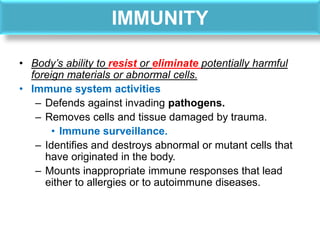
IMMUNITY
• Body’s ability to resist or eliminate potentially harmful
foreign materials or abnormal cells.
• Immune system activities
– Defends against invading pathogens.
– Removes cells and tissue damaged by trauma.
• Immune surveillance.
– Identifies and destroys abnormal or mutant cells that
have originated in the body.
– Mounts inappropriate immune responses that lead
either to allergies or to autoimmune diseases.
4
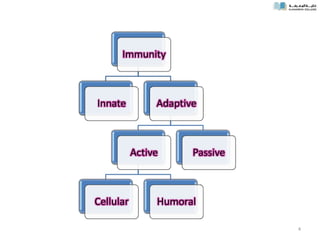
Immunity
Innate Adaptive
Active
Cellular Humoral
Passive
INNATE IMMUNITY
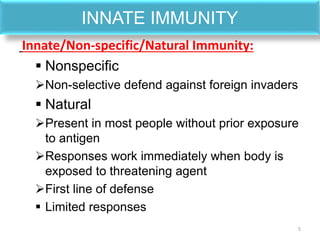
Innate/Non-specific/Natural Immunity:
 Nonspecific
Non-selective defend against foreign invaders
 Natural
Present in most people without prior exposure
to antigen
Responses work immediately when body is
exposed to threatening agent
First line of defense
 Limited responses
5
INNATE IMMUNITY
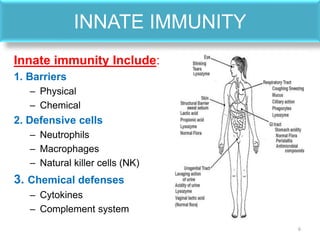
Innate immunity Include:
1. Barriers
– Physical
– Chemical
2. Defensive cells
– Neutrophils
– Macrophages
– Natural killer cells (NK)
3. Chemical defenses
– Cytokines
– Complement system
6
Physical and chemical barriers
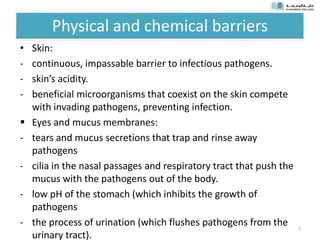
• Skin:
- continuous, impassable barrier to infectious pathogens.
- skin’s acidity.
- beneficial microorganisms that coexist on the skin compete
with invading pathogens, preventing infection.
 Eyes and mucus membranes:
- tears and mucus secretions that trap and rinse away
pathogens
- cilia in the nasal passages and respiratory tract that push the
mucus with the pathogens out of the body.
- low pH of the stomach (which inhibits the growth of
pathogens
- the process of urination (which flushes pathogens from the
urinary tract).
7
INFLAMMATION &NEUTROPHILS AND
MACROPHAGES ACTIVATION
• Inflammation: a protective response
involving immune cells, blood vessels, and
molecular mediators. The function of
inflammation is to eliminate the initial cause
of cell injury
• Neutrophils and macrophages are recruited to
the sites of injury: these cells kill
microorganisms/damaged cells by phagocytosis
.
8
Cytokines
• Low molecular weight proteins (30 KDa)
• Produced by white blood cells
• Cytokines regulate immune responses
INTERFERON(CYTOKINE)
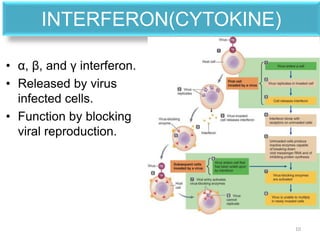
• α, β, and γ interferon.
• Released by virus
infected cells.
• Function by blocking
viral reproduction.
10
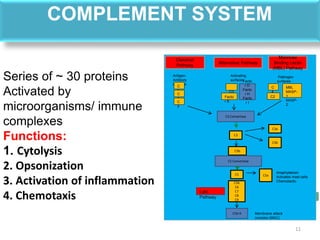
COMPLEMENT SYSTEM
Series of ~ 30 proteins
Activated by
microorganisms/ immune
complexes
Functions:
1. Cytolysis
2. Opsonization
3. Activation of inflammation
4. Chemotaxis
11
Continued next
page…
Classical
Pathway
Alternative Pathway
Mannose
Binding Lectin
(MBL) Pathway
Antigen-
Antibody
complex
Activating
surfaces
Pathogen
surfaces
C
1
C
4
C
2
C3
b
C
4
C2
MBL
MASP-
1
MASP-
2
C3 Convertase
C3b
C3b
C3a
C3
C5b-9
C5a
C5
C5 Convertase
Lytic
Pathway
C5b
C6
C7
C8
C9
Membrane attack
complex (MAC)
Anaphylatoxin
Activates mast cells
Chemotactic
Facto
r B
Facto
r D
Facto
r H
Facto
r I
ADAPTIVE IMMUNITY
• Adaptive or Acquired immunity
– Specific: Specifically targets foreign material to which
body has already been exposed
– Late: Body has taken time to prepare to attack
– Efficient:
o Ultimate weapon against most pathogens
o Responses are mediated by β and T lymphocytes
o Formation of memory cells allows system to react
more swiftly against specific invaders in the future
ADAPTIVE IMMUNITY
Two types:
1. Active immunity – direct encounter
with the antigen.
2. Passive immunity – without
encounter with the antigen
13
ADAPTIVE IMMUNITY
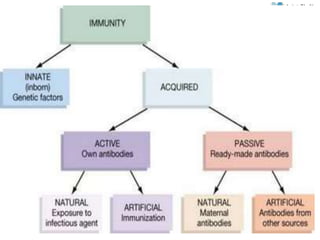
• Active immunity
– “self-generated”
– Results from exposure to an antigen.
– Encounter with the antigen can be:
o Natural when you get the disease
o Artificial: Vaccination
• Passive immunity
– “borrowed immunity”
– Results from transfer of preformed antibodies
– Can provide immediate protection
– Natural: Example of passive immunity is transfer of
IgG antibodies from mother to fetus
– Artificial: Tetanus toxins, anti snake venom, rabies
virus
ADAPTIVE IMMUNITY
• Antigen – “any substance when introduced into
the body stimulates immune response
– Bacteria, fungus, parasite
– Viral particles
– Other foreign material
• Pathogen – an Antigen which causes disease.
• Hapten – is not antigenic by itself. When combines
with protein it become an antigen
16
B AND T LYMPHOCYTES
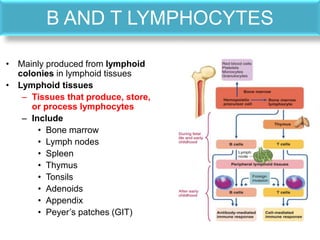
• Mainly produced from lymphoid
colonies in lymphoid tissues
• Lymphoid tissues
– Tissues that produce, store,
or process lymphocytes
– Include
• Bone marrow
• Lymph nodes
• Spleen
• Thymus
• Tonsils
• Adenoids
• Appendix
• Peyer’s patches (GIT)
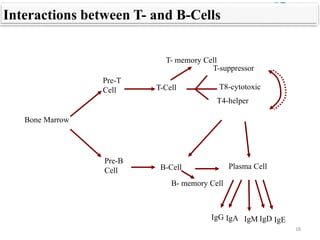
Bone Marrow
Pre-B
Cell
Pre-T
Cell T-Cell
T-suppressor
T4-helper
B-Cell Plasma Cell
IgG IgA IgM IgD IgE
Interactions between T- and B-Cells
T8-cytotoxic
T- memory Cell
B- memory Cell
18
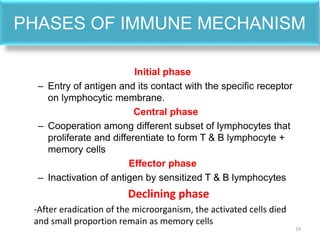
PHASES OF IMMUNE MECHANISM
Initial phase
– Entry of antigen and its contact with the specific receptor
on lymphocytic membrane.
Central phase
– Cooperation among different subset of lymphocytes that
proliferate and differentiate to form T & B lymphocyte +
memory cells
Effector phase
– Inactivation of antigen by sensitized T & B lymphocytes
Declining phase
-After eradication of the microorganism, the activated cells died
and small proportion remain as memory cells
19
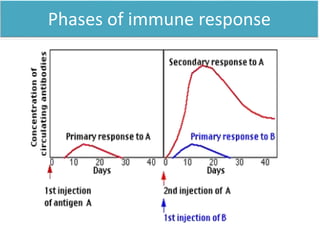
Characteristic of adaptive immunity
• Memory:
Two types of immune response:
- Primary immune response
- Secondary immune response
Phases of immune response
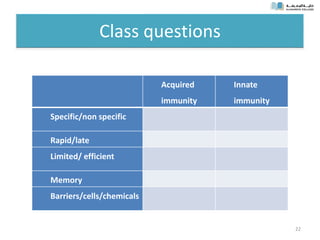
Class questions
Acquired
immunity
Innate
immunity
Specific/non specific
Rapid/late
Limited/ efficient
Memory
Barriers/cells/chemicals
22
Class questions
What is the type of immunity in each case?
Person receive corona vaccine
Person bites by a dog. He received anti-rabies
antibodies
Child receive Ig A antibodies from his mother
milk
Person who got corona infection
23
REFERENCES
 Human Physiology, Lauralee Sherwood, seventh
edition.
 Text book Physiology by Guyton &Hall,11th edition.
 Text book of Physiology by Linda S. Contanzo,
third edition.
 Physiology by Berne and Levy, sixth edition.
24

L7 Introducation to Immunity FINAL.pptx

  • 1.
    INTRODUCTION TO IMMUNITY Dr.Nisreen Daffa Alla M.B.B.S, PhD (Human Physiology), MSc health Profession Education 1
  • 2.
    OBJECTIVES The student shouldbe able to:  Discuss general overview of the immune system.  Differentiate between innate and adaptive immunity.  Identify the component of innate and adaptive immunity.  Define the term antigen, antibody and hapten.  Phases of immune response. 2
  • 3.
    IMMUNITY • Body’s abilityto resist or eliminate potentially harmful foreign materials or abnormal cells. • Immune system activities – Defends against invading pathogens. – Removes cells and tissue damaged by trauma. • Immune surveillance. – Identifies and destroys abnormal or mutant cells that have originated in the body. – Mounts inappropriate immune responses that lead either to allergies or to autoimmune diseases.
  • 4.
  • 5.
    INNATE IMMUNITY Innate/Non-specific/Natural Immunity: Nonspecific Non-selective defend against foreign invaders  Natural Present in most people without prior exposure to antigen Responses work immediately when body is exposed to threatening agent First line of defense  Limited responses 5
  • 6.
    INNATE IMMUNITY Innate immunityInclude: 1. Barriers – Physical – Chemical 2. Defensive cells – Neutrophils – Macrophages – Natural killer cells (NK) 3. Chemical defenses – Cytokines – Complement system 6
  • 7.
    Physical and chemicalbarriers • Skin: - continuous, impassable barrier to infectious pathogens. - skin’s acidity. - beneficial microorganisms that coexist on the skin compete with invading pathogens, preventing infection.  Eyes and mucus membranes: - tears and mucus secretions that trap and rinse away pathogens - cilia in the nasal passages and respiratory tract that push the mucus with the pathogens out of the body. - low pH of the stomach (which inhibits the growth of pathogens - the process of urination (which flushes pathogens from the urinary tract). 7
  • 8.
    INFLAMMATION &NEUTROPHILS AND MACROPHAGESACTIVATION • Inflammation: a protective response involving immune cells, blood vessels, and molecular mediators. The function of inflammation is to eliminate the initial cause of cell injury • Neutrophils and macrophages are recruited to the sites of injury: these cells kill microorganisms/damaged cells by phagocytosis . 8
  • 9.
    Cytokines • Low molecularweight proteins (30 KDa) • Produced by white blood cells • Cytokines regulate immune responses
  • 10.
    INTERFERON(CYTOKINE) • α, β,and γ interferon. • Released by virus infected cells. • Function by blocking viral reproduction. 10
  • 11.
    COMPLEMENT SYSTEM Series of~ 30 proteins Activated by microorganisms/ immune complexes Functions: 1. Cytolysis 2. Opsonization 3. Activation of inflammation 4. Chemotaxis 11 Continued next page… Classical Pathway Alternative Pathway Mannose Binding Lectin (MBL) Pathway Antigen- Antibody complex Activating surfaces Pathogen surfaces C 1 C 4 C 2 C3 b C 4 C2 MBL MASP- 1 MASP- 2 C3 Convertase C3b C3b C3a C3 C5b-9 C5a C5 C5 Convertase Lytic Pathway C5b C6 C7 C8 C9 Membrane attack complex (MAC) Anaphylatoxin Activates mast cells Chemotactic Facto r B Facto r D Facto r H Facto r I
  • 12.
    ADAPTIVE IMMUNITY • Adaptiveor Acquired immunity – Specific: Specifically targets foreign material to which body has already been exposed – Late: Body has taken time to prepare to attack – Efficient: o Ultimate weapon against most pathogens o Responses are mediated by β and T lymphocytes o Formation of memory cells allows system to react more swiftly against specific invaders in the future
  • 13.
    ADAPTIVE IMMUNITY Two types: 1.Active immunity – direct encounter with the antigen. 2. Passive immunity – without encounter with the antigen 13
  • 14.
    ADAPTIVE IMMUNITY • Activeimmunity – “self-generated” – Results from exposure to an antigen. – Encounter with the antigen can be: o Natural when you get the disease o Artificial: Vaccination • Passive immunity – “borrowed immunity” – Results from transfer of preformed antibodies – Can provide immediate protection – Natural: Example of passive immunity is transfer of IgG antibodies from mother to fetus – Artificial: Tetanus toxins, anti snake venom, rabies virus
  • 16.
    ADAPTIVE IMMUNITY • Antigen– “any substance when introduced into the body stimulates immune response – Bacteria, fungus, parasite – Viral particles – Other foreign material • Pathogen – an Antigen which causes disease. • Hapten – is not antigenic by itself. When combines with protein it become an antigen 16
  • 17.
    B AND TLYMPHOCYTES • Mainly produced from lymphoid colonies in lymphoid tissues • Lymphoid tissues – Tissues that produce, store, or process lymphocytes – Include • Bone marrow • Lymph nodes • Spleen • Thymus • Tonsils • Adenoids • Appendix • Peyer’s patches (GIT)
  • 18.
    Bone Marrow Pre-B Cell Pre-T Cell T-Cell T-suppressor T4-helper B-CellPlasma Cell IgG IgA IgM IgD IgE Interactions between T- and B-Cells T8-cytotoxic T- memory Cell B- memory Cell 18
  • 19.
    PHASES OF IMMUNEMECHANISM Initial phase – Entry of antigen and its contact with the specific receptor on lymphocytic membrane. Central phase – Cooperation among different subset of lymphocytes that proliferate and differentiate to form T & B lymphocyte + memory cells Effector phase – Inactivation of antigen by sensitized T & B lymphocytes Declining phase -After eradication of the microorganism, the activated cells died and small proportion remain as memory cells 19
  • 20.
    Characteristic of adaptiveimmunity • Memory: Two types of immune response: - Primary immune response - Secondary immune response
  • 21.
  • 22.
  • 23.
    Class questions What isthe type of immunity in each case? Person receive corona vaccine Person bites by a dog. He received anti-rabies antibodies Child receive Ig A antibodies from his mother milk Person who got corona infection 23
  • 24.
    REFERENCES  Human Physiology,Lauralee Sherwood, seventh edition.  Text book Physiology by Guyton &Hall,11th edition.  Text book of Physiology by Linda S. Contanzo, third edition.  Physiology by Berne and Levy, sixth edition. 24