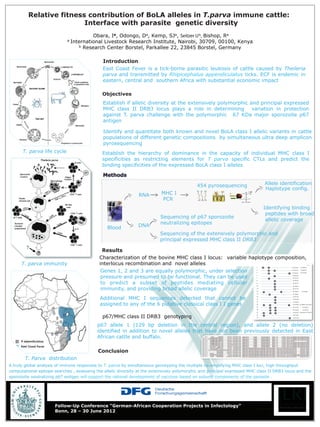
Relative fitness contribution of BoLA alleles in T.parva immune cattle:
                         Interface with parasite genetic diversity
                                        Obara, Ia, Odongo, Da, Kemp, SJa, Seitzer U b, Bishop, Ra
                             a International Livestock Research Institute, Nairobi, 30709, 00100, Kenya
                                  b Research Center Borstel, Parkallee 22, 23845 Borstel, Germany


                                              East Coast Fever is a tick-borne parasitic leukosis of cattle caused by Theileria
                                              parva and transmitted by Rhipicephalus appendiculatus ticks. ECF is endemic in
                                              eastern, central and southern Africa with substantial economic impact


                                              Establish if allelic diversity at the extensively polymorphic and principal expressed
                                              MHC class II DRB3 locus plays a role in determining            variation in protection
                                              against T. parva challenge with the polymorphic 67 KDa major sporozoite p67
                                              antigen

                                               Identify and quantitate both known and novel BoLA class I allelic variants in cattle
                                               populations of different genetic compositions by simultaneous ultra deep amplicon
                                               pyrosequencing
      T. parva life cycle                     Establish the hierarchy of dominance in the capacity of individual MHC class I
                                              specificities as restricting elements for T parva specific CTLs and predict the
                                              binding specificities of the expressed BoLA class I alleles


                                                                                             454 pyrosequencing                Allele identification
                                                                                                                               Haplotype config.
                                                                RNA         MHC I
                                                                            PCR
                                                                                                                               Identifying binding
                                                                                                                                peptides with broad
                                                                           Sequencing of p67 sporozoite
                                                                                                                                allelic coverage
                                                                           neutralizing epitopes
                                                 Blood          DNA
                                                                           Sequencing of the extensively polymorphic and
                                                                           principal expressed MHC class II DRB3


                                             Characterization of the bovine MHC class I locus: variable haplotype composition,
      T. parva immunity                      interlocus recombination and novel alleles
                                              Genes 1, 2 and 3 are equally polymorphic, under selection
                                              pressure and presumed to be functional. They can be used
                                              to predict a subset of peptides mediating cellular
                                              immunity, and providing broad allelic coverage
                                             Additional MHC I sequences detected that cannot be
                                             assigned to any of the 6 putative classical class I I genes

                                              p67/MHC class II DRB3 genotyping
                                            p67 allele 1 (129 bp deletion in the central region), and allele 2 (no deletion)
                                            identified in addition to novel alleles that have not been previously detected in East
                                            African cattle and buffalo.


       T. Parva distribution
A truly global analysis of immune responses to T. parva by simultaneous genotyping the multiple co-amplifying MHC class I loci, high throughput
computational epitope searches , assessing the allelic diversity at the extensively polymorphic and principal expressed MHC class II DRB3 locus and the
sporozoite neutralizing p67 antigen will support the rational development of vaccines based on subunit components of the parasite .

Relative fitness contribution of BoLA alleles in T.parva immune cattle: interface

  • 1.
    Relative fitness contributionof BoLA alleles in T.parva immune cattle: Interface with parasite genetic diversity Obara, Ia, Odongo, Da, Kemp, SJa, Seitzer U b, Bishop, Ra a International Livestock Research Institute, Nairobi, 30709, 00100, Kenya b Research Center Borstel, Parkallee 22, 23845 Borstel, Germany East Coast Fever is a tick-borne parasitic leukosis of cattle caused by Theileria parva and transmitted by Rhipicephalus appendiculatus ticks. ECF is endemic in eastern, central and southern Africa with substantial economic impact Establish if allelic diversity at the extensively polymorphic and principal expressed MHC class II DRB3 locus plays a role in determining variation in protection against T. parva challenge with the polymorphic 67 KDa major sporozoite p67 antigen Identify and quantitate both known and novel BoLA class I allelic variants in cattle populations of different genetic compositions by simultaneous ultra deep amplicon pyrosequencing T. parva life cycle Establish the hierarchy of dominance in the capacity of individual MHC class I specificities as restricting elements for T parva specific CTLs and predict the binding specificities of the expressed BoLA class I alleles 454 pyrosequencing Allele identification Haplotype config. RNA MHC I PCR Identifying binding peptides with broad Sequencing of p67 sporozoite allelic coverage neutralizing epitopes Blood DNA Sequencing of the extensively polymorphic and principal expressed MHC class II DRB3 Characterization of the bovine MHC class I locus: variable haplotype composition, T. parva immunity interlocus recombination and novel alleles Genes 1, 2 and 3 are equally polymorphic, under selection pressure and presumed to be functional. They can be used to predict a subset of peptides mediating cellular immunity, and providing broad allelic coverage Additional MHC I sequences detected that cannot be assigned to any of the 6 putative classical class I I genes p67/MHC class II DRB3 genotyping p67 allele 1 (129 bp deletion in the central region), and allele 2 (no deletion) identified in addition to novel alleles that have not been previously detected in East African cattle and buffalo. T. Parva distribution A truly global analysis of immune responses to T. parva by simultaneous genotyping the multiple co-amplifying MHC class I loci, high throughput computational epitope searches , assessing the allelic diversity at the extensively polymorphic and principal expressed MHC class II DRB3 locus and the sporozoite neutralizing p67 antigen will support the rational development of vaccines based on subunit components of the parasite .