1
Immersive Storytelling and AI-Powered Performance Marketing (ISAPM)
©Jayakumar K, 2024-25
Immersive Storytelling and AI-Powered
Performance Marketing (ISAPM)
Search & Display advertisements in new Dimensions
© Copyright 2024-25, Prepared by Jayakumar K
This book, “Immersive Storytelling and AI-Powered Performance Marketing (ISAPM),” was
meticulously prepared by Jayakumar K exclusively for New Media Training purposes. The content within
this book has been curated from a variety of sources, including books, websites, and blogs related to
Digital/Web Journalism. The information and materials ("the Content") presented in this material is intended
for educational purposes and should not be reproduced or used for commercial gain without permission.
All rights reserved by Jayakumar K. For any further assistance or inquiries, please contact the author
through the provided email addresses.
All images, logos, graphics, and their selection and arrangement are the property of their respective content
providers and are protected by international copyright laws. Certain logos are registered trademarks of the
content providers referenced and are not to be infringed upon.
Please direct any queries, suggestions, or feedback regarding this study material to mail@kjayakumar.in
or kjay_kumar@yahoo.com. For more information about the author, visit www.kjayakumar.in.
2
Immersive Storytelling and AI-Powered Performance Marketing (ISAPM)
©Jayakumar K, 2024-25
Contents
1 Digital Advertising - Search & Display...................................................................................................4
1.1 Search & Display advertisements in new Dimensions...................................................................4
1.2 Digital Advertising Categories........................................................................................................4
1.2.1 Search Engine Advertising (SEA)..........................................................................................4
1.2.2 Display Advertising ................................................................................................................5
1.3 Trend Analysis...............................................................................................................................6
1.4 Keyword Research ........................................................................................................................6
1.5 Google Analytics Integration..........................................................................................................6
2 Effective Strategies in Paid Advertising ................................................................................................6
2.1 Targeting Strategies ......................................................................................................................7
2.2 Advertising Strategies....................................................................................................................7
2.3 Optimization Strategies..................................................................................................................8
3 Performance Metrics in Digital Advertising............................................................................................8
3.1 Pay Per Click (PPC) ......................................................................................................................8
3.2 CTR: Click Through Rate...............................................................................................................8
3.3 CPC: Cost-Per-Click......................................................................................................................9
3.4 CPA: Cost-Per-Acquisition...........................................................................................................10
3.5 CR: Conversion Rate...................................................................................................................11
4 A Comprehensive Guide about Adv Platforms....................................................................................11
4.1 Google AdWords MCC Account Creation and Management .......................................................12
4.2 Contextual Targeting and Display Campaign Optimization..........................................................12
4.3 Different Type of Ads/ Campaigns...............................................................................................13
4.3.1 Search Ads..........................................................................................................................13
4.3.2 Display Ads..........................................................................................................................14
4.3.3 Mobile Ads...........................................................................................................................15
4.3.4 You Tube Ads......................................................................................................................15
4.3.5 Facebook Ads......................................................................................................................16
4.3.6 Instagram Ads......................................................................................................................17
4.3.7 WhatsApp Ads.....................................................................................................................17
4.3.8 Twitter Ads...........................................................................................................................17
4.3.9 LinkedIn Ads........................................................................................................................18
5 Return on Investment (ROI) Attributes in Advertising..........................................................................19
5.1 Bid Rate Management.................................................................................................................19
5.2 Remarketing ................................................................................................................................19
5.2.1 Remarketing List for Search Ad...........................................................................................19
5.3 Look-Alike Audience....................................................................................................................20
5.4 Programmatic Advertising............................................................................................................20
5.5 Methods to Improve Conversion Rate & ROI...............................................................................20
5.6 Negative Keywords......................................................................................................................20
5.7 Click through Rate (CTR) ............................................................................................................21
5.8 Threshold Frequency...................................................................................................................21
5.9 Reach and Frequency report.......................................................................................................21
5.10 Ad Annotations or Extensions..................................................................................................21
5.10.1 APP Extensions...............................................................................................................21
5.10.2 Call Extensions................................................................................................................22
3
Immersive Storytelling and AI-Powered Performance Marketing (ISAPM)
©Jayakumar K, 2024-25
5.10.3 Location Extensions.........................................................................................................22
5.10.4 Review Extensions ..........................................................................................................23
5.10.5 Sitelink Extensions...............................................................................................................23
5.10.6 Call out extensions ..........................................................................................................24
5.11 Optimized Ads .........................................................................................................................25
5.11.1 Ad Storytelling..................................................................................................................25
5.11.2 Video Ads and View Hours..............................................................................................25
5.11.3 Responsive Display Ads..................................................................................................25
5.11.4 Cross device Conversions (CDC)....................................................................................26
5.11.5 Universal App Campaign (UAC) ......................................................................................26
5.11.6 Expandable Text Ads (ETAs)...........................................................................................26
5.11.7 Rich Media Ads (RMA) ....................................................................................................27
5.11.8 LightBox Ads (LBA) .........................................................................................................27
5.11.9 Mail Sponsored promotions.............................................................................................27
5.12 Latest Types of Ads.................................................................................................................28
5.13 Most common best Practices and policy mistakes...................................................................28
5.13.1 Best practices..................................................................................................................28
5.13.2 Common Mistakes...........................................................................................................28
6 Ads Creativity and Performance at Scale with Google AI ...................................................................29
6.1 Scaling Creative Production in Line with Brand Standards:.........................................................29
6.2 Creating High-Performing Ads with Google AI:............................................................................30
6.3 Bringing Creative to Life with New Immersive Ad Experiences:...................................................30
6.4 Driving Results Through Visual Storytelling:................................................................................30
6.5 Creating Opportunities to Help Consumers Along Their Information Journey:.............................30
6.6 Improving Results with a Strong Foundation of Measurement:....................................................31
6.7 Putting Google AI to Work for Businesses:..................................................................................31
7 The Future of Digital Advertising.........................................................................................................31
8 Building a Digital Advertising Career...................................................................................................31
8.1 Skills and Qualifications:..............................................................................................................31
8.2 Career Paths: ..............................................................................................................................32
8.3 Resources and Networking:.........................................................................................................32
8.4 Tips for Success:.........................................................................................................................32
9 Free Online Digital Certification Programs..........................................................................................32
10 Additional Resources.......................................................................................................................33
11 Conclusion.......................................................................................................................................34
12 Acronyms used in this book.............................................................................................................34
4
Immersive Storytelling and AI-Powered Performance Marketing (ISAPM)
©Jayakumar K, 2024-25
1 Digital Advertising - Search & Display
1.1 Search & Display advertisements in new Dimensions
Welcome to "Immersive Storytelling and AI-Powered Performance Marketing (ISAPM)"!
This course is designed to explore the transformative power of artificial intelligence in
digital advertising, focusing on how AI can elevate storytelling and drive performance
across search and display advertisements. As we delve into the realm of AI-powered
marketing, we'll uncover how cutting-edge technologies and innovative strategies can
help businesses create more engaging, personalized, and effective ad campaigns.
In an era where digital presence is paramount, understanding the mechanics and
strategies behind AI-driven digital advertising is essential for businesses looking to stand
out. This course will guide you through the essential aspects of immersive storytelling and
AI-powered performance marketing, providing insights into various techniques, tools, and
best practices. By the end of this course, you'll be equipped with the knowledge and skills
to harness the power of AI in your digital advertising efforts, ensuring your campaigns are
both impactful and efficient.
1.2 Digital Advertising Categories
Digital advertising is broadly classified into two major categories: Search Engine
Advertising (SEA) and Display Advertising. These categories encompass the primary
methods by which businesses can promote their products and services online, reaching
a diverse audience through various digital platforms.
1.2.1 Search Engine Advertising (SEA)
Search Engine Advertising (SEA) is a highly effective method of increasing web traffic to
your site by placing digital advertisements on search engine results pages (SERPs). This
type of advertising allows businesses to bid on keywords relevant to their products or
services so that their ads appear alongside organic search results when users search for
those keywords. The goal of SEA is to boost click-through rates (CTR) and drive targeted
traffic to your site.
Key elements of SEA include:
▪ Keyword Research and Selection: Identifying and targeting specific keywords
that your potential customers are likely to use when searching for products or
services similar to yours.
▪ Ad Copy and Creativity: Crafting focused and compelling ad copy that resonates
with your target audience and encourages them to click on your ad.
▪ Budget Management: Allocating a budget for your Google Ads campaigns, which
can be adjusted based on performance and business goals. How much you spend
is entirely up to you, allowing for flexible and scalable advertising strategies.
▪ Bid Management: Setting bids for each keyword to determine how much you are
willing to pay for a click. Higher bids can improve ad placement and visibility, but
it's crucial to balance costs with expected returns.
5
Immersive Storytelling and AI-Powered Performance Marketing (ISAPM)
©Jayakumar K, 2024-25
▪ Performance Tracking and Optimization: Continuously monitoring ad
performance using metrics such as CTR, conversion rates, and return on ad spend
(ROAS). Making data-driven adjustments to improve campaign effectiveness.
SEA offers the advantage of reaching users who are actively searching for information
related to your business, making it a powerful tool for generating high-quality leads and
driving conversions.
1.2.2 Display Advertising
Display Advertising is a form of digital advertising that uses visual elements to convey a
commercial message to users. This can include text, logos, animations, videos,
photographs, or other graphics. Display ads are typically shown on websites, social media
platforms, and apps that are part of a display network, such as Google Display Network
or Facebook Audience Network.
Key elements of Display Advertising include:
▪ Visual Creativity: Creating visually appealing ads that capture the attention of
users. This includes the use of high-quality images, engaging videos, and
attractive animations.
▪ Targeted Audience: Display advertisers frequently target users with specific traits,
interests, or behaviors to increase the effectiveness of their ads. This targeting can
be based on demographics, interests, browsing behavior, or contextual relevance.
▪ Ad Formats: Utilizing various ad formats such as banner ads, interstitial ads, rich
media ads, and video ads to engage users across different platforms and devices.
▪ Brand Awareness: Display advertising is particularly effective for building brand
awareness and recognition. Even if users do not click on the ads, repeated
exposure to the visual elements can enhance brand recall.
▪ Retargeting: Implementing retargeting strategies to show ads to users who have
previously visited your website or interacted with your brand. This helps in re-
engaging potential customers and encouraging them to complete a purchase or
take another desired action.
▪ Performance Measurement: Monitoring the performance of display ads using
metrics like impressions, CTR, engagement rates, and conversion rates. Adjusting
campaigns based on performance data to optimize results.
Display advertising offers the advantage of reaching a broad audience and creating a
strong visual impact. It is particularly useful for brand-building efforts and engaging users
who may not be actively searching for your products or services but are likely to be
interested based on their online behavior and interests.
By leveraging both SEA and Display Advertising, businesses can create comprehensive
digital advertising strategies that maximize their reach and impact across different stages
of the customer journey.
6
Immersive Storytelling and AI-Powered Performance Marketing (ISAPM)
©Jayakumar K, 2024-25
1.3 Trend Analysis
Trend analysis involves examining market trends to identify patterns and opportunities for
advertising. Understanding trends helps advertisers stay ahead of the competition and
tailor their strategies to current market conditions.
▪ Tools for Trend Analysis: Google Trends, BuzzSumo, TrendSpottr
▪ Applying Trends to Advertising Strategies: Use trend data to create timely and
relevant ads that resonate with the target audience.
1.4 Keyword Research
Keyword research involves identifying the words and phrases that potential customers
use when searching for products or services online. Effective keyword research helps in
creating ads that are relevant to the audience, increasing the likelihood of clicks and
conversions.
Tools for Keyword Research: Google Keyword Planner, SEMrush, Ahrefs
1.5 Google Analytics Integration
Integrating Google Analytics with your ad campaigns helps in tracking and analyzing user
behavior, providing insights to improve ad performance.
▪ Setting Up Google Analytics: Link Google Analytics with your ad accounts
▪ Using Analytics to Improve Ad Performance: Analyze user data to optimize ad
targeting, creatives, and landing pages.
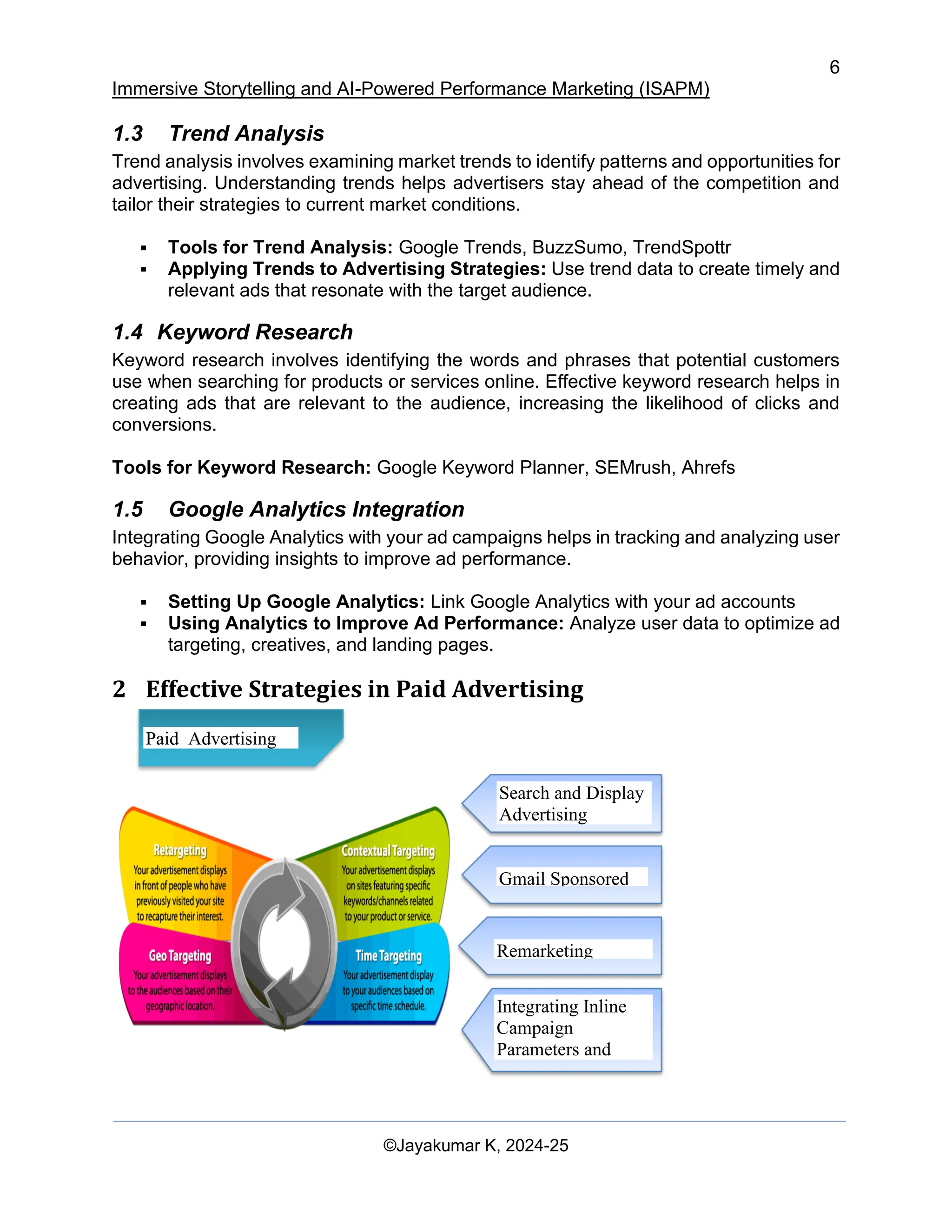
2 Effective Strategies in Paid Advertising
Search and Display
Advertising
Gmail Sponsored
Promotions
Remarketing
Integrating Inline
Campaign
Parameters and
Cross Device
Paid Advertising
7
Immersive Storytelling and AI-Powered Performance Marketing (ISAPM)
©Jayakumar K, 2024-25
2.1 Targeting Strategies
Retargeting: Retargeting involves using cookies to track visitors who have previously
interacted with your website. By showing them tailored ads that remind and encourage
them to return and complete a purchase, you can effectively capture their interest again.
For instance, if a user added items to their cart but didn't check out, you can use
retargeting ads to display those specific products, prompting them to complete the
transaction.
Geo Targeting: Geo targeting customizes your ads based on the geographic location of
your audience. This involves utilizing location-based keywords and ad copy to make the
ads more relevant and engaging for users in specific areas. For example, a restaurant
can target ads to users within a certain radius, promoting local deals or events.
Contextual Targeting: Contextual targeting selects keywords and topics that align
closely with your product or service. By placing your ads on websites and content that
match these keywords, you can attract a more interested audience. For example, an
outdoor gear company could place ads on travel blogs and adventure websites to reach
potential customers who are already interested in related topics.
Time Targeting: Time targeting involves analyzing your audience's behavior to
determine the optimal times for displaying your ads. By scheduling your campaigns to run
during these peak times, you can maximize engagement and conversions. For instance,
a business might find that its audience is most active during the evening and schedule
ads accordingly to capture their attention when they are most likely to respond.
2.2 Advertising Strategies
Search and Display Advertising: Combining search ads, which appear on search
engine results pages, with display ads that are shown on various websites, can help
increase visibility and reach a wider audience. Search ads target users actively looking
for specific information, while display ads capture the attention of users browsing related
content, thus complementing each other and enhancing overall campaign performance.
Gmail Sponsored Ads: Gmail Sponsored Promotions place your ads directly in users'
Gmail inboxes. By targeting users based on their interests, demographics, and past
interactions, you can increase the relevance of your ads. For example, promoting a new
product launch to users who have shown interest in similar products can lead to higher
engagement and conversion rates.
Remarketing: Remarketing strategies re-engage users who have previously visited your
site but did not convert. By using customized ads to encourage them to return and
complete the desired action, you can improve conversion rates. For instance, offering a
discount to users who abandoned their shopping cart can incentivize them to finalize their
purchase.
8
Immersive Storytelling and AI-Powered Performance Marketing (ISAPM)
©Jayakumar K, 2024-25
2.3 Optimization Strategies
To enhance your retargeting efforts, segment your audience based on their behavior and
interests, and create personalized ad content that directly addresses their needs and
encourages them to return. For geo targeting, analyze the performance of your ads in
different geographic locations and adjust your targeting accordingly, using location-
specific keywords and tailored ad copy. In contextual targeting, continuously refine your
keyword and topic selection to ensure your ads are placed on the most relevant websites,
monitoring performance and using A/B testing for best results. For time targeting, use
analytics to identify peak times for audience engagement, schedule campaigns during
these times, and adjust your bidding strategy to allocate more budget during high-
performing periods. In search and display advertising, focus on keyword relevance, ad
copy quality, and landing page experience to improve Quality Score and lower costs,
while experimenting with different formats, placements, and creatives for display ads. For
Gmail Sponsored Ads, craft compelling subject lines and preview text to increase open
rates, segmenting your audience for relevance, and monitoring engagement metrics. In
remarketing, segment your audience based on interactions with your site, create tailored
ads, experiment with different formats and messages, and use frequency capping to avoid
overexposure and ad fatigue. Implementing these optimization strategies can enhance
the effectiveness of your paid advertising campaigns, delivering better results and higher
returns on investment.
3 Performance Metrics in Digital Advertising
Digital advertising campaigns can be optimized and evaluated through various
performance metrics, often referred to as the 4 Big Cs of paid search advertising. These
metrics help in understanding the effectiveness of your campaigns and provide strategies
for improvement.
3.1 Pay Per Click (PPC)
PPC (pay-per-click) Ads, are advertisements in which the cost of advertising is
determined by the number of clicks an ad receives. A model of internet marketing in which
advertisers pay a fee each time one of their Ads is clicked.
The success of your PPC campaign depends on how well you manage and optimize the
4 Big Cs of paid search advertising. The following terms highlights the importance of each
of these metrics/tactics of the PPC effectiveness, and also highlights proven strategies
on how to optimize them.
3.2 CTR: Click Through Rate
Is a ratio of the number of times your ad was clicked (Click) to the number of times it was
displayed (Impression) on a search engine.
CTR = Clicks/Impressions
Example - If your ad has received 10 clicks and it was displayed 500 times, your CTR
would be 2%.
9
Immersive Storytelling and AI-Powered Performance Marketing (ISAPM)
©Jayakumar K, 2024-25
Why Is CTR Important?
1. A higher CTR results in lowering of Cost-per-click at campaign level.
2. A higher CTR will ensure a higher Quality Score of the keywords.
3. Higher the CTR, greater are the chances of conversions & improved Conversion rate.
Top 3 Strategies to Improve CTR
1. Include Keywords In Your Ad Copy: Ad Copy with a keyword in the headline is
the ideal strategy for achieving a healthy CTR. For example, if you are selling
mobiles phones online, inclusion of ‘Mobile Phones Online’ in the headline will
ensure ad relevancy to the search query entered, resulting in a greater chance of
a click.
2. Usage of Ad Extensions: Ad extensions are your friends that always come to
your rescue when you need to improve CTR. We have a great option of choosing
from a variety of ad extensions that are offered by the search marketing programs.
For example:
Sitelinks with additional information not only increase the space occupied on a
Search engine results page but each link acts as a separate ad copy giving an end
user more information as well as reason for clicking on the ad copy resulting in
improved CTR.
Review Extensions help-built credibility of your brand.
Location extensions encourage people to visit you in person, and on an average
as per Google, an ad with location extensions sees a 10% boost in Clickthrough
rate.
3. Strong Negative Keyword List: A strong negative keyword list is as important as
your keyword inventory. Negative keywords not only ensure that you do not spend
on unnecessary traffic but also helps in displaying your Ads on the right search
query. This results in controlled impressions and improved CTR.
3.3 CPC: Cost-Per-Click
Is the amount you pay for a click, Cost per click depends on the maximum bid and quality
score of a keyword.
Why Is CPC Important?
1. The ROI of paid campaigns depends on the amount you are spending per click.
2. Clicks at a lower cost will lower your Cost-per acquisition.
3. The value of each click is essential for a campaign’s success.
Top 3 Strategies for Lowering CPC
10
Immersive Storytelling and AI-Powered Performance Marketing (ISAPM)
©Jayakumar K, 2024-25
1. Bid on Relevant Keywords Only: Building your keyword inventory with only
relevant & a few keywords will help in lowering CPC. Including long tail keywords
in your inventory will further reduce CPC as they are less expensive.
2. Highly Themed Ad Groups: Closely knit keywords in an ad group with relevant
ad copy & landing page will result in a better Quality Score and reduced CPC.
3. Do Not Bid on Broad Match Type: Keywords in broad match attract a lot of
irrelevant traffic resulting in increased impressions and lower CTR. As a result the
overall Quality Score is affected & this can lead to increased CPC. Trying out Exact
& Phrase match to increase relevance is a better approach in lowering the CPC.
3.4 CPA: Cost-Per-Acquisition
The amount that you pay for the action taken by the prospect on your website.
CPA = Total Cost/Conversions
Why Is CPA Important?
1. Lower the CPA, higher the ROI on paid campaigns.
2. Low CPA is an indicator of a well optimized campaigns.
3. A Low CPA also reflects how efficiently the budget is being utilized on an ad.
Top 3 Strategies for Lowering CPA
1. Better Campaign Structure: A closely knit campaign structure with highly
relevant keywords in ad groups and ad copy that are relevant to landing page will
increase the chances of a click, resulting in improved CTR and Quality Score.
Higher the Quality Score, lower the CPC and hence the resultant is a lower CPA.
2. Multiple Asset Testing: For a B2B account, trying out different assets like a white
paper download, product demos, free trial download, product guides or
Infographics would be recommended to know which asset converts at a lower CPA
with increased ROI.
3. Bid Higher at Converting Hours: If you want to know the peak hours for your
business you can always turn to the hourly performance report that is available in
the account. Identifying the converting hours at lower CPA and increasing the bids
to improve ad positions during these hours ensures that the chances of
conversions are increased. Lowering the bids at non-converting hours or higher
CPA hours will ensure that the CPA is controlled.
11
Immersive Storytelling and AI-Powered Performance Marketing (ISAPM)
©Jayakumar K, 2024-25
3.5 CR: Conversion Rate
Is a ratio of conversions to clicks during the same time period?
CR – Conversions/Clicks
Why Is CR Important?
1. CR is the indicator of a healthy account.
2. CR helps in calculating the ROI.
3. CR helps access the success rate of the asset promoted & helps you take a more
informed decision on the assets for promotion.
Top 3 Strategies for Improving CR
1. A Great Landing Page: Once the end user lands on the landing page, having
engaging content and asset, as promised in the ad copy increases the chances of
the customer signing up and downloading the asset. As Conversions increase, so
does the CR.
2. Compelling Ad Copy: Including unique selling points or distinguishing features
from competitors will capture end user attention and compel him to click on your
ad, as a result the conversion chances are increased and this results in improved
CR.
3. Search Term Analysis: Validating the search queries on a regular basis helps
reduce the junk clicks that happen due to irrelevant queries. This results in lower
spend and a higher CR. To sum up, these four Cs form the basis of your PPC
engagement. Right from the dollars spent to the successful conversions that you
receive, everything can be optimized if these campaign essentials are taken care
of. Regularly monitoring their trends and optimizing to better these parameters
helps in improving the account’s health.
4 A Comprehensive Guide about Adv Platforms
Meta Business Suite (MBS), Instagram Ads, WhatsApp Ads, and Google AdWords MCC:
Meta Business Suite and Ads Manager
Meta Business Suite and Ads Manager are robust tools designed to help businesses
manage and optimize their Facebook and Instagram ad campaigns efficiently. Here’s a
breakdown of how to utilize these tools effectively:
▪ Navigating Meta Ads Manager: This tool allows you to create, manage, and
analyze ads seamlessly. It's essential to familiarize yourself with its interface and
features to maximize your advertising potential.
▪ Creating and Managing Ads: Use Meta Business Suite to schedule posts,
manage ad accounts, and analyze performance. This integration simplifies the ad
management process, enabling better campaign oversight and optimization.
12
Immersive Storytelling and AI-Powered Performance Marketing (ISAPM)
©Jayakumar K, 2024-25
4.1 Google AdWords MCC Account Creation and Management
My Client Centre (MCC), also known as an umbrella account, is a powerful tool for
managing multiple Google AdWords accounts without the hassle of logging in and out of
each account:
▪ AdWords Overview: Google AdWords allows businesses to display ads on
Google and its advertising network. AdWords is highly focused on keyword
targeting, enabling businesses to set budgets and only pay when people click the
ads.
▪ Creating an MCC Account: MCC simplifies the management of multiple AdWords
accounts by linking them under one umbrella account. This setup streamlines
account management and enhances efficiency.
4.2 Contextual Targeting and Display Campaign Optimization
Google AdWords offers various targeting methods and optimization strategies to enhance
the performance of display campaigns:
Contextual Targeting: This method matches your ads to relevant sites based on the
keywords or topics you’ve chosen. It ensures your ads appear on sites, apps, and web
pages that are part of the Display Network.
Display Campaign Optimization (DCO): Optimizing a display campaign involves
several considerations to ensure maximum effectiveness. Key factors include:
✓ Ad Group & Keyword Performance: Regularly review and adjust ad groups and
keywords to maintain relevance and effectiveness.
✓ Ad Performance: Continuously monitor and tweak ads to improve engagement
and conversion rates.
✓ Device Performance: Analyze how your ads perform across different devices and
optimize accordingly.
✓ Placement Performance: Identify the best-performing placements and allocate
budget to maximize returns.
✓ Geographic Performance: Tailor your campaigns based on geographic
performance data to target high-converting regions.
✓ Hour of Day and Day of Week Performance: Optimize ad scheduling to ensure
ads run at times when your target audience is most active.
✓ Conversion Performance: Track conversions to measure the effectiveness of
your campaigns and make necessary adjustments.
✓ Category Exclusions: Exclude irrelevant categories to prevent your ads from
appearing on non-performing sites.
✓ Reach and Frequency: Balance reach and frequency to avoid ad fatigue and
maintain audience engagement.
✓ Demographic Performance: Utilize demographic data to target specific audience
segments more effectively.
13
Immersive Storytelling and AI-Powered Performance Marketing (ISAPM)
©Jayakumar K, 2024-25
By integrating these comprehensive strategies and tools, businesses can enhance their
digital advertising efforts across multiple platforms, leading to improved engagement,
higher conversion rates, and greater overall success.
4.3 Different Type of Ads/ Campaigns
There are various types of digital advertising campaigns, each suited for different goals
and platforms.
▪ Overview of Campaign Types: Search ads, display ads, social media ads, video
ads, email ads
▪ Selecting the Right Campaign Type: Match campaign type to advertising goals
and target audience.
▪ Best Practices for Each Campaign Type: Tailor strategies for maximum
effectiveness.
Ad Formats: Digital ads come in various formats, each with unique benefits and use
cases.
▪ Overview of Ad Formats: Text ads, image ads, video ads, carousel ads,
sponsored content
▪ Selecting the Right Ad Format: Choose based on platform, audience, and
campaign goals.
Best Practices for Each Ad Format: Optimize creatives for engagement and
conversions.
The different types of Ads
▪ Search Ads
▪ Display Ads
▪ Mobile Ads
▪ Rich Text Ads
▪ Carousel Ads
▪ Mail sponsored Ads
▪ Remarketing Ads
▪ You Tube Ads
Implement Keywords in Ads: Use keywords in ad headlines, descriptions, and landing
pages to improve ad relevance and performance.
4.3.1 Search Ads
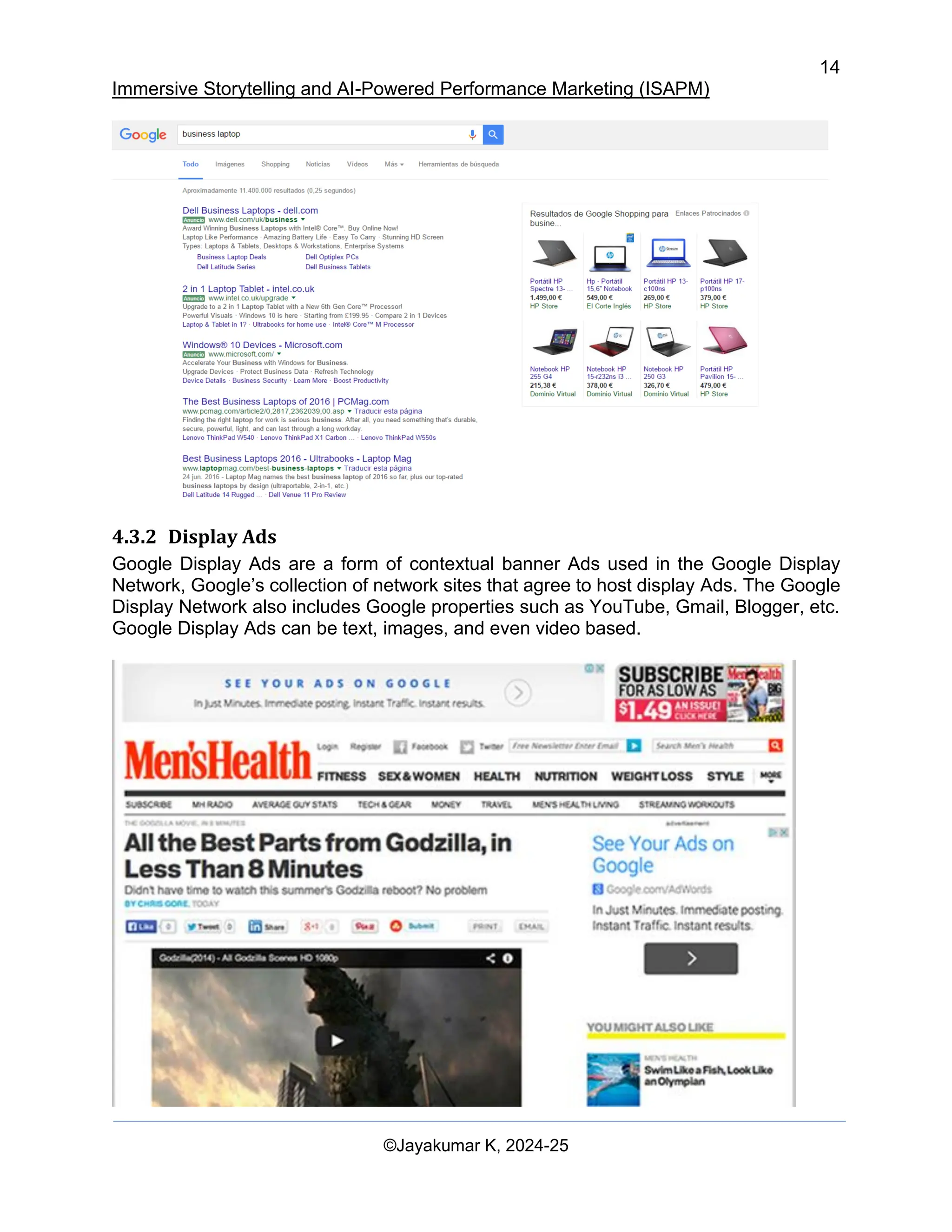
Google search Ads are online Ads that appear alongside the search engine result page
when users search a keyword query on Google. These Ads are PPC, or pay-per-click
Ads, in which advertisers pay for each ad click.
14
Immersive Storytelling and AI-Powered Performance Marketing (ISAPM)
©Jayakumar K, 2024-25
4.3.2 Display Ads
Google Display Ads are a form of contextual banner Ads used in the Google Display
Network, Google’s collection of network sites that agree to host display Ads. The Google
Display Network also includes Google properties such as YouTube, Gmail, Blogger, etc.
Google Display Ads can be text, images, and even video based.
15
Immersive Storytelling and AI-Powered Performance Marketing (ISAPM)
©Jayakumar K, 2024-25
4.3.3 Mobile Ads
Mobile Ads are Ads that appear on smart phones, tablets, and any other mobile device.
Many social media platforms, websites, and apps offer their own unique mobile ad
options.
4.3.4 You Tube Ads
YouTube Ads are Ads that appear on Google’s video-sharing site. Since Google obtained
ownership of YouTube, advertising in it has become easy and customizable. YouTube
advertisements can appear as banner Ads, in-video overlay Ads, in-stream video Ads
“I’m searching for…”
“I want to buy...”
16
Immersive Storytelling and AI-Powered Performance Marketing (ISAPM)
©Jayakumar K, 2024-25
(which are video Ads that appear before or during another YouTube video), as well as
several other setups.
4.3.5 Facebook Ads
Facebook advertising allows businesses to promote custom Ads or content targeting a
specific audience, with costs varying based on the reach and engagement the ad
receives. Facebook Ads can appear in your target audience’s News Feed or right column
of Facebook. When you advertise on Facebook, you’ll gain insight about your current and
potential audience. The data you collect through Facebook Ads allows you to improve
your ad targeting for a more efficient and effective advertising experience.
17
Immersive Storytelling and AI-Powered Performance Marketing (ISAPM)
©Jayakumar K, 2024-25
4.3.6 Instagram Ads
Instagram is a powerful platform for visual advertising, offering businesses a unique
opportunity to reach a highly engaged audience. Effective Instagram ads require careful
planning and execution:
• Creating Effective Instagram Ads: Use high-quality images and videos, craft
compelling captions, and utilize relevant hashtags to enhance your ad’s visibility
and engagement.
• Analyzing Instagram Ad Performance: Instagram Insights is a valuable tool for
tracking ad performance. Use this data to make informed, data-driven decisions to
refine and improve your ad strategies.
4.3.7 WhatsApp Ads
WhatsApp Ads offer a direct and personalized way to connect with customers. This
advertising method is highly engaging and can significantly enhance customer
interactions:
• Creating and Managing WhatsApp Ads: Utilize the WhatsApp Business API to
create ads and manage customer interactions. This API facilitates personalized
messaging and multimedia use.
• Best Practices for WhatsApp Ads: Personalize messages to each recipient, use
multimedia content to make messages more engaging, and ensure timely
responses to maintain customer interest and satisfaction.
4.3.8 Twitter Ads
Twitter Ads objective based campaigns are designed to help you achieve results that
drive action and add value to your business. Track your impressions, results and cost-
per-result across all your different campaign objectives. Targeting capabilities help you
get in front of people who are interested in your business.
18
Immersive Storytelling and AI-Powered Performance Marketing (ISAPM)
©Jayakumar K, 2024-25
4.3.9 LinkedIn Ads
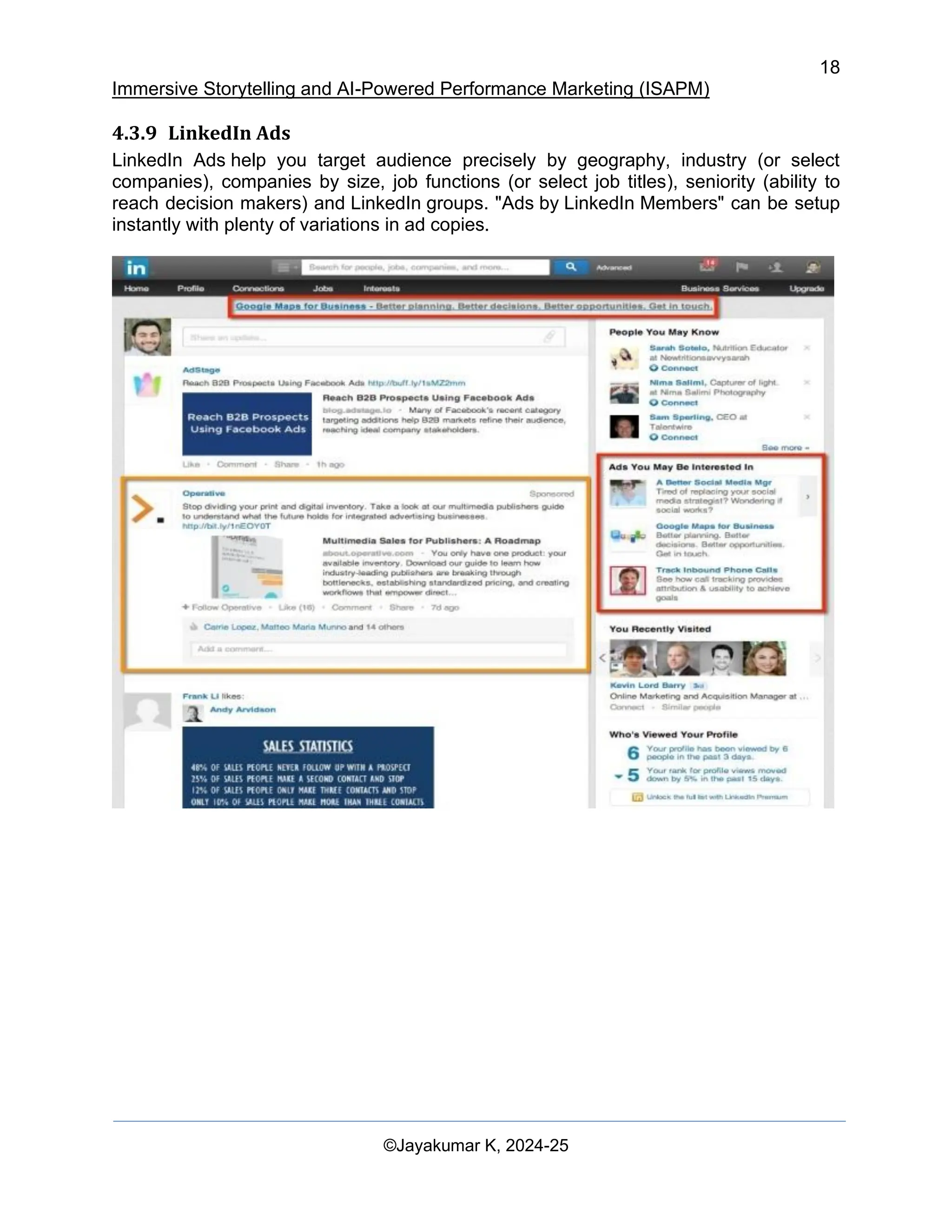
LinkedIn Ads help you target audience precisely by geography, industry (or select
companies), companies by size, job functions (or select job titles), seniority (ability to
reach decision makers) and LinkedIn groups. "Ads by LinkedIn Members" can be setup
instantly with plenty of variations in ad copies.
19
Immersive Storytelling and AI-Powered Performance Marketing (ISAPM)
©Jayakumar K, 2024-25
5 Return on Investment (ROI) Attributes in Advertising
5.1 Bid Rate Management
Bid rate management involves setting and adjusting the amount an advertiser is willing to
pay for each click or impression of their ad. Effective bid management helps in maximizing
the return on investment (ROI) for ad campaigns.
▪ Factors Affecting Bid Rates: Competition, keyword relevance, ad quality
▪ Strategies for Optimal Bidding: Use automated bidding strategies, monitor
performance, and adjust bids based on campaign goals.
5.2 Remarketing
Remarketing is a strategy that targets users who have previously interacted with your
website or app. By showing relevant ads to these users, advertisers can increase the
chances of conversion.
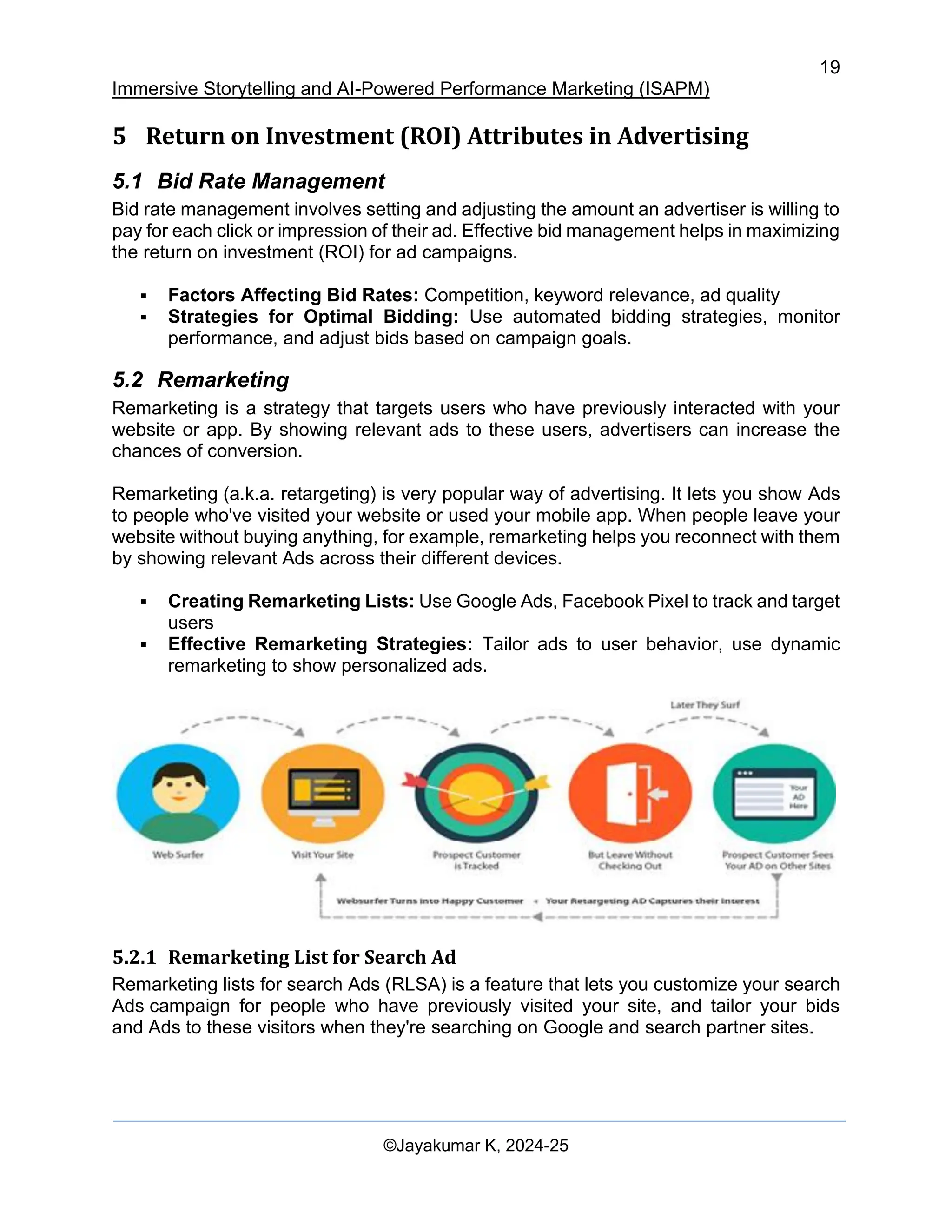
Remarketing (a.k.a. retargeting) is very popular way of advertising. It lets you show Ads
to people who've visited your website or used your mobile app. When people leave your
website without buying anything, for example, remarketing helps you reconnect with them
by showing relevant Ads across their different devices.
▪ Creating Remarketing Lists: Use Google Ads, Facebook Pixel to track and target
users
▪ Effective Remarketing Strategies: Tailor ads to user behavior, use dynamic
remarketing to show personalized ads.
5.2.1 Remarketing List for Search Ad
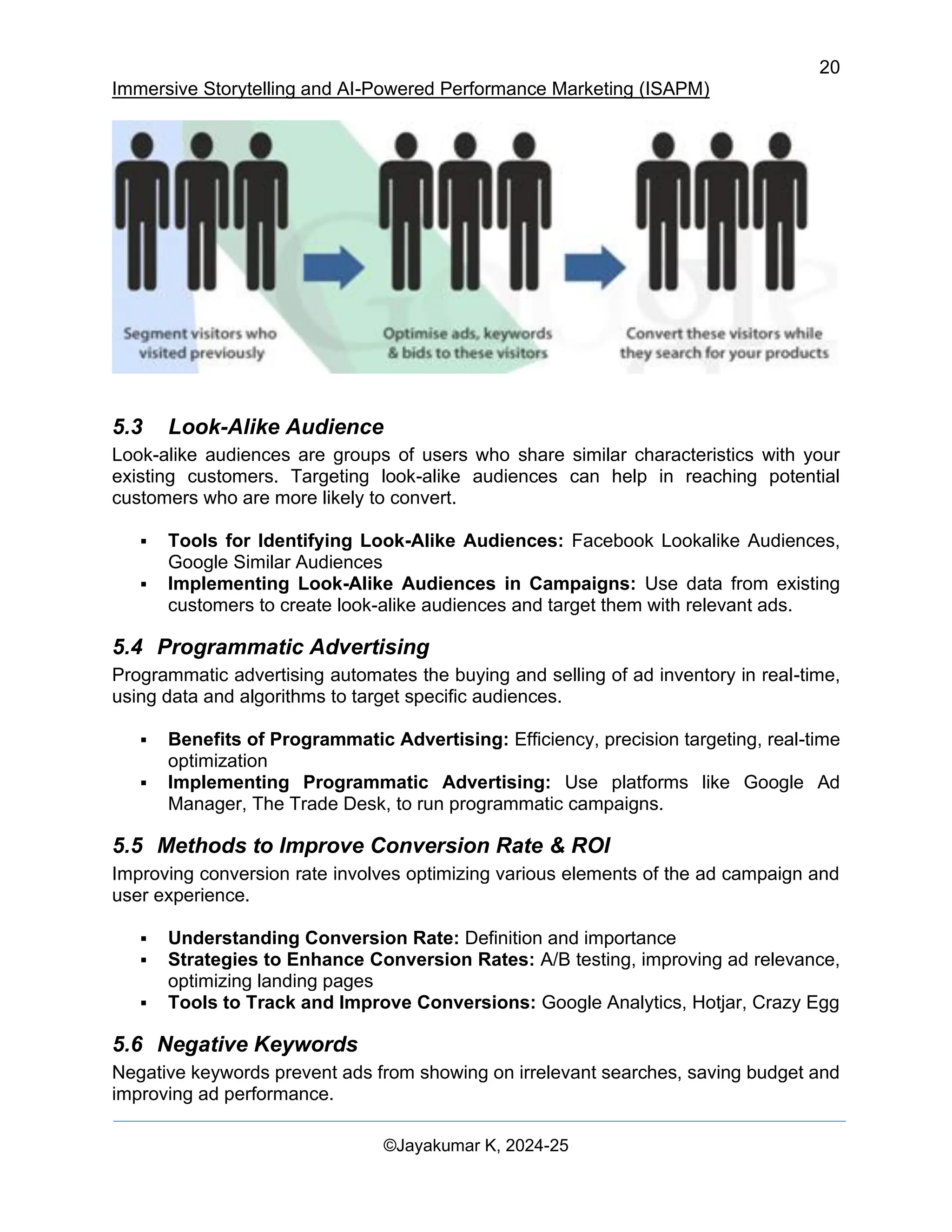
Remarketing lists for search Ads (RLSA) is a feature that lets you customize your search
Ads campaign for people who have previously visited your site, and tailor your bids
and Ads to these visitors when they're searching on Google and search partner sites.
20
Immersive Storytelling and AI-Powered Performance Marketing (ISAPM)
©Jayakumar K, 2024-25
5.3 Look-Alike Audience
Look-alike audiences are groups of users who share similar characteristics with your
existing customers. Targeting look-alike audiences can help in reaching potential
customers who are more likely to convert.
▪ Tools for Identifying Look-Alike Audiences: Facebook Lookalike Audiences,
Google Similar Audiences
▪ Implementing Look-Alike Audiences in Campaigns: Use data from existing
customers to create look-alike audiences and target them with relevant ads.
5.4 Programmatic Advertising
Programmatic advertising automates the buying and selling of ad inventory in real-time,
using data and algorithms to target specific audiences.
▪ Benefits of Programmatic Advertising: Efficiency, precision targeting, real-time
optimization
▪ Implementing Programmatic Advertising: Use platforms like Google Ad
Manager, The Trade Desk, to run programmatic campaigns.
5.5 Methods to Improve Conversion Rate & ROI
Improving conversion rate involves optimizing various elements of the ad campaign and
user experience.
▪ Understanding Conversion Rate: Definition and importance
▪ Strategies to Enhance Conversion Rates: A/B testing, improving ad relevance,
optimizing landing pages
▪ Tools to Track and Improve Conversions: Google Analytics, Hotjar, Crazy Egg
5.6 Negative Keywords
Negative keywords prevent ads from showing on irrelevant searches, saving budget and
improving ad performance.
21
Immersive Storytelling and AI-Powered Performance Marketing (ISAPM)
©Jayakumar K, 2024-25
▪ Importance of Negative Keywords: Reduces wasted spend, improves targeting
accuracy
▪ Creating a Negative Keyword List: Use search query reports to identify irrelevant
terms.
▪ Managing Negative Keywords: Regularly update the list to maintain ad
relevance.
5.7 Click through Rate (CTR)
Click-through rate (CTR) is the ratio of users who click on a specific link to the number of
total users who view a page, email, or advertisement. It is commonly used to measure
the success of an online advertising campaign for a particular website.
5.8 Threshold Frequency
A frequency cap (also known as an impression cap) allows an advertiser to limit the max
amount of times that your ad will be shown to a user over a period of time. Google allows
you to specify this on a daily, weekly, or monthly basis.
5.9 Reach and Frequency report
By analyzing reach and frequency data, you can estimate how many people saw your
Ads and how many times they saw them over a certain period of time. How Google
calculates reach and frequency:
▪ Frequency capping and viewable impressions
▪ Adjusting for Cookie Deletion
▪ Avoiding Double Counting
▪ Correct the data
5.10Ad Annotations or Extensions
Ad extensions are a type of ad format that show extra information (“extending” from your
text Ads) about your business.
The different types of Ad Extensions are:
▪ App Extensions
▪ Call Extensions
▪ Location Extensions
▪ Review Extensions
▪ Site link Extensions
▪ Callout Extensions
5.10.1 APP Extensions
Helps you show a link below your ad text that sends people to the app store or begins
downloading your app.
22
Immersive Storytelling and AI-Powered Performance Marketing (ISAPM)
©Jayakumar K, 2024-25
5.10.2 Call Extensions
The call extensions help people click the button and give call directly.
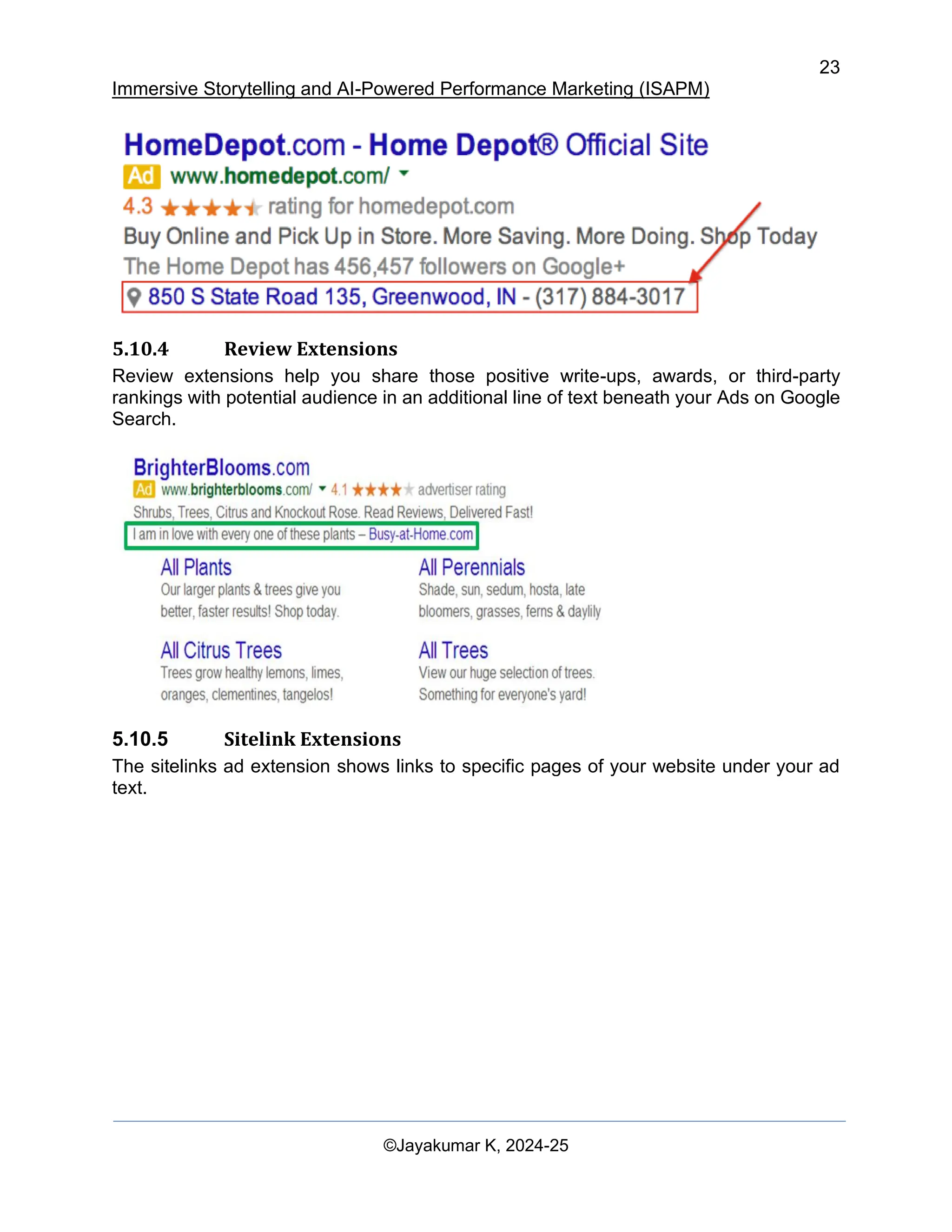
5.10.3 Location Extensions
Location extensions can help people find your locations by showing your Ads with a map,
your address, or the distance to your business.
23
Immersive Storytelling and AI-Powered Performance Marketing (ISAPM)
©Jayakumar K, 2024-25
5.10.4 Review Extensions
Review extensions help you share those positive write-ups, awards, or third-party
rankings with potential audience in an additional line of text beneath your Ads on Google
Search.
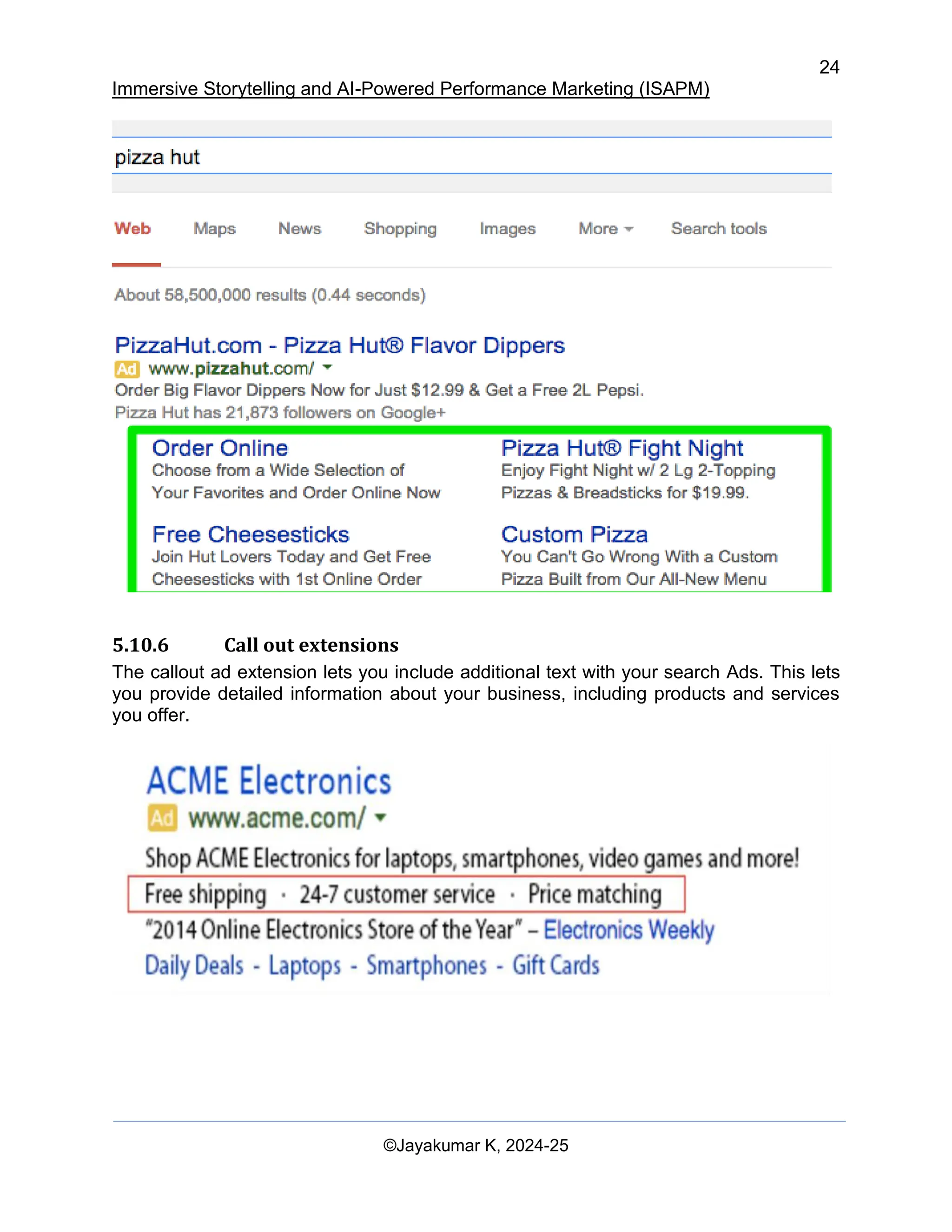
5.10.5 Sitelink Extensions
The sitelinks ad extension shows links to specific pages of your website under your ad
text.
24
Immersive Storytelling and AI-Powered Performance Marketing (ISAPM)
©Jayakumar K, 2024-25
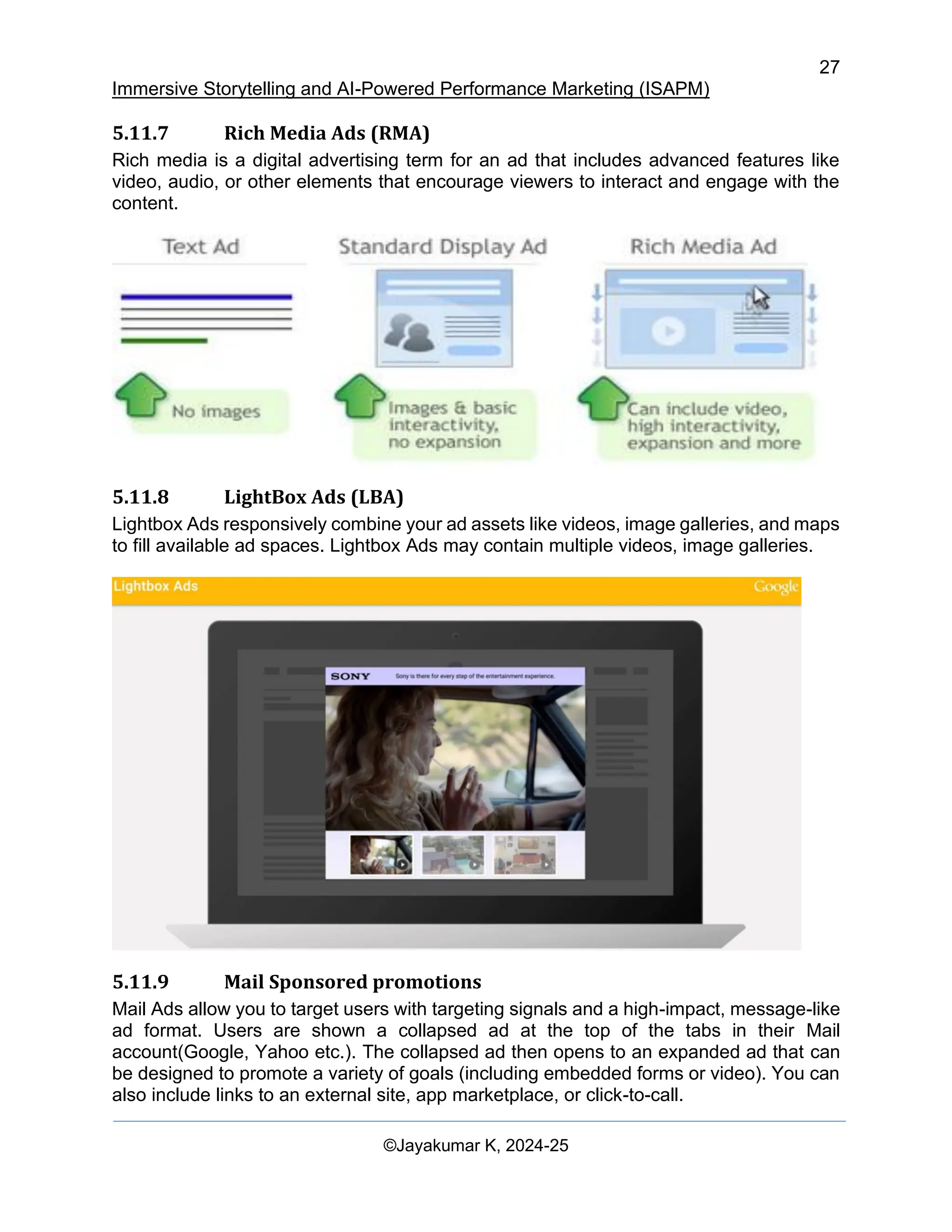
5.10.6 Call out extensions
The callout ad extension lets you include additional text with your search Ads. This lets
you provide detailed information about your business, including products and services
you offer.
25
Immersive Storytelling and AI-Powered Performance Marketing (ISAPM)
©Jayakumar K, 2024-25
5.11Optimized Ads
5.11.1 Ad Storytelling
Storytelling in ads helps create emotional connections with the audience, increasing
engagement and conversions.
▪ Importance of Storytelling in Ads: Builds brand identity, captures audience
attention
▪ Techniques for Effective Storytelling: Use compelling narratives, visuals, and
calls-to-action.
▪ Examples of Successful Ad Stories: Case studies of brands using storytelling
effectively.
5.11.2 Video Ads and View Hours
Video ads are highly engaging and can convey complex messages effectively.
▪ Importance of Video Ads: Higher engagement rates, better storytelling potential
▪ Creating Compelling Video Ads: Focus on high-quality production, clear
messaging, and strong CTAs.
▪ Analyzing Video Ad Performance: Use metrics like view hours, completion rates,
and engagement.
5.11.3 Responsive Display Ads
The responsive ad for Display is an ad that automatically adjusts its size, appearance,
and format to fit available ad spaces on the Google Display Network. Responsive Display
Ad contains a marketing image, a short headline, a long headline, a description, and
optional name and logo fields.
26
Immersive Storytelling and AI-Powered Performance Marketing (ISAPM)
©Jayakumar K, 2024-25
5.11.4 Cross device Conversions (CDC)
As an advertiser, you want to track all the conversions your AdWords campaigns drive,
including those that begin on one device or browser and end on another. By using the
“Include cross-device conversions” setting, you can include these conversions in your
“Conversions” column and factor them into any automated bid strategy you’ve set up.
5.11.5 Universal App Campaign (UAC)
With Google Universal App Campaigns, you can quickly launch an install campaign
across the four Google inventories: Google Display (Apps), Google Display (Websites),
Google Search and YouTube. The simplified setup process for Universal App Campaigns
results in fewer reporting dimensions available - the same campaign reach can be
achieved by creating separate campaigns for each Google inventory with the added
benefit of granular reporting.
5.11.6 Expandable Text Ads (ETAs)
Expanded Text Ads are designed to maximize your presence and performance on mobile
search results with a bigger headline and an extra long description. (And with a mobile-
first mindset, whatever works on mobile is going to get applied to desktop too.)Expanded
Text Ads will show across all devices i.e. desktop and mobile.
27
Immersive Storytelling and AI-Powered Performance Marketing (ISAPM)
©Jayakumar K, 2024-25
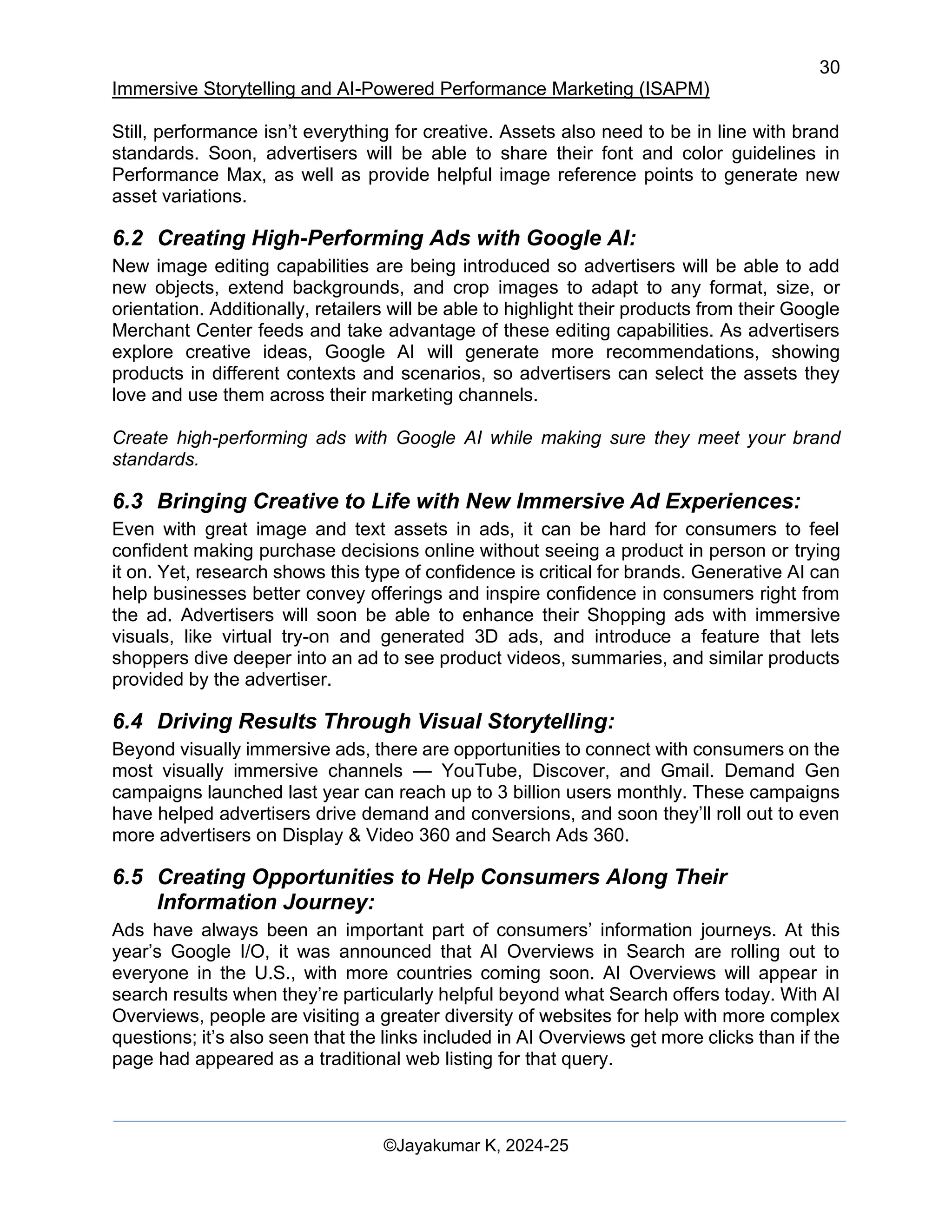
5.11.7 Rich Media Ads (RMA)
Rich media is a digital advertising term for an ad that includes advanced features like
video, audio, or other elements that encourage viewers to interact and engage with the
content.
5.11.8 LightBox Ads (LBA)
Lightbox Ads responsively combine your ad assets like videos, image galleries, and maps
to fill available ad spaces. Lightbox Ads may contain multiple videos, image galleries.
5.11.9 Mail Sponsored promotions
Mail Ads allow you to target users with targeting signals and a high-impact, message-like
ad format. Users are shown a collapsed ad at the top of the tabs in their Mail
account(Google, Yahoo etc.). The collapsed ad then opens to an expanded ad that can
be designed to promote a variety of goals (including embedded forms or video). You can
also include links to an external site, app marketplace, or click-to-call.
28
Immersive Storytelling and AI-Powered Performance Marketing (ISAPM)
©Jayakumar K, 2024-25
5.12Latest Types of Ads
Stay updated with emerging ad types to keep your campaigns innovative and effective.
▪ Overview of Emerging Ad Types: Interactive ads, augmented reality (AR) ads,
voice search ads
▪ Implementing New Ad Types: Test and adapt new ad formats to your strategy.
▪ Case Studies of Successful Ad Implementations: Examples of brands using
innovative ad types effectively.
5.13Most common best Practices and policy mistakes
5.13.1 Best practices
▪ Highlight what makes you unique
▪ Include prices, promotions, and exclusives
▪ Empower audience to take action
▪ Include at least one of your keywords
▪ Match your ad to your landing page
▪ Appeal to audience on mobile
▪ Experiment
▪ Check for common ad text mistakes
5.13.2 Common Mistakes
▪ Unclear content
▪ Style and spelling
▪ Repetition
▪ Capitalization
▪ Symbols
▪ Image quality
▪ Video quality
29
Immersive Storytelling and AI-Powered Performance Marketing (ISAPM)
©Jayakumar K, 2024-25
6 Ads Creativity and Performance at Scale with Google AI
An evolution of attention is underway. People have seemingly endless ways to shop,
communicate, and stay entertained online. For advertising to stand out, it needs to be
relevant and helpful; in fact, that’s more important than ever before. Businesses need to
be on every surface with creative assets that capture people’s attention.
Until now, it has felt impossible to do this at scale, but generative AI is changing that. This
technology is helping businesses better meet advertisers’ needs and unlock new
possibilities across the marketing process, from new immersive ad experiences to high-
performing creative assets. As this next era of marketing is built together, Google shared
their latest innovations, including creative asset generation controls, new ad experiences,
visual storytelling features, and more at this year’s Google Marketing Live (GML), which
kicked off in Mountain View, California.
6.1 Scaling Creative Production in Line with Brand Standards:
Google has been working on making it easier and faster to produce great creative assets
for ads across marketing channels. Creative asset variety is crucial to strong ads, and
achieving this has gotten easier for more advertisers with generative AI in Performance
Max. Google found that advertisers who improve their Performance Max Ad Strength to
“Excellent” see 6% more conversions on average. Event Tickets Center was one of the
earliest beta testers for asset generation in Performance Max, which helped the team
accelerate its creative production by 5X with less time and effort.
30
Immersive Storytelling and AI-Powered Performance Marketing (ISAPM)
©Jayakumar K, 2024-25
Still, performance isn’t everything for creative. Assets also need to be in line with brand
standards. Soon, advertisers will be able to share their font and color guidelines in
Performance Max, as well as provide helpful image reference points to generate new
asset variations.
6.2 Creating High-Performing Ads with Google AI:
New image editing capabilities are being introduced so advertisers will be able to add
new objects, extend backgrounds, and crop images to adapt to any format, size, or
orientation. Additionally, retailers will be able to highlight their products from their Google
Merchant Center feeds and take advantage of these editing capabilities. As advertisers
explore creative ideas, Google AI will generate more recommendations, showing
products in different contexts and scenarios, so advertisers can select the assets they
love and use them across their marketing channels.
Create high-performing ads with Google AI while making sure they meet your brand
standards.
6.3 Bringing Creative to Life with New Immersive Ad Experiences:
Even with great image and text assets in ads, it can be hard for consumers to feel
confident making purchase decisions online without seeing a product in person or trying
it on. Yet, research shows this type of confidence is critical for brands. Generative AI can
help businesses better convey offerings and inspire confidence in consumers right from
the ad. Advertisers will soon be able to enhance their Shopping ads with immersive
visuals, like virtual try-on and generated 3D ads, and introduce a feature that lets
shoppers dive deeper into an ad to see product videos, summaries, and similar products
provided by the advertiser.
6.4 Driving Results Through Visual Storytelling:
Beyond visually immersive ads, there are opportunities to connect with consumers on the
most visually immersive channels — YouTube, Discover, and Gmail. Demand Gen
campaigns launched last year can reach up to 3 billion users monthly. These campaigns
have helped advertisers drive demand and conversions, and soon they’ll roll out to even
more advertisers on Display & Video 360 and Search Ads 360.
6.5 Creating Opportunities to Help Consumers Along Their
Information Journey:
Ads have always been an important part of consumers’ information journeys. At this
year’s Google I/O, it was announced that AI Overviews in Search are rolling out to
everyone in the U.S., with more countries coming soon. AI Overviews will appear in
search results when they’re particularly helpful beyond what Search offers today. With AI
Overviews, people are visiting a greater diversity of websites for help with more complex
questions; it’s also seen that the links included in AI Overviews get more clicks than if the
page had appeared as a traditional web listing for that query.
31
Immersive Storytelling and AI-Powered Performance Marketing (ISAPM)
©Jayakumar K, 2024-25
6.6 Improving Results with a Strong Foundation of Measurement:
While all of these updates are helpful for businesses, AI is only as good as the information
it’s given. To get the most out of AI, businesses need a strong measurement strategy built
on a foundation of first-party data. Many businesses have data from different sources,
including conversion data, email lists, and surveys. Until now, getting a complete picture
has been very complex, especially for small businesses. But it’s made much simpler for
advertisers with Google Ads Data Manager, which is now available to everyone. This
allows advertisers to easily bring sources of first-party data together in one place to use,
analyze, and activate — so what once could take weeks or months now takes minutes.
6.7 Putting Google AI to Work for Businesses:
Guided by AI principles and customer feedback, these latest AI innovations will help
marketers think bigger, create bolder, and drive results faster. Google AI is there to assist,
not replace; human creativity, strategic insight, and expertise will always be a marketer’s
advantage. Google also recognizes that, as exciting as these advancements are, the shift
to AI is a lot to manage for many businesses. They’re being thoughtful about evolving
their products with that in mind and look forward to feedback along the way.
7 The Future of Digital Advertising
The future of digital advertising is being shaped by rapid technological advancements and
evolving consumer preferences. Emerging trends include the use of artificial intelligence
(AI), augmented reality (AR), and virtual reality (VR) to create immersive ad experiences.
Additionally, the rise of subscription-based models and the increasing importance of
mobile-friendly content are transforming the digital advertising landscape. Staying
updated with these trends and continuously adapting to new technologies is crucial for
success in digital advertising.
Emerging technologies like VR and AR are opening new possibilities for creating
engaging and immersive ad experiences. Advertisers need to embrace these innovations
and adapt to the ever-changing digital landscape.
8 Building a Digital Advertising Career
8.1 Skills and Qualifications:
• Creative and Analytical Skills: Advertisers need to combine creativity with
analytical thinking to create compelling campaigns and measure their
effectiveness.
• Multimedia Skills: A good understanding of various media formats, including text,
audio, video, and images, is essential for creating diverse and engaging ads.
• Data Analysis and Visualization: Advertisers should be comfortable working with
data, conducting analysis, and creating visualizations to track campaign
performance.
• Social Media Expertise: Knowledge of social media platforms, audience building,
and engagement strategies is crucial.
32
Immersive Storytelling and AI-Powered Performance Marketing (ISAPM)
©Jayakumar K, 2024-25
• SEO and Web Development Fundamentals: A basic understanding of search
engine optimization (SEO) and web development principles helps in optimizing ad
performance and website user experience.
8.2 Career Paths:
▪ Digital Marketer: Focuses on planning and executing digital marketing campaigns
across various online platforms.
▪ Social Media Manager: Manages social media accounts and strategies for brands
to engage with their audience effectively.
▪ Data Analyst: Specializes in analyzing advertising data to measure campaign
success and inform future strategies.
▪ Media Creative Specialist: Compiles multimedia content, combining text, audio,
video, and interactive elements for advertising campaigns.
▪ Ad Campaign Manager: Oversees the planning, execution, and optimization of
digital ad campaigns.
8.3 Resources and Networking:
▪ Professional Organizations: The American Marketing Association (AMA), the
Interactive Advertising Bureau (IAB), and others offer resources, networking
opportunities, and professional development programs.
▪ Online Platforms and Portals: MarketingProfs, HubSpot Academy, and AdAge
provide news, analysis, and resources for digital advertisers.
▪ Social Media Groups and Networks: Connect with professionals through
LinkedIn, Twitter, and other platforms.
8.4 Tips for Success:
▪ Develop a Strong Portfolio: Create a portfolio showcasing your best work,
including successful ad campaigns and creative projects.
▪ Network with Other Advertisers: Attend industry events, engage on social
media, and build relationships with other professionals.
▪ Stay Up-to-Date with Trends: Continuously learn and adapt to the rapidly
changing digital advertising landscape.
▪ Be Passionate and Driven: Success in digital advertising requires creativity,
analytical skills, and a passion for innovation.
9 Free Online Digital Certification Programs
▪ Google Ads Certification: Offers comprehensive training and certification in
Google Ads. Google Ads Certification.
▪ Meta Blueprint Courses: Specialized training in Facebook and Instagram
advertising. Meta Blueprint Courses.
(https://www.facebook.com/business/learn/blueprint)
▪ HubSpot Academy: Free courses in digital marketing, including content
marketing and social media. HubSpot Academy. (https://academy.hubspot.com/)
33
Immersive Storytelling and AI-Powered Performance Marketing (ISAPM)
©Jayakumar K, 2024-25
▪ Coursera: Offers free courses in partnership with universities, covering digital
marketing, social media, and more. Coursera Marketing Courses.
(https://www.coursera.org/browse/business/marketing)
▪ edX: Provides free courses on digital advertising, marketing analytics, and more.
edX Marketing Courses.
▪ FutureLearn: Features courses on digital marketing and the impact of technology
on advertising. FutureLearn Marketing Courses.
These resources and certification programs provide a comprehensive foundation for
aspiring and current digital advertisers to enhance their skills in the evolving digital
advertising landscape.
10 Additional Resources
• Google: Scaling creative production in line with brand standards
https://blog.google/products/ads-commerce/ai-creativity-google-marketing-live/
• Pew Research Center: Extensive data and analysis on digital media and
advertising.
• Interactive Advertising Bureau (IAB): A leading organization for digital
advertisers, offering resources, training, and events.
• MarketingProfs: A website with news, analysis, and resources for marketers.
• HubSpot Academy: Provides free certification courses on various aspects of
digital marketing.
• Google Marketing Platform: Offers tools and resources to optimize digital
advertising efforts.
• Meta Blueprint: Provides training and resources for advertisers to leverage
Facebook and Instagram.
• American Marketing Association (AMA): Offers training and resources for
marketers to improve their craft and adapt to the evolving digital landscape.
• Nieman Lab: Focuses on innovation and the future of media, including advertising
trends.
• Digital Marketing Institute: Offers certification and resources for digital marketers
to enhance their skills.
• HubSpot Blog: Provides insights, tips, and best practices for digital advertising.
By leveraging these resources and staying updated with the latest trends and
technologies, digital advertisers can effectively navigate the future of digital advertising
and build successful careers in the industry.
34
Immersive Storytelling and AI-Powered Performance Marketing (ISAPM)
©Jayakumar K, 2024-25
11 Conclusion
Digital advertising, especially when enhanced by AI, is a dynamic and ever-evolving field.
By mastering the concepts and techniques covered in "Immersive Storytelling and AI-
Powered Performance Marketing (ISAPM)," advertisers can create compelling
campaigns that drive results and resonate with their target audiences. Continuous
learning, experimentation, and adaptation are key to staying ahead in the digital
advertising landscape.
In conclusion, AI-powered digital advertising offers immense potential for businesses to
reach and engage with their audiences more effectively. By understanding and
implementing the strategies discussed in this course, advertisers can significantly
enhance their conversion rates and overall campaign performance. The key to success
lies in embracing the latest advancements in AI, staying informed about emerging trends,
and utilizing the right tools and techniques to craft captivating stories that capture
attention and drive action.
12 Acronyms used in this book
C
CPA: Cost Per Acquisition, 10
CPC: Cost Per Click, 9, 10
CR: Conversion Rate, 11
CTR: Click Through Rate, 4, 5, 8, 9, 10, 21
D
DCO: Display Campaign Optimization, 12
E
ETAs: Expandable Text Ads, 26
I
ISAPM: Immersive Storytelling and AI-Powered
Performance Marketing, 1, 4, 34
L
LBA: Light Box Ads, 27
M
MBS: Meta Business Suite, 11
MCC: My Client Centre, 11, 12
P
PPC: Pay Per Click, 8, 11, 13
R
RLSA: Remarketing Lists for Search Ads, 19
RMA: Rich Media Ads, 27
ROAS: Rerurn on Ad Spend, 5
ROI: Return On Investment, 9, 10, 11, 19
S
SEA: Search Engine Advertising, 4, 5
U
UAC: Universal App Campaign, 26

Immersive Storytelling and AI-Powered Performance Marketing (ISAPM) | Digital Marketing Course ware | Digital Marketing Courses | Jayakumar K

  • 2.
    1 Immersive Storytelling andAI-Powered Performance Marketing (ISAPM) ©Jayakumar K, 2024-25 Immersive Storytelling and AI-Powered Performance Marketing (ISAPM) Search & Display advertisements in new Dimensions © Copyright 2024-25, Prepared by Jayakumar K This book, “Immersive Storytelling and AI-Powered Performance Marketing (ISAPM),” was meticulously prepared by Jayakumar K exclusively for New Media Training purposes. The content within this book has been curated from a variety of sources, including books, websites, and blogs related to Digital/Web Journalism. The information and materials ("the Content") presented in this material is intended for educational purposes and should not be reproduced or used for commercial gain without permission. All rights reserved by Jayakumar K. For any further assistance or inquiries, please contact the author through the provided email addresses. All images, logos, graphics, and their selection and arrangement are the property of their respective content providers and are protected by international copyright laws. Certain logos are registered trademarks of the content providers referenced and are not to be infringed upon. Please direct any queries, suggestions, or feedback regarding this study material to mail@kjayakumar.in or kjay_kumar@yahoo.com. For more information about the author, visit www.kjayakumar.in.
  • 3.
    2 Immersive Storytelling andAI-Powered Performance Marketing (ISAPM) ©Jayakumar K, 2024-25 Contents 1 Digital Advertising - Search & Display...................................................................................................4 1.1 Search & Display advertisements in new Dimensions...................................................................4 1.2 Digital Advertising Categories........................................................................................................4 1.2.1 Search Engine Advertising (SEA)..........................................................................................4 1.2.2 Display Advertising ................................................................................................................5 1.3 Trend Analysis...............................................................................................................................6 1.4 Keyword Research ........................................................................................................................6 1.5 Google Analytics Integration..........................................................................................................6 2 Effective Strategies in Paid Advertising ................................................................................................6 2.1 Targeting Strategies ......................................................................................................................7 2.2 Advertising Strategies....................................................................................................................7 2.3 Optimization Strategies..................................................................................................................8 3 Performance Metrics in Digital Advertising............................................................................................8 3.1 Pay Per Click (PPC) ......................................................................................................................8 3.2 CTR: Click Through Rate...............................................................................................................8 3.3 CPC: Cost-Per-Click......................................................................................................................9 3.4 CPA: Cost-Per-Acquisition...........................................................................................................10 3.5 CR: Conversion Rate...................................................................................................................11 4 A Comprehensive Guide about Adv Platforms....................................................................................11 4.1 Google AdWords MCC Account Creation and Management .......................................................12 4.2 Contextual Targeting and Display Campaign Optimization..........................................................12 4.3 Different Type of Ads/ Campaigns...............................................................................................13 4.3.1 Search Ads..........................................................................................................................13 4.3.2 Display Ads..........................................................................................................................14 4.3.3 Mobile Ads...........................................................................................................................15 4.3.4 You Tube Ads......................................................................................................................15 4.3.5 Facebook Ads......................................................................................................................16 4.3.6 Instagram Ads......................................................................................................................17 4.3.7 WhatsApp Ads.....................................................................................................................17 4.3.8 Twitter Ads...........................................................................................................................17 4.3.9 LinkedIn Ads........................................................................................................................18 5 Return on Investment (ROI) Attributes in Advertising..........................................................................19 5.1 Bid Rate Management.................................................................................................................19 5.2 Remarketing ................................................................................................................................19 5.2.1 Remarketing List for Search Ad...........................................................................................19 5.3 Look-Alike Audience....................................................................................................................20 5.4 Programmatic Advertising............................................................................................................20 5.5 Methods to Improve Conversion Rate & ROI...............................................................................20 5.6 Negative Keywords......................................................................................................................20 5.7 Click through Rate (CTR) ............................................................................................................21 5.8 Threshold Frequency...................................................................................................................21 5.9 Reach and Frequency report.......................................................................................................21 5.10 Ad Annotations or Extensions..................................................................................................21 5.10.1 APP Extensions...............................................................................................................21 5.10.2 Call Extensions................................................................................................................22
  • 4.
    3 Immersive Storytelling andAI-Powered Performance Marketing (ISAPM) ©Jayakumar K, 2024-25 5.10.3 Location Extensions.........................................................................................................22 5.10.4 Review Extensions ..........................................................................................................23 5.10.5 Sitelink Extensions...............................................................................................................23 5.10.6 Call out extensions ..........................................................................................................24 5.11 Optimized Ads .........................................................................................................................25 5.11.1 Ad Storytelling..................................................................................................................25 5.11.2 Video Ads and View Hours..............................................................................................25 5.11.3 Responsive Display Ads..................................................................................................25 5.11.4 Cross device Conversions (CDC)....................................................................................26 5.11.5 Universal App Campaign (UAC) ......................................................................................26 5.11.6 Expandable Text Ads (ETAs)...........................................................................................26 5.11.7 Rich Media Ads (RMA) ....................................................................................................27 5.11.8 LightBox Ads (LBA) .........................................................................................................27 5.11.9 Mail Sponsored promotions.............................................................................................27 5.12 Latest Types of Ads.................................................................................................................28 5.13 Most common best Practices and policy mistakes...................................................................28 5.13.1 Best practices..................................................................................................................28 5.13.2 Common Mistakes...........................................................................................................28 6 Ads Creativity and Performance at Scale with Google AI ...................................................................29 6.1 Scaling Creative Production in Line with Brand Standards:.........................................................29 6.2 Creating High-Performing Ads with Google AI:............................................................................30 6.3 Bringing Creative to Life with New Immersive Ad Experiences:...................................................30 6.4 Driving Results Through Visual Storytelling:................................................................................30 6.5 Creating Opportunities to Help Consumers Along Their Information Journey:.............................30 6.6 Improving Results with a Strong Foundation of Measurement:....................................................31 6.7 Putting Google AI to Work for Businesses:..................................................................................31 7 The Future of Digital Advertising.........................................................................................................31 8 Building a Digital Advertising Career...................................................................................................31 8.1 Skills and Qualifications:..............................................................................................................31 8.2 Career Paths: ..............................................................................................................................32 8.3 Resources and Networking:.........................................................................................................32 8.4 Tips for Success:.........................................................................................................................32 9 Free Online Digital Certification Programs..........................................................................................32 10 Additional Resources.......................................................................................................................33 11 Conclusion.......................................................................................................................................34 12 Acronyms used in this book.............................................................................................................34
  • 5.
    4 Immersive Storytelling andAI-Powered Performance Marketing (ISAPM) ©Jayakumar K, 2024-25 1 Digital Advertising - Search & Display 1.1 Search & Display advertisements in new Dimensions Welcome to "Immersive Storytelling and AI-Powered Performance Marketing (ISAPM)"! This course is designed to explore the transformative power of artificial intelligence in digital advertising, focusing on how AI can elevate storytelling and drive performance across search and display advertisements. As we delve into the realm of AI-powered marketing, we'll uncover how cutting-edge technologies and innovative strategies can help businesses create more engaging, personalized, and effective ad campaigns. In an era where digital presence is paramount, understanding the mechanics and strategies behind AI-driven digital advertising is essential for businesses looking to stand out. This course will guide you through the essential aspects of immersive storytelling and AI-powered performance marketing, providing insights into various techniques, tools, and best practices. By the end of this course, you'll be equipped with the knowledge and skills to harness the power of AI in your digital advertising efforts, ensuring your campaigns are both impactful and efficient. 1.2 Digital Advertising Categories Digital advertising is broadly classified into two major categories: Search Engine Advertising (SEA) and Display Advertising. These categories encompass the primary methods by which businesses can promote their products and services online, reaching a diverse audience through various digital platforms. 1.2.1 Search Engine Advertising (SEA) Search Engine Advertising (SEA) is a highly effective method of increasing web traffic to your site by placing digital advertisements on search engine results pages (SERPs). This type of advertising allows businesses to bid on keywords relevant to their products or services so that their ads appear alongside organic search results when users search for those keywords. The goal of SEA is to boost click-through rates (CTR) and drive targeted traffic to your site. Key elements of SEA include: ▪ Keyword Research and Selection: Identifying and targeting specific keywords that your potential customers are likely to use when searching for products or services similar to yours. ▪ Ad Copy and Creativity: Crafting focused and compelling ad copy that resonates with your target audience and encourages them to click on your ad. ▪ Budget Management: Allocating a budget for your Google Ads campaigns, which can be adjusted based on performance and business goals. How much you spend is entirely up to you, allowing for flexible and scalable advertising strategies. ▪ Bid Management: Setting bids for each keyword to determine how much you are willing to pay for a click. Higher bids can improve ad placement and visibility, but it's crucial to balance costs with expected returns.
  • 6.
    5 Immersive Storytelling andAI-Powered Performance Marketing (ISAPM) ©Jayakumar K, 2024-25 ▪ Performance Tracking and Optimization: Continuously monitoring ad performance using metrics such as CTR, conversion rates, and return on ad spend (ROAS). Making data-driven adjustments to improve campaign effectiveness. SEA offers the advantage of reaching users who are actively searching for information related to your business, making it a powerful tool for generating high-quality leads and driving conversions. 1.2.2 Display Advertising Display Advertising is a form of digital advertising that uses visual elements to convey a commercial message to users. This can include text, logos, animations, videos, photographs, or other graphics. Display ads are typically shown on websites, social media platforms, and apps that are part of a display network, such as Google Display Network or Facebook Audience Network. Key elements of Display Advertising include: ▪ Visual Creativity: Creating visually appealing ads that capture the attention of users. This includes the use of high-quality images, engaging videos, and attractive animations. ▪ Targeted Audience: Display advertisers frequently target users with specific traits, interests, or behaviors to increase the effectiveness of their ads. This targeting can be based on demographics, interests, browsing behavior, or contextual relevance. ▪ Ad Formats: Utilizing various ad formats such as banner ads, interstitial ads, rich media ads, and video ads to engage users across different platforms and devices. ▪ Brand Awareness: Display advertising is particularly effective for building brand awareness and recognition. Even if users do not click on the ads, repeated exposure to the visual elements can enhance brand recall. ▪ Retargeting: Implementing retargeting strategies to show ads to users who have previously visited your website or interacted with your brand. This helps in re- engaging potential customers and encouraging them to complete a purchase or take another desired action. ▪ Performance Measurement: Monitoring the performance of display ads using metrics like impressions, CTR, engagement rates, and conversion rates. Adjusting campaigns based on performance data to optimize results. Display advertising offers the advantage of reaching a broad audience and creating a strong visual impact. It is particularly useful for brand-building efforts and engaging users who may not be actively searching for your products or services but are likely to be interested based on their online behavior and interests. By leveraging both SEA and Display Advertising, businesses can create comprehensive digital advertising strategies that maximize their reach and impact across different stages of the customer journey.
  • 7.
    6 Immersive Storytelling andAI-Powered Performance Marketing (ISAPM) ©Jayakumar K, 2024-25 1.3 Trend Analysis Trend analysis involves examining market trends to identify patterns and opportunities for advertising. Understanding trends helps advertisers stay ahead of the competition and tailor their strategies to current market conditions. ▪ Tools for Trend Analysis: Google Trends, BuzzSumo, TrendSpottr ▪ Applying Trends to Advertising Strategies: Use trend data to create timely and relevant ads that resonate with the target audience. 1.4 Keyword Research Keyword research involves identifying the words and phrases that potential customers use when searching for products or services online. Effective keyword research helps in creating ads that are relevant to the audience, increasing the likelihood of clicks and conversions. Tools for Keyword Research: Google Keyword Planner, SEMrush, Ahrefs 1.5 Google Analytics Integration Integrating Google Analytics with your ad campaigns helps in tracking and analyzing user behavior, providing insights to improve ad performance. ▪ Setting Up Google Analytics: Link Google Analytics with your ad accounts ▪ Using Analytics to Improve Ad Performance: Analyze user data to optimize ad targeting, creatives, and landing pages. 2 Effective Strategies in Paid Advertising Search and Display Advertising Gmail Sponsored Promotions Remarketing Integrating Inline Campaign Parameters and Cross Device Paid Advertising
  • 8.
    7 Immersive Storytelling andAI-Powered Performance Marketing (ISAPM) ©Jayakumar K, 2024-25 2.1 Targeting Strategies Retargeting: Retargeting involves using cookies to track visitors who have previously interacted with your website. By showing them tailored ads that remind and encourage them to return and complete a purchase, you can effectively capture their interest again. For instance, if a user added items to their cart but didn't check out, you can use retargeting ads to display those specific products, prompting them to complete the transaction. Geo Targeting: Geo targeting customizes your ads based on the geographic location of your audience. This involves utilizing location-based keywords and ad copy to make the ads more relevant and engaging for users in specific areas. For example, a restaurant can target ads to users within a certain radius, promoting local deals or events. Contextual Targeting: Contextual targeting selects keywords and topics that align closely with your product or service. By placing your ads on websites and content that match these keywords, you can attract a more interested audience. For example, an outdoor gear company could place ads on travel blogs and adventure websites to reach potential customers who are already interested in related topics. Time Targeting: Time targeting involves analyzing your audience's behavior to determine the optimal times for displaying your ads. By scheduling your campaigns to run during these peak times, you can maximize engagement and conversions. For instance, a business might find that its audience is most active during the evening and schedule ads accordingly to capture their attention when they are most likely to respond. 2.2 Advertising Strategies Search and Display Advertising: Combining search ads, which appear on search engine results pages, with display ads that are shown on various websites, can help increase visibility and reach a wider audience. Search ads target users actively looking for specific information, while display ads capture the attention of users browsing related content, thus complementing each other and enhancing overall campaign performance. Gmail Sponsored Ads: Gmail Sponsored Promotions place your ads directly in users' Gmail inboxes. By targeting users based on their interests, demographics, and past interactions, you can increase the relevance of your ads. For example, promoting a new product launch to users who have shown interest in similar products can lead to higher engagement and conversion rates. Remarketing: Remarketing strategies re-engage users who have previously visited your site but did not convert. By using customized ads to encourage them to return and complete the desired action, you can improve conversion rates. For instance, offering a discount to users who abandoned their shopping cart can incentivize them to finalize their purchase.
  • 9.
    8 Immersive Storytelling andAI-Powered Performance Marketing (ISAPM) ©Jayakumar K, 2024-25 2.3 Optimization Strategies To enhance your retargeting efforts, segment your audience based on their behavior and interests, and create personalized ad content that directly addresses their needs and encourages them to return. For geo targeting, analyze the performance of your ads in different geographic locations and adjust your targeting accordingly, using location- specific keywords and tailored ad copy. In contextual targeting, continuously refine your keyword and topic selection to ensure your ads are placed on the most relevant websites, monitoring performance and using A/B testing for best results. For time targeting, use analytics to identify peak times for audience engagement, schedule campaigns during these times, and adjust your bidding strategy to allocate more budget during high- performing periods. In search and display advertising, focus on keyword relevance, ad copy quality, and landing page experience to improve Quality Score and lower costs, while experimenting with different formats, placements, and creatives for display ads. For Gmail Sponsored Ads, craft compelling subject lines and preview text to increase open rates, segmenting your audience for relevance, and monitoring engagement metrics. In remarketing, segment your audience based on interactions with your site, create tailored ads, experiment with different formats and messages, and use frequency capping to avoid overexposure and ad fatigue. Implementing these optimization strategies can enhance the effectiveness of your paid advertising campaigns, delivering better results and higher returns on investment. 3 Performance Metrics in Digital Advertising Digital advertising campaigns can be optimized and evaluated through various performance metrics, often referred to as the 4 Big Cs of paid search advertising. These metrics help in understanding the effectiveness of your campaigns and provide strategies for improvement. 3.1 Pay Per Click (PPC) PPC (pay-per-click) Ads, are advertisements in which the cost of advertising is determined by the number of clicks an ad receives. A model of internet marketing in which advertisers pay a fee each time one of their Ads is clicked. The success of your PPC campaign depends on how well you manage and optimize the 4 Big Cs of paid search advertising. The following terms highlights the importance of each of these metrics/tactics of the PPC effectiveness, and also highlights proven strategies on how to optimize them. 3.2 CTR: Click Through Rate Is a ratio of the number of times your ad was clicked (Click) to the number of times it was displayed (Impression) on a search engine. CTR = Clicks/Impressions Example - If your ad has received 10 clicks and it was displayed 500 times, your CTR would be 2%.
  • 10.
    9 Immersive Storytelling andAI-Powered Performance Marketing (ISAPM) ©Jayakumar K, 2024-25 Why Is CTR Important? 1. A higher CTR results in lowering of Cost-per-click at campaign level. 2. A higher CTR will ensure a higher Quality Score of the keywords. 3. Higher the CTR, greater are the chances of conversions & improved Conversion rate. Top 3 Strategies to Improve CTR 1. Include Keywords In Your Ad Copy: Ad Copy with a keyword in the headline is the ideal strategy for achieving a healthy CTR. For example, if you are selling mobiles phones online, inclusion of ‘Mobile Phones Online’ in the headline will ensure ad relevancy to the search query entered, resulting in a greater chance of a click. 2. Usage of Ad Extensions: Ad extensions are your friends that always come to your rescue when you need to improve CTR. We have a great option of choosing from a variety of ad extensions that are offered by the search marketing programs. For example: Sitelinks with additional information not only increase the space occupied on a Search engine results page but each link acts as a separate ad copy giving an end user more information as well as reason for clicking on the ad copy resulting in improved CTR. Review Extensions help-built credibility of your brand. Location extensions encourage people to visit you in person, and on an average as per Google, an ad with location extensions sees a 10% boost in Clickthrough rate. 3. Strong Negative Keyword List: A strong negative keyword list is as important as your keyword inventory. Negative keywords not only ensure that you do not spend on unnecessary traffic but also helps in displaying your Ads on the right search query. This results in controlled impressions and improved CTR. 3.3 CPC: Cost-Per-Click Is the amount you pay for a click, Cost per click depends on the maximum bid and quality score of a keyword. Why Is CPC Important? 1. The ROI of paid campaigns depends on the amount you are spending per click. 2. Clicks at a lower cost will lower your Cost-per acquisition. 3. The value of each click is essential for a campaign’s success. Top 3 Strategies for Lowering CPC
  • 11.
    10 Immersive Storytelling andAI-Powered Performance Marketing (ISAPM) ©Jayakumar K, 2024-25 1. Bid on Relevant Keywords Only: Building your keyword inventory with only relevant & a few keywords will help in lowering CPC. Including long tail keywords in your inventory will further reduce CPC as they are less expensive. 2. Highly Themed Ad Groups: Closely knit keywords in an ad group with relevant ad copy & landing page will result in a better Quality Score and reduced CPC. 3. Do Not Bid on Broad Match Type: Keywords in broad match attract a lot of irrelevant traffic resulting in increased impressions and lower CTR. As a result the overall Quality Score is affected & this can lead to increased CPC. Trying out Exact & Phrase match to increase relevance is a better approach in lowering the CPC. 3.4 CPA: Cost-Per-Acquisition The amount that you pay for the action taken by the prospect on your website. CPA = Total Cost/Conversions Why Is CPA Important? 1. Lower the CPA, higher the ROI on paid campaigns. 2. Low CPA is an indicator of a well optimized campaigns. 3. A Low CPA also reflects how efficiently the budget is being utilized on an ad. Top 3 Strategies for Lowering CPA 1. Better Campaign Structure: A closely knit campaign structure with highly relevant keywords in ad groups and ad copy that are relevant to landing page will increase the chances of a click, resulting in improved CTR and Quality Score. Higher the Quality Score, lower the CPC and hence the resultant is a lower CPA. 2. Multiple Asset Testing: For a B2B account, trying out different assets like a white paper download, product demos, free trial download, product guides or Infographics would be recommended to know which asset converts at a lower CPA with increased ROI. 3. Bid Higher at Converting Hours: If you want to know the peak hours for your business you can always turn to the hourly performance report that is available in the account. Identifying the converting hours at lower CPA and increasing the bids to improve ad positions during these hours ensures that the chances of conversions are increased. Lowering the bids at non-converting hours or higher CPA hours will ensure that the CPA is controlled.
  • 12.
    11 Immersive Storytelling andAI-Powered Performance Marketing (ISAPM) ©Jayakumar K, 2024-25 3.5 CR: Conversion Rate Is a ratio of conversions to clicks during the same time period? CR – Conversions/Clicks Why Is CR Important? 1. CR is the indicator of a healthy account. 2. CR helps in calculating the ROI. 3. CR helps access the success rate of the asset promoted & helps you take a more informed decision on the assets for promotion. Top 3 Strategies for Improving CR 1. A Great Landing Page: Once the end user lands on the landing page, having engaging content and asset, as promised in the ad copy increases the chances of the customer signing up and downloading the asset. As Conversions increase, so does the CR. 2. Compelling Ad Copy: Including unique selling points or distinguishing features from competitors will capture end user attention and compel him to click on your ad, as a result the conversion chances are increased and this results in improved CR. 3. Search Term Analysis: Validating the search queries on a regular basis helps reduce the junk clicks that happen due to irrelevant queries. This results in lower spend and a higher CR. To sum up, these four Cs form the basis of your PPC engagement. Right from the dollars spent to the successful conversions that you receive, everything can be optimized if these campaign essentials are taken care of. Regularly monitoring their trends and optimizing to better these parameters helps in improving the account’s health. 4 A Comprehensive Guide about Adv Platforms Meta Business Suite (MBS), Instagram Ads, WhatsApp Ads, and Google AdWords MCC: Meta Business Suite and Ads Manager Meta Business Suite and Ads Manager are robust tools designed to help businesses manage and optimize their Facebook and Instagram ad campaigns efficiently. Here’s a breakdown of how to utilize these tools effectively: ▪ Navigating Meta Ads Manager: This tool allows you to create, manage, and analyze ads seamlessly. It's essential to familiarize yourself with its interface and features to maximize your advertising potential. ▪ Creating and Managing Ads: Use Meta Business Suite to schedule posts, manage ad accounts, and analyze performance. This integration simplifies the ad management process, enabling better campaign oversight and optimization.
  • 13.
    12 Immersive Storytelling andAI-Powered Performance Marketing (ISAPM) ©Jayakumar K, 2024-25 4.1 Google AdWords MCC Account Creation and Management My Client Centre (MCC), also known as an umbrella account, is a powerful tool for managing multiple Google AdWords accounts without the hassle of logging in and out of each account: ▪ AdWords Overview: Google AdWords allows businesses to display ads on Google and its advertising network. AdWords is highly focused on keyword targeting, enabling businesses to set budgets and only pay when people click the ads. ▪ Creating an MCC Account: MCC simplifies the management of multiple AdWords accounts by linking them under one umbrella account. This setup streamlines account management and enhances efficiency. 4.2 Contextual Targeting and Display Campaign Optimization Google AdWords offers various targeting methods and optimization strategies to enhance the performance of display campaigns: Contextual Targeting: This method matches your ads to relevant sites based on the keywords or topics you’ve chosen. It ensures your ads appear on sites, apps, and web pages that are part of the Display Network. Display Campaign Optimization (DCO): Optimizing a display campaign involves several considerations to ensure maximum effectiveness. Key factors include: ✓ Ad Group & Keyword Performance: Regularly review and adjust ad groups and keywords to maintain relevance and effectiveness. ✓ Ad Performance: Continuously monitor and tweak ads to improve engagement and conversion rates. ✓ Device Performance: Analyze how your ads perform across different devices and optimize accordingly. ✓ Placement Performance: Identify the best-performing placements and allocate budget to maximize returns. ✓ Geographic Performance: Tailor your campaigns based on geographic performance data to target high-converting regions. ✓ Hour of Day and Day of Week Performance: Optimize ad scheduling to ensure ads run at times when your target audience is most active. ✓ Conversion Performance: Track conversions to measure the effectiveness of your campaigns and make necessary adjustments. ✓ Category Exclusions: Exclude irrelevant categories to prevent your ads from appearing on non-performing sites. ✓ Reach and Frequency: Balance reach and frequency to avoid ad fatigue and maintain audience engagement. ✓ Demographic Performance: Utilize demographic data to target specific audience segments more effectively.
  • 14.
    13 Immersive Storytelling andAI-Powered Performance Marketing (ISAPM) ©Jayakumar K, 2024-25 By integrating these comprehensive strategies and tools, businesses can enhance their digital advertising efforts across multiple platforms, leading to improved engagement, higher conversion rates, and greater overall success. 4.3 Different Type of Ads/ Campaigns There are various types of digital advertising campaigns, each suited for different goals and platforms. ▪ Overview of Campaign Types: Search ads, display ads, social media ads, video ads, email ads ▪ Selecting the Right Campaign Type: Match campaign type to advertising goals and target audience. ▪ Best Practices for Each Campaign Type: Tailor strategies for maximum effectiveness. Ad Formats: Digital ads come in various formats, each with unique benefits and use cases. ▪ Overview of Ad Formats: Text ads, image ads, video ads, carousel ads, sponsored content ▪ Selecting the Right Ad Format: Choose based on platform, audience, and campaign goals. Best Practices for Each Ad Format: Optimize creatives for engagement and conversions. The different types of Ads ▪ Search Ads ▪ Display Ads ▪ Mobile Ads ▪ Rich Text Ads ▪ Carousel Ads ▪ Mail sponsored Ads ▪ Remarketing Ads ▪ You Tube Ads Implement Keywords in Ads: Use keywords in ad headlines, descriptions, and landing pages to improve ad relevance and performance. 4.3.1 Search Ads Google search Ads are online Ads that appear alongside the search engine result page when users search a keyword query on Google. These Ads are PPC, or pay-per-click Ads, in which advertisers pay for each ad click.
  • 15.
    14 Immersive Storytelling andAI-Powered Performance Marketing (ISAPM) ©Jayakumar K, 2024-25 4.3.2 Display Ads Google Display Ads are a form of contextual banner Ads used in the Google Display Network, Google’s collection of network sites that agree to host display Ads. The Google Display Network also includes Google properties such as YouTube, Gmail, Blogger, etc. Google Display Ads can be text, images, and even video based.
  • 16.
    15 Immersive Storytelling andAI-Powered Performance Marketing (ISAPM) ©Jayakumar K, 2024-25 4.3.3 Mobile Ads Mobile Ads are Ads that appear on smart phones, tablets, and any other mobile device. Many social media platforms, websites, and apps offer their own unique mobile ad options. 4.3.4 You Tube Ads YouTube Ads are Ads that appear on Google’s video-sharing site. Since Google obtained ownership of YouTube, advertising in it has become easy and customizable. YouTube advertisements can appear as banner Ads, in-video overlay Ads, in-stream video Ads “I’m searching for…” “I want to buy...”
  • 17.
    16 Immersive Storytelling andAI-Powered Performance Marketing (ISAPM) ©Jayakumar K, 2024-25 (which are video Ads that appear before or during another YouTube video), as well as several other setups. 4.3.5 Facebook Ads Facebook advertising allows businesses to promote custom Ads or content targeting a specific audience, with costs varying based on the reach and engagement the ad receives. Facebook Ads can appear in your target audience’s News Feed or right column of Facebook. When you advertise on Facebook, you’ll gain insight about your current and potential audience. The data you collect through Facebook Ads allows you to improve your ad targeting for a more efficient and effective advertising experience.
  • 18.
    17 Immersive Storytelling andAI-Powered Performance Marketing (ISAPM) ©Jayakumar K, 2024-25 4.3.6 Instagram Ads Instagram is a powerful platform for visual advertising, offering businesses a unique opportunity to reach a highly engaged audience. Effective Instagram ads require careful planning and execution: • Creating Effective Instagram Ads: Use high-quality images and videos, craft compelling captions, and utilize relevant hashtags to enhance your ad’s visibility and engagement. • Analyzing Instagram Ad Performance: Instagram Insights is a valuable tool for tracking ad performance. Use this data to make informed, data-driven decisions to refine and improve your ad strategies. 4.3.7 WhatsApp Ads WhatsApp Ads offer a direct and personalized way to connect with customers. This advertising method is highly engaging and can significantly enhance customer interactions: • Creating and Managing WhatsApp Ads: Utilize the WhatsApp Business API to create ads and manage customer interactions. This API facilitates personalized messaging and multimedia use. • Best Practices for WhatsApp Ads: Personalize messages to each recipient, use multimedia content to make messages more engaging, and ensure timely responses to maintain customer interest and satisfaction. 4.3.8 Twitter Ads Twitter Ads objective based campaigns are designed to help you achieve results that drive action and add value to your business. Track your impressions, results and cost- per-result across all your different campaign objectives. Targeting capabilities help you get in front of people who are interested in your business.
  • 19.
    18 Immersive Storytelling andAI-Powered Performance Marketing (ISAPM) ©Jayakumar K, 2024-25 4.3.9 LinkedIn Ads LinkedIn Ads help you target audience precisely by geography, industry (or select companies), companies by size, job functions (or select job titles), seniority (ability to reach decision makers) and LinkedIn groups. "Ads by LinkedIn Members" can be setup instantly with plenty of variations in ad copies.
  • 20.
    19 Immersive Storytelling andAI-Powered Performance Marketing (ISAPM) ©Jayakumar K, 2024-25 5 Return on Investment (ROI) Attributes in Advertising 5.1 Bid Rate Management Bid rate management involves setting and adjusting the amount an advertiser is willing to pay for each click or impression of their ad. Effective bid management helps in maximizing the return on investment (ROI) for ad campaigns. ▪ Factors Affecting Bid Rates: Competition, keyword relevance, ad quality ▪ Strategies for Optimal Bidding: Use automated bidding strategies, monitor performance, and adjust bids based on campaign goals. 5.2 Remarketing Remarketing is a strategy that targets users who have previously interacted with your website or app. By showing relevant ads to these users, advertisers can increase the chances of conversion. Remarketing (a.k.a. retargeting) is very popular way of advertising. It lets you show Ads to people who've visited your website or used your mobile app. When people leave your website without buying anything, for example, remarketing helps you reconnect with them by showing relevant Ads across their different devices. ▪ Creating Remarketing Lists: Use Google Ads, Facebook Pixel to track and target users ▪ Effective Remarketing Strategies: Tailor ads to user behavior, use dynamic remarketing to show personalized ads. 5.2.1 Remarketing List for Search Ad Remarketing lists for search Ads (RLSA) is a feature that lets you customize your search Ads campaign for people who have previously visited your site, and tailor your bids and Ads to these visitors when they're searching on Google and search partner sites.
  • 21.
    20 Immersive Storytelling andAI-Powered Performance Marketing (ISAPM) ©Jayakumar K, 2024-25 5.3 Look-Alike Audience Look-alike audiences are groups of users who share similar characteristics with your existing customers. Targeting look-alike audiences can help in reaching potential customers who are more likely to convert. ▪ Tools for Identifying Look-Alike Audiences: Facebook Lookalike Audiences, Google Similar Audiences ▪ Implementing Look-Alike Audiences in Campaigns: Use data from existing customers to create look-alike audiences and target them with relevant ads. 5.4 Programmatic Advertising Programmatic advertising automates the buying and selling of ad inventory in real-time, using data and algorithms to target specific audiences. ▪ Benefits of Programmatic Advertising: Efficiency, precision targeting, real-time optimization ▪ Implementing Programmatic Advertising: Use platforms like Google Ad Manager, The Trade Desk, to run programmatic campaigns. 5.5 Methods to Improve Conversion Rate & ROI Improving conversion rate involves optimizing various elements of the ad campaign and user experience. ▪ Understanding Conversion Rate: Definition and importance ▪ Strategies to Enhance Conversion Rates: A/B testing, improving ad relevance, optimizing landing pages ▪ Tools to Track and Improve Conversions: Google Analytics, Hotjar, Crazy Egg 5.6 Negative Keywords Negative keywords prevent ads from showing on irrelevant searches, saving budget and improving ad performance.
  • 22.
    21 Immersive Storytelling andAI-Powered Performance Marketing (ISAPM) ©Jayakumar K, 2024-25 ▪ Importance of Negative Keywords: Reduces wasted spend, improves targeting accuracy ▪ Creating a Negative Keyword List: Use search query reports to identify irrelevant terms. ▪ Managing Negative Keywords: Regularly update the list to maintain ad relevance. 5.7 Click through Rate (CTR) Click-through rate (CTR) is the ratio of users who click on a specific link to the number of total users who view a page, email, or advertisement. It is commonly used to measure the success of an online advertising campaign for a particular website. 5.8 Threshold Frequency A frequency cap (also known as an impression cap) allows an advertiser to limit the max amount of times that your ad will be shown to a user over a period of time. Google allows you to specify this on a daily, weekly, or monthly basis. 5.9 Reach and Frequency report By analyzing reach and frequency data, you can estimate how many people saw your Ads and how many times they saw them over a certain period of time. How Google calculates reach and frequency: ▪ Frequency capping and viewable impressions ▪ Adjusting for Cookie Deletion ▪ Avoiding Double Counting ▪ Correct the data 5.10Ad Annotations or Extensions Ad extensions are a type of ad format that show extra information (“extending” from your text Ads) about your business. The different types of Ad Extensions are: ▪ App Extensions ▪ Call Extensions ▪ Location Extensions ▪ Review Extensions ▪ Site link Extensions ▪ Callout Extensions 5.10.1 APP Extensions Helps you show a link below your ad text that sends people to the app store or begins downloading your app.
  • 23.
    22 Immersive Storytelling andAI-Powered Performance Marketing (ISAPM) ©Jayakumar K, 2024-25 5.10.2 Call Extensions The call extensions help people click the button and give call directly. 5.10.3 Location Extensions Location extensions can help people find your locations by showing your Ads with a map, your address, or the distance to your business.
  • 24.
    23 Immersive Storytelling andAI-Powered Performance Marketing (ISAPM) ©Jayakumar K, 2024-25 5.10.4 Review Extensions Review extensions help you share those positive write-ups, awards, or third-party rankings with potential audience in an additional line of text beneath your Ads on Google Search. 5.10.5 Sitelink Extensions The sitelinks ad extension shows links to specific pages of your website under your ad text.
  • 25.
    24 Immersive Storytelling andAI-Powered Performance Marketing (ISAPM) ©Jayakumar K, 2024-25 5.10.6 Call out extensions The callout ad extension lets you include additional text with your search Ads. This lets you provide detailed information about your business, including products and services you offer.
  • 26.
    25 Immersive Storytelling andAI-Powered Performance Marketing (ISAPM) ©Jayakumar K, 2024-25 5.11Optimized Ads 5.11.1 Ad Storytelling Storytelling in ads helps create emotional connections with the audience, increasing engagement and conversions. ▪ Importance of Storytelling in Ads: Builds brand identity, captures audience attention ▪ Techniques for Effective Storytelling: Use compelling narratives, visuals, and calls-to-action. ▪ Examples of Successful Ad Stories: Case studies of brands using storytelling effectively. 5.11.2 Video Ads and View Hours Video ads are highly engaging and can convey complex messages effectively. ▪ Importance of Video Ads: Higher engagement rates, better storytelling potential ▪ Creating Compelling Video Ads: Focus on high-quality production, clear messaging, and strong CTAs. ▪ Analyzing Video Ad Performance: Use metrics like view hours, completion rates, and engagement. 5.11.3 Responsive Display Ads The responsive ad for Display is an ad that automatically adjusts its size, appearance, and format to fit available ad spaces on the Google Display Network. Responsive Display Ad contains a marketing image, a short headline, a long headline, a description, and optional name and logo fields.
  • 27.
    26 Immersive Storytelling andAI-Powered Performance Marketing (ISAPM) ©Jayakumar K, 2024-25 5.11.4 Cross device Conversions (CDC) As an advertiser, you want to track all the conversions your AdWords campaigns drive, including those that begin on one device or browser and end on another. By using the “Include cross-device conversions” setting, you can include these conversions in your “Conversions” column and factor them into any automated bid strategy you’ve set up. 5.11.5 Universal App Campaign (UAC) With Google Universal App Campaigns, you can quickly launch an install campaign across the four Google inventories: Google Display (Apps), Google Display (Websites), Google Search and YouTube. The simplified setup process for Universal App Campaigns results in fewer reporting dimensions available - the same campaign reach can be achieved by creating separate campaigns for each Google inventory with the added benefit of granular reporting. 5.11.6 Expandable Text Ads (ETAs) Expanded Text Ads are designed to maximize your presence and performance on mobile search results with a bigger headline and an extra long description. (And with a mobile- first mindset, whatever works on mobile is going to get applied to desktop too.)Expanded Text Ads will show across all devices i.e. desktop and mobile.
  • 28.
    27 Immersive Storytelling andAI-Powered Performance Marketing (ISAPM) ©Jayakumar K, 2024-25 5.11.7 Rich Media Ads (RMA) Rich media is a digital advertising term for an ad that includes advanced features like video, audio, or other elements that encourage viewers to interact and engage with the content. 5.11.8 LightBox Ads (LBA) Lightbox Ads responsively combine your ad assets like videos, image galleries, and maps to fill available ad spaces. Lightbox Ads may contain multiple videos, image galleries. 5.11.9 Mail Sponsored promotions Mail Ads allow you to target users with targeting signals and a high-impact, message-like ad format. Users are shown a collapsed ad at the top of the tabs in their Mail account(Google, Yahoo etc.). The collapsed ad then opens to an expanded ad that can be designed to promote a variety of goals (including embedded forms or video). You can also include links to an external site, app marketplace, or click-to-call.
  • 29.
    28 Immersive Storytelling andAI-Powered Performance Marketing (ISAPM) ©Jayakumar K, 2024-25 5.12Latest Types of Ads Stay updated with emerging ad types to keep your campaigns innovative and effective. ▪ Overview of Emerging Ad Types: Interactive ads, augmented reality (AR) ads, voice search ads ▪ Implementing New Ad Types: Test and adapt new ad formats to your strategy. ▪ Case Studies of Successful Ad Implementations: Examples of brands using innovative ad types effectively. 5.13Most common best Practices and policy mistakes 5.13.1 Best practices ▪ Highlight what makes you unique ▪ Include prices, promotions, and exclusives ▪ Empower audience to take action ▪ Include at least one of your keywords ▪ Match your ad to your landing page ▪ Appeal to audience on mobile ▪ Experiment ▪ Check for common ad text mistakes 5.13.2 Common Mistakes ▪ Unclear content ▪ Style and spelling ▪ Repetition ▪ Capitalization ▪ Symbols ▪ Image quality ▪ Video quality
  • 30.
    29 Immersive Storytelling andAI-Powered Performance Marketing (ISAPM) ©Jayakumar K, 2024-25 6 Ads Creativity and Performance at Scale with Google AI An evolution of attention is underway. People have seemingly endless ways to shop, communicate, and stay entertained online. For advertising to stand out, it needs to be relevant and helpful; in fact, that’s more important than ever before. Businesses need to be on every surface with creative assets that capture people’s attention. Until now, it has felt impossible to do this at scale, but generative AI is changing that. This technology is helping businesses better meet advertisers’ needs and unlock new possibilities across the marketing process, from new immersive ad experiences to high- performing creative assets. As this next era of marketing is built together, Google shared their latest innovations, including creative asset generation controls, new ad experiences, visual storytelling features, and more at this year’s Google Marketing Live (GML), which kicked off in Mountain View, California. 6.1 Scaling Creative Production in Line with Brand Standards: Google has been working on making it easier and faster to produce great creative assets for ads across marketing channels. Creative asset variety is crucial to strong ads, and achieving this has gotten easier for more advertisers with generative AI in Performance Max. Google found that advertisers who improve their Performance Max Ad Strength to “Excellent” see 6% more conversions on average. Event Tickets Center was one of the earliest beta testers for asset generation in Performance Max, which helped the team accelerate its creative production by 5X with less time and effort.
  • 31.
    30 Immersive Storytelling andAI-Powered Performance Marketing (ISAPM) ©Jayakumar K, 2024-25 Still, performance isn’t everything for creative. Assets also need to be in line with brand standards. Soon, advertisers will be able to share their font and color guidelines in Performance Max, as well as provide helpful image reference points to generate new asset variations. 6.2 Creating High-Performing Ads with Google AI: New image editing capabilities are being introduced so advertisers will be able to add new objects, extend backgrounds, and crop images to adapt to any format, size, or orientation. Additionally, retailers will be able to highlight their products from their Google Merchant Center feeds and take advantage of these editing capabilities. As advertisers explore creative ideas, Google AI will generate more recommendations, showing products in different contexts and scenarios, so advertisers can select the assets they love and use them across their marketing channels. Create high-performing ads with Google AI while making sure they meet your brand standards. 6.3 Bringing Creative to Life with New Immersive Ad Experiences: Even with great image and text assets in ads, it can be hard for consumers to feel confident making purchase decisions online without seeing a product in person or trying it on. Yet, research shows this type of confidence is critical for brands. Generative AI can help businesses better convey offerings and inspire confidence in consumers right from the ad. Advertisers will soon be able to enhance their Shopping ads with immersive visuals, like virtual try-on and generated 3D ads, and introduce a feature that lets shoppers dive deeper into an ad to see product videos, summaries, and similar products provided by the advertiser. 6.4 Driving Results Through Visual Storytelling: Beyond visually immersive ads, there are opportunities to connect with consumers on the most visually immersive channels — YouTube, Discover, and Gmail. Demand Gen campaigns launched last year can reach up to 3 billion users monthly. These campaigns have helped advertisers drive demand and conversions, and soon they’ll roll out to even more advertisers on Display & Video 360 and Search Ads 360. 6.5 Creating Opportunities to Help Consumers Along Their Information Journey: Ads have always been an important part of consumers’ information journeys. At this year’s Google I/O, it was announced that AI Overviews in Search are rolling out to everyone in the U.S., with more countries coming soon. AI Overviews will appear in search results when they’re particularly helpful beyond what Search offers today. With AI Overviews, people are visiting a greater diversity of websites for help with more complex questions; it’s also seen that the links included in AI Overviews get more clicks than if the page had appeared as a traditional web listing for that query.
  • 32.
    31 Immersive Storytelling andAI-Powered Performance Marketing (ISAPM) ©Jayakumar K, 2024-25 6.6 Improving Results with a Strong Foundation of Measurement: While all of these updates are helpful for businesses, AI is only as good as the information it’s given. To get the most out of AI, businesses need a strong measurement strategy built on a foundation of first-party data. Many businesses have data from different sources, including conversion data, email lists, and surveys. Until now, getting a complete picture has been very complex, especially for small businesses. But it’s made much simpler for advertisers with Google Ads Data Manager, which is now available to everyone. This allows advertisers to easily bring sources of first-party data together in one place to use, analyze, and activate — so what once could take weeks or months now takes minutes. 6.7 Putting Google AI to Work for Businesses: Guided by AI principles and customer feedback, these latest AI innovations will help marketers think bigger, create bolder, and drive results faster. Google AI is there to assist, not replace; human creativity, strategic insight, and expertise will always be a marketer’s advantage. Google also recognizes that, as exciting as these advancements are, the shift to AI is a lot to manage for many businesses. They’re being thoughtful about evolving their products with that in mind and look forward to feedback along the way. 7 The Future of Digital Advertising The future of digital advertising is being shaped by rapid technological advancements and evolving consumer preferences. Emerging trends include the use of artificial intelligence (AI), augmented reality (AR), and virtual reality (VR) to create immersive ad experiences. Additionally, the rise of subscription-based models and the increasing importance of mobile-friendly content are transforming the digital advertising landscape. Staying updated with these trends and continuously adapting to new technologies is crucial for success in digital advertising. Emerging technologies like VR and AR are opening new possibilities for creating engaging and immersive ad experiences. Advertisers need to embrace these innovations and adapt to the ever-changing digital landscape. 8 Building a Digital Advertising Career 8.1 Skills and Qualifications: • Creative and Analytical Skills: Advertisers need to combine creativity with analytical thinking to create compelling campaigns and measure their effectiveness. • Multimedia Skills: A good understanding of various media formats, including text, audio, video, and images, is essential for creating diverse and engaging ads. • Data Analysis and Visualization: Advertisers should be comfortable working with data, conducting analysis, and creating visualizations to track campaign performance. • Social Media Expertise: Knowledge of social media platforms, audience building, and engagement strategies is crucial.
  • 33.
    32 Immersive Storytelling andAI-Powered Performance Marketing (ISAPM) ©Jayakumar K, 2024-25 • SEO and Web Development Fundamentals: A basic understanding of search engine optimization (SEO) and web development principles helps in optimizing ad performance and website user experience. 8.2 Career Paths: ▪ Digital Marketer: Focuses on planning and executing digital marketing campaigns across various online platforms. ▪ Social Media Manager: Manages social media accounts and strategies for brands to engage with their audience effectively. ▪ Data Analyst: Specializes in analyzing advertising data to measure campaign success and inform future strategies. ▪ Media Creative Specialist: Compiles multimedia content, combining text, audio, video, and interactive elements for advertising campaigns. ▪ Ad Campaign Manager: Oversees the planning, execution, and optimization of digital ad campaigns. 8.3 Resources and Networking: ▪ Professional Organizations: The American Marketing Association (AMA), the Interactive Advertising Bureau (IAB), and others offer resources, networking opportunities, and professional development programs. ▪ Online Platforms and Portals: MarketingProfs, HubSpot Academy, and AdAge provide news, analysis, and resources for digital advertisers. ▪ Social Media Groups and Networks: Connect with professionals through LinkedIn, Twitter, and other platforms. 8.4 Tips for Success: ▪ Develop a Strong Portfolio: Create a portfolio showcasing your best work, including successful ad campaigns and creative projects. ▪ Network with Other Advertisers: Attend industry events, engage on social media, and build relationships with other professionals. ▪ Stay Up-to-Date with Trends: Continuously learn and adapt to the rapidly changing digital advertising landscape. ▪ Be Passionate and Driven: Success in digital advertising requires creativity, analytical skills, and a passion for innovation. 9 Free Online Digital Certification Programs ▪ Google Ads Certification: Offers comprehensive training and certification in Google Ads. Google Ads Certification. ▪ Meta Blueprint Courses: Specialized training in Facebook and Instagram advertising. Meta Blueprint Courses. (https://www.facebook.com/business/learn/blueprint) ▪ HubSpot Academy: Free courses in digital marketing, including content marketing and social media. HubSpot Academy. (https://academy.hubspot.com/)
  • 34.
    33 Immersive Storytelling andAI-Powered Performance Marketing (ISAPM) ©Jayakumar K, 2024-25 ▪ Coursera: Offers free courses in partnership with universities, covering digital marketing, social media, and more. Coursera Marketing Courses. (https://www.coursera.org/browse/business/marketing) ▪ edX: Provides free courses on digital advertising, marketing analytics, and more. edX Marketing Courses. ▪ FutureLearn: Features courses on digital marketing and the impact of technology on advertising. FutureLearn Marketing Courses. These resources and certification programs provide a comprehensive foundation for aspiring and current digital advertisers to enhance their skills in the evolving digital advertising landscape. 10 Additional Resources • Google: Scaling creative production in line with brand standards https://blog.google/products/ads-commerce/ai-creativity-google-marketing-live/ • Pew Research Center: Extensive data and analysis on digital media and advertising. • Interactive Advertising Bureau (IAB): A leading organization for digital advertisers, offering resources, training, and events. • MarketingProfs: A website with news, analysis, and resources for marketers. • HubSpot Academy: Provides free certification courses on various aspects of digital marketing. • Google Marketing Platform: Offers tools and resources to optimize digital advertising efforts. • Meta Blueprint: Provides training and resources for advertisers to leverage Facebook and Instagram. • American Marketing Association (AMA): Offers training and resources for marketers to improve their craft and adapt to the evolving digital landscape. • Nieman Lab: Focuses on innovation and the future of media, including advertising trends. • Digital Marketing Institute: Offers certification and resources for digital marketers to enhance their skills. • HubSpot Blog: Provides insights, tips, and best practices for digital advertising. By leveraging these resources and staying updated with the latest trends and technologies, digital advertisers can effectively navigate the future of digital advertising and build successful careers in the industry.
  • 35.
    34 Immersive Storytelling andAI-Powered Performance Marketing (ISAPM) ©Jayakumar K, 2024-25 11 Conclusion Digital advertising, especially when enhanced by AI, is a dynamic and ever-evolving field. By mastering the concepts and techniques covered in "Immersive Storytelling and AI- Powered Performance Marketing (ISAPM)," advertisers can create compelling campaigns that drive results and resonate with their target audiences. Continuous learning, experimentation, and adaptation are key to staying ahead in the digital advertising landscape. In conclusion, AI-powered digital advertising offers immense potential for businesses to reach and engage with their audiences more effectively. By understanding and implementing the strategies discussed in this course, advertisers can significantly enhance their conversion rates and overall campaign performance. The key to success lies in embracing the latest advancements in AI, staying informed about emerging trends, and utilizing the right tools and techniques to craft captivating stories that capture attention and drive action. 12 Acronyms used in this book C CPA: Cost Per Acquisition, 10 CPC: Cost Per Click, 9, 10 CR: Conversion Rate, 11 CTR: Click Through Rate, 4, 5, 8, 9, 10, 21 D DCO: Display Campaign Optimization, 12 E ETAs: Expandable Text Ads, 26 I ISAPM: Immersive Storytelling and AI-Powered Performance Marketing, 1, 4, 34 L LBA: Light Box Ads, 27 M MBS: Meta Business Suite, 11 MCC: My Client Centre, 11, 12 P PPC: Pay Per Click, 8, 11, 13 R RLSA: Remarketing Lists for Search Ads, 19 RMA: Rich Media Ads, 27 ROAS: Rerurn on Ad Spend, 5 ROI: Return On Investment, 9, 10, 11, 19 S SEA: Search Engine Advertising, 4, 5 U UAC: Universal App Campaign, 26