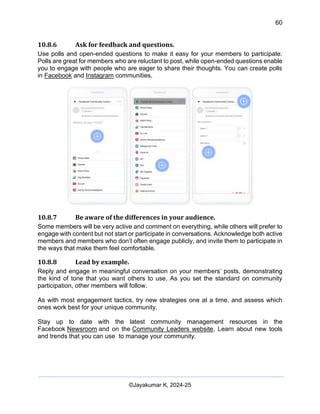
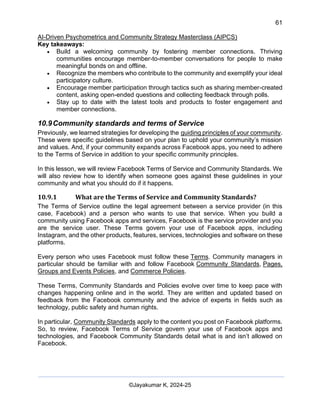
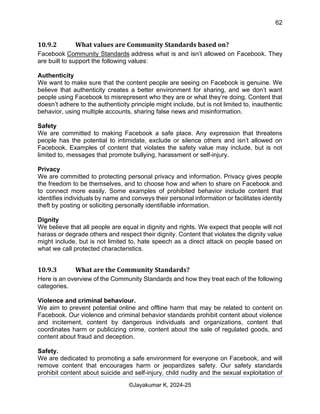
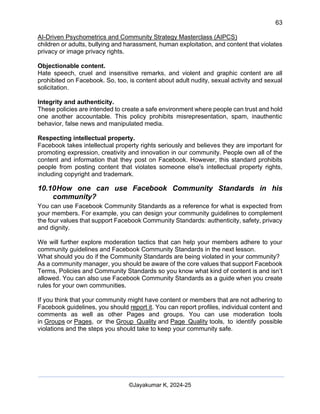
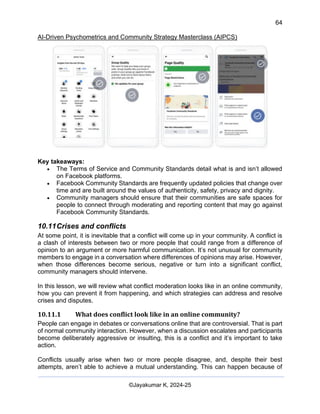
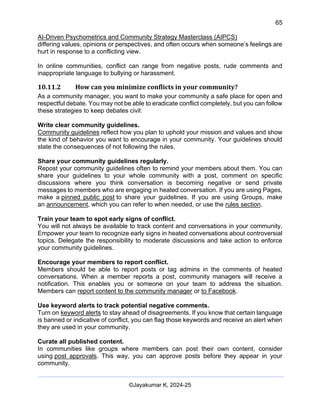
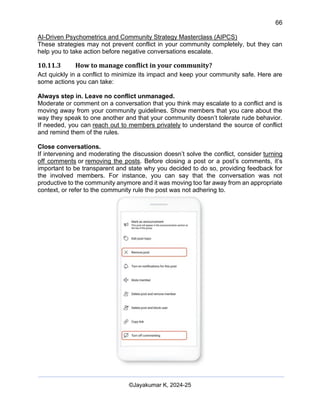
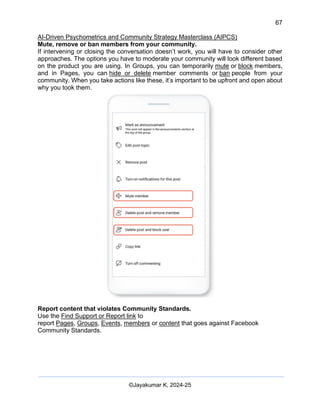
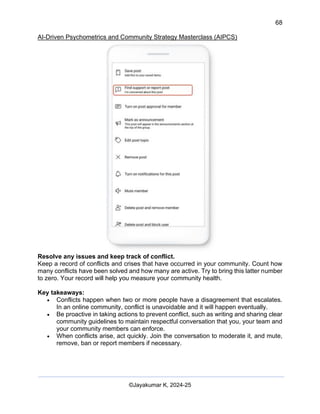
1
AI-Driven Psychometrics and Community Strategy Masterclass (AIPCS)
©Jayakumar K, 2024-25
AI-Driven Psychometrics and
Community Strategy Masterclass
(AIPCS)
Copyright Notice
© Copyright 2024-25, Prepared by Jayakumar K
This book, “AI-Driven Psychometrics and Community Strategy Masterclass (AIPCS),” was
meticulously prepared by Jayakumar K exclusively for New Media Training purposes. The content within
this book has been curated from a variety of sources, including books, websites, and blogs related to
Digital/Web Journalism. The information and materials ("the Content") presented in this book are intended
solely for personal, non-commercial educational use.
All images, logos, graphics, and their selection and arrangement are the property of their respective content
providers and are protected by international copyright laws. Certain logos are registered trademarks of the
content providers referenced and are not to be infringed upon.
This book may not be resold or used for any commercial purposes.
Please direct any queries, suggestions, or feedback regarding this study material to mail@kjayakumar.in
or kjay_kumar@yahoo.com. For more information about the author, visit www.kjayakumar.in.
2
AI-Driven Psychometrics and Community Strategy Masterclass (AIPCS)
©Jayakumar K, 2024-25
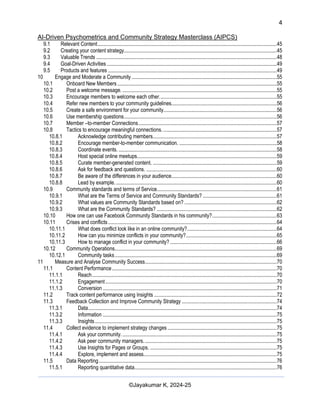
Contents
1 Psychometric Artefacts and Artificial Intelligence for Marketers (PAAIM) .............................................................6
1.1 The Endowment Effect .................................................................................................................................6
1.2 Reciprocity:...................................................................................................................................................6
1.3 Consistency Principle: ..................................................................................................................................6
1.4 The Foot-in-the-Door Method:......................................................................................................................6
1.5 Framing Effect:.............................................................................................................................................6
1.6 Loss Aversion:..............................................................................................................................................7
1.7 Conformity and Social Influence:..................................................................................................................7
1.8 Acquiescence Effect:....................................................................................................................................7
1.9 Mere Exposure Theory:................................................................................................................................7
1.10 Informational Social Influence: .................................................................................................................7
1.11 The Decoy Effect:.....................................................................................................................................7
1.12 Availability Heuristic: ................................................................................................................................7
1.13 Buffer Effect of Social Support: ................................................................................................................8
1.14 Ben Franklin Effect:..................................................................................................................................8
1.15 Propinquity Effect:....................................................................................................................................8
1.16 The Filter Bubble / Echo Chamber Effect.................................................................................................8
2 Business Story: VirtualStyle ..................................................................................................................................8
2.1 Behavioral Targeting: ...................................................................................................................................9
2.2 Emotion AI:...................................................................................................................................................9
2.3 Ethical Considerations:.................................................................................................................................9
2.4 Case Studies:...............................................................................................................................................9
2.5 Interactive Simulations: ................................................................................................................................9
2.6 Future Trends:..............................................................................................................................................9
2.7 Integration with Other Technologies:............................................................................................................9
3 Case Study: Applying Psychological Attributes in VirtualStyle............................................................................10
3.1 Conclusion:.................................................................................................................................................11
4 Business Storytelling with Psychometric Artefacts and Artificial Intelligence ......................................................12
4.1 Quantitative Analysis in AI Marketing.........................................................................................................13
4.1.1 Predictive Analytics: Techniques and Tools for Predicting Consumer Behavior................................13
4.1.2 A/B Testing and Multivariate Testing: Methods for Optimizing Marketing Strategies.........................13
4.1.3 Customer Lifetime Value (CLV) Calculation: How to Calculate and Maximize CLV Using AI............14
4.1.4 Marketing Mix Modeling (MMM):........................................................................................................14
4.1.5 Sentiment Analysis: ...........................................................................................................................14
4.1.6 Advanced AI Techniques in Marketing ..............................................................................................14
4.1.7 Natural Language Processing (NLP): ................................................................................................14
4.1.8 Deep Learning: Use Cases and Impact on Personalized Marketing..................................................15
4.1.9 AI-Driven Content Creation:...............................................................................................................15
4.1.10 Ethical and Privacy Considerations...............................................................................................15
4.1.11 Ethical AI Use: Ensuring Ethical Practices in AI Applications........................................................15
4.1.12 Latest Trends in AI and Marketing.................................................................................................15
4.1.13 Chatbots and Virtual Assistants:....................................................................................................15
4.1.14 Personalization Engines:...............................................................................................................16
5 Quantitative Analysis in AI-Driven Marketing ......................................................................................................16
5.1 Cronbach Alpha:.........................................................................................................................................16
5.2 Pearson Correlation:...................................................................................................................................17
5.3 Kaiser-Meyer-Olkin (KMO) Test: ................................................................................................................17
3
AI-Driven Psychometrics and Community Strategy Masterclass (AIPCS)
©Jayakumar K, 2024-25
5.4 P-P Plot and Histogram:.............................................................................................................................17
5.5 Skewness and Kurtosis Test: .....................................................................................................................17
5.6 Variance Inflation Factor (VIF):...................................................................................................................18
5.7 Multiple Linear Regression (MLR): .............................................................................................................18
5.8 Simple Linear Regression (SLR):...............................................................................................................18
5.9 Advantages of Quantitative Analysis in AI-Driven Marketing......................................................................19
6 Community Management and Growth Management...........................................................................................20
6.1 Objectives:..................................................................................................................................................20
7 Define and Establish a Community .....................................................................................................................20
7.1 Community Building....................................................................................................................................20
7.1.1 Community-building on Facebook .....................................................................................................20
7.1.2 Facebook Groups ..............................................................................................................................21
7.1.3 Facebook Pages................................................................................................................................21
7.1.4 Instagram accounts............................................................................................................................21
7.2 Community Strategy...................................................................................................................................21
7.3 Community Goals and Parameters.............................................................................................................22
7.3.1 Community mission............................................................................................................................22
7.3.2 Community goals...............................................................................................................................22
7.4 Community mission ....................................................................................................................................24
7.4.1 Community Guiding Principles...........................................................................................................24
7.4.2 Defining Guiding Principles................................................................................................................24
7.5 Community goals and Objectives...............................................................................................................25
7.5.1 Measurement.....................................................................................................................................25
7.5.2 Values................................................................................................................................................26
8 Develop Community Strategies and Processes ..................................................................................................26
8.1 Persona profiles..........................................................................................................................................26
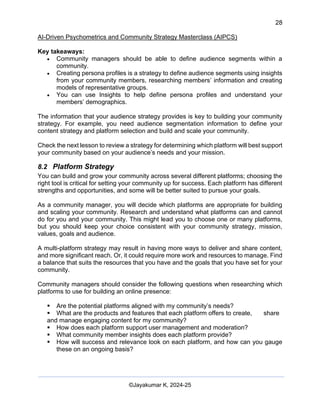
8.2 Platform Strategy........................................................................................................................................28
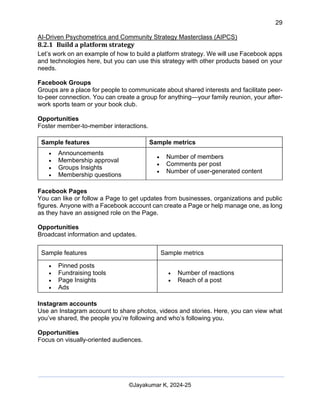
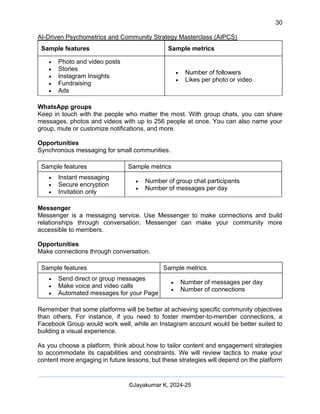
8.2.1 Build a platform strategy....................................................................................................................29
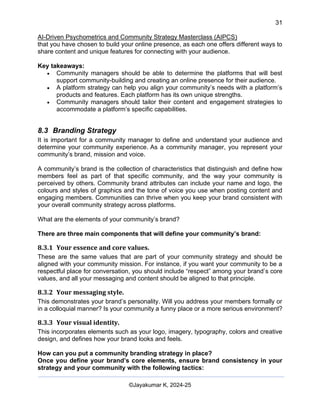
8.3 Branding Strategy.......................................................................................................................................31
8.3.1 Your essence and core values...........................................................................................................31
8.3.2 Your messaging style.........................................................................................................................31
8.3.3 Your visual identity.............................................................................................................................31
8.3.4 Make your community easy to identify...............................................................................................32
8.3.5 Define and document brand guidelines. ............................................................................................32
8.3.6 Be consistent with brand guidelines across platforms. ......................................................................32
8.3.7 Ensure brand consistency in your content.........................................................................................32
8.4 Launch Strategy .........................................................................................................................................32
8.5 Growing your community............................................................................................................................34
8.5.1 Organic growth ..................................................................................................................................35
8.5.2 Paid growth........................................................................................................................................35
8.6 Team- Building Strategy.............................................................................................................................36
8.7 Operational Work Flows .............................................................................................................................37
8.7.1 Definition of roles and responsibilities................................................................................................38
8.7.2 A Gantt chart illustrates mid- and long-term milestones. ...................................................................39
8.7.3 A content calendars...........................................................................................................................40
8.7.4 A list of frequently asked questions (FAQs).......................................................................................40
8.8 A community management playbook..........................................................................................................41
8.9 Partnerships Strategy.................................................................................................................................41
8.9.1 Community partnerships....................................................................................................................42
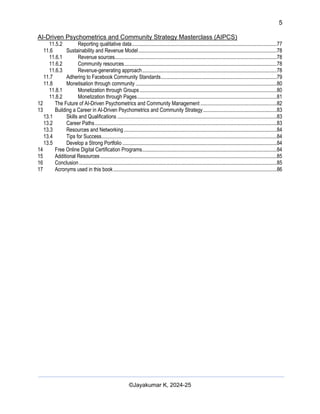
9 Make Strategic Content Decisions for a Community...........................................................................................45
4
AI-Driven Psychometrics and Community Strategy Masterclass (AIPCS)
©Jayakumar K, 2024-25
9.1 Relevant Content........................................................................................................................................45
9.2 Creating your content strategy....................................................................................................................45
9.3 Valuable Trends .........................................................................................................................................48
9.4 Goal-Driven Activities .................................................................................................................................49
9.5 Products and features ................................................................................................................................49
10 Engage and Moderate a Community ..............................................................................................................55
10.1 Onboard New Members.........................................................................................................................55
10.2 Post a welcome message. .....................................................................................................................55
10.3 Encourage members to welcome each other.........................................................................................55
10.4 Refer new members to your community guidelines................................................................................56
10.5 Create a safe environment for your community......................................................................................56
10.6 Use membership questions....................................................................................................................56
10.7 Member –to-member Connections.........................................................................................................57
10.8 Tactics to encourage meaningful connections. ......................................................................................57
10.8.1 Acknowledge contributing members..............................................................................................57
10.8.2 Encourage member-to-member communication. ..........................................................................58
10.8.3 Coordinate events. ........................................................................................................................58
10.8.4 Host special online meetups..........................................................................................................59
10.8.5 Curate member-generated content. ..............................................................................................59
10.8.6 Ask for feedback and questions. ...................................................................................................60
10.8.7 Be aware of the differences in your audience................................................................................60
10.8.8 Lead by example...........................................................................................................................60
10.9 Community standards and terms of Service...........................................................................................61
10.9.1 What are the Terms of Service and Community Standards? ........................................................61
10.9.2 What values are Community Standards based on? ......................................................................62
10.9.3 What are the Community Standards? ...........................................................................................62
10.10 How one can use Facebook Community Standards in his community?.................................................63
10.11 Crises and conflicts................................................................................................................................64
10.11.1 What does conflict look like in an online community?....................................................................64
10.11.2 How can you minimize conflicts in your community?.....................................................................65
10.11.3 How to manage conflict in your community?.................................................................................66
10.12 Community Operations...........................................................................................................................69
10.12.1 Community tasks...........................................................................................................................69
11 Measure and Analyse Community Success....................................................................................................70
11.1 Content Performance.............................................................................................................................70
11.1.1 Reach............................................................................................................................................70
11.1.2 Engagement..................................................................................................................................70
11.1.3 Conversion ....................................................................................................................................71
11.2 Track content performance using Insights .............................................................................................72
11.3 Feedback Collection and Improve Community Strategy ........................................................................74
11.3.1 Data...............................................................................................................................................74
11.3.2 Information ....................................................................................................................................75
11.3.3 Insights..........................................................................................................................................75
11.4 Collect evidence to implement strategy changes...................................................................................75
11.4.1 Ask your community......................................................................................................................75
11.4.2 Ask peer community managers.....................................................................................................75
11.4.3 Use Insights for Pages or Groups. ................................................................................................75
11.4.4 Explore, implement and assess.....................................................................................................75
11.5 Data Reporting.......................................................................................................................................76
11.5.1 Reporting quantitative data............................................................................................................76
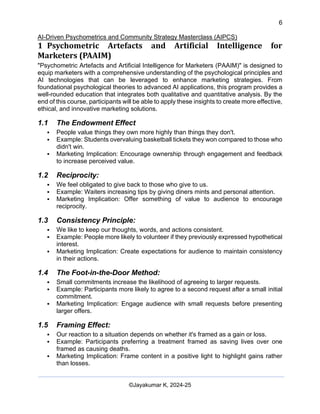
5
AI-Driven Psychometrics and Community Strategy Masterclass (AIPCS)
©Jayakumar K, 2024-25
11.5.2 Reporting qualitative data..............................................................................................................77
11.6 Sustainability and Revenue Model.........................................................................................................78
11.6.1 Revenue sources...........................................................................................................................78
11.6.2 Community resources....................................................................................................................78
11.6.3 Revenue-generating approach......................................................................................................78
11.7 Adhering to Facebook Community Standards........................................................................................79
11.8 Monetisation through community ...........................................................................................................80
11.8.1 Monetization through Groups ........................................................................................................80
11.8.2 Monetization through Pages..........................................................................................................81
12 The Future of AI-Driven Psychometrics and Community Management ..........................................................82
13 Building a Career in AI-Driven Psychometrics and Community Strategy........................................................83
13.1 Skills and Qualifications .........................................................................................................................83
13.2 Career Paths..........................................................................................................................................83
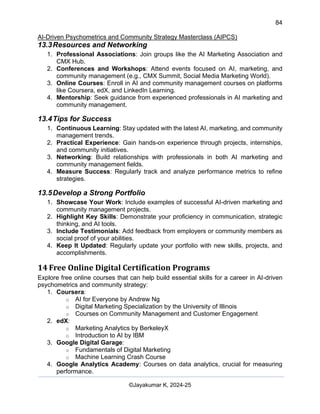
13.3 Resources and Networking....................................................................................................................84
13.4 Tips for Success.....................................................................................................................................84
13.5 Develop a Strong Portfolio .....................................................................................................................84
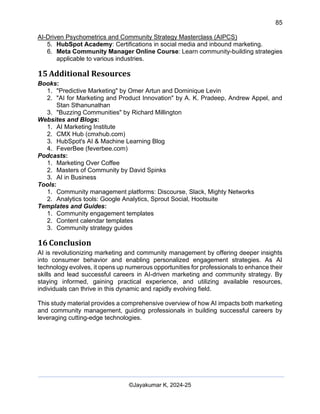
14 Free Online Digital Certification Programs......................................................................................................84
15 Additional Resources......................................................................................................................................85
16 Conclusion......................................................................................................................................................85
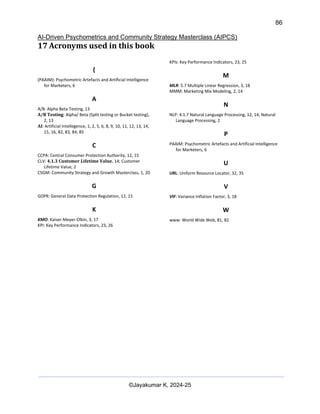
17 Acronyms used in this book............................................................................................................................86
6
AI-Driven Psychometrics and Community Strategy Masterclass (AIPCS)
©Jayakumar K, 2024-25
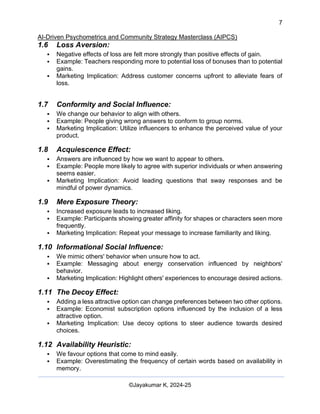
1 Psychometric Artefacts and Artificial Intelligence for
Marketers (PAAIM)
"Psychometric Artefacts and Artificial Intelligence for Marketers (PAAIM)" is designed to
equip marketers with a comprehensive understanding of the psychological principles and
AI technologies that can be leveraged to enhance marketing strategies. From
foundational psychological theories to advanced AI applications, this program provides a
well-rounded education that integrates both qualitative and quantitative analysis. By the
end of this course, participants will be able to apply these insights to create more effective,
ethical, and innovative marketing solutions.
1.1 The Endowment Effect
▪ People value things they own more highly than things they don't.
▪ Example: Students overvaluing basketball tickets they won compared to those who
didn't win.
▪ Marketing Implication: Encourage ownership through engagement and feedback
to increase perceived value.
1.2 Reciprocity:
▪ We feel obligated to give back to those who give to us.
▪ Example: Waiters increasing tips by giving diners mints and personal attention.
▪ Marketing Implication: Offer something of value to audience to encourage
reciprocity.
1.3 Consistency Principle:
▪ We like to keep our thoughts, words, and actions consistent.
▪ Example: People more likely to volunteer if they previously expressed hypothetical
interest.
▪ Marketing Implication: Create expectations for audience to maintain consistency
in their actions.
1.4 The Foot-in-the-Door Method:
▪ Small commitments increase the likelihood of agreeing to larger requests.
▪ Example: Participants more likely to agree to a second request after a small initial
commitment.
▪ Marketing Implication: Engage audience with small requests before presenting
larger offers.
1.5 Framing Effect:
▪ Our reaction to a situation depends on whether it's framed as a gain or loss.
▪ Example: Participants preferring a treatment framed as saving lives over one
framed as causing deaths.
▪ Marketing Implication: Frame content in a positive light to highlight gains rather
than losses.
7
AI-Driven Psychometrics and Community Strategy Masterclass (AIPCS)
©Jayakumar K, 2024-25
1.6 Loss Aversion:
▪ Negative effects of loss are felt more strongly than positive effects of gain.
▪ Example: Teachers responding more to potential loss of bonuses than to potential
gains.
▪ Marketing Implication: Address customer concerns upfront to alleviate fears of
loss.
1.7 Conformity and Social Influence:
▪ We change our behavior to align with others.
▪ Example: People giving wrong answers to conform to group norms.
▪ Marketing Implication: Utilize influencers to enhance the perceived value of your
product.
1.8 Acquiescence Effect:
▪ Answers are influenced by how we want to appear to others.
▪ Example: People more likely to agree with superior individuals or when answering
seems easier.
▪ Marketing Implication: Avoid leading questions that sway responses and be
mindful of power dynamics.
1.9 Mere Exposure Theory:
▪ Increased exposure leads to increased liking.
▪ Example: Participants showing greater affinity for shapes or characters seen more
frequently.
▪ Marketing Implication: Repeat your message to increase familiarity and liking.
1.10 Informational Social Influence:
▪ We mimic others' behavior when unsure how to act.
▪ Example: Messaging about energy conservation influenced by neighbors'
behavior.
▪ Marketing Implication: Highlight others' experiences to encourage desired actions.
1.11 The Decoy Effect:
▪ Adding a less attractive option can change preferences between two other options.
▪ Example: Economist subscription options influenced by the inclusion of a less
attractive option.
▪ Marketing Implication: Use decoy options to steer audience towards desired
choices.
1.12 Availability Heuristic:
▪ We favour options that come to mind easily.
▪ Example: Overestimating the frequency of certain words based on availability in
memory.
8
AI-Driven Psychometrics and Community Strategy Masterclass (AIPCS)
©Jayakumar K, 2024-25
▪ Marketing Implication: Provide clear examples to make your product or service
more memorable.
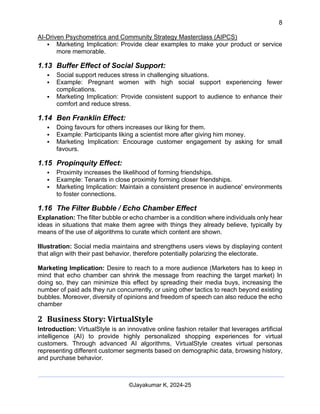
1.13 Buffer Effect of Social Support:
▪ Social support reduces stress in challenging situations.
▪ Example: Pregnant women with high social support experiencing fewer
complications.
▪ Marketing Implication: Provide consistent support to audience to enhance their
comfort and reduce stress.
1.14 Ben Franklin Effect:
▪ Doing favours for others increases our liking for them.
▪ Example: Participants liking a scientist more after giving him money.
▪ Marketing Implication: Encourage customer engagement by asking for small
favours.
1.15 Propinquity Effect:
▪ Proximity increases the likelihood of forming friendships.
▪ Example: Tenants in close proximity forming closer friendships.
▪ Marketing Implication: Maintain a consistent presence in audience' environments
to foster connections.
1.16 The Filter Bubble / Echo Chamber Effect
Explanation: The filter bubble or echo chamber is a condition where individuals only hear
ideas in situations that make them agree with things they already believe, typically by
means of the use of algorithms to curate which content are shown.
Illustration: Social media maintains and strengthens users views by displaying content
that align with their past behavior, therefore potentially polarizing the electorate.
Marketing Implication: Desire to reach to a more audience (Marketers has to keep in
mind that echo chamber can shrink the message from reaching the target market) In
doing so, they can minimize this effect by spreading their media buys, increasing the
number of paid ads they run concurrently, or using other tactics to reach beyond existing
bubbles. Moreover, diversity of opinions and freedom of speech can also reduce the echo
chamber
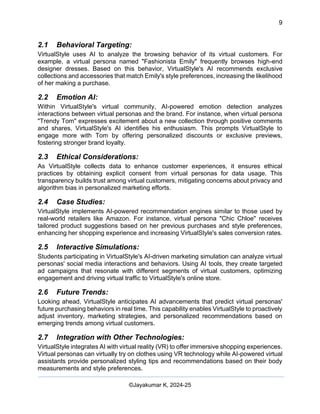
2 Business Story: VirtualStyle
Introduction: VirtualStyle is an innovative online fashion retailer that leverages artificial
intelligence (AI) to provide highly personalized shopping experiences for virtual
customers. Through advanced AI algorithms, VirtualStyle creates virtual personas
representing different customer segments based on demographic data, browsing history,
and purchase behavior.
9
AI-Driven Psychometrics and Community Strategy Masterclass (AIPCS)
©Jayakumar K, 2024-25
2.1 Behavioral Targeting:
VirtualStyle uses AI to analyze the browsing behavior of its virtual customers. For
example, a virtual persona named "Fashionista Emily" frequently browses high-end
designer dresses. Based on this behavior, VirtualStyle's AI recommends exclusive
collections and accessories that match Emily's style preferences, increasing the likelihood
of her making a purchase.
2.2 Emotion AI:
Within VirtualStyle's virtual community, AI-powered emotion detection analyzes
interactions between virtual personas and the brand. For instance, when virtual persona
"Trendy Tom" expresses excitement about a new collection through positive comments
and shares, VirtualStyle's AI identifies his enthusiasm. This prompts VirtualStyle to
engage more with Tom by offering personalized discounts or exclusive previews,
fostering stronger brand loyalty.
2.3 Ethical Considerations:
As VirtualStyle collects data to enhance customer experiences, it ensures ethical
practices by obtaining explicit consent from virtual personas for data usage. This
transparency builds trust among virtual customers, mitigating concerns about privacy and
algorithm bias in personalized marketing efforts.
2.4 Case Studies:
VirtualStyle implements AI-powered recommendation engines similar to those used by
real-world retailers like Amazon. For instance, virtual persona "Chic Chloe" receives
tailored product suggestions based on her previous purchases and style preferences,
enhancing her shopping experience and increasing VirtualStyle's sales conversion rates.
2.5 Interactive Simulations:
Students participating in VirtualStyle's AI-driven marketing simulation can analyze virtual
personas' social media interactions and behaviors. Using AI tools, they create targeted
ad campaigns that resonate with different segments of virtual customers, optimizing
engagement and driving virtual traffic to VirtualStyle's online store.
2.6 Future Trends:
Looking ahead, VirtualStyle anticipates AI advancements that predict virtual personas'
future purchasing behaviors in real time. This capability enables VirtualStyle to proactively
adjust inventory, marketing strategies, and personalized recommendations based on
emerging trends among virtual customers.
2.7 Integration with Other Technologies:
VirtualStyle integrates AI with virtual reality (VR) to offer immersive shopping experiences.
Virtual personas can virtually try on clothes using VR technology while AI-powered virtual
assistants provide personalized styling tips and recommendations based on their body
measurements and style preferences.
10
AI-Driven Psychometrics and Community Strategy Masterclass (AIPCS)
©Jayakumar K, 2024-25
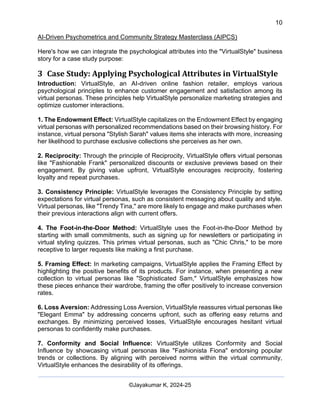
Here's how we can integrate the psychological attributes into the "VirtualStyle" business
story for a case study purpose:
3 Case Study: Applying Psychological Attributes in VirtualStyle
Introduction: VirtualStyle, an AI-driven online fashion retailer, employs various
psychological principles to enhance customer engagement and satisfaction among its
virtual personas. These principles help VirtualStyle personalize marketing strategies and
optimize customer interactions.
1. The Endowment Effect: VirtualStyle capitalizes on the Endowment Effect by engaging
virtual personas with personalized recommendations based on their browsing history. For
instance, virtual persona "Stylish Sarah" values items she interacts with more, increasing
her likelihood to purchase exclusive collections she perceives as her own.
2. Reciprocity: Through the principle of Reciprocity, VirtualStyle offers virtual personas
like "Fashionable Frank" personalized discounts or exclusive previews based on their
engagement. By giving value upfront, VirtualStyle encourages reciprocity, fostering
loyalty and repeat purchases.
3. Consistency Principle: VirtualStyle leverages the Consistency Principle by setting
expectations for virtual personas, such as consistent messaging about quality and style.
Virtual personas, like "Trendy Tina," are more likely to engage and make purchases when
their previous interactions align with current offers.
4. The Foot-in-the-Door Method: VirtualStyle uses the Foot-in-the-Door Method by
starting with small commitments, such as signing up for newsletters or participating in
virtual styling quizzes. This primes virtual personas, such as "Chic Chris," to be more
receptive to larger requests like making a first purchase.
5. Framing Effect: In marketing campaigns, VirtualStyle applies the Framing Effect by
highlighting the positive benefits of its products. For instance, when presenting a new
collection to virtual personas like "Sophisticated Sam," VirtualStyle emphasizes how
these pieces enhance their wardrobe, framing the offer positively to increase conversion
rates.
6. Loss Aversion: Addressing Loss Aversion, VirtualStyle reassures virtual personas like
"Elegant Emma" by addressing concerns upfront, such as offering easy returns and
exchanges. By minimizing perceived losses, VirtualStyle encourages hesitant virtual
personas to confidently make purchases.
7. Conformity and Social Influence: VirtualStyle utilizes Conformity and Social
Influence by showcasing virtual personas like "Fashionista Fiona" endorsing popular
trends or collections. By aligning with perceived norms within the virtual community,
VirtualStyle enhances the desirability of its offerings.
11
AI-Driven Psychometrics and Community Strategy Masterclass (AIPCS)
©Jayakumar K, 2024-25
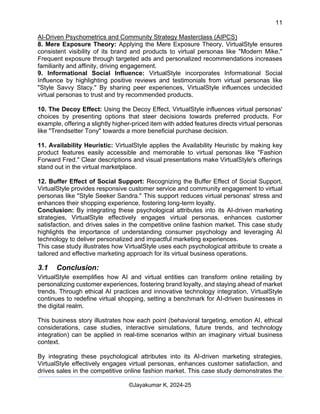
8. Mere Exposure Theory: Applying the Mere Exposure Theory, VirtualStyle ensures
consistent visibility of its brand and products to virtual personas like "Modern Mike."
Frequent exposure through targeted ads and personalized recommendations increases
familiarity and affinity, driving engagement.
9. Informational Social Influence: VirtualStyle incorporates Informational Social
Influence by highlighting positive reviews and testimonials from virtual personas like
"Style Savvy Stacy." By sharing peer experiences, VirtualStyle influences undecided
virtual personas to trust and try recommended products.
10. The Decoy Effect: Using the Decoy Effect, VirtualStyle influences virtual personas'
choices by presenting options that steer decisions towards preferred products. For
example, offering a slightly higher-priced item with added features directs virtual personas
like "Trendsetter Tony" towards a more beneficial purchase decision.
11. Availability Heuristic: VirtualStyle applies the Availability Heuristic by making key
product features easily accessible and memorable to virtual personas like "Fashion
Forward Fred." Clear descriptions and visual presentations make VirtualStyle's offerings
stand out in the virtual marketplace.
12. Buffer Effect of Social Support: Recognizing the Buffer Effect of Social Support,
VirtualStyle provides responsive customer service and community engagement to virtual
personas like "Style Seeker Sandra." This support reduces virtual personas' stress and
enhances their shopping experience, fostering long-term loyalty.
Conclusion: By integrating these psychological attributes into its AI-driven marketing
strategies, VirtualStyle effectively engages virtual personas, enhances customer
satisfaction, and drives sales in the competitive online fashion market. This case study
highlights the importance of understanding consumer psychology and leveraging AI
technology to deliver personalized and impactful marketing experiences.
This case study illustrates how VirtualStyle uses each psychological attribute to create a
tailored and effective marketing approach for its virtual business operations.
3.1 Conclusion:
VirtualStyle exemplifies how AI and virtual entities can transform online retailing by
personalizing customer experiences, fostering brand loyalty, and staying ahead of market
trends. Through ethical AI practices and innovative technology integration, VirtualStyle
continues to redefine virtual shopping, setting a benchmark for AI-driven businesses in
the digital realm.
This business story illustrates how each point (behavioral targeting, emotion AI, ethical
considerations, case studies, interactive simulations, future trends, and technology
integration) can be applied in real-time scenarios within an imaginary virtual business
context.
By integrating these psychological attributes into its AI-driven marketing strategies,
VirtualStyle effectively engages virtual personas, enhances customer satisfaction, and
drives sales in the competitive online fashion market. This case study demonstrates the
12
AI-Driven Psychometrics and Community Strategy Masterclass (AIPCS)
©Jayakumar K, 2024-25
power of combining consumer psychology with AI technology to deliver personalized and
impactful marketing experiences.
This document combines the business story of VirtualStyle with the case study on
applying psychological attributes in marketing, focusing on relevant points that showcase
how VirtualStyle leverages AI and psychological principles to succeed in the virtual
marketplace.
4 Business Storytelling with Psychometric Artefacts and
Artificial Intelligence
In this session, we explore the innovative integration of psychometric artefacts and
artificial intelligence in modern marketing strategies. By leveraging these advanced
techniques, businesses can create compelling narratives that resonate with their target
audience and drive effective lead generation. To illustrate these concepts, we introduce
VirtualStyle, an imaginary business designed to demonstrate the practical application of
these techniques in an online business setting.
VirtualStyle will serve as our case study, providing a detailed example of how
psychometric artefacts and AI can be used to enhance marketing efforts, engage
customers, and generate leads. Through VirtualStyle's journey, students will gain a deep
understanding of how these advanced methods can be applied to real-world scenarios,
ensuring a comprehensive learning experience.
1. Advanced AI Techniques in Marketing:
o Machine Learning Algorithms: Overview of key algorithms and their
applications in marketing.
o Natural Language Processing (NLP): Applications in content creation and
customer interaction.
o Deep Learning: Use cases and impact on personalized marketing.
o AI-Driven Content Creation: How AI can automate and enhance content
generation.
2. Ethical and Privacy Considerations:
o Data Privacy Laws and Regulations: Overview of GDPR, CCPA, and
other relevant regulations.
o Ethical AI Use: Ensuring ethical practices in AI applications.
3. Latest Trends in AI and Marketing:
o Voice Search Optimization: How AI is transforming voice search and its
implications for marketers.
o Chatbots and Virtual Assistants: Their role in enhancing customer
service and engagement.
o Personalization Engines: How AI personalizes marketing messages at
scale.
o Blockchain in Marketing: Potential applications and benefits.
13
AI-Driven Psychometrics and Community Strategy Masterclass (AIPCS)
©Jayakumar K, 2024-25
4.1 Quantitative Analysis in AI Marketing
“Quantitative analysis in AI marketing” involves the use of statistical and mathematical
models to analyze data and make informed decisions. This approach leverages the power
of AI and machine learning to process large volumes of data, uncover patterns, and
predict future trends. By utilizing quantitative methods, marketers can enhance their
strategies, optimize resource allocation, and drive better business outcomes. This
session will explore key techniques and tools used in quantitative analysis, including
predictive analytics, A/B testing, customer lifetime value calculation, marketing mix
modeling, and sentiment analysis. Each of these methods will be examined through
practical applications and real-world examples, demonstrating how they can be
implemented to improve marketing efforts and achieve measurable results.
To provide context and practical insights, we'll reference VirtualStyle, an imaginary
business created specifically for this course. VirtualStyle will serve as our case study
throughout this session, illustrating how quantitative analysis can be applied in real-world
scenarios.
4.1.1 Predictive Analytics: Techniques and Tools for Predicting Consumer
Behavior
VirtualStyle uses predictive analytics to forecast sales and inventory needs. By analyzing
historical sales data and current market trends, they predict which products will be popular
in the upcoming season. Tools like Python's Scikit-learn and R's caret package are used
for building predictive models.
Example: Predictive models can identify that summer dresses will see a 20% increase in
sales next month. VirtualStyle can then adjust their inventory and marketing strategies
accordingly.
4.1.2 A/B Testing and Multivariate Testing: Methods for Optimizing Marketing
Strategies
A/B testing—also called split testing or bucket testing—compares the performance of two
versions of content to see which one appeals more to visitors/viewers. It tests a control
(A) version against a variant (B) version to measure which one is most successful based
on your key metrics.
VirtualStyle conducts A/B testing to determine the most effective email subject lines for
their marketing campaigns. They send different versions of an email to a small segment
of their customers and measure the open rates and click-through rates.
Example: Version A of an email has the subject line "New Summer Collection," and
Version B has "Exclusive Summer Sale." The results show that Version B has a higher
open rate, so VirtualStyle uses that subject line for the rest of their campaign.
14
AI-Driven Psychometrics and Community Strategy Masterclass (AIPCS)
©Jayakumar K, 2024-25
4.1.3 Customer Lifetime Value (CLV) Calculation: How to Calculate and
Maximize CLV Using AI
VirtualStyle calculates the CLV of their customers to identify their most valuable
segments. By using AI-driven models, they can predict future purchasing behavior and
tailor marketing efforts to increase the overall CLV.
Example: Using customer data, they identify that VIP customers (those who have spent
over $1000) have a CLV of $2000. VirtualStyle then creates a loyalty program to reward
these customers, encouraging repeat purchases.
4.1.4 Marketing Mix Modeling (MMM):
Using Statistical Analysis to Understand the Impact of Various Marketing Tactics
VirtualStyle uses MMM to analyze the effectiveness of their marketing channels (e.g.,
social media, email, paid search) and allocate their budget more efficiently.
Example: By analyzing sales data and marketing spend, they discover that social media
ads contribute most to sales, followed by email campaigns. As a result, they decide to
increase their social media ad spend by 15%.
4.1.5 Sentiment Analysis:
Techniques for Analyzing Consumer Sentiments from Social Media and Reviews
VirtualStyle uses sentiment analysis to monitor customer feedback on social media and
product reviews. This helps them understand customer satisfaction and identify areas for
improvement.
Example: Analyzing Twitter mentions reveals that customers are unhappy with the
shipping times. VirtualStyle addresses this by improving their logistics, leading to better
customer satisfaction.
4.1.6 Advanced AI Techniques in Marketing
Machine Learning Algorithms: Overview of Key Algorithms and Their Applications in
Marketing. VirtualStyle applies machine learning algorithms like decision trees and
clustering to segment their customers and personalize marketing campaigns.
Example: Clustering algorithms group customers into segments based on purchasing
behavior. VirtualStyle then creates targeted campaigns for each segment, such as
discounts on specific product categories.
4.1.7 Natural Language Processing (NLP):
Applications in Content Creation and Customer Interaction
VirtualStyle uses NLP to automate customer support through chatbots and generate
product descriptions for their website.
Example: A chatbot powered by NLP handles common customer inquiries, such as order
status and return policies, freeing up human agents for more complex issues.
15
AI-Driven Psychometrics and Community Strategy Masterclass (AIPCS)
©Jayakumar K, 2024-25
4.1.8 Deep Learning: Use Cases and Impact on Personalized Marketing
VirtualStyle leverages deep learning to create personalized product recommendations
based on customer browsing and purchase history.
Example:A deep learning model analyzes customer data and suggests products they are
likely to buy. This results in a 30% increase in cross-selling and up-selling opportunities.
4.1.9 AI-Driven Content Creation:
How AI Can Automate and Enhance Content Generation
VirtualStyle uses AI tools to generate engaging social media posts and blog content.
Tools like GPT-4 assist in creating high-quality, relevant content quickly.
Example: AI-generated blog posts about the latest fashion trends attract more visitors to
the VirtualStyle website, boosting overall sales.
4.1.10 Ethical and Privacy Considerations
Data Privacy Laws and Regulations: Overview of GDPR, CCPA, and Other Relevant
Regulations. VirtualStyle ensures compliance with GDPR and CCPA by implementing
robust data protection measures and obtaining customer consent for data collection.
Example: Customers are informed about how their data will be used, and they have the
option to opt-out of data collection, ensuring VirtualStyle remains compliant with privacy
regulations.
4.1.11 Ethical AI Use: Ensuring Ethical Practices in AI Applications
VirtualStyle adopts ethical AI practices by ensuring transparency and fairness in their AI
models, avoiding biases in customer segmentation and targeting.
Example: They conduct regular audits of their AI models to ensure they do not unfairly
discriminate against any customer group.
4.1.12 Latest Trends in AI and Marketing
Voice Search Optimization: How AI is Transforming Voice Search and Its Implications for
Marketers. VirtualStyle optimizes their website for voice search by incorporating natural
language keywords and ensuring fast load times.
Example: Customers using voice assistants like Alexa to search for "best summer
dresses" are directed to VirtualStyle's optimized landing page.
4.1.13 Chatbots and Virtual Assistants:
Their Role in Enhancing Customer Service and Engagement
VirtualStyle deploys chatbots on their website to provide 24/7 customer support,
improving customer satisfaction and engagement.
16
AI-Driven Psychometrics and Community Strategy Masterclass (AIPCS)
©Jayakumar K, 2024-25
Example: A chatbot helps customers find products, track orders, and answer questions,
leading to a 20% increase in customer retention.
4.1.14 Personalization Engines:
How AI Personalizes Marketing Messages at Scale
VirtualStyle uses AI-driven personalization engines to deliver customized marketing
messages through email and social media.
Example: Customers receive personalized email recommendations based on their
browsing history, resulting in higher open and conversion rates.
By incorporating these advanced and latest topics, "Psychometric Artefacts and Artificial
Intelligence to Marketers (PAAIM)" can provide a comprehensive understanding of how
quantitative and AI techniques can be practically applied to real-time projects and
businesses like VirtualStyle.
5 Quantitative Analysis in AI-Driven Marketing
Incorporate quantitative analysis topics and tools to provide a more comprehensive
understanding of how data and statistical methods are used in AI-driven marketing.
5.1 Cronbach Alpha:
Cronbach Alpha is used to evaluate the reliability of surveys and questionnaires. In
marketing, when you're gathering customer feedback or assessing brand perception
through surveys, this metric ensures that the questions are consistent and measure the
intended variables reliably. For example, if you're surveying customer satisfaction across
different dimensions (like service quality, product quality, and brand loyalty), Cronbach
Alpha will help determine if these items collectively form a reliable scale.
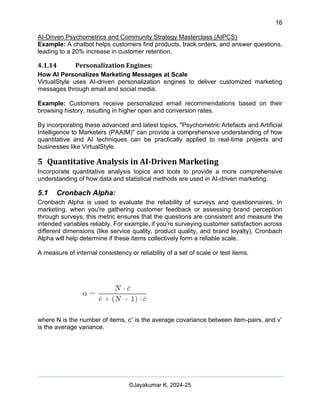
A measure of internal consistency or reliability of a set of scale or test items.
where N is the number of items, cˉ is the average covariance between item-pairs, and vˉ
is the average variance.
17
AI-Driven Psychometrics and Community Strategy Masterclass (AIPCS)
©Jayakumar K, 2024-25
5.2 Pearson Correlation:
Pearson Correlation helps to measure the strength and direction of the relationship
between two variables. In marketing, it can be used to analyze the relationship between
advertising spend and sales, customer satisfaction and loyalty, or website traffic and
conversion rates. For instance, if you want to know if there’s a significant correlation
between the number of emails sent in a campaign and the number of purchases made,
Pearson Correlation will provide insights.
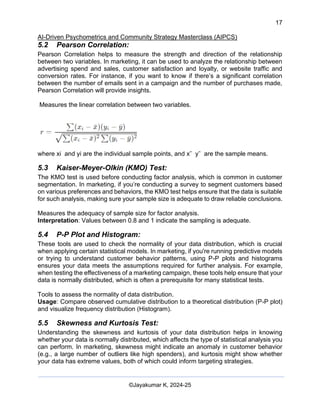
Measures the linear correlation between two variables.
where xi and yi are the individual sample points, and xˉ yˉ are the sample means.
5.3 Kaiser-Meyer-Olkin (KMO) Test:
The KMO test is used before conducting factor analysis, which is common in customer
segmentation. In marketing, if you’re conducting a survey to segment customers based
on various preferences and behaviors, the KMO test helps ensure that the data is suitable
for such analysis, making sure your sample size is adequate to draw reliable conclusions.
Measures the adequacy of sample size for factor analysis.
Interpretation: Values between 0.8 and 1 indicate the sampling is adequate.
5.4 P-P Plot and Histogram:
These tools are used to check the normality of your data distribution, which is crucial
when applying certain statistical models. In marketing, if you're running predictive models
or trying to understand customer behavior patterns, using P-P plots and histograms
ensures your data meets the assumptions required for further analysis. For example,
when testing the effectiveness of a marketing campaign, these tools help ensure that your
data is normally distributed, which is often a prerequisite for many statistical tests.
Tools to assess the normality of data distribution.
Usage: Compare observed cumulative distribution to a theoretical distribution (P-P plot)
and visualize frequency distribution (Histogram).
5.5 Skewness and Kurtosis Test:
Understanding the skewness and kurtosis of your data distribution helps in knowing
whether your data is normally distributed, which affects the type of statistical analysis you
can perform. In marketing, skewness might indicate an anomaly in customer behavior
(e.g., a large number of outliers like high spenders), and kurtosis might show whether
your data has extreme values, both of which could inform targeting strategies.
18
AI-Driven Psychometrics and Community Strategy Masterclass (AIPCS)
©Jayakumar K, 2024-25
Measures the asymmetry (skewness) and peakedness (kurtosis) of data distribution.
Interpretation: Skewness values close to 0 indicate symmetric distribution. Kurtosis
values close to 3 indicate normal distribution.
5.6 Variance Inflation Factor (VIF):
VIF is crucial in regression analysis to detect multicollinearity, where predictor variables
are highly correlated. In marketing, if you're using a regression model to predict customer
lifetime value (CLV) or the impact of various marketing channels on sales, VIF helps
ensure that the independent variables in your model aren’t too similar, which could distort
your analysis.
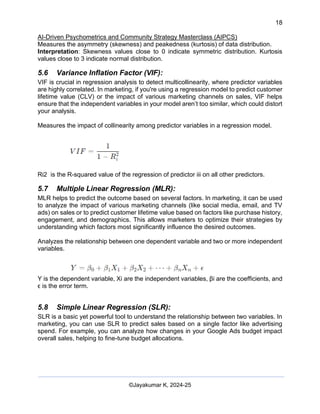
Measures the impact of collinearity among predictor variables in a regression model.
Ri2 is the R-squared value of the regression of predictor iii on all other predictors.
5.7 Multiple Linear Regression (MLR):
MLR helps to predict the outcome based on several factors. In marketing, it can be used
to analyze the impact of various marketing channels (like social media, email, and TV
ads) on sales or to predict customer lifetime value based on factors like purchase history,
engagement, and demographics. This allows marketers to optimize their strategies by
understanding which factors most significantly influence the desired outcomes.
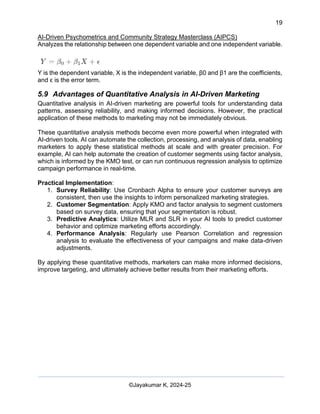
Analyzes the relationship between one dependent variable and two or more independent
variables.
Y is the dependent variable, Xi are the independent variables, βi are the coefficients, and
ϵ is the error term.
5.8 Simple Linear Regression (SLR):
SLR is a basic yet powerful tool to understand the relationship between two variables. In
marketing, you can use SLR to predict sales based on a single factor like advertising
spend. For example, you can analyze how changes in your Google Ads budget impact
overall sales, helping to fine-tune budget allocations.
19
AI-Driven Psychometrics and Community Strategy Masterclass (AIPCS)
©Jayakumar K, 2024-25
Analyzes the relationship between one dependent variable and one independent variable.
Y is the dependent variable, X is the independent variable, β0 and β1 are the coefficients,
and ϵ is the error term.
5.9 Advantages of Quantitative Analysis in AI-Driven Marketing
Quantitative analysis in AI-driven marketing are powerful tools for understanding data
patterns, assessing reliability, and making informed decisions. However, the practical
application of these methods to marketing may not be immediately obvious.
These quantitative analysis methods become even more powerful when integrated with
AI-driven tools. AI can automate the collection, processing, and analysis of data, enabling
marketers to apply these statistical methods at scale and with greater precision. For
example, AI can help automate the creation of customer segments using factor analysis,
which is informed by the KMO test, or can run continuous regression analysis to optimize
campaign performance in real-time.
Practical Implementation:
1. Survey Reliability: Use Cronbach Alpha to ensure your customer surveys are
consistent, then use the insights to inform personalized marketing strategies.
2. Customer Segmentation: Apply KMO and factor analysis to segment customers
based on survey data, ensuring that your segmentation is robust.
3. Predictive Analytics: Utilize MLR and SLR in your AI tools to predict customer
behavior and optimize marketing efforts accordingly.
4. Performance Analysis: Regularly use Pearson Correlation and regression
analysis to evaluate the effectiveness of your campaigns and make data-driven
adjustments.
By applying these quantitative methods, marketers can make more informed decisions,
improve targeting, and ultimately achieve better results from their marketing efforts.
20
AI-Driven Psychometrics and Community Strategy Masterclass (AIPCS)
©Jayakumar K, 2024-25
6 Community Management and Growth Management
Community Strategy and Growth Management (CSGM), a comprehensive program
designed to empower you with essential skills for managing and expanding online
communities. Whether you aspire to forge a career in community management or seek
to elevate your existing expertise, this course offers in-depth insights and actionable
strategies. Explore proven methods to cultivate thriving communities, harness social
dynamics, and drive sustainable growth in today's digital landscape
6.1 Objectives:
• Understand the fundamentals of community management.
• Develop strategies for building and sustaining online communities.
• Learn best practices for engaging and moderating community members.
• Measure and analyze community success to optimize strategies.
7 Define and Establish a Community
7.1 Community Building
Community building is at the heart of Facebook’s mission, and it’s a community
manager’s key task. Learn the basic elements needed to define your community strategy
and start building your online community. This course will help you identify your mission,
goals and success criteria, and create guiding principles to better support your
community.
Facebook’s mission is to give people the power to build community and bring the world
closer together. People use Facebook to stay connected with local and global
communities through common interests, discover what’s going on in the world and share
and express what matters to them.
There are millions of communities that help people connect, which can give members a
feeling of belonging and access to a network of peers with shared interests. Overseeing
and running a community is called community management, and is done by a community
manager.
Community managers are in charge of building, growing and maintaining a meaningful
community. Whether you’re managing a community on behalf of an entrepreneur, brand,
agency or nonprofit—and whether it’s a new or existing community—this lesson can help
you learn how to build, scale and sustain a meaningful community more effectively and
efficiently.
7.1.1 Community-building on Facebook
Online communities come in many shapes and sizes. They can meet in Facebook
Groups, nonprofit Facebook Pages or brand Instagram accounts. Many platforms support
community-building online, and community managers need to have a coherent strategy
to oversee building, scaling and sustaining a meaningful online community. However,
these tasks require thoughtful planning and execution.
21
AI-Driven Psychometrics and Community Strategy Masterclass (AIPCS)
©Jayakumar K, 2024-25
Community managers can use Facebook products and technologies along with additional
strategy frameworks to do their jobs.
Let’s start with the basics and review how various platforms support different types of
online communities.
7.1.2 Facebook Groups
Facebook Groups enable people to come together around a common interest to learn,
share and discuss. Groups can be public or private and the Groups themselves can
be searchable or unsearchable.
Community managers can define rules to set group standards and ask membership
questions of prospective members to learn more about the people who want to join your
group.
Community managers can create content and communicate with group members. Groups
also allow member-to-member interactions and member-curated content.
7.1.3 Facebook Pages
A Facebook Page gives your community a public-facing presence on Facebook. Pages
are built around a product, business, cause or public figure, and give you a place to share
information. Think of your Page as your storefront: it’s visible to everyone. Pages are
public, and members can join the community by liking or following your Page.
Community managers curate all the content on a Page, as opposed to Groups, where
community members can post, too.
7.1.4 Instagram accounts
Instagram builds communities through visual experiences. The Instagram community
comes together to share their passions and to be inspired through multimedia content.
Instagram accounts can be public or private.
Community managers curate the content on an Instagram account and broadcast it to the
community, just like a Facebook Page.
In future lessons, we will review strategies to help you decide which platforms are best
suited to build and scale your community online.
7.2 Community Strategy
There is a set of processes, known as a community strategy, that every community
manager should follow. A community strategy is a plan that a community manager uses
to build, scale and sustain a community online. Usually, a community strategy covers
community goals and guidelines, as well as strategies for engaging the community
through content and platforms, among other key tactics.
22
AI-Driven Psychometrics and Community Strategy Masterclass (AIPCS)
©Jayakumar K, 2024-25
We will learn more about how to build your community strategy in the following
courses. As you begin, be sure to:
Give the community a name and an identity.
Think of a title, description and image that represents the community.
Invite friends to join your community.
Start with people you trust who are interested in what brings the community
together.
Post something to welcome new members and start the conversation.
Facebook products and technologies include several different tools that can support
communities, such as WhatsApp and Messenger, where you can create group chats to
connect with your community in real time, and Facebook Events, which can bring your
community together for experiences both on and offline. Explore all the options to engage
and empower your community.
7.3 Community Goals and Parameters
Develop the foundation of your community strategy, including setting your mission, goals,
objectives, values and metrics.
Communities need to set clear purposes and strategies to thrive. Whether a community
is new or established, community managers should pay close attention to its mission and
goals, and determine metrics to build a healthy community and assess its success. These
key elements will help to build the other components of your strategy.
Let’s review key definitions and a question-based strategy that will support you in defining
your community goals and parameters:
7.3.1 Community mission
The overall impact your community is trying to make on your members and in the world.
Guiding questions:
▪ Why do I want to build a community?
▪ What do I want to accomplish with this community?
▪ What impact do I want this community to make in the future?
7.3.2 Community goals
What you want to achieve through your community to support your mission. You can have
one or many goals. They are often broad and general statements.
Guiding questions:
• What endeavors or activities do you need to accomplish to achieve your mission?
• How does this goal support the community mission?
23
AI-Driven Psychometrics and Community Strategy Masterclass (AIPCS)
©Jayakumar K, 2024-25
Objectives
What you want your community to achieve as you work toward obtaining your goals. You
can have one or many objectives associated with specific goals. Objectives are usually
precise, measurable and time-bound and will help you define what success looks like.
Guiding questions:
• Are your objectives specific, measurable, attainable, relevant to a goal and time-
bound?
• How can you evaluate if the objective has been accomplished?
Measurement
The data and key performance indicators (KPIs) that you’ll track to determine your
community success at each of the objectives that lead toward achieving your goals.
Guiding questions:
• What data will help you determine whether you are meeting your community goals
and objectives?
• Do you have access to this data?
• Is the data source reliable?
• How can you process data to measure a KPI?
• What functions and algorithms do you need to use?
Values
The behaviors and targets that are important to you and your community. Values set the
standard of how you want to achieve your objectives and goals and fulfill your mission.
Guiding questions:
• What kind of behavior do you expect from a valued member of your community?
• What does it look like, feel like, or sound like for a member of your community to
act on these values?
• What are the values that you want your community to be known for?
Define and write down your community goals and parameters using the question-based
strategy we presented in this lesson and the following worksheet.
Think of these foundational elements of your community strategy as taking you on a
journey. Your mission is your destination, and your goals give you a map to get there.
Your objectives are the distinct milestones that you'll reach along the way. And your
measurement will provide you with information about how quickly you’re progressing: Are
you delayed, or are you on schedule?
Once you define a baseline community strategy, share your mission and goals with your
community members. They will play a fundamental role in making it successful.
24
AI-Driven Psychometrics and Community Strategy Masterclass (AIPCS)
©Jayakumar K, 2024-25
7.4 Community mission
The overall impact your community is trying to make on your members and in the world
Why do I want to build a community? What do I want to accomplish with this community?
What impact do I want this community to make in the future?
7.4.1 Community Guiding Principles
Creating and communicating guidelines and rules is an important part of being a
community manager. As a community manager, you should work to keep your community
safe and enlist your community members to connect with one another in meaningful and
respectful ways.
Your mission and values will reflect the kind of community you want to build. Share a set
of guiding principles with your community to ensure that members understand them.
Guiding principles are statements that instruct your community on how you plan to uphold
your mission and values. These can range from stating what kind of content is appropriate
to encouraging respectful communication.
7.4.2 Defining Guiding Principles
Community managers use guiding principles to moderate content and interactions that
don’t align with their community values. Think of rules as your tools to maintain the
environment you envision for your community. Follow these tips for writing your
community principles:
Make sure that your guiding principles are aligned with your mission and values.
Your guidelines should establish the kind of behavior that will uphold your values.
Effective guidelines should include affirmative statements that encourage a positive
community culture.
For instance, guidelines like “We believe in respectful conversations, so we do not allow
profanity,” instead of “Do not use profanity,” send a clearer message.
Your guiding principles should be posted publicly with your community.
Share these guidelines when admitting new members. For existing members, encourage
behavior that reflects your guidelines.
If you are using Pages, make a pinned public post to share your guidelines. If you are
using Groups, make an announcement, which you can refer to when needed, or use
the rules section. Consider using post approvals. This way, you can approve posts before
they appear in your community or decline posts and provide feedback.
25
AI-Driven Psychometrics and Community Strategy Masterclass (AIPCS)
©Jayakumar K, 2024-25
Great guidelines are more than just a list of what’s not allowed.
Experienced community managers recommend guidelines that encourage the kind of
member behavior they want to see in the community, so members know how to engage
positively with other members.
Guidelines can change over time.
Introduce changes gradually, not all at once, to give the community time to adapt and
react. Your rules will change and grow as your community does, and you can establish
these guidelines as a living document early on to let your community know that you will
revisit them.
Writing great rules is a starting point for maintaining a safe community. However,
guidelines need to be enforced through moderation.
In future lessons, we will further explore how to use guidelines to moderate your
community and help your community adhere to them.
Key takeaways
• Your community guidelines reflect how you can enact your mission and values.
• Creating clear guidelines helps build your community culture and prevent member
conflict.
• Guidelines show what is expected and what is not allowed from your members.
• As your community evolves, so can your guidelines.
7.5 Community goals and Objectives
What you want to achieve through your community to support your mission. You can have
one or many goals. They are often broad and general statements
▪ What endeavours or activities do you need to accomplish to achieve your mission?
▪ How does this goal support the community mission?
What you want your community to achieve as you work toward obtaining your goals. You
can have one or many objectives associated with specific goals. Objectives are usually
precise, measurable and time-bound and will help you define what success looks like
Are your objectives specific, measurable, attainable, relevant to a goal and time-bound?
How can you evaluate if the objective has been accomplished?
7.5.1 Measurement
The data and key performance indicators (KPIs) that you’ll track to determine your
community success at each of the objectives that lead toward achieving your goals
26
AI-Driven Psychometrics and Community Strategy Masterclass (AIPCS)
©Jayakumar K, 2024-25
What data will help you determine whether you are meeting your community goals and
objectives? Do you have access to this data? Is the data source reliable? How can you
process data to measure a KPI? (What functions and algorithms do you need to use?
7.5.2 Values
The behaviors and targets that are important to you and your community. Values set the
standard of how you want to achieve your objectives and goals and fulfill your mission.
What kind of behavior do you expect from a valued member of your community? What
does it look like, feel like, or sound like for a member of your community to act on these
values? What are the values that you want your community to be known for?
8 Develop Community Strategies and Processes
Communities thrive when they have strategies in place to support their mission. In this
course, we’ll share key processes that community managers use to build and scale their
online communities.
To best represent their audience, community managers should be able to answer
questions like: Who are the members of our community? Where are they from? What do
they like? What kind of content do they engage with online? And who would you like the
members of your community to be? The answers will help you to understand and define
your community’s audience profile.
In this lesson, you will learn how to divide your audience into segments, determine a
strategy for the content you will share with your members and choose the platforms that
will best support your community online.
8.1 Persona profiles
Without a clear idea of who your audience is, scaling your community and engaging your
members can be challenging. You can define your audience and their needs by creating
persona profiles.
Imagine that someone asks you to describe the average member of your community. You
would probably start by describing some general characteristics that your community
members share, such as where they are from, their age range and their common traits
and interests. You can consolidate all this information into specific profiles that reflect
your community members. These are known as persona profiles.
A persona is a fictional character that represents a segment of your community. To create
a persona profile, you will need to do some research. Members’ locations, demographics,
interests, behaviors and connections are crucial information for creating a persona profile.
27
AI-Driven Psychometrics and Community Strategy Masterclass (AIPCS)
©Jayakumar K, 2024-25
Here’s how to start researching and define your persona profiles:
Interview, poll or observe a group of your community members.
Remember that you are looking for publicly available information about their locations,
demographics, interests, behaviors and connections. Be sure to collect enough data in
order to represent the community you are studying, not just a small group of people who
happen to show up. Use polls or ask open-ended questions to survey your community.
Look for other communities that your members may belong to.
This will help you understand your members’ interests and connections more deeply. For
instance, if you manage a Facebook Group, you can investigate which other Groups your
members have joined and which Pages they follow.
Define your community’s value to members.
Members will join your community with expectations of what they can do in it.
Understanding what motivates members to join your community will help you to set clear
expectations for its value and address your members’ needs.
Find patterns from your research and group similar members together.
If you see that a group of members share a common characteristic, you may have found
a member pattern within your community. Patterns can include members sharing
common interests and members in the same age range.
Create representative models of those groups based on the patterns you found.
Representative models, which are also known as archetypes, are ideal models of types
or groups, such as a member type. These archetype models will be your personas. You
can create as many persona profiles as necessary to represent your audience segments.
Make persona profiles unique by giving them a name and a story to represent the
segment you are describing.
The Persona’s description should have information on his or her location, demographics,
interests, behaviors and connections.
There is no right or wrong answer for how many persona profiles you should create for
your community, though you should avoid getting too granular and creating dozens of
them. The best approach is to assess how many segments you will need to reasonably
represent your audience.
Defining an audience strategy using persona profiles will help to identify which content
strategies you can use to engage your community members better and select the best
platforms to build and scale your online presence. The more insights you have on your
audience, the better equipped you’ll be to deliver meaningful messages to them.
Also, as your community evolves, your audience may change too. Revisit your audience
strategy frequently to see if your persona profiles need to be updated or your audience
segments need to be reviewed.
28
AI-Driven Psychometrics and Community Strategy Masterclass (AIPCS)
©Jayakumar K, 2024-25
Key takeaways:
• Community managers should be able to define audience segments within a
community.
• Creating persona profiles is a strategy to define audience segments using insights
from your community members, researching members’ information and creating
models of representative groups.
• You can use Insights to help define persona profiles and understand your
members’ demographics.
The information that your audience strategy provides is key to building your community
strategy. For example, you need audience segmentation information to define your
content strategy and platform selection and build and scale your community.
Check the next lesson to review a strategy for determining which platform will best support
your community based on your audience’s needs and your mission.
8.2 Platform Strategy
You can build and grow your community across several different platforms; choosing the
right tool is critical for setting your community up for success. Each platform has different
strengths and opportunities, and some will be better suited to pursue your goals.
As a community manager, you will decide which platforms are appropriate for building
and scaling your community. Research and understand what platforms can and cannot
do for you and your community. This might lead you to choose one or many platforms,
but you should keep your choice consistent with your community strategy, mission,
values, goals and audience.
A multi-platform strategy may result in having more ways to deliver and share content,
and more significant reach. Or, it could require more work and resources to manage. Find
a balance that suits the resources that you have and the goals that you have set for your
community.
Community managers should consider the following questions when researching which
platforms to use for building an online presence:
▪ Are the potential platforms aligned with my community’s needs?
▪ What are the products and features that each platform offers to create, share
and manage engaging content for my community?
▪ How does each platform support user management and moderation?
▪ What community member insights does each platform provide?
▪ How will success and relevance look on each platform, and how can you gauge
these on an ongoing basis?
29
AI-Driven Psychometrics and Community Strategy Masterclass (AIPCS)
©Jayakumar K, 2024-25
8.2.1 Build a platform strategy
Let’s work on an example of how to build a platform strategy. We will use Facebook apps
and technologies here, but you can use this strategy with other products based on your
needs.
Facebook Groups
Groups are a place for people to communicate about shared interests and facilitate peer-
to-peer connection. You can create a group for anything—your family reunion, your after-
work sports team or your book club.
Opportunities
Foster member-to-member interactions.
Sample features Sample metrics
• Announcements
• Membership approval
• Groups Insights
• Membership questions
• Number of members
• Comments per post
• Number of user-generated content
Facebook Pages
You can like or follow a Page to get updates from businesses, organizations and public
figures. Anyone with a Facebook account can create a Page or help manage one, as long
as they have an assigned role on the Page.
Opportunities
Broadcast information and updates.
Sample features Sample metrics
• Pinned posts
• Fundraising tools
• Page Insights
• Ads
• Number of reactions
• Reach of a post
Instagram accounts
Use an Instagram account to share photos, videos and stories. Here, you can view what
you’ve shared, the people you’re following and who’s following you.
Opportunities
Focus on visually-oriented audiences.
30
AI-Driven Psychometrics and Community Strategy Masterclass (AIPCS)
©Jayakumar K, 2024-25
Sample features Sample metrics
• Photo and video posts
• Stories
• Instagram Insights
• Fundraising
• Ads
• Number of followers
• Likes per photo or video
WhatsApp groups
Keep in touch with the people who matter the most. With group chats, you can share
messages, photos and videos with up to 256 people at once. You can also name your
group, mute or customize notifications, and more.
Opportunities
Synchronous messaging for small communities.
Sample features Sample metrics
• Instant messaging
• Secure encryption
• Invitation only
• Number of group chat participants
• Number of messages per day
Messenger
Messenger is a messaging service. Use Messenger to make connections and build
relationships through conversation. Messenger can make your community more
accessible to members.
Opportunities
Make connections through conversation.
Sample features Sample metrics
• Send direct or group messages
• Make voice and video calls
• Automated messages for your Page
• Number of messages per day
• Number of connections
Remember that some platforms will be better at achieving specific community objectives
than others. For instance, if you need to foster member-to-member connections, a
Facebook Group would work well, while an Instagram account would be better suited to
building a visual experience.
As you choose a platform, think about how to tailor content and engagement strategies
to accommodate its capabilities and constraints. We will review tactics to make your
content more engaging in future lessons, but these strategies will depend on the platform
31
AI-Driven Psychometrics and Community Strategy Masterclass (AIPCS)
©Jayakumar K, 2024-25
that you have chosen to build your online presence, as each one offers different ways to
share content and unique features for connecting with your audience.
Key takeaways:
• Community managers should be able to determine the platforms that will best
support community-building and creating an online presence for their audience.
• A platform strategy can help you align your community’s needs with a platform’s
products and features. Each platform has its own unique strengths.
• Community managers should tailor their content and engagement strategies to
accommodate a platform’s specific capabilities.
8.3 Branding Strategy
It is important for a community manager to define and understand your audience and
determine your community experience. As a community manager, you represent your
community’s brand, mission and voice.
A community’s brand is the collection of characteristics that distinguish and define how
members feel as part of that specific community, and the way your community is
perceived by others. Community brand attributes can include your name and logo, the
colours and styles of graphics and the tone of voice you use when posting content and
engaging members. Communities can thrive when you keep your brand consistent with
your overall community strategy across platforms.
What are the elements of your community’s brand?
There are three main components that will define your community’s brand:
8.3.1 Your essence and core values.
These are the same values that are part of your community strategy and should be
aligned with your community mission. For instance, if you want your community to be a
respectful place for conversation, you should include “respect” among your brand’s core
values, and all your messaging and content should be aligned to that principle.
8.3.2 Your messaging style.
This demonstrates your brand’s personality. Will you address your members formally or
in a colloquial manner? Is your community a funny place or a more serious environment?
8.3.3 Your visual identity.
This incorporates elements such as your logo, imagery, typography, colors and creative
design, and defines how your brand looks and feels.
How can you put a community branding strategy in place?
Once you define your brand’s core elements, ensure brand consistency in your
strategy and your community with the following tactics:
32
AI-Driven Psychometrics and Community Strategy Masterclass (AIPCS)
©Jayakumar K, 2024-25
8.3.4 Make your community easy to identify.
Pick a recognizable name and use a profile or cover photo that represents your
community clearly. In the example above, the Page has a clear name, profile and cover
photo. In Groups, you can create a custom URL for easy access, and in Pages, you
can set up a username in your custom URL.
8.3.5 Define and document brand guidelines.
Write down your brand rules: logos, colors, layouts, styles and tone of voice. Annotate
everything that makes your community unique, and specify how you are going to use
those features.
8.3.6 Be consistent with brand guidelines across platforms.
If your community has an online presence on multiple platforms, make sure that you follow
your brand guidelines on all of them. For instance, if you use a Facebook Page and an
Instagram account, make sure that your logo is the same on both.
8.3.7 Ensure brand consistency in your content.
Maintain your brand’s core elements throughout your content. For instance, if you create
an Instagram account dedicated to black and white photography, don’t post color photos,
as they would go against your guidelines. In the example above, the Instagram account
posts a consistent type of photos. Also, if you engage with your members in a friendly
way, keep that tone consistent in all interactions.
Your branding strategy is not set in stone. You can always update it to reflect how you
want your brand to be perceived by your members, but don’t change it so often that people
won’t know how to pick you out of a crowd.
Key takeaways:
• A community manager represents a community’s brand and voice.
• A community’s brand is how it is perceived by others. Your brand consists of your
core values, your messaging style and your visual identity.
• Document your brand strategy and identity, and adhere to it in all your content and
across different platforms.
8.4 Launch Strategy
Ready? Set? Launch! You have prepared by determining a strategy and guidelines,
figuring out how to define your audience, deciding on appropriate platforms and writing
down brand guidelines for your community. This is all just the beginning for your
community, and keeping your strategy in place will be key to your success.
Community managers can use a launch strategy to define milestones, determine tactics
and actions to get to their goals, use metrics to gauge early success and establish a
process for redefining their targets on an ongoing basis.
33
AI-Driven Psychometrics and Community Strategy Masterclass (AIPCS)
©Jayakumar K, 2024-25
How to build your launch strategy?
First, think about how you are going to pair the components of your community
strategy with specific tactics that will help you meet your goals. For instance, if you want
to reach a specific number of members by the end of the month: What practices are you
going to follow to achieve that objective? How will you consider audience segments to
determine the most engaging tactics? What will those tactics look like on the specific
platform you are using to grow your community? And how will you implement your brand
guidelines when using these tactics?
For example, imagine that you want to grow a Facebook Page follower base. Here’s how
to implement a tactic for achieving this goal:
Define your community parameters and community strategies.
You can learn more about this in our Define and Establish a Community course. There
are foundational and fundamental parameters you need to establish in order to define
your community, such as its mission, goals, objectives and values. In this case, our
goal is to grow Facebook Page followers.
Define your community parameters and community strategies.
You can learn more about this in our Define and Establish a Community course. There
are foundational and fundamental parameters you need to establish in order to define
your community, such as its mission, goals, objectives and values. In this case, our
goal is to grow Facebook Page followers.
An objective is precise, measurable and time-bound, meaning that it needs to be
accomplished in a certain time period.
34
AI-Driven Psychometrics and Community Strategy Masterclass (AIPCS)
©Jayakumar K, 2024-25
Plan tactics that will work within the timeframe of your objective. For example, to grow
Facebook Page followers, be specific about how many new members you are
expecting and when you should expect them by. Be realistic about your objectives
and set specific numbers and due dates.
Choose a tactic for how you are going to reach each objective.
Consider your audience research, your platform capabilities and your brand
guidelines. An appropriate tactic should detail how, when and with what you are going
to achieve your objective. To grow a Page, for example, you could use Facebook ads
to reach potential new followers.
When you reach your deadline, use your measurement data to assess whether you
have accomplished your objective.
If you reach your objective, think about how you can set a higher bar next time to keep
enhancing your community. If you didn’t meet your goal, think of ways you could
improve your tactics. It may also be necessary to redefine your objectives.
List your tactics, as they will create an action plan for your launch strategy.
Compile your tactics and use them as part of a roadmap for managing your
community. Facebook Ads is one of many tactics that you can use to grow your
followers. You could also invite your friends to join the community, or rely on organic
growth and let people find you through word of mouth. All these tactics can contribute
to an action plan that builds toward your goal during the launch period.
Feel free to make changes anytime you redefine your goals and objectives through this
process.
Things can and will change over time, so it’s important to revisit your parameters and
strategies to make sure that they still reflect the reality of your community and the
sentiment behind your mission.
Other launch goals may include creating a certain amount of content to post, getting a
specific number of reactions per post or launching a set number of campaigns in a period
of time. Think about your launch objectives and determine specific tactics to help you
reach them.
8.5 Growing your community
As you launch your community, you will set in motion a strategy to start building your
community’s presence. But you can’t build and scale a community without members to
engage with.
One of the first objectives to pursue in your launch strategy is growing your member base.
There are two main ways to do it: organic and paid growth.
35
AI-Driven Psychometrics and Community Strategy Masterclass (AIPCS)
©Jayakumar K, 2024-25
8.5.1 Organic growth
Growing your community organically means bringing in new members through unpaid
tactics and strategies. Some examples of tactics that can lead to organic growth:
▪ Invite people you know.
If you are starting a community about a topic you are passionate about, you probably
know some people who share that passion already. Get them involved early and
encourage them to be active in the community.
▪ Ask members to invite their friends.
If your members are having a positive experience in your community, they might consider
inviting their friends to join them. Encourage your members to help promote your
community and expand your reach.
▪ Optimize your community for online search tools.
There are several ways to help people find your community online. For example, use
keywords that represent what your community is in its name, since potential group
members might be searching for those common terms. You can also use hashtags in
your content to make it easier to find.
8.5.2 Paid growth
Paid marketing campaigns can help your community grow by leveraging the reach of
social media channels, including Facebook apps and technologies, and using
merchandising.
▪ Create ad campaigns.
Facebook apps and services provide a wide variety of ad options to grow your
community. If you manage a Facebook Group, you can create and link a Facebook
Page to it, from which you can run ads. With ads, you can create campaigns to increase
overall awareness of your community, grow the number of people who are visiting your
community and get more people to engage with your posts through comments, shares
and likes.
▪ Use merchandise to advertise.
Give souvenirs or merchandise with your community name and URL to members or
potential new members. You can also make flyers or business cards as offline
advertisements to promote your community.
When growing your community, you can combine organic and paid strategies to achieve
your goals.
Use the combination of tactics that best fits your goals and budget.
36
AI-Driven Psychometrics and Community Strategy Masterclass (AIPCS)
©Jayakumar K, 2024-25
Key takeaways:
• Successful communities set launch strategies that align an overall community
strategy with an audience, platform and brand strategy.
• A launch strategy considers several tactics to achieve your objectives. Community
managers can compile a list of tactics in an action plan for success.
• Use organic or paid growth options to expand your membership base and reach
potential new members.
8.6 Team- Building Strategy
Overall, your team strategy should consider a process to assess your community’s needs
and define ideal team candidates, strategies to onboard and train new team members,
and tactics to empower your peers and delegate responsibilities.
To start building an all-star community team, you’ll need to:
▪ Determine the tasks you need help with.
Do you have a backlog of content to review? Then you need someone to moderate
content. Are conversations going off-topic? Then you need someone to moderate
discussions. Identifying your needs will help you figure out the profile and skills to look for
in a potential team member.
▪ Define the profile of your target teammates.
Build a list of characteristics that are most likely to make your team successful. In Groups,
you can use the suggested moderator feature to determine candidates who may be a
good fit for your moderation team.
▪ Try to build your team with members from your community.
Active members who frequently engage with others, support your cause and know your
brand might be interested in joining the team. These members are usually well
established in the community and are familiar with its culture. If possible, consider these
people when building your team, as their knowledge of the community will be a valuable
asset.
▪ Find people with diverse skills and perspectives.
While you are passionate about your community, there will be things that you know less
about. Try to find people who believe in your mission and can bring a different point of
view to the team.
▪ Onboard new members and have frequent training for your team.
Explain your management approach and community goals upfront so your team is on the
same page. Be clear about each individual’s responsibilities and your expectations for
their performance. Every team member is critical to maintaining your community’s culture
and should be well versed in understanding and implementing the community strategy.
Find ways to develop the team’s skills through mentorship, coaching, training and
feedback.
37
AI-Driven Psychometrics and Community Strategy Masterclass (AIPCS)
©Jayakumar K, 2024-25
▪ Communicate with your team.
Establish a private communication channel to discuss community issues. Use meetings
to coordinate with your team and collaborate on moderation decisions before taking
action. You can set up a WhatsApp or Messenger group chat to stay connected.
▪ Rely on your team for help.
Share and divide responsibilities among team members to avoid overwhelming any
individual. Be sure that team members know what they are responsible for, so no single
person takes on too much and there are no redundancies. As you build your team, trust
that they will share responsibilities.
▪ Keep your team motivated.
Some communities will have paid community managers, but others may enlist volunteers.
Find ways to incentivize and reward your team to encourage them and keep them
engaged. Show how thankful you and your community are for your team’s work. For
example, some communities acknowledge outstanding admin work by dedicating posts
to them.
Key takeaways:
• Scaling your community provides an opportunity for growing your team. Assess
your needs and invite the right people to collaborate in running a growing
community efficiently and effectively.
• Communicate with your team members on an ongoing basis. Set expectations for
your team so they can manage the community and stay aligned with the
community strategy and mission.
Defining your team is essential when it comes to running your community with specific
roles and responsibilities. But just determining who does what is not enough to manage
a community.
In the next lesson, you will learn tools that can support your team in managing the
community.
8.7 Operational Work Flows
Your community runs through a combined effort from people who are following processes
and defining strategies. To run a community efficiently, be sure to clearly define,
document and share strategies and procedures with your team. Community managers
define operational workflows to manage their community in an efficient and effective way.
Defining and documenting workflows will help you organize how things get done in your
community. For instance, you can establish protocols to categorize responses by priority
or sensitivity, design documents that include key resources to better onboard new team
members and determine a service-level agreement (SLA) commitment to set a response
time to community needs.
38
AI-Driven Psychometrics and Community Strategy Masterclass (AIPCS)
©Jayakumar K, 2024-25
How can you build operational workflows?
Not all workflows need to be defined in one master document. You can use a group of
supporting frameworks together to form your operational workflow protocol.
Here are some examples of documents that your workflow might consider:
Flowcharts that define a sequence of activities.
A flowchart is a visual representation of the steps in a procedure and the decisions
needed to perform a process. You should establish a flow for each critical process
required to run your community, such as a protocol to escalate crises, accept and
welcome new members into the community and a sequence of steps to approve content.
8.7.1 Definition of roles and responsibilities.
A Responsible, Accountable, Consulted and Informed (RACI) chart, or similar, can define
roles and responsibilities. RACI charts are usually displayed as a matrix with a list of
processes alongside the team members who are responsible for them. It is a good
practice to map your flowcharts to a RACI chart. For instance, you can use a RACI chart
to determine who is the point of contact when you need to escalate conflicts and who will
be in charge of onboarding new members.
39
AI-Driven Psychometrics and Community Strategy Masterclass (AIPCS)
©Jayakumar K, 2024-25
8.7.2 A Gantt chart illustrates mid- and long-term milestones.
This project management tool is used for high-level planning and can help you schedule,
coordinate and track specific tasks in your community. For instance, use it to keep track
of the target dates for milestones and the weekly activities that you are implementing to
achieve your community objectives.
40
AI-Driven Psychometrics and Community Strategy Masterclass (AIPCS)
©Jayakumar K, 2024-25
8.7.3 A content calendars.
While a Gantt chart illustrates long-term tasks, a content calendar can be broken down
by days, weeks and months. Content calendars specify what content you are going to
share with your community and when.
8.7.4 A list of frequently asked questions (FAQs).
Your team and your community members will have many questions that will come up
often. Gather the ones that are most frequently repeated and write down the answers to
them. You can refer members to the list to save yourself some time.
41
AI-Driven Psychometrics and Community Strategy Masterclass (AIPCS)
©Jayakumar K, 2024-25
8.8 A community management playbook.
In a playbook, you can write down your mission, goals, values and guidelines. Also, you
can use this document to share tips and best practices. For instance, your playbook can
list expert advice on how to create engaging content and how to measure content
performance. Ask your team what topics they would like to see covered in the playbook
to take advantage of it as a training tool.
Operational workflows will support you in managing your day-to-day tasks. Revisit your
workflows over time to see what needs to be updated based on how your community
evolves.
Share your documents and workflows with your team and train them on how to use the
documents to run your community efficiently and effectively.
Key takeaways:
• Community managers should define the most important operational workflows to
run the community.
• Operational workflows can consist of varied tools and documents, including
flowcharts, project schedules and playbooks.
There are many tools and resources beyond what we shared here that you can use to
optimize community management. Select the tools that work best for your community and
commit to using them.
In the next lesson, we will review how you can partner with others who can offer positive
impact to your community.
8.9 Partnerships Strategy
As your community grows, you may be thinking of ways to expand your community’s
impact. Some communities have found that connecting with different strategic partners,
like other communities, brands, nonprofits and organizations, helps to strengthen their
community’s efforts.
Community managers can define strategic partnership criteria and classify potential
partners, steward mutually beneficial partner relationships and determine terms of
collaboration between parties.
In this lesson, you will learn more about what strategic partnerships are, how they work
and how your community could benefit from this type of collaboration.
42
AI-Driven Psychometrics and Community Strategy Masterclass (AIPCS)
©Jayakumar K, 2024-25
8.9.1 Community partnerships
What is a strategic partnership?
A partnership works by connecting two or more communities or organizations who offer
unique and exclusive benefits to support each other’s causes and help each other achieve
their objectives. Your community could partner with other groups, nonprofits, brands or
organizations.
What are the benefits of partnerships?
Strategic partnerships represent an important opportunity for communities to connect with
other organizations that can help support their goals and further their impact. Partnerships
offer a simple and effective way to increase your community’s presence without financial
strain.
For instance, you can partner with an elearning organization that helps you provide
training courses to your community members while you raise traffic to the organization’s
website by sharing a link to it in your community.
What kind of partnerships are there?
From brand and business partnerships to nonprofit and fundraising options, there are a
wide variety of opportunities. Some partnerships are purely motivated by cost-saving, but
there are a variety of other benefits to partnerships that can strengthen your community.
Here are some examples:
43
AI-Driven Psychometrics and Community Strategy Masterclass (AIPCS)
©Jayakumar K, 2024-25
44
AI-Driven Psychometrics and Community Strategy Masterclass (AIPCS)
©Jayakumar K, 2024-25
How can I establish a partnership?
Knowing the benefits that strategic partnerships can bring to your community is the first
step. Let’s review the strategy that a community manager should follow to establish and
nurture partnerships
1. Define partnership criteria and classify potential partners.
A potential partner should share common ground with your community, such as values or
mutually beneficial goals. Ask yourself questions such as: Do our values align with those
of the prospective partner? Are our community members interested in the partnership
outcome? Is the potential partnership aligned with our overall community strategy?
2. Prepare a pitch to land your strategic partnership and reach out to your partner
candidates.
Think of something concise that answers who your community is, what you expect both
parties to gain from the partnership and how you envision success for both partners and
their communities.
3. Cultivate and nurture a mutually beneficial partner relationship.
Make sure that the partnership will be beneficial to everyone involved. For instance, ask
your members if the outcomes of the partnership are beneficial to them, and check your
content performance to assess if there has been a change in engagement with content
related to the partnership.
45
AI-Driven Psychometrics and Community Strategy Masterclass (AIPCS)
©Jayakumar K, 2024-25
4. Define the terms of engagement following local rules and regulations.
Be open and share with your community the news of the partnership and the reasons for
it. Adhere to rules or policies that the partnership may be subject to.
5. Measure the success of a partnership and develop your relationship.
Assess the collaboration on an ongoing basis, asking questions such as: Is the
partnership working? Are both parties benefitting from the partnership? How can the
partnership be amplified or extended in the future?
Key takeaways:
• Community managers can establish partnerships with other communities or
organizations to amplify their impact.
• There are various partnership types. Community managers should assess when
and if partnerships are necessary and who are possible partner candidates to
collaborate with.
• To establish partnerships, you need to define the criteria, cultivate mutual benefits
and measure the success of your collaboration.
9 Make Strategic Content Decisions for a Community
Part of the role of a community manager is to create and curate engaging content. In this
course, you’ll learn best practices and tools needed to build an engaging content strategy
for your community.
9.1 Relevant Content
Everything you share with your community online—like posts, photos, videos and
stories—is content. In order to build, scale and grow your community, engaging content
is key. Creating and curating content that is relevant to your community is a complex task
that requires planning, strategizing and understanding your audience. As a community
manager, you should set a content strategy that outlines when and what to post. A good
content strategy will lead members to check in often to see what’s new.
To know when to post, observe your audience’s habits and behaviors, including the time
they are most active online. You can create and use a content calendar to plan when your
content will go online. To know what content to share, first, learn what’s relevant to your
audience and how to create or curate content that will be meaningful to them. Community
managers create and curate content that is reflective of their community members’
interests.
9.2 Creating your content strategy
A content strategy connects your everyday efforts to your overall community strategy and
the needs of your community. You can build a content strategy in three steps:
1. Define what to post.
2. Determine when to post, and
3. Assess the performance of your content.
46
AI-Driven Psychometrics and Community Strategy Masterclass (AIPCS)
©Jayakumar K, 2024-25
Let’s review each of the three elements of a content strategy:
1. What should you consider when posting content?
Consider your community mission.
The content that you share with your community should contribute to your overarching
mission. It should also adhere to your community strategy, rules and branding principles.
Think about your platform strategy.
Content works differently across different platforms. For instance, if you manage an
Instagram community, your members will most likely see your content on their phones.
Plan ahead, and use the strengths of the platform to your advantage.
Get to know what your members like.
Your content should be relevant to the people in your community. To best understand
what your community members like, use tools like Page Insights, Groups
Insights and polls.
Use eye-catching multimedia.
Don’t limit yourself to plain text. Engaging content often consists of multimedia assets
such as pictures, animations or GIFs, video, infographics and links to other sites.
Decide what action you want people to take.
Ask your community to do something with a clear call to action in the content you share.
It could be to answer open-ended questions, reply with a GIF, provide feedback or
comments, tag a friend or ask your community to share content to their feed.
Use tools that support your creative process.
You don’t need to use advanced graphic design software to create beautiful multimedia
content. Instagram filters, Boomerang, Layout and other tools can help you streamline
graphic design work.
Amplify someone else’s content.
In addition to original content, you can also share high-quality material from other sources
with your community. Always ask for permission and give credit to the source. Tailor it to
your community by saying why you think the content you’re sharing is good for them.
Encourage members to share content when the platform allows.
Members are at the heart of meaningful communities, and their interest is what moves
the community forward and keeps other people engaged. Harness your members’
interests and experiences by encouraging them to create content for the community. You
can moderate and curate member content using post approvals in Facebook Groups.
Promote challenges or topics of the week, engage with the content your community
members post and acknowledge and thank your top contributors.
47
AI-Driven Psychometrics and Community Strategy Masterclass (AIPCS)
©Jayakumar K, 2024-25
2.When should you post content?
Research your community’s online behavior.
Use Page Insights or Groups Insights to figure out the times your community is most
active. Your audience has a greater chance of seeing your content at those times, and
the more people who see your content, the greater the likelihood of engagement.
Post regularly.
Your community needs to stay active and engaged. Commit to a periodic release of
content to keep things interesting.
Use a content calendar.
Determine the days and hours when you will post. Prepare your content calendar in
advance by scheduling posts in your group or on your Page.
3.How can you monitor and assess your content?
Keep track of performance metrics.
You can track the reach, engagement and conversion metrics of each post. Reach is
defined as how many people see your content. Engagement is how many interactions
community members have with the content, such as Likes, comments and shares.
Conversion relates to how many member interactions turned into new actions, such as
website visits, sign-ups or event attendance. Track your content performance using Page
Insights or Groups Insights. We will learn more about content performance and further
explore how to track it in a future course.
Test your content and optimize it for performance.
If a particular post isn’t performing as well as others, compare it to past posts that were
more successful. Experiment with the variables that may have contributed to past
performance. Some variables that you can optimize are the time of a post, the type of
media you share and the call to action you use. Change one variable at a time until you
determine which ones perform better with your audience.
Use Facebook tools to manage your content and measure its performance.
If you're running a community on a Facebook Page or Instagram, Creator Studio brings
together tools you need to effectively post, manage and measure content across all your
Facebook Pages and Instagram accounts. Creator Studio also helps you take advantage
of new features and opportunities for your community when they become available.
Key takeaways:
• Community managers can use a content calendar and community insights to post
content that is relevant to their audience at times their audience is most active.
• Track and measure the reach, engagement and conversion from your content to
understand which pieces perform best in your community.
• Your content strategy should always be in sync with and contribute to your
community’s mission and values.
48
AI-Driven Psychometrics and Community Strategy Masterclass (AIPCS)
©Jayakumar K, 2024-25
9.3 Valuable Trends
Your community is not isolated from global and local events, trends and issues. This can
include global issues such as climate change, a health crisis, or local news and events.
Pop-culture trends will also affect the social media platforms that your community uses,
and most of your members will engage with trending topics in some way.
In this lesson, we will share examples of trends and issues that can help community
managers create relevant and valuable content to increase engagement with their
communities.
Common trends
Community managers can research trending topics and incorporate them into content to
increase its relevance to their audience. Here are a few examples of trends and issues
that you may consider:
Global and local news
Events that occur at a global or local scale may affect members of your community.
Include these issues in your content to acknowledge how a particular event may be
affecting your audience. Make sure to cite reliable sources and avoid misinformation.
Holidays and festivities
Refresh your content with seasonal elements, whether it’s to celebrate the beginning of
spring or to commemorate an upcoming festivity.
Viral memes and internet challenges
Have you seen what is trending on Facebook and Instagram? Chances are that your
community members have. Make use of memes, GIFs and internet challenges to engage
your community, but make sure that the content that you are sharing adheres to your
community guidelines and aligns with your community mission.
These trends are valuable for connecting your community to the wider world but are best
used sparingly, as they could shift attention away from your mission.
Find valuable trends
The key to finding valuable trends is to monitor traditional and social media. What’s
happening in the world? What’s happening outside my community? What other social
media are my members consuming? Here are some ways to find valuable trends to
engage your community:
Insights
Facebook IQ can lead you to powerful, actionable insights and measurement about the
behavior of your community. Use Insights To Go to look at insights aggregated by region,
industry, people and more. Page Insights and Groups Insights can show you which posts
are trending in your community.
49
AI-Driven Psychometrics and Community Strategy Masterclass (AIPCS)
©Jayakumar K, 2024-25
News
News outlets can provide valuable information about what’s happening globally and
locally. If you want to share news with your community, make sure to post news from
reliable sources. Facebook News offers a collection of headlines and stories from
trustworthy publishers.
Social listening
Social listening is the act of monitoring social media to determine what people are saying
about a particular topic. You can use hashtags and keyword alerts to start social listening
in your community. Hashtags turn topics and phrases into links in your posts and can help
you find more related posts about topics you’re interested in. Keyword alerts enable you
to receive notifications when specific words and phrases appear in your community.
Your community members will often provide valuable trends and give you ideas of what
content they would like to see. Engage your community in conversation and explore what
valuable trends you can include in your conversation.
Key takeaways:
• Community managers can include relevant trends in their content strategy to
improve community engagement.
• Trends may include global and local news, holidays and festivities, viral memes
and internet challenges, among others.
It’s important for you to engage in conversations about topics and trends that matter to
your community members. But there are also certain types of content that should be
specific to your goals.
In the next lesson, we will review some Facebook apps, products and features that can
help you achieve your community goals.
9.4 Goal-Driven Activities
Creating engaging content for your community is at the core of a community manager’s
tasks. But traditional text-based media may not be enough to accomplish your strategic
goals, such as improving your reach and engagement, or kicking off conversation.
Facebook apps and services provide product-specific tools to help you enhance your
content engagement and support your overall community strategy.
As a community manager, you can create different types of posts using Facebook
products and services to engage your audience and mobilize your community in different
ways. In the next lesson, we will review examples of the tools you can use to reach your
goals.
9.5 Products and features
Certain types of posts can help you achieve your particular community strategic goals.
Community managers should be familiar with the tools available and how each one can
engage and mobilize their audience.
50
AI-Driven Psychometrics and Community Strategy Masterclass (AIPCS)
©Jayakumar K, 2024-25
Here are some product-specific tools that you can use to enhance your content and reach
your overall community strategy goals:
• Tools for highlighting content in the long- and short-term.
o Announcements and pinned posts
o Stories
• Tools for helping your community get together on and offline.
o Events and get-together
o Live
• Tools to get to know your community’s opinions.
o Polls
• Tools to support community learning.
o Guides
• Tools to mobilize your community to take action.
o Fundraise
o Ads
Announcements and pinned posts
Group announcements are posts that appear at the top of your group and in the
announcements section. Similarly, you can pin a post to the top of your Facebook Page.
While you can only pin one post at a time, you can feature multiple announcements.
Use announcements or pinned posts to share important information with your community,
such as your guidelines or news that you want members to see clearly at the top of your
community feed. These tools can help you pursue goals of reach and engagement, since
the content will have a prominent place on your page.
51
AI-Driven Psychometrics and Community Strategy Masterclass (AIPCS)
©Jayakumar K, 2024-25
Stories
Stories are collections of images or short videos that you can create from your Facebook
Page or Instagram account. You can add overlays, stickers and effects to your stories,
and they are visible to your community for 24 hours.
Get creative with stories to achieve broader reach and engagement. For example, create
a narrative with a collection of short clips or survey your audience using poll stickers.
Events and Get-together
You can host in-person and online meetups using the Events tool on
your Facebook Page or in your group.
In your group, you can create get-togethers, which enable you to set a date, time and
location for a meeting. You can also choose to “decide later” if you don’t have those details
worked out yet.
With events and get-togethers, your community members can make more robust
connections by meeting in person or online. These relationships can contribute to an
increased sense of community and belonging.
52
AI-Driven Psychometrics and Community Strategy Masterclass (AIPCS)
©Jayakumar K, 2024-25
Live
You can use Facebook Live to broadcast events, performances and gatherings in real
time. Your community can watch from a smartphone, computer or connected TV. Start a
live video on Instagram, or on Facebook from a Page or a Group.
53
AI-Driven Psychometrics and Community Strategy Masterclass (AIPCS)
©Jayakumar K, 2024-25
Polls
Create a poll on Facebook or Instagram to ask a question. Customize the answers and
let your community members vote for their favorite option.
Polls can help you engage your community and start conversations around topics that
are of interest to them. For instance, you can ask your community for feedback, or ask
what types of content they would like to see more of in the future.
Guides
Guides enable group admins to organize content and share educational resources with
their community. You can use Guides to create a series of sequential or themed Facebook
posts (for example, a member training guide or learning path) and track who has
completed it.
54
AI-Driven Psychometrics and Community Strategy Masterclass (AIPCS)
©Jayakumar K, 2024-25
Ads
Facebook ads can help you reach new people on Facebook or Instagram who may be
interested in your community. Use ads to increase overall awareness, expand your reach
and get more people to engage with your content.
Ads can enable your community to reach more people, create awareness and grow your
member base.
Fundraise
Use fundraising tools on Facebook and Instagram to donate and raise money for both
nonprofits and personal causes. You can create fundraisers as a community to support
your overall cause or mission.
Note: Some of the above tools are not yet available worldwide.
55
AI-Driven Psychometrics and Community Strategy Masterclass (AIPCS)
©Jayakumar K, 2024-25
Think of creative ways that you could use these tools to pursue your community goals.
You can also create campaigns that achieve your goals through a mix of tools. For
example, if you want to grow your community, you can use stories and ads, and plan an
in-person event to invite new people to join your community. If you want to assess your
community guidelines, post them in an announcement, use a poll to survey your
community and host a live event to chat with your audience about your mission and how
your values should be reflected in the community rules.
Key takeaways:
• Facebook apps and services include many tools that can help you create content
and activities that support your community goals.
• Community managers should determine which tools can best enable them to
engage and mobilize their community.
10 Engage and Moderate a Community
Community managers have the ability to cultivate a welcoming culture. Learn how to
engage and moderate your online community by onboarding new members, encouraging
member-to-member connections and using Facebook Community Standards to keep
your community safe.
10.1Onboard New Members
A community is a group of people who connect around a common topic to learn, share
and discuss. Each community has its own mission, values and culture. Community
managers work to create spaces that support the community strategy and culture.
Community managers should help new members get oriented. The first step in the
onboarding process is to make new members feel welcome and comfortable in the
community. In this lesson, we will review different ways to onboard new members of your
community.
How can you make new members feel welcome?
New members may have a hard time engaging with your community at first. Help them to
feel more comfortable with these strategies:
10.2Post a welcome message.
A greeting makes new members feel appreciated and accepted. Each platform your
community uses offers a unique opportunity to welcome new people. For instance, in
Facebook Groups, you can tag new members in a welcome message. In Pages and on
Instagram, you can post a photo that invites new members to introduce themselves in the
comments. Across platforms, you can create a welcome post that invites new members
to say hello and prompts current members to greet them.
10.3Encourage members to welcome each other.
Empower your community members to support one another and contribute to the
community culture. For instance, your members can organize a welcome committee that
56
AI-Driven Psychometrics and Community Strategy Masterclass (AIPCS)
©Jayakumar K, 2024-25
greets new members. Members can also tag each other to make connections and start
conversations. Reach out to members who help you make your community a welcoming
space, and thank them for their support.
Involve everyone on your team in the onboarding process.
Encourage your teammates to welcome new members and to introduce themselves and
share their roles in the community. This helps new members get to know the different
community management team members and feel acknowledged.
10.4Refer new members to your community guidelines.
If you are using Pages, make a pinned public post to share your community code of
conduct. If you are using Groups, make an announcement, which you can refer to
whenever you need it, or create rules for your group. Be explicit with your new members
about your values and rules. Include a link to your community guidelines in your welcome
post in order to set clear expectations, encourage positive behaviors and help new
members understand more about your culture. As an added bonus, sharing the
community guidelines in frequent welcome posts will help to reiterate the rules for
everyone.
10.5Create a safe environment for your community.
Building a welcoming community culture is an ongoing effort. Encourage members to
engage with your community content and each other in a friendly manner. Cultivate
respectful conversations so everyone feels invited to participate.
10.6Use membership questions.
In Groups, membership questions can help you screen new members. Learn more about
potential members before introducing them to your community—for instance, you can ask
them why they want to join the community, and ask them to adhere to your guidelines.
Your onboarding strategy will depend on the platform you are using. For instance,
membership questions and rules sections are available in Groups, while in Pages you
can post a welcome message with your guidelines and pin it to the top. With Pages, you
can also create a group in which your Page is the admin, and move your community-
building strategies from your Page to a group. Adjust and revise your strategies to make
them suitable for your platform and community.
Key takeaways:
• Community managers should help new members to feel welcome and comfortable
within the community. Try tagging new members individually or share a collective
welcome post.
• Make sure that new members understand your community guidelines when they
join.
• Encourage other community members to participate in the onboarding process.
57
AI-Driven Psychometrics and Community Strategy Masterclass (AIPCS)
©Jayakumar K, 2024-25
Welcoming new members and making them feel comfortable is essential to maintaining
your community’s culture. But how can you make all your members, new and existing,
feel like they belong to the community?
In the next lesson, we will review tactics to foster member-to-member connections that
encourage participation.
10.7Member –to-member Connections
Fostering meaningful conversations and connections among your community members
can lead to a strong sense of belonging. Experienced community managers encourage
participation from everyone, recognize members on an individual level and enable
meaningful connections among peers.
In this lesson, we will review a series of strategies to help you boost community
engagement by strengthening members’ connections with each other and creating
opportunities for participation.
10.8Tactics to encourage meaningful connections.
Here are some great ways for community managers to promote participation among
community members:
10.8.1 Acknowledge contributing members.
Recognize and reward people who exemplify your community culture and values. You
can encourage members to give shout-outs to other helpful members, identify your most
active members in Group Insights and use top fan badges in Pages to identify the most
active members in your community. There are several ways you can acknowledge your
top contributors: You can post picture collages of them with a thank-you message,
interview them and share it with the community or pre-approve their posts in your
Facebook group.
58
AI-Driven Psychometrics and Community Strategy Masterclass (AIPCS)
©Jayakumar K, 2024-25
10.8.2 Encourage member-to-member communication.
As you get to know your community members, think about ways to connect them, such
as asking them to share the region or city where they live or similar interests they may
have. Tag members and invite them to start a conversation. Motivating members to get
to know one another on a deeper level can help your community form stronger bonds.
10.8.3 Coordinate events.
Meetings can increase a sense of community and belonging. Consider
hosting events or get-togethers to gather with your community offline.
59
AI-Driven Psychometrics and Community Strategy Masterclass (AIPCS)
©Jayakumar K, 2024-25
10.8.4 Host special online meetups.
Online events are a great way to connect with your community both locally and globally.
Host a live video with your group or Page to kick off a virtual gathering. You can also
encourage conversations and plan events using Messenger Rooms.
10.8.5 Curate member-generated content.
Your members are a great resource for content. Encourage them to share their favorite
stories, images, memes and opinions to start discussions. This can also help lighten your
workload when creating content for the community. In Groups, you can pre-approve
members to post, or you can use the post-approval function to curate individual member
contributions.
60
AI-Driven Psychometrics and Community Strategy Masterclass (AIPCS)
©Jayakumar K, 2024-25
10.8.6 Ask for feedback and questions.
Use polls and open-ended questions to make it easy for your members to participate.
Polls are great for members who are reluctant to post, while open-ended questions enable
you to engage with people who are eager to share their thoughts. You can create polls
in Facebook and Instagram communities.
10.8.7 Be aware of the differences in your audience.
Some members will be very active and comment on everything, while others will prefer to
engage with content but not start or participate in conversations. Acknowledge both active
members and members who don’t often engage publicly, and invite them to participate in
the ways that make them feel comfortable.
10.8.8 Lead by example.
Reply and engage in meaningful conversation on your members’ posts, demonstrating
the kind of tone that you want others to use. As you set the standard on community
participation, other members will follow.
As with most engagement tactics, try new strategies one at a time, and assess which
ones work best for your unique community.
Stay up to date with the latest community management resources in the
Facebook Newsroom and on the Community Leaders website. Learn about new tools
and trends that you can use to manage your community.
61
AI-Driven Psychometrics and Community Strategy Masterclass (AIPCS)
©Jayakumar K, 2024-25
Key takeaways:
• Build a welcoming community by fostering member connections. Thriving
communities encourage member-to-member conversations for people to make
meaningful bonds on and offline.
• Recognize the members who contribute to the community and exemplify your ideal
participatory culture.
• Encourage member participation through tactics such as sharing member-created
content, asking open-ended questions and collecting feedback through polls.
• Stay up to date with the latest tools and products to foster engagement and
member connections.
10.9Community standards and terms of Service
Previously, we learned strategies for developing the guiding principles of your community.
These were specific guidelines based on your plan to uphold your community’s mission
and values. And, if your community expands across Facebook apps, you need to adhere
to the Terms of Service in addition to your specific community principles.
In this lesson, we will review Facebook Terms of Service and Community Standards. We
will also review how to identify when someone goes against these guidelines in your
community and what you should do if it happens.
10.9.1 What are the Terms of Service and Community Standards?
The Terms of Service outline the legal agreement between a service provider (in this
case, Facebook) and a person who wants to use that service. When you build a
community using Facebook apps and services, Facebook is the service provider and you
are the service user. These Terms govern your use of Facebook apps, including
Instagram, and the other products, features, services, technologies and software on these
platforms.
Every person who uses Facebook must follow these Terms. Community managers in
particular should be familiar with and follow Facebook Community Standards, Pages,
Groups and Events Policies, and Commerce Policies.
These Terms, Community Standards and Policies evolve over time to keep pace with
changes happening online and in the world. They are written and updated based on
feedback from the Facebook community and the advice of experts in fields such as
technology, public safety and human rights.
In particular, Community Standards apply to the content you post on Facebook platforms.
So, to review, Facebook Terms of Service govern your use of Facebook apps and
technologies, and Facebook Community Standards detail what is and isn’t allowed on
Facebook.
62
AI-Driven Psychometrics and Community Strategy Masterclass (AIPCS)
©Jayakumar K, 2024-25
10.9.2 What values are Community Standards based on?
Facebook Community Standards address what is and isn’t allowed on Facebook. They
are built to support the following values:
Authenticity
We want to make sure that the content people are seeing on Facebook is genuine. We
believe that authenticity creates a better environment for sharing, and we don’t want
people using Facebook to misrepresent who they are or what they’re doing. Content that
doesn’t adhere to the authenticity principle might include, but is not limited to, inauthentic
behavior, using multiple accounts, sharing false news and misinformation.
Safety
We are committed to making Facebook a safe place. Any expression that threatens
people has the potential to intimidate, exclude or silence others and isn’t allowed on
Facebook. Examples of content that violates the safety value may include, but is not
limited to, messages that promote bullying, harassment or self-injury.
Privacy
We are committed to protecting personal privacy and information. Privacy gives people
the freedom to be themselves, and to choose how and when to share on Facebook and
to connect more easily. Some examples of prohibited behavior include content that
identifies individuals by name and conveys their personal information or facilitates identity
theft by posting or soliciting personally identifiable information.
Dignity
We believe that all people are equal in dignity and rights. We expect that people will not
harass or degrade others and respect their dignity. Content that violates the dignity value
might include, but is not limited to, hate speech as a direct attack on people based on
what we call protected characteristics.
10.9.3 What are the Community Standards?
Here is an overview of the Community Standards and how they treat each of the following
categories.
Violence and criminal behaviour.
We aim to prevent potential online and offline harm that may be related to content on
Facebook. Our violence and criminal behavior standards prohibit content about violence
and incitement, content by dangerous individuals and organizations, content that
coordinates harm or publicizing crime, content about the sale of regulated goods, and
content about fraud and deception.
Safety.
We are dedicated to promoting a safe environment for everyone on Facebook, and will
remove content that encourages harm or jeopardizes safety. Our safety standards
prohibit content about suicide and self-injury, child nudity and the sexual exploitation of
63
AI-Driven Psychometrics and Community Strategy Masterclass (AIPCS)
©Jayakumar K, 2024-25
children or adults, bullying and harassment, human exploitation, and content that violates
privacy or image privacy rights.
Objectionable content.
Hate speech, cruel and insensitive remarks, and violent and graphic content are all
prohibited on Facebook. So, too, is content about adult nudity, sexual activity and sexual
solicitation.
Integrity and authenticity.
These policies are intended to create a safe environment where people can trust and hold
one another accountable. This policy prohibits misrepresentation, spam, inauthentic
behavior, false news and manipulated media.
Respecting intellectual property.
Facebook takes intellectual property rights seriously and believes they are important for
promoting expression, creativity and innovation in our community. People own all of the
content and information that they post on Facebook. However, this standard prohibits
people from posting content that violates someone else's intellectual property rights,
including copyright and trademark.
10.10How one can use Facebook Community Standards in his
community?
You can use Facebook Community Standards as a reference for what is expected from
your members. For example, you can design your community guidelines to complement
the four values that support Facebook Community Standards: authenticity, safety, privacy
and dignity.
We will further explore moderation tactics that can help your members adhere to your
community guidelines and Facebook Community Standards in the next lesson.
What should you do if the Community Standards are being violated in your community?
As a community manager, you should be aware of the core values that support Facebook
Terms, Policies and Community Standards so you know what kind of content is and isn’t
allowed. You can also use Facebook Community Standards as a guide when you create
rules for your own communities.
If you think that your community might have content or members that are not adhering to
Facebook guidelines, you should report it. You can report profiles, individual content and
comments as well as other Pages and groups. You can use moderation tools
in Groups or Pages, or the Group Quality and Page Quality tools, to identify possible
violations and the steps you should take to keep your community safe.
64
AI-Driven Psychometrics and Community Strategy Masterclass (AIPCS)
©Jayakumar K, 2024-25
Key takeaways:
• The Terms of Service and Community Standards detail what is and isn’t allowed
on Facebook platforms.
• Facebook Community Standards are frequently updated policies that change over
time and are built around the values of authenticity, safety, privacy and dignity.
• Community managers should ensure that their communities are safe spaces for
people to connect through moderating and reporting content that may go against
Facebook Community Standards.
10.11Crises and conflicts
At some point, it is inevitable that a conflict will come up in your community. A conflict is
a clash of interests between two or more people that could range from a difference of
opinion to an argument or more harmful communication. It’s not unusual for community
members to engage in a conversation where differences of opinions may arise. However,
when those differences become serious, negative or turn into a significant conflict,
community managers should intervene.
In this lesson, we will review what conflict moderation looks like in an online community,
how you can prevent it from happening, and which strategies can address and resolve
crises and disputes.
10.11.1 What does conflict look like in an online community?
People can engage in debates or conversations online that are controversial. That is part
of normal community interaction. However, when a discussion escalates and participants
become deliberately aggressive or insulting, this is a conflict and it’s important to take
action.
Conflicts usually arise when two or more people disagree, and, despite their best
attempts, aren’t able to achieve a mutual understanding. This can happen because of
65
AI-Driven Psychometrics and Community Strategy Masterclass (AIPCS)
©Jayakumar K, 2024-25
differing values, opinions or perspectives, and often occurs when someone’s feelings are
hurt in response to a conflicting view.
In online communities, conflict can range from negative posts, rude comments and
inappropriate language to bullying or harassment.
10.11.2 How can you minimize conflicts in your community?
As a community manager, you want to make your community a safe place for open and
respectful debate. You may not be able to eradicate conflict completely, but you can follow
these strategies to keep debates civil:
Write clear community guidelines.
Community guidelines reflect how you plan to uphold your mission and values and show
the kind of behavior you want to encourage in your community. Your guidelines should
state the consequences of not following the rules.
Share your community guidelines regularly.
Repost your community guidelines often to remind your members about them. You can
share your guidelines to your whole community with a post, comment on specific
discussions where you think conversation is becoming negative or send private
messages to members who are engaging in heated conversation. If you are using Pages,
make a pinned public post to share your guidelines. If you are using Groups, make
an announcement, which you can refer to when needed, or use the rules section.
Train your team to spot early signs of conflict.
You will not always be available to track content and conversations in your community.
Empower your team to recognize early signs in heated conversations about controversial
topics. Delegate the responsibility to moderate discussions and take action to enforce
your community guidelines.
Encourage your members to report conflict.
Members should be able to report posts or tag admins in the comments of heated
conversations. When a member reports a post, community managers will receive a
notification. This enables you or someone on your team to address the situation.
Members can report content to the community manager or to Facebook.
Use keyword alerts to track potential negative comments.
Turn on keyword alerts to stay ahead of disagreements. If you know that certain language
is banned or indicative of conflict, you can flag those keywords and receive an alert when
they are used in your community.
Curate all published content.
In communities like groups where members can post their own content, consider
using post approvals. This way, you can approve posts before they appear in your
community.
66
AI-Driven Psychometrics and Community Strategy Masterclass (AIPCS)
©Jayakumar K, 2024-25
These strategies may not prevent conflict in your community completely, but they can
help you to take action before negative conversations escalate.
10.11.3 How to manage conflict in your community?
Act quickly in a conflict to minimize its impact and keep your community safe. Here are
some actions you can take:
Always step in. Leave no conflict unmanaged.
Moderate or comment on a conversation that you think may escalate to a conflict and is
moving away from your community guidelines. Show members that you care about the
way they speak to one another and that your community doesn’t tolerate rude behavior.
If needed, you can reach out to members privately to understand the source of conflict
and remind them of the rules.
Close conversations.
If intervening and moderating the discussion doesn’t solve the conflict, consider turning
off comments or removing the posts. Before closing a post or a post’s comments, it’s
important to be transparent and state why you decided to do so, providing feedback for
the involved members. For instance, you can say that the conversation was not
productive to the community anymore and it was moving too far away from an appropriate
context, or refer to the community rule the post was not adhering to.
67
AI-Driven Psychometrics and Community Strategy Masterclass (AIPCS)
©Jayakumar K, 2024-25
Mute, remove or ban members from your community.
If intervening or closing the conversation doesn’t work, you will have to consider other
approaches. The options you have to moderate your community will look different based
on the product you are using. In Groups, you can temporarily mute or block members,
and in Pages, you can hide or delete member comments or ban people from your
community. When you take actions like these, it’s important to be upfront and open about
why you took them.
Report content that violates Community Standards.
Use the Find Support or Report link to
report Pages, Groups, Events, members or content that goes against Facebook
Community Standards.
68
AI-Driven Psychometrics and Community Strategy Masterclass (AIPCS)
©Jayakumar K, 2024-25
Resolve any issues and keep track of conflict.
Keep a record of conflicts and crises that have occurred in your community. Count how
many conflicts have been solved and how many are active. Try to bring this latter number
to zero. Your record will help you measure your community health.
Key takeaways:
• Conflicts happen when two or more people have a disagreement that escalates.
In an online community, conflict is unavoidable and it will happen eventually.
• Be proactive in taking actions to prevent conflict, such as writing and sharing clear
community guidelines to maintain respectful conversation that you, your team and
your community members can enforce.
• When conflicts arise, act quickly. Join the conversation to moderate it, and mute,
remove, ban or report members if necessary.
69
AI-Driven Psychometrics and Community Strategy Masterclass (AIPCS)
©Jayakumar K, 2024-25
10.12Community Operations
Community operations are the set of tasks, based on your community strategies, that
keep your community running on a daily basis. In previous lessons, we reviewed:
• Operational documents and workflows that can help you manage your community.
• How to create and implement a content strategy.
• Tactics to engage members.
• Strategies to build a team.
Community managers combine all these elements and strategies to manage their
communities effectively and efficiently on a daily basis.
In this lesson, we will look in depth at how community operations tasks can help you
manage and run your day-to-day community tasks.
10.12.1 Community tasks
As a community manager, you will take actions to maintain your community operations
on a daily basis. Each of these actions should align with your overall community strategy.
Community operation tasks will vary from one community to another. Overall, community
operation tasks will revolve around four elements:
1. Creating and monitoring content.
2. Engaging and moderating members.
3. Collaborating with your team.
4. Tracking your long-term community strategy.
Compare this list with your community core tasks and define your community operations
strategy based on what’s important to achieve in your day-to-day work.
Let’s break down each of these processes:
Creating and monitoring content.
• Create or curate relevant content and use valuable trends to update your
community content library.
• Schedule posts for publication using a content calendar. You can use the
scheduling tool in Groups or Pages to implement a content calendar.
• Track content engagement and performance, measuring reach, engagement and
conversion metrics using Group or Page Insights.
Schedule your daily activities to cover all the elements of your community operations
protocol.
Remember that not all communities are the same. Adjust this protocol to suit your
community’s needs.
70
AI-Driven Psychometrics and Community Strategy Masterclass (AIPCS)
©Jayakumar K, 2024-25
Key takeaways:
• Community operations are a set of tasks that keep your community running on a
daily basis.
• As you manage your online community each day, you will create and monitor
content, engage and moderate members, work together with your team and keep
an eye on your long-term community strategy.
11 Measure and Analyse Community Success
To determine strategy success, community managers must review data. Learn how to
gauge your content performance, collect insights and evaluate monetization options for
your online community.
Community managers review data and analyse insights on an ongoing basis to determine
the success of their community strategy. In this course, you will learn how to assess the
performance of your content, collect insights from your online community and evaluate
your monetization options.
11.1Content Performance
Community managers measure the performance of the content they create and curate to
understand how it performs, how people are engaging, and how they may need to revise
or adjust their strategy.
In this lesson, you will learn about how to measure content performance with Facebook
apps and services.
Understanding content performance
In content metrics, there are three key elements to define performance: reach,
engagement and conversion.
11.1.1 Reach
Reach is defined as how many people see your content. For instance, if you post
something in a Facebook group, the reach will refer to how many members saw your post.
Members may not interact with the post, but as long they have seen it, their view will count
toward its reach.
11.1.2 Engagement
Engagement is defined as how many interactions the content receives, such as Likes,
comments and shares. Measure the engagement of a piece of content when you want to
gauge how many people interacted with it. For instance, if you post a photo to a Page,
engagement refers to the number of interactions on the photo. Interactions include things
like reactions (Like, Love, Care, Haha, Wow, Sad or Angry ), comments and the clicks on
the photo to open it in gallery view.
71
AI-Driven Psychometrics and Community Strategy Masterclass (AIPCS)
©Jayakumar K, 2024-25
11.1.3 Conversion
Conversion is defined as member interactions that turn into valuable actions, such as
website visits, sign-ups and purchases. For instance, if you create an ad campaign for a
Page in hopes of increasing sales, conversion will be measured as the number of people
who were exposed to the ad and bought something. A high conversion rate means that
an ad campaign was successful in making the audience take a desired action.
How can we track content performance?
The simplest way to track the performance of content in your community is to use a
content engagement tracker. Let’s build a simple content tracker with an example post.
• The example post has a reach of 122, because that is the number of people who
saw the post.
• The example post engagement includes how many people reacted to the post and
how many people commented on the post. The example post has 4 reactions and
9 comments.
• The example post contains a poll, so conversion here refers to how many people
answered the poll question. The poll received 108 answers.
Apply this counting method to all your posts and build a table to track content performance
and historical data. You can also build your analytics tracker within your content calendar
template so you can keep track of how scheduled content performs. Your tracker might
look similar to this:
72
AI-Driven Psychometrics and Community Strategy Masterclass (AIPCS)
©Jayakumar K, 2024-25
Date Time Campaign Description Reach Engagement Conversion
4/5 12pm Feelings
Poll: how are you
feeling today
122
Reactions: 4
Comments: 9
108 answers
29/4 10am Feelings
Post:
understanding
our feelings
160
Reactions: 4
Comments: 4
-
... ... ... ... ... ... ...
A content engagement tracker provides a useful overview of how your content is
performing. However, it can be challenging to keep a manual tracker up to date with all
the real-time interactions that may happen in your community. Facebook apps and
services have specific tools that enable you to review and keep track of your content
performance with data that is always up to date.
11.2Track content performance using Insights
Insights provide information about your community, including demographic data about
your audience and how your members are responding to your content. Your access to
and capabilities within Insights will vary depending on the product you are using to build
your online community. For example, Pages provides data through the last two years,
and you need 100 or more members to see aggregated demographic data, like age,
gender and location. In Groups, you need 250 members to see aggregated data, like top
countries, cities, age and gender. In Instagram Insights, you can find aggregated data
about your followers and the people interacting with your organization, including gender,
age range and location. You can also determine the posts and stories that your audience
sees and engages with the most.
• To track content performance in Groups, go to Insights and click on the
Engagement tab. In this section, you will see a graph of your engagement metrics
for a specific date range. In Group Insights, under the Engagement tab, you can
also track the posts with the most comments and reactions. Download details to
see a comprehensive table that specifies the performance metrics for each post in
your group.
73
AI-Driven Psychometrics and Community Strategy Masterclass (AIPCS)
©Jayakumar K, 2024-25
To track content performance in Pages, go to Insights and click on the Post tab. Here,
you will see a list of all your published posts with the reach and engagement numbers for
each one. In the Overview tab, you can download details to see a comprehensive table
with the performance metrics for each post on your Page. You can also track the
performance of your ad campaigns from your Page. Go to the Page’s Ad Center to find a
summary of your latest campaigns.
Tracking the metrics of your posts and analyzing their performance will help you
understand what kinds of content work best to engage your community members. For
74
AI-Driven Psychometrics and Community Strategy Masterclass (AIPCS)
©Jayakumar K, 2024-25
example, you may notice that posts published at certain times receive more attention and
positively affect your reach numbers, or that content with photos and animations receives
more reactions than text-only posts.
Explore different approaches and optimize your posts for reach, engagement and
conversion as needed. Eventually, you will see performance trends that may help you set
goals for your metrics, determine specific content objectives and redefine your
engagement tactics.
Key takeaways:
• Community managers measure the performance of the content they create to
understand what resonates most with their community.
• Content performance is measured by tracking reach, engagement and conversion.
• You can use Insights to analyze the performance of your content.
Tracking content performance is a valuable way to enrich your content strategy and
engage your community. There are other learning resources that you can use to revise
your strategies and make them more robust.
In the next lesson, we will review ways to collect feedback and keep learning how to
improve your community strategy.
11.3Feedback Collection and Improve Community Strategy
Your community strategy acts as a foundation for building, scaling and sustaining a
meaningful community. But your strategy will change over time to meet the evolving
needs of your community. You can learn what needs to be updated and when by
collecting data and feedback.
In this lesson, you will learn how to implement feedback channels and collect data that
can help you make changes to your strategy as needed.
Data, information and insights
Any strategy changes you make should be based on evidence: data, information and
insights. To collect this evidence, assess what works, focus on the goals and outcomes
that matter to your community and use the insights you learn to inform any changes to
your strategy. Let’s break down these different kinds of evidence:
11.3.1 Data
Raw numbers, facts and figures. Some examples of data are the number of reactions that
each post has or the number of members in your community.
75
AI-Driven Psychometrics and Community Strategy Masterclass (AIPCS)
©Jayakumar K, 2024-25
11.3.2 Information
The context that data needs in order to be categorized or organized in specific ways. For
example, post reaction data can be organized by type of post (text only, photos, videos)
and you can look at the number of members in your community by gender or age range.
11.3.3 Insights
Findings based on data and information that can help you plan and improve your
community strategies. For example, historical data and information from your community
posts can help you determine that video content usually gets higher levels of
engagement, or that most of the community members who engage with your posts are
women between the ages of 25 and 34. You can use these insights to plan future content
that may include video and is designed to appeal to your audience.
11.4Collect evidence to implement strategy changes
You can collect and analyze feedback in many different ways. For example, you can:
11.4.1 Ask your community.
This may seem obvious, but it’s often overlooked. Ask community members what things
are working and what things could be improved. You can ask questions about what kind
of content they would like to see more often and what opinions people have of your
community guidelines. Use open-ended questions to engage people in conversation or
post polls to gather specific feedback. Give members the ability to add poll options and
vote for more than one option.
11.4.2 Ask peer community managers.
It’s likely that other communities have faced problems or challenges that are similar to
yours. Share your obstacles and experiences with other community managers, and ask
them how they resolved similar issues. What strategies did they use and what results did
they get? How did they collect evidence to support decisions and make changes?
11.4.3 Use Insights for Pages or Groups.
Insights provide information about your community, including aggregated demographic
data about your audience and how your community members respond to your content.
Use this data and information to understand what works well with your community and
what doesn’t.
11.4.4 Explore, implement and assess.
Try new things. When you face a challenge, make small changes to start, and use other
feedback collection methods to understand how that change is working. If your community
responds well to a small change, expand it.
As with most tactics, you can combine all these feedback channels to make decisions
about your strategy. Ultimately, you should try to collect evidence that can help you
understand what strategies you should maintain or review.
76
AI-Driven Psychometrics and Community Strategy Masterclass (AIPCS)
©Jayakumar K, 2024-25
Key takeaways:
• Collect data, information and insights to support changes to your community
strategy.
• Use feedback collection channels to understand what is and isn’t working in your
community strategy.
• Ask your community members and community manager peers for additional
feedback.
Collecting evidence is an important way to support your decision-making process.
Sometimes you’ll need to report this evidence to others.
In the next lesson, we’ll review data-reporting strategies that can inform your community
insights.
11.5Data Reporting
As your community grows, the increasing number of members, interactions, content and
insights will generate more data. As we reviewed in the previous lesson, contextualizing
and organizing this data can help you make valuable discoveries and decisions.
Reporting and understanding this data is an essential skill, especially if you want to share
your community insights with others. In this lesson, we will review data-reporting tactics.
11.5.1 Reporting quantitative data
Quantitative information, or data, is obtained using a numerical measurement process.
The number of reactions to a post and the number of members in your community are
two examples of quantitative information. You can report this data with:
Tables
Tables are a fantastic way to present raw data that you need to analyze in detail or use
to make other calculations. For instance, you can use tables to build a post performance
tracker. Download spreadsheets with raw data in table format from the Facebook Group
or Page Insights tabs.
Graphics
Graphics are visual representations of numeric values. Facebook Group and Page
Insights use graphics to show engagement levels and member attributes. Some kinds of
graphics are better suited to reporting data and explaining certain concepts.
A. Histograms represent how data has varied over time. For example, use
histograms to track how your member base has grown in the last month.
B. Bar charts represent categorical data with heights or lengths proportional to the
values that they represent. For example, you can compare the reach and
engagement values of your last five posts to see how they performed.
C. Pie charts represent how data sets relate to one another. For example, you can
display the proportion of women to men in your member base.
77
AI-Driven Psychometrics and Community Strategy Masterclass (AIPCS)
©Jayakumar K, 2024-25
11.5.2 Reporting qualitative data
Qualitative data records things that are descriptive, subjective, not quantifiable or difficult
to measure, like a community member's opinion on your last post or a written review of a
service your community offers. As this data is not numeric, it can’t be represented with
tables or graphics. However, it can be represented through other methods.
For example:
Quotations
Select key quotes that sum up the opinions of the group. Use quotes to support claims,
illustrate ideas, evoke emotion or provoke a response. For instance, if you ask an open-
ended question in your community, pick a selection of responses that summarize how
your community responded to your question.
Word clouds
Give greater prominence to words that appear more frequently in your community. Use
word clouds to identify broad topics that are discussed often.
Categorization
If your qualitative data can be organized by topic, classify responses into categories.
Categorizing enables you to transform qualitative responses into quantitative data. For
instance, you can classify responses to a change of your community guidelines into
positives and negatives, and graph your results to report what the general community
response was to the new rules.
You can combine qualitative and quantitative reporting in creative ways. Make a
presentation featuring graphics and word clouds, or use infographics to show your results.
Key takeaways:
• To illustrate key insights from their communities, community managers need to
understand data and how to collect it.
• Report quantitative data using tables or graphics. Download the graphics and raw
data that are provided in Insights.
• Report qualitative data using meaningful quotations or word clouds. Categorize
member responses to questions when possible to transform qualitative data into
quantitative data.
• Create presentations that combine quantitative and qualitative data or make a
presentation stronger by using infographics.
Reporting your community’s key data and insights can help others to understand how
your community is doing.
78
AI-Driven Psychometrics and Community Strategy Masterclass (AIPCS)
©Jayakumar K, 2024-25
11.6Sustainability and Revenue Model
Some communities sell products and services that offer an income source that may help
them be financially sustainable in time. These communities can use the Facebook Family
of Apps to connect with their audience and grow their business.
Other communities are built around a common interest or cause, and may not have a
revenue model with a direct source of income. As these communities grow, so will the
amount of work they’ll need to do to moderate and engage their members. It may also be
the case that they’ll need to build a team to help with running and maintaining the
community. All this effort is costly and communities may need to find new ways to be
sustainable in time by finding revenue streams to help keep the community flourishing.
In this lesson, we will review potential revenue generation options to make your
community financially sustainable.
Building a sustainable community
To make your community financially sustainable in time, you should work on developing
your community’s revenue model. A revenue model is a framework for generating
financial income and, for a community, it defines ways to make a community financially
sustainable. A revenue model combines a revenue source, community resources, and a
revenue-generating approach.
11.6.1 Revenue sources
Revenue sources are the different ways you can have a source of income. Examples of
revenue sources may be - but are not limited to - donations, fundraisers, subscriptions,
and sales of products and services.
11.6.2 Community resources
Community resources are the things that you can monetize in favour of your revenue
model - for instance, community content, products or services.
11.6.3 Revenue-generating approach
Revenue generating approach is the combination of one or many revenue sources with
your community resources. For instance, offering subscriptions to up-to-date community
content or selling community merchandising.
Understanding revenue options
A revenue source represents a single form of income for your community. There are many
different revenue sources and you don’t need to be limited to picking just one for your
community. On the contrary, it is good practice to combine multiple sources of income
depending on the resources and capabilities of your community, as long as you are also
considering the impact that your choices for revenue sources could have on your
community, as a bad choice could mean losing the respect and trust of your members.
The more income options you have, the more robust your revenue model becomes.
79
AI-Driven Psychometrics and Community Strategy Masterclass (AIPCS)
©Jayakumar K, 2024-25
Examples of revenue options you may use in your community are:
Donations
Donations are amounts of money that are gifted to your community to support its cause.
You can receive donations from individuals, institutions, or even earned through events.
For example, a local band organizing a fundraiser concert can donate part of its ticket
sales to your community because they support your cause.
Recurring revenues
Recurring revenues are a locked and consistent stream of income. Usually, recurring
revenues come in the form of subscriptions or time-bound membership fees. For instance,
you can offer a monthly subscription to premium content that you create and that is only
available to subscribed members of your community.
Sales income
Sales income, in the context of communities, could come from selling products or services
that you develop to address the needs of your community. For example, you could sell
products as souvenirs, or even you can sell services such as access to online courses
you may host.
Brand partnerships
Brand partnerships can be a source of income where you receive money by helping
companies promote their brand within your community. Companies could use your
community to bring awareness to activities, products or services, offered by them.
Partnerships can be used to promote branded content or sponsor company events in your
community.
Publications
Publications such as books, magazines or blogs, can be a great way to tell the story of
your community. You can opt to publish yourself or aim for a partnership with a publisher.
For example, you can combine the top learnings on a topic into a blog article, to be shared
with a wider audience.
These are just some examples of revenue source options - remember that you are not
limited to use just one. Try mixing and matching different revenue options to diversify the
monetization alternatives you have available.
11.7Adhering to Facebook Community Standards
When communities use Facebook Family of Apps to build their online presence, they
must adhere to our Community Standards and policies. While exploring monetization
options, communities should pay close attention to what is and isn’t allowed on our
platforms and must comply with a set of rules called Partner Monetization Policies. For a
comprehensive list of rules please visit our Partner Monetization Policies. These rules
apply to all content, Pages and Groups on Facebook:
80
AI-Driven Psychometrics and Community Strategy Masterclass (AIPCS)
©Jayakumar K, 2024-25
• Follow our Community Standards: These rules apply to all posts and
interactions on Facebook, including rules against hate speech, calls for violence,
and sexualized content. Any content posted by communities that violates our
Community Standards, including our policies regarding intellectual property,
authenticity, and user safety, may cause communities to become ineligible or lose
their eligibility to monetize using our features.
• Follow our Content Monetization Policies: Monetized content must pass an
additional level of standards above and beyond our Community Standards. These
additional rules are called Content Monetization Policies. These include deeper
restrictions on the content itself and the formats in which it is presented.
• Follow Facebook Partner Monetization Policies: Groups or Pages that
monetize content in any way have to pass standards that address the behavior of
the Group and Page as a whole. These additional rules are called Partner
Monetization Policies and include rules for creating authentic and original content,
sharing this content to an authentic audience, adhering to our Payment Terms and
connecting to entities that follow our policies.
11.8Monetisation through community
Even though all monetization policies apply for Pages and Groups, the way you can
monetize your community varies depending on the platform you use. Here are some
examples of how you can monetize your community based on your platform of choice:
11.8.1 Monetization through Groups
• Branded Content: For group admins, branded content provides an opportunity to
earn money to support their work to manage engaged communities, and for brands
to reach engaged, authentic group spaces. The branded content tag is a tool that
allows admins to publish content in partnership with brand advertisers. Posts that
are published with the branded content tag will include a Paid Partnership label.
This provides group members with transparency by clearly labeling content funded
or produced by a brand advertiser. The tool also provides brand advertisers with
more understanding into how the post performs on Facebook. The branded
content tag tool is currently only available to a limited number of public Facebook
groups and it ensures that branded content occurring within public groups is policy
compliant.
• Selling Merchandise: Communities can only sell things in their group if they have
the buy and sell feature turned on. Only admins of the group can turn the buy and
sell group feature on or off.
• Tickets to Paid Events: Communities are welcome to create paid and sponsored
events that exist outside of their group. Events must provide clear and up-front
disclosure for any actions or additional costs associated with an event ticket
purchase. Asking members to pay for exclusive access to their group will result in
a violation of this policy.
81
AI-Driven Psychometrics and Community Strategy Masterclass (AIPCS)
©Jayakumar K, 2024-25
11.8.2 Monetization through Pages
• Collecting donations with the Donate button: Eligible Pages can raise money
for a cause by adding a donate button to their page, posts or live video. The
community can contribute to your cause with a one-time or monthly recurring
donation. This allows you to raise money for a nonprofit or charitable organization.
• Creating Fundraisers: Eligible Pages can create fundraisers for a current event,
a specific program or to generally support a cause. The community can donate to
that Fundraiser directly on Facebook to support a nonprofit or charitable
organization.
• Collecting recurring revenues with Fan Subscriptions: Eligible pages can
connect with their members to offer exclusive contents, discounts, and perks,
through a monthly monetary subscription service. It enables the community to pay
monthly to support your work and get access to special features available only for
subscribers. Any Page in these markets that meets Facebook eligibility criteria can
sign up here (facebook.com/creators/tools/subscriptions)
• Selling tickets for Paid Online Events: Eligible Pages can create an online
event, set a price, promote the event, collect payments and host the event on their
Facebook Page. The community can come together in live video and interactive
experience. Check eligibility.
(https://www.facebook.com/business/help/289550429048714?id=249507379665
693)
• Selling physical products with Facebook Shops: Eligible Pages can add a
Facebook Shop directly to their page to list physical products and connect with
more audience. The community can support your work by buying branded products
(e.g. swag or apparel) directly through your page. Check eligibility.
(https://www.facebook.com/business/help/2347002662267537)
• Establishing paid partnerships with the Brand Collabs Manager: Eligible
Pages can connect with brands looking to create and share content with your
community. The content will be distributed through your Facebook Page as part
of a paid partnership. Check eligibility.
(https://www.facebook.com/creators/tools/brand-collabs-manager)
• Monetizing video content via in-stream ads: Videos posted to Facebook can be
used to earn money through a product called in-stream ads. However, in-stream
ads can only be placed in videos that follow certain rules
(https://www.facebook.com/business/help/1884527914934148).
Check eligibility.(
https://www.facebook.com/business/help/1884527914934148?id=1200580480150259)
82
AI-Driven Psychometrics and Community Strategy Masterclass (AIPCS)
©Jayakumar K, 2024-25
• Monetizing video through Facebook Stars: Viewers can buy Stars and send
them to you while you're live or on past live videos that had Stars enabled. Creators
in these markets can express interest and get started here.
(https://www.facebook.com/creators/tools/stars)
• Creating fast and interactive Instant Articles: Eligible Pages can create fast
and interactive articles on Facebook that highlight topics relevant to your
community and increase engagement. Instant articles can be combined with
branded content. Check eligibility (https://developers.facebook.com/docs/instant-
articles/get-started/overview).
Note: Some of these tools are not yet available worldwide. Please check your eligibility
for each tool.
Key takeaways:
• Find ways to be financially sustainable in time through revenue sources and keep
your community flourishing.
• Donations, memberships, sales or partnerships are some examples of revenue
sources that communities can use to generate income.
• Make sure that all your sustainability efforts comply with our Facebook Terms of
Service, Community Standards and policies.
12 The Future of AI-Driven Psychometrics and Community
Management
Artificial Intelligence (AI) is transforming the landscape of marketing and community
management by enhancing the understanding and application of psychological attributes.
AI-driven tools empower marketers and community managers to analyze large datasets,
uncover consumer patterns, and develop more personalized, effective strategies. The
future of AI in these domains will see advancements in predictive analytics, sentiment
analysis, customer behavior modeling, and real-time data processing, enabling highly
targeted and dynamic marketing campaigns and community engagement strategies.
AI will also advance the creation of sophisticated customer personas, leading to deeper
audience resonance and more impactful community building. As AI continues to evolve,
it will provide marketers and community managers with powerful tools to create more
engaging and responsive environments, enhancing user experiences across platforms.
83
AI-Driven Psychometrics and Community Strategy Masterclass (AIPCS)
©Jayakumar K, 2024-25
13 Building a Career in AI-Driven Psychometrics and Community
Strategy
Building a career in this field requires a strategic blend of technical knowledge, marketing
expertise, and community management skills. The following sections outline the key
skills, career paths, resources, and tips for success.
13.1Skills and Qualifications
Technical Proficiency:
1. Knowledge of AI, machine learning, and data analytics.
2. Proficiency in community management platforms and tools.
Marketing and Psychology Expertise:
1. Understanding traditional and digital marketing strategies.
2. Insights into consumer psychology and behavior.
Communication Skills:
1. Strong verbal and written communication for engaging both customers and
community members.
2. Ability to convey complex AI concepts simply.
Interpersonal and Organizational Skills:
1. Relationship-building and empathy in managing community dynamics.
2. Efficient management of community activities and content schedules.
Strategic Thinking:
1. Developing and implementing AI-integrated marketing and community strategies.
2. Creative problem-solving to address challenges and leverage opportunities.
13.2Career Paths
1. AI Marketing Specialist: Integrates AI tools into marketing strategies, focusing on
psychometric insights.
2. Community Manager: Manages day-to-day operations, engagement, and content
within an online community.
3. Data Analyst: Specializes in analyzing marketing and community data to inform
AI-driven strategies.
4. Community Strategist: Develops long-term strategies for community growth and
sustainability.
5. Consumer Psychologist: Uses AI to study consumer behavior and improve
marketing algorithms.
84
AI-Driven Psychometrics and Community Strategy Masterclass (AIPCS)
©Jayakumar K, 2024-25
13.3Resources and Networking
1. Professional Associations: Join groups like the AI Marketing Association and
CMX Hub.
2. Conferences and Workshops: Attend events focused on AI, marketing, and
community management (e.g., CMX Summit, Social Media Marketing World).
3. Online Courses: Enroll in AI and community management courses on platforms
like Coursera, edX, and LinkedIn Learning.
4. Mentorship: Seek guidance from experienced professionals in AI marketing and
community management.
13.4Tips for Success
1. Continuous Learning: Stay updated with the latest AI, marketing, and community
management trends.
2. Practical Experience: Gain hands-on experience through projects, internships,
and community initiatives.
3. Networking: Build relationships with professionals in both AI marketing and
community management fields.
4. Measure Success: Regularly track and analyze performance metrics to refine
strategies.
13.5Develop a Strong Portfolio
1. Showcase Your Work: Include examples of successful AI-driven marketing and
community management projects.
2. Highlight Key Skills: Demonstrate your proficiency in communication, strategic
thinking, and AI tools.
3. Include Testimonials: Add feedback from employers or community members as
social proof of your abilities.
4. Keep It Updated: Regularly update your portfolio with new skills, projects, and
accomplishments.
14 Free Online Digital Certification Programs
Explore free online courses that can help build essential skills for a career in AI-driven
psychometrics and community strategy:
1. Coursera:
o AI for Everyone by Andrew Ng
o Digital Marketing Specialization by the University of Illinois
o Courses on Community Management and Customer Engagement
2. edX:
o Marketing Analytics by BerkeleyX
o Introduction to AI by IBM
3. Google Digital Garage:
o Fundamentals of Digital Marketing
o Machine Learning Crash Course
4. Google Analytics Academy: Courses on data analytics, crucial for measuring
performance.
85
AI-Driven Psychometrics and Community Strategy Masterclass (AIPCS)
©Jayakumar K, 2024-25
5. HubSpot Academy: Certifications in social media and inbound marketing.
6. Meta Community Manager Online Course: Learn community-building strategies
applicable to various industries.
15 Additional Resources
Books:
1. "Predictive Marketing" by Omer Artun and Dominique Levin
2. "AI for Marketing and Product Innovation" by A. K. Pradeep, Andrew Appel, and
Stan Sthanunathan
3. "Buzzing Communities" by Richard Millington
Websites and Blogs:
1. AI Marketing Institute
2. CMX Hub (cmxhub.com)
3. HubSpot's AI & Machine Learning Blog
4. FeverBee (feverbee.com)
Podcasts:
1. Marketing Over Coffee
2. Masters of Community by David Spinks
3. AI in Business
Tools:
1. Community management platforms: Discourse, Slack, Mighty Networks
2. Analytics tools: Google Analytics, Sprout Social, Hootsuite
Templates and Guides:
1. Community engagement templates
2. Content calendar templates
3. Community strategy guides
16 Conclusion
AI is revolutionizing marketing and community management by offering deeper insights
into consumer behavior and enabling personalized engagement strategies. As AI
technology evolves, it opens up numerous opportunities for professionals to enhance their
skills and lead successful careers in AI-driven marketing and community strategy. By
staying informed, gaining practical experience, and utilizing available resources,
individuals can thrive in this dynamic and rapidly evolving field.
This study material provides a comprehensive overview of how AI impacts both marketing
and community management, guiding professionals in building successful careers by
leveraging cutting-edge technologies.
86
AI-Driven Psychometrics and Community Strategy Masterclass (AIPCS)
©Jayakumar K, 2024-25
17 Acronyms used in this book
(
(PAAIM): Psychometric Artefacts and Artificial Intelligence
for Marketers, 6
A
A/B: Alpha Beta Testing, 13
A/B Testing: Alpha/ Beta (Split testing or Bucket testing),
2, 13
AI: Artificial Intellegence, 1, 2, 5, 6, 8, 9, 10, 11, 12, 13, 14,
15, 16, 82, 83, 84, 85
C
CCPA: Central Consumer Protection Authority, 12, 15
CLV: 4.1.3 Customer Lifetime Value, 14; Customer
Lifetime Value, 2
CSGM: Community Strategy and Growth Masterclass, 1, 20
G
GDPR: General Data Protection Regulation, 12, 15
K
KMO: Kaiser-Meyer-Olkin, 3, 17
KPI: Key Performance Indicators, 23, 26
KPIs: Key Performance Indicators, 23, 25
M
MLR: 5.7 Multiple Linear Regression, 3, 18
MMM: Marketing Mix Modeling, 2, 14
N
NLP: 4.1.7 Natural Language Processing, 12, 14; Natural
Language Processing, 2
P
PAAIM: Psychometric Artefacts and Artificial Intelligence
for Marketers, 6
U
URL: Uniform Resource Locator, 32, 35
V
VIF: Variance Inflation Factor, 3, 18
W
www: World Wide Web, 81, 82

AI-Driven Psychometrics and Community Strategy Masterclass (AIPCS)

  • 2.
    1 AI-Driven Psychometrics andCommunity Strategy Masterclass (AIPCS) ©Jayakumar K, 2024-25 AI-Driven Psychometrics and Community Strategy Masterclass (AIPCS) Copyright Notice © Copyright 2024-25, Prepared by Jayakumar K This book, “AI-Driven Psychometrics and Community Strategy Masterclass (AIPCS),” was meticulously prepared by Jayakumar K exclusively for New Media Training purposes. The content within this book has been curated from a variety of sources, including books, websites, and blogs related to Digital/Web Journalism. The information and materials ("the Content") presented in this book are intended solely for personal, non-commercial educational use. All images, logos, graphics, and their selection and arrangement are the property of their respective content providers and are protected by international copyright laws. Certain logos are registered trademarks of the content providers referenced and are not to be infringed upon. This book may not be resold or used for any commercial purposes. Please direct any queries, suggestions, or feedback regarding this study material to mail@kjayakumar.in or kjay_kumar@yahoo.com. For more information about the author, visit www.kjayakumar.in.
  • 3.
    2 AI-Driven Psychometrics andCommunity Strategy Masterclass (AIPCS) ©Jayakumar K, 2024-25 Contents 1 Psychometric Artefacts and Artificial Intelligence for Marketers (PAAIM) .............................................................6 1.1 The Endowment Effect .................................................................................................................................6 1.2 Reciprocity:...................................................................................................................................................6 1.3 Consistency Principle: ..................................................................................................................................6 1.4 The Foot-in-the-Door Method:......................................................................................................................6 1.5 Framing Effect:.............................................................................................................................................6 1.6 Loss Aversion:..............................................................................................................................................7 1.7 Conformity and Social Influence:..................................................................................................................7 1.8 Acquiescence Effect:....................................................................................................................................7 1.9 Mere Exposure Theory:................................................................................................................................7 1.10 Informational Social Influence: .................................................................................................................7 1.11 The Decoy Effect:.....................................................................................................................................7 1.12 Availability Heuristic: ................................................................................................................................7 1.13 Buffer Effect of Social Support: ................................................................................................................8 1.14 Ben Franklin Effect:..................................................................................................................................8 1.15 Propinquity Effect:....................................................................................................................................8 1.16 The Filter Bubble / Echo Chamber Effect.................................................................................................8 2 Business Story: VirtualStyle ..................................................................................................................................8 2.1 Behavioral Targeting: ...................................................................................................................................9 2.2 Emotion AI:...................................................................................................................................................9 2.3 Ethical Considerations:.................................................................................................................................9 2.4 Case Studies:...............................................................................................................................................9 2.5 Interactive Simulations: ................................................................................................................................9 2.6 Future Trends:..............................................................................................................................................9 2.7 Integration with Other Technologies:............................................................................................................9 3 Case Study: Applying Psychological Attributes in VirtualStyle............................................................................10 3.1 Conclusion:.................................................................................................................................................11 4 Business Storytelling with Psychometric Artefacts and Artificial Intelligence ......................................................12 4.1 Quantitative Analysis in AI Marketing.........................................................................................................13 4.1.1 Predictive Analytics: Techniques and Tools for Predicting Consumer Behavior................................13 4.1.2 A/B Testing and Multivariate Testing: Methods for Optimizing Marketing Strategies.........................13 4.1.3 Customer Lifetime Value (CLV) Calculation: How to Calculate and Maximize CLV Using AI............14 4.1.4 Marketing Mix Modeling (MMM):........................................................................................................14 4.1.5 Sentiment Analysis: ...........................................................................................................................14 4.1.6 Advanced AI Techniques in Marketing ..............................................................................................14 4.1.7 Natural Language Processing (NLP): ................................................................................................14 4.1.8 Deep Learning: Use Cases and Impact on Personalized Marketing..................................................15 4.1.9 AI-Driven Content Creation:...............................................................................................................15 4.1.10 Ethical and Privacy Considerations...............................................................................................15 4.1.11 Ethical AI Use: Ensuring Ethical Practices in AI Applications........................................................15 4.1.12 Latest Trends in AI and Marketing.................................................................................................15 4.1.13 Chatbots and Virtual Assistants:....................................................................................................15 4.1.14 Personalization Engines:...............................................................................................................16 5 Quantitative Analysis in AI-Driven Marketing ......................................................................................................16 5.1 Cronbach Alpha:.........................................................................................................................................16 5.2 Pearson Correlation:...................................................................................................................................17 5.3 Kaiser-Meyer-Olkin (KMO) Test: ................................................................................................................17
  • 4.
    3 AI-Driven Psychometrics andCommunity Strategy Masterclass (AIPCS) ©Jayakumar K, 2024-25 5.4 P-P Plot and Histogram:.............................................................................................................................17 5.5 Skewness and Kurtosis Test: .....................................................................................................................17 5.6 Variance Inflation Factor (VIF):...................................................................................................................18 5.7 Multiple Linear Regression (MLR): .............................................................................................................18 5.8 Simple Linear Regression (SLR):...............................................................................................................18 5.9 Advantages of Quantitative Analysis in AI-Driven Marketing......................................................................19 6 Community Management and Growth Management...........................................................................................20 6.1 Objectives:..................................................................................................................................................20 7 Define and Establish a Community .....................................................................................................................20 7.1 Community Building....................................................................................................................................20 7.1.1 Community-building on Facebook .....................................................................................................20 7.1.2 Facebook Groups ..............................................................................................................................21 7.1.3 Facebook Pages................................................................................................................................21 7.1.4 Instagram accounts............................................................................................................................21 7.2 Community Strategy...................................................................................................................................21 7.3 Community Goals and Parameters.............................................................................................................22 7.3.1 Community mission............................................................................................................................22 7.3.2 Community goals...............................................................................................................................22 7.4 Community mission ....................................................................................................................................24 7.4.1 Community Guiding Principles...........................................................................................................24 7.4.2 Defining Guiding Principles................................................................................................................24 7.5 Community goals and Objectives...............................................................................................................25 7.5.1 Measurement.....................................................................................................................................25 7.5.2 Values................................................................................................................................................26 8 Develop Community Strategies and Processes ..................................................................................................26 8.1 Persona profiles..........................................................................................................................................26 8.2 Platform Strategy........................................................................................................................................28 8.2.1 Build a platform strategy....................................................................................................................29 8.3 Branding Strategy.......................................................................................................................................31 8.3.1 Your essence and core values...........................................................................................................31 8.3.2 Your messaging style.........................................................................................................................31 8.3.3 Your visual identity.............................................................................................................................31 8.3.4 Make your community easy to identify...............................................................................................32 8.3.5 Define and document brand guidelines. ............................................................................................32 8.3.6 Be consistent with brand guidelines across platforms. ......................................................................32 8.3.7 Ensure brand consistency in your content.........................................................................................32 8.4 Launch Strategy .........................................................................................................................................32 8.5 Growing your community............................................................................................................................34 8.5.1 Organic growth ..................................................................................................................................35 8.5.2 Paid growth........................................................................................................................................35 8.6 Team- Building Strategy.............................................................................................................................36 8.7 Operational Work Flows .............................................................................................................................37 8.7.1 Definition of roles and responsibilities................................................................................................38 8.7.2 A Gantt chart illustrates mid- and long-term milestones. ...................................................................39 8.7.3 A content calendars...........................................................................................................................40 8.7.4 A list of frequently asked questions (FAQs).......................................................................................40 8.8 A community management playbook..........................................................................................................41 8.9 Partnerships Strategy.................................................................................................................................41 8.9.1 Community partnerships....................................................................................................................42 9 Make Strategic Content Decisions for a Community...........................................................................................45
  • 5.
    4 AI-Driven Psychometrics andCommunity Strategy Masterclass (AIPCS) ©Jayakumar K, 2024-25 9.1 Relevant Content........................................................................................................................................45 9.2 Creating your content strategy....................................................................................................................45 9.3 Valuable Trends .........................................................................................................................................48 9.4 Goal-Driven Activities .................................................................................................................................49 9.5 Products and features ................................................................................................................................49 10 Engage and Moderate a Community ..............................................................................................................55 10.1 Onboard New Members.........................................................................................................................55 10.2 Post a welcome message. .....................................................................................................................55 10.3 Encourage members to welcome each other.........................................................................................55 10.4 Refer new members to your community guidelines................................................................................56 10.5 Create a safe environment for your community......................................................................................56 10.6 Use membership questions....................................................................................................................56 10.7 Member –to-member Connections.........................................................................................................57 10.8 Tactics to encourage meaningful connections. ......................................................................................57 10.8.1 Acknowledge contributing members..............................................................................................57 10.8.2 Encourage member-to-member communication. ..........................................................................58 10.8.3 Coordinate events. ........................................................................................................................58 10.8.4 Host special online meetups..........................................................................................................59 10.8.5 Curate member-generated content. ..............................................................................................59 10.8.6 Ask for feedback and questions. ...................................................................................................60 10.8.7 Be aware of the differences in your audience................................................................................60 10.8.8 Lead by example...........................................................................................................................60 10.9 Community standards and terms of Service...........................................................................................61 10.9.1 What are the Terms of Service and Community Standards? ........................................................61 10.9.2 What values are Community Standards based on? ......................................................................62 10.9.3 What are the Community Standards? ...........................................................................................62 10.10 How one can use Facebook Community Standards in his community?.................................................63 10.11 Crises and conflicts................................................................................................................................64 10.11.1 What does conflict look like in an online community?....................................................................64 10.11.2 How can you minimize conflicts in your community?.....................................................................65 10.11.3 How to manage conflict in your community?.................................................................................66 10.12 Community Operations...........................................................................................................................69 10.12.1 Community tasks...........................................................................................................................69 11 Measure and Analyse Community Success....................................................................................................70 11.1 Content Performance.............................................................................................................................70 11.1.1 Reach............................................................................................................................................70 11.1.2 Engagement..................................................................................................................................70 11.1.3 Conversion ....................................................................................................................................71 11.2 Track content performance using Insights .............................................................................................72 11.3 Feedback Collection and Improve Community Strategy ........................................................................74 11.3.1 Data...............................................................................................................................................74 11.3.2 Information ....................................................................................................................................75 11.3.3 Insights..........................................................................................................................................75 11.4 Collect evidence to implement strategy changes...................................................................................75 11.4.1 Ask your community......................................................................................................................75 11.4.2 Ask peer community managers.....................................................................................................75 11.4.3 Use Insights for Pages or Groups. ................................................................................................75 11.4.4 Explore, implement and assess.....................................................................................................75 11.5 Data Reporting.......................................................................................................................................76 11.5.1 Reporting quantitative data............................................................................................................76
  • 6.
    5 AI-Driven Psychometrics andCommunity Strategy Masterclass (AIPCS) ©Jayakumar K, 2024-25 11.5.2 Reporting qualitative data..............................................................................................................77 11.6 Sustainability and Revenue Model.........................................................................................................78 11.6.1 Revenue sources...........................................................................................................................78 11.6.2 Community resources....................................................................................................................78 11.6.3 Revenue-generating approach......................................................................................................78 11.7 Adhering to Facebook Community Standards........................................................................................79 11.8 Monetisation through community ...........................................................................................................80 11.8.1 Monetization through Groups ........................................................................................................80 11.8.2 Monetization through Pages..........................................................................................................81 12 The Future of AI-Driven Psychometrics and Community Management ..........................................................82 13 Building a Career in AI-Driven Psychometrics and Community Strategy........................................................83 13.1 Skills and Qualifications .........................................................................................................................83 13.2 Career Paths..........................................................................................................................................83 13.3 Resources and Networking....................................................................................................................84 13.4 Tips for Success.....................................................................................................................................84 13.5 Develop a Strong Portfolio .....................................................................................................................84 14 Free Online Digital Certification Programs......................................................................................................84 15 Additional Resources......................................................................................................................................85 16 Conclusion......................................................................................................................................................85 17 Acronyms used in this book............................................................................................................................86
  • 7.
    6 AI-Driven Psychometrics andCommunity Strategy Masterclass (AIPCS) ©Jayakumar K, 2024-25 1 Psychometric Artefacts and Artificial Intelligence for Marketers (PAAIM) "Psychometric Artefacts and Artificial Intelligence for Marketers (PAAIM)" is designed to equip marketers with a comprehensive understanding of the psychological principles and AI technologies that can be leveraged to enhance marketing strategies. From foundational psychological theories to advanced AI applications, this program provides a well-rounded education that integrates both qualitative and quantitative analysis. By the end of this course, participants will be able to apply these insights to create more effective, ethical, and innovative marketing solutions. 1.1 The Endowment Effect ▪ People value things they own more highly than things they don't. ▪ Example: Students overvaluing basketball tickets they won compared to those who didn't win. ▪ Marketing Implication: Encourage ownership through engagement and feedback to increase perceived value. 1.2 Reciprocity: ▪ We feel obligated to give back to those who give to us. ▪ Example: Waiters increasing tips by giving diners mints and personal attention. ▪ Marketing Implication: Offer something of value to audience to encourage reciprocity. 1.3 Consistency Principle: ▪ We like to keep our thoughts, words, and actions consistent. ▪ Example: People more likely to volunteer if they previously expressed hypothetical interest. ▪ Marketing Implication: Create expectations for audience to maintain consistency in their actions. 1.4 The Foot-in-the-Door Method: ▪ Small commitments increase the likelihood of agreeing to larger requests. ▪ Example: Participants more likely to agree to a second request after a small initial commitment. ▪ Marketing Implication: Engage audience with small requests before presenting larger offers. 1.5 Framing Effect: ▪ Our reaction to a situation depends on whether it's framed as a gain or loss. ▪ Example: Participants preferring a treatment framed as saving lives over one framed as causing deaths. ▪ Marketing Implication: Frame content in a positive light to highlight gains rather than losses.
  • 8.
    7 AI-Driven Psychometrics andCommunity Strategy Masterclass (AIPCS) ©Jayakumar K, 2024-25 1.6 Loss Aversion: ▪ Negative effects of loss are felt more strongly than positive effects of gain. ▪ Example: Teachers responding more to potential loss of bonuses than to potential gains. ▪ Marketing Implication: Address customer concerns upfront to alleviate fears of loss. 1.7 Conformity and Social Influence: ▪ We change our behavior to align with others. ▪ Example: People giving wrong answers to conform to group norms. ▪ Marketing Implication: Utilize influencers to enhance the perceived value of your product. 1.8 Acquiescence Effect: ▪ Answers are influenced by how we want to appear to others. ▪ Example: People more likely to agree with superior individuals or when answering seems easier. ▪ Marketing Implication: Avoid leading questions that sway responses and be mindful of power dynamics. 1.9 Mere Exposure Theory: ▪ Increased exposure leads to increased liking. ▪ Example: Participants showing greater affinity for shapes or characters seen more frequently. ▪ Marketing Implication: Repeat your message to increase familiarity and liking. 1.10 Informational Social Influence: ▪ We mimic others' behavior when unsure how to act. ▪ Example: Messaging about energy conservation influenced by neighbors' behavior. ▪ Marketing Implication: Highlight others' experiences to encourage desired actions. 1.11 The Decoy Effect: ▪ Adding a less attractive option can change preferences between two other options. ▪ Example: Economist subscription options influenced by the inclusion of a less attractive option. ▪ Marketing Implication: Use decoy options to steer audience towards desired choices. 1.12 Availability Heuristic: ▪ We favour options that come to mind easily. ▪ Example: Overestimating the frequency of certain words based on availability in memory.
  • 9.
    8 AI-Driven Psychometrics andCommunity Strategy Masterclass (AIPCS) ©Jayakumar K, 2024-25 ▪ Marketing Implication: Provide clear examples to make your product or service more memorable. 1.13 Buffer Effect of Social Support: ▪ Social support reduces stress in challenging situations. ▪ Example: Pregnant women with high social support experiencing fewer complications. ▪ Marketing Implication: Provide consistent support to audience to enhance their comfort and reduce stress. 1.14 Ben Franklin Effect: ▪ Doing favours for others increases our liking for them. ▪ Example: Participants liking a scientist more after giving him money. ▪ Marketing Implication: Encourage customer engagement by asking for small favours. 1.15 Propinquity Effect: ▪ Proximity increases the likelihood of forming friendships. ▪ Example: Tenants in close proximity forming closer friendships. ▪ Marketing Implication: Maintain a consistent presence in audience' environments to foster connections. 1.16 The Filter Bubble / Echo Chamber Effect Explanation: The filter bubble or echo chamber is a condition where individuals only hear ideas in situations that make them agree with things they already believe, typically by means of the use of algorithms to curate which content are shown. Illustration: Social media maintains and strengthens users views by displaying content that align with their past behavior, therefore potentially polarizing the electorate. Marketing Implication: Desire to reach to a more audience (Marketers has to keep in mind that echo chamber can shrink the message from reaching the target market) In doing so, they can minimize this effect by spreading their media buys, increasing the number of paid ads they run concurrently, or using other tactics to reach beyond existing bubbles. Moreover, diversity of opinions and freedom of speech can also reduce the echo chamber 2 Business Story: VirtualStyle Introduction: VirtualStyle is an innovative online fashion retailer that leverages artificial intelligence (AI) to provide highly personalized shopping experiences for virtual customers. Through advanced AI algorithms, VirtualStyle creates virtual personas representing different customer segments based on demographic data, browsing history, and purchase behavior.
  • 10.
    9 AI-Driven Psychometrics andCommunity Strategy Masterclass (AIPCS) ©Jayakumar K, 2024-25 2.1 Behavioral Targeting: VirtualStyle uses AI to analyze the browsing behavior of its virtual customers. For example, a virtual persona named "Fashionista Emily" frequently browses high-end designer dresses. Based on this behavior, VirtualStyle's AI recommends exclusive collections and accessories that match Emily's style preferences, increasing the likelihood of her making a purchase. 2.2 Emotion AI: Within VirtualStyle's virtual community, AI-powered emotion detection analyzes interactions between virtual personas and the brand. For instance, when virtual persona "Trendy Tom" expresses excitement about a new collection through positive comments and shares, VirtualStyle's AI identifies his enthusiasm. This prompts VirtualStyle to engage more with Tom by offering personalized discounts or exclusive previews, fostering stronger brand loyalty. 2.3 Ethical Considerations: As VirtualStyle collects data to enhance customer experiences, it ensures ethical practices by obtaining explicit consent from virtual personas for data usage. This transparency builds trust among virtual customers, mitigating concerns about privacy and algorithm bias in personalized marketing efforts. 2.4 Case Studies: VirtualStyle implements AI-powered recommendation engines similar to those used by real-world retailers like Amazon. For instance, virtual persona "Chic Chloe" receives tailored product suggestions based on her previous purchases and style preferences, enhancing her shopping experience and increasing VirtualStyle's sales conversion rates. 2.5 Interactive Simulations: Students participating in VirtualStyle's AI-driven marketing simulation can analyze virtual personas' social media interactions and behaviors. Using AI tools, they create targeted ad campaigns that resonate with different segments of virtual customers, optimizing engagement and driving virtual traffic to VirtualStyle's online store. 2.6 Future Trends: Looking ahead, VirtualStyle anticipates AI advancements that predict virtual personas' future purchasing behaviors in real time. This capability enables VirtualStyle to proactively adjust inventory, marketing strategies, and personalized recommendations based on emerging trends among virtual customers. 2.7 Integration with Other Technologies: VirtualStyle integrates AI with virtual reality (VR) to offer immersive shopping experiences. Virtual personas can virtually try on clothes using VR technology while AI-powered virtual assistants provide personalized styling tips and recommendations based on their body measurements and style preferences.
  • 11.
    10 AI-Driven Psychometrics andCommunity Strategy Masterclass (AIPCS) ©Jayakumar K, 2024-25 Here's how we can integrate the psychological attributes into the "VirtualStyle" business story for a case study purpose: 3 Case Study: Applying Psychological Attributes in VirtualStyle Introduction: VirtualStyle, an AI-driven online fashion retailer, employs various psychological principles to enhance customer engagement and satisfaction among its virtual personas. These principles help VirtualStyle personalize marketing strategies and optimize customer interactions. 1. The Endowment Effect: VirtualStyle capitalizes on the Endowment Effect by engaging virtual personas with personalized recommendations based on their browsing history. For instance, virtual persona "Stylish Sarah" values items she interacts with more, increasing her likelihood to purchase exclusive collections she perceives as her own. 2. Reciprocity: Through the principle of Reciprocity, VirtualStyle offers virtual personas like "Fashionable Frank" personalized discounts or exclusive previews based on their engagement. By giving value upfront, VirtualStyle encourages reciprocity, fostering loyalty and repeat purchases. 3. Consistency Principle: VirtualStyle leverages the Consistency Principle by setting expectations for virtual personas, such as consistent messaging about quality and style. Virtual personas, like "Trendy Tina," are more likely to engage and make purchases when their previous interactions align with current offers. 4. The Foot-in-the-Door Method: VirtualStyle uses the Foot-in-the-Door Method by starting with small commitments, such as signing up for newsletters or participating in virtual styling quizzes. This primes virtual personas, such as "Chic Chris," to be more receptive to larger requests like making a first purchase. 5. Framing Effect: In marketing campaigns, VirtualStyle applies the Framing Effect by highlighting the positive benefits of its products. For instance, when presenting a new collection to virtual personas like "Sophisticated Sam," VirtualStyle emphasizes how these pieces enhance their wardrobe, framing the offer positively to increase conversion rates. 6. Loss Aversion: Addressing Loss Aversion, VirtualStyle reassures virtual personas like "Elegant Emma" by addressing concerns upfront, such as offering easy returns and exchanges. By minimizing perceived losses, VirtualStyle encourages hesitant virtual personas to confidently make purchases. 7. Conformity and Social Influence: VirtualStyle utilizes Conformity and Social Influence by showcasing virtual personas like "Fashionista Fiona" endorsing popular trends or collections. By aligning with perceived norms within the virtual community, VirtualStyle enhances the desirability of its offerings.
  • 12.
    11 AI-Driven Psychometrics andCommunity Strategy Masterclass (AIPCS) ©Jayakumar K, 2024-25 8. Mere Exposure Theory: Applying the Mere Exposure Theory, VirtualStyle ensures consistent visibility of its brand and products to virtual personas like "Modern Mike." Frequent exposure through targeted ads and personalized recommendations increases familiarity and affinity, driving engagement. 9. Informational Social Influence: VirtualStyle incorporates Informational Social Influence by highlighting positive reviews and testimonials from virtual personas like "Style Savvy Stacy." By sharing peer experiences, VirtualStyle influences undecided virtual personas to trust and try recommended products. 10. The Decoy Effect: Using the Decoy Effect, VirtualStyle influences virtual personas' choices by presenting options that steer decisions towards preferred products. For example, offering a slightly higher-priced item with added features directs virtual personas like "Trendsetter Tony" towards a more beneficial purchase decision. 11. Availability Heuristic: VirtualStyle applies the Availability Heuristic by making key product features easily accessible and memorable to virtual personas like "Fashion Forward Fred." Clear descriptions and visual presentations make VirtualStyle's offerings stand out in the virtual marketplace. 12. Buffer Effect of Social Support: Recognizing the Buffer Effect of Social Support, VirtualStyle provides responsive customer service and community engagement to virtual personas like "Style Seeker Sandra." This support reduces virtual personas' stress and enhances their shopping experience, fostering long-term loyalty. Conclusion: By integrating these psychological attributes into its AI-driven marketing strategies, VirtualStyle effectively engages virtual personas, enhances customer satisfaction, and drives sales in the competitive online fashion market. This case study highlights the importance of understanding consumer psychology and leveraging AI technology to deliver personalized and impactful marketing experiences. This case study illustrates how VirtualStyle uses each psychological attribute to create a tailored and effective marketing approach for its virtual business operations. 3.1 Conclusion: VirtualStyle exemplifies how AI and virtual entities can transform online retailing by personalizing customer experiences, fostering brand loyalty, and staying ahead of market trends. Through ethical AI practices and innovative technology integration, VirtualStyle continues to redefine virtual shopping, setting a benchmark for AI-driven businesses in the digital realm. This business story illustrates how each point (behavioral targeting, emotion AI, ethical considerations, case studies, interactive simulations, future trends, and technology integration) can be applied in real-time scenarios within an imaginary virtual business context. By integrating these psychological attributes into its AI-driven marketing strategies, VirtualStyle effectively engages virtual personas, enhances customer satisfaction, and drives sales in the competitive online fashion market. This case study demonstrates the
  • 13.
    12 AI-Driven Psychometrics andCommunity Strategy Masterclass (AIPCS) ©Jayakumar K, 2024-25 power of combining consumer psychology with AI technology to deliver personalized and impactful marketing experiences. This document combines the business story of VirtualStyle with the case study on applying psychological attributes in marketing, focusing on relevant points that showcase how VirtualStyle leverages AI and psychological principles to succeed in the virtual marketplace. 4 Business Storytelling with Psychometric Artefacts and Artificial Intelligence In this session, we explore the innovative integration of psychometric artefacts and artificial intelligence in modern marketing strategies. By leveraging these advanced techniques, businesses can create compelling narratives that resonate with their target audience and drive effective lead generation. To illustrate these concepts, we introduce VirtualStyle, an imaginary business designed to demonstrate the practical application of these techniques in an online business setting. VirtualStyle will serve as our case study, providing a detailed example of how psychometric artefacts and AI can be used to enhance marketing efforts, engage customers, and generate leads. Through VirtualStyle's journey, students will gain a deep understanding of how these advanced methods can be applied to real-world scenarios, ensuring a comprehensive learning experience. 1. Advanced AI Techniques in Marketing: o Machine Learning Algorithms: Overview of key algorithms and their applications in marketing. o Natural Language Processing (NLP): Applications in content creation and customer interaction. o Deep Learning: Use cases and impact on personalized marketing. o AI-Driven Content Creation: How AI can automate and enhance content generation. 2. Ethical and Privacy Considerations: o Data Privacy Laws and Regulations: Overview of GDPR, CCPA, and other relevant regulations. o Ethical AI Use: Ensuring ethical practices in AI applications. 3. Latest Trends in AI and Marketing: o Voice Search Optimization: How AI is transforming voice search and its implications for marketers. o Chatbots and Virtual Assistants: Their role in enhancing customer service and engagement. o Personalization Engines: How AI personalizes marketing messages at scale. o Blockchain in Marketing: Potential applications and benefits.
  • 14.
    13 AI-Driven Psychometrics andCommunity Strategy Masterclass (AIPCS) ©Jayakumar K, 2024-25 4.1 Quantitative Analysis in AI Marketing “Quantitative analysis in AI marketing” involves the use of statistical and mathematical models to analyze data and make informed decisions. This approach leverages the power of AI and machine learning to process large volumes of data, uncover patterns, and predict future trends. By utilizing quantitative methods, marketers can enhance their strategies, optimize resource allocation, and drive better business outcomes. This session will explore key techniques and tools used in quantitative analysis, including predictive analytics, A/B testing, customer lifetime value calculation, marketing mix modeling, and sentiment analysis. Each of these methods will be examined through practical applications and real-world examples, demonstrating how they can be implemented to improve marketing efforts and achieve measurable results. To provide context and practical insights, we'll reference VirtualStyle, an imaginary business created specifically for this course. VirtualStyle will serve as our case study throughout this session, illustrating how quantitative analysis can be applied in real-world scenarios. 4.1.1 Predictive Analytics: Techniques and Tools for Predicting Consumer Behavior VirtualStyle uses predictive analytics to forecast sales and inventory needs. By analyzing historical sales data and current market trends, they predict which products will be popular in the upcoming season. Tools like Python's Scikit-learn and R's caret package are used for building predictive models. Example: Predictive models can identify that summer dresses will see a 20% increase in sales next month. VirtualStyle can then adjust their inventory and marketing strategies accordingly. 4.1.2 A/B Testing and Multivariate Testing: Methods for Optimizing Marketing Strategies A/B testing—also called split testing or bucket testing—compares the performance of two versions of content to see which one appeals more to visitors/viewers. It tests a control (A) version against a variant (B) version to measure which one is most successful based on your key metrics. VirtualStyle conducts A/B testing to determine the most effective email subject lines for their marketing campaigns. They send different versions of an email to a small segment of their customers and measure the open rates and click-through rates. Example: Version A of an email has the subject line "New Summer Collection," and Version B has "Exclusive Summer Sale." The results show that Version B has a higher open rate, so VirtualStyle uses that subject line for the rest of their campaign.
  • 15.
    14 AI-Driven Psychometrics andCommunity Strategy Masterclass (AIPCS) ©Jayakumar K, 2024-25 4.1.3 Customer Lifetime Value (CLV) Calculation: How to Calculate and Maximize CLV Using AI VirtualStyle calculates the CLV of their customers to identify their most valuable segments. By using AI-driven models, they can predict future purchasing behavior and tailor marketing efforts to increase the overall CLV. Example: Using customer data, they identify that VIP customers (those who have spent over $1000) have a CLV of $2000. VirtualStyle then creates a loyalty program to reward these customers, encouraging repeat purchases. 4.1.4 Marketing Mix Modeling (MMM): Using Statistical Analysis to Understand the Impact of Various Marketing Tactics VirtualStyle uses MMM to analyze the effectiveness of their marketing channels (e.g., social media, email, paid search) and allocate their budget more efficiently. Example: By analyzing sales data and marketing spend, they discover that social media ads contribute most to sales, followed by email campaigns. As a result, they decide to increase their social media ad spend by 15%. 4.1.5 Sentiment Analysis: Techniques for Analyzing Consumer Sentiments from Social Media and Reviews VirtualStyle uses sentiment analysis to monitor customer feedback on social media and product reviews. This helps them understand customer satisfaction and identify areas for improvement. Example: Analyzing Twitter mentions reveals that customers are unhappy with the shipping times. VirtualStyle addresses this by improving their logistics, leading to better customer satisfaction. 4.1.6 Advanced AI Techniques in Marketing Machine Learning Algorithms: Overview of Key Algorithms and Their Applications in Marketing. VirtualStyle applies machine learning algorithms like decision trees and clustering to segment their customers and personalize marketing campaigns. Example: Clustering algorithms group customers into segments based on purchasing behavior. VirtualStyle then creates targeted campaigns for each segment, such as discounts on specific product categories. 4.1.7 Natural Language Processing (NLP): Applications in Content Creation and Customer Interaction VirtualStyle uses NLP to automate customer support through chatbots and generate product descriptions for their website. Example: A chatbot powered by NLP handles common customer inquiries, such as order status and return policies, freeing up human agents for more complex issues.
  • 16.
    15 AI-Driven Psychometrics andCommunity Strategy Masterclass (AIPCS) ©Jayakumar K, 2024-25 4.1.8 Deep Learning: Use Cases and Impact on Personalized Marketing VirtualStyle leverages deep learning to create personalized product recommendations based on customer browsing and purchase history. Example:A deep learning model analyzes customer data and suggests products they are likely to buy. This results in a 30% increase in cross-selling and up-selling opportunities. 4.1.9 AI-Driven Content Creation: How AI Can Automate and Enhance Content Generation VirtualStyle uses AI tools to generate engaging social media posts and blog content. Tools like GPT-4 assist in creating high-quality, relevant content quickly. Example: AI-generated blog posts about the latest fashion trends attract more visitors to the VirtualStyle website, boosting overall sales. 4.1.10 Ethical and Privacy Considerations Data Privacy Laws and Regulations: Overview of GDPR, CCPA, and Other Relevant Regulations. VirtualStyle ensures compliance with GDPR and CCPA by implementing robust data protection measures and obtaining customer consent for data collection. Example: Customers are informed about how their data will be used, and they have the option to opt-out of data collection, ensuring VirtualStyle remains compliant with privacy regulations. 4.1.11 Ethical AI Use: Ensuring Ethical Practices in AI Applications VirtualStyle adopts ethical AI practices by ensuring transparency and fairness in their AI models, avoiding biases in customer segmentation and targeting. Example: They conduct regular audits of their AI models to ensure they do not unfairly discriminate against any customer group. 4.1.12 Latest Trends in AI and Marketing Voice Search Optimization: How AI is Transforming Voice Search and Its Implications for Marketers. VirtualStyle optimizes their website for voice search by incorporating natural language keywords and ensuring fast load times. Example: Customers using voice assistants like Alexa to search for "best summer dresses" are directed to VirtualStyle's optimized landing page. 4.1.13 Chatbots and Virtual Assistants: Their Role in Enhancing Customer Service and Engagement VirtualStyle deploys chatbots on their website to provide 24/7 customer support, improving customer satisfaction and engagement.
  • 17.
    16 AI-Driven Psychometrics andCommunity Strategy Masterclass (AIPCS) ©Jayakumar K, 2024-25 Example: A chatbot helps customers find products, track orders, and answer questions, leading to a 20% increase in customer retention. 4.1.14 Personalization Engines: How AI Personalizes Marketing Messages at Scale VirtualStyle uses AI-driven personalization engines to deliver customized marketing messages through email and social media. Example: Customers receive personalized email recommendations based on their browsing history, resulting in higher open and conversion rates. By incorporating these advanced and latest topics, "Psychometric Artefacts and Artificial Intelligence to Marketers (PAAIM)" can provide a comprehensive understanding of how quantitative and AI techniques can be practically applied to real-time projects and businesses like VirtualStyle. 5 Quantitative Analysis in AI-Driven Marketing Incorporate quantitative analysis topics and tools to provide a more comprehensive understanding of how data and statistical methods are used in AI-driven marketing. 5.1 Cronbach Alpha: Cronbach Alpha is used to evaluate the reliability of surveys and questionnaires. In marketing, when you're gathering customer feedback or assessing brand perception through surveys, this metric ensures that the questions are consistent and measure the intended variables reliably. For example, if you're surveying customer satisfaction across different dimensions (like service quality, product quality, and brand loyalty), Cronbach Alpha will help determine if these items collectively form a reliable scale. A measure of internal consistency or reliability of a set of scale or test items. where N is the number of items, cˉ is the average covariance between item-pairs, and vˉ is the average variance.
  • 18.
    17 AI-Driven Psychometrics andCommunity Strategy Masterclass (AIPCS) ©Jayakumar K, 2024-25 5.2 Pearson Correlation: Pearson Correlation helps to measure the strength and direction of the relationship between two variables. In marketing, it can be used to analyze the relationship between advertising spend and sales, customer satisfaction and loyalty, or website traffic and conversion rates. For instance, if you want to know if there’s a significant correlation between the number of emails sent in a campaign and the number of purchases made, Pearson Correlation will provide insights. Measures the linear correlation between two variables. where xi and yi are the individual sample points, and xˉ yˉ are the sample means. 5.3 Kaiser-Meyer-Olkin (KMO) Test: The KMO test is used before conducting factor analysis, which is common in customer segmentation. In marketing, if you’re conducting a survey to segment customers based on various preferences and behaviors, the KMO test helps ensure that the data is suitable for such analysis, making sure your sample size is adequate to draw reliable conclusions. Measures the adequacy of sample size for factor analysis. Interpretation: Values between 0.8 and 1 indicate the sampling is adequate. 5.4 P-P Plot and Histogram: These tools are used to check the normality of your data distribution, which is crucial when applying certain statistical models. In marketing, if you're running predictive models or trying to understand customer behavior patterns, using P-P plots and histograms ensures your data meets the assumptions required for further analysis. For example, when testing the effectiveness of a marketing campaign, these tools help ensure that your data is normally distributed, which is often a prerequisite for many statistical tests. Tools to assess the normality of data distribution. Usage: Compare observed cumulative distribution to a theoretical distribution (P-P plot) and visualize frequency distribution (Histogram). 5.5 Skewness and Kurtosis Test: Understanding the skewness and kurtosis of your data distribution helps in knowing whether your data is normally distributed, which affects the type of statistical analysis you can perform. In marketing, skewness might indicate an anomaly in customer behavior (e.g., a large number of outliers like high spenders), and kurtosis might show whether your data has extreme values, both of which could inform targeting strategies.
  • 19.
    18 AI-Driven Psychometrics andCommunity Strategy Masterclass (AIPCS) ©Jayakumar K, 2024-25 Measures the asymmetry (skewness) and peakedness (kurtosis) of data distribution. Interpretation: Skewness values close to 0 indicate symmetric distribution. Kurtosis values close to 3 indicate normal distribution. 5.6 Variance Inflation Factor (VIF): VIF is crucial in regression analysis to detect multicollinearity, where predictor variables are highly correlated. In marketing, if you're using a regression model to predict customer lifetime value (CLV) or the impact of various marketing channels on sales, VIF helps ensure that the independent variables in your model aren’t too similar, which could distort your analysis. Measures the impact of collinearity among predictor variables in a regression model. Ri2 is the R-squared value of the regression of predictor iii on all other predictors. 5.7 Multiple Linear Regression (MLR): MLR helps to predict the outcome based on several factors. In marketing, it can be used to analyze the impact of various marketing channels (like social media, email, and TV ads) on sales or to predict customer lifetime value based on factors like purchase history, engagement, and demographics. This allows marketers to optimize their strategies by understanding which factors most significantly influence the desired outcomes. Analyzes the relationship between one dependent variable and two or more independent variables. Y is the dependent variable, Xi are the independent variables, βi are the coefficients, and ϵ is the error term. 5.8 Simple Linear Regression (SLR): SLR is a basic yet powerful tool to understand the relationship between two variables. In marketing, you can use SLR to predict sales based on a single factor like advertising spend. For example, you can analyze how changes in your Google Ads budget impact overall sales, helping to fine-tune budget allocations.
  • 20.
    19 AI-Driven Psychometrics andCommunity Strategy Masterclass (AIPCS) ©Jayakumar K, 2024-25 Analyzes the relationship between one dependent variable and one independent variable. Y is the dependent variable, X is the independent variable, β0 and β1 are the coefficients, and ϵ is the error term. 5.9 Advantages of Quantitative Analysis in AI-Driven Marketing Quantitative analysis in AI-driven marketing are powerful tools for understanding data patterns, assessing reliability, and making informed decisions. However, the practical application of these methods to marketing may not be immediately obvious. These quantitative analysis methods become even more powerful when integrated with AI-driven tools. AI can automate the collection, processing, and analysis of data, enabling marketers to apply these statistical methods at scale and with greater precision. For example, AI can help automate the creation of customer segments using factor analysis, which is informed by the KMO test, or can run continuous regression analysis to optimize campaign performance in real-time. Practical Implementation: 1. Survey Reliability: Use Cronbach Alpha to ensure your customer surveys are consistent, then use the insights to inform personalized marketing strategies. 2. Customer Segmentation: Apply KMO and factor analysis to segment customers based on survey data, ensuring that your segmentation is robust. 3. Predictive Analytics: Utilize MLR and SLR in your AI tools to predict customer behavior and optimize marketing efforts accordingly. 4. Performance Analysis: Regularly use Pearson Correlation and regression analysis to evaluate the effectiveness of your campaigns and make data-driven adjustments. By applying these quantitative methods, marketers can make more informed decisions, improve targeting, and ultimately achieve better results from their marketing efforts.
  • 21.
    20 AI-Driven Psychometrics andCommunity Strategy Masterclass (AIPCS) ©Jayakumar K, 2024-25 6 Community Management and Growth Management Community Strategy and Growth Management (CSGM), a comprehensive program designed to empower you with essential skills for managing and expanding online communities. Whether you aspire to forge a career in community management or seek to elevate your existing expertise, this course offers in-depth insights and actionable strategies. Explore proven methods to cultivate thriving communities, harness social dynamics, and drive sustainable growth in today's digital landscape 6.1 Objectives: • Understand the fundamentals of community management. • Develop strategies for building and sustaining online communities. • Learn best practices for engaging and moderating community members. • Measure and analyze community success to optimize strategies. 7 Define and Establish a Community 7.1 Community Building Community building is at the heart of Facebook’s mission, and it’s a community manager’s key task. Learn the basic elements needed to define your community strategy and start building your online community. This course will help you identify your mission, goals and success criteria, and create guiding principles to better support your community. Facebook’s mission is to give people the power to build community and bring the world closer together. People use Facebook to stay connected with local and global communities through common interests, discover what’s going on in the world and share and express what matters to them. There are millions of communities that help people connect, which can give members a feeling of belonging and access to a network of peers with shared interests. Overseeing and running a community is called community management, and is done by a community manager. Community managers are in charge of building, growing and maintaining a meaningful community. Whether you’re managing a community on behalf of an entrepreneur, brand, agency or nonprofit—and whether it’s a new or existing community—this lesson can help you learn how to build, scale and sustain a meaningful community more effectively and efficiently. 7.1.1 Community-building on Facebook Online communities come in many shapes and sizes. They can meet in Facebook Groups, nonprofit Facebook Pages or brand Instagram accounts. Many platforms support community-building online, and community managers need to have a coherent strategy to oversee building, scaling and sustaining a meaningful online community. However, these tasks require thoughtful planning and execution.
  • 22.
    21 AI-Driven Psychometrics andCommunity Strategy Masterclass (AIPCS) ©Jayakumar K, 2024-25 Community managers can use Facebook products and technologies along with additional strategy frameworks to do their jobs. Let’s start with the basics and review how various platforms support different types of online communities. 7.1.2 Facebook Groups Facebook Groups enable people to come together around a common interest to learn, share and discuss. Groups can be public or private and the Groups themselves can be searchable or unsearchable. Community managers can define rules to set group standards and ask membership questions of prospective members to learn more about the people who want to join your group. Community managers can create content and communicate with group members. Groups also allow member-to-member interactions and member-curated content. 7.1.3 Facebook Pages A Facebook Page gives your community a public-facing presence on Facebook. Pages are built around a product, business, cause or public figure, and give you a place to share information. Think of your Page as your storefront: it’s visible to everyone. Pages are public, and members can join the community by liking or following your Page. Community managers curate all the content on a Page, as opposed to Groups, where community members can post, too. 7.1.4 Instagram accounts Instagram builds communities through visual experiences. The Instagram community comes together to share their passions and to be inspired through multimedia content. Instagram accounts can be public or private. Community managers curate the content on an Instagram account and broadcast it to the community, just like a Facebook Page. In future lessons, we will review strategies to help you decide which platforms are best suited to build and scale your community online. 7.2 Community Strategy There is a set of processes, known as a community strategy, that every community manager should follow. A community strategy is a plan that a community manager uses to build, scale and sustain a community online. Usually, a community strategy covers community goals and guidelines, as well as strategies for engaging the community through content and platforms, among other key tactics.
  • 23.
    22 AI-Driven Psychometrics andCommunity Strategy Masterclass (AIPCS) ©Jayakumar K, 2024-25 We will learn more about how to build your community strategy in the following courses. As you begin, be sure to: Give the community a name and an identity. Think of a title, description and image that represents the community. Invite friends to join your community. Start with people you trust who are interested in what brings the community together. Post something to welcome new members and start the conversation. Facebook products and technologies include several different tools that can support communities, such as WhatsApp and Messenger, where you can create group chats to connect with your community in real time, and Facebook Events, which can bring your community together for experiences both on and offline. Explore all the options to engage and empower your community. 7.3 Community Goals and Parameters Develop the foundation of your community strategy, including setting your mission, goals, objectives, values and metrics. Communities need to set clear purposes and strategies to thrive. Whether a community is new or established, community managers should pay close attention to its mission and goals, and determine metrics to build a healthy community and assess its success. These key elements will help to build the other components of your strategy. Let’s review key definitions and a question-based strategy that will support you in defining your community goals and parameters: 7.3.1 Community mission The overall impact your community is trying to make on your members and in the world. Guiding questions: ▪ Why do I want to build a community? ▪ What do I want to accomplish with this community? ▪ What impact do I want this community to make in the future? 7.3.2 Community goals What you want to achieve through your community to support your mission. You can have one or many goals. They are often broad and general statements. Guiding questions: • What endeavors or activities do you need to accomplish to achieve your mission? • How does this goal support the community mission?
  • 24.
    23 AI-Driven Psychometrics andCommunity Strategy Masterclass (AIPCS) ©Jayakumar K, 2024-25 Objectives What you want your community to achieve as you work toward obtaining your goals. You can have one or many objectives associated with specific goals. Objectives are usually precise, measurable and time-bound and will help you define what success looks like. Guiding questions: • Are your objectives specific, measurable, attainable, relevant to a goal and time- bound? • How can you evaluate if the objective has been accomplished? Measurement The data and key performance indicators (KPIs) that you’ll track to determine your community success at each of the objectives that lead toward achieving your goals. Guiding questions: • What data will help you determine whether you are meeting your community goals and objectives? • Do you have access to this data? • Is the data source reliable? • How can you process data to measure a KPI? • What functions and algorithms do you need to use? Values The behaviors and targets that are important to you and your community. Values set the standard of how you want to achieve your objectives and goals and fulfill your mission. Guiding questions: • What kind of behavior do you expect from a valued member of your community? • What does it look like, feel like, or sound like for a member of your community to act on these values? • What are the values that you want your community to be known for? Define and write down your community goals and parameters using the question-based strategy we presented in this lesson and the following worksheet. Think of these foundational elements of your community strategy as taking you on a journey. Your mission is your destination, and your goals give you a map to get there. Your objectives are the distinct milestones that you'll reach along the way. And your measurement will provide you with information about how quickly you’re progressing: Are you delayed, or are you on schedule? Once you define a baseline community strategy, share your mission and goals with your community members. They will play a fundamental role in making it successful.
  • 25.
    24 AI-Driven Psychometrics andCommunity Strategy Masterclass (AIPCS) ©Jayakumar K, 2024-25 7.4 Community mission The overall impact your community is trying to make on your members and in the world Why do I want to build a community? What do I want to accomplish with this community? What impact do I want this community to make in the future? 7.4.1 Community Guiding Principles Creating and communicating guidelines and rules is an important part of being a community manager. As a community manager, you should work to keep your community safe and enlist your community members to connect with one another in meaningful and respectful ways. Your mission and values will reflect the kind of community you want to build. Share a set of guiding principles with your community to ensure that members understand them. Guiding principles are statements that instruct your community on how you plan to uphold your mission and values. These can range from stating what kind of content is appropriate to encouraging respectful communication. 7.4.2 Defining Guiding Principles Community managers use guiding principles to moderate content and interactions that don’t align with their community values. Think of rules as your tools to maintain the environment you envision for your community. Follow these tips for writing your community principles: Make sure that your guiding principles are aligned with your mission and values. Your guidelines should establish the kind of behavior that will uphold your values. Effective guidelines should include affirmative statements that encourage a positive community culture. For instance, guidelines like “We believe in respectful conversations, so we do not allow profanity,” instead of “Do not use profanity,” send a clearer message. Your guiding principles should be posted publicly with your community. Share these guidelines when admitting new members. For existing members, encourage behavior that reflects your guidelines. If you are using Pages, make a pinned public post to share your guidelines. If you are using Groups, make an announcement, which you can refer to when needed, or use the rules section. Consider using post approvals. This way, you can approve posts before they appear in your community or decline posts and provide feedback.
  • 26.
    25 AI-Driven Psychometrics andCommunity Strategy Masterclass (AIPCS) ©Jayakumar K, 2024-25 Great guidelines are more than just a list of what’s not allowed. Experienced community managers recommend guidelines that encourage the kind of member behavior they want to see in the community, so members know how to engage positively with other members. Guidelines can change over time. Introduce changes gradually, not all at once, to give the community time to adapt and react. Your rules will change and grow as your community does, and you can establish these guidelines as a living document early on to let your community know that you will revisit them. Writing great rules is a starting point for maintaining a safe community. However, guidelines need to be enforced through moderation. In future lessons, we will further explore how to use guidelines to moderate your community and help your community adhere to them. Key takeaways • Your community guidelines reflect how you can enact your mission and values. • Creating clear guidelines helps build your community culture and prevent member conflict. • Guidelines show what is expected and what is not allowed from your members. • As your community evolves, so can your guidelines. 7.5 Community goals and Objectives What you want to achieve through your community to support your mission. You can have one or many goals. They are often broad and general statements ▪ What endeavours or activities do you need to accomplish to achieve your mission? ▪ How does this goal support the community mission? What you want your community to achieve as you work toward obtaining your goals. You can have one or many objectives associated with specific goals. Objectives are usually precise, measurable and time-bound and will help you define what success looks like Are your objectives specific, measurable, attainable, relevant to a goal and time-bound? How can you evaluate if the objective has been accomplished? 7.5.1 Measurement The data and key performance indicators (KPIs) that you’ll track to determine your community success at each of the objectives that lead toward achieving your goals
  • 27.
    26 AI-Driven Psychometrics andCommunity Strategy Masterclass (AIPCS) ©Jayakumar K, 2024-25 What data will help you determine whether you are meeting your community goals and objectives? Do you have access to this data? Is the data source reliable? How can you process data to measure a KPI? (What functions and algorithms do you need to use? 7.5.2 Values The behaviors and targets that are important to you and your community. Values set the standard of how you want to achieve your objectives and goals and fulfill your mission. What kind of behavior do you expect from a valued member of your community? What does it look like, feel like, or sound like for a member of your community to act on these values? What are the values that you want your community to be known for? 8 Develop Community Strategies and Processes Communities thrive when they have strategies in place to support their mission. In this course, we’ll share key processes that community managers use to build and scale their online communities. To best represent their audience, community managers should be able to answer questions like: Who are the members of our community? Where are they from? What do they like? What kind of content do they engage with online? And who would you like the members of your community to be? The answers will help you to understand and define your community’s audience profile. In this lesson, you will learn how to divide your audience into segments, determine a strategy for the content you will share with your members and choose the platforms that will best support your community online. 8.1 Persona profiles Without a clear idea of who your audience is, scaling your community and engaging your members can be challenging. You can define your audience and their needs by creating persona profiles. Imagine that someone asks you to describe the average member of your community. You would probably start by describing some general characteristics that your community members share, such as where they are from, their age range and their common traits and interests. You can consolidate all this information into specific profiles that reflect your community members. These are known as persona profiles. A persona is a fictional character that represents a segment of your community. To create a persona profile, you will need to do some research. Members’ locations, demographics, interests, behaviors and connections are crucial information for creating a persona profile.
  • 28.
    27 AI-Driven Psychometrics andCommunity Strategy Masterclass (AIPCS) ©Jayakumar K, 2024-25 Here’s how to start researching and define your persona profiles: Interview, poll or observe a group of your community members. Remember that you are looking for publicly available information about their locations, demographics, interests, behaviors and connections. Be sure to collect enough data in order to represent the community you are studying, not just a small group of people who happen to show up. Use polls or ask open-ended questions to survey your community. Look for other communities that your members may belong to. This will help you understand your members’ interests and connections more deeply. For instance, if you manage a Facebook Group, you can investigate which other Groups your members have joined and which Pages they follow. Define your community’s value to members. Members will join your community with expectations of what they can do in it. Understanding what motivates members to join your community will help you to set clear expectations for its value and address your members’ needs. Find patterns from your research and group similar members together. If you see that a group of members share a common characteristic, you may have found a member pattern within your community. Patterns can include members sharing common interests and members in the same age range. Create representative models of those groups based on the patterns you found. Representative models, which are also known as archetypes, are ideal models of types or groups, such as a member type. These archetype models will be your personas. You can create as many persona profiles as necessary to represent your audience segments. Make persona profiles unique by giving them a name and a story to represent the segment you are describing. The Persona’s description should have information on his or her location, demographics, interests, behaviors and connections. There is no right or wrong answer for how many persona profiles you should create for your community, though you should avoid getting too granular and creating dozens of them. The best approach is to assess how many segments you will need to reasonably represent your audience. Defining an audience strategy using persona profiles will help to identify which content strategies you can use to engage your community members better and select the best platforms to build and scale your online presence. The more insights you have on your audience, the better equipped you’ll be to deliver meaningful messages to them. Also, as your community evolves, your audience may change too. Revisit your audience strategy frequently to see if your persona profiles need to be updated or your audience segments need to be reviewed.
  • 29.
    28 AI-Driven Psychometrics andCommunity Strategy Masterclass (AIPCS) ©Jayakumar K, 2024-25 Key takeaways: • Community managers should be able to define audience segments within a community. • Creating persona profiles is a strategy to define audience segments using insights from your community members, researching members’ information and creating models of representative groups. • You can use Insights to help define persona profiles and understand your members’ demographics. The information that your audience strategy provides is key to building your community strategy. For example, you need audience segmentation information to define your content strategy and platform selection and build and scale your community. Check the next lesson to review a strategy for determining which platform will best support your community based on your audience’s needs and your mission. 8.2 Platform Strategy You can build and grow your community across several different platforms; choosing the right tool is critical for setting your community up for success. Each platform has different strengths and opportunities, and some will be better suited to pursue your goals. As a community manager, you will decide which platforms are appropriate for building and scaling your community. Research and understand what platforms can and cannot do for you and your community. This might lead you to choose one or many platforms, but you should keep your choice consistent with your community strategy, mission, values, goals and audience. A multi-platform strategy may result in having more ways to deliver and share content, and more significant reach. Or, it could require more work and resources to manage. Find a balance that suits the resources that you have and the goals that you have set for your community. Community managers should consider the following questions when researching which platforms to use for building an online presence: ▪ Are the potential platforms aligned with my community’s needs? ▪ What are the products and features that each platform offers to create, share and manage engaging content for my community? ▪ How does each platform support user management and moderation? ▪ What community member insights does each platform provide? ▪ How will success and relevance look on each platform, and how can you gauge these on an ongoing basis?
  • 30.
    29 AI-Driven Psychometrics andCommunity Strategy Masterclass (AIPCS) ©Jayakumar K, 2024-25 8.2.1 Build a platform strategy Let’s work on an example of how to build a platform strategy. We will use Facebook apps and technologies here, but you can use this strategy with other products based on your needs. Facebook Groups Groups are a place for people to communicate about shared interests and facilitate peer- to-peer connection. You can create a group for anything—your family reunion, your after- work sports team or your book club. Opportunities Foster member-to-member interactions. Sample features Sample metrics • Announcements • Membership approval • Groups Insights • Membership questions • Number of members • Comments per post • Number of user-generated content Facebook Pages You can like or follow a Page to get updates from businesses, organizations and public figures. Anyone with a Facebook account can create a Page or help manage one, as long as they have an assigned role on the Page. Opportunities Broadcast information and updates. Sample features Sample metrics • Pinned posts • Fundraising tools • Page Insights • Ads • Number of reactions • Reach of a post Instagram accounts Use an Instagram account to share photos, videos and stories. Here, you can view what you’ve shared, the people you’re following and who’s following you. Opportunities Focus on visually-oriented audiences.
  • 31.
    30 AI-Driven Psychometrics andCommunity Strategy Masterclass (AIPCS) ©Jayakumar K, 2024-25 Sample features Sample metrics • Photo and video posts • Stories • Instagram Insights • Fundraising • Ads • Number of followers • Likes per photo or video WhatsApp groups Keep in touch with the people who matter the most. With group chats, you can share messages, photos and videos with up to 256 people at once. You can also name your group, mute or customize notifications, and more. Opportunities Synchronous messaging for small communities. Sample features Sample metrics • Instant messaging • Secure encryption • Invitation only • Number of group chat participants • Number of messages per day Messenger Messenger is a messaging service. Use Messenger to make connections and build relationships through conversation. Messenger can make your community more accessible to members. Opportunities Make connections through conversation. Sample features Sample metrics • Send direct or group messages • Make voice and video calls • Automated messages for your Page • Number of messages per day • Number of connections Remember that some platforms will be better at achieving specific community objectives than others. For instance, if you need to foster member-to-member connections, a Facebook Group would work well, while an Instagram account would be better suited to building a visual experience. As you choose a platform, think about how to tailor content and engagement strategies to accommodate its capabilities and constraints. We will review tactics to make your content more engaging in future lessons, but these strategies will depend on the platform
  • 32.
    31 AI-Driven Psychometrics andCommunity Strategy Masterclass (AIPCS) ©Jayakumar K, 2024-25 that you have chosen to build your online presence, as each one offers different ways to share content and unique features for connecting with your audience. Key takeaways: • Community managers should be able to determine the platforms that will best support community-building and creating an online presence for their audience. • A platform strategy can help you align your community’s needs with a platform’s products and features. Each platform has its own unique strengths. • Community managers should tailor their content and engagement strategies to accommodate a platform’s specific capabilities. 8.3 Branding Strategy It is important for a community manager to define and understand your audience and determine your community experience. As a community manager, you represent your community’s brand, mission and voice. A community’s brand is the collection of characteristics that distinguish and define how members feel as part of that specific community, and the way your community is perceived by others. Community brand attributes can include your name and logo, the colours and styles of graphics and the tone of voice you use when posting content and engaging members. Communities can thrive when you keep your brand consistent with your overall community strategy across platforms. What are the elements of your community’s brand? There are three main components that will define your community’s brand: 8.3.1 Your essence and core values. These are the same values that are part of your community strategy and should be aligned with your community mission. For instance, if you want your community to be a respectful place for conversation, you should include “respect” among your brand’s core values, and all your messaging and content should be aligned to that principle. 8.3.2 Your messaging style. This demonstrates your brand’s personality. Will you address your members formally or in a colloquial manner? Is your community a funny place or a more serious environment? 8.3.3 Your visual identity. This incorporates elements such as your logo, imagery, typography, colors and creative design, and defines how your brand looks and feels. How can you put a community branding strategy in place? Once you define your brand’s core elements, ensure brand consistency in your strategy and your community with the following tactics:
  • 33.
    32 AI-Driven Psychometrics andCommunity Strategy Masterclass (AIPCS) ©Jayakumar K, 2024-25 8.3.4 Make your community easy to identify. Pick a recognizable name and use a profile or cover photo that represents your community clearly. In the example above, the Page has a clear name, profile and cover photo. In Groups, you can create a custom URL for easy access, and in Pages, you can set up a username in your custom URL. 8.3.5 Define and document brand guidelines. Write down your brand rules: logos, colors, layouts, styles and tone of voice. Annotate everything that makes your community unique, and specify how you are going to use those features. 8.3.6 Be consistent with brand guidelines across platforms. If your community has an online presence on multiple platforms, make sure that you follow your brand guidelines on all of them. For instance, if you use a Facebook Page and an Instagram account, make sure that your logo is the same on both. 8.3.7 Ensure brand consistency in your content. Maintain your brand’s core elements throughout your content. For instance, if you create an Instagram account dedicated to black and white photography, don’t post color photos, as they would go against your guidelines. In the example above, the Instagram account posts a consistent type of photos. Also, if you engage with your members in a friendly way, keep that tone consistent in all interactions. Your branding strategy is not set in stone. You can always update it to reflect how you want your brand to be perceived by your members, but don’t change it so often that people won’t know how to pick you out of a crowd. Key takeaways: • A community manager represents a community’s brand and voice. • A community’s brand is how it is perceived by others. Your brand consists of your core values, your messaging style and your visual identity. • Document your brand strategy and identity, and adhere to it in all your content and across different platforms. 8.4 Launch Strategy Ready? Set? Launch! You have prepared by determining a strategy and guidelines, figuring out how to define your audience, deciding on appropriate platforms and writing down brand guidelines for your community. This is all just the beginning for your community, and keeping your strategy in place will be key to your success. Community managers can use a launch strategy to define milestones, determine tactics and actions to get to their goals, use metrics to gauge early success and establish a process for redefining their targets on an ongoing basis.
  • 34.
    33 AI-Driven Psychometrics andCommunity Strategy Masterclass (AIPCS) ©Jayakumar K, 2024-25 How to build your launch strategy? First, think about how you are going to pair the components of your community strategy with specific tactics that will help you meet your goals. For instance, if you want to reach a specific number of members by the end of the month: What practices are you going to follow to achieve that objective? How will you consider audience segments to determine the most engaging tactics? What will those tactics look like on the specific platform you are using to grow your community? And how will you implement your brand guidelines when using these tactics? For example, imagine that you want to grow a Facebook Page follower base. Here’s how to implement a tactic for achieving this goal: Define your community parameters and community strategies. You can learn more about this in our Define and Establish a Community course. There are foundational and fundamental parameters you need to establish in order to define your community, such as its mission, goals, objectives and values. In this case, our goal is to grow Facebook Page followers. Define your community parameters and community strategies. You can learn more about this in our Define and Establish a Community course. There are foundational and fundamental parameters you need to establish in order to define your community, such as its mission, goals, objectives and values. In this case, our goal is to grow Facebook Page followers. An objective is precise, measurable and time-bound, meaning that it needs to be accomplished in a certain time period.
  • 35.
    34 AI-Driven Psychometrics andCommunity Strategy Masterclass (AIPCS) ©Jayakumar K, 2024-25 Plan tactics that will work within the timeframe of your objective. For example, to grow Facebook Page followers, be specific about how many new members you are expecting and when you should expect them by. Be realistic about your objectives and set specific numbers and due dates. Choose a tactic for how you are going to reach each objective. Consider your audience research, your platform capabilities and your brand guidelines. An appropriate tactic should detail how, when and with what you are going to achieve your objective. To grow a Page, for example, you could use Facebook ads to reach potential new followers. When you reach your deadline, use your measurement data to assess whether you have accomplished your objective. If you reach your objective, think about how you can set a higher bar next time to keep enhancing your community. If you didn’t meet your goal, think of ways you could improve your tactics. It may also be necessary to redefine your objectives. List your tactics, as they will create an action plan for your launch strategy. Compile your tactics and use them as part of a roadmap for managing your community. Facebook Ads is one of many tactics that you can use to grow your followers. You could also invite your friends to join the community, or rely on organic growth and let people find you through word of mouth. All these tactics can contribute to an action plan that builds toward your goal during the launch period. Feel free to make changes anytime you redefine your goals and objectives through this process. Things can and will change over time, so it’s important to revisit your parameters and strategies to make sure that they still reflect the reality of your community and the sentiment behind your mission. Other launch goals may include creating a certain amount of content to post, getting a specific number of reactions per post or launching a set number of campaigns in a period of time. Think about your launch objectives and determine specific tactics to help you reach them. 8.5 Growing your community As you launch your community, you will set in motion a strategy to start building your community’s presence. But you can’t build and scale a community without members to engage with. One of the first objectives to pursue in your launch strategy is growing your member base. There are two main ways to do it: organic and paid growth.
  • 36.
    35 AI-Driven Psychometrics andCommunity Strategy Masterclass (AIPCS) ©Jayakumar K, 2024-25 8.5.1 Organic growth Growing your community organically means bringing in new members through unpaid tactics and strategies. Some examples of tactics that can lead to organic growth: ▪ Invite people you know. If you are starting a community about a topic you are passionate about, you probably know some people who share that passion already. Get them involved early and encourage them to be active in the community. ▪ Ask members to invite their friends. If your members are having a positive experience in your community, they might consider inviting their friends to join them. Encourage your members to help promote your community and expand your reach. ▪ Optimize your community for online search tools. There are several ways to help people find your community online. For example, use keywords that represent what your community is in its name, since potential group members might be searching for those common terms. You can also use hashtags in your content to make it easier to find. 8.5.2 Paid growth Paid marketing campaigns can help your community grow by leveraging the reach of social media channels, including Facebook apps and technologies, and using merchandising. ▪ Create ad campaigns. Facebook apps and services provide a wide variety of ad options to grow your community. If you manage a Facebook Group, you can create and link a Facebook Page to it, from which you can run ads. With ads, you can create campaigns to increase overall awareness of your community, grow the number of people who are visiting your community and get more people to engage with your posts through comments, shares and likes. ▪ Use merchandise to advertise. Give souvenirs or merchandise with your community name and URL to members or potential new members. You can also make flyers or business cards as offline advertisements to promote your community. When growing your community, you can combine organic and paid strategies to achieve your goals. Use the combination of tactics that best fits your goals and budget.
  • 37.
    36 AI-Driven Psychometrics andCommunity Strategy Masterclass (AIPCS) ©Jayakumar K, 2024-25 Key takeaways: • Successful communities set launch strategies that align an overall community strategy with an audience, platform and brand strategy. • A launch strategy considers several tactics to achieve your objectives. Community managers can compile a list of tactics in an action plan for success. • Use organic or paid growth options to expand your membership base and reach potential new members. 8.6 Team- Building Strategy Overall, your team strategy should consider a process to assess your community’s needs and define ideal team candidates, strategies to onboard and train new team members, and tactics to empower your peers and delegate responsibilities. To start building an all-star community team, you’ll need to: ▪ Determine the tasks you need help with. Do you have a backlog of content to review? Then you need someone to moderate content. Are conversations going off-topic? Then you need someone to moderate discussions. Identifying your needs will help you figure out the profile and skills to look for in a potential team member. ▪ Define the profile of your target teammates. Build a list of characteristics that are most likely to make your team successful. In Groups, you can use the suggested moderator feature to determine candidates who may be a good fit for your moderation team. ▪ Try to build your team with members from your community. Active members who frequently engage with others, support your cause and know your brand might be interested in joining the team. These members are usually well established in the community and are familiar with its culture. If possible, consider these people when building your team, as their knowledge of the community will be a valuable asset. ▪ Find people with diverse skills and perspectives. While you are passionate about your community, there will be things that you know less about. Try to find people who believe in your mission and can bring a different point of view to the team. ▪ Onboard new members and have frequent training for your team. Explain your management approach and community goals upfront so your team is on the same page. Be clear about each individual’s responsibilities and your expectations for their performance. Every team member is critical to maintaining your community’s culture and should be well versed in understanding and implementing the community strategy. Find ways to develop the team’s skills through mentorship, coaching, training and feedback.
  • 38.
    37 AI-Driven Psychometrics andCommunity Strategy Masterclass (AIPCS) ©Jayakumar K, 2024-25 ▪ Communicate with your team. Establish a private communication channel to discuss community issues. Use meetings to coordinate with your team and collaborate on moderation decisions before taking action. You can set up a WhatsApp or Messenger group chat to stay connected. ▪ Rely on your team for help. Share and divide responsibilities among team members to avoid overwhelming any individual. Be sure that team members know what they are responsible for, so no single person takes on too much and there are no redundancies. As you build your team, trust that they will share responsibilities. ▪ Keep your team motivated. Some communities will have paid community managers, but others may enlist volunteers. Find ways to incentivize and reward your team to encourage them and keep them engaged. Show how thankful you and your community are for your team’s work. For example, some communities acknowledge outstanding admin work by dedicating posts to them. Key takeaways: • Scaling your community provides an opportunity for growing your team. Assess your needs and invite the right people to collaborate in running a growing community efficiently and effectively. • Communicate with your team members on an ongoing basis. Set expectations for your team so they can manage the community and stay aligned with the community strategy and mission. Defining your team is essential when it comes to running your community with specific roles and responsibilities. But just determining who does what is not enough to manage a community. In the next lesson, you will learn tools that can support your team in managing the community. 8.7 Operational Work Flows Your community runs through a combined effort from people who are following processes and defining strategies. To run a community efficiently, be sure to clearly define, document and share strategies and procedures with your team. Community managers define operational workflows to manage their community in an efficient and effective way. Defining and documenting workflows will help you organize how things get done in your community. For instance, you can establish protocols to categorize responses by priority or sensitivity, design documents that include key resources to better onboard new team members and determine a service-level agreement (SLA) commitment to set a response time to community needs.
  • 39.
    38 AI-Driven Psychometrics andCommunity Strategy Masterclass (AIPCS) ©Jayakumar K, 2024-25 How can you build operational workflows? Not all workflows need to be defined in one master document. You can use a group of supporting frameworks together to form your operational workflow protocol. Here are some examples of documents that your workflow might consider: Flowcharts that define a sequence of activities. A flowchart is a visual representation of the steps in a procedure and the decisions needed to perform a process. You should establish a flow for each critical process required to run your community, such as a protocol to escalate crises, accept and welcome new members into the community and a sequence of steps to approve content. 8.7.1 Definition of roles and responsibilities. A Responsible, Accountable, Consulted and Informed (RACI) chart, or similar, can define roles and responsibilities. RACI charts are usually displayed as a matrix with a list of processes alongside the team members who are responsible for them. It is a good practice to map your flowcharts to a RACI chart. For instance, you can use a RACI chart to determine who is the point of contact when you need to escalate conflicts and who will be in charge of onboarding new members.
  • 40.
    39 AI-Driven Psychometrics andCommunity Strategy Masterclass (AIPCS) ©Jayakumar K, 2024-25 8.7.2 A Gantt chart illustrates mid- and long-term milestones. This project management tool is used for high-level planning and can help you schedule, coordinate and track specific tasks in your community. For instance, use it to keep track of the target dates for milestones and the weekly activities that you are implementing to achieve your community objectives.
  • 41.
    40 AI-Driven Psychometrics andCommunity Strategy Masterclass (AIPCS) ©Jayakumar K, 2024-25 8.7.3 A content calendars. While a Gantt chart illustrates long-term tasks, a content calendar can be broken down by days, weeks and months. Content calendars specify what content you are going to share with your community and when. 8.7.4 A list of frequently asked questions (FAQs). Your team and your community members will have many questions that will come up often. Gather the ones that are most frequently repeated and write down the answers to them. You can refer members to the list to save yourself some time.
  • 42.
    41 AI-Driven Psychometrics andCommunity Strategy Masterclass (AIPCS) ©Jayakumar K, 2024-25 8.8 A community management playbook. In a playbook, you can write down your mission, goals, values and guidelines. Also, you can use this document to share tips and best practices. For instance, your playbook can list expert advice on how to create engaging content and how to measure content performance. Ask your team what topics they would like to see covered in the playbook to take advantage of it as a training tool. Operational workflows will support you in managing your day-to-day tasks. Revisit your workflows over time to see what needs to be updated based on how your community evolves. Share your documents and workflows with your team and train them on how to use the documents to run your community efficiently and effectively. Key takeaways: • Community managers should define the most important operational workflows to run the community. • Operational workflows can consist of varied tools and documents, including flowcharts, project schedules and playbooks. There are many tools and resources beyond what we shared here that you can use to optimize community management. Select the tools that work best for your community and commit to using them. In the next lesson, we will review how you can partner with others who can offer positive impact to your community. 8.9 Partnerships Strategy As your community grows, you may be thinking of ways to expand your community’s impact. Some communities have found that connecting with different strategic partners, like other communities, brands, nonprofits and organizations, helps to strengthen their community’s efforts. Community managers can define strategic partnership criteria and classify potential partners, steward mutually beneficial partner relationships and determine terms of collaboration between parties. In this lesson, you will learn more about what strategic partnerships are, how they work and how your community could benefit from this type of collaboration.
  • 43.
    42 AI-Driven Psychometrics andCommunity Strategy Masterclass (AIPCS) ©Jayakumar K, 2024-25 8.9.1 Community partnerships What is a strategic partnership? A partnership works by connecting two or more communities or organizations who offer unique and exclusive benefits to support each other’s causes and help each other achieve their objectives. Your community could partner with other groups, nonprofits, brands or organizations. What are the benefits of partnerships? Strategic partnerships represent an important opportunity for communities to connect with other organizations that can help support their goals and further their impact. Partnerships offer a simple and effective way to increase your community’s presence without financial strain. For instance, you can partner with an elearning organization that helps you provide training courses to your community members while you raise traffic to the organization’s website by sharing a link to it in your community. What kind of partnerships are there? From brand and business partnerships to nonprofit and fundraising options, there are a wide variety of opportunities. Some partnerships are purely motivated by cost-saving, but there are a variety of other benefits to partnerships that can strengthen your community. Here are some examples:
  • 44.
    43 AI-Driven Psychometrics andCommunity Strategy Masterclass (AIPCS) ©Jayakumar K, 2024-25
  • 45.
    44 AI-Driven Psychometrics andCommunity Strategy Masterclass (AIPCS) ©Jayakumar K, 2024-25 How can I establish a partnership? Knowing the benefits that strategic partnerships can bring to your community is the first step. Let’s review the strategy that a community manager should follow to establish and nurture partnerships 1. Define partnership criteria and classify potential partners. A potential partner should share common ground with your community, such as values or mutually beneficial goals. Ask yourself questions such as: Do our values align with those of the prospective partner? Are our community members interested in the partnership outcome? Is the potential partnership aligned with our overall community strategy? 2. Prepare a pitch to land your strategic partnership and reach out to your partner candidates. Think of something concise that answers who your community is, what you expect both parties to gain from the partnership and how you envision success for both partners and their communities. 3. Cultivate and nurture a mutually beneficial partner relationship. Make sure that the partnership will be beneficial to everyone involved. For instance, ask your members if the outcomes of the partnership are beneficial to them, and check your content performance to assess if there has been a change in engagement with content related to the partnership.
  • 46.
    45 AI-Driven Psychometrics andCommunity Strategy Masterclass (AIPCS) ©Jayakumar K, 2024-25 4. Define the terms of engagement following local rules and regulations. Be open and share with your community the news of the partnership and the reasons for it. Adhere to rules or policies that the partnership may be subject to. 5. Measure the success of a partnership and develop your relationship. Assess the collaboration on an ongoing basis, asking questions such as: Is the partnership working? Are both parties benefitting from the partnership? How can the partnership be amplified or extended in the future? Key takeaways: • Community managers can establish partnerships with other communities or organizations to amplify their impact. • There are various partnership types. Community managers should assess when and if partnerships are necessary and who are possible partner candidates to collaborate with. • To establish partnerships, you need to define the criteria, cultivate mutual benefits and measure the success of your collaboration. 9 Make Strategic Content Decisions for a Community Part of the role of a community manager is to create and curate engaging content. In this course, you’ll learn best practices and tools needed to build an engaging content strategy for your community. 9.1 Relevant Content Everything you share with your community online—like posts, photos, videos and stories—is content. In order to build, scale and grow your community, engaging content is key. Creating and curating content that is relevant to your community is a complex task that requires planning, strategizing and understanding your audience. As a community manager, you should set a content strategy that outlines when and what to post. A good content strategy will lead members to check in often to see what’s new. To know when to post, observe your audience’s habits and behaviors, including the time they are most active online. You can create and use a content calendar to plan when your content will go online. To know what content to share, first, learn what’s relevant to your audience and how to create or curate content that will be meaningful to them. Community managers create and curate content that is reflective of their community members’ interests. 9.2 Creating your content strategy A content strategy connects your everyday efforts to your overall community strategy and the needs of your community. You can build a content strategy in three steps: 1. Define what to post. 2. Determine when to post, and 3. Assess the performance of your content.
  • 47.
    46 AI-Driven Psychometrics andCommunity Strategy Masterclass (AIPCS) ©Jayakumar K, 2024-25 Let’s review each of the three elements of a content strategy: 1. What should you consider when posting content? Consider your community mission. The content that you share with your community should contribute to your overarching mission. It should also adhere to your community strategy, rules and branding principles. Think about your platform strategy. Content works differently across different platforms. For instance, if you manage an Instagram community, your members will most likely see your content on their phones. Plan ahead, and use the strengths of the platform to your advantage. Get to know what your members like. Your content should be relevant to the people in your community. To best understand what your community members like, use tools like Page Insights, Groups Insights and polls. Use eye-catching multimedia. Don’t limit yourself to plain text. Engaging content often consists of multimedia assets such as pictures, animations or GIFs, video, infographics and links to other sites. Decide what action you want people to take. Ask your community to do something with a clear call to action in the content you share. It could be to answer open-ended questions, reply with a GIF, provide feedback or comments, tag a friend or ask your community to share content to their feed. Use tools that support your creative process. You don’t need to use advanced graphic design software to create beautiful multimedia content. Instagram filters, Boomerang, Layout and other tools can help you streamline graphic design work. Amplify someone else’s content. In addition to original content, you can also share high-quality material from other sources with your community. Always ask for permission and give credit to the source. Tailor it to your community by saying why you think the content you’re sharing is good for them. Encourage members to share content when the platform allows. Members are at the heart of meaningful communities, and their interest is what moves the community forward and keeps other people engaged. Harness your members’ interests and experiences by encouraging them to create content for the community. You can moderate and curate member content using post approvals in Facebook Groups. Promote challenges or topics of the week, engage with the content your community members post and acknowledge and thank your top contributors.
  • 48.
    47 AI-Driven Psychometrics andCommunity Strategy Masterclass (AIPCS) ©Jayakumar K, 2024-25 2.When should you post content? Research your community’s online behavior. Use Page Insights or Groups Insights to figure out the times your community is most active. Your audience has a greater chance of seeing your content at those times, and the more people who see your content, the greater the likelihood of engagement. Post regularly. Your community needs to stay active and engaged. Commit to a periodic release of content to keep things interesting. Use a content calendar. Determine the days and hours when you will post. Prepare your content calendar in advance by scheduling posts in your group or on your Page. 3.How can you monitor and assess your content? Keep track of performance metrics. You can track the reach, engagement and conversion metrics of each post. Reach is defined as how many people see your content. Engagement is how many interactions community members have with the content, such as Likes, comments and shares. Conversion relates to how many member interactions turned into new actions, such as website visits, sign-ups or event attendance. Track your content performance using Page Insights or Groups Insights. We will learn more about content performance and further explore how to track it in a future course. Test your content and optimize it for performance. If a particular post isn’t performing as well as others, compare it to past posts that were more successful. Experiment with the variables that may have contributed to past performance. Some variables that you can optimize are the time of a post, the type of media you share and the call to action you use. Change one variable at a time until you determine which ones perform better with your audience. Use Facebook tools to manage your content and measure its performance. If you're running a community on a Facebook Page or Instagram, Creator Studio brings together tools you need to effectively post, manage and measure content across all your Facebook Pages and Instagram accounts. Creator Studio also helps you take advantage of new features and opportunities for your community when they become available. Key takeaways: • Community managers can use a content calendar and community insights to post content that is relevant to their audience at times their audience is most active. • Track and measure the reach, engagement and conversion from your content to understand which pieces perform best in your community. • Your content strategy should always be in sync with and contribute to your community’s mission and values.
  • 49.
    48 AI-Driven Psychometrics andCommunity Strategy Masterclass (AIPCS) ©Jayakumar K, 2024-25 9.3 Valuable Trends Your community is not isolated from global and local events, trends and issues. This can include global issues such as climate change, a health crisis, or local news and events. Pop-culture trends will also affect the social media platforms that your community uses, and most of your members will engage with trending topics in some way. In this lesson, we will share examples of trends and issues that can help community managers create relevant and valuable content to increase engagement with their communities. Common trends Community managers can research trending topics and incorporate them into content to increase its relevance to their audience. Here are a few examples of trends and issues that you may consider: Global and local news Events that occur at a global or local scale may affect members of your community. Include these issues in your content to acknowledge how a particular event may be affecting your audience. Make sure to cite reliable sources and avoid misinformation. Holidays and festivities Refresh your content with seasonal elements, whether it’s to celebrate the beginning of spring or to commemorate an upcoming festivity. Viral memes and internet challenges Have you seen what is trending on Facebook and Instagram? Chances are that your community members have. Make use of memes, GIFs and internet challenges to engage your community, but make sure that the content that you are sharing adheres to your community guidelines and aligns with your community mission. These trends are valuable for connecting your community to the wider world but are best used sparingly, as they could shift attention away from your mission. Find valuable trends The key to finding valuable trends is to monitor traditional and social media. What’s happening in the world? What’s happening outside my community? What other social media are my members consuming? Here are some ways to find valuable trends to engage your community: Insights Facebook IQ can lead you to powerful, actionable insights and measurement about the behavior of your community. Use Insights To Go to look at insights aggregated by region, industry, people and more. Page Insights and Groups Insights can show you which posts are trending in your community.
  • 50.
    49 AI-Driven Psychometrics andCommunity Strategy Masterclass (AIPCS) ©Jayakumar K, 2024-25 News News outlets can provide valuable information about what’s happening globally and locally. If you want to share news with your community, make sure to post news from reliable sources. Facebook News offers a collection of headlines and stories from trustworthy publishers. Social listening Social listening is the act of monitoring social media to determine what people are saying about a particular topic. You can use hashtags and keyword alerts to start social listening in your community. Hashtags turn topics and phrases into links in your posts and can help you find more related posts about topics you’re interested in. Keyword alerts enable you to receive notifications when specific words and phrases appear in your community. Your community members will often provide valuable trends and give you ideas of what content they would like to see. Engage your community in conversation and explore what valuable trends you can include in your conversation. Key takeaways: • Community managers can include relevant trends in their content strategy to improve community engagement. • Trends may include global and local news, holidays and festivities, viral memes and internet challenges, among others. It’s important for you to engage in conversations about topics and trends that matter to your community members. But there are also certain types of content that should be specific to your goals. In the next lesson, we will review some Facebook apps, products and features that can help you achieve your community goals. 9.4 Goal-Driven Activities Creating engaging content for your community is at the core of a community manager’s tasks. But traditional text-based media may not be enough to accomplish your strategic goals, such as improving your reach and engagement, or kicking off conversation. Facebook apps and services provide product-specific tools to help you enhance your content engagement and support your overall community strategy. As a community manager, you can create different types of posts using Facebook products and services to engage your audience and mobilize your community in different ways. In the next lesson, we will review examples of the tools you can use to reach your goals. 9.5 Products and features Certain types of posts can help you achieve your particular community strategic goals. Community managers should be familiar with the tools available and how each one can engage and mobilize their audience.
  • 51.
    50 AI-Driven Psychometrics andCommunity Strategy Masterclass (AIPCS) ©Jayakumar K, 2024-25 Here are some product-specific tools that you can use to enhance your content and reach your overall community strategy goals: • Tools for highlighting content in the long- and short-term. o Announcements and pinned posts o Stories • Tools for helping your community get together on and offline. o Events and get-together o Live • Tools to get to know your community’s opinions. o Polls • Tools to support community learning. o Guides • Tools to mobilize your community to take action. o Fundraise o Ads Announcements and pinned posts Group announcements are posts that appear at the top of your group and in the announcements section. Similarly, you can pin a post to the top of your Facebook Page. While you can only pin one post at a time, you can feature multiple announcements. Use announcements or pinned posts to share important information with your community, such as your guidelines or news that you want members to see clearly at the top of your community feed. These tools can help you pursue goals of reach and engagement, since the content will have a prominent place on your page.
  • 52.
    51 AI-Driven Psychometrics andCommunity Strategy Masterclass (AIPCS) ©Jayakumar K, 2024-25 Stories Stories are collections of images or short videos that you can create from your Facebook Page or Instagram account. You can add overlays, stickers and effects to your stories, and they are visible to your community for 24 hours. Get creative with stories to achieve broader reach and engagement. For example, create a narrative with a collection of short clips or survey your audience using poll stickers. Events and Get-together You can host in-person and online meetups using the Events tool on your Facebook Page or in your group. In your group, you can create get-togethers, which enable you to set a date, time and location for a meeting. You can also choose to “decide later” if you don’t have those details worked out yet. With events and get-togethers, your community members can make more robust connections by meeting in person or online. These relationships can contribute to an increased sense of community and belonging.
  • 53.
    52 AI-Driven Psychometrics andCommunity Strategy Masterclass (AIPCS) ©Jayakumar K, 2024-25 Live You can use Facebook Live to broadcast events, performances and gatherings in real time. Your community can watch from a smartphone, computer or connected TV. Start a live video on Instagram, or on Facebook from a Page or a Group.
  • 54.
    53 AI-Driven Psychometrics andCommunity Strategy Masterclass (AIPCS) ©Jayakumar K, 2024-25 Polls Create a poll on Facebook or Instagram to ask a question. Customize the answers and let your community members vote for their favorite option. Polls can help you engage your community and start conversations around topics that are of interest to them. For instance, you can ask your community for feedback, or ask what types of content they would like to see more of in the future. Guides Guides enable group admins to organize content and share educational resources with their community. You can use Guides to create a series of sequential or themed Facebook posts (for example, a member training guide or learning path) and track who has completed it.
  • 55.
    54 AI-Driven Psychometrics andCommunity Strategy Masterclass (AIPCS) ©Jayakumar K, 2024-25 Ads Facebook ads can help you reach new people on Facebook or Instagram who may be interested in your community. Use ads to increase overall awareness, expand your reach and get more people to engage with your content. Ads can enable your community to reach more people, create awareness and grow your member base. Fundraise Use fundraising tools on Facebook and Instagram to donate and raise money for both nonprofits and personal causes. You can create fundraisers as a community to support your overall cause or mission. Note: Some of the above tools are not yet available worldwide.
  • 56.
    55 AI-Driven Psychometrics andCommunity Strategy Masterclass (AIPCS) ©Jayakumar K, 2024-25 Think of creative ways that you could use these tools to pursue your community goals. You can also create campaigns that achieve your goals through a mix of tools. For example, if you want to grow your community, you can use stories and ads, and plan an in-person event to invite new people to join your community. If you want to assess your community guidelines, post them in an announcement, use a poll to survey your community and host a live event to chat with your audience about your mission and how your values should be reflected in the community rules. Key takeaways: • Facebook apps and services include many tools that can help you create content and activities that support your community goals. • Community managers should determine which tools can best enable them to engage and mobilize their community. 10 Engage and Moderate a Community Community managers have the ability to cultivate a welcoming culture. Learn how to engage and moderate your online community by onboarding new members, encouraging member-to-member connections and using Facebook Community Standards to keep your community safe. 10.1Onboard New Members A community is a group of people who connect around a common topic to learn, share and discuss. Each community has its own mission, values and culture. Community managers work to create spaces that support the community strategy and culture. Community managers should help new members get oriented. The first step in the onboarding process is to make new members feel welcome and comfortable in the community. In this lesson, we will review different ways to onboard new members of your community. How can you make new members feel welcome? New members may have a hard time engaging with your community at first. Help them to feel more comfortable with these strategies: 10.2Post a welcome message. A greeting makes new members feel appreciated and accepted. Each platform your community uses offers a unique opportunity to welcome new people. For instance, in Facebook Groups, you can tag new members in a welcome message. In Pages and on Instagram, you can post a photo that invites new members to introduce themselves in the comments. Across platforms, you can create a welcome post that invites new members to say hello and prompts current members to greet them. 10.3Encourage members to welcome each other. Empower your community members to support one another and contribute to the community culture. For instance, your members can organize a welcome committee that
  • 57.
    56 AI-Driven Psychometrics andCommunity Strategy Masterclass (AIPCS) ©Jayakumar K, 2024-25 greets new members. Members can also tag each other to make connections and start conversations. Reach out to members who help you make your community a welcoming space, and thank them for their support. Involve everyone on your team in the onboarding process. Encourage your teammates to welcome new members and to introduce themselves and share their roles in the community. This helps new members get to know the different community management team members and feel acknowledged. 10.4Refer new members to your community guidelines. If you are using Pages, make a pinned public post to share your community code of conduct. If you are using Groups, make an announcement, which you can refer to whenever you need it, or create rules for your group. Be explicit with your new members about your values and rules. Include a link to your community guidelines in your welcome post in order to set clear expectations, encourage positive behaviors and help new members understand more about your culture. As an added bonus, sharing the community guidelines in frequent welcome posts will help to reiterate the rules for everyone. 10.5Create a safe environment for your community. Building a welcoming community culture is an ongoing effort. Encourage members to engage with your community content and each other in a friendly manner. Cultivate respectful conversations so everyone feels invited to participate. 10.6Use membership questions. In Groups, membership questions can help you screen new members. Learn more about potential members before introducing them to your community—for instance, you can ask them why they want to join the community, and ask them to adhere to your guidelines. Your onboarding strategy will depend on the platform you are using. For instance, membership questions and rules sections are available in Groups, while in Pages you can post a welcome message with your guidelines and pin it to the top. With Pages, you can also create a group in which your Page is the admin, and move your community- building strategies from your Page to a group. Adjust and revise your strategies to make them suitable for your platform and community. Key takeaways: • Community managers should help new members to feel welcome and comfortable within the community. Try tagging new members individually or share a collective welcome post. • Make sure that new members understand your community guidelines when they join. • Encourage other community members to participate in the onboarding process.
  • 58.
    57 AI-Driven Psychometrics andCommunity Strategy Masterclass (AIPCS) ©Jayakumar K, 2024-25 Welcoming new members and making them feel comfortable is essential to maintaining your community’s culture. But how can you make all your members, new and existing, feel like they belong to the community? In the next lesson, we will review tactics to foster member-to-member connections that encourage participation. 10.7Member –to-member Connections Fostering meaningful conversations and connections among your community members can lead to a strong sense of belonging. Experienced community managers encourage participation from everyone, recognize members on an individual level and enable meaningful connections among peers. In this lesson, we will review a series of strategies to help you boost community engagement by strengthening members’ connections with each other and creating opportunities for participation. 10.8Tactics to encourage meaningful connections. Here are some great ways for community managers to promote participation among community members: 10.8.1 Acknowledge contributing members. Recognize and reward people who exemplify your community culture and values. You can encourage members to give shout-outs to other helpful members, identify your most active members in Group Insights and use top fan badges in Pages to identify the most active members in your community. There are several ways you can acknowledge your top contributors: You can post picture collages of them with a thank-you message, interview them and share it with the community or pre-approve their posts in your Facebook group.
  • 59.
    58 AI-Driven Psychometrics andCommunity Strategy Masterclass (AIPCS) ©Jayakumar K, 2024-25 10.8.2 Encourage member-to-member communication. As you get to know your community members, think about ways to connect them, such as asking them to share the region or city where they live or similar interests they may have. Tag members and invite them to start a conversation. Motivating members to get to know one another on a deeper level can help your community form stronger bonds. 10.8.3 Coordinate events. Meetings can increase a sense of community and belonging. Consider hosting events or get-togethers to gather with your community offline.
  • 60.
    59 AI-Driven Psychometrics andCommunity Strategy Masterclass (AIPCS) ©Jayakumar K, 2024-25 10.8.4 Host special online meetups. Online events are a great way to connect with your community both locally and globally. Host a live video with your group or Page to kick off a virtual gathering. You can also encourage conversations and plan events using Messenger Rooms. 10.8.5 Curate member-generated content. Your members are a great resource for content. Encourage them to share their favorite stories, images, memes and opinions to start discussions. This can also help lighten your workload when creating content for the community. In Groups, you can pre-approve members to post, or you can use the post-approval function to curate individual member contributions.
  • 61.
    60 AI-Driven Psychometrics andCommunity Strategy Masterclass (AIPCS) ©Jayakumar K, 2024-25 10.8.6 Ask for feedback and questions. Use polls and open-ended questions to make it easy for your members to participate. Polls are great for members who are reluctant to post, while open-ended questions enable you to engage with people who are eager to share their thoughts. You can create polls in Facebook and Instagram communities. 10.8.7 Be aware of the differences in your audience. Some members will be very active and comment on everything, while others will prefer to engage with content but not start or participate in conversations. Acknowledge both active members and members who don’t often engage publicly, and invite them to participate in the ways that make them feel comfortable. 10.8.8 Lead by example. Reply and engage in meaningful conversation on your members’ posts, demonstrating the kind of tone that you want others to use. As you set the standard on community participation, other members will follow. As with most engagement tactics, try new strategies one at a time, and assess which ones work best for your unique community. Stay up to date with the latest community management resources in the Facebook Newsroom and on the Community Leaders website. Learn about new tools and trends that you can use to manage your community.
  • 62.
    61 AI-Driven Psychometrics andCommunity Strategy Masterclass (AIPCS) ©Jayakumar K, 2024-25 Key takeaways: • Build a welcoming community by fostering member connections. Thriving communities encourage member-to-member conversations for people to make meaningful bonds on and offline. • Recognize the members who contribute to the community and exemplify your ideal participatory culture. • Encourage member participation through tactics such as sharing member-created content, asking open-ended questions and collecting feedback through polls. • Stay up to date with the latest tools and products to foster engagement and member connections. 10.9Community standards and terms of Service Previously, we learned strategies for developing the guiding principles of your community. These were specific guidelines based on your plan to uphold your community’s mission and values. And, if your community expands across Facebook apps, you need to adhere to the Terms of Service in addition to your specific community principles. In this lesson, we will review Facebook Terms of Service and Community Standards. We will also review how to identify when someone goes against these guidelines in your community and what you should do if it happens. 10.9.1 What are the Terms of Service and Community Standards? The Terms of Service outline the legal agreement between a service provider (in this case, Facebook) and a person who wants to use that service. When you build a community using Facebook apps and services, Facebook is the service provider and you are the service user. These Terms govern your use of Facebook apps, including Instagram, and the other products, features, services, technologies and software on these platforms. Every person who uses Facebook must follow these Terms. Community managers in particular should be familiar with and follow Facebook Community Standards, Pages, Groups and Events Policies, and Commerce Policies. These Terms, Community Standards and Policies evolve over time to keep pace with changes happening online and in the world. They are written and updated based on feedback from the Facebook community and the advice of experts in fields such as technology, public safety and human rights. In particular, Community Standards apply to the content you post on Facebook platforms. So, to review, Facebook Terms of Service govern your use of Facebook apps and technologies, and Facebook Community Standards detail what is and isn’t allowed on Facebook.
  • 63.
    62 AI-Driven Psychometrics andCommunity Strategy Masterclass (AIPCS) ©Jayakumar K, 2024-25 10.9.2 What values are Community Standards based on? Facebook Community Standards address what is and isn’t allowed on Facebook. They are built to support the following values: Authenticity We want to make sure that the content people are seeing on Facebook is genuine. We believe that authenticity creates a better environment for sharing, and we don’t want people using Facebook to misrepresent who they are or what they’re doing. Content that doesn’t adhere to the authenticity principle might include, but is not limited to, inauthentic behavior, using multiple accounts, sharing false news and misinformation. Safety We are committed to making Facebook a safe place. Any expression that threatens people has the potential to intimidate, exclude or silence others and isn’t allowed on Facebook. Examples of content that violates the safety value may include, but is not limited to, messages that promote bullying, harassment or self-injury. Privacy We are committed to protecting personal privacy and information. Privacy gives people the freedom to be themselves, and to choose how and when to share on Facebook and to connect more easily. Some examples of prohibited behavior include content that identifies individuals by name and conveys their personal information or facilitates identity theft by posting or soliciting personally identifiable information. Dignity We believe that all people are equal in dignity and rights. We expect that people will not harass or degrade others and respect their dignity. Content that violates the dignity value might include, but is not limited to, hate speech as a direct attack on people based on what we call protected characteristics. 10.9.3 What are the Community Standards? Here is an overview of the Community Standards and how they treat each of the following categories. Violence and criminal behaviour. We aim to prevent potential online and offline harm that may be related to content on Facebook. Our violence and criminal behavior standards prohibit content about violence and incitement, content by dangerous individuals and organizations, content that coordinates harm or publicizing crime, content about the sale of regulated goods, and content about fraud and deception. Safety. We are dedicated to promoting a safe environment for everyone on Facebook, and will remove content that encourages harm or jeopardizes safety. Our safety standards prohibit content about suicide and self-injury, child nudity and the sexual exploitation of
  • 64.
    63 AI-Driven Psychometrics andCommunity Strategy Masterclass (AIPCS) ©Jayakumar K, 2024-25 children or adults, bullying and harassment, human exploitation, and content that violates privacy or image privacy rights. Objectionable content. Hate speech, cruel and insensitive remarks, and violent and graphic content are all prohibited on Facebook. So, too, is content about adult nudity, sexual activity and sexual solicitation. Integrity and authenticity. These policies are intended to create a safe environment where people can trust and hold one another accountable. This policy prohibits misrepresentation, spam, inauthentic behavior, false news and manipulated media. Respecting intellectual property. Facebook takes intellectual property rights seriously and believes they are important for promoting expression, creativity and innovation in our community. People own all of the content and information that they post on Facebook. However, this standard prohibits people from posting content that violates someone else's intellectual property rights, including copyright and trademark. 10.10How one can use Facebook Community Standards in his community? You can use Facebook Community Standards as a reference for what is expected from your members. For example, you can design your community guidelines to complement the four values that support Facebook Community Standards: authenticity, safety, privacy and dignity. We will further explore moderation tactics that can help your members adhere to your community guidelines and Facebook Community Standards in the next lesson. What should you do if the Community Standards are being violated in your community? As a community manager, you should be aware of the core values that support Facebook Terms, Policies and Community Standards so you know what kind of content is and isn’t allowed. You can also use Facebook Community Standards as a guide when you create rules for your own communities. If you think that your community might have content or members that are not adhering to Facebook guidelines, you should report it. You can report profiles, individual content and comments as well as other Pages and groups. You can use moderation tools in Groups or Pages, or the Group Quality and Page Quality tools, to identify possible violations and the steps you should take to keep your community safe.
  • 65.
    64 AI-Driven Psychometrics andCommunity Strategy Masterclass (AIPCS) ©Jayakumar K, 2024-25 Key takeaways: • The Terms of Service and Community Standards detail what is and isn’t allowed on Facebook platforms. • Facebook Community Standards are frequently updated policies that change over time and are built around the values of authenticity, safety, privacy and dignity. • Community managers should ensure that their communities are safe spaces for people to connect through moderating and reporting content that may go against Facebook Community Standards. 10.11Crises and conflicts At some point, it is inevitable that a conflict will come up in your community. A conflict is a clash of interests between two or more people that could range from a difference of opinion to an argument or more harmful communication. It’s not unusual for community members to engage in a conversation where differences of opinions may arise. However, when those differences become serious, negative or turn into a significant conflict, community managers should intervene. In this lesson, we will review what conflict moderation looks like in an online community, how you can prevent it from happening, and which strategies can address and resolve crises and disputes. 10.11.1 What does conflict look like in an online community? People can engage in debates or conversations online that are controversial. That is part of normal community interaction. However, when a discussion escalates and participants become deliberately aggressive or insulting, this is a conflict and it’s important to take action. Conflicts usually arise when two or more people disagree, and, despite their best attempts, aren’t able to achieve a mutual understanding. This can happen because of
  • 66.
    65 AI-Driven Psychometrics andCommunity Strategy Masterclass (AIPCS) ©Jayakumar K, 2024-25 differing values, opinions or perspectives, and often occurs when someone’s feelings are hurt in response to a conflicting view. In online communities, conflict can range from negative posts, rude comments and inappropriate language to bullying or harassment. 10.11.2 How can you minimize conflicts in your community? As a community manager, you want to make your community a safe place for open and respectful debate. You may not be able to eradicate conflict completely, but you can follow these strategies to keep debates civil: Write clear community guidelines. Community guidelines reflect how you plan to uphold your mission and values and show the kind of behavior you want to encourage in your community. Your guidelines should state the consequences of not following the rules. Share your community guidelines regularly. Repost your community guidelines often to remind your members about them. You can share your guidelines to your whole community with a post, comment on specific discussions where you think conversation is becoming negative or send private messages to members who are engaging in heated conversation. If you are using Pages, make a pinned public post to share your guidelines. If you are using Groups, make an announcement, which you can refer to when needed, or use the rules section. Train your team to spot early signs of conflict. You will not always be available to track content and conversations in your community. Empower your team to recognize early signs in heated conversations about controversial topics. Delegate the responsibility to moderate discussions and take action to enforce your community guidelines. Encourage your members to report conflict. Members should be able to report posts or tag admins in the comments of heated conversations. When a member reports a post, community managers will receive a notification. This enables you or someone on your team to address the situation. Members can report content to the community manager or to Facebook. Use keyword alerts to track potential negative comments. Turn on keyword alerts to stay ahead of disagreements. If you know that certain language is banned or indicative of conflict, you can flag those keywords and receive an alert when they are used in your community. Curate all published content. In communities like groups where members can post their own content, consider using post approvals. This way, you can approve posts before they appear in your community.
  • 67.
    66 AI-Driven Psychometrics andCommunity Strategy Masterclass (AIPCS) ©Jayakumar K, 2024-25 These strategies may not prevent conflict in your community completely, but they can help you to take action before negative conversations escalate. 10.11.3 How to manage conflict in your community? Act quickly in a conflict to minimize its impact and keep your community safe. Here are some actions you can take: Always step in. Leave no conflict unmanaged. Moderate or comment on a conversation that you think may escalate to a conflict and is moving away from your community guidelines. Show members that you care about the way they speak to one another and that your community doesn’t tolerate rude behavior. If needed, you can reach out to members privately to understand the source of conflict and remind them of the rules. Close conversations. If intervening and moderating the discussion doesn’t solve the conflict, consider turning off comments or removing the posts. Before closing a post or a post’s comments, it’s important to be transparent and state why you decided to do so, providing feedback for the involved members. For instance, you can say that the conversation was not productive to the community anymore and it was moving too far away from an appropriate context, or refer to the community rule the post was not adhering to.
  • 68.
    67 AI-Driven Psychometrics andCommunity Strategy Masterclass (AIPCS) ©Jayakumar K, 2024-25 Mute, remove or ban members from your community. If intervening or closing the conversation doesn’t work, you will have to consider other approaches. The options you have to moderate your community will look different based on the product you are using. In Groups, you can temporarily mute or block members, and in Pages, you can hide or delete member comments or ban people from your community. When you take actions like these, it’s important to be upfront and open about why you took them. Report content that violates Community Standards. Use the Find Support or Report link to report Pages, Groups, Events, members or content that goes against Facebook Community Standards.
  • 69.
    68 AI-Driven Psychometrics andCommunity Strategy Masterclass (AIPCS) ©Jayakumar K, 2024-25 Resolve any issues and keep track of conflict. Keep a record of conflicts and crises that have occurred in your community. Count how many conflicts have been solved and how many are active. Try to bring this latter number to zero. Your record will help you measure your community health. Key takeaways: • Conflicts happen when two or more people have a disagreement that escalates. In an online community, conflict is unavoidable and it will happen eventually. • Be proactive in taking actions to prevent conflict, such as writing and sharing clear community guidelines to maintain respectful conversation that you, your team and your community members can enforce. • When conflicts arise, act quickly. Join the conversation to moderate it, and mute, remove, ban or report members if necessary.
  • 70.
    69 AI-Driven Psychometrics andCommunity Strategy Masterclass (AIPCS) ©Jayakumar K, 2024-25 10.12Community Operations Community operations are the set of tasks, based on your community strategies, that keep your community running on a daily basis. In previous lessons, we reviewed: • Operational documents and workflows that can help you manage your community. • How to create and implement a content strategy. • Tactics to engage members. • Strategies to build a team. Community managers combine all these elements and strategies to manage their communities effectively and efficiently on a daily basis. In this lesson, we will look in depth at how community operations tasks can help you manage and run your day-to-day community tasks. 10.12.1 Community tasks As a community manager, you will take actions to maintain your community operations on a daily basis. Each of these actions should align with your overall community strategy. Community operation tasks will vary from one community to another. Overall, community operation tasks will revolve around four elements: 1. Creating and monitoring content. 2. Engaging and moderating members. 3. Collaborating with your team. 4. Tracking your long-term community strategy. Compare this list with your community core tasks and define your community operations strategy based on what’s important to achieve in your day-to-day work. Let’s break down each of these processes: Creating and monitoring content. • Create or curate relevant content and use valuable trends to update your community content library. • Schedule posts for publication using a content calendar. You can use the scheduling tool in Groups or Pages to implement a content calendar. • Track content engagement and performance, measuring reach, engagement and conversion metrics using Group or Page Insights. Schedule your daily activities to cover all the elements of your community operations protocol. Remember that not all communities are the same. Adjust this protocol to suit your community’s needs.
  • 71.
    70 AI-Driven Psychometrics andCommunity Strategy Masterclass (AIPCS) ©Jayakumar K, 2024-25 Key takeaways: • Community operations are a set of tasks that keep your community running on a daily basis. • As you manage your online community each day, you will create and monitor content, engage and moderate members, work together with your team and keep an eye on your long-term community strategy. 11 Measure and Analyse Community Success To determine strategy success, community managers must review data. Learn how to gauge your content performance, collect insights and evaluate monetization options for your online community. Community managers review data and analyse insights on an ongoing basis to determine the success of their community strategy. In this course, you will learn how to assess the performance of your content, collect insights from your online community and evaluate your monetization options. 11.1Content Performance Community managers measure the performance of the content they create and curate to understand how it performs, how people are engaging, and how they may need to revise or adjust their strategy. In this lesson, you will learn about how to measure content performance with Facebook apps and services. Understanding content performance In content metrics, there are three key elements to define performance: reach, engagement and conversion. 11.1.1 Reach Reach is defined as how many people see your content. For instance, if you post something in a Facebook group, the reach will refer to how many members saw your post. Members may not interact with the post, but as long they have seen it, their view will count toward its reach. 11.1.2 Engagement Engagement is defined as how many interactions the content receives, such as Likes, comments and shares. Measure the engagement of a piece of content when you want to gauge how many people interacted with it. For instance, if you post a photo to a Page, engagement refers to the number of interactions on the photo. Interactions include things like reactions (Like, Love, Care, Haha, Wow, Sad or Angry ), comments and the clicks on the photo to open it in gallery view.
  • 72.
    71 AI-Driven Psychometrics andCommunity Strategy Masterclass (AIPCS) ©Jayakumar K, 2024-25 11.1.3 Conversion Conversion is defined as member interactions that turn into valuable actions, such as website visits, sign-ups and purchases. For instance, if you create an ad campaign for a Page in hopes of increasing sales, conversion will be measured as the number of people who were exposed to the ad and bought something. A high conversion rate means that an ad campaign was successful in making the audience take a desired action. How can we track content performance? The simplest way to track the performance of content in your community is to use a content engagement tracker. Let’s build a simple content tracker with an example post. • The example post has a reach of 122, because that is the number of people who saw the post. • The example post engagement includes how many people reacted to the post and how many people commented on the post. The example post has 4 reactions and 9 comments. • The example post contains a poll, so conversion here refers to how many people answered the poll question. The poll received 108 answers. Apply this counting method to all your posts and build a table to track content performance and historical data. You can also build your analytics tracker within your content calendar template so you can keep track of how scheduled content performs. Your tracker might look similar to this:
  • 73.
    72 AI-Driven Psychometrics andCommunity Strategy Masterclass (AIPCS) ©Jayakumar K, 2024-25 Date Time Campaign Description Reach Engagement Conversion 4/5 12pm Feelings Poll: how are you feeling today 122 Reactions: 4 Comments: 9 108 answers 29/4 10am Feelings Post: understanding our feelings 160 Reactions: 4 Comments: 4 - ... ... ... ... ... ... ... A content engagement tracker provides a useful overview of how your content is performing. However, it can be challenging to keep a manual tracker up to date with all the real-time interactions that may happen in your community. Facebook apps and services have specific tools that enable you to review and keep track of your content performance with data that is always up to date. 11.2Track content performance using Insights Insights provide information about your community, including demographic data about your audience and how your members are responding to your content. Your access to and capabilities within Insights will vary depending on the product you are using to build your online community. For example, Pages provides data through the last two years, and you need 100 or more members to see aggregated demographic data, like age, gender and location. In Groups, you need 250 members to see aggregated data, like top countries, cities, age and gender. In Instagram Insights, you can find aggregated data about your followers and the people interacting with your organization, including gender, age range and location. You can also determine the posts and stories that your audience sees and engages with the most. • To track content performance in Groups, go to Insights and click on the Engagement tab. In this section, you will see a graph of your engagement metrics for a specific date range. In Group Insights, under the Engagement tab, you can also track the posts with the most comments and reactions. Download details to see a comprehensive table that specifies the performance metrics for each post in your group.
  • 74.
    73 AI-Driven Psychometrics andCommunity Strategy Masterclass (AIPCS) ©Jayakumar K, 2024-25 To track content performance in Pages, go to Insights and click on the Post tab. Here, you will see a list of all your published posts with the reach and engagement numbers for each one. In the Overview tab, you can download details to see a comprehensive table with the performance metrics for each post on your Page. You can also track the performance of your ad campaigns from your Page. Go to the Page’s Ad Center to find a summary of your latest campaigns. Tracking the metrics of your posts and analyzing their performance will help you understand what kinds of content work best to engage your community members. For
  • 75.
    74 AI-Driven Psychometrics andCommunity Strategy Masterclass (AIPCS) ©Jayakumar K, 2024-25 example, you may notice that posts published at certain times receive more attention and positively affect your reach numbers, or that content with photos and animations receives more reactions than text-only posts. Explore different approaches and optimize your posts for reach, engagement and conversion as needed. Eventually, you will see performance trends that may help you set goals for your metrics, determine specific content objectives and redefine your engagement tactics. Key takeaways: • Community managers measure the performance of the content they create to understand what resonates most with their community. • Content performance is measured by tracking reach, engagement and conversion. • You can use Insights to analyze the performance of your content. Tracking content performance is a valuable way to enrich your content strategy and engage your community. There are other learning resources that you can use to revise your strategies and make them more robust. In the next lesson, we will review ways to collect feedback and keep learning how to improve your community strategy. 11.3Feedback Collection and Improve Community Strategy Your community strategy acts as a foundation for building, scaling and sustaining a meaningful community. But your strategy will change over time to meet the evolving needs of your community. You can learn what needs to be updated and when by collecting data and feedback. In this lesson, you will learn how to implement feedback channels and collect data that can help you make changes to your strategy as needed. Data, information and insights Any strategy changes you make should be based on evidence: data, information and insights. To collect this evidence, assess what works, focus on the goals and outcomes that matter to your community and use the insights you learn to inform any changes to your strategy. Let’s break down these different kinds of evidence: 11.3.1 Data Raw numbers, facts and figures. Some examples of data are the number of reactions that each post has or the number of members in your community.
  • 76.
    75 AI-Driven Psychometrics andCommunity Strategy Masterclass (AIPCS) ©Jayakumar K, 2024-25 11.3.2 Information The context that data needs in order to be categorized or organized in specific ways. For example, post reaction data can be organized by type of post (text only, photos, videos) and you can look at the number of members in your community by gender or age range. 11.3.3 Insights Findings based on data and information that can help you plan and improve your community strategies. For example, historical data and information from your community posts can help you determine that video content usually gets higher levels of engagement, or that most of the community members who engage with your posts are women between the ages of 25 and 34. You can use these insights to plan future content that may include video and is designed to appeal to your audience. 11.4Collect evidence to implement strategy changes You can collect and analyze feedback in many different ways. For example, you can: 11.4.1 Ask your community. This may seem obvious, but it’s often overlooked. Ask community members what things are working and what things could be improved. You can ask questions about what kind of content they would like to see more often and what opinions people have of your community guidelines. Use open-ended questions to engage people in conversation or post polls to gather specific feedback. Give members the ability to add poll options and vote for more than one option. 11.4.2 Ask peer community managers. It’s likely that other communities have faced problems or challenges that are similar to yours. Share your obstacles and experiences with other community managers, and ask them how they resolved similar issues. What strategies did they use and what results did they get? How did they collect evidence to support decisions and make changes? 11.4.3 Use Insights for Pages or Groups. Insights provide information about your community, including aggregated demographic data about your audience and how your community members respond to your content. Use this data and information to understand what works well with your community and what doesn’t. 11.4.4 Explore, implement and assess. Try new things. When you face a challenge, make small changes to start, and use other feedback collection methods to understand how that change is working. If your community responds well to a small change, expand it. As with most tactics, you can combine all these feedback channels to make decisions about your strategy. Ultimately, you should try to collect evidence that can help you understand what strategies you should maintain or review.
  • 77.
    76 AI-Driven Psychometrics andCommunity Strategy Masterclass (AIPCS) ©Jayakumar K, 2024-25 Key takeaways: • Collect data, information and insights to support changes to your community strategy. • Use feedback collection channels to understand what is and isn’t working in your community strategy. • Ask your community members and community manager peers for additional feedback. Collecting evidence is an important way to support your decision-making process. Sometimes you’ll need to report this evidence to others. In the next lesson, we’ll review data-reporting strategies that can inform your community insights. 11.5Data Reporting As your community grows, the increasing number of members, interactions, content and insights will generate more data. As we reviewed in the previous lesson, contextualizing and organizing this data can help you make valuable discoveries and decisions. Reporting and understanding this data is an essential skill, especially if you want to share your community insights with others. In this lesson, we will review data-reporting tactics. 11.5.1 Reporting quantitative data Quantitative information, or data, is obtained using a numerical measurement process. The number of reactions to a post and the number of members in your community are two examples of quantitative information. You can report this data with: Tables Tables are a fantastic way to present raw data that you need to analyze in detail or use to make other calculations. For instance, you can use tables to build a post performance tracker. Download spreadsheets with raw data in table format from the Facebook Group or Page Insights tabs. Graphics Graphics are visual representations of numeric values. Facebook Group and Page Insights use graphics to show engagement levels and member attributes. Some kinds of graphics are better suited to reporting data and explaining certain concepts. A. Histograms represent how data has varied over time. For example, use histograms to track how your member base has grown in the last month. B. Bar charts represent categorical data with heights or lengths proportional to the values that they represent. For example, you can compare the reach and engagement values of your last five posts to see how they performed. C. Pie charts represent how data sets relate to one another. For example, you can display the proportion of women to men in your member base.
  • 78.
    77 AI-Driven Psychometrics andCommunity Strategy Masterclass (AIPCS) ©Jayakumar K, 2024-25 11.5.2 Reporting qualitative data Qualitative data records things that are descriptive, subjective, not quantifiable or difficult to measure, like a community member's opinion on your last post or a written review of a service your community offers. As this data is not numeric, it can’t be represented with tables or graphics. However, it can be represented through other methods. For example: Quotations Select key quotes that sum up the opinions of the group. Use quotes to support claims, illustrate ideas, evoke emotion or provoke a response. For instance, if you ask an open- ended question in your community, pick a selection of responses that summarize how your community responded to your question. Word clouds Give greater prominence to words that appear more frequently in your community. Use word clouds to identify broad topics that are discussed often. Categorization If your qualitative data can be organized by topic, classify responses into categories. Categorizing enables you to transform qualitative responses into quantitative data. For instance, you can classify responses to a change of your community guidelines into positives and negatives, and graph your results to report what the general community response was to the new rules. You can combine qualitative and quantitative reporting in creative ways. Make a presentation featuring graphics and word clouds, or use infographics to show your results. Key takeaways: • To illustrate key insights from their communities, community managers need to understand data and how to collect it. • Report quantitative data using tables or graphics. Download the graphics and raw data that are provided in Insights. • Report qualitative data using meaningful quotations or word clouds. Categorize member responses to questions when possible to transform qualitative data into quantitative data. • Create presentations that combine quantitative and qualitative data or make a presentation stronger by using infographics. Reporting your community’s key data and insights can help others to understand how your community is doing.
  • 79.
    78 AI-Driven Psychometrics andCommunity Strategy Masterclass (AIPCS) ©Jayakumar K, 2024-25 11.6Sustainability and Revenue Model Some communities sell products and services that offer an income source that may help them be financially sustainable in time. These communities can use the Facebook Family of Apps to connect with their audience and grow their business. Other communities are built around a common interest or cause, and may not have a revenue model with a direct source of income. As these communities grow, so will the amount of work they’ll need to do to moderate and engage their members. It may also be the case that they’ll need to build a team to help with running and maintaining the community. All this effort is costly and communities may need to find new ways to be sustainable in time by finding revenue streams to help keep the community flourishing. In this lesson, we will review potential revenue generation options to make your community financially sustainable. Building a sustainable community To make your community financially sustainable in time, you should work on developing your community’s revenue model. A revenue model is a framework for generating financial income and, for a community, it defines ways to make a community financially sustainable. A revenue model combines a revenue source, community resources, and a revenue-generating approach. 11.6.1 Revenue sources Revenue sources are the different ways you can have a source of income. Examples of revenue sources may be - but are not limited to - donations, fundraisers, subscriptions, and sales of products and services. 11.6.2 Community resources Community resources are the things that you can monetize in favour of your revenue model - for instance, community content, products or services. 11.6.3 Revenue-generating approach Revenue generating approach is the combination of one or many revenue sources with your community resources. For instance, offering subscriptions to up-to-date community content or selling community merchandising. Understanding revenue options A revenue source represents a single form of income for your community. There are many different revenue sources and you don’t need to be limited to picking just one for your community. On the contrary, it is good practice to combine multiple sources of income depending on the resources and capabilities of your community, as long as you are also considering the impact that your choices for revenue sources could have on your community, as a bad choice could mean losing the respect and trust of your members. The more income options you have, the more robust your revenue model becomes.
  • 80.
    79 AI-Driven Psychometrics andCommunity Strategy Masterclass (AIPCS) ©Jayakumar K, 2024-25 Examples of revenue options you may use in your community are: Donations Donations are amounts of money that are gifted to your community to support its cause. You can receive donations from individuals, institutions, or even earned through events. For example, a local band organizing a fundraiser concert can donate part of its ticket sales to your community because they support your cause. Recurring revenues Recurring revenues are a locked and consistent stream of income. Usually, recurring revenues come in the form of subscriptions or time-bound membership fees. For instance, you can offer a monthly subscription to premium content that you create and that is only available to subscribed members of your community. Sales income Sales income, in the context of communities, could come from selling products or services that you develop to address the needs of your community. For example, you could sell products as souvenirs, or even you can sell services such as access to online courses you may host. Brand partnerships Brand partnerships can be a source of income where you receive money by helping companies promote their brand within your community. Companies could use your community to bring awareness to activities, products or services, offered by them. Partnerships can be used to promote branded content or sponsor company events in your community. Publications Publications such as books, magazines or blogs, can be a great way to tell the story of your community. You can opt to publish yourself or aim for a partnership with a publisher. For example, you can combine the top learnings on a topic into a blog article, to be shared with a wider audience. These are just some examples of revenue source options - remember that you are not limited to use just one. Try mixing and matching different revenue options to diversify the monetization alternatives you have available. 11.7Adhering to Facebook Community Standards When communities use Facebook Family of Apps to build their online presence, they must adhere to our Community Standards and policies. While exploring monetization options, communities should pay close attention to what is and isn’t allowed on our platforms and must comply with a set of rules called Partner Monetization Policies. For a comprehensive list of rules please visit our Partner Monetization Policies. These rules apply to all content, Pages and Groups on Facebook:
  • 81.
    80 AI-Driven Psychometrics andCommunity Strategy Masterclass (AIPCS) ©Jayakumar K, 2024-25 • Follow our Community Standards: These rules apply to all posts and interactions on Facebook, including rules against hate speech, calls for violence, and sexualized content. Any content posted by communities that violates our Community Standards, including our policies regarding intellectual property, authenticity, and user safety, may cause communities to become ineligible or lose their eligibility to monetize using our features. • Follow our Content Monetization Policies: Monetized content must pass an additional level of standards above and beyond our Community Standards. These additional rules are called Content Monetization Policies. These include deeper restrictions on the content itself and the formats in which it is presented. • Follow Facebook Partner Monetization Policies: Groups or Pages that monetize content in any way have to pass standards that address the behavior of the Group and Page as a whole. These additional rules are called Partner Monetization Policies and include rules for creating authentic and original content, sharing this content to an authentic audience, adhering to our Payment Terms and connecting to entities that follow our policies. 11.8Monetisation through community Even though all monetization policies apply for Pages and Groups, the way you can monetize your community varies depending on the platform you use. Here are some examples of how you can monetize your community based on your platform of choice: 11.8.1 Monetization through Groups • Branded Content: For group admins, branded content provides an opportunity to earn money to support their work to manage engaged communities, and for brands to reach engaged, authentic group spaces. The branded content tag is a tool that allows admins to publish content in partnership with brand advertisers. Posts that are published with the branded content tag will include a Paid Partnership label. This provides group members with transparency by clearly labeling content funded or produced by a brand advertiser. The tool also provides brand advertisers with more understanding into how the post performs on Facebook. The branded content tag tool is currently only available to a limited number of public Facebook groups and it ensures that branded content occurring within public groups is policy compliant. • Selling Merchandise: Communities can only sell things in their group if they have the buy and sell feature turned on. Only admins of the group can turn the buy and sell group feature on or off. • Tickets to Paid Events: Communities are welcome to create paid and sponsored events that exist outside of their group. Events must provide clear and up-front disclosure for any actions or additional costs associated with an event ticket purchase. Asking members to pay for exclusive access to their group will result in a violation of this policy.
  • 82.
    81 AI-Driven Psychometrics andCommunity Strategy Masterclass (AIPCS) ©Jayakumar K, 2024-25 11.8.2 Monetization through Pages • Collecting donations with the Donate button: Eligible Pages can raise money for a cause by adding a donate button to their page, posts or live video. The community can contribute to your cause with a one-time or monthly recurring donation. This allows you to raise money for a nonprofit or charitable organization. • Creating Fundraisers: Eligible Pages can create fundraisers for a current event, a specific program or to generally support a cause. The community can donate to that Fundraiser directly on Facebook to support a nonprofit or charitable organization. • Collecting recurring revenues with Fan Subscriptions: Eligible pages can connect with their members to offer exclusive contents, discounts, and perks, through a monthly monetary subscription service. It enables the community to pay monthly to support your work and get access to special features available only for subscribers. Any Page in these markets that meets Facebook eligibility criteria can sign up here (facebook.com/creators/tools/subscriptions) • Selling tickets for Paid Online Events: Eligible Pages can create an online event, set a price, promote the event, collect payments and host the event on their Facebook Page. The community can come together in live video and interactive experience. Check eligibility. (https://www.facebook.com/business/help/289550429048714?id=249507379665 693) • Selling physical products with Facebook Shops: Eligible Pages can add a Facebook Shop directly to their page to list physical products and connect with more audience. The community can support your work by buying branded products (e.g. swag or apparel) directly through your page. Check eligibility. (https://www.facebook.com/business/help/2347002662267537) • Establishing paid partnerships with the Brand Collabs Manager: Eligible Pages can connect with brands looking to create and share content with your community. The content will be distributed through your Facebook Page as part of a paid partnership. Check eligibility. (https://www.facebook.com/creators/tools/brand-collabs-manager) • Monetizing video content via in-stream ads: Videos posted to Facebook can be used to earn money through a product called in-stream ads. However, in-stream ads can only be placed in videos that follow certain rules (https://www.facebook.com/business/help/1884527914934148). Check eligibility.( https://www.facebook.com/business/help/1884527914934148?id=1200580480150259)
  • 83.
    82 AI-Driven Psychometrics andCommunity Strategy Masterclass (AIPCS) ©Jayakumar K, 2024-25 • Monetizing video through Facebook Stars: Viewers can buy Stars and send them to you while you're live or on past live videos that had Stars enabled. Creators in these markets can express interest and get started here. (https://www.facebook.com/creators/tools/stars) • Creating fast and interactive Instant Articles: Eligible Pages can create fast and interactive articles on Facebook that highlight topics relevant to your community and increase engagement. Instant articles can be combined with branded content. Check eligibility (https://developers.facebook.com/docs/instant- articles/get-started/overview). Note: Some of these tools are not yet available worldwide. Please check your eligibility for each tool. Key takeaways: • Find ways to be financially sustainable in time through revenue sources and keep your community flourishing. • Donations, memberships, sales or partnerships are some examples of revenue sources that communities can use to generate income. • Make sure that all your sustainability efforts comply with our Facebook Terms of Service, Community Standards and policies. 12 The Future of AI-Driven Psychometrics and Community Management Artificial Intelligence (AI) is transforming the landscape of marketing and community management by enhancing the understanding and application of psychological attributes. AI-driven tools empower marketers and community managers to analyze large datasets, uncover consumer patterns, and develop more personalized, effective strategies. The future of AI in these domains will see advancements in predictive analytics, sentiment analysis, customer behavior modeling, and real-time data processing, enabling highly targeted and dynamic marketing campaigns and community engagement strategies. AI will also advance the creation of sophisticated customer personas, leading to deeper audience resonance and more impactful community building. As AI continues to evolve, it will provide marketers and community managers with powerful tools to create more engaging and responsive environments, enhancing user experiences across platforms.
  • 84.
    83 AI-Driven Psychometrics andCommunity Strategy Masterclass (AIPCS) ©Jayakumar K, 2024-25 13 Building a Career in AI-Driven Psychometrics and Community Strategy Building a career in this field requires a strategic blend of technical knowledge, marketing expertise, and community management skills. The following sections outline the key skills, career paths, resources, and tips for success. 13.1Skills and Qualifications Technical Proficiency: 1. Knowledge of AI, machine learning, and data analytics. 2. Proficiency in community management platforms and tools. Marketing and Psychology Expertise: 1. Understanding traditional and digital marketing strategies. 2. Insights into consumer psychology and behavior. Communication Skills: 1. Strong verbal and written communication for engaging both customers and community members. 2. Ability to convey complex AI concepts simply. Interpersonal and Organizational Skills: 1. Relationship-building and empathy in managing community dynamics. 2. Efficient management of community activities and content schedules. Strategic Thinking: 1. Developing and implementing AI-integrated marketing and community strategies. 2. Creative problem-solving to address challenges and leverage opportunities. 13.2Career Paths 1. AI Marketing Specialist: Integrates AI tools into marketing strategies, focusing on psychometric insights. 2. Community Manager: Manages day-to-day operations, engagement, and content within an online community. 3. Data Analyst: Specializes in analyzing marketing and community data to inform AI-driven strategies. 4. Community Strategist: Develops long-term strategies for community growth and sustainability. 5. Consumer Psychologist: Uses AI to study consumer behavior and improve marketing algorithms.
  • 85.
    84 AI-Driven Psychometrics andCommunity Strategy Masterclass (AIPCS) ©Jayakumar K, 2024-25 13.3Resources and Networking 1. Professional Associations: Join groups like the AI Marketing Association and CMX Hub. 2. Conferences and Workshops: Attend events focused on AI, marketing, and community management (e.g., CMX Summit, Social Media Marketing World). 3. Online Courses: Enroll in AI and community management courses on platforms like Coursera, edX, and LinkedIn Learning. 4. Mentorship: Seek guidance from experienced professionals in AI marketing and community management. 13.4Tips for Success 1. Continuous Learning: Stay updated with the latest AI, marketing, and community management trends. 2. Practical Experience: Gain hands-on experience through projects, internships, and community initiatives. 3. Networking: Build relationships with professionals in both AI marketing and community management fields. 4. Measure Success: Regularly track and analyze performance metrics to refine strategies. 13.5Develop a Strong Portfolio 1. Showcase Your Work: Include examples of successful AI-driven marketing and community management projects. 2. Highlight Key Skills: Demonstrate your proficiency in communication, strategic thinking, and AI tools. 3. Include Testimonials: Add feedback from employers or community members as social proof of your abilities. 4. Keep It Updated: Regularly update your portfolio with new skills, projects, and accomplishments. 14 Free Online Digital Certification Programs Explore free online courses that can help build essential skills for a career in AI-driven psychometrics and community strategy: 1. Coursera: o AI for Everyone by Andrew Ng o Digital Marketing Specialization by the University of Illinois o Courses on Community Management and Customer Engagement 2. edX: o Marketing Analytics by BerkeleyX o Introduction to AI by IBM 3. Google Digital Garage: o Fundamentals of Digital Marketing o Machine Learning Crash Course 4. Google Analytics Academy: Courses on data analytics, crucial for measuring performance.
  • 86.
    85 AI-Driven Psychometrics andCommunity Strategy Masterclass (AIPCS) ©Jayakumar K, 2024-25 5. HubSpot Academy: Certifications in social media and inbound marketing. 6. Meta Community Manager Online Course: Learn community-building strategies applicable to various industries. 15 Additional Resources Books: 1. "Predictive Marketing" by Omer Artun and Dominique Levin 2. "AI for Marketing and Product Innovation" by A. K. Pradeep, Andrew Appel, and Stan Sthanunathan 3. "Buzzing Communities" by Richard Millington Websites and Blogs: 1. AI Marketing Institute 2. CMX Hub (cmxhub.com) 3. HubSpot's AI & Machine Learning Blog 4. FeverBee (feverbee.com) Podcasts: 1. Marketing Over Coffee 2. Masters of Community by David Spinks 3. AI in Business Tools: 1. Community management platforms: Discourse, Slack, Mighty Networks 2. Analytics tools: Google Analytics, Sprout Social, Hootsuite Templates and Guides: 1. Community engagement templates 2. Content calendar templates 3. Community strategy guides 16 Conclusion AI is revolutionizing marketing and community management by offering deeper insights into consumer behavior and enabling personalized engagement strategies. As AI technology evolves, it opens up numerous opportunities for professionals to enhance their skills and lead successful careers in AI-driven marketing and community strategy. By staying informed, gaining practical experience, and utilizing available resources, individuals can thrive in this dynamic and rapidly evolving field. This study material provides a comprehensive overview of how AI impacts both marketing and community management, guiding professionals in building successful careers by leveraging cutting-edge technologies.
  • 87.
    86 AI-Driven Psychometrics andCommunity Strategy Masterclass (AIPCS) ©Jayakumar K, 2024-25 17 Acronyms used in this book ( (PAAIM): Psychometric Artefacts and Artificial Intelligence for Marketers, 6 A A/B: Alpha Beta Testing, 13 A/B Testing: Alpha/ Beta (Split testing or Bucket testing), 2, 13 AI: Artificial Intellegence, 1, 2, 5, 6, 8, 9, 10, 11, 12, 13, 14, 15, 16, 82, 83, 84, 85 C CCPA: Central Consumer Protection Authority, 12, 15 CLV: 4.1.3 Customer Lifetime Value, 14; Customer Lifetime Value, 2 CSGM: Community Strategy and Growth Masterclass, 1, 20 G GDPR: General Data Protection Regulation, 12, 15 K KMO: Kaiser-Meyer-Olkin, 3, 17 KPI: Key Performance Indicators, 23, 26 KPIs: Key Performance Indicators, 23, 25 M MLR: 5.7 Multiple Linear Regression, 3, 18 MMM: Marketing Mix Modeling, 2, 14 N NLP: 4.1.7 Natural Language Processing, 12, 14; Natural Language Processing, 2 P PAAIM: Psychometric Artefacts and Artificial Intelligence for Marketers, 6 U URL: Uniform Resource Locator, 32, 35 V VIF: Variance Inflation Factor, 3, 18 W www: World Wide Web, 81, 82