For further information, please contact:
The ILO Turin Centre’s facilities
Located in an attractive park on the banks of the
River Po, the Centre’s campus provides a congenial
environment in which to live and study.
• It contains 21 pavilions with fully equipped
modern classrooms, conference halls and meeting
rooms fitted out for multilingual simultaneous
interpretation, and a computerized documentation
centre linked to various data banks.
The campus has 287 study/bedrooms, all with private
bathroom, telephone, free access to internet and cable
television. It also has:
• a reception desk open 24 hours a day;
• a restaurant, a self-service canteen and a coffee
lounge, all catering for international dietary needs;
• a bank;
• a travel agency;
• a laundry service;
• a post office;
• an internet point;
• a recreation room;
• facilities for outdoor and indoor sports;
• medical service.
Social events are regularly held both on and off
campus, so that participants from different cultural
backgrounds can make the most of a stimulating
international environment.
Copyright © International Training Centre of the International Labour Organization, 2017. All rights reserved.
Design Luca Fiore – Printed by the International Training Centre of the ILO, Turin, Italy
Made of paper awarded the European Union Eco-label, reg.nr FR/011/002, supplied by International Paper.
International Training Centre of the ILO
Employment Policy and Analysis Programme
Viale Maestri del Lavoro 10,
10127 Torino, Italy
Email:
Phone: +39 011 693 6757
How to apply
To apply, interested candidates should send us a completed on line
application form with a confirmation letter from their sponsor(s). We
need to receive both of these documents in order to register you for this
course; the nomination form alone is not enough.
To get the online application form, click on the following hyperlink or
insert it into your computer’s browser window.
http://intranetp.itcilo.org/STF/A9010952/en
Application deadline
The deadline for applications is 9 June 2017 for those who would
need to obtain visa to enter Italy due to the time required to process
Schengen visa applications.
Depending on availability of space, application from candidates who
do not need visa might be accepted until 26 June 2017.
In both cases, early application is strongly recommended since
admission is competitive and space is limited.
Acceptance is provisional pending evidence of full financial
sponsorship and approval by the course team.
For information regarding payments, cancellation and refunds, please
consult
http://www.itcilo.org/en/training-offer/how-to-apply
www.itcilo.org
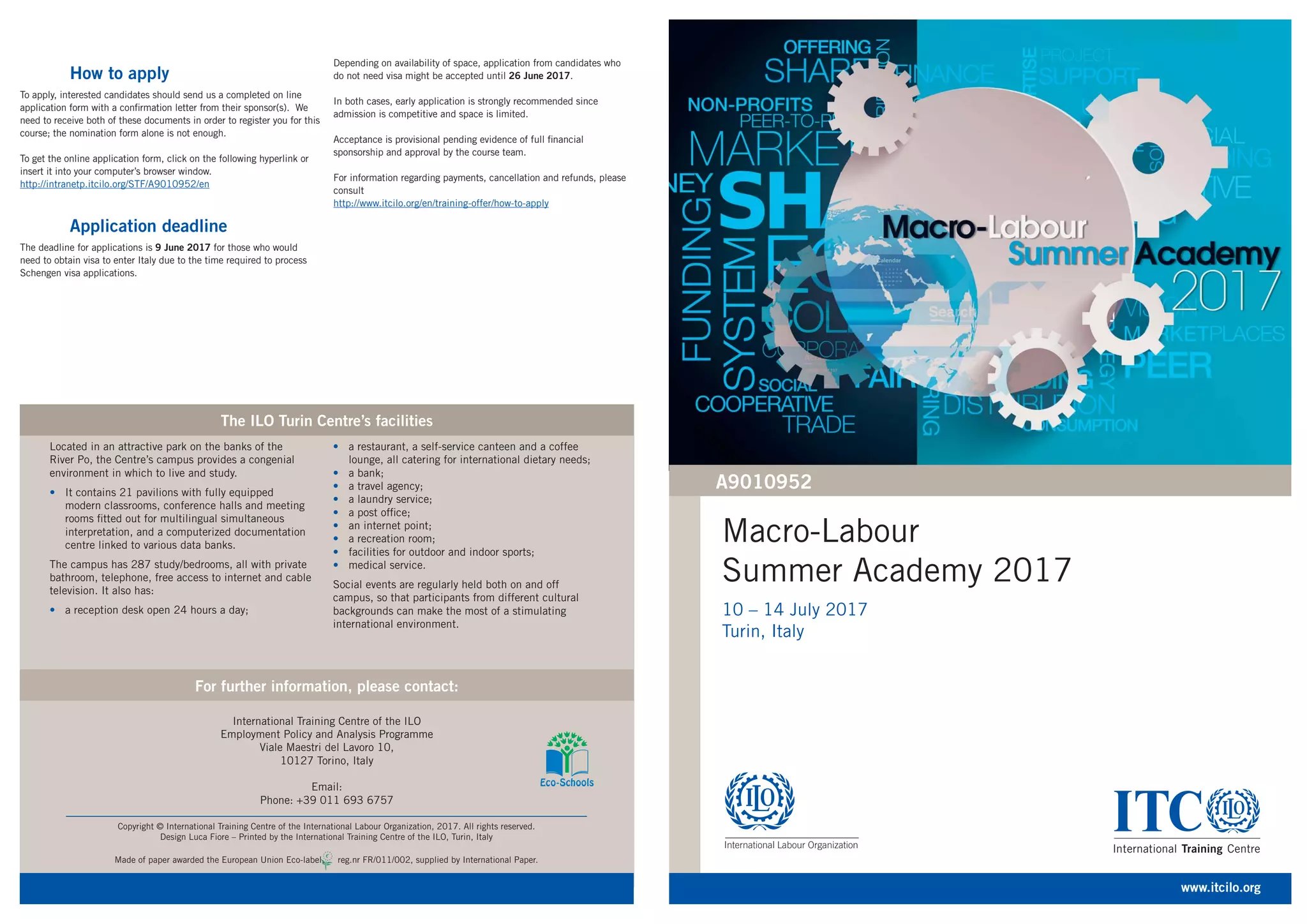
Macro-Labour
Summer Academy 2017
10 – 14 July 2017
Turin, Italy
A9010952
Macro-Labour Summer Academy 2017
A9010952
Rationale
For a long time, thoughts about macro-economic and labour
market issues evolved on separate tracks. At best, macro-
economic analysts made use of a statistical relationship
between aggregate demand and employment – the so-called
Okun’s curve – to estimate how changes in monetary and fiscal
policies or the impact of such exogenous shocks as rising oil
prices cause a shift in employment. Labour market experts, in
turn, looked at reforms to minimum wages, labour regulation
or education and training systems as if they had no bearing
on macroeconomic outcomes, at least not over the course of a
business cycle.
The global financial crisis and the slow growth in its aftermath
shook the belief that macro-economic and labour market
issues could be analysed separately and independently from
each other. Researchers started pointing to the rise in income
inequality and the fall in the labour income share as main
causes of the large financial imbalances that had built up prior
to the housing boom and bust. They also indicated that both
slow wage growth and a fall in the growth rate of the labour
force made the recovery more sluggish than it would have been
under a more equitable labour market situation.
Despite this, knowledge on how macro-economic and labour
market dynamics influence each other is still lacking. Partly,
this is due to the multi-faceted nature of labour markets. A
single labour market indicator poorly captures employment
challenges and social imbalances in a given country. Often,
headline indicators such as the unemployment rate are of little
relevance for developing countries where low unemployment
rates disguise high rates of informality and working poverty.
The ILO-ITC Macro-Labour Summer Academy aims at providing
a systematic overview of the theoretical and empirical tools
that support policy makers, analysts and practitioners to
better understand macro-labour interactions. As a leading
institution with the mandate to promote decent work, the
ILO has conducted research initiatives to revisit traditional
macroeconomic models of labour markets. To this effect,
it has developed new tools for labour market analysis and
forecasting which provide in-depth insights into labour market
dynamics and functioning. In particular, it has developed the
global economic linkages (GEL) model to analyze the effect
of business cycles and macro-economic policies on labour
markets and to identify factors that affect employment, wages
and the informal sector.
This course on macro-economics and modelling for labour
market analysis, organized jointly by the ILO Research
Department and the ILO International Training Centre, with
support from ILO’s Human Resources Department, establishes
a platform for taking stock of emerging developments in
macro-economic analysis of labour market performances and
for debate and knowledge sharing in this area. The course will
create a platform for an in-depth analysis of the dynamics of
employment and labour markets in traditional macroeconomic
models and their assumptions. Participants will obtain a
comprehensive overview of new ideas and techniques that
prominent academics, leading research institutions and
multilateral organisations proposed for a better understanding
of economic and labour market dynamics and their
interactions.
Course objectives
The course has the following objectives:
• The course will introduce concepts, structures and basic
assumptions of prominent macro-economic models and
modelling techniques and their relative strengths and
weaknesses in terms of understanding labour market
dynamics and analysing the labour and social impact of
policies. To this end:
– Participants will be introduced to new models and
indicators for macro-economic analysis of employment
and labour market performance;
– Participants will be provided insights into alternative
macro-economic modelling and employment analysis
techniques and their relative strengths and weaknesses.
• The course also brings together expertise from within the
ILO and external academics and policy experts to discuss
relevant instruments for macroeconomic analysis.
– Participants will get to know innovative macro-economic
tools to understand and analyse sources of current
labour market and social trends;
– Participants will be confronted with alternative approaches
to macroeconomic and labour market analysis.
The highlight of the course includes a keynote speech by a
leading academic on current macro-economic issues relevant
for labour market and inclusive growth dynamics.
Target Audience
The course caters to policy advisors and practitioners from
ministries of labour, finance and planning; economists
from central banks; ILO social partners; researchers and
policy analysts from international, regional and national
organizations; academia; and donor organizations.
Fees
The fee for the one-week course is 2,180 Euros per
participant. The tuition fee (1,580 euro) covers the cost
of training materials, and other conference facilities. The
subsistence fee (600 euro) covers full board and lodging at
the Turin Centre’s Campus; it also covers minor medical care,
insurance and occasional socio-cultural activities.
Participants are responsible for obtaining all necessary visas to
enter the Schengen area and to cover their travel costs,
including transfers to and from airport.
Structure of the course
The Macro-Labour Summer Academy consists of 5 modules:
i. Measuring and understanding labour market dynamics and
their drivers;
ii. Forecasting employment and the impact of macro-
economic policies;
iii. Projecting sectoral and occupational shifts in employment:
Some applications;
iv. Diagnosing sources of inequality and barriers to inclusive
growth;
v. Slow-moving drivers of growth and jobs.
Each module is comprised of 2-3 lectures and one group work
session.
The group work consists of a short macro-labour study on a
selected economy, using the tools and instruments discussed
during the course. Data and relevant software for the group
exercise will be provided and are pre-installed on computers
in the exercise lab. There will be a keynote speech given by
a leading academic expert on recent issues in macro-labour
market research.
Course topics
The main course topics include:
• Measuring and understanding labour market dynamics and
their drivers
Drawing on latest empirical studies, this module will
present an overview of sources and measures of labour
market indicators and discuss their links with macro-
economic variables. Through dedicated sessions the
module presents a thorough way of diagnosing labour
markets, taking into account the specific challenges for
both advanced and emerging countries and offering an
assessment of long-term structural challenges as well
as business-cycle related short-term dynamics of labour
markets. Questions to be discussed include: Besides the
unemployment rate, what other measures are there to
determine the status of a country’s labour market? How do
these measures evolve in relation to other macro-economic
variables? How do expectations and uncertainty influence
job creation? Do institutions matter for labour market
dynamics in business cycles?
• Forecasting employment and the impact of macro-
economic policies
This module gives an overview of key tools currently used
at the ILO as well as in other international organizations
and shows their strength and areas of application. In
particular, models used for forecasting detailed labour
market dynamics – such as labour market flows – are
compared with those applied for policy analysis and based
on general equilibrium considerations. The module will
also present a scenario analysis based on the most recent
run of the ILO global macro-econometric model. In a
hands-on exercise, participants learn how to run their own
small-scale labour market forecast.
• Projecting sectoral and occupational shifts in employment:
Some applications
Projecting sectoral and occupational employment shifts
provides useful information for policy makers. Besides
offering a general outlook of an economy, these shifts are
very closely watched and monitored by businesses, policy
analysts as well as job-seekers. Such employment
projections are often used to analyse the evolution
of demand and supply of skills and to detect skills
mismatches. What models are prominently used for
projecting employment demand and supply? What are their
relative strengths and weaknesses? How can they help in
trade and environmental policy reforms? This module will
discuss these questions and through hands-on exercises it
will allow participants to undertake their own projection
and interpret the results.
• Diagnosing sources of inequality and barriers to inclusive
growth
Rising inequality and the slowdown of wage growth in
comparison to productivity have become a central policy
question globally. The failure to achieve faster economic
growth in the aftermath of the crisis and to allow a more
rapid convergence of living standards and labour market
conditions across countries have been attributed to a lack
of inclusive growth. This module presents an overview of
how to analyse and measure different labour and social
issues in an integrated manner in order to develop policy-
relevant diagnostics and interventions. The module will
focus specifically on wage developments, wage policy
interventions and redistributive fiscal policies.
• Slow-moving drivers of growth and jobs
Economic and social imbalances often evolve gradually but
with long-lasting consequences for growth and job
creation. Shifts in demographics, exchange rate
misalignements, housing price bubbles and busts, and the
credit cycle are all examples of such slow moving drivers
with potentially large disruptive effects. This module
introduces an analytical framework for understanding
macroeconomic dynamics in the medium-term. Starting
from recent housing booms and busts in major economies,
this module analyses the effects of balance-sheet
recessions on long-term growth and social imbalances.
It also presents evidence on how demographic shifts
and globalization have triggered technological shifts that
fueled the imbalances. Finally, it examines policy options.
Language
The course will be delivered in English.

ILO ITC Macro-Labour Summer Academy - 2017

  • 1.
    For further information,please contact: The ILO Turin Centre’s facilities Located in an attractive park on the banks of the River Po, the Centre’s campus provides a congenial environment in which to live and study. • It contains 21 pavilions with fully equipped modern classrooms, conference halls and meeting rooms fitted out for multilingual simultaneous interpretation, and a computerized documentation centre linked to various data banks. The campus has 287 study/bedrooms, all with private bathroom, telephone, free access to internet and cable television. It also has: • a reception desk open 24 hours a day; • a restaurant, a self-service canteen and a coffee lounge, all catering for international dietary needs; • a bank; • a travel agency; • a laundry service; • a post office; • an internet point; • a recreation room; • facilities for outdoor and indoor sports; • medical service. Social events are regularly held both on and off campus, so that participants from different cultural backgrounds can make the most of a stimulating international environment. Copyright © International Training Centre of the International Labour Organization, 2017. All rights reserved. Design Luca Fiore – Printed by the International Training Centre of the ILO, Turin, Italy Made of paper awarded the European Union Eco-label, reg.nr FR/011/002, supplied by International Paper. International Training Centre of the ILO Employment Policy and Analysis Programme Viale Maestri del Lavoro 10, 10127 Torino, Italy Email: Phone: +39 011 693 6757 How to apply To apply, interested candidates should send us a completed on line application form with a confirmation letter from their sponsor(s). We need to receive both of these documents in order to register you for this course; the nomination form alone is not enough. To get the online application form, click on the following hyperlink or insert it into your computer’s browser window. http://intranetp.itcilo.org/STF/A9010952/en Application deadline The deadline for applications is 9 June 2017 for those who would need to obtain visa to enter Italy due to the time required to process Schengen visa applications. Depending on availability of space, application from candidates who do not need visa might be accepted until 26 June 2017. In both cases, early application is strongly recommended since admission is competitive and space is limited. Acceptance is provisional pending evidence of full financial sponsorship and approval by the course team. For information regarding payments, cancellation and refunds, please consult http://www.itcilo.org/en/training-offer/how-to-apply www.itcilo.org Macro-Labour Summer Academy 2017 10 – 14 July 2017 Turin, Italy A9010952
  • 2.
    Macro-Labour Summer Academy2017 A9010952 Rationale For a long time, thoughts about macro-economic and labour market issues evolved on separate tracks. At best, macro- economic analysts made use of a statistical relationship between aggregate demand and employment – the so-called Okun’s curve – to estimate how changes in monetary and fiscal policies or the impact of such exogenous shocks as rising oil prices cause a shift in employment. Labour market experts, in turn, looked at reforms to minimum wages, labour regulation or education and training systems as if they had no bearing on macroeconomic outcomes, at least not over the course of a business cycle. The global financial crisis and the slow growth in its aftermath shook the belief that macro-economic and labour market issues could be analysed separately and independently from each other. Researchers started pointing to the rise in income inequality and the fall in the labour income share as main causes of the large financial imbalances that had built up prior to the housing boom and bust. They also indicated that both slow wage growth and a fall in the growth rate of the labour force made the recovery more sluggish than it would have been under a more equitable labour market situation. Despite this, knowledge on how macro-economic and labour market dynamics influence each other is still lacking. Partly, this is due to the multi-faceted nature of labour markets. A single labour market indicator poorly captures employment challenges and social imbalances in a given country. Often, headline indicators such as the unemployment rate are of little relevance for developing countries where low unemployment rates disguise high rates of informality and working poverty. The ILO-ITC Macro-Labour Summer Academy aims at providing a systematic overview of the theoretical and empirical tools that support policy makers, analysts and practitioners to better understand macro-labour interactions. As a leading institution with the mandate to promote decent work, the ILO has conducted research initiatives to revisit traditional macroeconomic models of labour markets. To this effect, it has developed new tools for labour market analysis and forecasting which provide in-depth insights into labour market dynamics and functioning. In particular, it has developed the global economic linkages (GEL) model to analyze the effect of business cycles and macro-economic policies on labour markets and to identify factors that affect employment, wages and the informal sector. This course on macro-economics and modelling for labour market analysis, organized jointly by the ILO Research Department and the ILO International Training Centre, with support from ILO’s Human Resources Department, establishes a platform for taking stock of emerging developments in macro-economic analysis of labour market performances and for debate and knowledge sharing in this area. The course will create a platform for an in-depth analysis of the dynamics of employment and labour markets in traditional macroeconomic models and their assumptions. Participants will obtain a comprehensive overview of new ideas and techniques that prominent academics, leading research institutions and multilateral organisations proposed for a better understanding of economic and labour market dynamics and their interactions. Course objectives The course has the following objectives: • The course will introduce concepts, structures and basic assumptions of prominent macro-economic models and modelling techniques and their relative strengths and weaknesses in terms of understanding labour market dynamics and analysing the labour and social impact of policies. To this end: – Participants will be introduced to new models and indicators for macro-economic analysis of employment and labour market performance; – Participants will be provided insights into alternative macro-economic modelling and employment analysis techniques and their relative strengths and weaknesses. • The course also brings together expertise from within the ILO and external academics and policy experts to discuss relevant instruments for macroeconomic analysis. – Participants will get to know innovative macro-economic tools to understand and analyse sources of current labour market and social trends; – Participants will be confronted with alternative approaches to macroeconomic and labour market analysis. The highlight of the course includes a keynote speech by a leading academic on current macro-economic issues relevant for labour market and inclusive growth dynamics. Target Audience The course caters to policy advisors and practitioners from ministries of labour, finance and planning; economists from central banks; ILO social partners; researchers and policy analysts from international, regional and national organizations; academia; and donor organizations. Fees The fee for the one-week course is 2,180 Euros per participant. The tuition fee (1,580 euro) covers the cost of training materials, and other conference facilities. The subsistence fee (600 euro) covers full board and lodging at the Turin Centre’s Campus; it also covers minor medical care, insurance and occasional socio-cultural activities. Participants are responsible for obtaining all necessary visas to enter the Schengen area and to cover their travel costs, including transfers to and from airport. Structure of the course The Macro-Labour Summer Academy consists of 5 modules: i. Measuring and understanding labour market dynamics and their drivers; ii. Forecasting employment and the impact of macro- economic policies; iii. Projecting sectoral and occupational shifts in employment: Some applications; iv. Diagnosing sources of inequality and barriers to inclusive growth; v. Slow-moving drivers of growth and jobs. Each module is comprised of 2-3 lectures and one group work session. The group work consists of a short macro-labour study on a selected economy, using the tools and instruments discussed during the course. Data and relevant software for the group exercise will be provided and are pre-installed on computers in the exercise lab. There will be a keynote speech given by a leading academic expert on recent issues in macro-labour market research. Course topics The main course topics include: • Measuring and understanding labour market dynamics and their drivers Drawing on latest empirical studies, this module will present an overview of sources and measures of labour market indicators and discuss their links with macro- economic variables. Through dedicated sessions the module presents a thorough way of diagnosing labour markets, taking into account the specific challenges for both advanced and emerging countries and offering an assessment of long-term structural challenges as well as business-cycle related short-term dynamics of labour markets. Questions to be discussed include: Besides the unemployment rate, what other measures are there to determine the status of a country’s labour market? How do these measures evolve in relation to other macro-economic variables? How do expectations and uncertainty influence job creation? Do institutions matter for labour market dynamics in business cycles? • Forecasting employment and the impact of macro- economic policies This module gives an overview of key tools currently used at the ILO as well as in other international organizations and shows their strength and areas of application. In particular, models used for forecasting detailed labour market dynamics – such as labour market flows – are compared with those applied for policy analysis and based on general equilibrium considerations. The module will also present a scenario analysis based on the most recent run of the ILO global macro-econometric model. In a hands-on exercise, participants learn how to run their own small-scale labour market forecast. • Projecting sectoral and occupational shifts in employment: Some applications Projecting sectoral and occupational employment shifts provides useful information for policy makers. Besides offering a general outlook of an economy, these shifts are very closely watched and monitored by businesses, policy analysts as well as job-seekers. Such employment projections are often used to analyse the evolution of demand and supply of skills and to detect skills mismatches. What models are prominently used for projecting employment demand and supply? What are their relative strengths and weaknesses? How can they help in trade and environmental policy reforms? This module will discuss these questions and through hands-on exercises it will allow participants to undertake their own projection and interpret the results. • Diagnosing sources of inequality and barriers to inclusive growth Rising inequality and the slowdown of wage growth in comparison to productivity have become a central policy question globally. The failure to achieve faster economic growth in the aftermath of the crisis and to allow a more rapid convergence of living standards and labour market conditions across countries have been attributed to a lack of inclusive growth. This module presents an overview of how to analyse and measure different labour and social issues in an integrated manner in order to develop policy- relevant diagnostics and interventions. The module will focus specifically on wage developments, wage policy interventions and redistributive fiscal policies. • Slow-moving drivers of growth and jobs Economic and social imbalances often evolve gradually but with long-lasting consequences for growth and job creation. Shifts in demographics, exchange rate misalignements, housing price bubbles and busts, and the credit cycle are all examples of such slow moving drivers with potentially large disruptive effects. This module introduces an analytical framework for understanding macroeconomic dynamics in the medium-term. Starting from recent housing booms and busts in major economies, this module analyses the effects of balance-sheet recessions on long-term growth and social imbalances. It also presents evidence on how demographic shifts and globalization have triggered technological shifts that fueled the imbalances. Finally, it examines policy options. Language The course will be delivered in English.