

Report EUR 26519 EN
2014
Authors: Stefania Aceto, Spiros Borotis,
Jim Devine & Thomas Fischer
Results from a consultation with
European stakeholders and roadmaps
for policy action
Mapping and Analysing
Prospective Technologies for Learning
Editors: Panagiotis Kampylis & Yves Punie
European Commission
Joint Research Centre
Institute for Prospective Technological Studies
Contact information
Address: Edificio Expo. c/ Inca Garcilaso, 3. E-41092 Seville (Spain)
E-mail: jrc-ipts-secretariat@ec.europa.eu
Tel.: +34 954488318
Fax: +34 954488300
http://ipts.jrc.ec.europa.eu
http://www.jrc.ec.europa.eu
This publication is a Scientific and Policy Report by the Joint Research Centre of the European Commission.
Legal Notice
Neither the European Commission nor any person acting on behalf of the Commission
is responsible for the use which might be made of this publication.
Europe Direct is a service to help you find answers to your questions about the European Union
Freephone number (*): 00 800 6 7 8 9 10 11
(*) Certain mobile telephone operators do not allow access to 00 800 numbers or these calls may be billed.
A great deal of additional information on the European Union is available on the Internet.
It can be accessed through the Europa server http://europa.eu/.
This document replaces the JRC Scientific and Policy Report 'Mapping and analysing prospective technologies for learning –
Results from a consultation with European stakeholders and roadmaps for policy action' with ISBN number 978-92-79-32383-6
and PUBSY request number JRC81935. Corrections have been made to the names and/or affiliation of some stakeholders
participating in the activities of the MATEL study, in Annex 2 (pp. 56-57) of the new document.
JRC88469
EUR 26519 EN
ISBN 978-92-79-35501-1 (pdf)
ISSN 1831-9424 (online)
doi:10.2791/64987
Luxembourg: Publications Office of the European Union, 2014
© European Union, 2014
Reproduction is authorised provided the source is acknowledged.
Printed in Spain
1
Preface
The Europe 2020 strategy acknowledges that a fundamental transformation of education and
training is needed to address the new skills and competences that will be required if Europe is to
remain competitive, overcome the current economic crisis and grasp new opportunities. Innovating
in education and training is a key priority in several flagship initiatives of the Europe 2020 strategy,
in particular the Agenda for New Skills and Jobs, Youth on the Move, the Digital Agenda, and the
Innovation Union Agenda. Accordingly, one of the five targets for measuring the success of the
Europe 2020 strategy is the modernization of European Education and Training systems with the
goals of reducing early school leaving and increasing tertiary education attainment.
Policy makers and educational stakeholders recognise the contribution of ICT to achieving these
targets, and more broadly, the role of ICT as a key enabler of innovation and creativity in Education
and Training (E&T) and for learning in general. It is however also highlighted that the full potential
of ICT is not being realised in formal education settings.
Within this framework, JRC-IPTS1
commissioned MENON Network to conduct the study 'Mapping and
analysing prospective technologies for learning' (MATEL) in the context of the broader JRC-IPTS
research agenda on modernisation of Education and Training systems in Europe. In particular, this
final report of the MATEL study brings evidence to the debate about the technologies that are
expected to play a decisive role in shaping future learning strategies in the short to medium term
(5-10 years from now) in three main learning domains: formal education and training; work-place
and work-related learning; re-skilling and up-skilling strategies in a lifelong-learning continuum. The
current and potential use of eight key technologies for teaching and learning purposes, the relevant
market trends, and on-going policy initiatives are analysed. In addition, three roadmaps, one per
learning domain, are presented suggesting the long-term goals and specific objectives for
educational change, leading to the immediate strategies and actions to be undertaken by policy-
and decision-makers.
Yves Punie
Project leader ICT for Learning and Skills
1
The Institute for Prospective Technological Studies (IPTS) is one of the seven research institutes that make
up the European Commission’s Joint Research Centre (JRC).
2
Acknowledgements
The authors would like to thank Yves Punie and Panagiotis Kampylis for their valuable support in
developing and finalising this study. We would also like to thank all the experts who have
participated in the MATEL study for their valuable contributions to our research as well as the
President and Vice-President of the MENON Network (Nikitas Kastis and Claudio Dondi) for their key
inputs for the strategic development of the Study.
3
Table of Contents
Preface......................................................................................................................................................................................................... 1
Acknowledgements............................................................................................................................................................................... 2
Executive Summary.............................................................................................................................................................................. 5
1. Introduction..................................................................................................................................................................................... 9
2. The MATEL study features.................................................................................................................................................. 11
2.1 Context ................................................................................................................................................................................ 11
2.2 Study phases.................................................................................................................................................................... 12
2.3 Online consultation....................................................................................................................................................... 14
2.4 State-of-the-art analysis.......................................................................................................................................... 14
2.5 Roadmapping workshop............................................................................................................................................ 14
2.6 Stakeholder involvement .......................................................................................................................................... 14
3. The MATEL technologies for educational change.................................................................................................. 16
3.1 The MATEL clusters...................................................................................................................................................... 16
3.2 The views of stakeholders on key technologies for educational change...................................... 19
3.2.1 Primary Education.............................................................................................................................................. 19
3.2.2 Secondary Education........................................................................................................................................ 20
3.2.3 Vocational Education and Training........................................................................................................... 21
3.2.4 Higher Education................................................................................................................................................. 22
3.2.5 Workplace and work-related learning..................................................................................................... 23
3.2.6 Re-skilling and up-skilling strategies....................................................................................................... 24
3.2.7 Informal learning................................................................................................................................................ 25
3.3 A cluster-based interpretation of results......................................................................................................... 26
3.4 A technology-based interpretation of results ............................................................................................... 29
4. The wider context..................................................................................................................................................................... 32
4.1 The MATEL study in a wider context: comparison with Horizon series of reports.................... 32
4.2 The MATEL clusters in the wider context......................................................................................................... 35
4.2.1 Devices, interfaces and connectivity ....................................................................................................... 35
4.2.2 Learning environments.................................................................................................................................... 35
4.2.3 Learner management services ................................................................................................................... 36
4.2.4 Tools for visualisation and simulation.................................................................................................... 36
4.2.5 Games....................................................................................................................................................................... 36
4.2.6 Content..................................................................................................................................................................... 36
4.2.7 Networked collaboration ................................................................................................................................ 36
4.2.8 Tools for productivity and creativity........................................................................................................ 37
5. Roadmapping.............................................................................................................................................................................. 38
4
5.1 Policy focus areas for educational change..................................................................................................... 39
5.2 The needs and challenges of learning systems........................................................................................... 40
5.3 A roadmap for change in Primary and Secondary Education .............................................................. 45
5.4 A roadmap for change in work-based and work-related learning.................................................... 46
5.5 A roadmap for change in re-skilling and up-skilling strategies.......................................................... 47
6. Conclusions.................................................................................................................................................................................. 49
References.............................................................................................................................................................................................. 52
Annex 1 – Details about respondents in the brainstorming and prioritisation rounds................................ 54
Annex 2 – Stakeholders participating in the activities of the MATEL study...................................................... 56
Annex 3 - Definition of the MATEL key technologies for educational change................................................. 58
5
Executive Summary
This report presents the results of the study Mapping and Analysing Prospective Technologies for
Learning (MATEL), commissioned by JRC-IPTS and carried out by the MENON Network. The MATEL
study took 14 months (from January 2012 to February 2013) and involved more than 200
stakeholders in a joint reflection on the role of technologies for innovation in learning and change of
learning systems. The inclusion of a variety of stakeholders in the consultation, together with the
European focus on the key technologies for educational change, mark the distinctive elements of
this study, which provides a European perspective on technologies for learning across three learning
domains: formal education and training; workplace and work-related learning; re-skilling and up-
skilling strategies for workers.
The study had three main phases: an online consultation, a state-of-the art analysis and a
roadmapping workshop. The online consultation with stakeholders included a brainstorming round
to get a long list of technologies, which were then grouped in a clustering validation round. There
was also a prioritisation round to identify the “top technologies” able to support learning innovation
in Europe). These consultations led to the identification of 8 technology clusters and a set of related
key technologies for educational change. These key technologies were analysed in depth in the
state-of-the-art analysis to highlight their current and potential use in education, the relevant
market trends, and on-going policy initiatives. In parallel, the roadmapping workshop attended by
external experts allowed discussion of strategies and actions for the effective deployment of
technologies in learning in the three learning domains.
Below, the key technologies emerging from the online consultation are presented per learning
sector and in relation to their cluster of belonging.
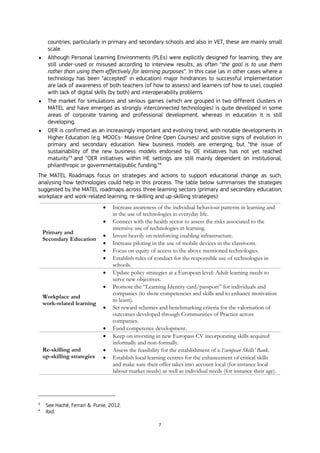
Learning sectors Key technologies
Formal
Education &
Training
Primary
Education
Enabling Infrastructure
Visualisations
Games and serious games
eContent
Video/DVD, TV/Digital TV, Digital radio
Secondary
Education
Enabling Infrastructure
Mobile devices
Games and serious games
Visualisations
Virtual reality
Higher
Education
OER
Cloud Computing
Online collaboration platforms and tools
Enabling Infrastructure
Simulations
eContent
Vocational
Education and
Training
Simulations
Enabling Infrastructure
Visualisations
Learner Management Systems
eAssessment
Workplace and work-related
learning
Simulations
Enabling Infrastructure
Cloud Computing
Online collaboration platforms and tools
Content management systems
Visualisations
6
Re-skilling and up-skilling
Enabling Infrastructure
ePortfolio
Personal Learning Environments
Intelligent tutoring systems
Simulations
Informal learning
Web 2.0
Games and Serious games
Mobile devices
Social Networking/software/media
Blogs and micro-blogging
Legend
Devices, Interfaces and Connectivity Learner management services
Tools for visualization and simulation Networked collaboration
Content Games and Serious Games
Learning Environments Tools for productivity and creativity
Based on the selection process described in Section 3.4, the following eight technologies were
selected for in-depth analysis by MATEL:
 Enabling infrastructure (Internet, broadband, Wi-Fi, cloud computing2
)
 Mobile devices (mobile phones, smart phones, tablets)
 Games (with specific reference to serious games)
 Open Educational Resources (OER)
 ePortfolios
 Simulations
 Personal learning environments (PLEs)
 Social networking/software/media
Desk research and interviews with experts provided an overview of how far these technologies in
learning are currently deployed or could be deployed in the future. The main focus was on: demand
patterns, supply features, market trends, opportunities and threats linked to a mainstreamed
adoption in learning. The following overall picture emerged:
 In the area of Enabling Infrastructure, despite the fact that broadband and extended Wi-Fi
connections are still a concern in most of the EU countries, cloud computing is now becoming
the key technology.
 In the mobile devices arena, the market for mobile phones is now mature and is expected to
decline, leaving space for the rapidly growing market for smart phones and tablets.
 ePortfolios, though widely recognised by the scientific community, are not yet mainstreamed
and therefore the market is not yet mature. The “Open badges” project, launched by Mozilla,
which aimed to build an ecosystem where badges can be offered for skills, abilities, and
achievements in ways that traditional certifications do not, may have a positive impact on
further ePortfolio developments.
 Social networks, media and software are ubiquitous in everyday life, but not in learning. These
technologies were not designed with a learning purpose in mind and have not been
mainstreamed in education and training. Though good practices can be found across EU
2
It shall be noted that cloud computing was added to the Enabling Infrastructure based on the inputs and
suggestions gathered by experts.
7
countries, particularly in primary and secondary schools and also in VET, these are mainly small
scale.
 Although Personal Learning Environments (PLEs) were explicitly designed for learning, they are
still under-used or misused according to interview results, as often “the goal is to use them
rather than using them effectively for learning purposes”. In this case (as in other cases where a
technology has been “accepted” in education) major hindrances to successful implementation
are lack of awareness of both teachers (of how to assess) and learners (of how to use), coupled
with lack of digital skills (by both) and interoperability problems.
 The market for simulations and serious games (which are grouped in two different clusters in
MATEL and have emerged as strongly interconnected technologies) is quite developed in some
areas of corporate training and professional development, whereas in education it is still
developing.
 OER is confirmed as an increasingly important and evolving trend, with notable developments in
Higher Education (e.g. MOOCs- Massive Online Open Courses) and positive signs of evolution in
primary and secondary education. New business models are emerging, but “the issue of
sustainability of the new business models endorsed by OE initiatives has not yet reached
maturity”3
and “OER initiatives within HE settings are still mainly dependent on institutional,
philanthropic or governmental/public funding.”4
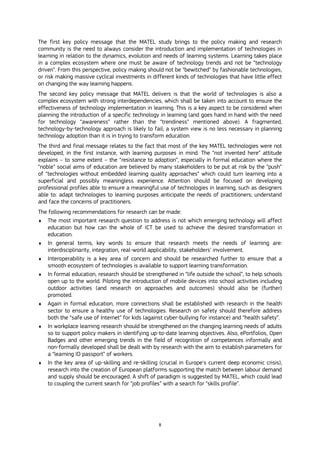
The MATEL Roadmaps focus on strategies and actions to support educational change as such,
analysing how technologies could help in this process. The table below summarises the strategies
suggested by the MATEL roadmaps across three learning sectors (primary and secondary education;
workplace and work-related learning; re-skilling and up-skilling strategies):
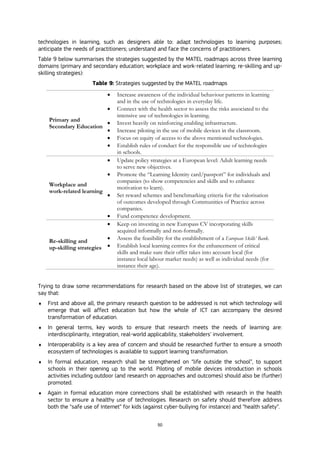
Primary and
Secondary Education
 Increase awareness of the individual behaviour patterns in learning and
in the use of technologies in everyday life.
 Connect with the health sector to assess the risks associated to the
intensive use of technologies in learning.
 Invest heavily on reinforcing enabling infrastructure.
 Increase piloting in the use of mobile devices in the classroom.
 Focus on equity of access to the above mentioned technologies.
 Establish rules of conduct for the responsible use of technologies in
schools.
Workplace and
work-related learning
 Update policy strategies at a European level: Adult learning needs to
serve new objectives.
 Promote the “Learning Identity card/passport” for individuals and
companies (to show competencies and skills and to enhance motivation
to learn).
 Set reward schemes and benchmarking criteria for the valorisation of
outcomes developed through Communities of Practice across
companies.
 Fund competence development.
Re-skilling and
up-skilling strategies
 Keep on investing in new Europass CV incorporating skills acquired
informally and non-formally.
 Assess the feasibility for the establishment of a European Skills’ Bank.
 Establish local learning centres for the enhancement of critical skills
and make sure their offer takes into account local (for instance local
labour market needs) as well as individual needs (for instance their age).
3
See Haché, Ferrari & Punie, 2012.
4
Ibid.
8
The first key policy message that the MATEL study brings to the policy making and research
community is the need to always consider the introduction and implementation of technologies in
learning in relation to the dynamics, evolution and needs of learning systems. Learning takes place
in a complex ecosystem where one must be aware of technology trends and not be “technology
driven”. From this perspective, policy making should not be “bewitched” by fashionable technologies,
or risk making massive cyclical investments in different kinds of technologies that have little effect
on changing the way learning happens.
The second key policy message that MATEL delivers is that the world of technologies is also a
complex ecosystem with strong interdependencies, which shall be taken into account to ensure the
effectiveness of technology implementation in learning. This is a key aspect to be considered when
planning the introduction of a specific technology in learning (and goes hand in hand with the need
for technology “awareness” rather than the “trendiness” mentioned above). A fragmented,
technology-by-technology approach is likely to fail; a system view is no less necessary in planning
technology adoption than it is in trying to transform education.
The third and final message relates to the fact that most of the key MATEL technologies were not
developed, in the first instance, with learning purposes in mind. The “not invented here” attitude
explains – to some extent – the “resistance to adoption”, especially in formal education where the
“noble” social aims of education are believed by many stakeholders to be put at risk by the “push”
of “technologies without embedded learning quality approaches” which could turn learning into a
superficial and possibly meaningless experience. Attention should be focused on developing
professional profiles able to ensure a meaningful use of technologies in learning, such as designers
able to: adapt technologies to learning purposes anticipate the needs of practitioners; understand
and face the concerns of practitioners.
The following recommendations for research can be made:
 The most important research question to address is not which emerging technology will affect
education but how can the whole of ICT be used to achieve the desired transformation in
education.
 In general terms, key words to ensure that research meets the needs of learning are:
interdisciplinarity, integration, real-world applicability, stakeholders’ involvement.
 Interoperability is a key area of concern and should be researched further to ensure that a
smooth ecosystem of technologies is available to support learning transformation.
 In formal education, research should be strengthened in “life outside the school”, to help schools
open up to the world. Piloting the introduction of mobile devices into school activities including
outdoor activities (and research on approaches and outcomes) should also be (further)
promoted.
 Again in formal education, more connections shall be established with research in the health
sector to ensure a healthy use of technologies. Research on safety should therefore address
both the “safe use of Internet” for kids (against cyber-bullying for instance) and “health safety”.
 In workplace learning research should be strengthened on the changing learning needs of adults
so to support policy makers in identifying up-to-date learning objectives. Also, ePortfolios, Open
Badges and other emerging trends in the field of recognition of competences informally and
non-formally developed shall be dealt with by research with the aim to establish parameters for
a “learning ID passport” of workers.
 In the key area of up-skilling and re-skilling (crucial in Europe's current deep economic crisis),
research into the creation of European platforms supporting the match between labour demand
and supply should be encouraged. A shift of paradigm is suggested by MATEL, which could lead
to coupling the current search for “job profiles” with a search for “skills profile”.
9
1. Introduction
The Europe 2020 strategy (EC, 2010) acknowledges that, to remain competitive, overcome the
current economic crisis and grasp new opportunities, Europe has to concentrate on smart,
sustainable and inclusive growth. One key to achieving these overall goals is developing and
investing in citizens’ skills and competences. Consequently, one of the five targets for measuring
the success of the Europe 2020 strategy is the modernisation of European Education and Training
systems and institutions with the goals of reducing early school leaving and increasing tertiary
education attainment.
Knowledge generation and organisation have changed substantially over the last 10 to 20 years,
giving rise not only to new communication and working patterns, but also to new learning
approaches and competence requirements. There is clear evidence5
that Information and
Communication Technologies (ICT) can play a role in shaping and changing learning patterns,
pathways and opportunities.
Within this framework, JRC-IPTS6
commissioned the MENON Network to conduct the study Mapping
and Analysing Prospective Technologies for Learning (MATEL) with the aim of identifying key
technologies able to support educational change in Europe.
This final report presents the results of the MATEL Study, launched in January 2012 and concluded
in March 2013. The report critically integrates the outcomes of the research and of the
consultations with experts and stakeholders, in order to offer a roadmap for the deployment of the
technologies that have the potential to support educational change in Europe in the next 5 to 10
years. In particular, the report offers:
 a better understanding of the technologies, technological trends and applications that are
expected to play a decisive role in shaping future learning strategies in Europe in the short to
medium term (5 to 10 years from now);
 a critical analysis of how the evolution of such technologies can support educational change in
Europe;
 a set of strategies and actions to promote promising technologies, encourage implementation
and ensure effective and inclusive deployment in formal, non-formal and informal learning
environments.
A number of studies, papers and research reports7
have been/are being and will be published on the
key technologies to support learning innovation. However, MATEL has some distinctive features that
can contribute to the existing body of knowledge including:
 A European coverage and perspective (compared to most of the available reports that focus
on the worldwide situation or, as in the case of the Horizon series, mainly on the US),
guaranteed by the participation in the study of European stakeholders (policy and decision
makers; technology providers; industry representatives; researchers; teachers; trainers;
students; parents) and ICT for learning experts and by the fact that research was explicitly
aimed at identifying key technologies for educational change in Europe.
 A multi-sector approach, as the research focuses contemporarily on three main learning
domains (Formal Education and Training; Work-place and work-related learning; Re-skilling
5
See for instance Redecker et al., 2009.
6
The Institute for Prospective Technological Studies (IPTS) is one of the seven research institutes that make
up the European Commission’s Joint Research Centre (JRC).
7
See for instance the Horizon report series by the New Media Consortium (2012); the UNED Engineering
Education Report available at http://ohm.ieec.uned.es/eer/consulta_years.php. The HOTEL support action
(http://hotel-project.eu/Project_Overview) will publish in Spring 2013 a report on Emerging Technologies
for learning.
10
and up-skilling strategies in a lifelong-learning continuum) and their subsectors, allowing for
the differentiation of the technologies that are most suitable to each domain and subsector.
 A bottom-up, multi-stakeholder approach, guaranteed by the participation in the study of a
wide variety of actors, ranging from experts and researchers to teachers and learners and
involving also policy makers and industry.
The report is organised as follows:
 Chapter 2 provides an outline of the MATEL study (distinctive features; structure and
phases).
 Chapter 3 presents the MATEL technology clusters and technologies and analyses critically
the results of the online consultation.
 Chapter 4 situates the MATEL results in the ongoing international debate in the field,
referring in particular to the Horizon report series.
 Chapter 5 proposes a roadmap for the successful and meaningful deployment of key
technologies in learning.
 Chapter 6 draws general conclusions on the outcomes of the study and puts forward
recommendations for further tracking/mapping of developments.
Finally, Annex 1 provides details about respondents in the Brainstorming and Prioritisation rounds,
Annex 2 provides the list of stakeholders contributed to the Study, and Annex 3 provides the
definition of the key technologies identified by MATEL.
11
2. The MATEL study features
The chapter in a snapshot
The MATEL study involves three main phases:
 Online stakeholders’ consultation – aimed at identifying and mapping existing
technological developments that are expected to decisively impact on learning strategies
and pathways in the next 5 to 10 years. This entailed three consultation rounds:
Brainstorming (to identify technologies); Clustering (to map them) and Prioritisation (to
rank the technologies, differentiated according to the learning domains and respective
sub-sectors).
 State of the art analysis – aimed at analysing the state of the art of deployment and
implementation of the technologies for learning that emerged from the online
consultation as the most suitable and promising for supporting educational change. This
phase entailed both desk research and consultation with experts by means of interviews.
 Roadmapping had the aim of suggesting actions and strategies to ensure that the
potential of technologies in facilitating effective, efficient, inclusive and high-quality
lifelong learning opportunities is ideally developed.
A total of 226 stakeholders were involved in the MATEL Study:
 174 stakeholders (policy and decision makers, teachers, trainers, technology providers,
technology developers, students, parents) and 19 European experts in the field of
learning, ICT and ICT for learning participated in the online consultation.
 15 technology and e-learning experts contributed to the State of the Art analysis.
 18 European stakeholders and experts participated in the roadmapping exercise.
2.1 Context
The MATEL study aimed to identify technologies, technological trends, technology-related trends
and applications that have already/have the potential to support learning innovation in Europe with
a short-medium term time frame, namely 5 to 10 years from now. Following an in-depth analysis
of such technologies (potential for educational use, current and foreseen market developments, and
barriers to deployment) MATEL aims to provide policy and decision makers with a set of suggested
actions and strategies to favour their meaningful deployment in learning.
In particular, the MATEL Study had the following objectives:
1. To identify, classify and prioritise existing and currently emerging technological applications
and innovations that already have or are expected to have an impact on learning patterns,
strategies and pathways, in formal education and training, professional development and
lifelong learning.
2. To analyse the state of the art of deployment and educational use of the key technologies
identified as having an impact on learning, including an understanding of the structure and
evolution of the corresponding market and a focus on bottlenecks and barriers to deployment
and implementation.
3. To develop a roadmap guiding policy and research for seizing the potential of technologies
for learning.
The study also focused on the particular technologies/technological innovations that can support
learning innovation in the following targeted domains of learning:
12
 Formal Education and Training (i.e., primary, secondary and higher education; vocational
education and training);
 Work-place and work-related learning (i.e., professional development strategies that are
integrated into and/or directly relevant to a specific job or career path);
 Re-skilling and up-skilling strategies in a lifelong-learning continuum (e.g., re-qualification
schemes; strategies for regaining employment; career development strategies an individual
undertakes voluntarily to change his/her job or professional profile, etc.).
Note: Given its breadth, scope and internal variability, the formal education and training domain
was analysed along each of its learning sectors as reported above. Additionally, informal learning
was introduced during the development of the study, given its transversal relevance to learning
change supported by the use of technologies.
2.2 Study phases
The study was articulated in three main phases, each one reflecting one of the three objectives
mentioned in 2.1: Online Consultation (addressing objective 1); State of the Art Analysis (addressing
objective 2); Roadmapping Workshop (addressing objective 3).
Figure 1 shows the main features of each of the three phases of the MATEL Study and their
interrelation, further discussed in the next sections. The study started with an online consultation
with stakeholders that led to the identification of 8 technology clusters and a set of related key
technologies for educational change. Such technologies were analysed in depth in the State of the
Art analysis to highlight their current and potential use in education, the relevant market trends and
on-going policy initiatives. In parallel, the Roadmapping workshop attended by stakeholders and
experts allowed discussion of strategies and actions for the effective deployment of such
technologies in learning in the three learning domains.
13
BRAINSTORMING
ROUND
List of 571
technologies
ONLINE
CONSULTATION
CLUSTERING
ROUND
Systematisation
and rationalisation
of the
technologies into
8 technology
clusters
The MATEL
roadmap
PRIORITISATION
ROUND
Identification of
the key
technologies for
educational
change
STATE OF THE ART
ANALYSIS
Validation of the
key MATEL
technologies in
the wider policy,
market and
practice context
ROADMAPPING
WORKSHOP
Actions and
strategies to
ensure effective
deployment of
technologies in
learning in Europe
Figure 1: Core MATEL study phases
14
2.3 Online consultation
The aim of the Online stakeholders’ consultation was to identify and map existing technological
developments that are expected to decisively impact on learning strategies and pathways in the
near future, i.e., in the next 5 to 10 years. In this phase, a systematic approach was used to collect
evidence, based on respondents’ opinions and insights, through three online stakeholder
consultation rounds (brainstorming, clustering, prioritisation), involving different panels of
respondents in each case (see 2.6):
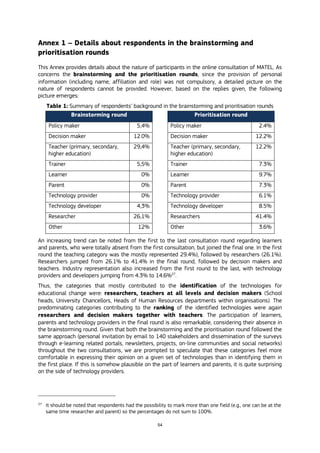
 The brainstorming round helped to gather a total of 571 items related to technologies,
technological developments, technological trends and applications with the potential to
support educational change in the near future.
 The clustering round rationalised and systematised the items of the brainstorming round and
resulted in a final map of 8 technology clusters (and related technologies) validated by 19
external experts.
 The prioritisation round ranked the key technologies for educational change within each
cluster and in relation to each learning domain (and sector, where relevant).
Once the key technologies were identified, research shifted to the analysis of the state of
development of such technologies, their potential growth and their current and potential value
added for learning innovation (see 2.4). In parallel (see 2.5), consultation started with key European
experts to identify a set of actions and strategies for the successful deployment of the identified
technologies in learning.
2.4 State-of-the-art analysis
The aim of the state-of-the-art analysis was to analyse the current and future prospects for
deployment and implementation of the technologies for learning that emerged from the online
consultation as the most suitable to support educational change. Desk research and a series of
targeted expert interviews were employed to:
 Study the impact of these technologies on learning (current educational use of the
technology; potential of the particular technology for changing and shaping learning patterns
and pathways in the near future; outline of weaknesses and of any limitations of the
technology for learning).
 Analyse the underlying economic sectors (market structure and trends analysis in general and
for learning purposes in particular; identification of current bottlenecks and barriers to
deployment with a view to identifying areas for policy intervention).
2.5 Roadmapping workshop
The aim of the Roadmapping exercise was to identify bottlenecks and barriers to the deployment
and implementation of the identified key technologies for educational change and to suggest
actions and strategies to ensure that the potential of technologies in facilitating effective, efficient,
inclusive and high-quality lifelong learning opportunities is optimally developed. This phase
concretised in the organisation of a Roadmapping workshop in Brussels in autumn 2012 with the
participation of European stakeholders, including experts in the field of technology, learning and
learning innovation.
Based on the input provided by participants in the workshop and on the critical analysis of the
results of the three core phases of the study, a set of strategies, actions and recommendations for
policy and decision makers were defined to support effective and meaningful deployment of key
technological innovations for learning (see Chapter 5).
2.6 Stakeholder involvement
One of the distinctive elements of the MATEL study is the involvement of educational stakeholders
throughout the period of the study.
15
A total of 226 stakeholders were involved in the MATEL Study:
 174 stakeholders’ representatives (policy and decision makers, teachers, trainers, technology
providers; technology developers, students, parents, researchers) and 19 European experts in
the field of learning, ICT and ICT for learning participated in the online consultation.
 15 technology and e-learning experts contributed to the State of the Art analysis.
 18 European stakeholders’ representatives participated in the roadmapping exercise
The aim was to collect views of respondents representing policy, market, research, and practice
perspectives and so to obtain a realistic and multi-stakeholder-generated picture of the key
technologies for learning in Europe. As explored in Chapter 4, this led to interesting results, if
compared to the current research debate and to recent publications in the same field.
16
3. The MATEL technologies for educational change
The chapter in a snapshot
MATEL identified a set of technology clusters and key technologies8
influencing innovation
across the three learning domains and sub-sectors.
In the cluster Devices, Interfaces and Connectivity, Enabling Infrastructure (Wi-Fi,
Internet, and Broadband), Mobile devices (Mobile phones, Smart phones and tablets) and
Cloud Computing are key across all the learning domains and sectors considered.
Another cluster showing a remarkable role across all sectors (except for informal learning) is
Tools for Visualisation and Simulation.
eContent, Open Educational Resources (OER), Content Management Systems (CMS) and
Video/DVD Digital radio, TV/Digital TV are the top rated technologies in the Content cluster in
one or more of the following sectors: Primary Education, Higher Education, Workplace
Learning.
The clusters Learning Environments (including Personal learning environments, Learning
Management Systems, Intelligent tutoring systems) and Learner Management Services
(including ePortfolio and eAssessment) emerge as particularly relevant in Vocational
Education and Training and Re-skilling and up-skilling strategies.
The Networked Collaboration cluster has the potential to influence change in Higher
Education, Workplace learning and Informal learning with the following technologies: Online
Collaboration platforms and tools; Web 2.0; Social networking/software/media; Blogs and
micro-blogging.
The Games cluster addresses mainly Primary Education, Secondary Education and Informal
learning.
The online consultation brought interesting results about the key technologies for educational
change. An overview of the outcomes of this phase is provided in this chapter, focusing both on key
methodological milestones (the MATEL clusters) and on the emerging key technologies for
educational change, classified by learning domain and –where relevant – by sub-sector.
3.1 The MATEL clusters
The rapid evolution of technologies requires a dynamic mapping able to reflect different
perspectives (technology, learning, market, policy) and needs (policy makers, industry, practitioners,
learners) when considering their potential for learning.
The 571 variables collected through the brainstorming round were semantically grouped by the
MENON research team in ten clusters. Each cluster contained a set of technologies (named
items/descriptors). The 10 identified clusters were then discussed with 19 external experts. The
validation process of the clusters led to a final list of 8 clusters.
The identification of the final list of the MATEL technology clusters was a key milestone in the on-
line consultation phase, as this allowed rationalisation, systematisation and mapping of the
technological landscape emerged from the brainstorming round.
The research team is aware of the existence of other clustering exercises in the field9
, as well as the
fact that to a certain extent, clustering can have a character. For this reason the finalisation of the
clustering exercise was conducted with the collaboration of external experts. The comments below
provide a flavour of what respondents contributed through the ‘open comment’ section.
8
The 8 identified key technologies belong to 7 out of the 8 MATEL clusters as further explored in the
following chapters.
9
See for instance the HOTEL report on Emerging technologies Landscape available at http://bit.ly/11k2v40
17
In a majority of cases, experts agreed with the utility and clarity of the clusters proposed,
acknowledging that the goal is not to produce an exhaustive taxonomy. “(T)he classification is
adequate and comprehensive”.
A key challenge, known to the team, was the interplay between ‘technologies’ (as in physical
devices, software and communications technology) and the learning, teaching and institutionally
oriented tasks and activities that are enabled by the same technologies. The dilemma of seeking to
represent both perspectives is pointed out in one response:
“There is little room in the analytical framework for dynamics that depict the social shaping of
technologies, nor the notion that technological change is not simply about technical ‘artefacts’ but
about ‘cultural practices’. It is likely that the technological innovations driving educational change
will be shaped by ‘convergence’ – not just the convergence of platforms, devices and tools but the
set of new practices that emerge out of the proliferation of media channels or technologies, and the
increasing frequency with which content flows across them (Jenkins, 2006). The big unknown here is
how ‘top-down’ technological innovation is re-defined and re-shaped through cultural change and
through ‘use’”.
Attention was also drawn to the dynamics of technological evolution and to the fact that the
clusters do not draw attention to the relative maturity of particular technologies. This is an
important insight, particularly when seeking to look five to ten years into the future. We need to
incorporate an understanding of “…the technological product’s lifecycle from the rise, begin, and
highest peak to its fall”.
The inter-relatedness of clusters was also pointed out, since the “same tool could be put in many
different clusters”. This issue points to the desirability of developing a series of views on the data
and the near impossibility of capturing nuances on a single diagram.
All in all, the respondents suggested a number of changes to the attachment of items within the
proposed clusters, but were generally satisfied with the overall cluster descriptors. Responses
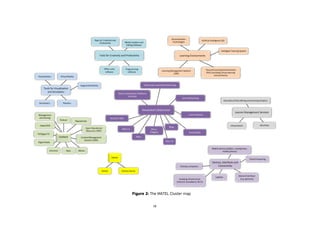
showed remarkable overall convergence that led to the following final set of clusters (graphically
presented in Figure3):
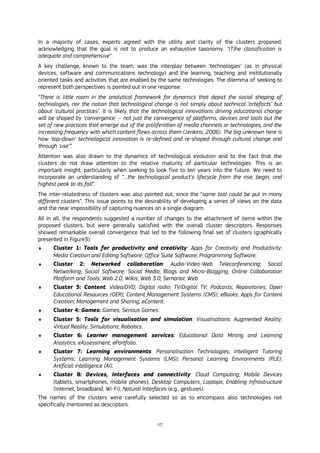
 Cluster 1: Tools for productivity and creativity: Apps for Creativity and Productivity;
Media Creation and Editing Software; Office Suite Software; Programming Software.
 Cluster 2: Networked collaboration: Audio-Video-Web Teleconferencing; Social
Networking; Social Software; Social Media; Blogs and Micro-Blogging; Online Collaboration
Platform and Tools; Web 2.0; Wikis; Web 3.0; Semantic Web.
 Cluster 3: Content: Video/DVD; Digital radio; TV/Digital TV; Podcasts; Repositories; Open
Educational Resources (OER); Content Management Systems (CMS); eBooks; Apps for Content
Creation; Management and Sharing; eContent.
 Cluster 4: Games: Games; Serious Games.
 Cluster 5: Tools for visualisation and simulation: Visualisations; Augmented Reality;
Virtual Reality; Simulations; Robotics.
 Cluster 6: Learner management services: Educational Data Mining and Learning
Analytics; eAssessment; ePortfolio.
 Cluster 7: Learning environments: Personalisation Technologies; Intelligent Tutoring
Systems; Learning Management Systems (LMS); Personal Learning Environments (PLE);
Artificial intelligence (AI).
 Cluster 8: Devices, interfaces and connectivity: Cloud Computing; Mobile Devices
(tablets, smartphones, mobile phones); Desktop Computers; Laptops; Enabling Infrastructure
(Internet, broadband, Wi-Fi); Natural Interfaces (e.g., gestures).
The names of the clusters were carefully selected so as to encompass also technologies not
specifically mentioned as descriptors.
18
Figure 2: The MATEL Cluster map
19
3.2 The views of stakeholders on key technologies for educational
change
Once the technology clusters and the descriptors thereof were defined, the on-line consultation
focused on the identification of the key technologies for educational change across learning sectors
and domains, taking into account also the clusters they belonged to. An overview of the results is
presented below.
3.2.1 Primary Education
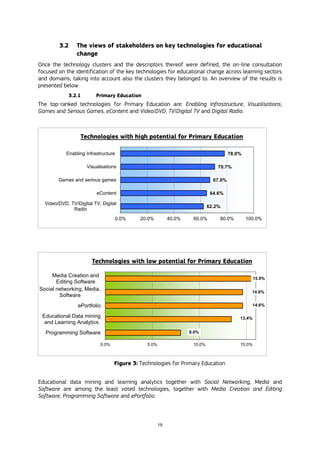
The top-ranked technologies for Primary Education are: Enabling Infrastructure, Visualisations,
Games and Serious Games, eContent and Video/DVD, TV/Digital TV and Digital Radio.
Figure 3: Technologies for Primary Education
Educational data mining and learning analytics together with Social Networking, Media and
Software are among the least voted technologies, together with Media Creation and Editing
Software, Programming Software and ePortfolio.
62.2%
64.6%
67.0%
70.7%
78.0%
0.0% 20.0% 40.0% 60.0% 80.0% 100.0%
Video/DVD, TV/DigItal TV, Digital
Radio
eContent
Games and serious games
Visualisations
Enabling Infrastructure
Technologies with high potential for Primary Education
8.0%
13.4%
14.6%
14.6%
15.9%
0.0% 5.0% 10.0% 15.0%
Programming Software
Educational Data mining
and Learning Analytics
ePortfolio
Social networking, Media,
Software
Media Creation and
Editing Software
Technologies with low potential for Primary Education
20
3.2.2 Secondary Education
As in the case of Primary Education, Enabling Infrastructure, Games and Serious Games and
Visualisations emerge as top technologies to support educational change in Secondary Education in
the short-medium term. Mobile Devices and Virtual Reality also belong to the list of technologies
with high potential in this sector of Formal Education and Training.
Figure 4: Technologies for Secondary Education
Least voted technologies are Programming Software, Robotics, Artificial Intelligence, Office Suite
Software and Augmented Reality.
58.5%
73.2%
72.0%
80.5%
82.9%
0.0% 20.0% 40.0% 60.0% 80.0% 100.0%
Virtual reality
Visualisations
Games and serious
games
Mobile devices
Enabling Infrastructure
Technologies with high potential for Secondary Education
14.6%
18.3%
19.5%
20.7%
22.70%
0.0% 5.0% 10.0% 15.0% 20.0%
Programming
software
Robotics
Artificial Intelligence
Office Suite
Software
Augmented reality
Technologies with low potential for Secondary Education
21
3.2.3 Vocational Education and Training
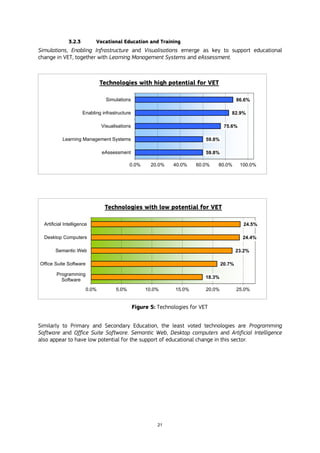
Simulations, Enabling Infrastructure and Visualisations emerge as key to support educational
change in VET, together with Learning Management Systems and eAssessment.
Figure 5: Technologies for VET
Similarly to Primary and Secondary Education, the least voted technologies are Programming
Software and Office Suite Software. Semantic Web, Desktop computers and Artificial Intelligence
also appear to have low potential for the support of educational change in this sector.
59.8%
59.8%
75.6%
82.9%
86.6%
0.0% 20.0% 40.0% 60.0% 80.0% 100.0%
eAssessment
Learning Management Systems
Visualisations
Enabling infrastructure
Simulations
Technologies with high potential for VET
18.3%
20.7%
23.2%
24.4%
24.5%
0.0% 5.0% 10.0% 15.0% 20.0% 25.0%
Programming
Software
Office Suite Software
Semantic Web
Desktop Computers
Artificial Intelligence
Technologies with low potential for VET
22
3.2.4 Higher Education
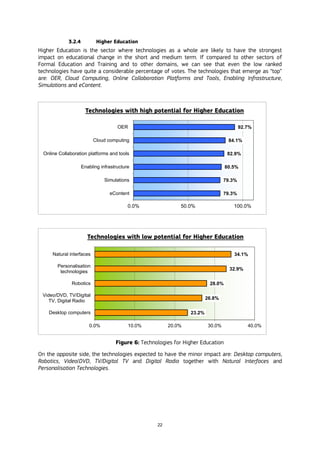
Higher Education is the sector where technologies as a whole are likely to have the strongest
impact on educational change in the short and medium term. If compared to other sectors of
Formal Education and Training and to other domains, we can see that even the low ranked
technologies have quite a considerable percentage of votes. The technologies that emerge as “top”
are: OER, Cloud Computing, Online Collaboration Platforms and Tools, Enabling Infrastructure,
Simulations and eContent.
Figure 6: Technologies for Higher Education
On the opposite side, the technologies expected to have the minor impact are: Desktop computers,
Robotics, Video/DVD, TV/Digital TV and Digital Radio together with Natural Interfaces and
Personalisation Technologies.
79.3%
79.3%
80.5%
82.9%
84.1%
92.7%
0.0% 50.0% 100.0%
eContent
Simulations
Enabling infrastructure
Online Collaboration platforms and tools
Cloud computing
OER
Technologies with high potential for Higher Education
23.2%
26.8%
28.0%
32.9%
34.1%
0.0% 10.0% 20.0% 30.0% 40.0%
Desktop computers
Video/DVD, TV/DigItal
TV, Digital Radio
Robotics
Personalisation
technologies
Natural interfaces
Technologies with low potential for Higher Education
23
3.2.5 Workplace and work-related learning
Simulations, Visualisations and Enabling Infrastructure are likely to play a key role in the
transformation of workplace and work-related learning. The same is true for Cloud Computing, On-
Line Collaboration Platforms and Tools and Content Management Systems.
Figure 7: Technologies for Workplace and work-related learning
As in the case of Formal Education and Training, Programming Software is among the least voted
technologies, followed by Educational Data Mining and Learning Analytics, Augmented Reality,
Video/DVD, TV/Digital TV, and Digital Radio and Podcasts.
74.4%
74.4%
76.8%
79.3%
82.9%
85.4%
0.0% 20.0% 40.0% 60.0% 80.0% 100.0%
Visualisations
Content Management Systems
Online collaboration platforms and tools
Cloud computing
Enabling Infrstructure
Simulations
Technologies with high potential for Workplace Learning
19.5%
29.3%
29.3%
30.5%
31.7%
0.0% 5.0% 10.0% 15.0% 20.0% 25.0% 30.0%
Programming
software
Educational Data
Mining and…
Augmented reality
Video/DVD,
TV/Digital TV,…
Podcasts
Technologies with low potential for Workplace Learning
24
3.2.6 Re-skilling and up-skilling strategies
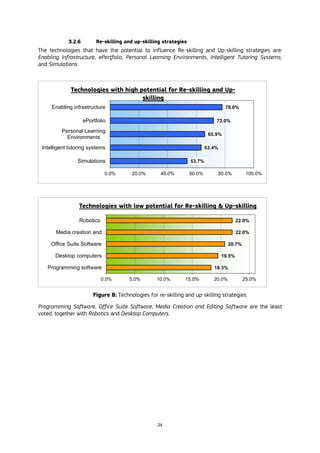
The technologies that have the potential to influence Re-skilling and Up-skilling strategies are:
Enabling Infrastructure, ePortfolio, Personal Learning Environments, Intelligent Tutoring Systems,
and Simulations.
Figure 8: Technologies for re-skilling and up-skilling strategies
Programming Software, Office Suite Software, Media Creation and Editing Software are the least
voted, together with Robotics and Desktop Computers.
53.7%
63.4%
65.9%
72.0%
78.0%
0.0% 20.0% 40.0% 60.0% 80.0% 100.0%
Simulations
Intelligent tutoring systems
Personal Learning
Environments
ePortfolio
Enabling infrastructure
Technologies with high potential for Re-skilling and Up-
skilling
18.3%
19.5%
20.7%
22.0%
22.0%
0.0% 5.0% 10.0% 15.0% 20.0% 25.0%
Programming software
Desktop computers
Office Suite Software
Media creation and…
Robotics
Technologies with low potential for Re-skilling & Up-skilling
25
3.2.7 Informal learning
Informal learning will (continue) to be mostly supported by networking technologies, namely Web
2.0, Social Networking, Media and Software and Blogs and micro blogging. Games and Serious
Games will also have a key role, together with Mobile Devices.
Figure 9: Technologies for informal learning
Educational Data Mining and Learning Analytics as well as Learning Management Systems belong
to the least voted technologies together with Office Suite Software, Programming Software and
Robotics.
75.6%
76.8%
76.8%
78.0%
78.0%
0.0% 20.0% 40.0% 60.0% 80.0% 100.0%
Blogs and micro-blogging
Social Networking / Software /
Media
Mobile Devices
Games and serious Games
Web 2.0
Technologies with high potential for Informal Learning
14.70%
15.9%
15.9%
17.1%
18.0%
0.00%2.00%4.00%6.00%8.00%10.00%12.00%14.00%16.00%18.00%20.00%
Programming Software
Learning Management Systems
Robotics
Educational Data Mining and Learning
Analytics
Office Suite Software
Technologies with low potential for Informal Learning
26
3.3 A cluster-based interpretation of results
Table 1 summarises the results of the MATEL online consultation showing the key technologies for
each learning sector. The colouring code of the technology cells shows the cluster belonging of
technologies (see Table 2).
Table 1: Top technologies per learning sector
Learning sectors Key technologies
Formal
Education &
Training
Primary
Education
Enabling Infrastructure
Visualisations
Games and serious games
eContent
Video/DVD, TV/Digital TV, Digital radio
Secondary
Education
Enabling Infrastructure
Mobile devices
Games and serious games
Visualisations
Virtual reality
Higher
Education
OER
Cloud Computing
Online collaboration platforms and tools
Enabling Infrastructure
Simulations
eContent
Vocational
Education and
Training
Simulations
Enabling Infrastructure
Visualisations
Learner Management Systems
eAssessment
Workplace and work-related
learning
Simulations
Enabling Infrastructure
Cloud Computing
Online collaboration platforms and tools
Content management systems
Visualisations
Re-skilling and up-skilling
Enabling Infrastructure
ePortfolio
Personal Learning Environments
Intelligent tutoring systems
Simulations
Informal learning
Web 2.0
Games and Serious games
Mobile devices
Social Networking/software/media
Blogs and micro-blogging
Legend
Devices, Interfaces and Connectivity Learner management services
Tools for visualization and simulation Networked collaboration
Content Games and Serious Games
Learning Environments Tools for productivity and creativity
27
Linking the key technologies to the technology clusters, the following picture emerges:
Table 2: Clusters, top technologies and learning sectors
Cluster Top Technologies Learning Sectors /domains
Devices, interfaces and
connectivity
- Enabling Infrastructure
- Mobile devices
- Cloud Computing
- Primary Education
- Secondary Education
- Vocational Education and
Training
- Higher Education
- Workplace learning
- Re-skilling and up-skilling
strategies
- Informal learning
Tools for visualization
and simulation
- Visualisations
- Simulations
- Virtual Reality
- Primary Education
- Secondary Education
- Vocational Education and
Training
- Higher Education
- Workplace learning
- Re-skilling and up-skilling
strategies
Content
- eContent
- OER
- Content Management
Systems
- Video/DVD, Digital
radio, TV/Digital TV
- Primary Education
- Higher Education
- Workplace Learning
Learning environments
- Personal learning
environments
- Learning Management
Systems
- Intelligent tutoring
systems
- Vocational Education and
Training
- Re-skilling and up-skilling
strategies
Learner management
services
- ePortfolio
- eAssessment
- Vocational Education and
Training
- Re-skilling and up-skilling
strategies
Networked
collaboration
- Online Collaboration
platforms and tools
- Web 2.0
- Social networking /
software / media
- Blogs and micro-blogging
- Higher Education
- Workplace learning
- Informal learning
Games and serious
games
- Games and Serious
Games
- Primary Education
- Secondary Education
- Informal learning
Tools for creativity and
productivity
- -
Some of the results of the online consultation turned out as expected, and are in line with finding in
other available reports in the same field, see Chapter 4 below, whereas other outcomes were
remarkable:
28
 The cluster Devices, interfaces and connectivity is by far the strongest cluster as it
appears throughout all learning sectors with the exception of informal learning. Out of Its
related technologies, Enabling Infrastructure (broadband, Internet, Wi-Fi) holds a top position
followed by Cloud Computing and Mobile Devices. Taking account of both the results of the
on-line consultation and the inputs received by experts during the course of the study, Mobile
Devices and Cloud Computing can be considered as being part of the Enabling Infrastructure
themselves.
 The cluster Networked collaboration (Audio-Video-Web Teleconferencing, Social
Networking, Social Software, Social Media, Blogs and Micro-Blogging, Online Collaboration
Platform and Tools, Web 2.0, Wikis, Web 3.0, Semantic Web) is very strong in the informal
learning area (quite unsurprisingly) and less in the remaining domains. Given the increasing
attention of research and, to some extent, policy on the role of social networking, Web 2.0,
semantic web for learning, it seems respondents still believe its contribution is (still) mainly
confined to informal learning experiences.
 The cluster Content (Video/DVD, Digital Radio, TV/Digital TV, Podcasts, Repositories, Open
Educational Resources, Content Management Systems, eBooks, Apps for Content Creation,
Management and Sharing; eContent) affects mainly Primary Education, Higher Education and
Workplace learning. OER is top-rated in Higher Education (and this was somehow expected,
considering the evolution of recent years and the more recent popularity of Open archives
and MOOCs- Massive Online Open Courses), but plays a relatively minor role in other sectors.
This somehow reflects the current situation of “OER penetration” in primary and secondary
education, although good signs of evolution are these sectors are emerging10
.
 The cluster Games (Games and Serious Games) appears to have a high potential in Primary
and Secondary Education and in Informal learning. Quite unexpected is its absence in the
workplace learning and work-related learning, as both the interviews carried out by MATEL for
this cluster and the research evidence11
confirm an increasing role of Games in training,
especially in the corporate sector (military and health particularly).
 The cluster Tools for visualisation and simulation (Visualisations, Augmented Reality,
Virtual Reality, Simulations, Robotics) seems – together with the cluster Devices, Interfaces
and Connectivity - to have the highest potential to support educational change across all
the analysed learning sectors (except for informal learning). In relation to what is observed
about the Games cluster, it might well be that some of the respondents ranked simulations
high in the professionalization-related domains, taking for granted their link to games.
Simulations and Visualisations appear as the most rated technologies in this cluster, whereas
the time seems not yet mature for augmented and virtual reality use for learning.
 The cluster Learner management services (Educational Data Mining and Learning
Analytics, eAssessment, ePortfolio) only appears to be relevant to Vocational Education and
Training (with eAssessment) and Re-skilling and up-skilling strategies (with ePortfolio). The
absence of learning analytics from the top position in any of the scanned learning sectors
and domains is somehow incoherent with the increasing attention of European TEL
(Technology Enhanced Learning) research towards this subject: the LAK (Learning Analytics
and Knowledge) conference will take place this year in Europe (Leuven-Belgium) moving out
of Canada for the first time. In parallel, in the 2012 7th
Framework Programme IST call
Learning Analytics was part of objective 8.2 funding STRePs (Specific Targeted Research
Projects) for around 5 Million Euros.
 The cluster Learning environments (Personalisation Technologies, Intelligent Tutoring
Systems, Learning Management Systems, Personal Learning Environments, Artificial
Intelligence) has a high potential in Vocational Education and Training (with Learning
10
See for instance Edgecliffe-Johnson, 2013.
11
See for instance Cai, 2012 and Susi et al., 2007.
29
Management Systems) and in the strategies for Re-skilling and Up-skilling (with Personal
Learning Environments and Intelligent Tutoring Systems).
Last but not least, it shall be noted that the technologies part of the cluster Tools for creativity
and productivity (Apps for Creativity and Productivity, Media Creation and Editing Software, Office
Suite Software, Programming Software) lost relevance from the first to the last round of the
consultation: if in the brainstorming round they were considered as relevant both in formal
education (primary and secondary education in particular) and in workplace learning, they dropped
down in the final rating of the prioritisation round making the cluster “disappear” from the ranking.
The full list of top technologies presented in Table 1 was assessed in terms of:
 The overall percentage of votes attained by each technology in absolute terms (independent
of the learning sector/domain) within the prioritisation round of the online consultation.
 The highest percentage of votes attained by particular technologies for each of the different
learning sectors/domains within the prioritisation round of the online consultation.
 The role of technology clusters in the different learning sectors/domains.
3.4 A technology-based interpretation of results
The “long list of technologies obtained from the above assessment” was then scanned against the
following criteria:
 the final list of technologies should possibly cover the technology clusters identified in the
study;
 feedback on relevant technologies for educational change as provided by experts in the
roadmapping would be considered.
The process led to the identification of the following eight key technologies for in-depth analysis:12
 Enabling Infrastructure (Internet, broadband, Wi-Fi, cloud computing)
 Mobile devices (mobile phones, smart phones, tablets)
 Games (with specific reference to Serious Games)
 Open Educational Resources (OER)
 ePortfolio
 Simulations
 Personal learning environments (PLEs)
 Social networking/software/media
Desk research and interviews with experts provided an overview of the current and potential state
of deployment of these technologies in learning with focus on: demand patterns, supply features,
market trends, opportunities and threats linked to a mainstreamed adoption in learning. The overall
picture emerging is the following:
 In the area of Enabling Infrastructure, despite the fact that broadband and extended Wi-Fi
connections are still a concern in most of the EU countries,13
the key technology is now
becoming cloud computing.
 In the mobile devices arena, mobile phones have reached a mature market and are expected
to decline, leaving space for the rapidly increasing market for smart phones and tablets.
 ePortfolios, though widely recognised by the scientific community, are not yet mainstreamed
and therefore a mature market is not there yet. The “Open badges” project - launched by
12
The results of such analysis are available in the State of the Art Report. The definition of the MATEL key
technologies for educational change is provided in Annex 3.
13
For an overview on penetration levels please visit https://ec.europa.eu/digital-agenda/en/progress-country
30
Mozilla14
and aimed to build an ecosystem where badges can be offered for skills, abilities,
and achievements in ways that traditional certifications don't allow for - might have an
impact on further ePortfolio developments.
 Social networks, media and software are ubiquitous in everyday life, but not so for learning
use. These technologies were not designed with a learning purpose in mind. Many are the
research papers and good practices in the field of social media use for learning. IPTS itself
funded two major studies already in 2008 to find out the potential of Web 2.0 (which
includes social media) for learning and to investigate on the learning (if any) taking place in
on-line communities.15
 Still, five years later the social media use cannot be defined as a mainstreamed phenomenon
in education and training, particularly in primary and secondary schools as well as VET, where
good practices do not certainly lack across EU countries though being mainly small scale. The
slow pace of social media adoption in schools (and similarly in other sectors of education and
training) is more a cultural rather than an infrastructural hindrance according to Sheninger
(2012), whereas Selwyn (2011) expresses serious doubts about the effectiveness of social
media for learning purposes.
 On the other side, Personal Learning Environments (PLEs), which were explicitly designed for
learning, are still under-used or misused according to interview results as often “the goal is to
use them rather than using them effectively for learning purposes”. The impression is that in
this case (as in other cases where a technology has been “accepted” in education) major
hindrances to successful implementation are the lack of awareness on the side of both
teachers (on how to assess) and of learners (on how to use) coupled with lack of digital skills
(by both) and interoperability problems.
 Simulations and serious games (grouped in two different clusters in MATEL and emerged as
strongly interconnected technologies) have a quite developed market in some areas of
corporate training and professional development, whereas the market in education is still
under development.
 OER is confirmed as an increasingly important and evolving trend, with remarkable
developments in Higher Education (with the so-called MOOCs - Massive Online Open Courses)
and positive signs of evolution in primary and secondary education. New business models are
emerging, but “the issue of sustainability of the new business models endorsed by Open
Education initiatives has not yet reached maturity”16
and “OER initiatives within Higher
Education settings are still mainly dependent on institutional, philanthropic or
governmental/public funding.”17
Notwithstanding the confirmation that technologies do have a potential to support change in
learning, what emerges clearly from the analysis is the need for a holistic view about the complex
ecosystem of technologies, and on how such an ecosystem connects with learning and related
policies:
 With Enabling Infrastructure acting as the “vertebrae” for ICT for learning (more and more
virtual given the increasing adoption of cloud computing solutions), and with mobile
technologies quickly shifting from a “key technology” to an “enabling technology” role, the
strong interconnection between mobile devices, social networks, serious games and simulations
emerged. All of these technologies share a strong degree of use for learning in the
corporate/professional development sector (with simulations and serious games being utilised
particularly in the military and health sector) and an increasing interest shown by the education
sector.
14
The Mozilla Foundation and Peer 2 Peer University (2012).
15
Ala-Mutka, 2010; Ala-Mutka et al., 2009.
16
See Haché, Ferrari & Punie, 2012.
17
Ibid.
31
 Linked to social networks, media and software are also Personal Learning Environments, whose
main barrier to full exploitation (according to field research results) is the resistance to social
networking use in education.
 ePortfolios and the rising “open badges” phenomenon are located in-between social networks
and OER, as they value learning outcomes based also on peer assessment.
As concerns the “penetration” of the above technologies across learning sectors, the literature
review and field research carried out by MATEL18
suggests that workplace and work-related learning
together with Higher Education are the most dynamic sectors in terms of technology testing and
implementation for learning. Primary and secondary education still seem “hard to be reached”, due
not only to teachers’ and overall systemic resistance, but also due to insufficient policy measures. In
turn, the lack of policy measures is sometimes intentional (such as the case of social networks,
where the perceived risks for child safety hinders the support to a mainstreamed adoption) and
sometimes due to lack of awareness or negative, 'fun-like' connotation of some technologies (as
mentioned by the interviewed experts in the case of games and serious games).
The in-depth analysis of the key technologies identified by MATEL sheds light on some areas where
policy intervention is needed. These will be further analysed in Chapter 5:
 The need for public policy to support market development of some key technologies:
 Fill in the still existing infrastructural gaps19
(in relation to broadband penetration and Wi-Fi
connection) and to support the use of cloud computing.
 Keep on investing in research and experimentation of the use of social networking and mobile
devices for learning, focusing in particular on privacy and security issues as well as health
risks (the latter associated with the use of mobile devices).
 Revise teacher training so as to empower teachers in the use of the identified key
technologies.
 Increase collaboration with Industry to adapt to learning purposes technologies that were not
initially designed or developed with learning in mind.
 Support research and experimentation in the use of OER in primary and secondary education
and invest in capacity building actions addressing higher education with the aim to foster
self-sustainable use of OER.
 There is a need to consider that some of the technologies which are already used and “accepted”
in education need other “enabling” technologies if they are to develop further. If PLEs are
introduced, but social networks are banned, it will be difficult for PLEs to evolve. If serious
games are introduced in the classroom but mobile devices are banned, it will be difficult to use
them (considering the reported shift of games from PCs to mobile).
 The need for some industries (such as the Serious games) to take inspiration from other
industries (such as commercial games) to become more successful. This recommendation,
emerging from interviews to experts in the field of Games and Serious games, is to be coupled
with the need to form “serious games” designers coupling technical background for the design of
games with pedagogical background to ensure effectiveness in terms of learning and to address
the current main challenge of serious games: assessment.20
18
The MATEL State of the Art report has analysed in depth the 8 top technologies identified in the study.
19
See the Digital Agenda for Europe available at http://ec.europa.eu/digital-agenda/en/
20
As for the challenges related to Serious Games see for instance Cai, 2012.
32
4. The wider context
The chapter in a snapshot
Cross referencing the outcomes of the MATEL study with the findings of the Horizon report
series some similarities and differences emerge:
- MATEL and Horizon both look at technologies and trends, seeking to forecast the most
likely developments but within a different timeframe.
- MATEL also takes a more fine-grained approach than Horizon, in terms of the domains of
learning in which it makes findings.
- Both Horizon and MATEL focus on trends and on ‘obstacles and barriers’ (MATEL) or
‘challenges’ (Horizon) in respect of implementation at scale.
In terms of technologies and clusters:
- There is universal agreement about the overall direction of technologies for digital
learning across all sectors of education and training, i.e., towards individually owned/used
devices - connected to the Internet either through Wi-Fi or 3G/4G mobile networks and
drawing on content and services that are frequently hosted in cloud computing
environments.
- There is unanimity between Horizon and MATEL studies on the current and future
importance of games and gamification.
- Content, particularly OER, feature strongly in forecasts for tertiary and higher education in
both Horizon and MATEL studies.
- Massive Open Online Courses (MOOCs), as a specific instantiation of online
courses/platforms, receive significant attention in the context of Horizon studies for
tertiary and higher education, but do not feature explicitly in the priorities expressed by
MATEL experts.
- Learning Analytics does not feature at all in the list of technologies prioritised by MATEL
experts, whereas it features as a strong prospect for higher education in Horizon.
- Augmented reality is predicted to have a relevant role in education by Horizon, whereas
MATEL results give more emphasis to visualisation and simulation.
- Personal Learning Environments dominate the Horizon forecast for both the K12 and
tertiary education sectors, marking a clear divergence with MATEL
- The MATEL study identifies networked collaboration as a particular priority for higher
education, workplace learning and informal learning, but less so for school education and
VET. The emphasis in Horizon studies is the direct opposite.
4.1 The MATEL study in a wider context: comparison with Horizon series
of reports
Where the MATEL Study is situated in the context of other foresight reports, such as Horizon?21
In
this section, the methodology and outcomes of the MATEL Study are cross referenced with the
findings of six recent Horizon reports, three referring to the K12 domain and three focused on
Higher Education.
MATEL and Horizon both look at technologies and trends, seeking to forecast the most likely
developments. Horizon differentiates its forecasts on ‘time to adoption’, listing predictions for ‘one
year or less’, ‘two to three years’ and ‘four to five years’. If the Horizon predictions are aggregated
across these three timeframes, the resulting five-year window becomes broadly comparable with
21
The New Media Consortium, NMC publishes the annual Horizon Reports for K12 and Higher Education. In
addition, focused reports are produced for particular regions. For an overview of publications by the NMC
see http://www.nmc.org/publications.
33
the MATEL timeframe (MATEL experts were asked to project from the present, five to ten years into
the future). As both overlap in their respective timeframes, it is possible to make a comparison
between Horizon and MATEL findings.
MATEL also takes a more fine-grained approach than Horizon, in terms of the domains in which it
makes findings. Horizon reports differentiate between K12 education and higher education, with
some regional Horizon reports focusing on tertiary education, (i.e., more encompassing than higher
education). MATEL on the other hand is more Euro-centric,22
where a distinction is made within
formal education between primary schooling, secondary schooling, vocational education
(compulsory or at tertiary level) and higher education. MATEL also identifies the domains of work-
based and workplace learning and up-skilling and re-skilling, not explicitly referenced in Horizon
studies.
Both Horizon and MATEL focus on trends and on ‘obstacles and barriers’ (MATEL) or ‘challenges’
(Horizon) in respect of implementation at scale. The respective findings are discussed below.
It is clear from Table 3 that there is remarkable internal consistency between the six recent Horizon
reports selected, all covering the period from 2012 to 2017. Of the 22 individual ‘technologies’ cited
across the six reports, 5 are common to all six, and 14 are listed in at least five of the reports
considered. This consistency extends across the K12 and HE domains and across the regions for
which the reports were compiled. In effect, Horizon studies point to a convergence of expert opinion
about the future deployment key technologies, even where local contexts remain quite varied. A
strong correlation can also be found in the case of the MATEL outcomes, but with some nuanced
differences in the European context.
22
Stakeholders, including policy makers, decision makers, practitioners and experts invited to contribute to
the different phases of the MATEL Study were drawn from European countries, albeit that some have also
experience in a wider international/transcontinental milieu.
34
Table 3: Comparing the outcomes of Horizon and MATEL
HORIZON STUDIES
2012K12
K12Singapore2012-2017
K12Brazil2012-2017
2013HigherEducation
IberoamericanTertiary
Education2012-2017
AustralianTertiary
Education2012-2017
MATEL CLUSTERS
Technologies
Cloud Computing
   
Devices/Interfaces/
Connectivity
Tablet Computing      
Mobile Devices and
Apps
     
Natural User Interfaces    
MOOC platforms
    
Learning EnvironmentsPersonal Learning
Environments
    
Personal Identities  
Learning Analytics     
Learner Management
Services
Augmented Reality
 
Tools for Visualisation and
Simulation
Wearable Computing  
Internet of Things    
Mobile laboratories 
Telepresence  
Game-based
Learning/Gamification
      Games
OER      
Content
ePublishing    
Collaborative
environments
    
Networked CollaborationCollective Intelligence     
Semantic Applications  
MATEL Cluster - no
correspondence with
Horizon
  Tools for Productivity and
Creativity
 
GSM and geo-location
infrastructure     
Horizon Technologies - no
correspondence with
MATEL
3D Printing
 
Horizon Technologies - no
correspondence with
MATELDigital Preservation
 
35
4.2 The MATEL clusters in the wider context
4.2.1 Devices, interfaces and connectivity
There is universal agreement about the overall direction of technologies for digital learning across
all sectors of education and training, i.e., towards individually owned/used devices - what is now
being referred to simply as ‘screen technology’, smartphone and tablet devices, connected to the
Internet either through Wi-Fi or 3G/4G mobile networks and drawing on content and services that
are frequently hosted in cloud computing environments.
While this may be seen as the destination, it is clear that different sectors are starting from
different places and have a different perspective on precisely what they expect to be doing with
individualised devices. But what is clear is that piecemeal approaches to infrastructure have no
place. Devices are versatile and their ultimate value and utility is a function of the extent to which
they can be readily connected to the Internet, albeit that they can also be used ‘offline’ (e.g., running
pre-loaded apps or as e-book readers).
MATEL respondents focused on both the technologies and their affordances. This is evident in the
emergence of a cluster Tools for Productivity and Creativity in MATEL, for which no counterpart can
be found in Horizon, but where each ‘technology’ is accompanied by examples and linked case
studies of how it might be deployed in different situations.
The relative prioritisation of Enabling Infrastructure and ‘cloud computing’ in MATEL, across the
different sectors is also instructive. It appears that the HE sector is less concerned with
infrastructure (i.e., satisfied that it is in place) and now places a greater emphasis on the evolution
of cloud solutions, particularly for OER. This most probably reflects the trajectory to be followed in
the compulsory education sector, although gaps are still all too evident in terms of basic
infrastructure. From the MATEL study it is also clear that schools and VET centres still rely heavily
on more traditional audio-visual technologies.
With respect to the informal learning sector, Enabling Infrastructure does not emerge strongly. It is
not clear if this reflects a satisfaction with the ability of individuals to ‘get online’ and the level of
broadband service generally available outside of formal settings. Data on broadband penetration
and digital inclusion would suggest otherwise for at least a minority of European citizens.
What is surprising, in both the Horizon and MATEL studies is that ‘natural user interfaces’, a rapidly
developing field, receives mention, but not across all sectors. A possible explanation is that
emphasis is currently being placed on how to rapidly achieve scale with the current generation of
‘screen’ devices, with the unintended consequence of under-estimating the likely impact of near
market innovations.
This is a constant dilemma for practitioners and policy makers. Touchscreen technology has
revolutionised devices in recent years, but it will be important to anticipate the next generation of
interfacing technologies (both output and input), particularly given their close correlation with the
development of augmented reality and gaming applications.
4.2.2 Learning environments
It is clear that ‘Personal Learning Environments’ dominate the Horizon forecast for both the K12
and tertiary education sectors, marking a clear divergence with MATEL. This perhaps reflects a more
integrated perspective on the part of Horizon, drawing an inference from the dominance of personal
devices and a cloud infrastructure that suggest that individuals now have the capacity to
personalise and customise their own online ‘space’. A more diffuse perspective is evident from the
MATEL study, perhaps a reflection of a lesser degree of optimism about how soon such
personalised learning environments can become a universal reality in Europe. Focus within MATEL
was rooted to some extent (particularly for VET and workplace learning) in the more established
Learner Management Systems and Content Management Systems.
MOOCs (as a specific instantiation of online courses/platforms) receive significant attention in the
context of Horizon studies for tertiary and higher education, but do not feature explicitly in the
36
priorities expressed by MATEL experts. It would appear the MOOC phenomenon is gaining traction
more quickly outside of Europe. See, however, ‘Content’ below.
4.2.3 Learner management services
The technologies identified by MATEL under this cluster include Learning Analytics, eAssessment
and ePortfolios. These do not feature consistently across the learning sectors, nor are they
identified strongly when it comes to prioritisation. For example, ePortfolio features strongly in
forecasts for the domain of up-skilling/re-skilling, but less so elsewhere; eAssessment is seen as a
strong prospect for VET, but does not feature significantly elsewhere.
Learning Analytics does not feature at all in the list of technologies prioritised by MATEL experts,
whereas it features as a strong prospect for higher education in Horizon studies and, at least for
Singapore, in K12 education as well. This is a remarkable divergence of opinion, reflecting perhaps
on the European side that the debate on learning analytics is slow to ignite, or, is culturally more
challenging.
4.2.4 Tools for visualisation and simulation
This cluster features strongly across the domains of upper secondary schooling, VET and workplace
learning, but to a lesser extent in higher education. Visualisations and simulation are particularly
strong for VET and workplace learning. By comparison, Horizon studies indicate a more diffuse
pattern, with perhaps the unexpected forecast that augmented reality can play an important role in
both K12 and tertiary education.
It may be possible to infer from the difference of emphasis between MATEL and Horizon that on the
European side there is a greater disposition towards the ‘learning by doing’ aspects of
modernisation through technology.
4.2.5 Games
There is unanimity between Horizon and MATEL studies on the current and future importance of
games and gamification. Horizon studies foresee this area as significant for all levels of education.
MATEL, in its prioritisation, foresee that secondary education and informal learning are the more
likely domains where games/gamification will have the greatest impact.
4.2.6 Content
Content, particularly OER, features strongly in forecasts for tertiary and higher education in both
Horizon and MATEL studies. ePublishing, surprisingly does not feature strongly (except in the K12
report for Singapore). This perhaps reflects a shared view that open resources will ultimately
achieve a dominant position. However, the relatively low prioritisation of OER within MATEL for
schools, VET and workplace learning should be a cause of concern. This may be the consequence of
a lack of clear policy measures in support to OER in most of the EU member states, or there may be
some complacency arising from a belief that an abundance of digital resources already exists.
4.2.7 Networked collaboration
The MATEL study identifies networked collaboration as a particular priority for higher education,
workplace learning and informal learning, but less so for school education and VET. The emphasis in
Horizon studies is the direct opposite. This is a particularly interesting divergence of opinion. If the
importance of networked collaboration is taken as a proxy for a more constructivist approach to
learning, then Horizon studies locate this in the earlier years of formal education, whereas MATEL
prioritised its role in later phases. This prompts two hypotheses:
 If skills in networked collaboration are developed during schooling (K12), they carry though into
higher education and need not be re-emphasised there (perhaps the message from Horizon), or
 Where networked collaboration is not prioritised, an instruction paradigm is dominant. For
MATEL and the European experts, this would, for example, reflect a dominant instruction
paradigm for schools, but a change of focus towards networked collaboration in higher
education.
37
It is becoming ever clearer that choices about the deployment of technologies are highly correlated,
at all levels and across all sectors, with underlying systemic beliefs about the relative value or
importance of instruction versus constructivist approaches.
4.2.8 Tools for productivity and creativity
This MATEL cluster has no corresponding grouping in the Horizon studies. This reflects a highly
engaged debate within the MATEL study on the applications/affordances of technologies as well as
on the technologies themselves. This has enabled MATEL to take a more fine-grained approach to
how technologies might impact on different sectors. Horizon takes a different approach, citing case
study examples of the technologies in use.
Overall, MATEL and Horizon converge on key technologies and trends, with nuanced differences
reflecting their different methodologies. The global Horizon studies are repeated on an annual basis
and thus have an inbuilt longitudinal tracking approach. MATEL would benefit from further
iterations of its methodology in future years.
It is also interesting to note and compare the headline trends identified by OECD/CERI in the recent
publication Trends Shaping Education 2013:
 Quality of eLearning and online learning resources
 A gap in the skills levels of teachers relating to digital learning
 The need to transform our understanding of classrooms as places of learning
 The pros and cons of social networking in education
 The growing importance of participatory and collaborative models of learning
 Importance of Media Literacy
 Local diversity when dealing with OER (e.g., availability in local languages)
 The growing significance of cloud computing and apps
These trends are also evident in MATEL and featured in the discussions of the Roadmapping
workshop, which are detailed in the next chapter.
38
5. Roadmapping
The chapter in a snapshot
The Horizon report series shows that a cultural shift is occurring across all sectors of
education, reflecting the profound wider societal change being effected by technologies more
generally. The outcomes of MATEL are entirely consistent with these trends, although in
distilling a set of ‘top technologies’, MATEL goes somewhat further in focusing on the most
promising set of technology-enhanced activities for each of the sectors under consideration.
It is clear that MATEL experts foresee the development of infrastructure, devices and
connectivity within a short time frame to a point where anywhere/anytime use of a ‘screen’
device is a reality for each and every individual. Horizon focuses on a set of macro-challenges
to be faced to let change happen, whereas MATEL takes a more detailed (and meso/micro)
approach, highlighting the specific need to enhance learning change (in Formal Education and
Training, Workplace learning and strategies for re-skilling and up-skilling). Starting from these
needs, MATEL presents three Roadmaps (one per learning domain) where long term goals and
specific objectives for educational change are highlighted. The specific technologies that
support these changes are then discussed, leading to the immediate strategies and actions to
be undertaken by policy and decision makers.
The MATEL study provides a stakeholders-based European vision and perspective on the key
technologies with the potential to support the evolution of our learning systems in the coming 5 to
10 years. As shown in the previous chapters, the emerging picture has many similarities but also a
number of nuanced differences when compared to findings of available reports in the same area at
international level (or focused on other world regions).
What we present here is not a “technology deterministic” roadmap for the integration of the 8
identified key technologies in learning. Rather, we focus on strategies and actions to support
educational change as such and we analyse how technologies could help in this process. Thus, the
questions the MATEL Roadmap will answer are:
What are the key areas of policy focus for educational change?
What are the key needs of Formal education and Training, Workplace Learning and Re-
skilling/up-skilling strategies to enhance educational change?
What are the long and short term objectives for each learning domain to enhance
change?
How do technologies fit in this process?
What are the strategies and actions needed?
39
5.1 Policy focus areas for educational change
The adoption of technologies in learning processes must be meaningful. In other words,
technological integration in learning cannot happen simply to demonstrate that learning systems
are up-to-date or “trendy”. The technologies to be introduced in learning systems are those that can
solve current problems, support wider educational policy objectives and facilitate their achievement.
With this perspective in mind, the Stellar Network of Excellence23
identified six key policy areas for
educational change where technologies could have a role:
 Scalability of innovation: how to mainstream and scale up innovation in learning, shifting
from low-scale and scattered innovation practices to an innovated learning system able to
prepare citizens to the needs of society and of the economy.
 Cost and effectiveness of learning: how to reduce costs guaranteeing at the same time
learning effectiveness; how to improve the effectiveness of learning.
 Learning attractiveness: how to increase the attractiveness of learning in a lifelong learning
perspective and in relation to some specific sectors (VET) or subjects (science education).
 Transferability of learning outcomes: how to support the recognition of learning outcomes
and their transferability across sectors and areas.
 New assessment methods: how to change assessment to guarantee that both formal and
informal learning achievements are valued and that the acquired skills and knowledge are
recognized.
 Employability value of education: how to ensure that education provides learners with the
skills necessary to find a job, including both transversal and specific skills.
Figure 10: Relevant policy objectives for TEL research (Stellar Network of Excellence)
Provided that additional policy priority areas exist, the first key recommendation is to consider that
the reason why a technology is promoted in learning environments is far more important than how
it will be introduced. Justifying the introduction of a technology in learning in relation to a wider
policy objective and related challenges legitimates the choice, allows easier assessment (at a later
stage) of the achieved results vs. expectations and has more chances to get a wide consensus.
23
Aceto et al., 2012.
40
Given that the introduction of a technology in learning affects a wide variety of stakeholders, an
additional necessary step is to promote awareness on how the technology can contribute to a)
achieve the objectives and priorities of the involved stakeholders’ groups and b) address the
teaching/learning challenges they are facing every day. For example, a government decides to
invest heavily in the introduction of tablets in science education for secondary schools, because this
is believed to increase the attractiveness of science education and to have a positive impact on the
number of graduates in science and maths. How will this fit into the objectives of teachers (related,
for instance, to the need to address given curricular requirements and assessment standards)?
To sum up, the choice to support the adoption of technologies in learning must correlate with the
existing policy priorities and objectives and must address the challenges and needs that learning
has to face in order to change and innovate.
5.2 The needs and challenges of learning systems
The Horizon report series provides an interesting outlook on the trends influencing change in
learning systems, with specific reference to the Formal Education and Training domain. In order to
draw comparisons with MATEL, these are organised in Table 4 as: Cultural Factors; Factors at a
Systemic Level; Factors affecting the individual learner; Factors at the school or institutional level.
41
Table 4: Trends identified by Horizon
HORIZON STUDIES
2012K12
K12Singapore2012-2017
K12Brazil2012-2017
2013HigherEducation
IberoamericanTertiary
Education2012-2017
AustralianTertiary
Education2012-2017
<<<<Factors
Trends
Openness and sharing   
Cultural
Towards a culture that is student-oriented
and technology-based     
Towards challenge-based active learning    
Technology continues to profoundly
affect how we work, collaborate,
communicate, share: "improved
bandwidth changes behaviours"     
Towards cloud-based and decentralised
infrastructure   
Role of technology in social and civic
empowerment   
MOOC ecosystem  
Systemic
Towards using learning analytics, as tool
to support personalisation     
Paradigm shifting towards
online/hybrid/collaborative models     
New forms of expression (diverse
media/publication platforms) are now
gaining acceptance  
Training of educators as a strategic
element in ensuring quality   
Skills acquired through informal learning  
Individual
Bring your own device     
eBooks replace traditional books  
Flexibility: learn anywhere anytime     
Computers' in the process of massive
reinvention 
Abundance of resources (and broadband
infrastructure) challenges us to review
our role as educators      
Institutional
Increasing exploration of technologies
that enable greater collaboration between
teachers and students 
Content can much more easily be
prepared for viewing by students before
coming to class (towards 'flip the
classroom')   
42
What is evident, from the work of Horizon, is that a cultural shift is occurring across all sectors of
education, reflecting the profound wider societal change being effected by technologies more
generally. In a society confronting rapid and unpredictable changes, educational values, particularly
within the K12 sector, appear to be moving in the direction of ‘challenge-based’ approaches.
Looking at this from the point of view of the individual learner at all levels, the dominant themes
are flexibility (learn anywhere, anytime) and freedom (again anywhere, anytime) to use one’s ‘own
device’.
The outcomes of MATEL are entirely consistent with these trends, although in distilling a set of ‘top
technologies’, MATEL goes somewhat further in focusing on the most promising set of technology-
enhanced activities for each of the sectors under consideration. It is clear that MATEL experts
foresee the development of infrastructure, devices and connectivity within a short time frame to a
point where anywhere/anytime use of a ‘screen’ device is a reality for each and every individual. The
focus in ‘top technologies’ on games and on simulations correlated with the Horizon emphasis on
challenge-based learning.
Turning to systemic trends and trends at the level of individual schools or institutions, the dominant
themes in Horizon are the abundance of digital resources (OER) and a paradigm shift towards
online/hybrid/collaborative learning models/spaces. Again, European experts in MATEL have
identified the similar themes, particularly the identification of OER in the ‘top technologies’.
However, MATEL outcomes are less emphatic in relation to a paradigm shift in learning
models/spaces, taking perhaps a more pragmatic view, ‘from within’, and focusing on specific
promising applications, e.g., ePortfolio and Social Media deployment.
Horizon reports also focus on the major challenges to be overcome if predictions/trends are to
become a meaningful reality. These are summarised in Table 5, organised as cultural, systemic and
institutional factors.24
Dominant challenges for Horizon are somewhat different between K12 and Higher Education. For
higher education, the starkest cultural challenge is that academics are simply not changing or
adapting their teaching. HE is also culturally challenged by competition, e.g., from the entry of new
private online providers and/or from the rapid rise of MOOC provision; however, this is a challenge
from ‘more of the same’ (perhaps with demonstrable quality), rather than concern about a
paradigm shift. For the K12 sector, the absence of such concerns perhaps signals a greater cultural
shift towards new approaches to teaching and learning, but the lack of real challenge-based
opportunities is flagged as a concern. This is echoed in a concern for K12 about the formal/informal
learning continuum and an acknowledgement that so many meaningful learning opportunities occur
outside of the classroom.
Table 5: Challenges identified by Horizon
HORIZON STUDIES
2012K12
K12Singapore2012-2017
K12Brazil2012-2017
2013HigherEducation
IberoamericanTertiary
Education2012-2017
AustralianTertiaryEducation
2012-2017
<<<<Factors
24
Individual factors are also relevant, e.g., motivation, competence and capability to learn in new
environments and under new conditions, but these are not considered here.
43
Challenges
Faculty/teacher training lagging far behind   
Cultural
Competition brought about by new forms of
education   
Most academics/teachers are not using technologies
for teaching and learning or for organising their own
research     
Many activities take place outside the classroom and
are not part of what is formally assessed. Blending
formal and informal  
Not enough learning involves real life challenges  
Influence and unintended consequences of rise of
commercial providers 
New forms of authoring and publishing, not matched
by scalable methods of assessment    
Systemic
Processes and practices in education generally
(inertia)  
Digitisation is not enough - textbooks need to be
reinvented  
Demand for personalised learning not supported by
current platforms or technologies     
Development of personalised assessment is more
complex than realised  
Digital Media Literacy    
Infrastructure gaps - need for improved infrastructure 
Infrastructure under funding  
Improving overall quality of education 
Role of tertiary educator is changing/research
required on tertiary education  
Innovation in tertiary education must be assessed on
the basis that technology is now a central component  
Pressures on all aspects of the system due to rising
numbers 
Curriculum needs reinvention   
Institutional
Disconnect between goals of assessment and
personalised learning  
Achieving flexible access to planned open access
opportunities     
Institutional structures as barriers to moving forward
in a constructive manner: "Putting 21st century
technology into 19th century schools is a major
challenge"    
Digital Media not being used as it could and should
be for formative assessment  
Efficient and effective integration of technology  
44
Looking to the systemic and institutional level challenges, it is clear from Horizon studies that
removing institutional barriers is a most significant challenge. Also, the current status of evolution
of ‘platforms’ falls short of what is required for a truly ‘personalised’ approach to student learning
at all levels. The question of ‘new forms of authoring’ also arises, i.e., a move beyond what is
traditionally ‘acceptable’ as schoolwork or academic endeavour, the ‘book’ or ‘article’ and towards
more inclusive digital formats.
The trends and challenges highlighted by the Horizon report series are consistent with the outcomes
of the consultation with experts organised by MATEL throughout the development of the study
which comes together in the Roadmaps presented in the coming section.
As said however, MATEL takes a more fine-grained approach that leads (by means of consultation
with experts in the Roadmapping workshop) to the identification of more concrete sets of
challenges and needs which could be well framed in the above “macro” trends and challenges. Also,
the identification of challenges and needs in MATEL goes beyond formal education and extends to
the domains of Workplace Learning and of Strategies for the re-skilling and up-skilling of workers.
Formal Education and Training25
 The need for policy makers to give priority to the integration of formal and informal learning,
with focus on validation of what has been learnt informally while clearly acknowledging that
regulation of informal learning processes is by definition not possible;
 The need for teachers and decision makers to be fully aware of technological trends and
opportunities (through guidelines or information services);
 The need to transform learning spaces so that they can be technologically enhanced;
 The need to urgently address the issue of connectivity, where it is still problematic;
 The need to start considering health, wellbeing and security problems related to the use of
technologies by learners in schools.
Workplace and work-related learning
 The need to enhance the use of communities of practice across companies to support inter-
organisational learning;
 The need to provide accreditation solutions for the skills developed informally and non-formally
by workers;
 The need to enhance the transfer of knowledge as well as industry/academic partnerships in
work-related education and vocational training;
 The need to develop EQF (European Qualifications Framework) compliant systems;
 The need for a holistic and integrated use of technologies to facilitate the professional
development of workers;
 The need to address a set of challenges in order to enhance the use of technologies for learning
in the workplace (interoperability, e-skills of workers, security and connectivity, working spaces
suitable for the use of technology).
Re-skilling and up-skilling strategies
 There is a need to consider both the top-down and the bottom-up processes involved in this
area. If up-skilling strategies are usually voluntarily undertaken by individuals to improve their
professional profile for their career and/or to find a new job, re-skilling strategies usually
happen with the mediation of ad-hoc entities and are necessary for individuals to re-position
themselves in the labour market. All in all, there is a need for re-skilling and up-skilling to
become an increasingly individually-driven process, in a lifelong learning perspective;
 The need for a top down intervention to support a paradigm shift in the search for jobs which
should happen through a search and matching process “by skills” rather than by “job profiles”;
25
The analysis is related to primary and secondary education as these were the sectors of the domain
prioritised by experts. It is interesting to notice that the VET sector was addressed in the discussion on
Workplace and work-related learning.
45
 The need to support individuals in building multiple profiles according to their skills (formally,
non- formally and informally developed);
 The need for brokerage systems at EU level able to support the matching of demand and supply
in terms of skills (named by experts as the European Skills' Bank and allowing “skills scouting”
by employers and intermediate agencies).
5.3 A roadmap for change in Primary and Secondary Education
Table 6 shows the Roadmap for Primary and Secondary Education26
.There is a need to continue
investigating the links between formal and informal education. In parallel, the need for a cultural
shift in the notion of schools as closed environments emerges. Schools should “open up” as
community meeting points and school stakeholders should accept the idea that school is not only
about formal learning. The need to change assessment strategies also emerges as a key priority.
Enabling infrastructure and mobile devices are key technologies to support educational change in
primary and secondary education. At policy level, a stronger focus on the needs and habits of
students in the use of technologies is recommended.
Table 6: Roadmap for primary and secondary education
Primary and Secondary Education
Long term
goal
Permeability between formal and informal learning.
It is evident that Formal learning systems do not have a monopoly on learning
anymore. The role of non-formal and informal learning is dramatically rising. In this
context, a new vision of school is needed: school is not just about “transmitting
knowledge” but also about co-constructing knowledge, creating new knowledge,
developing skills. How individuals behave outside the school (in terms of learning and
of technology use) should become a key interest for policy makers and practitioners.
Short term
objectives
1. To support research on students’ behaviour outside the school (as individuals)
focusing on their learning interests, aims and processes and on the technologies
they use at home (for learning and for entertainment).
2. To raise awareness of teachers on the technologies used by students at home (i.e.
affordances, operation).
3. To invest in further research and piloting for new assessment strategies able to
meet both political and educational goals.
Role of
technologies
Technologies can play a key role in is supporting the permeability of formal
and informal learning. In order to improve connectedness between inside and
outside of school, strong investments are still needed to reinforce the enabling
technological infrastructure. In addition, technologies that already show high levels of
penetration in the market and in use by individual learners in their every-day life should
be considered, as they could support bridging the school to the outside world.
Strategies
 Increase awareness of the individual behaviour patterns in learning and in the use
of technologies in everyday life (at policy making and practitioners’ level).
 Connect with the health sector (and research in the field) to assess the risks
associated to the intensive use of technologies in learning.
 Invest heavily on reinforcing enabling infrastructure with priority on broadband
and Wi-Fi connection.
 Increase piloting in the use of mobile devices in the classroom as these are the
technologies mostly used by students outside schools.
 Focus on equity of access to the above mentioned technologies.
 Establish rules of conduct for the responsible use of technologies in schools.
26
These sectors were assessed by experts as those with the highest need for policy focus within the domain
of Formal Education and Training.
46
5.4 A roadmap for change in work-based and work-related learning
Table 7 shows the Roadmap for change in workplace and work-related learning. The concept of
ubiquitous, mobile learning is increasingly featuring the area of learning at the workplace. The
graphical representation below (Figure 11), created by the experts attending the Roadmapping
workshop, summarises the concept of work-flow competences ecosystem, where technologies are
integrated to provide support in the professional development of human resources.
Figure 11: The workflow competences ecosystem
Policy intervention is called for to identify new and up-to date objectives for Adult learning, through
which decision makers within companies are called upon to valorise Communities of Practice
(through Reward schemes and Benchmarking). Both are recommended to fund competence
development (and remove barriers linking it to Return of Investment).
ePortfolios Digital RepositoriesCOMPETENCIES
Blogs
Enabling
Infrastructure OPEN
Games Mobile devices
WORK
-FLOW
47
Table 7: Roadmap for workplace learning
Work-based and work-related learning
Long term
goal
A workflow-based ecosystem to enhance talent performance and
competence development via personalised learning. Such an ecosystem
becomes possible if the following conditions are met:
 Companies are able to map the competences of their employees and of
their organisation as a whole in a common way;
 Inter-organisational learning is promoted;
 Accreditation and certification of the competencies acquired on the job is
possible;
 Partnerships between Industry and Formal Education (mainly Higher
Education and VET) are in place.
Short term
objectives
1. To promote ePortfolio for each employee (initiation in the short term,
realisation in the long term).
2. To promote the use of Communities of Practice across companies
3. To set the rules for the accreditation of competences acquired on the job
(consistent and compliant with the EQF system) and to identify
Authorities for their certification.
4. To support partnerships between formal education and industry for
knowledge transfer and joint identification of skills-related challenges.
Role of
technologies
An integrated use of technologies can support talent performance and
competence development via personalised learning. Increasing uptake is
envisaged of Immersive learning experiences at the workplace, enhanced by
the use of next generation learning content management systems (Ambient
technologies, Haptic technologies, Augmented reality, 3D Environments).
ePortfolios could be used for smart archiving, Blogs, Micro-blogging, Blog
archives should be integrated. Serious Games could be used to emulate
workflows. OER in workplace learning should be intended as Digital
Repositories with open standards architecture and the concept of Enabling
infrastructure should include also evaluation/training methodology. Last but
not least, Mobile devices (smart devices) should be the tools to enhance
learning at work. In this framework, competence and valorisation of
collaborative learning are key levers for educational change. Social networking
and ePortfolios promotion play a crucial role.
Strategies
 Update policy strategies at a European level: Adult learning needs to serve
new objectives linked to the achievement of the long term goal expressed
above.
 Promote the “Learning Identity card/passport” for individuals and
companies (to show competencies and skills and to enhance motivation to
learn).
 Set Reward schemes and Benchmarking criteria for the valorisation of
outcomes developed through Communities of Practice across companies.
 Fund competence development (and remove barriers linking it to Return
of Investment).
 Promote ePortfolio and social networking for learning in the workplace.
5.5 A roadmap for change in re-skilling and up-skilling strategies
Re-skilling and up-skilling strategies are considered from top down and a bottom-up perspective.
ePortfolio, Enabling Infrastructure and open repositories emerge as key priorities to facilitate a
better match between demand and supply in the world of work. A paradigm shift is recommended,
orienting the profiling of workers according to their skills rather than titles or traditional job
descriptions. The creation of a European Skills' Bank is proposed, matching demand and supply on
48
the basis of the combination of the requested skills. Skills-based profiling is believed to empower
individuals trying to re-invent themselves as workers.
Table 8: Roadmap for re-skilling and up-skilling strategies
Re-skilling and up-skilling strategies
Long term
goal
Resilience Building by Multiple Skills Profiling for Multimodal Work.
The increasing value of individual skills (formally and informally developed)
implies a new approach for job search complementing the traditional “job
profile” search with a skills-based search. Individuals are no longer assessed
for a new job, based only on their previous roles, but also based on the skills
they can prove they have developed. This will imply a change in the role and
models of intermediate players (job search agencies, head-hunters, etc.).
Short term
objectives
 To foster research on the development of new methods for Skill-Based
Profiling so as to improve job search (from job profile to skill-based
profile search).
 To set common rules for the Accreditation/Certification of non-formal
skills (as in the case of Workplace and Work-related learning).
 To achieve 21st Century (Digital) Literacy for all.
 To define new roles and models of intermediate players in the job search
market.
Role of
technologies
ePortfolio can play a key role as a service to enhance formal and non-formal
skills recognition and skills-based profiling.
Open repositories can play a key role for the establishment of:
 Professional up-skilling systems (on-line brokerage systems providing
access to information on training opportunities for the development of
skills);
 European on-line repositories supporting job search by employers by
skills (and not just by job profiles).
Last but not least, technology can help in the design of tools for dynamic skills
and skills gap self-evaluation.
Strategies  Keep on investing in new Europass CV incorporating skills acquired
informally and non-formally.
 Assess the feasibility for the establishment of a European Skills’ Bank.
(Skills clearing house where workers can upload their profile based on
skills and employers can search the skills required and identify the right
worker).
 Establish local (physical/virtual) learning centres for the enhancement of
critical skills (creativity, entrepreneurship & innovation) and make sure
their offer takes into account local (for instance local labour market
needs) as well as individual needs (for instance their age).
49
6. Conclusions
The MATEL study, which took 14 months, involved more than 200 stakeholders in a joint reflection
on the role of technologies for innovation in learning and change of learning systems. The inclusion
of a variety of stakeholders in the consultation, together with the European focus on the key
technologies for educational change, mark the distinctive elements of this study. It provides a
European perspective on technologies for learning across three learning domains: Formal Education
and Training, Workplace and Work-related Learning, Re-skilling and Up-skilling Strategies for
Workers.
This final report presents the key outcomes of the study and proposes three operational roadmaps
to support innovation and change in the three learning domains considered. It also suggests which
technologies should be promoted to support the achievement of the identified goals and objectives,
starting from the assumption that meaningful technology adoption and use must be aligned to and
consistent with wider objectives (in education as elsewhere).
The first key policy message that the MATEL study brings to the policy making and research
community is the need to always consider the introduction and implementation of technologies in
learning in relation to the dynamics, evolution and needs of learning systems. Learning takes place
in a complex ecosystem where one must be aware of technology trends and not be “technology
driven”. From this perspective, policy making should not be led astray by “fashionable” technologies
with the risk of massive cyclical technological investments that have little effect on changing the
way learning happens.
In this context, the Roadmaps presented in Chapter 5 focus on strategies and actions to support
holistic innovation and transformation in learning and analyse how technologies could help in this
process. The key questions that the MATEL Roadmaps try to answer are the following: What are the
key areas of policy focus for educational change?; What are the key needs of Formal education and
Training, Workplace Learning and Re-skilling/up-skilling strategies to enhance educational change?
What are the long and short-term objectives for each learning domain to enhance change? How do
technologies fit into this process? What are the strategies and actions needed to extract and use the
maximum innovation potential of ICT?
The second key policy message that MATEL delivers is that the world of technologies is also a
complex ecosystem with strong interdependencies, which must be taken into account to ensure
effectiveness of technology implementation in learning. This is a key aspect to be considered when
planning the introduction of a specific technology in learning (and goes hand in hand with the need
for technology “awareness” rather than “trendiness” mentioned above). A fragmented, technology-
by-technology approach is likely to fail; a system view is no less necessary when planning
technology adoption than it is in when we are trying to transform education.
The list of key technologies resulting from the MATEL online consultation (see Table 1, p. 26)
suggests a set of technologies (sometimes overlapping, sometimes not) per learning sector. It
should be clear to policy and decision makers that deciding, for instance, to introduce mobile
devices in secondary education would also mean making sure that the right infrastructure is there
(Wi-Fi connection, broadband) to ensure proper technical use of the devices (and cost-effectiveness
of the investment). Linking this with the first key message, the introduction of mobile devices in
secondary education should be functional to wider transformation/innovation objectives and would
ensure learning effectiveness of the investment.
The third and final key message of MATEL relates to the fact that most of the key MATEL
technologies were not developed, in the first instance, with learning purposes in mind. The “not
invented here” attitude explains – to some extent – the “resistance to adoption”, especially in formal
education where the “push” of technologies without embedded learning quality approaches is often
perceived as a risk which could turn learning into a superficial and possibly meaningless experience.
Attention should be focused on developing professional profiles able to ensure a meaningful use of
50
technologies in learning, such as designers able to: adapt technologies to learning purposes;
anticipate the needs of practitioners; understand and face the concerns of practitioners.
Table 9 below summarises the strategies suggested by the MATEL roadmaps across three learning
domains (primary and secondary education; workplace and work-related learning; re-skilling and up-
skilling strategies):
Table 9: Strategies suggested by the MATEL roadmaps
Primary and
Secondary Education
 Increase awareness of the individual behaviour patterns in learning
and in the use of technologies in everyday life.
 Connect with the health sector to assess the risks associated to the
intensive use of technologies in learning.
 Invest heavily on reinforcing enabling infrastructure.
 Increase piloting in the use of mobile devices in the classroom.
 Focus on equity of access to the above mentioned technologies.
 Establish rules of conduct for the responsible use of technologies
in schools.
Workplace and
work-related learning
 Update policy strategies at a European level: Adult learning needs
to serve new objectives.
 Promote the “Learning Identity card/passport” for individuals and
companies (to show competencies and skills and to enhance
motivation to learn).
 Set reward schemes and benchmarking criteria for the valorisation
of outcomes developed through Communities of Practice across
companies.
 Fund competence development.
Re-skilling and
up-skilling strategies
 Keep on investing in new Europass CV incorporating skills
acquired informally and non-formally.
 Assess the feasibility for the establishment of a European Skills’ Bank.
 Establish local learning centres for the enhancement of critical
skills and make sure their offer takes into account local (for
instance local labour market needs) as well as individual needs (for
instance their age).
Trying to draw some recommendations for research based on the above list of strategies, we can
say that:
 First and above all, the primary research question to be addressed is not which technology will
emerge that will affect education but how the whole of ICT can accompany the desired
transformation of education.
 In general terms, key words to ensure that research meets the needs of learning are:
interdisciplinarity, integration, real-world applicability, stakeholders’ involvement.
 Interoperability is a key area of concern and should be researched further to ensure a smooth
ecosystem of technologies is available to support learning transformation.
 In formal education, research shall be strengthened on “life outside the school”, to support
schools in their opening up to the world. Piloting of mobile devices introduction in schools
activities including outdoor (and research on approaches and outcomes) should also be (further)
promoted.
 Again in formal education more connections shall be established with research in the health
sector to ensure a healthy use of technologies. Research on safety should therefore address
both the “safe use of Internet” for kids (against cyber-bullying for instance) and “health safety”.
51
 In workplace learning research should be strengthened on the changing learning needs of adults
so to support policy makers in identifying up-to-date learning objectives. Also, ePortfolios, Open
Badges and other emerging trends in the field of recognition of competences informally and
non-formally developed shall be dealt with by research with the aim to establish parameters for
a “learning ID passport” of workers.
 In the key area of up-skilling and re-skilling (crucial in the current deep economic crisis of
Europe) research shall be strengthened for the creation of European platforms supporting the
match between labour demand and supply. A shift of paradigm is suggested by MATEL, which
could lead to coupling the current search for “job profiles” with a search for “skills profile”.
52
References
Aceto, S., Crooks C., & Devries F. (2012). Summative Evaluation of the Stellar Stakeholders’
Community. Retrieved July 31, 2012, from http://bit.ly/19yx1XK
Ala-Mutka, K. (2010). JRC Scientific and Technical Reports Learning in Online Networks and
Communities. Joint Research Centre, Institute for Prospective Technological Studies (IPTS).
Retrieved July 20, 2012 from http://bit.ly/12n3Z7a
Ala-Mutka, K., M. Bacigalupo, S. Kluzer, C. Pascu, Y. Punie & C. Redecker. (2009). JRC Scientific and
Technical Reports Learning 2.0: The Impact of Web2.0 Innovation on Education and Training
in Europe. Joint Research Centre, Institute for Prospective Technological Studies (IPTS), EUR
23786 EN. Retrieved July 25, 2012, from
http://ipts.jrc.ec.europa.eu/publications/pub.cfm?id=2139
Alessi S.M., & Trollip S.R. (1991). Computer-based instruction: methods and development. (2nd
ed.).
Englewood Cliffs; London: Prentice-Hall Ed.
Ambient Insight. (2011). 2010-2015 Worldwide Market Forecast for Mobile Learning Products and
Services. Retrieved September 13, 2012 from Web site http://bit.ly/136uJ3j
Attwell, G. (2007). Personal Learning Environments - the future of eLearning? eLearning Papers,
2(1), 1-8. Retrieved August 31, 2012, from http://bit.ly/11XYs78
Cai, M. (2012). Serious Game, Serious play. Retrieved September 30, 2012, from
http://slidesha.re/14oKGNK
Cohen, H. (2011). 30 Social Media Definitions. Retrieved September 1, 2012, from
http://heidicohen.com/social-media-definition
Corti, K. (2006) Games-based Learning: a serious business application. Coventry (UK): PIXELearning
Limited. Retrieved July 20, 2012, from
http://202.119.101.57/upload/2006_09/06091415525749.pdf
Cotterill, S. (2007). What is an ePortfolio? Retrieved October 1, 2012, from
http://www.epics.ac.uk/?pid=174
Damassa D. A., & Sitko T. D. (2010), Simulation technologies in Higher Education: uses, trends and
Implications. ECAR Research Bulletin 3, 2010. Retrieved July 1, 2012, from
http://net.educause.edu/ir/library/pdf/erb1003.pdf
Djaouti, D., Alvarez, J., Jessel, J.P., & Rampnoux, O. (2010). Origins of serious games. Retrieved July
20, 2012 from http://bit.ly/11Kxa5x
EIfEL (2009). ePortfolio a European Perspective Report produced in the frame of the LLP AVE
EXMEPLO project. Retrieved July 31, 2012, from http://www.cde-
pc.it/documenti/ave_eportfolio.pdf
European Commission. (2010). Europe 2020. A European strategy for smart, sustainable and
inclusive growth. Commission Communication (COM) 2010. Retrieved October 20, 2012,
from http://bit.ly/120WOTh
Edgecliffe-Johnson, A. (2013). Online courses open doors for teenagers. Financial Times March 26,
2013. Retrieved March 31, 2013, from http://on.ft.com/10ildX7
Gee J. (2007). What Video Games Have to Teach Us About Learning and Literacy? New York:
Palgrave Macmillan.
Hachè A., Ferrari A., & Punie Y. (2012) Open Education Initiatives in Higher Education – an overview
of current business and sustainability models. Proceedings of the EADTU 2012 Conference
(pp. 81-97).
Jenkins, H. (2006) Convergence Culture –Where old and New Media collide. New York and London:
New York University Press.
53
Magee, M. (2006). State of the Field Review, Simulation in Education, Final Report, Alberta Online
Learning Consortium, Calgary AB. Retrieved September 17, 2012 from http://www.ccl-
cca.ca/pdfs/StateOfField/SFRSimulationinEducationJul06REV.pdf
Meller P., & Grance T. (2011). The NIST definition of Cloud Computing. National Institute of
Standards and Technology, Gathersburg, MD. Retrieved February 20, 2013, from
http://csrc.nist.gov/publications/nistpubs/800-145/SP800-145.pdf
Mota, J. (2009), Personal Learning Environments: Contributos para uma discussão do conceito.
Educação, Formação & Tecnologias, 2(2), 5-21. Retrieved September 17, 2012, from
http://eft.educom.pt/index.php/eft/article/view/105/66
New Media Consortium Horizon Report. (2012). Higher Education Edition. Retrieved February 20,
2013, from http://www.nmc.org/horizon-project/horizon-reports/horizon-report-higher-ed-
edition.
New Media Consortium Horizon Report. (2012). 2012 K-12 Edition. Retrieved February 20, 2013,
from http://www.nmc.org/horizon-project/horizon-reports/horizon-report-k-12-edition.
New Media Consortium. (2012) Technology Outlook Australian Tertiary Education 2012-2017. An
NMC Horizon Report Regional Analysis. Retrieved February 20, 2013, from
http://www.nmc.org/publications/2012-technology-outlook-au
New Media Consortium. (2012) Technology Outlook Iberoamerican Tertiary Education 2012-2017.
An NMC and UOC Horizon Report Regional Analysis. Retrieved February 20, 2013, from
http://www.nmc.org/pdf/2012-technology-outlook-iberoamerica_EN.pdf
New Media Consortium. (2012) Technology Outlook Singaporean Education 2012-2017, An NMC
Horizon Report Regional Analysis. Retrieved February 20, 2013, from
http://www.nmc.org/pdf/2012-technology-outlook-for-singapore-k12-education.pdf.
OECD CERI. (2007) Giving Knowledge for free, the emergence of Open Educational Resources.
Retrieved June 24, 2012, from http://www.oecd.org/edu/ceri/38654317.pdf
OECD. (2013). Trends shaping education 2013. OECD publishing. Retrieved February 28, 2013, from
http://dx.doi.org/10.1787/trends_edu-2013-en
Redecker, C., Leis M., Leendertse M., Punie Y., Gijsbers G., Kirschner P. et al. (2010). The Future of
Learning: New Ways to Learn New Skills for Future Jobs. JRC Technical Notes (JRC 60869).
Luxembourg: Publications Office of the European Union. Web site:
ftp://ftp.jrc.es/pub/EURdoc/JRC60869_TN.pdf
Schaffert, S., & Hilzensauer, W. (2008). On the way towards Personal Learning Environments: Seven
crucial aspects. eLearning Papers, 9, 1-11. Retrieved February 28, 2013, from
http://www.elearningeuropa.info/files/media/media15971.pdf
Selwyn, N. (2011). Social Media in Higher Education. Retrieved September 5, 2012, from
http://www.educationarena.com/pdf/sample/sample-essay-selwyn.pdf
Sheninger, E. (2012). Leverage Social Media. The New York Times, January 3, 2012. Retrieved March
20, 2013, from http://www.nytimes.com/roomfordebate/2012/01/03/the-frontier-of-
classroom-technology/leverage-social-medias-potential
Susi, T., Johannesson, M., & Backlund, P. (2007). Serious Games - An Overview. Technical Report.
Retrieved March 20, 2013, from http://his.diva-
portal.org/smash/get/diva2:2416/FULLTEXT01
Sutherland, S., & Powell, A. (2007). CETIS SIG mailing list discussions. Retrieved August 30, 2012
from https://www.jiscmail.ac.uk/cgi-bin/webadmin?A0=cetis-portfolio
The Mozilla Foundation and Peer 2 Peer University. (2012). Open Badges for Lifelong Learning -
Exploring an open badge ecosystem to support skill development and lifelong learning for
real results such as jobs and advancement Working Document. Retrieved January 20, 2013,
from https://wiki.mozilla.org/images/b/b1/OpenBadges-Working-Paper_092011.pdf
54
Annex 1 – Details about respondents in the brainstorming and
prioritisation rounds
This Annex provides details about the nature of participants in the online consultation of MATEL. As
concerns the brainstorming and the prioritisation rounds, since the provision of personal
information (including name, affiliation and role) was not compulsory, a detailed picture on the
nature of respondents cannot be provided. However, based on the replies given, the following
picture emerges:
Table 1: Summary of respondents’ background in the brainstorming and prioritisation rounds
Brainstorming round Prioritisation round
Policy maker 5,4% Policy maker 2.4%
Decision maker 12.0% Decision maker 12.2%
Teacher (primary, secondary,
higher education)
29,4% Teacher (primary, secondary,
higher education)
12.2%
Trainer 5,5% Trainer 7.3%
Learner 0% Learner 9.7%
Parent 0% Parent 7.3%
Technology provider 0% Technology provider 6.1%
Technology developer 4,3% Technology developer 8.5%
Researcher 26,1% Researchers 41.4%
Other 12% Other 3.6%
An increasing trend can be noted from the first to the last consultation round regarding learners
and parents, who were totally absent from the first consultation, but joined the final one. In the first
round the teaching category was the mostly represented 29.4%), followed by researchers (26.1%).
Researchers jumped from 26.1% to 41.4% in the final round, followed by decision makers and
teachers. Industry representation also increased from the first round to the last, with technology
providers and developers jumping from 4.3% to 14.6%27
.
Thus, the categories that mostly contributed to the identification of the technologies for
educational change were: researchers, teachers at all levels and decision makers (School
heads, University Chancellors, Heads of Human Resources departments within organisations). The
predominating categories contributing to the ranking of the identified technologies were again
researchers and decision makers together with teachers. The participation of learners,
parents and technology providers in the final round is also remarkable, considering their absence in
the brainstorming round. Given that both the brainstorming and the prioritisation round followed the
same approach (personal invitation by email to 140 stakeholders and dissemination of the surveys
through e-learning related portals, newsletters, projects, on-line communities and social networks)
throughout the two consultations, we are prompted to speculate that these categories feel more
comfortable in expressing their opinion on a given set of technologies than in identifying them in
the first place. If this is somehow plausible on the part of learners and parents, it is quite surprising
on the side of technology providers.
27
It should be noted that respondents had the possibility to mark more than one field (e.g., one can be at the
same time researcher and parent) so the percentages do not sum to 100%.
55
Identification and selection of the experts for the clustering validation was carried out by the
MENON research team and approved by JRC-IPTS. Experts recruited belong to the world of research
in ICT for learning, to the e-learning industry and to the school/university/training environment.
Identification and selection of the stakeholders invited to the Roadmapping workshop was carried
out in collaboration with IPTS. The criteria for selection were linked to the need to have a pool of
participants representing the different perspectives linked to technologies and learning: the policy
and decision making perspective; the industry perspective; the research perspective; the practice
perspective (teachers, trainers, university professors, learners). Last but not least, representatives of
stakeholders’ organisations in the field of education (such as UNESCO) were also invited.
56
Annex 2 – Stakeholders participating in the activities of the MATEL
study
(Clustering Validation, State-of-the-Art Analysis, Roadmapping Workshop)
Name Affiliation
Attwell Graham Pontydysgu Ltd.
Bacsich Paul Sero Consulting Ltd.
Balacheff Nicolas CNRS – Centre National de la Recherche Scientifique
Berki Eleni University of Tampere
Blamire Roger EUN – European Schoolnet
Bocconi Stefania
ITD CNR- Istituto per le Tecnologie Didattiche del Consiglio
Nazionale delle Ricerche
Burgos Daniel UNIR – Universidad Internacional de la Rioja
Butler Deirdre Dublin City University
Camilleri Anthony EFQUEL – European Foundation for Quality in eLearning
Cardinali Fabrizio Chair European Learning Industry Group
Conole Gráinne University of Leicester
Cullen Joe Tavistock Institute of Human Relations
de-la-Fuente-Valentín Luis UNIR – Universidad Internacional de la Rioja
de Salvador Núria Teacher & education consultant
Dinh Thuy
Dublin Institute of Technology, Centre for Social and
Educational Research
Giorgini Fabrizio eXact learning solutions
Helsper Ellen London School of Economics and Political Science
Hertz Benjamin European Commission, DG Education and Culture
Husson Anne-Marie Consultant
Johannessen Oystein Cerpus AS
Kangasniemi Jouni Advisor at the Finnish Ministry of Education
Koglin Hajo SHARP Europe
Komninou Ioanna eTwinner
Lambropoulos Niki
Regional Directorate for Primary & Secondary Education in
Western Greece
57
Name Affiliation
Looney Anne Irish National Council for Curriculum and Assessment
López Hernández Fernando UNIR – Universidad Internacional de la Rioja
Lugano Giuseppe COST – European Cooperation in Science and Technology
Manouselis Nikos ARIADNE Foundation
Mystakidis Stylianos University of Patras & eProbate
O’Neill Brian Dublin Institute of Technology, School of Media
Penny Philip
IADT – Dun Laoghaire Institute of Art, Design and
Technology
Pivec Maja University of Applied Sciences FH JOANNEUM
Ravet Serge Consultant
Sánchez Jairo VICOMTech-IK4
Smith David Advisor at the Austrian Ministry of Education
Specht Marcus
Open University of the Netherlands, CELSTEC – Centre for
Learning Sciences & Technologies
Szûcs András EDEN – European Distance and E-Learning Network
Torres Kompen Ricardo i2Cat Foundation & Education Research Group at Citilab
Vanbuel Mathy
ATiT– Audiovisual Technologies, Informatics and
Telecommunications
Vosloo Steven Edwin UNESCO, ICT in Education
Vourikari Riina EUN – European Schoolnet
Wheeler Steve Plymouth University, Plymouth Institute of Education
Wijngaards Guus Inholland University of Applied Sciences
Wild Fridolin The Open University (UK), Knowledge Media Institute
58
Annex 3 - Definition of the MATEL key technologies for educational
change
Mobile Devices
By Mobile Devices it is meant:
 mobile phone also known as a cellular phone, cell phone and a hand
phone;
 smart phones: mobile phone built on a mobile operating system, with
more advanced computing capability and connectivity incorporating
media player, digital cameras, pocket video cameras, GPS navigation,
high-resolution touchscreens and web browsers that display standard
web pages as well as mobile-optimized sites;
 tablet: a mobile computer, larger than a mobile phone or personal
digital assistant, integrated into a flat touch screen and primarily
operated by touching the screen rather than using a physical keyboard.
Ambient Insight (2011) defines Mobile Learning as knowledge transfer
events, content, tools, and applications accessed on handheld computing
devices.
Games
According to Damien Djaouti et al. (2010) "Current research on the use of
games outside of entertainment may raise a debate about 'Serious Games'
being an oxymoron. Indeed, video games have been demonstrated to be
useful in education, defence and so on. According to these references, we
could argue that all games are 'serious' and that the 'Serious Games' term is
not really an oxymoron”.
According to T.Susi, M. Johannesson, P.Backlund (2007) Serious games
are (digital) games used for purposes other than mere entertainment.
According to Corti (2006) game-based learning/serious games “is all about
leveraging the power of computer games to captivate and engage end-users
for a specific purpose, such as to develop new knowledge and skills”. The
following themes are also provided as complementary to the above
definition:
 Serious games use game technology (both hardware and software);
 Serious games employ features, such as competition and rewards,
commonly found in games.
During the ICT 2010 Conference 28 organised by the European
Commission and hosted by the Belgian Presidency of the European
Union, serious games have been described as the application games and
simulations technology to non-entertainment domains, such as technology-
enhanced learning, history and culture, environmental awareness and
physical or mental rehabilitation. They define an interdisciplinary research
area where concepts such as natural human-computer interaction, user-
centred design and evaluation, social networking, signal processing and
computer graphics, are interwoven.
Game-based learning has gained considerable traction since 2003, when
Gee (2007) began to describe the impact of game play on cognitive
development. Since then, research and interest in the potential of gaming
on learning has exploded, as has the diversity of games themselves, with
the emergence of serious games as a genre, the proliferation of gaming
platforms, and the evolution of games on mobile devices. Developers and
researchers are working in every area of game-based learning, including
games that are goal-oriented; social game environments; non-digital games
that are easy to construct and play; games developed expressly for
education; and commercial games that lend themselves to refining team
28
http://ec.europa.eu/information_society/events/ict/2010/index_en.htm
59
and group skills.
Role-playing, collaborative problem solving, and other forms of simulated
experiences are recognized for having broad applicability across a wide
range of disciplines.
Open Educational
Resources
The term Open Educational Resources first came to use in 2002 at a
conference hosted by UNESCO. Participants at that forum defined OER
as: “The open provision of educational resources, enabled by information
and communication technologies, for consultation, use and adaptation by a
community of users for non-commercial purposes.” The currently most
used definition of OER is the one by OECD CERI (2007): “Open
Educational Resources are digitised materials offered freely and openly for
educators, students and self-learners to use and re-use for teaching,
learning and research.” To further clarify this, OER is said to include:
 Learning Content: Full courses, courseware, content modules, learning
objects, collections and journals.
 Tools: Software to support the development, use, re-use and delivery
of learning content including searching and organisation of content,
content and learning management systems, content development tools,
and online learning communities.
 Implementation Resources: Intellectual property licenses to promote
open publishing of materials, design principles of best practice, and
localization of content.
ePortfolio
Sutherland and Powell (2007) define an ePortfolio as “a purposeful
aggregation of digital items – ideas, evidence, reflections, feedback etc.,
which ‘presents’ a selected audience with evidence of a person’s learning
and/or ability”. Cotterill (2007) has defined ePortfolios to acknowledge the
central activity of the portfolio approach, namely the process of reflection,
self-awareness and forward planning. Portfolios have multiple purposes
and are created from different perspectives according to individual need.
In its report “ePortfolio a European Perspective”, EIfEL (2009) describes
ePortfolio as “any digital system supporting reflexive learning and practice
by allowing a person (or an organisation) to collect, manage and publish a
selection of learning evidence in order to have one’s assets recognised,
accredited or plan further learning”. The following clarifications are
provided with respect to the above definition:
 Learning includes formal, non-formal, individual and organisational
learning;
 Reflexive means that it is the result of a conscious self-analysis;
 By assets it is meant not only competencies but also tacit and explicit
knowledge as well as social/peer recognised assets;
 Linked to the above, recognition is both intended as the result of
formal (i.e. delivery of a certificate) and of informal (i.e.: assignment of
new tasks at work thanks to the performance of the worker) processes.
Whereas at an early stage the term ePortfolio was a synonymous of
paperless portfolio, the technological progress made it possible to use
technologies to manage ePortfolio processes. ePortfolio Management
Systems arose then, starting in the US higher education system and being
then adopted also in some EU countries (mainly the UK) in the VET and
health sector. The advent of social networks allowed the extension of the
ePortfolio concept to the social networking and social recognition area.
Simulation
Simulation is defined as “an act of imitating the behaviour of a physical or
abstract system, such as an event, situation or process that does or could
exist The goal of simulation is “to mimic, or simulate, a real system so that
we can explore it, perform experiments on it, and understand it before
60
implementing it in the real world”29 . Educational simulations typically
come in one of three categories: "live" simulation (where actual players use
genuine systems in a real environment); "virtual" simulation (where actual
players use simulated systems in a synthetic environment), or
"constructive" simulation (where simulated players use simulated systems
in a synthetic environment)30.
With a focus then on the aim of the learning process, Alessi and Trollip
(1991) provide a four-fold classification of simulation-based learning. Such
classification distinguishes between simulations oriented to “learning about
something” (physical object, environmental simulation and process
simulation) and simulations aimed at “learning to do something” or
“performance-based simulations” (procedural and situational). The latter
refers to active learning experiences where the learner is called to an
interaction which requires knowledge, skills and experiences to be applied.
In that respect the potential of simulation is related to its capacity to
“provide immersive learning experiences where skills, processes and
knowledge can all be enhanced in a way reality cannot”31 and can be
applied to unlimited models situation, turning thus simulation into a highly
versatile learning tool. According to Magee (2006) simulations have in fact
the capacity to “mimic the chaotic and ambiguous environment of the real
world. Simulations are more than just an interactive model or a collection
of facts with which the learner interacts. It provides the framework for
learners to build on their existing knowledge and augment existing cases
they already have in their memory”.
Personal Learning
Environments
The term Personal Learning Environment (PLE) describes32 the tools,
communities and services that constitute the individual educational
platforms learners use to direct their own learning and pursue educational
goals.
According to Mota (2009), the concept of PLEs may have been born in
2001 in a paper by Bill Olivier & Oleg Liber, who proposed the integration
of the learning institutional contexts with a peer-to-peer model, which
would be centred on personal learning and lifelong learning. With the
evolution and the complexity of Web 2.0, there has been an enormous
advance in the working environments, in the communications and in the
publishing and sharing of resources. One of the consequences of this
evolution is the availability for anybody to access a huge volume of
information, whether through the consultation of online documents and
media or through direct or indirect communication with others, thus
increasing exponentially the learning opportunities.
A PLE differs from a LMS in that the former is learner-centric and the
latter course-centric. While most discuss on PLEs focuses on online
environments, the term encompasses the entire set of resources that a
learner uses to answer questions, provide context, and illustrate processes.
The idea of a Personal Learning Environment recognises that learning is
on-going and seeks to provide tools to support that learning. It also
recognises the role of the individual in organising his or her own learning.
Moreover, the pressures for a PLE are based on the idea that learning will
take place in different contexts and situations and will not be provided by a
single learning provider. Linked to this is an increasing recognition of the
importance of informal learning (Atwell, 2007).
29
http://www.novasim.com
30
http://www.corporatepress.com/clientfiles/ntsa
31
http://www.atghome.com/resources/simulation-white-paper.pdf
32
http://educase.edu/eli
61
Schaffert and Hilzensauer (2008) try to underpin a better understanding of
the underlying concepts of both LMS and PLE and, on the other hand, to
emphasise the consequences and challenges of PLE and its rising usage for
learning.
They have identified seven aspects where these changes are most obvious
and/or important and they concern:
 The role of the learner as active, self-directed creators of content;
 Personalisation with the support and data of community members;
 Learning content as an infinite “bazaar”;
 The big role of social involvement;
 The ownership of learner's data;
 The meaning of self-organised learning for the culture of educational
institutions and organisations, and
 Technological aspects of using social software tools and aggregation of
multiple sources.
Enabling
Infrastructure
By enabling infrastructure it is meant the technological solutions that allow
access to learning resources, knowledge and information online.
Considering the current technological developments, the key terms
associated with the concept of enabling infrastructure are therefore:
Broadband, Internet and Wi-Fi access and Cloud computing.
According to Meller and Grance (2011) Cloud computing is a model for
enabling ubiquitous, convenient, on-demand network access to a shared
pool of configurable computing resources (e.g., networks, servers, storage,
applications, and services) that can be rapidly provisioned and released
with minimal management effort or service provider interaction. This
cloud model is composed of five essential characteristics, three service
models, and four deployment models.
Essential Characteristics are: On-demand self-service (there is no need
for human interaction to mediate the client request on the provision of
computing capabilities such as server time and network storage); Broad
network access (allowing use from different platforms such as mobile
phones, laptops, and PDAs); Resource pooling (The provider’s computing
resources are pooled to serve multiple consumers using a multi-tenant
model, with different physical and virtual resources dynamically assigned
and reassigned according to consumer demand); Rapid elasticity
(Capabilities can be rapidly and elastically provisioned and can be
purchased in any quantity at any time); Measured Service to the type of
needs (e.g., storage, processing, bandwidth, and active user accounts).
Service Models are:
Cloud Software as a Service (SaaS) - The capability provided to the
consumer is to use the provider’s applications running on a cloud
infrastructure. The applications are accessible from various client devices
through a thin client interface such as a web browser (e.g., web-based
email). The consumer does not manage or control the underlying cloud
infrastructure.
Cloud Platform as a Service (PaaS) - The capability provided to the
consumer is to deploy onto the cloud infrastructure consumer-created or
acquired applications created using programming languages and tools
supported by the provider. The consumer does not manage or control the
underlying cloud infrastructure.
Cloud Infrastructure as a Service (IaaS). -The capability provided to the
consumer is to provision processing, storage, networks, and other
fundamental computing resources where the consumer is able to deploy
and run arbitrary software, which can include operating systems and
applications. The consumer does not manage or control the underlying
62
cloud infrastructure but has control over operating systems, storage,
deployed applications, and possibly limited control of select networking
components (e.g., host firewalls).
Deployment Models are:
Private cloud - The cloud infrastructure is operated only for an
organization. It may be managed by the organization or a third party and
may exist on or off site.
Community cloud - The cloud infrastructure is shared by several
organizations and supports a specific community that has shared concerns
(e.g. mission, security requirements, policy and compliance considerations).
It may be managed by the organizations or a third party and may exist on
or off site.
Public cloud - The cloud infrastructure is made available to the general
public or a large industry group and is owned by an organization selling
cloud services.
Hybrid cloud - The cloud infrastructure is a composition of two or more
clouds (private, community, or public) that remain unique entities but are
bound together by standardized or proprietary technology that enables
data and application portability.
Social Networking,
Software and Media
Social networking33 is the practice of expanding the number of one's
business and/or social contacts by making connections through
individuals. While social networking has gone on almost as long as
societies themselves have existed, the unparalleled potential of the Internet
to promote such connections is only now being fully recognized and
exploited, through Web-based groups established for that purpose. Based
on the six degrees of separation concept (the idea that any two people on
the planet could make contact through a chain of no more than five
intermediaries), social networking establishes interconnected Internet
communities (sometimes known as personal networks) that help people
make contacts that would be good for them to know, but that they would
be unlikely to have met otherwise.
Social software 34 is a category of software systems that primarily
functions to allow user collaboration and communication. Examples of
social software include: Instant messaging, Email, Internet forums, Chat
rooms, Wikis (Web pages allowing editing by viewers), Web blogs, Social
network services (participants that communicate about shared interests,
such as hobbies or causes). Social software is often defined as bottom-up
social development. Usually, participants are classless and voluntary and
have earned reputations and trust among themselves. Frequently,
persistent and lasting relationships are created by members with common
interests, goals, mindsets, tendencies, factions or associations.
Social media are the platforms that enable the interactive web by
engaging users to participate in, comment on and create content as means
of communicating with their social graph, other users and the public
(Cohen, 2011).
33
http://whatis.techtarget.com/definition/social-networking
34
www.techopedia.com
European Commission
EUR 26519 – Joint Research Centre – Institute for Prospective Technological Studies
Title: Mapping and Analysing Prospective Technologies for Learning
Authors: Stefania Aceto, Spiros Borotis, Jim Devine & Thomas Fischer
Luxembourg: Publications Office of the European Union
2014 – 62 pp. – 21.0 x 29.7 cm
EUR – Scientific and Technical Research series – ISSN 1831-9424 (online)
ISBN 978-92-79-35501-1 (pdf)
doi:10.2791/64987
Abstract
EU policies call for the strengthening of Europe’s innovative capacity and it is considered that the modernisation of Education
and Training systems and technologies for learning will be a key enabler of educational innovation and change. This report
brings evidence to the debate about the technologies that are expected to play a decisive role in shaping future learning
strategies in the short to medium term (5-10 years from now) in three main learning domains: formal education and training;
work-place and work-related learning; re-skilling and up-skilling strategies in a lifelong-learning continuum. This is the final
report of the study ‘Mapping and analysing prospective technologies for learning (MATEL)' carried out by the MENON Network
EEIG on behalf of the European Commission, Joint Research Centre, Institute for Prospective Technological Studies. The report
synthesises the main messages gathered from the three phases of the study: online consultation, state-of-the-art analysis and
a roadmapping workshop. Eight technology clusters and a set of related key technologies that can enable learning innovation
and educational change were identified. A number of these technologies were analysed to highlight their current and potential
use in education, the relevant market trends and ongoing policy initiatives. Three roadmaps, one for each learning domain, were
developed. These identified long-term goals and specific objectives for educational change, which in turn led to
recommendations on the immediate strategies and actions to be undertaken by policy and decision makers.
z
As the Commission’s in-house science service, the Joint Research Centre’s mission is to provide EU
policies with independent, evidence-based scientific and technical support throughout the whole policy
cycle.
Working in close cooperation with policy Directorates-General, the JRC addresses key societal
challenges while stimulating innovation through developing new standards, methods and tools, and
sharing and transferring its know-how to the Member States and international community.
Key policy areas include: environment and climate change; energy and transport; agriculture and food
security; health and consumer protection; information society and digital agenda; safety and security
including nuclear; all supported through a cross-cutting and multi-disciplinary approach.
LF-NA-26519-EN-N
doi:10.2791/64987
978-92-79-35501-1 (pdf)

Informe final: "Mapeo y análisis de las tecnologías posibles para el aprendizaje" (MATEL)

  • 1.
    Report EUR 26519EN 2014 Authors: Stefania Aceto, Spiros Borotis, Jim Devine & Thomas Fischer Results from a consultation with European stakeholders and roadmaps for policy action Mapping and Analysing Prospective Technologies for Learning Editors: Panagiotis Kampylis & Yves Punie
  • 2.
    European Commission Joint ResearchCentre Institute for Prospective Technological Studies Contact information Address: Edificio Expo. c/ Inca Garcilaso, 3. E-41092 Seville (Spain) E-mail: jrc-ipts-secretariat@ec.europa.eu Tel.: +34 954488318 Fax: +34 954488300 http://ipts.jrc.ec.europa.eu http://www.jrc.ec.europa.eu This publication is a Scientific and Policy Report by the Joint Research Centre of the European Commission. Legal Notice Neither the European Commission nor any person acting on behalf of the Commission is responsible for the use which might be made of this publication. Europe Direct is a service to help you find answers to your questions about the European Union Freephone number (*): 00 800 6 7 8 9 10 11 (*) Certain mobile telephone operators do not allow access to 00 800 numbers or these calls may be billed. A great deal of additional information on the European Union is available on the Internet. It can be accessed through the Europa server http://europa.eu/. This document replaces the JRC Scientific and Policy Report 'Mapping and analysing prospective technologies for learning – Results from a consultation with European stakeholders and roadmaps for policy action' with ISBN number 978-92-79-32383-6 and PUBSY request number JRC81935. Corrections have been made to the names and/or affiliation of some stakeholders participating in the activities of the MATEL study, in Annex 2 (pp. 56-57) of the new document. JRC88469 EUR 26519 EN ISBN 978-92-79-35501-1 (pdf) ISSN 1831-9424 (online) doi:10.2791/64987 Luxembourg: Publications Office of the European Union, 2014 © European Union, 2014 Reproduction is authorised provided the source is acknowledged. Printed in Spain
  • 3.
    1 Preface The Europe 2020strategy acknowledges that a fundamental transformation of education and training is needed to address the new skills and competences that will be required if Europe is to remain competitive, overcome the current economic crisis and grasp new opportunities. Innovating in education and training is a key priority in several flagship initiatives of the Europe 2020 strategy, in particular the Agenda for New Skills and Jobs, Youth on the Move, the Digital Agenda, and the Innovation Union Agenda. Accordingly, one of the five targets for measuring the success of the Europe 2020 strategy is the modernization of European Education and Training systems with the goals of reducing early school leaving and increasing tertiary education attainment. Policy makers and educational stakeholders recognise the contribution of ICT to achieving these targets, and more broadly, the role of ICT as a key enabler of innovation and creativity in Education and Training (E&T) and for learning in general. It is however also highlighted that the full potential of ICT is not being realised in formal education settings. Within this framework, JRC-IPTS1 commissioned MENON Network to conduct the study 'Mapping and analysing prospective technologies for learning' (MATEL) in the context of the broader JRC-IPTS research agenda on modernisation of Education and Training systems in Europe. In particular, this final report of the MATEL study brings evidence to the debate about the technologies that are expected to play a decisive role in shaping future learning strategies in the short to medium term (5-10 years from now) in three main learning domains: formal education and training; work-place and work-related learning; re-skilling and up-skilling strategies in a lifelong-learning continuum. The current and potential use of eight key technologies for teaching and learning purposes, the relevant market trends, and on-going policy initiatives are analysed. In addition, three roadmaps, one per learning domain, are presented suggesting the long-term goals and specific objectives for educational change, leading to the immediate strategies and actions to be undertaken by policy- and decision-makers. Yves Punie Project leader ICT for Learning and Skills 1 The Institute for Prospective Technological Studies (IPTS) is one of the seven research institutes that make up the European Commission’s Joint Research Centre (JRC).
  • 4.
    2 Acknowledgements The authors wouldlike to thank Yves Punie and Panagiotis Kampylis for their valuable support in developing and finalising this study. We would also like to thank all the experts who have participated in the MATEL study for their valuable contributions to our research as well as the President and Vice-President of the MENON Network (Nikitas Kastis and Claudio Dondi) for their key inputs for the strategic development of the Study.
  • 5.
    3 Table of Contents Preface.........................................................................................................................................................................................................1 Acknowledgements............................................................................................................................................................................... 2 Executive Summary.............................................................................................................................................................................. 5 1. Introduction..................................................................................................................................................................................... 9 2. The MATEL study features.................................................................................................................................................. 11 2.1 Context ................................................................................................................................................................................ 11 2.2 Study phases.................................................................................................................................................................... 12 2.3 Online consultation....................................................................................................................................................... 14 2.4 State-of-the-art analysis.......................................................................................................................................... 14 2.5 Roadmapping workshop............................................................................................................................................ 14 2.6 Stakeholder involvement .......................................................................................................................................... 14 3. The MATEL technologies for educational change.................................................................................................. 16 3.1 The MATEL clusters...................................................................................................................................................... 16 3.2 The views of stakeholders on key technologies for educational change...................................... 19 3.2.1 Primary Education.............................................................................................................................................. 19 3.2.2 Secondary Education........................................................................................................................................ 20 3.2.3 Vocational Education and Training........................................................................................................... 21 3.2.4 Higher Education................................................................................................................................................. 22 3.2.5 Workplace and work-related learning..................................................................................................... 23 3.2.6 Re-skilling and up-skilling strategies....................................................................................................... 24 3.2.7 Informal learning................................................................................................................................................ 25 3.3 A cluster-based interpretation of results......................................................................................................... 26 3.4 A technology-based interpretation of results ............................................................................................... 29 4. The wider context..................................................................................................................................................................... 32 4.1 The MATEL study in a wider context: comparison with Horizon series of reports.................... 32 4.2 The MATEL clusters in the wider context......................................................................................................... 35 4.2.1 Devices, interfaces and connectivity ....................................................................................................... 35 4.2.2 Learning environments.................................................................................................................................... 35 4.2.3 Learner management services ................................................................................................................... 36 4.2.4 Tools for visualisation and simulation.................................................................................................... 36 4.2.5 Games....................................................................................................................................................................... 36 4.2.6 Content..................................................................................................................................................................... 36 4.2.7 Networked collaboration ................................................................................................................................ 36 4.2.8 Tools for productivity and creativity........................................................................................................ 37 5. Roadmapping.............................................................................................................................................................................. 38
  • 6.
    4 5.1 Policy focusareas for educational change..................................................................................................... 39 5.2 The needs and challenges of learning systems........................................................................................... 40 5.3 A roadmap for change in Primary and Secondary Education .............................................................. 45 5.4 A roadmap for change in work-based and work-related learning.................................................... 46 5.5 A roadmap for change in re-skilling and up-skilling strategies.......................................................... 47 6. Conclusions.................................................................................................................................................................................. 49 References.............................................................................................................................................................................................. 52 Annex 1 – Details about respondents in the brainstorming and prioritisation rounds................................ 54 Annex 2 – Stakeholders participating in the activities of the MATEL study...................................................... 56 Annex 3 - Definition of the MATEL key technologies for educational change................................................. 58
  • 7.
    5 Executive Summary This reportpresents the results of the study Mapping and Analysing Prospective Technologies for Learning (MATEL), commissioned by JRC-IPTS and carried out by the MENON Network. The MATEL study took 14 months (from January 2012 to February 2013) and involved more than 200 stakeholders in a joint reflection on the role of technologies for innovation in learning and change of learning systems. The inclusion of a variety of stakeholders in the consultation, together with the European focus on the key technologies for educational change, mark the distinctive elements of this study, which provides a European perspective on technologies for learning across three learning domains: formal education and training; workplace and work-related learning; re-skilling and up- skilling strategies for workers. The study had three main phases: an online consultation, a state-of-the art analysis and a roadmapping workshop. The online consultation with stakeholders included a brainstorming round to get a long list of technologies, which were then grouped in a clustering validation round. There was also a prioritisation round to identify the “top technologies” able to support learning innovation in Europe). These consultations led to the identification of 8 technology clusters and a set of related key technologies for educational change. These key technologies were analysed in depth in the state-of-the-art analysis to highlight their current and potential use in education, the relevant market trends, and on-going policy initiatives. In parallel, the roadmapping workshop attended by external experts allowed discussion of strategies and actions for the effective deployment of technologies in learning in the three learning domains. Below, the key technologies emerging from the online consultation are presented per learning sector and in relation to their cluster of belonging. Learning sectors Key technologies Formal Education & Training Primary Education Enabling Infrastructure Visualisations Games and serious games eContent Video/DVD, TV/Digital TV, Digital radio Secondary Education Enabling Infrastructure Mobile devices Games and serious games Visualisations Virtual reality Higher Education OER Cloud Computing Online collaboration platforms and tools Enabling Infrastructure Simulations eContent Vocational Education and Training Simulations Enabling Infrastructure Visualisations Learner Management Systems eAssessment Workplace and work-related learning Simulations Enabling Infrastructure Cloud Computing Online collaboration platforms and tools Content management systems Visualisations
  • 8.
    6 Re-skilling and up-skilling EnablingInfrastructure ePortfolio Personal Learning Environments Intelligent tutoring systems Simulations Informal learning Web 2.0 Games and Serious games Mobile devices Social Networking/software/media Blogs and micro-blogging Legend Devices, Interfaces and Connectivity Learner management services Tools for visualization and simulation Networked collaboration Content Games and Serious Games Learning Environments Tools for productivity and creativity Based on the selection process described in Section 3.4, the following eight technologies were selected for in-depth analysis by MATEL:  Enabling infrastructure (Internet, broadband, Wi-Fi, cloud computing2 )  Mobile devices (mobile phones, smart phones, tablets)  Games (with specific reference to serious games)  Open Educational Resources (OER)  ePortfolios  Simulations  Personal learning environments (PLEs)  Social networking/software/media Desk research and interviews with experts provided an overview of how far these technologies in learning are currently deployed or could be deployed in the future. The main focus was on: demand patterns, supply features, market trends, opportunities and threats linked to a mainstreamed adoption in learning. The following overall picture emerged:  In the area of Enabling Infrastructure, despite the fact that broadband and extended Wi-Fi connections are still a concern in most of the EU countries, cloud computing is now becoming the key technology.  In the mobile devices arena, the market for mobile phones is now mature and is expected to decline, leaving space for the rapidly growing market for smart phones and tablets.  ePortfolios, though widely recognised by the scientific community, are not yet mainstreamed and therefore the market is not yet mature. The “Open badges” project, launched by Mozilla, which aimed to build an ecosystem where badges can be offered for skills, abilities, and achievements in ways that traditional certifications do not, may have a positive impact on further ePortfolio developments.  Social networks, media and software are ubiquitous in everyday life, but not in learning. These technologies were not designed with a learning purpose in mind and have not been mainstreamed in education and training. Though good practices can be found across EU 2 It shall be noted that cloud computing was added to the Enabling Infrastructure based on the inputs and suggestions gathered by experts.
  • 9.
    7 countries, particularly inprimary and secondary schools and also in VET, these are mainly small scale.  Although Personal Learning Environments (PLEs) were explicitly designed for learning, they are still under-used or misused according to interview results, as often “the goal is to use them rather than using them effectively for learning purposes”. In this case (as in other cases where a technology has been “accepted” in education) major hindrances to successful implementation are lack of awareness of both teachers (of how to assess) and learners (of how to use), coupled with lack of digital skills (by both) and interoperability problems.  The market for simulations and serious games (which are grouped in two different clusters in MATEL and have emerged as strongly interconnected technologies) is quite developed in some areas of corporate training and professional development, whereas in education it is still developing.  OER is confirmed as an increasingly important and evolving trend, with notable developments in Higher Education (e.g. MOOCs- Massive Online Open Courses) and positive signs of evolution in primary and secondary education. New business models are emerging, but “the issue of sustainability of the new business models endorsed by OE initiatives has not yet reached maturity”3 and “OER initiatives within HE settings are still mainly dependent on institutional, philanthropic or governmental/public funding.”4 The MATEL Roadmaps focus on strategies and actions to support educational change as such, analysing how technologies could help in this process. The table below summarises the strategies suggested by the MATEL roadmaps across three learning sectors (primary and secondary education; workplace and work-related learning; re-skilling and up-skilling strategies): Primary and Secondary Education  Increase awareness of the individual behaviour patterns in learning and in the use of technologies in everyday life.  Connect with the health sector to assess the risks associated to the intensive use of technologies in learning.  Invest heavily on reinforcing enabling infrastructure.  Increase piloting in the use of mobile devices in the classroom.  Focus on equity of access to the above mentioned technologies.  Establish rules of conduct for the responsible use of technologies in schools. Workplace and work-related learning  Update policy strategies at a European level: Adult learning needs to serve new objectives.  Promote the “Learning Identity card/passport” for individuals and companies (to show competencies and skills and to enhance motivation to learn).  Set reward schemes and benchmarking criteria for the valorisation of outcomes developed through Communities of Practice across companies.  Fund competence development. Re-skilling and up-skilling strategies  Keep on investing in new Europass CV incorporating skills acquired informally and non-formally.  Assess the feasibility for the establishment of a European Skills’ Bank.  Establish local learning centres for the enhancement of critical skills and make sure their offer takes into account local (for instance local labour market needs) as well as individual needs (for instance their age). 3 See Haché, Ferrari & Punie, 2012. 4 Ibid.
  • 10.
    8 The first keypolicy message that the MATEL study brings to the policy making and research community is the need to always consider the introduction and implementation of technologies in learning in relation to the dynamics, evolution and needs of learning systems. Learning takes place in a complex ecosystem where one must be aware of technology trends and not be “technology driven”. From this perspective, policy making should not be “bewitched” by fashionable technologies, or risk making massive cyclical investments in different kinds of technologies that have little effect on changing the way learning happens. The second key policy message that MATEL delivers is that the world of technologies is also a complex ecosystem with strong interdependencies, which shall be taken into account to ensure the effectiveness of technology implementation in learning. This is a key aspect to be considered when planning the introduction of a specific technology in learning (and goes hand in hand with the need for technology “awareness” rather than the “trendiness” mentioned above). A fragmented, technology-by-technology approach is likely to fail; a system view is no less necessary in planning technology adoption than it is in trying to transform education. The third and final message relates to the fact that most of the key MATEL technologies were not developed, in the first instance, with learning purposes in mind. The “not invented here” attitude explains – to some extent – the “resistance to adoption”, especially in formal education where the “noble” social aims of education are believed by many stakeholders to be put at risk by the “push” of “technologies without embedded learning quality approaches” which could turn learning into a superficial and possibly meaningless experience. Attention should be focused on developing professional profiles able to ensure a meaningful use of technologies in learning, such as designers able to: adapt technologies to learning purposes anticipate the needs of practitioners; understand and face the concerns of practitioners. The following recommendations for research can be made:  The most important research question to address is not which emerging technology will affect education but how can the whole of ICT be used to achieve the desired transformation in education.  In general terms, key words to ensure that research meets the needs of learning are: interdisciplinarity, integration, real-world applicability, stakeholders’ involvement.  Interoperability is a key area of concern and should be researched further to ensure that a smooth ecosystem of technologies is available to support learning transformation.  In formal education, research should be strengthened in “life outside the school”, to help schools open up to the world. Piloting the introduction of mobile devices into school activities including outdoor activities (and research on approaches and outcomes) should also be (further) promoted.  Again in formal education, more connections shall be established with research in the health sector to ensure a healthy use of technologies. Research on safety should therefore address both the “safe use of Internet” for kids (against cyber-bullying for instance) and “health safety”.  In workplace learning research should be strengthened on the changing learning needs of adults so to support policy makers in identifying up-to-date learning objectives. Also, ePortfolios, Open Badges and other emerging trends in the field of recognition of competences informally and non-formally developed shall be dealt with by research with the aim to establish parameters for a “learning ID passport” of workers.  In the key area of up-skilling and re-skilling (crucial in Europe's current deep economic crisis), research into the creation of European platforms supporting the match between labour demand and supply should be encouraged. A shift of paradigm is suggested by MATEL, which could lead to coupling the current search for “job profiles” with a search for “skills profile”.
  • 11.
    9 1. Introduction The Europe2020 strategy (EC, 2010) acknowledges that, to remain competitive, overcome the current economic crisis and grasp new opportunities, Europe has to concentrate on smart, sustainable and inclusive growth. One key to achieving these overall goals is developing and investing in citizens’ skills and competences. Consequently, one of the five targets for measuring the success of the Europe 2020 strategy is the modernisation of European Education and Training systems and institutions with the goals of reducing early school leaving and increasing tertiary education attainment. Knowledge generation and organisation have changed substantially over the last 10 to 20 years, giving rise not only to new communication and working patterns, but also to new learning approaches and competence requirements. There is clear evidence5 that Information and Communication Technologies (ICT) can play a role in shaping and changing learning patterns, pathways and opportunities. Within this framework, JRC-IPTS6 commissioned the MENON Network to conduct the study Mapping and Analysing Prospective Technologies for Learning (MATEL) with the aim of identifying key technologies able to support educational change in Europe. This final report presents the results of the MATEL Study, launched in January 2012 and concluded in March 2013. The report critically integrates the outcomes of the research and of the consultations with experts and stakeholders, in order to offer a roadmap for the deployment of the technologies that have the potential to support educational change in Europe in the next 5 to 10 years. In particular, the report offers:  a better understanding of the technologies, technological trends and applications that are expected to play a decisive role in shaping future learning strategies in Europe in the short to medium term (5 to 10 years from now);  a critical analysis of how the evolution of such technologies can support educational change in Europe;  a set of strategies and actions to promote promising technologies, encourage implementation and ensure effective and inclusive deployment in formal, non-formal and informal learning environments. A number of studies, papers and research reports7 have been/are being and will be published on the key technologies to support learning innovation. However, MATEL has some distinctive features that can contribute to the existing body of knowledge including:  A European coverage and perspective (compared to most of the available reports that focus on the worldwide situation or, as in the case of the Horizon series, mainly on the US), guaranteed by the participation in the study of European stakeholders (policy and decision makers; technology providers; industry representatives; researchers; teachers; trainers; students; parents) and ICT for learning experts and by the fact that research was explicitly aimed at identifying key technologies for educational change in Europe.  A multi-sector approach, as the research focuses contemporarily on three main learning domains (Formal Education and Training; Work-place and work-related learning; Re-skilling 5 See for instance Redecker et al., 2009. 6 The Institute for Prospective Technological Studies (IPTS) is one of the seven research institutes that make up the European Commission’s Joint Research Centre (JRC). 7 See for instance the Horizon report series by the New Media Consortium (2012); the UNED Engineering Education Report available at http://ohm.ieec.uned.es/eer/consulta_years.php. The HOTEL support action (http://hotel-project.eu/Project_Overview) will publish in Spring 2013 a report on Emerging Technologies for learning.
  • 12.
    10 and up-skilling strategiesin a lifelong-learning continuum) and their subsectors, allowing for the differentiation of the technologies that are most suitable to each domain and subsector.  A bottom-up, multi-stakeholder approach, guaranteed by the participation in the study of a wide variety of actors, ranging from experts and researchers to teachers and learners and involving also policy makers and industry. The report is organised as follows:  Chapter 2 provides an outline of the MATEL study (distinctive features; structure and phases).  Chapter 3 presents the MATEL technology clusters and technologies and analyses critically the results of the online consultation.  Chapter 4 situates the MATEL results in the ongoing international debate in the field, referring in particular to the Horizon report series.  Chapter 5 proposes a roadmap for the successful and meaningful deployment of key technologies in learning.  Chapter 6 draws general conclusions on the outcomes of the study and puts forward recommendations for further tracking/mapping of developments. Finally, Annex 1 provides details about respondents in the Brainstorming and Prioritisation rounds, Annex 2 provides the list of stakeholders contributed to the Study, and Annex 3 provides the definition of the key technologies identified by MATEL.
  • 13.
    11 2. The MATELstudy features The chapter in a snapshot The MATEL study involves three main phases:  Online stakeholders’ consultation – aimed at identifying and mapping existing technological developments that are expected to decisively impact on learning strategies and pathways in the next 5 to 10 years. This entailed three consultation rounds: Brainstorming (to identify technologies); Clustering (to map them) and Prioritisation (to rank the technologies, differentiated according to the learning domains and respective sub-sectors).  State of the art analysis – aimed at analysing the state of the art of deployment and implementation of the technologies for learning that emerged from the online consultation as the most suitable and promising for supporting educational change. This phase entailed both desk research and consultation with experts by means of interviews.  Roadmapping had the aim of suggesting actions and strategies to ensure that the potential of technologies in facilitating effective, efficient, inclusive and high-quality lifelong learning opportunities is ideally developed. A total of 226 stakeholders were involved in the MATEL Study:  174 stakeholders (policy and decision makers, teachers, trainers, technology providers, technology developers, students, parents) and 19 European experts in the field of learning, ICT and ICT for learning participated in the online consultation.  15 technology and e-learning experts contributed to the State of the Art analysis.  18 European stakeholders and experts participated in the roadmapping exercise. 2.1 Context The MATEL study aimed to identify technologies, technological trends, technology-related trends and applications that have already/have the potential to support learning innovation in Europe with a short-medium term time frame, namely 5 to 10 years from now. Following an in-depth analysis of such technologies (potential for educational use, current and foreseen market developments, and barriers to deployment) MATEL aims to provide policy and decision makers with a set of suggested actions and strategies to favour their meaningful deployment in learning. In particular, the MATEL Study had the following objectives: 1. To identify, classify and prioritise existing and currently emerging technological applications and innovations that already have or are expected to have an impact on learning patterns, strategies and pathways, in formal education and training, professional development and lifelong learning. 2. To analyse the state of the art of deployment and educational use of the key technologies identified as having an impact on learning, including an understanding of the structure and evolution of the corresponding market and a focus on bottlenecks and barriers to deployment and implementation. 3. To develop a roadmap guiding policy and research for seizing the potential of technologies for learning. The study also focused on the particular technologies/technological innovations that can support learning innovation in the following targeted domains of learning:
  • 14.
    12  Formal Educationand Training (i.e., primary, secondary and higher education; vocational education and training);  Work-place and work-related learning (i.e., professional development strategies that are integrated into and/or directly relevant to a specific job or career path);  Re-skilling and up-skilling strategies in a lifelong-learning continuum (e.g., re-qualification schemes; strategies for regaining employment; career development strategies an individual undertakes voluntarily to change his/her job or professional profile, etc.). Note: Given its breadth, scope and internal variability, the formal education and training domain was analysed along each of its learning sectors as reported above. Additionally, informal learning was introduced during the development of the study, given its transversal relevance to learning change supported by the use of technologies. 2.2 Study phases The study was articulated in three main phases, each one reflecting one of the three objectives mentioned in 2.1: Online Consultation (addressing objective 1); State of the Art Analysis (addressing objective 2); Roadmapping Workshop (addressing objective 3). Figure 1 shows the main features of each of the three phases of the MATEL Study and their interrelation, further discussed in the next sections. The study started with an online consultation with stakeholders that led to the identification of 8 technology clusters and a set of related key technologies for educational change. Such technologies were analysed in depth in the State of the Art analysis to highlight their current and potential use in education, the relevant market trends and on-going policy initiatives. In parallel, the Roadmapping workshop attended by stakeholders and experts allowed discussion of strategies and actions for the effective deployment of such technologies in learning in the three learning domains.
  • 15.
    13 BRAINSTORMING ROUND List of 571 technologies ONLINE CONSULTATION CLUSTERING ROUND Systematisation andrationalisation of the technologies into 8 technology clusters The MATEL roadmap PRIORITISATION ROUND Identification of the key technologies for educational change STATE OF THE ART ANALYSIS Validation of the key MATEL technologies in the wider policy, market and practice context ROADMAPPING WORKSHOP Actions and strategies to ensure effective deployment of technologies in learning in Europe Figure 1: Core MATEL study phases
  • 16.
    14 2.3 Online consultation Theaim of the Online stakeholders’ consultation was to identify and map existing technological developments that are expected to decisively impact on learning strategies and pathways in the near future, i.e., in the next 5 to 10 years. In this phase, a systematic approach was used to collect evidence, based on respondents’ opinions and insights, through three online stakeholder consultation rounds (brainstorming, clustering, prioritisation), involving different panels of respondents in each case (see 2.6):  The brainstorming round helped to gather a total of 571 items related to technologies, technological developments, technological trends and applications with the potential to support educational change in the near future.  The clustering round rationalised and systematised the items of the brainstorming round and resulted in a final map of 8 technology clusters (and related technologies) validated by 19 external experts.  The prioritisation round ranked the key technologies for educational change within each cluster and in relation to each learning domain (and sector, where relevant). Once the key technologies were identified, research shifted to the analysis of the state of development of such technologies, their potential growth and their current and potential value added for learning innovation (see 2.4). In parallel (see 2.5), consultation started with key European experts to identify a set of actions and strategies for the successful deployment of the identified technologies in learning. 2.4 State-of-the-art analysis The aim of the state-of-the-art analysis was to analyse the current and future prospects for deployment and implementation of the technologies for learning that emerged from the online consultation as the most suitable to support educational change. Desk research and a series of targeted expert interviews were employed to:  Study the impact of these technologies on learning (current educational use of the technology; potential of the particular technology for changing and shaping learning patterns and pathways in the near future; outline of weaknesses and of any limitations of the technology for learning).  Analyse the underlying economic sectors (market structure and trends analysis in general and for learning purposes in particular; identification of current bottlenecks and barriers to deployment with a view to identifying areas for policy intervention). 2.5 Roadmapping workshop The aim of the Roadmapping exercise was to identify bottlenecks and barriers to the deployment and implementation of the identified key technologies for educational change and to suggest actions and strategies to ensure that the potential of technologies in facilitating effective, efficient, inclusive and high-quality lifelong learning opportunities is optimally developed. This phase concretised in the organisation of a Roadmapping workshop in Brussels in autumn 2012 with the participation of European stakeholders, including experts in the field of technology, learning and learning innovation. Based on the input provided by participants in the workshop and on the critical analysis of the results of the three core phases of the study, a set of strategies, actions and recommendations for policy and decision makers were defined to support effective and meaningful deployment of key technological innovations for learning (see Chapter 5). 2.6 Stakeholder involvement One of the distinctive elements of the MATEL study is the involvement of educational stakeholders throughout the period of the study.
  • 17.
    15 A total of226 stakeholders were involved in the MATEL Study:  174 stakeholders’ representatives (policy and decision makers, teachers, trainers, technology providers; technology developers, students, parents, researchers) and 19 European experts in the field of learning, ICT and ICT for learning participated in the online consultation.  15 technology and e-learning experts contributed to the State of the Art analysis.  18 European stakeholders’ representatives participated in the roadmapping exercise The aim was to collect views of respondents representing policy, market, research, and practice perspectives and so to obtain a realistic and multi-stakeholder-generated picture of the key technologies for learning in Europe. As explored in Chapter 4, this led to interesting results, if compared to the current research debate and to recent publications in the same field.
  • 18.
    16 3. The MATELtechnologies for educational change The chapter in a snapshot MATEL identified a set of technology clusters and key technologies8 influencing innovation across the three learning domains and sub-sectors. In the cluster Devices, Interfaces and Connectivity, Enabling Infrastructure (Wi-Fi, Internet, and Broadband), Mobile devices (Mobile phones, Smart phones and tablets) and Cloud Computing are key across all the learning domains and sectors considered. Another cluster showing a remarkable role across all sectors (except for informal learning) is Tools for Visualisation and Simulation. eContent, Open Educational Resources (OER), Content Management Systems (CMS) and Video/DVD Digital radio, TV/Digital TV are the top rated technologies in the Content cluster in one or more of the following sectors: Primary Education, Higher Education, Workplace Learning. The clusters Learning Environments (including Personal learning environments, Learning Management Systems, Intelligent tutoring systems) and Learner Management Services (including ePortfolio and eAssessment) emerge as particularly relevant in Vocational Education and Training and Re-skilling and up-skilling strategies. The Networked Collaboration cluster has the potential to influence change in Higher Education, Workplace learning and Informal learning with the following technologies: Online Collaboration platforms and tools; Web 2.0; Social networking/software/media; Blogs and micro-blogging. The Games cluster addresses mainly Primary Education, Secondary Education and Informal learning. The online consultation brought interesting results about the key technologies for educational change. An overview of the outcomes of this phase is provided in this chapter, focusing both on key methodological milestones (the MATEL clusters) and on the emerging key technologies for educational change, classified by learning domain and –where relevant – by sub-sector. 3.1 The MATEL clusters The rapid evolution of technologies requires a dynamic mapping able to reflect different perspectives (technology, learning, market, policy) and needs (policy makers, industry, practitioners, learners) when considering their potential for learning. The 571 variables collected through the brainstorming round were semantically grouped by the MENON research team in ten clusters. Each cluster contained a set of technologies (named items/descriptors). The 10 identified clusters were then discussed with 19 external experts. The validation process of the clusters led to a final list of 8 clusters. The identification of the final list of the MATEL technology clusters was a key milestone in the on- line consultation phase, as this allowed rationalisation, systematisation and mapping of the technological landscape emerged from the brainstorming round. The research team is aware of the existence of other clustering exercises in the field9 , as well as the fact that to a certain extent, clustering can have a character. For this reason the finalisation of the clustering exercise was conducted with the collaboration of external experts. The comments below provide a flavour of what respondents contributed through the ‘open comment’ section. 8 The 8 identified key technologies belong to 7 out of the 8 MATEL clusters as further explored in the following chapters. 9 See for instance the HOTEL report on Emerging technologies Landscape available at http://bit.ly/11k2v40
  • 19.
    17 In a majorityof cases, experts agreed with the utility and clarity of the clusters proposed, acknowledging that the goal is not to produce an exhaustive taxonomy. “(T)he classification is adequate and comprehensive”. A key challenge, known to the team, was the interplay between ‘technologies’ (as in physical devices, software and communications technology) and the learning, teaching and institutionally oriented tasks and activities that are enabled by the same technologies. The dilemma of seeking to represent both perspectives is pointed out in one response: “There is little room in the analytical framework for dynamics that depict the social shaping of technologies, nor the notion that technological change is not simply about technical ‘artefacts’ but about ‘cultural practices’. It is likely that the technological innovations driving educational change will be shaped by ‘convergence’ – not just the convergence of platforms, devices and tools but the set of new practices that emerge out of the proliferation of media channels or technologies, and the increasing frequency with which content flows across them (Jenkins, 2006). The big unknown here is how ‘top-down’ technological innovation is re-defined and re-shaped through cultural change and through ‘use’”. Attention was also drawn to the dynamics of technological evolution and to the fact that the clusters do not draw attention to the relative maturity of particular technologies. This is an important insight, particularly when seeking to look five to ten years into the future. We need to incorporate an understanding of “…the technological product’s lifecycle from the rise, begin, and highest peak to its fall”. The inter-relatedness of clusters was also pointed out, since the “same tool could be put in many different clusters”. This issue points to the desirability of developing a series of views on the data and the near impossibility of capturing nuances on a single diagram. All in all, the respondents suggested a number of changes to the attachment of items within the proposed clusters, but were generally satisfied with the overall cluster descriptors. Responses showed remarkable overall convergence that led to the following final set of clusters (graphically presented in Figure3):  Cluster 1: Tools for productivity and creativity: Apps for Creativity and Productivity; Media Creation and Editing Software; Office Suite Software; Programming Software.  Cluster 2: Networked collaboration: Audio-Video-Web Teleconferencing; Social Networking; Social Software; Social Media; Blogs and Micro-Blogging; Online Collaboration Platform and Tools; Web 2.0; Wikis; Web 3.0; Semantic Web.  Cluster 3: Content: Video/DVD; Digital radio; TV/Digital TV; Podcasts; Repositories; Open Educational Resources (OER); Content Management Systems (CMS); eBooks; Apps for Content Creation; Management and Sharing; eContent.  Cluster 4: Games: Games; Serious Games.  Cluster 5: Tools for visualisation and simulation: Visualisations; Augmented Reality; Virtual Reality; Simulations; Robotics.  Cluster 6: Learner management services: Educational Data Mining and Learning Analytics; eAssessment; ePortfolio.  Cluster 7: Learning environments: Personalisation Technologies; Intelligent Tutoring Systems; Learning Management Systems (LMS); Personal Learning Environments (PLE); Artificial intelligence (AI).  Cluster 8: Devices, interfaces and connectivity: Cloud Computing; Mobile Devices (tablets, smartphones, mobile phones); Desktop Computers; Laptops; Enabling Infrastructure (Internet, broadband, Wi-Fi); Natural Interfaces (e.g., gestures). The names of the clusters were carefully selected so as to encompass also technologies not specifically mentioned as descriptors.
  • 20.
    18 Figure 2: TheMATEL Cluster map
  • 21.
    19 3.2 The viewsof stakeholders on key technologies for educational change Once the technology clusters and the descriptors thereof were defined, the on-line consultation focused on the identification of the key technologies for educational change across learning sectors and domains, taking into account also the clusters they belonged to. An overview of the results is presented below. 3.2.1 Primary Education The top-ranked technologies for Primary Education are: Enabling Infrastructure, Visualisations, Games and Serious Games, eContent and Video/DVD, TV/Digital TV and Digital Radio. Figure 3: Technologies for Primary Education Educational data mining and learning analytics together with Social Networking, Media and Software are among the least voted technologies, together with Media Creation and Editing Software, Programming Software and ePortfolio. 62.2% 64.6% 67.0% 70.7% 78.0% 0.0% 20.0% 40.0% 60.0% 80.0% 100.0% Video/DVD, TV/DigItal TV, Digital Radio eContent Games and serious games Visualisations Enabling Infrastructure Technologies with high potential for Primary Education 8.0% 13.4% 14.6% 14.6% 15.9% 0.0% 5.0% 10.0% 15.0% Programming Software Educational Data mining and Learning Analytics ePortfolio Social networking, Media, Software Media Creation and Editing Software Technologies with low potential for Primary Education
  • 22.
    20 3.2.2 Secondary Education Asin the case of Primary Education, Enabling Infrastructure, Games and Serious Games and Visualisations emerge as top technologies to support educational change in Secondary Education in the short-medium term. Mobile Devices and Virtual Reality also belong to the list of technologies with high potential in this sector of Formal Education and Training. Figure 4: Technologies for Secondary Education Least voted technologies are Programming Software, Robotics, Artificial Intelligence, Office Suite Software and Augmented Reality. 58.5% 73.2% 72.0% 80.5% 82.9% 0.0% 20.0% 40.0% 60.0% 80.0% 100.0% Virtual reality Visualisations Games and serious games Mobile devices Enabling Infrastructure Technologies with high potential for Secondary Education 14.6% 18.3% 19.5% 20.7% 22.70% 0.0% 5.0% 10.0% 15.0% 20.0% Programming software Robotics Artificial Intelligence Office Suite Software Augmented reality Technologies with low potential for Secondary Education
  • 23.
    21 3.2.3 Vocational Educationand Training Simulations, Enabling Infrastructure and Visualisations emerge as key to support educational change in VET, together with Learning Management Systems and eAssessment. Figure 5: Technologies for VET Similarly to Primary and Secondary Education, the least voted technologies are Programming Software and Office Suite Software. Semantic Web, Desktop computers and Artificial Intelligence also appear to have low potential for the support of educational change in this sector. 59.8% 59.8% 75.6% 82.9% 86.6% 0.0% 20.0% 40.0% 60.0% 80.0% 100.0% eAssessment Learning Management Systems Visualisations Enabling infrastructure Simulations Technologies with high potential for VET 18.3% 20.7% 23.2% 24.4% 24.5% 0.0% 5.0% 10.0% 15.0% 20.0% 25.0% Programming Software Office Suite Software Semantic Web Desktop Computers Artificial Intelligence Technologies with low potential for VET
  • 24.
    22 3.2.4 Higher Education HigherEducation is the sector where technologies as a whole are likely to have the strongest impact on educational change in the short and medium term. If compared to other sectors of Formal Education and Training and to other domains, we can see that even the low ranked technologies have quite a considerable percentage of votes. The technologies that emerge as “top” are: OER, Cloud Computing, Online Collaboration Platforms and Tools, Enabling Infrastructure, Simulations and eContent. Figure 6: Technologies for Higher Education On the opposite side, the technologies expected to have the minor impact are: Desktop computers, Robotics, Video/DVD, TV/Digital TV and Digital Radio together with Natural Interfaces and Personalisation Technologies. 79.3% 79.3% 80.5% 82.9% 84.1% 92.7% 0.0% 50.0% 100.0% eContent Simulations Enabling infrastructure Online Collaboration platforms and tools Cloud computing OER Technologies with high potential for Higher Education 23.2% 26.8% 28.0% 32.9% 34.1% 0.0% 10.0% 20.0% 30.0% 40.0% Desktop computers Video/DVD, TV/DigItal TV, Digital Radio Robotics Personalisation technologies Natural interfaces Technologies with low potential for Higher Education
  • 25.
    23 3.2.5 Workplace andwork-related learning Simulations, Visualisations and Enabling Infrastructure are likely to play a key role in the transformation of workplace and work-related learning. The same is true for Cloud Computing, On- Line Collaboration Platforms and Tools and Content Management Systems. Figure 7: Technologies for Workplace and work-related learning As in the case of Formal Education and Training, Programming Software is among the least voted technologies, followed by Educational Data Mining and Learning Analytics, Augmented Reality, Video/DVD, TV/Digital TV, and Digital Radio and Podcasts. 74.4% 74.4% 76.8% 79.3% 82.9% 85.4% 0.0% 20.0% 40.0% 60.0% 80.0% 100.0% Visualisations Content Management Systems Online collaboration platforms and tools Cloud computing Enabling Infrstructure Simulations Technologies with high potential for Workplace Learning 19.5% 29.3% 29.3% 30.5% 31.7% 0.0% 5.0% 10.0% 15.0% 20.0% 25.0% 30.0% Programming software Educational Data Mining and… Augmented reality Video/DVD, TV/Digital TV,… Podcasts Technologies with low potential for Workplace Learning
  • 26.
    24 3.2.6 Re-skilling andup-skilling strategies The technologies that have the potential to influence Re-skilling and Up-skilling strategies are: Enabling Infrastructure, ePortfolio, Personal Learning Environments, Intelligent Tutoring Systems, and Simulations. Figure 8: Technologies for re-skilling and up-skilling strategies Programming Software, Office Suite Software, Media Creation and Editing Software are the least voted, together with Robotics and Desktop Computers. 53.7% 63.4% 65.9% 72.0% 78.0% 0.0% 20.0% 40.0% 60.0% 80.0% 100.0% Simulations Intelligent tutoring systems Personal Learning Environments ePortfolio Enabling infrastructure Technologies with high potential for Re-skilling and Up- skilling 18.3% 19.5% 20.7% 22.0% 22.0% 0.0% 5.0% 10.0% 15.0% 20.0% 25.0% Programming software Desktop computers Office Suite Software Media creation and… Robotics Technologies with low potential for Re-skilling & Up-skilling
  • 27.
    25 3.2.7 Informal learning Informallearning will (continue) to be mostly supported by networking technologies, namely Web 2.0, Social Networking, Media and Software and Blogs and micro blogging. Games and Serious Games will also have a key role, together with Mobile Devices. Figure 9: Technologies for informal learning Educational Data Mining and Learning Analytics as well as Learning Management Systems belong to the least voted technologies together with Office Suite Software, Programming Software and Robotics. 75.6% 76.8% 76.8% 78.0% 78.0% 0.0% 20.0% 40.0% 60.0% 80.0% 100.0% Blogs and micro-blogging Social Networking / Software / Media Mobile Devices Games and serious Games Web 2.0 Technologies with high potential for Informal Learning 14.70% 15.9% 15.9% 17.1% 18.0% 0.00%2.00%4.00%6.00%8.00%10.00%12.00%14.00%16.00%18.00%20.00% Programming Software Learning Management Systems Robotics Educational Data Mining and Learning Analytics Office Suite Software Technologies with low potential for Informal Learning
  • 28.
    26 3.3 A cluster-basedinterpretation of results Table 1 summarises the results of the MATEL online consultation showing the key technologies for each learning sector. The colouring code of the technology cells shows the cluster belonging of technologies (see Table 2). Table 1: Top technologies per learning sector Learning sectors Key technologies Formal Education & Training Primary Education Enabling Infrastructure Visualisations Games and serious games eContent Video/DVD, TV/Digital TV, Digital radio Secondary Education Enabling Infrastructure Mobile devices Games and serious games Visualisations Virtual reality Higher Education OER Cloud Computing Online collaboration platforms and tools Enabling Infrastructure Simulations eContent Vocational Education and Training Simulations Enabling Infrastructure Visualisations Learner Management Systems eAssessment Workplace and work-related learning Simulations Enabling Infrastructure Cloud Computing Online collaboration platforms and tools Content management systems Visualisations Re-skilling and up-skilling Enabling Infrastructure ePortfolio Personal Learning Environments Intelligent tutoring systems Simulations Informal learning Web 2.0 Games and Serious games Mobile devices Social Networking/software/media Blogs and micro-blogging Legend Devices, Interfaces and Connectivity Learner management services Tools for visualization and simulation Networked collaboration Content Games and Serious Games Learning Environments Tools for productivity and creativity
  • 29.
    27 Linking the keytechnologies to the technology clusters, the following picture emerges: Table 2: Clusters, top technologies and learning sectors Cluster Top Technologies Learning Sectors /domains Devices, interfaces and connectivity - Enabling Infrastructure - Mobile devices - Cloud Computing - Primary Education - Secondary Education - Vocational Education and Training - Higher Education - Workplace learning - Re-skilling and up-skilling strategies - Informal learning Tools for visualization and simulation - Visualisations - Simulations - Virtual Reality - Primary Education - Secondary Education - Vocational Education and Training - Higher Education - Workplace learning - Re-skilling and up-skilling strategies Content - eContent - OER - Content Management Systems - Video/DVD, Digital radio, TV/Digital TV - Primary Education - Higher Education - Workplace Learning Learning environments - Personal learning environments - Learning Management Systems - Intelligent tutoring systems - Vocational Education and Training - Re-skilling and up-skilling strategies Learner management services - ePortfolio - eAssessment - Vocational Education and Training - Re-skilling and up-skilling strategies Networked collaboration - Online Collaboration platforms and tools - Web 2.0 - Social networking / software / media - Blogs and micro-blogging - Higher Education - Workplace learning - Informal learning Games and serious games - Games and Serious Games - Primary Education - Secondary Education - Informal learning Tools for creativity and productivity - - Some of the results of the online consultation turned out as expected, and are in line with finding in other available reports in the same field, see Chapter 4 below, whereas other outcomes were remarkable:
  • 30.
    28  The clusterDevices, interfaces and connectivity is by far the strongest cluster as it appears throughout all learning sectors with the exception of informal learning. Out of Its related technologies, Enabling Infrastructure (broadband, Internet, Wi-Fi) holds a top position followed by Cloud Computing and Mobile Devices. Taking account of both the results of the on-line consultation and the inputs received by experts during the course of the study, Mobile Devices and Cloud Computing can be considered as being part of the Enabling Infrastructure themselves.  The cluster Networked collaboration (Audio-Video-Web Teleconferencing, Social Networking, Social Software, Social Media, Blogs and Micro-Blogging, Online Collaboration Platform and Tools, Web 2.0, Wikis, Web 3.0, Semantic Web) is very strong in the informal learning area (quite unsurprisingly) and less in the remaining domains. Given the increasing attention of research and, to some extent, policy on the role of social networking, Web 2.0, semantic web for learning, it seems respondents still believe its contribution is (still) mainly confined to informal learning experiences.  The cluster Content (Video/DVD, Digital Radio, TV/Digital TV, Podcasts, Repositories, Open Educational Resources, Content Management Systems, eBooks, Apps for Content Creation, Management and Sharing; eContent) affects mainly Primary Education, Higher Education and Workplace learning. OER is top-rated in Higher Education (and this was somehow expected, considering the evolution of recent years and the more recent popularity of Open archives and MOOCs- Massive Online Open Courses), but plays a relatively minor role in other sectors. This somehow reflects the current situation of “OER penetration” in primary and secondary education, although good signs of evolution are these sectors are emerging10 .  The cluster Games (Games and Serious Games) appears to have a high potential in Primary and Secondary Education and in Informal learning. Quite unexpected is its absence in the workplace learning and work-related learning, as both the interviews carried out by MATEL for this cluster and the research evidence11 confirm an increasing role of Games in training, especially in the corporate sector (military and health particularly).  The cluster Tools for visualisation and simulation (Visualisations, Augmented Reality, Virtual Reality, Simulations, Robotics) seems – together with the cluster Devices, Interfaces and Connectivity - to have the highest potential to support educational change across all the analysed learning sectors (except for informal learning). In relation to what is observed about the Games cluster, it might well be that some of the respondents ranked simulations high in the professionalization-related domains, taking for granted their link to games. Simulations and Visualisations appear as the most rated technologies in this cluster, whereas the time seems not yet mature for augmented and virtual reality use for learning.  The cluster Learner management services (Educational Data Mining and Learning Analytics, eAssessment, ePortfolio) only appears to be relevant to Vocational Education and Training (with eAssessment) and Re-skilling and up-skilling strategies (with ePortfolio). The absence of learning analytics from the top position in any of the scanned learning sectors and domains is somehow incoherent with the increasing attention of European TEL (Technology Enhanced Learning) research towards this subject: the LAK (Learning Analytics and Knowledge) conference will take place this year in Europe (Leuven-Belgium) moving out of Canada for the first time. In parallel, in the 2012 7th Framework Programme IST call Learning Analytics was part of objective 8.2 funding STRePs (Specific Targeted Research Projects) for around 5 Million Euros.  The cluster Learning environments (Personalisation Technologies, Intelligent Tutoring Systems, Learning Management Systems, Personal Learning Environments, Artificial Intelligence) has a high potential in Vocational Education and Training (with Learning 10 See for instance Edgecliffe-Johnson, 2013. 11 See for instance Cai, 2012 and Susi et al., 2007.
  • 31.
    29 Management Systems) andin the strategies for Re-skilling and Up-skilling (with Personal Learning Environments and Intelligent Tutoring Systems). Last but not least, it shall be noted that the technologies part of the cluster Tools for creativity and productivity (Apps for Creativity and Productivity, Media Creation and Editing Software, Office Suite Software, Programming Software) lost relevance from the first to the last round of the consultation: if in the brainstorming round they were considered as relevant both in formal education (primary and secondary education in particular) and in workplace learning, they dropped down in the final rating of the prioritisation round making the cluster “disappear” from the ranking. The full list of top technologies presented in Table 1 was assessed in terms of:  The overall percentage of votes attained by each technology in absolute terms (independent of the learning sector/domain) within the prioritisation round of the online consultation.  The highest percentage of votes attained by particular technologies for each of the different learning sectors/domains within the prioritisation round of the online consultation.  The role of technology clusters in the different learning sectors/domains. 3.4 A technology-based interpretation of results The “long list of technologies obtained from the above assessment” was then scanned against the following criteria:  the final list of technologies should possibly cover the technology clusters identified in the study;  feedback on relevant technologies for educational change as provided by experts in the roadmapping would be considered. The process led to the identification of the following eight key technologies for in-depth analysis:12  Enabling Infrastructure (Internet, broadband, Wi-Fi, cloud computing)  Mobile devices (mobile phones, smart phones, tablets)  Games (with specific reference to Serious Games)  Open Educational Resources (OER)  ePortfolio  Simulations  Personal learning environments (PLEs)  Social networking/software/media Desk research and interviews with experts provided an overview of the current and potential state of deployment of these technologies in learning with focus on: demand patterns, supply features, market trends, opportunities and threats linked to a mainstreamed adoption in learning. The overall picture emerging is the following:  In the area of Enabling Infrastructure, despite the fact that broadband and extended Wi-Fi connections are still a concern in most of the EU countries,13 the key technology is now becoming cloud computing.  In the mobile devices arena, mobile phones have reached a mature market and are expected to decline, leaving space for the rapidly increasing market for smart phones and tablets.  ePortfolios, though widely recognised by the scientific community, are not yet mainstreamed and therefore a mature market is not there yet. The “Open badges” project - launched by 12 The results of such analysis are available in the State of the Art Report. The definition of the MATEL key technologies for educational change is provided in Annex 3. 13 For an overview on penetration levels please visit https://ec.europa.eu/digital-agenda/en/progress-country
  • 32.
    30 Mozilla14 and aimed tobuild an ecosystem where badges can be offered for skills, abilities, and achievements in ways that traditional certifications don't allow for - might have an impact on further ePortfolio developments.  Social networks, media and software are ubiquitous in everyday life, but not so for learning use. These technologies were not designed with a learning purpose in mind. Many are the research papers and good practices in the field of social media use for learning. IPTS itself funded two major studies already in 2008 to find out the potential of Web 2.0 (which includes social media) for learning and to investigate on the learning (if any) taking place in on-line communities.15  Still, five years later the social media use cannot be defined as a mainstreamed phenomenon in education and training, particularly in primary and secondary schools as well as VET, where good practices do not certainly lack across EU countries though being mainly small scale. The slow pace of social media adoption in schools (and similarly in other sectors of education and training) is more a cultural rather than an infrastructural hindrance according to Sheninger (2012), whereas Selwyn (2011) expresses serious doubts about the effectiveness of social media for learning purposes.  On the other side, Personal Learning Environments (PLEs), which were explicitly designed for learning, are still under-used or misused according to interview results as often “the goal is to use them rather than using them effectively for learning purposes”. The impression is that in this case (as in other cases where a technology has been “accepted” in education) major hindrances to successful implementation are the lack of awareness on the side of both teachers (on how to assess) and of learners (on how to use) coupled with lack of digital skills (by both) and interoperability problems.  Simulations and serious games (grouped in two different clusters in MATEL and emerged as strongly interconnected technologies) have a quite developed market in some areas of corporate training and professional development, whereas the market in education is still under development.  OER is confirmed as an increasingly important and evolving trend, with remarkable developments in Higher Education (with the so-called MOOCs - Massive Online Open Courses) and positive signs of evolution in primary and secondary education. New business models are emerging, but “the issue of sustainability of the new business models endorsed by Open Education initiatives has not yet reached maturity”16 and “OER initiatives within Higher Education settings are still mainly dependent on institutional, philanthropic or governmental/public funding.”17 Notwithstanding the confirmation that technologies do have a potential to support change in learning, what emerges clearly from the analysis is the need for a holistic view about the complex ecosystem of technologies, and on how such an ecosystem connects with learning and related policies:  With Enabling Infrastructure acting as the “vertebrae” for ICT for learning (more and more virtual given the increasing adoption of cloud computing solutions), and with mobile technologies quickly shifting from a “key technology” to an “enabling technology” role, the strong interconnection between mobile devices, social networks, serious games and simulations emerged. All of these technologies share a strong degree of use for learning in the corporate/professional development sector (with simulations and serious games being utilised particularly in the military and health sector) and an increasing interest shown by the education sector. 14 The Mozilla Foundation and Peer 2 Peer University (2012). 15 Ala-Mutka, 2010; Ala-Mutka et al., 2009. 16 See Haché, Ferrari & Punie, 2012. 17 Ibid.
  • 33.
    31  Linked tosocial networks, media and software are also Personal Learning Environments, whose main barrier to full exploitation (according to field research results) is the resistance to social networking use in education.  ePortfolios and the rising “open badges” phenomenon are located in-between social networks and OER, as they value learning outcomes based also on peer assessment. As concerns the “penetration” of the above technologies across learning sectors, the literature review and field research carried out by MATEL18 suggests that workplace and work-related learning together with Higher Education are the most dynamic sectors in terms of technology testing and implementation for learning. Primary and secondary education still seem “hard to be reached”, due not only to teachers’ and overall systemic resistance, but also due to insufficient policy measures. In turn, the lack of policy measures is sometimes intentional (such as the case of social networks, where the perceived risks for child safety hinders the support to a mainstreamed adoption) and sometimes due to lack of awareness or negative, 'fun-like' connotation of some technologies (as mentioned by the interviewed experts in the case of games and serious games). The in-depth analysis of the key technologies identified by MATEL sheds light on some areas where policy intervention is needed. These will be further analysed in Chapter 5:  The need for public policy to support market development of some key technologies:  Fill in the still existing infrastructural gaps19 (in relation to broadband penetration and Wi-Fi connection) and to support the use of cloud computing.  Keep on investing in research and experimentation of the use of social networking and mobile devices for learning, focusing in particular on privacy and security issues as well as health risks (the latter associated with the use of mobile devices).  Revise teacher training so as to empower teachers in the use of the identified key technologies.  Increase collaboration with Industry to adapt to learning purposes technologies that were not initially designed or developed with learning in mind.  Support research and experimentation in the use of OER in primary and secondary education and invest in capacity building actions addressing higher education with the aim to foster self-sustainable use of OER.  There is a need to consider that some of the technologies which are already used and “accepted” in education need other “enabling” technologies if they are to develop further. If PLEs are introduced, but social networks are banned, it will be difficult for PLEs to evolve. If serious games are introduced in the classroom but mobile devices are banned, it will be difficult to use them (considering the reported shift of games from PCs to mobile).  The need for some industries (such as the Serious games) to take inspiration from other industries (such as commercial games) to become more successful. This recommendation, emerging from interviews to experts in the field of Games and Serious games, is to be coupled with the need to form “serious games” designers coupling technical background for the design of games with pedagogical background to ensure effectiveness in terms of learning and to address the current main challenge of serious games: assessment.20 18 The MATEL State of the Art report has analysed in depth the 8 top technologies identified in the study. 19 See the Digital Agenda for Europe available at http://ec.europa.eu/digital-agenda/en/ 20 As for the challenges related to Serious Games see for instance Cai, 2012.
  • 34.
    32 4. The widercontext The chapter in a snapshot Cross referencing the outcomes of the MATEL study with the findings of the Horizon report series some similarities and differences emerge: - MATEL and Horizon both look at technologies and trends, seeking to forecast the most likely developments but within a different timeframe. - MATEL also takes a more fine-grained approach than Horizon, in terms of the domains of learning in which it makes findings. - Both Horizon and MATEL focus on trends and on ‘obstacles and barriers’ (MATEL) or ‘challenges’ (Horizon) in respect of implementation at scale. In terms of technologies and clusters: - There is universal agreement about the overall direction of technologies for digital learning across all sectors of education and training, i.e., towards individually owned/used devices - connected to the Internet either through Wi-Fi or 3G/4G mobile networks and drawing on content and services that are frequently hosted in cloud computing environments. - There is unanimity between Horizon and MATEL studies on the current and future importance of games and gamification. - Content, particularly OER, feature strongly in forecasts for tertiary and higher education in both Horizon and MATEL studies. - Massive Open Online Courses (MOOCs), as a specific instantiation of online courses/platforms, receive significant attention in the context of Horizon studies for tertiary and higher education, but do not feature explicitly in the priorities expressed by MATEL experts. - Learning Analytics does not feature at all in the list of technologies prioritised by MATEL experts, whereas it features as a strong prospect for higher education in Horizon. - Augmented reality is predicted to have a relevant role in education by Horizon, whereas MATEL results give more emphasis to visualisation and simulation. - Personal Learning Environments dominate the Horizon forecast for both the K12 and tertiary education sectors, marking a clear divergence with MATEL - The MATEL study identifies networked collaboration as a particular priority for higher education, workplace learning and informal learning, but less so for school education and VET. The emphasis in Horizon studies is the direct opposite. 4.1 The MATEL study in a wider context: comparison with Horizon series of reports Where the MATEL Study is situated in the context of other foresight reports, such as Horizon?21 In this section, the methodology and outcomes of the MATEL Study are cross referenced with the findings of six recent Horizon reports, three referring to the K12 domain and three focused on Higher Education. MATEL and Horizon both look at technologies and trends, seeking to forecast the most likely developments. Horizon differentiates its forecasts on ‘time to adoption’, listing predictions for ‘one year or less’, ‘two to three years’ and ‘four to five years’. If the Horizon predictions are aggregated across these three timeframes, the resulting five-year window becomes broadly comparable with 21 The New Media Consortium, NMC publishes the annual Horizon Reports for K12 and Higher Education. In addition, focused reports are produced for particular regions. For an overview of publications by the NMC see http://www.nmc.org/publications.
  • 35.
    33 the MATEL timeframe(MATEL experts were asked to project from the present, five to ten years into the future). As both overlap in their respective timeframes, it is possible to make a comparison between Horizon and MATEL findings. MATEL also takes a more fine-grained approach than Horizon, in terms of the domains in which it makes findings. Horizon reports differentiate between K12 education and higher education, with some regional Horizon reports focusing on tertiary education, (i.e., more encompassing than higher education). MATEL on the other hand is more Euro-centric,22 where a distinction is made within formal education between primary schooling, secondary schooling, vocational education (compulsory or at tertiary level) and higher education. MATEL also identifies the domains of work- based and workplace learning and up-skilling and re-skilling, not explicitly referenced in Horizon studies. Both Horizon and MATEL focus on trends and on ‘obstacles and barriers’ (MATEL) or ‘challenges’ (Horizon) in respect of implementation at scale. The respective findings are discussed below. It is clear from Table 3 that there is remarkable internal consistency between the six recent Horizon reports selected, all covering the period from 2012 to 2017. Of the 22 individual ‘technologies’ cited across the six reports, 5 are common to all six, and 14 are listed in at least five of the reports considered. This consistency extends across the K12 and HE domains and across the regions for which the reports were compiled. In effect, Horizon studies point to a convergence of expert opinion about the future deployment key technologies, even where local contexts remain quite varied. A strong correlation can also be found in the case of the MATEL outcomes, but with some nuanced differences in the European context. 22 Stakeholders, including policy makers, decision makers, practitioners and experts invited to contribute to the different phases of the MATEL Study were drawn from European countries, albeit that some have also experience in a wider international/transcontinental milieu.
  • 36.
    34 Table 3: Comparingthe outcomes of Horizon and MATEL HORIZON STUDIES 2012K12 K12Singapore2012-2017 K12Brazil2012-2017 2013HigherEducation IberoamericanTertiary Education2012-2017 AustralianTertiary Education2012-2017 MATEL CLUSTERS Technologies Cloud Computing     Devices/Interfaces/ Connectivity Tablet Computing       Mobile Devices and Apps       Natural User Interfaces     MOOC platforms      Learning EnvironmentsPersonal Learning Environments      Personal Identities   Learning Analytics      Learner Management Services Augmented Reality   Tools for Visualisation and Simulation Wearable Computing   Internet of Things     Mobile laboratories  Telepresence   Game-based Learning/Gamification       Games OER       Content ePublishing     Collaborative environments      Networked CollaborationCollective Intelligence      Semantic Applications   MATEL Cluster - no correspondence with Horizon   Tools for Productivity and Creativity   GSM and geo-location infrastructure      Horizon Technologies - no correspondence with MATEL 3D Printing   Horizon Technologies - no correspondence with MATELDigital Preservation  
  • 37.
    35 4.2 The MATELclusters in the wider context 4.2.1 Devices, interfaces and connectivity There is universal agreement about the overall direction of technologies for digital learning across all sectors of education and training, i.e., towards individually owned/used devices - what is now being referred to simply as ‘screen technology’, smartphone and tablet devices, connected to the Internet either through Wi-Fi or 3G/4G mobile networks and drawing on content and services that are frequently hosted in cloud computing environments. While this may be seen as the destination, it is clear that different sectors are starting from different places and have a different perspective on precisely what they expect to be doing with individualised devices. But what is clear is that piecemeal approaches to infrastructure have no place. Devices are versatile and their ultimate value and utility is a function of the extent to which they can be readily connected to the Internet, albeit that they can also be used ‘offline’ (e.g., running pre-loaded apps or as e-book readers). MATEL respondents focused on both the technologies and their affordances. This is evident in the emergence of a cluster Tools for Productivity and Creativity in MATEL, for which no counterpart can be found in Horizon, but where each ‘technology’ is accompanied by examples and linked case studies of how it might be deployed in different situations. The relative prioritisation of Enabling Infrastructure and ‘cloud computing’ in MATEL, across the different sectors is also instructive. It appears that the HE sector is less concerned with infrastructure (i.e., satisfied that it is in place) and now places a greater emphasis on the evolution of cloud solutions, particularly for OER. This most probably reflects the trajectory to be followed in the compulsory education sector, although gaps are still all too evident in terms of basic infrastructure. From the MATEL study it is also clear that schools and VET centres still rely heavily on more traditional audio-visual technologies. With respect to the informal learning sector, Enabling Infrastructure does not emerge strongly. It is not clear if this reflects a satisfaction with the ability of individuals to ‘get online’ and the level of broadband service generally available outside of formal settings. Data on broadband penetration and digital inclusion would suggest otherwise for at least a minority of European citizens. What is surprising, in both the Horizon and MATEL studies is that ‘natural user interfaces’, a rapidly developing field, receives mention, but not across all sectors. A possible explanation is that emphasis is currently being placed on how to rapidly achieve scale with the current generation of ‘screen’ devices, with the unintended consequence of under-estimating the likely impact of near market innovations. This is a constant dilemma for practitioners and policy makers. Touchscreen technology has revolutionised devices in recent years, but it will be important to anticipate the next generation of interfacing technologies (both output and input), particularly given their close correlation with the development of augmented reality and gaming applications. 4.2.2 Learning environments It is clear that ‘Personal Learning Environments’ dominate the Horizon forecast for both the K12 and tertiary education sectors, marking a clear divergence with MATEL. This perhaps reflects a more integrated perspective on the part of Horizon, drawing an inference from the dominance of personal devices and a cloud infrastructure that suggest that individuals now have the capacity to personalise and customise their own online ‘space’. A more diffuse perspective is evident from the MATEL study, perhaps a reflection of a lesser degree of optimism about how soon such personalised learning environments can become a universal reality in Europe. Focus within MATEL was rooted to some extent (particularly for VET and workplace learning) in the more established Learner Management Systems and Content Management Systems. MOOCs (as a specific instantiation of online courses/platforms) receive significant attention in the context of Horizon studies for tertiary and higher education, but do not feature explicitly in the
  • 38.
    36 priorities expressed byMATEL experts. It would appear the MOOC phenomenon is gaining traction more quickly outside of Europe. See, however, ‘Content’ below. 4.2.3 Learner management services The technologies identified by MATEL under this cluster include Learning Analytics, eAssessment and ePortfolios. These do not feature consistently across the learning sectors, nor are they identified strongly when it comes to prioritisation. For example, ePortfolio features strongly in forecasts for the domain of up-skilling/re-skilling, but less so elsewhere; eAssessment is seen as a strong prospect for VET, but does not feature significantly elsewhere. Learning Analytics does not feature at all in the list of technologies prioritised by MATEL experts, whereas it features as a strong prospect for higher education in Horizon studies and, at least for Singapore, in K12 education as well. This is a remarkable divergence of opinion, reflecting perhaps on the European side that the debate on learning analytics is slow to ignite, or, is culturally more challenging. 4.2.4 Tools for visualisation and simulation This cluster features strongly across the domains of upper secondary schooling, VET and workplace learning, but to a lesser extent in higher education. Visualisations and simulation are particularly strong for VET and workplace learning. By comparison, Horizon studies indicate a more diffuse pattern, with perhaps the unexpected forecast that augmented reality can play an important role in both K12 and tertiary education. It may be possible to infer from the difference of emphasis between MATEL and Horizon that on the European side there is a greater disposition towards the ‘learning by doing’ aspects of modernisation through technology. 4.2.5 Games There is unanimity between Horizon and MATEL studies on the current and future importance of games and gamification. Horizon studies foresee this area as significant for all levels of education. MATEL, in its prioritisation, foresee that secondary education and informal learning are the more likely domains where games/gamification will have the greatest impact. 4.2.6 Content Content, particularly OER, features strongly in forecasts for tertiary and higher education in both Horizon and MATEL studies. ePublishing, surprisingly does not feature strongly (except in the K12 report for Singapore). This perhaps reflects a shared view that open resources will ultimately achieve a dominant position. However, the relatively low prioritisation of OER within MATEL for schools, VET and workplace learning should be a cause of concern. This may be the consequence of a lack of clear policy measures in support to OER in most of the EU member states, or there may be some complacency arising from a belief that an abundance of digital resources already exists. 4.2.7 Networked collaboration The MATEL study identifies networked collaboration as a particular priority for higher education, workplace learning and informal learning, but less so for school education and VET. The emphasis in Horizon studies is the direct opposite. This is a particularly interesting divergence of opinion. If the importance of networked collaboration is taken as a proxy for a more constructivist approach to learning, then Horizon studies locate this in the earlier years of formal education, whereas MATEL prioritised its role in later phases. This prompts two hypotheses:  If skills in networked collaboration are developed during schooling (K12), they carry though into higher education and need not be re-emphasised there (perhaps the message from Horizon), or  Where networked collaboration is not prioritised, an instruction paradigm is dominant. For MATEL and the European experts, this would, for example, reflect a dominant instruction paradigm for schools, but a change of focus towards networked collaboration in higher education.
  • 39.
    37 It is becomingever clearer that choices about the deployment of technologies are highly correlated, at all levels and across all sectors, with underlying systemic beliefs about the relative value or importance of instruction versus constructivist approaches. 4.2.8 Tools for productivity and creativity This MATEL cluster has no corresponding grouping in the Horizon studies. This reflects a highly engaged debate within the MATEL study on the applications/affordances of technologies as well as on the technologies themselves. This has enabled MATEL to take a more fine-grained approach to how technologies might impact on different sectors. Horizon takes a different approach, citing case study examples of the technologies in use. Overall, MATEL and Horizon converge on key technologies and trends, with nuanced differences reflecting their different methodologies. The global Horizon studies are repeated on an annual basis and thus have an inbuilt longitudinal tracking approach. MATEL would benefit from further iterations of its methodology in future years. It is also interesting to note and compare the headline trends identified by OECD/CERI in the recent publication Trends Shaping Education 2013:  Quality of eLearning and online learning resources  A gap in the skills levels of teachers relating to digital learning  The need to transform our understanding of classrooms as places of learning  The pros and cons of social networking in education  The growing importance of participatory and collaborative models of learning  Importance of Media Literacy  Local diversity when dealing with OER (e.g., availability in local languages)  The growing significance of cloud computing and apps These trends are also evident in MATEL and featured in the discussions of the Roadmapping workshop, which are detailed in the next chapter.
  • 40.
    38 5. Roadmapping The chapterin a snapshot The Horizon report series shows that a cultural shift is occurring across all sectors of education, reflecting the profound wider societal change being effected by technologies more generally. The outcomes of MATEL are entirely consistent with these trends, although in distilling a set of ‘top technologies’, MATEL goes somewhat further in focusing on the most promising set of technology-enhanced activities for each of the sectors under consideration. It is clear that MATEL experts foresee the development of infrastructure, devices and connectivity within a short time frame to a point where anywhere/anytime use of a ‘screen’ device is a reality for each and every individual. Horizon focuses on a set of macro-challenges to be faced to let change happen, whereas MATEL takes a more detailed (and meso/micro) approach, highlighting the specific need to enhance learning change (in Formal Education and Training, Workplace learning and strategies for re-skilling and up-skilling). Starting from these needs, MATEL presents three Roadmaps (one per learning domain) where long term goals and specific objectives for educational change are highlighted. The specific technologies that support these changes are then discussed, leading to the immediate strategies and actions to be undertaken by policy and decision makers. The MATEL study provides a stakeholders-based European vision and perspective on the key technologies with the potential to support the evolution of our learning systems in the coming 5 to 10 years. As shown in the previous chapters, the emerging picture has many similarities but also a number of nuanced differences when compared to findings of available reports in the same area at international level (or focused on other world regions). What we present here is not a “technology deterministic” roadmap for the integration of the 8 identified key technologies in learning. Rather, we focus on strategies and actions to support educational change as such and we analyse how technologies could help in this process. Thus, the questions the MATEL Roadmap will answer are: What are the key areas of policy focus for educational change? What are the key needs of Formal education and Training, Workplace Learning and Re- skilling/up-skilling strategies to enhance educational change? What are the long and short term objectives for each learning domain to enhance change? How do technologies fit in this process? What are the strategies and actions needed?
  • 41.
    39 5.1 Policy focusareas for educational change The adoption of technologies in learning processes must be meaningful. In other words, technological integration in learning cannot happen simply to demonstrate that learning systems are up-to-date or “trendy”. The technologies to be introduced in learning systems are those that can solve current problems, support wider educational policy objectives and facilitate their achievement. With this perspective in mind, the Stellar Network of Excellence23 identified six key policy areas for educational change where technologies could have a role:  Scalability of innovation: how to mainstream and scale up innovation in learning, shifting from low-scale and scattered innovation practices to an innovated learning system able to prepare citizens to the needs of society and of the economy.  Cost and effectiveness of learning: how to reduce costs guaranteeing at the same time learning effectiveness; how to improve the effectiveness of learning.  Learning attractiveness: how to increase the attractiveness of learning in a lifelong learning perspective and in relation to some specific sectors (VET) or subjects (science education).  Transferability of learning outcomes: how to support the recognition of learning outcomes and their transferability across sectors and areas.  New assessment methods: how to change assessment to guarantee that both formal and informal learning achievements are valued and that the acquired skills and knowledge are recognized.  Employability value of education: how to ensure that education provides learners with the skills necessary to find a job, including both transversal and specific skills. Figure 10: Relevant policy objectives for TEL research (Stellar Network of Excellence) Provided that additional policy priority areas exist, the first key recommendation is to consider that the reason why a technology is promoted in learning environments is far more important than how it will be introduced. Justifying the introduction of a technology in learning in relation to a wider policy objective and related challenges legitimates the choice, allows easier assessment (at a later stage) of the achieved results vs. expectations and has more chances to get a wide consensus. 23 Aceto et al., 2012.
  • 42.
    40 Given that theintroduction of a technology in learning affects a wide variety of stakeholders, an additional necessary step is to promote awareness on how the technology can contribute to a) achieve the objectives and priorities of the involved stakeholders’ groups and b) address the teaching/learning challenges they are facing every day. For example, a government decides to invest heavily in the introduction of tablets in science education for secondary schools, because this is believed to increase the attractiveness of science education and to have a positive impact on the number of graduates in science and maths. How will this fit into the objectives of teachers (related, for instance, to the need to address given curricular requirements and assessment standards)? To sum up, the choice to support the adoption of technologies in learning must correlate with the existing policy priorities and objectives and must address the challenges and needs that learning has to face in order to change and innovate. 5.2 The needs and challenges of learning systems The Horizon report series provides an interesting outlook on the trends influencing change in learning systems, with specific reference to the Formal Education and Training domain. In order to draw comparisons with MATEL, these are organised in Table 4 as: Cultural Factors; Factors at a Systemic Level; Factors affecting the individual learner; Factors at the school or institutional level.
  • 43.
    41 Table 4: Trendsidentified by Horizon HORIZON STUDIES 2012K12 K12Singapore2012-2017 K12Brazil2012-2017 2013HigherEducation IberoamericanTertiary Education2012-2017 AustralianTertiary Education2012-2017 <<<<Factors Trends Openness and sharing    Cultural Towards a culture that is student-oriented and technology-based      Towards challenge-based active learning     Technology continues to profoundly affect how we work, collaborate, communicate, share: "improved bandwidth changes behaviours"      Towards cloud-based and decentralised infrastructure    Role of technology in social and civic empowerment    MOOC ecosystem   Systemic Towards using learning analytics, as tool to support personalisation      Paradigm shifting towards online/hybrid/collaborative models      New forms of expression (diverse media/publication platforms) are now gaining acceptance   Training of educators as a strategic element in ensuring quality    Skills acquired through informal learning   Individual Bring your own device      eBooks replace traditional books   Flexibility: learn anywhere anytime      Computers' in the process of massive reinvention  Abundance of resources (and broadband infrastructure) challenges us to review our role as educators       Institutional Increasing exploration of technologies that enable greater collaboration between teachers and students  Content can much more easily be prepared for viewing by students before coming to class (towards 'flip the classroom')   
  • 44.
    42 What is evident,from the work of Horizon, is that a cultural shift is occurring across all sectors of education, reflecting the profound wider societal change being effected by technologies more generally. In a society confronting rapid and unpredictable changes, educational values, particularly within the K12 sector, appear to be moving in the direction of ‘challenge-based’ approaches. Looking at this from the point of view of the individual learner at all levels, the dominant themes are flexibility (learn anywhere, anytime) and freedom (again anywhere, anytime) to use one’s ‘own device’. The outcomes of MATEL are entirely consistent with these trends, although in distilling a set of ‘top technologies’, MATEL goes somewhat further in focusing on the most promising set of technology- enhanced activities for each of the sectors under consideration. It is clear that MATEL experts foresee the development of infrastructure, devices and connectivity within a short time frame to a point where anywhere/anytime use of a ‘screen’ device is a reality for each and every individual. The focus in ‘top technologies’ on games and on simulations correlated with the Horizon emphasis on challenge-based learning. Turning to systemic trends and trends at the level of individual schools or institutions, the dominant themes in Horizon are the abundance of digital resources (OER) and a paradigm shift towards online/hybrid/collaborative learning models/spaces. Again, European experts in MATEL have identified the similar themes, particularly the identification of OER in the ‘top technologies’. However, MATEL outcomes are less emphatic in relation to a paradigm shift in learning models/spaces, taking perhaps a more pragmatic view, ‘from within’, and focusing on specific promising applications, e.g., ePortfolio and Social Media deployment. Horizon reports also focus on the major challenges to be overcome if predictions/trends are to become a meaningful reality. These are summarised in Table 5, organised as cultural, systemic and institutional factors.24 Dominant challenges for Horizon are somewhat different between K12 and Higher Education. For higher education, the starkest cultural challenge is that academics are simply not changing or adapting their teaching. HE is also culturally challenged by competition, e.g., from the entry of new private online providers and/or from the rapid rise of MOOC provision; however, this is a challenge from ‘more of the same’ (perhaps with demonstrable quality), rather than concern about a paradigm shift. For the K12 sector, the absence of such concerns perhaps signals a greater cultural shift towards new approaches to teaching and learning, but the lack of real challenge-based opportunities is flagged as a concern. This is echoed in a concern for K12 about the formal/informal learning continuum and an acknowledgement that so many meaningful learning opportunities occur outside of the classroom. Table 5: Challenges identified by Horizon HORIZON STUDIES 2012K12 K12Singapore2012-2017 K12Brazil2012-2017 2013HigherEducation IberoamericanTertiary Education2012-2017 AustralianTertiaryEducation 2012-2017 <<<<Factors 24 Individual factors are also relevant, e.g., motivation, competence and capability to learn in new environments and under new conditions, but these are not considered here.
  • 45.
    43 Challenges Faculty/teacher training laggingfar behind    Cultural Competition brought about by new forms of education    Most academics/teachers are not using technologies for teaching and learning or for organising their own research      Many activities take place outside the classroom and are not part of what is formally assessed. Blending formal and informal   Not enough learning involves real life challenges   Influence and unintended consequences of rise of commercial providers  New forms of authoring and publishing, not matched by scalable methods of assessment     Systemic Processes and practices in education generally (inertia)   Digitisation is not enough - textbooks need to be reinvented   Demand for personalised learning not supported by current platforms or technologies      Development of personalised assessment is more complex than realised   Digital Media Literacy     Infrastructure gaps - need for improved infrastructure  Infrastructure under funding   Improving overall quality of education  Role of tertiary educator is changing/research required on tertiary education   Innovation in tertiary education must be assessed on the basis that technology is now a central component   Pressures on all aspects of the system due to rising numbers  Curriculum needs reinvention    Institutional Disconnect between goals of assessment and personalised learning   Achieving flexible access to planned open access opportunities      Institutional structures as barriers to moving forward in a constructive manner: "Putting 21st century technology into 19th century schools is a major challenge"     Digital Media not being used as it could and should be for formative assessment   Efficient and effective integration of technology  
  • 46.
    44 Looking to thesystemic and institutional level challenges, it is clear from Horizon studies that removing institutional barriers is a most significant challenge. Also, the current status of evolution of ‘platforms’ falls short of what is required for a truly ‘personalised’ approach to student learning at all levels. The question of ‘new forms of authoring’ also arises, i.e., a move beyond what is traditionally ‘acceptable’ as schoolwork or academic endeavour, the ‘book’ or ‘article’ and towards more inclusive digital formats. The trends and challenges highlighted by the Horizon report series are consistent with the outcomes of the consultation with experts organised by MATEL throughout the development of the study which comes together in the Roadmaps presented in the coming section. As said however, MATEL takes a more fine-grained approach that leads (by means of consultation with experts in the Roadmapping workshop) to the identification of more concrete sets of challenges and needs which could be well framed in the above “macro” trends and challenges. Also, the identification of challenges and needs in MATEL goes beyond formal education and extends to the domains of Workplace Learning and of Strategies for the re-skilling and up-skilling of workers. Formal Education and Training25  The need for policy makers to give priority to the integration of formal and informal learning, with focus on validation of what has been learnt informally while clearly acknowledging that regulation of informal learning processes is by definition not possible;  The need for teachers and decision makers to be fully aware of technological trends and opportunities (through guidelines or information services);  The need to transform learning spaces so that they can be technologically enhanced;  The need to urgently address the issue of connectivity, where it is still problematic;  The need to start considering health, wellbeing and security problems related to the use of technologies by learners in schools. Workplace and work-related learning  The need to enhance the use of communities of practice across companies to support inter- organisational learning;  The need to provide accreditation solutions for the skills developed informally and non-formally by workers;  The need to enhance the transfer of knowledge as well as industry/academic partnerships in work-related education and vocational training;  The need to develop EQF (European Qualifications Framework) compliant systems;  The need for a holistic and integrated use of technologies to facilitate the professional development of workers;  The need to address a set of challenges in order to enhance the use of technologies for learning in the workplace (interoperability, e-skills of workers, security and connectivity, working spaces suitable for the use of technology). Re-skilling and up-skilling strategies  There is a need to consider both the top-down and the bottom-up processes involved in this area. If up-skilling strategies are usually voluntarily undertaken by individuals to improve their professional profile for their career and/or to find a new job, re-skilling strategies usually happen with the mediation of ad-hoc entities and are necessary for individuals to re-position themselves in the labour market. All in all, there is a need for re-skilling and up-skilling to become an increasingly individually-driven process, in a lifelong learning perspective;  The need for a top down intervention to support a paradigm shift in the search for jobs which should happen through a search and matching process “by skills” rather than by “job profiles”; 25 The analysis is related to primary and secondary education as these were the sectors of the domain prioritised by experts. It is interesting to notice that the VET sector was addressed in the discussion on Workplace and work-related learning.
  • 47.
    45  The needto support individuals in building multiple profiles according to their skills (formally, non- formally and informally developed);  The need for brokerage systems at EU level able to support the matching of demand and supply in terms of skills (named by experts as the European Skills' Bank and allowing “skills scouting” by employers and intermediate agencies). 5.3 A roadmap for change in Primary and Secondary Education Table 6 shows the Roadmap for Primary and Secondary Education26 .There is a need to continue investigating the links between formal and informal education. In parallel, the need for a cultural shift in the notion of schools as closed environments emerges. Schools should “open up” as community meeting points and school stakeholders should accept the idea that school is not only about formal learning. The need to change assessment strategies also emerges as a key priority. Enabling infrastructure and mobile devices are key technologies to support educational change in primary and secondary education. At policy level, a stronger focus on the needs and habits of students in the use of technologies is recommended. Table 6: Roadmap for primary and secondary education Primary and Secondary Education Long term goal Permeability between formal and informal learning. It is evident that Formal learning systems do not have a monopoly on learning anymore. The role of non-formal and informal learning is dramatically rising. In this context, a new vision of school is needed: school is not just about “transmitting knowledge” but also about co-constructing knowledge, creating new knowledge, developing skills. How individuals behave outside the school (in terms of learning and of technology use) should become a key interest for policy makers and practitioners. Short term objectives 1. To support research on students’ behaviour outside the school (as individuals) focusing on their learning interests, aims and processes and on the technologies they use at home (for learning and for entertainment). 2. To raise awareness of teachers on the technologies used by students at home (i.e. affordances, operation). 3. To invest in further research and piloting for new assessment strategies able to meet both political and educational goals. Role of technologies Technologies can play a key role in is supporting the permeability of formal and informal learning. In order to improve connectedness between inside and outside of school, strong investments are still needed to reinforce the enabling technological infrastructure. In addition, technologies that already show high levels of penetration in the market and in use by individual learners in their every-day life should be considered, as they could support bridging the school to the outside world. Strategies  Increase awareness of the individual behaviour patterns in learning and in the use of technologies in everyday life (at policy making and practitioners’ level).  Connect with the health sector (and research in the field) to assess the risks associated to the intensive use of technologies in learning.  Invest heavily on reinforcing enabling infrastructure with priority on broadband and Wi-Fi connection.  Increase piloting in the use of mobile devices in the classroom as these are the technologies mostly used by students outside schools.  Focus on equity of access to the above mentioned technologies.  Establish rules of conduct for the responsible use of technologies in schools. 26 These sectors were assessed by experts as those with the highest need for policy focus within the domain of Formal Education and Training.
  • 48.
    46 5.4 A roadmapfor change in work-based and work-related learning Table 7 shows the Roadmap for change in workplace and work-related learning. The concept of ubiquitous, mobile learning is increasingly featuring the area of learning at the workplace. The graphical representation below (Figure 11), created by the experts attending the Roadmapping workshop, summarises the concept of work-flow competences ecosystem, where technologies are integrated to provide support in the professional development of human resources. Figure 11: The workflow competences ecosystem Policy intervention is called for to identify new and up-to date objectives for Adult learning, through which decision makers within companies are called upon to valorise Communities of Practice (through Reward schemes and Benchmarking). Both are recommended to fund competence development (and remove barriers linking it to Return of Investment). ePortfolios Digital RepositoriesCOMPETENCIES Blogs Enabling Infrastructure OPEN Games Mobile devices WORK -FLOW
  • 49.
    47 Table 7: Roadmapfor workplace learning Work-based and work-related learning Long term goal A workflow-based ecosystem to enhance talent performance and competence development via personalised learning. Such an ecosystem becomes possible if the following conditions are met:  Companies are able to map the competences of their employees and of their organisation as a whole in a common way;  Inter-organisational learning is promoted;  Accreditation and certification of the competencies acquired on the job is possible;  Partnerships between Industry and Formal Education (mainly Higher Education and VET) are in place. Short term objectives 1. To promote ePortfolio for each employee (initiation in the short term, realisation in the long term). 2. To promote the use of Communities of Practice across companies 3. To set the rules for the accreditation of competences acquired on the job (consistent and compliant with the EQF system) and to identify Authorities for their certification. 4. To support partnerships between formal education and industry for knowledge transfer and joint identification of skills-related challenges. Role of technologies An integrated use of technologies can support talent performance and competence development via personalised learning. Increasing uptake is envisaged of Immersive learning experiences at the workplace, enhanced by the use of next generation learning content management systems (Ambient technologies, Haptic technologies, Augmented reality, 3D Environments). ePortfolios could be used for smart archiving, Blogs, Micro-blogging, Blog archives should be integrated. Serious Games could be used to emulate workflows. OER in workplace learning should be intended as Digital Repositories with open standards architecture and the concept of Enabling infrastructure should include also evaluation/training methodology. Last but not least, Mobile devices (smart devices) should be the tools to enhance learning at work. In this framework, competence and valorisation of collaborative learning are key levers for educational change. Social networking and ePortfolios promotion play a crucial role. Strategies  Update policy strategies at a European level: Adult learning needs to serve new objectives linked to the achievement of the long term goal expressed above.  Promote the “Learning Identity card/passport” for individuals and companies (to show competencies and skills and to enhance motivation to learn).  Set Reward schemes and Benchmarking criteria for the valorisation of outcomes developed through Communities of Practice across companies.  Fund competence development (and remove barriers linking it to Return of Investment).  Promote ePortfolio and social networking for learning in the workplace. 5.5 A roadmap for change in re-skilling and up-skilling strategies Re-skilling and up-skilling strategies are considered from top down and a bottom-up perspective. ePortfolio, Enabling Infrastructure and open repositories emerge as key priorities to facilitate a better match between demand and supply in the world of work. A paradigm shift is recommended, orienting the profiling of workers according to their skills rather than titles or traditional job descriptions. The creation of a European Skills' Bank is proposed, matching demand and supply on
  • 50.
    48 the basis ofthe combination of the requested skills. Skills-based profiling is believed to empower individuals trying to re-invent themselves as workers. Table 8: Roadmap for re-skilling and up-skilling strategies Re-skilling and up-skilling strategies Long term goal Resilience Building by Multiple Skills Profiling for Multimodal Work. The increasing value of individual skills (formally and informally developed) implies a new approach for job search complementing the traditional “job profile” search with a skills-based search. Individuals are no longer assessed for a new job, based only on their previous roles, but also based on the skills they can prove they have developed. This will imply a change in the role and models of intermediate players (job search agencies, head-hunters, etc.). Short term objectives  To foster research on the development of new methods for Skill-Based Profiling so as to improve job search (from job profile to skill-based profile search).  To set common rules for the Accreditation/Certification of non-formal skills (as in the case of Workplace and Work-related learning).  To achieve 21st Century (Digital) Literacy for all.  To define new roles and models of intermediate players in the job search market. Role of technologies ePortfolio can play a key role as a service to enhance formal and non-formal skills recognition and skills-based profiling. Open repositories can play a key role for the establishment of:  Professional up-skilling systems (on-line brokerage systems providing access to information on training opportunities for the development of skills);  European on-line repositories supporting job search by employers by skills (and not just by job profiles). Last but not least, technology can help in the design of tools for dynamic skills and skills gap self-evaluation. Strategies  Keep on investing in new Europass CV incorporating skills acquired informally and non-formally.  Assess the feasibility for the establishment of a European Skills’ Bank. (Skills clearing house where workers can upload their profile based on skills and employers can search the skills required and identify the right worker).  Establish local (physical/virtual) learning centres for the enhancement of critical skills (creativity, entrepreneurship & innovation) and make sure their offer takes into account local (for instance local labour market needs) as well as individual needs (for instance their age).
  • 51.
    49 6. Conclusions The MATELstudy, which took 14 months, involved more than 200 stakeholders in a joint reflection on the role of technologies for innovation in learning and change of learning systems. The inclusion of a variety of stakeholders in the consultation, together with the European focus on the key technologies for educational change, mark the distinctive elements of this study. It provides a European perspective on technologies for learning across three learning domains: Formal Education and Training, Workplace and Work-related Learning, Re-skilling and Up-skilling Strategies for Workers. This final report presents the key outcomes of the study and proposes three operational roadmaps to support innovation and change in the three learning domains considered. It also suggests which technologies should be promoted to support the achievement of the identified goals and objectives, starting from the assumption that meaningful technology adoption and use must be aligned to and consistent with wider objectives (in education as elsewhere). The first key policy message that the MATEL study brings to the policy making and research community is the need to always consider the introduction and implementation of technologies in learning in relation to the dynamics, evolution and needs of learning systems. Learning takes place in a complex ecosystem where one must be aware of technology trends and not be “technology driven”. From this perspective, policy making should not be led astray by “fashionable” technologies with the risk of massive cyclical technological investments that have little effect on changing the way learning happens. In this context, the Roadmaps presented in Chapter 5 focus on strategies and actions to support holistic innovation and transformation in learning and analyse how technologies could help in this process. The key questions that the MATEL Roadmaps try to answer are the following: What are the key areas of policy focus for educational change?; What are the key needs of Formal education and Training, Workplace Learning and Re-skilling/up-skilling strategies to enhance educational change? What are the long and short-term objectives for each learning domain to enhance change? How do technologies fit into this process? What are the strategies and actions needed to extract and use the maximum innovation potential of ICT? The second key policy message that MATEL delivers is that the world of technologies is also a complex ecosystem with strong interdependencies, which must be taken into account to ensure effectiveness of technology implementation in learning. This is a key aspect to be considered when planning the introduction of a specific technology in learning (and goes hand in hand with the need for technology “awareness” rather than “trendiness” mentioned above). A fragmented, technology- by-technology approach is likely to fail; a system view is no less necessary when planning technology adoption than it is in when we are trying to transform education. The list of key technologies resulting from the MATEL online consultation (see Table 1, p. 26) suggests a set of technologies (sometimes overlapping, sometimes not) per learning sector. It should be clear to policy and decision makers that deciding, for instance, to introduce mobile devices in secondary education would also mean making sure that the right infrastructure is there (Wi-Fi connection, broadband) to ensure proper technical use of the devices (and cost-effectiveness of the investment). Linking this with the first key message, the introduction of mobile devices in secondary education should be functional to wider transformation/innovation objectives and would ensure learning effectiveness of the investment. The third and final key message of MATEL relates to the fact that most of the key MATEL technologies were not developed, in the first instance, with learning purposes in mind. The “not invented here” attitude explains – to some extent – the “resistance to adoption”, especially in formal education where the “push” of technologies without embedded learning quality approaches is often perceived as a risk which could turn learning into a superficial and possibly meaningless experience. Attention should be focused on developing professional profiles able to ensure a meaningful use of
  • 52.
    50 technologies in learning,such as designers able to: adapt technologies to learning purposes; anticipate the needs of practitioners; understand and face the concerns of practitioners. Table 9 below summarises the strategies suggested by the MATEL roadmaps across three learning domains (primary and secondary education; workplace and work-related learning; re-skilling and up- skilling strategies): Table 9: Strategies suggested by the MATEL roadmaps Primary and Secondary Education  Increase awareness of the individual behaviour patterns in learning and in the use of technologies in everyday life.  Connect with the health sector to assess the risks associated to the intensive use of technologies in learning.  Invest heavily on reinforcing enabling infrastructure.  Increase piloting in the use of mobile devices in the classroom.  Focus on equity of access to the above mentioned technologies.  Establish rules of conduct for the responsible use of technologies in schools. Workplace and work-related learning  Update policy strategies at a European level: Adult learning needs to serve new objectives.  Promote the “Learning Identity card/passport” for individuals and companies (to show competencies and skills and to enhance motivation to learn).  Set reward schemes and benchmarking criteria for the valorisation of outcomes developed through Communities of Practice across companies.  Fund competence development. Re-skilling and up-skilling strategies  Keep on investing in new Europass CV incorporating skills acquired informally and non-formally.  Assess the feasibility for the establishment of a European Skills’ Bank.  Establish local learning centres for the enhancement of critical skills and make sure their offer takes into account local (for instance local labour market needs) as well as individual needs (for instance their age). Trying to draw some recommendations for research based on the above list of strategies, we can say that:  First and above all, the primary research question to be addressed is not which technology will emerge that will affect education but how the whole of ICT can accompany the desired transformation of education.  In general terms, key words to ensure that research meets the needs of learning are: interdisciplinarity, integration, real-world applicability, stakeholders’ involvement.  Interoperability is a key area of concern and should be researched further to ensure a smooth ecosystem of technologies is available to support learning transformation.  In formal education, research shall be strengthened on “life outside the school”, to support schools in their opening up to the world. Piloting of mobile devices introduction in schools activities including outdoor (and research on approaches and outcomes) should also be (further) promoted.  Again in formal education more connections shall be established with research in the health sector to ensure a healthy use of technologies. Research on safety should therefore address both the “safe use of Internet” for kids (against cyber-bullying for instance) and “health safety”.
  • 53.
    51  In workplacelearning research should be strengthened on the changing learning needs of adults so to support policy makers in identifying up-to-date learning objectives. Also, ePortfolios, Open Badges and other emerging trends in the field of recognition of competences informally and non-formally developed shall be dealt with by research with the aim to establish parameters for a “learning ID passport” of workers.  In the key area of up-skilling and re-skilling (crucial in the current deep economic crisis of Europe) research shall be strengthened for the creation of European platforms supporting the match between labour demand and supply. A shift of paradigm is suggested by MATEL, which could lead to coupling the current search for “job profiles” with a search for “skills profile”.
  • 54.
    52 References Aceto, S., CrooksC., & Devries F. (2012). Summative Evaluation of the Stellar Stakeholders’ Community. Retrieved July 31, 2012, from http://bit.ly/19yx1XK Ala-Mutka, K. (2010). JRC Scientific and Technical Reports Learning in Online Networks and Communities. Joint Research Centre, Institute for Prospective Technological Studies (IPTS). Retrieved July 20, 2012 from http://bit.ly/12n3Z7a Ala-Mutka, K., M. Bacigalupo, S. Kluzer, C. Pascu, Y. Punie & C. Redecker. (2009). JRC Scientific and Technical Reports Learning 2.0: The Impact of Web2.0 Innovation on Education and Training in Europe. Joint Research Centre, Institute for Prospective Technological Studies (IPTS), EUR 23786 EN. Retrieved July 25, 2012, from http://ipts.jrc.ec.europa.eu/publications/pub.cfm?id=2139 Alessi S.M., & Trollip S.R. (1991). Computer-based instruction: methods and development. (2nd ed.). Englewood Cliffs; London: Prentice-Hall Ed. Ambient Insight. (2011). 2010-2015 Worldwide Market Forecast for Mobile Learning Products and Services. Retrieved September 13, 2012 from Web site http://bit.ly/136uJ3j Attwell, G. (2007). Personal Learning Environments - the future of eLearning? eLearning Papers, 2(1), 1-8. Retrieved August 31, 2012, from http://bit.ly/11XYs78 Cai, M. (2012). Serious Game, Serious play. Retrieved September 30, 2012, from http://slidesha.re/14oKGNK Cohen, H. (2011). 30 Social Media Definitions. Retrieved September 1, 2012, from http://heidicohen.com/social-media-definition Corti, K. (2006) Games-based Learning: a serious business application. Coventry (UK): PIXELearning Limited. Retrieved July 20, 2012, from http://202.119.101.57/upload/2006_09/06091415525749.pdf Cotterill, S. (2007). What is an ePortfolio? Retrieved October 1, 2012, from http://www.epics.ac.uk/?pid=174 Damassa D. A., & Sitko T. D. (2010), Simulation technologies in Higher Education: uses, trends and Implications. ECAR Research Bulletin 3, 2010. Retrieved July 1, 2012, from http://net.educause.edu/ir/library/pdf/erb1003.pdf Djaouti, D., Alvarez, J., Jessel, J.P., & Rampnoux, O. (2010). Origins of serious games. Retrieved July 20, 2012 from http://bit.ly/11Kxa5x EIfEL (2009). ePortfolio a European Perspective Report produced in the frame of the LLP AVE EXMEPLO project. Retrieved July 31, 2012, from http://www.cde- pc.it/documenti/ave_eportfolio.pdf European Commission. (2010). Europe 2020. A European strategy for smart, sustainable and inclusive growth. Commission Communication (COM) 2010. Retrieved October 20, 2012, from http://bit.ly/120WOTh Edgecliffe-Johnson, A. (2013). Online courses open doors for teenagers. Financial Times March 26, 2013. Retrieved March 31, 2013, from http://on.ft.com/10ildX7 Gee J. (2007). What Video Games Have to Teach Us About Learning and Literacy? New York: Palgrave Macmillan. Hachè A., Ferrari A., & Punie Y. (2012) Open Education Initiatives in Higher Education – an overview of current business and sustainability models. Proceedings of the EADTU 2012 Conference (pp. 81-97). Jenkins, H. (2006) Convergence Culture –Where old and New Media collide. New York and London: New York University Press.
  • 55.
    53 Magee, M. (2006).State of the Field Review, Simulation in Education, Final Report, Alberta Online Learning Consortium, Calgary AB. Retrieved September 17, 2012 from http://www.ccl- cca.ca/pdfs/StateOfField/SFRSimulationinEducationJul06REV.pdf Meller P., & Grance T. (2011). The NIST definition of Cloud Computing. National Institute of Standards and Technology, Gathersburg, MD. Retrieved February 20, 2013, from http://csrc.nist.gov/publications/nistpubs/800-145/SP800-145.pdf Mota, J. (2009), Personal Learning Environments: Contributos para uma discussão do conceito. Educação, Formação & Tecnologias, 2(2), 5-21. Retrieved September 17, 2012, from http://eft.educom.pt/index.php/eft/article/view/105/66 New Media Consortium Horizon Report. (2012). Higher Education Edition. Retrieved February 20, 2013, from http://www.nmc.org/horizon-project/horizon-reports/horizon-report-higher-ed- edition. New Media Consortium Horizon Report. (2012). 2012 K-12 Edition. Retrieved February 20, 2013, from http://www.nmc.org/horizon-project/horizon-reports/horizon-report-k-12-edition. New Media Consortium. (2012) Technology Outlook Australian Tertiary Education 2012-2017. An NMC Horizon Report Regional Analysis. Retrieved February 20, 2013, from http://www.nmc.org/publications/2012-technology-outlook-au New Media Consortium. (2012) Technology Outlook Iberoamerican Tertiary Education 2012-2017. An NMC and UOC Horizon Report Regional Analysis. Retrieved February 20, 2013, from http://www.nmc.org/pdf/2012-technology-outlook-iberoamerica_EN.pdf New Media Consortium. (2012) Technology Outlook Singaporean Education 2012-2017, An NMC Horizon Report Regional Analysis. Retrieved February 20, 2013, from http://www.nmc.org/pdf/2012-technology-outlook-for-singapore-k12-education.pdf. OECD CERI. (2007) Giving Knowledge for free, the emergence of Open Educational Resources. Retrieved June 24, 2012, from http://www.oecd.org/edu/ceri/38654317.pdf OECD. (2013). Trends shaping education 2013. OECD publishing. Retrieved February 28, 2013, from http://dx.doi.org/10.1787/trends_edu-2013-en Redecker, C., Leis M., Leendertse M., Punie Y., Gijsbers G., Kirschner P. et al. (2010). The Future of Learning: New Ways to Learn New Skills for Future Jobs. JRC Technical Notes (JRC 60869). Luxembourg: Publications Office of the European Union. Web site: ftp://ftp.jrc.es/pub/EURdoc/JRC60869_TN.pdf Schaffert, S., & Hilzensauer, W. (2008). On the way towards Personal Learning Environments: Seven crucial aspects. eLearning Papers, 9, 1-11. Retrieved February 28, 2013, from http://www.elearningeuropa.info/files/media/media15971.pdf Selwyn, N. (2011). Social Media in Higher Education. Retrieved September 5, 2012, from http://www.educationarena.com/pdf/sample/sample-essay-selwyn.pdf Sheninger, E. (2012). Leverage Social Media. The New York Times, January 3, 2012. Retrieved March 20, 2013, from http://www.nytimes.com/roomfordebate/2012/01/03/the-frontier-of- classroom-technology/leverage-social-medias-potential Susi, T., Johannesson, M., & Backlund, P. (2007). Serious Games - An Overview. Technical Report. Retrieved March 20, 2013, from http://his.diva- portal.org/smash/get/diva2:2416/FULLTEXT01 Sutherland, S., & Powell, A. (2007). CETIS SIG mailing list discussions. Retrieved August 30, 2012 from https://www.jiscmail.ac.uk/cgi-bin/webadmin?A0=cetis-portfolio The Mozilla Foundation and Peer 2 Peer University. (2012). Open Badges for Lifelong Learning - Exploring an open badge ecosystem to support skill development and lifelong learning for real results such as jobs and advancement Working Document. Retrieved January 20, 2013, from https://wiki.mozilla.org/images/b/b1/OpenBadges-Working-Paper_092011.pdf
  • 56.
    54 Annex 1 –Details about respondents in the brainstorming and prioritisation rounds This Annex provides details about the nature of participants in the online consultation of MATEL. As concerns the brainstorming and the prioritisation rounds, since the provision of personal information (including name, affiliation and role) was not compulsory, a detailed picture on the nature of respondents cannot be provided. However, based on the replies given, the following picture emerges: Table 1: Summary of respondents’ background in the brainstorming and prioritisation rounds Brainstorming round Prioritisation round Policy maker 5,4% Policy maker 2.4% Decision maker 12.0% Decision maker 12.2% Teacher (primary, secondary, higher education) 29,4% Teacher (primary, secondary, higher education) 12.2% Trainer 5,5% Trainer 7.3% Learner 0% Learner 9.7% Parent 0% Parent 7.3% Technology provider 0% Technology provider 6.1% Technology developer 4,3% Technology developer 8.5% Researcher 26,1% Researchers 41.4% Other 12% Other 3.6% An increasing trend can be noted from the first to the last consultation round regarding learners and parents, who were totally absent from the first consultation, but joined the final one. In the first round the teaching category was the mostly represented 29.4%), followed by researchers (26.1%). Researchers jumped from 26.1% to 41.4% in the final round, followed by decision makers and teachers. Industry representation also increased from the first round to the last, with technology providers and developers jumping from 4.3% to 14.6%27 . Thus, the categories that mostly contributed to the identification of the technologies for educational change were: researchers, teachers at all levels and decision makers (School heads, University Chancellors, Heads of Human Resources departments within organisations). The predominating categories contributing to the ranking of the identified technologies were again researchers and decision makers together with teachers. The participation of learners, parents and technology providers in the final round is also remarkable, considering their absence in the brainstorming round. Given that both the brainstorming and the prioritisation round followed the same approach (personal invitation by email to 140 stakeholders and dissemination of the surveys through e-learning related portals, newsletters, projects, on-line communities and social networks) throughout the two consultations, we are prompted to speculate that these categories feel more comfortable in expressing their opinion on a given set of technologies than in identifying them in the first place. If this is somehow plausible on the part of learners and parents, it is quite surprising on the side of technology providers. 27 It should be noted that respondents had the possibility to mark more than one field (e.g., one can be at the same time researcher and parent) so the percentages do not sum to 100%.
  • 57.
    55 Identification and selectionof the experts for the clustering validation was carried out by the MENON research team and approved by JRC-IPTS. Experts recruited belong to the world of research in ICT for learning, to the e-learning industry and to the school/university/training environment. Identification and selection of the stakeholders invited to the Roadmapping workshop was carried out in collaboration with IPTS. The criteria for selection were linked to the need to have a pool of participants representing the different perspectives linked to technologies and learning: the policy and decision making perspective; the industry perspective; the research perspective; the practice perspective (teachers, trainers, university professors, learners). Last but not least, representatives of stakeholders’ organisations in the field of education (such as UNESCO) were also invited.
  • 58.
    56 Annex 2 –Stakeholders participating in the activities of the MATEL study (Clustering Validation, State-of-the-Art Analysis, Roadmapping Workshop) Name Affiliation Attwell Graham Pontydysgu Ltd. Bacsich Paul Sero Consulting Ltd. Balacheff Nicolas CNRS – Centre National de la Recherche Scientifique Berki Eleni University of Tampere Blamire Roger EUN – European Schoolnet Bocconi Stefania ITD CNR- Istituto per le Tecnologie Didattiche del Consiglio Nazionale delle Ricerche Burgos Daniel UNIR – Universidad Internacional de la Rioja Butler Deirdre Dublin City University Camilleri Anthony EFQUEL – European Foundation for Quality in eLearning Cardinali Fabrizio Chair European Learning Industry Group Conole Gráinne University of Leicester Cullen Joe Tavistock Institute of Human Relations de-la-Fuente-Valentín Luis UNIR – Universidad Internacional de la Rioja de Salvador Núria Teacher & education consultant Dinh Thuy Dublin Institute of Technology, Centre for Social and Educational Research Giorgini Fabrizio eXact learning solutions Helsper Ellen London School of Economics and Political Science Hertz Benjamin European Commission, DG Education and Culture Husson Anne-Marie Consultant Johannessen Oystein Cerpus AS Kangasniemi Jouni Advisor at the Finnish Ministry of Education Koglin Hajo SHARP Europe Komninou Ioanna eTwinner Lambropoulos Niki Regional Directorate for Primary & Secondary Education in Western Greece
  • 59.
    57 Name Affiliation Looney AnneIrish National Council for Curriculum and Assessment López Hernández Fernando UNIR – Universidad Internacional de la Rioja Lugano Giuseppe COST – European Cooperation in Science and Technology Manouselis Nikos ARIADNE Foundation Mystakidis Stylianos University of Patras & eProbate O’Neill Brian Dublin Institute of Technology, School of Media Penny Philip IADT – Dun Laoghaire Institute of Art, Design and Technology Pivec Maja University of Applied Sciences FH JOANNEUM Ravet Serge Consultant Sánchez Jairo VICOMTech-IK4 Smith David Advisor at the Austrian Ministry of Education Specht Marcus Open University of the Netherlands, CELSTEC – Centre for Learning Sciences & Technologies Szûcs András EDEN – European Distance and E-Learning Network Torres Kompen Ricardo i2Cat Foundation & Education Research Group at Citilab Vanbuel Mathy ATiT– Audiovisual Technologies, Informatics and Telecommunications Vosloo Steven Edwin UNESCO, ICT in Education Vourikari Riina EUN – European Schoolnet Wheeler Steve Plymouth University, Plymouth Institute of Education Wijngaards Guus Inholland University of Applied Sciences Wild Fridolin The Open University (UK), Knowledge Media Institute
  • 60.
    58 Annex 3 -Definition of the MATEL key technologies for educational change Mobile Devices By Mobile Devices it is meant:  mobile phone also known as a cellular phone, cell phone and a hand phone;  smart phones: mobile phone built on a mobile operating system, with more advanced computing capability and connectivity incorporating media player, digital cameras, pocket video cameras, GPS navigation, high-resolution touchscreens and web browsers that display standard web pages as well as mobile-optimized sites;  tablet: a mobile computer, larger than a mobile phone or personal digital assistant, integrated into a flat touch screen and primarily operated by touching the screen rather than using a physical keyboard. Ambient Insight (2011) defines Mobile Learning as knowledge transfer events, content, tools, and applications accessed on handheld computing devices. Games According to Damien Djaouti et al. (2010) "Current research on the use of games outside of entertainment may raise a debate about 'Serious Games' being an oxymoron. Indeed, video games have been demonstrated to be useful in education, defence and so on. According to these references, we could argue that all games are 'serious' and that the 'Serious Games' term is not really an oxymoron”. According to T.Susi, M. Johannesson, P.Backlund (2007) Serious games are (digital) games used for purposes other than mere entertainment. According to Corti (2006) game-based learning/serious games “is all about leveraging the power of computer games to captivate and engage end-users for a specific purpose, such as to develop new knowledge and skills”. The following themes are also provided as complementary to the above definition:  Serious games use game technology (both hardware and software);  Serious games employ features, such as competition and rewards, commonly found in games. During the ICT 2010 Conference 28 organised by the European Commission and hosted by the Belgian Presidency of the European Union, serious games have been described as the application games and simulations technology to non-entertainment domains, such as technology- enhanced learning, history and culture, environmental awareness and physical or mental rehabilitation. They define an interdisciplinary research area where concepts such as natural human-computer interaction, user- centred design and evaluation, social networking, signal processing and computer graphics, are interwoven. Game-based learning has gained considerable traction since 2003, when Gee (2007) began to describe the impact of game play on cognitive development. Since then, research and interest in the potential of gaming on learning has exploded, as has the diversity of games themselves, with the emergence of serious games as a genre, the proliferation of gaming platforms, and the evolution of games on mobile devices. Developers and researchers are working in every area of game-based learning, including games that are goal-oriented; social game environments; non-digital games that are easy to construct and play; games developed expressly for education; and commercial games that lend themselves to refining team 28 http://ec.europa.eu/information_society/events/ict/2010/index_en.htm
  • 61.
    59 and group skills. Role-playing,collaborative problem solving, and other forms of simulated experiences are recognized for having broad applicability across a wide range of disciplines. Open Educational Resources The term Open Educational Resources first came to use in 2002 at a conference hosted by UNESCO. Participants at that forum defined OER as: “The open provision of educational resources, enabled by information and communication technologies, for consultation, use and adaptation by a community of users for non-commercial purposes.” The currently most used definition of OER is the one by OECD CERI (2007): “Open Educational Resources are digitised materials offered freely and openly for educators, students and self-learners to use and re-use for teaching, learning and research.” To further clarify this, OER is said to include:  Learning Content: Full courses, courseware, content modules, learning objects, collections and journals.  Tools: Software to support the development, use, re-use and delivery of learning content including searching and organisation of content, content and learning management systems, content development tools, and online learning communities.  Implementation Resources: Intellectual property licenses to promote open publishing of materials, design principles of best practice, and localization of content. ePortfolio Sutherland and Powell (2007) define an ePortfolio as “a purposeful aggregation of digital items – ideas, evidence, reflections, feedback etc., which ‘presents’ a selected audience with evidence of a person’s learning and/or ability”. Cotterill (2007) has defined ePortfolios to acknowledge the central activity of the portfolio approach, namely the process of reflection, self-awareness and forward planning. Portfolios have multiple purposes and are created from different perspectives according to individual need. In its report “ePortfolio a European Perspective”, EIfEL (2009) describes ePortfolio as “any digital system supporting reflexive learning and practice by allowing a person (or an organisation) to collect, manage and publish a selection of learning evidence in order to have one’s assets recognised, accredited or plan further learning”. The following clarifications are provided with respect to the above definition:  Learning includes formal, non-formal, individual and organisational learning;  Reflexive means that it is the result of a conscious self-analysis;  By assets it is meant not only competencies but also tacit and explicit knowledge as well as social/peer recognised assets;  Linked to the above, recognition is both intended as the result of formal (i.e. delivery of a certificate) and of informal (i.e.: assignment of new tasks at work thanks to the performance of the worker) processes. Whereas at an early stage the term ePortfolio was a synonymous of paperless portfolio, the technological progress made it possible to use technologies to manage ePortfolio processes. ePortfolio Management Systems arose then, starting in the US higher education system and being then adopted also in some EU countries (mainly the UK) in the VET and health sector. The advent of social networks allowed the extension of the ePortfolio concept to the social networking and social recognition area. Simulation Simulation is defined as “an act of imitating the behaviour of a physical or abstract system, such as an event, situation or process that does or could exist The goal of simulation is “to mimic, or simulate, a real system so that we can explore it, perform experiments on it, and understand it before
  • 62.
    60 implementing it inthe real world”29 . Educational simulations typically come in one of three categories: "live" simulation (where actual players use genuine systems in a real environment); "virtual" simulation (where actual players use simulated systems in a synthetic environment), or "constructive" simulation (where simulated players use simulated systems in a synthetic environment)30. With a focus then on the aim of the learning process, Alessi and Trollip (1991) provide a four-fold classification of simulation-based learning. Such classification distinguishes between simulations oriented to “learning about something” (physical object, environmental simulation and process simulation) and simulations aimed at “learning to do something” or “performance-based simulations” (procedural and situational). The latter refers to active learning experiences where the learner is called to an interaction which requires knowledge, skills and experiences to be applied. In that respect the potential of simulation is related to its capacity to “provide immersive learning experiences where skills, processes and knowledge can all be enhanced in a way reality cannot”31 and can be applied to unlimited models situation, turning thus simulation into a highly versatile learning tool. According to Magee (2006) simulations have in fact the capacity to “mimic the chaotic and ambiguous environment of the real world. Simulations are more than just an interactive model or a collection of facts with which the learner interacts. It provides the framework for learners to build on their existing knowledge and augment existing cases they already have in their memory”. Personal Learning Environments The term Personal Learning Environment (PLE) describes32 the tools, communities and services that constitute the individual educational platforms learners use to direct their own learning and pursue educational goals. According to Mota (2009), the concept of PLEs may have been born in 2001 in a paper by Bill Olivier & Oleg Liber, who proposed the integration of the learning institutional contexts with a peer-to-peer model, which would be centred on personal learning and lifelong learning. With the evolution and the complexity of Web 2.0, there has been an enormous advance in the working environments, in the communications and in the publishing and sharing of resources. One of the consequences of this evolution is the availability for anybody to access a huge volume of information, whether through the consultation of online documents and media or through direct or indirect communication with others, thus increasing exponentially the learning opportunities. A PLE differs from a LMS in that the former is learner-centric and the latter course-centric. While most discuss on PLEs focuses on online environments, the term encompasses the entire set of resources that a learner uses to answer questions, provide context, and illustrate processes. The idea of a Personal Learning Environment recognises that learning is on-going and seeks to provide tools to support that learning. It also recognises the role of the individual in organising his or her own learning. Moreover, the pressures for a PLE are based on the idea that learning will take place in different contexts and situations and will not be provided by a single learning provider. Linked to this is an increasing recognition of the importance of informal learning (Atwell, 2007). 29 http://www.novasim.com 30 http://www.corporatepress.com/clientfiles/ntsa 31 http://www.atghome.com/resources/simulation-white-paper.pdf 32 http://educase.edu/eli
  • 63.
    61 Schaffert and Hilzensauer(2008) try to underpin a better understanding of the underlying concepts of both LMS and PLE and, on the other hand, to emphasise the consequences and challenges of PLE and its rising usage for learning. They have identified seven aspects where these changes are most obvious and/or important and they concern:  The role of the learner as active, self-directed creators of content;  Personalisation with the support and data of community members;  Learning content as an infinite “bazaar”;  The big role of social involvement;  The ownership of learner's data;  The meaning of self-organised learning for the culture of educational institutions and organisations, and  Technological aspects of using social software tools and aggregation of multiple sources. Enabling Infrastructure By enabling infrastructure it is meant the technological solutions that allow access to learning resources, knowledge and information online. Considering the current technological developments, the key terms associated with the concept of enabling infrastructure are therefore: Broadband, Internet and Wi-Fi access and Cloud computing. According to Meller and Grance (2011) Cloud computing is a model for enabling ubiquitous, convenient, on-demand network access to a shared pool of configurable computing resources (e.g., networks, servers, storage, applications, and services) that can be rapidly provisioned and released with minimal management effort or service provider interaction. This cloud model is composed of five essential characteristics, three service models, and four deployment models. Essential Characteristics are: On-demand self-service (there is no need for human interaction to mediate the client request on the provision of computing capabilities such as server time and network storage); Broad network access (allowing use from different platforms such as mobile phones, laptops, and PDAs); Resource pooling (The provider’s computing resources are pooled to serve multiple consumers using a multi-tenant model, with different physical and virtual resources dynamically assigned and reassigned according to consumer demand); Rapid elasticity (Capabilities can be rapidly and elastically provisioned and can be purchased in any quantity at any time); Measured Service to the type of needs (e.g., storage, processing, bandwidth, and active user accounts). Service Models are: Cloud Software as a Service (SaaS) - The capability provided to the consumer is to use the provider’s applications running on a cloud infrastructure. The applications are accessible from various client devices through a thin client interface such as a web browser (e.g., web-based email). The consumer does not manage or control the underlying cloud infrastructure. Cloud Platform as a Service (PaaS) - The capability provided to the consumer is to deploy onto the cloud infrastructure consumer-created or acquired applications created using programming languages and tools supported by the provider. The consumer does not manage or control the underlying cloud infrastructure. Cloud Infrastructure as a Service (IaaS). -The capability provided to the consumer is to provision processing, storage, networks, and other fundamental computing resources where the consumer is able to deploy and run arbitrary software, which can include operating systems and applications. The consumer does not manage or control the underlying
  • 64.
    62 cloud infrastructure buthas control over operating systems, storage, deployed applications, and possibly limited control of select networking components (e.g., host firewalls). Deployment Models are: Private cloud - The cloud infrastructure is operated only for an organization. It may be managed by the organization or a third party and may exist on or off site. Community cloud - The cloud infrastructure is shared by several organizations and supports a specific community that has shared concerns (e.g. mission, security requirements, policy and compliance considerations). It may be managed by the organizations or a third party and may exist on or off site. Public cloud - The cloud infrastructure is made available to the general public or a large industry group and is owned by an organization selling cloud services. Hybrid cloud - The cloud infrastructure is a composition of two or more clouds (private, community, or public) that remain unique entities but are bound together by standardized or proprietary technology that enables data and application portability. Social Networking, Software and Media Social networking33 is the practice of expanding the number of one's business and/or social contacts by making connections through individuals. While social networking has gone on almost as long as societies themselves have existed, the unparalleled potential of the Internet to promote such connections is only now being fully recognized and exploited, through Web-based groups established for that purpose. Based on the six degrees of separation concept (the idea that any two people on the planet could make contact through a chain of no more than five intermediaries), social networking establishes interconnected Internet communities (sometimes known as personal networks) that help people make contacts that would be good for them to know, but that they would be unlikely to have met otherwise. Social software 34 is a category of software systems that primarily functions to allow user collaboration and communication. Examples of social software include: Instant messaging, Email, Internet forums, Chat rooms, Wikis (Web pages allowing editing by viewers), Web blogs, Social network services (participants that communicate about shared interests, such as hobbies or causes). Social software is often defined as bottom-up social development. Usually, participants are classless and voluntary and have earned reputations and trust among themselves. Frequently, persistent and lasting relationships are created by members with common interests, goals, mindsets, tendencies, factions or associations. Social media are the platforms that enable the interactive web by engaging users to participate in, comment on and create content as means of communicating with their social graph, other users and the public (Cohen, 2011). 33 http://whatis.techtarget.com/definition/social-networking 34 www.techopedia.com
  • 65.
    European Commission EUR 26519– Joint Research Centre – Institute for Prospective Technological Studies Title: Mapping and Analysing Prospective Technologies for Learning Authors: Stefania Aceto, Spiros Borotis, Jim Devine & Thomas Fischer Luxembourg: Publications Office of the European Union 2014 – 62 pp. – 21.0 x 29.7 cm EUR – Scientific and Technical Research series – ISSN 1831-9424 (online) ISBN 978-92-79-35501-1 (pdf) doi:10.2791/64987 Abstract EU policies call for the strengthening of Europe’s innovative capacity and it is considered that the modernisation of Education and Training systems and technologies for learning will be a key enabler of educational innovation and change. This report brings evidence to the debate about the technologies that are expected to play a decisive role in shaping future learning strategies in the short to medium term (5-10 years from now) in three main learning domains: formal education and training; work-place and work-related learning; re-skilling and up-skilling strategies in a lifelong-learning continuum. This is the final report of the study ‘Mapping and analysing prospective technologies for learning (MATEL)' carried out by the MENON Network EEIG on behalf of the European Commission, Joint Research Centre, Institute for Prospective Technological Studies. The report synthesises the main messages gathered from the three phases of the study: online consultation, state-of-the-art analysis and a roadmapping workshop. Eight technology clusters and a set of related key technologies that can enable learning innovation and educational change were identified. A number of these technologies were analysed to highlight their current and potential use in education, the relevant market trends and ongoing policy initiatives. Three roadmaps, one for each learning domain, were developed. These identified long-term goals and specific objectives for educational change, which in turn led to recommendations on the immediate strategies and actions to be undertaken by policy and decision makers.
  • 66.
    z As the Commission’sin-house science service, the Joint Research Centre’s mission is to provide EU policies with independent, evidence-based scientific and technical support throughout the whole policy cycle. Working in close cooperation with policy Directorates-General, the JRC addresses key societal challenges while stimulating innovation through developing new standards, methods and tools, and sharing and transferring its know-how to the Member States and international community. Key policy areas include: environment and climate change; energy and transport; agriculture and food security; health and consumer protection; information society and digital agenda; safety and security including nuclear; all supported through a cross-cutting and multi-disciplinary approach. LF-NA-26519-EN-N doi:10.2791/64987 978-92-79-35501-1 (pdf)