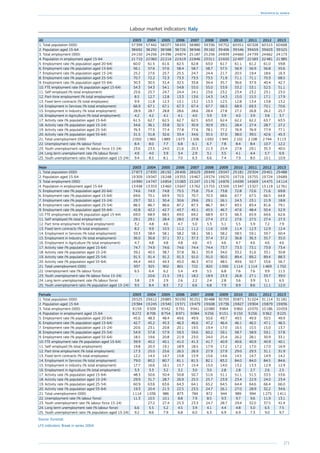
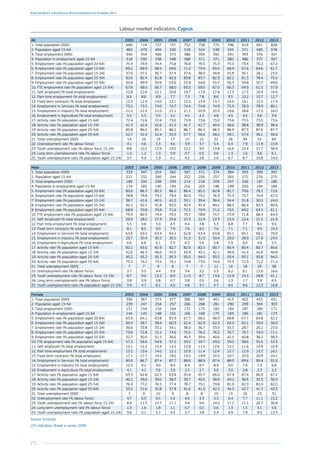
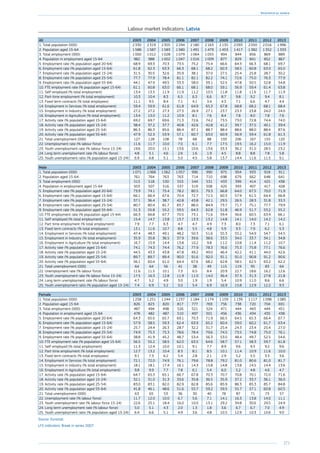
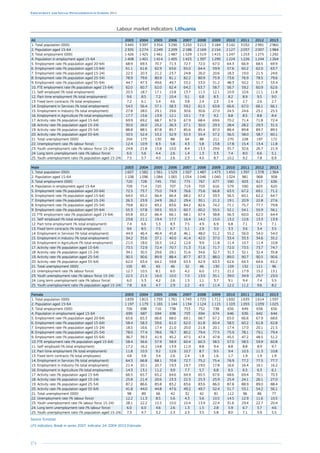
Social Europe
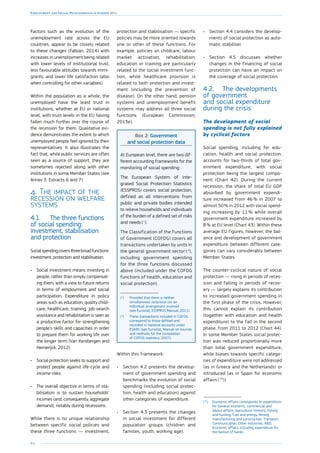
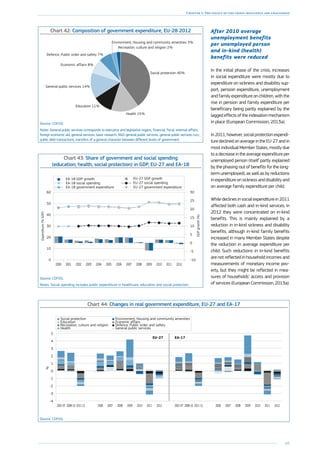
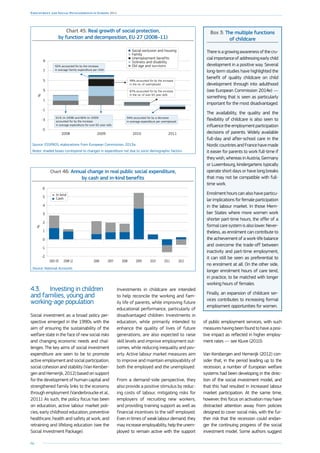
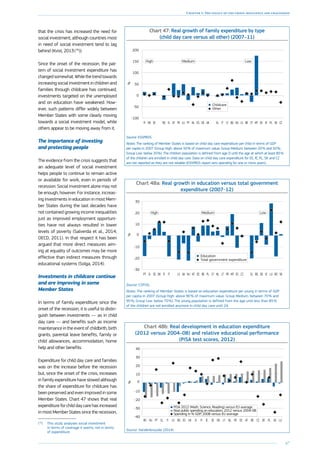
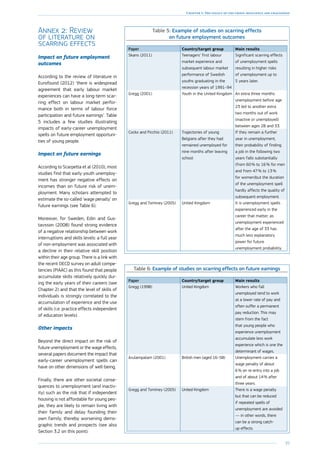
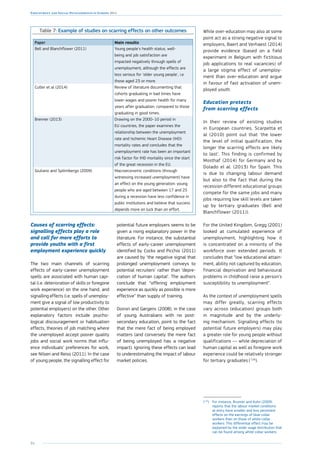
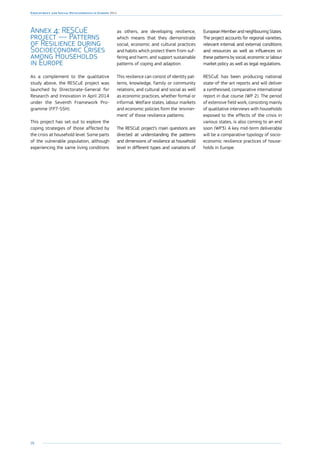
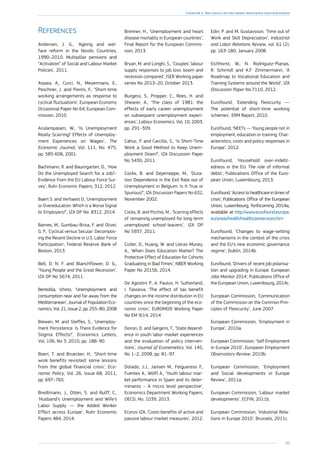
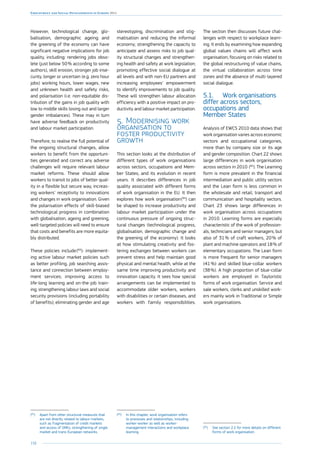
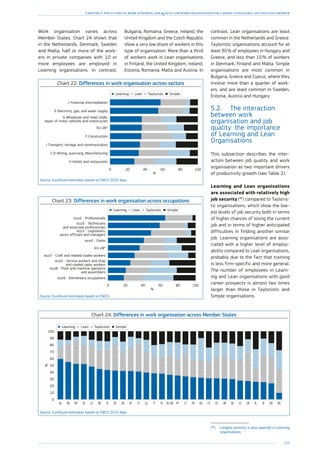
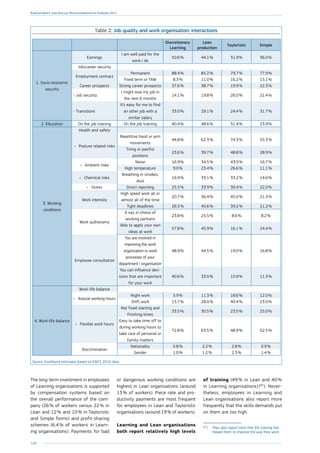
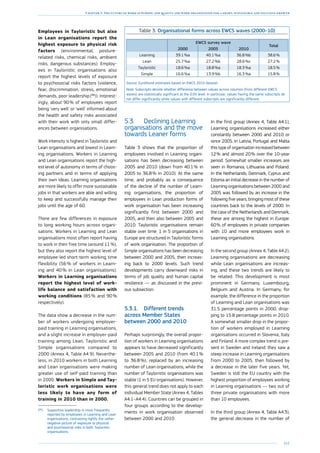
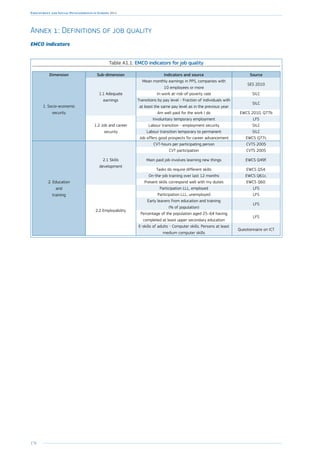
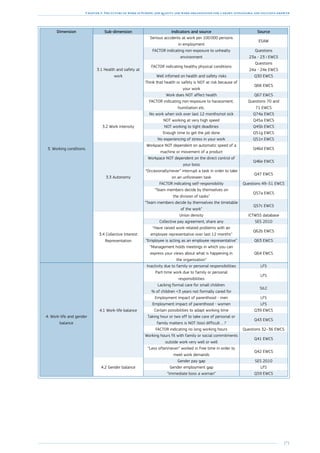
Employment and
Social Developments
in Europe 2014
ISSN 2315-2540
Employment and
Social Developments
in Europe 2014
European Commission
Directorate-General for Employment, Social Affairs and Inclusion
Directorate A
Manuscript completed in December 2014
This publication is a Commission staff working document aimed to inform the public at large. It does not consti-
tute an official position of the Commission on this subject nor in any way prejudges one. Neither the European
Commission nor any person acting on behalf of the Commission may be held responsible for the use that may be
made of the information contained in this publication.
ACKNOWLEDGEMENTS
The Directorate-General for Employment, Social Affairs and Inclusion would like to thank Eurostat and Eurofound
for their close collaboration and support in preparing the review.
Comments from other services of the European Commission are gratefully acknowledged.
Comments on the review would be gratefully received and should be sent to:
Directorate A
Directorate-General for Employment, Social Affairs and Inclusion
Office J-27 05/80
B-1049 Brussels
E-mail: Empl-A1-unit@ec.europa.eu
Cover illustration: Mi Ran Collin — © European Union
For any use or reproduction of photos which are not under European Union copyright, permission must be sought
directly from the copyright holder(s).
Europe Direct is a service to help you find answers
to your questions about the European Union.
Freephone number (*):
00 800 6 7 8 9 10 11
(*) The information given is free, as are most calls
(though some operators, phone boxes or hotels may charge you).
More information on the European Union is available on the Internet (http://europa.eu).
Luxembourg: Publications Office of the European Union, 2014
ISBN 978-92-79-39484-3 (print)
ISBN 978-92-79-39483-6 (web)
ISSN 1977-270X (print)
ISSN 2315-2540 (web)
doi:10.2767/34190 (print)
doi:10.2767/33738 (web)
© European Union, 2015
Reproduction is authorised provided the source is acknowledged.
Printed in Belgium
Printed on elemental chlorine-free bleached paper (ECF)
3
Contents
Executive summary. . . . . . . . . . . . . . . . . . . . . . . . . . . . . . . . . . . . . . . . . . . . . . . . . . . . . . . . . . . . . . . . . . . . . . . . . . . . . . 9
Job creation, productivity and more equality for sustained growth. . . . . . . . . . . . . . . . . . . . . . 13
1.	 Growth, jobs and household incomes: recent developments. . . . . . . . . . . . . . . . . . . . . . . . . . . . 13
2.	 Obstacles to job creation. . . . . . . . . . . . . . . . . . . . . . . . . . . . . . . . . . . . . . . . . . . . . . . . . . . . . . . . . . . . . . . . . . 15
2.1.	 Weak demand hampers job creation. . . . . . . . . . . . . . . . . . . . . . . . . . . . . . . . . . . . . . . . . . . . . . . . . . . . . . . . . . . . . 15
2.2.	 Crisis legacy reinforces some obstacles to job creation. . . . . . . . . . . . . . . . . . . . . . . . . . . . . . . . . . . . . . . . . . . . . . . 17
2.3.	 Recurrent obstacles. . . . . . . . . . . . . . . . . . . . . . . . . . . . . . . . . . . . . . . . . . . . . . . . . . . . . . . . . . . . . . . . . . . . . . . . . . 19
3.	 Who will benefit from job creation?. . . . . . . . . . . . . . . . . . . . . . . . . . . . . . . . . . . . . . . . . . . . . . . . . . . . . . 22
3.1.	 Youth: more education and better skills can lessen the impact of lack of experience. . . . . . . . . . . . . . . . . . . . . . . . . 22
3.2.	 Long-term unemployment has doubled, different policies can help prevent and tackle it. . . . . . . . . . . . . . . . . . . . . . 23
3.3.	 The structural issue of raising the labour market participation of specific groups. . . . . . . . . . . . . . . . . . . . . . . . . . . . 26
4.	 Job creation with productivity growth. . . . . . . . . . . . . . . . . . . . . . . . . . . . . . . . . . . . . . . . . . . . . . . . . . . . 29
4.1.	 What sort of jobs will be created? . . . . . . . . . . . . . . . . . . . . . . . . . . . . . . . . . . . . . . . . . . . . . . . . . . . . . . . . . . . . . . . 29
4.2.	 Job and wage polarisation: a pre-crisis trend that has continued. . . . . . . . . . . . . . . . . . . . . . . . . . . . . . . . . . . . . . . . 30
4.3.	 A major role for lifelong learning . . . . . . . . . . . . . . . . . . . . . . . . . . . . . . . . . . . . . . . . . . . . . . . . . . . . . . . . . . . . . . . . 30
5.	 Who will benefit from income growth?. . . . . . . . . . . . . . . . . . . . . . . . . . . . . . . . . . . . . . . . . . . . . . . . . . . 32
5.1.	 Household incomes declined in the crisis but have started to recover. . . . . . . . . . . . . . . . . . . . . . . . . . . . . . . . . . . . . 32
5.2.	 Rising poverty mainly affects the working-age population and children. . . . . . . . . . . . . . . . . . . . . . . . . . . . . . . . . . . 32
5.3.	 Mitigating rising inequalities requires training and quality jobs for all and improving the effectiveness
of social policies. . . . . . . . . . . . . . . . . . . . . . . . . . . . . . . . . . . . . . . . . . . . . . . . . . . . . . . . . . . . . . . . . . . . . . . . . . . . 33
6.	 Social and labour market imbalances impact GDP growth. . . . . . . . . . . . . . . . . . . . . . . . . . . . . . 36
6.1.	 How unemployment, poverty and inequality might affect GDP growth, also across national borders. . . . . . . . . . . . . 36
6.2.	 The impact of inequality on GDP growth: theory and recent evidence. . . . . . . . . . . . . . . . . . . . . . . . . . . . . . . . . . . . . 36
6.3.	 Lessons from the different interactions between GDP growth and labour market and social developments. . . . . . . . 37
References. . . . . . . . . . . . . . . . . . . . . . . . . . . . . . . . . . . . . . . . . . . . . . . . . . . . . . . . . . . . . . . . . . . . . . . . . . . . . . . . . . . . . . 38
4
Employment and Social Developments in Europe 2014
Chapter 1: The legacy of the crisis: resilience and challenges. . . . . . . . . . . . . . . . . . . . . . . . . . . . 41
1.	Introduction. . . . . . . . . . . . . . . . . . . . . . . . . . . . . . . . . . . . . . . . . . . . . . . . . . . . . . . . . . . . . . . . . . . . . . . . . . . . . . . . . 41
2.	 The legacy of the crisis on the employment and social situation. . . . . . . . . . . . . . . . . . . . . . 41
2.1.	 Long and protracted recession. . . . . . . . . . . . . . . . . . . . . . . . . . . . . . . . . . . . . . . . . . . . . . . . . . . . . . . . . . . . . . . . . . 41
2.2.	 Participation in education and in the labour market continued to rise. . . . . . . . . . . . . . . . . . . . . . . . . . . . . . . . . . . . . 49
2.3.	 Falling incomes and rising market income inequalities put tax and transfers systems under pressure . . . . . . . . . . . . 54
3.	 The potential long-term impacts on people and society. . . . . . . . . . . . . . . . . . . . . . . . . . . . . . . . 58
3.1.	 Scarring effects of unemployment — evidence from most recent data. . . . . . . . . . . . . . . . . . . . . . . . . . . . . . . . . . . 58
3.2.	 Households: running into debt, adjusting consumption and pooling resources. . . . . . . . . . . . . . . . . . . . . . . . . . . . . . . 60
3.3.	 Impact on health and access to healthcare. . . . . . . . . . . . . . . . . . . . . . . . . . . . . . . . . . . . . . . . . . . . . . . . . . . . . . . . 62
3.4.	 Weakening trust in institutions. . . . . . . . . . . . . . . . . . . . . . . . . . . . . . . . . . . . . . . . . . . . . . . . . . . . . . . . . . . . . . . . . . 63
4.	 The impact of the recession on welfare systems. . . . . . . . . . . . . . . . . . . . . . . . . . . . . . . . . . . . . . . . 64
4.1.	 The three functions of social spending: investment, stabilisation and protection . . . . . . . . . . . . . . . . . . . . . . . . . . . . 64
4.2.	 The developments of government and social expenditure during the crisis. . . . . . . . . . . . . . . . . . . . . . . . . . . . . . . . . 64
4.3.	 Investing in children and families, young and working-age population. . . . . . . . . . . . . . . . . . . . . . . . . . . . . . . . . . . . 66
4.4.	 The development of social protection as an automatic stabiliser. . . . . . . . . . . . . . . . . . . . . . . . . . . . . . . . . . . . . . . . 70
4.5.	 The development in the financing of social protection: risks and opportunities. . . . . . . . . . . . . . . . . . . . . . . . . . . . . . 72
5.	 The impact of the recession on labour market institutions. . . . . . . . . . . . . . . . . . . . . . . . . . . . . 73
5.1.	 A healthy labour market: balancing employment protection legislation, activation and support. . . . . . . . . . . . . . . . . 73
5.2.	 Employment protection legislation: reductions with results still pending. . . . . . . . . . . . . . . . . . . . . . . . . . . . . . . . . . . 74
5.3.	 The development of activation during the recession: investment in human capital and activation yielded positive
labour market outcomes . . . . . . . . . . . . . . . . . . . . . . . . . . . . . . . . . . . . . . . . . . . . . . . . . . . . . . . . . . . . . . . . . . . . . . 77
5.4.	 The development of unemployment benefits and short-time working arrangements. . . . . . . . . . . . . . . . . . . . . . . . . 82
5.5.	 The role of social partners: industrial relations and minimum wages. . . . . . . . . . . . . . . . . . . . . . . . . . . . . . . . . . . . . 87
5.6.	 The institutional balance to recover and benefit from growth: flexibility, activation and
support to prevent and tackle long-term unemployment. . . . . . . . . . . . . . . . . . . . . . . . . . . . . . . . . . . . . . . . . . . . . . 88
6.	Conclusions. . . . . . . . . . . . . . . . . . . . . . . . . . . . . . . . . . . . . . . . . . . . . . . . . . . . . . . . . . . . . . . . . . . . . . . . . . . . . . . . . 90
Annex 1: Employment change by job-wage quintile. . . . . . . . . . . . . . . . . . . . . . . . . . . . . . . . . . . . . . . . . 92
Annex 2: Review of literature on scarring effects. . . . . . . . . . . . . . . . . . . . . . . . . . . . . . . . . . . . . . . . . . . 93
Annex 3: Coping strategies during the recession — Qualitative analysis. . . . . . . . . . . . . . . . . 95
Annex 4: RESCuE project — Patterns of Resilience during Socioeconomic Crises
among Households in Europe	98
References. . . . . . . . . . . . . . . . . . . . . . . . . . . . . . . . . . . . . . . . . . . . . . . . . . . . . . . . . . . . . . . . . . . . . . . . . . . . . . . . . . . . . . 99
5

Chapter 2: Investing in human capital and responding to long-term
societal challenges. . . . . . . . . . . . . . . . . . . . . . . . . . . . . . . . . . . . . . . . . . . . . . . . . . . . . . . . . . . . . . . . . . . . . . . . . . . .  103
1.	Introduction
2.	 Long-term challenges threatening job-rich and inclusive growth. . . . . . . . . . . . . . . . . . . .  106
3.	 Policy and institutional framework. . . . . . . . . . . . . . . . . . . . . . . . . . . . . . . . . . . . . . . . . . . . . . . . . . . . .  109
3.1.	 Forming human capital . . . . . . . . . . . . . . . . . . . . . . . . . . . . . . . . . . . . . . . . . . . . . . . . . . . . . . . . . . . . . . . . . . . . .  109
3.2.	 Maintaining human capital. . . . . . . . . . . . . . . . . . . . . . . . . . . . . . . . . . . . . . . . . . . . . . . . . . . . . . . . . . . . . . . . . . .  115
3.3.	 Using human capital. . . . . . . . . . . . . . . . . . . . . . . . . . . . . . . . . . . . . . . . . . . . . . . . . . . . . . . . . . . . . . . . . . . . . . .  118
4.	 Policies and their impact: Evidence from the Labour Market Model. . . . . . . . . . . . . . . . . .  124
4.1.	 Forming HC: Investment in education — the case of Germany. . . . . . . . . . . . . . . . . . . . . . . . . . . . . . . . . . . . . . . .  124
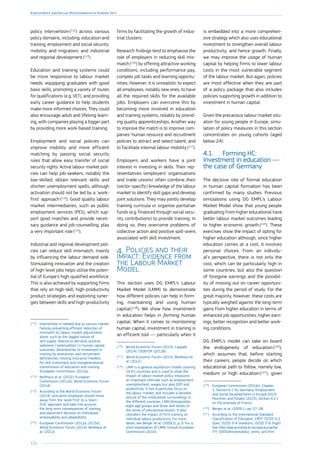
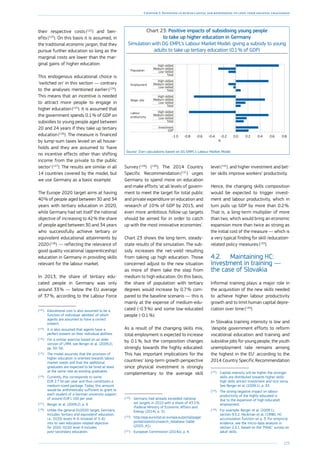
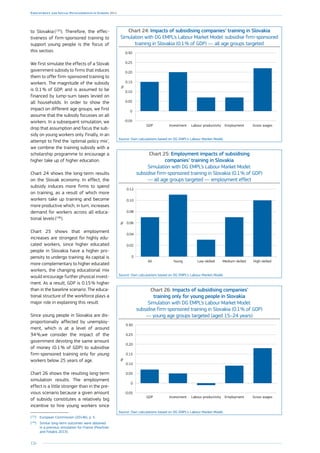
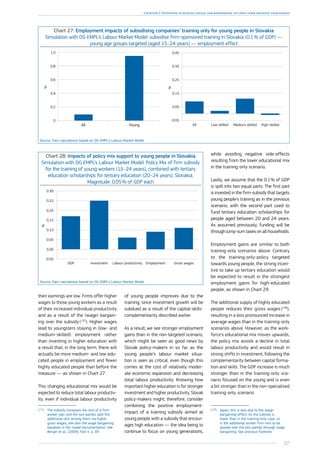
4.2.	 Maintaining HC: Investment in training — the case of Slovakia. . . . . . . . . . . . . . . . . . . . . . . . . . . . . . . . . . . . . . .  125
4.3.	 Using HC: Labour demand incentives to youth employment — the case of Italy . . . . . . . . . . . . . . . . . . . . . . . . . .  128
5.	Conclusions. . . . . . . . . . . . . . . . . . . . . . . . . . . . . . . . . . . . . . . . . . . . . . . . . . . . . . . . . . . . . . . . . . . . . . . . . . . . . . .  130
Annex. . . . . . . . . . . . . . . . . . . . . . . . . . . . . . . . . . . . . . . . . . . . . . . . . . . . . . . . . . . . . . . . . . . . . . . . . . . . . . . . . . . . . . . . .  131
References. . . . . . . . . . . . . . . . . . . . . . . . . . . . . . . . . . . . . . . . . . . . . . . . . . . . . . . . . . . . . . . . . . . . . . . . . . . . . . . . . . . .  132
6
Employment and Social Developments in Europe 2014
Chapter 3: The future of work in Europe: job quality and work organisation
for a smart, sustainable and inclusive growth. . . . . . . . . . . . . . . . . . . . . . . . . . . . . . . . . . . . . . . . . . . . .  135
1.	 Better jobs and work organisation yield a more productive workforce. . . . . . . . . . . . . .  135
2.	 Job quality and work organisation: multi-dimensional concepts. . . . . . . . . . . . . . . . . . . . .  135
2.1.	 Job quality dimensions. . . . . . . . . . . . . . . . . . . . . . . . . . . . . . . . . . . . . . . . . . . . . . . . . . . . . . . . . . . . . . . . . . . . . .  136
2.2.	 Work organisation can take different forms. . . . . . . . . . . . . . . . . . . . . . . . . . . . . . . . . . . . . . . . . . . . . . . . . . . . . .  137
2.3.	 Work organisation impacts on job quality and performance. . . . . . . . . . . . . . . . . . . . . . . . . . . . . . . . . . . . . . . . . .  137
3.	 The effects of job quality on productivity, labour market participation
and social cohesion. . . . . . . . . . . . . . . . . . . . . . . . . . . . . . . . . . . . . . . . . . . . . . . . . . . . . . . . . . . . . . . . . . . . . .  138
3.1.	 Socioeconomic security: synergy of interests. . . . . . . . . . . . . . . . . . . . . . . . . . . . . . . . . . . . . . . . . . . . . . . . . . . . .  138
3.2.	 Education and training may enhance employability and productivity. . . . . . . . . . . . . . . . . . . . . . . . . . . . . . . . . . .  142
3.3.	 Good working conditions can attract and develop human capital and improve performance and output. . . . . . . . . 143
3.4.	 Work-life and gender balance to strengthen participation, efficiency and equity. . . . . . . . . . . . . . . . . . . . . . . . . . .  147
3.5.	 Summary of findings. . . . . . . . . . . . . . . . . . . . . . . . . . . . . . . . . . . . . . . . . . . . . . . . . . . . . . . . . . . . . . . . . . . . . . .  148
4.	 Structural changes can impact on job quality and productivity growth. . . . . . . . . . . . . .  148
4.1.	 The two sides of knowledge and technology-intensive growth. . . . . . . . . . . . . . . . . . . . . . . . . . . . . . . . . . . . . . . .  149
4.2.	 Globalisation creates opportunities but also challenges for job quality and productivity. . . . . . . . . . . . . . . . . . . . .  152
4.3.	 Demographic change calls for an innovative approach to job quality. . . . . . . . . . . . . . . . . . . . . . . . . . . . . . . . . . .  155
4.4.	 The jobs potential of the green economy . . . . . . . . . . . . . . . . . . . . . . . . . . . . . . . . . . . . . . . . . . . . . . . . . . . . . . .  156
4.5.	 Strengthening job quality to foster future productivity growth in the face of significant structural changes . . . . . .  157
5.	 Modernising work organisation to foster productivity growth. . . . . . . . . . . . . . . . . . . . . . . .  158
5.1.	 Work organisations differ across sectors, occupations and Member States. . . . . . . . . . . . . . . . . . . . . . . . . . . . . . .  158
5.2.	 The interaction between work organisation and job quality: the importance of Learning and Lean Organisations .  159
5.3.	 Declining Learning organisations and the move towards Leaner forms. . . . . . . . . . . . . . . . . . . . . . . . . . . . . . . . . .  161
5.4.	 Complementing technological innovation with workplace innovation. . . . . . . . . . . . . . . . . . . . . . . . . . . . . . . . . . .  162
5.5.	 Fostering workers’ engagement. . . . . . . . . . . . . . . . . . . . . . . . . . . . . . . . . . . . . . . . . . . . . . . . . . . . . . . . . . . . . . .  163
5.6.	 Management strategies for organisational efficiency: supervision and control versus common values. . . . . . . . . .  164
5.7.	 Office and workflow design for optimum efficiency. . . . . . . . . . . . . . . . . . . . . . . . . . . . . . . . . . . . . . . . . . . . . . . .  164
5.8.	 Addressing future challenges in the Learning organisation. . . . . . . . . . . . . . . . . . . . . . . . . . . . . . . . . . . . . . . . . . .  165
5.9.	 Further globalisation brings changes to work organisation with job quality implications. . . . . . . . . . . . . . . . . . . . .  166
5.10.	 Conclusion: stronger employee empowerment matters for productivity growth. . . . . . . . . . . . . . . . . . . . . . . . . . . .  167
6.	Conclusions. . . . . . . . . . . . . . . . . . . . . . . . . . . . . . . . . . . . . . . . . . . . . . . . . . . . . . . . . . . . . . . . . . . . . . . . . . . . . . .  167
Annex 1: Definitions of job quality. . . . . . . . . . . . . . . . . . . . . . . . . . . . . . . . . . . . . . . . . . . . . . . . . . . . . . . . .  170
Annex 2: Organisation of work — Technical details. . . . . . . . . . . . . . . . . . . . . . . . . . . . . . . . . . . . . . .  178
Annex 3: Additional indicators relating to job quality. . . . . . . . . . . . . . . . . . . . . . . . . . . . . . . . . . . . .  179
Annex 4: Trend developments in Learning organisation. . . . . . . . . . . . . . . . . . . . . . . . . . . . . . . . . .  183
Annex 5: Companies’ well-being policies — case studies. . . . . . . . . . . . . . . . . . . . . . . . . . . . . . . . .  190
References. . . . . . . . . . . . . . . . . . . . . . . . . . . . . . . . . . . . . . . . . . . . . . . . . . . . . . . . . . . . . . . . . . . . . . . . . . . . . . . . . . . .  192
7

Chapter 4: Restoring Convergence between Member States in the EU and EMU. . . .  203
1.	Introduction. . . . . . . . . . . . . . . . . . . . . . . . . . . . . . . . . . . . . . . . . . . . . . . . . . . . . . . . . . . . . . . . . . . . . . . . . . . . . . .  203
2.	 Productivity and employment growth: THE key to long-term
convergence in the EU . . . . . . . . . . . . . . . . . . . . . . . . . . . . . . . . . . . . . . . . . . . . . . . . . . . . . . . . . . . . . . . . . .  204
2.1.	 Convergence trends in the EU since the mid-1990s. . . . . . . . . . . . . . . . . . . . . . . . . . . . . . . . . . . . . . . . . . . . . . . .  204
2.2.	 Structural factors impacting on employment and social divergence. . . . . . . . . . . . . . . . . . . . . . . . . . . . . . . . . . . .  213
2.3.	 Conclusion: promoting upward convergence by balanced adjustment efforts and strengthening human capital
formation. . . . . . . . . . . . . . . . . . . . . . . . . . . . . . . . . . . . . . . . . . . . . . . . . . . . . . . . . . . . . . . . . . . . . . . . . . . . . . . .  218
3.	 Convergence within the EU, a specific challenge?. . . . . . . . . . . . . . . . . . . . . . . . . . . . . . . . . . . . .  218
3.1.	 The specificities of a monetary union. . . . . . . . . . . . . . . . . . . . . . . . . . . . . . . . . . . . . . . . . . . . . . . . . . . . . . . . . . .  219
3.2.	 Cross-border externalities arising from employment and social developments linked to economic shocks
in a monetary union . . . . . . . . . . . . . . . . . . . . . . . . . . . . . . . . . . . . . . . . . . . . . . . . . . . . . . . . . . . . . . . . . . . . . . .  220
3.3.	 The contribution of employment and social policies to convergence in the EU. . . . . . . . . . . . . . . . . . . . . . . . . . . .  227
4.	Conclusion. . . . . . . . . . . . . . . . . . . . . . . . . . . . . . . . . . . . . . . . . . . . . . . . . . . . . . . . . . . . . . . . . . . . . . . . . . . . . . . .  232
Annex 1: Price dynamics in the euro area. . . . . . . . . . . . . . . . . . . . . . . . . . . . . . . . . . . . . . . . . . . . . . . . . .  234
Annex 2: Member States’ overall capacity to promote productivity growth:
2013–14 ranking. . . . . . . . . . . . . . . . . . . . . . . . . . . . . . . . . . . . . . . . . . . . . . . . . . . . . . . . . . . . . . . . . .  236
Annex 3: Between and within zones convergence. . . . . . . . . . . . . . . . . . . . . . . . . . . . . . . . . . . . . . . . .  238
References. . . . . . . . . . . . . . . . . . . . . . . . . . . . . . . . . . . . . . . . . . . . . . . . . . . . . . . . . . . . . . . . . . . . . . . . . . . . . . . . . . . .  243
8
Employment and Social Developments in Europe 2014
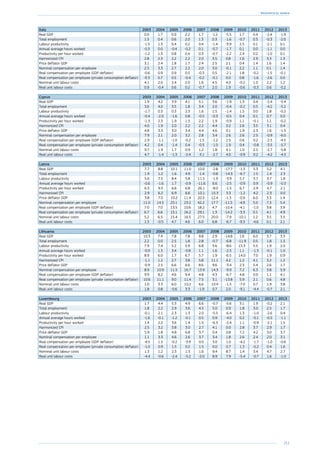
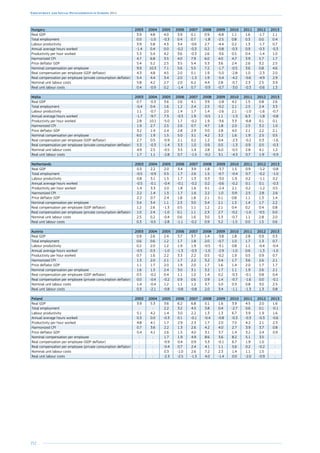
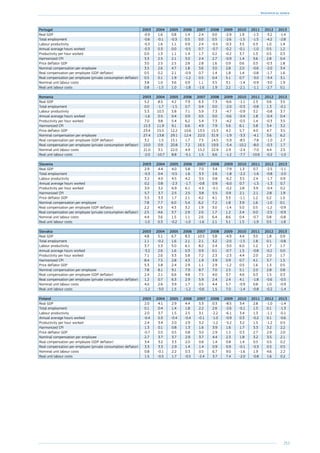
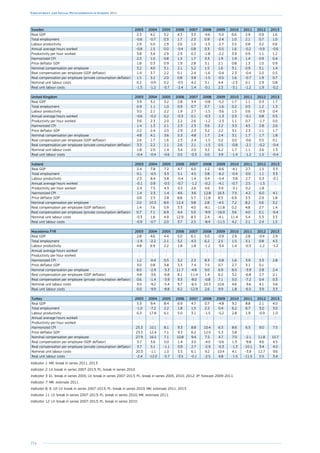
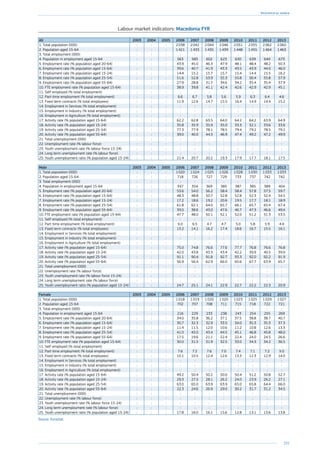
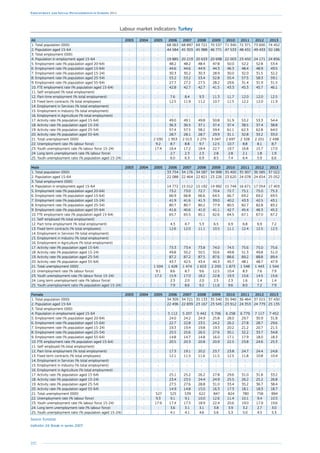
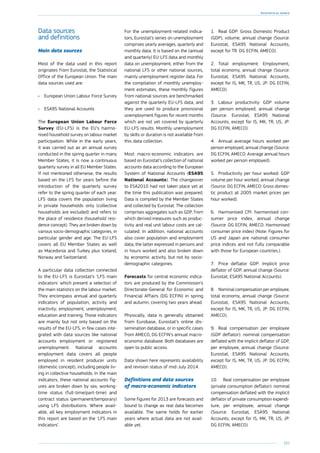
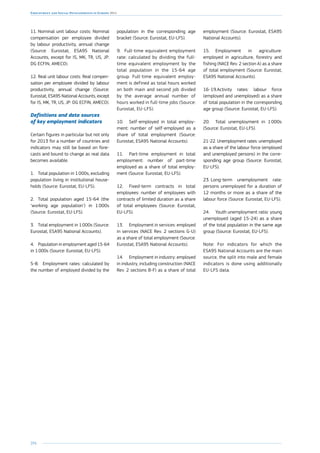
Statistical annex. . . . . . . . . . . . . . . . . . . . . . . . . . . . . . . . . . . . . . . . . . . . . . . . . . . . . . . . . . . . . . . . . . . . . . . . . . . . . . .  247
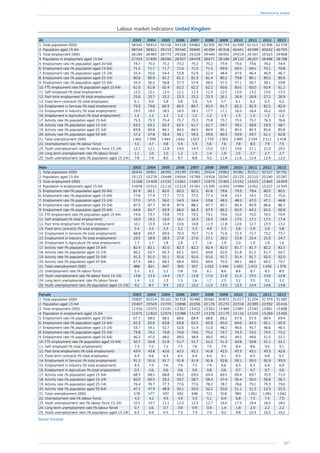
1.	 Macro economic indicators. . . . . . . . . . . . . . . . . . . . . . . . . . . . . . . . . . . . . . . . . . . . . . . . . . . . . . . . . . . . . .  247
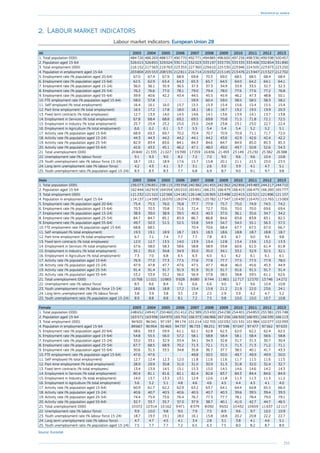
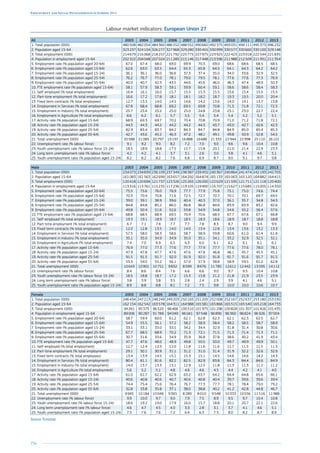
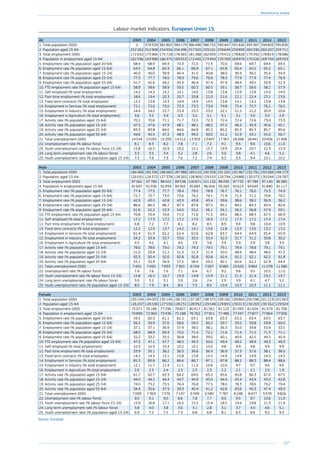
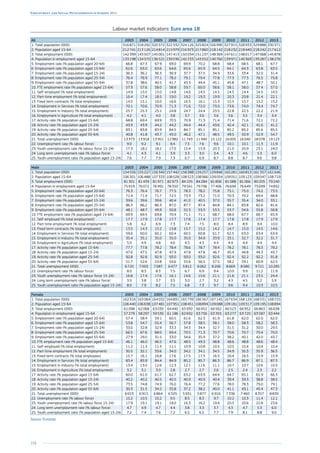
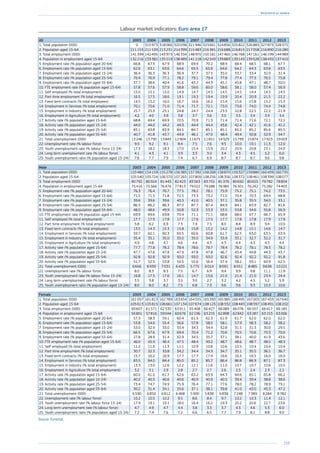
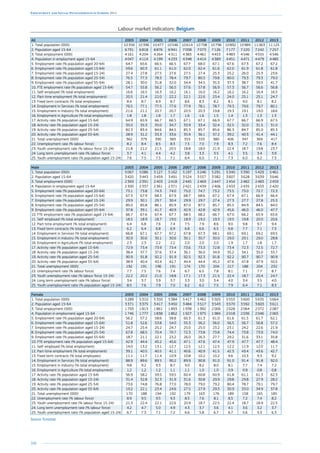
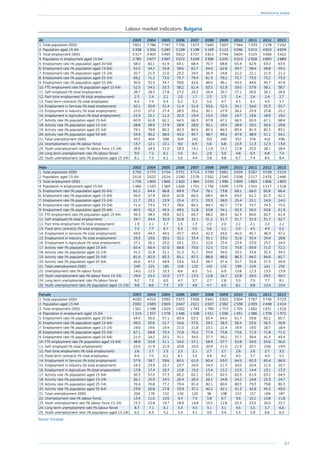
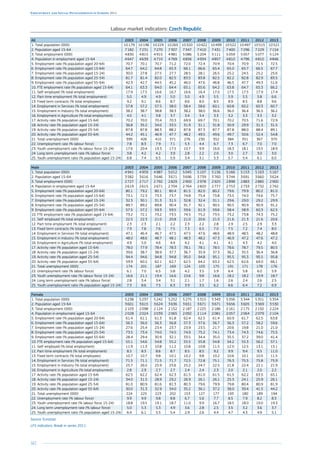
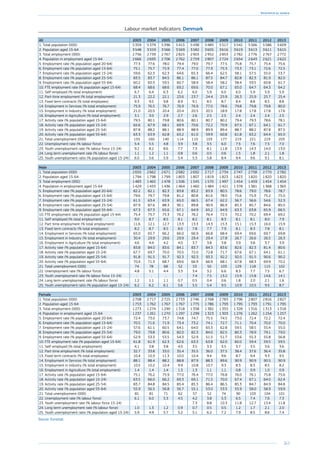
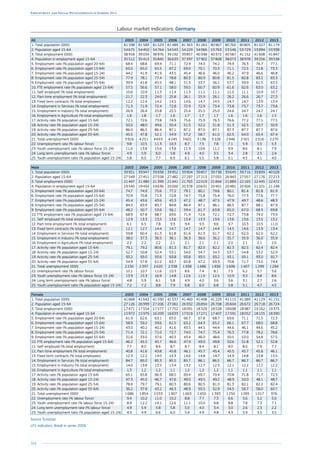
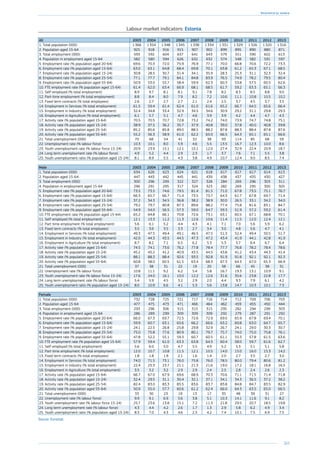
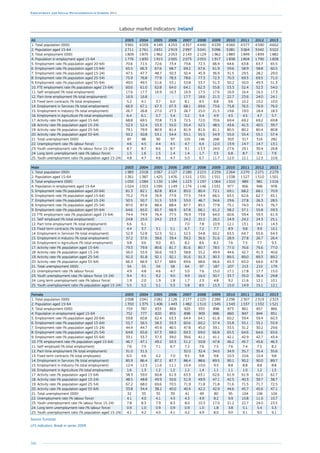
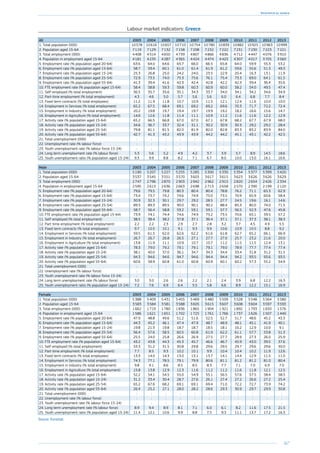
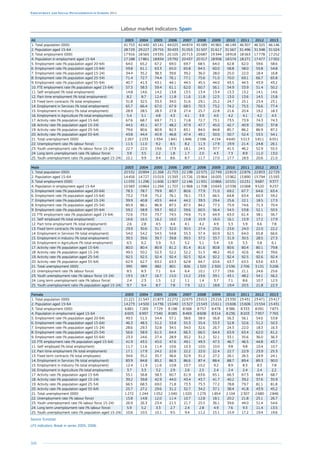
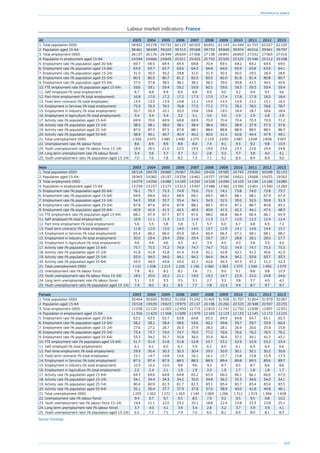
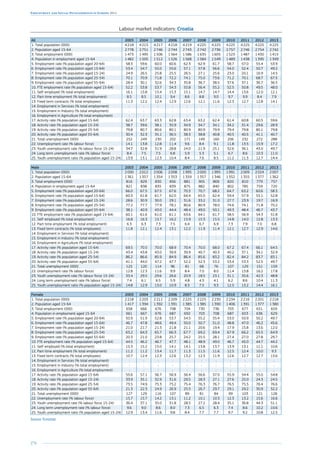
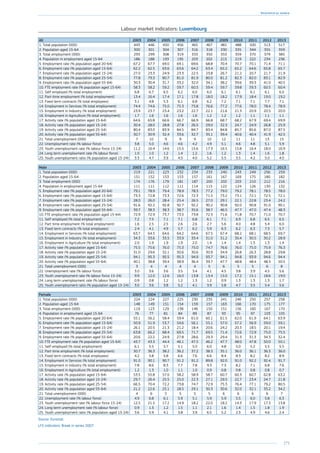
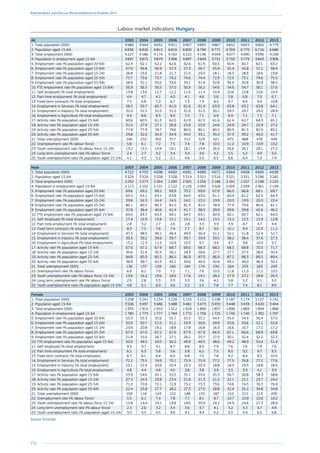
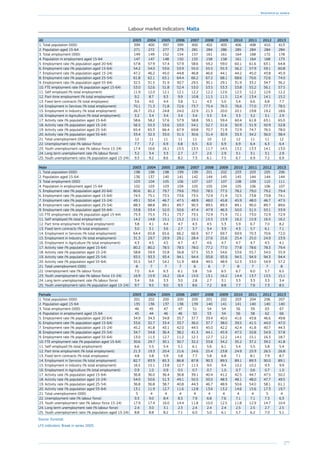
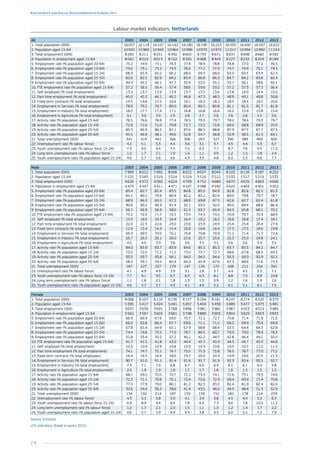
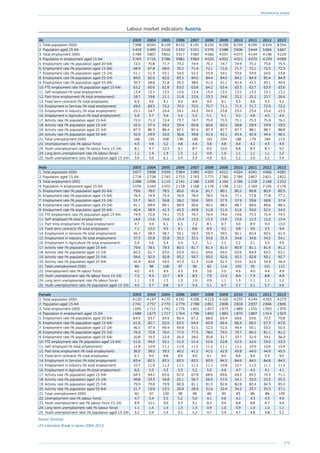
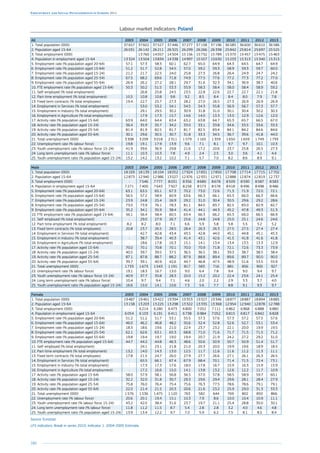
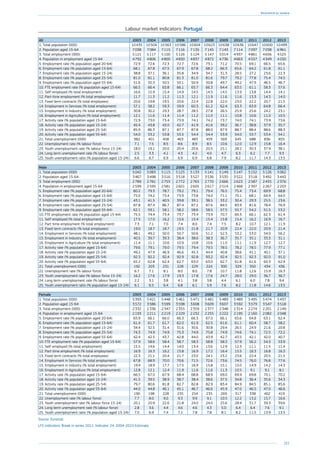
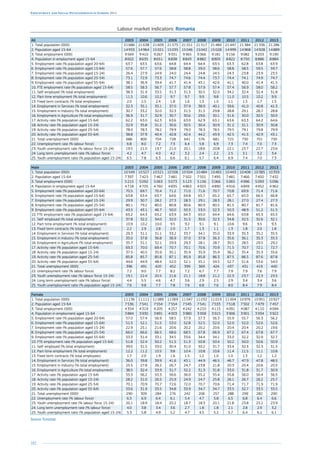
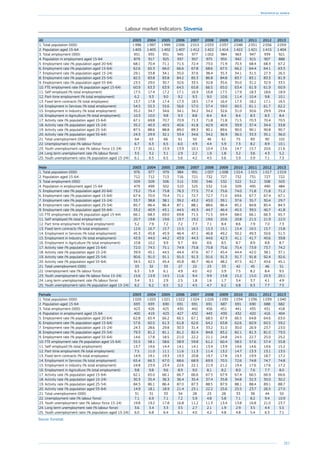
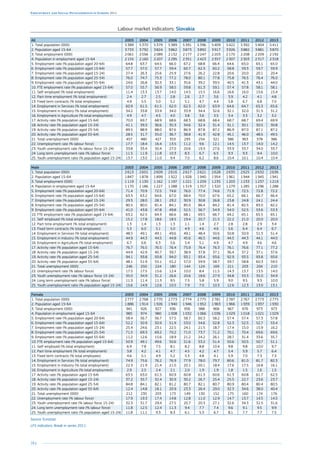
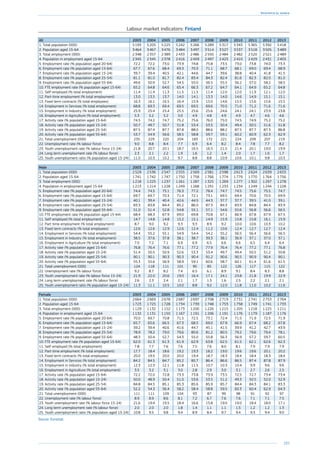
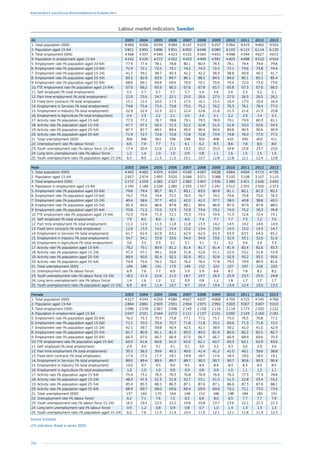
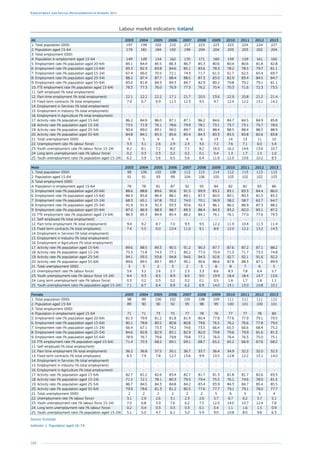
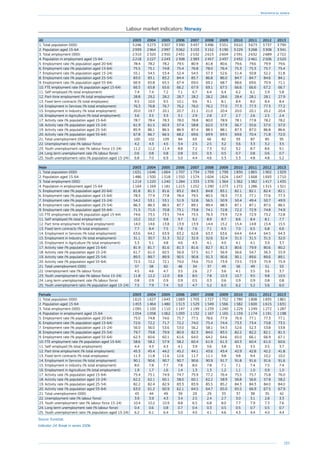
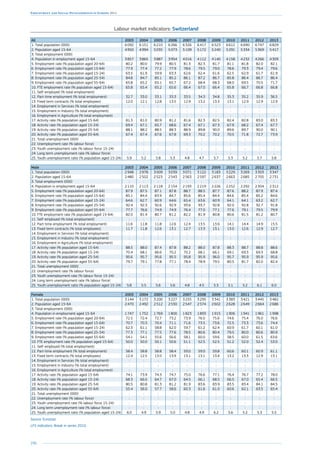
2.	 Labour market indicators. . . . . . . . . . . . . . . . . . . . . . . . . . . . . . . . . . . . . . . . . . . . . . . . . . . . . . . . . . . . . . . .  255
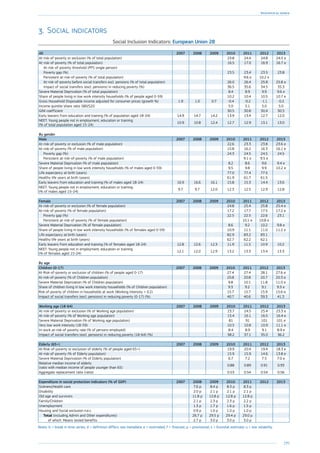
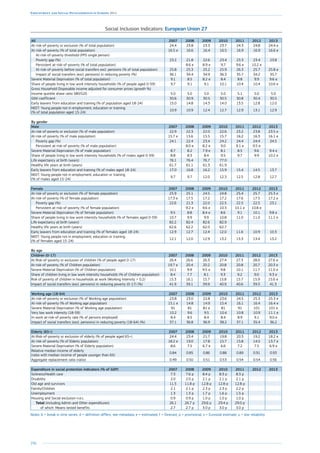
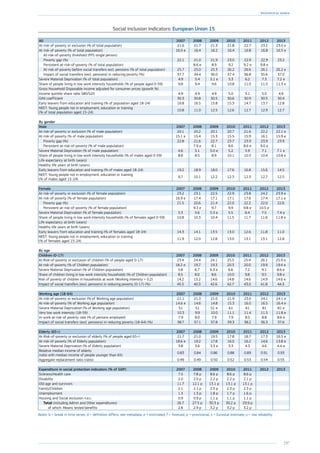
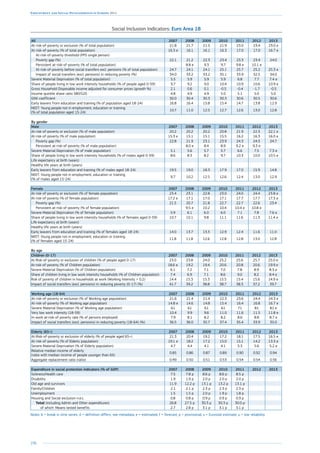
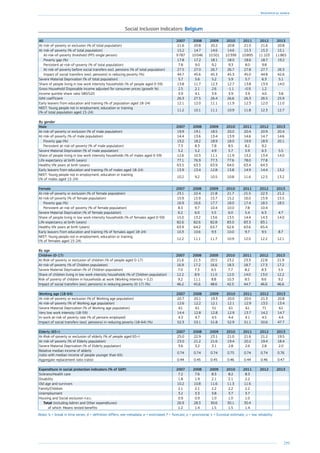
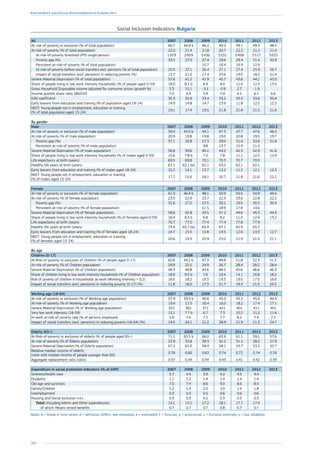
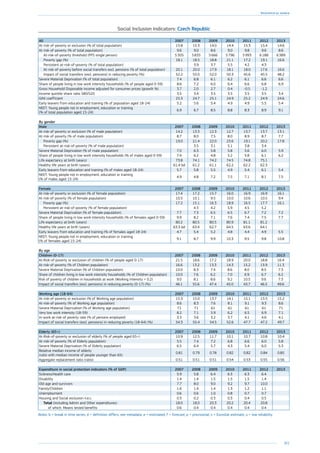
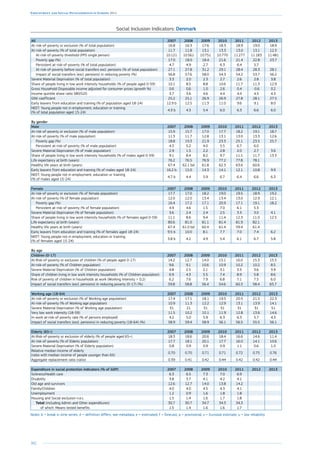
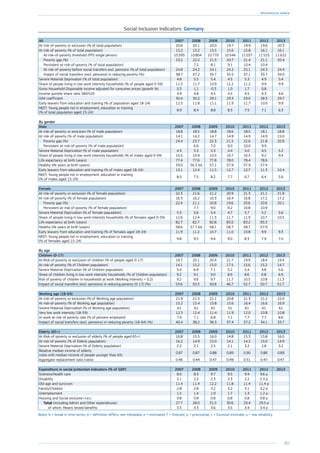
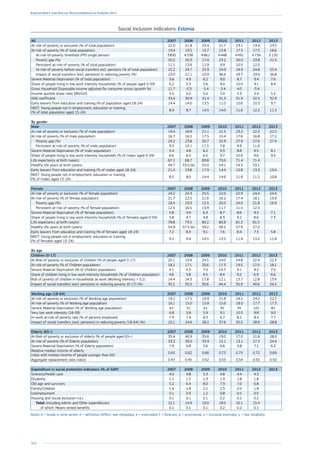
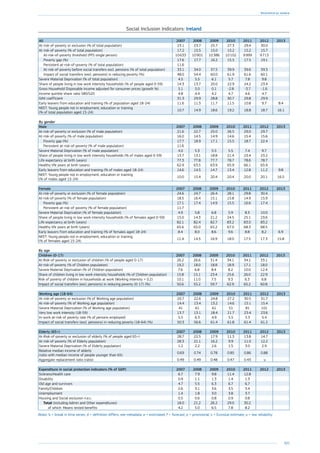
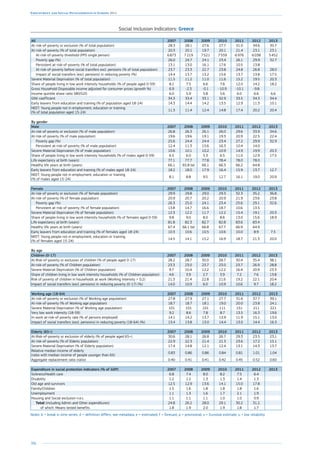
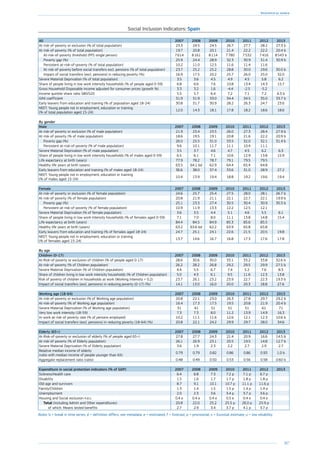
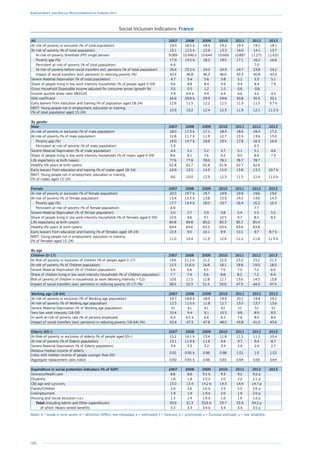
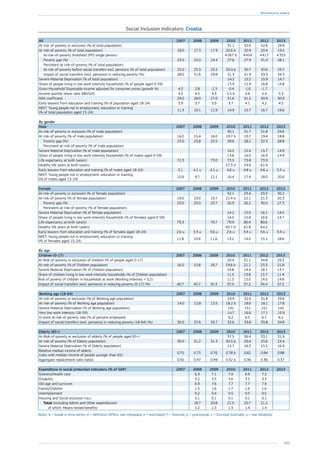
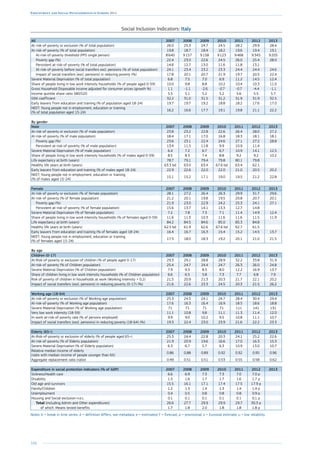
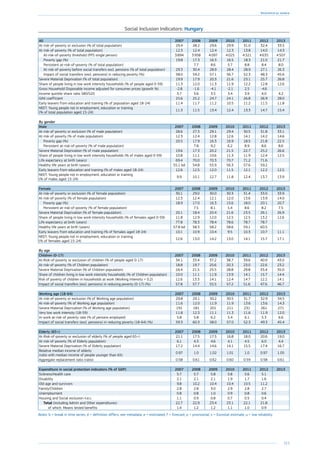
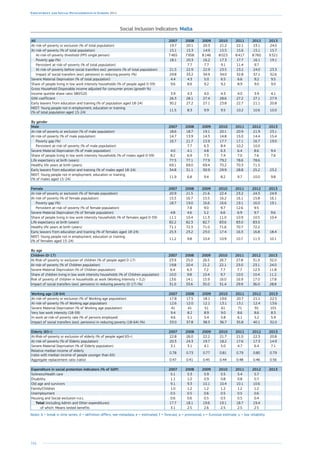
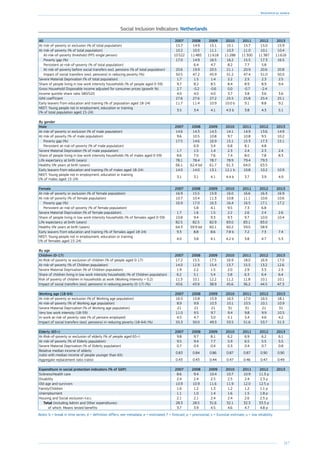
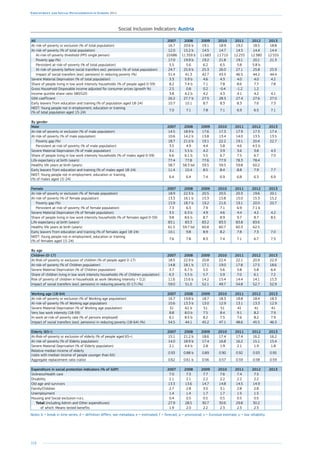
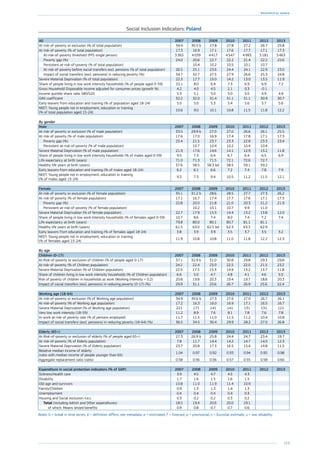
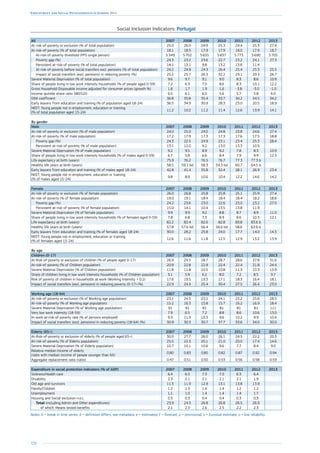
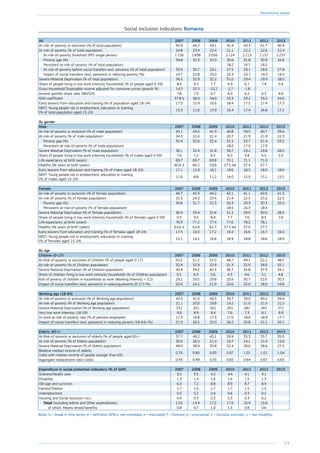
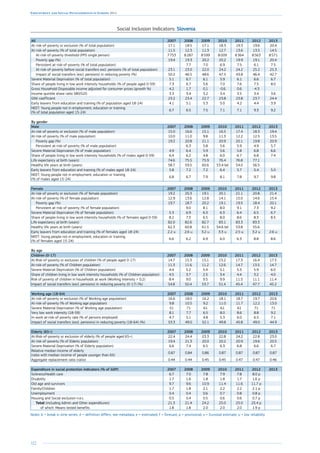
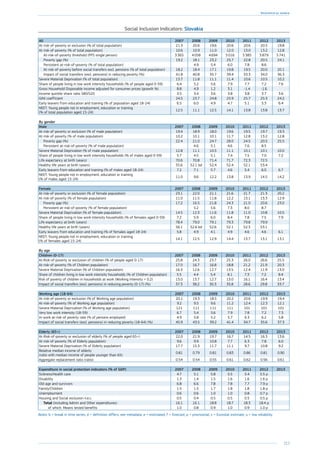
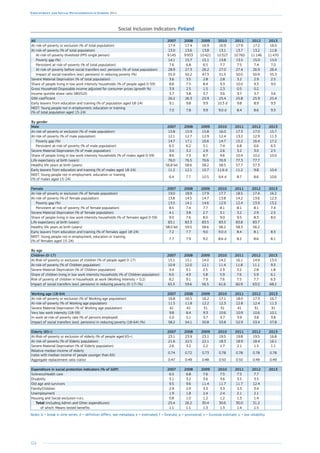
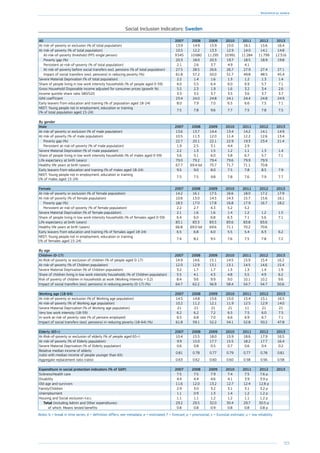
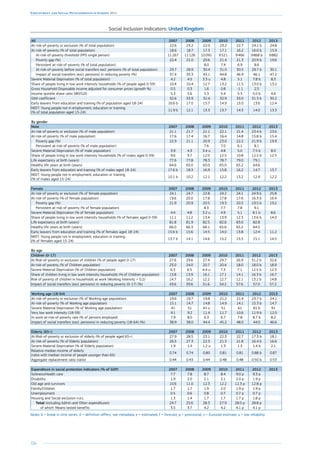
3.	 Social indicators. . . . . . . . . . . . . . . . . . . . . . . . . . . . . . . . . . . . . . . . . . . . . . . . . . . . . . . . . . . . . . . . . . . . . . . . . .  295
9
Executive summary
This fourth edition of the annual Employment and Social Developments in Europe
(ESDE) Review presents a detailed analysis of key employment and social issues
and concerns for the European Union and its Member States as it pursues its
EU 2020 employment and social goals.
The opening section provides an overall review of developments, challenges and
responses, followed by thematic chapters on:
•	 The legacy of the recession; resilience and challenges
•	 Investing in human capital and responding to long-term societal challenges
•	 The future of work in Europe; job quality and work organisation for smart, ­sustainable
and inclusive growth
•	 Restoring socio-economic convergence between Member States in the EU and EMU
The European economy and labour markets are experiencing signs of recovery from
the prolonged downturn. However, there is no reason to celebrate prematurely. While
economic output and employment have both started to recover in recent quar-
ters, they remain below the pre-crisis levels and the foundations of further growth
remain fragile. Moreover, the employment and social impacts of the crisis will take
years to redress, even under the most optimistic scenarios. At the same time, some
Member States weathered the crisis better than others and experience a stronger
recovery, also in terms of employment.
Unemployment has declined from the crisis peaks, but still remains in double digits
in the EU as a whole. Around 9 million more people are out of work compared with
2008, with youth and long-term unemployment being a source of particular concern.
Moreover, much of the recent employment growth consists of temporary or part-time,
which is suggestive of the uncertainty that prevails on the hiring side.
Also household incomes have shown some signs of improvement since late 2013,
after several years of decline, but this is insufficient to address the social challenges
that have exacerbated since the beginning of the crisis. Increased levels of poverty
and inequality in the most affected Member States threaten the EU goal of inclusive
and sustainable growth.
The foundations of sustained growth
remain fragile in many Member States…
… with unemployment still high
and employment growth concentrated
in temporary and part-time jobs.
The recovery remains short of
addressing the social challenges built
up since the beginning of the crisis.
10
Employment and Social Developments in Europe 2014
Against this backdrop, the European Commission launched earlier this year its mid-
term review of the Europe 2020 Strategy, in the first phase through a broad public con-
sultation. The results of the review will feed into discussions on the Strategy’s future
direction by the new Commission appointed in the wake of the June 2014 European
Parliament elections. This Review aims to contribute to this process by providing a
longer term analysis of employment and social trends and presenting the policy chal-
lenges, and possible ways to improve the delivery of the Europe 2020 headline targets.
In many countries long-term unemployment has more than doubled, especially
among the young. The review documents the potential ‘scarring’ effects on people
facing unemployment early in their careers, while underlining the opportunity that
the recession presents to step up investment in developing and maintaining skills in
order to contribute to a more solid and socially sustainable future growth.
Unlike in past recessions, activity rates have continued to increase, with the rise in
the participation of women and older workers, partly due to the fact that supportive
policy measures were maintained. At the same time, the crisis has increased financial
distress and debt levels among households, exacerbated poverty and social exclusion,
weakened social ties and led many families and individuals to rely on informal support.
The deterioration of the social situation for a prolonged period of time had a negative
impact on the public belief and trust in the ability of governments and institutions to
address such problems.
Looking back to the experience of the crisis, different Member States showed different
levels of resilience to the economic shock of the recession, which can be linked to both
their initial institutional and policy setting, and the policies implemented during the
recession years. Here the review finds, inter alia, that the transmission of economic
shocks to employment and income was smaller in countries in which there were more
open and also less segmented labour markets; more efficient social protection sys-
tems, a greater availability and use of short-time working arrangements; a stronger
investment in lifelong learning and activation; as well as unemployment and other
social benefits that were widely available, linked to activation, and responsive to the
economic cycle, in other words policy and institutional setups focused on providing
stronger employment security over working life, rather than in a single job.
The review also finds that a number of Member States are progressively moving towards
a social investment model that helps people achieve their full potential throughout their
lifetime and supports wider labour market participation. It likewise notes that the effec-
tiveness of automatic financial stabilisers depends on their ability to provide sustained
support even in a case of a prolonged labour demand weakness, while not creating
work disincentives in times of growth. Moreover, the structure of financing arrange-
ments influences the sustainability of social expenditure in that a shift from financing
from social security contributions toward financing through general taxation may lead
to a more inclusive system, provided the benefit systems are appropriately adjusted.
The combination effects of an ageing and declining population in the Union as against
demographic growth in much of the rest of the world, and increasing global produc-
tion, trade and competition, highlights the need to recognise investment in human
capital as the main approach needed in order to support productivity gains and ensure
that future growth is both job-rich and inclusive. Here the review underlines the fact
that effective human capital investment requires not only the forming of the right
skills through education and training, but also the creation of policy and institutional
frameworks that help individuals to maintain, upgrade and use their skills throughout
their working lives.
Among the key elements of a supportive policy and institutional mix for the forma-
tion of human capital are accessible, affordable and quality early childhood care
and education, which can help reducing the generation-to-generation transmission
of poverty and persistence of social inequalities, and support female participation in
the labour market. At the same time there is a need to reduce early school leaving,
which contributes to breaking the cycle of deprivation that leads to social exclusion,
and ensure that higher education and vocational education and training systems
respond to future needs of the labour markets.
Europe 2020 mid-term review
and new European Commission.
The crisis had a deep impact
on people and societies…
… while cross country differences
in their resilience to the economic shock
can be explained by several factors.
Structural trends underline the need
for investment in human capital
to support productivity.
Policy support to formation,
maintenance and use
of human capital…
11
Executive summary
In terms of maintaining and developing human capital throughout working lives, the
review demonstrates the importance of stronger investment in skills of all workers
and avoiding skills depreciation. It highlights the complementary roles of public and
private sector organisations in the provision of life-long learning. At the same time,
appropriate policies are needed in order to prevent human capital investments being
wasted through labour market inactivity, weak labour market attachment, skills mis-
match, or the underutilisation of the employment potential of all.
Integrated policy approaches reflecting all these aspects are instrumental for
strengthening EU competitiveness and for sustaining its social welfare model. Social
protection systems should represent an investment in human capital by effectively
activating and enabling those who can participate in the labour market, protecting
those (temporarily) excluded from the labour market and/or unable to participate
in it, and preparing individuals for potential risks in their lifecycles, in particular for
children and the elderly. Well-functioning welfare systems and well-designed social
investments are instrumental in supporting Europe’s main source of international
competitive advantage in the form of its highly skilled and productive human capital.
An increase in the supply of skilled human capital needs to be matched by an increase
in the supply of quality jobs in order to yield a more productive workforce. Here the
Review takes a closer look at future EU labour market challenges and opportunities
in terms of job quality and work organisation, and notes large differences between
Member States, and across population groups. It discusses a range of workplace
issues such as transition rates from temporary jobs to more permanent employ-
ment; access to training; work-life and gender balance; work intensity; and levels of
autonomy at work.
In terms of these workplace issues, the crisis period has seen deterioration in a num-
ber of Member States with, notably, a decrease in participation in life-long learning
in around a third of Member States. On the other hand, ongoing structural changes
linked to technological advance and innovation, globalisation, demographic change
and the greening of the economy, should offer opportunities for the creation of high
quality jobs and shifts in work organisation that are supportive of productivity growth.
Equally, however, the same structural changes may also contribute to skills obsoles-
cence or jobs and wage polarisation, calling for broader and more pro-active policy
responses that can mitigate the risks associated to these changes. These include, for
instance, support for participation in life-long training, improved job-search assistance
and job profiling, and the promotion of social dialogue linked to work organisation
innovations that are conducive to supporting the development of the knowledge-
based economy.
Another important task facing the EU following the crisis years concerns the ways
in which it can promote and support the return to an upward socio-economic con-
vergence of its Member States. This particularly concerns Southern and peripheral
EU 15 Member States, since most of the post-2004 Member States managed to
continue to converge even during the crisis.
The factors behind the divergence included, not only the sheer size of the economic
shock, but also the underlying structural imbalances in the affected countries in
the period before the crisis (notably weak productivity growth, lack of human capi-
tal investment, divergent unit labour cost growth, banking sector weaknesses and
property bubbles). In this respect the Review contributes to the ongoing debate on
the most appropriate forms of reforms given the aims of restoring convergence,
deepening the economic and monetary union, and strengthening its social dimension.
Adverse socio-economic outcomes such as labour market polarisation and poverty
or ‘scarring’ effects intensify the depth and persistence of any economic downturn if
adjustments are left solely to market forces. Here national level reforms to improve
the viability of social protection systems in the case of temporary shocks can sig-
nificantly contribute to the stabilisation of aggregate demand, long-term employ-
ment and productivity growth, thereby strengthening convergence and mitigating
hysteresis effects.
… is instrumental for strengthening
competitiveness and sustaining
EU social welfare model.
Increasing supply of skilled human
capital needs to be matched
by supply of quality jobs.
Structural changes generate opportunities
for creating of high quality jobs.
Restoring socio-economic convergence
is another important goal facing the EU.
12
Employment and Social Developments in Europe 2014
National level actions can be supported, at the EU level, by measures facilitating
mobility, promoting investment in human capital, notably through the European Social
Fund (ESF), and by the use of appropriate benchmarks.
This year’s Review provides an overview of key employment and social developments
and policy responses that can be drawn upon by the new European Commission in its
deliberations on the future orientations of the Europe 2020 strategy.
The Review recognises that the legacy of the prolonged crisis is continuing to seri-
ously affect the lives of many of the EU’s citizens, and that it has also compounded
many of the structural challenges already facing the Union. However, the evidence
presented in the Review also shows how structural reforms combining employment
and social policies can promote social fairness, enable countries to address both
their social concerns and their competitiveness challenges with reasonable success,
even in the most difficult of circumstances, where there is a commitment to do so.
A wealth of lessons for the future.
13
Job creation, productivity
and more equality for
sustained growth (1
)
While the EU has been seeing a recovery
from the recession, with output, employ-
ment and household incomes growing
and unemployment falling, the recovery
remains extremely fragile and unequal,
as witnessed by the recent downgrading
of the GDP outlook in the Commission
autumn forecast (2
).
At the same time, the employment and
social imbalances (and their cross-border
impacts) that occurred during the crisis
must as far as possible be prevented
from happening in the future. The ‘key
employment and social indicators’ score-
board introduced in the 2014 European
Semester should help with the close
monitoring of key factors – unemploy-
ment; young people not in employment,
education or training; household income;
poverty; and inequality – and will help
detect challenges early and enable
timely policy responses to be made.
Nevertheless, the EU’s prosperity ulti-
mately depends on economic growth,
which results from employment growth
and productivity growth. In order to
develop this further we have looked at
those labour market factors that constrain
job creation, apart from weak demand
and legacy effects from the crisis.
In this respect we particularly identify
demographic developments as being
liable to constrain future employment
(1
)	By Guy Lejeune and Isabelle Maquet.
(2
)	European Commission (2014), ‘European
Economic Forecast Autumn 2014’, Directorate-
General for Economic and Financial Affairs,
European Economy N° 7/2014.
growth (3
), putting further pressure on
ensuring that the best use is made of
all available human resources.
In so far as the contribution of employ-
ment to overall GDP growth declines
over the coming 20 years, then produc-
tivity growth will be the only source of
increased output in the EU (4
) – hence
the need to fully understand the links
between productivity and education, skill
formation and innovation.
After several years of decline, household
incomes started increasing again slightly
in real terms at the end of 2013. In some
countries, very significant declines have
led to strong increases in poverty, and
together with high household debt lev-
els, this is likely to undermine aggre-
gate demand for some time, especially
in countries where inequalities have
also increased.
We examine the potential role of well-
functioning labour markets and tax and
transfer systems to restore a sustain-
able recovery of household incomes and
a reduction of poverty and inequalities.
Unemployment, poverty and inequalities
undermine sustainable growth by weak-
ening aggregate demand in the short
term and by affecting potential GDP in
the longer term through reduced access
for many households to education and
(3
)	‘The quantitative evidence shows that in less
than 20 years EU employment will almost
inescapably start declining in volume due
to the intensity of workforce shrinking’,
Peschner and Fotakis (2013).
(4
)	Peschner and Fotakis (2013).
health services, and hence sub-optimal
use of human capital.
They can also lead to political instability,
weaken trust in institutions and under-
mine the capacity of governments to
conduct the reforms that are necessary
to ensure that policies and institutions
are supportive of growth. Such effects
may also have impacts beyond borders
and are therefore of common EU con-
cern. Moreover, these effects contribute
to increased divergence within the EU,
specifically since the start of the crisis
and which recently has stabilised at a
high level.
The EU economy is facing an uncertain
outlook, the recovery is not assured and
isolated demand or supply policies can-
not bring a sustainable recovery with
job growth.
1.	Growth, jobs and
household incomes:
recent developments
Although employment growth in
EU-28 turned positive at the end of 2013,
as did growth in household disposable
income (5
) after nearly four years of con-
tinuous decline (Chart 1) (6
), ­employment
(5
)	The real GDHI growth for the EU is a DG
EMPL estimation, and it does not include
Member States for which quarterly data are
missing (eight Member States). The nominal
GDHI is converted into real GDHI by deflating
with the deflator (price index) of household
final consumption expenditure. The real
GDHI growth is a weighted average of real
GDHI growth in Member States.
(6
)	See Section 5 for a detailed analysis of
recent trends of the EU GDHI in real terms
and its components.
14
Employment and Social Developments in Europe 2014
rates (for 20-64) remain well below
pre-crisis levels (68.4 % in 2013 vs.
70.3 % in 2008) and a long way off
the Europe 2020 target of 75 %. While
6.7 million jobs were destroyed between
2008 and the first quarter of 2013, the
number of jobs increased by 1.8 million up
to the second quarter of 2014. Moreover,
a large proportion of the new jobs cre-
ated recently are temporary or part-time,
raising concerns about the robustness of
the recovery.
The impact of the crisis on employment
and the social situation increased as the
unemployment rate rose from less than
7 % in 2008 to 10.8 % in 2013, putting
9 million more people out of work. The
effects were unevenly spread across the
EU however, with unemployment rates in
2013 still only around 5 % in Austria and
Germany against over 25 % in Greece
and Spain.
While the economic recovery is expected
to strengthen only gradually, EU employ-
ment is foreseen to start growing from
this year onwards, leading to a decline
in the overall EU unemployment rate
towards 9.5 % by 2016, according to the
Commission autumn forecast.
Cross-country differences in employ-
ment are large. Between 2008 and mid-
2014 most of the jobs were destroyed
in Spain (-3.4 million), Italy (-1.2 million),
and Greece (-1.0 million), while the num-
ber of jobs increased by 1.8 million in
Germany, and by 0.9 million in the United
Kingdom during the same period.
Employment divergence was reflected in
cross-country differences in unemploy-
ment, particularly in the euro area, with
Southern/peripheral countries seeing a
massive increase while rates remained
stable and low in the Northern/core
countries (see Chart 2). The dispersion in
unemployment rates is expected to start
to decline only gradually, still remaining
well above the pre-crisis level.
Chart 1: Growth in real GDP, real household disposable income
and employment, year-on-year change
-8
-6
-4
-2
0
2
4
Q2Q1Q4Q3Q2Q1Q4Q3Q2Q1Q4Q3Q2Q1Q4Q3Q2Q1Q4Q3Q2Q1Q4Q3Q2Q1Q4Q3Q2Q1
%changeonpreviousyear
GDP
GDHI
Employment
2007 2008 2009 2010 2011 2012 2013 2014
Source: Eurostat, National Accounts, data non-seasonally adjusted [namq_gdp_k]
Chart 2: Unemployment rates in the EU by group of Member States
0
5
10
15
20
201420132012201120102009200820072006200520042003200220012000
Non-EA South and peripheryEA North and core
EA South and peripheryNon-EA North
%oflabourforce15-74
Source: Eurostat, EU-LFS; DG EMPL calculations.
Note: EA North and core: AT BE DE FI FR LU NL, EA South and periphery: EE EL ES IE IT CY MT PT SI SK LV
Non-EA north: CZ DK PL SE UK, Non-EA South and periphery: BG HR LT HU RO.
Chart 3: Youth unemployment rates in the EU Member States
in August 2014 and the highest and lowest rates since 2008
%oflabourforce15-24
0
10
20
30
40
50
60
70
ESELITHRCYPTSKIEROFRBE
EA-18
PLBGLVSE
EU-28
LTHUFISICZUKLUMTEEDKNLATDE
August 2014
Highest rate since 2008
Lowest rate since 2008
Source: Eurostat, EU-LFS data, seasonally adjusted [une_rt_m].
Notes: EE EL HU UK Jul 2014 CY HR LV RO SI 2014Q2.
The convergence in the cyclical positions
and the ongoing labour cost adjustment
in high-unemployment countries would
contribute to further reduce the diver-
gence of labour market conditions in
the EU. Nevertheless, the present diver-
gence shows the need to look beyond
the traditional macro-economic adjust-
ment channels and consider changes in
socio-economic factors and cross-border
effects that may influence the depth and
15
Job creation, productivity and more equality for sustained growth
persistence of an economic downturn as
well as the adjustment capacity of any
given economy (7
).
The situation of young people and the
long-term unemployed is of particular
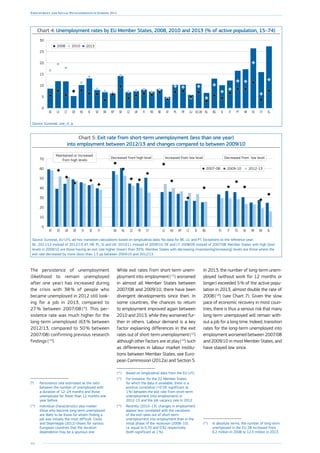
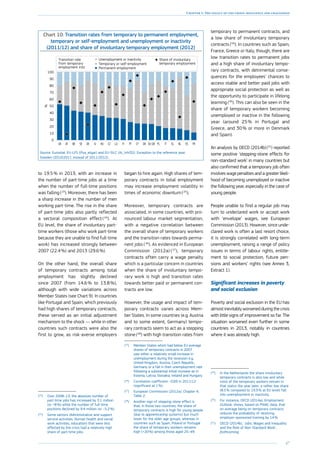
concern. In almost two thirds of Mem-
ber States, youth unemployment rates in
July 2014 were still close to their historic
highs – EU average of 21.7 % compared
to about 15 % in the first half of 2008 –
(Chart 3) while the proportion of young
people not in education or employment
(NEET) reached 13 % in 2011 against
11 % in 2008 (Chart 4). Again, however,
it varies considerably between Mem-
ber States while remaining higher than
before the downturn.
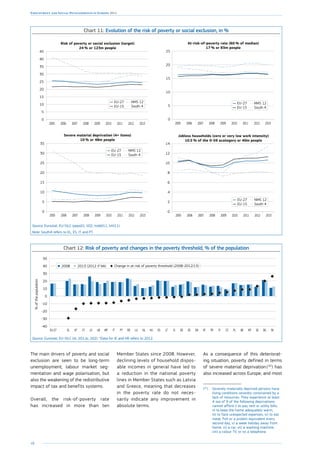
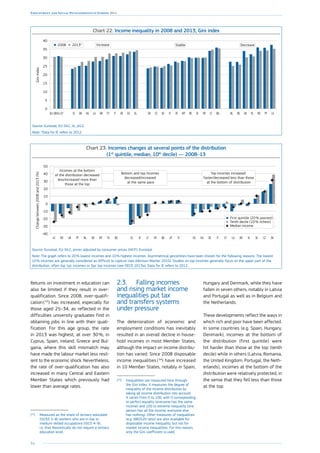
Such severe labour market deterioration
has had inevitable social consequences
with the number of people at risk of pov-
erty and social exclusion rising by more
than 6 million since 2008, reaching some
123 million in 2013, and taking us fur-
ther from the Europe 2020 target of hav-
ing at least 20 million fewer people in or
at risk of poverty and social exclusion.
Poverty and social exclusion among
those of working age (18-64 years)
has increased significantly in two thirds
of the Member States as a combined
result of rising levels of jobless and low
work intensity households, and in-work
poverty. In Greece, Ireland, Spain, Italy
and Hungary, poverty, social exclusion
and inequalities have increased signifi-
cantly from already high levels prior to
the crisis.
(7
)	See also Chapter 4 of this review.
Chart 4: NEET rate for the EU, EA and Member States in 2013
and the highest and lowest rates since 2008
0
5
10
15
20
25
ITBGELCYESHRROIEHUPTSKUKLV
EU-28
EA-18
BEPLEEFRLTMTFISICZSEATDEDKNLLU
2013
Highest rate since 2008
Lowest rate since 2008
%ofpopulation15-24
Source: Eurostat, EU-LFS data [edat_lfse_20].
Chart 5: Evolution of the risk-of-poverty or social exclusion,
2008 and 2013
0
5
10
15
20
25
30
35
40
45
50
BGELHULTIEITCYESMTLUDKLVHRPTUKEU-28EEEA-18SISENLBEDEFRROPLSKATFICZ
2008 2012/2013
%ofpopulation
Decrease Stable Increase Strongincrease
Source: Eurostat, EU SILC [ilc_peps01], income year 2007, 2012.
Notes: ES 2013 break in series (classified as strong increase based on 2008-2012 change), AT and UK
2012 break in series, HR 2010 instead of 2008 and 2012 instead of 2013, IE 2012 instead of 2013,
EU-27 instead of EU-28 in 2008.
Chart 6: Inequality of income distribution (income quintile share ratio
S80/S20), 2008 and 2013
Ratio
Decrease Stable Increase Strongincrease
0
1
2
3
4
5
6
7
8
ELESITEEHRCYLUDKHULTIESESKSIBGPT
EA-18
EU-28
FRATCZROLVPLDEUKMTBEFINL
2008 2013
Source: Eurostat, EU SILC [ilc_di11], income year 2007, 2012.
Notes: ES 2013 break in series, AT and UK 2012 break in series, HR 2010 instead of 2008, IE 2012
instead of 2013, EU-27 instead of EU-28 in 2008.
2.	Obstacles to job
creation
The legacy of the crisis poses significant
obstacles to job creation now, which add
to many of the obstacles that were pre-
sent before the crisis and are still in place.
2.1.	 Weak demand
hampers job creation
Weak demand is a major obstacle to
job creation. While EU GDP growth was
1.2 % year-on-year in the second quar-
ter of 2014, potential growth estimates
suggest little room for further accelera-
tion from there under ‘no policy change’
assumptions. Commission estimates put
potential growth in the EU at 1.0 % in
2015, accelerating slightly to 1.4 % in
16
Employment and Social Developments in Europe 2014
2020-23 (8
). The sober outlook for poten-
tial growth (in combination with high lev-
els of private and public debt for many
EU Member States) creates a difficult
environment for job creation.
The policy environment remains difficult.
Changes that could boost growth are, in
the short term, faster wage growth in
those sectors and Member States where
it has lagged productivity growth and,
in the medium term, policies to boost
productive investment, specifically in
human capital. A more expansionary fis-
cal stance in the euro area as a whole,
within the limits of rules on national
budgets would also be helpful (9
).
Stronger demand and structural reforms
should ideally occur simultaneously,
with little impact likely to be expected
from structural reforms (such as institu-
tional, product market and labour market
reforms) in a weak demand environment.
As ECB President Draghi has put it: ‘With-
out higher aggregate demand, we risk
higher structural unemployment, and
governments that introduce structural
reforms could end up running just to stand
still. … But without determined structural
reforms, aggregate demand measures
will quickly run out of steam and may
ultimately become less effective.’ (10
)
Weakness in wage
developments
Wages play a dual role in that they not
only affect price competitiveness, but
also influence domestic demand. In a
weak economic environment, the pro-
pensity to spend out of labour income
(and particularly for those at lower and
average earnings and in the context of
high private/household indebtedness as
is the case in many Member States) is
higher than the propensity to spend out
of capital income (11
).
(8
)	‘… the pre-crisis boost to capital
accumulation did not lead to increased
TFP growth. Post crisis, capital and labour
resources are only gradually re-allocated to
more productive uses, which further strains
potential growth.’ From ‘The euro area’s
growth prospects over the coming decade’ in
European Commission (2013e).
(9
)	See also Draghi (2014).
(10
)	Draghi (2014).
(11
)	The wage share, which is compensation of
employees divided by GDP, is also equivalent
to the real unit labour cost which measures
real (price-adjusted) compensation per
employee adjusted for productivity and
is a measure of price competitiveness.
See Annex 1 of Chapter 5, ‘Wage
developments in the European Union during
a severe economic downturn’ of European
Commission (2013c).
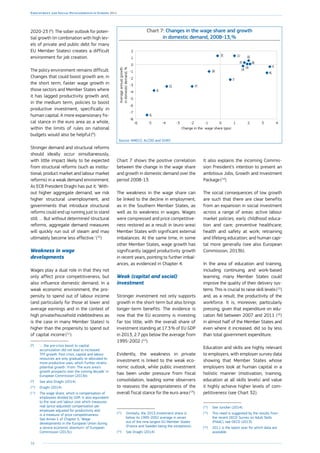
Chart 7 shows the positive correlation
between the change in the wage share
and growth in domestic demand over the
period 2008-13.
The weakness in the wage share can
be linked to the decline in employment,
as in the Southern Member States, as
well as to weakness in wages. Wages
were compressed and price competitive-
ness restored as a result in (euro-area)
Member States with significant external
imbalances. At the same time, in some
other Member States, wage growth has
significantly lagged productivity growth
in recent years, pointing to further imbal-
ances, as evidenced in Chapter 4.
Weak (capital and social)
investment
Stronger investment not only supports
growth in the short-term but also brings
longer-term benefits. The evidence is
now that the EU economy is investing
far too little, with the overall share of
investment standing at 17.3 % of EU GDP
in 2013, 2.7 pps below the average from
1995-2002 (12
).
Evidently, the weakness in private
investment is linked to the weak eco-
nomic outlook, while public investment
has been under pressure from fiscal
consolidation, leading some observers
to reassess the appropriateness of the
overall fiscal stance for the euro area (13
).
(12
)	Similarly, the 2013 investment share is
below its 1995-2002 average in seven
out of the nine largest EU Member States
(France and Sweden being the exceptions).
(13
)	See Draghi (2014).
It also explains the incoming Commis-
sion President’s intention to present an
ambitious Jobs, Growth and Investment
Package (14
).
The social consequences of low growth
are such that there are clear benefits
from an expansion in social investment
across a range of areas: active labour
market policies; early childhood educa-
tion and care; preventive healthcare;
health and safety at work; retraining
and lifelong education; and human capi-
tal more generally (see also European
Commission, 2013b).
In the area of education and training,
including continuing and work-based
learning, many Member States could
improve the quality of their delivery sys-
tems. This is crucial to raise skill ­levels (15
)
and, as a result, the productivity of the
workforce. It is, moreover, particularly
pressing, given that expenditure on edu-
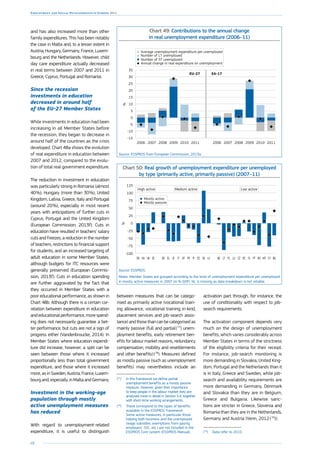
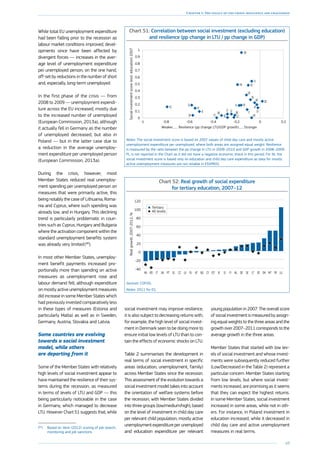
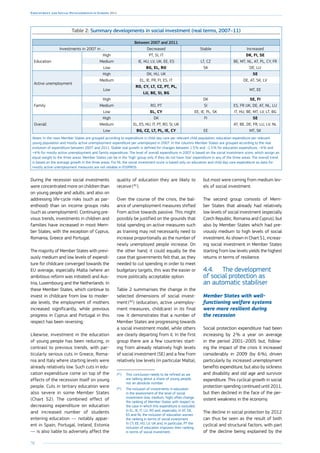
cation fell between 2007 and 2011 (16
)
in almost half of the Member States and
even where it increased, did so by less
than total government expenditure.
Education and skills are highly relevant
to employers, with employer survey data
showing that Member States whose
employers look at human capital in a
holistic manner (motivation, training,
education at all skills levels) and value
it highly achieve higher levels of com-
petitiveness (see Chart 32).
(14
)	See Juncker (2014).
(15
)	This need is suggested by the results from
the recent OECD Survey on Adult Skills
(PIAAC), see OECD (2013).
(16
)	2011 is the latest year for which data are
available.
Chart 7: Changes in the wage share and growth
in domestic demand, 2008-13, %
-6 -5 -4 -3 -2 -1 0 1 2 3 4
-8
-7
-6
-5
-4
-3
-2
-1
0
1
2
Change in the wage share (pps)
Averageannualgrowth
indomesticdemand,%
BE
DK
DE
IE
EL
ES
FR
IT
LU
NL
AT
PT
FI
SE
UK
Source: AMECO, ALCD0 and OUNT.
17
Job creation, productivity and more equality for sustained growth
2.2.	 Crisis legacy
reinforces some obstacles
to job creation
Job creation has been hampered by
many obstacles, some of which have
been reinforced by the lingering effects
of the crisis.
Access to finance and the role
of small and young firms
Small- and medium-sized enterprises (17
)
are traditionally seen as the motor of
employment growth with, for example, EIM
Business  Policy Research (2012) finding
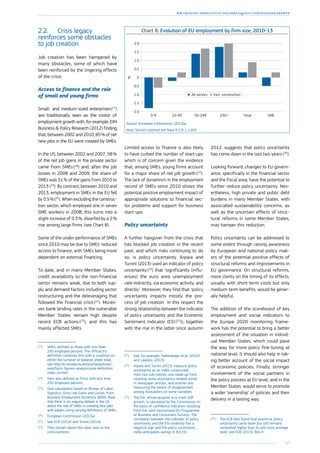
that, between 2002 and 2010, 85 % of net
new jobs in the EU were created by SMEs.
In the US, between 2002 and 2007, 58 %
of the net job gains in the private sector
came from SMEs (18
) and, after the job
losses in 2008 and 2009, the share of
SMEs was 51 % of the gains from 2010 to
2013 (19
). By contrast, between 2010 and
2013, employment in SMEs in the EU fell
by 0.5 % (20
). When excluding the construc-
tion sector, which employed one in seven
SME workers in 2008, this turns into a
slight increase of 0.3 %, dwarfed by a 2 %
rise among large firms (see Chart 8).
Some of the under-performance of SMEs
since 2010 may be due to SMEs’ reduced
access to finance, with SMEs being more
dependent on external financing.
To date, and in many Member States,
credit availability to the non-financial
sector remains weak, due to both sup-
ply and demand factors including sector
restructuring and the deleveraging that
followed the financial crisis (21
). Moreo-
ver, bank lending rates in the vulnerable
Member States remain high despite
recent ECB actions (22
), and this has
mainly affected SMEs.
(17
)	SMEs, defined as those with less than
250 employed persons. The official EU
definition combines this with a condition on
either the turnover or balance sheet total,
see http://ec.europa.eu/enterprise/policies/
sme/facts-figures-analysis/sme-definition/
index_en.htm
(18
)	Here also defined as firms with less than
250 employed persons.
(19
)	Own calculations based on Bureau of Labor
Statistics, Gross Job Gains and Losses, from
Business Employment Dynamics (BDM). Note
that there is an ongoing debate in the US
about the role of SMEs in creating new jobs
with papers using varying definitions of SMEs.
(20
)	European Commission (2013a).
(21
)	See ECB (2014) and Turner (2014).
(22
)	They remain above the rates seen in the
core countries.
Limited access to finance is also likely
to have curbed the number of start-ups
which is of concern given the evidence
that, among SMEs, young firms account
for a major share of net job growth (23
).
The lack of dynamism in the employment
record of SMEs since 2010 shows the
potential positive employment impact of
appropriate solutions to financial sec-
tor problems and support for business
start-ups.
Policy uncertainty
A further hangover from the crisis that
has blocked job creation in the recent
past, and which risks continuing to do
so, is policy uncertainty. Arpaia and
­Turrini (2013) used an indicator of policy
uncertainty (24
) that ‘significantly (influ-
ences) the euro area unemployment
rate indirectly, via economic activity, and
directly’. Moreover, they find that ‘policy
uncertainty impacts mostly the pro-
cess of job creation’. In this respect the
strong relationship between the indicator
of policy uncertainty and the Economic
Sentiment Indicator (ESI (25
)), together
with the rise in the latter since autumn
(23
)	See, for example, Haltiwanger et al. (2010)
and Lawless (2013).
(24
)	Arpaia and Turrini (2013) measure policy
uncertainty as an index constructed
from two sub-indices, one made up from
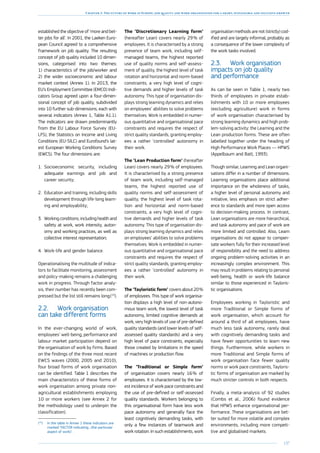
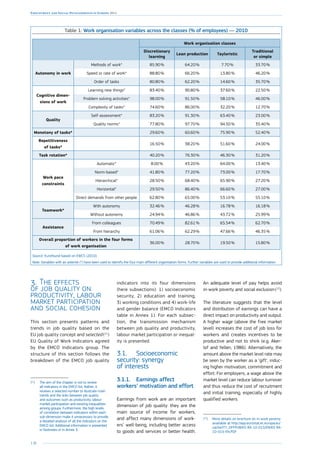
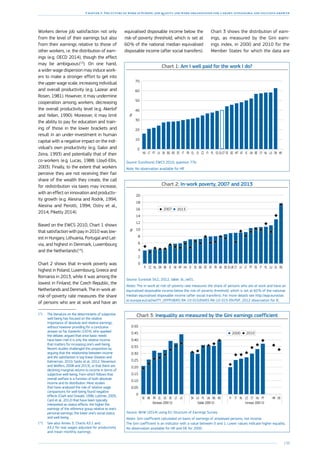
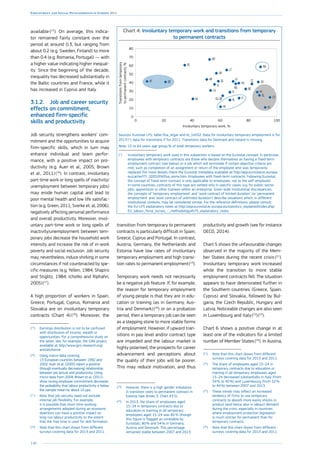
counting some uncertainty-related words
in newspaper articles, and another one
measuring the extent of disagreement
among forecasters on some variables.
(25
)	The ESI, whose purpose is to track GDP
growth, is calculated by the Commission on
the basis of confidence indicators resulting
from the Joint Harmonised EU Programme
of Business and Consumers Surveys. The
correlation between the indicator of policy
uncertainty and the ESI evidently has a
negative sign and the policy uncertainty
index anticipates swings in the ESI.
2012, suggests that policy uncertainty
has come down in the last two years (26
).
Looking forward, changes to EU govern-
ance, specifically in the financial sector
and the fiscal area, have the potential to
further reduce policy uncertainty. Nev-
ertheless, high private and public debt
burdens in many Member States, with
associated sustainability concerns, as
well as the uncertain effects of struc-
tural reforms in some Member States,
may hamper this reduction.
Policy uncertainty can be addressed to
some extent through raising awareness
by European and national policy mak-
ers of the potential positive effects of
structural reforms and improvements in
EU governance. On structural reforms,
more clarity on the timing of its effects,
usually with short-term costs but only
medium-term benefits, would be gener-
ally helpful.
The addition of the scoreboard of key
employment and social indicators to
the Europe 2020 monitoring frame-
work has the potential to bring a better
assessment of the situation in individ-
ual ­Member States, which could pave
the way for more policy fine-tuning at
national level. It should also help in tak-
ing better account of the social impact
of economic policies. Finally, stronger
involvement of the social partners in
the policy process at EU level, and in the
Member States, would serve to promote
a wider ‘ownership’ of policies and their
delivery in a lasting way.
(26
)	The ECB also found that economic policy
uncertainty came down but still remains
somewhat higher than its pre-crisis average
level, see ECB (2013), Box 4.
Chart 8: Evolution of EU employment by firm size, 2010-13
-2.0
-1.5
-1.0
-0.5
0
0.5
1.0
1.5
2.0
SMETotal250+50-24910-490-9
All sectors Excl. construction
%
Source: European Commission (2013a).
Note: Sectors covered are Nace R.2 B-J, L,M,N.
18
Employment and Social Developments in Europe 2014
Skills mismatches
Skill mismatch – the discrepancy
between the qualifications and skills
that individuals possess and those that
are needed by the labour market – is a
structural problem. Due to the intense
job destruction and its concentration in
certain branches of economic activity a
strong increase in structural mismatch
has taken place since the start of the
crisis. The evidence set out below points
to increasing levels of skills mismatch
in the EU, further aggravating current
labour market difficulties (27
).
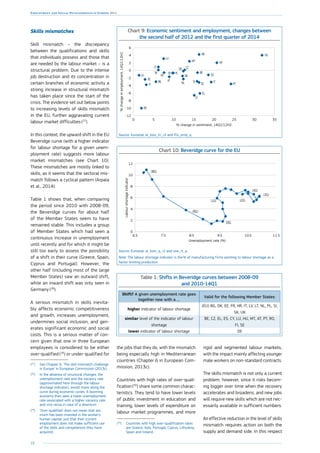
In this context, the upward shift in the EU
Beveridge curve (with a higher indicator
for labour shortage for a given unem-
ployment rate) suggests more labour
market mismatches (see Chart 10).
These mismatches are mostly linked to
skills, as it seems that the sectoral mis-
match follows a cyclical pattern (Arpaia
et al., 2014).
Table 1 shows that, when comparing
the period since 2010 with 2008‑09,
the Beveridge curves for about half
of the Member States seem to have
remained stable. This includes a group
of Member States which had seen a
continuous increase in unemployment
until recently and for which it might be
still too early to assess the possibility
of a shift in their curve (Greece, Spain,
Cyprus and Portugal). However, the
other half (including most of the large
Member States) saw an outward shift,
while an inward shift was only seen in
Germany (28
).
A serious mismatch in skills inevita-
bly affects economic competitiveness
and growth, increases unemployment,
undermines social inclusion, and gen-
erates significant economic and social
costs. This is a serious matter of con-
cern given that one in three European
employees is considered to be either
over-qualified (29
) or under-qualified for
(27
)	See Chapter 6, ‘The skill mismatch challenge
in Europe’ in European Commission (2013c).
(28
)	In the absence of structural changes, the
unemployment rate and the vacancy rate
(approximated here through the labour
shortage indicator), would move along the
curve during economic cycles. A booming
economy then sees a lower unemployment
rate associated with a higher vacancy rate
and vice versa in case of a downturn.
(29
)	‘Over-qualified’ does not mean that too
much has been invested in the worker’s
human capital, just that their current
employment does not make sufficient use
of the skills and competences they have
acquired.
the jobs that they do, with the mismatch
being especially high in Mediterranean
countries (Chapter 6 in European Com-
mission, 2013c).
Countries with high rates of over-quali-
fication (30
) share some common charac-
teristics. They tend to have lower levels
of public investment in education and
training, lower levels of expenditure on
labour market programmes, and more
(30
)	Countries with high over-qualification rates
are Greece, Italy, Portugal, Cyprus, Lithuania,
Spain and Ireland.
rigid and segmented labour markets,
with the impact mainly affecting younger
male workers on non-standard contracts.
The skills mismatch is not only a current
problem, however, since it risks becom-
ing bigger over time when the recovery
accelerates and broadens, and new jobs
will require new skills which are not nec-
essarily available in sufficient numbers.
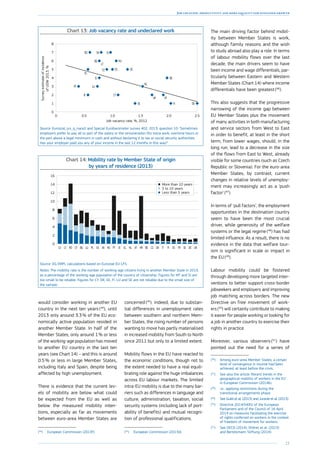
Chart 9: Economic sentiment and employment, changes between
the second half of 2012 and the first quarter of 2014
0 5 10 15 20 25 30 35
-12
-10
-8
-6
-4
-2
0
2
4
6
% change in sentiment, 14Q1/12H2
%changeinemployment,14Q1/12H2
EU
BE
BG
CZ
DK
DE
EE
EL
ES
FR
HR
IT
CY
LV
LT
LU
HU
MT
NL
AT
PL
PT
RO
SI
SK
FI
SE
UK
Source: Eurostat, ei_bssi_m_r2 and lfsi_emp_q.
Chart 10: Beveridge curve for the EU
6.5 7.5 8.5 9.5 10.5 11.5
0
2
4
6
8
10
12
Labourshortageindicator
Unemployment rate (%)
08Q1
09Q1
10Q1
11Q1 12Q1
14Q1
13Q1
Source: Eurostat, ei_bsin_q_r2 and une_rt_q.
Note: The labour shortage indicator is the % of manufacturing firms pointing to labour shortage as a
factor limiting production.
Table 1: Shifts in Beveridge curves between 2008-09
and 2010-14Q1
Shift? A given unemployment rate goes
together now with a …
Valid for the following Member States:
higher indicator of labour shortage
(EU) BG, DK, EE, FR, HR, IT, LV, LT, NL, PL, SI,
SK, UK
similar level of the indicator of labour
shortage
BE, CZ, EL, ES, CY, LU, HU, MT, AT, PT, RO,
FI, SE
lower indicator of labour shortage DE
An effective reduction in the level of skills
mismatch requires action on both the
supply and demand side. In this respect
19
Job creation, productivity and more equality for sustained growth
reforms designed to increase the flex-
ibility and responsiveness of educational
and training systems – including those to
ensure the recognition of skills acquired
outside of formal education or in another
country – will need to be balanced by
the creation of sufficient innovative and
high-skilled jobs.
Tackling skills mismatches should also
involve a significant degree of anticipa-
tion as, going forward, job creation will
require different or higher skills and
competencies (see Section 4.1), point-
ing to the need to invest in skills and
adaptation of business strategies and
human capital.
Low working hours and changes
to work organisation
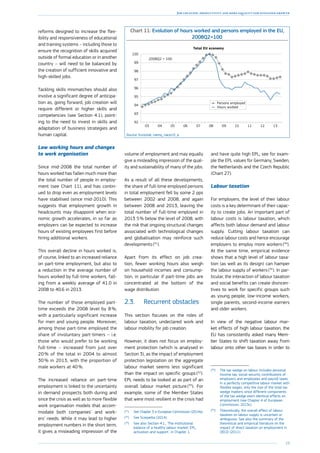
Since mid-2008 the total number of
hours worked has fallen much more than
the total number of people in employ-
ment (see Chart 11), and has contin-
ued to drop even as employment levels
have stabilised (since mid-2010). This
suggests that employment growth in
headcounts may disappoint when eco-
nomic growth accelerates, in so far as
employers can be expected to increase
hours of existing employees first before
hiring additional workers.
This overall decline in hours worked is,
of course, linked to an increased reliance
on part-time employment, but also to
a reduction in the average number of
hours worked by full-time workers, fall-
ing from a weekly average of 41.0 in
2008 to 40.6 in 2013.
The number of those employed part-
time exceeds the 2008 level by 8 %,
with a particularly significant increase
for men and young people. Moreover,
among those part-time employed the
share of involuntary part-timers – i.e.
those who would prefer to be working
full-time – increased from just over
20 % of the total in 2004 to almost
30 % in 2013, with the proportion of
male workers at 40 %.
Chart 11: Evolution of hours worked and persons employed in the EU,
2008Q2=100
92
93
94
95
96
97
98
99
100
2008Q2 = 100
03 04 05 06 07 08 09 10 11 12 13
Total EU economy
Persons employed
Hours worked
Source: Eurostat, namq_nace10_e.
The increased reliance on part-time
employment is linked to the uncertainty
in demand prospects both during and
since the crisis as well as to more flexible
work organisation models that accom-
modate both companies’ and work-
ers’ needs. While it may lead to higher
employment numbers in the short term,
it gives a misleading impression of the
volume of employment and may equally
give a misleading impression of the qual-
ity and sustainability of many of the jobs.
As a result of all these developments,
the share of full-time employed persons
in total employment fell by some 2 pps
between 2002 and 2008, and again
between 2008 and 2013, leaving the
total number of full-time employed in
2013 5 % below the level of 2008, with
the risk that ongoing structural changes
associated with technological changes
and globalisation may reinforce such
developments (31
).
Apart from its effect on job crea-
tion, fewer working hours also weigh
on household incomes and consump-
tion, in particular if part-time jobs are
concentrated at the bottom of the
wage distribution.
2.3.	 Recurrent obstacles
This section focuses on the roles of
labour taxation, undeclared work and
labour mobility for job creation.
However, it does not focus on employ-
ment protection (which is analysed in
Section 3), as the impact of employment
protection legislation on the aggregate
labour market seems less significant
than the impact on specific groups (32
).
EPL needs to be looked at as part of an
overall labour market picture (33
). For
example, some of the Member States
that were most resilient in the crisis had
(31
)	See Chapter 3 in European Commission (2014a).
(32
)	See Scarpetta (2014).
(33
)	See also Section 4.1., ‘The institutional
balance of a healthy labour market: EPL,
activation and support’, in Chapter 1.
and have quite high EPL; see for exam-
ple the EPL values for Germany, Sweden,
the Netherlands and the Czech Republic
(Chart 27).
Labour taxation
For employers, the level of their labour
costs is a key determinant of their capac-
ity to create jobs. An important part of
labour costs is labour taxation, which
affects both labour demand and labour
supply. Cutting labour taxation can
reduce labour costs and hence encourage
employers to employ more workers (34
).
At the same time, empirical evidence
shows that a high level of labour taxa-
tion (as well as its design) can hamper
the labour supply of workers (35
). In par-
ticular, the interaction of labour taxation
and social benefits can create disincen-
tives to work for specific groups such
as young people, low-income workers,
single parents, second-income earners
and older workers.
In view of the negative labour mar-
ket effects of high labour taxation, the
EU has consistently asked many Mem-
ber States to shift taxation away from
labour onto other tax bases in order to
(34
)	The tax wedge on labour includes personal
income tax, social security contributions of
employers and employees and payroll taxes.
In a perfectly competitive labour market with
flexible wages, only the size of the total tax
wedge matters since different components
of the tax wedge exert identical effects on
employment (see Chapter 4 of European
Commission, 2013c).
(35
)	Theoretically, the overall effect of labour
taxation on labour supply is uncertain or
ambiguous. See also the summary of the
theoretical and empirical literature on the
impact of direct taxation on employment in
OECD (2011).
20
Employment and Social Developments in Europe 2014
stimulate employment creation (36
). The
benefits could be particularly high if tax
reductions were targeted at the most vul-
nerable groups in the labour market, while
recognising that the outcome might dif-
fer significantly between Member States
depending on their characteristics and the
composition of their workforce.
The optimal design of tax shifts from both
an employment policy and social policy
perspective is a complex task, requiring
distributional impacts to be addressed.
For example, the regressive effects of
substituting VAT for labour taxes can
be mitigated by compensating targeted
groups (unemployed, retirees) and by
focusing on standard rather than reduced
rates and exemptions (37
). Similarly, green
taxes linked to car ownership represent
a lower tax burden for the lower income
groups than taxes on heating and energy,
and a proper taxation of imputed rent has
socially favourable effects.
The desirability of some tax shifts could
also be linked to other policy goals. A
shift from labour towards green taxation
also provides incentives for moving to a
more green and resource-efficient econ-
omy, which could bring more sustainable
and high-quality employment (38
).
Targeting a reduction in the labour tax
wedge to the groups facing the greatest
challenges can maximise the employ-
ment effects of the reform limiting at
the same time its fiscal costs. Simula-
tions with DG EMPL’s Labour Market
Model for nine selected Member States
show a pronounced employment impact
when employers’ social security costs for
young workers are lowered by an amount
equivalent to 0.1 % of GDP, financed by
higher VAT (39
). Tax shifts away from
labour can reduce labour costs, in par-
ticular for the low-skilled and the young
where such reductions can have a strong
impact and are most needed. This makes
handling the distributional implications
of such shifts even more important.
(36
)	The Eurogroup recalled that the ‘overall tax
burden in the euro area is above the OECD
average and is skewed towards labour’
(Eurogroup, 2014).
(37
)	See the conclusions of Chapter 4 in
European Commission (2013c): “increasing
standard VAT rates has less socially
detrimental effects than curtailing VAT
reduced rates and exemptions”.
(38
)	European Commission (2014c) provided
estimates of possible employment gains.
(39
)	More simulation results, with reductions
targeted at other groups, can be found in
Chapter 4 of European Commission (2013c).
See also Chapter 3 of this review.
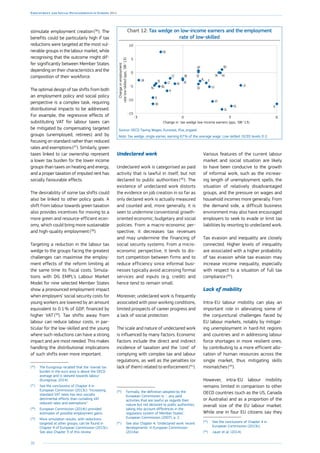
Chart 12: Tax wedge on low-income earners and the employment
rate of low-skilled
-3 0 3 6
-15
-10
-5
0
5
10
Changeinemployment
ratelow-skilled(pps,'08-'13)
Change in tax wedge low-income earners (pps, '08-'13)
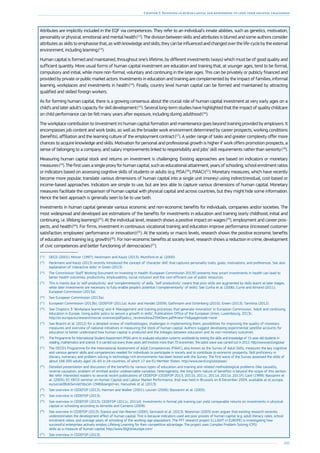
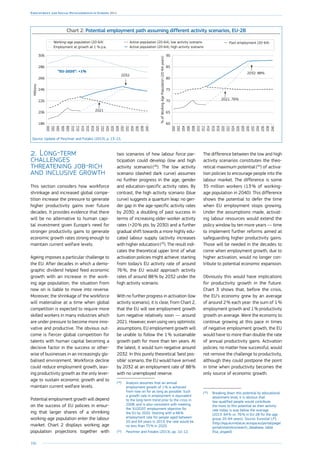
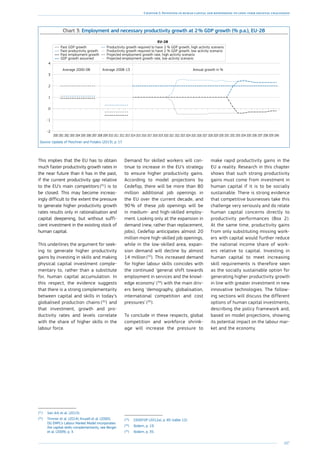
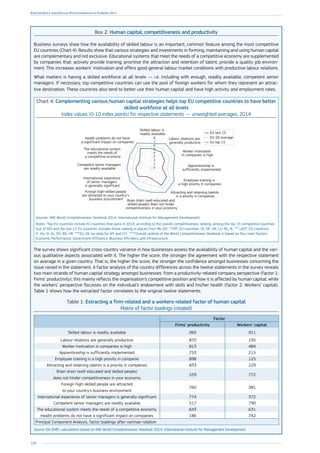
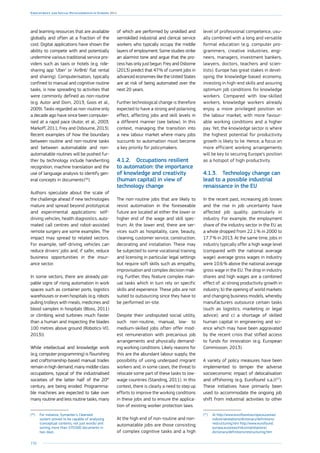
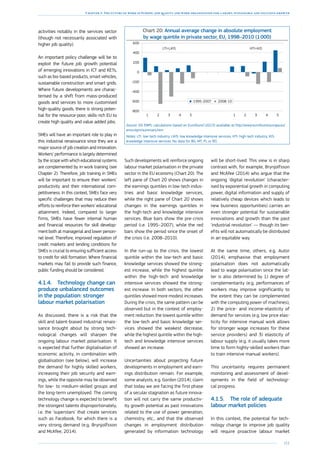
EU
BE
BG
CZ
DK
DE
EE
IE
EL
ES
FR
IT
LV
LT
LU
HU
MT
NL
AT
PL
PT
RO
SI
SK
FI
SEUK
Source: OECD Taxing Wages, Eurostat, lfsa_ergaed.
Note: Tax wedge: single earner, earning 67 % of the average wage. Low-skilled: ISCED levels 0-2.
Undeclared work
Undeclared work is categorised as paid
activity that is lawful in itself, but not
declared to public authorities (40
). The
existence of undeclared work distorts
the evidence on job creation in so far as
only declared work is actually measured
and counted and, more generally, it is
seen to undermine conventional growth-
oriented economic, budgetary and social
policies. From a macro-economic per-
spective, it decreases tax revenues
and may undermine the financing of
social security systems. From a micro-
economic perspective, it tends to dis-
tort competition between firms and to
reduce efficiency since informal busi-
nesses typically avoid accessing formal
services and inputs (e.g. credit) and
hence tend to remain small.
Moreover, undeclared work is frequently
associated with poor working conditions,
limited prospects of career progress and
a lack of social protection.
The scale and nature of undeclared work
is influenced by many factors. Economic
factors include the direct and indirect
incidence of taxation and the ‘cost’ of
complying with complex tax and labour
regulations, as well as the penalties (or
lack of them) related to enforcement (41
).
(40
)	Formally, the definition adopted by the
European Commission is: ‘…any paid
activities that are lawful as regards their
nature but not declared to public authorities,
taking into account differences in the
regulatory system of Member States’,
European Commission (2007), p. 2.
(41
)	See also Chapter 4, ‘Undeclared work: recent
developments’ in European Commission
(2014a).
Various features of the current labour
market and social situation are likely
to have been conducive to the growth
of informal work, such as the increas-
ing length of unemployment spells, the
situation of relatively disadvantaged
groups, and the pressure on wages and
household incomes more generally. From
the demand side, a difficult business
environment may also have encouraged
employers to seek to evade or limit tax
liabilities by resorting to undeclared work.
Tax evasion and inequality are closely
connected. Higher levels of inequality
are associated with a higher probability
of tax evasion while tax evasion may
increase income inequality, especially
with respect to a situation of full tax
compliance (42
).
Lack of mobility
Intra-EU labour mobility can play an
important role in alleviating some of
the conjunctural challenges faced by
EU labour markets, notably by mitigat-
ing unemployment in hard-hit regions
and countries and in addressing labour
force shortages in more resilient ones,
by contributing to a more efficient allo-
cation of human resources across the
single market, thus mitigating skills
mismatches (43
).
However, intra-EU labour mobility
remains limited in comparison to other
OECD countries (such as the US, Canada
or Australia) and as a proportion of the
overall size of the EU labour market.
While one in four EU citizens say they
(42
)	See the conclusions of Chapter 4 in
European Commission (2013c).
(43
)	Jauer et al. (2014).
21
Job creation, productivity and more equality for sustained growth
would consider working in another EU
country in the next ten years (44
), until
2013 only around 3.3 % of the EU eco-
nomically active population resided in
another Member State. In half of the
Member States, only around 1 % or less
of the working-age population has moved
to another EU country in the last ten
years (see Chart 14) – and this is around
0.5 % or less in large Member States,
including Italy and Spain, despite being
affected by high unemployment.
There is evidence that the current lev-
els of mobility are below what could
be expected from the EU as well as
below the measured mobility inten-
tions, especially as far as movements
between euro-area Member States are
(44
)	European Commission (2013f).
concerned (45
). Indeed, due to substan-
tial differences in unemployment rates
between southern and northern Mem-
ber States, the rising number of persons
wanting to move has partly materialised
in increased mobility from South to North
since 2011 but only to a limited extent.
Mobility flows in the EU have reacted to
the economic conditions, though not to
the extent needed to have a real equili-
brating role against the huge imbalances
across EU labour markets. The limited
intra-EU mobility is due to the many bar-
riers such as differences in language and
culture, administration, taxation, social
security systems (including lack of port-
ability of benefits) and mutual recogni-
tion of professional qualifications.
(45
)	European Commission (2013d).
Chart 13: Job vacancy rate and undeclared work
0 0.5 1.0 1.5 2.0 2.5
0
1
2
3
4
5
6
7
8Surveyestimateofincidence
ofUDW2013,%
Job vacancy rate, %, 2012
AT
BE
BG
CY
CZ
DE
EE
EL
ES
FI
HU
IE
LT
LU
NL
PL
PT
RO
SE
SI
SK
UK
Source: Eurostat, jvs_q_nace2 and Special Eurobarometer survey 402, 2013, question 10: ‘Sometimes
employers prefer to pay all or part of the salary or the remuneration (for extra work, overtime hours or
the part above a legal minimum) in cash and without declaring it to tax or social security authorities.
Has your employer paid you any of your income in the last 12 months in this way?‘
Chart 14: Mobility rate by Member State of origin
by years of residence (2013)
0
2
4
6
8
10
12
14
16
UKDESEFRESFIITDKCZBEHRATNLELIEPTHUSKEEPLLUBGCYROLTLV
Less than 5 years
5 to 10 years
More than 10 years
Source: DG EMPL calculations based on Eurostat EU-LFS.
Notes: The mobility rate is the number of working-age citizens living in another Member State in 2013,
as a percentage of the working-age population of the country of citizenship. Figures for MT and SI are
too small to be reliable. Figures for CY, DK, EE, FI, LU and SE are not reliable due to the small size of
the sample.
The main driving factor behind mobil-
ity between Member States is work,
although family reasons and the wish
to study abroad also play a role. In terms
of labour mobility flows over the last
decade, the main drivers seem to have
been income and wage differentials, par-
ticularly between Eastern and Western
Member States (Chart 14) where income
differentials have been greatest (46
).
This also suggests that the progressive
narrowing of the income gap between
EU Member States plus the movement
of many activities in both manufacturing
and service sectors from West to East
in order to benefit, at least in the short
term, from lower wages, should, in the
long run, lead to a decrease in the size
of the flows from East to West, already
visible for some countries (such as Czech
Republic or Slovenia). For the euro-area
Member States, by contrast, current
changes in relative levels of unemploy-
ment may increasingly act as a ‘push
factor’ (47
).
In terms of ‘pull factors’, the employment
opportunities in the destination country
seem to have been the most crucial
driver, while generosity of the welfare
systems or the legal regime (48
) has had
limited influence. As a result, there is no
evidence in the data that welfare tour-
ism is significant in scale or impact in
the EU (49
).
Labour mobility could be fostered
through developing more targeted inter-
ventions to better support cross-border
jobseekers and employers and improving
job matching across borders. The new
Directive on free movement of work-
ers (50
) will certainly contribute to making
it easier for people working or looking for
a job in another country to exercise their
rights in practice.
Moreover, various observers (51
) have
pointed out the need for a series of
(46
)	Among euro-area Member States, a certain
level of convergence in income had been
achieved, at least before the crisis.
(47
)	See also the article ‘Recent trends in the
geographical mobility of workers in the EU’
in European Commission (2014b).
(48
)	i.e.: applying restrictions during the
transitional arrangements phase.
(49
)	See Guild et al. (2013) and Juravle et al. (2013).
(50
)	Directive 2014/54/EU of the European
Parliament and of the Council of 16 April
2014 on measures facilitating the exercise
of rights conferred on workers in the context
of freedom of movement for workers.
(51
)	See OECD (2014), Dhéret et al. (2013)
and Bertelsmann Stiftung (2014).
22
Employment and Social Developments in Europe 2014
various other measures such as improv-
ing the transferability and tracking of
supplementary pension rights, address-
ing concerns for taxation of cross-border
pensions, improving the cross-border
recognition of professional qualifica-
tions, tackling administrative obstacles
for cross-border workers and their fami-
lies and, finally, giving more support for
language learning.
3.	Who will benefit
from job creation?
The Commission autumn 2014 forecast
envisages employment growth of around
0.7 % annually in 2014-16, but with the
benefits liable to be unevenly spread
across Member States and sections of
the population. The logical question then
is who is likely to benefit most from the
creation of jobs?
This section starts by looking at those
two groups on whom the legacy of the
crisis weighs most, namely youth and
the long-term unemployed. Next, it
takes a broader look at the employ-
ment rates of various groups, the
possible reasons for the differences
in employment rates and possible
ways to help curb these differences,
with some attention to the issues of
employment protection legislation
and segmentation.
In this long period of labour market
weakness, with 2016 employment
still expected to be 0.5 % below the
2008 level according to the latest Com-
mission forecast, job search has been
(and still is) a difficult process for many
workers, with lasting effects, specifi-
cally those who searched for an entry
(youth) or a re-entry (unemployed) into
the labour market – the two groups we
analyse here in detail.
Table 2: Employment rates of young people (aged 18-34 years)
not in education and training, by educational attainment level, EU-28
Educational
attainment level
years after 2007 2008 2009 2010 2011 2012 2013
Total
3 years
or less
75.2 76.2 72.0 71.1 71.2 69.9 69.5
Total Over 3 years 78.2 78.5 75.6 74.9 74.5 73.6 72.8
Pre-primary, primary
and lower secondary
education
3 years
or less
53.2 52.1 43.9 42.8 42.9 37.1 38.4
Pre-primary, primary
and lower secondary
education
Over 3 years 65.4 64.7 59.2 57.4 56.1 54.2 52.5
Upper secondary
and post-secondary
non-tertiary education
3 years
or less
72.1 73.4 68.9 67.9 67.3 65.6 65.1
Upper secondary
and post-secondary
non-tertiary education
Over 3 years 80.3 80.9 78.3 77.9 77.5 76.5 75.5
First and second stage
of tertiary education
3 years
or less
84.0 84.4 80.9 80.0 80.3 79.5 78.6
First and second stage
of tertiary education
Over 3 years 89.9 89.9 88.5 87.8 87.7 86.9 86.5
Source: Eurostat, edat_lfse_24.
Note: ‘years after’ refers to years since completion of highest level of education.
3.1.	 Youth: more
education and better skills
can lessen the impact
of lack of experience
The current labour market challenges
facing young people are the result of
underlying structural problems which
have been aggravated by the crisis.
Young people have to overcome two
difficulties as a result of their lack of
work experience: firstly, they are likely
to be less productive initially compared
to existing workers, and, secondly,
employers will be uncertain about
their likely reliability as individuals. On
the other hand, their recent education
and better skills (e.g. ICT, language)
may compensate for a lack of work
experience, especially if it is seen to
be relevant.
Young people often remain outsiders in
countries with particularly segmented
labour markets, experiencing lower
employment rates, more precarious
employment conditions and higher
unemployment rates than the over-
all average.
While the employment rate of those
aged 25 or over fell by a little more
than 1 pps between 2007 and 2013,
much larger falls were recorded for
those aged under 25. All these devel-
opments come with an education gra-
dient in the sense that people younger
than 35 who left education at least
three years ago have lower chances
of being in employment than people
with more education who left educa-
tion less than three years ago (Table 2).
When they are employed, young people
are more likely to be subject to more
precarious employment terms and
conditions (52
) with some 43 % being
(52
)	These jobs often come with less pay, less
security, less training and fewer pension
rights.
on temporary contracts – a share that
has increased since 2007, while it has
declined for those aged 25 or more.
However, the share working on tem-
porary contracts varies significantly
across Member States, reflecting their
different labour market regimes, being
less than 10 % in Romania and Lithu-
ania and more than 60 % in Portugal,
Spain, Poland and Slovenia.
Similarly, young people have a higher
than average share of part-time
employment (almost one out of three),
with a larger than average increase in
the share since 2007. In 2013, one out
of four male workers under 25 had a
part-time job, against one out of fif-
teen male workers aged 25 or older.
As a result of the lower earnings asso-
ciated with temporary and part-time
jobs (53
) young people with a job run a
higher than average risk of experiencing
in-work poverty. However such terms
and conditions are not always one-
sided. In Member States such as Ger-
many, the Netherlands, Luxembourg,
Austria, and Denmark, temporary con-
tracts include a significant portion of
apprenticeships or other employment
(53
)	‘The in-work poverty rate is on average almost
two times higher for people working on
temporary contracts or part-time’ – Chapter 4,
‘Is working enough to avoid poverty? In-work
poverty mechanisms and policies in the EU’ in
European Commission (2011a).
23
Job creation, productivity and more equality for sustained growth
forms linked to education and training,
which are generally seen as providing
effective stepping stones into regular
and secure employment (54
).
High unemployment of young people
also affects the 25-29 age group –
with a rate of 14.5 % in 2013, rising
to 28 % for the least educated group.
Overall, one out of three unemployed
people aged 15-24 has currently been
unemployed for 12 months or more,
compared with one out of four in
2009, increasing their risk of becom-
ing detached from the labour market.
The social problem is particularly acute
for young people who are neither in
employment nor in education and
training (NEET) with the NEET rates
having increased most for those aged
20-24 and 25-29 since 2007. For the
20-24 years old, the NEET rate for the
EU currently stands at over 18.5 % in
2013, an increase of more than 3 pps
since 2007.
NEET rates for 20-24 year olds show a
clear North-South divide within the EU,
ranging from less than 10 % in Luxem-
bourg, the Netherlands, Denmark, Aus-
tria and Germany (but also Malta) to
above 25 % in Croatia, Bulgaria, Spain,
Cyprus, Greece and Italy.
Best practices point to the value added
of measures which improve school-to
work transitions and, more generally,
labour market insertion. Moreover, a
comprehensive framework of EU meas-
ures exists to help tackle youth unem-
ployment (55
), the main ones being
the Youth Guarantee (56
), reforms of
vocational education and training sys-
tems, support for public employment
services and EURES (the pan-European
job search network). The focus on
the under-25s may not come at the
expense of the 25-29 age group, which
also requires policy attention due to a
similar lack of job opportunities.
(54
)	See also ‘Special Focus: Youth labour market
adjustment and temporary contracts’ in
European Commission (2013d).
(55
)	See European Commission (2014d).
(56
)	The Youth Guarantee seeks to ensure that
Member States offer all young people up to
age 25 a quality job, continued education,
an apprenticeship or a traineeship within
four months of leaving formal education or
becoming unemployed.
Chart 15: Long-term unemployment rates, 2008 and 2013
0
2
4
6
8
10
12
14
16
18
20
ATSEFILUDKNLDEUKMTCZROEEBEFRPLHULTEUSILVCYITBGIEPTSKHRESEL
2013
2008
%oflabourforce
Source: Eurostat, une_ltu_a.
Chart 16: Exit rate from short-term unemployment
(less than one year) and long-term unemployment
(more than one year) into employment between 2012/13
NL
LV
PT
FI
BG
HU
EE
PL
HR
CY
LT
IE
EL
IT
ES
CZ
DK
DE
FR
MT
AT
RO
SI
SK
SE
UK
0 10 20 30 40 50 60
0
10
20
30
40
50
60
Exitratefromlong-termunemploment
intoemployment(2012/2013)
Exit rate from short-term unemploment into employment (2012/2013)
Source: Eurostat, EU-LFS, ad-hoc transition calculations based on longitudinal data. No data for BE and
LU. Exceptions to the reference year: NL: 2011/12 instead of 2012/13.
3.2.	 Long-term
unemployment has doubled,
different policies can help
prevent and tackle it
While long-term unemployment (unem-
ployed for 12 months or more) has
increased in most Member States in
recent years, doubling between 2008 and
2013 at EU level, the problem is particu-
larly acute in some Member States, nota-
bly Spain and Greece (Chart 15). In recent
months, very long-term unemployment
(for 24 months or more) has continued
to increase, while overall unemployment
has declined modestly.
Long-term unemployment affects some
specific groups more severely than oth-
ers: men, young people or low-skilled
workers and, particularly, those employed
in declining occupations and sectors,
whose skills often need upgrading. In this
respect, the most recent data on labour
market transitions shows that inflows
into unemployment have returned close
to pre-crisis levels, but that outflows to
employment have fallen for both short-
and long-term unemployed.
The overall state of the economy remains
a powerful factor in determining changes
in levels and flows to and from long-term
unemployment, but there are also strong
country-specific effects with some Mem-
ber States (such as the Netherlands, Swe-
den or Finland) ensuring high transition
rates back to employment in contrast to
others, for instance Slovakia, Greece and
Bulgaria (see Chart 16).
In general, one in five of the long-term
unemployed in the EU has never worked,
three quarters of them being below
35 years of age, creating a strong risk
of marginalisation. In Member States
where temporary contracts play an
important role, repeated multiple spells
of short-term unemployment are a wide-
spread phenomenon.
24
Employment and Social Developments in Europe 2014
Chart 17: Long-term unemployment rates by skill level
(% of labour force), 2004-13
0
2
4
6
8
10
12
2013201220112010200920082007200620052004
High
Medium
Low
Source: EMPL calculations based on Eurostat data.
Chart 18: Participation rate of unemployed in education/training
(in 2012) and exit rate out of short-term unemployment to employment
(2012-13)
NL
LV
PT
FI
BG
HU
EE
PL
HR
CY
LT IE
RO
EL
IT ES
CZ
DK
DE
FR
MT
AT
SI
SK
SE
UK
0 5 10 15 20 25 30 35 40 45
0
10
20
30
40
50
60
70
Exitrateoutofshort-termunemployment,
toemployment(2012-13)
Participation of unemployed (25-64) to education/training in 2012
Coef correlation = 0.58
Source: Eurostat, EU-LFS, ad-hoc transition calculations based on longitudinal data.
Chart 19: Higher spending on activation is associated with higher exit
rates out of short-term unemployment
NL
LV
PT
FI
HU
EE
PL
CY
LT
IE
EL
ES
CZ
DE
FR
AT
RO
SI
SK
SE
UK
0 1000 2000 3000 4000 5000 6000 7000
15
20
25
30
35
40
45
50
55
60
TransitionsfromSTUtoemployment2010-11,%
ALMP expenditure (cat. 1.1-7) per person wanting to work 2010, pps
y = 0.0026x + 35.39
R² = 0.246
Source: Eurostat, EU-LFS, ad-hoc transition calculations based on longitudinal data and LMP database.
Participation in education
and training helps to exit out
of unemployment
Since 2008, the gap in long-term unem-
ployment rates between low-skilled
workers on the one hand and highly
skilled and medium-skilled workers
on the other has widened significantly
(see Chart 17). In addition, low-skilled
workers (and the unemployed) tend to
participate less in training.
Chart 18 shows that, in general, a
higher participation of unemployed
people in education and training
comes with a higher exit rate out of
short-term unemployment. The posi-
tive impact of participation in lifelong
learning on economic performance is
also illustrated in Section 4.3.
Member States’ labour
market performance is linked
to activation, lifelong learning
and coverage of benefits
The countries that spend most on active
labour market policies (ALMP) per per-
son wanting to work are among those
with the highest exit rates out of short-
term unemployment (Chart 19). Simi-
larly, Member States with low levels of
ALMP spending prior to the recession,
but who increased or maintained their
ALMP spending per person wanting to
work (e.g. the United ­Kingdom, Estonia,
Latvia, ­Slovakia and the Czech ­Republic),
were better able to contain levels
of unemployment.
Chart 20 shows that some Mem-
ber States (identified as ‘top labour
market performers’ in Chart 21) com-
bine high returns to employment with
the high transitions from temporary
to permanent contracts, while others
(‘bottom labour market performers’ in
Chart 21) have lower transition rates
in both cases.
Chart 21 illustrates the potential benefits
of combining policy actions in that the
countries with the best labour market per-
formance – in terms of returns to employ-
ment from short-term unemployment and
25
Job creation, productivity and more equality for sustained growth
transitions from temporary to permanent
contracts in 2012 – have significantly
higher spending on ALMP, stronger activa-
tion conditionality, a higher participation
in lifelong learning and higher coverage
and adequacy of unemployment ben-
efits than the countries with the low-
est performance.
During the crisis, countries with the low-
est performance did reduce the strictness
of their employment protection legisla-
tion, bringing some convergence of the
protection of regular employment, but
they did not improve on the other dimen-
sions that seem also to have relevance,
see also Chapter 1 of this review.
Chart 20: Transitions from short-term unemployment to employment
(2012-13) and from temporary to permanent contracts (2011-12)
0
10
20
30
40
50
60
70
80
Transitionfromtemporarytopermanent
contracts2011-12
2012
NL
PT FI
BG
HU
EE
PL
HR
CY
LT
LV
EL IT
ES
CZ
DK
DE
FR
MT
AT
RO
SISK
SE
UK
15 20 25 30 35 40 45 50 55 60 65
Transition from short-term unemployment to employment 2012-13
Source: Transitions from temporary to permanent contracts from Eurostat, EU-SILC.; transitions from short-term
unemployment to employment from Eurostat, EU LFS, ad-hoc transition calculations based on longitudinal data.
Note: Blue line marks the EU average. 2010-11 values used for CY, HR, HU, MT, PL, PT, RO, SE and SK
for transitions from temporary to permanent contracts and 2010-11 value used for NL short-term
unemployment to employment transition.
Chart 21: Activation, lifelong learning and adequate coverage of unemployment benefits
are associated with better labour market performance
2007
LLL
UB
EPL
ALMP expenditure
-1.5
-2.0
-1.0
-0.5
0
0.5
1.0
1.5
2.0
Top LM performers: AT, UK, DE, DK  SE
Bottom LM performers: EL, ES, PL  IT
ALMP: active labour market policies
LLL: lifelong learning
UB: unemployment benefits
EPL: employment protection legislation
2012
LLL
UB
EPL
ALMP expenditure
-1.5
-2.0
-1.0
-0.5
0
0.5
1.0
1.5
2.0
Source: ALMP and UB spending data from Eurostat LMP database, Lifelong learning data from Eurostat (trng_lfs_02), data on opinions of managers (part of
LLL component) is from IMD WCY executive survey and IMD World Competitiveness Yearbook 2012, eligibility requirements and job-search conditionalities for
unemployment benefits are from Venn (2012) and EPL index is from the OECD database.
Note: The top and bottom LM performers are ranked according to their transitions from temporary to permanent contracts and exits from STU to employment with only
large countries used in both groups. The labour market institutions index is a composite Z-score index of EPL (permanent contracts and gap between permanent and
temporary contracts v3), ALMP (expenditure in % of GDP and activation/job search conditionalities), lifelong learning (participation rates of total population and opinions
of managers about skills from IMD WCY executive survey) and unemployment benefits (expenditure per person wanting to work in PPS, eligibility criteria and coverage).
2008 EPL values were used for 2007 due to availability of data. The EPL values were all turned into negative values so that the lowest EPL gap and lowest EPL value
for permanent contracts had the highest Z-score. The eligibility requirements (part of UB indicator) and job-search conditionalities for unemployment benefits have only
2012 data available in both years. The UB spending for 2012 uses 2011 values, expect for EL and UK for whom 2010 values are used. The mean value in 2012 for
each indicator is that of the 2007 scores in order to be able to compare the 2012 scores with those of 2007. For 2012 ALMP expenditure 2011 values used for CY, ES,
IE, LU, MT and PL, and 2010 values used for EL and UK. For EPL in 2007 for EE, LU and SI, 2008 values were used.
Returns to employment
are linked to the coverage
and adequacy of unemployment
benefits
All other things being equal, there is
some evidence that people receiving
unemployment benefits have a better
chance of taking up a job than non-
recipients (57
), and that adequate and
widely available systems of income
support do not prevent or discourage
returns to employment (See Chart 22,
Panel A – coverage and B – adequacy).
This is likely the case for systems that
are well designed (for example, reduc-
ing generosity over time) and accom-
panied by appropriate conditions (job
search requirements, participation in
training). Research also shows that
receiving adequate income support
also provides workers with enough
time to search for a job matching their
skills and/or to strengthen those skills
where necessary.
(57
)	See also Chapter 1 in European Commission
(2014a).
26
Employment and Social Developments in Europe 2014
Chart 22: Higher coverage and adequacy of unemployment benefits
are associated with higher returns to employment
Panel A: coverage vs. returns to work		 Panel B: replacement rates vs. returns to work
LV
PT
FI
BG
HU
RO
EE
PL
HR
CY
LT
EL
IT
ES
CZ
DK
DE
FR
MT
AT
SI
SK
SE
UK
TransitionsfromSTUtoemployment2010-11,%
Coverage of unemployment benefits for STU 2010, %
y = 0.281x + 29.556
R² = 0.1936
0 10 20 30 40 50 60 70 80
15
20
25
30
35
40
45
50
55
60
NL
LV
PTFI
BG
HU
EE PL
LT
IE
LU
EL
IT
ESCZ
BE
DK
FR
MT
AT
RO
SI
SK
SEUK
Transitionsfromunemploymenttoemployment
(2009-11average,%)
Net replacement rates, including unemployment,
family, social and housing benefits, %
40 45 50 55 60 65 70 75 80 85
15
20
25
30
35
40
45
50
55
Source: Panel A: EU-LFS, DG EMPL calculations. 2012 value used for coverage of UK in 2010. 2011-12 value used for transitions of DE and PT. No data
available for BG, IE, LU and NL. Panel B: DG EMPL calculations based on Eurostat, EU-SILC 2009–10–11 longitudinal data and OECD-EC tax-benefit model.
However, the coverage of unemploy-
ment benefits for the short term
unemployed varies greatly across
Member States, ranging from less
than 20 % to more than 50 %. This
is due to variations in eligibility cri-
teria and in the average time spent
in employment, as well as to differ-
ences in the duration of benefits and
in take-up rates. The coverage of last
resort (means-tested) schemes that
support the long-term unemployed
who have no entitlements to other
benefits also varies a lot. While both
unemployment benefits and social
assistance schemes are increasingly
associated with activation measures
(job-search support, access to training,
individualised support), low coverage
undermines the effectiveness of acti-
vation in encouraging and supporting
actual returns to work.
This suggests that in order to restrain
and reduce long-term unemployment,
it is first necessary to reduce the
inflow into unemployment, by sup-
porting labour demand, while using
measures such as short-time work
arrangements in difficult times. In
addition, the newly unemployed need
to be supported to return as quickly
as possible to employment, through
appropriate activation and support
measures. Policies addressed specifi-
cally at the long-term unemployed can
then be most effectively deployed.
Chart 23: Some convergence in employment rates by groups, EU-28
Changeinemploymentrate2012-13,pps
Employment rate 2002
50 55 60 65 70 75 80 85
-8
-6
-4
-2
0
2
4
6
8
10
50to64y
ISCED5-8
ISCED3-4
ISCED0-2
25to49y
25to29y
20to24y
Nationals
Third-country
Females
Males
Total
Source: Eurostat, lfsa_ergan and lfsa_ergaed.
Notes: Third-country nationals: series start in 2005 instead of 2002. Levels of education: ISCED 0-2:
Pre-primary, primary and lower secondary; ISCED 3-4: Upper secondary and post-secondary non-tertiary;
ISCED 5-6: First and second stage of tertiary education.
3.3.	 The structural issue
of raising the labour market
participation of specific
groups
Overview: a higher employment
rate among women, older
people, young people
and migrants is needed
The resilience of an economy depends in
part on ensuring continuous wide-ranging
labour market participation for all groups
of workers. However, over time (58
), con-
vergence in this respect has only been
seen for some groups (Chart 23).
(58
)	Unfortunately, no comparative data is
available prior to 2002.
Taking the total as the benchmark,
three groups can be distinguished.
A first group consists of women and
those aged 50-64 years of both sexes,
which has shown some convergence in
their employment rates even though
in 2013 these still lagged behind the
average employment rate of the total
workforce by 6 and 9 pps respec-
tively. Those aged 50-64 years saw
a large increase in their employment
rate overall, but with big differences
between those aged 50-59 – with a
rate of over 70 % – and those aged
60-64 – with a rate of less than 35 %
in 2013.
27
Job creation, productivity and more equality for sustained growth
The labour market situation of women
and older workers will be analysed in
further detail.
A second group consists of third-country
nationals, workers with a low level of
education (ISCED 0-2), and young people
aged 20 to 24 years, who already lagged
behind the average in 2002 and have
performed weaker than average since.
Compared to the overall average in
2013, the employment rate of national
workers is 0.5 pp higher, while the rate
of foreign workers is 6.5 pps lower.
Among foreign workers, a large divide
has opened up between foreigners from
another EU Member State (2.5 pps above
the average) and third-country nationals
(more than 12 pps below).
The skills of third-country nationals
residing in the EU are very much under-
used, in particular in the case of women.
Since 2008, the employment rate gap
between third-country nationals and
national citizens has widened, espe-
cially in medium-skilled and high-skilled
categories, noting also that many third-
country nationals are over-qualified for
the jobs they perform (59
).
The third group includes all other groups
of workers, who had above-average
employment rates in 2002, but have
not improved since. In almost all cases
(the exception being ISCED 3-4) the
2013 employment rate was below its
2002 level, while remaining above the
overall average.
For male workers, the above-average
decline since 2008 reflects the fact that
men are over-represented in sectors such
as construction and manufacturing which
were particularly hit in the recession.
Gender and labour market
participation: fewer and worse
jobs for women
While women have historically experi-
enced unfavourable labour market (and
social) outcomes compared to men, as
reflected in persistent gender gaps on
various criteria, women contributed more
than two-thirds of the total growth in
employment in the EU in the decade
(59
)	See ‘Special Focus: Labour Market Situation
of Migrants’ in European Commission
(2011b), Supplement ‘Recent trends in the
geographical mobility of workers in the EU’
in European Commission (2014b) and OECD/
European Union (2014).
before the crisis and, during the crisis, the
employment rate of women remained
stable while it declined significantly for
men (60
).
The crisis actually resulted in a reduc-
tion in the gender gap on various criteria
(see Chart 24). However, the underly-
ing gender differences persisted in
terms of labour market participation,
pay and the risk of poverty. Moreover,
since women tend to accumulate fewer
total hours over their working lives than
men, the total gender employment gap
is larger than the simple comparison of
employment rates suggests. Moreover,
although this gap has narrowed dur-
ing the crisis years, it is still high and
persistent (61
).
While the lower rates of female labour
participation can reflect individual pref-
erences and be associated with some
favourable effects, it still leads to
diminished career opportunities, lower
pay, lower prospective pensions and
an underutilisation of human capital,
resulting in lower GDP. Many societal
or institutional barriers and constraints
remain to be tackled in this respect and
such structural labour market and social
inclusion challenges may harm both
the supply and demand side of the EU
labour market.
(60
)	When leaving out the sectors of agriculture,
mining, manufacturing and construction,
employment of both genders grew at about
the same pace between 2010 and 2013.
From 2008 to 2010, employment of women
in this aggregate grew 0.8 %, while it was
stable for men.
(61
)	See also Chapter 3, ‘The gender impact of
the crisis and the gap in total hours worked’
in European Commission (2014a).
Chart 24: Gender gaps narrowed during the crisis,
mainly as men were hit harder
-30
-20
-10
0
10
20
30
Full-time
equivalent
empl. rate
PayShare part-timeEmpl. rateActivity rate
2006
2012
Source: Eurostat, lfsa_argan, lfsa_ergan, fsa_eppgan, lfsa_urgan, earn_gr_gpgr2, lfsa_ewhuna
and lfsa_ewhun2.
Note: The gap is the figure for males minus the corresponding figure for females. The pay gap is 2008
and 2011.
Although Member States perform differ-
ently in terms of hours worked by men
and women, there are some different
patterns: in some cases a high share
of women are working but for relatively
short hours; in others female participa-
tion is lower but, once in employment,
women tend to work relatively longer
hours. Relatively few Member States
succeed in combining high female
employment rates with a low gender
gap in terms of the total number of
hours worked.
Factors that have been identified that
allow a combination of high participation
and longer hours for women are gen-
der-equal working time, widely available
flexible work and employment-friendly,
accessible and affordable childcare with
longer day-care hours (62
).
Older workers: active ageing
Despite the success in raising the employ-
ment rate of older workers over the last
decade to close to 50 %, achieving the
target overall employment rate of 75 %
for workers of all ages by 2020 depends
in part on sustained progress in this age
group given that the working population
in the EU is projected to age significantly
in the coming decades which will pose
a major challenge to the sustainability
(62
)	See European social partners’ agreement
on parental leave http://ec.europa.eu/social/
main.jsp?catId=521langId=enagreemen
tId=5129, implemented by Council Directive
2010/18/EU.
28
Employment and Social Developments in Europe 2014
of an (un)adjusted European Social
Model (63
) (Chart 25).
In order to encourage and assist older
people to remain active longer, appropri-
ate policy responses or incentives will
need to be targeted on both workers
and firms, since market forces alone
are unlikely to succeed given that the
decision on whether to retire or remain
in the labour market is a complex one,
and not just dependent on financial
considerations (64
).
Individual and household characteristics
will play their part, including the worker’s
education level (65
), the health of both
the worker and spouse, and the spouse’s
activity. Institutional factors include the
way older earners are treated in tax-
benefit schemes, the retirement eligibil-
ity conditions, and the influence of the
statutory retirement age.
Factors affecting differences
in employment rates, including
employment protection
legislation
Many factors affect the differences in
labour market outcomes of different
groups with their relative importance
being almost always country-specific
and including structural issues as labour
taxation and benefits (and the associ-
ated unemployment and inactivity traps),
childcare access, retirement rules, the
level of minimum wages, the labour mar-
ket adequacy of the education system,
as well as cyclical issues such as the
strength of demand.
In this chapter, some of these factors
are discussed when the labour market
outcome of a specific group is discussed,
others when the general obstacles for job
creation are reviewed. Often it is argued
that employment protection legislation
(EPL) – essentially the set of rules gov-
erning hiring and firing (66
) of employ-
ees – has a strong link to labour market
segmentation and hence can be harmful
for new entrants.
(63
)	See also Peschner and Fotakis (2013) and
European Commission and the Economic
Policy Committee (2012).
(64
)	See also ‘Chapter 5: Active ageing’ in
European Commission (2011a).
(65
)	Older workers with higher education levels
have higher participation rates.
(66
)	The hiring rules are the conditions for the
use of standard and non-standard labour
contracts. The firing rules are the rules
on individual and collective dismissals of
workers on standard permanent contracts.
Chart 25: Old–age dependency ratio in EU-28
0
0.1
0.2
0.3
0.4
0.5
0.6
206020502040203020202013
Source: DG EMPL calculations on the basis of Eurostat EUROPOP2013 – Population projections.
Note: The old-age dependency ratio is the ration between the population aged 65+ and the population
aged 16-64.
Chart 26: Convergence in EPL on regular employment, 2008-13
ChangeinEPLregular,2008-13
EPL regular, 2008
NL
EU
PT
FI
HU
EE
PL
IE
LU
EL
IT
ES
CZ
BE
DK
DE
FR
AT
SI
SK
SE
UK
1.0 1.5 2.0 2.5 3.0 3.5 4.0 4.5
-1.4
-0.9
-0.4
0.1
0.6
Source: OECD Employment and Labour Market Statistics, Strictness of employment protection
legislation: regular employment, Version 3 (EU = median of available Member States).
EPL seeks to balance the interests of
firms and workers. Firms have to be
able to adapt their operations quickly,
including adjusting the size and composi-
tion of their workforce, while the workers
need protection against job loss. There
are the publicly borne financial and
social costs linked to unemployment.
Productive economies also need moti-
vated workers willing to contribute to the
success of their company and a certain
degree of job protection can encourage
such behaviour.
EPL legislation has evolved in recent
years with around half of Member States
having reduced protection on regular
employment with the objective of helping
to combat labour market segmentation
(Chart 26), although Greece and Spain
have also reduced protection of tempo-
rary contracts (67
).
Large costs and rights differences
between permanent and non-standard
work (68
) contracts are seen to encourage
companies to opt for a prominent use
of the latter. As a consequence, these
jobs often do not serve as a stepping-
stone to more permanent forms of work
and rarely provide for sufficient access
to lifelong learning, social protection
(including pension rights) and monetary
protection in the case of termination
without fault. This is one aspect of labour
market segmentation, with protected
(67
)	Please note that the EPL data are only
available for OECD member countries,
excluding the other eight EU Member States
from the analysis.
(68
)	Such as fixed-term contracts, temporary
agency work, part-time work and
independent contract work.
29
Job creation, productivity and more equality for sustained growth
insiders on permanent contracts versus
outsiders on fixed-term contracts, often
young people, who run a high risk of in-
work poverty (69
).
Temporary contracts are not necessar-
ily problematic if they serve a positive
purpose, as for example when they
combine work and the acquirement of
specific skills through training and learn-
ing by doing which could, for example,
allow young workers to move from a
temporary contract to a more stable
employment relationship. Indeed, Chap-
ter 1 documents huge country differ-
ences not only in the share of temporary
contracts but also in positive transitions.
Chart 27 shows that a high level of
employment protection for regular
employment, as measured by the OECD
indicator, helps to explain the share of
temporary jobs. Nevertheless, attempts
to assess the effect of EPL reforms on
labour market outcomes are made diffi-
cult by timing issues (lags), methodologi-
cal issues and the problem of attempting
to do so in a period when the level of
labour demand in many countries remains
very low (see also Turrini et al., 2014).
Moreover, there is evidence that, in some
of the most resilient Member States,
their relatively high level of EPL is not
necessarily damaging to well-functioning
labour markets, while Member States
with relatively low levels of EPL do not
necessarily create more jobs. All this
evidence suggests the need to take a
broader approach to the assessment of
the impact of EPL within different labour
market and social protection systems.
The evidence suggests that the main
benefits of reforms designed to reduce
labour market segmentation tend to be
in terms of providing better opportunities
to find jobs that match available skills
and thereby improve longer-term career
prospects (70
). This suggests that, in order
to improve their effectiveness, changes
in employment protection should be
supported by a range of policies such
as activation and training, employment
(69
)	See also “Segmentation of the EU labour
markets” in European Commission (2012b).
(70
)	See Chapter 2 “Reducing labour market
segmentation by supporting transitions:
towards a new momentum for flexicurity”
in European Commission Policy Review, ‘New
skills and jobs in Europe: Pathways towards
full employment’, Publications Office of the
European Union, Luxembourg, 2012.
http://ec.europa.eu/research/social-sciences/
pdf/new-skils-and-jobs-in-europe_en.pdf
services, lifelong learning and adequate
social security systems (71
), as well as
possible fiscal policy changes (72
).
More generally, while reforming EPL
may be relevant in terms of reducing
segmentation, it is far from being the
only way forward, with other actions –
such as encouraging employers to use
internal flexibility for established workers
and work-training combinations for new
or re-entrants – also being potentially
positive options.
(71
)	Notably reforms in social protection that
are adequate to deal with the challenges
created by an increased job turnover as a
result of lesser job protection.
(72
)	Notably, assessing the tax wedge on low-
paid workers.
Chart 27: EPL on regular employment and the share
of temporary employment
Sharetemporaryjobs,15-64y,2013
EPL regular, 2013
NL
PT
FI
HU
EE
PL
IE
LU
EL IT
ES
CZ
BE
DK
DE
FR
AT
EU
SI
SK
SE
UK
1.0 1.5 2.0 2.5 3.0 3.5
0
5
10
15
20
25
30
Source: OECD Employment and Labour Market Statistics, Strictness of employment protection legislation
(EU = median of available Member States), Version 3 and Eurostat, lfsa_etpgan.
Chart 28: Share of technology- and knowledge-intensive jobs
in total service sector employment
20
30
40
50
60
70
80
90
2012
2000
ROPLSIPTLTBGCZHRSKLVEEHUELESITIEEUDEATMTFIFRCYDKBESEUKNLLU
%
Source: Eurostat, Science and technology, htec_emp_nat and htec_emp_nat2.
Note: 2000 and 2012 data are not fully comparable because of change-over in NACE code. Data
are for 2011 instead of 2012 for UK and EU; 2002 and 2004 instead of 2000 for Croatia and
Poland respectively.
4.	Job creation with
productivity growth
4.1.	 What sort of jobs
will be created?
Technological progress, especially in key
enabling technologies (73
) and informa-
tion and communication technologies
(ICT), in combination with the forces of
globalisation, are widely seen as the
basis for the creation of new higher qual-
ity jobs, which the EU could exploit to its
comparative advantage while enabling it
to speed up productivity gains in order
(73
)	Key enabling technologies (KETs) enable the
development of new goods and services
and the restructuring of industrial processes
needed to modernise EU industry and make
the transition to a knowledge-based and
low-carbon resource-efficient economy
(European Commission, 2012a).
30
Employment and Social Developments in Europe 2014
to offset the likely impact of a declining
working-age population.
At the same time, demographic trends
characterised by ageing populations and
changing family structures are expected
to create new jobs in the health and
care sectors, while the ‘greening’ of the
economy and a more intensive use of ICT
could result in profound changes in the
skill profiles that employers want, and
employees need (74
).
Nevertheless, there are limits to this
positive outlook in that the benefits
of these transformations can only be
sustained by a virtuous circle of con-
tinuous innovation, supporting strong
knowledge-intensive and technology-
intensive enterprise sectors backed
by expanding international trade and
appropriate human capital investment.
Moreover, work organisation that sup-
ports the adaptability of firms to these
transformations is seen to be required
(see Chapter 3 of this issue).
At the same time it has to be recognised
that, along the way, many existing jobs
will inevitably be destroyed and there
is no automatic guarantee concerning
the impact of such changes on overall
job quality. Skill mismatches (75
), gaps
and shortages are liable to be issues in
this respect, with the risk of a potential
(74
)	See also Chapter 1, ‘EU employment in
a global context: where will new jobs
come from and what will they look like?’
in European Commission (2014a) and
Chapter 3, ‘The Future of Work in Europe:
Job Quality and Work Organization for a
Smart, Sustainable and Inclusive Growth’,
of this review.
(75
)	See also Section 2.2.
worsening of the existing labour market
polarisation which would further inhibit
the realisation of the EU’s employment
goals in 2020 and beyond.
4.2.	 Job and wage
polarisation: a pre-crisis
trend that has continued
Even before the crisis there was evi-
dence of an increasing polarisation in
the labour market, with new jobs being
concentrated at the high and low ends
of the skill and income scale, notably in
the expanding service sectors, with a pre-
dominance of better-paid jobs.
The intensity of the 2008 recession and
theconsequentjobreallocationsdestroyed
many medium-paid jobs in manufactur-
ing and construction (Chart 29) while,
at the same time, the educational and
skills profiles in the new service-based
jobs structures have tended to be more
demanding, limiting the chances of re-
employment for those who had lost their
jobs during the recession.
This experience highlights the impor-
tance of addressing wage-related issues
in terms of factors such as wage-setting
mechanisms and the income security
implications of low wages; and the need
for up-skilling and re-skilling of the work-
force at all levels (76
).
(76
)	See Chapter 1, ‘Shifts in the job structure
in Europe during the recession’ in
European Commission (2011a) and Box 3,
‘Employment polarisation in the crisis’, in
European Commission (2013d).
From an individual perspective, choosing
which specific skills to acquire in addition
to crucial transversal competences is an
important factor for a successful working
life. Likewise, from the perspective of the
economy, it is necessary to improve the
ability to forecast future skills demand,
ensure effective labour market matching,
promote the adaptability of enterprises and
workers to change and develop new sec-
tors with sustainable job-creation potential.
Many low-skilled jobs will continue to
exist but will nevertheless require greater
literacy, numeracy and other basic skills.
Equally, the availability of more high-
skilled jobs will not guarantee that all
graduates find appropriate work unless
the content of tertiary education is
aligned with new needs.
4.3.	 A major role
for lifelong learning
To ensure a virtuous circle of continuous
innovation supporting a strong knowl-
edge-intensive and technology-intensive
enterprise sector, a strong and continu-
ous investment in human capital is clearly
necessary. This means not only investing
in initial education and training systems,
but also ensuring that the skills people
acquire are used and maintained over
their life course. In this respect, all stake-
holders have an important role to play (77
).
(77
)	For example, social partners identify skills
gaps and need, develop joint curricula, and
provide training through paritarian funds.
Chart 29: Polarisation of jobs in the EU, 1998-2010, and 2008-12
-1500
-1000
-500
0
500
1000
Highest
quintile
432Lowest
quintile
1998-2007
2008-10
-350
-300
-250
-200
-150
-100
-50
%
0
50
100
150
200
Highest
quintile
432Lowest
quintile
2011Q2-2013Q2
2008Q2-2010Q2
Source: European Commission (2011a).
Note: The Chart shows the annual average change in absolute employment by
wage quintile, in thousands.
Source: Eurofound (2014), Drivers of recent job polarisation and
upgrading in Europe: European Jobs Monitor 2014, Publications
Office of the European Union, Luxembourg.
31
Job creation, productivity and more equality for sustained growth
Chart 30: Participation in lifelong learning by education (%)
%
0
5
10
15
20
25
30
35
40
45
*DK*SE*FI*FR*AT*NL*UKSIPTMTEEESCZ
EU-28
*LUIT*DECYBELVIEPLLTSKELHUHRROBG
2013 low
2008 high
2008 low
2013 high
Source: Eurostat, trng_lfse_03, 25-64 years old Member States indicated by * are among the top
25 most competitive countries in the world in 2013, according to the ‘IMD World Competitiveness
Yearbook 2013’, International Institute for Management Development.
Note: ISCED-97 classification used: low education level corresponds to pre-primary, primary and lower
secondary education (levels 0-2) and high education level corresponds to first and second stage of tertiary
education (levels 5-6). Due to breaks in series, instead of 2008 values the 2009 value is used for LU and
the 2010 value for NL. Due to breaks in series, there is no value for 2008 for CZ and PT, or for 2008 ‘high’
for LV. There is no ‘low’ shown for BG, RO, HR, SK, LT, CY and (2008 only) EE, due to low reliability.
Chart 31: Participation in lifelong learning by labour status (%), 2013
0
5
10
15
20
25
30
35
40
45
*DK*SE*FI*FR*NL*UK*LU*ATSIEEEUCZESPTMT*DECY*BELVLTIEITPLSKHUELHRROBG
Employed
Unemployed
Inactive
Source: Eurostat, trng_lfse_02, 25-64 years old, Member States indicated by * are among the top-
25 most competitive countries in the world in 2013, according to the ‘IMD World Competitiveness
Yearbook 2013’, International Institute for Management Development.
Note: Values for unemployed: CY 5.5; FI 15.5.
Chart 32: Higher levels of business values and investment in skills are
associated with higher competitiveness
The educational system
meets the needs of
a competitive economy
Competent senior
managers are
readily available
International experience
of senior managers is
generally significant
Foreign high-skilled people
are attracted to your country's
business environment
Brain drain does
not hinder competitiveness
in your economy
Attracting and retaining talents
is a priority in companies
Employee training is
a high priority in companies
Apprenticeship is
sufficiently implemented
Worker motivation
in companies is high
Labour relations are
generally productive
Skilled labour
is readily available
1
0
2
3
4
5
6
7
8
Average EU-8 (Accession 2004)
EU best performers
Average EU-15
Average RO, BG
Source: DG EMPL calculations on the basis of Business Survey results from the ‘IMD World
Competitiveness Yearbook 2014’, International Institute for Management Development.
Note: Index values (0-10 index points) for respective statements. Median values taken by group.
EU best performers include SE, DE, DK, LU, NL, IE, UK and FI, which were ranked among top 20
competitive countries (out of 61) in 2014.
Concerning public policies, it is encourag-
ing that participation in lifelong learn-
ing (LLL) (78
) was higher in 2013 than
it had been before the recession (albeit
with a slight dip in 2011 (79
)). However,
Member States where LLL was already
the highest in 2008 have seen the most
progress, specifically for the low-skilled,
where progress has been lacking in some
Member States (Chart 30).
Member States with the higher levels
of participation in lifelong learning for
both the employed and the unemployed
(Chart 31) also have the highest labour
market performance in terms of hav-
ing the highest transition rates out of
unemployment and lowest transition
rates from employment to unemploy-
ment (see Section 3.1). This has positive
implications for the prevention of long-
term unemployment and exit rates out
of unemployment.
However, Chart 31 shows that in seven
Member States, only around 5 % of
workers participate in lifelong learning
and less than 10 % in a further nine.
Moreover, only in a few countries is the
participation of the unemployed in LLL
higher than for workers although pub-
lic policy might have been expected to
be focused on encouraging the use of
periods of unemployment to improve
competencies and skills.
Business surveys show big differences in
the way companies and workers see the
quality of managers and in-firm training.
They also show that the most competitive
and resilient countries are those where
companies and entrepreneurs value and
invest most in skills (Chart 32). In this
context, however, huge challenges clearly
remain in a number of countries nota-
bly in Central and Eastern Europe and
in some Southern European countries.
To mitigate the risk of accelerating
labour market polarisation, a return to
growth combined with adequate policy
responses is needed. These responses
include stronger synergies between edu-
cation/training systems and the needs
of enterprises, as well as a greater
involvement of companies in the use and
development of skills. Unless the worst
performing countries make substantial
(78
)	Lifelong learning is measured through the
participation rate in training and education in
the last four weeks.
(79
)	Please note that comparisons over time are
hampered by breaks in series, for example
for France and the EU in 2013.
32
Employment and Social Developments in Europe 2014
improvements in in-firm training, and
this requires a big change of attitude by
companies, skills and productivity will
continue to languish.
Chart 33: Real change in Gross Disposable Household Income by component in the EU
(year on year; 2005Q1 – 2014Q2)%changeonpreviousyear
-6
-4
-2
0
2
4
6
Q2Q1Q4Q3Q2Q1Q4Q3Q2Q1Q4Q3Q2Q1Q4Q3Q2Q1Q4Q3Q2Q1Q4Q3Q2Q1Q4Q3Q2Q1Q4Q3Q2Q1Q4Q3Q2Q1
2005 2006 2007 2008 2009 2010 2011 2012 2013 2014
Compensation of employees
Compensation of self-employed
Net property income
Net social benefits
Net social contributions
Net other current transfers
Taxes on income, wealth (negative)
Real GDHI
Real GDP
Source: Eurostat, National Accounts, data non-seasonally adjusted [namq_gdp_k, nasq_nf_tr and namq_fcs_p] (DG EMPL calculations).
Note: GDHI EU aggregate for Member States for which data are available, GDP for EU-28.
5.	Who will benefit
from income growth?
5.1.	 Household incomes
declined in the crisis but
have started to recover
After nearly four years of continuous
declines, gross disposable household
income in the EU (80
) increased in real
terms in the last quarter of 2013, as
result of the general economic recov-
ery and the associated improvements
in labour market conditions. The overall
decline in household incomes had mainly
been driven by job losses, reduced work-
ing hours and wage compression in some
Member States.
In the first years of the crisis, unemploy-
ment benefit systems played an impor-
tant role in stabilising income, while other
items of social expenditure (notably
pensions and health) also helped main-
tain aggregate demand (see Chart 33).
Since 2011, however, the stabilisation
impact of tax and benefit systems has
weakened over the prolonged recession.
This was due to various factors includ-
ing the increasing number of long-term
unemployed losing their entitlements,
the partial phasing-out of the stimulus
measures taken to counter the crisis,
and cuts in social expenditure under
(80
)	Estimate based on data for
20 Member States.
pressure of budgetary consolidation.
According to a recent EUROMOD analy-
sis (81
), between 2008 and 2013 the
total impact of changes in the tax and
benefit systems on household dispos-
able income was particularly strong in
Ireland (-17 pps), Greece (-14 pps), Por-
tugal, Spain and Lithuania.
It is to be expected that the redistributive
impact of taxes and transfers increases
with unchanged policy settings when
unemployment increases significantly.
However, policy changes implemented
during the crisis also had an impact on
the income distribution. The analysis
based on EUROMOD (82
) shows that, in
many countries, the measures taken dur-
ing the crisis had either neutral or pro-
gressive impacts on income distribution,
with a few notable exceptions (Germany,
Estonia and Lithuania). It also shows that
similar types of tools can have different
distributional impacts depending on their
design, and independent of the size of
the adjustments.
5.2.	 Rising poverty
mainly affects the working-
age population and children
As could be expected, poverty and social
exclusion in the EU worsened during
(81
)	De Agostini P., Paulus A., Sutherland H.
and Tasseva I. (2014), ‘The effect of tax-
benefit changes on income distribution in
EU countries since the beginning of the
economic crisis’, EUROMOD Working Paper
Series EM9/14 – 02 May 2014.
(82
)	De Agostini P., Paulus A., Sutherland H.
and Tasseva I. (2014), ‘The effect of tax-
benefit changes on income distribution in
EU countries since the beginning of the
economic crisis’, EUROMOD Working Paper
Series EM9/14 – 02 May 2014.
the crisis and has shown little sign of
improvement up to 2013, especially in
Member States where economic condi-
tions continue to worsen. The deterio-
ration of labour market conditions has
significantly increased the number of
people on low income or living in jobless
households, with the overall reduction in
household incomes resulting in increased
hardship among the poorest segments
of the population, resulting in a rise in
material deprivation.
The working-age population has been
most affected, mainly due to rising levels
of jobless or low work-intensity house-
holds and increased in-work poverty. In
more than 20 Member States, the risk
of poverty or social exclusion for chil-
dren has risen since 2008, along with
a worsening situation for their (mostly
working-age) parents, with single-par-
ent households facing the highest risks.
Older people (65+) have been relatively
sheltered as pensions have remained
largely unaffected, while income levels
for the working-age population have
stagnated or fallen. In most countries,
women are still more affected by old-age
poverty than men.
The likelihood of entering into and exit-
ing from poverty varies greatly across
Member States and between population
groups (83
). In some countries a significant
proportion of the population is trapped in
persistent poverty, while in others they
may exit poverty for a time but neverthe-
less return. The key risk factors include
(83
)	See Chapter 2 in European Commission,
2013c, Chapters 3 and 4 in
European Commission, 2011a.
33
Job creation, productivity and more equality for sustained growth
lack of strong labour market attachment,
being young or old and being in particu-
lar family circumstances, including those
caused by care obligations; as well as
other individual characteristics, such as
disability, being a migrant or coming
from a minority background.
In the crisis all these factors have been
reinforced by increased long-term unem-
ployment, labour market segmentation
and wage polarisation (see Section 4.2).
The weakening of the poverty reduction
impact of social transfers also played
a role in a number of countries (see
Chart 34), as measures taken to restore
the financial sustainability of welfare
systems included reductions in the level
or duration of benefits, or tightened eli-
gibility rules to increase incentives to
seek work, and may have led to exclud-
ing beneficiaries from certain schemes.
Restoring the effectiveness of such
schemes and adapting them better to
the economic cycle would be important.
Chart 34: Poverty reduction impact of social transfers
(excluding pensions), 2008-13
-8
-6
-4
-2
0
2
4
6
8
10
ELLUSISKFRLTITIE*PTSEHUDEDKPLMTBENLESCYEEUKBGCZATROFILV
Change in poverty after social transfers (2008-13)
Change in poverty before social transfers (2008-13)
Povertyafterandbefore
transfersdecreased
Povertyafterandbefore
transfersincreased
Povertybeforetransfers
increasedorstable,
povertyafter
transfersdecreased
Povertybeforetransfers
decreasedorkept
stable,povertyafter
transfersincreased
2008-13changeinpovertyrates(points)
Source: Eurostat EU-SILC.
Chart 35: Level and changes in inequalities
between 2008 and 2013. Gini Index
Changeininequalities(Gini)2008-13
Inequality in 2008 (Gini)
NL
LV
PT
FI
BG
HU
EE
PL
HR
CY
LT
IE
LU
EL
IT
ES
CZ
BE
DK
DE
RO
FR
MT
AT
SI
SK
SE
EU-27
UK
20 25 30 35 40
-4
-3
-2
-1
0
1
2
3
4
Source: Eurostat, Gini coefficient of equivalised disposable income (source: SILC) (ilc_di12).
While the deterioration of labour market
conditions was a strong driver of the rise
in working-age poverty, past experience
has shown that improvements in the
labour market do not necessarily lead to
a reduction in poverty. This implies that,
independent of any improvement in the
economic and employment outlook, a
combination of effective policy interven-
tions is likely to be required in order to
support returns to work and ensure that
jobs enable workers and their families
to stay out of poverty. This is especially
the case for workers who have been out
of work for some time or have weak ties
to the labour market.
Analysis (84
) shows that income support
(unemployment and social assistance)
can support returns to employment if
linked with activation and well designed
(see also Section 3.2). Income support
(84
)	See Chapter 2 in European Commission,
2013c, Chapters 3 and 4 in
European Commission, 2011a.
also allows people both to maintain a
decent standard of living and devote
time to job search. Enabling services
such as training, Public Employment Ser-
vices, childcare or housing support the
employability and active participation of
people in society. At the same time, the
likelihood to escape poverty on a last-
ing basis when moving into employment
depends on the quality of jobs, including
decent pay and sufficient working hours
to earn a living, but also on measures
supporting households willing to increase
their level of labour market participation
(taxation for the second earner, childcare
and other reconciliation measures).
Policies to address and prevent
poverty and long-term exclusion need
both to prevent people from falling
into persistent poverty and to reach the
most excluded.
5.3.	 Mitigating rising
inequalities requires
training and quality jobs
for all and improving
the effectiveness
of social policies
Since the beginning of the crisis, income
inequalities have converged across the
EU (Chart 35). They have increased in
the countries with lower levels of ine-
quality (Denmark, Croatia, Luxembourg,
Hungary, Slovenia, Slovakia, Sweden),
while they have decreased in a number
of countries with initially high levels (Bul-
garia, Latvia, Portugal, Romania). Greece,
Lithuania and Spain are exceptions in so
far as inequalities have increased from
their already high levels.
Income inequalities are primarily formed
on the labour market reflecting both
labour market exclusion and a polarisa-
tion of earnings of those in work. Mar-
ket income inequalities (i.e. referring to
the distribution of incomes before taxes
and transfers) among the working-age
population (85
) have increased in at least
15 Member States (Chart 36) with the
largest increases in those countries hit
hardest by the crisis notably Ireland,
Greece, Spain and Estonia, but also
­Denmark, Slovenia, Germany, France,
Austria and Italy.
While rising unemployment obviously
increases the income gap between
(85
)	Inequalities are measured based on the Gini
coefficient in this Chapter – OECD, Income
Inequality Update 2014.
34
Employment and Social Developments in Europe 2014
those in and out of work, the crisis has
also led to a further widening of labour
market inequalities among those in work.
This is because well paid, full-time jobs
remained relatively well protected, while
lower-paid workers often ended up with
fewer hours worked and less take-home
pay. In fact, in the years 2011-12 most
of the new permanent jobs and full-time
jobs were high-paid jobs while the new
low-paid jobs were increasingly part-time
and temporary (see Chart 37). Likewise,
job losses tended to be concentrated in
low- to middle-income households, while
richer households were relatively spared
and more often combine two full-time
jobs (see Chapter 1).
Chart 36: Trends in market income inequalities between
2005 and 2011, Gini coefficient, 18-65 population
-0.08
-0.04
0
0.04
0.08
ESELIESIEEFRDKUKATFIPTITDENLCZBESESKPLLU
-0.6
-0.4
-0.2
0
0.2
0.4
0.6
2011 level (right axis)2005-08 2008-11
Source: OECD, Income distribution database, own’s calculations.
Note: No data for HU, HR, MT, CY, LT, LV ; no data for 2005 for SE, DE, IT; 2011 data not available
for BE (2010) and NL (2012).
Mitigating rising inequalities therefore
requires actions to address the forces
driving labour market (earnings) inequal-
ity, preventing and tackling long-term
unemployment and improving the effec-
tiveness and efficiency of social protec-
tion systems.
Mitigating rising labour market
inequalities
Over the long term, the main drivers of
overall earnings inequalities are skills
bias, technological change and policy
interventions that may affect employ-
ment and earnings distribution differ-
ently, resulting in a complex impact on
inequalities as analysed by the OECD in
their latest report on inequalities (86
).
As illustrated in Section 3.2, participation
in training protects workers from unem-
ployment and increases the chances of
the short-term unemployed going back
to work. At the same time, investing in
skills may help more people into employ-
ment but may increase dispersion in
hourly wages. Great attention has to be
paid to these interactions when design-
ing policy interventions.
Tackling labour market segmentation,
improving the quality of jobs (notably
by ensuring access to adequate work-
ing hours and working conditions for all
workers) and tackling underemployment
(e.g. involuntary part-time) can also miti-
gate earning inequalities and improve
the overall use of human capital. This
may require considering adaptations to
wage-setting mechanisms, increased
income security for the low waged and
the up- and re-skilling of the workforce
at all levels (87
).
Measures to facilitate the entry of low-
skilled workers into the labour market
may contribute to increasing the disper-
sion of hours worked and wages, while
narrowing the total earnings dispersion
by reducing the number of individuals
who are not working.
(86
)	OECD (2013).
(87
)	See Chapter 1, ‘Shifts in the job structure
in Europe during the recession’ in
European Commission (2011a) and Box 3,
‘Employment polarisation in the crisis’ in
European Commission (2013d).
Chart 37: Employment change by job-wage quintile and full-time or part-time status (a)
and temporary versus permanent (b), EU, 2011 Q2 to 2013 Q2
In thousands
-1000
-500
0
5
500
1000
Temporary
Permanent
Highest
quintile
Lowest
quintile
-2000
-1500
-1000
-500
0
500
1000
Highest
quintile
Lowest
quintile
Full-time
Part-time
Source: European Job Monitor 2014, based on Eurostat, EU-LFS and SES (Eurofound calculations)
Note: Data for 26 Member States; Germany and the Netherlands excluded due to data breaks.
35
Job creation, productivity and more equality for sustained growth
Preventing and tackling long-term unem-
ployment through activation, training and
income support can also mitigate labour
market inequalities. However, when
faced with a prolonged recession and
the increase in long-term unemployment,
most welfare systems came under pres-
sure, and there is now a need to restore
their effectiveness.
Improving the effectiveness and effi-
ciency of social spending
Tax-benefit systems helped to maintain
gross household disposable income in all
Member States in the first phase of the
crisis. However, this also represented a
further challenge to government financ-
ing as tax revenues declined in line with
falling GDP, while expenditure levels
did not.
While the intensity of fiscal consoli-
dation has differed across countries,
Member States used markedly different
economic and social approaches and
achieved somewhat different outcomes
in terms of income smoothing and pov-
erty and inequality reduction despite
similar levels of spending.
The allocation of welfare expenditure
to different social functions has strong
implications for the overall efficiency and
effectiveness of social protection (88
). In
2010, EU Member States had differ-
ent welfare expenditure patterns. For
instance, Member States such as Italy or
Poland have a strong orientation towards
pension expenditure, associated with
relatively strong pension adequacy, but
also with a low level of labour market
attachment among older workers. In such
cases, there may be scope to improve
the efficiency of old-age spending and
shift the spending towards other func-
tions that support those of working age.
As analysed in Chapter 1 of this
review, countries that have directed
their social investment expenditure
efforts to helping people return to work,
through active labour market policies
combined with widely available and
well-designed unemployment benefits,
have shown better signs of resilience
(88
)	As analysed in European Commission,
(2014e), efficiency gains can be obtained
by shifting expenditure from functions in
which high levels of spending are associated
with comparatively low economic or
social outcomes, towards functions where
relatively low spending levels may explain
their below EU average outcomes.
in the recession. However, most wel-
fare systems were not designed for a
prolonged crisis and recent reforms of
unemployment benefits systems have
not introduced measures to improve the
reactivity of the systems to the eco-
nomic cycle (e.g. automatic triggers) in
the event of future recessions.
Furthermore, while the strictness of
employment protection legislation has
been further reduced in most coun-
tries, the coverage and adequacy of
benefits did not improve, the financ-
ing of active labour market policies
has declined slightly and participation
in training and lifelong learning has
fallen slightly, although it did recover
slightly in 2013. Hence renewed atten-
tion needs to be paid to the orientation
of social expenditure and the interaction
of income support schemes with labour
market regulations.
During the recession social investment
in children and families (notably through
early childhood education and care) con-
tinued to strengthen (89
), but there have
been signs of a weakening investment in
education and the unemployed in some
Member States. Table 3 summarises the
evolution of the social investment orien-
tation of social spending. It shows that
while a number of Member States seem
to be moving towards a social invest-
ment model, others seem to be departing
from it.
(89
)	A recent report of the OECD analyses in
detail the ‘relative efficiency of cash versus
in-kind family benefits’. See OECD (October
2014). It provides insight on the potential
efficiency gains of several combinations of
cash and in-kind benefits for different levels
of spending and policy goals.
Table 3: Evolution of the social investment orientation
of social spending in EU Member States
Investments in 2007
Between 2007 and 2011
Decreased Stable Increased
Overall level of spending
oriented towards social
investment
High DK FI SE
Medium
EL, ES, IT, HU, PT,
RO, SI, UK
AT, BE, DE,
FR, LU, LV, NL
Low BG, CZ, IE, CY, LT, PL EE MT, SK
Source: European Commission (2014) Chapter 1.
Notes: Member States in Group 1 have high expenditure in 2007, Group 2 medium and Group 3 low.
Levels refer to expenditure in child day care per relevant child population, education expenditure
per relevant young population and mostly active unemployment expenditure per unemployed in
2007. In the columns Member States are grouped according to the real evolution of expenditure
between 2007 and 2011. Stable real growth is defined for changes between 1.5 % and –1.5 % for
education expenditure, –4 % and +4 % for unemployment and family, and, –5 % and +5 % for active
unemployment. The level of overall expenditure in 2007 is based on the social investment score, which
assigns an equal weight to the three areas. Overall trend is based on the average growth in the three
areas. For NL the social investment score is based only on education and child day care expenditure as
data for mostly active unemployment measures are not reliable in ESSPROS.
The crisis has also shown that Mem-
ber States with better coverage and
more adequate unemployment benefits
achieved better automatic stabilisation.
However, while these systems proved
adequate in the first phase of the crisis
in sustaining household income, they
were not designed for a prolonged crisis.
Faced with a prolonged recession and
the increase in long-term unemploy-
ment most countries did not, or could
not, strengthen the automatic stabilisa-
tion dimension of their welfare systems,
thus undermining the effectiveness of
social protection.
Analysis presented in Chapter 1 of
this review shows that the responsive-
ness of unemployment benefits to the
economic cycle can be increased by
allowing a temporary increase in the
duration of benefits and a relaxation of
the eligibility criteria during recessions.
Other measures, such as minimum
income schemes linked to activation
and a more responsive indexation of
family benefits and pensions can also
play a role.
Overall the evidence indicates that
adequate levels of social investment,
investment in lifelong learning, social
expenditure that are more responsive
to the economic cycle and integrated
welfare reforms supported by well-func-
tioning labour markets all help mitigate
excessive inequalities.
36
Employment and Social Developments in Europe 2014
6.	Social and labour
market imbalances
impact GDP growth
6.1.	 How unemployment,
poverty and inequality
might affect GDP growth,
also across national borders
While GDP growth is the central pillar of
economic performance, it is important
to recognise that growth alone is not
enough to bring jobs (see Section 2), that
employment growth does not necessar-
ily bring sufficient earnings growth (see
Section 5.1), and that tax-benefit sys-
tems do not necessarily ensure adequate
redistribution (see Section 5.3).
It is also necessary to consider the inter-
actions from the opposite direction: how
do labour market conditions and levels
of inequality and poverty affect GDP
growth? All three possible causalities
come with a time dimension:
In the short term, higher unemployment,
inequality and poverty are expected to
curb GDP growth through constraints on
demand (90
).
In the medium term, the associated
lack of available financial resources can
lead to the build-up of unsustainable
household debt levels, which poten-
tially endangers future GDP growth (via
increased financial risks).
In the long term, higher inequality and
poverty can affect potential GDP, through
reduced access for many households to
education and health services, affecting
human capital.
Higher unemployment can, over the
medium term, affect GDP growth through
diminished human capital, through skills
loss of the (long-term) unemployed and
young workers, whose access to the
labour market is blocked. Higher unem-
ployment, inequality and poverty can,
rather quickly, bring the risk of social
unrest and a lack of support for govern-
ment, both of which might endanger the
implementation of necessary reforms.
In turn, this lack of reform can restrain
future GDP growth.
(90
)	This goes via disposable income, domestic
demand and foreign demand (cross-border
spill-overs). The higher propensity to
consume of households with low income is a
vital factor in this process.
Chart 38: Inequality and resilience since 2008
RealGDPpercapita,%difference2013-07
S80/S20 average 2005-07
NL
PT
FI
IE
LU
EL
IT
ES
BE
DK
DE
FR
ATSE
UK
3.0 3.5 4.0 4.5 5.0 5.5 6.0 6.5 7.0
-25
-20
-15
-10
-5
0
5
10
Source: Eurostat, ilc_di11 and AMECO, HVGTP.
Note: S80/S20: (Income quintile share ratio: the ratio of total income received by the 20 %
of the population with the highest income to that received by the 20 % of the population
with the lowest income.
Given that lower growth tends to impair
public debt sustainability, policymakers
have to weigh the direct (cost) effect of
social welfare on public finances against
its indirect (beneficial) effect via eco-
nomic growth.
Moreover, these effects do not stop at
national borders. The effects spill over to
other countries, both directly through the
intensive intra-EU trade and indirectly
through the effect on the confidence in
the common European project (91
), con-
tributing to the divergence in the EU.
6.2.	 The impact of
inequality on GDP growth:
theory and recent evidence
Theoretically the effect of inequality
on GDP growth is ambiguous (92
). While
inequality may promote growth through
higher incentives for innovation and
entrepreneurship, and in so far as the rich
save and invest a higher share of their
income, it may equally reduce the ability
of the poor to accumulate human capital
(education and skills) for themselves and
their children.
More generally, inequality might gener-
ate social and political instability, which
harms investment and growth and may
harm consensus on necessary reforms,
restraining future growth. Moreover,
the large increases in borrowing in a
number of Member States prior to the
crisis might have been related to high
and rising levels of inequality, imply-
ing that this partly contributed to the
(91
)	See also Chapter 4 of this review.
(92
)	See also Cingano (2014).
build-up of today’s problems (Darvas
and Wolff, 2014).
In terms of empirical analysis on the
growth impact of inequality, three recent
studies stand out. Ostry et al. (2014)
found that lower net inequality (after
taxes and benefits) is robustly correlated
with faster and more durable growth for
a given level of redistribution. Redistribu-
tion appears generally benign in terms
of its impact on growth; only in extreme
cases is there evidence that it may have
direct negative effects on growth. Thus
the combined direct and indirect effects
of redistribution – including the growth
effect of the resultant lower inequality –
are on average pro-growth.
Econometric analysis by Cingano (2014)
on data covering OECD countries over the
past thirty years suggests that income
inequality has a sizeable and statistically
significant negative impact on growth,
and that redistributive policies achiev-
ing greater equality in disposable income
have no adverse growth consequences.
Causa et al. (2014, forthcoming) also
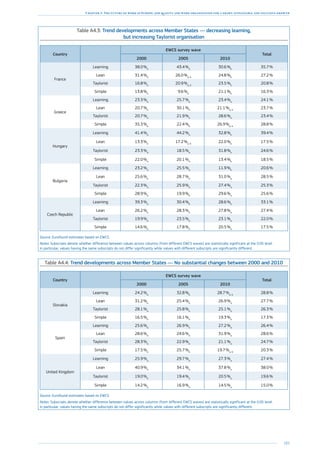
find evidence that, in OECD countries,
higher levels of inequality can reduce
GDP per capita (93
).
Chart 38 suggests that, in the EU, more
equal societies withstood the recent cri-
sis better than less equal ones. This rela-
tionship holds well for Member States
who were in the EU before 2004. When
all Member States are considered, the
picture is blurred by developments in four
(93
)	Moreover, the results are invariant to
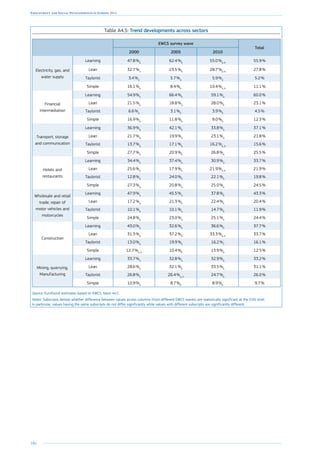
whether the rise in inequality takes place
mainly in the upper or lower half of the
distribution.
37
Job creation, productivity and more equality for sustained growth
catching-up Member States with a high
level of inequality whose real GDP per
capita in 2013 was at least 10 % higher
than it had been in 2007 (­Bulgaria,
­Lithuania, Poland and Romania).
It can also be noted that in the present
‘secular stagnation’ debate on lower
long-term growth perspectives for the
US economy, several authors mention
inequality as one of the contributing fac-
tors (see Teulings and Baldwin, 2014 and
SP Capital IQ, 2014).
6.3.	 Lessons from
the different interactions
between GDP growth
and labour market and
social developments
Some overall conclusions could be
drawn from the literature and the
analysis presented in this Chapter (with
cross-references to other chapters).
Firstly, more equal societies appear
to do better in terms of growth and
employment resilience. This is linked to
differences in the propensity to spend
(short-term growth) and differences in
access to education and health services
(affecting human capital and long-term
growth).
Secondly, high-employment socie-
ties show higher resilience, pointing
to the added value of well-designed
combinations of social protection
and activation. Some of these soci-
eties did so, while having relatively
strict employment protection legisla-
tion. At the same time less resilient
societies have loosened EPL in recent
years and may need to address other
­policy challenges.
Thirdly, societies that invest more
in human capital and share human
capital more equally also show higher
resilience. This is linked to the impact
that productivity has on growth, which
is likely to increase over time, given
the likely reduction in the size of the
working-age population due to ageing.
These conclusions suggest that the EU
should try to develop its comparative
advantage on issues such as appren-
ticeship, enterprise training, internal
flexibility, workers’ involvement and
participation, ensuring that opportuni-
ties are widely shared and that access
to the labour market at all levels is not
decided simply by market forces.
They also imply that the EU would ben-
efit by restoring the sustainability and
effectiveness of its social model, nota-
bly by improving its design (e.g. combin-
ing protection and activation) and by the
orientation of its expenditure towards
greater social investment.
Such developments will need significant
reforms and investments (specifically in
education, training, ALMPs and health).
Such reforms and investments require a
stronger growth environment, as struc-
tural reforms need stronger aggregate
demand (and vice versa) and invest-
ments need to be paid for.
Among these reforms, tax shifts away
from labour could have a vital role to
play by reducing labour costs for the
low-skilled and the young, where such
reductions can have a strong impact and
are most needed. This makes handling
the distributional implications of such
shifts even more important.
Stronger aggregate demand can come
either from the public or private sec-
tor, but it is important that it occurs in a
way that does not weaken the structural
improvements in budgets – hence an EU-
led public investment initiative is such
an attractive idea since it paves the way
for more productivity in the months and
years to come.
As ECB President Draghi concluded: ‘the
way back to higher employment… is a
policy mix that combines monetary, fis-
cal and structural measures at the union
level and at the national level. This
will allow each member of our union
to achieve a sustainably high level of
employment’ (94
).
(94
)	Draghi (2014).
38
Employment and Social Developments in Europe 2014
References
Arpaia, A. and A. Turrini (2013), ‘Policy-
related uncertainty and the euro-zone
labour market’, ECFIN Economic Brief,
Issue No 24, June 2013.
Arpaia, A., A. Kiss and A. Turrini (2014),
‘Is unemployment structural or cyclical?
Main features of job matching in the EU
after the crisis’, European Economy, Eco-
nomic Papers No 527.
Bertelsmann Stiftung (2014), ‘Harnessing
European labour mobility’, available at:
http://www.bertelsmann-stiftung.de/cps/
rde/xbcr/SID-01F33729-D9BA6244/bst_
engl/xcms_bst_dms_39662_39663_2.pdf
Causa, O., A. de Serres and N. Ruiz (2014),
‘Can growth-enhancing policies lift all
boats? An analysis based on household
disposable incomes’, OECD Economics
Department Working Papers, OECD Pub-
lishing, Paris, forthcoming, http://www.
oecd.org/forum/oecdyearbook/growth-
and-inequality-close-relationship.htm
Cingano, F. (2014), ‘Trends in Income
Inequality and its Impact on Economic
Growth’, OECD Social, Employment and
Migration Working Papers, No. 163, OECD
Publishing, DOI: 10.1787/5jxrjncwxv6j-en
Darvas, Z. and G. Wolff, (2014), ‘Europe’s
social problem and its implications for
economic growth’, Bruegel Policy Brief,
2014/03, 1 April 2014.
Dhéret, C., F. Nicoli, Y. Pascouau and F.
Zuleeg (2013), ‘Making progress towards
the completion of the Single European
Labour Market’, European Policy Centre,
May 2013, available at: http://www.epc.
eu/pub_details.php?pub_id=3529
Draghi, M. (2014), ‘Unemployment in the
euro area’, Annual central bank sympo-
sium in Jackson Hole, 22 August 2014.
EIM Business  Policy Research (2012), ‘Do
SMEs create more and better jobs?’, Study
made for the European Commission, http://
ec.europa.eu/enterprise/policies/sme/facts-
figures-analysis/performance-review/files/
supporting-documents/2012/do-smes-cre-
ate-more-and-better-jobs_en.pdf
Eurogroup (2014), ‘Structural reform
agenda – thematic discussions on growth
and jobs – Common principles for reforms
reducing the tax burden on labour’, State-
ment, Milan, 12 September 2014.
European Central Bank (2013), Monthly
Bulletin October 2013.
European Central Bank (2014), Monthly
Bulletin May 2014
European Commission (2007), ‘Stepping
up the fight against undeclared work’,
COM(2007) 628 final.
European Commission (2011a), ‘Employ-
ment and Social Developments in Europe
2011’.
European Commission (2011b), ‘EU
Employment and Social Situation Quar-
terly Review’, December 2011.
European Commission (2012a), ‘A Euro-
pean strategy for Key Enabling Tech-
nologies – A bridge to growth and jobs’,
Communication from the Commission to
the European Parliament, the Council, the
European Economic and Social Commit-
tee and the Committee of the Regions,
COM(2012) 341 final.
European Commission (2012b), ‘EU
Employment and Social Situation Quar-
terly Review’, June 2012.
European Commission (2013a), ‘A Recov-
ery on the Horizon? Annual Report on
European SMEs 2012/2013’.
European Commission (2013b), ‘Commu-
nication from the Commission: Towards
Social Investment for Growth and Cohe-
sion – including implementing the Euro-
pean Social Fund 2014-2020.
European Commission (2013c), ‘Employ-
ment and Social Developments in Europe
2012’.
European Commission (2013d), ‘EU
Employment and Social Situation Quar-
terly Review’, June 2013.
European Commission (2013e), ‘Quar-
terly report on the euro area’, Vol-
ume 12 Issue 4, Directorate-General for
Economic and Financial Affairs, Decem-
ber 2013.
European Commission (2013f), ‘Special
Eurobarometer398 –InternalMarket’,Octo-
ber 2013, http://ec.europa.eu/public_opinion/
archives/ebs/ebs_398_en.pdf
European Commission (2014a), ‘Employ-
ment and Social Developments in Europe
2013’.
European Commission (2014b), ‘EU
Employment and Social Situation Quar-
terly Review’, June 2014.
European Commission (2014c), ‘Green
Employment Initiative: Tapping into
the job creation potential of the green
economy’, Communication from the
Commission to the European Parlia-
ment, the Council, the European Eco-
nomic and Social Committee and the
Committee of the Regions, COM(2014)
446 final.
European Commission (2014d), ‘Youth
employment: overview of EU meas-
ures’, MEMO/14/338, 8 May 2014,
http://europa.eu/rapid/press-release_
MEMO-14-338_en.htm?locale=en
European Commission and the Eco-
nomic Policy Committee (2011), ‘The
2012 Ageing Report – Underlying
Assumptions and Projection Method-
ologies’, European Economy No 4, Sep-
tember 2011.
Guild, E., S. Carrera and K. Eisele
(2013), ‘Social Benefits and Migra-
tion: A Contested Relationship and
Policy Challenge in the EU’, Justice
and Home Affairs, CEPS Paperbacks,
September 2013.
Haltiwanger, J., R. Jarmin and J. Miranda
(2010), ‘Who Creates Jobs? Small vs.
Large vs. Young’, NBER Working Paper
No 16300, August 2010.
Jauer, J., Liebig, T., Martin, J. and Puhani,
P. (2013), ‘Migration as an adjustment
mechanism in the crisis? A compari-
son of Europe and the United States’,
OECD Social, Employment and Migra-
tion Working Papers, OECD Publishing.
Juncker, J.-C. (2014), ‘A New Start for
Europe: My Agenda for Jobs, Growth,
Fairness and Democratic Change Politi-
cal Guidelines for the next European
Commission’, Strasbourg, 15 July 2014.
Juravle, C., T. Weber, E. Canetta, E. Fries
Tersch and M. Kadunc (2013): ‘A fact
finding analysis on the impact on the
Member States’ social security systems
of the entitlements of non-active intra-
EU migrants to special non-contributory
cash benefits and healthcare granted
on the basis of residence’, Final report
submitted to the European Commission
by ICF GHK in association with Milieu
Ltd. London, Brussels.
39
Job creation, productivity and more equality for sustained growth
Lawless, M. (2013), ‘Age or Size?
Determinants of Job Creation’, Cen-
tral Bank of Ireland Research Technical
Paper 02RT13.
Organisation for Economic Co-operation
and Development (2011), ‘Taxation and
Employment’, OECD Tax Policy Studies,
No. 21, OECD Publishing, http://dx.doi.
org/10.1787/9789264120808-en
Organisation for Economic Co-operation
and Development (2013), ‘Skills Outlook
2013, First results from the survey of
adult skills’.
Organisation for Economic Co-opera-
tion and Development (2014), ‘OECD
Economic Surveys: European Union’,
April 2014.
Organisation for Economic Co-opera-
tion and Development /European Union
(2014), ‘Matching Economic Migration
with Labour Market Needs’, OECD Publish-
ing, DOI: 10.1787/9789264216501-en
Ostry, J., A. Berg and Ch. Tsangarides
(2014), ‘Redistribution, Inequality, and
Growth’, IMF Staff Discussion Note
SDN/14/02.
Peschner, J. and C. Fotakis (2013),
‘Growth potential of EU human resources
and policy implications for future eco-
nomic growth’, Working paper 03/2013,
September 2013.
SP Capital IQ (2014), ‘How Increasing
Income Inequality Is Dampening U.S.
Economic Growth, And Possible Ways To
Change The Tide’, Global Credit Portal,
5 August 2014, https://www.globalcred-
itportal.com/ratingsdirect/renderArticle.
do?articleId=1351366SctArtId=2557
32from=CMnsl_code=LIMEsourceO
bjectId=8741033sourceRevId=1fee_
ind=Nexp_date=20240804-19:41:13
Scarpetta, S. (2014), ‘Employment pro-
tection’, IZA World of Labor 2014: 12,
May 2014, doi: 10.15185/izawol.12 
Teulings, C. and R. Baldwin (eds.) (2014),
Secular stagnation: Facts, causes, and
cures, Vox eBook, http://www.voxeu.
org/content/secular-stagnation-facts-
causes-and-cures
Turner, A. (2014),’The Great Credit
Mistake’, Project Syndicate, 6 June
2014, http://www.project-syndicate.
org/commentary/adair-turner-warns-
that-policymakers--focus-on-credit-
supply-constraints-ignores-the-main-
impediment-to-growth
Turrini, A., G. Koltay, F. Pierini, C. Gof-
fard and A. Kiss (2014), ‘A Decade
of Labour Market Reforms in the EU:
Insights from the LABREF database’,
European Economy, Economic Paper No
522, July 2014.
41
Chapter 1
The legacy of the crisis:
resilience and challenges (1
)
1.	Introduction
The most severe financial and economic cri-
sis to have hit Europe since the 1930s has
had a major impact on the employment and
social situation across the Union. Unemploy-
ment, poverty and inequality have seriously
worsened in many countries and a return to
pre-crisis levels is not foreseen before some
time. Individuals and households have been
obliged to develop coping strategies in the
face of the deteriorating economic situa-
tion and with the prospect of only a slow
and uncertain recovery. All of this is liable to
have negative long-term effects on labour
market participation and to lead to a per-
manent loss of human capital. Meanwhile,
rising level of inequalities and the ability
of institutions to deal with the crisis also
impacted the trust in institutions.
The recession has also been a live stress-
test for both social protections and labour
market systems and institutions, with Mem-
ber States’ performances diverging in terms
of economic as well as of employment and
social outcomes. They have shown differ-
ent degrees of resilience i.e. their capacity
to limit the initial impact of the economic
shock on labour markets and incomes; to
recover quickly; and to progressively ensure
a job-rich and inclusive growth.
This chapter focuses on the potential con-
tribution of employment and social policies
to resilience, paying particular attention to
the effects of imbalances (such as high
levels of unemployment and inequalities,
(1
)	By Laurent Aujean, Virginia Maestri,
Filip Tanay and Céline Thévenot.
under-investment in education, levels of
household debt, etc.) as well as their dif-
fering mixes of social and labour market
policies both prior to, and during, the crisis.
•	 Section 2 of the chapter reviews how
labour markets and social outcomes
have developed since the onset of the
recession, in particular with severe
impacts for some groups and coun-
tries and changes in participation to
education and the labour market.
•	 Section 3 highlights the possible
long-term consequences of unem-
ployment and economic hardship
including potential scarring effects
on unemployed young people, ‘cop-
ing strategies’ during the crisis and
the weakening trust in institutions.
•	 Section 4 analyses the developments
of social spending in terms of its three
main functions: investment, stabilisation
and protection and their link to labour
market outcomes as well as the poten-
tial role of better synchronising benefits
to the economic cycle for the resilience
of Member States and the role of the
financing of social protection.
•	 Section 5 investigates the impact of
labour market institutions such as
unemployment benefits, employment
protection legislation and active labour
market policies during the recession as
well as policy changes since 2008.
•	 The concluding section summarises
both the findings and the main pol-
icy implications.
2.	The legacy
of the crisis on
the employment
and social situation
2.1.	 Long and protracted
recession
Various impacts of the economic
downturn on employment
and incomes
Since 2008, the EU has experienced a
recession of exceptional magnitude and
duration from which it has been slow to
emerge, with real GDP in 2014 exceeding
pre-recession levels by only around 1 % in
the EU and with euro area GDP still below
its 2007 level.
This contrasts with the United States where
real GDP is now 8 % higher than it was
in 2007. Moreover, within the EU, there
is a growing gap between the countries
that experienced a double dip recession in
2012 and the others. Five years into the
recession, real GDP remains substantially
below (5 % or more) pre-crisis levels in
many countries including Italy, Spain, Por-
tugal, Greece, Slovenia and Finland. This is
especially worrying, given the long-term
effects of the comparatively milder reces-
sion of the 1990s ( 2
) when employment
rates declined and took several years to
recover, notably in the Nordic countries ( 3
).
(2
)	 In the 1990s, most EU countries experienced
only one year of negative growth and after five
years real GDP had increased by 5 to 15 %,
with the exception of Sweden and Finland
which experienced long and deep recessions.
(3
)	 Social situation monitor, Scarring effects of
the crisis, Research note 06/2014.
42
Employment and Social Developments in Europe 2014
Chart 1: Real GDP in the EU, euro area and United States (left),
and percentage changes over the previous quarter (right)
80
85
90
95
100
105
110
Q1Q4Q3Q2Q1Q4Q3Q2Q1Q4Q3Q2Q1Q4Q3Q2Q1Q4Q3Q2Q1Q4Q3Q2Q1Q4Q3Q2Q1
-4
-3
-2
-1
0
1
2
3
4
5
6
EU-28 EU-28
USUS
Index 2007=100
2007 2008 2009 2010 2011 2012 2013 2014
Source: Eurostat, National Accounts, data seasonally adjusted [namq_gdp_k].
In the first phase of the crisis (2008–10)
the fall in employment in most EU Mem-
ber States was significantly less than the
decline in economic activity especially
when compared with the United States ( 4
).
However the decline in economic activity
had a much greater impact on employ-
ment in some Member States ( 5
) see
Chart 2. Some of this can be explained
by structural factors. In Spain, for
example, the disproportionate impact
on employment (almost twice as large
as the economic shock) ( 6
), reflected the
relative importance of the construction
sector and the country’s highly seg-
mented labour market ( 7
). In contrast,
the strong decline in GDP in Germany
was absorbed through a reduction of
working time (as well as productivity)
rather than a reduction of employment,
notably due to the widespread use of
short-time working arrangements (as
also used in Austria and Belgium) ( 8
).
Finally, it should also be noted that the
more or less large transmission in terms
of employment and income impacted
later on GDP through the channel of
aggregate demand.
Variations in the stabilising impact of
national welfare systems also explain
some of the differences in the impacts
of job losses and reduced working
time on household disposable income
across different countries (GDHI, see
Chart 3). For instance, in Italy, the
decline in employment resulted quickly
in a disproportionate drop in house-
hold incomes while the sharp decline
in employment in 2009 in Spain and
Ireland did not result in any immediate
(4
)	 European Commission (2010a), Employment
in Europe.
(5
)	 By contrast, in Germany the manufacturing
sector was badly hit by plummeting
exports but high productivity levels led to
a comparatively small fall in employment
relative to that in GDP.
(6
)	 i.e. employment volume declining by almost
7 % in the year to 2009 Q3, compared to a
decline of the GDP by around 4 %.
(7
)	 In Poland the high share of temporary
workers also explains the decline in
employment that occurred despite a rather
favourable change in terms of GDP (decline
in growth but no recession).
(8
)	 The cost of adjustment was spread
across the workforce instead of, in case
of extensive reliance on layoffs, being
concentrated on a relatively small number
of workers suffering large losses of income
(Cahuc and Carcillo (2011)).
fall in income due to the effects of a
fiscal stimulus and automatic stabilis-
ers (though income levels did drop later
as benefit payments ran out). In the
United Kingdom, the moderate impact
on employment was nevertheless fol-
lowed by a drop in household incomes,
while in Sweden and France the declines
in employment levels did not translate
into reduced income levels.
Chart 2: Change in GDP and employment
between 2008 and 2013, EU Member States, in %
-30
-25
-20
-15
-10
-5
0
5
10
15
20
PLSEMTSKDEATBELUEEFRUKEU-28ROLTBGCZDKNLHUFIIELVESPTITCYSIHREL
Employment
GDP
Source: Eurostat, nama_gdp_k and nama_aux_pem.
43
Chapter 1: The legacy of the crisis: resilience and challenges
Chart 3: Real GDP growth, real Gross Disposable Household Income (GDHI) growth
and employment growth (No of persons employed), year-on-year change
-8
-6
-4
-2
0
2
4
6
8
10
Q1Q4Q3Q2Q1Q4Q3Q2Q1Q4Q3Q2Q1Q4Q3Q2Q1Q4Q3Q2Q1Q4Q3Q2Q1Q4Q3Q2Q1
EU-28
2007 2008 2009 2010 2011 2012 2013 2014
%changeonpreviousyear
GDHI
GDP
Employment
-8
-6
-4
-2
0
2
4
6
8
10
Q1Q4Q3Q2Q1Q4Q3Q2Q1Q4Q3Q2Q1Q4Q3Q2Q1Q4Q3Q2Q1Q4Q3Q2Q1Q4Q3Q2Q1
EA-17
2007 2008 2009 2010 2011 2012 2013 2014
%changeonpreviousyear
GDHI
GDP
Employment
-8
-6
-4
-2
0
2
4
6
8
10
Q1Q4Q3Q2Q1Q4Q3Q2Q1Q4Q3Q2Q1Q4Q3Q2Q1Q4Q3Q2Q1Q4Q3Q2Q1Q4Q3Q2Q1
DE
2007 2008 2009 2010 2011 2012 2013 2014
%changeonpreviousyear
GDHI
GDP
Employment
-8
-6
-4
-2
0
2
4
6
8
10
Q1Q4Q3Q2Q1Q4Q3Q2Q1Q4Q3Q2Q1Q4Q3Q2Q1Q4Q3Q2Q1Q4Q3Q2Q1Q4Q3Q2Q1
ES
2007 2008 2009 2010 2011 2012 2013 2014
%changeonpreviousyear
GDHI
GDP
Employment
-8
-6
-4
-2
0
2
4
6
8
10
Q1Q4Q3Q2Q1Q4Q3Q2Q1Q4Q3Q2Q1Q4Q3Q2Q1Q4Q3Q2Q1Q4Q3Q2Q1Q4Q3Q2Q1
FR
2007 2008 2009 2010 2011 2012 2013 2014
%changeonpreviousyear
GDHI
GDP
Employment
-8
-6
-4
-2
0
2
4
6
8
10
Q1Q4Q3Q2Q1Q4Q3Q2Q1Q4Q3Q2Q1Q4Q3Q2Q1Q4Q3Q2Q1Q4Q3Q2Q1Q4Q3Q2Q1
GDHI
GDP
Employment
IT
2007 2008 2009 2010 2011 2012 2013 2014
%changeonpreviousyear
Source: Eurostat, National Accounts [namq_gdp_k, namq_aux_pem, nasq_nf_tr and namq_fcs_p] (DG EMPL calculations).
A strong and uneven impact
on unemployment
For the EU as a whole, the unemploy-
ment rate rose from 7.0 % in 2008
to 9.6 % in 2010, reaching 10.8 %
in 2013. Chart 4 shows that, in two-
thirds of EU countries, unemployment
increased mainly in the period up
to 2010 but that in those countries
that experienced a double recession,
unemployment rose substantially after
2011. The impact was ­strongest (in
terms of percentage points) for the
young, the low-skilled and ­non-EU
­foreign workers — groups that already
faced higher risks of joblessness
before the recession.
44
Employment and Social Developments in Europe 2014
Chart 4: Unemployment rates by EU Member States, 2008, 2010 and 2013 (% of active population, 15–74)
0
5
10
15
20
25
30
ELCYESHRPTITSIBGNLEU-28LUFRPLATBEROFIUKCZSKMTDKSEIEHUDELTLVEE
201320102008
Source: Eurostat, une_rt_a.
The persistence of unemployment
(likelihood to remain unemployed
after one year) has increased during
the crisis with 38 % of people who
became unemployed in 2012 still look-
ing for a job in 2013, compared to
27 % between 2007/08 ( 9
). This per-
sistence rate was much higher for the
long-term unemployed (63 % between
2012/13, compared to 50 % between
2007/08) confirming previous research
findings ( 10
).
(9
)	 Persistence rate estimated as the ratio
between the number of unemployed with
a duration of 12–24 months and those
unemployed for fewer than 12 months one
year before.
(10
)	 Individual characteristics also matter:
those who become long-term unemployed
are likely to be those for whom finding a
job was initially the most difficult. Cockx
and Dejemeppe (2012) shows for various
European countries that the duration
dependence may be a spurious one.
Chart 5: Exit rate from short-term unemployment (less than one year)
into employment between 2012/13 and changes compared to between 2009/10
0
10
20
30
40
50
60
70
ELROHRSKESITPLBGIELTMTHULVCYFRCZNLDKFISESIDEUKEEAT
2009-10 2012-132007-08
Decreased from high level Increased from low level Decreased from low level
Maintained or increased
from high levels
Source: Eurostat, EU-LFS, ad-hoc transition calculations based on longitudinal data. No data for BE, LU and PT. Exceptions to the reference year:
NL: 2011/12 instead of 2012/13; AT, HR, PL, SI and UK: 2010/11 instead of 2009/10; DE and LT: 2008/09 instead of 2007/08. Member States with high (low)
levels in 2009/10 are those having an exit rate higher (lower) than 39 %. Member States with decreasing (maintaining/increasing) levels are those where the
exit rate decreased by more (less) than 1.5 pp between 2009/10 and 2012/13.
While exit rates from short-term unem-
ployment into employment ( 11
) worsened
in almost all Member States between
2007/08 and 2009/10, there have been
divergent developments since then. In
some countries, the chances to return
to employment improved again between
2010 and 2013, while they worsened fur-
ther in others. Labour demand is a key
factor explaining differences in the exit
rates out of short-term unemployment ( 12
)
although other factors are at play ( 13
) such
as differences in labour market institu-
tions between Member States, see Euro-
pean Commission (2012a) and Section 5.
(11
)	 Based on longitudinal data from the EU-LFS.
(12
)	 For instance, for the 22 Member States
for which the data is available, there is a
positive correlation (+0.59, significant at
1 %) between the exit rate from short-term
unemployment (into employment) in
2012-13 and the job vacancy rate in 2012.
(13
)	 Recently (2010–13), changes in employment
appear less correlated with the variations
of the exit rates out of short-term
unemployment into employment than in the
initial phase of the recession (2008–10),
i.e. equal to 0.70 and 0.92 respectively
(both significant at 1 %).
In 2013, the number of long-term unem-
ployed (without work for 12 months or
longer) exceeded 5 % of the active popu-
lation in 2013, almost double the rate of
2008 ( 14
) (see Chart 7). Given the slow
pace of economic recovery in most coun-
tries, there is thus a serious risk that many
long-term unemployed will remain with-
out a job for a long time. Indeed, transition
rates for the long-term unemployed into
employment worsened between 2007/08
and 2009/10 in most Member States, and
have stayed low since.
(14
)	 In absolute terms, the number of long-term
unemployed in the EU-28 increased from
6.2 million in 2008 to 12.3 million in 2013.
45
Chapter 1: The legacy of the crisis: resilience and challenges
While most countries with high exit rates
from short-term unemployment also
have high exit rates for the long-term
unemployed, a few countries (such as
Germany and the United Kingdom) that
manage to ensure rapid rates returns to
employment for the short-term unem-
ployed, have nevertheless relatively
low exit rates for the long-term unem-
ployed ( 15
), see Chart 6. In these countries,
a limited proportion of the unemployed
become long-term unemployed but when
they do, they have difficulties returning
to employment.
(15
)	 The gap between the exit rates for short
versus long-term unemployed is much
higher in the UK and Germany (respectively
22 and 19 pps) than the EU average
(11 pps, with rates of 38 % and 27 %). On
the contrary Denmark and Estonia manage
to maintain high exit rates into employment
also for the long-term unemployed and have
relative low gaps between the two rates
(respectively 8 and 6 pps).
Chart 6: Exit rate from short-term unemployment
(less than one year) and long-term unemployment
(more than 1 year) into employment between 2012/13Exitratefromlong-termunemployment
intoemployment(2012/2013)
Exit rate from short-term unemployment into employment (2012/2013)
0 10 20 30 40 50 60
0
10
20
30
40
50
60
UK
MT
DE
AT
SE
LT
LV
NL
HU
FR
IT
IE
HR
PL
CZ
PT
DK
CY
BG
ES
EE
FI
SI
EL
RO
SK
Source: Eurostat, EU-LFS, ad-hoc transition calculations based on longitudinal data. No data for BE
and LU. Exceptions to the reference year: NL: 2011/12 instead of 2012/13.
Exit rates out of long-term unemployment
seem less sensitive to changes in the eco-
nomic cycle ( 16
) than they are for the short-
term unemployed, which suggests that an
economic recovery may not bring back into
employment many of those who are cur-
rently long-term unemployed. This is likely
to have lasting negative consequences, such
as the depreciation of human capital, nega-
tive signalling effects for potential employ-
ers and demotivation for those concerned,
with further risks in terms of benefits
dependency, poverty and social exclusion.
It should also be noted that 20 % of the
long-term unemployed in 2013 have never
worked before and are likely to need vari-
ous forms of support in order to find a first
job. This raises concerns regarding access
to benefits and the risk of social and eco-
nomic marginalisation.
(16
)	 For instance, the coefficient of correlation with
changes in employment over 2008–10 is much
stronger for the exit rates out of short-term
unemployment into employment (0.92, significant
at 1 %) than with the exit rates out of long-term
unemployment (0.53, significant at 5 %).
Chart 7: Long-term unemployment in % of active population for EU Member States (2002–2008–2013)
0
2
4
6
8
10
12
14
16
18
20
ELESHRSKPTIEBGITCYLVSIEU-28LTHUPLFRBEEEROCZMTUKNLDELUDKFISEAT
20132002 2008
Source: Eurostat, EU-LFS [une_ltu_a].
Young people tend to experience shorter
spells of unemployment and higher transi-
tion rates into employment than other age
groups, but this is less true now than it was
in the past ( 17
), with an increase in the share
of long-term unemployed among the young
unemployed, especially for the age group
25–34 ( 18
). Significantly, however, having
a tertiary degree appears to be a form of
protection against long-term unemploy-
ment, albeit probably at the expense of
less qualified young people competing for
the same jobs.
(17
)	 According to longitudinal data of the EU-LFS
(European Commission (2012a), Chapter 1),
even if young people continued to have
better exit rates out of unemployment than
older workers, their situation worsened since
2008. In 2010-11, they had a much higher
chance of losing their job (8 %) compared
to prime-age (3 %) and older (2 %) workers.
In addition their transition rate back into
employment had sharply diminished, from
40 to 30 %. These findings are confirmed by
analysis of RWI (2014) drawing on micro-
data from the EU-SILC.
(18
)	 Strictly speaking the group of young people
is defined as those aged 15–24; however for
many indicators analysis of the age group
25–34 is also meaningful as this age group
has also been strongly affected by the crisis.
46
Employment and Social Developments in Europe 2014
Chart 8: Youth unemployment in % of active population (aged 15–24)
0
10
20
30
40
50
60
70
ELESHRITCYPTSKBGPLHUIEFRBEROSEEU-28LVLTSIUKFICZEELUMTDKNLATDE
20132008
Source: Eurostat, EU-LFS [lfsa_urgan].
Chart 9: Temporary employment as percentage of the total number of employees
20132007
0
5
10
15
20
25
30
35
ESPLPTSINLSEFIFRDEEU-28CYITHRELDKATBECZIEHULUUKBGSKMTLVLTEERO
Source: Eurostat, EU-LFS [lfsa_etpgan].
Levels of unemployment among youth
tend to vary more than total unemploy-
ment because their job prospects are
more sensitive to the business cycle ( 19
)
and because of the variety of policies
and institutions supporting school to
work transitions (education and train-
ing systems, contractual arrangements,
minimum wage, etc.) ( 20
). In this respect,
the apprenticeship systems in Germany
and Austria are commonly highlighted
as being mechanisms that overcome
many of the obstacles and, in particu-
lar, ensure high transition rates from
(19
)	 According to IMF (2014), the business cycle
‘explains up to 70 % of changes in the youth
(15–24) unemployment rates in stressed
euro area countries’. It estimates that
an additional percentage point of annual
growth could lower the unemployment rate
from 0.8 pp in Greece and Portugal
to 1.9 pps in Spain.
(20
)	 Another factor explaining the wide variation
of the youth unemployment rate across
Member States is the very diverse level of
participation of young people in the labour
market while still being in education.
temporary to permanent contracts
(Eichhorst et al, 2012).
In 2013 the proportion of young people
aged 15–24 in the EU who were nei-
ther in employment, education or train-
ing (commonly called NEETs) was 13 %
in 2013 (compared to 10.8 % in 2008),
and exceeding 20 % in Greece, Bulgaria
and Italy ( 21
). In most countries, how-
ever, the increase in the NEET rate since
2008 has been mainly the result of an
increase in unemployment, rather than
inactivity ( 22
), which implies that most
(21
)	 In Bulgaria, Romania and Italy the majority
of young NEET were inactive, in Greece,
Spain or Croatia most of them (around 70 %)
were unemployed (i.e. looking for a job).
(22
)	 At EU level, the share of unemployed in the
whole age class 15–24 has risen by 2.6 pps
(from 6.6 % to 9.2 %) while the number of
inactive (not in education or training) only
slightly changed (by 0.3 pp, from 7.4 to
7.7 %).
‘newly’ NEET young people are actually
looking for work.
Changes affecting
those in work: non-
standard employment,
job quality and informality
Since the recession, not only has the
quantity of jobs been affected but also
their quality as reflected by various indi-
cators (see also Chapter 3). In this regard
the share of part-time jobs in overall
employment rose from 17.5 % in 2008
47
Chapter 1: The legacy of the crisis: resilience and challenges
to 19.5 % in 2013, with an increase in
the number of part-time jobs at a time
when the number of full-time positions
was falling ( 23
). Moreover, there has been
a sharp increase in the number of men
working part-time. The rise in the share
of part-time jobs also partly reflected
a sectoral composition effect ( 24
). At
EU level, the share of involuntary part-
time workers (those who work part-time
because they are unable to find full-time
work) has increased strongly between
2007 (22.4 %) and 2013 (29.6 %).
On the other hand, the overall share
of temporary contracts among total
employment has slightly declined
since 2007 (from 14.6 % to 13.8 %),
although with wide variations across
­Member States (see Chart 9). In countries
like Portugal and Spain, which previously
had high shares of temporary contracts,
these served as an initial adjustment
mechanism to the shock — while in other
countries such contracts were also the
first to grow, as risk-averse employers
(23
)	 Over 2008–13, the absolute number of
part-time jobs has increased by 3.1 million
(or +8 %) while the number of full-time
positions declined by 9.4 million (or –5.2 %).
(24
)	 Some sectors (Administrative and support
service activities, Human health and social
work activities, education) that were less
affected by the crisis had a relatively high
share of part-time jobs.
began to hire again. High shares of tem-
porary contracts in total employment
may increase employment volatility in
times of economic downturn ( 25
).
Moreover, temporary contracts are
associated, in some countries, with pro-
nounced labour market segmentation,
with a negative correlation between
the overall share of temporary workers
and the transition rates towards perma-
nent jobs ( 26
). As evidenced in European
­Commission  (2012a) ( 27
), temporary
contracts often carry a wage penalty
which is a particular concern in countries
when the share of involuntary tempo-
rary work is high and transition rates
towards better paid or permanent con-
tracts are low.
However, the usage and impact of tem-
porary contracts varies across Mem-
ber States. In some countries (e.g. Austria
and to some extent, Germany) tempo-
rary contracts seem to act as a stepping
stone ( 28
) with high transition rates from
(25
)	 Member States which had below EU average
shares of temporary contracts in 2007
saw either a relatively small increase in
unemployment during the recession e.g.
United Kingdom, Austria, Czech Republic,
Germany or a fall in their unemployment rate
following a substantial initial increase as in
Estonia, Latvia, Slovakia, Ireland and Hungary.
(26
)	 Correlation coefficient –0.69 in 2011/12
(significant at 1 %).
(27
)	 European Commission (2012a), Chapter 4,
Table 2.
(28
)	 Another sign of stepping stone effect is
that, in those two countries, the share of
temporary contracts is high for young people
(due to apprenticeship systems) but much
lower for the older age groups, whereas in
countries such as Spain, Poland or Portugal
the share of temporary workers remains
high (20 %) among those aged 25–49.
temporary to permanent contracts, and
a low share of involuntary temporary
contracts ( 29
). In countries such as Spain,
France, Greece or Italy, though, there are
low transition rates to permanent jobs
and a high share of involuntary tempo-
rary contracts, with detrimental conse-
quences for the employees’ chances to
access stable and better paid jobs with
appropriate social protection as well as
the opportunity to participate in lifelong
learning ( 30
). This can also be seen in the
share of temporary workers becoming
unemployed or inactive in the ­following
year (around 25 % in Portugal and
Greece, and 30 % or more in Denmark
and Spain).
An analysis by OECD (2014b) ( 31
) reported
some positive ‘stepping-stone effects for
non-standard work’ in many countries but
also confirmed that a temporary job often
involves wage penalties and a greater likeli-
hood of becoming unemployed or inactive
the following year, especially in the case of
young people.
People unable to find a regular job may
turn to undeclared work or accept work
with ‘envelope’ wages, see European
Commission (2013). However, since unde-
clared work is often a last resort choice,
it is strongly correlated with long-term
unemployment, raising a range of policy
issues in terms of labour rights, entitle-
ment to social protection, future pen-
sions and workers’ rights (see Annex 3,
Extract 1).
Significant increases in poverty
and social exclusion
Poverty and social exclusion in the EU has
almost inevitably worsened during the crisis
with little signs of improvement so far. The
situation worsened even further in some
countries in 2013, notably in countries
where it was already high.
(29
)	 In the Netherlands the share involuntary
temporary contracts is also low and while
most of the temporary workers remain in
that status the year later, a rather low share
(8.5 % compared to 19.3 % at EU level) fall
into unemployment or inactivity.
(30
)	 For instance, OECD (2014a), Employment
Outlook, shows, based on PIAAC data, that
on average being on temporary contracts
reduces the probability of receiving
employer-sponsored training by 14 %.
(31
)	 OECD (2014b), ‘Jobs, Wages and Inequality
and the Role of Non-Standard Work’,
forthcoming.
Chart 10: Transition rates from temporary to permanent employment,
temporary or self-employment and unemployment or inactivity
(2011/12) and share of involuntary temporary employment (2012)
0
10
20
30
40
50
60
70
80
90
100
FRESNLELITPLEU-28DKCYPTFILUCZHUSIDESEBEATUK
Temporary or self-employment
Permanent employment
Unemployment or inactivityTransition rate
from temporary
employment into:
Share of involuntary
temporary employment
%
Source: Eurostat, EU-LFS (lfsa_etgar) and EU-SILC (ilc_lvhl32). Exception to the reference year:
Sweden (2010/2011 instead of 2011/2012).
48
Employment and Social Developments in Europe 2014
Chart 11: Evolution of the risk of poverty or social exclusion, in %
0
5
10
15
20
25
30
35
40
45
201320122011201020092008200720062005
EU-27
EU-15
NMS 12
South 4
Risk of poverty or social exclusion (target)
24 % or 123m people
0
5
10
15
20
25
201320122011201020092008200720062005
At-risk-of-poverty rate (60 % of median)
17 % or 83m people
EU-27
EU-15
NMS 12
South 4
0
5
10
15
20
25
30
35
Severe material deprivation (4+ items)
10 % or 48m people
EU-27
EU-15
NMS 12
South 4
201320122011201020092008200720062005
0
2
4
6
8
10
12
14
Jobless households (zero or very low work intensity)
10.5 % of the 0-59 acategory or 40m people
EU-27
EU-15
NMS 12
South 4
201320122011201020092008200720062005
Source: Eurostat, EU-SILC (peps01, li02, mddd11, lvhl11).
Note: South4 refers to EL, ES, IT and PT.
Chart 12: Risk of poverty and changes in the poverty threshold, % of the population
-40
-30
-20
-10
0
10
20
30
40
50
SKBGSEMTBEPLCZFIFRATDKEEDESILTESHUNLLUROPTITHR*UKLVCYIE*ELEU-27
%ofthepopulation
2008 2013 (2012 if NA) Change in at risk of poverty threshold (2008-2012/13)
Source: Eurostat, EU-SILC (ilc_li01,ilc_li02). *Data for IE and HR refers to 2012.
The main drivers of poverty and social
exclusion are seen to be long-term
unemployment, labour market seg-
mentation and wage polarisation, but
also the weakening of the redistributive
impact of tax and benefits systems.
Overall, the risk-of-poverty rate
has increased in more than ten
Member States since 2008. However,
declining levels of household dispos-
able incomes in general have led to
a reduction in the national poverty
lines in Member States such as Latvia
and Greece, meaning that decreases
in the poverty rate do not neces-
sarily indicate any improvement in
absolute terms.
As a consequence of this deteriorat-
ing situation, poverty defined in terms
of severe material deprivation ( 32
) has
also increased across Europe, and most
(32
)	 Severely materially deprived persons have
living conditions severely constrained by a
lack of resources. They experience at least
4 out of 9 of the following deprivations:
cannot afford i) to pay rent or utility bills,
ii) to keep the home adequately warm,
iii) to face unexpected expenses, iv) to eat
meat, fish or a protein equivalent every
second day, v) a week holiday away from
home, vi) a car, vii) a washing machine,
viii) a colour TV, or ix) a telephone.
49
Chapter 1: The legacy of the crisis: resilience and challenges
strongly in those Member States most
affected by the crisis (Spain, Italy, Ire-
land, Malta, United Kingdom). In some
Eastern/Southern countries where dep-
rivation had been improving before the
crisis, the trend reversed and material
deprivation increased dramatically after
the crisis (Lithuania, Latvia, Estonia,
Cyprus, Greece, Hungary and to a lesser
extent Bulgaria).
Working age adults have been especially
affected, reflecting the deterioration of
labour market conditions, with the worst
hit countries being Spain, Italy, Greece,
the Baltic States, but also the United
Kingdom ( 33
). Moreover, since many such
working age adults live in households
with children, child poverty has also risen
across Europe as a whole. In contrast, the
risk-of-poverty indicator for older people
showed a significant decline in most
Member States between 2008 and 2013
reflecting the fact that pensions have, to
a large extent, remain unchanged during
the crisis.
(33
)	 See European Commission (2014a).
Chart 13: Activity rate across EU Member States,
2003, 2008 and 2013, in % of population aged 15–64
55
60
65
70
75
80
85
SENLDKDEUKATFIEEESLVCYPTCZLTEU-28FRSILUSKIEBGELBEPLHUMTROITHR
20132003 2008
Source: Eurostat, EU-LFS [lfsi_act_a].
Chart 14: Activity rate (15–64) compared to 1990 and 2007 levels, for selected countries, in pps
-7
-6
-5
-4
-3
-2
-1
0
1
2
19981997199619951994199319921991
France US Italy
FinlandUKSweden
-4
-3
-2
-1
0
1
2
3
201320122011201020092008
Spain Germany Sweden
FinlandUK IrelandUS
Source: OECD.						Source: Eurostat, EU-LFS and OECD data for the US.
Due to the combination of life expectancy,
lower participation in the labour market
and household composition (single ­parent
families), women are at higher risk of
poverty or social exclusion than men in
all Member States, with the exception of
Spain and Portugal.
2.2.	 Participation
in education and in the labour
market continued to rise
Economic participation, as measured by
the activity rate indicator ( 34
), has con-
tinued to increase since 2008 in most
­Member States, in contrast to the experi-
ence in past recessions. While the employ-
ment rate declined from 65.7 % in 2008
to 64.1 % in 2013 for the EU as a whole, the
activity rate increased from 70.7 % in 2008
to 71.9 % in 2013. It implies that the drop
in the number of jobs mainly translated
into a rising number of unemployed and,
only to a limited extent, a rising number of
‘discouraged workers’ (see Section below).
This EU experience also contrasts with the
decline in activity rate witnessed in the
United States since 2008 ( 35
).
Reductions in activity rates in previous
crises are attributed to a higher share
of working-age persons withdrawing
(34
)	 The activity rate measures the share, among
the working-age population, of those being
economically active, i.e. either in employment
or unemployed, according to the ILO
definitions. While this indicator counts the
total number of people in employment and
unemployment and country-comparisons may
be influenced by differences in institutional
factors (such as incentives to be registered
as unemployed), the analysis of changes of
activity rate over time remains meaningful,
in particular to analyse behavioural changes
compared to previous recessions.
(35
)	 Note that for the US, several papers (e.g. Barnes
et al (2013)) show that the decline in
participation since 2008 reflects, to a great
extent, long-term demographic and behavioural
changes rather than cyclical developments.
50
Employment and Social Developments in Europe 2014
from the labour market, resulting in their
decline between 1990 and 1994 and a
very slow return to previous levels, sub-
stantially so for ­Sweden and Finland,
while increasing slightly in France (and the
United States), see Chart 14. By contrast,
since 2007, activity rates have continued
to increase in many EU countries, even
those strongly affected by the recession.
Increase in activity continued
to be driven by women and older
workers
The increase in the activity rate since
2008 has mainly been driven by the
rising participation of women and older
workers throughout the recession see
Chart 15. This is seen to be due to a
number of factors: structural increases
in their activity rate due to cohort
effects and rising levels of education;
policy measures designed to encour-
age increased female and older workers
participation( 36
); and the fact that the
initial labour market shock did not hit
women and older workers as strongly as
prime-age males.
Chart 17 shows that the decline in activ-
ity rate for prime-age men was lim-
ited (–0.8 pp) compared to the decline in
(36
)	 The increase in older workers participation
over the last decades was also driven by
an overall improvement in their health
status, see European Commission (2011a),
Chapter 5.
their employment rate (–4.8 pps), indicat-
ing that they were the group least likely to
fall into inactivity if they lost their job. LFS
data for 2013 also shows that, if prime-
age men become unemployed, they are
more likely to receive unemployment ben-
efits (43 %) than young ­people (18 %) or
prime-age women (36 %), notably due
to their more favourable employment
histories. This is one of the factors that
promote continuation of job search rather
than ‘discouragement’ and inactivity.
Chart 15: Activity rate by group (age and sex), EU-28, 2002–13 (in %)
30
40
50
60
70
80
90
100
201320122011201020092008200720062005200420032002
Men 15-24 Men 25-49 Men 50-64
Women 25-49Women 15-24 Women 50-64
75.7
92.6
48.3
64.3
40.9
43.4
44.9
92.0
72.1
39.3
79.7
56.9
Source: Eurostat, EU-LFS, [lfsi_agan].
Chart 16: Change in the activity rate by group
(age and sex) in EU-28, 2008–13 compared
to 2002–08, in percentage points
-4
-2
0
2
4
6
8
2002-08 2008-13
15-24 25-49 50-64
WomenMenWomenMenWomenMen
7.2
6.3
3.3
4.5
-1.4
-0.2
-0.8
0.2
1.4
2.6
-2.8
-0.6
Source: Eurostat, EU-LFS, [lfsa_argan].
Chart 17: Change in the employment and activity
rates by group (age and sex) in EU-28, 2008–13,
in percentage points
-8
-6
-4
-2
0
2
4
6
8
WomenMenWomenMenWomenMen
15-24 25-49 50-64
Changes in ER (pps) Changes in AR (pps)
4.9
6.3
3.3
0.9
-1.4
-3.9
-0.8
-4.8
1.4
-1.6
-2.8
-6.1
Source: Eurostat, EU-LFS, [lfsa_argan] and [lfsa_ergan].
Since 2008, the activity rates of older
workers (55–64) increased substan-
tially in most countries even in the
most affected countries ( 37
) while they
had been decreasing during the 1990s
recession ( 38
). Several changes explain
this difference.
•	 Older workers have been (in com-
parison to the 1990s) less affected
by job losses (see Chart 18) nota-
bly because their educational levels
(37
)	 In Spain, Portugal and Ireland, decreases
for men were more than offset by increases
for women.
(38
)	 For instance: in the UK (–1.6 pps over
1990–95), Italy (–4.2 pps over 1991–95)
and Germany (–2.9 pps over 1992–96)
with more pronounced drops for men
(respectively –5.8 pps, –7.3 pps and 4.9 pps).
51
Chapter 1: The legacy of the crisis: resilience and challenges
have improved ( 39
) and the sectors
in which they are employed have
changed. Moreover, employers are
often reluctant to lay off their most
experienced workers, who also often
benefit from a better protection
(higher severance pay) than younger
workers due to longer employment
histories ( 40
).
•	 If they become unemployed, older
workers are less likely than before
to withdraw from the labour market
not least because of policies intro-
duced over the last two decades
to extend working lives, such as
reforms in pension schemes (general
increase in the statutory retirement
age), and early retirement schemes.
Moreover, alternative options such
as disability schemes have been
closed or made less accessible ( 41
).
The continued increase in female activity
rates also results from a combination
of factors.
•	 Women tend to work in sectors that
are less hit by the recession ( 42
) (see
also European Commission (2013),
Chapter 3). This seems to explain
most of the better performance of
women’s employment during the
crisis, while the ‘added-workers’
effects may also have played a part
(see Box 1).
•	 There has been a structural increase in
the participation of women, mainly due
(39
)	 Between 1992 and 2008, the overall level of
education of older workers increased more
quickly than for prime-age workers, even
when excluding the effects of the rising level
of education among women. EU-LFS data
for EU-15 countries shows that the share
of low-educated among male older workers
dropped sharply, from 53.9 % in 1992 to
32.3 % in 2008 (–21.6 pp) compared to
prime age workers (from 40.2 % to 28.2 %
or –12.0 pps). The share of tertiary educated
persons among older men increased more
sharply than among prime-age workers.
(40
)	 The share of older workers under involuntary
temporary contract is also much lower
(4.4 % among those aged 55–64 compared
to 8.1 % for prime-age and 14.7 % for young
workers, i.e. EU-LFS data for EU-28 in 2013).
(41
)	 European Commission (2011), Chapter 5.
(42
)	 Female employment was less affected by
the recession than male (respectively –0.6 %
over 2008–13 against –4.7 %). While the
two male-dominated sectors (manufacturing
and construction) were strongly affected by
the crisis, the two main female-dominated
sectors (education and human health and
social work) resisted well.
to rising levels of education of women
over time ( 43
). This has brought the
behaviour of women in the labour mar-
ket much closer to that of men with a
rising share of dual-earner households.
•	 Measures supporting female par-
ticipation such as flexible working
arrangements, the removal of finan-
cial disincentives for second earners,
childcare and elderly care facilities
have also played a role, together
with measures to retain older women
longer in the labour market ( 44
).
Until 2013, there were no signs of
a reversal in the policies supporting
female participation (see Section 4)
(43
)	 For instance, among women aged 25–49
(50–64) the share of those with not more
than lower secondary education decreased
from 41 to 22 % (64 to 38 %) between 1995
and 2013, or –19 pps (–26 pps), to the profit
of the medium and high educational groups
(based on EU-LFS data on EU-15).
(44
)	 Analysis by age and education confirms that
the overall increase in female activity rate
is not only due to change in the composition
(i.e. increase in average level of education)
and affected most sub-groups of women.
although this may no longer be the
case in some countries that have
applied major fiscal consolidation
measures ( 45
). Moreover, women
tend to be over-represented in public
and non-market service sectors that
are now becoming more adversely
affected by fiscal consolidation in
many Member States ( 46
).
Moreover, recent trends have not led to
a substantial decrease in the large gen-
der inequalities in the labour market that
persist in many EU Member States to
the disadvantage of women, in terms of
activity and employment rates as well as
in terms of part-time work and earnings.
(45
)	 European Commission (2012b).
(46
)	 European Parliament (2014).
Chart 18: Older workers less affected by job losses since 2008
than in the 1990s: changes in employment rates for prime-age
(25–54) and older (55–64) age groups in 1992–96 and 2008–13,
in percentage points, selected Member States
-15
-10
-5
0
5
10
15
2008-13
1992-96
2008-13
1992-96
2008-13
1992-96
2008-13
1992-96
2008-13
1992-96
2008-13
1992-96
2008-13
1992-96
2008-13
1992-96
25-54 55-64
EU-15 DE ES FR IT FI SE UK
Source: Eurostat, EU-LFS, [lfsi_emp_a].
52
Employment and Social Developments in Europe 2014
Box 1: Some mixed evidence about ‘added-worker
effects’ during the recession
A recession can impact on labour market participation of ‘partnered’ women in two
ways: (a) it can discourage women from looking for a job or postpone their decision
(discouragement effect) or (b) it can foster participation in order to compensate for
the job loss of the partner (added-worker effect). It is hard to determine whether
the increase in female participation was due partly to the latter — or whether it
was entirely caused by other structural factors due to education and cohort effects.
Several reports support the added worker hypothesis without being totally conclusive:
•	European Commission (2011b) shows that the activity rate of married women
with children was more reactive to male unemployment and that it has increased
faster since 2008 than for other women*.
•	OECD (2012a) shows that in many countries partnered women were more likely
to have increased their working hours during the crisis than single women.
•	European Commission (2012b) points out that over 2007–09, dual-earner
­couples had lost ground mainly to the benefit of female breadwinner couples.
•	European Commission (2013) shows that over 2007–11, the share of working
women with a non-working male partner increased in most Member States.
•	Bredtmann et al (2014) found that women whose partner becomes unemployed
have a higher chances of entering the labour market and changing from part-
time to full-time employment than women whose partner remains employed.
The added worker effect varies over both the business cycle and the different
welfare regimes within Europe**.
•	EU-SILC*** data do not show such added-worker effect, as women’s transitions
from inactivity to employment and from part-time to full-time employment do
not increase between 2007 and 2012.
While there is no robust evidence of an added-worker effect during the crisis, the
stronger share of women in employment, hours worked and earnings and the
increasing share of dual-earner households has helped to cushion the impact of
the recession on household incomes (OECD (2014c)).
Notes: * However, this is not true for all countries and may be due to other effects — for instance
the increase in investment in childcare facilities. ** For instance, for the UK, Bryan and Longhi (2013)
found an increase in job searches but only among single earner couples —which does not translate
into more success in finding work (consistent with declining job-finding rate), at least in the short-
term. *** Eurostat, EU-SILC, [ilc_lvhl30]. Note that these indicators are not available for different
groups of women (partnered or not, with or without children).
Limited increase in discouraged
workers during the recession
The number of persons available and want-
ing to work but not looking for a job ( 47
) (the
‘discouraged workers’) increased from 7.4
million in 2008 to 9.3 million in 2013 (or
from 3.1 % to 3.8 % of the labour force).
This increase was much lower than the
increase in unemployment and long-term
(47
)	 These are jobless persons (neither employed
nor unemployed) who do not qualify for
recording as unemployed (from the ILO
definition) because they are not actively
looking for a job (anymore), despite the fact
that they want to work and are available
for work. According to Eurostat, they include
‘discouraged workers but also persons
prevented from job seeking due to personal
or family circumstances’. However, for
convenience, this Section uses the term
‘discouraged workers’ to refer to all the
inactive persons wanting to work but not
looking for a job.
unemployment ( 48
) and can be viewed as
a positive sign insofar as it means that
unemployed persons continue to look for a
job and can potentially benefit from activa-
tion or (re)training.
Institutional factors can contribute to
limiting the number of discouraged
workers. For instance, countries where
the share of discouraged workers is the
(48
)	 Since 2008, the number of unemployed
increased from 16.8 million to 26.4 million
in 2013, and the number of long-term
unemployed almost doubled in the same
period (from 6.2 million to 12.3 million).
highest tend to be those with relatively
limited support for the unemployed or
the long-term unemployed ( 49
). Gener-
ally speaking, the countries that recorded
increases in discouraged workers since
2008 ( 50
) were those that combined a
strong labour market impact of the crisis
and relatively weak support services to
the unemployed ( 51
), whether in terms of
spending on active labour market policies
or income support.
There can also be other explanatory fac-
tors such as the extent to which there
are, or are not, incentives to register
as unemployed, the link to social assis-
tance schemes, or the actual probability
of finding a job. The availability of care
services for children or dependents may
also affect the labour supply given that
36 % of ‘discouraged workers’ in 2013
were women of prime-age (25–54),
a group more likely to be affected by
issues related to the combination of work
and family life. This share was highest
in Spain (41 %), Italy (47 %) and Greece
(49 %), all countries recognised as being
poor performers in terms of supporting
improved work-life balance ( 52
).
Remaining in education
Since 2008, an increasing number
of young people have remained in, or
have returned to, education, notably
within the younger age group (18–24)
and especially in Member States where
youth unemployment was especially high
(Spain, Ireland and Portugal) and where
the share of young people in education
had been below the EU average in 2004.
In some countries however, participation
in education has either stalled (Greece,
Italy, Romania, the Czech Republic and
Slovakia), or even declined (Poland and
Hungary).
(49
)	 In 2013, a very low share of long-term
unemployed were receiving unemployment
benefits (or assistance) in Italy (2 %),
Croatia (10 %), Bulgaria (1 %), Latvia (3 %)
or Estonia (4 %), all characterised by a
higher than average share of discouraged
workers –while the receipt rate of benefits
was rather high in some of the countries
displaying a low share of ‘discouraged
workers’ such as France, Germany, Malta,
Belgium and Denmark.
(50
)	 Croatia and Cyprus (strong increase) and
Finland, Romania, Spain, Italy, Hungary,
Greece and Slovenia (significant increase).
(51
)	 According to typology presented in Stovicek
and Turrini (2012)
(52
)	 They display high gender employment gaps,
high incidence of inactivity due to family
obligations as well as relatively insufficient
provision of child and/or dependent care
facilities (see European Commission (2013),
Chapter 3).
53
Chapter 1: The legacy of the crisis: resilience and challenges
Chart 19: Proportion of young people in education or training, 18–24, % of age group
-20
-15
-10
-5
0
5
10
15
20
-80
-60
-40
-20
0
20
40
60
80
EU-28SILUDKNLDEPLLTCZEESKKRBEELLVFIESHUFRPTBGIEITROATSEMTCYUK
2004-08 change (pps)
2008-13 change (pps)
% of young people in education (2013), rhs
Source: EU-LFS, Social Situation Monitor calculations.
Notes: Only young people in education or training not economically active are measured. Countries are sorted by 2013 levels.
Chart 20: Share of 20-24 having completed upper secondary education in 2008 in %
and changes over 2004-08 and 2008-13 in percentage points
-20
-15
-10
-5
0
5
10
15
20
-100
-80
-60
-40
-20
0
20
40
60
80
100
HRSKCZPLSILTIESEFICYATFRBGHUBEELEELVEU-28ROUKITNLDELUDKMTESPT
2004-08 change (pps)
2008-13 change (pps)
% of 20-24 having completed upper secondary education in 2008 (rhs, %)
Source: Eurostat, EU-LFS [edat_lfse_08]; sorted by 2008 level.
Chart 21: Over-qualification rate: share of tertiary-educated workers working in low or medium-skilled
occupations (in %), age group 25–34, 2008 and 2013
0
5
10
15
20
25
30
35
40
45
CYESIEELBGPLITUKEEEU-28FRSKLVROHRATBESESILTHUCZFINLPTDEDKMTLU
20132008
Source: Eurostat, EU-LFS and DG EMPL calculations.
Notes: tertiary-educated is defined as workers having the highest level of qualification equal or above ISCED 5–6; low and medium-skilled occupations are
defined as occupational groups ISCO 4 to 9.
Overall, educational outcomes have
improved in most Member States (see
Chart 20) but especially so in those
countries where they were less favour-
able ten years ago and the share of
early school leavers from education
and training decreased. Delaying labour
market entry by remaining in educa-
tion is a rational response in times of
recession, but it is not yet clear whether
this will result in better labour market
outcomes in terms of human capi-
tal and skills development. The long-
term impact of increased educational
level will notably depend on the qual-
ity of education, on whether the skills
acquired are adapted to labour market
needs, as well as on whether cuts in
spending affect the quality of educa-
tion in the short to medium term (see
Section 4.3).
54
Employment and Social Developments in Europe 2014
Chart 22: Income inequality in 2008 and 2013, Gini index
0
5
10
15
20
25
30
35
40
LVPTROPLUKBENLBGLTFRIEDEMTATFISECZSKELESEEITCYHRLUHUDKSIEU-27EU-28
2008 2013*
GiniIndex
Increase Stable Decrease
Source: Eurostat, EU-SILC, ilc_di12.
Note: *Data for IE refers to 2012.
Chart 23: Incomes changes at several points of the distribution
(1st
quintile, median, 10th
decile) — 2008–13
-40
-30
-20
-10
0
10
20
30
40
50
SKCZSESIDKLUCYITEEHUESFIATBEFRLTIEELBGPLMTDENLPTUKROLV
First quintile (20% poorest)
Tenth decile (10% richest)
Median income
Changebetween2008and2013(%)
Incomes at the bottom
of the distribution decreased
less/increased more than
those at the top
Bottom and top incomes
decreased/increased
at the same pace
Top incomes increased
faster/decreased less than those
at the bottom of distribution
Source: Eurostat, EU-SILC, prices adjusted by consumer prices (HICP), Eurostat.
Note: The graph refers to 20 % lowest incomes and 10 % highest incomes. Asymmetrical percentiles have been chosen for the following reasons. The lowest
10 % incomes are generally considered as difficult to capture (see Atkinson-Marlier 2010). Studies on top incomes generally focus on the upper part of the
distribution, often top 1pc incomes or 5pc top incomes (see OECD 2013a). Data for IE refers to 2012.
Returns on investment in education can
also be limited if they result in over-
qualification. Since 2008, over-qualifi-
cation ( 53
) has increased, especially for
those aged 25–34, as reflected in the
difficulties university graduates find in
obtaining jobs in line with their quali-
fication. For this age group, the rate
in 2013 was highest, at over 30 %, in
Cyprus, Spain, Ireland, Greece and Bul-
garia, where this skill mismatch may
have made the labour market less resil-
ient to the economic shock. Nevertheless,
the rate of over-qualification has also
increased in many Central and Eastern
Member States which previously had
lower than average rates.
(53
)	 Measured as the share of tertiary-educated
(ISCED 5–8) workers who are in low or
medium-skilled occupations (ISCO 4–9),
i.e. that theoretically do not require a tertiary
education level.
2.3.	 Falling incomes
and rising market income
inequalities put tax
and transfers systems
under pressure
The deterioration of economic and
employment conditions has inevitably
resulted in an overall decline in house-
hold incomes in most Member States,
although the impact on income distribu-
tion has varied. Since 2008 disposable
income inequalities ( 54
) have increased
in 10 Member States, notably in Spain,
(54
)	 Inequalities are measured here through
the Gini index. It measures the degree of
inequality of the income distribution by
taking all income distribution into account.
It varies from 0 to 100, with 0 corresponding
to perfect equality (everyone has the same
income) and 100 to extreme inequality (one
person has all the income, everyone else
has nothing). Other measures of inequalities
(e.g. S80/S20 ratio) are also available for
disposable income inequality, but not for
market income inequalities. For this reason,
only the Gini coefficient is used.
Hungary and Denmark, while they have
fallen in seven others, notably in Latvia
and Portugal as well as in Belgium and
the Netherlands.
These developments reflect the ways in
which rich and poor have been affected.
In some countries (e.g. Spain, Hungary,
Denmark), incomes at the bottom of
the distribution (first quintile) were
hit harder than those at the top (tenth
decile) while in others (Latvia, Romania,
the United Kingdom, Portugal, the Neth-
erlands), incomes at the bottom of the
distribution were relatively protected, in
the sense that they fell less than those
at the top.
55
Chapter 1: The legacy of the crisis: resilience and challenges
Chart 24: Trends in market income inequalities between 2008 and 2012, Gini coefficient
0
10
20
30
40
50
60GiniIndex(%)
IEELUKESFRDEITATEELUSIDKPTFIBECZSENLSKPL
2008 (2007 ref. year) 2012 (2011 ref. year)
Stable since 2008 Increase since 2008
Source: OECD, income distribution database.
Note: year refers to SILC production year and not reference year. 2008 data not available for SE, DE, IT, FR, IT. 2012 data not available for BE. No data for HU.
Chart 25: Net employment change (%) by job-wage quintile,
2011 to 2013, EU-28
-4
-3
-2
-1
0
1
2
Highest quintileLowest quintile
2008-10
2011-13
Employmentgrowth
Source: Eurofound (2014c) calculations, based on Eurostat, EU-LFS.
Market incomes: polarisation
and upgrading in the top
of the distribution
Market income inequalities (before
taxes and transfers) ( 55
) have increased
in most Member States (see Chart 24)
since 2008, as a result of both increased
joblessness and increased earnings
polarisation for those in work. Following
the worsening of unemployment from
2008 onwards, the share of households
with no income from work increased,
especially in Ireland, Spain, Lithuania
and Greece. In addition, the polarisa-
tion of earnings from work increased as
a result of the widening of the hourly
wage distribution, a greater dispersion
in the quantity of work among those
employed, and of the quantity of work
within households.
In recent years, the trend towards a hol-
lowing out of jobs at the middle of the
wage distribution has continued (see
Chapter 3 and Eurofound 2014c). Top-paid
jobs were resilient even in the countries
where employment losses were substan-
tial (Italy, Greece, Ireland, see Annex 1)
(55
)	 Market incomes refer to gross earnings and
capital income. Inequalities are measured
based on the Gini coefficient in this Chapter.
and contributed positively to job growth in
countries where the recession was milder
(Austria, Belgium and Germany). Jobs at
the bottom of the wage distribution either
decreased less markedly than in the
­middle, or even expanded significantly, as
in France, Greece and the United Kingdom.
The increased polarisation of household
market incomes can also be explained in
part by the respective shares of job-rich
and job-poor households. Before the reces-
sion the share of adults living in very high
work intensity households was increasing
with growing labour market participation of
women as second earners. During the cri-
sis, this trend reversed, with an increase in
lower job intensity households and reduc-
tions in the number of high work intensity
households due to unemployment and
part-time work (see Chart 26), although
experiences varied across Member States.
56
Employment and Social Developments in Europe 2014
Chart 26: Changes in the distribution of population by household work intensity
(2005–08 and 2008–13) EU-27, in percentage points
-2
-1
0
1
2
3
4
VeryhighHighMediumLowVerylow
2005-08 2008-12
EU-27
Inpp
-10
-5
0
5
10
15
Germany
VeryhighHighMediumLowVerylow
Inpp
-10
-5
0
5
10
15
Poland
VeryhighHighMediumLowVerylow
Inpp
-10
-5
0
5
10
15
Spain
VeryhighHighMediumLowVerylow
Inpp
-15
-10
-5
0
5
10
15
Greece
VeryhighHighMediumLowVerylow
Inpp
Source: EU-SILC, Eurostat (ilc_lvps03).
57
Chapter 1: The legacy of the crisis: resilience and challenges
The role of tax and transfers
in mitigating inequalities
increased in most countries
Overall, while social spending had
played a significant role in sustaining
household incomes in most countries in
2008/2009, this contribution lessened
from 2010 onwards ( 56
). Nevertheless,
the redistributive role of tax and trans-
fer systems helped limit the increase
in market income inequality (see
Chart 27), as expected when a large
number of workers lose their jobs. In a
few countries, however, market income
inequality declined while after-tax and
transfers inequality increased.
A Euromod micro-simulation study of
13 EU countries found that the policy
changes undertaken between 2008 and
2013 resulted in a reduction of income
in aggregate terms which directly con-
tributed to increased hardship especially
among low income households, whose
budgets were already very constrained
(De Agostini et al., 2014). Neverthe-
less the distributional effects of these
changes have been broadly progressive,
with some country exceptions, despite
increases in VAT rates which are normally
judged to be regressive.
But the poverty reduction
impact of social transfers
declined in one third
of countries
While the reduction of poverty that
can be attributed to social transfers
has changed significantly in a number
of Member States since 2008, it has
remained at a very low level in Greece,
Bulgaria, Romania and Italy where
weak or absent safety nets (unemploy-
ment benefits and social assistance)
are combined with ­limited support for
those at work. In contrast, the impact
of social transfers in reducing poverty
increased significantly after the crisis in
Spain, Latvia, the United Kingdom, Ire-
land and Finland.
(56
)	 See European Commission (2013c) and
European Commission (2014a). The
lessening observed from 2010 is explained
by the increase in the number of long-term
unemployed losing their entitlements along
with the partial phasing-out of the measures
put in place to counter the crisis and the
tapering off of the impact of social spending
in Member States where the economic
situation improved.
Changes in the impact of social transfers
on reducing poverty may be due to policy
changes or to changes in the composi-
tion of the population at risk of poverty
(e.g. an increased share of unemployed
or working poor). In some Member States
which had previously had high levels of
social transfers, the impact of social
transfers on poverty reduction decreased
significantly during the recession. This is
especially the case in Sweden, Hungary,
Germany, Denmark, Belgium and France
(Chart 28). In some other Member States,
such as the United Kingdom Spain and
Ireland, social transfers contributed to
smoothing the impact of the crisis on
poverty. Lastly, in some Member States,
the impact of transfers on reducing pov-
erty has lowered significantly, as in the
Czech Republic and Poland.
Chart 27: Changes in market income and disposable
income inequalities (2008–12), Gini index
-0.05
-0.04
-0.03
-0.02
-0.01
0
0.01
0.02
0.03
0.04
0.05
0.06
0.07
0.08
0.09
SKSEPLESFRATEEDKITSIUKELLUCZIEDKFINLBEPT
Change in market income inequality
Change in disposable income inequality
ppchange(2008-2012)
Redistribution
increased
Redistribution
declined
Source: OECD, income sources database.
Note: Year refers to SILC production year and not reference year. 2008 data not available for SE, DE, IT,
FR, IT. 2012 data not available for BE. No data for Hungary.
Chart 28: Evolution of the risk of poverty after
and before social transfers 2008–13
-8
-6
-4
-2
0
2
4
6
8
10
ELLUSISKFRLTITIEPTSEHUDEDKPLMTBENLESCYEEUKBGCZATROFILV
Change in poverty after social transfers (2008-13)
Change in poverty before social transfers (2008-13)
Povertyafterandbefore
transfersdecreased
Povertyafterandbefore
transfersincreased
Povertybeforetransfers
increasedorstable,
povertyafter
transfersdecreased
Povertybeforetransfers
decreasedorkept
stable,povertyafter
transfersincreased
2008-13changeinpovertyrates(points)
Source: Eurostat EU-SILC (ilc_li02).
Note: 2012 data for IE.
58
Employment and Social Developments in Europe 2014
3.	The potential
long-term impacts
on people and society
The long-term impact of the prolonged
recession, and the contribution of policies
intended to mitigate its effects, can be
reviewed in the following terms:
•	 The scarring effect of early career
unemployment for future employment
outcomes
•	 The ability of households to adapt to
adverse economic circumstances, draw-
ing on their savings or going into debt,
by adjusting their consumption or pulling
resources
•	 The impacts on health and on access
to healthcare
•	 The extent to which declining confi-
dence in the ability of public institutions
to address problems may impact on
social cohesion, weaken democracies,
and inhibit effective policy making.
3.1.	 Scarring effects of
unemployment — evidence
from most recent data
The scarring effects of early
career unemployment on
individuals: lessons from the past
There is considerable existing knowledge
about ‘scarring effects’ for early career
unemployment ( 57
) based on research
that pre-dates the current recession. Such
research shows that, while young people
tend to experience spells of unemployment
more frequently than adults, they gener-
ally face shorter spells of unemployment.
In this context, a higher unemployment
rate among youth is generally explained
by the time needed to make the transi-
tion from education to an appropriate job.
However, there is evidence that unemploy-
ment among young people is less and less
a ‘temporary nuisance’ as spells increase
in length. Delays in making the transition
to working life, and the lack of opportunity
to acquire on-the-job skills and knowledge,
can have negative consequences for the
individual and society as a whole (Euro-
found 2012).
(57
)	 The focus is mainly on young people due
to the strong impact of the recession and
because several authors argue that long-
term scarring effects are more likely to
occur when unemployment is experimented
early in the career, see for instance Bell and
Blanchflower (2011).
Chart 29: Employment rate one year after obtaining highest
education level (persons 20–29, not in education or training)
in 2008, 2009 and 2013
0
10
20
30
40
50
%
60
70
80
90
100
PLUKITFREU-28ESDE
2013
2009
2008
Source: Eurostat, LFS, DG EMPL calculations. Year of obtaining highest level of education is the
variable HATYEAR.
These ‘scarring effects’ in early stage
of a life or career can impact on future
employment outcomes, earnings pros-
pects, as well on health and general
well-being ( 58
). This occurs in various
ways such as a depreciation (or non-
accumulation) of skills, negative signal-
ling effects for potential employers, or
simply demotivation. A high level of edu-
cation tends to attenuate potential scar-
ring effects, and impacts on the channels
through which they happen. In all cases,
it seems that some work experience,
even if limited, is key to prevention ( 59
).
Annex 2 contains an overview of litera-
ture on the subject.
Entering the labour market
in bad times for a whole
generation: attempts to
measure current impact
While long-term effects are not yet fully
observable, analysing the labour mar-
ket trajectories of those who entered the
labour market during the crisis compared
to the previous generation — as carried
out here — can be informative ( 60
).
(58
)	 The literature on scarring effects for early-
career unemployment has been reviewed
in Eurofound (2012); European Commission
(2013), Chapter 1; European Commission
(2012c); Schmillen and Umkehrer (2013);
Scarpetta et al. (2010). Most of the papers
claim evidence of ‘true state dependence’
scarring effects in individual unemployment
histories but conclusions about the existence
and magnitude of the effects somewhat
vary.
(59
)	 See recent paper by IAB (2014) as well as
Cockx and Picchio (2011) or Doiron and
Gørgens (2008).
(60
)	 Such methodological approach differs
from most papers on scarring effects
as it measures the overall impact on a
generation, rather than focusing on the scars
for those individuals having experienced
unemployment spells.
Studies comparing the outcomes of
those entering the labour market in bad
times (i.e. when unemployment is high or
increasing) to previous or future genera-
tions (‘better-off’) ( 61
) suggests that the
negative effect of being unemployed at
entry on future employment rates disap-
pears relatively quickly (i.e. in a three-
year period), though the catch-up period
regarding wages can be longer, or even
permanent ( 62
).
These somewhat different findings (com-
pared to most papers on scarring effects,
see Annex 2) may be due to the fact that
they are based on data for a whole gen-
eration rather than individuals, but they
may also reflect the fact that the stigma
attached to having been unemployed may
be weaker in times of crisis ( 63
). However,
such ‘scarring effects’ are generally seen
in terms of their long-term effects, and
findings relating to experiences in the
1980s and 1990s cannot necessarily be
relevant to the current period.
Chart 29 shows that, over the period of
the recent crisis, the employment rate
of young people (aged 20–29 and no
longer in education or training) one year
after having obtained their highest level
(61
)	 Such comparisons have been documented
in numerous countries, notably in Austria,
Canada, Germany, Japan, Norway, Sweden
and the US, see for example the review of
papers conducted by Gaini et al (2012).
(62
)	 See for instance Oreopoulos et al. (2012) for
Canada or Kahn (2010), for the US.
(63
)	 For instance, Biewen and Steffes (2010)
argue for Germany that ‘if unemployment
is relatively high, the stigma connected to
it is lower because it is a more widespread
phenomenon’. Gaini et al (2012) also found,
for France, that ‘unlucky’ young people (i.e.
leaving school during a recession) catch up
quickly (3 years) in terms of employment
with ’lucky’ ones (i.e. who entered the labour
market during a boom).
59
Chapter 1: The legacy of the crisis: resilience and challenges
of education ( 64
) dropped from 79 % in
2008 to 71 % in 2013.
What appears to be important from an
operational and policy perspective is
whether the effects of these negative
labour market experiences for current
generations will persist over time. In this
respect Chart 26 shows that, before the
crisis, the employment rate of entrants
was relatively low in the first year but
steadily increased in the following years.
This is not the case for the cohorts of
young people who left education after
2006 and have had to face the full
effects of the recent recession.
In fact, some five years after enter-
ing the labour market, the employment
rate of the 2008–09 cohort is below
the level recorded for the two previ-
ous cohorts (2004–05 and 2006–07).
While the gap between the 2008–09
generation and the previous ones
diminishes over time ( 65
), this is due to
a worsening outcome of the previous
generations rather than a real catch
up effect.
(64
)	 The EU-LFS does not indicate the year of
entry into the labour market and one has to
use a proxy which is the ‘year of obtaining
highest level of education’. As young people
may have continued their studies after that
year without obtaining necessarily a higher
level diploma, there may some bias as those
having for instance a theoretical presence
of 3 years in the labour market may have
just entered after having been three years
in education though without succeeding in
getting a higher diploma.
(65
)	 The outcome of the ‘unlucky’ 2008-9 cohort
is, relative to the previous one (2006-7), less
unfavourable after 5 years (gap by 2 pps)
than after one year (gap by 5 pps).
Chart 30: Employment rate of young people (20–29) no longer in education or training,
by number of years after obtaining highest level of education, for various cohorts
(i.e. year when obtaining highest level of education), EU-28
2002-03 2004-05 2006-07 2008-09 2010-11
Number of years after obtaining highest level of education
%
64
66
68
70
72
74
76
78
80
82
321543217654321876543218765432
ER after 1 year
ER after 5 years
Source: Eurostat, LFS, DG EMPL calculations. Year of obtaining highest level of education is the variable HATYEAR.
Note: For the cohort 200607, the employment rate after 7 years is only available for those having left education in 2006; the same is true for the cohort
2008–09 after 5 years (only 2008 included) and for the cohort 2010–11 after 3 years (only 2010 included). For the cohort 2002–03, the employment rate
after one year is not available and the employment rate after one year is only available for those having left education in 2003.
Chart 31: Employment rate 5 years after completion of highest level
of education, by cohort by country, in % (for young people aged 20–29,
no longer in education or training)
0
10
20
30
40
50
60
70
80
90
100
ESITFRLTSEUKDEEU-28
2002-03
2004-05
2006-07
2008-09
%
Source: Eurostat, LFS, DG EMPL calculations. Year of obtaining highest level of education is the
variable HATYEAR.
Note: For the cohort 2008–09, the employment rate after 5 years is only available for those having left
education in 2008.
Since employment rates are largely influ-
enced by the economic cycle, it is difficult
to judge whether the long-term effects
are already visible. In addition, it is not
yet possible to observe the outcomes for
a prospective generation that will hope-
fully be entering the labour market at a
time of robust economic recovery or even
to use the previous generation as a refer-
ence point.
The labour market outcomes of young
people five years after completing their
highest level of education vary across
countries (see Chart 31). In Germany, the
employment rate increased for all cohorts
while in the United Kingdom, Sweden
and Lithuania the 2008–09 generation
seems to have suffered less than pre-
vious cohorts. In Lithuania this may be
explained by the rather strong economic
recovery and also by the fact that many
young people migrated to other countries.
In Italy and Spain (and to some extent
France), sharp declines in the employment
rate can be seen five years after having
left education, with each generation per-
forming worse than the previous one ( 66
).
The level of education appears to have
played a protective role during the
(66
)	 In Spain and Italy, the 2008-9 cohort has,
five years after having left education,
employment rates of around 20 and 15 pps
respectively below those for the 2002-03
cohort, while it is around 10 pps for France.
60
Employment and Social Developments in Europe 2014
recession, with the clearest evidence
being in France and, to some extent, in
Italy, while it is much less true in Spain.
Chart 32 suggests that those who obtained
a tertiary level education after 2008 have
rather similar employment rates to those
achieved by previous generations. In con-
trast, the outcomes of those having no
more than upper secondary education
are much worse compared with previous
cohorts (Chart 33). 
This protective role of higher education has
been referred to in several studies drawing
on the experience of past recessions, where
the impact of unemployment at gradua-
tion on future income, life satisfaction and
health outcomes being lower for the highly
educated, see Cutler et al (2014). Likewise,
a lasting effect of adverse labour market
conditions at entry has been found for the
low-skilled, but not the mid-skilled or high-
skilled, underlining the risk of polarisation
and increased inequalities, see Burgess et
al (2013).
Another factor impacting the transitions
from education to professional life is gen-
der. European Commission (2013i) demon-
strated that despite the stronger impact of
the crisis on the labour market conditions
of young men (particularly those aged
15–24) than young women, the latter still
face worse labour market conditions over-
all, especially in southern and eastern EU
Member States, notably due to care and
family responsibilities. Nevertheless, edu-
cational attainment is an important factor
in employment opportunities for young
women and the gender gaps in employ-
ment are smaller for young people with a
tertiary education.
Chart 32: Employment rate 5 years after completion
of highest level of education, by cohort, in % (for young
people aged 20–29, no longer in education or training
and having a high level of education)
0
10
20
30
40
50
60
70
80
90
100
ESITFRLTSEUKDEEU-28
2002-03
2004-05
2006-07
2008-09
%
Source: Eurostat, LFS, DG EMPL calculations. Year of obtaining highest level
of education is the variable HATYEAR.
Note: For the cohort 2008–09, the employment rate after 5 years is only
available for those having left education in 2008.
Chart 33: Employment rate 5 years after completion
of highest level of education, by cohort, in % (for young
people aged 20–29, no longer in education or training
and having a medium level of education)
0
10
20
30
40
50
60
70
80
90
100
ESITFRLTSEUKDEEU-28
2002-03
2004-05
2006-07
2008-09
%
Source: Eurostat, LFS, DG EMPL calculations. Year of obtaining highest level
of education is the variable HATYEAR.
Note: For the cohort 2008–09, the employment rate after 5 years is only
available for those having left education in 2008.
Chart 34: Financial distress of people in low-income households
Reported financial distress of the lowest quartile (share of adults reporting necessity
to draw on savings and share of adults reporting need to run into debt), 2000–14
0
10
20
30
40
50
60
70
2014M2
2013M11
2013M8
2013M5
2013M2
2012M11
2012M8
2012M5
2012M2
2011M11
2011M8
2011M5
2011M2
2010M11
2010M8
2010M5
2010M2
2009M11
2009M8
2009M5
2009M2
2008M11
2008M8
2008M5
2008M2
2007M11
2007M8
2007M5
2007M2
2006M11
2006M8
2006M5
2006M2
EU PT DE ES EL
%
Source: European Commission DG ECFIN, Business and Consumer Surveys (DG EMPL calculations), data non-seasonally adjusted.
Note: Three-month moving averages.
3.2.	 Households:
running into debt, adjusting
consumption and pooling
resources
Running into debt
Household debt levels increased signifi-
cantly in a number of Euro area countries
prior to the onset of the recession (European
Commission, 2014d). Household financial
61
Chapter 1: The legacy of the crisis: resilience and challenges
distress ( 67
) in 2014 is now way above the
long-term trend. Its recent easing in some
Member States has not yet reached low-
income households, who remain in the most
acute financial situation (see Chart 34).
While the number of poor people with debt
problems has grown as a result of the cri-
sis, much of the increase in indebtedness
has been among people who had been in
well-paid employment, had lost their jobs
and are now left with large outstanding
mortgages on their homes with limited
prospect of obtaining alternative income
anytime soon (Eurofound, 2013).
Reduced access to finance following the
onset of the recession has increased the
vulnerability of people and families and
friends to whom they might otherwise
have been able to turn to for financial sup-
port (see Chart 35) (Eurofound, 2013). In
this context some people — notably those
who were unemployed for over a year,
unable to work due to illness or disability
or retired — report being unable to turn
to anybody when they need money ( 68
).
Adjusting consumption
Faced with economic hardship, peo-
ple naturally adjust their consumption
behaviour, and are in some cases led
to cut down on essentials such as food,
shelter, and healthcare. An analysis
based on SILC longitudinal data (Guio
and Pomati, 2014) shows that people
experiencing economic hardship first
(67
)	 Financial distress is measured as the
need to draw on savings or to run into
debt (Source: European Commission, DG
ECFIN, Business and Consumers Surveys);
see European Commission 2014a.
(68
)	 Evidence supported by qualitative reports
indicates that people most hit by economic
hardship face the greatest difficulties
accessing credit or obtaining support from
banks (see Annex 3, Extract 2).
cut expenditures on holidays and leisure
activities, but retain a car insofar as it is
necessary in order to maintain employ-
ability, while strictly limiting its use. In
countries most hit by the crisis, and in
poorer sections of society, this also leads
to cutbacks on essentials such as food,
clothing, heating and healthcare. These
survey findings are further illustrated
by qualitative analysis (see Annex 3,
Extract 3).
Chart 35: Sources of emergency financial support, by income quartile (%)
0
10
20
30
40
50
60
70
80
NobodyService provider/
Institution
Friend/neighbourFamily/relative
Top quartile
3rd
quartile
2nd
quartile
Bottom quartile
Source: Eurofound.
Pooling resources
If there is insufficient income support,
people experiencing hardship have to rely
on other income sources, such as finan-
cial help from the family, informal work
or sometimes non-governmental support
(soup kitchen, food banks, etc.). A typical
example in some countries would involve
pooling resources within multi-genera-
tional households, with pensions received
by elderly household members serving as
a major source of income for all ( 69
).
A study on ways in which households
seek to mitigate the effects of unem-
ployment (Bentolila, 2008) shows that in
Member States where the ‘welfare state
fails to mitigate the consequences of
unemployment, the role of family sup-
port is stronger’ and that ‘family networks
represent an important device that allows
households to insure against labour mar-
ket risk.’ This can lead to changes in the
composition of households, with adult
children staying longer or moving back to
the parental home, or separated partners
sharing the same property.
(69
)	 This trade-off between government
income support and household solidarity
is documented in European Commission,
2013a. It shows that Member States with
widely available income support have
lower shares of working age adults living in
intergenerational households and depending
on the pensions of the elderly.
Table 1: Order of renouncement to deprivation items
EU-27 AT BE BG CY CZ DK EE ES FI HU IT LT LU LV MT NL PL PT RO UK
Holidays 1 2 1 2 1 1 2 1 1 2 2 1 2 2 2 1 2 1 1 1 2
Unexpected
expenses
2 1 2 3 2 2 1 2 2 1 1 2 1 1 1 2 1 2 3 2 1
Meat/
chicken/
fish
3 3 5 4 5 4 4 4 5 5 3 5 4 4 3 3 5 3 6 6 5
Home
warm
4 6 4 1 3 5 5 6 4 6 6 4 3 5 6 6 4 4 2 5 4
Arrears 5 4 3 5 4 6 3 3 3 3 4 3 6 3 5 4 3 5 5 4 3
Car 6 5 6 6 6 3 6 5 6 4 5 6 5 6 4 5 6 6 4 3 6
Source: Guio and Pomati, 2014, own calculations based on EU-SILC 2011 longitudinal data.
Note: The ranking shows the more frequent order of renouncement of items within households as long as their deprivation increases.
62
Employment and Social Developments in Europe 2014
Across the EU as a whole, there is little
evidence that the recession as such led to
any major change as regards young peo-
ple living with their parents (see Chart 36)
although there have been substantial
increases (e.g. + 4 percentage points) in
the proportion of young people living with
their parents in Ireland, Spain, and Greece
since 2008. Qualitative research shows
that people sometimes have had no other
choice than to rely on family solidarity
(see Annex 3, Extract 4).
3.3.	 Impact on health
and access to healthcare
The potential long-term impact of the
crisis on health determinants (i.e., unem-
ployment, quality of work, precarious liv-
ing conditions) is threatening to increase
health inequalities between social groups
and Member States. There is extensive
research documenting the negative
impact of economic hardship on the
health status of individuals, which in a
recession may be further exacerbated by
greater difficulties in accessing or paying
for healthcare.
Many studies report that, during reces-
sions, individuals are more likely to suf-
fer from depression and stress (Cooper,
2011). Otterbach (2014) also reports, on
the basis of long-lasting panel data, that
being unemployed or insecure in one’s
job has a strong negative effect on life
satisfaction and health.
OECD (2014d) also notes evidence of a
possible link between the economic crisis
and obesity. Many families, especially in
the worst hit countries, have been forced
to cut food consumption or to switch to
lower-priced and less healthy foods.
­Brenner (2013) identified unemploy-
ment as an important risk factor for
heart disease mortality at the start of the
2008/9 recession. Stuckler et al. 2011,
Reeves et al. 2012 reports a higher sui-
cide rate during recessions. In Italy, the
suicide rate increased by 10 % among
men younger than 65 between 2006 and
2010, with an increase by 25 % within
the 50–54 age group ( 70
).
(70
)	 Source: Eurostat, Causes of death —
crude death rate per 100 000 inhabitants
[hlth_cd_acdr].
Chart 36: Access to autonomy: changes in the share of young people
living with their parents (2004–13), in percentage points
-10
-8
-6
-4
-2
0
2
4
6
8
10
12
EU-28CYIEESELFRPTHRUKITATLULVNLMTDKSKFIHULTPLEERODESIBECZBGSE
2004-08
2008-13
Recent decrease Recent increase
ppchange(2004-13)
Source: Social Situation Monitor, based on LFS data.
Chart 37: Unmet need for healthcare by employment status
0
5
10
15
20
25
30
LVBGROEEELITPLCYPTDEFRHUSEEU-28BEFISKMTLUHRNLLTATDKUKESCZSIIE
Employed persons
Unemployed persons
%
Source: EU-SILC, Eurostat. Unmet need for healthcare is measured as the share of individuals
renouncing healthcare because of: cost, i.e. the person cannot afford to pay for it (too expensive); the
waiting list; or distance or means of transportation ( 1
).
(1
)	This definition also applies to the European Core Health Indicator (ECHI) on Equity of access to
healthcare service (ECHI 80) for total population and by educational level.
Chart 38: Correlation of real expenditure per capita on sickness,
healthcare, disability and unmet healthcare needs, 2007–11
Percentagepointschange(2007-11)
inunmethealthcareneed
Growth (2007-11) in real public expenditure per capita in sickness and disability, %
NL
LV
PT
FI
BG
HU
EE
PLCY
LT
IELU
EL IT
ES
CZ
BE
DK
DE
FR
MT
AT ROSI
SK
SE
UK
-25 -15 -5 5 15 25 35 45 55
-10
-8
-6
-4
-2
0
2
4
Source: ESSPROS for expenditure in sickness, healthcare and disability and EU-SILC, Eurostat for unmet
need for healthcare.
The harmful and hazardous use of
alcohol and other substances are also
key factors in the development of
social and health inequalities in the
EU, influenced by unemployment and
economic downturns (European Com-
mission, 2013, Marmot et al. 2013).
Chart 37 shows that, in many Mem-
ber States, the unmet need for
healthcare is much greater among the
unemployed than among the employed.
Eurofound (2014, forthcoming) also
identified situations in which peo-
ple lost access to healthcare during
63
Chapter 1: The legacy of the crisis: resilience and challenges
the crisis ( 71
). These findings are also
illustrated by the qualitative analysis
(see Annex 3, Extract 5).
The share of the population with self-
reported unmet healthcare needs in terms
of medical examinations or treatment ( 72
)
increased between 2007 and 2011 in the
majority of Member States. Despite greater
needs in the wake of the crisis, many gov-
ernments have cut spending on healthcare
services (Eurofound, 2014), especially in
countries most hit by the crisis since 2010
(OECD, 2014c). Unmet healthcare needs
also increased in some Member States
where per capita real expenditure in sick-
ness, healthcare and disability is still higher
than it had been in 2007 (Chart 38). This
may be explained by other health expendi-
ture being cut such as for medical equip-
ment and investments in hospitals ( 73
).
Clearly the relationship between expendi-
ture and outcomes in health is not straight-
forward. Reforms cutting public health
expenditure aimed at improving efficiency
may have undesired effects ( 74
), shift the
burden of healthcare payments to the user’s
ability to pay, reduce the bundle of health-
care services, increase waiting time and
affect particularly disadvantaged groups.
It is also possible to reduce expenditure
without reducing access or improving out-
comes via cost-effective reforms. Taking
into account gender-specific needs can con-
tribute to the efficiency and sustainability
of health systems. Supplementary meas-
ures of health outcomes (such as social
(71
)	 People experiencing: a) reduced disposable income,
increased living cost or debt problems; b) loss of
insurance; c) the ‘twilight zone’, being marginally
beyond the entitlement threshold;
d) new situations, not familiar with entitlements
or entitlements not adjusted to these situations;
e) reduced coverage; f) need for services
particularly affected by cuts; g) being part of an
increased-need patient group; h) closure of nearby
healthcare providers with insufficient ‘replacement
services’; i) decentralised financing of healthcare
services and taxes in areas affected by the crisis;
j) staff shortages; and k) discrimination with
increased xenophobia and crisis-induced migration.
(72
)	 Unmet need may also serve as a possible proxy
for health outcome as health outcomes are in part
determined by access to healthcare services. The
indicator on self-reported unmet need for medical
care may induce some comparability issues due to
cultural differences between countries. However,
over time changes can be more directly linked to
changes in health expenditure. http://www.echim.
org/docs/Final_Report_II_2012.pdf
(73
)	 In Ireland, for instance, while expenditure
for sickness and disability did not decrease
over the period 2007–11, per capita health
spending has experienced a sharp decline
since 2010 (OECD, 2014c).
(74
)	 For instance, in 2006 the Netherlands
introduced a dual system with obligatory
private health insurance (covering short-term
care) and public health expenditure (covering
long-term care) increased in real terms by
10 %, while between 2000 and 2005 it grew
by an annual average of 2 %.
gradient in health), a longer time-horizon
and country-specific analyses are needed
for a better assessment.
3.4.	 Weakening trust
in institutions
Trust is a necessary condition for the
maintenance of democratic institutions
and respect for civic society rules. Since
the recession, this trust has decreased
across the Union, although a clear diver-
gence can be seen between countries
that were less affected by the recession
and show a more positive perception of
social climate and trust in institutions
compared with countries that were
more affected and show a more nega-
tive perception of trust in institutions
(see Chart 41).
Chart 39: Mean Social Climate index scores, 2014 and 2009–14 change
-6 -4 -2 0 2 4 6
-4
-3
-2
-1
0
1
2
3
4
Difference(2014-09)
insocialclimateindexscore
Social climate index score, 2014
NL
AT
PT FI
BG
HU
EE
LT
LV
PL
LU
CY
IE
MT
EL
ES
CZ
BE
DK
RO IT
DE
FR
SI
SK
SEUK
Source: Fabian at al. (2014) based on Eurobarometer.
Note: Numbers are mean scores of responses to fifteen questions about personal and general situations and
perceived social protection and inclusion policy factors. SC-index scores have a theoretical range of –10 to +10.
Chart 40: Changes in unemployment and trust
in national political institutions, 2008–12
%changeintrustininstitutions(2008-12)
pp change in unemployment rate (2008-12)
-5 0 5 10 15 20
-60
-40
-20
0
20
40
60
80
NL
PT
FI
BG
HU
EE
PL
HR
CY
IE
EL
ES
CZ
BE
DK
DE
FR
SI
SK
SE UK
Source: Eurostat, EU-LFS and European Social Survey, Social Situation Monitor calculations.
Chart 41: Distrust in institutions over time: unemployed and whole population
Percentage of trust among the population
%
0
10
20
30
40
50
60
Sp.2012Sp.2010Aut.2008Aut.2006Aut.2004
The European Union - unemployed
The (national) Government - unemployed
The European Union - whole population
The (national) Government - whole population
Source: Standard Eurobarometer 80/ Autumn 2013: TNS opinion  social, 2013.
64
Employment and Social Developments in Europe 2014
Factors such as the evolution of the
unemployment rate across the EU
countries, appear to be closely related
to these changes (Fabian, 2014) with
increases in unemployment being related
with lower levels of institutional trust,
less favourable attitudes towards immi-
grants, and lower life satisfaction (also
when controlling for other variables).
Within the population as a whole, the
unemployed have the least trust in
institutions, whether at EU or national
level, with trust levels in the EU having
fallen much further over the course of
the recession for them. Qualitative evi-
dence demonstrates the extent to which
unemployed people feel ignored by their
representatives. It also illustrates the
fact that, while public services are often
seen as a source of support, they are
sometimes rejected along with other
institutions in some Member States (see
Annex 3, Extracts 6 and 7).
4.	The impact of the
recession on welfare
systems
4.1.	 The three functions
of social spending:
investment, stabilisation
and protection
Socialspendingcoversthreebroadfunctions:
investment, protection and stabilisation.
•	 Social investment means investing in
people, rather than simply compensat-
ing them, with a view to future returns
in terms of employment and social
participation. Expenditure in policy
areas such as education, quality child-
care, healthcare, training, job-search
assistance and rehabilitation is seen as
a productive factor for strengthening
people’s skills and capacities in order
to prepare them for working life over
the longer term (Van Kersbergen and
Hemerijck, 2012).
•	 Social protection seeks to support and
protect people against life-cycle and
income risks.
•	 The overall objective in terms of sta-
bilisation is to sustain households’
incomes (and, consequently, aggregate
demand), notably during recessions.
While there is no unique relationship
between specific social policies and
these three functions — investment,
protection and stabilisation — specific
policies may be more oriented towards
one or other of these functions. For
example, policies on childcare, labour
market activation, rehabilitation,
education or training are particularly
related to the social investment func-
tion, while healthcare provision is
related to both protection and invest-
ment (including the prevention of
disease). On the other hand, pension
systems and unemployment benefit
systems may address all three social
functions (European Commission,
2013e).
Box 2: Government
and social protection data
At European level, there are two dif-
ferent accounting frameworks for the
monitoring of social spending:
The European System of Inte-
grated Social Protection Statistics
(ESSPROS) ­covers social protection,
defined as all interventions from
public and private bodies intended
to relieve households and individuals
of the burden of a defined set of risks
and needs ( 1
).
The Classification of the Functions
of Government (COFOG) covers all
transactions undertaken by units in
the general government sector ( 2
),
including government spending
for the three functions discussed
above (included under the COFOG
functions of health, education and
social protection).
(1
)	 Provided that there is neither
simultaneous reciprocal nor an
individual arrangement involved
(see Eurostat, ESSPROS Manual, 2011).
(2
)	 These transactions included in COFOG
correspond to those defined and
recorded in national accounts under
ESA95 (see Eurostat, Manual on sources
and methods for the compilation
of COFOG statistics, 2007).
Within this framework:
•	 Section 4.2 presents the develop-
ment of government spending and
benchmarks the evolution of social
spending (including social protec-
tion, health and education) against
other categories of expenditure.
•	 Section 4.3 presents the changes
in social investment for different
population groups (children and
families, youth, working age).
•	 Section 4.4 considers the develop-
ments of social protection as auto-
matic stabiliser.
•	 Section 4.5 discusses whether
changes in the financing of social
protection can have an impact on
the coverage of social protection.
4.2.	 The developments
of government
and social expenditure
during the crisis
The development of social
spending is not fully explained
by cyclical factors
Social spending, including for edu-
cation, health and social protection,
accounts for two-thirds of total gov-
ernment expenditure, with social
protection being the largest compo-
nent (Chart 42). During the current
recession, the share of total EU GDP
absorbed by government expendi-
ture increased from 46 % in 2007 to
almost 50 % in 2012 with social spend-
ing increasing by 11 % while overall
government expenditure increased by
8 % at EU level (Chart 43). Within these
average EU figures, however, the bal-
ance and development of government
expenditure between different cate-
gories can vary considerably between
Member States.
The counter-cyclical nature of social
protection — rising in periods of reces-
sion and falling in periods of recov-
ery — largely explains its contribution
to increased government spending in
the first phase of the crisis. However,
this cannot explain its contribution
(together with education and health
expenditure) to the fall in the second
phase, from 2011 to 2012 (Chart 44).
In some Member States social protec-
tion was reduced proportionally more
than total government expenditure,
while biases towards specific catego-
ries of expenditure were not addressed
(as in Greece and the Netherlands) or
introduced (as in Spain for economic
affairs ( 75
)).
(75
)	 Economic affairs corresponds to expenditure
for General economic, commercial and
labour affairs, Agriculture, forestry, fishing
and hunting, Fuel and energy, Mining,
manufacturing and construction, Transport,
Communication, Other industries, RD,
Economic affairs, including expenditure for
the bailout of banks.
65
Chapter 1: The legacy of the crisis: resilience and challenges
Chart 42: Composition of government expenditure, EU-28 2012
Recreation, culture and religion 2%
Environment, Housing and community amenities 3%
Defence, Public order and safety 7%
Economic affairs 8%
General public services 14%
Education 11%
Health 15%
Social protection 40%
Source: COFOG.
Notes: General public services corresponds to executive and legislative organs, financial, fiscal, external affairs,
foreign economic aid, general services, basic research, RD general public services, general public services n.e.c.,
public debt transactions, transfers of a general character between different levels of government.
Chart 43: Share of government and social spending
(education, health, social protection) in GDP, EU-27 and EA-18
Expenditure(%GDP)
GDPgrowth(%)
0
10
20
30
40
50
60
-10
-5
0
5
10
15
20
25
30
2012201120102009200820072006200520042003200220012000
EA-18 government expenditure EU-27 government expenditure
EU-27 social spendingEA-18 social spending
EU-27 GDP growthEA-18 GDP growth
Source: COFOG.
Notes: Social spending includes public expenditure in healthcare, education and social protection.
Chart 44: Changes in real government expenditure, EU-27 and EA-17
-4
-3
-2
-1
0
1
2
3
4
5
20122011201020092008200720062011-122008-102001-0720122011201020092008200720062011-122008-102001-07
EU-27 EA-17
Social protection
Education
Recreation, culture and religion
Health
Environment, Housing and community amenities
Economic affairs
Defence, Public order and safety
General public services
%
Source: COFOG.
After 2010 average
unemployment benefits
per unemployed person
and in-kind (health)
benefits were reduced
In the initial phase of the crisis, increases
in social expenditure were mostly due to
expenditure on sickness and disability sup-
port, pension expenditure, unemployment
and family expenditure on children, with the
rise in pension and family expenditure per
beneficiary being partly explained by the
lagged effects of the indexation mechanism
in place (European Commission, 2013a).
In 2011, however, social protection expendi-
ture declined on average in the EU-27 and in
most individual Member States, mostly due
to a decrease in the average expenditure per
unemployed person (itself partly explained
by the phasing-out of benefits for the long-
term unemployed), as well as by reductions
in expenditure on sickness and disability and
on average family expenditure per child.
While declines in social expenditure in 2011
affected both cash and in-kind services, in
2012 they were concentrated on in-kind
benefits. This is mainly explained by a
reduction in in-kind sickness and disability
benefits, although in-kind family benefits
increased in many Member States despite
the reduction in average expenditure per
child. Such reductions in in-kind benefits
are not reflected in household incomes and
measurements of monetary income pov-
erty, but they might be reflected in mea-
sures of households’ access and provision
of services (European Commission, 2013a).
66
Employment and Social Developments in Europe 2014
Chart 45: Real growth of social protection,
by function and decomposition, EU-27 (2008–11)
-5
-3
-1
1
3
%
5
7
9
2011201020092008
92% accounted for by the increase
in average family expenditure per child
99% accounted for by the increase
in the no. of unemployed
61% (in 2008) and 66% (in 2009)
accounted for by the increase
in average expenditure for over 65 year-olds
94% accounted for by a decrease
in average expenditure per unemployed
87% accounted for by the increase
in the no. of over 65 year-olds
Social exclusion and housing
Family
Unemployment benefits
Sickness and disability
Old age and survivors
Source: ESSPROS, elaborations from European Commission, 2013a.
Notes: shaded boxes correspond to changes in expenditure not due to socio-demographic factors.
Chart 46: Annual change in real public social expenditure,
by cash and in-kind benefits
-2
-1
0
1
2
3
4
%
5
6
20122011201020092008200720062008-122001-05
In kind
Cash
Source: National Accounts.
4.3.	 Investing in children
and families, young and
working-age population
Social investment as a broad policy per-
spective emerged in the 1990s with the
aim of ensuring the sustainability of the
welfare state in the face of new social risks
and changing economic needs and chal-
lenges. The key aims of social investment
expenditure are seen to be to promote
active employment and social participation,
social cohesion and stability (Van Kersber-
gen and Hemerijk, 2012) based on support
for the development of human capital and
strengthened family links to the economy
through employment (Vanderbroucke et al.,
2011). As such, the policy focus has been
on education, active labour market poli-
cies, early childhood education, preventive
healthcare, health and safety at work, and
retraining and lifelong education (see the
Social Investment Package).
Investments in childcare are intended
to help reconcile the working and fam-
ily life of parents, while improving future
educational performance, particularly of
disadvantaged children. Investments in
education, while primarily intended to
enhance the quality of lives of future
generations, are also expected to raise
skill levels and improve employment out-
comes, while reducing inequality and pov-
erty. Active labour market measures aim
to improve and maintain employability of
both the employed and the unemployed.
Box 3: The multiple functions
of childcare
Thereisagrowingawarenessofthecru-
cial importance of addressing early child
development in a positive way. Several
long-term studies have highlighted the
benefit of quality childcare on child
development through into adulthood
(see European Commission 2014e) —
something that is seen as particularly
important for the most disadvantaged.
The availability, the quality and the
flexibility of childcare is also seen to
influence the employment participation
decisions of parents. Widely available
full-day and after-school care in the
Nordic countries and France have made
it easier for parents to work full-time if
they wish, whereas in Austria, Germany
or Luxembourg, kindergartens typically
operate short days or have long breaks
that may not be compatible with full-
time work.
Enrolment hours can also have particu-
lar implications for female participation
in the labour market. In those Mem-
ber States where more women work
shorter part-time hours, the offer of a
formal care system is also lower. Never-
theless, as enrolment can contribute to
the achievement of a work-life balance
and overcome the trade-off between
inactivity and part-time employment,
it can still be seen as preferential to
no enrolment at all. On the other side,
longer enrolment hours of care tend,
in practice, to be matched with longer
working hours of females.
Finally, an expansion of childcare ser-
vices contributes to increasing formal
employment opportunities for women.
From a demand-side perspective, they
also provide a positive stimulus by reduc-
ing costs of labour, mitigating risks for
employers of recruiting new workers,
and providing training support as well as
financial incentives to the self-employed.
Even in times of weak labour demand, they
may increase employability, help the unem-
ployed to remain active with the support
of public employment services, with such
measures having been found to have a posi-
tive impact as reflected in higher employ-
ment rates — see Kluve (2010).
Van Kersbergen and Hemerijk (2012) con-
sider that, in the period leading up to the
recession, a number of European welfare
systems had been developing in the direc-
tion of the social investment model, and
that this had resulted in increased labour
market participation. At the same time,
however, this focus on activation may have
distracted attention away from policies
designed to cover social risks, with the fur-
ther risk that the recession could endan-
ger the continuing progress of the social
investment model. Some authors suggest
67
Chapter 1: The legacy of the crisis: resilience and challenges
that the crisis has increased the need for
social investment, although countries most
in need of social investment tend to lag
behind (Kvist, 2013 ( 76
)).
Since the onset of the recession, the pat-
tern of social investment expenditure has
changedsomewhat.Whilethetrendtowards
increasing social investment in children and
families through childcare has continued,
investments targeted on the unemployed
and on education have weakened. How-
ever, such patterns differ widely between
Member States with some clearly moving
towards a social investment model, while
others appear to be moving away from it.
The importance of investing
and protecting people
The evidence from the crisis suggests that
an adequate level of social investment
helps people to continue to remain active
or available for work, even in periods of
recession. Social investment alone may not
be enough, however. For instance, increas-
ing investments in education in most Mem-
ber States during the last decades have
not contained growing income inequalities
just as improved employment opportuni-
ties have not always resulted in lower
levels of ­poverty (Salverda et al., 2014;
OECD, 2011). In that respect it has been
argued that more direct measures aim-
ing at equality of outcomes may be more
effective than indirect measures through
educational systems (Solga, 2014).
(76
)	 This study analyses social investment
in terms of coverage it seems, not in terms
of expenditure.
Chart 47: Real growth of family expenditure by type
(child day care versus all other) (2007–11)
-100
-50
0
50
%
100
150
200
CZSKPLIEEEMTCYBELVHUBGLTITELUKDEESNLPTLUFRATSIROSEDKFI
Childcare
Other
High LowMedium
Source: ESSPROS.
Notes: The ranking of Member States is based on child day care expenditure per child in terms of GDP
per capita in 2007 (Group High: above 50 % of maximum value; Group Medium: between 20 % and 50 %;
Group Low: below 20 %). The children population is defined from age 0 until the age at which at least 85 %
of the children are enrolled in child day care. Data on child day care expenditure for EE, IE, PL, SK and CZ
are not reported as they are not reliable (ESSPROS report zero spending for one or more years).
Chart 48a: Real growth in education versus total government
expenditure (2007-12)
-30
-20
-10
0
10
20
30
SKROLUIEDEBGELCZESMTFRLTNLCYPLBEEEATHUUKLVITFIDKSESIPT
Education
Total government expenditure
%
High LowMedium
Source: COFOG.
Notes: The ranking of Member States is based on education expenditure per young in terms of GDP
per capita in 2007 (Group High: above 90 % of maximum value; Group Medium: between 70 % and
90 %; Group Low: below 70 %). The young population is defined from the age until less than 85 %
of the children are not enrolled anymore in child day care until 24.
Chart 48b: Real development in education expenditure
(2012 versus 2004–08) and relative educational performance
(PISA test scores, 2012)
-40
-30
-20
-10
0
10
20
30
40
LUSKPLDECZBEATEEFRNLLTDKSEIEFISIUKESBGLVITELPTHURO
%
Real public spending on education, 2012 versus 2004-08
PISA 2012 (Math, Science, Reading) versus EU average
Spending in % GDP, 2008 versus EU average
Source: Vandenbroucke (2014).
Investments in childcare continue
and are improving in some
Member States
In terms of family expenditure since the
onset of the recession, it is useful to distin-
guish between investments — as in child
day care — and benefits such as income
maintenance in the event of childbirth, birth
grants, parental leave benefits, family or
child allowances, accommodation, home
help and other benefits.
Expenditure for child day care and families
was on the increase before the recession
but, since the onset of the crisis, increases
in family expenditure have slowed although
the share of expenditure for childcare has
been preserved and even improved in some
Member States. Chart 47 shows that real
expenditure for child day care has increased
in most Member States since the recession,
68
Employment and Social Developments in Europe 2014
and has also increased more than other
family expenditures. This has been notably
the case in Malta and, to a lesser extent in
Austria, Hungary, Germany, France, Luxem-
bourg and the Netherlands. However, child
day care expenditure actually decreased
in real terms between 2007 and 2011 in
Greece, Cyprus, ­Portugal and Romania.
Since the recession
investments in education
decreased in around half
of the EU-27 Member States
While investments in education had been
increasing in all Member States before
the recession, they began to decrease in
around half of the countries as the crisis
developed. Chart 48a shows the evolution
of real expenditure in education between
2007 and 2012, compared to the evolu-
tion of total real government expenditure.
The reduction in investment in education
was particularly strong in Romania (almost
40 %), Hungary (more than 30 %), United
Kingdom, Latvia, Greece, Italy and Portugal
(around 20 %), especially in most recent
years with anticipations of further cuts in
Cyprus, Portugal and the United Kingdom
(European ­Commission, 2013f). Cuts in
education have resulted in teachers’ salary
cuts and freezes, a reduction in the number
of teachers, restrictions to financial support
for students, and an increased targeting of
adult education in some Member States,
although budgets for ITC resources were
generally preserved (European Commis-
sion, 2013f). Cuts in education spending
are further aggravated by the fact that
they occurred in Member States with a
poor educational performance, as shown in
Chart 48b. Although there is a certain cor-
relation between expenditure in education
and educational performance, more spend-
ing does not necessarily guarantee a bet-
ter performance, but cuts are not a sign of
progress either (Vandenbroucke, 2014). In
­Member States where education expendi-
ture did increase, however, a split can be
seen between those where it increased
proportionally less than total government
expenditure, and those where it increased
more, as in Sweden, Austria, France, Luxem-
bourg and, especially, in Malta and Germany.
Investment in the working-age
population through mostly
active unemployment measures
has reduced
With regard to unemployment-related
expenditure, it is useful to distinguish
between measures that can be catego-
rised as primarily active (vocational train-
ing allowance, vocational training in-kind,
placement services and job-search assis-
tance) and those than can be categorised as
mainly passive (full and partial ( 77
) unem-
ployment benefits, early retirement ben-
efits for labour market reasons, redundancy
compensation, mobility and resettlements
and other benefits) ( 78
). Measures defined
as mostly passive (such as unemployment
benefits) may nevertheless include an
(77
)	 In this framework we define partial
unemployment benefits as a mostly passive
measure. However, given their importance
to keep people in the labour market they are
analysed more in detail in Section 5.4, together
with short-time working arrangements.
(78
)	 These correspond to the types of benefits
available in the ESSPROS framework.
Some active measures, in particular those
helping both business and the unemployed
(wage subsidies, exemptions from paying
employers’ SSC, etc.) are not included in the
ESSPROS Core system (ESSPROS Manual).
activation part through, for instance, the
use of conditionality with respect to job-
search requirements.
The activation component depends very
much on the design of unemployment
benefits, which varies considerably across
Member States in terms of the strictness
of the eligibility criteria for their receipt.
For instance, job-search monitoring is
more demanding in Slovakia, United King-
dom, Portugal and the Netherlands than it
is in Italy, Greece and Sweden, while job-
search and availability requirements are
more demanding in Germany, Denmark
and Slovakia than they are in Belgium,
Greece and Bulgaria. Likewise sanc-
tions are stricter in Greece, Slovenia and
Romania than they are in the Netherlands,
­Germany and Austria (Venn, 2012 ( 79
)).
(79
)	 Data refer to 2010.
Chart 49: Contributions to the annual change
in real unemployment expenditure (2006–11)
-15
-10
-5
0
5
10
%
15
20
25
30
35
Average unemployment expenditure per unemployed
Number of LT unemployed
Number of ST unemployed
Annual change in real expenditure on unemployment
201120102009200820072006201120102009200820072006
EU-27 EA-17
Source: ESSPROS from European Commission, 2013a.
Chart 50: Real growth of unemployment expenditure per unemployed
by type (primarily active, primarily passive) (2007–11)
-100
-75
-50
-25
0
%
25
50
75
100
125
BGCYMTROPTSIEECZLUPLLTBELVSKESFIFRATITIEELDESEUKHUDK
Mostly active
Mostly passive
High active Low activeMedium active
Source: ESSPROS.
Notes: Member States are grouped according to the level of unemployment expenditure per unemployed
in mostly active measures in 2007 (in % GDP). NL is missing as data breakdown is not reliable.
69
Chapter 1: The legacy of the crisis: resilience and challenges
While total EU unemployment expenditure
had been falling prior to the recession as
labour market conditions improved, devel-
opments since have been affected by
divergent forces — increases in the aver-
age level of unemployment expenditure
per unemployed person, on the one hand,
off-set by reductions in the number of short
and, especially, long-term unemployed.
In the first phase of the crisis — from
2008 to 2009 — unemployment expendi-
ture across the EU increased, mostly due
to the increased number of unemployed
(European Commission, 2013a), although
it actually fell in Germany as the ­number
of unemployed decreased, but also in
Poland — but in the latter case due to
a reduction in the average unemploy-
ment expenditure per unemployed person
(European Commission, 2013a).
During the crisis, however, most
­Member States reduced real unemploy-
ment spending per unemployed person on
measures that were primarily active, this
being notably the case of Lithuania, Roma-
nia and Cyprus, where such spending was
already low, and in Hungary. This declining
trend is particularly problematic in coun-
tries such as Cyprus, Hungary and Bulgaria
where the activation component within the
standard unemployment ­benefits system
was already very limited ( 80
).
In most other Member States, unemploy-
ment benefit payments increased pro-
portionally more than spending on active
measures as unemployment rose and
labour demand fell, although expenditure
on mostly active unemployment measures
did increase in some ­Member States which
had previously invested comparatively less
in these types of measures (Estonia and
particularly Malta) as well as in Sweden,
­Germany, Austria, Slovakia and Latvia.
Some countries are evolving
towards a social investment
model, while others
are departing from it
Some of the Member States with relatively
high levels of social investment appear to
have maintained the resilience of their sys-
tems during the recession, as measured
in terms of levels of LTU and GDP — this
being particularly noticeable in the case
in Germany, which managed to decrease
LTU. However Chart 51 suggests that, while
(80
)	 Based on Venn (2012) scoring of job-search,
monitoring and job sanctions.
social investment may improve resilience,
it is also subject to decreasing returns with,
for example, the high level of social invest-
ment in Denmark seen to be doing more to
ensure initial low levels of LTU than to con-
tain the effects of economic shocks on LTU.
Table 2 summarises the development in
real terms of social investment in specific
areas (education, unemployment, family)
across Member States since the recession.
This assessment of the evolution towards a
social investment model takes into account
the orientation of welfare systems before
the recession, with Member States divided
into three groups (low/medium/high), based
on the level of investment in child day care
per relevant child population, mostly active
unemploymentexpenditureperunemployed
and education expenditure per relevant
young population in 2007. The overall score
of social investment is measured by assign-
ing equal weights to the three areas and the
growth over 2007–2011 corresponds to the
average growth in the three areas.
Member States that started with low lev-
els of social investment and whose invest-
ments were subsequently reduced further
(Low/Decreased in the Table 2) represent a
particular concern. Member States starting
from low levels, but where social invest-
ments increased, are promising as it seems
that they can expect the highest returns.
In some Member States, social investment
increased in some areas, while not in oth-
ers. For instance, in Poland investment in
education increased, while it decreased in
child day care and active unemployment
measures in real terms.
Chart 51: Correlation between social investment (excluding education)
and resilience (pp change in LTU / pp change in GDP)
Socialinvestmentscore(excl.education)2007
Weaker....... Resilience (pp change LTU/GDP growth)...... Stronger
NL
LV
PT
FI
BG
HU
EECY
LTIE LU
EL
IT
ES
CZ
BE
DK
DE
FR
MT
AT
RO
SI
SK
SE
UK
-1 -0.8 -0.6 -0.4 -0.2 0 0.2
0
0.1
0.2
0.3
0.4
0.5
0.6
0.7
0.8
0.9
1
Notes: The social investment score is based on 2007 values of child day care and mostly active
unemployment expenditure per unemployed, where both areas are assigned equal weight. Resilience
is measured by the ratio between the pp change in LTU in 2009–2010 and GDP growth in 2008–2009.
PL is not reported in the Chart as it did not have a negative economic shock in this period. For NL the
social investment score is based only on education and child day care expenditure as data for mostly
active unemployment measures are not reliable in ESSPROS.
Chart 52: Real growth of social expenditure
for tertiary education, 2007–12
Realgrowth,2007-2012,%
-40
-20
0
20
40
60
80
100
120
LUFRMTDKEELTSEDENLFISIIEES*CYBGATPLLVCZELPTUKITROHU
Tertiary
All levels
Sources: COFOG.
Notes: 2011 for ES.
70
Employment and Social Developments in Europe 2014
Table 2: Summary developments in social investment (real terms, 2007–11)
Between 2007 and 2011
Investments in 2007 in … Decreased Stable Increased
Education
High PT, SI, IT DK, FI, SE
Medium IE, HU, LV, UK, EE, ES LT, CZ BE, MT, NL, AT, PL, CY, FR
Low BG, EL, RO SK DE, LU
Active unemployment
High DK, HU, UK SE
Medium EL, IE, FR, FI, ES, IT DE, AT, SK, LV
Low
RO, CY, LT, CZ, PT, PL,
LU, BE, SI, BG
MT, EE
Family
High DK SE, FI
Medium RO, PT SI ES, FR UK, DE, AT, NL, LU
Low EL, CY EE, IE, PL, SK IT, HU, BE, MT, LV, LT, BG
Overall
High DK FI SE
Medium EL, ES, HU, IT, PT, RO, SI, UK AT, BE, DE, FR, LU, LV, NL
Low BG, CZ, LT, PL, IE, CY EE MT, SK
Notes: In the rows Member States are grouped according to expenditure in child day care per relevant child population, education expenditure per relevant
young population and mostly active unemployment expenditure per unemployed in 2007. In the columns Member States are grouped according to the real
evolution of expenditure between 2007 and 2011. Stable real growth is defined for changes between 1.5 % and –1.5 % for education expenditure, –4 % and
+4 % for mostly active unemployment and family expenditure. The level of overall expenditure in 2007 is based on the social investment score, which assign an
equal weight to the three areas. Member States can be in the ‘high’ group only if they do not have ‘low’ expenditure in any of the three areas. The overall trend
is based on the average growth in the three areas. For NL the social investment score is based only on education and child day care expenditure as data for
mostly active unemployment measures are not reliable in ESSPROS.
During the recession social investments
were concentrated more on children than
on young people and adults, and also on
addressing life-cycle risks (such as par-
enthood) than on income groups risks
(such as unemployment). Continuing pre-
vious trends, investments in children and
families have increased in most Mem-
ber States, with the exception of Cyprus,
Romania, Greece and Portugal.
The majority of Member States with previ-
ously medium and low levels of expendi-
ture for childcare converged towards the
EU average, especially Malta (where an
ambitious reform was initiated) and Aus-
tria, ­Luxembourg and the Netherlands. In
these ­Member States, which continue to
invest in childcare from low to moder-
ate levels, the employment of mothers
increased significantly, while previous
progress in Cyprus and Portugal in this
respect has been reversing.
Likewise, investment in the education
of young people has been reducing, in
contrast to previous trends, with par-
ticularly serious cuts in Greece, Roma-
nia and Italy where starting levels were
already relatively low. Such cuts in edu-
cation expenditure come on top of the
effects of the recession itself on young
people. Cuts in tertiary education were
also severe in some Member States
(Chart 52). The combined effect of
decreasing expenditure on education
and increased number of students
entering education — notably appar-
ent in Spain, Portugal, Ireland, Estonia
— is also liable to adversely affect the
quality of education they are likely to
receive ( 81
).
Over the course of the crisis, the bal-
ance of unemployment measures shifted
from active towards passive. This might
possibly be justified on the grounds that
total spending on active measures such
as training may not necessarily need to
increase proportionally as the number of
newly unemployed people increase. On
the other hand, it could equally be the
case that governments felt that, as they
needed to cut spending in order to meet
budgetary targets, this was the easier or
more politically acceptable option.
Table 2 summarises the change in the
selected dimensions of social invest-
ment ( 82
) (education, active unemploy-
ment measures, childcare) in its final
row. It demonstrates that a number of
Member States are progressing towards
a social investment model, while others
are clearly departing from it. In the first
group there are a few countries start-
ing from already relatively high levels
of social investment (SE) and a few from
relatively low levels (in particular Malta),
(81
)	 This conclusion needs to be refined as we
are talking about a share of young people,
not an absolute number.
(82
)	 The inclusion of investments in education
in the assessment of the level of social
investment (low, medium, high) often change
the ranking of Member States with respect to
the case in which this expenditure is excluded.
In EL, IE, IT, LU, RO and, especially, in AT, DE,
ES and NL the inclusion of education worsen
the ranking in terms of social investment.
In CY, EE, HU, LV, UK and, in particular, PT the
inclusion of education improves their ranking
in terms of social investment.
but most were coming from medium lev-
els of social investment.
The second group consists of Mem-
ber States that already had relatively
low levels of social investment (especially
Czech Republic, Romania and Cyprus), but
also by Member States which had pre-
viously medium to high levels of social
investment. As shown in Chart 51, increas-
ing social investment in ­Member States
starting from low levels yields the highest
returns in terms of resilience.
4.4.	 The development
of social protection as
an automatic stabiliser
Member States with well-
functioning welfare systems
were more resilient during
the recession
Social protection expenditure had been
increasing by 2 % a year on average
in the period 2001–2005 but, follow-
ing the impact of the crisis it increased
considerably in 2009 (by 6 %), driven
particularly by increased unemployment
benefits expenditure, but also by sickness
and disability and old age and survivor
expenditure. This cyclical growth in social
protection spending continued until 2011,
but then declined in the face of the per-
sistent weakness in the economy.
The decline in social protection by 2012
can thus be seen as the result of both
cyclical and structural factors, with part
of the decline being explained by the
71
Chapter 1: The legacy of the crisis: resilience and challenges
long-term unemployed losing their enti-
tlement to benefits, but also by the phas-
ing-out of stimulus measures initially
put in place to counter the crisis, and
by expenditure consolidation measures.
The impact of budget consolidation on
social protection spending can be seen by
comparing what happened in this reces-
sion with what had gone before. In previ-
ous recessions, social expenditure was
still counter-cyclical after 3 years, while
in 2012 it continued adjusting downward
as the output gap deteriorated (European
Commission, 2013a). Such a pro-cyclical
adjustment of social protection clearly
limits its stabilisation contribution, rais-
ing concerns about its contribution in
case of future recessions.
A more detailed prior analysis (European
Commission, 2013a) shows that, while
the increase in unemployment expendi-
ture in 2009 was driven by the increase in
the number of unemployed, the increase
in family and, to a lesser extent, pension
expenditure was driven by an increase
in average expenditure per (potential)
beneficiary. This reflects the workings
of the indexation mechanism of benefits
which tend to be based on the previous
year’s rate of inflation, such that the rise
in family and pension benefits in 2009
can probably be explained by the high
inflation in 2008, even though the rate
of inflation in 2009 was low.
Table 3 shows that most Member States
did not adjust their indexation mechanism
for family benefits. Only Slovenia went
in this direction by replacing the annual
indexation with a semester indexa-
tion, while Ireland and Greece lost their
indexation mechanism altogether. In most
Member States with no indexation or a
discretionary mechanism, family expendi-
ture was more stable in 2009 compared
to other countries (European Commis-
sion, 2013a). However, the outcome for
countries with a discretionary indexation
mechanism depended on the discretion-
ary measure adopted. In Bulgaria, for
instance, family expenditure increased.
However, systems
were not designed
for a prolonged crisis…
The crisis showed that Member States
with a better coverage and more ade-
quate unemployment benefits achieved
better automatic stabilisation. However,
while these systems proved adequate
in the first phase of the crisis in sus-
taining household income, they were not
designed for a prolonged crisis. In some
Member States unemployment benefits
had a low coverage, while in most they
lacked automatic triggers to adapt to a
prolonged crisis although discretionary
decision can also be made in order to
make unemployment benefits more anti-
cyclical (European Commission, 2013a).
In particular, the duration and the strict-
ness of the eligibility criteria of unem-
ployment benefits can be extended and
relaxed, respectively, in order to accom-
modate the more difficult labour market
conditions of recessions. Section 5.4.1
illustrates the discretionary measures
taken by Member States over the crisis.
… but they did not improve
automatic triggers in case
of future recessions
In general, more relaxed eligibility
conditions, higher replacement rate, a
longer duration of unemployment ben-
efits, and last resort support such as
social assistance, seem to have worked
better to improve the coverage of long-
term unemployed (see Section 5.4.1)
and stabilise incomes in times of crisis.
However, this was only a first step and,
fiscal constraints apart, it seems clear
that unemployment benefits need to
be better designed and better synchro-
nised with the economic cycle in order
to make them more counter-cyclical,
while improving the use of last resort
schemes, and avoid possible unemploy-
ment traps when the economy recovers.
While changes can be made through
either discretionary decisions or auto-
matic triggers (European Commission,
2012a), Member States relied more
on discretionary measures in the
first time of the recession with, for
instance, France and Portugal extend-
ing out of work benefits at the onset
of the recession. However, some of the
countries most affected by the crisis,
especially the Southern ­Member States
with already weak safety nets, did not
significantly strengthen income sup-
port through discretionary measures
(OECD, 2014c).
Automatic triggers for unemployment
benefits — in particular for partial
unemployment benefits — were already
in place in some Member States (in
­Luxembourg, Italy, Portugal ( 83
)). In oth-
ers (e.g. Denmark) active unemployment
measures were adjusted to labour mar-
ket conditions (OECD, 2014c). However,
recent changes have not, in general,
introduced automatic triggers which
would help enhancing the counter-
cyclicality of unemployment benefits
and improve their stabilisation function,
while containing expenditure in times of
expansion and avoiding possible traps.
It is also clear that, while discretionary
measures can be effective, their timing is
not always optimal, underlining the case
for a greater use of automatic triggers.
(83
)	 Based on MISSOC.
Table 3: Family benefits, indexation mechanism changes 2007–13
2013
2007
No indexation
Automatic indexation
(lag)
Automatic indexation
(more timely)
Discretionary indexation
No indexation AT, EE, LV, LU, PL, ES
Automatic indexation
(lag)
IE
BE, CY*, CZ, DK, FI, HU, IT,
LT*, NL
SI
Automatic indexation
(more timely)
FR
Discretionary
indexation
EL BG, DE, MT, PT, SK, SE, UK
Source: MISSOC.
Notes: * adjusted in CPI increase more than 1.1.
72
Employment and Social Developments in Europe 2014
4.5.	 The development
in the financing
of social protection:
risks and opportunities
The share of social security
contributions in the financing
of social protection has
decreased for both cyclical
and structural reasons
Tax-benefitsystemsworkasautomaticsta-
bilisers,whichmeantthattheyhadapositive
effect in terms of maintaining gross house-
holddisposableincomeinallMember States
in the first phase of the crisis. However, this
alsorepresentedafurtherchallengetogov-
ernment financing as tax revenues declined
in line with falling GDP, while expenditure
levels did not, although the overall impact
of these different adjustments on govern-
mentbudgetsvariedgreatlybetweenMem-
ber States (Mourre et al., 2013).
Social transfers played an important role
throughout Europe (Dolls, 2012) and, dur-
ing the first phase of thecrisis,thecontribu-
tion of social transfers to Gross Household
Disposable Income was three times greater
thantaxes,whiletaxesdidnotplayaneffec-
tive stabilising role in all Member States
(European Commission, 2013a ( 84
)). Social
security contributions are estimated to be
lesssensitivetothecyclethanindirecttaxes,
while personal and corporate income taxes
are the most sensitive (Mourre et al., 2013).
The crisis accelerated the declining impor-
tance of social security contributions in the
financing of social protection, although the
(84
)	 See Chapter 6 of European Commission, 2013a.
trend changed in 2011 in the EA-18 Mem-
ber States (Chart 53). Those Member States
with the option of earmarking taxes have
used it to balance the effects of the reduced
financing of social protection from social
security contributions, but currently only six
Member States have this facility ( 85
). The
sharp decline in the financing of social pro-
tection from social security contributions in
2009 was mostly due to cyclical factors but
structural factors also contributed.
Indeed, changes in social protection financ-
ing did not affect all benefits equally, nor
all tax sources with the decreasing impor-
tance of social security contributions in
total receipts being mostly caused by a
declining share of social security contribu-
tions being funded by levies on employers
(Social Protection Committee, 2014). The
shift in financing between 2007 and 2011
was concentrated on pensions and, to a
lesser extent, health, while no clear trends
are observed in the financing of family and
(85
)	 In Germany the shift from social security
contributions to VAT was only politically
earmarked.
unemployment benefits (Social Protection
Committee, 2014).
In the context of increased pressure on the
levelofdeficits,Member Stateswererecom-
mended to shift taxation away from labour,
and in particular social security contribution,
towards less growth-hampering tax bases
such as consumption and property (Euro-
pean Commission, 2013g; European Com-
mission,2013h).In2014,Belgium,­Germany,
France, Italy, ­Latvia, Austria, Czech Republic,
Spain and, implicitly, France and ­Germany
received a Country Specific Recommenda-
tion on shifting the tax burden away from
labour, while ­Hungary and Romania have
been recommended to lower the tax burden
on labour and NL to reduce tax disincen-
tives on labour. Since the beginning of the
crisis, Bulgaria, Czech ­Republic, Denmark,
­Germany, France, ­Latvia, the ­Netherlands,
Slovenia, Finland, Sweden and the United
Kingdom have reduced the tax wedge on
low wage earners ( 86
).
(86
)	The source of this data is the ECFIN Tax
and benefits indicators database based on the
change between 2008 and 2013/2012 in the tax
wedge for a single person without children, with
earnings at 67 % of a full-time production worker.
Chart 53: Trends in financing of social protection
1.4
1.5
1.6
1.7
1.8
2011201020092008200720062005
EA-18
EU-27
Relativeimportanceofsocialsecurity
contributioninthefinancingofsocialprotection
withrespecttogeneraltaxation(ratio)
Source: ESSPROS.
Chart 54: Trend in the financing of social protection in Spain and Germany
Spain
0.6
0.7
0.8
0.9
1.0
1.1
1.2
2011201020092008200720062005
Evolution-baseyear2005
0.6
0.7
0.8
0.9
1.0
1.1
1.2
2011201020092008200720062005
Germany
GDP
Relative importance of social
security contribution in the financing
of social protection with respect
to general taxation (ratio)
Evolution-baseyear2005
Source: ESSPROS and National Accounts.
Note: Index year is 2005.
73
Chapter 1: The legacy of the crisis: resilience and challenges
A key choice is often between cutting
employee or employer social security
contributions depending on whether the
aim is to stimulate labour demand or
labour supply. In some countries, cuts in
employee social security contributions
have been targeted to specific groups
such as the unemployed or younger
people, while employment incentives,
often provided through a discount in
social security contributions paid by
the employer, were increasingly used in
­Belgium, Czech Republic, Spain, Malta and,
in particular, in Slovakia and Luxembourg.
While cyclical factors seems to better
explain the acceleration in the declining
weight of social security contributions
since the crisis, differences between
Member States in the evolution of the
financing of social protection suggest
that structural changes may play a role.
For example, tax reforms may explain why
the increasing weight of general taxation
in the financing of social protection con-
tinued in 2011 in Spain, alongside the sta-
bilization of the economy, while it reverted
in Germany (Chart 54).
Is a shift away from insurance-
based systems an opportunity
for better inclusion?
The shift away from social security contri-
butions as a source of government fund-
ing has implications for the financing of
social protection, and simply changing the
structure of the financing of social protec-
tion without modifying the rules deter-
mining benefit entitlements may not be
sustainable in the long-run.
On the one hand, a shift away from
social security contributions as a financ-
ing source could pave the way for more
universal and egalitarian social benefit
systems ( 87
) given that insurance-based
contributory systems, as notably devel-
oped for pensions in recent decades, are
likely to have magnified labour market
inequalities and reduced the poten-
tial of social expenditure for promoting
inclusion ( 88
).
(87
)	 Nonetheless, the redistributive impact of
such shift depends also on the type of taxes
increased to compensate for the reduction in
social security contributions.
(88
)	 Hills (2003) lists fives reasons for the stuck
up of contributory benefits: the reality
of the labour market, the complexity of
the system, the insufficient accumulation
of contributions for adequate benefits,
weak link between work records and
actual contributions, weak link between
contributions and benefits.
On the other hand, a shift away from social
security contributions to indirect taxes could
limit the scope for indirect taxes to act as
automatic stabilisers across the economic
cycle. Moreover, any weakening of the link
between contributions and benefits could be
problematic in countries with high levels of
tax evasion and undeclared work, although
better returns from State’s spending are
associated with lower levels of undeclared
work (European Commission, 2013a).
5.	The impact of the
recession on labour
market institutions
5.1.	 A healthy labour
market: balancing
employment protection
legislation, activation
and support
Three policy dimensions are relevant in
terms of maintaining well-functioning
labour markets able to resist economic
shocks: employment protection legisla-
tion; activation measures; and support
measures. The social partners, through
bipartite dialogue or tripartite consulta-
tions with public authorities, often are
central actors in these policies. However,
their role differs widely between Mem-
ber States and domains, in accordance
with the particular national industrial rela-
tions systems and traditions.
•	 Employment protection legislation
(EPL), which needs to be flexible enough
to encourage employers to hire people,
but also firm enough, with respect to
temporary and permanent contracts,
to avoid any abuse and prevent their
use resulting in a segmented, two-tier,
labour market.
•	 Activation measures, such as training
and employment subsidies, which need
to ensure that people who become
unemployed can remain in the labour
market by improving their employability.
•	 Support measures, such as unem-
ployment benefits and other welfare
support, which provide income replace-
ment and stabilise aggregate demand
while also ensuring that the people
affected are not pushed into poverty
and social exclusion.
•	 Labour market institutions’ activities,
such as collective bargaining by social
partners, and minimum wages, can
contribute to the resilience of labour
markets to macroeconomic shocks.
With regard to competitiveness of
firms, wages (and non-wage labour
costs) represent a large part of pro-
duction costs and need to remain in
line with productivity changes. Wages
directly impact aggregate demand
(and thus also labour demand) as
a major component of disposable
household income. Indirectly, they
have an impact as a source of financ-
ing for social automatic stabilisers,
combating inequality and poverty.
Within this general framework, specific
combinations can be effective, for exam-
ple, short-time working arrangements
complemented by partial unemployment
benefits have been found to be success-
ful in preventing workers from becoming
unemployed by supporting them during a
period when their employers face finan-
cial difficulties (Section 5.4.2).
Illustration 1: The institutional balance
for a healthy and dynamic labour market
ALMP, activation
conditionalities,
Lifelong learning
Social partners
EPL
Unemployment
benefits and other
welfare support
Source: DG EMPL.
Before the crisis, most EU Member States
were undertaking policy reforms designed
74
Employment and Social Developments in Europe 2014
to make their labour markets more flex-
ible and, to some extent, more inclusive. In
this respect, activation and the flexicurity
model ( 89
) were seen as the guiding princi-
ples at both EU and national levels (Euro-
pean Commission, 2007), while reforms
of pensions and actions to encourage
older workers to remain active longer
were also part of the agenda.
As the crisis developed, however, active
labour market policy (ALMP) expendi-
ture ( 90
) did not always increase in
response to the rising unemployment
trend due to fiscal consolidation in
many countries in 2010 and 2011
(Section 5.3.1).
An effective welfare support system can
also play an important role in enabling
people who lose their jobs to seek and
obtain new employment. Data from 2012
shows that the Member States with the
highest transition rates out of unem-
ployment and lowest transitions rates
into unemployment (namely the Neth-
erlands, Sweden, Austria and Denmark;
Chart 55) had all invested heavily in sup-
port and activation measures (see Sec-
tion 5.4). Likewise, countries such as the
­Netherlands, Sweden and Czech Republic
all had adequate unemployment benefits
with a strong activation component (Euro-
pean Commission, 2012a).
We examine what happened to labour
market institutions during the crisis and
whether their configuration prior to and
during the crisis appeared to have a (posi-
tive) impact on labour market outcomes.
(89
)	 Flexicurity is an integrated strategy for
enhancing, at the same time, flexibility and
security in the labour market. It attempts
to reconcile employers’ needs for a flexible
workforce with workers’ needs for security
– confidence that they will not face long
periods of unemployment. Its components
include: (1) Flexible and reliable contractual
arrangements; comprehensive lifelong learning
(LLL) strategies; effective active labour
market policies (ALMP); modern social security
systems that provide adequate income support,
encourage employment and facilitate labour
market mobility including broad coverage of
social protection provisions (unemployment
benefits, pensions and healthcare) that help
people combine work with private and family
responsibilities such as childcare.
(90
)	 Source: The LMP database includes
expenditures on demand side measures
and a richer level of details of policies.
Investment into support measures for
the unemployed is likely to produce good
resilience to increases in unemployment
levels, ensuring that the short-term
unemployed and vulnerable groups do not
stay unemployed for too long and mostly
active and mostly passive unemployment
measures are key in ensuring this.
Chart 55: Transition rates: from unemployment
to employment and vice versa, 2012
HU
EE
LV
SI
NL
FI
PL
DE
MT
PT
LT
LU
BE
AT
DKEU-27
SE
ES
CZ
UK
IT
CY
FR
RO
BG
EL
SK
Transitionratefromemployment
tounemployment,% Transition rate from unemployment to employment, %
2012
15 20 25 30 35 40 45 50 55
0
2
4
6
8
10
12
Source: DG EMPL calculations based on Eurostat, EU-SILC; transition rates, between 2011 and 2012,
ages 15–74. Note: 2011 values used for RO, SE and SK.
5.2.	 Employment
protection legislation:
reductions with results
still pending
5.2.1.	 Employment protection
legislation (EPL) has been
loosened further in some
Member States and the gap
between EPL for permanent
and temporary contracts has
been narrowing
Employment protection legislation (EPL)
can be seen as a set of rules governing
the hiring and firing ( 91
)of employees with
the aim of providing workers with certain
levels of protection and security in terms
of their jobs by specifying the require-
ments that employers need to respect if
they need to make workers redundant.
Chart 56 groups 18 Member States ( 92
)
according to the rigour of their employ-
ment protection legislation (EPL) in terms
of permanent contracts (individual and
collective dismissals) prior to, and dur-
ing, the recession. It shows that in most
Member States there has been a down-
ward trend in the strictness of EPL since
2000 but with considerable variations
between countries ( 93
). Several Mem-
ber States saw their previous trends
of EPL halt during the crisis, whether it
(91
)	 The hiring rules are the conditions for the
use of standard and non-standard labour
contracts. The firing rules are the rules
on individual and collective dismissals of
workers on standard permanent contracts.
(92
)	 Those Member States for which data is
available for the 2000–13 period.
(93
)	 OECD EPL indicators Version 1 used here
in order to be able to have access to values
prior to 2008. EPL V3 is used elsewhere
in the chapter.
had previously increased (Belgium and
Germany) or decreased (Austria, Finland,
Poland and Sweden). Only Ireland saw
the upward trend between 2000 and
2008 continue after 2008.
While EPL has been an important
component of recent labour market
reforms ( 94
), it is difficult to measure
the impact of any such policy changes
given the very low level of labour
demand in many countries, although
there is some evidence indicating that
selected EPL reforms have been fol-
lowed by lower shares of temporary
contracts and increased job-finding
rates after a certain period ( 95
). More
generally, the OECD (2013b) notes
that ‘the evidence also suggests that
reforms involving the relaxation of
overly strict regulatory provisions on
individual and collective dismissals
are likely to increase the number of
dismissed workers’ ( 96
) while the ILO
(ILO, 2014b) ( 97
) argues that there are
signs that more flexible labour mar-
kets (i.e. lower levels of EPL strictness)
do not necessarily lead to reductions
of unemployment.
In terms of the strictness of EPL, the
gap between permanent contracts
compared with temporary or fixed-
term contracts continued to narrow
during the recession (2008-11) in five
Member States and widened in another
(94
)	 EMCO Labour market report 2014.
(95
)	 LABREF report (2012).
(96
)	 OECD Employment Outlook 2013b, p. 107
(97
)	 Aleksynska, M., Deregulating labour markets:
how robust is the analysis of recent IMF
working papers, International Labour Office,
Conditions of Work and Employment Branch,
ILO, Geneva, 2014.
75
Chapter 1: The legacy of the crisis: resilience and challenges
six Member States (Chart 57). The
main changes in countries like Spain,
which saw a narrowing of the gap,
was a reduction in EPL for both tem-
porary and permanent contracts, with
the reduction in the EPL rules applied
to permanent contracts being greater
than that of temporary contracts. Por-
tugal and Greece chose to reduce their
gap by reducing the strictness of EPL
afforded to permanent contracts but
also by increasing that afforded to tem-
porary contracts.
Chart 56: Employment protection legislation (EPL) indexes
for permanent contracts, 18 Member States, 2000, 2008 and 2013
1.4
1.6
1.8
2.0
2.2
2.4
2.6
2.8
3.0
3.2
3.4
Continued pre-existing upward trend: IE
Stopped downward trend during crisis: AT, FI, PL and SE
Stopped previously upward trend during crisis: BE and DE
Reversed previously negative direction during crisis: DK
Reversed previously positive direction during crisis: FR
Continued pre-existing downward trend: CZ, PT and SK
Other 12 EU Member States average
No change before the crisis: ES, EL, HU, IT, NL, UK
18 EU Member States average
201320082000
EmploymentProtectionLegislationIndex
Source: OECD EPL database.
Note: Arithmetic average of EPL indexes across Member States. BG, CY, EE, HR, LT, LU, LV, MT, RO and
SI not included. Employment protection legislation (EPL) Index refers to permanent contracts (individual
and collective dismissals).
Table 4: Changes in EPL index for permanent contracts
(individual and collective dismissals) and temporary contracts, 2008–11
DECREASE STABLE (+/– 0.1) INCREASE
Permanent contracts (individual and collective dismissals)
High EPL index (1
) EL, PT IT, DE, FR, NL, SI BE
Medium EPL index ES SE, SK, SI, LU, CZ
Low EPL index EE UK, IE, FI, DK, HU, PL, AT
Temporary contracts
High EPL index ES EL, FR, SI, IT, LU
Medium EPL index AT, BE, EE, FI, PL, HU CZ, PT, SK
Low EPL index UK, IE, NL, DE, SE, DK
Notes: Groups of Member States are defined for each EPL category.
(1
)	For permanent contracts high EPL index = 2.8, medium = 2.5–2.8, low = 2.5. For temporary contracts high EPL index = 2.49, medium = 1.8–2.5, low = 1.8
Chart 57: Gap between EPL indexes for permanent and temporary contracts (2004–13)
and the EPL index just for permanent contracts (2008 and 2013)
-2
-1
0
1
2
3
4
NLSEDELVCZPTUKFIDKIEATSIPLITBEHUSKELFRESEELU
2008 gap 2011 gap 2013 gap 2008 perm 2013 perm
Source: OECD EPL database.
Note: BG, CY, HR, LT, LU, LV, MT, RO and SI not included. EPL index for individual dismissals used for gap between permanent and temporary contracts (v3),
but just the EPL index for permanent contracts (black and blue diamonds marker) includes individual and collective dismissals (also v3).
5.2.2.	 Developments in EPL
do not seem to have had
an impact on transitions out
of unemployment or reductions
in labour market segmentation
in the short- to medium-term
Neither reductions in EPL (Table 4) for per-
manent contracts during the recession (as in
Estonia, Spain, Greece and Portugal) nor for
temporary contracts (as in Spain) appear to
be clearly correlated with improvements in
76
Employment and Social Developments in Europe 2014
the transition from unemployment to per-
manent or temporary contracts (Chart 58),
again underlining the uncertain impact of
EPL reforms during a period of weak labour
demand and in the short- to medium-
term ( 98
). Others who increased their EPL for
permanent contracts (e.g. Belgium) saw an
increase in transitions out of unemployment
(98
)	 Some mild signs of improvement exist when
looking at the transitions to permanent
employment in 2010-12 for Estonia and in
2010-11 for Portugal.
and into permanent contracts. Nevertheless,
there are signs that EPL levels prior to the
recession had an impact on the level of the
transition rates out of unemployment into
permanent employment (r= -0.53, r2
= 0.28),
with the average transition rates by country
(when grouped by EPL levels as illustrated
by the green lines in the graph) seem to be
better for those with lower EPL.
Despite the narrowing of the EPL gap and
the 2012 labour market reforms, there
have been limited signs of an improvement
in transition rate out of unemployment in
Spain (Chart 5 in Section 2.1). Neverthe-
less, some post-reform improvements
were seen in 2012 in terms of exit out of
unemployment when a distinction is made
according to length of unemployment (less
than 6 months, 7–12 months, and more
than 12 months), and between exits to
temporary and permanent contracts ( 99
).
(99
)	 OECD (2013b).
Chart 58: Transition rate from unemployment to permanent or temporary employment
%unemployedyearbefore
0
5
10
15
20
25
30
35
40
45
50
EU-27CYLTROBGMTHRLVFRNLBEDEPTITELCZLUSESKSIESDKEEATUKHUFIPL
LowEPLforpermanent
1.6-2.5
MediumEPLforpermanent
2.5-2.8
HighEPLforpermanent
2.8
NoEPLindex
2012
2008
2010
To permanent employment
%unemployedyearbefore
0
5
10
15
20
25
30
35
EU-27HRCYMTBGROLTLUFRSIESITELPLCZPTSKHUATBEFIEENLSEDKDELVUK
LowEPLfortemporary
0.3-1.8
MediumEPLfortemporary
1.8-2.49
HighEPLfortemporary
2.5
NoEPLindex
2012
2008
2010
To temporary employment
Source: Eurostat, EU-SILC.
Note: The ranking according to EPL level was done using 2008 values, except for LV for which 2012 value was the earliest one available. 2011 value used
instead of 2012 for PL, PT, HR, SK, SE, RO, HU and CY. No data available for IE. Reductions of EPL in 2008-11 period indicated by the white bars.
Box4: Mind the Gap: Employment Protection Legislation (EPL)
Index for Permanent and Temporary contracts
The EPL index measures the strictness of the employment protection afforded to permanent or temporary contracts. However, the
strictness that is measured by this index does not measure protection in the same way for the two forms of contract. For example,
the EPL index for temporary contracts does not measure the ease of dismissing a worker, whereas the EPL index for permanent con-
tracts focuses primarily on this aspect. On the other hand, the EPL index for temporary contracts focuses on matters such as: when
fixed-term contracts are allowed to be used; how many are allowed to run consecutively; and rules concerning agency work — none
of which are measured in the index for permanent contracts.
Given the methodological differences in their calculation, care needs to be taken when seeking to interpret or compare the
two indices in terms of the protection they afford.
It is somewhat more justifiable to compare the two indexes as a measure of the strictness of the employment protection legislation
relating to temporary and permanent contracts. In this case the gap between the two EPL indexes can be seen in terms of the differ-
ence in strictness or complexity that an employer must deal with when faced with these two types of contracts. Hence, examining the
gap can serve a purpose in terms of seeing whether the reform of employment protection legislation across countries prevents labour
segmentation, assuming that smaller gaps between the two indexes shows a reduced distinction between the two types of contracts.
77
Chapter 1: The legacy of the crisis: resilience and challenges
Large costs and rights differences between
the use of permanent and non-standard
work ( 100
) contracts may encourage compa-
nies to opt for the latter. From an employ-
ee’s point of view, however, these jobs may
be much less effective as stepping-stones
to permanent employment and they may
increase the risk of being excluded from
lifelong learning opportunities as well as
social protection (including pension rights)
and financial compensation in cases of
termination without fault.
Despite the trend towards an overall
reduction in EPL and a narrowing of
the legislative gap between temporary
and permanent contracts, the transition
from one to the other has been stead-
ily decreasing since the onset of the
recession in 2008 (Chart 59), signalling
a reduction of the ‘stepping stone’ poten-
tial of temporary contracts and potential
increase in labour market segmentation.
Even in countries where the EPL gap
reduced substantially during the reces-
sion (Czech Republic, Spain and Portugal,
2008–11) transition rates from tem-
porary to permanent contracts did not
increase. In contrast, countries with the
greatest gaps (such as Sweden and Ger-
many) saw some of the highest transi-
tion rates from temporary to permanent
contracts, suggesting that EPL alone can-
not be used to either explain or address
labour market segmentation concerns,
although the 2012 reform of the Spanish
labour market seems to have produced
some signs of improvement in transi-
tion rates from temporary to permanent
contracts compared to the previous year.
(100
)	 Such as fixed-term contracts, temporary
agency work, part-time work and
independent contract work.
Chart 59: Transition rate from temporary to permanent contracts for selected Member States, 2008–12
%oftemporaryyearbefore
0
10
20
30
40
50
60
70
80
SEDESIFIPTCYPLNLESFRATBEHULVCZLUDKITELMTEEROUKBGSKLT
2012
2010
2008
Low level of temporary
contracts [0-5%]
Medium level [5-10%] High level [10%]
Source: Eurostat, EU-SILC. Member States grouped by level of temporary contracts in total employment: low = 0–5 %, medium = 5–10 %, high = 10 %. For CY,
PL, PT, LU, HU, SK, SE, LT, RO and MT 2011 values used instead of 2012. No data for UK in 2008. No data for IE and HR. No data for DK prior to 2012 and none
reported for LT and LV due to break in series in 2012. Countries which reduced their EPL gap between 2008 and 2011 indicated by the white bars.
Chart 60: ALMP expenditure per person wanting to work (2010)
and exit rates out of short-term unemployment (2010–11)
ALMP expenditure (cat. 1.1-7) per person wanting to work 2010, pps
TransitionsfromSTUtoemployment2010-11,%
NL
LV
PT
FI
HU
EE
PL
CY
LT
IE
EL
ES
CZ
DE
FR
AT
RO
SI
SK
SEUK
0 1000 2000 3000 4000 5000 6000 7000
0
10
20
30
40
50
60
70
R² = 0.25
Correl coeff = 0.50
Source: EU-LFS, EU-LMP database and DG EMPL calculations. For NL and PT transitions from STU to
employment 2011-12 figures used due to availability of data.
5.3.	 The development
of activation during
the recession: investment
in human capital and
activation yielded positive
labour market outcomes
5.3.1.	 ALMP design and
funding have been subject
to many changes across the EU
Active labour market policies (ALMPs) that
provide training and job search assistance
to those out of work as well as incentives
to firms to hire them, are seen to contribute
positively to a well-functioning labour mar-
ket, most notably by speeding their return
to employment ( 101
). This is reflected in the
(101
)	 Section 4.2 above already touches on spending
on active and passive unemployment measures
in its analysis of social investment during
the crisis. However, its assessment of mostly
active measures does not include several
measures such as supported employment and
rehabilitation measures, direct job creation and
start-up incentives, which are included in the
ALMP calculations here.
findings of a study by Kluve (2010) which
examined the conclusions of 137 pro-
gramme evaluations from 96 academic
studies from 19 countries, and which
found that most ALMP measures (with
the exception of direct public employment
programs and programs targeting young
people) had a modest to high likelihood of
producing a significant positive impact on
employment rates ( 102
). This is echoed by
Chart 60. Empirical findings also note that
active labour market policies are also asso-
ciated with a higher matching efficiency
(­European Commission, 2014c).
Across the EU as a whole, most of this
expenditure goes on supply side policies,
with some 59 % being devoted to PES and
training,withtheproportionspentontraining
being on the increase. In terms of type of
activelabourmarketpolicies,agreatdealof
divergence exists between Member States.
(102
)	 Kluve, J., ‘The effectiveness of European active
labor market programs’, Labour Economics
01/2010, Vol. 17, No 6, pp. 904–18.
78
Employment and Social Developments in Europe 2014
Forexample,in2010Germanyspentalmost
41 % of its ALMP expenditure on PES, com-
paredwiththeUnitedKingdomthatspentas
much as 81 %, while Sweden devoted only
around 23 %. In the same year Ireland and
Latvia channelled the greatest share of its
ALMPexpenditureintotraining(45 %inboth
countries), while Estonia had a more even
splitbetweenPES(38 %),training(26 %)and
employment subsidies (26 %).
The contribution of different types of
expenditure to the growth of ALMP expendi-
ture in real terms (Chart 62) suggests that
Member States with high levels of spend-
ing on ALMP prior to the recession (e.g.
­Germany, Belgium, Ireland, Austria, Finland,
France, the Netherlands and Denmark)
weathered it better than others.
It also suggests that the evolution of ALMP
expenditure during the recession did not
move in line with trends in unemployment.
Compared to the pre-crisis period, Mem-
ber States with medium expenditure lev-
els lowered their overall ALMP expenditure
in 2011, namely Bulgaria (–12.1 %), Poland
(–6.3 %), Lithuania (–5.7 %), Italy (–5.6 %)
and Hungary (–1.2 %). Since none of these
Member States saw their unemployment
levels drop in 2011 compared to 2007,
this decrease cannot be attributed to a
decrease in the number of unemployed.
While real ALMP expenditure increases
were not significantly related to increases in
unemployment levels ( 103
), it is possible that
(103
)	 The correlation between the change in the
unemployment rate and the change in real
ALMP expenditure is weak (R2=0.08) even after
removing the Member States that increased ALMP
spending despite a decrease in unemployment
(e.g. Germany, Austria and Belgium) (R2=0.16).
this could be partly due to Member States
being able to accommodate additional par-
ticipants at low marginal costs.
Member States with low levels of ALMP
spending prior to the recession, but who
increased or maintained their ALMP
spending per person wanting to work (e.g.
United ­Kingdom, Estonia, Latvia, Slovakia
and Czech Republic), showed resilience in
terms of containing levels of unemployment
(Chart 63). The same holds true in terms
of levels of spending per person wanting
to work, with those with the highest levels
(e.g. the Netherlands and Sweden) having
some of the best labour market perfor-
mances in terms of exits out of short-term
unemployment, and transitions from per-
manent to temporary contracts.
While in 2011 this may have been due to
their greater ability to finance support for
their unemployed, it also reinforces previ-
ous findings indicating that countries who
invested strongly in ALMP prior to the cri-
sis (e.g. Sweden, the Netherlands, Finland)
were better prepared to prevent many
of the short-term unemployed becom-
ing long-term unemployed (European
Commission, 2012a) ( 104
).
(104
)	 European Commission, (2012a) concludes
that countries with successful labour
market institutions such as UBs, SSS,
ALMPs, EPL and in-work benefits (e.g. NL,
SE, FI) managed to limit increase in LTU
despite increases in STU, resulting in highest
transition rates out of unemployment
for both LTU and STU (p. 65).
Chart 61: Total ALMP expenditure in real terms,
year on year growth by category, for EA15 (2005-11)
-15
-10
-5
0
%
5
10
15
2011201020092008200720062007-112005-07
Start-up incentives
Direct job creation
Supported employment and rehabilitation
Employment incentives
Training
Labour market services
Source: Eurostat, LMP.
Note: EA-15 = EA-18 without FR, PT and ES due to substantial breaks in series. Two values for DK
and EE erased as they appeared to be wrong and were disturbing the calculation. EL and UK 2010
values used also for 2011. Due to breaks in series no values used for PL, ES, HU, SK prior to 2008 so
2008–2011 average used instead of 2007–2011. Due to certain categories having missing values only
totals reported for CY, DK, EE, EL, HU, IE, IT, LT, LV, NL, RO, SE, SI, UK. Due to missing values for 2005
CY and MT not reported in 2005–2007 average and due to break in series PT not included in 2007–11
average. Due to break in series FR average 2007–2010 used instead of 2007–2011.
Chart 62: Annual real growth of total ALMP expenditure by type (2007-11), per Member State grouped
according to level of spending (% of GDP in 2007) and average annual change in total ALMP expenditure
AverageannualchangeinALMP
expenditurebycategory,%
Averageannualchange
intotalALMPexpenditure,%
-20
-15
-10
-5
0
5
10
15
20
25
30
35
40
EA-15DKSENLFRFIESATIEBEDEPLITPTLUBGHULTELCZSKSILVCYROUKMTEE
-30
-20
-10
0
10
20
30
40
50
60
Start-up incentives (lhs)
Direct job creation (lhs)
Supported employment and rehabilitation (lhs)
Employment incentives (lhs)
Training (lhs)
Labour market services (lhs)
Average annual change in total ALMP expenditure (rhs)
Countries without breakdown for all categories (lhs)
Low spenders Medium spenders High spenders
Source: Eurostat, LMP. DG EMPL calculations of EA-18 average value. ES, FR and PT not included in EA-18 average value due to substantial breaks in series.
Note: EL and UK 2010 values used for 2011. Due to breaks in series no values used for PL, ES, HU, SK prior to 2008 so 2008–2011 average used instead of 2007–2011. Due
to certain categories having missing values all categories reported for CY, DK, EE, EL, HU, IE, IT, LT, LV, NL, RO, SE, SI and UK in grey. Due to missing values for 2005 CY and MT not
reported in 2005–2007 average and due to break in series PT not included in 2007–11 average. Due to break in series FR average 2007–2010 used instead of 2007–2011.
79
Chapter 1: The legacy of the crisis: resilience and challenges
Chart 63: Average expenditure on active labour market
policies (ALMP) including PES client services, per person
wanting to work (in PPS) and growth of real ALMP
expenditure per person wanting to work (2007–11)
-80 -60 -40 -20 0 20 40 60 80 100 120
0
1000
2000
3000
4000
5000
6000
7000
8000
LV
NL
PT
FI
HU
EEPL
CY
LT
ES
CZ
UK
DE
FR
AT
RO SI
SK
SE
ALMPexpenditureperpersonwantingtowork2011,pps
Change in real ALMP expenditure per person wanting to work 2007-11, %
The size of the bubble represents
the average value of the rate
of exits out of STU and transition
rate from temporary to permanent
contracts in 2012
Worst
Medium
Best
Source: Eurostat, LMP.
Note: No data for BG, DK, EL, HR, IT and MT for 2007 and 2011, and no data for EE in 2007.
The 2010 value is used for UK in 2011. Insufficient data for BE, IE and LU.
5.3.2.	 Lifelong learning
in the EU fell slightly during
the recession but has recently
recovered with potentially
positive implications for exit
rates out of unemployment
and competitiveness
Lifelong learning, measured in terms of par-
ticipation in training and education in the
previous four weeks, increased relative to
periods before the recession, with higher
rates in 2013 than in 2008, apart from
a slight dip in 2011 (Chart 64). Countries
with higher levels of participation in lifelong
learning for both the employed and unem-
ployed (e.g. Sweden, the ­Netherlands, United
Kingdom, Austria, Denmark) also had bet-
ter labour market performances in terms of
higher transition rates out of unemployment
and lower transition rates from employment
into unemployment (Chart 55).
Chart 64: Participation rate in education and training (lifelong learning) (last four weeks) of employed
(2008, 2011 and 2013), unemployed (2011) and inactive persons (2011) aged 25–64 in selected countries
0
5
10
15
20
25
30
35
40
45
*DK*SE*FI*FR*NL*UK*LU*ATSIEEEU-28CZESPTMT*DECY*BELVLTIEITPLSKHUEL
2008 empl 2011 empl 2013 empl 2011 unemployed 2011 inactive
%ofpeopleparticipatinginlifelong
learningbylabourstatus
Source: Lifelong learning data from Eurostat (trng_lfs_02); Member States indicated by * are among the top 25 most competitive countries in the world in 2013,
according to the competitiveness ranking from Global Competitiveness Index 2013–14 from the World Economic Forum. Due to breaks in series no data reported
for 2008 for CZ, LV, LU, NL and PT, and no data reported for 2008 and 2011 for FR.
Chart 65: Change in real ALMP expenditure on training (%) 2007–11
-150
-100
-50
0
50
100
150
200
250
EECYLVSIMTCZIEDKNLFIATESFRUKBEDESEITBGROLUHUELLTPLSK
Change in real expenditure on training as part of ALMP 2007-11
%
Source: Eurostat, LMP database, DG EMPL calculations. No data for PT due to breaks in series.
2010 values used for UK and EL.
This range of evidence supports the view
that there is a positive relationship between
investing in lifelong learning and tackling
unemployment. In this respect the countries
that, between 2008 and 2013, had the
largest increases in the proportion of their
unemployed who undertook lifelong learn-
ing were Estonia and Sweden, which saw
their unemployment rates fall in 2010–13
with some of the best transitions out of
short-term unemployment (see Chart 5).
80
Employment and Social Developments in Europe 2014
Chart 66: Opinions of managers regarding skills
and competitiveness of Member States, 2013
Top EU
EU-26
Last EU
2
0
4
6
8Worker motivation
in companies is high
Labour relations are
generally productive
Apprenticeship is
sufficiently implemented
Competent senior managers
are readily available Foreign highly skilled
people attracted
Brain drain (highly skilled) does
not hinder competitiveness
Attracting and retaining talents
is a priority in companies
Skilled labour is
readily available
Employee training is a
high priority in companies
Education system meets the needs
of a competitive economy
Managers about skills, 2013
Source: Data is from the IMD WCY executive survey and IMD World Competitiveness Yearbook 2013.
Top EU countries include EU countries that were ranked among top 20 competitive countries (out of 60)
in 2013 and the last EU countries include those ranking in places from 40–60.
Note: Top EU countries: SE, DE, DK, LU, NL, IE, UK, FI. Last EU countries: LV, IT, ES, PT, SK, HU, SI, EL, RO,
BG, HR. EU-26: no data for MT and CY.
Chart 67: Participation rate in education and training
(last four weeks, aged 25–64) by education level, 2008–13
0
5
10
15
20
25
30
35
40
45
*DK*SE*FI*FR*AT*NL*UKSIPTMTEEESCZEU-28*LUIT*DECYBELVIEPLLTSKELHUHRROBG
2013 low
2008 low
2008 high
2013 high
%ofpeopleparticipatinginLLL
Source: Lifelong learning data from Eurostat (trng_lfs_03); Member States indicated by * are
among the top 25 most competitive countries in the world in 2013, according to the ‘IMD World
Competitiveness Yearbook 2013’, International Institute for Management Development.
Note: ISCED97 classification used: low education level corresponds to pre-primary, primary and lower
secondary education (levels 0–2); and high education level corresponds to first and second stage of tertiary
education (levels 5 and 6). Due to breaks in series, instead of 2008 values, the 2009 value is used for LU
and 2010 value for NL. Due to substantial breaks in series, there is no value for 2008 for CZ and PT,
or for 2008 high for LV. No ‘low’ is shown for BG, RO, HR, SK, LT, CY and (2008 only) EE, due to low reliability.
Chart 68: Exit rate out of short-term unemployment
to employment (2012–13) and participation rate
of unemployed in education/training (in 2012)
Exitrateoutofshort-termunemployment,
toemployment(2012-13)
Participation of unemployed (25-64) to education/training in 2012
R² = 0.33
Coeff correlation = 0.58
0 5 10 15 20 25 30 35 40 45
0
10
20
30
40
50
60
70
NL
LV
PT
FI
BG
HU
EE
PLHR
CYLT
IE
IT ES
CZ
EL
DK
UK
DE
FR
MT
AT
RO
SI
SK
SE
Source: Eurostat, EU-LFS, ad-hoc transition calculations based on longitudinal data. No data for
transitions out of STU for BE and LU available.
Even when taking account of differences
in education levels ( 105
), Member States
with the highest levels of participation in
lifelong learning of those in employment
in 2013 (e.g. Denmark, Sweden, Finland,
France, the Netherlands, United Kingdom
and Austria) were also listed among the
most competitive countries, according to
the IMD World Competitiveness Yearbook
(Chart 64). This is supported by data con-
cerning the opinions of employers that
indicates that Member States whose
employers value human capital highly and
approach its development in a holistic way
achieve higher levels of competitiveness
than those who do not (Chart 66).
Both low and highly educated people
increased their participation in lifelong
learning initiatives during the recession
across the EU as a whole (Chart 67), but
to a lesser extent in countries where initial
participation was lowest. In general those
with a high level of education were over
four times more likely to take part in life-
long learning than those with a low level of
education in 2013 ( 106
). During the recession
this gap narrowed, but only slightly, and not
in countries where participation was lowest.
These findings imply that investments
in lifelong learning can play a crucial
role in both supporting a recovery and
ensuring long-run competitiveness.
Chart 68 highlights the strong corre-
lation between investment in lifelong
learning and training and prevention of
long-term unemployment.
5.3.3.	 Employment
incentives were used in many
Member States during the
crisis and proved to be an
effective way of getting target
groups back into employment
The recession initially saw an increase
in the use of employment incentives as
a way of boosting demand for labour.
However, it reached its peak in 2009 and
experienced a sharp decline in 2011 as
Member States either began to see the
beginnings of an economic recovery and
no longer saw a need for them, or found
they could no long afford them given the
pressures to consolidate their public debt
(105
)	 See Chart 67 — Participation rate in
education and training (last four weeks)
by education level, 2008–13.
(106
)	 The exact difference between the lifelong
learning participation of those with lower
education levels compared to those with
higher education levels is 18.6 % vs. 4.4 %
in EU-28 in 2013.
81
Chapter 1: The legacy of the crisis: resilience and challenges
levels (Section 5.3.1). Nonetheless, their
use relative to other ALMP remained at
much the same level as they had been
before the recession.
In general, employment incentives in the
form of recruitment subsidies are seen
to be expensive with their effectiveness
depending significantly on their design.
In a recent review of studies of a range
of ALMPs by the European Employ-
ment Observatory (EEO) in 2014, wage
subsidies appeared to be one of the
most successful techniques in terms of
improving the chances of recipients pro-
gressing into jobs ( 107
). However, Martin
and Grubb (2001) had earlier reported
that, when evaluations take into account
the reaction of firms to the employment
subsidies (e.g. deadweight loss, displace-
ment, substitution and creaming effects),
most programmes only yield small
employment gains. Nonetheless, these
programmes could have other important
functions, such as rotating jobs amongst
jobseekers, and ensuring that hard-to-
place jobseekers have occasional access
to jobs, thereby reducing social exclusion.
The EEO (2014) Review and ECORYS IZA
(2012) have both highlighted the criti-
cal importance of policy design in deter-
mining successful outcomes, while Kluve
(2010) found in his large-scale analysis
that wage subsidies to private firms
and start-up grants were very likely to
result in a significantly positive impact
on employment rates ( 108
).
5.3.4.	 Job search: relying
on public employment services
or coping through personal
networks
Evidence on the job search techniques
used by job seekers tells us that they
typically combine several methods; that
the search intensity increases with the
skill level of the job seekers; and that
search intensity decreases with age and
the longer people are unemployed. More
generally it highlights large national dif-
ferences in the type of formal or informal
(107
)	 Stimulating job demand: the design of
effective recruitment incentives in Europe,
European Employment Observatory Review
(EEO Review), 2014
(108
)	 Kluve, J., ‘The effectiveness of European
active labor market programs’, Labour
Economics 01/2010, Vol. 17, No 6,
pp. 904–18.
methods used ( 109
) In terms of intensity,
higher coverage of unemployment ben-
efits, minimum wages and low levels of
inequality are associated with greater
intensities of job search (­Bachman and
Baumgarten, 2012).
Even though direct and informal channels
can be very important, half of those who
were unemployed in 2013 did contact their
public employment services as part of their
job-search activity, with this share being
somewhat higher among best perform-
ers in terms of making the transition from
unemployment to employment (Chart 69).
However, people do not only rely on pub-
lic employment services and often use
their own social networks to find a job.
Nearly three-quarters of the unemployed
ask friends or relatives when looking for
a job, with the share being highest in
countries such as Greece, Hungary, Ire-
land — which are countries with rela-
tively low exit rates out of short-term
unemployment. This evidence is also
supported and illustrated by the quali-
tative analysis (see Annex 3, Extract 7).
(109
)	 In most Mediterranean countries, with the
exception of Portugal, direct applications and
searches conducted via personal networks
are clearly more important than enquiries
through public employment offices. The
same is also true for Central and Eastern
European countries where, apart from
Slovakia, the use of direct methods is above
the EU average, which may reflect the
importance of family ties.
Chart 69: Methods used for seeking work and performance
in exits from short-term unemployment, % of people
who declared having used a given method
Study advertisements
Publish or answer
advertisements
Ask friends, relatives, trade unions
Apply to employers directly
Contact private
employment office
Contact public employment office
100
0
5 worst performers (HR, RO, BG, SK, IE)
5 best performers (AT, NL, DK, DE, SI)
Source: EU-LFS, 2013.
Note: The performance is captured by ranking Member States across transition from short-term
unemployment to employment out of 25 Member States for which the data is available. The 5 best
performers are: Austria, the Netherlands, Denmark, Germany and Slovenia. The five worst performers
are Croatia, Romania, Bulgaria, Slovakia and Ireland. Results for the transitions from long-term
unemployment to employment are not shown but go in the same direction.
At least 18 Member States undertook
reforms to their public employment ser-
vices during the period 2011 to 2013
(EMCO 2014) with the main aims being
to improve targeting (better local deliv-
ery, more individualised support, better
matching), to extend the reach of the ser-
vice (e.g. to better reach the long-term
unemployed and marginalised youth),
and to improve performance through
better monitoring.
The evidence shows that in Mem-
ber States with very low levels of expendi-
ture dedicated to labour market services
(and ALMP in general), the proportion of
the unemployed who say that they rely on
friends and social networks is highest (see
Chart 70). Similarly, in countries that were
more impacted by the crisis, including
Spain, Italy, Greece and Ireland, searches
through informal channels outweigh the
use of public employment services.
Comparing the exit rates out of short-
term unemployment (Chart 69) and the
level of investment in and use of PES
(Chart 70), the pattern that emerges
is similar to that of ALMP in general,
namely that the best performing coun-
tries are those which invest the most
(e.g. Austria, the Netherlands, Denmark
and Germany) and that a high level of
contact with public employment services
is of limited use unless they have the
resources to meet their customer’s needs
(e.g. Croatia, Romania, Bulgaria, Slovakia
and Ireland).
82
Employment and Social Developments in Europe 2014
Chart 70: PES expenditure per unemployed and methods to find a job
Expenditure in LM services per 1000 unemployed (Millions Euros)
%ofunemployedwhoaskfriends,relatives
ortradeunionstofindajob
0 1 2 3 4 5 6 7
0
10
20
30
40
50
60
70
80
90
100
NL
HU
DK
DE
AT
SI
SE
UK
LV
PT
FI
EU-28
BG
EE
PL
HR
CY
LT
IE
LU
IT
ES
CZ
BE
FR
MT
RO
SK
Ask friends, relatives, trade unions
Expenditure in LM services per 1000 unemployed (Millions Euros)
%ofunemployedwhocontactpublic
employmentservicestofindajob
0 1 2 3 4 5 6 7
0
10
20
30
40
50
60
70
80
90
100
NL
LV
PT FI
EU-28
BG
HU
EE
PL
HR
CY
LT
IE
LU
IT
ES
CZ
BE
DK
DE
FR
MT
AT
RO
SI
SK
SE
Contact public employment office
Source: LMP, LFS. 2011 expenditure values used for CY, ES, FR, IE, LT, LU, MT, PL, SK. No data available for EL and UK.
5.4.	 The development
of unemployment benefits
and short-time working
arrangements
5.4.1.	 Reforms of
unemployment benefit systems
have included both positive
and negative changes
Unemployment benefits serve a dual
purpose: they provide direct support for
those who suffer a loss of income dur-
ing a period of unemployment (which
also serves as an automatic financial
stabiliser for the economy as a whole),
and they help maintain the individual’s
continuing employability thus support-
ing their re-employment efforts. Nev-
ertheless, the type, effective coverage
and amount of income support received
by the unemployed vary across Mem-
ber States, and it does not generally
enable them to maintain similar living
standards to those they had when they
were in work.
When people lose their jobs the first level
of protection is unemployment benefits,
which are contributory (insurance-based)
schemes in most EU Member States.
However, variations in eligibility criteria
and average time spent in employment,
combined with differences in take-up,
result in very different levels of receipt
of unemployment benefits for the short-
term unemployed across Member States,
ranging from less than 20 % in Italy,
Poland, Slovakia, Bulgaria and Malta
to more than 50 % in Belgium, Finland
and Germany (Chart 73). In general the
receipt of unemployment benefits has a
positive relationship with the exit rates
out of short-term unemployment.
Chart 71: Coverage rates of unemployment benefits (2010)
and exits out of short-term unemployment (2010–11 average)
LV
PT
FI
BG
HU
EE
PL
HR
CY
LT
EL
IT
ES
CZ
DK
DE
FRMT
AT
RO
SI
SK
SE UK
0 10 20 30 40 50 60 70 80
0
10
20
30
40
50
60
70
R² = 0.19
Coeff correlation = 0.44
TransitionratefromSTU
toemployment2010-11,%
Coverage of unemployment benefits for STU 2010, %
Source: EU LFS, DG EMPL calculations. 2012 value used for coverage of UK in 2010. 2011-12 value
used for transitions of DE and PT. No data available for BG, IE, LU and NL.
Chart 72: Net replacement rate of unemployment
and additional benefits for an unemployed, single person
without children, during the early stage of unemployment
and long-term unemployment, year 2012
0
10
20
30
40
50
60
70
80
90
100
CYLVLUBGPTNLCZSIFRSKBEDKDEITESFIEEATIEPLHUSELTUKMTROEL
Initial Phase of unemployment
Long-term unemployed
%
Source: OECD, tax-benefit model.
Note: After tax and including unemployment benefits, social assistance, family and housing benefits
in the 60th
month of benefit receipt. No data available for CY.
83
Chapter 1: The legacy of the crisis: resilience and challenges
Chart 72 illustrates the amount of ben-
efits received by a single person during
the early stages of unemployment, and
after they have been unemployed for
more than 12 months, which shows how
replacement rates vary with the dura-
tion of unemployment. Such variations
between countries are even greater for
very long spells of unemployment with
many Member States providing only lim-
ited support while others maintain high
levels of income replacement. Likewise,
entitlement rules vary greatly across
Member States, whatever the level of
benefits, and the share of the unem-
ployed who actually receive unemploy-
ment benefits, as reported through the
EU-LFS, illustrates this diversity.
The level and efficiency of the sup-
port provided by unemployment benefit
schemes depends on their design and
the degree to which they are conditional
on engaging in activation measures.
Between 2011 and 2013 almost a third
of Member States (including Belgium,
Spain, Italy, Croatia, Slovenia and United
Kingdom) modified their unemployment
benefit arrangements primarily by: tight-
ening eligibility requirements, reducing
the amount of benefits received, intro-
ducing means testing, making them
conditional on undertaking active job
searches and linking the level of ben-
efits to the duration of unemployment
(EMCO 2014).
These changes impacted more on the
long-term unemployed than on the
short-term unemployed (Chart 73) with
coverage rates in 2013 for the long-term
unemployment across the EU as a whole
being some 11 pps below pre-crisis
levels, although this average outcome
resulted from reductions in 12 Mem-
ber States against increases in 13 Mem-
ber States. This compared with no overall
change for the short-term unemployed
in the EU as a whole but, again, these
results reflect reductions in 8 Mem-
ber States and increases in 17 others.
Member States with the most generous
length of unemployment benefits, such
as Belgium, Germany and Finland, saw
increased take-up by the unemployed,
with increased coverage for the long-
term unemployed as they became aware
of the possibilities and the need to utilise
them due to their prolonged unemploy-
ment duration.
Chart 73: Unemployment benefit coverage
of short-term and long-term unemployed
0
10
20
30
40
50
60
70
80
90
EU-25ATDEBEFIDKFRESPTEECZLUUKHUELSILVLTCYSEBGHRSKMTPLROIT
201320102007
Short-term unemployed
%
0
10
20
30
40
50
60
70
80
90
100
EU-25ATFIDEBEDKUKFRMTPTESHULULTSEROHRSIELEELVITSKPLBGCYCZ
201320102007
Long-term unemployed
%
Source: Eurostat, EU-LFS, DG EMPL calculations.
Note: IE, HR and NL: not covered. No data for UK in 2010. STU stands for short-term unemployed
(less than 12 months) and LTU stands for long-term unemployed (unemployed 12 months or more).
EU-25 =EU-28 minus NL, IE, UK (and AT in 2013). The coverage rate is the ratio of the unemployed
who received unemployment benefits or assistance and those who did not receive them in each
category of unemployment duration (STU and LTU).
Low coverage rates, and low ben-
efit rates, not only reflect a lack of
effectiveness of the unemployment ben-
efits scheme in protecting people against
income shocks, but also imply a limited
stabilisation impact on the economy.
Likewise, the level of income support
will also impact on the effectiveness of
activation schemes.
Expansionary measures that increased
the opportunity to claim unemployment
benefits have included a reduction in the
required period of contribution in order
to be eligible (e.g. Latvia) and the exten-
sion of unemployment benefits to new
categories such as non-regular work-
ers (e.g. Germany), the self-employed
(e.g. Austria), or those who would oth-
erwise have exhausted their rights
(e.g. Latvia, Spain; ILO, 2014a). Some
Member States increased the levels of
benefits or provided one-off benefits to
some groups (e.g. France, United King-
dom). Partial unemployment benefits in
order to maintain people in their existing
jobs were also introduced (e.g. France,
Germany, the Netherlands and Poland),
often following collective bargaining
negotiations. Given that these countries
are among those whose labour markets
proved relatively more resilient to the
recession, they highlight the contribu-
tion of well-designed unemployment
benefit arrangements. In particular, the
introduction of partial unemployment
benefits is seen to have been an impor-
tant policy innovation that helped many
Member States weather the recession
(ILO 2014a; more detail in Section 5.4.2).
On the other hand, contraction
measures taken during the recession
included: tightening entitlement condi-
tions for unemployment benefits (e.g. Ire-
land, United Kingdom); an increase in
the number of contributions needed in
order to qualify (e.g. Ireland); reductions
in the maximum length of period for
receiving unemployment benefits (e.g.
Czech Republic, Portugal); and reduction
in their levels (e.g. Romania) (ILO 2014a).
84
Employment and Social Developments in Europe 2014
Some Member States also decided to
link the payment of unemployment ben-
efits more closely to activation through
ALMP in order to help and encourage those
affected to return to employment quickly.
The changes included introducing job seek-
ing obligations (e.g. Spain, United King-
dom), compulsory participation in training
and other ALMP for certain categories (e.g.
Spain, United Kingdom), and stricter sanc-
tions for those who refused offers (e.g.
Ireland) (ILO 2014a).
The eligibility criteria and the minimum and
maximum duration periods are among the
important design features affecting out-
comes. These criteria can be tailored to
address different objectives. In the United
Kingdom, for example, changes went in
different directions for different aspects
— increasing one-off benefits for some
categories, and tightening eligibility and
strengthening conditionality for others.
A key aspect determining the coverage,
stabilisation, protection and investment
functions of unemployment benefits
concerns eligibility criteria. In some Mem-
ber States eligibility requirements for
obtaining unemployment benefits were
relatively relaxed before the recession
(especially in Finland, Greece and Sweden),
while in others these had been quite strict
(in particular in ­Lithuania, Portugal and Slo-
vakia). A majority of Member States did not
change the ­criteria during the crisis, but in
Denmark, France, Hungary, Italy, Portugal,
­Slovakia, Slovenia the criteria were some-
what relaxed, while they were tightened in
Ireland and Finland.
Across the EU as a whole the proportion
of the long-term unemployed receiving
unemployment benefits fell slightly during
the recession, although this overall result
was mainly due to substantial reductions
in coverage rates in Sweden, Slovenia and
Hungary. The overall proportion of short-
term unemployed persons receiving ben-
efits remained more or less the same during
the crisis, but with substantial reductions
in Hungary (–15pps) and Sweden (–7pps)
against considerable increases in Estonia
(+20pps), Spain (+12pps) and Lithuania
(+10pps).
In most Member States the duration of
unemployment benefits for the people with
the lowest entitlement (either because of
periods of contribution, type of contract or
age) has not changed since the onset of
the recession. Nevertheless, in a number
of countries the minimum duration for the
most vulnerable and those with the lowest
entitlement was further reduced (Chart 75).
Only in Italy was the minimum duration of
unemployment benefits extended for the
most vulnerable unemployed categories.
The increased coverage of the unemployed
with unemployment benefits in Italy in the
2010–13 period (Chart 73) was most
likely a result of the relaxing of eligibility
requirements and of an increase in the
minimum duration of benefits during the
crisis. Others who also relaxed their eligibil-
ity requirements but reduced the duration
of their unemployment benefits experi-
enced a reduction in coverage (e.g. Portugal
and Slovakia) ( 110
).
The longer people stay out of employment,
the more entitlements they lose. In nearly
(110
)	No conclusion available for Ireland and the
Netherlands due to no data on coverage of
unemployment benefits. Denmark managed to
increase its coverage whilst also reducing the
very long length of its unemployment benefits.
all Member States additional schemes of
social assistance are available, in the form
of means-tested benefits, to help them sus-
tain living standards, albeit minimal in some
Member States. However, social assistance
schemes are increasingly associated with
activation schemes (job-search support,
access to training, individualised support) to
encourage and support a return to employ-
ment wherever possible.
Unfortunately, in some Member States,
a significant share of people in need of
income support (working-age people in
jobless households that are also poor)
do not receive standard benefits (unem-
ployment benefits, social assistance) and
are at greater risk of long-term exclusion
(Chart 77). Despite the fact that all coun-
tries have now introduced links to activa-
tion in national legislation, the coverage
of social assistance remains very low in
some countries, which is likely to under-
mine efforts supporting the return of the
most excluded to work.
Chart 74: Change in the qualifying conditions
for unemployment benefits, 2007–14
-60
-40
-20
0
20
40
60
80
100
UKSKSISEROPTPLNLMTLVLULTITIEHUFRFIESELEEDKDECZCYBGBEAT
Numberofweeks
Sources: MISSOC.
Chart 75: Change in the duration of unemployment
benefits for persons with the lowest entitlement, 2007–14
Numberofmonths
-30
-25
-20
-15
-10
-5
0
5
10
UKSKSISEROPTPLNLMTLVLULTITIEHUFRFIESELEEDKDECZCYBGBEAT
Source: MISSOC. *Note that in the case of Slovenia the minimum duration has changed due to a new
category being introduced, so the coverage of the least entitled actually increased.
85
Chapter 1: The legacy of the crisis: resilience and challenges
Chart 76: Maximum duration for the least and most entitled
groups of unemployed, 2007 (min) and 2014 (min and max)
Months
0
5
10
15
20
25
30
35
40
45
50
BENLFRPTLUESDKDEFISESI*ROPLITELEEBGATLVLTCZIEUKSKMTCYHU
Min 2014
Min 2007
Max 2014
BE: unlimited
Source: MISSOC.
Note: When calculating the minimum duration, the longest duration for the least entitled group was
taken, whereas for maximum, the longest specified duration for the most entitled group was taken,
not including those with disability status or with special status due to being over the age of 55.
*Note that in the case of Slovenia the minimum duration has changed due to a new category being
introduced, so the coverage of the least entitled actually increased.
Chart 77: Non-coverage of social benefits: share of working-age
people that are poor, living in a jobless household and not
receiving benefits ( 10 % of total household income) (2010)
0
5
10
15
20
25
30
35
40
45
50
CYELBGITROLVPTHRPLATEEMT
EU-27
ESLTCZSEIEDEHUSKDKUKSINLBEFRLUFI
2008 2011
20
%
Source: EU-SILC, DG EMPL calculations.
Note: Family/child benefits not included. For IE and BE 2011 value used instead of 2012.
Chart 78: Take-up rate of short-time working (STW) schemes
0
1
2
3
4
5
6
7
8
%oftotal(dependent)employment
DKBE*IT*FIIEFR*DE*ESCZPT*NL*AT*SKHUPL
2010 Q4
2007 Q4
Peak
Source: Chart made using data from Hijzen  Martin (2013). Data on STW accompanied by partial
unemployment benefits from ESSPROS. No data available for LV, LT, RO and SI. *STW accompanied
by partial unemployment benefits.
5.4.2.	 Short-time working
arrangements and partial
unemployment benefits helped
Short-time working schemes (STW) are
publicly funded schemes intended to allow
firms facing reduced demand to temporarily
reduce the working hours of their workers
and organise a form of work-sharing, while
providing income-support to the workers
affected. The aim of STW schemes is to
prevent the excessive loss of jobs that are
viable in the long-term during an economic
downturn (Hijzen and Martin, 2013).
Such schemes were quite extensively used
in some Member States during the reces-
sion and were seen as successful in helping
maintain employment and contain unem-
ployment (Hijzen and Venn, 2010; Euro-
found, 2010; Boeri and Bruecker, 2011;
Cahuc and Carcillo, 2011; Hijzen and Mar-
tin, 2013) especially when combined with
partial unemployment benefits (Arpaia et
al, 2010), thereby reducing the hysteresis
effect of the downturn. There is also some
evidence that the requirement to partici-
pate in training as part of such schemes
also improved the employability of those
concerned (Eurofound, 2010).
Short-time working arrangements went
from being largely absent or almost unused
by the employed in most Member States
in 2007 (with the exception of Belgium)
to being more intensively employed dur-
ing the recession (Chart 78). Several Mem-
ber States introduced STW schemes for the
first time during the recession including the
Czech Republic, Slovakia, the Netherlands
and Poland (Boeri and Bruecker, 2011). At
their peak, take-up rates ranged from 7.5 %
of dependent employment in Belgium, 4 %
in Germany to around 1–2 % in Austria,
Czech Republic, France, Ireland, Italy, the
Netherlands and Slovakia.
The design of STW schemes varied across
Member States with their maximum dura-
tion ranging from 3 to 24 months (unlim-
ited duration in Finland), with the cost to
the employer for each worker taking part
ranging from 0 % to 47.5 %, and with the
level of benefit received by the workers
concerned (compared to their previous last
wage) going from 49 % to 100 % (Chart 79).
STW schemes covered a range of differ-
ent workers but in several Member States
those in training (e.g. apprentices and train-
ees) or in management positions were not
allowed to take part (Eurofound, 2010),
and most countries did not allow workers
86
Employment and Social Developments in Europe 2014
on temporary contracts to participate; even
when they did, their numbers were very
small (OECD, 2010).
Some schemes required the STW to be sup-
ported by a collective agreement. In some
cases worker councils initiated the scheme
(e.g. Germany) and in others only workers
eligible for unemployment insurance were
allowed to take part (Boeri and Bruecker,
2011). In general the participation of the
social partners in the design and introduc-
tion of the STW schemes was seen to be
an essential success factor for ensuring a
fast and timely implementation (Eurofound,
2010; European Commission, 2011c).
Firms taking part in STW schemes were
usually required to prove that their need
for public funding was a result of reduced
demand. Several Member States also
required the employer to provide training
(e.g. Czech Republic, Hungary, the Nether-
lands and Portugal), to have a restructuring
plan(e.g.Belgium,Italy,Luxembourg,Poland
and Spain), or not to make dismissals during
the period that the scheme was in operation
(e.g. ­Austria, France, Hungary, the Nether-
landsandPoland)(BoeriandBruecker,2011).
As might be expected, the higher the costs
for employers and the stricter the eligibility
conditions, the lower the take-up rates were,
while higher levels of STW net replacement
rates served to encourage workers to take
part (Boeri and Bruecker, 2011). Neverthe-
less,manyMember Statesreducedthestrict-
ness of their requirements and/or extended
themaximumdurationandnetreplacement
rate of their STW schemes during the reces-
sion including Austria, France, Germany and
Latvia (Boeri and Bruecker, 2011).
It is clear that STW schemes needed to be
carefully designed in order to ensure suf-
ficient uptake while avoiding deadweight
costs in the sense that the jobs would have
been saved even without the scheme, or
that they prevented a necessary reloca-
tion of workers (Boeri and Bruecker, 2011)
or inefficient low average hours worked
(Arpaia et al, 2010). As such, these schemes
were seen to be essentially temporary in
their nature (Arpaia et al, 2010).
Nevertheless,whentheyareused,itappears
thattheyaremostlikelytobeeffectivewhen
accompanied by adequate levels of sup-
port, as was often the case with increased
spending on partial unemployment benefits
during the recession (see below). However,
care should be taken since some countries
did not use partial unemployment benefits
as part of the arrangement, opting instead
to combine STW schemes with public works
participation (e.g. Lithuania; Boeri and
Bruecker, 2011).
Less than half of the Member States
use partial unemployment benefits and
their usage only increased in those Mem-
ber States that had used them before 2008
(Chart 80). In the first phase of the reces-
sion, expenditure for partial unemployment
benefits increased in most Member States
with this type of benefit in place ( 111
), par-
ticularly in Austria, Portugal and Germany.
While their overall cost and contribution was
(111
)	 Before 2008, expenditure for partial
unemployment benefits was particularly
high in BE and, to a lesser extent in DE, EL,
IT, NL, FI. Partial unemployment benefits
were also in place, with a low level of
expenditure, in ES, FR, LT, AT and PT.
small relative to other support expenditures
(accounting for 8 % of all unemployment
support at its peak use in 2009) ( 112
), par-
tial unemployment benefits were seen not
only as an effective tool for strengthening
the resilience of the labour market and
economy, but also as a commitment by
governments and social partners to tackle
the economic and social aspects of the cri-
sis together.
While the STW schemes were recognised
as having been successful in maintaining
employment and containing unemployment
during the downturn, the issue of the treat-
mentofworkersontemporarycontracts,who
were generally excluded, also highlighted
concernsaboutlabourmarketsegmentation.
(112
)	 Eurostat LMP database.
Chart 79: Short-time working (STW)
scheme design characteristics across the EU
0
5
10
15
20
25
No.ofmonths
%
0
10
20
30
40
50
60
70
80
90
100
ESDEATPTITNL+FRSI*HUPL+DKCZ+BESK+
Max duration of STW 2009 (lhs)
Countries that introduced STW during Great Recession (below)
Average cost to employer in 1st month (rhs)
STW net replacement rate (rhs)
+
Source: Chart made using data from Boeri and Bruecker (2011).
Note: Cost to employer = percentage of normal total labour cost for a single worker without children
who usually earns the average wage; STW net replacement rate = benefit from STW schemes as
percentage of last wage; Maximum duration = maximum duration of STW schemes in months.
The information refers to the year 2009. No data available for LV, LT, RO and SI.
Chart 80: Real growth partial unemployment benefits in Member States
where they exist, annual average in 2007–09 and 2009–11
Realgrowth(annualaverage),%
%GDP
-100
-50
0
50
100
150
200
PTATLTFRESFISINLITELDEBE
-0.2
-0.1
0
0.1
0.2
0.3
0.4
2010-11
2008-09
% GDP 2007 (right scale)
In AT increase
from 0.4 mil euro
in 2007 to 113.5
in 2009 and
then decreased
to 6.1 in 2011
High/medium expenditure Low expenditure
Source: ESSPROS.
Notes: Diamond markers corresponds to partial unemployment expenditure in % of GDP in 2007.
Bars represent real average annual changes in partial unemployment expenditure between
2007–2009 and 2009–2011. The left axis is cut at 200 % for AT.
87
Chapter 1: The legacy of the crisis: resilience and challenges
5.4.3.	 The stabilisation
role of short-time working
arrangements and automatic
triggers for benefits
Some institutional arrangements have
proved relatively effective in limiting the
impact of economic shocks. Automatic sta-
bilisers, in particular unemployment benefit
systems, played an important role in sup-
porting incomes in the first phase of the
crisis in most Member States. Discretionary
measures to temporarily increase the cover-
age and adequacy of benefits also proved
successful, although Member States with
lower coverage and lower levels of benefits
were not generally among those introducing
such measures.
Short-time working arrangements, sup-
ported by partial unemployment benefits,
also proved successful in absorbing eco-
nomic shocks in their initial stage, although
they were not available in all countries
(ECFIN, 2013) ( 113
). However, not all gov-
ernments and social partners opted for
short time working arrangements during
the recession, just as many also resisted
pressures to reduce the level of employ-
ment protection on permanent contracts on
the grounds that such actions were more
likely to lead to job losses than job crea-
tion. Another explanation could also be that
the extensive use of temporary contracts
enabled firms to unilaterally reduce their
workforce without recourse to negotiations.
Evidence suggests that, in case of reces-
sions, especially if protracted, automatic
triggers of benefits and more flexible work-
ing arrangements within more stable con-
tractual arrangements could improve the
resilience of systems. The indexation of ben-
efits could also be smoothed over a longer
time period in order to better distribute
economic resources where most needed.
5.5.	 The role of social
partners: industrial relations
and minimum wages
5.5.1.	 Main developments
in industrial relations
The recession had a significant impact on
industrial relations in Europe. There is con-
siderable diversity in the social dialogue
practices of different Member States,
including different institutional frameworks
with different roles and capacities of the
(113
)	 European Commission, 2013.
Labour Market Developments in Europe,
European Economy 6, 2013.
main actors (workers’ and employers’ rep-
resentatives, as well as the state). Nonethe-
less, a number of broad developments can
be identified, corresponding to the different
phases of the recession.
The initial impact of the crisis affected the
private sector in particular. In response,
social partners — often with the help of
governments — cooperated effectively to
limit employment losses through internal
flexibility measures and short-time working
schemes, as discussed. At this stage, social
dialogue was generally recognised as a fac-
tor of resilience and adaptation (European
Commission, 2011c).
As the crisis deepened and widened, how-
ever, social dialogue came under increasing
strain. Diverging views emerged between
employers and their representative organi-
sations and trade unions regarding the most
effective exit strategy. Fiscal consolidation
measures gave rise to further tensions,
particularly in the public sector (European
Commission, 2013b).
While European industrial relations were in
flux even before the crisis, the crisis appears
to have increased the pace of certain devel-
opments. The decentralisation of collective
wage bargaining — a secular trend since
the 1980s — has accelerated since 2007.
In 12 Member States, the main bargaining
levels are seen to have shifted downwards,
with the company level gaining impor-
tance vis-à-vis negotiations at industry or
cross-industry level. The recentralisation
of bargaining in Belgium and Finland is a
notable exception.
Recent years have also seen important
changes in linkages between bargaining
levels, notably increased use of opening
and opt-out clauses from collective agree-
ments. At the same time, fewer agreements
were (legally) extended to cover all workers
and employers of a given level. There is also
evidence of reduced horizontal coordination
between bargaining units (a trend which did
not necessarily pre-exist).
Industrial relations are systems, whose
settings are interrelated. In this regard, it is
notable that countries under financial assis-
tance have experienced more changes than
others, in a larger number of parameters of
their systems (Eurofound, 2014b).
Since 2008, the share of European workers
covered by collective bargaining decreased
(from 66 % in 2007 to 60 % in 2012). The
largest drops occurred in Portugal, Greece
and Spain. Several Central and Eastern
European countries experienced decreases
from initially low levels. In continental North
West Europe, coverage remained high
and fairly stable. While national systems
appeared to converge slightly prior to the
crisis, this trend was reversed.
Countries where social dialogue is well-
established and industrial relations systems
are strong have proven most resilient during
the recent downturn. We can expect social
dialogue to play an important part in the
durable recovery of the European economy,
promoting win-win solutions and the owner-
ship of labour market reforms.
Watt (2009) also found, for example, that
there was a higher likelihood of equity
and social concerns being included in the
design of fiscal reforms packages in Mem-
ber States when trade unions were involved
in the process. In particular, as already
noted, the participation of social partners
in the design and introduction of the STW
schemes has been seen as a crucial factor
in ensuring their fast and effective imple-
mentation (Eurofound, 2010b).
5.5.2.	 Minimum wage
and wage-setting mechanism
developments
Minimum wages are designed to prevent
wage competition in low-paid occupations
such that wages are too low to prevent pov-
erty and social exclusion. From an economic
perspective, minimum wages can increase
labour costs and thereby reduce levels of
employment. Nevertheless, they can also
be seen as part of a broader dynamic pro-
cess that encourages firms to invest in skill
formation and on-the- job-training with a
view to raising labour productivity — and
strengthening profits.
While some economists consider that
minimum wages have adverse effects on
employment, as do price rises in any com-
petitive market, empirical evidence is mixed.
A recent review of empirical minimum wage
studies by Holmlund (2013) concluded that
minimum wages have ‘negligible employ-
ment effects despite having substantial
effects on wages’ ( 114
). Nevertheless, the
possibility that a relatively high minimum
wage involves the risk of ‘pricing out’
(114
)	 Holmlund, Bertil, 2013. What do labor
market institutions do? (available
at https://ideas.repec.org/p/hhs/
uunewp/2013_023.html). Working Paper
Series (available at https://ideas.repec.
org/s/hhs/uunewp.html) 2013:23, Uppsala
University, Department of Economics.
88
Employment and Social Developments in Europe 2014
low-productivity workers from the labour
market should not be excluded.
In 2014, 21 Member States now have a
statutory national minimum wage. Cyprus
has one covering just six occupations, while
there are none in Austria, Denmark, Finland,
Germany, Italy or Sweden. In these countries
social partners define sector-specific mini-
mum wages through collective bargaining
agreements (which can be extended by the
government to all companies and workers
in specific sectors) or de facto minimum
wages due to extremely high collective bar-
gaining coverage, as in Austria. However,
Germany decided to gradually introduce a
statutory minimum wage of 8.5 euro per
hour from the beginning of 2015 through
to the end of 2016 in order to allow existing
collective bargaining agreements to expire.
Duringtherecession,statutorynationalmin-
imum wages increased in nominal terms in
almost all Member States (Chart 81) with
only Greece lowering its national statu-
tory wage. However, despite these nominal
increases, in many Member States the mini-
mum wages did not keep up with average
wage levels (Chart 82).
5.6.	 The institutional
balance to recover
and benefit from growth:
flexibility, activation and
support to prevent and tackle
long-term unemployment
Resilience can be measured in terms of
the capacity to resist and recover from
the impact of a shock. This is, however, a
particularly challenging policy given that an
effective triangular relationship between
employment protection measures, labour
market activation measures, and systems
of social support is difficult to achieve at
the best of times.
Charts 83 and 84 use an index that is a
sum of the characteristics of each Member
State in terms of EPL, activation measures
(ALMPs and activation conditionalities),
support measures (unemployment ben-
efits) and lifelong learning. Its purpose is to
provide us with an aggregate of the perfor-
mance of each Member State in terms of all
of their labour market institutions.
The two charts illustrate that in terms of
transitions out of short-term unemploy-
ment and transitions from temporary to
permanent contracts, the countries with the
highest investment in activation and sup-
port measures were those that faired the
crisis better. Moreover, the countries with the
highest ALMP and unemployment benefit
expenditure, which have strong job-search
requirementsaspartoftheirunemployment
benefits, with high coverage and relatively
low eligibility criteria, as well as high levels
ofparticipationinlifelonglearning,alsohave
the best labour market performance( 115
).
The conclusions and results hold even when
taking 2009–13 averages for the transi-
tions. Taking the average of the transitions
from the 2005–08 period and comparing
it with the labour market institutions index
for 2007 there is also a clear positive link
between better transitions and better labour
market institutions.
During the crisis, countries with the low-
est performance, significantly reduced the
(115
)	 Note: Estonia is not included in the average of
the top-performing countries despite its positive
labour market performance because only larger
Member States were taken into account in order
to try and balance with the size of the bottom
performers. Nevertheless, its inclusion does not
substantially alter the shape of the curve or
relative relationship between the curve of the
top and bottom performers.
strictness of their EPL, but did not improve
on the other dimensions that appear to
have a higher relevance (Chart 83). ALMP
spending declined a little in bottom per-
formers over the crisis, while it increased
in top performers.
Countries which combined a less strict EPL
with higher levels of activation measures
and support managed to limit the impact of
the recession on their labour market. There
are also signs that countries which chose to
improve the balance between labour market
institutions during the recession are begin-
ning to feel the benefits on their labour
market performance.
On the other hand, we find support for pre-
vious findings noting that the idea of flexi-
curity was not always followed (European
Commission, 2012f). For example, in several
Member States where EPL decreased, the
adequacy of unemployment benefits and
ALMP expenditure per person wanting to
work did not proportionately increase dur-
ing the crisis.
Chart 81: Minimum wage levels (EUR/month), 2014 and 2007
0
500
1000
1500
2000
2500
Euro/month
LUBENLIEFRUKSIESMTELPTPLHREESKHULVCZLTROBG
2014 - July2007 - July
Source: Eurostat (earn_mw_cur).
Note: for HR 2008S2 (July) instead of 2007S2 (July). Also note that changing to PPS as unit of
measurement does not significantly alter the ranking of the EU Member States.
Chart 82: Minimum wage — % of average wage — 2013 and 2008
0
10
20
30
40
50
60
SIELFRLUMTLTHUPLNLPTLVIEUKBGSKHRESROEECZ
20132008
%ofaveragewage
Source: Eurostat (earn_mw_avgr2). Instead of 2013 value, 2012 value used for EE, RO, NL and FR,
and 2011 value for EL. Instead of 2008 value, 2009 value used for NL.
89
Chapter 1: The legacy of the crisis: resilience and challenges
Chart 83: Labour market institutions index (LMII),
average for the top and bottom labour market performers, 2012 and 2007
2007
LLL
UB
EPL
ALMP expenditure
-1.5
-2.0
-1.0
-0.5
0
0.5
1.0
1.5
2.0
2012
LLL
UB
EPL
ALMP expenditure
-1.5
-2.0
-1.0
-0.5
0
0.5
1.0
1.5
2.0
2012
LLL
UB EPL
Activation
conditionalities
ALMP expenditure
-1.5
-2.0
-1.0
-0.5
0
0.5
1.0
1.5
2.0
Top LM performers: AT, UK, DE, DK  SE
Bottom LM performers: EL, ES, PL  IT
ALMP: active labour market policies
LLL: lifelong learning
UB: unemployment benefits
EPL: employment protection legislation
Source: ALMP and UB spending data from Eurostat LMP database, Lifelong learning data from Eurostat (trng_lfs_02), data on opinions of managers (part of
LLL component) is from IMD WCY executive survey and IMD World Competitiveness Yearbook 2012, eligibility requirements and job-search conditionalities for
unemployment benefits are from Venn (2012) and EPL index is from the OECD database.
Notes: The top and bottom LM performers are ranked according to their transitions from temporary to permanent contracts and exits from STU to employment with only
large countries used in both groups. The labour market institutions index is a composite Z-score index of EPL (permanent contracts and gap between permanent and
temporary contracts v3), ALMP (expenditure in % of GDP and activation/job search conditionalities), lifelong learning (participation rates of total population and opinions
of managers about skills from IMD WCY executive survey) and unemployment benefits (expenditure per person wanting to work in PPS, eligibility criteria and coverage).
2008 EPL values were used for 2007 due to availability of data. The EPL values were all turned into negative values so that the lowest EPL gap and lowest EPL value
for permanent contracts had the highest Z-score. The eligibility requirements (part of UB indicator) and job-search conditionalities for unemployment benefits have
only 2012 data available in both years. The UB spending for 2012 uses 2011 values, expect for EL and UK for whom 2010 values are used. The mean value in 2012
for each indicator is that of the 2007 scores in order to be able to compare the 2012 scores with those of 2007. For 2012 ALMP expenditure 2011 values used for CY,
ES, IE, LU, MT and PL, and 2010 values used for EL and UK. For EPL in 2007 for EE, LU and SI, 2008 values were used.
Chart 84: Transitions from temporary to permanent contracts (2011–12)
and from short-term unemployment to employment (2012–13)
Transitionratefromtemporarytopermanent
contracts2011-12,%
2012
NL
PT
FI
HU
EE
PL
EL
IT
ES
CZ
EU-27
DK
DE
FR
AT
SISK
SE
UK
15 20 25 30 35 40 45 50 55 60 65
0
10
20
30
40
50
60
70
80
Transition rate from short-term unemployment to employment 2012-13, %
Worst
Best
Middle
Size of bubble represents
score of labour market
institutions index (LMII)
Source: Transition rate from temporary to permanent contracts from Eurostat, EU-SILC.; transition rate
from short-term unemployment to employment from Eurostat, EU-LFS, ad-hoc transition calculations
based on longitudinal data.
Note: Blue dotted line marks the EU average. 2010–11 values used for CY, HR, HU, MT, PL, PT, RO,
SE and SK for transitions from temporary to permanent contracts and 2010–11 value used for NL
short-term unemployment to employment transition. EU-27 average for transitions from temporary
to permanent from EU-SILC and for exits out of STU calculated arithmetic average.
The social partners, through bipartite dia-
logue or tripartite relations with public
authorities, often are central actors in the
design, acceptance and successful imple-
mentation of these policies. However, their
role differs widely between Member States
and domains, in accordance with the par-
ticular national industrial relations systems
and traditions.
Finally, the analysis of the impact of
changes in welfare systems on the labour
market during the crisis and their interplay
with many labour market institutions (Sec-
tion 4) highlights the need for a more inte-
grated policy approach in order to address
new challenges and work towards the goals
of a job-rich and inclusive growth. Establish-
ing the right balance between the differ-
ent functions of the welfare systems, and
between benefit systems and labour market
institutions, is crucial.
90
Employment and Social Developments in Europe 2014
6.	Conclusions
This chapter has taken stock of the
impact of the recession on people and
institutions, analysed the role of social
protection systems and labour market
institutions in explaining the various
levels of resilience to the crisis, and
assessed how well policy changes since
2008 are likely to help the EU to promote
a job-rich and inclusive growth as well
as being better prepared in the future.
We find that Member States have shown
different levels of resilience to the eco-
nomic shock experienced across the EU.
While employment levels have declined
and unemployment increased in most
countries, some have managed to limit
the worst effects, because of their initial
position and/or the policies implemented
in reaction to the crisis.
The design of different labour market
institutions contributed to mitigate or
exacerbate the impact of economic
shocks on employment. The effective-
ness of automatic stabilisers in sustain-
ing incomes of those directly affected
and in stabilising the economy depends
on the extent to which they provide
longer term support in the case of a pro-
longed period of weak labour demand,
while not creating disincentives to work.
At the same time, using the opportunity
of the recession to invest in skills and
ensure that they are properly used can
be crucial in helping maintain an adapta-
ble and productive workforce and speed-
ing recovery.
In terms of the short- and long-term
impacts of the recession, the following
points stand out:
•	 The recession generated large
increases in the number of unem-
ployed, especially among some
specific groups (youth, low-skilled)
and long-term unemployment rose
in nearly all countries, and doubled
overall. The recession also impacted
negatively on job quality, notably due
to increasing involuntary part-time
and temporary employment.
•	 The large variation across countries
in the ability to prevent long-term
unemployment (as measured by exit
rates out of short-term unemploy-
ment) reflects differences both in the
severity of economic conditions and in
the policies implemented. Supporting
the unemployed through activation,
(re)training services, quality of the
public employment services, and well-
designed income support contributed
to a faster recovery.
•	 Activity rates continued to increase
during the recession, with fewer peo-
ple leaving the labour market than
might have been expected on past
experience of periods of high unem-
ployment. This contrasts quite signifi-
cantly with experiences in previous
recessions. It is seen to be driven by
the structural rise in participation of
women and older workers, supported
by policy measures that have not
been reversed during the recession.
•	 Employment rates of young people
entering the labour market are cur-
rently below pre-recession levels in
most countries. This is of particular
concern given the known negative
consequences of facing unemploy-
ment early in a career, although
highly educated young people are
relatively well protected against such
scarring effects.
•	 Many young people entered or
stayed in education, especially in
Member States where participation
had previously been low and where
youth unemployment is currently
high. However, the extent to which
this will improve their future employ-
ment and earnings opportunities will
depend on the quality of education,
which may be undermined by recent
cuts in expenditure.
•	 Future employment growth will need
to be widely shared if it is to contribute
to reducing inequalities and prevent-
ing long-term exclusion. In the face
of declining job opportunities, people
have developed multiple strategies
for finding work, going beyond the use
of public employment services, such
as mobilising family ties and social
networks, as well as adjusting their
quantity of work (part-time, on call,
informal work, etc.).
•	 Unemployment and economic hard-
ship has led many households to
drastically adjust their expenditure
and draw on savings, with many
moving into debt. The weakening of
social ties or the increased reliance
on informal support may undermine
integration in society and the labour
market. Moreover, the rise of social
exclusion has a very negative impact
on public trust in institutions and gov-
ernments, contributing to the political
uncertainty that already undermines
the effectiveness of policy action.
In relating the pre-crisis situation of
labour market institutions and patterns
of social expenditure to the post-cri-
sis outcomes, as well as to the policy
changes by Member States since 2008,
the following lessons can be drawn:
•	 The development of social expendi-
ture has proved to be an important
factor in explaining the resilience
of some Member States during the
recession. Social protection expendi-
ture increased in the first phase of
the crisis, absorbing part of the shock
in most Member States, thanks to
‘automatic’ stabilisation and to ad-
hoc discretionary measures. How-
ever, as the recession has persisted,
social expenditure has started to be
cut back.
•	 The design and operational character-
istics of welfare systems and labour
market institutions help explain dif-
fering degrees of resilience to eco-
nomic shocks across Member States.
The transmission of economic shocks
to employment and income was
smaller in those with a lower share
of temporary contracts, a greater
availability and use of short-time
working arrangements, a stronger
investment in labour market activa-
tion measures and lifelong learning,
as well as widely available unemploy-
ment benefits linked to activation,
and responsive to the economic cycle.
•	 The relationship between employ-
ment protection legislation (EPL),
labour market activation policies and
income support changed somewhat
during the recession. The loosening
of EPL has not been so far a strong
predictor of transitions out of unem-
ployment or of general labour mar-
ket performance, signalling that the
effects of EPL reforms during peri-
ods of low labour demand may have
limited impacts and that they may
require longer than the short- and
medium-term to have an effect.
•	 The analysis highlighted that EPL
alone cannot explain labour market
outcomes but is just one of several
91
Chapter 1: The legacy of the crisis: resilience and challenges
labour market institutions whose
reform may need to be utilised to
combat unemployment and a dual
labour market. Countries display-
ing the best returns to employment
from short-term unemployment
and transitions from temporary to
permanent contracts in 2012 were
those that had the most developed
and balance set of labour market
institutions. The best perform-
ers combined significantly higher
spending in ALMP, stronger acti-
vation conditionality, higher par-
ticipation in lifelong learning and
higher coverage and adequacy of
unemployment benefits than the
countries with the lowest labour
market performance. During the
crisis, countries with the lowest per-
formance reduced the strictness of
their employment protection legis-
lation, but they did not improve the
other labour market institutions.
•	 Short-time working schemes accom-
panied by partial unemployment ben-
efits were extensively used during the
early phase of the recession and were
successful in maintaining employ-
ment and containing unemployment.
•	 Investments in lifelong learning can
play a crucial role in both supporting a
recovery and ensuring long-run com-
petitiveness. There is a strong positive
relationship between the participation
rates of the unemployed in educa-
tion and training, and their chances
to go back to work. Even when con-
trolling for differences in education
levels, Member States with the high-
est levels of participation in lifelong
learning and whose employers value
and invest in human capital achieve
higher levels of competitiveness than
those who do not.
•	 Faced with a prolonged recession
and the increase in long-term unem-
ployment most countries did not, or
could not, strengthen the automatic
stabilisation dimension of their wel-
fare systems, thus undermining the
effectiveness of social protection.
This argues for increasing the respon-
siveness of unemployment benefits
to the economic cycle, by allowing a
temporary increase in the duration of
benefits and a relaxation of the eligi-
bility criteria during recessions. Other
measures, such as minimum income
schemes linked to activation and a
more responsive indexation of family
benefits and pensions may also sup-
port these efforts. In times of growth,
the eligibility and duration of unem-
ployment benefits can be readjusted,
just as the pressures to increase
labour market flexibility may decrease,
in order to limit possible employment
disincentives and support the financial
sustainability of social expenditure.
•	 The sustainability of social expendi-
ture is influenced by the structure
of its financing arrangements. The
apparent move away from financing
through social security contribution
to financing from general taxation
may open the way for a more inclu-
sive system, but the design of benefit
systems also need to be appropri-
ately adjusted.
•	 A number of Member States are pro-
gressively moving towards a social
investment model that supports
all those who wish to participate in
the labour market by helping them
achieve their full employment poten-
tial throughout their lifetime. In this
respect, for example, expenditure
on childcare is supporting the active
participation of women in the labour
market, with countries starting from
low levels benefiting the most.
•	 The evidence from the complex,
and mixed, experience of the Mem-
ber States during the recession has
underlined the importance of ensur-
ing balanced and purposeful reforms
of both labour market institutions and
welfare systems. It showed that, in
contrast to experiences in previous
recessions, recent policy reforms in
areas such as pensions and childcare
have helped prevent a massive with-
drawal of older workers and women
from the labour markets. It showed
the successful complementarity of
short-time working arrangements
and partial unemployment benefits
during the crisis. It also highlighted
the important role that social partners
can play in the successful design and
implementation of such schemes.
Adequate levels of social investment,
investment in lifelong learning, a greater
responsiveness of social expenditure to
the economic cycle, and integrated wel-
fare reforms supported by well-func-
tioning labour markets can contribute
to better prepare people and societies
to face any future crises, as well as pro-
vide the necessary foundations for more
productive economies and societies. In
this respect, recent efforts to stimulate
labour demand, such as the reduction of
the tax wedge and incentives to entre-
preneurship, can also serve to strengthen
the impact of reforms in pursuit of job-
rich and inclusive growth.
92
Employment and Social Developments in Europe 2014
Annex 1: Employment change by job-wage quintile
Chart: Employment change (%) by job-wage wage quintile in EU-28 Member States,
2011 Q2–2013 Q2 and 2012 Q2–2013 Q2
AT
-6
-4
-2
0
2
4
6
8
10
12
BE
-15
-10
-5
0
5
10
15
BG
-4
-3
-2
-1
0
1
2
3
4
5
CY
-14
-12
-10
-8
-6
-4
-2
0
2
4
CZ
-4
-2
0
2
4
6
8
10
DE
-1.0
-0.5
0
0.5
1.0
1.5
2.0
2.5
3.0
3.5
4.0
DK
-8
-6
-4
-2
0
2
4
6
8
EE
-4
-2
0
2
4
6
8
10
12
ES
-20
-15
-10
-5
0
5
EU
-3
-2
-1
0
1
2
3
FI
-5
-4
-3
-2
-1
0
1
2
3
4
FR
-5
-4
-3
-2
-1
0
1
2
3
4
5
EL
-30
-25
-20
-15
-10
-5
0
HR
-12
-10
-8
-6
-4
-2
0
2
4
HU
-6
-4
-2
0
2
4
6
8
10
12
IE
-5
-4
-3
-2
-1
0
1
2
3
4
5
6
IT
-6
-5
-4
-3
-2
-1
0
1
2
LT
-6
-4
-2
0
2
4
6
8
10
12
14
LU
-15
-10
-5
0
5
10
15
20
LV
-10
-5
0
5
10
15
20
25
30
MT
-8
-6
-4
-2
0
2
4
6
8
10
12
14
NL
-0.5
0.0
0.5
1.0
1.5
2.0
2.5
3.0
3.5
4.0
PL
-6
-4
-2
0
2
4
6
8
10
12
PT
-20
-18
-16
-14
-12
-10
-8
-6
-4
-2
0
2
RO
-5
-4
-3
-2
-1
0
1
2
3
4
5
SE
-4
-3
-2
-1
0
1
2
3
4
5
6
SI
-14
-12
-10
-8
-6
-4
-2
0
2
4
6
SK
-20
-15
-10
-5
0
5
10
15
UK
-2
-1
0
1
2
3
4
5
6
2012Q2-13Q2
2011Q2-13Q2
Source: Eurostat, EU-LFS, Eurofound’s calculations (Eurofound 2014).
Notes: Data missing for Germany for 2011 Q2–2012 Q2 due to classification change. Data for the Netherlands refer to 2011 Q2–2012 Q2. EU aggregate data
incorporates data adjustments for Germany and the Netherlands to reflect changed occupational classifications in 2012–2013 and 2011–2012 respectively.
93
Chapter 1: The legacy of the crisis: resilience and challenges
Annex 2: Review
of literature on
scarring effects
Impact on future employment
outcomes
According to the review of literature in
Eurofound (2012) ‘there is widespread
agreement that early labour market
experiences can have a long-term scar-
ring effect on labour market perfor-
mance both in terms of labour force
participation and future earnings’. Table
5 includes a few studies illustrating
impacts of early-career unemployment
spells on future employment opportuni-
ties of young people.
Impact on future earnings
According to Scarpetta et al (2010), most
studies find that early youth unemploy-
ment has stronger negative effects on
incomes than on future risk of unem-
ployment. Many scholars attempted to
estimate the so-called ‘wage penalty’ on
future earnings (see Table 6).
Moreover, for Sweden, Edin and Gus-
tavsson (2008) found strong evidence
of a negative relationship between work
interruptions and skills levels: a full year
of non-employment was associated with
a decline in their relative skill position
within their age group. There is a link with
the recent OECD survey on adult compe-
tencies (PIAAC) as this found that people
accumulate skills relatively quickly dur-
ing the early years of their careers (see
Chapter 2) and that the level of skills of
individuals is strongly correlated to the
accumulation of experience and the use
of skills (i.e. practice effects independent
of education levels).
Other impacts
Beyond the direct impact on the risk of
future unemployment or the wage effects,
several papers document the impact that
early-career unemployment spells can
have on other dimensions of well-being.
Finally, there are other societal conse-
quences to unemployment (and inactiv-
ity) such as the risk that if independent
housing is not affordable for young peo-
ple, they are likely to remain living with
their family and delay founding their
own family, thereby worsening demo-
graphic trends and prospects (see also
Section 3.2 on this point).
Table 5: Example of studies on scarring effects
on future employment outcomes
Paper Country/target group Main results
Skans (2011) Teenagers’ first labour
market experience and
subsequent labour market
performance of Swedish
youths graduating in the
recession years of 1991–94
Significant scarring effects
of unemployment spells
resulting in higher risks
of unemployment up to
5 years later.
Gregg (2001) Youth in the United Kingdom An extra three months
unemployment before age
23 led to another extra
two months out of work
(inactive or unemployed)
between ages 28 and 33.
Cockx and Picchio (2011) Trajectories of young
Belgians after they had
remained unemployed for
nine months after leaving
school
If they remain a further
year in unemployment,
their probability of finding
a job in the following two
years falls substantially
(from 60 % to 16 % for men
and from 47 % to 13 %
for women)but the duration
of the unemployment spell
hardly affects the quality of
subsequent employment.
Gregg and Tominey (2005) United Kingdom It is unemployment spells
experienced early in the
career that matter, as
unemployment experienced
after the age of 33 has
much less explanatory
power for future
unemployment probability.
Table 6: Example of studies on scarring effects on future earnings
Paper Country/target group Main results
Gregg (1998) United Kingdom Workers who fall
unemployed tend to work
at a lower rate of pay and
often suffer a permanent
pay reduction. This may
stem from the fact
that young people who
experience unemployment
accumulate less work
experience which is one the
determinant of wages.
Arulampalam (2001) British men (aged 16–58) Unemployment carries a
wage penalty of about
6 % on re-entry into a job
and of about 14 % after
three years.
Gregg and Tominey (2005) United Kingdom There is a wage penalty
but that can be reduced
if repeated spells of
unemployment are avoided
— in other words, there
can be a strong catch-
up effects.
94
Employment and Social Developments in Europe 2014
Table 7: Example of studies on scarring effects on other outcomes
Paper Main results
Bell and Blanchflower (2011) Young people's health status, well-
being and job satisfaction are
impacted negatively through spells of
unemployment, although the effects are
less serious for 'older young people', i.e.
those aged 23 or more.
Cutler et al (2014) Review of literature documenting that
cohorts graduating in bad times have
lower wages and poorer health for many
years after graduation, compared to those
graduating in good times.
Brenner (2013) Drawing on the 2000–10 period in
EU countries, the paper examines the
relationship between the unemployment
rate and Ischemic Heart Disease (IHD)
mortality rates and concludes that the
unemployment rate has been an important
risk factor for IHD mortality since the start
of the great recession in the EU.
Giuliano and Spilimbergo (2009) Macroeconomic conditions (through
witnessing increased unemployment) have
an effect on the young generation: young
people who are aged between 17 and 25
during a recession have less confidence in
public institutions and believe that success
depends more on luck than on effort.
Causes of scarring effects:
signalling effects play a role
and call for more efforts to
provide youths with a first
employment experience quickly
The two main channels of scarring
effects of early-career unemployment
spells are associated with human capi-
tal (i.e. deterioration of skills or foregone
work experience) on the one hand, and
signalling effects (i.e. spells of unemploy-
ment give a signal of low productivity to
potential employers) on the other. Other
explanatory factors include psycho-
logical discouragement or habituation
effects, theories of job matching where
the unemployed accept poorer quality
jobs and social work norms that influ-
ence individuals’ preferences for work,
see Nilsen and Reiso (2011). In the case
of young people, the signalling effect for
potential future employers seems to be
given a rising explanatory power in the
literature. For instance, the substantial
effects of early-career unemployment
identified by Cockx and Picchio (2011)
are caused by ‘the negative signal that
prolonged unemployment conveys to
potential recruiters’ rather than ‘depre-
ciation of human capital’. The authors
conclude that “offering employment
experience as quickly as possible is more
effective” than supply of training.
Doiron and Gørgens (2008), in the case
of young Australians with no post-
secondary education, point to the fact
that the mere fact of being employed
matters (and conversely the mere fact
of being unemployed has a negative
impact). Ignoring these effects can lead
to underestimating the impact of labour
market policies.
While over-education may also at some
point act as a strong negative signal to
employers, Baert and Verhaest (2014)
provide evidence (based on a field
experiment in Belgium with fictitious
job applications to real vacancies) of
a large stigma effect of unemploy-
ment than over-education and argue
in favour of fast activation of unem-
ployed youth.
Education protects
from scarring effects
In their review of existing studies
in European countries, Scarpetta et
al (2010) point out that ‘the lower
the level of initial qualification, the
longer the scarring effects are likely
to last’. This finding is confirmed by
Mosthaf (2014) for Germany and by
Dolado el al. (2013) for Spain. This
is due to changing labour demand
but also to the fact that during the
recession different educational groups
compete for the same jobs and many
jobs requiring low skill levels are taken
up by tertiary graduates (Bell and
Blanchflower (2011)).
For the United Kingdom, Gregg (2001)
looked at cumulated experience of
unemployment, highlighting how it
is concentrated on a minority of the
workforce over extended periods. It
concludes that “low educational attain-
ment, ability not captured by education,
financial deprivation and behavioural
problems in childhood raise a person’s
susceptibility to unemployment”.
As the context of unemployment spells
may differ greatly, scarring effects
vary across (education) groups both
in magnitude and by the underly-
ing mechanism. Signalling effects (to
potential future employers) may play
a greater role for young people without
qualifications — while depreciation of
human capital as well as foregone work
experience could be relatively stronger
for tertiary graduates ( 116
).
(116
)	 For instance, Brunner and Kuhn (2009)
reports that the labour market conditions
at entry have smaller and less persistent
effects on the earnings of blue-collar
workers than on those of white-collar
workers. This differential effect may be
explained by the wider wage distribution that
can be found among white-collar workers.
95
Chapter 1: The legacy of the crisis: resilience and challenges
Annex 3: Coping
strategies during
the recession —
Qualitative analysis
This project ( 117
), which was launched
in July 2013 in DG EMPL, investigates
the coping strategies of individuals and
households hit by the crisis, and that as
a result of this, either lost their job, and
therefore their main source of income,
or did not manage to find a regular job
in the first place. Specifically, it seeks to
understand what happens to family and
social ties in the course of a job loss;
what individuals do to remain active;
(117
)	Facing the crisis - The coping strategies
of unemployed people in Europe (2014),
available at : http://ec.europa.eu/social/main.
jsp?catId=738langId=enpubId=7729typ
e=2furtherPubs=yes
and, whether individuals’ trust towards
institutions stays intact.
The project is novel in its approach, as it
goes beyond the use of traditional, quan-
titative methods, which help to describe
the economic and social situation of
individuals but oftentimes lack the abil-
ity to provide insights into the behaviour
response of individuals experiencing
hardship. Therefore, in order to uncover
the coping mechanisms for the impact
of the crisis, the project uses qualitative
research methods in addition to quantita-
tive research methods.
The main part of this qualitative research
forms a study, which consists of over
100 face-to-face interviews, conducted
with the help of national experts and the
coordination efforts of a high-level expert
using a sociological approach in seven EU
Member States (Germany, Greece, Spain,
France, Ireland, Portugal and Romania).
As such, in addition to the novelty lying in
the use of a mixed methods approach, the
project is also unique to its kind because of
its broader coverage, enabling international
comparison in times of crisis. The main
qualitative research component is then
complemented by a focus group study con-
ducted by TNS to enable a deeper insight
into coping mechanisms through group dis-
cussion, a specific quantitative research
component using EU-SILC data to analyse
the deprivation profile of households fac-
ing a severe economic shock, and a range
of EU-wide surveys (Eurobarometer, EQLS,
LFS and SHARE) to illustrate trends in dif-
ferent socioeconomic indicators.
Extracts below illustrate different aspects
of the trends reported in the core of
the chapter:
Extract 1: Informal work
Interviews with people having experienced long-term unemployment show that working in the informal economy is a matter of surviving:
‘Yeah, that’s right, if you have no choice, you have no choice... I wasn’t even receiving the RSA [earned income supplement], due to an
incomprehensible administrative hold-up, I had zero income, I mean zero, … I was doing computer repairs out of my house, undeclared,
and I was doing undeclared odd jobs, like mowing lawns, hanging wallpaper, parqueting floors.’ No 52. FR, M, 45 years
Also show that informal economy puts people into fragile situations. A women living in Athens explains how she was working in the
informal sector and was injured:
‘I’m working without insurance and they’re always late in paying me.’ No 21. EL, F, 43 years
‘Last month I had an accident at work...… After 25 days, I’d reached the point where the doctor told me I could walk again, so I returned
to work, …They said, “You better come back to work soon or else we’ll find someone else.”’ No 21. EL, F, 43 years
Extract 2: Running into debt
Interviews with people having experienced long-term unemployment illustrate that people hit by economic hardship face
difficulties in accessing credit and find low support from banks.
Family and friends are a frequent source of loans. Respondents prefer these informal routes to formalised loan agreements,
although such loans are not always emotionally stress free. However, such solutions remain limited as sometimes friends
and family members also experience financial difficulties.
‘Sometimes I have needed to ask a pal for €20 if my money hasn’t lasted over the last few days of the month. That’s normal,
that’s okay, even though it’s not great.’ (DE)
Loans were taken out for two main reasons: A one-off expense, either unexpected (such as a medical expense) or more pre-
dictable (such as a loan to pay one’s taxes); and to help cover daily expenses such as paying utility bills or paying for food.
‘I borrow €50 from a friend of mine at the beginning of each month. I use the money to pay the supermarket. I give back the
money at the end of the month only to borrow it again at the beginning of the next month. I do not seem able to break from
this pattern no matter what.’ (EL, Group 3)
Respondents were generally reluctant to approach banks for loans. Some respondents also mentioned struggling with loans
that they had incurred before the crisis. There was some, but limited mention of using overdraft facilities. Banks are also not
looked upon favourably as they are seen as part of the cause of the financial crisis.
‘I went to the bank to see whether I could delay payments on my mortgage and they told me I couldn’t, I would have to find
a way to take out a loan, they didn’t make it easy for me.’ (ES, Group 3)
Such situations are often reported to generate stress.
‘When someone lends you money your first reaction is relief, but later it’s just one more problem.’ (FR, Group 3)
96
Employment and Social Developments in Europe 2014
Extract 3: Adjusting consumption
Interviews with people having experienced long-term unemployment show that people hit by economic hardship first cut expendi-
ture related to holidays and leisure activities, and this is the case whatever the country.
‘We’ve had no holidays in three or four years, maybe four or five.’
However, in countries most strongly hit by the crisis, restrictions are going much further. Restrictions in food and clothes expenditure
are reported. While in France or Germany, food deprivation is not considered an issue, this is not the case in other Member States,
where some cases of food restriction were reported in other Member States.
‘Well, it was quite tough. I mean myself and my wife might not eat for a day or two just to make sure the kids have food, that
kind of thing. […] We’ve just cut everything back as much as we could. We don’t put the lights on until necessary and the same
with the heating and all that kind of stuff.’ No 73. IE, M, 47 years
Energy bills are also a leverage to limit expenditures, and many individuals reported restrictions in this areas.
‘I get, when it’s really cold, I turn the heat up a little and I immediately turn it off and I wear, woollen jumpers, I wear warm
clothes, blankets, and I watch TV. So, I have no problem.’ No 38. ES, F, 53 years
Lastly, keeping a car means a lot to keep employability and efforts are generally being made to keep a car in the household,
but its use is also strongly limited.
‘It is a change in a way because they were never things we had to worry about, there were never things like, you know, putting
€10 or €5 of petrol in the car. This was something I never did, I just filled it up, you know what I mean. […] you’re conscious of
what journey you’re going to make. My daughter lives in Bray which is the other side of Dublin, so you’re sort of thinking, you
decide to go over to see her you’ve got to pay two tolls and petrol.’ No 68. IE, M 51 years
Extract 4: Pooling resources — family solidarities
The coping strategies during the great recession project illustrates that, despite the cultural differences in perceiving the role of intra-
family financial support, people have sometimes no other choice than relying on family solidarity. Among the seven Member States
investigated during the project, support from family was not perceived to a comparable extend in France or Germany compared to
southern Europe Member States. The norm of autonomy varies. Nevertheless, even in Member States where cultural norms would
tend to strengthen family solidarity, adults relying on their parents report that they do so because they have no other income support.
They also clearly say that they are living with their parents because they have no financial means to live independently.
‘I’m only 62 years old, […] I’m not entitled to anything: neither retirement nor unemployment benefit, not even the Social Integration
Income. I am supposed to live off what?! […] Every morning I have to expect… my mother to give me a euro (that’s the truth!) for a
coffee. Then, when I’m out of cigarettes, I don’t drink the coffee, and I say to my mother… “Mother, I need 2€ to buy something…”’
No 89. PT, F, 62 years
‘They’re struggling now themselves because my mam only works three days a week, so she doesn’t get much money at all, and
my dad’s pay got cut as well, recently, so they really have no money to be going out spare; they’re struggling themselves…. So, they
would really like, they are always at me to get a job but, look, I have been trying my hardest lately and there’s nothing coming up for
me.’ No 65. IE, Woman, 22 years
Extract 5: Impact on health and access to healthcare
People hit by economic shock and unemployment often report deterioration in their health status.
In addition to increased medical needs related to economic adverse circumstances, many interviewees report difficulties in meeting
health-related expenses.
‘I am missing many teeth and I cannot make it. In fact, I have several broken teeth, (...) because doing root canals, that’s worth a lot
of money that I do not possess. And, for me, man, I understand that the mouth is essential for food and for all that but I still have a
few teeth and with those I am still managing.’ No 46. ES, M, 43 years
‘I have cholesterol […] if I take pills... if I take the pill my wife and daughters end up not eating and no, I’d rather stay without it than...
all I have is for them.’ No 44. ES, M, 49 years
This adds up to greater difficulties in accessing healthcare, which might be itself reduced subsequently to cuts in expenditure.
‘There is too much discrimination in the healthcare system. Forget it if you want to go to the dentist. You need a thousand euros for
your teeth. If you need an emergency X-ray, you’ll wait a month and a half. Even if you have very advanced cancer, without money,
you can’t get treatment.’ No 17. EL, F, 51 years,
However, there are large national variations in reporting such difficulties. In France and Germany very few interviewees report dif-
ficulties in paying for health-related expenses, despite many of them mentioning greater needs linked to their economic distress. In
other Member States such as Greece, Spain, Portugal or Romania, the situation is however much more frequent.
97
Chapter 1: The legacy of the crisis: resilience and challenges
Extract 6: Losing trust in institutions
Qualitative analysis (see Box 1) highlights that, the distrust in institutions expressed by persons unemployed for at least one
year ranges from a balanced criticism to an overall rejection.
‘We are paying for things that have nothing to do with us.’ No 75.
Generally speaking, unemployed interviewees are feeling ignored by their representatives. They also share the feeling that
they pay disproportionately for economic recovery. Europe is especially seen as a major player in this feeling, together with
banks and firms:
‘I think an awful lot went wrong with this country when the government decided that they needed to look good in Europe
rather than look good to their own population I suppose.’ No 71
Nevertheless, public services continue to be seen as a tool towards better lives. Cuts in public expenditure severely affect
their lives.
‘We don’t trust the politicians anymore, because they have been a total disappointment. We can’t believe a thing they say
anymore. [....] There is also this downgrading of education by the government and it forces us to dig our hands into our pockets
to pay for extra classes, you know, but meanwhile we pay our taxes and are supposed to have an education system, but this
current downgrading of education is very disappointing… The State has even become our predator.’ No 34. EL, M., 55 years
In some countries strongly affected by the great recession, however, the feeling of distrust toward institutions is much more
pronounced —sometimes even violent, and embeds all types of institutions.
‘I’ve stopped watching the news. … I’ve stopped worrying about politics. It just tells me that it’s every man for himself in life.
Let everyone tend their own garden, that’s how it is, and I’ve put on blinkers and just say keep on going forward because I
have a child to raise.’ No 21, F, EL
‘My country simply died. My country, if it continues to be ruled by these people, by the idea of the people who are now govern-
ing, my country will die soon.’ No 93, PT
Extract 7: Losing trust in the public employment services
Interviews with people having experienced long-term unemployment show that trust in public employment service is varying
across Member States. There is a general feeling ranging from mistrust to defiance.
‘I get very down. There’s days I’ll just be sick of it.[…] I’ve sent out about 500 or 600 CVs […] I got a few interviews, but you
go to the interviews and it’s just like I’ve done interview techniques so it’s not a case of I don’t know what I’m doing when
I’m in there, it’s just the case that you go for the job […] and then they tell you and then OK and then it’s the whole jumping
through hoops that just gets you really down.’ No 72. IE, M, 38 years
98
Employment and Social Developments in Europe 2014
Annex 4: RESCuE
project — Patterns
of Resilience during
Socioeconomic Crises
among Households
in Europe
As a complement to the qualitative
study above, the RESCuE project was
launched by Directorate-General for
Research and Innovation in April 2014
under the Seventh Framework Pro-
gramme (FP7-SSH).
This project has set out to explore the
coping strategies of those affected by
the crisis at household level. Some parts
of the vulnerable population, although
experiencing the same living conditions
as others, are developing resilience,
which means that they demonstrate
social, economic and cultural practices
and habits which protect them from suf-
fering and harm, and support sustainable
patterns of coping and adaption.
This resilience can consist of identity pat-
terns, knowledge, family or community
relations, and cultural and social as well
as economic practices, whether formal or
informal. Welfare states, labour markets
and economic policies form the ‘environ-
ment’ of those resilience patterns.
The RESCuE project’s main questions are
directed at understanding the patterns
and dimensions of resilience at household
level in different types and variations of
European Member and neighbouring States.
The project accounts for regional varieties,
relevant internal and external conditions
and resources as well as influences on
these patterns by social, economic or labour
market policy as well as legal regulations.
RESCuE has been producing national
state-of-the-art reports and will deliver
a synthesised, comparative international
report in due course (WP 2). The period
of extensive field work, consisting mainly
of qualitative interviews with households
exposed to the effects of the crisis in
various states, is also coming to an end
soon (WP3). A key mid-term deliverable
will be a comparative typology of socio-
economic resilience practices of house-
holds in Europe.
99
Chapter 1: The legacy of the crisis: resilience and challenges
References
Andersen, J. G., ‘Ageing and wel-
fare reform in the Nordic Countries,
­1990–2010. Multipillar pensions and
“Activation” of Social and Labour Market
Policies’, 2011.
Arpaia, A., Curci, N., Meyermans, E.,
Peschner, J. and Pierini, F., ‘Short-time
working arrangements as response to
cyclical fluctuations’, European Economy
Occasional Paper No 64, European Com-
mission, 2010.
Arulampalam, W., ‘Is Unemployment
Really Scarring? Effects of Unemploy-
ment Experiences on Wages’, The
Economic Journal, Vol. 111, No. 475,
pp. 585-606, 2001.
Bachmann, R. and Baumgarten, D., ‘How
Do the Unemployed Search for a Job?–
Evidence from the EU Labour Force Sur-
vey’, Ruhr Economic Papers, 312, 2012.
Baert S. and Verhaest D, ‘Unemployment
or Overeducation: Which is a Worse Signal
to Employers?’, IZA DP No. 8312, 2014.
Barnes, M., Gumbau-Brisa, F. and Olivei,
G. P., ‘Cyclical versus Secular: Decompos-
ing the Recent Decline in U.S. Labor Force
Participation’, Federal Reserve Bank of
Boston, 2013.
Bell, D. N. F. and Blanchflower, D. G.,
‘Young People and the Great Recession’,
IZA DP No 5674, 2011.
Bentolila, Ichino, ‘Unemployment and
consumption near and far away from the
Mediterranean’, Journal of Population Eco-
nomics, Vol. 21, Issue 2, pp. 255–80, 2008
Biewen, M. and Steffes, S., ‘Unemploy-
ment Persistence: Is There Evidence for
Stigma Effects?’, Economics Letters,
Vol. 106, No 3, 2010, pp. 188–90.
Boeri, T. and Bruecker, H., ‘Short-time
work benefits revisited: some lessons
from the global financial crisis’, Eco-
nomic Policy, Vol. 26, Issue 68, 2011,
pp. 697–765.
Bredtmann, J., Otten, S. and Rulff, C.,
‘Husband’s Unemployment and Wife’s
Labor Supply — the Added Worker
Effect across Europe’, Ruhr Economic
Papers 484, 2014.
Brenner, H., ‘Unemployment and heart
disease mortality in European countries’,
Final Report for the European Commis-
sion, 2013.
Bryan, M. and Longhi, S., ‘Couples’ labour
supply responses to job loss: boom and
recession compared’, ISER Working paper
series No 2013–20, October 2013.
Burgess, S., Propper, C., Rees, H. and
Shearer, A., ‘The class of 1981: the
effects of early career unemployment
on subsequent unemployment experi-
ences’, Labour Economics, Vol. 10, 2003,
pp. 291–309.
Cahuc, P. and Carcillo, S., ‘Is Short-Time
Work a Good Method to Keep Unem-
ployment Down?’, IZA Discussion Paper
No 5430, 2011.
Cockx, B. and Dejemeppe, M., ‘Dura-
tion Dependence in the Exit Rate out of
Unemployment in Belgium: Is It True or
Spurious?’, IZA Discussion Papers No 632,
November 2002.
Cockx, B. and Picchio, M., ‘Scarring effects
of remaining unemployed for long-term
unemployed school-leavers’, IZA DP
No 5937, 2011.
Cutler, D., Huang, W. and Lleras-Muney,
A., ‘When Does Education Matter? The
Protective Effect of Education for Cohorts
Graduating in Bad Times’, NBER Working
Paper No 20156, 2014.
De Agostini P., A. Paulus, H. Sutherland,
I. Tasseva, ‘The effect of tax benefit
changes on the income distribution in EU
countries since the beginning of the eco-
nomic crisis’, EUROMOD Working Paper
No EM 9/14, 2014
Doiron, D. and Gørgens, T., ‘State depend-
ence in youth labor market experiences
and the evaluation of policy interven-
tions’, Journal of Econometics, Vol. 145,
No 1–2, 2008, pp. 81–97.
Dolado, J.J., Jansen M., Felguereso F.,
Fuentes A., Wölfl A., ‘Youth labour mar-
ket performance in Spain and its deter-
minants – A micro level perspective’,
Economics Department Working Papers,
OECD, No. 1039, 2013.
Ecorys-IZA, ‘Costs-benefits of active and
passive labour market measures’, 2012.
Edin, P. and M. Gustavsson, ‘Time out of
Work and Skill Depreciation’, Industrial
and Labor Relations Review, vol. 61 (2),
pp. 163-180, January 2008.
Eichhorst, W., N. Rodríguez-Planas,
R. Schmidl and K.F. Zimmermann, ‘A
Roadmap to Vocational Education and
Training Systems around the World’, IZA
Discussion Paper No.7110, 2012.
Eurofound, ‘Extending flexicurity —
The potential of short-time working
schemes’, ERM Report, 2010.
Eurofound, ‘NEETs — Young people not in
employment, education or training: Char-
acteristics, costs and policy responses in
Europe’, 2012.
Eurofound, ‘Household over-indebt-
edness in the EU: The role of informal
debts’, Publications Office of the Euro-
pean Union, Luxembourg, 2013.
Eurofound, ‘Access to healthcare in times of
crisis’, Publications Office of the European
Union, Luxembourg, forthcoming 2014a,
available at http://www.eurofound.europa.
eu/areas/health/healthcareservices.htm
Eurofound, ‘Changes to wage-setting
mechanisms in the context of the crisis
and the EU’s new economic governance
regime’, Dublin, 2014b.
Eurofound, ‘Drivers of recent job polarisa-
tion and upgrading in Europe: European
Jobs Monitor 2014’, Publications Office of
the European Union, Luxembourg, 2014c.
European Commission, ‘Communication
of the Commission on the Common Prin-
ciples of Flexicurity’, June 2007.
European Commission, ‘Employment in
Europe’, 2010a.
European Commission, ‘Self Employment
in Europe 2010’, European Employment
Observatory Review, 2010b.
European Commission, ‘Employment
and Social developments in Europe
Review’, 2011a.
European Commission, ‘Labour market
developments’, ECFIN, 2011b.
European Commission, ‘Industrial Rela-
tions in Europe 2010’, Brussels, 2011c.
100
Employment and Social Developments in Europe 2014
European Commission, ‘Employment
and Social developments in Europe
Review’, 2012a.
European Commission, ‘The impact of
the economic crisis on the situation of
women and men and on gender equal-
ity policies’, Expert Group on Gender and
Employment (EGGE), 2012b.
European Commission, ‘Staff working
document accompanying the document
Proposal for a Council Recommenda-
tion on Establishing a Youth Guaran-
tee’, 2012c.
European Commission, ‘A Decade of
Labour Market Reforms in the EU:
Trends, Main Features, Outcomes’,
LABREF, 2012d.
European Commission, ‘Industrial Rela-
tions in Europe 2012’, Directorate-Gen-
eral for Employment, Social Affairs and
Inclusion, 2012e.
European Commission, ‘Evaluation of
flexicurity 2007–2010: Final Report’,
Directorate-General Employment, Social
Affairs and Equal Opportunities, 2012f.
European Commission, ‘Employment
and Social developments in Europe
Review’, 2013a.
European Commission, ‘Industrial Rela-
tions in Europe 2012’, Brussels, 2013b.
European Commission, ‘Draft Joint Employ-
ment Report accompanying the Commu-
nication from the Commission on Annual
Growth Survey 2014’, Brussels, 2013c.
European Commission, ‘Labour Market
Developments in Europe’, ECFIN, Euro-
pean Economy 6, 2013d.
European Commission, ‘Social Invest-
ment Package’, Staff Working Docu-
ment, 2013e.
European Commission/EACEA/Eurydice,
Funding of Education in Europe 2000–
2012: The Impact of the Economic
Crisis. Eurydice Report, Luxembourg:
Publications Office of the European
Union, 2013f.
European Commission, ‘Annual Growth
Survey 2014’, 2013g.
European Commission, ‘Tax reforms in
EU Member States’, 2013h.
European Commission, ‘Starting Frag-
ile — Gender differences in the youth
labour market’, Expert Group on Gender
and Employment (EGGE), 2013i.
European Commission, ‘Report on health
inequalities in the European Union’, Com-
mission Staff Working Document, 2013j.
European Commission ‘Employment and
Social economic developments in Europe,
Quarterly Review, March 2014’, 2014a.
European Commission, ‘A Decade of
Labour Market Reforms in the EU:
Insights from the LABREF database’,
LABREF, 2014b.
European Commission, ‘Is unemployment
structural or cyclical? Main features of
job matching in the EU after the crisis’,
August 2014c.
European Commission, ‘Assessment of the
2014 national reform programmes and sta-
bility programmes for the Euro Area’, Com-
mission Staff Working Document, 2014d.
European Commission ‘Employment
and Social economic developments
in Europe, Quarterly Review, June
2014’, 2014e.
European Commission, ‘Industrial Rela-
tions in Europe 2014’, Directorate-Gen-
eral for Employment, Social Affairs and
Inclusion, forthcoming 2015.
European Employment Observatory,
‘Stimulating job demand: the design
of effective recruitment incentives in
Europe’, EEO Review, 2014.
European Parliament, ‘Gender aspects
of the effects of the economic down-
turn and financial crisis on welfare sys-
tems’, 2014.
Fabian at al. ‘The legacy of the recession:
values and societal issues’, Social Situa-
tion Monitor, Research note No 7, 2014.
Gaini, M., Leduc, A. and Vicard, A., ‘A
scarred generation? French evidence
on young people entering into a tough
labour market’, Direction des etudes et
synthèses économiques, G 2012/05,
INSEE, 2012.
Giuliano, P., Spilimbergo, A., ‘Grow-
ing Up in a Recession: Beliefs and the
Macroeconomy’, NBER Working Paper
No. 15321, September 2009.
Gregg, P., ‘The impact of youth unem-
ployment on adult unemployment in the
NCDS’, The Economic Journal, Vol. 111,
pp. 626-653, 2001.
Gregg, P. and Tominey, E., ‘The wage
scar from male youth unemployment’,
Labour Economics, Vol. 12, No 4, 2005,
pp. 487–509.
Guio A.C., Pomati, M., ‘How do European
Citizens cope with economic shock?
Expenditures that households in hard-
ship are curtailing first’; European
Commission, to be published, 2014.
Hijzen, A. and Martin, S., ‘The role
of short-time work schemes during
the global financial crisis and early
recovery: a cross-country analysis’,
IZA Journal of Labor Policy, Vol. 2,
No 5, 2013.
Hijzen, A. and Venn, D., ‘The role of
short-time work schemes during the
2008–09 recession’, OECD Social,
Employment and Migration Working
Papers No 2010/15, OECD Publishing,
Paris, 2010.
Holmlund, B., ‘What do labor mar-
ket institutions do?’, Working Paper
Series 2013, No 23, Uppsala Univer-
sity, Department of Economics, 2013,
available at http://ideas.repec.org/s/hhs/
uunewp.html
International Labour Organisation, ‘World
Social Protection Report 2014/15: Build-
ing economic recovery, inclusive devel-
opment and social justice’, International
Labour Office - Geneva: ILO, 2014a
International Labour Organisation, ‘Dereg-
ulating labour markets: how robust is the
analysis of recent IMF working papers’, by
Mariya Aleksynska; International Labour
Office, Conditions of Work and Employ-
ment Branch. - Geneva: ILO, 2014.
International Monetary Fund, ‘Euro
Area policies’, IMF Country Report
No 14/198, 2014a.
International Monetary Fund, ‘Euro
Area policies’, IMF Country Report
No 14/199, 2014b.
Immervoll, H. and Scarpetta, S., ‘Activa-
tion and employment support policies
in OECD countries. An overview of cur-
rent approaches’, IZA Journal of Labor
Policy, Vol. 1, No 9, 2012.
101
Chapter 1: The legacy of the crisis: resilience and challenges
Kahn, L. B., ‘The long-term labor
market consequences of graduat-
ing from college in a bad economy’,
Labour Economics, Vol. 17, No 2, 2010,
pp. 303–16.
Kluve, J., ‘The effectiveness of Euro-
pean active labor market programs’,
Labour Economics, Vol. 17, No 6, 2010,
pp. 904–18.
Kvist, J., ‘The post-crisis European social
model: developing or dismantling social
investments?’, Journal of International and
Comparative Social Policy, Vol. 29, No 1,
2013, pp. 91–107.
Marmot, M. and consortium, ‘Health ine-
qualities in the EU — Final report of a
consortium. Consortium lead: Sir Michael
Marmot’, funded by the health programme
of the European Union, 2013.
Mosthaf A. (2014), ‘Do Scarring Effects
of Low-Wage Employment and Non-
Employment Differ BETWEEN Levels of
Qualification?’, Scottish Journal of Politi-
cal Economy, vol.61, Issue 2, pp.154-177,
May 2014.
Mourre, G., Isbasoiu, G. M., Paternoster,
D. and Salto, M., ‘The cyclically-adjusted
budget balance used in the EU fiscal
framework: an update’, European Econ-
omy, Economic papers 478, 2013.
Munnell, A. H., Muldoon, D. and Sass,
S. A., ‘Recessions and older workers’,
Issue in Brief 9–2, Center for Retirement
Research, 2009.
Nielsen Ø.A., Reiso K. H., ‘Scarring effects
of unemployment’, IZA DP No. 6198, 2011.
Oreopoulos, P., von Wachter, T. and Heisz, A.,
‘The Short and Long-Term Career Effects
of Graduating in a Recession: Hysteresis
and Heterogeneity in the Market for College
Graduates’, American Economic Journal:
Applied Economics, Vol. 4, No 1, 2012,
pp. 1–29.
Organisation for Economic Co-operation
and Development, ‘Employment Out-
look 2010: Moving beyond the job crisis’,
Paris, 2010.
Organisation for Economic Co-operation
andDevelopment,‘Dividedwestand’,2011.
Organisation for Economic Co-operation
and Development, ‘Closing the gender
gap’, 2012a.
Organisation for Economic Co-operation
and Development, ‘What Makes Labour
Markets Resilient During Recessions?’,
Employment Outlook 2012, 2012b,
pp. 43–107.
Organisation for Economic Co-opera-
tion and Development, ‘Crisis squeezes
income and puts pressure on inequality
and poverty’, 2013a.
Organisation for Economic Co-operation
and Development, ‘Employment Out-
look’, 2013b.
Organisation for Economic Co-operation
and Development, ‘OECD Skills Outlook
2013: First results from the Survey of
Adult Skills’, 2013c.
Organisation for Economic Co-operation
and Development, ‘Employment Out-
look’, 2014a.
Organisation for Economic Co-operation
and Development, ‘Jobs, Wages and
Inequality and the Role of Non-Standard
Work’, OECD Publishing, Paris, forthcom-
ing 2014b.
Organisation for Economic Co-operation
and Development, ‘Society at Glance’,
OECD Publishing, Paris, 2014c.
Organisation for Economic Co-oper-
ation and Development, ‘Obesity
update’, 2014d.
Otterbach, S., and A. Sousa-Poza. ‘Job
insecurity, employability, and health:
An analysis for Germany across gen-
erations’. No. 88-2014. FZID Discussion
Paper, 2014.
Reeves, A., McKee, M. and Stuckler, D.,
‘Economic suicides in the Great Reces-
sion in Europe and North America’, The
British Journal of Psychiatry, 2014.
RWI, ‘Study on labour market transi-
tions using micro-data from the Sta-
tistics on Income and Living Conditions
(SILC)’, 2014.
Salverda, W., Nolan, B., Checchi, D., Marx,
I., McKnight, A., Toth, I.G. and van de Wer-
fhorst, H. (Editors), ‘Changing Inequali-
ties in Rich Countries’, Oxford University
Press, 2014.
Scarpetta, S., Sonnet, A. and Manfredi,
T., ‘Rising Youth Unemployment Dur-
ing The Crisis: How to Prevent Negative
Long-Term Consequences on a Gen-
eration?’, OECD Social, Employment
and Migration Working Papers No 106,
OECD Publishing, 2010, http://dx.doi.
org/10.1787/5kmh79zb2mmv-en
Schmillen, A. and Umkehrer, M., ‘The
scars of youth — Effects of early career
unemployment on future unemployment
experience’, IAB Discussion paper 6/2013.
Schmillen, A. and Umkehrer, M., ‘Verfesti-
gung von früher Arbeitslosigkeit — Einmal
arbeitslos, immer wieder arbeitslos?’, IAB
Kurz-Bericht, 16/2014.
Skans, O.N.,‘Scarring effects of the
First Labor Market Experience’, IZA DP
No. 5565, 2011.
Social situation monitor, ‘Scarring effects
of the crisis’, Research note 06/2014.
Social Protection Committee and Euro-
pean Commission service, ‘Social pro-
tection systems in the EU: financing
arrangements and the effectiveness and
efficiency of resource allocation’, 2014.
Solga, H., ‘Education, economic inequality
and the promises of the social investment
state’, Socio-economic Review, Vol. 12,
2014, pp. 269–97.
Stovicek, K. and Turrini, A., ‘Benchmark-
ing unemployment benefits systems’,
European Commission Economic Papers
No 454, May 2012.
Stuckler, D., S. Basu, M. Suhrcke, A. Coutts,
and M. McKee. “Effects of the 2008 reces-
sion on health: a first look at European data.”
The Lancet 378, no. 9786: 124-125, 2011.
Vandenbroucke, F., ‘The case for a European
Social Union. From muddling through to a
sense of common purpose’, Euroforum
Policy Paper, 2014.
Vanderbroucke, F., Hemerijk, A. and Palier,
B., ‘The EU need a social investment pact’,
OSE Paper Series, Vol. 5, 2011.
Van Kersbergen, K. and Hemerijk, A., ‘Two
decades of change in Europe: the emer-
gence of the social investment model’,
Journal of Social Policy, Vol. 41, No 3, 2012,
pp. 475–92.
Venn, D., ‘Eligibility Criteria for Unemploy-
ment Benefits’, OECD Social, Employ-
ment and Migration Working Paper
No 131, OECD Publishing, 2012.
103
Chapter 2
Investing in human capital
and responding to long-term
societal challenges (1
)
1.	Introduction
Five years after the recession hit the
European Union (EU) the prospects for
a robust labour market recovery are still
uncertain. With unemployment persis-
tently remaining above 10 %, and almost
one out of four economically active
young people without a job, the current
situation not only presents a serious con-
cern for labour market policy making, but
also a long-term challenge to the social
welfare of our society.
From today’s perspective, long and per-
sistent spells of unemployment prevent
people from achieving a self-sustained
living and participating fully in society —
a situation which places strong pressure
on current labour market policies to find
solutions without further delay. However,
the urgency of today’s situation should
not divert attention from the detrimen-
tal long-term impact of unemployment.
The exclusion of people from the labour
market today means a waste of human
resources and undermines tomorrow’s
production capacity, just as human capi-
tal depreciation destroys a major part
of previous social investment. In that
sense, current labour market develop-
ments should also be seen as a difficult
(1
)	By Paolo Pasimeni, Jörg Peschner and
Monika Velikonja.
starting point into an era in which Europe
faces strong, partly new, challenges.
Those challenges require a shift in pol-
icy focus, with long-term human capital
formation as the central component of
social investment:
Globalisation has already led to fast
structural changes in both factor and
product markets. It bears many oppor-
tunities as it improves worldwide fac-
tor allocation and generates income to
industries engaged in both export and
import businesses. Companies exposed
to global competition have a strong
incentive to reduce inefficiencies, better
exploit innovation potential and come
to stronger productivity gains. However,
as a result of such pressure, firms also
exploit the potential of technological
progress and automation to substitute
low-profile jobs by capital (2
). Apart from
substitution, outsourcing of such activi-
ties to other parts of the world in search
of competitive (cost) advantages will
continue being a wider-spread phe-
nomenon. These adjustments may
happen at the expense of social peace,
unless policies manage to implement
reforms that combine alleviating the
pressure on those most affected with
a focus on adapting the skills supply
(2
)	 Autor et al. (2003) argue that, in contrast
to more complex tasks, manual tasks and
those ‘following explicit rules’ face higher
risk of getting substituted by ‘computer
capital’ (p. 1279).
to the changing needs of the economy.
Globalisation should be seen as an
opportunity for stronger EU exports of
goods with high value added, and evi-
dence shows that firms tend to focus
their expansion of labour demand (3
) on
workers with higher skills.
Demographic ageing will reinforce
the competitive pressure that the EU is
already exposed to. Other parts of the
world will mostly continue to benefit
from a demographic dividend (4
) since
their working-age population will con-
tinue to expand over the next decades,
while the EU will face a sizeable workforce
decline (5
). As the workforce shrinks, the
EU economy can only continue to grow
if future productivity growth becomes
a multiple of what it was in the past.
In fact, it is foreseeable that, even with
ambitious employment rate targets, pro-
ductivity growth will eventually become
the only source of potential economic
growth as employment growth turns
negative. Hence, to the extent human
capital investment helps maintain a pro-
ductive workforce, including in times of a
declining working-age population, this is
the obvious policy response to this chal-
lenge unless Europe engages in a mere
substitution of labour by capital. Given
(3
)	 Expansion means demand for workers where
there is a net increase of employment (not
just a substitution), see Cedefop (2012a), p. 7.
(4
)	As working-age population increases,
this will help potential GDP to increase even
in the absence of shifts in the employment
rates. See Coomans (2012), p. 200.
(5
)	 See, for example, the European
Commission’s 2012 Ageing Report (European
Commission, 2012f), esp. p. 69.
104
Employment and Social Developments in Europe 2014
technological change and rapid improve-
ment in technology, investment in human
capital is a crucial condition to securing
sustainable levels of employment.
Both challenges lead to workforce short-
ages in many sectors, and the crisis has
clearly shown that high unemployment
can coincide with such shortages due to
skill mismatches. Hence, it is a dangerous
fallacy to rely on changing demographics
to relieve Europe’s labour market prob-
lems. In the absence of a demographic
dividend for economic growth, ensuring
decent prospects in standards of liv-
ing and social welfare in Europe in the
future will require better utilisation of
existing labour capacity through better
skills matching, allowing for more rapid
productivity gains.
In view of the above, this chapter explores
the role of human capital investment as
a tool for creating the skills that changing
globalised markets require. It also looks
at the economic, social and employment
implications of such investment, which
differ depending on the groups that
are targeted.
Given the EU’s demographic ageing, qual-
ified migration will be another important
element in forming and maintaining EU
human capital stock in the future. The
complex issue of migration, which is
extensively dealt with for instance in
recent Commission-OECD research (6
),
however, goes beyond the scope of this
chapter, which focuses on investing in the
human capital of the existing EU popula-
tion and labour force as the central issue.
(6
)	 The joint EU-OECD research project ‘Matching
economic migration with labour market needs’
shed light on the following key questions: what
policies and practices are needed to ensure
that economic migration and free movement
contribute to meeting the labour market
shortages that are expected to arise over the
short-to-medium term? How to ensure a better
use of migrants’ skills? What are the lessons
learnt from non-European OECD countries,
particularly in the management of labour
migration? Its findings have been published in
two reports, ‘Free Movement and Workers and
Labour Market Adjustment. Recent Experiences
from OECD Countries and the European Union’
in 2012 and ‘Matching Economic Migration
with Labour Market Needs’, (http://dx.doi.
org/10.1787/9789264216501-en).
Box 1: The concept of human capital
Human capital can be defined in overall terms as ‘the knowledge, skills, competencies and attributes embodied in individuals that facilitate
the creation of personal, social and economic well-being’ (7
)(Chart 1) — an approach that is much broader than earlier definitions that
focused essentially on the ‘productive value’ of human capital (8
).
Chart 1: Human capital: the links between formation, composition and benefits
Parenting
Education
Training
Informal learning
Workplace
Health care
Migration
Economic: employment, earnings,
professional status/career development
Non-economic: life satisfaction,
well.being, healthlongevity,
individual motivation, self-confidence
Economic: enterprise performance,
employee productivity
Non-economic: inclusion
of disadvantaged groups
Economic: economic growth,
labour-market outcome, faster rate
of technological adoption
Non-economic: crime reduction,
informed citizens, improved civic behaviour,
willingness to cooperate, social cohesion,
health, solidarity between generations,
better parenting, lower morbidity
Human capital investment
(formation and maintenance
lifelonglifewide)
Human capital categories
(embodied in individuals)
Institutional
and policy framework
(utilisation)
Benefits
Knowledge
Skills
Competencies
Attributes
Individuals
Enterprises and groups
Society
Sources: Developed based on CEDEFOP (2013), Boarini et al. (2012) and Heckman and Kautz (2013).
Humancapitalcategories,exceptforattributes,canbedescribedbytheEuropeanQualificationsFramework(EQF) (9
).Knowledgeisthebody
of facts, principles, theories and practices related to a field of work or study and can be theoretical and/or factual. Skills mean the ability to
apply knowledge and to use know-how to complete tasks and solve problems. In the EQF they are described as cognitive and practical (10
).
Competence means the proven ability to use knowledge, skills and personal, social and/or methodological abilities, in work or study
situations and in professional and personal development. Competence goes beyond cognitive elements and encompasses functional
aspects, interpersonal attributes and ethical values (11
).
(7
)	 OECD (2001).
(8
)	 Human capital analysis has gained more interest in research since late 1950s although it appeared in the economic analysis already in the 18th
century
in Adam Smith’s book The Wealth of Nation. The motive for its rebirth was the need to explain a huge residual in growth accounting and to better
understand the variance in labour incomes that was one of the largest components of income inequality in the US according to Mincer (1997). The
beginners of the human capital theory are researchers such as Becker, Schultz, Mincer or Ben-Porath.
(9
)	 Broad EQF approach is used for two reasons. First, EQF defined key terms to support common understanding of key concepts and, second, key terms are shared by all the EU
Member States, EEA and candidate countries participating in the EQF. Recommendation of the European Parliament and of the Council on the establishment of the European
Qualifications Framework for lifelong learning (2008/C 111/01); European Qualifications Framework, Key Terms, http://ec.europa.eu/eqf/terms_en.htm and CEDEFOP (2014).
(10
)	 Currently favoured typology of skills distinguishes between cognitive (e.g. reading, writing, problem solving, numeracy, IT etc.), interactive (all forms of communication
and other activities for cooperative working and engagement with customers and suppliers, including emotional and aesthetic labour) and physical skills (strength and
dexterity) according to Green (2013). Author also presents some other typologies, e.g. based on where or how the skills are used (skills according to domain of activity,
generic or occupation-specific), who pays for them and who benefits from them (firm-specific or transferable), or based on the skills’ complexity (basic skills).
(11
)	 CEDEFOP (2014).
105
Chapter 2: Investing in human capital and responding to long-term societal challenges
Attributes are implicitly included in the EQF via competences. They refer to an individual’s innate abilities, such as genetics, motivation,
personality or physical, emotional and mental health (12
). The division between skills and attributes is blurred and some authors consider
attributes as skills to emphasise that, as with knowledge and skills, they can be influenced and changed over the life-cycle by the external
environment, including learning (13
).
Human capital is formed and maintained, throughout one’s lifetime, by different investments (ways) which must be of good quality and
sufficient quantity. More usual forms of human capital investment are education and training that, at younger ages, tend to be formal,
compulsory and initial, while more non-formal, voluntary and continuing in the later ages. This can be privately or publicly financed and
provided by private or public market actors. Investments in education and training are complemented by the impact of families, informal
learning, workplaces and investments in health (14
). Finally, country level human capital can be formed and maintained by attracting
qualified and skilled foreign workers.
As for forming human capital, there is a growing consensus about the crucial role of human capital investment at very early ages on a
child’s and later adult’s capacity for skill development (15
). Several long-term studies have highlighted that the impact of quality childcare
on child performance can be felt many years after exposure, including during adulthood (16
).
The workplace contribution to (investment in) human capital formation and maintenance goes beyond training provided by employers. It
encompasses job content and work tasks, as well as the broader work environment determined by career prospects, working conditions
(benefits), affiliation and the learning culture of the employment contract (17
). A wider range of tasks and greater complexity offer more
chances to acquire knowledge and skills. Motivation for personal and professional growth is higher if work offers promotion prospects, a
sense of belonging to a company, and salary improvements linked to responsibility and jobs’ skill requirements rather than seniority (18
).
Measuring human capital stock and returns on investment is challenging. Existing approaches are based on indicators or monetary
measures (19
). The first uses a single proxy for human capital, such as educational attainment, years of schooling, school enrolment ratios
or indicators based on assessing cognitive skills of students or adults (e.g. PISA (20
), PIAAC) (21
). Monetary measures, which have recently
become more popular, translate various dimensions of human capital into a single unit (money) using indirect/residual, cost-based or
income-based approaches. Indicators are simple to use, but are less able to capture various dimensions of human capital. Monetary
measures facilitate the comparison of human capital with physical capital and across countries, but they might hide some information.
Hence the best approach is generally seen to be to use both.
Investments in human capital generate various economic and non-economic benefits for individuals, companies and/or societies. The
most widespread and developed are estimations of the benefits for investments in education and training (early childhood, initial and
continuing, i.e. lifelong learning) (22
). At the individual level, research shows a positive impact on wages (23
), employment and career pros-
pects, and health (24
). For firms, investment in continuous vocational training and education improve performance (increased customer
satisfaction, employees’ performance or innovation) (25
). At the society or macro levels, research shows the positive economic benefits
of education and training (e.g. growth) (26
). For non-economic benefits at society level, research shows a reduction in crime, development
of civic competences and better functioning of democracies (27
).
(12
)	 OECD (2001); Mincer (1997); Heckmann and Kautz (2013), Mumford et al. (2000).
(13
)	 Heckmann and Kautz (2013) recently introduced the concept of ‘character skill’ that captures personality traits, goals, motivations, and preferences. See also
explanation of ‘interactive skills’ in Green (2013).
(14
)	The Commission Staff Working Document on Investing in Health (European Commission 2013f) presents how smart investments in health can lead to
better health outcomes, productivity, employability, social inclusion and the cost-efficient use of public resources.
(15
)	 This is mainly due to ‘self-productivity’ and ‘complementarity’ of skills. ‘Self-productivity’ means that prior skills are augmented by skills learnt at later stages,
while later investments are necessary to fully enable people’s potential (‘complementarity’ of skills). See Cunha et al. (2006); Currie and Almond (2011);
European Commission (2013a).
(16
)	 See European Commission (2013a).
(17
)	 European Commission (2013b); CEDEFOP (2011a); Autor and Handel (2009); Gathmann and Schönberg (2010); Green (2013); Tamilina (2012).
(18
)	See Chapters 3 ‘Workplace learning’ and 4 ‘Management and training processes that generate innovation’ in European Commission, ‘Adult and continuing
education in Europe, Using public policy to secure a growth in skills’, Publications Office of the European Union, Luxembourg, 2013c.
http://ec.europa.eu/research/social-sciences/pdf/policy_reviews/kina25943enc.pdf#view=fitpagemode=none
(19
)	 See Boarini et al. (2012) for a detailed review of methodologies, challenges in implementing them, possibilities for improving the quality of monetary
measures and overview of national initiatives in measuring the stock of human capital. Authors suggest developing experimental satellite accounts for
education to better understand how human capital is produced and the linkages between education and its non-monetary outcomes.
(20
)	 The Programme for International Student Assessment (PISA) aims to evaluate education systems worldwide by testing the skills and knowledge of 15-year-old students in
reading, mathematics and science. It is carried out every three years and involves more than 70 economies. The latest wave was carried out in 2012. http://www.oecd.org/pisa/
(21
)	 The OECD’s Programme for the International Assessment of Adult Competencies (PIAAC), also known as the Survey of Adult Skills, measures the key cognitive
and various generic skills and competencies needed for individuals to participate in society and to contribute to economic prosperity. Skill proficiency in
literacy, numeracy and problem solving in technology-rich environments has been tested with the Survey. The first wave of the Survey assessed the skills of
about 166 000 adults aged 16–65 in 24 countries, of which 17 are EU Member States. http://www.oecd.org/site/piaac/
(22
)	 Detailed presentation and discussion of the benefits by various types of education and training and related methodological problems (like causality,
reverse causation, problem of omitted and/or unobservable variables, heterogeneity, the long-term nature of benefits) is beyond the scope of this section.
We refer interested readers to several recent publications of CEDEFOP (CEDEFOP 2013, 2011b, 2011c, 2011d, 2011e, 2011f); Card (1999); Bassanini et
al. (2005); EC-OECD seminar on Human Capital and Labour Market Performance, that was held in Brussels on 8 December 2004, available at ec.europa.
eu/social/BlobServlet?docId=1946langId=en, Hanushek et al. (2013).
(23
)	 See overview in CEDEFOP (2013); Harmon and Walker (2001); Leuven (2006); Bassanini et al. (2005).
(24
)	 See overview in CEDEFOP (2013).
(25
)	 See overview in CEDEFOP (2013); CEDEFOP (2011c, 2011d). Investments in formal job training can yield comparable returns on investments in physical
capital or schooling according to Almeida and Carneiro (2009).
(26
)	 See overview in CEDEFOP (2013); Sianesi and Van Reenen (2000); Gennaioli et al. (2013). Woesman (2003) even argues that existing research severely
underestimates the development effect of human capital. This is because indicators used are poor proxies of human capital (e.g. adult literacy rates, school
enrolment ratios, and average years of schooling of the working-age population). The FP7 research project (LLLIGHT in EUROPE) is investigating how
successful enterprises actively employ Lifelong Learning for their competitive advantage. The project uses Complex Problem Solving (CPS)
skills as a measure of human capital. http://www.lllightineurope.com/
(27
)	 See overview in CEDEFOP (2013).
106
Employment and Social Developments in Europe 2014
2.	Long-term
challenges
threatening job-rich
and inclusive growth
This section considers how workforce
shrinkage and increased global compe-
tition increase the pressure to generate
higher productivity gains over future
decades. It provides evidence that there
will be no alternative to human capi-
tal investment given Europe’s need for
stronger productivity gains to generate
economic growth rates strong enough to
maintain current welfare levels.
Ageing imposes a particular challenge to
the EU. After decades in which a demo-
graphic dividend helped feed economic
growth with an increase in the work-
ing age population, the situation from
now on is liable to move into reverse.
Moreover, the shrinkage of the workforce
will materialise at a time when global
competition is expected to require more
skilled workers in many industries which
are under pressure to become more inno-
vative and productive. The obvious out-
come is fiercer global competition for
talents with human capital becoming a
decisive factor in the success or other-
wise of businesses in an increasingly glo-
balised environment. Workforce decline
could reduce employment growth, leav-
ing productivity growth as the only lever-
age to sustain economic growth and to
maintain current welfare levels.
Potential employment growth will depend
on the success of EU policies in ensur-
ing that larger shares of a shrinking
working-age population enter the labour
market. Chart 2 displays working age
population projections together with
two scenarios of how labour force par-
ticipation could develop (low and high
activity scenario) (28
). The low activity
scenario (dashed dark curve) assumes
no further progress in the age, gender
and education-specific activity rates. By
contrast, the high activity scenario (blue
curve) suggests a quantum leap: no gen-
der gap in the age-specific activity rates
by 2030; a doubling of past success in
terms of increasing older-worker activity
rates (+20 % pts. by 2030) and a further
gradual shift towards a more highly edu-
cated labour supply (activity increases
with higher education) (29
). The result indi-
cates the theoretical upper limit of what
activation policies might achieve: starting
from today’s EU activity rate of around
76 %, the EU would approach activity
rates of around 88 % by 2032 under the
high activity scenario.
With no further progress in activation (low
activity scenario), it is clear, from Chart 2,
that the EU will see employment growth
turn negative relatively soon — around
2021. However, even using very optimistic
assumptions, EU employment growth will
be unable to follow the 1 % sustainable
growth path for more than ten years. At
the latest, it would turn negative around
2032. In this purely theoretical ‘best pos-
sible’ scenario, the EU would have arrived
by 2032 at an employment rate of 88 %
with no unemployed reserve.
(28
)	 Analysis assumes that an annual
employment growth of 1 % is achieved
from now on for as long as possible. Such
a growth rate in employment is equivalent
to the long-term trend prior to the crisis in
2008, and is also consistent with meeting
the ‘EU2020’ employment objective for
the EU by 2020. Starting with a 68 %
employment rate for people aged between
20 and 64 years in 2013, the rate would be
no less than 75 % in 2020.
(29
)	 Peschner and Fotakis (2013), pp. 10–12.
The difference between the low and high
activity scenarios constitutes the theo-
retical maximum potential (30
) of activa-
tion policies to encourage people into the
labour market. The difference is some
35 million workers (13 % of working-
age population in 2040). This difference
shows the potential to defer the time
when EU employment stops growing.
Under the assumptions made, activat-
ing labour resources would extend the
policy window by ten more years — time
to implement further reforms aimed at
safeguarding higher productivity gains.
Those will be needed in the decades to
come when employment growth, due to
higher activation, would no longer con-
tribute to potential economic expansion.
Obviously this would have implications
for productivity growth in the future.
Chart 3 shows that, before the crisis,
the EU’s economy grew by an average
of around 2 % each year: the sum of 1 %
employment growth and 1 % productivity
growth on average. Were the economy to
continue growing at this pace in times
of negative employment growth, the EU
would have to more than double the rate
of annual productivity gains. Activation
policies, no matter how successful, would
not remove the challenge to productivity,
although they could postpone the point
in time when productivity becomes the
only source of economic growth.
(30
)	 Breaking down this potential by educational
attainment level, it is obvious that
low-qualified people would contribute
the most to this potential as their activity
rate today is way below the average
(2013: 64 % vs. 76 % in EU-28 for the age
group 20–64 years). Source: Eurostat LFS
(http://epp.eurostat.ec.europa.eu/portal/page/
portal/statistics/search_database, table
lfsa_argaed).
Chart 2: Potential employment path assuming different activity scenarios, EU-28
Millions
%ofWorkingAgePopulation(20-64years)
186
206
226
246
266
286
306
2040
2038
2036
2034
2032
2030
2028
2026
2024
2022
2020
2018
2016
2014
2012
2010
2008
2006
2004
2002
2000
2040
2038
2036
2034
2032
2030
2028
2026
2024
2022
2020
2018
2016
2014
2012
2010
2008
2006
2004
2002
2000
60
65
70
75
80
85
90
Working-age population (20-64)
Employment at growth at 1 % p.a.
Past employment (20-64)Active population (20-64), low activity scenario
Active population (20-64), high activity scenario
2021
“EU-2020”: +1%
2021: 76%
2032: 88%
2032
Source: Update of Peschner and Fotakis (2013), p. 13–15.
107
Chapter 2: Investing in human capital and responding to long-term societal challenges
Chart 3: Employment and necessary productivity growth at 2 % GDP growth (% p.a.), EU-28
-2
-1
0
1
2
3
4
20402039203820372036203520342033203220312030202920282027202620252024202320222021202020192018201720162015201420132012201120102009200820072006200520042003200220012000
Average 2000-08 Average 2008-13 Annual growth in %
Past GDP growth
Past productivity growth
Past employment growth
GDP growth assumed
Productivity growth required to have 2 % GDP growth, high activity scenario
Productivity growth required to have 2 % GDP growth, low activity scenario
Projected employment growth rate, high activity scenario
Projected employment growth rate, low activity scenario
EU-28
Source: Update of Peschner and Fotakis (2013), p. 17.
This implies that the EU has to obtain
much faster productivity growth rates in
the near future than it has in the past,
if the current productivity gap relative
to the EU’s main competitors (31
) is to
be closed. This may become increas-
ingly difficult to the extent the pressure
to generate higher productivity growth
rates results only in rationalisation and
capital deepening, but without suffi-
cient investment in the existing stock of
human capital.
This underlines the argument for seek-
ing to generate higher productivity
gains by investing in skills and making
physical capital investment comple-
mentary to, rather than a substitute
for, human capital accumulation. In
this respect, the evidence suggests
that there is a strong complementarity
between capital and skills in today’s
globalised production chains (32
) and
that investment, growth and pro-
ductivity rates and levels correlate
with the share of higher skills in the
labour force.
(31
)	 Van Ark et al. (2013).
(32
)	 Timmer et al. (2014); Krusell et al. (2000);
DG EMPL’s Labour Market Model incorporates
the capital-skills-complementarity, see Berger
et al. (2009), p. 3.
Demand for skilled workers will con-
tinue to increase in the EU’s strategy
to ensure higher productivity gains.
According to model projections by
Cedefop, there will be more than 80
million additional job openings in
the EU over the current decade, and
90 % of these job openings will be
in medium- and high-skilled employ-
ment. Looking only at the expansion in
demand (new, rather than replacement,
jobs), Cedefop anticipates almost 20
million more high-skilled job openings,
while in the low-skilled area, expan-
sion demand will decline by almost
14 million (33
). This increased demand
for higher labour skills coincides with
the continued ‘general shift towards
employment in services and the knowl-
edge economy’ (34
) with the main driv-
ers being ‘demography, globalisation,
international competition and cost
pressures’ (35
).
To conclude in these respects, global
competition and workforce shrink-
age will increase the pressure to
(33
)	 CEDEFOP (2012a), p. 85 (table 12).
(34
)	 Ibidem, p. 19.
(35
)	 Ibidem, p. 35.
make rapid productivity gains in the
EU a reality. Research in this chapter
shows that such strong productivity
gains must come from investment in
human capital if it is to be socially
sustainable. There is strong evidence
that competitive businesses take this
challenge very seriously and do relate
human capital concerns directly to
productivity performances (Box 2).
At the same time, productivity gains
from only substituting missing work-
ers with capital would further reduce
the national income share of work-
ers relative to capital. Investing in
human capital to meet increasing
skill requirements is therefore seen
as the socially sustainable option for
generating higher productivity growth
in line with greater investment in new
innovative technologies. The follow-
ing sections will discuss the different
options of human capital investments,
describing the policy framework and,
based on model projections, showing
its potential impact on the labour mar-
ket and the economy.
108
Employment and Social Developments in Europe 2014
Box 2: Human capital, competitiveness and productivity
Business surveys show how the availability of skilled labour is an important, common feature among the most competitive
EU countries (Chart 4). Results show that various strategies and investments in forming, maintaining and using human capital
are complementary and not exclusive. Educational systems that meet the needs of a competitive economy are supplemented
by companies that: actively provide training; prioritise the attraction and retention of talent; provide a quality job environ-
ment. This increases workers’ motivation and offers good general labour market conditions with productive labour relations.
What matters is having a skilled workforce at all levels — i.e. including with enough, readily available, competent senior
managers. If necessary, top competitive countries can use the pool of foreign workers for whom they represent an attrac-
tive destination. These countries also tend to better use their human capital and have high activity and employment rates.
Chart 4: Complementing various human capital strategies helps top EU competitive countries to have better
skilled workforce at all levels
Index values (0-10 index points) for respective statements — unweighted averages, 2014
Health problems do not have
a significant impact on companies
The educational system
meets the needs of
a competitive economy
Competent senior managers
are readily available
International experience
of senior managers
is generally significant
Foreign high-skilled people
are attracted to your country's
business environment Brain drain (well-educated and
skilled people) does not hinder
competitiveness in your economy
Attracting and retaining talents
is a priority in companies
Employee training is
a high priority in companies
Apprenticeship is
sufficiently implemented
Worker motivation
in companies is high
Labour relations are
generally productive
Skilled labour is
readily available
1
0
2
3
4
5
6
7
8
EU last 15
EU top 15
EU-26 average
Sources: IMD World Competitiveness Yearbook 2014, International Institute for Management Development.
Notes: *Top EU countries include EU countries that were in 2014, according to the overall competitiveness ranking, among the top 15 competitive countries
(out of 60) and the last 15 EU countries includes those ranking in places from 46–60. **TOP_EU countries: SE, DE, DK, LU, NL, IE. *** LAST_EU countries:
IT, HU, SI, EL, RO, BG, HR. ****EU-26 (no data for MT and CY). *****Overall ranking of the World Competitiveness Yearbook is based on four main factors:
Economic Performance; Government Efficiency; Business Efficiency and Infrastructure.
The survey shows significant cross-country variance in how businesses assess the availability of human capital and the vari-
ous qualitative aspects associated with it. The higher the score, the stronger the agreement with the respective statement
on average in a given country. That is, the higher the score, the stronger the confidence amongst businesses concerning the
issue raised in the statement. A factor analysis of the country differences across the twelve statements in the survey reveals
two main strands of human capital strategy amongst businesses: from a productivity-related company perspective (factor 1:
Firms’ productivity), this mainly reflects the organisation’s competitive position and how it is affected by human capital; while
the workers’ perspective focusses on the individual’s endowment with skills and his/her health (factor 2: Workers’ capital).
Table 1 shows how the extracted factor correlates to the original twelve statements.
Table 1: Extracting a firm-related and a workers-related factor of human capital
Matrix of factor loadings (rotated)
Factor
Firms’ productivity Workers’ capital
Skilled labour is readily available .060 .911
Labour relations are generally productive .870 .195
Worker motivation in companies is high .813 .484
Apprenticeship is sufficiently implemented .753 .215
Employee training is a high priority in companie .898 .125
Attracting and retaining talents is a priority in companies .833 .229
Brain drain (well-educated and skilled people)
does not hinder competitiveness in your economy
.559 .772
Foreign high-skilled people are attracted
to your country’s business environment
.760 .381
International experience of senior managers is generally significant .774 .372
Competent senior managers are readily available .517 .790
The educational system meets the needs of a competitive economy .643 .631
Health problems do not have a significant impact on companies .186 .742
Principal Component Analysis, factor loadings after varimax-rotation
Source: DG EMPL calculations based on IMD World Competitiveness Yearbook 2014, International Institute for Management Development.
109
Chapter 2: Investing in human capital and responding to long-term societal challenges
The two principal components of human capital identified above explain almost 80 % of the cross-country variability in the
twelve original statements. Taking these as a basis, the subsequent cluster analysis depicts how businesses in Member States
position themselves in the context of firm- and worker-related human capital concerns.
Member States are divided into four clusters with respect to their scores in the two principal components extracted. The result is shown
in Chart 5. A score of zero in each of the components is equivalent to the non-weighted average of factor scores across Member States.
The Southern/Mediterranean Member cluster combines Member States (Greece, Spain, France, Italy, Portugal, Croatia, but also the
Czech Republic and Slovenia) in which firm-productivity-related confidence plays little role in businesses’ regard for their own situation.
On the other hand, worker-related confidence (good health, skill-equipment) is clearly under-represented in Eastern Europe (Bulgaria,
Hungary, Poland, Slovakia, Latvia, Romania, Lithuania and Estonia).
In contrast, businesses in the Northern Cluster (Denmark, Finland, Sweden, the Netherlands, as well as the UK, Ireland and Belgium)
place strong emphasis on both factors, whereas organisations in the Central Cluster (Germany, Austria and Luxembourg) seem to pay
particular attention to the competitive environment (high importance of firm-related/productivity considerations).
Chart 5: Clustering Member States with relation to two Principal Components of Human Capital
Workers'capital
Firms' productivity
Principal components of businesses' Human Capital concerns
-2.0 -1.5 -1.0 -0.5 0.0 0.5 1.0 1.5 2.0 2.5
-2.5
-2.0
-1.5
-1.0
-0.5
0.0
0.5
1.0
1.5
2.0
2.5
LV
LT
PT
FI
BG
HU
HR
PL
IE
NL
LU
EL
IT
EE
ES
RO
CZ
BE
DK
DE
FR
AT
SI
SK
SE
UK
Source: DG EMPL calculations based on IMD World Competitiveness Yearbook 2014, International Institute for Management Development.
3.	Policy and
institutional
framework
The following analysis seeks to demonstrate
the potential of the EU Member States to
improve their economic and labour market
outcomes, and at the same time to prepare
for the long-term challenges with a better
skilled, and more productive, workforce. In
order to reap the benefits and realise that
potential, however, the institutional and
policy framework will need to be able to pro-
vide incentives or direct support for human
capital formation, maintenance and use (36
).
Thischaptersetsouttheinstitutionalframe-
work for forming, maintaining and using
human capital. It presents evidence on
how countries perform on indicators from,
among others, recent PIAAC and PISA sur-
veys. It tries to give evidence on the large
extent to which the EU is currently wasting
human resources and points to a variety of
policy approaches to better activate them
while investing in higher productivity.
(36
)	See for example OECD (2012a).
3.1.	 Forming human
capital
Education is one of the main channels
for human capital formation, hence it
figures among the headline targets of
the Europe  2020 strategy. This section
analyses in detail the different aspects
of policies aimed at forming and enhanc-
ing people’s capabilities. It also seeks to
identify both barriers to progress and good
practice examples.
This section cannot touch exhaustively
upon all relevant issues (37
). It limits
itself to discussing investment in forming
human capital from the existing popula-
tion, while it does not touch upon acquir-
ing human capital from outside the EU.
As it can’t cover all levels and aspects
of education and training, it focuses
mainly on inequality aspects and early
childhood education and care (ECEC).
The access to education and educational
performance are often influenced by an
(37
)	 See European Commission (2014d):
Education and Training Monitor (2014).
individual’s (child’s) socio-demographic/
economic background. Reducing inequali-
ties in skills and education is important,
not only for reducing income inequali-
ties but also for broadening the pool
of candidates for higher education and
high-skilled jobs and, by implication, for
improving long-term labour ­productivity.
The focus on ECEC follows from its
potential to overcome inequalities and
its long-term importance for the future
formation of human capital (38
). For a
more detailed analysis of educational
and training systems, see the Education
and Training Monitor 2014 (European
Commission, 2014d).
3.1.1.	 Early childhood education
and care: double dividend
The benefits of early childhood education
and care (ECEC) are two-fold — it improves
child development and facilitates labour
activity, especially female involvement in
the labour market (39
).
(38
)	See for instance Box 1.
(39
)	 For more on female activity, see section 3.3.3.
110
Employment and Social Developments in Europe 2014
Chart 6: Higher score in math 15 year-olds who participated in ECEC
Achievement in maths by participation in pre-primary school (PISA score points, 2012)
350
370
390
410
430
450
470
490
510
530
550
HUEEIELVSINLFIPLDEPTLTHRLUBEATDKUKSEESCZITCYFRROBGELSK
1 year of pre-primary school
More than 1 year of pre-primary school
No pre-primary school
Source: European Commission (2013c).
Note: Data are not corrected for parental/socioeconomic background.
Chart 7: Uptake of ECEC is low among disadvantaged children in the EU
Use of formal childcare for children aged 0–2 across several breakdowns
%ofchildrenaged0-2
Notatrisk
AllRisk of
poverty
Risk of
poverty
or social
exclusion
Income quintileMother
working
status
Household work intensityEducation
level of
the mother
Education level
of the father
Household type
Atrisk
Notatrisk
Atrisk
Richest
Poorest
2
3
4
Employed
Notemployed
Veryhigh
High
Medium
Low
Verylow
High
Medium
Low
High
Medium
Low
Otherwithchildren
2adults,3childrenormore
2adults,2children
2adults,1child
Singleparent
27%
30%
16%
31%
16%
38%
35%
32%
21%
15%
42%
13%
39%
29%
18%18%
14%
36%
21%
14%
36%
24%
19%
10%
22%
32%
30%27%
Source: Eurostat, EU-SILC 2012.
Research shows that high quality ECEC
can improve a child’s development, par-
ticularly for the most disadvantaged: it
prevents early school leaving; improves
academic achievement and increases
educational attainment (40
). This reduces
risky behaviour later in life and supports
participation in lifelong learning and
(40
)	The FP7 research project ‘CARE’ addresses
issues related to the quality, inclusiveness,
and individual, social and economic benefits
of early childhood education and care in
Europe. The central goal of CARE is to develop
an evidence-based and culture-sensitive
European framework of developmental goals,
quality assessment, curriculum approaches
and policy measures for improving the
quality and effectiveness of early childhood
education and care. http://ecec-care.org/
social inclusion (41
) (Chart 6). Therefore,
accessible and affordable, good quality
ECEC can significantly contribute towards
helping mitigate inequalities .
In practice, however, children from dis-
advantaged backgrounds (42
), defined
in terms of the education level of their
(41
)	 See Box 1 for literature review. The term
‘early childhood education and care’ includes
formal services for children between birth
and compulsory school age focused on
providing early — or pre-school — education
and childcare for working parents (Moss,
2009 in European Commission (2013a)).
(42
)	Migrant background is one important
dimension of disadvantaged people.
The analysis of this specific group goes
beyond the scope of this chapter. Specific
work on social gradients will deal with this.
parents, income quintiles or risk of
poverty, are far less likely to use such
­services (Chart 7).
Inequalities in childcare among social
groups (described as social gradients) vary
between Member States. For example, in
Scandinavian countries, such as Denmark
or Sweden, the use of childcare is high,
and the differences between the disad-
vantaged and better-off are low (see Chart
8). In France, Belgium and the Netherlands,
there is evidence of a stronger social gra-
dient combined with high levels of use of
childcare services. In other Member States,
such as Ireland, a significant social gradient
is combined with limited levels of childcare.
111
Chapter 2: Investing in human capital and responding to long-term societal challenges
Chart 8: Disadvantaged children have more access to childcare in the northern EU Member States
Use of childcare and social gradients in access to childcare across Member States (2011)
0 10 20 30 40 50 60 70 80
0
0.1
0.2
0.3
0.4
0.5
0.6
0.7
0.8
0.9
NL
LV
PT
FI
BG HU
EE
PL
HR
CY
LT
IE
LU
EL
IT ES
CZ BE
DK
DE
FR
MT
AT
RO
SI
SK
SE
UK
Measureofsocialgradientbased
onmaternaleducation
Use of formal childcare (0-2), %
0 10 20 30 40 50 60 70 80
-0.05
0
0.05
0.10
0.15
0.20
0.25
0.30
0.35
Measureofsocialgradientbased
onhouseholdincomedistribution
Use of formal childcare (0-2), %
NL
LV
PT
FI
BG
HU
EE
PL
HR
CYLT
IE
LU
EL IT ES
CZ
BE
DK
DE
FR
MT
AT
RO SI
SK SE
UK
Source: Social Situation Monitor for DG EMPL, work in progress.
Note: The social gradient based on education is a modified concentration index based on maternal education levels and the social gradient based on income
is a rank correlation based on income position.
The main reasons for low use of
childcare across the Member States
vary over a long duration of parental
leave (43
); excessive cost of childcare; a
disincentive tax-benefit system (44
) (for
lone parents or second earners); and
the quality, accessibility (e.g. proximity,
opening hours) and availability (wait-
ing list, lack of services) of childcare
(Table  2) (45
).
Improving the use of childcare at the
national level requires greater aware-
ness of the different obstacles, which
might differ across Member States. In
some of the countries currently below
(43
)	 Long parental leave can also be a
compensatory measure due to lack of
adequate infrastructure.
(44
)	 Removing or reducing distortionary income
taxes and social security contributions also
stimulates the labour market participation of
low-qualified individuals and boosts incentives
to invest in education and training for them
(see, for instance, Booth and Coles 2007).
(45
)	 European Commission (2013a).
the Barcelona target (46
), such as Slovakia,
Poland, Croatia or Estonia, the duration
of maternity leave is among the highest
in Europe. In Croatia, Romania, Latvia,
Greece and the United Kingdom, a large
share of those persons with care respon-
sibility is inactive or involuntarily works
part-time because of a lack of support
services. In other Member States, such as
Ireland, Slovakia or Malta, the high cost of
childcare associated with inactivity traps
for low earners are a major obstacle.
Difficulties in accessing quality child-
care are reported in Greece, Romania,
Slovakia, Poland, Slovenia, Italy and Spain
(46
)	 With Barcelona targets, the EU wanted to
provide childcare by 2010 to at least 90 %
of children between 3 years of age and
the mandatory school age, and to at least
33 % of children under 3 years of age. They
were set in 2002 at the Barcelona European
Council. Reaching those targets should
remove disincentives to female labour
force participation. Presidency Conclusions,
Barcelona European Council, 1516
March 2002, http://www.consilium.europa.
eu/uedocs/cms_data/docs/pressdata/en/
ec/71025.pdf.
— problems linked to a lack of physical
access, distance, inadequate opening
hours or eligibility criteria. The Eurofound
Quality of Life Survey reports access prob-
lems due to distance or opening hours in
Greece, France, Romania, Poland and the
Czech Republic. Availability, because of
waiting lists or lack of services, can also
restrict the use of childcare. However, the
extent of such difficulties also depends
on national circumstances with the
Netherlands and Hungary both reporting
similar levels of difficulty in accessing
childcare services, even though usage of
childcare differs considerably between
these countries.
112
Employment and Social Developments in Europe 2014
3.1.2.	 Formal education
Completion of upper secondary education
is considered to be the minimum skills
requirement for actively participating in
social and economic life (47
). In 2013, 5.5
million people left school without finishing
upper secondary education in the EU-28
with the share of early leavers being over
15 % in Romania and Italy (Chart 9) (48
).
(47
)	 OECD (2012b).
(48
)	Early school leaving is one of the Europe 2020
headline targets and it aims to reduce the share
of early school leavers to less than 10  %.
The share exceeded 20 % in Malta and
Spain, although this has decreased over
the last three years (49
). The reduction
in the number of early school leavers
over the last few years can be partially
explained by counter-cyclical education
participation. Young people may prefer
to stay in education given the limited job
possibilities in recession or slow-grow-
ing economies.
(49
)	The FP7 research project ‘RESL.eu’ (Reducing
Early School Leaving in Europe) is collecting
data on youngsters, families and schools
in nine EU countries. It aims at identifying
characteristics of youth at risk of ESL as well
as protective factors (such as social support
mechanisms, resiliency and agency of pupils,
etc.) which may encourage potential ESL
pupils to gain qualifications via alternative
learning arenas. https://www.uantwerpen.be/
en/projects/resl-eu/
Table 2: Use of childcare related to context indicators
Use of
formal
childcare
(at least
1 hour
a week)
0-2
Length of
maternity
leave
(months)
Out-of-pocket
childcare costs
(lone parent,
full-time
care net cost,
% of family
net income)
Participation tax
rate of taking
up employment
for a second
earner - Moving
into full-time
employment
with earnings =
50 % of average
earnings (AW)
Involuntary
fixed-
term or
part-time
% of
women
employed
Inactivity and
part-time work
due to lack of
care services
for children and
other dependents
% of persons
15-64 with care
responsibilities
Availability
(waiting
list, lack
of services)
Cost
Access
(distance,
opening
hours)
Quality
EU-28 28 35.2 13.4 42.9 58 59 41 27
BelowtheBarcelonatarget
CZ 3 43 17.8 10 18 61 45 51 28
SK 5 44 25.1 23.7 7 14 61 71 47 38
PL 6 49 8.7 18 38 61 66 51 38
BG 8 14 7.7 21.6 4 21 49 55 33 20
LT 8 41 9.0 36.1 5 45 53 55 29 26
HU 8 42 5.9 9 37 45 63 39 36
HR 12 20 7 81
AT 14 28 4.3 45.9 5 16 45 43 39 21
RO 15 29 1 89 62 74 57 47
MT 17 16 21.3 28.9 7 3 64 78 35 29
EE 18 41 7.6 24.8 4 15 62 71 45 24
EL 20 6.5 5.3 15 72 73 78 57 63
IE 21 18 40.4 49.5 14 49 47 76 36 23
IT 21 16 25 17 58 63 37 32
LV 23 41 13.5 35.6 6 79 59 60 45 27
DE 24 40 15.3 8 47 61 50 39 25
CY 26 8 24 52 36 47 33 19
UK 27 19 13.0 51.5 7 72 54 78 39 25
FI 29 12 21.7 16 6 46 33 34 12
AbovetheBarcelonatarget
PT 35 13 4.0 15.7 22 47 53 63 42 36
ES 36 40 9.0 31 63 53 67 44 30
SI 38 15 12.3 30.1 10 55 70 74 46 35
FR 40 40 7.5 25.9 16 22 72 60 50 25
NL 46 16 5.7 36.6 10 7 46 65 19 14
BE 48 12 8.2 43.1 10 71 60 42 35 18
LU 48 16 10.7 9 14 60 37 35 17
SE 52 37 5.0 23.7 18 9 28 11 26 18
DK 67 16 7.8 89.1 11 11 37 43 32 20
Sources: Eurostat, EU-SILC 2012 (IE 2011); Fondazione Brodolini, 2013 (maternity and parental leave); Eurostat, EU-LFS 2012 (involuntary part-time
and inactivity); OECD tax-benefit model (cost of childcare); Eurofound European Quality of life survey (self-declared obstacles).
Note: All data are for 2012, except for length of maternity leave, which is for 2013.
In tertiary education, Italy, Romania,
Croatia, Malta, Czech Republic and
Slovakia remain far below the head-
line target, although all are improving
(Chart 10) (50
).
Educational mobility has, on average,
improved across the EU, but having low
qualified parents still has a negative
impact on the educational opportunities
of their children (Chart 11). The share of
tertiary educated young people from low
educated families is lowest in Austria,
Italy, Poland and Slovakia, while it is the
highest in Finland. Moreover, Slovakia
(50
)	The Europe 2020 headline target is that
the share of 30–34 year olds with tertiary
education attainment or equivalent should
be at least 40 %.
113
Chapter 2: Investing in human capital and responding to long-term societal challenges
and Italy, together with Spain, also have
high shares of young people without
upper secondary education coming from
disadvantaged families (51
).
Completing upper secondary or tertiary
education is no guarantee, however,
that young people from disadvantaged
backgrounds (52
) will attain similar basic
skills compared to their better-off coun-
terparts, as demonstrated by the PISA
survey (Chart 12) (53
). One third of the
variation in mathematics proficiency
across the OECD in PISA is explained by
differences in the percentage of students
who attended pre-primary education for
more than one year, after accounting
for per capita GDP (54
). Some countries,
such as Estonia, Finland, Ireland and the
Netherlands, have been able to combine
high levels of student performance with
an equitable distribution of learning
opportunities as measured by PISA (55
).
Too often, and in too many countries,
however, schools reproduce existing pat-
terns of socioeconomic advantage.
Possession of basic (cognitive) skills is
important in terms of labour market
achievement with regard to maintaining
employability and achieving success-
ful transitions between jobs (56
). At the
same time, non-cognitive skills, such as:
motivation; sociability; the ability to work
with others; and job-specific or technical
skills; are also important for successful
labour market participation (57
).
(51
)	For more details, see section on Tackling
inequalities in the Commission Education
and Training Monitor 2014 (European
Commission 2014d).
(52
)	 In the OECD’s PISA study, a pupil’s
socioeconomic status is estimated by the
index that is based on such indicators as
parental education and occupation, and
the number and type of home possessions
related to education. These are considered
proxies for wealth and the educational
resources available at home.
(53
)	 The OECD PISA survey compares the outcomes
of high school students internationally in
mathematics, reading and science, as well as
so called cognitive skills, and provides valuable
information on how well prepared upper
secondary students are for the workplace,
career training or higher education.
(54
)	 OECD (2013b).
(55
)	 Schleicher (2014).
(56
)	 Berton et al. (2014).
(57
)	 See Box 1.
Chart 9: Early school leaving: current performance and recent changes
Early school leavers is the share of people between 18–24 years
of age not in education and who have not completed upper
secondary education, EU, 2010, 2013
Average annual change in early school leaving rate (%) over the period 2010-13
Earlyschoolleavingrate(%)2013
-14 -12 -10 -8 -6 -4 -2 0 2 4 6 8 10 12
0
5
10
15
20
25
MT
RO
HU
HR
EU
IT
HR
BG
SK
SE
PL
NLFR
CZ
CY
BE
LUSI
DE
AT
UK
FI
DK
EL
PT
EELV
LT
ES
IE
Source: European Commission (2014d).
Chart 10: Tertiary education: current performance and recent changes
Share of people between 30–34 years old having
tertiary education EU, 2010, 2013
MT
RO
HU
EU
ITHR
BG
SK
SE
PLNL
FR
CZ
CY
BE
LU
SI
DE
AT
UK
FI
DK
EL
IE
PT
EE LV
LT
ES
Average annual change in tertiary education attainment rate (%) over the period 2010-13
Tertiaryeducationattainmentrate(%)2013
-2 0 2 4 6 8 10
20
25
30
35
40
45
50
55
Source: European Commission (2014d).
Chart 11: Limited chances for tertiary education attainment for young
people with low-educated parents in several Member States
Educational achievement among 25–34 year-old non-students with parents
who have below upper secondary educational attainment, 2012
NL
FI
EE
PL
IE
IT
ES
BE(FL)
DK
FR
AT
SK
SE
UK(Eng/N.Ir.)
0 10 20 30 40 50 60 70
0
5
10
15
20
25
30
35
40
R² = 0.3953
Proportionofnon-studentsfromloweducational
backgroundwithtertiaryeducationalattainment
Proportion of non-student from low educational background
who have not attained an upper secondary educational attainment
Source of data: OECD (2014b).
More general effort is needed in order
to improve school outcomes and the lit-
eracy of pupils in the EU Member States
as demonstrated by the PISA survey
(Table A.1 in Annex). The EU as a whole
is far behind its benchmark in maths,
although the picture is more encouraging
114
Employment and Social Developments in Europe 2014
in science and reading. In comparative
terms, overall EU performance is slightly
better than the United States, but below
that of Japan.
Despite good performance and a low
share of early leavers (well below the
EU average) (see Chart 9), there are a
number of countries with an above EU
average share of low achievers in all
three fields (Croatia, Slovakia, Sweden)
or at least in particular fields (Slovenia
and Austria in reading, and Lithuania in
reading and mathematics).
PISA 2012 results show that performance
across all three areas of basic skills
correlate with each other — Members
States that show certain levels of basic
skills in one area tend to perform simi-
larly in other areas (58
). Therefore, policies
designed to tackle low achievement in
one field often converge with policies
in another.
In many countries, the proficiency
achieved at a young age strongly cor-
relates with the proficiency of the same
cohort as adults, as demonstrated by
PIAAC (Chart 13). Countries whose
cohorts performed very well in PISA also
had much better results in the Adult sur-
vey and vice versa.
Financial resources are important in
improving the quality and equity of
educational outcomes but, in high-
income countries, their allocation is
more important than their size (59
). PISA
results show that advantaged and dis-
advantaged schools tend to have similar
physical infrastructure and educational
(58
)	 European Commission (2013c).
(59
)	 Oosterbeek et al. (2007), Schleicher (2014),
OECD (2013b).
resources to those in good performing
countries, but those countries tend to pri-
oritise higher salaries for teachers over
other expenditure, such as supporting
smaller classes (60
). In low-income (61
)
countries, the scale of the resources is
a more important determinant of stu-
dents’ performance.
OECD suggests that improving the qual-
ity and equity of educational outcomes
requires a combination of measures (62
).
This includes promoting high-quality
teaching, especially for disadvantaged
schools and students, by encouraging
diversity and improving the employ-
ment conditions of teachers (work-
ing conditions, career and financial
(60
)	 OECD (2013b).
(61
)	 Countries with cumulative expenditure per
student below USD 50 000, like the Czech
Republic, Hungary and the Slovak Republic.
(Schleicher 2014).
(62
)	 Schleicher (2014).
incentives to attract and retain teachers
in disadvantaged schools, educating the
teacher educators). It also considers that
measures need to be taken in order to
prevent increases in school’s autonomy
undermining equity, by avoiding socio-
economic segregation, and investment
in pre-school care and childhood, as well
as improving the quality of schools via
student and school assessments. Finally,
measures are needed to create effec-
tive learning environments: by limiting
grade repetition; reducing early track-
ing by not placing students on separate
tracks at a very early age; continuously
supporting students; and by setting high
expectations, especially for disadvan-
taged students.
Chart 12: Higher scores in skills proficiency for young people with higher socioeconomic status
Achievement in maths by socioeconomic status (PISA score points, 2012)
350
400
450
500
550
600
EEFINLPLBEDEIEDKSIETUKLVCZITFRESSEPTLTLUHRHUSKELROCYBG
Top quarter of the socio-economic scale
Bottom quarter of the socio-economic scale
Source: European Commission (2013c).
Chart 13: Vicious cycle of low performance
Mean literacy proficiency in PISA (2000) and in the Survey
of Adult Skills (2012)
IT
DK
CZ
AT
SE
PL
US
JP
FICA
DE
NO
AU
Averageat26-28
OECD average for PISA 2000
PISAscore
SurveyofAdultSkillsscore
KR
ES
IE
250 260 270 280 290 300 310 320
450
470
490
510
530
550
570
Above-average in PISA 2000
Above-average in Survey of Adult Skills 2012
Above-average in PISA 2000
Below-average in Survey of Adult Skills 2012
Below-average in PISA 2000
Above-average in Survey of Adult Skills 2012
Below-average in PISA 2000
Below-average in Survey of Adult Skills 2012
Source: OECD (2013a).
115
Chapter 2: Investing in human capital and responding to long-term societal challenges
3.2.	 Maintaining human
capital
The dynamic character of human capi-
tal accumulation implies that the skills
acquired at one stage form the basis
from which further steps can be made
throughout the life-cycle (63
), with the
possibility for further accumulation or
depreciation at every stage.
Higher participation rates in education can
have a positive effect on human capital
formation, but they do not ensure that
skills obtained during education are main-
tained and used throughout the working
life. Traditional measures of human capi-
tal, as used in macroeconomic analyses,
focus essentially on length and level of
formal education, but a comprehensive
analysis of human capital needs to move
beyond this. Lifelong learning and training,
in particular, play critical roles in maintain-
ing human capital once formal education
has been completed. (64
)
3.2.1.	 Lifelong learning and
training: complementary roles
of public and private sectors
The most competitive countries in the EU
seem to be those which invest a higher
share of GDP in education and which have
high participation in formal and non-for-
mal education and training (Chart 14) (65
).
In these countries, the private sector
seems more likely to train employees,
who then show a higher propensity to
(63
)	 So called ‘self-productivity’ and
‘complementarity’ upon skills
(Cunha et al. 2006).
(64
)	 Beblavy and Maselli (2014) argue that the
number of low-skilled workers shouldn’t be
considered only as a stock, but also as a
flow variable, as one can become low-skilled
during working life. Kurekova et al (2013)
point to structural and institutional barriers
that can draw people into low-skillness such
as technological change, growing service
sector or educational expansion.
(65
)	 In assessing the importance of training,
several measures have proved useful. They
have materialised in different indicators that
measure the efforts of public finances, private
enterprises and individuals in forming and
maintaining human capital. In particular, we
consider: total general government expenditure
on education, as a share of GDP; overall
participation rate in education and training of
the population; the percentage of employees
taking part in continuous vocational training
courses; the share of enterprises providing
training for their employees; the rate of young
people (aged 15–29) neither in employment
nor in education and training (NEET rate);
the employment rate in the country. By
normalising these indicators, with a max-min
method, in a 0–1 scale, we can compare
them directly in Chart 14. In particular, we can
compare them with the aggregates of Member
States used previously according to their level
of competitiveness as stated in the IMD World
Competitiveness Yearbook 2014 (see Box 2).
participate in continuous vocational train-
ing. Unsurprisingly, these countries also
have significantly lower NEET rates and
higher employment rates. The differences
between the most competitive and least
competitive countries can be observed.
On the input side, the biggest gaps are
in terms of participation rates and of the
percentage of private sector enterprises
investing in employee training. On the out-
come side, NEET rates and employment
rates differ greatly.
The role of the private sector in maintain-
ing human capital, by investing in voca-
tional training of employees, is particularly
relevant not only from a public finance
perspective, but also in terms of effective-
ness of the investment, as enterprises can
fine-tune and adapt training programmes
to their specific needs.
In general, training provided by the public
and private sectors can be seen as both
necessary and complementary. Chart 15
shows that countries that spend more on
education, as a share of GDP, are also
those whose firms are more engaged in
providing employee training. Moreover,
this positive relationship has been rather
stable over time, as shown by the trend
line through 1999, 2005 and 2010 (66
).
(66
)	See chapter 5 ‘Markets and systems of
adult education and CVET: the governance
challenge’ in European Commission, 2013b.
Chart 14: More competitive countries are those more able to maintain
human capital
EU last 15
EU top 15
EU-28 average
Employment
rate [LFS]
2011
NEETs rate
15-29
(inverse scale)
[LFS]
2011
Percentage of employees (all enterprises)
participating in CVT courses [CVT] 2010
Training enterprises
as % of all
enterprises [CVT] 2010
Participation rate
in education
and training [AES]
Formal  non-formal
2011
Total general government expenditures
in education, in % of GDP [COFOG] 2011
0.2
0
0.4
0.6
0.8
1.0
Source: Eurostat (COFOG, AES, CVTS, LFS), DG EMPL elaborations.
Notes: *Top EU countries include EU countries that were in 2014, according to the overall competitiveness
ranking, among the top 15 competitive countries (out of 60) and the last 15 EU countries includes those
ranking in places from 46–60. **TOP_EU countries: SE, DE, DK, LU, NL, IE. *** LAST_EU countries: IT, HU, SI, EL,
RO, BG, HR. ****Overall ranking of the World Competitiveness Yearbook is based on four main factors: Economic
Performance; Government Efficiency; Business Efficiency and Infrastructure. The scale 0 to 1 for the different
indicators is calculated by normalising their values with a standard MAX/MIN normalisation formula.
Chart 15: Public and private sector investments in human capital are
complementary and mutually reinforcing
General government expenditure on education (X-axis), as a share of GDP, and
share of enterprises providing training (Y-axis) (years 1999, 2005 and 2010)
1999
Linear (1999)
Linear (2005)
Linear (2010)
2005
2010
2.5 3.5 4.5 5.5 6.5 7.5 8.5
0
10
20
30
40
50
60
70
80
90
100
Sources: COFOG and CVTS, DG EMPL elaborations.
116
Employment and Social Developments in Europe 2014
The service sector has a higher share of
companies providing training for their
employees, compared to the industrial,
manufacturing or agriculture sectors.
Moreover, within the service sector, knowl-
edge-intensive industries, like ICTs and
financial services, are most likely to invest
private resources in training (67
).
The size of enterprises is also seen to be an
important factor in determining their pro-
pensity to invest in training for their employ-
ees. In general, larger companies seem
more likely to provide training in both the
most competitive and the least competitive
countries, confirming previous results (68
).
From 2005 to 2010 we see an EU-wide
increase in companies providing training,
most notably in small firms (Chart 16). In
the most competitive EU countries (69
) the
increase is lower than in the least com-
petitive ones, due to the already high share
of companies providing training in 2005.
The gap between big and small compa-
nies in providing training is being reduced
at a faster pace in the least competi-
tive countries.
These trends are confirmed by the recent
3rd
European Company Survey (70
), which
found that some 71 % of companies in
the EU provide paid time off for training
for some employees at least, although
small establishments are least likely to do
this. Experiences vary considerably across
countries, with Bulgaria, Greece, Croatia and
Lithuania being those where this is rarest, as
compared with Austria, Finland, Sweden and
the Czech Republic. In general, where paid
time off for training is provided, the training
is mainly focused on enhancing employee
skills in relation to their current job (71
).
Certainlytrainingisnottheonlywaythrough
which firms can help maintain and optimise
the use of human capital. Workplace prac-
tices adopted by firms (72
) are complemen-
tary to on-the-job training (see Box 1).
An analysis of the quality of human capi-
tal, through direct measurement of skills,
can help shed some light on the relevance
of training provided by enterprises to their
(67
)	 Continuing Vocational Training Survey,
Eurostat.
(68
)	 Badescu et al. (2011).
(69
)	 As ranked by the IMD World Competitiveness
Yearbook 2014, International Institute for
Management Development.
(70
)	 Eurofound (2013).
(71
)	 Ibidem, p.5.
(72
)	 For instance, job latitude and employee
control and empowerment, performance
incentives etc.
employees. Looking at scores in numeracy,
literacy and problem-solving can provide
an overview of the quality of education
and training.
We focus on PIAAC scores for employed
people (both full-time and part-time) in
the three dimensions of numeracy, literacy
and problem-solving, and observe differ-
ences among EU countries. The share of
employer-sponsored, job-related educa-
tion and training (Eurostat, Adult Education
Survey, 2011) correlates positively with
the PIAAC scores across all three dimen-
sions (Chart 17). This might suggest that
the comparatively higher efforts done by
the employers in providing training to the
employees might contribute to these dif-
ferences. Section 3.3.1. further investigates
this stylised fact through an economet-
ric analysis.
3.2.2.	 Active ageing and health
The demographic challenges posed by
the combination of lower fertility rates,
longer life expectancy, and a declining
share of the working-age population cre-
ates pressures to mobilise all available
human resources (73
). Since the propor-
tion of older inactive people per those
in work is rising, the contribution that
older people can make to the economy
and society becomes even more relevant
than in the past. Consequently, the stock
(73
)	 The next chapter (Chapter 3) will further
develop the analysis of active ageing.
of labour market skills becomes ever
more dependent on the maintenance
and updating of the existing workforce’s
skills (74
), increasing the importance of
policies to ensure a healthy life and pro-
moting active ageing.
In this respect, age has a limited, but
nevertheless significant, effect on the
level of skill proficiency, as the analysis
of microdata below shows. Older adults
generally show lower proficiency in lit-
eracy, numeracy and problem solving
than younger people, but data from the
PIAAC survey also shows considerable
variation in the skill proficiency of older
people across countries. This suggests
that differences in education and labour
markets may influence adults’ capabilities
to develop and maintain skills as they age.
Moreover, the general decline in cogni-
tive skills can be mitigated, delayed or
prevented by continuous vocational train-
ing, education and lifelong learning (75
),
highlighting their importance in active
ageing policies.
In general, individuals with poor skills
are less likely to engage in education
and training on their own initiative, and
tend to receive less employer-sponsored
training. This applies particularly to older
workers (76
). Therefore, they need well
targeted help to escape the low-skills/
low-income trap.
(74
)	 Desjardins and Warnke (2012).
(75
)	 Desjardins and Warnke (2012).
(76
)	 OECD (2013a).
Chart 16: Big differences between small
and large enterprises in less competitive countries
Enterprises providing training as % of all enterprises, by size class
(2005 and 2010, EU-28, most and least competitive countries)
LAST-EU
(2010)
LAST-EU
(2005)
TOP-EU
(2010)
TOP-EU
(2005)
EU-28
(2010)
EU-28
(2005)
30
40
50
60
70
80
90
100
Big (250 or more)
Medium (50-249)
Small (10-49)
Sources: Eurostat, CVTS.
Notes: *Top EU countries include EU countries that were in 2014, according to the overall competitiveness
ranking, among the top 15 competitive countries (out of 60) and the last 15 EU countries includes those
ranking in places from 46–60. **TOP_EU countries: SE, DE, DK, LU, NL, IE. *** LAST_EU countries: IT, HU, SI,
EL, RO, BG, HR. ****Overall ranking of the World Competitiveness Yearbook is based on four main factors:
Economic Performance; Government Efficiency; Business Efficiency and Infrastructure.
117
Chapter 2: Investing in human capital and responding to long-term societal challenges
Chart 17: More employer-sponsored training is associated
with better skilled employees
Employer-sponsored education and training
and skills proficiency of employees
Numeracy
Employer-sponsored, job-related, education and training
(% of tot) AES, 2011
Numeracyscore(employees)PIAAC,2011
R² = 0.4344
0 10 20 30 40 50 60
250
255
260
265
270
275
280
285
290
0 10 20 30 40 50 60
250
255
260
265
270
275
280
285
290
295
Literacy
Employer-sponsored, job-related, education and training
(% of tot) AES, 2011
Literacyscore(employees)PIAAC,2011
R² = 0.2593
0 10 20 30 40 50 60
274
276
278
280
282
284
286
288
290
Problem solving
Employer-sponsored, job-related, education and training
(% of tot) AES, 2011
ProblemSolvingscore(employees)PIAAC,2011
R² = 0.3546
Sources: PIAAC and Adult Education Survey, DG EMPL elaborations.
Previous studies have shown an association
between higher rates of and more equal
participation in training in EU countries,
suggesting that differences in national
training systems are mainly due to (77
) their
respective capacity for training older, less
educated and less skilled workers. This is
(77
)	 Badescu et al. (2011).
linked to institutions affecting the system
of incentives for engaging in adult learning
and the resources available for including
older workers in lifelong training.
A key factor for ensuring that human capi-
tal is preserved is health. A useful indica-
tor of health as a productivity/economic
factor is the Healthy Life Years (HLY)
indicator (78
) (also called disability-free life
expectancy), which measures the number
of years that a person of a certain age is
likely to live without disability. Eurostat
data show that the expected length of
healthy life in the EU has been decreasing
since 2010 for both females and males.
A prolonged decrease in the number of
healthy life years would present an impor-
tant risk to the provision of human capital
and the sustainability of public expendi-
ture. Investment in health care will conse-
quently have to, on the one hand, preserve
human capital (supporting active ageing
and participation in the labour market)
and, on the other, prevent higher depend-
ency costs. The importance of health and
safety at work to promote active and
healthy ageing becomes evident (79
).
The Europe 2020 strategy highlights the
importance of addressing health inequali-
ties as part of achieving the goal of inclusive
growth and poverty reduction. The evalua-
tion of the European Strategy 2007-2012
on health and safety at work  (80
), highlighted
that several occupational and safety
issues are age-related and demographic
trends make the needs of older workers,
in particular older females, a priority in the
immediate future. Data also show that the
health status of people varies significantly
according to their educational level. This is
particularly relevant to understanding the
dual link between human capital and health;
better educated people enjoy better health
status, which can in turn be linked to their
better economic conditions. Ensuring good
(78
)	 HLY is a functional health status measure
that is increasingly used to complement the
conventional life expectancy measures. The
HLY measure was developed to reflect the fact
that not all years of a person’s life are typically
lived in perfect health. Chronic disease, frailty,
and disability tend to become more prevalent at
older ages, so that a population with a higher life
expectancy may not be healthier. Indeed, a major
question with an aging population is whether
increases in life expectancy will be associated
with a greater or lesser proportion of the future
population spending their years living with
disability. If HLY is increasing more rapidly than
life expectancy in a population, then not only are
people living longer, they are also living a greater
portion of their lives free of disability. Any loss in
health will, nonetheless, have important second
order effects. These will include an altered
pattern of resource allocation within the health-
care system, as well as wider ranging effects
on consumption and production throughout the
economy. It is important for policy-makers to be
aware of the opportunity cost (i.e. the benefits
forgone) of doing too little to prevent ill-health,
resulting in the use of limited health resources
for the diagnosis, treatment, and management of
preventable illness and injuries. The HLY is a key
indicator of health status of the European Core
Health Indicators (ECHI). More information on
the indicator is available at: http://ec.europa.eu/
health/indicators/healthy_life_years/index_en.htm
(79
)	European Commission (2013f).
(80
)	European Commission (2013e).
118
Employment and Social Developments in Europe 2014
health is thus an important precondition for
maintaining the available human capital.
3.3.	 Using human capital
Research suggests that the availabil-
ity of human capital does not gener-
ate benefits, notably economic ones, if
it is left idle or under-utilised (81
) with
the quality of the national institutional
and policy frameworks being important
in this respect (82
). Examples of poor
human capital usage are reflected in evi-
dence of outcomes such as high rates of
unemployment and inactivity, especially
of women, migrants and young people;
high levels of (early) retirement; part-
time work or skill-mismatch. On the other
hand, institutions and policies such as:
active labour market policies; financial
incentives to work through tax and social
welfare systems; retirement policy of
increasing retirement age and extend-
ing working life, can all improve the uti-
lisation of human capital and thereby
indirectly support further investment in
human capital.
Moreover, use of skills in and out-
side work is the best way to maintain
and even increase them (83
), as being
employed generally corresponds to bet-
ter skills (see Chart A.1 in Annex). Recent
PIAAC data allow us to shed more light
on the importance of using skills at work.
The data not only show that the potential
of highly skilled adults is not exploited
to the same extent in all countries (84
),
but also stresses the role of a person’s
employment status on skill usage and
maintenance (85
).
Good utilisation of human capital cov-
ers a broad range of problems and
(81
)	 Knowledge and skill are workers’ capabilities
for performing various tasks, and they can
be used differently. Therefore Acemoglu and
Autor (2011) argue for adding additional
variables in the models to distinguish
between skills (availability) and their use
in order to better understand the labour
market trends, and the impact of technology
on employment and earnings. Also, within
the companies, the value of its human
capital depends on its potential to contribute
to the competitive advantage of the firm.
See Lepak and Snell (1999 in Baron (2011).
(82
)	 See review of human capital policies in the
EU in Heckman and Jacobs (2009).
(83
)	 Reder (1994).
(84
)	 In CZ, PL, NL and Flanders (BE) highly skilled
individuals who are out of the labour force
represented more than 2 % of the total adult
population and in FI the share was close to 4 %
while the highest share of inactive highly skilled
adults is in CZ, SK, IT, and PL (more than 20 %).
(85
)	 Various studies had already found a link between
national levels of educational attainment among
EU Member States and the level of workforce
training (Badescu et al., 2011).
policies, which cannot all be presented
and analysed here. We decided to focus
on the importance of work intensity on
skills performance, on women and labour
segmentation and skill mismatches, as
potential key explanatory variables (86
).
Skill proficiency is higher among those
who are active on the labour market — a
finding which may be part of a vicious
circle: the inactive part of the workforce
suffers from skill depreciation and has
lower participation in education and
training, further worsening their pros-
pects to find a job. Such a result reveals
that human capital capacity extends well
beyond the ‘stock’ accumulated during
formal education and develops through
use at work.
3.3.1.	 Work intensity,
the use of skills and skills
performances
The phenomenon of skill usage and its
impact on maintaining human capital
can be investigated through a series of
regression analyses using PIAAC micro-
data. We build a new variable, which
takes into account the full working his-
tory of individuals. ‘Work intensity’ can be
proxied as the total number of years a
person is paid to work, relative to his or
her age (87
). The so-defined ‘work inten-
sity’ variable has been classified into
quintiles (88
). We include two variables
reflecting the use at work of those skills
which may be particularly relevant: the
frequency of ‘solving complex problems’
(of any nature) and ICT experience (89
).
We then control for a number of core
socio-demographic variables: educa-
tion (highest educational attainment
achieved), age, gender, and ‘foreign
born’ — a dummy variable reflecting
where the respondent was born.
(86
)	 European Commission publishes extensively
about activation problems and policies. See
e.g. European Commission (2014g, 2012c,
2012d, 2012e).
(87
)	 A more accurate definition of ‘work intensity’
would have been the number of years one has
worked for pay, relative to the time elapsed
since finishing formal education. However, as
many people start working long before they
finish formal education, we dropped that idea
because so-defined work intensity would often
have exceeded 100 %. We have no information
on the work history after finishing education.
(88
)	 Dividing the population into five equal classes
with respect to people’s ‘work intensity’:
Class 1: Work intensity (WI)  60 %;
class 2: 48.15 %  WI ≤ 60 %;
class 3: 33.33 %  WI ≤ 48.15 %;
class 4: 16.67 %  WI ≤ 33.33 %;
class 5: WI ≤ 16.67 %.
(89
)	 The ICT experience variable is negatively
expressed, i.e. equal to 2 if there is no
experience, otherwise it is 1.
The aim of the regression is to find evi-
dence for the human capital deprecia-
tion phenomenon, such as the impact of
skills and work intensity on PIAAC perfor-
mance, i.e. the scores in literacy, numer-
acy, and problem-solving. Tables 3 to 5
show the results of the regressions (90
)
with the respective coefficients together
with the standard error of estimation.
The higher the coefficient relative to the
standard error, the greater its statistical
significance as indicated by the stars in
the respective third column (91
).
Results for the socio-demographic controls:
•	 Age has a clear, negative impact
across all three disciplines. The older
people are, the poorer they perform in
literacy, numeracy and problem solv-
ing. Though cohort effects may play a
role, this is an unsustainable situation
in view of workforce ageing, which
calls for stronger investment in their
work-related qualifications and skills.
•	 Women score less favourably in
all disciplines.
•	 As expected, higher educational
attainment leads to better scores in
all disciplines.
•	 Being foreign-born strongly reduces
the chance of achieving high scores
in all disciplines.
Of particular relevance for our analysis
are the impact of work intensity and
the use of skills. A number of results
stand out.
•	 Not being exposed to ICT in one’s
working environment strongly reduces
the scores in all three disciplines. The
same is true for a low frequency of
‘solving complex problems’ at work.
•	 The longer someone has been working
for pay, the higher their relative per-
formance in numeracy, literacy and,
to a lesser extent, problem solving.
(90
)	 The number of valid cases per country
involved may be too small (ranging from
around 2.500 to around 6.000). The last
column shows the international average for
countries where the results are most reliable,
due to a higher number of observations.
(91
)	 Third column: * and ** refer to the coefficient if
it is (in absolute terms) greater than 1.96 and
2.576 times the standard error, resp. As the true
coefficient then lies in the middle a confidential
interval greater than 95 % and 99 %, resp., the
estimated sign of the coefficient is significant at
minimum 5 % and 1 %, resp.
119
Chapter 2: Investing in human capital and responding to long-term societal challenges
Table 3: Linear regression — Literacy
Age S.E. Sex S.E.
Educa-
tion
S.E.
Foreign
born
S.E.
Work
intensity
S.E.
Freq. of
solving
complex
problems
S.E.
No ICT-
experience
S.E.
Belgium
(Flanders)
-0.79 0.12** -4.35 1.35** 4.99 0.27** -35.48 3.69** 0.75 1.15 1.64 0.6** -20.06 2.04**
Czech
Republic
-0.59 0.17** -3.69 1.75* 4.16 0.34** -7.29 5.91 0.01 1.67 0.98 0.8 -10.53 2.58**
Denmark -1.01 0.07** -1.54 1.1 4.03 0.18** -37.43 2.46** 1.58 0.79* 2.97 0.58** -15.87 1.88**
Finland -1.04 0.1** -0.38 1.67 4.16 0.26** -41.49 5.35** -1.12 0.87 3.12 0.67** -15.83 2.63**
France -0.59 0.08** -1.48 1.16 4.99 0.2** -25.01 2.24** -0.11 0.74 1.98 0.46** -15.82 1.6**
Ireland -0.41 0.09** -5.29 1.44** 4.83 0.31** -13.21 2.11** 1.28 0.83 1.79 0.59** -10.03 2.21**
Italy -0.56 0.13** 2.62 2.1 3.98 0.33** -23.46 4.11** 2.34 0.95* 1.66 0.79* -18.55 2.5**
Japan -0.8 0.08** 0.91 1.48 4.05 0.2** -31.12 14.06* 1.65 0.77* 1.34 0.61* -10.38 1.87**
Korea,
Republic of
-1.06 0.07** -2.87 1.39* 3.6 0.21** -44.45 6.79** 1.49 0.63* 0.38 0.48 -10.13 1.82**
Netherlands -0.94 0.08** -3.02 1.32* 4.25 0.24** -34.09 3.14** -0.12 0.8 2.61 0.59** -20.26 2.23**
Norway -0.83 0.09** -3.97 1.35** 4.35 0.19** -37.05 2.58** 1.87 0.97 3.23 0.7** -19.61 2.26**
Poland -0.64 0.13** 0.28 1.86 4.36 0.28** 6.3 13.86 1.62 1.2 1.39 0.79 -12.35 2.29**
Russian
Federation *
-0.25 0.19 2.54 2.03 2.35 0.51** -3.16 8.54 3.42 1.81 1.26 0.99 -1.46 3.48
Slovak
Republic
-0.86 0.12** 2.6 1.44 2.69 0.28** -0.42 4.72 5.37 0.99** 3.32 0.58** -6.46 1.86**
Spain -0.64 0.08** -8.09 1.63** 4.06 0.2** -20.37 2.63** -1.41 0.67* 1.33 0.56* -14.99 1.87**
Sweden -0.99 0.1** -2.97 1.52 4.85 0.23** -40.46 2.24** 2.54 1.09* 3.05 0.62** -15.26 2.34**
UK (England/
N.Ireland)
-0.32 0.12** -1.24 1.59 2.92 0.19** -24 3.76** 2.06 1.19 2.74 0.72** -20.96 2.45**
International
average
-0.73 0.03** -1.76 0.38** 4.03 0.07** -24.25 1.54** 1.37 0.26** 2.05 0.16** -14.03 0.55**
Sources: PIAAC, DG EMPL elaboration.
Notes: * Data for the Russian Federation do not cover the Moscow municipal area. ** Belgium refers only to Flanders. *** United Kingdom refers only to England
and Northern Ireland.
Table 4: Linear regression — Numeracy
Age S.E. Sex S.E.
Educa-
tion
S.E.
Foreign
born
S.E.
Work
intensity
S.E.
Freq. of
solving
complex
problems
S.E.
No ICT-
experience
S.E.
Belgium
(Flanders)
-0.66 0.13** -15.89 1.71** 5.44 0.3** -33.69 3.54** 1.36 1.17 2.23 0.66** -21.55 2.07**
Czech
Republic
-0.39 0.15** -9.02 2.03** 5.04 0.4** -10.9 6.07 -0.56 1.41 1.57 0.88 -13.76 2.77**
Denmark -0.7 0.08** -12.61 1.47** 4.49 0.22** -35.73 2.8** 2.34 0.89** 3.16 0.66** -16.08 2.09**
Finland -0.85 0.1** -14.43 1.62** 4.69 0.3** -40.22 5.22** -0.74 0.96 3.5 0.79** -15.58 2.73**
France -0.55 0.1** -12.02 1.46** 6.41 0.23** -29.94 2.99** 1.41 0.94 2.23 0.5** -21.4 1.61**
Ireland -0.39 0.1** -16.07 1.5** 5.11 0.34** -8.4 2.37** 2 1.01* 1.54 0.67* -16.98 2.51**
Italy -0.72 0.14** -5.14 2.18* 4.26 0.35** -14.63 4.57** 4.72 1.13** 2.49 0.88** -23.23 2.83**
Japan -0.4 0.08** -6.68 1.79** 4.43 0.22** -32.17 15.85* 2.09 0.96* 2.35 0.66** -15.96 1.75**
Korea,
Republic of
-1 0.08** -5.73 1.41** 4.41 0.24** -42.15 6.64** 1.94 0.69** 0.29 0.55 -10.55 2.1**
Netherlands -0.72 0.08** -14.33 1.34** 4.3 0.24** -36.71 3.32** 0.03 0.85 2.73 0.67** -20.39 2.6**
Norway -0.75 0.1** -15.08 1.42** 5.26 0.21** -43.97 2.99** 3.59 1.04** 2.56 0.75** -17.77 2.6**
Poland -0.52 0.14** -8.49 1.67** 4.34 0.31** -34.59 15.97* 2.56 1.29* 1.74 0.74* -14.01 2.25**
Russian
Federation *
-0.23 0.2 0.6 2.36 2.55 0.58** -10.56 4.45* 2.3 1.98 2.55 0.96** -4.48 3.12
Slovak
Republic
-0.85 0.14** 0.16 1.74 3.62 0.3** -3.35 5.11 6.79 1.28** 3.81 0.69** -10.24 1.94**
Spain -0.7 0.09** -15 1.7** 4.11 0.21** -18.16 2.89** 0.13 0.76 1.89 0.63** -19.02 1.78**
Sweden -0.8 0.11** -14.38 1.4** 5.61 0.22** -43.26 2.5** 2.83 1.15* 2.83 0.75** -13.49 2.39**
UK (England/
N.Ireland)
-0.3 0.12* -11.65 1.79** 3.25 0.22** -30.05 3.64** 2.5 1.33 3.44 0.79** -23.43 2.61**
International
average
-0.62 0.03** -10.34 0.41** 4.55 0.07** -27.56 1.63** 2.08 0.28** 2.41 0.18** -16.35 0.58**
Sources: PIAAC, DG EMPL elaboration.
Notes: * Data for the Russian Federation do not cover the Moscow municipal area. ** Belgium refers only to Flanders. *** United Kingdom refers only to England
and Northern Ireland.
120
Employment and Social Developments in Europe 2014
•	 The statistical significance for ‘work-
ing intensity’ is considerable, but less
so than skill-use as measured in the
questionnaire (92
).
These results confirm a link between peo-
ple’s work history and usage of their skills
with enhancing skills proficiency. At any
level of educational attainment, the pos-
sibility of using skills at work is associated
with a higher performance measurement
of those skills (93
). This, in turn, has strong
implications for future labour market pros-
pects of individuals. Successful workforce
activation is therefore key, also from the
point of view of skills maintenance.
(92
)	 One reason could be measurement problems
since skill-use variables are strongly connected
with work-intensity so that multi-collinearity
problems emerge. Probably related to that
problem (and the reduced number of valid
observations), the country-specific coefficients
vary and are not all positive. Apart from that,
country differences also reflect different sectoral
specialisations within each country, with more
knowledge-intensive sectors determining a higher
‘pay-off’ of work to skills. All in all, the evidence
of a positive impact of work history on skills
proficiency across all countries is still convincing.
(93
)	 The fact that our variable considers the whole
work history of the individuals, while the test
of skills proficiency are taken at one point in
time (2011 in this case), should allow for a
prudent inference of causal relations, from
being at work to having better skills.
Table 5: Linear regression — Problem solving
Age S.E. Sex S.E.
Educa-
tion
S.E.
Foreign
born
S.E.
Work
intensity
S.E.
Freq. of
solving
complex
problems
S.E.
No ICT-
experience
S.E.
Belgium
(Flanders)
-1.28 0.14** -8.19 1.67** 4.36 0.23** -18.42 3.34** -0.85 1.14 1.62 0.59** -16.9 2.41**
Czech
Republic
-0.9 0.21** -5.15 2.37* 3.17 0.4** -1.01 6.77 -2.73 2.05 4.58 0.91** -20.82 3.45**
Denmark -1.48 0.07** -6.03 1.28** 3.61 0.22** -21.63 2.74** 1.6 0.76* 2.8 0.62** -15.98 2.26**
Finland -1.47 0.1** -6.23 1.35** 3.97 0.31** -15.66 4.91** -2.48 0.93** 3.01 0.66** -12.16 2.09**
France . .. . .. . .. . .. . .. . .. . ..
Ireland -0.97 0.11** -7.84 1.79** 4.35 0.34** -0.03 2.14 0.57 0.97 1.41 0.7* -10.12 2.1**
Italy . .. . .. . .. . .. . .. . .. . ..
Japan -1.58 0.14** -6.07 1.99** 3.62 0.35** 4.2 15.55 3.51 1.26** 3.3 0.91** -16.44 3.03**
Korea,
Republic of
-1.61 0.1** -4.93 1.5** 2.88 0.31** -35.36 10.44** 0.95 0.81 1.41 0.64* -5.87 2.1**
Netherlands -1.12 0.08** -5.45 1.42** 3.5 0.22** -17.52 3.08** -0.71 0.85 1.92 0.6** -16.44 2.2**
Norway -1.46 0.09** -7.67 1.12** 3.84 0.22** -22.51 2.86** 1.65 0.84* 2.36 0.68** -15.35 2.1**
Poland -1.33 0.21** -12.14 2.53** 3.81 0.38** -1.57 24.06 1.11 1.87 -0.56 1.04 -17.68 2.9**
Russian
Federation *
-0.88 0.24** 1.07 3.65 1.37 0.76 -1.8 4.56 5.91 2.86* 2.71 1.29* -11.98 4.92*
Slovak
Republic
-0.98 0.16** -1.99 1.9 2.49 0.39** 0.89 7.44 3.17 1.45* 1.22 0.78 -9.43 2.93**
Spain . .. . .. . .. . .. . .. . .. . ..
Sweden -1.44 0.11** -5.34 1.48** 4.34 0.24** -30.23 2.29** 0.77 1.01 3.03 0.71** -11.98 2.42**
UK (England/
N.Ireland)
-1.02 0.09** -7.91 1.67** 2.57 0.16** -17.17 3.15** 1.73 0.88* 1.46 0.64* -20.45 2.77**
International
average
-1.25 0.04** -5.99 0.52** 3.42 0.09** -12.7 2.4** 1.01 0.37** 2.16 0.21** -14.4 0.75**
Sources: PIAAC, DG EMPL elaboration.
Notes: * Data for the Russian Federation do not cover the Moscow municipal area. ** Belgium refers only to Flanders. *** United Kingdom refers only to England
and Northern Ireland.
3.3.2.	 Utilising the potential
of women in the labour market
One in four persons of working age in the
EU is inactive, and about 15 % of them
have a tertiary education. This represents
a significant cost in terms of potential
human capital that is unused.
Chart 18: Men continue to be stronger integrated
in the labour market than women
Gaps between male and female full-time equivalent
employment rates (FTER) and employment rate (ER) in 2013,
women and men aged 20–64, 2013, Member States
0
5
10
15
20
25
30
35
MTITELCZROPLSKLUHUEU-28UKIECYBEESNLDEATHRFRSIEEPTDKBGSELVFILT
FTER GAP (males-females)
ER GAP (males-females)
Percentagepoints
Sources: Eurostat, DG EMPL, own calculations.
Note: FTER — full-time equivalents calculated with regard to the working time of a full-time, full-year employee.
When it comes to a better utilisation of
existing resources, female participation
becomes a concern. Although the female
employment rate has been increasing in
the EU, women are still less likely to work
than men with big variations across the EU
(Chart 18). In 2013, the EU-28 employment
rate for women aged 20–64 was more than
121
Chapter 2: Investing in human capital and responding to long-term societal challenges
12 percentage points lower than that of
men (62.5 % vs 74.2 %) — yet this is a sig-
nificant improvement on the 17 percentage
points gap in 2002 (58.1 % vs 75.4 %) (94
).
Not only are women less likely to work
than men, those who do are, on aver-
age, likely to work fewer hours than
men. When employment is measured in
full-time equivalents, the largest gaps
are in Member States where the female
employment rate is relatively high (e.g.
Austria, Belgium, The Netherlands, Ireland,
Germany and the United Kingdom)
(Chart 18). In other words, part of higher
female employment rates is a result of
greater participation in part-time work
and, to that extent, reflects less, not more,
exposure to work-related skill usage and
strong under-employment.
(94
)	 Over the last two decades, the employment
rate of women in the EU-15 increased by more
than ten percentage points, from 52.8 % in
1995 to 63.7 % in 2013. [lfsa_ergan].
Chart 19: High educated women — more in population, less in employment
Employment rate gender gap in percentage points (male — female); share of female/male
with high educational attainment (% of respective population), 2013, 25–64 years
0
5
10
15
20
25
30
35
40
45
50
ROITMTATHRCZSKPTHUDEELEU-28PLBGNLSIFRESLVBELUDKUKCYLTSEIEEEFI
0
5
10
15
20
25
30
35
40
45
Percentagepoints(males-females)
%oftotalmale/femalepopulation
Female (rhs)
Male (rhs)
ER gender gap (lhs)
Sources: Eurostat, DG EMPL, own calculations.
Notes: *Countries are ranked according to the decreasing share of women with high educational attainment. ** High educational attainments means short-cycle
tertiary, bachelor or equivalent, master or equivalent and doctoral or equivalent (levels 5–8).
Chart 20: Some policy mixes are better for women’s labour market integration
FTER gap (percentage points) and female employment rate (%) in the EU Member States in 2013
Femaleemploymentrate
Full-time equivalent employment rate gender gap
High female employment
- shorter hours
Relative good utilisation
of female labour force
Relative worse utilisation
of female labour force
Low female employment
- longer hours
0 5 10 15 20 25 30 35 40
40
45
50
55
60
65
70
75
80
BE
BG
CZ
DK DE
EE
IE
EL
ES
FR
HR IT
CY
LV
LT
LU
HU
MT
NL
AT
PL
PT
RO
SI
SK
FI
SE
UK
Sources: Eurostat, DG EMPL, own calculations.
Note: FTER — full-time equivalents calculated with regard to the working time of a full-time, full-year employee.
The gender employment gap is strongly
linked to family and care activities,
with prime age women being most likely
to work fewer hours or be inactive due
to family and care-related activities, and
this is only changing slowly (95
).
Indeed, the stock of female human capi-
tal is not used effectively. As for men,
for women too the likelihood of work-
ing increases with higher educational
attainment, but the employment rate
gender gap remains significant even at
the highest levels of educational attain-
ment (Chart 19). In all but four countries
(Luxembourg, Germany, Austria and the
Netherlands), a greater share of women
have higher educational attainment than
men, with the biggest differences occur-
ring in Estonia and Latvia (more than
15 pps). Despite this, the employment
rate of men exceeded that of women in
(95
)	 European Commission (2014f).
all Member States, with the exception of
Croatia, where the rates were the same.
The Commission’s analyses (96
) reveal
that a country’s relative performance in
terms of gender-gap tends to be simi-
lar across all educational levels: e.g. low
gender gaps exist in Bulgaria, Lithuania,
Latvia, Hungary and Slovakia and high
gaps occur in Germany, Belgium, Ireland,
the United Kingdom and the Netherlands.
The analysis in the 2013 Economic and
Social Developments in Europe review
showed some distinct patterns among
Member States regarding the gender
gap in total hours worked. Only a few
Member States, mainly Nordic and Baltic
countries, have so far succeeded in
implementing a policy mix that combines
high female employment rates with a
low gender gap in total hours worked
(Chart 20).
(96
)	 European Commission (2014f).
122
Employment and Social Developments in Europe 2014
Chart 21: Temporary contracts are the main typology of new jobs created in the last quarters
Employees in permanent and temporary work in the EU-28, self-employment and total employment (15–64)Changeonpreviousyear(000'spersons)
2008 2009 2010 2011 2012 2013 2014
-6000
-5000
-4000
-3000
-2000
-1000
0
1000
2000
3000
4000
5000
Q1Q4Q3Q2Q1Q4Q3Q2Q1Q4Q3Q2Q1Q4Q3Q2Q1Q4Q3Q2Q1Q4Q3Q2Q1
Permanent employees Temporary employees
Self-employed Overall
Sources: Eurostat, LFS [lfsq_egaps,lfsq_etgaed] Data non-seasonally adjusted.
The policy mix notably includes: avail-
ability of flexible working arrange-
ments and long part-time positions
for parents; incentives to share unpaid
work within the couple; and available,
affordable, quality childcare. Some coun-
tries, such as Germany and the United
Kingdom, have a high share of working
women but with relatively short hours.
Others, such as Spain or Ireland, have a
lower female labour market participation
rate although those women who do work
tend to work longer hours.
OECD analysis reveals that closing the
gender gap reveals some great poten-
tial in terms of economic growth through
activating existing labour resources (97
).
In countries such as Ireland and
Luxembourg, which have low female
activity, a convergence in activity rates
could increase the total labour force by
more than 20 %. Moreover, an increase
in the working time of women would
obviously increase still further the con-
vergence in labour force intensity. The
convergence in intensity contributes
more to the increase in the total size of
the labour force in countries with a high
share of women working part-time.
Furthermore, the OECD estimates that
halving the gender labour-force partici-
pation gap could bring a 6.2 % gain in
GDP across 21 EU members of the OECD
by 2030, plus a further 6.2 % gain for full
convergence. The largest gains from full
convergence are projected in countries
like Italy and Greece with large existing
gender gaps (around 20 %) while the
growth potential is limited in countries
like Finland or Sweden (less than 5 %).
(97
)	 Thevenon et al. (2012).
3.3.3.	 Labour market
segmentation and skill
mismatches
Strong labour market segmentation (high
incidence of atypical work) and the per-
sistence of skill mismatches on the labour
market, together with a rising share of long-
term unemployment, point to the increas-
ingly structural nature of the EU’s labour
market problems and are a threat to future
welfare. They create a persistent exclusion
of ‘outsiders’ and force many people into
work that does not match their skills. The
resulting depreciation of skills will inhibit
growth for a long period of time, while at the
same time skills needs are changing, with
an increasing need for highly-skilled work-
ers. In light of the human capital shortages
to be expected, the policy focus must lie on
structural labour market reforms.
In recent years, changes in labour market
conditions and policy changes, like dereg-
ulation of non-standard work forms (98
),
have contributed to the increase in non-
standard forms of contracts and a rise in
part-time work and the use of temporary
contracts. For example, a tendency to make
more extensive use of temporary contract
was already evident before the crisis, par-
ticularly in some countries. However, tem-
porary contracts have become the main
form of new jobs created in recent quarters
(Chart 21) (99
).
(98
)	Eichhorst, 2013.
(99
)	 An employee is considered as having a
temporary job if employer and employee
agree that its end is determined by objective
conditions, such as a specific date, the
completion of an assignment, or the return
of an employee who is temporarily replaced.
Typical cases include: people in seasonal
employment; people engaged by an agency
or employment exchange and hired to a third
party to perform a specific task (unless there is
a written work contract of unlimited duration);
people with specific training contracts (Eurostat).
While the share of temporary contracts
in total employment is higher for women,
more recently the increase has been
faster for men.
Growing levels of atypical employment,
such as part-time work, casual work or
work on temporary contracts reflects
strong labour market segmentation and
is therefore considered to be one of the
main drivers of increasing inequality,
even in the pre-crisis period, despite
employment growth (100
). Recent stud-
ies have also demonstrated that the
increase in non-standard work contracts
has had a negative influence on total
productivity as a result of an underin-
vestment in human capital (101
).
In the vast majority of countries, workers
on temporary contracts are found (102
) to
make less intensive use of their informa-
tion-processing skills and some generic
skills (e.g. task direction, influencing and
self-organising), than those in perma-
nent employment — suggesting that
the tasks carried out by workers hired
under different contractual arrange-
ments vary substantially. Such a usage
gap can potentially reduce future oppor-
tunities for temporary workers and have
a negative impact on labour productivity
of young workers if they are on tempo-
rary contracts for long periods. Moreover,
employers invest less in training of tem-
porary workers.
Therefore, tapping into existing labour
resources requires the promotion of
regular instead of atypical employment,
helping transition to permanent jobs and
(100
)	 OECD (2014a).
(101
)	 Franceschi and Mariani (2014); and ISFOL (2014).
(102
)	 Quintini (2014).
123
Chapter 2: Investing in human capital and responding to long-term societal challenges
reducing the share of involuntary forms
of at non-standard work contracts.
Chart 22: Qualification mismatch is very high in some Member States
Average incidence of vertical mismatch (2001–11) in EU-27
countries, % of employees (aged 25–64)
0
10
20
30
40
50
60
70
80
90
100
SKCZROSIPLHUBGLUFIDKPTDEATSELVEEMTITLTUKCYNLFRELBEESIE
%
Over-qualification
Under-qualification
Matched qualification
Source: European Commission (2012a).
Notes: Over-qualified (or under-qualified) workers are those whose highest level of qualification attained
is greater than (or lower than) the qualification requirement of their occupation. The modal qualification
in each occupational group at the two-digit level is used to measure qualification requirements. The
appropriate EU-LFS weighting variable (COEFF) is used in the calculation of the modal qualification.
However, the spread of fixed-term con-
tracts can be seen to have encouraged
firms to adopt a short-term approach to
the management of human resources,
which overestimates the short-term
benefits of a reduction in labour costs
due to short-term flexible or temporary
contracts, and to discount the long-term
collective costs associated with reduced
human capital formation and the loss of
innovative capacity (103
).
Atypical contracts often coincide with
people having to accept jobs below
their level of education or not matching
their skills. Skill mismatch — a differ-
ence between the skills and qualifica-
tions that are available and those which
are needed in the labour market (104
)
— especially if it is persistent, implies
real short- and long-term economic and
social losses for individuals, employers
and society. Individuals working in jobs
below their qualifications may earn less,
be more prone to change jobs and in the
long-run will be more likely to lose skills
by not using them (105
) and become less
satisfied with their jobs.
Those with insufficient skills are less
efficient and productive in their work. In
the long-run employers are faced with
higher recruitment and turnover costs,
as well as lower productivity and reduced
competitiveness. For society as a whole,
skill mismatch reduces matching effi-
ciency and increases unemployment (106
).
In the long run it leads to under-invest-
ment in training, low-skills-bad-jobs-
low-wage equilibrium, and undermines
long-run growth and social inclusion (107
).
Some skill mismatch is inevitable in a
dynamic economy, where skill require-
ments change as jobs are changing,
(103
)	 ISFOL (2014).
(104
)	 Skill mismatch can be quantitative and
qualitative. The first one shows differences
between aggregate labour supply and
demand. Qualitative mismatch shows
differences between individuals’ skills and
job requirements at micro level, where
individuals can have higher qualifications
and skills than required (over-qualified
or over-skilled) or lower (under-qualified
or under-skilled). For a more detailed
presentation of various forms of skill
mismatch, see European Commission
(2012a) and Flisi et al. (2014).
(105
)	 See evidence by results on Adults skills
survey (OECD 2013a) and Pellizzari and
Fichen (2013).
(106
)	 European Commission (2013d).
(107
)	 For more details on the economic and
welfare cost of skill mismatch, see European
Commission (2012a).
where labour market information is
imperfect and where education and
training systems need time to respond
to new knowledge and skill demands (108
).
However, in some EU Member States
almost half of the labour force is seen
to be mismatched, which is a huge
waste of human potential (Chart 22),
with vertical mismatch especially high
in Mediterranean countries (e.g. Greece,
Spain).
As the ageing society will require a strong
acceleration of productivity growth due
to the forthcoming workforce decline,
this waste of resources belongs to the
most serious recent socioeconomic
developments and will inevitably result
in lower growth potential unless policy
takes decisive action.
Earlier Commission research has shown
that countries with high levels of over-
qualification appear to share some
common characteristics (109
). Already
now (before the demographic shift) they
tend to be less wealthy and have a lower
share of services in GDP. They also have
(108
)	 Even if there is today a skill match, this can
change in the future, due to technological
changes and changing job requirements, skill
depreciation and obsolescence if there is no
further training (European Commission, 2012a).
(109
)	 Those characteristics are based on observing
vertical mismatch for 2001–09. The high
over-qualification cluster includes Greece,
Italy, Portugal, Cyprus, Lithuania, Ireland and
Spain, while the medium over-qualification
cluster includes Austria, Belgium, Denmark,
Estonia, France, Luxembourg, Latvia, the
Netherlands, Sweden and the UK. See
European Commission (2012a).
low levels of public investment in edu-
cation and training and low expenditure
in labour market programmes, which
might reduce their quality and ability
to respond to changing labour market
needs. There are few jobs available for
highly educated graduates and many
business executives in these countries
consider that their educational systems
are not meeting their business needs;
enterprises provide less company train-
ing and pay less attention to human
resource management and recruitment.
Highly mismatched countries tend to
have more rigid labour markets and
higher labour market segmentation (110
).
Some skill mismatch is likely to continue
in the future given that, according to
forecasts by Cedefop, the demand for the
highly educated is expected to fall short
of supply, while the opposite is forecast
for the low qualified, in 2015 (111
). Raising
awareness of the need to anticipate and
address potential mismatches in differ-
ent sectors and occupations is an impor-
tant investment into future growth, but
a reduction in skill mismatch requires
(110
)	 See European Commission (2012a).
(111
)	 Cedefop, Skills forecasts, Online data
and results (April 2014) and Flisi et al.
(2014). Eurostat has recently published a
new population projection Europop 2013
that significantly changes current labour
supply estimates, especially at the national
level. Cedefop is currently working on
the evaluation of possible impacts of the
new population projections on the skills
forecasting results and will produce a new
forecast in early 2015.
124
Employment and Social Developments in Europe 2014
policy intervention (112
) across various
policy domains, including: education and
training; employment and social security;
mobility and migration; and industrial
and regional development  
(113
).
Education and training systems could
be more responsive to labour market
needs, equipping graduates with good
basic skills, promoting a variety of routes
for qualifications (e.g. VET), and providing
early career guidance to help students
make more informed choices. They could
also encourage adult and lifelong learn-
ing, with companies playing a bigger part
by providing more work-based training.
Employment and social policies can
improve mobility and more efficient
matching by passing social security
rules that allow easy transfer of social
security rights. Active labour market poli-
cies can help job-seekers, notably the
low-skilled, obtain relevant skills and
shorten unemployment spells, although
activation should not be led by a ‘work-
first’ approach (114
). Good quality labour
market intermediaries, such as public
employment services (PES), which sup-
port good matches and provide neces-
sary guidance and job-counselling, play
a very important role (115
).
Industrial and regional development poli-
cies can reduce skill mismatch, mainly
by influencing the labour demand side.
Stimulating innovation and the creation
of high-level jobs helps utilise the poten-
tial of Europe’s high-qualified workforce.
This is also achieved by supporting firms
that rely on high-skill, high-productivity
product strategies and exploiting syner-
gies between skills and high-productivity
(112
)	 Intervention is needed due to various market
failures preventing efficient reduction of
mismatch by labour market adjustments
alone, such as the lagged nature of
skill supply relative to demand; positive
spillovers (‘externalities’) in human capital
outcomes; disincentives to investment in
training by enterprises and recruitment
deficiencies; missing insurance markets
for skill investment and intergenerational
transmission of education and training.
(European Commission, 2012a).
(113
)	 Berkhout et al. (2012); European
Commission (2012a), World Economic Forum
(2014).
(114
)	 According to the World Economic Forum
(2014), activation strategies should move
away from the ‘work-first’ to a ‘learn-
first’ approach and take into account
the long-term consequences of training
and placement decision on individuals’
employability and adaptability.
(115
)	 European Commission (2012a, 2013d);
World Economic Forum (2014); Berkhout et
al. (2012).
firms by facilitating the growth of indus-
trial clusters.
Research findings tend to emphasise the
role of employers in reducing skill mis-
match (116
) by offering attractive working
conditions, including performance pay,
complex job tasks and learning opportu-
nities. However, it is unrealistic to expect
all employees, notably new ones, to have
all the required skills for the available
jobs. Employers can overcome this by
becoming more involved in education
and training systems, notably by provid-
ing quality apprenticeships. Another way
to improve the match is to improve com-
panies’ human resource and recruitment
policies to attract and select talent, and
to facilitate internal labour mobility (117
).
Employers and workers have a joint
interest in investing in skills. Their rep-
resentatives (employers’ organisations
and trade unions) often combine their
(sector-specific) knowledge of the labour
market to identify skill gaps and develop
joint solutions. They may jointly develop
training curricula or organise paritarian
funds (e.g. financed through social secu-
rity contributions) to provide training. In
doing so, they overcome problems of
collective action and positive spill-overs
associated with skill investment.
4.	Policies and their
impact: Evidence from
the Labour Market
Model
This section uses DG EMPL’s Labour
Market Model (LMM) to demonstrate
how different policies can help in form-
ing, maintaining and using human
capital (118
). We show how investment
in education helps in forming human
capital. When it comes to maintaining
human capital, investment in training is
an efficient tool — particularly when it
(116
)	 World Economic Forum (2014), Cappelli
(2014), CEDEFOP (2012b).
(117
)	 World Economic Forum (2014), Berkhout et
al. (2012).
(118
)	 LMM is a general equilibrium model covering
14 EU countries and is used to show the
impact of labour market policy measures
on important internals such as employment,
unemployment, wages, but also GDP and
productivity. It has a particular focus on
the labour market, and includes a detailed
picture of the institutional surroundings in
the different countries. LMM distinguishes
eight age groups and three skill-levels (in
the sense of educational levels). It also
considers the impact of firm-training on
individual labour productivity. For more
detail, see Berger et al. (2009:2), p. 9. For a
short explanation of LMM, consult European
Commission (2010).
is embedded into a more comprehen-
sive strategy which also uses educational
investment to strengthen overall labour
productivity, and hence growth. Finally,
we may improve the usage of human
capital by helping firms to lower labour
costs in the most vulnerable segment
of the labour market. But again, policies
are most effective when they are part
of a policy package that also includes
policies supporting growth in addition to
investment in human capital.
Given the precarious labour market situ-
ation for young people in Europe, simu-
lation of policy measures in this section
concentrates on young cohorts (aged
below 24).
4.1.	 Forming HC:
Investment in education —
the case of Germany
The decisive role of formal education
in human capital formation has been
confirmed by many studies. Previous
simulations using DG EMPL’s Labour
Market Model show that young people
graduating from higher educational have
better labour market outcomes leading
to higher economic growth (119
). These
exercises show the impact of opting for
higher education although, since higher
education comes at a cost, it involves
personal choices. From an individu-
al’s perspective, there is not only the
cost, which can be particularly high in
some countries, but also the question
of foregone earnings and the possibil-
ity of missing out on career opportuni-
ties during the period of study. For the
great majority, however, these costs are
typically weighed against the long-term
gains from higher education in terms of
enhanced job opportunities, higher earn-
ings, better recognition and better work-
ing conditions.
DG EMPL’s model can take on board
the endogeneity of education (120
),
which assumes that, before starting
their careers, people decide on which
educational path to follow, namely low,
medium or high education (121
), given
(119
)	 European Commission (2014e), Chapter
1, Section 6.1 for Germany; Employment
and Social Developments in Europe 2013;
Peschner and Fotakis (2013), Section 4.2.1
on the example of France.
(120
)	 Berger et al. (2009:1), pp. 27–28.
(121
)	 According to the International Standard
Classification of Education 1997: ISCED 0-2
(low), ISCED 3-4 (medium), ISCED 5-6 (high).
See http://epp.eurostat.ec.europa.eu/cache/
ITY_SDDS/Annexes/educ_esms_an5.htm
125
Chapter 2: Investing in human capital and responding to long-term societal challenges
their respective costs (122
) and ben-
efits (123
). On this basis it is assumed, in
the traditional economic jargon, that they
pursue further education so long as the
marginal costs are lower than the mar-
ginal gains of higher education.
This endogenous educational choice is
‘switched on’ in this section — contrary
to the analyses mentioned earlier (124
).
This means that an incentive is needed
to attract more people to engage in
higher education (125
). It is assumed that
the government spends 0.1 % of GDP on
subsidies to young people aged between
20 and 24 years if they take up tertiary
education (126
). The measure is financed
by lump-sum taxes levied on all house-
holds and they are assumed to ‘have
no incentive effects other than shifting
income from the private to the public
sector’ (127
). The results are similar in all
14 countries covered by the model, but
we use Germany as a basic example.
The Europe 2020 target aims at having
40 % of people aged between 30 and 34
years with tertiary education in 2020,
while Germany had set itself the national
objective of increasing to 42 % the share
of people aged between 30 and 34 years
who successfully achieve tertiary or
equivalent educational attainments by
2020 (128
) — reflecting the relevance of
good quality vocational (apprenticeship)
education in Germany in providing skills
relevant for the labour market.
In 2013, the share of tertiary edu-
cated people in Germany was only
around 33 % — below the EU average
of 37 %, according to the Labour Force
(122
)	 Educational cost is also assumed to be a
function of individual ‘abilities’ of which
agents are assumed to have a correct
esteem.
(123
)	 It is also assumed that agents have a
perfect esteem on their individual abilities.
(124
)	 For a similar exercise based on an older
version of LMM, see Berger et al. (2009:2),
pp. 50–56.
(125
)	 The model assumes that the provision of
higher education is oriented towards labour
market needs and that the additional
graduates are expected to be hired at least
at the same rate as existing graduates.
(126
)	Currently, this corresponds to some
EUR 2.7 bn per year and thus constitutes a
medium-sized package. Today, this amount
would be arithmetically sufficient to grant to
each student of a German university support
of around EUR 1 100 per year.
(127
)	 Berger et al. (2009:2), p. 9.
(128
)	 Unlike the general EU2020 target, Germany
includes ‘tertiary and equivalent’ education,
i.e., ISCED levels 4–6 (instead of 5–6)
into its own education-related objective
for 2020. ISCED level 4 includes
post-secondary education.
Survey (129
)  (130
). The 2014 Country
Specific Recommendation (131
) urges
Germany to spend more on education
and make efforts ‘at all levels of govern-
ment to meet the target for total public
and private expenditure on education and
research of 10 % of GDP by 2015, and
even more ambitious follow-up targets
should be aimed for in order to catch
up with the most innovative economies’.
Chart 23 shows the long-term, steady-
state results of the simulation. The sub-
sidy increases the net-yield resulting
from taking up high education. Those
concerned adjust to the new situation
as more of them take the step from
medium to high education. On this basis,
the share of population with tertiary
degrees would increase by 0.7 % com-
pared to the baseline scenario — this is
mainly at the expense of medium-edu-
cated (-0.3 %) and some low-educated
people (-0.1 %).
(129
)	 Germany had already exceeded national
set targets in 2010 with a share of 43.5 %
(Federal Ministry of Economic Affairs and
Energy (2014), p. 31.
(130
)	 http://epp.eurostat.ec.europa.eu/portal/page/
portal/statistics/search_database (table
t2020_41).
(131
)	 European Commission (2014a), p. 4.
Chart 23: Positive impacts of subsidising young people
to take up higher education in Germany
Simulation with DG EMPL’s Labour Market Model: giving a subsidy to young
adults to take up tertiary education (0.1 % of GDP)
-1.0 -0.8 -0.6 -0.4 -0.2 0.0 0.2 0.4 0.6 0.8
High-skilled
Medium-skilled
Low-skilled
Total
High-skilled
Medium-skilled
Low-skilled
Total
High-skilled
Medium-skilled
Low-skilled
Total
High-skilled
Medium-skilled
Low-skilled
Total
Investment
GDP
Labour
productivity
%
Wage rate
Employment
Population
Source: Own calculations based on DG EMPL’s Labour Market Model.
As a result of the changing skills mix,
total employment is expected to increase
by 0.1 %, but the composition changes
strongly towards the highly educated.
This has important implications for the
countries’ long-term growth perspective
since physical investment is strongly
complementary to the average skill
level (132
), and higher investment and bet-
ter skills improve workers’ productivity.
Hence, the changing skills composition
would be expected to trigger invest-
ment and labour productivity, which in
turn pulls up GDP by more than 0.2 %.
That is, a long-term multiplier of more
than two, which would bring an economic
expansion more than twice as strong as
the initial cost of the measure — which is
a very typical finding for skill-/education-
related policy measures (133
).
4.2.	 Maintaining HC:
Investment in training —
the case of Slovakia
Informal training plays a major role in
the acquisition of the new skills needed
to achieve higher labour productivity
growth and to limit human capital depre-
ciation over time (134
).
In Slovakia training intensity is low and
‘despite government efforts to reform
vocational education and training and
subsidise jobs for young people, the youth
unemployment rate remains among
the highest in the EU’ according to the
2014 Country Specific Recommendation
(132
)	 Capital intensity will be higher the stronger
skills are distributed towards higher skills:
high skills attract investment and vice versa.
See Berger et al. (2009:1), p. 33.
(133
)	 The strong negative impact on labour
productivity of the highly educated is
due to the expansion of high-educated
employment.
(134
)	 For example: Berger et al. (2009:1),
section 9.5.2; Heckman et al. (1998), HC
accumulation function on p. 3. For empirical
evidence, see the micro-data analysis in
section 2.3.1, based on the ‘PIAAC’ survey on
adult skills.
126
Employment and Social Developments in Europe 2014
to Slovakia (135
). Therefore, the effec-
tiveness of firm-sponsored training to
support young people is the focus of
this section.
We first simulate the effects of a Slovak
government subsidy to firms that induces
them to offer firm-sponsored training to
workers. The magnitude of the subsidy
is 0.1 % of GDP, and is assumed to be
financed by lump-sum taxes levied on
all households. In order to show the
impact on different age groups, we first
assume that the subsidy focusses on all
workers. In a subsequent simulation, we
drop that assumption and focus the sub-
sidy on young workers only. Finally, in an
attempt to find the ‘optimal policy mix’,
we combine the training subsidy with a
scholarship programme to encourage a
higher take up of higher education.
Chart 24 shows the long-term results
on the Slovak economy. In effect, the
subsidy induces more firms to spend
on training, as a result of which more
workers take up training and become
more productive which, in turn, increases
demand for workers across all educa-
tional levels (136
).
Chart 25 shows that employment
increases are strongest for highly edu-
cated workers, since higher educated
people in Slovakia have a higher pro-
pensity to undergo training. As capital is
more complementary to higher educated
workers, the changing educational mix
would encourage further physical invest-
ment. As a result, GDP is 0.15 % higher
than in the baseline scenario. The educa-
tional structure of the workforce plays a
major role in explaining this result.
Since young people in Slovakia are dis-
proportionally affected by unemploy-
ment, which is at a level of around
34 %,we consider the impact of the
government devoting the same amount
of money (0.1 % of GDP) to subsidise
firm-sponsored training only for young
workers below 25 years of age.
(135
)	 European Commission (2014b), p. 5.
(136
)	 Similar long-term outcomes were obtained
in a previous simulation for France (Peschner
and Fotakis 2013).
Chart 24: Impacts of subsidising companies’ training in Slovakia
Simulation with DG EMPL’s Labour Market Model: subsidise firm-sponsored
training in Slovakia (0.1 % of GDP) — all age groups targeted
-0.05
0
0.05
0.10
0.15
0.20
0.25
0.30
Gross wagesEmploymentLabour productivityInvestmentGDP
%
Source: Own calculations based on DG EMPL’s Labour Market Model.
Chart 25: Employment impacts of subsidising
companies’ training in Slovakia
Simulation with DG EMPL’s Labour Market Model:
subsidise firm-sponsored training in Slovakia (0.1 % of GDP)
— all age groups targeted — employment effect
0
0.02
0.04
0.06
0.08
0.10
0.12
High-skilledMedium-skilledLow-skilledYoungAll
%
Source: Own calculations based on DG EMPL’s Labour Market Model.
Chart 26: Impacts of subsidising companies’
training only for young people in Slovakia
Simulation with DG EMPL’s Labour Market Model:
subsidise firm-sponsored training in Slovakia (0.1 % of GDP)
— young age groups targeted (aged 15–24 years)
-0.05
0
0.05
0.10
0.15
0.20
0.25
0.30
Gross wagesEmploymentLabour productivityInvestmentGDP
%
Source: Own calculations based on DG EMPL’s Labour Market Model.
Chart 26 shows the resulting long-term
simulation results. The employment
effect is a little stronger than in the pre-
vious scenario because a given amount
of subsidy constitutes a relatively big
incentive to hire young workers since
127
Chapter 2: Investing in human capital and responding to long-term societal challenges
their earnings are low. Firms offer higher
wages to those young workers as a result
of their increased individual productivity
and as a result of the (wage) bargain-
ing over the subsidy (137
). Higher wages
lead to youngsters staying in (low- and
medium-skilled) employment rather
than investing in higher education with
a result that, in the long term, there will
actually be more medium- and low-edu-
cated people in employment and fewer
highly educated people than before the
measure — as shown in Chart 27.
(137
)	 The subsidy increases the rent of a firm-
worker-pair and the two parties split this
additional rent among them via higher
gross wages, see also the wage bargaining
equation in the model documentation. See
Berger et al., (2009), Part II, p. 39.
Chart 27: Employment impacts of subsidising companies’ training only for young people in Slovakia
Simulation with DG EMPL’s Labour Market Model: subsidise firm-sponsored training in Slovakia (0.1 % of GDP) —
young age groups targeted (aged 15–24 years) — employment effect
0
0.2
0.4
0.6
0.8
1.0
YoungAll
%
%
-0.05
0.05
0.15
0.25
0.35
0.45
High-skilledMedium-skilledLow-skilledAll
Source: Own calculations based on DG EMPL’s Labour Market Model.
Chart 28: Impacts of policy mix support to young people in Slovakia
Simulation with DG EMPL’s Labour Market Model: Policy Mix of firm subsidy
for the training of young workers (15–24 years), combined with tertiary
education scholarships for tertiary education (20–24 years), Slovakia.
Magnitude: 0.05 % of GDP each
-0.05
0.00
0.05
0.10
0.15
0.20
0.25
0.30
Gross wagesEmploymentLabour productivityInvestmentGDP
%
Source: Own calculations based on DG EMPL’s Labour Market Model.
This changing educational mix would be
expected to reduce total labour productiv-
ity, even if individual labour productivity
of young people improves due to the
training, since investment growth will be
subdued as a result of the capital-skills-
complementarity described earlier.
As a result, we see stronger employment
gains than in the non-targeted scenario,
which might be seen as good news by
Slovak policy-makers in so far as the
young people’s labour market situa-
tion is seen as critical, even though this
comes at the cost of relatively moder-
ate economic expansion and decreasing
total labour productivity. Knowing how
important higher education is for stronger
investment and higher productivity, Slovak
policy-makers might, therefore, consider
combining the positive employment-
impact of a training subsidy aimed at
young people with a subsidy that encour-
ages high education — the idea being to
continue to focus on young generations,
while avoiding negative side-effects
resulting from the lower educational mix
in the training-only scenario.
Lastly, we assume that the 0.1 % of GDP
is spilt into two equal parts. The first part
is invested in the firm-subsidy that targets
young people’s training as in the previous
scenario, with the second part used to
fund tertiary education scholarships for
people aged between 20 and 24 years.
As assumed previously, funding will be
through lump-sum taxes on all households.
Employment gains are similar to both
training-only scenarios above. Contrary
to the training-only-policy targeted
towards young people, the strong incen-
tive to take up tertiary education would
be expected to result in the strongest
employment gains for high-educated
people, as shown in Chart 29.
The additional supply of highly educated
people reduces their gross wages (138
),
resulting in a less pronounced increase in
average wages than in the training-only
scenarios above. However, as the work-
force’s educational mix moves upwards,
the policy mix avoids a decline in total
labour productivity and would result in
strong shifts in investment, following the
complementarity between capital forma-
tion and skills. The GDP increase is much
stronger than in the training-only sce-
nario focused on the young and is even
a bit stronger than in the non-specialised
training-only scenario.
(138
)	 Again, this is also due to the wage-
bargaining-effect. As the subsidy is
lower than in the training-only case, so
is the additional worker-firm rent to be
spread over the two parties through wage
bargaining. See previous footnote.
128
Employment and Social Developments in Europe 2014
Chart 29: Employment impacts of policy mix support to young people in Slovakia
Simulation with DG EMPL’s Labour Market Model: Policy Mix of firm subsidy for the training of young workers
(15–24 years), combined with tertiary education scholarships for tertiary education (20–24 years), Slovakia.
Magnitude: 0.05 % of GDP each — employment effect
0
0.2
0.4
0.6
0.8
1
YoungAll
%
%
-0.05
0.05
0.15
0.25
0.35
0.45
High-skilledMedium-skilledLow-skilledAll
Source: Own calculations based on DG EMPL’s Labour Market Model.
4.3.	 Using HC: Labour
demand incentives to youth
employment — the case
of Italy
As hysteresis is seen to be particularly
harmful for those who become unemployed
early on in their working lives, there are
arguments in favour of including measures
that strongly encourage employers to hire
young people.
Previous analyses (139
) revealed that labour-
cost oriented policies have a strong poten-
tial to generate pronounced employment
gains, particularly among vulnerable groups
of workers, such as low-skilled, young or
low-income workers. However, these poli-
cies come at a cost in so far as they pro-
vide demand and supply-side incentives
for stronger low-skilled employment at the
expense of higher skill groups, which could
lead to lower investment and lower eco-
nomic growth in the long run.
Italy is a country where young people face
severe labour market problems as their
unemployment rate reaches 40 %. In the
2014 Country Specific Recommendations,
Italyisurgedtotakefurthersteps‘inlinewith
the objectives of a youth guarantee’. Policy
that addresses the low youth labour market
participation appears to be ‘limited’ (140
).
Chart 30 reproduces the long-term result
of a 0.1 %-of-GDP subsidy to lower young
workers’ labour cost by lowering employ-
ers’ social contributions for the case
of Italy (141
). In contrast to the training
(139
)	 European Commission (2012b), section 4
and European Commission (2012a).
(140
)	 European Commission (2014c), paragraph 13.
(141
)	 European Commission (2012b), especially
p. 277–279.
subsidy simulated for Slovakia above,
we assume that the measure is financed
by an increase in the VAT rate. This is in
order to reflect more popular strategies of
shifting the tax-burden away from labour
towards consumption. That is, we assume
tax-reform away from labour towards VAT.
As the subsidy is restricted to young work-
ers, employment gains concentrate almost
exclusively on the 15 to 24 years age
group. Compared to the situation where
the wage-cost subsidy is not restricted to a
specific age group, the overall employment
impact is substantial because the given
subsidy has a stronger relative impact
where wages are low, as is the case for
young workers. As the initial stimulus is
clearly demand-driven (decreasing labour
costs), the strong employment effect is in
fact the endogenous result of higher labour
market participation (and lower unemploy-
ment) within the group of young people.
This is because young workers’ wages shift
pronouncedly, following stronger demand.
The measure’s side effects are revealed
by Charts 30 and 31. Concentrating labour
cost subsidies to young people will change
the educational composition towards the
low-skilled — an effect already seen in the
previous section on the training subsidy.
As higher wages make employment more
attractive to young people, more of them
decide not to invest in higher education
but take up employment — remaining
medium- or low-educated. The changing
educational composition would drag down
investment (and hence GDP), following the
capital-skills-complementarity.
To avoid this side-effect on the skills-com-
position,theItaliangovernmentmaydecide
to split the subsidy in two parts, similarly
to the training-example for Slovakia: with
half of the 0.1 % of GDP devoted to low-
ering labour costs — the other half being
spent on support for tertiary education, all
funded through higher VAT. In fact, Italy’s
share of young people aged 30 to 34 years
holding tertiary degrees is the lowest in
the EU: only 22.4 % — way below the EU
average (some 38 %) and the country-
specific target for the year 2020 (26 %).
Hence, further efforts to increase educa-
tion attainment seem necessary, despite
recent progress.
The long-term effects of such a policy-mix
are displayed in Chart 32. Total employ-
ment shifts quite significantly, by 0.12 %,
compared to the reference scenario — the
increase being twice as strong as in the
case of only reducing labour costs. On the
other hand, looking at young workers, their
employment gains are less pronounced
than in the scenario where all resources
are devoted to reducing labour costs. This
result appears logical, only half of the
0.1 % of GDP is now devoted to reducing
young workers’ labour costs, whereas total
employment takes advantage of a chang-
ing educational mix when young people are
subsidised into tertiary education (where
they are assumed not to be employed).
The education-subsidy is a strong incen-
tive to take up tertiary education, so the
number of highly skilled workers increases
markedly, whereas medium-skilled
employment declines. In so far as there is
currently a shortage of skilled labour rela-
tive to supply, and a surplus of unskilled
labour relative to supply, this would boost
total labour productivity (despite strong
employment gains), as the additional com-
plementary physical investment triggers
faster GDP growth.
129
Chapter 2: Investing in human capital and responding to long-term societal challenges
Chart 31: Lowering social security contributions for young people in Italy increases employment
of the low-skilled at the expense of the highly skilled
Simulation with DG EMPL’s Labour Market Model: lowering employers’ social contributions for young workers
(15–24 years), Italy. Funding: VAT increases. Magnitude: 0.1 % of GDP — employment effects
YoungAll
%
-0.4
0
0.4
0.8
1.2
1.6
0.07
High-skilledMedium-skilledLow-skilledAll
-0.4
0
0.4
0.8
1.2
1.6
%
0.07
0.23
0.02
-0.20
Source: Own calculations based on DG EMPL’s Labour Market Model.
Chart 30: Balancing between short- and long-term benefits and costs
of lower social security contributions for young people in Italy
Simulation with DG EMPL’s Labour Market Model: lowering employers’ social contributions
for young workers (15–24 years), Italy. Funding: VAT increases. Magnitude: 0.1 % of GDP
EmploymentLabour
productivity
InvestmentGDP
-0.1
0
0.1
0.2
0.3
0.4
%
-0.03 -0.08 -0.03
0.07
-0.6
-0.2
0.2
0.6
1.0
1.4
1.8
2.2
Real labour costsReal net wages
All YoungAll Young
%
-0.03
Source: Own calculations based on DG EMPL’s Labour Market Model.
Chart 32: Impacts of policy mix support to young people in Italy
Simulation with DG EMPL’s Labour Market Model: lowering employers’ social contributions
for young workers (15–24 years), combined with tertiary education scholarships
for tertiary education (20–24 years), Italy. Magnitude: 0.05 % of GDP each
EmploymentLabour
productivity
InvestmentGDP
-0.1
0
0.1
0.2
0.3
0.4
%
0.20
0.32
0.05
0.12
Real labour costsReal net wages
-0.6
-0.2
0.2
0.6
1.0
1.4
1.8
2.2
All YoungAll Young
%
0.03
-0.07
Source: Own calculations based on DG EMPL’s Labour Market Model.
130
Employment and Social Developments in Europe 2014
Chart 33: Employment impacts of policy mix support to young people in Italy
Simulation with DG EMPL’s Labour Market Model: lowering employers’ social contributions for young workers
(15–24 years), combined with tertiary education scholarships for tertiary education (20–24 years), Italy.
Magnitude: 0.05 % of GDP each — employment effects
-0.4
0
0.4
0.8
1.2
1.6
YoungAll
%
0.12
%
High-skilledMedium-skilledLow-skilledAll
-0.4
0
0.4
0.8
1.2
1.6
0.12
0.05
-0.05
Source: Own calculations based on DG EMPL’s Labour Market Model.
5.	Conclusions
Demographic trends and globalisation
are considered among the major chal-
lenges that threaten a job-rich and inclu-
sive growth in the EU over the long run.
In the absence of the demographic divi-
dend from which the EU has benefited
in the past, ensuring positive prospects
for economic growth and social welfare
in Europe requires increased productivity
and a better utilisation of labour capacity.
Investment in human capital is crucial to
supporting productivity gains and ensur-
ing that future growth is both job-rich
and inclusive. Effective human capital
investment must be understood not only
in terms of forming skills through the
education and training of individuals, but
also as the creation of the policy and
institutional frameworks that can help
individuals maintain and use their skills.
This chapter has illustrated the impor-
tance of various elements of a support-
ive policy and institutional mix for the
formation of human capital, including
accessible and affordable good qual-
ity early childhood care and education,
which reduces generational transmission
of social-inequalities.
Similarly, at the other end of the initial
formation spectrum, the importance of
higher education is rapidly increasing.
Various reports suggest that demand
for better educated people will continue
to be strong in future decades, par-
ticularly for expanding businesses  (142
).
The analysis, including macro-model
simulation, adds to the evidence that
the supply of a highly-educated work-
force represents a necessary condition
for achieving higher productivity and
stronger economic growth. Hence recent
progress in Member States towards the
Europe 2020 objective of increasing the
share of tertiary educated people aged
30 to 34 years to 40 % is encouraging.
At the same time, and especially given
the current demographic situation and
projections, the EU cannot afford to rely
solely on the supply of highly skilled
people newly entering labour markets.
As the whole society and its workforce
continues ageing and the relative con-
tribution of older people to the economy
and society increases, policy makers
must pay more attention to mobilising
and optimising existing human resources.
Maintaining human capital is mainly
dependent on provision of lifelong learn-
ing and continuous vocational training,
together with investment in health and
other policies to support longer working
lives. This chapter particularly highlights
the complementary roles of the public
and private sectors and shows how the
(142
)	 For example: CEDEFOP (2012).
maintenance of human capital is decisive
in avoiding skill depreciation.
Finally, the chapter argues that stronger
supply of highly skilled workers, com-
bined with a focus on human capital
maintenance through training and
health policies, will not suffice to ensure
future sustainable and inclusive growth.
Labour market inactivity, weak labour
market attachment, skill mismatch and
underutilisation of women’s employ-
ment potential all represent a waste
of resources in the form of unused
human capital, which needs to be miti-
gated by appropriate public policies. In
particular, the changing skills profile of
our economies must be supported by
comprehensive skills-strategies to fully
realise its potential.
Integrated policy approaches targeted at
all three aspects of human capital devel-
opment — skills formation, maintenance
and use — are crucial for strengthening
EU competitiveness and for sustaining its
social welfare model. But the relationship
runs both ways, as this chapter repeat-
edly demonstrates. Functioning welfare
systems and, in particular, well-designed
social investments, are paramount if
Europe is to continue to benefit from
its main competitive advantage in the
international markets — highly skilled
and productive human capital.
131
Chapter 2: Investing in human capital and responding to long-term societal challenges
Annex
Table A.1: Share of low achievers among young people too high in several Members States and has even
increased in some
Share of low achievers in reading, maths and science among 15 year olds (PISA), benchmark less than 15 %, 2012,
change 2009–12 in percentage points, EU and EU Member States
2012
Reading
Evolution
2009-12
(% points)
2012
Maths
Evolution
2009-12
(% points)
2012
Science
Evolution
2009-12
(% points)
EU 17.8 -1.9 22.1 -0.2 16.6 -1.2
Belgium 16.1 -1.5 19.0 -0.2 17.7 -0.4
Bulgaria 39.4 -1.6 43.8 -3.3 36.9 -1.9
Czech Republic 16.9 -6.2 21.0 -1.3 13.8 -3.5
Denmark 14.6 -0.6 16.8 -0.3 16.7 0.1
Germany 14.5 -4.0 17.7 -0.9 12.2 -2.6
Estonia 9.1 -4.2 10.5 -2.1 5.0 -3.3
Ireland 9.6 -7.6 16.9 -3.9 11.1 -4.1
Greece 22.6 1.3 35.7 5.4 25.5 0.2
Spain 18.3 -1.3 23.6 -0.1 15.7 -2.5
France 18.9 -0.9 22.4 -0.1 18.7 -0.6
Croatia 18.7 -3.7 29.9 -3.3 17.3 -1.2
Italy 19.5 -1.5 24.7 -0.2 18.7 -1.9
Cyprus 32.8 : 42.0 : 38.0 :
Latvia 17.0 -0.6 19.9 -2.7 12.4 -2.3
Lithuania 21.2 -3.2 26.0 -0.3 16.1 -0.9
Luxembourg 22.2 -3.8 24.3 0.4 22.2 -1.5
Hungary 19.7 2.1 28.1 5.8 18.0 3.9
Malta : : : : : :
Netherlands 14.0 -0.3 14.8 1.4 13.1 -0.1
Austria 19.5 -8.0 18.7 -4.5 15.8 -5.2
Poland 10.6 -4.4 14.4 -6.1 9.0 -4.1
Portugal 18.8 1.2 24.9 1.2 19.0 2.5
Romania 37.3 -3.1 40.8 -6.2 37.3 -4.1
Slovenia 21.1 -0.1 20.1 -0.2 12.9 -1.9
Slovakia 28.2 6.0 27.5 6.5 26.9 7.6
Finland 11.3 3.2 12.3 4.5 7.7 1.7
Sweden 22.7 5.3 27.1 6.0 22.2 3.1
UK 16.6 -1.8 21.8 1.6 15.0 0.0
Japan 9.8 -3.8 11.1 -1.4 8.5 0.0
USA 16.6 -1.0 25.8 2.5 18.1 -2.2
Source: EC Press release, http://europa.eu/rapid/press-release_IP-13-1198_en.htm.
Note: [1] The PISA 2012 scores are divided into six proficiency levels ranging from the lowest, level 1, to the highest, level 6. Low achievement is defined as
performance below level 2: reading (score 407.47), mathematics (score 420.07) and science (score409.54).
Chart A.1: Being employed generally corresponds to better skills
Average literacy scores by labour status
230
240
250
260
270
280
290
300
ITESPLCYATIEDECZDKUKEESKBESENLFI
Inactive
Employed
Unemployed
Source: PIAAC, DG EMPL elaboration.
132
Employment and Social Developments in Europe 2014
References
Acemoglu, D. and Autor, D., ‘Chapter
12 — Skills, Tasks and Technologies:
Implications for Employment and
Earnings’, Handbook of Labor
Economics, Volume 4, Part B, 2011,
pp. 773–1823.
Almeida, R. and Carneiro, P., ‘The return
to firm investments in human capital’,
Labour Economics, Vol. 16, Issue 1,
January 2009, pp. 97–106, available at
http://www.sciencedirect.com/science/
article/pii/S0927537108000511
van Ark, B., Chen, V., Colijn, B., Jaeger, K.,
Overmeer, W., and Timmer, M., ‘Recent
ChangesinEurope’sCompetitiveLandscape
— How the Sources of Demand and Supply
Are Shaping Up’, European Economy,
Economic Papers 485, April 2013.
Autor, D., Levy, F. and Murnane, R.,
‘The skill content of recent technologi-
cal change: an empirical exploration’,
The Quarterly Journal of Economics,
November 2003.
Autor, D. H. and Handel, M. J., ‘Putting
tasks to the test: Human capital, job
tasks, and wages’, NBER Working paper
15116, National Bureau of Economic
Research, 2009.
Badescu, M., Garrouste, C. and Loi, M. ‘The
distribution of adult training in European
Countries.’ Evidence from recent surveys.
European Commission, JRC Scientific and
Technical Report EUR24895EN-2011
(2011).
Baron, A., ‘Measuring human capital,’
Strategic HR Review, Vol. 10, No 2, 2011,
pp. 30–5.
Bassanini, A., Booth, A., Brunello, G., De
Paola, M. and Leuven, E., ‘Workplace
Training in Europe’, IZA Discussion paper
1640, Forschungsinstitut zur Zukunft der
Arbeit/Institute for the Study of Labor,
Bonn, 2005, available at http://ftp.iza.org/
dp1640.pdf
Beblavý, M., and Maselli, I., ‘Many world of
the‘low-skilled‘,butonlyonegenericpolicy’,
Social welfare policies, CEPS Policy Briefs,
January 2014, available at http://www.ceps.
eu/book/many-worlds-%E2%80%98low-
skilled%E2%80%99-only-one-generic-
policy
Berger, J., Keuschnigg, C., Keuschnigg, M.,
Miess, M., Strohner, L. and Winter-Ebmer,
R., ‘Modelling of Labour Markets in the
European Union — Final Report’, 2009,
available at http://ec.europa.eu/social/Blo
bServlet?docId=4275langId=en
Berkhout, E., Sattinger, M., Theeuwes, J.
and Volkerink, M., ‘Into the gap: Exploring
skills and mismatches’, SEO Economic
Research, Amsterdam, 2012.
Berton, F., Devicienti, F. and Paceli,
L., ‘Human Capital accumulation in
temporary jobs: specific or general?’,
Laboratorio R. Revelli, Collegio Carlo
Alberto, Working Paper No 138, 2014,
available at http://www.laboratoriorevelli.
it/_pdf/wp138.pdf
Boarini, R., Mira d’Ercole, M. and Liu, G.,
‘Approaches to Measuring the Stock of
Human Capital: A Review of Country
Practices’, OECD Statistics Working Papers,
2012/04, OECD Publishing, available at
http://dx.doi.org/10.1787/5k8zlm5bc3ns-en
Booth, A. L. and Coles, M. G., ‘A micro-
foundation for increasing returns in
human capital accumulation and the
under-participation trap’, European
Economic Review, Vol. 51, No 7, October
2007, pp. 1661–81.
Cappelli, P., ‘Skill Gaps, Skill Shortages and
Skill Mismatches: Evidence for the US’,
NBER Working Paper No 20382, 2014.
Card, D., ‘Chapter 30: The causal effect
of education on earnings’, Handbook of
Labour Economics, Volume 3, Part A,
1999, pp. 1277–2097.
CEDEFOP, ‘Learning while working.
Success stories on workplace learning
in Europe’, Publications Office of the
European Union, Luxembourg, 2011a.
CEDEFOP, ‘The economic benefits of
VET for individuals’, Cedefop research
paper No 11, Publications Office of the
European Union, Luxembourg, 2011b,
available at http://www.cedefop.europa.
eu/EN/Files/5511_en.pdf
CEDEFOP, ‘The benefits of vocational
education and training’, Cedefop research
paper No 10, Publications Office of the
European Union, Luxembourg, 2011c,
available at http://www.cedefop.europa.
eu/EN/Files/5510_en.pdf
CEDEFOP, ‘The anatomy of the wider ben-
efits of VET in the workplace’, Cedefop
research paper No 12, Publications Office
of the European Union, Luxembourg,
2011d, available at http://www.cedefop.
europa.eu/EN/Files/5512_en.pdf
CEDEFOP, ‘The impact of vocational
education and training on company per-
formance’, Cedefop research paper No
19, Publications Office of the European
Union, Luxembourg, 2011e, available
at http://www.cedefop.europa.eu/EN/
Files/5519_en.pdf
CEDEFOP, ‘Vocational education and
training is good for you: the social ben-
efits of VET for individuals’, Cedefop
research paper No 17, Publications Office
of the European Union, Luxembourg,
2011f, available at http://www.cedefop.
europa.eu/EN/Files/5517_en.pdf
CEDEFOP, ‘Future skills supply and
demand in Europe’, Forecast 2012,
Research Paper No 26, 2012a.
CEDEFOP, ‘Skill mismatch: The role of
the enterprise’, Research Paper No 21,
Publications Office of the European
Union, Luxembourg, 2012b.
CEDEFOP, ‘Benefits of vocational education
and training in Europe for people, organi-
sations and countries’, Publications Office
of the European Union, Luxembourg, 2013,
available at http://www.cedefop.europa.eu/
EN/Files/4121_en.pdf
CEDEFOP, Terminology of European edu-
cation and training policy, second edi-
tion, Publications Office of the European
Union, Luxembourg, 2014, available
at http://www.cedefop.europa.eu/EN/
Files/4117_en.pdf
Coomans, G., The EU workforce and future
international migration, in OECD (2012).
Free Movement of Workers and Labour
Market Adjustment: Recent Experiences
from OECD Countries and the European
Union, pp. 197–211. http://www.oecd-ili-
brary.org/social-issues-migration-health/
free-movement-ofworkers-and-labour-
market-adjustment_9789264177185-en
Cunha, F., Heckman, J. J., Lochner, L., and
Masterov, D. V., ‘Interpreting the evidence
on life cycle skill formation’, Handbook of
the Economics of Education, Volume 1,
2006, pp. 697–812.
133
Chapter 2: Investing in human capital and responding to long-term societal challenges
Currie, J. and Almond, D., ‘Chapter 15
— Human capital development before
age five’, Handbook of Labor Economics,
Volume 4, Part B, 2011, pp. 1315–486.
Desjardins, R. and Warnke, A., ‘Ageing and
Skills: A Review and Analysis of Skill Gain
and Skill Loss Over the Lifespan and Over
Time’, OECD Education Working Papers,
No 72, OECD Publishing, 2012.
Eichhorst, W., ‘The Unequal Distribution
of Labor Market Risks: Permanent vs.
Temporary Employment’, IZA VEF Bonn,
11 July 2013, 2013.
European Commission, Employment in
Europe 2010, 2010.
European Commission, ‘Chapter 6: The
skill mismatch challenge in Europe’,
Employment and Social Developments
in Europe 2012, 2012a.
European Commission, ‘Chapter 4:
Taxation in the context of the Europe
2020 strategy on employment and
poverty’, Employment and Social
Developments in Europe 2012, 2012b.
European Commission, ‘Chapter 1: The
dynamics of long-term unemployment’,
Employment and Social Developments in
Europe 2012, 2012c.
European Commission, ‘Analysis of costs
and benefits of active compared to pas-
sive measures’, study done for DG EMPL
by Ecorys and IZA, 2012d.
European Commission, ‘Tackling long-
term unemployment: effective strategies
and tools to address long-term unem-
ployment’, Mutual Learning Programme,
Peer Review Seminar, 2012e, available
at http://ec.europa.eu/social/main.jsp?la
ngId=encatId=1072eventsId=905f
urtherEvents=yes
European Commission, ‘The 2012
Ageing Report, Economic and budget-
ary projections for the 27 EU Member
States (2010–2060)’, European Economy
2/2012, 2012f.
European Commission, ‘Special Focus:
Early childhood education and care
and child poverty, EU Employment and
Social Situation’, Quarterly Review,
June 2013, 2013a.
European Commission, ‘Adult and con-
tinuing education in Europe, Using pub-
lic policy to secure a growth in skills’,
Publications Office of the European
Union, Luxembourg, 2013b.
European Commission, ‘PISA 2012: EU per-
formance and first inferences regarding
education and training policies in Europe’,
2013c, available at http://ec.europa.eu/
education/policy/strategic-framework/doc/
pisa2012_en.pdf
European Commission, ‘Labour market
developments 2013’, 2013d.
European Commission, ‘Evaluation of the
European Strategy 2007-2012 on health
and safety at work’, Commission Staff
Working Document, SWD(2013) 202
final from 31.5.2013, 2013e.
European Commission, ‘Towards Social
Investment for Growth and Cohesion’.
Communication from the Commission
to the European Parliament, the Council,
the European Economic and Social
Committee and the Committee of
the Regions. COM(2013) 83 final, of
20.2.2013, 2013f.
European Commission, Draft Recom­
mendation for a Council Recommendation
on Germany’s 2014 national reform
programme, COM(2014) 406 final from
2.6.2014, 2014a.
European Commission, Draft Recom­
mendation for a Council Recommendation
on Slovakia’s 2014 national reform pro-
gramme, COM(2014) 426 final from
2.6.2014, 2014b.
European Commission, Draft Recom­
mendation for a Council Recommendation
on Italy’s 2014 national reform pro-
gramme, COM(2014) 413 final from
2.6.2014, 2014c.
European Commission, ‘Education and
Training Monitor 2014’, at ec.europa.eu/
education/monitor, 2014d.
European Commission, ‘Employment and
Social Developments in Europe 2013’,
Chapter 1, particularly section 6, 2014e.
European Commission, ‘Chapter 3: The
gender impact of the crisis and the gap
in total hours worked’, Employment
and Social Developments in Europe
2013, 2014f.
European Commission, ‘Chapter 2:
Working age poverty: what policies
help people finding a job and getting
out of poverty’, Employment and Social
Developments in Europe 2013, 2014g.
European Commission and OECD semi-
nar on Human Capital and Labour Market
Performance that was held in Brussels
on 8 December 2004, available at
ec.europa.eu/social/BlobServlet?docId=
1946langId=en
Eurofound, 3rd
European Company
Survey, 2013.
Federal Ministry of Economic Affairs
and Energy, Germany, National Reform
Programme 2014.
Flisi, S., Goglio, V., Meroni, E., Rodrigues,
M. and Vera-Toscano, E., ‘Occupational
mismatch in Europe: Understanding
overeducation and overskilling for policy
making’, JRC Science and Policy Reports,
Report EUR 26618EN, 2014.
Franceschi, F. and Mariani, V., ‘Flexible
Labour and Innovation in the Italian
Industrial Sector’, Bank of Italy discus-
sion papers, 2014, available at http://
www.bancaditalia.it/studiricerche/con-
vegni/atti/innovation-in-Italy/Franceschi-
Mariani.pdf
Gathmann, C., and Schönberg, U., ‘How
general is human capital? A task-based
approach’, Journal of Labor Economics,
Vol. 28, No 1, 2010, pp. 1–48.
Gennaioli, N., La Porta, R., Lopez-de-
Sialnec, F. and Shleifer, A., ‘Human
capital and regional development’, The
Quarterly Journal of Economics, 2013,
pp. 105–64.
Green, F., Skills and skilled work. An
economic and social analysis, Oxford
University Press, 2013.
Hanushek, E. A., Schwerdt, G., Wiederhold,
S. and Woessmann, L., ‘Returns to Skills
around the World: Evidence from PIAAC’,
NBER Working Paper No 19762, 2013,
available at http://www.nber.org/papers/
w19762
Harmon, C. and Walker, I., ‘The Returns to
Education, A Review of Evidence, Issues
and Deficiencies in the Literature’, DEE
Research Report 254, 2001, at available
at http://dera.ioe.ac.uk/4663/1/RR254.pdf
134
Employment and Social Developments in Europe 2014
Heckman,J.andJacobs,B.,‘PoliciestoCreate
and Destroy Human Capital in Europe’, IZA
Discussion paper No 4680, 2009.
Heckman, J. and Kautz, T., ‘Fostering
and measuring skills: interventions that
improve character and cognition’, NBER
Working Paper 19656, 2013.
Heckman, J. H., Lochner, L. and Taber, C.,
‘Tax policy and human capital formation’,
Working Paper 6462, National Bureau of
Economic Research, Cambridge, MA, 1998.
ISFOL, ‘Mercato del lavoro, capitale
umano e imprese: una prospettiva di
politica del lavoro’, Rome, 2014.
Krahn, H. and Lowe, G. S., Literacy Utilization
in Canadian Workplaces, Statistics Canada
and Human Resource Development
Canada, Ottawa and Hull, 1998.
Krusell, P., Ohanian, L. E., Rios-Rull,
J. V. and Violante, G. L., ‘Capital-Skill
Complementarity and Inequality: A
Macroeconomic Analysis’, Econometrica,
Vol. 68, No 5, 2000, pp. 1029–53.
Kureková, L., Haita, C., and Beblavý,
M., ‘Being and becoming low-skilled: a
comprehensive approach to studying
low skillness’, NEUJOBS Working Paper
No. 4.3.1, 2013, available at http://www.
neujobs.eu/publications/working-papers/
being-and-becoming-low-skilled-com-
prehensive-approach-studying-low-skill
Leuven, E., ‘2nd paper: A review of the
wage return to private sector training,’
Papers prepared for the joint EC-OECD
Seminar on ‘Human Capital and Labour
Market Performance’ held in Brussels
on 8 December 2004, available at
ec.europa.eu/social/BlobServlet?docId=
1946langId=en
Mincer, J., ‘The Production of Human Capital
and the Life Cycle of Earnings: Variations on
a Theme’, Journal of Labor Economics, Vol.
15, No 1, Part 2: Essays in Honor of Yoram
Ben-Porath, January 1997, pp. S26–S47.
Mumford, M.D., Zaccaro, S. J., Harding,
F. D., Jacobs, T. and Fleishman, E. A.,
‘Leadership skills for changing world’,
Leadership Quarterly, Vol. 11, No 1,
2000, pp. 11–35.
OECD, The Well-being of Nations, The
role of human and social capital, OECD,
Paris, 2001.
OECD, Better Skills, Better Jobs,
Better Lives: A Strategic Approach
to Skills Policies, OECD Publishing,
2012a, available at http://dx.doi.
org/10.1787/9789264177338-en
OECD, ‘How well are countries educat-
ing young people to the level needed
for a job and a living wage?’, Education
indicators in focus 7 September, 2012b,
available at http://www.oecd.org/educa-
tion/skills-beyond-school/Education%20
Indicators%20in%20Focus%207.pdf
OECD, OECD Skills Outlook 2013: First
Results from the Survey of Adult Skills, OECD
Publishing, 2013a, available at http://dx.doi.
org/10.1787/9789264204256-en
OECD, PISA 2012 Results: What Makes
Schools Successful? Resources, Policies
and Practices (Volume IV), PISA, OECD
Publishing, 2013b, available at http://
dx.doi.org/10.1787/9789264201156-en
OECD, Jobs, Wages and Inequality, final
report of the joint EC-OECD Project.
OECD, Social Policiy Division, Directorate
for Employment, Labour and Social
Affairs. Forthcoming, 2014a.
OECD, Education at a Glance 2014:
Highlights”, OECD Publishing 2014b,
available at http://www.oecd-ilibrary.org/
education/education-at-a-glance-2014_
eag_highlights-2014-en
Oosterbeek, H., Leuven, E., Lindahl, M. and
Webbink, D., ‘The effect of extra funding
for disadvantaged students on achieve-
ment’, Review of Economics and Statistics,
Vol. 89, No 4, 2007, pp. 721–36.
Pellizzari, M. and Fichen, A., ‘A New
Measure of Skills Mismatch: Theory
and Evidence from the Survey of Adult
Skills (PIAAC)’, OECD Social, Employment
and Migration Working Papers, No 153,
OECD Publishing, 2013, available at
http://dx.doi.org/10.1787/5k3tpt04lcnt-en
Peschner, J. and Fotakis, C., ‘Growth Potential
of EU human resources and policy implica-
tions for future economic growth’, European
Commission, Working Paper 3/2013.
Quintini, G., ‘Skills at work: how skills
and their use matter in the labour mar-
ket’, OECD Social, Employment and
Migration Working Papers, No. 158,
OECD Publishing, 2014, available at DOI:
10.1787/5jz44fdfjm7j-en
Recommendation of the European
Parliament and of the Council on
the establishment of the European
Qualifications Framework for lifelong
learning (2008/C 111/01).
Reder, S., ‘Practice-engagement theory: A
sociocultural approach to literacy across
languages and cultures’, in Ferdman, B.
M., Weber, R. M. and Ramirez, A. G. (eds.),
Literacy Across Languages and Cultures,
State University of New York Press,
Albany, NY, 1994, pp. 33–74.
Schleicher, A., Equity, Excellence and
Inclusiveness in Education: Policy Lessons
from Around the World, International
Summit on the Teaching Profession,
OECD Publishing, 2014.
Sianesi, B. and Van Reenen, J., The
Returns to Education: A Review of the
Macro-Economic Literature, Centre for
the Economics of Education, London
School of Economics and Political
Sciences, 2000, available at http://cee.
lse.ac.uk/ceedps/ceedp06.pdf
Tamilina, L., ‘LLLight Project’s approaches
to human capital measurement’, LLLIGHT
Project Position paper, No 2012-2.
http://www.lllightineurope.com/
Thevenon, O., Nabil, A., Adema, W. and
Salvi del Pero, A., ‘Effects of reducing
gender gaps in education and labour
force participation on economic growth
in the OECD’, OECD Social, Employment
and Migration Working Papers, No 138,
DELSA/ ELSA/WD/SEM(2012)9.
Timmer, M. P., Erumban, A. A., Los, B.,
Stehrer, R. and de Vries, G. J., Slicing Up
Global Value Chains, Groningen Growth
and Development Centre, Faculty of
Economics and Business, University of
Groningen, the Netherlands, May 2013.
Woessmann, L., ‘Specifying Human
Capital’, Journal of Economic Surveys,
Vol. 17, No 3, 2003, pp. 239–70.
World Economic Forum, ‘Matching Skills and
Needs:BuildingSocialPartnershipsforBetter
Skills and Better Jobs’, January 2014, avail-
able at http://www.openeducationeuropa.
eu/sites/default/files/news/WEF_GAC_
Employment_MatchingSkillsLabourMarket_
Report_2014.pdf
European Qualifications Framework, Key
Terms,http://ec.europa.eu/eqf/terms_en.htm
135
Chapter 3
Thefutureofworkin Europe:
jobqualityandworkorganisation
forasmart,sustainableand
inclusivegrowth (1
)
1.	Better jobs and
work organisation
yield a more
productive workforce
This chapter assesses the future EU labour
market challenges and opportunities in
terms of job quality and work organisa-
tion and their likely impact on labour mar-
ket developments over the next 10 years.
It presents recent developments in job
quality and work organisation (and their
interactions) and highlights their impact
on productivity, labour market participation
and social cohesion as indicated by recent
research. It then explores how technologi-
cal progress and innovation, globalisation,
demographic change and the greening of
the economy may affect the workforce’s
potential via their impact on job quality and
work organisation. It ends by discussing
how labour market policies can help pre-
vent, cushion or correct adverse develop-
ments in job quality and work organisation
associated with those structural changes,
including issues such as polarisation and
inequality, while reinforcing positive devel-
opments. The chapter builds on the analy-
sis presented in the 2014 ESDE review 
(2
).
Since the onset of the crisis, job creation
has been high on the agenda of policy
makers across the EU. As the signs of
an economic recovery (albeit weak and
unevenly spread across Member States)
(1
)	By Eric Meyermans, Teodora Tchipeva
and Bartek Lessaer, with a contribution on
work organisation by Agnès Parent-Thiron
(Eurofound) and Milos Kankaras (Eurofound).
(2
)	Employment and Social Developments
in Europe 2013 Review. Chapter 1,
European Commission (2014f).
are growing, attention is turning to other
emerging challenges such as those associ-
ated to globalisation or technological pro-
gress. These may exacerbate some of the
negative developments ensuing from the
economic crisis. Such forces may render
some jobs obsolete, increase the health
and accident risks associated with certain
types of jobs or increase the pressure to
ensure employees’ availability around the
clock. They may also bring new opportuni-
ties. In this context, forward-looking policies
need to address the impact of such forces
on jobs, job quality, work organisation and
human capital formation. Policy makers
will need to monitor, prevent and correct
adverse developments, while strengthen-
ing positive ones.
The chapter is structured as follows. Sec-
tion 2 introduces the general and EU con-
cepts of job quality. It also identifies
different forms of work organisation across
the EU 
(3
). Section 3 presents patterns
and trends in job quality across EU Mem-
ber States and highlights the link between
some dimensions of job quality and labour
productivity and labour market participa-
tion. Section 4 identifies future challenges
to job quality associated with globalisation,
technological progress and innovation,
demographic change and the greening of
the economy. Challenges include rising job
insecurity, increased polarisation, acceler-
ating skill erosion, gender inequality and
a stronger emphasis on knowledge and
(3
)	Note that while the analytical framework of
this chapter makes a distinction between job
quality and working conditions, due regard is
given to the possible reinforcing interactions
between the two.
creativity. Section 5 describes different
types of work organisation, distinguish-
ing those that offer greater autonomy to
employees. It explores how work organi-
sation can foster productivity and longer
working lives and reduce both absences
and health-related costs. It discusses how
workplaces can stimulate creativity and
foster exchanges between workers, pre-
vent stress, help maintain good physical
and mental health and accommodate older
workers or those with disabilities or certain
diseases. It identifies modern management
strategies that can facilitate employees’
empowerment and are key to facing future
challenges. Section 6 concludes on how to
strengthen productivity growth and labour
market resilience via improved job quality
and increased work organisation innovation,
while ensuring that costs and benefits are
distributed equitably.
2.	Job quality and
work organisation:
multi-dimensional
concepts
This section reviews the concepts of job
quality and work organisation. It describes
the EU concept of job quality, based on the
EU Quality of Work system of indicators,
as agreed within the Employment Com-
mittee (EMCO). In this system, indicators
are grouped in four main dimensions:
socioeconomic security; education and
training; working conditions; and work-life
and gender balance (Annex 1, Table A1.1).
The section then focuses on the EU’s four
main different forms of work organisation
that relate to employees’ performance and
labour market participation. These are:
136
Employment and Social Developments in Europe 2014
Discretionary Learning forms; Lean Produc-
tion forms; Tayloristic forms; and Traditional
Simple forms. See Annex 2 for a brief dis-
cussion of the methodology used to classify
different types of work organisation.
2.1.	 Job quality
dimensions
Job quality is a complex and multidimen-
sional concept that has been extensively
analysed and debated by economists,
sociologists, and psychologists. Several
factors make its definition and measure-
ment a challenge.
There are a variety of perspectives on work
and jobs depending on each individual’s
work role, and the perspectives of workers
and their employers may not necessarily
always coincide. Nevertheless, from an
employer’s perspective there are several
factors that should encourage employers
to increase the quality of jobs. For exam-
ple, there is a direct link between a higher
level of skills and a firm’s productivity,
which may encourage employers to pro-
vide continuous training. Furthermore, a
physically safe and healthy working envi-
ronment reduces accidents and absences
from work and improves productivity and
output. Hence, increased job quality can
result in better quality goods and services
together with a positive impact on com-
panies’ income and welfare as a whole.
2.1.1.	 Job quality: ‘subjective’
and ‘objective’ concepts
It is commonplace in analytical research
to distinguish between the subjective and
objective concepts of job quality. The sub-
jective approach assumes that job quality
is the ‘utility’ a worker derives from the
job. That utility depends on job features
over which each worker has personal pref-
erences. Each worker values one feature
against another in a different way. Some
academics argue that measures of well-
being or job satisfaction can be used as
subjective indicators of job quality (4
). Such
measures take the individual differences
into account as it is workers who evaluate
the positive and negative aspects of a job
and rank them 
(5
).
However, the use of job satisfaction as
a one-dimensional measure of job quality
(4
)	For a discussion, see Eurofound (2012b).
(5
)	Some questions in the semi-structured
interviews of the NEUJOBS project reflect
this focus on preferences by asking ‘Which
of the following features (attributes) of your
job are more/less important to you?’.
has limitations. For instance, it may be
sensitive to each individual’s aspirations
and expectations. Indeed, workers with low
aspirations or expectations often express
high job satisfaction, even when— on
the basis of measurable variables such
as earnings — they are in low-quality
jobs. Moreover, factors like one’s cultural
environment and traditions or personality
(e.g. disposition to pessimism/optimism)
can affect subjective job satisfaction.
Therefore, subjective job satisfaction is
prone to bias and can be misleading in
measuring and monitoring job quality.
Objective approaches assume that job
quality encompasses job features that
meet workers’ needs. Objective measures
of job quality are derived from a given
theory of human needs and measure
how far jobs meet those needs 
(6
). Thus,
the objective concept of job quality is not
assessed by a one-dimensional measure
(e.g. job satisfaction) but by a set of indica-
tors measuring various dimensions associ-
ated with the job 
(7
).
Different disciplines tend to focus on differ-
ent dimensions. Economists tend to focus
on monetary aspects such as wage levels
or working hours 
(8
). Sociologists tend to
focus more on such factors as occupational
(6
)	E.g. Maslow’s hierarchy of needs applied
to the world of work leads to a number
of key job characteristics. Similarly, Green
(2006) adapts Sen’s capability approach and
develops the idea that a ‘good job’ is one
that offers workers a high capability to do
and be things that they value.
(7
)	Some confusion may arise regarding self-
reported variables in surveys (e.g. in the
EWCS), which sometimes are referred to
as ‘subjective’. It should be stressed that
the variables included in the EWCS refer to
‘objective’ job features; the term ‘subjective’ is
reserved for reports of feelings, perceptions,
attitudes or values. See Eurofound (2012b).
(8
)	In the standard neo-classical model, for example,
work is disutility and wages are the sole
motivation of workers. At market equilibrium
the wage level fully reflects the job quality,
and it equals the level of productivity and
compensates for the disutility of work. In the
framework of compensating wage differentials
some displeasures that arise from work are
explicitly taken into account in the utility
function (e.g. injury and occupational diseases,
commuting costs, working hours); they are fully
compensated by a wage premium because
(by assumption) workers trade off working
conditions and benefits for pay (see e.g. Rosen,
1986). In other words, ceteris paribus, workers
with similar qualifications who work under bad
working conditions are paid more by employers
to compensate for the unpleasantness of the
job. In a perfectly competitive labour market
with perfect information, as assumed in the
framework, the wage level reflects job quality.
Bustillo et al. (2012), part 5, provide an overview
of the empirical literature testing the link
between working conditions and differences in
pay. By contrast, dual labour market theorists
(e.g. Piore, 1971; Edwards, 1979) have
contended that bad job characteristics tend to
cluster so that a job that is bad in one dimension
tends to be bad in others.
status and the extent to which workers
have autonomy and control over their
jobs (e.g. Jencks et al., 1988; Goldthorpe
and Hope, 1974; Prandy, 1990; Stewart et
al., 1980). Psychologists often emphasise
how intrinsically meaningful and challeng-
ing work is, and thus analyse a variety of
psychological measures of job satisfac-
tion such as workers’ discretion and trust
in their jobs (Guillen and Dahl, 2009; Kalle-
berg and Vaisey, 2005).
Even though different academic fields
conceptualise and measure job quality in
different ways, there is some convergence
in terms of the work features that are seen
to be crucial. Integrated insights from psy-
chology, sociology, applied economics and
other fields are enriched by considering the
workers’ point of view, notably through the
development of surveys on job satisfac-
tion and workers’ well-being (e.g. Layard,
2005).
Therefore, objective approaches to job
quality are based on a selected set of
indicators depending on the researcher’s
objectives (see Annex 1 for examples of
objective definitions of job quality). Some
researchers tend to focus on the charac-
teristics of the job (e.g. Eurofound, Euro-
pean Parliament); others include broader
indicators of the economic and labour
market environment as well as indicators
relating to the personal characteristics of
the worker (e.g. ILO ‘decent work concept’,
with indicators on child labour, social pro-
tection; UNECE concept).
Most approaches either group the multi-
tude of individual indicators into a system
of indicators, or aggregate those indicators
into a composite index. Both approaches
have advantages and disadvantages. An
aggregate index typically trades off the
ease of presentation for strong assump-
tions on the weighting attributed to each
indicator, i.e. assumptions about people’s
preferences for one job feature over
another 
(9
). Several examples of such
aggregation and the use of composite
indices are available (Annex 1).
2.1.2.	 A set of job quality
indicators for policy-making
at EU level
Job quality issues were first explicitly intro-
duced into the European policy agenda at
the Lisbon Council in March 2000, which
(9
)	The pros and cons of composite indices
against a system of indicators are discussed
in more detail in Annex 1.
137
Chapter 3: The future of work in Europe: job quality and work organisation for a smart, sustainable and inclusive growth
established the objective of ‘more and bet-
ter jobs for all’. In 2001, the Laeken Euro-
pean Council agreed to a comprehensive
framework on job quality. The resulting
concept of job quality included 10 dimen-
sions, categorised into two themes:
1) characteristics of the job/worker and
2) the wider socioeconomic and labour
market context (Annex 1). In 2013, the
EU’s Employment Committee (EMCO) Indi-
cators Group agreed upon a four-dimen-
sional concept of job quality, subdivided
into 10 further sub-dimensions, each with
several indicators (Annex 1, Table A1.1).
The indicators are drawn predominantly
from the EU Labour Force Survey (EU-
LFS), the Statistics on Income and Living
Conditions (EU-SILC) and Eurofound’s lat-
est European Working Conditions Survey
(EWCS). The four dimensions are:
1.	 Socioeconomic security, including
adequate earnings and job and
career security;
2.	 Education and training, including skills
development through life-long learn-
ing and employability;
3.	 Working conditions, including health and
safety at work, work intensity, auton-
omy and working practices, as well as
collective interest representation;
4.	 Work-life and gender balance.
Operationalising the multitude of indica-
tors to facilitate monitoring, assessment
and policy-making remains a challenging
work in progress. Through factor analy-
sis, their number has recently been com-
pressed but the list still remains long 
(10
).
2.2.	 Work organisation
can take different forms
In the ever-changing world of work,
employees’ well-being, performance and
labour market participation depend on
the organisation of work by firms. Based
on the findings of the three most recent
EWCS waves (2000, 2005 and 2010),
four broad forms of work organisation
can be identified. Table 1 describes the
main characteristics of these forms of
work organisation among private non-
agricultural establishments employing
10 or more workers (see Annex 2 for
the methodology used to underpin the
classification).
(10
)	In the table in Annex 1 these indicators are
marked ‘FACTOR indicating…(the particular
aspect of work)’.
The ‘Discretionary Learning form’
(hereafter Lean) covers nearly 29 % of
employees. It is characterised by a strong
presence of team work, including self-
managed teams, the highest reported
use of quality norms and self-assess-
ment of quality, the highest level of task
rotation and horizontal and norm-based
constraints, a very high level of cogni-
tive demands and higher levels of task
autonomy. This type of organisation dis-
plays strong learning dynamics and relies
on employees’ abilities to solve problems
themselves. Work is embedded in numer-
ous quantitative and organisational pace
constraints and requires the respect of
strict quality standards, granting employ-
ees a rather ‘controlled’ autonomy in
their work.
The ‘Lean Production form’ (hereafter
Lean) covers nearly 29 % of employees.
It is characterised by a strong presence
of team work, including self-managed
teams, the highest reported use of
quality norms and self-assessment of
quality, the highest level of task rota-
tion and horizontal and norm-based
constraints, a very high level of cogni-
tive demands and higher levels of task
autonomy. This type of organisation dis-
plays strong learning dynamics and relies
on employees’ abilities to solve problems
themselves. Work is embedded in numer-
ous quantitative and organisational pace
constraints and requires the respect of
strict quality standards, granting employ-
ees a rather ‘controlled’ autonomy in
their work.
The ‘Tayloristic form’ covers about 20 %
of employees. This type of work organisa-
tion displays a high level of non-autono-
mous team work, the lowest level of task
autonomy, limited cognitive demands at
work, very high levels of use of pre-defined
quality standards (and lower levels of self-
assessed quality standards) and a very
high level of pace constraints, especially
those created by limitations in the speed
of machines or production flow.
The ‘Traditional or Simple form’
of organisation covers nearly 16 % of
employees. It is characterised by the low-
est incidence of work pace constraints and
the use of pre-defined or self-assessed
quality standards. Workers belonging to
this organisational form have less work
pace autonomy and generally face the
least cognitively demanding tasks, with
only a few instances of teamwork and
work rotation. In such establishments, work
organisation methods are not (strictly) cod-
ified and are largely informal, probably as
a consequence of the lower complexity of
the work tasks involved.
2.3.	 Work organisation
impacts on job quality
and performance
As can be seen in Table 1, nearly two
thirds of employees in private estab-
lishments with 10 or more employees
(excluding agriculture) work in forms
of work organisation characterised by
strong learning dynamics and high prob-
lem-solving activity: the Learning and the
Lean production forms. These are often
labelled together under the heading of
High Performance Work Places — HPWS
(Appelbaum and Batt, 1993).
Though similar, Learning and Lean organi-
sations differ in a number of dimensions.
Learning organisations place additional
importance on the wholeness of tasks,
a higher level of personal autonomy and
initiative, less emphasis on strict adher-
ence to standards and more open access
to decision-making process. In contrast,
Lean organisations are more hierarchical,
and task autonomy and pace of work are
more limited and controlled. Also, Learn
organisations do not appear to compen-
sate workers fully for their increased level
of responsibility and the need to address
ongoing problem-solving activities in an
increasingly complex environment. This
may result in problems relating to personal
well-being, health or work-life balance
similar to those experienced in Tayloris-
tic organisations.
Employees working in Tayloristic and
more Traditional or Simple forms of
work organisation, which account for
around a third of all employees, have
much less task autonomy, rarely deal
with cognitively demanding tasks and
have fewer opportunities to learn new
things. Furthermore, while workers in
more Traditional and Simple forms of
work organisation face fewer quality
norms or work pace constraints, Tayloris-
tic forms of organisation are marked by
much stricter controls in both respects.
Finally, a meta-analysis of 92 studies
(Combs et al., 2006) found evidence
that HPWS enhance organisational per-
formance. These organisations are bet-
ter suited for more volatile and complex
environments, including more competi-
tive and globalised markets.
138
Employment and Social Developments in Europe 2014
Table 1: Work organisation variables across the classes (% of employees) — 2010
Work organisation classes
Discretionary
learning
Lean production Tayloristic
Traditional
or simple
Autonomy in work
Methods of work* 85.90 % 64.20 % 7.70 % 33.70 %
Speed or rate of work* 88.80 % 66.20 % 13.80 % 46.20 %
Order of tasks 80.80 % 62.20 % 14.60 % 35.70 %
Cognitive dimen-
sions of work
Learning new things* 83.40 % 90.80 % 37.60 % 22.50 %
Problem solving activities* 98.00 % 91.50 % 58.10 % 46.00 %
Complexity of tasks* 74.60 % 86.00 % 32.20 % 12.70 %
Quality
Self-assessment* 83.20 % 91.30 % 63.40 % 23.00 %
Quality norms* 77.80 % 97.70 % 94.50 % 35.40 %
Monotony of tasks* 29.60 % 60.60 % 75.90 % 52.40 %
Repetitiveness
of tasks*
16.50 % 38.20 % 51.60 % 24.00 %
Task rotation* 40.20 % 76.30 % 46.30 % 31.20 %
Work pace
constraints
Automatic* 8.00 % 43.20 % 64.00 % 13.40 %
Norm-based* 41.80 % 77.20 % 73.00 % 17.70 %
Hierarchical* 28.50 % 68.40 % 65.90 % 27.20 %
Horizontal* 29.50 % 86.40 % 66.60 % 27.00 %
Direct demands from other people 62.80 % 65.00 % 53.10 % 55.10 %
Teamwork*
With autonomy 32.46 % 46.28 % 16.78 % 16.18 %
Without autonomy 24.94 % 46.86 % 43.72 % 25.99 %
Assistance
From colleagues 70.49 % 82.61 % 65.54 % 62.70 %
From hierarchy 61.06 % 62.29 % 47.66 % 46.35 %
Overall proportion of workers in the four forms
of work organisation
36.00 % 28.70 % 19.50 % 15.80 %
Source: Eurofound based on EWCS (2010).
Note: Variables with an asterisk (*) have been used to identify the four main different organisation forms. Further variables are used to provide additional information.
3.	The effects
of job quality on
productivity, labour
market participation
and social cohesion
This section presents patterns and
trends in job quality based on the
EU job quality concept and selected 
(11
)
EU Quality of Work Indicators agreed
by the EMCO Indicators group. The
structure of this section follows the
breakdown of the EMCO job quality
(11
)	The aim of the chapter is not to review
all indicators in the EMCO list. Rather, it
reviews a selected number to illustrate main
trends and the links between job quality
and outcomes such as productivity, labour
market participation and existing inequalities
among groups. Furthermore, the high levels
of correlation between indicators within each
sub-dimension make it unnecessary to provide
a detailed analysis of all the indicators on the
EMCO list. Additional information is presented
in footnotes or in Annex 3.
indicators into its four dimensions
(here subsections): 1) socioeconomic
security, 2) education and training,
3) working conditions and 4) work-life
and gender balance (EMCO Indicators
table in Annex 1). For each subsec-
tion, the transmission mechanism
between job quality and productivity,
labour market participation or inequal-
ity is presented.
3.1.	 Socioeconomic
security: synergy
of interests
3.1.1.	 Earnings affect
workers’ motivation and effort
Earnings from work are an important
dimension of job quality: they are the
main source of income for workers,
and affect many dimensions of work-
ers’ well-being, including better access
to goods and services or better health.
An adequate level of pay helps avoid
in-work poverty and social exclusion (12
).
The literature suggests that the level
and distribution of earnings can have a
direct impact on productivity and output.
A higher wage (above the free market
level) increases the cost of job loss for
workers and creates incentives to be
productive and not to shirk (e.g. Aker-
lof and Yellen, 1986). Alternatively, the
amount above the market level rate may
be seen by the worker as a ‘gift’, induc-
ing higher motivation, commitment and
effort. For employers, a wage above the
market level can reduce labour turnover
and thus reduce the cost of recruitment
and initial training, especially of highly
qualified workers.
(12
)	More details on brochure on in-work poverty
available at http://epp.eurostat.ec.europa.eu/
cache/ITY_OFFPUB/KS-RA-10-015/EN/KS-RA-
10-015-EN.PDF
139
Chapter 3: The future of work in Europe: job quality and work organisation for a smart, sustainable and inclusive growth
Workers derive job satisfaction not only
from the level of their earnings but also
from their earnings relative to those of
other workers, i.e. the distribution of earn-
ings (e.g. OECD 2014), though the effect
may be ambiguous 
(13
). On one hand,
a wider wage dispersion may induce work-
ers to make a stronger effort to get into
the upper wage scale, increasing individual
and overall productivity (e.g. Lazear and
Rosen, 1981). However, it may undermine
cooperation among workers, decreasing
the overall productivity level (e.g. Akerlof
and Yellen, 1990). Moreover, it may limit
the ability to pay for education and train-
ing of those in the lower brackets and
result in an under-investment in human
capital with a negative impact on the indi-
vidual’s own productivity (e.g. Galor and
Zeira, 1993) and potentially that of their
co-workers (e.g. Lucas, 1988; Lloyd-Ellis,
2003). Finally, to the extent that workers
perceive they are not receiving their fair
share of the wealth they create, the call
for redistribution via taxes may increase,
with an effect on innovation and productiv-
ity growth (e.g. Alesina and Rodrik, 1994;
Alesina and Perotti, 1994; Ostry et al.,
2014; Piketty 2014).
Based on the EWCS 2010, Chart 1 shows
that satisfaction with pay in 2010 was low-
est in Hungary, Lithuania, Portugal and Lat-
via, and highest in Denmark, Luxembourg
and the Netherlands 
(14
).
Chart 2 shows that in-work poverty was
highest in Poland, Luxembourg, Greece and
Romania in 2013, while it was among the
lowest in Finland, the Czech Republic, the
Netherlands and Denmark. The in-work at-
risk-of-poverty rate measures the share
of persons who are at work and have an
(13
)	The literature on the determinants of subjective
well-being has focused on the relative
importance of absolute and relative earnings,
without however providing for a conclusive
answer so far. Easterlin (1974), who sparked
the debate, argued that once basic needs
have been met it is only the relative income
that matters for increasing one’s well-being.
Recent studies challenged this proposition by
arguing that the relationship between income
and life satisfaction is log-linear (Deaton and
Kahneman, 2010; Sacks et al., 2012; Stevenson
and Wolfers, 2008 and 2013), or that there are
declining marginal returns to income in terms of
subjective well-being, from which follows that
overall welfare is a function of both absolute
income and its distribution. Most studies
that have analysed the role of relative wage
comparisons for well-being found negative
effects (Clark and Oswald, 1996; Luttmer, 2005;
Card et al., 2012) that have been typically
interpreted as status effects: the higher the
earnings of the reference group relative to one’s
personal earnings, the lower one’s social status
and well-being.
(14
)	See also Annex 3, Charts A3.1 and
A3.2 for real wages adjusted for productivity
and mean monthly earnings.
equivalised disposable income below the
risk-of-poverty threshold, which is set at
60 % of the national median equivalised
disposable income (after social transfers).
Chart 1: Am I well paid for the work I do?
0
10
20
30
40
50
60
70
HRDKLUNLCYBEUKIEATMTDESEEU-27ESPLFICZSIELFRITEEROBGSKLVPTLTHU
%
Source: Eurofound, EWCS 2010, question 77b.
Note: No observation available for HR.
Chart 2: In-work poverty, 2007 and 2013
0
2
4
6
8
10
12
14
16
18
20
ROELLUPLITESPTLTLVCYEU-28DEUKFRATEEBGSESIHUMTSKIEBEDKNLCZFI
%
20132007
Source: Eurostat SILC, 2012, table: ilc_iw01.
Notes: The in-work at-risk-of-poverty rate measures the share of persons who are at work and have an
equivalised disposable income below the risk-of-poverty threshold, which is set at 60 % of the national
median equivalised disposable income (after social transfers). For more details see http://epp.eurostat.
ec.europa.eu/cache/ITY_OFFPUB/KS-RA-10-015/EN/KS-RA-10-015-EN.PDF; 2012 observation for IE.
Chart 3: Inequality as measured by the Gini earnings coefficient
0
0.05
0.10
0.15
0.20
0.25
0.30
0.35
0.40
0.45
0.50
DEHRPTHUCYCZNLITFIROBGUKPLLUSKLVLTEEESELFRBESE
2000 2010
Decrease:2000-10 Stable:2000-10 Increase:2000-10
Source: WiiW (2014) using EU Structure of Earnings Survey.
Notes: Gini coefficient calculated on basis of earnings of employed persons, not income.
The Gini coefficient is an indicator with a value between 0 and 1. Lower values indicate higher equality.
No observation available for HR and DE for 2000.
Chart 3 shows the distribution of earn-
ings, as measured by the Gini earn-
ings index, in 2000 and 2010 for the
Member States for which the data are
140
Employment and Social Developments in Europe 2014
available (15
). On average, this indica-
tor remained fairly constant over the
period at around 0.3, but ranging from
about 0.2 (e.g. Sweden, Finland) to more
than 0.4 (e.g. Romania, Portugal) — with
a higher value indicating higher inequal-
ity. Since the beginning of the decade,
inequality has decreased substantially in
the Baltic countries and France, while it
has increased in Cyprus and Italy.
3.1.2.	 Job and career security
effects on commitment,
enhanced firm-specific
skills and productivity
Job security strengthens workers’ com-
mitment and the opportunities to acquire
firm-specific skills, which in turn may
enhance individual and team perfor-
mance, with a positive impact on pro-
ductivity (e.g. Auer et al., 2005; Brown
et al., 2011) (16
). In contrast, involuntary
part-time work or long spells of inactivity/
unemployment between temporary jobs)
may erode human capital and lead to
poor mental health and low life satisfac-
tion (e.g. Green, 2011; Sverke et. al, 2006),
negatively affecting personal performance
and overall productivity. Moreover, invol-
untary part-time work or long spells of
inactivity/unemployment between tem-
porary jobs decrease the household work
intensity and increase the risk of in-work
poverty and social exclusion. Job security
may, nevertheless, induce shirking in some
circumstances if not counteracted by spe-
cific measures (e.g. Yellen, 1984; Shapiro
and Stiglitz, 1984; IchoNo and Riphahn,
2005) 
(17
).
A high proportion of workers in Spain,
Greece, Portugal, Cyprus, Romania and
Slovakia are on involuntary temporary
contracts (Chart 4) (18
). Moreover, the
(15
)	Earnings distribution is not to be confused
with distribution of income, wealth or
opportunities. For a comprehensive study on
the latter, see, for example, the GINI project
available at http://www.gini-research.org/
articles/home
(16
)	Using macro-data covering
13 European countries between 1992 and
2002, Auer et al. (2005) report a positive
(though eventually decreasing) relationship
between job tenure and productivity. Using
micro-data from 2004, Brown et al. (2011)
show strong employee commitment decreases
the probability that labour productivity is below
the sample mean by about 10 pps.
(17
)	Note that job security need not exclude
internal job flexibility. For example,
it is possible that short-time working
arrangements adopted during an economic
downturn can have a positive impact on
long-run labour productivity to the extent
that the free time is used for skill formation.
(18
)	Note that this chart draws from different
surveys covering data for 2013 and 2011.
transition from temporary to permanent
contracts is particularly difficult in Spain,
Greece, Cyprus and ­Portugal. In contrast,
Austria, Germany, the ­Netherlands and
Estonia have low rates of involuntary
temporary employment and high transi-
tion rates to permanent employment 
(19
).
Temporary work needs not necessarily
be a negative job feature. If, for example,
the reason for temporary employment
of young people is that they are in edu-
cation or training (as in Germany, Aus-
tria and Denmark) 
(20
) or on a probation
period, then a temporary job can be seen
as a stepping stone to more stable forms
of employment. However, if upward tran-
sitions in pay level and/or contract type
are impeded and the labour market is
highly polarised, the prospects for career
advancement and perceptions about
the quality of their jobs will be poorer.
This may reduce motivation, and thus
(19
)	However, there is a high gender imbalance
in transition rates to permanent contract in
Estonia (see Annex 3, Chart A3.5).
(20
)	In 2013, the share of employees aged
15–24 in temporary contracts due to
education or training in all temporary
employees aged 15–24 was 85 % (though
this figure is flagged as unreliable by
Eurostat), 80 % and 54 % in Germany,
Austria and Denmark. This percentage
remained stable between 2007 and 2013.
productivity and growth (see for instance
OECD, 2014).
Chart 4: Involuntary temporary work and transitions from temporary
to permanent contracts
0 20 40 60 80 100
0
10
20
30
40
50
60
70
80
AT
BEBG
CY
CZDE
EE
EL
ES
EU-28
FI
FR
HR
HU
IT
LT
LU
LV
MT
NL PL
PT
RO
SE
SI
SK
UK
Involuntary temporary work, %
Transitionsfromtemporary
topermanentcontracts,%
Sources: Eurostat LFS, table lfsa_etgar and ilc_lvhl32. Data for involuntary temporary employment is for
2013 
(1
); data for transitions if for 2011. Transitions data for Denmark and Ireland is missing.
Note: 15 to 64 years age group; % of total temporary workers.
(1
)	Involuntary temporary work used in this subsection is based on the Eurostat concept. In particular,
employees with temporary contracts are those who declare themselves as having a fixed-term
employment contract (see below) or a job which will terminate if certain objective criteria are
met, such as completion of an assignment or return of the employee who was temporarily
replaced (for more details check the Eurostat metadata available at http://epp.eurostat.ec.europa.
eu/cache/ITY_SDDS/EN/lfsa_esms.htm. Employees with fixed-term contracts: Following Eurostat,
the concept of fixed-term contract is only applicable to employees, not to the self-employed.
In some countries, contracts of this type are settled only in specific cases, e.g. for public-sector
jobs, apprentices or other trainees within an enterprise. Given wide institutional discrepancies,
the concepts of ‘temporary employment’ and ‘work contract of limited duration’ (or ‘permanent
employment’ and ‘work contract of unlimited duration’) describe situations which, in different
institutional contexts, may be considered similar. For the reference definitions, please consult
the EU-LFS explanatory notes at http://epp.eurostat.ec.europa.eu/statistics_explained/index.php/
EU_labour_force_survey_-_methodology#LFS_explanatory_notes
Chart 5 shows the unfavourable changes
observed in the majority of the Mem-
ber States during the recent crisis (21
).
Involuntary temporary work increased
while the transition to more stable
employment contracts fell. The situation
appears to have deteriorated further in
the Southern countries (Greece, Spain,
Cyprus) and Slovakia, followed by Bul-
garia, the Czech Republic, Hungary and
Latvia. Noticeable changes are also seen
in Luxembourg and Italy 
(22
) 
(23
).
Chart 6 shows a positive change in at
least one of the indicators for a limited
number of Member States (24
). In Austria,
(21
)	Note that this chart draws from different
surveys covering data for 2013 and 2011.
(22
)	The share of employees aged 15–24 in
temporary contracts due to education or
training in all temporary employees aged
15–24 decreased substantially in Italy (from
54 % to 40 %) and Luxembourg (from 52 %
to 44 %) between 2007 and 2013.
(23
)	These trends may reflect an increased
tendency of firms to use temporary
contracts to absorb more easily shocks in
product (and hence also in labour) demand
during the crisis, especially in countries
where employment protection legislation
is much stricter for permanent than for
temporary contracts.
(24
)	Note that this chart draws from different
surveys covering data for 2013 and 2011.
141
Chapter 3: The future of work in Europe: job quality and work organisation for a smart, sustainable and inclusive growth
involuntary temporary work declined. In
Finland and Portugal it increased slightly,
but transitions improved. In Germany
and Lithuania, involuntary temporary
work declined and transitions to more
stable employment contracts became
easier. Annex 3 gives more detail about
the evolution of involuntary temporary
work and transitions by country (Annex 3,
Charts A3.3–A3.8).
Chart 5: Involuntary temporary work and transitions during crisis
deteriorated in some Member States
0 20 40 60 80 100
0
10
20
30
40
50
60
70
80
Involuntary temporary work, %
Transitionstemporary-permanent,%
2007 2013
BG
CYEL
ES
CZ
HU
LU
LV
SK
IT
BG
CY
EL
ES
CZ
HU
LU
LV
SK
IT
Source: Eurostat LFS, table lfsa_etgar and ilc_lvhl32.
Note: 15 to 64 years age group; % of total temporary workers.
Chart 6: Involuntary temporary work and/or transitions during crisis
improved in some Member States
0 20 40 60 80 100
0
10
20
30
40
50
60
70
80
Involuntary temporary work, %
Transitionstemporary-permanent,%
AT
DE
FI
LT
PL
PT
AT
DE
FI
LT
PL
PT
2007 2013
Source: Eurostat LFS, table lfsa_etgar and ilc_lvhl32.
Note: 15 to 64 years age group; % of total temporary workers.
Chart 7: Contribution to GINI earnings index (2010)
Gender
Age
Education
Job duration
Contract
Full-time/Part-time
Occupation
NACE
Size class
Collective pay agreement
Public/Private
Residual
%
0
10
20
30
40
50
60
70
80
90
100
SENOFIBEFRELITNLESCZSKLUEEDECYPLLTUKHRHUBGLVPTRO
Source: WiiW (2014) using EU Structure of Earnings Survey.
Note: Gini coefficient calculated on basis of earnings of employed persons, not income.
There are significant gender inequalities in
the transition from temporary to perma-
nent contracts. In many Member States,
men have higher transition rates to per-
manent contracts than women. Gender
differences in transition rates stand out
in Lithuania (30 pps), Estonia (15 pps) and
Cyprus (18 pps) (Annex 3, Charts A3.5).
Women show better transition rates than
men in Romania and Latvia. Annex 3 also
shows how transition rates evolved dur-
ing the recent crisis by gender (Annex 3,
Charts A3.5–A3.7). Involuntary temporary
work is also more widespread among
workers on temporary contracts who are
aged 55–64 than among younger work-
ers (aged 15–24), especially in Germany
(where the gap is the highest at 60 pps),
Luxembourg, Denmark and Ireland 
(25
)
(Annex 3, Chart A3.8).
(25
)	The low share of involuntary temporary
young workers in Germany, Austria,
Luxembourg and Denmark may be due to the
fact that many young people on temporary
contracts in these countries are in education
or training (see footnotes 20 and 22).
Box 1: How much does job
security (duration) contribute
to earnings dispersion?
The extent to which individual (i.e.
gender, age, educational level), job
(i.e. occupation, job duration, employ-
ment contract type) and firm (i.e. eco-
nomic activity, size of the enterprise,
existence and type of pay agreement,
ownership) characteristics affect the
earnings distribution differs within
Member States. (See Chart 7 for
those for which data are available). On
average, occupation is estimated to
contribute about 25 % to earnings dis-
persion, followed by education (12 %),
industry (10 %), enterprise size (6 %),
job duration (6 %), age (5 %) and
gender (3.5 %), leaving some 30 % of
earnings dispersion unexplained by
these factors. Job duration appears
relatively strong in explaining earn-
ings dispersion in Southern European
countries, and also in Germany and
Luxembourg. Whether a contract is
permanent or of fixed duration con-
tributes strongly in Germany, Poland
and the Netherlands, while part-time
versus full-time work is estimated to
contribute strongly to earnings disper-
sion in Germany, Latvia, Hungary, the
Netherlands, Belgium and Lithuania
(WiiW, 2014).
142
Employment and Social Developments in Europe 2014
Chart 8: Participation rates in life-long learning (LLL), 2007–13
DKSEFIFRNLUKLUATEESIESEU-28PTCZDEMTIECYBELVITLTPLHUSKELHRROBG
0
5
10
15
20
25
30
35
20132007
%
Source: Eurostat table trng_lfse_02
Note: Break in series for CZ, FR, LU, LV, NL, PT and SE.
Chart 9: On-the-job training, 2010
0
10
20
30
40
50
60
HRFISKSEDKSIUKNLATIEDEBEEU-27EECZLULVPLHUCYMTFRLTESPTROBGITEL
%
Source: Eurofound, EWCS 2010, question 61c.
Note: No observation available for HR.
3.2.	 Education
and training may
enhance employability
and productivity
The literature (e.g. Lucas, 1988;
Rebelo, 1991; Dearden et al., 2006;
Christen et al., 2008) suggests that
human capital formation is directly
and positively linked to productiv-
ity and labour market participation.
Investment in education and training
leads to individual increasing returns
and generates positive spill-over
effects increasing the productivity of
co-workers 
(26
). Strengthening human
capital and its formation may be
(26
)	Endogenous growth models illustrate how
human capital accumulation increases the
growth rate (Lucas, 1988; Rebelo, 1991).
Christen et al. (2008) show that differences
in job performance between male and
female physicians were fully accounted for
by differences in their communication skills.
Dearden et al. (2006), using a dynamic
perspective on skills, show that training
which enhances skills is also associated with
higher productivity.
crucial to strengthen European firms’
comparative advantage on interna-
tional markets in the face of increased
global competition and the knowledge
economy, as developed in section 4.
However, investing in human capital
formation through education alone is
not enough. Appropriate skill-devel-
opment and skill-anticipation policies
and working conditions (i.e. ensuring
good skills matching and the best use
of the accumulated human capital)
are crucial.
There is a wide variation between
­Member States in terms of their
efforts to strengthen skill develop-
ment. ­Denmark, Sweden and Fin-
land perform the best across all the
selected indicators (See participation
in life-long learning (Chart 8), on-the-
job training (Chart 9) and new learning
opportunities on the job (Eurofound,
EWCS 2010, question 49f)). The
lowest participation rates on life-
long learning are found in Bulgaria,
­Romania, Croatia and Greece. Spain
and Italy perform poorly in terms of
on-the-job training. These countries
also show the poorest outcomes in
other indicators of skills develop-
ment 
(27
). Bulgaria, Romania, Cyprus,
and Greece also rank the lowest of all
EU Member States of the OECD in the
latest PISA test (2012) 
(28
). Note that
less effective training systems and an
inappropriate skill mix due to weak
training and skill-anticipation policies
can lead to lower productivity and
output and result in persistent labour
market structural problems (fragmen-
tation, polarisation).
The recent crisis has affected participa-
tion in life-long learning in around one
third of the Member States, but in dif-
ferent ways (Chart 8). Sweden, France,
Luxembourg and Portugal saw an
increase, while the United Kingdom and
Slovenia saw the highest declines (29
).
Employers may tend to increase train-
ing during a recession because training
costs, including opportunity costs (lost
productivity is less problematic when
demand is slack), are lower (e.g. Caponi
et al., 2010; Felstead et al., 2011). In
addition, difficult conditions may encour-
age employers to compete on quality
or to diversify their products, both of
which require increased training efforts
(e.g. Felstead et al., 2011). In contrast,
a crisis can make employers reluctant to
provide training if this is seen as a finan-
cial strain with an uncertain return on
(27
)	Percentage of early school leavers (highest
shares are in Spain (23.5 %), Malta (21 %),
Portugal (19 %), Romania and Italy (17 %),
Bulgaria (13 %); percentage of population with
at least medium computer skills (lowest shares
are in Romania (21 %), Bulgaria (29 %), Greece
(41 %), and Italy (44 %). Data source: Eurostat,
tables [edat_lfse_14], [edat_lfse_08] and
under the link http://epp.eurostat.ec.europa.eu/
tgm/table.do?tab=tableinit=1plugin=1l
anguage=enpcode=tsdsc460. The data on
early school leavers refers to 2013, while data
on level of computer skills is from 2012, the
latest available at the time of drafting.
(28
)	The Member States performing best on
the PISA test in 2012 are the Netherlands,
Finland, Belgium, Germany and two new
Member States (Estonia and Poland).
More information about the PISA results
is available at http://www.oecd.org/pisa/
keyfindings/pisa-2012-results-overview.pdf
(29
)	Based on data from the European Social
Survey of 19 countries over the period
2004–10, Dieckhoff (2010) found that
the odds of training in 2010 were 20 %
lower than in 2004, even after controlling
for a range of employee and workplace
characteristics. However, there were country
differences: there was no significant change
in the volume of training in any of the
Nordic countries, there was an increase in
two Continental countries, and there was
a decrease in the UK and Ireland and in
some of the Eastern European countries.
143
Chapter 3: The future of work in Europe: job quality and work organisation for a smart, sustainable and inclusive growth
their investment (e.g. Dieckhoff, 2013;
Felstead et al., 2011; Majumdar, 2007).
The low-skilled, who are already dis-
advantaged in terms of obtaining a
job, also receive less life-long learning,
see Chart 10. The difference in partici-
pation rates between highly and lowly
educated people is the highest in Poland,
the Czech Republic, Greece, Cyprus and
Italy. It is the lowest in Denmark, Sweden,
Finland and the Netherlands.
3.3.	 Good working
conditions can attract
and develop human capital
and improve performance
and output
Good working conditions create the envi-
ronment to attract and develop human
capital and improve the performance of
workers. A physically safe and healthy
working environment leads to fewer
accidents and absences from work and,
hence, to lower costs (European Com-
mission, 2014; OECD, 2014; Cottini and
Lucifora, 2011; Lewis and Malecha,
2011). Furthermore, work-related stress
or negative social relations in the work-
place may lead to employees working
below their full potential, higher distrac-
tion levels or neglect of responsibilities,
and may affect career-related decisions
(Lewis and Malecha, 2011; Mather and
Lighthall, 2012). A working environment
too focussed on competition may also
generate unethical behaviour (Shleifer,
2004; Schwieren and Weichselbaumer,
2010; Gill et al., 2013; Charness et al.,
2013) 
(30
).
The EMCO framework distinguishes four
sub-dimensions of working conditions
and organisation: health and safety at
work; work intensity; work autonomy; and
collective interest representation 
(31
).
(30
)	Work-related psychological disorders
and mental health problems were behind
42 % of all early retirements of white-
collar workers in Austria in 2009 and the
main reason for long-term sick leaves in
the Netherlands (55 days on average) in
2010 (European Commission 2014 — Social
Agenda 02/2014, p. 9). High psychological
job demands, long working hours and poor
physical environment are detrimental to
the mental and physical health of workers
(e.g. increasing obesity) and can influence
the health status of the worker’s family
(Morrissey et al., 2011; Cottini and Lucifora,
2011). Lewis and Malecha (2011) find that
negative social relations in the workplace
have detrimental effects on the productivity
of nurses. Mather and Lighthall (2012),
reviewing the literature on mental stress
and reward processing, find that overly
stressed employees are more likely to be
distracted and may neglect to adjust their
working habits after negative feedback from
their hierarchy. Halko et al. (2014), Shleifer
(2004), Schwieren and Weichselbaumer
(2010), and Gill et al. (2013) suggest that
competitive pressures at the workplace,
notably compensation-related, can lead
to greater risk-taking by men and lower
risk-taking by women (shyness to compete
for promotion and under-representation
in leading positions), and can increase
cheating, sabotage, corruption, excessive
executive pay and corporate earnings
manipulations with no or a negative effect
on productivity.
(31
)	For the ‘working conditions’ dimension the
EMCO set of indicators relies mostly on
the EWCS questions. One should note that
while they relate to objective outcomes,
the indicators reflect people’s feelings
and perceptions about their working
environment. However, this adds valuable
information to the comprehensive picture
about the general labour market conditions.
Chart 10: Participation in LLL by educational attainment,
aged 25–64, 2013 — relative difference
0
2
4
6
8
10
12
14
SK*LT*HR*BG*ELPLCYITCZMTSIROATHUPTEEESLVEU-28DEBEFRIEUKLUFINLSEDK
High to medium High to low
%
Source: Eurostat LFS, table [trng_lfs_10].
Notes: Lifelong learning (LLL) measures participation rate in education and training (last 4 weeks).
The Chart shows the relative difference in the life-long learning participation rates between those
with high education and those with medium, respectively low, education. It reflects the situation of the
population (aged 25–64) engaged in formal or non-formal education and training. ‘Low’ stands for pre-
primary, primary and lower secondary education corresponding to levels 0–2 (ISCED 1997); ‘medium’
stands for upper secondary non-tertiary education corresponding to levels 3–4; and ‘high’ corresponds
to levels 5–6. * No data for ‘low’ education for 2013.
3.3.1.	 Reducing health
and safety risks may increase
overall productivity
Health and safety at work can have
a direct impact on employers’ costs and
employees’ productivity, absenteeism
and job satisfaction. While the incidence
of work accidents has declined in recent
years, significant differences across dif-
ferent groups of workers can be observed.
Chart 11 shows the relative accident rate
of those with medium (alternatively high)
education to those with low education. It
can be seen that the lower the education
level, the higher the accident rate. More
generally, those with lower levels of edu-
cation are more often in jobs that present
greater risks in terms of health and safety
conditions at work 
(32
).
Note that important structural changes
will likely bring along new products and
production processes with potentially
unknown health and safety risks which
may need to be borne in mind, as dis-
cussed in section 4.
3.3.2.	 Combining work
autonomy with work intensity
can increase productivity
Work intensity 
(33
) and work autonomy
are two important characteristics of work
organisation that can affect workers’
performance through their impact on the
level of motivation, stress and physical
and mental health. They can also impact
the labour market participation decisions
of particular groups such as older workers,
second earners with children and/or peo-
ple with disabilities. By reinforcing posi-
tive interactions between work intensity
and work autonomy, an organisation can
achieve greater effort from its employees,
thus increasing productivity and output.
(32
)	The Chart refers only to accidents rate, while in
many jobs work-related health and safety risks
are much broader, including respiratory diseases,
skin conditions, musculoskeletal disorders, etc.
(33
)	Note that in this subsection ‘work intensity’
is used in line with the sociological literature
in the sense of a characteristic of work
organisation, rather than in the most narrow
sense used by Eurostat (the indicator
persons living in households with low
work intensity is defined as the number of
persons living in a household having a work
intensity below a threshold set at 0.20). The
work intensity of a household is the ratio of
the total number of months that all working-
age household members have worked during
the income reference year and the total
number of months the same household
members theoretically could have worked in
the same period. More details at http://epp.
eurostat.ec.europa.eu/statistics_explained/
index.php/Glossary:Persons_living_in_
households_with_low_work_intensity.
144
Employment and Social Developments in Europe 2014
Chart 11: Relative rate of accidents at work by skill level
(relative to the low-skilled), in pps
-6
-5
-4
-3
-2
-1
0
1
LUSICYFRATFIMTLVCZPTNLEEBEROITDKESELEU-27SESKIEPLHRUKDELTHUBG
Medium High
Source: Eurostat ESAW 2009, table [hsw_ac1]. ‘Low’ stands for pre-primary, primary and lower
secondary education corresponding to levels 0–2 (ISCED 1997); ’medium’ stands for upper secondary
non-tertiary education corresponding to levels 3–4; and ‘high’ for levels 5–6.
Chart 12: High speed at work and stress based on Eurofound data
0 0.1 0.2 0.3 0.4 0.5 0.6 0.7 0.8
0
0.1
0.2
0.3
0.4
0.5
0.6
Not working at very high speed, q45a
Notexperiencingstressatwork,q51n
AT
BE
BG
CY CZ
DE
DK EE
EL
ES
EU-27
FI
FR
HU
IE
IT
LT
LU
LV
MT
NL PL
PT
RO
SE
SI
SK UK
Correlation = 0.5***
Source: Eurofound, EWCS 2010, question 45a and 51n.
In general, work intensity does not need
to have a negative connotation. Argu-
ments emphasising the negative effects
of work intensity on employees’ well-
being focus on “constrained” work inten-
sity, where employees have little choice
about the effort they put into their work.
Higher work intensity may be a result of
organisational policies, such as man-
agement strategies, supervisory pres-
sures or machine pacing, but may also
reflect individuals’ choice (e.g. Gallie
and Zhou, 2013). Some degree of work
intensity is an inherent part of creative
effort, providing a challenge that ena-
bles people to develop their skills (Gallie
and Zhou, 2013).
Empirical research indicates that
the combination of high work inten-
sity and low job autonomy increases
work stress and can severely impact
employees’ physical and mental health.
Excessive workloads and unclear or
conflicting demands on the job-holder,
combined with the lack of role clarity,
lack of involvement in decision-making,
lack of influence over the job design,
poorly managed organisational change
and job insecurity, lead to psychosocial
risks and physical and mental ill health,
in particular depression, burnout and
cardiovascular diseases, and therefore
lower productivity and output (Kar-
asek and Theorell, 1990; Theorell and
­Karasek, 1996; Marmot, 2004; Theorell,
2007; European Commission, 2014d;
OECD, 2014).
As Chart 12 shows, according to the
Eurofound EWCS (2010), in some
Member States (Bulgaria, Poland, Lat-
via and Lithuania) people appear not
to experience stress and do not work
at high speed nor to tight deadlines.
In contrast, in Sweden, Germany, Aus-
tria, Greece and Cyprus people work
at very high speed, to tight deadlines
and under stress. However, the level of
self-responsibility is also much higher in
the Nordic countries. Note, though, that
measuring exposure to stress across the
EU is not straightforward, since workers’
perception of stress may be affected by
cultural differences, their understanding
of the notion of stress or their propen-
sity towards admitting to stress.
Chart 13 links the three dimensions
of working conditions: work intensity,
work autonomy and the level of job
stress. The Chart shows that there are
two groups of countries that are char-
acterised by a low level of stress: one
where job control and work intensity
are low (e.g. Bulgaria and Lithuania);
and one where the ‘demands’ of the
job are high but are compensated
by a high level of self-responsibility
(e.g. the Netherlands and Denmark).
High levels of stress are experienced
in Germany, Cyprus and Austria, where
the ‘demands’ are among the highest
but levels of self-responsibility are
relatively low 
(34
). Unsurprisingly, there
are no countries with high autonomy
and low ‘demands’.
(34
)	Sweden represents an exception: even
though it is in the yellow circle, stress is
perceived to be high in Sweden regardless of
the high level of job autonomy. However, if
one looks at the separate indicators behind
the composite factor of self-responsibility,
one can see that the control over the
speed of own work (EWCS question 50c)
is remarkably low, the third lowest in the
Union. This may convey the impression of
time pressure and explain the registered
high levels of stress in the country.
145
Chapter 3: The future of work in Europe: job quality and work organisation for a smart, sustainable and inclusive growth
Chart 13: Work intensity, autonomy and stress
-2 -1 0 1 2 3
0.20
0.25
0.30
0.35
0.40
0.45
0.50
0.55
0.60
0.65
Factor self-responsibility
Notworkingtotightdeadlines,q45b
AT
BE
BG
CY
CZ
DE
DK
EE
EL
ES
FI
FR
HU
IE
IT
LT
LU
LV
MT
NL
PL
PT
RO
SESI
SK
UK
Correlation = -0.4
L
O
W
W
I
H
I
G
H
Source: DG EMPL calculations based on the Eurofound EWCS 2010, question 45b. For explanation
of the factor “self-responsibility” and the underlying questions from the EWCS, see the source , see the
source of Chart 16. The colours of the circles show the degree of work stress (based on question 51n):
dark blue — low; light blue — high; and gray— about the average.
Box 2: Stress, happiness and productivity
In 2014, stress was the second most-reported work-related health problem in
the EU. A 2013 European opinion poll conducted by EU-OSHA 
(35
) found that more
than half of all workers considered work-related stress to be common in their
workplace. The most common causes of work-related stress are job reorganisation
or job insecurity (72 %), hours worked or workload (66 %), being subject to unac-
ceptable behaviour such as bullying or harassment (59 %), lack of support from
colleagues or superiors (57 %), lack of clarity on roles or responsibilities (52 %),
and limited possibility of managing one’s work patterns (46 %) (European Com-
mission, 2014d). In the Enterprise Survey on New and Emerging Risks (2010) 
(36
),
around 8 in 10 European managers expressed concern about work-related stress
in their workplaces, though less than 30 % admitted having implemented policies
to deal with its risks. Between 50 % and 60 % of all lost working days are related
to stress and psychosocial risks.
The question of whether happiness makes people more productive occupies
economists, behavioural scientists and policy makers. The well-being of employ-
ees concerns many company managers. For example, “At Google, we know that
health, family and wellbeing are an important aspect of Googlers’ lives. We have
also noticed that employees who are happy demonstrate increased motivation
...[We] ...work to ensure that Google is ...an emotionally healthy place to work”
(Lara Harding, People Programs Manager, Google). Several studies show the link
between positive mood and productivity (Oswald et al., 2014) 
(37
), between well-
being and motivation and higher capacity to solve anagrams (Erez and Isen, 2002),
and between job satisfaction and value added per hours worked in manufacturing
(Boeckerman and Ilmakunnas, 2012).
(35
)	See reports in figures at https://osha.europa.eu/en/safety-health-in-figures.
(36
)	Results and publications available at https://osha.europa.eu/en/esener-enterprise-survey.
(37
)	Oswald et al. (2014) set up three short (five-minute) GMAT-style maths experiments on more
than 700 individuals whose mood was measured and then manipulated with video clips, snacks
and drinks. The measurements took into account negative real-life events in the previous five
years (e.g. bereavement and family illness). The study concluded that those made happier
had productivity gains of 12 %, while individuals who suffered a major real-life shock in the
preceding five years showed lower productivity.
3.3.3.	 Job autonomy
can boost productivity
Job control or autonomy 
(38
) is a core fac-
tor in determining the quality of work.
Several studies report that workers who
are free to make choices in the workplace
and are accountable for their decisions
are happier, more committed, put more
effort into their work, and are therefore
more productive and show a lower ten-
dency to quit their job (Chirkov et al.,
2011 for a review; Mahdi et al., 2012;
Gellatly and Irving, 2001; Langfred and
Moye, 2004). This is especially the case
when the work is complex or requires
more creativity, though in a very routine
job, autonomy can still increase satisfac-
tion and reduce turnover (DeCarlo and
Agarwal, 1999; Finn, 2001; Liu et al.,
2005; Nguyen et al., 2003; Thompson
and Prottas, 2005). Job autonomy has
also been seen as an important factor in
moderating the impact of work intensity
(Liu et al., 2005).
Chart 14, Chart 15 and Chart 16, based
on the Eurofound EWCS (2010), show
that job autonomy is the highest in Swe-
den, Denmark, Finland and the Nether-
lands. It is the lowest in Cyprus, Greece,
Portugal and Bulgaria. Germany and Aus-
tria score among the lowest on the per-
ceptions of the level of self-responsibility
(Chart 16) 
(39
). Gallie and Zhou (2013),
using European Social Survey data 
(40
),
report similar country patterns that are
stable over time. The authors explain this
stability over time with the fact that job
autonomy is embedded in wider institu-
tional structures. In some countries, job
autonomy and control have been embed-
ded for many years at company as well
as national level institutions.
(38
)	Job autonomy can take different forms
depending on the country context and the
organisational culture. Organisations may
let employees set their own schedules or
choose how and where to do their work.
(39
)	Germany scores low in terms of control over
the speed of own work (EWCS question 50c),
order of tasks (50a), employee consultation
on targets (51c), ability to apply own ideas
(51i) and employee involvement in improving
work organisation (51d). Austria scores
low in terms of control over speed of work,
ability to apply own ideas and involvement
in improvements of work processes.
(40
)	There are three items in the ESS that provide
a measure of job control: how much ‘the
management at your work allows you (a) to
decide how your own daily work is organised;
(b) to influence policy decisions about the
activities of the organisation; and (c) to
choose or change your pace of work’. The
items then cover not only immediate control
over the work task (task discretion), but also
people’s perceptions of wider influence over
organisational decisions.
146
Employment and Social Developments in Europe 2014
Chart 14: Workplace NOT dependent on the direct
control of your boss
0
10
20
30
40
50
60
70
80
90
HRDKNLFISEATITDEPLEEBESI
EU-27
LTLVCZFRLUESPTROSKMTIEBGUKELCYHU
%
Source: Eurofound, EWCS 2010, question q46e.
Note: No observation available for HR.
Chart 15: Team members decide by themselves
on the division of tasks
0
10
20
30
40
50
60
70
80
90
HRDKFISENLDEIEATLVLU
EU-27
EEBEUKSIPLMTHULTROCZFRESSKITBGPTELCY
%
Source: Eurofound, EWCS 2010, question 57a.
Note: No observation available for HR.
Chart 16: Self-responsibility
-2.0
-1.5
-1.0
-0.5
0.0
0.5
1.0
1.5
2.0
2.5
3.0
HRDKMTNLSEFILVEELUUKELIEROBESIPTITCZPLHUCYFRATESDELTSKBG
Source: DG EMPL calculations based on Eurofound EWCS 2010, compressing questions q49b — main
job involves assessing the quality of own work; q49c — solving unforeseen problems on your own;
q50a — able to choose or change your order of tasks; q50b — able to choose your methods of work;
q50c — able to choose/change your speed of work; q51c — you are consulted before targets are set for
your work; q51d — involved in improving the work organisation; q51e — you have a say in the choice of
your working partners; q51f — can take a break when you wish; q51i — able to apply your own ideas in
your work; q51o — can influence decisions that are important for your work.
Note: No observation available for HR.
3.3.4.	 Social dialogue
By promoting win-win solutions for
employers and workers, social dialogue 
(41
)
plays an important role in the improvement
of working conditions. Throughout Europe
employers’ and workers’ representatives
combine their expertise on work-related
matters to promote job quality 
(42
).
(41
)	Social dialogue refers to discussions,
consultations, negotiations and joint actions
involving organisations representing the two
sides of industry (employers and workers).
(42
)	 This section cannot exhaustively cover
all social partners’ activities at company,
sectoral, national and European level.
Rather, it focuses on a number of key
initiatives at European level. Interested
readers will find additional information
in the ‘Industrial Relations in Europe’ series
published by the European Commission
(e.g. European Commission 2010b and 2013d),
and in publications by the European Foundation
for the Improvement of Living and Working
Conditions (e.g. Eurofound 2014a).
Workers’ and employers’ representa-
tives are uniquely well-placed to iden-
tify skill needs and promote lifelong
learning. Social partners play a key
role in European Sector Skills Coun-
cils, which are designed to anticipate
the need for skills in specific sectors
more effectively and achieve a bet-
ter match between skills and labour
market needs 
(43
). European social
partners have concluded a number of
skills-related autonomous agreements,
which national social partners imple-
ment in accordance with procedures and
practices specific to management and
labour in the Member States 
(44
).
(43
)	See http://ec.europa.eu/social/main.
jsp?catId=784
(44
)	Examples include a European licence
for drivers on interoperable services
(railway sector), training standards and
European certificates (hairdressing), or core
competences for process operators and first-
line supervisors (chemical sector).
Employers and workers have a joint inter-
est in promoting safe and healthy work-
places. EU cross-industry social dialogue
led to agreements on stress and violence
at work, while EU sectoral social dialogue
led to sectors-specific agreements or cam-
paigns 
(45
). With the support of the Euro-
pean Agency for Health and Safety at Work,
social partners at European and national
level cooperate to develop ‘Online Interac-
tive Risk Assessment’ (OiRA) tools 
(46
).
Europe has a rich tradition of social
dialogue on working time, contractual
arrangements and the reconciliation of
work and family life. Framework agree-
ments cover a large number of areas
from parental leave 
(47
) and working
time, to equal treatment between part-
time workers and full-time workers and
between fixed-term contract workers and
those on open-ended contracts 
(48
).
A number of EU Directives establish
minimum requirements regarding infor-
mation and consultation of workers at
(45
)	For instance in the hospital sector
http://ec.europa.eu/social/main.jsp?catId=521
langId=enagreementId=5136
(46
)	These tools can help micro and small
organisations to put in place a step-by-step
risk assessment process — starting with the
identification and evaluation of workplace
risks, through to the decision-making and
implementation of preventative actions, to
monitoring and reporting.
(47
)	Established at cross-industry level, giving all
employees an individual non-transferable
right to parental leave was first signed by
European social partners in 1995, revised in
2009.
(48
)	Each of these cross-industry agreements
has been made legally binding through
Council Directives. The same applies to
a number of sectoral agreements on working
time of mobile workers, including sea
farers, mobile civil aviation staff and mobile
workers assigned to interoperable cross-
border rail services. A recent agreement
between social partners of the inland
waterways sector has been forwarded to the
Council for implementation by directive.
147
Chapter 3: The future of work in Europe: job quality and work organisation for a smart, sustainable and inclusive growth
company level 
(49
). A recent fitness
check of these directives 
(50
) found that
information and consultation of work-
ers at company level can contribute
to solving problems at work, engage
workers in changes in work organisa-
tion and work conditions, appease con-
flicts, promote trust and partnership,
increase job satisfaction and commit-
ment, reduce the rate at which workers
leave the company, and improve the
physical health and well-being of work-
ers. It was also found that information
and consultation has a positive impact
on staff performance and on the com-
pany’s competitiveness and reputation.
Finally, setting wages is one of the key
functions of industrial relations systems
in the EU. Despite a tendency for the
company level and individual bargaining
to gain importance, multi-employer bar-
gaining remains important in many Euro-
pean countries. Beyond the main level
of bargaining, it is important to consider
coordination of different processes, both
vertically (between different levels) and
horizontally (between units at a given
level, e.g. between companies).
While the promotion of dialogue
between management and labour is an
objective of the European Union (Article
151 TFEU), there is no single model of
social dialogue in the EU. Across Europe,
there exists a large diversity of national
industrial relations systems, which the
Union has to take into account when
promoting social dialogue at its level
(Article 152 TFEU). Industrial relations
should be considered as complex sys-
tems whose institutions interlock, which
cannot be measured along a single
dimension or in a single statistic. There
are different qualities, each with dif-
ferent effects on the regulation of the
economy and the labour market. In
whichever form, social dialogue makes
an important contribution to job qual-
ity, both directly as a key dimension of
a ‘good job’ and through its positive
impact on working conditions.
(49
)	In particular, Directives 98/59/EC
on collective redundancies,
2001/23/EC on transfers of undertakings
and 2002/14/EC on a general framework
relating to information and consultation of
workers.
(50
)	The results of the fitness check were
published on 26 July 2013 in a Commission
Staff Working Document available at
http://ec.europa.eu/social/main.jsp?langId=
encatId=707newsId=1942furtherNe
ws=yes
Chart 17: Inactivity due to family responsibilities,
2007–13 (% of total inactive population)
FRMTIECYESUKLUEEATPLITSKELCZBGROEU-28DELVHRHUBEFIPTNLLTSISEDK
0
5
10
15
20
25
30
35
40
45
20132007
%Source: Eurostat LFS, table [lfsa_igar].
Note: No observation available for FR in 2013.
Chart 18: The proportion of children who are not in formal
childcare  3 years old, 2012 (% of the population under 3 years old)
0
20
40
60
80
100
ROPLSKCZBGHULTMTATHRLVELEEIECYDEFIITEU-28UKPTSIBEESLUFRSENLDK
%
Source: Eurostat SILC, table [ilc_caindformal].
3.4.	 Work-life and gender
balance to strengthen
participation, efficiency
and equity
3.4.1.	 Work-life balance
Insufficient opportunities 
(51
) for com-
bining work with other private and social
responsibilities may lead to higher inac-
tivity rates among certain groups of the
population (e.g. older people, persons
with family responsibilities), with poten-
tial consequences in terms of social
exclusion and greater dependence on
social protection systems.
(51
)	For example, availability of easily accessible
and affordable childcare facilities, voluntary
part-time work patterns, parental leave,
adaptations for older workers or workers
with disabilities, etc.
The inactivity rate due to family respon-
sibilities is the highest in Malta, Cyprus,
Spain and Ireland (Chart 17), followed
by Luxembourg and the United King-
dom. It has decreased over time in
Spain, Cyprus, and Greece though. In
the United Kingdom, supply of child-
care facilities is around the EU aver-
age (Chart 18) but childcare costs are
high 
(52
). In contrast, Denmark, Sweden,
France, Estonia, the Netherlands and
Portugal have some of the lowest inac-
tivity rates due to family responsibilities
(Chart 17), as well as more readily avail-
able childcare facilities (Chart 18) and
at an affordable cost.
(52
)	The 2013 Northern Ireland Childcare
Cost survey (Dennison, 2013) shows that
a full-time childcare place (50 hours) costs
GBP 213 per week in Britain. In Northern
Ireland, childcare costs are also high, and
increased to GBP 158 per week in 2013.
Moreover, 35 % of the nurseries in Ireland
charge the same price or even higher for
a part-time place than for a full-time one.
148
Employment and Social Developments in Europe 2014
Chart 19: Contribution of wage differences
between men and women to Gini index (in %)
0
1
2
3
4
5
6
7
8
9
10
ROBGLVHULULTPLITHRPTBEELNLFRDECYESUKCZNOSESKEEFI
2002 2010
%
Source: WiiW (2014).
Notes: Using the Shapley approach, i.e. a decomposition that calculates the contribution of each
of thexexplanatory variables to the Gini index — for more details see WiiW (2014). No observation
available for DE and HR in 2002.
3.4.2.	 Gender balance
Gender stereotypes can lead to lower
labour market participation of women,
fewer job opportunities for women and
lower pay which, in turn, may lead to a
higher risk of social exclusion. The gen-
der pay gap is an important indicator of
persistent discrimination in the labour
market. The unadjusted gender pay
gap stood at 16.4 % in 2012 in the EU
as a whole. For example, WiiW (2014),
using EU-SES data, estimates  
(53
) that
in 2010 the adjusted gender pay gap
ranged from around 5 % in Romania
and Bulgaria to more than 15 % in Esto-
nia (Annex 3, Chart A3.11). The median
adjusted gender pay gap decreased from
13.2 % in 2002 to 10.4 % in 2010. The
adjusted gender wage gap has declined
over time in all except four Member
States (Lithuania, Poland, Portugal and
Slovakia).
Chart 19 shows the extent to which gen-
der pay gaps contribute to overall wage
inequality. On average, gender differences
contribute about 3 % to overall inequal-
ity, though there are important cross-
country differences ranging from more
than 6 % in Finland to less than 1 % in
Bulgaria and Romania. The contribution
of gender differences to inequality fell
between 2002 and 2010 in all countries
except Lithuania, Poland and Portugal. The
declines were particularly large in Cyprus
(from initially around 9 % in 2002 to only
3 % in 2010), the Czech Republic (from
(53
)	Correcting for differences in age, education,
contract type, occupation, enterprise type
(private, public), firm size, industry and country.
initially 8 % to 4 % in 2010) and Italy
(from 5 % in 2002 to 2 % in 2010).
3.5.	 Summary of findings
The literature review suggests that
higher productivity can be attained
through adequate levels of earnings;
higher job security; higher education
and life-long training, including on-the-
job training; good working conditions
— a safe and healthy working environ-
ment, an appropriate balance between
work intensity and job autonomy and
greater employee participation and
empowerment, including social dia-
logue; and better work-life and gender
balance. These can strengthen human
capital formation, including firm-
specific human capital, and increase
motivation, commitment and effort.
They can reduce accidents, absentee-
ism and stress, induce creative effort,
foster cooperation and generate posi-
tive externalities on co-workers. They
may also contribute to fostering higher
labour market participation and longer
working lives, particularly of certain
population groups (e.g. older workers,
those with family responsibilities or
disabilities), reducing dependency on
social security systems and ensuring
greater social cohesion.
EMCO indicators show that job quality
varies across EU Member States and
may have deteriorated during the crisis
in several dimensions.
•	 In-work poverty increased in most coun-
tries during the crisis. In-work poverty is
high in Romania (due to low earnings),
Italy, Spain and Greece (due to a high
proportion of people in low work-inten-
sity households).
•	 The crisis increased the share of invol-
untary temporary work and impeded
the transition rates to permanent con-
tracts in many Member States. There is
a high share of people on involuntar-
ily temporary contracts in Italy, Spain,
Greece, Portugal, Cyprus, Romania and
Slovakia. Transitions from temporary
to permanent contracts are difficult
in Italy, Spain, Greece, Portugal and
Cyprus, and in most Member States are
more impeded for women than for men.
Austria, Germany, the Netherlands and
Estonia have the lowest rates of invol-
untary temporary work and high transi-
tions rates to permanent employment.
•	 The lowest participation rates in life-long
learning are found in Bulgaria, Romania,
Croatia and Greece, while Denmark, Swe-
den and Finland have the highest par-
ticipation rates. Spain and Italy perform
rather low on on-the-job training.
•	 Low work intensity and low autonomy
lead to low levels of perceived stress
in Bulgaria and Lithuania; high work
intensity and job autonomy gener-
ate average stress in Netherlands
and Denmark; high intensity with low
autonomy lead to high levels of stress
in Germany, Austria and Cyprus.
•	 The unadjusted gender pay gap
stood at 16.4 % in 2012 in the EU
as a whole. Inactivity rates due to
family responsibilities are the high-
est in Malta, Cyprus, Spain, Ireland
and UK, and the lowest in Denmark
and Sweden. They decreased in most
Member States during the crisis due
to increased strain on family budgets.
4.	Structural
changes can impact
on job quality and
productivity growth
Job quality can have a direct impact on
labour productivity and labour market
participation and both are crucial to the
success of the European social market
economy. This section identifies future
challenges to job quality and labour mar-
ket outcomes (labour market participa-
tion, productivity) brought about by a
range of structural changes such as fur-
ther technological progress and innova-
tion, further globalisation, demographic
149
Chapter 3: The future of work in Europe: job quality and work organisation for a smart, sustainable and inclusive growth
change and the general greening of the
economy. The section assesses to what
extent labour market polices can rein-
force positive developments and prevent
or correct adverse outcomes associated
with those changes and which are to
a large extent conditioned by labour
market institutions (e.g. social dialogue
mechanisms, wage bargaining systems,
minimum wages schemes, employment
protection legislation, unemployment
insurance, active labour market policies
and life-long learning) and the business
cycle  
(54
).
This section starts by assessing the
extent to which further innovation in
information and communications tech-
nologies (ICT) and key enabling technolo-
gies (KETs) 
(55
) may affect job quality. It
focus on the job quality potential of an
industrial renaissance, the role of small
and medium enterprises (SMEs) and the
risk that skill and talent biased techno-
logical progress may involve an unequal
distribution of the costs and benefits
between low and medium-skilled work-
ers and high-skilled workers. In other
words, technological progress has strong
potential to improve productivity but may
have a polarising effect in terms of job
quality, impeding further technological
progress and productivity growth and
generating inequalities.
Next, the section looks at globalisation
(associated with changes in interna-
tional trade, foreign direct investment
and labour mobility) and its potential to
increase productivity and hence earnings.
Again, costs may be incurred primarily
by the most vulnerable workers, such as
the low-skilled and employees on tem-
porary contracts. They may experience
stronger job insecurity (e.g. due to off-
shoring or relocation) and lower wages
(54
)	 A macroeconomic downturn may reduce job
quality through: lower job security, lower
skill formation, stronger health and safety
risks, more involuntary temporary/part-time
labour contracts, distorted work-private life
and gender balances (e.g. Eurofound, 2012a;
RWI, 2014; Tahlin, 2013; Dieckhoff, 2014;
Johnson, 2012; McGinnity and Russel, 2013;
Ravn and Sterk, 2013; Gallie, 2014).
(55
)	Key enabling technologies (KETs) enable the
development of new goods and services
and the restructuring of industrial processes
needed to modernise EU industry and make
the transition to a knowledge-based and
low-carbon resource-efficient economy.
They play an important role in the RD,
innovation and cluster strategies of many
industries. More particularly, KETs cover
micro-/nano-electronics, nanotechnology,
photonics, advanced materials, industrial
biotechnology and advanced manufacturing
technologies. See European Commission
(2012b) and HLGKET (2010).
(e.g. to compete with countries with an
abundant supply of low-skilled workers).
Such adverse outcomes may, in turn,
have negative feedback on productivity
and labour market participation if they
reduce workers’ commitment, motiva-
tion, abilities and upward job mobility.
The section then focuses on the oppor-
tunities and challenges for job quality
brought about by an ageing population
and high youth unemployment. These
developments pose some important
labour market policy challenges related
to active ageing, gender equality, work-
private life balance and discrimination,
which may have a negative impact
on employment and productivity if
they hinder the optimal allocation
of resources.
Finally, the section explores the policy
challenges and opportunities related
to job quality in the transition to a
greener economy. The shift to a green
and resource-efficient economy is
above all an opportunity to support
sustainable and high-quality employ-
ment, while contributing to the recovery
from the recent economic crisis. How-
ever, better targeting and coordination
of labour market measures and tools
are essential in order to create the nec-
essary conditions to bridge skill gaps
and overcome labour shortages, man-
age restructuring, anticipate change
and emerging health and safety risks
(especially for low-skilled manual work-
ers), and ensure gender balance. These
may have an important impact on work-
ers’ performance and participation in
the production of new green goods
and services.
4.1.	 The two sides of
knowledge and technology-
intensive growth
This subsection focuses on challenges
posed by technological progress on job
quality. It starts by assessing the increas-
ing importance of knowledge and crea-
tivity in the future labour market and the
risks associated with the automation of
tasks, such as jobs losses and labour
market polarisation. It investigates the
extent to which an industrial renais-
sance associated with the potential for
further innovations in ICT and KETs has
the ability to generate more and better
jobs. It looks at the role of SMEs and
the challenges they face in improving
job quality in the context of technology
innovation. It then discusses the role
of labour market policies in tempering
labour market polarisation driven by
technological progress.
4.1.1.	 Technology change
and innovation will change
the job landscape of the future
and can render jobs obsolete
Technological progress is a key defin-
ing factor in how goods and services
are produced and delivered to consum-
ers. The fact that production processes
are changing is by no means new, but
the speed of that change may be. It can
take decades for a new invention to be
applied, but when it is applied, changes
accelerate. The typewriter was invented
in the 1860s but was not introduced
into the office until the early 20th
cen-
tury, when it joined a wave of mecha-
nisation, with Dictaphones, calculators,
mimeo machines, address machines, and
the predecessor of the computer — the
keypunch (Frey and Osborne, 2013, after
Beniger, 1986; Cortada, 2000). There are
many signs that the cumulative effect
of advancements in information shar-
ing, computing power, machine learn-
ing, machine vision and data mining will
soon accelerate the changes in terms of
the types of jobs that are needed, how
rewarding these jobs are and the requi-
site organisational arrangements.
In the not-so-distant past the switch-
board operator became obsolete due to
direct number dialling, the copy typist
gave way to personal word processing,
the bank teller was replaced by cash
machines, the travel agent fell prey to
online booking systems and many car
assembly line workers were replaced
by industrial robots. Deindustrialisation
and relocation to low-cost countries have
been shaping the economic landscape
and labour markets of the high-income
countries over the past forty or so years.
A long-term decline of heavy industries
such as mining or steel production has
been observed, while specialised high-
tech industries have been holding ground
even if employing fewer workers per out-
put (automotive manufacturing being
one of many examples).
However, current changes are expected
to have a stronger and polarising impact
on labour markets (e.g. Acemoglu and
Autor, 2010; Eurofound, 2013). Currently,
technology is changing the face of edu-
cation through online lectures classes
150
Employment and Social Developments in Europe 2014
and learning resources that are available
globally and often at a fraction of the
cost. Digital applications have shown the
ability to compete with and potentially
undermine various traditional service pro-
viders such as taxis or hotels (e.g. ride-
sharing app ‘Uber’ or ‘AirBnb’ flat rental
and sharing). Computerisation, typically
confined to manual and cognitive routine
tasks, is now spreading to activities that
were commonly defined as non-routine
(e.g. Autor and Dorn, 2013; Goos et al.,
2009). Tasks regarded as non-routine only
a decade ago have since been computer-
ised at a rapid pace (Autor, et al., 2003;
Markoff, 2011; Frey and Osbourne, 2013).
Recent examples of how the boundary
between routine and non-routine tasks
and between automatable and non-
automatable routines will be pushed fur-
ther by technology include handwriting
recognition, machine translation and the
use of language analysis to identify gen-
eral concepts in documents 
(56
).
Authors speculate about the scale of
the challenge ahead if new technologies
mature and spread beyond prototypical
and experimental applications: self-
driving vehicles, health diagnostics, auto-
mated call centres and robot-assisted
remote surgery are some examples. The
impact may spread to related sectors.
For example, self-driving vehicles can
reduce drivers’ jobs and, if safer, reduce
business opportunities in the insur-
ance sector.
In some sectors, there are already pal-
pable signs of rising automation in work
spaces such as container ports, logistics
warehouses or even hospitals (e.g. robots
pulling trolleys with meals, medicines and
blood samples in hospitals (Bloss, 2011)
or climbing wind turbines much faster
than a human and inspecting the blades
100 metres above ground (Robotics-VO,
2013)).
While intellectual and knowledge work
(e.g. computer programming) is flourishing
and craftsmanship-based manual trades
remain in high demand, many middle-class
occupations, typical of the industrialised
societies of the latter half of the 20th
century, are being eroded. Programma-
ble machines are expected to take over
many routine and less routine tasks, many
(56
)	For instance, Symantec’s Clearwell
system proved to be capable of analysing
(conceptual contents, not just words) and
sorting more than 570 000 documents in
two days.
of which are performed by unskilled and
semiskilled industrial and clerical service
workers who typically occupy the middle
layers of employment. Some studies strike
an alarmist tone and argue that the pro-
cess has only just begun. Frey and Osborne
(2013) predict that 47 % of current jobs in
advanced economies like the United States
are at risk of being automated over the
next 20 years.
Further technological change is therefore
expected to have a strong and polarising
effect, affecting jobs and skill levels in
a different manner (see below). In this
context, managing the transition into
a new labour market where many jobs
succumb to automation must become
a key priority for policymakers.
4.1.2.	 Occupations resilient
to automation: the importance
of knowledge and creativity
(human capital) in view of
technology change
The non-routine jobs that are likely to
resist automation in the foreseeable
future are located at either the lower or
higher end of the wage and skill spec-
trum. At the lower end, there are ser-
vices such as hospitality, care, beauty,
cleaning, customer service, construction,
decorating and installation. These may
be subjected to some vocational training
and licensing in particular legal settings
but require soft skills such as empathy,
improvisation and complex decision mak-
ing. Further, they feature complex man-
ual tasks which in turn rely on specific
skills and experience. These jobs are not
suited to outsourcing since they have to
be performed on-site.
Despite their undisputed social ­utility,
such non-routine, manual, low- to
medium-skilled jobs often offer mod-
est remuneration with precarious job
arrangements and physically demand-
ing working conditions. Likely reasons for
this are the abundant labour supply, the
possibility of using underpaid migrant
workers and, in some cases, the threat to
relocate some part of these tasks to low-
wage countries (Standing, 2011). In this
context, there is clearly a need to step up
efforts to improve the working conditions
in these jobs and to ensure the applica-
tion of existing worker protection laws.
At the high end of non-routine and non-
automatable jobs are those consisting
of complex cognitive tasks and a high
level of professional competence, usu-
ally combined with a long and versatile
formal education (e.g. computer pro-
grammers, creative industries, engi-
neers, managers, investment bankers,
lawyers, doctors, teachers and scien-
tists). Europe has great stakes in devel-
oping the knowledge-based economy,
investing in high-end skills and assuring
optimum job conditions for knowledge
workers. Compared with low-skilled
workers, knowledge workers already
enjoy a more privileged position on
the labour market, with more favour-
able working conditions and a higher
pay. Yet, the knowledge sector is where
the highest potential for productivity
growth is likely to lie. Hence, a focus on
more efficient working arrangements
will be key to securing Europe’s position
as a hotspot of high productivity.
4.1.3.	 Technology change can
lead to a possible industrial
renaissance in the EU
In the recent past, increasing job losses
and the rise in job uncertainty have
affected job quality, particularly in
industry. For example, the employment
share of the industry sector in the EU as
a whole dropped from 22.1 % in 2000 to
17.7 % in 2013. At the same time, jobs in
industry typically offer a high wage level
(compared with the national average
wage): average gross wages in industry
were 10.6 % above the national average
gross wage in the EU. The drop in industry
shares and high wages are a combined
effect of: a) strong productivity growth in
industry; b) the opening of world markets
and changing business models, whereby
manufacturers outsource certain tasks
(such as logistics, marketing or legal
advice); and c) a shortage of skilled
human capital in engineering and sci-
ence which may have been aggravated
by the recent crisis that stifled access
to funds for innovation (e.g. European
Commission, 2013).
A variety of policy measures have been
implemented to temper the adverse
socioeconomic impact of delocalisation
and offshoring (e.g. Eurofound s.a.) 
(57
).
These initiatives have primarily been
used to accommodate the ongoing job
shift from industrial activities to other
(57
)	At http://www.eurofound.europa.eu/areas/
industrialrelations/dictionary/definitions/
restructuring.htm http://www.eurofound.
europa.eu/areas/industrialrelations/
dictionary/definitions/restructuring.htm
151
Chapter 3: The future of work in Europe: job quality and work organisation for a smart, sustainable and inclusive growth
activities notably in the services sector
(though not necessarily associated with
higher job quality).
An important policy challenge will be to
exploit the future job growth potential
of emerging innovations in ICT and KETs,
such as bio-based products, smart vehicles,
sustainable construction and smart grids.
Where future developments are charac-
terised by a shift from mass-produced
goods and services to more customised
high-quality goods, there is strong poten-
tial for the resource-poor, skills-rich EU to
create high quality and value added jobs.
SMEs will have an important role to play in
this industrial renaissance since they are a
major source of job creation and innovation.
Workers’ performance is largely determined
by the scope with which educational systems
are complemented by in-work training (see
Chapter 2). Therefore, job training in SMEs
will be important to ensure their workers’
productivity and their international com-
petitiveness. In this context, SMEs face very
specific challenges that may reduce their
efforts to reinforce their workers’ educational
attainment. Indeed, compared to larger
firms, SMEs have fewer internal human
and financial resources for skill develop-
ment both at managerial and lower person-
nel level. Therefore, improved regulation of
credit markets and lending conditions for
SMEs is crucial to ensuring sufficient access
to credit for skill formation. Where financial
markets may fail to provide such finance,
public funding should be considered.
4.1.4.	 Technology change can
produce unbalanced outcomes
in the population: stronger
labour market polarisation
As discussed, there is a risk that the
skill and talent-biased industrial renais-
sance brought about by strong tech-
nological changes will sharpen the
ongoing labour market polarisation. It
is expected that further digitalisation of
economic activity, in combination with
globalisation (see below), will increase
the demand for highly skilled workers,
increasing their job security and earn-
ings, while the opposite may be observed
for low- to medium-skilled groups and
the long-term unemployed. The coming
technology change is expected to benefit
the strongest talents disproportionately,
i.e. the ‘superstars’ that create services
such as Facebook, for which there is a
very strong demand (e.g. Brynjolfsson
and McAfee, 2014).
Chart 20: Annual average change in absolute employment
by wage quintile in private sector, EU, 1998–2010 (1 000)
-800
-600
-400
-200
0
200
400
600
5432154321
1995-2007 2008-10
LTI+LKIS HTI+KIS
Source: DG EMPL calculations based on Eurofound (2013) available at http://www.eurofound.europa.eu/
emcc/ejm/summary.htm
Notes: LTI: low-tech industry, LKIS: low knowledge intensive services, HTI: high-tech industry, KIS:
knowledge intensive services. No data for BG, MT, PL or RO.
Such developments will reinforce ongoing
labour market polarisation in the private
sector in the EU economy (Chart 20). The
left pane of Chart 20 shows changes in
the earnings quintiles in low-tech indus-
tries and basic knowledge services,
while the right pane of Chart 20 shows
changes in the earnings quintiles in
the high-tech and knowledge intensive
services. Blue bars show the pre-crisis
period (i.e. 1995–2007), while the red
bars show the period since the onset of
the crisis (i.e. 2008–2010).
In the run-up to the crisis, the lowest
quintile within the low-tech and basic
knowledge services showed the strong-
est increase, while the highest quintile
within the high-tech and knowledge
intensive services showed the strong-
est increase. In both sectors, the other
quintiles showed more modest increases.
During the crisis, the same pattern can be
observed but in the context of employ-
ment reduction: the lowest quintile within
the low-tech and basic knowledge ser-
vices showed the weakest decrease,
while the highest quintile within the high-
tech and knowledge intensive services
showed an increase.
Uncertainties about projecting future
developments in employment and earn-
ings distribution remain. For example,
some analysts, e.g. Gordon (2014), claim
that today we are facing the first phase
of a secular stagnation as future innova-
tion will not carry the same productiv-
ity growth potential as past innovations
related to the use of power generation,
chemistry, etc., and that the observed
changes in employment distribution
generated by information technology
will be short-lived. This view is in sharp
contrast with, for example, Brynjolfsson
and McAfee (2014) who argue that the
ongoing ‘digital revolution’ (character-
ised by exponential growth in computing
power, digital information and supply of
relatively cheap devices which leads to
new business opportunities) carries an
even stronger potential for sustainable
innovations and growth than the past
‘industrial revolution’ — though its ben-
efits will not automatically be distributed
in an equitable way.
At the same time, others, e.g. Autor
(2014), emphasise that employment
polarisation does not automatically
lead to wage polarisation since the lat-
ter is also determined by 1) degree of
complementarity (e.g. performances of
workers may improve significantly to
the extent they can be complemented
with the computing power of machines),
2) the price- and income-elasticity of
demand for services (e.g. low price elas-
ticity for intensive manual work allows
for stronger wage increases for these
service providers) and 3) elasticity of
labour supply (e.g. it usually takes more
time to form highly-skilled workers than
to train intensive manual workers).
This uncertainty requires permanent
monitoring and assessment of devel-
opments in the field of technologi-
cal progress.
4.1.5.	 The role of adequate
labour market policies
In this context, the potential for tech-
nology change to improve job quality
will require proactive labour market
152
Employment and Social Developments in Europe 2014
policies developed in synergy with other
policies 
(58
) to support the reallocation
of labour towards these new activities
in a secure way and in a way that ben-
efits all employees, especially the low-
skilled. For these workers, adequate
earnings could be provided in the short
to medium run by measures that have
a direct impact on wages (such as the
minimum wage paid by the employer),
hiring subsidies (paid by the taxpayer to
employer) or by social transfers or fis-
cal benefits (paid by the taxpayer to the
employee).
However, since differences in gross earn-
ings are largely driven by differences in
productivity 
(59
), closing the earnings
gap through nominal unit labour cost
increases 
(60
) may be unsustainable for
companies. In other words, to keep work-
ers with excessive labour costs (relative
to productivity) may be financially unsus-
tainable to companies, especially in the
face of increased international competi-
tion. Therefore, it is crucial immediately
to reinforce the incentives and opportu-
nities for skills formation and life-long
learning directed at the low skilled and
both inside and outside the job (Euro-
pean Commission, 2010a). These pro-
ductivity-enhancing measures should
complement the wage/income and other
targeted measures towards workers at
the lowest end of the earnings distribu-
tion (e.g. access to support services, such
as child and elderly care).
Anticipating future changes in jobs and
associated skill needs will remain a chal-
lenge, requiring a stronger collaboration
between stakeholders (including employ-
ers, employees, education providers and
skills forecasters) and better support
for job mobility including through better
information flows on job availability and
(58
)	Such as investments in innovation,
improvements in the functioning of the
Internal Market and opening up international
markets, mobilising public resources and
unlocking private funds, equipping labour
force for industrial transformations. See,
for example, ‘Industrial revolution brings
industry back to Europe’ at http://ec.europa.
eu/enterprise/initiatives/mission-growth/
index_en.htm#h2-4
(59
)	At least if competition and information
flows are not distorted too much. Notable
exceptions are, for example, in ‘winner-
takes-it-all’ games where it is relative (not
absolute) productivity which determines
earnings, as is the case, for example, for
Olympic athletes or employees in the
financial sector.
(60
)	I.e. nominal compensation per employee
adjusted for productivity, whereby
gross wages are an important part of
compensation per employee.
the portability of social security benefits
(health, pensions).
4.2.	 Globalisation creates
opportunities but also
challenges for job quality
and productivity
This subsection looks at the potential
impact of further globalisation brought
about by the removal of barriers to free
and fair trade, foreign direct invest-
ment (FDI) and migration. These are
expected to create upward and down-
ward impacts on job quality which have
a direct impact on labour market partici-
pation and productivity, as the following
analysis shows.
4.2.1.	 International trade
may enhance productivity and
job quality
Further opening to world markets
strengthens countries’ ability to exploit
their comparative advantages, thereby
reinforcing their overall productivity
growth. For example, it is estimated that
a 1 % increase in the openness of the
economy generates an increase of 0.6 %
in labour productivity the following year,
based on an analysis of EU trade flows
between 1996 and 2005 (e.g. European
Commission, 2007c). These increases
in productivity create the potential to
raise real wages, which is an important
determinant of job quality. In turn, these
increases in earnings may strengthen
workers’ commitment, with further posi-
tive impacts on productivity.
Production patterns will change as glo-
balisation, in combination with techno-
logical progress, will allow (large) firms
to specialise in core activities and del-
egate much of their non-core activi-
ties to global suppliers so as to reduce
production costs. For the resource-poor,
skill-rich EU this may imply a shift from
traditional manufacturing (e.g. agro-food,
steel, textiles) to more knowledge- and
technology-intensive activities (e.g. high-
tech business services, haute couture and
design, as well as industrial activities such
as computing, biotechnology and nano-
technology) 
(61
). These developments will
strengthen workers’ opportunities to move
to jobs of higher quality and value added
(e.g. in terms of earnings or autonomy).
(61
)	For example, from 1970–2003, the
textile workforce dropped by 60 % in the
G7 countries (Huwart and Verdier, 2013).
However, not all workers (especially the
low-skilled) will have the opportunity to
benefit from the opportunities created by
globalisation (in combination with tech-
nological progress). Moreover, increased
international competition from firms
located in countries with lower job quality
standards and low wages may also result
in increased job insecurity (e.g. due to off-
shoring, restructuring), poorer worker con-
ditions (e.g. in terms of maintenance of
hygiene, occupational health and safety
norms) and cuts in wage and non-wage
labour costs (e.g. severance pay, individ-
ual and collective dismissal procedures),
especially for workers performing routine
tasks in the production of tradable goods
and services. Globalisation may then have
a persistent adverse impact on job quality
in these types of activities.
Nevertheless, several policy instruments
can be used to strengthen upward job
mobility, including job-searching assis-
tance, skill formation and portability of
social security benefits 
(62
). Job-searching
assistance is a relatively effective, low-
cost tool for smoothing the reallocation
of labour. However, as the transition to
new knowledge- and technology-inten-
sive activities poses new challenges,
awareness of job opportunities and skills
requirements by workers, employers and
employment services can be low.
Hence, European and National plat-
forms that facilitate the exchange of
information between all stakeholders
should be strengthened to improve the
effectiveness of job-searching struc-
tures. Another policy is to strengthen the
expertise and capacity of employment
services to be more proactive and to
increase their offer of re-training pro-
grammes and other relevant services.
In addition to modernising educa-
tion and training systems to meet the
emerging demand for new skills, equal
access to skills formation should be
ensured to avoid any further polarisa-
tion. Despite a strong political commit-
ment to life-long learning, only half of
all European workers underwent training
in 2010 (Eurofound, 2010). The figures
are particularly low among women,
older workers, lower-skilled workers,
workers in small companies and work-
ers on temporary contracts.
(62
)	Apart from guidelines for Multinational
Enterprises that establish responsible
business conduct wherever they operate, as
is outlined in, for example, OECD (2011a).
153
Chapter 3: The future of work in Europe: job quality and work organisation for a smart, sustainable and inclusive growth
Improving the cross-border portability
of social security benefits and pensions,
together with better information about
rights and assistance and their enforce-
ment, can further reduce institutional
barriers to labour mobility and increase
the opportunities to exploit job quality to
the fullest extent across the EU.
Finally, particular attention will need to
be placed on the low- to medium-skilled
workers who are in a disadvantageous
position in their ability to upgrade their
skills to meet the requirements of the
new knowledge- and technology-inten-
sive activities and are employed in jobs
subject to international competition
from countries with lower job quality
standards. In such cases, just as with
technology, a combination of targeted
measures in terms of adequate earnings,
support services, targeted skill-formation
programmes and appropriate health and
safety standards is necessary.
At the same time, a level playing field
with trading partners could be assured
via, for example, the inclusion in Free
Trade Agreements of provisions cover-
ing minimum working conditions and
the enforcement of national labour
laws, with monitoring and enforcement
of labour standards, in line with existing
good practices. The ILO (2013a) reports
a substantial growth in the number of
trade agreements featuring labour-
related measures since the mid-1990s
as a result of a growing awareness of
social and employment effects of trade
liberalisation 
(63
). In this context, imple-
menting health and safety at work leg-
islation in the EU but also more globally
may be important (Box 3).
(63
)	In total, there were 58 agreements with
labour provisions in June 2013 — almost
a quarter of the total 248 trade agreements
currently in force.
Box 3: Promoting Health and safety at work
The EU 
(64
) has a strong interest in health and safety at work and develops, imple-
ments and monitors EU legislation to improve occupational health and safety in
all activity sectors. EU legislation seeks to reduce the risk element associated
with particular jobs (e.g. magnetic fields), therefore protecting the health of those
workers 
(65
). Part of the EU awareness-raising and legal process is also to pro-
mote workers’ rights to make proposals to improve their health and safety and
to appeal to competent authorities and stop their work in the event of serious
danger. The European Commission Strategic Framework on Health and Safety at
Work 2014–20 
(66
) identifies the following key challenges:
•	 to improve the implementation of existing health and safety rules, in particular
by enhancing the capacity of micro and small enterprises to put in place effec-
tive and efficient risk prevention strategies;
•	 to improve the prevention of work-related diseases by tackling new and emerg-
ing risks without neglecting existing risks;
•	 to take account of the ageing of the EU’s workforce.
Actions to address these challenges include:
•	 Consolidating national health and safety strategies through, for example, policy
coordination and mutual learning;
•	 Practical support (technical assistance and practical tools, such as the Online
Interactive Risk Assessment tool (OiRA) that assesses sector-specific risks) to
micro and small enterprises to help them comply with health and safety rules;
•	 Evaluatingandimprovingtheenforcementabilityofnationallabourinspectorates;
•	 Eliminating unnecessary administrative burdens associated with ­existing legislation;
•	 Addressing the ageing of the European workforce and improving prevention of
work-related diseases associated with new risks such as nanomaterials, green
technology and biotechnologies;
•	 Improving data collection and developing monitoring tools;
•	 Reinforcing coordination with international organisations (e.g. ILO, WHO and
OECD) and partners to contribute to improving working conditions and reducing
work accidents and occupational diseases worldwide.
(64
)	Supported by Committees of national experts such as the Advisory Committee on Safety and
Health at Work (ACSH), the Scientific Committee on Occupational Exposure Limits (SCOEL) or the
Senior Labour Inspectors Committee (SLIC).
(65
)	For more details see Council Directive 89/391/EEC of 12 June 1989 on the introduction of measures
to encourage improvements in the safety and health of workers at work, available at http://eur-lex.
europa.eu/legal-content/EN/ALL/?uri=CELEX:31989L0391. See also IRE (2014 — Chapter 7).
(66
)	For more details, see http://ec.europa.eu/social/main.jsp?langId=encatId=89newsId=2053fur
therNews=yes
154
Employment and Social Developments in Europe 2014
4.2.2.	 Labour mobility
and free movement
of services within the EU
may affect job quality
Strengthening labour mobility and free
movement of services (such as posted
workers) within the single market can
have an important impact on job quality
and productivity.
Labour mobility can have a positive
impact on job quality as it can reduce
the risk of unemployment and increase
employment opportunities in more pro-
ductive activities, thus yielding higher
earnings for the workers involved. This
is especially true for workers in sectors
that are vulnerable to ongoing structural
changes (e.g. energy-intensive industries).
Nevertheless, labour mobility within the
EU is still only taking place on a small
scale despite the considerable opportuni-
ties offered by the EU single market 
(67
).
This is the combined outcome of factors
such as language barriers or family con-
straints, as well as skill mismatches (such
as in the case of coal miners — ILO and
OECD, 2012). In such cases, workers tend
to remain in their countries despite poor
prospects for high quality jobs.
The free movement of services may also
have a positive impact on job quality. The
free movement of services is one of the
founding principles of the European Union
(Article 56 TFEU). The principle of the free-
dom to provide services enables a busi-
ness providing services in one Member
State to offer services on a temporary
basis in another Member State, without
having to be established. The exercise of
this right entails that companies, when
providing services in another Member
State, may need to post employees to
work temporarily in an EU country other
than the one where they are habitually
employed. Posting workers 
(68
) allows
(67
)	At the end of 2012, 14 million EU citizens
resided in another Member State, i.e. 2.8 %
of the total EU population, up from 1.6 % at
the end of 2004, but lower than the share of
non-EU nationals (4 %) (European Commission,
2013b). On average the employment rate of
mobile EU citizens was 67.7 % in 2012; mobile
EU citizens not in employment represent only
a limited share (European Commission, 2013b).
(68
)	A ‘posted worker’ is a worker who, for a limited
period, carries out their work in the territory of
a Member State other than the Member State in
which they normally work. Posted work relates
to the free movement of services and is legally
distinct from individual migration, which relates
to the free movement of labour. For a summary
on EU legislation on posting of workers, see,
for instance, http://europa.eu/legislation_
summaries/employment_and_social_policy/
employment_rights_and_work_organisation/
c10508_en.htm
companies to exploit their competitive
advantages across borders and to meet
temporary shortfalls in labour supply
(such as in construction and transport) 
(69
),
while it may offer workers an opportunity
to increase their job quality. At the same
time, it may benefit European consum-
ers by increasing competition in the single
market 
(70
).
(69
)	Comparable estimates of the number
of posted workers across sectors,
occupations and countries are not readily
available but some studies provide
ad-hoc estimates. For example, Idea and
ECORYS (2011), European Commission
(2011) and European Commission (2014)
(June 2014 supplement to EU Employment
and Social Situation, available at http://
ec.europa.eu/social/BlobServlet?docId=1194
5langId=en) estimate that there are about
1 million posted in the EU, employed in the
construction, transport, telecommunications,
entertainment, repairs, maintenance and
servicing sectors, but also in specialised, high-
skilled activities such as in the IT sector.
(70
)	Nevertheless, the impact of current regulations
on competition is not unambiguous. For
example, Mustilli and Pelkmans (2013) identify
the imposition of, for example, a minimum
wage for posted workers as a barrier to
freedom of services in that it pre-empts
Eastern European EU workers from exploiting
their lower wages as a competitive advantage
in the internal market.
Box 4: Job quality of posted workers
The 1996 Posting of Workers Directive 
(1
) requires Member States to ensure that
posted workers are subject to the host country’s laws, regulations or administra-
tive provisions, and generally applicable collective agreements in the construction
sector as regards a core of employment conditions, such as: applicable minimum
wages, maximum work and minimum rest periods, minimum paid annual leave,
health, safety and hygiene at work, employment terms for pregnant women and
young people, rules prohibiting child labour, and equality of treatment between
men and women. However, the Commission’s close monitoring of the implemen-
tation of the 1996 Directive found that the rules laid down by the Directive were
not always correctly applied in practice by Member States.
This led the Commission in 2012 to table a proposal for an Enforcement Directive,
aimed at providing clearer rules on posted workers and practical safeguards. A new
Enforcement Directive 
(2
) on the posting of workers based on the Commission’s
proposal was subsequently adopted by the co-legislator in May 2014. Some of
the measures in the new Directive are: a clearer definition of posting to inhibit the
growth of letter-box companies; a list of national control measures that the Mem-
ber States may impose on posting companies; the possibility for Member States to
require the designation of a contact person within the posting company to liaise
with enforcement authorities; the option of applying an obligation to declare the
identity of the company, the number of workers, their period of posting and the
nature of services, and to keep basic documents such as employment contracts
and payslips available at the workplace. Moreover, the new Directive includes
the provision that penalties imposed on service providers in one Member State
can be enforced and recovered in another. In addition, it also introduces a limited
subcontracting liability in the construction sector. This means that posted workers
in this sector can hold the contractor in a direct subcontractor relationship liable
for any outstanding net remuneration corresponding to the minimum rates of
pay, in addition to or in place of the employer.
(1
)	Directive 96/71/EC of 16 December 1996, available at http://eur-lex.europa.eu/LexUriServ/
LexUriServ.do?uri=OJ:L:1997:018:0001:0006:EN:PDF
(2
)	Directive 2014/67/EU of 15 May 2014, available at http://eur-lex.europa.eu/legal-content/EN/
TXT/PDF/?uri=CELEX:32014L0067rid=1
Nevertheless, the job quality of posted
workers is a policy concern. Posted work-
ers may suffer abuses such as not being
appropriately or fully paid. In addition,
one study found that only a very small
minority of foreign workers were union-
ised compared to native workers 
(71
). In
turn, abuses may affect the job quality of
residential workers by placing downward
pressure on their wages and working con-
ditions, with a potential negative impact
on their motivation and productivity. All in
all, the empirical evidence on the impact
of posted work on the job quality of resi-
dent workers is scant and not clear-cut,
partly due to lack of adequate data.
To counteract such adverse outcomes,
important EU measures have been put in
place to ensure that posted workers are
not deprived of the protection of basic
employment rights in the host country and
that enterprises face a level playing field
of competition (Box 4). Nevertheless, the
(71
)	See, for example, Hansen and Andersen (2008)
for the case of Eastern European workers
working in the Danish construction sector.
155
Chapter 3: The future of work in Europe: job quality and work organisation for a smart, sustainable and inclusive growth
monitoring of the employment conditions
of posted workers — where relevant in
cooperation with the social partners in the
‘posting’ as well as ‘hosting’ countries —
needs to be intensified, while maintaining
a balance between the protection of work-
ers’ job quality and the cost of adminis-
trative requirements imposed on service
providers operating across borders.
4.3.	 Demographic change
calls for an innovative
approach to job quality
This subsection looks at the workplace
challenges faced by older workers, and
briefly discusses how structural changes
are expected to affect their job quality
and how policies can address present and
future challenges and improve job quality
of older workers. The section then looks
at young workers, who have seen their
unemployment rate soar to historical levels
in recent times, the challenges they face
and the policies needed to improve young
workers’ employment and avoid human
capital erosion.
An ageing population and changing fam-
ily structures (including a rising number
of one-parent families) are important
future demographic developments that
pose important challenges to EU job qual-
ity, with a direct impact on labour market
participation, productivity and growth. Job
quality (e.g. straining working conditions)
and specific characteristics of tax and ben-
efit systems (including pensions) have an
important impact on older workers’ deci-
sions regarding labour market participation
and retirement (e.g. European Commission,
2011a; Lindström, 2006). In addition, the
crisis has shown that young workers’
job quality can be especially vulnerable,
potentially reducing future opportunities
for employment in high-quality jobs and
thus productivity and growth. In order to
preserve the European social model, a set
of policies is needed to help older people
stay active longer, retire later and become
more productive, while ensuring that young
workers find and keep a suitable job and
use and reinforce their human capital.
4.3.1.	 More flexible work
arrangements and skill-
updating for older workers
while addressing age
discrimination
About six out of ten EU citizens perceive
that workplaces are not adapted to
the needs of people aged 54 and over,
although there are large differences across
Member States: from about 80 % in Hun-
gary to below 40 % in Sweden (e.g. Euro-
barometer, 2012). Work psychosocial 
(72
)
and physical strain is a strong push factor
to early retirement for older workers (e.g.
Bonsdorff et al., 2010; Park, 2010; Pollack,
2012). Such strains are often rooted in a
loss of control over working conditions and
a (perceived) lack of recognition of their
performance (e.g. Siegrist et al., 2007;
Oorschot and Jensen, 2009; Siegret and
Wahrendorf, 2011).
Older workers have the lowest probability
to transit to unemployment (if compared
with the other age groups), but their prob-
ability to transit from unemployment to
employment is also the lowest and their
probability to transit to inactivity is the
highest (e.g. RWI 2014). In addition to
skewed financial incentives (e.g. expected
pension income that exceeds contribu-
tions), poor career prospects may con-
tribute to such an outcome. Poor career
prospects for older workers often reflect
a lack of recognition of their experience
and expertise, which in turn discourages
the search for a better or more adequate
job. This calls for measures that strengthen
the recognition of older workers’ informally
acquired qualifications, in combination
with an enhancement of their job search
intensity (in close collaboration with public
employment services).
Furthermore, skills, especially ICT skills, are
an important driver of job opportunities
for older workers. For instance, Biagi et
al. (2011) estimate that being skilled and
using a PC at work reduced the probabil-
ity of exiting employment by 12 percent-
age points in Italy in the early 2000s. This
example illustrates that barriers to learn-
ing and training for older workers should
be lowered.
Age discrimination in the workplace is still
prevalent. For example, in 2011 one in
five people surveyed experienced or wit-
nessed age discrimination in the workplace
or when looking for work (Special Euroba-
rometer, 2012). Strong differences exist
between Member States, from almost
40 % in Hungary compared to about 15 %
in Ireland. Nevertheless, employees aged
54 and over are thought to be more expe-
rienced and more reliable than younger
employees (i.e., respectively 87 % and 67 %
‘more likely’).
(72
)	Such as working in a post that does not
correspond with the level of qualification.
Age discrimination and stereotyping may
push older workers to early retirement (e.g.
Gringart et al., 2011). They may be rooted
in the perception that older workers are
more reluctant to accept organisational
change or new types of work (e.g. Taylor
and Walker, 2003). Institutional reforms
can address these forms of discrimination.
Note though that ‘age discrimination’ laws
that counteract these trends by reinforc-
ing the employment protection of older
workers may in fact reduce their hiring
opportunities by increasing firing costs (e.g.
Heywood and Siebert, 2009).
Measures to strengthen older workers’
control over their working conditions could
include the promotion of technologies that
create more flexible and safer and healthier
working conditions such as flexible working
time and teleworking. The provision of elder-
care facilities for partners may also ensure a
better balance between family and working
lives. Barriers to learning and training for
older workers should be lowered. Special
programmes (including training subsidies)
focused on updating the skills of older work-
ers, especially the low-skilled, may play an
important role. Finally, ensuring an appro-
priate balance between efforts spent and
earnings may improve their motivation,
career prospects and recognition.
4.3.2.	 Investing in young
workers’ job quality
Occupational together with geographi-
cal mobility will be key to improving job
quality in the future. In an ever-changing
economy, workers will have to become
receptive to more frequent job change
if they want to improve their job quality.
Young people have a stronger potential in
this regard. They are on average more will-
ing and able to move geographically since
they often face fewer family commitments
and are more likely to speak foreign lan-
guages and therefore adapt more quickly
to new settings.
However, young people often lack the initial
experience in professional life to kick-start
their career along a path of high-quality
jobs. Well-targeted labour market policies
that invest in young people and improve
the job quality of present and future
cohorts of young workers are crucial. Such
policies include modern apprenticeship
systems, skill development that matches
better the (short- and long-term) needs of
the labour market, and guidance. From this
perspective, it is imperative to ensure that
all young people, whether registered with
156
Employment and Social Developments in Europe 2014
employment services or not, receive an
offer of employment, an apprenticeship, a
traineeship or the chance to continue their
education or training within four months of
becoming unemployed or leaving formal
education — as has been stipulated in the
Youth Guarantee 
(73
).
In support of this, there is a need to
strengthen the capacity of the public
employment services, reform education and
training systems, and strengthen partner-
ships to reach out to inactive young people
who are not registered with the employment
services. In addition, the first experiences
should offer quality learning content and
satisfactory working conditions — as will
be promoted by the European Alliance for
Apprenticeships 
(74
). Furthermore, the Euro-
pean social partners’ Framework of Actions
on Youth Employment is addressing several
of the challenges related to bringing more
youth into employment. Also, as the single
market becomes more open and integrated,
there will be an increasing need for a regu-
lar, low-cost and real-time flow of informa-
tion on jobs across the EU, for young (as well
as all) workers, as is envisaged under the
European Jobs Network (EURES) 
(75
).
Finally, persistent scarring effects affect-
ing the current cohort of young workers
will require attention to improve their job
quality in coming years.
4.3.3.	 Tackling persistent
gender discrimination
Women’s job quality continues to be
adversely affected by persistent forms of
discrimination. In addition to lower partici-
pation and employment rates and shorter
careers, Section 3 shows significant gender
differences in earnings in the EU: on aver-
age women earn 16 % less than men per
hour of work. They also participate less in
decision-making: women account for an
average of 18 % of the members of the
board of directors in the largest publicly-
listed companies (far from the 40 % target
for 2020) and 3 % of CEOs (76
).
(73
)	For more details, see Council
Recommendation of 22 April 2013 on
establishing a Youth Guarantee, available
at http://eur-lex.europa.eu/legal-content/EN/
ALL/;ELX_SESSIONID=lNQSTntdhQbGNl1z
7P6hZ0YHvy8dS2lKN2wkn8lfRx9RnXTFL
mTL!-60128961?uri=CELEX:32013H0426(01)
(74
)	More details available at http://ec.europa.
eu/education/policy/vocational-policy/
alliance_en.htm
(75
)	For more details, see https://ec.europa.eu/
eures/page/homepage?lang=en
(76
)	See for instance http://ec.europa.eu/justice/
gender-equality/files/documents/140303_
factsheet_progress_en.pdf
As labour market participation, employ-
ment and retirement age are positively
linked to education levels, an increasing
share of women receiving a higher educa-
tion is expected to result in better labour
market outcomes. Nevertheless, along
with appropriate legislation and social poli-
cies (e.g. European Commission, 2014c),
addressing discrimination in general also
calls for labour market policies that focus
on the further strengthening of occupa-
tional and geographical mobility at the
European level, through strengthening job
search facilities, improving the portability
of social security rights (such as pensions,
medical care, unemployment benefits,
etc.), and the recognition of skills and
education certificates. Increased labour
mobility decreases the bargaining power
of employers and as a consequence also
their scope to discriminate (77
).
4.4.	 The jobs potential
of the green economy
The greening of the economy can be
a source of employment growth, as by
increasing the efficiency of production
processes, adopting innovative solutions to
save resources and reduce pollution, devel-
oping new business models, or offering
more sustainable products and services,
companies can expand their markets
(77
)	In perfect competition and perfect information,
wage differences reflect differences in
productivity and job quality, and lower job
quality should give rise to a positive wage
premium and discrimination cannot persist
(e.g. Becker, 1957; Rosen, 1986). However,
once perfect labour mobility does not hold and
employers have an inclination to discriminate
or stigmatise, then lower wages may be paid
to the victims of discrimination (e.g. Black,
1995). The stronger the barriers to all forms of
job mobility, the more likely low job quality will
be associated with low pay, as employers can
use their bargaining position.
and create new jobs, while transforming
existing ones. In a knowledge economy,
higher resource productivity can augment
employment and allow wage increases
without reducing the profit rate on the
reduced capital stock (78
). It is estimated
that reducing the total material require-
ment of the EU economy by 24 % could
boost GDP by up to 3.3 %, while creating
2.8 million jobs (79
).
There has been considerable job creation
in the environmental goods and services
sector (EGSS) even during the economic
crisis. Employment in the EU increased
from 3 to 4.2 million between 2002 and
2011, including by 20 % during the reces-
sion years (Eurostat). This trend is expected
to continue as the EGSS sector supports
the overall greening of the economy. Take
the example of recycling. Many everyday
goods are made out of materials that can
be recycled. Recycling has introduced new
production processes to treat used materi-
als and to make new products out of old
ones. This can generate new jobs of differ-
ent levels of skills. ILO and OECD (2012)
in turn provide a review of studies point-
ing to a significant job-creation potential in
renewable energy sectors and associated
with energy-efficient buildings.
Workers expect that further greening will
have a positive impact on job quality, espe-
cially on their health (Gaušas et al., 2012)
(Chart 21). Nevertheless, in a successful
transition towards a greener economy, sev-
eral downward risks for job quality in all its
dimensions may have to be considered, as
highlighted below.
(78
)	http://www.unido.org/fileadmin/user_media_
upgrade/Media_center/2013/GREENBOOK.pdf
(79
)	http://ec.europa.eu/environment/enveco/studies_
modelling/pdf/report_macroeconomic.pdf
Chart 21: Effects of greening on health and well-being of employees
0
20
40
60
80
100
Workorganisation
(e.g.workintensity,multitasking)
Riskexposure
(e.g.physicalandpsychologicalenvironment)
Healthproblems
(e.g.psychosocial,physical)
Better Same Worse Don't know/not applicable
%Source: Gaušas et al. (2012).
Note: Survey with a total of 145 responses from companies (12 % of respondents), employer organisations
(21 %), trade unions (41 %), national, regional and local authorities (5 %), European and international
organisations (5.5 %), other EU and national-level stakeholders (10 %) and others (7 %).
157
Chapter 3: The future of work in Europe: job quality and work organisation for a smart, sustainable and inclusive growth
4.4.1.	 Skills and training
needs in the green economy
The introduction of new products and
processes associated with greening (e.g.
improving resource efficiency, recycling
waste or preserving biodiversity) are due
to entail changes in skills requirements
and occupational profiles. Traditional
skills remain important but new tasks
are required, with increased demand
for a skilled workforce in growing eco-
industries, up-skilling of workers across
all sectors, and re-skilling of workers in
sectors vulnerable to restructuring. Work-
ers may not be fully prepared for such
tasks, or they may pose new safety and
health risks (see below). For example,
electricians are not trained to work at
extreme heights and construction work-
ers may not know how to deal with new
material or electrical hazards.
Opportunities to move to green jobs of
better quality will depend largely on
workers’ ability to upgrade their skills.
This, in turn, will require enough flexibil-
ity in educational and training schemes
to keep pace with green products and
process innovations.
Education and training systems (voca-
tional training, life-long learning pro-
grammes, on-the-job training) can
be effective tools for coping with the
demand for new skills and preventing
skill bottlenecks. Targeted bridging pro-
grammes which put low-skilled workers
on a sustainable long-term career path
(e.g. pre-vocational training schemes
providing basic skills to enter technical
training) could temper emerging inequal-
ities in job quality. E-learning through-
out the career supported by instruments
such as online libraries and interactive
tools also constitute interesting options
(e.g. Cedefop, 2010; EU-OSHA, 2013).
Anticipating future skill needs and sup-
porting the dissemination of new train-
ing opportunities, as outlined in the New
Skills for New Jobs agenda and the Euro-
pean Quality Framework for anticipation
of change and restructuring 
(80
), in close
cooperation with public employment
services (European Commission, 2010a
and European Commission, 2014e), are
another policy priority.
(80
)	See, for example, http://ec.europa.eu/social/
main.jsp?langId=encatId=89newsId=201
2furtherNews=yes
4.4.2.	 Anticipating change,
securing transitions
and considering new
health and safety risks
As stated, the greening of the economy
can bring along many occupational risks.
Some new tasks (e.g. accessing the exte-
rior peak of windmills (AEE, 2012)) or
products (e.g. the use of microorganisms
in the production of biofuels (Driscoll et
al., 2005)), the use of nanomaterials)
may involve risks in terms of workers’
health and safety (e.g. falls or respira-
tory illnesses). These uncertain risks are
often without monetary compensation:
for example, intensive manual workers in
waste management face strong health
and safety risks and often receive low
pay (e.g. Antonsson, 2014; EU-OSHA,
2013).
Monitoring the impact of new technolo-
gies on job quality may pose challenges,
in particular to SMEs, which may not
have the necessary resources to make
adequate assessments of new processes
and products vis-à-vis larger firms. These
have better access to financial resources
and technologies, better access to infor-
mation, internal human resources and
access to skills programmes.
These developments raise several impor-
tant challenges (which go beyond labour
market policies), including: filling the
gaps in our knowledge to make more reli-
able risk assessments; promoting tech-
nologies that reduce health and safety
hazards of intensive manual work such
as in waste management and recycling
(including collection, transport, and dis-
posal and processing); promoting product
designs that cover the whole life cycle
of products, including their recycling at
the end of their use; and integrating in
the production process an independent
assessment of the health and safety
risks associated with the introduction of
new green products or processes (e.g.
EU-OHSA, 2013).
Awareness-raising activities informing
workers of their employment rights and
obligations and upgrading their skills
to include the new “greener” forms of
materials and production methods can
substantially improve working condi-
tions and decrease safety and health
hazards. Promoting social dialogue at
industry and sector levels will be key
in this respect (e.g. European Commis-
sion, 2014e). Further strengthening
international cooperation and health and
safety more generally, via for instance,
the Green Growth Knowledge Forum 
(81
),
can also provide innovative solutions.
4.4.3.	 Addressing gender
stereotyping
Women are more often employed in
occupations that are seen as less closely
related to the greening of the economy
(e.g. health and social work, education
and retail), while men are more likely
to be employed in research, engineer-
ing, manufacturing and construction
of energy- and resource-saving tech-
nologies (82
), requiring STEM skills. Such
activities are also often characterised
by a lack of managerial positions held
by women. While the greening of the
economy is likely to affect all sectors (for
instance via the integration of environ-
mental considerations in education and
training, or adding skill sets in retail to
advise customers on the environmental
performance), there is a risk that it may
be perceived as primarily creating more
and better jobs for men.
4.5.	 Strengthening job
quality to foster future
productivity growth in
the face of significant
structural changes
Ongoing structural changes are expected
to have a significant impact on job qual-
ity and workers’ performance. They can
bring along a host of opportunities for
job creation and improving job qual-
ity. This may happen through: widening
the opportunities to exploit countries’
comparative advantages through new
production processes, new products and
new markets; mitigating physical or
psychosocial barriers to labour market
participation, notably of more vulnerable
workers (e.g. older and disabled workers);
and generating greater (occupational and
geographical) labour mobility and thus
a larger choice of jobs and the opportu-
nity to perform tasks that best fit work-
ers’ abilities and preferences. This may
reinforce overall productivity growth and
earnings potential.
(81
)	See the Green Growth Knowledge Forum
launched by the Green Growth Institute,
the OECD, the United Nations Environment
Programme and the World Bank, see
http://www.greengrowthknowledge.org
(82
)	For example, Blanco and Rodrigues (2011)
report that 78 % of the workforce in wind
energy is male.
158
Employment and Social Developments in Europe 2014
However, technological change, glo-
balisation, demographic ageing and
the greening of the economy can have
significant negative implications for job
quality, including: rendering jobs obso-
lete (just below 50 % according to some
authors), skill erosion, stronger job inse-
curity, longer or uncertain (e.g. zero hour
jobs) working hours, lower wages, new
and unknown health and safety risks,
and polarisation (i.e. non-equitable dis-
tribution of the gains in job quality with
low to middle skills losing out and larger
gender imbalances). These may in turn
have adverse feedback on productivity
and labour market participation.
Therefore, to realise the full potential of
the ongoing structural changes, allow
workers to benefit from the opportuni-
ties generated and correct any adverse
challenges will require relevant labour
market reforms. These should allow
workers to transit to jobs of better qual-
ity in a flexible but secure way, increas-
ing workers’ receptivity to innovations
and changes in work organisation. Given
the polarisation effects of skill-biased
technological progress in combination
with globalisation, ageing and greening,
well-targeted policies will need to ensure
that costs and benefits are more equita-
bly distributed.
These policies include 
(83
): implement-
ing active labour market policies such
as better profiling, job searching assis-
tance and connection between employ-
ment services; improving access to
life-long learning and on-the-job train-
ing; strengthening labour laws and social
security provisions (including portability
of benefits); eliminating gender and age
(83
)	Apart from other structural measures that
are not directly related to labour markets,
such as fragmentation of credit markets
and access of SMEs, strengthening of single
market and trans-European networks.
stereotyping, discrimination and stig-
matisation and reducing the informal
economy; strengthening the capacity to
anticipate and assess risks to job qual-
ity structural changes and strengthen-
ing health and safety at work legislation;
promoting effective social dialogue at
all levels and with non-EU partners and
increasing employees’ empowerment
to identify improvements to job quality.
These will strengthen labour allocation
efficiency with a positive impact on pro-
ductivity and labour market participation.
5.	Modernising work
organisation to
foster productivity
growth
This section looks at the distribution of
different types of work organisations
across sectors, occupations and Mem-
ber States, and its evolution in recent
years. It describes differences in job
quality associated with different forms
of work organisation in the EU. It then
explores how work organisation 
(84
) can
be shaped to increase productivity and
labour market participation under the
continuous pressure of ongoing struc-
tural changes (technological progress,
globalisation, demographic change and
the greening of the economy). It looks
at how stimulating creativity and fos-
tering exchanges between workers can
prevent stress and help maintain good
physical and mental health, while at the
same time improving productivity and
innovation capacity. It sees how special
arrangements can be implemented to
accommodate older workers, workers
with disabilities or certain diseases, and
workers with family responsibilities.
(84
)	In this chapter, work organisation refers
to processes and relationships, including
worker-worker as well as worker-
management interactions and workplace
learning.
The section then discusses future chal-
lenges with respect to workplace learn-
ing. It ends by examining how expanding
global values chains will affect work
organisation, focusing on risks related to
the global restructuring of value chains,
the virtual collaboration across time
zones and the absence of multi-layered
social dialogue.
5.1.	 Work organisations
differ across sectors,
occupations and
Member States
Analysis of EWCS 2010 data shows that
work organisation varies across economic
sectors and occupational categories,
more than by company size or its age
and gender composition. Chart 22 shows
large differences in work organisation
across sectors in 2010  
(85
). The Learning
form is more prevalent in the financial
intermediation and public utility sectors
and the Lean form is less common in
the wholesale and retail, transport and
communication and hospitality sectors.
Chart 23 shows large differences in
work organisation across occupations
in 2010. Learning forms are especially
characteristic of the work of profession-
als, technicians and senior managers, but
also of 31 % of craft workers, 20 % of
plant and machine operators and 18 % of
elementary occupations. The Lean form
is more frequent for senior managers
(41 %) and skilled blue-collar workers
(38 %). A high proportion of blue-collar
workers are employed in Tayloristic
forms of work organisation. Service and
sale workers, clerks and unskilled work-
ers mainly work in Traditional or Simple
work organisations.
(85
)	See section 2.2 for more details on different
forms of work organisation.
159
Chapter 3: The future of work in Europe: job quality and work organisation for a smart, sustainable and inclusive growth
Work organisation varies across
­Member States. Chart 24 shows that
in the ­Netherlands, Denmark, Sweden
and Malta, half or more of the work-
ers in private companies with 10 or
more employees are employed in
Learning organisations. In contrast,
Bulgaria, Romania, Greece, Ireland, the
United Kingdom and the Czech Republic
show a very low share of workers in this
type of organisation. More than a third
of workers work in Lean organisations
in Finland, the United Kingdom, Ireland,
Estonia, Romania, Malta and Austria. In
contrast, Lean organisations are least
common in the Netherlands and Greece.
Tayloristic organisations account for at
least 30 % of employees in Hungary and
Greece, and less than 10 % of workers
in Denmark, Finland and Malta. ­Simple
organisations are most common in
­Bulgaria, Greece and Cyprus, where they
involve more than a quarter of work-
ers, and are least common in Sweden,
­Estonia, Austria and Hungary.
5.2.	 The interaction
between work
organisation and job
quality: the importance
of Learning and Lean
Organisations
This subsection describes the inter-
action between job quality and work
organisation as two important drivers
of productivity growth (see Table 2).
Learning and Lean organisations
are associated with relatively high
job security (86
) compared to Tayloris-
tic organisations, which show the low-
est levels of job security both in terms
of higher chances of losing the current
job and in terms of higher anticipated
difficulties in finding another similar
job. Learning organisations are asso-
ciated with a higher level of employ-
ability compared to Lean organisations,
probably due to the fact that training
is less firm-specific and more general.
The number of employees in Learn-
ing and Lean organisations with good
career prospects is almost two times
larger than those in Tayloristic and
Simple organisations.
(86
)	Longest seniority is also reported in Learning
organisations.
Chart 22: Differences in work organisation across sectors
Learning Lean Tayloristic Simple
0 20 40 60 80 100
H Hotels and restaurants
C-D Mining, quarrying, Manufacturing
I Transport, storage and communication
F Construction
EU-28*
G Wholesale and retail trade;
repair of motor vehicles and motorcycles
E Electricity, gas, and water supply
J Financial intermediation
%
Source: Eurofound estimates based on EWCS 2010 data.
Chart 23: Differences in work organisation across occupations
0 20 40 60 80 100
isco9 - Elementary occupations
isco8 - Plant and machine operators
and assemblers
isco5 - Service workers and shop
and market sales workers
isco7 - Craft and related trades workers
EU-28*
isco4 - Clerks
isco1 - Legislators,
senior officials and managers
isco3 - Technicians
and associate professionals
isco2 - Professionals
%
Learning Lean Tayloristic Simple
Source: Eurofound estimates based on EWCS.
Chart 24: Differences in work organisation across Member States
0
10
20
30
40
50
60
70
80
90
100
BGROIEELUKCZSKHRESCYHUFRLTPTEU-28PLITLUFIATDEEESIBELVSEMTDKNL
%
Learning Lean Tayloristic Simple
Source: Eurofound estimates based on EWCS 2010 data.
160
Employment and Social Developments in Europe 2014
Table 2: Job quality and work organisation: interactions
Discretionary
Learning
Lean
production
Tayloristic Simple
1. Socio-economic
security
Earnings
I am well paid for the
work I do
50.6 % 44.1 % 31.9 % 36.0 %
Job/career security
Employment contract
Permanent 88.4 % 85.2 % 79.7 % 77.9 %
Fixed term or TAW 8.3 % 11.0 % 16.2 % 15.1 %
Career prospects Strong career prospects 37.6 % 38.7 % 19.9 % 22.3 %
- Job security
I might lose my job in
the next 6 months
14.1 % 19.8 % 26.0 % 21.4 %
- Transitions
It’s easy for me to find
an other job with a
similar salary
33.0 % 29.1 % 24.4 % 31.7 %
2. Education On the job training On the job training 40.4 % 48.6 % 31.4 % 23.9 %
3. Working
conditions
Health and safety
•	 Posture related risks
Repetitive hand or arm
movements
44.8 % 62.3 % 74.3 % 55.3 %
Tiring or painful
positions
23.6 % 39.7 % 48.8 % 28.9 %
•	 Ambient risks
Noise 16.9 % 34.5 % 43.0 % 16.7 %
High temperature 9.0 % 23.4 % 26.6 % 11.1 %
•	 Chemical risks
Breathing in smokes,
dust
16.9 % 33.1 % 33.2 % 14.6 %
•	 Stress Direct reporting 25.5 % 33.9 % 30.4 % 22.0 %
Work intensity
High speed work all or
almost all of the time
20.7 % 36.4 % 45.0 % 21.3 %
Tight deadlines 26.5 % 45.6 % 39.2 % 21.2 %
Work authonomy
A say in choice of
working partners
23.8 % 25.5 % 8.6 % 8.2 %
Able to apply your own
ideas at work
57.8 % 45.9 % 16.1 % 24.4 %
Employee consultation
You are involved in
improving the work
organization or work
processes of your
department / organisation
48.9 % 44.5 % 19.0 % 16.8 %
You can influence deci-
sions that are important
for your work
40.6 % 33.0 % 10.9 % 11.3 %
4. Work-life balance
Work-life balance
•	 Asocial working hours
Night work 5.9 % 11.3 % 18.6 % 12.0 %
Shift work 13.7 % 28.0 % 40.4 % 23.0 %
•	 Flexible work hours
Not fixed starting and
finishing times
33.5 % 30.5 % 23.5 % 25.0 %
Easy to take time off to
during working hours to
take care of personal or
family matters
72.8 % 63.5 % 48.9 % 52.5 %
Discrimination
Nationality 0.8 % 2.2 % 2.8 % 0.9 %
Gender 1.0 % 1.2 % 2.3 % 1.4 %
Source: Eurofound estimates based on EWCS 2010 data.
The long-term investment in employees
of Learning organisations is supported
by compensation systems based on
the overall performance of the com-
pany (26 % of workers versus 22 % in
Lean and 12 % and 10 % in Tayloristic
and Simple forms) and profit-sharing
schemes (6.4 % of workers in Learn-
ing organisations). Payments for bad
or dangerous working conditions are
highest in Lean organisations (around
13 % of workers). Piece rate and pro-
ductivity payments are most frequent
for employees in Lean and Tayloristic
organisations (around 19 % of workers).
Learning and Lean organisations
both report relatively high levels
of training (49 % in Lean and 40 %
in Learning organisations) (87
). Never-
theless, employees in Learning and
Lean organisations also report more
frequently that the skills demands put
on them are too high.
(87
)	They also report most that the training has
helped them to improve the way they work.
161
Chapter 3: The future of work in Europe: job quality and work organisation for a smart, sustainable and inclusive growth
Employees in Tayloristic but also
in Lean organisations report the
highest exposure to physical risk
factors (environmental, posture-
related risks, chemical risks, ambient
risks, dangerous substances). Employ-
ees in Tayloristic organisations also
report the highest levels of exposure
to psychosocial risks factors (violence,
fear, discrimination, stress, emotional
demands, poor leadership (88
)). Interest-
ingly, about 90 % of employees report
being ‘very well’ or ‘well’ informed about
the health and safety risks associated
with their work with only small differ-
ences between organisations.
Work intensity is highest in Tayloristic and
Lean organisations and lowest in Learn-
ing organisations. Workers in Learning
and Lean organisations report the high-
est level of autonomy in terms of choos-
ing partners and in terms of applying
their own ideas. Learning organisations
are more likely to offer more sustainable
jobs in that workers are able and willing
to keep and successfully manage their
jobs until the age of 60.
There are few differences in exposure
to long working hours across organi-
sations. Workers in Learning and Lean
organisations most often report having
to work in their free time (around 11 %),
but they also report the highest level of
employee-led short-term working time
flexibility (56 % of workers in Learn-
ing and 40 % in Lean organisations).
Workers in Learning organisations
report the highest level of work-
life balance and satisfaction with
working conditions (85 % and 90 %
respectively).
The data show a decrease in the num-
ber of workers undergoing employer-
paid training in Learning organisations,
and a slight increase in employer-paid
training among Lean, Tayloristic and
Simple organisations compared to
2000 (Annex 4, Table A4.9). Neverthe-
less, in 2010 workers in both Learning
and Lean organisations were making
greater use of self-paid training than
in 2000. Workers in Simple and Tay-
loristic work organisations were
less likely to have any form of
training in 2010 than in 2000.
(88
)	Supportive leadership is most frequently
reported by employees in Learning and Lean
organisations, contrasting lightly the rather
negative picture of exposure to physical
and psychosocial risks in both Tayloristic
organisations.
5.3.	 Declining Learning
organisations and the move
towards Leaner forms
Table 3 shows that the proportion of
employees involved in Learning organi-
sations has been decreasing between
2005 and 2010 (down from 40.1 % in
2005 to 36.8 % in 2010). At the same
time, and probably as a consequence
of the decline of the number of Learn-
ing organisations, the proportion of
employees in Lean production forms of
work organisation has been increasing
significantly first between 2000 and
2005, and then also between 2005 and
2010. Tayloristic organisations remain
stable over time: 1 in 5 organisations in
Europe are structured in Tayloristic forms
of work organisation. The proportion of
Simple organisations has been decreasing
between 2000 and 2005, then increas-
ing back to 2000 levels. Such trend
developments carry downward risks in
terms of job quality and human capital
resilience — as discussed in the previ-
ous subsection.
Table 3: Organisational forms across EWCS waves (2000–10)
EWCS survey wave
Total
2000 2005 2010
Learning 39.1 %a 40.1 %a 36.8 %b 38.6 %
Lean 25.7 %a 27.2 %b 28.6 %c 27.2 %
Tayloristic 18.6 %a 18.8 %a 18.3 %a 18.5 %
Simple 16.6 %a 13.9 %b 16.3 %a 15.8 %
Source: Eurofound estimates based on EWCS 2010 dataset.
Note: Subscripts denote whether difference between values across columns (from different EWCS
waves) are statistically significant at the 0.05 level. In particular, values having the same subscripts do
not differ significantly while values with different subscripts are significantly different.
5.3.1.	 Different trends
across Member States
between 2000 and 2010
Perhaps surprisingly, the overall propor-
tion of workers in Learning organisations
appears to have decreased significantly
between 2005 and 2010 (from 40.1 %
to 36.8 %), replaced by an increasing
number of Lean organisations, while the
number of Tayloristic organisations was
stable (1 in 5 EU organisations). However,
this general trend does not apply to each
individual Member State (Annex 4, Tables
A4.1–A4.4). Countries can be grouped in
four groups according to the develop-
ments in work organisation observed
between 2000 and 2010.
In the first group (Annex 4, Table A4.1),
Learning organisations increased either
constantly between 2000 and 2010 or
since 2005. In Latvia, Portugal and Malta
this type of organisation increased between
12 % and almost 20 % over the 10-year
period. Somewhat smaller increases are
seen in Romania, Lithuania and Poland.
In the Netherlands, Denmark, Cyprus and
Estonia an initial decrease in the number of
Learning organisations between 2000 and
2005 was followed by an increase in the
following five years, bringing most of these
countries back to the levels of 2000. In
the case of the Netherlands and Denmark,
these are among the highest in Europe:
60 % of employees in private companies
with 10 and more employees work in
Learning organisations.
In the second group (Annex 4, Table A4.2),
Learning organisations are decreasing
while Lean organisations are increas-
ing, and these two trends are likely to
be related. This development is most
prominent in Germany, Luxembourg,
Belgium and Austria. In Germany, for
example, the difference in the proportion
of Learning and Lean organisations was
31.5 percentage points in 2000, drop-
ping to 15.8 percentage points in 2010.
A somewhat smaller drop in the propor-
tion of workers employed in Learning
organisations occurred in Slovenia, Italy
and Finland. A more complex trend is pre-
sent in Sweden and Ireland: they saw a
steep increase in Learning organisations
from 2000 to 2005, then followed by
a decrease in the later five years. Yet,
Sweden is still the EU country with the
highest proportion of employees working
in Learning organisations — two out of
three private organisations with more
than 10 employees.
In the third group (Annex 4, Table A4.3),
the general decrease in the number of
162
Employment and Social Developments in Europe 2014
Learning organisations is mostly coupled
with an increase in Tayloristic organisa-
tions. In France and the Czech Repub-
lic Learning organisations decreased,
replaced by an increasing proportion
of Tayloristic and Simple organisations.
On the other hand, Learning and Simple
forms of work organisation are replaced
by Lean and Tayloristic in Hungary and
Bulgaria. In Greece, Simple types of
organisations are replaced by Tayloristic.
Finally, in Slovakia, Spain and the
United Kingdom there were no sub-
stantial changes in the proportion of
the four types of organisations between
2000 and 2010 (Annex 4, Table A4.4).
5.3.2.	 Different trends
across economic sectors
between 2000 and 2010
Trends are also different across sec-
tors (Annex 4, Table A4.5). In the public
utilities, financial intermediation, trans-
port and communication and hospitality
sectors there was a marked increase in
the number of Learning organisations
and a decrease of Lean organisations
between 2000 and 2005, followed by the
exact opposite trend over the next five
years. For example, from 2000 to 2005,
the share of Learning organisations in
public utilities increased by more than
5 pps and the share of Lean organisa-
tions decreased by almost 10 pps. In the
following five years, the share of Learn-
ing organisations decreased by over
7 pps, compensated by a 5 pps increase
in the proportion of Lean organisations.
The retail industry changed work organi-
sation from Learning to mostly Lean and
Tayloristic organisations, with the share
of the latter increasing by almost 5 pps.
In the construction sector there was
a shift towards Lean and Tayloristic work
organisations, especially in the first five
years, though this trend appears to have
halted now. In mining and manufactur-
ing, a slight shift towards Lean organisa-
tions forms can be seen.
5.3.3.	 Different trends
across occupations
between 2000 and 2010
Trend developments in work organisa-
tion across occupations are also dif-
ferent (Annex 4, Table A4.6). Among
high-skilled clerical workers such as leg-
islators, managers, senior officials and
professionals, the relatively high share
of Learning organisations decreased
substantially between 2000 and 2005,
with some reverse trend in the case
of professionals between 2005 and
2010. In contrast, Lean organisations
have become more prominent. From
2000 to 2005, an increasing share of
clerks and service and sale workers
worked in Learning organisations, but
this trend was reversed in 2005 and
the share of Lean and Tayloristic work
organisations increased. This is not
the case for technicians and associate
professionals, for whom nothing much
changed over the period, except perhaps
for some decrease in the proportion
of Tayloristic organisations. By 2010,
a higher share of low-skilled manual
workers, those working in plants,
assemblers, machine operators and
those in elementary occupations were
working in Simple organisations than
in 2000. High-skilled manual workers,
such as craft and related trade work-
ers are primarily in Lean organisations
(38 % in 2010). The share has consist-
ently increased since 2000.
5.3.4.	 A decrease
in Learning organisations
in smaller establishments
The biggest decrease (3 pps) in the share
of workers in of Learning organisations
between 2000 and 2010 occurred in
smaller establishments, which switched
to Lean organisations and to a certain
extent also to Tayloristic organisations
(Annex 4, Table A4.7). The strongest
increase in the share of Lean organisa-
tions (6 pps) occurs in the biggest com-
panies, though in this case the increase in
the number of Lean organisations is due
to a shift from Simple (down by 5 pps)
rather than from Learning organisations.
5.3.5.	 Trends across
different levels of seniority
In 2010, new workers (one year or less
in a company) were less likely to find
employment in Learning organisations
and more likely to find employment in
Lean organisations, and to a smaller
extent Tayloristic organisations, com-
pared to 2005 and 2000 (Annex 4, Table
A4.8), although Learning organisations
still represent the highest share. In con-
trast, the shares across the four different
types of organisations did not change
over the period for workers with two or
more years of experience.
5.4.	 Complementing
technological innovation
with workplace innovation
Section 4 indicated how the ongoing
technology change can create new
opportunities for jobs and growth.
The interaction between knowledge,
innovation and education is seen to
be a key driver of productivity growth
in a knowledge-based economy 
(89
).
However, for the knowledge-based
potential to materialise, the knowledge
triangle has to be complemented by
forms of work organisation that use
workers’ human capital to their fullest
(e.g. Totterdill, 2014).
Section 4 also indicated how structural
changes can pose challenges since
the nature of knowledge work differs
markedly from routine work. In modern
knowledge-based tasks, existing work-
ing arrangements that were functional
in the manufacturing industry or cleri-
cal organisation such as vertical deci-
sion structures, Tayloristic division of
tasks, repetition of work items, low level
of autonomy, strict time management
and high levels of intrusive control, may
no longer result in higher productivity.
Success in modern knowledge-based
tasks is likely to rely more on the possi-
bility of choosing to do what one is best
at, a lack of interruptions and strong
personal motivation.
Future developments in ICT and KETs
are likely to affect work organisation
internally (e.g. generating virtual worker-
worker interactions) and externally
(e.g. greater outsourcing of tasks), while
the production of new KETs-based prod-
ucts and services may pose new occu-
pational hazards (e.g. through the use
of microorganisms), all with a potential
impact on productivity and labour market
participation (e.g. EU-OHSA, 2013).
Finally, the impact of changes in work
organisation on earnings distribution
will also be affected by firms’ human
resource policies. Indeed, if firms
encourage training they could promote
their workers at the bottom end of the
occupational or skill structure up to
higher levels, rather than hiring new
already-trained workers (e.g. Aghion
et al., 1999).
(89
)	I.e. the so-called ‘knowledge triangle’
(see also http://ec.europa.eu/
education/policy/higher-education/
knowledge-innovation-triangle_en.htm).
163
Chapter 3: The future of work in Europe: job quality and work organisation for a smart, sustainable and inclusive growth
Box 5: Work organisation and earnings distribution
Work organisation, including worker-worker and worker-employer interactions as
well as workplace learning, is also an important driver of enterprises’ productivity
and distribution of factor income (e.g. Aghion et al., 1999). As further technological
progress strengthens communication and information flows, a less hierarchical
(more organic) structure of work organisation will likely emerge. This may give
rise to fewer specialised tasks supervised by middle management, and to more
multitasking within teams. Such team work may then give rise to knowledge
and learning externalities that give an extra boost to productivity from which
all team players may benefit via higher earnings (if profits are not extracted by
‘team leaders’).
However, as transaction costs decrease facilitating outsourcing, a stronger skill-
segregation between enterprises may emerge (e.g., low-skilled employment in
McDonald’s Inc. versus high-skilled employment in Google Inc.), leading to stronger
earnings parity among workers within enterprises but to stronger earnings disper-
sion between workers of different enterprises.
5.4.1.	 More autonomy
and responsibility for workers
may strengthen the EU’s
innovation capacity but also
increase polarisation
Technology change will provide oppor-
tunities to strengthen firms’ innovation
capacity. Future developments in ICT
(e.g. an expansion of cloud computing)
will increase the potential for virtual work-
places with workers who are physically
located in different places (including their
own home) interacting in real time. Such
developments may give workers more
autonomy and responsibility and allow for
better reconciliation of work and family life.
As such, these changes in work organisa-
tion may strengthen the opportunities to
make full use of existing knowledge, with
the potential to generate new knowledge
with new products and processes, or new
applications of existing knowledge. Such
developments may also strengthen labour
market participation, notably of older work-
ers and workers with disabilities or family
responsibilities, and may become the pri-
mary driver of productivity growth for the
resource-poor, skills-rich EU.
Appelbaum et al. (2011) estimate that
a positive workplace environment and prac-
tices that develop employees’ knowledge
and ability to create value may increase
productivity by 15 % to 30 % (taking
account of specific characteristics of indus-
tries and occupations). Therefore, it will be
important actively to engage employees in
identifying and developing solutions, while
allowing them to participate in the imple-
mentation of work innovations so that they
become more receptive to change (e.g. Tot-
terdill, 2014; Dhondt and Totterdill, 2014).
In this context, an important policy would
be to facilitate the creation of EU-wide plat-
forms that allow employees and employers
to exchange experiences in developing and
implementing solutions related to produc-
tion and work organisation. The specific
characteristics of such platforms will vary
between production entities and may take
place at European or national level. They
can promote the exchange of experiences,
help identify best practices, monitor their
implementation, assess their impact on
productivity and identify social implications.
Continuous change in work organisation
may discourage individuals from staying
in employment, especially older workers
and workers with disabilities notably if
low-skilled, and may adversely affect the
commitment of the other workers. Moreo-
ver, greater flexibility may lead to further
polarisation in the labour market with core
workers remaining/being employed under
attractive contractual arrangements (albeit
with increased work intensity  
(90
), and with
other workers (such as temporary contract
workers, hired self-employed or other forms
of flexible contracts) acting as a buffer to
accommodate the increased flexibility.
As stated, innovation may render tasks
obsolete and skills obsolescence may
accelerate to the extent that access to
learning opportunities is not equitably dis-
tributed, thus reinforcing ongoing polari-
sation. Technology may also make task
outsourcing easier, reducing job security,
especially for low-skilled workers. In addi-
tion, virtual workplaces are expected to
lead to more fragmented task organisa-
tion, which may have an adverse impact
(90
)	Which is not necessarily related to
a decrease of job quality, as discussed in
section 3.
on the team spirit of the workforce. The
impact of this on productivity is unclear.
While future technological developments
will create important opportunities to
improve the EU’s innovation capac-
ity, realising and benefiting from this
potential calls for workplace innovations
that depend on the consensual effort of
employees and employers. In this con-
text, future workplace change should
foster workers’ engagement, promote
social dialogue helping to align employ-
ers’ and employees’ objectives and moti-
vation, address new challenges in office
and workflow design such as information
overload and distractions, and give work-
ers more responsibilities and autonomy.
As knowledge and autonomy become
more important, more attention should be
paid to the challenges faced by Learning
organisation (as described in Section 5.3).
5.5.	 Fostering workers’
engagement
It is often said that ‘an organisation’s
greatest asset is its people’. But this is
only likely to be true if and when they
are committed to their job. Studies on
the current shape of modern work-
places, such as Gallup’s ‘Q12’ survey 
(91
)
(which, it should be noted, covers only
United States workers), suggest that
as little as one third of workers show
high engagement at work and a further
third of workers are ‘not engaged’, while
another third are ‘actively disengaged’.
Gallup’s employee engagement index is
based on worker responses to 12 pol-
icy-relevant workplace elements with
proven linkages to performance out-
comes, including: productivity; cus-
tomer service; quality; retention; safety;
and profit (Gallup 2013). Workplaces
where workers score low in that sur-
vey suffer from lower productivity, are
(91
)	The questions are:
1.	 Do you know what is expected of you at
work?
2.	 Do you have the materials and equipment
you need to do your work right?
3.	 At work, do you have the opportunity to do
what you do best every day?
4.	 In the last seven days, have you received
recognition or praise for doing good work?
5.	 Does your supervisor, or someone at work,
seem to care about you as a person?
6.	 Is there someone at work who encourages
your development?
7.	 At work, do your opinions seem to count?
8.	 Does the purpose of your organisation
make you feel your job is important?
9.	 Are your colleagues committed to doing
quality work?
10.	Do you have a best friend at work?
11.	In the last six months, has someone at
work talked to you about your progress?
12.	In the last year, have you had opportunities
at work to learn and grow?
164
Employment and Social Developments in Europe 2014
less likely to create new jobs, are more
likely to be reducing their workforce
and are more likely to see employ-
ees leave.
The ‘not engaged’ are passive and less
productive; they are, in Gallup’s words,
‘sleepwalking through their workday,
putting time but not energy or passion
in their work’. Actively disengaged
employees ‘are not just unhappy at
work; they are busy acting out their
unhappiness. Every day, actively dis-
engaged workers undermine what
their engaged co-workers accomplish’
(Gallup 2013) and are a liability to the
company. They spread frustration and
demotivate colleagues. Gallup argues
that management typically responds to
low engagement with extrinsic motiva-
tion, e.g. by offering fringe benefits.
However, these cannot address the
fundamental needs of workers such as:
sense of purpose; perceived relevance
of their work; opportunity to use one’s
skills and learn new skills.
Similarly, engagement tends to dimin-
ish with educational attainment, with
a 6 percentage point difference found
between those with less than a high
school diploma (34 % feel engaged
at work) and college graduates (28 %
engaged). This may reflect graduates
having higher expectations that are
harder to meet following their invest-
ment in education.
Workers’ engagement seems to be
sensitive to the organisation’s size,
with Gallup’s research suggesting that
there is something unique and benefi-
cial about working in a small, tightly-
knit environment.
Their research suggests that workers of
all generations are most engaged when
they have the opportunity to do what
they do best every day. While those born
between 1981 and 2000 are particu-
larly prone to job-hopping compared to
previous generations, this characteris-
tic is clearly dependent on engagement
levels. Nearly half of those who actively
disengage want to change jobs, while
only 17 % of engaged ones do.
Findings by experimental psychologists
(Pink, 2010) offer surprising insights
into the mechanisms of motivation.
Laboratory experiments highlight the
limitations of external rewards (such as
gifts or money) as incentives for creative
problem-solving 
(92
). However, studies
also show that such extrinsic motiva-
tors work when it comes to routine tasks.
In other words it appears that it is the
worker’s intrinsic motivation, curiosity
and emotional engagement that drive
performance when it comes to solving
problems and carrying out non-routine
tasks. The consequences for future work
organisation are potentially very signifi-
cant. If success in the future economy
relies on innovation and solving complex
problems, then employers will need to
foster genuine personal interest in the
work of their employees. Annex 5 pro-
vides examples that illustrate the positive
link between the mental state of knowl-
edge workers and productivity.
5.6.	 Management
strategies for
organisational efficiency:
supervision and control
versus common values
In the traditional bureaucratic indus-
trial model, management has typically
focused on designing and supervising
work processes to minimise the (intel-
lectual) effort and skill necessary for
workers to carry out their work. Taylorism
summarises this managerial ethos as the
focus on constructing work procedures
constrained to the point where work-
ers can only do the correct thing in an
economic way (McIntyre, 1984; Jackall,
1988). It features vertical division of
labour, hierarchy, and formalised and
standardised work processes (Mintz-
berg, 1983; Wright, 1996). Traditional
management theorises that work can
be divided between those who work and
those who: plan; organise; coordinate;
and control work.
However, management methods have
evolved since changing patterns of
work organisation require other forms
of managerial intervention. Many mod-
ern professional organisations operate
in conditions where it would anyway be
difficult or even counterproductive to
organise and control behaviour. Man-
agement in modern organisations turn
to targeting behaviour indirectly, through
norms and values (e.g. Etzioni, 1964).
(92
)	A classic psychological experiment from
1969 by Edward Deci (echoing pioneering
experiments on rhesus macaques by Harry
F. Harrow from 1949) showed that extrinsic
motivators (gifts) are counter-productive
in puzzle-solving tasks. The gifts distract
the subject from the task and undermine
the intrinsic motivation and the pleasure of
performing the task itself.
This is accomplished through managerial
practices such as normative control: ‘the
attempt to elicit and direct the required
efforts of members by controlling the
underlying experience, thoughts, and
feelings that guide their actions’ (Kunda,
1992). Employees then accept and adopt
as their own a corporate culture: the
norms of behaviour preferred by the
corporate organisation.
5.7.	 Office and
workflow design for
optimum efficiency
Efficiency in a typical modern office is
prone to the risk of distraction, informa-
tion overload and lack of control over
one’s personal space. Companies may
overlook these risks as they strive to
encourage team work through faster
work pace via heavy IT use, multitask-
ing and office design, as well as greater
control over employees.
5.7.1.	 The strain
of multitasking
in intellectual work
Many contemporary employers require
staff to engage in multitasking. Yet
studies have demonstrated that this
may be counterproductive. Clifford
Nass, who carried out seminal studies
on how people interact with communica-
tion technology, concluded that modern
life is overloaded with information and
that this is not conducive to remaining
focused and analytical thinking (Ophir et
al., 2009). His studies have shown that
people who frequently engaged in multi-
tasking actually score worse in perform-
ing parallel tasks.
Since the brain has very specialised
modules for different tasks, like lan-
guage processing and spatial recogni-
tion, it stands to reason that it is much
harder to perform two similar tasks
simultaneously. Driving and talking
do not use the same bits of brain but
answering an e-mail while talking on
the phone does — creating information
bottlenecks. Studies by Gloria Mark, pro-
fessor of informatics at the University of
California, have found that when people
are continually distracted from one task,
they work faster but produce (Mark et
al. 2008) less. New computer and media
‘advances’ can thus be seen as placing
new demands on cognitive processing
and particularly on attention alloca-
tion. Experiments have demonstrated
165
Chapter 3: The future of work in Europe: job quality and work organisation for a smart, sustainable and inclusive growth
that students solving a maths puzzle
took 40 % longer — and suffered more
stress — when they were made to mul-
titask (Ophir et al., 2009).
Such a working environment saturated
with media and the resulting infor-
mation and task overload is a recent
phenomenon. Multitasking is still per-
ceived as a target that is often actively
encouraged in the corporate environ-
ment, but there is a case for serious
analysis into how progressive employers
could shape communication policies in
order to minimise the psychological bur-
den and productivity losses stemming
from multitasking.
5.7.2.	 The pace of work
and efficient time use
in knowledge occupations
Ergonomics of work reflect the cycli-
cal balance of intense effort and focus
with recovery and rest. Sensible time
management should take a long time
perspective. Like a long-distance run-
ner, cognitive workers tend to pace
themselves in order to achieve opti-
mum results. Productivity should then
be assessed not over a day or week
but over years or even a worker’s entire
productive life. What may appear to be
high productivity, from the employer’s
point of view, can mask hidden costs.
If a worker achieves high output in the
short term but, as a result, suffers burn-
out or illness and exits early from the
labour market, many of the costs are
ultimately borne by society at large
through the welfare system.
Knowledge work that requires intense
mental focus has been found (Hobson
and Pace-Schott., 2002) to follow a par-
ticular cycle of 90 minutes with corre-
sponding performance benefiting from
short breaks. In cognitive activities such
as assembly-line production, the break
or rest does not follow the same pattern.
Adding variety, changing the subject of
work, off-time, freedom from meetings
and rapid reaction to external demands,
being given time to reflect and think are
all factors that can help achieve a bal-
anced working day.
The need for the body and mind to
recover is clearly recognised in leg-
islation covering occupations such
as pilots and truck drivers, since the
consequences of human error due to
overwork in such areas are obvious.
A Directive also sets for all EU work-
ers minimum standards in terms of rest
periods and limits to working time 
(93
).
Numerous studies have linked exces-
sive working hours with health risks,
including mental illnesses. Common
mental disorders, such as depression,
are an important public health concern
(Mathers, 2006; Eaton, 2008). Accord-
ing to projections by the World Health
Organisation, depressive disorders
will be the leading cause of disease
burden in high-income countries by
2030 (Mathers, (2006). In addition to
human misery, mental disorders often
result in substantial work impairment
and lost work days (Eaton, 2008; Adler,
2006; Wang, 2004; Demyttenaere et
al., 2004).
As mentioned above, the unrestrained
and ever-increasing use of information
technology can be seen as a mixed bless-
ing. Solutions to avoid productivity-kill-
ing interruptions could include reducing
the number of alerts to a manageable
level and creating periods of a digital
down-time, devoted to deep thinking
and concentration.
Finally, productivity assessment needs
to be seen in relation to the type of job.
Jackson (2012) argues that seeking
higher productivity in a conventional way
may be counterproductive in occupations
that rely on allocating one’s time to the
service recipient. For example, chasing
productivity growth in caring profes-
sions, social work, medicine and edu-
cation according to the manufacturing
paradigm leads to degradation of the
service provided.
Finally, looking at successful companies
at the forefront of workplace innovation
suggests that taking a holistic approach
to office design can be an important
driver of productivity growth, as in the
example, albeit somewhat exceptional,
described in Box 7 in the annex.
(93
)	Directive 2003/88/EC of the European
Parliament and of the Council of
4 November 2003 concerning certain
aspects of the organisation of working time.
5.8.	 Addressing future
challenges in the Learning
organisation
Section 5.3 suggests that Lean organisa-
tions are increasing mostly at the expense
of Learning organisations, and that these
two forms of work organisation are becom-
ing increasingly divergent. The shift to
Lean forms of work organisation may risk
eroding the performance and job quality of
European workers. Indeed, such a move is
happening when technology and globalisa-
tion emphasise the importance of knowl-
edge and the speed at which knowledge
and skills may become obsolete. Learning
rather than Lean organisations appear
better placed to exploit the opportunities
brought about by structural changes..
As a consequence, there is a need for
firms to engage in organisational learn-
ing and for workers to engage in acquiring
new competencies to strengthen the EU’s
comparative advantages in world markets.
In this context, policies should develop the
framework conditions to increase the num-
ber of Learning organisations and sup-
port the change process. Box 6 provides
some considerations on how to revert
the shift from Learning to Lean forms of
work organisation.
A coherent and holistic policy approach,
integrating policy objectives from vari-
ous policy domains such as employment,
social policy and enterprises’ competitive-
ness policies may be necessary. In addi-
tion, these processes would have to be
implemented across different levels — EU,
national, local, individual companies — and
will involve a number of actors — vari-
ous governmental bodies, social partners,
management, workers of private and pub-
lic companies acting in Europe. The number
of actors and fields of actions will require
an organised effort to create a compre-
hensive and consistent framework of
policy recommendations and initiatives at
the EU and national levels. These would
then be used for guiding and supporting
the process of change of local workplaces
by ensuring coherence of actions between
different actors and different levels to find
the optimal form of work organisation for
each (locally specific) circumstances.
166
Employment and Social Developments in Europe 2014
Box 6: Promoting Learning forms of work organisation
Labour market policies aimed at reducing, halting and reversing the decline in Learning organisations should:
•	 Promote mutual learning and exchange of good practices in the design of programmes: e.g. Denmark, the Netherlands
and Sweden have been developing national initiatives and research programmes to support innovations in organisations.
•	 Provide staff training and development, with emphasis on learning a broader skill set that enables workers to engage
with a wider range of problems, to be more able to respond to unforeseen events and to support processes of work-
place innovation.
•	 Involve social partners (when social partners are involved in work organisation) in the initiation and streamlining of the
process of organisational change, thereby adding to its legitimacy and increasing acceptance.
•	 Provide innovative policy instruments that help to initiate, streamline and guide the process of change and the introduction
of new, more innovative work practices. Aside from various forms of direct or indirect financial support, this could include
consultancy helpdesks or information databases with (locally relevant) good and bad examples. These would be especially
relevant to SMEs that may lack the resources for such activities compared to bigger companies.
•	 Emphasise the synergies between workers’ well-being and companies’ performance, which may increase workers’ involve-
ment and intrinsic motivation, improving their learning and problem-solving abilities and benefiting their physical and
psychosocial state.
•	 Assist individual workers in developing their abilities throughout their working life, via, inter alia, the provision of neces-
sary information and facilities, certain types of training or (subsidised) access to various forms of education and life-long
learning, and encouraging workers to take a more active approach to the development of their skills and abilities.
5.9.	 Further globalisation
brings changes to work
organisation with job
quality implications
5.9.1.	 Global restructuring
of value chains
Globalisation and the expansion of global
value chains is expected to have a deep
impact on work organisation, giving rise
to a stronger division of tasks (including
conception, design, production, adver-
tising and marketing) spread across the
world (Newhouse, 2007; Dedrick et al.,
2008). For workers, this means increas-
ing the need for specialisation in specific
tasks at the local level and the acquisi-
tion of skills (e.g. foreign languages and
ICT skills) related to global collaboration.
As global value chains expand, work-
ers have the opportunity to specialise
in those activities in which they have
a comparative advantage while gain-
ing more international experience and
interacting in multicultural environments.
Further specialisation and participa-
tion in networks may lead to increased
overall productivity which in turn may
increase job quality, including earnings
and learning ability (e.g. Grossman and
Rossi-Hansberg, 2006).
As global value chains expand and Euro-
pean enterprises want to remain at the
cutting-edge of innovation, employees
and their representatives may get more
involved in participative and empowering
forms of work to use their knowledge and
experience to the fullest extent. Never-
theless, further opening to international
markets creates stronger opportunities
to off-shore activities and may increase
pressures to deregulate, which can
weaken the bargaining power of employ-
ees (as employers can use, for example,
the threat of offshoring) (94
).
5.9.2.	 The risk of
further polarisation
Such changes in work organisation asso-
ciated with the expansion of global value
chains will also pose risks to workers,
adding to polarisation and inequality
among workers just as seen with tech-
nology. The restructuring of global value
chains may place stronger emphasis on
unit labour costs competition. This may
lead to either lower wages or job losses
due to firm relocation to exploit differ-
ences in unit labour costs, notably in
areas with fewer job alternatives. While
this may be (partly) off-set by taking up
new activities, the risk exists that the
patterns of specialisation built up in the
past will no longer meet the require-
ments of the new tasks. This may be
of especial concern in the case of older
workers and workers with limited learn-
ing capabilities.
Furthermore, in anticipation of a further
restructuring of the global value chain,
(94
)	See, for instance, ILO at http://www.ilo.org/
global/research/topics/labour-standards-
and-socially-inclusive-globalisation/lang--en/
index.htm
local employers may be inclined to hire
temporary contract workers to act as
a buffer against unexpected develop-
ments further down or up the chain
(e.g. Lehndorff and Voss-Dahm, 2005).
Consequently, while workers in core
activities may gain favourable working
conditions, workers in non-core activi-
ties may see their job insecurity increase.
This may in turn affect adversely the
motivation and effort of workers who
are most affected and perpetuate their
unfavourable position.
In other words, future developments
in global value chains may imply job
losses or lower job quality (lower wages,
job insecurity), affecting primarily the
‘weakest’ workers including the low-
skilled or those on temporary contracts
(e.g. OECD, 2006).
In addition, the resilience of a global
chain is largely determined by the resil-
ience of all of its components. In that
sense, job security may be adversely
affected by events beyond the control
of local management and employees,
such as geopolitical tensions or natu-
ral disasters.
5.9.3.	 Working across
time zones
Expanding global value chains will also
intensify real-time collaboration across
different time zones (e.g. Stanoevska-
Slabeva, 2009). Alongside the gains in
productivity and earnings mentioned,
167
Chapter 3: The future of work in Europe: job quality and work organisation for a smart, sustainable and inclusive growth
such international workplaces pose work
organisational challenges. Local working
time will have to be aligned with work-
ing time in other time zones (i.e. 24-hour
reachability), resulting in more flexible
and longer working times to participate
in digital teamwork spread across differ-
ent time zones. They can also increase
stress from differences in work cultures,
mediated communication and language
barriers and the fragmentation of work
organisation, which may generate fal-
tering team dynamics and erode trust
between workers, potentially reducing
workers’ motivation and effort. Never-
theless, at the same time, they can also
reduce longer work hours or shift work,
as workers in another time zone can take
over the task.
5.10.	 Conclusion:
stronger employee
empowerment matters
for productivity growth
The restructuring of global supply chains
combined with technology may ben-
efit the resource-poor, skills-rich Euro-
pean Union as its skills structure may
have a comparative advantage in world
markets. Ongoing structural changes
may bring changes to work organisa-
tion that can improve job opportunities,
through greater mobility and skill match-
ing. These can in turn improve job quality
(e.g. greater autonomy, responsibility and
flexibility in the workplace, more flex-
ible working arrangements, which may
entice/maintain older workers, workers
with disabilities and those with family
responsibilities in the workplace; higher
earnings).
However, changes in organisation due
to technology and globalisation can
render skills, tasks and jobs obsolete at
a high speed (through automation and
relocation) and reduce job quality (more
flexitime and longer working hours to
fit diverse time zones). They will also
require specific skills to act in interna-
tional environments (e.g. languages and
ICT). In addition, the gains and losses
may be unequally distributed between
employees and employers (as it changes
the bargaining position) and between dif-
ferent groups of workers (low- versus
high-skilled workers) resulting in further
polarisation and inequity.
Unless such challenges are addressed,
changes in work organisation due to
technology and globalisation may carry
a severe and persistent socioeconomic
cost for individual workers and for soci-
ety as a whole (e.g. lower production
capacity, dependence on social assis-
tance). Such adverse outcomes can be
counteracted by adequate labour mar-
ket policies and improvements in work
organisation that benefit both employees
and employers and facilitate labour real-
location in a flexible but secure way.
Active labour market policies, life-long
learning (including investing in the skills
relevant to knowledge occupations and
new tasks more generally) and mod-
ern labour laws, complemented by an
increased forecasting capacity to antici-
pate, ‘locate’ the challenges and adapt
to change are important. Improving the
link between education and the needs of
enterprises that operate in different time
zones, through linguistic education and
enhanced cultural awareness, may prove
useful. The links between labour market
policies and other policies will need to
be strengthened, including in areas such
as the trans-European and international
networks for communication and collab-
oration, and international cooperation on
security (including internet transactions).
Given the ambiguous impact of expand-
ing global value chains on industrial
relations, promoting productivity and
inclusive growth may require the pro-
motion of a global social dialogue and
through it the negotiation of topics that
are of direct interest for employees’
working conditions, such as training,
health and safety and restructuring 
(95
).
This will contribute to ensuring a greater
acceptance of changes and that due
attention is paid to the most vulnerable
workers (the low-skilled, older workers
and workers with family responsibilities).
Under the ongoing structural changes,
strengthening the EU’s productivity
growth and labour market resilience calls
for work organisations that make full use
of workers’ knowledge potential and that
increase the quality of their jobs. In this
context, work organisations, and nota-
bly managerial structures, should be
reformed to promote higher well-being
and engagement of workers. Greater
focus should be placed on intrinsic moti-
vation of workers that feeds on the abil-
ity of using one’s skills on the job, sense
(95
)	See, for instance the case of GDF Suez
launching an international social dialogue
in 2011 at http://www.eurofound.europa.eu/
eiro/2011/01/articles/eu1101011i.htm
of purpose, autonomy in managing one’s
time and control over the substance and
methods of work tasks.
More participative and empowering
forms of work organisation should be
developed to strengthen employees’
involvement in innovation implementa-
tion (and therefore understanding and
acceptance of tasks changes) and ena-
ble workers (especially the low-skilled)
to gain the abilities that enhance their
employability through life-long learning
(e.g. Totterdill, 2014). Loyalty and incen-
tives to acquire firm-specific skills should
not be adversely affected as workers will
have to show more flexibility within and
between enterprises. Otherwise, work-
place innovations may have a negative
impact on productivity, labour market
participation and job quality. Workplace
innovations should also avoid perpetu-
ating or sharpening the existing gender
segregation in the workplace 
(96
).
Learning organisations have the poten-
tial to foster intrinsic motivation, sup-
port workers’ involvement and skill use/
development, and therefore improve
companies’ performance. Worryingly,
recent years have seen a reduction in
the number of Learning organisations
and a move towards Lean organisations.
A coherent and comprehensive policy
response to support changes in work
organisation towards more effective
and beneficial forms of work organisa-
tion would be in the mutual interest of
EU companies and their workers.
6.	Conclusions
Job quality and work
organisation are high
on the EU policy agenda
Since the Lisbon Growth and Jobs
Strategy launched in 2000, the Euro-
pean Employment Strategy’s overarch-
ing objectives have encompassed not
only full employment, but also the
promotion of quality and productivity
at work. In 2001, the Laeken European
Summit agreed to a comprehensive
framework on job quality, and appro-
priate quality indicators were included in
the 2002 Employment Guidelines. With
the Europe 2020 Strategy, launched
in 2010, it also became a priority to
(96
)	See, for instance, http://www.genderportal.eu/
and http://www.eurofound.europa.eu/areas/
industrialrelations/dictionary/definitions/
horizontalsegregation.htm
168
Employment and Social Developments in Europe 2014
support workplace innovation aimed at
improving staff motivation and work-
ing conditions with a view to enhanc-
ing the EU’s innovation capability, labour
productivity and organisational perfor-
mance. In 2013, the Employment Com-
mittee Indicators Group agreed upon a
four-dimensional concept of job quality
reflecting the complexity of the concept
of job quality (1. socioeconomic secu-
rity, 2. education and training, 3. working
conditions, and 4. work-life and gender
balance).
The level of earnings, job security, the
level of education and access to life-long
training, a safe and healthy workplace,
an appropriate balance between work
intensity and job autonomy, employee
participation and empowerment and an
adequate balance between work and
private and social responsibilities, are
all job quality dimensions that can fos-
ter commitment, motivation and higher
effort and reduce absenteeism with a
direct impact on labour productivity and
labour market resilience.
Some Member States, such as Italy,
Spain, Greece, Cyprus or Portugal have
a higher share of involuntary temporary
contracts and lower transition rates to
permanent employment compared to
Austria, Germany or the Netherlands.
Denmark, Sweden and Finland have
high participation rates in life-long
learning of more than 50 % or 60 %,
while Greece, Spain, Italy, Romania and
Bulgaria have participation rates that
are half or less than half of the Nor-
dic ones. High work intensity and low
autonomy leads to high levels of stress
in Germany and Austria, for example.
Inactivity rates due to family respon-
sibilities are higher in Ireland and the
United Kingdom where the availability
of child care facilities is low and/or
costs are high.
In addition, strong differences in job
quality across population groups per-
sist, especially across skills level, gen-
der and age. Such heterogeneity in job
quality may not only have an adverse
impact on social cohesion, but it may
also have a negative feedback on the
overall performance of the labour
force. For example, persistent gender
stereotyping in certain types of work
continues to prevent an optimal labour
allocation while at the same time
reducing job and earnings opportunities
of a significant part of the labour force.
The crisis has seen the
deterioration of some
dimensions of job quality
and in work organisation
The crisis may have led to the dete-
rioration of some of the job quality
dimensions in several or most EU Mem-
ber States. For example, participation in
life-long learning went down in recent
years in about one third of the Mem-
ber States. In recent years, there has
been a downward trend from Learning
to Lean forms of work organisation.
Learning work organisations repre-
sent the newer type of work organisa-
tion that have the potential to foster
intrinsic motivation, support job qual-
ity including workers’ involvement and
skill development and use, and there-
fore improve companies’ performance.
… while ongoing structural
changes bring along
opportunities for job creation
and productivity growth …
Further innovations in ICT and KETs
broaden the scope for job creation in
industrial activities which are often
associated with jobs of high quality
and value added and therefore earn-
ings. Technology change allows for
more flexible working arrangements
and has the potential to mitigate some
physical or psychosocial barriers which
reduce the labour market participa-
tion of certain groups such as older
workers, workers with disabilities and
those with family responsibilities and
entice them to remain in the workplace.
Technology is also likely to change the
job landscape of the future by putting
a premium on creative and knowledge
occupations and allowing for greater
autonomy, responsibility and flexibility
in the workplace.
Globalisation also has the potential
to create new quality jobs reinforc-
ing overall productivity growth and
earnings potential. Expanding global
value chains can allow further task
specialisation and higher mobility,
giving workers a larger choice of jobs
and the opportunity to perform those
tasks that best fit their abilities and
preferences. The restructuring of global
chains combined with technology may
benefit the resource-poor, skills-rich
European Union, as its skills structure
may have a comparative advantage in
world markets.
The greening of the economy through
recycling and reusing, together with the
call for energy efficiency and biotechnol-
ogy, is generating new production pro-
cesses, new products and new markets.
This has the potential to generate new
jobs at all levels of skills. As such, struc-
tural changes can generate jobs, increase
motivation and effort and therefore pro-
ductivity growth.
… but also pose important
challenges such
as polarisation …
Technology change, globalisation, demo-
graphic ageing and the greening of
economy can have significant negative
implications. Technology change may
render an important share of tasks and
jobs obsolete at a high speed. Globalisa-
tion requires specific skills to act in inter-
national environments (e.g. languages
and ICT) which some workers lack. It may
also lead to task relocation, notably of
low-skilled routine tasks (or lower wages
as a result of the threat of relocation).
Green jobs may bring along new and
unknown health and safety risks. The
combination of technology change and
globalisation emphasises the impor-
tance of knowledge and creativity and
the need to adjust quickly to new and
complex tasks, skills that some groups
of workers lack. Therefore, low to middle
skills may see stronger job insecurity or
a worsening of their job quality: longer
working hours and higher occupational
risks but lower wages.
Therefore, in the absence of policy action,
the gains in job quality from ongoing
structural changes may be distributed
in a non-equitable way, generating
polarisation and in turn adverse feed-
back on productivity and labour mar-
ket participation.
…calling for adequate policy
responses to improve job
quality and ensure a more
equal distribution of the
benefit potential associated
with structural changes…
The analysis suggests that in addition
to correcting the current unfavourable
developments, policy makers will have
to gear up to the opportunities and face
up to the challenges posed by ongo-
ing structural changes in technology,
international trade and foreign direct
investment, demographic change and
169
Chapter 3: The future of work in Europe: job quality and work organisation for a smart, sustainable and inclusive growth
the greening of the economy. To reap
the full potential of ongoing structural
changes, priorities for labour market poli-
cies include:
•	 strengthen the tools to antici-
pate and assess risks to job qual-
ity from ongoing structural changes
(via stronger partnerships between
governments, social partners and
academic researchers with a special
focus on SMEs);
•	 promote health and safety in
the workplace in general and nota-
bly in relation to new technologies
and products (through legislation,
awareness-raising activities and
monitoring);
•	 remove institutional barriers to
labour mobility (e.g. by strengthen-
ing cross-border portability of social
security benefits);
•	 combat gender and age stereo-
typing, discrimination and stig-
matisation (via among others,
legislation and awareness-raising
activities and an adequate provision
of enabling and support services);
•	 green mainstream education poli-
cies, training and skill formation (e.g.
by promoting STEM careers (97
) for
women and to increase the number
of women in the green economy);
•	 reduce the informal sector;
•	 increase participation in life-long
learning and on-the-job training,
(97
)	STEM: Science, Technology, Engineering and
Mathematics.
potentially considering stronger and
dedicated public support to SMEs;
•	 improve job profiling, job search
assistance and the connection
between employment services,
together with removing fiscal incen-
tives that hinder further labour mar-
ket participation;
•	 target the most vulnerable (e.g. by
focusing on the low-skilled trapped in
poor working conditions);
•	 promote social dialogue at all rele-
vant levels (company, sector, national
and EU).
…to promote work organisation
innovation that supports
the knowledge-based economy
of the future
For the resource-poor, skills-rich Euro-
pean Union, the strengthening of its inno-
vation capacity will be crucial in order to be
able to exploit its comparative advantages
in world markets to the fullest extent. The
analysis underlines the need to:
•	 promote employee empowerment
(e.g. employees creating their own
team structure, employees involved
in the identification of problems and
solutions in production);
•	 promote the exchange of experi-
ences in work organisation innovation
to help identify best practices;
•	 monitor the implementation and
support the assessment of the impact
of the changes in work organisation
on productivity and social cohesion;
•	 strengthen employee’s capacity to
learn including through education
and life-long learning (e.g. meet-
ing the needs of knowledge-intensive
work process with rapid technical
change);
•	 strengthen social skills for digi-
tal workplaces spread around the
world (e.g. languages and cultural
awareness);
•	 develop benchmarks with a view to
promoting the full exploitation of
the complementarity of educational
systems and employee in-work train-
ing to the fullest extent, especially
in SMEs;
•	 promote social dialogue adapted
to expanding global value chains
(e.g. involving counterparts in other
countries to discuss minimum stand-
ards and conditions);
•	 target the most vulnerable workers
(e.g. strengthening skill formation of
workers with limited learning capacity).
Finally, it is important to recognise that
the impact of job quality and work organ-
isation on productivity and social cohe-
sion is conditioned by worker, firm and
country specific conditions. Therefore,
designing and implementing measures
to correct adverse developments and to
promote positive developments will be a
complex task taking account of country,
sector and firm specificities.
170
Employment and Social Developments in Europe 2014
Annex 1: Definitions of job quality
EMCO indicators
Table A1.1: EMCO indicators for job quality
Dimension Sub-dimension Indicators and source Source
1. Socio-economic
security
1.1 Adequate
earnings
Mean monthly earnings in PPS, companies with
10 employees or more
SES 2010
In-work at-risk-of-poverty rate SILC
Transitions by pay level - Fraction of individuals with
at least the same pay level as in the previous year
SILC
Am well paid for the work I do EWCS 2010, Q77b
1.2 Job and career
security
Involuntary temporary employment LFS
Labour transition - employment security SILC
Labour transition temporary to permanent SILC
Job offers good prospects for career advancement EWCS Q77c
2. Education
and 
training
2.1 Skills
development
CVT-hours per participating person CVTS 2005
CVT participation CVTS 2005
Main paid job involves learning new things EWCS Q49f.
Tasks do require different skills EWCS Q54.
On-the-job training over last 12 months EWCS Q61c.
Present skills correspond well with my duties EWCS Q60.
2.2 Employability
Participation LLL, employed LFS
Participation LLL, unemployed LFS
Early leavers from education and training
(% of population)
LFS
Percentage of the population aged 25–64 having
completed at least upper secondary education
LFS
E-skills of adults - Computer skills. Persons at least
medium computer skills
Questionnaire on ICT
171
Chapter 3: The future of work in Europe: job quality and work organisation for a smart, sustainable and inclusive growth
Dimension Sub-dimension Indicators and source Source
3. Working conditions
3.1 Health and safety at
work
Serious accidents at work per 100 000 persons
in employment
ESAW
FACTOR indicating non-exposure to unhealty
environment
Questions
23a - 23 i EWCS
FACTOR indicating healthy physical conditions
Questions
24a - 24e EWCS
Well infomed on health and safety risks Q30 EWCS
Think that health or safety is NOT at risk because of
your work
Q66 EWCS
Work does NOT affect health Q67 EWCS
FACTOR indicating non-exposure to harassment,
humiliation etc.
Questions 70 and
71 EWCS
3.2 Work intensity
No work when sick over last 12 months/not sick Q74a EWCS
NOT working at very high speed Q45a EWCS
NOT working to tight deadlines Q45b EWCS
Enough time to get the job done Q51g EWCS
No experiencing of stress in your work Q51n EWCS
3.3 Autonomy
Workpace NOT dependent on automatic speed of a
machine or movement of a product
Q46d EWCS
Workpace NOT dependent on the direct control of
your boss
Q46e EWCS
“Occasionally/never” interrupt a task in order to take
on an unforeseen task
Q47 EWCS
FACTOR indicating self-responsibility Questions 49–51 EWCS
“Team members decide by themselves on
the division of tasks”
Q57a EWCS
“Team members decide by themselves the timetable
of the work”
Q57c EWCS
3.4 Collective Interest
Representation
Union density ICTWSS database
Collective pay agreement, share any SES 2010
“Have raised work-related problems with an
employee representative over last 12 months”
Q62b EWCS
“Employee is acting as an employee representative” Q63 EWCS
“Management holds meetings in which you can
express your views about what is happening in
the organisation”
Q64 EWCS
4. Work-life and gender
balance
4.1 Work-life balance
Inactivity due to family or personal responsibilities LFS
Part-time work due to family or personal
responsibilities
LFS
Lacking formal care for small children:
% of children 3 years not formally cared for
SILC
Employment impact of parenthood - men LFS
Employment impact of parenthood - women LFS
Certain possibilities to adapt working time Q39 EWCS
Taking hour or two off to take care of personal or
family matters is NOT (too) difficult ... ?
Q43 EWCS
FACTOR indicating no long working hours Questions 32–36 EWCS
Working hours fit with family or social commitments
outside work very well or well
Q41 EWCS
“Less often/never” worked in free time in order to
meet work demands
Q42 EWCS
4.2 Gender balance
Gender pay gap SES 2010
Gender employment gap LFS
“Immediate boss a woman” Q59 EWCS
172
Employment and Social Developments in Europe 2014
Laeken Indicators of Job Quality
The Laeken indicators of job quality
include 10 dimensions, categorised into
two themes: characteristics of the job/
worker (e.g. skills, working conditions,
reconciliation between working and non-
working life, health and safety at work, job
satisfaction) and the wider socioeconomic
and labour market context (e.g. employ-
ment rates, growth in aggregate labour
demand) 
(98
).
The Laeken indicators constitute the big-
gest attempt at that time to construct an
EU system of job quality indicators. Nev-
ertheless, there have been some critiques.
For example, both the European Com-
mission (2008) and the European Parlia-
ment (2009) recognise that this set of
indicators covers economy-wide areas not
directly related to job quality while lacking
very relevant indicators such as wages,
work intensity and some more qualitative
aspects of human capital formation 
(99
).
Another issue is the inclusion of gaps
(gender and age gaps). The European Par-
liament (2009) considers that in order to
reflect differences in job quality for spe-
cific groups, the way to do this is to com-
pute the variables of job quality for each
of the subgroups and then compare the
overall results between them 
(100
).
(98
)	The EU defined several specific indicators
for evaluating each dimension, except in the
case of social dialogue where no agreement
was reached. The 10 dimensions of job
quality are: intrinsic job quality; skills,
life-long learning and career development;
gender equality; health and safety
at work; flexibility and security; work
organisation and the work-life balance;
inclusion and access to the labour market;
social dialogue and worker involvement;
diversity and non-discrimination; overall
work performance. All available sources at
EU level were used (e.g. LFS, ECHS, etc.). For
more details, see http://ec.europa.eu/social/
BlobServlet?docId=2134langId=en and
European Commission (2008).
(99
)	According to the EP, a good job quality index
should not include any information that
does not relate directly to the well-being of
workers because it tends to skew the results.
The European Parliament refers to several
such dimensions in the Laeken Indicators
such as access to the labour market,
overall performance and productivity and
variables measuring the quantity of jobs.
While important because it gives the general
context, according to the EP this type of
information can form part of another index
on the socioeconomic context, for example.
(100
)	In fact, this problem stems from the fact
that the indicators are measured only
at the aggregate level, and to deal with
distributional aspects some indicators are
measured as gaps. This problem is overcome
in the EWCS, which will be reviewed next,
which allows to compute the various
dimensions separately for men and women
(alternatively allows for breakdowns by age,
occupation).
The Laeken indicators represent a sys-
tem of indicators with no aggregation
between the different dimensions. While
this does not require any pre-judgement
on the relative importance of the differ-
ent attributes, each observer may use
their own subjective system of weighing,
emphasising the features they consider
most important.
Several other organisations, such as Euro-
found, OECD, ILO and UNECE, have also
made efforts to assess and quantify the
quality of work as reviewed in the follow-
ing paragraphs.
Eurofound: Quality of Work
and Employment
The European Foundation for the
Improvement of Living and Working Con-
ditions, Eurofound, has been working on
the measurement of the concept since
1991 in the European Working Conditions
Surveys (EWCS). The questionnaire covers
all major areas of job quality identified in
the social sciences literature.
The survey is carried out every five years
(1991, 1995, 2000, 2005, 2010). The
scope of the questionnaire as well as the
country coverage has widened substan-
tially since the first edition 
(101
).
The Eurofound’s concept of work and
employment quality (see Eurofound,
2002) has four main dimensions: career
and employment security, health and
well-being, skills development, reconcili-
ation of working and non-working life.
Historically, the EWCS has not come up
with an index of job quality, but rather
with a ‘system’ of indicators on job qual-
ity. In a study based on the 5th
EWCS 
(102
),
Eurofound presented, however, four com-
posite indices of job quality: an Earnings
index, a Working Time Index, a Career Pros-
pects Index, and an Intrinsic Job Quality
(101
)	The latest, 5th
EWCS is available at:
http://www.eurofound.europa.eu/surveys/
ewcs/2010/. For more details about
the different extensions by waves, see
Eurofound (2010), p. 141.
(102
)	Eurofound (2012b)
Index 
(103
) 
(104
). To illustrate the complex-
ity, the index of intrinsic job quality, for
example, is composed of a whole set of
indicators measuring skills and discretion;
good social environment; good physical
environment; and work intensity 
(105
).
An advantage of the EWCS is that it
is well documented and harmonised.
The same questionnaire is used in all
countries, which allows cross-country
comparisons. However, because of
important changes in the questionnaire,
comparisons over time are possible only
for a core of key questions which were
retained unchanged since 1991.
One issue with the EWCS is its periodic-
ity: it is conducted every five years. Also
worth mentioning is the sample size,
which does not allow for too many lev-
els of breakdowns. Nevertheless, gender
mainstreaming has been an important
concern for recent reviews of the ques-
tionnaire, and the most recent addition
allows for breakdowns by age, gender
and occupation.
The EWCS has also been used as a basis
for development of other job quality indi-
ces/systems of indicators by other organi-
sations, for example, the EMCO indicators
list or the European Trade Union Institute
Job quality index (see below).
(103
)	Regarding the methodology of composing
the indices, based on statistical correlations
similar items were identified and normalised,
and then grouped in a summative index.
When multiple indices are aggregated
together they were accorded equal weights,
except where it was found that the indices
had considerably different associations
with subjective well-being. The weighting
assumptions are accompanied by a sensitivity
analysis. More methodological details are
available in Chapter 2 of Eurofound (2012b).
(104
)	Eurofound discusses the pros and cons of
producing a single job quality index. This might
be justified from a rather pure theoretical
perspective, whereby it is assumed to be a utility
associated with each job, i.e. the index is seen as
measuring that utility. One feature that makes
a single index very appealing is its tractability,
ease of presentation, and ease of cross-
country comparisons. However, this argument
is firstly not very persuasive since job quality,
as discussed above, is a multi-faceted concept.
Secondly, it risks being interpreted differently
by different users. For example, economists
will tend to think about wages, social scientists
about non-wage aspects, etc. Last but not least,
to compute such an index would require very
strong assumptions about how individuals trade
off job quality features against each other. The
choice of four indices presented by Eurofound
is something of a middle solution: they are
smaller in number and allow country rankings
in a meaningful way; yet, they sufficiently well
portray the different aspects of job quality
without mixing them up.
(105
)	Table 1 in Eurofound (2012b), p. 20, gives
a brief description of the content of each index
and survey questions on which it is based.
173
Chapter 3: The future of work in Europe: job quality and work organisation for a smart, sustainable and inclusive growth
OECD Job quality indicator
A recent ongoing project, ‘Defining, meas-
uring and assessing job quality and its
links to labour market performance and
well-being’ within the OECD, co-funded
by the European Union, started in Sep-
tember 2013 and will run for two years.
It starts from the insights provided by
the EU flagship initiative New Skills and
Jobs in Europe, the OECD Re-assessed
Jobs Strategy and the OECD Better Life
Initiative 
(106
).
The new OECD framework for measur-
ing and assessing job quality considers
three dimensions of job quality that are
both important for worker well-being
and relevant for policy, and together
allow for a comprehensive assessment
of job quality.
•	 Earnings quality refers to the extent
to which employment contributes to
the material living standards of work-
ers and their families. While the aver-
age level of earnings provides a key
benchmark for assessing the degree
to which having a job ensures good
living conditions, the way earnings are
distributed across the workforce also
matters for well-being. Therefore, the
OECD measures earnings quality by
a synthetic index that accounts for
both the level of earnings and their
distribution across the workforce.
•	 Labour market security captures
those aspects of economic security
that are related to the risk of job loss
and its consequences for workers and
their families. For OECD countries,
labour market insecurity is defined in
terms of the risk of becoming unem-
ployed and its expected cost. The
latter depends both on the expected
duration of unemployment and the
degree of public unemployment insur-
ance. Labour market security is there-
fore defined in terms of the risk of
unemployment, which encompasses
both the risk of becoming unem-
ployed and the expected duration of
(106
)	The project is structured into seven work
packages: 1. Job quality: what does it
mean and how can it be measured?
2. Measuring work-related economic security
and its determinants. 3. Measuring quality
of working life and its determinants.
4. Reassessing labour market performance
when accounting for job quality.
5. Maintenance of a permanent database
on job quality. 6. The role of policies and
institutions for job quality and employment
performance. 7. Job quality in emerging
economies.
unemployment, and unemployment
insurance, which takes into account
both benefit coverage among the
unemployed and benefit generosity.
•	 Quality of the working environment
captures non-economic aspects of
job quality and includes factors that
relate to the nature and content
of work performed, working-time
arrangements and workplace rela-
tionships. Jobs that are characterised
by a high level of job demands such
as time pressure or physical health
risk factors, combined with insuf-
ficient job resources to accomplish
job duties, such as work autonomy
and good workplace relationships,
constitute a major health risk fac-
tor for workers. Therefore, the OECD
measures the quality of the work-
ing environment by incidence of job
strain, which is a combination of high
job demands and few job resources.
While the three dimensions of job quality
are key elements of the new framework,
their actual measurement is flexible
and can be adapted according to the
purpose for which they are being used,
data availability and different choices
for weighting together the different
sub-components. In order to ensure that
indicators of job quality are conceptually
sound and relevant for policy, the frame-
work provides three guiding principles.
These are to: i) focus on outcomes expe-
rienced by workers as opposed to drivers
of job quality; ii) emphasise the objec-
tive features of job quality; and iii) derive
indicators from data on individuals to
allow going beyond average tendencies.
Chart A1.1, Chart A1.2 and Chart
A1.3 report the values of the three job
quality measures (earnings quality,
labour market insecurity and job strain)
for each country in the dataset.
Chart A1.4 plots the cross-country aver-
ages of different measures of job quality
for different worker characteristics. For
more details, see OECD 2014.
Overall, job quality outcomes vary sub-
stantially across OECD countries across
each of the three dimensions:
•	 Denmark, Finland, Germany, Luxem-
bourg, the Netherlands, New Zealand,
Norway, Sweden and Switzerland are
among the best performers. These
countries do relatively well along at
least two of the three main dimen-
sions of job quality, without any
outcomes in the bottom-10 of the
ranking across OECD countries.
•	 Australia, Austria, Belgium, Canada,
the Czech Republic, France, Ireland,
Israel, Italy, Japan, Korea, Mexico, Slo-
venia, the United Kingdom and the
United States display average perfor-
mance. Over the three main dimen-
sions of job quality, these countries
display no more than one outcome in
either the top-10 or the bottom-10 of
the ranking across OECD countries,
except for Ireland and Korea where
the picture is more mixed.
Chart A1.1: Earnings quality 
(1
)
(PPP-adjusted gross hourly earnings in USD, 2010)
%
0
5
10
15
20
25
30
LVLTHUEESKCZPLPTSIESELATITFRUKSEFIDELUNLIEBEDK
Source: OECD, Employment Outlook 2014.
Note: Moderate inequality aversion; see OECD 2014.
(1
)	 Earnings Quality is measured as the Harmonic Mean of the earnings distribution in each country.
Like other types of ‘general means’, the harmonic mean can be expressed as a function of the
simple arithmetic mean and of a measure of earnings inequality. As such, it lends itself to being an
encompassing measure of earnings quality, since it captures both the average of earnings and their
distribution. See Section 2.1 in Chapter 3 of Employment Outlook 2014 for a detailed discussion.
174
Employment and Social Developments in Europe 2014
•	 Estonia, Greece, Hungary, Poland,
­Portugal, the Slovak Republic, Spain
and Turkey do relatively badly in two
or all of the three main dimensions of
job quality. In addition, none of these
countries perform very well along at
least one of these dimensions.
Looking at job quality outcomes across
socio-economic groups provides new
insights into labour market inequalities
by shedding further light on the nature
and depth of the disadvantages faced by
some population groups.
Chart A1.2: Labour market insecurity (1
)
(Share of previous earnings, 2010)
0
2
4
6
8
10
12
14
16
18
20
ESELEESKPLHUIEITUKBEPTSESIDKCZDEFRFIATNLLU
%
Source: OECD, Employment Outlook 2014.
Note: Labour market insecurity: unemployment risk times one minus unemployment insurance which may
be interpreted as the expected earnings loss associated with unemployment as a share of previous earnings.
(1
)	Labour market insecurity is defined as uninsured labour market risk. More specifically, it is
calculated as the ratio of the probability of becoming unemployed over the probability of finding
employment, times one minus the effective rate of risk-absorption through the tax and benefits
system. The latter can be viewed as the rate at which the tax and benefits system is able to
‘replace’ workers’ earnings when they lose their job. See Section 2.2 in Chapter 3 of Employment
Outlook 2014 for details.
Chart A1.3: Job strain 
(1
) (percentage of employees in strained jobs)
0
10
20
30
40
50
60
70
ELPLESSIHUPTSKFRCZITDEATLUEEBENLUKDKFIIESE
%
Source: OECD, Employment Outlook 2014.
(1
)	Job strain is produced by the interaction of high job demands and limited job resources.
Job demands require sustained physical, cognitive and emotional effort. Resources include
work autonomy, appropriate feedback, opportunities to learn and support from colleagues
and managers. In the OECD Employment Outlook 2014, job strain is characterised by a set
of combinations of job demands and resources that are most likely to have detrimental effects
on workers’ health (see Section 2.3 for exact definition of such combinations).
•	 Youth and the unskilled face the worst
outcomes with respect to job qual-
ity. By contrast, high-skilled workers
perform well in all dimensions. For
women, the picture is mixed. While
men tend to enjoy higher earnings,
women tend to enjoy a better qual-
ity working environment. The degree
of labour market security is similar
between men and women.
•	 Temporary work is strongly associ-
ated with poor job quality in all three
dimensions. Part-time work, on the
other hand, is associated with weaker
outcomes in terms of earnings and
labour market security, however, the
risk of job strain tends to be lower
among workers on part-time contracts
compared to the full-time workers.
ILO Decent Work Agenda
The ILO Declaration on Social Justice for
a Fair Globalization, adopted in 2008,
endorses the Agenda for Decent Work,
which includes four equally important
strategic objectives: creating jobs, guar-
anteeing rights at work, extending social
protection and promoting social dia-
logue, with gender equality as a cross-
cutting objective.
The same year, the ILO adopted
a comprehensive framework of Decent
Work Indicators to monitor progress.
The framework contains no country
rankings and no composite index, and
covers all four dimensions of Decent
Work. The information is derived
from various sources: household and
establishment surveys, administrative
records, qualitative legal framework
information, among others.
The framework is based on both statisti-
cal indicators and qualitative informa-
tion on the rights at work and the legal
framework 
(107
) to take cognisance of
the contextual environment in which the
progress occurs. Progress of countries
is recorded in the Decent Work Country
Profiles. The ILO Manual on Decent Work
Indicators: concepts and definitions was
launched in 2012 
(108
).
(107
)	The statistical indicators cover the
broader economic and social context as
well as 10 thematic areas (employment
opportunities, adequate earnings, working
time, combining work and family life,
child and forced labour, stability and
security of work, equal opportunities, safe
work environment, social security, social
dialogue). The legal framework indicators
are divided into 21 groups, some of which
are labour administration, minimum wage,
unemployment insurance, leave (paid
annual leave, maternity and parental leave),
child and forced labour, termination of
employment, employment injury benefits,
pension, incapacity due to sickness/
invalidity, freedom of association, collective
bargaining, tripartite consultation. More
information is available at http://www.ilo.
org/integration/themes/mdw/lang--en/index.
htm, which gives access also to the specific
Decent Work Factsheets and Country Profiles
as well as the Manual on Decent Work
Indicators, see next footnote.
(108
)	The link to the manual is: http://www.ilo.
org/wcmsp5/groups/public/---dgreports/-
--integration/documents/publication/
wcms_229374.pdf. It presents a description
of the statistical indicators and legal
framework indicators related to the
10 substantive elements of decent work.
175
Chapter 3: The future of work in Europe: job quality and work organisation for a smart, sustainable and inclusive growth
Chart A1.4: Measures of job quality by works characteristics 
(1
)
0
5
10
15
20
25
HighMediumLow50-6430-4915-29WomenMen
%
A. Earnings quality
0
2
4
6
8
10
12
14
HighMediumLow50-6430-4915-29WomenMen
%
B. Labour market security
0
5
10
15
20
25
HighMediumLow50-6430-4915-29WomenMen
C. Incidence of job strain
%
Source: European Union Survey on Income and Living Conditions (EU-SILC), European Working Conditions Survey (Eurofound, 2010), OECD Employment Database.
Note: Country coverage: Austria, Belgium, Czech Republic, Denmark, Estonia, Finland, France, Germany, Greece, Hungary, Iceland, Ireland, Italy, Luxembourg, Netherlands,
Norway, Poland, Portugal, Slovenia, Slovak Republic, Spain, Sweden, Turkey and United Kingdom (24 countries, 23 countries excluding Iceland in Panel C).
(1
)	Earnings quality and labour market insecurity data show an average for 2005–10, while job strain refers to 2010.
The ILO provides support through
integrated Decent Work Country Pro-
grammes developed in coordination with
its constituencies. These programmes
define the priorities and the targets
within national development frame-
works and aim to tackle major Decent
Work deficits towards each of the stra-
tegic objectives. The country profiles
provide an input for the Country Pro-
grammes and help spell out the targets.
There emerged synergies between the
EU and the ILO’s job quality strategies.
Implemented by the ILO with funding
from the European Union, the project
‘Monitoring and Assessing Progress on
Decent Work (MAP)’ (2009 to 2013)
involves joint work with government
agencies, Statistical Offices, work-
ers’ and employers’ organisations and
research institutions to strengthen
national capacity, particularly of devel-
oping and transition countries, to
self-monitor and self-assess progress
towards decent work. The project further
facilitates the identification of decent
work indicators that are relevant at the
national level, supports data collection,
and uses the collected data for an inte-
grated policy analysis of decent work.
The ILO Key Indicators
of the Labour Market (KILM)
Published every two years since 1999,
the KILM is a collection of 20 key indica-
tors of the labour market, ranging from
employment and variables relating to
employment (status, sector, hours, etc.)
to education, wages and compensation
costs, labour productivity and working
poverty. These indicators are relatively
broad, capturing the economic and
labour market situation in a country,
but provide less insight into the quality
of employment/jobs.
UNECE Task Force on
measuring quality of
employment
Since 2000, UNECE, Eurostat, the OECD
and ILO organise joint seminars on
quality of employment to share infor-
mation between international experts
and to develop a quality of employ-
ment framework. The new framework
does not seek to reconcile the existing
frameworks used in the different policy
contexts: the ILO’s Decent Work Indica-
tors Measurement Framework, the EU
Quality of Work Indicators, and the Euro-
found’s quality of work and employment
framework. Rather, it aims to provide
a ‘toolbox’ of indicators to be used for
international and national initiatives to
study quality of employment.
In 2007, under the auspices of the
Conference of European Statisticians,
a Task Force 
(109
) was set up to develop
a concept for statistical measurement
of quality of employment unifying the
elements in the existing approaches.
(109
)	The Task Force was composed of
representatives from national statistical
offices of Canada, France, Finland, Hungary,
Israel, Italy, Poland, ESTAT, Eurofound, ILO,
UNECE and the NGO Women in Informal
Employment (WIEGO).
176
Employment and Social Developments in Europe 2014
The 2007 Task Force created an initial
framework for measuring quality of
employment with seven dimensions and
over 50 indicators 
(110
). The framework
was implemented by nine countries by
the end of the Task Force’s term, leading
to nine pilot country reports 
(111
).
The ILO decent work concept and the
UNECE Task Force-proposed set of
indicators are designed to capture
aspects of labour markets in both
developing and developed countries,
and thus they put more emphasis on
labour rights (including no child and
forced labour) and social protection
aspects in their definitions than the
European Commission’s and Euro-
found frameworks.
In 2012, with a time frame of 2012–15,
an Expert Group on Measuring the Quality
of Employment was established within
the framework of the Conference of Euro-
pean Statisticians, with the main objec-
tive to revise the conceptual structure
and the set of indicators of the quality
of employment.
European Trade Union Institute’s
(ETUI) Job Quality index 
(112
)
The ETUI started work on this issue in
2008. The job quality index (JQI) com-
prises six dimensions based on 16 indi-
cators, which in turn are drawn from
individual variables taken from differ-
ent sources 
(113
). The six dimensions
are: wages, non-standard forms of
employment, working conditions, work-
ing time and work-life balance, access
to training and career advancement,
and collective interest representation
and participation.
(110
)	1) safety and ethics of employment (safety at
work, child and forced labour, fair treatment
in employment); 2) income and benefits
from employment, including also non-
wage pecuniary benefits; 3) working hours
and balancing work and non-working life
(working hours, working time arrangements);
4) security of employment and social
protection; 5) social dialogue; 6) skills
development and training; 7) workplace
relationships and work motivation. For more
information see UNECE (2009).
(111
)	Canada, Mexico, Finland, France, Germany,
Israel, Italy, Republic of Moldova, Ukraine.
See UNECE (2010).
(112
)	ETUI is the research arm of the European
Trade Union Confederation (ETUC), the most
important representative body of workers
at EU level and a major player as a social
partner in the EU policy area of work and
employment.
(113
)	The index is based on five sources: LFS, SILC,
AMECO, EWCS and ICTWSS (the latter stands
for Database on Institutional Characteristics
of Trade Unions, Wage Setting, State
Intervention and Social Pacts).
This index is focused on job quality from
the perspective of workers; it captures
most of the areas of job quality from
the social sciences literature.
Although the variables refer to informa-
tion measured at the level of individual
workers, job quality is computed and
reported only at national level based on
averages 
(114
). Apart from a readily avail-
able gender breakdown, it is not possible
to break it down in order to analyse spe-
cific groups of workers (e.g. by occupa-
tion, type of contract).
The results are consistent with most
of the results from other indices: best
performers are the Northern countries,
and lowest values are found for East-
ern and Southern European countries.
The JQI also allows comparisons over
time for the EU-15 countries. How-
ever, caution needs to be taken as the
index is based on various data sources,
not all of which are updated with the
same periodicity.
European Job Quality Indicator:
European Parliament
The European Parliament (2009) came
up with an outline for the development
of a European Job Quality Index. The
authors suggest that the new indica-
tor should be based only on variables
that directly affect the quality of work
and employment. Ideally, it should be
constructed from individual data. They
suggest as a leading source the EWCS.
The future indicator should include the
following dimensions: work, employ-
ment, and a joint dimension for work
and employment (see European Parlia-
ment 2009).
(114
)	It is constructed by first normalising
the indicators for each dimension, then
weighting the normalised indicators within
each dimension, and then summing up
the dimensions (i.e. each dimension is
equally weighted or equally important for
the overall result of the index). As for each
composite index this method involves some
discretion in choosing the weights. The
sensitivity analysis shows however that
the results are quite stable to changing the
weights (Leschke, Watt and Finn, 2008).
The indicators are normalised by rescaling
each value to the proportion they represent
with respect to the difference between
the maximum and minimum values for
the base year, which is set to 2000 for
EU-15 and 2007 for EU-27. This system
of normalization is a widely used method
for comparing countries’ performance
(for example, in the construction of the
Human Development Index) and has the
advantage of putting each value in relation
to the best and worst cases. For more
methodological details see Leschke, Watt
and Finn, and 2012.
EU Seventh Framework
Programme
Working conditions and job quality
have been a prominent feature under
the socio-economic research pro-
grammes of the EU’s Research Frame-
work Programmes. Below, the two most
recent and relevant European research
projects on this theme are briefly pre-
sented. For a more exhaustive over-
view of recent comparative research
in Europe, see Chapter 4 ‘Toward bet-
ter job quality and working conditions:
increasing productivity and work-
related well-being’ in the European
Commission Policy Review, ‘New skills
and jobs in Europe: Pathways towards
full employment’ (115
).
NEUJOBS project
NEUJOBS is a research project financed
by the European Commission under
the Seventh Framework Programme
(FP7-SSH). Its objective is to analyse
likely future developments in the Euro-
pean labour market(s), in view of four
major transitions that are expected
to impact employment and European
societies in general 
(116
).
The WP 2 (work package) called ‘Good
jobs-bad jobs, cultural attributes of
decent work in Europe’ looks at issues
of job quality. The package considers
the conceptualisation of job quality
from both the labour law perspec-
tive and the perspective of employees
through case studies and in-depth
face-to-face interviews 
(117
). In contrast
to previous approaches, the NEUJOBS
project does not seek to measure job
quality nor come up with particular
(115
)	Publications Office of the European
Union, Luxembourg, 2012.
http://ec.europa.eu/research/social-sciences/
pdf/new-skils-and-jobs-in-europe_en.pdf
(116
)	These transitions are: 1. socio-ecological
transition (a change in the patterns of
social organisation and culture, production
and consumption beyond the current
industrial model towards a more sustainable
future); 2. societal transition produced by
a combination of factors like population ageing,
low fertility rates, changing family structures,
urbanisation and growing female employment;
3. new territorial dynamics and the balance
between agglomeration and dispersion forces;
and, 4. skills (upgrading) transition and its likely
consequences for employment and (in)equality.
(117
)	The interviews are semi-structured
qualitative interviews, with many open
questions. However, they give additional
valuable information and allow taking into
account cultural aspects. There are five
groups of actors interviewed: social partners,
governments and parties, civil society
organisations, research communities, and
separately, employees.
177
Chapter 3: The future of work in Europe: job quality and work organisation for a smart, sustainable and inclusive growth
indicators/dimensions thereof. On
one hand, it concentrates on what is
found in the labour codes, employment
laws/guidelines, government plans,
trade union strategies, NGO agen-
das and academic works with regard
to job quality. Additionally, it tries to
understand the attitudes of employees
towards work and explain cleavages
between ‘collective’ views expressed
in the employment programmes/
labour law and those expressed by the
employees themselves.
The project has already published a
state-of-the-art report on job qual-
ity (118
). The countries covered are Spain,
Hungary, Slovakia and the United King-
dom (two ‘old’ and two ‘new’ Member
States). More recently, the project fin-
ished its comparative qualitative (‘quasi-
anthropological’) research (119
), in which
it finds the mainstream ‘postmaterial-
ist’ academic discourses on good jobs
(mainly obtained from quantitative sur-
veys) quite distant from the preoccupa-
tions of the workers interviewed in these
four countries. Researchers appeared
to observe a ‘retraditionalisation’ of
employment preferences (security-ori-
ented: full-time work with permanent
contracts and appropriate wages) and
found sectoral and company type fea-
tures to be more defining for job quality
than the national contexts.
(118
)	Kovacs with Hilbert, Veselkova and Virag (2012)
(119
)	‘Travelling back in time? Job Quality in
Europe as seen from below’, Kovacs with
Hilbert, Veselkova and Virag (2014) —
http://www.neujobs.eu/
WALQING project: Work and Life
Quality in New and Growing
Jobs 
(120
)
Funded by the European Union’s Seventh
Framework Programme (FP7-SSH) from
2009–2012 and involving 11 European
partners, the Walqing project investi-
gated the linkages between new and
expanding jobs, the conditions of work
and employment in these jobs, and the
outcomes for employees’ quality of
work and life. It did so by integrating
several analytical levels and research
paradigms. In particular, research in
Walqing is divided into three pillars:
1. Data analysis — Employment growth,
quality of work and quality of life in
Europe; 2. Stakeholder involvement
— Comparative institutional analysis
and action research; and 3. Qualitative
research — Organisational strategies,
vulnerability and individual agency.
Under the first pillar, in-depth analyses
of the most important European data
sources, such as EU-LFS, EWCS, EU-
SILC and ESQL were used to identify
‘new and growing’ jobs and to assess
the quality of jobs and life in these
growth areas, particularly with regard
to jobs with problematic working condi-
tions in the service and manufacturing
industries (121
). Pillar 2 performed insti-
tutional analysis and action research to
(120
)	http://www.walqing.eu/index.php?id=2
(121
)	Key final reports include: ‘Comparative
analysis of employment expansion and
of job characteristics in selected business
functions’, ‘Comparative analyses of job
quality in new growth jobs’, and ‘Secondary
analysis on working conditions and quality of
life’ (all available at http://www.walqing.eu/
index.php?id=29).
disseminate good-practice examples
aimed at improving working conditions
beyond their national, company-spe-
cific or sectoral contexts. In particu-
lar, the approach involves interviews
with representatives of key stake-
holders about the emergence of low-
quality jobs and vulnerable groups in
the selected sectors and policy docu-
ments reviewed. It developed and dis-
seminated strategies for improving
unhealthy or dysfunctional working
conditions to foster mutual learning
and dialogue among stakeholders (122
).
Pillar 3 explored the practices of work
organisation, HRM strategies, contrac-
tual relations and working conditions,
by means of 53 in-depth case studies
in companies.
The research focused on five sectors
with substantial growth potential in
quantity  quality of jobs: Commercial
Cleaning, Contract Catering, Green Con-
struction, Mobile Elderly Care and Waste
Management. Moreover, these sectors
address basic human needs and are dif-
ficult to delocalise. The main findings
and recommendations were summa-
rised in five sectoral brochures on good
working practices and social dialogue
issues (123
). This included an analysis of
particularly vulnerable groups, such as
young workers, older workers, migrants
and some groups of women 
(124
).
(122
)	See for example ‘Synthesis report on sector
specifics in stakeholder policies and quality
of work and life’, available at
http://www.walqing.eu/index.php?id=32
(123
)	Available at: http://ww.walqing.eu/webresource
(124
)	See for example ‘Integrated report on
organisational case studies’, available at:
http://www.walqing.eu/index.php?id=34
178
Employment and Social Developments in Europe 2014
Annex 2:
Organisation
of work —
Technical details
Criteria for classification
Classification of work organisation is
established on the basis of 15 dimen-
sions that describe relevant and discrimi-
nating aspects of work organisation:
•	 Two binary variables measuring
autonomy in work:
-- Autonomy in choosing methods
of work;
-- Autonomy in pace or rate at which
work is carried out.
•	 Two binary variables measuring the
way quality is controlled:
-- Use of precise quality standards;
-- Self-assessment of the quality
of work.
•	 Three binary variables measuring the
cognitive dimensions of work:
-- Complexity of tasks;
-- Learning new things in work;
-- Work requires problem-solving.
•	 Four binary variables measuring con-
straints of the pace or rate of work:
-- Constraints linked to the equip-
ment speed or movement of
a product in production flow;
-- Constraints relating to numerical
production or performance targets;
-- Constraints due to direct control by
worker’s immediate supervisors;
-- Constraints resulting from depend-
ency on the work done by work-
er’s colleagues.
•	 Three binary variables measuring
degree of novelty in job tasks:
-- Perceived monotony of tasks;
-- Repetitiveness of tasks of less
than one minute.
-- Task rotation between colleagues
•	 A three-level variable measuring of
the use of teamwork, with catego-
ries of autonomous teamwork (team
members decide the division of tasks),
non-autonomous teamwork (manag-
ers/supervisors decide the division of
tasks) and no teamwork 
(125
).
(125
)	In the analyses of trend data a binary
variable measuring presence of teamwork
was used, since a three-level variable was
not available in the 2000 EWCS dataset.
Different models of work
organisation
The typology initially developed by Lor-
enz and Valeyre builds on a review of the
literature on work organisation covering
High Performance Work systems (HPWS)
(Appelbaum and Batt, 1993, 1994; Pfef-
fer, 1998; Osterman, 1994), the lean pro-
duction model (MacDuffie and Pil, 1997),
the socio-technical system (Emery and
Trist, 1960), learning organisations (Zari-
fian, 2003), Tayloristic organisations and
adhocracies (Mintzberg, 1979). This review
led to the identification of 15 dimensions
that describe relevant and discriminating
aspects of work organisation covering
autonomy in work, quality control, cogni-
tive dimensions of work, constraints of the
pace or rate of work, novelty in job tasks
and teamwork, and can be measured by
the EWCS. In the 2010 survey, the same
15 dimensions to determine the presence
and size of the four types of work organi-
sations is used.
Traditional forms of work organisation are
based on the principles of labour division,
hierarchical and centralised authority and
control. They are designed as static struc-
tures, optimised for a fixed set of external
economic, social and cultural conditions.
However, the emergence of new and uncer-
tain environments has put these traditional
work structures under increasing pressure.
As a response, new forms of work organisa-
tion have emerged that are more flexible
and more responsive to changing internal or
external circumstances. Many of these ‘new’
forms are often grouped together under
the label ‘High Performance workplaces’
(HPWP), but this group is far from being
homogeneous and covers some of the
defining characteristics of different organi-
sational forms such as the socio-technical
systems (STS), the learning organisations,
lean production, high performance work
systems and the adhocracy (Mintzberg).
Combs et al (2006), in a meta-analysis of
92 recent studies on HPWS and perfor-
mance, found evidence that HPWS enhance
organisational performance. An increase in
one standard deviation in the use of HPWS
is associated with a 4.6 % increase in gross
return on assets and a 4.4 percentage-point
decrease in turnover from 18.4 to 14.0 %.
The effect is stronger when bundles of meas-
ures are considered together rather than
individual practices. Effects sizes are larger
in manufacturing industries than in service
industries. Common to these HPWP forms
are attention to knowledge as a competitive
factor, decentralisation of decision-making
and self-managed teams, performance-
based compensation structures and rather
extensive training and strong problem-solv-
ing opportunities. However, lean and learning
forms of work organisation differ on a num-
ber of points such as:
•	 A higher level of individual autonomy
granted to workers (higher in learning
organisations as well as in the socio-
technical models but lower in lean
production models);
•	 A higher level of standardisation
in lean forms of work organisation
(tasks, quality standards, etc.);
•	 A higher interdependent work struc-
ture as well as higher dependence on
technologies to set the pace of work-
ers and reliance on team work in lean
production forms;
•	 An emphasis on workers’ autonomy
in organising and controlling the
products of their work, decreased
interdependency of work process in
learning organisations;
•	 Attention to quality of working life is
a key driver for example in the case
of STS;
•	 While learning in lean production
forms of organisation is mostly used
to improve the work processes and
increase productivity, learning activities
in the case of learning organisations are
seen as a critical activity for respond-
ing to unforeseen events and for the
introduction of important innovations.
In contrast to Tayloristic organisations,
which have been abundantly criticised for
their physically demanding work, repetitive
tasks and low learning opportunities, because
conception is distinct from execution, lean
production is designed to improve the overall
performance of the organisation by assigning
more autonomy to workers and their immedi-
ate managers, but with continued emphasis
on the strict quality standards, standardisa-
tion of work and procedures and with reliance
on individual performance-based pay struc-
tures. Lean forms of work organisation differ
in a number of ways from the STS in that
they promote development of more special-
ised, contextualised skills, organise work into
wider production systems (greater interde-
pendency) and provide feedback and support
that are based on the degree to which strict
performance criteria are satisfied.
179
Chapter 3: The future of work in Europe: job quality and work organisation for a smart, sustainable and inclusive growth
Annex 3: Additional indicators relating to job quality
Socioeconomic security
Chart A3.1: Real wage level adjusted for productivity, 2013
0
10
20
30
40
50
60
70
SKLTPLLVELROCYIEHULUMTCZEEESBGITHRPTSEDEATDKFRFINLUKBESI
%
Source: AMECO database.
Note: Real compensation per employee adjusted for productivity.
Chart A3.2: Mean monthly earnings, PPS 
(1
), 2010
0
500
1000
1500
2000
2500
3000
3500
4000
HRMTELIEDKLUUKDEBENLFISEATCYFRITESEU-27SIPTPLLVCZHUEESKLTROBG
Source: SES, 2010.
Note: No observation available for EL, MT and HR.
(1
)	The indicator of adequate earnings that has been chosen by the EMCO Indicators Group was mean monthly earnings in purchasing power standard.
It should be noted however that there are ongoing discussions, for example within the OECD, as to whether gross or net earnings are relevant for
measuring job quality, or whether earnings should be taken on an hourly or monthly basis (see chapter 3 in the 2014 OECD Employment Outlook).
Furthermore, the EMCO indicator does not consider ‘increments’ to job earnings such as health insurance, employer’s contribution to the pension scheme,
etc. which increase the socio-economic security of job holders and improve the quality of jobs.
Job insecurity
During the crisis involuntary tempo-
rary work increased in a number of
Member States, more significantly in Ire-
land, the United Kingdom, Luxembourg,
Denmark and some New Member States
(Slovakia, the Czech Republic, Hungary)
(Chart A3.3), while transitions to perma-
nent contracts worsened (Chart A3.4),
most significantly in Slovakia (29 pps)
and Spain (15 pps) 
(126
).
(126
)	Transitions improved notably in Finland
(21 pps), Germany (14 pps) and Portugal
(11 pps).
180
Employment and Social Developments in Europe 2014
Chart A3.3: Involuntary temporary employment, 2007–13
CYESROELSKPTCZBEITHUBGLVFIPLIELTEU-28FRSEUKSILUMTDKHRNLEEDEAT
0
10
20
30
40
50
60
70
80
90
100
%
20132007
Source: Eurostat LFS, table lfsa_etgar.
Chart A3.4: Transitions from temporary to permanent contract, 2007–13
IEDKMTEEROLTUKHRSEATLVSKDEHUBGCZSIBELUPTFIELEU-28CYITNLPLFRES
0
10
20
30
40
50
60
70
80
%
20112007
Source: Eurostat, ilc_lvhl32.
Chart A3.5: Labour transitions temporary to permanent, by gender, 2011
DKIEMTROEELVUKSKSEHRDEATBGHULTSICZBEPTLUFIELEU-28NLITPLCYFRES
0
10
20
30
40
50
60
70
80
%
Females Males
Source: Eurostat, ilc_lvhl32
Note: No observation available for IE and DK.
181
Chapter 3: The future of work in Europe: job quality and work organisation for a smart, sustainable and inclusive growth
Chart A3.6: Labour transitions temporary to permanent, males, 2007–11
IEDKEEMTLTUKROHRATCZDESIHUSEBGSKLVCYFIBELUPTEU-28ELITPLNLFRES
0
10
20
30
40
50
60
70
80
90
%
20112007
Source: Eurostat, ilc_lvhl32.
Notes: 2011 observation not available for IE and DK. 2007 observation not available for EU-28, HR, RO, UK and DK.
Chart A3.7: Labour transitions temporary to permanent, females, 2007–11
IEDKMTROEELVUKSKSEHRDEATBGHULTSICZBEPTLUFIELEU-28NLITPLCYFRES
0
10
20
30
40
50
60
70
80
90
%
20112007
Source: Eurostat, ilc_lvhl32.
Notes: 2011 observation not available for IE and DK. 2007 observation not available for EU-28, HR, RO, UK and DK.
Chart A3.8: Involuntary temporary employment, by age, 2013
CYSKESROPTELCZBEITFIIELVHUBGEU-28PLFRUKSESILTMTLUDKHRNLDEEEAT
0
20
40
60
80
100
120
%
Middle, 25-49Young, 15-24 Old, 55-64
Source: Eurostat, lfsa_etgar.
Prospects for career
advancement
In some Member States job insecurity
goes together with lower perceptions
for career advancement, e.g. Romania,
Slovakia, Italy, but the relationship is
far from clear (Chart A3.9). The percep-
tions are also low in Member States like
Germany and Austria where involuntary
temporary work is the lowest 
(127
). In fact,
career advancement prospects seem
to be higher in countries where jobs
involve more training and learning new
things 
(128
).
(127
)	In fact the correlation between job security
and perceptions about career advancement
(as measured by EWCS question 77c) is
negative but close to zero.
(128
)	The correlation coefficient between the
two Eurofound indicators (‘Job offers good
prospects for career advancement’, on one
hand, and ‘Job involves learning new things’,
on the other) is 0.5 significant at the 1 % level.
182
Employment and Social Developments in Europe 2014
Chart A3.9: Job offers good prospects for career advancement?
0
5
10
15
20
25
30
35
40
45
50
HRMTLUUKIEBEDKCYFIPLEU-27FRSESINLELESLVPTBGCZITDEATROEEHUSKLT
%
Source: Eurofound, EWCS 2010, question 77c.
Work-life balance
Chart A3.10: Financial distress in the EU, total and by income quartiles
0
3
6
9
12
15
18
21
24
27
201420132012201120102009200820072006200520042003200220012000
Lowest income quartile
Top quartile
Second quartile long-term average
Lowest income quartile long-term average
Top quartile long-term average
Third quartile
Second quartile
Third quartile long-term average
Financial distress - Total long-term average
%ofpopulationinrespectivegroup
Financial distress - TOTAL
% need to draw on savings
% need to run into debt
Source: European Commission DG ECFIN, Business and Consumer Surveys (DG EMPL estimation), data non-seasonally adjusted.
Notes: Three-months moving averages. Horizontal lines reflect long-term averages of financial distress for total and four income quartile households.
For total households, the share of adults reporting needing to draw on savings and needing to run into debt are stacked in the grey Chart area which adds
to total financial distress.
Gender balance
Chart A3.11: Adjusted gender earnings differences
-25
-20
-15
-10
-5
0
EESKCYCZESPLUKHRPTFILTITLUNLDEFRNOELSELVHUBEBGRO
%
2002 2010
Sources: WiiW (2014, Tables A1 to A3) based on EU Structure of Earnings Survey data, release 2002, 2006 and 2010.
Notes: The coefficients are taken from the full Mincer regressions estimated separately for each country. Countries are ranked according to gender wage gap
in 2010. No information on career breaks available in the dataset. Since women are more likely to take career breaks, which may negatively impact upon their
wages, a failure to control for career breaks will bias the estimates of the wage gap slightly upwards.
183
Chapter 3: The future of work in Europe: job quality and work organisation for a smart, sustainable and inclusive growth
Annex 4: Trend developments in Learning organisation
Table A4.1: Trend developments across Member States — increased learning
Country
EWCS survey wave
Total
2000 2005 2010
Malta
Learning 38.2 %a
48.6 %a, b
57.6 %b
51.1 %
Lean 40.9 %a
35.6 %a, b
29.7 %b
33.6 %
Taylorist 7.3 %a, b
8.2 %b
3.6 %a
5.6 %
Simple 13.6 %a
7.5 %a
9.1 %a
9.6 %
Latvia
Learning 29.8 %a
28.5 %a
44.0 %b
34.4 %
Lean 27.1 %a
38.3 %b
32.4 %a, b
33.2 %
Taylorist 14.9 %a
15.6 %a
10.0 %a
13.4 %
Simple 28.2 %a
17.6 %b
13.7 %b
19.0 %
Portugal
Learning 23.8 %a
26.7 %a
35.2 %b
27.7 %
Lean 21.7 %a
33.3 %b
22.9 %a
25.4 %
Taylorist 30.7 %a
26.0 %a
26.7 %a
28.3 %
Simple 23.8 %a
14.0 %b
15.3 %b
18.6 %
Romania
Learning 17.3 %a
23.6 %a
25.2 %a
22.5 %
Lean 39.1 %a
40.1 %a
38.8 %a
39.3 %
Taylorist 30.2 %a
25.7 %a, b
19.6 %b
24.6 %
Simple 13.4 %a
10.5 %a
16.4 %a
13.5 %
Netherlands
Learning 59.6 %a, b
54.3 %b
63.5 %a
59.3 %
Lean 20.5 %a
22.9 %a
13.8 %b
19.4 %
Taylorist 8.3 %a
11.4 %a
9.6 %a
9.4 %
Simple 11.6 %a
11.4 %a
13.1 %a
11.9 %
Denmark
Learning 64.7 %a
58.4 %a
61.1 %a
62.1 %
Lean 18.9 %a
29.8 %b
23.2 %a, b
22.9 %
Taylorist 10.7 %a
5.0 %b
6.1 %b
8.0 %
Simple 5.7 %a
6.9 %a, b
9.6 %b
7.1 %
Cyprus
Learning 40.5 %a
25.6 %b
33.3 %a, b
32.7 %
Lean 20.6 %a, b
30.1 %b
20.6 %a
23.5 %
Taylorist 15.9 %a
14.7 %a
22.4 %a
18.4 %
Simple 23.0 %a
29.5 %a
23.7 %a
25.3 %
Estonia
Learning 40.5 %a
36.0 %a
38.4 %a
38.6 %
Lean 38.6 %a
40.9 %a
39.6 %a
39.6 %
Taylorist 9.8 %a
9.7 %a
11.0 %a
10.2 %
Simple 11.0 %a
13.4 %a
11.0 %a
11.6 %
Poland
Learning 36.7 %a
36.2 %a
39.1 %a
37.6 %
Lean 25.4 %a, b
33.3 %b
20.9 %a
25.8 %
Taylorist 14.2 %a
15.0 %a
19.6 %a
16.7 %
Simple 23.8 %a
15.4 %b
20.4 %a, b
19.9 %
Lithuania
Learning 24.2 %a
27.0 %a
28.1 %a
26.6 %
Lean 19.6 %a
29.6 %b
30.9 %b
27.1 %
Taylorist 19.6 %a
19.4 %a
18.5 %a
19.2 %
Simple 36.6 %a
24.0 %b
22.5 %b
27.1 %
Source: Eurofound estimates based on EWCS.
Notes: Subscripts denote whether difference between values across columns (from different EWCS waves) are statistically significant at the 0.05 level.
In particular, values having the same subscripts do not differ significantly while values with different subscripts are significantly different.
184
Employment and Social Developments in Europe 2014
Table A4.2: Trend developments across Member States — decreasing learning, but increasing lean forms
Country
EWCS survey wave
Total
2000 2005 2010
Germany
Learning 47.6 %a
45.2 %a, b
41.6 %b
44.4 %
Lean 16.1 %a
19.1 %a
25.8 %b
21.2 %
Taylorist 16.6 %a
16.2 %a
15.5 %a
16.0 %
Simple 19.7 %a
19.4 %a
17.0 %a
18.4 %
Luxembourg
Learning 41.6 %a, b
49.3 %b
34.7 %a
41.2 %
Lean 22.9 %a
28.4 %a, b
33.6 %b
29.1 %
Taylorist 12.7 %a, b
10.9 %b
19.1 %a
14.8 %
Simple 22.9 %a
11.4 %b
12.6 %b
14.9 %
Belgium
Learning 44.9 %a
48.4 %a
42.6 %a
44.0 %
Lean 18.4 %a
25.1 %b
29.2 %b
25.7 %
Taylorist 17.0 %a
11.2 %b
13.3 %a, b
14.0 %
Simple 19.7 %a
15.2 %a, b
14.9 %b
16.3 %
Austria
Learning 51.8 %a
44.7 %a
44.5 %a
47.6 %
Lean 24.7 %a
25.3 %a
30.4 %a
26.7 %
Taylorist 13.5 %a
20.3 %b
14.7 %a, b
15.6 %
Simple 9.9 %a
9.7 %a
10.4 %a
10.0 %
Slovenia
Learning 45.0 %a
42.7 %a
42.2 %a
43.1 %
Lean 21.2 %a
31.8 %b
30.5 %b
28.1 %
Taylorist 17.3 %a
12.8 %a
13.0 %a
14.2 %
Simple 16.5 %a
12.8 %a
14.3 %a
14.6 %
Italy
Learning 41.7 %a
42.5 %a
40.4 %a
41.4 %
Lean 17.8 %a
20.4 %a
23.7 %a
20.5 %
Taylorist 20.1 %a
21.0 %a
14.8 %a
18.4 %
Simple 20.4 %a
16.1 %a
21.1 %a
19.6 %
Finland
Learning 44.1 %a
40.9 %a
43.8 %a
43.0 %
Lean 30.2 %a
32.7 %a, b
38.6 %b
33.3 %
Taylorist 15.5 %a
13.9 %a, b
8.8 %b
13.2 %
Simple 10.1 %a
12.5 %a
8.8 %a
10.5 %
Ireland
Learning 22.7 %a
41.2 %b
22.6 %a
27.7 %
Lean 32.9 %a, b
27.7 %b
37.4 %a
32.7 %
Taylorist 23.0 %a
12.4 %b
24.4 %a
20.5 %
Simple 21.4 %a
18.7 %a
15.6 %a
19.1 %
Sweden
Learning 57.0 %a
73.2 %b
66.5 %b
64.1 %
Lean 18.9 %a
14.5 %a
19.7 %a
17.8 %
Taylorist 9.3 %a
6.2 %a
7.3 %a
7.9 %
Simple 14.7 %a
6.2 %b
6.4 %b
10.2 %
Source: Eurofound estimates based on EWCS.
Notes: Subscripts denote whether difference between values across columns (from different EWCS waves) are statistically significant at the 0.05 level.
In particular, values having the same subscripts do not differ significantly while values with different subscripts are significantly different.
185
Chapter 3: The future of work in Europe: job quality and work organisation for a smart, sustainable and inclusive growth
Table A4.3: Trend developments across Member States — decreasing learning,
but increasing Taylorist organisation
Country
EWCS survey wave
Total
2000 2005 2010
France
Learning 38.0 %a
43.4 %a
30.6 %b
35.7 %
Lean 31.4 %a
26.0 %a, b
24.8 %b
27.2 %
Taylorist 16.8 %a
20.9 %a, b
23.5 %b
20.8 %
Simple 13.8 %a
9.6 %a
21.1 %b
16.3 %
Greece
Learning 23.3 %a
25.7 %a
23.4 %a
24.1 %
Lean 20.7 %a
30.1 %b
21.1 %a, b
23.7 %
Taylorist 20.7 %a
21.9 %a
28.6 %a
23.4 %
Simple 35.3 %a
22.4 %b
26.9 %a, b
28.8 %
Hungary
Learning 41.4 %a
44.2 %a
32.8 %b
39.4 %
Lean 13.3 %a
17.2 %a, b
22.0 %b
17.5 %
Taylorist 23.3 %a
18.5 %a
31.8 %b
24.6 %
Simple 22.0 %a
20.1 %a
13.4 %b
18.5 %
Bulgaria
Learning 23.2 %a
25.5 %a
11.9 %b
20.6 %
Lean 25.6 %a
28.7 %a
31.0 %a
28.5 %
Taylorist 22.3 %a
25.9 %a
27.4 %a
25.3 %
Simple 28.9 %a
19.9 %b
29.6 %a
25.6 %
Czech Republic
Learning 39.3 %a
30.4 %b
28.6 %b
33.1 %
Lean 26.2 %a
28.3 %a
27.8 %a
27.4 %
Taylorist 19.9 %a
23.5 %a
23.1 %a
22.0 %
Simple 14.6 %a
17.8 %a
20.5 %a
17.5 %
Source: Eurofound estimates based on EWCS.
Notes: Subscripts denote whether difference between values across columns (from different EWCS waves) are statistically significant at the 0.05 level.
In particular, values having the same subscripts do not differ significantly while values with different subscripts are significantly different.
Table A4.4: Trend developments across Member States — No substantial changes between 2000 and 2010
Country
EWCS survey wave
Total
2000 2005 2010
Slovakia
Learning 24.2 %a
32.8 %b
28.7 %a, b
28.8 %
Lean 31.2 %a
25.4 %a
26.9 %a
27.7 %
Taylorist 28.1 %a
25.8 %a
25.1 %a
26.3 %
Simple 16.5 %a
16.1 %a
19.3 %a
17.3 %
Spain
Learning 25.6 %a
26.9 %a
27.2 %a
26.4 %
Lean 28.6 %a
24.6 %a
31.9 %a
28.6 %
Taylorist 28.3 %a
22.9 %a
21.1 %a
24.7 %
Simple 17.5 %a
25.7 %b
19.7 %a, b
20.3 %
United Kingdom
Learning 25.9 %a
29.7 %a
27.3 %a
27.4 %
Lean 40.9 %a
34.1 %a
37.8 %a
38.0 %
Taylorist 19.0 %a
19.4 %a
20.5 %a
19.6 %
Simple 14.2 %a
16.9 %a
14.5 %a
15.0 %
Source: Eurofound estimates based on EWCS.
Notes: Subscripts denote whether difference between values across columns (from different EWCS waves) are statistically significant at the 0.05 level.
In particular, values having the same subscripts do not differ significantly while values with different subscripts are significantly different.
186
Employment and Social Developments in Europe 2014
Table A4.5: Trend developments across sectors
EWCS survey wave
Total
2000 2005 2010
Electricity, gas, and
water supply
Learning 47.8 %a
62.4 %b
55.0 %a, b
55.9 %
Lean 32.7 %a
23.5 %b
28.7 %a, b
27.8 %
Taylorist 3.4 %a
5.7 %a
5.9 %a
5.2 %
Simple 16.1 %a
8.4 %b
10.4 %a, b
11.1 %
Financial
intermediation
Learning 54.9 %a
66.4 %b
59.1 %a
60.0 %
Lean 21.5 %a
18.8 %a
28.0 %b
23.1 %
Taylorist 6.6 %a
3.1 %b
3.9 %b
4.5 %
Simple 16.9 %a
11.8 %b
9.0 %b
12.3 %
Transport, storage
and communication
Learning 36.9 %a
42.1 %b
33.8 %a
37.1 %
Lean 21.7 %a
19.9 %a
23.1 %a
21.8 %
Taylorist 13.7 %a
17.1 %b
16.2 %a, b
15.6 %
Simple 27.7 %a
20.9 %b
26.8 %a
25.5 %
Hotels and
restaurants
Learning 34.4 %a
37.4 %a
30.9 %a
33.7 %
Lean 25.6 %a
17.9 %b
21.9 %a, b
21.9 %
Taylorist 12.8 %a
24.0 %b
22.1 %b
19.8 %
Simple 27.3 %a
20.8 %a
25.0 %a
24.5 %
Wholesale and retail
trade; repair of
motor vehicles and
motorcycles
Learning 47.9 %a
45.5 %a
37.8 %b
43.3 %
Lean 17.2 %a
21.3 %b
22.4 %b
20.4 %
Taylorist 10.1 %a
10.1 %a
14.7 %b
11.9 %
Simple 24.8 %a
23.0 %a
25.1 %a
24.4 %
Construction
Learning 43.0 %a
32.6 %b
36.6 %b
37.7 %
Lean 31.3 %a
37.2 %b
33.3 %a, b
33.7 %
Taylorist 13.0 %a
19.9 %b
16.2 %c
16.1 %
Simple 12.7 %a, b
10.4 %b
13.9 %a
12.5 %
Mining, quarrying,
Manufacturing
Learning 33.7 %a
32.8 %a
32.9 %a
33.2 %
Lean 28.6 %a
32.1 %b
33.5 %b
31.1 %
Taylorist 26.8 %a
26.4 %a, b
24.7 %b
26.0 %
Simple 10.9 %a
8.7 %b
8.9 %b
9.7 %
Source: Eurofound estimates based on EWCS, Nace rev1.
Notes: Subscripts denote whether difference between values across columns (from different EWCS waves) are statistically significant at the 0.05 level.
In particular, values having the same subscripts do not differ significantly while values with different subscripts are significantly different.
187
Chapter 3: The future of work in Europe: job quality and work organisation for a smart, sustainable and inclusive growth
Table A4.6: Trend developments across occupations
Occupation: 1st
-level ISCO codes
EWCS survey wave
Total
2000 2005 2010
Legislators,
senior officials
and managers
High-skilled
clerical
Learning 68.5 %a
55.6 %b
54.3 %b
59.1 %
Lean 26.5 %a
36.3 %b
36.0 %b
33.1 %
Taylorist 2.3 %a
3.4 %a, b
4.4 %b
3.5 %
Simple 2.7 %a
4.7 %a, b
5.4 %b
4.3 %
Professionals
High-skilled
clerical
Learning 72.5 %a
61.8 %b
68.4 %a
66.7 %
Lean 17.0 %a
32.1 %b
26.0 %c
26.0 %
Taylorist 7.1 %a
2.9 %b
2.2 %b
3.9 %
Simple 3.4 %a
3.2 %a
3.4 %a
3.3 %
Technicians
and associate
professionals
Low-skilled
clerical
Learning 58.9 %a
57.1 %a
60.8 %a
59.3 %
Lean 23.9 %a
26.5 %a
26.1 %a
25.4 %
Taylorist 8.0 %a
10.0 %a
3.9 %b
6.8 %
Simple 9.2 %a
6.4 %b
9.2 %a
8.5 %
Clerks
Low-skilled
clerical
Learning 46.5 %a
50.3 %a
41.9 %b
46.0 %
Lean 19.5 %a
18.3 %a
22.8 %b
20.3 %
Taylorist 8.6 %a
9.6 %a
13.3 %b
10.6 %
Simple 25.4 %a
21.8 %b
22.0 %b
23.1 %
Service workers
and shop and
market sales
workers
Low-skilled
clerical
Learning 35.7 %a
43.5 %b
26.4 %c
34.6 %
Lean 18.1 %a
14.7 %a
23.9 %b
19.2 %
Taylorist 12.0 %a
10.4 %a
19.0 %b
14.1 %
Simple 34.3 %a
31.4 %a
30.7 %a
32.1 %
Craft and related
trades workers
High-skilled
manual
Learning 33.1 %a
31.2 %a, b
30.2 %b
31.6 %
Lean 34.1 %a
36.3 %a, b
38.1 %b
36.0 %
Taylorist 22.4 %a
25.6 %b
23.0 %a, b
23.5 %
Simple 10.4 %a
6.8 %b
8.7 %a
8.9 %
Plant and
machine
operators and
assemblers
Low-skilled
manual
Learning 21.3 %a
17.3 %b
18.9 %a, b
19.4 %
Lean 29.2 %a
25.8 %b
27.2 %a, b
27.7 %
Taylorist 32.7 %a
39.8 %b
31.2 %a
33.9 %
Simple 16.8 %a
17.0 %a
22.7 %b
19.0 %
Elementary
occupations
Low-skilled
manual
Learning 19.6 %a
26.4 %b
18.2 %a
21.4 %
Lean 18.9 %a
23.3 %b
23.5 %b
21.9 %
Taylorist 31.7 %a
29.4 %a
33.9 %a
31.6 %
Simple 29.8 %a
21.0 %b
24.4 %b
25.1 %
Source: Eurofound estimates based on EWCS.
Notes: Subscripts denote whether difference between values across columns (from different EWCS waves) are statistically significant at the 0.05 level.
In particular, values having the same subscripts do not differ significantly while values with different subscripts are significantly different.
188
Employment and Social Developments in Europe 2014
Table A4.7: Trend developments across firm size
Number of paid
workers in local
establishment
EWCS survey wave
Total
2000 2005 2010
10–49
Learning 41.5 %a
39.5 %a, b
38.3 %b
39.8 %
Lean 23.0 %a
24.1 %a, b
25.8 %b
24.4 %
Taylorist 15.3 %a
17.7 %b
16.1 %a, b
16.3 %
Simple 20.2 %a
18.6 %a
19.8 %a
19.6 %
50–499
Learning 36.8 %a
40.1 %b
34.6 %c
37.0 %
Lean 27.1 %a
28.7 %a, b
29.9 %b
28.6 %
Taylorist 21.0 %a
19.8 %a
20.4 %a
20.4 %
Simple 15.1 %a
11.3 %b
15.2 %a
14.0 %
500 or over
Learning 38.4 %a
41.3 %a
39.1 %a
39.4 %
Lean 28.6 %a
31.2 %a, b
34.7 %b
31.1 %
Taylorist 20.8 %a
19.0 %a
19.1 %a
19.8 %
Simple 12.2 %a
8.5 %b
7.1 %b
9.7 %
Source: Eurofound estimates based on EWCS.
Note: Subscripts denote whether difference between values across columns (from different EWCS waves) are statistically significant at the 0.05 level.
In particular, values having the same subscripts do not differ significantly while values with different subscripts are significantly different.
Table A4.8: Trend developments across different levels of seniority
Number of
years working
at the company
EWCS survey wave
Total
2000 2005 2010
1 year or less
Learning 35.0 %a
35.3 %a
27.8 %b
32.9 %
Lean 23.0 %a
24.9 %a, b
26.5 %b
24.6 %
Taylorist 21.7 %a
23.0 %a
24.4 %a
22.9 %
Simple 20.3 %a
16.7 %b
21.3 %a
19.6 %
2–10 years
Learning 38.6 %a
37.5 %a
36.6 %a
37.5 %
Lean 25.9 %a
28.4 %b
28.4 %b
27.6 %
Taylorist 17.8 %a
18.9 %a
17.8 %a
18.1 %
Simple 17.7 %a
15.2 %b
17.2 %a
16.8 %
More than 10 years
Learning 41.6 %a
46.3 %b
40.8 %a
42.6 %
Lean 26.8 %a
26.9 %a
29.9 %b
27.9 %
Taylorist 17.9 %a
16.4 %a
16.6 %a
17.1 %
Simple 13.6 %a
10.4 %b
12.7 %a
12.4 %
Source: Eurofound estimates based on EWCS.
Notes: Subscripts denote whether difference between values across columns (from different EWCS waves) are statistically significant at the 0.05 level.
In particular, values having the same subscripts do not differ significantly while values with different subscripts are significantly different.
189
Chapter 3: The future of work in Europe: job quality and work organisation for a smart, sustainable and inclusive growth
Table A4.9: Trend developments across type of training
Training
EWCS survey wave
Total
2000 2005 2010
Training paid for or
provided by your
employer
Learning 50.4 %a
49.7 %a
44.2 %b
47.7 %
Lean 30.9 %a
33.1 %a, b
34.6 %b
32.9 %
Taylorist 9.6 %a
10.3 %a, b
11.6 %b
10.6 %
Simple 9.1 %a
6.8 %b
9.6 %a
8.8 %
Training paid for by
yourself
Learning 33.0 %a
44.6 %b
49.7 %b
45.7 %
Lean 18.0 %a
30.8 %b
32.9 %b
30.2 %
Taylorist 25.0 %a
14.2 %b
9.4 %b
13.2 %
Simple 24.0 %a
10.4 %b
7.9 %b
10.9 %
On-the-job training
Learning 38.8 %a
45.2 %b
39.1 %a
41.3 %
Lean 26.7 %a
32.4 %b
35.8 %c
34.0 %
Taylorist 16.0 %a
14.9 %a
14.8 %a
14.9 %
Simple 18.5 %a
7.5 %b
10.3 %c
9.8 %
Source: Eurofound estimates based on EWCS.
Notes: Subscripts denote whether difference between values across columns (from different EWCS waves) are statistically significant at the 0.05 level.
In particular, values having the same subscripts do not differ significantly while values with different subscripts are significantly different.
Table A4.10: Second job profiles
Second job
EWCS survey wave
Total
2000 2005 2010
Yes
Learning 43.2 %a
33.7 %b
36.5 %b
38.0 %
Lean 29.1 %a
28.1 %a
23.7 %a
26.7 %
Taylorist 15.4 %a
22.8 %b
22.6 %b
20.2 %
Simple 12.3 %a
15.4 %a, b
17.3 %b
15.1 %
Source: Eurofound estimates based on EWCS.
Notes: Subscripts denote whether difference between values across columns (from different EWCS waves) are statistically significant at the 0.05 level.
In particular, values having the same subscripts do not differ significantly while values with different subscripts are significantly different
190
Employment and Social Developments in Europe 2014
Annex 5: Companies’
well-being policies
— case studies
Many companies have recognised the
link between positive mental states of
workers and productivity on the job and
have implemented specific well-being
policies. The motivation of the these poli-
cies assumes that the benefits of hav-
ing happier workers range from fewer
interpersonal conflicts and less sick
leave to stronger identification with the
organisation or team and therefore more
prevalent ethical behaviours, a better
use of workers’ skills for creative ideas
and efficient problem-solving. Moreover,
employers who have a reputation for car-
ing for their people manage to attract
and keep talent. These companies also
manage to protect their quality workers
from unnecessary stress, fatigue and
frustration, assuring greater loyalty of
workers and greater internalisation of
corporate norms of behaviours.
AstraZeneca
AstraZeneca plc is a British-Swedish mul-
tinational pharmaceutical and biologics
company headquartered in London.
The company launched a whole package
of health and well-being initiatives ranging
from a counselling and life-management
programme, health promotion activities
and ergonomic workspace design to fit-
ness opportunities, healthy eating options
and flexibility arrangements for a better
work-life balance. The company reported
savings in the range of GBP 500 000–
700 000 through improved productivity
after counselling. GBP 80 000 was saved
on health insurance costs for psychological
illness. Global accident and occupational
illness rates went down by 61 %. The pro-
gramme has also served company’s image
among its staff well. 84 % of employees
are proud to work for AstraZeneca and
82 % would recommend the company as
a good place to work, 80 % of employees
said they had enough flexibility in their job
to be able to balance work and personal
life, and 88 % said AstraZeneca demon-
strated commitment to the health and
well-being of its employees.
British Gas Services
British Gas Services, Britain’s largest
energy and home services provider,
needed to reduce the level of mus-
culoskeletal disorders (MSDs), which
accounted for one third of staff absences,
to improve attendance and performance
capability at work. To that effect, back-
care workshops were introduced in 2005.
120 workshops were delivered over
a two-year period with over 1200 partici-
pants. Back-related absence was reduced
by 43 % in the 2005 cohort one year
after the seminar participation. 73 % of
the staff in the intervention group had
no absence up to one year after par-
ticipation. The company reported a solid
return on investment: GBP 1660 per par-
ticipating employee and GBP 31 on every
pound invested.
The British Library
The British Library, a renowned research
library based in London, developed
a corporate well-being vision includ-
ing personal development, diversity
and a platform for dialogue and opin-
ion survey to promote holistic health of
employees. The employer guarantees
free access to an employee assistance
programme. This confidential service,
run by an external contractor, offers sup-
port and advice on financial, legal and
psychological issues for staff and their
spouses, live-in partners and dependent
children aged 16 to 23. Further, employ-
ees benefit from subsidised member-
ship in gyms and discounted Tai Chi and
yoga classes, osteopathy treatments
and Shiatsu massages. The employees
benefit from healthy on-site catering
and nutritional guidance. The employer
organises annual health events where
employees can receive on-site lifestyle
and health guidance and assessments,
such as blood pressure and cholesterol
tests, bone density scans and liver func-
tion tests. The Library tries to help staff
and their families with health care costs.
It facilitates access to medical diagnos-
tic, surgical and medical support services
via cheap flat-rate membership in the
Beneden Healthcare Society and offers
discounts with the HealthShield health-
care scheme. Staff also receive a 45 %
discount for travel healthcare insurance
from BUPA.
The Library reported numerous busi-
ness benefits of the well-being scheme
and reports that over a two-year period
absence dropped from 10.2 to 7.5 days
per year, cost of absence dropped 11 %
(GBP 160 000 per year), staff turnover
was halved from 12 % to 6 % and per-
formance management results increased
from 86 % to 98 %.
Digital Outlook Communications
Digital Outlook Communications is a Lon-
don-based digital marketing and creative
agency specialising in the entertainment
and media sectors. The company sought
to address the challenge of ensuring the
intense, long hours culture of its industry
did not become a barrier to building the
business on a foundation of sound health
and well-being principles.
The company conducted a Best Com-
panies survey to obtain employees’
feedback on their well-being and the
perceived quality of leadership and man-
agement. A Well-being Team, supported
by senior management, was established
to gather suggestions for, and imple-
ment, initiatives which included:
Introduction of flexible working; Revamp-
ing the agency’s charging system to
ensure clients paid for work actually
done, optimise profitability and enable
employees to reduce working hours while
still meeting financial targets; Improved
promotion of the employee benefits
system; Introduction of a mentoring
and development scheme; Improving the
ergonomic working environment; Estab-
lishing health and well-being as a KPI for
all senior managers.
Health and well-being survey scores
improved 11 % to a score of 4.9, better
than all other small media companies
surveyed in 2008. Sickness absence rates
improved 95 % from 4 days per person
in 2006 to 0.22 days per person in 2008.
Staff turnover was reduced from 34 % in
2007 to 9 % in 2008, resulting in savings
in recruitment, training and induction costs.
Google
Inspired by the Framingham Heart Study,
Google developed a long-term study
called gDNA. The aim of the study is to
learn how to improve well-being, culti-
vate great leaders, better understand
how happiness affects work, and how
work affects happiness (Bock, 2014). One
issue that became a matter of corporate
policy at Google pertains to managing
the work-life balance and protecting the
privacy of employees after work. Goog-
le’s Dublin office, for example, ran a pro-
gramme called ‘Dublin Goes Dark’ which
asked people to drop off their devices at
the front desk before going home for the
night. Googlers reported blissful, stress-
less evenings.
191
Chapter 3: The future of work in Europe: job quality and work organisation for a smart, sustainable and inclusive growth
Box 7: Office design integrating work, team space, privacy, entertainment and relaxation
The following is an example of how a contemporary multinational may try to recreate the informal start-up working envi-
ronment that, in the opinion of its proponents, unleashes creativity and, according to its adversaries, blurs the line between
working and private lives. Google’s Zurich office is a very special case that became famous for its innovative design (129
) taking
a radical step away from the norm. The design combines teamwork, privacy and individual work, entertainment, meditation
and relaxation.
The (partially) open-plan office space is dotted with egg-shaped wigwams or arctic domes that serve as small meeting rooms.
Some meeting rooms feature reclining chairs and sofas. Some people work with laptops while sitting in hammock-like facili-
ties in tropical island-themed rooms. Some offices have a beach theme with sand, pebbles and lifebuoys. Some conference
call rooms have a thematic design, e.g. ottoman-style sofas with a baldachin and other accessories. Some are styled as ski
lifts or taxis, feature alpine designs or urban graffiti. The library is styled as a Victorian English parlour.
There is a quiet room where people go to relax or take a nap that features reclining chairs and a bathtub filled with foam
in front of a fish tank. There are massage rooms. Google offers free breakfast, lunch and dinner all cooked by an in-house
chef. There is a slide that drops employees into the eating area (a fun way to get to lunch). There are also poles allowing
workers to drop down a floor. There are work-out spaces in the offices, as well as games: billiards, table football, ping pong,
a basketball corner and a music stage.
How far this is replicated across the company or encouraged among its associates and suppliers is less clear, however. Also,
time will show if this concept, in its current innovative yet very unusual form, will set a new trend in office design or remain
an amusing yet unsuccessful path of corporate culture evolution.
(129
)	See http://www.businessinsider.com/googles-zurich-office-2013-2?op=1
192
Employment and Social Developments in Europe 2014
References
Acemoglu, D., ‘Good jobs versus bad
jobs’, Journal of Labor Economics,
Vol. 19, No 1, 2001.
Acemoglu, D. and Autor, D. H., ‘Skills, tasks
and technology: Implications for employ-
ment and earnings’, NBER Working Paper
No 16082, The National Bureau of Eco-
nomic Research, Cambridge, MA, 2010.
Adler, D. A., McLaughlin, T. J., Rogers,
W. H., Chang, H., Lapitsky, L., et al., ‘Job
performance deficits due to depression’,
American Journal of Psychiatry, Vol. 163,
2006, pp. 1569–76.
Aghion, P., Caroli, E. and García-Peñalosa,
C., ‘Inequality and Economic Growth: The
Perspective of the New Growth Theo-
ries’, Journal of Economic Literature,
Vol. XXXVII, 1999, pp. 1615–60, avail-
able at http://www.aeaweb.org/articles.
php?doi=10.1257/jel.37.4.1615
Akerlof, G. A. and Yellen, J. L., ‘The Fair
Wage-Effort Hypothesis and Unem-
ployment’, The Quarterly Journal
of Economics, Vol. 105, No 2, 1990,
pp. 255–83.
Alesina, A. and Perotti, R., ‘The Political
Economy of Growth: A Critical Survey
of the Recent Literature’, World Bank
Economic Review, Vol. 8, No 3, 1994,
pp. 351–71, available at http://www-
wds.worldbank.org/servlet/WDSCon-
tentServer/IW3P/IB/1999/09/11/00017
8830_98101911401317/Rendered/PDF/
multi_page.pdf
Alesina, A. and Rodrik, D., ‘Distributive
politics and economic growth’, The Quar-
terly Journal of Economics, Vol. 109,
No 2, 1994, pp. 465–90.
Antonsson, A.-B., ‘OSH in the green econ-
omy — a victim or an integrated aim?’,
HesaMag No 9 Waste and recycling:
workers at risk, 2014, available at http://
www.etui.org/Topics/Health-Safety/News/
HesaMag-09-Waste-and-recycling-work-
ers-at-risk
Appelbaum, E., Bailey, T., Berg, P. and
Kalleberg, A., Manufacturing Advan-
tage — Why High-Performance Work
Systems Pay Off, ILR Press, Ithaca,
NY, 2000.
Appelbaum, E. and Batt, R., High Perfor-
mance Work Systems: American Models
of Workplace Transformation, Economic
Policy Institute, Washington, DC, 1993.
Appelbaum, E. and Batt, R., The New
American Workplace, ILR Press, Ithaca,
NY, 1994.
Appelbaum, E., Hoffer Gittell, J. and
Leana, C., ‘High-Performance Work Prac-
tices and Sustainable Economic Growth’,
2011, available at http://50.87.169.168/
Documents/EPRN/High-Performance-
Work-Practices-and-Sustainable-Eco-
nomic-Growth.pdf
Association of Colleges, Why Careers
Guidance: Guaranteed is crucial, a report
from the Association of Colleges mem-
bership survey of careers advice and
guidance, 2014, available at http://
www.aoc.co.uk/system/files/Why%20
Careers%20Guidance%20Guaran-
teed%20is%20crucial.pdf
Auer, P., Berg, J., and Coulibaly, I., ‘Is a sta-
ble workforce good for productivity?’,
International Labour Review, Vol. 144,
No 3, 2005, available at http://onlineli-
brary.wiley.com/doi/10.1111/j.1564-
913X.2005.tb00571.x/abstract
Autor, D., ‘Polanyi’s Paradox and the
Shape of Employment Growth’, Federal
Reserve Bank of Kansas City’s economic
policy symposium on Re-Evaluating
Labor Market Dynamics, 2014, avail-
able at http://www.kc.frb.org/publicat/
sympos/2014/2014093014.pdf
Autor, D. and Dorn, D., ‘The Growth of
Low Skill Service Jobs and the Polariza-
tion of the U.S. Labor Market’, American
Economic Review, Vol. 103, No 5, 2013,
pp. 1553–97, available at http://www.
aeaweb.org/articles.php?doi=10.1257/
aer.103.5.1553
Autor, D., Levy, F. and Murnane, R., ‘The
Skill Content of Recent Technological
Change: An Empirical Exploration’, The
Quarterly Journal of Economics, Vol. 118,
No 4, 2003, pp. 1279–333.
Bachmann, R., König, M. and Schaffner,
S., ‘Lost in Transition? Minimum Wage
Effects on German Construction Work-
ers’, Ruhr Economic Papers No 358,
2012, available at http://www.rwi-essen.
de/media/content/pages/publikationen/
ruhr-economic-papers/REP_12_358.pdf
Baron, J., Hannan, M. and Burton, D.,
‘Labor pains: Change in organizational
models and employee turnover in
young, high-tech firms’, American Jour-
nal of Sociology, Vol. 106, No 4, 2001,
pp. 960–1012.
Beniger, J. R., The control revolution:
Technological and economic origins of
the information society, Harvard Univer-
sity Press, 1986.
Bengt-Åke Lundvall, ‘Organising for learn-
ing at work - an important but neglected
dimension of Innovations systems’, Key-
note speech at The International Helix
Conference 12 June 2013 Linköping
Aalborg University, available at http://
www.liu.se/helix/helix-conference-2013/
conference-information?l=en
Biagi, F., Cavapozzi, D. and Miniaci, R.,
‘Employment transitions and computer
use of older workers’, Applied Econom-
ics, Vol. 45, No 6, 2013, pp. 687–96,
available at http://peer.ccsd.cnrs.fr/
peer-00741504
Black, D., ‘Discrimination in an equilib-
rium search model’, Journal of Labor
Economics, Vol. 13, 1995, pp. 309–34,
available at http://www.jstor.org/discover
/10.2307/2535106?uid=3737592uid=
2uid=4sid=21104204622977
Black, S. and Lynch, L., ‘How to compete:
the impact of workplace practices and
information technology on productiv-
ity’, Review of Economics and Statistics,
Vol. 83, 2001, pp. 434–45.
Blanco, M. I. and Rodrigues, G., ‘Direct
Employment in the Wind Energy Sector:
An EU Study’, Energy Policy, Vol. 37, 2009,
pp. 2847–57, available at http://ac.els-
cdn.com/S0301421509001359/1-
s2.0-S0301421509001359-main.
pdf?_tid=38c7d83a-b3f9-11e3-9fc6-
00000aab0f6cacdnat=1395737053_
3ad85263fef4584018f5ac57e1626c05
Bloss, R., ‘Mobile hospital robots cure
numerous logistic needs’, Industrial
Robot: An International Journal, Vol. 38,
No 6, 2011, pp. 567–71.
Bock, L., ‘Google’s Scientific Approach to
Work-Life Balance (and Much More)’, Har-
vard Business Review, 27 March 2014.
Böckerman, P. and Ilmakunnas, P. (2012).
The Job Satisfaction-productivity Nexus:
A Study Using Matched Survey and Reg-
ister Data. Industrial and Labor Relations
Review, 65:2, 244–262.
193
Chapter 3: The future of work in Europe: job quality and work organisation for a smart, sustainable and inclusive growth
Bonsdorff, von, M., Huuhtanen, P.,
Tuomi, K. and Seitsamo, J., ‘Predictors
of employees’ early retirement inten-
tions: an 11-year longitudinal study’,
Occupational Medicine, Vol. 60, 2010,
pp. 94–100, available at http://occmed.
oxfordjournals.org/content/60/2/94.full.
pdf+html
Brown, S., McHardy, J., McNabb, R. and
Taylor, K., ‘Workplace Performance,
Worker Commitment and Loyalty’, IZA
Discussion Paper No 5447, 2011, avail-
able at http://ftp.iza.org/dp5447.pdf
Brynjolfsson, E. and McAfee, A., Race
against the machine: How the digital rev-
olution is accelerating innovation, driving
productivity, and irreversibly transform-
ing employment and the economy, Digital
Frontier Press, Lexington, MA, 2011.
Brynjolfsson, E. and McAfee, A., The Sec-
ond Machine Age, W. W. Norton  Com-
pany, 2014.
Bustillo, R., Fernandez-Macias, E., Anton,
J. I. and Esteve, F., ‘On Job Quality. The
Economic point of view’, Paper pre-
sented at the International Expert Con-
ference on Job Quality, Copenhagen,
10–11 July, 2012.
Caponi, V., Kayahan, B. and Plesca, M.,
‘The impact of aggregate and sectoral
fluctuations on training decisions’, The
B.E. Journal of Macroeconomics, Vol. 10,
No 1, 2010, pp. 1–35.
Cappelli, P. and Neumark, D., ‘Do ‘High-
Performance’ work practices improve
establishment-level outcomes?’, Indus-
trial and Labor Relations Review, Vol. 54,
2001, pp. 737–75.
Card, D., Mas, A., Moretti, E. and Saez, E.,
‘Inequality at Work: The Effect of Peer
Salaries on Job Satisfaction’, American
Economic Review, Vol. 102, No 6, 2012,
pp. 2981–3003.
CEDEFOP, ‘Skills for green jobs. Euro-
pean synthesis report’, 2010, available
at http://www.cedefop.europa.eu/EN/pub-
lications/16439.aspx
Charness, G., Masclet, D. and Villeval,
M. C., ‘The dark side of competition for
status’, Management Science, Vol. 60,
No 1, 2013, pp. 38–55.
Chirkov, V. I., Ryan, R. and Sheldon, K. M.
(eds.), Human Autonomy in Cross-Cultural
Context. Perspectives on the Psychology
of Agency, Freedom, and Well-Being,
Springer Publishing, 2011.
Christen, R. N., Alder, J. and Bitzer, J., ‘Gen-
der differences in physicians’ communica-
tive skills and their influence on patient
satisfaction in gynaecological outpatient
consultations’, Social Science  Medicine,
Vol. 66, No 7, 2008, pp. 1474–83.
Clark, A. E. and Oswald, A. J., ‘Satisfac-
tion and comparison income’, Journal of
Public Economics, Vol. 61, No 3, 1996,
pp. 359–81.
Combs, J., Liu, Y., Hall, A. and Ketchen, D.,
‘How Much Do High-Performance Work
Practices Matter? a Meta-Analysis of
Their Effects on Organizational Perfor-
mance’, Personnel Psychology, Vol. 59,
No 3, 2006, pp. 501–28, available at
http://doi.wiley.com/10.1111/j.1744-
6570.2006.00045.x
Cooke, W., ‘Employee participation pro-
grams, group-based incentives, and com-
pany performance. A union–nonunion
comparison’, Industrial and Labor Rela-
tions Review, Vol. 47, 1994, pp. 594–609.
Cortada, J. W., Before the Computer: IBM,
NCR, Burroughs, and Remington Rand
and the Industry They Created, 1865–
1956, Princeton University Press, 2000.
Cottini, E. and Lucifora, C., ‘Mental health
and working conditions in Europe’ (con-
ference presentation), Trends in Job
Quality, Cornell University, Novem-
ber 2011.
Dearden, L., Reed, H. and Van Reenen,
J., ‘The impact of training on productiv-
ity and wages: Evidence from British
panel data’, Oxford Bulletin of Econom-
ics and Statistics, Vol. 68, No 4, 2006,
pp. 397–421.
Deaton, A. and Kahneman, D., ‘High
income improves evaluation of life but
not emotional well-being’, Proceedings
of the National Academy of Sciences,
Vol. 107, No 38, 2010.
DeCarlo, T. and Agarwal, S., ‘Influence of
Managerial Behaviors and Job Autonomy
on Job Satisfaction of Industrial Sales-
persons’, Industrial Marketing Manage-
ment. Vol. 28, 1999, pp. 51–62.
Dedrick, J., Kraemer, K. L. and Linden, G.,
‘Who Profits from Innovation in Global
Value Chains? A Study of the iPod and
notebook PCs’, Alfred P. Sloan Founda-
tion, Industry Studies, 2008, available
at http://web.mit.edu/is08/pdf/Dedrick_
Kraemer_Linden.pdf
Demyttenaere, K., Bruffaerts, R., Posada–
Villa, J., Gasquet, I., Kovess, V. et al.,(WHO
World Mental Health Survey Consortium),
‘Prevalence, severity, and unmet need
for treatment of mental disorders in the
World Health Organization World Mental
Health Surveys’, JAMA Vol. 291, 2004,
pp. 2581–90.
Dennison R., Northern Ireland Childcare
Cost survey, 2013.
Dhondt, S., Kraan, K. and van Sloten, G.,
‘Work organisation, technology and work-
ing conditions’, 2002, available at www.
eurofound.europa.eu/pubdocs/2002/05/
en/1/ef0205en.pdf
Dieckhoff, M. (2013), ‘Continuing Training
in Times of Economic Crisis’, Chapter 3 in
Gallie (2013).
Driscoll, T., Takala, J., Steenland, K., Corva-
lan, C. and Fingerhut, M., ‘Review of esti-
mates of the global burden of injury and
illness due to occupational exposures’,
American Journal of Industrial Medicine,
Vol. 48, No 6, 2005, pp. 491–502.
Easterlin, R. A., ‘Does economic growth
improve the human lot? Some empiri-
cal evidence’, in David, P. A. and Reder,
M. W. (eds.), Nations and households
in economic growth: Essays in honour
of Moses Abramovitz, Academic Press,
New York, NY, 1974.
Eaton, W. W., Martins, S. S., Nestadt, G.,
Bienvenu, O. J., Clarke, D., et al., ‘The bur-
den of mental disorders’, Epidemiological
Review, Vol. 30, 2008, pp. 1–14.
Edwards, R., Contested terrain. The trans-
formation of the workplace in the 20th
century, Basic Books, New York, NY, 1979.
Emery, F., and Trist, E. L., ‘Socio-technical
systems’, in Churchman, C. W. and Ver-
hulst, M. (Eds.), Management Science.
Models and Techniques, Vol. 2, Pergamon
Press, London, 1960.
Erez, A. and Isen, A. M., ‘The influence
of positive affect on the components
of expectancy motivation’, Journal
of Applied Psychology, Vol. 89, 2012,
pp. 1055–67.
194
Employment and Social Developments in Europe 2014
Etzioni, A., Modern Organizations, Pren-
tice Hall, Englewood Cliffs, NJ, 1964.
Eurofound, ‘Quality of work and employ-
ment in Europe: Issues and challenges’,
Foundation Paper No 1, Office for Official
Publications of the European Communi-
ties, Luxembourg, 2002.
Eurofound, ‘Work organisation and inno-
vation’, 2010a, available at http://www.
eurofound.europa.eu/pubdocs/2012/72/
en/1/EF1272EN.pdf
Eurofound,‘Posted workers in the Euro-
pean Union’, 2010b, available at http://
www.eurofound.europa.eu/docs/eiro/
tn0908038s/tn0908038s.pdf
Eurofound, ‘Work organisation and inno-
vation’, 2012a, available at http://www.
eurofound.europa.eu/publications/html-
files/ef1272.htm
Eurofound, ‘Trends in Job Quality in
Europe’, 2012b, available at http://www.
eurofound.europa.eu/publications/html-
files/ef1228.htm
Eurofound, ‘After restructuring: Labour
markets, working conditions and life sat-
isfaction’, ERM report 2012, 2012c, avail-
able at http://www.eurofound.europa.eu/
pubdocs/2012/61/en/1/EF1261EN.pdf
Eurofound, ‘Fifth European working
conditions survey : overview report’,
2012d, available at http://www.euro-
found.europa.eu/publications/htmlfiles/
ef1182.htm
Eurofound, ‘Employment polarisation
and job quality in the crisis: European
Jobs Monitor 2013’, 2013a, available
at http://www.eurofound.europa.eu/pub-
docs/2013/04/en/1/EF1304EN.pdf
Eurofound, ‘Work organisation and
employee involvement in Europe’, 2013b,
available at http://www.eurofound.europa.
eu/pubdocs/2013/30/en/1/EF1330EN.pdf
Eurofound, ‘Role of social dialogue in
industrial policies’, 2014, available at
http://www.eurofound.europa.eu/eiro/
studies/tn1311011s/tn1311011s.htm
Eurofound, ‘Changes to wage-setting
mechanisms in the context of the cri-
sis and the EU’s new economic govern-
ance regime’, 2014, available at http://
www.eurofound.europa.eu/eiro/studies/
tn1402049s/tn1402049s.htm
Eurofound, ‘Involving employees at the
workplace pays off in higher levels of
work performance’, (s.a.), available at
http://www.eurofound.europa.eu/areas/
workorganisation/innovation.htm
Eurofound, ‘Workplace innovation’, (s.a.),
available at https://eurofound.europa.eu/
areas/industrialrelations/dictionary/defi-
nitions/workplaceinnovation.htm
European Agency for Safety and Health
at Work (EU-OSHA), ‘Foresight of new and
emerging risks to occupational safety
and health associated with new tech-
nologies in green jobs by 2020’, 2011,
available at https://osha.europa.eu/en/
publications/reports/foresight-green-
jobs-drivers-change-TERO11001ENN
European Agency for Safety and Health
at Work (EU-OSHA), ‘Priorities for occu-
pational safety and health research in
Europe: 2013–20’, 2013, available at
https://osha.europa.eu/en/publications/
reports/priorities-for-occupational-
safety-and-health-research-in-eu-
rope-2013–2020
European Commission, ‘Partnership
for a new organisation of work’, Green
Paper, Bulletin of the European Union,
Supplement 4/97, 1997, available at
http://europa.eu/documents/comm/
green_papers/pdf/com97_128_en.pdf
European Commission, ‘Modernising
the organisation of work — A positive
approach to change’, COM (98) 592 final,
1998, available at http://ec.europa.eu/
social/BlobServlet?docId=2934langId
=en
European Commission, ‘Ageing well in
the Information Society. An i2010 Ini-
tiative Action Plan on Information and
Communication Technologies and Age-
ing’, COM(2007) 332, 2007a, available
at http://ec.europa.eu/prelex/detail_dos-
sier_real.cfm?CL=enDosId=195839
European Commission, ‘Ageing well in
the Information Society. An i2010 Initia-
tive Action Plan on Information and Com-
munication Technologies and Ageing’,
Commission Staff Working Document,
SEC(2007) 811, 2007b, available at
http://ec.europa.eu/transparency/regdoc/
rep/2/2007/EN/2-2007-811-EN-1-0.Pdf
European Commission, ‘Raising pro-
ductivity growth: key messages
from the European Competitiveness
Report 2007’, 2007c, available at http://
eur-lex.europa.eu/LexUriServ/LexUriServ.
do?uri=COM:2007:0666:FIN:EN:PDF
European Commission, ‘Measuring the
quality of employment in the EU’, Chap-
ter 4 in Employment in Europe 2008,
2008, available at http://ec.europa.eu/
social/main.jsp?langId=encatId=89n
ewsId=415
European Commission, ‘Strategy for
equality between women and men’,
Communication from the Commis-
sion to the European Parliament,
the Council, the European Economic
and Social Committee and the Com-
mittee of the Regions, COM(2010)
491 final, 2010, available at http://eur-
lex.europa.eu/LexUriServ/LexUriServ.
do?uri=COM:2010:0491:FIN:en:PDF
European Commission, ‘New Skills for
new jobs’, 2010a, available at http://
ec.europa.eu/social/main.jsp?catId=568
European Commission, ‘Variations and
trends in European industrial relations
in the 21st
century’s first decade’, Indus-
trial Relations in Europe 2010, 2010b,
pp. 17–53, available at http://ec.europa.eu/
social/BlobServlet?docId=6607langId=en
European Commission, Conference on
Fundamental Social Rights and the Post-
ing of Workers in the Framework of the
Single Market, 2011, available at http://
ec.europa.eu/social/main.jsp?langId=en
catId=471eventsId=347furtherEv
ents=yes
European Commission, ‘Active ageing’,
Chapter 5 in Employment and Social
Developments in Europe, 2011a, avail-
able at http://ec.europa.eu/social/BlobSe
rvlet?docId=7294langId=en
European Commission, ‘Employment
and Social Developments in Europe’,
2012, available at http://ec.europa.eu/
social/main.jsp?catId=738langId=en
pubId=7315
European Commission, ‘Proposal for
a Directive of the European Parliament
and of The Council on the enforcement of
Directive 96/71/EC concerning the posting
of workers in the framework of the provi-
sion of services’, COM(2012) 131 final,
2012a, available at http://www.euro-
parl.europa.eu/meetdocs/2009_2014/
documents/com/com_com(2012)0131_/
com_com(2012)0131_en.pdf
195
Chapter 3: The future of work in Europe: job quality and work organisation for a smart, sustainable and inclusive growth
European Commission, ‘A European
strategy for Key Enabling Technolo-
gies — A bridge to growth and jobs’,
Communication from the Commis-
sion to the European Parliament,
the Council, the European Economic
and Social Committee and the Com-
mittee of the Regions, COM(2012)
341 final, 2012b, available at http://
eur-lex.europa.eu/LexUriServ/LexUriServ.
do?uri=COM:2012:0341:FIN:EN:PDF
European Commission, ‘Employment and
social developments in Europe’, 2013.
European Commission, ‘Posting of work-
ers: EU safeguards against social dump-
ing’, MEMO/13/1138 from 12/12/2013,
2013a, available at: http://europa.eu/rapid/
press-release_MEMO-13-1138_en.htm
European Commission, ‘Free move-
ment of EU citizens and their families:
Five actions to make a difference’,
COM(2013)837 final, 2013b.
European Commission, ‘LIFE creating
green jobs and skills’, 2013c, available
at http://ec.europa.eu/environment/life/
publications/lifepublications/lifefocus/
documents/jobs_skills.pdf
European Commission, ‘Overview of
European, national and public sector
industrial relations’, Industrial Relations
in Europe 2012, 2013d, pp. 21–52, avail-
able at http://ec.europa.eu/social/BlobSer
vlet?docId=9994langId=en
European Commission, ‘Innovation Union
Scoreboard 2014’, 2014, available at
http://ec.europa.eu/enterprise/policies/
innovation/files/ius/ius-2014_en.pdf
European Commission, ‘State of the
Industry, Sectoral overview and Imple-
mentation of the EU Industrial Policy’,
Commission Staff Working Document,
SWD(2014) 14 final, 2014a, available
at http://eur-lex.europa.eu/legal-content/
EN/TXT/PDF/?uri=CELEX:52014SC0014
from=EN
European Commission, ‘For a European
Industrial Renaissance’, Communication
from The Commission to the European
Parliament, the Council, the Economic
and Social Committee and the Commit-
tee of the Regions, 2014b, available at
http://eur-lex.europa.eu/legal-content/
EN/TXT/PDF/?uri=CELEX:52014SC0014
from=EN
European Commission, ‘Tackling the
gender pay gap in the European Union’,
DG Justice, 2014c, available at http://
ec.europa.eu/justice/gender-equality/
files/gender_pay_gap/140227_gpg_bro-
chure_web_en.pdf
European Commission, ‘Social agenda’,
No 36, 2014d, available at: http://
ec.europa.eu/social/main.jsp?catId=737
langId=enpubId=7691
European Commission, ‘Green Employ-
ment Initiative Communication’, Com-
munication from The Commission to
the European Parliament, the Council,
the Economic and Social Committee and
the Committee of the Regions, 2014e,
available http://eur-lex.europa.eu/legal-
content/EN/TXT/?qid=1400658727626
uri=COM:2014:446:FIN
European Commission (2000), ‘First
Stage Consultation of social partners on
modernising and improving employment
relations’, available at http://ec.europa.
eu/social/BlobServlet?docId=2485lan
gId=en
European Commission (2001), ‘Second
stage consultation of social partners on
modernising and improving employment
relations’, available at http://ec.europa.
eu/social/BlobServlet?docId=2486lan
gId=en
European Commission (s.a.), ‘Policies
for Ageing Well with ICT’, available at
http://ec.europa.eu/digital-agenda/en/
policies-ageing-well-ict
European Commission, ‘Dimensions of
Quality in Work’, s.a.1, available at http://
ec.europa.eu/social/BlobServlet?docId=2
134langId=en
European Commission, ‘Workplace
innovation’, s.a.2, http://ec.europa.eu/
enterprise/policies/innovation/policy/
workplace-innovation/index_en.htm
European Commission, ‘Facing the
Future — Modernisation of Work
Organisation’, s.a.3, available at http://
ec.europa.eu/social/main.jsp?catId=709
langId=enintPageId=216
European Institute for Construction
Labour Research, ‘Undeclared labour in
the construction industry’, Study com-
missioned by the European Social Part-
ners in the construction sector, FIEC and
EFBWW, financed by the European Com-
mission, 2006.
European Parliament, ‘Indicators of job
quality in the European Union’, DG for
Internal Policies, Policy Department A:
Economic and Scientific Policy, 2009,
available at http://www.europarl.europa.
eu/document/activities/cont/201107/20
110718ATT24284/20110718ATT2428
4EN.pdf
European Parliament, ‘Role of women in
the green economy’, European Parliament
resolution of 11 September 2012 on the
role of women in the green economy
(2012/2035(INI)), 2012, available at
http://www.europarl.europa.eu/sides/get-
Doc.do?pubRef=-//EP//NONSGML+TA+P7-
TA-2012-0321+0+DOC+PDF+V0//
EN
European Parliament, ‘Indicators of Job
Quality’, Directorate-General for Internal
Affairs, 2012a, available at http://www.
europarl.europa.eu/document/activities/
cont/201107/20110718ATT24284/201
10718ATT24284EN.pdf
European Parliament, ‘Report on the
impact of the economic crisis on gender
equality and women’s rights’, Committee
on Women’s Rights and Gender Equal-
ity, 2012/2301(INI), 2013, available at
http://www.europarl.europa.eu/sides/
getDoc.do?type=REPORTreference=A7-
2013-0048language=EN
European Workplace Innovation Net-
work (EUWIN), at http://ec.europa.eu/
enterprise/policies/innovation/policy/
workplace-innovation/euwin/index_en.htm
Eurostat, ‘Reconciliation between work,
private and family life in the Euro-
pean Union’, 2009, available at http://
epp.eurostat.ec.europa.eu/cache/ITY_
OFFPUB/KS-78-09-908/EN/KS-78-09-
908-EN.PDF
Eurostat, ‘Active ageing and solidar-
ity between generations. A statistical
portrait of the European Union’, 2012,
available at http://epp.eurostat.ec.europa.
eu/portal/page/portal/product_details/
publication?p_product_code=KS-
EP-11-001
Eurostat, ‘Active Ageing’, Special Euroba-
rometer 378, 2012, available at http://
ec.europa.eu/public_opinion/archives/
ebs/ebs_378_en.pdf
196
Employment and Social Developments in Europe 2014
Feldstead, A. and N. Jewson, N., ‘The
impact of the 2008–9 recession on the
extent, form and patterns of training at
work’, LLAKES research paper 22, LLA-
KES Centre, Institute of Education, Lon-
don, 2011.
Fernández-Macías, E., ‘Job Polarization
in Europe? Changes in the Employment
Structure and Job Quality, 1995–2007’,
Work and Occupations, Vol. 39, 2012,
pp. 157–82, available at http://wox.sage-
pub.com/content/39/2/157.full.pdf+html
Fernie, S. and Metcalf, D., ‘Participation,
contingent pay, representation and work-
place performance: evidence from Great
Britain’, British Journal of Industrial Rela-
tions, Vol. 33, 1995, pp. 379–415.
Finn, C. P., ‘Autonomy: an important
component for nurses’ job satisfaction’,
International Journal of Nursing Studies,
Vol. 38, 2001, pp. 349–57.
Frey, B. S. and Stutzer, A., Happiness and
economics: How the economy and insti-
tutions affect human well-being, Prince-
ton University Press, 2010.
Frey, C. B. and Osborne, M. A., The Future
of Employment: How Susceptible Are
Jobs to Computerisation?, 2013.
Gallie, D. (Ed.), Economic Crisis, Qual-
ity of Work and Social Integration, The
European Experience, Oxford University
Press, 2013.
Gallie, D. and Zhou, Y. (2013), ‘Job con-
trol, work intensity, and work stress.’ In
Gallie (2013).
Gallup, ‘State of the American Work-
place — Employee Engagement Insights
for U.S. Business Leaders’, 2013, available
at http://www.gallup.com/strategiccon-
sulting/163007/state-american-work-
place.aspx
Galor, O. and Zeira, J., ‘Income distribu-
tion and macroeconomics’, Review of
Economic Studies, Vol. 60, No 1, 1993,
pp. 35–52.
Gaušas, S., ‘Greening of industries in
the EU: Anticipating and managing the
effects on quantity and quality of jobs’,
Eurofound, 2013, available at http://
www.eurofound.europa.eu/publications/
htmlfiles/ef1248.htm
Gellatly, I. R. and Irving, G., ‘Personality,
Autonomy and Contextual Performance
for Managers’, Human Performance,
Vol. 43, No 3, 2001, pp. 231–45.
Georgantzis, N. and Vasileiou, E., ‘Are
Dangerous Jobs Paid Better? European
Evidence’, Research in Labor Economics,
Vol. 38, 2013, pp. 163–92.
Gill, D., Prowse, V. and Vlassopoulos, M.,
‘Cheating in the workplace: An experi-
mental study of the impact of bonuses
and productivity’, Journal of Economic
Behavior  Organization, Vol. 96, 2013,
pp. 120–34.
Godard, J. and Delaney, J., ‘Reflections
on the “High Performance” paradigm’s
implications for industrial relations as
a field’, Industrial and Labor Relations
Review, Vol. 53, 2000, pp. 482–502.
Godart, O., Görg, H. and Hanley, A., ‘Trust-
Based Work-Time and Product Improve-
ments: Evidence from Firm Level Data’,
IZA Discussion Paper 80/97, Bonn,
April 2014.
Goldthorpe, J. H. and Hope, K., The Social
Grading of Occupations, Oxford Univer-
sity Press, Oxford, 1974.
Goos, M., Manning, A. and Salomons, A.,
‘Job polarization in Europe’, American
Economic Review: Papers and Proceed-
ings, 2009, Vol. 99, No. 2, pp. 58–63,
available at https://www.aeaweb.org/
articles.php?doi=10.1257/aer.99.2.58
Gordon, R. J., ‘The Demise of U.S. Eco-
nomic Growth: Restatement, Rebuttal,
and Reflections’, NBER Working Paper
No 19895, Cambridge, MA, 2014, availa-
ble at http://www.nber.org/papers/w19895
Green, A. E., de Hoyos, M., Barnes, S.-A.,
Owen, D., Baldauf, B. and Behle, H., ‘Litera-
ture Review on Employability, Inclusion and
ICT, Report 2: ICT and Employability’, JRC
Technical Reports Series, 2013, available
at http://ftp.jrc.es/EURdoc/JRC78601.pdf
Green, F., Demanding work. The paradox
of job quality in the affluent economy,
Princeton University Press, Princeton,
NJ, 2006.
Green, F., ‘Unpacking the misery mul-
tiplier: how employability modifies the
impacts of unemployment and job
insecurity on life satisfaction and men-
tal health’, Journal of Health Economics,
Vol. 30, No 2, 2011, pp. 265–76.
Greenan, N. and Mairesse, J., ‘How do New
Organizational Practices Change the Work
ofBlueCollars,TechniciansandSupervisors?
Results from Matched Employer–Employee
Survey for French Manufacturing’, Mimeo,
INSEE-CREST, Paris, 2002.
Grimshaw, D., ‘What do we know about low-
wage work and low-wage workers? Analys-
ing the definitions, patterns, causes and
consequences in international perspective’,
ILO Conditions of Work and Employment
Series, No 28, 2011, available at https://
research.mbs.ac.uk/european-employ-
ment/Portals/0/docs/gendersocial/ILO%20
Paper%202011 %20-%20CWES28.pdf
Gringart, E., Helmes, E. and Speelman, C.,
The Role of Stereotypes in Age Discrimi-
nation in Hiring: Evaluation and Inter-
vention, Lambert Academic Publishing,
Saarbrucken, 2010, available at http://
eprints.jcu.edu.au/12160/8/12160_Grin-
gart_et_al_2010_Front_pages.pdf
Grossman, G. and Rossi-Hansberg, E.,
‘Trading Tasks: A Simple Theory of Off-
shoring’, NBER Working Paper 12721,
2012, available at http://www.nber.org/
papers/w12721
Guillen, A. and Dahl, S., Quality of work in
the European Union. Concept, data and
debates from a transnational perspec-
tive, P.I.E. Peter Land S.A., 2009.
Halko, M.-L., Sääksvuori, L. and Timko,
K., Stress, Competitiveness and Gender,
In preparation, 2014.
Hansen, J. A. and Andersen, S. K., ‘Employ-
ment Relations Research Centre (FAOS),
East European workers in the building
and construction Industry — Recruitment
strategies and effects on wages, employ-
ment terms and agreements’, 2008,
available at http://faos.ku.dk/english/pdf/
publications/2008/East_European_work-
ers_in_the_building_and_construction_
industry_0108.pdf
Healthy People = Healthy Profits, 20 case
studies from UK companies: A Business
in the Community report, 2009, avail-
able at http://www.work4wellbeing.
org/uploads/2/3/4/1/23413848/bitc_-
_4647_healthy_profits.pdf
197
Chapter 3: The future of work in Europe: job quality and work organisation for a smart, sustainable and inclusive growth
Hempell, T. and Zwick, T., ‘New Technol-
ogy, Work Organisation, and Innova-
tion’, Economics of Innovation and New
Technology, Vol. 17, No 4, 2008, avail-
able at http://www.tandfonline.com/doi/
abs/10.1080/10438590701279649#.
U467gvl_tbE
Heywood, J. S. and Siebert, W. S., ‘Under-
standing the Labour Market for Older
Workers: A Survey’, Discussion Paper
No 4033, 2009, available at http://ftp.
iza.org/dp4033.pdf
High Level Group on Key Enabling Tech-
nologies (HLGKET), ‘Thematic Report by
the Working Team on Advanced Manu-
facturing Systems’, 2010, available at
http://ec.europa.eu/enterprise/sectors/
ict/files/kets/6_advanced_manufactur-
ing_report_en.pdf
Hobson, A. and Pace-Schott, E. F., ‘The
cognitive neuroscience of sleep: neuronal
systems, cosciouncesness and learning’,
Nature Reviews Neuroscience 3, (Sep-
tember) 2002, pp. 679–693.
Holmlund, B., ‘What do labor market insti-
tutions do?’, IZA DP No 7809, 2013, avail-
able at http://uu.diva-portal.org/smash/
get/diva2:668186/FULLTEXT01.pdf
Hübler, O. and Jirjahn, U., ‘Arbeitsproduk-
tivität, Reorganisationsmaßnahmen und
Betriebsräte’, in Bellmann, L. and Kölling,
A. (eds.), Betrieblicher Wandel und
Fachkräftebedarf, Beiträge zur Arbeits-
markt- und Berufsforschung, Vol. 257,
2002, pp. 1–45.
Huselid, M. A., ‘The impact of human
resource management practices on turn-
over, productivity, and corporate financial
performance’, Academy of Management
Journal, Vol. 38, 1995, pp. 635–72.
Huwart, J.-Y. and Verdier, L., ‘Does Glo-
balization promote employment?’, in
Economic Globalization: Origins and
consequences, OECD Publishing, 2013,
available at http://www.oecd-ilibrary.
org/economics/economic-globalisa-
tion/does-globalisation-promote-
employment_9789264111905-7-en
Ichino, A. and Riphahn, R., ‘The effect of
employment protection on worker effort:
Absenteeism during and after probation’,
Journal of the European Economic Asso-
ciation, Vol. 3, No 1, 2005, pp. 120–43,
available at http://onlinelibrary.wiley.com/
doi/10.1162/1542476053295296/abstract
Ichniowski, C., Kochan, T. A., Levine, D.,
Olson, C. and Strauss, G., ‘What works
at work: overview and assessment’,
Industrial Relations, Vol. 35, 1996,
pp. 356–74.
Ichniowski, C., Shaw, K. and Prennushi,
G., ‘The effects of human resource
management practices on productivity:
a study of steel finishing lines’, Ameri-
can Economic Review, Vol. 87, 1997,
pp. 293–313.
Idea Consult and ECORYS, ‘Study on
the economic and social effects asso-
ciated with the phenomenon of post-
ing of workers in the EU’, Report on
behalf of DG EMPL, 2011, available
at http://ec.europa.eu/social/BlobServ
let?docId=6678langId=en
International Labour Foundation for
Sustainable Development, ‘Green Jobs
and Women Workers Employment,
Equity, Equality’, 2009, available at
http://www.sustainlabour.org/IMG/pdf/
women.en.pdf
International Labour Organisation (ILO)
, ‘Green jobs: Improving the climate
for gender equality too!’, 2008, avail-
able at http://www.preventionweb.net/
files/8307_wcms1015051.pdf
International Labour Organisa-
tion (ILO), ‘Sustainable develop-
ment, decent work and green jobs’,
2013a, available at http://www.ilo.org/
wcmsp5/groups/public/---ed_norm/---
relconf/documents/meetingdocument/
wcms_207370.pdf
International Labour Organisation (ILO),
‘Social Dimensions of Free Trade Agree-
ments’, 2013b, available at http://www.
ilo.org/global/research/publications/
WCMS_228965/lang--en/index.htm
International Labour Organisation
(ILO), ‘Decent work agenda’, s.a., avail-
able at http://www.ilo.org/global/about-
the-ilo/decent-work-agenda/lang--en/
index.htm
International Labour Organisation (ILO)
and Organisation for Economic Co-opera-
tion and Development (OECD), ‘Sustainable
development, green growth and quality of
employment’, Background paper for the
meeting of the G20 Labour and Employ-
ment Ministers, Guadalajara, 17–18 May,
2012, available at http://www.oecd.org/els/
emp/50318559.pdf
Inanc, H., Labour Market Insecurity and
Family Relationships, 2010.
Jackall, R., Moral Mazes, Oxford Univer-
sity Press, New York, 1988.
Jackson, T., ‘Let’s Be Less Productive’, The
New York Times, 26 May 2012.
Jencks, C., Perman, L. and Rainwater, L.,
‘What Is a Good Job? A New Measure of
Labour-Market Success’, American Jour-
nal of Sociology, Vol. 93, No 6, 1988,
pp. 1322–57.
Kahneman, D., Thinking, fast and slow,
Macmillan, 2011.
Kalleberg, A. L. and Vaisey, S., ‘Pathways
to a good job: perceived work quality
among machinists in North America’,
British Journal of Industrial Relations,
Vol. 43, 2005, pp. 431–54.
Karasek, R. A. and Theorell, T., Healthy
work, stress, productivity and the recon-
struction of work life, Basic Books,
New York, 1990.
Kärreman, D. and Alvesson, M., ‘Cages
in Tandem: Management Control, Social
Identity, and Identification in a Knowl-
edge-Intensive Firm’, Organization,
Vol. 11, 2004, p. 149.
Kelley, R., The Gold Collar Worker — Har-
nessing the Brainpower of the New Work-
force, Addison-Wesley, Reading, MA, 1990.
Kim, G. and Lee, H.-R., ‘Mothers’ work-
ing hours and children’s obesity: Data
from the Korean national health
and nutrition examination survey
2008–10’, Annual Occupational 
Environmental Medicine Symposium,
Vol. 25, No 28, 2013.
Klaver, de P., van der Graaf, A., Gri-
jpstra, D. and Snijders, J., ‘More and
better jobs in home-care services’,
2013, available at http://www.euro-
found.europa.eu/publications/html-
files/ef1353.htm
Knabe, A. and Plum, A., ‘Low-wage
Jobs — Springboard to High-paid Ones?’,
Labour, Vol. 27, No 3, 2013, pp. 310–30,
available at http://onlinelibrary.wiley.
com/doi/10.1111/labr.12015/full
Knights, D. and Willmott, H., ‘Power and
Subjectivity at Work’, Sociology, Vol. 23,
No 4, 1989, pp. 535–58.
198
Employment and Social Developments in Europe 2014
Kovacs, J. with Hilbert, C., Veselkova,
M. and Virag, T., ‘Jobs first? In search
of quality’, NEUJOBS State of the art
Report N.D 2.1, 2012, available at
http://www.neujobs.eu/sites/default/
files/publication/2012/08/NEUJOBS%20
STATE%20OF%20THE%20ART%20
REPORT%20NO.%20D%202.1.pdf
Kunda, G., Engineering Culture. Control
and Commitment in a High-Tech Corpo-
ration, Temple University Press, Philadel-
phia, PA, 1992.
Langfred, C. W. and Moye, A., ‘Effects
of Task Autonomy on Performance:
An Extended Model Considering Moti-
vational, Informational and Structural
Mechanisms’, Journal of Applied Psy-
chology, Vol. 89, No 6, 2004, pp. 934–45.
Layard, R., Happiness. Lessons from
a New Science, Allen Lane.
Lazear, E. P. and Rosen, S., ‘Rank-order
Tournaments as Optimum Labor Con-
tracts’, Journal of Political Economy,
Vol. 89, 1981, pp. 841–64.
Lehndorff, S. and Voss-Dahm, D., ‘The
delegation of uncertainty: flexibility and
the role of the market in service work’, in
Bosch, G. and Lehndorff, S. (eds.), Work-
ing in the service sector — a tale from
different worlds, Routledge, London and
New York, 2005, pp. 289–315.
Leschke, J. and Watt, A., ‘Job qual-
ity in Europe’, ETUI Working Paper WP
2008.07, 2008, available at http://www.
etui.org/Publications2/Working-Papers/
Job-quality-in-Europe
Leschke, J. and Watt, A. with Finn, M., ‘Putting
a numberonjobquality?’,ETUIWorkingPaper
WP 2008.03, 2008, available at http://www.
etui.org/Publications2/Working-Papers/
Putting-a-number-on-job-quality
Leschke, J. and Watt, A. with Finn, M.,
‘Job quality in the crisis — an update of
the Job Quality Index (JQI)’, ETUI Work-
ing Paper 2012.07, 2012, available at
http://www.etui.org/Publications2/Work-
ing-Papers/Job-quality-in-the-crisis-an-
update-of-the-Job-Quality-Index-JQI
Levine, L. and Tyson, L. D., ‘Participation,
productivity, and the firm’s environment’,
in Blinder, A. (ed.), Paying for Productivity,
Brookings Institution, Washington, 1990,
pp. 183–236.
Lewis, S. and Malecha, A., ‘The impact of
workplace incivility on the work environ-
ment, manager skill, and productivity’,
2011, available at http://www.ncbi.nlm.
nih.gov/pubmed/21799351
Lillie, N., ‘Subcontracting, Posted Migrants
and Labour Market Segmentation in Fin-
land’, British Journal of Industrial Rela-
tions, Vol. 50, No 1, 2011, pp. 148–67,
available at http://www.researchgate.net/
publication/227371573_Subcontract-
ing_Posted_Migrants_and_Labour_Mar-
ket_Segmentation_in_Finland
Lindbeck, A. and Snower, D., ‘The Insider-
Outsider Theory: A Survey’, IZA DP
No 534, 2002, available at http://ftp.iza.
org/dp534.pdf
Lindström, M., ‘Psychosocial work con-
ditions, social participation and social
capital: A causal pathway investigated
in a longitudinal study’, Social Science
and Medicine, Vol. 62, pp. 280–91, avail-
able at http://www.ncbi.nlm.nih.gov/
pubmed/16098650
Liu, C., Spector, P. E. and Jex, S., ‘The
relation of job control with job strains:
A comparison of multiple data sources’,
Journal of Occupational and Organi-
zational Psychology, Vol. 78, 2005,
pp. 325–36.
Lloyd-Ellis, H., ‘On the impact of inequality
on productivity growth in the short and
long run: a synthesis’, Canadian Public
Policy — Analyse de Politiques, Vol. XXIX,
Supplement/Numéro Spécial, 2003.
Lorenz, E. and Valeyre, A., ‘Les formes
d’organisation du travail dans les pays de
l’Union européenne’, Document de Travail
du Centre d’études de l’emploi, No 32,
Noisy-le-Grand, France, Centre d’études
de l’emploi, 2004.
Lorenz, E. and Valeyre, A., ‘Organisational
Innovation, Human Resource Manage-
ment and Labour Market Structure’, The
Journal of Industrial Relations, Vol. 47,
No 4, 2005, pp. 424–42.
Lucas, R., ‘On the mechanics of economic
development’, Journal of Monetary Eco-
nomics, Vol. 22, 1988, pp. 3–42.
Luttmer, E. F. P., ‘Neighbors as Nega-
tives: Relative Earnings and Well-Being’,
Quarterly Journal of Economics, Vol. 120,
No 3, 2005, pp. 963–1002.
MacDuffie, J. P. and Pil, F. K., ‘Changes in
Auto Industry Employment Practices: An
International Overview’, in Thomas, K.,
Lansbury, R. and MacDuffie, J. P. (eds.),
After Lean Production, Cornell University
Press, Ithaca, 1997, pp. 9–42.
Machin, S., ‘Wage inequalities since
1975’, in Dickens, R., Gregg, P. and
Wadsworth, J. (Eds.), The Labour Market
Under New Labour, Palgrave MacMillan,
London, 2003.
MacIntyre, A., After Virtue, University of
Notre Dame Press, Notre Dame, IN, 1984.
Mahdi, A. F., Zin, M. Z. M., Nor, M. R. M,
Sakat, A. A. and Naim, A. S. A., ‘The
relationship between job satisfaction
and turnover intention’, American Jour-
nal of Applied Science, 2012, Vol. 9,
pp. 1518–26.
Majundar, S., ‘Market conditions and
worker training: how does it affect and
whom?’ Labour Economics, Vol. 14, No 1,
2007, pp. 1–23.
Mankins, M., Bahm, C. and Caimi,
G., ‘Your Scarcest Resource, a Bain
 Company report’, Harvard Business
Review, 2014.
Mark, G., Gudith, D. and Klocke, U., ‘The
Cost of Interrupted Work: More Speed
and Stress’, CHI ‘08 Proceedings of the
SIGCHI Conference on Human Factors
in Computing Systems, ACM, New York,
USA, 2008.
Marmot, M., Status syndrome: How your
social standing directly affects your
health and life expectancy, Bloomsbury,
London, 2004.
Martinson, K., Stanczyk, A. and Eyster,
L., ‘Low-Skill Workers’ Access to Qual-
ity Green Jobs’, The Urban Institute,
Brief 13, 2010, available at http://www.
urban.org/uploadedpdf/412096-low-
skilled-worker.pdf
Mather, M. and Lighthall, N. R., ‘Risk and
reward are processed differently in deci-
sions made under stress’, Current Direc-
tions in Psychological Science, Vol. 21,
No 1, 2012, pp. 36–41.
Mathers, C. D. and Loncar, D., ‘Projec-
tions of global mortality and burden of
disease from 2002 to 2030’, PLoS Med,
Vol. 3, 2006.
199
Chapter 3: The future of work in Europe: job quality and work organisation for a smart, sustainable and inclusive growth
Mattera, P., Dubro, A., Gradel, T., Thomp-
son, R., Gordon, K. and Foshay, E., ‘High
Road or Low Road? Job quality in the
new green economy’, Sierra Club, 2009,
available at http://www.sierraclub.org/
greenjobs/downloads/high-low.pdf
McGinnity, F. and Russel, H. (2013),
‘Work-Family Conflict and Economic
Change’, Chapter 7 in Gallie (2013).
Mintzberg, H., The Structuring of Organi-
sations, Prentice Hall, Englewood Cliffs,
NJ, 1979.
Mintzberg, H., Structure in Fives. Design-
ing effective organizations, Prentice Hall,
Englewood-Cliffs, NJ, 1983.
Monti, M., ‘New strategy for the single
market — at the service of Europe’s
Economy and Society’, Report to the Pres-
ident of the European Commission, 2010,
available at http://ec.europa.eu/bepa/pdf/
monti_report_final_10_05_2010_en.pdf
Morrissey, T., Dunifon, R. and Kalil, A.,
‘Maternal employment, work schedules,
and children’s body mass index’, Child
Development, Vol. 82, No 1, pp. 66–81.
Mosthaf, A., ‘Low-wage jobs — step-
ping stones or just bad signals?’, IAB
Discussion Paper 11/201, 2011, avail-
able at http://doku.iab.de/discussionpa-
pers/2011/dp1111.pdf
Muñoz de Bustillo, R. and Fernández
Macías, E., ‘Job satisfaction as an indi-
cator of the quality of work’, Journal of
Socio-Economics, Vol. 34, No 5, 2005,
pp. 656–73.
Muñoz de Bustillo, R., Fernández-Macías,
E., Antón, J. I. and Esteve, F., Measuring
More than Money — The Social Econom-
ics of Job Quality, 2011.
Mustilli, F. and Pelkmans, J., ‘Access
Barriers to Services Markets. Mapping,
tracing, understanding and measur-
ing’, CEPS Special Report, No 77, 2013,
available at http://www.ceps.eu/book/
access-barriers-services-markets-
mapping-tracing-understanding-and-
measuring
NEUJOBS (s.a.), ‘Job Quality in
EU Research: Building Up the Knowledge
Base’, available at http://www.neujobs.
eu/events/job-quality-eu-research-
building-knowledge-base
Newhouse, J., ‘Boeing Versus Airbus:
The Inside Story of the Greatest Inter-
national Competition in Business’, 2007,
available at http://www.youtube.com/
watch?v=dnDoJ-KFJa4
Nguyen, A. N., Taylor, J. and Bradley, S., ‘Job
Autonomy and Job Satisfaction: A New
Evidence’, Working Paper Lancaster Uni-
versity: The Department of Economics,
2003, available at http://www.research.
lancs.ac.uk/portal/en/publications/
job-autonomy-and-job-satisfaction-
new-evidence(c62c01f2-bac6-4f84-
b740-9a0ecdd92e4a)/export.html
Nonaka, I., ‘A dynamic theory of organiza-
tional knowledge creation’, Organization
Science, Vol. 5, No 1, 1994, pp. 14–37.
Oorschot, van, W. and Jensen, P. H.,
‘Early retirement differences between
Denmark and The Netherlands. A cross-
national comparison of push and pull
factors in two small European wel-
fare states’, Journal of Aging Studies,
Vol. 23, No 4, 2009, available at http://
www.sciencedirect.com/science/article/
pii/S089040650800145X
Ophir, E., Nass, C. and Wagner, A. D.,
‘Cognitive control in media multitaskers’,
Proceedings of the National Academy of
Science, 2009, Vol. 106, No 37.
Organisation for Economic Co-operation
and Development (OECD), ‘Chapter 3.
How good is your job? Measuring and
assessing job quality’, OECD Employment
Outlook (2014), 2014, available at http://
www.oecd.org/employment/oecdemploy-
mentoutlook.htm
Organisation for Economic Co-operation
and Development (OECD), ‘Building qual-
ity jobs in the recovery — Issues paper’,
2011, available at http://www.oecd.org/
cfe/leed/48859871.pdf
Organisation for Economic Co-operation
and Development (OECD), ‘OECD Guide-
lines for Multinational Enterprises —
2011 Update’, 2011a, available at http://
www.oecd.org/daf/inv/mne/oecdguide-
linesformultinationalenterprises.htm
Organisation for Economic Co-opera-
tion and Development (OECD), ‘Moving
Up the Value Chain: Staying Competi-
tive in the Global Economy’, 2007,
available at http://www.oecd.org/sti/
ind/38558080.pdf
Organisation for Economic Co-operation
and Development (OECD), ‘New enterprise
work practices and their labour market
implications’, OECD Employment Outlook
(1999), 1999, pp. 177–221, available at
http://www.oecd.org/els/employmentout-
look-previouseditions.htm
Organisation for Economic Co-operation
and Development (OECD), Conference
on Job Quality, s.a., available at http://
www.oecd.org/cfe/leed/internationalcon-
ferencebuildingqualityjobsintherecovery-
dublinireland.htm
Osterman, P., ‘How Common is Workplace
Transformation and Who Adopts It?’,
Industrial and Labor Relations Review,
Vol. 47, 1994, pp. 173–89.
Ostry, J., Berg, A. and Tsangarides, C. G.,
‘Redistribution, Inequality, and Growth’,
IMF Staff Discussion Note 14/02, 2014,
available at http://www.imf.org/external/
pubs/ft/sdn/2014/sdn1402.pdf
Oswald, A. J., Proto, E. and Sgroi, D., ‘Hap-
piness and Productivity’, University of
Warwick, 2014, available at http://www2.
warwick.ac.uk/fac/soc/economics/staff/
academic/proto/workingpapers/happi-
nessproductivity.pdf
Park, J., ‘Health factors and early retire-
ment among older workers’, Statistics
Canada, 2010, available at http://www.
statcan.gc.ca/pub/75-001-x/2010106/
article/11275-eng.htm
Patterson, M., Warr, P. and West, M.,
‘Organizational climate and company
productivity: the role of employee
affect and employee level’, CEP Dis-
cussion Paper No 626, 2004, avail-
able at http://eprints.lse.ac.uk/19977/1/
Organizational_Climate_and_Company_
Productivity_the_Role_of_Employee_
Affect_and_Employee_Level.pdf
Pedersen, K. and Andersen, S. K., ‘The
enlarged EU and the free movement
of East European service providers —
Extent and effects on the Danish labour
market’, 2008, available at http://
faos.ku.dk/english/publications/2008/
the_enlarged_eu
Pedersini, R. and Pallini, M., ‘Posted workers
in the European Union’, Eurofound Study,
2010, available at http://www.eurofound.
europa.eu/eiro/studies/tn0908038s/
tn0908038s_5.htm
200
Employment and Social Developments in Europe 2014
Pellegrina, Dalla, L. and Saraceno,
M., ‘Posted Workers: Complements or
Substitutes for Local Employment?
Empirical Evidence from the EU’,
“Paolo Baffi” Centre Research Paper
Series No 2013–136, 2013, available
at http://papers.ssrn.com/sol3/papers.
cfm?abstract_id=2287841
Pfeffer, J., The Human Equation: Building
Profits by Putting People First, Harvard
Business School Press, Boston, 1998.
Piketty, T., Capital in the Twenty-
First Century, Harvard University
Press, 2014.
Pink, D. P., Drive — The Surprising Truth
About What Motivates Us, 2010.
Piore, M., ‘The dual labor market’, in Gordon,
D. M. (ed.), Problems in Political Economy:
An Urban Perspective, D.C. Heath, Lexing-
ton, MA, 1971.
Pissarides, C., ‘Equilibrium unemploy-
ment theory’, Basil Blackwell, Cambridge,
MA, 1990.
Pollak, C., ‘Employed and Happy Despite
Weak Health? Labour Market Participa-
tion and Job Quality of Older Workers
with Disabilities’, IRDES Working Paper,
No 45, 2012, update version avail-
able at http://www.touteconomie.org/
conference/index.php/afse/aim/paper/
viewFile/342/131
Ponce Del Castillllo, A., ‘EU waste legisla-
tion: current situation and future develop-
ment’, HesaMag No 9 Waste and recycling:
workers at risk, 2014, available at http://
www.etui.org/Topics/Health-Safety/News/
HesaMag-09-Waste-and-recycling-work-
ers-at-risk
Prandy, K., ‘The revised Cambridge scale
of occupations’, Sociology, Vol. 24, 1990,
pp. 629–55.
Rath, T. and Harter, J., Well-being — The
Five Essential Elements, Gallup Press,
New York, 2010.
Ravn, M. O. and Sterk, V., ‘Job Uncer-
tainty and Deep Recessions’, University
College London, October 2013 version,
available at http://www.homepages.ucl.
ac.uk/~uctpvst/Ravn-Sterk-Uncertainty-
Oct31.pdf
Rebelo, S., ‘Long-Run Policy Analysis and
Long-Run Growth’, Journal of Political
Economy, Vol. 99, No 3, 1991.
Robertson, M. and Swan, J., ‘Going pub-
lic: The emergence and effects of soft
bureaucracy in a knowledge intensive
firm’, Organization, Vol. 11, No 1, 2004,
pp. 123–48.
Robotics-VO, ‘A Roadmap for US Robot-
ics. From Internet to Robotics’, 2013 Edi-
tion, available at https://robotics-vo.us/
sites/default/files/2013 %20Robotics%20
Roadmap-rs.pdf
Rosen, S., ‘The Theory of Equalizing Differ-
ence’, in Ashenfelter, O. and Card, D., Hand-
book of Labor Economics, Vol. 1, Elsevier,
Amsterdam, 1986, pp. 641–92.
Rubery, J. and Grimshaw, D. (2001), ‘ICTs
and employment: The problem of job
quality’, International Labour Review,
Vol. 140, No 2, pp. 165–92, available at
http://onlinelibrary.wiley.com/doi/10.1111/
j.1564-913X.2001.tb00219.x/abstract
Rustico, L. and Sperotti, F., ‘A Green Econ-
omy that Works for Social Progress. Work-
ing Conditions in “Green Jobs” — Results
from WiRES’, WiRES (Women in Renewable
Energy Sector), 2011, available at http://
www.ituc-csi.org/IMG/pdf/Paper_Sperotti_
Rustico_2011.pdf
Rustico, L. and Sperotti, F., ‘Working condi-
tions in “green jobs”: Women in the renew-
able energy sector’, International Journal
of Labour Research, Vol. 4, No 2, 2012,
available at http://www.skillsforemploy-
ment.org/wcmstest4/groups/skills/docu-
ments/skpcontent/ddrf/mdq1/~edisp/
wcmstest4_045236.pdf
Sacks, D., Stevenson, B. and Wolfers, J.,
‘The New Stylized Facts About Income and
Subjective Well-Being’, Emotion, Vol. 12,
No 6, 2012, pp. 1181–7.
Schwieren, C. and Weichselbaumer, D.,
‘Does competition enhance performance
or cheating? A laboratory experiment’,
Journal of Economic Psychology, Vol. 31,
No 3, 2010, pp. 241–53.
Shapiro, C. and Stiglitz, J. E., ‘Equilibrium
Unemployment as a Worker Discipline
Device,’ American Economic Review,
Vol. 74, 1984, pp. 433–44.
Shleifer, A., ‘Does Competition Destroy Ethi-
cal Behavior?’, American Economic Review,
Vol. 94, No 2, 2004, pp. 414–18.
Siegrist, J. and Wahrendorf, M., ‘Quality of
Work, Health and Early Retirement: Euro-
pean Comparisons’, in Börsch-Supan, A. et
al. (eds.), The Individual and the Welfare
State, Springer-Verlag, Berlin Heidelberg,
2011, available at http://link.springer.com/
chapter/10.1007 %2F978-3-642-17472-
8_15#page-1
Siegrist, J., Wahrendorf, M., Knesebeck, von
dem, O., Jürges, H. and Börsch-Supan, A.,
‘Quality of work, well-being, and intended
early retirement of older employees—
baseline results from the SHARE Study’,
European Journal of Public Health, Vol. 17,
No 1, 2007, pp. 62–8, available at http://
eurpub.oxfordjournals.org/content/17/1/62.
short
Spanish Wind Energy Association (AEE),
‘Accidentratesreportwithinthewindenergy
sector, period 2007–11’, Report No 2,
2012, available at http://www.aeeolica.org/
uploads/documents/4063-accident-rates-
report-within-the-wind-energy-sector-
report-2-period-2007-2011.pdf
Standing, G., The Precariat, The New Dan-
gerous Class, Bloomsbury, London, 2011.
Stanoevska-Slabeva, K., Blijsma, M., Gareis,
K., Vartiainen, M. and Verburg, R., ‘Collabora-
tive work: Globalisation and New Collabora-
tive Working Environments — New Global’,
Final Report, 2009, available at http://
www.empirica.com/publikationen/docu-
ments/2009/FinalReport_FinalVersion.pdf
Starbuck, W., ‘Learning by knowledge-
intensive firms’, Journal of Management
Studies, Vol. 29, No 6, 1992, pp. 713–40.
Stevenson, B. and Wolfers, J. (2013), ‘Sub-
jective Well-Being and Income: Is There Any
Evidence of Satiation?’, American Economic
Review, Papers and Proceedings, Vol. 101,
No 3, 2013, pp. 598–604.
Stevenson, B. and Wolfers, J., ‘Economic
Growth and Subjective Well-Being: Reas-
sessing the Easterlin Paradox’, Brookings
Papers on Economic Activity, Spring 2008.
Stewart, A., Prandy, K. and Blackburn, R. M.,
Social Stratification and Occupations, Mac-
millan, London, 1980.
201
Chapter 3: The future of work in Europe: job quality and work organisation for a smart, sustainable and inclusive growth
Stiglitz, J., Sen, A. and Fitoussi, J.-P., ‘Report
by the Commission on the Measurement
of Economic performance and Social
Progress’, 2009, available at http://www.
stiglitz-sen-fitoussi.fr/documents/rap-
port_anglais.pdf
Sumner, S. A. and Layde, P. M., ‘Expansion of
renewable energy industries and implica-
tions for occupational health’, Journal of
the American Medical Association, Vol. 302,
No 7, 2009.
Sverke, M., Hellgren, J. and Näswall, K.,
‘Job insecurity. A literature review’, 2006,
available at http://nile.lub.lu.se/arbarch/
saltsa/2006/wlr2006_01.pdf
Taylor, P. and Walker, A., ‘Age dis-
crimination in the Labour Market and
Policy responses: the Situation in the
United Kingdom’, The Geneva Papers
on Risk and Insurance, Vol. 28, No 4,
2003, pp. 612–24, available at http://
www.genevaassociation.org/PDF/
Geneva_papers_on_Risk_and_Insurance/
GA2003_GP28(4)_TaylorWalker.pdf
Tahlin, M. (2013), ‘Distribution in the
Downturn’, Chapter 3 in Gallie (2013).
Theorell, T., ‘Psychosocial factors in
research on work conditions and health
in Sweden’, Scandinavian Journal of
Work and Environmental Health, Vol. 33,
No 1, 2007, pp. 20-6.
Theorell, T. and Karasek, R., ‘Current
issues relating to psychosocial job
strain and cardiovascular disease
research’, Journal of Occupational
Health and Psychology, Vol. 1, No 1,
pp. 9–26.
Thompson, C.A. and Prottas, D., ‘Relation-
ship Among Organizational Family Sup-
port, Job Autonomy, Perceived Control,
and Employee Well-Being’, Journal of
Occupational Health Psychology, Vol. 10,
No 4, 2005, pp. 100–18.
Totterdill, P., ‘The Future We Want? Work
and Organisations in 2020’, A Report by
the Advisory Board of the UK Work Organ-
isation Network, 2014, available at http://
www.uk.ukwon.eu/_literature_1812/
UKWON_2020_Report
United Nations Development Pro-
gramme (UNDP), ‘Powerful synergies.
Gender Equality, Economic Develop-
ment and Environmental Sustainability’,
2012, available at http://www.undp.org/
content/dam/undp/library/gender/Gen-
der%20and%20Environment/Powerful-
Synergies.pdf
United Nations Economic Commission
for Europe (UNECE), ‘Introduction of the
Conceptual Framework for Measuring the
Quality of Employment’, 2009, available at
http://www.unece.org/fileadmin/DAM/stats/
documents/ece/ces/ge.12/2009/zip.4.e.pdf
United Nations Economic Commission
for Europe (UNECE), ‘Measuring quality
of employment. Country pilot reports’,
2010, available at http://www.unece.org/
fileadmin/DAM/publications/oes/STATS_
MeasuringQualityEmploment.E.pdf
United Nations Environment Programme
(UNEP), ‘Green Jobs — Towards Decent
Work in a Sustainable, Low ‘Carbon World’,
2008, available at http://www.unep.org/
PDF/UNEPGreenjobs_report08.pdf
United States Department of Labor, ‘Why
Green Is Your Color: A Woman’s Guide to
a Sustainable Career’, available at http://
www.dol.gov/wb/Green_Jobs_Guide/Green-
Jobs%20Ch%202.pdf
Valeyre, A., Lorenz, E., Cartron, D., Csizma-
dia, P., Gollac, M., Illéssy, M. and Makó, C.,
Eurofound, Work organisation in Europe,
Technical report, 2008.
Valeyre, A., Lorenz, E., Cartron, D., Csiz-
madia, P., Gollac, M., Illéssy, M., and
Makó, C., ‘Working conditions in the
­European Union: Work organisation’,
Eurofound report, 2009, available at
http://www.eurofound.europa.eu/publi-
cations/htmlfiles/ef0862.htm
Vieira, J. A. C., ‘Low pay, higher pay
and job quality: empirical evidence for
Portugal’, Applied Economics Letters,
Vol. 12, No 8, 2005, pp. 505–11, avail-
able at http://www.tandfonline.com/doi/
abs/10.1080/13504850500109907#.
UzghEfl_vl8
Vienna Institute for International Eco-
nomic Studies, WiiW, ‘Study on various
aspects of earnings distribution using
micro-data from the European Structure
of Earnings Survey’, Final report submit-
ted to DG EMPL (contract VC/2013/0019),
2014, available at http://ec.europa.eu/
social/keyDocuments.jsp?advSearchKey
=analysislabourmarketmode=advanc
edSubmitlangId=enpolicyArea=typ
e=0country=0year=0
Virtanen, M., Stansfeld, S. A., Fuhrer, R.,
Ferrie, J. E. and Kivimaäki, M., ‘Overtime
Work as a Predictor of Major Depres-
sive Episode: A 5-Year Follow-Up of the
Whitehall II Study’, PLoS ONE, Vol. 7,
No 1, 2012.
Visser, J., ‘The Institutional Characteris-
tics of Trade Unions, Wage Setting, State
Intervention and Social Pacts’, ICTWSS
Database, version 4.0, 2013, available
at http://www.uva-aias.net/208
Wahrendorf, M., Sembajwe, G., Zins, M.,
Berkman, L., Goldberg, M. and Siegrist, J.,
‘Long-term Effects of Psychosocial Work
Stress in Midlife on Health Functioning
After Labor Market Exit — Results from
the GAZEL Study’, The Journals of Ger-
ontology: Series B, Vol. 67, No 4, 2012,
pp. 471–80, available at http://psych-
socgerontology.oxfordjournals.org/con-
tent/67/4/471.short
Wang, P. S., Beck, A. L., Berglund, P., McK-
enas, D. K., Pronk, N. P. et al., ‘Effects of
major depression on moment-in-time
work performance’, American Journal
of Psychiatry, Vol. 161, No 10, 2004,
pp. 1885–91.
Weintraub, E. R., ‘Neoclassical Econom-
ics’, in The Concise Encyclopedia Of Eco-
nomics, 2007.
Westgaard, R. H. and Winkel, J., ‘Occu-
pational musculoskeletal and mental
health: Significance of rationalization
and opportunities to create sustainable
production systems — A systematic
review’, Applied Ergonomics, Vol. 42,
2011, pp. 261–96.
Wills, J., ‘Subcontracted Employment and
its Challenge to Labor’, Labor Studies
Journal, Vol. 443, No 4, p. 441.
Wolf, E. and Zwick, T., ‘Welche Personal-
maßnahmen entfalten eine Produktivitäts­
wirkung?’, Zeitschrift für Betriebswirtschaft,
Vol. 73 (EH4/2003), 2003, pp. 43–62.
Work Foundation, ‘Is Knowledge Work
Better For Us? Knowledge workers, good
work and wellbeing’, 2010, available
at http://www.theworkfoundation.com/
downloadpublication/report/238_238_
ke_wellbeing_final_final.pdf
Wright, P., Managerial Leadership, Rout-
ledge, London, 1996.
202
Employment and Social Developments in Europe 2014
Yellen, J. L., ‘Efficiency Wage Models of
Unemployment’, American Economic
Review, Vol. 74, 1984, pp. 200–5.
Yeung, N., ‘Between-task competition
and cognitive control in task switching’,
Journal of Neuroscience, Vol. 26, 2006,
pp. 1429–38.
Youndt, M. A., Snell, S. A., Dean,
J. W. and Lepak, D. P., ‘Human resource
management, manufacturing strategy,
and firm performance’, Academy of
Management Journal, Vol. 39, 1996,
pp. 836–66.
Zarifian, P., ‘A quoi sert le travail ?’, La
Dispute, Paris, 2003.
Zwick, T., ‘Employee participation and
productivity’, Labour Economics, Vol. 11,
No 6, 2004, pp. 715–40.
203
Chapter 4
Restoring Convergence
between Member States
in the EU and EMU (1
)
1.	Introduction
Over the past two decades, significant
convergence has occurred between
European Member States in terms of
employment and social outcomes. How-
ever, since the onset of the crisis, much
of this progress has been reversed, pos-
ing serious new policy challenges for
the countries concerned and the EU as
a whole (2
).
These recent developments suggest a
need to refocus many current employ-
ment and social policy instruments at
national and EU levels, and have intensi-
fied the pressures for further structural
reform within the EMU. In November
2012, the Commission published the
Blueprint for a Deep and Genuine Eco-
nomic and Monetary Union (3
), with a
view to complementing the already
ambitious reforms underway with the
creation of a banking union, deepen-
ing the fiscal and economic union and
strengthening its social dimension. The
Blueprint underlined that the creation
of an EMU-wide fiscal capacity should
be considered as a longer-term step to
improve the stabilisation of EMU econo-
mies, in particular in the case of asym-
metric (temporary) shocks, as well as the
need to proceed in parallel with a process
(1
)	By Olivier Bontout. With contributions from
Guy Lejeune and Eric Meyermans.
(2
)	See European Commission (2012a, 2013a,
2014a).
(3
)	See European Commission (2012b)
of political integration. The means to set
up such a fiscal capacity is the subject
of quite some discussions (4
), as intended
by the Blueprint’s subtitle ‘Launching a
European debate’.
This chapter reviews literature on the
identification of relevant key channels
and the developing theory that the cur-
rent EMU-architecture can, in the face
of (asymmetric) shocks, drive short-run
divergence in socioeconomic performance
and, in the long-run, increase the persis-
tence of such adverse developments. In
particular there is a growing awareness
among policy makers that cross-border
effects will increasingly affect domestic
stabilisation and upward convergence, as
European economies become more inte-
grated, which calls for a markedly stronger
coordination of structural reforms (see,
for instance, Draghi 2014).
Stylised facts are first presented on socio­
economic convergence in Europe since
the mid-1990s, including a comparison
with the United States, with a focus not
only on employment and productiv-
ity trends, but also on unemployment,
household incomes, poverty and inequal-
ities. Trends in nominal unit labour costs,
human capital formation and indebted-
ness in the run-up to the crisis are also
(4
)	See for example Allard et al. (2013), Pisani et
al. (2013) as well as CEPS (2014) and Dolls
et al. (2014) both prepared for the European
Parliament and Clayes et al. (2014).
reviewed, as they are seen as potential
drivers of the divergent socioeconomic
performance observed since the onset of
the crisis.
Two major concerns are then addressed:
firstly, the extent to which cross-border
effects arising from labour markets are
likely to intensify in the future and how
they are likely to impact upward con-
vergence across the EU and, secondly,
the potential for a fiscal capacity to not
only stabilise economies hit by tem-
porary asymmetric shocks, but also
mitigate such cross-border effects. The
analysis concludes 	by looking at the
extent to which national and EU labour
market and social policies can strengthen
upward socioeconomic convergence and
labour market resilience, in terms of:
•	 the routes available at national level
to strengthen the contribution of
employment and social policies, with a
view to better stabilising the economy
and reinforcing long-term growth;
•	 the European level routes that could
contribute, such as strengthened
labour mobility, targeted or reinforced
cohesion funds, common benchmarks,
and, in the longer term, the develop-
ment of an EMU-level fiscal capacity.
204
Employment and Social Developments in Europe 2014
2.	Productivity and
employment growth:
THE key to long-term
convergence in the EU
How has convergence between EU Mem-
ber States in key employment and social
dimensions evolved over recent decades,
and how does this compare with devel-
opments in the United States?
This section initially reviews trends in
convergence of key socioeconomic vari-
ables, followed by a comparison with
developments in the United States. Next,
it reviews adverse developments in three
key socioeconomic dimensions that can
impact significantly on employment and
productivity growth: i.e. trends in nominal
unit labour costs (ULCs); human capital
formation; private and public debt.
2.1.	 Convergence
trends in the EU since
the mid-1990s
How did the dispersion of labour mar-
ket and social performance evolve over
recent decades in Europe?
This section reviews trends in the dis-
persion of key employment and social
variables, placing emphasis on overall
economic development as reflected by:
GDP per head or per capita; employment
and unemployment (and activity) rates;
gross household disposable income per
capita; poverty and inequalities.
2.1.1.	 Key dimensions
of convergence
Identifying key dimensions …
Five employment and social dimensions
were selected for the analysis, reflecting
the scoreboard for key employment and
social indicators (see Joint Employment
Report 2014). Emphasis is put on overall
economic developments (as reflected by
GDP per head), employment and unem-
ployment rates, gross household dispos-
able income (GHDI) per capita, poverty
rates, and inequalities (S80/S20):
•	 GDP per head (GDPpc) provides a
broad indication of economic devel-
opment and relates to the various
factors that contribute to economic
growth or growth models, notably
productivity and employment trends
(see Box 1).
•	 Employment and unemployment
developments, which are key con-
tributors to economic growth (and
indicate remaining unused poten-
tial) and a central dimension of the
EU2020 strategy.
•	 Household income per capita (gross
household disposable income GHDIpc),
is a more direct indicator of the devel-
opment of the populations’ living stand-
ards than GDPpc trends.
•	 The rate of being at-risk-of-poverty-
and-exclusion (AROPE), complemented
by monetary poverty rates (at the 60 %
of the median threshold).
•	 Inequality (measured by the S80/S20
ratio), which indicates the extent to
which overall economic and social
developments are inclusive and
is another key dimension of the
EU2020 strategy.
… and measuring convergence
The analysis covers 28 EU Member States
and focuses, as far as possible, on the
1995–2013 period. Convergence can be
analysed in two basic ways: in terms of
levels (Beta-convergence) and in terms
of variability (Sigma-convergence) as
described in Box 1. In this chapter con-
vergence is mainly measured in terms
of variability, in order to provide an
assessment of the trends relating to key
variables, while convergence in terms of
levels is more relevant to assessing the
catching up process (for a review of Beta
convergence, see, for instance, trends
within EA-12 in ESDE 2013).
Trends in GDPpc and GHDIpc are meas-
ured in constant prices since the focus
is on convergence of real economic and
living conditions (5
). The literature on
growth initiated by Solow (1956) devel-
oped the concept of ‘catching up’ that is
close to beta convergence. It should be
noted that this type of ‘absolute’ conver-
gence is not always easy to verify and a
number of additional elements are taken
into account, notably the possible endo-
geneity of total factor productivity (TFP)
growth. Other analyses of convergence
have been developed such as ‘conditional
growth’ (Mankiw et al., 1992) and more
generally the literature identifies a num-
ber of dimensions of convergence (6
).
Since convergence can result from
changes in the dispersion within zones
as well as between zones, this chapter
considers both overall convergence or
divergence development in Europe (7
)
(as reflected by the coefficient of vari-
ation), as well as the contribution of
trends within and between European
zones to these overall developments
(see Section 1.2.1 below). For this, a
standard between-within decomposition
of total variance is used, along with the
decomposition of the Theil index (see
Box 1 and Annex).
(5
)	Furthermore, while entry into the euro is
conditional on fulfilling the Maastricht
criteria, the euro is intended to support real
convergence, defined in terms of per capita
GDP, by fostering economic integration (see
European Commission, 2008).
(6
)	See, for instance, Islam (2003).
(7
)	As far as possible in the EU-28 (with the
only exception being Section 1.2.1 which
focuses on developments in nominal unit
labour costs in the euro area).
205
Chapter 4: Restoring Convergence between Member States in the EU and EMU
Box 1: Economic convergence, growth models and measures of convergence
Economic convergence and growth models
Economic growth is conventionally attributed to the accumulation of human and physical capital and increased productivity following
technological innovation. The most basic growth model, the Solow model (also called the neoclassical growth model) considers that
technological innovations are exogenous and assumes that capital and labour have diminishing returns. Notably it implies that, in
general, poor countries with less capital per person grow faster (because of diminishing returns to capital), leading to convergence in
GDP per head over time.
In the Solow model, GDP depends on production factors (capital and labour) augmented by technology. Total factor productivity (TFP) is,
by definition, that part of the increase in output that cannot be explained by changes in the other input factors. This residual is seen as a
(proxy) measure of skills, knowledge and technical progress. In empirical analysis, capital and TFP are not easy to separate. This is due
to the fact that technical progress is often embodied in new capital goods. One would underestimate the effect of TFP by assuming that
growth is the result of capital accumulation. Differences in TFP are seen to be important in explaining differences in income and growth
between countries, particularly in the long run when countries can overcome the steady state and grow by inventing new technology.
Decomposition of growth
Trends in GDPpc and GHDIpc are measured in constant prices, since the focus is on real economic and living conditions convergence (1
).
Furthermore, the use of GDP in real euros (deflated by the GDP deflator) is preferred to the PPS which are available in nominal values
and are thus more appropriate for cross-section comparisons (since No specific price deflator of PPS values is available).
GDP and growth can be decomposed into several contributions. This section uses a standard simple decomposition of GDPpc trends in
productivity (apparent employment productivity GDP/L), employment rate of the 15–64 population (share of employment in the active
age population) and active age population rate (share of active age population in total population), as reflected below.
GDPpc = GDP /Population = (GDP / L) * (L / POP active age) * (POP active age / Population)
GDPpc = (Apparent productivity) * (Employment rate) * (Share of active age population)
Measures of convergence
Sigma-convergence refers to a reduction of disparities over time between countries, for instance, measured in terms of the standard
deviation or coefficient of variation (the ratio of the standard deviation to the average). Beta-convergence refers to a situation where
incomes in poorer countries grow faster than those in richer ones, usually measured in terms of change over time. The two concepts
of convergence are closely related with Beta-convergence being necessary but not sufficient to achieve Sigma-convergence (see, for
instance, Monfort, 2008).
Other indices exist (for instance, the Gini coefficient, the Atkinson index, the Theil index and the Mean Logarithmic Deviation). It is recom-
mended that we ‘consider a variety of measures to draw firm conclusions about changes in the extent of disparities’ (see, for instance,
Montfort, 2008), and the analysis in this chapter focuses on the coefficient of variation as a main measure of sigma-convergence,
complemented as regards within zones and between zones dispersion by a standard between-within decomposition of total variance
and a decomposition of the Theil index (see Annex 3). An emphasis in the main text is put on the decomposition of total variance
which is closer to the measure of the coefficient of variation and, more specifically, on the share of total variance corresponding to the
between zones component (as the level of variance per se can be misleading, since it is affected by homothetic changes which do not
affect dispersion, the Annex provides additional elements on the level of the between zones contribution to total variance expressed
as an index, based on the first year when data are available).
(1
)	Furthermore, while entry into the euro is conditional on fulfilling the Maastricht criteria, the euro is intended to support real convergence, defined in
terms of per capita GDP, by fostering economic integration (see European Commission, 2008).
2.1.2.	 Convergence in Europe,
trends between and within zones
In order to provide an overview of
employment and social convergence
trends in Europe (EU-28) overall, it is use-
ful to reflect not only on overall develop-
ments, but also on changes in dispersion
both within and between zones. For this
purpose, five groups of countries are
considered, reflecting socioeconomic and
geographical proximity criteria:
•	 EU-15 Centre (Belgium, Luxembourg,
the Netherlands, Germany, Finland,
France, Austria) (8
), which represented
36 % of EU-28 population in 2013.
•	 EU-15 North (Denmark, Sweden,
United Kingdom) (9
), which represented
17 % of EU-28 population in 2013.
•	 EU-15 South and periphery (Greece,
Ireland, Portugal, Spain, Italy) (10
) which
(8
)	Or in other terms EA-12 Northern countries,
see European Commission (2014a).
(9
)	Which are actually EU non-EA countries.
(10
)	Which are actually EA-12 South and periphery
countries, see European Commission (2014a).
represented 26 % of EU-28 population
in 2013.
•	 EU-13 Centre and North (Czech Republic,
Hungary, Poland, Slovenia and ­Slovakia),
which represented 13 % of EU-28 popu-
lation in 2013.
•	 EU-13 South and periphery (­Bulgaria,
Cyprus, Estonia, Latvia, Lithuania, Malta,
Croatia, Romania) which represented
8 % of EU-28 population in 2013.
206
Employment and Social Developments in Europe 2014
Chart 1: Convergence and divergence of GDP per capita in the EU (1995–2013)
30
40
50
60
70
80
90
100
20
30
40
50
60
70
80
90
%
%
2013
2012
2011
2010
2009
2008
2007
2006
2005
2004
2003
2002
2001
2000
1999
1998
1997
1996
1995
Dispersion
0
5000
10000
15000
20000
25000
30000
35000
Averages
Average EU-28
EU-15 South
EU-15 Centre
EU-15 North
EU-13 North
EU-13 South
2013
2012
2011
2010
2009
2008
2007
2006
2005
2004
2003
2002
2001
2000
1999
1998
1997
1996
1995
Reading note: σ values refer to the coefficient of variation (based on weighted averages) and are reported on the left scale. The share of between zones
variance in total variance is reported on the right axis.
Source: Eurostat, calculations DG EMPL.
Notes: GDP in real terms (in euros); the share of inter groups variance is based on uneweithted averages by zone (see annex). Some missing values in the
beginning of the period were kept constant for the calculation of dispersion and averages: BG, EE, HR, CY, MT (1995-99), LV (1995-98), EL, LT, SK (1995-97), PL,
RO (1995-96), HU, SI (1995).
Chart 2: Decomposition of the GDP per capita gap to EU-28 average for two EU-13 zones (1995–2013)
-90
-80
-70
-60
-50
-40
-30
-20
-10
0
10
EU-13 Centre and North
%
2013
2012
2011
2010
2009
2008
2007
2006
2005
2004
2003
2002
2001
2000
1999
1998
1997
1996
1995
Active age population Productivity Employment
-90
-80
-70
-60
-50
-40
-30
-20
-10
0
10
EU-13 South and periphery
%
2013
2012
2011
2010
2009
2008
2007
2006
2005
2004
2003
2002
2001
2000
1999
1998
1997
1996
1995
Active age population Productivity Employment
Source: Eurostat, calculations DG EMPL.
Notes: Calculations based on GDP in real terms, in euros. Some missing values in the beginning of the period were kept constant for the calculation of averages:
BG, EE, HR, CY, MT (1995-99), LV (1995-98), LT, SK (1995-97), PL, RO (1995-96), HU, SI (1995).
Slow GDPpc convergence
reflecting adverse developments
in EU-15 South and periphery
The dispersion of GDP per head since
1995 in Europe has been fairly stable,
with some strong convergence within
EU-13 (reflecting the catching-up pro-
cess) and some slightly divergent trends
in EU-15. This overall stability in EU-28
reflected a pre-crisis decline in between-
zones dispersion, which came to a halt
when the 2008 crisis hit and reversed in
relative terms (see Chart 1a).
More specifically, in EU-13 (both Centre
and North, as well as South and periph-
ery zones) a catching up since 1995 is
observed (Chart 1b). In EU-15, develop-
ments of GDPpc have been more hetero-
geneous, with EU-15 South losing ground
mainly since around 2005 (and to a lesser
extent since the early 2000s). EU-15 Cen-
tre GDPpc levels remained broadly sta-
ble in comparison to EU-28 (and actually
gained some ground in recent years) and
EU-15 North GDPpc remained broadly
stable (also reflecting potential changes
in exchange rate against the Euro).
While the gradual catching up process of
EU-13 appears consistent with that of pre-
vious decades (11
), developments since the
mid-2000s, particularly in EU-15 Southern
and periphery zone, appear atypical.
The GDP per head developments can
be split into three different effects (see
Box 1), focusing on trends in: productivity
(11
)	See, for instance, Barro and Sala-i-Martin
(1991) or Sala-i-Martin (1996).
(apparent employment productivity GDP);
employment (share in employment of
the active age population); and active
age population (share of the active age
population from the overall population).
Gradual catching up of GDPpc
by the newer Member States,
reflecting quicker productivity
gains
Since 1995, the gap in GDP per head
between EU-13 and EU-28 narrowed,
mainly reflecting productivity gains. Over
the period, this progressive catching up
process actually impacted more on the
decline in the gap to the EU-28 average
GDPpc than employment rates and active
population rates. However, the contribution
from the share of the active age popula-
tion remained positive over the period, and
207
Chapter 4: Restoring Convergence between Member States in the EU and EMU
even increased in EU-13 Centre and North.
This partly compensated for the relatively
weaker dynamics of employment rates
until the mid-2000s, which have only par-
tially reversed since then (12
).
(12
)	See, for instance, European Commission
(2009).
Chart 3: Decomposition of the GDP per capita gap to EU-28 average for three EU-15 zones (1995–2013)
Active age population Productivity Employment
-20
-10
0
10
20
30
40
50%
EU-15 Centre
2013
2012
2011
2010
2009
2008
2007
2006
2005
2004
2003
2002
2001
2000
1999
1998
1997
1996
1995
-20
-10
0
10
20
30
40
50
%
EU-15 North
2013
2012
2011
2010
2009
2008
2007
2006
2005
2004
2003
2002
2001
2000
1999
1998
1997
1996
1995
-20
-10
0
10
20
30
40
50
%
EU-15 South and periphery
2013
2012
2011
2010
2009
2008
2007
2006
2005
2004
2003
2002
2001
2000
1999
1998
1997
1996
1995
Source: Eurostat, calculations DG EMPL.
Notes: Calculations based on GDP in real terms, in euros. Some missing values in the beginning of the period were kept constant for the calculation of averages:
EL (1995-97).
Overall stability of GDPpc in
the core older Member States
compared to the EU average,
though with different
employment dynamics
The relative stability in the gap in GDP per
head between the EU-15 Centre and the
EU North zones nevertheless masks dif-
ferent composition trends over the period.
In both zones the relative advantage in
terms of productivity levels remained
broadly constant since the mid-1990s,
though with some fluctuations and, nota-
bly, slight erosion in EU-15 Centre.
In EU-15 North, the relative advantage in
terms of the contribution of employment
rate levels was stable over the period,
translating into an advantage of around
10 percentage points of average EU-28
GDP per head. In EU-15 Centre, employ-
ment rates used to be close to the EU-28
average but there has been a significant
relative improvement over the period,
notably since the beginning of the crisis.
Finally, while the contribution of the
share of the working age population
remained relatively small, it is notice-
able that it was negative in these two
zones and that the relative deterioration
appears to have fallen since the begin-
ning of the crisis in EU-15 Centre and has
further developed in EU-15 North, prob-
ably reflecting trends in net migration.
A growing gap in GDPpc in the
peripheral older Member States,
compared to the EU average,
linked to weakening productivity
and employment
Developments in GDP per head in EU-15
South and periphery were more significant
over the period. EU-15 South experienced
losses in productivity over the 1995–2004
period (see, for instance, Balta and Mohl,
2014), which were initially compensated
by an above average improvement in
employment rates (see also European
Commission, 2008). Since the crisis, how-
ever, developments in employment rates
have been less favourable than in the
EU overall and have also been combined
with a slight reduction in the working
age population. These adverse employ-
ment developments reflect a change in
the composition of employment across
sectors during the boom phase, which
reversed with the crisis, notably in the
construction sector (see ESDE 2013).
A move from convergence
to divergence in employment
and unemployment in the crisis,
mostly driven by between-zones
movements
The decade from the mid-1990s until
the onset of the crisis was marked by
some EU-wide convergence in terms of
both employment and unemployment
rates (see Charts 4 and 5). This con-
vergence trend was particularly strong
within EU-15. Since 2008, however, these
converging trends reversed, mainly due
to adverse developments within EU-15.
208
Employment and Social Developments in Europe 2014
Chart 4: Convergence and divergence of Employment rates in the EU (1995–2013)
0
2
4
6
8
10
12
14
0
10
20
30
40
50
60
70
%
%
2013
2012
2011
2010
2009
2008
2007
2006
2005
2004
2003
2002
2001
2000
1999
1998
1997
1996
1995
1994
1993
1992
1991
1990
Dispersion
45
50
55
60
65
70
75
2013
2012
2011
2010
2009
2008
2007
2006
2005
2004
2003
2002
2001
2000
1999
1998
1997
1996
1995
1994
1993
1992
1991
1990
Averages
%
Average EU-28
EU-15 South
EU-15 Centre
EU-15 North
EU-13 North
EU-13 South
Reading note: σ values refer to the coefficient of variation (based on weighted averages) and are reported on the left scale. The share of between zones
variance in total is reported on the right axis.
Source: Eurostat, employment rate 15–64 age bracket, calculations DG EMPL.
Notes: σ refers to the coefficient of variation (based on weighted averages); the share of inter groups variance is based on un-weighted averages by zone (see
annex). Some missing values in the beginning of the period were kept constant for the calculation of dispersion and averages: s HR (1995-01), BG, MT
(1995-99), CY (1995-98), LT, LV, SK (1995-97), CZ, EE, PL, RO (1995-96), HU, SI (1995), AT, FI, SE (1990-94).
Chart 5: Convergence and divergence of Unemployment rates in the EU (1995–2013)
0
10
20
30
40
50
60
70
%
0
10
20
30
40
50
60
70
%
2013
2012
2011
2010
2009
2008
2007
2006
2005
2004
2003
2002
2001
2000
1999
1998
1997
1996
1995
1994
1993
1992
1991
1990
Dispersion
0
2
4
6
8
10
12
14
16
18
20
2013
2012
2011
2010
2009
2008
2007
2006
2005
2004
2003
2002
2001
2000
1999
1998
1997
1996
1995
1994
1993
1992
1991
1990
Averages
Average EU-28
EU-15 South
EU-15 Centre
EU-15 North
EU-13 North
EU-13 South
Reading note: σ values refer to the coefficient of variation (based on weighted averages) and are reported on the left scale. The share of between zones
variance in total is reported on the right axis.
Source: Eurostat, calculations DG EMPL.
Notes: σ refers to the coefficient of variation (based on weighted averages); the share of inter groups variance is based on unweighted averages by zone
(see annex). Some missing values in the beginning of the period were kept constant for the calculation of dispersion and averages: BG, CY, EE, HR, MT
(1995-99), LV (1995-98), LT (1995-97), PL, RO (1995-96), HU, SI (1995), AT (1990-93), DE (1990), EL (1990-97).
Trends in unemployment rate dispersion
very closely reflect those of employment
rates, with strong convergence before the
crisis and strong divergence since, with,
notably increased dispersion between
zones. It should be noted, however, that
both these adverse developments seem
to have stabilised to some extent in 2013,
and that the sharp changes observed in
unemployment rates resulted in a rela-
tively small fall in activity rates.
It is worth noting that the long-term
convergence of activity rates continued
during the crisis and that activity rates
resisted well, even in the most affected
regions (Chart 6), implying that there
were No significant withdrawals from
the active population during this crisis
(see also Chapter 1).
A slight reversal of converging
trends in household incomes
in the crisis
The degree of dispersion of EU house-
hold incomes over the last two decades
appears to have been broadly stable
but with some diverging trends since
the crisis, linked to a slight increase in
between-zone variance. This relative sta-
bility, notably during the first years of
the crisis when some European countries
were rather more strongly affected by
the crisis, presumably reflects the strong
stabilising impact of tax and benefit sys-
tems on household incomes (see Chap-
ter 1). However, it can be noted that in
2012 there was a further increase in
dispersion, both in EU-13 and EU-15,
reflecting a slight additional increase in
between-zone dispersion.
A halt in convergence of poverty
rates in the crisis
Over the past decade or more, poverty
and exclusion rates have tended to con-
verge in Europe. However, this overall
experience includes two different sub-
periods. Before the crisis, convergence
209
Chapter 4: Restoring Convergence between Member States in the EU and EMU
was mainly driven by developments in
EU-13, accompanied by some stability
in dispersion within EU-15 and some
decline in between-zones variance.
Since the onset of the crisis in 2008,
however, convergence has come to a
halt, with convergence within EU-13
paused, some increased divergence
within EU-15, as well as a significant
increase in between-zone dispersion in
Europe (Chart 8).
Overall developments in monetary pov-
erty have followed a similar pattern,
with a stabilisation in the degree of dis-
persion since the crisis that reflects a
reversal of dispersion trends by zones,
with some convergence in EU-13 and
some divergence in EU-15. While the
convergence before the crisis in EU-15
was associated with some increase in
poverty rates in the EU-15 Centre zone
(where poverty rates are relatively low),
this increase paused during the crisis and
was accompanied by a decrease in the
EU-15 Northern zone and an increase in
the EU-15 Southern zone.
Chart 6: Convergence and divergence of activity rates in the EU (1995–2013)
0
2
4
6
8
10
12
0
5
10
15
20
25
30
35
40
45
50
%
%
2013
2012
2011
2010
2009
2008
2007
2006
2005
2004
2003
2002
2001
2000
1999
1998
1997
1996
1995
1994
1993
1992
1991
1990
Dispersion
50
55
60
65
70
75
80
2013
2012
2011
2010
2009
2008
2007
2006
2005
2004
2003
2002
2001
2000
1999
1998
1997
1996
1995
1994
1993
1992
1991
1990
Averages
Average EU-28
EU-15 South
EU-15 Centre
EU-15 North
EU-13 North
EU-13 South
%
Reading note: σ values refer to the coefficient of variation (based on weighted averages) and are reported on the left scale. The share of between zones
variance in total variance is reported on the right axis.
Source: Eurostat, employment rate 15–64 age bracket, calculations DG EMPL.
Note: σ refers to the coefficient of variation (based on weighted averages); the share of inter groups variance is based on unweighted averages by zone (see annex).
Some missing values in the beginning of the period were kept constant for the calculation of dispersion and averages: HR (1995-01), BG, CY, MT (1995-99), CZ, EE,
LV, LT, SK (1995-97), PL, RO (1995-96), HU, SI (1995), IT (1992), AT (1992-93).
Chart 7: Convergence and divergence of GHDI per capita in the EU (1995–2013)
0
10
20
30
40
50
60
70
80
90
100
40
50
60
70
80
90
%
%
Dispersion
2013
2012
2011
2010
2009
2008
2007
2006
2005
2004
2003
2002
2001
2000
1999
1998
1997
1996
1995
0
2000
4000
6000
8000
10000
12000
14000
16000
18000
20000
Averages
Average EU-28
EU-15 South
EU-15 Centre
EU-15 North
EU-13 North
EU-13 South
2013
2012
2011
2010
2009
2008
2007
2006
2005
2004
2003
2002
2001
2000
1999
1998
1997
1996
1995
Reading note: σ values refer to the coefficient of variation (based on weighted averages) and are reported on the left scale. The share of between zones
variance in total variance is reported on the right axis.
Source: Eurostat, calculations DG EMPL.
Notes: σ refers to the coefficient of variation (based on weighted averages); the share of inter groups variance is based on unweighted averages by zone (see
annex). Values in real euros deflated by HICP. Missing data for MT, some missing values in the beginning of the period were kept constant for the calculation of
dispersion and averages: LU (1996-2005), BG, HR, IE (1996-01), EL, ES, RO (1996-99).
210
Employment and Social Developments in Europe 2014
Chart 8: Convergence and divergence of AROPE in the EU (2004–12)
10
20
30
40
50
20
30
40
50
60
%
%
Dispersion
2013
2012
2011
2010
2009
2008
2007
2006
2005
2004
2003
2002
2001
2000
1999
1998
1997
1996
1995
0
5
10
15
20
25
30
35
40
45
50
Averages
Average EU-28
EU-15 South
EU-15 Centre
EU-15 North
EU-13 North
EU-13 South
2013
2012
2011
2010
2009
2008
2007
2006
2005
2004
2003
2002
2001
2000
1999
1998
1997
1996
1995
%
Reading note: σ values refer to the coefficient of variation (based on weighted averages) and are reported on the left scale. The share of between zones
variance in total is reported on the right axis.
Source: Eurostat, calculations DG EMPL.
Notes: σ refers to the coefficient of variation (based on weighted averages); the share of inter groups variance is based on un-weighted averages by zone (see
annex). Some missing values at the beginning of the period were kept constant for the calculation of dispersion and averages: HR (2004-09), RO (2004-06), BG
(2004-05), CZ, DE, CY, LV, LT, HU, MT, NL, PL, SI, SK, UK (2004).
Chart 9: Convergence and divergence of AROP in the EU (2004–12)
10
15
20
25
30
35
20
30
40
50
60
70
%
%
Dispersion
2013
2012
2011
2010
2009
2008
2007
2006
2005
2004
2003
2002
2001
2000
1999
1998
1997
1996
1995
10
15
20
%
25
Averages
Average EU-28
EU-15 South
EU-15 Centre
EU-15 North
EU-13 North
EU-13 South
2013
2012
2011
2010
2009
2008
2007
2006
2005
2004
2003
2002
2001
2000
1999
1998
1997
1996
1995
Reading note: σ values refer to the coefficient of variation (based on weighted averages) and are reported on the left scale. The share of between zones in total
variance is reported on the right axis. The dates correspond to the dates of the SILC waves which refer to households’ incomes on the year before.
Source: Eurostat, calculations DG EMPL.
Notes: σ refers to the coefficient of variation (based on weighted averages); the share of inter groups variance is based on un-weighted averages by zone (see
annex). Some missing values at the beginning of the period were kept constant for the calculation of dispersion and averages: RO (2005-06), CZ, DE, CY, LV, LT,
HU, MT, NL, PL, SI, SK, UK (2004).
Ongoing convergence
in inequalities masks increasing
dispersion between zones
Finally, convergence in inequalities
occurred over the last decade (meas-
ured as the ratio of average incomes
of fifth and first quintiles S80/S20), but
with different timings in their devel-
opment in EU-13 and EU-15. While
the onset of the crisis saw divergence
being followed by some convergence
within EU-13, the reverse occurred in
EU-15, where there was significant
convergence until the crisis which
reversed and then stabilised. Overall,
these trends were associated with a
significant increase in the share of
variance between zones, with adverse
developments in the EU-15 Southern
and peripheral zone.
211
Chapter 4: Restoring Convergence between Member States in the EU and EMU
Chart 10: Convergence and divergence of inequalities (S80/S20) in the EU (2004–12)
15
20
25
30
10
30
50
70%
%
Dispersion
2012
2011
2010
2009
2008
2007
2006
2005
2004
2003
2002
2001
2000
1999
1998
1997
1996
1995
2
3
4
5
6
7
8
Average EU-28
EU-15 South
EU-15 Centre
EU-15 North
EU-13 North
EU-13 South
Averages
2012
2011
2010
2009
2008
2007
2006
2005
2004
2003
2002
2001
2000
1999
1998
1997
1996
1995
Reading note: σ values refer to the coefficient of variation (based on weighted averages) and are reported on the left scale. The share of between zones
variance in total is reported on the right axis. The dates correspond to the dates of the SILC waves which refer to households’ incomes on the year before.
Source: Eurostat, calculations DG EMPL.
Notes: σ refers to the coefficient of variation (based on weighted averages); the share of inter groups variance is based on un-weighted averages by zone (see
annex). Some missing values at the beginning of the period were kept constant for the calculation of dispersion and averages: CZ, DE, CY, LV, LT, HU, MT, NL, PL,
SI, SK, UK (2004).
2.1.3.	 EU and United States
experienced different trends
during the crisis
It is useful to compare trends in disper-
sion rates of GDP per head; unemploy-
ment rates; and poverty rates within
Europe with those within the United
States over recent decades given their
similarity in terms of economic develop-
ment and overall size (13
), and the avail-
ability of relevant long-term data series.
GDPpc convergence resumes
slightly more quickly in the
United States than in Europe
While some convergence of GDP per
head continued in the EU as a whole
during the crisis, this was the product of
different trends (see above). On one side,
strong convergence dynamics remained
at play in EU-13 while there was stability
in dispersion within EU-15. On the other
side, the long-term trend of between-
zones convergence eventually came to a
halt and reversed in relative terms.
The dynamics of GDP per head conver-
gence were slightly different in the United
States, with an initially divergent trend,
in the early phase of the crisis, which
reverted afterwards (from 2010 between
States and from 2012 between regions).
(13
)	In this respect the comparison with other
federal countries, such as CH or CAN, may be
less relevant.
Chart 11: Convergence and divergence of GDP per capita in the EU
and in the United States (1995–2013)
0
0.2
0.4
0.6
0.8
1.0
-0.2
0
0.2
0.4
0.6
0.8
2013
2012
2011
2010
2009
2008
2007
2006
2005
2004
2003
2002
2001
2000
1999
1998
1997
1996
1995
Reading note: σ values refer to the coefficient of variation (based on weighted averages).
The definition of the five EU-28 zones is the same as in the former section.
Source: Eurostat and BEA, calculations DG EMPL.
Note: Real GDP per capita expressed in euro in Europe and dollar in USA. Dispersion measured as the
coefficient of variation, based on the weighted average of each zone EU-15* does not include LU.
Divergence of unemployment
rates in Europe, stability
in the United States
Since 1995, developments were similar
in the EU-28 and EU-15, with some con-
vergence followed by significant diver-
gence in unemployment rates since the
beginning of the crisis. Within EU-15 (for
which longer time series are available)
convergence actually dates back to the
1960s and the reversal since the crisis
has brought it back to the early 1970s
dispersion levels.
In the United States, where the dispersion
of unemployment rates between States is
around half that in Europe, there has been
some overall stability in dispersion over
recent decades, with the most significant
212
Employment and Social Developments in Europe 2014
increase occurring in the second half of the
1980s. Most notably, unemployment rates
have not shown a significant increase in
dispersion in recent years.
Stability in dispersion of
poverty rates in Europe, signs
of further convergence in the
United States
In both the EU and United States the
crisis led to an increase in overall lev-
els of poverty. The increase is seen to
have been more substantial in the United
States, though it should be noted that
their definition of poverty differs and is
not linked to the median income as in
Europe (14
). In the United States overall
dispersion of poverty levels continued to
decline during the crisis. In Europe, the
slightly declining trend reflected differ-
ent dynamics in EU-13 and EU-15.
(14
)	For instance, when the median income
declines, which has been the case in some
Member States during this crisis (also see
Chapter 1), this can translate into declines
in at-risk-of-poverty rates as measured
based on poverty threshold reflecting 60 %
of the median income, as long as the income
situation of the lower end of the income
distribution remains unchanged.
Chart 12: Dispersion of unemployment rates in the EU
and in the United States (1960–2013)
0
0.05
0.10
0.15
0.20
0.25
0.30
0.35
0.40
0.45
2012
2010
2008
2006
2004
2002
2000
1998
1996
1994
1992
1990
1988
1986
1984
1982
1980
1978
1976
1974
1972
1970
1968
1966
1964
1962
1960
0.0
0.1
0.2
0.3
0.4
0.5
0.6
0.7
0.8
0.9
Reading note: σ values refer to the coefficient of variation (based on weighted averages) reported on
the left axis for EU and right axis for the United States. The scales are different on both axis.
Source: Eurostat, AMECO and DoL, calculations DG EMPL.
Note: Dispersion measured as the coefficient of variation, based on the weighted average of each zone
considered. For Germany, values up to 1989 refer to West Germany.
Chart 13: Convergence and divergence of poverty rates in the EU and in the United States
0
5
10
15
20
25
30
35
40
2012201120102009200820072006200520042003
2
4
6
8
10
12
14
16
18
%
EU
2
4
6
8
10
12
14
16
18
2012
2011
2010
2009
2008
2007
2006
2005
2004
2003
2002
2001
2000
1999
1998
1997
1996
1995
1994
1993
1992
1991
1990
1989
1988
1987
1986
1985
1984
1983
1982
1981
1980
0
5
10
15
20
25
30
35
40
%
US
Reading note: σ values refer to the coefficient of variation (based on weighted averages) reported on the right axis, while average values are reported on the
left axis.
Source: Eurostat and Census bureau, calculations DG EMPL.
Note: Poverty relates here to monetary poverty and poverty thresholds are not defined in the same manner in Europe (where it corresponds to 60 % of the
median equivalised disposable income) and in the USA.
213
Chapter 4: Restoring Convergence between Member States in the EU and EMU
Chart 14: Nominal unit labour cost and its components —
EA-12 cumulative growth 2001–07
-10
0
10
20
30
40
50
DEATFIBEFRNLLUPTITELESIE
Nominal ULC
Just below 2% per annum cumulativeCompensation per employee
Productivity
%
Source: DG EMPL calculations based on Eurostat (nama_aux_lp and nama_aux_ulc).
Note: Just below 2 % per annum increase is set at 1.95 %.
2.2.	 Structural factors
impacting on employment
and social divergence
An important issue to address is the
extent to which nominal unit labour
cost growth in the euro area, weak pro-
ductivity growth, limited human capital
formation and increasing indebtedness
(of both private and public sectors) has
contributed to diverging socioeconomic
performance, and how such develop-
ments may affect upward convergence
in the future.
Since a currency union implies irrevers-
ible nominal exchange rates, Member
States are No longer able to adjust rel-
ative prices and wages via changes in
the nominal exchange rate in the face of
economic shocks and competitive chal-
lenges, and have to make adjustments in
terms of prices and nominal unit labour
costs (reflecting changes in nominal
wages and productivity). However, expe-
rience shows that these adjustments are
generally slow to take place (see below)
with the inevitable risk that this may trig-
ger increases in unemployment.
The first subsection reviews trends in
dispersion of nominal unit labour cost
growth in the euro area, both during the
run-up to the crisis and since then.
The second subsection reviews major
drivers of potential divergence in human
capital formation, in terms of possible
impact on productivity growth, notably
developments for early school leavers,
thereby complementing the analyses
provided in the other chapters of this
review (see Chapter 2).
The third subsection reviews debt level
trends, during the run-up to the crisis,
with increases across the EU, notably
reflecting in some euro-area Member
States strong decreases in nominal inter-
est rates, which may also hinder conver-
gence across Member States.
2.2.1.	 Productivity matters
for nominal unit labour
cost divergence across
the euro area
Developments in nominal unit labour
cost, which measures nominal compen-
sation per employee adjusted for pro-
ductivity, may lead to inflationary (or
deflationary) cost-push pressures in an
economy. Clearly, in the long-run, strong
divergence in nominal unit labour cost
growth across Member States of a cur-
rency union (with irreversible nominal
exchange rates) is unsustainable.
While changes in nominal compensa-
tion are often seen as one way to cor-
rect such developments, at least in the
short run, the following analysis shows
that strengthening labour productivity
(in a sustainable way (15
)) is necessary
in order to both restore external balance
and promote upward convergence.
Divergence in unit labour costs
during the run-up to the crisis …
Intherun-uptothecrisis(i.e.the2001–07
period) there was a strong divergence in
nominal unit labour cost (ULC) growth
across the euro area (see Chart 14). More
particularly, taking growth of just below
2 % per year (i.e. the ECB’s inflation tar-
get, since if real wages grow in line with
productivity developments, nominal ULCs
will grow at the same rate as nominal
prices), several Member States greatly
exceeded this benchmark, particularly
Ireland, Spain and, to a lesser extent,
(15
)	Labour productivity measures output per unit
of labour input. The rule that productivity
is calculated as GVA divided by the number
of employed persons is an accounting rule
which does not constitute a behavioural
relationship that indicates a direction of
causality, i.e., it still allows that causality
runs from (predetermined) productivity
and GVA to a (endogenous) number of
employed persons, from (predetermined)
GVA and number of employed persons
to (endogenous) productivity, or from
(predetermined) productivity and number
of employed persons to (endogenous) GVA.
While the latter adjustment is underpinned
by structural developments, the two other
adjustment schemes may reflect cyclical
behaviour in GDP and structural rigidities in
labour markets.
Greece, Italy and Portugal (16
). In contrast,
Germany and to a lesser extent Austria
and Finland, undershot this benchmark.
These divergent developments led to an
unsustainable distortion of competitive-
ness within the euro area.
However, while divergent development
in nominal unit labour costs may impact
directly on a country’s competitiveness,
it is primarily driven by developments in
labour productivity and nominal compen-
sation per employee. In Italy and Spain,
for example, it was largely driven by rela-
tively weak productivity growth. In con-
trast, Greece and Ireland (together with
Finland) showed the strongest increases
in productivity and also recorded much
stronger than average increases in nomi-
nal compensation per employee. At the
same time Germany, and to a lesser
extent Austria, showed fairly robust
productivity growth in combination with
relatively weak growth in nominal com-
pensation per employee.
Correcting such divergent develop-
ments across Member States can be
approached in different ways, with dif-
fering impacts on convergence. Nominal
wages can be reduced in the Member
States with excessive nominal unit labour
cost growth, or increased in the States
with relatively weak nominal unit labour
cost growth. While this may restore inter-
national competitiveness (17
), it will not
(16
)	Among the EA-12 Member States that were
members of the euro area over the entire
period.
(17
)	It can notably be noted that an additional
element for consideration lies in the average
development in unit labour costs of the euro
zone as a whole, as compared with the ones
in the main trading partners.
214
Employment and Social Developments in Europe 2014
affect the Member State’s overall pro-
ductivity level. Another approach would
be to increase productivity in Member
States where unit labour cost growth
was too strong, which would increase
the Member State’s overall productivity
level — thereby potentially strengthen-
ing upward convergence.
Chart 15: Nominal unit labour cost and its components —
EA-18 cumulative growth 2008–13
-20
-10
0
10
20
30
40
IEELESCYPTLVSKFRITDENLSIATMTBEEEFILU
Nominal ULC
Just below 2% per annum cumulativeCompensation per employee
Productivity
%
Source: DG EMPL calculations based on Eurostat (nama_aux_lp and nama_aux_ulc).
Chart 16: Labour productivity and its components —
EA–18 cumulative growth 2008–13
-30
-25
-20
-15
-10
-5
0
5
10
15
20
LUELFIITATMTBENLDESIFREECYIEPTLVSKES
GDP
Employment
Productivity
%
Source: DG EMPL calculations based on Eurostat (nama_aux_lp and nama_aux_ulc).
... mainly corrected
by adjustments in nominal
compensation per employee …
Adjustment over the period 2008–13 has
primarily occurred via changes in nominal
unit labour costs, with strong downwards
adjustment in several euro area Member
States (see Chart 15). Ireland and Greece
showed negative cumulative growth in
nominal unit labour cost for 2008–13,
followed by very low growth in Spain and
Portugal. At the same time, several core
Member States remained close to the
just below 2 % cumulative growth.
However, the underlying downward
adjustment pattern varied significantly
across Member States. In Spain strong
productivity growth tempered nominal
unit labour cost growth, while in Greece
it was primarily decreases in nominal
compensation per employee that cor-
rected past slippages in nominal unit
cost growth.
In this respect, since the onset of the
crisis, adjustment has primarily occurred
via changes in nominal compensation per
employee. This can be due to several rea-
sons, for example the time it takes to
improve productivity means that declines
in wages and employment could have
been necessary to restore ‘confidence’
under pressing circumstances. Moreover,
the financial means to improve produc-
tivity growth (such as training and skill
formation) are not always readily avail-
able during an economic downturn.
… and shedding labour, but with
adverse impacts on upward
socioeconomic convergence …
Divergence in cumulative nominal unit
labour costs were tempered by increased
productivity in some Member States.
However, in several Member States
(particularly Spain, Latvia, Portugal, Ire-
land and Cyprus) the gains in produc-
tivity were primarily realised by sharper
reductions in employment than output
(see Chart 16) (18
). While such productiv-
ity increases may restore convergence in
nominal unit labour cost in the short run,
they may also have an adverse impact
on long-term upward convergence and
social cohesion.
… which can be insufficient to
restore competitiveness in a
sustainable way
On the whole, the rebalancing over the
2008–13 period reversed some of the
divergence observed in the 2001–07
period (Chart 17). While, on average,
(18
)	It can also be noted that changes in
employment can have affected more
specifically lower productivity sectors,
resulting in a positive impact on average
productivity (see, for instance, European
Commission, 2014a, for analysis of the
sectoral composition).
nominal ULCs were very slightly below
the 2 % benchmark, corresponding to
the ECB inflation target, relatively lower
development in some Member States
reflects stronger increases in nominal
ULCs elsewhere.
This pattern of development was
achieved through significantly below
average developments in some Member
States who had previously experienced
above average increases (particularly
Ireland, Greece, Spain and Portugal, who
saw declines or stagnation in nominal
ULCs), but generally without above aver-
age increases in Member States who
had previously experienced lower than
average developments (in particular in
Austria and Germany).
215
Chapter 4: Restoring Convergence between Member States in the EU and EMU
While it is beyond the scope of this chap-
ter to investigate in depth the various
roots of wage dynamics, developments
over the period also reflect shortcomings
in the architecture of the euro area (such
as developments in real interest rates).
Moreover, the underlying loss of competi-
tiveness can be related to wage setting
developments (19
) and to the incomplete
pass through from wages to prices (see
Section 2.2).
2.2.2.	 Trends in human
capital investment
In the years preceding the crisis, some
countries experienced weak productivity
gains, (notably the Southern or periphery
EU-15 as indicated above), with future
productivity growth prospects seen
to rely strongly on education and skill
among the active population. This sec-
tion thus reviews some key dimensions
of trends in education and skill struc-
tures of the active age population, as
well as trends in the youngest segment
of the active population, namely early
school leavers and NEETs (20
). In particu-
lar, it seeks to document whether trends
observed before the crisis have been
affected in recent years (21
).
The average level of education of the
working age population (as reflected by
the ISCED classification) is progressively
increasing with convergent trends in edu-
cational attainments by 16–39 year olds
over the past 15 years. Moreover, these
trends were not affected by the crisis,
suggesting that there has not been any
significant deterioration in the potential
for long-term growth. However, the sta-
bilisation in dispersion of the share of
the active age population with education
levels up to lower secondary education
(ISCED 0–2 range) in recent years is
worth noting.
Nevertheless, any review of trends
in the education of the working age
(19
)	As well as either price or non-price
competiveness factors. For instance,
assessing external positions on the basis
of real effective exchange rates (based on
wages adjusted for productivity) does not
reflect all costs, such as capital costs, RD
expenditure and distribution costs.
(20
)	Young people Not in Employment, Education
or Training.
(21
)	The analysis in this section complements
analyses presented elsewhere in this
report. Chapter 2 discusses in more detail
the challenges to future human capital
formation, while Chapter 3 provides an
analysis of the increasing importance of
job quality and workplace innovation to
strengthen productivity growth.
population needs to be comple-
mented by analysis of the trends
in skills, since these are even more
relevant to productivity (and educa-
tion levels can reflect very different
skills between countries) (22
). In this
regard, there is No indication that the
dispersion of skill levels in the 16–64
population improves when consider-
ing younger age brackets (16–24).
Though younger cohorts generally
benefit from higher average skills,
the differentials between countries are
lower for younger generations and are
sometimes reinforced (as, for instance,
in the case in England and Northern
Ireland, see Chart 18).
When considering the youth situation
over the period, it is remarkable that
there is a clear convergence pattern
(22
)	See, for instance, OECD (2012).
in the share of early school leavers
(aged 18–24), with convergence con-
tinuing during the crisis — though at a
reduced pace, particularly in Southern
EU-15 countries. This is a positive sign
that most of the gains made before the
crisis will be beneficial after the crisis,
providing stronger grounds for employ-
ment growth. It can be noted that the
slowdown of the convergence pattern in
recent years could reflect longer periods
at school, due to the deterioration of the
labour market.
The labour market attachment of
younger generations, as reflected by the
rate of NEETs, has seen some signifi-
cant reversal of the convergence trends
in recent years. However, this mainly
reflects increases in unemployment
rather than inactivity (23
).
(23
)	See, for instance, EU Employment and Social
situation, Quarterly review, March 2014.
Chart 17: Nominal unit labour cost —
EA-18 cumulative growth 2001–13
-20
0
20
40
60
80
100
120
DEELPTATESEA-12EA-18CYIEFRNLBESKFIITMTSILUEELV
Just below 2% per annum cumulative
2008-2013
2001-2007
2001-2013
%
Source: DG EMPL calculations based on Eurostat (nama_aux_ulc).
Chart 18: Trends in dispersion of education performance
in the EU-28 (active age 16–39 population) (1999–2013)
10
15
20
25
30
35
%
40
45
50
201320122011201020092008200720062005200420032002200120001999
Sigma ISCED (0-2)
Sigma ISCED (3-4)
Sigma ISCED 5+
Source: Eurostat, calculations DG EMPL.
Note: dispersion measured as the coefficient of variation, based on the unweighted average.
216
Employment and Social Developments in Europe 2014
Chart 19: Scores in literacy (left panel) and numeracy (right panel) for a selection of Member States or regions (2012)
Adjusted average scores for populations aged 16–25 and 16–65
200
210
220
230
240
250
260
270
280
290
300
US
Japan
AverageOECD
FINLSEEESKCZDKUKDKPLATIEFRESITCY
16-65 16-25 16-25
200
210
220
230
240
250
260
270
280
290
US
Japan
AverageOECD
FISEDKNLSKCZEEATDEPLUKIEFRITESCY
16-65 16-25 16-25
Reading note: The bar for 16–25 is in light blue and not in blue when the score for 16–25 is lower than the one for 16–65.
Source: OECD PIAAC, calculations DG EMPL.
Note: UK refers to England and Northern Ireland.
Chart 20: Trends in the rate of early school leavers in Europe (age 18–24 population) (2001–13)
%
Dispersion
0.1
0.2
0.3
0.4
0.5
0.6
0.7
0.8
0.9
1.0
1.1
2013201220112010200920082007200620052004200320022001
20
30
40
50
0
-40
-30
-20
-10
10
20
30
40
50
60
MTPTESITROBG
EU-15
LUCYUKELLV
EU-28
NLLTIEEEBEFRHUDESEATFIDKHRPLSKSICZ
Changes
2011-13
2008-112001-082001
2013
Source: Eurostat, calculations DG EMPL.
Notes: σ refers to the coefficient of variation (based on weighted averages); the share of inter groups variance is based on unweighted averages by zone
(see annex). Some missing data at the beginning of the period were kept constant for the calculation of dispersion: CZ, IE, HR, LV, SK (2001) and UK (2003).
Chart 21: Trends in the rate of NEETS (18–24) in Europe (2001–13)
%
Dispersion
0.2
0.3
0.4
0.5
0.6
0
10
20
30
40
2013201220112010200920082007200620052004200320022001
-30
-20
-10
0
10
20
30
40
50
BGSKHRPLROLTITELEEHULVBE
EU-28
CZMTIEESUK
EU-15
FRSIFIDECYPTSEATLUDKNL
Changes
2011-13
2008-112001-082001
2013
Source: Eurostat, calculations DG EMPL.
Notes: Dispersion measured as the coefficient of variation, based on the unweighted average. Some missing data at the beginning of the period were kept
constant for the calculation of dispersion: CZ, IE, HR, LV, SK (2001).
217
Chapter 4: Restoring Convergence between Member States in the EU and EMU
2.2.3.	 Trends in public
and private indebtedness
Trends in public and private indebtedness
can also contribute to diverging socioeco-
nomic performance, notably since increases
in good economic times can reduce access
to credit in bad economic times, while
increases in private debt can fuel consump-
tion when debt is increased, but also then
reduce consumption when debt is serviced.
Furthermore, during an economic downturn,
servicing debt may have a strong adverse
impact on the purchasing power of house-
holds (especially when inflation is lower
than expected), notably at the lower end of
the income distribution. This may also hin-
der convergence across Member States, to
the extent that it stifles aggregate demand
in debtor countries.
Households’ debt to income ratios had been
converging overall in Europe since the mid-
1990s but this convergence essentially
halted during the crisis (see Chart 22) and
was accompanied by a significant increase
between 1999 and 2008 (over 20 percent-
age points for the whole EU average). This
increase was not only significant in EU-13
Member States (in relative and absolute
terms) where initial levels were relatively
low, but also in some Member States where
rates were already relatively high (such
as Ireland, the Netherlands or Denmark).
During the crisis household debt to income
ratios were on average nearly stable,
including in Member States where house-
hold incomes were more strongly affected.
While household debt to income ratios con-
verged,non-financialcorporateindebtedness
diverged in the decade preceding the cri-
sis, with significant increases in the EU-15
Southern and periphery zone (see Chart 22)
and declines mostly in EU-13. These diverg-
ing developments reverted somewhat dur-
ing the crisis, with some significant declines
in some EU-15 Southern and periphery
Member States (in particular in Spain and
Portugal).
Public debt to GDP ratios showed some
divergence before the crisis, notably as
a result of increases in Southern and
peripheral EU-15 Member States (such
as Portugal and Greece), but also due
to declines in some EU-15 Northern
Member States (such as Sweden and
Denmark) and EU-13 Member States
(such as Bulgaria and Slovakia). Over-
all, there was some convergence over
Chart 22: Trends in households’ gross debt to income ratio (1995–2013)
55
60
65
70
75
2012
2011
2010
2009
2008
2007
2006
2005
2004
2003
2002
2001
2000
1999
1998
1997
1996
1995
Dispersion
%
-50
0
50
100
150
200
250
300
DKNLIESELUUKESPTFI
EU-28
EA-17
BEATDEFREEITCZLVHUPLSISKLT
Changes
201219991999-082008-112011-12
Source: Eurostat, calculations DG EMPL.
Notes: Gross debt-to-income ratio of households as registered by national accounts ((AF4, liab)/(B6G+D8net)). Missing data for BG, EL, CY, HR, MT and RO, some
missing data at the beginning of the period were kept constant for the calculation of dispersion : IE (1995-01), ES (1995-99), LU (1995-2005), SI (1995-01).
Reading note: Dispersion measured as the coefficient of variation, based on the EU-28 weighted average.
Chart 23: Trends in non-financial corporations’ net debt to income ratio (1995–2013)
0
20
40
60
80
100
120
140
160
2012
2011
2010
2009
2008
2007
2006
2005
2004
2003
2002
2001
2000
1999
1998
1997
1996
1995
Dispersion
%
-1500
-1000
-500
0
500
1000
1500
2000
2500
SIPTITESDKFIAT
EA-17
FRSEIEUKHULVEEPLSKDECZLTNLBE
Changes
2011-122008-111999-08 1999 2012
Source: Eurostat, calculations DG EMPL.
Notes: net debt-to-income ratio, after taxes, of non-financial corporations: (AF2+AF33+AF4, liab - assets)/(B4N-D5PAY). Missing data for BG, CY, EL, MT and RO,
some missing data at the beginning of the period were kept constant for the calculation of dispersion DK (1995-02), EE, SI (1995-01), ES (1995-99), PL
(1995-96), LV (1995 and 1997).
Reading note: Dispersion measured as the coefficient of variation, based on the unweighted average.
218
Employment and Social Developments in Europe 2014
the first years of the crisis and some
stabilisation since then, but within the
context of a significant average increase
in public debt.
Chart 24: Trends in public debt to GDP ratio (1996–2013)
Dispersion
0.3
0.4
0.5
0.6
2013
2012
2011
2010
2009
2008
2007
2006
2005
2004
2003
2002
2001
2000
1999
1998
1997
1996
1995
-100
-50
0
50
100
150
200
FI ELITPTIECYBEESFR
EA-18
UK
EU-28
HUDEATNLMTSIHRPLSKCZDKSELTROLVLUBGEE
Changes
2011-122008-111999-08 1999 2012
Source: Eurostat, calculations DG EMPL.
Note: Some missing data at the beginning of the period were kept constant for the calculation of dispersion BG (1995-97), HR (1995-01).
Reading note: Dispersion measured as the coefficient of variation, based on the EU-28 weighted average.
2.3.	 Conclusion:
promoting upward
convergence by balanced
adjustment efforts
and strengthening human
capital formation
While socioeconomic convergence had
been ongoing across the EU over the last
two decades, it came to a halt with the cri-
sis in terms of GDP per head and reversed
strongly for employment and unemploy-
ment rates. Activity rates, which held up
during the crisis, broadly continued to
converge. Convergence slightly reversed
in terms of household incomes and came
to a halt in terms of poverty. These trends
were mainly due to adverse develop-
ments in southern and peripheral EU-15
Member States, which translated into an
overall increase in the share of dispersion
between zones. Conversely, convergence
(within EU-13 and with the EU-15) broadly
continued for most Member States that
joined the EU in 2004 or later.
In comparison, adjustments in the cri-
sis were more balanced in the United
States than in Europe, with convergence
(between States or regions) in GDP per
capita recovering slightly more quickly
after the crisis in the United States,
unemployment rates not diverging in
the United States, (they diverged sig-
nificantly in the EU) and poverty rates
still showing signs of convergence in the
United States (convergence came to a
halt in the EU).
These divergent socioeconomic trends
after 2008 concentrated mainly within
EU-15 and reflect the exceptional scale
and impact of the crisis in a context
where the adjustment capacity in the
euro area was wanting (see Section 2.1).
But they also reflect the consequences
of the build-up of structural imbalances
that had taken place prior to the crisis,
notably divergent nominal unit labour
cost growth in the euro area, low pro-
ductivity growth in several Member
States, and the rising indebtedness of
households, enterprises and the public
sector in many Member States. While
this correction led to a cyclical recovery
in productivity growth in Member States
such as Spain, it also led to deflationary
tendencies in Member States such as
Greece, Cyprus and Portugal. Further-
more, the correction has not been dis-
tributed symmetrically across Member
States, notably with respect to nominal
unit labour cost growth. It was primar-
ily the Member States that had expe-
rienced higher than average growth in
nominal unit labour costs in the run-up
to the crisis that made the strongest
downwards adjustments, while adjust-
ment in the Member States that had
recorded below average growth was
rather moderate.
More positively, the convergence in labour
force education levels and in the share of
early school leavers was not interrupted
by the crisis. However, it seems that
human capital formation risks remaining
an important source of divergence across
Member States, since strong dispersion in
skill levels persists, especially among the
young (also see Chapter 2 of this report).
3.	Convergence
within the EU,
a specific challenge?
The persistent divergent socioeconomic
cyclical developments across the euro
area since the onset of the crisis, sug-
gest that the current E(M)U frame-
work, could be strengthened to foster
upward convergence in times of cyclical
downturn (24
).
In particular it is important to consider
the extent to which cross-border effects
arising from labour market and social
adjustments are likely to intensify in the
future, how such developments might
impact on the goals of upward conver-
gence, and whether a fiscal capacity at
the EMU level could mitigate any nega-
tive effects.
There is a need to look beyond traditional
macro-economic adjustment channels
and also consider socioeconomic devel-
opments, such as changes in labour mar-
ket polarisation and hysteresis effects,
that risk deepening and extending the
duration of any economic downturns.
(24
)	Such ideas go back to the early discussions
on optimal currency areas, with Mundell
(1961) emphasising the need for price
flexibility and labour mobility, and Kenen
(1969) the need for fiscal integration for
smoothening adjustment to asymmetric
shocks.
219
Chapter 4: Restoring Convergence between Member States in the EU and EMU
3.1.	 The specificities
of a monetary union
The capacity to adjust
to asymmetric shocks in the EMU
In an economic and monetary union with
irreversible nominal exchange rates,
the available channels for adjustment
to asymmetric shocks at the Member
State level include, on one hand, market
based channels such as wages, prices,
labour mobility (geographic and occu-
pational), and private capital flows, and
on the other hand, policy based chan-
nels including fiscal policies such as
automatic fiscal stabilisers, discretionary
taxes and public expenditure. And by con-
struction, they do not include monetary
policy instruments (such as open market
operations) or the possibility of adjusting
nominal exchange rates.
The absence of national monetary pol-
icy instruments and nominal exchange
rates, combined with downward rigid-
ity in prices and wages, requires addi-
tional adjustments through quantities
(including raising unemployment and
decreasing real income) when a national
economy is hit by an adverse asymmetric
shock. This is especially the case when
access to capital markets is limited, so
that the adjustment burden cannot be
spread over time.
In addition, such a limited adjustment
capacity can generate strong adverse
socioeconomic consequences (such as
distributional impacts, hysteresis effects,
and interactions with product markets, as
discussed below), which may generate
self-reinforcing adverse labour market
developments that increase the duration
and intensity of an economic downturn,
with the risk of a permanent loss of
potential output and employment.
It is worth noting that since the intro-
duction of the euro, there appear to be
at least as many asymmetric shocks
as before (such as, for instance, meas-
ured by the dispersion in growth rates;
see, for instance, European Commission
(2008), Pisani (2012) and Allard et al.
(2013)). While a number of factors affect
trends in business cycle synchronisation,
increased trade integration can lead to
more synchronisation of the business
cycle (see, for instance, Frankel and Rose,
1998), while there are other forces that
reduce synchronisation, such as increas-
ing economic specialisation linked to
trade integration (see, for instance, Krug-
man 1993) (25
), as well as heterogeneity
in the development of real interest rates
(see, for instance, ESDE 2013).
In such an environment, the fiscal
capacity of the currency union level
is an important factor in terms of the
system’s ability to alleviate the eco-
nomic and social impact of asymmetric
shocks. Under the current architecture of
the EMU, however, adjustment relies on
decentralised fiscal policies under a rule-
based framework and does not provide
for an (automatic) fiscal stabilisation
capacity (26
). Furthermore, while social
protection generally played a prominent
role in compensating households’ income
losses in the early phase of the crisis
(2008–9), and thus helped stabilise the
economy, this capacity was eroded in the
second phase of the crisis (particularly in
2012 and 2013). This was due to a num-
ber of factors, including high pre-existing
levels of sovereign debt and protracted
uncertainty about the EMU’s future, lead-
ing to cuts in public spending and/or tax
increases in many Member States (27
).
The importance of a common fiscal
capacity at the monetary union level
had already been recognised in the
early stages of European monetary pol-
icy cooperation, such as in the Marjolin
Report in 1975, the MacDougall Report
in 1977 and the Delors report in 1989.
Enderlein and Rubio (2014) underlined
that the Delors report considered that
‘a well-functioning economic pillar was
needed to limit the scope for diver-
gences’, requiring common regional and
structural policies and macroeconomic
policy coordination and that ‘more effec-
tive EC structural and regional poli­cies
were seen as indispensable to mitigate
the negative effects that economic and
monetary integration was expected to
have on poorer regions’. In particular, it
was feared that agglomeration effects
would ‘favour a shift in economic activ-
ity away from less developed regions,
(25
)	See Section 2.2 below.
(26
)	The EU budget contributes to stabilising
national budgets only in a marginal way,
namely through slightly lower national fiscal
contributions due to lower imports (tariffs)
and economic activity (VAT) and through
reduced requirements for co-financing
of European Structural and Investment
Funds’ support (in the case of ‘programme
countries’). The European Globalisation
Adjustment Fund, outside the MFF, provides
small-scale financial assistance in case of
regional economic shocks.
(27
)	See, for instance, EU Employment and Social
situation, Quarterly review, March 2014.
especially if they were in the periphery
of the Community, to the highly devel-
oped areas in the centre’. They also note
that the Report ‘emphasised the need to
“equalise production conditions” in the
Community by strengthening EC cohe-
sion policies and developing major EC
investment programmes in areas such
as physical infrastructures, communi-
cations, transportation and education’
and ‘stressed the need to ensure the
“efficient use” of EC cohesion funds, the
performance of which had to be evalu-
ated and “if necessary be adapted in
the light of experience”’. The Commis-
sion’s Blueprint for a deep and genuine
EMU (2012), the Four Presidents’ report
(2012) and the Commission Communica-
tion on strengthening the Social Dimen-
sion of the EMU (2013) stress that the
creation of an EMU-wide fiscal capacity
should be considered as a longer-term
step to improve the stabilisation of EMU
economies, particularly in case of asym-
metric shocks.
It should also be underlined that, as
stated in the Blueprint for a deep and
genuine EMU (2012), such developments
relate to a medium- and long-term vision
of the EMU and are thus complementary
to existing measures to improve policy
coordination, in particular implementa-
tion of the economic governance frame-
work, as well as developments relating to
the Banking Union, while they also imply
a greater degree of sovereignty transfer
and hence should be accompanied by
steps towards political integration.
Available estimates of the level of risk
sharing (smoothing capacity against the
impact of country specific shocks) overall
in Europe suggest that it remains low,
compared to Canada or the United States
(see Allard et al. (2013) and Van Beers
et al. (2014)). It appears that the rela-
tive weakness of risk sharing in Europe
and EMU does not derive from the credit
markets, but is mainly due to lower risk
sharing in the capital market channels
(which remains weak) and fiscal trans-
fer channels (which are comparatively
inexistent, see chart). In this respect, the
Banking Union should strengthen the
capital market and depreciation chan-
nels, while the argument that its credibil-
ity and efficiency would be strengthened
by a fiscal backstop should be noted (28
).
(28
)	See, for instance, IMF (2014), Article IV
Consultation with the Euro Area — Staff
report.
220
Employment and Social Developments in Europe 2014
Chart 25: Risk sharing — insurance against
income shocks remains low in Europe
-10
0
10
20
30
40
50
60
70
80
90
100
Credit markets
Capital markets and depreciation
Fiscal transfers
DEUSCAEMUEU%
Source: Allard et al. (2013).
Labour mobility
While the last decade has seen a large
increase in mobility within the EU, mostly
due to the 2004–07 enlargements, there
is still scope to increase labour mobility.
In 2013, 3.3 % of the total population (29
)
(of economically active EU-28 citizens)
resided in another EU-28 country, com-
pared with 2.1 % in 2005. This increase
mainly occurred post-enlargement (2004
and 2007) with more than three quarters
of this net increase corresponding to citi-
zens from EU-12 (30
) countries.
During the crisis, mobility flows helped
Member States adjust, to some extent, to
changing labour market conditions. Intra-
EU mobility flows actually declined in the
first phase of the crisis (2009–10), but
have partly recovered subsequently (31
),
especially from Southern EU Member
States (although the majority of intra-
EU movers — around 60 % — still origi-
nate from Central and Eastern Member
States).
There has been a notable increase in
inflows in more resilient countries (such
as Germany, Austria, Belgium and the
Nordic countries) (32
) and, by contrast,
reduced inflows and increased outflows
in the countries most affected by the
crisis (such as Spain and Ireland (33
)).
However, part of this adjustment reflects
changes in migration to and from non-
EU countries, rather than intra-EU
movements (34
). Overall, intra-EU labour
mobility remains limited, in comparison
to other OECD countries (such as the
United States, Canada or Australia) (35
).
However, while the migration response to
labour market shocks prior to the crisis
was stronger in the United States, recent
evidence suggests that migration in
Europe reacted quite strongly to changes
in labour market conditions — more so
than in the United States, where internal
(29
)	Corresponding to 8 million persons; in
addition, there are also around 1.1 million
EU inhabitants working outside their country
of residence (i.e. ‘cross-border’ or ‘frontier’
workers).
(30
)	EU-12: countries that joined the EU in 2004
(EU-10) and 2007 (EU-2).
(31
)	European Commission, EU ESSQR June
2014, Supplement ‘Recent trends in the
geographical mobility of workers’.
(32
)	See European Commission, EU ESSQR June
2014, Supplement ‘Recent trends in the
geographical mobility of workers’.
(33
)	See Deutsche Bank (2011).
(34
)	European Commission (2014a), pp. 281–6.
(35
)	See European Commission (2014a),
pp. 282–3 for a recent review of the
literature.
mobility seems to have declined (see, for
instance, Jauer et al., 2014).
There is further potential for increased
intra-EU labour mobility. Given the dis-
parities in unemployment rates (36
) and
recent increases in mobility intentions
in some countries (37
), mobility changes
remain limited in absolute terms (38
). The
potential for countries with high unem-
ployment levels to tackle that problem
through migration to other countries is
limited by the fact that the education
profile of the average unemployed per-
son does not match the profile needs of
the potential recipient country (39
). While
there is evidence that current levels of
mobility are below the measured mobil-
ity intentions (40
) in terms of move-
ments between euro area countries,
any further intra-EU labour mobility is
likely to require a reduction in the many
remaining barriers to mobility, which
(36
)	See European Commission (2014a), Boxes 2
and 3, pp. 282–6.
(37
)	According to the Gallup Word Poll, the share
of EU citizens planning to move permanently
in another country increased from 0.5 %
in 2008–10 to 1.2 % in 2011–12, see
European Commission, EU ESSQR June
2013, pp. 38–50. Another indicator is the
rising number of EU citizens registering in
EURES CV online (from 761 000 in June
2012 to 1 035 000 in June 2013 and
1 160 000 in January 2014).
(38
)	See European Commission, EU Employment
and Social Situation Quarterly Report, June
2013, pp. 38–50 and European Commission,
EU Employment and Social Situation
Quarterly Report June 2014, Supplement
‘Recent trends in the geographical mobility
of workers’.
(39
)	EU-LFS data indicate that most (around
60 %) recent movers from the South are
highly educated while around 80 % of the
unemployed in Southern countries have a
low or medium level of education, see EU
Employment and Social Situation Quarterly
Report, June 2013, p. 45.
(40
)	See European Commission, Employment and
Social Situation Quarterly Report, June 2013.
notably include differences in adminis-
tration, taxation, social security systems,
transferability of professional qualifica-
tions (see Section 3.2).
Moreover, it is important to monitor the
broader long-term impact of mobility on
both destination and origin countries, and
recognise that there are natural limits
to intra-EU mobility, as well as potential
negative side effects in both destination
countries (impact on local services and
budgets, risk of displacement effects on
low-skilled natives) and origin countries
(youth and brain drain, risk for cohesion
and sustainability of social security sys-
tems in the long-run).
3.2.	 Cross-border
externalities arising from
employment and social
developments linked
to economic shocks
in a monetary union
In terms of future perspectives, two par-
ticular questions can be raised:
•	 To what extent will cross-border
effects arising from employment and
social developments intensify in the
future, and how will they impact on
upward convergence across the EU?
•	 Do cross-border externalities stem-
ming from developments in national
labour markets provide a basis for
more EU-level policy coordination?
When an economy is hit by a shock,
it has to adjust, but the nature of the
shocks and adjustment channels vary
greatly (see, for instance, Box 2). In
closely integrated national economies,
221
Chapter 4: Restoring Convergence between Member States in the EU and EMU
such as the EU, the effects of domes-
tic economic shocks and labour mar-
ket adjustment can often be rapidly
transmitted to other Member States, in
particular through international trade,
labour mobility, knowledge networks
and capital flows.
Cross-border effects are determined by
the nature of the domestic shock, the
domestic adjustment to that shock and
the strength of the channels through
which shocks are transmitted across
borders. All of this can reinforce upward
convergence if they involve, for example,
the dissemination of good business prac-
tices across borders. However, they can
increase divergence if they involve, for
example, the migration of highly skilled
persons who want to escape adverse
socioeconomic developments in their
home country.
The scale and intensity of these cross-
border effects is largely conditioned
by the structural characteristics of the
economies, such as their trade openness,
their integration in cross-border supply
chains, their financial integration with
the rest of the world, and their access
to international knowledge networks and
market flexibility (see, for instance, IMF,
2013 and Weyerstrass et al., 2006) (41
).
(41
)	Empirical assessments of spill-over effects
within EMU in the face of budgetary
consolidation and structural reforms prior
to the crisis can be found in, for example,
Weyerstrass et al. (2006) and Beetsma and
Giuliodori (2011).
Box 2: Types of macro-economic shocks
Different types of shocks
A shock on the supply side of the real sector affects, production technologies
(e.g. a decrease in productivity growth) or production factors (e.g. increases in
the price of raw materials), while a shock on the demand side of the real sector
affects, the preferences of consumers (e.g. a shift in propensity to consume), the
public sector (e.g. less military spending) or trading partners (e.g. a shift towards
overseas imports). In the long run, permanent real shocks induce adjustments
in the quantities and relative prices, to restore equilibrium — in the absence of
structural reforms. These changes may generate spill-overs to the rest of the world.
A permanent shock is defined as a shock that does not disappear and has a
permanent impact, while a temporary shock has No permanent effect on trend
developments. Nevertheless, as discussed elsewhere in this section, this distinc-
tion does not hold once hysteresis effects in labour markets (and other markets)
are taken into account.
A symmetric shock affects all economies in the same way (e.g. the rise in the price
of oil affects all oil importers), while an asymmetric shock (1
) affects a specific
Member State (e.g. a boom in the domestic construction sector). Nevertheless,
while countries may be hit by a common shock, differences in (labour market)
institutions or other country specific characteristics (such as wage setting) may
generate asymmetric outcomes (at least in the short- to medium-term).
An exogenous shock (e.g. a geopolitical crisis) is beyond the control of policy mak-
ers, while policy-induced shocks (e.g. unexpected bail-outs of banks) stem from
discretionary policy decisions. Finally, shocks may be anticipated (e.g. introduction
of the euro) or unanticipated (i.e. ‘news’).
Difficulties in identifying the nature of different shocks
Although knowledge of the nature of a shock that hits an economy is important,
it should be recognised that the exact nature of a shock is not always unambigu-
ously observable in real time, and estimations confront several issues.
First, it cannot be excluded that national policy makers may have an incentive to
misrepresent the nature of a shock. Consequently, it may be useful to establish an
institutional framework that provides an independent assessment of the nature
of shocks and macro-economic outlooks.
Furthermore, literature provides several methodologies to estimate (sources of)
business fluctuations (including output gaps). Seminal work include Tinbergen
(1939) using a linear difference equation, Burns and Mitchel (1946) using leading
indicators, Shapiro and Watson (1989) using multivariate dynamic factor models,
and Hamilton (1989) using a Markov-based regime shifting models. Neverthe-
less, experience has shown that real time estimates can be very uncertain, inter
alia, due to parameter instability, model uncertainty, and data revisions. See, for
instance, Marcellinoa and Musso (2011), Cheremukhin (2013) and Orphanides
and van Norden (2002).
(1
)	Sometimes referred to as ‘country-specific shocks’.
222
Employment and Social Developments in Europe 2014
3.2.1.	 Stronger cross-border
transmission in the future
A key question concerns the extent
to which structural developments in
the economy strengthen the channels
through which domestic employment
and social developments are transmit-
ted across borders, and can this affect
upward convergence.
It can be expected that recent or future
developments, such as the establishment
of a banking union, further strengthen-
ing of the European Single Market, and
technological developments (including
trans-European networks), will together
reinforce the channels through which
cross-border effects are transmitted
within the EU, namely international trade,
knowledge networks, migration and capi-
tal flows (42
).
Expanding international trade
and supply chains
The continued opening of national
markets to international trade and
the expansion of value chains across
borders should allow countries to fur-
ther exploit their comparative advan-
tages — with potential to increase
upward convergence between countries.
Nevertheless, such developments will
also make national labour markets more
sensitive to labour market conditions
in their trading partners and to gener-
ate spill-over effects stemming from
developments inside and outside the
EU, thus calling for changes such as a
stronger coordination of working condi-
tions across the EU.
First, when markets are opened further,
economic developments in the (main)
trading partners impact more strongly
domestically. Second, the further expan-
sion of supply chains across borders
facilitates the spread of technologies
thereby strengthening upward conver-
gence of productivity. Nevertheless, such
(42
)	Although an analytical distinction will
be made between four channels, due
recognition will be given to possible
interactions.
supply chains also increase countries’
exposure to developments in the rest
of the world and their sensitivity (both
positively and negatively) to EU labour
market conditions (see Elekdag and Muir
(2013) for aspects relating to Germany,
the Czech Republic, Hungary, Poland and
the Slovak Republic).
Stronger knowledge diffusion
across borders
Knowledge is expected to become an
increasingly important driver of pro-
ductivity growth and job creation in
the future (see, European Commission,
2014a). Hence, fostering the diffusion of
knowledge across borders may become
a strong force in support of sustainable
upward convergence through catching-
up (see, for instance, Guerrieri et al.,
2005).
Indeed, there are still major cross-country
differences in the share of employment
between knowledge intensive services
and manufacturing, indicating a strong
catch-up potential for the Member States
that joined the EU in 2004 or later, as
well as Portugal, Greece, Italy and Spain
(see Chart 26).
Chart 26: Employment share of employment in knowledge intensive
services and manufacturing — 2012
0
10
20
30
40
50
60
ROBGHRPTPLLTCYELLVEEITESSKATCZSIHUNLMTFRFIIEDEUKBEDKSELU%
Source: DG EMPL calculations based on Eurostat (htec_emp_nat2).
Notes: employment in knowledge-intensive services and high- and medium-high-technology
manufacturing. UK is 2011 observation.
Due care will have to be given to cross-
border effects that may have an adverse
impact on convergence. First, employees
and employers do not always have the
skills to use and apply (new) knowledge
in an optimal way (see, for instance,
Audretsch and Keilbach (2010)) (43
).
Second, depending on the nature of the
activity, increasing returns in the accu-
mulation of knowledge may lead to a
stronger geographical pooling of highly
skilled workers. Such agglomeration
effects may however carry negative
externalities for the countries/regions
from which the high-skilled workers
move (44
). On balance, there is a risk
that such outcomes may weaken con-
vergence across regions and countries.
Nevertheless, not all knowledge-intensive
activities are subject to agglomeration
effects, and further decreases in trade
and transaction costs that strengthen the
connectivity of agents with the outside
world (such as the expansion of Trans-
European networks) may put downward
pressure on agglomeration effects (see,
for instance, Baldwin et al., 2001). More
importantly, efficient and effective use
of public funds to boost local innova-
tion capacity has the potential to remedy
(43
)	In this context it is important to note that
the private sector may underinvest in
private research and innovation, as well as
skill formation, while such outcomes may
intensify if labour becomes more mobile.
(44
)	See, for instance, European Commission
(2012), Chapter 6, and European
Commission (2014) EU Employment and
Social Situation Quarterly Review, June
2014, supplement on mobility.
223
Chapter 4: Restoring Convergence between Member States in the EU and EMU
such adverse developments. See, for
instance, European Commission (2010).
Labour mobility can strengthen
upward convergence
Increased labour mobility means that, in
principle, workers can move more eas-
ily from areas with a surplus of workers
(and lower real wages) to areas with a
shortage (and higher real wages). Sig-
nificant immigration flows put down-
ward pressure on real wages in host
countries, while emigration flows put
upward pressure on real wages in send-
ing countries (45
) — thereby strengthen-
ing convergence in earnings.
In addition, increased mobility of skilled
workers can strengthen the diffusion of
knowledge and has strong potential to
promote upward convergence in produc-
tivity growth. Nevertheless, increased
labour mobility runs the risk of agglom-
eration of knowledge-intensive industries
and brain drain that may strengthen
divergence (as discussed above). Hence,
the coordination of synergies between
policies that promote labour mobility
and knowledge networks will continue
to be an important policy challenge (at
the European level) in the future (see
also Section 3.2 below).
International capital flows:
direct foreign and portfolio
investment
Domestic labour market conditions can
also trigger cross-border effects via their
impact on international capital flows.
Foreign direct investment (FDI) from
countries at the cutting edge of tech-
nology to lagging countries is expected
to have a positive impact on employment
and growth as well as on human capital
formation in the destination country (46
).
Increased dependency on FDI can how-
ever make the host country more vulner-
able to sudden reductions in FDI flows,
such as labour market shocks, with
(45
)	See, for instance, European Commission
(2012), Chapter 6, and European
Commission (2014) EU Employment and
Social Situation Quarterly Review, June
2014, supplement on mobility.
(46
)	See, for instance, http://ec.europa.
eu/research/social-sciences/pdf/
labfdi-final-report_en.pdf
consequential risks of a slowdown or halt
of the convergence process. Furthermore,
there is a risk that the diffusion of tech-
nology weakens firms’ competitiveness
in international markets, so that firms
may decide to export rather than invest
in production capacity in the other coun-
tries — with a potentially adverse impact
on convergence (see, for instance, Fosfuri
et al. (2001) and Kudo (1993)).
Finally, cross-border portfolio investment
can be affected by the development of
socioeconomic conditions, in particular
by adverse developments in unemploy-
ment and income distribution. Firstly,
low income earners are generally more
affected, since their capacity to service
debt may deteriorate more quickly than
for other categories of the population.
Secondly, as rising income inequality
and unemployment affects domestic
economic, social and political stability,
the ‘confidence’ of portfolio investors
may decrease and a higher risk pre-
mium demanded.
3.2.2.	 Cross-border
transmission of domestic
socio-economic developments
in the economic cycle
This section examines the cross-border
effects stemming from domestic labour
market adjustment in the face of a
temporary shock. More specifically, the
analysis in this section will look beyond
the traditional macro-economic adjust-
ment channels (47
), and identify socio-
economic adjustment channels that may
also affect the depth and persistence
of the downturn. Such socio-economic
channels include distributional effects,
labour market hysteresis and interac-
tions between labour and product mar-
kets (as discussed in the first part of this
section). In turn, these socio-economic
developments may generate cross-bor-
der effects via international trade and
capital flows (as discussed in the second
part of this section).
(47
)	I.e. changes in average prices, wages,
income, etc. (in a currency union with
irreversible nominal exchange in the absence
of a fiscal capacity). See, for example, De
Grauwe (2014) for an analysis of traditional
macro-economic adjustment channels.
Domestic socioeconomic
developments include...
When a Member State of a currency
union is hit by a temporary asymmetric
negative demand shock, its economy will
temporarily (but not necessarily only for
a short period) deviate from its growth
path, before it eventually returns to its
original growth path (48
), at least in the
absence of hysteresis effects, such as
the erosion of employability of unem-
ployed workers — as discussed below.
The cross-border effects will primarily
be transmitted via the trade channel as
the country’s real effective exchange rate
depreciates and its domestic absorp-
tion decreases (49
). While cross-border
effects are transmitted through changes
in average prices, wages and domestic
income (50
), a full assessment of the
adjustment process needs to also take
account of the socioeconomic adjustment
channels (in particular, distributional and
labour market hysteresis effects) as well
as other socioeconomic feedbacks.
…cyclical distributional effects…
An adverse temporary asymmetric
shock will not only affect total output
and income, but can also intensify ine-
quality resulting in important feedbacks
to aggregate demand, employment
and social cohesion along the follow-
ing channels.
Firstly, job losses are likely to be dis-
proportionally carried by the low-skilled
since the hiring and firing costs of low-
skilled workers are lower than those of
the highly skilled (notably since that the
latter carry more valuable firm-specific
human capital) (51
). Consequently, as the
low-paid generally have an above aver-
age propensity to consume out of their
incomes, aggregate demand will experi-
ence an additional downward push (52
).
(48
)	It should be noted that a similar argument
can be made in the case of a temporary
negative supply shock.
(49
)	If focusing only on macro-economic
adjustment in labour markets. It would
be beyond the scope of this chapter to
examine also cyclical cross-border effects
that arise from developments that are not
directly related to labour market adjustment,
such as developments in bond, money and
product markets.
(50
)	In a currency union with irreversible nominal
exchange and an absence of fiscal capacity.
(51
)	See, for example, Agénor (2001).
(52
)	To the extent that the related average
propensity to consume will be higher than
the average propensity to consume in the
economy.
224
Employment and Social Developments in Europe 2014
Furthermore, if the downturn persists and
entitlement to unemployment benefits
expire after a certain period, reductions
in unemployment benefit outlays will put
additional downward pressure on aggre-
gate demand as well as social cohesion.
Secondly, some additional adverse feed-
backs arise from the financial markets,
notably as liquidity (53
) and credit con-
straints hinder households’ borrowing
and spending, with a view to smooth-
ing their consumption over time, par-
ticularly at the lower end of the income
distribution (54
).
… labour market hysteresis
effects …
Once a negative demand shock disap-
pears, the economy will start to revert
towards equilibrium. However, several
adverse labour market feedbacks may
prevent a return to pre-shock levels of
employment and output (55
).
Firstly, persistent spells of unemploy-
ment may erode the employability of
unemployed persons as well as their
earnings potential (for example: due to a
loss of skills; decline in the motivation to
look for a job; and stigmatisation in the
eyes of potential employers). Cockx and
Picchio (2013) — using Belgian panel
data covering the labour market history
of young people over the 1998–2002
period — report that, if job market entry
(53
)	Liquid assets (including cash and checking
accounts) are vital to meet uncertain
consumption needs. Liquidity constraints
amplify business cycle volatility and have
nonlinear effects on risk premia. See, for
instance, Jaccard (2013).
(54
)	Furthermore, downward pressure on prices
will increase both the real incomes but also
the real value of debt and real interest rates
affecting notably debtors, which can in turn,
have a negative feedback on aggregate
demand.
(55
)	Also see Blanchard and Summers 1986 for
an analysis of the impact of an increase in
the structural unemployment on employees’
reservation wage and bargaining power, and
real wages dynamics. See, for instance, Ball
(2014) and Hall (2014) for an analysis of
hysteresis effects that look beyond labour
markets, including hysteresis in capital
accumulation and total factor productivity.
Haltmaier (2012) reports regression results
covering 40 countries that indicate that the
reduction in the capital-labour ratio as a
result of lower investment is the main driver
of declines in potential output. See also
Summers and DeLong (2013).
is delayed by one year, the probability of
finding a job in the following two years
falls from 60 % to 16 % for men and from
47 % to 13 % for women. Arulampalam
(2001) — using UK data for the 1991–
97 period — reports that unemployment
carries a wage penalty of about 6 % on
re-entry in Britain and that, after three
years, they are earning 14 % less than
if they had not been unemployed. Ball
(2009) provides evidence from 20 devel-
oped countries that points to a degenera-
tion of skills, a reduction in motivation
to search for a job and stigmatisation
when unemployment spells persist,
while Edin and Gustavsson (2008) report
similar results using Swedish data from
two waves (1994 and 1998) (56
). On the
other hand, when the job of the ‘main
breadwinner’ becomes precarious, other
members of the family may become
more economically active — the ‘added
worker effect’ — partly offsetting the ini-
tial hysteresis effects. See, for instance,
European Commission (2013).
Secondly, apart from the direct labour
market effects on the unemployed per-
sons, such outcomes are also associated
with adverse impacts on their health, as
well as poorer academic performance
and reduced earnings opportunities
for their children — all of which have
an adverse impact on potential out-
put in the long run (see, for instance,
Dao and Loungani (2010) and Bell and
Blanchflower (2011)). However, adverse
(56
)	For more details on labour market hysteresis
effects see, for example, European
Commission (2013, Chapter 3).
developments in the labour market can
translate into longer periods in education
for cohorts who are about to enter the
labour market.
Thirdly, the impact of a downturn on
retirement decisions is twofold. On
the one hand, when economic activity
slows down and employers want to fire
employees to meet the fall in activity,
early retirement may be the preferred
exit route. On the other hand, if the
crisis has a strong adverse impact on
their (financial) wealth, older workers
may have a strong incentive to post-
pone their retirement. See, for instance,
OECD (2010).
… and distorted product
market feedbacks.
The employment impact of a temporary
asymmetric shock depends not only on
the nature of the shock but also on the
cyclical behaviour of prices and wages. To
the extent that prices react to changes in
nominal wages with a lag (i.e. pro-cycli-
cal real wages) the domestic purchasing
power of wage earners will decrease (57
),
further deepening the downturn (58
).
Chart 27 provides some empirical evi-
dence (59
) on the pass-through of changes
in nominal wages (adjusted for productiv-
ity, i.e. nominal unit labour cost) to output
prices in the euro area (see Box 3 and
Annex for more technical details on the
specification and estimation).
(57
)	i.e. in absolute (via the real wage effect) and
relative terms (via the labour income share
effect which is equal to the real wage effect
adjusted for productivity).
(58
)	Again, assuming that the marginal
propensity to consume out of wage income
is larger than the marginal propensity to
consume out of capital income.
(59
)	Based on an econometric analysis using
quarterly data for the Member States of the
euro area over the 1995q1–2013q2 period.
225
Chapter 4: Restoring Convergence between Member States in the EU and EMU
Box 3: Estimating the pass-through of changes in the nominal unit labour cost (1
)
The starting point of the empirical analysis is the assumption that in the long run output prices are in line with the nominal
unit labour cost (2
). However, in markets characterised by imperfect competition and imperfect information, the output prices
are not automatically fully aligned with nominal unit labour costs due to, inter alia, menu costs (3
), administered prices (4
),
or backward-looking ‘rule of thumb’ price setting (5
). Moreover, the state of the business cycle (i.e. fluctuations in effective
demand compared to potential output) may put demand-push inflationary pressures on prices (6
). Within such an economy,
prices may over- or undershoot their equilibrium values in the short- to medium-run so that output prices will only converge
gradually towards the nominal unit labour cost (7
).
Specifying these adjustment channels and regressing quarterly changes in output prices on a set of explanatory variables (includ-
ing changes in the nominal unit labour cost, past price changes and past divergence between output price and nominal unit
labour cost) (8
), yields estimates that are in line with the hypothesis that output prices adjust with a lag to changes in nominal
unit labour costs. Subsequently, the point estimates can be used to project the path along which prices converge to the new
equilibrium in response to changes in nominal unit labour cost (keeping all other factors constant) — as shown in Chart 27.
More particularly, Chart 27 shows the impact of an (exogenous shock in the) nominal unit labour cost after two quarters and then
one, three, five and ten years — for the euro area Member States for which the data are available (for other Member States the
dataset needed for the estimation is not available). It would be beyond the scope of this chapter to take into account feedbacks
of changes in output prices and nominal unit labour cost on the rest of the economy, such as nominal interest rates, exchange
rates, etc. Moreover, it should also be recognised that to the extent that the effects of cuts and increases in nominal unit labour
cost are not symmetric in price adjustment, the simulated results in Chart 27 may overestimate the adjustment speed of prices.
(1
)	 More technical details are to be found in Annex 1.
(2
)	More specifically, it is assumed that unit labour cost and price levels are co-integrated.
(3
)	See, for instance, Mankiw (1984).
(4
)	Which are in the short run not necessarily disciplined by market forces.
(5
)	See, for instance, Calvo (1983).
(6
)	As well as inflationary pressures on nominal unit labour cost via its impact on nominal wages and productivity — requiring the use of instrumental
variables estimation techniques.
(7
)	Note that the analysis in this note is limited to the Member States of the euro area (for which the data are available). This section does not analyse the
price level at the level of the euro area as a whole. At that level, the price level is aligned (in the long run) to developments in the supply of money and
demand for real money balances.
(8
)	Using harmonised, seasonally and working-time adjusted, quarterly Eurostat data of the Member States for which the data are available, covering the
1995a1–2013q2 period, and applying instrumental variables estimation techniques.
Chart 27: Adjustment path of output prices after a permanent
cut in nominal unit labour cost — total economy
-160
-140
-120
-100
-80
-60
-40
-20
0
SKEEITFILUNLBEFRATESCYSIPTDE
Year 1/2 Year 1 Year 3 Year 5 Year 10
%
Source: DG EMPL estimations using Eurostat data.
Notes: nominal unit labour cost is compensation per employee adjusted for productivity. No data
available for IE and EL.
226
Employment and Social Developments in Europe 2014
Box 4: Income distribution and international trade
In classical economic models, such as the Heckscher-Ohlin model, causality runs
from international trade to factor income distribution. In assessing the impact of
income distribution on international trade, a distinction has to be made between
a scale and composition effect (1
).
The scale effect is related to differences in marginal propensity to spend income
across the income quintiles (2
). As income earners in the lower quintiles have a
higher marginal propensity to spend income, a re-distribution of income from low-
to high-income earners will reduce aggregate demand, including imports. Moreo-
ver, when low-income earners face liquidity (or credit) constraints, cuts in their
disposable income strengthen the fall in aggregate demand, including imports.
The composition effect refers to the allocation of a budget across different goods
and services — whereby a distinction has to be made between necessities (3
) and
luxuries (4
). A decrease in disposable income will decrease demand for luxuries
and increase demand for necessities. Hence, when the home country and trading
partners produce different types of goods, the change in income inequality will
affect trade patterns.
The quantitative impact of these channels depends largely on the structural charac-
teristics of the economies. It is beyond the scope of this chapter to investigate this in
more detail, but Chart 28 provides some indicative evidence of strong differences in
trade openness of the Member States of the euro area. As the Chart shows, for exam-
ple, Greece has the lowest number of jobs (% of total business sector employment in
the business sector) sustained by foreign final demand, while Ireland has the highest.
(1
)	Assuming separability of preferences, i.e. in a first stage it is decided how much to spend and
how much to save, while in a second stage it is decided how the total spending will be allocated
between the available goods and services. See, for instance, Deaton and Muellbauer (1986).
(2
)	See for instance Parker et al. (2013).
(3
)	Such as food and beverages which have a positive income elasticity below 1.
(4
)	Such as exotic travel which has an income elasticity above 1.
Chart 28: Jobs in the business sector sustained by foreign final demand
(% of total business sector employment)
0
10
20
30
40
50
60
70
80
LUEEIESKHUBESICZSEATDKNLFIDEPLITPTFRUKESEL
2008
1995
%
Source:
KE-BD-14-001-EN-N
KE-BD-14-001-EN-N
KE-BD-14-001-EN-N
KE-BD-14-001-EN-N
KE-BD-14-001-EN-N
KE-BD-14-001-EN-N
KE-BD-14-001-EN-N
KE-BD-14-001-EN-N
KE-BD-14-001-EN-N
KE-BD-14-001-EN-N
KE-BD-14-001-EN-N
KE-BD-14-001-EN-N
KE-BD-14-001-EN-N
KE-BD-14-001-EN-N
KE-BD-14-001-EN-N
KE-BD-14-001-EN-N
KE-BD-14-001-EN-N
KE-BD-14-001-EN-N
KE-BD-14-001-EN-N
KE-BD-14-001-EN-N
KE-BD-14-001-EN-N
KE-BD-14-001-EN-N
KE-BD-14-001-EN-N
KE-BD-14-001-EN-N
KE-BD-14-001-EN-N
KE-BD-14-001-EN-N
KE-BD-14-001-EN-N
KE-BD-14-001-EN-N
KE-BD-14-001-EN-N
KE-BD-14-001-EN-N
KE-BD-14-001-EN-N
KE-BD-14-001-EN-N
KE-BD-14-001-EN-N
KE-BD-14-001-EN-N
KE-BD-14-001-EN-N
KE-BD-14-001-EN-N
KE-BD-14-001-EN-N
KE-BD-14-001-EN-N
KE-BD-14-001-EN-N
KE-BD-14-001-EN-N
KE-BD-14-001-EN-N
KE-BD-14-001-EN-N
KE-BD-14-001-EN-N
KE-BD-14-001-EN-N
KE-BD-14-001-EN-N
KE-BD-14-001-EN-N
KE-BD-14-001-EN-N
KE-BD-14-001-EN-N
KE-BD-14-001-EN-N
KE-BD-14-001-EN-N
KE-BD-14-001-EN-N
KE-BD-14-001-EN-N
KE-BD-14-001-EN-N
KE-BD-14-001-EN-N
KE-BD-14-001-EN-N
KE-BD-14-001-EN-N
KE-BD-14-001-EN-N
KE-BD-14-001-EN-N
KE-BD-14-001-EN-N
KE-BD-14-001-EN-N
KE-BD-14-001-EN-N
KE-BD-14-001-EN-N
KE-BD-14-001-EN-N
KE-BD-14-001-EN-N
KE-BD-14-001-EN-N
KE-BD-14-001-EN-N
KE-BD-14-001-EN-N
KE-BD-14-001-EN-N
KE-BD-14-001-EN-N
KE-BD-14-001-EN-N
KE-BD-14-001-EN-N
KE-BD-14-001-EN-N
KE-BD-14-001-EN-N
KE-BD-14-001-EN-N
KE-BD-14-001-EN-N
KE-BD-14-001-EN-N
KE-BD-14-001-EN-N
KE-BD-14-001-EN-N
KE-BD-14-001-EN-N
KE-BD-14-001-EN-N
KE-BD-14-001-EN-N
KE-BD-14-001-EN-N
KE-BD-14-001-EN-N
KE-BD-14-001-EN-N
KE-BD-14-001-EN-N
KE-BD-14-001-EN-N
KE-BD-14-001-EN-N
KE-BD-14-001-EN-N
KE-BD-14-001-EN-N
KE-BD-14-001-EN-N
KE-BD-14-001-EN-N
KE-BD-14-001-EN-N
KE-BD-14-001-EN-N
KE-BD-14-001-EN-N
KE-BD-14-001-EN-N
KE-BD-14-001-EN-N
KE-BD-14-001-EN-N
KE-BD-14-001-EN-N
KE-BD-14-001-EN-N
KE-BD-14-001-EN-N
KE-BD-14-001-EN-N
KE-BD-14-001-EN-N
KE-BD-14-001-EN-N
KE-BD-14-001-EN-N

KE-BD-14-001-EN-N

  • 1.
    Social Europe Employment and SocialDevelopments in Europe 2014 ISSN 2315-2540
  • 3.
    Employment and Social Developments in Europe 2014 EuropeanCommission Directorate-General for Employment, Social Affairs and Inclusion Directorate A Manuscript completed in December 2014
  • 4.
    This publication isa Commission staff working document aimed to inform the public at large. It does not consti- tute an official position of the Commission on this subject nor in any way prejudges one. Neither the European Commission nor any person acting on behalf of the Commission may be held responsible for the use that may be made of the information contained in this publication. ACKNOWLEDGEMENTS The Directorate-General for Employment, Social Affairs and Inclusion would like to thank Eurostat and Eurofound for their close collaboration and support in preparing the review. Comments from other services of the European Commission are gratefully acknowledged. Comments on the review would be gratefully received and should be sent to: Directorate A Directorate-General for Employment, Social Affairs and Inclusion Office J-27 05/80 B-1049 Brussels E-mail: Empl-A1-unit@ec.europa.eu Cover illustration: Mi Ran Collin — © European Union For any use or reproduction of photos which are not under European Union copyright, permission must be sought directly from the copyright holder(s). Europe Direct is a service to help you find answers to your questions about the European Union. Freephone number (*): 00 800 6 7 8 9 10 11 (*) The information given is free, as are most calls (though some operators, phone boxes or hotels may charge you). More information on the European Union is available on the Internet (http://europa.eu). Luxembourg: Publications Office of the European Union, 2014 ISBN 978-92-79-39484-3 (print) ISBN 978-92-79-39483-6 (web) ISSN 1977-270X (print) ISSN 2315-2540 (web) doi:10.2767/34190 (print) doi:10.2767/33738 (web) © European Union, 2015 Reproduction is authorised provided the source is acknowledged. Printed in Belgium Printed on elemental chlorine-free bleached paper (ECF)
  • 5.
    3 Contents Executive summary. .. . . . . . . . . . . . . . . . . . . . . . . . . . . . . . . . . . . . . . . . . . . . . . . . . . . . . . . . . . . . . . . . . . . . . . . . . . . . 9 Job creation, productivity and more equality for sustained growth. . . . . . . . . . . . . . . . . . . . . . 13 1. Growth, jobs and household incomes: recent developments. . . . . . . . . . . . . . . . . . . . . . . . . . . . 13 2. Obstacles to job creation. . . . . . . . . . . . . . . . . . . . . . . . . . . . . . . . . . . . . . . . . . . . . . . . . . . . . . . . . . . . . . . . . . 15 2.1. Weak demand hampers job creation. . . . . . . . . . . . . . . . . . . . . . . . . . . . . . . . . . . . . . . . . . . . . . . . . . . . . . . . . . . . . 15 2.2. Crisis legacy reinforces some obstacles to job creation. . . . . . . . . . . . . . . . . . . . . . . . . . . . . . . . . . . . . . . . . . . . . . . 17 2.3. Recurrent obstacles. . . . . . . . . . . . . . . . . . . . . . . . . . . . . . . . . . . . . . . . . . . . . . . . . . . . . . . . . . . . . . . . . . . . . . . . . . 19 3. Who will benefit from job creation?. . . . . . . . . . . . . . . . . . . . . . . . . . . . . . . . . . . . . . . . . . . . . . . . . . . . . . 22 3.1. Youth: more education and better skills can lessen the impact of lack of experience. . . . . . . . . . . . . . . . . . . . . . . . . 22 3.2. Long-term unemployment has doubled, different policies can help prevent and tackle it. . . . . . . . . . . . . . . . . . . . . . 23 3.3. The structural issue of raising the labour market participation of specific groups. . . . . . . . . . . . . . . . . . . . . . . . . . . . 26 4. Job creation with productivity growth. . . . . . . . . . . . . . . . . . . . . . . . . . . . . . . . . . . . . . . . . . . . . . . . . . . . 29 4.1. What sort of jobs will be created? . . . . . . . . . . . . . . . . . . . . . . . . . . . . . . . . . . . . . . . . . . . . . . . . . . . . . . . . . . . . . . . 29 4.2. Job and wage polarisation: a pre-crisis trend that has continued. . . . . . . . . . . . . . . . . . . . . . . . . . . . . . . . . . . . . . . . 30 4.3. A major role for lifelong learning . . . . . . . . . . . . . . . . . . . . . . . . . . . . . . . . . . . . . . . . . . . . . . . . . . . . . . . . . . . . . . . . 30 5. Who will benefit from income growth?. . . . . . . . . . . . . . . . . . . . . . . . . . . . . . . . . . . . . . . . . . . . . . . . . . . 32 5.1. Household incomes declined in the crisis but have started to recover. . . . . . . . . . . . . . . . . . . . . . . . . . . . . . . . . . . . . 32 5.2. Rising poverty mainly affects the working-age population and children. . . . . . . . . . . . . . . . . . . . . . . . . . . . . . . . . . . 32 5.3. Mitigating rising inequalities requires training and quality jobs for all and improving the effectiveness of social policies. . . . . . . . . . . . . . . . . . . . . . . . . . . . . . . . . . . . . . . . . . . . . . . . . . . . . . . . . . . . . . . . . . . . . . . . . . . . 33 6. Social and labour market imbalances impact GDP growth. . . . . . . . . . . . . . . . . . . . . . . . . . . . . . 36 6.1. How unemployment, poverty and inequality might affect GDP growth, also across national borders. . . . . . . . . . . . . 36 6.2. The impact of inequality on GDP growth: theory and recent evidence. . . . . . . . . . . . . . . . . . . . . . . . . . . . . . . . . . . . . 36 6.3. Lessons from the different interactions between GDP growth and labour market and social developments. . . . . . . . 37 References. . . . . . . . . . . . . . . . . . . . . . . . . . . . . . . . . . . . . . . . . . . . . . . . . . . . . . . . . . . . . . . . . . . . . . . . . . . . . . . . . . . . . . 38
  • 6.
    4 Employment and SocialDevelopments in Europe 2014 Chapter 1: The legacy of the crisis: resilience and challenges. . . . . . . . . . . . . . . . . . . . . . . . . . . . 41 1. Introduction. . . . . . . . . . . . . . . . . . . . . . . . . . . . . . . . . . . . . . . . . . . . . . . . . . . . . . . . . . . . . . . . . . . . . . . . . . . . . . . . . 41 2. The legacy of the crisis on the employment and social situation. . . . . . . . . . . . . . . . . . . . . . 41 2.1. Long and protracted recession. . . . . . . . . . . . . . . . . . . . . . . . . . . . . . . . . . . . . . . . . . . . . . . . . . . . . . . . . . . . . . . . . . 41 2.2. Participation in education and in the labour market continued to rise. . . . . . . . . . . . . . . . . . . . . . . . . . . . . . . . . . . . . 49 2.3. Falling incomes and rising market income inequalities put tax and transfers systems under pressure . . . . . . . . . . . . 54 3. The potential long-term impacts on people and society. . . . . . . . . . . . . . . . . . . . . . . . . . . . . . . . 58 3.1. Scarring effects of unemployment — evidence from most recent data. . . . . . . . . . . . . . . . . . . . . . . . . . . . . . . . . . . 58 3.2. Households: running into debt, adjusting consumption and pooling resources. . . . . . . . . . . . . . . . . . . . . . . . . . . . . . . 60 3.3. Impact on health and access to healthcare. . . . . . . . . . . . . . . . . . . . . . . . . . . . . . . . . . . . . . . . . . . . . . . . . . . . . . . . 62 3.4. Weakening trust in institutions. . . . . . . . . . . . . . . . . . . . . . . . . . . . . . . . . . . . . . . . . . . . . . . . . . . . . . . . . . . . . . . . . . 63 4. The impact of the recession on welfare systems. . . . . . . . . . . . . . . . . . . . . . . . . . . . . . . . . . . . . . . . 64 4.1. The three functions of social spending: investment, stabilisation and protection . . . . . . . . . . . . . . . . . . . . . . . . . . . . 64 4.2. The developments of government and social expenditure during the crisis. . . . . . . . . . . . . . . . . . . . . . . . . . . . . . . . . 64 4.3. Investing in children and families, young and working-age population. . . . . . . . . . . . . . . . . . . . . . . . . . . . . . . . . . . . 66 4.4. The development of social protection as an automatic stabiliser. . . . . . . . . . . . . . . . . . . . . . . . . . . . . . . . . . . . . . . . 70 4.5. The development in the financing of social protection: risks and opportunities. . . . . . . . . . . . . . . . . . . . . . . . . . . . . . 72 5. The impact of the recession on labour market institutions. . . . . . . . . . . . . . . . . . . . . . . . . . . . . 73 5.1. A healthy labour market: balancing employment protection legislation, activation and support. . . . . . . . . . . . . . . . . 73 5.2. Employment protection legislation: reductions with results still pending. . . . . . . . . . . . . . . . . . . . . . . . . . . . . . . . . . . 74 5.3. The development of activation during the recession: investment in human capital and activation yielded positive labour market outcomes . . . . . . . . . . . . . . . . . . . . . . . . . . . . . . . . . . . . . . . . . . . . . . . . . . . . . . . . . . . . . . . . . . . . . . 77 5.4. The development of unemployment benefits and short-time working arrangements. . . . . . . . . . . . . . . . . . . . . . . . . 82 5.5. The role of social partners: industrial relations and minimum wages. . . . . . . . . . . . . . . . . . . . . . . . . . . . . . . . . . . . . 87 5.6. The institutional balance to recover and benefit from growth: flexibility, activation and support to prevent and tackle long-term unemployment. . . . . . . . . . . . . . . . . . . . . . . . . . . . . . . . . . . . . . . . . . . . . . 88 6. Conclusions. . . . . . . . . . . . . . . . . . . . . . . . . . . . . . . . . . . . . . . . . . . . . . . . . . . . . . . . . . . . . . . . . . . . . . . . . . . . . . . . . 90 Annex 1: Employment change by job-wage quintile. . . . . . . . . . . . . . . . . . . . . . . . . . . . . . . . . . . . . . . . . 92 Annex 2: Review of literature on scarring effects. . . . . . . . . . . . . . . . . . . . . . . . . . . . . . . . . . . . . . . . . . . 93 Annex 3: Coping strategies during the recession — Qualitative analysis. . . . . . . . . . . . . . . . . 95 Annex 4: RESCuE project — Patterns of Resilience during Socioeconomic Crises among Households in Europe 98 References. . . . . . . . . . . . . . . . . . . . . . . . . . . . . . . . . . . . . . . . . . . . . . . . . . . . . . . . . . . . . . . . . . . . . . . . . . . . . . . . . . . . . . 99
  • 7.
    5  Chapter 2: Investingin human capital and responding to long-term societal challenges. . . . . . . . . . . . . . . . . . . . . . . . . . . . . . . . . . . . . . . . . . . . . . . . . . . . . . . . . . . . . . . . . . . . . . . . . . . . 103 1. Introduction 2. Long-term challenges threatening job-rich and inclusive growth. . . . . . . . . . . . . . . . . . . . 106 3. Policy and institutional framework. . . . . . . . . . . . . . . . . . . . . . . . . . . . . . . . . . . . . . . . . . . . . . . . . . . . . 109 3.1. Forming human capital . . . . . . . . . . . . . . . . . . . . . . . . . . . . . . . . . . . . . . . . . . . . . . . . . . . . . . . . . . . . . . . . . . . . . 109 3.2. Maintaining human capital. . . . . . . . . . . . . . . . . . . . . . . . . . . . . . . . . . . . . . . . . . . . . . . . . . . . . . . . . . . . . . . . . . . 115 3.3. Using human capital. . . . . . . . . . . . . . . . . . . . . . . . . . . . . . . . . . . . . . . . . . . . . . . . . . . . . . . . . . . . . . . . . . . . . . . 118 4. Policies and their impact: Evidence from the Labour Market Model. . . . . . . . . . . . . . . . . . 124 4.1. Forming HC: Investment in education — the case of Germany. . . . . . . . . . . . . . . . . . . . . . . . . . . . . . . . . . . . . . . . 124 4.2. Maintaining HC: Investment in training — the case of Slovakia. . . . . . . . . . . . . . . . . . . . . . . . . . . . . . . . . . . . . . . 125 4.3. Using HC: Labour demand incentives to youth employment — the case of Italy . . . . . . . . . . . . . . . . . . . . . . . . . . 128 5. Conclusions. . . . . . . . . . . . . . . . . . . . . . . . . . . . . . . . . . . . . . . . . . . . . . . . . . . . . . . . . . . . . . . . . . . . . . . . . . . . . . . 130 Annex. . . . . . . . . . . . . . . . . . . . . . . . . . . . . . . . . . . . . . . . . . . . . . . . . . . . . . . . . . . . . . . . . . . . . . . . . . . . . . . . . . . . . . . . . 131 References. . . . . . . . . . . . . . . . . . . . . . . . . . . . . . . . . . . . . . . . . . . . . . . . . . . . . . . . . . . . . . . . . . . . . . . . . . . . . . . . . . . . 132
  • 8.
    6 Employment and SocialDevelopments in Europe 2014 Chapter 3: The future of work in Europe: job quality and work organisation for a smart, sustainable and inclusive growth. . . . . . . . . . . . . . . . . . . . . . . . . . . . . . . . . . . . . . . . . . . . . 135 1. Better jobs and work organisation yield a more productive workforce. . . . . . . . . . . . . . 135 2. Job quality and work organisation: multi-dimensional concepts. . . . . . . . . . . . . . . . . . . . . 135 2.1. Job quality dimensions. . . . . . . . . . . . . . . . . . . . . . . . . . . . . . . . . . . . . . . . . . . . . . . . . . . . . . . . . . . . . . . . . . . . . . 136 2.2. Work organisation can take different forms. . . . . . . . . . . . . . . . . . . . . . . . . . . . . . . . . . . . . . . . . . . . . . . . . . . . . . 137 2.3. Work organisation impacts on job quality and performance. . . . . . . . . . . . . . . . . . . . . . . . . . . . . . . . . . . . . . . . . . 137 3. The effects of job quality on productivity, labour market participation and social cohesion. . . . . . . . . . . . . . . . . . . . . . . . . . . . . . . . . . . . . . . . . . . . . . . . . . . . . . . . . . . . . . . . . . . . . . 138 3.1. Socioeconomic security: synergy of interests. . . . . . . . . . . . . . . . . . . . . . . . . . . . . . . . . . . . . . . . . . . . . . . . . . . . . 138 3.2. Education and training may enhance employability and productivity. . . . . . . . . . . . . . . . . . . . . . . . . . . . . . . . . . . 142 3.3. Good working conditions can attract and develop human capital and improve performance and output. . . . . . . . . 143 3.4. Work-life and gender balance to strengthen participation, efficiency and equity. . . . . . . . . . . . . . . . . . . . . . . . . . . 147 3.5. Summary of findings. . . . . . . . . . . . . . . . . . . . . . . . . . . . . . . . . . . . . . . . . . . . . . . . . . . . . . . . . . . . . . . . . . . . . . . 148 4. Structural changes can impact on job quality and productivity growth. . . . . . . . . . . . . . 148 4.1. The two sides of knowledge and technology-intensive growth. . . . . . . . . . . . . . . . . . . . . . . . . . . . . . . . . . . . . . . . 149 4.2. Globalisation creates opportunities but also challenges for job quality and productivity. . . . . . . . . . . . . . . . . . . . . 152 4.3. Demographic change calls for an innovative approach to job quality. . . . . . . . . . . . . . . . . . . . . . . . . . . . . . . . . . . 155 4.4. The jobs potential of the green economy . . . . . . . . . . . . . . . . . . . . . . . . . . . . . . . . . . . . . . . . . . . . . . . . . . . . . . . 156 4.5. Strengthening job quality to foster future productivity growth in the face of significant structural changes . . . . . . 157 5. Modernising work organisation to foster productivity growth. . . . . . . . . . . . . . . . . . . . . . . . 158 5.1. Work organisations differ across sectors, occupations and Member States. . . . . . . . . . . . . . . . . . . . . . . . . . . . . . . 158 5.2. The interaction between work organisation and job quality: the importance of Learning and Lean Organisations . 159 5.3. Declining Learning organisations and the move towards Leaner forms. . . . . . . . . . . . . . . . . . . . . . . . . . . . . . . . . . 161 5.4. Complementing technological innovation with workplace innovation. . . . . . . . . . . . . . . . . . . . . . . . . . . . . . . . . . . 162 5.5. Fostering workers’ engagement. . . . . . . . . . . . . . . . . . . . . . . . . . . . . . . . . . . . . . . . . . . . . . . . . . . . . . . . . . . . . . . 163 5.6. Management strategies for organisational efficiency: supervision and control versus common values. . . . . . . . . . 164 5.7. Office and workflow design for optimum efficiency. . . . . . . . . . . . . . . . . . . . . . . . . . . . . . . . . . . . . . . . . . . . . . . . 164 5.8. Addressing future challenges in the Learning organisation. . . . . . . . . . . . . . . . . . . . . . . . . . . . . . . . . . . . . . . . . . . 165 5.9. Further globalisation brings changes to work organisation with job quality implications. . . . . . . . . . . . . . . . . . . . . 166 5.10. Conclusion: stronger employee empowerment matters for productivity growth. . . . . . . . . . . . . . . . . . . . . . . . . . . . 167 6. Conclusions. . . . . . . . . . . . . . . . . . . . . . . . . . . . . . . . . . . . . . . . . . . . . . . . . . . . . . . . . . . . . . . . . . . . . . . . . . . . . . . 167 Annex 1: Definitions of job quality. . . . . . . . . . . . . . . . . . . . . . . . . . . . . . . . . . . . . . . . . . . . . . . . . . . . . . . . . 170 Annex 2: Organisation of work — Technical details. . . . . . . . . . . . . . . . . . . . . . . . . . . . . . . . . . . . . . . 178 Annex 3: Additional indicators relating to job quality. . . . . . . . . . . . . . . . . . . . . . . . . . . . . . . . . . . . . 179 Annex 4: Trend developments in Learning organisation. . . . . . . . . . . . . . . . . . . . . . . . . . . . . . . . . . 183 Annex 5: Companies’ well-being policies — case studies. . . . . . . . . . . . . . . . . . . . . . . . . . . . . . . . . 190 References. . . . . . . . . . . . . . . . . . . . . . . . . . . . . . . . . . . . . . . . . . . . . . . . . . . . . . . . . . . . . . . . . . . . . . . . . . . . . . . . . . . . 192
  • 9.
    7  Chapter 4: Restoring Convergencebetween Member States in the EU and EMU. . . . 203 1. Introduction. . . . . . . . . . . . . . . . . . . . . . . . . . . . . . . . . . . . . . . . . . . . . . . . . . . . . . . . . . . . . . . . . . . . . . . . . . . . . . . 203 2. Productivity and employment growth: THE key to long-term convergence in the EU . . . . . . . . . . . . . . . . . . . . . . . . . . . . . . . . . . . . . . . . . . . . . . . . . . . . . . . . . . . . . . . . . . 204 2.1. Convergence trends in the EU since the mid-1990s. . . . . . . . . . . . . . . . . . . . . . . . . . . . . . . . . . . . . . . . . . . . . . . . 204 2.2. Structural factors impacting on employment and social divergence. . . . . . . . . . . . . . . . . . . . . . . . . . . . . . . . . . . . 213 2.3. Conclusion: promoting upward convergence by balanced adjustment efforts and strengthening human capital formation. . . . . . . . . . . . . . . . . . . . . . . . . . . . . . . . . . . . . . . . . . . . . . . . . . . . . . . . . . . . . . . . . . . . . . . . . . . . . . . . 218 3. Convergence within the EU, a specific challenge?. . . . . . . . . . . . . . . . . . . . . . . . . . . . . . . . . . . . . 218 3.1. The specificities of a monetary union. . . . . . . . . . . . . . . . . . . . . . . . . . . . . . . . . . . . . . . . . . . . . . . . . . . . . . . . . . . 219 3.2. Cross-border externalities arising from employment and social developments linked to economic shocks in a monetary union . . . . . . . . . . . . . . . . . . . . . . . . . . . . . . . . . . . . . . . . . . . . . . . . . . . . . . . . . . . . . . . . . . . . . . . 220 3.3. The contribution of employment and social policies to convergence in the EU. . . . . . . . . . . . . . . . . . . . . . . . . . . . 227 4. Conclusion. . . . . . . . . . . . . . . . . . . . . . . . . . . . . . . . . . . . . . . . . . . . . . . . . . . . . . . . . . . . . . . . . . . . . . . . . . . . . . . . 232 Annex 1: Price dynamics in the euro area. . . . . . . . . . . . . . . . . . . . . . . . . . . . . . . . . . . . . . . . . . . . . . . . . . 234 Annex 2: Member States’ overall capacity to promote productivity growth: 2013–14 ranking. . . . . . . . . . . . . . . . . . . . . . . . . . . . . . . . . . . . . . . . . . . . . . . . . . . . . . . . . . . . . . . . . . 236 Annex 3: Between and within zones convergence. . . . . . . . . . . . . . . . . . . . . . . . . . . . . . . . . . . . . . . . . 238 References. . . . . . . . . . . . . . . . . . . . . . . . . . . . . . . . . . . . . . . . . . . . . . . . . . . . . . . . . . . . . . . . . . . . . . . . . . . . . . . . . . . . 243
  • 10.
    8 Employment and SocialDevelopments in Europe 2014 Statistical annex. . . . . . . . . . . . . . . . . . . . . . . . . . . . . . . . . . . . . . . . . . . . . . . . . . . . . . . . . . . . . . . . . . . . . . . . . . . . . . . 247 1. Macro economic indicators. . . . . . . . . . . . . . . . . . . . . . . . . . . . . . . . . . . . . . . . . . . . . . . . . . . . . . . . . . . . . . 247 2. Labour market indicators. . . . . . . . . . . . . . . . . . . . . . . . . . . . . . . . . . . . . . . . . . . . . . . . . . . . . . . . . . . . . . . . 255 3. Social indicators. . . . . . . . . . . . . . . . . . . . . . . . . . . . . . . . . . . . . . . . . . . . . . . . . . . . . . . . . . . . . . . . . . . . . . . . . . 295
  • 11.
    9 Executive summary This fourthedition of the annual Employment and Social Developments in Europe (ESDE) Review presents a detailed analysis of key employment and social issues and concerns for the European Union and its Member States as it pursues its EU 2020 employment and social goals. The opening section provides an overall review of developments, challenges and responses, followed by thematic chapters on: • The legacy of the recession; resilience and challenges • Investing in human capital and responding to long-term societal challenges • The future of work in Europe; job quality and work organisation for smart, ­sustainable and inclusive growth • Restoring socio-economic convergence between Member States in the EU and EMU The European economy and labour markets are experiencing signs of recovery from the prolonged downturn. However, there is no reason to celebrate prematurely. While economic output and employment have both started to recover in recent quar- ters, they remain below the pre-crisis levels and the foundations of further growth remain fragile. Moreover, the employment and social impacts of the crisis will take years to redress, even under the most optimistic scenarios. At the same time, some Member States weathered the crisis better than others and experience a stronger recovery, also in terms of employment. Unemployment has declined from the crisis peaks, but still remains in double digits in the EU as a whole. Around 9 million more people are out of work compared with 2008, with youth and long-term unemployment being a source of particular concern. Moreover, much of the recent employment growth consists of temporary or part-time, which is suggestive of the uncertainty that prevails on the hiring side. Also household incomes have shown some signs of improvement since late 2013, after several years of decline, but this is insufficient to address the social challenges that have exacerbated since the beginning of the crisis. Increased levels of poverty and inequality in the most affected Member States threaten the EU goal of inclusive and sustainable growth. The foundations of sustained growth remain fragile in many Member States… … with unemployment still high and employment growth concentrated in temporary and part-time jobs. The recovery remains short of addressing the social challenges built up since the beginning of the crisis.
  • 12.
    10 Employment and SocialDevelopments in Europe 2014 Against this backdrop, the European Commission launched earlier this year its mid- term review of the Europe 2020 Strategy, in the first phase through a broad public con- sultation. The results of the review will feed into discussions on the Strategy’s future direction by the new Commission appointed in the wake of the June 2014 European Parliament elections. This Review aims to contribute to this process by providing a longer term analysis of employment and social trends and presenting the policy chal- lenges, and possible ways to improve the delivery of the Europe 2020 headline targets. In many countries long-term unemployment has more than doubled, especially among the young. The review documents the potential ‘scarring’ effects on people facing unemployment early in their careers, while underlining the opportunity that the recession presents to step up investment in developing and maintaining skills in order to contribute to a more solid and socially sustainable future growth. Unlike in past recessions, activity rates have continued to increase, with the rise in the participation of women and older workers, partly due to the fact that supportive policy measures were maintained. At the same time, the crisis has increased financial distress and debt levels among households, exacerbated poverty and social exclusion, weakened social ties and led many families and individuals to rely on informal support. The deterioration of the social situation for a prolonged period of time had a negative impact on the public belief and trust in the ability of governments and institutions to address such problems. Looking back to the experience of the crisis, different Member States showed different levels of resilience to the economic shock of the recession, which can be linked to both their initial institutional and policy setting, and the policies implemented during the recession years. Here the review finds, inter alia, that the transmission of economic shocks to employment and income was smaller in countries in which there were more open and also less segmented labour markets; more efficient social protection sys- tems, a greater availability and use of short-time working arrangements; a stronger investment in lifelong learning and activation; as well as unemployment and other social benefits that were widely available, linked to activation, and responsive to the economic cycle, in other words policy and institutional setups focused on providing stronger employment security over working life, rather than in a single job. The review also finds that a number of Member States are progressively moving towards a social investment model that helps people achieve their full potential throughout their lifetime and supports wider labour market participation. It likewise notes that the effec- tiveness of automatic financial stabilisers depends on their ability to provide sustained support even in a case of a prolonged labour demand weakness, while not creating work disincentives in times of growth. Moreover, the structure of financing arrange- ments influences the sustainability of social expenditure in that a shift from financing from social security contributions toward financing through general taxation may lead to a more inclusive system, provided the benefit systems are appropriately adjusted. The combination effects of an ageing and declining population in the Union as against demographic growth in much of the rest of the world, and increasing global produc- tion, trade and competition, highlights the need to recognise investment in human capital as the main approach needed in order to support productivity gains and ensure that future growth is both job-rich and inclusive. Here the review underlines the fact that effective human capital investment requires not only the forming of the right skills through education and training, but also the creation of policy and institutional frameworks that help individuals to maintain, upgrade and use their skills throughout their working lives. Among the key elements of a supportive policy and institutional mix for the forma- tion of human capital are accessible, affordable and quality early childhood care and education, which can help reducing the generation-to-generation transmission of poverty and persistence of social inequalities, and support female participation in the labour market. At the same time there is a need to reduce early school leaving, which contributes to breaking the cycle of deprivation that leads to social exclusion, and ensure that higher education and vocational education and training systems respond to future needs of the labour markets. Europe 2020 mid-term review and new European Commission. The crisis had a deep impact on people and societies… … while cross country differences in their resilience to the economic shock can be explained by several factors. Structural trends underline the need for investment in human capital to support productivity. Policy support to formation, maintenance and use of human capital…
  • 13.
    11 Executive summary In termsof maintaining and developing human capital throughout working lives, the review demonstrates the importance of stronger investment in skills of all workers and avoiding skills depreciation. It highlights the complementary roles of public and private sector organisations in the provision of life-long learning. At the same time, appropriate policies are needed in order to prevent human capital investments being wasted through labour market inactivity, weak labour market attachment, skills mis- match, or the underutilisation of the employment potential of all. Integrated policy approaches reflecting all these aspects are instrumental for strengthening EU competitiveness and for sustaining its social welfare model. Social protection systems should represent an investment in human capital by effectively activating and enabling those who can participate in the labour market, protecting those (temporarily) excluded from the labour market and/or unable to participate in it, and preparing individuals for potential risks in their lifecycles, in particular for children and the elderly. Well-functioning welfare systems and well-designed social investments are instrumental in supporting Europe’s main source of international competitive advantage in the form of its highly skilled and productive human capital. An increase in the supply of skilled human capital needs to be matched by an increase in the supply of quality jobs in order to yield a more productive workforce. Here the Review takes a closer look at future EU labour market challenges and opportunities in terms of job quality and work organisation, and notes large differences between Member States, and across population groups. It discusses a range of workplace issues such as transition rates from temporary jobs to more permanent employ- ment; access to training; work-life and gender balance; work intensity; and levels of autonomy at work. In terms of these workplace issues, the crisis period has seen deterioration in a num- ber of Member States with, notably, a decrease in participation in life-long learning in around a third of Member States. On the other hand, ongoing structural changes linked to technological advance and innovation, globalisation, demographic change and the greening of the economy, should offer opportunities for the creation of high quality jobs and shifts in work organisation that are supportive of productivity growth. Equally, however, the same structural changes may also contribute to skills obsoles- cence or jobs and wage polarisation, calling for broader and more pro-active policy responses that can mitigate the risks associated to these changes. These include, for instance, support for participation in life-long training, improved job-search assistance and job profiling, and the promotion of social dialogue linked to work organisation innovations that are conducive to supporting the development of the knowledge- based economy. Another important task facing the EU following the crisis years concerns the ways in which it can promote and support the return to an upward socio-economic con- vergence of its Member States. This particularly concerns Southern and peripheral EU 15 Member States, since most of the post-2004 Member States managed to continue to converge even during the crisis. The factors behind the divergence included, not only the sheer size of the economic shock, but also the underlying structural imbalances in the affected countries in the period before the crisis (notably weak productivity growth, lack of human capi- tal investment, divergent unit labour cost growth, banking sector weaknesses and property bubbles). In this respect the Review contributes to the ongoing debate on the most appropriate forms of reforms given the aims of restoring convergence, deepening the economic and monetary union, and strengthening its social dimension. Adverse socio-economic outcomes such as labour market polarisation and poverty or ‘scarring’ effects intensify the depth and persistence of any economic downturn if adjustments are left solely to market forces. Here national level reforms to improve the viability of social protection systems in the case of temporary shocks can sig- nificantly contribute to the stabilisation of aggregate demand, long-term employ- ment and productivity growth, thereby strengthening convergence and mitigating hysteresis effects. … is instrumental for strengthening competitiveness and sustaining EU social welfare model. Increasing supply of skilled human capital needs to be matched by supply of quality jobs. Structural changes generate opportunities for creating of high quality jobs. Restoring socio-economic convergence is another important goal facing the EU.
  • 14.
    12 Employment and SocialDevelopments in Europe 2014 National level actions can be supported, at the EU level, by measures facilitating mobility, promoting investment in human capital, notably through the European Social Fund (ESF), and by the use of appropriate benchmarks. This year’s Review provides an overview of key employment and social developments and policy responses that can be drawn upon by the new European Commission in its deliberations on the future orientations of the Europe 2020 strategy. The Review recognises that the legacy of the prolonged crisis is continuing to seri- ously affect the lives of many of the EU’s citizens, and that it has also compounded many of the structural challenges already facing the Union. However, the evidence presented in the Review also shows how structural reforms combining employment and social policies can promote social fairness, enable countries to address both their social concerns and their competitiveness challenges with reasonable success, even in the most difficult of circumstances, where there is a commitment to do so. A wealth of lessons for the future.
  • 15.
    13 Job creation, productivity andmore equality for sustained growth (1 ) While the EU has been seeing a recovery from the recession, with output, employ- ment and household incomes growing and unemployment falling, the recovery remains extremely fragile and unequal, as witnessed by the recent downgrading of the GDP outlook in the Commission autumn forecast (2 ). At the same time, the employment and social imbalances (and their cross-border impacts) that occurred during the crisis must as far as possible be prevented from happening in the future. The ‘key employment and social indicators’ score- board introduced in the 2014 European Semester should help with the close monitoring of key factors – unemploy- ment; young people not in employment, education or training; household income; poverty; and inequality – and will help detect challenges early and enable timely policy responses to be made. Nevertheless, the EU’s prosperity ulti- mately depends on economic growth, which results from employment growth and productivity growth. In order to develop this further we have looked at those labour market factors that constrain job creation, apart from weak demand and legacy effects from the crisis. In this respect we particularly identify demographic developments as being liable to constrain future employment (1 ) By Guy Lejeune and Isabelle Maquet. (2 ) European Commission (2014), ‘European Economic Forecast Autumn 2014’, Directorate- General for Economic and Financial Affairs, European Economy N° 7/2014. growth (3 ), putting further pressure on ensuring that the best use is made of all available human resources. In so far as the contribution of employ- ment to overall GDP growth declines over the coming 20 years, then produc- tivity growth will be the only source of increased output in the EU (4 ) – hence the need to fully understand the links between productivity and education, skill formation and innovation. After several years of decline, household incomes started increasing again slightly in real terms at the end of 2013. In some countries, very significant declines have led to strong increases in poverty, and together with high household debt lev- els, this is likely to undermine aggre- gate demand for some time, especially in countries where inequalities have also increased. We examine the potential role of well- functioning labour markets and tax and transfer systems to restore a sustain- able recovery of household incomes and a reduction of poverty and inequalities. Unemployment, poverty and inequalities undermine sustainable growth by weak- ening aggregate demand in the short term and by affecting potential GDP in the longer term through reduced access for many households to education and (3 ) ‘The quantitative evidence shows that in less than 20 years EU employment will almost inescapably start declining in volume due to the intensity of workforce shrinking’, Peschner and Fotakis (2013). (4 ) Peschner and Fotakis (2013). health services, and hence sub-optimal use of human capital. They can also lead to political instability, weaken trust in institutions and under- mine the capacity of governments to conduct the reforms that are necessary to ensure that policies and institutions are supportive of growth. Such effects may also have impacts beyond borders and are therefore of common EU con- cern. Moreover, these effects contribute to increased divergence within the EU, specifically since the start of the crisis and which recently has stabilised at a high level. The EU economy is facing an uncertain outlook, the recovery is not assured and isolated demand or supply policies can- not bring a sustainable recovery with job growth. 1. Growth, jobs and household incomes: recent developments Although employment growth in EU-28 turned positive at the end of 2013, as did growth in household disposable income (5 ) after nearly four years of con- tinuous decline (Chart 1) (6 ), ­employment (5 ) The real GDHI growth for the EU is a DG EMPL estimation, and it does not include Member States for which quarterly data are missing (eight Member States). The nominal GDHI is converted into real GDHI by deflating with the deflator (price index) of household final consumption expenditure. The real GDHI growth is a weighted average of real GDHI growth in Member States. (6 ) See Section 5 for a detailed analysis of recent trends of the EU GDHI in real terms and its components.
  • 16.
    14 Employment and SocialDevelopments in Europe 2014 rates (for 20-64) remain well below pre-crisis levels (68.4 % in 2013 vs. 70.3 % in 2008) and a long way off the Europe 2020 target of 75 %. While 6.7 million jobs were destroyed between 2008 and the first quarter of 2013, the number of jobs increased by 1.8 million up to the second quarter of 2014. Moreover, a large proportion of the new jobs cre- ated recently are temporary or part-time, raising concerns about the robustness of the recovery. The impact of the crisis on employment and the social situation increased as the unemployment rate rose from less than 7 % in 2008 to 10.8 % in 2013, putting 9 million more people out of work. The effects were unevenly spread across the EU however, with unemployment rates in 2013 still only around 5 % in Austria and Germany against over 25 % in Greece and Spain. While the economic recovery is expected to strengthen only gradually, EU employ- ment is foreseen to start growing from this year onwards, leading to a decline in the overall EU unemployment rate towards 9.5 % by 2016, according to the Commission autumn forecast. Cross-country differences in employ- ment are large. Between 2008 and mid- 2014 most of the jobs were destroyed in Spain (-3.4 million), Italy (-1.2 million), and Greece (-1.0 million), while the num- ber of jobs increased by 1.8 million in Germany, and by 0.9 million in the United Kingdom during the same period. Employment divergence was reflected in cross-country differences in unemploy- ment, particularly in the euro area, with Southern/peripheral countries seeing a massive increase while rates remained stable and low in the Northern/core countries (see Chart 2). The dispersion in unemployment rates is expected to start to decline only gradually, still remaining well above the pre-crisis level. Chart 1: Growth in real GDP, real household disposable income and employment, year-on-year change -8 -6 -4 -2 0 2 4 Q2Q1Q4Q3Q2Q1Q4Q3Q2Q1Q4Q3Q2Q1Q4Q3Q2Q1Q4Q3Q2Q1Q4Q3Q2Q1Q4Q3Q2Q1 %changeonpreviousyear GDP GDHI Employment 2007 2008 2009 2010 2011 2012 2013 2014 Source: Eurostat, National Accounts, data non-seasonally adjusted [namq_gdp_k] Chart 2: Unemployment rates in the EU by group of Member States 0 5 10 15 20 201420132012201120102009200820072006200520042003200220012000 Non-EA South and peripheryEA North and core EA South and peripheryNon-EA North %oflabourforce15-74 Source: Eurostat, EU-LFS; DG EMPL calculations. Note: EA North and core: AT BE DE FI FR LU NL, EA South and periphery: EE EL ES IE IT CY MT PT SI SK LV Non-EA north: CZ DK PL SE UK, Non-EA South and periphery: BG HR LT HU RO. Chart 3: Youth unemployment rates in the EU Member States in August 2014 and the highest and lowest rates since 2008 %oflabourforce15-24 0 10 20 30 40 50 60 70 ESELITHRCYPTSKIEROFRBE EA-18 PLBGLVSE EU-28 LTHUFISICZUKLUMTEEDKNLATDE August 2014 Highest rate since 2008 Lowest rate since 2008 Source: Eurostat, EU-LFS data, seasonally adjusted [une_rt_m]. Notes: EE EL HU UK Jul 2014 CY HR LV RO SI 2014Q2. The convergence in the cyclical positions and the ongoing labour cost adjustment in high-unemployment countries would contribute to further reduce the diver- gence of labour market conditions in the EU. Nevertheless, the present diver- gence shows the need to look beyond the traditional macro-economic adjust- ment channels and consider changes in socio-economic factors and cross-border effects that may influence the depth and
  • 17.
    15 Job creation, productivityand more equality for sustained growth persistence of an economic downturn as well as the adjustment capacity of any given economy (7 ). The situation of young people and the long-term unemployed is of particular concern. In almost two thirds of Mem- ber States, youth unemployment rates in July 2014 were still close to their historic highs – EU average of 21.7 % compared to about 15 % in the first half of 2008 – (Chart 3) while the proportion of young people not in education or employment (NEET) reached 13 % in 2011 against 11 % in 2008 (Chart 4). Again, however, it varies considerably between Mem- ber States while remaining higher than before the downturn. Such severe labour market deterioration has had inevitable social consequences with the number of people at risk of pov- erty and social exclusion rising by more than 6 million since 2008, reaching some 123 million in 2013, and taking us fur- ther from the Europe 2020 target of hav- ing at least 20 million fewer people in or at risk of poverty and social exclusion. Poverty and social exclusion among those of working age (18-64 years) has increased significantly in two thirds of the Member States as a combined result of rising levels of jobless and low work intensity households, and in-work poverty. In Greece, Ireland, Spain, Italy and Hungary, poverty, social exclusion and inequalities have increased signifi- cantly from already high levels prior to the crisis. (7 ) See also Chapter 4 of this review. Chart 4: NEET rate for the EU, EA and Member States in 2013 and the highest and lowest rates since 2008 0 5 10 15 20 25 ITBGELCYESHRROIEHUPTSKUKLV EU-28 EA-18 BEPLEEFRLTMTFISICZSEATDEDKNLLU 2013 Highest rate since 2008 Lowest rate since 2008 %ofpopulation15-24 Source: Eurostat, EU-LFS data [edat_lfse_20]. Chart 5: Evolution of the risk-of-poverty or social exclusion, 2008 and 2013 0 5 10 15 20 25 30 35 40 45 50 BGELHULTIEITCYESMTLUDKLVHRPTUKEU-28EEEA-18SISENLBEDEFRROPLSKATFICZ 2008 2012/2013 %ofpopulation Decrease Stable Increase Strongincrease Source: Eurostat, EU SILC [ilc_peps01], income year 2007, 2012. Notes: ES 2013 break in series (classified as strong increase based on 2008-2012 change), AT and UK 2012 break in series, HR 2010 instead of 2008 and 2012 instead of 2013, IE 2012 instead of 2013, EU-27 instead of EU-28 in 2008. Chart 6: Inequality of income distribution (income quintile share ratio S80/S20), 2008 and 2013 Ratio Decrease Stable Increase Strongincrease 0 1 2 3 4 5 6 7 8 ELESITEEHRCYLUDKHULTIESESKSIBGPT EA-18 EU-28 FRATCZROLVPLDEUKMTBEFINL 2008 2013 Source: Eurostat, EU SILC [ilc_di11], income year 2007, 2012. Notes: ES 2013 break in series, AT and UK 2012 break in series, HR 2010 instead of 2008, IE 2012 instead of 2013, EU-27 instead of EU-28 in 2008. 2. Obstacles to job creation The legacy of the crisis poses significant obstacles to job creation now, which add to many of the obstacles that were pre- sent before the crisis and are still in place. 2.1. Weak demand hampers job creation Weak demand is a major obstacle to job creation. While EU GDP growth was 1.2 % year-on-year in the second quar- ter of 2014, potential growth estimates suggest little room for further accelera- tion from there under ‘no policy change’ assumptions. Commission estimates put potential growth in the EU at 1.0 % in 2015, accelerating slightly to 1.4 % in
  • 18.
    16 Employment and SocialDevelopments in Europe 2014 2020-23 (8 ). The sober outlook for poten- tial growth (in combination with high lev- els of private and public debt for many EU Member States) creates a difficult environment for job creation. The policy environment remains difficult. Changes that could boost growth are, in the short term, faster wage growth in those sectors and Member States where it has lagged productivity growth and, in the medium term, policies to boost productive investment, specifically in human capital. A more expansionary fis- cal stance in the euro area as a whole, within the limits of rules on national budgets would also be helpful (9 ). Stronger demand and structural reforms should ideally occur simultaneously, with little impact likely to be expected from structural reforms (such as institu- tional, product market and labour market reforms) in a weak demand environment. As ECB President Draghi has put it: ‘With- out higher aggregate demand, we risk higher structural unemployment, and governments that introduce structural reforms could end up running just to stand still. … But without determined structural reforms, aggregate demand measures will quickly run out of steam and may ultimately become less effective.’ (10 ) Weakness in wage developments Wages play a dual role in that they not only affect price competitiveness, but also influence domestic demand. In a weak economic environment, the pro- pensity to spend out of labour income (and particularly for those at lower and average earnings and in the context of high private/household indebtedness as is the case in many Member States) is higher than the propensity to spend out of capital income (11 ). (8 ) ‘… the pre-crisis boost to capital accumulation did not lead to increased TFP growth. Post crisis, capital and labour resources are only gradually re-allocated to more productive uses, which further strains potential growth.’ From ‘The euro area’s growth prospects over the coming decade’ in European Commission (2013e). (9 ) See also Draghi (2014). (10 ) Draghi (2014). (11 ) The wage share, which is compensation of employees divided by GDP, is also equivalent to the real unit labour cost which measures real (price-adjusted) compensation per employee adjusted for productivity and is a measure of price competitiveness. See Annex 1 of Chapter 5, ‘Wage developments in the European Union during a severe economic downturn’ of European Commission (2013c). Chart 7 shows the positive correlation between the change in the wage share and growth in domestic demand over the period 2008-13. The weakness in the wage share can be linked to the decline in employment, as in the Southern Member States, as well as to weakness in wages. Wages were compressed and price competitive- ness restored as a result in (euro-area) Member States with significant external imbalances. At the same time, in some other Member States, wage growth has significantly lagged productivity growth in recent years, pointing to further imbal- ances, as evidenced in Chapter 4. Weak (capital and social) investment Stronger investment not only supports growth in the short-term but also brings longer-term benefits. The evidence is now that the EU economy is investing far too little, with the overall share of investment standing at 17.3 % of EU GDP in 2013, 2.7 pps below the average from 1995-2002 (12 ). Evidently, the weakness in private investment is linked to the weak eco- nomic outlook, while public investment has been under pressure from fiscal consolidation, leading some observers to reassess the appropriateness of the overall fiscal stance for the euro area (13 ). (12 ) Similarly, the 2013 investment share is below its 1995-2002 average in seven out of the nine largest EU Member States (France and Sweden being the exceptions). (13 ) See Draghi (2014). It also explains the incoming Commis- sion President’s intention to present an ambitious Jobs, Growth and Investment Package (14 ). The social consequences of low growth are such that there are clear benefits from an expansion in social investment across a range of areas: active labour market policies; early childhood educa- tion and care; preventive healthcare; health and safety at work; retraining and lifelong education; and human capi- tal more generally (see also European Commission, 2013b). In the area of education and training, including continuing and work-based learning, many Member States could improve the quality of their delivery sys- tems. This is crucial to raise skill ­levels (15 ) and, as a result, the productivity of the workforce. It is, moreover, particularly pressing, given that expenditure on edu- cation fell between 2007 and 2011 (16 ) in almost half of the Member States and even where it increased, did so by less than total government expenditure. Education and skills are highly relevant to employers, with employer survey data showing that Member States whose employers look at human capital in a holistic manner (motivation, training, education at all skills levels) and value it highly achieve higher levels of com- petitiveness (see Chart 32). (14 ) See Juncker (2014). (15 ) This need is suggested by the results from the recent OECD Survey on Adult Skills (PIAAC), see OECD (2013). (16 ) 2011 is the latest year for which data are available. Chart 7: Changes in the wage share and growth in domestic demand, 2008-13, % -6 -5 -4 -3 -2 -1 0 1 2 3 4 -8 -7 -6 -5 -4 -3 -2 -1 0 1 2 Change in the wage share (pps) Averageannualgrowth indomesticdemand,% BE DK DE IE EL ES FR IT LU NL AT PT FI SE UK Source: AMECO, ALCD0 and OUNT.
  • 19.
    17 Job creation, productivityand more equality for sustained growth 2.2. Crisis legacy reinforces some obstacles to job creation Job creation has been hampered by many obstacles, some of which have been reinforced by the lingering effects of the crisis. Access to finance and the role of small and young firms Small- and medium-sized enterprises (17 ) are traditionally seen as the motor of employment growth with, for example, EIM Business Policy Research (2012) finding that, between 2002 and 2010, 85 % of net new jobs in the EU were created by SMEs. In the US, between 2002 and 2007, 58 % of the net job gains in the private sector came from SMEs (18 ) and, after the job losses in 2008 and 2009, the share of SMEs was 51 % of the gains from 2010 to 2013 (19 ). By contrast, between 2010 and 2013, employment in SMEs in the EU fell by 0.5 % (20 ). When excluding the construc- tion sector, which employed one in seven SME workers in 2008, this turns into a slight increase of 0.3 %, dwarfed by a 2 % rise among large firms (see Chart 8). Some of the under-performance of SMEs since 2010 may be due to SMEs’ reduced access to finance, with SMEs being more dependent on external financing. To date, and in many Member States, credit availability to the non-financial sector remains weak, due to both sup- ply and demand factors including sector restructuring and the deleveraging that followed the financial crisis (21 ). Moreo- ver, bank lending rates in the vulnerable Member States remain high despite recent ECB actions (22 ), and this has mainly affected SMEs. (17 ) SMEs, defined as those with less than 250 employed persons. The official EU definition combines this with a condition on either the turnover or balance sheet total, see http://ec.europa.eu/enterprise/policies/ sme/facts-figures-analysis/sme-definition/ index_en.htm (18 ) Here also defined as firms with less than 250 employed persons. (19 ) Own calculations based on Bureau of Labor Statistics, Gross Job Gains and Losses, from Business Employment Dynamics (BDM). Note that there is an ongoing debate in the US about the role of SMEs in creating new jobs with papers using varying definitions of SMEs. (20 ) European Commission (2013a). (21 ) See ECB (2014) and Turner (2014). (22 ) They remain above the rates seen in the core countries. Limited access to finance is also likely to have curbed the number of start-ups which is of concern given the evidence that, among SMEs, young firms account for a major share of net job growth (23 ). The lack of dynamism in the employment record of SMEs since 2010 shows the potential positive employment impact of appropriate solutions to financial sec- tor problems and support for business start-ups. Policy uncertainty A further hangover from the crisis that has blocked job creation in the recent past, and which risks continuing to do so, is policy uncertainty. Arpaia and ­Turrini (2013) used an indicator of policy uncertainty (24 ) that ‘significantly (influ- ences) the euro area unemployment rate indirectly, via economic activity, and directly’. Moreover, they find that ‘policy uncertainty impacts mostly the pro- cess of job creation’. In this respect the strong relationship between the indicator of policy uncertainty and the Economic Sentiment Indicator (ESI (25 )), together with the rise in the latter since autumn (23 ) See, for example, Haltiwanger et al. (2010) and Lawless (2013). (24 ) Arpaia and Turrini (2013) measure policy uncertainty as an index constructed from two sub-indices, one made up from counting some uncertainty-related words in newspaper articles, and another one measuring the extent of disagreement among forecasters on some variables. (25 ) The ESI, whose purpose is to track GDP growth, is calculated by the Commission on the basis of confidence indicators resulting from the Joint Harmonised EU Programme of Business and Consumers Surveys. The correlation between the indicator of policy uncertainty and the ESI evidently has a negative sign and the policy uncertainty index anticipates swings in the ESI. 2012, suggests that policy uncertainty has come down in the last two years (26 ). Looking forward, changes to EU govern- ance, specifically in the financial sector and the fiscal area, have the potential to further reduce policy uncertainty. Nev- ertheless, high private and public debt burdens in many Member States, with associated sustainability concerns, as well as the uncertain effects of struc- tural reforms in some Member States, may hamper this reduction. Policy uncertainty can be addressed to some extent through raising awareness by European and national policy mak- ers of the potential positive effects of structural reforms and improvements in EU governance. On structural reforms, more clarity on the timing of its effects, usually with short-term costs but only medium-term benefits, would be gener- ally helpful. The addition of the scoreboard of key employment and social indicators to the Europe 2020 monitoring frame- work has the potential to bring a better assessment of the situation in individ- ual ­Member States, which could pave the way for more policy fine-tuning at national level. It should also help in tak- ing better account of the social impact of economic policies. Finally, stronger involvement of the social partners in the policy process at EU level, and in the Member States, would serve to promote a wider ‘ownership’ of policies and their delivery in a lasting way. (26 ) The ECB also found that economic policy uncertainty came down but still remains somewhat higher than its pre-crisis average level, see ECB (2013), Box 4. Chart 8: Evolution of EU employment by firm size, 2010-13 -2.0 -1.5 -1.0 -0.5 0 0.5 1.0 1.5 2.0 SMETotal250+50-24910-490-9 All sectors Excl. construction % Source: European Commission (2013a). Note: Sectors covered are Nace R.2 B-J, L,M,N.
  • 20.
    18 Employment and SocialDevelopments in Europe 2014 Skills mismatches Skill mismatch – the discrepancy between the qualifications and skills that individuals possess and those that are needed by the labour market – is a structural problem. Due to the intense job destruction and its concentration in certain branches of economic activity a strong increase in structural mismatch has taken place since the start of the crisis. The evidence set out below points to increasing levels of skills mismatch in the EU, further aggravating current labour market difficulties (27 ). In this context, the upward shift in the EU Beveridge curve (with a higher indicator for labour shortage for a given unem- ployment rate) suggests more labour market mismatches (see Chart 10). These mismatches are mostly linked to skills, as it seems that the sectoral mis- match follows a cyclical pattern (Arpaia et al., 2014). Table 1 shows that, when comparing the period since 2010 with 2008‑09, the Beveridge curves for about half of the Member States seem to have remained stable. This includes a group of Member States which had seen a continuous increase in unemployment until recently and for which it might be still too early to assess the possibility of a shift in their curve (Greece, Spain, Cyprus and Portugal). However, the other half (including most of the large Member States) saw an outward shift, while an inward shift was only seen in Germany (28 ). A serious mismatch in skills inevita- bly affects economic competitiveness and growth, increases unemployment, undermines social inclusion, and gen- erates significant economic and social costs. This is a serious matter of con- cern given that one in three European employees is considered to be either over-qualified (29 ) or under-qualified for (27 ) See Chapter 6, ‘The skill mismatch challenge in Europe’ in European Commission (2013c). (28 ) In the absence of structural changes, the unemployment rate and the vacancy rate (approximated here through the labour shortage indicator), would move along the curve during economic cycles. A booming economy then sees a lower unemployment rate associated with a higher vacancy rate and vice versa in case of a downturn. (29 ) ‘Over-qualified’ does not mean that too much has been invested in the worker’s human capital, just that their current employment does not make sufficient use of the skills and competences they have acquired. the jobs that they do, with the mismatch being especially high in Mediterranean countries (Chapter 6 in European Com- mission, 2013c). Countries with high rates of over-quali- fication (30 ) share some common charac- teristics. They tend to have lower levels of public investment in education and training, lower levels of expenditure on labour market programmes, and more (30 ) Countries with high over-qualification rates are Greece, Italy, Portugal, Cyprus, Lithuania, Spain and Ireland. rigid and segmented labour markets, with the impact mainly affecting younger male workers on non-standard contracts. The skills mismatch is not only a current problem, however, since it risks becom- ing bigger over time when the recovery accelerates and broadens, and new jobs will require new skills which are not nec- essarily available in sufficient numbers. Chart 9: Economic sentiment and employment, changes between the second half of 2012 and the first quarter of 2014 0 5 10 15 20 25 30 35 -12 -10 -8 -6 -4 -2 0 2 4 6 % change in sentiment, 14Q1/12H2 %changeinemployment,14Q1/12H2 EU BE BG CZ DK DE EE EL ES FR HR IT CY LV LT LU HU MT NL AT PL PT RO SI SK FI SE UK Source: Eurostat, ei_bssi_m_r2 and lfsi_emp_q. Chart 10: Beveridge curve for the EU 6.5 7.5 8.5 9.5 10.5 11.5 0 2 4 6 8 10 12 Labourshortageindicator Unemployment rate (%) 08Q1 09Q1 10Q1 11Q1 12Q1 14Q1 13Q1 Source: Eurostat, ei_bsin_q_r2 and une_rt_q. Note: The labour shortage indicator is the % of manufacturing firms pointing to labour shortage as a factor limiting production. Table 1: Shifts in Beveridge curves between 2008-09 and 2010-14Q1 Shift? A given unemployment rate goes together now with a … Valid for the following Member States: higher indicator of labour shortage (EU) BG, DK, EE, FR, HR, IT, LV, LT, NL, PL, SI, SK, UK similar level of the indicator of labour shortage BE, CZ, EL, ES, CY, LU, HU, MT, AT, PT, RO, FI, SE lower indicator of labour shortage DE An effective reduction in the level of skills mismatch requires action on both the supply and demand side. In this respect
  • 21.
    19 Job creation, productivityand more equality for sustained growth reforms designed to increase the flex- ibility and responsiveness of educational and training systems – including those to ensure the recognition of skills acquired outside of formal education or in another country – will need to be balanced by the creation of sufficient innovative and high-skilled jobs. Tackling skills mismatches should also involve a significant degree of anticipa- tion as, going forward, job creation will require different or higher skills and competencies (see Section 4.1), point- ing to the need to invest in skills and adaptation of business strategies and human capital. Low working hours and changes to work organisation Since mid-2008 the total number of hours worked has fallen much more than the total number of people in employ- ment (see Chart 11), and has contin- ued to drop even as employment levels have stabilised (since mid-2010). This suggests that employment growth in headcounts may disappoint when eco- nomic growth accelerates, in so far as employers can be expected to increase hours of existing employees first before hiring additional workers. This overall decline in hours worked is, of course, linked to an increased reliance on part-time employment, but also to a reduction in the average number of hours worked by full-time workers, fall- ing from a weekly average of 41.0 in 2008 to 40.6 in 2013. The number of those employed part- time exceeds the 2008 level by 8 %, with a particularly significant increase for men and young people. Moreover, among those part-time employed the share of involuntary part-timers – i.e. those who would prefer to be working full-time – increased from just over 20 % of the total in 2004 to almost 30 % in 2013, with the proportion of male workers at 40 %. Chart 11: Evolution of hours worked and persons employed in the EU, 2008Q2=100 92 93 94 95 96 97 98 99 100 2008Q2 = 100 03 04 05 06 07 08 09 10 11 12 13 Total EU economy Persons employed Hours worked Source: Eurostat, namq_nace10_e. The increased reliance on part-time employment is linked to the uncertainty in demand prospects both during and since the crisis as well as to more flexible work organisation models that accom- modate both companies’ and work- ers’ needs. While it may lead to higher employment numbers in the short term, it gives a misleading impression of the volume of employment and may equally give a misleading impression of the qual- ity and sustainability of many of the jobs. As a result of all these developments, the share of full-time employed persons in total employment fell by some 2 pps between 2002 and 2008, and again between 2008 and 2013, leaving the total number of full-time employed in 2013 5 % below the level of 2008, with the risk that ongoing structural changes associated with technological changes and globalisation may reinforce such developments (31 ). Apart from its effect on job crea- tion, fewer working hours also weigh on household incomes and consump- tion, in particular if part-time jobs are concentrated at the bottom of the wage distribution. 2.3. Recurrent obstacles This section focuses on the roles of labour taxation, undeclared work and labour mobility for job creation. However, it does not focus on employ- ment protection (which is analysed in Section 3), as the impact of employment protection legislation on the aggregate labour market seems less significant than the impact on specific groups (32 ). EPL needs to be looked at as part of an overall labour market picture (33 ). For example, some of the Member States that were most resilient in the crisis had (31 ) See Chapter 3 in European Commission (2014a). (32 ) See Scarpetta (2014). (33 ) See also Section 4.1., ‘The institutional balance of a healthy labour market: EPL, activation and support’, in Chapter 1. and have quite high EPL; see for exam- ple the EPL values for Germany, Sweden, the Netherlands and the Czech Republic (Chart 27). Labour taxation For employers, the level of their labour costs is a key determinant of their capac- ity to create jobs. An important part of labour costs is labour taxation, which affects both labour demand and labour supply. Cutting labour taxation can reduce labour costs and hence encourage employers to employ more workers (34 ). At the same time, empirical evidence shows that a high level of labour taxa- tion (as well as its design) can hamper the labour supply of workers (35 ). In par- ticular, the interaction of labour taxation and social benefits can create disincen- tives to work for specific groups such as young people, low-income workers, single parents, second-income earners and older workers. In view of the negative labour mar- ket effects of high labour taxation, the EU has consistently asked many Mem- ber States to shift taxation away from labour onto other tax bases in order to (34 ) The tax wedge on labour includes personal income tax, social security contributions of employers and employees and payroll taxes. In a perfectly competitive labour market with flexible wages, only the size of the total tax wedge matters since different components of the tax wedge exert identical effects on employment (see Chapter 4 of European Commission, 2013c). (35 ) Theoretically, the overall effect of labour taxation on labour supply is uncertain or ambiguous. See also the summary of the theoretical and empirical literature on the impact of direct taxation on employment in OECD (2011).
  • 22.
    20 Employment and SocialDevelopments in Europe 2014 stimulate employment creation (36 ). The benefits could be particularly high if tax reductions were targeted at the most vul- nerable groups in the labour market, while recognising that the outcome might dif- fer significantly between Member States depending on their characteristics and the composition of their workforce. The optimal design of tax shifts from both an employment policy and social policy perspective is a complex task, requiring distributional impacts to be addressed. For example, the regressive effects of substituting VAT for labour taxes can be mitigated by compensating targeted groups (unemployed, retirees) and by focusing on standard rather than reduced rates and exemptions (37 ). Similarly, green taxes linked to car ownership represent a lower tax burden for the lower income groups than taxes on heating and energy, and a proper taxation of imputed rent has socially favourable effects. The desirability of some tax shifts could also be linked to other policy goals. A shift from labour towards green taxation also provides incentives for moving to a more green and resource-efficient econ- omy, which could bring more sustainable and high-quality employment (38 ). Targeting a reduction in the labour tax wedge to the groups facing the greatest challenges can maximise the employ- ment effects of the reform limiting at the same time its fiscal costs. Simula- tions with DG EMPL’s Labour Market Model for nine selected Member States show a pronounced employment impact when employers’ social security costs for young workers are lowered by an amount equivalent to 0.1 % of GDP, financed by higher VAT (39 ). Tax shifts away from labour can reduce labour costs, in par- ticular for the low-skilled and the young where such reductions can have a strong impact and are most needed. This makes handling the distributional implications of such shifts even more important. (36 ) The Eurogroup recalled that the ‘overall tax burden in the euro area is above the OECD average and is skewed towards labour’ (Eurogroup, 2014). (37 ) See the conclusions of Chapter 4 in European Commission (2013c): “increasing standard VAT rates has less socially detrimental effects than curtailing VAT reduced rates and exemptions”. (38 ) European Commission (2014c) provided estimates of possible employment gains. (39 ) More simulation results, with reductions targeted at other groups, can be found in Chapter 4 of European Commission (2013c). See also Chapter 3 of this review. Chart 12: Tax wedge on low-income earners and the employment rate of low-skilled -3 0 3 6 -15 -10 -5 0 5 10 Changeinemployment ratelow-skilled(pps,'08-'13) Change in tax wedge low-income earners (pps, '08-'13) EU BE BG CZ DK DE EE IE EL ES FR IT LV LT LU HU MT NL AT PL PT RO SI SK FI SEUK Source: OECD Taxing Wages, Eurostat, lfsa_ergaed. Note: Tax wedge: single earner, earning 67 % of the average wage. Low-skilled: ISCED levels 0-2. Undeclared work Undeclared work is categorised as paid activity that is lawful in itself, but not declared to public authorities (40 ). The existence of undeclared work distorts the evidence on job creation in so far as only declared work is actually measured and counted and, more generally, it is seen to undermine conventional growth- oriented economic, budgetary and social policies. From a macro-economic per- spective, it decreases tax revenues and may undermine the financing of social security systems. From a micro- economic perspective, it tends to dis- tort competition between firms and to reduce efficiency since informal busi- nesses typically avoid accessing formal services and inputs (e.g. credit) and hence tend to remain small. Moreover, undeclared work is frequently associated with poor working conditions, limited prospects of career progress and a lack of social protection. The scale and nature of undeclared work is influenced by many factors. Economic factors include the direct and indirect incidence of taxation and the ‘cost’ of complying with complex tax and labour regulations, as well as the penalties (or lack of them) related to enforcement (41 ). (40 ) Formally, the definition adopted by the European Commission is: ‘…any paid activities that are lawful as regards their nature but not declared to public authorities, taking into account differences in the regulatory system of Member States’, European Commission (2007), p. 2. (41 ) See also Chapter 4, ‘Undeclared work: recent developments’ in European Commission (2014a). Various features of the current labour market and social situation are likely to have been conducive to the growth of informal work, such as the increas- ing length of unemployment spells, the situation of relatively disadvantaged groups, and the pressure on wages and household incomes more generally. From the demand side, a difficult business environment may also have encouraged employers to seek to evade or limit tax liabilities by resorting to undeclared work. Tax evasion and inequality are closely connected. Higher levels of inequality are associated with a higher probability of tax evasion while tax evasion may increase income inequality, especially with respect to a situation of full tax compliance (42 ). Lack of mobility Intra-EU labour mobility can play an important role in alleviating some of the conjunctural challenges faced by EU labour markets, notably by mitigat- ing unemployment in hard-hit regions and countries and in addressing labour force shortages in more resilient ones, by contributing to a more efficient allo- cation of human resources across the single market, thus mitigating skills mismatches (43 ). However, intra-EU labour mobility remains limited in comparison to other OECD countries (such as the US, Canada or Australia) and as a proportion of the overall size of the EU labour market. While one in four EU citizens say they (42 ) See the conclusions of Chapter 4 in European Commission (2013c). (43 ) Jauer et al. (2014).
  • 23.
    21 Job creation, productivityand more equality for sustained growth would consider working in another EU country in the next ten years (44 ), until 2013 only around 3.3 % of the EU eco- nomically active population resided in another Member State. In half of the Member States, only around 1 % or less of the working-age population has moved to another EU country in the last ten years (see Chart 14) – and this is around 0.5 % or less in large Member States, including Italy and Spain, despite being affected by high unemployment. There is evidence that the current lev- els of mobility are below what could be expected from the EU as well as below the measured mobility inten- tions, especially as far as movements between euro-area Member States are (44 ) European Commission (2013f). concerned (45 ). Indeed, due to substan- tial differences in unemployment rates between southern and northern Mem- ber States, the rising number of persons wanting to move has partly materialised in increased mobility from South to North since 2011 but only to a limited extent. Mobility flows in the EU have reacted to the economic conditions, though not to the extent needed to have a real equili- brating role against the huge imbalances across EU labour markets. The limited intra-EU mobility is due to the many bar- riers such as differences in language and culture, administration, taxation, social security systems (including lack of port- ability of benefits) and mutual recogni- tion of professional qualifications. (45 ) European Commission (2013d). Chart 13: Job vacancy rate and undeclared work 0 0.5 1.0 1.5 2.0 2.5 0 1 2 3 4 5 6 7 8Surveyestimateofincidence ofUDW2013,% Job vacancy rate, %, 2012 AT BE BG CY CZ DE EE EL ES FI HU IE LT LU NL PL PT RO SE SI SK UK Source: Eurostat, jvs_q_nace2 and Special Eurobarometer survey 402, 2013, question 10: ‘Sometimes employers prefer to pay all or part of the salary or the remuneration (for extra work, overtime hours or the part above a legal minimum) in cash and without declaring it to tax or social security authorities. Has your employer paid you any of your income in the last 12 months in this way?‘ Chart 14: Mobility rate by Member State of origin by years of residence (2013) 0 2 4 6 8 10 12 14 16 UKDESEFRESFIITDKCZBEHRATNLELIEPTHUSKEEPLLUBGCYROLTLV Less than 5 years 5 to 10 years More than 10 years Source: DG EMPL calculations based on Eurostat EU-LFS. Notes: The mobility rate is the number of working-age citizens living in another Member State in 2013, as a percentage of the working-age population of the country of citizenship. Figures for MT and SI are too small to be reliable. Figures for CY, DK, EE, FI, LU and SE are not reliable due to the small size of the sample. The main driving factor behind mobil- ity between Member States is work, although family reasons and the wish to study abroad also play a role. In terms of labour mobility flows over the last decade, the main drivers seem to have been income and wage differentials, par- ticularly between Eastern and Western Member States (Chart 14) where income differentials have been greatest (46 ). This also suggests that the progressive narrowing of the income gap between EU Member States plus the movement of many activities in both manufacturing and service sectors from West to East in order to benefit, at least in the short term, from lower wages, should, in the long run, lead to a decrease in the size of the flows from East to West, already visible for some countries (such as Czech Republic or Slovenia). For the euro-area Member States, by contrast, current changes in relative levels of unemploy- ment may increasingly act as a ‘push factor’ (47 ). In terms of ‘pull factors’, the employment opportunities in the destination country seem to have been the most crucial driver, while generosity of the welfare systems or the legal regime (48 ) has had limited influence. As a result, there is no evidence in the data that welfare tour- ism is significant in scale or impact in the EU (49 ). Labour mobility could be fostered through developing more targeted inter- ventions to better support cross-border jobseekers and employers and improving job matching across borders. The new Directive on free movement of work- ers (50 ) will certainly contribute to making it easier for people working or looking for a job in another country to exercise their rights in practice. Moreover, various observers (51 ) have pointed out the need for a series of (46 ) Among euro-area Member States, a certain level of convergence in income had been achieved, at least before the crisis. (47 ) See also the article ‘Recent trends in the geographical mobility of workers in the EU’ in European Commission (2014b). (48 ) i.e.: applying restrictions during the transitional arrangements phase. (49 ) See Guild et al. (2013) and Juravle et al. (2013). (50 ) Directive 2014/54/EU of the European Parliament and of the Council of 16 April 2014 on measures facilitating the exercise of rights conferred on workers in the context of freedom of movement for workers. (51 ) See OECD (2014), Dhéret et al. (2013) and Bertelsmann Stiftung (2014).
  • 24.
    22 Employment and SocialDevelopments in Europe 2014 various other measures such as improv- ing the transferability and tracking of supplementary pension rights, address- ing concerns for taxation of cross-border pensions, improving the cross-border recognition of professional qualifica- tions, tackling administrative obstacles for cross-border workers and their fami- lies and, finally, giving more support for language learning. 3. Who will benefit from job creation? The Commission autumn 2014 forecast envisages employment growth of around 0.7 % annually in 2014-16, but with the benefits liable to be unevenly spread across Member States and sections of the population. The logical question then is who is likely to benefit most from the creation of jobs? This section starts by looking at those two groups on whom the legacy of the crisis weighs most, namely youth and the long-term unemployed. Next, it takes a broader look at the employ- ment rates of various groups, the possible reasons for the differences in employment rates and possible ways to help curb these differences, with some attention to the issues of employment protection legislation and segmentation. In this long period of labour market weakness, with 2016 employment still expected to be 0.5 % below the 2008 level according to the latest Com- mission forecast, job search has been (and still is) a difficult process for many workers, with lasting effects, specifi- cally those who searched for an entry (youth) or a re-entry (unemployed) into the labour market – the two groups we analyse here in detail. Table 2: Employment rates of young people (aged 18-34 years) not in education and training, by educational attainment level, EU-28 Educational attainment level years after 2007 2008 2009 2010 2011 2012 2013 Total 3 years or less 75.2 76.2 72.0 71.1 71.2 69.9 69.5 Total Over 3 years 78.2 78.5 75.6 74.9 74.5 73.6 72.8 Pre-primary, primary and lower secondary education 3 years or less 53.2 52.1 43.9 42.8 42.9 37.1 38.4 Pre-primary, primary and lower secondary education Over 3 years 65.4 64.7 59.2 57.4 56.1 54.2 52.5 Upper secondary and post-secondary non-tertiary education 3 years or less 72.1 73.4 68.9 67.9 67.3 65.6 65.1 Upper secondary and post-secondary non-tertiary education Over 3 years 80.3 80.9 78.3 77.9 77.5 76.5 75.5 First and second stage of tertiary education 3 years or less 84.0 84.4 80.9 80.0 80.3 79.5 78.6 First and second stage of tertiary education Over 3 years 89.9 89.9 88.5 87.8 87.7 86.9 86.5 Source: Eurostat, edat_lfse_24. Note: ‘years after’ refers to years since completion of highest level of education. 3.1. Youth: more education and better skills can lessen the impact of lack of experience The current labour market challenges facing young people are the result of underlying structural problems which have been aggravated by the crisis. Young people have to overcome two difficulties as a result of their lack of work experience: firstly, they are likely to be less productive initially compared to existing workers, and, secondly, employers will be uncertain about their likely reliability as individuals. On the other hand, their recent education and better skills (e.g. ICT, language) may compensate for a lack of work experience, especially if it is seen to be relevant. Young people often remain outsiders in countries with particularly segmented labour markets, experiencing lower employment rates, more precarious employment conditions and higher unemployment rates than the over- all average. While the employment rate of those aged 25 or over fell by a little more than 1 pps between 2007 and 2013, much larger falls were recorded for those aged under 25. All these devel- opments come with an education gra- dient in the sense that people younger than 35 who left education at least three years ago have lower chances of being in employment than people with more education who left educa- tion less than three years ago (Table 2). When they are employed, young people are more likely to be subject to more precarious employment terms and conditions (52 ) with some 43 % being (52 ) These jobs often come with less pay, less security, less training and fewer pension rights. on temporary contracts – a share that has increased since 2007, while it has declined for those aged 25 or more. However, the share working on tem- porary contracts varies significantly across Member States, reflecting their different labour market regimes, being less than 10 % in Romania and Lithu- ania and more than 60 % in Portugal, Spain, Poland and Slovenia. Similarly, young people have a higher than average share of part-time employment (almost one out of three), with a larger than average increase in the share since 2007. In 2013, one out of four male workers under 25 had a part-time job, against one out of fif- teen male workers aged 25 or older. As a result of the lower earnings asso- ciated with temporary and part-time jobs (53 ) young people with a job run a higher than average risk of experiencing in-work poverty. However such terms and conditions are not always one- sided. In Member States such as Ger- many, the Netherlands, Luxembourg, Austria, and Denmark, temporary con- tracts include a significant portion of apprenticeships or other employment (53 ) ‘The in-work poverty rate is on average almost two times higher for people working on temporary contracts or part-time’ – Chapter 4, ‘Is working enough to avoid poverty? In-work poverty mechanisms and policies in the EU’ in European Commission (2011a).
  • 25.
    23 Job creation, productivityand more equality for sustained growth forms linked to education and training, which are generally seen as providing effective stepping stones into regular and secure employment (54 ). High unemployment of young people also affects the 25-29 age group – with a rate of 14.5 % in 2013, rising to 28 % for the least educated group. Overall, one out of three unemployed people aged 15-24 has currently been unemployed for 12 months or more, compared with one out of four in 2009, increasing their risk of becom- ing detached from the labour market. The social problem is particularly acute for young people who are neither in employment nor in education and training (NEET) with the NEET rates having increased most for those aged 20-24 and 25-29 since 2007. For the 20-24 years old, the NEET rate for the EU currently stands at over 18.5 % in 2013, an increase of more than 3 pps since 2007. NEET rates for 20-24 year olds show a clear North-South divide within the EU, ranging from less than 10 % in Luxem- bourg, the Netherlands, Denmark, Aus- tria and Germany (but also Malta) to above 25 % in Croatia, Bulgaria, Spain, Cyprus, Greece and Italy. Best practices point to the value added of measures which improve school-to work transitions and, more generally, labour market insertion. Moreover, a comprehensive framework of EU meas- ures exists to help tackle youth unem- ployment (55 ), the main ones being the Youth Guarantee (56 ), reforms of vocational education and training sys- tems, support for public employment services and EURES (the pan-European job search network). The focus on the under-25s may not come at the expense of the 25-29 age group, which also requires policy attention due to a similar lack of job opportunities. (54 ) See also ‘Special Focus: Youth labour market adjustment and temporary contracts’ in European Commission (2013d). (55 ) See European Commission (2014d). (56 ) The Youth Guarantee seeks to ensure that Member States offer all young people up to age 25 a quality job, continued education, an apprenticeship or a traineeship within four months of leaving formal education or becoming unemployed. Chart 15: Long-term unemployment rates, 2008 and 2013 0 2 4 6 8 10 12 14 16 18 20 ATSEFILUDKNLDEUKMTCZROEEBEFRPLHULTEUSILVCYITBGIEPTSKHRESEL 2013 2008 %oflabourforce Source: Eurostat, une_ltu_a. Chart 16: Exit rate from short-term unemployment (less than one year) and long-term unemployment (more than one year) into employment between 2012/13 NL LV PT FI BG HU EE PL HR CY LT IE EL IT ES CZ DK DE FR MT AT RO SI SK SE UK 0 10 20 30 40 50 60 0 10 20 30 40 50 60 Exitratefromlong-termunemploment intoemployment(2012/2013) Exit rate from short-term unemploment into employment (2012/2013) Source: Eurostat, EU-LFS, ad-hoc transition calculations based on longitudinal data. No data for BE and LU. Exceptions to the reference year: NL: 2011/12 instead of 2012/13. 3.2. Long-term unemployment has doubled, different policies can help prevent and tackle it While long-term unemployment (unem- ployed for 12 months or more) has increased in most Member States in recent years, doubling between 2008 and 2013 at EU level, the problem is particu- larly acute in some Member States, nota- bly Spain and Greece (Chart 15). In recent months, very long-term unemployment (for 24 months or more) has continued to increase, while overall unemployment has declined modestly. Long-term unemployment affects some specific groups more severely than oth- ers: men, young people or low-skilled workers and, particularly, those employed in declining occupations and sectors, whose skills often need upgrading. In this respect, the most recent data on labour market transitions shows that inflows into unemployment have returned close to pre-crisis levels, but that outflows to employment have fallen for both short- and long-term unemployed. The overall state of the economy remains a powerful factor in determining changes in levels and flows to and from long-term unemployment, but there are also strong country-specific effects with some Mem- ber States (such as the Netherlands, Swe- den or Finland) ensuring high transition rates back to employment in contrast to others, for instance Slovakia, Greece and Bulgaria (see Chart 16). In general, one in five of the long-term unemployed in the EU has never worked, three quarters of them being below 35 years of age, creating a strong risk of marginalisation. In Member States where temporary contracts play an important role, repeated multiple spells of short-term unemployment are a wide- spread phenomenon.
  • 26.
    24 Employment and SocialDevelopments in Europe 2014 Chart 17: Long-term unemployment rates by skill level (% of labour force), 2004-13 0 2 4 6 8 10 12 2013201220112010200920082007200620052004 High Medium Low Source: EMPL calculations based on Eurostat data. Chart 18: Participation rate of unemployed in education/training (in 2012) and exit rate out of short-term unemployment to employment (2012-13) NL LV PT FI BG HU EE PL HR CY LT IE RO EL IT ES CZ DK DE FR MT AT SI SK SE UK 0 5 10 15 20 25 30 35 40 45 0 10 20 30 40 50 60 70 Exitrateoutofshort-termunemployment, toemployment(2012-13) Participation of unemployed (25-64) to education/training in 2012 Coef correlation = 0.58 Source: Eurostat, EU-LFS, ad-hoc transition calculations based on longitudinal data. Chart 19: Higher spending on activation is associated with higher exit rates out of short-term unemployment NL LV PT FI HU EE PL CY LT IE EL ES CZ DE FR AT RO SI SK SE UK 0 1000 2000 3000 4000 5000 6000 7000 15 20 25 30 35 40 45 50 55 60 TransitionsfromSTUtoemployment2010-11,% ALMP expenditure (cat. 1.1-7) per person wanting to work 2010, pps y = 0.0026x + 35.39 R² = 0.246 Source: Eurostat, EU-LFS, ad-hoc transition calculations based on longitudinal data and LMP database. Participation in education and training helps to exit out of unemployment Since 2008, the gap in long-term unem- ployment rates between low-skilled workers on the one hand and highly skilled and medium-skilled workers on the other has widened significantly (see Chart 17). In addition, low-skilled workers (and the unemployed) tend to participate less in training. Chart 18 shows that, in general, a higher participation of unemployed people in education and training comes with a higher exit rate out of short-term unemployment. The posi- tive impact of participation in lifelong learning on economic performance is also illustrated in Section 4.3. Member States’ labour market performance is linked to activation, lifelong learning and coverage of benefits The countries that spend most on active labour market policies (ALMP) per per- son wanting to work are among those with the highest exit rates out of short- term unemployment (Chart 19). Simi- larly, Member States with low levels of ALMP spending prior to the recession, but who increased or maintained their ALMP spending per person wanting to work (e.g. the United ­Kingdom, Estonia, Latvia, ­Slovakia and the Czech ­Republic), were better able to contain levels of unemployment. Chart 20 shows that some Mem- ber States (identified as ‘top labour market performers’ in Chart 21) com- bine high returns to employment with the high transitions from temporary to permanent contracts, while others (‘bottom labour market performers’ in Chart 21) have lower transition rates in both cases. Chart 21 illustrates the potential benefits of combining policy actions in that the countries with the best labour market per- formance – in terms of returns to employ- ment from short-term unemployment and
  • 27.
    25 Job creation, productivityand more equality for sustained growth transitions from temporary to permanent contracts in 2012 – have significantly higher spending on ALMP, stronger activa- tion conditionality, a higher participation in lifelong learning and higher coverage and adequacy of unemployment ben- efits than the countries with the low- est performance. During the crisis, countries with the low- est performance did reduce the strictness of their employment protection legisla- tion, bringing some convergence of the protection of regular employment, but they did not improve on the other dimen- sions that seem also to have relevance, see also Chapter 1 of this review. Chart 20: Transitions from short-term unemployment to employment (2012-13) and from temporary to permanent contracts (2011-12) 0 10 20 30 40 50 60 70 80 Transitionfromtemporarytopermanent contracts2011-12 2012 NL PT FI BG HU EE PL HR CY LT LV EL IT ES CZ DK DE FR MT AT RO SISK SE UK 15 20 25 30 35 40 45 50 55 60 65 Transition from short-term unemployment to employment 2012-13 Source: Transitions from temporary to permanent contracts from Eurostat, EU-SILC.; transitions from short-term unemployment to employment from Eurostat, EU LFS, ad-hoc transition calculations based on longitudinal data. Note: Blue line marks the EU average. 2010-11 values used for CY, HR, HU, MT, PL, PT, RO, SE and SK for transitions from temporary to permanent contracts and 2010-11 value used for NL short-term unemployment to employment transition. Chart 21: Activation, lifelong learning and adequate coverage of unemployment benefits are associated with better labour market performance 2007 LLL UB EPL ALMP expenditure -1.5 -2.0 -1.0 -0.5 0 0.5 1.0 1.5 2.0 Top LM performers: AT, UK, DE, DK SE Bottom LM performers: EL, ES, PL IT ALMP: active labour market policies LLL: lifelong learning UB: unemployment benefits EPL: employment protection legislation 2012 LLL UB EPL ALMP expenditure -1.5 -2.0 -1.0 -0.5 0 0.5 1.0 1.5 2.0 Source: ALMP and UB spending data from Eurostat LMP database, Lifelong learning data from Eurostat (trng_lfs_02), data on opinions of managers (part of LLL component) is from IMD WCY executive survey and IMD World Competitiveness Yearbook 2012, eligibility requirements and job-search conditionalities for unemployment benefits are from Venn (2012) and EPL index is from the OECD database. Note: The top and bottom LM performers are ranked according to their transitions from temporary to permanent contracts and exits from STU to employment with only large countries used in both groups. The labour market institutions index is a composite Z-score index of EPL (permanent contracts and gap between permanent and temporary contracts v3), ALMP (expenditure in % of GDP and activation/job search conditionalities), lifelong learning (participation rates of total population and opinions of managers about skills from IMD WCY executive survey) and unemployment benefits (expenditure per person wanting to work in PPS, eligibility criteria and coverage). 2008 EPL values were used for 2007 due to availability of data. The EPL values were all turned into negative values so that the lowest EPL gap and lowest EPL value for permanent contracts had the highest Z-score. The eligibility requirements (part of UB indicator) and job-search conditionalities for unemployment benefits have only 2012 data available in both years. The UB spending for 2012 uses 2011 values, expect for EL and UK for whom 2010 values are used. The mean value in 2012 for each indicator is that of the 2007 scores in order to be able to compare the 2012 scores with those of 2007. For 2012 ALMP expenditure 2011 values used for CY, ES, IE, LU, MT and PL, and 2010 values used for EL and UK. For EPL in 2007 for EE, LU and SI, 2008 values were used. Returns to employment are linked to the coverage and adequacy of unemployment benefits All other things being equal, there is some evidence that people receiving unemployment benefits have a better chance of taking up a job than non- recipients (57 ), and that adequate and widely available systems of income support do not prevent or discourage returns to employment (See Chart 22, Panel A – coverage and B – adequacy). This is likely the case for systems that are well designed (for example, reduc- ing generosity over time) and accom- panied by appropriate conditions (job search requirements, participation in training). Research also shows that receiving adequate income support also provides workers with enough time to search for a job matching their skills and/or to strengthen those skills where necessary. (57 ) See also Chapter 1 in European Commission (2014a).
  • 28.
    26 Employment and SocialDevelopments in Europe 2014 Chart 22: Higher coverage and adequacy of unemployment benefits are associated with higher returns to employment Panel A: coverage vs. returns to work Panel B: replacement rates vs. returns to work LV PT FI BG HU RO EE PL HR CY LT EL IT ES CZ DK DE FR MT AT SI SK SE UK TransitionsfromSTUtoemployment2010-11,% Coverage of unemployment benefits for STU 2010, % y = 0.281x + 29.556 R² = 0.1936 0 10 20 30 40 50 60 70 80 15 20 25 30 35 40 45 50 55 60 NL LV PTFI BG HU EE PL LT IE LU EL IT ESCZ BE DK FR MT AT RO SI SK SEUK Transitionsfromunemploymenttoemployment (2009-11average,%) Net replacement rates, including unemployment, family, social and housing benefits, % 40 45 50 55 60 65 70 75 80 85 15 20 25 30 35 40 45 50 55 Source: Panel A: EU-LFS, DG EMPL calculations. 2012 value used for coverage of UK in 2010. 2011-12 value used for transitions of DE and PT. No data available for BG, IE, LU and NL. Panel B: DG EMPL calculations based on Eurostat, EU-SILC 2009–10–11 longitudinal data and OECD-EC tax-benefit model. However, the coverage of unemploy- ment benefits for the short term unemployed varies greatly across Member States, ranging from less than 20 % to more than 50 %. This is due to variations in eligibility cri- teria and in the average time spent in employment, as well as to differ- ences in the duration of benefits and in take-up rates. The coverage of last resort (means-tested) schemes that support the long-term unemployed who have no entitlements to other benefits also varies a lot. While both unemployment benefits and social assistance schemes are increasingly associated with activation measures (job-search support, access to training, individualised support), low coverage undermines the effectiveness of acti- vation in encouraging and supporting actual returns to work. This suggests that in order to restrain and reduce long-term unemployment, it is first necessary to reduce the inflow into unemployment, by sup- porting labour demand, while using measures such as short-time work arrangements in difficult times. In addition, the newly unemployed need to be supported to return as quickly as possible to employment, through appropriate activation and support measures. Policies addressed specifi- cally at the long-term unemployed can then be most effectively deployed. Chart 23: Some convergence in employment rates by groups, EU-28 Changeinemploymentrate2012-13,pps Employment rate 2002 50 55 60 65 70 75 80 85 -8 -6 -4 -2 0 2 4 6 8 10 50to64y ISCED5-8 ISCED3-4 ISCED0-2 25to49y 25to29y 20to24y Nationals Third-country Females Males Total Source: Eurostat, lfsa_ergan and lfsa_ergaed. Notes: Third-country nationals: series start in 2005 instead of 2002. Levels of education: ISCED 0-2: Pre-primary, primary and lower secondary; ISCED 3-4: Upper secondary and post-secondary non-tertiary; ISCED 5-6: First and second stage of tertiary education. 3.3. The structural issue of raising the labour market participation of specific groups Overview: a higher employment rate among women, older people, young people and migrants is needed The resilience of an economy depends in part on ensuring continuous wide-ranging labour market participation for all groups of workers. However, over time (58 ), con- vergence in this respect has only been seen for some groups (Chart 23). (58 ) Unfortunately, no comparative data is available prior to 2002. Taking the total as the benchmark, three groups can be distinguished. A first group consists of women and those aged 50-64 years of both sexes, which has shown some convergence in their employment rates even though in 2013 these still lagged behind the average employment rate of the total workforce by 6 and 9 pps respec- tively. Those aged 50-64 years saw a large increase in their employment rate overall, but with big differences between those aged 50-59 – with a rate of over 70 % – and those aged 60-64 – with a rate of less than 35 % in 2013.
  • 29.
    27 Job creation, productivityand more equality for sustained growth The labour market situation of women and older workers will be analysed in further detail. A second group consists of third-country nationals, workers with a low level of education (ISCED 0-2), and young people aged 20 to 24 years, who already lagged behind the average in 2002 and have performed weaker than average since. Compared to the overall average in 2013, the employment rate of national workers is 0.5 pp higher, while the rate of foreign workers is 6.5 pps lower. Among foreign workers, a large divide has opened up between foreigners from another EU Member State (2.5 pps above the average) and third-country nationals (more than 12 pps below). The skills of third-country nationals residing in the EU are very much under- used, in particular in the case of women. Since 2008, the employment rate gap between third-country nationals and national citizens has widened, espe- cially in medium-skilled and high-skilled categories, noting also that many third- country nationals are over-qualified for the jobs they perform (59 ). The third group includes all other groups of workers, who had above-average employment rates in 2002, but have not improved since. In almost all cases (the exception being ISCED 3-4) the 2013 employment rate was below its 2002 level, while remaining above the overall average. For male workers, the above-average decline since 2008 reflects the fact that men are over-represented in sectors such as construction and manufacturing which were particularly hit in the recession. Gender and labour market participation: fewer and worse jobs for women While women have historically experi- enced unfavourable labour market (and social) outcomes compared to men, as reflected in persistent gender gaps on various criteria, women contributed more than two-thirds of the total growth in employment in the EU in the decade (59 ) See ‘Special Focus: Labour Market Situation of Migrants’ in European Commission (2011b), Supplement ‘Recent trends in the geographical mobility of workers in the EU’ in European Commission (2014b) and OECD/ European Union (2014). before the crisis and, during the crisis, the employment rate of women remained stable while it declined significantly for men (60 ). The crisis actually resulted in a reduc- tion in the gender gap on various criteria (see Chart 24). However, the underly- ing gender differences persisted in terms of labour market participation, pay and the risk of poverty. Moreover, since women tend to accumulate fewer total hours over their working lives than men, the total gender employment gap is larger than the simple comparison of employment rates suggests. Moreover, although this gap has narrowed dur- ing the crisis years, it is still high and persistent (61 ). While the lower rates of female labour participation can reflect individual pref- erences and be associated with some favourable effects, it still leads to diminished career opportunities, lower pay, lower prospective pensions and an underutilisation of human capital, resulting in lower GDP. Many societal or institutional barriers and constraints remain to be tackled in this respect and such structural labour market and social inclusion challenges may harm both the supply and demand side of the EU labour market. (60 ) When leaving out the sectors of agriculture, mining, manufacturing and construction, employment of both genders grew at about the same pace between 2010 and 2013. From 2008 to 2010, employment of women in this aggregate grew 0.8 %, while it was stable for men. (61 ) See also Chapter 3, ‘The gender impact of the crisis and the gap in total hours worked’ in European Commission (2014a). Chart 24: Gender gaps narrowed during the crisis, mainly as men were hit harder -30 -20 -10 0 10 20 30 Full-time equivalent empl. rate PayShare part-timeEmpl. rateActivity rate 2006 2012 Source: Eurostat, lfsa_argan, lfsa_ergan, fsa_eppgan, lfsa_urgan, earn_gr_gpgr2, lfsa_ewhuna and lfsa_ewhun2. Note: The gap is the figure for males minus the corresponding figure for females. The pay gap is 2008 and 2011. Although Member States perform differ- ently in terms of hours worked by men and women, there are some different patterns: in some cases a high share of women are working but for relatively short hours; in others female participa- tion is lower but, once in employment, women tend to work relatively longer hours. Relatively few Member States succeed in combining high female employment rates with a low gender gap in terms of the total number of hours worked. Factors that have been identified that allow a combination of high participation and longer hours for women are gen- der-equal working time, widely available flexible work and employment-friendly, accessible and affordable childcare with longer day-care hours (62 ). Older workers: active ageing Despite the success in raising the employ- ment rate of older workers over the last decade to close to 50 %, achieving the target overall employment rate of 75 % for workers of all ages by 2020 depends in part on sustained progress in this age group given that the working population in the EU is projected to age significantly in the coming decades which will pose a major challenge to the sustainability (62 ) See European social partners’ agreement on parental leave http://ec.europa.eu/social/ main.jsp?catId=521langId=enagreemen tId=5129, implemented by Council Directive 2010/18/EU.
  • 30.
    28 Employment and SocialDevelopments in Europe 2014 of an (un)adjusted European Social Model (63 ) (Chart 25). In order to encourage and assist older people to remain active longer, appropri- ate policy responses or incentives will need to be targeted on both workers and firms, since market forces alone are unlikely to succeed given that the decision on whether to retire or remain in the labour market is a complex one, and not just dependent on financial considerations (64 ). Individual and household characteristics will play their part, including the worker’s education level (65 ), the health of both the worker and spouse, and the spouse’s activity. Institutional factors include the way older earners are treated in tax- benefit schemes, the retirement eligibil- ity conditions, and the influence of the statutory retirement age. Factors affecting differences in employment rates, including employment protection legislation Many factors affect the differences in labour market outcomes of different groups with their relative importance being almost always country-specific and including structural issues as labour taxation and benefits (and the associ- ated unemployment and inactivity traps), childcare access, retirement rules, the level of minimum wages, the labour mar- ket adequacy of the education system, as well as cyclical issues such as the strength of demand. In this chapter, some of these factors are discussed when the labour market outcome of a specific group is discussed, others when the general obstacles for job creation are reviewed. Often it is argued that employment protection legislation (EPL) – essentially the set of rules gov- erning hiring and firing (66 ) of employ- ees – has a strong link to labour market segmentation and hence can be harmful for new entrants. (63 ) See also Peschner and Fotakis (2013) and European Commission and the Economic Policy Committee (2012). (64 ) See also ‘Chapter 5: Active ageing’ in European Commission (2011a). (65 ) Older workers with higher education levels have higher participation rates. (66 ) The hiring rules are the conditions for the use of standard and non-standard labour contracts. The firing rules are the rules on individual and collective dismissals of workers on standard permanent contracts. Chart 25: Old–age dependency ratio in EU-28 0 0.1 0.2 0.3 0.4 0.5 0.6 206020502040203020202013 Source: DG EMPL calculations on the basis of Eurostat EUROPOP2013 – Population projections. Note: The old-age dependency ratio is the ration between the population aged 65+ and the population aged 16-64. Chart 26: Convergence in EPL on regular employment, 2008-13 ChangeinEPLregular,2008-13 EPL regular, 2008 NL EU PT FI HU EE PL IE LU EL IT ES CZ BE DK DE FR AT SI SK SE UK 1.0 1.5 2.0 2.5 3.0 3.5 4.0 4.5 -1.4 -0.9 -0.4 0.1 0.6 Source: OECD Employment and Labour Market Statistics, Strictness of employment protection legislation: regular employment, Version 3 (EU = median of available Member States). EPL seeks to balance the interests of firms and workers. Firms have to be able to adapt their operations quickly, including adjusting the size and composi- tion of their workforce, while the workers need protection against job loss. There are the publicly borne financial and social costs linked to unemployment. Productive economies also need moti- vated workers willing to contribute to the success of their company and a certain degree of job protection can encourage such behaviour. EPL legislation has evolved in recent years with around half of Member States having reduced protection on regular employment with the objective of helping to combat labour market segmentation (Chart 26), although Greece and Spain have also reduced protection of tempo- rary contracts (67 ). Large costs and rights differences between permanent and non-standard work (68 ) contracts are seen to encourage companies to opt for a prominent use of the latter. As a consequence, these jobs often do not serve as a stepping- stone to more permanent forms of work and rarely provide for sufficient access to lifelong learning, social protection (including pension rights) and monetary protection in the case of termination without fault. This is one aspect of labour market segmentation, with protected (67 ) Please note that the EPL data are only available for OECD member countries, excluding the other eight EU Member States from the analysis. (68 ) Such as fixed-term contracts, temporary agency work, part-time work and independent contract work.
  • 31.
    29 Job creation, productivityand more equality for sustained growth insiders on permanent contracts versus outsiders on fixed-term contracts, often young people, who run a high risk of in- work poverty (69 ). Temporary contracts are not necessar- ily problematic if they serve a positive purpose, as for example when they combine work and the acquirement of specific skills through training and learn- ing by doing which could, for example, allow young workers to move from a temporary contract to a more stable employment relationship. Indeed, Chap- ter 1 documents huge country differ- ences not only in the share of temporary contracts but also in positive transitions. Chart 27 shows that a high level of employment protection for regular employment, as measured by the OECD indicator, helps to explain the share of temporary jobs. Nevertheless, attempts to assess the effect of EPL reforms on labour market outcomes are made diffi- cult by timing issues (lags), methodologi- cal issues and the problem of attempting to do so in a period when the level of labour demand in many countries remains very low (see also Turrini et al., 2014). Moreover, there is evidence that, in some of the most resilient Member States, their relatively high level of EPL is not necessarily damaging to well-functioning labour markets, while Member States with relatively low levels of EPL do not necessarily create more jobs. All this evidence suggests the need to take a broader approach to the assessment of the impact of EPL within different labour market and social protection systems. The evidence suggests that the main benefits of reforms designed to reduce labour market segmentation tend to be in terms of providing better opportunities to find jobs that match available skills and thereby improve longer-term career prospects (70 ). This suggests that, in order to improve their effectiveness, changes in employment protection should be supported by a range of policies such as activation and training, employment (69 ) See also “Segmentation of the EU labour markets” in European Commission (2012b). (70 ) See Chapter 2 “Reducing labour market segmentation by supporting transitions: towards a new momentum for flexicurity” in European Commission Policy Review, ‘New skills and jobs in Europe: Pathways towards full employment’, Publications Office of the European Union, Luxembourg, 2012. http://ec.europa.eu/research/social-sciences/ pdf/new-skils-and-jobs-in-europe_en.pdf services, lifelong learning and adequate social security systems (71 ), as well as possible fiscal policy changes (72 ). More generally, while reforming EPL may be relevant in terms of reducing segmentation, it is far from being the only way forward, with other actions – such as encouraging employers to use internal flexibility for established workers and work-training combinations for new or re-entrants – also being potentially positive options. (71 ) Notably reforms in social protection that are adequate to deal with the challenges created by an increased job turnover as a result of lesser job protection. (72 ) Notably, assessing the tax wedge on low- paid workers. Chart 27: EPL on regular employment and the share of temporary employment Sharetemporaryjobs,15-64y,2013 EPL regular, 2013 NL PT FI HU EE PL IE LU EL IT ES CZ BE DK DE FR AT EU SI SK SE UK 1.0 1.5 2.0 2.5 3.0 3.5 0 5 10 15 20 25 30 Source: OECD Employment and Labour Market Statistics, Strictness of employment protection legislation (EU = median of available Member States), Version 3 and Eurostat, lfsa_etpgan. Chart 28: Share of technology- and knowledge-intensive jobs in total service sector employment 20 30 40 50 60 70 80 90 2012 2000 ROPLSIPTLTBGCZHRSKLVEEHUELESITIEEUDEATMTFIFRCYDKBESEUKNLLU % Source: Eurostat, Science and technology, htec_emp_nat and htec_emp_nat2. Note: 2000 and 2012 data are not fully comparable because of change-over in NACE code. Data are for 2011 instead of 2012 for UK and EU; 2002 and 2004 instead of 2000 for Croatia and Poland respectively. 4. Job creation with productivity growth 4.1. What sort of jobs will be created? Technological progress, especially in key enabling technologies (73 ) and informa- tion and communication technologies (ICT), in combination with the forces of globalisation, are widely seen as the basis for the creation of new higher qual- ity jobs, which the EU could exploit to its comparative advantage while enabling it to speed up productivity gains in order (73 ) Key enabling technologies (KETs) enable the development of new goods and services and the restructuring of industrial processes needed to modernise EU industry and make the transition to a knowledge-based and low-carbon resource-efficient economy (European Commission, 2012a).
  • 32.
    30 Employment and SocialDevelopments in Europe 2014 to offset the likely impact of a declining working-age population. At the same time, demographic trends characterised by ageing populations and changing family structures are expected to create new jobs in the health and care sectors, while the ‘greening’ of the economy and a more intensive use of ICT could result in profound changes in the skill profiles that employers want, and employees need (74 ). Nevertheless, there are limits to this positive outlook in that the benefits of these transformations can only be sustained by a virtuous circle of con- tinuous innovation, supporting strong knowledge-intensive and technology- intensive enterprise sectors backed by expanding international trade and appropriate human capital investment. Moreover, work organisation that sup- ports the adaptability of firms to these transformations is seen to be required (see Chapter 3 of this issue). At the same time it has to be recognised that, along the way, many existing jobs will inevitably be destroyed and there is no automatic guarantee concerning the impact of such changes on overall job quality. Skill mismatches (75 ), gaps and shortages are liable to be issues in this respect, with the risk of a potential (74 ) See also Chapter 1, ‘EU employment in a global context: where will new jobs come from and what will they look like?’ in European Commission (2014a) and Chapter 3, ‘The Future of Work in Europe: Job Quality and Work Organization for a Smart, Sustainable and Inclusive Growth’, of this review. (75 ) See also Section 2.2. worsening of the existing labour market polarisation which would further inhibit the realisation of the EU’s employment goals in 2020 and beyond. 4.2. Job and wage polarisation: a pre-crisis trend that has continued Even before the crisis there was evi- dence of an increasing polarisation in the labour market, with new jobs being concentrated at the high and low ends of the skill and income scale, notably in the expanding service sectors, with a pre- dominance of better-paid jobs. The intensity of the 2008 recession and theconsequentjobreallocationsdestroyed many medium-paid jobs in manufactur- ing and construction (Chart 29) while, at the same time, the educational and skills profiles in the new service-based jobs structures have tended to be more demanding, limiting the chances of re- employment for those who had lost their jobs during the recession. This experience highlights the impor- tance of addressing wage-related issues in terms of factors such as wage-setting mechanisms and the income security implications of low wages; and the need for up-skilling and re-skilling of the work- force at all levels (76 ). (76 ) See Chapter 1, ‘Shifts in the job structure in Europe during the recession’ in European Commission (2011a) and Box 3, ‘Employment polarisation in the crisis’, in European Commission (2013d). From an individual perspective, choosing which specific skills to acquire in addition to crucial transversal competences is an important factor for a successful working life. Likewise, from the perspective of the economy, it is necessary to improve the ability to forecast future skills demand, ensure effective labour market matching, promote the adaptability of enterprises and workers to change and develop new sec- tors with sustainable job-creation potential. Many low-skilled jobs will continue to exist but will nevertheless require greater literacy, numeracy and other basic skills. Equally, the availability of more high- skilled jobs will not guarantee that all graduates find appropriate work unless the content of tertiary education is aligned with new needs. 4.3. A major role for lifelong learning To ensure a virtuous circle of continuous innovation supporting a strong knowl- edge-intensive and technology-intensive enterprise sector, a strong and continu- ous investment in human capital is clearly necessary. This means not only investing in initial education and training systems, but also ensuring that the skills people acquire are used and maintained over their life course. In this respect, all stake- holders have an important role to play (77 ). (77 ) For example, social partners identify skills gaps and need, develop joint curricula, and provide training through paritarian funds. Chart 29: Polarisation of jobs in the EU, 1998-2010, and 2008-12 -1500 -1000 -500 0 500 1000 Highest quintile 432Lowest quintile 1998-2007 2008-10 -350 -300 -250 -200 -150 -100 -50 % 0 50 100 150 200 Highest quintile 432Lowest quintile 2011Q2-2013Q2 2008Q2-2010Q2 Source: European Commission (2011a). Note: The Chart shows the annual average change in absolute employment by wage quintile, in thousands. Source: Eurofound (2014), Drivers of recent job polarisation and upgrading in Europe: European Jobs Monitor 2014, Publications Office of the European Union, Luxembourg.
  • 33.
    31 Job creation, productivityand more equality for sustained growth Chart 30: Participation in lifelong learning by education (%) % 0 5 10 15 20 25 30 35 40 45 *DK*SE*FI*FR*AT*NL*UKSIPTMTEEESCZ EU-28 *LUIT*DECYBELVIEPLLTSKELHUHRROBG 2013 low 2008 high 2008 low 2013 high Source: Eurostat, trng_lfse_03, 25-64 years old Member States indicated by * are among the top 25 most competitive countries in the world in 2013, according to the ‘IMD World Competitiveness Yearbook 2013’, International Institute for Management Development. Note: ISCED-97 classification used: low education level corresponds to pre-primary, primary and lower secondary education (levels 0-2) and high education level corresponds to first and second stage of tertiary education (levels 5-6). Due to breaks in series, instead of 2008 values the 2009 value is used for LU and the 2010 value for NL. Due to breaks in series, there is no value for 2008 for CZ and PT, or for 2008 ‘high’ for LV. There is no ‘low’ shown for BG, RO, HR, SK, LT, CY and (2008 only) EE, due to low reliability. Chart 31: Participation in lifelong learning by labour status (%), 2013 0 5 10 15 20 25 30 35 40 45 *DK*SE*FI*FR*NL*UK*LU*ATSIEEEUCZESPTMT*DECY*BELVLTIEITPLSKHUELHRROBG Employed Unemployed Inactive Source: Eurostat, trng_lfse_02, 25-64 years old, Member States indicated by * are among the top- 25 most competitive countries in the world in 2013, according to the ‘IMD World Competitiveness Yearbook 2013’, International Institute for Management Development. Note: Values for unemployed: CY 5.5; FI 15.5. Chart 32: Higher levels of business values and investment in skills are associated with higher competitiveness The educational system meets the needs of a competitive economy Competent senior managers are readily available International experience of senior managers is generally significant Foreign high-skilled people are attracted to your country's business environment Brain drain does not hinder competitiveness in your economy Attracting and retaining talents is a priority in companies Employee training is a high priority in companies Apprenticeship is sufficiently implemented Worker motivation in companies is high Labour relations are generally productive Skilled labour is readily available 1 0 2 3 4 5 6 7 8 Average EU-8 (Accession 2004) EU best performers Average EU-15 Average RO, BG Source: DG EMPL calculations on the basis of Business Survey results from the ‘IMD World Competitiveness Yearbook 2014’, International Institute for Management Development. Note: Index values (0-10 index points) for respective statements. Median values taken by group. EU best performers include SE, DE, DK, LU, NL, IE, UK and FI, which were ranked among top 20 competitive countries (out of 61) in 2014. Concerning public policies, it is encourag- ing that participation in lifelong learn- ing (LLL) (78 ) was higher in 2013 than it had been before the recession (albeit with a slight dip in 2011 (79 )). However, Member States where LLL was already the highest in 2008 have seen the most progress, specifically for the low-skilled, where progress has been lacking in some Member States (Chart 30). Member States with the higher levels of participation in lifelong learning for both the employed and the unemployed (Chart 31) also have the highest labour market performance in terms of hav- ing the highest transition rates out of unemployment and lowest transition rates from employment to unemploy- ment (see Section 3.1). This has positive implications for the prevention of long- term unemployment and exit rates out of unemployment. However, Chart 31 shows that in seven Member States, only around 5 % of workers participate in lifelong learning and less than 10 % in a further nine. Moreover, only in a few countries is the participation of the unemployed in LLL higher than for workers although pub- lic policy might have been expected to be focused on encouraging the use of periods of unemployment to improve competencies and skills. Business surveys show big differences in the way companies and workers see the quality of managers and in-firm training. They also show that the most competitive and resilient countries are those where companies and entrepreneurs value and invest most in skills (Chart 32). In this context, however, huge challenges clearly remain in a number of countries nota- bly in Central and Eastern Europe and in some Southern European countries. To mitigate the risk of accelerating labour market polarisation, a return to growth combined with adequate policy responses is needed. These responses include stronger synergies between edu- cation/training systems and the needs of enterprises, as well as a greater involvement of companies in the use and development of skills. Unless the worst performing countries make substantial (78 ) Lifelong learning is measured through the participation rate in training and education in the last four weeks. (79 ) Please note that comparisons over time are hampered by breaks in series, for example for France and the EU in 2013.
  • 34.
    32 Employment and SocialDevelopments in Europe 2014 improvements in in-firm training, and this requires a big change of attitude by companies, skills and productivity will continue to languish. Chart 33: Real change in Gross Disposable Household Income by component in the EU (year on year; 2005Q1 – 2014Q2)%changeonpreviousyear -6 -4 -2 0 2 4 6 Q2Q1Q4Q3Q2Q1Q4Q3Q2Q1Q4Q3Q2Q1Q4Q3Q2Q1Q4Q3Q2Q1Q4Q3Q2Q1Q4Q3Q2Q1Q4Q3Q2Q1Q4Q3Q2Q1 2005 2006 2007 2008 2009 2010 2011 2012 2013 2014 Compensation of employees Compensation of self-employed Net property income Net social benefits Net social contributions Net other current transfers Taxes on income, wealth (negative) Real GDHI Real GDP Source: Eurostat, National Accounts, data non-seasonally adjusted [namq_gdp_k, nasq_nf_tr and namq_fcs_p] (DG EMPL calculations). Note: GDHI EU aggregate for Member States for which data are available, GDP for EU-28. 5. Who will benefit from income growth? 5.1. Household incomes declined in the crisis but have started to recover After nearly four years of continuous declines, gross disposable household income in the EU (80 ) increased in real terms in the last quarter of 2013, as result of the general economic recov- ery and the associated improvements in labour market conditions. The overall decline in household incomes had mainly been driven by job losses, reduced work- ing hours and wage compression in some Member States. In the first years of the crisis, unemploy- ment benefit systems played an impor- tant role in stabilising income, while other items of social expenditure (notably pensions and health) also helped main- tain aggregate demand (see Chart 33). Since 2011, however, the stabilisation impact of tax and benefit systems has weakened over the prolonged recession. This was due to various factors includ- ing the increasing number of long-term unemployed losing their entitlements, the partial phasing-out of the stimulus measures taken to counter the crisis, and cuts in social expenditure under (80 ) Estimate based on data for 20 Member States. pressure of budgetary consolidation. According to a recent EUROMOD analy- sis (81 ), between 2008 and 2013 the total impact of changes in the tax and benefit systems on household dispos- able income was particularly strong in Ireland (-17 pps), Greece (-14 pps), Por- tugal, Spain and Lithuania. It is to be expected that the redistributive impact of taxes and transfers increases with unchanged policy settings when unemployment increases significantly. However, policy changes implemented during the crisis also had an impact on the income distribution. The analysis based on EUROMOD (82 ) shows that, in many countries, the measures taken dur- ing the crisis had either neutral or pro- gressive impacts on income distribution, with a few notable exceptions (Germany, Estonia and Lithuania). It also shows that similar types of tools can have different distributional impacts depending on their design, and independent of the size of the adjustments. 5.2. Rising poverty mainly affects the working- age population and children As could be expected, poverty and social exclusion in the EU worsened during (81 ) De Agostini P., Paulus A., Sutherland H. and Tasseva I. (2014), ‘The effect of tax- benefit changes on income distribution in EU countries since the beginning of the economic crisis’, EUROMOD Working Paper Series EM9/14 – 02 May 2014. (82 ) De Agostini P., Paulus A., Sutherland H. and Tasseva I. (2014), ‘The effect of tax- benefit changes on income distribution in EU countries since the beginning of the economic crisis’, EUROMOD Working Paper Series EM9/14 – 02 May 2014. the crisis and has shown little sign of improvement up to 2013, especially in Member States where economic condi- tions continue to worsen. The deterio- ration of labour market conditions has significantly increased the number of people on low income or living in jobless households, with the overall reduction in household incomes resulting in increased hardship among the poorest segments of the population, resulting in a rise in material deprivation. The working-age population has been most affected, mainly due to rising levels of jobless or low work-intensity house- holds and increased in-work poverty. In more than 20 Member States, the risk of poverty or social exclusion for chil- dren has risen since 2008, along with a worsening situation for their (mostly working-age) parents, with single-par- ent households facing the highest risks. Older people (65+) have been relatively sheltered as pensions have remained largely unaffected, while income levels for the working-age population have stagnated or fallen. In most countries, women are still more affected by old-age poverty than men. The likelihood of entering into and exit- ing from poverty varies greatly across Member States and between population groups (83 ). In some countries a significant proportion of the population is trapped in persistent poverty, while in others they may exit poverty for a time but neverthe- less return. The key risk factors include (83 ) See Chapter 2 in European Commission, 2013c, Chapters 3 and 4 in European Commission, 2011a.
  • 35.
    33 Job creation, productivityand more equality for sustained growth lack of strong labour market attachment, being young or old and being in particu- lar family circumstances, including those caused by care obligations; as well as other individual characteristics, such as disability, being a migrant or coming from a minority background. In the crisis all these factors have been reinforced by increased long-term unem- ployment, labour market segmentation and wage polarisation (see Section 4.2). The weakening of the poverty reduction impact of social transfers also played a role in a number of countries (see Chart 34), as measures taken to restore the financial sustainability of welfare systems included reductions in the level or duration of benefits, or tightened eli- gibility rules to increase incentives to seek work, and may have led to exclud- ing beneficiaries from certain schemes. Restoring the effectiveness of such schemes and adapting them better to the economic cycle would be important. Chart 34: Poverty reduction impact of social transfers (excluding pensions), 2008-13 -8 -6 -4 -2 0 2 4 6 8 10 ELLUSISKFRLTITIE*PTSEHUDEDKPLMTBENLESCYEEUKBGCZATROFILV Change in poverty after social transfers (2008-13) Change in poverty before social transfers (2008-13) Povertyafterandbefore transfersdecreased Povertyafterandbefore transfersincreased Povertybeforetransfers increasedorstable, povertyafter transfersdecreased Povertybeforetransfers decreasedorkept stable,povertyafter transfersincreased 2008-13changeinpovertyrates(points) Source: Eurostat EU-SILC. Chart 35: Level and changes in inequalities between 2008 and 2013. Gini Index Changeininequalities(Gini)2008-13 Inequality in 2008 (Gini) NL LV PT FI BG HU EE PL HR CY LT IE LU EL IT ES CZ BE DK DE RO FR MT AT SI SK SE EU-27 UK 20 25 30 35 40 -4 -3 -2 -1 0 1 2 3 4 Source: Eurostat, Gini coefficient of equivalised disposable income (source: SILC) (ilc_di12). While the deterioration of labour market conditions was a strong driver of the rise in working-age poverty, past experience has shown that improvements in the labour market do not necessarily lead to a reduction in poverty. This implies that, independent of any improvement in the economic and employment outlook, a combination of effective policy interven- tions is likely to be required in order to support returns to work and ensure that jobs enable workers and their families to stay out of poverty. This is especially the case for workers who have been out of work for some time or have weak ties to the labour market. Analysis (84 ) shows that income support (unemployment and social assistance) can support returns to employment if linked with activation and well designed (see also Section 3.2). Income support (84 ) See Chapter 2 in European Commission, 2013c, Chapters 3 and 4 in European Commission, 2011a. also allows people both to maintain a decent standard of living and devote time to job search. Enabling services such as training, Public Employment Ser- vices, childcare or housing support the employability and active participation of people in society. At the same time, the likelihood to escape poverty on a last- ing basis when moving into employment depends on the quality of jobs, including decent pay and sufficient working hours to earn a living, but also on measures supporting households willing to increase their level of labour market participation (taxation for the second earner, childcare and other reconciliation measures). Policies to address and prevent poverty and long-term exclusion need both to prevent people from falling into persistent poverty and to reach the most excluded. 5.3. Mitigating rising inequalities requires training and quality jobs for all and improving the effectiveness of social policies Since the beginning of the crisis, income inequalities have converged across the EU (Chart 35). They have increased in the countries with lower levels of ine- quality (Denmark, Croatia, Luxembourg, Hungary, Slovenia, Slovakia, Sweden), while they have decreased in a number of countries with initially high levels (Bul- garia, Latvia, Portugal, Romania). Greece, Lithuania and Spain are exceptions in so far as inequalities have increased from their already high levels. Income inequalities are primarily formed on the labour market reflecting both labour market exclusion and a polarisa- tion of earnings of those in work. Mar- ket income inequalities (i.e. referring to the distribution of incomes before taxes and transfers) among the working-age population (85 ) have increased in at least 15 Member States (Chart 36) with the largest increases in those countries hit hardest by the crisis notably Ireland, Greece, Spain and Estonia, but also ­Denmark, Slovenia, Germany, France, Austria and Italy. While rising unemployment obviously increases the income gap between (85 ) Inequalities are measured based on the Gini coefficient in this Chapter – OECD, Income Inequality Update 2014.
  • 36.
    34 Employment and SocialDevelopments in Europe 2014 those in and out of work, the crisis has also led to a further widening of labour market inequalities among those in work. This is because well paid, full-time jobs remained relatively well protected, while lower-paid workers often ended up with fewer hours worked and less take-home pay. In fact, in the years 2011-12 most of the new permanent jobs and full-time jobs were high-paid jobs while the new low-paid jobs were increasingly part-time and temporary (see Chart 37). Likewise, job losses tended to be concentrated in low- to middle-income households, while richer households were relatively spared and more often combine two full-time jobs (see Chapter 1). Chart 36: Trends in market income inequalities between 2005 and 2011, Gini coefficient, 18-65 population -0.08 -0.04 0 0.04 0.08 ESELIESIEEFRDKUKATFIPTITDENLCZBESESKPLLU -0.6 -0.4 -0.2 0 0.2 0.4 0.6 2011 level (right axis)2005-08 2008-11 Source: OECD, Income distribution database, own’s calculations. Note: No data for HU, HR, MT, CY, LT, LV ; no data for 2005 for SE, DE, IT; 2011 data not available for BE (2010) and NL (2012). Mitigating rising inequalities therefore requires actions to address the forces driving labour market (earnings) inequal- ity, preventing and tackling long-term unemployment and improving the effec- tiveness and efficiency of social protec- tion systems. Mitigating rising labour market inequalities Over the long term, the main drivers of overall earnings inequalities are skills bias, technological change and policy interventions that may affect employ- ment and earnings distribution differ- ently, resulting in a complex impact on inequalities as analysed by the OECD in their latest report on inequalities (86 ). As illustrated in Section 3.2, participation in training protects workers from unem- ployment and increases the chances of the short-term unemployed going back to work. At the same time, investing in skills may help more people into employ- ment but may increase dispersion in hourly wages. Great attention has to be paid to these interactions when design- ing policy interventions. Tackling labour market segmentation, improving the quality of jobs (notably by ensuring access to adequate work- ing hours and working conditions for all workers) and tackling underemployment (e.g. involuntary part-time) can also miti- gate earning inequalities and improve the overall use of human capital. This may require considering adaptations to wage-setting mechanisms, increased income security for the low waged and the up- and re-skilling of the workforce at all levels (87 ). Measures to facilitate the entry of low- skilled workers into the labour market may contribute to increasing the disper- sion of hours worked and wages, while narrowing the total earnings dispersion by reducing the number of individuals who are not working. (86 ) OECD (2013). (87 ) See Chapter 1, ‘Shifts in the job structure in Europe during the recession’ in European Commission (2011a) and Box 3, ‘Employment polarisation in the crisis’ in European Commission (2013d). Chart 37: Employment change by job-wage quintile and full-time or part-time status (a) and temporary versus permanent (b), EU, 2011 Q2 to 2013 Q2 In thousands -1000 -500 0 5 500 1000 Temporary Permanent Highest quintile Lowest quintile -2000 -1500 -1000 -500 0 500 1000 Highest quintile Lowest quintile Full-time Part-time Source: European Job Monitor 2014, based on Eurostat, EU-LFS and SES (Eurofound calculations) Note: Data for 26 Member States; Germany and the Netherlands excluded due to data breaks.
  • 37.
    35 Job creation, productivityand more equality for sustained growth Preventing and tackling long-term unem- ployment through activation, training and income support can also mitigate labour market inequalities. However, when faced with a prolonged recession and the increase in long-term unemployment, most welfare systems came under pres- sure, and there is now a need to restore their effectiveness. Improving the effectiveness and effi- ciency of social spending Tax-benefit systems helped to maintain gross household disposable income in all Member States in the first phase of the crisis. However, this also represented a further challenge to government financ- ing as tax revenues declined in line with falling GDP, while expenditure levels did not. While the intensity of fiscal consoli- dation has differed across countries, Member States used markedly different economic and social approaches and achieved somewhat different outcomes in terms of income smoothing and pov- erty and inequality reduction despite similar levels of spending. The allocation of welfare expenditure to different social functions has strong implications for the overall efficiency and effectiveness of social protection (88 ). In 2010, EU Member States had differ- ent welfare expenditure patterns. For instance, Member States such as Italy or Poland have a strong orientation towards pension expenditure, associated with relatively strong pension adequacy, but also with a low level of labour market attachment among older workers. In such cases, there may be scope to improve the efficiency of old-age spending and shift the spending towards other func- tions that support those of working age. As analysed in Chapter 1 of this review, countries that have directed their social investment expenditure efforts to helping people return to work, through active labour market policies combined with widely available and well-designed unemployment benefits, have shown better signs of resilience (88 ) As analysed in European Commission, (2014e), efficiency gains can be obtained by shifting expenditure from functions in which high levels of spending are associated with comparatively low economic or social outcomes, towards functions where relatively low spending levels may explain their below EU average outcomes. in the recession. However, most wel- fare systems were not designed for a prolonged crisis and recent reforms of unemployment benefits systems have not introduced measures to improve the reactivity of the systems to the eco- nomic cycle (e.g. automatic triggers) in the event of future recessions. Furthermore, while the strictness of employment protection legislation has been further reduced in most coun- tries, the coverage and adequacy of benefits did not improve, the financ- ing of active labour market policies has declined slightly and participation in training and lifelong learning has fallen slightly, although it did recover slightly in 2013. Hence renewed atten- tion needs to be paid to the orientation of social expenditure and the interaction of income support schemes with labour market regulations. During the recession social investment in children and families (notably through early childhood education and care) con- tinued to strengthen (89 ), but there have been signs of a weakening investment in education and the unemployed in some Member States. Table 3 summarises the evolution of the social investment orien- tation of social spending. It shows that while a number of Member States seem to be moving towards a social invest- ment model, others seem to be departing from it. (89 ) A recent report of the OECD analyses in detail the ‘relative efficiency of cash versus in-kind family benefits’. See OECD (October 2014). It provides insight on the potential efficiency gains of several combinations of cash and in-kind benefits for different levels of spending and policy goals. Table 3: Evolution of the social investment orientation of social spending in EU Member States Investments in 2007 Between 2007 and 2011 Decreased Stable Increased Overall level of spending oriented towards social investment High DK FI SE Medium EL, ES, IT, HU, PT, RO, SI, UK AT, BE, DE, FR, LU, LV, NL Low BG, CZ, IE, CY, LT, PL EE MT, SK Source: European Commission (2014) Chapter 1. Notes: Member States in Group 1 have high expenditure in 2007, Group 2 medium and Group 3 low. Levels refer to expenditure in child day care per relevant child population, education expenditure per relevant young population and mostly active unemployment expenditure per unemployed in 2007. In the columns Member States are grouped according to the real evolution of expenditure between 2007 and 2011. Stable real growth is defined for changes between 1.5 % and –1.5 % for education expenditure, –4 % and +4 % for unemployment and family, and, –5 % and +5 % for active unemployment. The level of overall expenditure in 2007 is based on the social investment score, which assigns an equal weight to the three areas. Overall trend is based on the average growth in the three areas. For NL the social investment score is based only on education and child day care expenditure as data for mostly active unemployment measures are not reliable in ESSPROS. The crisis has also shown that Mem- ber States with better coverage and more adequate unemployment benefits achieved better automatic stabilisation. However, while these systems proved adequate in the first phase of the crisis in sustaining household income, they were not designed for a prolonged crisis. Faced with a prolonged recession and the increase in long-term unemploy- ment most countries did not, or could not, strengthen the automatic stabilisa- tion dimension of their welfare systems, thus undermining the effectiveness of social protection. Analysis presented in Chapter 1 of this review shows that the responsive- ness of unemployment benefits to the economic cycle can be increased by allowing a temporary increase in the duration of benefits and a relaxation of the eligibility criteria during recessions. Other measures, such as minimum income schemes linked to activation and a more responsive indexation of family benefits and pensions can also play a role. Overall the evidence indicates that adequate levels of social investment, investment in lifelong learning, social expenditure that are more responsive to the economic cycle and integrated welfare reforms supported by well-func- tioning labour markets all help mitigate excessive inequalities.
  • 38.
    36 Employment and SocialDevelopments in Europe 2014 6. Social and labour market imbalances impact GDP growth 6.1. How unemployment, poverty and inequality might affect GDP growth, also across national borders While GDP growth is the central pillar of economic performance, it is important to recognise that growth alone is not enough to bring jobs (see Section 2), that employment growth does not necessar- ily bring sufficient earnings growth (see Section 5.1), and that tax-benefit sys- tems do not necessarily ensure adequate redistribution (see Section 5.3). It is also necessary to consider the inter- actions from the opposite direction: how do labour market conditions and levels of inequality and poverty affect GDP growth? All three possible causalities come with a time dimension: In the short term, higher unemployment, inequality and poverty are expected to curb GDP growth through constraints on demand (90 ). In the medium term, the associated lack of available financial resources can lead to the build-up of unsustainable household debt levels, which poten- tially endangers future GDP growth (via increased financial risks). In the long term, higher inequality and poverty can affect potential GDP, through reduced access for many households to education and health services, affecting human capital. Higher unemployment can, over the medium term, affect GDP growth through diminished human capital, through skills loss of the (long-term) unemployed and young workers, whose access to the labour market is blocked. Higher unem- ployment, inequality and poverty can, rather quickly, bring the risk of social unrest and a lack of support for govern- ment, both of which might endanger the implementation of necessary reforms. In turn, this lack of reform can restrain future GDP growth. (90 ) This goes via disposable income, domestic demand and foreign demand (cross-border spill-overs). The higher propensity to consume of households with low income is a vital factor in this process. Chart 38: Inequality and resilience since 2008 RealGDPpercapita,%difference2013-07 S80/S20 average 2005-07 NL PT FI IE LU EL IT ES BE DK DE FR ATSE UK 3.0 3.5 4.0 4.5 5.0 5.5 6.0 6.5 7.0 -25 -20 -15 -10 -5 0 5 10 Source: Eurostat, ilc_di11 and AMECO, HVGTP. Note: S80/S20: (Income quintile share ratio: the ratio of total income received by the 20 % of the population with the highest income to that received by the 20 % of the population with the lowest income. Given that lower growth tends to impair public debt sustainability, policymakers have to weigh the direct (cost) effect of social welfare on public finances against its indirect (beneficial) effect via eco- nomic growth. Moreover, these effects do not stop at national borders. The effects spill over to other countries, both directly through the intensive intra-EU trade and indirectly through the effect on the confidence in the common European project (91 ), con- tributing to the divergence in the EU. 6.2. The impact of inequality on GDP growth: theory and recent evidence Theoretically the effect of inequality on GDP growth is ambiguous (92 ). While inequality may promote growth through higher incentives for innovation and entrepreneurship, and in so far as the rich save and invest a higher share of their income, it may equally reduce the ability of the poor to accumulate human capital (education and skills) for themselves and their children. More generally, inequality might gener- ate social and political instability, which harms investment and growth and may harm consensus on necessary reforms, restraining future growth. Moreover, the large increases in borrowing in a number of Member States prior to the crisis might have been related to high and rising levels of inequality, imply- ing that this partly contributed to the (91 ) See also Chapter 4 of this review. (92 ) See also Cingano (2014). build-up of today’s problems (Darvas and Wolff, 2014). In terms of empirical analysis on the growth impact of inequality, three recent studies stand out. Ostry et al. (2014) found that lower net inequality (after taxes and benefits) is robustly correlated with faster and more durable growth for a given level of redistribution. Redistribu- tion appears generally benign in terms of its impact on growth; only in extreme cases is there evidence that it may have direct negative effects on growth. Thus the combined direct and indirect effects of redistribution – including the growth effect of the resultant lower inequality – are on average pro-growth. Econometric analysis by Cingano (2014) on data covering OECD countries over the past thirty years suggests that income inequality has a sizeable and statistically significant negative impact on growth, and that redistributive policies achiev- ing greater equality in disposable income have no adverse growth consequences. Causa et al. (2014, forthcoming) also find evidence that, in OECD countries, higher levels of inequality can reduce GDP per capita (93 ). Chart 38 suggests that, in the EU, more equal societies withstood the recent cri- sis better than less equal ones. This rela- tionship holds well for Member States who were in the EU before 2004. When all Member States are considered, the picture is blurred by developments in four (93 ) Moreover, the results are invariant to whether the rise in inequality takes place mainly in the upper or lower half of the distribution.
  • 39.
    37 Job creation, productivityand more equality for sustained growth catching-up Member States with a high level of inequality whose real GDP per capita in 2013 was at least 10 % higher than it had been in 2007 (­Bulgaria, ­Lithuania, Poland and Romania). It can also be noted that in the present ‘secular stagnation’ debate on lower long-term growth perspectives for the US economy, several authors mention inequality as one of the contributing fac- tors (see Teulings and Baldwin, 2014 and SP Capital IQ, 2014). 6.3. Lessons from the different interactions between GDP growth and labour market and social developments Some overall conclusions could be drawn from the literature and the analysis presented in this Chapter (with cross-references to other chapters). Firstly, more equal societies appear to do better in terms of growth and employment resilience. This is linked to differences in the propensity to spend (short-term growth) and differences in access to education and health services (affecting human capital and long-term growth). Secondly, high-employment socie- ties show higher resilience, pointing to the added value of well-designed combinations of social protection and activation. Some of these soci- eties did so, while having relatively strict employment protection legisla- tion. At the same time less resilient societies have loosened EPL in recent years and may need to address other ­policy challenges. Thirdly, societies that invest more in human capital and share human capital more equally also show higher resilience. This is linked to the impact that productivity has on growth, which is likely to increase over time, given the likely reduction in the size of the working-age population due to ageing. These conclusions suggest that the EU should try to develop its comparative advantage on issues such as appren- ticeship, enterprise training, internal flexibility, workers’ involvement and participation, ensuring that opportuni- ties are widely shared and that access to the labour market at all levels is not decided simply by market forces. They also imply that the EU would ben- efit by restoring the sustainability and effectiveness of its social model, nota- bly by improving its design (e.g. combin- ing protection and activation) and by the orientation of its expenditure towards greater social investment. Such developments will need significant reforms and investments (specifically in education, training, ALMPs and health). Such reforms and investments require a stronger growth environment, as struc- tural reforms need stronger aggregate demand (and vice versa) and invest- ments need to be paid for. Among these reforms, tax shifts away from labour could have a vital role to play by reducing labour costs for the low-skilled and the young, where such reductions can have a strong impact and are most needed. This makes handling the distributional implications of such shifts even more important. Stronger aggregate demand can come either from the public or private sec- tor, but it is important that it occurs in a way that does not weaken the structural improvements in budgets – hence an EU- led public investment initiative is such an attractive idea since it paves the way for more productivity in the months and years to come. As ECB President Draghi concluded: ‘the way back to higher employment… is a policy mix that combines monetary, fis- cal and structural measures at the union level and at the national level. This will allow each member of our union to achieve a sustainably high level of employment’ (94 ). (94 ) Draghi (2014).
  • 40.
    38 Employment and SocialDevelopments in Europe 2014 References Arpaia, A. and A. Turrini (2013), ‘Policy- related uncertainty and the euro-zone labour market’, ECFIN Economic Brief, Issue No 24, June 2013. Arpaia, A., A. Kiss and A. Turrini (2014), ‘Is unemployment structural or cyclical? Main features of job matching in the EU after the crisis’, European Economy, Eco- nomic Papers No 527. Bertelsmann Stiftung (2014), ‘Harnessing European labour mobility’, available at: http://www.bertelsmann-stiftung.de/cps/ rde/xbcr/SID-01F33729-D9BA6244/bst_ engl/xcms_bst_dms_39662_39663_2.pdf Causa, O., A. de Serres and N. Ruiz (2014), ‘Can growth-enhancing policies lift all boats? An analysis based on household disposable incomes’, OECD Economics Department Working Papers, OECD Pub- lishing, Paris, forthcoming, http://www. oecd.org/forum/oecdyearbook/growth- and-inequality-close-relationship.htm Cingano, F. (2014), ‘Trends in Income Inequality and its Impact on Economic Growth’, OECD Social, Employment and Migration Working Papers, No. 163, OECD Publishing, DOI: 10.1787/5jxrjncwxv6j-en Darvas, Z. and G. Wolff, (2014), ‘Europe’s social problem and its implications for economic growth’, Bruegel Policy Brief, 2014/03, 1 April 2014. Dhéret, C., F. Nicoli, Y. Pascouau and F. Zuleeg (2013), ‘Making progress towards the completion of the Single European Labour Market’, European Policy Centre, May 2013, available at: http://www.epc. eu/pub_details.php?pub_id=3529 Draghi, M. (2014), ‘Unemployment in the euro area’, Annual central bank sympo- sium in Jackson Hole, 22 August 2014. EIM Business Policy Research (2012), ‘Do SMEs create more and better jobs?’, Study made for the European Commission, http:// ec.europa.eu/enterprise/policies/sme/facts- figures-analysis/performance-review/files/ supporting-documents/2012/do-smes-cre- ate-more-and-better-jobs_en.pdf Eurogroup (2014), ‘Structural reform agenda – thematic discussions on growth and jobs – Common principles for reforms reducing the tax burden on labour’, State- ment, Milan, 12 September 2014. European Central Bank (2013), Monthly Bulletin October 2013. European Central Bank (2014), Monthly Bulletin May 2014 European Commission (2007), ‘Stepping up the fight against undeclared work’, COM(2007) 628 final. European Commission (2011a), ‘Employ- ment and Social Developments in Europe 2011’. European Commission (2011b), ‘EU Employment and Social Situation Quar- terly Review’, December 2011. European Commission (2012a), ‘A Euro- pean strategy for Key Enabling Tech- nologies – A bridge to growth and jobs’, Communication from the Commission to the European Parliament, the Council, the European Economic and Social Commit- tee and the Committee of the Regions, COM(2012) 341 final. European Commission (2012b), ‘EU Employment and Social Situation Quar- terly Review’, June 2012. European Commission (2013a), ‘A Recov- ery on the Horizon? Annual Report on European SMEs 2012/2013’. European Commission (2013b), ‘Commu- nication from the Commission: Towards Social Investment for Growth and Cohe- sion – including implementing the Euro- pean Social Fund 2014-2020. European Commission (2013c), ‘Employ- ment and Social Developments in Europe 2012’. European Commission (2013d), ‘EU Employment and Social Situation Quar- terly Review’, June 2013. European Commission (2013e), ‘Quar- terly report on the euro area’, Vol- ume 12 Issue 4, Directorate-General for Economic and Financial Affairs, Decem- ber 2013. European Commission (2013f), ‘Special Eurobarometer398 –InternalMarket’,Octo- ber 2013, http://ec.europa.eu/public_opinion/ archives/ebs/ebs_398_en.pdf European Commission (2014a), ‘Employ- ment and Social Developments in Europe 2013’. European Commission (2014b), ‘EU Employment and Social Situation Quar- terly Review’, June 2014. European Commission (2014c), ‘Green Employment Initiative: Tapping into the job creation potential of the green economy’, Communication from the Commission to the European Parlia- ment, the Council, the European Eco- nomic and Social Committee and the Committee of the Regions, COM(2014) 446 final. European Commission (2014d), ‘Youth employment: overview of EU meas- ures’, MEMO/14/338, 8 May 2014, http://europa.eu/rapid/press-release_ MEMO-14-338_en.htm?locale=en European Commission and the Eco- nomic Policy Committee (2011), ‘The 2012 Ageing Report – Underlying Assumptions and Projection Method- ologies’, European Economy No 4, Sep- tember 2011. Guild, E., S. Carrera and K. Eisele (2013), ‘Social Benefits and Migra- tion: A Contested Relationship and Policy Challenge in the EU’, Justice and Home Affairs, CEPS Paperbacks, September 2013. Haltiwanger, J., R. Jarmin and J. Miranda (2010), ‘Who Creates Jobs? Small vs. Large vs. Young’, NBER Working Paper No 16300, August 2010. Jauer, J., Liebig, T., Martin, J. and Puhani, P. (2013), ‘Migration as an adjustment mechanism in the crisis? A compari- son of Europe and the United States’, OECD Social, Employment and Migra- tion Working Papers, OECD Publishing. Juncker, J.-C. (2014), ‘A New Start for Europe: My Agenda for Jobs, Growth, Fairness and Democratic Change Politi- cal Guidelines for the next European Commission’, Strasbourg, 15 July 2014. Juravle, C., T. Weber, E. Canetta, E. Fries Tersch and M. Kadunc (2013): ‘A fact finding analysis on the impact on the Member States’ social security systems of the entitlements of non-active intra- EU migrants to special non-contributory cash benefits and healthcare granted on the basis of residence’, Final report submitted to the European Commission by ICF GHK in association with Milieu Ltd. London, Brussels.
  • 41.
    39 Job creation, productivityand more equality for sustained growth Lawless, M. (2013), ‘Age or Size? Determinants of Job Creation’, Cen- tral Bank of Ireland Research Technical Paper 02RT13. Organisation for Economic Co-operation and Development (2011), ‘Taxation and Employment’, OECD Tax Policy Studies, No. 21, OECD Publishing, http://dx.doi. org/10.1787/9789264120808-en Organisation for Economic Co-operation and Development (2013), ‘Skills Outlook 2013, First results from the survey of adult skills’. Organisation for Economic Co-opera- tion and Development (2014), ‘OECD Economic Surveys: European Union’, April 2014. Organisation for Economic Co-opera- tion and Development /European Union (2014), ‘Matching Economic Migration with Labour Market Needs’, OECD Publish- ing, DOI: 10.1787/9789264216501-en Ostry, J., A. Berg and Ch. Tsangarides (2014), ‘Redistribution, Inequality, and Growth’, IMF Staff Discussion Note SDN/14/02. Peschner, J. and C. Fotakis (2013), ‘Growth potential of EU human resources and policy implications for future eco- nomic growth’, Working paper 03/2013, September 2013. SP Capital IQ (2014), ‘How Increasing Income Inequality Is Dampening U.S. Economic Growth, And Possible Ways To Change The Tide’, Global Credit Portal, 5 August 2014, https://www.globalcred- itportal.com/ratingsdirect/renderArticle. do?articleId=1351366SctArtId=2557 32from=CMnsl_code=LIMEsourceO bjectId=8741033sourceRevId=1fee_ ind=Nexp_date=20240804-19:41:13 Scarpetta, S. (2014), ‘Employment pro- tection’, IZA World of Labor 2014: 12, May 2014, doi: 10.15185/izawol.12  Teulings, C. and R. Baldwin (eds.) (2014), Secular stagnation: Facts, causes, and cures, Vox eBook, http://www.voxeu. org/content/secular-stagnation-facts- causes-and-cures Turner, A. (2014),’The Great Credit Mistake’, Project Syndicate, 6 June 2014, http://www.project-syndicate. org/commentary/adair-turner-warns- that-policymakers--focus-on-credit- supply-constraints-ignores-the-main- impediment-to-growth Turrini, A., G. Koltay, F. Pierini, C. Gof- fard and A. Kiss (2014), ‘A Decade of Labour Market Reforms in the EU: Insights from the LABREF database’, European Economy, Economic Paper No 522, July 2014.
  • 43.
    41 Chapter 1 The legacy ofthe crisis: resilience and challenges (1 ) 1. Introduction The most severe financial and economic cri- sis to have hit Europe since the 1930s has had a major impact on the employment and social situation across the Union. Unemploy- ment, poverty and inequality have seriously worsened in many countries and a return to pre-crisis levels is not foreseen before some time. Individuals and households have been obliged to develop coping strategies in the face of the deteriorating economic situa- tion and with the prospect of only a slow and uncertain recovery. All of this is liable to have negative long-term effects on labour market participation and to lead to a per- manent loss of human capital. Meanwhile, rising level of inequalities and the ability of institutions to deal with the crisis also impacted the trust in institutions. The recession has also been a live stress- test for both social protections and labour market systems and institutions, with Mem- ber States’ performances diverging in terms of economic as well as of employment and social outcomes. They have shown differ- ent degrees of resilience i.e. their capacity to limit the initial impact of the economic shock on labour markets and incomes; to recover quickly; and to progressively ensure a job-rich and inclusive growth. This chapter focuses on the potential con- tribution of employment and social policies to resilience, paying particular attention to the effects of imbalances (such as high levels of unemployment and inequalities, (1 ) By Laurent Aujean, Virginia Maestri, Filip Tanay and Céline Thévenot. under-investment in education, levels of household debt, etc.) as well as their dif- fering mixes of social and labour market policies both prior to, and during, the crisis. • Section 2 of the chapter reviews how labour markets and social outcomes have developed since the onset of the recession, in particular with severe impacts for some groups and coun- tries and changes in participation to education and the labour market. • Section 3 highlights the possible long-term consequences of unem- ployment and economic hardship including potential scarring effects on unemployed young people, ‘cop- ing strategies’ during the crisis and the weakening trust in institutions. • Section 4 analyses the developments of social spending in terms of its three main functions: investment, stabilisation and protection and their link to labour market outcomes as well as the poten- tial role of better synchronising benefits to the economic cycle for the resilience of Member States and the role of the financing of social protection. • Section 5 investigates the impact of labour market institutions such as unemployment benefits, employment protection legislation and active labour market policies during the recession as well as policy changes since 2008. • The concluding section summarises both the findings and the main pol- icy implications. 2. The legacy of the crisis on the employment and social situation 2.1. Long and protracted recession Various impacts of the economic downturn on employment and incomes Since 2008, the EU has experienced a recession of exceptional magnitude and duration from which it has been slow to emerge, with real GDP in 2014 exceeding pre-recession levels by only around 1 % in the EU and with euro area GDP still below its 2007 level. This contrasts with the United States where real GDP is now 8 % higher than it was in 2007. Moreover, within the EU, there is a growing gap between the countries that experienced a double dip recession in 2012 and the others. Five years into the recession, real GDP remains substantially below (5 % or more) pre-crisis levels in many countries including Italy, Spain, Por- tugal, Greece, Slovenia and Finland. This is especially worrying, given the long-term effects of the comparatively milder reces- sion of the 1990s ( 2 ) when employment rates declined and took several years to recover, notably in the Nordic countries ( 3 ). (2 ) In the 1990s, most EU countries experienced only one year of negative growth and after five years real GDP had increased by 5 to 15 %, with the exception of Sweden and Finland which experienced long and deep recessions. (3 ) Social situation monitor, Scarring effects of the crisis, Research note 06/2014.
  • 44.
    42 Employment and SocialDevelopments in Europe 2014 Chart 1: Real GDP in the EU, euro area and United States (left), and percentage changes over the previous quarter (right) 80 85 90 95 100 105 110 Q1Q4Q3Q2Q1Q4Q3Q2Q1Q4Q3Q2Q1Q4Q3Q2Q1Q4Q3Q2Q1Q4Q3Q2Q1Q4Q3Q2Q1 -4 -3 -2 -1 0 1 2 3 4 5 6 EU-28 EU-28 USUS Index 2007=100 2007 2008 2009 2010 2011 2012 2013 2014 Source: Eurostat, National Accounts, data seasonally adjusted [namq_gdp_k]. In the first phase of the crisis (2008–10) the fall in employment in most EU Mem- ber States was significantly less than the decline in economic activity especially when compared with the United States ( 4 ). However the decline in economic activity had a much greater impact on employ- ment in some Member States ( 5 ) see Chart 2. Some of this can be explained by structural factors. In Spain, for example, the disproportionate impact on employment (almost twice as large as the economic shock) ( 6 ), reflected the relative importance of the construction sector and the country’s highly seg- mented labour market ( 7 ). In contrast, the strong decline in GDP in Germany was absorbed through a reduction of working time (as well as productivity) rather than a reduction of employment, notably due to the widespread use of short-time working arrangements (as also used in Austria and Belgium) ( 8 ). Finally, it should also be noted that the more or less large transmission in terms of employment and income impacted later on GDP through the channel of aggregate demand. Variations in the stabilising impact of national welfare systems also explain some of the differences in the impacts of job losses and reduced working time on household disposable income across different countries (GDHI, see Chart 3). For instance, in Italy, the decline in employment resulted quickly in a disproportionate drop in house- hold incomes while the sharp decline in employment in 2009 in Spain and Ireland did not result in any immediate (4 ) European Commission (2010a), Employment in Europe. (5 ) By contrast, in Germany the manufacturing sector was badly hit by plummeting exports but high productivity levels led to a comparatively small fall in employment relative to that in GDP. (6 ) i.e. employment volume declining by almost 7 % in the year to 2009 Q3, compared to a decline of the GDP by around 4 %. (7 ) In Poland the high share of temporary workers also explains the decline in employment that occurred despite a rather favourable change in terms of GDP (decline in growth but no recession). (8 ) The cost of adjustment was spread across the workforce instead of, in case of extensive reliance on layoffs, being concentrated on a relatively small number of workers suffering large losses of income (Cahuc and Carcillo (2011)). fall in income due to the effects of a fiscal stimulus and automatic stabilis- ers (though income levels did drop later as benefit payments ran out). In the United Kingdom, the moderate impact on employment was nevertheless fol- lowed by a drop in household incomes, while in Sweden and France the declines in employment levels did not translate into reduced income levels. Chart 2: Change in GDP and employment between 2008 and 2013, EU Member States, in % -30 -25 -20 -15 -10 -5 0 5 10 15 20 PLSEMTSKDEATBELUEEFRUKEU-28ROLTBGCZDKNLHUFIIELVESPTITCYSIHREL Employment GDP Source: Eurostat, nama_gdp_k and nama_aux_pem.
  • 45.
    43 Chapter 1: Thelegacy of the crisis: resilience and challenges Chart 3: Real GDP growth, real Gross Disposable Household Income (GDHI) growth and employment growth (No of persons employed), year-on-year change -8 -6 -4 -2 0 2 4 6 8 10 Q1Q4Q3Q2Q1Q4Q3Q2Q1Q4Q3Q2Q1Q4Q3Q2Q1Q4Q3Q2Q1Q4Q3Q2Q1Q4Q3Q2Q1 EU-28 2007 2008 2009 2010 2011 2012 2013 2014 %changeonpreviousyear GDHI GDP Employment -8 -6 -4 -2 0 2 4 6 8 10 Q1Q4Q3Q2Q1Q4Q3Q2Q1Q4Q3Q2Q1Q4Q3Q2Q1Q4Q3Q2Q1Q4Q3Q2Q1Q4Q3Q2Q1 EA-17 2007 2008 2009 2010 2011 2012 2013 2014 %changeonpreviousyear GDHI GDP Employment -8 -6 -4 -2 0 2 4 6 8 10 Q1Q4Q3Q2Q1Q4Q3Q2Q1Q4Q3Q2Q1Q4Q3Q2Q1Q4Q3Q2Q1Q4Q3Q2Q1Q4Q3Q2Q1 DE 2007 2008 2009 2010 2011 2012 2013 2014 %changeonpreviousyear GDHI GDP Employment -8 -6 -4 -2 0 2 4 6 8 10 Q1Q4Q3Q2Q1Q4Q3Q2Q1Q4Q3Q2Q1Q4Q3Q2Q1Q4Q3Q2Q1Q4Q3Q2Q1Q4Q3Q2Q1 ES 2007 2008 2009 2010 2011 2012 2013 2014 %changeonpreviousyear GDHI GDP Employment -8 -6 -4 -2 0 2 4 6 8 10 Q1Q4Q3Q2Q1Q4Q3Q2Q1Q4Q3Q2Q1Q4Q3Q2Q1Q4Q3Q2Q1Q4Q3Q2Q1Q4Q3Q2Q1 FR 2007 2008 2009 2010 2011 2012 2013 2014 %changeonpreviousyear GDHI GDP Employment -8 -6 -4 -2 0 2 4 6 8 10 Q1Q4Q3Q2Q1Q4Q3Q2Q1Q4Q3Q2Q1Q4Q3Q2Q1Q4Q3Q2Q1Q4Q3Q2Q1Q4Q3Q2Q1 GDHI GDP Employment IT 2007 2008 2009 2010 2011 2012 2013 2014 %changeonpreviousyear Source: Eurostat, National Accounts [namq_gdp_k, namq_aux_pem, nasq_nf_tr and namq_fcs_p] (DG EMPL calculations). A strong and uneven impact on unemployment For the EU as a whole, the unemploy- ment rate rose from 7.0 % in 2008 to 9.6 % in 2010, reaching 10.8 % in 2013. Chart 4 shows that, in two- thirds of EU countries, unemployment increased mainly in the period up to 2010 but that in those countries that experienced a double recession, unemployment rose substantially after 2011. The impact was ­strongest (in terms of percentage points) for the young, the low-skilled and ­non-EU ­foreign workers — groups that already faced higher risks of joblessness before the recession.
  • 46.
    44 Employment and SocialDevelopments in Europe 2014 Chart 4: Unemployment rates by EU Member States, 2008, 2010 and 2013 (% of active population, 15–74) 0 5 10 15 20 25 30 ELCYESHRPTITSIBGNLEU-28LUFRPLATBEROFIUKCZSKMTDKSEIEHUDELTLVEE 201320102008 Source: Eurostat, une_rt_a. The persistence of unemployment (likelihood to remain unemployed after one year) has increased during the crisis with 38 % of people who became unemployed in 2012 still look- ing for a job in 2013, compared to 27 % between 2007/08 ( 9 ). This per- sistence rate was much higher for the long-term unemployed (63 % between 2012/13, compared to 50 % between 2007/08) confirming previous research findings ( 10 ). (9 ) Persistence rate estimated as the ratio between the number of unemployed with a duration of 12–24 months and those unemployed for fewer than 12 months one year before. (10 ) Individual characteristics also matter: those who become long-term unemployed are likely to be those for whom finding a job was initially the most difficult. Cockx and Dejemeppe (2012) shows for various European countries that the duration dependence may be a spurious one. Chart 5: Exit rate from short-term unemployment (less than one year) into employment between 2012/13 and changes compared to between 2009/10 0 10 20 30 40 50 60 70 ELROHRSKESITPLBGIELTMTHULVCYFRCZNLDKFISESIDEUKEEAT 2009-10 2012-132007-08 Decreased from high level Increased from low level Decreased from low level Maintained or increased from high levels Source: Eurostat, EU-LFS, ad-hoc transition calculations based on longitudinal data. No data for BE, LU and PT. Exceptions to the reference year: NL: 2011/12 instead of 2012/13; AT, HR, PL, SI and UK: 2010/11 instead of 2009/10; DE and LT: 2008/09 instead of 2007/08. Member States with high (low) levels in 2009/10 are those having an exit rate higher (lower) than 39 %. Member States with decreasing (maintaining/increasing) levels are those where the exit rate decreased by more (less) than 1.5 pp between 2009/10 and 2012/13. While exit rates from short-term unem- ployment into employment ( 11 ) worsened in almost all Member States between 2007/08 and 2009/10, there have been divergent developments since then. In some countries, the chances to return to employment improved again between 2010 and 2013, while they worsened fur- ther in others. Labour demand is a key factor explaining differences in the exit rates out of short-term unemployment ( 12 ) although other factors are at play ( 13 ) such as differences in labour market institu- tions between Member States, see Euro- pean Commission (2012a) and Section 5. (11 ) Based on longitudinal data from the EU-LFS. (12 ) For instance, for the 22 Member States for which the data is available, there is a positive correlation (+0.59, significant at 1 %) between the exit rate from short-term unemployment (into employment) in 2012-13 and the job vacancy rate in 2012. (13 ) Recently (2010–13), changes in employment appear less correlated with the variations of the exit rates out of short-term unemployment into employment than in the initial phase of the recession (2008–10), i.e. equal to 0.70 and 0.92 respectively (both significant at 1 %). In 2013, the number of long-term unem- ployed (without work for 12 months or longer) exceeded 5 % of the active popu- lation in 2013, almost double the rate of 2008 ( 14 ) (see Chart 7). Given the slow pace of economic recovery in most coun- tries, there is thus a serious risk that many long-term unemployed will remain with- out a job for a long time. Indeed, transition rates for the long-term unemployed into employment worsened between 2007/08 and 2009/10 in most Member States, and have stayed low since. (14 ) In absolute terms, the number of long-term unemployed in the EU-28 increased from 6.2 million in 2008 to 12.3 million in 2013.
  • 47.
    45 Chapter 1: Thelegacy of the crisis: resilience and challenges While most countries with high exit rates from short-term unemployment also have high exit rates for the long-term unemployed, a few countries (such as Germany and the United Kingdom) that manage to ensure rapid rates returns to employment for the short-term unem- ployed, have nevertheless relatively low exit rates for the long-term unem- ployed ( 15 ), see Chart 6. In these countries, a limited proportion of the unemployed become long-term unemployed but when they do, they have difficulties returning to employment. (15 ) The gap between the exit rates for short versus long-term unemployed is much higher in the UK and Germany (respectively 22 and 19 pps) than the EU average (11 pps, with rates of 38 % and 27 %). On the contrary Denmark and Estonia manage to maintain high exit rates into employment also for the long-term unemployed and have relative low gaps between the two rates (respectively 8 and 6 pps). Chart 6: Exit rate from short-term unemployment (less than one year) and long-term unemployment (more than 1 year) into employment between 2012/13Exitratefromlong-termunemployment intoemployment(2012/2013) Exit rate from short-term unemployment into employment (2012/2013) 0 10 20 30 40 50 60 0 10 20 30 40 50 60 UK MT DE AT SE LT LV NL HU FR IT IE HR PL CZ PT DK CY BG ES EE FI SI EL RO SK Source: Eurostat, EU-LFS, ad-hoc transition calculations based on longitudinal data. No data for BE and LU. Exceptions to the reference year: NL: 2011/12 instead of 2012/13. Exit rates out of long-term unemployment seem less sensitive to changes in the eco- nomic cycle ( 16 ) than they are for the short- term unemployed, which suggests that an economic recovery may not bring back into employment many of those who are cur- rently long-term unemployed. This is likely to have lasting negative consequences, such as the depreciation of human capital, nega- tive signalling effects for potential employ- ers and demotivation for those concerned, with further risks in terms of benefits dependency, poverty and social exclusion. It should also be noted that 20 % of the long-term unemployed in 2013 have never worked before and are likely to need vari- ous forms of support in order to find a first job. This raises concerns regarding access to benefits and the risk of social and eco- nomic marginalisation. (16 ) For instance, the coefficient of correlation with changes in employment over 2008–10 is much stronger for the exit rates out of short-term unemployment into employment (0.92, significant at 1 %) than with the exit rates out of long-term unemployment (0.53, significant at 5 %). Chart 7: Long-term unemployment in % of active population for EU Member States (2002–2008–2013) 0 2 4 6 8 10 12 14 16 18 20 ELESHRSKPTIEBGITCYLVSIEU-28LTHUPLFRBEEEROCZMTUKNLDELUDKFISEAT 20132002 2008 Source: Eurostat, EU-LFS [une_ltu_a]. Young people tend to experience shorter spells of unemployment and higher transi- tion rates into employment than other age groups, but this is less true now than it was in the past ( 17 ), with an increase in the share of long-term unemployed among the young unemployed, especially for the age group 25–34 ( 18 ). Significantly, however, having a tertiary degree appears to be a form of protection against long-term unemploy- ment, albeit probably at the expense of less qualified young people competing for the same jobs. (17 ) According to longitudinal data of the EU-LFS (European Commission (2012a), Chapter 1), even if young people continued to have better exit rates out of unemployment than older workers, their situation worsened since 2008. In 2010-11, they had a much higher chance of losing their job (8 %) compared to prime-age (3 %) and older (2 %) workers. In addition their transition rate back into employment had sharply diminished, from 40 to 30 %. These findings are confirmed by analysis of RWI (2014) drawing on micro- data from the EU-SILC. (18 ) Strictly speaking the group of young people is defined as those aged 15–24; however for many indicators analysis of the age group 25–34 is also meaningful as this age group has also been strongly affected by the crisis.
  • 48.
    46 Employment and SocialDevelopments in Europe 2014 Chart 8: Youth unemployment in % of active population (aged 15–24) 0 10 20 30 40 50 60 70 ELESHRITCYPTSKBGPLHUIEFRBEROSEEU-28LVLTSIUKFICZEELUMTDKNLATDE 20132008 Source: Eurostat, EU-LFS [lfsa_urgan]. Chart 9: Temporary employment as percentage of the total number of employees 20132007 0 5 10 15 20 25 30 35 ESPLPTSINLSEFIFRDEEU-28CYITHRELDKATBECZIEHULUUKBGSKMTLVLTEERO Source: Eurostat, EU-LFS [lfsa_etpgan]. Levels of unemployment among youth tend to vary more than total unemploy- ment because their job prospects are more sensitive to the business cycle ( 19 ) and because of the variety of policies and institutions supporting school to work transitions (education and train- ing systems, contractual arrangements, minimum wage, etc.) ( 20 ). In this respect, the apprenticeship systems in Germany and Austria are commonly highlighted as being mechanisms that overcome many of the obstacles and, in particu- lar, ensure high transition rates from (19 ) According to IMF (2014), the business cycle ‘explains up to 70 % of changes in the youth (15–24) unemployment rates in stressed euro area countries’. It estimates that an additional percentage point of annual growth could lower the unemployment rate from 0.8 pp in Greece and Portugal to 1.9 pps in Spain. (20 ) Another factor explaining the wide variation of the youth unemployment rate across Member States is the very diverse level of participation of young people in the labour market while still being in education. temporary to permanent contracts (Eichhorst et al, 2012). In 2013 the proportion of young people aged 15–24 in the EU who were nei- ther in employment, education or train- ing (commonly called NEETs) was 13 % in 2013 (compared to 10.8 % in 2008), and exceeding 20 % in Greece, Bulgaria and Italy ( 21 ). In most countries, how- ever, the increase in the NEET rate since 2008 has been mainly the result of an increase in unemployment, rather than inactivity ( 22 ), which implies that most (21 ) In Bulgaria, Romania and Italy the majority of young NEET were inactive, in Greece, Spain or Croatia most of them (around 70 %) were unemployed (i.e. looking for a job). (22 ) At EU level, the share of unemployed in the whole age class 15–24 has risen by 2.6 pps (from 6.6 % to 9.2 %) while the number of inactive (not in education or training) only slightly changed (by 0.3 pp, from 7.4 to 7.7 %). ‘newly’ NEET young people are actually looking for work. Changes affecting those in work: non- standard employment, job quality and informality Since the recession, not only has the quantity of jobs been affected but also their quality as reflected by various indi- cators (see also Chapter 3). In this regard the share of part-time jobs in overall employment rose from 17.5 % in 2008
  • 49.
    47 Chapter 1: Thelegacy of the crisis: resilience and challenges to 19.5 % in 2013, with an increase in the number of part-time jobs at a time when the number of full-time positions was falling ( 23 ). Moreover, there has been a sharp increase in the number of men working part-time. The rise in the share of part-time jobs also partly reflected a sectoral composition effect ( 24 ). At EU level, the share of involuntary part- time workers (those who work part-time because they are unable to find full-time work) has increased strongly between 2007 (22.4 %) and 2013 (29.6 %). On the other hand, the overall share of temporary contracts among total employment has slightly declined since 2007 (from 14.6 % to 13.8 %), although with wide variations across ­Member States (see Chart 9). In countries like Portugal and Spain, which previously had high shares of temporary contracts, these served as an initial adjustment mechanism to the shock — while in other countries such contracts were also the first to grow, as risk-averse employers (23 ) Over 2008–13, the absolute number of part-time jobs has increased by 3.1 million (or +8 %) while the number of full-time positions declined by 9.4 million (or –5.2 %). (24 ) Some sectors (Administrative and support service activities, Human health and social work activities, education) that were less affected by the crisis had a relatively high share of part-time jobs. began to hire again. High shares of tem- porary contracts in total employment may increase employment volatility in times of economic downturn ( 25 ). Moreover, temporary contracts are associated, in some countries, with pro- nounced labour market segmentation, with a negative correlation between the overall share of temporary workers and the transition rates towards perma- nent jobs ( 26 ). As evidenced in European ­Commission  (2012a) ( 27 ), temporary contracts often carry a wage penalty which is a particular concern in countries when the share of involuntary tempo- rary work is high and transition rates towards better paid or permanent con- tracts are low. However, the usage and impact of tem- porary contracts varies across Mem- ber States. In some countries (e.g. Austria and to some extent, Germany) tempo- rary contracts seem to act as a stepping stone ( 28 ) with high transition rates from (25 ) Member States which had below EU average shares of temporary contracts in 2007 saw either a relatively small increase in unemployment during the recession e.g. United Kingdom, Austria, Czech Republic, Germany or a fall in their unemployment rate following a substantial initial increase as in Estonia, Latvia, Slovakia, Ireland and Hungary. (26 ) Correlation coefficient –0.69 in 2011/12 (significant at 1 %). (27 ) European Commission (2012a), Chapter 4, Table 2. (28 ) Another sign of stepping stone effect is that, in those two countries, the share of temporary contracts is high for young people (due to apprenticeship systems) but much lower for the older age groups, whereas in countries such as Spain, Poland or Portugal the share of temporary workers remains high (20 %) among those aged 25–49. temporary to permanent contracts, and a low share of involuntary temporary contracts ( 29 ). In countries such as Spain, France, Greece or Italy, though, there are low transition rates to permanent jobs and a high share of involuntary tempo- rary contracts, with detrimental conse- quences for the employees’ chances to access stable and better paid jobs with appropriate social protection as well as the opportunity to participate in lifelong learning ( 30 ). This can also be seen in the share of temporary workers becoming unemployed or inactive in the ­following year (around 25 % in Portugal and Greece, and 30 % or more in Denmark and Spain). An analysis by OECD (2014b) ( 31 ) reported some positive ‘stepping-stone effects for non-standard work’ in many countries but also confirmed that a temporary job often involves wage penalties and a greater likeli- hood of becoming unemployed or inactive the following year, especially in the case of young people. People unable to find a regular job may turn to undeclared work or accept work with ‘envelope’ wages, see European Commission (2013). However, since unde- clared work is often a last resort choice, it is strongly correlated with long-term unemployment, raising a range of policy issues in terms of labour rights, entitle- ment to social protection, future pen- sions and workers’ rights (see Annex 3, Extract 1). Significant increases in poverty and social exclusion Poverty and social exclusion in the EU has almost inevitably worsened during the crisis with little signs of improvement so far. The situation worsened even further in some countries in 2013, notably in countries where it was already high. (29 ) In the Netherlands the share involuntary temporary contracts is also low and while most of the temporary workers remain in that status the year later, a rather low share (8.5 % compared to 19.3 % at EU level) fall into unemployment or inactivity. (30 ) For instance, OECD (2014a), Employment Outlook, shows, based on PIAAC data, that on average being on temporary contracts reduces the probability of receiving employer-sponsored training by 14 %. (31 ) OECD (2014b), ‘Jobs, Wages and Inequality and the Role of Non-Standard Work’, forthcoming. Chart 10: Transition rates from temporary to permanent employment, temporary or self-employment and unemployment or inactivity (2011/12) and share of involuntary temporary employment (2012) 0 10 20 30 40 50 60 70 80 90 100 FRESNLELITPLEU-28DKCYPTFILUCZHUSIDESEBEATUK Temporary or self-employment Permanent employment Unemployment or inactivityTransition rate from temporary employment into: Share of involuntary temporary employment % Source: Eurostat, EU-LFS (lfsa_etgar) and EU-SILC (ilc_lvhl32). Exception to the reference year: Sweden (2010/2011 instead of 2011/2012).
  • 50.
    48 Employment and SocialDevelopments in Europe 2014 Chart 11: Evolution of the risk of poverty or social exclusion, in % 0 5 10 15 20 25 30 35 40 45 201320122011201020092008200720062005 EU-27 EU-15 NMS 12 South 4 Risk of poverty or social exclusion (target) 24 % or 123m people 0 5 10 15 20 25 201320122011201020092008200720062005 At-risk-of-poverty rate (60 % of median) 17 % or 83m people EU-27 EU-15 NMS 12 South 4 0 5 10 15 20 25 30 35 Severe material deprivation (4+ items) 10 % or 48m people EU-27 EU-15 NMS 12 South 4 201320122011201020092008200720062005 0 2 4 6 8 10 12 14 Jobless households (zero or very low work intensity) 10.5 % of the 0-59 acategory or 40m people EU-27 EU-15 NMS 12 South 4 201320122011201020092008200720062005 Source: Eurostat, EU-SILC (peps01, li02, mddd11, lvhl11). Note: South4 refers to EL, ES, IT and PT. Chart 12: Risk of poverty and changes in the poverty threshold, % of the population -40 -30 -20 -10 0 10 20 30 40 50 SKBGSEMTBEPLCZFIFRATDKEEDESILTESHUNLLUROPTITHR*UKLVCYIE*ELEU-27 %ofthepopulation 2008 2013 (2012 if NA) Change in at risk of poverty threshold (2008-2012/13) Source: Eurostat, EU-SILC (ilc_li01,ilc_li02). *Data for IE and HR refers to 2012. The main drivers of poverty and social exclusion are seen to be long-term unemployment, labour market seg- mentation and wage polarisation, but also the weakening of the redistributive impact of tax and benefits systems. Overall, the risk-of-poverty rate has increased in more than ten Member States since 2008. However, declining levels of household dispos- able incomes in general have led to a reduction in the national poverty lines in Member States such as Latvia and Greece, meaning that decreases in the poverty rate do not neces- sarily indicate any improvement in absolute terms. As a consequence of this deteriorat- ing situation, poverty defined in terms of severe material deprivation ( 32 ) has also increased across Europe, and most (32 ) Severely materially deprived persons have living conditions severely constrained by a lack of resources. They experience at least 4 out of 9 of the following deprivations: cannot afford i) to pay rent or utility bills, ii) to keep the home adequately warm, iii) to face unexpected expenses, iv) to eat meat, fish or a protein equivalent every second day, v) a week holiday away from home, vi) a car, vii) a washing machine, viii) a colour TV, or ix) a telephone.
  • 51.
    49 Chapter 1: Thelegacy of the crisis: resilience and challenges strongly in those Member States most affected by the crisis (Spain, Italy, Ire- land, Malta, United Kingdom). In some Eastern/Southern countries where dep- rivation had been improving before the crisis, the trend reversed and material deprivation increased dramatically after the crisis (Lithuania, Latvia, Estonia, Cyprus, Greece, Hungary and to a lesser extent Bulgaria). Working age adults have been especially affected, reflecting the deterioration of labour market conditions, with the worst hit countries being Spain, Italy, Greece, the Baltic States, but also the United Kingdom ( 33 ). Moreover, since many such working age adults live in households with children, child poverty has also risen across Europe as a whole. In contrast, the risk-of-poverty indicator for older people showed a significant decline in most Member States between 2008 and 2013 reflecting the fact that pensions have, to a large extent, remain unchanged during the crisis. (33 ) See European Commission (2014a). Chart 13: Activity rate across EU Member States, 2003, 2008 and 2013, in % of population aged 15–64 55 60 65 70 75 80 85 SENLDKDEUKATFIEEESLVCYPTCZLTEU-28FRSILUSKIEBGELBEPLHUMTROITHR 20132003 2008 Source: Eurostat, EU-LFS [lfsi_act_a]. Chart 14: Activity rate (15–64) compared to 1990 and 2007 levels, for selected countries, in pps -7 -6 -5 -4 -3 -2 -1 0 1 2 19981997199619951994199319921991 France US Italy FinlandUKSweden -4 -3 -2 -1 0 1 2 3 201320122011201020092008 Spain Germany Sweden FinlandUK IrelandUS Source: OECD. Source: Eurostat, EU-LFS and OECD data for the US. Due to the combination of life expectancy, lower participation in the labour market and household composition (single ­parent families), women are at higher risk of poverty or social exclusion than men in all Member States, with the exception of Spain and Portugal. 2.2. Participation in education and in the labour market continued to rise Economic participation, as measured by the activity rate indicator ( 34 ), has con- tinued to increase since 2008 in most ­Member States, in contrast to the experi- ence in past recessions. While the employ- ment rate declined from 65.7 % in 2008 to 64.1 % in 2013 for the EU as a whole, the activity rate increased from 70.7 % in 2008 to 71.9 % in 2013. It implies that the drop in the number of jobs mainly translated into a rising number of unemployed and, only to a limited extent, a rising number of ‘discouraged workers’ (see Section below). This EU experience also contrasts with the decline in activity rate witnessed in the United States since 2008 ( 35 ). Reductions in activity rates in previous crises are attributed to a higher share of working-age persons withdrawing (34 ) The activity rate measures the share, among the working-age population, of those being economically active, i.e. either in employment or unemployed, according to the ILO definitions. While this indicator counts the total number of people in employment and unemployment and country-comparisons may be influenced by differences in institutional factors (such as incentives to be registered as unemployed), the analysis of changes of activity rate over time remains meaningful, in particular to analyse behavioural changes compared to previous recessions. (35 ) Note that for the US, several papers (e.g. Barnes et al (2013)) show that the decline in participation since 2008 reflects, to a great extent, long-term demographic and behavioural changes rather than cyclical developments.
  • 52.
    50 Employment and SocialDevelopments in Europe 2014 from the labour market, resulting in their decline between 1990 and 1994 and a very slow return to previous levels, sub- stantially so for ­Sweden and Finland, while increasing slightly in France (and the United States), see Chart 14. By contrast, since 2007, activity rates have continued to increase in many EU countries, even those strongly affected by the recession. Increase in activity continued to be driven by women and older workers The increase in the activity rate since 2008 has mainly been driven by the rising participation of women and older workers throughout the recession see Chart 15. This is seen to be due to a number of factors: structural increases in their activity rate due to cohort effects and rising levels of education; policy measures designed to encour- age increased female and older workers participation( 36 ); and the fact that the initial labour market shock did not hit women and older workers as strongly as prime-age males. Chart 17 shows that the decline in activ- ity rate for prime-age men was lim- ited (–0.8 pp) compared to the decline in (36 ) The increase in older workers participation over the last decades was also driven by an overall improvement in their health status, see European Commission (2011a), Chapter 5. their employment rate (–4.8 pps), indicat- ing that they were the group least likely to fall into inactivity if they lost their job. LFS data for 2013 also shows that, if prime- age men become unemployed, they are more likely to receive unemployment ben- efits (43 %) than young ­people (18 %) or prime-age women (36 %), notably due to their more favourable employment histories. This is one of the factors that promote continuation of job search rather than ‘discouragement’ and inactivity. Chart 15: Activity rate by group (age and sex), EU-28, 2002–13 (in %) 30 40 50 60 70 80 90 100 201320122011201020092008200720062005200420032002 Men 15-24 Men 25-49 Men 50-64 Women 25-49Women 15-24 Women 50-64 75.7 92.6 48.3 64.3 40.9 43.4 44.9 92.0 72.1 39.3 79.7 56.9 Source: Eurostat, EU-LFS, [lfsi_agan]. Chart 16: Change in the activity rate by group (age and sex) in EU-28, 2008–13 compared to 2002–08, in percentage points -4 -2 0 2 4 6 8 2002-08 2008-13 15-24 25-49 50-64 WomenMenWomenMenWomenMen 7.2 6.3 3.3 4.5 -1.4 -0.2 -0.8 0.2 1.4 2.6 -2.8 -0.6 Source: Eurostat, EU-LFS, [lfsa_argan]. Chart 17: Change in the employment and activity rates by group (age and sex) in EU-28, 2008–13, in percentage points -8 -6 -4 -2 0 2 4 6 8 WomenMenWomenMenWomenMen 15-24 25-49 50-64 Changes in ER (pps) Changes in AR (pps) 4.9 6.3 3.3 0.9 -1.4 -3.9 -0.8 -4.8 1.4 -1.6 -2.8 -6.1 Source: Eurostat, EU-LFS, [lfsa_argan] and [lfsa_ergan]. Since 2008, the activity rates of older workers (55–64) increased substan- tially in most countries even in the most affected countries ( 37 ) while they had been decreasing during the 1990s recession ( 38 ). Several changes explain this difference. • Older workers have been (in com- parison to the 1990s) less affected by job losses (see Chart 18) nota- bly because their educational levels (37 ) In Spain, Portugal and Ireland, decreases for men were more than offset by increases for women. (38 ) For instance: in the UK (–1.6 pps over 1990–95), Italy (–4.2 pps over 1991–95) and Germany (–2.9 pps over 1992–96) with more pronounced drops for men (respectively –5.8 pps, –7.3 pps and 4.9 pps).
  • 53.
    51 Chapter 1: Thelegacy of the crisis: resilience and challenges have improved ( 39 ) and the sectors in which they are employed have changed. Moreover, employers are often reluctant to lay off their most experienced workers, who also often benefit from a better protection (higher severance pay) than younger workers due to longer employment histories ( 40 ). • If they become unemployed, older workers are less likely than before to withdraw from the labour market not least because of policies intro- duced over the last two decades to extend working lives, such as reforms in pension schemes (general increase in the statutory retirement age), and early retirement schemes. Moreover, alternative options such as disability schemes have been closed or made less accessible ( 41 ). The continued increase in female activity rates also results from a combination of factors. • Women tend to work in sectors that are less hit by the recession ( 42 ) (see also European Commission (2013), Chapter 3). This seems to explain most of the better performance of women’s employment during the crisis, while the ‘added-workers’ effects may also have played a part (see Box 1). • There has been a structural increase in the participation of women, mainly due (39 ) Between 1992 and 2008, the overall level of education of older workers increased more quickly than for prime-age workers, even when excluding the effects of the rising level of education among women. EU-LFS data for EU-15 countries shows that the share of low-educated among male older workers dropped sharply, from 53.9 % in 1992 to 32.3 % in 2008 (–21.6 pp) compared to prime age workers (from 40.2 % to 28.2 % or –12.0 pps). The share of tertiary educated persons among older men increased more sharply than among prime-age workers. (40 ) The share of older workers under involuntary temporary contract is also much lower (4.4 % among those aged 55–64 compared to 8.1 % for prime-age and 14.7 % for young workers, i.e. EU-LFS data for EU-28 in 2013). (41 ) European Commission (2011), Chapter 5. (42 ) Female employment was less affected by the recession than male (respectively –0.6 % over 2008–13 against –4.7 %). While the two male-dominated sectors (manufacturing and construction) were strongly affected by the crisis, the two main female-dominated sectors (education and human health and social work) resisted well. to rising levels of education of women over time ( 43 ). This has brought the behaviour of women in the labour mar- ket much closer to that of men with a rising share of dual-earner households. • Measures supporting female par- ticipation such as flexible working arrangements, the removal of finan- cial disincentives for second earners, childcare and elderly care facilities have also played a role, together with measures to retain older women longer in the labour market ( 44 ). Until 2013, there were no signs of a reversal in the policies supporting female participation (see Section 4) (43 ) For instance, among women aged 25–49 (50–64) the share of those with not more than lower secondary education decreased from 41 to 22 % (64 to 38 %) between 1995 and 2013, or –19 pps (–26 pps), to the profit of the medium and high educational groups (based on EU-LFS data on EU-15). (44 ) Analysis by age and education confirms that the overall increase in female activity rate is not only due to change in the composition (i.e. increase in average level of education) and affected most sub-groups of women. although this may no longer be the case in some countries that have applied major fiscal consolidation measures ( 45 ). Moreover, women tend to be over-represented in public and non-market service sectors that are now becoming more adversely affected by fiscal consolidation in many Member States ( 46 ). Moreover, recent trends have not led to a substantial decrease in the large gen- der inequalities in the labour market that persist in many EU Member States to the disadvantage of women, in terms of activity and employment rates as well as in terms of part-time work and earnings. (45 ) European Commission (2012b). (46 ) European Parliament (2014). Chart 18: Older workers less affected by job losses since 2008 than in the 1990s: changes in employment rates for prime-age (25–54) and older (55–64) age groups in 1992–96 and 2008–13, in percentage points, selected Member States -15 -10 -5 0 5 10 15 2008-13 1992-96 2008-13 1992-96 2008-13 1992-96 2008-13 1992-96 2008-13 1992-96 2008-13 1992-96 2008-13 1992-96 2008-13 1992-96 25-54 55-64 EU-15 DE ES FR IT FI SE UK Source: Eurostat, EU-LFS, [lfsi_emp_a].
  • 54.
    52 Employment and SocialDevelopments in Europe 2014 Box 1: Some mixed evidence about ‘added-worker effects’ during the recession A recession can impact on labour market participation of ‘partnered’ women in two ways: (a) it can discourage women from looking for a job or postpone their decision (discouragement effect) or (b) it can foster participation in order to compensate for the job loss of the partner (added-worker effect). It is hard to determine whether the increase in female participation was due partly to the latter — or whether it was entirely caused by other structural factors due to education and cohort effects. Several reports support the added worker hypothesis without being totally conclusive: • European Commission (2011b) shows that the activity rate of married women with children was more reactive to male unemployment and that it has increased faster since 2008 than for other women*. • OECD (2012a) shows that in many countries partnered women were more likely to have increased their working hours during the crisis than single women. • European Commission (2012b) points out that over 2007–09, dual-earner ­couples had lost ground mainly to the benefit of female breadwinner couples. • European Commission (2013) shows that over 2007–11, the share of working women with a non-working male partner increased in most Member States. • Bredtmann et al (2014) found that women whose partner becomes unemployed have a higher chances of entering the labour market and changing from part- time to full-time employment than women whose partner remains employed. The added worker effect varies over both the business cycle and the different welfare regimes within Europe**. • EU-SILC*** data do not show such added-worker effect, as women’s transitions from inactivity to employment and from part-time to full-time employment do not increase between 2007 and 2012. While there is no robust evidence of an added-worker effect during the crisis, the stronger share of women in employment, hours worked and earnings and the increasing share of dual-earner households has helped to cushion the impact of the recession on household incomes (OECD (2014c)). Notes: * However, this is not true for all countries and may be due to other effects — for instance the increase in investment in childcare facilities. ** For instance, for the UK, Bryan and Longhi (2013) found an increase in job searches but only among single earner couples —which does not translate into more success in finding work (consistent with declining job-finding rate), at least in the short- term. *** Eurostat, EU-SILC, [ilc_lvhl30]. Note that these indicators are not available for different groups of women (partnered or not, with or without children). Limited increase in discouraged workers during the recession The number of persons available and want- ing to work but not looking for a job ( 47 ) (the ‘discouraged workers’) increased from 7.4 million in 2008 to 9.3 million in 2013 (or from 3.1 % to 3.8 % of the labour force). This increase was much lower than the increase in unemployment and long-term (47 ) These are jobless persons (neither employed nor unemployed) who do not qualify for recording as unemployed (from the ILO definition) because they are not actively looking for a job (anymore), despite the fact that they want to work and are available for work. According to Eurostat, they include ‘discouraged workers but also persons prevented from job seeking due to personal or family circumstances’. However, for convenience, this Section uses the term ‘discouraged workers’ to refer to all the inactive persons wanting to work but not looking for a job. unemployment ( 48 ) and can be viewed as a positive sign insofar as it means that unemployed persons continue to look for a job and can potentially benefit from activa- tion or (re)training. Institutional factors can contribute to limiting the number of discouraged workers. For instance, countries where the share of discouraged workers is the (48 ) Since 2008, the number of unemployed increased from 16.8 million to 26.4 million in 2013, and the number of long-term unemployed almost doubled in the same period (from 6.2 million to 12.3 million). highest tend to be those with relatively limited support for the unemployed or the long-term unemployed ( 49 ). Gener- ally speaking, the countries that recorded increases in discouraged workers since 2008 ( 50 ) were those that combined a strong labour market impact of the crisis and relatively weak support services to the unemployed ( 51 ), whether in terms of spending on active labour market policies or income support. There can also be other explanatory fac- tors such as the extent to which there are, or are not, incentives to register as unemployed, the link to social assis- tance schemes, or the actual probability of finding a job. The availability of care services for children or dependents may also affect the labour supply given that 36 % of ‘discouraged workers’ in 2013 were women of prime-age (25–54), a group more likely to be affected by issues related to the combination of work and family life. This share was highest in Spain (41 %), Italy (47 %) and Greece (49 %), all countries recognised as being poor performers in terms of supporting improved work-life balance ( 52 ). Remaining in education Since 2008, an increasing number of young people have remained in, or have returned to, education, notably within the younger age group (18–24) and especially in Member States where youth unemployment was especially high (Spain, Ireland and Portugal) and where the share of young people in education had been below the EU average in 2004. In some countries however, participation in education has either stalled (Greece, Italy, Romania, the Czech Republic and Slovakia), or even declined (Poland and Hungary). (49 ) In 2013, a very low share of long-term unemployed were receiving unemployment benefits (or assistance) in Italy (2 %), Croatia (10 %), Bulgaria (1 %), Latvia (3 %) or Estonia (4 %), all characterised by a higher than average share of discouraged workers –while the receipt rate of benefits was rather high in some of the countries displaying a low share of ‘discouraged workers’ such as France, Germany, Malta, Belgium and Denmark. (50 ) Croatia and Cyprus (strong increase) and Finland, Romania, Spain, Italy, Hungary, Greece and Slovenia (significant increase). (51 ) According to typology presented in Stovicek and Turrini (2012) (52 ) They display high gender employment gaps, high incidence of inactivity due to family obligations as well as relatively insufficient provision of child and/or dependent care facilities (see European Commission (2013), Chapter 3).
  • 55.
    53 Chapter 1: Thelegacy of the crisis: resilience and challenges Chart 19: Proportion of young people in education or training, 18–24, % of age group -20 -15 -10 -5 0 5 10 15 20 -80 -60 -40 -20 0 20 40 60 80 EU-28SILUDKNLDEPLLTCZEESKKRBEELLVFIESHUFRPTBGIEITROATSEMTCYUK 2004-08 change (pps) 2008-13 change (pps) % of young people in education (2013), rhs Source: EU-LFS, Social Situation Monitor calculations. Notes: Only young people in education or training not economically active are measured. Countries are sorted by 2013 levels. Chart 20: Share of 20-24 having completed upper secondary education in 2008 in % and changes over 2004-08 and 2008-13 in percentage points -20 -15 -10 -5 0 5 10 15 20 -100 -80 -60 -40 -20 0 20 40 60 80 100 HRSKCZPLSILTIESEFICYATFRBGHUBEELEELVEU-28ROUKITNLDELUDKMTESPT 2004-08 change (pps) 2008-13 change (pps) % of 20-24 having completed upper secondary education in 2008 (rhs, %) Source: Eurostat, EU-LFS [edat_lfse_08]; sorted by 2008 level. Chart 21: Over-qualification rate: share of tertiary-educated workers working in low or medium-skilled occupations (in %), age group 25–34, 2008 and 2013 0 5 10 15 20 25 30 35 40 45 CYESIEELBGPLITUKEEEU-28FRSKLVROHRATBESESILTHUCZFINLPTDEDKMTLU 20132008 Source: Eurostat, EU-LFS and DG EMPL calculations. Notes: tertiary-educated is defined as workers having the highest level of qualification equal or above ISCED 5–6; low and medium-skilled occupations are defined as occupational groups ISCO 4 to 9. Overall, educational outcomes have improved in most Member States (see Chart 20) but especially so in those countries where they were less favour- able ten years ago and the share of early school leavers from education and training decreased. Delaying labour market entry by remaining in educa- tion is a rational response in times of recession, but it is not yet clear whether this will result in better labour market outcomes in terms of human capi- tal and skills development. The long- term impact of increased educational level will notably depend on the qual- ity of education, on whether the skills acquired are adapted to labour market needs, as well as on whether cuts in spending affect the quality of educa- tion in the short to medium term (see Section 4.3).
  • 56.
    54 Employment and SocialDevelopments in Europe 2014 Chart 22: Income inequality in 2008 and 2013, Gini index 0 5 10 15 20 25 30 35 40 LVPTROPLUKBENLBGLTFRIEDEMTATFISECZSKELESEEITCYHRLUHUDKSIEU-27EU-28 2008 2013* GiniIndex Increase Stable Decrease Source: Eurostat, EU-SILC, ilc_di12. Note: *Data for IE refers to 2012. Chart 23: Incomes changes at several points of the distribution (1st quintile, median, 10th decile) — 2008–13 -40 -30 -20 -10 0 10 20 30 40 50 SKCZSESIDKLUCYITEEHUESFIATBEFRLTIEELBGPLMTDENLPTUKROLV First quintile (20% poorest) Tenth decile (10% richest) Median income Changebetween2008and2013(%) Incomes at the bottom of the distribution decreased less/increased more than those at the top Bottom and top incomes decreased/increased at the same pace Top incomes increased faster/decreased less than those at the bottom of distribution Source: Eurostat, EU-SILC, prices adjusted by consumer prices (HICP), Eurostat. Note: The graph refers to 20 % lowest incomes and 10 % highest incomes. Asymmetrical percentiles have been chosen for the following reasons. The lowest 10 % incomes are generally considered as difficult to capture (see Atkinson-Marlier 2010). Studies on top incomes generally focus on the upper part of the distribution, often top 1pc incomes or 5pc top incomes (see OECD 2013a). Data for IE refers to 2012. Returns on investment in education can also be limited if they result in over- qualification. Since 2008, over-qualifi- cation ( 53 ) has increased, especially for those aged 25–34, as reflected in the difficulties university graduates find in obtaining jobs in line with their quali- fication. For this age group, the rate in 2013 was highest, at over 30 %, in Cyprus, Spain, Ireland, Greece and Bul- garia, where this skill mismatch may have made the labour market less resil- ient to the economic shock. Nevertheless, the rate of over-qualification has also increased in many Central and Eastern Member States which previously had lower than average rates. (53 ) Measured as the share of tertiary-educated (ISCED 5–8) workers who are in low or medium-skilled occupations (ISCO 4–9), i.e. that theoretically do not require a tertiary education level. 2.3. Falling incomes and rising market income inequalities put tax and transfers systems under pressure The deterioration of economic and employment conditions has inevitably resulted in an overall decline in house- hold incomes in most Member States, although the impact on income distribu- tion has varied. Since 2008 disposable income inequalities ( 54 ) have increased in 10 Member States, notably in Spain, (54 ) Inequalities are measured here through the Gini index. It measures the degree of inequality of the income distribution by taking all income distribution into account. It varies from 0 to 100, with 0 corresponding to perfect equality (everyone has the same income) and 100 to extreme inequality (one person has all the income, everyone else has nothing). Other measures of inequalities (e.g. S80/S20 ratio) are also available for disposable income inequality, but not for market income inequalities. For this reason, only the Gini coefficient is used. Hungary and Denmark, while they have fallen in seven others, notably in Latvia and Portugal as well as in Belgium and the Netherlands. These developments reflect the ways in which rich and poor have been affected. In some countries (e.g. Spain, Hungary, Denmark), incomes at the bottom of the distribution (first quintile) were hit harder than those at the top (tenth decile) while in others (Latvia, Romania, the United Kingdom, Portugal, the Neth- erlands), incomes at the bottom of the distribution were relatively protected, in the sense that they fell less than those at the top.
  • 57.
    55 Chapter 1: Thelegacy of the crisis: resilience and challenges Chart 24: Trends in market income inequalities between 2008 and 2012, Gini coefficient 0 10 20 30 40 50 60GiniIndex(%) IEELUKESFRDEITATEELUSIDKPTFIBECZSENLSKPL 2008 (2007 ref. year) 2012 (2011 ref. year) Stable since 2008 Increase since 2008 Source: OECD, income distribution database. Note: year refers to SILC production year and not reference year. 2008 data not available for SE, DE, IT, FR, IT. 2012 data not available for BE. No data for HU. Chart 25: Net employment change (%) by job-wage quintile, 2011 to 2013, EU-28 -4 -3 -2 -1 0 1 2 Highest quintileLowest quintile 2008-10 2011-13 Employmentgrowth Source: Eurofound (2014c) calculations, based on Eurostat, EU-LFS. Market incomes: polarisation and upgrading in the top of the distribution Market income inequalities (before taxes and transfers) ( 55 ) have increased in most Member States (see Chart 24) since 2008, as a result of both increased joblessness and increased earnings polarisation for those in work. Following the worsening of unemployment from 2008 onwards, the share of households with no income from work increased, especially in Ireland, Spain, Lithuania and Greece. In addition, the polarisa- tion of earnings from work increased as a result of the widening of the hourly wage distribution, a greater dispersion in the quantity of work among those employed, and of the quantity of work within households. In recent years, the trend towards a hol- lowing out of jobs at the middle of the wage distribution has continued (see Chapter 3 and Eurofound 2014c). Top-paid jobs were resilient even in the countries where employment losses were substan- tial (Italy, Greece, Ireland, see Annex 1) (55 ) Market incomes refer to gross earnings and capital income. Inequalities are measured based on the Gini coefficient in this Chapter. and contributed positively to job growth in countries where the recession was milder (Austria, Belgium and Germany). Jobs at the bottom of the wage distribution either decreased less markedly than in the ­middle, or even expanded significantly, as in France, Greece and the United Kingdom. The increased polarisation of household market incomes can also be explained in part by the respective shares of job-rich and job-poor households. Before the reces- sion the share of adults living in very high work intensity households was increasing with growing labour market participation of women as second earners. During the cri- sis, this trend reversed, with an increase in lower job intensity households and reduc- tions in the number of high work intensity households due to unemployment and part-time work (see Chart 26), although experiences varied across Member States.
  • 58.
    56 Employment and SocialDevelopments in Europe 2014 Chart 26: Changes in the distribution of population by household work intensity (2005–08 and 2008–13) EU-27, in percentage points -2 -1 0 1 2 3 4 VeryhighHighMediumLowVerylow 2005-08 2008-12 EU-27 Inpp -10 -5 0 5 10 15 Germany VeryhighHighMediumLowVerylow Inpp -10 -5 0 5 10 15 Poland VeryhighHighMediumLowVerylow Inpp -10 -5 0 5 10 15 Spain VeryhighHighMediumLowVerylow Inpp -15 -10 -5 0 5 10 15 Greece VeryhighHighMediumLowVerylow Inpp Source: EU-SILC, Eurostat (ilc_lvps03).
  • 59.
    57 Chapter 1: Thelegacy of the crisis: resilience and challenges The role of tax and transfers in mitigating inequalities increased in most countries Overall, while social spending had played a significant role in sustaining household incomes in most countries in 2008/2009, this contribution lessened from 2010 onwards ( 56 ). Nevertheless, the redistributive role of tax and trans- fer systems helped limit the increase in market income inequality (see Chart 27), as expected when a large number of workers lose their jobs. In a few countries, however, market income inequality declined while after-tax and transfers inequality increased. A Euromod micro-simulation study of 13 EU countries found that the policy changes undertaken between 2008 and 2013 resulted in a reduction of income in aggregate terms which directly con- tributed to increased hardship especially among low income households, whose budgets were already very constrained (De Agostini et al., 2014). Neverthe- less the distributional effects of these changes have been broadly progressive, with some country exceptions, despite increases in VAT rates which are normally judged to be regressive. But the poverty reduction impact of social transfers declined in one third of countries While the reduction of poverty that can be attributed to social transfers has changed significantly in a number of Member States since 2008, it has remained at a very low level in Greece, Bulgaria, Romania and Italy where weak or absent safety nets (unemploy- ment benefits and social assistance) are combined with ­limited support for those at work. In contrast, the impact of social transfers in reducing poverty increased significantly after the crisis in Spain, Latvia, the United Kingdom, Ire- land and Finland. (56 ) See European Commission (2013c) and European Commission (2014a). The lessening observed from 2010 is explained by the increase in the number of long-term unemployed losing their entitlements along with the partial phasing-out of the measures put in place to counter the crisis and the tapering off of the impact of social spending in Member States where the economic situation improved. Changes in the impact of social transfers on reducing poverty may be due to policy changes or to changes in the composi- tion of the population at risk of poverty (e.g. an increased share of unemployed or working poor). In some Member States which had previously had high levels of social transfers, the impact of social transfers on poverty reduction decreased significantly during the recession. This is especially the case in Sweden, Hungary, Germany, Denmark, Belgium and France (Chart 28). In some other Member States, such as the United Kingdom Spain and Ireland, social transfers contributed to smoothing the impact of the crisis on poverty. Lastly, in some Member States, the impact of transfers on reducing pov- erty has lowered significantly, as in the Czech Republic and Poland. Chart 27: Changes in market income and disposable income inequalities (2008–12), Gini index -0.05 -0.04 -0.03 -0.02 -0.01 0 0.01 0.02 0.03 0.04 0.05 0.06 0.07 0.08 0.09 SKSEPLESFRATEEDKITSIUKELLUCZIEDKFINLBEPT Change in market income inequality Change in disposable income inequality ppchange(2008-2012) Redistribution increased Redistribution declined Source: OECD, income sources database. Note: Year refers to SILC production year and not reference year. 2008 data not available for SE, DE, IT, FR, IT. 2012 data not available for BE. No data for Hungary. Chart 28: Evolution of the risk of poverty after and before social transfers 2008–13 -8 -6 -4 -2 0 2 4 6 8 10 ELLUSISKFRLTITIEPTSEHUDEDKPLMTBENLESCYEEUKBGCZATROFILV Change in poverty after social transfers (2008-13) Change in poverty before social transfers (2008-13) Povertyafterandbefore transfersdecreased Povertyafterandbefore transfersincreased Povertybeforetransfers increasedorstable, povertyafter transfersdecreased Povertybeforetransfers decreasedorkept stable,povertyafter transfersincreased 2008-13changeinpovertyrates(points) Source: Eurostat EU-SILC (ilc_li02). Note: 2012 data for IE.
  • 60.
    58 Employment and SocialDevelopments in Europe 2014 3. The potential long-term impacts on people and society The long-term impact of the prolonged recession, and the contribution of policies intended to mitigate its effects, can be reviewed in the following terms: • The scarring effect of early career unemployment for future employment outcomes • The ability of households to adapt to adverse economic circumstances, draw- ing on their savings or going into debt, by adjusting their consumption or pulling resources • The impacts on health and on access to healthcare • The extent to which declining confi- dence in the ability of public institutions to address problems may impact on social cohesion, weaken democracies, and inhibit effective policy making. 3.1. Scarring effects of unemployment — evidence from most recent data The scarring effects of early career unemployment on individuals: lessons from the past There is considerable existing knowledge about ‘scarring effects’ for early career unemployment ( 57 ) based on research that pre-dates the current recession. Such research shows that, while young people tend to experience spells of unemployment more frequently than adults, they gener- ally face shorter spells of unemployment. In this context, a higher unemployment rate among youth is generally explained by the time needed to make the transi- tion from education to an appropriate job. However, there is evidence that unemploy- ment among young people is less and less a ‘temporary nuisance’ as spells increase in length. Delays in making the transition to working life, and the lack of opportunity to acquire on-the-job skills and knowledge, can have negative consequences for the individual and society as a whole (Euro- found 2012). (57 ) The focus is mainly on young people due to the strong impact of the recession and because several authors argue that long- term scarring effects are more likely to occur when unemployment is experimented early in the career, see for instance Bell and Blanchflower (2011). Chart 29: Employment rate one year after obtaining highest education level (persons 20–29, not in education or training) in 2008, 2009 and 2013 0 10 20 30 40 50 % 60 70 80 90 100 PLUKITFREU-28ESDE 2013 2009 2008 Source: Eurostat, LFS, DG EMPL calculations. Year of obtaining highest level of education is the variable HATYEAR. These ‘scarring effects’ in early stage of a life or career can impact on future employment outcomes, earnings pros- pects, as well on health and general well-being ( 58 ). This occurs in various ways such as a depreciation (or non- accumulation) of skills, negative signal- ling effects for potential employers, or simply demotivation. A high level of edu- cation tends to attenuate potential scar- ring effects, and impacts on the channels through which they happen. In all cases, it seems that some work experience, even if limited, is key to prevention ( 59 ). Annex 2 contains an overview of litera- ture on the subject. Entering the labour market in bad times for a whole generation: attempts to measure current impact While long-term effects are not yet fully observable, analysing the labour mar- ket trajectories of those who entered the labour market during the crisis compared to the previous generation — as carried out here — can be informative ( 60 ). (58 ) The literature on scarring effects for early- career unemployment has been reviewed in Eurofound (2012); European Commission (2013), Chapter 1; European Commission (2012c); Schmillen and Umkehrer (2013); Scarpetta et al. (2010). Most of the papers claim evidence of ‘true state dependence’ scarring effects in individual unemployment histories but conclusions about the existence and magnitude of the effects somewhat vary. (59 ) See recent paper by IAB (2014) as well as Cockx and Picchio (2011) or Doiron and Gørgens (2008). (60 ) Such methodological approach differs from most papers on scarring effects as it measures the overall impact on a generation, rather than focusing on the scars for those individuals having experienced unemployment spells. Studies comparing the outcomes of those entering the labour market in bad times (i.e. when unemployment is high or increasing) to previous or future genera- tions (‘better-off’) ( 61 ) suggests that the negative effect of being unemployed at entry on future employment rates disap- pears relatively quickly (i.e. in a three- year period), though the catch-up period regarding wages can be longer, or even permanent ( 62 ). These somewhat different findings (com- pared to most papers on scarring effects, see Annex 2) may be due to the fact that they are based on data for a whole gen- eration rather than individuals, but they may also reflect the fact that the stigma attached to having been unemployed may be weaker in times of crisis ( 63 ). However, such ‘scarring effects’ are generally seen in terms of their long-term effects, and findings relating to experiences in the 1980s and 1990s cannot necessarily be relevant to the current period. Chart 29 shows that, over the period of the recent crisis, the employment rate of young people (aged 20–29 and no longer in education or training) one year after having obtained their highest level (61 ) Such comparisons have been documented in numerous countries, notably in Austria, Canada, Germany, Japan, Norway, Sweden and the US, see for example the review of papers conducted by Gaini et al (2012). (62 ) See for instance Oreopoulos et al. (2012) for Canada or Kahn (2010), for the US. (63 ) For instance, Biewen and Steffes (2010) argue for Germany that ‘if unemployment is relatively high, the stigma connected to it is lower because it is a more widespread phenomenon’. Gaini et al (2012) also found, for France, that ‘unlucky’ young people (i.e. leaving school during a recession) catch up quickly (3 years) in terms of employment with ’lucky’ ones (i.e. who entered the labour market during a boom).
  • 61.
    59 Chapter 1: Thelegacy of the crisis: resilience and challenges of education ( 64 ) dropped from 79 % in 2008 to 71 % in 2013. What appears to be important from an operational and policy perspective is whether the effects of these negative labour market experiences for current generations will persist over time. In this respect Chart 26 shows that, before the crisis, the employment rate of entrants was relatively low in the first year but steadily increased in the following years. This is not the case for the cohorts of young people who left education after 2006 and have had to face the full effects of the recent recession. In fact, some five years after enter- ing the labour market, the employment rate of the 2008–09 cohort is below the level recorded for the two previ- ous cohorts (2004–05 and 2006–07). While the gap between the 2008–09 generation and the previous ones diminishes over time ( 65 ), this is due to a worsening outcome of the previous generations rather than a real catch up effect. (64 ) The EU-LFS does not indicate the year of entry into the labour market and one has to use a proxy which is the ‘year of obtaining highest level of education’. As young people may have continued their studies after that year without obtaining necessarily a higher level diploma, there may some bias as those having for instance a theoretical presence of 3 years in the labour market may have just entered after having been three years in education though without succeeding in getting a higher diploma. (65 ) The outcome of the ‘unlucky’ 2008-9 cohort is, relative to the previous one (2006-7), less unfavourable after 5 years (gap by 2 pps) than after one year (gap by 5 pps). Chart 30: Employment rate of young people (20–29) no longer in education or training, by number of years after obtaining highest level of education, for various cohorts (i.e. year when obtaining highest level of education), EU-28 2002-03 2004-05 2006-07 2008-09 2010-11 Number of years after obtaining highest level of education % 64 66 68 70 72 74 76 78 80 82 321543217654321876543218765432 ER after 1 year ER after 5 years Source: Eurostat, LFS, DG EMPL calculations. Year of obtaining highest level of education is the variable HATYEAR. Note: For the cohort 200607, the employment rate after 7 years is only available for those having left education in 2006; the same is true for the cohort 2008–09 after 5 years (only 2008 included) and for the cohort 2010–11 after 3 years (only 2010 included). For the cohort 2002–03, the employment rate after one year is not available and the employment rate after one year is only available for those having left education in 2003. Chart 31: Employment rate 5 years after completion of highest level of education, by cohort by country, in % (for young people aged 20–29, no longer in education or training) 0 10 20 30 40 50 60 70 80 90 100 ESITFRLTSEUKDEEU-28 2002-03 2004-05 2006-07 2008-09 % Source: Eurostat, LFS, DG EMPL calculations. Year of obtaining highest level of education is the variable HATYEAR. Note: For the cohort 2008–09, the employment rate after 5 years is only available for those having left education in 2008. Since employment rates are largely influ- enced by the economic cycle, it is difficult to judge whether the long-term effects are already visible. In addition, it is not yet possible to observe the outcomes for a prospective generation that will hope- fully be entering the labour market at a time of robust economic recovery or even to use the previous generation as a refer- ence point. The labour market outcomes of young people five years after completing their highest level of education vary across countries (see Chart 31). In Germany, the employment rate increased for all cohorts while in the United Kingdom, Sweden and Lithuania the 2008–09 generation seems to have suffered less than pre- vious cohorts. In Lithuania this may be explained by the rather strong economic recovery and also by the fact that many young people migrated to other countries. In Italy and Spain (and to some extent France), sharp declines in the employment rate can be seen five years after having left education, with each generation per- forming worse than the previous one ( 66 ). The level of education appears to have played a protective role during the (66 ) In Spain and Italy, the 2008-9 cohort has, five years after having left education, employment rates of around 20 and 15 pps respectively below those for the 2002-03 cohort, while it is around 10 pps for France.
  • 62.
    60 Employment and SocialDevelopments in Europe 2014 recession, with the clearest evidence being in France and, to some extent, in Italy, while it is much less true in Spain. Chart 32 suggests that those who obtained a tertiary level education after 2008 have rather similar employment rates to those achieved by previous generations. In con- trast, the outcomes of those having no more than upper secondary education are much worse compared with previous cohorts (Chart 33).  This protective role of higher education has been referred to in several studies drawing on the experience of past recessions, where the impact of unemployment at gradua- tion on future income, life satisfaction and health outcomes being lower for the highly educated, see Cutler et al (2014). Likewise, a lasting effect of adverse labour market conditions at entry has been found for the low-skilled, but not the mid-skilled or high- skilled, underlining the risk of polarisation and increased inequalities, see Burgess et al (2013). Another factor impacting the transitions from education to professional life is gen- der. European Commission (2013i) demon- strated that despite the stronger impact of the crisis on the labour market conditions of young men (particularly those aged 15–24) than young women, the latter still face worse labour market conditions over- all, especially in southern and eastern EU Member States, notably due to care and family responsibilities. Nevertheless, edu- cational attainment is an important factor in employment opportunities for young women and the gender gaps in employ- ment are smaller for young people with a tertiary education. Chart 32: Employment rate 5 years after completion of highest level of education, by cohort, in % (for young people aged 20–29, no longer in education or training and having a high level of education) 0 10 20 30 40 50 60 70 80 90 100 ESITFRLTSEUKDEEU-28 2002-03 2004-05 2006-07 2008-09 % Source: Eurostat, LFS, DG EMPL calculations. Year of obtaining highest level of education is the variable HATYEAR. Note: For the cohort 2008–09, the employment rate after 5 years is only available for those having left education in 2008. Chart 33: Employment rate 5 years after completion of highest level of education, by cohort, in % (for young people aged 20–29, no longer in education or training and having a medium level of education) 0 10 20 30 40 50 60 70 80 90 100 ESITFRLTSEUKDEEU-28 2002-03 2004-05 2006-07 2008-09 % Source: Eurostat, LFS, DG EMPL calculations. Year of obtaining highest level of education is the variable HATYEAR. Note: For the cohort 2008–09, the employment rate after 5 years is only available for those having left education in 2008. Chart 34: Financial distress of people in low-income households Reported financial distress of the lowest quartile (share of adults reporting necessity to draw on savings and share of adults reporting need to run into debt), 2000–14 0 10 20 30 40 50 60 70 2014M2 2013M11 2013M8 2013M5 2013M2 2012M11 2012M8 2012M5 2012M2 2011M11 2011M8 2011M5 2011M2 2010M11 2010M8 2010M5 2010M2 2009M11 2009M8 2009M5 2009M2 2008M11 2008M8 2008M5 2008M2 2007M11 2007M8 2007M5 2007M2 2006M11 2006M8 2006M5 2006M2 EU PT DE ES EL % Source: European Commission DG ECFIN, Business and Consumer Surveys (DG EMPL calculations), data non-seasonally adjusted. Note: Three-month moving averages. 3.2. Households: running into debt, adjusting consumption and pooling resources Running into debt Household debt levels increased signifi- cantly in a number of Euro area countries prior to the onset of the recession (European Commission, 2014d). Household financial
  • 63.
    61 Chapter 1: Thelegacy of the crisis: resilience and challenges distress ( 67 ) in 2014 is now way above the long-term trend. Its recent easing in some Member States has not yet reached low- income households, who remain in the most acute financial situation (see Chart 34). While the number of poor people with debt problems has grown as a result of the cri- sis, much of the increase in indebtedness has been among people who had been in well-paid employment, had lost their jobs and are now left with large outstanding mortgages on their homes with limited prospect of obtaining alternative income anytime soon (Eurofound, 2013). Reduced access to finance following the onset of the recession has increased the vulnerability of people and families and friends to whom they might otherwise have been able to turn to for financial sup- port (see Chart 35) (Eurofound, 2013). In this context some people — notably those who were unemployed for over a year, unable to work due to illness or disability or retired — report being unable to turn to anybody when they need money ( 68 ). Adjusting consumption Faced with economic hardship, peo- ple naturally adjust their consumption behaviour, and are in some cases led to cut down on essentials such as food, shelter, and healthcare. An analysis based on SILC longitudinal data (Guio and Pomati, 2014) shows that people experiencing economic hardship first (67 ) Financial distress is measured as the need to draw on savings or to run into debt (Source: European Commission, DG ECFIN, Business and Consumers Surveys); see European Commission 2014a. (68 ) Evidence supported by qualitative reports indicates that people most hit by economic hardship face the greatest difficulties accessing credit or obtaining support from banks (see Annex 3, Extract 2). cut expenditures on holidays and leisure activities, but retain a car insofar as it is necessary in order to maintain employ- ability, while strictly limiting its use. In countries most hit by the crisis, and in poorer sections of society, this also leads to cutbacks on essentials such as food, clothing, heating and healthcare. These survey findings are further illustrated by qualitative analysis (see Annex 3, Extract 3). Chart 35: Sources of emergency financial support, by income quartile (%) 0 10 20 30 40 50 60 70 80 NobodyService provider/ Institution Friend/neighbourFamily/relative Top quartile 3rd quartile 2nd quartile Bottom quartile Source: Eurofound. Pooling resources If there is insufficient income support, people experiencing hardship have to rely on other income sources, such as finan- cial help from the family, informal work or sometimes non-governmental support (soup kitchen, food banks, etc.). A typical example in some countries would involve pooling resources within multi-genera- tional households, with pensions received by elderly household members serving as a major source of income for all ( 69 ). A study on ways in which households seek to mitigate the effects of unem- ployment (Bentolila, 2008) shows that in Member States where the ‘welfare state fails to mitigate the consequences of unemployment, the role of family sup- port is stronger’ and that ‘family networks represent an important device that allows households to insure against labour mar- ket risk.’ This can lead to changes in the composition of households, with adult children staying longer or moving back to the parental home, or separated partners sharing the same property. (69 ) This trade-off between government income support and household solidarity is documented in European Commission, 2013a. It shows that Member States with widely available income support have lower shares of working age adults living in intergenerational households and depending on the pensions of the elderly. Table 1: Order of renouncement to deprivation items EU-27 AT BE BG CY CZ DK EE ES FI HU IT LT LU LV MT NL PL PT RO UK Holidays 1 2 1 2 1 1 2 1 1 2 2 1 2 2 2 1 2 1 1 1 2 Unexpected expenses 2 1 2 3 2 2 1 2 2 1 1 2 1 1 1 2 1 2 3 2 1 Meat/ chicken/ fish 3 3 5 4 5 4 4 4 5 5 3 5 4 4 3 3 5 3 6 6 5 Home warm 4 6 4 1 3 5 5 6 4 6 6 4 3 5 6 6 4 4 2 5 4 Arrears 5 4 3 5 4 6 3 3 3 3 4 3 6 3 5 4 3 5 5 4 3 Car 6 5 6 6 6 3 6 5 6 4 5 6 5 6 4 5 6 6 4 3 6 Source: Guio and Pomati, 2014, own calculations based on EU-SILC 2011 longitudinal data. Note: The ranking shows the more frequent order of renouncement of items within households as long as their deprivation increases.
  • 64.
    62 Employment and SocialDevelopments in Europe 2014 Across the EU as a whole, there is little evidence that the recession as such led to any major change as regards young peo- ple living with their parents (see Chart 36) although there have been substantial increases (e.g. + 4 percentage points) in the proportion of young people living with their parents in Ireland, Spain, and Greece since 2008. Qualitative research shows that people sometimes have had no other choice than to rely on family solidarity (see Annex 3, Extract 4). 3.3. Impact on health and access to healthcare The potential long-term impact of the crisis on health determinants (i.e., unem- ployment, quality of work, precarious liv- ing conditions) is threatening to increase health inequalities between social groups and Member States. There is extensive research documenting the negative impact of economic hardship on the health status of individuals, which in a recession may be further exacerbated by greater difficulties in accessing or paying for healthcare. Many studies report that, during reces- sions, individuals are more likely to suf- fer from depression and stress (Cooper, 2011). Otterbach (2014) also reports, on the basis of long-lasting panel data, that being unemployed or insecure in one’s job has a strong negative effect on life satisfaction and health. OECD (2014d) also notes evidence of a possible link between the economic crisis and obesity. Many families, especially in the worst hit countries, have been forced to cut food consumption or to switch to lower-priced and less healthy foods. ­Brenner (2013) identified unemploy- ment as an important risk factor for heart disease mortality at the start of the 2008/9 recession. Stuckler et al. 2011, Reeves et al. 2012 reports a higher sui- cide rate during recessions. In Italy, the suicide rate increased by 10 % among men younger than 65 between 2006 and 2010, with an increase by 25 % within the 50–54 age group ( 70 ). (70 ) Source: Eurostat, Causes of death — crude death rate per 100 000 inhabitants [hlth_cd_acdr]. Chart 36: Access to autonomy: changes in the share of young people living with their parents (2004–13), in percentage points -10 -8 -6 -4 -2 0 2 4 6 8 10 12 EU-28CYIEESELFRPTHRUKITATLULVNLMTDKSKFIHULTPLEERODESIBECZBGSE 2004-08 2008-13 Recent decrease Recent increase ppchange(2004-13) Source: Social Situation Monitor, based on LFS data. Chart 37: Unmet need for healthcare by employment status 0 5 10 15 20 25 30 LVBGROEEELITPLCYPTDEFRHUSEEU-28BEFISKMTLUHRNLLTATDKUKESCZSIIE Employed persons Unemployed persons % Source: EU-SILC, Eurostat. Unmet need for healthcare is measured as the share of individuals renouncing healthcare because of: cost, i.e. the person cannot afford to pay for it (too expensive); the waiting list; or distance or means of transportation ( 1 ). (1 ) This definition also applies to the European Core Health Indicator (ECHI) on Equity of access to healthcare service (ECHI 80) for total population and by educational level. Chart 38: Correlation of real expenditure per capita on sickness, healthcare, disability and unmet healthcare needs, 2007–11 Percentagepointschange(2007-11) inunmethealthcareneed Growth (2007-11) in real public expenditure per capita in sickness and disability, % NL LV PT FI BG HU EE PLCY LT IELU EL IT ES CZ BE DK DE FR MT AT ROSI SK SE UK -25 -15 -5 5 15 25 35 45 55 -10 -8 -6 -4 -2 0 2 4 Source: ESSPROS for expenditure in sickness, healthcare and disability and EU-SILC, Eurostat for unmet need for healthcare. The harmful and hazardous use of alcohol and other substances are also key factors in the development of social and health inequalities in the EU, influenced by unemployment and economic downturns (European Com- mission, 2013, Marmot et al. 2013). Chart 37 shows that, in many Mem- ber States, the unmet need for healthcare is much greater among the unemployed than among the employed. Eurofound (2014, forthcoming) also identified situations in which peo- ple lost access to healthcare during
  • 65.
    63 Chapter 1: Thelegacy of the crisis: resilience and challenges the crisis ( 71 ). These findings are also illustrated by the qualitative analysis (see Annex 3, Extract 5). The share of the population with self- reported unmet healthcare needs in terms of medical examinations or treatment ( 72 ) increased between 2007 and 2011 in the majority of Member States. Despite greater needs in the wake of the crisis, many gov- ernments have cut spending on healthcare services (Eurofound, 2014), especially in countries most hit by the crisis since 2010 (OECD, 2014c). Unmet healthcare needs also increased in some Member States where per capita real expenditure in sick- ness, healthcare and disability is still higher than it had been in 2007 (Chart 38). This may be explained by other health expendi- ture being cut such as for medical equip- ment and investments in hospitals ( 73 ). Clearly the relationship between expendi- ture and outcomes in health is not straight- forward. Reforms cutting public health expenditure aimed at improving efficiency may have undesired effects ( 74 ), shift the burden of healthcare payments to the user’s ability to pay, reduce the bundle of health- care services, increase waiting time and affect particularly disadvantaged groups. It is also possible to reduce expenditure without reducing access or improving out- comes via cost-effective reforms. Taking into account gender-specific needs can con- tribute to the efficiency and sustainability of health systems. Supplementary meas- ures of health outcomes (such as social (71 ) People experiencing: a) reduced disposable income, increased living cost or debt problems; b) loss of insurance; c) the ‘twilight zone’, being marginally beyond the entitlement threshold; d) new situations, not familiar with entitlements or entitlements not adjusted to these situations; e) reduced coverage; f) need for services particularly affected by cuts; g) being part of an increased-need patient group; h) closure of nearby healthcare providers with insufficient ‘replacement services’; i) decentralised financing of healthcare services and taxes in areas affected by the crisis; j) staff shortages; and k) discrimination with increased xenophobia and crisis-induced migration. (72 ) Unmet need may also serve as a possible proxy for health outcome as health outcomes are in part determined by access to healthcare services. The indicator on self-reported unmet need for medical care may induce some comparability issues due to cultural differences between countries. However, over time changes can be more directly linked to changes in health expenditure. http://www.echim. org/docs/Final_Report_II_2012.pdf (73 ) In Ireland, for instance, while expenditure for sickness and disability did not decrease over the period 2007–11, per capita health spending has experienced a sharp decline since 2010 (OECD, 2014c). (74 ) For instance, in 2006 the Netherlands introduced a dual system with obligatory private health insurance (covering short-term care) and public health expenditure (covering long-term care) increased in real terms by 10 %, while between 2000 and 2005 it grew by an annual average of 2 %. gradient in health), a longer time-horizon and country-specific analyses are needed for a better assessment. 3.4. Weakening trust in institutions Trust is a necessary condition for the maintenance of democratic institutions and respect for civic society rules. Since the recession, this trust has decreased across the Union, although a clear diver- gence can be seen between countries that were less affected by the recession and show a more positive perception of social climate and trust in institutions compared with countries that were more affected and show a more nega- tive perception of trust in institutions (see Chart 41). Chart 39: Mean Social Climate index scores, 2014 and 2009–14 change -6 -4 -2 0 2 4 6 -4 -3 -2 -1 0 1 2 3 4 Difference(2014-09) insocialclimateindexscore Social climate index score, 2014 NL AT PT FI BG HU EE LT LV PL LU CY IE MT EL ES CZ BE DK RO IT DE FR SI SK SEUK Source: Fabian at al. (2014) based on Eurobarometer. Note: Numbers are mean scores of responses to fifteen questions about personal and general situations and perceived social protection and inclusion policy factors. SC-index scores have a theoretical range of –10 to +10. Chart 40: Changes in unemployment and trust in national political institutions, 2008–12 %changeintrustininstitutions(2008-12) pp change in unemployment rate (2008-12) -5 0 5 10 15 20 -60 -40 -20 0 20 40 60 80 NL PT FI BG HU EE PL HR CY IE EL ES CZ BE DK DE FR SI SK SE UK Source: Eurostat, EU-LFS and European Social Survey, Social Situation Monitor calculations. Chart 41: Distrust in institutions over time: unemployed and whole population Percentage of trust among the population % 0 10 20 30 40 50 60 Sp.2012Sp.2010Aut.2008Aut.2006Aut.2004 The European Union - unemployed The (national) Government - unemployed The European Union - whole population The (national) Government - whole population Source: Standard Eurobarometer 80/ Autumn 2013: TNS opinion social, 2013.
  • 66.
    64 Employment and SocialDevelopments in Europe 2014 Factors such as the evolution of the unemployment rate across the EU countries, appear to be closely related to these changes (Fabian, 2014) with increases in unemployment being related with lower levels of institutional trust, less favourable attitudes towards immi- grants, and lower life satisfaction (also when controlling for other variables). Within the population as a whole, the unemployed have the least trust in institutions, whether at EU or national level, with trust levels in the EU having fallen much further over the course of the recession for them. Qualitative evi- dence demonstrates the extent to which unemployed people feel ignored by their representatives. It also illustrates the fact that, while public services are often seen as a source of support, they are sometimes rejected along with other institutions in some Member States (see Annex 3, Extracts 6 and 7). 4. The impact of the recession on welfare systems 4.1. The three functions of social spending: investment, stabilisation and protection Socialspendingcoversthreebroadfunctions: investment, protection and stabilisation. • Social investment means investing in people, rather than simply compensat- ing them, with a view to future returns in terms of employment and social participation. Expenditure in policy areas such as education, quality child- care, healthcare, training, job-search assistance and rehabilitation is seen as a productive factor for strengthening people’s skills and capacities in order to prepare them for working life over the longer term (Van Kersbergen and Hemerijck, 2012). • Social protection seeks to support and protect people against life-cycle and income risks. • The overall objective in terms of sta- bilisation is to sustain households’ incomes (and, consequently, aggregate demand), notably during recessions. While there is no unique relationship between specific social policies and these three functions — investment, protection and stabilisation — specific policies may be more oriented towards one or other of these functions. For example, policies on childcare, labour market activation, rehabilitation, education or training are particularly related to the social investment func- tion, while healthcare provision is related to both protection and invest- ment (including the prevention of disease). On the other hand, pension systems and unemployment benefit systems may address all three social functions (European Commission, 2013e). Box 2: Government and social protection data At European level, there are two dif- ferent accounting frameworks for the monitoring of social spending: The European System of Inte- grated Social Protection Statistics (ESSPROS) ­covers social protection, defined as all interventions from public and private bodies intended to relieve households and individuals of the burden of a defined set of risks and needs ( 1 ). The Classification of the Functions of Government (COFOG) covers all transactions undertaken by units in the general government sector ( 2 ), including government spending for the three functions discussed above (included under the COFOG functions of health, education and social protection). (1 ) Provided that there is neither simultaneous reciprocal nor an individual arrangement involved (see Eurostat, ESSPROS Manual, 2011). (2 ) These transactions included in COFOG correspond to those defined and recorded in national accounts under ESA95 (see Eurostat, Manual on sources and methods for the compilation of COFOG statistics, 2007). Within this framework: • Section 4.2 presents the develop- ment of government spending and benchmarks the evolution of social spending (including social protec- tion, health and education) against other categories of expenditure. • Section 4.3 presents the changes in social investment for different population groups (children and families, youth, working age). • Section 4.4 considers the develop- ments of social protection as auto- matic stabiliser. • Section 4.5 discusses whether changes in the financing of social protection can have an impact on the coverage of social protection. 4.2. The developments of government and social expenditure during the crisis The development of social spending is not fully explained by cyclical factors Social spending, including for edu- cation, health and social protection, accounts for two-thirds of total gov- ernment expenditure, with social protection being the largest compo- nent (Chart 42). During the current recession, the share of total EU GDP absorbed by government expendi- ture increased from 46 % in 2007 to almost 50 % in 2012 with social spend- ing increasing by 11 % while overall government expenditure increased by 8 % at EU level (Chart 43). Within these average EU figures, however, the bal- ance and development of government expenditure between different cate- gories can vary considerably between Member States. The counter-cyclical nature of social protection — rising in periods of reces- sion and falling in periods of recov- ery — largely explains its contribution to increased government spending in the first phase of the crisis. However, this cannot explain its contribution (together with education and health expenditure) to the fall in the second phase, from 2011 to 2012 (Chart 44). In some Member States social protec- tion was reduced proportionally more than total government expenditure, while biases towards specific catego- ries of expenditure were not addressed (as in Greece and the Netherlands) or introduced (as in Spain for economic affairs ( 75 )). (75 ) Economic affairs corresponds to expenditure for General economic, commercial and labour affairs, Agriculture, forestry, fishing and hunting, Fuel and energy, Mining, manufacturing and construction, Transport, Communication, Other industries, RD, Economic affairs, including expenditure for the bailout of banks.
  • 67.
    65 Chapter 1: Thelegacy of the crisis: resilience and challenges Chart 42: Composition of government expenditure, EU-28 2012 Recreation, culture and religion 2% Environment, Housing and community amenities 3% Defence, Public order and safety 7% Economic affairs 8% General public services 14% Education 11% Health 15% Social protection 40% Source: COFOG. Notes: General public services corresponds to executive and legislative organs, financial, fiscal, external affairs, foreign economic aid, general services, basic research, RD general public services, general public services n.e.c., public debt transactions, transfers of a general character between different levels of government. Chart 43: Share of government and social spending (education, health, social protection) in GDP, EU-27 and EA-18 Expenditure(%GDP) GDPgrowth(%) 0 10 20 30 40 50 60 -10 -5 0 5 10 15 20 25 30 2012201120102009200820072006200520042003200220012000 EA-18 government expenditure EU-27 government expenditure EU-27 social spendingEA-18 social spending EU-27 GDP growthEA-18 GDP growth Source: COFOG. Notes: Social spending includes public expenditure in healthcare, education and social protection. Chart 44: Changes in real government expenditure, EU-27 and EA-17 -4 -3 -2 -1 0 1 2 3 4 5 20122011201020092008200720062011-122008-102001-0720122011201020092008200720062011-122008-102001-07 EU-27 EA-17 Social protection Education Recreation, culture and religion Health Environment, Housing and community amenities Economic affairs Defence, Public order and safety General public services % Source: COFOG. After 2010 average unemployment benefits per unemployed person and in-kind (health) benefits were reduced In the initial phase of the crisis, increases in social expenditure were mostly due to expenditure on sickness and disability sup- port, pension expenditure, unemployment and family expenditure on children, with the rise in pension and family expenditure per beneficiary being partly explained by the lagged effects of the indexation mechanism in place (European Commission, 2013a). In 2011, however, social protection expendi- ture declined on average in the EU-27 and in most individual Member States, mostly due to a decrease in the average expenditure per unemployed person (itself partly explained by the phasing-out of benefits for the long- term unemployed), as well as by reductions in expenditure on sickness and disability and on average family expenditure per child. While declines in social expenditure in 2011 affected both cash and in-kind services, in 2012 they were concentrated on in-kind benefits. This is mainly explained by a reduction in in-kind sickness and disability benefits, although in-kind family benefits increased in many Member States despite the reduction in average expenditure per child. Such reductions in in-kind benefits are not reflected in household incomes and measurements of monetary income pov- erty, but they might be reflected in mea- sures of households’ access and provision of services (European Commission, 2013a).
  • 68.
    66 Employment and SocialDevelopments in Europe 2014 Chart 45: Real growth of social protection, by function and decomposition, EU-27 (2008–11) -5 -3 -1 1 3 % 5 7 9 2011201020092008 92% accounted for by the increase in average family expenditure per child 99% accounted for by the increase in the no. of unemployed 61% (in 2008) and 66% (in 2009) accounted for by the increase in average expenditure for over 65 year-olds 94% accounted for by a decrease in average expenditure per unemployed 87% accounted for by the increase in the no. of over 65 year-olds Social exclusion and housing Family Unemployment benefits Sickness and disability Old age and survivors Source: ESSPROS, elaborations from European Commission, 2013a. Notes: shaded boxes correspond to changes in expenditure not due to socio-demographic factors. Chart 46: Annual change in real public social expenditure, by cash and in-kind benefits -2 -1 0 1 2 3 4 % 5 6 20122011201020092008200720062008-122001-05 In kind Cash Source: National Accounts. 4.3. Investing in children and families, young and working-age population Social investment as a broad policy per- spective emerged in the 1990s with the aim of ensuring the sustainability of the welfare state in the face of new social risks and changing economic needs and chal- lenges. The key aims of social investment expenditure are seen to be to promote active employment and social participation, social cohesion and stability (Van Kersber- gen and Hemerijk, 2012) based on support for the development of human capital and strengthened family links to the economy through employment (Vanderbroucke et al., 2011). As such, the policy focus has been on education, active labour market poli- cies, early childhood education, preventive healthcare, health and safety at work, and retraining and lifelong education (see the Social Investment Package). Investments in childcare are intended to help reconcile the working and fam- ily life of parents, while improving future educational performance, particularly of disadvantaged children. Investments in education, while primarily intended to enhance the quality of lives of future generations, are also expected to raise skill levels and improve employment out- comes, while reducing inequality and pov- erty. Active labour market measures aim to improve and maintain employability of both the employed and the unemployed. Box 3: The multiple functions of childcare Thereisagrowingawarenessofthecru- cial importance of addressing early child development in a positive way. Several long-term studies have highlighted the benefit of quality childcare on child development through into adulthood (see European Commission 2014e) — something that is seen as particularly important for the most disadvantaged. The availability, the quality and the flexibility of childcare is also seen to influence the employment participation decisions of parents. Widely available full-day and after-school care in the Nordic countries and France have made it easier for parents to work full-time if they wish, whereas in Austria, Germany or Luxembourg, kindergartens typically operate short days or have long breaks that may not be compatible with full- time work. Enrolment hours can also have particu- lar implications for female participation in the labour market. In those Mem- ber States where more women work shorter part-time hours, the offer of a formal care system is also lower. Never- theless, as enrolment can contribute to the achievement of a work-life balance and overcome the trade-off between inactivity and part-time employment, it can still be seen as preferential to no enrolment at all. On the other side, longer enrolment hours of care tend, in practice, to be matched with longer working hours of females. Finally, an expansion of childcare ser- vices contributes to increasing formal employment opportunities for women. From a demand-side perspective, they also provide a positive stimulus by reduc- ing costs of labour, mitigating risks for employers of recruiting new workers, and providing training support as well as financial incentives to the self-employed. Even in times of weak labour demand, they may increase employability, help the unem- ployed to remain active with the support of public employment services, with such measures having been found to have a posi- tive impact as reflected in higher employ- ment rates — see Kluve (2010). Van Kersbergen and Hemerijk (2012) con- sider that, in the period leading up to the recession, a number of European welfare systems had been developing in the direc- tion of the social investment model, and that this had resulted in increased labour market participation. At the same time, however, this focus on activation may have distracted attention away from policies designed to cover social risks, with the fur- ther risk that the recession could endan- ger the continuing progress of the social investment model. Some authors suggest
  • 69.
    67 Chapter 1: Thelegacy of the crisis: resilience and challenges that the crisis has increased the need for social investment, although countries most in need of social investment tend to lag behind (Kvist, 2013 ( 76 )). Since the onset of the recession, the pat- tern of social investment expenditure has changedsomewhat.Whilethetrendtowards increasing social investment in children and families through childcare has continued, investments targeted on the unemployed and on education have weakened. How- ever, such patterns differ widely between Member States with some clearly moving towards a social investment model, while others appear to be moving away from it. The importance of investing and protecting people The evidence from the crisis suggests that an adequate level of social investment helps people to continue to remain active or available for work, even in periods of recession. Social investment alone may not be enough, however. For instance, increas- ing investments in education in most Mem- ber States during the last decades have not contained growing income inequalities just as improved employment opportuni- ties have not always resulted in lower levels of ­poverty (Salverda et al., 2014; OECD, 2011). In that respect it has been argued that more direct measures aim- ing at equality of outcomes may be more effective than indirect measures through educational systems (Solga, 2014). (76 ) This study analyses social investment in terms of coverage it seems, not in terms of expenditure. Chart 47: Real growth of family expenditure by type (child day care versus all other) (2007–11) -100 -50 0 50 % 100 150 200 CZSKPLIEEEMTCYBELVHUBGLTITELUKDEESNLPTLUFRATSIROSEDKFI Childcare Other High LowMedium Source: ESSPROS. Notes: The ranking of Member States is based on child day care expenditure per child in terms of GDP per capita in 2007 (Group High: above 50 % of maximum value; Group Medium: between 20 % and 50 %; Group Low: below 20 %). The children population is defined from age 0 until the age at which at least 85 % of the children are enrolled in child day care. Data on child day care expenditure for EE, IE, PL, SK and CZ are not reported as they are not reliable (ESSPROS report zero spending for one or more years). Chart 48a: Real growth in education versus total government expenditure (2007-12) -30 -20 -10 0 10 20 30 SKROLUIEDEBGELCZESMTFRLTNLCYPLBEEEATHUUKLVITFIDKSESIPT Education Total government expenditure % High LowMedium Source: COFOG. Notes: The ranking of Member States is based on education expenditure per young in terms of GDP per capita in 2007 (Group High: above 90 % of maximum value; Group Medium: between 70 % and 90 %; Group Low: below 70 %). The young population is defined from the age until less than 85 % of the children are not enrolled anymore in child day care until 24. Chart 48b: Real development in education expenditure (2012 versus 2004–08) and relative educational performance (PISA test scores, 2012) -40 -30 -20 -10 0 10 20 30 40 LUSKPLDECZBEATEEFRNLLTDKSEIEFISIUKESBGLVITELPTHURO % Real public spending on education, 2012 versus 2004-08 PISA 2012 (Math, Science, Reading) versus EU average Spending in % GDP, 2008 versus EU average Source: Vandenbroucke (2014). Investments in childcare continue and are improving in some Member States In terms of family expenditure since the onset of the recession, it is useful to distin- guish between investments — as in child day care — and benefits such as income maintenance in the event of childbirth, birth grants, parental leave benefits, family or child allowances, accommodation, home help and other benefits. Expenditure for child day care and families was on the increase before the recession but, since the onset of the crisis, increases in family expenditure have slowed although the share of expenditure for childcare has been preserved and even improved in some Member States. Chart 47 shows that real expenditure for child day care has increased in most Member States since the recession,
  • 70.
    68 Employment and SocialDevelopments in Europe 2014 and has also increased more than other family expenditures. This has been notably the case in Malta and, to a lesser extent in Austria, Hungary, Germany, France, Luxem- bourg and the Netherlands. However, child day care expenditure actually decreased in real terms between 2007 and 2011 in Greece, Cyprus, ­Portugal and Romania. Since the recession investments in education decreased in around half of the EU-27 Member States While investments in education had been increasing in all Member States before the recession, they began to decrease in around half of the countries as the crisis developed. Chart 48a shows the evolution of real expenditure in education between 2007 and 2012, compared to the evolu- tion of total real government expenditure. The reduction in investment in education was particularly strong in Romania (almost 40 %), Hungary (more than 30 %), United Kingdom, Latvia, Greece, Italy and Portugal (around 20 %), especially in most recent years with anticipations of further cuts in Cyprus, Portugal and the United Kingdom (European ­Commission, 2013f). Cuts in education have resulted in teachers’ salary cuts and freezes, a reduction in the number of teachers, restrictions to financial support for students, and an increased targeting of adult education in some Member States, although budgets for ITC resources were generally preserved (European Commis- sion, 2013f). Cuts in education spending are further aggravated by the fact that they occurred in Member States with a poor educational performance, as shown in Chart 48b. Although there is a certain cor- relation between expenditure in education and educational performance, more spend- ing does not necessarily guarantee a bet- ter performance, but cuts are not a sign of progress either (Vandenbroucke, 2014). In ­Member States where education expendi- ture did increase, however, a split can be seen between those where it increased proportionally less than total government expenditure, and those where it increased more, as in Sweden, Austria, France, Luxem- bourg and, especially, in Malta and Germany. Investment in the working-age population through mostly active unemployment measures has reduced With regard to unemployment-related expenditure, it is useful to distinguish between measures that can be catego- rised as primarily active (vocational train- ing allowance, vocational training in-kind, placement services and job-search assis- tance) and those than can be categorised as mainly passive (full and partial ( 77 ) unem- ployment benefits, early retirement ben- efits for labour market reasons, redundancy compensation, mobility and resettlements and other benefits) ( 78 ). Measures defined as mostly passive (such as unemployment benefits) may nevertheless include an (77 ) In this framework we define partial unemployment benefits as a mostly passive measure. However, given their importance to keep people in the labour market they are analysed more in detail in Section 5.4, together with short-time working arrangements. (78 ) These correspond to the types of benefits available in the ESSPROS framework. Some active measures, in particular those helping both business and the unemployed (wage subsidies, exemptions from paying employers’ SSC, etc.) are not included in the ESSPROS Core system (ESSPROS Manual). activation part through, for instance, the use of conditionality with respect to job- search requirements. The activation component depends very much on the design of unemployment benefits, which varies considerably across Member States in terms of the strictness of the eligibility criteria for their receipt. For instance, job-search monitoring is more demanding in Slovakia, United King- dom, Portugal and the Netherlands than it is in Italy, Greece and Sweden, while job- search and availability requirements are more demanding in Germany, Denmark and Slovakia than they are in Belgium, Greece and Bulgaria. Likewise sanc- tions are stricter in Greece, Slovenia and Romania than they are in the Netherlands, ­Germany and Austria (Venn, 2012 ( 79 )). (79 ) Data refer to 2010. Chart 49: Contributions to the annual change in real unemployment expenditure (2006–11) -15 -10 -5 0 5 10 % 15 20 25 30 35 Average unemployment expenditure per unemployed Number of LT unemployed Number of ST unemployed Annual change in real expenditure on unemployment 201120102009200820072006201120102009200820072006 EU-27 EA-17 Source: ESSPROS from European Commission, 2013a. Chart 50: Real growth of unemployment expenditure per unemployed by type (primarily active, primarily passive) (2007–11) -100 -75 -50 -25 0 % 25 50 75 100 125 BGCYMTROPTSIEECZLUPLLTBELVSKESFIFRATITIEELDESEUKHUDK Mostly active Mostly passive High active Low activeMedium active Source: ESSPROS. Notes: Member States are grouped according to the level of unemployment expenditure per unemployed in mostly active measures in 2007 (in % GDP). NL is missing as data breakdown is not reliable.
  • 71.
    69 Chapter 1: Thelegacy of the crisis: resilience and challenges While total EU unemployment expenditure had been falling prior to the recession as labour market conditions improved, devel- opments since have been affected by divergent forces — increases in the aver- age level of unemployment expenditure per unemployed person, on the one hand, off-set by reductions in the number of short and, especially, long-term unemployed. In the first phase of the crisis — from 2008 to 2009 — unemployment expendi- ture across the EU increased, mostly due to the increased number of unemployed (European Commission, 2013a), although it actually fell in Germany as the ­number of unemployed decreased, but also in Poland — but in the latter case due to a reduction in the average unemploy- ment expenditure per unemployed person (European Commission, 2013a). During the crisis, however, most ­Member States reduced real unemploy- ment spending per unemployed person on measures that were primarily active, this being notably the case of Lithuania, Roma- nia and Cyprus, where such spending was already low, and in Hungary. This declining trend is particularly problematic in coun- tries such as Cyprus, Hungary and Bulgaria where the activation component within the standard unemployment ­benefits system was already very limited ( 80 ). In most other Member States, unemploy- ment benefit payments increased pro- portionally more than spending on active measures as unemployment rose and labour demand fell, although expenditure on mostly active unemployment measures did increase in some ­Member States which had previously invested comparatively less in these types of measures (Estonia and particularly Malta) as well as in Sweden, ­Germany, Austria, Slovakia and Latvia. Some countries are evolving towards a social investment model, while others are departing from it Some of the Member States with relatively high levels of social investment appear to have maintained the resilience of their sys- tems during the recession, as measured in terms of levels of LTU and GDP — this being particularly noticeable in the case in Germany, which managed to decrease LTU. However Chart 51 suggests that, while (80 ) Based on Venn (2012) scoring of job-search, monitoring and job sanctions. social investment may improve resilience, it is also subject to decreasing returns with, for example, the high level of social invest- ment in Denmark seen to be doing more to ensure initial low levels of LTU than to con- tain the effects of economic shocks on LTU. Table 2 summarises the development in real terms of social investment in specific areas (education, unemployment, family) across Member States since the recession. This assessment of the evolution towards a social investment model takes into account the orientation of welfare systems before the recession, with Member States divided into three groups (low/medium/high), based on the level of investment in child day care per relevant child population, mostly active unemploymentexpenditureperunemployed and education expenditure per relevant young population in 2007. The overall score of social investment is measured by assign- ing equal weights to the three areas and the growth over 2007–2011 corresponds to the average growth in the three areas. Member States that started with low lev- els of social investment and whose invest- ments were subsequently reduced further (Low/Decreased in the Table 2) represent a particular concern. Member States starting from low levels, but where social invest- ments increased, are promising as it seems that they can expect the highest returns. In some Member States, social investment increased in some areas, while not in oth- ers. For instance, in Poland investment in education increased, while it decreased in child day care and active unemployment measures in real terms. Chart 51: Correlation between social investment (excluding education) and resilience (pp change in LTU / pp change in GDP) Socialinvestmentscore(excl.education)2007 Weaker....... Resilience (pp change LTU/GDP growth)...... Stronger NL LV PT FI BG HU EECY LTIE LU EL IT ES CZ BE DK DE FR MT AT RO SI SK SE UK -1 -0.8 -0.6 -0.4 -0.2 0 0.2 0 0.1 0.2 0.3 0.4 0.5 0.6 0.7 0.8 0.9 1 Notes: The social investment score is based on 2007 values of child day care and mostly active unemployment expenditure per unemployed, where both areas are assigned equal weight. Resilience is measured by the ratio between the pp change in LTU in 2009–2010 and GDP growth in 2008–2009. PL is not reported in the Chart as it did not have a negative economic shock in this period. For NL the social investment score is based only on education and child day care expenditure as data for mostly active unemployment measures are not reliable in ESSPROS. Chart 52: Real growth of social expenditure for tertiary education, 2007–12 Realgrowth,2007-2012,% -40 -20 0 20 40 60 80 100 120 LUFRMTDKEELTSEDENLFISIIEES*CYBGATPLLVCZELPTUKITROHU Tertiary All levels Sources: COFOG. Notes: 2011 for ES.
  • 72.
    70 Employment and SocialDevelopments in Europe 2014 Table 2: Summary developments in social investment (real terms, 2007–11) Between 2007 and 2011 Investments in 2007 in … Decreased Stable Increased Education High PT, SI, IT DK, FI, SE Medium IE, HU, LV, UK, EE, ES LT, CZ BE, MT, NL, AT, PL, CY, FR Low BG, EL, RO SK DE, LU Active unemployment High DK, HU, UK SE Medium EL, IE, FR, FI, ES, IT DE, AT, SK, LV Low RO, CY, LT, CZ, PT, PL, LU, BE, SI, BG MT, EE Family High DK SE, FI Medium RO, PT SI ES, FR UK, DE, AT, NL, LU Low EL, CY EE, IE, PL, SK IT, HU, BE, MT, LV, LT, BG Overall High DK FI SE Medium EL, ES, HU, IT, PT, RO, SI, UK AT, BE, DE, FR, LU, LV, NL Low BG, CZ, LT, PL, IE, CY EE MT, SK Notes: In the rows Member States are grouped according to expenditure in child day care per relevant child population, education expenditure per relevant young population and mostly active unemployment expenditure per unemployed in 2007. In the columns Member States are grouped according to the real evolution of expenditure between 2007 and 2011. Stable real growth is defined for changes between 1.5 % and –1.5 % for education expenditure, –4 % and +4 % for mostly active unemployment and family expenditure. The level of overall expenditure in 2007 is based on the social investment score, which assign an equal weight to the three areas. Member States can be in the ‘high’ group only if they do not have ‘low’ expenditure in any of the three areas. The overall trend is based on the average growth in the three areas. For NL the social investment score is based only on education and child day care expenditure as data for mostly active unemployment measures are not reliable in ESSPROS. During the recession social investments were concentrated more on children than on young people and adults, and also on addressing life-cycle risks (such as par- enthood) than on income groups risks (such as unemployment). Continuing pre- vious trends, investments in children and families have increased in most Mem- ber States, with the exception of Cyprus, Romania, Greece and Portugal. The majority of Member States with previ- ously medium and low levels of expendi- ture for childcare converged towards the EU average, especially Malta (where an ambitious reform was initiated) and Aus- tria, ­Luxembourg and the Netherlands. In these ­Member States, which continue to invest in childcare from low to moder- ate levels, the employment of mothers increased significantly, while previous progress in Cyprus and Portugal in this respect has been reversing. Likewise, investment in the education of young people has been reducing, in contrast to previous trends, with par- ticularly serious cuts in Greece, Roma- nia and Italy where starting levels were already relatively low. Such cuts in edu- cation expenditure come on top of the effects of the recession itself on young people. Cuts in tertiary education were also severe in some Member States (Chart 52). The combined effect of decreasing expenditure on education and increased number of students entering education — notably appar- ent in Spain, Portugal, Ireland, Estonia — is also liable to adversely affect the quality of education they are likely to receive ( 81 ). Over the course of the crisis, the bal- ance of unemployment measures shifted from active towards passive. This might possibly be justified on the grounds that total spending on active measures such as training may not necessarily need to increase proportionally as the number of newly unemployed people increase. On the other hand, it could equally be the case that governments felt that, as they needed to cut spending in order to meet budgetary targets, this was the easier or more politically acceptable option. Table 2 summarises the change in the selected dimensions of social invest- ment ( 82 ) (education, active unemploy- ment measures, childcare) in its final row. It demonstrates that a number of Member States are progressing towards a social investment model, while others are clearly departing from it. In the first group there are a few countries start- ing from already relatively high levels of social investment (SE) and a few from relatively low levels (in particular Malta), (81 ) This conclusion needs to be refined as we are talking about a share of young people, not an absolute number. (82 ) The inclusion of investments in education in the assessment of the level of social investment (low, medium, high) often change the ranking of Member States with respect to the case in which this expenditure is excluded. In EL, IE, IT, LU, RO and, especially, in AT, DE, ES and NL the inclusion of education worsen the ranking in terms of social investment. In CY, EE, HU, LV, UK and, in particular, PT the inclusion of education improves their ranking in terms of social investment. but most were coming from medium lev- els of social investment. The second group consists of Mem- ber States that already had relatively low levels of social investment (especially Czech Republic, Romania and Cyprus), but also by Member States which had pre- viously medium to high levels of social investment. As shown in Chart 51, increas- ing social investment in ­Member States starting from low levels yields the highest returns in terms of resilience. 4.4. The development of social protection as an automatic stabiliser Member States with well- functioning welfare systems were more resilient during the recession Social protection expenditure had been increasing by 2 % a year on average in the period 2001–2005 but, follow- ing the impact of the crisis it increased considerably in 2009 (by 6 %), driven particularly by increased unemployment benefits expenditure, but also by sickness and disability and old age and survivor expenditure. This cyclical growth in social protection spending continued until 2011, but then declined in the face of the per- sistent weakness in the economy. The decline in social protection by 2012 can thus be seen as the result of both cyclical and structural factors, with part of the decline being explained by the
  • 73.
    71 Chapter 1: Thelegacy of the crisis: resilience and challenges long-term unemployed losing their enti- tlement to benefits, but also by the phas- ing-out of stimulus measures initially put in place to counter the crisis, and by expenditure consolidation measures. The impact of budget consolidation on social protection spending can be seen by comparing what happened in this reces- sion with what had gone before. In previ- ous recessions, social expenditure was still counter-cyclical after 3 years, while in 2012 it continued adjusting downward as the output gap deteriorated (European Commission, 2013a). Such a pro-cyclical adjustment of social protection clearly limits its stabilisation contribution, rais- ing concerns about its contribution in case of future recessions. A more detailed prior analysis (European Commission, 2013a) shows that, while the increase in unemployment expendi- ture in 2009 was driven by the increase in the number of unemployed, the increase in family and, to a lesser extent, pension expenditure was driven by an increase in average expenditure per (potential) beneficiary. This reflects the workings of the indexation mechanism of benefits which tend to be based on the previous year’s rate of inflation, such that the rise in family and pension benefits in 2009 can probably be explained by the high inflation in 2008, even though the rate of inflation in 2009 was low. Table 3 shows that most Member States did not adjust their indexation mechanism for family benefits. Only Slovenia went in this direction by replacing the annual indexation with a semester indexa- tion, while Ireland and Greece lost their indexation mechanism altogether. In most Member States with no indexation or a discretionary mechanism, family expendi- ture was more stable in 2009 compared to other countries (European Commis- sion, 2013a). However, the outcome for countries with a discretionary indexation mechanism depended on the discretion- ary measure adopted. In Bulgaria, for instance, family expenditure increased. However, systems were not designed for a prolonged crisis… The crisis showed that Member States with a better coverage and more ade- quate unemployment benefits achieved better automatic stabilisation. However, while these systems proved adequate in the first phase of the crisis in sus- taining household income, they were not designed for a prolonged crisis. In some Member States unemployment benefits had a low coverage, while in most they lacked automatic triggers to adapt to a prolonged crisis although discretionary decision can also be made in order to make unemployment benefits more anti- cyclical (European Commission, 2013a). In particular, the duration and the strict- ness of the eligibility criteria of unem- ployment benefits can be extended and relaxed, respectively, in order to accom- modate the more difficult labour market conditions of recessions. Section 5.4.1 illustrates the discretionary measures taken by Member States over the crisis. … but they did not improve automatic triggers in case of future recessions In general, more relaxed eligibility conditions, higher replacement rate, a longer duration of unemployment ben- efits, and last resort support such as social assistance, seem to have worked better to improve the coverage of long- term unemployed (see Section 5.4.1) and stabilise incomes in times of crisis. However, this was only a first step and, fiscal constraints apart, it seems clear that unemployment benefits need to be better designed and better synchro- nised with the economic cycle in order to make them more counter-cyclical, while improving the use of last resort schemes, and avoid possible unemploy- ment traps when the economy recovers. While changes can be made through either discretionary decisions or auto- matic triggers (European Commission, 2012a), Member States relied more on discretionary measures in the first time of the recession with, for instance, France and Portugal extend- ing out of work benefits at the onset of the recession. However, some of the countries most affected by the crisis, especially the Southern ­Member States with already weak safety nets, did not significantly strengthen income sup- port through discretionary measures (OECD, 2014c). Automatic triggers for unemployment benefits — in particular for partial unemployment benefits — were already in place in some Member States (in ­Luxembourg, Italy, Portugal ( 83 )). In oth- ers (e.g. Denmark) active unemployment measures were adjusted to labour mar- ket conditions (OECD, 2014c). However, recent changes have not, in general, introduced automatic triggers which would help enhancing the counter- cyclicality of unemployment benefits and improve their stabilisation function, while containing expenditure in times of expansion and avoiding possible traps. It is also clear that, while discretionary measures can be effective, their timing is not always optimal, underlining the case for a greater use of automatic triggers. (83 ) Based on MISSOC. Table 3: Family benefits, indexation mechanism changes 2007–13 2013 2007 No indexation Automatic indexation (lag) Automatic indexation (more timely) Discretionary indexation No indexation AT, EE, LV, LU, PL, ES Automatic indexation (lag) IE BE, CY*, CZ, DK, FI, HU, IT, LT*, NL SI Automatic indexation (more timely) FR Discretionary indexation EL BG, DE, MT, PT, SK, SE, UK Source: MISSOC. Notes: * adjusted in CPI increase more than 1.1.
  • 74.
    72 Employment and SocialDevelopments in Europe 2014 4.5. The development in the financing of social protection: risks and opportunities The share of social security contributions in the financing of social protection has decreased for both cyclical and structural reasons Tax-benefitsystemsworkasautomaticsta- bilisers,whichmeantthattheyhadapositive effect in terms of maintaining gross house- holddisposableincomeinallMember States in the first phase of the crisis. However, this alsorepresentedafurtherchallengetogov- ernment financing as tax revenues declined in line with falling GDP, while expenditure levels did not, although the overall impact of these different adjustments on govern- mentbudgetsvariedgreatlybetweenMem- ber States (Mourre et al., 2013). Social transfers played an important role throughout Europe (Dolls, 2012) and, dur- ing the first phase of thecrisis,thecontribu- tion of social transfers to Gross Household Disposable Income was three times greater thantaxes,whiletaxesdidnotplayaneffec- tive stabilising role in all Member States (European Commission, 2013a ( 84 )). Social security contributions are estimated to be lesssensitivetothecyclethanindirecttaxes, while personal and corporate income taxes are the most sensitive (Mourre et al., 2013). The crisis accelerated the declining impor- tance of social security contributions in the financing of social protection, although the (84 ) See Chapter 6 of European Commission, 2013a. trend changed in 2011 in the EA-18 Mem- ber States (Chart 53). Those Member States with the option of earmarking taxes have used it to balance the effects of the reduced financing of social protection from social security contributions, but currently only six Member States have this facility ( 85 ). The sharp decline in the financing of social pro- tection from social security contributions in 2009 was mostly due to cyclical factors but structural factors also contributed. Indeed, changes in social protection financ- ing did not affect all benefits equally, nor all tax sources with the decreasing impor- tance of social security contributions in total receipts being mostly caused by a declining share of social security contribu- tions being funded by levies on employers (Social Protection Committee, 2014). The shift in financing between 2007 and 2011 was concentrated on pensions and, to a lesser extent, health, while no clear trends are observed in the financing of family and (85 ) In Germany the shift from social security contributions to VAT was only politically earmarked. unemployment benefits (Social Protection Committee, 2014). In the context of increased pressure on the levelofdeficits,Member Stateswererecom- mended to shift taxation away from labour, and in particular social security contribution, towards less growth-hampering tax bases such as consumption and property (Euro- pean Commission, 2013g; European Com- mission,2013h).In2014,Belgium,­Germany, France, Italy, ­Latvia, Austria, Czech Republic, Spain and, implicitly, France and ­Germany received a Country Specific Recommenda- tion on shifting the tax burden away from labour, while ­Hungary and Romania have been recommended to lower the tax burden on labour and NL to reduce tax disincen- tives on labour. Since the beginning of the crisis, Bulgaria, Czech ­Republic, Denmark, ­Germany, France, ­Latvia, the ­Netherlands, Slovenia, Finland, Sweden and the United Kingdom have reduced the tax wedge on low wage earners ( 86 ). (86 ) The source of this data is the ECFIN Tax and benefits indicators database based on the change between 2008 and 2013/2012 in the tax wedge for a single person without children, with earnings at 67 % of a full-time production worker. Chart 53: Trends in financing of social protection 1.4 1.5 1.6 1.7 1.8 2011201020092008200720062005 EA-18 EU-27 Relativeimportanceofsocialsecurity contributioninthefinancingofsocialprotection withrespecttogeneraltaxation(ratio) Source: ESSPROS. Chart 54: Trend in the financing of social protection in Spain and Germany Spain 0.6 0.7 0.8 0.9 1.0 1.1 1.2 2011201020092008200720062005 Evolution-baseyear2005 0.6 0.7 0.8 0.9 1.0 1.1 1.2 2011201020092008200720062005 Germany GDP Relative importance of social security contribution in the financing of social protection with respect to general taxation (ratio) Evolution-baseyear2005 Source: ESSPROS and National Accounts. Note: Index year is 2005.
  • 75.
    73 Chapter 1: Thelegacy of the crisis: resilience and challenges A key choice is often between cutting employee or employer social security contributions depending on whether the aim is to stimulate labour demand or labour supply. In some countries, cuts in employee social security contributions have been targeted to specific groups such as the unemployed or younger people, while employment incentives, often provided through a discount in social security contributions paid by the employer, were increasingly used in ­Belgium, Czech Republic, Spain, Malta and, in particular, in Slovakia and Luxembourg. While cyclical factors seems to better explain the acceleration in the declining weight of social security contributions since the crisis, differences between Member States in the evolution of the financing of social protection suggest that structural changes may play a role. For example, tax reforms may explain why the increasing weight of general taxation in the financing of social protection con- tinued in 2011 in Spain, alongside the sta- bilization of the economy, while it reverted in Germany (Chart 54). Is a shift away from insurance- based systems an opportunity for better inclusion? The shift away from social security contri- butions as a source of government fund- ing has implications for the financing of social protection, and simply changing the structure of the financing of social protec- tion without modifying the rules deter- mining benefit entitlements may not be sustainable in the long-run. On the one hand, a shift away from social security contributions as a financ- ing source could pave the way for more universal and egalitarian social benefit systems ( 87 ) given that insurance-based contributory systems, as notably devel- oped for pensions in recent decades, are likely to have magnified labour market inequalities and reduced the poten- tial of social expenditure for promoting inclusion ( 88 ). (87 ) Nonetheless, the redistributive impact of such shift depends also on the type of taxes increased to compensate for the reduction in social security contributions. (88 ) Hills (2003) lists fives reasons for the stuck up of contributory benefits: the reality of the labour market, the complexity of the system, the insufficient accumulation of contributions for adequate benefits, weak link between work records and actual contributions, weak link between contributions and benefits. On the other hand, a shift away from social security contributions to indirect taxes could limit the scope for indirect taxes to act as automatic stabilisers across the economic cycle. Moreover, any weakening of the link between contributions and benefits could be problematic in countries with high levels of tax evasion and undeclared work, although better returns from State’s spending are associated with lower levels of undeclared work (European Commission, 2013a). 5. The impact of the recession on labour market institutions 5.1. A healthy labour market: balancing employment protection legislation, activation and support Three policy dimensions are relevant in terms of maintaining well-functioning labour markets able to resist economic shocks: employment protection legisla- tion; activation measures; and support measures. The social partners, through bipartite dialogue or tripartite consulta- tions with public authorities, often are central actors in these policies. However, their role differs widely between Mem- ber States and domains, in accordance with the particular national industrial rela- tions systems and traditions. • Employment protection legislation (EPL), which needs to be flexible enough to encourage employers to hire people, but also firm enough, with respect to temporary and permanent contracts, to avoid any abuse and prevent their use resulting in a segmented, two-tier, labour market. • Activation measures, such as training and employment subsidies, which need to ensure that people who become unemployed can remain in the labour market by improving their employability. • Support measures, such as unem- ployment benefits and other welfare support, which provide income replace- ment and stabilise aggregate demand while also ensuring that the people affected are not pushed into poverty and social exclusion. • Labour market institutions’ activities, such as collective bargaining by social partners, and minimum wages, can contribute to the resilience of labour markets to macroeconomic shocks. With regard to competitiveness of firms, wages (and non-wage labour costs) represent a large part of pro- duction costs and need to remain in line with productivity changes. Wages directly impact aggregate demand (and thus also labour demand) as a major component of disposable household income. Indirectly, they have an impact as a source of financ- ing for social automatic stabilisers, combating inequality and poverty. Within this general framework, specific combinations can be effective, for exam- ple, short-time working arrangements complemented by partial unemployment benefits have been found to be success- ful in preventing workers from becoming unemployed by supporting them during a period when their employers face finan- cial difficulties (Section 5.4.2). Illustration 1: The institutional balance for a healthy and dynamic labour market ALMP, activation conditionalities, Lifelong learning Social partners EPL Unemployment benefits and other welfare support Source: DG EMPL. Before the crisis, most EU Member States were undertaking policy reforms designed
  • 76.
    74 Employment and SocialDevelopments in Europe 2014 to make their labour markets more flex- ible and, to some extent, more inclusive. In this respect, activation and the flexicurity model ( 89 ) were seen as the guiding princi- ples at both EU and national levels (Euro- pean Commission, 2007), while reforms of pensions and actions to encourage older workers to remain active longer were also part of the agenda. As the crisis developed, however, active labour market policy (ALMP) expendi- ture ( 90 ) did not always increase in response to the rising unemployment trend due to fiscal consolidation in many countries in 2010 and 2011 (Section 5.3.1). An effective welfare support system can also play an important role in enabling people who lose their jobs to seek and obtain new employment. Data from 2012 shows that the Member States with the highest transition rates out of unem- ployment and lowest transitions rates into unemployment (namely the Neth- erlands, Sweden, Austria and Denmark; Chart 55) had all invested heavily in sup- port and activation measures (see Sec- tion 5.4). Likewise, countries such as the ­Netherlands, Sweden and Czech Republic all had adequate unemployment benefits with a strong activation component (Euro- pean Commission, 2012a). We examine what happened to labour market institutions during the crisis and whether their configuration prior to and during the crisis appeared to have a (posi- tive) impact on labour market outcomes. (89 ) Flexicurity is an integrated strategy for enhancing, at the same time, flexibility and security in the labour market. It attempts to reconcile employers’ needs for a flexible workforce with workers’ needs for security – confidence that they will not face long periods of unemployment. Its components include: (1) Flexible and reliable contractual arrangements; comprehensive lifelong learning (LLL) strategies; effective active labour market policies (ALMP); modern social security systems that provide adequate income support, encourage employment and facilitate labour market mobility including broad coverage of social protection provisions (unemployment benefits, pensions and healthcare) that help people combine work with private and family responsibilities such as childcare. (90 ) Source: The LMP database includes expenditures on demand side measures and a richer level of details of policies. Investment into support measures for the unemployed is likely to produce good resilience to increases in unemployment levels, ensuring that the short-term unemployed and vulnerable groups do not stay unemployed for too long and mostly active and mostly passive unemployment measures are key in ensuring this. Chart 55: Transition rates: from unemployment to employment and vice versa, 2012 HU EE LV SI NL FI PL DE MT PT LT LU BE AT DKEU-27 SE ES CZ UK IT CY FR RO BG EL SK Transitionratefromemployment tounemployment,% Transition rate from unemployment to employment, % 2012 15 20 25 30 35 40 45 50 55 0 2 4 6 8 10 12 Source: DG EMPL calculations based on Eurostat, EU-SILC; transition rates, between 2011 and 2012, ages 15–74. Note: 2011 values used for RO, SE and SK. 5.2. Employment protection legislation: reductions with results still pending 5.2.1. Employment protection legislation (EPL) has been loosened further in some Member States and the gap between EPL for permanent and temporary contracts has been narrowing Employment protection legislation (EPL) can be seen as a set of rules governing the hiring and firing ( 91 )of employees with the aim of providing workers with certain levels of protection and security in terms of their jobs by specifying the require- ments that employers need to respect if they need to make workers redundant. Chart 56 groups 18 Member States ( 92 ) according to the rigour of their employ- ment protection legislation (EPL) in terms of permanent contracts (individual and collective dismissals) prior to, and dur- ing, the recession. It shows that in most Member States there has been a down- ward trend in the strictness of EPL since 2000 but with considerable variations between countries ( 93 ). Several Mem- ber States saw their previous trends of EPL halt during the crisis, whether it (91 ) The hiring rules are the conditions for the use of standard and non-standard labour contracts. The firing rules are the rules on individual and collective dismissals of workers on standard permanent contracts. (92 ) Those Member States for which data is available for the 2000–13 period. (93 ) OECD EPL indicators Version 1 used here in order to be able to have access to values prior to 2008. EPL V3 is used elsewhere in the chapter. had previously increased (Belgium and Germany) or decreased (Austria, Finland, Poland and Sweden). Only Ireland saw the upward trend between 2000 and 2008 continue after 2008. While EPL has been an important component of recent labour market reforms ( 94 ), it is difficult to measure the impact of any such policy changes given the very low level of labour demand in many countries, although there is some evidence indicating that selected EPL reforms have been fol- lowed by lower shares of temporary contracts and increased job-finding rates after a certain period ( 95 ). More generally, the OECD (2013b) notes that ‘the evidence also suggests that reforms involving the relaxation of overly strict regulatory provisions on individual and collective dismissals are likely to increase the number of dismissed workers’ ( 96 ) while the ILO (ILO, 2014b) ( 97 ) argues that there are signs that more flexible labour mar- kets (i.e. lower levels of EPL strictness) do not necessarily lead to reductions of unemployment. In terms of the strictness of EPL, the gap between permanent contracts compared with temporary or fixed- term contracts continued to narrow during the recession (2008-11) in five Member States and widened in another (94 ) EMCO Labour market report 2014. (95 ) LABREF report (2012). (96 ) OECD Employment Outlook 2013b, p. 107 (97 ) Aleksynska, M., Deregulating labour markets: how robust is the analysis of recent IMF working papers, International Labour Office, Conditions of Work and Employment Branch, ILO, Geneva, 2014.
  • 77.
    75 Chapter 1: Thelegacy of the crisis: resilience and challenges six Member States (Chart 57). The main changes in countries like Spain, which saw a narrowing of the gap, was a reduction in EPL for both tem- porary and permanent contracts, with the reduction in the EPL rules applied to permanent contracts being greater than that of temporary contracts. Por- tugal and Greece chose to reduce their gap by reducing the strictness of EPL afforded to permanent contracts but also by increasing that afforded to tem- porary contracts. Chart 56: Employment protection legislation (EPL) indexes for permanent contracts, 18 Member States, 2000, 2008 and 2013 1.4 1.6 1.8 2.0 2.2 2.4 2.6 2.8 3.0 3.2 3.4 Continued pre-existing upward trend: IE Stopped downward trend during crisis: AT, FI, PL and SE Stopped previously upward trend during crisis: BE and DE Reversed previously negative direction during crisis: DK Reversed previously positive direction during crisis: FR Continued pre-existing downward trend: CZ, PT and SK Other 12 EU Member States average No change before the crisis: ES, EL, HU, IT, NL, UK 18 EU Member States average 201320082000 EmploymentProtectionLegislationIndex Source: OECD EPL database. Note: Arithmetic average of EPL indexes across Member States. BG, CY, EE, HR, LT, LU, LV, MT, RO and SI not included. Employment protection legislation (EPL) Index refers to permanent contracts (individual and collective dismissals). Table 4: Changes in EPL index for permanent contracts (individual and collective dismissals) and temporary contracts, 2008–11 DECREASE STABLE (+/– 0.1) INCREASE Permanent contracts (individual and collective dismissals) High EPL index (1 ) EL, PT IT, DE, FR, NL, SI BE Medium EPL index ES SE, SK, SI, LU, CZ Low EPL index EE UK, IE, FI, DK, HU, PL, AT Temporary contracts High EPL index ES EL, FR, SI, IT, LU Medium EPL index AT, BE, EE, FI, PL, HU CZ, PT, SK Low EPL index UK, IE, NL, DE, SE, DK Notes: Groups of Member States are defined for each EPL category. (1 ) For permanent contracts high EPL index = 2.8, medium = 2.5–2.8, low = 2.5. For temporary contracts high EPL index = 2.49, medium = 1.8–2.5, low = 1.8 Chart 57: Gap between EPL indexes for permanent and temporary contracts (2004–13) and the EPL index just for permanent contracts (2008 and 2013) -2 -1 0 1 2 3 4 NLSEDELVCZPTUKFIDKIEATSIPLITBEHUSKELFRESEELU 2008 gap 2011 gap 2013 gap 2008 perm 2013 perm Source: OECD EPL database. Note: BG, CY, HR, LT, LU, LV, MT, RO and SI not included. EPL index for individual dismissals used for gap between permanent and temporary contracts (v3), but just the EPL index for permanent contracts (black and blue diamonds marker) includes individual and collective dismissals (also v3). 5.2.2. Developments in EPL do not seem to have had an impact on transitions out of unemployment or reductions in labour market segmentation in the short- to medium-term Neither reductions in EPL (Table 4) for per- manent contracts during the recession (as in Estonia, Spain, Greece and Portugal) nor for temporary contracts (as in Spain) appear to be clearly correlated with improvements in
  • 78.
    76 Employment and SocialDevelopments in Europe 2014 the transition from unemployment to per- manent or temporary contracts (Chart 58), again underlining the uncertain impact of EPL reforms during a period of weak labour demand and in the short- to medium- term ( 98 ). Others who increased their EPL for permanent contracts (e.g. Belgium) saw an increase in transitions out of unemployment (98 ) Some mild signs of improvement exist when looking at the transitions to permanent employment in 2010-12 for Estonia and in 2010-11 for Portugal. and into permanent contracts. Nevertheless, there are signs that EPL levels prior to the recession had an impact on the level of the transition rates out of unemployment into permanent employment (r= -0.53, r2 = 0.28), with the average transition rates by country (when grouped by EPL levels as illustrated by the green lines in the graph) seem to be better for those with lower EPL. Despite the narrowing of the EPL gap and the 2012 labour market reforms, there have been limited signs of an improvement in transition rate out of unemployment in Spain (Chart 5 in Section 2.1). Neverthe- less, some post-reform improvements were seen in 2012 in terms of exit out of unemployment when a distinction is made according to length of unemployment (less than 6 months, 7–12 months, and more than 12 months), and between exits to temporary and permanent contracts ( 99 ). (99 ) OECD (2013b). Chart 58: Transition rate from unemployment to permanent or temporary employment %unemployedyearbefore 0 5 10 15 20 25 30 35 40 45 50 EU-27CYLTROBGMTHRLVFRNLBEDEPTITELCZLUSESKSIESDKEEATUKHUFIPL LowEPLforpermanent 1.6-2.5 MediumEPLforpermanent 2.5-2.8 HighEPLforpermanent 2.8 NoEPLindex 2012 2008 2010 To permanent employment %unemployedyearbefore 0 5 10 15 20 25 30 35 EU-27HRCYMTBGROLTLUFRSIESITELPLCZPTSKHUATBEFIEENLSEDKDELVUK LowEPLfortemporary 0.3-1.8 MediumEPLfortemporary 1.8-2.49 HighEPLfortemporary 2.5 NoEPLindex 2012 2008 2010 To temporary employment Source: Eurostat, EU-SILC. Note: The ranking according to EPL level was done using 2008 values, except for LV for which 2012 value was the earliest one available. 2011 value used instead of 2012 for PL, PT, HR, SK, SE, RO, HU and CY. No data available for IE. Reductions of EPL in 2008-11 period indicated by the white bars. Box4: Mind the Gap: Employment Protection Legislation (EPL) Index for Permanent and Temporary contracts The EPL index measures the strictness of the employment protection afforded to permanent or temporary contracts. However, the strictness that is measured by this index does not measure protection in the same way for the two forms of contract. For example, the EPL index for temporary contracts does not measure the ease of dismissing a worker, whereas the EPL index for permanent con- tracts focuses primarily on this aspect. On the other hand, the EPL index for temporary contracts focuses on matters such as: when fixed-term contracts are allowed to be used; how many are allowed to run consecutively; and rules concerning agency work — none of which are measured in the index for permanent contracts. Given the methodological differences in their calculation, care needs to be taken when seeking to interpret or compare the two indices in terms of the protection they afford. It is somewhat more justifiable to compare the two indexes as a measure of the strictness of the employment protection legislation relating to temporary and permanent contracts. In this case the gap between the two EPL indexes can be seen in terms of the differ- ence in strictness or complexity that an employer must deal with when faced with these two types of contracts. Hence, examining the gap can serve a purpose in terms of seeing whether the reform of employment protection legislation across countries prevents labour segmentation, assuming that smaller gaps between the two indexes shows a reduced distinction between the two types of contracts.
  • 79.
    77 Chapter 1: Thelegacy of the crisis: resilience and challenges Large costs and rights differences between the use of permanent and non-standard work ( 100 ) contracts may encourage compa- nies to opt for the latter. From an employ- ee’s point of view, however, these jobs may be much less effective as stepping-stones to permanent employment and they may increase the risk of being excluded from lifelong learning opportunities as well as social protection (including pension rights) and financial compensation in cases of termination without fault. Despite the trend towards an overall reduction in EPL and a narrowing of the legislative gap between temporary and permanent contracts, the transition from one to the other has been stead- ily decreasing since the onset of the recession in 2008 (Chart 59), signalling a reduction of the ‘stepping stone’ poten- tial of temporary contracts and potential increase in labour market segmentation. Even in countries where the EPL gap reduced substantially during the reces- sion (Czech Republic, Spain and Portugal, 2008–11) transition rates from tem- porary to permanent contracts did not increase. In contrast, countries with the greatest gaps (such as Sweden and Ger- many) saw some of the highest transi- tion rates from temporary to permanent contracts, suggesting that EPL alone can- not be used to either explain or address labour market segmentation concerns, although the 2012 reform of the Spanish labour market seems to have produced some signs of improvement in transi- tion rates from temporary to permanent contracts compared to the previous year. (100 ) Such as fixed-term contracts, temporary agency work, part-time work and independent contract work. Chart 59: Transition rate from temporary to permanent contracts for selected Member States, 2008–12 %oftemporaryyearbefore 0 10 20 30 40 50 60 70 80 SEDESIFIPTCYPLNLESFRATBEHULVCZLUDKITELMTEEROUKBGSKLT 2012 2010 2008 Low level of temporary contracts [0-5%] Medium level [5-10%] High level [10%] Source: Eurostat, EU-SILC. Member States grouped by level of temporary contracts in total employment: low = 0–5 %, medium = 5–10 %, high = 10 %. For CY, PL, PT, LU, HU, SK, SE, LT, RO and MT 2011 values used instead of 2012. No data for UK in 2008. No data for IE and HR. No data for DK prior to 2012 and none reported for LT and LV due to break in series in 2012. Countries which reduced their EPL gap between 2008 and 2011 indicated by the white bars. Chart 60: ALMP expenditure per person wanting to work (2010) and exit rates out of short-term unemployment (2010–11) ALMP expenditure (cat. 1.1-7) per person wanting to work 2010, pps TransitionsfromSTUtoemployment2010-11,% NL LV PT FI HU EE PL CY LT IE EL ES CZ DE FR AT RO SI SK SEUK 0 1000 2000 3000 4000 5000 6000 7000 0 10 20 30 40 50 60 70 R² = 0.25 Correl coeff = 0.50 Source: EU-LFS, EU-LMP database and DG EMPL calculations. For NL and PT transitions from STU to employment 2011-12 figures used due to availability of data. 5.3. The development of activation during the recession: investment in human capital and activation yielded positive labour market outcomes 5.3.1. ALMP design and funding have been subject to many changes across the EU Active labour market policies (ALMPs) that provide training and job search assistance to those out of work as well as incentives to firms to hire them, are seen to contribute positively to a well-functioning labour mar- ket, most notably by speeding their return to employment ( 101 ). This is reflected in the (101 ) Section 4.2 above already touches on spending on active and passive unemployment measures in its analysis of social investment during the crisis. However, its assessment of mostly active measures does not include several measures such as supported employment and rehabilitation measures, direct job creation and start-up incentives, which are included in the ALMP calculations here. findings of a study by Kluve (2010) which examined the conclusions of 137 pro- gramme evaluations from 96 academic studies from 19 countries, and which found that most ALMP measures (with the exception of direct public employment programs and programs targeting young people) had a modest to high likelihood of producing a significant positive impact on employment rates ( 102 ). This is echoed by Chart 60. Empirical findings also note that active labour market policies are also asso- ciated with a higher matching efficiency (­European Commission, 2014c). Across the EU as a whole, most of this expenditure goes on supply side policies, with some 59 % being devoted to PES and training,withtheproportionspentontraining being on the increase. In terms of type of activelabourmarketpolicies,agreatdealof divergence exists between Member States. (102 ) Kluve, J., ‘The effectiveness of European active labor market programs’, Labour Economics 01/2010, Vol. 17, No 6, pp. 904–18.
  • 80.
    78 Employment and SocialDevelopments in Europe 2014 Forexample,in2010Germanyspentalmost 41 % of its ALMP expenditure on PES, com- paredwiththeUnitedKingdomthatspentas much as 81 %, while Sweden devoted only around 23 %. In the same year Ireland and Latvia channelled the greatest share of its ALMPexpenditureintotraining(45 %inboth countries), while Estonia had a more even splitbetweenPES(38 %),training(26 %)and employment subsidies (26 %). The contribution of different types of expenditure to the growth of ALMP expendi- ture in real terms (Chart 62) suggests that Member States with high levels of spend- ing on ALMP prior to the recession (e.g. ­Germany, Belgium, Ireland, Austria, Finland, France, the Netherlands and Denmark) weathered it better than others. It also suggests that the evolution of ALMP expenditure during the recession did not move in line with trends in unemployment. Compared to the pre-crisis period, Mem- ber States with medium expenditure lev- els lowered their overall ALMP expenditure in 2011, namely Bulgaria (–12.1 %), Poland (–6.3 %), Lithuania (–5.7 %), Italy (–5.6 %) and Hungary (–1.2 %). Since none of these Member States saw their unemployment levels drop in 2011 compared to 2007, this decrease cannot be attributed to a decrease in the number of unemployed. While real ALMP expenditure increases were not significantly related to increases in unemployment levels ( 103 ), it is possible that (103 ) The correlation between the change in the unemployment rate and the change in real ALMP expenditure is weak (R2=0.08) even after removing the Member States that increased ALMP spending despite a decrease in unemployment (e.g. Germany, Austria and Belgium) (R2=0.16). this could be partly due to Member States being able to accommodate additional par- ticipants at low marginal costs. Member States with low levels of ALMP spending prior to the recession, but who increased or maintained their ALMP spending per person wanting to work (e.g. United ­Kingdom, Estonia, Latvia, Slovakia and Czech Republic), showed resilience in terms of containing levels of unemployment (Chart 63). The same holds true in terms of levels of spending per person wanting to work, with those with the highest levels (e.g. the Netherlands and Sweden) having some of the best labour market perfor- mances in terms of exits out of short-term unemployment, and transitions from per- manent to temporary contracts. While in 2011 this may have been due to their greater ability to finance support for their unemployed, it also reinforces previ- ous findings indicating that countries who invested strongly in ALMP prior to the cri- sis (e.g. Sweden, the Netherlands, Finland) were better prepared to prevent many of the short-term unemployed becom- ing long-term unemployed (European Commission, 2012a) ( 104 ). (104 ) European Commission, (2012a) concludes that countries with successful labour market institutions such as UBs, SSS, ALMPs, EPL and in-work benefits (e.g. NL, SE, FI) managed to limit increase in LTU despite increases in STU, resulting in highest transition rates out of unemployment for both LTU and STU (p. 65). Chart 61: Total ALMP expenditure in real terms, year on year growth by category, for EA15 (2005-11) -15 -10 -5 0 % 5 10 15 2011201020092008200720062007-112005-07 Start-up incentives Direct job creation Supported employment and rehabilitation Employment incentives Training Labour market services Source: Eurostat, LMP. Note: EA-15 = EA-18 without FR, PT and ES due to substantial breaks in series. Two values for DK and EE erased as they appeared to be wrong and were disturbing the calculation. EL and UK 2010 values used also for 2011. Due to breaks in series no values used for PL, ES, HU, SK prior to 2008 so 2008–2011 average used instead of 2007–2011. Due to certain categories having missing values only totals reported for CY, DK, EE, EL, HU, IE, IT, LT, LV, NL, RO, SE, SI, UK. Due to missing values for 2005 CY and MT not reported in 2005–2007 average and due to break in series PT not included in 2007–11 average. Due to break in series FR average 2007–2010 used instead of 2007–2011. Chart 62: Annual real growth of total ALMP expenditure by type (2007-11), per Member State grouped according to level of spending (% of GDP in 2007) and average annual change in total ALMP expenditure AverageannualchangeinALMP expenditurebycategory,% Averageannualchange intotalALMPexpenditure,% -20 -15 -10 -5 0 5 10 15 20 25 30 35 40 EA-15DKSENLFRFIESATIEBEDEPLITPTLUBGHULTELCZSKSILVCYROUKMTEE -30 -20 -10 0 10 20 30 40 50 60 Start-up incentives (lhs) Direct job creation (lhs) Supported employment and rehabilitation (lhs) Employment incentives (lhs) Training (lhs) Labour market services (lhs) Average annual change in total ALMP expenditure (rhs) Countries without breakdown for all categories (lhs) Low spenders Medium spenders High spenders Source: Eurostat, LMP. DG EMPL calculations of EA-18 average value. ES, FR and PT not included in EA-18 average value due to substantial breaks in series. Note: EL and UK 2010 values used for 2011. Due to breaks in series no values used for PL, ES, HU, SK prior to 2008 so 2008–2011 average used instead of 2007–2011. Due to certain categories having missing values all categories reported for CY, DK, EE, EL, HU, IE, IT, LT, LV, NL, RO, SE, SI and UK in grey. Due to missing values for 2005 CY and MT not reported in 2005–2007 average and due to break in series PT not included in 2007–11 average. Due to break in series FR average 2007–2010 used instead of 2007–2011.
  • 81.
    79 Chapter 1: Thelegacy of the crisis: resilience and challenges Chart 63: Average expenditure on active labour market policies (ALMP) including PES client services, per person wanting to work (in PPS) and growth of real ALMP expenditure per person wanting to work (2007–11) -80 -60 -40 -20 0 20 40 60 80 100 120 0 1000 2000 3000 4000 5000 6000 7000 8000 LV NL PT FI HU EEPL CY LT ES CZ UK DE FR AT RO SI SK SE ALMPexpenditureperpersonwantingtowork2011,pps Change in real ALMP expenditure per person wanting to work 2007-11, % The size of the bubble represents the average value of the rate of exits out of STU and transition rate from temporary to permanent contracts in 2012 Worst Medium Best Source: Eurostat, LMP. Note: No data for BG, DK, EL, HR, IT and MT for 2007 and 2011, and no data for EE in 2007. The 2010 value is used for UK in 2011. Insufficient data for BE, IE and LU. 5.3.2. Lifelong learning in the EU fell slightly during the recession but has recently recovered with potentially positive implications for exit rates out of unemployment and competitiveness Lifelong learning, measured in terms of par- ticipation in training and education in the previous four weeks, increased relative to periods before the recession, with higher rates in 2013 than in 2008, apart from a slight dip in 2011 (Chart 64). Countries with higher levels of participation in lifelong learning for both the employed and unem- ployed (e.g. Sweden, the ­Netherlands, United Kingdom, Austria, Denmark) also had bet- ter labour market performances in terms of higher transition rates out of unemployment and lower transition rates from employment into unemployment (Chart 55). Chart 64: Participation rate in education and training (lifelong learning) (last four weeks) of employed (2008, 2011 and 2013), unemployed (2011) and inactive persons (2011) aged 25–64 in selected countries 0 5 10 15 20 25 30 35 40 45 *DK*SE*FI*FR*NL*UK*LU*ATSIEEEU-28CZESPTMT*DECY*BELVLTIEITPLSKHUEL 2008 empl 2011 empl 2013 empl 2011 unemployed 2011 inactive %ofpeopleparticipatinginlifelong learningbylabourstatus Source: Lifelong learning data from Eurostat (trng_lfs_02); Member States indicated by * are among the top 25 most competitive countries in the world in 2013, according to the competitiveness ranking from Global Competitiveness Index 2013–14 from the World Economic Forum. Due to breaks in series no data reported for 2008 for CZ, LV, LU, NL and PT, and no data reported for 2008 and 2011 for FR. Chart 65: Change in real ALMP expenditure on training (%) 2007–11 -150 -100 -50 0 50 100 150 200 250 EECYLVSIMTCZIEDKNLFIATESFRUKBEDESEITBGROLUHUELLTPLSK Change in real expenditure on training as part of ALMP 2007-11 % Source: Eurostat, LMP database, DG EMPL calculations. No data for PT due to breaks in series. 2010 values used for UK and EL. This range of evidence supports the view that there is a positive relationship between investing in lifelong learning and tackling unemployment. In this respect the countries that, between 2008 and 2013, had the largest increases in the proportion of their unemployed who undertook lifelong learn- ing were Estonia and Sweden, which saw their unemployment rates fall in 2010–13 with some of the best transitions out of short-term unemployment (see Chart 5).
  • 82.
    80 Employment and SocialDevelopments in Europe 2014 Chart 66: Opinions of managers regarding skills and competitiveness of Member States, 2013 Top EU EU-26 Last EU 2 0 4 6 8Worker motivation in companies is high Labour relations are generally productive Apprenticeship is sufficiently implemented Competent senior managers are readily available Foreign highly skilled people attracted Brain drain (highly skilled) does not hinder competitiveness Attracting and retaining talents is a priority in companies Skilled labour is readily available Employee training is a high priority in companies Education system meets the needs of a competitive economy Managers about skills, 2013 Source: Data is from the IMD WCY executive survey and IMD World Competitiveness Yearbook 2013. Top EU countries include EU countries that were ranked among top 20 competitive countries (out of 60) in 2013 and the last EU countries include those ranking in places from 40–60. Note: Top EU countries: SE, DE, DK, LU, NL, IE, UK, FI. Last EU countries: LV, IT, ES, PT, SK, HU, SI, EL, RO, BG, HR. EU-26: no data for MT and CY. Chart 67: Participation rate in education and training (last four weeks, aged 25–64) by education level, 2008–13 0 5 10 15 20 25 30 35 40 45 *DK*SE*FI*FR*AT*NL*UKSIPTMTEEESCZEU-28*LUIT*DECYBELVIEPLLTSKELHUHRROBG 2013 low 2008 low 2008 high 2013 high %ofpeopleparticipatinginLLL Source: Lifelong learning data from Eurostat (trng_lfs_03); Member States indicated by * are among the top 25 most competitive countries in the world in 2013, according to the ‘IMD World Competitiveness Yearbook 2013’, International Institute for Management Development. Note: ISCED97 classification used: low education level corresponds to pre-primary, primary and lower secondary education (levels 0–2); and high education level corresponds to first and second stage of tertiary education (levels 5 and 6). Due to breaks in series, instead of 2008 values, the 2009 value is used for LU and 2010 value for NL. Due to substantial breaks in series, there is no value for 2008 for CZ and PT, or for 2008 high for LV. No ‘low’ is shown for BG, RO, HR, SK, LT, CY and (2008 only) EE, due to low reliability. Chart 68: Exit rate out of short-term unemployment to employment (2012–13) and participation rate of unemployed in education/training (in 2012) Exitrateoutofshort-termunemployment, toemployment(2012-13) Participation of unemployed (25-64) to education/training in 2012 R² = 0.33 Coeff correlation = 0.58 0 5 10 15 20 25 30 35 40 45 0 10 20 30 40 50 60 70 NL LV PT FI BG HU EE PLHR CYLT IE IT ES CZ EL DK UK DE FR MT AT RO SI SK SE Source: Eurostat, EU-LFS, ad-hoc transition calculations based on longitudinal data. No data for transitions out of STU for BE and LU available. Even when taking account of differences in education levels ( 105 ), Member States with the highest levels of participation in lifelong learning of those in employment in 2013 (e.g. Denmark, Sweden, Finland, France, the Netherlands, United Kingdom and Austria) were also listed among the most competitive countries, according to the IMD World Competitiveness Yearbook (Chart 64). This is supported by data con- cerning the opinions of employers that indicates that Member States whose employers value human capital highly and approach its development in a holistic way achieve higher levels of competitiveness than those who do not (Chart 66). Both low and highly educated people increased their participation in lifelong learning initiatives during the recession across the EU as a whole (Chart 67), but to a lesser extent in countries where initial participation was lowest. In general those with a high level of education were over four times more likely to take part in life- long learning than those with a low level of education in 2013 ( 106 ). During the recession this gap narrowed, but only slightly, and not in countries where participation was lowest. These findings imply that investments in lifelong learning can play a crucial role in both supporting a recovery and ensuring long-run competitiveness. Chart 68 highlights the strong corre- lation between investment in lifelong learning and training and prevention of long-term unemployment. 5.3.3. Employment incentives were used in many Member States during the crisis and proved to be an effective way of getting target groups back into employment The recession initially saw an increase in the use of employment incentives as a way of boosting demand for labour. However, it reached its peak in 2009 and experienced a sharp decline in 2011 as Member States either began to see the beginnings of an economic recovery and no longer saw a need for them, or found they could no long afford them given the pressures to consolidate their public debt (105 ) See Chart 67 — Participation rate in education and training (last four weeks) by education level, 2008–13. (106 ) The exact difference between the lifelong learning participation of those with lower education levels compared to those with higher education levels is 18.6 % vs. 4.4 % in EU-28 in 2013.
  • 83.
    81 Chapter 1: Thelegacy of the crisis: resilience and challenges levels (Section 5.3.1). Nonetheless, their use relative to other ALMP remained at much the same level as they had been before the recession. In general, employment incentives in the form of recruitment subsidies are seen to be expensive with their effectiveness depending significantly on their design. In a recent review of studies of a range of ALMPs by the European Employ- ment Observatory (EEO) in 2014, wage subsidies appeared to be one of the most successful techniques in terms of improving the chances of recipients pro- gressing into jobs ( 107 ). However, Martin and Grubb (2001) had earlier reported that, when evaluations take into account the reaction of firms to the employment subsidies (e.g. deadweight loss, displace- ment, substitution and creaming effects), most programmes only yield small employment gains. Nonetheless, these programmes could have other important functions, such as rotating jobs amongst jobseekers, and ensuring that hard-to- place jobseekers have occasional access to jobs, thereby reducing social exclusion. The EEO (2014) Review and ECORYS IZA (2012) have both highlighted the criti- cal importance of policy design in deter- mining successful outcomes, while Kluve (2010) found in his large-scale analysis that wage subsidies to private firms and start-up grants were very likely to result in a significantly positive impact on employment rates ( 108 ). 5.3.4. Job search: relying on public employment services or coping through personal networks Evidence on the job search techniques used by job seekers tells us that they typically combine several methods; that the search intensity increases with the skill level of the job seekers; and that search intensity decreases with age and the longer people are unemployed. More generally it highlights large national dif- ferences in the type of formal or informal (107 ) Stimulating job demand: the design of effective recruitment incentives in Europe, European Employment Observatory Review (EEO Review), 2014 (108 ) Kluve, J., ‘The effectiveness of European active labor market programs’, Labour Economics 01/2010, Vol. 17, No 6, pp. 904–18. methods used ( 109 ) In terms of intensity, higher coverage of unemployment ben- efits, minimum wages and low levels of inequality are associated with greater intensities of job search (­Bachman and Baumgarten, 2012). Even though direct and informal channels can be very important, half of those who were unemployed in 2013 did contact their public employment services as part of their job-search activity, with this share being somewhat higher among best perform- ers in terms of making the transition from unemployment to employment (Chart 69). However, people do not only rely on pub- lic employment services and often use their own social networks to find a job. Nearly three-quarters of the unemployed ask friends or relatives when looking for a job, with the share being highest in countries such as Greece, Hungary, Ire- land — which are countries with rela- tively low exit rates out of short-term unemployment. This evidence is also supported and illustrated by the quali- tative analysis (see Annex 3, Extract 7). (109 ) In most Mediterranean countries, with the exception of Portugal, direct applications and searches conducted via personal networks are clearly more important than enquiries through public employment offices. The same is also true for Central and Eastern European countries where, apart from Slovakia, the use of direct methods is above the EU average, which may reflect the importance of family ties. Chart 69: Methods used for seeking work and performance in exits from short-term unemployment, % of people who declared having used a given method Study advertisements Publish or answer advertisements Ask friends, relatives, trade unions Apply to employers directly Contact private employment office Contact public employment office 100 0 5 worst performers (HR, RO, BG, SK, IE) 5 best performers (AT, NL, DK, DE, SI) Source: EU-LFS, 2013. Note: The performance is captured by ranking Member States across transition from short-term unemployment to employment out of 25 Member States for which the data is available. The 5 best performers are: Austria, the Netherlands, Denmark, Germany and Slovenia. The five worst performers are Croatia, Romania, Bulgaria, Slovakia and Ireland. Results for the transitions from long-term unemployment to employment are not shown but go in the same direction. At least 18 Member States undertook reforms to their public employment ser- vices during the period 2011 to 2013 (EMCO 2014) with the main aims being to improve targeting (better local deliv- ery, more individualised support, better matching), to extend the reach of the ser- vice (e.g. to better reach the long-term unemployed and marginalised youth), and to improve performance through better monitoring. The evidence shows that in Mem- ber States with very low levels of expendi- ture dedicated to labour market services (and ALMP in general), the proportion of the unemployed who say that they rely on friends and social networks is highest (see Chart 70). Similarly, in countries that were more impacted by the crisis, including Spain, Italy, Greece and Ireland, searches through informal channels outweigh the use of public employment services. Comparing the exit rates out of short- term unemployment (Chart 69) and the level of investment in and use of PES (Chart 70), the pattern that emerges is similar to that of ALMP in general, namely that the best performing coun- tries are those which invest the most (e.g. Austria, the Netherlands, Denmark and Germany) and that a high level of contact with public employment services is of limited use unless they have the resources to meet their customer’s needs (e.g. Croatia, Romania, Bulgaria, Slovakia and Ireland).
  • 84.
    82 Employment and SocialDevelopments in Europe 2014 Chart 70: PES expenditure per unemployed and methods to find a job Expenditure in LM services per 1000 unemployed (Millions Euros) %ofunemployedwhoaskfriends,relatives ortradeunionstofindajob 0 1 2 3 4 5 6 7 0 10 20 30 40 50 60 70 80 90 100 NL HU DK DE AT SI SE UK LV PT FI EU-28 BG EE PL HR CY LT IE LU IT ES CZ BE FR MT RO SK Ask friends, relatives, trade unions Expenditure in LM services per 1000 unemployed (Millions Euros) %ofunemployedwhocontactpublic employmentservicestofindajob 0 1 2 3 4 5 6 7 0 10 20 30 40 50 60 70 80 90 100 NL LV PT FI EU-28 BG HU EE PL HR CY LT IE LU IT ES CZ BE DK DE FR MT AT RO SI SK SE Contact public employment office Source: LMP, LFS. 2011 expenditure values used for CY, ES, FR, IE, LT, LU, MT, PL, SK. No data available for EL and UK. 5.4. The development of unemployment benefits and short-time working arrangements 5.4.1. Reforms of unemployment benefit systems have included both positive and negative changes Unemployment benefits serve a dual purpose: they provide direct support for those who suffer a loss of income dur- ing a period of unemployment (which also serves as an automatic financial stabiliser for the economy as a whole), and they help maintain the individual’s continuing employability thus support- ing their re-employment efforts. Nev- ertheless, the type, effective coverage and amount of income support received by the unemployed vary across Mem- ber States, and it does not generally enable them to maintain similar living standards to those they had when they were in work. When people lose their jobs the first level of protection is unemployment benefits, which are contributory (insurance-based) schemes in most EU Member States. However, variations in eligibility criteria and average time spent in employment, combined with differences in take-up, result in very different levels of receipt of unemployment benefits for the short- term unemployed across Member States, ranging from less than 20 % in Italy, Poland, Slovakia, Bulgaria and Malta to more than 50 % in Belgium, Finland and Germany (Chart 73). In general the receipt of unemployment benefits has a positive relationship with the exit rates out of short-term unemployment. Chart 71: Coverage rates of unemployment benefits (2010) and exits out of short-term unemployment (2010–11 average) LV PT FI BG HU EE PL HR CY LT EL IT ES CZ DK DE FRMT AT RO SI SK SE UK 0 10 20 30 40 50 60 70 80 0 10 20 30 40 50 60 70 R² = 0.19 Coeff correlation = 0.44 TransitionratefromSTU toemployment2010-11,% Coverage of unemployment benefits for STU 2010, % Source: EU LFS, DG EMPL calculations. 2012 value used for coverage of UK in 2010. 2011-12 value used for transitions of DE and PT. No data available for BG, IE, LU and NL. Chart 72: Net replacement rate of unemployment and additional benefits for an unemployed, single person without children, during the early stage of unemployment and long-term unemployment, year 2012 0 10 20 30 40 50 60 70 80 90 100 CYLVLUBGPTNLCZSIFRSKBEDKDEITESFIEEATIEPLHUSELTUKMTROEL Initial Phase of unemployment Long-term unemployed % Source: OECD, tax-benefit model. Note: After tax and including unemployment benefits, social assistance, family and housing benefits in the 60th month of benefit receipt. No data available for CY.
  • 85.
    83 Chapter 1: Thelegacy of the crisis: resilience and challenges Chart 72 illustrates the amount of ben- efits received by a single person during the early stages of unemployment, and after they have been unemployed for more than 12 months, which shows how replacement rates vary with the dura- tion of unemployment. Such variations between countries are even greater for very long spells of unemployment with many Member States providing only lim- ited support while others maintain high levels of income replacement. Likewise, entitlement rules vary greatly across Member States, whatever the level of benefits, and the share of the unem- ployed who actually receive unemploy- ment benefits, as reported through the EU-LFS, illustrates this diversity. The level and efficiency of the sup- port provided by unemployment benefit schemes depends on their design and the degree to which they are conditional on engaging in activation measures. Between 2011 and 2013 almost a third of Member States (including Belgium, Spain, Italy, Croatia, Slovenia and United Kingdom) modified their unemployment benefit arrangements primarily by: tight- ening eligibility requirements, reducing the amount of benefits received, intro- ducing means testing, making them conditional on undertaking active job searches and linking the level of ben- efits to the duration of unemployment (EMCO 2014). These changes impacted more on the long-term unemployed than on the short-term unemployed (Chart 73) with coverage rates in 2013 for the long-term unemployment across the EU as a whole being some 11 pps below pre-crisis levels, although this average outcome resulted from reductions in 12 Mem- ber States against increases in 13 Mem- ber States. This compared with no overall change for the short-term unemployed in the EU as a whole but, again, these results reflect reductions in 8 Mem- ber States and increases in 17 others. Member States with the most generous length of unemployment benefits, such as Belgium, Germany and Finland, saw increased take-up by the unemployed, with increased coverage for the long- term unemployed as they became aware of the possibilities and the need to utilise them due to their prolonged unemploy- ment duration. Chart 73: Unemployment benefit coverage of short-term and long-term unemployed 0 10 20 30 40 50 60 70 80 90 EU-25ATDEBEFIDKFRESPTEECZLUUKHUELSILVLTCYSEBGHRSKMTPLROIT 201320102007 Short-term unemployed % 0 10 20 30 40 50 60 70 80 90 100 EU-25ATFIDEBEDKUKFRMTPTESHULULTSEROHRSIELEELVITSKPLBGCYCZ 201320102007 Long-term unemployed % Source: Eurostat, EU-LFS, DG EMPL calculations. Note: IE, HR and NL: not covered. No data for UK in 2010. STU stands for short-term unemployed (less than 12 months) and LTU stands for long-term unemployed (unemployed 12 months or more). EU-25 =EU-28 minus NL, IE, UK (and AT in 2013). The coverage rate is the ratio of the unemployed who received unemployment benefits or assistance and those who did not receive them in each category of unemployment duration (STU and LTU). Low coverage rates, and low ben- efit rates, not only reflect a lack of effectiveness of the unemployment ben- efits scheme in protecting people against income shocks, but also imply a limited stabilisation impact on the economy. Likewise, the level of income support will also impact on the effectiveness of activation schemes. Expansionary measures that increased the opportunity to claim unemployment benefits have included a reduction in the required period of contribution in order to be eligible (e.g. Latvia) and the exten- sion of unemployment benefits to new categories such as non-regular work- ers (e.g. Germany), the self-employed (e.g. Austria), or those who would oth- erwise have exhausted their rights (e.g. Latvia, Spain; ILO, 2014a). Some Member States increased the levels of benefits or provided one-off benefits to some groups (e.g. France, United King- dom). Partial unemployment benefits in order to maintain people in their existing jobs were also introduced (e.g. France, Germany, the Netherlands and Poland), often following collective bargaining negotiations. Given that these countries are among those whose labour markets proved relatively more resilient to the recession, they highlight the contribu- tion of well-designed unemployment benefit arrangements. In particular, the introduction of partial unemployment benefits is seen to have been an impor- tant policy innovation that helped many Member States weather the recession (ILO 2014a; more detail in Section 5.4.2). On the other hand, contraction measures taken during the recession included: tightening entitlement condi- tions for unemployment benefits (e.g. Ire- land, United Kingdom); an increase in the number of contributions needed in order to qualify (e.g. Ireland); reductions in the maximum length of period for receiving unemployment benefits (e.g. Czech Republic, Portugal); and reduction in their levels (e.g. Romania) (ILO 2014a).
  • 86.
    84 Employment and SocialDevelopments in Europe 2014 Some Member States also decided to link the payment of unemployment ben- efits more closely to activation through ALMP in order to help and encourage those affected to return to employment quickly. The changes included introducing job seek- ing obligations (e.g. Spain, United King- dom), compulsory participation in training and other ALMP for certain categories (e.g. Spain, United Kingdom), and stricter sanc- tions for those who refused offers (e.g. Ireland) (ILO 2014a). The eligibility criteria and the minimum and maximum duration periods are among the important design features affecting out- comes. These criteria can be tailored to address different objectives. In the United Kingdom, for example, changes went in different directions for different aspects — increasing one-off benefits for some categories, and tightening eligibility and strengthening conditionality for others. A key aspect determining the coverage, stabilisation, protection and investment functions of unemployment benefits concerns eligibility criteria. In some Mem- ber States eligibility requirements for obtaining unemployment benefits were relatively relaxed before the recession (especially in Finland, Greece and Sweden), while in others these had been quite strict (in particular in ­Lithuania, Portugal and Slo- vakia). A majority of Member States did not change the ­criteria during the crisis, but in Denmark, France, Hungary, Italy, Portugal, ­Slovakia, Slovenia the criteria were some- what relaxed, while they were tightened in Ireland and Finland. Across the EU as a whole the proportion of the long-term unemployed receiving unemployment benefits fell slightly during the recession, although this overall result was mainly due to substantial reductions in coverage rates in Sweden, Slovenia and Hungary. The overall proportion of short- term unemployed persons receiving ben- efits remained more or less the same during the crisis, but with substantial reductions in Hungary (–15pps) and Sweden (–7pps) against considerable increases in Estonia (+20pps), Spain (+12pps) and Lithuania (+10pps). In most Member States the duration of unemployment benefits for the people with the lowest entitlement (either because of periods of contribution, type of contract or age) has not changed since the onset of the recession. Nevertheless, in a number of countries the minimum duration for the most vulnerable and those with the lowest entitlement was further reduced (Chart 75). Only in Italy was the minimum duration of unemployment benefits extended for the most vulnerable unemployed categories. The increased coverage of the unemployed with unemployment benefits in Italy in the 2010–13 period (Chart 73) was most likely a result of the relaxing of eligibility requirements and of an increase in the minimum duration of benefits during the crisis. Others who also relaxed their eligibil- ity requirements but reduced the duration of their unemployment benefits experi- enced a reduction in coverage (e.g. Portugal and Slovakia) ( 110 ). The longer people stay out of employment, the more entitlements they lose. In nearly (110 ) No conclusion available for Ireland and the Netherlands due to no data on coverage of unemployment benefits. Denmark managed to increase its coverage whilst also reducing the very long length of its unemployment benefits. all Member States additional schemes of social assistance are available, in the form of means-tested benefits, to help them sus- tain living standards, albeit minimal in some Member States. However, social assistance schemes are increasingly associated with activation schemes (job-search support, access to training, individualised support) to encourage and support a return to employ- ment wherever possible. Unfortunately, in some Member States, a significant share of people in need of income support (working-age people in jobless households that are also poor) do not receive standard benefits (unem- ployment benefits, social assistance) and are at greater risk of long-term exclusion (Chart 77). Despite the fact that all coun- tries have now introduced links to activa- tion in national legislation, the coverage of social assistance remains very low in some countries, which is likely to under- mine efforts supporting the return of the most excluded to work. Chart 74: Change in the qualifying conditions for unemployment benefits, 2007–14 -60 -40 -20 0 20 40 60 80 100 UKSKSISEROPTPLNLMTLVLULTITIEHUFRFIESELEEDKDECZCYBGBEAT Numberofweeks Sources: MISSOC. Chart 75: Change in the duration of unemployment benefits for persons with the lowest entitlement, 2007–14 Numberofmonths -30 -25 -20 -15 -10 -5 0 5 10 UKSKSISEROPTPLNLMTLVLULTITIEHUFRFIESELEEDKDECZCYBGBEAT Source: MISSOC. *Note that in the case of Slovenia the minimum duration has changed due to a new category being introduced, so the coverage of the least entitled actually increased.
  • 87.
    85 Chapter 1: Thelegacy of the crisis: resilience and challenges Chart 76: Maximum duration for the least and most entitled groups of unemployed, 2007 (min) and 2014 (min and max) Months 0 5 10 15 20 25 30 35 40 45 50 BENLFRPTLUESDKDEFISESI*ROPLITELEEBGATLVLTCZIEUKSKMTCYHU Min 2014 Min 2007 Max 2014 BE: unlimited Source: MISSOC. Note: When calculating the minimum duration, the longest duration for the least entitled group was taken, whereas for maximum, the longest specified duration for the most entitled group was taken, not including those with disability status or with special status due to being over the age of 55. *Note that in the case of Slovenia the minimum duration has changed due to a new category being introduced, so the coverage of the least entitled actually increased. Chart 77: Non-coverage of social benefits: share of working-age people that are poor, living in a jobless household and not receiving benefits ( 10 % of total household income) (2010) 0 5 10 15 20 25 30 35 40 45 50 CYELBGITROLVPTHRPLATEEMT EU-27 ESLTCZSEIEDEHUSKDKUKSINLBEFRLUFI 2008 2011 20 % Source: EU-SILC, DG EMPL calculations. Note: Family/child benefits not included. For IE and BE 2011 value used instead of 2012. Chart 78: Take-up rate of short-time working (STW) schemes 0 1 2 3 4 5 6 7 8 %oftotal(dependent)employment DKBE*IT*FIIEFR*DE*ESCZPT*NL*AT*SKHUPL 2010 Q4 2007 Q4 Peak Source: Chart made using data from Hijzen Martin (2013). Data on STW accompanied by partial unemployment benefits from ESSPROS. No data available for LV, LT, RO and SI. *STW accompanied by partial unemployment benefits. 5.4.2. Short-time working arrangements and partial unemployment benefits helped Short-time working schemes (STW) are publicly funded schemes intended to allow firms facing reduced demand to temporarily reduce the working hours of their workers and organise a form of work-sharing, while providing income-support to the workers affected. The aim of STW schemes is to prevent the excessive loss of jobs that are viable in the long-term during an economic downturn (Hijzen and Martin, 2013). Such schemes were quite extensively used in some Member States during the reces- sion and were seen as successful in helping maintain employment and contain unem- ployment (Hijzen and Venn, 2010; Euro- found, 2010; Boeri and Bruecker, 2011; Cahuc and Carcillo, 2011; Hijzen and Mar- tin, 2013) especially when combined with partial unemployment benefits (Arpaia et al, 2010), thereby reducing the hysteresis effect of the downturn. There is also some evidence that the requirement to partici- pate in training as part of such schemes also improved the employability of those concerned (Eurofound, 2010). Short-time working arrangements went from being largely absent or almost unused by the employed in most Member States in 2007 (with the exception of Belgium) to being more intensively employed dur- ing the recession (Chart 78). Several Mem- ber States introduced STW schemes for the first time during the recession including the Czech Republic, Slovakia, the Netherlands and Poland (Boeri and Bruecker, 2011). At their peak, take-up rates ranged from 7.5 % of dependent employment in Belgium, 4 % in Germany to around 1–2 % in Austria, Czech Republic, France, Ireland, Italy, the Netherlands and Slovakia. The design of STW schemes varied across Member States with their maximum dura- tion ranging from 3 to 24 months (unlim- ited duration in Finland), with the cost to the employer for each worker taking part ranging from 0 % to 47.5 %, and with the level of benefit received by the workers concerned (compared to their previous last wage) going from 49 % to 100 % (Chart 79). STW schemes covered a range of differ- ent workers but in several Member States those in training (e.g. apprentices and train- ees) or in management positions were not allowed to take part (Eurofound, 2010), and most countries did not allow workers
  • 88.
    86 Employment and SocialDevelopments in Europe 2014 on temporary contracts to participate; even when they did, their numbers were very small (OECD, 2010). Some schemes required the STW to be sup- ported by a collective agreement. In some cases worker councils initiated the scheme (e.g. Germany) and in others only workers eligible for unemployment insurance were allowed to take part (Boeri and Bruecker, 2011). In general the participation of the social partners in the design and introduc- tion of the STW schemes was seen to be an essential success factor for ensuring a fast and timely implementation (Eurofound, 2010; European Commission, 2011c). Firms taking part in STW schemes were usually required to prove that their need for public funding was a result of reduced demand. Several Member States also required the employer to provide training (e.g. Czech Republic, Hungary, the Nether- lands and Portugal), to have a restructuring plan(e.g.Belgium,Italy,Luxembourg,Poland and Spain), or not to make dismissals during the period that the scheme was in operation (e.g. ­Austria, France, Hungary, the Nether- landsandPoland)(BoeriandBruecker,2011). As might be expected, the higher the costs for employers and the stricter the eligibility conditions, the lower the take-up rates were, while higher levels of STW net replacement rates served to encourage workers to take part (Boeri and Bruecker, 2011). Neverthe- less,manyMember Statesreducedthestrict- ness of their requirements and/or extended themaximumdurationandnetreplacement rate of their STW schemes during the reces- sion including Austria, France, Germany and Latvia (Boeri and Bruecker, 2011). It is clear that STW schemes needed to be carefully designed in order to ensure suf- ficient uptake while avoiding deadweight costs in the sense that the jobs would have been saved even without the scheme, or that they prevented a necessary reloca- tion of workers (Boeri and Bruecker, 2011) or inefficient low average hours worked (Arpaia et al, 2010). As such, these schemes were seen to be essentially temporary in their nature (Arpaia et al, 2010). Nevertheless,whentheyareused,itappears thattheyaremostlikelytobeeffectivewhen accompanied by adequate levels of sup- port, as was often the case with increased spending on partial unemployment benefits during the recession (see below). However, care should be taken since some countries did not use partial unemployment benefits as part of the arrangement, opting instead to combine STW schemes with public works participation (e.g. Lithuania; Boeri and Bruecker, 2011). Less than half of the Member States use partial unemployment benefits and their usage only increased in those Mem- ber States that had used them before 2008 (Chart 80). In the first phase of the reces- sion, expenditure for partial unemployment benefits increased in most Member States with this type of benefit in place ( 111 ), par- ticularly in Austria, Portugal and Germany. While their overall cost and contribution was (111 ) Before 2008, expenditure for partial unemployment benefits was particularly high in BE and, to a lesser extent in DE, EL, IT, NL, FI. Partial unemployment benefits were also in place, with a low level of expenditure, in ES, FR, LT, AT and PT. small relative to other support expenditures (accounting for 8 % of all unemployment support at its peak use in 2009) ( 112 ), par- tial unemployment benefits were seen not only as an effective tool for strengthening the resilience of the labour market and economy, but also as a commitment by governments and social partners to tackle the economic and social aspects of the cri- sis together. While the STW schemes were recognised as having been successful in maintaining employment and containing unemployment during the downturn, the issue of the treat- mentofworkersontemporarycontracts,who were generally excluded, also highlighted concernsaboutlabourmarketsegmentation. (112 ) Eurostat LMP database. Chart 79: Short-time working (STW) scheme design characteristics across the EU 0 5 10 15 20 25 No.ofmonths % 0 10 20 30 40 50 60 70 80 90 100 ESDEATPTITNL+FRSI*HUPL+DKCZ+BESK+ Max duration of STW 2009 (lhs) Countries that introduced STW during Great Recession (below) Average cost to employer in 1st month (rhs) STW net replacement rate (rhs) + Source: Chart made using data from Boeri and Bruecker (2011). Note: Cost to employer = percentage of normal total labour cost for a single worker without children who usually earns the average wage; STW net replacement rate = benefit from STW schemes as percentage of last wage; Maximum duration = maximum duration of STW schemes in months. The information refers to the year 2009. No data available for LV, LT, RO and SI. Chart 80: Real growth partial unemployment benefits in Member States where they exist, annual average in 2007–09 and 2009–11 Realgrowth(annualaverage),% %GDP -100 -50 0 50 100 150 200 PTATLTFRESFISINLITELDEBE -0.2 -0.1 0 0.1 0.2 0.3 0.4 2010-11 2008-09 % GDP 2007 (right scale) In AT increase from 0.4 mil euro in 2007 to 113.5 in 2009 and then decreased to 6.1 in 2011 High/medium expenditure Low expenditure Source: ESSPROS. Notes: Diamond markers corresponds to partial unemployment expenditure in % of GDP in 2007. Bars represent real average annual changes in partial unemployment expenditure between 2007–2009 and 2009–2011. The left axis is cut at 200 % for AT.
  • 89.
    87 Chapter 1: Thelegacy of the crisis: resilience and challenges 5.4.3. The stabilisation role of short-time working arrangements and automatic triggers for benefits Some institutional arrangements have proved relatively effective in limiting the impact of economic shocks. Automatic sta- bilisers, in particular unemployment benefit systems, played an important role in sup- porting incomes in the first phase of the crisis in most Member States. Discretionary measures to temporarily increase the cover- age and adequacy of benefits also proved successful, although Member States with lower coverage and lower levels of benefits were not generally among those introducing such measures. Short-time working arrangements, sup- ported by partial unemployment benefits, also proved successful in absorbing eco- nomic shocks in their initial stage, although they were not available in all countries (ECFIN, 2013) ( 113 ). However, not all gov- ernments and social partners opted for short time working arrangements during the recession, just as many also resisted pressures to reduce the level of employ- ment protection on permanent contracts on the grounds that such actions were more likely to lead to job losses than job crea- tion. Another explanation could also be that the extensive use of temporary contracts enabled firms to unilaterally reduce their workforce without recourse to negotiations. Evidence suggests that, in case of reces- sions, especially if protracted, automatic triggers of benefits and more flexible work- ing arrangements within more stable con- tractual arrangements could improve the resilience of systems. The indexation of ben- efits could also be smoothed over a longer time period in order to better distribute economic resources where most needed. 5.5. The role of social partners: industrial relations and minimum wages 5.5.1. Main developments in industrial relations The recession had a significant impact on industrial relations in Europe. There is con- siderable diversity in the social dialogue practices of different Member States, including different institutional frameworks with different roles and capacities of the (113 ) European Commission, 2013. Labour Market Developments in Europe, European Economy 6, 2013. main actors (workers’ and employers’ rep- resentatives, as well as the state). Nonethe- less, a number of broad developments can be identified, corresponding to the different phases of the recession. The initial impact of the crisis affected the private sector in particular. In response, social partners — often with the help of governments — cooperated effectively to limit employment losses through internal flexibility measures and short-time working schemes, as discussed. At this stage, social dialogue was generally recognised as a fac- tor of resilience and adaptation (European Commission, 2011c). As the crisis deepened and widened, how- ever, social dialogue came under increasing strain. Diverging views emerged between employers and their representative organi- sations and trade unions regarding the most effective exit strategy. Fiscal consolidation measures gave rise to further tensions, particularly in the public sector (European Commission, 2013b). While European industrial relations were in flux even before the crisis, the crisis appears to have increased the pace of certain devel- opments. The decentralisation of collective wage bargaining — a secular trend since the 1980s — has accelerated since 2007. In 12 Member States, the main bargaining levels are seen to have shifted downwards, with the company level gaining impor- tance vis-à-vis negotiations at industry or cross-industry level. The recentralisation of bargaining in Belgium and Finland is a notable exception. Recent years have also seen important changes in linkages between bargaining levels, notably increased use of opening and opt-out clauses from collective agree- ments. At the same time, fewer agreements were (legally) extended to cover all workers and employers of a given level. There is also evidence of reduced horizontal coordination between bargaining units (a trend which did not necessarily pre-exist). Industrial relations are systems, whose settings are interrelated. In this regard, it is notable that countries under financial assis- tance have experienced more changes than others, in a larger number of parameters of their systems (Eurofound, 2014b). Since 2008, the share of European workers covered by collective bargaining decreased (from 66 % in 2007 to 60 % in 2012). The largest drops occurred in Portugal, Greece and Spain. Several Central and Eastern European countries experienced decreases from initially low levels. In continental North West Europe, coverage remained high and fairly stable. While national systems appeared to converge slightly prior to the crisis, this trend was reversed. Countries where social dialogue is well- established and industrial relations systems are strong have proven most resilient during the recent downturn. We can expect social dialogue to play an important part in the durable recovery of the European economy, promoting win-win solutions and the owner- ship of labour market reforms. Watt (2009) also found, for example, that there was a higher likelihood of equity and social concerns being included in the design of fiscal reforms packages in Mem- ber States when trade unions were involved in the process. In particular, as already noted, the participation of social partners in the design and introduction of the STW schemes has been seen as a crucial factor in ensuring their fast and effective imple- mentation (Eurofound, 2010b). 5.5.2. Minimum wage and wage-setting mechanism developments Minimum wages are designed to prevent wage competition in low-paid occupations such that wages are too low to prevent pov- erty and social exclusion. From an economic perspective, minimum wages can increase labour costs and thereby reduce levels of employment. Nevertheless, they can also be seen as part of a broader dynamic pro- cess that encourages firms to invest in skill formation and on-the- job-training with a view to raising labour productivity — and strengthening profits. While some economists consider that minimum wages have adverse effects on employment, as do price rises in any com- petitive market, empirical evidence is mixed. A recent review of empirical minimum wage studies by Holmlund (2013) concluded that minimum wages have ‘negligible employ- ment effects despite having substantial effects on wages’ ( 114 ). Nevertheless, the possibility that a relatively high minimum wage involves the risk of ‘pricing out’ (114 ) Holmlund, Bertil, 2013. What do labor market institutions do? (available at https://ideas.repec.org/p/hhs/ uunewp/2013_023.html). Working Paper Series (available at https://ideas.repec. org/s/hhs/uunewp.html) 2013:23, Uppsala University, Department of Economics.
  • 90.
    88 Employment and SocialDevelopments in Europe 2014 low-productivity workers from the labour market should not be excluded. In 2014, 21 Member States now have a statutory national minimum wage. Cyprus has one covering just six occupations, while there are none in Austria, Denmark, Finland, Germany, Italy or Sweden. In these countries social partners define sector-specific mini- mum wages through collective bargaining agreements (which can be extended by the government to all companies and workers in specific sectors) or de facto minimum wages due to extremely high collective bar- gaining coverage, as in Austria. However, Germany decided to gradually introduce a statutory minimum wage of 8.5 euro per hour from the beginning of 2015 through to the end of 2016 in order to allow existing collective bargaining agreements to expire. Duringtherecession,statutorynationalmin- imum wages increased in nominal terms in almost all Member States (Chart 81) with only Greece lowering its national statu- tory wage. However, despite these nominal increases, in many Member States the mini- mum wages did not keep up with average wage levels (Chart 82). 5.6. The institutional balance to recover and benefit from growth: flexibility, activation and support to prevent and tackle long-term unemployment Resilience can be measured in terms of the capacity to resist and recover from the impact of a shock. This is, however, a particularly challenging policy given that an effective triangular relationship between employment protection measures, labour market activation measures, and systems of social support is difficult to achieve at the best of times. Charts 83 and 84 use an index that is a sum of the characteristics of each Member State in terms of EPL, activation measures (ALMPs and activation conditionalities), support measures (unemployment ben- efits) and lifelong learning. Its purpose is to provide us with an aggregate of the perfor- mance of each Member State in terms of all of their labour market institutions. The two charts illustrate that in terms of transitions out of short-term unemploy- ment and transitions from temporary to permanent contracts, the countries with the highest investment in activation and sup- port measures were those that faired the crisis better. Moreover, the countries with the highest ALMP and unemployment benefit expenditure, which have strong job-search requirementsaspartoftheirunemployment benefits, with high coverage and relatively low eligibility criteria, as well as high levels ofparticipationinlifelonglearning,alsohave the best labour market performance( 115 ). The conclusions and results hold even when taking 2009–13 averages for the transi- tions. Taking the average of the transitions from the 2005–08 period and comparing it with the labour market institutions index for 2007 there is also a clear positive link between better transitions and better labour market institutions. During the crisis, countries with the low- est performance, significantly reduced the (115 ) Note: Estonia is not included in the average of the top-performing countries despite its positive labour market performance because only larger Member States were taken into account in order to try and balance with the size of the bottom performers. Nevertheless, its inclusion does not substantially alter the shape of the curve or relative relationship between the curve of the top and bottom performers. strictness of their EPL, but did not improve on the other dimensions that appear to have a higher relevance (Chart 83). ALMP spending declined a little in bottom per- formers over the crisis, while it increased in top performers. Countries which combined a less strict EPL with higher levels of activation measures and support managed to limit the impact of the recession on their labour market. There are also signs that countries which chose to improve the balance between labour market institutions during the recession are begin- ning to feel the benefits on their labour market performance. On the other hand, we find support for pre- vious findings noting that the idea of flexi- curity was not always followed (European Commission, 2012f). For example, in several Member States where EPL decreased, the adequacy of unemployment benefits and ALMP expenditure per person wanting to work did not proportionately increase dur- ing the crisis. Chart 81: Minimum wage levels (EUR/month), 2014 and 2007 0 500 1000 1500 2000 2500 Euro/month LUBENLIEFRUKSIESMTELPTPLHREESKHULVCZLTROBG 2014 - July2007 - July Source: Eurostat (earn_mw_cur). Note: for HR 2008S2 (July) instead of 2007S2 (July). Also note that changing to PPS as unit of measurement does not significantly alter the ranking of the EU Member States. Chart 82: Minimum wage — % of average wage — 2013 and 2008 0 10 20 30 40 50 60 SIELFRLUMTLTHUPLNLPTLVIEUKBGSKHRESROEECZ 20132008 %ofaveragewage Source: Eurostat (earn_mw_avgr2). Instead of 2013 value, 2012 value used for EE, RO, NL and FR, and 2011 value for EL. Instead of 2008 value, 2009 value used for NL.
  • 91.
    89 Chapter 1: Thelegacy of the crisis: resilience and challenges Chart 83: Labour market institutions index (LMII), average for the top and bottom labour market performers, 2012 and 2007 2007 LLL UB EPL ALMP expenditure -1.5 -2.0 -1.0 -0.5 0 0.5 1.0 1.5 2.0 2012 LLL UB EPL ALMP expenditure -1.5 -2.0 -1.0 -0.5 0 0.5 1.0 1.5 2.0 2012 LLL UB EPL Activation conditionalities ALMP expenditure -1.5 -2.0 -1.0 -0.5 0 0.5 1.0 1.5 2.0 Top LM performers: AT, UK, DE, DK SE Bottom LM performers: EL, ES, PL IT ALMP: active labour market policies LLL: lifelong learning UB: unemployment benefits EPL: employment protection legislation Source: ALMP and UB spending data from Eurostat LMP database, Lifelong learning data from Eurostat (trng_lfs_02), data on opinions of managers (part of LLL component) is from IMD WCY executive survey and IMD World Competitiveness Yearbook 2012, eligibility requirements and job-search conditionalities for unemployment benefits are from Venn (2012) and EPL index is from the OECD database. Notes: The top and bottom LM performers are ranked according to their transitions from temporary to permanent contracts and exits from STU to employment with only large countries used in both groups. The labour market institutions index is a composite Z-score index of EPL (permanent contracts and gap between permanent and temporary contracts v3), ALMP (expenditure in % of GDP and activation/job search conditionalities), lifelong learning (participation rates of total population and opinions of managers about skills from IMD WCY executive survey) and unemployment benefits (expenditure per person wanting to work in PPS, eligibility criteria and coverage). 2008 EPL values were used for 2007 due to availability of data. The EPL values were all turned into negative values so that the lowest EPL gap and lowest EPL value for permanent contracts had the highest Z-score. The eligibility requirements (part of UB indicator) and job-search conditionalities for unemployment benefits have only 2012 data available in both years. The UB spending for 2012 uses 2011 values, expect for EL and UK for whom 2010 values are used. The mean value in 2012 for each indicator is that of the 2007 scores in order to be able to compare the 2012 scores with those of 2007. For 2012 ALMP expenditure 2011 values used for CY, ES, IE, LU, MT and PL, and 2010 values used for EL and UK. For EPL in 2007 for EE, LU and SI, 2008 values were used. Chart 84: Transitions from temporary to permanent contracts (2011–12) and from short-term unemployment to employment (2012–13) Transitionratefromtemporarytopermanent contracts2011-12,% 2012 NL PT FI HU EE PL EL IT ES CZ EU-27 DK DE FR AT SISK SE UK 15 20 25 30 35 40 45 50 55 60 65 0 10 20 30 40 50 60 70 80 Transition rate from short-term unemployment to employment 2012-13, % Worst Best Middle Size of bubble represents score of labour market institutions index (LMII) Source: Transition rate from temporary to permanent contracts from Eurostat, EU-SILC.; transition rate from short-term unemployment to employment from Eurostat, EU-LFS, ad-hoc transition calculations based on longitudinal data. Note: Blue dotted line marks the EU average. 2010–11 values used for CY, HR, HU, MT, PL, PT, RO, SE and SK for transitions from temporary to permanent contracts and 2010–11 value used for NL short-term unemployment to employment transition. EU-27 average for transitions from temporary to permanent from EU-SILC and for exits out of STU calculated arithmetic average. The social partners, through bipartite dia- logue or tripartite relations with public authorities, often are central actors in the design, acceptance and successful imple- mentation of these policies. However, their role differs widely between Member States and domains, in accordance with the par- ticular national industrial relations systems and traditions. Finally, the analysis of the impact of changes in welfare systems on the labour market during the crisis and their interplay with many labour market institutions (Sec- tion 4) highlights the need for a more inte- grated policy approach in order to address new challenges and work towards the goals of a job-rich and inclusive growth. Establish- ing the right balance between the differ- ent functions of the welfare systems, and between benefit systems and labour market institutions, is crucial.
  • 92.
    90 Employment and SocialDevelopments in Europe 2014 6. Conclusions This chapter has taken stock of the impact of the recession on people and institutions, analysed the role of social protection systems and labour market institutions in explaining the various levels of resilience to the crisis, and assessed how well policy changes since 2008 are likely to help the EU to promote a job-rich and inclusive growth as well as being better prepared in the future. We find that Member States have shown different levels of resilience to the eco- nomic shock experienced across the EU. While employment levels have declined and unemployment increased in most countries, some have managed to limit the worst effects, because of their initial position and/or the policies implemented in reaction to the crisis. The design of different labour market institutions contributed to mitigate or exacerbate the impact of economic shocks on employment. The effective- ness of automatic stabilisers in sustain- ing incomes of those directly affected and in stabilising the economy depends on the extent to which they provide longer term support in the case of a pro- longed period of weak labour demand, while not creating disincentives to work. At the same time, using the opportunity of the recession to invest in skills and ensure that they are properly used can be crucial in helping maintain an adapta- ble and productive workforce and speed- ing recovery. In terms of the short- and long-term impacts of the recession, the following points stand out: • The recession generated large increases in the number of unem- ployed, especially among some specific groups (youth, low-skilled) and long-term unemployment rose in nearly all countries, and doubled overall. The recession also impacted negatively on job quality, notably due to increasing involuntary part-time and temporary employment. • The large variation across countries in the ability to prevent long-term unemployment (as measured by exit rates out of short-term unemploy- ment) reflects differences both in the severity of economic conditions and in the policies implemented. Supporting the unemployed through activation, (re)training services, quality of the public employment services, and well- designed income support contributed to a faster recovery. • Activity rates continued to increase during the recession, with fewer peo- ple leaving the labour market than might have been expected on past experience of periods of high unem- ployment. This contrasts quite signifi- cantly with experiences in previous recessions. It is seen to be driven by the structural rise in participation of women and older workers, supported by policy measures that have not been reversed during the recession. • Employment rates of young people entering the labour market are cur- rently below pre-recession levels in most countries. This is of particular concern given the known negative consequences of facing unemploy- ment early in a career, although highly educated young people are relatively well protected against such scarring effects. • Many young people entered or stayed in education, especially in Member States where participation had previously been low and where youth unemployment is currently high. However, the extent to which this will improve their future employ- ment and earnings opportunities will depend on the quality of education, which may be undermined by recent cuts in expenditure. • Future employment growth will need to be widely shared if it is to contribute to reducing inequalities and prevent- ing long-term exclusion. In the face of declining job opportunities, people have developed multiple strategies for finding work, going beyond the use of public employment services, such as mobilising family ties and social networks, as well as adjusting their quantity of work (part-time, on call, informal work, etc.). • Unemployment and economic hard- ship has led many households to drastically adjust their expenditure and draw on savings, with many moving into debt. The weakening of social ties or the increased reliance on informal support may undermine integration in society and the labour market. Moreover, the rise of social exclusion has a very negative impact on public trust in institutions and gov- ernments, contributing to the political uncertainty that already undermines the effectiveness of policy action. In relating the pre-crisis situation of labour market institutions and patterns of social expenditure to the post-cri- sis outcomes, as well as to the policy changes by Member States since 2008, the following lessons can be drawn: • The development of social expendi- ture has proved to be an important factor in explaining the resilience of some Member States during the recession. Social protection expendi- ture increased in the first phase of the crisis, absorbing part of the shock in most Member States, thanks to ‘automatic’ stabilisation and to ad- hoc discretionary measures. How- ever, as the recession has persisted, social expenditure has started to be cut back. • The design and operational character- istics of welfare systems and labour market institutions help explain dif- fering degrees of resilience to eco- nomic shocks across Member States. The transmission of economic shocks to employment and income was smaller in those with a lower share of temporary contracts, a greater availability and use of short-time working arrangements, a stronger investment in labour market activa- tion measures and lifelong learning, as well as widely available unemploy- ment benefits linked to activation, and responsive to the economic cycle. • The relationship between employ- ment protection legislation (EPL), labour market activation policies and income support changed somewhat during the recession. The loosening of EPL has not been so far a strong predictor of transitions out of unem- ployment or of general labour mar- ket performance, signalling that the effects of EPL reforms during peri- ods of low labour demand may have limited impacts and that they may require longer than the short- and medium-term to have an effect. • The analysis highlighted that EPL alone cannot explain labour market outcomes but is just one of several
  • 93.
    91 Chapter 1: Thelegacy of the crisis: resilience and challenges labour market institutions whose reform may need to be utilised to combat unemployment and a dual labour market. Countries display- ing the best returns to employment from short-term unemployment and transitions from temporary to permanent contracts in 2012 were those that had the most developed and balance set of labour market institutions. The best perform- ers combined significantly higher spending in ALMP, stronger acti- vation conditionality, higher par- ticipation in lifelong learning and higher coverage and adequacy of unemployment benefits than the countries with the lowest labour market performance. During the crisis, countries with the lowest per- formance reduced the strictness of their employment protection legis- lation, but they did not improve the other labour market institutions. • Short-time working schemes accom- panied by partial unemployment ben- efits were extensively used during the early phase of the recession and were successful in maintaining employ- ment and containing unemployment. • Investments in lifelong learning can play a crucial role in both supporting a recovery and ensuring long-run com- petitiveness. There is a strong positive relationship between the participation rates of the unemployed in educa- tion and training, and their chances to go back to work. Even when con- trolling for differences in education levels, Member States with the high- est levels of participation in lifelong learning and whose employers value and invest in human capital achieve higher levels of competitiveness than those who do not. • Faced with a prolonged recession and the increase in long-term unem- ployment most countries did not, or could not, strengthen the automatic stabilisation dimension of their wel- fare systems, thus undermining the effectiveness of social protection. This argues for increasing the respon- siveness of unemployment benefits to the economic cycle, by allowing a temporary increase in the duration of benefits and a relaxation of the eligi- bility criteria during recessions. Other measures, such as minimum income schemes linked to activation and a more responsive indexation of family benefits and pensions may also sup- port these efforts. In times of growth, the eligibility and duration of unem- ployment benefits can be readjusted, just as the pressures to increase labour market flexibility may decrease, in order to limit possible employment disincentives and support the financial sustainability of social expenditure. • The sustainability of social expendi- ture is influenced by the structure of its financing arrangements. The apparent move away from financing through social security contribution to financing from general taxation may open the way for a more inclu- sive system, but the design of benefit systems also need to be appropri- ately adjusted. • A number of Member States are pro- gressively moving towards a social investment model that supports all those who wish to participate in the labour market by helping them achieve their full employment poten- tial throughout their lifetime. In this respect, for example, expenditure on childcare is supporting the active participation of women in the labour market, with countries starting from low levels benefiting the most. • The evidence from the complex, and mixed, experience of the Mem- ber States during the recession has underlined the importance of ensur- ing balanced and purposeful reforms of both labour market institutions and welfare systems. It showed that, in contrast to experiences in previous recessions, recent policy reforms in areas such as pensions and childcare have helped prevent a massive with- drawal of older workers and women from the labour markets. It showed the successful complementarity of short-time working arrangements and partial unemployment benefits during the crisis. It also highlighted the important role that social partners can play in the successful design and implementation of such schemes. Adequate levels of social investment, investment in lifelong learning, a greater responsiveness of social expenditure to the economic cycle, and integrated wel- fare reforms supported by well-func- tioning labour markets can contribute to better prepare people and societies to face any future crises, as well as pro- vide the necessary foundations for more productive economies and societies. In this respect, recent efforts to stimulate labour demand, such as the reduction of the tax wedge and incentives to entre- preneurship, can also serve to strengthen the impact of reforms in pursuit of job- rich and inclusive growth.
  • 94.
    92 Employment and SocialDevelopments in Europe 2014 Annex 1: Employment change by job-wage quintile Chart: Employment change (%) by job-wage wage quintile in EU-28 Member States, 2011 Q2–2013 Q2 and 2012 Q2–2013 Q2 AT -6 -4 -2 0 2 4 6 8 10 12 BE -15 -10 -5 0 5 10 15 BG -4 -3 -2 -1 0 1 2 3 4 5 CY -14 -12 -10 -8 -6 -4 -2 0 2 4 CZ -4 -2 0 2 4 6 8 10 DE -1.0 -0.5 0 0.5 1.0 1.5 2.0 2.5 3.0 3.5 4.0 DK -8 -6 -4 -2 0 2 4 6 8 EE -4 -2 0 2 4 6 8 10 12 ES -20 -15 -10 -5 0 5 EU -3 -2 -1 0 1 2 3 FI -5 -4 -3 -2 -1 0 1 2 3 4 FR -5 -4 -3 -2 -1 0 1 2 3 4 5 EL -30 -25 -20 -15 -10 -5 0 HR -12 -10 -8 -6 -4 -2 0 2 4 HU -6 -4 -2 0 2 4 6 8 10 12 IE -5 -4 -3 -2 -1 0 1 2 3 4 5 6 IT -6 -5 -4 -3 -2 -1 0 1 2 LT -6 -4 -2 0 2 4 6 8 10 12 14 LU -15 -10 -5 0 5 10 15 20 LV -10 -5 0 5 10 15 20 25 30 MT -8 -6 -4 -2 0 2 4 6 8 10 12 14 NL -0.5 0.0 0.5 1.0 1.5 2.0 2.5 3.0 3.5 4.0 PL -6 -4 -2 0 2 4 6 8 10 12 PT -20 -18 -16 -14 -12 -10 -8 -6 -4 -2 0 2 RO -5 -4 -3 -2 -1 0 1 2 3 4 5 SE -4 -3 -2 -1 0 1 2 3 4 5 6 SI -14 -12 -10 -8 -6 -4 -2 0 2 4 6 SK -20 -15 -10 -5 0 5 10 15 UK -2 -1 0 1 2 3 4 5 6 2012Q2-13Q2 2011Q2-13Q2 Source: Eurostat, EU-LFS, Eurofound’s calculations (Eurofound 2014). Notes: Data missing for Germany for 2011 Q2–2012 Q2 due to classification change. Data for the Netherlands refer to 2011 Q2–2012 Q2. EU aggregate data incorporates data adjustments for Germany and the Netherlands to reflect changed occupational classifications in 2012–2013 and 2011–2012 respectively.
  • 95.
    93 Chapter 1: Thelegacy of the crisis: resilience and challenges Annex 2: Review of literature on scarring effects Impact on future employment outcomes According to the review of literature in Eurofound (2012) ‘there is widespread agreement that early labour market experiences can have a long-term scar- ring effect on labour market perfor- mance both in terms of labour force participation and future earnings’. Table 5 includes a few studies illustrating impacts of early-career unemployment spells on future employment opportuni- ties of young people. Impact on future earnings According to Scarpetta et al (2010), most studies find that early youth unemploy- ment has stronger negative effects on incomes than on future risk of unem- ployment. Many scholars attempted to estimate the so-called ‘wage penalty’ on future earnings (see Table 6). Moreover, for Sweden, Edin and Gus- tavsson (2008) found strong evidence of a negative relationship between work interruptions and skills levels: a full year of non-employment was associated with a decline in their relative skill position within their age group. There is a link with the recent OECD survey on adult compe- tencies (PIAAC) as this found that people accumulate skills relatively quickly dur- ing the early years of their careers (see Chapter 2) and that the level of skills of individuals is strongly correlated to the accumulation of experience and the use of skills (i.e. practice effects independent of education levels). Other impacts Beyond the direct impact on the risk of future unemployment or the wage effects, several papers document the impact that early-career unemployment spells can have on other dimensions of well-being. Finally, there are other societal conse- quences to unemployment (and inactiv- ity) such as the risk that if independent housing is not affordable for young peo- ple, they are likely to remain living with their family and delay founding their own family, thereby worsening demo- graphic trends and prospects (see also Section 3.2 on this point). Table 5: Example of studies on scarring effects on future employment outcomes Paper Country/target group Main results Skans (2011) Teenagers’ first labour market experience and subsequent labour market performance of Swedish youths graduating in the recession years of 1991–94 Significant scarring effects of unemployment spells resulting in higher risks of unemployment up to 5 years later. Gregg (2001) Youth in the United Kingdom An extra three months unemployment before age 23 led to another extra two months out of work (inactive or unemployed) between ages 28 and 33. Cockx and Picchio (2011) Trajectories of young Belgians after they had remained unemployed for nine months after leaving school If they remain a further year in unemployment, their probability of finding a job in the following two years falls substantially (from 60 % to 16 % for men and from 47 % to 13 % for women)but the duration of the unemployment spell hardly affects the quality of subsequent employment. Gregg and Tominey (2005) United Kingdom It is unemployment spells experienced early in the career that matter, as unemployment experienced after the age of 33 has much less explanatory power for future unemployment probability. Table 6: Example of studies on scarring effects on future earnings Paper Country/target group Main results Gregg (1998) United Kingdom Workers who fall unemployed tend to work at a lower rate of pay and often suffer a permanent pay reduction. This may stem from the fact that young people who experience unemployment accumulate less work experience which is one the determinant of wages. Arulampalam (2001) British men (aged 16–58) Unemployment carries a wage penalty of about 6 % on re-entry into a job and of about 14 % after three years. Gregg and Tominey (2005) United Kingdom There is a wage penalty but that can be reduced if repeated spells of unemployment are avoided — in other words, there can be a strong catch- up effects.
  • 96.
    94 Employment and SocialDevelopments in Europe 2014 Table 7: Example of studies on scarring effects on other outcomes Paper Main results Bell and Blanchflower (2011) Young people's health status, well- being and job satisfaction are impacted negatively through spells of unemployment, although the effects are less serious for 'older young people', i.e. those aged 23 or more. Cutler et al (2014) Review of literature documenting that cohorts graduating in bad times have lower wages and poorer health for many years after graduation, compared to those graduating in good times. Brenner (2013) Drawing on the 2000–10 period in EU countries, the paper examines the relationship between the unemployment rate and Ischemic Heart Disease (IHD) mortality rates and concludes that the unemployment rate has been an important risk factor for IHD mortality since the start of the great recession in the EU. Giuliano and Spilimbergo (2009) Macroeconomic conditions (through witnessing increased unemployment) have an effect on the young generation: young people who are aged between 17 and 25 during a recession have less confidence in public institutions and believe that success depends more on luck than on effort. Causes of scarring effects: signalling effects play a role and call for more efforts to provide youths with a first employment experience quickly The two main channels of scarring effects of early-career unemployment spells are associated with human capi- tal (i.e. deterioration of skills or foregone work experience) on the one hand, and signalling effects (i.e. spells of unemploy- ment give a signal of low productivity to potential employers) on the other. Other explanatory factors include psycho- logical discouragement or habituation effects, theories of job matching where the unemployed accept poorer quality jobs and social work norms that influ- ence individuals’ preferences for work, see Nilsen and Reiso (2011). In the case of young people, the signalling effect for potential future employers seems to be given a rising explanatory power in the literature. For instance, the substantial effects of early-career unemployment identified by Cockx and Picchio (2011) are caused by ‘the negative signal that prolonged unemployment conveys to potential recruiters’ rather than ‘depre- ciation of human capital’. The authors conclude that “offering employment experience as quickly as possible is more effective” than supply of training. Doiron and Gørgens (2008), in the case of young Australians with no post- secondary education, point to the fact that the mere fact of being employed matters (and conversely the mere fact of being unemployed has a negative impact). Ignoring these effects can lead to underestimating the impact of labour market policies. While over-education may also at some point act as a strong negative signal to employers, Baert and Verhaest (2014) provide evidence (based on a field experiment in Belgium with fictitious job applications to real vacancies) of a large stigma effect of unemploy- ment than over-education and argue in favour of fast activation of unem- ployed youth. Education protects from scarring effects In their review of existing studies in European countries, Scarpetta et al (2010) point out that ‘the lower the level of initial qualification, the longer the scarring effects are likely to last’. This finding is confirmed by Mosthaf (2014) for Germany and by Dolado el al. (2013) for Spain. This is due to changing labour demand but also to the fact that during the recession different educational groups compete for the same jobs and many jobs requiring low skill levels are taken up by tertiary graduates (Bell and Blanchflower (2011)). For the United Kingdom, Gregg (2001) looked at cumulated experience of unemployment, highlighting how it is concentrated on a minority of the workforce over extended periods. It concludes that “low educational attain- ment, ability not captured by education, financial deprivation and behavioural problems in childhood raise a person’s susceptibility to unemployment”. As the context of unemployment spells may differ greatly, scarring effects vary across (education) groups both in magnitude and by the underly- ing mechanism. Signalling effects (to potential future employers) may play a greater role for young people without qualifications — while depreciation of human capital as well as foregone work experience could be relatively stronger for tertiary graduates ( 116 ). (116 ) For instance, Brunner and Kuhn (2009) reports that the labour market conditions at entry have smaller and less persistent effects on the earnings of blue-collar workers than on those of white-collar workers. This differential effect may be explained by the wider wage distribution that can be found among white-collar workers.
  • 97.
    95 Chapter 1: Thelegacy of the crisis: resilience and challenges Annex 3: Coping strategies during the recession — Qualitative analysis This project ( 117 ), which was launched in July 2013 in DG EMPL, investigates the coping strategies of individuals and households hit by the crisis, and that as a result of this, either lost their job, and therefore their main source of income, or did not manage to find a regular job in the first place. Specifically, it seeks to understand what happens to family and social ties in the course of a job loss; what individuals do to remain active; (117 ) Facing the crisis - The coping strategies of unemployed people in Europe (2014), available at : http://ec.europa.eu/social/main. jsp?catId=738langId=enpubId=7729typ e=2furtherPubs=yes and, whether individuals’ trust towards institutions stays intact. The project is novel in its approach, as it goes beyond the use of traditional, quan- titative methods, which help to describe the economic and social situation of individuals but oftentimes lack the abil- ity to provide insights into the behaviour response of individuals experiencing hardship. Therefore, in order to uncover the coping mechanisms for the impact of the crisis, the project uses qualitative research methods in addition to quantita- tive research methods. The main part of this qualitative research forms a study, which consists of over 100 face-to-face interviews, conducted with the help of national experts and the coordination efforts of a high-level expert using a sociological approach in seven EU Member States (Germany, Greece, Spain, France, Ireland, Portugal and Romania). As such, in addition to the novelty lying in the use of a mixed methods approach, the project is also unique to its kind because of its broader coverage, enabling international comparison in times of crisis. The main qualitative research component is then complemented by a focus group study con- ducted by TNS to enable a deeper insight into coping mechanisms through group dis- cussion, a specific quantitative research component using EU-SILC data to analyse the deprivation profile of households fac- ing a severe economic shock, and a range of EU-wide surveys (Eurobarometer, EQLS, LFS and SHARE) to illustrate trends in dif- ferent socioeconomic indicators. Extracts below illustrate different aspects of the trends reported in the core of the chapter: Extract 1: Informal work Interviews with people having experienced long-term unemployment show that working in the informal economy is a matter of surviving: ‘Yeah, that’s right, if you have no choice, you have no choice... I wasn’t even receiving the RSA [earned income supplement], due to an incomprehensible administrative hold-up, I had zero income, I mean zero, … I was doing computer repairs out of my house, undeclared, and I was doing undeclared odd jobs, like mowing lawns, hanging wallpaper, parqueting floors.’ No 52. FR, M, 45 years Also show that informal economy puts people into fragile situations. A women living in Athens explains how she was working in the informal sector and was injured: ‘I’m working without insurance and they’re always late in paying me.’ No 21. EL, F, 43 years ‘Last month I had an accident at work...… After 25 days, I’d reached the point where the doctor told me I could walk again, so I returned to work, …They said, “You better come back to work soon or else we’ll find someone else.”’ No 21. EL, F, 43 years Extract 2: Running into debt Interviews with people having experienced long-term unemployment illustrate that people hit by economic hardship face difficulties in accessing credit and find low support from banks. Family and friends are a frequent source of loans. Respondents prefer these informal routes to formalised loan agreements, although such loans are not always emotionally stress free. However, such solutions remain limited as sometimes friends and family members also experience financial difficulties. ‘Sometimes I have needed to ask a pal for €20 if my money hasn’t lasted over the last few days of the month. That’s normal, that’s okay, even though it’s not great.’ (DE) Loans were taken out for two main reasons: A one-off expense, either unexpected (such as a medical expense) or more pre- dictable (such as a loan to pay one’s taxes); and to help cover daily expenses such as paying utility bills or paying for food. ‘I borrow €50 from a friend of mine at the beginning of each month. I use the money to pay the supermarket. I give back the money at the end of the month only to borrow it again at the beginning of the next month. I do not seem able to break from this pattern no matter what.’ (EL, Group 3) Respondents were generally reluctant to approach banks for loans. Some respondents also mentioned struggling with loans that they had incurred before the crisis. There was some, but limited mention of using overdraft facilities. Banks are also not looked upon favourably as they are seen as part of the cause of the financial crisis. ‘I went to the bank to see whether I could delay payments on my mortgage and they told me I couldn’t, I would have to find a way to take out a loan, they didn’t make it easy for me.’ (ES, Group 3) Such situations are often reported to generate stress. ‘When someone lends you money your first reaction is relief, but later it’s just one more problem.’ (FR, Group 3)
  • 98.
    96 Employment and SocialDevelopments in Europe 2014 Extract 3: Adjusting consumption Interviews with people having experienced long-term unemployment show that people hit by economic hardship first cut expendi- ture related to holidays and leisure activities, and this is the case whatever the country. ‘We’ve had no holidays in three or four years, maybe four or five.’ However, in countries most strongly hit by the crisis, restrictions are going much further. Restrictions in food and clothes expenditure are reported. While in France or Germany, food deprivation is not considered an issue, this is not the case in other Member States, where some cases of food restriction were reported in other Member States. ‘Well, it was quite tough. I mean myself and my wife might not eat for a day or two just to make sure the kids have food, that kind of thing. […] We’ve just cut everything back as much as we could. We don’t put the lights on until necessary and the same with the heating and all that kind of stuff.’ No 73. IE, M, 47 years Energy bills are also a leverage to limit expenditures, and many individuals reported restrictions in this areas. ‘I get, when it’s really cold, I turn the heat up a little and I immediately turn it off and I wear, woollen jumpers, I wear warm clothes, blankets, and I watch TV. So, I have no problem.’ No 38. ES, F, 53 years Lastly, keeping a car means a lot to keep employability and efforts are generally being made to keep a car in the household, but its use is also strongly limited. ‘It is a change in a way because they were never things we had to worry about, there were never things like, you know, putting €10 or €5 of petrol in the car. This was something I never did, I just filled it up, you know what I mean. […] you’re conscious of what journey you’re going to make. My daughter lives in Bray which is the other side of Dublin, so you’re sort of thinking, you decide to go over to see her you’ve got to pay two tolls and petrol.’ No 68. IE, M 51 years Extract 4: Pooling resources — family solidarities The coping strategies during the great recession project illustrates that, despite the cultural differences in perceiving the role of intra- family financial support, people have sometimes no other choice than relying on family solidarity. Among the seven Member States investigated during the project, support from family was not perceived to a comparable extend in France or Germany compared to southern Europe Member States. The norm of autonomy varies. Nevertheless, even in Member States where cultural norms would tend to strengthen family solidarity, adults relying on their parents report that they do so because they have no other income support. They also clearly say that they are living with their parents because they have no financial means to live independently. ‘I’m only 62 years old, […] I’m not entitled to anything: neither retirement nor unemployment benefit, not even the Social Integration Income. I am supposed to live off what?! […] Every morning I have to expect… my mother to give me a euro (that’s the truth!) for a coffee. Then, when I’m out of cigarettes, I don’t drink the coffee, and I say to my mother… “Mother, I need 2€ to buy something…”’ No 89. PT, F, 62 years ‘They’re struggling now themselves because my mam only works three days a week, so she doesn’t get much money at all, and my dad’s pay got cut as well, recently, so they really have no money to be going out spare; they’re struggling themselves…. So, they would really like, they are always at me to get a job but, look, I have been trying my hardest lately and there’s nothing coming up for me.’ No 65. IE, Woman, 22 years Extract 5: Impact on health and access to healthcare People hit by economic shock and unemployment often report deterioration in their health status. In addition to increased medical needs related to economic adverse circumstances, many interviewees report difficulties in meeting health-related expenses. ‘I am missing many teeth and I cannot make it. In fact, I have several broken teeth, (...) because doing root canals, that’s worth a lot of money that I do not possess. And, for me, man, I understand that the mouth is essential for food and for all that but I still have a few teeth and with those I am still managing.’ No 46. ES, M, 43 years ‘I have cholesterol […] if I take pills... if I take the pill my wife and daughters end up not eating and no, I’d rather stay without it than... all I have is for them.’ No 44. ES, M, 49 years This adds up to greater difficulties in accessing healthcare, which might be itself reduced subsequently to cuts in expenditure. ‘There is too much discrimination in the healthcare system. Forget it if you want to go to the dentist. You need a thousand euros for your teeth. If you need an emergency X-ray, you’ll wait a month and a half. Even if you have very advanced cancer, without money, you can’t get treatment.’ No 17. EL, F, 51 years, However, there are large national variations in reporting such difficulties. In France and Germany very few interviewees report dif- ficulties in paying for health-related expenses, despite many of them mentioning greater needs linked to their economic distress. In other Member States such as Greece, Spain, Portugal or Romania, the situation is however much more frequent.
  • 99.
    97 Chapter 1: Thelegacy of the crisis: resilience and challenges Extract 6: Losing trust in institutions Qualitative analysis (see Box 1) highlights that, the distrust in institutions expressed by persons unemployed for at least one year ranges from a balanced criticism to an overall rejection. ‘We are paying for things that have nothing to do with us.’ No 75. Generally speaking, unemployed interviewees are feeling ignored by their representatives. They also share the feeling that they pay disproportionately for economic recovery. Europe is especially seen as a major player in this feeling, together with banks and firms: ‘I think an awful lot went wrong with this country when the government decided that they needed to look good in Europe rather than look good to their own population I suppose.’ No 71 Nevertheless, public services continue to be seen as a tool towards better lives. Cuts in public expenditure severely affect their lives. ‘We don’t trust the politicians anymore, because they have been a total disappointment. We can’t believe a thing they say anymore. [....] There is also this downgrading of education by the government and it forces us to dig our hands into our pockets to pay for extra classes, you know, but meanwhile we pay our taxes and are supposed to have an education system, but this current downgrading of education is very disappointing… The State has even become our predator.’ No 34. EL, M., 55 years In some countries strongly affected by the great recession, however, the feeling of distrust toward institutions is much more pronounced —sometimes even violent, and embeds all types of institutions. ‘I’ve stopped watching the news. … I’ve stopped worrying about politics. It just tells me that it’s every man for himself in life. Let everyone tend their own garden, that’s how it is, and I’ve put on blinkers and just say keep on going forward because I have a child to raise.’ No 21, F, EL ‘My country simply died. My country, if it continues to be ruled by these people, by the idea of the people who are now govern- ing, my country will die soon.’ No 93, PT Extract 7: Losing trust in the public employment services Interviews with people having experienced long-term unemployment show that trust in public employment service is varying across Member States. There is a general feeling ranging from mistrust to defiance. ‘I get very down. There’s days I’ll just be sick of it.[…] I’ve sent out about 500 or 600 CVs […] I got a few interviews, but you go to the interviews and it’s just like I’ve done interview techniques so it’s not a case of I don’t know what I’m doing when I’m in there, it’s just the case that you go for the job […] and then they tell you and then OK and then it’s the whole jumping through hoops that just gets you really down.’ No 72. IE, M, 38 years
  • 100.
    98 Employment and SocialDevelopments in Europe 2014 Annex 4: RESCuE project — Patterns of Resilience during Socioeconomic Crises among Households in Europe As a complement to the qualitative study above, the RESCuE project was launched by Directorate-General for Research and Innovation in April 2014 under the Seventh Framework Pro- gramme (FP7-SSH). This project has set out to explore the coping strategies of those affected by the crisis at household level. Some parts of the vulnerable population, although experiencing the same living conditions as others, are developing resilience, which means that they demonstrate social, economic and cultural practices and habits which protect them from suf- fering and harm, and support sustainable patterns of coping and adaption. This resilience can consist of identity pat- terns, knowledge, family or community relations, and cultural and social as well as economic practices, whether formal or informal. Welfare states, labour markets and economic policies form the ‘environ- ment’ of those resilience patterns. The RESCuE project’s main questions are directed at understanding the patterns and dimensions of resilience at household level in different types and variations of European Member and neighbouring States. The project accounts for regional varieties, relevant internal and external conditions and resources as well as influences on these patterns by social, economic or labour market policy as well as legal regulations. RESCuE has been producing national state-of-the-art reports and will deliver a synthesised, comparative international report in due course (WP 2). The period of extensive field work, consisting mainly of qualitative interviews with households exposed to the effects of the crisis in various states, is also coming to an end soon (WP3). A key mid-term deliverable will be a comparative typology of socio- economic resilience practices of house- holds in Europe.
  • 101.
    99 Chapter 1: Thelegacy of the crisis: resilience and challenges References Andersen, J. G., ‘Ageing and wel- fare reform in the Nordic Countries, ­1990–2010. Multipillar pensions and “Activation” of Social and Labour Market Policies’, 2011. Arpaia, A., Curci, N., Meyermans, E., Peschner, J. and Pierini, F., ‘Short-time working arrangements as response to cyclical fluctuations’, European Economy Occasional Paper No 64, European Com- mission, 2010. Arulampalam, W., ‘Is Unemployment Really Scarring? Effects of Unemploy- ment Experiences on Wages’, The Economic Journal, Vol. 111, No. 475, pp. 585-606, 2001. Bachmann, R. and Baumgarten, D., ‘How Do the Unemployed Search for a Job?– Evidence from the EU Labour Force Sur- vey’, Ruhr Economic Papers, 312, 2012. Baert S. and Verhaest D, ‘Unemployment or Overeducation: Which is a Worse Signal to Employers?’, IZA DP No. 8312, 2014. Barnes, M., Gumbau-Brisa, F. and Olivei, G. P., ‘Cyclical versus Secular: Decompos- ing the Recent Decline in U.S. Labor Force Participation’, Federal Reserve Bank of Boston, 2013. Bell, D. N. F. and Blanchflower, D. G., ‘Young People and the Great Recession’, IZA DP No 5674, 2011. Bentolila, Ichino, ‘Unemployment and consumption near and far away from the Mediterranean’, Journal of Population Eco- nomics, Vol. 21, Issue 2, pp. 255–80, 2008 Biewen, M. and Steffes, S., ‘Unemploy- ment Persistence: Is There Evidence for Stigma Effects?’, Economics Letters, Vol. 106, No 3, 2010, pp. 188–90. Boeri, T. and Bruecker, H., ‘Short-time work benefits revisited: some lessons from the global financial crisis’, Eco- nomic Policy, Vol. 26, Issue 68, 2011, pp. 697–765. Bredtmann, J., Otten, S. and Rulff, C., ‘Husband’s Unemployment and Wife’s Labor Supply — the Added Worker Effect across Europe’, Ruhr Economic Papers 484, 2014. Brenner, H., ‘Unemployment and heart disease mortality in European countries’, Final Report for the European Commis- sion, 2013. Bryan, M. and Longhi, S., ‘Couples’ labour supply responses to job loss: boom and recession compared’, ISER Working paper series No 2013–20, October 2013. Burgess, S., Propper, C., Rees, H. and Shearer, A., ‘The class of 1981: the effects of early career unemployment on subsequent unemployment experi- ences’, Labour Economics, Vol. 10, 2003, pp. 291–309. Cahuc, P. and Carcillo, S., ‘Is Short-Time Work a Good Method to Keep Unem- ployment Down?’, IZA Discussion Paper No 5430, 2011. Cockx, B. and Dejemeppe, M., ‘Dura- tion Dependence in the Exit Rate out of Unemployment in Belgium: Is It True or Spurious?’, IZA Discussion Papers No 632, November 2002. Cockx, B. and Picchio, M., ‘Scarring effects of remaining unemployed for long-term unemployed school-leavers’, IZA DP No 5937, 2011. Cutler, D., Huang, W. and Lleras-Muney, A., ‘When Does Education Matter? The Protective Effect of Education for Cohorts Graduating in Bad Times’, NBER Working Paper No 20156, 2014. De Agostini P., A. Paulus, H. Sutherland, I. Tasseva, ‘The effect of tax benefit changes on the income distribution in EU countries since the beginning of the eco- nomic crisis’, EUROMOD Working Paper No EM 9/14, 2014 Doiron, D. and Gørgens, T., ‘State depend- ence in youth labor market experiences and the evaluation of policy interven- tions’, Journal of Econometics, Vol. 145, No 1–2, 2008, pp. 81–97. Dolado, J.J., Jansen M., Felguereso F., Fuentes A., Wölfl A., ‘Youth labour mar- ket performance in Spain and its deter- minants – A micro level perspective’, Economics Department Working Papers, OECD, No. 1039, 2013. Ecorys-IZA, ‘Costs-benefits of active and passive labour market measures’, 2012. Edin, P. and M. Gustavsson, ‘Time out of Work and Skill Depreciation’, Industrial and Labor Relations Review, vol. 61 (2), pp. 163-180, January 2008. Eichhorst, W., N. Rodríguez-Planas, R. Schmidl and K.F. Zimmermann, ‘A Roadmap to Vocational Education and Training Systems around the World’, IZA Discussion Paper No.7110, 2012. Eurofound, ‘Extending flexicurity — The potential of short-time working schemes’, ERM Report, 2010. Eurofound, ‘NEETs — Young people not in employment, education or training: Char- acteristics, costs and policy responses in Europe’, 2012. Eurofound, ‘Household over-indebt- edness in the EU: The role of informal debts’, Publications Office of the Euro- pean Union, Luxembourg, 2013. Eurofound, ‘Access to healthcare in times of crisis’, Publications Office of the European Union, Luxembourg, forthcoming 2014a, available at http://www.eurofound.europa. eu/areas/health/healthcareservices.htm Eurofound, ‘Changes to wage-setting mechanisms in the context of the crisis and the EU’s new economic governance regime’, Dublin, 2014b. Eurofound, ‘Drivers of recent job polarisa- tion and upgrading in Europe: European Jobs Monitor 2014’, Publications Office of the European Union, Luxembourg, 2014c. European Commission, ‘Communication of the Commission on the Common Prin- ciples of Flexicurity’, June 2007. European Commission, ‘Employment in Europe’, 2010a. European Commission, ‘Self Employment in Europe 2010’, European Employment Observatory Review, 2010b. European Commission, ‘Employment and Social developments in Europe Review’, 2011a. European Commission, ‘Labour market developments’, ECFIN, 2011b. European Commission, ‘Industrial Rela- tions in Europe 2010’, Brussels, 2011c.
  • 102.
    100 Employment and SocialDevelopments in Europe 2014 European Commission, ‘Employment and Social developments in Europe Review’, 2012a. European Commission, ‘The impact of the economic crisis on the situation of women and men and on gender equal- ity policies’, Expert Group on Gender and Employment (EGGE), 2012b. European Commission, ‘Staff working document accompanying the document Proposal for a Council Recommenda- tion on Establishing a Youth Guaran- tee’, 2012c. European Commission, ‘A Decade of Labour Market Reforms in the EU: Trends, Main Features, Outcomes’, LABREF, 2012d. European Commission, ‘Industrial Rela- tions in Europe 2012’, Directorate-Gen- eral for Employment, Social Affairs and Inclusion, 2012e. European Commission, ‘Evaluation of flexicurity 2007–2010: Final Report’, Directorate-General Employment, Social Affairs and Equal Opportunities, 2012f. European Commission, ‘Employment and Social developments in Europe Review’, 2013a. European Commission, ‘Industrial Rela- tions in Europe 2012’, Brussels, 2013b. European Commission, ‘Draft Joint Employ- ment Report accompanying the Commu- nication from the Commission on Annual Growth Survey 2014’, Brussels, 2013c. European Commission, ‘Labour Market Developments in Europe’, ECFIN, Euro- pean Economy 6, 2013d. European Commission, ‘Social Invest- ment Package’, Staff Working Docu- ment, 2013e. European Commission/EACEA/Eurydice, Funding of Education in Europe 2000– 2012: The Impact of the Economic Crisis. Eurydice Report, Luxembourg: Publications Office of the European Union, 2013f. European Commission, ‘Annual Growth Survey 2014’, 2013g. European Commission, ‘Tax reforms in EU Member States’, 2013h. European Commission, ‘Starting Frag- ile — Gender differences in the youth labour market’, Expert Group on Gender and Employment (EGGE), 2013i. European Commission, ‘Report on health inequalities in the European Union’, Com- mission Staff Working Document, 2013j. European Commission ‘Employment and Social economic developments in Europe, Quarterly Review, March 2014’, 2014a. European Commission, ‘A Decade of Labour Market Reforms in the EU: Insights from the LABREF database’, LABREF, 2014b. European Commission, ‘Is unemployment structural or cyclical? Main features of job matching in the EU after the crisis’, August 2014c. European Commission, ‘Assessment of the 2014 national reform programmes and sta- bility programmes for the Euro Area’, Com- mission Staff Working Document, 2014d. European Commission ‘Employment and Social economic developments in Europe, Quarterly Review, June 2014’, 2014e. European Commission, ‘Industrial Rela- tions in Europe 2014’, Directorate-Gen- eral for Employment, Social Affairs and Inclusion, forthcoming 2015. European Employment Observatory, ‘Stimulating job demand: the design of effective recruitment incentives in Europe’, EEO Review, 2014. European Parliament, ‘Gender aspects of the effects of the economic down- turn and financial crisis on welfare sys- tems’, 2014. Fabian at al. ‘The legacy of the recession: values and societal issues’, Social Situa- tion Monitor, Research note No 7, 2014. Gaini, M., Leduc, A. and Vicard, A., ‘A scarred generation? French evidence on young people entering into a tough labour market’, Direction des etudes et synthèses économiques, G 2012/05, INSEE, 2012. Giuliano, P., Spilimbergo, A., ‘Grow- ing Up in a Recession: Beliefs and the Macroeconomy’, NBER Working Paper No. 15321, September 2009. Gregg, P., ‘The impact of youth unem- ployment on adult unemployment in the NCDS’, The Economic Journal, Vol. 111, pp. 626-653, 2001. Gregg, P. and Tominey, E., ‘The wage scar from male youth unemployment’, Labour Economics, Vol. 12, No 4, 2005, pp. 487–509. Guio A.C., Pomati, M., ‘How do European Citizens cope with economic shock? Expenditures that households in hard- ship are curtailing first’; European Commission, to be published, 2014. Hijzen, A. and Martin, S., ‘The role of short-time work schemes during the global financial crisis and early recovery: a cross-country analysis’, IZA Journal of Labor Policy, Vol. 2, No 5, 2013. Hijzen, A. and Venn, D., ‘The role of short-time work schemes during the 2008–09 recession’, OECD Social, Employment and Migration Working Papers No 2010/15, OECD Publishing, Paris, 2010. Holmlund, B., ‘What do labor mar- ket institutions do?’, Working Paper Series 2013, No 23, Uppsala Univer- sity, Department of Economics, 2013, available at http://ideas.repec.org/s/hhs/ uunewp.html International Labour Organisation, ‘World Social Protection Report 2014/15: Build- ing economic recovery, inclusive devel- opment and social justice’, International Labour Office - Geneva: ILO, 2014a International Labour Organisation, ‘Dereg- ulating labour markets: how robust is the analysis of recent IMF working papers’, by Mariya Aleksynska; International Labour Office, Conditions of Work and Employ- ment Branch. - Geneva: ILO, 2014. International Monetary Fund, ‘Euro Area policies’, IMF Country Report No 14/198, 2014a. International Monetary Fund, ‘Euro Area policies’, IMF Country Report No 14/199, 2014b. Immervoll, H. and Scarpetta, S., ‘Activa- tion and employment support policies in OECD countries. An overview of cur- rent approaches’, IZA Journal of Labor Policy, Vol. 1, No 9, 2012.
  • 103.
    101 Chapter 1: Thelegacy of the crisis: resilience and challenges Kahn, L. B., ‘The long-term labor market consequences of graduat- ing from college in a bad economy’, Labour Economics, Vol. 17, No 2, 2010, pp. 303–16. Kluve, J., ‘The effectiveness of Euro- pean active labor market programs’, Labour Economics, Vol. 17, No 6, 2010, pp. 904–18. Kvist, J., ‘The post-crisis European social model: developing or dismantling social investments?’, Journal of International and Comparative Social Policy, Vol. 29, No 1, 2013, pp. 91–107. Marmot, M. and consortium, ‘Health ine- qualities in the EU — Final report of a consortium. Consortium lead: Sir Michael Marmot’, funded by the health programme of the European Union, 2013. Mosthaf A. (2014), ‘Do Scarring Effects of Low-Wage Employment and Non- Employment Differ BETWEEN Levels of Qualification?’, Scottish Journal of Politi- cal Economy, vol.61, Issue 2, pp.154-177, May 2014. Mourre, G., Isbasoiu, G. M., Paternoster, D. and Salto, M., ‘The cyclically-adjusted budget balance used in the EU fiscal framework: an update’, European Econ- omy, Economic papers 478, 2013. Munnell, A. H., Muldoon, D. and Sass, S. A., ‘Recessions and older workers’, Issue in Brief 9–2, Center for Retirement Research, 2009. Nielsen Ø.A., Reiso K. H., ‘Scarring effects of unemployment’, IZA DP No. 6198, 2011. Oreopoulos, P., von Wachter, T. and Heisz, A., ‘The Short and Long-Term Career Effects of Graduating in a Recession: Hysteresis and Heterogeneity in the Market for College Graduates’, American Economic Journal: Applied Economics, Vol. 4, No 1, 2012, pp. 1–29. Organisation for Economic Co-operation and Development, ‘Employment Out- look 2010: Moving beyond the job crisis’, Paris, 2010. Organisation for Economic Co-operation andDevelopment,‘Dividedwestand’,2011. Organisation for Economic Co-operation and Development, ‘Closing the gender gap’, 2012a. Organisation for Economic Co-operation and Development, ‘What Makes Labour Markets Resilient During Recessions?’, Employment Outlook 2012, 2012b, pp. 43–107. Organisation for Economic Co-opera- tion and Development, ‘Crisis squeezes income and puts pressure on inequality and poverty’, 2013a. Organisation for Economic Co-operation and Development, ‘Employment Out- look’, 2013b. Organisation for Economic Co-operation and Development, ‘OECD Skills Outlook 2013: First results from the Survey of Adult Skills’, 2013c. Organisation for Economic Co-operation and Development, ‘Employment Out- look’, 2014a. Organisation for Economic Co-operation and Development, ‘Jobs, Wages and Inequality and the Role of Non-Standard Work’, OECD Publishing, Paris, forthcom- ing 2014b. Organisation for Economic Co-operation and Development, ‘Society at Glance’, OECD Publishing, Paris, 2014c. Organisation for Economic Co-oper- ation and Development, ‘Obesity update’, 2014d. Otterbach, S., and A. Sousa-Poza. ‘Job insecurity, employability, and health: An analysis for Germany across gen- erations’. No. 88-2014. FZID Discussion Paper, 2014. Reeves, A., McKee, M. and Stuckler, D., ‘Economic suicides in the Great Reces- sion in Europe and North America’, The British Journal of Psychiatry, 2014. RWI, ‘Study on labour market transi- tions using micro-data from the Sta- tistics on Income and Living Conditions (SILC)’, 2014. Salverda, W., Nolan, B., Checchi, D., Marx, I., McKnight, A., Toth, I.G. and van de Wer- fhorst, H. (Editors), ‘Changing Inequali- ties in Rich Countries’, Oxford University Press, 2014. Scarpetta, S., Sonnet, A. and Manfredi, T., ‘Rising Youth Unemployment Dur- ing The Crisis: How to Prevent Negative Long-Term Consequences on a Gen- eration?’, OECD Social, Employment and Migration Working Papers No 106, OECD Publishing, 2010, http://dx.doi. org/10.1787/5kmh79zb2mmv-en Schmillen, A. and Umkehrer, M., ‘The scars of youth — Effects of early career unemployment on future unemployment experience’, IAB Discussion paper 6/2013. Schmillen, A. and Umkehrer, M., ‘Verfesti- gung von früher Arbeitslosigkeit — Einmal arbeitslos, immer wieder arbeitslos?’, IAB Kurz-Bericht, 16/2014. Skans, O.N.,‘Scarring effects of the First Labor Market Experience’, IZA DP No. 5565, 2011. Social situation monitor, ‘Scarring effects of the crisis’, Research note 06/2014. Social Protection Committee and Euro- pean Commission service, ‘Social pro- tection systems in the EU: financing arrangements and the effectiveness and efficiency of resource allocation’, 2014. Solga, H., ‘Education, economic inequality and the promises of the social investment state’, Socio-economic Review, Vol. 12, 2014, pp. 269–97. Stovicek, K. and Turrini, A., ‘Benchmark- ing unemployment benefits systems’, European Commission Economic Papers No 454, May 2012. Stuckler, D., S. Basu, M. Suhrcke, A. Coutts, and M. McKee. “Effects of the 2008 reces- sion on health: a first look at European data.” The Lancet 378, no. 9786: 124-125, 2011. Vandenbroucke, F., ‘The case for a European Social Union. From muddling through to a sense of common purpose’, Euroforum Policy Paper, 2014. Vanderbroucke, F., Hemerijk, A. and Palier, B., ‘The EU need a social investment pact’, OSE Paper Series, Vol. 5, 2011. Van Kersbergen, K. and Hemerijk, A., ‘Two decades of change in Europe: the emer- gence of the social investment model’, Journal of Social Policy, Vol. 41, No 3, 2012, pp. 475–92. Venn, D., ‘Eligibility Criteria for Unemploy- ment Benefits’, OECD Social, Employ- ment and Migration Working Paper No 131, OECD Publishing, 2012.
  • 105.
    103 Chapter 2 Investing inhuman capital and responding to long-term societal challenges (1 ) 1. Introduction Five years after the recession hit the European Union (EU) the prospects for a robust labour market recovery are still uncertain. With unemployment persis- tently remaining above 10 %, and almost one out of four economically active young people without a job, the current situation not only presents a serious con- cern for labour market policy making, but also a long-term challenge to the social welfare of our society. From today’s perspective, long and per- sistent spells of unemployment prevent people from achieving a self-sustained living and participating fully in society — a situation which places strong pressure on current labour market policies to find solutions without further delay. However, the urgency of today’s situation should not divert attention from the detrimen- tal long-term impact of unemployment. The exclusion of people from the labour market today means a waste of human resources and undermines tomorrow’s production capacity, just as human capi- tal depreciation destroys a major part of previous social investment. In that sense, current labour market develop- ments should also be seen as a difficult (1 ) By Paolo Pasimeni, Jörg Peschner and Monika Velikonja. starting point into an era in which Europe faces strong, partly new, challenges. Those challenges require a shift in pol- icy focus, with long-term human capital formation as the central component of social investment: Globalisation has already led to fast structural changes in both factor and product markets. It bears many oppor- tunities as it improves worldwide fac- tor allocation and generates income to industries engaged in both export and import businesses. Companies exposed to global competition have a strong incentive to reduce inefficiencies, better exploit innovation potential and come to stronger productivity gains. However, as a result of such pressure, firms also exploit the potential of technological progress and automation to substitute low-profile jobs by capital (2 ). Apart from substitution, outsourcing of such activi- ties to other parts of the world in search of competitive (cost) advantages will continue being a wider-spread phe- nomenon. These adjustments may happen at the expense of social peace, unless policies manage to implement reforms that combine alleviating the pressure on those most affected with a focus on adapting the skills supply (2 ) Autor et al. (2003) argue that, in contrast to more complex tasks, manual tasks and those ‘following explicit rules’ face higher risk of getting substituted by ‘computer capital’ (p. 1279). to the changing needs of the economy. Globalisation should be seen as an opportunity for stronger EU exports of goods with high value added, and evi- dence shows that firms tend to focus their expansion of labour demand (3 ) on workers with higher skills. Demographic ageing will reinforce the competitive pressure that the EU is already exposed to. Other parts of the world will mostly continue to benefit from a demographic dividend (4 ) since their working-age population will con- tinue to expand over the next decades, while the EU will face a sizeable workforce decline (5 ). As the workforce shrinks, the EU economy can only continue to grow if future productivity growth becomes a multiple of what it was in the past. In fact, it is foreseeable that, even with ambitious employment rate targets, pro- ductivity growth will eventually become the only source of potential economic growth as employment growth turns negative. Hence, to the extent human capital investment helps maintain a pro- ductive workforce, including in times of a declining working-age population, this is the obvious policy response to this chal- lenge unless Europe engages in a mere substitution of labour by capital. Given (3 ) Expansion means demand for workers where there is a net increase of employment (not just a substitution), see Cedefop (2012a), p. 7. (4 ) As working-age population increases, this will help potential GDP to increase even in the absence of shifts in the employment rates. See Coomans (2012), p. 200. (5 ) See, for example, the European Commission’s 2012 Ageing Report (European Commission, 2012f), esp. p. 69.
  • 106.
    104 Employment and SocialDevelopments in Europe 2014 technological change and rapid improve- ment in technology, investment in human capital is a crucial condition to securing sustainable levels of employment. Both challenges lead to workforce short- ages in many sectors, and the crisis has clearly shown that high unemployment can coincide with such shortages due to skill mismatches. Hence, it is a dangerous fallacy to rely on changing demographics to relieve Europe’s labour market prob- lems. In the absence of a demographic dividend for economic growth, ensuring decent prospects in standards of liv- ing and social welfare in Europe in the future will require better utilisation of existing labour capacity through better skills matching, allowing for more rapid productivity gains. In view of the above, this chapter explores the role of human capital investment as a tool for creating the skills that changing globalised markets require. It also looks at the economic, social and employment implications of such investment, which differ depending on the groups that are targeted. Given the EU’s demographic ageing, qual- ified migration will be another important element in forming and maintaining EU human capital stock in the future. The complex issue of migration, which is extensively dealt with for instance in recent Commission-OECD research (6 ), however, goes beyond the scope of this chapter, which focuses on investing in the human capital of the existing EU popula- tion and labour force as the central issue. (6 ) The joint EU-OECD research project ‘Matching economic migration with labour market needs’ shed light on the following key questions: what policies and practices are needed to ensure that economic migration and free movement contribute to meeting the labour market shortages that are expected to arise over the short-to-medium term? How to ensure a better use of migrants’ skills? What are the lessons learnt from non-European OECD countries, particularly in the management of labour migration? Its findings have been published in two reports, ‘Free Movement and Workers and Labour Market Adjustment. Recent Experiences from OECD Countries and the European Union’ in 2012 and ‘Matching Economic Migration with Labour Market Needs’, (http://dx.doi. org/10.1787/9789264216501-en). Box 1: The concept of human capital Human capital can be defined in overall terms as ‘the knowledge, skills, competencies and attributes embodied in individuals that facilitate the creation of personal, social and economic well-being’ (7 )(Chart 1) — an approach that is much broader than earlier definitions that focused essentially on the ‘productive value’ of human capital (8 ). Chart 1: Human capital: the links between formation, composition and benefits Parenting Education Training Informal learning Workplace Health care Migration Economic: employment, earnings, professional status/career development Non-economic: life satisfaction, well.being, healthlongevity, individual motivation, self-confidence Economic: enterprise performance, employee productivity Non-economic: inclusion of disadvantaged groups Economic: economic growth, labour-market outcome, faster rate of technological adoption Non-economic: crime reduction, informed citizens, improved civic behaviour, willingness to cooperate, social cohesion, health, solidarity between generations, better parenting, lower morbidity Human capital investment (formation and maintenance lifelonglifewide) Human capital categories (embodied in individuals) Institutional and policy framework (utilisation) Benefits Knowledge Skills Competencies Attributes Individuals Enterprises and groups Society Sources: Developed based on CEDEFOP (2013), Boarini et al. (2012) and Heckman and Kautz (2013). Humancapitalcategories,exceptforattributes,canbedescribedbytheEuropeanQualificationsFramework(EQF) (9 ).Knowledgeisthebody of facts, principles, theories and practices related to a field of work or study and can be theoretical and/or factual. Skills mean the ability to apply knowledge and to use know-how to complete tasks and solve problems. In the EQF they are described as cognitive and practical (10 ). Competence means the proven ability to use knowledge, skills and personal, social and/or methodological abilities, in work or study situations and in professional and personal development. Competence goes beyond cognitive elements and encompasses functional aspects, interpersonal attributes and ethical values (11 ). (7 ) OECD (2001). (8 ) Human capital analysis has gained more interest in research since late 1950s although it appeared in the economic analysis already in the 18th century in Adam Smith’s book The Wealth of Nation. The motive for its rebirth was the need to explain a huge residual in growth accounting and to better understand the variance in labour incomes that was one of the largest components of income inequality in the US according to Mincer (1997). The beginners of the human capital theory are researchers such as Becker, Schultz, Mincer or Ben-Porath. (9 ) Broad EQF approach is used for two reasons. First, EQF defined key terms to support common understanding of key concepts and, second, key terms are shared by all the EU Member States, EEA and candidate countries participating in the EQF. Recommendation of the European Parliament and of the Council on the establishment of the European Qualifications Framework for lifelong learning (2008/C 111/01); European Qualifications Framework, Key Terms, http://ec.europa.eu/eqf/terms_en.htm and CEDEFOP (2014). (10 ) Currently favoured typology of skills distinguishes between cognitive (e.g. reading, writing, problem solving, numeracy, IT etc.), interactive (all forms of communication and other activities for cooperative working and engagement with customers and suppliers, including emotional and aesthetic labour) and physical skills (strength and dexterity) according to Green (2013). Author also presents some other typologies, e.g. based on where or how the skills are used (skills according to domain of activity, generic or occupation-specific), who pays for them and who benefits from them (firm-specific or transferable), or based on the skills’ complexity (basic skills). (11 ) CEDEFOP (2014).
  • 107.
    105 Chapter 2: Investingin human capital and responding to long-term societal challenges Attributes are implicitly included in the EQF via competences. They refer to an individual’s innate abilities, such as genetics, motivation, personality or physical, emotional and mental health (12 ). The division between skills and attributes is blurred and some authors consider attributes as skills to emphasise that, as with knowledge and skills, they can be influenced and changed over the life-cycle by the external environment, including learning (13 ). Human capital is formed and maintained, throughout one’s lifetime, by different investments (ways) which must be of good quality and sufficient quantity. More usual forms of human capital investment are education and training that, at younger ages, tend to be formal, compulsory and initial, while more non-formal, voluntary and continuing in the later ages. This can be privately or publicly financed and provided by private or public market actors. Investments in education and training are complemented by the impact of families, informal learning, workplaces and investments in health (14 ). Finally, country level human capital can be formed and maintained by attracting qualified and skilled foreign workers. As for forming human capital, there is a growing consensus about the crucial role of human capital investment at very early ages on a child’s and later adult’s capacity for skill development (15 ). Several long-term studies have highlighted that the impact of quality childcare on child performance can be felt many years after exposure, including during adulthood (16 ). The workplace contribution to (investment in) human capital formation and maintenance goes beyond training provided by employers. It encompasses job content and work tasks, as well as the broader work environment determined by career prospects, working conditions (benefits), affiliation and the learning culture of the employment contract (17 ). A wider range of tasks and greater complexity offer more chances to acquire knowledge and skills. Motivation for personal and professional growth is higher if work offers promotion prospects, a sense of belonging to a company, and salary improvements linked to responsibility and jobs’ skill requirements rather than seniority (18 ). Measuring human capital stock and returns on investment is challenging. Existing approaches are based on indicators or monetary measures (19 ). The first uses a single proxy for human capital, such as educational attainment, years of schooling, school enrolment ratios or indicators based on assessing cognitive skills of students or adults (e.g. PISA (20 ), PIAAC) (21 ). Monetary measures, which have recently become more popular, translate various dimensions of human capital into a single unit (money) using indirect/residual, cost-based or income-based approaches. Indicators are simple to use, but are less able to capture various dimensions of human capital. Monetary measures facilitate the comparison of human capital with physical capital and across countries, but they might hide some information. Hence the best approach is generally seen to be to use both. Investments in human capital generate various economic and non-economic benefits for individuals, companies and/or societies. The most widespread and developed are estimations of the benefits for investments in education and training (early childhood, initial and continuing, i.e. lifelong learning) (22 ). At the individual level, research shows a positive impact on wages (23 ), employment and career pros- pects, and health (24 ). For firms, investment in continuous vocational training and education improve performance (increased customer satisfaction, employees’ performance or innovation) (25 ). At the society or macro levels, research shows the positive economic benefits of education and training (e.g. growth) (26 ). For non-economic benefits at society level, research shows a reduction in crime, development of civic competences and better functioning of democracies (27 ). (12 ) OECD (2001); Mincer (1997); Heckmann and Kautz (2013), Mumford et al. (2000). (13 ) Heckmann and Kautz (2013) recently introduced the concept of ‘character skill’ that captures personality traits, goals, motivations, and preferences. See also explanation of ‘interactive skills’ in Green (2013). (14 ) The Commission Staff Working Document on Investing in Health (European Commission 2013f) presents how smart investments in health can lead to better health outcomes, productivity, employability, social inclusion and the cost-efficient use of public resources. (15 ) This is mainly due to ‘self-productivity’ and ‘complementarity’ of skills. ‘Self-productivity’ means that prior skills are augmented by skills learnt at later stages, while later investments are necessary to fully enable people’s potential (‘complementarity’ of skills). See Cunha et al. (2006); Currie and Almond (2011); European Commission (2013a). (16 ) See European Commission (2013a). (17 ) European Commission (2013b); CEDEFOP (2011a); Autor and Handel (2009); Gathmann and Schönberg (2010); Green (2013); Tamilina (2012). (18 ) See Chapters 3 ‘Workplace learning’ and 4 ‘Management and training processes that generate innovation’ in European Commission, ‘Adult and continuing education in Europe, Using public policy to secure a growth in skills’, Publications Office of the European Union, Luxembourg, 2013c. http://ec.europa.eu/research/social-sciences/pdf/policy_reviews/kina25943enc.pdf#view=fitpagemode=none (19 ) See Boarini et al. (2012) for a detailed review of methodologies, challenges in implementing them, possibilities for improving the quality of monetary measures and overview of national initiatives in measuring the stock of human capital. Authors suggest developing experimental satellite accounts for education to better understand how human capital is produced and the linkages between education and its non-monetary outcomes. (20 ) The Programme for International Student Assessment (PISA) aims to evaluate education systems worldwide by testing the skills and knowledge of 15-year-old students in reading, mathematics and science. It is carried out every three years and involves more than 70 economies. The latest wave was carried out in 2012. http://www.oecd.org/pisa/ (21 ) The OECD’s Programme for the International Assessment of Adult Competencies (PIAAC), also known as the Survey of Adult Skills, measures the key cognitive and various generic skills and competencies needed for individuals to participate in society and to contribute to economic prosperity. Skill proficiency in literacy, numeracy and problem solving in technology-rich environments has been tested with the Survey. The first wave of the Survey assessed the skills of about 166 000 adults aged 16–65 in 24 countries, of which 17 are EU Member States. http://www.oecd.org/site/piaac/ (22 ) Detailed presentation and discussion of the benefits by various types of education and training and related methodological problems (like causality, reverse causation, problem of omitted and/or unobservable variables, heterogeneity, the long-term nature of benefits) is beyond the scope of this section. We refer interested readers to several recent publications of CEDEFOP (CEDEFOP 2013, 2011b, 2011c, 2011d, 2011e, 2011f); Card (1999); Bassanini et al. (2005); EC-OECD seminar on Human Capital and Labour Market Performance, that was held in Brussels on 8 December 2004, available at ec.europa. eu/social/BlobServlet?docId=1946langId=en, Hanushek et al. (2013). (23 ) See overview in CEDEFOP (2013); Harmon and Walker (2001); Leuven (2006); Bassanini et al. (2005). (24 ) See overview in CEDEFOP (2013). (25 ) See overview in CEDEFOP (2013); CEDEFOP (2011c, 2011d). Investments in formal job training can yield comparable returns on investments in physical capital or schooling according to Almeida and Carneiro (2009). (26 ) See overview in CEDEFOP (2013); Sianesi and Van Reenen (2000); Gennaioli et al. (2013). Woesman (2003) even argues that existing research severely underestimates the development effect of human capital. This is because indicators used are poor proxies of human capital (e.g. adult literacy rates, school enrolment ratios, and average years of schooling of the working-age population). The FP7 research project (LLLIGHT in EUROPE) is investigating how successful enterprises actively employ Lifelong Learning for their competitive advantage. The project uses Complex Problem Solving (CPS) skills as a measure of human capital. http://www.lllightineurope.com/ (27 ) See overview in CEDEFOP (2013).
  • 108.
    106 Employment and SocialDevelopments in Europe 2014 2. Long-term challenges threatening job-rich and inclusive growth This section considers how workforce shrinkage and increased global compe- tition increase the pressure to generate higher productivity gains over future decades. It provides evidence that there will be no alternative to human capi- tal investment given Europe’s need for stronger productivity gains to generate economic growth rates strong enough to maintain current welfare levels. Ageing imposes a particular challenge to the EU. After decades in which a demo- graphic dividend helped feed economic growth with an increase in the work- ing age population, the situation from now on is liable to move into reverse. Moreover, the shrinkage of the workforce will materialise at a time when global competition is expected to require more skilled workers in many industries which are under pressure to become more inno- vative and productive. The obvious out- come is fiercer global competition for talents with human capital becoming a decisive factor in the success or other- wise of businesses in an increasingly glo- balised environment. Workforce decline could reduce employment growth, leav- ing productivity growth as the only lever- age to sustain economic growth and to maintain current welfare levels. Potential employment growth will depend on the success of EU policies in ensur- ing that larger shares of a shrinking working-age population enter the labour market. Chart 2 displays working age population projections together with two scenarios of how labour force par- ticipation could develop (low and high activity scenario) (28 ). The low activity scenario (dashed dark curve) assumes no further progress in the age, gender and education-specific activity rates. By contrast, the high activity scenario (blue curve) suggests a quantum leap: no gen- der gap in the age-specific activity rates by 2030; a doubling of past success in terms of increasing older-worker activity rates (+20 % pts. by 2030) and a further gradual shift towards a more highly edu- cated labour supply (activity increases with higher education) (29 ). The result indi- cates the theoretical upper limit of what activation policies might achieve: starting from today’s EU activity rate of around 76 %, the EU would approach activity rates of around 88 % by 2032 under the high activity scenario. With no further progress in activation (low activity scenario), it is clear, from Chart 2, that the EU will see employment growth turn negative relatively soon — around 2021. However, even using very optimistic assumptions, EU employment growth will be unable to follow the 1 % sustainable growth path for more than ten years. At the latest, it would turn negative around 2032. In this purely theoretical ‘best pos- sible’ scenario, the EU would have arrived by 2032 at an employment rate of 88 % with no unemployed reserve. (28 ) Analysis assumes that an annual employment growth of 1 % is achieved from now on for as long as possible. Such a growth rate in employment is equivalent to the long-term trend prior to the crisis in 2008, and is also consistent with meeting the ‘EU2020’ employment objective for the EU by 2020. Starting with a 68 % employment rate for people aged between 20 and 64 years in 2013, the rate would be no less than 75 % in 2020. (29 ) Peschner and Fotakis (2013), pp. 10–12. The difference between the low and high activity scenarios constitutes the theo- retical maximum potential (30 ) of activa- tion policies to encourage people into the labour market. The difference is some 35 million workers (13 % of working- age population in 2040). This difference shows the potential to defer the time when EU employment stops growing. Under the assumptions made, activat- ing labour resources would extend the policy window by ten more years — time to implement further reforms aimed at safeguarding higher productivity gains. Those will be needed in the decades to come when employment growth, due to higher activation, would no longer con- tribute to potential economic expansion. Obviously this would have implications for productivity growth in the future. Chart 3 shows that, before the crisis, the EU’s economy grew by an average of around 2 % each year: the sum of 1 % employment growth and 1 % productivity growth on average. Were the economy to continue growing at this pace in times of negative employment growth, the EU would have to more than double the rate of annual productivity gains. Activation policies, no matter how successful, would not remove the challenge to productivity, although they could postpone the point in time when productivity becomes the only source of economic growth. (30 ) Breaking down this potential by educational attainment level, it is obvious that low-qualified people would contribute the most to this potential as their activity rate today is way below the average (2013: 64 % vs. 76 % in EU-28 for the age group 20–64 years). Source: Eurostat LFS (http://epp.eurostat.ec.europa.eu/portal/page/ portal/statistics/search_database, table lfsa_argaed). Chart 2: Potential employment path assuming different activity scenarios, EU-28 Millions %ofWorkingAgePopulation(20-64years) 186 206 226 246 266 286 306 2040 2038 2036 2034 2032 2030 2028 2026 2024 2022 2020 2018 2016 2014 2012 2010 2008 2006 2004 2002 2000 2040 2038 2036 2034 2032 2030 2028 2026 2024 2022 2020 2018 2016 2014 2012 2010 2008 2006 2004 2002 2000 60 65 70 75 80 85 90 Working-age population (20-64) Employment at growth at 1 % p.a. Past employment (20-64)Active population (20-64), low activity scenario Active population (20-64), high activity scenario 2021 “EU-2020”: +1% 2021: 76% 2032: 88% 2032 Source: Update of Peschner and Fotakis (2013), p. 13–15.
  • 109.
    107 Chapter 2: Investingin human capital and responding to long-term societal challenges Chart 3: Employment and necessary productivity growth at 2 % GDP growth (% p.a.), EU-28 -2 -1 0 1 2 3 4 20402039203820372036203520342033203220312030202920282027202620252024202320222021202020192018201720162015201420132012201120102009200820072006200520042003200220012000 Average 2000-08 Average 2008-13 Annual growth in % Past GDP growth Past productivity growth Past employment growth GDP growth assumed Productivity growth required to have 2 % GDP growth, high activity scenario Productivity growth required to have 2 % GDP growth, low activity scenario Projected employment growth rate, high activity scenario Projected employment growth rate, low activity scenario EU-28 Source: Update of Peschner and Fotakis (2013), p. 17. This implies that the EU has to obtain much faster productivity growth rates in the near future than it has in the past, if the current productivity gap relative to the EU’s main competitors (31 ) is to be closed. This may become increas- ingly difficult to the extent the pressure to generate higher productivity growth rates results only in rationalisation and capital deepening, but without suffi- cient investment in the existing stock of human capital. This underlines the argument for seek- ing to generate higher productivity gains by investing in skills and making physical capital investment comple- mentary to, rather than a substitute for, human capital accumulation. In this respect, the evidence suggests that there is a strong complementarity between capital and skills in today’s globalised production chains (32 ) and that investment, growth and pro- ductivity rates and levels correlate with the share of higher skills in the labour force. (31 ) Van Ark et al. (2013). (32 ) Timmer et al. (2014); Krusell et al. (2000); DG EMPL’s Labour Market Model incorporates the capital-skills-complementarity, see Berger et al. (2009), p. 3. Demand for skilled workers will con- tinue to increase in the EU’s strategy to ensure higher productivity gains. According to model projections by Cedefop, there will be more than 80 million additional job openings in the EU over the current decade, and 90 % of these job openings will be in medium- and high-skilled employ- ment. Looking only at the expansion in demand (new, rather than replacement, jobs), Cedefop anticipates almost 20 million more high-skilled job openings, while in the low-skilled area, expan- sion demand will decline by almost 14 million (33 ). This increased demand for higher labour skills coincides with the continued ‘general shift towards employment in services and the knowl- edge economy’ (34 ) with the main driv- ers being ‘demography, globalisation, international competition and cost pressures’ (35 ). To conclude in these respects, global competition and workforce shrink- age will increase the pressure to (33 ) CEDEFOP (2012a), p. 85 (table 12). (34 ) Ibidem, p. 19. (35 ) Ibidem, p. 35. make rapid productivity gains in the EU a reality. Research in this chapter shows that such strong productivity gains must come from investment in human capital if it is to be socially sustainable. There is strong evidence that competitive businesses take this challenge very seriously and do relate human capital concerns directly to productivity performances (Box 2). At the same time, productivity gains from only substituting missing work- ers with capital would further reduce the national income share of work- ers relative to capital. Investing in human capital to meet increasing skill requirements is therefore seen as the socially sustainable option for generating higher productivity growth in line with greater investment in new innovative technologies. The follow- ing sections will discuss the different options of human capital investments, describing the policy framework and, based on model projections, showing its potential impact on the labour mar- ket and the economy.
  • 110.
    108 Employment and SocialDevelopments in Europe 2014 Box 2: Human capital, competitiveness and productivity Business surveys show how the availability of skilled labour is an important, common feature among the most competitive EU countries (Chart 4). Results show that various strategies and investments in forming, maintaining and using human capital are complementary and not exclusive. Educational systems that meet the needs of a competitive economy are supplemented by companies that: actively provide training; prioritise the attraction and retention of talent; provide a quality job environ- ment. This increases workers’ motivation and offers good general labour market conditions with productive labour relations. What matters is having a skilled workforce at all levels — i.e. including with enough, readily available, competent senior managers. If necessary, top competitive countries can use the pool of foreign workers for whom they represent an attrac- tive destination. These countries also tend to better use their human capital and have high activity and employment rates. Chart 4: Complementing various human capital strategies helps top EU competitive countries to have better skilled workforce at all levels Index values (0-10 index points) for respective statements — unweighted averages, 2014 Health problems do not have a significant impact on companies The educational system meets the needs of a competitive economy Competent senior managers are readily available International experience of senior managers is generally significant Foreign high-skilled people are attracted to your country's business environment Brain drain (well-educated and skilled people) does not hinder competitiveness in your economy Attracting and retaining talents is a priority in companies Employee training is a high priority in companies Apprenticeship is sufficiently implemented Worker motivation in companies is high Labour relations are generally productive Skilled labour is readily available 1 0 2 3 4 5 6 7 8 EU last 15 EU top 15 EU-26 average Sources: IMD World Competitiveness Yearbook 2014, International Institute for Management Development. Notes: *Top EU countries include EU countries that were in 2014, according to the overall competitiveness ranking, among the top 15 competitive countries (out of 60) and the last 15 EU countries includes those ranking in places from 46–60. **TOP_EU countries: SE, DE, DK, LU, NL, IE. *** LAST_EU countries: IT, HU, SI, EL, RO, BG, HR. ****EU-26 (no data for MT and CY). *****Overall ranking of the World Competitiveness Yearbook is based on four main factors: Economic Performance; Government Efficiency; Business Efficiency and Infrastructure. The survey shows significant cross-country variance in how businesses assess the availability of human capital and the vari- ous qualitative aspects associated with it. The higher the score, the stronger the agreement with the respective statement on average in a given country. That is, the higher the score, the stronger the confidence amongst businesses concerning the issue raised in the statement. A factor analysis of the country differences across the twelve statements in the survey reveals two main strands of human capital strategy amongst businesses: from a productivity-related company perspective (factor 1: Firms’ productivity), this mainly reflects the organisation’s competitive position and how it is affected by human capital; while the workers’ perspective focusses on the individual’s endowment with skills and his/her health (factor 2: Workers’ capital). Table 1 shows how the extracted factor correlates to the original twelve statements. Table 1: Extracting a firm-related and a workers-related factor of human capital Matrix of factor loadings (rotated) Factor Firms’ productivity Workers’ capital Skilled labour is readily available .060 .911 Labour relations are generally productive .870 .195 Worker motivation in companies is high .813 .484 Apprenticeship is sufficiently implemented .753 .215 Employee training is a high priority in companie .898 .125 Attracting and retaining talents is a priority in companies .833 .229 Brain drain (well-educated and skilled people) does not hinder competitiveness in your economy .559 .772 Foreign high-skilled people are attracted to your country’s business environment .760 .381 International experience of senior managers is generally significant .774 .372 Competent senior managers are readily available .517 .790 The educational system meets the needs of a competitive economy .643 .631 Health problems do not have a significant impact on companies .186 .742 Principal Component Analysis, factor loadings after varimax-rotation Source: DG EMPL calculations based on IMD World Competitiveness Yearbook 2014, International Institute for Management Development.
  • 111.
    109 Chapter 2: Investingin human capital and responding to long-term societal challenges The two principal components of human capital identified above explain almost 80 % of the cross-country variability in the twelve original statements. Taking these as a basis, the subsequent cluster analysis depicts how businesses in Member States position themselves in the context of firm- and worker-related human capital concerns. Member States are divided into four clusters with respect to their scores in the two principal components extracted. The result is shown in Chart 5. A score of zero in each of the components is equivalent to the non-weighted average of factor scores across Member States. The Southern/Mediterranean Member cluster combines Member States (Greece, Spain, France, Italy, Portugal, Croatia, but also the Czech Republic and Slovenia) in which firm-productivity-related confidence plays little role in businesses’ regard for their own situation. On the other hand, worker-related confidence (good health, skill-equipment) is clearly under-represented in Eastern Europe (Bulgaria, Hungary, Poland, Slovakia, Latvia, Romania, Lithuania and Estonia). In contrast, businesses in the Northern Cluster (Denmark, Finland, Sweden, the Netherlands, as well as the UK, Ireland and Belgium) place strong emphasis on both factors, whereas organisations in the Central Cluster (Germany, Austria and Luxembourg) seem to pay particular attention to the competitive environment (high importance of firm-related/productivity considerations). Chart 5: Clustering Member States with relation to two Principal Components of Human Capital Workers'capital Firms' productivity Principal components of businesses' Human Capital concerns -2.0 -1.5 -1.0 -0.5 0.0 0.5 1.0 1.5 2.0 2.5 -2.5 -2.0 -1.5 -1.0 -0.5 0.0 0.5 1.0 1.5 2.0 2.5 LV LT PT FI BG HU HR PL IE NL LU EL IT EE ES RO CZ BE DK DE FR AT SI SK SE UK Source: DG EMPL calculations based on IMD World Competitiveness Yearbook 2014, International Institute for Management Development. 3. Policy and institutional framework The following analysis seeks to demonstrate the potential of the EU Member States to improve their economic and labour market outcomes, and at the same time to prepare for the long-term challenges with a better skilled, and more productive, workforce. In order to reap the benefits and realise that potential, however, the institutional and policy framework will need to be able to pro- vide incentives or direct support for human capital formation, maintenance and use (36 ). Thischaptersetsouttheinstitutionalframe- work for forming, maintaining and using human capital. It presents evidence on how countries perform on indicators from, among others, recent PIAAC and PISA sur- veys. It tries to give evidence on the large extent to which the EU is currently wasting human resources and points to a variety of policy approaches to better activate them while investing in higher productivity. (36 ) See for example OECD (2012a). 3.1. Forming human capital Education is one of the main channels for human capital formation, hence it figures among the headline targets of the Europe  2020 strategy. This section analyses in detail the different aspects of policies aimed at forming and enhanc- ing people’s capabilities. It also seeks to identify both barriers to progress and good practice examples. This section cannot touch exhaustively upon all relevant issues (37 ). It limits itself to discussing investment in forming human capital from the existing popula- tion, while it does not touch upon acquir- ing human capital from outside the EU. As it can’t cover all levels and aspects of education and training, it focuses mainly on inequality aspects and early childhood education and care (ECEC). The access to education and educational performance are often influenced by an (37 ) See European Commission (2014d): Education and Training Monitor (2014). individual’s (child’s) socio-demographic/ economic background. Reducing inequali- ties in skills and education is important, not only for reducing income inequali- ties but also for broadening the pool of candidates for higher education and high-skilled jobs and, by implication, for improving long-term labour ­productivity. The focus on ECEC follows from its potential to overcome inequalities and its long-term importance for the future formation of human capital (38 ). For a more detailed analysis of educational and training systems, see the Education and Training Monitor 2014 (European Commission, 2014d). 3.1.1. Early childhood education and care: double dividend The benefits of early childhood education and care (ECEC) are two-fold — it improves child development and facilitates labour activity, especially female involvement in the labour market (39 ). (38 ) See for instance Box 1. (39 ) For more on female activity, see section 3.3.3.
  • 112.
    110 Employment and SocialDevelopments in Europe 2014 Chart 6: Higher score in math 15 year-olds who participated in ECEC Achievement in maths by participation in pre-primary school (PISA score points, 2012) 350 370 390 410 430 450 470 490 510 530 550 HUEEIELVSINLFIPLDEPTLTHRLUBEATDKUKSEESCZITCYFRROBGELSK 1 year of pre-primary school More than 1 year of pre-primary school No pre-primary school Source: European Commission (2013c). Note: Data are not corrected for parental/socioeconomic background. Chart 7: Uptake of ECEC is low among disadvantaged children in the EU Use of formal childcare for children aged 0–2 across several breakdowns %ofchildrenaged0-2 Notatrisk AllRisk of poverty Risk of poverty or social exclusion Income quintileMother working status Household work intensityEducation level of the mother Education level of the father Household type Atrisk Notatrisk Atrisk Richest Poorest 2 3 4 Employed Notemployed Veryhigh High Medium Low Verylow High Medium Low High Medium Low Otherwithchildren 2adults,3childrenormore 2adults,2children 2adults,1child Singleparent 27% 30% 16% 31% 16% 38% 35% 32% 21% 15% 42% 13% 39% 29% 18%18% 14% 36% 21% 14% 36% 24% 19% 10% 22% 32% 30%27% Source: Eurostat, EU-SILC 2012. Research shows that high quality ECEC can improve a child’s development, par- ticularly for the most disadvantaged: it prevents early school leaving; improves academic achievement and increases educational attainment (40 ). This reduces risky behaviour later in life and supports participation in lifelong learning and (40 ) The FP7 research project ‘CARE’ addresses issues related to the quality, inclusiveness, and individual, social and economic benefits of early childhood education and care in Europe. The central goal of CARE is to develop an evidence-based and culture-sensitive European framework of developmental goals, quality assessment, curriculum approaches and policy measures for improving the quality and effectiveness of early childhood education and care. http://ecec-care.org/ social inclusion (41 ) (Chart 6). Therefore, accessible and affordable, good quality ECEC can significantly contribute towards helping mitigate inequalities . In practice, however, children from dis- advantaged backgrounds (42 ), defined in terms of the education level of their (41 ) See Box 1 for literature review. The term ‘early childhood education and care’ includes formal services for children between birth and compulsory school age focused on providing early — or pre-school — education and childcare for working parents (Moss, 2009 in European Commission (2013a)). (42 ) Migrant background is one important dimension of disadvantaged people. The analysis of this specific group goes beyond the scope of this chapter. Specific work on social gradients will deal with this. parents, income quintiles or risk of poverty, are far less likely to use such ­services (Chart 7). Inequalities in childcare among social groups (described as social gradients) vary between Member States. For example, in Scandinavian countries, such as Denmark or Sweden, the use of childcare is high, and the differences between the disad- vantaged and better-off are low (see Chart 8). In France, Belgium and the Netherlands, there is evidence of a stronger social gra- dient combined with high levels of use of childcare services. In other Member States, such as Ireland, a significant social gradient is combined with limited levels of childcare.
  • 113.
    111 Chapter 2: Investingin human capital and responding to long-term societal challenges Chart 8: Disadvantaged children have more access to childcare in the northern EU Member States Use of childcare and social gradients in access to childcare across Member States (2011) 0 10 20 30 40 50 60 70 80 0 0.1 0.2 0.3 0.4 0.5 0.6 0.7 0.8 0.9 NL LV PT FI BG HU EE PL HR CY LT IE LU EL IT ES CZ BE DK DE FR MT AT RO SI SK SE UK Measureofsocialgradientbased onmaternaleducation Use of formal childcare (0-2), % 0 10 20 30 40 50 60 70 80 -0.05 0 0.05 0.10 0.15 0.20 0.25 0.30 0.35 Measureofsocialgradientbased onhouseholdincomedistribution Use of formal childcare (0-2), % NL LV PT FI BG HU EE PL HR CYLT IE LU EL IT ES CZ BE DK DE FR MT AT RO SI SK SE UK Source: Social Situation Monitor for DG EMPL, work in progress. Note: The social gradient based on education is a modified concentration index based on maternal education levels and the social gradient based on income is a rank correlation based on income position. The main reasons for low use of childcare across the Member States vary over a long duration of parental leave (43 ); excessive cost of childcare; a disincentive tax-benefit system (44 ) (for lone parents or second earners); and the quality, accessibility (e.g. proximity, opening hours) and availability (wait- ing list, lack of services) of childcare (Table  2) (45 ). Improving the use of childcare at the national level requires greater aware- ness of the different obstacles, which might differ across Member States. In some of the countries currently below (43 ) Long parental leave can also be a compensatory measure due to lack of adequate infrastructure. (44 ) Removing or reducing distortionary income taxes and social security contributions also stimulates the labour market participation of low-qualified individuals and boosts incentives to invest in education and training for them (see, for instance, Booth and Coles 2007). (45 ) European Commission (2013a). the Barcelona target (46 ), such as Slovakia, Poland, Croatia or Estonia, the duration of maternity leave is among the highest in Europe. In Croatia, Romania, Latvia, Greece and the United Kingdom, a large share of those persons with care respon- sibility is inactive or involuntarily works part-time because of a lack of support services. In other Member States, such as Ireland, Slovakia or Malta, the high cost of childcare associated with inactivity traps for low earners are a major obstacle. Difficulties in accessing quality child- care are reported in Greece, Romania, Slovakia, Poland, Slovenia, Italy and Spain (46 ) With Barcelona targets, the EU wanted to provide childcare by 2010 to at least 90 % of children between 3 years of age and the mandatory school age, and to at least 33 % of children under 3 years of age. They were set in 2002 at the Barcelona European Council. Reaching those targets should remove disincentives to female labour force participation. Presidency Conclusions, Barcelona European Council, 1516 March 2002, http://www.consilium.europa. eu/uedocs/cms_data/docs/pressdata/en/ ec/71025.pdf. — problems linked to a lack of physical access, distance, inadequate opening hours or eligibility criteria. The Eurofound Quality of Life Survey reports access prob- lems due to distance or opening hours in Greece, France, Romania, Poland and the Czech Republic. Availability, because of waiting lists or lack of services, can also restrict the use of childcare. However, the extent of such difficulties also depends on national circumstances with the Netherlands and Hungary both reporting similar levels of difficulty in accessing childcare services, even though usage of childcare differs considerably between these countries.
  • 114.
    112 Employment and SocialDevelopments in Europe 2014 3.1.2. Formal education Completion of upper secondary education is considered to be the minimum skills requirement for actively participating in social and economic life (47 ). In 2013, 5.5 million people left school without finishing upper secondary education in the EU-28 with the share of early leavers being over 15 % in Romania and Italy (Chart 9) (48 ). (47 ) OECD (2012b). (48 ) Early school leaving is one of the Europe 2020 headline targets and it aims to reduce the share of early school leavers to less than 10  %. The share exceeded 20 % in Malta and Spain, although this has decreased over the last three years (49 ). The reduction in the number of early school leavers over the last few years can be partially explained by counter-cyclical education participation. Young people may prefer to stay in education given the limited job possibilities in recession or slow-grow- ing economies. (49 ) The FP7 research project ‘RESL.eu’ (Reducing Early School Leaving in Europe) is collecting data on youngsters, families and schools in nine EU countries. It aims at identifying characteristics of youth at risk of ESL as well as protective factors (such as social support mechanisms, resiliency and agency of pupils, etc.) which may encourage potential ESL pupils to gain qualifications via alternative learning arenas. https://www.uantwerpen.be/ en/projects/resl-eu/ Table 2: Use of childcare related to context indicators Use of formal childcare (at least 1 hour a week) 0-2 Length of maternity leave (months) Out-of-pocket childcare costs (lone parent, full-time care net cost, % of family net income) Participation tax rate of taking up employment for a second earner - Moving into full-time employment with earnings = 50 % of average earnings (AW) Involuntary fixed- term or part-time % of women employed Inactivity and part-time work due to lack of care services for children and other dependents % of persons 15-64 with care responsibilities Availability (waiting list, lack of services) Cost Access (distance, opening hours) Quality EU-28 28 35.2 13.4 42.9 58 59 41 27 BelowtheBarcelonatarget CZ 3 43 17.8 10 18 61 45 51 28 SK 5 44 25.1 23.7 7 14 61 71 47 38 PL 6 49 8.7 18 38 61 66 51 38 BG 8 14 7.7 21.6 4 21 49 55 33 20 LT 8 41 9.0 36.1 5 45 53 55 29 26 HU 8 42 5.9 9 37 45 63 39 36 HR 12 20 7 81 AT 14 28 4.3 45.9 5 16 45 43 39 21 RO 15 29 1 89 62 74 57 47 MT 17 16 21.3 28.9 7 3 64 78 35 29 EE 18 41 7.6 24.8 4 15 62 71 45 24 EL 20 6.5 5.3 15 72 73 78 57 63 IE 21 18 40.4 49.5 14 49 47 76 36 23 IT 21 16 25 17 58 63 37 32 LV 23 41 13.5 35.6 6 79 59 60 45 27 DE 24 40 15.3 8 47 61 50 39 25 CY 26 8 24 52 36 47 33 19 UK 27 19 13.0 51.5 7 72 54 78 39 25 FI 29 12 21.7 16 6 46 33 34 12 AbovetheBarcelonatarget PT 35 13 4.0 15.7 22 47 53 63 42 36 ES 36 40 9.0 31 63 53 67 44 30 SI 38 15 12.3 30.1 10 55 70 74 46 35 FR 40 40 7.5 25.9 16 22 72 60 50 25 NL 46 16 5.7 36.6 10 7 46 65 19 14 BE 48 12 8.2 43.1 10 71 60 42 35 18 LU 48 16 10.7 9 14 60 37 35 17 SE 52 37 5.0 23.7 18 9 28 11 26 18 DK 67 16 7.8 89.1 11 11 37 43 32 20 Sources: Eurostat, EU-SILC 2012 (IE 2011); Fondazione Brodolini, 2013 (maternity and parental leave); Eurostat, EU-LFS 2012 (involuntary part-time and inactivity); OECD tax-benefit model (cost of childcare); Eurofound European Quality of life survey (self-declared obstacles). Note: All data are for 2012, except for length of maternity leave, which is for 2013. In tertiary education, Italy, Romania, Croatia, Malta, Czech Republic and Slovakia remain far below the head- line target, although all are improving (Chart 10) (50 ). Educational mobility has, on average, improved across the EU, but having low qualified parents still has a negative impact on the educational opportunities of their children (Chart 11). The share of tertiary educated young people from low educated families is lowest in Austria, Italy, Poland and Slovakia, while it is the highest in Finland. Moreover, Slovakia (50 ) The Europe 2020 headline target is that the share of 30–34 year olds with tertiary education attainment or equivalent should be at least 40 %.
  • 115.
    113 Chapter 2: Investingin human capital and responding to long-term societal challenges and Italy, together with Spain, also have high shares of young people without upper secondary education coming from disadvantaged families (51 ). Completing upper secondary or tertiary education is no guarantee, however, that young people from disadvantaged backgrounds (52 ) will attain similar basic skills compared to their better-off coun- terparts, as demonstrated by the PISA survey (Chart 12) (53 ). One third of the variation in mathematics proficiency across the OECD in PISA is explained by differences in the percentage of students who attended pre-primary education for more than one year, after accounting for per capita GDP (54 ). Some countries, such as Estonia, Finland, Ireland and the Netherlands, have been able to combine high levels of student performance with an equitable distribution of learning opportunities as measured by PISA (55 ). Too often, and in too many countries, however, schools reproduce existing pat- terns of socioeconomic advantage. Possession of basic (cognitive) skills is important in terms of labour market achievement with regard to maintaining employability and achieving success- ful transitions between jobs (56 ). At the same time, non-cognitive skills, such as: motivation; sociability; the ability to work with others; and job-specific or technical skills; are also important for successful labour market participation (57 ). (51 ) For more details, see section on Tackling inequalities in the Commission Education and Training Monitor 2014 (European Commission 2014d). (52 ) In the OECD’s PISA study, a pupil’s socioeconomic status is estimated by the index that is based on such indicators as parental education and occupation, and the number and type of home possessions related to education. These are considered proxies for wealth and the educational resources available at home. (53 ) The OECD PISA survey compares the outcomes of high school students internationally in mathematics, reading and science, as well as so called cognitive skills, and provides valuable information on how well prepared upper secondary students are for the workplace, career training or higher education. (54 ) OECD (2013b). (55 ) Schleicher (2014). (56 ) Berton et al. (2014). (57 ) See Box 1. Chart 9: Early school leaving: current performance and recent changes Early school leavers is the share of people between 18–24 years of age not in education and who have not completed upper secondary education, EU, 2010, 2013 Average annual change in early school leaving rate (%) over the period 2010-13 Earlyschoolleavingrate(%)2013 -14 -12 -10 -8 -6 -4 -2 0 2 4 6 8 10 12 0 5 10 15 20 25 MT RO HU HR EU IT HR BG SK SE PL NLFR CZ CY BE LUSI DE AT UK FI DK EL PT EELV LT ES IE Source: European Commission (2014d). Chart 10: Tertiary education: current performance and recent changes Share of people between 30–34 years old having tertiary education EU, 2010, 2013 MT RO HU EU ITHR BG SK SE PLNL FR CZ CY BE LU SI DE AT UK FI DK EL IE PT EE LV LT ES Average annual change in tertiary education attainment rate (%) over the period 2010-13 Tertiaryeducationattainmentrate(%)2013 -2 0 2 4 6 8 10 20 25 30 35 40 45 50 55 Source: European Commission (2014d). Chart 11: Limited chances for tertiary education attainment for young people with low-educated parents in several Member States Educational achievement among 25–34 year-old non-students with parents who have below upper secondary educational attainment, 2012 NL FI EE PL IE IT ES BE(FL) DK FR AT SK SE UK(Eng/N.Ir.) 0 10 20 30 40 50 60 70 0 5 10 15 20 25 30 35 40 R² = 0.3953 Proportionofnon-studentsfromloweducational backgroundwithtertiaryeducationalattainment Proportion of non-student from low educational background who have not attained an upper secondary educational attainment Source of data: OECD (2014b). More general effort is needed in order to improve school outcomes and the lit- eracy of pupils in the EU Member States as demonstrated by the PISA survey (Table A.1 in Annex). The EU as a whole is far behind its benchmark in maths, although the picture is more encouraging
  • 116.
    114 Employment and SocialDevelopments in Europe 2014 in science and reading. In comparative terms, overall EU performance is slightly better than the United States, but below that of Japan. Despite good performance and a low share of early leavers (well below the EU average) (see Chart 9), there are a number of countries with an above EU average share of low achievers in all three fields (Croatia, Slovakia, Sweden) or at least in particular fields (Slovenia and Austria in reading, and Lithuania in reading and mathematics). PISA 2012 results show that performance across all three areas of basic skills correlate with each other — Members States that show certain levels of basic skills in one area tend to perform simi- larly in other areas (58 ). Therefore, policies designed to tackle low achievement in one field often converge with policies in another. In many countries, the proficiency achieved at a young age strongly cor- relates with the proficiency of the same cohort as adults, as demonstrated by PIAAC (Chart 13). Countries whose cohorts performed very well in PISA also had much better results in the Adult sur- vey and vice versa. Financial resources are important in improving the quality and equity of educational outcomes but, in high- income countries, their allocation is more important than their size (59 ). PISA results show that advantaged and dis- advantaged schools tend to have similar physical infrastructure and educational (58 ) European Commission (2013c). (59 ) Oosterbeek et al. (2007), Schleicher (2014), OECD (2013b). resources to those in good performing countries, but those countries tend to pri- oritise higher salaries for teachers over other expenditure, such as supporting smaller classes (60 ). In low-income (61 ) countries, the scale of the resources is a more important determinant of stu- dents’ performance. OECD suggests that improving the qual- ity and equity of educational outcomes requires a combination of measures (62 ). This includes promoting high-quality teaching, especially for disadvantaged schools and students, by encouraging diversity and improving the employ- ment conditions of teachers (work- ing conditions, career and financial (60 ) OECD (2013b). (61 ) Countries with cumulative expenditure per student below USD 50 000, like the Czech Republic, Hungary and the Slovak Republic. (Schleicher 2014). (62 ) Schleicher (2014). incentives to attract and retain teachers in disadvantaged schools, educating the teacher educators). It also considers that measures need to be taken in order to prevent increases in school’s autonomy undermining equity, by avoiding socio- economic segregation, and investment in pre-school care and childhood, as well as improving the quality of schools via student and school assessments. Finally, measures are needed to create effec- tive learning environments: by limiting grade repetition; reducing early track- ing by not placing students on separate tracks at a very early age; continuously supporting students; and by setting high expectations, especially for disadvan- taged students. Chart 12: Higher scores in skills proficiency for young people with higher socioeconomic status Achievement in maths by socioeconomic status (PISA score points, 2012) 350 400 450 500 550 600 EEFINLPLBEDEIEDKSIETUKLVCZITFRESSEPTLTLUHRHUSKELROCYBG Top quarter of the socio-economic scale Bottom quarter of the socio-economic scale Source: European Commission (2013c). Chart 13: Vicious cycle of low performance Mean literacy proficiency in PISA (2000) and in the Survey of Adult Skills (2012) IT DK CZ AT SE PL US JP FICA DE NO AU Averageat26-28 OECD average for PISA 2000 PISAscore SurveyofAdultSkillsscore KR ES IE 250 260 270 280 290 300 310 320 450 470 490 510 530 550 570 Above-average in PISA 2000 Above-average in Survey of Adult Skills 2012 Above-average in PISA 2000 Below-average in Survey of Adult Skills 2012 Below-average in PISA 2000 Above-average in Survey of Adult Skills 2012 Below-average in PISA 2000 Below-average in Survey of Adult Skills 2012 Source: OECD (2013a).
  • 117.
    115 Chapter 2: Investingin human capital and responding to long-term societal challenges 3.2. Maintaining human capital The dynamic character of human capi- tal accumulation implies that the skills acquired at one stage form the basis from which further steps can be made throughout the life-cycle (63 ), with the possibility for further accumulation or depreciation at every stage. Higher participation rates in education can have a positive effect on human capital formation, but they do not ensure that skills obtained during education are main- tained and used throughout the working life. Traditional measures of human capi- tal, as used in macroeconomic analyses, focus essentially on length and level of formal education, but a comprehensive analysis of human capital needs to move beyond this. Lifelong learning and training, in particular, play critical roles in maintain- ing human capital once formal education has been completed. (64 ) 3.2.1. Lifelong learning and training: complementary roles of public and private sectors The most competitive countries in the EU seem to be those which invest a higher share of GDP in education and which have high participation in formal and non-for- mal education and training (Chart 14) (65 ). In these countries, the private sector seems more likely to train employees, who then show a higher propensity to (63 ) So called ‘self-productivity’ and ‘complementarity’ upon skills (Cunha et al. 2006). (64 ) Beblavy and Maselli (2014) argue that the number of low-skilled workers shouldn’t be considered only as a stock, but also as a flow variable, as one can become low-skilled during working life. Kurekova et al (2013) point to structural and institutional barriers that can draw people into low-skillness such as technological change, growing service sector or educational expansion. (65 ) In assessing the importance of training, several measures have proved useful. They have materialised in different indicators that measure the efforts of public finances, private enterprises and individuals in forming and maintaining human capital. In particular, we consider: total general government expenditure on education, as a share of GDP; overall participation rate in education and training of the population; the percentage of employees taking part in continuous vocational training courses; the share of enterprises providing training for their employees; the rate of young people (aged 15–29) neither in employment nor in education and training (NEET rate); the employment rate in the country. By normalising these indicators, with a max-min method, in a 0–1 scale, we can compare them directly in Chart 14. In particular, we can compare them with the aggregates of Member States used previously according to their level of competitiveness as stated in the IMD World Competitiveness Yearbook 2014 (see Box 2). participate in continuous vocational train- ing. Unsurprisingly, these countries also have significantly lower NEET rates and higher employment rates. The differences between the most competitive and least competitive countries can be observed. On the input side, the biggest gaps are in terms of participation rates and of the percentage of private sector enterprises investing in employee training. On the out- come side, NEET rates and employment rates differ greatly. The role of the private sector in maintain- ing human capital, by investing in voca- tional training of employees, is particularly relevant not only from a public finance perspective, but also in terms of effective- ness of the investment, as enterprises can fine-tune and adapt training programmes to their specific needs. In general, training provided by the public and private sectors can be seen as both necessary and complementary. Chart 15 shows that countries that spend more on education, as a share of GDP, are also those whose firms are more engaged in providing employee training. Moreover, this positive relationship has been rather stable over time, as shown by the trend line through 1999, 2005 and 2010 (66 ). (66 ) See chapter 5 ‘Markets and systems of adult education and CVET: the governance challenge’ in European Commission, 2013b. Chart 14: More competitive countries are those more able to maintain human capital EU last 15 EU top 15 EU-28 average Employment rate [LFS] 2011 NEETs rate 15-29 (inverse scale) [LFS] 2011 Percentage of employees (all enterprises) participating in CVT courses [CVT] 2010 Training enterprises as % of all enterprises [CVT] 2010 Participation rate in education and training [AES] Formal non-formal 2011 Total general government expenditures in education, in % of GDP [COFOG] 2011 0.2 0 0.4 0.6 0.8 1.0 Source: Eurostat (COFOG, AES, CVTS, LFS), DG EMPL elaborations. Notes: *Top EU countries include EU countries that were in 2014, according to the overall competitiveness ranking, among the top 15 competitive countries (out of 60) and the last 15 EU countries includes those ranking in places from 46–60. **TOP_EU countries: SE, DE, DK, LU, NL, IE. *** LAST_EU countries: IT, HU, SI, EL, RO, BG, HR. ****Overall ranking of the World Competitiveness Yearbook is based on four main factors: Economic Performance; Government Efficiency; Business Efficiency and Infrastructure. The scale 0 to 1 for the different indicators is calculated by normalising their values with a standard MAX/MIN normalisation formula. Chart 15: Public and private sector investments in human capital are complementary and mutually reinforcing General government expenditure on education (X-axis), as a share of GDP, and share of enterprises providing training (Y-axis) (years 1999, 2005 and 2010) 1999 Linear (1999) Linear (2005) Linear (2010) 2005 2010 2.5 3.5 4.5 5.5 6.5 7.5 8.5 0 10 20 30 40 50 60 70 80 90 100 Sources: COFOG and CVTS, DG EMPL elaborations.
  • 118.
    116 Employment and SocialDevelopments in Europe 2014 The service sector has a higher share of companies providing training for their employees, compared to the industrial, manufacturing or agriculture sectors. Moreover, within the service sector, knowl- edge-intensive industries, like ICTs and financial services, are most likely to invest private resources in training (67 ). The size of enterprises is also seen to be an important factor in determining their pro- pensity to invest in training for their employ- ees. In general, larger companies seem more likely to provide training in both the most competitive and the least competitive countries, confirming previous results (68 ). From 2005 to 2010 we see an EU-wide increase in companies providing training, most notably in small firms (Chart 16). In the most competitive EU countries (69 ) the increase is lower than in the least com- petitive ones, due to the already high share of companies providing training in 2005. The gap between big and small compa- nies in providing training is being reduced at a faster pace in the least competi- tive countries. These trends are confirmed by the recent 3rd European Company Survey (70 ), which found that some 71 % of companies in the EU provide paid time off for training for some employees at least, although small establishments are least likely to do this. Experiences vary considerably across countries, with Bulgaria, Greece, Croatia and Lithuania being those where this is rarest, as compared with Austria, Finland, Sweden and the Czech Republic. In general, where paid time off for training is provided, the training is mainly focused on enhancing employee skills in relation to their current job (71 ). Certainlytrainingisnottheonlywaythrough which firms can help maintain and optimise the use of human capital. Workplace prac- tices adopted by firms (72 ) are complemen- tary to on-the-job training (see Box 1). An analysis of the quality of human capi- tal, through direct measurement of skills, can help shed some light on the relevance of training provided by enterprises to their (67 ) Continuing Vocational Training Survey, Eurostat. (68 ) Badescu et al. (2011). (69 ) As ranked by the IMD World Competitiveness Yearbook 2014, International Institute for Management Development. (70 ) Eurofound (2013). (71 ) Ibidem, p.5. (72 ) For instance, job latitude and employee control and empowerment, performance incentives etc. employees. Looking at scores in numeracy, literacy and problem-solving can provide an overview of the quality of education and training. We focus on PIAAC scores for employed people (both full-time and part-time) in the three dimensions of numeracy, literacy and problem-solving, and observe differ- ences among EU countries. The share of employer-sponsored, job-related educa- tion and training (Eurostat, Adult Education Survey, 2011) correlates positively with the PIAAC scores across all three dimen- sions (Chart 17). This might suggest that the comparatively higher efforts done by the employers in providing training to the employees might contribute to these dif- ferences. Section 3.3.1. further investigates this stylised fact through an economet- ric analysis. 3.2.2. Active ageing and health The demographic challenges posed by the combination of lower fertility rates, longer life expectancy, and a declining share of the working-age population cre- ates pressures to mobilise all available human resources (73 ). Since the propor- tion of older inactive people per those in work is rising, the contribution that older people can make to the economy and society becomes even more relevant than in the past. Consequently, the stock (73 ) The next chapter (Chapter 3) will further develop the analysis of active ageing. of labour market skills becomes ever more dependent on the maintenance and updating of the existing workforce’s skills (74 ), increasing the importance of policies to ensure a healthy life and pro- moting active ageing. In this respect, age has a limited, but nevertheless significant, effect on the level of skill proficiency, as the analysis of microdata below shows. Older adults generally show lower proficiency in lit- eracy, numeracy and problem solving than younger people, but data from the PIAAC survey also shows considerable variation in the skill proficiency of older people across countries. This suggests that differences in education and labour markets may influence adults’ capabilities to develop and maintain skills as they age. Moreover, the general decline in cogni- tive skills can be mitigated, delayed or prevented by continuous vocational train- ing, education and lifelong learning (75 ), highlighting their importance in active ageing policies. In general, individuals with poor skills are less likely to engage in education and training on their own initiative, and tend to receive less employer-sponsored training. This applies particularly to older workers (76 ). Therefore, they need well targeted help to escape the low-skills/ low-income trap. (74 ) Desjardins and Warnke (2012). (75 ) Desjardins and Warnke (2012). (76 ) OECD (2013a). Chart 16: Big differences between small and large enterprises in less competitive countries Enterprises providing training as % of all enterprises, by size class (2005 and 2010, EU-28, most and least competitive countries) LAST-EU (2010) LAST-EU (2005) TOP-EU (2010) TOP-EU (2005) EU-28 (2010) EU-28 (2005) 30 40 50 60 70 80 90 100 Big (250 or more) Medium (50-249) Small (10-49) Sources: Eurostat, CVTS. Notes: *Top EU countries include EU countries that were in 2014, according to the overall competitiveness ranking, among the top 15 competitive countries (out of 60) and the last 15 EU countries includes those ranking in places from 46–60. **TOP_EU countries: SE, DE, DK, LU, NL, IE. *** LAST_EU countries: IT, HU, SI, EL, RO, BG, HR. ****Overall ranking of the World Competitiveness Yearbook is based on four main factors: Economic Performance; Government Efficiency; Business Efficiency and Infrastructure.
  • 119.
    117 Chapter 2: Investingin human capital and responding to long-term societal challenges Chart 17: More employer-sponsored training is associated with better skilled employees Employer-sponsored education and training and skills proficiency of employees Numeracy Employer-sponsored, job-related, education and training (% of tot) AES, 2011 Numeracyscore(employees)PIAAC,2011 R² = 0.4344 0 10 20 30 40 50 60 250 255 260 265 270 275 280 285 290 0 10 20 30 40 50 60 250 255 260 265 270 275 280 285 290 295 Literacy Employer-sponsored, job-related, education and training (% of tot) AES, 2011 Literacyscore(employees)PIAAC,2011 R² = 0.2593 0 10 20 30 40 50 60 274 276 278 280 282 284 286 288 290 Problem solving Employer-sponsored, job-related, education and training (% of tot) AES, 2011 ProblemSolvingscore(employees)PIAAC,2011 R² = 0.3546 Sources: PIAAC and Adult Education Survey, DG EMPL elaborations. Previous studies have shown an association between higher rates of and more equal participation in training in EU countries, suggesting that differences in national training systems are mainly due to (77 ) their respective capacity for training older, less educated and less skilled workers. This is (77 ) Badescu et al. (2011). linked to institutions affecting the system of incentives for engaging in adult learning and the resources available for including older workers in lifelong training. A key factor for ensuring that human capi- tal is preserved is health. A useful indica- tor of health as a productivity/economic factor is the Healthy Life Years (HLY) indicator (78 ) (also called disability-free life expectancy), which measures the number of years that a person of a certain age is likely to live without disability. Eurostat data show that the expected length of healthy life in the EU has been decreasing since 2010 for both females and males. A prolonged decrease in the number of healthy life years would present an impor- tant risk to the provision of human capital and the sustainability of public expendi- ture. Investment in health care will conse- quently have to, on the one hand, preserve human capital (supporting active ageing and participation in the labour market) and, on the other, prevent higher depend- ency costs. The importance of health and safety at work to promote active and healthy ageing becomes evident (79 ). The Europe 2020 strategy highlights the importance of addressing health inequali- ties as part of achieving the goal of inclusive growth and poverty reduction. The evalua- tion of the European Strategy 2007-2012 on health and safety at work  (80 ), highlighted that several occupational and safety issues are age-related and demographic trends make the needs of older workers, in particular older females, a priority in the immediate future. Data also show that the health status of people varies significantly according to their educational level. This is particularly relevant to understanding the dual link between human capital and health; better educated people enjoy better health status, which can in turn be linked to their better economic conditions. Ensuring good (78 ) HLY is a functional health status measure that is increasingly used to complement the conventional life expectancy measures. The HLY measure was developed to reflect the fact that not all years of a person’s life are typically lived in perfect health. Chronic disease, frailty, and disability tend to become more prevalent at older ages, so that a population with a higher life expectancy may not be healthier. Indeed, a major question with an aging population is whether increases in life expectancy will be associated with a greater or lesser proportion of the future population spending their years living with disability. If HLY is increasing more rapidly than life expectancy in a population, then not only are people living longer, they are also living a greater portion of their lives free of disability. Any loss in health will, nonetheless, have important second order effects. These will include an altered pattern of resource allocation within the health- care system, as well as wider ranging effects on consumption and production throughout the economy. It is important for policy-makers to be aware of the opportunity cost (i.e. the benefits forgone) of doing too little to prevent ill-health, resulting in the use of limited health resources for the diagnosis, treatment, and management of preventable illness and injuries. The HLY is a key indicator of health status of the European Core Health Indicators (ECHI). More information on the indicator is available at: http://ec.europa.eu/ health/indicators/healthy_life_years/index_en.htm (79 ) European Commission (2013f). (80 ) European Commission (2013e).
  • 120.
    118 Employment and SocialDevelopments in Europe 2014 health is thus an important precondition for maintaining the available human capital. 3.3. Using human capital Research suggests that the availabil- ity of human capital does not gener- ate benefits, notably economic ones, if it is left idle or under-utilised (81 ) with the quality of the national institutional and policy frameworks being important in this respect (82 ). Examples of poor human capital usage are reflected in evi- dence of outcomes such as high rates of unemployment and inactivity, especially of women, migrants and young people; high levels of (early) retirement; part- time work or skill-mismatch. On the other hand, institutions and policies such as: active labour market policies; financial incentives to work through tax and social welfare systems; retirement policy of increasing retirement age and extend- ing working life, can all improve the uti- lisation of human capital and thereby indirectly support further investment in human capital. Moreover, use of skills in and out- side work is the best way to maintain and even increase them (83 ), as being employed generally corresponds to bet- ter skills (see Chart A.1 in Annex). Recent PIAAC data allow us to shed more light on the importance of using skills at work. The data not only show that the potential of highly skilled adults is not exploited to the same extent in all countries (84 ), but also stresses the role of a person’s employment status on skill usage and maintenance (85 ). Good utilisation of human capital cov- ers a broad range of problems and (81 ) Knowledge and skill are workers’ capabilities for performing various tasks, and they can be used differently. Therefore Acemoglu and Autor (2011) argue for adding additional variables in the models to distinguish between skills (availability) and their use in order to better understand the labour market trends, and the impact of technology on employment and earnings. Also, within the companies, the value of its human capital depends on its potential to contribute to the competitive advantage of the firm. See Lepak and Snell (1999 in Baron (2011). (82 ) See review of human capital policies in the EU in Heckman and Jacobs (2009). (83 ) Reder (1994). (84 ) In CZ, PL, NL and Flanders (BE) highly skilled individuals who are out of the labour force represented more than 2 % of the total adult population and in FI the share was close to 4 % while the highest share of inactive highly skilled adults is in CZ, SK, IT, and PL (more than 20 %). (85 ) Various studies had already found a link between national levels of educational attainment among EU Member States and the level of workforce training (Badescu et al., 2011). policies, which cannot all be presented and analysed here. We decided to focus on the importance of work intensity on skills performance, on women and labour segmentation and skill mismatches, as potential key explanatory variables (86 ). Skill proficiency is higher among those who are active on the labour market — a finding which may be part of a vicious circle: the inactive part of the workforce suffers from skill depreciation and has lower participation in education and training, further worsening their pros- pects to find a job. Such a result reveals that human capital capacity extends well beyond the ‘stock’ accumulated during formal education and develops through use at work. 3.3.1. Work intensity, the use of skills and skills performances The phenomenon of skill usage and its impact on maintaining human capital can be investigated through a series of regression analyses using PIAAC micro- data. We build a new variable, which takes into account the full working his- tory of individuals. ‘Work intensity’ can be proxied as the total number of years a person is paid to work, relative to his or her age (87 ). The so-defined ‘work inten- sity’ variable has been classified into quintiles (88 ). We include two variables reflecting the use at work of those skills which may be particularly relevant: the frequency of ‘solving complex problems’ (of any nature) and ICT experience (89 ). We then control for a number of core socio-demographic variables: educa- tion (highest educational attainment achieved), age, gender, and ‘foreign born’ — a dummy variable reflecting where the respondent was born. (86 ) European Commission publishes extensively about activation problems and policies. See e.g. European Commission (2014g, 2012c, 2012d, 2012e). (87 ) A more accurate definition of ‘work intensity’ would have been the number of years one has worked for pay, relative to the time elapsed since finishing formal education. However, as many people start working long before they finish formal education, we dropped that idea because so-defined work intensity would often have exceeded 100 %. We have no information on the work history after finishing education. (88 ) Dividing the population into five equal classes with respect to people’s ‘work intensity’: Class 1: Work intensity (WI) 60 %; class 2: 48.15 % WI ≤ 60 %; class 3: 33.33 % WI ≤ 48.15 %; class 4: 16.67 % WI ≤ 33.33 %; class 5: WI ≤ 16.67 %. (89 ) The ICT experience variable is negatively expressed, i.e. equal to 2 if there is no experience, otherwise it is 1. The aim of the regression is to find evi- dence for the human capital deprecia- tion phenomenon, such as the impact of skills and work intensity on PIAAC perfor- mance, i.e. the scores in literacy, numer- acy, and problem-solving. Tables 3 to 5 show the results of the regressions (90 ) with the respective coefficients together with the standard error of estimation. The higher the coefficient relative to the standard error, the greater its statistical significance as indicated by the stars in the respective third column (91 ). Results for the socio-demographic controls: • Age has a clear, negative impact across all three disciplines. The older people are, the poorer they perform in literacy, numeracy and problem solv- ing. Though cohort effects may play a role, this is an unsustainable situation in view of workforce ageing, which calls for stronger investment in their work-related qualifications and skills. • Women score less favourably in all disciplines. • As expected, higher educational attainment leads to better scores in all disciplines. • Being foreign-born strongly reduces the chance of achieving high scores in all disciplines. Of particular relevance for our analysis are the impact of work intensity and the use of skills. A number of results stand out. • Not being exposed to ICT in one’s working environment strongly reduces the scores in all three disciplines. The same is true for a low frequency of ‘solving complex problems’ at work. • The longer someone has been working for pay, the higher their relative per- formance in numeracy, literacy and, to a lesser extent, problem solving. (90 ) The number of valid cases per country involved may be too small (ranging from around 2.500 to around 6.000). The last column shows the international average for countries where the results are most reliable, due to a higher number of observations. (91 ) Third column: * and ** refer to the coefficient if it is (in absolute terms) greater than 1.96 and 2.576 times the standard error, resp. As the true coefficient then lies in the middle a confidential interval greater than 95 % and 99 %, resp., the estimated sign of the coefficient is significant at minimum 5 % and 1 %, resp.
  • 121.
    119 Chapter 2: Investingin human capital and responding to long-term societal challenges Table 3: Linear regression — Literacy Age S.E. Sex S.E. Educa- tion S.E. Foreign born S.E. Work intensity S.E. Freq. of solving complex problems S.E. No ICT- experience S.E. Belgium (Flanders) -0.79 0.12** -4.35 1.35** 4.99 0.27** -35.48 3.69** 0.75 1.15 1.64 0.6** -20.06 2.04** Czech Republic -0.59 0.17** -3.69 1.75* 4.16 0.34** -7.29 5.91 0.01 1.67 0.98 0.8 -10.53 2.58** Denmark -1.01 0.07** -1.54 1.1 4.03 0.18** -37.43 2.46** 1.58 0.79* 2.97 0.58** -15.87 1.88** Finland -1.04 0.1** -0.38 1.67 4.16 0.26** -41.49 5.35** -1.12 0.87 3.12 0.67** -15.83 2.63** France -0.59 0.08** -1.48 1.16 4.99 0.2** -25.01 2.24** -0.11 0.74 1.98 0.46** -15.82 1.6** Ireland -0.41 0.09** -5.29 1.44** 4.83 0.31** -13.21 2.11** 1.28 0.83 1.79 0.59** -10.03 2.21** Italy -0.56 0.13** 2.62 2.1 3.98 0.33** -23.46 4.11** 2.34 0.95* 1.66 0.79* -18.55 2.5** Japan -0.8 0.08** 0.91 1.48 4.05 0.2** -31.12 14.06* 1.65 0.77* 1.34 0.61* -10.38 1.87** Korea, Republic of -1.06 0.07** -2.87 1.39* 3.6 0.21** -44.45 6.79** 1.49 0.63* 0.38 0.48 -10.13 1.82** Netherlands -0.94 0.08** -3.02 1.32* 4.25 0.24** -34.09 3.14** -0.12 0.8 2.61 0.59** -20.26 2.23** Norway -0.83 0.09** -3.97 1.35** 4.35 0.19** -37.05 2.58** 1.87 0.97 3.23 0.7** -19.61 2.26** Poland -0.64 0.13** 0.28 1.86 4.36 0.28** 6.3 13.86 1.62 1.2 1.39 0.79 -12.35 2.29** Russian Federation * -0.25 0.19 2.54 2.03 2.35 0.51** -3.16 8.54 3.42 1.81 1.26 0.99 -1.46 3.48 Slovak Republic -0.86 0.12** 2.6 1.44 2.69 0.28** -0.42 4.72 5.37 0.99** 3.32 0.58** -6.46 1.86** Spain -0.64 0.08** -8.09 1.63** 4.06 0.2** -20.37 2.63** -1.41 0.67* 1.33 0.56* -14.99 1.87** Sweden -0.99 0.1** -2.97 1.52 4.85 0.23** -40.46 2.24** 2.54 1.09* 3.05 0.62** -15.26 2.34** UK (England/ N.Ireland) -0.32 0.12** -1.24 1.59 2.92 0.19** -24 3.76** 2.06 1.19 2.74 0.72** -20.96 2.45** International average -0.73 0.03** -1.76 0.38** 4.03 0.07** -24.25 1.54** 1.37 0.26** 2.05 0.16** -14.03 0.55** Sources: PIAAC, DG EMPL elaboration. Notes: * Data for the Russian Federation do not cover the Moscow municipal area. ** Belgium refers only to Flanders. *** United Kingdom refers only to England and Northern Ireland. Table 4: Linear regression — Numeracy Age S.E. Sex S.E. Educa- tion S.E. Foreign born S.E. Work intensity S.E. Freq. of solving complex problems S.E. No ICT- experience S.E. Belgium (Flanders) -0.66 0.13** -15.89 1.71** 5.44 0.3** -33.69 3.54** 1.36 1.17 2.23 0.66** -21.55 2.07** Czech Republic -0.39 0.15** -9.02 2.03** 5.04 0.4** -10.9 6.07 -0.56 1.41 1.57 0.88 -13.76 2.77** Denmark -0.7 0.08** -12.61 1.47** 4.49 0.22** -35.73 2.8** 2.34 0.89** 3.16 0.66** -16.08 2.09** Finland -0.85 0.1** -14.43 1.62** 4.69 0.3** -40.22 5.22** -0.74 0.96 3.5 0.79** -15.58 2.73** France -0.55 0.1** -12.02 1.46** 6.41 0.23** -29.94 2.99** 1.41 0.94 2.23 0.5** -21.4 1.61** Ireland -0.39 0.1** -16.07 1.5** 5.11 0.34** -8.4 2.37** 2 1.01* 1.54 0.67* -16.98 2.51** Italy -0.72 0.14** -5.14 2.18* 4.26 0.35** -14.63 4.57** 4.72 1.13** 2.49 0.88** -23.23 2.83** Japan -0.4 0.08** -6.68 1.79** 4.43 0.22** -32.17 15.85* 2.09 0.96* 2.35 0.66** -15.96 1.75** Korea, Republic of -1 0.08** -5.73 1.41** 4.41 0.24** -42.15 6.64** 1.94 0.69** 0.29 0.55 -10.55 2.1** Netherlands -0.72 0.08** -14.33 1.34** 4.3 0.24** -36.71 3.32** 0.03 0.85 2.73 0.67** -20.39 2.6** Norway -0.75 0.1** -15.08 1.42** 5.26 0.21** -43.97 2.99** 3.59 1.04** 2.56 0.75** -17.77 2.6** Poland -0.52 0.14** -8.49 1.67** 4.34 0.31** -34.59 15.97* 2.56 1.29* 1.74 0.74* -14.01 2.25** Russian Federation * -0.23 0.2 0.6 2.36 2.55 0.58** -10.56 4.45* 2.3 1.98 2.55 0.96** -4.48 3.12 Slovak Republic -0.85 0.14** 0.16 1.74 3.62 0.3** -3.35 5.11 6.79 1.28** 3.81 0.69** -10.24 1.94** Spain -0.7 0.09** -15 1.7** 4.11 0.21** -18.16 2.89** 0.13 0.76 1.89 0.63** -19.02 1.78** Sweden -0.8 0.11** -14.38 1.4** 5.61 0.22** -43.26 2.5** 2.83 1.15* 2.83 0.75** -13.49 2.39** UK (England/ N.Ireland) -0.3 0.12* -11.65 1.79** 3.25 0.22** -30.05 3.64** 2.5 1.33 3.44 0.79** -23.43 2.61** International average -0.62 0.03** -10.34 0.41** 4.55 0.07** -27.56 1.63** 2.08 0.28** 2.41 0.18** -16.35 0.58** Sources: PIAAC, DG EMPL elaboration. Notes: * Data for the Russian Federation do not cover the Moscow municipal area. ** Belgium refers only to Flanders. *** United Kingdom refers only to England and Northern Ireland.
  • 122.
    120 Employment and SocialDevelopments in Europe 2014 • The statistical significance for ‘work- ing intensity’ is considerable, but less so than skill-use as measured in the questionnaire (92 ). These results confirm a link between peo- ple’s work history and usage of their skills with enhancing skills proficiency. At any level of educational attainment, the pos- sibility of using skills at work is associated with a higher performance measurement of those skills (93 ). This, in turn, has strong implications for future labour market pros- pects of individuals. Successful workforce activation is therefore key, also from the point of view of skills maintenance. (92 ) One reason could be measurement problems since skill-use variables are strongly connected with work-intensity so that multi-collinearity problems emerge. Probably related to that problem (and the reduced number of valid observations), the country-specific coefficients vary and are not all positive. Apart from that, country differences also reflect different sectoral specialisations within each country, with more knowledge-intensive sectors determining a higher ‘pay-off’ of work to skills. All in all, the evidence of a positive impact of work history on skills proficiency across all countries is still convincing. (93 ) The fact that our variable considers the whole work history of the individuals, while the test of skills proficiency are taken at one point in time (2011 in this case), should allow for a prudent inference of causal relations, from being at work to having better skills. Table 5: Linear regression — Problem solving Age S.E. Sex S.E. Educa- tion S.E. Foreign born S.E. Work intensity S.E. Freq. of solving complex problems S.E. No ICT- experience S.E. Belgium (Flanders) -1.28 0.14** -8.19 1.67** 4.36 0.23** -18.42 3.34** -0.85 1.14 1.62 0.59** -16.9 2.41** Czech Republic -0.9 0.21** -5.15 2.37* 3.17 0.4** -1.01 6.77 -2.73 2.05 4.58 0.91** -20.82 3.45** Denmark -1.48 0.07** -6.03 1.28** 3.61 0.22** -21.63 2.74** 1.6 0.76* 2.8 0.62** -15.98 2.26** Finland -1.47 0.1** -6.23 1.35** 3.97 0.31** -15.66 4.91** -2.48 0.93** 3.01 0.66** -12.16 2.09** France . .. . .. . .. . .. . .. . .. . .. Ireland -0.97 0.11** -7.84 1.79** 4.35 0.34** -0.03 2.14 0.57 0.97 1.41 0.7* -10.12 2.1** Italy . .. . .. . .. . .. . .. . .. . .. Japan -1.58 0.14** -6.07 1.99** 3.62 0.35** 4.2 15.55 3.51 1.26** 3.3 0.91** -16.44 3.03** Korea, Republic of -1.61 0.1** -4.93 1.5** 2.88 0.31** -35.36 10.44** 0.95 0.81 1.41 0.64* -5.87 2.1** Netherlands -1.12 0.08** -5.45 1.42** 3.5 0.22** -17.52 3.08** -0.71 0.85 1.92 0.6** -16.44 2.2** Norway -1.46 0.09** -7.67 1.12** 3.84 0.22** -22.51 2.86** 1.65 0.84* 2.36 0.68** -15.35 2.1** Poland -1.33 0.21** -12.14 2.53** 3.81 0.38** -1.57 24.06 1.11 1.87 -0.56 1.04 -17.68 2.9** Russian Federation * -0.88 0.24** 1.07 3.65 1.37 0.76 -1.8 4.56 5.91 2.86* 2.71 1.29* -11.98 4.92* Slovak Republic -0.98 0.16** -1.99 1.9 2.49 0.39** 0.89 7.44 3.17 1.45* 1.22 0.78 -9.43 2.93** Spain . .. . .. . .. . .. . .. . .. . .. Sweden -1.44 0.11** -5.34 1.48** 4.34 0.24** -30.23 2.29** 0.77 1.01 3.03 0.71** -11.98 2.42** UK (England/ N.Ireland) -1.02 0.09** -7.91 1.67** 2.57 0.16** -17.17 3.15** 1.73 0.88* 1.46 0.64* -20.45 2.77** International average -1.25 0.04** -5.99 0.52** 3.42 0.09** -12.7 2.4** 1.01 0.37** 2.16 0.21** -14.4 0.75** Sources: PIAAC, DG EMPL elaboration. Notes: * Data for the Russian Federation do not cover the Moscow municipal area. ** Belgium refers only to Flanders. *** United Kingdom refers only to England and Northern Ireland. 3.3.2. Utilising the potential of women in the labour market One in four persons of working age in the EU is inactive, and about 15 % of them have a tertiary education. This represents a significant cost in terms of potential human capital that is unused. Chart 18: Men continue to be stronger integrated in the labour market than women Gaps between male and female full-time equivalent employment rates (FTER) and employment rate (ER) in 2013, women and men aged 20–64, 2013, Member States 0 5 10 15 20 25 30 35 MTITELCZROPLSKLUHUEU-28UKIECYBEESNLDEATHRFRSIEEPTDKBGSELVFILT FTER GAP (males-females) ER GAP (males-females) Percentagepoints Sources: Eurostat, DG EMPL, own calculations. Note: FTER — full-time equivalents calculated with regard to the working time of a full-time, full-year employee. When it comes to a better utilisation of existing resources, female participation becomes a concern. Although the female employment rate has been increasing in the EU, women are still less likely to work than men with big variations across the EU (Chart 18). In 2013, the EU-28 employment rate for women aged 20–64 was more than
  • 123.
    121 Chapter 2: Investingin human capital and responding to long-term societal challenges 12 percentage points lower than that of men (62.5 % vs 74.2 %) — yet this is a sig- nificant improvement on the 17 percentage points gap in 2002 (58.1 % vs 75.4 %) (94 ). Not only are women less likely to work than men, those who do are, on aver- age, likely to work fewer hours than men. When employment is measured in full-time equivalents, the largest gaps are in Member States where the female employment rate is relatively high (e.g. Austria, Belgium, The Netherlands, Ireland, Germany and the United Kingdom) (Chart 18). In other words, part of higher female employment rates is a result of greater participation in part-time work and, to that extent, reflects less, not more, exposure to work-related skill usage and strong under-employment. (94 ) Over the last two decades, the employment rate of women in the EU-15 increased by more than ten percentage points, from 52.8 % in 1995 to 63.7 % in 2013. [lfsa_ergan]. Chart 19: High educated women — more in population, less in employment Employment rate gender gap in percentage points (male — female); share of female/male with high educational attainment (% of respective population), 2013, 25–64 years 0 5 10 15 20 25 30 35 40 45 50 ROITMTATHRCZSKPTHUDEELEU-28PLBGNLSIFRESLVBELUDKUKCYLTSEIEEEFI 0 5 10 15 20 25 30 35 40 45 Percentagepoints(males-females) %oftotalmale/femalepopulation Female (rhs) Male (rhs) ER gender gap (lhs) Sources: Eurostat, DG EMPL, own calculations. Notes: *Countries are ranked according to the decreasing share of women with high educational attainment. ** High educational attainments means short-cycle tertiary, bachelor or equivalent, master or equivalent and doctoral or equivalent (levels 5–8). Chart 20: Some policy mixes are better for women’s labour market integration FTER gap (percentage points) and female employment rate (%) in the EU Member States in 2013 Femaleemploymentrate Full-time equivalent employment rate gender gap High female employment - shorter hours Relative good utilisation of female labour force Relative worse utilisation of female labour force Low female employment - longer hours 0 5 10 15 20 25 30 35 40 40 45 50 55 60 65 70 75 80 BE BG CZ DK DE EE IE EL ES FR HR IT CY LV LT LU HU MT NL AT PL PT RO SI SK FI SE UK Sources: Eurostat, DG EMPL, own calculations. Note: FTER — full-time equivalents calculated with regard to the working time of a full-time, full-year employee. The gender employment gap is strongly linked to family and care activities, with prime age women being most likely to work fewer hours or be inactive due to family and care-related activities, and this is only changing slowly (95 ). Indeed, the stock of female human capi- tal is not used effectively. As for men, for women too the likelihood of work- ing increases with higher educational attainment, but the employment rate gender gap remains significant even at the highest levels of educational attain- ment (Chart 19). In all but four countries (Luxembourg, Germany, Austria and the Netherlands), a greater share of women have higher educational attainment than men, with the biggest differences occur- ring in Estonia and Latvia (more than 15 pps). Despite this, the employment rate of men exceeded that of women in (95 ) European Commission (2014f). all Member States, with the exception of Croatia, where the rates were the same. The Commission’s analyses (96 ) reveal that a country’s relative performance in terms of gender-gap tends to be simi- lar across all educational levels: e.g. low gender gaps exist in Bulgaria, Lithuania, Latvia, Hungary and Slovakia and high gaps occur in Germany, Belgium, Ireland, the United Kingdom and the Netherlands. The analysis in the 2013 Economic and Social Developments in Europe review showed some distinct patterns among Member States regarding the gender gap in total hours worked. Only a few Member States, mainly Nordic and Baltic countries, have so far succeeded in implementing a policy mix that combines high female employment rates with a low gender gap in total hours worked (Chart 20). (96 ) European Commission (2014f).
  • 124.
    122 Employment and SocialDevelopments in Europe 2014 Chart 21: Temporary contracts are the main typology of new jobs created in the last quarters Employees in permanent and temporary work in the EU-28, self-employment and total employment (15–64)Changeonpreviousyear(000'spersons) 2008 2009 2010 2011 2012 2013 2014 -6000 -5000 -4000 -3000 -2000 -1000 0 1000 2000 3000 4000 5000 Q1Q4Q3Q2Q1Q4Q3Q2Q1Q4Q3Q2Q1Q4Q3Q2Q1Q4Q3Q2Q1Q4Q3Q2Q1 Permanent employees Temporary employees Self-employed Overall Sources: Eurostat, LFS [lfsq_egaps,lfsq_etgaed] Data non-seasonally adjusted. The policy mix notably includes: avail- ability of flexible working arrange- ments and long part-time positions for parents; incentives to share unpaid work within the couple; and available, affordable, quality childcare. Some coun- tries, such as Germany and the United Kingdom, have a high share of working women but with relatively short hours. Others, such as Spain or Ireland, have a lower female labour market participation rate although those women who do work tend to work longer hours. OECD analysis reveals that closing the gender gap reveals some great poten- tial in terms of economic growth through activating existing labour resources (97 ). In countries such as Ireland and Luxembourg, which have low female activity, a convergence in activity rates could increase the total labour force by more than 20 %. Moreover, an increase in the working time of women would obviously increase still further the con- vergence in labour force intensity. The convergence in intensity contributes more to the increase in the total size of the labour force in countries with a high share of women working part-time. Furthermore, the OECD estimates that halving the gender labour-force partici- pation gap could bring a 6.2 % gain in GDP across 21 EU members of the OECD by 2030, plus a further 6.2 % gain for full convergence. The largest gains from full convergence are projected in countries like Italy and Greece with large existing gender gaps (around 20 %) while the growth potential is limited in countries like Finland or Sweden (less than 5 %). (97 ) Thevenon et al. (2012). 3.3.3. Labour market segmentation and skill mismatches Strong labour market segmentation (high incidence of atypical work) and the per- sistence of skill mismatches on the labour market, together with a rising share of long- term unemployment, point to the increas- ingly structural nature of the EU’s labour market problems and are a threat to future welfare. They create a persistent exclusion of ‘outsiders’ and force many people into work that does not match their skills. The resulting depreciation of skills will inhibit growth for a long period of time, while at the same time skills needs are changing, with an increasing need for highly-skilled work- ers. In light of the human capital shortages to be expected, the policy focus must lie on structural labour market reforms. In recent years, changes in labour market conditions and policy changes, like dereg- ulation of non-standard work forms (98 ), have contributed to the increase in non- standard forms of contracts and a rise in part-time work and the use of temporary contracts. For example, a tendency to make more extensive use of temporary contract was already evident before the crisis, par- ticularly in some countries. However, tem- porary contracts have become the main form of new jobs created in recent quarters (Chart 21) (99 ). (98 ) Eichhorst, 2013. (99 ) An employee is considered as having a temporary job if employer and employee agree that its end is determined by objective conditions, such as a specific date, the completion of an assignment, or the return of an employee who is temporarily replaced. Typical cases include: people in seasonal employment; people engaged by an agency or employment exchange and hired to a third party to perform a specific task (unless there is a written work contract of unlimited duration); people with specific training contracts (Eurostat). While the share of temporary contracts in total employment is higher for women, more recently the increase has been faster for men. Growing levels of atypical employment, such as part-time work, casual work or work on temporary contracts reflects strong labour market segmentation and is therefore considered to be one of the main drivers of increasing inequality, even in the pre-crisis period, despite employment growth (100 ). Recent stud- ies have also demonstrated that the increase in non-standard work contracts has had a negative influence on total productivity as a result of an underin- vestment in human capital (101 ). In the vast majority of countries, workers on temporary contracts are found (102 ) to make less intensive use of their informa- tion-processing skills and some generic skills (e.g. task direction, influencing and self-organising), than those in perma- nent employment — suggesting that the tasks carried out by workers hired under different contractual arrange- ments vary substantially. Such a usage gap can potentially reduce future oppor- tunities for temporary workers and have a negative impact on labour productivity of young workers if they are on tempo- rary contracts for long periods. Moreover, employers invest less in training of tem- porary workers. Therefore, tapping into existing labour resources requires the promotion of regular instead of atypical employment, helping transition to permanent jobs and (100 ) OECD (2014a). (101 ) Franceschi and Mariani (2014); and ISFOL (2014). (102 ) Quintini (2014).
  • 125.
    123 Chapter 2: Investingin human capital and responding to long-term societal challenges reducing the share of involuntary forms of at non-standard work contracts. Chart 22: Qualification mismatch is very high in some Member States Average incidence of vertical mismatch (2001–11) in EU-27 countries, % of employees (aged 25–64) 0 10 20 30 40 50 60 70 80 90 100 SKCZROSIPLHUBGLUFIDKPTDEATSELVEEMTITLTUKCYNLFRELBEESIE % Over-qualification Under-qualification Matched qualification Source: European Commission (2012a). Notes: Over-qualified (or under-qualified) workers are those whose highest level of qualification attained is greater than (or lower than) the qualification requirement of their occupation. The modal qualification in each occupational group at the two-digit level is used to measure qualification requirements. The appropriate EU-LFS weighting variable (COEFF) is used in the calculation of the modal qualification. However, the spread of fixed-term con- tracts can be seen to have encouraged firms to adopt a short-term approach to the management of human resources, which overestimates the short-term benefits of a reduction in labour costs due to short-term flexible or temporary contracts, and to discount the long-term collective costs associated with reduced human capital formation and the loss of innovative capacity (103 ). Atypical contracts often coincide with people having to accept jobs below their level of education or not matching their skills. Skill mismatch — a differ- ence between the skills and qualifica- tions that are available and those which are needed in the labour market (104 ) — especially if it is persistent, implies real short- and long-term economic and social losses for individuals, employers and society. Individuals working in jobs below their qualifications may earn less, be more prone to change jobs and in the long-run will be more likely to lose skills by not using them (105 ) and become less satisfied with their jobs. Those with insufficient skills are less efficient and productive in their work. In the long-run employers are faced with higher recruitment and turnover costs, as well as lower productivity and reduced competitiveness. For society as a whole, skill mismatch reduces matching effi- ciency and increases unemployment (106 ). In the long run it leads to under-invest- ment in training, low-skills-bad-jobs- low-wage equilibrium, and undermines long-run growth and social inclusion (107 ). Some skill mismatch is inevitable in a dynamic economy, where skill require- ments change as jobs are changing, (103 ) ISFOL (2014). (104 ) Skill mismatch can be quantitative and qualitative. The first one shows differences between aggregate labour supply and demand. Qualitative mismatch shows differences between individuals’ skills and job requirements at micro level, where individuals can have higher qualifications and skills than required (over-qualified or over-skilled) or lower (under-qualified or under-skilled). For a more detailed presentation of various forms of skill mismatch, see European Commission (2012a) and Flisi et al. (2014). (105 ) See evidence by results on Adults skills survey (OECD 2013a) and Pellizzari and Fichen (2013). (106 ) European Commission (2013d). (107 ) For more details on the economic and welfare cost of skill mismatch, see European Commission (2012a). where labour market information is imperfect and where education and training systems need time to respond to new knowledge and skill demands (108 ). However, in some EU Member States almost half of the labour force is seen to be mismatched, which is a huge waste of human potential (Chart 22), with vertical mismatch especially high in Mediterranean countries (e.g. Greece, Spain). As the ageing society will require a strong acceleration of productivity growth due to the forthcoming workforce decline, this waste of resources belongs to the most serious recent socioeconomic developments and will inevitably result in lower growth potential unless policy takes decisive action. Earlier Commission research has shown that countries with high levels of over- qualification appear to share some common characteristics (109 ). Already now (before the demographic shift) they tend to be less wealthy and have a lower share of services in GDP. They also have (108 ) Even if there is today a skill match, this can change in the future, due to technological changes and changing job requirements, skill depreciation and obsolescence if there is no further training (European Commission, 2012a). (109 ) Those characteristics are based on observing vertical mismatch for 2001–09. The high over-qualification cluster includes Greece, Italy, Portugal, Cyprus, Lithuania, Ireland and Spain, while the medium over-qualification cluster includes Austria, Belgium, Denmark, Estonia, France, Luxembourg, Latvia, the Netherlands, Sweden and the UK. See European Commission (2012a). low levels of public investment in edu- cation and training and low expenditure in labour market programmes, which might reduce their quality and ability to respond to changing labour market needs. There are few jobs available for highly educated graduates and many business executives in these countries consider that their educational systems are not meeting their business needs; enterprises provide less company train- ing and pay less attention to human resource management and recruitment. Highly mismatched countries tend to have more rigid labour markets and higher labour market segmentation (110 ). Some skill mismatch is likely to continue in the future given that, according to forecasts by Cedefop, the demand for the highly educated is expected to fall short of supply, while the opposite is forecast for the low qualified, in 2015 (111 ). Raising awareness of the need to anticipate and address potential mismatches in differ- ent sectors and occupations is an impor- tant investment into future growth, but a reduction in skill mismatch requires (110 ) See European Commission (2012a). (111 ) Cedefop, Skills forecasts, Online data and results (April 2014) and Flisi et al. (2014). Eurostat has recently published a new population projection Europop 2013 that significantly changes current labour supply estimates, especially at the national level. Cedefop is currently working on the evaluation of possible impacts of the new population projections on the skills forecasting results and will produce a new forecast in early 2015.
  • 126.
    124 Employment and SocialDevelopments in Europe 2014 policy intervention (112 ) across various policy domains, including: education and training; employment and social security; mobility and migration; and industrial and regional development   (113 ). Education and training systems could be more responsive to labour market needs, equipping graduates with good basic skills, promoting a variety of routes for qualifications (e.g. VET), and providing early career guidance to help students make more informed choices. They could also encourage adult and lifelong learn- ing, with companies playing a bigger part by providing more work-based training. Employment and social policies can improve mobility and more efficient matching by passing social security rules that allow easy transfer of social security rights. Active labour market poli- cies can help job-seekers, notably the low-skilled, obtain relevant skills and shorten unemployment spells, although activation should not be led by a ‘work- first’ approach (114 ). Good quality labour market intermediaries, such as public employment services (PES), which sup- port good matches and provide neces- sary guidance and job-counselling, play a very important role (115 ). Industrial and regional development poli- cies can reduce skill mismatch, mainly by influencing the labour demand side. Stimulating innovation and the creation of high-level jobs helps utilise the poten- tial of Europe’s high-qualified workforce. This is also achieved by supporting firms that rely on high-skill, high-productivity product strategies and exploiting syner- gies between skills and high-productivity (112 ) Intervention is needed due to various market failures preventing efficient reduction of mismatch by labour market adjustments alone, such as the lagged nature of skill supply relative to demand; positive spillovers (‘externalities’) in human capital outcomes; disincentives to investment in training by enterprises and recruitment deficiencies; missing insurance markets for skill investment and intergenerational transmission of education and training. (European Commission, 2012a). (113 ) Berkhout et al. (2012); European Commission (2012a), World Economic Forum (2014). (114 ) According to the World Economic Forum (2014), activation strategies should move away from the ‘work-first’ to a ‘learn- first’ approach and take into account the long-term consequences of training and placement decision on individuals’ employability and adaptability. (115 ) European Commission (2012a, 2013d); World Economic Forum (2014); Berkhout et al. (2012). firms by facilitating the growth of indus- trial clusters. Research findings tend to emphasise the role of employers in reducing skill mis- match (116 ) by offering attractive working conditions, including performance pay, complex job tasks and learning opportu- nities. However, it is unrealistic to expect all employees, notably new ones, to have all the required skills for the available jobs. Employers can overcome this by becoming more involved in education and training systems, notably by provid- ing quality apprenticeships. Another way to improve the match is to improve com- panies’ human resource and recruitment policies to attract and select talent, and to facilitate internal labour mobility (117 ). Employers and workers have a joint interest in investing in skills. Their rep- resentatives (employers’ organisations and trade unions) often combine their (sector-specific) knowledge of the labour market to identify skill gaps and develop joint solutions. They may jointly develop training curricula or organise paritarian funds (e.g. financed through social secu- rity contributions) to provide training. In doing so, they overcome problems of collective action and positive spill-overs associated with skill investment. 4. Policies and their impact: Evidence from the Labour Market Model This section uses DG EMPL’s Labour Market Model (LMM) to demonstrate how different policies can help in form- ing, maintaining and using human capital (118 ). We show how investment in education helps in forming human capital. When it comes to maintaining human capital, investment in training is an efficient tool — particularly when it (116 ) World Economic Forum (2014), Cappelli (2014), CEDEFOP (2012b). (117 ) World Economic Forum (2014), Berkhout et al. (2012). (118 ) LMM is a general equilibrium model covering 14 EU countries and is used to show the impact of labour market policy measures on important internals such as employment, unemployment, wages, but also GDP and productivity. It has a particular focus on the labour market, and includes a detailed picture of the institutional surroundings in the different countries. LMM distinguishes eight age groups and three skill-levels (in the sense of educational levels). It also considers the impact of firm-training on individual labour productivity. For more detail, see Berger et al. (2009:2), p. 9. For a short explanation of LMM, consult European Commission (2010). is embedded into a more comprehen- sive strategy which also uses educational investment to strengthen overall labour productivity, and hence growth. Finally, we may improve the usage of human capital by helping firms to lower labour costs in the most vulnerable segment of the labour market. But again, policies are most effective when they are part of a policy package that also includes policies supporting growth in addition to investment in human capital. Given the precarious labour market situ- ation for young people in Europe, simu- lation of policy measures in this section concentrates on young cohorts (aged below 24). 4.1. Forming HC: Investment in education — the case of Germany The decisive role of formal education in human capital formation has been confirmed by many studies. Previous simulations using DG EMPL’s Labour Market Model show that young people graduating from higher educational have better labour market outcomes leading to higher economic growth (119 ). These exercises show the impact of opting for higher education although, since higher education comes at a cost, it involves personal choices. From an individu- al’s perspective, there is not only the cost, which can be particularly high in some countries, but also the question of foregone earnings and the possibil- ity of missing out on career opportuni- ties during the period of study. For the great majority, however, these costs are typically weighed against the long-term gains from higher education in terms of enhanced job opportunities, higher earn- ings, better recognition and better work- ing conditions. DG EMPL’s model can take on board the endogeneity of education (120 ), which assumes that, before starting their careers, people decide on which educational path to follow, namely low, medium or high education (121 ), given (119 ) European Commission (2014e), Chapter 1, Section 6.1 for Germany; Employment and Social Developments in Europe 2013; Peschner and Fotakis (2013), Section 4.2.1 on the example of France. (120 ) Berger et al. (2009:1), pp. 27–28. (121 ) According to the International Standard Classification of Education 1997: ISCED 0-2 (low), ISCED 3-4 (medium), ISCED 5-6 (high). See http://epp.eurostat.ec.europa.eu/cache/ ITY_SDDS/Annexes/educ_esms_an5.htm
  • 127.
    125 Chapter 2: Investingin human capital and responding to long-term societal challenges their respective costs (122 ) and ben- efits (123 ). On this basis it is assumed, in the traditional economic jargon, that they pursue further education so long as the marginal costs are lower than the mar- ginal gains of higher education. This endogenous educational choice is ‘switched on’ in this section — contrary to the analyses mentioned earlier (124 ). This means that an incentive is needed to attract more people to engage in higher education (125 ). It is assumed that the government spends 0.1 % of GDP on subsidies to young people aged between 20 and 24 years if they take up tertiary education (126 ). The measure is financed by lump-sum taxes levied on all house- holds and they are assumed to ‘have no incentive effects other than shifting income from the private to the public sector’ (127 ). The results are similar in all 14 countries covered by the model, but we use Germany as a basic example. The Europe 2020 target aims at having 40 % of people aged between 30 and 34 years with tertiary education in 2020, while Germany had set itself the national objective of increasing to 42 % the share of people aged between 30 and 34 years who successfully achieve tertiary or equivalent educational attainments by 2020 (128 ) — reflecting the relevance of good quality vocational (apprenticeship) education in Germany in providing skills relevant for the labour market. In 2013, the share of tertiary edu- cated people in Germany was only around 33 % — below the EU average of 37 %, according to the Labour Force (122 ) Educational cost is also assumed to be a function of individual ‘abilities’ of which agents are assumed to have a correct esteem. (123 ) It is also assumed that agents have a perfect esteem on their individual abilities. (124 ) For a similar exercise based on an older version of LMM, see Berger et al. (2009:2), pp. 50–56. (125 ) The model assumes that the provision of higher education is oriented towards labour market needs and that the additional graduates are expected to be hired at least at the same rate as existing graduates. (126 ) Currently, this corresponds to some EUR 2.7 bn per year and thus constitutes a medium-sized package. Today, this amount would be arithmetically sufficient to grant to each student of a German university support of around EUR 1 100 per year. (127 ) Berger et al. (2009:2), p. 9. (128 ) Unlike the general EU2020 target, Germany includes ‘tertiary and equivalent’ education, i.e., ISCED levels 4–6 (instead of 5–6) into its own education-related objective for 2020. ISCED level 4 includes post-secondary education. Survey (129 )  (130 ). The 2014 Country Specific Recommendation (131 ) urges Germany to spend more on education and make efforts ‘at all levels of govern- ment to meet the target for total public and private expenditure on education and research of 10 % of GDP by 2015, and even more ambitious follow-up targets should be aimed for in order to catch up with the most innovative economies’. Chart 23 shows the long-term, steady- state results of the simulation. The sub- sidy increases the net-yield resulting from taking up high education. Those concerned adjust to the new situation as more of them take the step from medium to high education. On this basis, the share of population with tertiary degrees would increase by 0.7 % com- pared to the baseline scenario — this is mainly at the expense of medium-edu- cated (-0.3 %) and some low-educated people (-0.1 %). (129 ) Germany had already exceeded national set targets in 2010 with a share of 43.5 % (Federal Ministry of Economic Affairs and Energy (2014), p. 31. (130 ) http://epp.eurostat.ec.europa.eu/portal/page/ portal/statistics/search_database (table t2020_41). (131 ) European Commission (2014a), p. 4. Chart 23: Positive impacts of subsidising young people to take up higher education in Germany Simulation with DG EMPL’s Labour Market Model: giving a subsidy to young adults to take up tertiary education (0.1 % of GDP) -1.0 -0.8 -0.6 -0.4 -0.2 0.0 0.2 0.4 0.6 0.8 High-skilled Medium-skilled Low-skilled Total High-skilled Medium-skilled Low-skilled Total High-skilled Medium-skilled Low-skilled Total High-skilled Medium-skilled Low-skilled Total Investment GDP Labour productivity % Wage rate Employment Population Source: Own calculations based on DG EMPL’s Labour Market Model. As a result of the changing skills mix, total employment is expected to increase by 0.1 %, but the composition changes strongly towards the highly educated. This has important implications for the countries’ long-term growth perspective since physical investment is strongly complementary to the average skill level (132 ), and higher investment and bet- ter skills improve workers’ productivity. Hence, the changing skills composition would be expected to trigger invest- ment and labour productivity, which in turn pulls up GDP by more than 0.2 %. That is, a long-term multiplier of more than two, which would bring an economic expansion more than twice as strong as the initial cost of the measure — which is a very typical finding for skill-/education- related policy measures (133 ). 4.2. Maintaining HC: Investment in training — the case of Slovakia Informal training plays a major role in the acquisition of the new skills needed to achieve higher labour productivity growth and to limit human capital depre- ciation over time (134 ). In Slovakia training intensity is low and ‘despite government efforts to reform vocational education and training and subsidise jobs for young people, the youth unemployment rate remains among the highest in the EU’ according to the 2014 Country Specific Recommendation (132 ) Capital intensity will be higher the stronger skills are distributed towards higher skills: high skills attract investment and vice versa. See Berger et al. (2009:1), p. 33. (133 ) The strong negative impact on labour productivity of the highly educated is due to the expansion of high-educated employment. (134 ) For example: Berger et al. (2009:1), section 9.5.2; Heckman et al. (1998), HC accumulation function on p. 3. For empirical evidence, see the micro-data analysis in section 2.3.1, based on the ‘PIAAC’ survey on adult skills.
  • 128.
    126 Employment and SocialDevelopments in Europe 2014 to Slovakia (135 ). Therefore, the effec- tiveness of firm-sponsored training to support young people is the focus of this section. We first simulate the effects of a Slovak government subsidy to firms that induces them to offer firm-sponsored training to workers. The magnitude of the subsidy is 0.1 % of GDP, and is assumed to be financed by lump-sum taxes levied on all households. In order to show the impact on different age groups, we first assume that the subsidy focusses on all workers. In a subsequent simulation, we drop that assumption and focus the sub- sidy on young workers only. Finally, in an attempt to find the ‘optimal policy mix’, we combine the training subsidy with a scholarship programme to encourage a higher take up of higher education. Chart 24 shows the long-term results on the Slovak economy. In effect, the subsidy induces more firms to spend on training, as a result of which more workers take up training and become more productive which, in turn, increases demand for workers across all educa- tional levels (136 ). Chart 25 shows that employment increases are strongest for highly edu- cated workers, since higher educated people in Slovakia have a higher pro- pensity to undergo training. As capital is more complementary to higher educated workers, the changing educational mix would encourage further physical invest- ment. As a result, GDP is 0.15 % higher than in the baseline scenario. The educa- tional structure of the workforce plays a major role in explaining this result. Since young people in Slovakia are dis- proportionally affected by unemploy- ment, which is at a level of around 34 %,we consider the impact of the government devoting the same amount of money (0.1 % of GDP) to subsidise firm-sponsored training only for young workers below 25 years of age. (135 ) European Commission (2014b), p. 5. (136 ) Similar long-term outcomes were obtained in a previous simulation for France (Peschner and Fotakis 2013). Chart 24: Impacts of subsidising companies’ training in Slovakia Simulation with DG EMPL’s Labour Market Model: subsidise firm-sponsored training in Slovakia (0.1 % of GDP) — all age groups targeted -0.05 0 0.05 0.10 0.15 0.20 0.25 0.30 Gross wagesEmploymentLabour productivityInvestmentGDP % Source: Own calculations based on DG EMPL’s Labour Market Model. Chart 25: Employment impacts of subsidising companies’ training in Slovakia Simulation with DG EMPL’s Labour Market Model: subsidise firm-sponsored training in Slovakia (0.1 % of GDP) — all age groups targeted — employment effect 0 0.02 0.04 0.06 0.08 0.10 0.12 High-skilledMedium-skilledLow-skilledYoungAll % Source: Own calculations based on DG EMPL’s Labour Market Model. Chart 26: Impacts of subsidising companies’ training only for young people in Slovakia Simulation with DG EMPL’s Labour Market Model: subsidise firm-sponsored training in Slovakia (0.1 % of GDP) — young age groups targeted (aged 15–24 years) -0.05 0 0.05 0.10 0.15 0.20 0.25 0.30 Gross wagesEmploymentLabour productivityInvestmentGDP % Source: Own calculations based on DG EMPL’s Labour Market Model. Chart 26 shows the resulting long-term simulation results. The employment effect is a little stronger than in the pre- vious scenario because a given amount of subsidy constitutes a relatively big incentive to hire young workers since
  • 129.
    127 Chapter 2: Investingin human capital and responding to long-term societal challenges their earnings are low. Firms offer higher wages to those young workers as a result of their increased individual productivity and as a result of the (wage) bargain- ing over the subsidy (137 ). Higher wages lead to youngsters staying in (low- and medium-skilled) employment rather than investing in higher education with a result that, in the long term, there will actually be more medium- and low-edu- cated people in employment and fewer highly educated people than before the measure — as shown in Chart 27. (137 ) The subsidy increases the rent of a firm- worker-pair and the two parties split this additional rent among them via higher gross wages, see also the wage bargaining equation in the model documentation. See Berger et al., (2009), Part II, p. 39. Chart 27: Employment impacts of subsidising companies’ training only for young people in Slovakia Simulation with DG EMPL’s Labour Market Model: subsidise firm-sponsored training in Slovakia (0.1 % of GDP) — young age groups targeted (aged 15–24 years) — employment effect 0 0.2 0.4 0.6 0.8 1.0 YoungAll % % -0.05 0.05 0.15 0.25 0.35 0.45 High-skilledMedium-skilledLow-skilledAll Source: Own calculations based on DG EMPL’s Labour Market Model. Chart 28: Impacts of policy mix support to young people in Slovakia Simulation with DG EMPL’s Labour Market Model: Policy Mix of firm subsidy for the training of young workers (15–24 years), combined with tertiary education scholarships for tertiary education (20–24 years), Slovakia. Magnitude: 0.05 % of GDP each -0.05 0.00 0.05 0.10 0.15 0.20 0.25 0.30 Gross wagesEmploymentLabour productivityInvestmentGDP % Source: Own calculations based on DG EMPL’s Labour Market Model. This changing educational mix would be expected to reduce total labour productiv- ity, even if individual labour productivity of young people improves due to the training, since investment growth will be subdued as a result of the capital-skills- complementarity described earlier. As a result, we see stronger employment gains than in the non-targeted scenario, which might be seen as good news by Slovak policy-makers in so far as the young people’s labour market situa- tion is seen as critical, even though this comes at the cost of relatively moder- ate economic expansion and decreasing total labour productivity. Knowing how important higher education is for stronger investment and higher productivity, Slovak policy-makers might, therefore, consider combining the positive employment- impact of a training subsidy aimed at young people with a subsidy that encour- ages high education — the idea being to continue to focus on young generations, while avoiding negative side-effects resulting from the lower educational mix in the training-only scenario. Lastly, we assume that the 0.1 % of GDP is spilt into two equal parts. The first part is invested in the firm-subsidy that targets young people’s training as in the previous scenario, with the second part used to fund tertiary education scholarships for people aged between 20 and 24 years. As assumed previously, funding will be through lump-sum taxes on all households. Employment gains are similar to both training-only scenarios above. Contrary to the training-only-policy targeted towards young people, the strong incen- tive to take up tertiary education would be expected to result in the strongest employment gains for high-educated people, as shown in Chart 29. The additional supply of highly educated people reduces their gross wages (138 ), resulting in a less pronounced increase in average wages than in the training-only scenarios above. However, as the work- force’s educational mix moves upwards, the policy mix avoids a decline in total labour productivity and would result in strong shifts in investment, following the complementarity between capital forma- tion and skills. The GDP increase is much stronger than in the training-only sce- nario focused on the young and is even a bit stronger than in the non-specialised training-only scenario. (138 ) Again, this is also due to the wage- bargaining-effect. As the subsidy is lower than in the training-only case, so is the additional worker-firm rent to be spread over the two parties through wage bargaining. See previous footnote.
  • 130.
    128 Employment and SocialDevelopments in Europe 2014 Chart 29: Employment impacts of policy mix support to young people in Slovakia Simulation with DG EMPL’s Labour Market Model: Policy Mix of firm subsidy for the training of young workers (15–24 years), combined with tertiary education scholarships for tertiary education (20–24 years), Slovakia. Magnitude: 0.05 % of GDP each — employment effect 0 0.2 0.4 0.6 0.8 1 YoungAll % % -0.05 0.05 0.15 0.25 0.35 0.45 High-skilledMedium-skilledLow-skilledAll Source: Own calculations based on DG EMPL’s Labour Market Model. 4.3. Using HC: Labour demand incentives to youth employment — the case of Italy As hysteresis is seen to be particularly harmful for those who become unemployed early on in their working lives, there are arguments in favour of including measures that strongly encourage employers to hire young people. Previous analyses (139 ) revealed that labour- cost oriented policies have a strong poten- tial to generate pronounced employment gains, particularly among vulnerable groups of workers, such as low-skilled, young or low-income workers. However, these poli- cies come at a cost in so far as they pro- vide demand and supply-side incentives for stronger low-skilled employment at the expense of higher skill groups, which could lead to lower investment and lower eco- nomic growth in the long run. Italy is a country where young people face severe labour market problems as their unemployment rate reaches 40 %. In the 2014 Country Specific Recommendations, Italyisurgedtotakefurthersteps‘inlinewith the objectives of a youth guarantee’. Policy that addresses the low youth labour market participation appears to be ‘limited’ (140 ). Chart 30 reproduces the long-term result of a 0.1 %-of-GDP subsidy to lower young workers’ labour cost by lowering employ- ers’ social contributions for the case of Italy (141 ). In contrast to the training (139 ) European Commission (2012b), section 4 and European Commission (2012a). (140 ) European Commission (2014c), paragraph 13. (141 ) European Commission (2012b), especially p. 277–279. subsidy simulated for Slovakia above, we assume that the measure is financed by an increase in the VAT rate. This is in order to reflect more popular strategies of shifting the tax-burden away from labour towards consumption. That is, we assume tax-reform away from labour towards VAT. As the subsidy is restricted to young work- ers, employment gains concentrate almost exclusively on the 15 to 24 years age group. Compared to the situation where the wage-cost subsidy is not restricted to a specific age group, the overall employment impact is substantial because the given subsidy has a stronger relative impact where wages are low, as is the case for young workers. As the initial stimulus is clearly demand-driven (decreasing labour costs), the strong employment effect is in fact the endogenous result of higher labour market participation (and lower unemploy- ment) within the group of young people. This is because young workers’ wages shift pronouncedly, following stronger demand. The measure’s side effects are revealed by Charts 30 and 31. Concentrating labour cost subsidies to young people will change the educational composition towards the low-skilled — an effect already seen in the previous section on the training subsidy. As higher wages make employment more attractive to young people, more of them decide not to invest in higher education but take up employment — remaining medium- or low-educated. The changing educational composition would drag down investment (and hence GDP), following the capital-skills-complementarity. To avoid this side-effect on the skills-com- position,theItaliangovernmentmaydecide to split the subsidy in two parts, similarly to the training-example for Slovakia: with half of the 0.1 % of GDP devoted to low- ering labour costs — the other half being spent on support for tertiary education, all funded through higher VAT. In fact, Italy’s share of young people aged 30 to 34 years holding tertiary degrees is the lowest in the EU: only 22.4 % — way below the EU average (some 38 %) and the country- specific target for the year 2020 (26 %). Hence, further efforts to increase educa- tion attainment seem necessary, despite recent progress. The long-term effects of such a policy-mix are displayed in Chart 32. Total employ- ment shifts quite significantly, by 0.12 %, compared to the reference scenario — the increase being twice as strong as in the case of only reducing labour costs. On the other hand, looking at young workers, their employment gains are less pronounced than in the scenario where all resources are devoted to reducing labour costs. This result appears logical, only half of the 0.1 % of GDP is now devoted to reducing young workers’ labour costs, whereas total employment takes advantage of a chang- ing educational mix when young people are subsidised into tertiary education (where they are assumed not to be employed). The education-subsidy is a strong incen- tive to take up tertiary education, so the number of highly skilled workers increases markedly, whereas medium-skilled employment declines. In so far as there is currently a shortage of skilled labour rela- tive to supply, and a surplus of unskilled labour relative to supply, this would boost total labour productivity (despite strong employment gains), as the additional com- plementary physical investment triggers faster GDP growth.
  • 131.
    129 Chapter 2: Investingin human capital and responding to long-term societal challenges Chart 31: Lowering social security contributions for young people in Italy increases employment of the low-skilled at the expense of the highly skilled Simulation with DG EMPL’s Labour Market Model: lowering employers’ social contributions for young workers (15–24 years), Italy. Funding: VAT increases. Magnitude: 0.1 % of GDP — employment effects YoungAll % -0.4 0 0.4 0.8 1.2 1.6 0.07 High-skilledMedium-skilledLow-skilledAll -0.4 0 0.4 0.8 1.2 1.6 % 0.07 0.23 0.02 -0.20 Source: Own calculations based on DG EMPL’s Labour Market Model. Chart 30: Balancing between short- and long-term benefits and costs of lower social security contributions for young people in Italy Simulation with DG EMPL’s Labour Market Model: lowering employers’ social contributions for young workers (15–24 years), Italy. Funding: VAT increases. Magnitude: 0.1 % of GDP EmploymentLabour productivity InvestmentGDP -0.1 0 0.1 0.2 0.3 0.4 % -0.03 -0.08 -0.03 0.07 -0.6 -0.2 0.2 0.6 1.0 1.4 1.8 2.2 Real labour costsReal net wages All YoungAll Young % -0.03 Source: Own calculations based on DG EMPL’s Labour Market Model. Chart 32: Impacts of policy mix support to young people in Italy Simulation with DG EMPL’s Labour Market Model: lowering employers’ social contributions for young workers (15–24 years), combined with tertiary education scholarships for tertiary education (20–24 years), Italy. Magnitude: 0.05 % of GDP each EmploymentLabour productivity InvestmentGDP -0.1 0 0.1 0.2 0.3 0.4 % 0.20 0.32 0.05 0.12 Real labour costsReal net wages -0.6 -0.2 0.2 0.6 1.0 1.4 1.8 2.2 All YoungAll Young % 0.03 -0.07 Source: Own calculations based on DG EMPL’s Labour Market Model.
  • 132.
    130 Employment and SocialDevelopments in Europe 2014 Chart 33: Employment impacts of policy mix support to young people in Italy Simulation with DG EMPL’s Labour Market Model: lowering employers’ social contributions for young workers (15–24 years), combined with tertiary education scholarships for tertiary education (20–24 years), Italy. Magnitude: 0.05 % of GDP each — employment effects -0.4 0 0.4 0.8 1.2 1.6 YoungAll % 0.12 % High-skilledMedium-skilledLow-skilledAll -0.4 0 0.4 0.8 1.2 1.6 0.12 0.05 -0.05 Source: Own calculations based on DG EMPL’s Labour Market Model. 5. Conclusions Demographic trends and globalisation are considered among the major chal- lenges that threaten a job-rich and inclu- sive growth in the EU over the long run. In the absence of the demographic divi- dend from which the EU has benefited in the past, ensuring positive prospects for economic growth and social welfare in Europe requires increased productivity and a better utilisation of labour capacity. Investment in human capital is crucial to supporting productivity gains and ensur- ing that future growth is both job-rich and inclusive. Effective human capital investment must be understood not only in terms of forming skills through the education and training of individuals, but also as the creation of the policy and institutional frameworks that can help individuals maintain and use their skills. This chapter has illustrated the impor- tance of various elements of a support- ive policy and institutional mix for the formation of human capital, including accessible and affordable good qual- ity early childhood care and education, which reduces generational transmission of social-inequalities. Similarly, at the other end of the initial formation spectrum, the importance of higher education is rapidly increasing. Various reports suggest that demand for better educated people will continue to be strong in future decades, par- ticularly for expanding businesses  (142 ). The analysis, including macro-model simulation, adds to the evidence that the supply of a highly-educated work- force represents a necessary condition for achieving higher productivity and stronger economic growth. Hence recent progress in Member States towards the Europe 2020 objective of increasing the share of tertiary educated people aged 30 to 34 years to 40 % is encouraging. At the same time, and especially given the current demographic situation and projections, the EU cannot afford to rely solely on the supply of highly skilled people newly entering labour markets. As the whole society and its workforce continues ageing and the relative con- tribution of older people to the economy and society increases, policy makers must pay more attention to mobilising and optimising existing human resources. Maintaining human capital is mainly dependent on provision of lifelong learn- ing and continuous vocational training, together with investment in health and other policies to support longer working lives. This chapter particularly highlights the complementary roles of the public and private sectors and shows how the (142 ) For example: CEDEFOP (2012). maintenance of human capital is decisive in avoiding skill depreciation. Finally, the chapter argues that stronger supply of highly skilled workers, com- bined with a focus on human capital maintenance through training and health policies, will not suffice to ensure future sustainable and inclusive growth. Labour market inactivity, weak labour market attachment, skill mismatch and underutilisation of women’s employ- ment potential all represent a waste of resources in the form of unused human capital, which needs to be miti- gated by appropriate public policies. In particular, the changing skills profile of our economies must be supported by comprehensive skills-strategies to fully realise its potential. Integrated policy approaches targeted at all three aspects of human capital devel- opment — skills formation, maintenance and use — are crucial for strengthening EU competitiveness and for sustaining its social welfare model. But the relationship runs both ways, as this chapter repeat- edly demonstrates. Functioning welfare systems and, in particular, well-designed social investments, are paramount if Europe is to continue to benefit from its main competitive advantage in the international markets — highly skilled and productive human capital.
  • 133.
    131 Chapter 2: Investingin human capital and responding to long-term societal challenges Annex Table A.1: Share of low achievers among young people too high in several Members States and has even increased in some Share of low achievers in reading, maths and science among 15 year olds (PISA), benchmark less than 15 %, 2012, change 2009–12 in percentage points, EU and EU Member States 2012 Reading Evolution 2009-12 (% points) 2012 Maths Evolution 2009-12 (% points) 2012 Science Evolution 2009-12 (% points) EU 17.8 -1.9 22.1 -0.2 16.6 -1.2 Belgium 16.1 -1.5 19.0 -0.2 17.7 -0.4 Bulgaria 39.4 -1.6 43.8 -3.3 36.9 -1.9 Czech Republic 16.9 -6.2 21.0 -1.3 13.8 -3.5 Denmark 14.6 -0.6 16.8 -0.3 16.7 0.1 Germany 14.5 -4.0 17.7 -0.9 12.2 -2.6 Estonia 9.1 -4.2 10.5 -2.1 5.0 -3.3 Ireland 9.6 -7.6 16.9 -3.9 11.1 -4.1 Greece 22.6 1.3 35.7 5.4 25.5 0.2 Spain 18.3 -1.3 23.6 -0.1 15.7 -2.5 France 18.9 -0.9 22.4 -0.1 18.7 -0.6 Croatia 18.7 -3.7 29.9 -3.3 17.3 -1.2 Italy 19.5 -1.5 24.7 -0.2 18.7 -1.9 Cyprus 32.8 : 42.0 : 38.0 : Latvia 17.0 -0.6 19.9 -2.7 12.4 -2.3 Lithuania 21.2 -3.2 26.0 -0.3 16.1 -0.9 Luxembourg 22.2 -3.8 24.3 0.4 22.2 -1.5 Hungary 19.7 2.1 28.1 5.8 18.0 3.9 Malta : : : : : : Netherlands 14.0 -0.3 14.8 1.4 13.1 -0.1 Austria 19.5 -8.0 18.7 -4.5 15.8 -5.2 Poland 10.6 -4.4 14.4 -6.1 9.0 -4.1 Portugal 18.8 1.2 24.9 1.2 19.0 2.5 Romania 37.3 -3.1 40.8 -6.2 37.3 -4.1 Slovenia 21.1 -0.1 20.1 -0.2 12.9 -1.9 Slovakia 28.2 6.0 27.5 6.5 26.9 7.6 Finland 11.3 3.2 12.3 4.5 7.7 1.7 Sweden 22.7 5.3 27.1 6.0 22.2 3.1 UK 16.6 -1.8 21.8 1.6 15.0 0.0 Japan 9.8 -3.8 11.1 -1.4 8.5 0.0 USA 16.6 -1.0 25.8 2.5 18.1 -2.2 Source: EC Press release, http://europa.eu/rapid/press-release_IP-13-1198_en.htm. Note: [1] The PISA 2012 scores are divided into six proficiency levels ranging from the lowest, level 1, to the highest, level 6. Low achievement is defined as performance below level 2: reading (score 407.47), mathematics (score 420.07) and science (score409.54). Chart A.1: Being employed generally corresponds to better skills Average literacy scores by labour status 230 240 250 260 270 280 290 300 ITESPLCYATIEDECZDKUKEESKBESENLFI Inactive Employed Unemployed Source: PIAAC, DG EMPL elaboration.
  • 134.
    132 Employment and SocialDevelopments in Europe 2014 References Acemoglu, D. and Autor, D., ‘Chapter 12 — Skills, Tasks and Technologies: Implications for Employment and Earnings’, Handbook of Labor Economics, Volume 4, Part B, 2011, pp. 773–1823. Almeida, R. and Carneiro, P., ‘The return to firm investments in human capital’, Labour Economics, Vol. 16, Issue 1, January 2009, pp. 97–106, available at http://www.sciencedirect.com/science/ article/pii/S0927537108000511 van Ark, B., Chen, V., Colijn, B., Jaeger, K., Overmeer, W., and Timmer, M., ‘Recent ChangesinEurope’sCompetitiveLandscape — How the Sources of Demand and Supply Are Shaping Up’, European Economy, Economic Papers 485, April 2013. Autor, D., Levy, F. and Murnane, R., ‘The skill content of recent technologi- cal change: an empirical exploration’, The Quarterly Journal of Economics, November 2003. Autor, D. H. and Handel, M. J., ‘Putting tasks to the test: Human capital, job tasks, and wages’, NBER Working paper 15116, National Bureau of Economic Research, 2009. Badescu, M., Garrouste, C. and Loi, M. ‘The distribution of adult training in European Countries.’ Evidence from recent surveys. European Commission, JRC Scientific and Technical Report EUR24895EN-2011 (2011). Baron, A., ‘Measuring human capital,’ Strategic HR Review, Vol. 10, No 2, 2011, pp. 30–5. Bassanini, A., Booth, A., Brunello, G., De Paola, M. and Leuven, E., ‘Workplace Training in Europe’, IZA Discussion paper 1640, Forschungsinstitut zur Zukunft der Arbeit/Institute for the Study of Labor, Bonn, 2005, available at http://ftp.iza.org/ dp1640.pdf Beblavý, M., and Maselli, I., ‘Many world of the‘low-skilled‘,butonlyonegenericpolicy’, Social welfare policies, CEPS Policy Briefs, January 2014, available at http://www.ceps. eu/book/many-worlds-%E2%80%98low- skilled%E2%80%99-only-one-generic- policy Berger, J., Keuschnigg, C., Keuschnigg, M., Miess, M., Strohner, L. and Winter-Ebmer, R., ‘Modelling of Labour Markets in the European Union — Final Report’, 2009, available at http://ec.europa.eu/social/Blo bServlet?docId=4275langId=en Berkhout, E., Sattinger, M., Theeuwes, J. and Volkerink, M., ‘Into the gap: Exploring skills and mismatches’, SEO Economic Research, Amsterdam, 2012. Berton, F., Devicienti, F. and Paceli, L., ‘Human Capital accumulation in temporary jobs: specific or general?’, Laboratorio R. Revelli, Collegio Carlo Alberto, Working Paper No 138, 2014, available at http://www.laboratoriorevelli. it/_pdf/wp138.pdf Boarini, R., Mira d’Ercole, M. and Liu, G., ‘Approaches to Measuring the Stock of Human Capital: A Review of Country Practices’, OECD Statistics Working Papers, 2012/04, OECD Publishing, available at http://dx.doi.org/10.1787/5k8zlm5bc3ns-en Booth, A. L. and Coles, M. G., ‘A micro- foundation for increasing returns in human capital accumulation and the under-participation trap’, European Economic Review, Vol. 51, No 7, October 2007, pp. 1661–81. Cappelli, P., ‘Skill Gaps, Skill Shortages and Skill Mismatches: Evidence for the US’, NBER Working Paper No 20382, 2014. Card, D., ‘Chapter 30: The causal effect of education on earnings’, Handbook of Labour Economics, Volume 3, Part A, 1999, pp. 1277–2097. CEDEFOP, ‘Learning while working. Success stories on workplace learning in Europe’, Publications Office of the European Union, Luxembourg, 2011a. CEDEFOP, ‘The economic benefits of VET for individuals’, Cedefop research paper No 11, Publications Office of the European Union, Luxembourg, 2011b, available at http://www.cedefop.europa. eu/EN/Files/5511_en.pdf CEDEFOP, ‘The benefits of vocational education and training’, Cedefop research paper No 10, Publications Office of the European Union, Luxembourg, 2011c, available at http://www.cedefop.europa. eu/EN/Files/5510_en.pdf CEDEFOP, ‘The anatomy of the wider ben- efits of VET in the workplace’, Cedefop research paper No 12, Publications Office of the European Union, Luxembourg, 2011d, available at http://www.cedefop. europa.eu/EN/Files/5512_en.pdf CEDEFOP, ‘The impact of vocational education and training on company per- formance’, Cedefop research paper No 19, Publications Office of the European Union, Luxembourg, 2011e, available at http://www.cedefop.europa.eu/EN/ Files/5519_en.pdf CEDEFOP, ‘Vocational education and training is good for you: the social ben- efits of VET for individuals’, Cedefop research paper No 17, Publications Office of the European Union, Luxembourg, 2011f, available at http://www.cedefop. europa.eu/EN/Files/5517_en.pdf CEDEFOP, ‘Future skills supply and demand in Europe’, Forecast 2012, Research Paper No 26, 2012a. CEDEFOP, ‘Skill mismatch: The role of the enterprise’, Research Paper No 21, Publications Office of the European Union, Luxembourg, 2012b. CEDEFOP, ‘Benefits of vocational education and training in Europe for people, organi- sations and countries’, Publications Office of the European Union, Luxembourg, 2013, available at http://www.cedefop.europa.eu/ EN/Files/4121_en.pdf CEDEFOP, Terminology of European edu- cation and training policy, second edi- tion, Publications Office of the European Union, Luxembourg, 2014, available at http://www.cedefop.europa.eu/EN/ Files/4117_en.pdf Coomans, G., The EU workforce and future international migration, in OECD (2012). Free Movement of Workers and Labour Market Adjustment: Recent Experiences from OECD Countries and the European Union, pp. 197–211. http://www.oecd-ili- brary.org/social-issues-migration-health/ free-movement-ofworkers-and-labour- market-adjustment_9789264177185-en Cunha, F., Heckman, J. J., Lochner, L., and Masterov, D. V., ‘Interpreting the evidence on life cycle skill formation’, Handbook of the Economics of Education, Volume 1, 2006, pp. 697–812.
  • 135.
    133 Chapter 2: Investingin human capital and responding to long-term societal challenges Currie, J. and Almond, D., ‘Chapter 15 — Human capital development before age five’, Handbook of Labor Economics, Volume 4, Part B, 2011, pp. 1315–486. Desjardins, R. and Warnke, A., ‘Ageing and Skills: A Review and Analysis of Skill Gain and Skill Loss Over the Lifespan and Over Time’, OECD Education Working Papers, No 72, OECD Publishing, 2012. Eichhorst, W., ‘The Unequal Distribution of Labor Market Risks: Permanent vs. Temporary Employment’, IZA VEF Bonn, 11 July 2013, 2013. European Commission, Employment in Europe 2010, 2010. European Commission, ‘Chapter 6: The skill mismatch challenge in Europe’, Employment and Social Developments in Europe 2012, 2012a. European Commission, ‘Chapter 4: Taxation in the context of the Europe 2020 strategy on employment and poverty’, Employment and Social Developments in Europe 2012, 2012b. European Commission, ‘Chapter 1: The dynamics of long-term unemployment’, Employment and Social Developments in Europe 2012, 2012c. European Commission, ‘Analysis of costs and benefits of active compared to pas- sive measures’, study done for DG EMPL by Ecorys and IZA, 2012d. European Commission, ‘Tackling long- term unemployment: effective strategies and tools to address long-term unem- ployment’, Mutual Learning Programme, Peer Review Seminar, 2012e, available at http://ec.europa.eu/social/main.jsp?la ngId=encatId=1072eventsId=905f urtherEvents=yes European Commission, ‘The 2012 Ageing Report, Economic and budget- ary projections for the 27 EU Member States (2010–2060)’, European Economy 2/2012, 2012f. European Commission, ‘Special Focus: Early childhood education and care and child poverty, EU Employment and Social Situation’, Quarterly Review, June 2013, 2013a. European Commission, ‘Adult and con- tinuing education in Europe, Using pub- lic policy to secure a growth in skills’, Publications Office of the European Union, Luxembourg, 2013b. European Commission, ‘PISA 2012: EU per- formance and first inferences regarding education and training policies in Europe’, 2013c, available at http://ec.europa.eu/ education/policy/strategic-framework/doc/ pisa2012_en.pdf European Commission, ‘Labour market developments 2013’, 2013d. European Commission, ‘Evaluation of the European Strategy 2007-2012 on health and safety at work’, Commission Staff Working Document, SWD(2013) 202 final from 31.5.2013, 2013e. European Commission, ‘Towards Social Investment for Growth and Cohesion’. Communication from the Commission to the European Parliament, the Council, the European Economic and Social Committee and the Committee of the Regions. COM(2013) 83 final, of 20.2.2013, 2013f. European Commission, Draft Recom­ mendation for a Council Recommendation on Germany’s 2014 national reform programme, COM(2014) 406 final from 2.6.2014, 2014a. European Commission, Draft Recom­ mendation for a Council Recommendation on Slovakia’s 2014 national reform pro- gramme, COM(2014) 426 final from 2.6.2014, 2014b. European Commission, Draft Recom­ mendation for a Council Recommendation on Italy’s 2014 national reform pro- gramme, COM(2014) 413 final from 2.6.2014, 2014c. European Commission, ‘Education and Training Monitor 2014’, at ec.europa.eu/ education/monitor, 2014d. European Commission, ‘Employment and Social Developments in Europe 2013’, Chapter 1, particularly section 6, 2014e. European Commission, ‘Chapter 3: The gender impact of the crisis and the gap in total hours worked’, Employment and Social Developments in Europe 2013, 2014f. European Commission, ‘Chapter 2: Working age poverty: what policies help people finding a job and getting out of poverty’, Employment and Social Developments in Europe 2013, 2014g. European Commission and OECD semi- nar on Human Capital and Labour Market Performance that was held in Brussels on 8 December 2004, available at ec.europa.eu/social/BlobServlet?docId= 1946langId=en Eurofound, 3rd European Company Survey, 2013. Federal Ministry of Economic Affairs and Energy, Germany, National Reform Programme 2014. Flisi, S., Goglio, V., Meroni, E., Rodrigues, M. and Vera-Toscano, E., ‘Occupational mismatch in Europe: Understanding overeducation and overskilling for policy making’, JRC Science and Policy Reports, Report EUR 26618EN, 2014. Franceschi, F. and Mariani, V., ‘Flexible Labour and Innovation in the Italian Industrial Sector’, Bank of Italy discus- sion papers, 2014, available at http:// www.bancaditalia.it/studiricerche/con- vegni/atti/innovation-in-Italy/Franceschi- Mariani.pdf Gathmann, C., and Schönberg, U., ‘How general is human capital? A task-based approach’, Journal of Labor Economics, Vol. 28, No 1, 2010, pp. 1–48. Gennaioli, N., La Porta, R., Lopez-de- Sialnec, F. and Shleifer, A., ‘Human capital and regional development’, The Quarterly Journal of Economics, 2013, pp. 105–64. Green, F., Skills and skilled work. An economic and social analysis, Oxford University Press, 2013. Hanushek, E. A., Schwerdt, G., Wiederhold, S. and Woessmann, L., ‘Returns to Skills around the World: Evidence from PIAAC’, NBER Working Paper No 19762, 2013, available at http://www.nber.org/papers/ w19762 Harmon, C. and Walker, I., ‘The Returns to Education, A Review of Evidence, Issues and Deficiencies in the Literature’, DEE Research Report 254, 2001, at available at http://dera.ioe.ac.uk/4663/1/RR254.pdf
  • 136.
    134 Employment and SocialDevelopments in Europe 2014 Heckman,J.andJacobs,B.,‘PoliciestoCreate and Destroy Human Capital in Europe’, IZA Discussion paper No 4680, 2009. Heckman, J. and Kautz, T., ‘Fostering and measuring skills: interventions that improve character and cognition’, NBER Working Paper 19656, 2013. Heckman, J. H., Lochner, L. and Taber, C., ‘Tax policy and human capital formation’, Working Paper 6462, National Bureau of Economic Research, Cambridge, MA, 1998. ISFOL, ‘Mercato del lavoro, capitale umano e imprese: una prospettiva di politica del lavoro’, Rome, 2014. Krahn, H. and Lowe, G. S., Literacy Utilization in Canadian Workplaces, Statistics Canada and Human Resource Development Canada, Ottawa and Hull, 1998. Krusell, P., Ohanian, L. E., Rios-Rull, J. V. and Violante, G. L., ‘Capital-Skill Complementarity and Inequality: A Macroeconomic Analysis’, Econometrica, Vol. 68, No 5, 2000, pp. 1029–53. Kureková, L., Haita, C., and Beblavý, M., ‘Being and becoming low-skilled: a comprehensive approach to studying low skillness’, NEUJOBS Working Paper No. 4.3.1, 2013, available at http://www. neujobs.eu/publications/working-papers/ being-and-becoming-low-skilled-com- prehensive-approach-studying-low-skill Leuven, E., ‘2nd paper: A review of the wage return to private sector training,’ Papers prepared for the joint EC-OECD Seminar on ‘Human Capital and Labour Market Performance’ held in Brussels on 8 December 2004, available at ec.europa.eu/social/BlobServlet?docId= 1946langId=en Mincer, J., ‘The Production of Human Capital and the Life Cycle of Earnings: Variations on a Theme’, Journal of Labor Economics, Vol. 15, No 1, Part 2: Essays in Honor of Yoram Ben-Porath, January 1997, pp. S26–S47. Mumford, M.D., Zaccaro, S. J., Harding, F. D., Jacobs, T. and Fleishman, E. A., ‘Leadership skills for changing world’, Leadership Quarterly, Vol. 11, No 1, 2000, pp. 11–35. OECD, The Well-being of Nations, The role of human and social capital, OECD, Paris, 2001. OECD, Better Skills, Better Jobs, Better Lives: A Strategic Approach to Skills Policies, OECD Publishing, 2012a, available at http://dx.doi. org/10.1787/9789264177338-en OECD, ‘How well are countries educat- ing young people to the level needed for a job and a living wage?’, Education indicators in focus 7 September, 2012b, available at http://www.oecd.org/educa- tion/skills-beyond-school/Education%20 Indicators%20in%20Focus%207.pdf OECD, OECD Skills Outlook 2013: First Results from the Survey of Adult Skills, OECD Publishing, 2013a, available at http://dx.doi. org/10.1787/9789264204256-en OECD, PISA 2012 Results: What Makes Schools Successful? Resources, Policies and Practices (Volume IV), PISA, OECD Publishing, 2013b, available at http:// dx.doi.org/10.1787/9789264201156-en OECD, Jobs, Wages and Inequality, final report of the joint EC-OECD Project. OECD, Social Policiy Division, Directorate for Employment, Labour and Social Affairs. Forthcoming, 2014a. OECD, Education at a Glance 2014: Highlights”, OECD Publishing 2014b, available at http://www.oecd-ilibrary.org/ education/education-at-a-glance-2014_ eag_highlights-2014-en Oosterbeek, H., Leuven, E., Lindahl, M. and Webbink, D., ‘The effect of extra funding for disadvantaged students on achieve- ment’, Review of Economics and Statistics, Vol. 89, No 4, 2007, pp. 721–36. Pellizzari, M. and Fichen, A., ‘A New Measure of Skills Mismatch: Theory and Evidence from the Survey of Adult Skills (PIAAC)’, OECD Social, Employment and Migration Working Papers, No 153, OECD Publishing, 2013, available at http://dx.doi.org/10.1787/5k3tpt04lcnt-en Peschner, J. and Fotakis, C., ‘Growth Potential of EU human resources and policy implica- tions for future economic growth’, European Commission, Working Paper 3/2013. Quintini, G., ‘Skills at work: how skills and their use matter in the labour mar- ket’, OECD Social, Employment and Migration Working Papers, No. 158, OECD Publishing, 2014, available at DOI: 10.1787/5jz44fdfjm7j-en Recommendation of the European Parliament and of the Council on the establishment of the European Qualifications Framework for lifelong learning (2008/C 111/01). Reder, S., ‘Practice-engagement theory: A sociocultural approach to literacy across languages and cultures’, in Ferdman, B. M., Weber, R. M. and Ramirez, A. G. (eds.), Literacy Across Languages and Cultures, State University of New York Press, Albany, NY, 1994, pp. 33–74. Schleicher, A., Equity, Excellence and Inclusiveness in Education: Policy Lessons from Around the World, International Summit on the Teaching Profession, OECD Publishing, 2014. Sianesi, B. and Van Reenen, J., The Returns to Education: A Review of the Macro-Economic Literature, Centre for the Economics of Education, London School of Economics and Political Sciences, 2000, available at http://cee. lse.ac.uk/ceedps/ceedp06.pdf Tamilina, L., ‘LLLight Project’s approaches to human capital measurement’, LLLIGHT Project Position paper, No 2012-2. http://www.lllightineurope.com/ Thevenon, O., Nabil, A., Adema, W. and Salvi del Pero, A., ‘Effects of reducing gender gaps in education and labour force participation on economic growth in the OECD’, OECD Social, Employment and Migration Working Papers, No 138, DELSA/ ELSA/WD/SEM(2012)9. Timmer, M. P., Erumban, A. A., Los, B., Stehrer, R. and de Vries, G. J., Slicing Up Global Value Chains, Groningen Growth and Development Centre, Faculty of Economics and Business, University of Groningen, the Netherlands, May 2013. Woessmann, L., ‘Specifying Human Capital’, Journal of Economic Surveys, Vol. 17, No 3, 2003, pp. 239–70. World Economic Forum, ‘Matching Skills and Needs:BuildingSocialPartnershipsforBetter Skills and Better Jobs’, January 2014, avail- able at http://www.openeducationeuropa. eu/sites/default/files/news/WEF_GAC_ Employment_MatchingSkillsLabourMarket_ Report_2014.pdf European Qualifications Framework, Key Terms,http://ec.europa.eu/eqf/terms_en.htm
  • 137.
    135 Chapter 3 Thefutureofworkin Europe: jobqualityandworkorganisation forasmart,sustainableand inclusivegrowth (1 ) 1. Better jobs and workorganisation yield a more productive workforce This chapter assesses the future EU labour market challenges and opportunities in terms of job quality and work organisa- tion and their likely impact on labour mar- ket developments over the next 10 years. It presents recent developments in job quality and work organisation (and their interactions) and highlights their impact on productivity, labour market participation and social cohesion as indicated by recent research. It then explores how technologi- cal progress and innovation, globalisation, demographic change and the greening of the economy may affect the workforce’s potential via their impact on job quality and work organisation. It ends by discussing how labour market policies can help pre- vent, cushion or correct adverse develop- ments in job quality and work organisation associated with those structural changes, including issues such as polarisation and inequality, while reinforcing positive devel- opments. The chapter builds on the analy- sis presented in the 2014 ESDE review  (2 ). Since the onset of the crisis, job creation has been high on the agenda of policy makers across the EU. As the signs of an economic recovery (albeit weak and unevenly spread across Member States) (1 ) By Eric Meyermans, Teodora Tchipeva and Bartek Lessaer, with a contribution on work organisation by Agnès Parent-Thiron (Eurofound) and Milos Kankaras (Eurofound). (2 ) Employment and Social Developments in Europe 2013 Review. Chapter 1, European Commission (2014f). are growing, attention is turning to other emerging challenges such as those associ- ated to globalisation or technological pro- gress. These may exacerbate some of the negative developments ensuing from the economic crisis. Such forces may render some jobs obsolete, increase the health and accident risks associated with certain types of jobs or increase the pressure to ensure employees’ availability around the clock. They may also bring new opportuni- ties. In this context, forward-looking policies need to address the impact of such forces on jobs, job quality, work organisation and human capital formation. Policy makers will need to monitor, prevent and correct adverse developments, while strengthen- ing positive ones. The chapter is structured as follows. Sec- tion 2 introduces the general and EU con- cepts of job quality. It also identifies different forms of work organisation across the EU  (3 ). Section 3 presents patterns and trends in job quality across EU Mem- ber States and highlights the link between some dimensions of job quality and labour productivity and labour market participa- tion. Section 4 identifies future challenges to job quality associated with globalisation, technological progress and innovation, demographic change and the greening of the economy. Challenges include rising job insecurity, increased polarisation, acceler- ating skill erosion, gender inequality and a stronger emphasis on knowledge and (3 ) Note that while the analytical framework of this chapter makes a distinction between job quality and working conditions, due regard is given to the possible reinforcing interactions between the two. creativity. Section 5 describes different types of work organisation, distinguish- ing those that offer greater autonomy to employees. It explores how work organi- sation can foster productivity and longer working lives and reduce both absences and health-related costs. It discusses how workplaces can stimulate creativity and foster exchanges between workers, pre- vent stress, help maintain good physical and mental health and accommodate older workers or those with disabilities or certain diseases. It identifies modern management strategies that can facilitate employees’ empowerment and are key to facing future challenges. Section 6 concludes on how to strengthen productivity growth and labour market resilience via improved job quality and increased work organisation innovation, while ensuring that costs and benefits are distributed equitably. 2. Job quality and work organisation: multi-dimensional concepts This section reviews the concepts of job quality and work organisation. It describes the EU concept of job quality, based on the EU Quality of Work system of indicators, as agreed within the Employment Com- mittee (EMCO). In this system, indicators are grouped in four main dimensions: socioeconomic security; education and training; working conditions; and work-life and gender balance (Annex 1, Table A1.1). The section then focuses on the EU’s four main different forms of work organisation that relate to employees’ performance and labour market participation. These are:
  • 138.
    136 Employment and SocialDevelopments in Europe 2014 Discretionary Learning forms; Lean Produc- tion forms; Tayloristic forms; and Traditional Simple forms. See Annex 2 for a brief dis- cussion of the methodology used to classify different types of work organisation. 2.1. Job quality dimensions Job quality is a complex and multidimen- sional concept that has been extensively analysed and debated by economists, sociologists, and psychologists. Several factors make its definition and measure- ment a challenge. There are a variety of perspectives on work and jobs depending on each individual’s work role, and the perspectives of workers and their employers may not necessarily always coincide. Nevertheless, from an employer’s perspective there are several factors that should encourage employers to increase the quality of jobs. For exam- ple, there is a direct link between a higher level of skills and a firm’s productivity, which may encourage employers to pro- vide continuous training. Furthermore, a physically safe and healthy working envi- ronment reduces accidents and absences from work and improves productivity and output. Hence, increased job quality can result in better quality goods and services together with a positive impact on com- panies’ income and welfare as a whole. 2.1.1. Job quality: ‘subjective’ and ‘objective’ concepts It is commonplace in analytical research to distinguish between the subjective and objective concepts of job quality. The sub- jective approach assumes that job quality is the ‘utility’ a worker derives from the job. That utility depends on job features over which each worker has personal pref- erences. Each worker values one feature against another in a different way. Some academics argue that measures of well- being or job satisfaction can be used as subjective indicators of job quality (4 ). Such measures take the individual differences into account as it is workers who evaluate the positive and negative aspects of a job and rank them  (5 ). However, the use of job satisfaction as a one-dimensional measure of job quality (4 ) For a discussion, see Eurofound (2012b). (5 ) Some questions in the semi-structured interviews of the NEUJOBS project reflect this focus on preferences by asking ‘Which of the following features (attributes) of your job are more/less important to you?’. has limitations. For instance, it may be sensitive to each individual’s aspirations and expectations. Indeed, workers with low aspirations or expectations often express high job satisfaction, even when— on the basis of measurable variables such as earnings — they are in low-quality jobs. Moreover, factors like one’s cultural environment and traditions or personality (e.g. disposition to pessimism/optimism) can affect subjective job satisfaction. Therefore, subjective job satisfaction is prone to bias and can be misleading in measuring and monitoring job quality. Objective approaches assume that job quality encompasses job features that meet workers’ needs. Objective measures of job quality are derived from a given theory of human needs and measure how far jobs meet those needs  (6 ). Thus, the objective concept of job quality is not assessed by a one-dimensional measure (e.g. job satisfaction) but by a set of indica- tors measuring various dimensions associ- ated with the job  (7 ). Different disciplines tend to focus on differ- ent dimensions. Economists tend to focus on monetary aspects such as wage levels or working hours  (8 ). Sociologists tend to focus more on such factors as occupational (6 ) E.g. Maslow’s hierarchy of needs applied to the world of work leads to a number of key job characteristics. Similarly, Green (2006) adapts Sen’s capability approach and develops the idea that a ‘good job’ is one that offers workers a high capability to do and be things that they value. (7 ) Some confusion may arise regarding self- reported variables in surveys (e.g. in the EWCS), which sometimes are referred to as ‘subjective’. It should be stressed that the variables included in the EWCS refer to ‘objective’ job features; the term ‘subjective’ is reserved for reports of feelings, perceptions, attitudes or values. See Eurofound (2012b). (8 ) In the standard neo-classical model, for example, work is disutility and wages are the sole motivation of workers. At market equilibrium the wage level fully reflects the job quality, and it equals the level of productivity and compensates for the disutility of work. In the framework of compensating wage differentials some displeasures that arise from work are explicitly taken into account in the utility function (e.g. injury and occupational diseases, commuting costs, working hours); they are fully compensated by a wage premium because (by assumption) workers trade off working conditions and benefits for pay (see e.g. Rosen, 1986). In other words, ceteris paribus, workers with similar qualifications who work under bad working conditions are paid more by employers to compensate for the unpleasantness of the job. In a perfectly competitive labour market with perfect information, as assumed in the framework, the wage level reflects job quality. Bustillo et al. (2012), part 5, provide an overview of the empirical literature testing the link between working conditions and differences in pay. By contrast, dual labour market theorists (e.g. Piore, 1971; Edwards, 1979) have contended that bad job characteristics tend to cluster so that a job that is bad in one dimension tends to be bad in others. status and the extent to which workers have autonomy and control over their jobs (e.g. Jencks et al., 1988; Goldthorpe and Hope, 1974; Prandy, 1990; Stewart et al., 1980). Psychologists often emphasise how intrinsically meaningful and challeng- ing work is, and thus analyse a variety of psychological measures of job satisfac- tion such as workers’ discretion and trust in their jobs (Guillen and Dahl, 2009; Kalle- berg and Vaisey, 2005). Even though different academic fields conceptualise and measure job quality in different ways, there is some convergence in terms of the work features that are seen to be crucial. Integrated insights from psy- chology, sociology, applied economics and other fields are enriched by considering the workers’ point of view, notably through the development of surveys on job satisfac- tion and workers’ well-being (e.g. Layard, 2005). Therefore, objective approaches to job quality are based on a selected set of indicators depending on the researcher’s objectives (see Annex 1 for examples of objective definitions of job quality). Some researchers tend to focus on the charac- teristics of the job (e.g. Eurofound, Euro- pean Parliament); others include broader indicators of the economic and labour market environment as well as indicators relating to the personal characteristics of the worker (e.g. ILO ‘decent work concept’, with indicators on child labour, social pro- tection; UNECE concept). Most approaches either group the multi- tude of individual indicators into a system of indicators, or aggregate those indicators into a composite index. Both approaches have advantages and disadvantages. An aggregate index typically trades off the ease of presentation for strong assump- tions on the weighting attributed to each indicator, i.e. assumptions about people’s preferences for one job feature over another  (9 ). Several examples of such aggregation and the use of composite indices are available (Annex 1). 2.1.2. A set of job quality indicators for policy-making at EU level Job quality issues were first explicitly intro- duced into the European policy agenda at the Lisbon Council in March 2000, which (9 ) The pros and cons of composite indices against a system of indicators are discussed in more detail in Annex 1.
  • 139.
    137 Chapter 3: The futureof work in Europe: job quality and work organisation for a smart, sustainable and inclusive growth established the objective of ‘more and bet- ter jobs for all’. In 2001, the Laeken Euro- pean Council agreed to a comprehensive framework on job quality. The resulting concept of job quality included 10 dimen- sions, categorised into two themes: 1) characteristics of the job/worker and 2) the wider socioeconomic and labour market context (Annex 1). In 2013, the EU’s Employment Committee (EMCO) Indi- cators Group agreed upon a four-dimen- sional concept of job quality, subdivided into 10 further sub-dimensions, each with several indicators (Annex 1, Table A1.1). The indicators are drawn predominantly from the EU Labour Force Survey (EU- LFS), the Statistics on Income and Living Conditions (EU-SILC) and Eurofound’s lat- est European Working Conditions Survey (EWCS). The four dimensions are: 1. Socioeconomic security, including adequate earnings and job and career security; 2. Education and training, including skills development through life-long learn- ing and employability; 3. Working conditions, including health and safety at work, work intensity, auton- omy and working practices, as well as collective interest representation; 4. Work-life and gender balance. Operationalising the multitude of indica- tors to facilitate monitoring, assessment and policy-making remains a challenging work in progress. Through factor analy- sis, their number has recently been com- pressed but the list still remains long  (10 ). 2.2. Work organisation can take different forms In the ever-changing world of work, employees’ well-being, performance and labour market participation depend on the organisation of work by firms. Based on the findings of the three most recent EWCS waves (2000, 2005 and 2010), four broad forms of work organisation can be identified. Table 1 describes the main characteristics of these forms of work organisation among private non- agricultural establishments employing 10 or more workers (see Annex 2 for the methodology used to underpin the classification). (10 ) In the table in Annex 1 these indicators are marked ‘FACTOR indicating…(the particular aspect of work)’. The ‘Discretionary Learning form’ (hereafter Lean) covers nearly 29 % of employees. It is characterised by a strong presence of team work, including self- managed teams, the highest reported use of quality norms and self-assess- ment of quality, the highest level of task rotation and horizontal and norm-based constraints, a very high level of cogni- tive demands and higher levels of task autonomy. This type of organisation dis- plays strong learning dynamics and relies on employees’ abilities to solve problems themselves. Work is embedded in numer- ous quantitative and organisational pace constraints and requires the respect of strict quality standards, granting employ- ees a rather ‘controlled’ autonomy in their work. The ‘Lean Production form’ (hereafter Lean) covers nearly 29 % of employees. It is characterised by a strong presence of team work, including self-managed teams, the highest reported use of quality norms and self-assessment of quality, the highest level of task rota- tion and horizontal and norm-based constraints, a very high level of cogni- tive demands and higher levels of task autonomy. This type of organisation dis- plays strong learning dynamics and relies on employees’ abilities to solve problems themselves. Work is embedded in numer- ous quantitative and organisational pace constraints and requires the respect of strict quality standards, granting employ- ees a rather ‘controlled’ autonomy in their work. The ‘Tayloristic form’ covers about 20 % of employees. This type of work organisa- tion displays a high level of non-autono- mous team work, the lowest level of task autonomy, limited cognitive demands at work, very high levels of use of pre-defined quality standards (and lower levels of self- assessed quality standards) and a very high level of pace constraints, especially those created by limitations in the speed of machines or production flow. The ‘Traditional or Simple form’ of organisation covers nearly 16 % of employees. It is characterised by the low- est incidence of work pace constraints and the use of pre-defined or self-assessed quality standards. Workers belonging to this organisational form have less work pace autonomy and generally face the least cognitively demanding tasks, with only a few instances of teamwork and work rotation. In such establishments, work organisation methods are not (strictly) cod- ified and are largely informal, probably as a consequence of the lower complexity of the work tasks involved. 2.3. Work organisation impacts on job quality and performance As can be seen in Table 1, nearly two thirds of employees in private estab- lishments with 10 or more employees (excluding agriculture) work in forms of work organisation characterised by strong learning dynamics and high prob- lem-solving activity: the Learning and the Lean production forms. These are often labelled together under the heading of High Performance Work Places — HPWS (Appelbaum and Batt, 1993). Though similar, Learning and Lean organi- sations differ in a number of dimensions. Learning organisations place additional importance on the wholeness of tasks, a higher level of personal autonomy and initiative, less emphasis on strict adher- ence to standards and more open access to decision-making process. In contrast, Lean organisations are more hierarchical, and task autonomy and pace of work are more limited and controlled. Also, Learn organisations do not appear to compen- sate workers fully for their increased level of responsibility and the need to address ongoing problem-solving activities in an increasingly complex environment. This may result in problems relating to personal well-being, health or work-life balance similar to those experienced in Tayloris- tic organisations. Employees working in Tayloristic and more Traditional or Simple forms of work organisation, which account for around a third of all employees, have much less task autonomy, rarely deal with cognitively demanding tasks and have fewer opportunities to learn new things. Furthermore, while workers in more Traditional and Simple forms of work organisation face fewer quality norms or work pace constraints, Tayloris- tic forms of organisation are marked by much stricter controls in both respects. Finally, a meta-analysis of 92 studies (Combs et al., 2006) found evidence that HPWS enhance organisational per- formance. These organisations are bet- ter suited for more volatile and complex environments, including more competi- tive and globalised markets.
  • 140.
    138 Employment and SocialDevelopments in Europe 2014 Table 1: Work organisation variables across the classes (% of employees) — 2010 Work organisation classes Discretionary learning Lean production Tayloristic Traditional or simple Autonomy in work Methods of work* 85.90 % 64.20 % 7.70 % 33.70 % Speed or rate of work* 88.80 % 66.20 % 13.80 % 46.20 % Order of tasks 80.80 % 62.20 % 14.60 % 35.70 % Cognitive dimen- sions of work Learning new things* 83.40 % 90.80 % 37.60 % 22.50 % Problem solving activities* 98.00 % 91.50 % 58.10 % 46.00 % Complexity of tasks* 74.60 % 86.00 % 32.20 % 12.70 % Quality Self-assessment* 83.20 % 91.30 % 63.40 % 23.00 % Quality norms* 77.80 % 97.70 % 94.50 % 35.40 % Monotony of tasks* 29.60 % 60.60 % 75.90 % 52.40 % Repetitiveness of tasks* 16.50 % 38.20 % 51.60 % 24.00 % Task rotation* 40.20 % 76.30 % 46.30 % 31.20 % Work pace constraints Automatic* 8.00 % 43.20 % 64.00 % 13.40 % Norm-based* 41.80 % 77.20 % 73.00 % 17.70 % Hierarchical* 28.50 % 68.40 % 65.90 % 27.20 % Horizontal* 29.50 % 86.40 % 66.60 % 27.00 % Direct demands from other people 62.80 % 65.00 % 53.10 % 55.10 % Teamwork* With autonomy 32.46 % 46.28 % 16.78 % 16.18 % Without autonomy 24.94 % 46.86 % 43.72 % 25.99 % Assistance From colleagues 70.49 % 82.61 % 65.54 % 62.70 % From hierarchy 61.06 % 62.29 % 47.66 % 46.35 % Overall proportion of workers in the four forms of work organisation 36.00 % 28.70 % 19.50 % 15.80 % Source: Eurofound based on EWCS (2010). Note: Variables with an asterisk (*) have been used to identify the four main different organisation forms. Further variables are used to provide additional information. 3. The effects of job quality on productivity, labour market participation and social cohesion This section presents patterns and trends in job quality based on the EU job quality concept and selected  (11 ) EU Quality of Work Indicators agreed by the EMCO Indicators group. The structure of this section follows the breakdown of the EMCO job quality (11 ) The aim of the chapter is not to review all indicators in the EMCO list. Rather, it reviews a selected number to illustrate main trends and the links between job quality and outcomes such as productivity, labour market participation and existing inequalities among groups. Furthermore, the high levels of correlation between indicators within each sub-dimension make it unnecessary to provide a detailed analysis of all the indicators on the EMCO list. Additional information is presented in footnotes or in Annex 3. indicators into its four dimensions (here subsections): 1) socioeconomic security, 2) education and training, 3) working conditions and 4) work-life and gender balance (EMCO Indicators table in Annex 1). For each subsec- tion, the transmission mechanism between job quality and productivity, labour market participation or inequal- ity is presented. 3.1. Socioeconomic security: synergy of interests 3.1.1. Earnings affect workers’ motivation and effort Earnings from work are an important dimension of job quality: they are the main source of income for workers, and affect many dimensions of work- ers’ well-being, including better access to goods and services or better health. An adequate level of pay helps avoid in-work poverty and social exclusion (12 ). The literature suggests that the level and distribution of earnings can have a direct impact on productivity and output. A higher wage (above the free market level) increases the cost of job loss for workers and creates incentives to be productive and not to shirk (e.g. Aker- lof and Yellen, 1986). Alternatively, the amount above the market level rate may be seen by the worker as a ‘gift’, induc- ing higher motivation, commitment and effort. For employers, a wage above the market level can reduce labour turnover and thus reduce the cost of recruitment and initial training, especially of highly qualified workers. (12 ) More details on brochure on in-work poverty available at http://epp.eurostat.ec.europa.eu/ cache/ITY_OFFPUB/KS-RA-10-015/EN/KS-RA- 10-015-EN.PDF
  • 141.
    139 Chapter 3: The futureof work in Europe: job quality and work organisation for a smart, sustainable and inclusive growth Workers derive job satisfaction not only from the level of their earnings but also from their earnings relative to those of other workers, i.e. the distribution of earn- ings (e.g. OECD 2014), though the effect may be ambiguous  (13 ). On one hand, a wider wage dispersion may induce work- ers to make a stronger effort to get into the upper wage scale, increasing individual and overall productivity (e.g. Lazear and Rosen, 1981). However, it may undermine cooperation among workers, decreasing the overall productivity level (e.g. Akerlof and Yellen, 1990). Moreover, it may limit the ability to pay for education and train- ing of those in the lower brackets and result in an under-investment in human capital with a negative impact on the indi- vidual’s own productivity (e.g. Galor and Zeira, 1993) and potentially that of their co-workers (e.g. Lucas, 1988; Lloyd-Ellis, 2003). Finally, to the extent that workers perceive they are not receiving their fair share of the wealth they create, the call for redistribution via taxes may increase, with an effect on innovation and productiv- ity growth (e.g. Alesina and Rodrik, 1994; Alesina and Perotti, 1994; Ostry et al., 2014; Piketty 2014). Based on the EWCS 2010, Chart 1 shows that satisfaction with pay in 2010 was low- est in Hungary, Lithuania, Portugal and Lat- via, and highest in Denmark, Luxembourg and the Netherlands  (14 ). Chart 2 shows that in-work poverty was highest in Poland, Luxembourg, Greece and Romania in 2013, while it was among the lowest in Finland, the Czech Republic, the Netherlands and Denmark. The in-work at- risk-of-poverty rate measures the share of persons who are at work and have an (13 ) The literature on the determinants of subjective well-being has focused on the relative importance of absolute and relative earnings, without however providing for a conclusive answer so far. Easterlin (1974), who sparked the debate, argued that once basic needs have been met it is only the relative income that matters for increasing one’s well-being. Recent studies challenged this proposition by arguing that the relationship between income and life satisfaction is log-linear (Deaton and Kahneman, 2010; Sacks et al., 2012; Stevenson and Wolfers, 2008 and 2013), or that there are declining marginal returns to income in terms of subjective well-being, from which follows that overall welfare is a function of both absolute income and its distribution. Most studies that have analysed the role of relative wage comparisons for well-being found negative effects (Clark and Oswald, 1996; Luttmer, 2005; Card et al., 2012) that have been typically interpreted as status effects: the higher the earnings of the reference group relative to one’s personal earnings, the lower one’s social status and well-being. (14 ) See also Annex 3, Charts A3.1 and A3.2 for real wages adjusted for productivity and mean monthly earnings. equivalised disposable income below the risk-of-poverty threshold, which is set at 60 % of the national median equivalised disposable income (after social transfers). Chart 1: Am I well paid for the work I do? 0 10 20 30 40 50 60 70 HRDKLUNLCYBEUKIEATMTDESEEU-27ESPLFICZSIELFRITEEROBGSKLVPTLTHU % Source: Eurofound, EWCS 2010, question 77b. Note: No observation available for HR. Chart 2: In-work poverty, 2007 and 2013 0 2 4 6 8 10 12 14 16 18 20 ROELLUPLITESPTLTLVCYEU-28DEUKFRATEEBGSESIHUMTSKIEBEDKNLCZFI % 20132007 Source: Eurostat SILC, 2012, table: ilc_iw01. Notes: The in-work at-risk-of-poverty rate measures the share of persons who are at work and have an equivalised disposable income below the risk-of-poverty threshold, which is set at 60 % of the national median equivalised disposable income (after social transfers). For more details see http://epp.eurostat. ec.europa.eu/cache/ITY_OFFPUB/KS-RA-10-015/EN/KS-RA-10-015-EN.PDF; 2012 observation for IE. Chart 3: Inequality as measured by the Gini earnings coefficient 0 0.05 0.10 0.15 0.20 0.25 0.30 0.35 0.40 0.45 0.50 DEHRPTHUCYCZNLITFIROBGUKPLLUSKLVLTEEESELFRBESE 2000 2010 Decrease:2000-10 Stable:2000-10 Increase:2000-10 Source: WiiW (2014) using EU Structure of Earnings Survey. Notes: Gini coefficient calculated on basis of earnings of employed persons, not income. The Gini coefficient is an indicator with a value between 0 and 1. Lower values indicate higher equality. No observation available for HR and DE for 2000. Chart 3 shows the distribution of earn- ings, as measured by the Gini earn- ings index, in 2000 and 2010 for the Member States for which the data are
  • 142.
    140 Employment and SocialDevelopments in Europe 2014 available (15 ). On average, this indica- tor remained fairly constant over the period at around 0.3, but ranging from about 0.2 (e.g. Sweden, Finland) to more than 0.4 (e.g. Romania, Portugal) — with a higher value indicating higher inequal- ity. Since the beginning of the decade, inequality has decreased substantially in the Baltic countries and France, while it has increased in Cyprus and Italy. 3.1.2. Job and career security effects on commitment, enhanced firm-specific skills and productivity Job security strengthens workers’ com- mitment and the opportunities to acquire firm-specific skills, which in turn may enhance individual and team perfor- mance, with a positive impact on pro- ductivity (e.g. Auer et al., 2005; Brown et al., 2011) (16 ). In contrast, involuntary part-time work or long spells of inactivity/ unemployment between temporary jobs) may erode human capital and lead to poor mental health and low life satisfac- tion (e.g. Green, 2011; Sverke et. al, 2006), negatively affecting personal performance and overall productivity. Moreover, invol- untary part-time work or long spells of inactivity/unemployment between tem- porary jobs decrease the household work intensity and increase the risk of in-work poverty and social exclusion. Job security may, nevertheless, induce shirking in some circumstances if not counteracted by spe- cific measures (e.g. Yellen, 1984; Shapiro and Stiglitz, 1984; IchoNo and Riphahn, 2005)  (17 ). A high proportion of workers in Spain, Greece, Portugal, Cyprus, Romania and Slovakia are on involuntary temporary contracts (Chart 4) (18 ). Moreover, the (15 ) Earnings distribution is not to be confused with distribution of income, wealth or opportunities. For a comprehensive study on the latter, see, for example, the GINI project available at http://www.gini-research.org/ articles/home (16 ) Using macro-data covering 13 European countries between 1992 and 2002, Auer et al. (2005) report a positive (though eventually decreasing) relationship between job tenure and productivity. Using micro-data from 2004, Brown et al. (2011) show strong employee commitment decreases the probability that labour productivity is below the sample mean by about 10 pps. (17 ) Note that job security need not exclude internal job flexibility. For example, it is possible that short-time working arrangements adopted during an economic downturn can have a positive impact on long-run labour productivity to the extent that the free time is used for skill formation. (18 ) Note that this chart draws from different surveys covering data for 2013 and 2011. transition from temporary to permanent contracts is particularly difficult in Spain, Greece, Cyprus and ­Portugal. In contrast, Austria, Germany, the ­Netherlands and Estonia have low rates of involuntary temporary employment and high transi- tion rates to permanent employment  (19 ). Temporary work needs not necessarily be a negative job feature. If, for example, the reason for temporary employment of young people is that they are in edu- cation or training (as in Germany, Aus- tria and Denmark)  (20 ) or on a probation period, then a temporary job can be seen as a stepping stone to more stable forms of employment. However, if upward tran- sitions in pay level and/or contract type are impeded and the labour market is highly polarised, the prospects for career advancement and perceptions about the quality of their jobs will be poorer. This may reduce motivation, and thus (19 ) However, there is a high gender imbalance in transition rates to permanent contract in Estonia (see Annex 3, Chart A3.5). (20 ) In 2013, the share of employees aged 15–24 in temporary contracts due to education or training in all temporary employees aged 15–24 was 85 % (though this figure is flagged as unreliable by Eurostat), 80 % and 54 % in Germany, Austria and Denmark. This percentage remained stable between 2007 and 2013. productivity and growth (see for instance OECD, 2014). Chart 4: Involuntary temporary work and transitions from temporary to permanent contracts 0 20 40 60 80 100 0 10 20 30 40 50 60 70 80 AT BEBG CY CZDE EE EL ES EU-28 FI FR HR HU IT LT LU LV MT NL PL PT RO SE SI SK UK Involuntary temporary work, % Transitionsfromtemporary topermanentcontracts,% Sources: Eurostat LFS, table lfsa_etgar and ilc_lvhl32. Data for involuntary temporary employment is for 2013  (1 ); data for transitions if for 2011. Transitions data for Denmark and Ireland is missing. Note: 15 to 64 years age group; % of total temporary workers. (1 ) Involuntary temporary work used in this subsection is based on the Eurostat concept. In particular, employees with temporary contracts are those who declare themselves as having a fixed-term employment contract (see below) or a job which will terminate if certain objective criteria are met, such as completion of an assignment or return of the employee who was temporarily replaced (for more details check the Eurostat metadata available at http://epp.eurostat.ec.europa. eu/cache/ITY_SDDS/EN/lfsa_esms.htm. Employees with fixed-term contracts: Following Eurostat, the concept of fixed-term contract is only applicable to employees, not to the self-employed. In some countries, contracts of this type are settled only in specific cases, e.g. for public-sector jobs, apprentices or other trainees within an enterprise. Given wide institutional discrepancies, the concepts of ‘temporary employment’ and ‘work contract of limited duration’ (or ‘permanent employment’ and ‘work contract of unlimited duration’) describe situations which, in different institutional contexts, may be considered similar. For the reference definitions, please consult the EU-LFS explanatory notes at http://epp.eurostat.ec.europa.eu/statistics_explained/index.php/ EU_labour_force_survey_-_methodology#LFS_explanatory_notes Chart 5 shows the unfavourable changes observed in the majority of the Mem- ber States during the recent crisis (21 ). Involuntary temporary work increased while the transition to more stable employment contracts fell. The situation appears to have deteriorated further in the Southern countries (Greece, Spain, Cyprus) and Slovakia, followed by Bul- garia, the Czech Republic, Hungary and Latvia. Noticeable changes are also seen in Luxembourg and Italy  (22 )  (23 ). Chart 6 shows a positive change in at least one of the indicators for a limited number of Member States (24 ). In Austria, (21 ) Note that this chart draws from different surveys covering data for 2013 and 2011. (22 ) The share of employees aged 15–24 in temporary contracts due to education or training in all temporary employees aged 15–24 decreased substantially in Italy (from 54 % to 40 %) and Luxembourg (from 52 % to 44 %) between 2007 and 2013. (23 ) These trends may reflect an increased tendency of firms to use temporary contracts to absorb more easily shocks in product (and hence also in labour) demand during the crisis, especially in countries where employment protection legislation is much stricter for permanent than for temporary contracts. (24 ) Note that this chart draws from different surveys covering data for 2013 and 2011.
  • 143.
    141 Chapter 3: The futureof work in Europe: job quality and work organisation for a smart, sustainable and inclusive growth involuntary temporary work declined. In Finland and Portugal it increased slightly, but transitions improved. In Germany and Lithuania, involuntary temporary work declined and transitions to more stable employment contracts became easier. Annex 3 gives more detail about the evolution of involuntary temporary work and transitions by country (Annex 3, Charts A3.3–A3.8). Chart 5: Involuntary temporary work and transitions during crisis deteriorated in some Member States 0 20 40 60 80 100 0 10 20 30 40 50 60 70 80 Involuntary temporary work, % Transitionstemporary-permanent,% 2007 2013 BG CYEL ES CZ HU LU LV SK IT BG CY EL ES CZ HU LU LV SK IT Source: Eurostat LFS, table lfsa_etgar and ilc_lvhl32. Note: 15 to 64 years age group; % of total temporary workers. Chart 6: Involuntary temporary work and/or transitions during crisis improved in some Member States 0 20 40 60 80 100 0 10 20 30 40 50 60 70 80 Involuntary temporary work, % Transitionstemporary-permanent,% AT DE FI LT PL PT AT DE FI LT PL PT 2007 2013 Source: Eurostat LFS, table lfsa_etgar and ilc_lvhl32. Note: 15 to 64 years age group; % of total temporary workers. Chart 7: Contribution to GINI earnings index (2010) Gender Age Education Job duration Contract Full-time/Part-time Occupation NACE Size class Collective pay agreement Public/Private Residual % 0 10 20 30 40 50 60 70 80 90 100 SENOFIBEFRELITNLESCZSKLUEEDECYPLLTUKHRHUBGLVPTRO Source: WiiW (2014) using EU Structure of Earnings Survey. Note: Gini coefficient calculated on basis of earnings of employed persons, not income. There are significant gender inequalities in the transition from temporary to perma- nent contracts. In many Member States, men have higher transition rates to per- manent contracts than women. Gender differences in transition rates stand out in Lithuania (30 pps), Estonia (15 pps) and Cyprus (18 pps) (Annex 3, Charts A3.5). Women show better transition rates than men in Romania and Latvia. Annex 3 also shows how transition rates evolved dur- ing the recent crisis by gender (Annex 3, Charts A3.5–A3.7). Involuntary temporary work is also more widespread among workers on temporary contracts who are aged 55–64 than among younger work- ers (aged 15–24), especially in Germany (where the gap is the highest at 60 pps), Luxembourg, Denmark and Ireland  (25 ) (Annex 3, Chart A3.8). (25 ) The low share of involuntary temporary young workers in Germany, Austria, Luxembourg and Denmark may be due to the fact that many young people on temporary contracts in these countries are in education or training (see footnotes 20 and 22). Box 1: How much does job security (duration) contribute to earnings dispersion? The extent to which individual (i.e. gender, age, educational level), job (i.e. occupation, job duration, employ- ment contract type) and firm (i.e. eco- nomic activity, size of the enterprise, existence and type of pay agreement, ownership) characteristics affect the earnings distribution differs within Member States. (See Chart 7 for those for which data are available). On average, occupation is estimated to contribute about 25 % to earnings dis- persion, followed by education (12 %), industry (10 %), enterprise size (6 %), job duration (6 %), age (5 %) and gender (3.5 %), leaving some 30 % of earnings dispersion unexplained by these factors. Job duration appears relatively strong in explaining earn- ings dispersion in Southern European countries, and also in Germany and Luxembourg. Whether a contract is permanent or of fixed duration con- tributes strongly in Germany, Poland and the Netherlands, while part-time versus full-time work is estimated to contribute strongly to earnings disper- sion in Germany, Latvia, Hungary, the Netherlands, Belgium and Lithuania (WiiW, 2014).
  • 144.
    142 Employment and SocialDevelopments in Europe 2014 Chart 8: Participation rates in life-long learning (LLL), 2007–13 DKSEFIFRNLUKLUATEESIESEU-28PTCZDEMTIECYBELVITLTPLHUSKELHRROBG 0 5 10 15 20 25 30 35 20132007 % Source: Eurostat table trng_lfse_02 Note: Break in series for CZ, FR, LU, LV, NL, PT and SE. Chart 9: On-the-job training, 2010 0 10 20 30 40 50 60 HRFISKSEDKSIUKNLATIEDEBEEU-27EECZLULVPLHUCYMTFRLTESPTROBGITEL % Source: Eurofound, EWCS 2010, question 61c. Note: No observation available for HR. 3.2. Education and training may enhance employability and productivity The literature (e.g. Lucas, 1988; Rebelo, 1991; Dearden et al., 2006; Christen et al., 2008) suggests that human capital formation is directly and positively linked to productiv- ity and labour market participation. Investment in education and training leads to individual increasing returns and generates positive spill-over effects increasing the productivity of co-workers  (26 ). Strengthening human capital and its formation may be (26 ) Endogenous growth models illustrate how human capital accumulation increases the growth rate (Lucas, 1988; Rebelo, 1991). Christen et al. (2008) show that differences in job performance between male and female physicians were fully accounted for by differences in their communication skills. Dearden et al. (2006), using a dynamic perspective on skills, show that training which enhances skills is also associated with higher productivity. crucial to strengthen European firms’ comparative advantage on interna- tional markets in the face of increased global competition and the knowledge economy, as developed in section 4. However, investing in human capital formation through education alone is not enough. Appropriate skill-devel- opment and skill-anticipation policies and working conditions (i.e. ensuring good skills matching and the best use of the accumulated human capital) are crucial. There is a wide variation between ­Member States in terms of their efforts to strengthen skill develop- ment. ­Denmark, Sweden and Fin- land perform the best across all the selected indicators (See participation in life-long learning (Chart 8), on-the- job training (Chart 9) and new learning opportunities on the job (Eurofound, EWCS 2010, question 49f)). The lowest participation rates on life- long learning are found in Bulgaria, ­Romania, Croatia and Greece. Spain and Italy perform poorly in terms of on-the-job training. These countries also show the poorest outcomes in other indicators of skills develop- ment  (27 ). Bulgaria, Romania, Cyprus, and Greece also rank the lowest of all EU Member States of the OECD in the latest PISA test (2012)  (28 ). Note that less effective training systems and an inappropriate skill mix due to weak training and skill-anticipation policies can lead to lower productivity and output and result in persistent labour market structural problems (fragmen- tation, polarisation). The recent crisis has affected participa- tion in life-long learning in around one third of the Member States, but in dif- ferent ways (Chart 8). Sweden, France, Luxembourg and Portugal saw an increase, while the United Kingdom and Slovenia saw the highest declines (29 ). Employers may tend to increase train- ing during a recession because training costs, including opportunity costs (lost productivity is less problematic when demand is slack), are lower (e.g. Caponi et al., 2010; Felstead et al., 2011). In addition, difficult conditions may encour- age employers to compete on quality or to diversify their products, both of which require increased training efforts (e.g. Felstead et al., 2011). In contrast, a crisis can make employers reluctant to provide training if this is seen as a finan- cial strain with an uncertain return on (27 ) Percentage of early school leavers (highest shares are in Spain (23.5 %), Malta (21 %), Portugal (19 %), Romania and Italy (17 %), Bulgaria (13 %); percentage of population with at least medium computer skills (lowest shares are in Romania (21 %), Bulgaria (29 %), Greece (41 %), and Italy (44 %). Data source: Eurostat, tables [edat_lfse_14], [edat_lfse_08] and under the link http://epp.eurostat.ec.europa.eu/ tgm/table.do?tab=tableinit=1plugin=1l anguage=enpcode=tsdsc460. The data on early school leavers refers to 2013, while data on level of computer skills is from 2012, the latest available at the time of drafting. (28 ) The Member States performing best on the PISA test in 2012 are the Netherlands, Finland, Belgium, Germany and two new Member States (Estonia and Poland). More information about the PISA results is available at http://www.oecd.org/pisa/ keyfindings/pisa-2012-results-overview.pdf (29 ) Based on data from the European Social Survey of 19 countries over the period 2004–10, Dieckhoff (2010) found that the odds of training in 2010 were 20 % lower than in 2004, even after controlling for a range of employee and workplace characteristics. However, there were country differences: there was no significant change in the volume of training in any of the Nordic countries, there was an increase in two Continental countries, and there was a decrease in the UK and Ireland and in some of the Eastern European countries.
  • 145.
    143 Chapter 3: The futureof work in Europe: job quality and work organisation for a smart, sustainable and inclusive growth their investment (e.g. Dieckhoff, 2013; Felstead et al., 2011; Majumdar, 2007). The low-skilled, who are already dis- advantaged in terms of obtaining a job, also receive less life-long learning, see Chart 10. The difference in partici- pation rates between highly and lowly educated people is the highest in Poland, the Czech Republic, Greece, Cyprus and Italy. It is the lowest in Denmark, Sweden, Finland and the Netherlands. 3.3. Good working conditions can attract and develop human capital and improve performance and output Good working conditions create the envi- ronment to attract and develop human capital and improve the performance of workers. A physically safe and healthy working environment leads to fewer accidents and absences from work and, hence, to lower costs (European Com- mission, 2014; OECD, 2014; Cottini and Lucifora, 2011; Lewis and Malecha, 2011). Furthermore, work-related stress or negative social relations in the work- place may lead to employees working below their full potential, higher distrac- tion levels or neglect of responsibilities, and may affect career-related decisions (Lewis and Malecha, 2011; Mather and Lighthall, 2012). A working environment too focussed on competition may also generate unethical behaviour (Shleifer, 2004; Schwieren and Weichselbaumer, 2010; Gill et al., 2013; Charness et al., 2013)  (30 ). The EMCO framework distinguishes four sub-dimensions of working conditions and organisation: health and safety at work; work intensity; work autonomy; and collective interest representation  (31 ). (30 ) Work-related psychological disorders and mental health problems were behind 42 % of all early retirements of white- collar workers in Austria in 2009 and the main reason for long-term sick leaves in the Netherlands (55 days on average) in 2010 (European Commission 2014 — Social Agenda 02/2014, p. 9). High psychological job demands, long working hours and poor physical environment are detrimental to the mental and physical health of workers (e.g. increasing obesity) and can influence the health status of the worker’s family (Morrissey et al., 2011; Cottini and Lucifora, 2011). Lewis and Malecha (2011) find that negative social relations in the workplace have detrimental effects on the productivity of nurses. Mather and Lighthall (2012), reviewing the literature on mental stress and reward processing, find that overly stressed employees are more likely to be distracted and may neglect to adjust their working habits after negative feedback from their hierarchy. Halko et al. (2014), Shleifer (2004), Schwieren and Weichselbaumer (2010), and Gill et al. (2013) suggest that competitive pressures at the workplace, notably compensation-related, can lead to greater risk-taking by men and lower risk-taking by women (shyness to compete for promotion and under-representation in leading positions), and can increase cheating, sabotage, corruption, excessive executive pay and corporate earnings manipulations with no or a negative effect on productivity. (31 ) For the ‘working conditions’ dimension the EMCO set of indicators relies mostly on the EWCS questions. One should note that while they relate to objective outcomes, the indicators reflect people’s feelings and perceptions about their working environment. However, this adds valuable information to the comprehensive picture about the general labour market conditions. Chart 10: Participation in LLL by educational attainment, aged 25–64, 2013 — relative difference 0 2 4 6 8 10 12 14 SK*LT*HR*BG*ELPLCYITCZMTSIROATHUPTEEESLVEU-28DEBEFRIEUKLUFINLSEDK High to medium High to low % Source: Eurostat LFS, table [trng_lfs_10]. Notes: Lifelong learning (LLL) measures participation rate in education and training (last 4 weeks). The Chart shows the relative difference in the life-long learning participation rates between those with high education and those with medium, respectively low, education. It reflects the situation of the population (aged 25–64) engaged in formal or non-formal education and training. ‘Low’ stands for pre- primary, primary and lower secondary education corresponding to levels 0–2 (ISCED 1997); ‘medium’ stands for upper secondary non-tertiary education corresponding to levels 3–4; and ‘high’ corresponds to levels 5–6. * No data for ‘low’ education for 2013. 3.3.1. Reducing health and safety risks may increase overall productivity Health and safety at work can have a direct impact on employers’ costs and employees’ productivity, absenteeism and job satisfaction. While the incidence of work accidents has declined in recent years, significant differences across dif- ferent groups of workers can be observed. Chart 11 shows the relative accident rate of those with medium (alternatively high) education to those with low education. It can be seen that the lower the education level, the higher the accident rate. More generally, those with lower levels of edu- cation are more often in jobs that present greater risks in terms of health and safety conditions at work  (32 ). Note that important structural changes will likely bring along new products and production processes with potentially unknown health and safety risks which may need to be borne in mind, as dis- cussed in section 4. 3.3.2. Combining work autonomy with work intensity can increase productivity Work intensity  (33 ) and work autonomy are two important characteristics of work organisation that can affect workers’ performance through their impact on the level of motivation, stress and physical and mental health. They can also impact the labour market participation decisions of particular groups such as older workers, second earners with children and/or peo- ple with disabilities. By reinforcing posi- tive interactions between work intensity and work autonomy, an organisation can achieve greater effort from its employees, thus increasing productivity and output. (32 ) The Chart refers only to accidents rate, while in many jobs work-related health and safety risks are much broader, including respiratory diseases, skin conditions, musculoskeletal disorders, etc. (33 ) Note that in this subsection ‘work intensity’ is used in line with the sociological literature in the sense of a characteristic of work organisation, rather than in the most narrow sense used by Eurostat (the indicator persons living in households with low work intensity is defined as the number of persons living in a household having a work intensity below a threshold set at 0.20). The work intensity of a household is the ratio of the total number of months that all working- age household members have worked during the income reference year and the total number of months the same household members theoretically could have worked in the same period. More details at http://epp. eurostat.ec.europa.eu/statistics_explained/ index.php/Glossary:Persons_living_in_ households_with_low_work_intensity.
  • 146.
    144 Employment and SocialDevelopments in Europe 2014 Chart 11: Relative rate of accidents at work by skill level (relative to the low-skilled), in pps -6 -5 -4 -3 -2 -1 0 1 LUSICYFRATFIMTLVCZPTNLEEBEROITDKESELEU-27SESKIEPLHRUKDELTHUBG Medium High Source: Eurostat ESAW 2009, table [hsw_ac1]. ‘Low’ stands for pre-primary, primary and lower secondary education corresponding to levels 0–2 (ISCED 1997); ’medium’ stands for upper secondary non-tertiary education corresponding to levels 3–4; and ‘high’ for levels 5–6. Chart 12: High speed at work and stress based on Eurofound data 0 0.1 0.2 0.3 0.4 0.5 0.6 0.7 0.8 0 0.1 0.2 0.3 0.4 0.5 0.6 Not working at very high speed, q45a Notexperiencingstressatwork,q51n AT BE BG CY CZ DE DK EE EL ES EU-27 FI FR HU IE IT LT LU LV MT NL PL PT RO SE SI SK UK Correlation = 0.5*** Source: Eurofound, EWCS 2010, question 45a and 51n. In general, work intensity does not need to have a negative connotation. Argu- ments emphasising the negative effects of work intensity on employees’ well- being focus on “constrained” work inten- sity, where employees have little choice about the effort they put into their work. Higher work intensity may be a result of organisational policies, such as man- agement strategies, supervisory pres- sures or machine pacing, but may also reflect individuals’ choice (e.g. Gallie and Zhou, 2013). Some degree of work intensity is an inherent part of creative effort, providing a challenge that ena- bles people to develop their skills (Gallie and Zhou, 2013). Empirical research indicates that the combination of high work inten- sity and low job autonomy increases work stress and can severely impact employees’ physical and mental health. Excessive workloads and unclear or conflicting demands on the job-holder, combined with the lack of role clarity, lack of involvement in decision-making, lack of influence over the job design, poorly managed organisational change and job insecurity, lead to psychosocial risks and physical and mental ill health, in particular depression, burnout and cardiovascular diseases, and therefore lower productivity and output (Kar- asek and Theorell, 1990; Theorell and ­Karasek, 1996; Marmot, 2004; Theorell, 2007; European Commission, 2014d; OECD, 2014). As Chart 12 shows, according to the Eurofound EWCS (2010), in some Member States (Bulgaria, Poland, Lat- via and Lithuania) people appear not to experience stress and do not work at high speed nor to tight deadlines. In contrast, in Sweden, Germany, Aus- tria, Greece and Cyprus people work at very high speed, to tight deadlines and under stress. However, the level of self-responsibility is also much higher in the Nordic countries. Note, though, that measuring exposure to stress across the EU is not straightforward, since workers’ perception of stress may be affected by cultural differences, their understanding of the notion of stress or their propen- sity towards admitting to stress. Chart 13 links the three dimensions of working conditions: work intensity, work autonomy and the level of job stress. The Chart shows that there are two groups of countries that are char- acterised by a low level of stress: one where job control and work intensity are low (e.g. Bulgaria and Lithuania); and one where the ‘demands’ of the job are high but are compensated by a high level of self-responsibility (e.g. the Netherlands and Denmark). High levels of stress are experienced in Germany, Cyprus and Austria, where the ‘demands’ are among the highest but levels of self-responsibility are relatively low  (34 ). Unsurprisingly, there are no countries with high autonomy and low ‘demands’. (34 ) Sweden represents an exception: even though it is in the yellow circle, stress is perceived to be high in Sweden regardless of the high level of job autonomy. However, if one looks at the separate indicators behind the composite factor of self-responsibility, one can see that the control over the speed of own work (EWCS question 50c) is remarkably low, the third lowest in the Union. This may convey the impression of time pressure and explain the registered high levels of stress in the country.
  • 147.
    145 Chapter 3: The futureof work in Europe: job quality and work organisation for a smart, sustainable and inclusive growth Chart 13: Work intensity, autonomy and stress -2 -1 0 1 2 3 0.20 0.25 0.30 0.35 0.40 0.45 0.50 0.55 0.60 0.65 Factor self-responsibility Notworkingtotightdeadlines,q45b AT BE BG CY CZ DE DK EE EL ES FI FR HU IE IT LT LU LV MT NL PL PT RO SESI SK UK Correlation = -0.4 L O W W I H I G H Source: DG EMPL calculations based on the Eurofound EWCS 2010, question 45b. For explanation of the factor “self-responsibility” and the underlying questions from the EWCS, see the source , see the source of Chart 16. The colours of the circles show the degree of work stress (based on question 51n): dark blue — low; light blue — high; and gray— about the average. Box 2: Stress, happiness and productivity In 2014, stress was the second most-reported work-related health problem in the EU. A 2013 European opinion poll conducted by EU-OSHA  (35 ) found that more than half of all workers considered work-related stress to be common in their workplace. The most common causes of work-related stress are job reorganisation or job insecurity (72 %), hours worked or workload (66 %), being subject to unac- ceptable behaviour such as bullying or harassment (59 %), lack of support from colleagues or superiors (57 %), lack of clarity on roles or responsibilities (52 %), and limited possibility of managing one’s work patterns (46 %) (European Com- mission, 2014d). In the Enterprise Survey on New and Emerging Risks (2010)  (36 ), around 8 in 10 European managers expressed concern about work-related stress in their workplaces, though less than 30 % admitted having implemented policies to deal with its risks. Between 50 % and 60 % of all lost working days are related to stress and psychosocial risks. The question of whether happiness makes people more productive occupies economists, behavioural scientists and policy makers. The well-being of employ- ees concerns many company managers. For example, “At Google, we know that health, family and wellbeing are an important aspect of Googlers’ lives. We have also noticed that employees who are happy demonstrate increased motivation ...[We] ...work to ensure that Google is ...an emotionally healthy place to work” (Lara Harding, People Programs Manager, Google). Several studies show the link between positive mood and productivity (Oswald et al., 2014)  (37 ), between well- being and motivation and higher capacity to solve anagrams (Erez and Isen, 2002), and between job satisfaction and value added per hours worked in manufacturing (Boeckerman and Ilmakunnas, 2012). (35 ) See reports in figures at https://osha.europa.eu/en/safety-health-in-figures. (36 ) Results and publications available at https://osha.europa.eu/en/esener-enterprise-survey. (37 ) Oswald et al. (2014) set up three short (five-minute) GMAT-style maths experiments on more than 700 individuals whose mood was measured and then manipulated with video clips, snacks and drinks. The measurements took into account negative real-life events in the previous five years (e.g. bereavement and family illness). The study concluded that those made happier had productivity gains of 12 %, while individuals who suffered a major real-life shock in the preceding five years showed lower productivity. 3.3.3. Job autonomy can boost productivity Job control or autonomy  (38 ) is a core fac- tor in determining the quality of work. Several studies report that workers who are free to make choices in the workplace and are accountable for their decisions are happier, more committed, put more effort into their work, and are therefore more productive and show a lower ten- dency to quit their job (Chirkov et al., 2011 for a review; Mahdi et al., 2012; Gellatly and Irving, 2001; Langfred and Moye, 2004). This is especially the case when the work is complex or requires more creativity, though in a very routine job, autonomy can still increase satisfac- tion and reduce turnover (DeCarlo and Agarwal, 1999; Finn, 2001; Liu et al., 2005; Nguyen et al., 2003; Thompson and Prottas, 2005). Job autonomy has also been seen as an important factor in moderating the impact of work intensity (Liu et al., 2005). Chart 14, Chart 15 and Chart 16, based on the Eurofound EWCS (2010), show that job autonomy is the highest in Swe- den, Denmark, Finland and the Nether- lands. It is the lowest in Cyprus, Greece, Portugal and Bulgaria. Germany and Aus- tria score among the lowest on the per- ceptions of the level of self-responsibility (Chart 16)  (39 ). Gallie and Zhou (2013), using European Social Survey data  (40 ), report similar country patterns that are stable over time. The authors explain this stability over time with the fact that job autonomy is embedded in wider institu- tional structures. In some countries, job autonomy and control have been embed- ded for many years at company as well as national level institutions. (38 ) Job autonomy can take different forms depending on the country context and the organisational culture. Organisations may let employees set their own schedules or choose how and where to do their work. (39 ) Germany scores low in terms of control over the speed of own work (EWCS question 50c), order of tasks (50a), employee consultation on targets (51c), ability to apply own ideas (51i) and employee involvement in improving work organisation (51d). Austria scores low in terms of control over speed of work, ability to apply own ideas and involvement in improvements of work processes. (40 ) There are three items in the ESS that provide a measure of job control: how much ‘the management at your work allows you (a) to decide how your own daily work is organised; (b) to influence policy decisions about the activities of the organisation; and (c) to choose or change your pace of work’. The items then cover not only immediate control over the work task (task discretion), but also people’s perceptions of wider influence over organisational decisions.
  • 148.
    146 Employment and SocialDevelopments in Europe 2014 Chart 14: Workplace NOT dependent on the direct control of your boss 0 10 20 30 40 50 60 70 80 90 HRDKNLFISEATITDEPLEEBESI EU-27 LTLVCZFRLUESPTROSKMTIEBGUKELCYHU % Source: Eurofound, EWCS 2010, question q46e. Note: No observation available for HR. Chart 15: Team members decide by themselves on the division of tasks 0 10 20 30 40 50 60 70 80 90 HRDKFISENLDEIEATLVLU EU-27 EEBEUKSIPLMTHULTROCZFRESSKITBGPTELCY % Source: Eurofound, EWCS 2010, question 57a. Note: No observation available for HR. Chart 16: Self-responsibility -2.0 -1.5 -1.0 -0.5 0.0 0.5 1.0 1.5 2.0 2.5 3.0 HRDKMTNLSEFILVEELUUKELIEROBESIPTITCZPLHUCYFRATESDELTSKBG Source: DG EMPL calculations based on Eurofound EWCS 2010, compressing questions q49b — main job involves assessing the quality of own work; q49c — solving unforeseen problems on your own; q50a — able to choose or change your order of tasks; q50b — able to choose your methods of work; q50c — able to choose/change your speed of work; q51c — you are consulted before targets are set for your work; q51d — involved in improving the work organisation; q51e — you have a say in the choice of your working partners; q51f — can take a break when you wish; q51i — able to apply your own ideas in your work; q51o — can influence decisions that are important for your work. Note: No observation available for HR. 3.3.4. Social dialogue By promoting win-win solutions for employers and workers, social dialogue  (41 ) plays an important role in the improvement of working conditions. Throughout Europe employers’ and workers’ representatives combine their expertise on work-related matters to promote job quality  (42 ). (41 ) Social dialogue refers to discussions, consultations, negotiations and joint actions involving organisations representing the two sides of industry (employers and workers). (42 ) This section cannot exhaustively cover all social partners’ activities at company, sectoral, national and European level. Rather, it focuses on a number of key initiatives at European level. Interested readers will find additional information in the ‘Industrial Relations in Europe’ series published by the European Commission (e.g. European Commission 2010b and 2013d), and in publications by the European Foundation for the Improvement of Living and Working Conditions (e.g. Eurofound 2014a). Workers’ and employers’ representa- tives are uniquely well-placed to iden- tify skill needs and promote lifelong learning. Social partners play a key role in European Sector Skills Coun- cils, which are designed to anticipate the need for skills in specific sectors more effectively and achieve a bet- ter match between skills and labour market needs  (43 ). European social partners have concluded a number of skills-related autonomous agreements, which national social partners imple- ment in accordance with procedures and practices specific to management and labour in the Member States  (44 ). (43 ) See http://ec.europa.eu/social/main. jsp?catId=784 (44 ) Examples include a European licence for drivers on interoperable services (railway sector), training standards and European certificates (hairdressing), or core competences for process operators and first- line supervisors (chemical sector). Employers and workers have a joint inter- est in promoting safe and healthy work- places. EU cross-industry social dialogue led to agreements on stress and violence at work, while EU sectoral social dialogue led to sectors-specific agreements or cam- paigns  (45 ). With the support of the Euro- pean Agency for Health and Safety at Work, social partners at European and national level cooperate to develop ‘Online Interac- tive Risk Assessment’ (OiRA) tools  (46 ). Europe has a rich tradition of social dialogue on working time, contractual arrangements and the reconciliation of work and family life. Framework agree- ments cover a large number of areas from parental leave  (47 ) and working time, to equal treatment between part- time workers and full-time workers and between fixed-term contract workers and those on open-ended contracts  (48 ). A number of EU Directives establish minimum requirements regarding infor- mation and consultation of workers at (45 ) For instance in the hospital sector http://ec.europa.eu/social/main.jsp?catId=521 langId=enagreementId=5136 (46 ) These tools can help micro and small organisations to put in place a step-by-step risk assessment process — starting with the identification and evaluation of workplace risks, through to the decision-making and implementation of preventative actions, to monitoring and reporting. (47 ) Established at cross-industry level, giving all employees an individual non-transferable right to parental leave was first signed by European social partners in 1995, revised in 2009. (48 ) Each of these cross-industry agreements has been made legally binding through Council Directives. The same applies to a number of sectoral agreements on working time of mobile workers, including sea farers, mobile civil aviation staff and mobile workers assigned to interoperable cross- border rail services. A recent agreement between social partners of the inland waterways sector has been forwarded to the Council for implementation by directive.
  • 149.
    147 Chapter 3: The futureof work in Europe: job quality and work organisation for a smart, sustainable and inclusive growth company level  (49 ). A recent fitness check of these directives  (50 ) found that information and consultation of work- ers at company level can contribute to solving problems at work, engage workers in changes in work organisa- tion and work conditions, appease con- flicts, promote trust and partnership, increase job satisfaction and commit- ment, reduce the rate at which workers leave the company, and improve the physical health and well-being of work- ers. It was also found that information and consultation has a positive impact on staff performance and on the com- pany’s competitiveness and reputation. Finally, setting wages is one of the key functions of industrial relations systems in the EU. Despite a tendency for the company level and individual bargaining to gain importance, multi-employer bar- gaining remains important in many Euro- pean countries. Beyond the main level of bargaining, it is important to consider coordination of different processes, both vertically (between different levels) and horizontally (between units at a given level, e.g. between companies). While the promotion of dialogue between management and labour is an objective of the European Union (Article 151 TFEU), there is no single model of social dialogue in the EU. Across Europe, there exists a large diversity of national industrial relations systems, which the Union has to take into account when promoting social dialogue at its level (Article 152 TFEU). Industrial relations should be considered as complex sys- tems whose institutions interlock, which cannot be measured along a single dimension or in a single statistic. There are different qualities, each with dif- ferent effects on the regulation of the economy and the labour market. In whichever form, social dialogue makes an important contribution to job qual- ity, both directly as a key dimension of a ‘good job’ and through its positive impact on working conditions. (49 ) In particular, Directives 98/59/EC on collective redundancies, 2001/23/EC on transfers of undertakings and 2002/14/EC on a general framework relating to information and consultation of workers. (50 ) The results of the fitness check were published on 26 July 2013 in a Commission Staff Working Document available at http://ec.europa.eu/social/main.jsp?langId= encatId=707newsId=1942furtherNe ws=yes Chart 17: Inactivity due to family responsibilities, 2007–13 (% of total inactive population) FRMTIECYESUKLUEEATPLITSKELCZBGROEU-28DELVHRHUBEFIPTNLLTSISEDK 0 5 10 15 20 25 30 35 40 45 20132007 %Source: Eurostat LFS, table [lfsa_igar]. Note: No observation available for FR in 2013. Chart 18: The proportion of children who are not in formal childcare 3 years old, 2012 (% of the population under 3 years old) 0 20 40 60 80 100 ROPLSKCZBGHULTMTATHRLVELEEIECYDEFIITEU-28UKPTSIBEESLUFRSENLDK % Source: Eurostat SILC, table [ilc_caindformal]. 3.4. Work-life and gender balance to strengthen participation, efficiency and equity 3.4.1. Work-life balance Insufficient opportunities  (51 ) for com- bining work with other private and social responsibilities may lead to higher inac- tivity rates among certain groups of the population (e.g. older people, persons with family responsibilities), with poten- tial consequences in terms of social exclusion and greater dependence on social protection systems. (51 ) For example, availability of easily accessible and affordable childcare facilities, voluntary part-time work patterns, parental leave, adaptations for older workers or workers with disabilities, etc. The inactivity rate due to family respon- sibilities is the highest in Malta, Cyprus, Spain and Ireland (Chart 17), followed by Luxembourg and the United King- dom. It has decreased over time in Spain, Cyprus, and Greece though. In the United Kingdom, supply of child- care facilities is around the EU aver- age (Chart 18) but childcare costs are high  (52 ). In contrast, Denmark, Sweden, France, Estonia, the Netherlands and Portugal have some of the lowest inac- tivity rates due to family responsibilities (Chart 17), as well as more readily avail- able childcare facilities (Chart 18) and at an affordable cost. (52 ) The 2013 Northern Ireland Childcare Cost survey (Dennison, 2013) shows that a full-time childcare place (50 hours) costs GBP 213 per week in Britain. In Northern Ireland, childcare costs are also high, and increased to GBP 158 per week in 2013. Moreover, 35 % of the nurseries in Ireland charge the same price or even higher for a part-time place than for a full-time one.
  • 150.
    148 Employment and SocialDevelopments in Europe 2014 Chart 19: Contribution of wage differences between men and women to Gini index (in %) 0 1 2 3 4 5 6 7 8 9 10 ROBGLVHULULTPLITHRPTBEELNLFRDECYESUKCZNOSESKEEFI 2002 2010 % Source: WiiW (2014). Notes: Using the Shapley approach, i.e. a decomposition that calculates the contribution of each of thexexplanatory variables to the Gini index — for more details see WiiW (2014). No observation available for DE and HR in 2002. 3.4.2. Gender balance Gender stereotypes can lead to lower labour market participation of women, fewer job opportunities for women and lower pay which, in turn, may lead to a higher risk of social exclusion. The gen- der pay gap is an important indicator of persistent discrimination in the labour market. The unadjusted gender pay gap stood at 16.4 % in 2012 in the EU as a whole. For example, WiiW (2014), using EU-SES data, estimates   (53 ) that in 2010 the adjusted gender pay gap ranged from around 5 % in Romania and Bulgaria to more than 15 % in Esto- nia (Annex 3, Chart A3.11). The median adjusted gender pay gap decreased from 13.2 % in 2002 to 10.4 % in 2010. The adjusted gender wage gap has declined over time in all except four Member States (Lithuania, Poland, Portugal and Slovakia). Chart 19 shows the extent to which gen- der pay gaps contribute to overall wage inequality. On average, gender differences contribute about 3 % to overall inequal- ity, though there are important cross- country differences ranging from more than 6 % in Finland to less than 1 % in Bulgaria and Romania. The contribution of gender differences to inequality fell between 2002 and 2010 in all countries except Lithuania, Poland and Portugal. The declines were particularly large in Cyprus (from initially around 9 % in 2002 to only 3 % in 2010), the Czech Republic (from (53 ) Correcting for differences in age, education, contract type, occupation, enterprise type (private, public), firm size, industry and country. initially 8 % to 4 % in 2010) and Italy (from 5 % in 2002 to 2 % in 2010). 3.5. Summary of findings The literature review suggests that higher productivity can be attained through adequate levels of earnings; higher job security; higher education and life-long training, including on-the- job training; good working conditions — a safe and healthy working environ- ment, an appropriate balance between work intensity and job autonomy and greater employee participation and empowerment, including social dia- logue; and better work-life and gender balance. These can strengthen human capital formation, including firm- specific human capital, and increase motivation, commitment and effort. They can reduce accidents, absentee- ism and stress, induce creative effort, foster cooperation and generate posi- tive externalities on co-workers. They may also contribute to fostering higher labour market participation and longer working lives, particularly of certain population groups (e.g. older workers, those with family responsibilities or disabilities), reducing dependency on social security systems and ensuring greater social cohesion. EMCO indicators show that job quality varies across EU Member States and may have deteriorated during the crisis in several dimensions. • In-work poverty increased in most coun- tries during the crisis. In-work poverty is high in Romania (due to low earnings), Italy, Spain and Greece (due to a high proportion of people in low work-inten- sity households). • The crisis increased the share of invol- untary temporary work and impeded the transition rates to permanent con- tracts in many Member States. There is a high share of people on involuntar- ily temporary contracts in Italy, Spain, Greece, Portugal, Cyprus, Romania and Slovakia. Transitions from temporary to permanent contracts are difficult in Italy, Spain, Greece, Portugal and Cyprus, and in most Member States are more impeded for women than for men. Austria, Germany, the Netherlands and Estonia have the lowest rates of invol- untary temporary work and high transi- tions rates to permanent employment. • The lowest participation rates in life-long learning are found in Bulgaria, Romania, Croatia and Greece, while Denmark, Swe- den and Finland have the highest par- ticipation rates. Spain and Italy perform rather low on on-the-job training. • Low work intensity and low autonomy lead to low levels of perceived stress in Bulgaria and Lithuania; high work intensity and job autonomy gener- ate average stress in Netherlands and Denmark; high intensity with low autonomy lead to high levels of stress in Germany, Austria and Cyprus. • The unadjusted gender pay gap stood at 16.4 % in 2012 in the EU as a whole. Inactivity rates due to family responsibilities are the high- est in Malta, Cyprus, Spain, Ireland and UK, and the lowest in Denmark and Sweden. They decreased in most Member States during the crisis due to increased strain on family budgets. 4. Structural changes can impact on job quality and productivity growth Job quality can have a direct impact on labour productivity and labour market participation and both are crucial to the success of the European social market economy. This section identifies future challenges to job quality and labour mar- ket outcomes (labour market participa- tion, productivity) brought about by a range of structural changes such as fur- ther technological progress and innova- tion, further globalisation, demographic
  • 151.
    149 Chapter 3: The futureof work in Europe: job quality and work organisation for a smart, sustainable and inclusive growth change and the general greening of the economy. The section assesses to what extent labour market polices can rein- force positive developments and prevent or correct adverse outcomes associated with those changes and which are to a large extent conditioned by labour market institutions (e.g. social dialogue mechanisms, wage bargaining systems, minimum wages schemes, employment protection legislation, unemployment insurance, active labour market policies and life-long learning) and the business cycle   (54 ). This section starts by assessing the extent to which further innovation in information and communications tech- nologies (ICT) and key enabling technolo- gies (KETs)  (55 ) may affect job quality. It focus on the job quality potential of an industrial renaissance, the role of small and medium enterprises (SMEs) and the risk that skill and talent biased techno- logical progress may involve an unequal distribution of the costs and benefits between low and medium-skilled work- ers and high-skilled workers. In other words, technological progress has strong potential to improve productivity but may have a polarising effect in terms of job quality, impeding further technological progress and productivity growth and generating inequalities. Next, the section looks at globalisation (associated with changes in interna- tional trade, foreign direct investment and labour mobility) and its potential to increase productivity and hence earnings. Again, costs may be incurred primarily by the most vulnerable workers, such as the low-skilled and employees on tem- porary contracts. They may experience stronger job insecurity (e.g. due to off- shoring or relocation) and lower wages (54 ) A macroeconomic downturn may reduce job quality through: lower job security, lower skill formation, stronger health and safety risks, more involuntary temporary/part-time labour contracts, distorted work-private life and gender balances (e.g. Eurofound, 2012a; RWI, 2014; Tahlin, 2013; Dieckhoff, 2014; Johnson, 2012; McGinnity and Russel, 2013; Ravn and Sterk, 2013; Gallie, 2014). (55 ) Key enabling technologies (KETs) enable the development of new goods and services and the restructuring of industrial processes needed to modernise EU industry and make the transition to a knowledge-based and low-carbon resource-efficient economy. They play an important role in the RD, innovation and cluster strategies of many industries. More particularly, KETs cover micro-/nano-electronics, nanotechnology, photonics, advanced materials, industrial biotechnology and advanced manufacturing technologies. See European Commission (2012b) and HLGKET (2010). (e.g. to compete with countries with an abundant supply of low-skilled workers). Such adverse outcomes may, in turn, have negative feedback on productivity and labour market participation if they reduce workers’ commitment, motiva- tion, abilities and upward job mobility. The section then focuses on the oppor- tunities and challenges for job quality brought about by an ageing population and high youth unemployment. These developments pose some important labour market policy challenges related to active ageing, gender equality, work- private life balance and discrimination, which may have a negative impact on employment and productivity if they hinder the optimal allocation of resources. Finally, the section explores the policy challenges and opportunities related to job quality in the transition to a greener economy. The shift to a green and resource-efficient economy is above all an opportunity to support sustainable and high-quality employ- ment, while contributing to the recovery from the recent economic crisis. How- ever, better targeting and coordination of labour market measures and tools are essential in order to create the nec- essary conditions to bridge skill gaps and overcome labour shortages, man- age restructuring, anticipate change and emerging health and safety risks (especially for low-skilled manual work- ers), and ensure gender balance. These may have an important impact on work- ers’ performance and participation in the production of new green goods and services. 4.1. The two sides of knowledge and technology- intensive growth This subsection focuses on challenges posed by technological progress on job quality. It starts by assessing the increas- ing importance of knowledge and crea- tivity in the future labour market and the risks associated with the automation of tasks, such as jobs losses and labour market polarisation. It investigates the extent to which an industrial renais- sance associated with the potential for further innovations in ICT and KETs has the ability to generate more and better jobs. It looks at the role of SMEs and the challenges they face in improving job quality in the context of technology innovation. It then discusses the role of labour market policies in tempering labour market polarisation driven by technological progress. 4.1.1. Technology change and innovation will change the job landscape of the future and can render jobs obsolete Technological progress is a key defin- ing factor in how goods and services are produced and delivered to consum- ers. The fact that production processes are changing is by no means new, but the speed of that change may be. It can take decades for a new invention to be applied, but when it is applied, changes accelerate. The typewriter was invented in the 1860s but was not introduced into the office until the early 20th cen- tury, when it joined a wave of mecha- nisation, with Dictaphones, calculators, mimeo machines, address machines, and the predecessor of the computer — the keypunch (Frey and Osborne, 2013, after Beniger, 1986; Cortada, 2000). There are many signs that the cumulative effect of advancements in information shar- ing, computing power, machine learn- ing, machine vision and data mining will soon accelerate the changes in terms of the types of jobs that are needed, how rewarding these jobs are and the requi- site organisational arrangements. In the not-so-distant past the switch- board operator became obsolete due to direct number dialling, the copy typist gave way to personal word processing, the bank teller was replaced by cash machines, the travel agent fell prey to online booking systems and many car assembly line workers were replaced by industrial robots. Deindustrialisation and relocation to low-cost countries have been shaping the economic landscape and labour markets of the high-income countries over the past forty or so years. A long-term decline of heavy industries such as mining or steel production has been observed, while specialised high- tech industries have been holding ground even if employing fewer workers per out- put (automotive manufacturing being one of many examples). However, current changes are expected to have a stronger and polarising impact on labour markets (e.g. Acemoglu and Autor, 2010; Eurofound, 2013). Currently, technology is changing the face of edu- cation through online lectures classes
  • 152.
    150 Employment and SocialDevelopments in Europe 2014 and learning resources that are available globally and often at a fraction of the cost. Digital applications have shown the ability to compete with and potentially undermine various traditional service pro- viders such as taxis or hotels (e.g. ride- sharing app ‘Uber’ or ‘AirBnb’ flat rental and sharing). Computerisation, typically confined to manual and cognitive routine tasks, is now spreading to activities that were commonly defined as non-routine (e.g. Autor and Dorn, 2013; Goos et al., 2009). Tasks regarded as non-routine only a decade ago have since been computer- ised at a rapid pace (Autor, et al., 2003; Markoff, 2011; Frey and Osbourne, 2013). Recent examples of how the boundary between routine and non-routine tasks and between automatable and non- automatable routines will be pushed fur- ther by technology include handwriting recognition, machine translation and the use of language analysis to identify gen- eral concepts in documents  (56 ). Authors speculate about the scale of the challenge ahead if new technologies mature and spread beyond prototypical and experimental applications: self- driving vehicles, health diagnostics, auto- mated call centres and robot-assisted remote surgery are some examples. The impact may spread to related sectors. For example, self-driving vehicles can reduce drivers’ jobs and, if safer, reduce business opportunities in the insur- ance sector. In some sectors, there are already pal- pable signs of rising automation in work spaces such as container ports, logistics warehouses or even hospitals (e.g. robots pulling trolleys with meals, medicines and blood samples in hospitals (Bloss, 2011) or climbing wind turbines much faster than a human and inspecting the blades 100 metres above ground (Robotics-VO, 2013)). While intellectual and knowledge work (e.g. computer programming) is flourishing and craftsmanship-based manual trades remain in high demand, many middle-class occupations, typical of the industrialised societies of the latter half of the 20th century, are being eroded. Programma- ble machines are expected to take over many routine and less routine tasks, many (56 ) For instance, Symantec’s Clearwell system proved to be capable of analysing (conceptual contents, not just words) and sorting more than 570 000 documents in two days. of which are performed by unskilled and semiskilled industrial and clerical service workers who typically occupy the middle layers of employment. Some studies strike an alarmist tone and argue that the pro- cess has only just begun. Frey and Osborne (2013) predict that 47 % of current jobs in advanced economies like the United States are at risk of being automated over the next 20 years. Further technological change is therefore expected to have a strong and polarising effect, affecting jobs and skill levels in a different manner (see below). In this context, managing the transition into a new labour market where many jobs succumb to automation must become a key priority for policymakers. 4.1.2. Occupations resilient to automation: the importance of knowledge and creativity (human capital) in view of technology change The non-routine jobs that are likely to resist automation in the foreseeable future are located at either the lower or higher end of the wage and skill spec- trum. At the lower end, there are ser- vices such as hospitality, care, beauty, cleaning, customer service, construction, decorating and installation. These may be subjected to some vocational training and licensing in particular legal settings but require soft skills such as empathy, improvisation and complex decision mak- ing. Further, they feature complex man- ual tasks which in turn rely on specific skills and experience. These jobs are not suited to outsourcing since they have to be performed on-site. Despite their undisputed social ­utility, such non-routine, manual, low- to medium-skilled jobs often offer mod- est remuneration with precarious job arrangements and physically demand- ing working conditions. Likely reasons for this are the abundant labour supply, the possibility of using underpaid migrant workers and, in some cases, the threat to relocate some part of these tasks to low- wage countries (Standing, 2011). In this context, there is clearly a need to step up efforts to improve the working conditions in these jobs and to ensure the applica- tion of existing worker protection laws. At the high end of non-routine and non- automatable jobs are those consisting of complex cognitive tasks and a high level of professional competence, usu- ally combined with a long and versatile formal education (e.g. computer pro- grammers, creative industries, engi- neers, managers, investment bankers, lawyers, doctors, teachers and scien- tists). Europe has great stakes in devel- oping the knowledge-based economy, investing in high-end skills and assuring optimum job conditions for knowledge workers. Compared with low-skilled workers, knowledge workers already enjoy a more privileged position on the labour market, with more favour- able working conditions and a higher pay. Yet, the knowledge sector is where the highest potential for productivity growth is likely to lie. Hence, a focus on more efficient working arrangements will be key to securing Europe’s position as a hotspot of high productivity. 4.1.3. Technology change can lead to a possible industrial renaissance in the EU In the recent past, increasing job losses and the rise in job uncertainty have affected job quality, particularly in industry. For example, the employment share of the industry sector in the EU as a whole dropped from 22.1 % in 2000 to 17.7 % in 2013. At the same time, jobs in industry typically offer a high wage level (compared with the national average wage): average gross wages in industry were 10.6 % above the national average gross wage in the EU. The drop in industry shares and high wages are a combined effect of: a) strong productivity growth in industry; b) the opening of world markets and changing business models, whereby manufacturers outsource certain tasks (such as logistics, marketing or legal advice); and c) a shortage of skilled human capital in engineering and sci- ence which may have been aggravated by the recent crisis that stifled access to funds for innovation (e.g. European Commission, 2013). A variety of policy measures have been implemented to temper the adverse socioeconomic impact of delocalisation and offshoring (e.g. Eurofound s.a.)  (57 ). These initiatives have primarily been used to accommodate the ongoing job shift from industrial activities to other (57 ) At http://www.eurofound.europa.eu/areas/ industrialrelations/dictionary/definitions/ restructuring.htm http://www.eurofound. europa.eu/areas/industrialrelations/ dictionary/definitions/restructuring.htm
  • 153.
    151 Chapter 3: The futureof work in Europe: job quality and work organisation for a smart, sustainable and inclusive growth activities notably in the services sector (though not necessarily associated with higher job quality). An important policy challenge will be to exploit the future job growth potential of emerging innovations in ICT and KETs, such as bio-based products, smart vehicles, sustainable construction and smart grids. Where future developments are charac- terised by a shift from mass-produced goods and services to more customised high-quality goods, there is strong poten- tial for the resource-poor, skills-rich EU to create high quality and value added jobs. SMEs will have an important role to play in this industrial renaissance since they are a major source of job creation and innovation. Workers’ performance is largely determined by the scope with which educational systems are complemented by in-work training (see Chapter 2). Therefore, job training in SMEs will be important to ensure their workers’ productivity and their international com- petitiveness. In this context, SMEs face very specific challenges that may reduce their efforts to reinforce their workers’ educational attainment. Indeed, compared to larger firms, SMEs have fewer internal human and financial resources for skill develop- ment both at managerial and lower person- nel level. Therefore, improved regulation of credit markets and lending conditions for SMEs is crucial to ensuring sufficient access to credit for skill formation. Where financial markets may fail to provide such finance, public funding should be considered. 4.1.4. Technology change can produce unbalanced outcomes in the population: stronger labour market polarisation As discussed, there is a risk that the skill and talent-biased industrial renais- sance brought about by strong tech- nological changes will sharpen the ongoing labour market polarisation. It is expected that further digitalisation of economic activity, in combination with globalisation (see below), will increase the demand for highly skilled workers, increasing their job security and earn- ings, while the opposite may be observed for low- to medium-skilled groups and the long-term unemployed. The coming technology change is expected to benefit the strongest talents disproportionately, i.e. the ‘superstars’ that create services such as Facebook, for which there is a very strong demand (e.g. Brynjolfsson and McAfee, 2014). Chart 20: Annual average change in absolute employment by wage quintile in private sector, EU, 1998–2010 (1 000) -800 -600 -400 -200 0 200 400 600 5432154321 1995-2007 2008-10 LTI+LKIS HTI+KIS Source: DG EMPL calculations based on Eurofound (2013) available at http://www.eurofound.europa.eu/ emcc/ejm/summary.htm Notes: LTI: low-tech industry, LKIS: low knowledge intensive services, HTI: high-tech industry, KIS: knowledge intensive services. No data for BG, MT, PL or RO. Such developments will reinforce ongoing labour market polarisation in the private sector in the EU economy (Chart 20). The left pane of Chart 20 shows changes in the earnings quintiles in low-tech indus- tries and basic knowledge services, while the right pane of Chart 20 shows changes in the earnings quintiles in the high-tech and knowledge intensive services. Blue bars show the pre-crisis period (i.e. 1995–2007), while the red bars show the period since the onset of the crisis (i.e. 2008–2010). In the run-up to the crisis, the lowest quintile within the low-tech and basic knowledge services showed the strong- est increase, while the highest quintile within the high-tech and knowledge intensive services showed the strong- est increase. In both sectors, the other quintiles showed more modest increases. During the crisis, the same pattern can be observed but in the context of employ- ment reduction: the lowest quintile within the low-tech and basic knowledge ser- vices showed the weakest decrease, while the highest quintile within the high- tech and knowledge intensive services showed an increase. Uncertainties about projecting future developments in employment and earn- ings distribution remain. For example, some analysts, e.g. Gordon (2014), claim that today we are facing the first phase of a secular stagnation as future innova- tion will not carry the same productiv- ity growth potential as past innovations related to the use of power generation, chemistry, etc., and that the observed changes in employment distribution generated by information technology will be short-lived. This view is in sharp contrast with, for example, Brynjolfsson and McAfee (2014) who argue that the ongoing ‘digital revolution’ (character- ised by exponential growth in computing power, digital information and supply of relatively cheap devices which leads to new business opportunities) carries an even stronger potential for sustainable innovations and growth than the past ‘industrial revolution’ — though its ben- efits will not automatically be distributed in an equitable way. At the same time, others, e.g. Autor (2014), emphasise that employment polarisation does not automatically lead to wage polarisation since the lat- ter is also determined by 1) degree of complementarity (e.g. performances of workers may improve significantly to the extent they can be complemented with the computing power of machines), 2) the price- and income-elasticity of demand for services (e.g. low price elas- ticity for intensive manual work allows for stronger wage increases for these service providers) and 3) elasticity of labour supply (e.g. it usually takes more time to form highly-skilled workers than to train intensive manual workers). This uncertainty requires permanent monitoring and assessment of devel- opments in the field of technologi- cal progress. 4.1.5. The role of adequate labour market policies In this context, the potential for tech- nology change to improve job quality will require proactive labour market
  • 154.
    152 Employment and SocialDevelopments in Europe 2014 policies developed in synergy with other policies  (58 ) to support the reallocation of labour towards these new activities in a secure way and in a way that ben- efits all employees, especially the low- skilled. For these workers, adequate earnings could be provided in the short to medium run by measures that have a direct impact on wages (such as the minimum wage paid by the employer), hiring subsidies (paid by the taxpayer to employer) or by social transfers or fis- cal benefits (paid by the taxpayer to the employee). However, since differences in gross earn- ings are largely driven by differences in productivity  (59 ), closing the earnings gap through nominal unit labour cost increases  (60 ) may be unsustainable for companies. In other words, to keep work- ers with excessive labour costs (relative to productivity) may be financially unsus- tainable to companies, especially in the face of increased international competi- tion. Therefore, it is crucial immediately to reinforce the incentives and opportu- nities for skills formation and life-long learning directed at the low skilled and both inside and outside the job (Euro- pean Commission, 2010a). These pro- ductivity-enhancing measures should complement the wage/income and other targeted measures towards workers at the lowest end of the earnings distribu- tion (e.g. access to support services, such as child and elderly care). Anticipating future changes in jobs and associated skill needs will remain a chal- lenge, requiring a stronger collaboration between stakeholders (including employ- ers, employees, education providers and skills forecasters) and better support for job mobility including through better information flows on job availability and (58 ) Such as investments in innovation, improvements in the functioning of the Internal Market and opening up international markets, mobilising public resources and unlocking private funds, equipping labour force for industrial transformations. See, for example, ‘Industrial revolution brings industry back to Europe’ at http://ec.europa. eu/enterprise/initiatives/mission-growth/ index_en.htm#h2-4 (59 ) At least if competition and information flows are not distorted too much. Notable exceptions are, for example, in ‘winner- takes-it-all’ games where it is relative (not absolute) productivity which determines earnings, as is the case, for example, for Olympic athletes or employees in the financial sector. (60 ) I.e. nominal compensation per employee adjusted for productivity, whereby gross wages are an important part of compensation per employee. the portability of social security benefits (health, pensions). 4.2. Globalisation creates opportunities but also challenges for job quality and productivity This subsection looks at the potential impact of further globalisation brought about by the removal of barriers to free and fair trade, foreign direct invest- ment (FDI) and migration. These are expected to create upward and down- ward impacts on job quality which have a direct impact on labour market partici- pation and productivity, as the following analysis shows. 4.2.1. International trade may enhance productivity and job quality Further opening to world markets strengthens countries’ ability to exploit their comparative advantages, thereby reinforcing their overall productivity growth. For example, it is estimated that a 1 % increase in the openness of the economy generates an increase of 0.6 % in labour productivity the following year, based on an analysis of EU trade flows between 1996 and 2005 (e.g. European Commission, 2007c). These increases in productivity create the potential to raise real wages, which is an important determinant of job quality. In turn, these increases in earnings may strengthen workers’ commitment, with further posi- tive impacts on productivity. Production patterns will change as glo- balisation, in combination with techno- logical progress, will allow (large) firms to specialise in core activities and del- egate much of their non-core activi- ties to global suppliers so as to reduce production costs. For the resource-poor, skill-rich EU this may imply a shift from traditional manufacturing (e.g. agro-food, steel, textiles) to more knowledge- and technology-intensive activities (e.g. high- tech business services, haute couture and design, as well as industrial activities such as computing, biotechnology and nano- technology)  (61 ). These developments will strengthen workers’ opportunities to move to jobs of higher quality and value added (e.g. in terms of earnings or autonomy). (61 ) For example, from 1970–2003, the textile workforce dropped by 60 % in the G7 countries (Huwart and Verdier, 2013). However, not all workers (especially the low-skilled) will have the opportunity to benefit from the opportunities created by globalisation (in combination with tech- nological progress). Moreover, increased international competition from firms located in countries with lower job quality standards and low wages may also result in increased job insecurity (e.g. due to off- shoring, restructuring), poorer worker con- ditions (e.g. in terms of maintenance of hygiene, occupational health and safety norms) and cuts in wage and non-wage labour costs (e.g. severance pay, individ- ual and collective dismissal procedures), especially for workers performing routine tasks in the production of tradable goods and services. Globalisation may then have a persistent adverse impact on job quality in these types of activities. Nevertheless, several policy instruments can be used to strengthen upward job mobility, including job-searching assis- tance, skill formation and portability of social security benefits  (62 ). Job-searching assistance is a relatively effective, low- cost tool for smoothing the reallocation of labour. However, as the transition to new knowledge- and technology-inten- sive activities poses new challenges, awareness of job opportunities and skills requirements by workers, employers and employment services can be low. Hence, European and National plat- forms that facilitate the exchange of information between all stakeholders should be strengthened to improve the effectiveness of job-searching struc- tures. Another policy is to strengthen the expertise and capacity of employment services to be more proactive and to increase their offer of re-training pro- grammes and other relevant services. In addition to modernising educa- tion and training systems to meet the emerging demand for new skills, equal access to skills formation should be ensured to avoid any further polarisa- tion. Despite a strong political commit- ment to life-long learning, only half of all European workers underwent training in 2010 (Eurofound, 2010). The figures are particularly low among women, older workers, lower-skilled workers, workers in small companies and work- ers on temporary contracts. (62 ) Apart from guidelines for Multinational Enterprises that establish responsible business conduct wherever they operate, as is outlined in, for example, OECD (2011a).
  • 155.
    153 Chapter 3: The futureof work in Europe: job quality and work organisation for a smart, sustainable and inclusive growth Improving the cross-border portability of social security benefits and pensions, together with better information about rights and assistance and their enforce- ment, can further reduce institutional barriers to labour mobility and increase the opportunities to exploit job quality to the fullest extent across the EU. Finally, particular attention will need to be placed on the low- to medium-skilled workers who are in a disadvantageous position in their ability to upgrade their skills to meet the requirements of the new knowledge- and technology-inten- sive activities and are employed in jobs subject to international competition from countries with lower job quality standards. In such cases, just as with technology, a combination of targeted measures in terms of adequate earnings, support services, targeted skill-formation programmes and appropriate health and safety standards is necessary. At the same time, a level playing field with trading partners could be assured via, for example, the inclusion in Free Trade Agreements of provisions cover- ing minimum working conditions and the enforcement of national labour laws, with monitoring and enforcement of labour standards, in line with existing good practices. The ILO (2013a) reports a substantial growth in the number of trade agreements featuring labour- related measures since the mid-1990s as a result of a growing awareness of social and employment effects of trade liberalisation  (63 ). In this context, imple- menting health and safety at work leg- islation in the EU but also more globally may be important (Box 3). (63 ) In total, there were 58 agreements with labour provisions in June 2013 — almost a quarter of the total 248 trade agreements currently in force. Box 3: Promoting Health and safety at work The EU  (64 ) has a strong interest in health and safety at work and develops, imple- ments and monitors EU legislation to improve occupational health and safety in all activity sectors. EU legislation seeks to reduce the risk element associated with particular jobs (e.g. magnetic fields), therefore protecting the health of those workers  (65 ). Part of the EU awareness-raising and legal process is also to pro- mote workers’ rights to make proposals to improve their health and safety and to appeal to competent authorities and stop their work in the event of serious danger. The European Commission Strategic Framework on Health and Safety at Work 2014–20  (66 ) identifies the following key challenges: • to improve the implementation of existing health and safety rules, in particular by enhancing the capacity of micro and small enterprises to put in place effec- tive and efficient risk prevention strategies; • to improve the prevention of work-related diseases by tackling new and emerg- ing risks without neglecting existing risks; • to take account of the ageing of the EU’s workforce. Actions to address these challenges include: • Consolidating national health and safety strategies through, for example, policy coordination and mutual learning; • Practical support (technical assistance and practical tools, such as the Online Interactive Risk Assessment tool (OiRA) that assesses sector-specific risks) to micro and small enterprises to help them comply with health and safety rules; • Evaluatingandimprovingtheenforcementabilityofnationallabourinspectorates; • Eliminating unnecessary administrative burdens associated with ­existing legislation; • Addressing the ageing of the European workforce and improving prevention of work-related diseases associated with new risks such as nanomaterials, green technology and biotechnologies; • Improving data collection and developing monitoring tools; • Reinforcing coordination with international organisations (e.g. ILO, WHO and OECD) and partners to contribute to improving working conditions and reducing work accidents and occupational diseases worldwide. (64 ) Supported by Committees of national experts such as the Advisory Committee on Safety and Health at Work (ACSH), the Scientific Committee on Occupational Exposure Limits (SCOEL) or the Senior Labour Inspectors Committee (SLIC). (65 ) For more details see Council Directive 89/391/EEC of 12 June 1989 on the introduction of measures to encourage improvements in the safety and health of workers at work, available at http://eur-lex. europa.eu/legal-content/EN/ALL/?uri=CELEX:31989L0391. See also IRE (2014 — Chapter 7). (66 ) For more details, see http://ec.europa.eu/social/main.jsp?langId=encatId=89newsId=2053fur therNews=yes
  • 156.
    154 Employment and SocialDevelopments in Europe 2014 4.2.2. Labour mobility and free movement of services within the EU may affect job quality Strengthening labour mobility and free movement of services (such as posted workers) within the single market can have an important impact on job quality and productivity. Labour mobility can have a positive impact on job quality as it can reduce the risk of unemployment and increase employment opportunities in more pro- ductive activities, thus yielding higher earnings for the workers involved. This is especially true for workers in sectors that are vulnerable to ongoing structural changes (e.g. energy-intensive industries). Nevertheless, labour mobility within the EU is still only taking place on a small scale despite the considerable opportuni- ties offered by the EU single market  (67 ). This is the combined outcome of factors such as language barriers or family con- straints, as well as skill mismatches (such as in the case of coal miners — ILO and OECD, 2012). In such cases, workers tend to remain in their countries despite poor prospects for high quality jobs. The free movement of services may also have a positive impact on job quality. The free movement of services is one of the founding principles of the European Union (Article 56 TFEU). The principle of the free- dom to provide services enables a busi- ness providing services in one Member State to offer services on a temporary basis in another Member State, without having to be established. The exercise of this right entails that companies, when providing services in another Member State, may need to post employees to work temporarily in an EU country other than the one where they are habitually employed. Posting workers  (68 ) allows (67 ) At the end of 2012, 14 million EU citizens resided in another Member State, i.e. 2.8 % of the total EU population, up from 1.6 % at the end of 2004, but lower than the share of non-EU nationals (4 %) (European Commission, 2013b). On average the employment rate of mobile EU citizens was 67.7 % in 2012; mobile EU citizens not in employment represent only a limited share (European Commission, 2013b). (68 ) A ‘posted worker’ is a worker who, for a limited period, carries out their work in the territory of a Member State other than the Member State in which they normally work. Posted work relates to the free movement of services and is legally distinct from individual migration, which relates to the free movement of labour. For a summary on EU legislation on posting of workers, see, for instance, http://europa.eu/legislation_ summaries/employment_and_social_policy/ employment_rights_and_work_organisation/ c10508_en.htm companies to exploit their competitive advantages across borders and to meet temporary shortfalls in labour supply (such as in construction and transport)  (69 ), while it may offer workers an opportunity to increase their job quality. At the same time, it may benefit European consum- ers by increasing competition in the single market  (70 ). (69 ) Comparable estimates of the number of posted workers across sectors, occupations and countries are not readily available but some studies provide ad-hoc estimates. For example, Idea and ECORYS (2011), European Commission (2011) and European Commission (2014) (June 2014 supplement to EU Employment and Social Situation, available at http:// ec.europa.eu/social/BlobServlet?docId=1194 5langId=en) estimate that there are about 1 million posted in the EU, employed in the construction, transport, telecommunications, entertainment, repairs, maintenance and servicing sectors, but also in specialised, high- skilled activities such as in the IT sector. (70 ) Nevertheless, the impact of current regulations on competition is not unambiguous. For example, Mustilli and Pelkmans (2013) identify the imposition of, for example, a minimum wage for posted workers as a barrier to freedom of services in that it pre-empts Eastern European EU workers from exploiting their lower wages as a competitive advantage in the internal market. Box 4: Job quality of posted workers The 1996 Posting of Workers Directive  (1 ) requires Member States to ensure that posted workers are subject to the host country’s laws, regulations or administra- tive provisions, and generally applicable collective agreements in the construction sector as regards a core of employment conditions, such as: applicable minimum wages, maximum work and minimum rest periods, minimum paid annual leave, health, safety and hygiene at work, employment terms for pregnant women and young people, rules prohibiting child labour, and equality of treatment between men and women. However, the Commission’s close monitoring of the implemen- tation of the 1996 Directive found that the rules laid down by the Directive were not always correctly applied in practice by Member States. This led the Commission in 2012 to table a proposal for an Enforcement Directive, aimed at providing clearer rules on posted workers and practical safeguards. A new Enforcement Directive  (2 ) on the posting of workers based on the Commission’s proposal was subsequently adopted by the co-legislator in May 2014. Some of the measures in the new Directive are: a clearer definition of posting to inhibit the growth of letter-box companies; a list of national control measures that the Mem- ber States may impose on posting companies; the possibility for Member States to require the designation of a contact person within the posting company to liaise with enforcement authorities; the option of applying an obligation to declare the identity of the company, the number of workers, their period of posting and the nature of services, and to keep basic documents such as employment contracts and payslips available at the workplace. Moreover, the new Directive includes the provision that penalties imposed on service providers in one Member State can be enforced and recovered in another. In addition, it also introduces a limited subcontracting liability in the construction sector. This means that posted workers in this sector can hold the contractor in a direct subcontractor relationship liable for any outstanding net remuneration corresponding to the minimum rates of pay, in addition to or in place of the employer. (1 ) Directive 96/71/EC of 16 December 1996, available at http://eur-lex.europa.eu/LexUriServ/ LexUriServ.do?uri=OJ:L:1997:018:0001:0006:EN:PDF (2 ) Directive 2014/67/EU of 15 May 2014, available at http://eur-lex.europa.eu/legal-content/EN/ TXT/PDF/?uri=CELEX:32014L0067rid=1 Nevertheless, the job quality of posted workers is a policy concern. Posted work- ers may suffer abuses such as not being appropriately or fully paid. In addition, one study found that only a very small minority of foreign workers were union- ised compared to native workers  (71 ). In turn, abuses may affect the job quality of residential workers by placing downward pressure on their wages and working con- ditions, with a potential negative impact on their motivation and productivity. All in all, the empirical evidence on the impact of posted work on the job quality of resi- dent workers is scant and not clear-cut, partly due to lack of adequate data. To counteract such adverse outcomes, important EU measures have been put in place to ensure that posted workers are not deprived of the protection of basic employment rights in the host country and that enterprises face a level playing field of competition (Box 4). Nevertheless, the (71 ) See, for example, Hansen and Andersen (2008) for the case of Eastern European workers working in the Danish construction sector.
  • 157.
    155 Chapter 3: The futureof work in Europe: job quality and work organisation for a smart, sustainable and inclusive growth monitoring of the employment conditions of posted workers — where relevant in cooperation with the social partners in the ‘posting’ as well as ‘hosting’ countries — needs to be intensified, while maintaining a balance between the protection of work- ers’ job quality and the cost of adminis- trative requirements imposed on service providers operating across borders. 4.3. Demographic change calls for an innovative approach to job quality This subsection looks at the workplace challenges faced by older workers, and briefly discusses how structural changes are expected to affect their job quality and how policies can address present and future challenges and improve job quality of older workers. The section then looks at young workers, who have seen their unemployment rate soar to historical levels in recent times, the challenges they face and the policies needed to improve young workers’ employment and avoid human capital erosion. An ageing population and changing fam- ily structures (including a rising number of one-parent families) are important future demographic developments that pose important challenges to EU job qual- ity, with a direct impact on labour market participation, productivity and growth. Job quality (e.g. straining working conditions) and specific characteristics of tax and ben- efit systems (including pensions) have an important impact on older workers’ deci- sions regarding labour market participation and retirement (e.g. European Commission, 2011a; Lindström, 2006). In addition, the crisis has shown that young workers’ job quality can be especially vulnerable, potentially reducing future opportunities for employment in high-quality jobs and thus productivity and growth. In order to preserve the European social model, a set of policies is needed to help older people stay active longer, retire later and become more productive, while ensuring that young workers find and keep a suitable job and use and reinforce their human capital. 4.3.1. More flexible work arrangements and skill- updating for older workers while addressing age discrimination About six out of ten EU citizens perceive that workplaces are not adapted to the needs of people aged 54 and over, although there are large differences across Member States: from about 80 % in Hun- gary to below 40 % in Sweden (e.g. Euro- barometer, 2012). Work psychosocial  (72 ) and physical strain is a strong push factor to early retirement for older workers (e.g. Bonsdorff et al., 2010; Park, 2010; Pollack, 2012). Such strains are often rooted in a loss of control over working conditions and a (perceived) lack of recognition of their performance (e.g. Siegrist et al., 2007; Oorschot and Jensen, 2009; Siegret and Wahrendorf, 2011). Older workers have the lowest probability to transit to unemployment (if compared with the other age groups), but their prob- ability to transit from unemployment to employment is also the lowest and their probability to transit to inactivity is the highest (e.g. RWI 2014). In addition to skewed financial incentives (e.g. expected pension income that exceeds contribu- tions), poor career prospects may con- tribute to such an outcome. Poor career prospects for older workers often reflect a lack of recognition of their experience and expertise, which in turn discourages the search for a better or more adequate job. This calls for measures that strengthen the recognition of older workers’ informally acquired qualifications, in combination with an enhancement of their job search intensity (in close collaboration with public employment services). Furthermore, skills, especially ICT skills, are an important driver of job opportunities for older workers. For instance, Biagi et al. (2011) estimate that being skilled and using a PC at work reduced the probabil- ity of exiting employment by 12 percent- age points in Italy in the early 2000s. This example illustrates that barriers to learn- ing and training for older workers should be lowered. Age discrimination in the workplace is still prevalent. For example, in 2011 one in five people surveyed experienced or wit- nessed age discrimination in the workplace or when looking for work (Special Euroba- rometer, 2012). Strong differences exist between Member States, from almost 40 % in Hungary compared to about 15 % in Ireland. Nevertheless, employees aged 54 and over are thought to be more expe- rienced and more reliable than younger employees (i.e., respectively 87 % and 67 % ‘more likely’). (72 ) Such as working in a post that does not correspond with the level of qualification. Age discrimination and stereotyping may push older workers to early retirement (e.g. Gringart et al., 2011). They may be rooted in the perception that older workers are more reluctant to accept organisational change or new types of work (e.g. Taylor and Walker, 2003). Institutional reforms can address these forms of discrimination. Note though that ‘age discrimination’ laws that counteract these trends by reinforc- ing the employment protection of older workers may in fact reduce their hiring opportunities by increasing firing costs (e.g. Heywood and Siebert, 2009). Measures to strengthen older workers’ control over their working conditions could include the promotion of technologies that create more flexible and safer and healthier working conditions such as flexible working time and teleworking. The provision of elder- care facilities for partners may also ensure a better balance between family and working lives. Barriers to learning and training for older workers should be lowered. Special programmes (including training subsidies) focused on updating the skills of older work- ers, especially the low-skilled, may play an important role. Finally, ensuring an appro- priate balance between efforts spent and earnings may improve their motivation, career prospects and recognition. 4.3.2. Investing in young workers’ job quality Occupational together with geographi- cal mobility will be key to improving job quality in the future. In an ever-changing economy, workers will have to become receptive to more frequent job change if they want to improve their job quality. Young people have a stronger potential in this regard. They are on average more will- ing and able to move geographically since they often face fewer family commitments and are more likely to speak foreign lan- guages and therefore adapt more quickly to new settings. However, young people often lack the initial experience in professional life to kick-start their career along a path of high-quality jobs. Well-targeted labour market policies that invest in young people and improve the job quality of present and future cohorts of young workers are crucial. Such policies include modern apprenticeship systems, skill development that matches better the (short- and long-term) needs of the labour market, and guidance. From this perspective, it is imperative to ensure that all young people, whether registered with
  • 158.
    156 Employment and SocialDevelopments in Europe 2014 employment services or not, receive an offer of employment, an apprenticeship, a traineeship or the chance to continue their education or training within four months of becoming unemployed or leaving formal education — as has been stipulated in the Youth Guarantee  (73 ). In support of this, there is a need to strengthen the capacity of the public employment services, reform education and training systems, and strengthen partner- ships to reach out to inactive young people who are not registered with the employment services. In addition, the first experiences should offer quality learning content and satisfactory working conditions — as will be promoted by the European Alliance for Apprenticeships  (74 ). Furthermore, the Euro- pean social partners’ Framework of Actions on Youth Employment is addressing several of the challenges related to bringing more youth into employment. Also, as the single market becomes more open and integrated, there will be an increasing need for a regu- lar, low-cost and real-time flow of informa- tion on jobs across the EU, for young (as well as all) workers, as is envisaged under the European Jobs Network (EURES)  (75 ). Finally, persistent scarring effects affect- ing the current cohort of young workers will require attention to improve their job quality in coming years. 4.3.3. Tackling persistent gender discrimination Women’s job quality continues to be adversely affected by persistent forms of discrimination. In addition to lower partici- pation and employment rates and shorter careers, Section 3 shows significant gender differences in earnings in the EU: on aver- age women earn 16 % less than men per hour of work. They also participate less in decision-making: women account for an average of 18 % of the members of the board of directors in the largest publicly- listed companies (far from the 40 % target for 2020) and 3 % of CEOs (76 ). (73 ) For more details, see Council Recommendation of 22 April 2013 on establishing a Youth Guarantee, available at http://eur-lex.europa.eu/legal-content/EN/ ALL/;ELX_SESSIONID=lNQSTntdhQbGNl1z 7P6hZ0YHvy8dS2lKN2wkn8lfRx9RnXTFL mTL!-60128961?uri=CELEX:32013H0426(01) (74 ) More details available at http://ec.europa. eu/education/policy/vocational-policy/ alliance_en.htm (75 ) For more details, see https://ec.europa.eu/ eures/page/homepage?lang=en (76 ) See for instance http://ec.europa.eu/justice/ gender-equality/files/documents/140303_ factsheet_progress_en.pdf As labour market participation, employ- ment and retirement age are positively linked to education levels, an increasing share of women receiving a higher educa- tion is expected to result in better labour market outcomes. Nevertheless, along with appropriate legislation and social poli- cies (e.g. European Commission, 2014c), addressing discrimination in general also calls for labour market policies that focus on the further strengthening of occupa- tional and geographical mobility at the European level, through strengthening job search facilities, improving the portability of social security rights (such as pensions, medical care, unemployment benefits, etc.), and the recognition of skills and education certificates. Increased labour mobility decreases the bargaining power of employers and as a consequence also their scope to discriminate (77 ). 4.4. The jobs potential of the green economy The greening of the economy can be a source of employment growth, as by increasing the efficiency of production processes, adopting innovative solutions to save resources and reduce pollution, devel- oping new business models, or offering more sustainable products and services, companies can expand their markets (77 ) In perfect competition and perfect information, wage differences reflect differences in productivity and job quality, and lower job quality should give rise to a positive wage premium and discrimination cannot persist (e.g. Becker, 1957; Rosen, 1986). However, once perfect labour mobility does not hold and employers have an inclination to discriminate or stigmatise, then lower wages may be paid to the victims of discrimination (e.g. Black, 1995). The stronger the barriers to all forms of job mobility, the more likely low job quality will be associated with low pay, as employers can use their bargaining position. and create new jobs, while transforming existing ones. In a knowledge economy, higher resource productivity can augment employment and allow wage increases without reducing the profit rate on the reduced capital stock (78 ). It is estimated that reducing the total material require- ment of the EU economy by 24 % could boost GDP by up to 3.3 %, while creating 2.8 million jobs (79 ). There has been considerable job creation in the environmental goods and services sector (EGSS) even during the economic crisis. Employment in the EU increased from 3 to 4.2 million between 2002 and 2011, including by 20 % during the reces- sion years (Eurostat). This trend is expected to continue as the EGSS sector supports the overall greening of the economy. Take the example of recycling. Many everyday goods are made out of materials that can be recycled. Recycling has introduced new production processes to treat used materi- als and to make new products out of old ones. This can generate new jobs of differ- ent levels of skills. ILO and OECD (2012) in turn provide a review of studies point- ing to a significant job-creation potential in renewable energy sectors and associated with energy-efficient buildings. Workers expect that further greening will have a positive impact on job quality, espe- cially on their health (Gaušas et al., 2012) (Chart 21). Nevertheless, in a successful transition towards a greener economy, sev- eral downward risks for job quality in all its dimensions may have to be considered, as highlighted below. (78 ) http://www.unido.org/fileadmin/user_media_ upgrade/Media_center/2013/GREENBOOK.pdf (79 ) http://ec.europa.eu/environment/enveco/studies_ modelling/pdf/report_macroeconomic.pdf Chart 21: Effects of greening on health and well-being of employees 0 20 40 60 80 100 Workorganisation (e.g.workintensity,multitasking) Riskexposure (e.g.physicalandpsychologicalenvironment) Healthproblems (e.g.psychosocial,physical) Better Same Worse Don't know/not applicable %Source: Gaušas et al. (2012). Note: Survey with a total of 145 responses from companies (12 % of respondents), employer organisations (21 %), trade unions (41 %), national, regional and local authorities (5 %), European and international organisations (5.5 %), other EU and national-level stakeholders (10 %) and others (7 %).
  • 159.
    157 Chapter 3: The futureof work in Europe: job quality and work organisation for a smart, sustainable and inclusive growth 4.4.1. Skills and training needs in the green economy The introduction of new products and processes associated with greening (e.g. improving resource efficiency, recycling waste or preserving biodiversity) are due to entail changes in skills requirements and occupational profiles. Traditional skills remain important but new tasks are required, with increased demand for a skilled workforce in growing eco- industries, up-skilling of workers across all sectors, and re-skilling of workers in sectors vulnerable to restructuring. Work- ers may not be fully prepared for such tasks, or they may pose new safety and health risks (see below). For example, electricians are not trained to work at extreme heights and construction work- ers may not know how to deal with new material or electrical hazards. Opportunities to move to green jobs of better quality will depend largely on workers’ ability to upgrade their skills. This, in turn, will require enough flexibil- ity in educational and training schemes to keep pace with green products and process innovations. Education and training systems (voca- tional training, life-long learning pro- grammes, on-the-job training) can be effective tools for coping with the demand for new skills and preventing skill bottlenecks. Targeted bridging pro- grammes which put low-skilled workers on a sustainable long-term career path (e.g. pre-vocational training schemes providing basic skills to enter technical training) could temper emerging inequal- ities in job quality. E-learning through- out the career supported by instruments such as online libraries and interactive tools also constitute interesting options (e.g. Cedefop, 2010; EU-OSHA, 2013). Anticipating future skill needs and sup- porting the dissemination of new train- ing opportunities, as outlined in the New Skills for New Jobs agenda and the Euro- pean Quality Framework for anticipation of change and restructuring  (80 ), in close cooperation with public employment services (European Commission, 2010a and European Commission, 2014e), are another policy priority. (80 ) See, for example, http://ec.europa.eu/social/ main.jsp?langId=encatId=89newsId=201 2furtherNews=yes 4.4.2. Anticipating change, securing transitions and considering new health and safety risks As stated, the greening of the economy can bring along many occupational risks. Some new tasks (e.g. accessing the exte- rior peak of windmills (AEE, 2012)) or products (e.g. the use of microorganisms in the production of biofuels (Driscoll et al., 2005)), the use of nanomaterials) may involve risks in terms of workers’ health and safety (e.g. falls or respira- tory illnesses). These uncertain risks are often without monetary compensation: for example, intensive manual workers in waste management face strong health and safety risks and often receive low pay (e.g. Antonsson, 2014; EU-OSHA, 2013). Monitoring the impact of new technolo- gies on job quality may pose challenges, in particular to SMEs, which may not have the necessary resources to make adequate assessments of new processes and products vis-à-vis larger firms. These have better access to financial resources and technologies, better access to infor- mation, internal human resources and access to skills programmes. These developments raise several impor- tant challenges (which go beyond labour market policies), including: filling the gaps in our knowledge to make more reli- able risk assessments; promoting tech- nologies that reduce health and safety hazards of intensive manual work such as in waste management and recycling (including collection, transport, and dis- posal and processing); promoting product designs that cover the whole life cycle of products, including their recycling at the end of their use; and integrating in the production process an independent assessment of the health and safety risks associated with the introduction of new green products or processes (e.g. EU-OHSA, 2013). Awareness-raising activities informing workers of their employment rights and obligations and upgrading their skills to include the new “greener” forms of materials and production methods can substantially improve working condi- tions and decrease safety and health hazards. Promoting social dialogue at industry and sector levels will be key in this respect (e.g. European Commis- sion, 2014e). Further strengthening international cooperation and health and safety more generally, via for instance, the Green Growth Knowledge Forum  (81 ), can also provide innovative solutions. 4.4.3. Addressing gender stereotyping Women are more often employed in occupations that are seen as less closely related to the greening of the economy (e.g. health and social work, education and retail), while men are more likely to be employed in research, engineer- ing, manufacturing and construction of energy- and resource-saving tech- nologies (82 ), requiring STEM skills. Such activities are also often characterised by a lack of managerial positions held by women. While the greening of the economy is likely to affect all sectors (for instance via the integration of environ- mental considerations in education and training, or adding skill sets in retail to advise customers on the environmental performance), there is a risk that it may be perceived as primarily creating more and better jobs for men. 4.5. Strengthening job quality to foster future productivity growth in the face of significant structural changes Ongoing structural changes are expected to have a significant impact on job qual- ity and workers’ performance. They can bring along a host of opportunities for job creation and improving job qual- ity. This may happen through: widening the opportunities to exploit countries’ comparative advantages through new production processes, new products and new markets; mitigating physical or psychosocial barriers to labour market participation, notably of more vulnerable workers (e.g. older and disabled workers); and generating greater (occupational and geographical) labour mobility and thus a larger choice of jobs and the opportu- nity to perform tasks that best fit work- ers’ abilities and preferences. This may reinforce overall productivity growth and earnings potential. (81 ) See the Green Growth Knowledge Forum launched by the Green Growth Institute, the OECD, the United Nations Environment Programme and the World Bank, see http://www.greengrowthknowledge.org (82 ) For example, Blanco and Rodrigues (2011) report that 78 % of the workforce in wind energy is male.
  • 160.
    158 Employment and SocialDevelopments in Europe 2014 However, technological change, glo- balisation, demographic ageing and the greening of the economy can have significant negative implications for job quality, including: rendering jobs obso- lete (just below 50 % according to some authors), skill erosion, stronger job inse- curity, longer or uncertain (e.g. zero hour jobs) working hours, lower wages, new and unknown health and safety risks, and polarisation (i.e. non-equitable dis- tribution of the gains in job quality with low to middle skills losing out and larger gender imbalances). These may in turn have adverse feedback on productivity and labour market participation. Therefore, to realise the full potential of the ongoing structural changes, allow workers to benefit from the opportuni- ties generated and correct any adverse challenges will require relevant labour market reforms. These should allow workers to transit to jobs of better qual- ity in a flexible but secure way, increas- ing workers’ receptivity to innovations and changes in work organisation. Given the polarisation effects of skill-biased technological progress in combination with globalisation, ageing and greening, well-targeted policies will need to ensure that costs and benefits are more equita- bly distributed. These policies include  (83 ): implement- ing active labour market policies such as better profiling, job searching assis- tance and connection between employ- ment services; improving access to life-long learning and on-the-job train- ing; strengthening labour laws and social security provisions (including portability of benefits); eliminating gender and age (83 ) Apart from other structural measures that are not directly related to labour markets, such as fragmentation of credit markets and access of SMEs, strengthening of single market and trans-European networks. stereotyping, discrimination and stig- matisation and reducing the informal economy; strengthening the capacity to anticipate and assess risks to job qual- ity structural changes and strengthen- ing health and safety at work legislation; promoting effective social dialogue at all levels and with non-EU partners and increasing employees’ empowerment to identify improvements to job quality. These will strengthen labour allocation efficiency with a positive impact on pro- ductivity and labour market participation. 5. Modernising work organisation to foster productivity growth This section looks at the distribution of different types of work organisations across sectors, occupations and Mem- ber States, and its evolution in recent years. It describes differences in job quality associated with different forms of work organisation in the EU. It then explores how work organisation  (84 ) can be shaped to increase productivity and labour market participation under the continuous pressure of ongoing struc- tural changes (technological progress, globalisation, demographic change and the greening of the economy). It looks at how stimulating creativity and fos- tering exchanges between workers can prevent stress and help maintain good physical and mental health, while at the same time improving productivity and innovation capacity. It sees how special arrangements can be implemented to accommodate older workers, workers with disabilities or certain diseases, and workers with family responsibilities. (84 ) In this chapter, work organisation refers to processes and relationships, including worker-worker as well as worker- management interactions and workplace learning. The section then discusses future chal- lenges with respect to workplace learn- ing. It ends by examining how expanding global values chains will affect work organisation, focusing on risks related to the global restructuring of value chains, the virtual collaboration across time zones and the absence of multi-layered social dialogue. 5.1. Work organisations differ across sectors, occupations and Member States Analysis of EWCS 2010 data shows that work organisation varies across economic sectors and occupational categories, more than by company size or its age and gender composition. Chart 22 shows large differences in work organisation across sectors in 2010   (85 ). The Learning form is more prevalent in the financial intermediation and public utility sectors and the Lean form is less common in the wholesale and retail, transport and communication and hospitality sectors. Chart 23 shows large differences in work organisation across occupations in 2010. Learning forms are especially characteristic of the work of profession- als, technicians and senior managers, but also of 31 % of craft workers, 20 % of plant and machine operators and 18 % of elementary occupations. The Lean form is more frequent for senior managers (41 %) and skilled blue-collar workers (38 %). A high proportion of blue-collar workers are employed in Tayloristic forms of work organisation. Service and sale workers, clerks and unskilled work- ers mainly work in Traditional or Simple work organisations. (85 ) See section 2.2 for more details on different forms of work organisation.
  • 161.
    159 Chapter 3: The futureof work in Europe: job quality and work organisation for a smart, sustainable and inclusive growth Work organisation varies across ­Member States. Chart 24 shows that in the ­Netherlands, Denmark, Sweden and Malta, half or more of the work- ers in private companies with 10 or more employees are employed in Learning organisations. In contrast, Bulgaria, Romania, Greece, Ireland, the United Kingdom and the Czech Republic show a very low share of workers in this type of organisation. More than a third of workers work in Lean organisations in Finland, the United Kingdom, Ireland, Estonia, Romania, Malta and Austria. In contrast, Lean organisations are least common in the Netherlands and Greece. Tayloristic organisations account for at least 30 % of employees in Hungary and Greece, and less than 10 % of workers in Denmark, Finland and Malta. ­Simple organisations are most common in ­Bulgaria, Greece and Cyprus, where they involve more than a quarter of work- ers, and are least common in Sweden, ­Estonia, Austria and Hungary. 5.2. The interaction between work organisation and job quality: the importance of Learning and Lean Organisations This subsection describes the inter- action between job quality and work organisation as two important drivers of productivity growth (see Table 2). Learning and Lean organisations are associated with relatively high job security (86 ) compared to Tayloris- tic organisations, which show the low- est levels of job security both in terms of higher chances of losing the current job and in terms of higher anticipated difficulties in finding another similar job. Learning organisations are asso- ciated with a higher level of employ- ability compared to Lean organisations, probably due to the fact that training is less firm-specific and more general. The number of employees in Learn- ing and Lean organisations with good career prospects is almost two times larger than those in Tayloristic and Simple organisations. (86 ) Longest seniority is also reported in Learning organisations. Chart 22: Differences in work organisation across sectors Learning Lean Tayloristic Simple 0 20 40 60 80 100 H Hotels and restaurants C-D Mining, quarrying, Manufacturing I Transport, storage and communication F Construction EU-28* G Wholesale and retail trade; repair of motor vehicles and motorcycles E Electricity, gas, and water supply J Financial intermediation % Source: Eurofound estimates based on EWCS 2010 data. Chart 23: Differences in work organisation across occupations 0 20 40 60 80 100 isco9 - Elementary occupations isco8 - Plant and machine operators and assemblers isco5 - Service workers and shop and market sales workers isco7 - Craft and related trades workers EU-28* isco4 - Clerks isco1 - Legislators, senior officials and managers isco3 - Technicians and associate professionals isco2 - Professionals % Learning Lean Tayloristic Simple Source: Eurofound estimates based on EWCS. Chart 24: Differences in work organisation across Member States 0 10 20 30 40 50 60 70 80 90 100 BGROIEELUKCZSKHRESCYHUFRLTPTEU-28PLITLUFIATDEEESIBELVSEMTDKNL % Learning Lean Tayloristic Simple Source: Eurofound estimates based on EWCS 2010 data.
  • 162.
    160 Employment and SocialDevelopments in Europe 2014 Table 2: Job quality and work organisation: interactions Discretionary Learning Lean production Tayloristic Simple 1. Socio-economic security Earnings I am well paid for the work I do 50.6 % 44.1 % 31.9 % 36.0 % Job/career security Employment contract Permanent 88.4 % 85.2 % 79.7 % 77.9 % Fixed term or TAW 8.3 % 11.0 % 16.2 % 15.1 % Career prospects Strong career prospects 37.6 % 38.7 % 19.9 % 22.3 % - Job security I might lose my job in the next 6 months 14.1 % 19.8 % 26.0 % 21.4 % - Transitions It’s easy for me to find an other job with a similar salary 33.0 % 29.1 % 24.4 % 31.7 % 2. Education On the job training On the job training 40.4 % 48.6 % 31.4 % 23.9 % 3. Working conditions Health and safety • Posture related risks Repetitive hand or arm movements 44.8 % 62.3 % 74.3 % 55.3 % Tiring or painful positions 23.6 % 39.7 % 48.8 % 28.9 % • Ambient risks Noise 16.9 % 34.5 % 43.0 % 16.7 % High temperature 9.0 % 23.4 % 26.6 % 11.1 % • Chemical risks Breathing in smokes, dust 16.9 % 33.1 % 33.2 % 14.6 % • Stress Direct reporting 25.5 % 33.9 % 30.4 % 22.0 % Work intensity High speed work all or almost all of the time 20.7 % 36.4 % 45.0 % 21.3 % Tight deadlines 26.5 % 45.6 % 39.2 % 21.2 % Work authonomy A say in choice of working partners 23.8 % 25.5 % 8.6 % 8.2 % Able to apply your own ideas at work 57.8 % 45.9 % 16.1 % 24.4 % Employee consultation You are involved in improving the work organization or work processes of your department / organisation 48.9 % 44.5 % 19.0 % 16.8 % You can influence deci- sions that are important for your work 40.6 % 33.0 % 10.9 % 11.3 % 4. Work-life balance Work-life balance • Asocial working hours Night work 5.9 % 11.3 % 18.6 % 12.0 % Shift work 13.7 % 28.0 % 40.4 % 23.0 % • Flexible work hours Not fixed starting and finishing times 33.5 % 30.5 % 23.5 % 25.0 % Easy to take time off to during working hours to take care of personal or family matters 72.8 % 63.5 % 48.9 % 52.5 % Discrimination Nationality 0.8 % 2.2 % 2.8 % 0.9 % Gender 1.0 % 1.2 % 2.3 % 1.4 % Source: Eurofound estimates based on EWCS 2010 data. The long-term investment in employees of Learning organisations is supported by compensation systems based on the overall performance of the com- pany (26 % of workers versus 22 % in Lean and 12 % and 10 % in Tayloristic and Simple forms) and profit-sharing schemes (6.4 % of workers in Learn- ing organisations). Payments for bad or dangerous working conditions are highest in Lean organisations (around 13 % of workers). Piece rate and pro- ductivity payments are most frequent for employees in Lean and Tayloristic organisations (around 19 % of workers). Learning and Lean organisations both report relatively high levels of training (49 % in Lean and 40 % in Learning organisations) (87 ). Never- theless, employees in Learning and Lean organisations also report more frequently that the skills demands put on them are too high. (87 ) They also report most that the training has helped them to improve the way they work.
  • 163.
    161 Chapter 3: The futureof work in Europe: job quality and work organisation for a smart, sustainable and inclusive growth Employees in Tayloristic but also in Lean organisations report the highest exposure to physical risk factors (environmental, posture- related risks, chemical risks, ambient risks, dangerous substances). Employ- ees in Tayloristic organisations also report the highest levels of exposure to psychosocial risks factors (violence, fear, discrimination, stress, emotional demands, poor leadership (88 )). Interest- ingly, about 90 % of employees report being ‘very well’ or ‘well’ informed about the health and safety risks associated with their work with only small differ- ences between organisations. Work intensity is highest in Tayloristic and Lean organisations and lowest in Learn- ing organisations. Workers in Learning and Lean organisations report the high- est level of autonomy in terms of choos- ing partners and in terms of applying their own ideas. Learning organisations are more likely to offer more sustainable jobs in that workers are able and willing to keep and successfully manage their jobs until the age of 60. There are few differences in exposure to long working hours across organi- sations. Workers in Learning and Lean organisations most often report having to work in their free time (around 11 %), but they also report the highest level of employee-led short-term working time flexibility (56 % of workers in Learn- ing and 40 % in Lean organisations). Workers in Learning organisations report the highest level of work- life balance and satisfaction with working conditions (85 % and 90 % respectively). The data show a decrease in the num- ber of workers undergoing employer- paid training in Learning organisations, and a slight increase in employer-paid training among Lean, Tayloristic and Simple organisations compared to 2000 (Annex 4, Table A4.9). Neverthe- less, in 2010 workers in both Learning and Lean organisations were making greater use of self-paid training than in 2000. Workers in Simple and Tay- loristic work organisations were less likely to have any form of training in 2010 than in 2000. (88 ) Supportive leadership is most frequently reported by employees in Learning and Lean organisations, contrasting lightly the rather negative picture of exposure to physical and psychosocial risks in both Tayloristic organisations. 5.3. Declining Learning organisations and the move towards Leaner forms Table 3 shows that the proportion of employees involved in Learning organi- sations has been decreasing between 2005 and 2010 (down from 40.1 % in 2005 to 36.8 % in 2010). At the same time, and probably as a consequence of the decline of the number of Learn- ing organisations, the proportion of employees in Lean production forms of work organisation has been increasing significantly first between 2000 and 2005, and then also between 2005 and 2010. Tayloristic organisations remain stable over time: 1 in 5 organisations in Europe are structured in Tayloristic forms of work organisation. The proportion of Simple organisations has been decreasing between 2000 and 2005, then increas- ing back to 2000 levels. Such trend developments carry downward risks in terms of job quality and human capital resilience — as discussed in the previ- ous subsection. Table 3: Organisational forms across EWCS waves (2000–10) EWCS survey wave Total 2000 2005 2010 Learning 39.1 %a 40.1 %a 36.8 %b 38.6 % Lean 25.7 %a 27.2 %b 28.6 %c 27.2 % Tayloristic 18.6 %a 18.8 %a 18.3 %a 18.5 % Simple 16.6 %a 13.9 %b 16.3 %a 15.8 % Source: Eurofound estimates based on EWCS 2010 dataset. Note: Subscripts denote whether difference between values across columns (from different EWCS waves) are statistically significant at the 0.05 level. In particular, values having the same subscripts do not differ significantly while values with different subscripts are significantly different. 5.3.1. Different trends across Member States between 2000 and 2010 Perhaps surprisingly, the overall propor- tion of workers in Learning organisations appears to have decreased significantly between 2005 and 2010 (from 40.1 % to 36.8 %), replaced by an increasing number of Lean organisations, while the number of Tayloristic organisations was stable (1 in 5 EU organisations). However, this general trend does not apply to each individual Member State (Annex 4, Tables A4.1–A4.4). Countries can be grouped in four groups according to the develop- ments in work organisation observed between 2000 and 2010. In the first group (Annex 4, Table A4.1), Learning organisations increased either constantly between 2000 and 2010 or since 2005. In Latvia, Portugal and Malta this type of organisation increased between 12 % and almost 20 % over the 10-year period. Somewhat smaller increases are seen in Romania, Lithuania and Poland. In the Netherlands, Denmark, Cyprus and Estonia an initial decrease in the number of Learning organisations between 2000 and 2005 was followed by an increase in the following five years, bringing most of these countries back to the levels of 2000. In the case of the Netherlands and Denmark, these are among the highest in Europe: 60 % of employees in private companies with 10 and more employees work in Learning organisations. In the second group (Annex 4, Table A4.2), Learning organisations are decreasing while Lean organisations are increas- ing, and these two trends are likely to be related. This development is most prominent in Germany, Luxembourg, Belgium and Austria. In Germany, for example, the difference in the proportion of Learning and Lean organisations was 31.5 percentage points in 2000, drop- ping to 15.8 percentage points in 2010. A somewhat smaller drop in the propor- tion of workers employed in Learning organisations occurred in Slovenia, Italy and Finland. A more complex trend is pre- sent in Sweden and Ireland: they saw a steep increase in Learning organisations from 2000 to 2005, then followed by a decrease in the later five years. Yet, Sweden is still the EU country with the highest proportion of employees working in Learning organisations — two out of three private organisations with more than 10 employees. In the third group (Annex 4, Table A4.3), the general decrease in the number of
  • 164.
    162 Employment and SocialDevelopments in Europe 2014 Learning organisations is mostly coupled with an increase in Tayloristic organisa- tions. In France and the Czech Repub- lic Learning organisations decreased, replaced by an increasing proportion of Tayloristic and Simple organisations. On the other hand, Learning and Simple forms of work organisation are replaced by Lean and Tayloristic in Hungary and Bulgaria. In Greece, Simple types of organisations are replaced by Tayloristic. Finally, in Slovakia, Spain and the United Kingdom there were no sub- stantial changes in the proportion of the four types of organisations between 2000 and 2010 (Annex 4, Table A4.4). 5.3.2. Different trends across economic sectors between 2000 and 2010 Trends are also different across sec- tors (Annex 4, Table A4.5). In the public utilities, financial intermediation, trans- port and communication and hospitality sectors there was a marked increase in the number of Learning organisations and a decrease of Lean organisations between 2000 and 2005, followed by the exact opposite trend over the next five years. For example, from 2000 to 2005, the share of Learning organisations in public utilities increased by more than 5 pps and the share of Lean organisa- tions decreased by almost 10 pps. In the following five years, the share of Learn- ing organisations decreased by over 7 pps, compensated by a 5 pps increase in the proportion of Lean organisations. The retail industry changed work organi- sation from Learning to mostly Lean and Tayloristic organisations, with the share of the latter increasing by almost 5 pps. In the construction sector there was a shift towards Lean and Tayloristic work organisations, especially in the first five years, though this trend appears to have halted now. In mining and manufactur- ing, a slight shift towards Lean organisa- tions forms can be seen. 5.3.3. Different trends across occupations between 2000 and 2010 Trend developments in work organisa- tion across occupations are also dif- ferent (Annex 4, Table A4.6). Among high-skilled clerical workers such as leg- islators, managers, senior officials and professionals, the relatively high share of Learning organisations decreased substantially between 2000 and 2005, with some reverse trend in the case of professionals between 2005 and 2010. In contrast, Lean organisations have become more prominent. From 2000 to 2005, an increasing share of clerks and service and sale workers worked in Learning organisations, but this trend was reversed in 2005 and the share of Lean and Tayloristic work organisations increased. This is not the case for technicians and associate professionals, for whom nothing much changed over the period, except perhaps for some decrease in the proportion of Tayloristic organisations. By 2010, a higher share of low-skilled manual workers, those working in plants, assemblers, machine operators and those in elementary occupations were working in Simple organisations than in 2000. High-skilled manual workers, such as craft and related trade work- ers are primarily in Lean organisations (38 % in 2010). The share has consist- ently increased since 2000. 5.3.4. A decrease in Learning organisations in smaller establishments The biggest decrease (3 pps) in the share of workers in of Learning organisations between 2000 and 2010 occurred in smaller establishments, which switched to Lean organisations and to a certain extent also to Tayloristic organisations (Annex 4, Table A4.7). The strongest increase in the share of Lean organisa- tions (6 pps) occurs in the biggest com- panies, though in this case the increase in the number of Lean organisations is due to a shift from Simple (down by 5 pps) rather than from Learning organisations. 5.3.5. Trends across different levels of seniority In 2010, new workers (one year or less in a company) were less likely to find employment in Learning organisations and more likely to find employment in Lean organisations, and to a smaller extent Tayloristic organisations, com- pared to 2005 and 2000 (Annex 4, Table A4.8), although Learning organisations still represent the highest share. In con- trast, the shares across the four different types of organisations did not change over the period for workers with two or more years of experience. 5.4. Complementing technological innovation with workplace innovation Section 4 indicated how the ongoing technology change can create new opportunities for jobs and growth. The interaction between knowledge, innovation and education is seen to be a key driver of productivity growth in a knowledge-based economy  (89 ). However, for the knowledge-based potential to materialise, the knowledge triangle has to be complemented by forms of work organisation that use workers’ human capital to their fullest (e.g. Totterdill, 2014). Section 4 also indicated how structural changes can pose challenges since the nature of knowledge work differs markedly from routine work. In modern knowledge-based tasks, existing work- ing arrangements that were functional in the manufacturing industry or cleri- cal organisation such as vertical deci- sion structures, Tayloristic division of tasks, repetition of work items, low level of autonomy, strict time management and high levels of intrusive control, may no longer result in higher productivity. Success in modern knowledge-based tasks is likely to rely more on the possi- bility of choosing to do what one is best at, a lack of interruptions and strong personal motivation. Future developments in ICT and KETs are likely to affect work organisation internally (e.g. generating virtual worker- worker interactions) and externally (e.g. greater outsourcing of tasks), while the production of new KETs-based prod- ucts and services may pose new occu- pational hazards (e.g. through the use of microorganisms), all with a potential impact on productivity and labour market participation (e.g. EU-OHSA, 2013). Finally, the impact of changes in work organisation on earnings distribution will also be affected by firms’ human resource policies. Indeed, if firms encourage training they could promote their workers at the bottom end of the occupational or skill structure up to higher levels, rather than hiring new already-trained workers (e.g. Aghion et al., 1999). (89 ) I.e. the so-called ‘knowledge triangle’ (see also http://ec.europa.eu/ education/policy/higher-education/ knowledge-innovation-triangle_en.htm).
  • 165.
    163 Chapter 3: The futureof work in Europe: job quality and work organisation for a smart, sustainable and inclusive growth Box 5: Work organisation and earnings distribution Work organisation, including worker-worker and worker-employer interactions as well as workplace learning, is also an important driver of enterprises’ productivity and distribution of factor income (e.g. Aghion et al., 1999). As further technological progress strengthens communication and information flows, a less hierarchical (more organic) structure of work organisation will likely emerge. This may give rise to fewer specialised tasks supervised by middle management, and to more multitasking within teams. Such team work may then give rise to knowledge and learning externalities that give an extra boost to productivity from which all team players may benefit via higher earnings (if profits are not extracted by ‘team leaders’). However, as transaction costs decrease facilitating outsourcing, a stronger skill- segregation between enterprises may emerge (e.g., low-skilled employment in McDonald’s Inc. versus high-skilled employment in Google Inc.), leading to stronger earnings parity among workers within enterprises but to stronger earnings disper- sion between workers of different enterprises. 5.4.1. More autonomy and responsibility for workers may strengthen the EU’s innovation capacity but also increase polarisation Technology change will provide oppor- tunities to strengthen firms’ innovation capacity. Future developments in ICT (e.g. an expansion of cloud computing) will increase the potential for virtual work- places with workers who are physically located in different places (including their own home) interacting in real time. Such developments may give workers more autonomy and responsibility and allow for better reconciliation of work and family life. As such, these changes in work organisa- tion may strengthen the opportunities to make full use of existing knowledge, with the potential to generate new knowledge with new products and processes, or new applications of existing knowledge. Such developments may also strengthen labour market participation, notably of older work- ers and workers with disabilities or family responsibilities, and may become the pri- mary driver of productivity growth for the resource-poor, skills-rich EU. Appelbaum et al. (2011) estimate that a positive workplace environment and prac- tices that develop employees’ knowledge and ability to create value may increase productivity by 15 % to 30 % (taking account of specific characteristics of indus- tries and occupations). Therefore, it will be important actively to engage employees in identifying and developing solutions, while allowing them to participate in the imple- mentation of work innovations so that they become more receptive to change (e.g. Tot- terdill, 2014; Dhondt and Totterdill, 2014). In this context, an important policy would be to facilitate the creation of EU-wide plat- forms that allow employees and employers to exchange experiences in developing and implementing solutions related to produc- tion and work organisation. The specific characteristics of such platforms will vary between production entities and may take place at European or national level. They can promote the exchange of experiences, help identify best practices, monitor their implementation, assess their impact on productivity and identify social implications. Continuous change in work organisation may discourage individuals from staying in employment, especially older workers and workers with disabilities notably if low-skilled, and may adversely affect the commitment of the other workers. Moreo- ver, greater flexibility may lead to further polarisation in the labour market with core workers remaining/being employed under attractive contractual arrangements (albeit with increased work intensity   (90 ), and with other workers (such as temporary contract workers, hired self-employed or other forms of flexible contracts) acting as a buffer to accommodate the increased flexibility. As stated, innovation may render tasks obsolete and skills obsolescence may accelerate to the extent that access to learning opportunities is not equitably dis- tributed, thus reinforcing ongoing polari- sation. Technology may also make task outsourcing easier, reducing job security, especially for low-skilled workers. In addi- tion, virtual workplaces are expected to lead to more fragmented task organisa- tion, which may have an adverse impact (90 ) Which is not necessarily related to a decrease of job quality, as discussed in section 3. on the team spirit of the workforce. The impact of this on productivity is unclear. While future technological developments will create important opportunities to improve the EU’s innovation capac- ity, realising and benefiting from this potential calls for workplace innovations that depend on the consensual effort of employees and employers. In this con- text, future workplace change should foster workers’ engagement, promote social dialogue helping to align employ- ers’ and employees’ objectives and moti- vation, address new challenges in office and workflow design such as information overload and distractions, and give work- ers more responsibilities and autonomy. As knowledge and autonomy become more important, more attention should be paid to the challenges faced by Learning organisation (as described in Section 5.3). 5.5. Fostering workers’ engagement It is often said that ‘an organisation’s greatest asset is its people’. But this is only likely to be true if and when they are committed to their job. Studies on the current shape of modern work- places, such as Gallup’s ‘Q12’ survey  (91 ) (which, it should be noted, covers only United States workers), suggest that as little as one third of workers show high engagement at work and a further third of workers are ‘not engaged’, while another third are ‘actively disengaged’. Gallup’s employee engagement index is based on worker responses to 12 pol- icy-relevant workplace elements with proven linkages to performance out- comes, including: productivity; cus- tomer service; quality; retention; safety; and profit (Gallup 2013). Workplaces where workers score low in that sur- vey suffer from lower productivity, are (91 ) The questions are: 1. Do you know what is expected of you at work? 2. Do you have the materials and equipment you need to do your work right? 3. At work, do you have the opportunity to do what you do best every day? 4. In the last seven days, have you received recognition or praise for doing good work? 5. Does your supervisor, or someone at work, seem to care about you as a person? 6. Is there someone at work who encourages your development? 7. At work, do your opinions seem to count? 8. Does the purpose of your organisation make you feel your job is important? 9. Are your colleagues committed to doing quality work? 10. Do you have a best friend at work? 11. In the last six months, has someone at work talked to you about your progress? 12. In the last year, have you had opportunities at work to learn and grow?
  • 166.
    164 Employment and SocialDevelopments in Europe 2014 less likely to create new jobs, are more likely to be reducing their workforce and are more likely to see employ- ees leave. The ‘not engaged’ are passive and less productive; they are, in Gallup’s words, ‘sleepwalking through their workday, putting time but not energy or passion in their work’. Actively disengaged employees ‘are not just unhappy at work; they are busy acting out their unhappiness. Every day, actively dis- engaged workers undermine what their engaged co-workers accomplish’ (Gallup 2013) and are a liability to the company. They spread frustration and demotivate colleagues. Gallup argues that management typically responds to low engagement with extrinsic motiva- tion, e.g. by offering fringe benefits. However, these cannot address the fundamental needs of workers such as: sense of purpose; perceived relevance of their work; opportunity to use one’s skills and learn new skills. Similarly, engagement tends to dimin- ish with educational attainment, with a 6 percentage point difference found between those with less than a high school diploma (34 % feel engaged at work) and college graduates (28 % engaged). This may reflect graduates having higher expectations that are harder to meet following their invest- ment in education. Workers’ engagement seems to be sensitive to the organisation’s size, with Gallup’s research suggesting that there is something unique and benefi- cial about working in a small, tightly- knit environment. Their research suggests that workers of all generations are most engaged when they have the opportunity to do what they do best every day. While those born between 1981 and 2000 are particu- larly prone to job-hopping compared to previous generations, this characteris- tic is clearly dependent on engagement levels. Nearly half of those who actively disengage want to change jobs, while only 17 % of engaged ones do. Findings by experimental psychologists (Pink, 2010) offer surprising insights into the mechanisms of motivation. Laboratory experiments highlight the limitations of external rewards (such as gifts or money) as incentives for creative problem-solving  (92 ). However, studies also show that such extrinsic motiva- tors work when it comes to routine tasks. In other words it appears that it is the worker’s intrinsic motivation, curiosity and emotional engagement that drive performance when it comes to solving problems and carrying out non-routine tasks. The consequences for future work organisation are potentially very signifi- cant. If success in the future economy relies on innovation and solving complex problems, then employers will need to foster genuine personal interest in the work of their employees. Annex 5 pro- vides examples that illustrate the positive link between the mental state of knowl- edge workers and productivity. 5.6. Management strategies for organisational efficiency: supervision and control versus common values In the traditional bureaucratic indus- trial model, management has typically focused on designing and supervising work processes to minimise the (intel- lectual) effort and skill necessary for workers to carry out their work. Taylorism summarises this managerial ethos as the focus on constructing work procedures constrained to the point where work- ers can only do the correct thing in an economic way (McIntyre, 1984; Jackall, 1988). It features vertical division of labour, hierarchy, and formalised and standardised work processes (Mintz- berg, 1983; Wright, 1996). Traditional management theorises that work can be divided between those who work and those who: plan; organise; coordinate; and control work. However, management methods have evolved since changing patterns of work organisation require other forms of managerial intervention. Many mod- ern professional organisations operate in conditions where it would anyway be difficult or even counterproductive to organise and control behaviour. Man- agement in modern organisations turn to targeting behaviour indirectly, through norms and values (e.g. Etzioni, 1964). (92 ) A classic psychological experiment from 1969 by Edward Deci (echoing pioneering experiments on rhesus macaques by Harry F. Harrow from 1949) showed that extrinsic motivators (gifts) are counter-productive in puzzle-solving tasks. The gifts distract the subject from the task and undermine the intrinsic motivation and the pleasure of performing the task itself. This is accomplished through managerial practices such as normative control: ‘the attempt to elicit and direct the required efforts of members by controlling the underlying experience, thoughts, and feelings that guide their actions’ (Kunda, 1992). Employees then accept and adopt as their own a corporate culture: the norms of behaviour preferred by the corporate organisation. 5.7. Office and workflow design for optimum efficiency Efficiency in a typical modern office is prone to the risk of distraction, informa- tion overload and lack of control over one’s personal space. Companies may overlook these risks as they strive to encourage team work through faster work pace via heavy IT use, multitask- ing and office design, as well as greater control over employees. 5.7.1. The strain of multitasking in intellectual work Many contemporary employers require staff to engage in multitasking. Yet studies have demonstrated that this may be counterproductive. Clifford Nass, who carried out seminal studies on how people interact with communica- tion technology, concluded that modern life is overloaded with information and that this is not conducive to remaining focused and analytical thinking (Ophir et al., 2009). His studies have shown that people who frequently engaged in multi- tasking actually score worse in perform- ing parallel tasks. Since the brain has very specialised modules for different tasks, like lan- guage processing and spatial recogni- tion, it stands to reason that it is much harder to perform two similar tasks simultaneously. Driving and talking do not use the same bits of brain but answering an e-mail while talking on the phone does — creating information bottlenecks. Studies by Gloria Mark, pro- fessor of informatics at the University of California, have found that when people are continually distracted from one task, they work faster but produce (Mark et al. 2008) less. New computer and media ‘advances’ can thus be seen as placing new demands on cognitive processing and particularly on attention alloca- tion. Experiments have demonstrated
  • 167.
    165 Chapter 3: The futureof work in Europe: job quality and work organisation for a smart, sustainable and inclusive growth that students solving a maths puzzle took 40 % longer — and suffered more stress — when they were made to mul- titask (Ophir et al., 2009). Such a working environment saturated with media and the resulting infor- mation and task overload is a recent phenomenon. Multitasking is still per- ceived as a target that is often actively encouraged in the corporate environ- ment, but there is a case for serious analysis into how progressive employers could shape communication policies in order to minimise the psychological bur- den and productivity losses stemming from multitasking. 5.7.2. The pace of work and efficient time use in knowledge occupations Ergonomics of work reflect the cycli- cal balance of intense effort and focus with recovery and rest. Sensible time management should take a long time perspective. Like a long-distance run- ner, cognitive workers tend to pace themselves in order to achieve opti- mum results. Productivity should then be assessed not over a day or week but over years or even a worker’s entire productive life. What may appear to be high productivity, from the employer’s point of view, can mask hidden costs. If a worker achieves high output in the short term but, as a result, suffers burn- out or illness and exits early from the labour market, many of the costs are ultimately borne by society at large through the welfare system. Knowledge work that requires intense mental focus has been found (Hobson and Pace-Schott., 2002) to follow a par- ticular cycle of 90 minutes with corre- sponding performance benefiting from short breaks. In cognitive activities such as assembly-line production, the break or rest does not follow the same pattern. Adding variety, changing the subject of work, off-time, freedom from meetings and rapid reaction to external demands, being given time to reflect and think are all factors that can help achieve a bal- anced working day. The need for the body and mind to recover is clearly recognised in leg- islation covering occupations such as pilots and truck drivers, since the consequences of human error due to overwork in such areas are obvious. A Directive also sets for all EU work- ers minimum standards in terms of rest periods and limits to working time  (93 ). Numerous studies have linked exces- sive working hours with health risks, including mental illnesses. Common mental disorders, such as depression, are an important public health concern (Mathers, 2006; Eaton, 2008). Accord- ing to projections by the World Health Organisation, depressive disorders will be the leading cause of disease burden in high-income countries by 2030 (Mathers, (2006). In addition to human misery, mental disorders often result in substantial work impairment and lost work days (Eaton, 2008; Adler, 2006; Wang, 2004; Demyttenaere et al., 2004). As mentioned above, the unrestrained and ever-increasing use of information technology can be seen as a mixed bless- ing. Solutions to avoid productivity-kill- ing interruptions could include reducing the number of alerts to a manageable level and creating periods of a digital down-time, devoted to deep thinking and concentration. Finally, productivity assessment needs to be seen in relation to the type of job. Jackson (2012) argues that seeking higher productivity in a conventional way may be counterproductive in occupations that rely on allocating one’s time to the service recipient. For example, chasing productivity growth in caring profes- sions, social work, medicine and edu- cation according to the manufacturing paradigm leads to degradation of the service provided. Finally, looking at successful companies at the forefront of workplace innovation suggests that taking a holistic approach to office design can be an important driver of productivity growth, as in the example, albeit somewhat exceptional, described in Box 7 in the annex. (93 ) Directive 2003/88/EC of the European Parliament and of the Council of 4 November 2003 concerning certain aspects of the organisation of working time. 5.8. Addressing future challenges in the Learning organisation Section 5.3 suggests that Lean organisa- tions are increasing mostly at the expense of Learning organisations, and that these two forms of work organisation are becom- ing increasingly divergent. The shift to Lean forms of work organisation may risk eroding the performance and job quality of European workers. Indeed, such a move is happening when technology and globalisa- tion emphasise the importance of knowl- edge and the speed at which knowledge and skills may become obsolete. Learning rather than Lean organisations appear better placed to exploit the opportunities brought about by structural changes.. As a consequence, there is a need for firms to engage in organisational learn- ing and for workers to engage in acquiring new competencies to strengthen the EU’s comparative advantages in world markets. In this context, policies should develop the framework conditions to increase the num- ber of Learning organisations and sup- port the change process. Box 6 provides some considerations on how to revert the shift from Learning to Lean forms of work organisation. A coherent and holistic policy approach, integrating policy objectives from vari- ous policy domains such as employment, social policy and enterprises’ competitive- ness policies may be necessary. In addi- tion, these processes would have to be implemented across different levels — EU, national, local, individual companies — and will involve a number of actors — vari- ous governmental bodies, social partners, management, workers of private and pub- lic companies acting in Europe. The number of actors and fields of actions will require an organised effort to create a compre- hensive and consistent framework of policy recommendations and initiatives at the EU and national levels. These would then be used for guiding and supporting the process of change of local workplaces by ensuring coherence of actions between different actors and different levels to find the optimal form of work organisation for each (locally specific) circumstances.
  • 168.
    166 Employment and SocialDevelopments in Europe 2014 Box 6: Promoting Learning forms of work organisation Labour market policies aimed at reducing, halting and reversing the decline in Learning organisations should: • Promote mutual learning and exchange of good practices in the design of programmes: e.g. Denmark, the Netherlands and Sweden have been developing national initiatives and research programmes to support innovations in organisations. • Provide staff training and development, with emphasis on learning a broader skill set that enables workers to engage with a wider range of problems, to be more able to respond to unforeseen events and to support processes of work- place innovation. • Involve social partners (when social partners are involved in work organisation) in the initiation and streamlining of the process of organisational change, thereby adding to its legitimacy and increasing acceptance. • Provide innovative policy instruments that help to initiate, streamline and guide the process of change and the introduction of new, more innovative work practices. Aside from various forms of direct or indirect financial support, this could include consultancy helpdesks or information databases with (locally relevant) good and bad examples. These would be especially relevant to SMEs that may lack the resources for such activities compared to bigger companies. • Emphasise the synergies between workers’ well-being and companies’ performance, which may increase workers’ involve- ment and intrinsic motivation, improving their learning and problem-solving abilities and benefiting their physical and psychosocial state. • Assist individual workers in developing their abilities throughout their working life, via, inter alia, the provision of neces- sary information and facilities, certain types of training or (subsidised) access to various forms of education and life-long learning, and encouraging workers to take a more active approach to the development of their skills and abilities. 5.9. Further globalisation brings changes to work organisation with job quality implications 5.9.1. Global restructuring of value chains Globalisation and the expansion of global value chains is expected to have a deep impact on work organisation, giving rise to a stronger division of tasks (including conception, design, production, adver- tising and marketing) spread across the world (Newhouse, 2007; Dedrick et al., 2008). For workers, this means increas- ing the need for specialisation in specific tasks at the local level and the acquisi- tion of skills (e.g. foreign languages and ICT skills) related to global collaboration. As global value chains expand, work- ers have the opportunity to specialise in those activities in which they have a comparative advantage while gain- ing more international experience and interacting in multicultural environments. Further specialisation and participa- tion in networks may lead to increased overall productivity which in turn may increase job quality, including earnings and learning ability (e.g. Grossman and Rossi-Hansberg, 2006). As global value chains expand and Euro- pean enterprises want to remain at the cutting-edge of innovation, employees and their representatives may get more involved in participative and empowering forms of work to use their knowledge and experience to the fullest extent. Never- theless, further opening to international markets creates stronger opportunities to off-shore activities and may increase pressures to deregulate, which can weaken the bargaining power of employ- ees (as employers can use, for example, the threat of offshoring) (94 ). 5.9.2. The risk of further polarisation Such changes in work organisation asso- ciated with the expansion of global value chains will also pose risks to workers, adding to polarisation and inequality among workers just as seen with tech- nology. The restructuring of global value chains may place stronger emphasis on unit labour costs competition. This may lead to either lower wages or job losses due to firm relocation to exploit differ- ences in unit labour costs, notably in areas with fewer job alternatives. While this may be (partly) off-set by taking up new activities, the risk exists that the patterns of specialisation built up in the past will no longer meet the require- ments of the new tasks. This may be of especial concern in the case of older workers and workers with limited learn- ing capabilities. Furthermore, in anticipation of a further restructuring of the global value chain, (94 ) See, for instance, ILO at http://www.ilo.org/ global/research/topics/labour-standards- and-socially-inclusive-globalisation/lang--en/ index.htm local employers may be inclined to hire temporary contract workers to act as a buffer against unexpected develop- ments further down or up the chain (e.g. Lehndorff and Voss-Dahm, 2005). Consequently, while workers in core activities may gain favourable working conditions, workers in non-core activi- ties may see their job insecurity increase. This may in turn affect adversely the motivation and effort of workers who are most affected and perpetuate their unfavourable position. In other words, future developments in global value chains may imply job losses or lower job quality (lower wages, job insecurity), affecting primarily the ‘weakest’ workers including the low- skilled or those on temporary contracts (e.g. OECD, 2006). In addition, the resilience of a global chain is largely determined by the resil- ience of all of its components. In that sense, job security may be adversely affected by events beyond the control of local management and employees, such as geopolitical tensions or natu- ral disasters. 5.9.3. Working across time zones Expanding global value chains will also intensify real-time collaboration across different time zones (e.g. Stanoevska- Slabeva, 2009). Alongside the gains in productivity and earnings mentioned,
  • 169.
    167 Chapter 3: The futureof work in Europe: job quality and work organisation for a smart, sustainable and inclusive growth such international workplaces pose work organisational challenges. Local working time will have to be aligned with work- ing time in other time zones (i.e. 24-hour reachability), resulting in more flexible and longer working times to participate in digital teamwork spread across differ- ent time zones. They can also increase stress from differences in work cultures, mediated communication and language barriers and the fragmentation of work organisation, which may generate fal- tering team dynamics and erode trust between workers, potentially reducing workers’ motivation and effort. Never- theless, at the same time, they can also reduce longer work hours or shift work, as workers in another time zone can take over the task. 5.10. Conclusion: stronger employee empowerment matters for productivity growth The restructuring of global supply chains combined with technology may ben- efit the resource-poor, skills-rich Euro- pean Union as its skills structure may have a comparative advantage in world markets. Ongoing structural changes may bring changes to work organisa- tion that can improve job opportunities, through greater mobility and skill match- ing. These can in turn improve job quality (e.g. greater autonomy, responsibility and flexibility in the workplace, more flex- ible working arrangements, which may entice/maintain older workers, workers with disabilities and those with family responsibilities in the workplace; higher earnings). However, changes in organisation due to technology and globalisation can render skills, tasks and jobs obsolete at a high speed (through automation and relocation) and reduce job quality (more flexitime and longer working hours to fit diverse time zones). They will also require specific skills to act in interna- tional environments (e.g. languages and ICT). In addition, the gains and losses may be unequally distributed between employees and employers (as it changes the bargaining position) and between dif- ferent groups of workers (low- versus high-skilled workers) resulting in further polarisation and inequity. Unless such challenges are addressed, changes in work organisation due to technology and globalisation may carry a severe and persistent socioeconomic cost for individual workers and for soci- ety as a whole (e.g. lower production capacity, dependence on social assis- tance). Such adverse outcomes can be counteracted by adequate labour mar- ket policies and improvements in work organisation that benefit both employees and employers and facilitate labour real- location in a flexible but secure way. Active labour market policies, life-long learning (including investing in the skills relevant to knowledge occupations and new tasks more generally) and mod- ern labour laws, complemented by an increased forecasting capacity to antici- pate, ‘locate’ the challenges and adapt to change are important. Improving the link between education and the needs of enterprises that operate in different time zones, through linguistic education and enhanced cultural awareness, may prove useful. The links between labour market policies and other policies will need to be strengthened, including in areas such as the trans-European and international networks for communication and collab- oration, and international cooperation on security (including internet transactions). Given the ambiguous impact of expand- ing global value chains on industrial relations, promoting productivity and inclusive growth may require the pro- motion of a global social dialogue and through it the negotiation of topics that are of direct interest for employees’ working conditions, such as training, health and safety and restructuring  (95 ). This will contribute to ensuring a greater acceptance of changes and that due attention is paid to the most vulnerable workers (the low-skilled, older workers and workers with family responsibilities). Under the ongoing structural changes, strengthening the EU’s productivity growth and labour market resilience calls for work organisations that make full use of workers’ knowledge potential and that increase the quality of their jobs. In this context, work organisations, and nota- bly managerial structures, should be reformed to promote higher well-being and engagement of workers. Greater focus should be placed on intrinsic moti- vation of workers that feeds on the abil- ity of using one’s skills on the job, sense (95 ) See, for instance the case of GDF Suez launching an international social dialogue in 2011 at http://www.eurofound.europa.eu/ eiro/2011/01/articles/eu1101011i.htm of purpose, autonomy in managing one’s time and control over the substance and methods of work tasks. More participative and empowering forms of work organisation should be developed to strengthen employees’ involvement in innovation implementa- tion (and therefore understanding and acceptance of tasks changes) and ena- ble workers (especially the low-skilled) to gain the abilities that enhance their employability through life-long learning (e.g. Totterdill, 2014). Loyalty and incen- tives to acquire firm-specific skills should not be adversely affected as workers will have to show more flexibility within and between enterprises. Otherwise, work- place innovations may have a negative impact on productivity, labour market participation and job quality. Workplace innovations should also avoid perpetu- ating or sharpening the existing gender segregation in the workplace  (96 ). Learning organisations have the poten- tial to foster intrinsic motivation, sup- port workers’ involvement and skill use/ development, and therefore improve companies’ performance. Worryingly, recent years have seen a reduction in the number of Learning organisations and a move towards Lean organisations. A coherent and comprehensive policy response to support changes in work organisation towards more effective and beneficial forms of work organisa- tion would be in the mutual interest of EU companies and their workers. 6. Conclusions Job quality and work organisation are high on the EU policy agenda Since the Lisbon Growth and Jobs Strategy launched in 2000, the Euro- pean Employment Strategy’s overarch- ing objectives have encompassed not only full employment, but also the promotion of quality and productivity at work. In 2001, the Laeken European Summit agreed to a comprehensive framework on job quality, and appro- priate quality indicators were included in the 2002 Employment Guidelines. With the Europe 2020 Strategy, launched in 2010, it also became a priority to (96 ) See, for instance, http://www.genderportal.eu/ and http://www.eurofound.europa.eu/areas/ industrialrelations/dictionary/definitions/ horizontalsegregation.htm
  • 170.
    168 Employment and SocialDevelopments in Europe 2014 support workplace innovation aimed at improving staff motivation and work- ing conditions with a view to enhanc- ing the EU’s innovation capability, labour productivity and organisational perfor- mance. In 2013, the Employment Com- mittee Indicators Group agreed upon a four-dimensional concept of job quality reflecting the complexity of the concept of job quality (1. socioeconomic secu- rity, 2. education and training, 3. working conditions, and 4. work-life and gender balance). The level of earnings, job security, the level of education and access to life-long training, a safe and healthy workplace, an appropriate balance between work intensity and job autonomy, employee participation and empowerment and an adequate balance between work and private and social responsibilities, are all job quality dimensions that can fos- ter commitment, motivation and higher effort and reduce absenteeism with a direct impact on labour productivity and labour market resilience. Some Member States, such as Italy, Spain, Greece, Cyprus or Portugal have a higher share of involuntary temporary contracts and lower transition rates to permanent employment compared to Austria, Germany or the Netherlands. Denmark, Sweden and Finland have high participation rates in life-long learning of more than 50 % or 60 %, while Greece, Spain, Italy, Romania and Bulgaria have participation rates that are half or less than half of the Nor- dic ones. High work intensity and low autonomy leads to high levels of stress in Germany and Austria, for example. Inactivity rates due to family respon- sibilities are higher in Ireland and the United Kingdom where the availability of child care facilities is low and/or costs are high. In addition, strong differences in job quality across population groups per- sist, especially across skills level, gen- der and age. Such heterogeneity in job quality may not only have an adverse impact on social cohesion, but it may also have a negative feedback on the overall performance of the labour force. For example, persistent gender stereotyping in certain types of work continues to prevent an optimal labour allocation while at the same time reducing job and earnings opportunities of a significant part of the labour force. The crisis has seen the deterioration of some dimensions of job quality and in work organisation The crisis may have led to the dete- rioration of some of the job quality dimensions in several or most EU Mem- ber States. For example, participation in life-long learning went down in recent years in about one third of the Mem- ber States. In recent years, there has been a downward trend from Learning to Lean forms of work organisation. Learning work organisations repre- sent the newer type of work organisa- tion that have the potential to foster intrinsic motivation, support job qual- ity including workers’ involvement and skill development and use, and there- fore improve companies’ performance. … while ongoing structural changes bring along opportunities for job creation and productivity growth … Further innovations in ICT and KETs broaden the scope for job creation in industrial activities which are often associated with jobs of high quality and value added and therefore earn- ings. Technology change allows for more flexible working arrangements and has the potential to mitigate some physical or psychosocial barriers which reduce the labour market participa- tion of certain groups such as older workers, workers with disabilities and those with family responsibilities and entice them to remain in the workplace. Technology is also likely to change the job landscape of the future by putting a premium on creative and knowledge occupations and allowing for greater autonomy, responsibility and flexibility in the workplace. Globalisation also has the potential to create new quality jobs reinforc- ing overall productivity growth and earnings potential. Expanding global value chains can allow further task specialisation and higher mobility, giving workers a larger choice of jobs and the opportunity to perform those tasks that best fit their abilities and preferences. The restructuring of global chains combined with technology may benefit the resource-poor, skills-rich European Union, as its skills structure may have a comparative advantage in world markets. The greening of the economy through recycling and reusing, together with the call for energy efficiency and biotechnol- ogy, is generating new production pro- cesses, new products and new markets. This has the potential to generate new jobs at all levels of skills. As such, struc- tural changes can generate jobs, increase motivation and effort and therefore pro- ductivity growth. … but also pose important challenges such as polarisation … Technology change, globalisation, demo- graphic ageing and the greening of economy can have significant negative implications. Technology change may render an important share of tasks and jobs obsolete at a high speed. Globalisa- tion requires specific skills to act in inter- national environments (e.g. languages and ICT) which some workers lack. It may also lead to task relocation, notably of low-skilled routine tasks (or lower wages as a result of the threat of relocation). Green jobs may bring along new and unknown health and safety risks. The combination of technology change and globalisation emphasises the impor- tance of knowledge and creativity and the need to adjust quickly to new and complex tasks, skills that some groups of workers lack. Therefore, low to middle skills may see stronger job insecurity or a worsening of their job quality: longer working hours and higher occupational risks but lower wages. Therefore, in the absence of policy action, the gains in job quality from ongoing structural changes may be distributed in a non-equitable way, generating polarisation and in turn adverse feed- back on productivity and labour mar- ket participation. …calling for adequate policy responses to improve job quality and ensure a more equal distribution of the benefit potential associated with structural changes… The analysis suggests that in addition to correcting the current unfavourable developments, policy makers will have to gear up to the opportunities and face up to the challenges posed by ongo- ing structural changes in technology, international trade and foreign direct investment, demographic change and
  • 171.
    169 Chapter 3: The futureof work in Europe: job quality and work organisation for a smart, sustainable and inclusive growth the greening of the economy. To reap the full potential of ongoing structural changes, priorities for labour market poli- cies include: • strengthen the tools to antici- pate and assess risks to job qual- ity from ongoing structural changes (via stronger partnerships between governments, social partners and academic researchers with a special focus on SMEs); • promote health and safety in the workplace in general and nota- bly in relation to new technologies and products (through legislation, awareness-raising activities and monitoring); • remove institutional barriers to labour mobility (e.g. by strengthen- ing cross-border portability of social security benefits); • combat gender and age stereo- typing, discrimination and stig- matisation (via among others, legislation and awareness-raising activities and an adequate provision of enabling and support services); • green mainstream education poli- cies, training and skill formation (e.g. by promoting STEM careers (97 ) for women and to increase the number of women in the green economy); • reduce the informal sector; • increase participation in life-long learning and on-the-job training, (97 ) STEM: Science, Technology, Engineering and Mathematics. potentially considering stronger and dedicated public support to SMEs; • improve job profiling, job search assistance and the connection between employment services, together with removing fiscal incen- tives that hinder further labour mar- ket participation; • target the most vulnerable (e.g. by focusing on the low-skilled trapped in poor working conditions); • promote social dialogue at all rele- vant levels (company, sector, national and EU). …to promote work organisation innovation that supports the knowledge-based economy of the future For the resource-poor, skills-rich Euro- pean Union, the strengthening of its inno- vation capacity will be crucial in order to be able to exploit its comparative advantages in world markets to the fullest extent. The analysis underlines the need to: • promote employee empowerment (e.g. employees creating their own team structure, employees involved in the identification of problems and solutions in production); • promote the exchange of experi- ences in work organisation innovation to help identify best practices; • monitor the implementation and support the assessment of the impact of the changes in work organisation on productivity and social cohesion; • strengthen employee’s capacity to learn including through education and life-long learning (e.g. meet- ing the needs of knowledge-intensive work process with rapid technical change); • strengthen social skills for digi- tal workplaces spread around the world (e.g. languages and cultural awareness); • develop benchmarks with a view to promoting the full exploitation of the complementarity of educational systems and employee in-work train- ing to the fullest extent, especially in SMEs; • promote social dialogue adapted to expanding global value chains (e.g. involving counterparts in other countries to discuss minimum stand- ards and conditions); • target the most vulnerable workers (e.g. strengthening skill formation of workers with limited learning capacity). Finally, it is important to recognise that the impact of job quality and work organ- isation on productivity and social cohe- sion is conditioned by worker, firm and country specific conditions. Therefore, designing and implementing measures to correct adverse developments and to promote positive developments will be a complex task taking account of country, sector and firm specificities.
  • 172.
    170 Employment and SocialDevelopments in Europe 2014 Annex 1: Definitions of job quality EMCO indicators Table A1.1: EMCO indicators for job quality Dimension Sub-dimension Indicators and source Source 1. Socio-economic security 1.1 Adequate earnings Mean monthly earnings in PPS, companies with 10 employees or more SES 2010 In-work at-risk-of-poverty rate SILC Transitions by pay level - Fraction of individuals with at least the same pay level as in the previous year SILC Am well paid for the work I do EWCS 2010, Q77b 1.2 Job and career security Involuntary temporary employment LFS Labour transition - employment security SILC Labour transition temporary to permanent SILC Job offers good prospects for career advancement EWCS Q77c 2. Education and  training 2.1 Skills development CVT-hours per participating person CVTS 2005 CVT participation CVTS 2005 Main paid job involves learning new things EWCS Q49f. Tasks do require different skills EWCS Q54. On-the-job training over last 12 months EWCS Q61c. Present skills correspond well with my duties EWCS Q60. 2.2 Employability Participation LLL, employed LFS Participation LLL, unemployed LFS Early leavers from education and training (% of population) LFS Percentage of the population aged 25–64 having completed at least upper secondary education LFS E-skills of adults - Computer skills. Persons at least medium computer skills Questionnaire on ICT
  • 173.
    171 Chapter 3: The futureof work in Europe: job quality and work organisation for a smart, sustainable and inclusive growth Dimension Sub-dimension Indicators and source Source 3. Working conditions 3.1 Health and safety at work Serious accidents at work per 100 000 persons in employment ESAW FACTOR indicating non-exposure to unhealty environment Questions 23a - 23 i EWCS FACTOR indicating healthy physical conditions Questions 24a - 24e EWCS Well infomed on health and safety risks Q30 EWCS Think that health or safety is NOT at risk because of your work Q66 EWCS Work does NOT affect health Q67 EWCS FACTOR indicating non-exposure to harassment, humiliation etc. Questions 70 and 71 EWCS 3.2 Work intensity No work when sick over last 12 months/not sick Q74a EWCS NOT working at very high speed Q45a EWCS NOT working to tight deadlines Q45b EWCS Enough time to get the job done Q51g EWCS No experiencing of stress in your work Q51n EWCS 3.3 Autonomy Workpace NOT dependent on automatic speed of a machine or movement of a product Q46d EWCS Workpace NOT dependent on the direct control of your boss Q46e EWCS “Occasionally/never” interrupt a task in order to take on an unforeseen task Q47 EWCS FACTOR indicating self-responsibility Questions 49–51 EWCS “Team members decide by themselves on the division of tasks” Q57a EWCS “Team members decide by themselves the timetable of the work” Q57c EWCS 3.4 Collective Interest Representation Union density ICTWSS database Collective pay agreement, share any SES 2010 “Have raised work-related problems with an employee representative over last 12 months” Q62b EWCS “Employee is acting as an employee representative” Q63 EWCS “Management holds meetings in which you can express your views about what is happening in the organisation” Q64 EWCS 4. Work-life and gender balance 4.1 Work-life balance Inactivity due to family or personal responsibilities LFS Part-time work due to family or personal responsibilities LFS Lacking formal care for small children: % of children 3 years not formally cared for SILC Employment impact of parenthood - men LFS Employment impact of parenthood - women LFS Certain possibilities to adapt working time Q39 EWCS Taking hour or two off to take care of personal or family matters is NOT (too) difficult ... ? Q43 EWCS FACTOR indicating no long working hours Questions 32–36 EWCS Working hours fit with family or social commitments outside work very well or well Q41 EWCS “Less often/never” worked in free time in order to meet work demands Q42 EWCS 4.2 Gender balance Gender pay gap SES 2010 Gender employment gap LFS “Immediate boss a woman” Q59 EWCS
  • 174.
    172 Employment and SocialDevelopments in Europe 2014 Laeken Indicators of Job Quality The Laeken indicators of job quality include 10 dimensions, categorised into two themes: characteristics of the job/ worker (e.g. skills, working conditions, reconciliation between working and non- working life, health and safety at work, job satisfaction) and the wider socioeconomic and labour market context (e.g. employ- ment rates, growth in aggregate labour demand)  (98 ). The Laeken indicators constitute the big- gest attempt at that time to construct an EU system of job quality indicators. Nev- ertheless, there have been some critiques. For example, both the European Com- mission (2008) and the European Parlia- ment (2009) recognise that this set of indicators covers economy-wide areas not directly related to job quality while lacking very relevant indicators such as wages, work intensity and some more qualitative aspects of human capital formation  (99 ). Another issue is the inclusion of gaps (gender and age gaps). The European Par- liament (2009) considers that in order to reflect differences in job quality for spe- cific groups, the way to do this is to com- pute the variables of job quality for each of the subgroups and then compare the overall results between them  (100 ). (98 ) The EU defined several specific indicators for evaluating each dimension, except in the case of social dialogue where no agreement was reached. The 10 dimensions of job quality are: intrinsic job quality; skills, life-long learning and career development; gender equality; health and safety at work; flexibility and security; work organisation and the work-life balance; inclusion and access to the labour market; social dialogue and worker involvement; diversity and non-discrimination; overall work performance. All available sources at EU level were used (e.g. LFS, ECHS, etc.). For more details, see http://ec.europa.eu/social/ BlobServlet?docId=2134langId=en and European Commission (2008). (99 ) According to the EP, a good job quality index should not include any information that does not relate directly to the well-being of workers because it tends to skew the results. The European Parliament refers to several such dimensions in the Laeken Indicators such as access to the labour market, overall performance and productivity and variables measuring the quantity of jobs. While important because it gives the general context, according to the EP this type of information can form part of another index on the socioeconomic context, for example. (100 ) In fact, this problem stems from the fact that the indicators are measured only at the aggregate level, and to deal with distributional aspects some indicators are measured as gaps. This problem is overcome in the EWCS, which will be reviewed next, which allows to compute the various dimensions separately for men and women (alternatively allows for breakdowns by age, occupation). The Laeken indicators represent a sys- tem of indicators with no aggregation between the different dimensions. While this does not require any pre-judgement on the relative importance of the differ- ent attributes, each observer may use their own subjective system of weighing, emphasising the features they consider most important. Several other organisations, such as Euro- found, OECD, ILO and UNECE, have also made efforts to assess and quantify the quality of work as reviewed in the follow- ing paragraphs. Eurofound: Quality of Work and Employment The European Foundation for the Improvement of Living and Working Con- ditions, Eurofound, has been working on the measurement of the concept since 1991 in the European Working Conditions Surveys (EWCS). The questionnaire covers all major areas of job quality identified in the social sciences literature. The survey is carried out every five years (1991, 1995, 2000, 2005, 2010). The scope of the questionnaire as well as the country coverage has widened substan- tially since the first edition  (101 ). The Eurofound’s concept of work and employment quality (see Eurofound, 2002) has four main dimensions: career and employment security, health and well-being, skills development, reconcili- ation of working and non-working life. Historically, the EWCS has not come up with an index of job quality, but rather with a ‘system’ of indicators on job qual- ity. In a study based on the 5th EWCS  (102 ), Eurofound presented, however, four com- posite indices of job quality: an Earnings index, a Working Time Index, a Career Pros- pects Index, and an Intrinsic Job Quality (101 ) The latest, 5th EWCS is available at: http://www.eurofound.europa.eu/surveys/ ewcs/2010/. For more details about the different extensions by waves, see Eurofound (2010), p. 141. (102 ) Eurofound (2012b) Index  (103 )  (104 ). To illustrate the complex- ity, the index of intrinsic job quality, for example, is composed of a whole set of indicators measuring skills and discretion; good social environment; good physical environment; and work intensity  (105 ). An advantage of the EWCS is that it is well documented and harmonised. The same questionnaire is used in all countries, which allows cross-country comparisons. However, because of important changes in the questionnaire, comparisons over time are possible only for a core of key questions which were retained unchanged since 1991. One issue with the EWCS is its periodic- ity: it is conducted every five years. Also worth mentioning is the sample size, which does not allow for too many lev- els of breakdowns. Nevertheless, gender mainstreaming has been an important concern for recent reviews of the ques- tionnaire, and the most recent addition allows for breakdowns by age, gender and occupation. The EWCS has also been used as a basis for development of other job quality indi- ces/systems of indicators by other organi- sations, for example, the EMCO indicators list or the European Trade Union Institute Job quality index (see below). (103 ) Regarding the methodology of composing the indices, based on statistical correlations similar items were identified and normalised, and then grouped in a summative index. When multiple indices are aggregated together they were accorded equal weights, except where it was found that the indices had considerably different associations with subjective well-being. The weighting assumptions are accompanied by a sensitivity analysis. More methodological details are available in Chapter 2 of Eurofound (2012b). (104 ) Eurofound discusses the pros and cons of producing a single job quality index. This might be justified from a rather pure theoretical perspective, whereby it is assumed to be a utility associated with each job, i.e. the index is seen as measuring that utility. One feature that makes a single index very appealing is its tractability, ease of presentation, and ease of cross- country comparisons. However, this argument is firstly not very persuasive since job quality, as discussed above, is a multi-faceted concept. Secondly, it risks being interpreted differently by different users. For example, economists will tend to think about wages, social scientists about non-wage aspects, etc. Last but not least, to compute such an index would require very strong assumptions about how individuals trade off job quality features against each other. The choice of four indices presented by Eurofound is something of a middle solution: they are smaller in number and allow country rankings in a meaningful way; yet, they sufficiently well portray the different aspects of job quality without mixing them up. (105 ) Table 1 in Eurofound (2012b), p. 20, gives a brief description of the content of each index and survey questions on which it is based.
  • 175.
    173 Chapter 3: The futureof work in Europe: job quality and work organisation for a smart, sustainable and inclusive growth OECD Job quality indicator A recent ongoing project, ‘Defining, meas- uring and assessing job quality and its links to labour market performance and well-being’ within the OECD, co-funded by the European Union, started in Sep- tember 2013 and will run for two years. It starts from the insights provided by the EU flagship initiative New Skills and Jobs in Europe, the OECD Re-assessed Jobs Strategy and the OECD Better Life Initiative  (106 ). The new OECD framework for measur- ing and assessing job quality considers three dimensions of job quality that are both important for worker well-being and relevant for policy, and together allow for a comprehensive assessment of job quality. • Earnings quality refers to the extent to which employment contributes to the material living standards of work- ers and their families. While the aver- age level of earnings provides a key benchmark for assessing the degree to which having a job ensures good living conditions, the way earnings are distributed across the workforce also matters for well-being. Therefore, the OECD measures earnings quality by a synthetic index that accounts for both the level of earnings and their distribution across the workforce. • Labour market security captures those aspects of economic security that are related to the risk of job loss and its consequences for workers and their families. For OECD countries, labour market insecurity is defined in terms of the risk of becoming unem- ployed and its expected cost. The latter depends both on the expected duration of unemployment and the degree of public unemployment insur- ance. Labour market security is there- fore defined in terms of the risk of unemployment, which encompasses both the risk of becoming unem- ployed and the expected duration of (106 ) The project is structured into seven work packages: 1. Job quality: what does it mean and how can it be measured? 2. Measuring work-related economic security and its determinants. 3. Measuring quality of working life and its determinants. 4. Reassessing labour market performance when accounting for job quality. 5. Maintenance of a permanent database on job quality. 6. The role of policies and institutions for job quality and employment performance. 7. Job quality in emerging economies. unemployment, and unemployment insurance, which takes into account both benefit coverage among the unemployed and benefit generosity. • Quality of the working environment captures non-economic aspects of job quality and includes factors that relate to the nature and content of work performed, working-time arrangements and workplace rela- tionships. Jobs that are characterised by a high level of job demands such as time pressure or physical health risk factors, combined with insuf- ficient job resources to accomplish job duties, such as work autonomy and good workplace relationships, constitute a major health risk fac- tor for workers. Therefore, the OECD measures the quality of the work- ing environment by incidence of job strain, which is a combination of high job demands and few job resources. While the three dimensions of job quality are key elements of the new framework, their actual measurement is flexible and can be adapted according to the purpose for which they are being used, data availability and different choices for weighting together the different sub-components. In order to ensure that indicators of job quality are conceptually sound and relevant for policy, the frame- work provides three guiding principles. These are to: i) focus on outcomes expe- rienced by workers as opposed to drivers of job quality; ii) emphasise the objec- tive features of job quality; and iii) derive indicators from data on individuals to allow going beyond average tendencies. Chart A1.1, Chart A1.2 and Chart A1.3 report the values of the three job quality measures (earnings quality, labour market insecurity and job strain) for each country in the dataset. Chart A1.4 plots the cross-country aver- ages of different measures of job quality for different worker characteristics. For more details, see OECD 2014. Overall, job quality outcomes vary sub- stantially across OECD countries across each of the three dimensions: • Denmark, Finland, Germany, Luxem- bourg, the Netherlands, New Zealand, Norway, Sweden and Switzerland are among the best performers. These countries do relatively well along at least two of the three main dimen- sions of job quality, without any outcomes in the bottom-10 of the ranking across OECD countries. • Australia, Austria, Belgium, Canada, the Czech Republic, France, Ireland, Israel, Italy, Japan, Korea, Mexico, Slo- venia, the United Kingdom and the United States display average perfor- mance. Over the three main dimen- sions of job quality, these countries display no more than one outcome in either the top-10 or the bottom-10 of the ranking across OECD countries, except for Ireland and Korea where the picture is more mixed. Chart A1.1: Earnings quality  (1 ) (PPP-adjusted gross hourly earnings in USD, 2010) % 0 5 10 15 20 25 30 LVLTHUEESKCZPLPTSIESELATITFRUKSEFIDELUNLIEBEDK Source: OECD, Employment Outlook 2014. Note: Moderate inequality aversion; see OECD 2014. (1 ) Earnings Quality is measured as the Harmonic Mean of the earnings distribution in each country. Like other types of ‘general means’, the harmonic mean can be expressed as a function of the simple arithmetic mean and of a measure of earnings inequality. As such, it lends itself to being an encompassing measure of earnings quality, since it captures both the average of earnings and their distribution. See Section 2.1 in Chapter 3 of Employment Outlook 2014 for a detailed discussion.
  • 176.
    174 Employment and SocialDevelopments in Europe 2014 • Estonia, Greece, Hungary, Poland, ­Portugal, the Slovak Republic, Spain and Turkey do relatively badly in two or all of the three main dimensions of job quality. In addition, none of these countries perform very well along at least one of these dimensions. Looking at job quality outcomes across socio-economic groups provides new insights into labour market inequalities by shedding further light on the nature and depth of the disadvantages faced by some population groups. Chart A1.2: Labour market insecurity (1 ) (Share of previous earnings, 2010) 0 2 4 6 8 10 12 14 16 18 20 ESELEESKPLHUIEITUKBEPTSESIDKCZDEFRFIATNLLU % Source: OECD, Employment Outlook 2014. Note: Labour market insecurity: unemployment risk times one minus unemployment insurance which may be interpreted as the expected earnings loss associated with unemployment as a share of previous earnings. (1 ) Labour market insecurity is defined as uninsured labour market risk. More specifically, it is calculated as the ratio of the probability of becoming unemployed over the probability of finding employment, times one minus the effective rate of risk-absorption through the tax and benefits system. The latter can be viewed as the rate at which the tax and benefits system is able to ‘replace’ workers’ earnings when they lose their job. See Section 2.2 in Chapter 3 of Employment Outlook 2014 for details. Chart A1.3: Job strain  (1 ) (percentage of employees in strained jobs) 0 10 20 30 40 50 60 70 ELPLESSIHUPTSKFRCZITDEATLUEEBENLUKDKFIIESE % Source: OECD, Employment Outlook 2014. (1 ) Job strain is produced by the interaction of high job demands and limited job resources. Job demands require sustained physical, cognitive and emotional effort. Resources include work autonomy, appropriate feedback, opportunities to learn and support from colleagues and managers. In the OECD Employment Outlook 2014, job strain is characterised by a set of combinations of job demands and resources that are most likely to have detrimental effects on workers’ health (see Section 2.3 for exact definition of such combinations). • Youth and the unskilled face the worst outcomes with respect to job qual- ity. By contrast, high-skilled workers perform well in all dimensions. For women, the picture is mixed. While men tend to enjoy higher earnings, women tend to enjoy a better qual- ity working environment. The degree of labour market security is similar between men and women. • Temporary work is strongly associ- ated with poor job quality in all three dimensions. Part-time work, on the other hand, is associated with weaker outcomes in terms of earnings and labour market security, however, the risk of job strain tends to be lower among workers on part-time contracts compared to the full-time workers. ILO Decent Work Agenda The ILO Declaration on Social Justice for a Fair Globalization, adopted in 2008, endorses the Agenda for Decent Work, which includes four equally important strategic objectives: creating jobs, guar- anteeing rights at work, extending social protection and promoting social dia- logue, with gender equality as a cross- cutting objective. The same year, the ILO adopted a comprehensive framework of Decent Work Indicators to monitor progress. The framework contains no country rankings and no composite index, and covers all four dimensions of Decent Work. The information is derived from various sources: household and establishment surveys, administrative records, qualitative legal framework information, among others. The framework is based on both statisti- cal indicators and qualitative informa- tion on the rights at work and the legal framework  (107 ) to take cognisance of the contextual environment in which the progress occurs. Progress of countries is recorded in the Decent Work Country Profiles. The ILO Manual on Decent Work Indicators: concepts and definitions was launched in 2012  (108 ). (107 ) The statistical indicators cover the broader economic and social context as well as 10 thematic areas (employment opportunities, adequate earnings, working time, combining work and family life, child and forced labour, stability and security of work, equal opportunities, safe work environment, social security, social dialogue). The legal framework indicators are divided into 21 groups, some of which are labour administration, minimum wage, unemployment insurance, leave (paid annual leave, maternity and parental leave), child and forced labour, termination of employment, employment injury benefits, pension, incapacity due to sickness/ invalidity, freedom of association, collective bargaining, tripartite consultation. More information is available at http://www.ilo. org/integration/themes/mdw/lang--en/index. htm, which gives access also to the specific Decent Work Factsheets and Country Profiles as well as the Manual on Decent Work Indicators, see next footnote. (108 ) The link to the manual is: http://www.ilo. org/wcmsp5/groups/public/---dgreports/- --integration/documents/publication/ wcms_229374.pdf. It presents a description of the statistical indicators and legal framework indicators related to the 10 substantive elements of decent work.
  • 177.
    175 Chapter 3: The futureof work in Europe: job quality and work organisation for a smart, sustainable and inclusive growth Chart A1.4: Measures of job quality by works characteristics  (1 ) 0 5 10 15 20 25 HighMediumLow50-6430-4915-29WomenMen % A. Earnings quality 0 2 4 6 8 10 12 14 HighMediumLow50-6430-4915-29WomenMen % B. Labour market security 0 5 10 15 20 25 HighMediumLow50-6430-4915-29WomenMen C. Incidence of job strain % Source: European Union Survey on Income and Living Conditions (EU-SILC), European Working Conditions Survey (Eurofound, 2010), OECD Employment Database. Note: Country coverage: Austria, Belgium, Czech Republic, Denmark, Estonia, Finland, France, Germany, Greece, Hungary, Iceland, Ireland, Italy, Luxembourg, Netherlands, Norway, Poland, Portugal, Slovenia, Slovak Republic, Spain, Sweden, Turkey and United Kingdom (24 countries, 23 countries excluding Iceland in Panel C). (1 ) Earnings quality and labour market insecurity data show an average for 2005–10, while job strain refers to 2010. The ILO provides support through integrated Decent Work Country Pro- grammes developed in coordination with its constituencies. These programmes define the priorities and the targets within national development frame- works and aim to tackle major Decent Work deficits towards each of the stra- tegic objectives. The country profiles provide an input for the Country Pro- grammes and help spell out the targets. There emerged synergies between the EU and the ILO’s job quality strategies. Implemented by the ILO with funding from the European Union, the project ‘Monitoring and Assessing Progress on Decent Work (MAP)’ (2009 to 2013) involves joint work with government agencies, Statistical Offices, work- ers’ and employers’ organisations and research institutions to strengthen national capacity, particularly of devel- oping and transition countries, to self-monitor and self-assess progress towards decent work. The project further facilitates the identification of decent work indicators that are relevant at the national level, supports data collection, and uses the collected data for an inte- grated policy analysis of decent work. The ILO Key Indicators of the Labour Market (KILM) Published every two years since 1999, the KILM is a collection of 20 key indica- tors of the labour market, ranging from employment and variables relating to employment (status, sector, hours, etc.) to education, wages and compensation costs, labour productivity and working poverty. These indicators are relatively broad, capturing the economic and labour market situation in a country, but provide less insight into the quality of employment/jobs. UNECE Task Force on measuring quality of employment Since 2000, UNECE, Eurostat, the OECD and ILO organise joint seminars on quality of employment to share infor- mation between international experts and to develop a quality of employ- ment framework. The new framework does not seek to reconcile the existing frameworks used in the different policy contexts: the ILO’s Decent Work Indica- tors Measurement Framework, the EU Quality of Work Indicators, and the Euro- found’s quality of work and employment framework. Rather, it aims to provide a ‘toolbox’ of indicators to be used for international and national initiatives to study quality of employment. In 2007, under the auspices of the Conference of European Statisticians, a Task Force  (109 ) was set up to develop a concept for statistical measurement of quality of employment unifying the elements in the existing approaches. (109 ) The Task Force was composed of representatives from national statistical offices of Canada, France, Finland, Hungary, Israel, Italy, Poland, ESTAT, Eurofound, ILO, UNECE and the NGO Women in Informal Employment (WIEGO).
  • 178.
    176 Employment and SocialDevelopments in Europe 2014 The 2007 Task Force created an initial framework for measuring quality of employment with seven dimensions and over 50 indicators  (110 ). The framework was implemented by nine countries by the end of the Task Force’s term, leading to nine pilot country reports  (111 ). The ILO decent work concept and the UNECE Task Force-proposed set of indicators are designed to capture aspects of labour markets in both developing and developed countries, and thus they put more emphasis on labour rights (including no child and forced labour) and social protection aspects in their definitions than the European Commission’s and Euro- found frameworks. In 2012, with a time frame of 2012–15, an Expert Group on Measuring the Quality of Employment was established within the framework of the Conference of Euro- pean Statisticians, with the main objec- tive to revise the conceptual structure and the set of indicators of the quality of employment. European Trade Union Institute’s (ETUI) Job Quality index  (112 ) The ETUI started work on this issue in 2008. The job quality index (JQI) com- prises six dimensions based on 16 indi- cators, which in turn are drawn from individual variables taken from differ- ent sources  (113 ). The six dimensions are: wages, non-standard forms of employment, working conditions, work- ing time and work-life balance, access to training and career advancement, and collective interest representation and participation. (110 ) 1) safety and ethics of employment (safety at work, child and forced labour, fair treatment in employment); 2) income and benefits from employment, including also non- wage pecuniary benefits; 3) working hours and balancing work and non-working life (working hours, working time arrangements); 4) security of employment and social protection; 5) social dialogue; 6) skills development and training; 7) workplace relationships and work motivation. For more information see UNECE (2009). (111 ) Canada, Mexico, Finland, France, Germany, Israel, Italy, Republic of Moldova, Ukraine. See UNECE (2010). (112 ) ETUI is the research arm of the European Trade Union Confederation (ETUC), the most important representative body of workers at EU level and a major player as a social partner in the EU policy area of work and employment. (113 ) The index is based on five sources: LFS, SILC, AMECO, EWCS and ICTWSS (the latter stands for Database on Institutional Characteristics of Trade Unions, Wage Setting, State Intervention and Social Pacts). This index is focused on job quality from the perspective of workers; it captures most of the areas of job quality from the social sciences literature. Although the variables refer to informa- tion measured at the level of individual workers, job quality is computed and reported only at national level based on averages  (114 ). Apart from a readily avail- able gender breakdown, it is not possible to break it down in order to analyse spe- cific groups of workers (e.g. by occupa- tion, type of contract). The results are consistent with most of the results from other indices: best performers are the Northern countries, and lowest values are found for East- ern and Southern European countries. The JQI also allows comparisons over time for the EU-15 countries. How- ever, caution needs to be taken as the index is based on various data sources, not all of which are updated with the same periodicity. European Job Quality Indicator: European Parliament The European Parliament (2009) came up with an outline for the development of a European Job Quality Index. The authors suggest that the new indica- tor should be based only on variables that directly affect the quality of work and employment. Ideally, it should be constructed from individual data. They suggest as a leading source the EWCS. The future indicator should include the following dimensions: work, employ- ment, and a joint dimension for work and employment (see European Parlia- ment 2009). (114 ) It is constructed by first normalising the indicators for each dimension, then weighting the normalised indicators within each dimension, and then summing up the dimensions (i.e. each dimension is equally weighted or equally important for the overall result of the index). As for each composite index this method involves some discretion in choosing the weights. The sensitivity analysis shows however that the results are quite stable to changing the weights (Leschke, Watt and Finn, 2008). The indicators are normalised by rescaling each value to the proportion they represent with respect to the difference between the maximum and minimum values for the base year, which is set to 2000 for EU-15 and 2007 for EU-27. This system of normalization is a widely used method for comparing countries’ performance (for example, in the construction of the Human Development Index) and has the advantage of putting each value in relation to the best and worst cases. For more methodological details see Leschke, Watt and Finn, and 2012. EU Seventh Framework Programme Working conditions and job quality have been a prominent feature under the socio-economic research pro- grammes of the EU’s Research Frame- work Programmes. Below, the two most recent and relevant European research projects on this theme are briefly pre- sented. For a more exhaustive over- view of recent comparative research in Europe, see Chapter 4 ‘Toward bet- ter job quality and working conditions: increasing productivity and work- related well-being’ in the European Commission Policy Review, ‘New skills and jobs in Europe: Pathways towards full employment’ (115 ). NEUJOBS project NEUJOBS is a research project financed by the European Commission under the Seventh Framework Programme (FP7-SSH). Its objective is to analyse likely future developments in the Euro- pean labour market(s), in view of four major transitions that are expected to impact employment and European societies in general  (116 ). The WP 2 (work package) called ‘Good jobs-bad jobs, cultural attributes of decent work in Europe’ looks at issues of job quality. The package considers the conceptualisation of job quality from both the labour law perspec- tive and the perspective of employees through case studies and in-depth face-to-face interviews  (117 ). In contrast to previous approaches, the NEUJOBS project does not seek to measure job quality nor come up with particular (115 ) Publications Office of the European Union, Luxembourg, 2012. http://ec.europa.eu/research/social-sciences/ pdf/new-skils-and-jobs-in-europe_en.pdf (116 ) These transitions are: 1. socio-ecological transition (a change in the patterns of social organisation and culture, production and consumption beyond the current industrial model towards a more sustainable future); 2. societal transition produced by a combination of factors like population ageing, low fertility rates, changing family structures, urbanisation and growing female employment; 3. new territorial dynamics and the balance between agglomeration and dispersion forces; and, 4. skills (upgrading) transition and its likely consequences for employment and (in)equality. (117 ) The interviews are semi-structured qualitative interviews, with many open questions. However, they give additional valuable information and allow taking into account cultural aspects. There are five groups of actors interviewed: social partners, governments and parties, civil society organisations, research communities, and separately, employees.
  • 179.
    177 Chapter 3: The futureof work in Europe: job quality and work organisation for a smart, sustainable and inclusive growth indicators/dimensions thereof. On one hand, it concentrates on what is found in the labour codes, employment laws/guidelines, government plans, trade union strategies, NGO agen- das and academic works with regard to job quality. Additionally, it tries to understand the attitudes of employees towards work and explain cleavages between ‘collective’ views expressed in the employment programmes/ labour law and those expressed by the employees themselves. The project has already published a state-of-the-art report on job qual- ity (118 ). The countries covered are Spain, Hungary, Slovakia and the United King- dom (two ‘old’ and two ‘new’ Member States). More recently, the project fin- ished its comparative qualitative (‘quasi- anthropological’) research (119 ), in which it finds the mainstream ‘postmaterial- ist’ academic discourses on good jobs (mainly obtained from quantitative sur- veys) quite distant from the preoccupa- tions of the workers interviewed in these four countries. Researchers appeared to observe a ‘retraditionalisation’ of employment preferences (security-ori- ented: full-time work with permanent contracts and appropriate wages) and found sectoral and company type fea- tures to be more defining for job quality than the national contexts. (118 ) Kovacs with Hilbert, Veselkova and Virag (2012) (119 ) ‘Travelling back in time? Job Quality in Europe as seen from below’, Kovacs with Hilbert, Veselkova and Virag (2014) — http://www.neujobs.eu/ WALQING project: Work and Life Quality in New and Growing Jobs  (120 ) Funded by the European Union’s Seventh Framework Programme (FP7-SSH) from 2009–2012 and involving 11 European partners, the Walqing project investi- gated the linkages between new and expanding jobs, the conditions of work and employment in these jobs, and the outcomes for employees’ quality of work and life. It did so by integrating several analytical levels and research paradigms. In particular, research in Walqing is divided into three pillars: 1. Data analysis — Employment growth, quality of work and quality of life in Europe; 2. Stakeholder involvement — Comparative institutional analysis and action research; and 3. Qualitative research — Organisational strategies, vulnerability and individual agency. Under the first pillar, in-depth analyses of the most important European data sources, such as EU-LFS, EWCS, EU- SILC and ESQL were used to identify ‘new and growing’ jobs and to assess the quality of jobs and life in these growth areas, particularly with regard to jobs with problematic working condi- tions in the service and manufacturing industries (121 ). Pillar 2 performed insti- tutional analysis and action research to (120 ) http://www.walqing.eu/index.php?id=2 (121 ) Key final reports include: ‘Comparative analysis of employment expansion and of job characteristics in selected business functions’, ‘Comparative analyses of job quality in new growth jobs’, and ‘Secondary analysis on working conditions and quality of life’ (all available at http://www.walqing.eu/ index.php?id=29). disseminate good-practice examples aimed at improving working conditions beyond their national, company-spe- cific or sectoral contexts. In particu- lar, the approach involves interviews with representatives of key stake- holders about the emergence of low- quality jobs and vulnerable groups in the selected sectors and policy docu- ments reviewed. It developed and dis- seminated strategies for improving unhealthy or dysfunctional working conditions to foster mutual learning and dialogue among stakeholders (122 ). Pillar 3 explored the practices of work organisation, HRM strategies, contrac- tual relations and working conditions, by means of 53 in-depth case studies in companies. The research focused on five sectors with substantial growth potential in quantity quality of jobs: Commercial Cleaning, Contract Catering, Green Con- struction, Mobile Elderly Care and Waste Management. Moreover, these sectors address basic human needs and are dif- ficult to delocalise. The main findings and recommendations were summa- rised in five sectoral brochures on good working practices and social dialogue issues (123 ). This included an analysis of particularly vulnerable groups, such as young workers, older workers, migrants and some groups of women  (124 ). (122 ) See for example ‘Synthesis report on sector specifics in stakeholder policies and quality of work and life’, available at http://www.walqing.eu/index.php?id=32 (123 ) Available at: http://ww.walqing.eu/webresource (124 ) See for example ‘Integrated report on organisational case studies’, available at: http://www.walqing.eu/index.php?id=34
  • 180.
    178 Employment and SocialDevelopments in Europe 2014 Annex 2: Organisation of work — Technical details Criteria for classification Classification of work organisation is established on the basis of 15 dimen- sions that describe relevant and discrimi- nating aspects of work organisation: • Two binary variables measuring autonomy in work: -- Autonomy in choosing methods of work; -- Autonomy in pace or rate at which work is carried out. • Two binary variables measuring the way quality is controlled: -- Use of precise quality standards; -- Self-assessment of the quality of work. • Three binary variables measuring the cognitive dimensions of work: -- Complexity of tasks; -- Learning new things in work; -- Work requires problem-solving. • Four binary variables measuring con- straints of the pace or rate of work: -- Constraints linked to the equip- ment speed or movement of a product in production flow; -- Constraints relating to numerical production or performance targets; -- Constraints due to direct control by worker’s immediate supervisors; -- Constraints resulting from depend- ency on the work done by work- er’s colleagues. • Three binary variables measuring degree of novelty in job tasks: -- Perceived monotony of tasks; -- Repetitiveness of tasks of less than one minute. -- Task rotation between colleagues • A three-level variable measuring of the use of teamwork, with catego- ries of autonomous teamwork (team members decide the division of tasks), non-autonomous teamwork (manag- ers/supervisors decide the division of tasks) and no teamwork  (125 ). (125 ) In the analyses of trend data a binary variable measuring presence of teamwork was used, since a three-level variable was not available in the 2000 EWCS dataset. Different models of work organisation The typology initially developed by Lor- enz and Valeyre builds on a review of the literature on work organisation covering High Performance Work systems (HPWS) (Appelbaum and Batt, 1993, 1994; Pfef- fer, 1998; Osterman, 1994), the lean pro- duction model (MacDuffie and Pil, 1997), the socio-technical system (Emery and Trist, 1960), learning organisations (Zari- fian, 2003), Tayloristic organisations and adhocracies (Mintzberg, 1979). This review led to the identification of 15 dimensions that describe relevant and discriminating aspects of work organisation covering autonomy in work, quality control, cogni- tive dimensions of work, constraints of the pace or rate of work, novelty in job tasks and teamwork, and can be measured by the EWCS. In the 2010 survey, the same 15 dimensions to determine the presence and size of the four types of work organi- sations is used. Traditional forms of work organisation are based on the principles of labour division, hierarchical and centralised authority and control. They are designed as static struc- tures, optimised for a fixed set of external economic, social and cultural conditions. However, the emergence of new and uncer- tain environments has put these traditional work structures under increasing pressure. As a response, new forms of work organisa- tion have emerged that are more flexible and more responsive to changing internal or external circumstances. Many of these ‘new’ forms are often grouped together under the label ‘High Performance workplaces’ (HPWP), but this group is far from being homogeneous and covers some of the defining characteristics of different organi- sational forms such as the socio-technical systems (STS), the learning organisations, lean production, high performance work systems and the adhocracy (Mintzberg). Combs et al (2006), in a meta-analysis of 92 recent studies on HPWS and perfor- mance, found evidence that HPWS enhance organisational performance. An increase in one standard deviation in the use of HPWS is associated with a 4.6 % increase in gross return on assets and a 4.4 percentage-point decrease in turnover from 18.4 to 14.0 %. The effect is stronger when bundles of meas- ures are considered together rather than individual practices. Effects sizes are larger in manufacturing industries than in service industries. Common to these HPWP forms are attention to knowledge as a competitive factor, decentralisation of decision-making and self-managed teams, performance- based compensation structures and rather extensive training and strong problem-solv- ing opportunities. However, lean and learning forms of work organisation differ on a num- ber of points such as: • A higher level of individual autonomy granted to workers (higher in learning organisations as well as in the socio- technical models but lower in lean production models); • A higher level of standardisation in lean forms of work organisation (tasks, quality standards, etc.); • A higher interdependent work struc- ture as well as higher dependence on technologies to set the pace of work- ers and reliance on team work in lean production forms; • An emphasis on workers’ autonomy in organising and controlling the products of their work, decreased interdependency of work process in learning organisations; • Attention to quality of working life is a key driver for example in the case of STS; • While learning in lean production forms of organisation is mostly used to improve the work processes and increase productivity, learning activities in the case of learning organisations are seen as a critical activity for respond- ing to unforeseen events and for the introduction of important innovations. In contrast to Tayloristic organisations, which have been abundantly criticised for their physically demanding work, repetitive tasks and low learning opportunities, because conception is distinct from execution, lean production is designed to improve the overall performance of the organisation by assigning more autonomy to workers and their immedi- ate managers, but with continued emphasis on the strict quality standards, standardisa- tion of work and procedures and with reliance on individual performance-based pay struc- tures. Lean forms of work organisation differ in a number of ways from the STS in that they promote development of more special- ised, contextualised skills, organise work into wider production systems (greater interde- pendency) and provide feedback and support that are based on the degree to which strict performance criteria are satisfied.
  • 181.
    179 Chapter 3: The futureof work in Europe: job quality and work organisation for a smart, sustainable and inclusive growth Annex 3: Additional indicators relating to job quality Socioeconomic security Chart A3.1: Real wage level adjusted for productivity, 2013 0 10 20 30 40 50 60 70 SKLTPLLVELROCYIEHULUMTCZEEESBGITHRPTSEDEATDKFRFINLUKBESI % Source: AMECO database. Note: Real compensation per employee adjusted for productivity. Chart A3.2: Mean monthly earnings, PPS  (1 ), 2010 0 500 1000 1500 2000 2500 3000 3500 4000 HRMTELIEDKLUUKDEBENLFISEATCYFRITESEU-27SIPTPLLVCZHUEESKLTROBG Source: SES, 2010. Note: No observation available for EL, MT and HR. (1 ) The indicator of adequate earnings that has been chosen by the EMCO Indicators Group was mean monthly earnings in purchasing power standard. It should be noted however that there are ongoing discussions, for example within the OECD, as to whether gross or net earnings are relevant for measuring job quality, or whether earnings should be taken on an hourly or monthly basis (see chapter 3 in the 2014 OECD Employment Outlook). Furthermore, the EMCO indicator does not consider ‘increments’ to job earnings such as health insurance, employer’s contribution to the pension scheme, etc. which increase the socio-economic security of job holders and improve the quality of jobs. Job insecurity During the crisis involuntary tempo- rary work increased in a number of Member States, more significantly in Ire- land, the United Kingdom, Luxembourg, Denmark and some New Member States (Slovakia, the Czech Republic, Hungary) (Chart A3.3), while transitions to perma- nent contracts worsened (Chart A3.4), most significantly in Slovakia (29 pps) and Spain (15 pps)  (126 ). (126 ) Transitions improved notably in Finland (21 pps), Germany (14 pps) and Portugal (11 pps).
  • 182.
    180 Employment and SocialDevelopments in Europe 2014 Chart A3.3: Involuntary temporary employment, 2007–13 CYESROELSKPTCZBEITHUBGLVFIPLIELTEU-28FRSEUKSILUMTDKHRNLEEDEAT 0 10 20 30 40 50 60 70 80 90 100 % 20132007 Source: Eurostat LFS, table lfsa_etgar. Chart A3.4: Transitions from temporary to permanent contract, 2007–13 IEDKMTEEROLTUKHRSEATLVSKDEHUBGCZSIBELUPTFIELEU-28CYITNLPLFRES 0 10 20 30 40 50 60 70 80 % 20112007 Source: Eurostat, ilc_lvhl32. Chart A3.5: Labour transitions temporary to permanent, by gender, 2011 DKIEMTROEELVUKSKSEHRDEATBGHULTSICZBEPTLUFIELEU-28NLITPLCYFRES 0 10 20 30 40 50 60 70 80 % Females Males Source: Eurostat, ilc_lvhl32 Note: No observation available for IE and DK.
  • 183.
    181 Chapter 3: The futureof work in Europe: job quality and work organisation for a smart, sustainable and inclusive growth Chart A3.6: Labour transitions temporary to permanent, males, 2007–11 IEDKEEMTLTUKROHRATCZDESIHUSEBGSKLVCYFIBELUPTEU-28ELITPLNLFRES 0 10 20 30 40 50 60 70 80 90 % 20112007 Source: Eurostat, ilc_lvhl32. Notes: 2011 observation not available for IE and DK. 2007 observation not available for EU-28, HR, RO, UK and DK. Chart A3.7: Labour transitions temporary to permanent, females, 2007–11 IEDKMTROEELVUKSKSEHRDEATBGHULTSICZBEPTLUFIELEU-28NLITPLCYFRES 0 10 20 30 40 50 60 70 80 90 % 20112007 Source: Eurostat, ilc_lvhl32. Notes: 2011 observation not available for IE and DK. 2007 observation not available for EU-28, HR, RO, UK and DK. Chart A3.8: Involuntary temporary employment, by age, 2013 CYSKESROPTELCZBEITFIIELVHUBGEU-28PLFRUKSESILTMTLUDKHRNLDEEEAT 0 20 40 60 80 100 120 % Middle, 25-49Young, 15-24 Old, 55-64 Source: Eurostat, lfsa_etgar. Prospects for career advancement In some Member States job insecurity goes together with lower perceptions for career advancement, e.g. Romania, Slovakia, Italy, but the relationship is far from clear (Chart A3.9). The percep- tions are also low in Member States like Germany and Austria where involuntary temporary work is the lowest  (127 ). In fact, career advancement prospects seem to be higher in countries where jobs involve more training and learning new things  (128 ). (127 ) In fact the correlation between job security and perceptions about career advancement (as measured by EWCS question 77c) is negative but close to zero. (128 ) The correlation coefficient between the two Eurofound indicators (‘Job offers good prospects for career advancement’, on one hand, and ‘Job involves learning new things’, on the other) is 0.5 significant at the 1 % level.
  • 184.
    182 Employment and SocialDevelopments in Europe 2014 Chart A3.9: Job offers good prospects for career advancement? 0 5 10 15 20 25 30 35 40 45 50 HRMTLUUKIEBEDKCYFIPLEU-27FRSESINLELESLVPTBGCZITDEATROEEHUSKLT % Source: Eurofound, EWCS 2010, question 77c. Work-life balance Chart A3.10: Financial distress in the EU, total and by income quartiles 0 3 6 9 12 15 18 21 24 27 201420132012201120102009200820072006200520042003200220012000 Lowest income quartile Top quartile Second quartile long-term average Lowest income quartile long-term average Top quartile long-term average Third quartile Second quartile Third quartile long-term average Financial distress - Total long-term average %ofpopulationinrespectivegroup Financial distress - TOTAL % need to draw on savings % need to run into debt Source: European Commission DG ECFIN, Business and Consumer Surveys (DG EMPL estimation), data non-seasonally adjusted. Notes: Three-months moving averages. Horizontal lines reflect long-term averages of financial distress for total and four income quartile households. For total households, the share of adults reporting needing to draw on savings and needing to run into debt are stacked in the grey Chart area which adds to total financial distress. Gender balance Chart A3.11: Adjusted gender earnings differences -25 -20 -15 -10 -5 0 EESKCYCZESPLUKHRPTFILTITLUNLDEFRNOELSELVHUBEBGRO % 2002 2010 Sources: WiiW (2014, Tables A1 to A3) based on EU Structure of Earnings Survey data, release 2002, 2006 and 2010. Notes: The coefficients are taken from the full Mincer regressions estimated separately for each country. Countries are ranked according to gender wage gap in 2010. No information on career breaks available in the dataset. Since women are more likely to take career breaks, which may negatively impact upon their wages, a failure to control for career breaks will bias the estimates of the wage gap slightly upwards.
  • 185.
    183 Chapter 3: The futureof work in Europe: job quality and work organisation for a smart, sustainable and inclusive growth Annex 4: Trend developments in Learning organisation Table A4.1: Trend developments across Member States — increased learning Country EWCS survey wave Total 2000 2005 2010 Malta Learning 38.2 %a 48.6 %a, b 57.6 %b 51.1 % Lean 40.9 %a 35.6 %a, b 29.7 %b 33.6 % Taylorist 7.3 %a, b 8.2 %b 3.6 %a 5.6 % Simple 13.6 %a 7.5 %a 9.1 %a 9.6 % Latvia Learning 29.8 %a 28.5 %a 44.0 %b 34.4 % Lean 27.1 %a 38.3 %b 32.4 %a, b 33.2 % Taylorist 14.9 %a 15.6 %a 10.0 %a 13.4 % Simple 28.2 %a 17.6 %b 13.7 %b 19.0 % Portugal Learning 23.8 %a 26.7 %a 35.2 %b 27.7 % Lean 21.7 %a 33.3 %b 22.9 %a 25.4 % Taylorist 30.7 %a 26.0 %a 26.7 %a 28.3 % Simple 23.8 %a 14.0 %b 15.3 %b 18.6 % Romania Learning 17.3 %a 23.6 %a 25.2 %a 22.5 % Lean 39.1 %a 40.1 %a 38.8 %a 39.3 % Taylorist 30.2 %a 25.7 %a, b 19.6 %b 24.6 % Simple 13.4 %a 10.5 %a 16.4 %a 13.5 % Netherlands Learning 59.6 %a, b 54.3 %b 63.5 %a 59.3 % Lean 20.5 %a 22.9 %a 13.8 %b 19.4 % Taylorist 8.3 %a 11.4 %a 9.6 %a 9.4 % Simple 11.6 %a 11.4 %a 13.1 %a 11.9 % Denmark Learning 64.7 %a 58.4 %a 61.1 %a 62.1 % Lean 18.9 %a 29.8 %b 23.2 %a, b 22.9 % Taylorist 10.7 %a 5.0 %b 6.1 %b 8.0 % Simple 5.7 %a 6.9 %a, b 9.6 %b 7.1 % Cyprus Learning 40.5 %a 25.6 %b 33.3 %a, b 32.7 % Lean 20.6 %a, b 30.1 %b 20.6 %a 23.5 % Taylorist 15.9 %a 14.7 %a 22.4 %a 18.4 % Simple 23.0 %a 29.5 %a 23.7 %a 25.3 % Estonia Learning 40.5 %a 36.0 %a 38.4 %a 38.6 % Lean 38.6 %a 40.9 %a 39.6 %a 39.6 % Taylorist 9.8 %a 9.7 %a 11.0 %a 10.2 % Simple 11.0 %a 13.4 %a 11.0 %a 11.6 % Poland Learning 36.7 %a 36.2 %a 39.1 %a 37.6 % Lean 25.4 %a, b 33.3 %b 20.9 %a 25.8 % Taylorist 14.2 %a 15.0 %a 19.6 %a 16.7 % Simple 23.8 %a 15.4 %b 20.4 %a, b 19.9 % Lithuania Learning 24.2 %a 27.0 %a 28.1 %a 26.6 % Lean 19.6 %a 29.6 %b 30.9 %b 27.1 % Taylorist 19.6 %a 19.4 %a 18.5 %a 19.2 % Simple 36.6 %a 24.0 %b 22.5 %b 27.1 % Source: Eurofound estimates based on EWCS. Notes: Subscripts denote whether difference between values across columns (from different EWCS waves) are statistically significant at the 0.05 level. In particular, values having the same subscripts do not differ significantly while values with different subscripts are significantly different.
  • 186.
    184 Employment and SocialDevelopments in Europe 2014 Table A4.2: Trend developments across Member States — decreasing learning, but increasing lean forms Country EWCS survey wave Total 2000 2005 2010 Germany Learning 47.6 %a 45.2 %a, b 41.6 %b 44.4 % Lean 16.1 %a 19.1 %a 25.8 %b 21.2 % Taylorist 16.6 %a 16.2 %a 15.5 %a 16.0 % Simple 19.7 %a 19.4 %a 17.0 %a 18.4 % Luxembourg Learning 41.6 %a, b 49.3 %b 34.7 %a 41.2 % Lean 22.9 %a 28.4 %a, b 33.6 %b 29.1 % Taylorist 12.7 %a, b 10.9 %b 19.1 %a 14.8 % Simple 22.9 %a 11.4 %b 12.6 %b 14.9 % Belgium Learning 44.9 %a 48.4 %a 42.6 %a 44.0 % Lean 18.4 %a 25.1 %b 29.2 %b 25.7 % Taylorist 17.0 %a 11.2 %b 13.3 %a, b 14.0 % Simple 19.7 %a 15.2 %a, b 14.9 %b 16.3 % Austria Learning 51.8 %a 44.7 %a 44.5 %a 47.6 % Lean 24.7 %a 25.3 %a 30.4 %a 26.7 % Taylorist 13.5 %a 20.3 %b 14.7 %a, b 15.6 % Simple 9.9 %a 9.7 %a 10.4 %a 10.0 % Slovenia Learning 45.0 %a 42.7 %a 42.2 %a 43.1 % Lean 21.2 %a 31.8 %b 30.5 %b 28.1 % Taylorist 17.3 %a 12.8 %a 13.0 %a 14.2 % Simple 16.5 %a 12.8 %a 14.3 %a 14.6 % Italy Learning 41.7 %a 42.5 %a 40.4 %a 41.4 % Lean 17.8 %a 20.4 %a 23.7 %a 20.5 % Taylorist 20.1 %a 21.0 %a 14.8 %a 18.4 % Simple 20.4 %a 16.1 %a 21.1 %a 19.6 % Finland Learning 44.1 %a 40.9 %a 43.8 %a 43.0 % Lean 30.2 %a 32.7 %a, b 38.6 %b 33.3 % Taylorist 15.5 %a 13.9 %a, b 8.8 %b 13.2 % Simple 10.1 %a 12.5 %a 8.8 %a 10.5 % Ireland Learning 22.7 %a 41.2 %b 22.6 %a 27.7 % Lean 32.9 %a, b 27.7 %b 37.4 %a 32.7 % Taylorist 23.0 %a 12.4 %b 24.4 %a 20.5 % Simple 21.4 %a 18.7 %a 15.6 %a 19.1 % Sweden Learning 57.0 %a 73.2 %b 66.5 %b 64.1 % Lean 18.9 %a 14.5 %a 19.7 %a 17.8 % Taylorist 9.3 %a 6.2 %a 7.3 %a 7.9 % Simple 14.7 %a 6.2 %b 6.4 %b 10.2 % Source: Eurofound estimates based on EWCS. Notes: Subscripts denote whether difference between values across columns (from different EWCS waves) are statistically significant at the 0.05 level. In particular, values having the same subscripts do not differ significantly while values with different subscripts are significantly different.
  • 187.
    185 Chapter 3: The futureof work in Europe: job quality and work organisation for a smart, sustainable and inclusive growth Table A4.3: Trend developments across Member States — decreasing learning, but increasing Taylorist organisation Country EWCS survey wave Total 2000 2005 2010 France Learning 38.0 %a 43.4 %a 30.6 %b 35.7 % Lean 31.4 %a 26.0 %a, b 24.8 %b 27.2 % Taylorist 16.8 %a 20.9 %a, b 23.5 %b 20.8 % Simple 13.8 %a 9.6 %a 21.1 %b 16.3 % Greece Learning 23.3 %a 25.7 %a 23.4 %a 24.1 % Lean 20.7 %a 30.1 %b 21.1 %a, b 23.7 % Taylorist 20.7 %a 21.9 %a 28.6 %a 23.4 % Simple 35.3 %a 22.4 %b 26.9 %a, b 28.8 % Hungary Learning 41.4 %a 44.2 %a 32.8 %b 39.4 % Lean 13.3 %a 17.2 %a, b 22.0 %b 17.5 % Taylorist 23.3 %a 18.5 %a 31.8 %b 24.6 % Simple 22.0 %a 20.1 %a 13.4 %b 18.5 % Bulgaria Learning 23.2 %a 25.5 %a 11.9 %b 20.6 % Lean 25.6 %a 28.7 %a 31.0 %a 28.5 % Taylorist 22.3 %a 25.9 %a 27.4 %a 25.3 % Simple 28.9 %a 19.9 %b 29.6 %a 25.6 % Czech Republic Learning 39.3 %a 30.4 %b 28.6 %b 33.1 % Lean 26.2 %a 28.3 %a 27.8 %a 27.4 % Taylorist 19.9 %a 23.5 %a 23.1 %a 22.0 % Simple 14.6 %a 17.8 %a 20.5 %a 17.5 % Source: Eurofound estimates based on EWCS. Notes: Subscripts denote whether difference between values across columns (from different EWCS waves) are statistically significant at the 0.05 level. In particular, values having the same subscripts do not differ significantly while values with different subscripts are significantly different. Table A4.4: Trend developments across Member States — No substantial changes between 2000 and 2010 Country EWCS survey wave Total 2000 2005 2010 Slovakia Learning 24.2 %a 32.8 %b 28.7 %a, b 28.8 % Lean 31.2 %a 25.4 %a 26.9 %a 27.7 % Taylorist 28.1 %a 25.8 %a 25.1 %a 26.3 % Simple 16.5 %a 16.1 %a 19.3 %a 17.3 % Spain Learning 25.6 %a 26.9 %a 27.2 %a 26.4 % Lean 28.6 %a 24.6 %a 31.9 %a 28.6 % Taylorist 28.3 %a 22.9 %a 21.1 %a 24.7 % Simple 17.5 %a 25.7 %b 19.7 %a, b 20.3 % United Kingdom Learning 25.9 %a 29.7 %a 27.3 %a 27.4 % Lean 40.9 %a 34.1 %a 37.8 %a 38.0 % Taylorist 19.0 %a 19.4 %a 20.5 %a 19.6 % Simple 14.2 %a 16.9 %a 14.5 %a 15.0 % Source: Eurofound estimates based on EWCS. Notes: Subscripts denote whether difference between values across columns (from different EWCS waves) are statistically significant at the 0.05 level. In particular, values having the same subscripts do not differ significantly while values with different subscripts are significantly different.
  • 188.
    186 Employment and SocialDevelopments in Europe 2014 Table A4.5: Trend developments across sectors EWCS survey wave Total 2000 2005 2010 Electricity, gas, and water supply Learning 47.8 %a 62.4 %b 55.0 %a, b 55.9 % Lean 32.7 %a 23.5 %b 28.7 %a, b 27.8 % Taylorist 3.4 %a 5.7 %a 5.9 %a 5.2 % Simple 16.1 %a 8.4 %b 10.4 %a, b 11.1 % Financial intermediation Learning 54.9 %a 66.4 %b 59.1 %a 60.0 % Lean 21.5 %a 18.8 %a 28.0 %b 23.1 % Taylorist 6.6 %a 3.1 %b 3.9 %b 4.5 % Simple 16.9 %a 11.8 %b 9.0 %b 12.3 % Transport, storage and communication Learning 36.9 %a 42.1 %b 33.8 %a 37.1 % Lean 21.7 %a 19.9 %a 23.1 %a 21.8 % Taylorist 13.7 %a 17.1 %b 16.2 %a, b 15.6 % Simple 27.7 %a 20.9 %b 26.8 %a 25.5 % Hotels and restaurants Learning 34.4 %a 37.4 %a 30.9 %a 33.7 % Lean 25.6 %a 17.9 %b 21.9 %a, b 21.9 % Taylorist 12.8 %a 24.0 %b 22.1 %b 19.8 % Simple 27.3 %a 20.8 %a 25.0 %a 24.5 % Wholesale and retail trade; repair of motor vehicles and motorcycles Learning 47.9 %a 45.5 %a 37.8 %b 43.3 % Lean 17.2 %a 21.3 %b 22.4 %b 20.4 % Taylorist 10.1 %a 10.1 %a 14.7 %b 11.9 % Simple 24.8 %a 23.0 %a 25.1 %a 24.4 % Construction Learning 43.0 %a 32.6 %b 36.6 %b 37.7 % Lean 31.3 %a 37.2 %b 33.3 %a, b 33.7 % Taylorist 13.0 %a 19.9 %b 16.2 %c 16.1 % Simple 12.7 %a, b 10.4 %b 13.9 %a 12.5 % Mining, quarrying, Manufacturing Learning 33.7 %a 32.8 %a 32.9 %a 33.2 % Lean 28.6 %a 32.1 %b 33.5 %b 31.1 % Taylorist 26.8 %a 26.4 %a, b 24.7 %b 26.0 % Simple 10.9 %a 8.7 %b 8.9 %b 9.7 % Source: Eurofound estimates based on EWCS, Nace rev1. Notes: Subscripts denote whether difference between values across columns (from different EWCS waves) are statistically significant at the 0.05 level. In particular, values having the same subscripts do not differ significantly while values with different subscripts are significantly different.
  • 189.
    187 Chapter 3: The futureof work in Europe: job quality and work organisation for a smart, sustainable and inclusive growth Table A4.6: Trend developments across occupations Occupation: 1st -level ISCO codes EWCS survey wave Total 2000 2005 2010 Legislators, senior officials and managers High-skilled clerical Learning 68.5 %a 55.6 %b 54.3 %b 59.1 % Lean 26.5 %a 36.3 %b 36.0 %b 33.1 % Taylorist 2.3 %a 3.4 %a, b 4.4 %b 3.5 % Simple 2.7 %a 4.7 %a, b 5.4 %b 4.3 % Professionals High-skilled clerical Learning 72.5 %a 61.8 %b 68.4 %a 66.7 % Lean 17.0 %a 32.1 %b 26.0 %c 26.0 % Taylorist 7.1 %a 2.9 %b 2.2 %b 3.9 % Simple 3.4 %a 3.2 %a 3.4 %a 3.3 % Technicians and associate professionals Low-skilled clerical Learning 58.9 %a 57.1 %a 60.8 %a 59.3 % Lean 23.9 %a 26.5 %a 26.1 %a 25.4 % Taylorist 8.0 %a 10.0 %a 3.9 %b 6.8 % Simple 9.2 %a 6.4 %b 9.2 %a 8.5 % Clerks Low-skilled clerical Learning 46.5 %a 50.3 %a 41.9 %b 46.0 % Lean 19.5 %a 18.3 %a 22.8 %b 20.3 % Taylorist 8.6 %a 9.6 %a 13.3 %b 10.6 % Simple 25.4 %a 21.8 %b 22.0 %b 23.1 % Service workers and shop and market sales workers Low-skilled clerical Learning 35.7 %a 43.5 %b 26.4 %c 34.6 % Lean 18.1 %a 14.7 %a 23.9 %b 19.2 % Taylorist 12.0 %a 10.4 %a 19.0 %b 14.1 % Simple 34.3 %a 31.4 %a 30.7 %a 32.1 % Craft and related trades workers High-skilled manual Learning 33.1 %a 31.2 %a, b 30.2 %b 31.6 % Lean 34.1 %a 36.3 %a, b 38.1 %b 36.0 % Taylorist 22.4 %a 25.6 %b 23.0 %a, b 23.5 % Simple 10.4 %a 6.8 %b 8.7 %a 8.9 % Plant and machine operators and assemblers Low-skilled manual Learning 21.3 %a 17.3 %b 18.9 %a, b 19.4 % Lean 29.2 %a 25.8 %b 27.2 %a, b 27.7 % Taylorist 32.7 %a 39.8 %b 31.2 %a 33.9 % Simple 16.8 %a 17.0 %a 22.7 %b 19.0 % Elementary occupations Low-skilled manual Learning 19.6 %a 26.4 %b 18.2 %a 21.4 % Lean 18.9 %a 23.3 %b 23.5 %b 21.9 % Taylorist 31.7 %a 29.4 %a 33.9 %a 31.6 % Simple 29.8 %a 21.0 %b 24.4 %b 25.1 % Source: Eurofound estimates based on EWCS. Notes: Subscripts denote whether difference between values across columns (from different EWCS waves) are statistically significant at the 0.05 level. In particular, values having the same subscripts do not differ significantly while values with different subscripts are significantly different.
  • 190.
    188 Employment and SocialDevelopments in Europe 2014 Table A4.7: Trend developments across firm size Number of paid workers in local establishment EWCS survey wave Total 2000 2005 2010 10–49 Learning 41.5 %a 39.5 %a, b 38.3 %b 39.8 % Lean 23.0 %a 24.1 %a, b 25.8 %b 24.4 % Taylorist 15.3 %a 17.7 %b 16.1 %a, b 16.3 % Simple 20.2 %a 18.6 %a 19.8 %a 19.6 % 50–499 Learning 36.8 %a 40.1 %b 34.6 %c 37.0 % Lean 27.1 %a 28.7 %a, b 29.9 %b 28.6 % Taylorist 21.0 %a 19.8 %a 20.4 %a 20.4 % Simple 15.1 %a 11.3 %b 15.2 %a 14.0 % 500 or over Learning 38.4 %a 41.3 %a 39.1 %a 39.4 % Lean 28.6 %a 31.2 %a, b 34.7 %b 31.1 % Taylorist 20.8 %a 19.0 %a 19.1 %a 19.8 % Simple 12.2 %a 8.5 %b 7.1 %b 9.7 % Source: Eurofound estimates based on EWCS. Note: Subscripts denote whether difference between values across columns (from different EWCS waves) are statistically significant at the 0.05 level. In particular, values having the same subscripts do not differ significantly while values with different subscripts are significantly different. Table A4.8: Trend developments across different levels of seniority Number of years working at the company EWCS survey wave Total 2000 2005 2010 1 year or less Learning 35.0 %a 35.3 %a 27.8 %b 32.9 % Lean 23.0 %a 24.9 %a, b 26.5 %b 24.6 % Taylorist 21.7 %a 23.0 %a 24.4 %a 22.9 % Simple 20.3 %a 16.7 %b 21.3 %a 19.6 % 2–10 years Learning 38.6 %a 37.5 %a 36.6 %a 37.5 % Lean 25.9 %a 28.4 %b 28.4 %b 27.6 % Taylorist 17.8 %a 18.9 %a 17.8 %a 18.1 % Simple 17.7 %a 15.2 %b 17.2 %a 16.8 % More than 10 years Learning 41.6 %a 46.3 %b 40.8 %a 42.6 % Lean 26.8 %a 26.9 %a 29.9 %b 27.9 % Taylorist 17.9 %a 16.4 %a 16.6 %a 17.1 % Simple 13.6 %a 10.4 %b 12.7 %a 12.4 % Source: Eurofound estimates based on EWCS. Notes: Subscripts denote whether difference between values across columns (from different EWCS waves) are statistically significant at the 0.05 level. In particular, values having the same subscripts do not differ significantly while values with different subscripts are significantly different.
  • 191.
    189 Chapter 3: The futureof work in Europe: job quality and work organisation for a smart, sustainable and inclusive growth Table A4.9: Trend developments across type of training Training EWCS survey wave Total 2000 2005 2010 Training paid for or provided by your employer Learning 50.4 %a 49.7 %a 44.2 %b 47.7 % Lean 30.9 %a 33.1 %a, b 34.6 %b 32.9 % Taylorist 9.6 %a 10.3 %a, b 11.6 %b 10.6 % Simple 9.1 %a 6.8 %b 9.6 %a 8.8 % Training paid for by yourself Learning 33.0 %a 44.6 %b 49.7 %b 45.7 % Lean 18.0 %a 30.8 %b 32.9 %b 30.2 % Taylorist 25.0 %a 14.2 %b 9.4 %b 13.2 % Simple 24.0 %a 10.4 %b 7.9 %b 10.9 % On-the-job training Learning 38.8 %a 45.2 %b 39.1 %a 41.3 % Lean 26.7 %a 32.4 %b 35.8 %c 34.0 % Taylorist 16.0 %a 14.9 %a 14.8 %a 14.9 % Simple 18.5 %a 7.5 %b 10.3 %c 9.8 % Source: Eurofound estimates based on EWCS. Notes: Subscripts denote whether difference between values across columns (from different EWCS waves) are statistically significant at the 0.05 level. In particular, values having the same subscripts do not differ significantly while values with different subscripts are significantly different. Table A4.10: Second job profiles Second job EWCS survey wave Total 2000 2005 2010 Yes Learning 43.2 %a 33.7 %b 36.5 %b 38.0 % Lean 29.1 %a 28.1 %a 23.7 %a 26.7 % Taylorist 15.4 %a 22.8 %b 22.6 %b 20.2 % Simple 12.3 %a 15.4 %a, b 17.3 %b 15.1 % Source: Eurofound estimates based on EWCS. Notes: Subscripts denote whether difference between values across columns (from different EWCS waves) are statistically significant at the 0.05 level. In particular, values having the same subscripts do not differ significantly while values with different subscripts are significantly different
  • 192.
    190 Employment and SocialDevelopments in Europe 2014 Annex 5: Companies’ well-being policies — case studies Many companies have recognised the link between positive mental states of workers and productivity on the job and have implemented specific well-being policies. The motivation of the these poli- cies assumes that the benefits of hav- ing happier workers range from fewer interpersonal conflicts and less sick leave to stronger identification with the organisation or team and therefore more prevalent ethical behaviours, a better use of workers’ skills for creative ideas and efficient problem-solving. Moreover, employers who have a reputation for car- ing for their people manage to attract and keep talent. These companies also manage to protect their quality workers from unnecessary stress, fatigue and frustration, assuring greater loyalty of workers and greater internalisation of corporate norms of behaviours. AstraZeneca AstraZeneca plc is a British-Swedish mul- tinational pharmaceutical and biologics company headquartered in London. The company launched a whole package of health and well-being initiatives ranging from a counselling and life-management programme, health promotion activities and ergonomic workspace design to fit- ness opportunities, healthy eating options and flexibility arrangements for a better work-life balance. The company reported savings in the range of GBP 500 000– 700 000 through improved productivity after counselling. GBP 80 000 was saved on health insurance costs for psychological illness. Global accident and occupational illness rates went down by 61 %. The pro- gramme has also served company’s image among its staff well. 84 % of employees are proud to work for AstraZeneca and 82 % would recommend the company as a good place to work, 80 % of employees said they had enough flexibility in their job to be able to balance work and personal life, and 88 % said AstraZeneca demon- strated commitment to the health and well-being of its employees. British Gas Services British Gas Services, Britain’s largest energy and home services provider, needed to reduce the level of mus- culoskeletal disorders (MSDs), which accounted for one third of staff absences, to improve attendance and performance capability at work. To that effect, back- care workshops were introduced in 2005. 120 workshops were delivered over a two-year period with over 1200 partici- pants. Back-related absence was reduced by 43 % in the 2005 cohort one year after the seminar participation. 73 % of the staff in the intervention group had no absence up to one year after par- ticipation. The company reported a solid return on investment: GBP 1660 per par- ticipating employee and GBP 31 on every pound invested. The British Library The British Library, a renowned research library based in London, developed a corporate well-being vision includ- ing personal development, diversity and a platform for dialogue and opin- ion survey to promote holistic health of employees. The employer guarantees free access to an employee assistance programme. This confidential service, run by an external contractor, offers sup- port and advice on financial, legal and psychological issues for staff and their spouses, live-in partners and dependent children aged 16 to 23. Further, employ- ees benefit from subsidised member- ship in gyms and discounted Tai Chi and yoga classes, osteopathy treatments and Shiatsu massages. The employees benefit from healthy on-site catering and nutritional guidance. The employer organises annual health events where employees can receive on-site lifestyle and health guidance and assessments, such as blood pressure and cholesterol tests, bone density scans and liver func- tion tests. The Library tries to help staff and their families with health care costs. It facilitates access to medical diagnos- tic, surgical and medical support services via cheap flat-rate membership in the Beneden Healthcare Society and offers discounts with the HealthShield health- care scheme. Staff also receive a 45 % discount for travel healthcare insurance from BUPA. The Library reported numerous busi- ness benefits of the well-being scheme and reports that over a two-year period absence dropped from 10.2 to 7.5 days per year, cost of absence dropped 11 % (GBP 160 000 per year), staff turnover was halved from 12 % to 6 % and per- formance management results increased from 86 % to 98 %. Digital Outlook Communications Digital Outlook Communications is a Lon- don-based digital marketing and creative agency specialising in the entertainment and media sectors. The company sought to address the challenge of ensuring the intense, long hours culture of its industry did not become a barrier to building the business on a foundation of sound health and well-being principles. The company conducted a Best Com- panies survey to obtain employees’ feedback on their well-being and the perceived quality of leadership and man- agement. A Well-being Team, supported by senior management, was established to gather suggestions for, and imple- ment, initiatives which included: Introduction of flexible working; Revamp- ing the agency’s charging system to ensure clients paid for work actually done, optimise profitability and enable employees to reduce working hours while still meeting financial targets; Improved promotion of the employee benefits system; Introduction of a mentoring and development scheme; Improving the ergonomic working environment; Estab- lishing health and well-being as a KPI for all senior managers. Health and well-being survey scores improved 11 % to a score of 4.9, better than all other small media companies surveyed in 2008. Sickness absence rates improved 95 % from 4 days per person in 2006 to 0.22 days per person in 2008. Staff turnover was reduced from 34 % in 2007 to 9 % in 2008, resulting in savings in recruitment, training and induction costs. Google Inspired by the Framingham Heart Study, Google developed a long-term study called gDNA. The aim of the study is to learn how to improve well-being, culti- vate great leaders, better understand how happiness affects work, and how work affects happiness (Bock, 2014). One issue that became a matter of corporate policy at Google pertains to managing the work-life balance and protecting the privacy of employees after work. Goog- le’s Dublin office, for example, ran a pro- gramme called ‘Dublin Goes Dark’ which asked people to drop off their devices at the front desk before going home for the night. Googlers reported blissful, stress- less evenings.
  • 193.
    191 Chapter 3: The futureof work in Europe: job quality and work organisation for a smart, sustainable and inclusive growth Box 7: Office design integrating work, team space, privacy, entertainment and relaxation The following is an example of how a contemporary multinational may try to recreate the informal start-up working envi- ronment that, in the opinion of its proponents, unleashes creativity and, according to its adversaries, blurs the line between working and private lives. Google’s Zurich office is a very special case that became famous for its innovative design (129 ) taking a radical step away from the norm. The design combines teamwork, privacy and individual work, entertainment, meditation and relaxation. The (partially) open-plan office space is dotted with egg-shaped wigwams or arctic domes that serve as small meeting rooms. Some meeting rooms feature reclining chairs and sofas. Some people work with laptops while sitting in hammock-like facili- ties in tropical island-themed rooms. Some offices have a beach theme with sand, pebbles and lifebuoys. Some conference call rooms have a thematic design, e.g. ottoman-style sofas with a baldachin and other accessories. Some are styled as ski lifts or taxis, feature alpine designs or urban graffiti. The library is styled as a Victorian English parlour. There is a quiet room where people go to relax or take a nap that features reclining chairs and a bathtub filled with foam in front of a fish tank. There are massage rooms. Google offers free breakfast, lunch and dinner all cooked by an in-house chef. There is a slide that drops employees into the eating area (a fun way to get to lunch). There are also poles allowing workers to drop down a floor. There are work-out spaces in the offices, as well as games: billiards, table football, ping pong, a basketball corner and a music stage. How far this is replicated across the company or encouraged among its associates and suppliers is less clear, however. Also, time will show if this concept, in its current innovative yet very unusual form, will set a new trend in office design or remain an amusing yet unsuccessful path of corporate culture evolution. (129 ) See http://www.businessinsider.com/googles-zurich-office-2013-2?op=1
  • 194.
    192 Employment and SocialDevelopments in Europe 2014 References Acemoglu, D., ‘Good jobs versus bad jobs’, Journal of Labor Economics, Vol. 19, No 1, 2001. Acemoglu, D. and Autor, D. H., ‘Skills, tasks and technology: Implications for employ- ment and earnings’, NBER Working Paper No 16082, The National Bureau of Eco- nomic Research, Cambridge, MA, 2010. Adler, D. A., McLaughlin, T. J., Rogers, W. H., Chang, H., Lapitsky, L., et al., ‘Job performance deficits due to depression’, American Journal of Psychiatry, Vol. 163, 2006, pp. 1569–76. Aghion, P., Caroli, E. and García-Peñalosa, C., ‘Inequality and Economic Growth: The Perspective of the New Growth Theo- ries’, Journal of Economic Literature, Vol. XXXVII, 1999, pp. 1615–60, avail- able at http://www.aeaweb.org/articles. php?doi=10.1257/jel.37.4.1615 Akerlof, G. A. and Yellen, J. L., ‘The Fair Wage-Effort Hypothesis and Unem- ployment’, The Quarterly Journal of Economics, Vol. 105, No 2, 1990, pp. 255–83. Alesina, A. and Perotti, R., ‘The Political Economy of Growth: A Critical Survey of the Recent Literature’, World Bank Economic Review, Vol. 8, No 3, 1994, pp. 351–71, available at http://www- wds.worldbank.org/servlet/WDSCon- tentServer/IW3P/IB/1999/09/11/00017 8830_98101911401317/Rendered/PDF/ multi_page.pdf Alesina, A. and Rodrik, D., ‘Distributive politics and economic growth’, The Quar- terly Journal of Economics, Vol. 109, No 2, 1994, pp. 465–90. Antonsson, A.-B., ‘OSH in the green econ- omy — a victim or an integrated aim?’, HesaMag No 9 Waste and recycling: workers at risk, 2014, available at http:// www.etui.org/Topics/Health-Safety/News/ HesaMag-09-Waste-and-recycling-work- ers-at-risk Appelbaum, E., Bailey, T., Berg, P. and Kalleberg, A., Manufacturing Advan- tage — Why High-Performance Work Systems Pay Off, ILR Press, Ithaca, NY, 2000. Appelbaum, E. and Batt, R., High Perfor- mance Work Systems: American Models of Workplace Transformation, Economic Policy Institute, Washington, DC, 1993. Appelbaum, E. and Batt, R., The New American Workplace, ILR Press, Ithaca, NY, 1994. Appelbaum, E., Hoffer Gittell, J. and Leana, C., ‘High-Performance Work Prac- tices and Sustainable Economic Growth’, 2011, available at http://50.87.169.168/ Documents/EPRN/High-Performance- Work-Practices-and-Sustainable-Eco- nomic-Growth.pdf Association of Colleges, Why Careers Guidance: Guaranteed is crucial, a report from the Association of Colleges mem- bership survey of careers advice and guidance, 2014, available at http:// www.aoc.co.uk/system/files/Why%20 Careers%20Guidance%20Guaran- teed%20is%20crucial.pdf Auer, P., Berg, J., and Coulibaly, I., ‘Is a sta- ble workforce good for productivity?’, International Labour Review, Vol. 144, No 3, 2005, available at http://onlineli- brary.wiley.com/doi/10.1111/j.1564- 913X.2005.tb00571.x/abstract Autor, D., ‘Polanyi’s Paradox and the Shape of Employment Growth’, Federal Reserve Bank of Kansas City’s economic policy symposium on Re-Evaluating Labor Market Dynamics, 2014, avail- able at http://www.kc.frb.org/publicat/ sympos/2014/2014093014.pdf Autor, D. and Dorn, D., ‘The Growth of Low Skill Service Jobs and the Polariza- tion of the U.S. Labor Market’, American Economic Review, Vol. 103, No 5, 2013, pp. 1553–97, available at http://www. aeaweb.org/articles.php?doi=10.1257/ aer.103.5.1553 Autor, D., Levy, F. and Murnane, R., ‘The Skill Content of Recent Technological Change: An Empirical Exploration’, The Quarterly Journal of Economics, Vol. 118, No 4, 2003, pp. 1279–333. Bachmann, R., König, M. and Schaffner, S., ‘Lost in Transition? Minimum Wage Effects on German Construction Work- ers’, Ruhr Economic Papers No 358, 2012, available at http://www.rwi-essen. de/media/content/pages/publikationen/ ruhr-economic-papers/REP_12_358.pdf Baron, J., Hannan, M. and Burton, D., ‘Labor pains: Change in organizational models and employee turnover in young, high-tech firms’, American Jour- nal of Sociology, Vol. 106, No 4, 2001, pp. 960–1012. Beniger, J. R., The control revolution: Technological and economic origins of the information society, Harvard Univer- sity Press, 1986. Bengt-Åke Lundvall, ‘Organising for learn- ing at work - an important but neglected dimension of Innovations systems’, Key- note speech at The International Helix Conference 12 June 2013 Linköping Aalborg University, available at http:// www.liu.se/helix/helix-conference-2013/ conference-information?l=en Biagi, F., Cavapozzi, D. and Miniaci, R., ‘Employment transitions and computer use of older workers’, Applied Econom- ics, Vol. 45, No 6, 2013, pp. 687–96, available at http://peer.ccsd.cnrs.fr/ peer-00741504 Black, D., ‘Discrimination in an equilib- rium search model’, Journal of Labor Economics, Vol. 13, 1995, pp. 309–34, available at http://www.jstor.org/discover /10.2307/2535106?uid=3737592uid= 2uid=4sid=21104204622977 Black, S. and Lynch, L., ‘How to compete: the impact of workplace practices and information technology on productiv- ity’, Review of Economics and Statistics, Vol. 83, 2001, pp. 434–45. Blanco, M. I. and Rodrigues, G., ‘Direct Employment in the Wind Energy Sector: An EU Study’, Energy Policy, Vol. 37, 2009, pp. 2847–57, available at http://ac.els- cdn.com/S0301421509001359/1- s2.0-S0301421509001359-main. pdf?_tid=38c7d83a-b3f9-11e3-9fc6- 00000aab0f6cacdnat=1395737053_ 3ad85263fef4584018f5ac57e1626c05 Bloss, R., ‘Mobile hospital robots cure numerous logistic needs’, Industrial Robot: An International Journal, Vol. 38, No 6, 2011, pp. 567–71. Bock, L., ‘Google’s Scientific Approach to Work-Life Balance (and Much More)’, Har- vard Business Review, 27 March 2014. Böckerman, P. and Ilmakunnas, P. (2012). The Job Satisfaction-productivity Nexus: A Study Using Matched Survey and Reg- ister Data. Industrial and Labor Relations Review, 65:2, 244–262.
  • 195.
    193 Chapter 3: The futureof work in Europe: job quality and work organisation for a smart, sustainable and inclusive growth Bonsdorff, von, M., Huuhtanen, P., Tuomi, K. and Seitsamo, J., ‘Predictors of employees’ early retirement inten- tions: an 11-year longitudinal study’, Occupational Medicine, Vol. 60, 2010, pp. 94–100, available at http://occmed. oxfordjournals.org/content/60/2/94.full. pdf+html Brown, S., McHardy, J., McNabb, R. and Taylor, K., ‘Workplace Performance, Worker Commitment and Loyalty’, IZA Discussion Paper No 5447, 2011, avail- able at http://ftp.iza.org/dp5447.pdf Brynjolfsson, E. and McAfee, A., Race against the machine: How the digital rev- olution is accelerating innovation, driving productivity, and irreversibly transform- ing employment and the economy, Digital Frontier Press, Lexington, MA, 2011. Brynjolfsson, E. and McAfee, A., The Sec- ond Machine Age, W. W. Norton  Com- pany, 2014. Bustillo, R., Fernandez-Macias, E., Anton, J. I. and Esteve, F., ‘On Job Quality. The Economic point of view’, Paper pre- sented at the International Expert Con- ference on Job Quality, Copenhagen, 10–11 July, 2012. Caponi, V., Kayahan, B. and Plesca, M., ‘The impact of aggregate and sectoral fluctuations on training decisions’, The B.E. Journal of Macroeconomics, Vol. 10, No 1, 2010, pp. 1–35. Cappelli, P. and Neumark, D., ‘Do ‘High- Performance’ work practices improve establishment-level outcomes?’, Indus- trial and Labor Relations Review, Vol. 54, 2001, pp. 737–75. Card, D., Mas, A., Moretti, E. and Saez, E., ‘Inequality at Work: The Effect of Peer Salaries on Job Satisfaction’, American Economic Review, Vol. 102, No 6, 2012, pp. 2981–3003. CEDEFOP, ‘Skills for green jobs. Euro- pean synthesis report’, 2010, available at http://www.cedefop.europa.eu/EN/pub- lications/16439.aspx Charness, G., Masclet, D. and Villeval, M. C., ‘The dark side of competition for status’, Management Science, Vol. 60, No 1, 2013, pp. 38–55. Chirkov, V. I., Ryan, R. and Sheldon, K. M. (eds.), Human Autonomy in Cross-Cultural Context. Perspectives on the Psychology of Agency, Freedom, and Well-Being, Springer Publishing, 2011. Christen, R. N., Alder, J. and Bitzer, J., ‘Gen- der differences in physicians’ communica- tive skills and their influence on patient satisfaction in gynaecological outpatient consultations’, Social Science Medicine, Vol. 66, No 7, 2008, pp. 1474–83. Clark, A. E. and Oswald, A. J., ‘Satisfac- tion and comparison income’, Journal of Public Economics, Vol. 61, No 3, 1996, pp. 359–81. Combs, J., Liu, Y., Hall, A. and Ketchen, D., ‘How Much Do High-Performance Work Practices Matter? a Meta-Analysis of Their Effects on Organizational Perfor- mance’, Personnel Psychology, Vol. 59, No 3, 2006, pp. 501–28, available at http://doi.wiley.com/10.1111/j.1744- 6570.2006.00045.x Cooke, W., ‘Employee participation pro- grams, group-based incentives, and com- pany performance. A union–nonunion comparison’, Industrial and Labor Rela- tions Review, Vol. 47, 1994, pp. 594–609. Cortada, J. W., Before the Computer: IBM, NCR, Burroughs, and Remington Rand and the Industry They Created, 1865– 1956, Princeton University Press, 2000. Cottini, E. and Lucifora, C., ‘Mental health and working conditions in Europe’ (con- ference presentation), Trends in Job Quality, Cornell University, Novem- ber 2011. Dearden, L., Reed, H. and Van Reenen, J., ‘The impact of training on productiv- ity and wages: Evidence from British panel data’, Oxford Bulletin of Econom- ics and Statistics, Vol. 68, No 4, 2006, pp. 397–421. Deaton, A. and Kahneman, D., ‘High income improves evaluation of life but not emotional well-being’, Proceedings of the National Academy of Sciences, Vol. 107, No 38, 2010. DeCarlo, T. and Agarwal, S., ‘Influence of Managerial Behaviors and Job Autonomy on Job Satisfaction of Industrial Sales- persons’, Industrial Marketing Manage- ment. Vol. 28, 1999, pp. 51–62. Dedrick, J., Kraemer, K. L. and Linden, G., ‘Who Profits from Innovation in Global Value Chains? A Study of the iPod and notebook PCs’, Alfred P. Sloan Founda- tion, Industry Studies, 2008, available at http://web.mit.edu/is08/pdf/Dedrick_ Kraemer_Linden.pdf Demyttenaere, K., Bruffaerts, R., Posada– Villa, J., Gasquet, I., Kovess, V. et al.,(WHO World Mental Health Survey Consortium), ‘Prevalence, severity, and unmet need for treatment of mental disorders in the World Health Organization World Mental Health Surveys’, JAMA Vol. 291, 2004, pp. 2581–90. Dennison R., Northern Ireland Childcare Cost survey, 2013. Dhondt, S., Kraan, K. and van Sloten, G., ‘Work organisation, technology and work- ing conditions’, 2002, available at www. eurofound.europa.eu/pubdocs/2002/05/ en/1/ef0205en.pdf Dieckhoff, M. (2013), ‘Continuing Training in Times of Economic Crisis’, Chapter 3 in Gallie (2013). Driscoll, T., Takala, J., Steenland, K., Corva- lan, C. and Fingerhut, M., ‘Review of esti- mates of the global burden of injury and illness due to occupational exposures’, American Journal of Industrial Medicine, Vol. 48, No 6, 2005, pp. 491–502. Easterlin, R. A., ‘Does economic growth improve the human lot? Some empiri- cal evidence’, in David, P. A. and Reder, M. W. (eds.), Nations and households in economic growth: Essays in honour of Moses Abramovitz, Academic Press, New York, NY, 1974. Eaton, W. W., Martins, S. S., Nestadt, G., Bienvenu, O. J., Clarke, D., et al., ‘The bur- den of mental disorders’, Epidemiological Review, Vol. 30, 2008, pp. 1–14. Edwards, R., Contested terrain. The trans- formation of the workplace in the 20th century, Basic Books, New York, NY, 1979. Emery, F., and Trist, E. L., ‘Socio-technical systems’, in Churchman, C. W. and Ver- hulst, M. (Eds.), Management Science. Models and Techniques, Vol. 2, Pergamon Press, London, 1960. Erez, A. and Isen, A. M., ‘The influence of positive affect on the components of expectancy motivation’, Journal of Applied Psychology, Vol. 89, 2012, pp. 1055–67.
  • 196.
    194 Employment and SocialDevelopments in Europe 2014 Etzioni, A., Modern Organizations, Pren- tice Hall, Englewood Cliffs, NJ, 1964. Eurofound, ‘Quality of work and employ- ment in Europe: Issues and challenges’, Foundation Paper No 1, Office for Official Publications of the European Communi- ties, Luxembourg, 2002. Eurofound, ‘Work organisation and inno- vation’, 2010a, available at http://www. eurofound.europa.eu/pubdocs/2012/72/ en/1/EF1272EN.pdf Eurofound,‘Posted workers in the Euro- pean Union’, 2010b, available at http:// www.eurofound.europa.eu/docs/eiro/ tn0908038s/tn0908038s.pdf Eurofound, ‘Work organisation and inno- vation’, 2012a, available at http://www. eurofound.europa.eu/publications/html- files/ef1272.htm Eurofound, ‘Trends in Job Quality in Europe’, 2012b, available at http://www. eurofound.europa.eu/publications/html- files/ef1228.htm Eurofound, ‘After restructuring: Labour markets, working conditions and life sat- isfaction’, ERM report 2012, 2012c, avail- able at http://www.eurofound.europa.eu/ pubdocs/2012/61/en/1/EF1261EN.pdf Eurofound, ‘Fifth European working conditions survey : overview report’, 2012d, available at http://www.euro- found.europa.eu/publications/htmlfiles/ ef1182.htm Eurofound, ‘Employment polarisation and job quality in the crisis: European Jobs Monitor 2013’, 2013a, available at http://www.eurofound.europa.eu/pub- docs/2013/04/en/1/EF1304EN.pdf Eurofound, ‘Work organisation and employee involvement in Europe’, 2013b, available at http://www.eurofound.europa. eu/pubdocs/2013/30/en/1/EF1330EN.pdf Eurofound, ‘Role of social dialogue in industrial policies’, 2014, available at http://www.eurofound.europa.eu/eiro/ studies/tn1311011s/tn1311011s.htm Eurofound, ‘Changes to wage-setting mechanisms in the context of the cri- sis and the EU’s new economic govern- ance regime’, 2014, available at http:// www.eurofound.europa.eu/eiro/studies/ tn1402049s/tn1402049s.htm Eurofound, ‘Involving employees at the workplace pays off in higher levels of work performance’, (s.a.), available at http://www.eurofound.europa.eu/areas/ workorganisation/innovation.htm Eurofound, ‘Workplace innovation’, (s.a.), available at https://eurofound.europa.eu/ areas/industrialrelations/dictionary/defi- nitions/workplaceinnovation.htm European Agency for Safety and Health at Work (EU-OSHA), ‘Foresight of new and emerging risks to occupational safety and health associated with new tech- nologies in green jobs by 2020’, 2011, available at https://osha.europa.eu/en/ publications/reports/foresight-green- jobs-drivers-change-TERO11001ENN European Agency for Safety and Health at Work (EU-OSHA), ‘Priorities for occu- pational safety and health research in Europe: 2013–20’, 2013, available at https://osha.europa.eu/en/publications/ reports/priorities-for-occupational- safety-and-health-research-in-eu- rope-2013–2020 European Commission, ‘Partnership for a new organisation of work’, Green Paper, Bulletin of the European Union, Supplement 4/97, 1997, available at http://europa.eu/documents/comm/ green_papers/pdf/com97_128_en.pdf European Commission, ‘Modernising the organisation of work — A positive approach to change’, COM (98) 592 final, 1998, available at http://ec.europa.eu/ social/BlobServlet?docId=2934langId =en European Commission, ‘Ageing well in the Information Society. An i2010 Ini- tiative Action Plan on Information and Communication Technologies and Age- ing’, COM(2007) 332, 2007a, available at http://ec.europa.eu/prelex/detail_dos- sier_real.cfm?CL=enDosId=195839 European Commission, ‘Ageing well in the Information Society. An i2010 Initia- tive Action Plan on Information and Com- munication Technologies and Ageing’, Commission Staff Working Document, SEC(2007) 811, 2007b, available at http://ec.europa.eu/transparency/regdoc/ rep/2/2007/EN/2-2007-811-EN-1-0.Pdf European Commission, ‘Raising pro- ductivity growth: key messages from the European Competitiveness Report 2007’, 2007c, available at http:// eur-lex.europa.eu/LexUriServ/LexUriServ. do?uri=COM:2007:0666:FIN:EN:PDF European Commission, ‘Measuring the quality of employment in the EU’, Chap- ter 4 in Employment in Europe 2008, 2008, available at http://ec.europa.eu/ social/main.jsp?langId=encatId=89n ewsId=415 European Commission, ‘Strategy for equality between women and men’, Communication from the Commis- sion to the European Parliament, the Council, the European Economic and Social Committee and the Com- mittee of the Regions, COM(2010) 491 final, 2010, available at http://eur- lex.europa.eu/LexUriServ/LexUriServ. do?uri=COM:2010:0491:FIN:en:PDF European Commission, ‘New Skills for new jobs’, 2010a, available at http:// ec.europa.eu/social/main.jsp?catId=568 European Commission, ‘Variations and trends in European industrial relations in the 21st century’s first decade’, Indus- trial Relations in Europe 2010, 2010b, pp. 17–53, available at http://ec.europa.eu/ social/BlobServlet?docId=6607langId=en European Commission, Conference on Fundamental Social Rights and the Post- ing of Workers in the Framework of the Single Market, 2011, available at http:// ec.europa.eu/social/main.jsp?langId=en catId=471eventsId=347furtherEv ents=yes European Commission, ‘Active ageing’, Chapter 5 in Employment and Social Developments in Europe, 2011a, avail- able at http://ec.europa.eu/social/BlobSe rvlet?docId=7294langId=en European Commission, ‘Employment and Social Developments in Europe’, 2012, available at http://ec.europa.eu/ social/main.jsp?catId=738langId=en pubId=7315 European Commission, ‘Proposal for a Directive of the European Parliament and of The Council on the enforcement of Directive 96/71/EC concerning the posting of workers in the framework of the provi- sion of services’, COM(2012) 131 final, 2012a, available at http://www.euro- parl.europa.eu/meetdocs/2009_2014/ documents/com/com_com(2012)0131_/ com_com(2012)0131_en.pdf
  • 197.
    195 Chapter 3: The futureof work in Europe: job quality and work organisation for a smart, sustainable and inclusive growth European Commission, ‘A European strategy for Key Enabling Technolo- gies — A bridge to growth and jobs’, Communication from the Commis- sion to the European Parliament, the Council, the European Economic and Social Committee and the Com- mittee of the Regions, COM(2012) 341 final, 2012b, available at http:// eur-lex.europa.eu/LexUriServ/LexUriServ. do?uri=COM:2012:0341:FIN:EN:PDF European Commission, ‘Employment and social developments in Europe’, 2013. European Commission, ‘Posting of work- ers: EU safeguards against social dump- ing’, MEMO/13/1138 from 12/12/2013, 2013a, available at: http://europa.eu/rapid/ press-release_MEMO-13-1138_en.htm European Commission, ‘Free move- ment of EU citizens and their families: Five actions to make a difference’, COM(2013)837 final, 2013b. European Commission, ‘LIFE creating green jobs and skills’, 2013c, available at http://ec.europa.eu/environment/life/ publications/lifepublications/lifefocus/ documents/jobs_skills.pdf European Commission, ‘Overview of European, national and public sector industrial relations’, Industrial Relations in Europe 2012, 2013d, pp. 21–52, avail- able at http://ec.europa.eu/social/BlobSer vlet?docId=9994langId=en European Commission, ‘Innovation Union Scoreboard 2014’, 2014, available at http://ec.europa.eu/enterprise/policies/ innovation/files/ius/ius-2014_en.pdf European Commission, ‘State of the Industry, Sectoral overview and Imple- mentation of the EU Industrial Policy’, Commission Staff Working Document, SWD(2014) 14 final, 2014a, available at http://eur-lex.europa.eu/legal-content/ EN/TXT/PDF/?uri=CELEX:52014SC0014 from=EN European Commission, ‘For a European Industrial Renaissance’, Communication from The Commission to the European Parliament, the Council, the Economic and Social Committee and the Commit- tee of the Regions, 2014b, available at http://eur-lex.europa.eu/legal-content/ EN/TXT/PDF/?uri=CELEX:52014SC0014 from=EN European Commission, ‘Tackling the gender pay gap in the European Union’, DG Justice, 2014c, available at http:// ec.europa.eu/justice/gender-equality/ files/gender_pay_gap/140227_gpg_bro- chure_web_en.pdf European Commission, ‘Social agenda’, No 36, 2014d, available at: http:// ec.europa.eu/social/main.jsp?catId=737 langId=enpubId=7691 European Commission, ‘Green Employ- ment Initiative Communication’, Com- munication from The Commission to the European Parliament, the Council, the Economic and Social Committee and the Committee of the Regions, 2014e, available http://eur-lex.europa.eu/legal- content/EN/TXT/?qid=1400658727626 uri=COM:2014:446:FIN European Commission (2000), ‘First Stage Consultation of social partners on modernising and improving employment relations’, available at http://ec.europa. eu/social/BlobServlet?docId=2485lan gId=en European Commission (2001), ‘Second stage consultation of social partners on modernising and improving employment relations’, available at http://ec.europa. eu/social/BlobServlet?docId=2486lan gId=en European Commission (s.a.), ‘Policies for Ageing Well with ICT’, available at http://ec.europa.eu/digital-agenda/en/ policies-ageing-well-ict European Commission, ‘Dimensions of Quality in Work’, s.a.1, available at http:// ec.europa.eu/social/BlobServlet?docId=2 134langId=en European Commission, ‘Workplace innovation’, s.a.2, http://ec.europa.eu/ enterprise/policies/innovation/policy/ workplace-innovation/index_en.htm European Commission, ‘Facing the Future — Modernisation of Work Organisation’, s.a.3, available at http:// ec.europa.eu/social/main.jsp?catId=709 langId=enintPageId=216 European Institute for Construction Labour Research, ‘Undeclared labour in the construction industry’, Study com- missioned by the European Social Part- ners in the construction sector, FIEC and EFBWW, financed by the European Com- mission, 2006. European Parliament, ‘Indicators of job quality in the European Union’, DG for Internal Policies, Policy Department A: Economic and Scientific Policy, 2009, available at http://www.europarl.europa. eu/document/activities/cont/201107/20 110718ATT24284/20110718ATT2428 4EN.pdf European Parliament, ‘Role of women in the green economy’, European Parliament resolution of 11 September 2012 on the role of women in the green economy (2012/2035(INI)), 2012, available at http://www.europarl.europa.eu/sides/get- Doc.do?pubRef=-//EP//NONSGML+TA+P7- TA-2012-0321+0+DOC+PDF+V0// EN European Parliament, ‘Indicators of Job Quality’, Directorate-General for Internal Affairs, 2012a, available at http://www. europarl.europa.eu/document/activities/ cont/201107/20110718ATT24284/201 10718ATT24284EN.pdf European Parliament, ‘Report on the impact of the economic crisis on gender equality and women’s rights’, Committee on Women’s Rights and Gender Equal- ity, 2012/2301(INI), 2013, available at http://www.europarl.europa.eu/sides/ getDoc.do?type=REPORTreference=A7- 2013-0048language=EN European Workplace Innovation Net- work (EUWIN), at http://ec.europa.eu/ enterprise/policies/innovation/policy/ workplace-innovation/euwin/index_en.htm Eurostat, ‘Reconciliation between work, private and family life in the Euro- pean Union’, 2009, available at http:// epp.eurostat.ec.europa.eu/cache/ITY_ OFFPUB/KS-78-09-908/EN/KS-78-09- 908-EN.PDF Eurostat, ‘Active ageing and solidar- ity between generations. A statistical portrait of the European Union’, 2012, available at http://epp.eurostat.ec.europa. eu/portal/page/portal/product_details/ publication?p_product_code=KS- EP-11-001 Eurostat, ‘Active Ageing’, Special Euroba- rometer 378, 2012, available at http:// ec.europa.eu/public_opinion/archives/ ebs/ebs_378_en.pdf
  • 198.
    196 Employment and SocialDevelopments in Europe 2014 Feldstead, A. and N. Jewson, N., ‘The impact of the 2008–9 recession on the extent, form and patterns of training at work’, LLAKES research paper 22, LLA- KES Centre, Institute of Education, Lon- don, 2011. Fernández-Macías, E., ‘Job Polarization in Europe? Changes in the Employment Structure and Job Quality, 1995–2007’, Work and Occupations, Vol. 39, 2012, pp. 157–82, available at http://wox.sage- pub.com/content/39/2/157.full.pdf+html Fernie, S. and Metcalf, D., ‘Participation, contingent pay, representation and work- place performance: evidence from Great Britain’, British Journal of Industrial Rela- tions, Vol. 33, 1995, pp. 379–415. Finn, C. P., ‘Autonomy: an important component for nurses’ job satisfaction’, International Journal of Nursing Studies, Vol. 38, 2001, pp. 349–57. Frey, B. S. and Stutzer, A., Happiness and economics: How the economy and insti- tutions affect human well-being, Prince- ton University Press, 2010. Frey, C. B. and Osborne, M. A., The Future of Employment: How Susceptible Are Jobs to Computerisation?, 2013. Gallie, D. (Ed.), Economic Crisis, Qual- ity of Work and Social Integration, The European Experience, Oxford University Press, 2013. Gallie, D. and Zhou, Y. (2013), ‘Job con- trol, work intensity, and work stress.’ In Gallie (2013). Gallup, ‘State of the American Work- place — Employee Engagement Insights for U.S. Business Leaders’, 2013, available at http://www.gallup.com/strategiccon- sulting/163007/state-american-work- place.aspx Galor, O. and Zeira, J., ‘Income distribu- tion and macroeconomics’, Review of Economic Studies, Vol. 60, No 1, 1993, pp. 35–52. Gaušas, S., ‘Greening of industries in the EU: Anticipating and managing the effects on quantity and quality of jobs’, Eurofound, 2013, available at http:// www.eurofound.europa.eu/publications/ htmlfiles/ef1248.htm Gellatly, I. R. and Irving, G., ‘Personality, Autonomy and Contextual Performance for Managers’, Human Performance, Vol. 43, No 3, 2001, pp. 231–45. Georgantzis, N. and Vasileiou, E., ‘Are Dangerous Jobs Paid Better? European Evidence’, Research in Labor Economics, Vol. 38, 2013, pp. 163–92. Gill, D., Prowse, V. and Vlassopoulos, M., ‘Cheating in the workplace: An experi- mental study of the impact of bonuses and productivity’, Journal of Economic Behavior Organization, Vol. 96, 2013, pp. 120–34. Godard, J. and Delaney, J., ‘Reflections on the “High Performance” paradigm’s implications for industrial relations as a field’, Industrial and Labor Relations Review, Vol. 53, 2000, pp. 482–502. Godart, O., Görg, H. and Hanley, A., ‘Trust- Based Work-Time and Product Improve- ments: Evidence from Firm Level Data’, IZA Discussion Paper 80/97, Bonn, April 2014. Goldthorpe, J. H. and Hope, K., The Social Grading of Occupations, Oxford Univer- sity Press, Oxford, 1974. Goos, M., Manning, A. and Salomons, A., ‘Job polarization in Europe’, American Economic Review: Papers and Proceed- ings, 2009, Vol. 99, No. 2, pp. 58–63, available at https://www.aeaweb.org/ articles.php?doi=10.1257/aer.99.2.58 Gordon, R. J., ‘The Demise of U.S. Eco- nomic Growth: Restatement, Rebuttal, and Reflections’, NBER Working Paper No 19895, Cambridge, MA, 2014, availa- ble at http://www.nber.org/papers/w19895 Green, A. E., de Hoyos, M., Barnes, S.-A., Owen, D., Baldauf, B. and Behle, H., ‘Litera- ture Review on Employability, Inclusion and ICT, Report 2: ICT and Employability’, JRC Technical Reports Series, 2013, available at http://ftp.jrc.es/EURdoc/JRC78601.pdf Green, F., Demanding work. The paradox of job quality in the affluent economy, Princeton University Press, Princeton, NJ, 2006. Green, F., ‘Unpacking the misery mul- tiplier: how employability modifies the impacts of unemployment and job insecurity on life satisfaction and men- tal health’, Journal of Health Economics, Vol. 30, No 2, 2011, pp. 265–76. Greenan, N. and Mairesse, J., ‘How do New Organizational Practices Change the Work ofBlueCollars,TechniciansandSupervisors? Results from Matched Employer–Employee Survey for French Manufacturing’, Mimeo, INSEE-CREST, Paris, 2002. Grimshaw, D., ‘What do we know about low- wage work and low-wage workers? Analys- ing the definitions, patterns, causes and consequences in international perspective’, ILO Conditions of Work and Employment Series, No 28, 2011, available at https:// research.mbs.ac.uk/european-employ- ment/Portals/0/docs/gendersocial/ILO%20 Paper%202011 %20-%20CWES28.pdf Gringart, E., Helmes, E. and Speelman, C., The Role of Stereotypes in Age Discrimi- nation in Hiring: Evaluation and Inter- vention, Lambert Academic Publishing, Saarbrucken, 2010, available at http:// eprints.jcu.edu.au/12160/8/12160_Grin- gart_et_al_2010_Front_pages.pdf Grossman, G. and Rossi-Hansberg, E., ‘Trading Tasks: A Simple Theory of Off- shoring’, NBER Working Paper 12721, 2012, available at http://www.nber.org/ papers/w12721 Guillen, A. and Dahl, S., Quality of work in the European Union. Concept, data and debates from a transnational perspec- tive, P.I.E. Peter Land S.A., 2009. Halko, M.-L., Sääksvuori, L. and Timko, K., Stress, Competitiveness and Gender, In preparation, 2014. Hansen, J. A. and Andersen, S. K., ‘Employ- ment Relations Research Centre (FAOS), East European workers in the building and construction Industry — Recruitment strategies and effects on wages, employ- ment terms and agreements’, 2008, available at http://faos.ku.dk/english/pdf/ publications/2008/East_European_work- ers_in_the_building_and_construction_ industry_0108.pdf Healthy People = Healthy Profits, 20 case studies from UK companies: A Business in the Community report, 2009, avail- able at http://www.work4wellbeing. org/uploads/2/3/4/1/23413848/bitc_- _4647_healthy_profits.pdf
  • 199.
    197 Chapter 3: The futureof work in Europe: job quality and work organisation for a smart, sustainable and inclusive growth Hempell, T. and Zwick, T., ‘New Technol- ogy, Work Organisation, and Innova- tion’, Economics of Innovation and New Technology, Vol. 17, No 4, 2008, avail- able at http://www.tandfonline.com/doi/ abs/10.1080/10438590701279649#. U467gvl_tbE Heywood, J. S. and Siebert, W. S., ‘Under- standing the Labour Market for Older Workers: A Survey’, Discussion Paper No 4033, 2009, available at http://ftp. iza.org/dp4033.pdf High Level Group on Key Enabling Tech- nologies (HLGKET), ‘Thematic Report by the Working Team on Advanced Manu- facturing Systems’, 2010, available at http://ec.europa.eu/enterprise/sectors/ ict/files/kets/6_advanced_manufactur- ing_report_en.pdf Hobson, A. and Pace-Schott, E. F., ‘The cognitive neuroscience of sleep: neuronal systems, cosciouncesness and learning’, Nature Reviews Neuroscience 3, (Sep- tember) 2002, pp. 679–693. Holmlund, B., ‘What do labor market insti- tutions do?’, IZA DP No 7809, 2013, avail- able at http://uu.diva-portal.org/smash/ get/diva2:668186/FULLTEXT01.pdf Hübler, O. and Jirjahn, U., ‘Arbeitsproduk- tivität, Reorganisationsmaßnahmen und Betriebsräte’, in Bellmann, L. and Kölling, A. (eds.), Betrieblicher Wandel und Fachkräftebedarf, Beiträge zur Arbeits- markt- und Berufsforschung, Vol. 257, 2002, pp. 1–45. Huselid, M. A., ‘The impact of human resource management practices on turn- over, productivity, and corporate financial performance’, Academy of Management Journal, Vol. 38, 1995, pp. 635–72. Huwart, J.-Y. and Verdier, L., ‘Does Glo- balization promote employment?’, in Economic Globalization: Origins and consequences, OECD Publishing, 2013, available at http://www.oecd-ilibrary. org/economics/economic-globalisa- tion/does-globalisation-promote- employment_9789264111905-7-en Ichino, A. and Riphahn, R., ‘The effect of employment protection on worker effort: Absenteeism during and after probation’, Journal of the European Economic Asso- ciation, Vol. 3, No 1, 2005, pp. 120–43, available at http://onlinelibrary.wiley.com/ doi/10.1162/1542476053295296/abstract Ichniowski, C., Kochan, T. A., Levine, D., Olson, C. and Strauss, G., ‘What works at work: overview and assessment’, Industrial Relations, Vol. 35, 1996, pp. 356–74. Ichniowski, C., Shaw, K. and Prennushi, G., ‘The effects of human resource management practices on productivity: a study of steel finishing lines’, Ameri- can Economic Review, Vol. 87, 1997, pp. 293–313. Idea Consult and ECORYS, ‘Study on the economic and social effects asso- ciated with the phenomenon of post- ing of workers in the EU’, Report on behalf of DG EMPL, 2011, available at http://ec.europa.eu/social/BlobServ let?docId=6678langId=en International Labour Foundation for Sustainable Development, ‘Green Jobs and Women Workers Employment, Equity, Equality’, 2009, available at http://www.sustainlabour.org/IMG/pdf/ women.en.pdf International Labour Organisation (ILO) , ‘Green jobs: Improving the climate for gender equality too!’, 2008, avail- able at http://www.preventionweb.net/ files/8307_wcms1015051.pdf International Labour Organisa- tion (ILO), ‘Sustainable develop- ment, decent work and green jobs’, 2013a, available at http://www.ilo.org/ wcmsp5/groups/public/---ed_norm/--- relconf/documents/meetingdocument/ wcms_207370.pdf International Labour Organisation (ILO), ‘Social Dimensions of Free Trade Agree- ments’, 2013b, available at http://www. ilo.org/global/research/publications/ WCMS_228965/lang--en/index.htm International Labour Organisation (ILO), ‘Decent work agenda’, s.a., avail- able at http://www.ilo.org/global/about- the-ilo/decent-work-agenda/lang--en/ index.htm International Labour Organisation (ILO) and Organisation for Economic Co-opera- tion and Development (OECD), ‘Sustainable development, green growth and quality of employment’, Background paper for the meeting of the G20 Labour and Employ- ment Ministers, Guadalajara, 17–18 May, 2012, available at http://www.oecd.org/els/ emp/50318559.pdf Inanc, H., Labour Market Insecurity and Family Relationships, 2010. Jackall, R., Moral Mazes, Oxford Univer- sity Press, New York, 1988. Jackson, T., ‘Let’s Be Less Productive’, The New York Times, 26 May 2012. Jencks, C., Perman, L. and Rainwater, L., ‘What Is a Good Job? A New Measure of Labour-Market Success’, American Jour- nal of Sociology, Vol. 93, No 6, 1988, pp. 1322–57. Kahneman, D., Thinking, fast and slow, Macmillan, 2011. Kalleberg, A. L. and Vaisey, S., ‘Pathways to a good job: perceived work quality among machinists in North America’, British Journal of Industrial Relations, Vol. 43, 2005, pp. 431–54. Karasek, R. A. and Theorell, T., Healthy work, stress, productivity and the recon- struction of work life, Basic Books, New York, 1990. Kärreman, D. and Alvesson, M., ‘Cages in Tandem: Management Control, Social Identity, and Identification in a Knowl- edge-Intensive Firm’, Organization, Vol. 11, 2004, p. 149. Kelley, R., The Gold Collar Worker — Har- nessing the Brainpower of the New Work- force, Addison-Wesley, Reading, MA, 1990. Kim, G. and Lee, H.-R., ‘Mothers’ work- ing hours and children’s obesity: Data from the Korean national health and nutrition examination survey 2008–10’, Annual Occupational Environmental Medicine Symposium, Vol. 25, No 28, 2013. Klaver, de P., van der Graaf, A., Gri- jpstra, D. and Snijders, J., ‘More and better jobs in home-care services’, 2013, available at http://www.euro- found.europa.eu/publications/html- files/ef1353.htm Knabe, A. and Plum, A., ‘Low-wage Jobs — Springboard to High-paid Ones?’, Labour, Vol. 27, No 3, 2013, pp. 310–30, available at http://onlinelibrary.wiley. com/doi/10.1111/labr.12015/full Knights, D. and Willmott, H., ‘Power and Subjectivity at Work’, Sociology, Vol. 23, No 4, 1989, pp. 535–58.
  • 200.
    198 Employment and SocialDevelopments in Europe 2014 Kovacs, J. with Hilbert, C., Veselkova, M. and Virag, T., ‘Jobs first? In search of quality’, NEUJOBS State of the art Report N.D 2.1, 2012, available at http://www.neujobs.eu/sites/default/ files/publication/2012/08/NEUJOBS%20 STATE%20OF%20THE%20ART%20 REPORT%20NO.%20D%202.1.pdf Kunda, G., Engineering Culture. Control and Commitment in a High-Tech Corpo- ration, Temple University Press, Philadel- phia, PA, 1992. Langfred, C. W. and Moye, A., ‘Effects of Task Autonomy on Performance: An Extended Model Considering Moti- vational, Informational and Structural Mechanisms’, Journal of Applied Psy- chology, Vol. 89, No 6, 2004, pp. 934–45. Layard, R., Happiness. Lessons from a New Science, Allen Lane. Lazear, E. P. and Rosen, S., ‘Rank-order Tournaments as Optimum Labor Con- tracts’, Journal of Political Economy, Vol. 89, 1981, pp. 841–64. Lehndorff, S. and Voss-Dahm, D., ‘The delegation of uncertainty: flexibility and the role of the market in service work’, in Bosch, G. and Lehndorff, S. (eds.), Work- ing in the service sector — a tale from different worlds, Routledge, London and New York, 2005, pp. 289–315. Leschke, J. and Watt, A., ‘Job qual- ity in Europe’, ETUI Working Paper WP 2008.07, 2008, available at http://www. etui.org/Publications2/Working-Papers/ Job-quality-in-Europe Leschke, J. and Watt, A. with Finn, M., ‘Putting a numberonjobquality?’,ETUIWorkingPaper WP 2008.03, 2008, available at http://www. etui.org/Publications2/Working-Papers/ Putting-a-number-on-job-quality Leschke, J. and Watt, A. with Finn, M., ‘Job quality in the crisis — an update of the Job Quality Index (JQI)’, ETUI Work- ing Paper 2012.07, 2012, available at http://www.etui.org/Publications2/Work- ing-Papers/Job-quality-in-the-crisis-an- update-of-the-Job-Quality-Index-JQI Levine, L. and Tyson, L. D., ‘Participation, productivity, and the firm’s environment’, in Blinder, A. (ed.), Paying for Productivity, Brookings Institution, Washington, 1990, pp. 183–236. Lewis, S. and Malecha, A., ‘The impact of workplace incivility on the work environ- ment, manager skill, and productivity’, 2011, available at http://www.ncbi.nlm. nih.gov/pubmed/21799351 Lillie, N., ‘Subcontracting, Posted Migrants and Labour Market Segmentation in Fin- land’, British Journal of Industrial Rela- tions, Vol. 50, No 1, 2011, pp. 148–67, available at http://www.researchgate.net/ publication/227371573_Subcontract- ing_Posted_Migrants_and_Labour_Mar- ket_Segmentation_in_Finland Lindbeck, A. and Snower, D., ‘The Insider- Outsider Theory: A Survey’, IZA DP No 534, 2002, available at http://ftp.iza. org/dp534.pdf Lindström, M., ‘Psychosocial work con- ditions, social participation and social capital: A causal pathway investigated in a longitudinal study’, Social Science and Medicine, Vol. 62, pp. 280–91, avail- able at http://www.ncbi.nlm.nih.gov/ pubmed/16098650 Liu, C., Spector, P. E. and Jex, S., ‘The relation of job control with job strains: A comparison of multiple data sources’, Journal of Occupational and Organi- zational Psychology, Vol. 78, 2005, pp. 325–36. Lloyd-Ellis, H., ‘On the impact of inequality on productivity growth in the short and long run: a synthesis’, Canadian Public Policy — Analyse de Politiques, Vol. XXIX, Supplement/Numéro Spécial, 2003. Lorenz, E. and Valeyre, A., ‘Les formes d’organisation du travail dans les pays de l’Union européenne’, Document de Travail du Centre d’études de l’emploi, No 32, Noisy-le-Grand, France, Centre d’études de l’emploi, 2004. Lorenz, E. and Valeyre, A., ‘Organisational Innovation, Human Resource Manage- ment and Labour Market Structure’, The Journal of Industrial Relations, Vol. 47, No 4, 2005, pp. 424–42. Lucas, R., ‘On the mechanics of economic development’, Journal of Monetary Eco- nomics, Vol. 22, 1988, pp. 3–42. Luttmer, E. F. P., ‘Neighbors as Nega- tives: Relative Earnings and Well-Being’, Quarterly Journal of Economics, Vol. 120, No 3, 2005, pp. 963–1002. MacDuffie, J. P. and Pil, F. K., ‘Changes in Auto Industry Employment Practices: An International Overview’, in Thomas, K., Lansbury, R. and MacDuffie, J. P. (eds.), After Lean Production, Cornell University Press, Ithaca, 1997, pp. 9–42. Machin, S., ‘Wage inequalities since 1975’, in Dickens, R., Gregg, P. and Wadsworth, J. (Eds.), The Labour Market Under New Labour, Palgrave MacMillan, London, 2003. MacIntyre, A., After Virtue, University of Notre Dame Press, Notre Dame, IN, 1984. Mahdi, A. F., Zin, M. Z. M., Nor, M. R. M, Sakat, A. A. and Naim, A. S. A., ‘The relationship between job satisfaction and turnover intention’, American Jour- nal of Applied Science, 2012, Vol. 9, pp. 1518–26. Majundar, S., ‘Market conditions and worker training: how does it affect and whom?’ Labour Economics, Vol. 14, No 1, 2007, pp. 1–23. Mankins, M., Bahm, C. and Caimi, G., ‘Your Scarcest Resource, a Bain  Company report’, Harvard Business Review, 2014. Mark, G., Gudith, D. and Klocke, U., ‘The Cost of Interrupted Work: More Speed and Stress’, CHI ‘08 Proceedings of the SIGCHI Conference on Human Factors in Computing Systems, ACM, New York, USA, 2008. Marmot, M., Status syndrome: How your social standing directly affects your health and life expectancy, Bloomsbury, London, 2004. Martinson, K., Stanczyk, A. and Eyster, L., ‘Low-Skill Workers’ Access to Qual- ity Green Jobs’, The Urban Institute, Brief 13, 2010, available at http://www. urban.org/uploadedpdf/412096-low- skilled-worker.pdf Mather, M. and Lighthall, N. R., ‘Risk and reward are processed differently in deci- sions made under stress’, Current Direc- tions in Psychological Science, Vol. 21, No 1, 2012, pp. 36–41. Mathers, C. D. and Loncar, D., ‘Projec- tions of global mortality and burden of disease from 2002 to 2030’, PLoS Med, Vol. 3, 2006.
  • 201.
    199 Chapter 3: The futureof work in Europe: job quality and work organisation for a smart, sustainable and inclusive growth Mattera, P., Dubro, A., Gradel, T., Thomp- son, R., Gordon, K. and Foshay, E., ‘High Road or Low Road? Job quality in the new green economy’, Sierra Club, 2009, available at http://www.sierraclub.org/ greenjobs/downloads/high-low.pdf McGinnity, F. and Russel, H. (2013), ‘Work-Family Conflict and Economic Change’, Chapter 7 in Gallie (2013). Mintzberg, H., The Structuring of Organi- sations, Prentice Hall, Englewood Cliffs, NJ, 1979. Mintzberg, H., Structure in Fives. Design- ing effective organizations, Prentice Hall, Englewood-Cliffs, NJ, 1983. Monti, M., ‘New strategy for the single market — at the service of Europe’s Economy and Society’, Report to the Pres- ident of the European Commission, 2010, available at http://ec.europa.eu/bepa/pdf/ monti_report_final_10_05_2010_en.pdf Morrissey, T., Dunifon, R. and Kalil, A., ‘Maternal employment, work schedules, and children’s body mass index’, Child Development, Vol. 82, No 1, pp. 66–81. Mosthaf, A., ‘Low-wage jobs — step- ping stones or just bad signals?’, IAB Discussion Paper 11/201, 2011, avail- able at http://doku.iab.de/discussionpa- pers/2011/dp1111.pdf Muñoz de Bustillo, R. and Fernández Macías, E., ‘Job satisfaction as an indi- cator of the quality of work’, Journal of Socio-Economics, Vol. 34, No 5, 2005, pp. 656–73. Muñoz de Bustillo, R., Fernández-Macías, E., Antón, J. I. and Esteve, F., Measuring More than Money — The Social Econom- ics of Job Quality, 2011. Mustilli, F. and Pelkmans, J., ‘Access Barriers to Services Markets. Mapping, tracing, understanding and measur- ing’, CEPS Special Report, No 77, 2013, available at http://www.ceps.eu/book/ access-barriers-services-markets- mapping-tracing-understanding-and- measuring NEUJOBS (s.a.), ‘Job Quality in EU Research: Building Up the Knowledge Base’, available at http://www.neujobs. eu/events/job-quality-eu-research- building-knowledge-base Newhouse, J., ‘Boeing Versus Airbus: The Inside Story of the Greatest Inter- national Competition in Business’, 2007, available at http://www.youtube.com/ watch?v=dnDoJ-KFJa4 Nguyen, A. N., Taylor, J. and Bradley, S., ‘Job Autonomy and Job Satisfaction: A New Evidence’, Working Paper Lancaster Uni- versity: The Department of Economics, 2003, available at http://www.research. lancs.ac.uk/portal/en/publications/ job-autonomy-and-job-satisfaction- new-evidence(c62c01f2-bac6-4f84- b740-9a0ecdd92e4a)/export.html Nonaka, I., ‘A dynamic theory of organiza- tional knowledge creation’, Organization Science, Vol. 5, No 1, 1994, pp. 14–37. Oorschot, van, W. and Jensen, P. H., ‘Early retirement differences between Denmark and The Netherlands. A cross- national comparison of push and pull factors in two small European wel- fare states’, Journal of Aging Studies, Vol. 23, No 4, 2009, available at http:// www.sciencedirect.com/science/article/ pii/S089040650800145X Ophir, E., Nass, C. and Wagner, A. D., ‘Cognitive control in media multitaskers’, Proceedings of the National Academy of Science, 2009, Vol. 106, No 37. Organisation for Economic Co-operation and Development (OECD), ‘Chapter 3. How good is your job? Measuring and assessing job quality’, OECD Employment Outlook (2014), 2014, available at http:// www.oecd.org/employment/oecdemploy- mentoutlook.htm Organisation for Economic Co-operation and Development (OECD), ‘Building qual- ity jobs in the recovery — Issues paper’, 2011, available at http://www.oecd.org/ cfe/leed/48859871.pdf Organisation for Economic Co-operation and Development (OECD), ‘OECD Guide- lines for Multinational Enterprises — 2011 Update’, 2011a, available at http:// www.oecd.org/daf/inv/mne/oecdguide- linesformultinationalenterprises.htm Organisation for Economic Co-opera- tion and Development (OECD), ‘Moving Up the Value Chain: Staying Competi- tive in the Global Economy’, 2007, available at http://www.oecd.org/sti/ ind/38558080.pdf Organisation for Economic Co-operation and Development (OECD), ‘New enterprise work practices and their labour market implications’, OECD Employment Outlook (1999), 1999, pp. 177–221, available at http://www.oecd.org/els/employmentout- look-previouseditions.htm Organisation for Economic Co-operation and Development (OECD), Conference on Job Quality, s.a., available at http:// www.oecd.org/cfe/leed/internationalcon- ferencebuildingqualityjobsintherecovery- dublinireland.htm Osterman, P., ‘How Common is Workplace Transformation and Who Adopts It?’, Industrial and Labor Relations Review, Vol. 47, 1994, pp. 173–89. Ostry, J., Berg, A. and Tsangarides, C. G., ‘Redistribution, Inequality, and Growth’, IMF Staff Discussion Note 14/02, 2014, available at http://www.imf.org/external/ pubs/ft/sdn/2014/sdn1402.pdf Oswald, A. J., Proto, E. and Sgroi, D., ‘Hap- piness and Productivity’, University of Warwick, 2014, available at http://www2. warwick.ac.uk/fac/soc/economics/staff/ academic/proto/workingpapers/happi- nessproductivity.pdf Park, J., ‘Health factors and early retire- ment among older workers’, Statistics Canada, 2010, available at http://www. statcan.gc.ca/pub/75-001-x/2010106/ article/11275-eng.htm Patterson, M., Warr, P. and West, M., ‘Organizational climate and company productivity: the role of employee affect and employee level’, CEP Dis- cussion Paper No 626, 2004, avail- able at http://eprints.lse.ac.uk/19977/1/ Organizational_Climate_and_Company_ Productivity_the_Role_of_Employee_ Affect_and_Employee_Level.pdf Pedersen, K. and Andersen, S. K., ‘The enlarged EU and the free movement of East European service providers — Extent and effects on the Danish labour market’, 2008, available at http:// faos.ku.dk/english/publications/2008/ the_enlarged_eu Pedersini, R. and Pallini, M., ‘Posted workers in the European Union’, Eurofound Study, 2010, available at http://www.eurofound. europa.eu/eiro/studies/tn0908038s/ tn0908038s_5.htm
  • 202.
    200 Employment and SocialDevelopments in Europe 2014 Pellegrina, Dalla, L. and Saraceno, M., ‘Posted Workers: Complements or Substitutes for Local Employment? Empirical Evidence from the EU’, “Paolo Baffi” Centre Research Paper Series No 2013–136, 2013, available at http://papers.ssrn.com/sol3/papers. cfm?abstract_id=2287841 Pfeffer, J., The Human Equation: Building Profits by Putting People First, Harvard Business School Press, Boston, 1998. Piketty, T., Capital in the Twenty- First Century, Harvard University Press, 2014. Pink, D. P., Drive — The Surprising Truth About What Motivates Us, 2010. Piore, M., ‘The dual labor market’, in Gordon, D. M. (ed.), Problems in Political Economy: An Urban Perspective, D.C. Heath, Lexing- ton, MA, 1971. Pissarides, C., ‘Equilibrium unemploy- ment theory’, Basil Blackwell, Cambridge, MA, 1990. Pollak, C., ‘Employed and Happy Despite Weak Health? Labour Market Participa- tion and Job Quality of Older Workers with Disabilities’, IRDES Working Paper, No 45, 2012, update version avail- able at http://www.touteconomie.org/ conference/index.php/afse/aim/paper/ viewFile/342/131 Ponce Del Castillllo, A., ‘EU waste legisla- tion: current situation and future develop- ment’, HesaMag No 9 Waste and recycling: workers at risk, 2014, available at http:// www.etui.org/Topics/Health-Safety/News/ HesaMag-09-Waste-and-recycling-work- ers-at-risk Prandy, K., ‘The revised Cambridge scale of occupations’, Sociology, Vol. 24, 1990, pp. 629–55. Rath, T. and Harter, J., Well-being — The Five Essential Elements, Gallup Press, New York, 2010. Ravn, M. O. and Sterk, V., ‘Job Uncer- tainty and Deep Recessions’, University College London, October 2013 version, available at http://www.homepages.ucl. ac.uk/~uctpvst/Ravn-Sterk-Uncertainty- Oct31.pdf Rebelo, S., ‘Long-Run Policy Analysis and Long-Run Growth’, Journal of Political Economy, Vol. 99, No 3, 1991. Robertson, M. and Swan, J., ‘Going pub- lic: The emergence and effects of soft bureaucracy in a knowledge intensive firm’, Organization, Vol. 11, No 1, 2004, pp. 123–48. Robotics-VO, ‘A Roadmap for US Robot- ics. From Internet to Robotics’, 2013 Edi- tion, available at https://robotics-vo.us/ sites/default/files/2013 %20Robotics%20 Roadmap-rs.pdf Rosen, S., ‘The Theory of Equalizing Differ- ence’, in Ashenfelter, O. and Card, D., Hand- book of Labor Economics, Vol. 1, Elsevier, Amsterdam, 1986, pp. 641–92. Rubery, J. and Grimshaw, D. (2001), ‘ICTs and employment: The problem of job quality’, International Labour Review, Vol. 140, No 2, pp. 165–92, available at http://onlinelibrary.wiley.com/doi/10.1111/ j.1564-913X.2001.tb00219.x/abstract Rustico, L. and Sperotti, F., ‘A Green Econ- omy that Works for Social Progress. Work- ing Conditions in “Green Jobs” — Results from WiRES’, WiRES (Women in Renewable Energy Sector), 2011, available at http:// www.ituc-csi.org/IMG/pdf/Paper_Sperotti_ Rustico_2011.pdf Rustico, L. and Sperotti, F., ‘Working condi- tions in “green jobs”: Women in the renew- able energy sector’, International Journal of Labour Research, Vol. 4, No 2, 2012, available at http://www.skillsforemploy- ment.org/wcmstest4/groups/skills/docu- ments/skpcontent/ddrf/mdq1/~edisp/ wcmstest4_045236.pdf Sacks, D., Stevenson, B. and Wolfers, J., ‘The New Stylized Facts About Income and Subjective Well-Being’, Emotion, Vol. 12, No 6, 2012, pp. 1181–7. Schwieren, C. and Weichselbaumer, D., ‘Does competition enhance performance or cheating? A laboratory experiment’, Journal of Economic Psychology, Vol. 31, No 3, 2010, pp. 241–53. Shapiro, C. and Stiglitz, J. E., ‘Equilibrium Unemployment as a Worker Discipline Device,’ American Economic Review, Vol. 74, 1984, pp. 433–44. Shleifer, A., ‘Does Competition Destroy Ethi- cal Behavior?’, American Economic Review, Vol. 94, No 2, 2004, pp. 414–18. Siegrist, J. and Wahrendorf, M., ‘Quality of Work, Health and Early Retirement: Euro- pean Comparisons’, in Börsch-Supan, A. et al. (eds.), The Individual and the Welfare State, Springer-Verlag, Berlin Heidelberg, 2011, available at http://link.springer.com/ chapter/10.1007 %2F978-3-642-17472- 8_15#page-1 Siegrist, J., Wahrendorf, M., Knesebeck, von dem, O., Jürges, H. and Börsch-Supan, A., ‘Quality of work, well-being, and intended early retirement of older employees— baseline results from the SHARE Study’, European Journal of Public Health, Vol. 17, No 1, 2007, pp. 62–8, available at http:// eurpub.oxfordjournals.org/content/17/1/62. short Spanish Wind Energy Association (AEE), ‘Accidentratesreportwithinthewindenergy sector, period 2007–11’, Report No 2, 2012, available at http://www.aeeolica.org/ uploads/documents/4063-accident-rates- report-within-the-wind-energy-sector- report-2-period-2007-2011.pdf Standing, G., The Precariat, The New Dan- gerous Class, Bloomsbury, London, 2011. Stanoevska-Slabeva, K., Blijsma, M., Gareis, K., Vartiainen, M. and Verburg, R., ‘Collabora- tive work: Globalisation and New Collabora- tive Working Environments — New Global’, Final Report, 2009, available at http:// www.empirica.com/publikationen/docu- ments/2009/FinalReport_FinalVersion.pdf Starbuck, W., ‘Learning by knowledge- intensive firms’, Journal of Management Studies, Vol. 29, No 6, 1992, pp. 713–40. Stevenson, B. and Wolfers, J. (2013), ‘Sub- jective Well-Being and Income: Is There Any Evidence of Satiation?’, American Economic Review, Papers and Proceedings, Vol. 101, No 3, 2013, pp. 598–604. Stevenson, B. and Wolfers, J., ‘Economic Growth and Subjective Well-Being: Reas- sessing the Easterlin Paradox’, Brookings Papers on Economic Activity, Spring 2008. Stewart, A., Prandy, K. and Blackburn, R. M., Social Stratification and Occupations, Mac- millan, London, 1980.
  • 203.
    201 Chapter 3: The futureof work in Europe: job quality and work organisation for a smart, sustainable and inclusive growth Stiglitz, J., Sen, A. and Fitoussi, J.-P., ‘Report by the Commission on the Measurement of Economic performance and Social Progress’, 2009, available at http://www. stiglitz-sen-fitoussi.fr/documents/rap- port_anglais.pdf Sumner, S. A. and Layde, P. M., ‘Expansion of renewable energy industries and implica- tions for occupational health’, Journal of the American Medical Association, Vol. 302, No 7, 2009. Sverke, M., Hellgren, J. and Näswall, K., ‘Job insecurity. A literature review’, 2006, available at http://nile.lub.lu.se/arbarch/ saltsa/2006/wlr2006_01.pdf Taylor, P. and Walker, A., ‘Age dis- crimination in the Labour Market and Policy responses: the Situation in the United Kingdom’, The Geneva Papers on Risk and Insurance, Vol. 28, No 4, 2003, pp. 612–24, available at http:// www.genevaassociation.org/PDF/ Geneva_papers_on_Risk_and_Insurance/ GA2003_GP28(4)_TaylorWalker.pdf Tahlin, M. (2013), ‘Distribution in the Downturn’, Chapter 3 in Gallie (2013). Theorell, T., ‘Psychosocial factors in research on work conditions and health in Sweden’, Scandinavian Journal of Work and Environmental Health, Vol. 33, No 1, 2007, pp. 20-6. Theorell, T. and Karasek, R., ‘Current issues relating to psychosocial job strain and cardiovascular disease research’, Journal of Occupational Health and Psychology, Vol. 1, No 1, pp. 9–26. Thompson, C.A. and Prottas, D., ‘Relation- ship Among Organizational Family Sup- port, Job Autonomy, Perceived Control, and Employee Well-Being’, Journal of Occupational Health Psychology, Vol. 10, No 4, 2005, pp. 100–18. Totterdill, P., ‘The Future We Want? Work and Organisations in 2020’, A Report by the Advisory Board of the UK Work Organ- isation Network, 2014, available at http:// www.uk.ukwon.eu/_literature_1812/ UKWON_2020_Report United Nations Development Pro- gramme (UNDP), ‘Powerful synergies. Gender Equality, Economic Develop- ment and Environmental Sustainability’, 2012, available at http://www.undp.org/ content/dam/undp/library/gender/Gen- der%20and%20Environment/Powerful- Synergies.pdf United Nations Economic Commission for Europe (UNECE), ‘Introduction of the Conceptual Framework for Measuring the Quality of Employment’, 2009, available at http://www.unece.org/fileadmin/DAM/stats/ documents/ece/ces/ge.12/2009/zip.4.e.pdf United Nations Economic Commission for Europe (UNECE), ‘Measuring quality of employment. Country pilot reports’, 2010, available at http://www.unece.org/ fileadmin/DAM/publications/oes/STATS_ MeasuringQualityEmploment.E.pdf United Nations Environment Programme (UNEP), ‘Green Jobs — Towards Decent Work in a Sustainable, Low ‘Carbon World’, 2008, available at http://www.unep.org/ PDF/UNEPGreenjobs_report08.pdf United States Department of Labor, ‘Why Green Is Your Color: A Woman’s Guide to a Sustainable Career’, available at http:// www.dol.gov/wb/Green_Jobs_Guide/Green- Jobs%20Ch%202.pdf Valeyre, A., Lorenz, E., Cartron, D., Csizma- dia, P., Gollac, M., Illéssy, M. and Makó, C., Eurofound, Work organisation in Europe, Technical report, 2008. Valeyre, A., Lorenz, E., Cartron, D., Csiz- madia, P., Gollac, M., Illéssy, M., and Makó, C., ‘Working conditions in the ­European Union: Work organisation’, Eurofound report, 2009, available at http://www.eurofound.europa.eu/publi- cations/htmlfiles/ef0862.htm Vieira, J. A. C., ‘Low pay, higher pay and job quality: empirical evidence for Portugal’, Applied Economics Letters, Vol. 12, No 8, 2005, pp. 505–11, avail- able at http://www.tandfonline.com/doi/ abs/10.1080/13504850500109907#. UzghEfl_vl8 Vienna Institute for International Eco- nomic Studies, WiiW, ‘Study on various aspects of earnings distribution using micro-data from the European Structure of Earnings Survey’, Final report submit- ted to DG EMPL (contract VC/2013/0019), 2014, available at http://ec.europa.eu/ social/keyDocuments.jsp?advSearchKey =analysislabourmarketmode=advanc edSubmitlangId=enpolicyArea=typ e=0country=0year=0 Virtanen, M., Stansfeld, S. A., Fuhrer, R., Ferrie, J. E. and Kivimaäki, M., ‘Overtime Work as a Predictor of Major Depres- sive Episode: A 5-Year Follow-Up of the Whitehall II Study’, PLoS ONE, Vol. 7, No 1, 2012. Visser, J., ‘The Institutional Characteris- tics of Trade Unions, Wage Setting, State Intervention and Social Pacts’, ICTWSS Database, version 4.0, 2013, available at http://www.uva-aias.net/208 Wahrendorf, M., Sembajwe, G., Zins, M., Berkman, L., Goldberg, M. and Siegrist, J., ‘Long-term Effects of Psychosocial Work Stress in Midlife on Health Functioning After Labor Market Exit — Results from the GAZEL Study’, The Journals of Ger- ontology: Series B, Vol. 67, No 4, 2012, pp. 471–80, available at http://psych- socgerontology.oxfordjournals.org/con- tent/67/4/471.short Wang, P. S., Beck, A. L., Berglund, P., McK- enas, D. K., Pronk, N. P. et al., ‘Effects of major depression on moment-in-time work performance’, American Journal of Psychiatry, Vol. 161, No 10, 2004, pp. 1885–91. Weintraub, E. R., ‘Neoclassical Econom- ics’, in The Concise Encyclopedia Of Eco- nomics, 2007. Westgaard, R. H. and Winkel, J., ‘Occu- pational musculoskeletal and mental health: Significance of rationalization and opportunities to create sustainable production systems — A systematic review’, Applied Ergonomics, Vol. 42, 2011, pp. 261–96. Wills, J., ‘Subcontracted Employment and its Challenge to Labor’, Labor Studies Journal, Vol. 443, No 4, p. 441. Wolf, E. and Zwick, T., ‘Welche Personal- maßnahmen entfalten eine Produktivitäts­ wirkung?’, Zeitschrift für Betriebswirtschaft, Vol. 73 (EH4/2003), 2003, pp. 43–62. Work Foundation, ‘Is Knowledge Work Better For Us? Knowledge workers, good work and wellbeing’, 2010, available at http://www.theworkfoundation.com/ downloadpublication/report/238_238_ ke_wellbeing_final_final.pdf Wright, P., Managerial Leadership, Rout- ledge, London, 1996.
  • 204.
    202 Employment and SocialDevelopments in Europe 2014 Yellen, J. L., ‘Efficiency Wage Models of Unemployment’, American Economic Review, Vol. 74, 1984, pp. 200–5. Yeung, N., ‘Between-task competition and cognitive control in task switching’, Journal of Neuroscience, Vol. 26, 2006, pp. 1429–38. Youndt, M. A., Snell, S. A., Dean, J. W. and Lepak, D. P., ‘Human resource management, manufacturing strategy, and firm performance’, Academy of Management Journal, Vol. 39, 1996, pp. 836–66. Zarifian, P., ‘A quoi sert le travail ?’, La Dispute, Paris, 2003. Zwick, T., ‘Employee participation and productivity’, Labour Economics, Vol. 11, No 6, 2004, pp. 715–40.
  • 205.
    203 Chapter 4 Restoring Convergence between Member States in theEU and EMU (1 ) 1. Introduction Over the past two decades, significant convergence has occurred between European Member States in terms of employment and social outcomes. How- ever, since the onset of the crisis, much of this progress has been reversed, pos- ing serious new policy challenges for the countries concerned and the EU as a whole (2 ). These recent developments suggest a need to refocus many current employ- ment and social policy instruments at national and EU levels, and have intensi- fied the pressures for further structural reform within the EMU. In November 2012, the Commission published the Blueprint for a Deep and Genuine Eco- nomic and Monetary Union (3 ), with a view to complementing the already ambitious reforms underway with the creation of a banking union, deepen- ing the fiscal and economic union and strengthening its social dimension. The Blueprint underlined that the creation of an EMU-wide fiscal capacity should be considered as a longer-term step to improve the stabilisation of EMU econo- mies, in particular in the case of asym- metric (temporary) shocks, as well as the need to proceed in parallel with a process (1 ) By Olivier Bontout. With contributions from Guy Lejeune and Eric Meyermans. (2 ) See European Commission (2012a, 2013a, 2014a). (3 ) See European Commission (2012b) of political integration. The means to set up such a fiscal capacity is the subject of quite some discussions (4 ), as intended by the Blueprint’s subtitle ‘Launching a European debate’. This chapter reviews literature on the identification of relevant key channels and the developing theory that the cur- rent EMU-architecture can, in the face of (asymmetric) shocks, drive short-run divergence in socioeconomic performance and, in the long-run, increase the persis- tence of such adverse developments. In particular there is a growing awareness among policy makers that cross-border effects will increasingly affect domestic stabilisation and upward convergence, as European economies become more inte- grated, which calls for a markedly stronger coordination of structural reforms (see, for instance, Draghi 2014). Stylised facts are first presented on socio­ economic convergence in Europe since the mid-1990s, including a comparison with the United States, with a focus not only on employment and productiv- ity trends, but also on unemployment, household incomes, poverty and inequal- ities. Trends in nominal unit labour costs, human capital formation and indebted- ness in the run-up to the crisis are also (4 ) See for example Allard et al. (2013), Pisani et al. (2013) as well as CEPS (2014) and Dolls et al. (2014) both prepared for the European Parliament and Clayes et al. (2014). reviewed, as they are seen as potential drivers of the divergent socioeconomic performance observed since the onset of the crisis. Two major concerns are then addressed: firstly, the extent to which cross-border effects arising from labour markets are likely to intensify in the future and how they are likely to impact upward con- vergence across the EU and, secondly, the potential for a fiscal capacity to not only stabilise economies hit by tem- porary asymmetric shocks, but also mitigate such cross-border effects. The analysis concludes by looking at the extent to which national and EU labour market and social policies can strengthen upward socioeconomic convergence and labour market resilience, in terms of: • the routes available at national level to strengthen the contribution of employment and social policies, with a view to better stabilising the economy and reinforcing long-term growth; • the European level routes that could contribute, such as strengthened labour mobility, targeted or reinforced cohesion funds, common benchmarks, and, in the longer term, the develop- ment of an EMU-level fiscal capacity.
  • 206.
    204 Employment and SocialDevelopments in Europe 2014 2. Productivity and employment growth: THE key to long-term convergence in the EU How has convergence between EU Mem- ber States in key employment and social dimensions evolved over recent decades, and how does this compare with devel- opments in the United States? This section initially reviews trends in convergence of key socioeconomic vari- ables, followed by a comparison with developments in the United States. Next, it reviews adverse developments in three key socioeconomic dimensions that can impact significantly on employment and productivity growth: i.e. trends in nominal unit labour costs (ULCs); human capital formation; private and public debt. 2.1. Convergence trends in the EU since the mid-1990s How did the dispersion of labour mar- ket and social performance evolve over recent decades in Europe? This section reviews trends in the dis- persion of key employment and social variables, placing emphasis on overall economic development as reflected by: GDP per head or per capita; employment and unemployment (and activity) rates; gross household disposable income per capita; poverty and inequalities. 2.1.1. Key dimensions of convergence Identifying key dimensions … Five employment and social dimensions were selected for the analysis, reflecting the scoreboard for key employment and social indicators (see Joint Employment Report 2014). Emphasis is put on overall economic developments (as reflected by GDP per head), employment and unem- ployment rates, gross household dispos- able income (GHDI) per capita, poverty rates, and inequalities (S80/S20): • GDP per head (GDPpc) provides a broad indication of economic devel- opment and relates to the various factors that contribute to economic growth or growth models, notably productivity and employment trends (see Box 1). • Employment and unemployment developments, which are key con- tributors to economic growth (and indicate remaining unused poten- tial) and a central dimension of the EU2020 strategy. • Household income per capita (gross household disposable income GHDIpc), is a more direct indicator of the devel- opment of the populations’ living stand- ards than GDPpc trends. • The rate of being at-risk-of-poverty- and-exclusion (AROPE), complemented by monetary poverty rates (at the 60 % of the median threshold). • Inequality (measured by the S80/S20 ratio), which indicates the extent to which overall economic and social developments are inclusive and is another key dimension of the EU2020 strategy. … and measuring convergence The analysis covers 28 EU Member States and focuses, as far as possible, on the 1995–2013 period. Convergence can be analysed in two basic ways: in terms of levels (Beta-convergence) and in terms of variability (Sigma-convergence) as described in Box 1. In this chapter con- vergence is mainly measured in terms of variability, in order to provide an assessment of the trends relating to key variables, while convergence in terms of levels is more relevant to assessing the catching up process (for a review of Beta convergence, see, for instance, trends within EA-12 in ESDE 2013). Trends in GDPpc and GHDIpc are meas- ured in constant prices since the focus is on convergence of real economic and living conditions (5 ). The literature on growth initiated by Solow (1956) devel- oped the concept of ‘catching up’ that is close to beta convergence. It should be noted that this type of ‘absolute’ conver- gence is not always easy to verify and a number of additional elements are taken into account, notably the possible endo- geneity of total factor productivity (TFP) growth. Other analyses of convergence have been developed such as ‘conditional growth’ (Mankiw et al., 1992) and more generally the literature identifies a num- ber of dimensions of convergence (6 ). Since convergence can result from changes in the dispersion within zones as well as between zones, this chapter considers both overall convergence or divergence development in Europe (7 ) (as reflected by the coefficient of vari- ation), as well as the contribution of trends within and between European zones to these overall developments (see Section 1.2.1 below). For this, a standard between-within decomposition of total variance is used, along with the decomposition of the Theil index (see Box 1 and Annex). (5 ) Furthermore, while entry into the euro is conditional on fulfilling the Maastricht criteria, the euro is intended to support real convergence, defined in terms of per capita GDP, by fostering economic integration (see European Commission, 2008). (6 ) See, for instance, Islam (2003). (7 ) As far as possible in the EU-28 (with the only exception being Section 1.2.1 which focuses on developments in nominal unit labour costs in the euro area).
  • 207.
    205 Chapter 4: Restoring Convergencebetween Member States in the EU and EMU Box 1: Economic convergence, growth models and measures of convergence Economic convergence and growth models Economic growth is conventionally attributed to the accumulation of human and physical capital and increased productivity following technological innovation. The most basic growth model, the Solow model (also called the neoclassical growth model) considers that technological innovations are exogenous and assumes that capital and labour have diminishing returns. Notably it implies that, in general, poor countries with less capital per person grow faster (because of diminishing returns to capital), leading to convergence in GDP per head over time. In the Solow model, GDP depends on production factors (capital and labour) augmented by technology. Total factor productivity (TFP) is, by definition, that part of the increase in output that cannot be explained by changes in the other input factors. This residual is seen as a (proxy) measure of skills, knowledge and technical progress. In empirical analysis, capital and TFP are not easy to separate. This is due to the fact that technical progress is often embodied in new capital goods. One would underestimate the effect of TFP by assuming that growth is the result of capital accumulation. Differences in TFP are seen to be important in explaining differences in income and growth between countries, particularly in the long run when countries can overcome the steady state and grow by inventing new technology. Decomposition of growth Trends in GDPpc and GHDIpc are measured in constant prices, since the focus is on real economic and living conditions convergence (1 ). Furthermore, the use of GDP in real euros (deflated by the GDP deflator) is preferred to the PPS which are available in nominal values and are thus more appropriate for cross-section comparisons (since No specific price deflator of PPS values is available). GDP and growth can be decomposed into several contributions. This section uses a standard simple decomposition of GDPpc trends in productivity (apparent employment productivity GDP/L), employment rate of the 15–64 population (share of employment in the active age population) and active age population rate (share of active age population in total population), as reflected below. GDPpc = GDP /Population = (GDP / L) * (L / POP active age) * (POP active age / Population) GDPpc = (Apparent productivity) * (Employment rate) * (Share of active age population) Measures of convergence Sigma-convergence refers to a reduction of disparities over time between countries, for instance, measured in terms of the standard deviation or coefficient of variation (the ratio of the standard deviation to the average). Beta-convergence refers to a situation where incomes in poorer countries grow faster than those in richer ones, usually measured in terms of change over time. The two concepts of convergence are closely related with Beta-convergence being necessary but not sufficient to achieve Sigma-convergence (see, for instance, Monfort, 2008). Other indices exist (for instance, the Gini coefficient, the Atkinson index, the Theil index and the Mean Logarithmic Deviation). It is recom- mended that we ‘consider a variety of measures to draw firm conclusions about changes in the extent of disparities’ (see, for instance, Montfort, 2008), and the analysis in this chapter focuses on the coefficient of variation as a main measure of sigma-convergence, complemented as regards within zones and between zones dispersion by a standard between-within decomposition of total variance and a decomposition of the Theil index (see Annex 3). An emphasis in the main text is put on the decomposition of total variance which is closer to the measure of the coefficient of variation and, more specifically, on the share of total variance corresponding to the between zones component (as the level of variance per se can be misleading, since it is affected by homothetic changes which do not affect dispersion, the Annex provides additional elements on the level of the between zones contribution to total variance expressed as an index, based on the first year when data are available). (1 ) Furthermore, while entry into the euro is conditional on fulfilling the Maastricht criteria, the euro is intended to support real convergence, defined in terms of per capita GDP, by fostering economic integration (see European Commission, 2008). 2.1.2. Convergence in Europe, trends between and within zones In order to provide an overview of employment and social convergence trends in Europe (EU-28) overall, it is use- ful to reflect not only on overall develop- ments, but also on changes in dispersion both within and between zones. For this purpose, five groups of countries are considered, reflecting socioeconomic and geographical proximity criteria: • EU-15 Centre (Belgium, Luxembourg, the Netherlands, Germany, Finland, France, Austria) (8 ), which represented 36 % of EU-28 population in 2013. • EU-15 North (Denmark, Sweden, United Kingdom) (9 ), which represented 17 % of EU-28 population in 2013. • EU-15 South and periphery (Greece, Ireland, Portugal, Spain, Italy) (10 ) which (8 ) Or in other terms EA-12 Northern countries, see European Commission (2014a). (9 ) Which are actually EU non-EA countries. (10 ) Which are actually EA-12 South and periphery countries, see European Commission (2014a). represented 26 % of EU-28 population in 2013. • EU-13 Centre and North (Czech Republic, Hungary, Poland, Slovenia and ­Slovakia), which represented 13 % of EU-28 popu- lation in 2013. • EU-13 South and periphery (­Bulgaria, Cyprus, Estonia, Latvia, Lithuania, Malta, Croatia, Romania) which represented 8 % of EU-28 population in 2013.
  • 208.
    206 Employment and SocialDevelopments in Europe 2014 Chart 1: Convergence and divergence of GDP per capita in the EU (1995–2013) 30 40 50 60 70 80 90 100 20 30 40 50 60 70 80 90 % % 2013 2012 2011 2010 2009 2008 2007 2006 2005 2004 2003 2002 2001 2000 1999 1998 1997 1996 1995 Dispersion 0 5000 10000 15000 20000 25000 30000 35000 Averages Average EU-28 EU-15 South EU-15 Centre EU-15 North EU-13 North EU-13 South 2013 2012 2011 2010 2009 2008 2007 2006 2005 2004 2003 2002 2001 2000 1999 1998 1997 1996 1995 Reading note: σ values refer to the coefficient of variation (based on weighted averages) and are reported on the left scale. The share of between zones variance in total variance is reported on the right axis. Source: Eurostat, calculations DG EMPL. Notes: GDP in real terms (in euros); the share of inter groups variance is based on uneweithted averages by zone (see annex). Some missing values in the beginning of the period were kept constant for the calculation of dispersion and averages: BG, EE, HR, CY, MT (1995-99), LV (1995-98), EL, LT, SK (1995-97), PL, RO (1995-96), HU, SI (1995). Chart 2: Decomposition of the GDP per capita gap to EU-28 average for two EU-13 zones (1995–2013) -90 -80 -70 -60 -50 -40 -30 -20 -10 0 10 EU-13 Centre and North % 2013 2012 2011 2010 2009 2008 2007 2006 2005 2004 2003 2002 2001 2000 1999 1998 1997 1996 1995 Active age population Productivity Employment -90 -80 -70 -60 -50 -40 -30 -20 -10 0 10 EU-13 South and periphery % 2013 2012 2011 2010 2009 2008 2007 2006 2005 2004 2003 2002 2001 2000 1999 1998 1997 1996 1995 Active age population Productivity Employment Source: Eurostat, calculations DG EMPL. Notes: Calculations based on GDP in real terms, in euros. Some missing values in the beginning of the period were kept constant for the calculation of averages: BG, EE, HR, CY, MT (1995-99), LV (1995-98), LT, SK (1995-97), PL, RO (1995-96), HU, SI (1995). Slow GDPpc convergence reflecting adverse developments in EU-15 South and periphery The dispersion of GDP per head since 1995 in Europe has been fairly stable, with some strong convergence within EU-13 (reflecting the catching-up pro- cess) and some slightly divergent trends in EU-15. This overall stability in EU-28 reflected a pre-crisis decline in between- zones dispersion, which came to a halt when the 2008 crisis hit and reversed in relative terms (see Chart 1a). More specifically, in EU-13 (both Centre and North, as well as South and periph- ery zones) a catching up since 1995 is observed (Chart 1b). In EU-15, develop- ments of GDPpc have been more hetero- geneous, with EU-15 South losing ground mainly since around 2005 (and to a lesser extent since the early 2000s). EU-15 Cen- tre GDPpc levels remained broadly sta- ble in comparison to EU-28 (and actually gained some ground in recent years) and EU-15 North GDPpc remained broadly stable (also reflecting potential changes in exchange rate against the Euro). While the gradual catching up process of EU-13 appears consistent with that of pre- vious decades (11 ), developments since the mid-2000s, particularly in EU-15 Southern and periphery zone, appear atypical. The GDP per head developments can be split into three different effects (see Box 1), focusing on trends in: productivity (11 ) See, for instance, Barro and Sala-i-Martin (1991) or Sala-i-Martin (1996). (apparent employment productivity GDP); employment (share in employment of the active age population); and active age population (share of the active age population from the overall population). Gradual catching up of GDPpc by the newer Member States, reflecting quicker productivity gains Since 1995, the gap in GDP per head between EU-13 and EU-28 narrowed, mainly reflecting productivity gains. Over the period, this progressive catching up process actually impacted more on the decline in the gap to the EU-28 average GDPpc than employment rates and active population rates. However, the contribution from the share of the active age popula- tion remained positive over the period, and
  • 209.
    207 Chapter 4: Restoring Convergencebetween Member States in the EU and EMU even increased in EU-13 Centre and North. This partly compensated for the relatively weaker dynamics of employment rates until the mid-2000s, which have only par- tially reversed since then (12 ). (12 ) See, for instance, European Commission (2009). Chart 3: Decomposition of the GDP per capita gap to EU-28 average for three EU-15 zones (1995–2013) Active age population Productivity Employment -20 -10 0 10 20 30 40 50% EU-15 Centre 2013 2012 2011 2010 2009 2008 2007 2006 2005 2004 2003 2002 2001 2000 1999 1998 1997 1996 1995 -20 -10 0 10 20 30 40 50 % EU-15 North 2013 2012 2011 2010 2009 2008 2007 2006 2005 2004 2003 2002 2001 2000 1999 1998 1997 1996 1995 -20 -10 0 10 20 30 40 50 % EU-15 South and periphery 2013 2012 2011 2010 2009 2008 2007 2006 2005 2004 2003 2002 2001 2000 1999 1998 1997 1996 1995 Source: Eurostat, calculations DG EMPL. Notes: Calculations based on GDP in real terms, in euros. Some missing values in the beginning of the period were kept constant for the calculation of averages: EL (1995-97). Overall stability of GDPpc in the core older Member States compared to the EU average, though with different employment dynamics The relative stability in the gap in GDP per head between the EU-15 Centre and the EU North zones nevertheless masks dif- ferent composition trends over the period. In both zones the relative advantage in terms of productivity levels remained broadly constant since the mid-1990s, though with some fluctuations and, nota- bly, slight erosion in EU-15 Centre. In EU-15 North, the relative advantage in terms of the contribution of employment rate levels was stable over the period, translating into an advantage of around 10 percentage points of average EU-28 GDP per head. In EU-15 Centre, employ- ment rates used to be close to the EU-28 average but there has been a significant relative improvement over the period, notably since the beginning of the crisis. Finally, while the contribution of the share of the working age population remained relatively small, it is notice- able that it was negative in these two zones and that the relative deterioration appears to have fallen since the begin- ning of the crisis in EU-15 Centre and has further developed in EU-15 North, prob- ably reflecting trends in net migration. A growing gap in GDPpc in the peripheral older Member States, compared to the EU average, linked to weakening productivity and employment Developments in GDP per head in EU-15 South and periphery were more significant over the period. EU-15 South experienced losses in productivity over the 1995–2004 period (see, for instance, Balta and Mohl, 2014), which were initially compensated by an above average improvement in employment rates (see also European Commission, 2008). Since the crisis, how- ever, developments in employment rates have been less favourable than in the EU overall and have also been combined with a slight reduction in the working age population. These adverse employ- ment developments reflect a change in the composition of employment across sectors during the boom phase, which reversed with the crisis, notably in the construction sector (see ESDE 2013). A move from convergence to divergence in employment and unemployment in the crisis, mostly driven by between-zones movements The decade from the mid-1990s until the onset of the crisis was marked by some EU-wide convergence in terms of both employment and unemployment rates (see Charts 4 and 5). This con- vergence trend was particularly strong within EU-15. Since 2008, however, these converging trends reversed, mainly due to adverse developments within EU-15.
  • 210.
    208 Employment and SocialDevelopments in Europe 2014 Chart 4: Convergence and divergence of Employment rates in the EU (1995–2013) 0 2 4 6 8 10 12 14 0 10 20 30 40 50 60 70 % % 2013 2012 2011 2010 2009 2008 2007 2006 2005 2004 2003 2002 2001 2000 1999 1998 1997 1996 1995 1994 1993 1992 1991 1990 Dispersion 45 50 55 60 65 70 75 2013 2012 2011 2010 2009 2008 2007 2006 2005 2004 2003 2002 2001 2000 1999 1998 1997 1996 1995 1994 1993 1992 1991 1990 Averages % Average EU-28 EU-15 South EU-15 Centre EU-15 North EU-13 North EU-13 South Reading note: σ values refer to the coefficient of variation (based on weighted averages) and are reported on the left scale. The share of between zones variance in total is reported on the right axis. Source: Eurostat, employment rate 15–64 age bracket, calculations DG EMPL. Notes: σ refers to the coefficient of variation (based on weighted averages); the share of inter groups variance is based on un-weighted averages by zone (see annex). Some missing values in the beginning of the period were kept constant for the calculation of dispersion and averages: s HR (1995-01), BG, MT (1995-99), CY (1995-98), LT, LV, SK (1995-97), CZ, EE, PL, RO (1995-96), HU, SI (1995), AT, FI, SE (1990-94). Chart 5: Convergence and divergence of Unemployment rates in the EU (1995–2013) 0 10 20 30 40 50 60 70 % 0 10 20 30 40 50 60 70 % 2013 2012 2011 2010 2009 2008 2007 2006 2005 2004 2003 2002 2001 2000 1999 1998 1997 1996 1995 1994 1993 1992 1991 1990 Dispersion 0 2 4 6 8 10 12 14 16 18 20 2013 2012 2011 2010 2009 2008 2007 2006 2005 2004 2003 2002 2001 2000 1999 1998 1997 1996 1995 1994 1993 1992 1991 1990 Averages Average EU-28 EU-15 South EU-15 Centre EU-15 North EU-13 North EU-13 South Reading note: σ values refer to the coefficient of variation (based on weighted averages) and are reported on the left scale. The share of between zones variance in total is reported on the right axis. Source: Eurostat, calculations DG EMPL. Notes: σ refers to the coefficient of variation (based on weighted averages); the share of inter groups variance is based on unweighted averages by zone (see annex). Some missing values in the beginning of the period were kept constant for the calculation of dispersion and averages: BG, CY, EE, HR, MT (1995-99), LV (1995-98), LT (1995-97), PL, RO (1995-96), HU, SI (1995), AT (1990-93), DE (1990), EL (1990-97). Trends in unemployment rate dispersion very closely reflect those of employment rates, with strong convergence before the crisis and strong divergence since, with, notably increased dispersion between zones. It should be noted, however, that both these adverse developments seem to have stabilised to some extent in 2013, and that the sharp changes observed in unemployment rates resulted in a rela- tively small fall in activity rates. It is worth noting that the long-term convergence of activity rates continued during the crisis and that activity rates resisted well, even in the most affected regions (Chart 6), implying that there were No significant withdrawals from the active population during this crisis (see also Chapter 1). A slight reversal of converging trends in household incomes in the crisis The degree of dispersion of EU house- hold incomes over the last two decades appears to have been broadly stable but with some diverging trends since the crisis, linked to a slight increase in between-zone variance. This relative sta- bility, notably during the first years of the crisis when some European countries were rather more strongly affected by the crisis, presumably reflects the strong stabilising impact of tax and benefit sys- tems on household incomes (see Chap- ter 1). However, it can be noted that in 2012 there was a further increase in dispersion, both in EU-13 and EU-15, reflecting a slight additional increase in between-zone dispersion. A halt in convergence of poverty rates in the crisis Over the past decade or more, poverty and exclusion rates have tended to con- verge in Europe. However, this overall experience includes two different sub- periods. Before the crisis, convergence
  • 211.
    209 Chapter 4: Restoring Convergencebetween Member States in the EU and EMU was mainly driven by developments in EU-13, accompanied by some stability in dispersion within EU-15 and some decline in between-zones variance. Since the onset of the crisis in 2008, however, convergence has come to a halt, with convergence within EU-13 paused, some increased divergence within EU-15, as well as a significant increase in between-zone dispersion in Europe (Chart 8). Overall developments in monetary pov- erty have followed a similar pattern, with a stabilisation in the degree of dis- persion since the crisis that reflects a reversal of dispersion trends by zones, with some convergence in EU-13 and some divergence in EU-15. While the convergence before the crisis in EU-15 was associated with some increase in poverty rates in the EU-15 Centre zone (where poverty rates are relatively low), this increase paused during the crisis and was accompanied by a decrease in the EU-15 Northern zone and an increase in the EU-15 Southern zone. Chart 6: Convergence and divergence of activity rates in the EU (1995–2013) 0 2 4 6 8 10 12 0 5 10 15 20 25 30 35 40 45 50 % % 2013 2012 2011 2010 2009 2008 2007 2006 2005 2004 2003 2002 2001 2000 1999 1998 1997 1996 1995 1994 1993 1992 1991 1990 Dispersion 50 55 60 65 70 75 80 2013 2012 2011 2010 2009 2008 2007 2006 2005 2004 2003 2002 2001 2000 1999 1998 1997 1996 1995 1994 1993 1992 1991 1990 Averages Average EU-28 EU-15 South EU-15 Centre EU-15 North EU-13 North EU-13 South % Reading note: σ values refer to the coefficient of variation (based on weighted averages) and are reported on the left scale. The share of between zones variance in total variance is reported on the right axis. Source: Eurostat, employment rate 15–64 age bracket, calculations DG EMPL. Note: σ refers to the coefficient of variation (based on weighted averages); the share of inter groups variance is based on unweighted averages by zone (see annex). Some missing values in the beginning of the period were kept constant for the calculation of dispersion and averages: HR (1995-01), BG, CY, MT (1995-99), CZ, EE, LV, LT, SK (1995-97), PL, RO (1995-96), HU, SI (1995), IT (1992), AT (1992-93). Chart 7: Convergence and divergence of GHDI per capita in the EU (1995–2013) 0 10 20 30 40 50 60 70 80 90 100 40 50 60 70 80 90 % % Dispersion 2013 2012 2011 2010 2009 2008 2007 2006 2005 2004 2003 2002 2001 2000 1999 1998 1997 1996 1995 0 2000 4000 6000 8000 10000 12000 14000 16000 18000 20000 Averages Average EU-28 EU-15 South EU-15 Centre EU-15 North EU-13 North EU-13 South 2013 2012 2011 2010 2009 2008 2007 2006 2005 2004 2003 2002 2001 2000 1999 1998 1997 1996 1995 Reading note: σ values refer to the coefficient of variation (based on weighted averages) and are reported on the left scale. The share of between zones variance in total variance is reported on the right axis. Source: Eurostat, calculations DG EMPL. Notes: σ refers to the coefficient of variation (based on weighted averages); the share of inter groups variance is based on unweighted averages by zone (see annex). Values in real euros deflated by HICP. Missing data for MT, some missing values in the beginning of the period were kept constant for the calculation of dispersion and averages: LU (1996-2005), BG, HR, IE (1996-01), EL, ES, RO (1996-99).
  • 212.
    210 Employment and SocialDevelopments in Europe 2014 Chart 8: Convergence and divergence of AROPE in the EU (2004–12) 10 20 30 40 50 20 30 40 50 60 % % Dispersion 2013 2012 2011 2010 2009 2008 2007 2006 2005 2004 2003 2002 2001 2000 1999 1998 1997 1996 1995 0 5 10 15 20 25 30 35 40 45 50 Averages Average EU-28 EU-15 South EU-15 Centre EU-15 North EU-13 North EU-13 South 2013 2012 2011 2010 2009 2008 2007 2006 2005 2004 2003 2002 2001 2000 1999 1998 1997 1996 1995 % Reading note: σ values refer to the coefficient of variation (based on weighted averages) and are reported on the left scale. The share of between zones variance in total is reported on the right axis. Source: Eurostat, calculations DG EMPL. Notes: σ refers to the coefficient of variation (based on weighted averages); the share of inter groups variance is based on un-weighted averages by zone (see annex). Some missing values at the beginning of the period were kept constant for the calculation of dispersion and averages: HR (2004-09), RO (2004-06), BG (2004-05), CZ, DE, CY, LV, LT, HU, MT, NL, PL, SI, SK, UK (2004). Chart 9: Convergence and divergence of AROP in the EU (2004–12) 10 15 20 25 30 35 20 30 40 50 60 70 % % Dispersion 2013 2012 2011 2010 2009 2008 2007 2006 2005 2004 2003 2002 2001 2000 1999 1998 1997 1996 1995 10 15 20 % 25 Averages Average EU-28 EU-15 South EU-15 Centre EU-15 North EU-13 North EU-13 South 2013 2012 2011 2010 2009 2008 2007 2006 2005 2004 2003 2002 2001 2000 1999 1998 1997 1996 1995 Reading note: σ values refer to the coefficient of variation (based on weighted averages) and are reported on the left scale. The share of between zones in total variance is reported on the right axis. The dates correspond to the dates of the SILC waves which refer to households’ incomes on the year before. Source: Eurostat, calculations DG EMPL. Notes: σ refers to the coefficient of variation (based on weighted averages); the share of inter groups variance is based on un-weighted averages by zone (see annex). Some missing values at the beginning of the period were kept constant for the calculation of dispersion and averages: RO (2005-06), CZ, DE, CY, LV, LT, HU, MT, NL, PL, SI, SK, UK (2004). Ongoing convergence in inequalities masks increasing dispersion between zones Finally, convergence in inequalities occurred over the last decade (meas- ured as the ratio of average incomes of fifth and first quintiles S80/S20), but with different timings in their devel- opment in EU-13 and EU-15. While the onset of the crisis saw divergence being followed by some convergence within EU-13, the reverse occurred in EU-15, where there was significant convergence until the crisis which reversed and then stabilised. Overall, these trends were associated with a significant increase in the share of variance between zones, with adverse developments in the EU-15 Southern and peripheral zone.
  • 213.
    211 Chapter 4: Restoring Convergencebetween Member States in the EU and EMU Chart 10: Convergence and divergence of inequalities (S80/S20) in the EU (2004–12) 15 20 25 30 10 30 50 70% % Dispersion 2012 2011 2010 2009 2008 2007 2006 2005 2004 2003 2002 2001 2000 1999 1998 1997 1996 1995 2 3 4 5 6 7 8 Average EU-28 EU-15 South EU-15 Centre EU-15 North EU-13 North EU-13 South Averages 2012 2011 2010 2009 2008 2007 2006 2005 2004 2003 2002 2001 2000 1999 1998 1997 1996 1995 Reading note: σ values refer to the coefficient of variation (based on weighted averages) and are reported on the left scale. The share of between zones variance in total is reported on the right axis. The dates correspond to the dates of the SILC waves which refer to households’ incomes on the year before. Source: Eurostat, calculations DG EMPL. Notes: σ refers to the coefficient of variation (based on weighted averages); the share of inter groups variance is based on un-weighted averages by zone (see annex). Some missing values at the beginning of the period were kept constant for the calculation of dispersion and averages: CZ, DE, CY, LV, LT, HU, MT, NL, PL, SI, SK, UK (2004). 2.1.3. EU and United States experienced different trends during the crisis It is useful to compare trends in disper- sion rates of GDP per head; unemploy- ment rates; and poverty rates within Europe with those within the United States over recent decades given their similarity in terms of economic develop- ment and overall size (13 ), and the avail- ability of relevant long-term data series. GDPpc convergence resumes slightly more quickly in the United States than in Europe While some convergence of GDP per head continued in the EU as a whole during the crisis, this was the product of different trends (see above). On one side, strong convergence dynamics remained at play in EU-13 while there was stability in dispersion within EU-15. On the other side, the long-term trend of between- zones convergence eventually came to a halt and reversed in relative terms. The dynamics of GDP per head conver- gence were slightly different in the United States, with an initially divergent trend, in the early phase of the crisis, which reverted afterwards (from 2010 between States and from 2012 between regions). (13 ) In this respect the comparison with other federal countries, such as CH or CAN, may be less relevant. Chart 11: Convergence and divergence of GDP per capita in the EU and in the United States (1995–2013) 0 0.2 0.4 0.6 0.8 1.0 -0.2 0 0.2 0.4 0.6 0.8 2013 2012 2011 2010 2009 2008 2007 2006 2005 2004 2003 2002 2001 2000 1999 1998 1997 1996 1995 Reading note: σ values refer to the coefficient of variation (based on weighted averages). The definition of the five EU-28 zones is the same as in the former section. Source: Eurostat and BEA, calculations DG EMPL. Note: Real GDP per capita expressed in euro in Europe and dollar in USA. Dispersion measured as the coefficient of variation, based on the weighted average of each zone EU-15* does not include LU. Divergence of unemployment rates in Europe, stability in the United States Since 1995, developments were similar in the EU-28 and EU-15, with some con- vergence followed by significant diver- gence in unemployment rates since the beginning of the crisis. Within EU-15 (for which longer time series are available) convergence actually dates back to the 1960s and the reversal since the crisis has brought it back to the early 1970s dispersion levels. In the United States, where the dispersion of unemployment rates between States is around half that in Europe, there has been some overall stability in dispersion over recent decades, with the most significant
  • 214.
    212 Employment and SocialDevelopments in Europe 2014 increase occurring in the second half of the 1980s. Most notably, unemployment rates have not shown a significant increase in dispersion in recent years. Stability in dispersion of poverty rates in Europe, signs of further convergence in the United States In both the EU and United States the crisis led to an increase in overall lev- els of poverty. The increase is seen to have been more substantial in the United States, though it should be noted that their definition of poverty differs and is not linked to the median income as in Europe (14 ). In the United States overall dispersion of poverty levels continued to decline during the crisis. In Europe, the slightly declining trend reflected differ- ent dynamics in EU-13 and EU-15. (14 ) For instance, when the median income declines, which has been the case in some Member States during this crisis (also see Chapter 1), this can translate into declines in at-risk-of-poverty rates as measured based on poverty threshold reflecting 60 % of the median income, as long as the income situation of the lower end of the income distribution remains unchanged. Chart 12: Dispersion of unemployment rates in the EU and in the United States (1960–2013) 0 0.05 0.10 0.15 0.20 0.25 0.30 0.35 0.40 0.45 2012 2010 2008 2006 2004 2002 2000 1998 1996 1994 1992 1990 1988 1986 1984 1982 1980 1978 1976 1974 1972 1970 1968 1966 1964 1962 1960 0.0 0.1 0.2 0.3 0.4 0.5 0.6 0.7 0.8 0.9 Reading note: σ values refer to the coefficient of variation (based on weighted averages) reported on the left axis for EU and right axis for the United States. The scales are different on both axis. Source: Eurostat, AMECO and DoL, calculations DG EMPL. Note: Dispersion measured as the coefficient of variation, based on the weighted average of each zone considered. For Germany, values up to 1989 refer to West Germany. Chart 13: Convergence and divergence of poverty rates in the EU and in the United States 0 5 10 15 20 25 30 35 40 2012201120102009200820072006200520042003 2 4 6 8 10 12 14 16 18 % EU 2 4 6 8 10 12 14 16 18 2012 2011 2010 2009 2008 2007 2006 2005 2004 2003 2002 2001 2000 1999 1998 1997 1996 1995 1994 1993 1992 1991 1990 1989 1988 1987 1986 1985 1984 1983 1982 1981 1980 0 5 10 15 20 25 30 35 40 % US Reading note: σ values refer to the coefficient of variation (based on weighted averages) reported on the right axis, while average values are reported on the left axis. Source: Eurostat and Census bureau, calculations DG EMPL. Note: Poverty relates here to monetary poverty and poverty thresholds are not defined in the same manner in Europe (where it corresponds to 60 % of the median equivalised disposable income) and in the USA.
  • 215.
    213 Chapter 4: Restoring Convergencebetween Member States in the EU and EMU Chart 14: Nominal unit labour cost and its components — EA-12 cumulative growth 2001–07 -10 0 10 20 30 40 50 DEATFIBEFRNLLUPTITELESIE Nominal ULC Just below 2% per annum cumulativeCompensation per employee Productivity % Source: DG EMPL calculations based on Eurostat (nama_aux_lp and nama_aux_ulc). Note: Just below 2 % per annum increase is set at 1.95 %. 2.2. Structural factors impacting on employment and social divergence An important issue to address is the extent to which nominal unit labour cost growth in the euro area, weak pro- ductivity growth, limited human capital formation and increasing indebtedness (of both private and public sectors) has contributed to diverging socioeconomic performance, and how such develop- ments may affect upward convergence in the future. Since a currency union implies irrevers- ible nominal exchange rates, Member States are No longer able to adjust rel- ative prices and wages via changes in the nominal exchange rate in the face of economic shocks and competitive chal- lenges, and have to make adjustments in terms of prices and nominal unit labour costs (reflecting changes in nominal wages and productivity). However, expe- rience shows that these adjustments are generally slow to take place (see below) with the inevitable risk that this may trig- ger increases in unemployment. The first subsection reviews trends in dispersion of nominal unit labour cost growth in the euro area, both during the run-up to the crisis and since then. The second subsection reviews major drivers of potential divergence in human capital formation, in terms of possible impact on productivity growth, notably developments for early school leavers, thereby complementing the analyses provided in the other chapters of this review (see Chapter 2). The third subsection reviews debt level trends, during the run-up to the crisis, with increases across the EU, notably reflecting in some euro-area Member States strong decreases in nominal inter- est rates, which may also hinder conver- gence across Member States. 2.2.1. Productivity matters for nominal unit labour cost divergence across the euro area Developments in nominal unit labour cost, which measures nominal compen- sation per employee adjusted for pro- ductivity, may lead to inflationary (or deflationary) cost-push pressures in an economy. Clearly, in the long-run, strong divergence in nominal unit labour cost growth across Member States of a cur- rency union (with irreversible nominal exchange rates) is unsustainable. While changes in nominal compensa- tion are often seen as one way to cor- rect such developments, at least in the short run, the following analysis shows that strengthening labour productivity (in a sustainable way (15 )) is necessary in order to both restore external balance and promote upward convergence. Divergence in unit labour costs during the run-up to the crisis … Intherun-uptothecrisis(i.e.the2001–07 period) there was a strong divergence in nominal unit labour cost (ULC) growth across the euro area (see Chart 14). More particularly, taking growth of just below 2 % per year (i.e. the ECB’s inflation tar- get, since if real wages grow in line with productivity developments, nominal ULCs will grow at the same rate as nominal prices), several Member States greatly exceeded this benchmark, particularly Ireland, Spain and, to a lesser extent, (15 ) Labour productivity measures output per unit of labour input. The rule that productivity is calculated as GVA divided by the number of employed persons is an accounting rule which does not constitute a behavioural relationship that indicates a direction of causality, i.e., it still allows that causality runs from (predetermined) productivity and GVA to a (endogenous) number of employed persons, from (predetermined) GVA and number of employed persons to (endogenous) productivity, or from (predetermined) productivity and number of employed persons to (endogenous) GVA. While the latter adjustment is underpinned by structural developments, the two other adjustment schemes may reflect cyclical behaviour in GDP and structural rigidities in labour markets. Greece, Italy and Portugal (16 ). In contrast, Germany and to a lesser extent Austria and Finland, undershot this benchmark. These divergent developments led to an unsustainable distortion of competitive- ness within the euro area. However, while divergent development in nominal unit labour costs may impact directly on a country’s competitiveness, it is primarily driven by developments in labour productivity and nominal compen- sation per employee. In Italy and Spain, for example, it was largely driven by rela- tively weak productivity growth. In con- trast, Greece and Ireland (together with Finland) showed the strongest increases in productivity and also recorded much stronger than average increases in nomi- nal compensation per employee. At the same time Germany, and to a lesser extent Austria, showed fairly robust productivity growth in combination with relatively weak growth in nominal com- pensation per employee. Correcting such divergent develop- ments across Member States can be approached in different ways, with dif- fering impacts on convergence. Nominal wages can be reduced in the Member States with excessive nominal unit labour cost growth, or increased in the States with relatively weak nominal unit labour cost growth. While this may restore inter- national competitiveness (17 ), it will not (16 ) Among the EA-12 Member States that were members of the euro area over the entire period. (17 ) It can notably be noted that an additional element for consideration lies in the average development in unit labour costs of the euro zone as a whole, as compared with the ones in the main trading partners.
  • 216.
    214 Employment and SocialDevelopments in Europe 2014 affect the Member State’s overall pro- ductivity level. Another approach would be to increase productivity in Member States where unit labour cost growth was too strong, which would increase the Member State’s overall productivity level — thereby potentially strengthen- ing upward convergence. Chart 15: Nominal unit labour cost and its components — EA-18 cumulative growth 2008–13 -20 -10 0 10 20 30 40 IEELESCYPTLVSKFRITDENLSIATMTBEEEFILU Nominal ULC Just below 2% per annum cumulativeCompensation per employee Productivity % Source: DG EMPL calculations based on Eurostat (nama_aux_lp and nama_aux_ulc). Chart 16: Labour productivity and its components — EA–18 cumulative growth 2008–13 -30 -25 -20 -15 -10 -5 0 5 10 15 20 LUELFIITATMTBENLDESIFREECYIEPTLVSKES GDP Employment Productivity % Source: DG EMPL calculations based on Eurostat (nama_aux_lp and nama_aux_ulc). ... mainly corrected by adjustments in nominal compensation per employee … Adjustment over the period 2008–13 has primarily occurred via changes in nominal unit labour costs, with strong downwards adjustment in several euro area Member States (see Chart 15). Ireland and Greece showed negative cumulative growth in nominal unit labour cost for 2008–13, followed by very low growth in Spain and Portugal. At the same time, several core Member States remained close to the just below 2 % cumulative growth. However, the underlying downward adjustment pattern varied significantly across Member States. In Spain strong productivity growth tempered nominal unit labour cost growth, while in Greece it was primarily decreases in nominal compensation per employee that cor- rected past slippages in nominal unit cost growth. In this respect, since the onset of the crisis, adjustment has primarily occurred via changes in nominal compensation per employee. This can be due to several rea- sons, for example the time it takes to improve productivity means that declines in wages and employment could have been necessary to restore ‘confidence’ under pressing circumstances. Moreover, the financial means to improve produc- tivity growth (such as training and skill formation) are not always readily avail- able during an economic downturn. … and shedding labour, but with adverse impacts on upward socioeconomic convergence … Divergence in cumulative nominal unit labour costs were tempered by increased productivity in some Member States. However, in several Member States (particularly Spain, Latvia, Portugal, Ire- land and Cyprus) the gains in produc- tivity were primarily realised by sharper reductions in employment than output (see Chart 16) (18 ). While such productiv- ity increases may restore convergence in nominal unit labour cost in the short run, they may also have an adverse impact on long-term upward convergence and social cohesion. … which can be insufficient to restore competitiveness in a sustainable way On the whole, the rebalancing over the 2008–13 period reversed some of the divergence observed in the 2001–07 period (Chart 17). While, on average, (18 ) It can also be noted that changes in employment can have affected more specifically lower productivity sectors, resulting in a positive impact on average productivity (see, for instance, European Commission, 2014a, for analysis of the sectoral composition). nominal ULCs were very slightly below the 2 % benchmark, corresponding to the ECB inflation target, relatively lower development in some Member States reflects stronger increases in nominal ULCs elsewhere. This pattern of development was achieved through significantly below average developments in some Member States who had previously experienced above average increases (particularly Ireland, Greece, Spain and Portugal, who saw declines or stagnation in nominal ULCs), but generally without above aver- age increases in Member States who had previously experienced lower than average developments (in particular in Austria and Germany).
  • 217.
    215 Chapter 4: Restoring Convergencebetween Member States in the EU and EMU While it is beyond the scope of this chap- ter to investigate in depth the various roots of wage dynamics, developments over the period also reflect shortcomings in the architecture of the euro area (such as developments in real interest rates). Moreover, the underlying loss of competi- tiveness can be related to wage setting developments (19 ) and to the incomplete pass through from wages to prices (see Section 2.2). 2.2.2. Trends in human capital investment In the years preceding the crisis, some countries experienced weak productivity gains, (notably the Southern or periphery EU-15 as indicated above), with future productivity growth prospects seen to rely strongly on education and skill among the active population. This sec- tion thus reviews some key dimensions of trends in education and skill struc- tures of the active age population, as well as trends in the youngest segment of the active population, namely early school leavers and NEETs (20 ). In particu- lar, it seeks to document whether trends observed before the crisis have been affected in recent years (21 ). The average level of education of the working age population (as reflected by the ISCED classification) is progressively increasing with convergent trends in edu- cational attainments by 16–39 year olds over the past 15 years. Moreover, these trends were not affected by the crisis, suggesting that there has not been any significant deterioration in the potential for long-term growth. However, the sta- bilisation in dispersion of the share of the active age population with education levels up to lower secondary education (ISCED 0–2 range) in recent years is worth noting. Nevertheless, any review of trends in the education of the working age (19 ) As well as either price or non-price competiveness factors. For instance, assessing external positions on the basis of real effective exchange rates (based on wages adjusted for productivity) does not reflect all costs, such as capital costs, RD expenditure and distribution costs. (20 ) Young people Not in Employment, Education or Training. (21 ) The analysis in this section complements analyses presented elsewhere in this report. Chapter 2 discusses in more detail the challenges to future human capital formation, while Chapter 3 provides an analysis of the increasing importance of job quality and workplace innovation to strengthen productivity growth. population needs to be comple- mented by analysis of the trends in skills, since these are even more relevant to productivity (and educa- tion levels can reflect very different skills between countries) (22 ). In this regard, there is No indication that the dispersion of skill levels in the 16–64 population improves when consider- ing younger age brackets (16–24). Though younger cohorts generally benefit from higher average skills, the differentials between countries are lower for younger generations and are sometimes reinforced (as, for instance, in the case in England and Northern Ireland, see Chart 18). When considering the youth situation over the period, it is remarkable that there is a clear convergence pattern (22 ) See, for instance, OECD (2012). in the share of early school leavers (aged 18–24), with convergence con- tinuing during the crisis — though at a reduced pace, particularly in Southern EU-15 countries. This is a positive sign that most of the gains made before the crisis will be beneficial after the crisis, providing stronger grounds for employ- ment growth. It can be noted that the slowdown of the convergence pattern in recent years could reflect longer periods at school, due to the deterioration of the labour market. The labour market attachment of younger generations, as reflected by the rate of NEETs, has seen some signifi- cant reversal of the convergence trends in recent years. However, this mainly reflects increases in unemployment rather than inactivity (23 ). (23 ) See, for instance, EU Employment and Social situation, Quarterly review, March 2014. Chart 17: Nominal unit labour cost — EA-18 cumulative growth 2001–13 -20 0 20 40 60 80 100 120 DEELPTATESEA-12EA-18CYIEFRNLBESKFIITMTSILUEELV Just below 2% per annum cumulative 2008-2013 2001-2007 2001-2013 % Source: DG EMPL calculations based on Eurostat (nama_aux_ulc). Chart 18: Trends in dispersion of education performance in the EU-28 (active age 16–39 population) (1999–2013) 10 15 20 25 30 35 % 40 45 50 201320122011201020092008200720062005200420032002200120001999 Sigma ISCED (0-2) Sigma ISCED (3-4) Sigma ISCED 5+ Source: Eurostat, calculations DG EMPL. Note: dispersion measured as the coefficient of variation, based on the unweighted average.
  • 218.
    216 Employment and SocialDevelopments in Europe 2014 Chart 19: Scores in literacy (left panel) and numeracy (right panel) for a selection of Member States or regions (2012) Adjusted average scores for populations aged 16–25 and 16–65 200 210 220 230 240 250 260 270 280 290 300 US Japan AverageOECD FINLSEEESKCZDKUKDKPLATIEFRESITCY 16-65 16-25 16-25 200 210 220 230 240 250 260 270 280 290 US Japan AverageOECD FISEDKNLSKCZEEATDEPLUKIEFRITESCY 16-65 16-25 16-25 Reading note: The bar for 16–25 is in light blue and not in blue when the score for 16–25 is lower than the one for 16–65. Source: OECD PIAAC, calculations DG EMPL. Note: UK refers to England and Northern Ireland. Chart 20: Trends in the rate of early school leavers in Europe (age 18–24 population) (2001–13) % Dispersion 0.1 0.2 0.3 0.4 0.5 0.6 0.7 0.8 0.9 1.0 1.1 2013201220112010200920082007200620052004200320022001 20 30 40 50 0 -40 -30 -20 -10 10 20 30 40 50 60 MTPTESITROBG EU-15 LUCYUKELLV EU-28 NLLTIEEEBEFRHUDESEATFIDKHRPLSKSICZ Changes 2011-13 2008-112001-082001 2013 Source: Eurostat, calculations DG EMPL. Notes: σ refers to the coefficient of variation (based on weighted averages); the share of inter groups variance is based on unweighted averages by zone (see annex). Some missing data at the beginning of the period were kept constant for the calculation of dispersion: CZ, IE, HR, LV, SK (2001) and UK (2003). Chart 21: Trends in the rate of NEETS (18–24) in Europe (2001–13) % Dispersion 0.2 0.3 0.4 0.5 0.6 0 10 20 30 40 2013201220112010200920082007200620052004200320022001 -30 -20 -10 0 10 20 30 40 50 BGSKHRPLROLTITELEEHULVBE EU-28 CZMTIEESUK EU-15 FRSIFIDECYPTSEATLUDKNL Changes 2011-13 2008-112001-082001 2013 Source: Eurostat, calculations DG EMPL. Notes: Dispersion measured as the coefficient of variation, based on the unweighted average. Some missing data at the beginning of the period were kept constant for the calculation of dispersion: CZ, IE, HR, LV, SK (2001).
  • 219.
    217 Chapter 4: Restoring Convergencebetween Member States in the EU and EMU 2.2.3. Trends in public and private indebtedness Trends in public and private indebtedness can also contribute to diverging socioeco- nomic performance, notably since increases in good economic times can reduce access to credit in bad economic times, while increases in private debt can fuel consump- tion when debt is increased, but also then reduce consumption when debt is serviced. Furthermore, during an economic downturn, servicing debt may have a strong adverse impact on the purchasing power of house- holds (especially when inflation is lower than expected), notably at the lower end of the income distribution. This may also hin- der convergence across Member States, to the extent that it stifles aggregate demand in debtor countries. Households’ debt to income ratios had been converging overall in Europe since the mid- 1990s but this convergence essentially halted during the crisis (see Chart 22) and was accompanied by a significant increase between 1999 and 2008 (over 20 percent- age points for the whole EU average). This increase was not only significant in EU-13 Member States (in relative and absolute terms) where initial levels were relatively low, but also in some Member States where rates were already relatively high (such as Ireland, the Netherlands or Denmark). During the crisis household debt to income ratios were on average nearly stable, including in Member States where house- hold incomes were more strongly affected. While household debt to income ratios con- verged,non-financialcorporateindebtedness diverged in the decade preceding the cri- sis, with significant increases in the EU-15 Southern and periphery zone (see Chart 22) and declines mostly in EU-13. These diverg- ing developments reverted somewhat dur- ing the crisis, with some significant declines in some EU-15 Southern and periphery Member States (in particular in Spain and Portugal). Public debt to GDP ratios showed some divergence before the crisis, notably as a result of increases in Southern and peripheral EU-15 Member States (such as Portugal and Greece), but also due to declines in some EU-15 Northern Member States (such as Sweden and Denmark) and EU-13 Member States (such as Bulgaria and Slovakia). Over- all, there was some convergence over Chart 22: Trends in households’ gross debt to income ratio (1995–2013) 55 60 65 70 75 2012 2011 2010 2009 2008 2007 2006 2005 2004 2003 2002 2001 2000 1999 1998 1997 1996 1995 Dispersion % -50 0 50 100 150 200 250 300 DKNLIESELUUKESPTFI EU-28 EA-17 BEATDEFREEITCZLVHUPLSISKLT Changes 201219991999-082008-112011-12 Source: Eurostat, calculations DG EMPL. Notes: Gross debt-to-income ratio of households as registered by national accounts ((AF4, liab)/(B6G+D8net)). Missing data for BG, EL, CY, HR, MT and RO, some missing data at the beginning of the period were kept constant for the calculation of dispersion : IE (1995-01), ES (1995-99), LU (1995-2005), SI (1995-01). Reading note: Dispersion measured as the coefficient of variation, based on the EU-28 weighted average. Chart 23: Trends in non-financial corporations’ net debt to income ratio (1995–2013) 0 20 40 60 80 100 120 140 160 2012 2011 2010 2009 2008 2007 2006 2005 2004 2003 2002 2001 2000 1999 1998 1997 1996 1995 Dispersion % -1500 -1000 -500 0 500 1000 1500 2000 2500 SIPTITESDKFIAT EA-17 FRSEIEUKHULVEEPLSKDECZLTNLBE Changes 2011-122008-111999-08 1999 2012 Source: Eurostat, calculations DG EMPL. Notes: net debt-to-income ratio, after taxes, of non-financial corporations: (AF2+AF33+AF4, liab - assets)/(B4N-D5PAY). Missing data for BG, CY, EL, MT and RO, some missing data at the beginning of the period were kept constant for the calculation of dispersion DK (1995-02), EE, SI (1995-01), ES (1995-99), PL (1995-96), LV (1995 and 1997). Reading note: Dispersion measured as the coefficient of variation, based on the unweighted average.
  • 220.
    218 Employment and SocialDevelopments in Europe 2014 the first years of the crisis and some stabilisation since then, but within the context of a significant average increase in public debt. Chart 24: Trends in public debt to GDP ratio (1996–2013) Dispersion 0.3 0.4 0.5 0.6 2013 2012 2011 2010 2009 2008 2007 2006 2005 2004 2003 2002 2001 2000 1999 1998 1997 1996 1995 -100 -50 0 50 100 150 200 FI ELITPTIECYBEESFR EA-18 UK EU-28 HUDEATNLMTSIHRPLSKCZDKSELTROLVLUBGEE Changes 2011-122008-111999-08 1999 2012 Source: Eurostat, calculations DG EMPL. Note: Some missing data at the beginning of the period were kept constant for the calculation of dispersion BG (1995-97), HR (1995-01). Reading note: Dispersion measured as the coefficient of variation, based on the EU-28 weighted average. 2.3. Conclusion: promoting upward convergence by balanced adjustment efforts and strengthening human capital formation While socioeconomic convergence had been ongoing across the EU over the last two decades, it came to a halt with the cri- sis in terms of GDP per head and reversed strongly for employment and unemploy- ment rates. Activity rates, which held up during the crisis, broadly continued to converge. Convergence slightly reversed in terms of household incomes and came to a halt in terms of poverty. These trends were mainly due to adverse develop- ments in southern and peripheral EU-15 Member States, which translated into an overall increase in the share of dispersion between zones. Conversely, convergence (within EU-13 and with the EU-15) broadly continued for most Member States that joined the EU in 2004 or later. In comparison, adjustments in the cri- sis were more balanced in the United States than in Europe, with convergence (between States or regions) in GDP per capita recovering slightly more quickly after the crisis in the United States, unemployment rates not diverging in the United States, (they diverged sig- nificantly in the EU) and poverty rates still showing signs of convergence in the United States (convergence came to a halt in the EU). These divergent socioeconomic trends after 2008 concentrated mainly within EU-15 and reflect the exceptional scale and impact of the crisis in a context where the adjustment capacity in the euro area was wanting (see Section 2.1). But they also reflect the consequences of the build-up of structural imbalances that had taken place prior to the crisis, notably divergent nominal unit labour cost growth in the euro area, low pro- ductivity growth in several Member States, and the rising indebtedness of households, enterprises and the public sector in many Member States. While this correction led to a cyclical recovery in productivity growth in Member States such as Spain, it also led to deflationary tendencies in Member States such as Greece, Cyprus and Portugal. Further- more, the correction has not been dis- tributed symmetrically across Member States, notably with respect to nominal unit labour cost growth. It was primar- ily the Member States that had expe- rienced higher than average growth in nominal unit labour costs in the run-up to the crisis that made the strongest downwards adjustments, while adjust- ment in the Member States that had recorded below average growth was rather moderate. More positively, the convergence in labour force education levels and in the share of early school leavers was not interrupted by the crisis. However, it seems that human capital formation risks remaining an important source of divergence across Member States, since strong dispersion in skill levels persists, especially among the young (also see Chapter 2 of this report). 3. Convergence within the EU, a specific challenge? The persistent divergent socioeconomic cyclical developments across the euro area since the onset of the crisis, sug- gest that the current E(M)U frame- work, could be strengthened to foster upward convergence in times of cyclical downturn (24 ). In particular it is important to consider the extent to which cross-border effects arising from labour market and social adjustments are likely to intensify in the future, how such developments might impact on the goals of upward conver- gence, and whether a fiscal capacity at the EMU level could mitigate any nega- tive effects. There is a need to look beyond traditional macro-economic adjustment channels and also consider socioeconomic devel- opments, such as changes in labour mar- ket polarisation and hysteresis effects, that risk deepening and extending the duration of any economic downturns. (24 ) Such ideas go back to the early discussions on optimal currency areas, with Mundell (1961) emphasising the need for price flexibility and labour mobility, and Kenen (1969) the need for fiscal integration for smoothening adjustment to asymmetric shocks.
  • 221.
    219 Chapter 4: Restoring Convergencebetween Member States in the EU and EMU 3.1. The specificities of a monetary union The capacity to adjust to asymmetric shocks in the EMU In an economic and monetary union with irreversible nominal exchange rates, the available channels for adjustment to asymmetric shocks at the Member State level include, on one hand, market based channels such as wages, prices, labour mobility (geographic and occu- pational), and private capital flows, and on the other hand, policy based chan- nels including fiscal policies such as automatic fiscal stabilisers, discretionary taxes and public expenditure. And by con- struction, they do not include monetary policy instruments (such as open market operations) or the possibility of adjusting nominal exchange rates. The absence of national monetary pol- icy instruments and nominal exchange rates, combined with downward rigid- ity in prices and wages, requires addi- tional adjustments through quantities (including raising unemployment and decreasing real income) when a national economy is hit by an adverse asymmetric shock. This is especially the case when access to capital markets is limited, so that the adjustment burden cannot be spread over time. In addition, such a limited adjustment capacity can generate strong adverse socioeconomic consequences (such as distributional impacts, hysteresis effects, and interactions with product markets, as discussed below), which may generate self-reinforcing adverse labour market developments that increase the duration and intensity of an economic downturn, with the risk of a permanent loss of potential output and employment. It is worth noting that since the intro- duction of the euro, there appear to be at least as many asymmetric shocks as before (such as, for instance, meas- ured by the dispersion in growth rates; see, for instance, European Commission (2008), Pisani (2012) and Allard et al. (2013)). While a number of factors affect trends in business cycle synchronisation, increased trade integration can lead to more synchronisation of the business cycle (see, for instance, Frankel and Rose, 1998), while there are other forces that reduce synchronisation, such as increas- ing economic specialisation linked to trade integration (see, for instance, Krug- man 1993) (25 ), as well as heterogeneity in the development of real interest rates (see, for instance, ESDE 2013). In such an environment, the fiscal capacity of the currency union level is an important factor in terms of the system’s ability to alleviate the eco- nomic and social impact of asymmetric shocks. Under the current architecture of the EMU, however, adjustment relies on decentralised fiscal policies under a rule- based framework and does not provide for an (automatic) fiscal stabilisation capacity (26 ). Furthermore, while social protection generally played a prominent role in compensating households’ income losses in the early phase of the crisis (2008–9), and thus helped stabilise the economy, this capacity was eroded in the second phase of the crisis (particularly in 2012 and 2013). This was due to a num- ber of factors, including high pre-existing levels of sovereign debt and protracted uncertainty about the EMU’s future, lead- ing to cuts in public spending and/or tax increases in many Member States (27 ). The importance of a common fiscal capacity at the monetary union level had already been recognised in the early stages of European monetary pol- icy cooperation, such as in the Marjolin Report in 1975, the MacDougall Report in 1977 and the Delors report in 1989. Enderlein and Rubio (2014) underlined that the Delors report considered that ‘a well-functioning economic pillar was needed to limit the scope for diver- gences’, requiring common regional and structural policies and macroeconomic policy coordination and that ‘more effec- tive EC structural and regional poli­cies were seen as indispensable to mitigate the negative effects that economic and monetary integration was expected to have on poorer regions’. In particular, it was feared that agglomeration effects would ‘favour a shift in economic activ- ity away from less developed regions, (25 ) See Section 2.2 below. (26 ) The EU budget contributes to stabilising national budgets only in a marginal way, namely through slightly lower national fiscal contributions due to lower imports (tariffs) and economic activity (VAT) and through reduced requirements for co-financing of European Structural and Investment Funds’ support (in the case of ‘programme countries’). The European Globalisation Adjustment Fund, outside the MFF, provides small-scale financial assistance in case of regional economic shocks. (27 ) See, for instance, EU Employment and Social situation, Quarterly review, March 2014. especially if they were in the periphery of the Community, to the highly devel- oped areas in the centre’. They also note that the Report ‘emphasised the need to “equalise production conditions” in the Community by strengthening EC cohe- sion policies and developing major EC investment programmes in areas such as physical infrastructures, communi- cations, transportation and education’ and ‘stressed the need to ensure the “efficient use” of EC cohesion funds, the performance of which had to be evalu- ated and “if necessary be adapted in the light of experience”’. The Commis- sion’s Blueprint for a deep and genuine EMU (2012), the Four Presidents’ report (2012) and the Commission Communica- tion on strengthening the Social Dimen- sion of the EMU (2013) stress that the creation of an EMU-wide fiscal capacity should be considered as a longer-term step to improve the stabilisation of EMU economies, particularly in case of asym- metric shocks. It should also be underlined that, as stated in the Blueprint for a deep and genuine EMU (2012), such developments relate to a medium- and long-term vision of the EMU and are thus complementary to existing measures to improve policy coordination, in particular implementa- tion of the economic governance frame- work, as well as developments relating to the Banking Union, while they also imply a greater degree of sovereignty transfer and hence should be accompanied by steps towards political integration. Available estimates of the level of risk sharing (smoothing capacity against the impact of country specific shocks) overall in Europe suggest that it remains low, compared to Canada or the United States (see Allard et al. (2013) and Van Beers et al. (2014)). It appears that the rela- tive weakness of risk sharing in Europe and EMU does not derive from the credit markets, but is mainly due to lower risk sharing in the capital market channels (which remains weak) and fiscal trans- fer channels (which are comparatively inexistent, see chart). In this respect, the Banking Union should strengthen the capital market and depreciation chan- nels, while the argument that its credibil- ity and efficiency would be strengthened by a fiscal backstop should be noted (28 ). (28 ) See, for instance, IMF (2014), Article IV Consultation with the Euro Area — Staff report.
  • 222.
    220 Employment and SocialDevelopments in Europe 2014 Chart 25: Risk sharing — insurance against income shocks remains low in Europe -10 0 10 20 30 40 50 60 70 80 90 100 Credit markets Capital markets and depreciation Fiscal transfers DEUSCAEMUEU% Source: Allard et al. (2013). Labour mobility While the last decade has seen a large increase in mobility within the EU, mostly due to the 2004–07 enlargements, there is still scope to increase labour mobility. In 2013, 3.3 % of the total population (29 ) (of economically active EU-28 citizens) resided in another EU-28 country, com- pared with 2.1 % in 2005. This increase mainly occurred post-enlargement (2004 and 2007) with more than three quarters of this net increase corresponding to citi- zens from EU-12 (30 ) countries. During the crisis, mobility flows helped Member States adjust, to some extent, to changing labour market conditions. Intra- EU mobility flows actually declined in the first phase of the crisis (2009–10), but have partly recovered subsequently (31 ), especially from Southern EU Member States (although the majority of intra- EU movers — around 60 % — still origi- nate from Central and Eastern Member States). There has been a notable increase in inflows in more resilient countries (such as Germany, Austria, Belgium and the Nordic countries) (32 ) and, by contrast, reduced inflows and increased outflows in the countries most affected by the crisis (such as Spain and Ireland (33 )). However, part of this adjustment reflects changes in migration to and from non- EU countries, rather than intra-EU movements (34 ). Overall, intra-EU labour mobility remains limited, in comparison to other OECD countries (such as the United States, Canada or Australia) (35 ). However, while the migration response to labour market shocks prior to the crisis was stronger in the United States, recent evidence suggests that migration in Europe reacted quite strongly to changes in labour market conditions — more so than in the United States, where internal (29 ) Corresponding to 8 million persons; in addition, there are also around 1.1 million EU inhabitants working outside their country of residence (i.e. ‘cross-border’ or ‘frontier’ workers). (30 ) EU-12: countries that joined the EU in 2004 (EU-10) and 2007 (EU-2). (31 ) European Commission, EU ESSQR June 2014, Supplement ‘Recent trends in the geographical mobility of workers’. (32 ) See European Commission, EU ESSQR June 2014, Supplement ‘Recent trends in the geographical mobility of workers’. (33 ) See Deutsche Bank (2011). (34 ) European Commission (2014a), pp. 281–6. (35 ) See European Commission (2014a), pp. 282–3 for a recent review of the literature. mobility seems to have declined (see, for instance, Jauer et al., 2014). There is further potential for increased intra-EU labour mobility. Given the dis- parities in unemployment rates (36 ) and recent increases in mobility intentions in some countries (37 ), mobility changes remain limited in absolute terms (38 ). The potential for countries with high unem- ployment levels to tackle that problem through migration to other countries is limited by the fact that the education profile of the average unemployed per- son does not match the profile needs of the potential recipient country (39 ). While there is evidence that current levels of mobility are below the measured mobil- ity intentions (40 ) in terms of move- ments between euro area countries, any further intra-EU labour mobility is likely to require a reduction in the many remaining barriers to mobility, which (36 ) See European Commission (2014a), Boxes 2 and 3, pp. 282–6. (37 ) According to the Gallup Word Poll, the share of EU citizens planning to move permanently in another country increased from 0.5 % in 2008–10 to 1.2 % in 2011–12, see European Commission, EU ESSQR June 2013, pp. 38–50. Another indicator is the rising number of EU citizens registering in EURES CV online (from 761 000 in June 2012 to 1 035 000 in June 2013 and 1 160 000 in January 2014). (38 ) See European Commission, EU Employment and Social Situation Quarterly Report, June 2013, pp. 38–50 and European Commission, EU Employment and Social Situation Quarterly Report June 2014, Supplement ‘Recent trends in the geographical mobility of workers’. (39 ) EU-LFS data indicate that most (around 60 %) recent movers from the South are highly educated while around 80 % of the unemployed in Southern countries have a low or medium level of education, see EU Employment and Social Situation Quarterly Report, June 2013, p. 45. (40 ) See European Commission, Employment and Social Situation Quarterly Report, June 2013. notably include differences in adminis- tration, taxation, social security systems, transferability of professional qualifica- tions (see Section 3.2). Moreover, it is important to monitor the broader long-term impact of mobility on both destination and origin countries, and recognise that there are natural limits to intra-EU mobility, as well as potential negative side effects in both destination countries (impact on local services and budgets, risk of displacement effects on low-skilled natives) and origin countries (youth and brain drain, risk for cohesion and sustainability of social security sys- tems in the long-run). 3.2. Cross-border externalities arising from employment and social developments linked to economic shocks in a monetary union In terms of future perspectives, two par- ticular questions can be raised: • To what extent will cross-border effects arising from employment and social developments intensify in the future, and how will they impact on upward convergence across the EU? • Do cross-border externalities stem- ming from developments in national labour markets provide a basis for more EU-level policy coordination? When an economy is hit by a shock, it has to adjust, but the nature of the shocks and adjustment channels vary greatly (see, for instance, Box 2). In closely integrated national economies,
  • 223.
    221 Chapter 4: Restoring Convergencebetween Member States in the EU and EMU such as the EU, the effects of domes- tic economic shocks and labour mar- ket adjustment can often be rapidly transmitted to other Member States, in particular through international trade, labour mobility, knowledge networks and capital flows. Cross-border effects are determined by the nature of the domestic shock, the domestic adjustment to that shock and the strength of the channels through which shocks are transmitted across borders. All of this can reinforce upward convergence if they involve, for example, the dissemination of good business prac- tices across borders. However, they can increase divergence if they involve, for example, the migration of highly skilled persons who want to escape adverse socioeconomic developments in their home country. The scale and intensity of these cross- border effects is largely conditioned by the structural characteristics of the economies, such as their trade openness, their integration in cross-border supply chains, their financial integration with the rest of the world, and their access to international knowledge networks and market flexibility (see, for instance, IMF, 2013 and Weyerstrass et al., 2006) (41 ). (41 ) Empirical assessments of spill-over effects within EMU in the face of budgetary consolidation and structural reforms prior to the crisis can be found in, for example, Weyerstrass et al. (2006) and Beetsma and Giuliodori (2011). Box 2: Types of macro-economic shocks Different types of shocks A shock on the supply side of the real sector affects, production technologies (e.g. a decrease in productivity growth) or production factors (e.g. increases in the price of raw materials), while a shock on the demand side of the real sector affects, the preferences of consumers (e.g. a shift in propensity to consume), the public sector (e.g. less military spending) or trading partners (e.g. a shift towards overseas imports). In the long run, permanent real shocks induce adjustments in the quantities and relative prices, to restore equilibrium — in the absence of structural reforms. These changes may generate spill-overs to the rest of the world. A permanent shock is defined as a shock that does not disappear and has a permanent impact, while a temporary shock has No permanent effect on trend developments. Nevertheless, as discussed elsewhere in this section, this distinc- tion does not hold once hysteresis effects in labour markets (and other markets) are taken into account. A symmetric shock affects all economies in the same way (e.g. the rise in the price of oil affects all oil importers), while an asymmetric shock (1 ) affects a specific Member State (e.g. a boom in the domestic construction sector). Nevertheless, while countries may be hit by a common shock, differences in (labour market) institutions or other country specific characteristics (such as wage setting) may generate asymmetric outcomes (at least in the short- to medium-term). An exogenous shock (e.g. a geopolitical crisis) is beyond the control of policy mak- ers, while policy-induced shocks (e.g. unexpected bail-outs of banks) stem from discretionary policy decisions. Finally, shocks may be anticipated (e.g. introduction of the euro) or unanticipated (i.e. ‘news’). Difficulties in identifying the nature of different shocks Although knowledge of the nature of a shock that hits an economy is important, it should be recognised that the exact nature of a shock is not always unambigu- ously observable in real time, and estimations confront several issues. First, it cannot be excluded that national policy makers may have an incentive to misrepresent the nature of a shock. Consequently, it may be useful to establish an institutional framework that provides an independent assessment of the nature of shocks and macro-economic outlooks. Furthermore, literature provides several methodologies to estimate (sources of) business fluctuations (including output gaps). Seminal work include Tinbergen (1939) using a linear difference equation, Burns and Mitchel (1946) using leading indicators, Shapiro and Watson (1989) using multivariate dynamic factor models, and Hamilton (1989) using a Markov-based regime shifting models. Neverthe- less, experience has shown that real time estimates can be very uncertain, inter alia, due to parameter instability, model uncertainty, and data revisions. See, for instance, Marcellinoa and Musso (2011), Cheremukhin (2013) and Orphanides and van Norden (2002). (1 ) Sometimes referred to as ‘country-specific shocks’.
  • 224.
    222 Employment and SocialDevelopments in Europe 2014 3.2.1. Stronger cross-border transmission in the future A key question concerns the extent to which structural developments in the economy strengthen the channels through which domestic employment and social developments are transmit- ted across borders, and can this affect upward convergence. It can be expected that recent or future developments, such as the establishment of a banking union, further strengthen- ing of the European Single Market, and technological developments (including trans-European networks), will together reinforce the channels through which cross-border effects are transmitted within the EU, namely international trade, knowledge networks, migration and capi- tal flows (42 ). Expanding international trade and supply chains The continued opening of national markets to international trade and the expansion of value chains across borders should allow countries to fur- ther exploit their comparative advan- tages — with potential to increase upward convergence between countries. Nevertheless, such developments will also make national labour markets more sensitive to labour market conditions in their trading partners and to gener- ate spill-over effects stemming from developments inside and outside the EU, thus calling for changes such as a stronger coordination of working condi- tions across the EU. First, when markets are opened further, economic developments in the (main) trading partners impact more strongly domestically. Second, the further expan- sion of supply chains across borders facilitates the spread of technologies thereby strengthening upward conver- gence of productivity. Nevertheless, such (42 ) Although an analytical distinction will be made between four channels, due recognition will be given to possible interactions. supply chains also increase countries’ exposure to developments in the rest of the world and their sensitivity (both positively and negatively) to EU labour market conditions (see Elekdag and Muir (2013) for aspects relating to Germany, the Czech Republic, Hungary, Poland and the Slovak Republic). Stronger knowledge diffusion across borders Knowledge is expected to become an increasingly important driver of pro- ductivity growth and job creation in the future (see, European Commission, 2014a). Hence, fostering the diffusion of knowledge across borders may become a strong force in support of sustainable upward convergence through catching- up (see, for instance, Guerrieri et al., 2005). Indeed, there are still major cross-country differences in the share of employment between knowledge intensive services and manufacturing, indicating a strong catch-up potential for the Member States that joined the EU in 2004 or later, as well as Portugal, Greece, Italy and Spain (see Chart 26). Chart 26: Employment share of employment in knowledge intensive services and manufacturing — 2012 0 10 20 30 40 50 60 ROBGHRPTPLLTCYELLVEEITESSKATCZSIHUNLMTFRFIIEDEUKBEDKSELU% Source: DG EMPL calculations based on Eurostat (htec_emp_nat2). Notes: employment in knowledge-intensive services and high- and medium-high-technology manufacturing. UK is 2011 observation. Due care will have to be given to cross- border effects that may have an adverse impact on convergence. First, employees and employers do not always have the skills to use and apply (new) knowledge in an optimal way (see, for instance, Audretsch and Keilbach (2010)) (43 ). Second, depending on the nature of the activity, increasing returns in the accu- mulation of knowledge may lead to a stronger geographical pooling of highly skilled workers. Such agglomeration effects may however carry negative externalities for the countries/regions from which the high-skilled workers move (44 ). On balance, there is a risk that such outcomes may weaken con- vergence across regions and countries. Nevertheless, not all knowledge-intensive activities are subject to agglomeration effects, and further decreases in trade and transaction costs that strengthen the connectivity of agents with the outside world (such as the expansion of Trans- European networks) may put downward pressure on agglomeration effects (see, for instance, Baldwin et al., 2001). More importantly, efficient and effective use of public funds to boost local innova- tion capacity has the potential to remedy (43 ) In this context it is important to note that the private sector may underinvest in private research and innovation, as well as skill formation, while such outcomes may intensify if labour becomes more mobile. (44 ) See, for instance, European Commission (2012), Chapter 6, and European Commission (2014) EU Employment and Social Situation Quarterly Review, June 2014, supplement on mobility.
  • 225.
    223 Chapter 4: Restoring Convergencebetween Member States in the EU and EMU such adverse developments. See, for instance, European Commission (2010). Labour mobility can strengthen upward convergence Increased labour mobility means that, in principle, workers can move more eas- ily from areas with a surplus of workers (and lower real wages) to areas with a shortage (and higher real wages). Sig- nificant immigration flows put down- ward pressure on real wages in host countries, while emigration flows put upward pressure on real wages in send- ing countries (45 ) — thereby strengthen- ing convergence in earnings. In addition, increased mobility of skilled workers can strengthen the diffusion of knowledge and has strong potential to promote upward convergence in produc- tivity growth. Nevertheless, increased labour mobility runs the risk of agglom- eration of knowledge-intensive industries and brain drain that may strengthen divergence (as discussed above). Hence, the coordination of synergies between policies that promote labour mobility and knowledge networks will continue to be an important policy challenge (at the European level) in the future (see also Section 3.2 below). International capital flows: direct foreign and portfolio investment Domestic labour market conditions can also trigger cross-border effects via their impact on international capital flows. Foreign direct investment (FDI) from countries at the cutting edge of tech- nology to lagging countries is expected to have a positive impact on employment and growth as well as on human capital formation in the destination country (46 ). Increased dependency on FDI can how- ever make the host country more vulner- able to sudden reductions in FDI flows, such as labour market shocks, with (45 ) See, for instance, European Commission (2012), Chapter 6, and European Commission (2014) EU Employment and Social Situation Quarterly Review, June 2014, supplement on mobility. (46 ) See, for instance, http://ec.europa. eu/research/social-sciences/pdf/ labfdi-final-report_en.pdf consequential risks of a slowdown or halt of the convergence process. Furthermore, there is a risk that the diffusion of tech- nology weakens firms’ competitiveness in international markets, so that firms may decide to export rather than invest in production capacity in the other coun- tries — with a potentially adverse impact on convergence (see, for instance, Fosfuri et al. (2001) and Kudo (1993)). Finally, cross-border portfolio investment can be affected by the development of socioeconomic conditions, in particular by adverse developments in unemploy- ment and income distribution. Firstly, low income earners are generally more affected, since their capacity to service debt may deteriorate more quickly than for other categories of the population. Secondly, as rising income inequality and unemployment affects domestic economic, social and political stability, the ‘confidence’ of portfolio investors may decrease and a higher risk pre- mium demanded. 3.2.2. Cross-border transmission of domestic socio-economic developments in the economic cycle This section examines the cross-border effects stemming from domestic labour market adjustment in the face of a temporary shock. More specifically, the analysis in this section will look beyond the traditional macro-economic adjust- ment channels (47 ), and identify socio- economic adjustment channels that may also affect the depth and persistence of the downturn. Such socio-economic channels include distributional effects, labour market hysteresis and interac- tions between labour and product mar- kets (as discussed in the first part of this section). In turn, these socio-economic developments may generate cross-bor- der effects via international trade and capital flows (as discussed in the second part of this section). (47 ) I.e. changes in average prices, wages, income, etc. (in a currency union with irreversible nominal exchange in the absence of a fiscal capacity). See, for example, De Grauwe (2014) for an analysis of traditional macro-economic adjustment channels. Domestic socioeconomic developments include... When a Member State of a currency union is hit by a temporary asymmetric negative demand shock, its economy will temporarily (but not necessarily only for a short period) deviate from its growth path, before it eventually returns to its original growth path (48 ), at least in the absence of hysteresis effects, such as the erosion of employability of unem- ployed workers — as discussed below. The cross-border effects will primarily be transmitted via the trade channel as the country’s real effective exchange rate depreciates and its domestic absorp- tion decreases (49 ). While cross-border effects are transmitted through changes in average prices, wages and domestic income (50 ), a full assessment of the adjustment process needs to also take account of the socioeconomic adjustment channels (in particular, distributional and labour market hysteresis effects) as well as other socioeconomic feedbacks. …cyclical distributional effects… An adverse temporary asymmetric shock will not only affect total output and income, but can also intensify ine- quality resulting in important feedbacks to aggregate demand, employment and social cohesion along the follow- ing channels. Firstly, job losses are likely to be dis- proportionally carried by the low-skilled since the hiring and firing costs of low- skilled workers are lower than those of the highly skilled (notably since that the latter carry more valuable firm-specific human capital) (51 ). Consequently, as the low-paid generally have an above aver- age propensity to consume out of their incomes, aggregate demand will experi- ence an additional downward push (52 ). (48 ) It should be noted that a similar argument can be made in the case of a temporary negative supply shock. (49 ) If focusing only on macro-economic adjustment in labour markets. It would be beyond the scope of this chapter to examine also cyclical cross-border effects that arise from developments that are not directly related to labour market adjustment, such as developments in bond, money and product markets. (50 ) In a currency union with irreversible nominal exchange and an absence of fiscal capacity. (51 ) See, for example, Agénor (2001). (52 ) To the extent that the related average propensity to consume will be higher than the average propensity to consume in the economy.
  • 226.
    224 Employment and SocialDevelopments in Europe 2014 Furthermore, if the downturn persists and entitlement to unemployment benefits expire after a certain period, reductions in unemployment benefit outlays will put additional downward pressure on aggre- gate demand as well as social cohesion. Secondly, some additional adverse feed- backs arise from the financial markets, notably as liquidity (53 ) and credit con- straints hinder households’ borrowing and spending, with a view to smooth- ing their consumption over time, par- ticularly at the lower end of the income distribution (54 ). … labour market hysteresis effects … Once a negative demand shock disap- pears, the economy will start to revert towards equilibrium. However, several adverse labour market feedbacks may prevent a return to pre-shock levels of employment and output (55 ). Firstly, persistent spells of unemploy- ment may erode the employability of unemployed persons as well as their earnings potential (for example: due to a loss of skills; decline in the motivation to look for a job; and stigmatisation in the eyes of potential employers). Cockx and Picchio (2013) — using Belgian panel data covering the labour market history of young people over the 1998–2002 period — report that, if job market entry (53 ) Liquid assets (including cash and checking accounts) are vital to meet uncertain consumption needs. Liquidity constraints amplify business cycle volatility and have nonlinear effects on risk premia. See, for instance, Jaccard (2013). (54 ) Furthermore, downward pressure on prices will increase both the real incomes but also the real value of debt and real interest rates affecting notably debtors, which can in turn, have a negative feedback on aggregate demand. (55 ) Also see Blanchard and Summers 1986 for an analysis of the impact of an increase in the structural unemployment on employees’ reservation wage and bargaining power, and real wages dynamics. See, for instance, Ball (2014) and Hall (2014) for an analysis of hysteresis effects that look beyond labour markets, including hysteresis in capital accumulation and total factor productivity. Haltmaier (2012) reports regression results covering 40 countries that indicate that the reduction in the capital-labour ratio as a result of lower investment is the main driver of declines in potential output. See also Summers and DeLong (2013). is delayed by one year, the probability of finding a job in the following two years falls from 60 % to 16 % for men and from 47 % to 13 % for women. Arulampalam (2001) — using UK data for the 1991– 97 period — reports that unemployment carries a wage penalty of about 6 % on re-entry in Britain and that, after three years, they are earning 14 % less than if they had not been unemployed. Ball (2009) provides evidence from 20 devel- oped countries that points to a degenera- tion of skills, a reduction in motivation to search for a job and stigmatisation when unemployment spells persist, while Edin and Gustavsson (2008) report similar results using Swedish data from two waves (1994 and 1998) (56 ). On the other hand, when the job of the ‘main breadwinner’ becomes precarious, other members of the family may become more economically active — the ‘added worker effect’ — partly offsetting the ini- tial hysteresis effects. See, for instance, European Commission (2013). Secondly, apart from the direct labour market effects on the unemployed per- sons, such outcomes are also associated with adverse impacts on their health, as well as poorer academic performance and reduced earnings opportunities for their children — all of which have an adverse impact on potential out- put in the long run (see, for instance, Dao and Loungani (2010) and Bell and Blanchflower (2011)). However, adverse (56 ) For more details on labour market hysteresis effects see, for example, European Commission (2013, Chapter 3). developments in the labour market can translate into longer periods in education for cohorts who are about to enter the labour market. Thirdly, the impact of a downturn on retirement decisions is twofold. On the one hand, when economic activity slows down and employers want to fire employees to meet the fall in activity, early retirement may be the preferred exit route. On the other hand, if the crisis has a strong adverse impact on their (financial) wealth, older workers may have a strong incentive to post- pone their retirement. See, for instance, OECD (2010). … and distorted product market feedbacks. The employment impact of a temporary asymmetric shock depends not only on the nature of the shock but also on the cyclical behaviour of prices and wages. To the extent that prices react to changes in nominal wages with a lag (i.e. pro-cycli- cal real wages) the domestic purchasing power of wage earners will decrease (57 ), further deepening the downturn (58 ). Chart 27 provides some empirical evi- dence (59 ) on the pass-through of changes in nominal wages (adjusted for productiv- ity, i.e. nominal unit labour cost) to output prices in the euro area (see Box 3 and Annex for more technical details on the specification and estimation). (57 ) i.e. in absolute (via the real wage effect) and relative terms (via the labour income share effect which is equal to the real wage effect adjusted for productivity). (58 ) Again, assuming that the marginal propensity to consume out of wage income is larger than the marginal propensity to consume out of capital income. (59 ) Based on an econometric analysis using quarterly data for the Member States of the euro area over the 1995q1–2013q2 period.
  • 227.
    225 Chapter 4: Restoring Convergencebetween Member States in the EU and EMU Box 3: Estimating the pass-through of changes in the nominal unit labour cost (1 ) The starting point of the empirical analysis is the assumption that in the long run output prices are in line with the nominal unit labour cost (2 ). However, in markets characterised by imperfect competition and imperfect information, the output prices are not automatically fully aligned with nominal unit labour costs due to, inter alia, menu costs (3 ), administered prices (4 ), or backward-looking ‘rule of thumb’ price setting (5 ). Moreover, the state of the business cycle (i.e. fluctuations in effective demand compared to potential output) may put demand-push inflationary pressures on prices (6 ). Within such an economy, prices may over- or undershoot their equilibrium values in the short- to medium-run so that output prices will only converge gradually towards the nominal unit labour cost (7 ). Specifying these adjustment channels and regressing quarterly changes in output prices on a set of explanatory variables (includ- ing changes in the nominal unit labour cost, past price changes and past divergence between output price and nominal unit labour cost) (8 ), yields estimates that are in line with the hypothesis that output prices adjust with a lag to changes in nominal unit labour costs. Subsequently, the point estimates can be used to project the path along which prices converge to the new equilibrium in response to changes in nominal unit labour cost (keeping all other factors constant) — as shown in Chart 27. More particularly, Chart 27 shows the impact of an (exogenous shock in the) nominal unit labour cost after two quarters and then one, three, five and ten years — for the euro area Member States for which the data are available (for other Member States the dataset needed for the estimation is not available). It would be beyond the scope of this chapter to take into account feedbacks of changes in output prices and nominal unit labour cost on the rest of the economy, such as nominal interest rates, exchange rates, etc. Moreover, it should also be recognised that to the extent that the effects of cuts and increases in nominal unit labour cost are not symmetric in price adjustment, the simulated results in Chart 27 may overestimate the adjustment speed of prices. (1 ) More technical details are to be found in Annex 1. (2 ) More specifically, it is assumed that unit labour cost and price levels are co-integrated. (3 ) See, for instance, Mankiw (1984). (4 ) Which are in the short run not necessarily disciplined by market forces. (5 ) See, for instance, Calvo (1983). (6 ) As well as inflationary pressures on nominal unit labour cost via its impact on nominal wages and productivity — requiring the use of instrumental variables estimation techniques. (7 ) Note that the analysis in this note is limited to the Member States of the euro area (for which the data are available). This section does not analyse the price level at the level of the euro area as a whole. At that level, the price level is aligned (in the long run) to developments in the supply of money and demand for real money balances. (8 ) Using harmonised, seasonally and working-time adjusted, quarterly Eurostat data of the Member States for which the data are available, covering the 1995a1–2013q2 period, and applying instrumental variables estimation techniques. Chart 27: Adjustment path of output prices after a permanent cut in nominal unit labour cost — total economy -160 -140 -120 -100 -80 -60 -40 -20 0 SKEEITFILUNLBEFRATESCYSIPTDE Year 1/2 Year 1 Year 3 Year 5 Year 10 % Source: DG EMPL estimations using Eurostat data. Notes: nominal unit labour cost is compensation per employee adjusted for productivity. No data available for IE and EL.
  • 228.
    226 Employment and SocialDevelopments in Europe 2014 Box 4: Income distribution and international trade In classical economic models, such as the Heckscher-Ohlin model, causality runs from international trade to factor income distribution. In assessing the impact of income distribution on international trade, a distinction has to be made between a scale and composition effect (1 ). The scale effect is related to differences in marginal propensity to spend income across the income quintiles (2 ). As income earners in the lower quintiles have a higher marginal propensity to spend income, a re-distribution of income from low- to high-income earners will reduce aggregate demand, including imports. Moreo- ver, when low-income earners face liquidity (or credit) constraints, cuts in their disposable income strengthen the fall in aggregate demand, including imports. The composition effect refers to the allocation of a budget across different goods and services — whereby a distinction has to be made between necessities (3 ) and luxuries (4 ). A decrease in disposable income will decrease demand for luxuries and increase demand for necessities. Hence, when the home country and trading partners produce different types of goods, the change in income inequality will affect trade patterns. The quantitative impact of these channels depends largely on the structural charac- teristics of the economies. It is beyond the scope of this chapter to investigate this in more detail, but Chart 28 provides some indicative evidence of strong differences in trade openness of the Member States of the euro area. As the Chart shows, for exam- ple, Greece has the lowest number of jobs (% of total business sector employment in the business sector) sustained by foreign final demand, while Ireland has the highest. (1 ) Assuming separability of preferences, i.e. in a first stage it is decided how much to spend and how much to save, while in a second stage it is decided how the total spending will be allocated between the available goods and services. See, for instance, Deaton and Muellbauer (1986). (2 ) See for instance Parker et al. (2013). (3 ) Such as food and beverages which have a positive income elasticity below 1. (4 ) Such as exotic travel which has an income elasticity above 1. Chart 28: Jobs in the business sector sustained by foreign final demand (% of total business sector employment) 0 10 20 30 40 50 60 70 80 LUEEIESKHUBESICZSEATDKNLFIDEPLITPTFRUKESEL 2008 1995 % Source: