Globalisation and informal jobs in developing countries Marc Bacchetta, WTO Ekkehard Ernst and Juana P. Bustamante, IILS (ILO)
MOTIVATION “ Addressing informality is not only a matter of concern for social equity. It also helps to improve a country’s efficiency, as the informal economy constitutes a drag on the capacity to foster high value-added production and compete in the world economy. Reducing the size of the informal economy is therefore a key policy objective from a developmental perspective .”
OUTLINE Informality: Key concepts and facts Trade opening and the informal economy Consequences of informality for trade and growth Policies Open issues
I Informality: Key concepts and facts
The informal economy comprises... Remunerative work that is not recognized, regulated or protected by existing legal or regulatory frameworks Plus non remunerative work in income producing enterprises Informal employment in both informal and formal enterprises Self employment and wage employment  Employers and employees Small productive firms operated by entrepreneurs and survival activities Independent or subordinated to larger (formal) firms
This diversity is reflected in a heterogeneity of views The  dualist  school focuses on survival activities informal sector is the residual of a dual labour market with no direct link to the formal economy… …  and it exists because the performance of the formal sector is too weak The  structuralist  school focuses on the interdependence informal economy comprises small firms subordinated to larger ones The  legalist/orthodox  school focuses on small entrepreneurs Informal economy comprises micro-entrepreneurs who prefer to operate informally to avoid the costs associated with registration and regulations
A unifying approach is emerging All 3 approaches can claim validity in explaining parts of the informal economy Informal economy comprises different segments populated by different types of agents: households engaged in survival activities,  micro-entrepreneurs, and  workers or firms subordinated to larger formal firms The relative size of each of these segments varies by region and country Challenge: measuring relative size and explaining the transitions
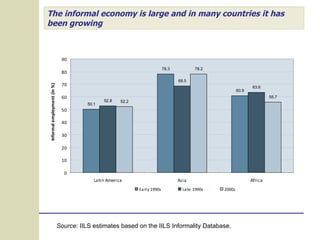
The informal economy is large and in many countries it has been growing Source : IILS estimates based on the IILS Informality Database.
II Trade opening and the informal economy
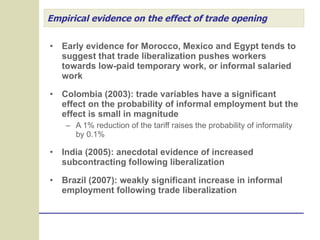
Empirical evidence on the effect of trade opening Early evidence for Morocco, Mexico and Egypt tends to suggest that trade liberalization pushes workers towards low-paid temporary work, or informal salaried work Colombia (2003): trade variables have a significant effect on the probability of informal employment but the effect is small in magnitude A 1% reduction of the tariff raises the probability of informality by 0.1% India (2005): anecdotal evidence of increased subcontracting following liberalization Brazil (2007): weakly significant increase in informal employment following trade liberalization
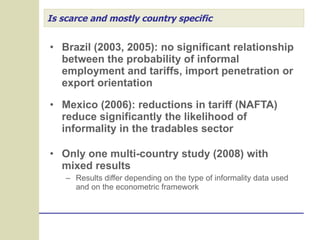
Is scarce and mostly country specific Brazil (2003, 2005): no significant relationship between the probability of informal employment and tariffs, import penetration or export orientation Mexico (2006): reductions in tariff (NAFTA) reduce significantly the likelihood of informality in the tradables sector Only one multi-country study (2008) with mixed results Results differ depending on the type of informality data used and on the econometric framework
..but labour market characteristics seem to matter. Colombia (2003): tariff cuts increase informal employment only in the presence of badly-designed labour regulations Brazil (2007): effect of trade liberalization is less important than effect of labour market legislation
Evidence on wages is even more limited and it is also mixed India (2003):  Informal real wage has grown between the pre- and the post-reform period Results support the idea that trade liberalization raised informal wages in manufacturing via capital reallocation from the formal to the informal sector Brazil (2005): some evidence that opening narrowed the formal-informal wage gap Mexico (2006): trade opening widened the formal-informal wage gap In line with the finding of an increase in the skill premium in the literature on the distributional effect of trade reforms
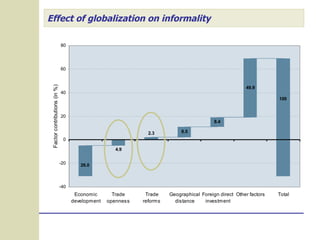
Effect of globalization on informality
III Consequences of informality for trade and growth
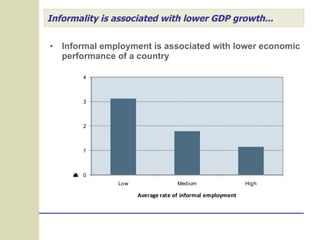
Informality is associated with lower GDP growth... Informal employment is associated with lower economic performance of a country
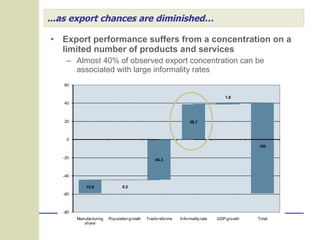
...as export chances are diminished… Export performance suffers from a concentration on a limited number of products and services Almost 40% of observed export concentration can be associated with large informality rates
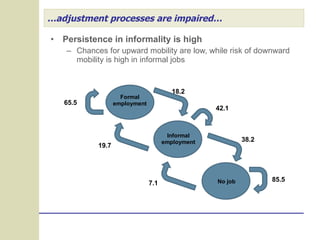
… adjustment processes are impaired… Persistence in informality is high Chances for upward mobility are low, while risk of downward mobility is high in informal jobs
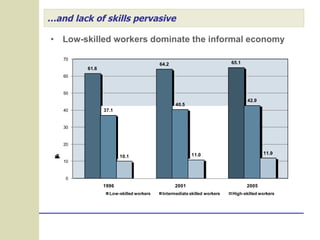
… and lack of skills pervasive Low-skilled workers dominate the informal economy
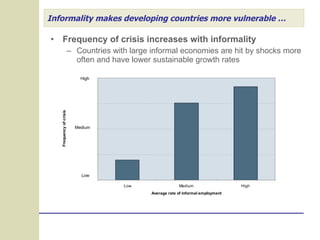
Informality makes developing countries more vulnerable … Frequency of crisis increases with informality Countries with large informal economies are hit by shocks more often and have lower sustainable growth rates
… countries have less resources to secure against shocks Policy space is reduced with larger informal economies Countries have less fiscal resources to insure against external shocks… … and to invest in higher sustainable growth rates Automatic stabilisers are less effective Investment in proper public infrastructure (transportation, education, etc.) is limited Informal sector firms are typically small, with little resources to support shocks and to grow Small firm size lowers potential to increase productivity… … and to trade internationally
IV Policies
Supporting  informal workers through the Decent Work Agenda Support social protection A basic social floor helps workers in the informal economy This can improve their bargaining position,… … avoids exploitation in informality,… … and procures basic insurance against individual risks. Enforce core labour standards Core labour standards can create level playing field across the economy For instance: Minimum wages spill over to informal wages… … and can help lowering the size of the informal economy
Facilitating adjustment and transition to formal jobs I Develop active labour market policies Extend public employment services also to the informal economy Job search and matching can be improved when informal workers are being reached as well Focus on education, also in the informal economy Improved education and skills is key for workers to find formal jobs Vocational training systems in the informal economy can provide additional policy leverage
Facilitating adjustment and transition to formal jobs II Strong social dialogue between employers and workers helps... ...in the design of measures ...extend the reach to the informal economy Reform product markets and enhance governance Eliminate red tape and improve governance to lower entry barriers and stimulate firm growth Well-designed taxation helps job creation in the formal economy
Promoting employment-friendly trade Carefully designed trade reforms Credible announcement of reform path Gradual implementation Country-specific trade reforms Support trade Aid-for-trade initiative: Least developed countries need support to export diversification and export development Exploit complementarities Countries reap greater benefits from trade opening when labour markets allow better adjustment of jobs across sectors. Coordination of trade and labour market reforms
V Open issues
Issues for future analysis Enhancing policy complementarities between trade reforms and decent work Is there an optimal reform path to exploit complementarities between trade and labour market policies? How can trade policies be designed to support the efforts to formalize the labour market? What is the role of initial country conditions? The role of agriculture How can well-designed trade reforms and development policies help exploit the agricultural potential in developing countries? Economic resilience How can trade and labour market policies by complemented to reduce a country’s vulnerability to shocks?

Globalization and informal jobs in developing countries

  • 1.
    Globalisation and informaljobs in developing countries Marc Bacchetta, WTO Ekkehard Ernst and Juana P. Bustamante, IILS (ILO)
  • 2.
    MOTIVATION “ Addressinginformality is not only a matter of concern for social equity. It also helps to improve a country’s efficiency, as the informal economy constitutes a drag on the capacity to foster high value-added production and compete in the world economy. Reducing the size of the informal economy is therefore a key policy objective from a developmental perspective .”
  • 3.
    OUTLINE Informality: Keyconcepts and facts Trade opening and the informal economy Consequences of informality for trade and growth Policies Open issues
  • 4.
    I Informality: Keyconcepts and facts
  • 5.
    The informal economycomprises... Remunerative work that is not recognized, regulated or protected by existing legal or regulatory frameworks Plus non remunerative work in income producing enterprises Informal employment in both informal and formal enterprises Self employment and wage employment Employers and employees Small productive firms operated by entrepreneurs and survival activities Independent or subordinated to larger (formal) firms
  • 6.
    This diversity isreflected in a heterogeneity of views The dualist school focuses on survival activities informal sector is the residual of a dual labour market with no direct link to the formal economy… … and it exists because the performance of the formal sector is too weak The structuralist school focuses on the interdependence informal economy comprises small firms subordinated to larger ones The legalist/orthodox school focuses on small entrepreneurs Informal economy comprises micro-entrepreneurs who prefer to operate informally to avoid the costs associated with registration and regulations
  • 7.
    A unifying approachis emerging All 3 approaches can claim validity in explaining parts of the informal economy Informal economy comprises different segments populated by different types of agents: households engaged in survival activities, micro-entrepreneurs, and workers or firms subordinated to larger formal firms The relative size of each of these segments varies by region and country Challenge: measuring relative size and explaining the transitions
  • 8.
    The informal economyis large and in many countries it has been growing Source : IILS estimates based on the IILS Informality Database.
  • 9.
    II Trade openingand the informal economy
  • 10.
    Empirical evidence onthe effect of trade opening Early evidence for Morocco, Mexico and Egypt tends to suggest that trade liberalization pushes workers towards low-paid temporary work, or informal salaried work Colombia (2003): trade variables have a significant effect on the probability of informal employment but the effect is small in magnitude A 1% reduction of the tariff raises the probability of informality by 0.1% India (2005): anecdotal evidence of increased subcontracting following liberalization Brazil (2007): weakly significant increase in informal employment following trade liberalization
  • 11.
    Is scarce andmostly country specific Brazil (2003, 2005): no significant relationship between the probability of informal employment and tariffs, import penetration or export orientation Mexico (2006): reductions in tariff (NAFTA) reduce significantly the likelihood of informality in the tradables sector Only one multi-country study (2008) with mixed results Results differ depending on the type of informality data used and on the econometric framework
  • 12.
    ..but labour marketcharacteristics seem to matter. Colombia (2003): tariff cuts increase informal employment only in the presence of badly-designed labour regulations Brazil (2007): effect of trade liberalization is less important than effect of labour market legislation
  • 13.
    Evidence on wagesis even more limited and it is also mixed India (2003): Informal real wage has grown between the pre- and the post-reform period Results support the idea that trade liberalization raised informal wages in manufacturing via capital reallocation from the formal to the informal sector Brazil (2005): some evidence that opening narrowed the formal-informal wage gap Mexico (2006): trade opening widened the formal-informal wage gap In line with the finding of an increase in the skill premium in the literature on the distributional effect of trade reforms
  • 14.
  • 15.
    III Consequences ofinformality for trade and growth
  • 16.
    Informality is associatedwith lower GDP growth... Informal employment is associated with lower economic performance of a country
  • 17.
    ...as export chancesare diminished… Export performance suffers from a concentration on a limited number of products and services Almost 40% of observed export concentration can be associated with large informality rates
  • 18.
    … adjustment processesare impaired… Persistence in informality is high Chances for upward mobility are low, while risk of downward mobility is high in informal jobs
  • 19.
    … and lackof skills pervasive Low-skilled workers dominate the informal economy
  • 20.
    Informality makes developingcountries more vulnerable … Frequency of crisis increases with informality Countries with large informal economies are hit by shocks more often and have lower sustainable growth rates
  • 21.
    … countries haveless resources to secure against shocks Policy space is reduced with larger informal economies Countries have less fiscal resources to insure against external shocks… … and to invest in higher sustainable growth rates Automatic stabilisers are less effective Investment in proper public infrastructure (transportation, education, etc.) is limited Informal sector firms are typically small, with little resources to support shocks and to grow Small firm size lowers potential to increase productivity… … and to trade internationally
  • 22.
  • 23.
    Supporting informalworkers through the Decent Work Agenda Support social protection A basic social floor helps workers in the informal economy This can improve their bargaining position,… … avoids exploitation in informality,… … and procures basic insurance against individual risks. Enforce core labour standards Core labour standards can create level playing field across the economy For instance: Minimum wages spill over to informal wages… … and can help lowering the size of the informal economy
  • 24.
    Facilitating adjustment andtransition to formal jobs I Develop active labour market policies Extend public employment services also to the informal economy Job search and matching can be improved when informal workers are being reached as well Focus on education, also in the informal economy Improved education and skills is key for workers to find formal jobs Vocational training systems in the informal economy can provide additional policy leverage
  • 25.
    Facilitating adjustment andtransition to formal jobs II Strong social dialogue between employers and workers helps... ...in the design of measures ...extend the reach to the informal economy Reform product markets and enhance governance Eliminate red tape and improve governance to lower entry barriers and stimulate firm growth Well-designed taxation helps job creation in the formal economy
  • 26.
    Promoting employment-friendly tradeCarefully designed trade reforms Credible announcement of reform path Gradual implementation Country-specific trade reforms Support trade Aid-for-trade initiative: Least developed countries need support to export diversification and export development Exploit complementarities Countries reap greater benefits from trade opening when labour markets allow better adjustment of jobs across sectors. Coordination of trade and labour market reforms
  • 27.
  • 28.
    Issues for futureanalysis Enhancing policy complementarities between trade reforms and decent work Is there an optimal reform path to exploit complementarities between trade and labour market policies? How can trade policies be designed to support the efforts to formalize the labour market? What is the role of initial country conditions? The role of agriculture How can well-designed trade reforms and development policies help exploit the agricultural potential in developing countries? Economic resilience How can trade and labour market policies by complemented to reduce a country’s vulnerability to shocks?