Understanding how to create
more and better jobs
Professor Pedro Martins
Inaugural Lecture
Queen Mary University of London
October 21st, 2015
Mentors and co-authors
• Prof Ian Walker, LancasterU
• Prof Pedro Portugal, Bank of PT
• Prof Jonathan Thomas, Edinburgh U
• Prof Alvaro S. Pereira, OECD
• Prof Gary Solon, Arizona U
• Prof Andrew Oswald, Warwick U
• Prof Pedro T. Pereira, Madeira U
• Prof Brigitte Granville, QMUL
• Prof Robin Naylor, Warwick U
• Prof Lazlo Andor, Brussels U
• Prof Jonathan Haskel, Imperial Coll
• Prof Huw Dixon, Cardiff U
• Dr Alex Hijzen, IMF
• Dr Francisco Lima, Lisbon U
• Dr Yong Yang, Sussex U
• Dr Luiz Esteves,CADE, Brazil
• Dr Richard Upward, Nottingham U
• Prof Andy Snell, Edinburgh U
• Sofia P. Costa, QMUL
• Dr Jim Jin, St Andrews U
2
Outline
1. Labour economics and labour policy
2. Globalisation
3. Institutions
4. Public programmes
3
Labour economics & policy – recent drivers 1/2
• Wider theory base
• Neoclassical: competitive markets (productivity, prices)
• Human capital (Becker 1992)
• Search (frictions, flows) (DMP 2010)
• Behavioural
• Institutional
• Greater focus on evidence
• Emergence of evidence-based policy
• Increasing demand for ‘policy-actionable’ evidence
• Eurozone debate on structural reforms vs monetary policy vs debt relief
4
5
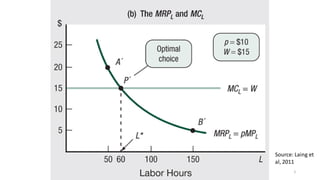
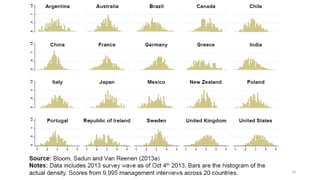
Source: Laing et
al, 2011
Labour economics & policy – recent drivers 2/2
• Counterfactual empirical methods
• Social experiments (Deaton 2015)
• Regression and matching (Heckman 2000)
• Regression discontinuity
• Difference-in-differences
• Instrumental variables
• Big(ger) data
• Matched employer-employee longitudinal data
• Social security and other administrative data sets
• Public records of firms
• Internet
6
International aspects
• Globalisation: FDI, GVCs, international trade, migration
• “Second unbundling” (ideas and production)
• Multinationals as sweatshops or promoters of more and better jobs?
• Job polarisation in G7 countries?
• Work co-authored with A. Hijzen, R. Upward, Th. Schank and Y. Yang,
part of which in collaboration with the OECD, Paris
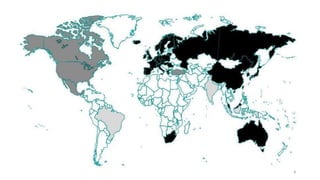
• Orbis firm-level data (1996-2007): 2,179 (parent) multinationals; 5,230 affiliates
• Focus on the cases of UK, Ger, PT, BR and Indonesia
7
8
International aspects
• International “rent sharing”
• Profits of multinationals are shared with workers in affiliates
• Effects stronger when greater differences in characteristics (complementarities)
but weaker when more affiliates (substitution)
• Acquisitions/divestments (UK, DE, PT, BR, IND)
• Positive wage effects of foreign ownership (especially for developing countries)
• Higher wage increases following from mobility to foreign firms
• Greater job security following foreign takeovers
9
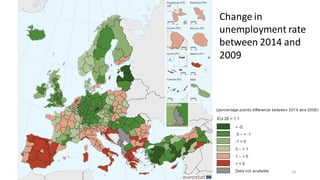
Change in
unemployment rate
between 2014 and
2009
10
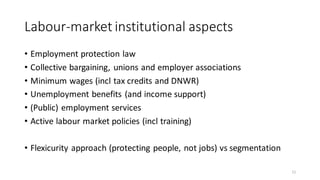
Labour-market institutional aspects
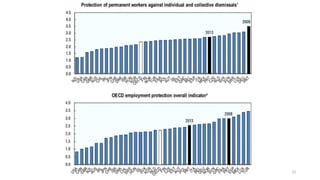
• Employment protection law
• Collective bargaining, unions and employer associations
• Minimum wages (incl tax credits and DNWR)
• Unemployment benefits (and income support)
• (Public) employment services
• Active labour market policies (incl training)
• Flexicurity approach (protecting people, not jobs) vs segmentation
11
12
13
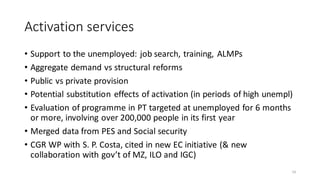
Activation services
• Support to the unemployed: job search, training, ALMPs
• Aggregate demand vs structural reforms
• Public vs private provision
• Potential substitution effects of activation (in periods of high unempl)
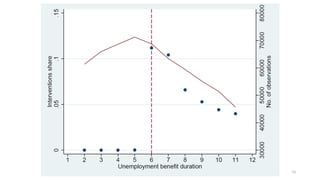
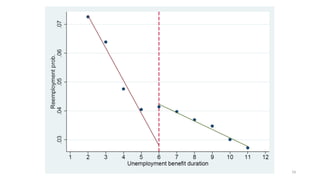
• Evaluation of programme in PT targeted at unemployed for 6 months
or more, involving over 200,000 people in its first year
• Merged data from PES and Social security
• CGR WP with S. P. Costa, cited in new EC initiative (& new
collaboration with gov’t of MZ, ILO and IGC)
14
15
16
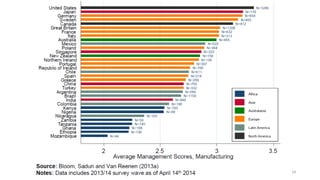
Management training
• Market failures in training provision, uncertain returns: lower
productivity
• €65b to be spent by the EU on education, training and employment
measures (2013-2020)
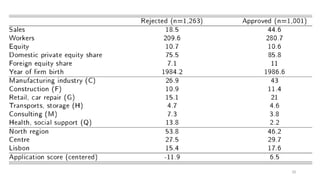
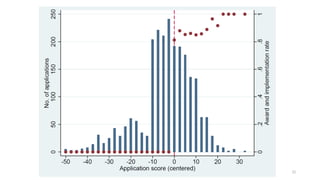
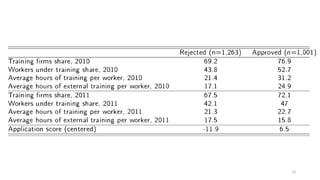
• Counterfactual evaluation of €100m programme in PT (‘FIG’, 2008)
• Funding to provide skills to workers (incl managers)
• Allocation depending on scores in different criteria, training and firm
characteristics, and available resources
• Merge of administrative and matched panel data
• Work in progress, in collaboration with the European Commission
17
18
19
20
21
22
23
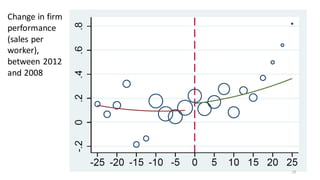
Change in firm
performance
(sales per
worker),
between 2012
and 2008
Final thoughts: Understanding how to…
• Work in progress, many different approaches
• Important contributions and developments
• Different theoretical concepts
• More sophisticatedempirical methods
• Richer data
• Significant potential from greater interaction between economics,
management, other fields of study (politics, law, etc) and other
stakeholders (public bodies, int’l organisations, etc)…
• … to promote further improvements in labour market evidence,
policy and outcomes
24

Inaugural lecture pedro martins 2015 10-21

  • 1.
    Understanding how tocreate more and better jobs Professor Pedro Martins Inaugural Lecture Queen Mary University of London October 21st, 2015
  • 2.
    Mentors and co-authors •Prof Ian Walker, LancasterU • Prof Pedro Portugal, Bank of PT • Prof Jonathan Thomas, Edinburgh U • Prof Alvaro S. Pereira, OECD • Prof Gary Solon, Arizona U • Prof Andrew Oswald, Warwick U • Prof Pedro T. Pereira, Madeira U • Prof Brigitte Granville, QMUL • Prof Robin Naylor, Warwick U • Prof Lazlo Andor, Brussels U • Prof Jonathan Haskel, Imperial Coll • Prof Huw Dixon, Cardiff U • Dr Alex Hijzen, IMF • Dr Francisco Lima, Lisbon U • Dr Yong Yang, Sussex U • Dr Luiz Esteves,CADE, Brazil • Dr Richard Upward, Nottingham U • Prof Andy Snell, Edinburgh U • Sofia P. Costa, QMUL • Dr Jim Jin, St Andrews U 2
  • 3.
    Outline 1. Labour economicsand labour policy 2. Globalisation 3. Institutions 4. Public programmes 3
  • 4.
    Labour economics &policy – recent drivers 1/2 • Wider theory base • Neoclassical: competitive markets (productivity, prices) • Human capital (Becker 1992) • Search (frictions, flows) (DMP 2010) • Behavioural • Institutional • Greater focus on evidence • Emergence of evidence-based policy • Increasing demand for ‘policy-actionable’ evidence • Eurozone debate on structural reforms vs monetary policy vs debt relief 4
  • 5.
  • 6.
    Labour economics &policy – recent drivers 2/2 • Counterfactual empirical methods • Social experiments (Deaton 2015) • Regression and matching (Heckman 2000) • Regression discontinuity • Difference-in-differences • Instrumental variables • Big(ger) data • Matched employer-employee longitudinal data • Social security and other administrative data sets • Public records of firms • Internet 6
  • 7.
    International aspects • Globalisation:FDI, GVCs, international trade, migration • “Second unbundling” (ideas and production) • Multinationals as sweatshops or promoters of more and better jobs? • Job polarisation in G7 countries? • Work co-authored with A. Hijzen, R. Upward, Th. Schank and Y. Yang, part of which in collaboration with the OECD, Paris • Orbis firm-level data (1996-2007): 2,179 (parent) multinationals; 5,230 affiliates • Focus on the cases of UK, Ger, PT, BR and Indonesia 7
  • 8.
  • 9.
    International aspects • International“rent sharing” • Profits of multinationals are shared with workers in affiliates • Effects stronger when greater differences in characteristics (complementarities) but weaker when more affiliates (substitution) • Acquisitions/divestments (UK, DE, PT, BR, IND) • Positive wage effects of foreign ownership (especially for developing countries) • Higher wage increases following from mobility to foreign firms • Greater job security following foreign takeovers 9
  • 10.
  • 11.
    Labour-market institutional aspects •Employment protection law • Collective bargaining, unions and employer associations • Minimum wages (incl tax credits and DNWR) • Unemployment benefits (and income support) • (Public) employment services • Active labour market policies (incl training) • Flexicurity approach (protecting people, not jobs) vs segmentation 11
  • 12.
  • 13.
  • 14.
    Activation services • Supportto the unemployed: job search, training, ALMPs • Aggregate demand vs structural reforms • Public vs private provision • Potential substitution effects of activation (in periods of high unempl) • Evaluation of programme in PT targeted at unemployed for 6 months or more, involving over 200,000 people in its first year • Merged data from PES and Social security • CGR WP with S. P. Costa, cited in new EC initiative (& new collaboration with gov’t of MZ, ILO and IGC) 14
  • 15.
  • 16.
  • 17.
    Management training • Marketfailures in training provision, uncertain returns: lower productivity • €65b to be spent by the EU on education, training and employment measures (2013-2020) • Counterfactual evaluation of €100m programme in PT (‘FIG’, 2008) • Funding to provide skills to workers (incl managers) • Allocation depending on scores in different criteria, training and firm characteristics, and available resources • Merge of administrative and matched panel data • Work in progress, in collaboration with the European Commission 17
  • 18.
  • 19.
  • 20.
  • 21.
  • 22.
  • 23.
    23 Change in firm performance (salesper worker), between 2012 and 2008
  • 24.
    Final thoughts: Understandinghow to… • Work in progress, many different approaches • Important contributions and developments • Different theoretical concepts • More sophisticatedempirical methods • Richer data • Significant potential from greater interaction between economics, management, other fields of study (politics, law, etc) and other stakeholders (public bodies, int’l organisations, etc)… • … to promote further improvements in labour market evidence, policy and outcomes 24