COMICS! By: Paolo Fortini Matthew Atzori
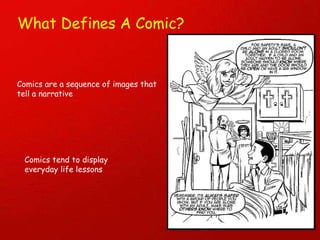
What Defines A Comic? Comics are a sequence of images that tell a narrative Comics tend to display everyday life lessons
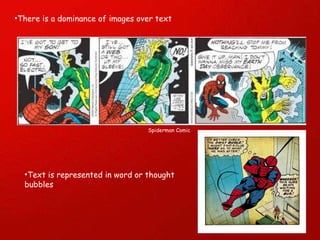
There is a dominance of images over text Text is represented in word or thought bubbles  Spiderman Comic
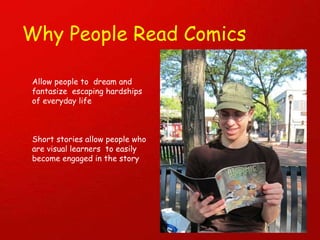
Why People Read Comics Allow people to  dream and fantasize  escaping hardships of everyday life Short stories allow people who are visual learners  to easily become engaged in the story
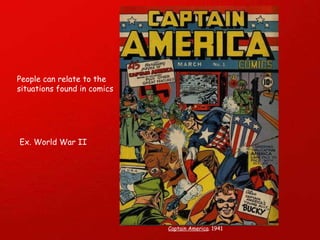
People can relate to the situations found in comics Captain America . 1941 Ex. World War II
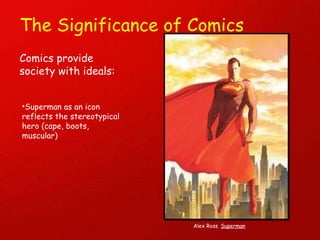
The Significance of Comics Comics provide society with ideals: Superman as an icon reflects the stereotypical hero (cape, boots, muscular) Alex Ross.  Superman
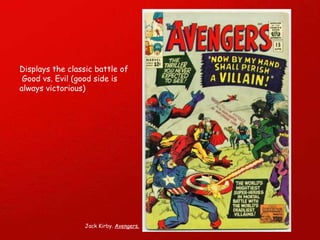
Displays the classic battle of  Good vs. Evil (good side is  always victorious) Jack Kirby.  Avengers.
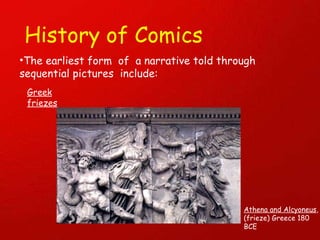
History of Comics The earliest form  of  a narrative told through sequential pictures  include: Greek friezes Athena and Alcyoneus , (frieze) Greece 180 BCE
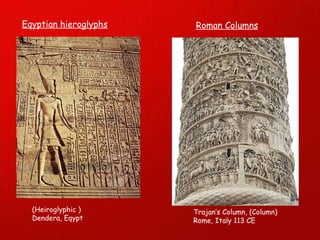
Eqyptian hieroglyphs Roman Columns Trajan’s Column, (Column) Rome, Italy 113 CE (Heiroglyphic ) Dendera, Eqypt
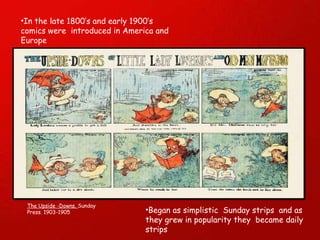
Began as simplistic  Sunday strips  and as they grew in popularity they  became daily strips In the late 1800’s and early 1900’s comics were  introduced in America and Europe The Upside -Downs.  Sunday Press. 1903-1905
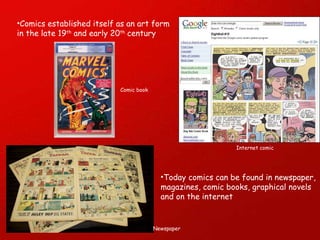
Today comics can be found in newspaper, magazines, comic books, graphical novels  and on the internet Comics established itself as an art form in the late 19 th  and early 20 th  century Comic book Newspaper Internet comic
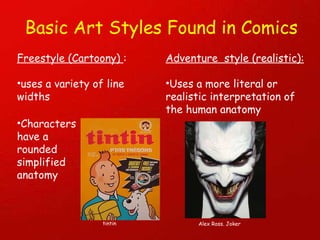
Basic Art Styles Found in Comics Freestyle (Cartoony)  : uses a variety of line widths Adventure  style (realistic): Uses a more literal or realistic interpretation of the human anatomy Characters  have a rounded simplified anatomy Alex Ross. Joker  tintin
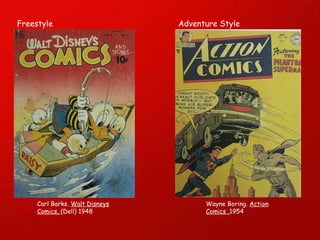
Carl Barks.  Walt Disneys Comics,  (Dell) 1948 Wayne Boring.  Action Comics , 1954 Freestyle Adventure Style
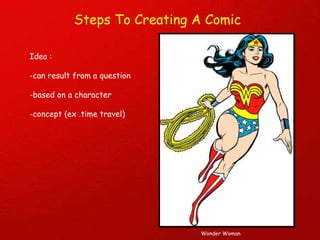
Steps To Creating A Comic Idea : -can result from a question -based on a character -concept (ex .time travel) Wonder Woman
Writer: -a group of people create story and dialogue for comic
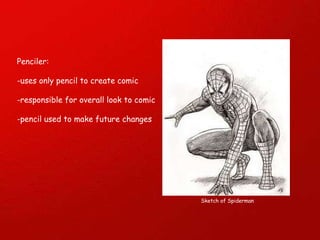
Penciler: -uses only pencil to create comic -responsible for overall look to comic -pencil used to make future changes Sketch of Spiderman
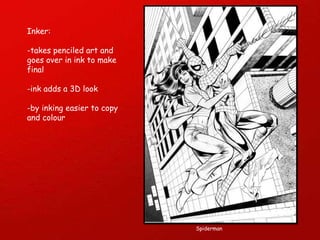
Inker: -takes penciled art and goes over in ink to make final -ink adds a 3D look -by inking easier to copy and colour Spiderman
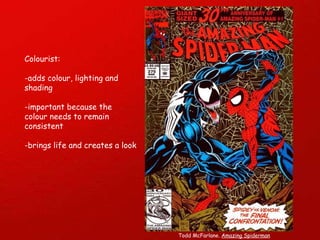
Colourist: -adds colour, lighting and shading -important because the colour needs to remain consistent -brings life and creates a look Todd McFarlane.  Amazing Spiderman
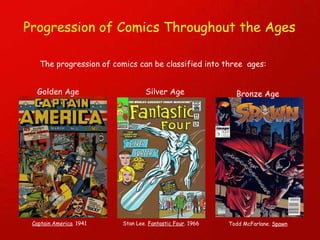
Progression of Comics Throughout the Ages The progression of comics can be classified into three  ages: Golden Age Captain America . 1941 Silver Age Stan Lee.  Fantastic Four . 1966 Bronze Age Todd McFarlane.  Spawn
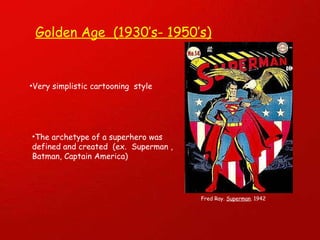
Very simplistic cartooning  style The archetype of a superhero was defined and created  (ex.  Superman , Batman, Captain America) Golden Age  (1930’s- 1950’s) Fred Ray.  Superman . 1942
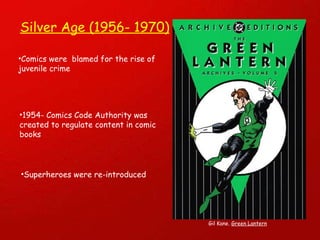
1954- Comics Code Authority was created to regulate content in comic books Silver Age (1956- 1970) Superheroes were re-introduced Comics were  blamed for the rise of juvenile crime Gil Kane.  Green Lantern
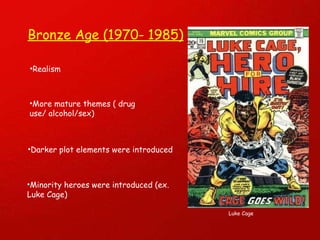
More mature themes ( drug use/ alcohol/sex) Bronze Age (1970- 1985) Minority heroes were introduced (ex. Luke Cage) Realism Darker plot elements were introduced Luke Cage
GOLDEN AGE: Comic Artists
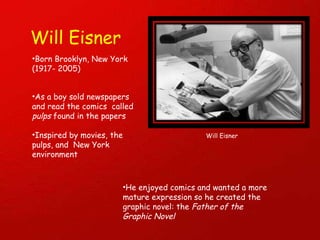
Will Eisner Will Eisner As a boy sold newspapers and read the comics  called  pulps  found in the papers Inspired by movies, the pulps, and  New York environment He enjoyed comics and wanted a more mature expression so he created the graphic novel: the  Father of the Graphic Novel Born Brooklyn, New York (1917- 2005)
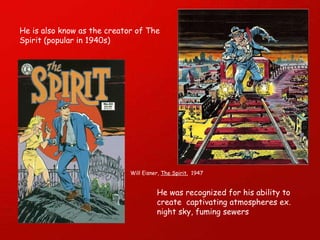
He is also know as the creator of The Spirit (popular in 1940s) Will Eisner,  The Spirit.   1947 He was recognized for his ability to create  captivating atmospheres ex. night sky, fuming sewers
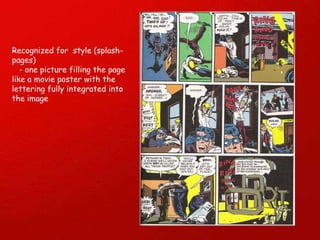
Recognized for  style (splash-pages) - one picture filling the page like a movie poster with the lettering fully integrated into the image
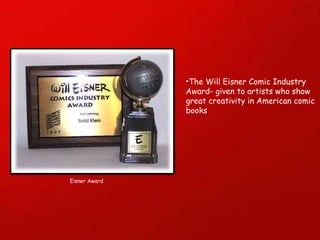
The Will Eisner Comic Industry  Award- given to artists who show great creativity in American comic books Eisner Award
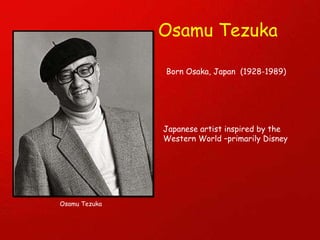
Osamu Tezuka Japanese artist inspired by the Western World –primarily Disney Osamu Tezuka Born Osaka, Japan  (1928-1989)
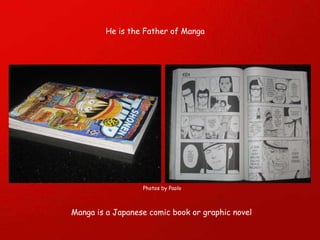
He is the Father of Manga Manga is a Japanese comic book or graphic novel Photos by Paolo
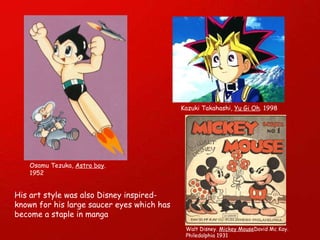
Osamu Tezuka,  Astro boy . 1952 Kazuki Takahashi,  Yu Gi Oh . 1998 His art style was also Disney inspired- known for his large saucer eyes which has become a staple in manga  Walt Disney.  Mickey Mouse David Mc Kay. Philedalphia 1931
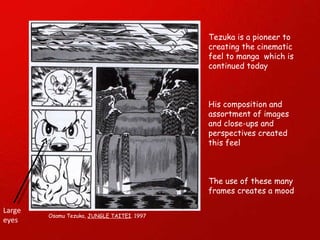
Tezuka is a pioneer to creating the cinematic feel to manga  which is continued today His composition and assortment of images and close-ups and perspectives created this feel The use of these many frames creates a mood  Large eyes Osamu Tezuka,  JUNGLE TAITEI . 1997
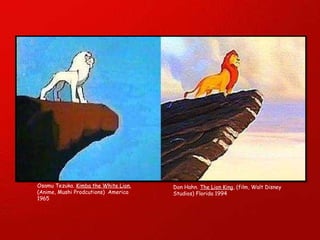
Osamu Tezuka.  Kimba the White Lion.   (Anime, Mushi Prodcutions)  America 1965 Don Hahn.  The Lion King , (film, Walt Disney Studios) Florida 1994
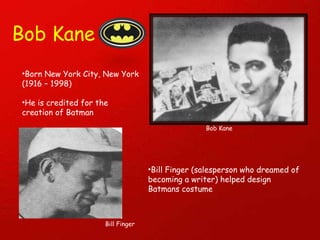
Bob Kane Bob Kane Born New York City, New York (1916 – 1998) He is credited for the creation of Batman Bill Finger (salesperson who dreamed of becoming a writer) helped design Batmans costume  Bill Finger
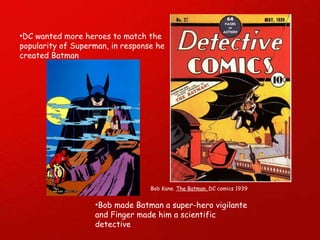
Bob made Batman a super-hero vigilante and Finger made him a scientific detective DC wanted more heroes to match the popularity of Superman, in response he created Batman Bob Kane.  The Batman.  DC comics 1939
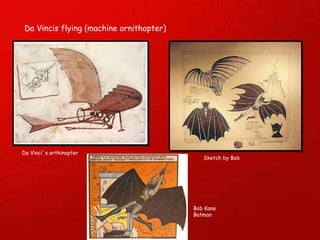
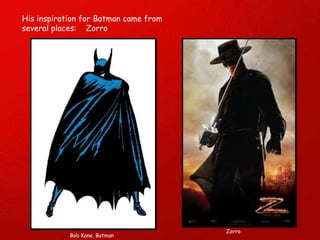
His inspiration for Batman came from several places:  Zorro Zorro Bob Kane. Batman
Da Vincis flying (machine ornithopter)  Sketch by Bob Da Vinci´s orthinopter Bob Kane Batman
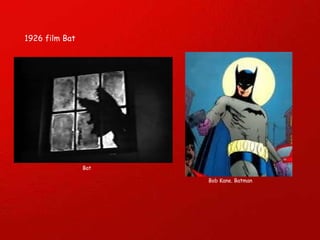
1926 film Bat Bob Kane. Batman Bat
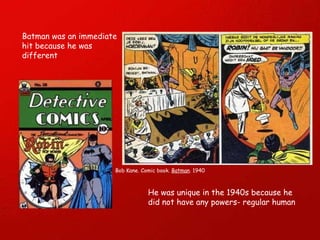
Batman was an immediate hit because he was different Bob Kane. Comic book.  Batman . 1940 He was unique in the 1940s because he did not have any powers- regular human
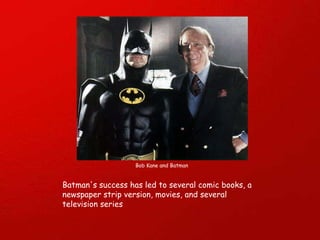
Batman's success has led to several comic books, a newspaper strip version, movies, and several television series Bob Kane and Batman
SILVER AGE: Comic Artists
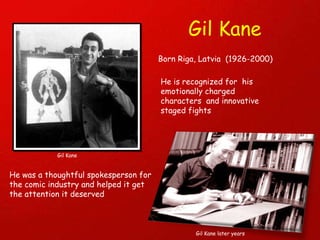
Gil Kane  Born Riga, Latvia  (1926-2000) Gil Kane He is recognized for  his emotionally charged characters  and innovative staged fights He was a thoughtful spokesperson for the comic industry and helped it get the attention it deserved Gil Kane later years
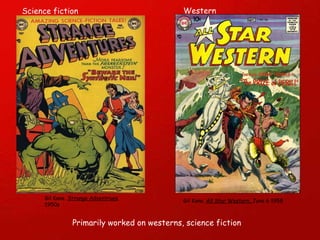
Primarily worked on westerns, science fiction  Gil Kane.  All Star Western.  June 6 1958 Gil Kane.  Strange Adventrues . 1950s Science fiction Western
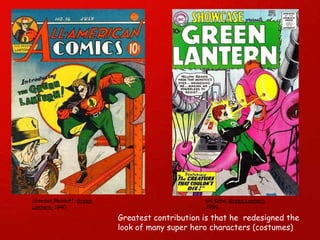
Greatest contribution is that he  redesigned the look of many super hero characters (costumes) Gil Kane.  Green Lantern . 1959. Shledon Moldoff.  Green Lantern.  1940.
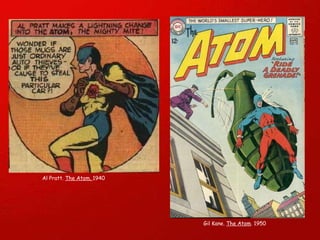
Al Pratt.  The Atom.  1940  Gil Kane.  The Atom . 1950
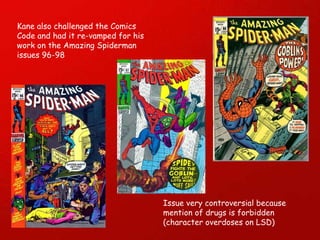
Kane also challenged the Comics Code and had it re-vamped for his work on the Amazing Spiderman issues 96-98 Issue very controversial because mention of drugs is forbidden (character overdoses on LSD)
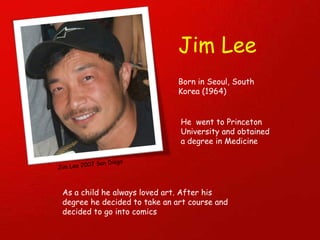
Jim Lee Born in Seoul, South Korea (1964) Jim Lee 2007 San Diego He  went to Princeton University and obtained a degree in Medicine  As a child he always loved art. After his degree he decided to take an art course and  decided to go into comics
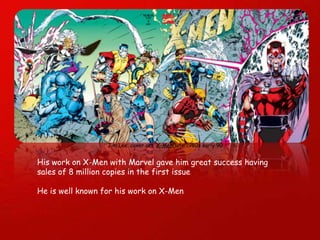
Jim Lee. cover art.  X-Men (late 1980s early 90 His work on X-Men with Marvel gave him great success having sales of 8 million copies in the first issue He is well known for his work on X-Men
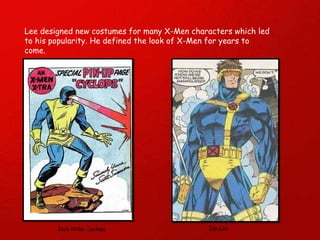
Lee designed new costumes for many X-Men characters which led to his popularity. He defined the look of X-Men for years to come. Jack Kirby. Cyclops  Jim Lee
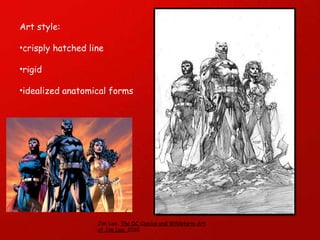
Art style:  crisply hatched line rigid idealized anatomical forms Jim Lee.  The DC Comics and Wildstorm Art of Jim Lee.  2010
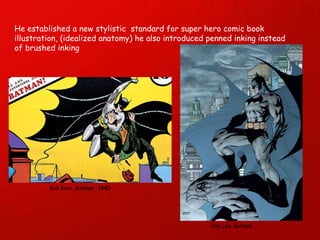
He established a new stylistic  standard for super hero comic book illustration, (idealized anatomy) he also introduced penned inking instead of brushed inking Bob Kane. Batman . 1940 Jim Lee. Batman
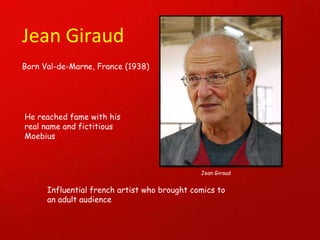
Jean Giraud Born Val-de-Marne, France (1938) Jean Giraud He reached fame with his real name and fictitious Moebius Influential french artist who brought comics to an adult audience
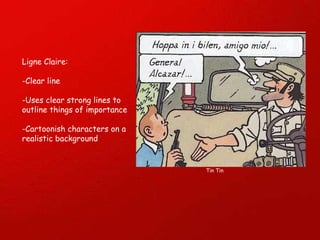
Ligne Claire: -Clear line -Uses clear strong lines to outline things of importance -Cartoonish characters on a realistic background Tin Tin
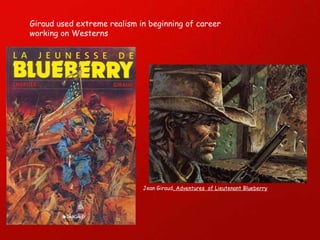
Giraud used extreme realism in beginning of career working on Westerns Jean Giraud . Adventures  of Lieutenant Blueberry
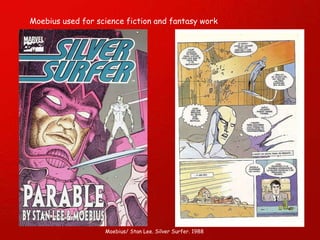
Moebius used for science fiction and fantasy work Moebius/ Stan Lee. Silver Surfer. 1988
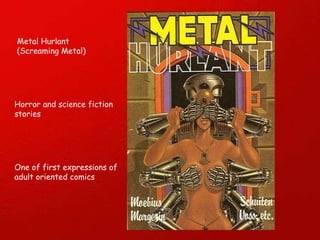
Metal Hurlant  (Screaming Metal) One of first expressions of adult oriented comics Horror and science fiction stories
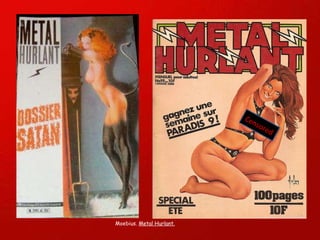
Censored   Moebius.  Metal Hurlant.
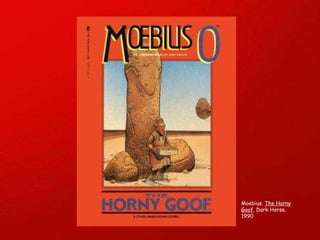
Moebius.  The Horny Goof . Dark Horse. 1990
BRONZE AGE: Comic Artists
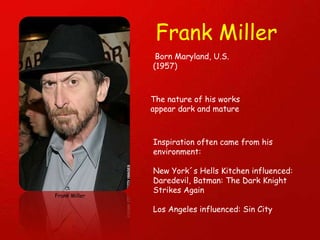
Frank Miller Frank Miller Born Maryland, U.S. (1957) The nature of his works appear dark and mature Inspiration often came from his environment: New York´s Hells Kitchen influenced: Daredevil, Batman: The Dark Knight Strikes Again Los Angeles influenced: Sin City
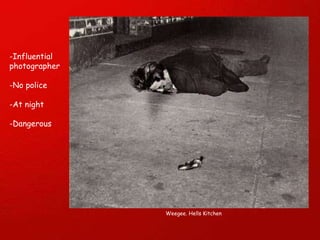
Weegee. Hells Kitchen -Influential photographer -No police -At night -Dangerous
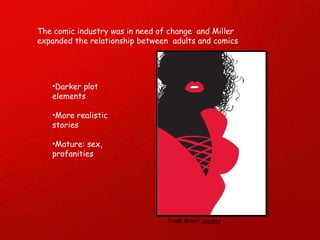
The comic industry was in need of change  and Miller expanded the relationship between  adults and comics Darker plot elements More realistic stories Mature: sex, profanities Frank Miller.  Sin city
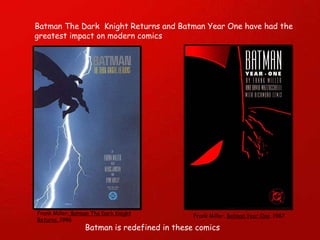
Batman The Dark  Knight Returns and Batman Year One have had the greatest impact on modern comics Batman is redefined in these comics Frank Miller . Batman The Dark Knight Returns.  1986 Frank Miller.  Batman Year One . 1987
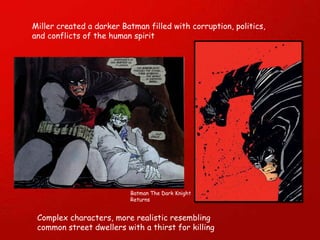
Miller created a darker Batman filled with corruption, politics, and conflicts of the human spirit Batman The Dark Knight Returns Complex characters, more realistic resembling common street dwellers with a thirst for killing
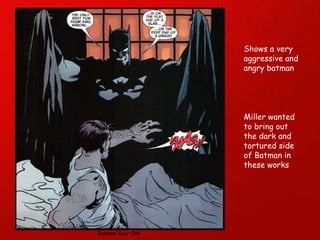
Shows a very aggressive and angry batman  Miller wanted to bring out the dark and tortured side of Batman in these works  Batman Year One
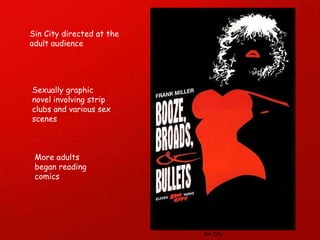
Sin City directed at the adult audience  Sexually graphic novel involving strip clubs and various sex scenes More adults began reading comics Sin City
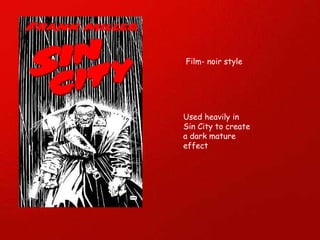
Film- noir style Used heavily in Sin City to create a dark mature effect
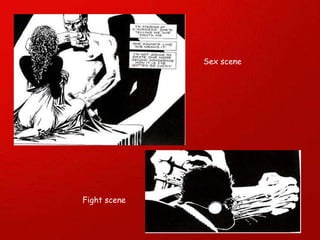
Sex scene Fight scene
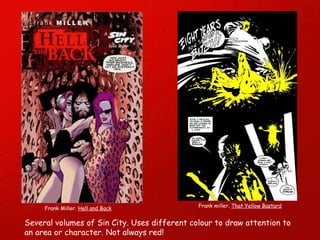
Frank Miller.  Hell and Back Frank miller.  That Yellow Bastard Several volumes of Sin City. Uses different colour to draw attention to an area or character. Not always red!
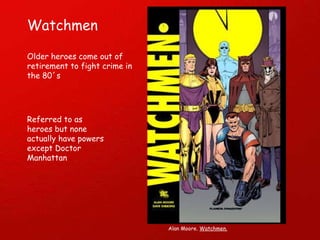
Older heroes come out of retirement to fight crime in the 80´s Referred to as heroes but none actually have powers except Doctor Manhattan Watchmen Alan Moore.  Watchmen.
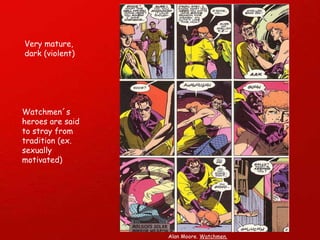
Watchmen´s heroes are said to stray from tradition (ex. sexually motivated) Alan Moore.  Watchmen. Very mature, dark (violent)
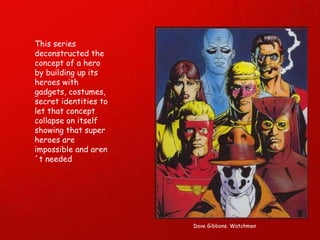
This series deconstructed the concept of a hero by building up its heroes with gadgets, costumes, secret identities to let that concept collapse on itself showing that super heroes are  impossible and aren´t needed Dave Gibbons. Watchmen
Watchmen  deconstructs the hero by developing its heroes . . . to the point where the reader comes to understand that these fantasies, realized, become nightmares.“  - Ian Thomas  (Deconstructing the Hero)
Watchmen proposes a question: Would the world be better off without heroes? YES!
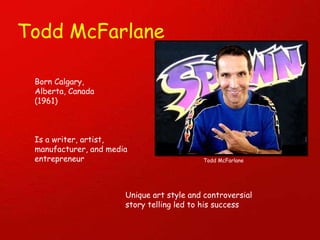
Todd McFarlane Born Calgary, Alberta, Canada (1961) Is a writer, artist, manufacturer, and media entrepreneur Unique art style and controversial story telling led to his success Todd McFarlane
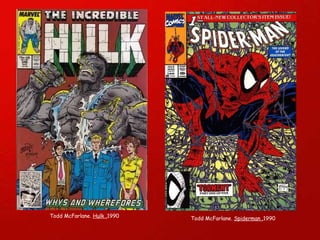
Todd McFarlane.  Spiderman . 1990 Todd McFarlane.  Hulk . 1990
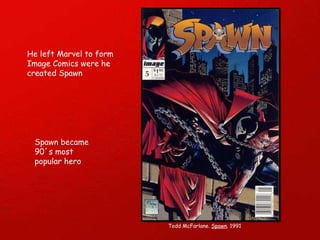
He left Marvel to form Image Comics were he created Spawn Spawn became 90´s most popular hero Todd McFarlane.  Spawn . 1991
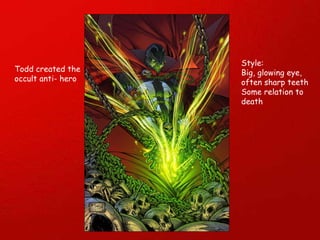
Todd created the occult anti- hero Style: Big, glowing eye, often sharp teeth  Some relation to death
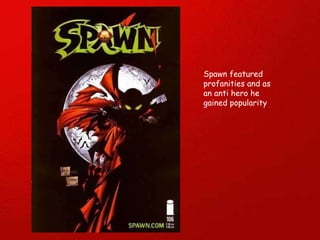
Spawn featured profanities and as an anti hero he gained popularity
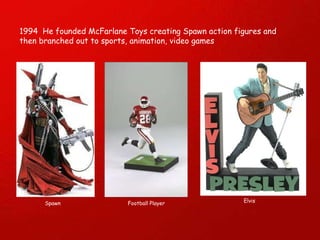
1994  He founded McFarlane Toys creating Spawn action figures and then branched out to sports, animation, video games  Spawn Football Player Elvis
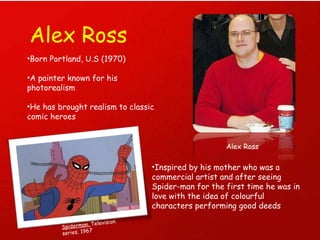
Alex Ross Alex Ross Born Portland, U.S (1970) A painter known for his photorealism  He has brought realism to classic comic heroes Inspired by his mother who was a commercial artist and after seeing Spider-man for the first time he was in love with the idea of colourful characters performing good deeds Spiderman.  Television series. 1967
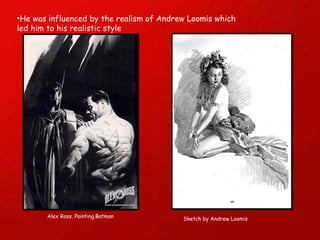
Sketch by Andrew Loomis Alex Ross. Painting.Batman  He was influenced by the realism of Andrew Loomis which led him to his realistic style
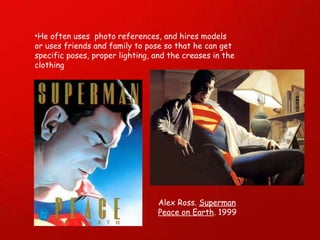
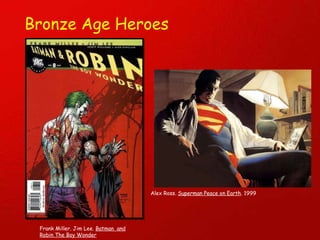
He often uses  photo references, and hires models or uses friends and family to pose so that he can get specific poses, proper lighting, and the creases in the clothing Alex Ross.  Superman Peace on Earth . 1999
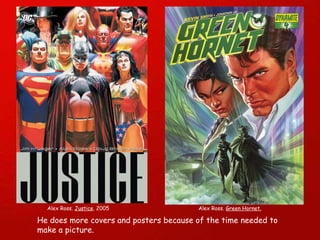
He does more covers and posters because of the time needed to make a picture. Alex Ross.  Justice . 2005 Alex Ross.  Green Hornet.
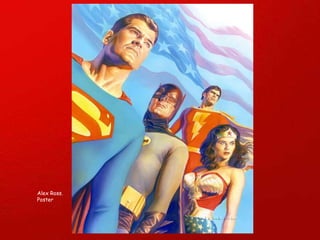
Alex Ross. Poster
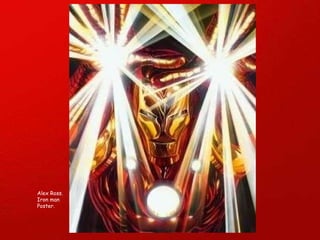
Alex Ross. Iron man Poster.
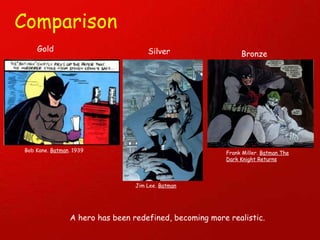
Comparison Gold Silver Bronze A hero has been redefined, becoming more realistic. Bob Kane.  Batman . 1939 Jim Lee.  Batman Frank Miller.  Batman The Dark Knight Returns
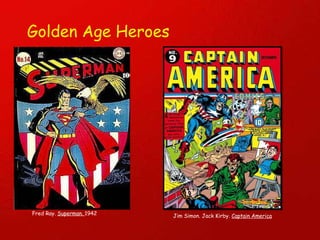
Golden Age Heroes Fred Ray.  Superman.  1942 Jim Simon. Jack Kirby.  Captain America
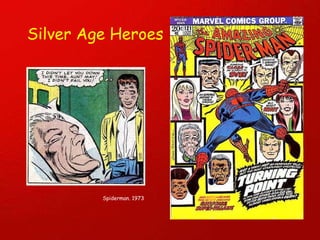
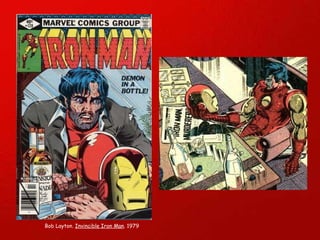
Silver Age Heroes Spiderman. 1973
Bob Layton.  Invincible Iron Man . 1979
Bronze Age Heroes Alex Ross.  Superman Peace on Earth . 1999 Frank Miller. Jim Lee.  Batman  and Robin The Boy Wonder
http://abovethestore.blogspot.com/2009/02/rewinding-watchmen.html Works Cited http://comicssilverage.org/ http://lambiek.net/artists/m/miller.htm http://superherouniverse.com/wiki/Jim_Lee/index.html http://www.lambiek.net/artists/k/kane.htm http://www.willeisner.com/biography/index.html Sabin, Roger.  Comics, Comix and Graphic Novels A History of Comic Art.  London: Phaidon Press Limited, 1996. http://bing.search.sympatico.ca/?q=Bob%20kane&mkt=en-ca&setLang=en-CA
http://tezukainenglish.com/ http://tezukasite.tripod.com/ http://comicbooks.about.com/od/creatingcomicbooks/tp/process.htm http://en.wikipedia.org/wiki/History_of_comics#History http://en.wikipedia.org/wiki/Alex_Ross

Comics!! good

  • 1.
    COMICS! By: PaoloFortini Matthew Atzori
  • 2.
    What Defines AComic? Comics are a sequence of images that tell a narrative Comics tend to display everyday life lessons
  • 3.
    There is adominance of images over text Text is represented in word or thought bubbles Spiderman Comic
  • 4.
    Why People ReadComics Allow people to dream and fantasize escaping hardships of everyday life Short stories allow people who are visual learners to easily become engaged in the story
  • 5.
    People can relateto the situations found in comics Captain America . 1941 Ex. World War II
  • 6.
    The Significance ofComics Comics provide society with ideals: Superman as an icon reflects the stereotypical hero (cape, boots, muscular) Alex Ross. Superman
  • 7.
    Displays the classicbattle of Good vs. Evil (good side is always victorious) Jack Kirby. Avengers.
  • 8.
    History of ComicsThe earliest form of a narrative told through sequential pictures include: Greek friezes Athena and Alcyoneus , (frieze) Greece 180 BCE
  • 9.
    Eqyptian hieroglyphs RomanColumns Trajan’s Column, (Column) Rome, Italy 113 CE (Heiroglyphic ) Dendera, Eqypt
  • 10.
    Began as simplistic Sunday strips and as they grew in popularity they became daily strips In the late 1800’s and early 1900’s comics were introduced in America and Europe The Upside -Downs. Sunday Press. 1903-1905
  • 11.
    Today comics canbe found in newspaper, magazines, comic books, graphical novels and on the internet Comics established itself as an art form in the late 19 th and early 20 th century Comic book Newspaper Internet comic
  • 12.
    Basic Art StylesFound in Comics Freestyle (Cartoony) : uses a variety of line widths Adventure style (realistic): Uses a more literal or realistic interpretation of the human anatomy Characters have a rounded simplified anatomy Alex Ross. Joker tintin
  • 13.
    Carl Barks. Walt Disneys Comics, (Dell) 1948 Wayne Boring. Action Comics , 1954 Freestyle Adventure Style
  • 14.
    Steps To CreatingA Comic Idea : -can result from a question -based on a character -concept (ex .time travel) Wonder Woman
  • 15.
    Writer: -a groupof people create story and dialogue for comic
  • 16.
    Penciler: -uses onlypencil to create comic -responsible for overall look to comic -pencil used to make future changes Sketch of Spiderman
  • 17.
    Inker: -takes penciledart and goes over in ink to make final -ink adds a 3D look -by inking easier to copy and colour Spiderman
  • 18.
    Colourist: -adds colour,lighting and shading -important because the colour needs to remain consistent -brings life and creates a look Todd McFarlane. Amazing Spiderman
  • 19.
    Progression of ComicsThroughout the Ages The progression of comics can be classified into three ages: Golden Age Captain America . 1941 Silver Age Stan Lee. Fantastic Four . 1966 Bronze Age Todd McFarlane. Spawn
  • 20.
    Very simplistic cartooning style The archetype of a superhero was defined and created (ex. Superman , Batman, Captain America) Golden Age (1930’s- 1950’s) Fred Ray. Superman . 1942
  • 21.
    1954- Comics CodeAuthority was created to regulate content in comic books Silver Age (1956- 1970) Superheroes were re-introduced Comics were blamed for the rise of juvenile crime Gil Kane. Green Lantern
  • 22.
    More mature themes( drug use/ alcohol/sex) Bronze Age (1970- 1985) Minority heroes were introduced (ex. Luke Cage) Realism Darker plot elements were introduced Luke Cage
  • 23.
  • 24.
    Will Eisner WillEisner As a boy sold newspapers and read the comics called pulps found in the papers Inspired by movies, the pulps, and New York environment He enjoyed comics and wanted a more mature expression so he created the graphic novel: the Father of the Graphic Novel Born Brooklyn, New York (1917- 2005)
  • 25.
    He is alsoknow as the creator of The Spirit (popular in 1940s) Will Eisner, The Spirit. 1947 He was recognized for his ability to create captivating atmospheres ex. night sky, fuming sewers
  • 26.
    Recognized for style (splash-pages) - one picture filling the page like a movie poster with the lettering fully integrated into the image
  • 27.
    The Will EisnerComic Industry Award- given to artists who show great creativity in American comic books Eisner Award
  • 28.
    Osamu Tezuka Japaneseartist inspired by the Western World –primarily Disney Osamu Tezuka Born Osaka, Japan (1928-1989)
  • 29.
    He is theFather of Manga Manga is a Japanese comic book or graphic novel Photos by Paolo
  • 30.
    Osamu Tezuka, Astro boy . 1952 Kazuki Takahashi, Yu Gi Oh . 1998 His art style was also Disney inspired- known for his large saucer eyes which has become a staple in manga Walt Disney. Mickey Mouse David Mc Kay. Philedalphia 1931
  • 31.
    Tezuka is apioneer to creating the cinematic feel to manga which is continued today His composition and assortment of images and close-ups and perspectives created this feel The use of these many frames creates a mood Large eyes Osamu Tezuka, JUNGLE TAITEI . 1997
  • 32.
    Osamu Tezuka. Kimba the White Lion. (Anime, Mushi Prodcutions) America 1965 Don Hahn. The Lion King , (film, Walt Disney Studios) Florida 1994
  • 33.
    Bob Kane BobKane Born New York City, New York (1916 – 1998) He is credited for the creation of Batman Bill Finger (salesperson who dreamed of becoming a writer) helped design Batmans costume Bill Finger
  • 34.
    Bob made Batmana super-hero vigilante and Finger made him a scientific detective DC wanted more heroes to match the popularity of Superman, in response he created Batman Bob Kane. The Batman. DC comics 1939
  • 35.
    His inspiration forBatman came from several places: Zorro Zorro Bob Kane. Batman
  • 36.
    Da Vincis flying(machine ornithopter) Sketch by Bob Da Vinci´s orthinopter Bob Kane Batman
  • 37.
    1926 film BatBob Kane. Batman Bat
  • 38.
    Batman was animmediate hit because he was different Bob Kane. Comic book. Batman . 1940 He was unique in the 1940s because he did not have any powers- regular human
  • 39.
    Batman's success hasled to several comic books, a newspaper strip version, movies, and several television series Bob Kane and Batman
  • 40.
  • 41.
    Gil Kane Born Riga, Latvia (1926-2000) Gil Kane He is recognized for his emotionally charged characters and innovative staged fights He was a thoughtful spokesperson for the comic industry and helped it get the attention it deserved Gil Kane later years
  • 42.
    Primarily worked onwesterns, science fiction Gil Kane. All Star Western. June 6 1958 Gil Kane. Strange Adventrues . 1950s Science fiction Western
  • 43.
    Greatest contribution isthat he redesigned the look of many super hero characters (costumes) Gil Kane. Green Lantern . 1959. Shledon Moldoff. Green Lantern. 1940.
  • 44.
    Al Pratt. The Atom. 1940 Gil Kane. The Atom . 1950
  • 45.
    Kane also challengedthe Comics Code and had it re-vamped for his work on the Amazing Spiderman issues 96-98 Issue very controversial because mention of drugs is forbidden (character overdoses on LSD)
  • 46.
    Jim Lee Bornin Seoul, South Korea (1964) Jim Lee 2007 San Diego He went to Princeton University and obtained a degree in Medicine As a child he always loved art. After his degree he decided to take an art course and decided to go into comics
  • 47.
    Jim Lee. coverart. X-Men (late 1980s early 90 His work on X-Men with Marvel gave him great success having sales of 8 million copies in the first issue He is well known for his work on X-Men
  • 48.
    Lee designed newcostumes for many X-Men characters which led to his popularity. He defined the look of X-Men for years to come. Jack Kirby. Cyclops Jim Lee
  • 49.
    Art style: crisply hatched line rigid idealized anatomical forms Jim Lee. The DC Comics and Wildstorm Art of Jim Lee. 2010
  • 50.
    He established anew stylistic standard for super hero comic book illustration, (idealized anatomy) he also introduced penned inking instead of brushed inking Bob Kane. Batman . 1940 Jim Lee. Batman
  • 51.
    Jean Giraud BornVal-de-Marne, France (1938) Jean Giraud He reached fame with his real name and fictitious Moebius Influential french artist who brought comics to an adult audience
  • 52.
    Ligne Claire: -Clearline -Uses clear strong lines to outline things of importance -Cartoonish characters on a realistic background Tin Tin
  • 53.
    Giraud used extremerealism in beginning of career working on Westerns Jean Giraud . Adventures of Lieutenant Blueberry
  • 54.
    Moebius used forscience fiction and fantasy work Moebius/ Stan Lee. Silver Surfer. 1988
  • 55.
    Metal Hurlant (Screaming Metal) One of first expressions of adult oriented comics Horror and science fiction stories
  • 56.
    Censored Moebius. Metal Hurlant.
  • 57.
    Moebius. TheHorny Goof . Dark Horse. 1990
  • 58.
  • 59.
    Frank Miller FrankMiller Born Maryland, U.S. (1957) The nature of his works appear dark and mature Inspiration often came from his environment: New York´s Hells Kitchen influenced: Daredevil, Batman: The Dark Knight Strikes Again Los Angeles influenced: Sin City
  • 60.
    Weegee. Hells Kitchen-Influential photographer -No police -At night -Dangerous
  • 61.
    The comic industrywas in need of change and Miller expanded the relationship between adults and comics Darker plot elements More realistic stories Mature: sex, profanities Frank Miller. Sin city
  • 62.
    Batman The Dark Knight Returns and Batman Year One have had the greatest impact on modern comics Batman is redefined in these comics Frank Miller . Batman The Dark Knight Returns. 1986 Frank Miller. Batman Year One . 1987
  • 63.
    Miller created adarker Batman filled with corruption, politics, and conflicts of the human spirit Batman The Dark Knight Returns Complex characters, more realistic resembling common street dwellers with a thirst for killing
  • 64.
    Shows a veryaggressive and angry batman Miller wanted to bring out the dark and tortured side of Batman in these works Batman Year One
  • 65.
    Sin City directedat the adult audience Sexually graphic novel involving strip clubs and various sex scenes More adults began reading comics Sin City
  • 66.
    Film- noir styleUsed heavily in Sin City to create a dark mature effect
  • 67.
  • 68.
    Frank Miller. Hell and Back Frank miller. That Yellow Bastard Several volumes of Sin City. Uses different colour to draw attention to an area or character. Not always red!
  • 69.
    Older heroes comeout of retirement to fight crime in the 80´s Referred to as heroes but none actually have powers except Doctor Manhattan Watchmen Alan Moore. Watchmen.
  • 70.
    Watchmen´s heroes aresaid to stray from tradition (ex. sexually motivated) Alan Moore. Watchmen. Very mature, dark (violent)
  • 71.
    This series deconstructedthe concept of a hero by building up its heroes with gadgets, costumes, secret identities to let that concept collapse on itself showing that super heroes are impossible and aren´t needed Dave Gibbons. Watchmen
  • 72.
    Watchmen deconstructsthe hero by developing its heroes . . . to the point where the reader comes to understand that these fantasies, realized, become nightmares.“ - Ian Thomas (Deconstructing the Hero)
  • 73.
    Watchmen proposes aquestion: Would the world be better off without heroes? YES!
  • 74.
    Todd McFarlane BornCalgary, Alberta, Canada (1961) Is a writer, artist, manufacturer, and media entrepreneur Unique art style and controversial story telling led to his success Todd McFarlane
  • 75.
    Todd McFarlane. Spiderman . 1990 Todd McFarlane. Hulk . 1990
  • 76.
    He left Marvelto form Image Comics were he created Spawn Spawn became 90´s most popular hero Todd McFarlane. Spawn . 1991
  • 77.
    Todd created theoccult anti- hero Style: Big, glowing eye, often sharp teeth Some relation to death
  • 78.
    Spawn featured profanitiesand as an anti hero he gained popularity
  • 79.
    1994 Hefounded McFarlane Toys creating Spawn action figures and then branched out to sports, animation, video games Spawn Football Player Elvis
  • 80.
    Alex Ross AlexRoss Born Portland, U.S (1970) A painter known for his photorealism He has brought realism to classic comic heroes Inspired by his mother who was a commercial artist and after seeing Spider-man for the first time he was in love with the idea of colourful characters performing good deeds Spiderman. Television series. 1967
  • 81.
    Sketch by AndrewLoomis Alex Ross. Painting.Batman He was influenced by the realism of Andrew Loomis which led him to his realistic style
  • 82.
    He often uses photo references, and hires models or uses friends and family to pose so that he can get specific poses, proper lighting, and the creases in the clothing Alex Ross. Superman Peace on Earth . 1999
  • 83.
    He does morecovers and posters because of the time needed to make a picture. Alex Ross. Justice . 2005 Alex Ross. Green Hornet.
  • 84.
  • 85.
    Alex Ross. Ironman Poster.
  • 86.
    Comparison Gold SilverBronze A hero has been redefined, becoming more realistic. Bob Kane. Batman . 1939 Jim Lee. Batman Frank Miller. Batman The Dark Knight Returns
  • 87.
    Golden Age HeroesFred Ray. Superman. 1942 Jim Simon. Jack Kirby. Captain America
  • 88.
    Silver Age HeroesSpiderman. 1973
  • 89.
    Bob Layton. Invincible Iron Man . 1979
  • 90.
    Bronze Age HeroesAlex Ross. Superman Peace on Earth . 1999 Frank Miller. Jim Lee. Batman and Robin The Boy Wonder
  • 91.
    http://abovethestore.blogspot.com/2009/02/rewinding-watchmen.html Works Citedhttp://comicssilverage.org/ http://lambiek.net/artists/m/miller.htm http://superherouniverse.com/wiki/Jim_Lee/index.html http://www.lambiek.net/artists/k/kane.htm http://www.willeisner.com/biography/index.html Sabin, Roger. Comics, Comix and Graphic Novels A History of Comic Art. London: Phaidon Press Limited, 1996. http://bing.search.sympatico.ca/?q=Bob%20kane&mkt=en-ca&setLang=en-CA
  • 92.
    http://tezukainenglish.com/ http://tezukasite.tripod.com/ http://comicbooks.about.com/od/creatingcomicbooks/tp/process.htmhttp://en.wikipedia.org/wiki/History_of_comics#History http://en.wikipedia.org/wiki/Alex_Ross