Sistem Operasi
       IKH311


Masukan Luaran (Input/Output)
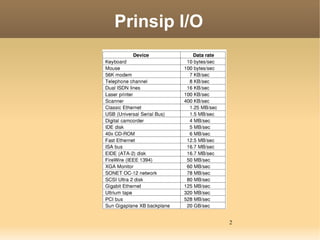
Prinsip I/O


              2
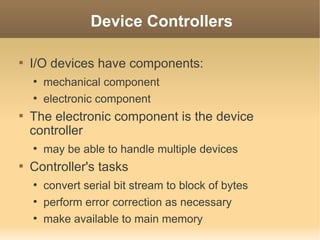
Device Controllers


    I/O devices have components:
    ●
        mechanical component
    ●
        electronic component

    The electronic component is the device
    controller
    ●
        may be able to handle multiple devices

    Controller's tasks
    ●
        convert serial bit stream to block of bytes
    ●
        perform error correction as necessary
    ●
        make available to main memory
Principles of I/O Software
                  Goals of I/O Software (1)

   Device independence
    ●   programs can access
        any I/O device
    ●   without specifying
        device in advance
        –   (floppy, hard drive, or
            CD-ROM)
   Uniform naming
    ●   name of a file or
        device a string or an
        integer
    ●   not depending on
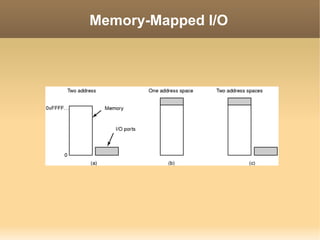
Memory-Mapped I/O
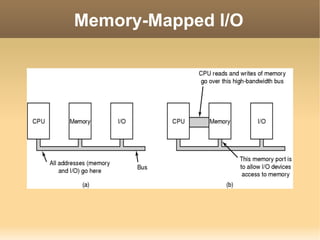
Memory-Mapped I/O
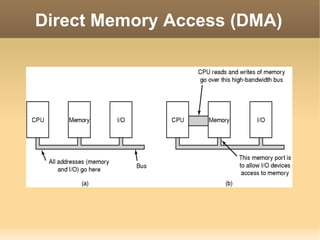
Direct Memory Access (DMA)
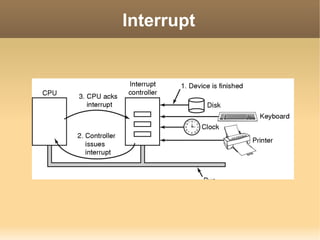
Interrupt
Not Recently Used Page Replacement
                  Algorithm

   Each page has
     Reference bit,
     Modified bit
          bits are set when
             page is
             referenced,
             modified
   Pages are classified
          not referenced,
            not modified
          not referenced,
            modified
Device-Independent I/O Software
             (1)

    Uniform interfacing for device drivers
    Buffering
    Error reporting
    Allocating and releasing dedicate devices
    Providing a deice-independent block size


Functions of the device-independent I/O software
                                                10
FIFO Page Replacement
                 Algorithm

    Maintain a linked list of all pages
       
           in order they came into memory

    Page at beginning of list replaced

    Disadvantage
       
           page in memory the longest may be often used
Device-Independent I/O Software
               (3)


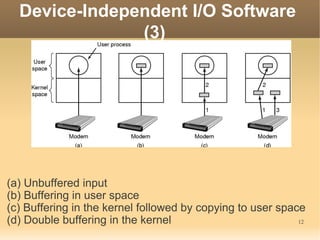
(a) Unbuffered input
(b) Buffering in user space
(c) Buffering in the kernel followed by copying to user space
(d) Double buffering in the kernel                          12
Device-Independent I/O Software
             (4)


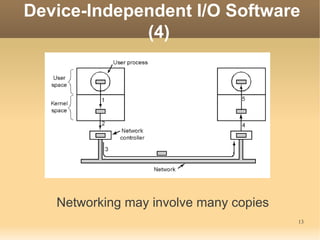
   Networking may involve many copies
                                        13
Disks
            Disk Hardware (1)


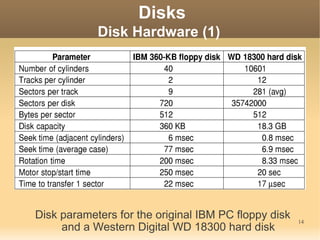
Disk parameters for the original IBM PC floppy disk   14
     and a Western Digital WD 18300 hard disk
Disk Hardware (2)



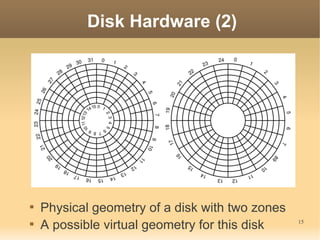
    Physical geometry of a disk with two zones

    A possible virtual geometry for this disk    15
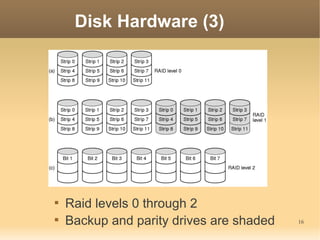
Disk Hardware (3)



    Raid levels 0 through 2

    Backup and parity drives are shaded   16
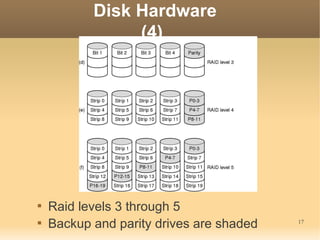
Disk Hardware
                (4)



    Raid levels 3 through 5

    Backup and parity drives are shaded   17
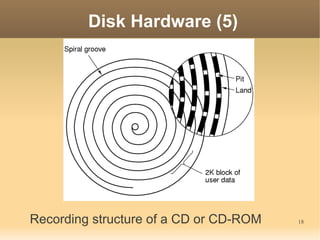
Disk Hardware (5)


Recording structure of a CD or CD-ROM   18
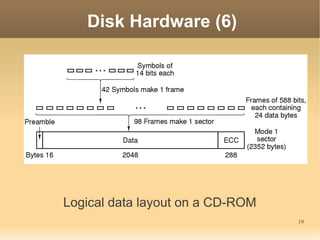
Disk Hardware (6)


Logical data layout on a CD-ROM
                                  19
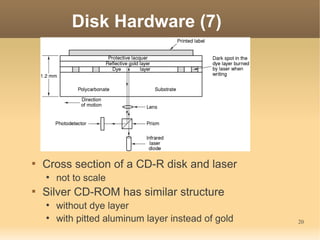
Disk Hardware (7)



    Cross section of a CD-R disk and laser
    ●
        not to scale

    Silver CD-ROM has similar structure
    ●
        without dye layer
    ●
        with pitted aluminum layer instead of gold   20
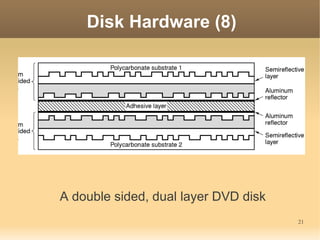
Disk Hardware (8)


A double sided, dual layer DVD disk
                                      21
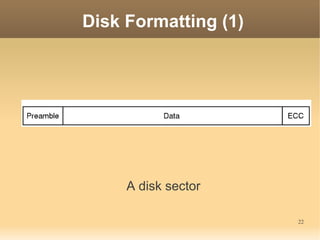
Disk Formatting (1)


     A disk sector

                      22
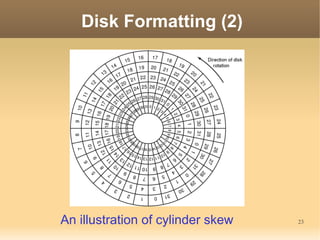
Disk Formatting (2)


An illustration of cylinder skew   23
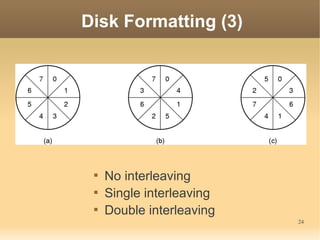
Disk Formatting (3)


 
     No interleaving
 
     Single interleaving
 
     Double interleaving
                           24
Disk Arm Scheduling Algorithms (1)
 • Time required to read or write a disk
   block determined by 3 factors
   1.   Seek time
   2.   Rotational delay
   3.   Actual transfer time
 • Seek time dominates
 • Error checking is done by controllers


                                           25
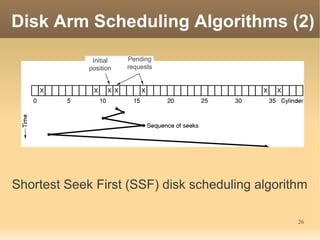
Disk Arm Scheduling Algorithms (2)
              Initial   Pending
             position   requests


Shortest Seek First (SSF) disk scheduling algorithm

                                                 26
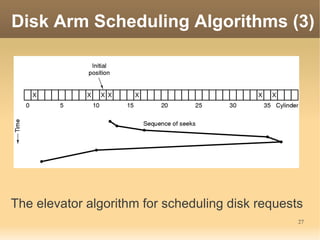
Disk Arm Scheduling Algorithms (3)


The elevator algorithm for scheduling disk requests
                                                  27
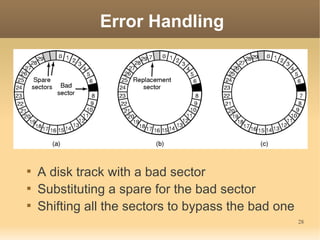
Error Handling



    A disk track with a bad sector

    Substituting a spare for the bad sector

    Shifting all the sectors to bypass the bad one
                                                     28
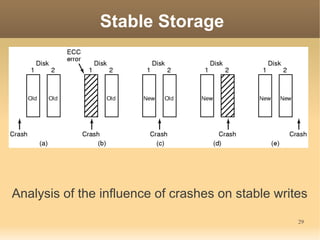
Stable Storage


Analysis of the influence of crashes on stable writes

                                                   29
Pustaka


    Avi Silberschatz, "Operating System Concepts"

    http://codex.cs.yale.edu/avi/os-
      book/OS8/os8j/index.html

    Andrew Tanenbaum, "Modern Operating
     Systems"

    http://www.cs.vu.nl/~ast/books/mos2/

    Harvey Deitel, "Operating Systems"

    http://cs.nyu.edu/~yap/classes/os/resources/origin_of
      _PV.html

    tjerdastangkas.blogspot.com/search/label/ikh311

ikh311-07

  • 1.
    Sistem Operasi IKH311 Masukan Luaran (Input/Output)
  • 2.
  • 3.
    Device Controllers  I/O devices have components: ● mechanical component ● electronic component  The electronic component is the device controller ● may be able to handle multiple devices  Controller's tasks ● convert serial bit stream to block of bytes ● perform error correction as necessary ● make available to main memory
  • 4.
    Principles of I/OSoftware Goals of I/O Software (1)  Device independence ● programs can access any I/O device ● without specifying device in advance – (floppy, hard drive, or CD-ROM)  Uniform naming ● name of a file or device a string or an integer ● not depending on
  • 5.
  • 6.
  • 7.
  • 8.
  • 9.
    Not Recently UsedPage Replacement Algorithm  Each page has Reference bit, Modified bit  bits are set when page is referenced, modified  Pages are classified  not referenced, not modified  not referenced, modified
  • 10.
    Device-Independent I/O Software (1) Uniform interfacing for device drivers Buffering Error reporting Allocating and releasing dedicate devices Providing a deice-independent block size Functions of the device-independent I/O software 10
  • 11.
    FIFO Page Replacement Algorithm  Maintain a linked list of all pages  in order they came into memory  Page at beginning of list replaced  Disadvantage  page in memory the longest may be often used
  • 12.
    Device-Independent I/O Software (3) (a) Unbuffered input (b) Buffering in user space (c) Buffering in the kernel followed by copying to user space (d) Double buffering in the kernel 12
  • 13.
    Device-Independent I/O Software (4) Networking may involve many copies 13
  • 14.
    Disks Disk Hardware (1) Disk parameters for the original IBM PC floppy disk 14 and a Western Digital WD 18300 hard disk
  • 15.
    Disk Hardware (2)  Physical geometry of a disk with two zones  A possible virtual geometry for this disk 15
  • 16.
    Disk Hardware (3)  Raid levels 0 through 2  Backup and parity drives are shaded 16
  • 17.
    Disk Hardware (4)  Raid levels 3 through 5  Backup and parity drives are shaded 17
  • 18.
    Disk Hardware (5) Recordingstructure of a CD or CD-ROM 18
  • 19.
    Disk Hardware (6) Logicaldata layout on a CD-ROM 19
  • 20.
    Disk Hardware (7)  Cross section of a CD-R disk and laser ● not to scale  Silver CD-ROM has similar structure ● without dye layer ● with pitted aluminum layer instead of gold 20
  • 21.
    Disk Hardware (8) Adouble sided, dual layer DVD disk 21
  • 22.
    Disk Formatting (1) A disk sector 22
  • 23.
    Disk Formatting (2) Anillustration of cylinder skew 23
  • 24.
    Disk Formatting (3)  No interleaving  Single interleaving  Double interleaving 24
  • 25.
    Disk Arm SchedulingAlgorithms (1) • Time required to read or write a disk block determined by 3 factors 1. Seek time 2. Rotational delay 3. Actual transfer time • Seek time dominates • Error checking is done by controllers 25
  • 26.
    Disk Arm SchedulingAlgorithms (2) Initial Pending position requests Shortest Seek First (SSF) disk scheduling algorithm 26
  • 27.
    Disk Arm SchedulingAlgorithms (3) The elevator algorithm for scheduling disk requests 27
  • 28.
    Error Handling  A disk track with a bad sector  Substituting a spare for the bad sector  Shifting all the sectors to bypass the bad one 28
  • 29.
    Stable Storage Analysis ofthe influence of crashes on stable writes 29
  • 30.
    Pustaka  Avi Silberschatz, "Operating System Concepts"  http://codex.cs.yale.edu/avi/os- book/OS8/os8j/index.html  Andrew Tanenbaum, "Modern Operating Systems"  http://www.cs.vu.nl/~ast/books/mos2/  Harvey Deitel, "Operating Systems"  http://cs.nyu.edu/~yap/classes/os/resources/origin_of _PV.html  tjerdastangkas.blogspot.com/search/label/ikh311