International Journal of Fuzzy Logic Systems (IJFLS) Vol.3, No2, April 2013
DOI : 10.5121/ijfls.2013.3205 63
SOFT-COMPUTING VIRUS
IDENTIFICATION SYSTEM
*Obi J.C1
and Okpor D.M2
Department of Computer Science, University of Benin, Benin City. Nigeria1
.
Department of Computer Science, Delta State, Polytechnic, Ozoro2
tripplejo2k2@yahoo.com1
&magaretokpor20@yahoo.com2
ABSTRACT
Virus is one of the world’s deadliest malicious software. One of the known attribute of
virus is the ability of reproducing itself and spreading from host to host. Several
approaches in recognizing virus has not been completely objective in nature. In other to
achieve this, developing a soft-computing system will help bring precision, learning
ability and optimal solution which is the focal point of this research.
KEYWORDS:
Virus, fuzzy-logic, genetic Algorithm, Neural Network
1.0 INTRODUCTION
A computer virus is an executable computer program that can replicate itself and spread from one
computer to another. The term "virus" is also commonly, but erroneously, used to refer to other
types of malware, including but not limited to adware and spyware programs that do not have a
reproductive ability (Hkust, 2002 and Wikipedia, 2013). Virus usually reside on a computer
program disrupting computer activities without replicating itself while a computer worm must
replicate itself consuming computer resources such as memory space and cpu processing time.
Examples of computer virus are malware, worms, and key-loggers etc. The majority of active
malware threats are usually trojans or worms rather than viruses (Hkust, 2002). Malware such as
Trojan horses and worms is sometimes confused with viruses, which are technically different: a
worm can exploit security vulnerabilities to spread itself automatically to other computers
through networks, while a trojan-horse is a program that appears harmless but hides malicious
functions. Worms and trojan-horses, like viruses, may harm a computer system's data or
performance. The criteria for identifying a virus are usually noticeable through abnormal system
behaviors (Hkust, 2012).
Virus can cause considerable harm and damage to a computer system, which could affect the hard
disk, the main operating system and other software relevant to system functionalities. Virus can
be prevented by strong anti-virus and regular update to harness the recent patches to prevent
International Journal of Fuzzy Logic Systems (IJFLS) Vol.3, No2, April 2013
64
exploitation of system vulnerabilities. There are many types of computer viruseswhich include
(Hkust, 2002):
a. File virus: Virus which attaches itself to program file (executable file) is known as file
virus).
b. Boot sector virus: Virus which affects system sector is known as boot virus. These system
sectors includes hard-disk, floppy disk etc).
c. Macro Virus: Virus writtenuses a language built into a particular application
d. Virus Hoax: A virus in the form of a compulsory non-existent message intended in
bending the user to carry a particular.
A complete soft-computing system for the recognition of computer virus utilizing genetic
algorithm, fuzzy logic and neural network drives this research hunt. Genetic algorithm will help
optimize the fuzzy set to arrive at a floor or roof value representing the clusters of the
membership function. The parameters for identifying computer virus are usually vague therefore
the adoption of fuzzy to set a boundary case while neural network provide the self-learning ability
(Hkust, 2002).
2.0 REVIEW OF RELATED LITERATURES
The research work of (Nitesh et al., 2012) provides a general overview on computer viruses and
defensive techniques. They focused on reviewing the techniques utilized by anti-virus experts
design in and develop new antivirus (Babak et al., 2011) which was utilized in proposing their
own work.
The research work on the regulation of virus by (Mathias, 2003) took a critical look phenomena
of computer virus computer virus helping legislator both locally and internationally prohibit it
spread and influence. It also exploits the alternative use of virus for which a legislator should be
aware of when processing the legal status of computer code.
The criteria’s/parameters for recognizing and identifying virus are (Arnold, 2012)
a. Decline system speed: The speed of most system is closely linked with virus infection or
not. Most system infected with virus usually run slower disrupting relevant daily operation.
If the user disconnects from the internet and the system performs improve tremendously
and perform decline gradually while connected to the internet, it is a sure sign of virus
infection.
b. Numerous system errors: When a user experiences strange errors or just more errors that
disrupt daily operation such asclose your programs or causing the user to restart your
computer, there is a high possibility of virus infection. Sometimes errors are normal, but
constant occurrence is problematic. By keeping a log of errors experiences, when it
occurred and the severity can help mitigate the issues.
c. Persistent Logoff: when the computer system continuously and persistently logoff without
the user initiating it indicates the present of virus.
International Journal of Fuzzy Logic Systems (IJFLS) Vol.3, No2, April 2013
65
d. Disable security software: When updated anti-virus software, firewall or window updates
has been change or disabled not by the user, virus is sequentially at work. Lack of updated
anti-virus, open the way for to exploit system vulnerabilities.
e. Abnormal Internet system Behaviors: The abnormal behavior of system when connected
to the Internet is another sign of virus infection. Virus is malicious codes therefore,
compromising sensitive document are usually one of their main purpose but this is only
possible when online.
f. Obvious desktop changes: Desktop icons are the small graphics on most computers
desktop. Under normal circumstances, a desktop icon only appears when a piece of
software is loaded, ask the program to load an icon, or when it is dragged from the icon of a
program list and drop it to on the desktop. The present of virus introduce desktop icons that
were not requested for.
g. Continuous Hard Drive noise: The retrieval of information from the system hard disk,
disk drive and external hard disk is usually accompanied by a slow processing noise which
is normal for any performing system. The continuous performs of this noise with or without
computer operation highlights computer virus infection.
Zadeh introduced fuzzy logic from which fuzzy set steams out as a means of handling
imprecision in real work data (Zadeh, 1965). Crisp values which propagate true or false values,
yes or no, and 0 or 1. Fuzzy provides ranges of values streaming from 0.00 through 1.00 Fuzzy
sets provide a means of representing and manipulating data that are not precise, but rather fuzzy
(Cengiz et al., 2007). Fuzzy logic is a superset of conventional (Boolean) logic that has been
extended to handle the concept of partial truth - truth values between "completely true" and
"completely false"(Abdelnassir, 2005; Kasabov, 1998; Robert, 1995; Christos and Dimitros,
2008, Leondes, 2010). Fuzzy logic works closely with neural network because they provide the
rules necessary for neural net trainer to adapt to in carrying out a particular action. They also
learn for close observations.
Integrated neurons form a neural net (Simon, 1999). This neuron is program construct mimicking
the biological parallel working of the human brain. There are different type of neural work such
supervised learning, unsupervised and reinforced learning rolling along several topology such as
feed-forward, feedback, adaptive resonant theory kohen self-organizing and counter-propagation.
The internal and external information flowing through the network results in continuous system
refinement leading optimal system results.
Genetic Algorithm is a search and optimization techniques made up of four main components
which include:
a. The fitness function, also called evaluation function, is the genetic algorithm component
that rates potential solution by calculating how good they are relative to the current
problem domain (Christian and Gustav 2003).
b. Selection enhances the movement of string of bit toward optimal genetic search space.
The individual bit is cross with other individual bit aim order to arrive at our optimal
fitness function.A lower selection pressure is recommended in the start of the genetic
search; while a higher selection pressure is recommended at the end in order to narrow
International Journal of Fuzzy Logic Systems (IJFLS) Vol.3, No2, April 2013
66
c. Mutation operator changes one or more gene values in a chromosome. Mutation means
taking, one or more random chromosomes from the DNA string and changing it (for
example, 0 become 1 and vice versa).
d. Crossover, involves exchanging chromosome portions of genetic material. The result is
that a large variety of genetic combinations will be produced. In other words, crossover
takes two of the fittest genetic strings in a population and combines the two of them to
generate new genetic string (Christian and Gustav 2003).
3.0 MATERIAL METHOD, RESULT AND DISCUSSION
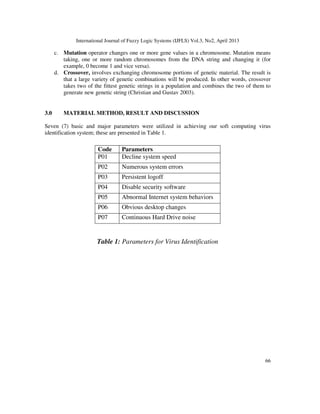
Seven (7) basic and major parameters were utilized in achieving our soft computing virus
identification system; these are presented in Table 1.
Table 1: Parameters for Virus Identification
Code Parameters
P01 Decline system speed
P02 Numerous system errors
P03 Persistent logoff
P04 Disable security software
P05 Abnormal Internet system behaviors
P06 Obvious desktop changes
P07 Continuous Hard Drive noise
International Journal of Fuzzy Logic Systems (IJFLS) Vol.3, No2, April 2013
67
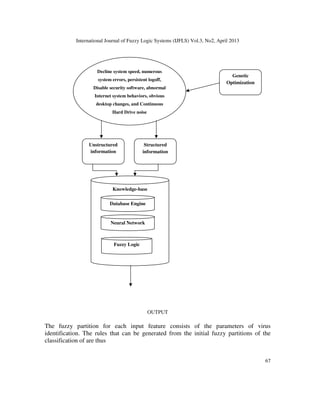
OUTPUT
The fuzzy partition for each input feature consists of the parameters of virus
identification. The rules that can be generated from the initial fuzzy partitions of the
classification of are thus
Knowledge-base
Database Engine
Neural Network
Fuzzy Logic
Decline system speed, numerous
system errors, persistent logoff,
Disable security software, abnormal
Internet system behaviors, obvious
desktop changes, and Continuous
Hard Drive noise
Structured
information
Unstructured
information
Genetic
Optimization
International Journal of Fuzzy Logic Systems (IJFLS) Vol.3, No2, April 2013
68
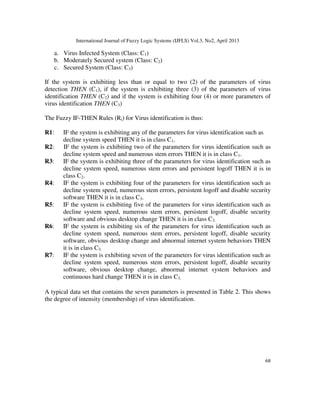
a. Virus Infected System (Class: C1)
b. Moderately Secured system (Class: C2)
c. Secured System (Class: C3)
If the system is exhibiting less than or equal to two (2) of the parameters of virus
detection THEN (C1), if the system is exhibiting three (3) of the parameters of virus
identification THEN (C2) and if the system is exhibiting four (4) or more parameters of
virus identification THEN (C3)
The Fuzzy IF-THEN Rules (Ri) for Virus identification is thus:
R1: IF the system is exhibiting any of the parameters for virus identification such as
decline system speed THEN it is in class C1.
R2: IF the system is exhibiting two of the parameters for virus identification such as
decline system speed and numerous stem errors THEN it is in class C1.
R3: IF the system is exhibiting three of the parameters for virus identification such as
decline system speed, numerous stem errors and persistent logoff THEN it is in
class C2.
R4: IF the system is exhibiting four of the parameters for virus identification such as
decline system speed, numerous stem errors, persistent logoff and disable security
software THEN it is in class C3.
R5: IF the system is exhibiting five of the parameters for virus identification such as
decline system speed, numerous stem errors, persistent logoff, disable security
software and obvious desktop change THEN it is in class C3.
R6: IF the system is exhibiting six of the parameters for virus identification such as
decline system speed, numerous stem errors, persistent logoff, disable security
software, obvious desktop change and abnormal internet system behaviors THEN
it is in class C3.
R7: IF the system is exhibiting seven of the parameters for virus identification such as
decline system speed, numerous stem errors, persistent logoff, disable security
software, obvious desktop change, abnormal internet system behaviors and
continuous hard change THEN it is in class C3.
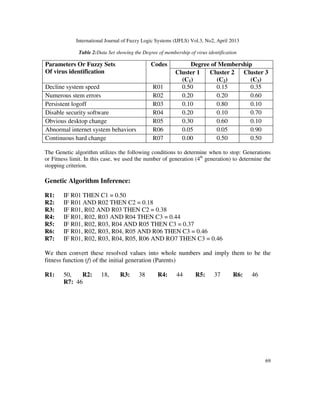
A typical data set that contains the seven parameters is presented in Table 2. This shows
the degree of intensity (membership) of virus identification.
International Journal of Fuzzy Logic Systems (IJFLS) Vol.3, No2, April 2013
69
Table 2:Data Set showing the Degree of membership of virus identification
The Genetic algorithm utilizes the following conditions to determine when to stop: Generations
or Fitness limit. In this case, we used the number of generation (4th
generation) to determine the
stopping criterion.
Genetic Algorithm Inference:
R1: IF R01 THEN C1 = 0.50
R2: IF R01 AND R02 THEN C2 = 0.18
R3: IF R01, R02 AND R03 THEN C2 = 0.38
R4: IF R01, R02, R03 AND R04 THEN C3 = 0.44
R5: IF R01, R02, R03, R04 AND R05 THEN C3 = 0.37
R6: IF R01, R02, R03, R04, R05 AND R06 THEN C3 = 0.46
R7: IF R01, R02, R03, R04, R05, R06 AND RO7 THEN C3 = 0.46
We then convert these resolved values into whole numbers and imply them to be the
fitness function (f) of the initial generation (Parents)
R1: 50, R2: 18, R3: 38 R4: 44 R5: 37 R6: 46
R7: 46
Parameters Or Fuzzy Sets
Of virus identification
Codes Degree of Membership
Cluster 1
(C1)
Cluster 2
(C2)
Cluster 3
(C3)
Decline system speed R01 0.50 0.15 0.35
Numerous stem errors R02 0.20 0.20 0.60
Persistent logoff R03 0.10 0.80 0.10
Disable security software R04 0.20 0.10 0.70
Obvious desktop change R05 0.30 0.60 0.10
Abnormal internet system behaviors R06 0.05 0.05 0.90
Continuous hard change R07 0.00 0.50 0.50
International Journal of Fuzzy Logic Systems (IJFLS) Vol.3, No2, April 2013
70
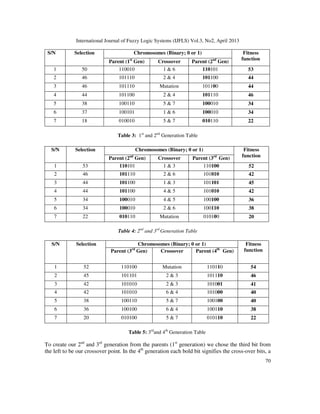
S/N Selection Chromosomes (Binary; 0 or 1) Fitness
function
Parent (1st
Gen) Crossover Parent (2nd
Gen)
1 50 110010 1 & 6 110101 53
2 46 101110 2 & 4 101100 44
3 46 101110 Mutation 101100 44
4 44 101100 2 & 4 101110 46
5 38 100110 5 & 7 100010 34
6 37 100101 1 & 6 100010 34
7 18 010010 5 & 7 010110 22
Table 3: 1st
and 2nd
Generation Table
Table 4: 2nd
and 3rd
Generation Table
Table 5: 3rd
and 4th
Generation Table
To create our 2nd
and 3rd
generation from the parents (1st
generation) we chose the third bit from
the left to be our crossover point. In the 4th
generation each bold bit signifies the cross-over bits, a
S/N Selection Chromosomes (Binary; 0 or 1) Fitness
functionParent (2nd
Gen) Crossover Parent (3rd
Gen)
1 53 110101 1 & 3 110100 52
2 46 101110 2 & 6 101010 42
3 44 101100 1 & 3 101101 45
4 44 101100 4 & 5 101010 42
5 34 100010 4 & 5 100100 36
6 34 100010 2 & 6 100110 38
7 22 010110 Mutation 010100 20
S/N Selection Chromosomes (Binary; 0 or 1) Fitness
functionParent (3rd
Gen) Crossover Parent (4th
Gen)
1 52 110100 Mutation 110110 54
2 45 101101 2 & 3 101110 46
3 42 101010 2 & 3 101001 41
4 42 101010 6 & 4 101000 40
5 38 100110 5 & 7 100100 40
6 36 100100 6 & 4 100110 38
7 20 010100 5 & 7 010110 22
International Journal of Fuzzy Logic Systems (IJFLS) Vol.3, No2, April 2013
71
single bold bit signifies mutation of that bit and an italicized chromosomes signifies elitism. The
best fourth generation (stopping criterion) is that with the best fitness function, 54. This implies
that the clusters of the various parameters has been searched and optimized to 0.54. Therefore
combination of parameters which produce a membership function < 0.54 = C1, 0.54 = C2 and ≥
0.54 = C3 as presented in Figure 4.
Table 6: Data Set showing the Degree of membership of Operating System Process
4.0 CONCLUSION
A complete soft-computing client-side system for the identification of virus has been developed.
The developed system will indicate the recent state of a user system based on the aforementioned
parameters for the recognition of virus. Full Implementation of such system will go a long way in
curbing the spread of virus on computer systems.
REFERENCE
[1] AbdelnassirA. (2005), “Torque Ripple Minimization in Direct Torque Control of Induction
Machines” A Thesis Presented to The Graduate Faculty of the University of Akron In Partial
Fulfillment of the Requirements for the Degree Master of Science, retrieved online from
http://etd.ohiolink.edu/send-pdf.cgi/Abdalla%2520Abdelnassir.pdf?akron1116121267
[2] Arnold A. (2012), “Computer Virus Symptom List”, retrieved online from
http://www.ehow.com/list_6594924_computer-virus-symptomlist.html#ixzz2Mrmvxn6o.
Parameters Or Fuzzy Sets
Of Operating System Process
Codes Degree of Membership
Cluster 1
(C1)
Cluster 2
(C2)
Cluster 3
(C3)
Decline system speed R01 0.50 0.15 0.35
Numerous stem errors R02 0.20 0.20 0.60
Persistent logoff R03 0.10 0.80 0.10
Disable security software R04 0.20 0.10 0.70
Obvious desktop change R05 0.30 0.60 0.10
Abnormal internet system behaviors R06 0.05 0.05 0.90
Continuous hard change R07 0.00 0.50 0.50
Result Virus
Infected
System
Moderatel
y Secured
System
Secure
System
International Journal of Fuzzy Logic Systems (IJFLS) Vol.3, No2, April 2013
72
[3] BabakB. R.., Maslin M. and Suhaimi I. (2011), “Evolution of Computer Virus Concealment and Anti-
Virus Techniques: A Short Survey”,International Journal of Computer Science Issues (IJCSI), Vol. 8, Issue 1, pp.
113-121.
[4] Cengiz K., Sezi C., Nufer Y.A. and Murat G. (2007), “Fuzzy multi-criteria evaluation of industrial
robotic systems” , Computers & Industrial Engineering, Vol. 52, Issue 4, Pages 414–433.
[5] Christian J. and Gustav E. (2003), “Optimizing Genetic Algorithms for Time Critical
Problems”,Department of Software Engineering and Computer Sciencelekinge Institute of
Technology Box 520 SE ä 372 25 Ronneby Sweden.
[6] Christos S. and Dimitros S. (2008) “Neural Network”, retrieved from
http://www.docstoc.com/docs/15050/neural-networks.
[7] Larry A. (2013), “How to Identify Computer Virus Symptoms” retrieved online from
http://www.ehow.com/how_4903119_identify-computer-virus-symptoms.html#ixzz2Mr
[8] Hkust,(2002), Types of Virus”, retrieved online from
http://www.ust.hk/itsc/antivirus/general/types.html
[9] Kasabov N. K. (1998), “Foundations of neural networks, fuzzy systems, and knowledge
engineering”, A Bradford Book, The MIT Press Cambridge, Massachusetts London, England, ISBN
0-262-11212-4.
[10] Leondes C (2010), “The Technology of Fuzzy Logic Algorithm retrieved from
Suite101.com/examples-of-expert-System-application-in-artificial Intelligence.
[11] Mathias K. (2003), “A Critical Look at the regulations of Computer Viruses”, International Journal
of Law and Information technology, Retrieved online from http://www.digital-rights.net/wp-
content/uploads/2008/01/klang_virus_ijlit.pdf.
[12] Nitesh K. D., Lokesh m., Mahendra S. C. and Bhabesh K. D., (2012), “The New Age
OfComputer Virus And Their Detection”, International Journal of Network Security & Its
Applications (IJNSA), Vol.4, No.3, retrieved on from http://airccse.org/journal/jnsa12_current.html
[13] Robert F. (1995), “Neural Fuzzy Systems”retrieved online from
http://faculty.petra.ac.id/resmana/basiclab/fuzzy/fuzzy_book.pdf.
[14] Simon S.H. (1999), “Neural Network: A comprehensive Foundation, Pretice Hall, Chapter 1-15, Pp.
1-889)
[15] Tom B. (2002), “Retail Market Basket Analysis: A Quantitative Modelling Approach” Dissertation
submitted to obtain the degree of Doctor in Applied Economic Sciences at the Limburg University
Center.
[16] Wikipedia (2013), “Computer virus” retrieved online from en.wikipedia.org/wiki/
[17] Zadeh L. A. (1965), “Fuzzy sets, Information and Control”, Vol.8, pp.338-353.

Ijfls05

  • 1.
    International Journal ofFuzzy Logic Systems (IJFLS) Vol.3, No2, April 2013 DOI : 10.5121/ijfls.2013.3205 63 SOFT-COMPUTING VIRUS IDENTIFICATION SYSTEM *Obi J.C1 and Okpor D.M2 Department of Computer Science, University of Benin, Benin City. Nigeria1 . Department of Computer Science, Delta State, Polytechnic, Ozoro2 tripplejo2k2@yahoo.com1 &magaretokpor20@yahoo.com2 ABSTRACT Virus is one of the world’s deadliest malicious software. One of the known attribute of virus is the ability of reproducing itself and spreading from host to host. Several approaches in recognizing virus has not been completely objective in nature. In other to achieve this, developing a soft-computing system will help bring precision, learning ability and optimal solution which is the focal point of this research. KEYWORDS: Virus, fuzzy-logic, genetic Algorithm, Neural Network 1.0 INTRODUCTION A computer virus is an executable computer program that can replicate itself and spread from one computer to another. The term "virus" is also commonly, but erroneously, used to refer to other types of malware, including but not limited to adware and spyware programs that do not have a reproductive ability (Hkust, 2002 and Wikipedia, 2013). Virus usually reside on a computer program disrupting computer activities without replicating itself while a computer worm must replicate itself consuming computer resources such as memory space and cpu processing time. Examples of computer virus are malware, worms, and key-loggers etc. The majority of active malware threats are usually trojans or worms rather than viruses (Hkust, 2002). Malware such as Trojan horses and worms is sometimes confused with viruses, which are technically different: a worm can exploit security vulnerabilities to spread itself automatically to other computers through networks, while a trojan-horse is a program that appears harmless but hides malicious functions. Worms and trojan-horses, like viruses, may harm a computer system's data or performance. The criteria for identifying a virus are usually noticeable through abnormal system behaviors (Hkust, 2012). Virus can cause considerable harm and damage to a computer system, which could affect the hard disk, the main operating system and other software relevant to system functionalities. Virus can be prevented by strong anti-virus and regular update to harness the recent patches to prevent
  • 2.
    International Journal ofFuzzy Logic Systems (IJFLS) Vol.3, No2, April 2013 64 exploitation of system vulnerabilities. There are many types of computer viruseswhich include (Hkust, 2002): a. File virus: Virus which attaches itself to program file (executable file) is known as file virus). b. Boot sector virus: Virus which affects system sector is known as boot virus. These system sectors includes hard-disk, floppy disk etc). c. Macro Virus: Virus writtenuses a language built into a particular application d. Virus Hoax: A virus in the form of a compulsory non-existent message intended in bending the user to carry a particular. A complete soft-computing system for the recognition of computer virus utilizing genetic algorithm, fuzzy logic and neural network drives this research hunt. Genetic algorithm will help optimize the fuzzy set to arrive at a floor or roof value representing the clusters of the membership function. The parameters for identifying computer virus are usually vague therefore the adoption of fuzzy to set a boundary case while neural network provide the self-learning ability (Hkust, 2002). 2.0 REVIEW OF RELATED LITERATURES The research work of (Nitesh et al., 2012) provides a general overview on computer viruses and defensive techniques. They focused on reviewing the techniques utilized by anti-virus experts design in and develop new antivirus (Babak et al., 2011) which was utilized in proposing their own work. The research work on the regulation of virus by (Mathias, 2003) took a critical look phenomena of computer virus computer virus helping legislator both locally and internationally prohibit it spread and influence. It also exploits the alternative use of virus for which a legislator should be aware of when processing the legal status of computer code. The criteria’s/parameters for recognizing and identifying virus are (Arnold, 2012) a. Decline system speed: The speed of most system is closely linked with virus infection or not. Most system infected with virus usually run slower disrupting relevant daily operation. If the user disconnects from the internet and the system performs improve tremendously and perform decline gradually while connected to the internet, it is a sure sign of virus infection. b. Numerous system errors: When a user experiences strange errors or just more errors that disrupt daily operation such asclose your programs or causing the user to restart your computer, there is a high possibility of virus infection. Sometimes errors are normal, but constant occurrence is problematic. By keeping a log of errors experiences, when it occurred and the severity can help mitigate the issues. c. Persistent Logoff: when the computer system continuously and persistently logoff without the user initiating it indicates the present of virus.
  • 3.
    International Journal ofFuzzy Logic Systems (IJFLS) Vol.3, No2, April 2013 65 d. Disable security software: When updated anti-virus software, firewall or window updates has been change or disabled not by the user, virus is sequentially at work. Lack of updated anti-virus, open the way for to exploit system vulnerabilities. e. Abnormal Internet system Behaviors: The abnormal behavior of system when connected to the Internet is another sign of virus infection. Virus is malicious codes therefore, compromising sensitive document are usually one of their main purpose but this is only possible when online. f. Obvious desktop changes: Desktop icons are the small graphics on most computers desktop. Under normal circumstances, a desktop icon only appears when a piece of software is loaded, ask the program to load an icon, or when it is dragged from the icon of a program list and drop it to on the desktop. The present of virus introduce desktop icons that were not requested for. g. Continuous Hard Drive noise: The retrieval of information from the system hard disk, disk drive and external hard disk is usually accompanied by a slow processing noise which is normal for any performing system. The continuous performs of this noise with or without computer operation highlights computer virus infection. Zadeh introduced fuzzy logic from which fuzzy set steams out as a means of handling imprecision in real work data (Zadeh, 1965). Crisp values which propagate true or false values, yes or no, and 0 or 1. Fuzzy provides ranges of values streaming from 0.00 through 1.00 Fuzzy sets provide a means of representing and manipulating data that are not precise, but rather fuzzy (Cengiz et al., 2007). Fuzzy logic is a superset of conventional (Boolean) logic that has been extended to handle the concept of partial truth - truth values between "completely true" and "completely false"(Abdelnassir, 2005; Kasabov, 1998; Robert, 1995; Christos and Dimitros, 2008, Leondes, 2010). Fuzzy logic works closely with neural network because they provide the rules necessary for neural net trainer to adapt to in carrying out a particular action. They also learn for close observations. Integrated neurons form a neural net (Simon, 1999). This neuron is program construct mimicking the biological parallel working of the human brain. There are different type of neural work such supervised learning, unsupervised and reinforced learning rolling along several topology such as feed-forward, feedback, adaptive resonant theory kohen self-organizing and counter-propagation. The internal and external information flowing through the network results in continuous system refinement leading optimal system results. Genetic Algorithm is a search and optimization techniques made up of four main components which include: a. The fitness function, also called evaluation function, is the genetic algorithm component that rates potential solution by calculating how good they are relative to the current problem domain (Christian and Gustav 2003). b. Selection enhances the movement of string of bit toward optimal genetic search space. The individual bit is cross with other individual bit aim order to arrive at our optimal fitness function.A lower selection pressure is recommended in the start of the genetic search; while a higher selection pressure is recommended at the end in order to narrow
  • 4.
    International Journal ofFuzzy Logic Systems (IJFLS) Vol.3, No2, April 2013 66 c. Mutation operator changes one or more gene values in a chromosome. Mutation means taking, one or more random chromosomes from the DNA string and changing it (for example, 0 become 1 and vice versa). d. Crossover, involves exchanging chromosome portions of genetic material. The result is that a large variety of genetic combinations will be produced. In other words, crossover takes two of the fittest genetic strings in a population and combines the two of them to generate new genetic string (Christian and Gustav 2003). 3.0 MATERIAL METHOD, RESULT AND DISCUSSION Seven (7) basic and major parameters were utilized in achieving our soft computing virus identification system; these are presented in Table 1. Table 1: Parameters for Virus Identification Code Parameters P01 Decline system speed P02 Numerous system errors P03 Persistent logoff P04 Disable security software P05 Abnormal Internet system behaviors P06 Obvious desktop changes P07 Continuous Hard Drive noise
  • 5.
    International Journal ofFuzzy Logic Systems (IJFLS) Vol.3, No2, April 2013 67 OUTPUT The fuzzy partition for each input feature consists of the parameters of virus identification. The rules that can be generated from the initial fuzzy partitions of the classification of are thus Knowledge-base Database Engine Neural Network Fuzzy Logic Decline system speed, numerous system errors, persistent logoff, Disable security software, abnormal Internet system behaviors, obvious desktop changes, and Continuous Hard Drive noise Structured information Unstructured information Genetic Optimization
  • 6.
    International Journal ofFuzzy Logic Systems (IJFLS) Vol.3, No2, April 2013 68 a. Virus Infected System (Class: C1) b. Moderately Secured system (Class: C2) c. Secured System (Class: C3) If the system is exhibiting less than or equal to two (2) of the parameters of virus detection THEN (C1), if the system is exhibiting three (3) of the parameters of virus identification THEN (C2) and if the system is exhibiting four (4) or more parameters of virus identification THEN (C3) The Fuzzy IF-THEN Rules (Ri) for Virus identification is thus: R1: IF the system is exhibiting any of the parameters for virus identification such as decline system speed THEN it is in class C1. R2: IF the system is exhibiting two of the parameters for virus identification such as decline system speed and numerous stem errors THEN it is in class C1. R3: IF the system is exhibiting three of the parameters for virus identification such as decline system speed, numerous stem errors and persistent logoff THEN it is in class C2. R4: IF the system is exhibiting four of the parameters for virus identification such as decline system speed, numerous stem errors, persistent logoff and disable security software THEN it is in class C3. R5: IF the system is exhibiting five of the parameters for virus identification such as decline system speed, numerous stem errors, persistent logoff, disable security software and obvious desktop change THEN it is in class C3. R6: IF the system is exhibiting six of the parameters for virus identification such as decline system speed, numerous stem errors, persistent logoff, disable security software, obvious desktop change and abnormal internet system behaviors THEN it is in class C3. R7: IF the system is exhibiting seven of the parameters for virus identification such as decline system speed, numerous stem errors, persistent logoff, disable security software, obvious desktop change, abnormal internet system behaviors and continuous hard change THEN it is in class C3. A typical data set that contains the seven parameters is presented in Table 2. This shows the degree of intensity (membership) of virus identification.
  • 7.
    International Journal ofFuzzy Logic Systems (IJFLS) Vol.3, No2, April 2013 69 Table 2:Data Set showing the Degree of membership of virus identification The Genetic algorithm utilizes the following conditions to determine when to stop: Generations or Fitness limit. In this case, we used the number of generation (4th generation) to determine the stopping criterion. Genetic Algorithm Inference: R1: IF R01 THEN C1 = 0.50 R2: IF R01 AND R02 THEN C2 = 0.18 R3: IF R01, R02 AND R03 THEN C2 = 0.38 R4: IF R01, R02, R03 AND R04 THEN C3 = 0.44 R5: IF R01, R02, R03, R04 AND R05 THEN C3 = 0.37 R6: IF R01, R02, R03, R04, R05 AND R06 THEN C3 = 0.46 R7: IF R01, R02, R03, R04, R05, R06 AND RO7 THEN C3 = 0.46 We then convert these resolved values into whole numbers and imply them to be the fitness function (f) of the initial generation (Parents) R1: 50, R2: 18, R3: 38 R4: 44 R5: 37 R6: 46 R7: 46 Parameters Or Fuzzy Sets Of virus identification Codes Degree of Membership Cluster 1 (C1) Cluster 2 (C2) Cluster 3 (C3) Decline system speed R01 0.50 0.15 0.35 Numerous stem errors R02 0.20 0.20 0.60 Persistent logoff R03 0.10 0.80 0.10 Disable security software R04 0.20 0.10 0.70 Obvious desktop change R05 0.30 0.60 0.10 Abnormal internet system behaviors R06 0.05 0.05 0.90 Continuous hard change R07 0.00 0.50 0.50
  • 8.
    International Journal ofFuzzy Logic Systems (IJFLS) Vol.3, No2, April 2013 70 S/N Selection Chromosomes (Binary; 0 or 1) Fitness function Parent (1st Gen) Crossover Parent (2nd Gen) 1 50 110010 1 & 6 110101 53 2 46 101110 2 & 4 101100 44 3 46 101110 Mutation 101100 44 4 44 101100 2 & 4 101110 46 5 38 100110 5 & 7 100010 34 6 37 100101 1 & 6 100010 34 7 18 010010 5 & 7 010110 22 Table 3: 1st and 2nd Generation Table Table 4: 2nd and 3rd Generation Table Table 5: 3rd and 4th Generation Table To create our 2nd and 3rd generation from the parents (1st generation) we chose the third bit from the left to be our crossover point. In the 4th generation each bold bit signifies the cross-over bits, a S/N Selection Chromosomes (Binary; 0 or 1) Fitness functionParent (2nd Gen) Crossover Parent (3rd Gen) 1 53 110101 1 & 3 110100 52 2 46 101110 2 & 6 101010 42 3 44 101100 1 & 3 101101 45 4 44 101100 4 & 5 101010 42 5 34 100010 4 & 5 100100 36 6 34 100010 2 & 6 100110 38 7 22 010110 Mutation 010100 20 S/N Selection Chromosomes (Binary; 0 or 1) Fitness functionParent (3rd Gen) Crossover Parent (4th Gen) 1 52 110100 Mutation 110110 54 2 45 101101 2 & 3 101110 46 3 42 101010 2 & 3 101001 41 4 42 101010 6 & 4 101000 40 5 38 100110 5 & 7 100100 40 6 36 100100 6 & 4 100110 38 7 20 010100 5 & 7 010110 22
  • 9.
    International Journal ofFuzzy Logic Systems (IJFLS) Vol.3, No2, April 2013 71 single bold bit signifies mutation of that bit and an italicized chromosomes signifies elitism. The best fourth generation (stopping criterion) is that with the best fitness function, 54. This implies that the clusters of the various parameters has been searched and optimized to 0.54. Therefore combination of parameters which produce a membership function < 0.54 = C1, 0.54 = C2 and ≥ 0.54 = C3 as presented in Figure 4. Table 6: Data Set showing the Degree of membership of Operating System Process 4.0 CONCLUSION A complete soft-computing client-side system for the identification of virus has been developed. The developed system will indicate the recent state of a user system based on the aforementioned parameters for the recognition of virus. Full Implementation of such system will go a long way in curbing the spread of virus on computer systems. REFERENCE [1] AbdelnassirA. (2005), “Torque Ripple Minimization in Direct Torque Control of Induction Machines” A Thesis Presented to The Graduate Faculty of the University of Akron In Partial Fulfillment of the Requirements for the Degree Master of Science, retrieved online from http://etd.ohiolink.edu/send-pdf.cgi/Abdalla%2520Abdelnassir.pdf?akron1116121267 [2] Arnold A. (2012), “Computer Virus Symptom List”, retrieved online from http://www.ehow.com/list_6594924_computer-virus-symptomlist.html#ixzz2Mrmvxn6o. Parameters Or Fuzzy Sets Of Operating System Process Codes Degree of Membership Cluster 1 (C1) Cluster 2 (C2) Cluster 3 (C3) Decline system speed R01 0.50 0.15 0.35 Numerous stem errors R02 0.20 0.20 0.60 Persistent logoff R03 0.10 0.80 0.10 Disable security software R04 0.20 0.10 0.70 Obvious desktop change R05 0.30 0.60 0.10 Abnormal internet system behaviors R06 0.05 0.05 0.90 Continuous hard change R07 0.00 0.50 0.50 Result Virus Infected System Moderatel y Secured System Secure System
  • 10.
    International Journal ofFuzzy Logic Systems (IJFLS) Vol.3, No2, April 2013 72 [3] BabakB. R.., Maslin M. and Suhaimi I. (2011), “Evolution of Computer Virus Concealment and Anti- Virus Techniques: A Short Survey”,International Journal of Computer Science Issues (IJCSI), Vol. 8, Issue 1, pp. 113-121. [4] Cengiz K., Sezi C., Nufer Y.A. and Murat G. (2007), “Fuzzy multi-criteria evaluation of industrial robotic systems” , Computers & Industrial Engineering, Vol. 52, Issue 4, Pages 414–433. [5] Christian J. and Gustav E. (2003), “Optimizing Genetic Algorithms for Time Critical Problems”,Department of Software Engineering and Computer Sciencelekinge Institute of Technology Box 520 SE ä 372 25 Ronneby Sweden. [6] Christos S. and Dimitros S. (2008) “Neural Network”, retrieved from http://www.docstoc.com/docs/15050/neural-networks. [7] Larry A. (2013), “How to Identify Computer Virus Symptoms” retrieved online from http://www.ehow.com/how_4903119_identify-computer-virus-symptoms.html#ixzz2Mr [8] Hkust,(2002), Types of Virus”, retrieved online from http://www.ust.hk/itsc/antivirus/general/types.html [9] Kasabov N. K. (1998), “Foundations of neural networks, fuzzy systems, and knowledge engineering”, A Bradford Book, The MIT Press Cambridge, Massachusetts London, England, ISBN 0-262-11212-4. [10] Leondes C (2010), “The Technology of Fuzzy Logic Algorithm retrieved from Suite101.com/examples-of-expert-System-application-in-artificial Intelligence. [11] Mathias K. (2003), “A Critical Look at the regulations of Computer Viruses”, International Journal of Law and Information technology, Retrieved online from http://www.digital-rights.net/wp- content/uploads/2008/01/klang_virus_ijlit.pdf. [12] Nitesh K. D., Lokesh m., Mahendra S. C. and Bhabesh K. D., (2012), “The New Age OfComputer Virus And Their Detection”, International Journal of Network Security & Its Applications (IJNSA), Vol.4, No.3, retrieved on from http://airccse.org/journal/jnsa12_current.html [13] Robert F. (1995), “Neural Fuzzy Systems”retrieved online from http://faculty.petra.ac.id/resmana/basiclab/fuzzy/fuzzy_book.pdf. [14] Simon S.H. (1999), “Neural Network: A comprehensive Foundation, Pretice Hall, Chapter 1-15, Pp. 1-889) [15] Tom B. (2002), “Retail Market Basket Analysis: A Quantitative Modelling Approach” Dissertation submitted to obtain the degree of Doctor in Applied Economic Sciences at the Limburg University Center. [16] Wikipedia (2013), “Computer virus” retrieved online from en.wikipedia.org/wiki/ [17] Zadeh L. A. (1965), “Fuzzy sets, Information and Control”, Vol.8, pp.338-353.