908
IEICE TRANS. COMMUN., VOL.E83–B, NO.5 MAY 2000
PAPER IEICE/IEEE Joint Special Issue on Autonomous Decentralized Systems
A Distributed Approach against Computer Viruses
Inspired by the Immune System∗
Takeshi OKAMOTO†
, Nonmember and Yoshiteru ISHIDA†
, Member
SUMMARY More than forty thousands computer viruses
have appeared so far since the first virus. Six computer viruses
on average appear every day. Enormous expansion of the com-
puter network opened a thread of explosive spread of computer
viruses. In this paper, we propose a distributed approach against
computer virus using the computer network that allows dis-
tributed and agent-based approach. Our system is composed of
an ÑÑÙÒ ØÝ¹ × ×Ýר Ñ similar to the biological immune sys-
tem and Ö ÓÚ ÖÝ ×Ýר Ñ similar to the recovery mechanism by
cell division. The ÑÑÙÒ ØÝ¹ × ×Ýר Ñ recognizes “non-self”
(which includes computer viruses) using the “self” information.
The ÑÑÙÒ ØÝ¹ × ×Ýר Ñ uses agents similar to an antibody, a
natural killer cell and a helper T-cell. Ì Ö ÓÚ Ö ×Ýר Ñ uses a
ÓÔÝ ÒØ which sends an uninfected copy to infected computer
on LAN, or receives from uninfected computer on LAN. We im-
plemented a prototype with JAVAT M known as a multi-platform
language. In experiments, we confirmed that the proposed sys-
tem works against some of existing computer viruses that can
infect programs for MS–DOST M .
key words: ÓÑÔÙØ Ö Ú ÖÙ׸ ÑÑÙÒ ×Ýר Ѹ ÒØ¸ × Ð ¹
Ö Ö Ò ¸ ÐÐ Ú × ÓÒ
1. Introduction
The explosive expansion of the Internet provides com-
puter viruses with their route of infection to the enor-
mous amount of computers connected to the Internet
[1], [2]. Indeed, computer viruses expanded rapidly
since 1987. It is said that the strains of computer
viruses exceed forty thousands, and six strains on av-
erage appeared everyday [3]. To make matters worse,
this trend will accelerate due to the development of the
Internet and the forum for constructing viruses on the
Internet.
After the debut of the computer virus, many anti-
virus systems which prevent viruses have been devel-
oped. However, since most of them use information
specific to virus for detection and repair, they cannot
deal with unknown viruses. Some anti-virus systems,
indeed, find unknown viruses by a heuristic method [3]–
[5]. Unfortunately, it cannot detect all of them and it
may even make false alarm. Further, it usually cannot
repair the infected programs.
Manuscript received October 8, 1999.
†
The authors are with the Department of Knowledge-
based Information Engineering, Toyohashi University of
Technology, Toyohashi-shi, 441-8580 Japan.
∗
This paper was presented in part at the 4th Interna-
tional Symposium on Artificial Life and Robotics, 1999, and
the 4th International Symposium on Autonomous Decen-
tralized Systems, 1999.
Recently, Kephart proposed the digital immune
system which shortens the time from detection of a
virus to distribution of a prescription [6]. The tech-
nique uses a network to automate the analysis of a
virus and all other processes from virus detection to
acquisition of the prescription required for the measure
against a virus. However, it is a centralized approach
where a central computer analyzes the virus and dis-
tributes the prescription. Consequently, once the com-
puter is attacked or the path to/from the computer
is shutdown, the “immune system” will be completely
broken down. Moreover, since the automatic analysis
of a virus is done by the “heuristics method,” it cannot
deal with new viral strains infecting a new file type.
Forrest devised a new detection method that
learned from the self/non-self discrimination mecha-
nism of the immune system [7]. The system generates
the code group (non-self) which does not exist in the
computer system (self). This technique may find a ma-
licious program besides viruses. However, since it is
impossible to maintain all the signature of “non-self,”
the viral codes may be recognized as “self.”
Pu proposed a diversification method of the im-
plementation of OS to escape from the virus attack [8].
This diversification strategy seems to be similar to that
of biological systems. The strategy is indeed taken not
only by the immune system but also by the sex system.
In this paper, we propose a distributed approach
against computer virus using the computer network
that allows distributed and agent-based approach. Our
system is designed based on the mechanism of the im-
mune system of a vertebrate. The immune system is
a sophisticated defense system of multi-cellular organ-
isms. Since the change from stand-alone computers to
computers connected by LAN is somewhat similar to
that from uni-cellular organisms to multi-cellular or-
ganisms, some strategies of the immune system may be
used in the defense system for networked computers.
We have been using the analogy of the immune system
as a basis of autonomous decentralized systems [9]. The
strategies of “the immune system” used in this paper
are as follows:
• It is a distributed system attained by autonomous
and heterogeneous agents.
• It uses the information of “host” side (called the
“self” information) rather than that of “parasite”
OKAMOTO and ISHIDA: A DISTRIBUTED APPROACH AGAINST COMPUTER VIRUSES
909
side (called the “non-self” information).
Our system consists of the immunity-based system
which detects a virus and the recovery system which re-
covers the infected programs. The immunity-based sys-
tem checks the programs which have a danger of being
infected by a virus. Checksums and the first few bytes
of the programs, etc. are kept as the “self” information
in a database. Our system detects virus infection based
on the “self” information.
The immunity-based system is managed by the con-
trol agent who plays a similar role to the helper T-cell
of the immune system. The control agent monitors ex-
ecution of all programs. When a program is executed,
the control agent compares the checksum of the “self”
information of the program with the checksum calcu-
lated just before execution. If the control agent de-
tects virus infection, it activates an antibody agent and
a killer agent. The antibody agent neutralizes the effect
of virus by overwriting the first few bytes of the “self”
information. As a result, the virus will no longer be ex-
ecuted. After the neutralization by the antibody agent,
the killer agent removes infected programs. The killer
agent works on its own in parallel with other agents.
The recovery system recovers the infected pro-
grams removed by the immunity-based system. The
recovery system is activated, when reported virus in-
fection from an infected computer, or when the killer
agent detects a virus. A copy agent sends/receives an
uninfected copy to/from computers on LAN.
Since algorithms of computer viruses do not de-
pend on a specific OS or on a specific machine, com-
puter virus may appear at all platforms in the future.
We used a multi-platform language JAVAT M
for imple-
menting a prototype.
This paper is organized as follows. Section 2 gives
overviews of computer viruses and anti-virus systems.
Section 3 presents our approach in detail. Section 4
presents the experimental results of our system with
some existing viruses. Section 5 discusses the problems
of implementing our system.
2. Computer Viruses and Anti-Virus Systems:
State of The Art
2.1 The Overview of Computer Viruses
The original concept of computer viruses may be traced
back Von Neumann’s works on Self-reproducing au-
tomata in 1940. The word “computer virus” may be
first found in 1987 [10]. In the paper, the computer
virus is defined to be a program that can infect by al-
tering other programs. The computer virus discussed
in this paper follows this definition. We do not deal
with a logic bomb, Trojan horse, computer bacteria,
and a worm in this paper.
There are three types of programs.
Fig. 1 Types of virus infection.
1. Boot program which exists in a boot sector.
2. Application program and executable system file
(under the “windows” directory) with extensions
.EXE, .COM, .SYS, .DRV, .BIN, etc.
3. Macro program contained in documents and
spreadsheet files.
When a virus infects these programs, it alters the
entry point of a host program in order to execute its
own code before the original host program is executed.
Our approach detects a virus by checking the alter-
ation of a file. Documents and spreadsheet files are
more often updated compared with programs. Hence,
checking those files causes many “false positives”†
than
that for programs. In order to reduce false positive,
we will limit the scope of scan only to the executable
system files whose alteration is not permitted. The tar-
get for our system is viruses that infect executable sys-
tem files under “windows” directory (i.e. second type
above). These viruses can be classified into the fol-
lowing three types (Fig. 1) based on the file infection
mechanism.
• Add-on infection type [11] (Fig. 1(a)) which at-
taches main viral codes at the end of a host file.
• Overwriting infection type (Fig. 1(b)) which over-
writes viral codes at the head of a host file.
• Fragmented infection type (Fig. 1(c)) which dis-
tributes main viral codes inside a host file.
The add-on infection type is the most popular
among viruses infecting the files for MS–DOST M
. They
attach their own codes to the end of a host file, and al-
ter the first few bytes of the host file in order to execute
their own codes before the codes of the host file. After
the virus executed all viral codes, they transfer control
to the host file (the first few bytes of the original host
file at the end of the infected host file) as if the virus
†
“False positive” means alerting user to virus infection
even if there is no virus. It is also called “false alarm.” To
the contrary, “false negative” means failing to alert user to
virus infection even if there is a virus.
910
IEICE TRANS. COMMUN., VOL.E83–B, NO.5 MAY 2000
Fig. 2 The overview of our system.
would not exist at all. As a result, they succeed to
conceal their own execution from users. Fortunately,
this first few bytes added at the end can give commer-
cial anti-virus systems a means to repair the infected
files, because the viral codes include the information of
transferring control to the host file.
The overwriting infection type can be easily found,
because the original host file can no longer function.
They resemble “Trojan horse” about changing the func-
tion from the original one. Unfortunately, commercial
anti-virus systems cannot repair the infected files be-
cause the first few bytes of the host files are not kept.
The fragmented infection type is rare, because it
needs sophisticated technique of programming them.
However, they have a possibility of spreading over the
world (e.g. CIH virus), because they are capable of es-
caping from commercial anti-virus systems.
2.2 The Overview of Anti-Virus Systems
Anti-virus systems have been extensively developed
against computer viruses. The importance of these
systems increases, since the number of computers con-
nected to LAN increases rapidly (compared with work-
stations whose OS are mostly UNIX). The techniques
are roughly divided into the following three types.
• The “scanning method” scans files, boot records
and memory to find the specific patterns (called
“signature”) of viruses.
• The “heuristics method” monitors execution of
programs to find the virus-like “behavior” (open-
ing of a program, termination of its own program,
etc.).
• The “checksum method” investigates the alter-
ation of the file.
The “scanning method” can detect a virus most
correctly out of the above three techniques. It also
allows to restore infected files. However, it can detect
only the known viruses found in the past. To detect new
viruses, the signature must be updated whenever new
viruses arise. Moreover, since the detected viruses are
analyzed manually, it requires time from first detection
to the distribution of the prescription. It would become
difficult to catch up the rapid spreading of viruses in
recent years.
The “heuristics method” can detect unknown
viruses, however, it cannot identify a virus, and restora-
tion of the infection file is almost impossible. Moreover,
the viruses detectable by the “heuristics method” are
only those infecting a specific file type.
The “checksum method” has a demerit of causing
many false positives, since alteration occurs not neces-
sarily at an invasion by a virus (e.g. alteration occurs
in a legitimate update of a program.), although all the
viruses that alter a file can be detected.
Most of commercial anti-virus systems use both
the “scanning method” and the “heuristics method,”
because their design policy is to avoid a false positive
rather than a false negative [5]. Although they are ef-
fective in the popular viral strains, they are weak with
the new viral strains infecting a new file type (When a
new virus which infects JAVAT M
files arose, the com-
mercial anti-virus systems could not detect it at that
time).
3. The Anti-Virus System
Our system roughly consists of the immunity-based sys-
tem and the recovery system (Fig. 2). Our goal is not
to pursue the parallelism between the immune system
and our system, but to solve the problem of computer
viruses. Our system is attained by a distributed and
redundant approach, and is different from other anti-
virus systems in the following three points.
• Virus detection is done by matching the “self” in-
formation (see Sect. 3.1) with the current host pro-
grams.
• Neutralization of viruses is done by overwriting the
“self” information on the infected files.
• File recovery is attained by copying the same file
from other uninfected computer on LAN. The same
files potentially under attack (executable system
files of OS in our system) will be used as backup
with each other through the network.
OKAMOTO and ISHIDA: A DISTRIBUTED APPROACH AGAINST COMPUTER VIRUSES
911
The remainder of this section describes how these
functions are implemented.
3.1 The “Self” Information
Similarly to the recognition of the immune system†
, we
propose to recognize “non-self” by comparing it with
“self” on the computer system. First, we must define
the “self” of the computer system in order to recognize
the “non-self.” We define the executable system files
which originally must not be altered as “self.” The
reason why executable system files are chosen as the
“self” is discussed in Sect. 5. The “non-self” in our
system is hence the altered executable system files.
In order to detect the alteration, all information of
the “self” must always be kept in the computer system.
Although it is an ideal to keep all of the information
before infection, it is difficult to keep it in the limited
capacity. Our system keeps the information such as the
file attributes (a file name, the full path of a file, a file
checksum, the size of a file), and a temporary data for
restoration (first few bytes of a file) as “self.” The file
attributes are used for detection of non-self (virus), and
the temporary data for restoration is used to overwrite
the viral code at the head of the file. Hereafter, these
data (the file attributes and the temporary data) will
be called the “self” information. All computers on LAN
keep their own database of the “self” information in the
path specified by an administrator. We suppose that
no virus knows the path.
3.2 Immunity-Based System
We propose the immunity-based system which neutral-
izes and removes viruses. The neutralization is done
by an antibody agent similar to the antibody††
. The re-
moval is done by a killer agent similar to a natural killer
cell and a killer T-cell†††
. The antibody agent is acti-
vated by a control agent similar to a helper T-cell††††
,
just before a program of “self” is executed. The killer
agent periodically run. It is also activated by the con-
trol agent when the control agent receives a report of
the infection from other control agents in LAN.
The antibody agent and the killer agent compare
the size, the checksum and the path to the current
file with those in the “self” information (see Sect. 3.1),
and if they differ, it will be considered an infected file.
This detection method (the “checksum method”) could
cause many false positives, however, some remedies are
shown in the paper [12]. Our system solves this prob-
lem by limiting the target of detection to the executable
system files not allowed alteration (see Sect. 5.1 in de-
tail).
If the antibody agent detects infection, it overwrites
the head of the infected file with the temporary data
for restoration saved in the “self” information. In this
way, the viral code is neutralized because the virus loses
Fig. 3 Neutralization by an ÒØ Ó Ý ÒØ.
Fig. 4 Increasing the size of the temporary data for restoration
(called “adaptation”).
a JUMP code or the entry point to the virus body.
When the overwritten range exceeds the range changed
by the virus, the neutralization not only prevents the
virus to be executed, but also allows the original file
to be executed normally (but a program which checks
its own code may not be executed because the viral
code remains at the end of the file). Figure 3 shows
the neutralization. The neutralization allows a quick
restoration even without the network.
When the size of alteration by the virus exceeds
the size of the temporary data for restoration, however,
the neutralized file may not be executed normally, be-
cause the fragment of a virus still remains. In this case,
the size of the temporary data for restoration increases
(corresponding to “adaptation” of the immune system),
and hence it can neutralize the virus in the second en-
counter (Fig. 4). The initial size and the maximum size
are set up beforehand by a system administrator (see
Sect. 5.2).
If the killer agent detects an infected file, it makes
the file unexecutable. At the same time, other com-
puters on LAN is informed of the infection through the
control agent.
The control agent has the following three functions:
a compulsory activation of a killer agent when the con-
†
One of the strategies used by the immune system is to
recognize “non-self” by using “self” (MHC).
††
The antibody prevents a virus from invading a cell by
binding the virus.
†††
The natural killer cell and killer T-cell destroy infected
cells.
††††
The helper T-cell is involved in controlling and regu-
lating other types of cells of the immune system.
912
IEICE TRANS. COMMUN., VOL.E83–B, NO.5 MAY 2000
trol agent received a report of the infection from the
infected computer on LAN; the surveillance of the ex-
ecution for an antibody agent; and reporting a virus
infection to other computers on LAN.
3.3 Recovery System
The recovery system is realized by a file replication sim-
ilar to a recovery mechanism of multi-cellular organ-
isms†
. First, we make the following three assumptions;
1) the immunity-based system can detect all viruses
which infect the “self”; 2) the communication between
each agents is not forged; 3) all the computers are not
infected all the same time.
The computer system must keep at least two same
programs in order to recover from the damage. How-
ever, it is difficult for the actual system to maintain
two (or more) same files because of the limited capac-
ity. Even if it backs up all files, since the backed up
files also have a risk of being infected, there is no point
of backing up files in the same computer.
We propose to distribute executable system files
(under “windows” directory) to two or more computers
in LAN. Those files contained in the “self” information
on one computer are backed up to other computers in
LAN, and the computer can receive the backed up files
whenever it requires. Since executable system files exist
in each computer after installing OS, those files need
not to be distributed (however, when the version of the
OS or the OS itself differs from each other, it needs to
be distributed). In this way, the recovery system fully
uses the network and redundancy of executable system
files.
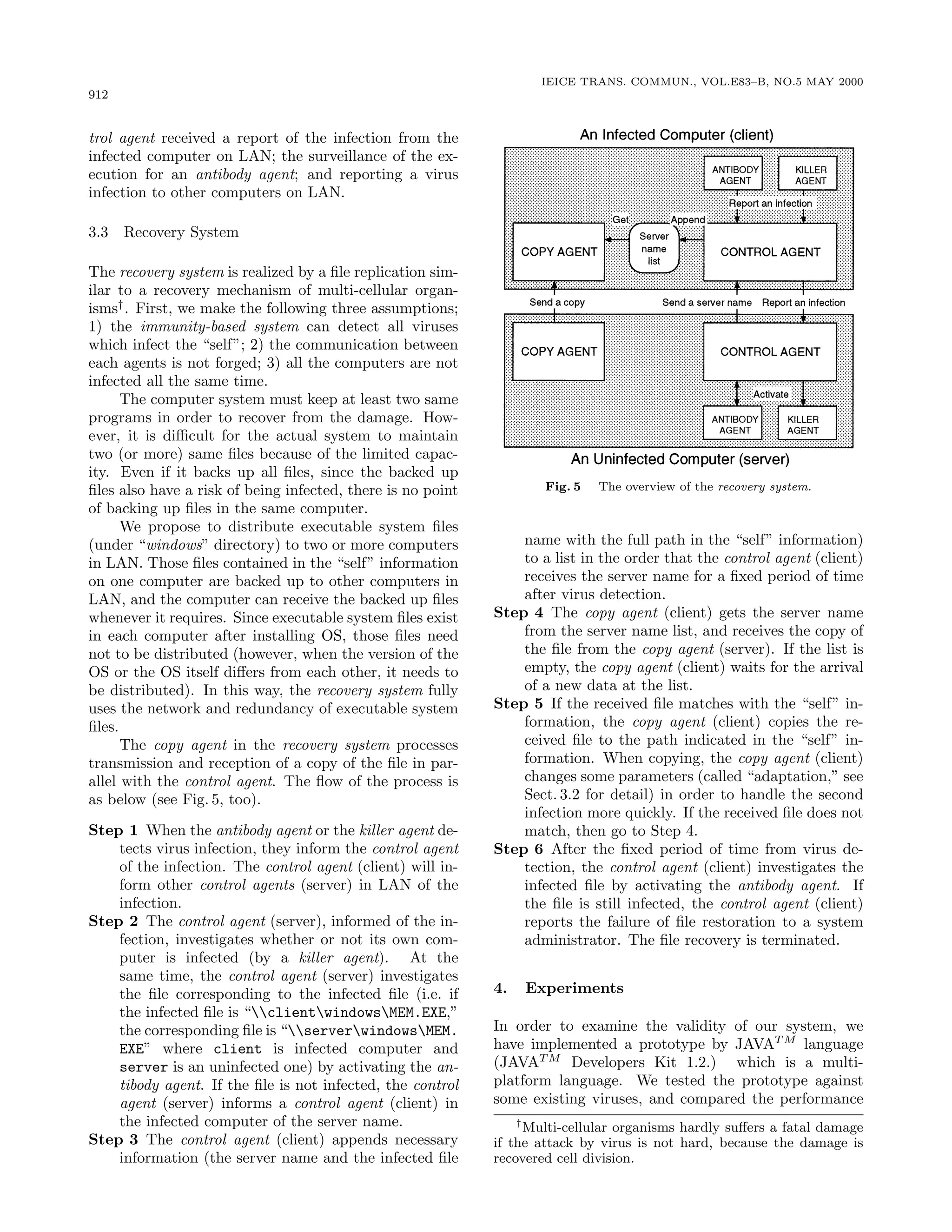
The copy agent in the recovery system processes
transmission and reception of a copy of the file in par-
allel with the control agent. The flow of the process is
as below (see Fig. 5, too).
Step 1 When the antibody agent or the killer agent de-
tects virus infection, they inform the control agent
of the infection. The control agent (client) will in-
form other control agents (server) in LAN of the
infection.
Step 2 The control agent (server), informed of the in-
fection, investigates whether or not its own com-
puter is infected (by a killer agent). At the
same time, the control agent (server) investigates
the file corresponding to the infected file (i.e. if
the infected file is “clientwindowsMEM.EXE,”
the corresponding file is “serverwindowsMEM.
EXE” where client is infected computer and
server is an uninfected one) by activating the an-
tibody agent. If the file is not infected, the control
agent (server) informs a control agent (client) in
the infected computer of the server name.
Step 3 The control agent (client) appends necessary
information (the server name and the infected file
Fig. 5 The overview of the Ö ÓÚ ÖÝ ×Ýר Ñ.
name with the full path in the “self” information)
to a list in the order that the control agent (client)
receives the server name for a fixed period of time
after virus detection.
Step 4 The copy agent (client) gets the server name
from the server name list, and receives the copy of
the file from the copy agent (server). If the list is
empty, the copy agent (client) waits for the arrival
of a new data at the list.
Step 5 If the received file matches with the “self” in-
formation, the copy agent (client) copies the re-
ceived file to the path indicated in the “self” in-
formation. When copying, the copy agent (client)
changes some parameters (called “adaptation,” see
Sect. 3.2 for detail) in order to handle the second
infection more quickly. If the received file does not
match, then go to Step 4.
Step 6 After the fixed period of time from virus de-
tection, the control agent (client) investigates the
infected file by activating the antibody agent. If
the file is still infected, the control agent (client)
reports the failure of file restoration to a system
administrator. The file recovery is terminated.
4. Experiments
In order to examine the validity of our system, we
have implemented a prototype by JAVAT M
language
(JAVAT M
Developers Kit 1.2.) which is a multi-
platform language. We tested the prototype against
some existing viruses, and compared the performance
†
Multi-cellular organisms hardly suffers a fatal damage
if the attack by virus is not hard, because the damage is
recovered cell division.
OKAMOTO and ISHIDA: A DISTRIBUTED APPROACH AGAINST COMPUTER VIRUSES
913
Table 1 Comparison of the proposed system with commercial systems.
Virus Name Size(byte) Detection Stage Recovery Stage
Commercial Sys. Ours Commercial Sys. Neut. Recov.
Scream3 about 7 S S S S F P F S S
Joker2 3 S S S S COM COM F S S
Commander Bomber unknown S S S S F F F P S
AP–605 666 S S S S COM COM COM S S
AIDS 13,952 S S S S F F F F S
with the present commercial systems. We experimented
on LAN which connected four computers (whose OS is
Windows 98T M
). As target files for virus detection,
we choose the executable system files (programs under
“windows” directory) of Windows 98T M
. (See [13] for
similar experiments by Windows 95T M
.) Since the size
of alteration by viruses was usually less than 10 Kbytes,
we set the size of the temporary data for restoration to
10 Kbytes.
We used the following viruses†
: Scream3, Joker2,
and AIDS, Commander Bomber, and AP-605. These
viruses are typical one from each infection types ex-
plained in Sect. 2.1.
Our system is compared with some of commer-
cial systems focusing on detection stage and recovery
stage. We selected three commercial softwares and
tested them with their newest prescription in Septem-
ber, 1999. In our system, recovery stage is further di-
vided into neutralization and file recovery (by copying
from the other computers). Table 1 summarizes the
experimental results on detection stage and recovery
stage. S, P and F represent success, partial success,
and failure respectively. COM means that only COM
files are successfully recovered.
Since these five computer viruses have been already
investigated, all of commercial systems successfully de-
tected them. There is no commercial system (among
those used in our experiments) that can successfully
recover from all these five viruses. There are several
reasons for the failure of recovering them. One is be-
cause a single prescription can remove only a single
virus and the number of the prescriptions is less than
that of viruses, although a single “signature” allows de-
tection of dozens of distinct viruses [4]. Another reason
is that viruses overwrite the head of the original host
program with their viral code. Also, it can be pointed
out that recovery succeeds more for COM files than for
EXE files. This is because the infection mechanism for
a COM file is simpler than that for an EXE file.
Virus detection by our system is successful for all
five viruses, since these viruses alter files. Neutraliza-
tion is not successful against Commander Bomber and
AIDS. Commander Bomber takes its body into pieces
of random size and overwrites the host program with
them. Alteration by AIDS virus exceeds the data kept
in the “self” information. However, the virus no longer
infect, since the JUMP code to the main viral codes is
already overwritten by the temporary data for restora-
tion. File recovery (by copying from the other comput-
ers) succeeds against these five viruses.
In summary, our system can deal with viruses in-
fecting programs for MS–DOST M
. Other than viruses
infecting those files, there are viruses that infect the sys-
tem area (a boot sector) and PE(Portable Executable)
file for Windows 95T M
or later. Our system may be
extended against these viruses by treating the system
area as a file and registering these code as the “self”
information.
5. Discussion
Our prototype and the experiments raised some ques-
tions. They include; 1) why the “self” information
should be executable system files under “windows” di-
rectory; 2) how long the size of the temporary data for
restoration should be; 3) what kind of viruses our sys-
tem can deal with in the future; and 4) the problems in
the actual use. This section discusses these questions.
5.1 The “Self” in a Computer System
Our system used the checksum method in order to de-
tect viruses. The checksum method can detect viruses
infecting a file without the virus information (“signa-
ture”), since it is a technique for detecting the alter-
ation of a file. However, it cannot distinguish whether
the alteration is just a legitimate update or the inva-
sion by a virus. The simple solution is to choose files
whose alteration is not allowed as the target of detec-
tion. Although the files not allowed alteration differ
from computer to computer, executable system files are
rarely updated. Since the target of detection is only the
executable system files, all alterations to those files are
regarded as invasion.
If the “self” is limited to only executable system
files, then the limitation causes many false negatives
when programs other than executable system files are
infected. In this case, the combination of the scanning
method and the heuristics method may be used. For the
security, the hybrid system integrating our method, the
scanning method and the heuristics method becomes
more secure than commercial anti-virus systems. Even
†
Those viruses are collected from some Internet Web
sites, and we use the names indicated in the sites. They may
differ from ones used by commercial anti-virus softwares.
914
IEICE TRANS. COMMUN., VOL.E83–B, NO.5 MAY 2000
if the virus which can be detected neither by the scan-
ning method nor by the heuristics method invades, they
will be detected and recovered at the time of secondary
infection to executable system files. Also, the detection
of the second infection to the executable system files
leads to the development of the prescription by inform-
ing vendors of the commercial anti-virus systems.
The scope of programs registered as the “self” will
be determined by the trade-off between a false positive
and a false negative. The trade-off is due to the re-
quirements for the availability and the security of the
computer system. Hence, the scope of the “self” is ul-
timately determined according to the security policy of
each computer.
5.2 Adjustment of the Size of the Temporary Data for
Restoration
Our system adapts to the environment by changing the
size of the temporary data for restoration kept in the
“self” information. If the infected files are not neu-
tralized by antibody agents (they are removed and re-
covered as long as infection is detected), the size will
be increased to prepare for the second encounter with
the same virus. Determination of the size of the head
part is a delicate problem which may be determined
by the environments of the computer (whether or not
the infection is highly possible). If the size is set to be
maximum, the database of the “self” information be-
comes full backup and the system can recover only by
neutralization, but doubles the used disk space.
5.3 Extension against Other Viruses
In this paper, we proposed the system to detect and
remove the non-resident viral strains in memory which
infect programs for MS–DOST M
. Since our system can
adjust the scope by choosing the “self,” it may be pos-
sible to detect and remove new viral strains infecting a
new file type, adding the files of the new file type to the
“self” information. The following three types of viral
strains may be treated by extending our system.
• First type is a viral strain which infects PE files.
The structure of the PE file is similar to that of
the programs for MS–DOST M
. Then, the infection
mechanism is classified into the same type as that
of the program for MS–DOST M
.
• Second type is a viral strain which infects a boot
program in a boot sector. The infection mecha-
nism is different from those infecting a file, be-
cause a space under possible infection is smaller
than that of infected file by the file infection type.
Hence, our system may fail to recover the infected
boot sector.
• Third type is virus-like malicious programs (the
“companion virus”[12] and “Trojan horse”) which
do not alter a host program. This type creates
another file having the same name as the original
one except for their extension†
. Fortunately, we
can find the malicious program by investigating the
file list in the directory where the host program is
located. Therefore, this type may be handled by
using the file list as “self.” However, it is diffi-
cult to know whether the addition is a legitimate
installed application or an illegal invasion of the
malicious program. The decision of registering the
file list at the “self” information depends on the
requirements for an availability and a security.
5.4 The Problems in Actual Use
A serious problem of our system may be protecting
the database of the “self” information. If a computer
virus attacks the database, our system can not detect
and recover, or may lead to many false positives. The
database should be encrypted and/or distributed over
LAN to minimize such possibility.
Another problem is weakness against resident
viruses in memory. Such viruses hook some of MS–
DOST M
interrupt handler (Int 13h, Int 21h, etc),
and infect a program when accessed (i.e. when the inter-
rupt handler is called for operating the file). Even if an
antibody agent and a copy agent repair an infected file,
the repaired file may be infected again. Moreover, if a
“stealth virus” which conceal itself infects a program,
our system cannot detect it. The method of detecting
the stealth viruses only scan a memory for the “signa-
ture.” Even if a scanning software detects it in memory,
the computer must be rebooted to repair it under clean
boot using clean floppy disk. File recovery in general is
a common problem to all anti-virus systems.
6. Conclusion
The proposed method differs from most of commer-
cial anti-virus systems, since it uses the information
of the host program side rather than that of virus side
(“signature”). The method differs from the so far pro-
posed anti-virus system that uses the computer network
for delivery of prescriptions, since our method uses the
computer network to mutually back up the files existing
in several computers.
By the experiments, we have shown that our sys-
tem can successfully detect, neutralize and recover
against some of viruses infecting programs for MS–
DOST M
. Moreover, the intensity of security may be
raised further by incorporating the scanning method
and the heuristic method into our system. However,
our system requires a protection of the database of the
“self” information and sophisticated control mechanism
†
For example, if the original file (infected file) is
“MEM.EXE,” the virus creates “MEM.COM.”
OKAMOTO and ISHIDA: A DISTRIBUTED APPROACH AGAINST COMPUTER VIRUSES
915
to prevent the secondary infection in the recovery pro-
cess.
Acknowledgement
This work has been supported in part by the SCAT
(Support Center for Advanced Telecommunications
Technology Research) Foundation and a General Re-
search Grant (C 10650431) by the Ministry of Educa-
tion, Science and Culture.
References
[1] ISCA, “Isca 1999 computer virus prevalence survey,” 1999.
http://www.icsa.net/ services/ consortia/ anti-virus
[2] D. Chess, “The future of virus on the internet,” Proc. 7th
Virus Bulletin Conf., Oct. 1997. http://www.ar.ibm.com/
InsideTheLab/ Bookshelf/ scientificPapers/ Chess/ Fu-
ture.html
[3] Symantec corp., Understanding heuristics: Symantec’s
bloodhound technology, 1997.
[4] J.O. Kephart, G.B. Sorkin, D.M. Chess, and S.R. White,
“Fighting computer viruses,” Scientific American, no.11,
pp.88–96, Nov. 1997.
[5] J.O. Kephart, G. Tesauro, and G.B. Sorkin, “Neural
networks for computer virus recognition,” IEEE Expert,
vol.11, no.4, pp.5–6, Aug. 1996.
[6] J.O. Kephart, “A biologically inspired immune system for
computers,” Proc. 14th Int. Joint Conf. on Artificial Intel-
ligence, pp.20–25, Aug. 1995.
[7] S. Forrest, P. D’haeseleer, and P. Helman, “An immuno-
logical approach to change detection: Algorithms, analysis
and implications,” Proc. IEEE Symposium on Research in
Security and Privacy, pp.110–119, May 1996.
[8] C. Pu, A. Black, C. Cowan, and J. Walpole, “A
specialization toolkit to increase the diversity in oper-
ating systems,” ICMAS Workshop on Immunity-Based
Systems, 1996. http://www.sys.tutkie.tut.ac.jp/ ∼ishida/
IMBS96proc.html
[9] Y. Ishida, “The immune system as a prototype of au-
tonomous decentralized systems,” Proc. Int. Symposium on
Autonomous Decentralized Systems, pp.85–92, 1997.
[10] F. Cohen, “Computer viruses, theory and experiments,”
Proc. 7th DOD/NBS Computer & Security Conf., pp.22–
35, 1987.
[11] E.H. Spafford, “Computer viruses—A form of artificial
life ?,” in Artificial Life II, Studies in the Sciences of Com-
plexity, Addison-Wesley, 1991.
[12] V. Bontchev, “Possible virus attacks against integrity pro-
grams and how to prevent them,” Proc. 2nd Int. Virus Bul-
letin Conf., pp.131–141, Sept. 1992.
[13] T. Okamoto and Y. Ishida, “A distributed approach to com-
puter virus detection and neutralization by autonomoous
and heterogeneous agents,” Proc. 4th Int. Symposium on
Autonomous Decentralized Systems, pp.328–331, March
1999.
Takeshi Okamoto received the de-
gree of B.S. in Engineering from Rit-
sumeikan University, Kyoto, in 1996 and
the degree of M.S. in Computer Sci-
ence from Nara Institute of Science and
Technology, Nara, in 1998. He is cur-
rently doctoral student at Department of
Knowledge-based Information Engineer-
ing at Toyohashi University of Technol-
ogy.
Yoshiteru Ishida received Ph.D. in
Applied Mathematics and Physics from
Kyoto University in 1986. He served as
an assistant professor at Department of
Applied Mathematics and Physics Kyoto
University from 1983 to 1986, and at Divi-
sion of Applied Systems Science from 1987
to 1993. From 1994 to 1998, he has been
an associate professor at Graduate School
of Information Science, Nara Institute of
Science and Technology. Since 1998, he
has been a professor at Department of Knowledge-based Infor-
mation Engineering at Toyohashi University of Technology. Dur-
ing this period, he had been a visiting researcher at School of
Computer Science, Carnegie-Mellon University (1986–1987), De-
partment of Psychology, Carnegie-Mellon University (1993–1994)
and Santa Fe Institute (1997–1998).

A distributed approach against computer viruses inspired by the immune system

  • 1.
    908 IEICE TRANS. COMMUN.,VOL.E83–B, NO.5 MAY 2000 PAPER IEICE/IEEE Joint Special Issue on Autonomous Decentralized Systems A Distributed Approach against Computer Viruses Inspired by the Immune System∗ Takeshi OKAMOTO† , Nonmember and Yoshiteru ISHIDA† , Member SUMMARY More than forty thousands computer viruses have appeared so far since the first virus. Six computer viruses on average appear every day. Enormous expansion of the com- puter network opened a thread of explosive spread of computer viruses. In this paper, we propose a distributed approach against computer virus using the computer network that allows dis- tributed and agent-based approach. Our system is composed of an ÑÑÙÒ ØÝ¹ × ×Ýר Ñ similar to the biological immune sys- tem and Ö ÓÚ ÖÝ ×Ýר Ñ similar to the recovery mechanism by cell division. The ÑÑÙÒ ØÝ¹ × ×Ýר Ñ recognizes “non-self” (which includes computer viruses) using the “self” information. The ÑÑÙÒ ØÝ¹ × ×Ýר Ñ uses agents similar to an antibody, a natural killer cell and a helper T-cell. Ì Ö ÓÚ Ö ×Ýר Ñ uses a ÓÔÝ ÒØ which sends an uninfected copy to infected computer on LAN, or receives from uninfected computer on LAN. We im- plemented a prototype with JAVAT M known as a multi-platform language. In experiments, we confirmed that the proposed sys- tem works against some of existing computer viruses that can infect programs for MS–DOST M . key words: ÓÑÔÙØ Ö Ú ÖÙ׸ ÑÑÙÒ ×Ýר Ѹ ÒØ¸ × Ð ¹ Ö Ö Ò ¸ ÐÐ Ú × ÓÒ 1. Introduction The explosive expansion of the Internet provides com- puter viruses with their route of infection to the enor- mous amount of computers connected to the Internet [1], [2]. Indeed, computer viruses expanded rapidly since 1987. It is said that the strains of computer viruses exceed forty thousands, and six strains on av- erage appeared everyday [3]. To make matters worse, this trend will accelerate due to the development of the Internet and the forum for constructing viruses on the Internet. After the debut of the computer virus, many anti- virus systems which prevent viruses have been devel- oped. However, since most of them use information specific to virus for detection and repair, they cannot deal with unknown viruses. Some anti-virus systems, indeed, find unknown viruses by a heuristic method [3]– [5]. Unfortunately, it cannot detect all of them and it may even make false alarm. Further, it usually cannot repair the infected programs. Manuscript received October 8, 1999. † The authors are with the Department of Knowledge- based Information Engineering, Toyohashi University of Technology, Toyohashi-shi, 441-8580 Japan. ∗ This paper was presented in part at the 4th Interna- tional Symposium on Artificial Life and Robotics, 1999, and the 4th International Symposium on Autonomous Decen- tralized Systems, 1999. Recently, Kephart proposed the digital immune system which shortens the time from detection of a virus to distribution of a prescription [6]. The tech- nique uses a network to automate the analysis of a virus and all other processes from virus detection to acquisition of the prescription required for the measure against a virus. However, it is a centralized approach where a central computer analyzes the virus and dis- tributes the prescription. Consequently, once the com- puter is attacked or the path to/from the computer is shutdown, the “immune system” will be completely broken down. Moreover, since the automatic analysis of a virus is done by the “heuristics method,” it cannot deal with new viral strains infecting a new file type. Forrest devised a new detection method that learned from the self/non-self discrimination mecha- nism of the immune system [7]. The system generates the code group (non-self) which does not exist in the computer system (self). This technique may find a ma- licious program besides viruses. However, since it is impossible to maintain all the signature of “non-self,” the viral codes may be recognized as “self.” Pu proposed a diversification method of the im- plementation of OS to escape from the virus attack [8]. This diversification strategy seems to be similar to that of biological systems. The strategy is indeed taken not only by the immune system but also by the sex system. In this paper, we propose a distributed approach against computer virus using the computer network that allows distributed and agent-based approach. Our system is designed based on the mechanism of the im- mune system of a vertebrate. The immune system is a sophisticated defense system of multi-cellular organ- isms. Since the change from stand-alone computers to computers connected by LAN is somewhat similar to that from uni-cellular organisms to multi-cellular or- ganisms, some strategies of the immune system may be used in the defense system for networked computers. We have been using the analogy of the immune system as a basis of autonomous decentralized systems [9]. The strategies of “the immune system” used in this paper are as follows: • It is a distributed system attained by autonomous and heterogeneous agents. • It uses the information of “host” side (called the “self” information) rather than that of “parasite”
  • 2.
    OKAMOTO and ISHIDA:A DISTRIBUTED APPROACH AGAINST COMPUTER VIRUSES 909 side (called the “non-self” information). Our system consists of the immunity-based system which detects a virus and the recovery system which re- covers the infected programs. The immunity-based sys- tem checks the programs which have a danger of being infected by a virus. Checksums and the first few bytes of the programs, etc. are kept as the “self” information in a database. Our system detects virus infection based on the “self” information. The immunity-based system is managed by the con- trol agent who plays a similar role to the helper T-cell of the immune system. The control agent monitors ex- ecution of all programs. When a program is executed, the control agent compares the checksum of the “self” information of the program with the checksum calcu- lated just before execution. If the control agent de- tects virus infection, it activates an antibody agent and a killer agent. The antibody agent neutralizes the effect of virus by overwriting the first few bytes of the “self” information. As a result, the virus will no longer be ex- ecuted. After the neutralization by the antibody agent, the killer agent removes infected programs. The killer agent works on its own in parallel with other agents. The recovery system recovers the infected pro- grams removed by the immunity-based system. The recovery system is activated, when reported virus in- fection from an infected computer, or when the killer agent detects a virus. A copy agent sends/receives an uninfected copy to/from computers on LAN. Since algorithms of computer viruses do not de- pend on a specific OS or on a specific machine, com- puter virus may appear at all platforms in the future. We used a multi-platform language JAVAT M for imple- menting a prototype. This paper is organized as follows. Section 2 gives overviews of computer viruses and anti-virus systems. Section 3 presents our approach in detail. Section 4 presents the experimental results of our system with some existing viruses. Section 5 discusses the problems of implementing our system. 2. Computer Viruses and Anti-Virus Systems: State of The Art 2.1 The Overview of Computer Viruses The original concept of computer viruses may be traced back Von Neumann’s works on Self-reproducing au- tomata in 1940. The word “computer virus” may be first found in 1987 [10]. In the paper, the computer virus is defined to be a program that can infect by al- tering other programs. The computer virus discussed in this paper follows this definition. We do not deal with a logic bomb, Trojan horse, computer bacteria, and a worm in this paper. There are three types of programs. Fig. 1 Types of virus infection. 1. Boot program which exists in a boot sector. 2. Application program and executable system file (under the “windows” directory) with extensions .EXE, .COM, .SYS, .DRV, .BIN, etc. 3. Macro program contained in documents and spreadsheet files. When a virus infects these programs, it alters the entry point of a host program in order to execute its own code before the original host program is executed. Our approach detects a virus by checking the alter- ation of a file. Documents and spreadsheet files are more often updated compared with programs. Hence, checking those files causes many “false positives”† than that for programs. In order to reduce false positive, we will limit the scope of scan only to the executable system files whose alteration is not permitted. The tar- get for our system is viruses that infect executable sys- tem files under “windows” directory (i.e. second type above). These viruses can be classified into the fol- lowing three types (Fig. 1) based on the file infection mechanism. • Add-on infection type [11] (Fig. 1(a)) which at- taches main viral codes at the end of a host file. • Overwriting infection type (Fig. 1(b)) which over- writes viral codes at the head of a host file. • Fragmented infection type (Fig. 1(c)) which dis- tributes main viral codes inside a host file. The add-on infection type is the most popular among viruses infecting the files for MS–DOST M . They attach their own codes to the end of a host file, and al- ter the first few bytes of the host file in order to execute their own codes before the codes of the host file. After the virus executed all viral codes, they transfer control to the host file (the first few bytes of the original host file at the end of the infected host file) as if the virus † “False positive” means alerting user to virus infection even if there is no virus. It is also called “false alarm.” To the contrary, “false negative” means failing to alert user to virus infection even if there is a virus.
  • 3.
    910 IEICE TRANS. COMMUN.,VOL.E83–B, NO.5 MAY 2000 Fig. 2 The overview of our system. would not exist at all. As a result, they succeed to conceal their own execution from users. Fortunately, this first few bytes added at the end can give commer- cial anti-virus systems a means to repair the infected files, because the viral codes include the information of transferring control to the host file. The overwriting infection type can be easily found, because the original host file can no longer function. They resemble “Trojan horse” about changing the func- tion from the original one. Unfortunately, commercial anti-virus systems cannot repair the infected files be- cause the first few bytes of the host files are not kept. The fragmented infection type is rare, because it needs sophisticated technique of programming them. However, they have a possibility of spreading over the world (e.g. CIH virus), because they are capable of es- caping from commercial anti-virus systems. 2.2 The Overview of Anti-Virus Systems Anti-virus systems have been extensively developed against computer viruses. The importance of these systems increases, since the number of computers con- nected to LAN increases rapidly (compared with work- stations whose OS are mostly UNIX). The techniques are roughly divided into the following three types. • The “scanning method” scans files, boot records and memory to find the specific patterns (called “signature”) of viruses. • The “heuristics method” monitors execution of programs to find the virus-like “behavior” (open- ing of a program, termination of its own program, etc.). • The “checksum method” investigates the alter- ation of the file. The “scanning method” can detect a virus most correctly out of the above three techniques. It also allows to restore infected files. However, it can detect only the known viruses found in the past. To detect new viruses, the signature must be updated whenever new viruses arise. Moreover, since the detected viruses are analyzed manually, it requires time from first detection to the distribution of the prescription. It would become difficult to catch up the rapid spreading of viruses in recent years. The “heuristics method” can detect unknown viruses, however, it cannot identify a virus, and restora- tion of the infection file is almost impossible. Moreover, the viruses detectable by the “heuristics method” are only those infecting a specific file type. The “checksum method” has a demerit of causing many false positives, since alteration occurs not neces- sarily at an invasion by a virus (e.g. alteration occurs in a legitimate update of a program.), although all the viruses that alter a file can be detected. Most of commercial anti-virus systems use both the “scanning method” and the “heuristics method,” because their design policy is to avoid a false positive rather than a false negative [5]. Although they are ef- fective in the popular viral strains, they are weak with the new viral strains infecting a new file type (When a new virus which infects JAVAT M files arose, the com- mercial anti-virus systems could not detect it at that time). 3. The Anti-Virus System Our system roughly consists of the immunity-based sys- tem and the recovery system (Fig. 2). Our goal is not to pursue the parallelism between the immune system and our system, but to solve the problem of computer viruses. Our system is attained by a distributed and redundant approach, and is different from other anti- virus systems in the following three points. • Virus detection is done by matching the “self” in- formation (see Sect. 3.1) with the current host pro- grams. • Neutralization of viruses is done by overwriting the “self” information on the infected files. • File recovery is attained by copying the same file from other uninfected computer on LAN. The same files potentially under attack (executable system files of OS in our system) will be used as backup with each other through the network.
  • 4.
    OKAMOTO and ISHIDA:A DISTRIBUTED APPROACH AGAINST COMPUTER VIRUSES 911 The remainder of this section describes how these functions are implemented. 3.1 The “Self” Information Similarly to the recognition of the immune system† , we propose to recognize “non-self” by comparing it with “self” on the computer system. First, we must define the “self” of the computer system in order to recognize the “non-self.” We define the executable system files which originally must not be altered as “self.” The reason why executable system files are chosen as the “self” is discussed in Sect. 5. The “non-self” in our system is hence the altered executable system files. In order to detect the alteration, all information of the “self” must always be kept in the computer system. Although it is an ideal to keep all of the information before infection, it is difficult to keep it in the limited capacity. Our system keeps the information such as the file attributes (a file name, the full path of a file, a file checksum, the size of a file), and a temporary data for restoration (first few bytes of a file) as “self.” The file attributes are used for detection of non-self (virus), and the temporary data for restoration is used to overwrite the viral code at the head of the file. Hereafter, these data (the file attributes and the temporary data) will be called the “self” information. All computers on LAN keep their own database of the “self” information in the path specified by an administrator. We suppose that no virus knows the path. 3.2 Immunity-Based System We propose the immunity-based system which neutral- izes and removes viruses. The neutralization is done by an antibody agent similar to the antibody†† . The re- moval is done by a killer agent similar to a natural killer cell and a killer T-cell††† . The antibody agent is acti- vated by a control agent similar to a helper T-cell†††† , just before a program of “self” is executed. The killer agent periodically run. It is also activated by the con- trol agent when the control agent receives a report of the infection from other control agents in LAN. The antibody agent and the killer agent compare the size, the checksum and the path to the current file with those in the “self” information (see Sect. 3.1), and if they differ, it will be considered an infected file. This detection method (the “checksum method”) could cause many false positives, however, some remedies are shown in the paper [12]. Our system solves this prob- lem by limiting the target of detection to the executable system files not allowed alteration (see Sect. 5.1 in de- tail). If the antibody agent detects infection, it overwrites the head of the infected file with the temporary data for restoration saved in the “self” information. In this way, the viral code is neutralized because the virus loses Fig. 3 Neutralization by an ÒØ Ó Ý ÒØ. Fig. 4 Increasing the size of the temporary data for restoration (called “adaptation”). a JUMP code or the entry point to the virus body. When the overwritten range exceeds the range changed by the virus, the neutralization not only prevents the virus to be executed, but also allows the original file to be executed normally (but a program which checks its own code may not be executed because the viral code remains at the end of the file). Figure 3 shows the neutralization. The neutralization allows a quick restoration even without the network. When the size of alteration by the virus exceeds the size of the temporary data for restoration, however, the neutralized file may not be executed normally, be- cause the fragment of a virus still remains. In this case, the size of the temporary data for restoration increases (corresponding to “adaptation” of the immune system), and hence it can neutralize the virus in the second en- counter (Fig. 4). The initial size and the maximum size are set up beforehand by a system administrator (see Sect. 5.2). If the killer agent detects an infected file, it makes the file unexecutable. At the same time, other com- puters on LAN is informed of the infection through the control agent. The control agent has the following three functions: a compulsory activation of a killer agent when the con- † One of the strategies used by the immune system is to recognize “non-self” by using “self” (MHC). †† The antibody prevents a virus from invading a cell by binding the virus. ††† The natural killer cell and killer T-cell destroy infected cells. †††† The helper T-cell is involved in controlling and regu- lating other types of cells of the immune system.
  • 5.
    912 IEICE TRANS. COMMUN.,VOL.E83–B, NO.5 MAY 2000 trol agent received a report of the infection from the infected computer on LAN; the surveillance of the ex- ecution for an antibody agent; and reporting a virus infection to other computers on LAN. 3.3 Recovery System The recovery system is realized by a file replication sim- ilar to a recovery mechanism of multi-cellular organ- isms† . First, we make the following three assumptions; 1) the immunity-based system can detect all viruses which infect the “self”; 2) the communication between each agents is not forged; 3) all the computers are not infected all the same time. The computer system must keep at least two same programs in order to recover from the damage. How- ever, it is difficult for the actual system to maintain two (or more) same files because of the limited capac- ity. Even if it backs up all files, since the backed up files also have a risk of being infected, there is no point of backing up files in the same computer. We propose to distribute executable system files (under “windows” directory) to two or more computers in LAN. Those files contained in the “self” information on one computer are backed up to other computers in LAN, and the computer can receive the backed up files whenever it requires. Since executable system files exist in each computer after installing OS, those files need not to be distributed (however, when the version of the OS or the OS itself differs from each other, it needs to be distributed). In this way, the recovery system fully uses the network and redundancy of executable system files. The copy agent in the recovery system processes transmission and reception of a copy of the file in par- allel with the control agent. The flow of the process is as below (see Fig. 5, too). Step 1 When the antibody agent or the killer agent de- tects virus infection, they inform the control agent of the infection. The control agent (client) will in- form other control agents (server) in LAN of the infection. Step 2 The control agent (server), informed of the in- fection, investigates whether or not its own com- puter is infected (by a killer agent). At the same time, the control agent (server) investigates the file corresponding to the infected file (i.e. if the infected file is “clientwindowsMEM.EXE,” the corresponding file is “serverwindowsMEM. EXE” where client is infected computer and server is an uninfected one) by activating the an- tibody agent. If the file is not infected, the control agent (server) informs a control agent (client) in the infected computer of the server name. Step 3 The control agent (client) appends necessary information (the server name and the infected file Fig. 5 The overview of the Ö ÓÚ ÖÝ ×Ýר Ñ. name with the full path in the “self” information) to a list in the order that the control agent (client) receives the server name for a fixed period of time after virus detection. Step 4 The copy agent (client) gets the server name from the server name list, and receives the copy of the file from the copy agent (server). If the list is empty, the copy agent (client) waits for the arrival of a new data at the list. Step 5 If the received file matches with the “self” in- formation, the copy agent (client) copies the re- ceived file to the path indicated in the “self” in- formation. When copying, the copy agent (client) changes some parameters (called “adaptation,” see Sect. 3.2 for detail) in order to handle the second infection more quickly. If the received file does not match, then go to Step 4. Step 6 After the fixed period of time from virus de- tection, the control agent (client) investigates the infected file by activating the antibody agent. If the file is still infected, the control agent (client) reports the failure of file restoration to a system administrator. The file recovery is terminated. 4. Experiments In order to examine the validity of our system, we have implemented a prototype by JAVAT M language (JAVAT M Developers Kit 1.2.) which is a multi- platform language. We tested the prototype against some existing viruses, and compared the performance † Multi-cellular organisms hardly suffers a fatal damage if the attack by virus is not hard, because the damage is recovered cell division.
  • 6.
    OKAMOTO and ISHIDA:A DISTRIBUTED APPROACH AGAINST COMPUTER VIRUSES 913 Table 1 Comparison of the proposed system with commercial systems. Virus Name Size(byte) Detection Stage Recovery Stage Commercial Sys. Ours Commercial Sys. Neut. Recov. Scream3 about 7 S S S S F P F S S Joker2 3 S S S S COM COM F S S Commander Bomber unknown S S S S F F F P S AP–605 666 S S S S COM COM COM S S AIDS 13,952 S S S S F F F F S with the present commercial systems. We experimented on LAN which connected four computers (whose OS is Windows 98T M ). As target files for virus detection, we choose the executable system files (programs under “windows” directory) of Windows 98T M . (See [13] for similar experiments by Windows 95T M .) Since the size of alteration by viruses was usually less than 10 Kbytes, we set the size of the temporary data for restoration to 10 Kbytes. We used the following viruses† : Scream3, Joker2, and AIDS, Commander Bomber, and AP-605. These viruses are typical one from each infection types ex- plained in Sect. 2.1. Our system is compared with some of commer- cial systems focusing on detection stage and recovery stage. We selected three commercial softwares and tested them with their newest prescription in Septem- ber, 1999. In our system, recovery stage is further di- vided into neutralization and file recovery (by copying from the other computers). Table 1 summarizes the experimental results on detection stage and recovery stage. S, P and F represent success, partial success, and failure respectively. COM means that only COM files are successfully recovered. Since these five computer viruses have been already investigated, all of commercial systems successfully de- tected them. There is no commercial system (among those used in our experiments) that can successfully recover from all these five viruses. There are several reasons for the failure of recovering them. One is be- cause a single prescription can remove only a single virus and the number of the prescriptions is less than that of viruses, although a single “signature” allows de- tection of dozens of distinct viruses [4]. Another reason is that viruses overwrite the head of the original host program with their viral code. Also, it can be pointed out that recovery succeeds more for COM files than for EXE files. This is because the infection mechanism for a COM file is simpler than that for an EXE file. Virus detection by our system is successful for all five viruses, since these viruses alter files. Neutraliza- tion is not successful against Commander Bomber and AIDS. Commander Bomber takes its body into pieces of random size and overwrites the host program with them. Alteration by AIDS virus exceeds the data kept in the “self” information. However, the virus no longer infect, since the JUMP code to the main viral codes is already overwritten by the temporary data for restora- tion. File recovery (by copying from the other comput- ers) succeeds against these five viruses. In summary, our system can deal with viruses in- fecting programs for MS–DOST M . Other than viruses infecting those files, there are viruses that infect the sys- tem area (a boot sector) and PE(Portable Executable) file for Windows 95T M or later. Our system may be extended against these viruses by treating the system area as a file and registering these code as the “self” information. 5. Discussion Our prototype and the experiments raised some ques- tions. They include; 1) why the “self” information should be executable system files under “windows” di- rectory; 2) how long the size of the temporary data for restoration should be; 3) what kind of viruses our sys- tem can deal with in the future; and 4) the problems in the actual use. This section discusses these questions. 5.1 The “Self” in a Computer System Our system used the checksum method in order to de- tect viruses. The checksum method can detect viruses infecting a file without the virus information (“signa- ture”), since it is a technique for detecting the alter- ation of a file. However, it cannot distinguish whether the alteration is just a legitimate update or the inva- sion by a virus. The simple solution is to choose files whose alteration is not allowed as the target of detec- tion. Although the files not allowed alteration differ from computer to computer, executable system files are rarely updated. Since the target of detection is only the executable system files, all alterations to those files are regarded as invasion. If the “self” is limited to only executable system files, then the limitation causes many false negatives when programs other than executable system files are infected. In this case, the combination of the scanning method and the heuristics method may be used. For the security, the hybrid system integrating our method, the scanning method and the heuristics method becomes more secure than commercial anti-virus systems. Even † Those viruses are collected from some Internet Web sites, and we use the names indicated in the sites. They may differ from ones used by commercial anti-virus softwares.
  • 7.
    914 IEICE TRANS. COMMUN.,VOL.E83–B, NO.5 MAY 2000 if the virus which can be detected neither by the scan- ning method nor by the heuristics method invades, they will be detected and recovered at the time of secondary infection to executable system files. Also, the detection of the second infection to the executable system files leads to the development of the prescription by inform- ing vendors of the commercial anti-virus systems. The scope of programs registered as the “self” will be determined by the trade-off between a false positive and a false negative. The trade-off is due to the re- quirements for the availability and the security of the computer system. Hence, the scope of the “self” is ul- timately determined according to the security policy of each computer. 5.2 Adjustment of the Size of the Temporary Data for Restoration Our system adapts to the environment by changing the size of the temporary data for restoration kept in the “self” information. If the infected files are not neu- tralized by antibody agents (they are removed and re- covered as long as infection is detected), the size will be increased to prepare for the second encounter with the same virus. Determination of the size of the head part is a delicate problem which may be determined by the environments of the computer (whether or not the infection is highly possible). If the size is set to be maximum, the database of the “self” information be- comes full backup and the system can recover only by neutralization, but doubles the used disk space. 5.3 Extension against Other Viruses In this paper, we proposed the system to detect and remove the non-resident viral strains in memory which infect programs for MS–DOST M . Since our system can adjust the scope by choosing the “self,” it may be pos- sible to detect and remove new viral strains infecting a new file type, adding the files of the new file type to the “self” information. The following three types of viral strains may be treated by extending our system. • First type is a viral strain which infects PE files. The structure of the PE file is similar to that of the programs for MS–DOST M . Then, the infection mechanism is classified into the same type as that of the program for MS–DOST M . • Second type is a viral strain which infects a boot program in a boot sector. The infection mecha- nism is different from those infecting a file, be- cause a space under possible infection is smaller than that of infected file by the file infection type. Hence, our system may fail to recover the infected boot sector. • Third type is virus-like malicious programs (the “companion virus”[12] and “Trojan horse”) which do not alter a host program. This type creates another file having the same name as the original one except for their extension† . Fortunately, we can find the malicious program by investigating the file list in the directory where the host program is located. Therefore, this type may be handled by using the file list as “self.” However, it is diffi- cult to know whether the addition is a legitimate installed application or an illegal invasion of the malicious program. The decision of registering the file list at the “self” information depends on the requirements for an availability and a security. 5.4 The Problems in Actual Use A serious problem of our system may be protecting the database of the “self” information. If a computer virus attacks the database, our system can not detect and recover, or may lead to many false positives. The database should be encrypted and/or distributed over LAN to minimize such possibility. Another problem is weakness against resident viruses in memory. Such viruses hook some of MS– DOST M interrupt handler (Int 13h, Int 21h, etc), and infect a program when accessed (i.e. when the inter- rupt handler is called for operating the file). Even if an antibody agent and a copy agent repair an infected file, the repaired file may be infected again. Moreover, if a “stealth virus” which conceal itself infects a program, our system cannot detect it. The method of detecting the stealth viruses only scan a memory for the “signa- ture.” Even if a scanning software detects it in memory, the computer must be rebooted to repair it under clean boot using clean floppy disk. File recovery in general is a common problem to all anti-virus systems. 6. Conclusion The proposed method differs from most of commer- cial anti-virus systems, since it uses the information of the host program side rather than that of virus side (“signature”). The method differs from the so far pro- posed anti-virus system that uses the computer network for delivery of prescriptions, since our method uses the computer network to mutually back up the files existing in several computers. By the experiments, we have shown that our sys- tem can successfully detect, neutralize and recover against some of viruses infecting programs for MS– DOST M . Moreover, the intensity of security may be raised further by incorporating the scanning method and the heuristic method into our system. However, our system requires a protection of the database of the “self” information and sophisticated control mechanism † For example, if the original file (infected file) is “MEM.EXE,” the virus creates “MEM.COM.”
  • 8.
    OKAMOTO and ISHIDA:A DISTRIBUTED APPROACH AGAINST COMPUTER VIRUSES 915 to prevent the secondary infection in the recovery pro- cess. Acknowledgement This work has been supported in part by the SCAT (Support Center for Advanced Telecommunications Technology Research) Foundation and a General Re- search Grant (C 10650431) by the Ministry of Educa- tion, Science and Culture. References [1] ISCA, “Isca 1999 computer virus prevalence survey,” 1999. http://www.icsa.net/ services/ consortia/ anti-virus [2] D. Chess, “The future of virus on the internet,” Proc. 7th Virus Bulletin Conf., Oct. 1997. http://www.ar.ibm.com/ InsideTheLab/ Bookshelf/ scientificPapers/ Chess/ Fu- ture.html [3] Symantec corp., Understanding heuristics: Symantec’s bloodhound technology, 1997. [4] J.O. Kephart, G.B. Sorkin, D.M. Chess, and S.R. White, “Fighting computer viruses,” Scientific American, no.11, pp.88–96, Nov. 1997. [5] J.O. Kephart, G. Tesauro, and G.B. Sorkin, “Neural networks for computer virus recognition,” IEEE Expert, vol.11, no.4, pp.5–6, Aug. 1996. [6] J.O. Kephart, “A biologically inspired immune system for computers,” Proc. 14th Int. Joint Conf. on Artificial Intel- ligence, pp.20–25, Aug. 1995. [7] S. Forrest, P. D’haeseleer, and P. Helman, “An immuno- logical approach to change detection: Algorithms, analysis and implications,” Proc. IEEE Symposium on Research in Security and Privacy, pp.110–119, May 1996. [8] C. Pu, A. Black, C. Cowan, and J. Walpole, “A specialization toolkit to increase the diversity in oper- ating systems,” ICMAS Workshop on Immunity-Based Systems, 1996. http://www.sys.tutkie.tut.ac.jp/ ∼ishida/ IMBS96proc.html [9] Y. Ishida, “The immune system as a prototype of au- tonomous decentralized systems,” Proc. Int. Symposium on Autonomous Decentralized Systems, pp.85–92, 1997. [10] F. Cohen, “Computer viruses, theory and experiments,” Proc. 7th DOD/NBS Computer & Security Conf., pp.22– 35, 1987. [11] E.H. Spafford, “Computer viruses—A form of artificial life ?,” in Artificial Life II, Studies in the Sciences of Com- plexity, Addison-Wesley, 1991. [12] V. Bontchev, “Possible virus attacks against integrity pro- grams and how to prevent them,” Proc. 2nd Int. Virus Bul- letin Conf., pp.131–141, Sept. 1992. [13] T. Okamoto and Y. Ishida, “A distributed approach to com- puter virus detection and neutralization by autonomoous and heterogeneous agents,” Proc. 4th Int. Symposium on Autonomous Decentralized Systems, pp.328–331, March 1999. Takeshi Okamoto received the de- gree of B.S. in Engineering from Rit- sumeikan University, Kyoto, in 1996 and the degree of M.S. in Computer Sci- ence from Nara Institute of Science and Technology, Nara, in 1998. He is cur- rently doctoral student at Department of Knowledge-based Information Engineer- ing at Toyohashi University of Technol- ogy. Yoshiteru Ishida received Ph.D. in Applied Mathematics and Physics from Kyoto University in 1986. He served as an assistant professor at Department of Applied Mathematics and Physics Kyoto University from 1983 to 1986, and at Divi- sion of Applied Systems Science from 1987 to 1993. From 1994 to 1998, he has been an associate professor at Graduate School of Information Science, Nara Institute of Science and Technology. Since 1998, he has been a professor at Department of Knowledge-based Infor- mation Engineering at Toyohashi University of Technology. Dur- ing this period, he had been a visiting researcher at School of Computer Science, Carnegie-Mellon University (1986–1987), De- partment of Psychology, Carnegie-Mellon University (1993–1994) and Santa Fe Institute (1997–1998).