http://www.iaeme.com/IJECET/index.asp 30 editor@iaeme.com
International Journal of Electronics and Communication Engineering & Technology
(IJECET)
Volume 6, Issue 9, Sep 2015, pp. 30-38, Article ID: IJECET_06_09_004
Available online at
http://www.iaeme.com/IJECETissues.asp?JTypeIJECET&VType=6&IType=9
ISSN Print: 0976-6464 and ISSN Online: 0976-6472
© IAEME Publication
ADVANCED REMOTE MONITORING OF A
CROP IN AGRICULTURE USING
WIRELESS SENSOR NETWORK
TOPOLOGIES
Kirankumar Y. Bendigeri
Research student, Dept of Electronics, Jain University
Bangalore, Karnataka, India
Jayashree D. Mallapur
Dept of Electronics & Communication Engineering,
Basaveshwar Engineering College, Bagalkot-587102, Karnataka, India
ABSTRACT
Wireless senor network (WSN) is most challenging area to be worked with
low cost applications in diversified field developed for military as well as
public. The current trend for research in WSN can be in the area of
agricultural, where the concept of typical wireless communication with real
time sensor nodes provides an approach for a low cost monitoring of a crop in
an agricultural area that leads to effective utilization of resources as though
WSN supports a very vast application we have chosen agriculture field with
WSN because of various drawbacks that are discussed in this paper thus
providing a solution to these. The objective of our proposed work is to analyze
the behavior of sensor network being used for monitoring the crop in a defined
area. For the prototype we have implemented the simulation in qualnet
simulator as test scenario. Initially nodes are deployed in a simulated area, we
have worked for two strategies such as grid and random topology as, where
sensor are placed at different positions are dealt with collecting the data.
Simulation shows that the readings obtained in qualnet are much more
satisfactory with respect to the application employed that is similar to real
time sensors.
Cite this Article: Kirankumar Y. Bendigeri and Jayashree D. Mallapur.
Advanced Remote Monitoring of a Crop in Agriculture using Wireless Sensor
Network Topologies, International Journal of Electronics and Communication
Engineering & Technology, 6(9), 2015, pp. 30-38.
http://www.iaeme.com/IJECET/issues.asp?JTypeIJECET&VType=6&IType=9
Advanced Remote Monitoring of a Crop in Agriculture using Wireless Sensor Network
Topologies
http://www.iaeme.com/IJECET/index.asp 31 editor@iaeme.com
1. INTRODUCTION
In the recent years WSN has extended the application for mankind in day today
application, write from being used in house hold application, industries etc. The use of
WSN has simplified the efficiency of any work with additional save in time. The
wired systems that exist are limited with the distance of communication with WSN
extending the range of communication over thousand of meters. [1] WSN is expected
to be used commonly in coming years over vast commercial applications like
electronics, computer systems, automated home, security for buildings, human
healthcare, bad chemical detection and games, industrial control and weather
monitoring, asset and inventory tracking, intelligent agriculture, forest, and so on. [10]
WSN in agriculture helps to provide distributed data collection, monitoring in harsh
environments, precise irrigation and fertilizer supply to produce profuse crop
production while diminishing cost and assisting farmers in real time data gathering.
[2] India being one of the largest countries in agricultural producing requires a
modernized tools and equipment so as to increase the quality, quantity of the product
grown with reduction in man power. The WSN developed so far are with functions
that are suitable to measure the parameters of crop and then are able to perform the
connectivity to forward the data to other connecting devices, thus WSN in agriculture
may bring out the fundamental contribution to typical precision agriculture. With the
evolution of WSN apart from existing protocol, improved protocols are needed so that
energy consumption can be reduced and overall performance can be improved. [15]
Agriculture is common in rural parts of our country, farmers lack in agricultural
information about soil conditions, the weather forecast, pest and plant diseases,
efficient irrigation methods, and crops they intend to grow. With lack of skills and
techniques to be adopted. [3] The use of wireless sensor network for the large area is
now becoming popular in green house technology of precision agriculture. [5] Most
of the agriculture area in our country is dry or due to the present weather condition
providing inadequate rainfall, irrigation becomes difficult. So, it needs to be
automated for proper yield and handled remotely for farmer safety. Increasing energy
costs and decreasing water supplies point can be an effective method to provide better
water management. [6] The typical method of cropping is that irrigation, fertilization
and pesticides management are often left to the farmer’s and agronomist’s discretion,
the outcome of safe culture and plant growth are often giving a greater amount of
chemicals and water than necessary thus leaving behind the natural growth of a plant .
There by making no direct feedback between the decision of treating or irrigating
plants and the real effects in the field. [9] The advantages of using wireless sensor
networks in agriculture are data which is distributed over long distance is gathered to
monitor and control the features like of climate, irrigation and nutrient supply, thus
decreasing the cost of production and increasing the efficiency of production. [13]
There are many situations that leads to the failure of crop due to lack of water and
maybe due to natural floods. The quality of seed which is the main cause for the
growth of crop if is with poor seed quality that often results into poor crop production,
which leads into wastage of time, money, labor and other resources, The sensor
network can be a substitute for these type of failures. [14] The sensors with different
applications like temperature, light and humidity measures can be used to detect the
risk of frost, various crop diseases and establish watering requirements based on soil
dampness can manage cultivation of crop and to monitor the exact conditions in
which the plants are grown with its condition of growth known to farmer being at a
far distance [4] Precision agriculture relies on information technology that are of a
hardware devices, whose precondition is providing real-time and accurate
Kirankumar Y. Bendigeri and Jayashree D. Mallapur
http://www.iaeme.com/IJECET/index.asp 32 editor@iaeme.com
information. There are various sensor devices used for this kind, such as
environmental temperature and humidity, wind speed, light intensity, and other types
of sensors. Aim of our work is to consider the scenario of WSN which is monitoring
the quite larger area, the scenario of which is created in qualnet simulator, the four
parameters of crop are considered for discussions that are soil moisture, weather
change, water indication, pests/diseases, where timely based check is done for these is
done and reported to the base station.
The rest of this paper is organized as follows: Section II presents the related work
discussing the present scenario of growing a crop through WSN. Section III provides
the approach giving a proposed model with section IV discussing the methodology of
implementation further Section V is concluded the paper with over all discussion,
finally the references have been provided.
Aim of our work is to consider the scenario of WSN which is monitoring the quite
larger area, the scenario of which is created in qualnet simulator, the four parameters
of crop are considered for discussions that are soil moisture, weather change, water
indication, pests/diseases, where timely based check is done for these is done and
reported to the base station.
2. RELATED WORK
In this paper [1] the author discusses the WSN deployed in greenhouses with melon
and cabbage in dongbu handong seed research center. A2
S technique was used to
monitor the growing process of them and control the environment of the greenhouses.
A2
S was developed for consumer electronic field such as home network as well as
automated agriculture field. This paper [2] explores the potential of WSN in the area
of agriculture in India. Aiming at the sugarcane crop, a multi parameter monitoring
system is designed based on low-power ZigBee wireless communication technology
for system automation and monitoring. In this paper [3], author has proposed and
analyzed the use of Programmable System on Chip Technology (PSOC) as a part of
Wireless Sensor Networks (WSN) to monitor and control various parameter of green
house. The low-Power MCU [4] and RF can reduce power consumption of the nodes
in activating state. Ultralow power MCU can reduce average power consumption.
This paper [5]aims to find the exact field condition and to control the wastage of
water in the field and to provide exact controlling of field by using the drip irrigation,
atomizing the agricultural environment by using the components and building the
necessary hardware. This paper [6] deals with the design, optimization and
development of a practical solution for application to the agro-food chain monitoring
and control. In this paper [8] author presents the initial setup of the Lofar Agro project
that concentrates on monitoring micro-climates in a crop field. This paper [9]
discussed the environmental and socio economical back ground of Kuttanad, the
problems faced in agriculture and proposed use of wireless sensor networks for
overcoming some difficulties. In this paper, [10] the sensor motes have several
external sensors namely leaf wetness, soil moisture, soil pH, atmospheric pressure
sensors attached to it. Based on the value of soil moisture sensor the mote triggers the
water sprinkler during the period of water scarcity. In this paper [11], we have
demonstrated how an Irrigation Management System was implemented based on
WSN, The system incorporated a remote monitoring mechanism via a GPRS modem
to report soil temperature, soil moisture, WSN link performance and PV power levels.
Sensor network and other [12] agricultural techniques might help them to store and
utilize the rain water, increase their crop productivity, reduce the cost for cultivation
Advanced Remote Monitoring of a Crop in Agriculture using Wireless Sensor Network
Topologies
http://www.iaeme.com/IJECET/index.asp 33 editor@iaeme.com
and make use of real time values instead of depending just on prediction. This paper
[16] is proposing a complete agricultural solution for the farmer based on Wireless
Sensor Networks and GSM technology. The data acquired about environmental
factors of the field is transmitted to the farmer enabling him to control the actuators in
the field.
3. APPROACH
To carry out the experiments there are various wireless simulators, we have
chosen qualnet simulator 6.1 version that provides simulation of networks like
cellular, UMTS, WSN, Vehicular networks etc, here we can visualize the desired
experiment by creating a test bench scenario which when simulated shows the
behavior that can actually be drawn with the real time devices like sensors, mobiles
etc, our paper deals with work on sensor technology in placing the nodes for
agricultural application which gives advanced way to handle the agriculture to
typically replace the mechanical method and consider the issue of negligence by
human beings in agriculture such as wastage of water, power etc helping agriculture
community with more remote usage and bringing changes to the typical mechanical
method followed in the agriculture, be it for any type plant or a crop thus adopting
changes with the issues of applications in agriculture by deploying a wireless sensor
web based network for monitoring soil moisture, temperature, humidity, rodent
detection, pest control and storing those data for future use by which effective growth
of a plant can be controlled thus linking the data to farmers mobile to make aware of
the required substances
The prototype model is been developed in a qualnet simulator giving a scenario of
a real time monitoring of crop using sensors. Sensors are statically distributed at
different locations in a field hence the static location of each sensor with its unique
sensor identity can be stored in the sensors during network configuration and
deployment phase. Figure 1 show the test scenario used to monitor the plant in a field
from which all the necessary data can be collected. Continuous monitoring of sensor
Kirankumar Y. Bendigeri and Jayashree D. Mallapur
http://www.iaeme.com/IJECET/index.asp 34 editor@iaeme.com
data at every minute may not be always needed. Instead, the data may be monitored
on hourly basis or at different times of the day, e.g., morning, noon, afternoon and
evening. This, in turn, helps in conserving the battery power of sensor nodes, and
“sleep and awake” cycle of the wireless sensors judiciously that are used to sense and
transmit the sensor data in wake-up phases and put the sensors in sleep mode rest of
the time. Sensor data captured over a period of time at each node is collected and
aggregated data is sent to the monitoring station. The monitoring station is located far
away from the field; therefore, laying wires for transferring sensor data from field to
control station is a costly proposition. But the range of battery-operated wireless
devices is also limited. So, multi-hop communication is used to send data to control
station. Considering all these functional aspects and limitations in wireless nodes, low
power, and low data rate wireless mesh network is found to be a good candidate for
realizing the WSN test bed. The deployed sensors would send the sensed data to a
optimally located Base station/Cluster Head node for the data aggregation. From base
station these data will be sent to cell phone of the respective client. This is the
prototype developed which can successfully work out in a field to monitor the
physical parameters of crop. The usual deployments that are rarely used in agriculture
are random deployment. The random deployment has its merits and demerits. We
have also chosen the random deployment as base of the studies, where we have tried
to collect the data from agriculture prototype field. The deployment we want to
establish and conduct the experiment are grid and random pattern in which sensor
nodes can be placed, for which we are expecting further enhancement in the nodes
and the equipment in WSN.
4. METHODOLOGY OF IMPLEMENTATION
The project is carried out in qualnet simulator as test scenario. Initially nodes are
deployed in a simulated area, we have worked for two strategies such as random and
grid topology as shown in figure 2 and 3, where sensor are placed at different
positions are dealt with collecting the data. Now we want to deploy sensor nodes at
least of 6 nodes and interface the network along with software. The readings obtained
in qualnet are much more satisfactory with respect to the application employed,
simulation results shows different results with different applications. The random
topology works well with large area, where as circular topology works best for limited
area. As the agriculture crops are with limited area such as vegetables and fruits that
can be employed with the circular topology. These works we want apply physically
and find the result in further experimentation
This area mainly depends upon the agriculture. There are different crops based on
the season or climate. We want to help agriculture community with remote control
monitoring of the crop as well as efficient usage of the system by having sensor
models installed in the field where we can monitor the requirement of the plants and
hence render the service through controllers. The simulation for two topologies has
been carried using network simulator called qualnet 6.1, which can be extended to
carry the simulation using sensors nodes and interfacing cards and special nodes. The
experiment will be carried by selecting two areas such as small crop area like fruits
and vegetables and large area like wheat, jowar. These experimentation results will
help this area of agriculture production and help the agriculture community.
By deploying the sensor devices in the field using different topologies we can
sense different areas of marking. The implementation of the project can meet the
frequent monitoring by a farmer which can be reduced, as the devices are required to
Advanced Remote Monitoring of a Crop in Agriculture using Wireless Sensor Network
Topologies
http://www.iaeme.com/IJECET/index.asp 35 editor@iaeme.com
meet the objective that the condition of a crop in terms of water, pesticides can be
alarmed to the farmer at regular intervals, if the conditions are not favorable, then the
farmer can be sent for the action, by doing so labor, man power can be saved, it
directly relates to the save in economy and power, also the device itself helps in
successful growth of a plant, that will additional increase the profit to the farmer, even
the betterment of a crop growth can be done. The projects definitely meet the
drawback of current methodology and are therefore going to meet the current status of
our country.
The experimentation will consider different sensors with applications such as
measurement of soil moisture, climate condition, water level indicator, the pests or
disease monitoring all together available with each sensors. The arrangement can be
in a way that sensors are placed in whole filed area that are placed near the plants.
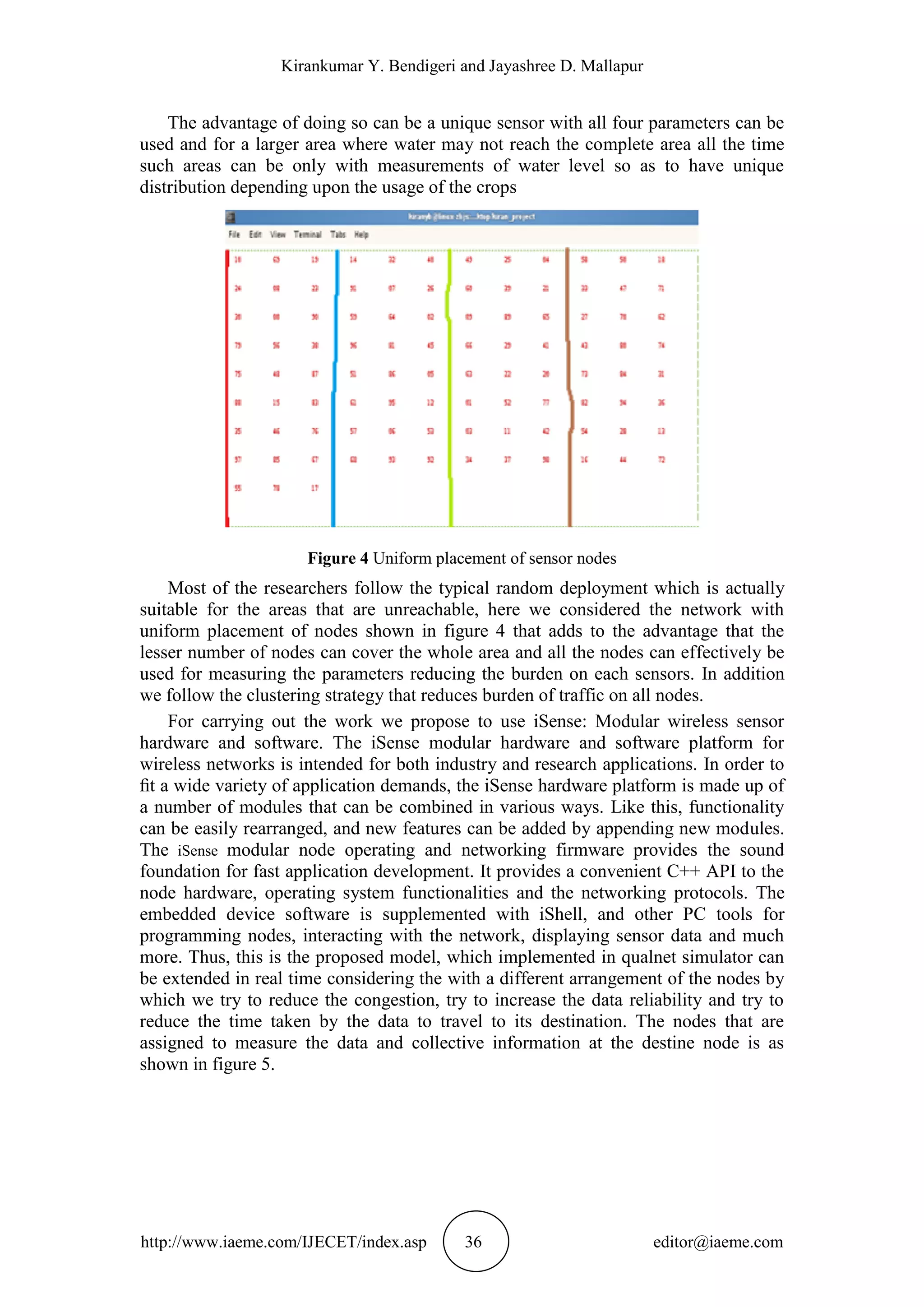
As discussed we have considered two deployment patterns for WSN, figure 3
showing a random placement pattern of nodes while figure 4 showing uniform
deployment pattern of nodes, the total area that is considered is distributed with sensor
nodes with these two patterns. For example in figure 3 the area that is marked where
respective sensors with soil moisture, climate, water and pest detection and these
sensors are varied in their application on a timely basis, start of the simulation this
would be the scenario where boundary with brown line indicating that these sensor
are monitoring for soil moisture content and so on such that during the next instant of
time the application is the boundary with brown takes on some other application and
so on.
Figure 2 Sensor nodes to monitor the data
Figure 3 Random placement of sensor nodes
Kirankumar Y. Bendigeri and Jayashree D. Mallapur
http://www.iaeme.com/IJECET/index.asp 36 editor@iaeme.com
The advantage of doing so can be a unique sensor with all four parameters can be
used and for a larger area where water may not reach the complete area all the time
such areas can be only with measurements of water level so as to have unique
distribution depending upon the usage of the crops
Figure 4 Uniform placement of sensor nodes
Most of the researchers follow the typical random deployment which is actually
suitable for the areas that are unreachable, here we considered the network with
uniform placement of nodes shown in figure 4 that adds to the advantage that the
lesser number of nodes can cover the whole area and all the nodes can effectively be
used for measuring the parameters reducing the burden on each sensors. In addition
we follow the clustering strategy that reduces burden of traffic on all nodes.
For carrying out the work we propose to use iSense: Modular wireless sensor
hardware and software. The iSense modular hardware and software platform for
wireless networks is intended for both industry and research applications. In order to
fit a wide variety of application demands, the iSense hardware platform is made up of
a number of modules that can be combined in various ways. Like this, functionality
can be easily rearranged, and new features can be added by appending new modules.
The iSense modular node operating and networking firmware provides the sound
foundation for fast application development. It provides a convenient C++ API to the
node hardware, operating system functionalities and the networking protocols. The
embedded device software is supplemented with iShell, and other PC tools for
programming nodes, interacting with the network, displaying sensor data and much
more. Thus, this is the proposed model, which implemented in qualnet simulator can
be extended in real time considering the with a different arrangement of the nodes by
which we try to reduce the congestion, try to increase the data reliability and try to
reduce the time taken by the data to travel to its destination. The nodes that are
assigned to measure the data and collective information at the destine node is as
shown in figure 5.
Advanced Remote Monitoring of a Crop in Agriculture using Wireless Sensor Network
Topologies
http://www.iaeme.com/IJECET/index.asp 37 editor@iaeme.com
Figure 5 Data sent by the nodes
Figure 5 shows the throughput with uniform placement of nodes which is higher
than random placement of nodes which is usually reduced by nearly 15 percent as
compared with uniform WSN pattern.
5. CONCLUSIONS
The project would be considering an area where any of the crops that are grown, and
finds a solution for a an agricultural system by different deployment techniques, the
device will successfully help in growth of a plant by monitoring temperature,
pesticides, humidity without human interference, these device can be implemented an
in a half acre of land as a prototype model, the device if implemented in a large scale
the overall cost can be brought down that is demonstrated using qualnet simulator.
This device will go over the years, as sensors usually has large durability with
frequent replace in batteries
REFERENCES
[1] Seong-Eun Yoo; Jae-Eon Kim; Taehong Kim; Sungjin Ahn; Jongwoo Sung;
Daeyoung Kim, A2
S: Automated Agriculture System Based On Wsn, Consumer
Electronics, 2007. Isce 2007. IEEE International Symposium on, June 2007,
Pp.1-5, 20-23.
[2] Anjum Awasthi, S.R.N Reddy. Monitoring For Precision Agriculture Using
Wireless Sensor Network-A Review, Global Journal of Computer Science and
Technology Network, Web & Security 13(7) Version 1.0 Year 2013
[3] D. D. Chaudhary, S.P.Nayse, L. M. Waghmare, Application of Wireless Sensor
Networks for Greenhouse Parameter Control in Precision Agriculture”,
International Journal of Wireless & Mobile Networks (IJWMN) 3(1), February
2011
[4] Xijun Yan, Xiangwei Meng, Yan Yan, A Wireless Sensor Network In Precision
Agriculture, Telkomnika Indonesian Journal of Electrical Engineering, 10(4)
2012 pp.788-797
[5] Prathyusha.K1, G. Sowmya Bala2, Dr. K. Sreenivasa Ravi3, A Real – Time
Irrigation Control System For Precision Agriculture Using WSN In Indian
Agricultural Sectors, International Journal of Computer Science, Engineering
And Applications (IJCSEA) 3(4), August 2013
[6] Luca Bencini, Davide Di Palma, Giovanni Collodi, Wireless Sensor Networks
For On-Field Agricultural Management Process, International Journal of Intech
Open Science, December 2010
[7] Wark, T.; Corke, P.; Sikka, P.; Klingbeil, L.; Ying Guo; Crossman, C.; Valencia,
P.; Swain, D.; Bishop-Hurley, G, Transforming Agriculture Through Pervasive
Kirankumar Y. Bendigeri and Jayashree D. Mallapur
http://www.iaeme.com/IJECET/index.asp 38 editor@iaeme.com
Wireless Sensor Networks, Pervasive Computing, IEEE , 6(2), April-June 2007,
pp.50-57.
[8] Aline Baggio, Wireless Sensor Networks In Precision Agriculture, In ACM
Workshops, Real World Sensor Networks
[9] Santhosh Simon1, K Paulose Jacob, Wireless Sensor Networks For Paddy Field
Crop Monitoring Application In Kuttanad, International Journal of Modern
Engineering Research (IJMER) www.ijmer.com 2(4), July-Aug 2012 pp.2017-
2020
[10] N. Sakthipriya an Effective Method for Crop Monitoring Using Wireless Sensor
Network Middle-East Journal of Scientific Research 20(9), pp.1127-1132. ISSN
1990-9233
[11] Million Mafutaa, Marco Zennarob, Antoine Bagulac, Successful Deployment of a
Wireless Sensor Network For Precision Agriculture In Malawi –Wipam, 3rd
IEEE
International Conference On Networked Embedded Systems For Every
Application (Nesea2012); 2012
[12] Rashid Hussain, J L Sahgal, Purvi Mishra, Babita Sharma, Application of WSN
In Rural Development, Agriculture Water Management, International Journal of
Soft Computing and Engineering (IJSCE) ISSN: 2231-2307, 2(5), November
2012
[13] Ahsan Abdullah, Ahmed Barnawi. Identification of The Type of Agriculture
Suited For Application of Wireless Sensor Networks, Russian Journal of
Agricultural And Socio-Economic Sciences, 12(12), 2012
[14] K. Walkera, A. Kabashib, J. Abdelnour-Nocera, Interaction Design For Rural
Agricultural Sensor Networks, International Journal of Environmental Modelling
and Software Society (IEMSS), 2008
[15] Deepti Bansal, S.R.N Reddy, WSN Based Closed Loop Automatic Irrigation
System, International Journal of Engineering Science and Innovative Technology
(IJESIT) 2(3) May 2013.
[16] Seema vora, Prof. Mukesh Tiwari, Prof. Jaikaran Singh. GSM Based Remote
Monitoring of Waste Gas at Locally Monitored GUI with The Implementation of
Modbus Protocol and Location Identification Through GPS, International
Journal of Advance research in Engineering & Technology, 3(2), 2015, pp. 52 -
59.

Ijecet 06 09_004

  • 1.
    http://www.iaeme.com/IJECET/index.asp 30 editor@iaeme.com InternationalJournal of Electronics and Communication Engineering & Technology (IJECET) Volume 6, Issue 9, Sep 2015, pp. 30-38, Article ID: IJECET_06_09_004 Available online at http://www.iaeme.com/IJECETissues.asp?JTypeIJECET&VType=6&IType=9 ISSN Print: 0976-6464 and ISSN Online: 0976-6472 © IAEME Publication ADVANCED REMOTE MONITORING OF A CROP IN AGRICULTURE USING WIRELESS SENSOR NETWORK TOPOLOGIES Kirankumar Y. Bendigeri Research student, Dept of Electronics, Jain University Bangalore, Karnataka, India Jayashree D. Mallapur Dept of Electronics & Communication Engineering, Basaveshwar Engineering College, Bagalkot-587102, Karnataka, India ABSTRACT Wireless senor network (WSN) is most challenging area to be worked with low cost applications in diversified field developed for military as well as public. The current trend for research in WSN can be in the area of agricultural, where the concept of typical wireless communication with real time sensor nodes provides an approach for a low cost monitoring of a crop in an agricultural area that leads to effective utilization of resources as though WSN supports a very vast application we have chosen agriculture field with WSN because of various drawbacks that are discussed in this paper thus providing a solution to these. The objective of our proposed work is to analyze the behavior of sensor network being used for monitoring the crop in a defined area. For the prototype we have implemented the simulation in qualnet simulator as test scenario. Initially nodes are deployed in a simulated area, we have worked for two strategies such as grid and random topology as, where sensor are placed at different positions are dealt with collecting the data. Simulation shows that the readings obtained in qualnet are much more satisfactory with respect to the application employed that is similar to real time sensors. Cite this Article: Kirankumar Y. Bendigeri and Jayashree D. Mallapur. Advanced Remote Monitoring of a Crop in Agriculture using Wireless Sensor Network Topologies, International Journal of Electronics and Communication Engineering & Technology, 6(9), 2015, pp. 30-38. http://www.iaeme.com/IJECET/issues.asp?JTypeIJECET&VType=6&IType=9
  • 2.
    Advanced Remote Monitoringof a Crop in Agriculture using Wireless Sensor Network Topologies http://www.iaeme.com/IJECET/index.asp 31 editor@iaeme.com 1. INTRODUCTION In the recent years WSN has extended the application for mankind in day today application, write from being used in house hold application, industries etc. The use of WSN has simplified the efficiency of any work with additional save in time. The wired systems that exist are limited with the distance of communication with WSN extending the range of communication over thousand of meters. [1] WSN is expected to be used commonly in coming years over vast commercial applications like electronics, computer systems, automated home, security for buildings, human healthcare, bad chemical detection and games, industrial control and weather monitoring, asset and inventory tracking, intelligent agriculture, forest, and so on. [10] WSN in agriculture helps to provide distributed data collection, monitoring in harsh environments, precise irrigation and fertilizer supply to produce profuse crop production while diminishing cost and assisting farmers in real time data gathering. [2] India being one of the largest countries in agricultural producing requires a modernized tools and equipment so as to increase the quality, quantity of the product grown with reduction in man power. The WSN developed so far are with functions that are suitable to measure the parameters of crop and then are able to perform the connectivity to forward the data to other connecting devices, thus WSN in agriculture may bring out the fundamental contribution to typical precision agriculture. With the evolution of WSN apart from existing protocol, improved protocols are needed so that energy consumption can be reduced and overall performance can be improved. [15] Agriculture is common in rural parts of our country, farmers lack in agricultural information about soil conditions, the weather forecast, pest and plant diseases, efficient irrigation methods, and crops they intend to grow. With lack of skills and techniques to be adopted. [3] The use of wireless sensor network for the large area is now becoming popular in green house technology of precision agriculture. [5] Most of the agriculture area in our country is dry or due to the present weather condition providing inadequate rainfall, irrigation becomes difficult. So, it needs to be automated for proper yield and handled remotely for farmer safety. Increasing energy costs and decreasing water supplies point can be an effective method to provide better water management. [6] The typical method of cropping is that irrigation, fertilization and pesticides management are often left to the farmer’s and agronomist’s discretion, the outcome of safe culture and plant growth are often giving a greater amount of chemicals and water than necessary thus leaving behind the natural growth of a plant . There by making no direct feedback between the decision of treating or irrigating plants and the real effects in the field. [9] The advantages of using wireless sensor networks in agriculture are data which is distributed over long distance is gathered to monitor and control the features like of climate, irrigation and nutrient supply, thus decreasing the cost of production and increasing the efficiency of production. [13] There are many situations that leads to the failure of crop due to lack of water and maybe due to natural floods. The quality of seed which is the main cause for the growth of crop if is with poor seed quality that often results into poor crop production, which leads into wastage of time, money, labor and other resources, The sensor network can be a substitute for these type of failures. [14] The sensors with different applications like temperature, light and humidity measures can be used to detect the risk of frost, various crop diseases and establish watering requirements based on soil dampness can manage cultivation of crop and to monitor the exact conditions in which the plants are grown with its condition of growth known to farmer being at a far distance [4] Precision agriculture relies on information technology that are of a hardware devices, whose precondition is providing real-time and accurate
  • 3.
    Kirankumar Y. Bendigeriand Jayashree D. Mallapur http://www.iaeme.com/IJECET/index.asp 32 editor@iaeme.com information. There are various sensor devices used for this kind, such as environmental temperature and humidity, wind speed, light intensity, and other types of sensors. Aim of our work is to consider the scenario of WSN which is monitoring the quite larger area, the scenario of which is created in qualnet simulator, the four parameters of crop are considered for discussions that are soil moisture, weather change, water indication, pests/diseases, where timely based check is done for these is done and reported to the base station. The rest of this paper is organized as follows: Section II presents the related work discussing the present scenario of growing a crop through WSN. Section III provides the approach giving a proposed model with section IV discussing the methodology of implementation further Section V is concluded the paper with over all discussion, finally the references have been provided. Aim of our work is to consider the scenario of WSN which is monitoring the quite larger area, the scenario of which is created in qualnet simulator, the four parameters of crop are considered for discussions that are soil moisture, weather change, water indication, pests/diseases, where timely based check is done for these is done and reported to the base station. 2. RELATED WORK In this paper [1] the author discusses the WSN deployed in greenhouses with melon and cabbage in dongbu handong seed research center. A2 S technique was used to monitor the growing process of them and control the environment of the greenhouses. A2 S was developed for consumer electronic field such as home network as well as automated agriculture field. This paper [2] explores the potential of WSN in the area of agriculture in India. Aiming at the sugarcane crop, a multi parameter monitoring system is designed based on low-power ZigBee wireless communication technology for system automation and monitoring. In this paper [3], author has proposed and analyzed the use of Programmable System on Chip Technology (PSOC) as a part of Wireless Sensor Networks (WSN) to monitor and control various parameter of green house. The low-Power MCU [4] and RF can reduce power consumption of the nodes in activating state. Ultralow power MCU can reduce average power consumption. This paper [5]aims to find the exact field condition and to control the wastage of water in the field and to provide exact controlling of field by using the drip irrigation, atomizing the agricultural environment by using the components and building the necessary hardware. This paper [6] deals with the design, optimization and development of a practical solution for application to the agro-food chain monitoring and control. In this paper [8] author presents the initial setup of the Lofar Agro project that concentrates on monitoring micro-climates in a crop field. This paper [9] discussed the environmental and socio economical back ground of Kuttanad, the problems faced in agriculture and proposed use of wireless sensor networks for overcoming some difficulties. In this paper, [10] the sensor motes have several external sensors namely leaf wetness, soil moisture, soil pH, atmospheric pressure sensors attached to it. Based on the value of soil moisture sensor the mote triggers the water sprinkler during the period of water scarcity. In this paper [11], we have demonstrated how an Irrigation Management System was implemented based on WSN, The system incorporated a remote monitoring mechanism via a GPRS modem to report soil temperature, soil moisture, WSN link performance and PV power levels. Sensor network and other [12] agricultural techniques might help them to store and utilize the rain water, increase their crop productivity, reduce the cost for cultivation
  • 4.
    Advanced Remote Monitoringof a Crop in Agriculture using Wireless Sensor Network Topologies http://www.iaeme.com/IJECET/index.asp 33 editor@iaeme.com and make use of real time values instead of depending just on prediction. This paper [16] is proposing a complete agricultural solution for the farmer based on Wireless Sensor Networks and GSM technology. The data acquired about environmental factors of the field is transmitted to the farmer enabling him to control the actuators in the field. 3. APPROACH To carry out the experiments there are various wireless simulators, we have chosen qualnet simulator 6.1 version that provides simulation of networks like cellular, UMTS, WSN, Vehicular networks etc, here we can visualize the desired experiment by creating a test bench scenario which when simulated shows the behavior that can actually be drawn with the real time devices like sensors, mobiles etc, our paper deals with work on sensor technology in placing the nodes for agricultural application which gives advanced way to handle the agriculture to typically replace the mechanical method and consider the issue of negligence by human beings in agriculture such as wastage of water, power etc helping agriculture community with more remote usage and bringing changes to the typical mechanical method followed in the agriculture, be it for any type plant or a crop thus adopting changes with the issues of applications in agriculture by deploying a wireless sensor web based network for monitoring soil moisture, temperature, humidity, rodent detection, pest control and storing those data for future use by which effective growth of a plant can be controlled thus linking the data to farmers mobile to make aware of the required substances The prototype model is been developed in a qualnet simulator giving a scenario of a real time monitoring of crop using sensors. Sensors are statically distributed at different locations in a field hence the static location of each sensor with its unique sensor identity can be stored in the sensors during network configuration and deployment phase. Figure 1 show the test scenario used to monitor the plant in a field from which all the necessary data can be collected. Continuous monitoring of sensor
  • 5.
    Kirankumar Y. Bendigeriand Jayashree D. Mallapur http://www.iaeme.com/IJECET/index.asp 34 editor@iaeme.com data at every minute may not be always needed. Instead, the data may be monitored on hourly basis or at different times of the day, e.g., morning, noon, afternoon and evening. This, in turn, helps in conserving the battery power of sensor nodes, and “sleep and awake” cycle of the wireless sensors judiciously that are used to sense and transmit the sensor data in wake-up phases and put the sensors in sleep mode rest of the time. Sensor data captured over a period of time at each node is collected and aggregated data is sent to the monitoring station. The monitoring station is located far away from the field; therefore, laying wires for transferring sensor data from field to control station is a costly proposition. But the range of battery-operated wireless devices is also limited. So, multi-hop communication is used to send data to control station. Considering all these functional aspects and limitations in wireless nodes, low power, and low data rate wireless mesh network is found to be a good candidate for realizing the WSN test bed. The deployed sensors would send the sensed data to a optimally located Base station/Cluster Head node for the data aggregation. From base station these data will be sent to cell phone of the respective client. This is the prototype developed which can successfully work out in a field to monitor the physical parameters of crop. The usual deployments that are rarely used in agriculture are random deployment. The random deployment has its merits and demerits. We have also chosen the random deployment as base of the studies, where we have tried to collect the data from agriculture prototype field. The deployment we want to establish and conduct the experiment are grid and random pattern in which sensor nodes can be placed, for which we are expecting further enhancement in the nodes and the equipment in WSN. 4. METHODOLOGY OF IMPLEMENTATION The project is carried out in qualnet simulator as test scenario. Initially nodes are deployed in a simulated area, we have worked for two strategies such as random and grid topology as shown in figure 2 and 3, where sensor are placed at different positions are dealt with collecting the data. Now we want to deploy sensor nodes at least of 6 nodes and interface the network along with software. The readings obtained in qualnet are much more satisfactory with respect to the application employed, simulation results shows different results with different applications. The random topology works well with large area, where as circular topology works best for limited area. As the agriculture crops are with limited area such as vegetables and fruits that can be employed with the circular topology. These works we want apply physically and find the result in further experimentation This area mainly depends upon the agriculture. There are different crops based on the season or climate. We want to help agriculture community with remote control monitoring of the crop as well as efficient usage of the system by having sensor models installed in the field where we can monitor the requirement of the plants and hence render the service through controllers. The simulation for two topologies has been carried using network simulator called qualnet 6.1, which can be extended to carry the simulation using sensors nodes and interfacing cards and special nodes. The experiment will be carried by selecting two areas such as small crop area like fruits and vegetables and large area like wheat, jowar. These experimentation results will help this area of agriculture production and help the agriculture community. By deploying the sensor devices in the field using different topologies we can sense different areas of marking. The implementation of the project can meet the frequent monitoring by a farmer which can be reduced, as the devices are required to
  • 6.
    Advanced Remote Monitoringof a Crop in Agriculture using Wireless Sensor Network Topologies http://www.iaeme.com/IJECET/index.asp 35 editor@iaeme.com meet the objective that the condition of a crop in terms of water, pesticides can be alarmed to the farmer at regular intervals, if the conditions are not favorable, then the farmer can be sent for the action, by doing so labor, man power can be saved, it directly relates to the save in economy and power, also the device itself helps in successful growth of a plant, that will additional increase the profit to the farmer, even the betterment of a crop growth can be done. The projects definitely meet the drawback of current methodology and are therefore going to meet the current status of our country. The experimentation will consider different sensors with applications such as measurement of soil moisture, climate condition, water level indicator, the pests or disease monitoring all together available with each sensors. The arrangement can be in a way that sensors are placed in whole filed area that are placed near the plants. As discussed we have considered two deployment patterns for WSN, figure 3 showing a random placement pattern of nodes while figure 4 showing uniform deployment pattern of nodes, the total area that is considered is distributed with sensor nodes with these two patterns. For example in figure 3 the area that is marked where respective sensors with soil moisture, climate, water and pest detection and these sensors are varied in their application on a timely basis, start of the simulation this would be the scenario where boundary with brown line indicating that these sensor are monitoring for soil moisture content and so on such that during the next instant of time the application is the boundary with brown takes on some other application and so on. Figure 2 Sensor nodes to monitor the data Figure 3 Random placement of sensor nodes
  • 7.
    Kirankumar Y. Bendigeriand Jayashree D. Mallapur http://www.iaeme.com/IJECET/index.asp 36 editor@iaeme.com The advantage of doing so can be a unique sensor with all four parameters can be used and for a larger area where water may not reach the complete area all the time such areas can be only with measurements of water level so as to have unique distribution depending upon the usage of the crops Figure 4 Uniform placement of sensor nodes Most of the researchers follow the typical random deployment which is actually suitable for the areas that are unreachable, here we considered the network with uniform placement of nodes shown in figure 4 that adds to the advantage that the lesser number of nodes can cover the whole area and all the nodes can effectively be used for measuring the parameters reducing the burden on each sensors. In addition we follow the clustering strategy that reduces burden of traffic on all nodes. For carrying out the work we propose to use iSense: Modular wireless sensor hardware and software. The iSense modular hardware and software platform for wireless networks is intended for both industry and research applications. In order to fit a wide variety of application demands, the iSense hardware platform is made up of a number of modules that can be combined in various ways. Like this, functionality can be easily rearranged, and new features can be added by appending new modules. The iSense modular node operating and networking firmware provides the sound foundation for fast application development. It provides a convenient C++ API to the node hardware, operating system functionalities and the networking protocols. The embedded device software is supplemented with iShell, and other PC tools for programming nodes, interacting with the network, displaying sensor data and much more. Thus, this is the proposed model, which implemented in qualnet simulator can be extended in real time considering the with a different arrangement of the nodes by which we try to reduce the congestion, try to increase the data reliability and try to reduce the time taken by the data to travel to its destination. The nodes that are assigned to measure the data and collective information at the destine node is as shown in figure 5.
  • 8.
    Advanced Remote Monitoringof a Crop in Agriculture using Wireless Sensor Network Topologies http://www.iaeme.com/IJECET/index.asp 37 editor@iaeme.com Figure 5 Data sent by the nodes Figure 5 shows the throughput with uniform placement of nodes which is higher than random placement of nodes which is usually reduced by nearly 15 percent as compared with uniform WSN pattern. 5. CONCLUSIONS The project would be considering an area where any of the crops that are grown, and finds a solution for a an agricultural system by different deployment techniques, the device will successfully help in growth of a plant by monitoring temperature, pesticides, humidity without human interference, these device can be implemented an in a half acre of land as a prototype model, the device if implemented in a large scale the overall cost can be brought down that is demonstrated using qualnet simulator. This device will go over the years, as sensors usually has large durability with frequent replace in batteries REFERENCES [1] Seong-Eun Yoo; Jae-Eon Kim; Taehong Kim; Sungjin Ahn; Jongwoo Sung; Daeyoung Kim, A2 S: Automated Agriculture System Based On Wsn, Consumer Electronics, 2007. Isce 2007. IEEE International Symposium on, June 2007, Pp.1-5, 20-23. [2] Anjum Awasthi, S.R.N Reddy. Monitoring For Precision Agriculture Using Wireless Sensor Network-A Review, Global Journal of Computer Science and Technology Network, Web & Security 13(7) Version 1.0 Year 2013 [3] D. D. Chaudhary, S.P.Nayse, L. M. Waghmare, Application of Wireless Sensor Networks for Greenhouse Parameter Control in Precision Agriculture”, International Journal of Wireless & Mobile Networks (IJWMN) 3(1), February 2011 [4] Xijun Yan, Xiangwei Meng, Yan Yan, A Wireless Sensor Network In Precision Agriculture, Telkomnika Indonesian Journal of Electrical Engineering, 10(4) 2012 pp.788-797 [5] Prathyusha.K1, G. Sowmya Bala2, Dr. K. Sreenivasa Ravi3, A Real – Time Irrigation Control System For Precision Agriculture Using WSN In Indian Agricultural Sectors, International Journal of Computer Science, Engineering And Applications (IJCSEA) 3(4), August 2013 [6] Luca Bencini, Davide Di Palma, Giovanni Collodi, Wireless Sensor Networks For On-Field Agricultural Management Process, International Journal of Intech Open Science, December 2010 [7] Wark, T.; Corke, P.; Sikka, P.; Klingbeil, L.; Ying Guo; Crossman, C.; Valencia, P.; Swain, D.; Bishop-Hurley, G, Transforming Agriculture Through Pervasive
  • 9.
    Kirankumar Y. Bendigeriand Jayashree D. Mallapur http://www.iaeme.com/IJECET/index.asp 38 editor@iaeme.com Wireless Sensor Networks, Pervasive Computing, IEEE , 6(2), April-June 2007, pp.50-57. [8] Aline Baggio, Wireless Sensor Networks In Precision Agriculture, In ACM Workshops, Real World Sensor Networks [9] Santhosh Simon1, K Paulose Jacob, Wireless Sensor Networks For Paddy Field Crop Monitoring Application In Kuttanad, International Journal of Modern Engineering Research (IJMER) www.ijmer.com 2(4), July-Aug 2012 pp.2017- 2020 [10] N. Sakthipriya an Effective Method for Crop Monitoring Using Wireless Sensor Network Middle-East Journal of Scientific Research 20(9), pp.1127-1132. ISSN 1990-9233 [11] Million Mafutaa, Marco Zennarob, Antoine Bagulac, Successful Deployment of a Wireless Sensor Network For Precision Agriculture In Malawi –Wipam, 3rd IEEE International Conference On Networked Embedded Systems For Every Application (Nesea2012); 2012 [12] Rashid Hussain, J L Sahgal, Purvi Mishra, Babita Sharma, Application of WSN In Rural Development, Agriculture Water Management, International Journal of Soft Computing and Engineering (IJSCE) ISSN: 2231-2307, 2(5), November 2012 [13] Ahsan Abdullah, Ahmed Barnawi. Identification of The Type of Agriculture Suited For Application of Wireless Sensor Networks, Russian Journal of Agricultural And Socio-Economic Sciences, 12(12), 2012 [14] K. Walkera, A. Kabashib, J. Abdelnour-Nocera, Interaction Design For Rural Agricultural Sensor Networks, International Journal of Environmental Modelling and Software Society (IEMSS), 2008 [15] Deepti Bansal, S.R.N Reddy, WSN Based Closed Loop Automatic Irrigation System, International Journal of Engineering Science and Innovative Technology (IJESIT) 2(3) May 2013. [16] Seema vora, Prof. Mukesh Tiwari, Prof. Jaikaran Singh. GSM Based Remote Monitoring of Waste Gas at Locally Monitored GUI with The Implementation of Modbus Protocol and Location Identification Through GPS, International Journal of Advance research in Engineering & Technology, 3(2), 2015, pp. 52 - 59.