http://www.iaeme.com/IJCIET/index.asp 112 editor@iaeme.com
International Journal of Civil Engineering and Technology (IJCIET)
Volume 10, Issue 1, January 2019, pp.112–127, Article ID: IJCIET_10_01_012
Available online at http://www.iaeme.com/IJCIET/issues.asp?JType=IJCIET&VType=10&IType=1
ISSN Print: 0976-6308 and ISSN Online: 0976-6316
©IAEME Publication Scopus Indexed
TORSIONAL BEHAVIOR OF REPAIRED
REINFORCED CONCRETE BEAMS WITH
MULTI-BOUNDARY CONDITIONS
Hayder Al-Khafaji
Lecturer: Civil engineering Department
University of Babylon, Hilla, Iraq
ABSTRACT
This paper describes a finite element analysis for reinforced concrete beams of
multi-boundary conditions end repaired by CFRP and fc85 section tested under pure
torsion, classified according boundary conditions in two types cantilever and simply
supported beams every type include 13 beams divided according repaired to three
groups and control beam. The variables considered for group one and two included
the beam faces number that will be strengthened, the effect of CFRP Strips numbers
while the third group included repaired by fc85. The results of the repaired test beams
revealed that the technique of used thefc85very effective in simply supported beam
more than cantilever beam by about 97.5% while used repaired by CFRP more than
in cantilever. The torque resistance increased in all beams which repaired by
550.65%, 137% in cantilever beams and 11.78%, 139% in simply supported beams for
CFRP and fc85respectively, while the max twist decreased in all beams by 69.46%,
79.5% in cantilever beams and 26.5%, 62.19%in simply supported beams for CFRP
and fc85respectively.
Keywords: Reinforced Concrete Beam, Torsional Strengthening, CFRP strips,
Boundary Conditions, Repaired Beam.
Cite this Article: Hayder Al-Khafaji, Torsional Behavior of Repaired Reinforced
Concrete Beams with Multi-Boundary Conditions, International Journal of Civil
Engineering and Technology (IJCIET), 10 (1), 2019, pp. 112–127.
http://www.iaeme.com/IJCIET/issues.asp?JType=IJCIET&VType=10&IType=1
1. INTRODUCTION
The retrofitting of structures is promoted rather than demolishing and reconstruction of
deteriorated structures. Attention has also given to increase the load carrying capacity of
existing structures to increase the usage capacity or to change the intended usage so there is a
large need to strengthen concrete structures around the world. Retrofitting of structures using
fc85 and Carbon Fiber Reinforced Polymer materials is accepted as a sustainable and effective
method.
Hayder Al-Khafaji
http://www.iaeme.com/IJCIET/index.asp 113 editor@iaeme.com
High strength concrete was used to repair of all types of structural concrete elements in
buildings, water retaining structures, industrial plants, bridges, etc. where provide high
strength and extremely low shrinkage properties are required.
Externally bonded, CFRP sheets are currently being studied and applied around the world
for the repair and strengthening of structural concrete members [1]. CFRP materials are of
great interest to the civil engineering community because of their superior properties such as
high stiffness and strength has well as ease of installation when compared to other repair
materials.
David, E.,Djelal, C. and Buyle-Bodin , F. [2],using externally CFRP strips to bounded
beams and their results show that CFRP is very effective for flexure strengthening.
S. Panchacharam and A. Belarbi [3], makings experimental study to investigate the
torsional behavior of RC beams strengthened with externally bonded GFRP sheets. The
variables considered in this study are fiber orientation (parallel and perpendicular to the
longitudinal axis of the beam). The torsional reinforced concrete beams strengthened with
GFRP sheets exhibited significant increase in their cracking and ultimate strength as well as
ultimate twist deformations.
R.Dhanaraj and E.Chandrasekaran [4], investigated the numerical study on un retrofitted
and retrofitted reinforced concrete beams subjected to combined bending and torsion by
ANSYS. Then the study has been extended for the same reinforced concrete beams retrofitted
with carbon fiber reinforced plastic composites with ±45° and 0/90° fiber orientations. The
present study reveals that the CFRP composites with ±45° fiber orientations are more
effective in retrofitting the RC beams subjected to combined bending and torsion for higher
torque to moment ratios.
Bonfiglioli et al (2004)[5], carried out an experimental and theoretical study to evaluate
the capability of dynamic testing to give useful information about the stiffness recovery due to
external CFRP strengthening of RC beams which were previously damaged. Specimens were
damaged under cycle loading until cracks appeared. Then CFRP used for repairing cracking
specimens. The theoretical results are in good agreement with the experimental ones. The
research suggests that dynamic testing can be used to obtain useful information about the
effectiveness of the strengthening system.
Ali (2007)[6], casted twenty eight reinforced concrete beams to investigate the behavior of
using CFRP to repaired and strengthened beams failed in flexure and shear zone. All beams
had been tested as a simply supported beam under two point of loading. From the results can
see the use of CFRP as external strengthening has significant effect on ultimate load, crack
pattern and deflection. The repaired beams reach (95% to 97%) of ultimate load in
comparison with those strengthened in the same way by CFRP.
AL-Saidy et al. (2007)[7], studied behavior of corroded damaged reinforced concrete
beams repair/strengthening with CFRP sheets. Ten beams were casted and tested up to failure.
Damaged beams were repaired by bonding CFRP sheets to the tension side to restore the
strength loss due to corrosion. From the results can see The use of CFRP sheets for
strengthening corroded reinforced concrete beams increasing the ultimate strength of repaired
specimens. Deflection was increased for all repaired beams as compared with control beam.
Abed Al-Amery (2009)[8], repaired ten damaged reinforced concrete beams at flexural
region. Steel and CFRP palates used for repairing work to investigate the effect of repairing
materials in restoring the original stiffness and capacity for damage beams. Beams tested as
simply supported beam under two point loading. It was observed that ultimate can be
increased up to (121.4%) in the case of using steel plates. While deflection was decreased to
Torsional Behavior of Repaired Reinforced Concrete Beams with Multi-Boundary Conditions
http://www.iaeme.com/IJCIET/index.asp 114 editor@iaeme.com
(15.4%) times .In case of using CFRP plates, the ultimate can be increased up to (64.3%).
While deflection was decreased to (28.6%) times of the original beams.
Nada S. Assi [9], using finite element method to adopted by ANSYS program for four
beams strengthened in flexure with different length of CFRP sheet to confirm the theoretical
calculations as well as to provide a valuable supplement to the laboratory investigation of
behavior of beams. Good agreement with the experimental test is obtain and this study shows
that the optimum length of CFRP plate equal to 83% of the full span length [10,11].
T.Abdo and R. Mabrouk[12],studied the behavior of simply supported RC beams with
openings subjected to pure torsion then verified using FEM analysis program ANSYS16.
Good agreement between the experimental and numerical results is found. The torque-rotation
relationship for all the beams under study was linear up to the cracking torque and after that it
became nonlinear.
2. MATERIALS CHARACTERISTICS:
The materials of the structural elements that analysis in this study include concrete, steel
reinforcing bars, Cempatch S and CFRP. The finite element models adopted have a number of
parameters, which are summarized in Table (1).
Table (1) Parameters for elements used in F.E. Model for beam
Representation Element Type Characteristics
Concrete Solid65
compressive strength (fc')=30 MPa
Poisson's ratio=0.2
modulus of elasticity=25742 MPa
ultimate strain=0.003
Steel Reinforcement Link180
Ø16, Ø12, Ø10
Yield strength=410 MPa
CFRP Shell41
Cempatch S Solid65
compressive strength (fc')=85 MPa
Poisson's ratio=0.17
modulus of elasticity=43332 MPa
ultimate strain=0.0045
Steel plate Solid185
modulus of elasticity=200000 MPa
Poisson's ratio=0.3
3. NUMERICAL ANALYSIS
The finite elements representation using ANSYS16.1 program has been applied in this study
to know the validate of the numerical representation of the reinforced concrete beams
strengthening with Cempatch S and CFRP subjected to pure torsion. Twenty six reinforced
concrete beams of 500*250 mm cross-section and 2550 mm length were tested in this study
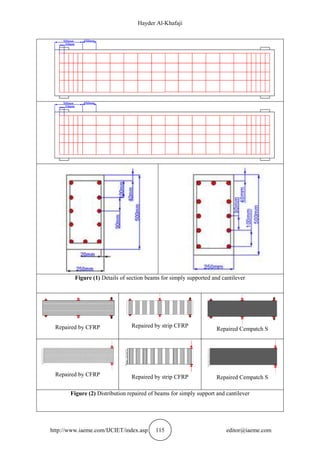
Fig (1). Schematic representations of the repairing and strengthening schemes are shown in
Fig (2) and Table (2) shows the cases of beams.
Hayder Al-Khafaji
http://www.iaeme.com/IJCIET/index.asp 115 editor@iaeme.com
Figure (1) Details of section beams for simply supported and cantilever
Repaired by CFRP Repaired by strip CFRP
Repaired Cempatch S
Repaired by CFRP Repaired by strip CFRP Repaired Cempatch S
Figure (2) Distribution repaired of beams for simply support and cantilever
Torsional Behavior of Repaired Reinforced Concrete Beams with Multi-Boundary Conditions
http://www.iaeme.com/IJCIET/index.asp 116 editor@iaeme.com
Designations:
C30= compressive strength fc'=30 MPa
C85= compressive strength fc'=85 MPa
CFRP= Carbon Fiber Reinforced Polymer
C=cut at the edge of beam
S =strip of beam length
4 , 3 =4edge and 3 edge
C4,C3 =Cover from 4 edge and 3 edge
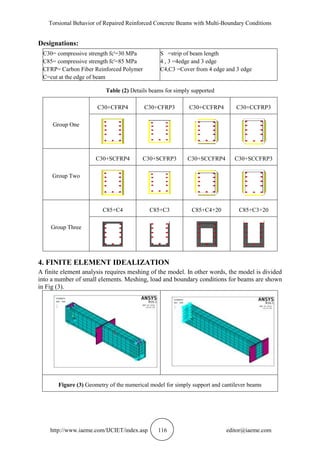
Table (2) Details beams for simply supported
Group One
C30+CFRP4 C30+CFRP3 C30+CCFRP4 C30+CCFRP3
Group Two
C30+SCFRP4 C30+SCFRP3 C30+SCCFRP4 C30+SCCFRP3
Group Three
C85+C4 C85+C3 C85+C4+20 C85+C3+20
4. FINITE ELEMENT IDEALIZATION
A finite element analysis requires meshing of the model. In other words, the model is divided
into a number of small elements. Meshing, load and boundary conditions for beams are shown
in Fig (3).
Figure (3) Geometry of the numerical model for simply support and cantilever beams
Hayder Al-Khafaji
http://www.iaeme.com/IJCIET/index.asp 117 editor@iaeme.com
5. RESULTS AND DISCUSSIONS
In this section, the results obtained from ANSYS 16.1 are displayed for 26 beams divided
according boundary condition in two types cantilever and simply support each type include 13
beams. Because there is no experimental program for this research and compare it with the
results of the ANSYS. Therefore, the effectiveness of the program was verified through
another research that contains experimental results [3]. The general behavior of beams of
finite element represented in the torque-twist plots showed good convention with the data of
test from the experimentally tested. The torque-twist curves were show in Fig (4)to(6) and
Table(3).
Designations
A90W4:90 degree complete wrap
A0L4:0 degree, 4 sides
Table (3) Comparison between experimental and numerical ultimate torque and twist
Beam
Ultimate Torque (kN-m) Ultimate Twist (rad/mm)
Experimental Numerical
Percentage
Difference %
Experimental Numerical
Percentage
Difference %
reference 18 19.5 -8.3 110 104 5.45
A90W4 45 48 -6.67 70 63 10
A0L4 29 31.25 -7.76 168 152 9.53
Figure (4) Torque-Twist relationship of reference beam
Figure (5) Torque-Twist relationship of
beam(A90W4)
Figure (6) Torque-Twist relationship of
beam(A0L4)
Torsional Behavior of Repaired Reinforced Concrete Beams with Multi-Boundary Conditions
http://www.iaeme.com/IJCIET/index.asp 118 editor@iaeme.com
The previous tables and figures present a comparison between experimental, numerical
results related to load, deflection. This comparison shows in general that the numerical
models are stiffer, and the numerical analyses give a smaller result for the deflection and
greater for ultimate load. These differences may be due to the following reasons:
 The concrete of experimental samples is not perfectly homogeneous as assumed in the
numerical models.
 The compressive strength of the tested concrete cubes may not represent exactly the actual
compressive strength.
Simply support
This type of boundary condition include 13 beams divided according repaired three groups
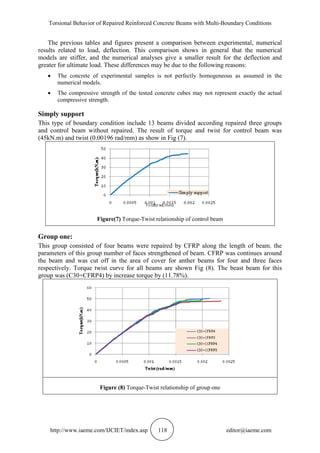
and control beam without repaired. The result of torque and twist for control beam was
(45kN.m) and twist (0.00196 rad/mm) as show in Fig (7).
Figure(7) Torque-Twist relationship of control beam
Group one:
This group consisted of four beams were repaired by CFRP along the length of beam. the
parameters of this group number of faces strengthened of beam. CFRP was continues around
the beam and was cut off in the area of cover for anther beams for four and three faces
respectively. Torque twist curve for all beams are shown Fig (8). The beast beam for this
group was (C30+CFRP4) by increase torque by (11.78%).
Figure (8) Torque-Twist relationship of group one
Hayder Al-Khafaji
http://www.iaeme.com/IJCIET/index.asp 119 editor@iaeme.com
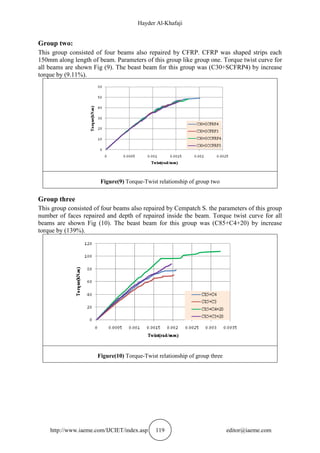
Group two:
This group consisted of four beams also repaired by CFRP. CFRP was shaped strips each
150mm along length of beam. Parameters of this group like group one. Torque twist curve for
all beams are shown Fig (9). The beast beam for this group was (C30+SCFRP4) by increase
torque by (9.11%).
Figure(9) Torque-Twist relationship of group two
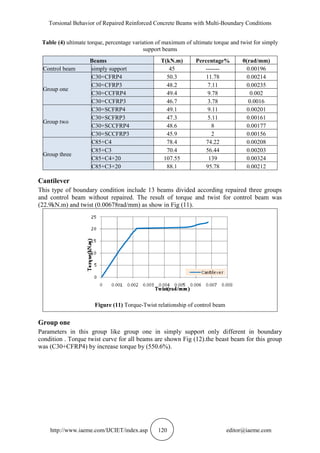
Group three
This group consisted of four beams also repaired by Cempatch S. the parameters of this group
number of faces repaired and depth of repaired inside the beam. Torque twist curve for all
beams are shown Fig (10). The beast beam for this group was (C85+C4+20) by increase
torque by (139%).
Figure(10) Torque-Twist relationship of group three
Torsional Behavior of Repaired Reinforced Concrete Beams with Multi-Boundary Conditions
http://www.iaeme.com/IJCIET/index.asp 120 editor@iaeme.com
Table (4) ultimate torque, percentage variation of maximum of ultimate torque and twist for simply
support beams
Beams T(kN.m) Percentage% θ(rad/mm)
Control beam simply support 45 ------- 0.00196
Group one
C30+CFRP4 50.3 11.78 0.00214
C30+CFRP3 48.2 7.11 0.00235
C30+CCFRP4 49.4 9.78 0.002
C30+CCFRP3 46.7 3.78 0.0016
Group two
C30+SCFRP4 49.1 9.11 0.00201
C30+SCFRP3 47.3 5.11 0.00161
C30+SCCFRP4 48.6 8 0.00177
C30+SCCFRP3 45.9 2 0.00156
Group three
C85+C4 78.4 74.22 0.00208
C85+C3 70.4 56.44 0.00203
C85+C4+20 107.55 139 0.00324
C85+C3+20 88.1 95.78 0.00212
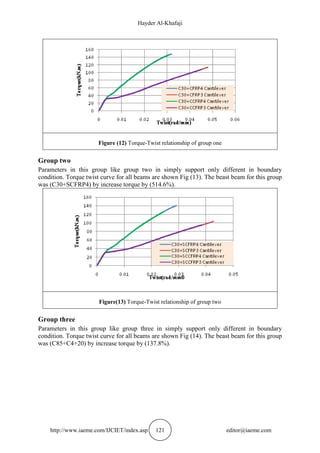
Cantilever
This type of boundary condition include 13 beams divided according repaired three groups
and control beam without repaired. The result of torque and twist for control beam was
(22.9kN.m) and twist (0.00678rad/mm) as show in Fig (11).
Figure (11) Torque-Twist relationship of control beam
Group one
Parameters in this group like group one in simply support only different in boundary
condition . Torque twist curve for all beams are shown Fig (12).the beast beam for this group
was (C30+CFRP4) by increase torque by (550.6%).
Hayder Al-Khafaji
http://www.iaeme.com/IJCIET/index.asp 121 editor@iaeme.com
Figure (12) Torque-Twist relationship of group one
Group two
Parameters in this group like group two in simply support only different in boundary
condition. Torque twist curve for all beams are shown Fig (13). The beast beam for this group
was (C30+SCFRP4) by increase torque by (514.6%).
Figure(13) Torque-Twist relationship of group two
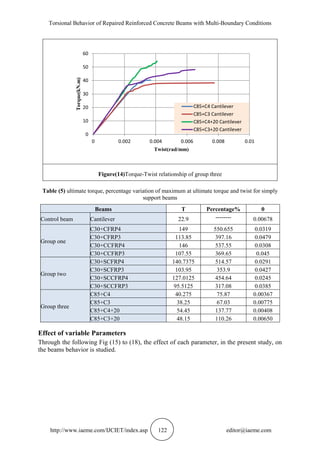
Group three
Parameters in this group like group three in simply support only different in boundary
condition. Torque twist curve for all beams are shown Fig (14). The beast beam for this group
was (C85+C4+20) by increase torque by (137.8%).
Torsional Behavior of Repaired Reinforced Concrete Beams with Multi-Boundary Conditions
http://www.iaeme.com/IJCIET/index.asp 122 editor@iaeme.com
Figure(14)Torque-Twist relationship of group three
Table (5) ultimate torque, percentage variation of maximum at ultimate torque and twist for simply
support beams
Beams T Percentage% θ
Control beam Cantilever 22.9 -------- 0.00678
Group one
C30+CFRP4 149 550.655 0.0319
C30+CFRP3 113.85 397.16 0.0479
C30+CCFRP4 146 537.55 0.0308
C30+CCFRP3 107.55 369.65 0.045
Group two
C30+SCFRP4 140.7375 514.57 0.0291
C30+SCFRP3 103.95 353.9 0.0427
C30+SCCFRP4 127.0125 454.64 0.0245
C30+SCCFRP3 95.5125 317.08 0.0385
Group three
C85+C4 40.275 75.87 0.00367
C85+C3 38.25 67.03 0.00775
C85+C4+20 54.45 137.77 0.00408
C85+C3+20 48.15 110.26 0.00650
Effect of variable Parameters
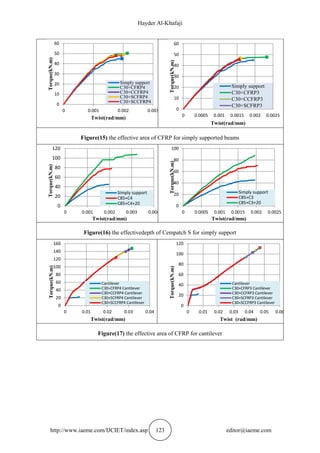
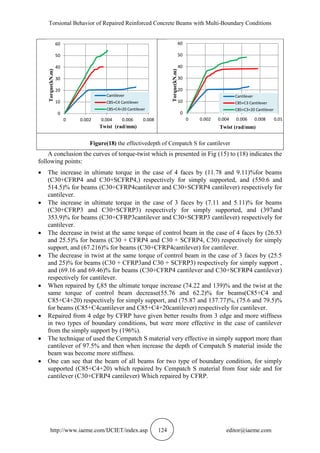
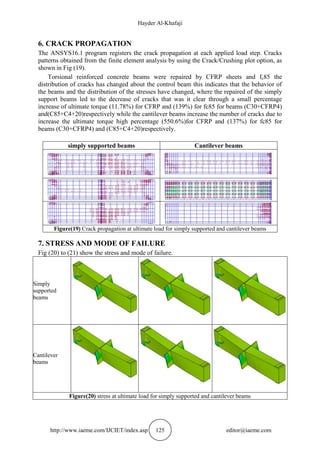
Through the following Fig (15) to (18), the effect of each parameter, in the present study, on
the beams behavior is studied.
0
10
20
30
40
50
60
0 0.002 0.004 0.006 0.008 0.01
Torque(kN.m)
Twist(rad/mm)
C85+C4 Cantilever
C85+C3 Cantilever
C85+C4+20 Cantilever
C85+C3+20 Cantilever
Hayder Al-Khafaji
http://www.iaeme.com/IJCIET/index.asp 123 editor@iaeme.com
Figure(15) the effective area of CFRP for simply supported beams
Figure(16) the effectivedepth of Cempatch S for simply support
Figure(17) the effective area of CFRP for cantilever
0
10
20
30
40
50
60
0 0.001 0.002 0.003
Torque(kN.m)
Twist(rad/mm)
Simply support
C30+CFRP4
C30+CCFRP4
C30+SCFRP4
C30+SCCFRP4
0
10
20
30
40
50
60
0 0.0005 0.001 0.0015 0.002 0.0025
Torque(kN.m)
Twist(rad/mm)
Simply support
C30+CFRP3
C30+CCFRP3
C30+SCFRP3
0
20
40
60
80
100
120
0 0.001 0.002 0.003 0.004
Torque(kN.m)
Twist(rad/mm)
Simply support
C85+C4
C85+C4+20 0
20
40
60
80
100
0 0.0005 0.001 0.0015 0.002 0.0025
Torque(kN.m)
Twist(rad/mm)
Simply support
C85+C3
C85+C3+20
0
20
40
60
80
100
120
140
160
0 0.01 0.02 0.03 0.04
Torque(kN.m)
Twist(rad/mm)
Cantilever
C30+CFRP4 Cantilever
C30+CCFRP4 Cantilever
C30+SCFRP4 Cantilever
C30+SCCFRP4 Cantilever
0
20
40
60
80
100
120
0 0.01 0.02 0.03 0.04 0.05 0.06
Torque(kN.m)
Twist (rad/mm)
Cantilever
C30+CFRP3 Cantilever
C30+CCFRP3 Cantilever
C30+SCFRP3 Cantilever
C30+SCCFRP3 Cantilever
Torsional Behavior of Repaired Reinforced Concrete Beams with Multi-Boundary Conditions
http://www.iaeme.com/IJCIET/index.asp 124 editor@iaeme.com
Figure(18) the effectivedepth of Cempatch S for cantilever
A conclusion the curves of torque-twist which is presented in Fig (15) to (18) indicates the
following points:
 The increase in ultimate torque in the case of 4 faces by (11.78 and 9.11)%for beams
(C30+CFRP4 and C30+SCFRP4,) respectively for simply supported, and (550.6 and
514.5)% for beams (C30+CFRP4cantilever and C30+SCFRP4 cantilever) respectively for
cantilever.
 The increase in ultimate torque in the case of 3 faces by (7.11 and 5.11)% for beams
(C30+CFRP3 and C30+SCFRP3) respectively for simply supported, and (397and
353.9)% for beams (C30+CFRP3cantilever and C30+SCFRP3 cantilever) respectively for
cantilever.
 The decrease in twist at the same torque of control beam in the case of 4 faces by (26.53
and 25.5)% for beams (C30 + CFRP4 and C30 + SCFRP4, C30) respectively for simply
support, and (67.216)% for beams (C30+CFRP4cantilever) for cantilever.
 The decrease in twist at the same torque of control beam in the case of 3 faces by (25.5
and 25)% for beams (C30 + CFRP3and C30 + SCFRP3) respectively for simply support ,
and (69.16 and 69.46)% for beams (C30+CFRP4 cantilever and C30+SCFRP4 cantilever)
respectively for cantilever.
 When repaired by fc85 the ultimate torque increase (74.22 and 139)% and the twist at the
same torque of control beam decrease(55.76 and 62.2)% for beams(C85+C4 and
C85+C4+20) respectively for simply support, and (75.87 and 137.77)%, (75.6 and 79.5)%
for beams (C85+C4cantilever and C85+C4+20cantilever) respectively for cantilever.
 Repaired from 4 edge by CFRP have given better results from 3 edge and more stiffness
in two types of boundary conditions, but were more effective in the case of cantilever
from the simply support by (196%).
 The technique of used the Cempatch S material very effective in simply support more than
cantilever of 97.5% and then when increase the depth of Cempatch S material inside the
beam was become more stiffness.
 One can see that the beam of all beams for two type of boundary condition, for simply
supported (C85+C4+20) which repaired by Cempatch S material from four side and for
cantilever (C30+CFRP4 cantilever) Which repaired by CFRP.
0
10
20
30
40
50
60
0 0.002 0.004 0.006 0.008
Torque(kN.m)
Twist (rad/mm)
Cantilever
C85+C4 Cantilever
C85+C4+20 Cantilever
0
10
20
30
40
50
60
0 0.002 0.004 0.006 0.008 0.01
Torque(kN.m)
Twist (rad/mm)
Cantilever
C85+C3 Cantilever
C85+C3+20 Cantilever
Hayder Al-Khafaji
http://www.iaeme.com/IJCIET/index.asp 125 editor@iaeme.com
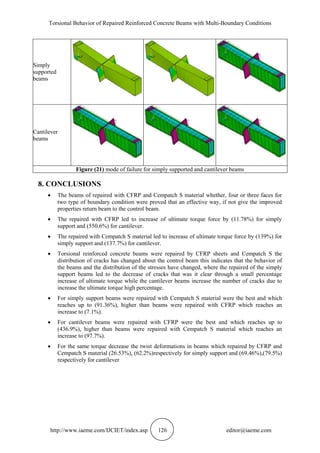
6. CRACK PROPAGATION
The ANSYS16.1 program registers the crack propagation at each applied load step. Cracks
patterns obtained from the finite element analysis by using the Crack/Crushing plot option, as
shown in Fig (19).
Torsional reinforced concrete beams were repaired by CFRP sheets and fc85 the
distribution of cracks has changed about the control beam this indicates that the behavior of
the beams and the distribution of the stresses have changed, where the repaired of the simply
support beams led to the decrease of cracks that was it clear through a small percentage
increase of ultimate torque (11.78%) for CFRP and (139%) for fc85 for beams (C30+CFRP4)
and(C85+C4+20)respectively while the cantilever beams increase the number of cracks due to
increase the ultimate torque high percentage (550.6%)for CFRP and (137%) for fc85 for
beams (C30+CFRP4) and (C85+C4+20)respectively.
simply supported beams Cantilever beams
Figure(19) Crack propagation at ultimate load for simply supported and cantilever beams
7. STRESS AND MODE OF FAILURE
Fig (20) to (21) show the stress and mode of failure.
Simply
supported
beams
Cantilever
beams
Figure(20) stress at ultimate load for simply supported and cantilever beams
Torsional Behavior of Repaired Reinforced Concrete Beams with Multi-Boundary Conditions
http://www.iaeme.com/IJCIET/index.asp 126 editor@iaeme.com
Simply
supported
beams
Cantilever
beams
Figure (21) mode of failure for simply supported and cantilever beams
8. CONCLUSIONS
 The beams of repaired with CFRP and Cempatch S material whether, four or three faces for
two type of boundary condition were proved that an effective way, if not give the improved
properties return beam to the control beam.
 The repaired with CFRP led to increase of ultimate torque force by (11.78%) for simply
support and (550.6%) for cantilever.
 The repaired with Cempatch S material led to increase of ultimate torque force by (139%) for
simply support and (137.7%) for cantilever.
 Torsional reinforced concrete beams were repaired by CFRP sheets and Cempatch S the
distribution of cracks has changed about the control beam this indicates that the behavior of
the beams and the distribution of the stresses have changed, where the repaired of the simply
support beams led to the decrease of cracks that was it clear through a small percentage
increase of ultimate torque while the cantilever beams increase the number of cracks due to
increase the ultimate torque high percentage.
 For simply support beams were repaired with Cempatch S material were the best and which
reaches up to (91.36%), higher than beams were repaired with CFRP which reaches an
increase to (7.1%).
 For cantilever beams were repaired with CFRP were the best and which reaches up to
(436.9%), higher than beams were repaired with Cempatch S material which reaches an
increase to (97.7%).
 For the same torque decrease the twist deformations in beams which repaired by CFRP and
Cempatch S material (26.53%), (62.2%)respectively for simply support and (69.46%),(79.5%)
respectively for cantilever
Hayder Al-Khafaji
http://www.iaeme.com/IJCIET/index.asp 127 editor@iaeme.com
REFERENCES
[1] Meier, U. : "Post-strengthening by continuous fiber sheets in Europe. Proceedings of
Third International Symposium, Non-Metallic (FRP) Reinforcement for Concrete
Structures", Vol. 1, Japan Concrete Institute, Tokyo, pp. 41–56, 1997.
[2] David ,E.,Djelal, C. and Buyle-Bodin , F.: " Repair and Strengthening of Reinforced
Concrete Beams using Composite Materials", second Int. PhD. Symposium in Civil
Engineering, 1998 Budapest, WWW.vbt.bme.hu.
[3] S. Panchacharam and A. Belarbi: "Torsional Behavior of Reinforced Concrete Beams
Strengthened with FRP Composites", First FIB Congress, Osaka, Japan, October 13-
19,2002.
[4] R.Santhakumar R.Dhanaraj and E.Chandrasekaran "Behaviour of retrofitted reinforced
concrete beams under combined bending and torsion".
[5] Bonfiglioli, B., Migo, S., M., Pascale, G., "Dynamic Testing of Reinforced Concrete
Beams Damaged and Repaired with Fiber Reinforced Polymer Sheets", Journal of
materials in civil engineering, ASCE, September 2004.
[6] Ali, D., D., "Experimental and Theoretical Investigation of the Behavior of Reinforced
Concrete Beams Strengthened by Fiber Reinforced Polymer" Ph.D. Thesis, University of
Baghdad, January 2007.
[7] Al-Saidy, A., H., Al-Harthy, A., S., Abdul-Halim, M., Al-Jabri, K., S., Al-shidi, N.,
M.,"Repair Strengthening of Corrosion Damaged Concrete Beams with Fiber Reinforced
Polymers Sheets", University of Patras, Patras, Greece, July 2007.
[8] Abed Al-Amery, S., J., "Behavior of RC Beams Repaired with Steel and CFRP Plates",
M.Sc. Thesis, AI -Mustansiriya University, Iraq, January- 2009.
[9] Nada S. Assi: " The Effect of Carbon Fiber Reinforced Polymer Length on the
Strengthened of Concentrically Loaded Reinforced Concrete Beams : Finite Element
Analysis", Vol. 32, Part (A), No.7, Eng. & Tech. Journal, pp. 1671-1683, 2014.
[10] Kadhim Naief Kadhim and Ghufran A. (The Geotechnical Maps For Gypsum By Using
Gis For Najaf City (Najaf - Iraq) (IJCIET), Volume 7, Issue 44, July-August 2016.
[11] Hassan and Kadhim Naief Kadhim (Development an Equation for Flow over Weirs Using
MNLR and CFD Simulation Approaches). (IJCIET), Volume 9, Issue 3, (Feb 2018)
[12] T. Abdo and R. Mabrouk" Effect of web openings on the structural behavior of RC beams
subjected to pure torsion"

Ijciet 10 01_012

  • 1.
    http://www.iaeme.com/IJCIET/index.asp 112 editor@iaeme.com InternationalJournal of Civil Engineering and Technology (IJCIET) Volume 10, Issue 1, January 2019, pp.112–127, Article ID: IJCIET_10_01_012 Available online at http://www.iaeme.com/IJCIET/issues.asp?JType=IJCIET&VType=10&IType=1 ISSN Print: 0976-6308 and ISSN Online: 0976-6316 ©IAEME Publication Scopus Indexed TORSIONAL BEHAVIOR OF REPAIRED REINFORCED CONCRETE BEAMS WITH MULTI-BOUNDARY CONDITIONS Hayder Al-Khafaji Lecturer: Civil engineering Department University of Babylon, Hilla, Iraq ABSTRACT This paper describes a finite element analysis for reinforced concrete beams of multi-boundary conditions end repaired by CFRP and fc85 section tested under pure torsion, classified according boundary conditions in two types cantilever and simply supported beams every type include 13 beams divided according repaired to three groups and control beam. The variables considered for group one and two included the beam faces number that will be strengthened, the effect of CFRP Strips numbers while the third group included repaired by fc85. The results of the repaired test beams revealed that the technique of used thefc85very effective in simply supported beam more than cantilever beam by about 97.5% while used repaired by CFRP more than in cantilever. The torque resistance increased in all beams which repaired by 550.65%, 137% in cantilever beams and 11.78%, 139% in simply supported beams for CFRP and fc85respectively, while the max twist decreased in all beams by 69.46%, 79.5% in cantilever beams and 26.5%, 62.19%in simply supported beams for CFRP and fc85respectively. Keywords: Reinforced Concrete Beam, Torsional Strengthening, CFRP strips, Boundary Conditions, Repaired Beam. Cite this Article: Hayder Al-Khafaji, Torsional Behavior of Repaired Reinforced Concrete Beams with Multi-Boundary Conditions, International Journal of Civil Engineering and Technology (IJCIET), 10 (1), 2019, pp. 112–127. http://www.iaeme.com/IJCIET/issues.asp?JType=IJCIET&VType=10&IType=1 1. INTRODUCTION The retrofitting of structures is promoted rather than demolishing and reconstruction of deteriorated structures. Attention has also given to increase the load carrying capacity of existing structures to increase the usage capacity or to change the intended usage so there is a large need to strengthen concrete structures around the world. Retrofitting of structures using fc85 and Carbon Fiber Reinforced Polymer materials is accepted as a sustainable and effective method.
  • 2.
    Hayder Al-Khafaji http://www.iaeme.com/IJCIET/index.asp 113editor@iaeme.com High strength concrete was used to repair of all types of structural concrete elements in buildings, water retaining structures, industrial plants, bridges, etc. where provide high strength and extremely low shrinkage properties are required. Externally bonded, CFRP sheets are currently being studied and applied around the world for the repair and strengthening of structural concrete members [1]. CFRP materials are of great interest to the civil engineering community because of their superior properties such as high stiffness and strength has well as ease of installation when compared to other repair materials. David, E.,Djelal, C. and Buyle-Bodin , F. [2],using externally CFRP strips to bounded beams and their results show that CFRP is very effective for flexure strengthening. S. Panchacharam and A. Belarbi [3], makings experimental study to investigate the torsional behavior of RC beams strengthened with externally bonded GFRP sheets. The variables considered in this study are fiber orientation (parallel and perpendicular to the longitudinal axis of the beam). The torsional reinforced concrete beams strengthened with GFRP sheets exhibited significant increase in their cracking and ultimate strength as well as ultimate twist deformations. R.Dhanaraj and E.Chandrasekaran [4], investigated the numerical study on un retrofitted and retrofitted reinforced concrete beams subjected to combined bending and torsion by ANSYS. Then the study has been extended for the same reinforced concrete beams retrofitted with carbon fiber reinforced plastic composites with ±45° and 0/90° fiber orientations. The present study reveals that the CFRP composites with ±45° fiber orientations are more effective in retrofitting the RC beams subjected to combined bending and torsion for higher torque to moment ratios. Bonfiglioli et al (2004)[5], carried out an experimental and theoretical study to evaluate the capability of dynamic testing to give useful information about the stiffness recovery due to external CFRP strengthening of RC beams which were previously damaged. Specimens were damaged under cycle loading until cracks appeared. Then CFRP used for repairing cracking specimens. The theoretical results are in good agreement with the experimental ones. The research suggests that dynamic testing can be used to obtain useful information about the effectiveness of the strengthening system. Ali (2007)[6], casted twenty eight reinforced concrete beams to investigate the behavior of using CFRP to repaired and strengthened beams failed in flexure and shear zone. All beams had been tested as a simply supported beam under two point of loading. From the results can see the use of CFRP as external strengthening has significant effect on ultimate load, crack pattern and deflection. The repaired beams reach (95% to 97%) of ultimate load in comparison with those strengthened in the same way by CFRP. AL-Saidy et al. (2007)[7], studied behavior of corroded damaged reinforced concrete beams repair/strengthening with CFRP sheets. Ten beams were casted and tested up to failure. Damaged beams were repaired by bonding CFRP sheets to the tension side to restore the strength loss due to corrosion. From the results can see The use of CFRP sheets for strengthening corroded reinforced concrete beams increasing the ultimate strength of repaired specimens. Deflection was increased for all repaired beams as compared with control beam. Abed Al-Amery (2009)[8], repaired ten damaged reinforced concrete beams at flexural region. Steel and CFRP palates used for repairing work to investigate the effect of repairing materials in restoring the original stiffness and capacity for damage beams. Beams tested as simply supported beam under two point loading. It was observed that ultimate can be increased up to (121.4%) in the case of using steel plates. While deflection was decreased to
  • 3.
    Torsional Behavior ofRepaired Reinforced Concrete Beams with Multi-Boundary Conditions http://www.iaeme.com/IJCIET/index.asp 114 editor@iaeme.com (15.4%) times .In case of using CFRP plates, the ultimate can be increased up to (64.3%). While deflection was decreased to (28.6%) times of the original beams. Nada S. Assi [9], using finite element method to adopted by ANSYS program for four beams strengthened in flexure with different length of CFRP sheet to confirm the theoretical calculations as well as to provide a valuable supplement to the laboratory investigation of behavior of beams. Good agreement with the experimental test is obtain and this study shows that the optimum length of CFRP plate equal to 83% of the full span length [10,11]. T.Abdo and R. Mabrouk[12],studied the behavior of simply supported RC beams with openings subjected to pure torsion then verified using FEM analysis program ANSYS16. Good agreement between the experimental and numerical results is found. The torque-rotation relationship for all the beams under study was linear up to the cracking torque and after that it became nonlinear. 2. MATERIALS CHARACTERISTICS: The materials of the structural elements that analysis in this study include concrete, steel reinforcing bars, Cempatch S and CFRP. The finite element models adopted have a number of parameters, which are summarized in Table (1). Table (1) Parameters for elements used in F.E. Model for beam Representation Element Type Characteristics Concrete Solid65 compressive strength (fc')=30 MPa Poisson's ratio=0.2 modulus of elasticity=25742 MPa ultimate strain=0.003 Steel Reinforcement Link180 Ø16, Ø12, Ø10 Yield strength=410 MPa CFRP Shell41 Cempatch S Solid65 compressive strength (fc')=85 MPa Poisson's ratio=0.17 modulus of elasticity=43332 MPa ultimate strain=0.0045 Steel plate Solid185 modulus of elasticity=200000 MPa Poisson's ratio=0.3 3. NUMERICAL ANALYSIS The finite elements representation using ANSYS16.1 program has been applied in this study to know the validate of the numerical representation of the reinforced concrete beams strengthening with Cempatch S and CFRP subjected to pure torsion. Twenty six reinforced concrete beams of 500*250 mm cross-section and 2550 mm length were tested in this study Fig (1). Schematic representations of the repairing and strengthening schemes are shown in Fig (2) and Table (2) shows the cases of beams.
  • 4.
    Hayder Al-Khafaji http://www.iaeme.com/IJCIET/index.asp 115editor@iaeme.com Figure (1) Details of section beams for simply supported and cantilever Repaired by CFRP Repaired by strip CFRP Repaired Cempatch S Repaired by CFRP Repaired by strip CFRP Repaired Cempatch S Figure (2) Distribution repaired of beams for simply support and cantilever
  • 5.
    Torsional Behavior ofRepaired Reinforced Concrete Beams with Multi-Boundary Conditions http://www.iaeme.com/IJCIET/index.asp 116 editor@iaeme.com Designations: C30= compressive strength fc'=30 MPa C85= compressive strength fc'=85 MPa CFRP= Carbon Fiber Reinforced Polymer C=cut at the edge of beam S =strip of beam length 4 , 3 =4edge and 3 edge C4,C3 =Cover from 4 edge and 3 edge Table (2) Details beams for simply supported Group One C30+CFRP4 C30+CFRP3 C30+CCFRP4 C30+CCFRP3 Group Two C30+SCFRP4 C30+SCFRP3 C30+SCCFRP4 C30+SCCFRP3 Group Three C85+C4 C85+C3 C85+C4+20 C85+C3+20 4. FINITE ELEMENT IDEALIZATION A finite element analysis requires meshing of the model. In other words, the model is divided into a number of small elements. Meshing, load and boundary conditions for beams are shown in Fig (3). Figure (3) Geometry of the numerical model for simply support and cantilever beams
  • 6.
    Hayder Al-Khafaji http://www.iaeme.com/IJCIET/index.asp 117editor@iaeme.com 5. RESULTS AND DISCUSSIONS In this section, the results obtained from ANSYS 16.1 are displayed for 26 beams divided according boundary condition in two types cantilever and simply support each type include 13 beams. Because there is no experimental program for this research and compare it with the results of the ANSYS. Therefore, the effectiveness of the program was verified through another research that contains experimental results [3]. The general behavior of beams of finite element represented in the torque-twist plots showed good convention with the data of test from the experimentally tested. The torque-twist curves were show in Fig (4)to(6) and Table(3). Designations A90W4:90 degree complete wrap A0L4:0 degree, 4 sides Table (3) Comparison between experimental and numerical ultimate torque and twist Beam Ultimate Torque (kN-m) Ultimate Twist (rad/mm) Experimental Numerical Percentage Difference % Experimental Numerical Percentage Difference % reference 18 19.5 -8.3 110 104 5.45 A90W4 45 48 -6.67 70 63 10 A0L4 29 31.25 -7.76 168 152 9.53 Figure (4) Torque-Twist relationship of reference beam Figure (5) Torque-Twist relationship of beam(A90W4) Figure (6) Torque-Twist relationship of beam(A0L4)
  • 7.
    Torsional Behavior ofRepaired Reinforced Concrete Beams with Multi-Boundary Conditions http://www.iaeme.com/IJCIET/index.asp 118 editor@iaeme.com The previous tables and figures present a comparison between experimental, numerical results related to load, deflection. This comparison shows in general that the numerical models are stiffer, and the numerical analyses give a smaller result for the deflection and greater for ultimate load. These differences may be due to the following reasons:  The concrete of experimental samples is not perfectly homogeneous as assumed in the numerical models.  The compressive strength of the tested concrete cubes may not represent exactly the actual compressive strength. Simply support This type of boundary condition include 13 beams divided according repaired three groups and control beam without repaired. The result of torque and twist for control beam was (45kN.m) and twist (0.00196 rad/mm) as show in Fig (7). Figure(7) Torque-Twist relationship of control beam Group one: This group consisted of four beams were repaired by CFRP along the length of beam. the parameters of this group number of faces strengthened of beam. CFRP was continues around the beam and was cut off in the area of cover for anther beams for four and three faces respectively. Torque twist curve for all beams are shown Fig (8). The beast beam for this group was (C30+CFRP4) by increase torque by (11.78%). Figure (8) Torque-Twist relationship of group one
  • 8.
    Hayder Al-Khafaji http://www.iaeme.com/IJCIET/index.asp 119editor@iaeme.com Group two: This group consisted of four beams also repaired by CFRP. CFRP was shaped strips each 150mm along length of beam. Parameters of this group like group one. Torque twist curve for all beams are shown Fig (9). The beast beam for this group was (C30+SCFRP4) by increase torque by (9.11%). Figure(9) Torque-Twist relationship of group two Group three This group consisted of four beams also repaired by Cempatch S. the parameters of this group number of faces repaired and depth of repaired inside the beam. Torque twist curve for all beams are shown Fig (10). The beast beam for this group was (C85+C4+20) by increase torque by (139%). Figure(10) Torque-Twist relationship of group three
  • 9.
    Torsional Behavior ofRepaired Reinforced Concrete Beams with Multi-Boundary Conditions http://www.iaeme.com/IJCIET/index.asp 120 editor@iaeme.com Table (4) ultimate torque, percentage variation of maximum of ultimate torque and twist for simply support beams Beams T(kN.m) Percentage% θ(rad/mm) Control beam simply support 45 ------- 0.00196 Group one C30+CFRP4 50.3 11.78 0.00214 C30+CFRP3 48.2 7.11 0.00235 C30+CCFRP4 49.4 9.78 0.002 C30+CCFRP3 46.7 3.78 0.0016 Group two C30+SCFRP4 49.1 9.11 0.00201 C30+SCFRP3 47.3 5.11 0.00161 C30+SCCFRP4 48.6 8 0.00177 C30+SCCFRP3 45.9 2 0.00156 Group three C85+C4 78.4 74.22 0.00208 C85+C3 70.4 56.44 0.00203 C85+C4+20 107.55 139 0.00324 C85+C3+20 88.1 95.78 0.00212 Cantilever This type of boundary condition include 13 beams divided according repaired three groups and control beam without repaired. The result of torque and twist for control beam was (22.9kN.m) and twist (0.00678rad/mm) as show in Fig (11). Figure (11) Torque-Twist relationship of control beam Group one Parameters in this group like group one in simply support only different in boundary condition . Torque twist curve for all beams are shown Fig (12).the beast beam for this group was (C30+CFRP4) by increase torque by (550.6%).
  • 10.
    Hayder Al-Khafaji http://www.iaeme.com/IJCIET/index.asp 121editor@iaeme.com Figure (12) Torque-Twist relationship of group one Group two Parameters in this group like group two in simply support only different in boundary condition. Torque twist curve for all beams are shown Fig (13). The beast beam for this group was (C30+SCFRP4) by increase torque by (514.6%). Figure(13) Torque-Twist relationship of group two Group three Parameters in this group like group three in simply support only different in boundary condition. Torque twist curve for all beams are shown Fig (14). The beast beam for this group was (C85+C4+20) by increase torque by (137.8%).
  • 11.
    Torsional Behavior ofRepaired Reinforced Concrete Beams with Multi-Boundary Conditions http://www.iaeme.com/IJCIET/index.asp 122 editor@iaeme.com Figure(14)Torque-Twist relationship of group three Table (5) ultimate torque, percentage variation of maximum at ultimate torque and twist for simply support beams Beams T Percentage% θ Control beam Cantilever 22.9 -------- 0.00678 Group one C30+CFRP4 149 550.655 0.0319 C30+CFRP3 113.85 397.16 0.0479 C30+CCFRP4 146 537.55 0.0308 C30+CCFRP3 107.55 369.65 0.045 Group two C30+SCFRP4 140.7375 514.57 0.0291 C30+SCFRP3 103.95 353.9 0.0427 C30+SCCFRP4 127.0125 454.64 0.0245 C30+SCCFRP3 95.5125 317.08 0.0385 Group three C85+C4 40.275 75.87 0.00367 C85+C3 38.25 67.03 0.00775 C85+C4+20 54.45 137.77 0.00408 C85+C3+20 48.15 110.26 0.00650 Effect of variable Parameters Through the following Fig (15) to (18), the effect of each parameter, in the present study, on the beams behavior is studied. 0 10 20 30 40 50 60 0 0.002 0.004 0.006 0.008 0.01 Torque(kN.m) Twist(rad/mm) C85+C4 Cantilever C85+C3 Cantilever C85+C4+20 Cantilever C85+C3+20 Cantilever
  • 12.
    Hayder Al-Khafaji http://www.iaeme.com/IJCIET/index.asp 123editor@iaeme.com Figure(15) the effective area of CFRP for simply supported beams Figure(16) the effectivedepth of Cempatch S for simply support Figure(17) the effective area of CFRP for cantilever 0 10 20 30 40 50 60 0 0.001 0.002 0.003 Torque(kN.m) Twist(rad/mm) Simply support C30+CFRP4 C30+CCFRP4 C30+SCFRP4 C30+SCCFRP4 0 10 20 30 40 50 60 0 0.0005 0.001 0.0015 0.002 0.0025 Torque(kN.m) Twist(rad/mm) Simply support C30+CFRP3 C30+CCFRP3 C30+SCFRP3 0 20 40 60 80 100 120 0 0.001 0.002 0.003 0.004 Torque(kN.m) Twist(rad/mm) Simply support C85+C4 C85+C4+20 0 20 40 60 80 100 0 0.0005 0.001 0.0015 0.002 0.0025 Torque(kN.m) Twist(rad/mm) Simply support C85+C3 C85+C3+20 0 20 40 60 80 100 120 140 160 0 0.01 0.02 0.03 0.04 Torque(kN.m) Twist(rad/mm) Cantilever C30+CFRP4 Cantilever C30+CCFRP4 Cantilever C30+SCFRP4 Cantilever C30+SCCFRP4 Cantilever 0 20 40 60 80 100 120 0 0.01 0.02 0.03 0.04 0.05 0.06 Torque(kN.m) Twist (rad/mm) Cantilever C30+CFRP3 Cantilever C30+CCFRP3 Cantilever C30+SCFRP3 Cantilever C30+SCCFRP3 Cantilever
  • 13.
    Torsional Behavior ofRepaired Reinforced Concrete Beams with Multi-Boundary Conditions http://www.iaeme.com/IJCIET/index.asp 124 editor@iaeme.com Figure(18) the effectivedepth of Cempatch S for cantilever A conclusion the curves of torque-twist which is presented in Fig (15) to (18) indicates the following points:  The increase in ultimate torque in the case of 4 faces by (11.78 and 9.11)%for beams (C30+CFRP4 and C30+SCFRP4,) respectively for simply supported, and (550.6 and 514.5)% for beams (C30+CFRP4cantilever and C30+SCFRP4 cantilever) respectively for cantilever.  The increase in ultimate torque in the case of 3 faces by (7.11 and 5.11)% for beams (C30+CFRP3 and C30+SCFRP3) respectively for simply supported, and (397and 353.9)% for beams (C30+CFRP3cantilever and C30+SCFRP3 cantilever) respectively for cantilever.  The decrease in twist at the same torque of control beam in the case of 4 faces by (26.53 and 25.5)% for beams (C30 + CFRP4 and C30 + SCFRP4, C30) respectively for simply support, and (67.216)% for beams (C30+CFRP4cantilever) for cantilever.  The decrease in twist at the same torque of control beam in the case of 3 faces by (25.5 and 25)% for beams (C30 + CFRP3and C30 + SCFRP3) respectively for simply support , and (69.16 and 69.46)% for beams (C30+CFRP4 cantilever and C30+SCFRP4 cantilever) respectively for cantilever.  When repaired by fc85 the ultimate torque increase (74.22 and 139)% and the twist at the same torque of control beam decrease(55.76 and 62.2)% for beams(C85+C4 and C85+C4+20) respectively for simply support, and (75.87 and 137.77)%, (75.6 and 79.5)% for beams (C85+C4cantilever and C85+C4+20cantilever) respectively for cantilever.  Repaired from 4 edge by CFRP have given better results from 3 edge and more stiffness in two types of boundary conditions, but were more effective in the case of cantilever from the simply support by (196%).  The technique of used the Cempatch S material very effective in simply support more than cantilever of 97.5% and then when increase the depth of Cempatch S material inside the beam was become more stiffness.  One can see that the beam of all beams for two type of boundary condition, for simply supported (C85+C4+20) which repaired by Cempatch S material from four side and for cantilever (C30+CFRP4 cantilever) Which repaired by CFRP. 0 10 20 30 40 50 60 0 0.002 0.004 0.006 0.008 Torque(kN.m) Twist (rad/mm) Cantilever C85+C4 Cantilever C85+C4+20 Cantilever 0 10 20 30 40 50 60 0 0.002 0.004 0.006 0.008 0.01 Torque(kN.m) Twist (rad/mm) Cantilever C85+C3 Cantilever C85+C3+20 Cantilever
  • 14.
    Hayder Al-Khafaji http://www.iaeme.com/IJCIET/index.asp 125editor@iaeme.com 6. CRACK PROPAGATION The ANSYS16.1 program registers the crack propagation at each applied load step. Cracks patterns obtained from the finite element analysis by using the Crack/Crushing plot option, as shown in Fig (19). Torsional reinforced concrete beams were repaired by CFRP sheets and fc85 the distribution of cracks has changed about the control beam this indicates that the behavior of the beams and the distribution of the stresses have changed, where the repaired of the simply support beams led to the decrease of cracks that was it clear through a small percentage increase of ultimate torque (11.78%) for CFRP and (139%) for fc85 for beams (C30+CFRP4) and(C85+C4+20)respectively while the cantilever beams increase the number of cracks due to increase the ultimate torque high percentage (550.6%)for CFRP and (137%) for fc85 for beams (C30+CFRP4) and (C85+C4+20)respectively. simply supported beams Cantilever beams Figure(19) Crack propagation at ultimate load for simply supported and cantilever beams 7. STRESS AND MODE OF FAILURE Fig (20) to (21) show the stress and mode of failure. Simply supported beams Cantilever beams Figure(20) stress at ultimate load for simply supported and cantilever beams
  • 15.
    Torsional Behavior ofRepaired Reinforced Concrete Beams with Multi-Boundary Conditions http://www.iaeme.com/IJCIET/index.asp 126 editor@iaeme.com Simply supported beams Cantilever beams Figure (21) mode of failure for simply supported and cantilever beams 8. CONCLUSIONS  The beams of repaired with CFRP and Cempatch S material whether, four or three faces for two type of boundary condition were proved that an effective way, if not give the improved properties return beam to the control beam.  The repaired with CFRP led to increase of ultimate torque force by (11.78%) for simply support and (550.6%) for cantilever.  The repaired with Cempatch S material led to increase of ultimate torque force by (139%) for simply support and (137.7%) for cantilever.  Torsional reinforced concrete beams were repaired by CFRP sheets and Cempatch S the distribution of cracks has changed about the control beam this indicates that the behavior of the beams and the distribution of the stresses have changed, where the repaired of the simply support beams led to the decrease of cracks that was it clear through a small percentage increase of ultimate torque while the cantilever beams increase the number of cracks due to increase the ultimate torque high percentage.  For simply support beams were repaired with Cempatch S material were the best and which reaches up to (91.36%), higher than beams were repaired with CFRP which reaches an increase to (7.1%).  For cantilever beams were repaired with CFRP were the best and which reaches up to (436.9%), higher than beams were repaired with Cempatch S material which reaches an increase to (97.7%).  For the same torque decrease the twist deformations in beams which repaired by CFRP and Cempatch S material (26.53%), (62.2%)respectively for simply support and (69.46%),(79.5%) respectively for cantilever
  • 16.
    Hayder Al-Khafaji http://www.iaeme.com/IJCIET/index.asp 127editor@iaeme.com REFERENCES [1] Meier, U. : "Post-strengthening by continuous fiber sheets in Europe. Proceedings of Third International Symposium, Non-Metallic (FRP) Reinforcement for Concrete Structures", Vol. 1, Japan Concrete Institute, Tokyo, pp. 41–56, 1997. [2] David ,E.,Djelal, C. and Buyle-Bodin , F.: " Repair and Strengthening of Reinforced Concrete Beams using Composite Materials", second Int. PhD. Symposium in Civil Engineering, 1998 Budapest, WWW.vbt.bme.hu. [3] S. Panchacharam and A. Belarbi: "Torsional Behavior of Reinforced Concrete Beams Strengthened with FRP Composites", First FIB Congress, Osaka, Japan, October 13- 19,2002. [4] R.Santhakumar R.Dhanaraj and E.Chandrasekaran "Behaviour of retrofitted reinforced concrete beams under combined bending and torsion". [5] Bonfiglioli, B., Migo, S., M., Pascale, G., "Dynamic Testing of Reinforced Concrete Beams Damaged and Repaired with Fiber Reinforced Polymer Sheets", Journal of materials in civil engineering, ASCE, September 2004. [6] Ali, D., D., "Experimental and Theoretical Investigation of the Behavior of Reinforced Concrete Beams Strengthened by Fiber Reinforced Polymer" Ph.D. Thesis, University of Baghdad, January 2007. [7] Al-Saidy, A., H., Al-Harthy, A., S., Abdul-Halim, M., Al-Jabri, K., S., Al-shidi, N., M.,"Repair Strengthening of Corrosion Damaged Concrete Beams with Fiber Reinforced Polymers Sheets", University of Patras, Patras, Greece, July 2007. [8] Abed Al-Amery, S., J., "Behavior of RC Beams Repaired with Steel and CFRP Plates", M.Sc. Thesis, AI -Mustansiriya University, Iraq, January- 2009. [9] Nada S. Assi: " The Effect of Carbon Fiber Reinforced Polymer Length on the Strengthened of Concentrically Loaded Reinforced Concrete Beams : Finite Element Analysis", Vol. 32, Part (A), No.7, Eng. & Tech. Journal, pp. 1671-1683, 2014. [10] Kadhim Naief Kadhim and Ghufran A. (The Geotechnical Maps For Gypsum By Using Gis For Najaf City (Najaf - Iraq) (IJCIET), Volume 7, Issue 44, July-August 2016. [11] Hassan and Kadhim Naief Kadhim (Development an Equation for Flow over Weirs Using MNLR and CFD Simulation Approaches). (IJCIET), Volume 9, Issue 3, (Feb 2018) [12] T. Abdo and R. Mabrouk" Effect of web openings on the structural behavior of RC beams subjected to pure torsion"