International Journal of Trend in Scientific Research and Development (IJTSRD)
Volume 6 Issue 6, September-October 2022 Available Online: www.ijtsrd.com e-ISSN: 2456 – 6470
@ IJTSRD | Unique Paper ID – IJTSRD52006 | Volume – 6 | Issue – 6 | September-October 2022 Page 1004
Reinforcement of Reinforced Concrete
Beams using CFRP and GFRP
Satrughan Singh1
, Puspendra Kushwaha2
1
Student, 2
Assistant Professor,
1,2
RKDF College of Engineering, Bhopal, Madhya Pradesh, India
ABSTRACT
Concrete, steel and masonry materials are the common materials used
for housing, office buildings, bridges, power plant structures and
these structures are being deteriorated with age. The deterioration of
the structures is due to the design deficiency, materials deficiency,
poor workmanship and extreme loads. Most of the investigation
reports on strengthening of damaged RC structures are based on
patch repairing and using FRP sheets for flexural, shear and
compressive strengthening of members. This research work is mainly
focused on retrofitting of RC beams using GFRP and CFRP sheets.
In this study the flexural behaviour of M 20, 40and M60grade RC
beams retrofitted with single, double and triple layers of GFRP sheets
is done and all the beams are analysed using ANSYS modelling and
compare with the experimental results. From the presence study, it is
derived that strengthening of RC beams with GFRP and CFRP sheets
can enhance the load carrying capacity of beams and at the same time
deflections up to yield stage of loading is increased and further the
deflections are reduced up to ultimate stage of loading. The RC
beams strengthened with GFRP and CFRP sheets show a marked
reduction in crack width at all stages of loading and substantial delay
in the formation of first crack.
KEYWORDS: Concrete, steel, masonry materials, buildings, bridges,
RC structures, FRP sheets, GFRP and CFRP, ANSYS modelling
How to cite this paper: Satrughan Singh
| Puspendra Kushwaha "Reinforcement
of Reinforced Concrete Beams using
CFRP and GFRP" Published in
International
Journal of Trend in
Scientific Research
and Development
(ijtsrd), ISSN:
2456-6470,
Volume-6 | Issue-6,
October 2022,
pp.1004-1011, URL:
www.ijtsrd.com/papers/ijtsrd52006.pdf
Copyright © 2022 by author (s) and
International Journal of Trend in
Scientific Research and Development
Journal. This is an
Open Access article
distributed under the
terms of the Creative Commons
Attribution License (CC BY 4.0)
(http://creativecommons.org/licenses/by/4.0)
1. INTRODUCTION
Fibre reinforced polymers are continuous or non-
continuous strong fibres surrounded by a matrix
material. The matrix serves to distribute the fibers and
transmit the load to the fibres. The bonding between
the fibres and the matrix is created during the
manufacturing phase and becomes a composite
material in the final stages of fabrication when the
matrix is hardened. The characteristics of composite
materials depend on proportions of reinforcements
and matrix, the form of reinforcement, and the
fabrication processes. These are a combination of
fibre reinforcement and a resin matrix. The resin
system holds fibers together and transfers the loads
through the fibres to the rest of the structure. In
addition to binding the composite structure together,
it protects from impact, abrasion, corrosion, other
environmental factors and rough handling. The most
common resins of the thermoset family are Polyester
(orthophthalic and isophthalic), vinyl ester, epoxy,
and phenolic. (Daniel, Isaac,2006)
Generally Reinforced Concrete (RC) structures can
suffer varying degrees of damage due to several
reasons including material deterioration, construction
technique adopted, poor workmanship, overloading,
aggressive environments, fatigue and corrosion of
steel reinforcement embedded in concrete.
Epoxy resins are a broadly used in FRP materials.
Epoxy resin systems are extremely high three
dimensional crosslink density which results to the
best mechanical performance characteristics of all the
resins. It can resist high amount of strength and
hardness, very good resistance to heat and electricity.
The disadvantages of this epoxy is higher cost and
processing difficulty. Epoxy systems are effectively
used in various applications such as aerospace,
defence, marine, sports equipment, adhesives,
sealants, coatings, architectural, flooring and many
other areas. (Åström,2018)
IJTSRD52006
International Journal of Trend in Scientific Research and Development @ www.ijtsrd.com eISSN: 2456-6470
@ IJTSRD | Unique Paper ID – IJTSRD52006 | Volume – 6 | Issue – 6 | September-October 2022 Page 1005
Most of the investigation reports on strengthening of
damaged RC structures are based on patch repairing
and using FRP sheets for flexural, shear and
compressive strengthening of members. This research
work is mainly focused on retrofitting of RC beams
using GFRP and CFRP sheets. Most of the
experimental studies are carried out in foreign
countries and this retrofitting work is carried out with
locally available GFRP and CFRP sheets. This study
is helpful to understand the retrofitting of RC beams
strengthened with GFRP and CFRP sheets according
to the Indian environment. It also deals with FEM
modelling of beams using ANSYS software to predict
load carrying capacity and deflection of control and
retrofitted beams. (Åström,2018)
2. LITERATURE REVIEW
Sharba, Amjad Ali K el al. (2021) reviewed several
features of Reinforced concrete (RC) beams
strengthened with FRP. Also this paper aims to
impart a comprehensive insight on adhesive curing,
surface arrangement, and failure modes of RC beams
modified with FRP. This effect of FRP for enhancing
the techniques of rehabilitation is a three-fold task, to
strengthen and retrofit of concrete structures, to
extend the fatigue life of the structural element, and
eliminates the crack growth rate.
Askar el al. (2022) gave a summary of the literature
on the flexural and shear behavior of RC beams
reinforced with FRP materials under various schemes.
The efficiency of various types of FRP materials and
processes has also been considered. Moreover, it
illustrates a cost comparison of different
strengthening schemes and the limitations of FRP
strengthening.
Abbasi el al. (2022) Compared experimental
investigations, the finite element (FE) technique
provides an accurate, cost-effective, and less time-
consuming tool, enabling practicing engineers to
perform efficient, accurate nonlinear and dynamic
analysis as well as parametric studies on RC beams
strengthened with EB-FRP. Since 1996, many
numerical studies have been carried out on the
response of RC beams strengthened using FRP.
Panahi el al. (2021) numerically investigated the
flexural strengthening efficiency of reinforced
concrete beams with combined externally bonded
FRP sheets and near-surface mounted FRP rods.
Rabia el al. (2021) presented a theoretical study
taking into account the effect of air bubbles in
concrete (as a material manufacturing defect) on
interfacial stresses, in reinforced concrete beams,
strengthening with an externally bonded FRP
composite plate.
Sheth and Gajjar et al (2010) conducted the study
of strengthening using FRP in RC beams to increase
the strength in flexure. The cross section of the beam
was 230 x 450 mm and length of 5 m.
El-Ghandour (2011) investigated beams
strengthened for flexure and shear by CFRP sheets.
He used different shear and flexure sheet ratios and
tested in three point bending. Longitudinal CFRP
sheets were used for flexure and U type wraps used
for shear. The size of beam was 120 mm x 300 mm x
2000 mm.
Jung Deng et al (2011) conducted test on CFRP
strengthened beam and found improvement in
strength and stiffness of beam. An analytical solution
developed for composite beams using FEM modelling
on CFRP strengthened beams. Both analytical and the
finite element models (ANSYS, 2003) were used to
validate the experimental work carried out by
Tavakkolizadeh and Saadatmanesh (2003).
Yasmeen Taleb Obaidat et al (2011) conducted a
study on CFRP strengthened RC beams for flexure
and shear. They have tested twelve RC beams in four
point loading. The mechanical properties of concrete,
steel and CFRP laminates were found out. The
stiffness of RC beams strengthened by CFRP
laminates got increased when compared to control
beam.
3. MATERIAL PROPERTIES
Ordinary Portland cement of 53 grades conforming to
IS: 12269 - 1987, Ground Granulated Blast furnace
Slag (GGBS) conforming to IS: 12089 - 1987, fine
aggregates of locally available river sand passing
through 3.75 mm sieve and retained on 600 microns
conforming of zone II of IS: 383 - 1970, coarse
aggregate of crushed granite type passing through 20
mm sieve and retaining on 10 mm sieve conforming
of IS: 383 - 1970 with portable water were used as
the ingredients in concrete. Specific gravity and sieve
analysis tests were conducted on cement, GGBS, fine
and coarse aggregate and the results are given in
Table 1.
International Journal of Trend in Scientific Research and Development @ www.ijtsrd.com eISSN: 2456-6470
@ IJTSRD | Unique Paper ID – IJTSRD52006 | Volume – 6 | Issue – 6 | September-October 2022 Page 1006
Table 1 Properties of Aggregate, Cement and GGBS
Sl. No. Properties of Aggregate and Cement Values
1 Specific gravity of cement 3.14
2 Specific gravity of GGBS 2.83
3 Specific gravity of fine aggregate 2.60
4 Fineness modulus of fine aggregate 2.18
5 Specific gravity of coarse aggregate 2.74
6 Fineness modulus of coarse aggregate 6.66
The glass fibre reinforced polymer sheet of 1.5 mm thick was used for retrofitting of RC beams. The fibre
orientation is unidirectional direction. The Carbon Fibre Reinforced Polymer sheet is available in 1.5 mm
thickness. The fibre is oriented in unidirectional direction.
4. EXPERIMENTAL PROGRAMME
Initially, the properties of concrete was obtained by casting and testing of concrete specimens of cubes (150 mm
x 150 mm x 150 mm to determine the compressive strength, tensile strength and flexural strength respectively.
The specimens were cast using various grades of concrete such as, M 40, . Ordinary Portland cement, natural
river sand and the coarse aggregate crushed on maximum size of 12.5 mm were used and three numbers of
specimens were cast and tested to take the average value at different curing period. The specimens were allowed
for curing of different periods of 7, 14 and 28 days.
Flexural Behaviour of Control Beams
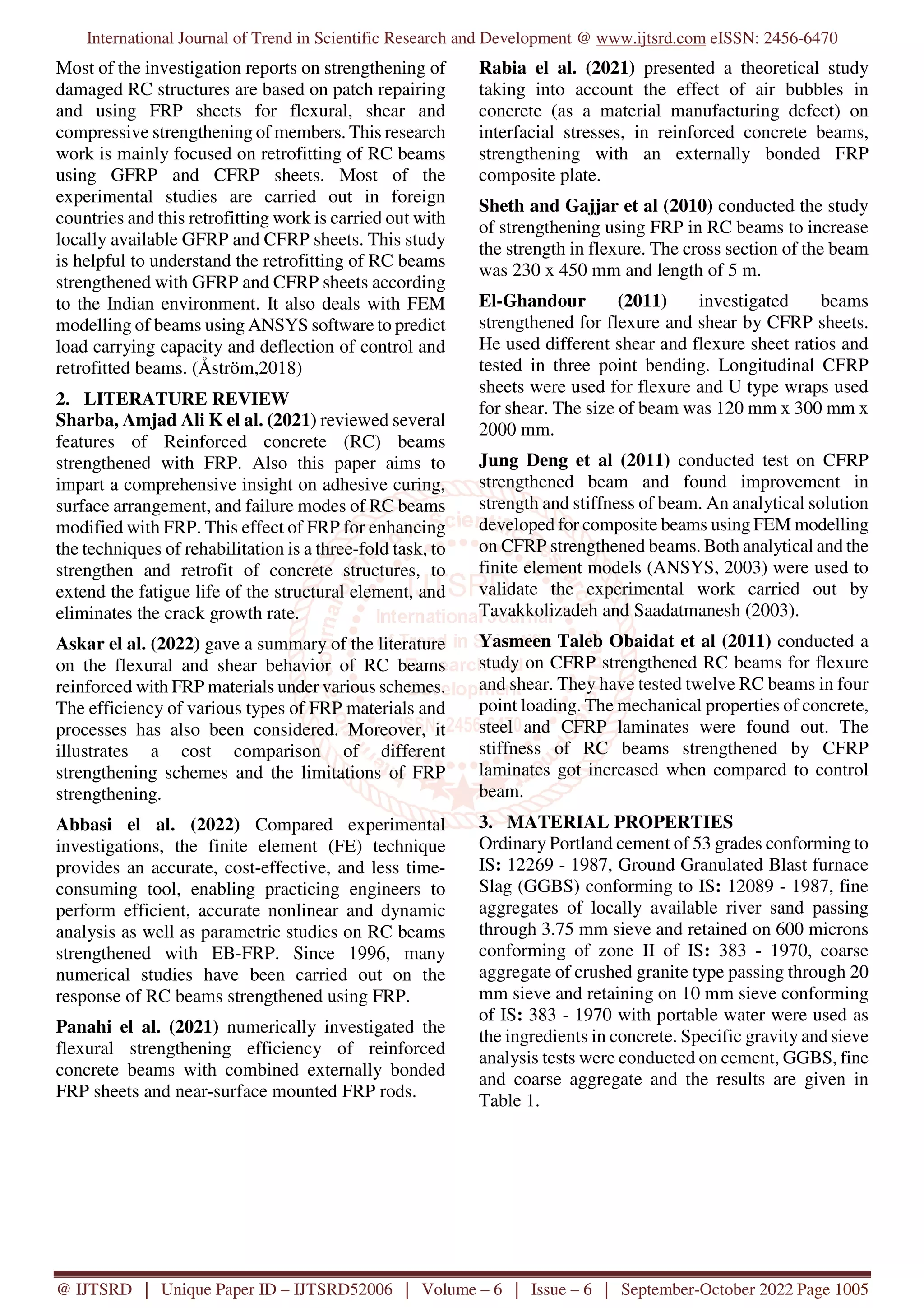
The static behaviour of beams includes studying the structural behaviour aspects such as deflection, crack
propagation and ultimate load carrying capacity of the beam under monotonic conditions. Hence the beams were
tested monotonically with simply supported boundary conditions. The crack pattern of beams is shown in
Figure1
Control Beam (M 20, M 40, and M 60) Grade
Figure 1 Crack Patterns of Control Beams of Varying Grades
These beams were loaded up to failure and deflections are measured for a load increment of 2.5 kN and these
load deflection values were used as base values for other beams.
5. ANALYTICAL INVESTIGATIONS AND RESULT
The concrete material propertiesfor all the grades of concrete used in the beams are shown in Table 2
Table 2 Concrete Material Properties
Grade of Concrete
Compressive
Strength (N/mm2
)
Young Modulus
(E) (N/mm2
)
Poisson’s
Ratio (µ)
M 20 RCC 28.40 2.51 x 10⁴
0.186
M 40 RCC 50.44 3.52 x 10⁴
0.171
M 60 RCC 73.56 4.32 x 10⁴
0.160
5.1. MESHING
In Finite Element Analysis meshing requires for a model to analyse (Bathe, 1996). The reinforcement model
is meshed using line elements so that the nodes of the lineelements come exactly over the node of the solid
elements which are later merged sothat both rebar elements and the concrete elements share the same node
(William,1975).
International Journal of Trend in Scientific Research and Development @ www.ijtsrd.com eISSN: 2456-6470
@ IJTSRD | Unique Paper ID – IJTSRD52006 | Volume – 6 | Issue – 6 | September-October 2022 Page 1007
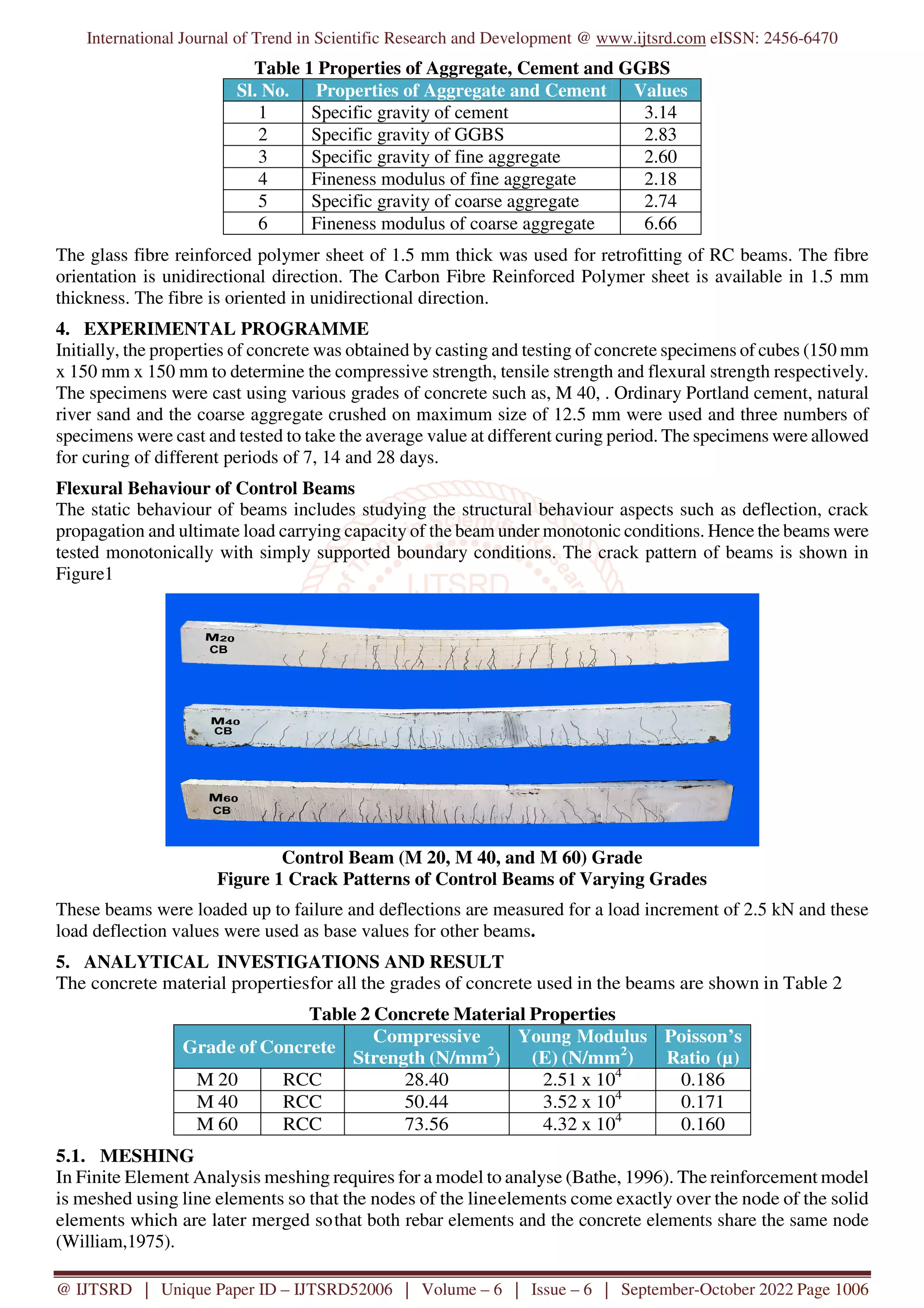
For beam generation total mesh model defined 3225 nodes and 2783 elements are required. The meshing
concrete is shown in Figure 2 and meshing reinforcement isshown in Figure 3
Figure 2 Meshing of Concrete Figure 3 Meshing of Reinforcement
5.2. LOADING AND BOUNDARY CONDITIONS
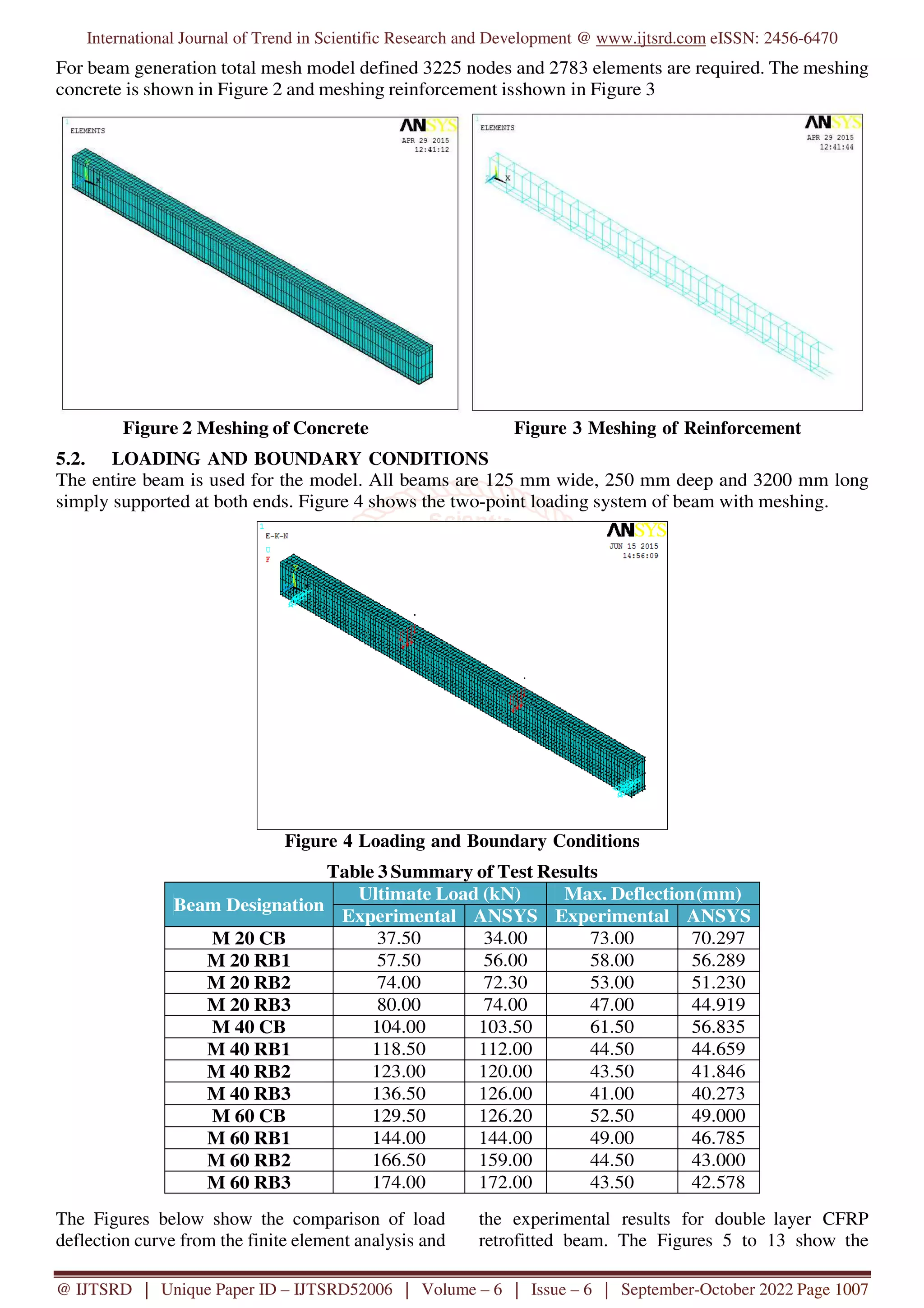
The entire beam is used for the model. All beams are 125 mm wide, 250 mm deep and 3200 mm long
simply supported at both ends. Figure 4 shows the two-point loading system of beam with meshing.
Figure 4 Loading and Boundary Conditions
Table 3 Summary of Test Results
Beam Designation
Ultimate Load (kN) Max. Deflection(mm)
Experimental ANSYS Experimental ANSYS
M 20 CB 37.50 34.00 73.00 70.297
M 20 RB1 57.50 56.00 58.00 56.289
M 20 RB2 74.00 72.30 53.00 51.230
M 20 RB3 80.00 74.00 47.00 44.919
M 40 CB 104.00 103.50 61.50 56.835
M 40 RB1 118.50 112.00 44.50 44.659
M 40 RB2 123.00 120.00 43.50 41.846
M 40 RB3 136.50 126.00 41.00 40.273
M 60 CB 129.50 126.20 52.50 49.000
M 60 RB1 144.00 144.00 49.00 46.785
M 60 RB2 166.50 159.00 44.50 43.000
M 60 RB3 174.00 172.00 43.50 42.578
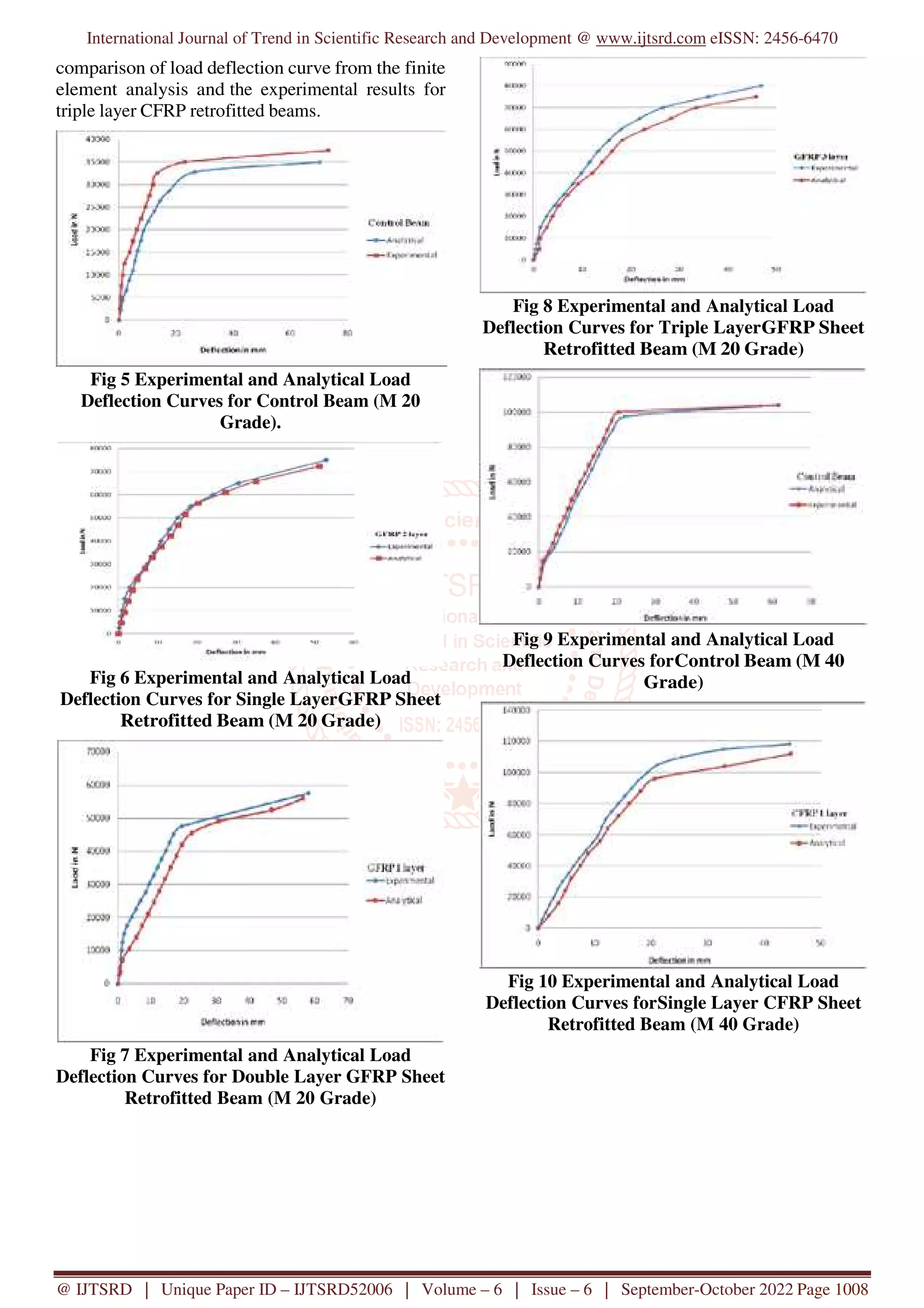
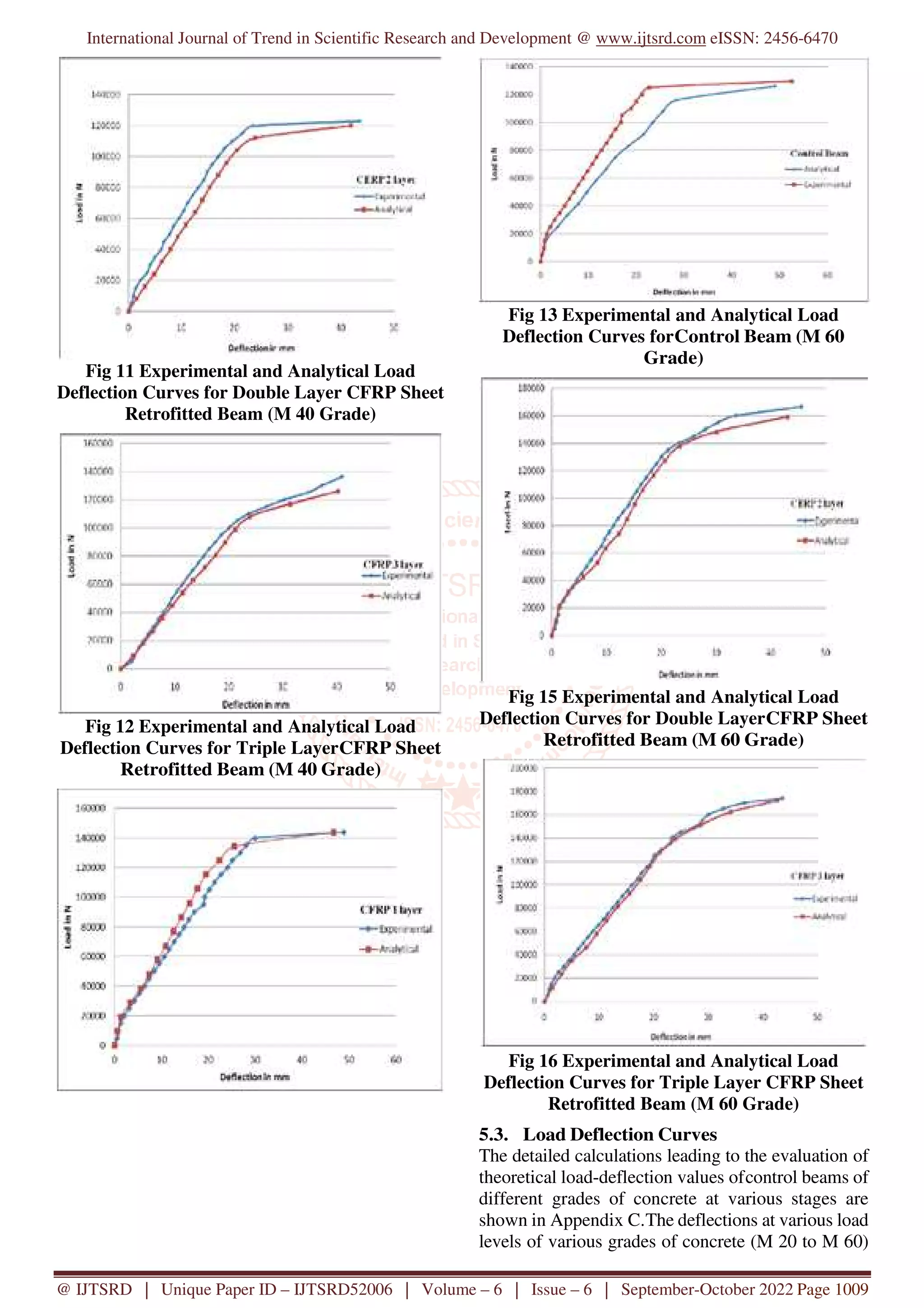
The Figures below show the comparison of load
deflection curve from the finite element analysis and
the experimental results for double layer CFRP
retrofitted beam. The Figures 5 to 13 show the
International Journal of Trend in Scientific Research and Development @ www.ijtsrd.com eISSN: 2456-6470
@ IJTSRD | Unique Paper ID – IJTSRD52006 | Volume – 6 | Issue – 6 | September-October 2022 Page 1008
comparison of load deflection curve from the finite
element analysis and the experimental results for
triple layer CFRP retrofitted beams.
Fig 5 Experimental and Analytical Load
Deflection Curves for Control Beam (M 20
Grade).
Fig 6 Experimental and Analytical Load
Deflection Curves for Single LayerGFRP Sheet
Retrofitted Beam (M 20 Grade)
Fig 7 Experimental and Analytical Load
Deflection Curves for Double Layer GFRP Sheet
Retrofitted Beam (M 20 Grade)
Fig 8 Experimental and Analytical Load
Deflection Curves for Triple LayerGFRP Sheet
Retrofitted Beam (M 20 Grade)
Fig 9 Experimental and Analytical Load
Deflection Curves forControl Beam (M 40
Grade)
Fig 10 Experimental and Analytical Load
Deflection Curves forSingle Layer CFRP Sheet
Retrofitted Beam (M 40 Grade)
International Journal of Trend in Scientific Research and Development @ www.ijtsrd.com eISSN: 2456-6470
@ IJTSRD | Unique Paper ID – IJTSRD52006 | Volume – 6 | Issue – 6 | September-October 2022 Page 1009
Fig 11 Experimental and Analytical Load
Deflection Curves for Double Layer CFRP Sheet
Retrofitted Beam (M 40 Grade)
Fig 12 Experimental and Analytical Load
Deflection Curves for Triple LayerCFRP Sheet
Retrofitted Beam (M 40 Grade)
Fig 13 Experimental and Analytical Load
Deflection Curves forControl Beam (M 60
Grade)
Fig 15 Experimental and Analytical Load
Deflection Curves for Double LayerCFRP Sheet
Retrofitted Beam (M 60 Grade)
Fig 16 Experimental and Analytical Load
Deflection Curves for Triple Layer CFRP Sheet
Retrofitted Beam (M 60 Grade)
5.3. Load Deflection Curves
The detailed calculations leading to the evaluation of
theoretical load-deflection values ofcontrol beams of
different grades of concrete at various stages are
shown in Appendix C.The deflections at various load
levels of various grades of concrete (M 20 to M 60)
International Journal of Trend in Scientific Research and Development @ www.ijtsrd.com eISSN: 2456-6470
@ IJTSRD | Unique Paper ID – IJTSRD52006 | Volume – 6 | Issue – 6 | September-October 2022 Page 1010
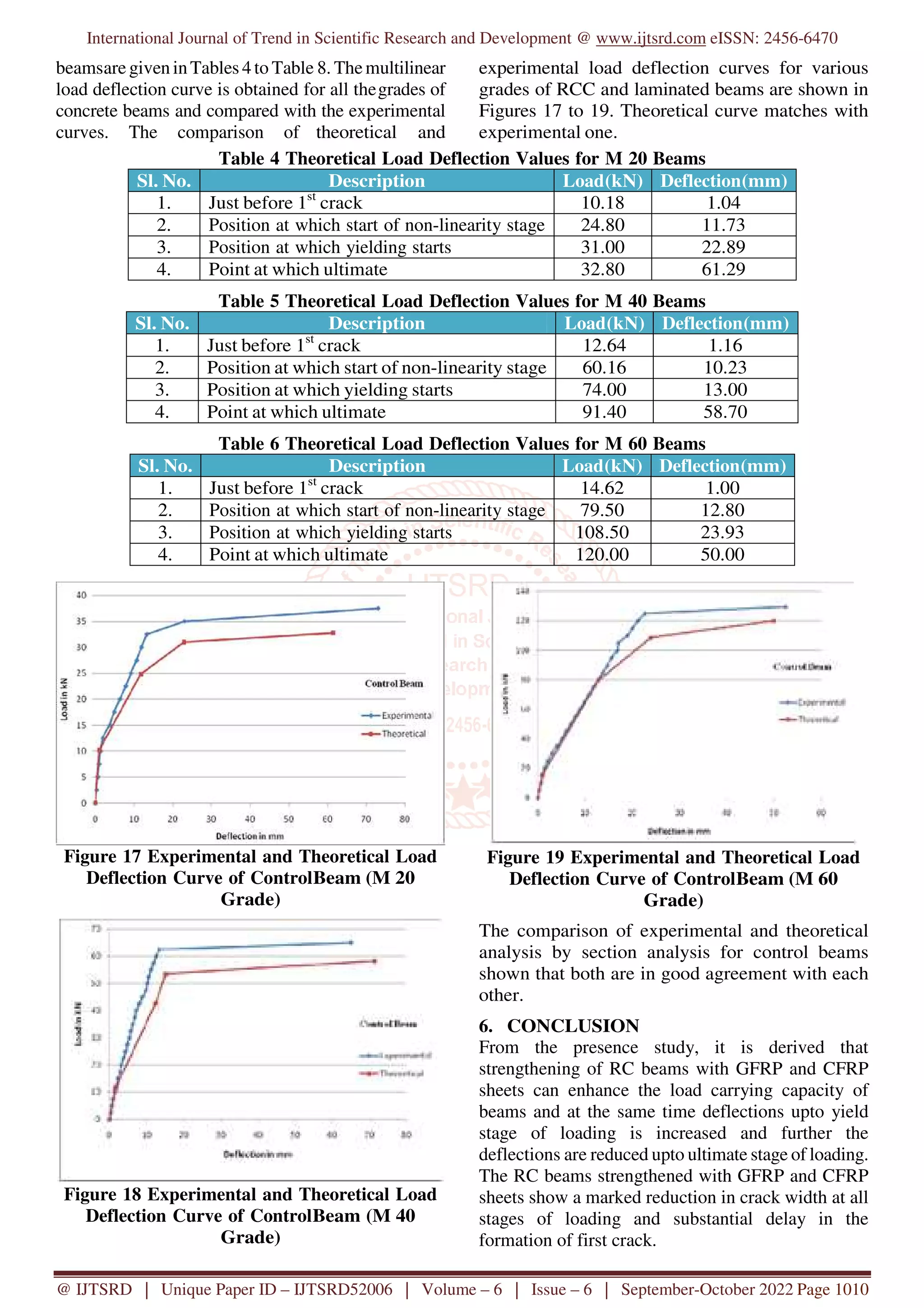
beamsare given inTables 4 to Table 8. Themultilinear
load deflection curve is obtained for all thegrades of
concrete beams and compared with the experimental
curves. The comparison of theoretical and
experimental load deflection curves for various
grades of RCC and laminated beams are shown in
Figures 17 to 19. Theoretical curve matches with
experimental one.
Table 4 Theoretical Load Deflection Values for M 20 Beams
Sl. No. Description Load(kN) Deflection(mm)
1. Just before 1st
crack 10.18 1.04
2. Position at which start of non-linearity stage 24.80 11.73
3. Position at which yielding starts 31.00 22.89
4. Point at which ultimate 32.80 61.29
Table 5 Theoretical Load Deflection Values for M 40 Beams
Sl. No. Description Load(kN) Deflection(mm)
1. Just before 1st
crack 12.64 1.16
2. Position at which start of non-linearity stage 60.16 10.23
3. Position at which yielding starts 74.00 13.00
4. Point at which ultimate 91.40 58.70
Table 6 Theoretical Load Deflection Values for M 60 Beams
Sl. No. Description Load(kN) Deflection(mm)
1. Just before 1st
crack 14.62 1.00
2. Position at which start of non-linearity stage 79.50 12.80
3. Position at which yielding starts 108.50 23.93
4. Point at which ultimate 120.00 50.00
Figure 17 Experimental and Theoretical Load
Deflection Curve of ControlBeam (M 20
Grade)
Figure 18 Experimental and Theoretical Load
Deflection Curve of ControlBeam (M 40
Grade)
Figure 19 Experimental and Theoretical Load
Deflection Curve of ControlBeam (M 60
Grade)
The comparison of experimental and theoretical
analysis by section analysis for control beams
shown that both are in good agreement with each
other.
6. CONCLUSION
From the presence study, it is derived that
strengthening of RC beams with GFRP and CFRP
sheets can enhance the load carrying capacity of
beams and at the same time deflections upto yield
stage of loading is increased and further the
deflections are reduced upto ultimate stage of loading.
The RC beams strengthened with GFRP and CFRP
sheets show a marked reduction in crack width at all
stages of loading and substantial delay in the
formation of first crack.
International Journal of Trend in Scientific Research and Development @ www.ijtsrd.com eISSN: 2456-6470
@ IJTSRD | Unique Paper ID – IJTSRD52006 | Volume – 6 | Issue – 6 | September-October 2022 Page 1011
The cracks distribution indicates that the size and
density of crack are lower in the GFRP and CFRP
strengthened beams than in the control beams.
7. REFERENCES
[1] Sharba, Amjad Ali K., Hussain Dhafir
Hussain, and Mohammed Abdulhussain.
"Retrofitting of RC beams using FRP
techniques: a review.” In IOP Conference
Series: Materials Science and Engineering,
vol. 1090, no. 1, p. 012054. IOP Publishing,
2021.
[2] Askar, Mand Kamal, Ali Falyeh Hassan, and
Yaman SS Al-Kamaki. "Flexural and Shear
Strengthening of Reinforced Concrete Beams
Using FRP Composites: A State of The Art.”
Case Studies in Construction Materials
(2022): e01189.
[3] Abbasi, Amirali, Omar Chaallal, and Georges
El-Saikaly. "Shear strengthening of RC
beams with FRP composites: Database of FE
simulations and analysis of studied
parameters.” Modelling and Simulation in
Engineering 2022 (2022).
[4] Panahi, Minoo, Seyed Alireza Zareei, and
Ardavan Izadi. "Flexural strengthening of
reinforced concrete beams through externally
bonded FRP sheets and near surface mounted
FRP bars.” Case Studies in Construction
Materials 15 (2021): e00601.
[5] Rabia, Benferhat, Tahar Hassaine Daouadji,
and Rabahi Abderezak. "Effect of air bubbles
in concrete on the mechanical behavior of
RC beams strengthened in flexion by
externally bonded FRP plates under
uniformly distributed loading.” 1 3, no. 1
(2021): 41.
[6] ACI Committee 440 Report, “Guide for the
design and construction of externally bonded
FRP systems strengthening concrete
structures”, (Revised 24 May 2000).
American Concrete Institute, Farming Hills,
Michigan, 2000, 1-89.
[7] ACI Committee 440. 2 R-02 (2002), Guide
for the design and construction of externally
bonded FRP systems for strengthening
concrete structures.
[8] Aiello. M. A., and Ombres. L., (2004),
Cracking and deformability analysis of
reinforced concrete beams strengthened with
externally bonded carbon fiber reinforced
polymer sheets, Journal of Material in Civil
Engineering, 16(5), 392-399.
[9] Alagusundaramoorthy. P., Harik. I. E., M.
ASCE., and Choo. C. C., (2003), Flexural
behavior of RC beams strengthened with
carbon fiber reinforced polymer sheets of
fabric, Journal of Composites for
Construction, 7(4), 292-301.
[10] Ali, Abdel-Zaher and Ambalavanan, R.,
(1998), Development and behavior of repair
mortars for RC components, The Indian
Concrete Journal, 669-675.
[11] ANSYS, (2003), The general purpose finite
element software, version 8. 0, Swanson
Analysis systems, Inc., International
Houston, TX, USA.
[12] Anwar, A. W., Nimityongskul, P., Pama, R.
P., and Austriaco, L., (1991), Method of
rehabilitation of structural beams elements
using ferrocement, Journal of Ferrocement,
21(3), 229-234.
[13] Daniel, Isaac M., Ori Ishai, Issac M. Daniel,
and Ishai Daniel. Engineering mechanics of
composite materials. Vol. 1994. New York:
Oxford university press, 2006.
[14] Åström, B. Tomas. Manufacturing of polymer
composites. Routledge, 2018.

Reinforcement of Reinforced Concrete Beams using CFRP and GFRP

  • 1.
    International Journal ofTrend in Scientific Research and Development (IJTSRD) Volume 6 Issue 6, September-October 2022 Available Online: www.ijtsrd.com e-ISSN: 2456 – 6470 @ IJTSRD | Unique Paper ID – IJTSRD52006 | Volume – 6 | Issue – 6 | September-October 2022 Page 1004 Reinforcement of Reinforced Concrete Beams using CFRP and GFRP Satrughan Singh1 , Puspendra Kushwaha2 1 Student, 2 Assistant Professor, 1,2 RKDF College of Engineering, Bhopal, Madhya Pradesh, India ABSTRACT Concrete, steel and masonry materials are the common materials used for housing, office buildings, bridges, power plant structures and these structures are being deteriorated with age. The deterioration of the structures is due to the design deficiency, materials deficiency, poor workmanship and extreme loads. Most of the investigation reports on strengthening of damaged RC structures are based on patch repairing and using FRP sheets for flexural, shear and compressive strengthening of members. This research work is mainly focused on retrofitting of RC beams using GFRP and CFRP sheets. In this study the flexural behaviour of M 20, 40and M60grade RC beams retrofitted with single, double and triple layers of GFRP sheets is done and all the beams are analysed using ANSYS modelling and compare with the experimental results. From the presence study, it is derived that strengthening of RC beams with GFRP and CFRP sheets can enhance the load carrying capacity of beams and at the same time deflections up to yield stage of loading is increased and further the deflections are reduced up to ultimate stage of loading. The RC beams strengthened with GFRP and CFRP sheets show a marked reduction in crack width at all stages of loading and substantial delay in the formation of first crack. KEYWORDS: Concrete, steel, masonry materials, buildings, bridges, RC structures, FRP sheets, GFRP and CFRP, ANSYS modelling How to cite this paper: Satrughan Singh | Puspendra Kushwaha "Reinforcement of Reinforced Concrete Beams using CFRP and GFRP" Published in International Journal of Trend in Scientific Research and Development (ijtsrd), ISSN: 2456-6470, Volume-6 | Issue-6, October 2022, pp.1004-1011, URL: www.ijtsrd.com/papers/ijtsrd52006.pdf Copyright © 2022 by author (s) and International Journal of Trend in Scientific Research and Development Journal. This is an Open Access article distributed under the terms of the Creative Commons Attribution License (CC BY 4.0) (http://creativecommons.org/licenses/by/4.0) 1. INTRODUCTION Fibre reinforced polymers are continuous or non- continuous strong fibres surrounded by a matrix material. The matrix serves to distribute the fibers and transmit the load to the fibres. The bonding between the fibres and the matrix is created during the manufacturing phase and becomes a composite material in the final stages of fabrication when the matrix is hardened. The characteristics of composite materials depend on proportions of reinforcements and matrix, the form of reinforcement, and the fabrication processes. These are a combination of fibre reinforcement and a resin matrix. The resin system holds fibers together and transfers the loads through the fibres to the rest of the structure. In addition to binding the composite structure together, it protects from impact, abrasion, corrosion, other environmental factors and rough handling. The most common resins of the thermoset family are Polyester (orthophthalic and isophthalic), vinyl ester, epoxy, and phenolic. (Daniel, Isaac,2006) Generally Reinforced Concrete (RC) structures can suffer varying degrees of damage due to several reasons including material deterioration, construction technique adopted, poor workmanship, overloading, aggressive environments, fatigue and corrosion of steel reinforcement embedded in concrete. Epoxy resins are a broadly used in FRP materials. Epoxy resin systems are extremely high three dimensional crosslink density which results to the best mechanical performance characteristics of all the resins. It can resist high amount of strength and hardness, very good resistance to heat and electricity. The disadvantages of this epoxy is higher cost and processing difficulty. Epoxy systems are effectively used in various applications such as aerospace, defence, marine, sports equipment, adhesives, sealants, coatings, architectural, flooring and many other areas. (Åström,2018) IJTSRD52006
  • 2.
    International Journal ofTrend in Scientific Research and Development @ www.ijtsrd.com eISSN: 2456-6470 @ IJTSRD | Unique Paper ID – IJTSRD52006 | Volume – 6 | Issue – 6 | September-October 2022 Page 1005 Most of the investigation reports on strengthening of damaged RC structures are based on patch repairing and using FRP sheets for flexural, shear and compressive strengthening of members. This research work is mainly focused on retrofitting of RC beams using GFRP and CFRP sheets. Most of the experimental studies are carried out in foreign countries and this retrofitting work is carried out with locally available GFRP and CFRP sheets. This study is helpful to understand the retrofitting of RC beams strengthened with GFRP and CFRP sheets according to the Indian environment. It also deals with FEM modelling of beams using ANSYS software to predict load carrying capacity and deflection of control and retrofitted beams. (Åström,2018) 2. LITERATURE REVIEW Sharba, Amjad Ali K el al. (2021) reviewed several features of Reinforced concrete (RC) beams strengthened with FRP. Also this paper aims to impart a comprehensive insight on adhesive curing, surface arrangement, and failure modes of RC beams modified with FRP. This effect of FRP for enhancing the techniques of rehabilitation is a three-fold task, to strengthen and retrofit of concrete structures, to extend the fatigue life of the structural element, and eliminates the crack growth rate. Askar el al. (2022) gave a summary of the literature on the flexural and shear behavior of RC beams reinforced with FRP materials under various schemes. The efficiency of various types of FRP materials and processes has also been considered. Moreover, it illustrates a cost comparison of different strengthening schemes and the limitations of FRP strengthening. Abbasi el al. (2022) Compared experimental investigations, the finite element (FE) technique provides an accurate, cost-effective, and less time- consuming tool, enabling practicing engineers to perform efficient, accurate nonlinear and dynamic analysis as well as parametric studies on RC beams strengthened with EB-FRP. Since 1996, many numerical studies have been carried out on the response of RC beams strengthened using FRP. Panahi el al. (2021) numerically investigated the flexural strengthening efficiency of reinforced concrete beams with combined externally bonded FRP sheets and near-surface mounted FRP rods. Rabia el al. (2021) presented a theoretical study taking into account the effect of air bubbles in concrete (as a material manufacturing defect) on interfacial stresses, in reinforced concrete beams, strengthening with an externally bonded FRP composite plate. Sheth and Gajjar et al (2010) conducted the study of strengthening using FRP in RC beams to increase the strength in flexure. The cross section of the beam was 230 x 450 mm and length of 5 m. El-Ghandour (2011) investigated beams strengthened for flexure and shear by CFRP sheets. He used different shear and flexure sheet ratios and tested in three point bending. Longitudinal CFRP sheets were used for flexure and U type wraps used for shear. The size of beam was 120 mm x 300 mm x 2000 mm. Jung Deng et al (2011) conducted test on CFRP strengthened beam and found improvement in strength and stiffness of beam. An analytical solution developed for composite beams using FEM modelling on CFRP strengthened beams. Both analytical and the finite element models (ANSYS, 2003) were used to validate the experimental work carried out by Tavakkolizadeh and Saadatmanesh (2003). Yasmeen Taleb Obaidat et al (2011) conducted a study on CFRP strengthened RC beams for flexure and shear. They have tested twelve RC beams in four point loading. The mechanical properties of concrete, steel and CFRP laminates were found out. The stiffness of RC beams strengthened by CFRP laminates got increased when compared to control beam. 3. MATERIAL PROPERTIES Ordinary Portland cement of 53 grades conforming to IS: 12269 - 1987, Ground Granulated Blast furnace Slag (GGBS) conforming to IS: 12089 - 1987, fine aggregates of locally available river sand passing through 3.75 mm sieve and retained on 600 microns conforming of zone II of IS: 383 - 1970, coarse aggregate of crushed granite type passing through 20 mm sieve and retaining on 10 mm sieve conforming of IS: 383 - 1970 with portable water were used as the ingredients in concrete. Specific gravity and sieve analysis tests were conducted on cement, GGBS, fine and coarse aggregate and the results are given in Table 1.
  • 3.
    International Journal ofTrend in Scientific Research and Development @ www.ijtsrd.com eISSN: 2456-6470 @ IJTSRD | Unique Paper ID – IJTSRD52006 | Volume – 6 | Issue – 6 | September-October 2022 Page 1006 Table 1 Properties of Aggregate, Cement and GGBS Sl. No. Properties of Aggregate and Cement Values 1 Specific gravity of cement 3.14 2 Specific gravity of GGBS 2.83 3 Specific gravity of fine aggregate 2.60 4 Fineness modulus of fine aggregate 2.18 5 Specific gravity of coarse aggregate 2.74 6 Fineness modulus of coarse aggregate 6.66 The glass fibre reinforced polymer sheet of 1.5 mm thick was used for retrofitting of RC beams. The fibre orientation is unidirectional direction. The Carbon Fibre Reinforced Polymer sheet is available in 1.5 mm thickness. The fibre is oriented in unidirectional direction. 4. EXPERIMENTAL PROGRAMME Initially, the properties of concrete was obtained by casting and testing of concrete specimens of cubes (150 mm x 150 mm x 150 mm to determine the compressive strength, tensile strength and flexural strength respectively. The specimens were cast using various grades of concrete such as, M 40, . Ordinary Portland cement, natural river sand and the coarse aggregate crushed on maximum size of 12.5 mm were used and three numbers of specimens were cast and tested to take the average value at different curing period. The specimens were allowed for curing of different periods of 7, 14 and 28 days. Flexural Behaviour of Control Beams The static behaviour of beams includes studying the structural behaviour aspects such as deflection, crack propagation and ultimate load carrying capacity of the beam under monotonic conditions. Hence the beams were tested monotonically with simply supported boundary conditions. The crack pattern of beams is shown in Figure1 Control Beam (M 20, M 40, and M 60) Grade Figure 1 Crack Patterns of Control Beams of Varying Grades These beams were loaded up to failure and deflections are measured for a load increment of 2.5 kN and these load deflection values were used as base values for other beams. 5. ANALYTICAL INVESTIGATIONS AND RESULT The concrete material propertiesfor all the grades of concrete used in the beams are shown in Table 2 Table 2 Concrete Material Properties Grade of Concrete Compressive Strength (N/mm2 ) Young Modulus (E) (N/mm2 ) Poisson’s Ratio (µ) M 20 RCC 28.40 2.51 x 10⁴ 0.186 M 40 RCC 50.44 3.52 x 10⁴ 0.171 M 60 RCC 73.56 4.32 x 10⁴ 0.160 5.1. MESHING In Finite Element Analysis meshing requires for a model to analyse (Bathe, 1996). The reinforcement model is meshed using line elements so that the nodes of the lineelements come exactly over the node of the solid elements which are later merged sothat both rebar elements and the concrete elements share the same node (William,1975).
  • 4.
    International Journal ofTrend in Scientific Research and Development @ www.ijtsrd.com eISSN: 2456-6470 @ IJTSRD | Unique Paper ID – IJTSRD52006 | Volume – 6 | Issue – 6 | September-October 2022 Page 1007 For beam generation total mesh model defined 3225 nodes and 2783 elements are required. The meshing concrete is shown in Figure 2 and meshing reinforcement isshown in Figure 3 Figure 2 Meshing of Concrete Figure 3 Meshing of Reinforcement 5.2. LOADING AND BOUNDARY CONDITIONS The entire beam is used for the model. All beams are 125 mm wide, 250 mm deep and 3200 mm long simply supported at both ends. Figure 4 shows the two-point loading system of beam with meshing. Figure 4 Loading and Boundary Conditions Table 3 Summary of Test Results Beam Designation Ultimate Load (kN) Max. Deflection(mm) Experimental ANSYS Experimental ANSYS M 20 CB 37.50 34.00 73.00 70.297 M 20 RB1 57.50 56.00 58.00 56.289 M 20 RB2 74.00 72.30 53.00 51.230 M 20 RB3 80.00 74.00 47.00 44.919 M 40 CB 104.00 103.50 61.50 56.835 M 40 RB1 118.50 112.00 44.50 44.659 M 40 RB2 123.00 120.00 43.50 41.846 M 40 RB3 136.50 126.00 41.00 40.273 M 60 CB 129.50 126.20 52.50 49.000 M 60 RB1 144.00 144.00 49.00 46.785 M 60 RB2 166.50 159.00 44.50 43.000 M 60 RB3 174.00 172.00 43.50 42.578 The Figures below show the comparison of load deflection curve from the finite element analysis and the experimental results for double layer CFRP retrofitted beam. The Figures 5 to 13 show the
  • 5.
    International Journal ofTrend in Scientific Research and Development @ www.ijtsrd.com eISSN: 2456-6470 @ IJTSRD | Unique Paper ID – IJTSRD52006 | Volume – 6 | Issue – 6 | September-October 2022 Page 1008 comparison of load deflection curve from the finite element analysis and the experimental results for triple layer CFRP retrofitted beams. Fig 5 Experimental and Analytical Load Deflection Curves for Control Beam (M 20 Grade). Fig 6 Experimental and Analytical Load Deflection Curves for Single LayerGFRP Sheet Retrofitted Beam (M 20 Grade) Fig 7 Experimental and Analytical Load Deflection Curves for Double Layer GFRP Sheet Retrofitted Beam (M 20 Grade) Fig 8 Experimental and Analytical Load Deflection Curves for Triple LayerGFRP Sheet Retrofitted Beam (M 20 Grade) Fig 9 Experimental and Analytical Load Deflection Curves forControl Beam (M 40 Grade) Fig 10 Experimental and Analytical Load Deflection Curves forSingle Layer CFRP Sheet Retrofitted Beam (M 40 Grade)
  • 6.
    International Journal ofTrend in Scientific Research and Development @ www.ijtsrd.com eISSN: 2456-6470 @ IJTSRD | Unique Paper ID – IJTSRD52006 | Volume – 6 | Issue – 6 | September-October 2022 Page 1009 Fig 11 Experimental and Analytical Load Deflection Curves for Double Layer CFRP Sheet Retrofitted Beam (M 40 Grade) Fig 12 Experimental and Analytical Load Deflection Curves for Triple LayerCFRP Sheet Retrofitted Beam (M 40 Grade) Fig 13 Experimental and Analytical Load Deflection Curves forControl Beam (M 60 Grade) Fig 15 Experimental and Analytical Load Deflection Curves for Double LayerCFRP Sheet Retrofitted Beam (M 60 Grade) Fig 16 Experimental and Analytical Load Deflection Curves for Triple Layer CFRP Sheet Retrofitted Beam (M 60 Grade) 5.3. Load Deflection Curves The detailed calculations leading to the evaluation of theoretical load-deflection values ofcontrol beams of different grades of concrete at various stages are shown in Appendix C.The deflections at various load levels of various grades of concrete (M 20 to M 60)
  • 7.
    International Journal ofTrend in Scientific Research and Development @ www.ijtsrd.com eISSN: 2456-6470 @ IJTSRD | Unique Paper ID – IJTSRD52006 | Volume – 6 | Issue – 6 | September-October 2022 Page 1010 beamsare given inTables 4 to Table 8. Themultilinear load deflection curve is obtained for all thegrades of concrete beams and compared with the experimental curves. The comparison of theoretical and experimental load deflection curves for various grades of RCC and laminated beams are shown in Figures 17 to 19. Theoretical curve matches with experimental one. Table 4 Theoretical Load Deflection Values for M 20 Beams Sl. No. Description Load(kN) Deflection(mm) 1. Just before 1st crack 10.18 1.04 2. Position at which start of non-linearity stage 24.80 11.73 3. Position at which yielding starts 31.00 22.89 4. Point at which ultimate 32.80 61.29 Table 5 Theoretical Load Deflection Values for M 40 Beams Sl. No. Description Load(kN) Deflection(mm) 1. Just before 1st crack 12.64 1.16 2. Position at which start of non-linearity stage 60.16 10.23 3. Position at which yielding starts 74.00 13.00 4. Point at which ultimate 91.40 58.70 Table 6 Theoretical Load Deflection Values for M 60 Beams Sl. No. Description Load(kN) Deflection(mm) 1. Just before 1st crack 14.62 1.00 2. Position at which start of non-linearity stage 79.50 12.80 3. Position at which yielding starts 108.50 23.93 4. Point at which ultimate 120.00 50.00 Figure 17 Experimental and Theoretical Load Deflection Curve of ControlBeam (M 20 Grade) Figure 18 Experimental and Theoretical Load Deflection Curve of ControlBeam (M 40 Grade) Figure 19 Experimental and Theoretical Load Deflection Curve of ControlBeam (M 60 Grade) The comparison of experimental and theoretical analysis by section analysis for control beams shown that both are in good agreement with each other. 6. CONCLUSION From the presence study, it is derived that strengthening of RC beams with GFRP and CFRP sheets can enhance the load carrying capacity of beams and at the same time deflections upto yield stage of loading is increased and further the deflections are reduced upto ultimate stage of loading. The RC beams strengthened with GFRP and CFRP sheets show a marked reduction in crack width at all stages of loading and substantial delay in the formation of first crack.
  • 8.
    International Journal ofTrend in Scientific Research and Development @ www.ijtsrd.com eISSN: 2456-6470 @ IJTSRD | Unique Paper ID – IJTSRD52006 | Volume – 6 | Issue – 6 | September-October 2022 Page 1011 The cracks distribution indicates that the size and density of crack are lower in the GFRP and CFRP strengthened beams than in the control beams. 7. REFERENCES [1] Sharba, Amjad Ali K., Hussain Dhafir Hussain, and Mohammed Abdulhussain. "Retrofitting of RC beams using FRP techniques: a review.” In IOP Conference Series: Materials Science and Engineering, vol. 1090, no. 1, p. 012054. IOP Publishing, 2021. [2] Askar, Mand Kamal, Ali Falyeh Hassan, and Yaman SS Al-Kamaki. "Flexural and Shear Strengthening of Reinforced Concrete Beams Using FRP Composites: A State of The Art.” Case Studies in Construction Materials (2022): e01189. [3] Abbasi, Amirali, Omar Chaallal, and Georges El-Saikaly. "Shear strengthening of RC beams with FRP composites: Database of FE simulations and analysis of studied parameters.” Modelling and Simulation in Engineering 2022 (2022). [4] Panahi, Minoo, Seyed Alireza Zareei, and Ardavan Izadi. "Flexural strengthening of reinforced concrete beams through externally bonded FRP sheets and near surface mounted FRP bars.” Case Studies in Construction Materials 15 (2021): e00601. [5] Rabia, Benferhat, Tahar Hassaine Daouadji, and Rabahi Abderezak. "Effect of air bubbles in concrete on the mechanical behavior of RC beams strengthened in flexion by externally bonded FRP plates under uniformly distributed loading.” 1 3, no. 1 (2021): 41. [6] ACI Committee 440 Report, “Guide for the design and construction of externally bonded FRP systems strengthening concrete structures”, (Revised 24 May 2000). American Concrete Institute, Farming Hills, Michigan, 2000, 1-89. [7] ACI Committee 440. 2 R-02 (2002), Guide for the design and construction of externally bonded FRP systems for strengthening concrete structures. [8] Aiello. M. A., and Ombres. L., (2004), Cracking and deformability analysis of reinforced concrete beams strengthened with externally bonded carbon fiber reinforced polymer sheets, Journal of Material in Civil Engineering, 16(5), 392-399. [9] Alagusundaramoorthy. P., Harik. I. E., M. ASCE., and Choo. C. C., (2003), Flexural behavior of RC beams strengthened with carbon fiber reinforced polymer sheets of fabric, Journal of Composites for Construction, 7(4), 292-301. [10] Ali, Abdel-Zaher and Ambalavanan, R., (1998), Development and behavior of repair mortars for RC components, The Indian Concrete Journal, 669-675. [11] ANSYS, (2003), The general purpose finite element software, version 8. 0, Swanson Analysis systems, Inc., International Houston, TX, USA. [12] Anwar, A. W., Nimityongskul, P., Pama, R. P., and Austriaco, L., (1991), Method of rehabilitation of structural beams elements using ferrocement, Journal of Ferrocement, 21(3), 229-234. [13] Daniel, Isaac M., Ori Ishai, Issac M. Daniel, and Ishai Daniel. Engineering mechanics of composite materials. Vol. 1994. New York: Oxford university press, 2006. [14] Åström, B. Tomas. Manufacturing of polymer composites. Routledge, 2018.