International Journal of Computer Applications Technology and Research 
Volume 3– Issue 10, 634 - 639, 2014 
A Comparative Analysis of Slicing for 
Structured Programs 
Lipika Jha K.S.Patnaik 
Department of Computer Science Department of Computer Science 
and engineering, and engineering, 
Birla Institute of Technology, Birla Institute of Technology, 
Mesra, Ranchi, India Mesra, Ranchi, India 
Abstract: Program Slicing is a method for automatically decomposing programs by analyzing their data flow and control flow. 
Slicing reduces the program to a minimal form called “slice” which still produces that behavior. Program slice singles out all 
statements that may have affected the value of a given variable at a specific program point. Slicing is useful in program 
debugging, program maintenance and other applications that involve understanding program behavior. In this paper we have 
discuss the static and dynamic slicing and its comparison by taking number of examples. 
Keywords: Slicing techniques, control and data dependence, data flow equation, control flow graph, program dependence graph 
1. INTRODUCTION 
Program slicing is one of the techniques of 
program analysis. It is an alternative approach to 
develop reusable components from existing 
software. To extract reusable functions from ill-structured 
programs we need a decomposition 
method which is able to group non sequential 
sets of statement. Program is decomposed based 
on program analysis. A program is analyzed 
using data flow and control flow. The 
decomposed program is called slice which is 
obtained by iteratively solving data flow 
equations based on a program flow graph. 
Program analysis uses program statement 
dependence information (i.e. data and control 
dependence) to identify parts of a program that 
influence or are influenced by a variable at 
particular point of interest is called the slicing 
criterion. 
Slicing Criterion: 
C = (n, V) 
where n is a statement in program P and V is a 
variable in P .A slice S consists of all statements 
in program P that may affect the value of 
variable V at some point n. 
Program slicing describes a mechanism or tool 
which allows the automatic generation of a slice. 
All statements affecting or affected by the 
variables V in n mentioned in the slicing 
criterion becomes a part of the slice. 
This paper gives the detail description of 
slicing techniques and comparison of different 
slicing. The paper is organized as follows. 
Section 2 defines some common slicing 
techniques. Section 3 defines static and dynamic 
slicing .Section 4 defines comparison of 
different slicing, section 5 presents conclusion 
and finally acknowledgement and references. 
2. SLICING TECHNIQUE 
The original concept of a program slice was 
introduced by Weiser [1] .He claims that a slice 
corresponds to the mental abstractions that 
www.ijcat.com 634
International Journal of Computer Applications Technology and Research 
Volume 3– Issue 10, 634 - 639, 2014 
people make when they are debugging a 
program. A slice S consists of all statements in 
program P that may affect the value of variable 
V at some point n. 
Variables V at statements n can be affected 
by statements because: 
– Statements which control the 
execution of n(Control 
Dependence) 
– Statements which uses the V at 
n (Data Dependence) 
The goal of slicing is to create a subprogram of 
the program (by eliminating some statements), 
such that the projection and the original program 
compute the same values for all variables in V at 
point n. 
The computation of a slicing is done using data 
dependence and control dependence. Data 
dependence and control dependence are defined 
in terms of the CFG of a program. A control 
flow graph is a graph which is interpreted as a 
program procedure. The nodes of a graph 
represent program statements and edges 
represent control flow transfers between 
statements. 
A Control Flow Graph for program P is a graph 
in which each node is associated with a 
statement from P and the edges represent the 
flow of control in P. With each node n (i.e., each 
statement in the program) associate two sets: 
USE (n), the set of variables whose values are 
used at n, and DEF (n), the set of variables 
whose values are defined at n. 
There are three main techniques to compute 
slice: 
2.1 Data dependence (DD) and control 
dependence (CD) 
Data dependence and control dependence are 
defined in terms of the CFG of program. A 
statement j is data dependent on statement i if a 
value computed at i is used at j in some program 
execution. A data dependence may be defined 
as; there exists a variable x such that 
(i) x ε DEF(i) and x ε USE(j) 
or 
x ε DEF(i) and x ε DEF(j) 
(ii) There exists a path from i to j without 
intervening definitions of x. 
Control dependence information identifies the 
conditionals node that may affect execution of a 
node in the slice. In a CFG, a node j post-dominates 
a node i if and only if j is a member 
of any path from i to Stop. Node i is control-dependent 
on j in program P if 
1. there exists a path P from i to j such that j post 
dominates every node in P. 
2. i is not post dominated by j. 
SC ={m | n . n є C and m→*n}. 
Or 
Sc = DD U CD 
2.2 Data Flow Equation 
According to Weiser the slicing is computed by 
iteratively solving data flow equation. He 
defines slice as an executable program that is 
obtained from the original program by deleting 
zero or more statement. At least one slice exists 
for any criterion for any program that is the 
program itself. 
The set of relevant variable RO 
C(i) with respect 
to slicing criterion C=(p,V) is: 
1. RO 
C(i)=V when i=p 
2. RO 
C(i)= (RO 
C(j)-DEF(i))U (USE(i) if 
RO 
C(j)∩DEF(i)≠ø) 
The set of relevant statements to C denoted 
S0 
C,is defined as: 
={i | Def(i) ∩ 
(j) ≠ ø ,i → CFG j} 
={3,4,9} 
The set of conditional statements which control 
the execution of the statements in S0 
C,denoted 
B0 
C is defined as: 
B0 
c={bєG | Infl(b) ∩ S0 
C≠ ø } 
Infl(5)={6,7,8} 
The sliced program Sc is defined recursively on 
the set of variables and statements which have 
either direct or indirect influence on V. Starting 
from zero, the superscripts represent the level of 
recursion. 
www.ijcat.com 635
International Journal of Computer Applications Technology and Research 
Volume 3– Issue 10, 634 - 639, 2014 
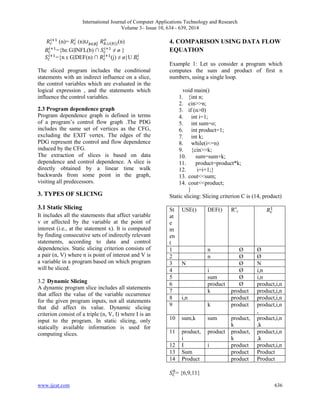
(n)= 
(n) 
(n) 
={bε G|INFL(b) ∩ 
≠ ø } 
={n ε G|DEF(n) ∩ 
(j) ≠ ø}U 
The sliced program includes the conditional 
statements with an indirect influence on a slice, 
the control variables which are evaluated in the 
logical expression , and the statements which 
influence the control variables. 
2.3 Program dependence graph 
Program dependence graph is defined in terms 
of a program’s control flow graph .The PDG 
includes the same set of vertices as the CFG, 
excluding the EXIT vertex. The edges of the 
PDG represent the control and flow dependence 
induced by the CFG. 
The extraction of slices is based on data 
dependence and control dependence. A slice is 
directly obtained by a linear time walk 
backwards from some point in the graph, 
visiting all predecessors. 
3. TYPES OF SLICING 
3.1 Static Slicing 
It includes all the statements that affect variable 
v or affected by the variable at the point of 
interest (i.e., at the statement x). It is computed 
by finding consecutive sets of indirectly relevant 
statements, according to data and control 
dependencies. Static slicing criterion consists of 
a pair (n, V) where n is point of interest and V is 
a variable in a program based on which program 
will be sliced. 
3.2 Dynamic Slicing 
A dynamic program slice includes all statements 
that affect the value of the variable occurrence 
for the given program inputs, not all statements 
that did affect its value. Dynamic slicing 
criterion consist of a triple (n, V, I) where I is an 
input to the program. In static slicing, only 
statically available information is used for 
computing slices. 
4. COMPARISON USING DATA FLOW 
EQUATION 
Example 1: Let us consider a program which 
computes the sum and product of first n 
numbers, using a single loop. 
void main() 
1. {int n; 
2. cin>>n; 
3. if (n>0) 
4. int i=1; 
5. int sum=o; 
6. int product=1; 
7. int k; 
8. while(i<=n) 
9. {cin>>k; 
10. sum=sum+k; 
11. product=product*k; 
12. i=i+1;} 
13. cout<<sum; 
14. cout<<product; 
} 
Static slicing: Slicing criterion C is (14, product) 
St 
at 
e 
m 
en 
t 
USE() DEF() Ro 
c 
1 n Ø Ø 
2 n Ø Ø 
3 N Ø N 
4 i Ø i,n 
5 sum Ø i,n 
6 product Ø product,i,n 
7 k product product,i,n 
8 i,n product product,i,n 
9 k product product,i,n 
, 
10 sum,k sum product, 
k 
product,i,n 
,k 
11 product, 
i 
product product, 
k 
product,i,n 
,k 
12 I i product product,i,n 
13 Sum product Product 
14 Product product Product 
= {6,9,11} 
www.ijcat.com 636
International Journal of Computer Applications Technology and Research 
Volume 3– Issue 10, 634 - 639, 2014 
={3,8} 
(n)= 
(n) 
(n) 
(3)=n 
(14)=n 
(13)=n 
(12)=n 
(11)=n 
(10)=n 
(9)=n 
(8)=n 
(7)=n 
(6)=n 
(5)=n 
(4)=n 
(2)= Ø 
(1)= Ø 
(8)=i,n 
(12)=i,n 
(11)=i,n 
(10)=i,n 
(9)=i,n 
(7)=i,n 
(6)=i,n 
(5)=i,n 
(4)=i, 
(3)= Ø 
(2)= Ø 
(1)= Ø 
={12,11,9,6,4,2} 
={bε G|INFL(b) ∩ 
≠ ø } 
={3,8} 
={n ε G|DEF(n) ∩ 
(j) ≠ ø}U 
={2,3,4,6,8,9,11,12} 
Dynamic slicing: Slicing criterion 
C:(14,product,n=2) 
void main () 
1. {int n; 
2. cin>>n; 
3. if (n>0) 
4. int i=1; 
5. int sum =1; 
6. int product=1; 
7. int k; 
81. i<=n 
91. cin>>k; 
101. sum=sum+k; 
111. product=product*k; 
121. i=i+1;} 
82. i<=n 
92. cin>>k; 
102. sum=sum+k; 
112. product=product*k; 
122. i=i+1; 
83. i<=n 
13. sum=sum+k; 
14. cout<<product; 
} 
DU: {(2,3),(2,81),(2,82),(2,83),(4,81), (4,121), 
(121,82 ) (121,122), 
(122,83),(6,111),(111,112),(112,14),(91,111), 
(92,112) 
TC: 
{3,4},{3,5},{3,6},{3,7}{3,81},{(81,91),(81,111), 
(81,121), (82,92),(82,112), (82,122) } 
IR: {(81,82), (81,83), (82,81), (82,83), (83,81), 
(83,82) 
S0= {112} 
A1= {111, 92, 82} 
S1= {112, 111, 92, 82} 
A2= {6, 91, 81, 2, 83,121} 
S2= {112, 111, 92, 82, 6, 91, 81, 2, 83,121} 
A3= {4, 121,122} 
S3= {112, 111, 92, 82, 6, 91, 81, 2, 83, 4, 121,122} 
Example 2: Let us consider a program which 
computes the sum and product of first n 
numbers, using for loop. 
void main() 
1. {int n; 
2. cin>>n; 
3. if (n>0) 
4. int sum=0; 
5. int product=1; 
6. int k; 
7. for(i=1;i<=n;i++) 
8. {cin>>k; 
9. sum=sum+k; 
10. product=product*k; 
} 
11. cout<<sum; 
12. cout<<product; 
} 
Static slicing: Slicing criterion C is (12, product) 
St 
at 
e 
m 
en 
t 
USE() DEF() 
1 n Ø I 
2 n Ø I 
3 N Ø i,n 
4 sum Ø i,n 
5 product Ø i,n 
6 k Product product,i,n 
7 i,n i Product product,i,n 
8 k Product product,i,n 
www.ijcat.com 637
International Journal of Computer Applications Technology and Research 
Volume 3– Issue 10, 634 - 639, 2014 
, 
9 sum,k sum product, 
k 
product,i,n 
,k 
10 product, 
k 
product product, 
k 
product,i,n 
,k 
11 Sum product Product 
12 Product product Product 
= {11,6,4} 
={7,8,9} 
(3)=n 
(11)=product,n 
(10)=product,k,n 
(9)=product,k,n 
(8)=product,n 
(7)=product,n 
(6)=product,n 
(5)=n 
(4)=n 
(2)= Ø 
(1)= Ø 
(7)=i,n 
(11)=i,n 
(10)=i,n 
(9)=i,n 
(8)=i,n 
(6)=i,n 
(5)=i,n 
(4)=i,n 
(3)= i,n 
(2)= i 
(1)= i 
={10,8,7,5,2} 
={3,7} 
={2,3,5,7,8,10} 
Dynamic slicing: Slicing criterion 
C:(12,product,n=2) 
void main () 
1. {int n; 
2. cin>>n; 
3. if (n>0) 
4. int sum =1; 
5. int product=1; 
6. int k; 
71. i=1; i<=n 
81. cin>>k; 
91. sum=sum+k; 
101. product=product*k; 
72. i<=n 
82. cin>>k; 
92. sum=sum+k; 
102. product=product*k; 
73. i<=n 
11. cout<< sum; 
12. cout<<product; 
} 
DU: {(2,3),(2,71),(2,72),(2,73),(4,91),(91,92), 
(92,11), 
(5,101),(101,102),(102,12),(81,91),(81,101),(82,92), 
(82,102)} 
TC: 
{(3,4),(3,5),(3,6),(3,71),(71,81),(71,91),(71,101), 
(72,82),(72,92), (72,102) } 
IR: {(71,72), (71,73), (72,71), (72,73), (73,71), 
(73,72) 
S0= {102} 
A1= {101, 82, 72} 
S1= {102, 101, 82, 72} 
A2= {5, 81, 71, 2, 73,101} 
S2= {102, 101, 82, 72, 5, 71, 81, 2, 73} 
A3= {3} 
S3= {102, 101, 82, 72, 5, 71, 81, 2, 73,3} 
5. CONCLUSION 
The concept of program slicing was originally 
defined by Weiser as a method for decomposing 
a program into pieces, i.e., slices. The static slice 
produced by his method is of the partially 
equivalent program type. His solution produces 
a static program slice based on solving data flow 
equations iteratively on the flow graph of the 
program. Here in this paper we have used the 
same concept for computing the static and 
dynamic slicing. We have taken the number of 
example and analyzed the slicing .As the 
number of control statement increases in a 
program it becomes difficult to compute the 
control dependent statement and then the 
relevant variable. In for loop we can either 
consider the different statement for the three 
section or we can consider a single statement. 
The output will be same the only difference is 
that it will be easy to compute from the different 
statement. 
6. ACKNOWLEDGEMENT 
I wish to convey my sincere gratitude and 
appreciation to each and every person who 
helped me in writing this paper. I am grateful to 
my institution, Birla Institute of Technology and 
my colleagues. I would especially like to thank 
Dr. K. S. Patnaik, my guide for his advice and 
guidance. 
www.ijcat.com 638
International Journal of Computer Applications Technology and Research 
Volume 3– Issue 10, 634 - 639, 2014 
7. REFERENCES 
[1] M. Weiser, “Program Slicing,” IEEE 
Transactions on Software Engineering, Vol. 16, 
No. 5, 1984, pp. 498-509. 
[2] F. Tip, “A Survey of Program Slicing 
Techniques,” Journal of Programming 
Languages, Vol. 3, No. 3, 1995, pp. 121- 
189 
[3] D. Binkley and K. B. Gallagher, 
“Program Slicing,” Advances in Computers, 
Vol. 43, 1996, pp. 1-50. 
[4] B. Korel and J. Laski. Dynamic program 
slicing. Information Processing Letters, 
29(3):155–163, 1988. 
[5] M. Kamkar, “An overview and 
comparative classification of program slicing 
techniques,” J. Systems Software, vol. 31, pp. 
197–214, 1995. 
www.ijcat.com 639

A Comparative Analysis of Slicing for Structured Programs

  • 1.
    International Journal ofComputer Applications Technology and Research Volume 3– Issue 10, 634 - 639, 2014 A Comparative Analysis of Slicing for Structured Programs Lipika Jha K.S.Patnaik Department of Computer Science Department of Computer Science and engineering, and engineering, Birla Institute of Technology, Birla Institute of Technology, Mesra, Ranchi, India Mesra, Ranchi, India Abstract: Program Slicing is a method for automatically decomposing programs by analyzing their data flow and control flow. Slicing reduces the program to a minimal form called “slice” which still produces that behavior. Program slice singles out all statements that may have affected the value of a given variable at a specific program point. Slicing is useful in program debugging, program maintenance and other applications that involve understanding program behavior. In this paper we have discuss the static and dynamic slicing and its comparison by taking number of examples. Keywords: Slicing techniques, control and data dependence, data flow equation, control flow graph, program dependence graph 1. INTRODUCTION Program slicing is one of the techniques of program analysis. It is an alternative approach to develop reusable components from existing software. To extract reusable functions from ill-structured programs we need a decomposition method which is able to group non sequential sets of statement. Program is decomposed based on program analysis. A program is analyzed using data flow and control flow. The decomposed program is called slice which is obtained by iteratively solving data flow equations based on a program flow graph. Program analysis uses program statement dependence information (i.e. data and control dependence) to identify parts of a program that influence or are influenced by a variable at particular point of interest is called the slicing criterion. Slicing Criterion: C = (n, V) where n is a statement in program P and V is a variable in P .A slice S consists of all statements in program P that may affect the value of variable V at some point n. Program slicing describes a mechanism or tool which allows the automatic generation of a slice. All statements affecting or affected by the variables V in n mentioned in the slicing criterion becomes a part of the slice. This paper gives the detail description of slicing techniques and comparison of different slicing. The paper is organized as follows. Section 2 defines some common slicing techniques. Section 3 defines static and dynamic slicing .Section 4 defines comparison of different slicing, section 5 presents conclusion and finally acknowledgement and references. 2. SLICING TECHNIQUE The original concept of a program slice was introduced by Weiser [1] .He claims that a slice corresponds to the mental abstractions that www.ijcat.com 634
  • 2.
    International Journal ofComputer Applications Technology and Research Volume 3– Issue 10, 634 - 639, 2014 people make when they are debugging a program. A slice S consists of all statements in program P that may affect the value of variable V at some point n. Variables V at statements n can be affected by statements because: – Statements which control the execution of n(Control Dependence) – Statements which uses the V at n (Data Dependence) The goal of slicing is to create a subprogram of the program (by eliminating some statements), such that the projection and the original program compute the same values for all variables in V at point n. The computation of a slicing is done using data dependence and control dependence. Data dependence and control dependence are defined in terms of the CFG of a program. A control flow graph is a graph which is interpreted as a program procedure. The nodes of a graph represent program statements and edges represent control flow transfers between statements. A Control Flow Graph for program P is a graph in which each node is associated with a statement from P and the edges represent the flow of control in P. With each node n (i.e., each statement in the program) associate two sets: USE (n), the set of variables whose values are used at n, and DEF (n), the set of variables whose values are defined at n. There are three main techniques to compute slice: 2.1 Data dependence (DD) and control dependence (CD) Data dependence and control dependence are defined in terms of the CFG of program. A statement j is data dependent on statement i if a value computed at i is used at j in some program execution. A data dependence may be defined as; there exists a variable x such that (i) x ε DEF(i) and x ε USE(j) or x ε DEF(i) and x ε DEF(j) (ii) There exists a path from i to j without intervening definitions of x. Control dependence information identifies the conditionals node that may affect execution of a node in the slice. In a CFG, a node j post-dominates a node i if and only if j is a member of any path from i to Stop. Node i is control-dependent on j in program P if 1. there exists a path P from i to j such that j post dominates every node in P. 2. i is not post dominated by j. SC ={m | n . n є C and m→*n}. Or Sc = DD U CD 2.2 Data Flow Equation According to Weiser the slicing is computed by iteratively solving data flow equation. He defines slice as an executable program that is obtained from the original program by deleting zero or more statement. At least one slice exists for any criterion for any program that is the program itself. The set of relevant variable RO C(i) with respect to slicing criterion C=(p,V) is: 1. RO C(i)=V when i=p 2. RO C(i)= (RO C(j)-DEF(i))U (USE(i) if RO C(j)∩DEF(i)≠ø) The set of relevant statements to C denoted S0 C,is defined as: ={i | Def(i) ∩ (j) ≠ ø ,i → CFG j} ={3,4,9} The set of conditional statements which control the execution of the statements in S0 C,denoted B0 C is defined as: B0 c={bєG | Infl(b) ∩ S0 C≠ ø } Infl(5)={6,7,8} The sliced program Sc is defined recursively on the set of variables and statements which have either direct or indirect influence on V. Starting from zero, the superscripts represent the level of recursion. www.ijcat.com 635
  • 3.
    International Journal ofComputer Applications Technology and Research Volume 3– Issue 10, 634 - 639, 2014 (n)= (n) (n) ={bε G|INFL(b) ∩ ≠ ø } ={n ε G|DEF(n) ∩ (j) ≠ ø}U The sliced program includes the conditional statements with an indirect influence on a slice, the control variables which are evaluated in the logical expression , and the statements which influence the control variables. 2.3 Program dependence graph Program dependence graph is defined in terms of a program’s control flow graph .The PDG includes the same set of vertices as the CFG, excluding the EXIT vertex. The edges of the PDG represent the control and flow dependence induced by the CFG. The extraction of slices is based on data dependence and control dependence. A slice is directly obtained by a linear time walk backwards from some point in the graph, visiting all predecessors. 3. TYPES OF SLICING 3.1 Static Slicing It includes all the statements that affect variable v or affected by the variable at the point of interest (i.e., at the statement x). It is computed by finding consecutive sets of indirectly relevant statements, according to data and control dependencies. Static slicing criterion consists of a pair (n, V) where n is point of interest and V is a variable in a program based on which program will be sliced. 3.2 Dynamic Slicing A dynamic program slice includes all statements that affect the value of the variable occurrence for the given program inputs, not all statements that did affect its value. Dynamic slicing criterion consist of a triple (n, V, I) where I is an input to the program. In static slicing, only statically available information is used for computing slices. 4. COMPARISON USING DATA FLOW EQUATION Example 1: Let us consider a program which computes the sum and product of first n numbers, using a single loop. void main() 1. {int n; 2. cin>>n; 3. if (n>0) 4. int i=1; 5. int sum=o; 6. int product=1; 7. int k; 8. while(i<=n) 9. {cin>>k; 10. sum=sum+k; 11. product=product*k; 12. i=i+1;} 13. cout<<sum; 14. cout<<product; } Static slicing: Slicing criterion C is (14, product) St at e m en t USE() DEF() Ro c 1 n Ø Ø 2 n Ø Ø 3 N Ø N 4 i Ø i,n 5 sum Ø i,n 6 product Ø product,i,n 7 k product product,i,n 8 i,n product product,i,n 9 k product product,i,n , 10 sum,k sum product, k product,i,n ,k 11 product, i product product, k product,i,n ,k 12 I i product product,i,n 13 Sum product Product 14 Product product Product = {6,9,11} www.ijcat.com 636
  • 4.
    International Journal ofComputer Applications Technology and Research Volume 3– Issue 10, 634 - 639, 2014 ={3,8} (n)= (n) (n) (3)=n (14)=n (13)=n (12)=n (11)=n (10)=n (9)=n (8)=n (7)=n (6)=n (5)=n (4)=n (2)= Ø (1)= Ø (8)=i,n (12)=i,n (11)=i,n (10)=i,n (9)=i,n (7)=i,n (6)=i,n (5)=i,n (4)=i, (3)= Ø (2)= Ø (1)= Ø ={12,11,9,6,4,2} ={bε G|INFL(b) ∩ ≠ ø } ={3,8} ={n ε G|DEF(n) ∩ (j) ≠ ø}U ={2,3,4,6,8,9,11,12} Dynamic slicing: Slicing criterion C:(14,product,n=2) void main () 1. {int n; 2. cin>>n; 3. if (n>0) 4. int i=1; 5. int sum =1; 6. int product=1; 7. int k; 81. i<=n 91. cin>>k; 101. sum=sum+k; 111. product=product*k; 121. i=i+1;} 82. i<=n 92. cin>>k; 102. sum=sum+k; 112. product=product*k; 122. i=i+1; 83. i<=n 13. sum=sum+k; 14. cout<<product; } DU: {(2,3),(2,81),(2,82),(2,83),(4,81), (4,121), (121,82 ) (121,122), (122,83),(6,111),(111,112),(112,14),(91,111), (92,112) TC: {3,4},{3,5},{3,6},{3,7}{3,81},{(81,91),(81,111), (81,121), (82,92),(82,112), (82,122) } IR: {(81,82), (81,83), (82,81), (82,83), (83,81), (83,82) S0= {112} A1= {111, 92, 82} S1= {112, 111, 92, 82} A2= {6, 91, 81, 2, 83,121} S2= {112, 111, 92, 82, 6, 91, 81, 2, 83,121} A3= {4, 121,122} S3= {112, 111, 92, 82, 6, 91, 81, 2, 83, 4, 121,122} Example 2: Let us consider a program which computes the sum and product of first n numbers, using for loop. void main() 1. {int n; 2. cin>>n; 3. if (n>0) 4. int sum=0; 5. int product=1; 6. int k; 7. for(i=1;i<=n;i++) 8. {cin>>k; 9. sum=sum+k; 10. product=product*k; } 11. cout<<sum; 12. cout<<product; } Static slicing: Slicing criterion C is (12, product) St at e m en t USE() DEF() 1 n Ø I 2 n Ø I 3 N Ø i,n 4 sum Ø i,n 5 product Ø i,n 6 k Product product,i,n 7 i,n i Product product,i,n 8 k Product product,i,n www.ijcat.com 637
  • 5.
    International Journal ofComputer Applications Technology and Research Volume 3– Issue 10, 634 - 639, 2014 , 9 sum,k sum product, k product,i,n ,k 10 product, k product product, k product,i,n ,k 11 Sum product Product 12 Product product Product = {11,6,4} ={7,8,9} (3)=n (11)=product,n (10)=product,k,n (9)=product,k,n (8)=product,n (7)=product,n (6)=product,n (5)=n (4)=n (2)= Ø (1)= Ø (7)=i,n (11)=i,n (10)=i,n (9)=i,n (8)=i,n (6)=i,n (5)=i,n (4)=i,n (3)= i,n (2)= i (1)= i ={10,8,7,5,2} ={3,7} ={2,3,5,7,8,10} Dynamic slicing: Slicing criterion C:(12,product,n=2) void main () 1. {int n; 2. cin>>n; 3. if (n>0) 4. int sum =1; 5. int product=1; 6. int k; 71. i=1; i<=n 81. cin>>k; 91. sum=sum+k; 101. product=product*k; 72. i<=n 82. cin>>k; 92. sum=sum+k; 102. product=product*k; 73. i<=n 11. cout<< sum; 12. cout<<product; } DU: {(2,3),(2,71),(2,72),(2,73),(4,91),(91,92), (92,11), (5,101),(101,102),(102,12),(81,91),(81,101),(82,92), (82,102)} TC: {(3,4),(3,5),(3,6),(3,71),(71,81),(71,91),(71,101), (72,82),(72,92), (72,102) } IR: {(71,72), (71,73), (72,71), (72,73), (73,71), (73,72) S0= {102} A1= {101, 82, 72} S1= {102, 101, 82, 72} A2= {5, 81, 71, 2, 73,101} S2= {102, 101, 82, 72, 5, 71, 81, 2, 73} A3= {3} S3= {102, 101, 82, 72, 5, 71, 81, 2, 73,3} 5. CONCLUSION The concept of program slicing was originally defined by Weiser as a method for decomposing a program into pieces, i.e., slices. The static slice produced by his method is of the partially equivalent program type. His solution produces a static program slice based on solving data flow equations iteratively on the flow graph of the program. Here in this paper we have used the same concept for computing the static and dynamic slicing. We have taken the number of example and analyzed the slicing .As the number of control statement increases in a program it becomes difficult to compute the control dependent statement and then the relevant variable. In for loop we can either consider the different statement for the three section or we can consider a single statement. The output will be same the only difference is that it will be easy to compute from the different statement. 6. ACKNOWLEDGEMENT I wish to convey my sincere gratitude and appreciation to each and every person who helped me in writing this paper. I am grateful to my institution, Birla Institute of Technology and my colleagues. I would especially like to thank Dr. K. S. Patnaik, my guide for his advice and guidance. www.ijcat.com 638
  • 6.
    International Journal ofComputer Applications Technology and Research Volume 3– Issue 10, 634 - 639, 2014 7. REFERENCES [1] M. Weiser, “Program Slicing,” IEEE Transactions on Software Engineering, Vol. 16, No. 5, 1984, pp. 498-509. [2] F. Tip, “A Survey of Program Slicing Techniques,” Journal of Programming Languages, Vol. 3, No. 3, 1995, pp. 121- 189 [3] D. Binkley and K. B. Gallagher, “Program Slicing,” Advances in Computers, Vol. 43, 1996, pp. 1-50. [4] B. Korel and J. Laski. Dynamic program slicing. Information Processing Letters, 29(3):155–163, 1988. [5] M. Kamkar, “An overview and comparative classification of program slicing techniques,” J. Systems Software, vol. 31, pp. 197–214, 1995. www.ijcat.com 639