AMITY UNIVERSITY HARYANA, ASET ANALYSIS AND DESIGN OF ALGORITHMS
- 1 -
Lab Manual
“Analysis and Design of Algorithm”
B.Tech(CSE/IT/SE/) 7th
Sem
Course Code: CSE2706
Department of Computer Science & Engineering
Amity School of Engineering and Technology
AMITY UNIVERSITY HARYANA
Prepared By:
Dr. Aman Jatain
Assistant Professor (CSE)
AMITY UNIVERSITY HARYANA, ASET ANALYSIS AND DESIGN OF ALGORITHMS
- 2 -
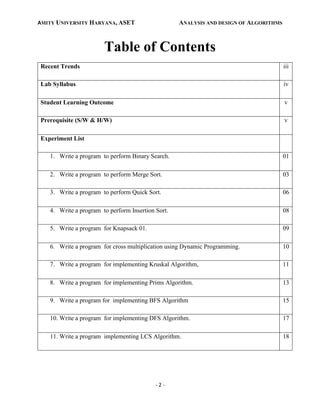
Table of Contents
Recent Trends iii
Lab Syllabus iv
Student Learning Outcome v
Prerequisite (S/W & H/W) v
Experiment List
1. Write a program to perform Binary Search. 01
2. Write a program to perform Merge Sort. 03
3. Write a program to perform Quick Sort. 06
4. Write a program to perform Insertion Sort. 08
5. Write a program for Knapsack 01. 09
6. Write a program for cross multiplication using Dynamic Programming. 10
7. Write a program for implementing Kruskal Algorithm, 11
8. Write a program for implementing Prims Algorithm. 13
9. Write a program for implementing BFS Algorithm 15
10. Write a program for implementing DFS Algorithm. 17
11. Write a program implementing LCS Algorithm. 18
AMITY UNIVERSITY HARYANA, ASET ANALYSIS AND DESIGN OF ALGORITHMS
- 3 -
Recent trends in the field of Algorithms
Design and Analysis of algorithm is systematic way of writing algorithms. It increasingly being
applied in the practical fields of mathematics and Computer Science. It elaborate the fundamental
concept like Divide & Conquer, Greedy Algorithm, Dynamic Programming, Backtracking, and
Branch & Bound along with the tractable and intractable problems. Now a day’s various
algorithms are designed for data analysis using R programming and Machine learning to solve
computational problems.
AMITY UNIVERSITY HARYANA, ASET ANALYSIS AND DESIGN OF ALGORITHMS
- 4 -
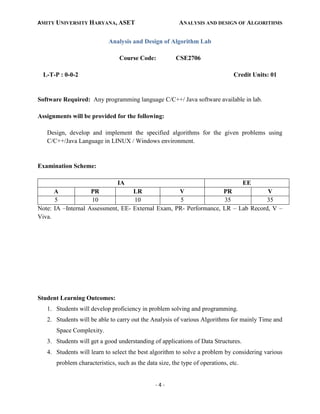
Analysis and Design of Algorithm Lab
Course Code: CSE2706
L-T-P : 0-0-2 Credit Units: 01
Software Required: Any programming language C/C++/ Java software available in lab.
Assignments will be provided for the following:
Design, develop and implement the specified algorithms for the given problems using
C/C++/Java Language in LINUX / Windows environment.
Examination Scheme:
IA EE
A PR LR V PR V
5 10 10 5 35 35
Note: IA –Internal Assessment, EE- External Exam, PR- Performance, LR – Lab Record, V –
Viva.
Student Learning Outcomes:
1. Students will develop proficiency in problem solving and programming.
2. Students will be able to carry out the Analysis of various Algorithms for mainly Time and
Space Complexity.
3. Students will get a good understanding of applications of Data Structures.
4. Students will learn to select the best algorithm to solve a problem by considering various
problem characteristics, such as the data size, the type of operations, etc.
AMITY UNIVERSITY HARYANA, ASET ANALYSIS AND DESIGN OF ALGORITHMS
- 5 -
5. Students will also develop a base for advanced study in Computer Science.
Relationship with SLOs: Students will learn the basics concepts of algorithm analysis by
designing different algorithms for various problems and also analyze the complexity of these
algorithms.
Prerequisite (S/W & H/W)
Hardware: Pentium III/IV CPU 2GHz
RAM:1/2/3/4 GB
HardDisk: 160GB
Software: Windows XP/7/8 OS
Any programming language C/C++ or Java and basic concepts of Data Structure
AMITY UNIVERSITY HARYANA, ASET ANALYSIS AND DESIGN OF ALGORITHMS
- 6 -
Experiment No. 1
Write a program to perform binary search*/
#include<iostream.h>
#include<conio.h>
void main()
{
int a[10],sc,mid,qq=0;
int temp;
clrscr();
cout<<"enter the values"<<endl;
for(int i=0;i<10;i++)
{
cin>>a[i];
}
for(int ctr=0;ctr<10;ctr++){
for(int i=0;i<9;i++)
{
if(a[i+1]<a[i])
{
temp=a[i];
a[i]=a[i+1];
a[i+1]=temp;
}
}}
cout<<"The value in the array is"<<endl;
for(int qtr=0;qtr<10;qtr++)
{
cout<<a[qtr]<<"t";
}
cout<<"Enter the value to be searched"<<endl;
cin>>sc;
mid=5;
if(sc>=a[mid]){
for(int ztr=mid;ztr<10;ztr++)
{
if(sc==a[ztr])
{qq=1;
cout<<"Value found at"<<ztr+1<<endl;
break;
}
}
}
AMITY UNIVERSITY HARYANA, ASET ANALYSIS AND DESIGN OF ALGORITHMS
- 7 -
else
{
for(int qtr=0;qtr<mid;qtr++)
{if(sc==a[qtr]){qq=1;
cout<<"Value found at"<<qtr+1<<endl;
break;
}
}
if(qq==0){cout<<"Value not found"<<endl;}
}
getch();
}
Output:
AMITY UNIVERSITY HARYANA, ASET ANALYSIS AND DESIGN OF ALGORITHMS
- 8 -
Experiment No. 2
Write a program to perform merge sort */
#include<stdio.h>
#include<conio.h>
void merge(int [],int ,int ,int );
void part(int [],int ,int );
void main()
{
int arr[30];
int i,size;
clrscr();
printf("Enter total no. of elements : ");
scanf("%d",&size);
for(i=0; i<size; i++)
{
scanf("%d",&arr[i]);
}
part(arr,0,size-1);
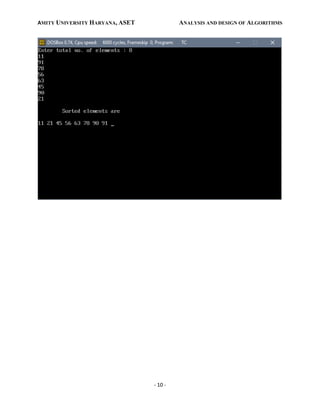
printf("ntSorted elements arenn");
for(i=0; i<size; i++)
printf("%d ",arr[i]);
getch();
}
void part(int arr[],int min,int max)
{
int mid;
if(min<max)
{
mid=(min+max)/2;
part(arr,min,mid);
part(arr,mid+1,max);
merge(arr,min,mid,max);
}
}
void merge(int arr[],int min,int mid,int max)
{
int tmp[30];
int i,j,k,m;
j=min;
m=mid+1;
for(i=min; j<=mid && m<=max ; i++)
{
AMITY UNIVERSITY HARYANA, ASET ANALYSIS AND DESIGN OF ALGORITHMS
- 9 -
if(arr[j]<=arr[m])
{
tmp[i]=arr[j];
j++;
}
else
{
tmp[i]=arr[m];
m++;
}
}
if(j>mid)
{
for(k=m; k<=max; k++)
{
tmp[i]=arr[k];
i++;}
}
else
{ for(k=j; k<=mid; k++)
{ tmp[i]=arr[k];
i++;
}
}
for(k=min; k<=max; k++)
arr[k]=tmp[k];
}
Output:
AMITY UNIVERSITY HARYANA, ASET ANALYSIS AND DESIGN OF ALGORITHMS
- 10 -
AMITY UNIVERSITY HARYANA, ASET ANALYSIS AND DESIGN OF ALGORITHMS
- 11 -
Experiment No.-3
/*Write a program to perform quick sort*/
#include<stdio.h>
void quicksort(int [10],int,int);
int main()
{
int x[20],size,i;
printf("Enter size of the array: ");
scanf("%d",&size);
printf("Enter %d elements: ",size);
for(i=0;i<size;i++)
scanf("%d",&x[i]);
quicksort(x,0,size-1);
printf("Sorted elements: ");
for(i=0;i<size;i++)
printf(" %d",x[i]);
return 0;
}
void quicksort(int x[10],int first,int last)
{
int pivot,j,temp,i;
if(first<last)
{
pivot=first;
i=first;
j=last;
while(i<j)
{
while(x[i]<=x[pivot]&&i<last)
i++;
while(x[j]>x[pivot])
j--;
if(i<j)
{
temp=x[i];
x[i]=x[j];
x[j]=temp;
}
}
temp=x[pivot];
x[pivot]=x[j];
AMITY UNIVERSITY HARYANA, ASET ANALYSIS AND DESIGN OF ALGORITHMS
- 12 -
x[j]=temp;
quicksort(x,first,j-1);
quicksort(x,j+1,last);
}
}
Output:-
AMITY UNIVERSITY HARYANA, ASET ANALYSIS AND DESIGN OF ALGORITHMS
- 13 -
Experiment No.-4
/*Write a program to perform insertion sort*/
#include <stdio.h>
int main()
{
int n, array[1000], c, d, t;
printf("Enter number of elementsn");
scanf("%d", &n);
printf("Enter %d integersn", n);
for (c = 0; c < n; c++) {
scanf("%d", &array[c]);
}
for (c = 1 ; c <= n - 1; c++) {
d = c;
while ( d > 0 && array[d] < array[d-1]) {
t = array[d];
array[d] = array[d-1];
array[d-1] = t;
d--;
}
}
printf("Sorted list in ascending order:n");
for (c = 0; c <= n - 1; c++) {
printf("%dn", array[c]);
}
return 0;
}
Output:-
AMITY UNIVERSITY HARYANA, ASET ANALYSIS AND DESIGN OF ALGORITHMS
- 14 -
Experiment No.-5
/*Write a program for knapsack 01*/
#include<stdio.h>
int max(int a, int b) { return (a > b)? a : b; }
int knapSack(int W, int wt[], int val[], int n)
{
if (n == 0 || W == 0)
return 0;
if (wt[n-1] > W)
return knapSack(W, wt, val, n-1);
else return max( val[n-1] + knapSack(W-wt[n-1], wt, val, n-1),
knapSack(W, wt, val, n-1)
);
}
int main()
{
int val[] = {60, 100, 120};
int wt[] = {10, 20, 30};
int W = 50;
int n = sizeof(val)/sizeof(val[0]);
printf("%d", knapSack(W, wt, val, n));
return 0;
}
Output:
AMITY UNIVERSITY HARYANA, ASET ANALYSIS AND DESIGN OF ALGORITHMS
- 15 -
Experiment No.-6
/*Write a program for cross multiplication using dynamic
programming*/
#include <stdio.h>
int main()
{
int n, array[1000], c, d, t;
printf("Enter number of elementsn");
scanf("%d", &n);
printf("Enter %d integersn", n);
for (c = 0; c < n; c++) {
scanf("%d", &array[c]);
}
for (c = 1 ; c <= n - 1; c++) {
d = c;
while ( d > 0 && array[d] < array[d-1]) {
t = array[d];
array[d] = array[d-1];
array[d-1] = t;
d--;
}
}
printf("Sorted list in ascending order:n");
for (c = 0; c <= n - 1; c++) {
printf("%dn", array[c]);
}
return 0;
}
Output:-
AMITY UNIVERSITY HARYANA, ASET ANALYSIS AND DESIGN OF ALGORITHMS
- 16 -
Experiment No.-7
/*Write a program for implementing kruskal algorithm*/
#include<stdio.h>
#include<conio.h>
#include<stdlib.h>
int i,j,k,a,b,u,v,n,ne=1;
int min,mincost=0,cost[9][9],parent[9];
int find(int);
int uni(int,int);
void main()
{
clrscr();
printf("nntImplementation of Kruskal's algorithmnn");
printf("nEnter the no. of verticesn");
scanf("%d",&n);
printf("nEnter the cost adjacency matrixn");
for(i=1;i<=n;i++)
{
for(j=1;j<=n;j++)
{
scanf("%d",&cost[i][j]);
if(cost[i][j]==0)
cost[i][j]=999;
}
}
printf("nThe edges of Minimum Cost Spanning Tree arenn");
while(ne<n)
{
for(i=1,min=999;i<=n;i++)
{
for(j=1;j<=n;j++)
{
if(cost[i][j]<min)
{
min=cost[i][j];
a=u=i;
b=v=j;
}
}
}
u=find(u);
v=find(v);
if(uni(u,v))
{
AMITY UNIVERSITY HARYANA, ASET ANALYSIS AND DESIGN OF ALGORITHMS
- 17 -
printf("n%d edge (%d,%d) =%dn",ne++,a,b,min);
mincost +=min;
}
cost[a][b]=cost[b][a]=999;
}
printf("ntMinimum cost = %dn",mincost);
getch();
}
int find(int i)
{
while(parent[i])
i=parent[i];
return i;
}
int uni(int i,int j)
{
if(i!=j)
{
parent[j]=i;
return 1;
}
return 0;
}
Output:-
AMITY UNIVERSITY HARYANA, ASET ANALYSIS AND DESIGN OF ALGORITHMS
- 18 -
Experiment No.-8
/*Write a program for implementing prims algorithm*/
#include<stdio.h>
#include<conio.h>
int a,b,u,v,n,i,j,ne=1;
int visited[10]={0},min,mincost=0,cost[10][10];
void main()
{
clrscr();
printf("nEnter the number of nodes:");
scanf("%d",&n);
printf("nEnter the adjacency matrix:n");
for(i=1;i<=n;i++)
for(j=1;j<=n;j++)
{
scanf("%d",&cost[i][j]);
if(cost[i][j]==0)
cost[i][j]=999;
}
visited[1]=1;
printf("n");
while(ne < n)
{
for(i=1,min=999;i<=n;i++)
for(j=1;j<=n;j++)
if(cost[i][j]< min)
if(visited[i]!=0)
{
min=cost[i][j];
a=u=i;
b=v=j;
}
if(visited[u]==0 || visited[v]==0)
{
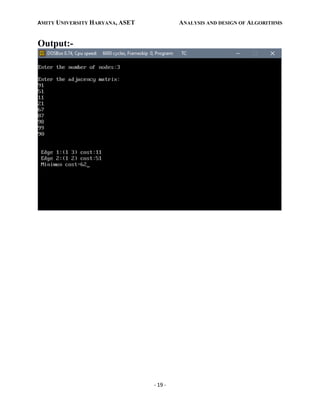
printf("n Edge %d:(%d %d) cost:%d",ne++,a,b,min);
mincost+=min;
visited[b]=1;
}
cost[a][b]=cost[b][a]=999;
}
printf("n Minimun cost=%d",mincost);
getch();
}
AMITY UNIVERSITY HARYANA, ASET ANALYSIS AND DESIGN OF ALGORITHMS
- 19 -
Output:-
AMITY UNIVERSITY HARYANA, ASET ANALYSIS AND DESIGN OF ALGORITHMS
- 20 -
Experiment No.-9
/*Write a program for implementing BFS algorithm*/
#include<stdio.h>
#include<conio.h>
int a[20][20],q[20],visited[20],n,i,j,f=0,r=-1;
void bfs(int v)
{
for(i=1;i<=n;i++)
if(a[v][i] && !visited[i])
q[++r]=i;
if(f<=r)
{
visited[q[f]]=1;
bfs(q[f++]);
}
}
int main()
{
int v;
printf("n Enter the number of vertices:");
scanf("%d",&n);
for(i=1;i<=n;i++)
{
q[i]=0;
visited[i]=0;
}
printf("n Enter graph data in matrix form:n");
for(i=1;i<=n;i++)
for(j=1;j<=n;j++)
scanf("%d",&a[i][j]);
printf("n Enter the starting vertex:");
scanf("%d",&v);
bfs(v);
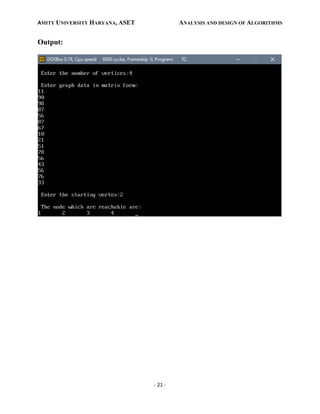
printf("n The node which are reachable are:n");
for(i=1;i<=n;i++)
if(visited[i])
printf("%dt",i);
else
printf("n Bfs is not possible");
getch();
}
AMITY UNIVERSITY HARYANA, ASET ANALYSIS AND DESIGN OF ALGORITHMS
- 21 -
Output:
AMITY UNIVERSITY HARYANA, ASET ANALYSIS AND DESIGN OF ALGORITHMS
- 22 -
Experiment.-10
/*Write a program for implementing DFS algorithm*/
#include<stdio.h>
#include<conio.h>
void DFS(int);
int G[10][10],visited[10],n;
void main()
{
int i,j;
clrscr();
printf("Enter number of vertices:");
scanf("%d",&n);
printf("nEnter adjecency matrix of the graph:");
for(i=0;i<n;i++)
for(j=0;j<n;j++)
scanf("%d",&G[i][j]);
for(i=0;i<n;i++)
visited[i]=0;
DFS(0);
getch();
}
void DFS(int i)
{
int j;
printf("n%d",i);
visited[i]=1;
for(j=0;j<n;j++)
if(!visited[j]&&G[i][j]==1)
DFS(j);
}
Output
AMITY UNIVERSITY HARYANA, ASET ANALYSIS AND DESIGN OF ALGORITHMS
- 23 -
Experiment No.-11
/*Write a program for implementing LCS algorithm*/
#include<stdio.h>
#include<conio.h>
int max(int a, int b);
int lcs( char *X, char *Y, int m, int n )
{
if (m == 0 || n == 0)
return 0;
if (X[m-1] == Y[n-1])
return 1 + lcs(X, Y, m-1, n-1);
else
return max(lcs(X, Y, m, n-1), lcs(X, Y, m-1, n));
}
int max(int a, int b)
{
return (a > b)? a : b;
}
int main()
{
char X[] = "AVGTAB";
char Y[] = "GNTXAYB";
int m = strlen(X);
int n = strlen(Y);
clrscr();
printf("Length of LCS is %dn", lcs( X, Y, m, n ) );
getch();
return 0;
}
Output:

Ada lab manual

  • 1.
    AMITY UNIVERSITY HARYANA,ASET ANALYSIS AND DESIGN OF ALGORITHMS - 1 - Lab Manual “Analysis and Design of Algorithm” B.Tech(CSE/IT/SE/) 7th Sem Course Code: CSE2706 Department of Computer Science & Engineering Amity School of Engineering and Technology AMITY UNIVERSITY HARYANA Prepared By: Dr. Aman Jatain Assistant Professor (CSE)
  • 2.
    AMITY UNIVERSITY HARYANA,ASET ANALYSIS AND DESIGN OF ALGORITHMS - 2 - Table of Contents Recent Trends iii Lab Syllabus iv Student Learning Outcome v Prerequisite (S/W & H/W) v Experiment List 1. Write a program to perform Binary Search. 01 2. Write a program to perform Merge Sort. 03 3. Write a program to perform Quick Sort. 06 4. Write a program to perform Insertion Sort. 08 5. Write a program for Knapsack 01. 09 6. Write a program for cross multiplication using Dynamic Programming. 10 7. Write a program for implementing Kruskal Algorithm, 11 8. Write a program for implementing Prims Algorithm. 13 9. Write a program for implementing BFS Algorithm 15 10. Write a program for implementing DFS Algorithm. 17 11. Write a program implementing LCS Algorithm. 18
  • 3.
    AMITY UNIVERSITY HARYANA,ASET ANALYSIS AND DESIGN OF ALGORITHMS - 3 - Recent trends in the field of Algorithms Design and Analysis of algorithm is systematic way of writing algorithms. It increasingly being applied in the practical fields of mathematics and Computer Science. It elaborate the fundamental concept like Divide & Conquer, Greedy Algorithm, Dynamic Programming, Backtracking, and Branch & Bound along with the tractable and intractable problems. Now a day’s various algorithms are designed for data analysis using R programming and Machine learning to solve computational problems.
  • 4.
    AMITY UNIVERSITY HARYANA,ASET ANALYSIS AND DESIGN OF ALGORITHMS - 4 - Analysis and Design of Algorithm Lab Course Code: CSE2706 L-T-P : 0-0-2 Credit Units: 01 Software Required: Any programming language C/C++/ Java software available in lab. Assignments will be provided for the following: Design, develop and implement the specified algorithms for the given problems using C/C++/Java Language in LINUX / Windows environment. Examination Scheme: IA EE A PR LR V PR V 5 10 10 5 35 35 Note: IA –Internal Assessment, EE- External Exam, PR- Performance, LR – Lab Record, V – Viva. Student Learning Outcomes: 1. Students will develop proficiency in problem solving and programming. 2. Students will be able to carry out the Analysis of various Algorithms for mainly Time and Space Complexity. 3. Students will get a good understanding of applications of Data Structures. 4. Students will learn to select the best algorithm to solve a problem by considering various problem characteristics, such as the data size, the type of operations, etc.
  • 5.
    AMITY UNIVERSITY HARYANA,ASET ANALYSIS AND DESIGN OF ALGORITHMS - 5 - 5. Students will also develop a base for advanced study in Computer Science. Relationship with SLOs: Students will learn the basics concepts of algorithm analysis by designing different algorithms for various problems and also analyze the complexity of these algorithms. Prerequisite (S/W & H/W) Hardware: Pentium III/IV CPU 2GHz RAM:1/2/3/4 GB HardDisk: 160GB Software: Windows XP/7/8 OS Any programming language C/C++ or Java and basic concepts of Data Structure
  • 6.
    AMITY UNIVERSITY HARYANA,ASET ANALYSIS AND DESIGN OF ALGORITHMS - 6 - Experiment No. 1 Write a program to perform binary search*/ #include<iostream.h> #include<conio.h> void main() { int a[10],sc,mid,qq=0; int temp; clrscr(); cout<<"enter the values"<<endl; for(int i=0;i<10;i++) { cin>>a[i]; } for(int ctr=0;ctr<10;ctr++){ for(int i=0;i<9;i++) { if(a[i+1]<a[i]) { temp=a[i]; a[i]=a[i+1]; a[i+1]=temp; } }} cout<<"The value in the array is"<<endl; for(int qtr=0;qtr<10;qtr++) { cout<<a[qtr]<<"t"; } cout<<"Enter the value to be searched"<<endl; cin>>sc; mid=5; if(sc>=a[mid]){ for(int ztr=mid;ztr<10;ztr++) { if(sc==a[ztr]) {qq=1; cout<<"Value found at"<<ztr+1<<endl; break; } } }
  • 7.
    AMITY UNIVERSITY HARYANA,ASET ANALYSIS AND DESIGN OF ALGORITHMS - 7 - else { for(int qtr=0;qtr<mid;qtr++) {if(sc==a[qtr]){qq=1; cout<<"Value found at"<<qtr+1<<endl; break; } } if(qq==0){cout<<"Value not found"<<endl;} } getch(); } Output:
  • 8.
    AMITY UNIVERSITY HARYANA,ASET ANALYSIS AND DESIGN OF ALGORITHMS - 8 - Experiment No. 2 Write a program to perform merge sort */ #include<stdio.h> #include<conio.h> void merge(int [],int ,int ,int ); void part(int [],int ,int ); void main() { int arr[30]; int i,size; clrscr(); printf("Enter total no. of elements : "); scanf("%d",&size); for(i=0; i<size; i++) { scanf("%d",&arr[i]); } part(arr,0,size-1); printf("ntSorted elements arenn"); for(i=0; i<size; i++) printf("%d ",arr[i]); getch(); } void part(int arr[],int min,int max) { int mid; if(min<max) { mid=(min+max)/2; part(arr,min,mid); part(arr,mid+1,max); merge(arr,min,mid,max); } } void merge(int arr[],int min,int mid,int max) { int tmp[30]; int i,j,k,m; j=min; m=mid+1; for(i=min; j<=mid && m<=max ; i++) {
  • 9.
    AMITY UNIVERSITY HARYANA,ASET ANALYSIS AND DESIGN OF ALGORITHMS - 9 - if(arr[j]<=arr[m]) { tmp[i]=arr[j]; j++; } else { tmp[i]=arr[m]; m++; } } if(j>mid) { for(k=m; k<=max; k++) { tmp[i]=arr[k]; i++;} } else { for(k=j; k<=mid; k++) { tmp[i]=arr[k]; i++; } } for(k=min; k<=max; k++) arr[k]=tmp[k]; } Output:
  • 10.
    AMITY UNIVERSITY HARYANA,ASET ANALYSIS AND DESIGN OF ALGORITHMS - 10 -
  • 11.
    AMITY UNIVERSITY HARYANA,ASET ANALYSIS AND DESIGN OF ALGORITHMS - 11 - Experiment No.-3 /*Write a program to perform quick sort*/ #include<stdio.h> void quicksort(int [10],int,int); int main() { int x[20],size,i; printf("Enter size of the array: "); scanf("%d",&size); printf("Enter %d elements: ",size); for(i=0;i<size;i++) scanf("%d",&x[i]); quicksort(x,0,size-1); printf("Sorted elements: "); for(i=0;i<size;i++) printf(" %d",x[i]); return 0; } void quicksort(int x[10],int first,int last) { int pivot,j,temp,i; if(first<last) { pivot=first; i=first; j=last; while(i<j) { while(x[i]<=x[pivot]&&i<last) i++; while(x[j]>x[pivot]) j--; if(i<j) { temp=x[i]; x[i]=x[j]; x[j]=temp; } } temp=x[pivot]; x[pivot]=x[j];
  • 12.
    AMITY UNIVERSITY HARYANA,ASET ANALYSIS AND DESIGN OF ALGORITHMS - 12 - x[j]=temp; quicksort(x,first,j-1); quicksort(x,j+1,last); } } Output:-
  • 13.
    AMITY UNIVERSITY HARYANA,ASET ANALYSIS AND DESIGN OF ALGORITHMS - 13 - Experiment No.-4 /*Write a program to perform insertion sort*/ #include <stdio.h> int main() { int n, array[1000], c, d, t; printf("Enter number of elementsn"); scanf("%d", &n); printf("Enter %d integersn", n); for (c = 0; c < n; c++) { scanf("%d", &array[c]); } for (c = 1 ; c <= n - 1; c++) { d = c; while ( d > 0 && array[d] < array[d-1]) { t = array[d]; array[d] = array[d-1]; array[d-1] = t; d--; } } printf("Sorted list in ascending order:n"); for (c = 0; c <= n - 1; c++) { printf("%dn", array[c]); } return 0; } Output:-
  • 14.
    AMITY UNIVERSITY HARYANA,ASET ANALYSIS AND DESIGN OF ALGORITHMS - 14 - Experiment No.-5 /*Write a program for knapsack 01*/ #include<stdio.h> int max(int a, int b) { return (a > b)? a : b; } int knapSack(int W, int wt[], int val[], int n) { if (n == 0 || W == 0) return 0; if (wt[n-1] > W) return knapSack(W, wt, val, n-1); else return max( val[n-1] + knapSack(W-wt[n-1], wt, val, n-1), knapSack(W, wt, val, n-1) ); } int main() { int val[] = {60, 100, 120}; int wt[] = {10, 20, 30}; int W = 50; int n = sizeof(val)/sizeof(val[0]); printf("%d", knapSack(W, wt, val, n)); return 0; } Output:
  • 15.
    AMITY UNIVERSITY HARYANA,ASET ANALYSIS AND DESIGN OF ALGORITHMS - 15 - Experiment No.-6 /*Write a program for cross multiplication using dynamic programming*/ #include <stdio.h> int main() { int n, array[1000], c, d, t; printf("Enter number of elementsn"); scanf("%d", &n); printf("Enter %d integersn", n); for (c = 0; c < n; c++) { scanf("%d", &array[c]); } for (c = 1 ; c <= n - 1; c++) { d = c; while ( d > 0 && array[d] < array[d-1]) { t = array[d]; array[d] = array[d-1]; array[d-1] = t; d--; } } printf("Sorted list in ascending order:n"); for (c = 0; c <= n - 1; c++) { printf("%dn", array[c]); } return 0; } Output:-
  • 16.
    AMITY UNIVERSITY HARYANA,ASET ANALYSIS AND DESIGN OF ALGORITHMS - 16 - Experiment No.-7 /*Write a program for implementing kruskal algorithm*/ #include<stdio.h> #include<conio.h> #include<stdlib.h> int i,j,k,a,b,u,v,n,ne=1; int min,mincost=0,cost[9][9],parent[9]; int find(int); int uni(int,int); void main() { clrscr(); printf("nntImplementation of Kruskal's algorithmnn"); printf("nEnter the no. of verticesn"); scanf("%d",&n); printf("nEnter the cost adjacency matrixn"); for(i=1;i<=n;i++) { for(j=1;j<=n;j++) { scanf("%d",&cost[i][j]); if(cost[i][j]==0) cost[i][j]=999; } } printf("nThe edges of Minimum Cost Spanning Tree arenn"); while(ne<n) { for(i=1,min=999;i<=n;i++) { for(j=1;j<=n;j++) { if(cost[i][j]<min) { min=cost[i][j]; a=u=i; b=v=j; } } } u=find(u); v=find(v); if(uni(u,v)) {
  • 17.
    AMITY UNIVERSITY HARYANA,ASET ANALYSIS AND DESIGN OF ALGORITHMS - 17 - printf("n%d edge (%d,%d) =%dn",ne++,a,b,min); mincost +=min; } cost[a][b]=cost[b][a]=999; } printf("ntMinimum cost = %dn",mincost); getch(); } int find(int i) { while(parent[i]) i=parent[i]; return i; } int uni(int i,int j) { if(i!=j) { parent[j]=i; return 1; } return 0; } Output:-
  • 18.
    AMITY UNIVERSITY HARYANA,ASET ANALYSIS AND DESIGN OF ALGORITHMS - 18 - Experiment No.-8 /*Write a program for implementing prims algorithm*/ #include<stdio.h> #include<conio.h> int a,b,u,v,n,i,j,ne=1; int visited[10]={0},min,mincost=0,cost[10][10]; void main() { clrscr(); printf("nEnter the number of nodes:"); scanf("%d",&n); printf("nEnter the adjacency matrix:n"); for(i=1;i<=n;i++) for(j=1;j<=n;j++) { scanf("%d",&cost[i][j]); if(cost[i][j]==0) cost[i][j]=999; } visited[1]=1; printf("n"); while(ne < n) { for(i=1,min=999;i<=n;i++) for(j=1;j<=n;j++) if(cost[i][j]< min) if(visited[i]!=0) { min=cost[i][j]; a=u=i; b=v=j; } if(visited[u]==0 || visited[v]==0) { printf("n Edge %d:(%d %d) cost:%d",ne++,a,b,min); mincost+=min; visited[b]=1; } cost[a][b]=cost[b][a]=999; } printf("n Minimun cost=%d",mincost); getch(); }
  • 19.
    AMITY UNIVERSITY HARYANA,ASET ANALYSIS AND DESIGN OF ALGORITHMS - 19 - Output:-
  • 20.
    AMITY UNIVERSITY HARYANA,ASET ANALYSIS AND DESIGN OF ALGORITHMS - 20 - Experiment No.-9 /*Write a program for implementing BFS algorithm*/ #include<stdio.h> #include<conio.h> int a[20][20],q[20],visited[20],n,i,j,f=0,r=-1; void bfs(int v) { for(i=1;i<=n;i++) if(a[v][i] && !visited[i]) q[++r]=i; if(f<=r) { visited[q[f]]=1; bfs(q[f++]); } } int main() { int v; printf("n Enter the number of vertices:"); scanf("%d",&n); for(i=1;i<=n;i++) { q[i]=0; visited[i]=0; } printf("n Enter graph data in matrix form:n"); for(i=1;i<=n;i++) for(j=1;j<=n;j++) scanf("%d",&a[i][j]); printf("n Enter the starting vertex:"); scanf("%d",&v); bfs(v); printf("n The node which are reachable are:n"); for(i=1;i<=n;i++) if(visited[i]) printf("%dt",i); else printf("n Bfs is not possible"); getch(); }
  • 21.
    AMITY UNIVERSITY HARYANA,ASET ANALYSIS AND DESIGN OF ALGORITHMS - 21 - Output:
  • 22.
    AMITY UNIVERSITY HARYANA,ASET ANALYSIS AND DESIGN OF ALGORITHMS - 22 - Experiment.-10 /*Write a program for implementing DFS algorithm*/ #include<stdio.h> #include<conio.h> void DFS(int); int G[10][10],visited[10],n; void main() { int i,j; clrscr(); printf("Enter number of vertices:"); scanf("%d",&n); printf("nEnter adjecency matrix of the graph:"); for(i=0;i<n;i++) for(j=0;j<n;j++) scanf("%d",&G[i][j]); for(i=0;i<n;i++) visited[i]=0; DFS(0); getch(); } void DFS(int i) { int j; printf("n%d",i); visited[i]=1; for(j=0;j<n;j++) if(!visited[j]&&G[i][j]==1) DFS(j); } Output
  • 23.
    AMITY UNIVERSITY HARYANA,ASET ANALYSIS AND DESIGN OF ALGORITHMS - 23 - Experiment No.-11 /*Write a program for implementing LCS algorithm*/ #include<stdio.h> #include<conio.h> int max(int a, int b); int lcs( char *X, char *Y, int m, int n ) { if (m == 0 || n == 0) return 0; if (X[m-1] == Y[n-1]) return 1 + lcs(X, Y, m-1, n-1); else return max(lcs(X, Y, m, n-1), lcs(X, Y, m-1, n)); } int max(int a, int b) { return (a > b)? a : b; } int main() { char X[] = "AVGTAB"; char Y[] = "GNTXAYB"; int m = strlen(X); int n = strlen(Y); clrscr(); printf("Length of LCS is %dn", lcs( X, Y, m, n ) ); getch(); return 0; } Output: