http://www.iaeme.com/IJARET/index.asp 122 editor@iaeme.com
International Journal of Advanced Research in Engineering and Technology
(IJARET)
Volume 6, Issue 10, Oct 2015, pp. 122-126, Article ID: IJARET_06_10_018
Available online at
http://www.iaeme.com/IJARET/issues.asp?JType=IJARET&VType=6&IType=10
ISSN Print: 0976-6480 and ISSN Online: 0976-6499
© IAEME Publication
___________________________________________________________________________
GROWTH OF (E)-2-NITRO-3-
PHENYLALLYL HYDROGEN SULFATE
USING BAYLIS–HILLMAN DERIVATIVES
CRYSTALS
Anandhan Vidya and Nagppan. Sivakumar
Department Chemistry, AMET University Kanathur Chennai 603 112, India
ABSTRACT
For the first time Baylis–Hillman adducts derived from nitroolefins have
been conveniently transformed into a novel class of building blocks, (E)-2-
nitro-3-phenylprop-2-ene-1-sulfonic acid The large second order optical
nonlinearities, short transparency cut-off wavelength and stable
physiochemical performance, which are needed in the realization of most of
the recent electronic applications, are also considered in the present study.
Key words: Baylis-Hillman reaction; (E)-2-nitro-3-phenylprop-2-en-1-ol and
(E)-2-nitro-3-phenylprop-2-ene-1-sulfonic acid.
Cite this Article: Anandhan Vidya and Nagppan. Sivakumar. Growth of (E)-
2-Nitro-3-Phenylallyl Hydrogen Sulfate Using Baylis–Hillman Derivatives
Crystals. International Journal of Advanced Research in Engineering and
Technology, 6(10), 2015, pp. 122-126.
http://www.iaeme.com/IJARET/issues.asp?JType=IJARET&VType=6&IType=10
1. INTRODUCTION
The search for suitable materials and crystals that display excellent nonlinear optical
properties is increased day by day because of the varied inherent applications in the
field of optical computing, optical information processing, optical disk data storage,
laser remote sensing, laser driven fusion, color display, medical diagnostic etc1-8
,. The
above said the important application ignited us to search for good and efficient NLO
materials and that is the objective of the present work.9-12
Since there is a high
demand for crystals in the revolution of electronic phase, it is required that both the
technical and economical aspects of crystal growth have to be improved. This analysis
focuses on pure organic materials in the emerging field of optoelectronics.13-20
The large second order optical nonlinearities, short transparency cut-off
wavelength and stable physiochemical performance, which are needed in the
Growth of (E)-2-Nitro-3-Phenylallyl Hydrogen Sulfate Using Baylis–Hillman Derivatives
Crystals
http://www.iaeme.com/IJARET/index.asp 123 editor@iaeme.com
realization of most of the recent electronic applications, are also considered in the
present study.21-25
The present materials are selected to increase the electron transformation, which
increases the OSO3H and CH2 stretching vibration, and also to reduce the NO2
-
bending vibration for obtaining better nonlinear optical activities. This work specially
concentrates on higher environmental stability and greater diversity of tuneable
electronic properties for economic and eco-friendly operations. In the present chapter
synthesis growth and characterization of new NLO crystal (E)-2-nitro-3-phenylprop-
2-ene-1-sulfonic acid is discussed in detail
2. RESULTS AND DISCUSSIONS
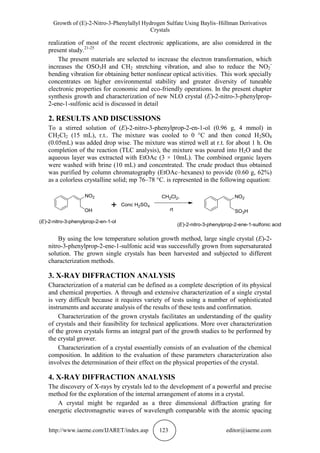
To a stirred solution of (E)-2-nitro-3-phenylprop-2-en-1-ol (0.96 g, 4 mmol) in
CH2Cl2 (15 mL), r.t.. The mixture was cooled to 0 °C and then concd H2SO4
(0.05mL) was added drop wise. The mixture was stirred well at r.t. for about 1 h. On
completion of the reaction (TLC analysis), the mixture was poured into H2O and the
aqueous layer was extracted with EtOAc (3 × 10mL). The combined organic layers
were washed with brine (10 mL) and concentrated. The crude product thus obtained
was purified by column chromatography (EtOAc–hexanes) to provide (0.60 g, 62%)
as a colorless crystalline solid; mp 76–78 °C. is represented in the following equation:
By using the low temperature solution growth method, large single crystal (E)-2-
nitro-3-phenylprop-2-ene-1-sulfonic acid was successfully grown from supersaturated
solution. The grown single crystals has been harvested and subjected to different
characterization methods.
3. X-RAY DIFFRACTION ANALYSIS
Characterization of a material can be defined as a complete description of its physical
and chemical properties. A through and extensive characterization of a single crystal
is very difficult because it requires variety of tests using a number of sophisticated
instruments and accurate analysis of the results of these tests and confirmation.
Characterization of the grown crystals facilitates an understanding of the quality
of crystals and their feasibility for technical applications. More over characterization
of the grown crystals forms an integral part of the growth studies to be performed by
the crystal grower.
Characterization of a crystal essentially consists of an evaluation of the chemical
composition. In addition to the evaluation of these parameters characterization also
involves the determination of their effect on the physical properties of the crystal.
4. X-RAY DIFFRACTION ANALYSIS
The discovery of X-rays by crystals led to the development of a powerful and precise
method for the exploration of the internal arrangement of atoms in a crystal.
A crystal might be regarded as a three dimensional diffraction grating for
energetic electromagnetic waves of wavelength comparable with the atomic spacing
Anandhan Vidya and Nagppan. Sivakumar
http://www.iaeme.com/IJARET/index.asp 124 editor@iaeme.com
and that a diffraction pattern should provide information about the regular
arrangement of atoms.
X-rays are still the principal source of new information about the crystallography
of solids and are supplemented by electron and neutron diffraction.
It is well known that when a beam of light passes through a screen containing a
regular pattern of holes interference phenomenon may be observed if the distance
between the holes is of the same as the wavelength of the light employed.
The diffraction of X-rays by the atoms in a solid is a completely analogous
phenomenon the wavelength of electromagnetic radiation in the case being of the
order of inter-atomic distance in solids, which is 1Å.
The structure of the compound was confirmed by IR, 1
H NMR and 13
C NMR
spectral data. The 1
H NMR spectrum shows that the CH2 protons appeared at δ 4.25
and Aromatic protons appeared in the region of δ 7.21-7.48. The olefinic proton
appeared at δ 8.3. Encouraged by this results we prepared variety of Baylis-Hillman
adducts and successfully transformed them into their corresponding thiocyanate
derivatives, according to scheme.
5. POWDER X-RAY DIFFRACTION METHOD
The powder method is applicable to finely divided crystalline powder or to a very
fine-grained polycrystalline spectrum. This is also Debye-Schrerrer method. In this
method single crystals are not required and it is used for accurate determination of
lattice parameters in crystals of known structure and for the identification of elements
and compounds. The powdered sample is kept inside a small capillary tube, which
does not undergo diffraction by X-rays.
A narrow pencil of monochromatic X-ray is diffracted from the powder and
recorded by photographic films as a series of lines of varying curvature. The full
opening angle of the diffraction cone 4Ɵ is determined by measuring the distance S
between two corresponding arch on the power photographs symmetrically displaced
about the exit point of the direct beam. The distance S on the film between two
diffraction lines corresponding to a particular plan is related to the Bragg’s angle by
the equation.
4Ɵ=S/R radians=S/R (180/π) degree
Where R is distance from the specimen to the film that is usually the radius of the
camera housing the film.
From the measured values of S a list of Ɵ and intensity gives a list of spacing d,
each spacing is the distance between neighbouring planes (hkl).
6. FOURIER TRANSFORM INFRARED SPECTROSCOPY
FT-IR stands for Fourier Transform Infrared Spectroscopy which provides the
structural information, from the observed diffraction patterns is obtained through a
mathematical manipulation known as Fourier Transformation.
In FT-IR spectroscopy, IR radiation is passed through a sample, some of the
radiation is absorbed by the sample and some of it is passed through (transmitted).
The resulting spectrum represents the molecular absorption and transmission of the
sample. Like a finger print, no two unique molecular structures produce the infrared
spectrum. This makes infrared spectroscopy useful for several types of analysis.
Growth of (E)-2-Nitro-3-Phenylallyl Hydrogen Sulfate Using Baylis–Hillman Derivatives
Crystals
http://www.iaeme.com/IJARET/index.asp 125 editor@iaeme.com
The advent of Fourier Transform Spectroscopy has made the far infrared much
more accessible, and has considerably speeded and improved spectroscopy in the
infrared region in general.
There are a number of advantages to be gained by using Fourier Transform rather
than dispersive measurements in the infrared.
 It is a non-destructive technique
 It provides a precise measurement method which requires no external calibration
 It has greater optical throughput
 The total scanning time for FTIR is considerably less than that required time to
produce a dispersive spectrum of the same sensitivity and resolution
 The whole spectrum is obtained across the entire frequency range at once. In
dispersive IR spectroscopy, it is common to change the dispersing grating during the
scan, as one grating is not usually able to function sufficient well over the whole
range.
7. PRINCIPLE OF FOURIER TRANSFORM INFRARED SPECTROSCOPY
The FT-IR spectra of most of the samples are recorded.
1635, 1518, 1323 cm-1
The principle of interferometer is the simple interference of radiation where the
absorption spectrum is obtained through the interference technique.
Two radiation beams with same wavelength and amplitude leads to optical
interference.
 If the radiation beams are in phase, the beam will interfere constructively and the
resultant amplitude will be twice as high
 If the radiation beams are out of phase by ½(2n+1)λ (half integral number of
wavelengths). The beams will interfere destructively cancelling out each other.
 At intermediate phase differences, the amplitude is given by ½(1±cos2πθ/λ). Where θ
is the phase difference.
 A typical inter ferogram, which is a plot of the intensity (amplitude) versus path
length difference (phase) for the interference of two radiation beams of identical
wavelength is obtained.
A complex interference pattern is obtained when two radiation beams of different
wavelengths are interfere.
8. CONCLUSION
In conclusion this methodology represents the first Friedel-Crafts reaction of the
Baylis-Hillman adducts derived from nitroolefins mediated by concentrated sulfuric
acid thus providing a simple synthesis of trisubstituted olefin derivatives.
Characterization of a crystal essentially consists of an evaluation of the chemical
composition. In addition to the evaluation of these parameters characterization also
involves the determination of their effect on the physical properties of the crystal.
ACKNOWLEDGMENTS
We thank AMET University for the financial support. We also thank University 0f
Madras for the NMR facility. Indian institute of Technology, Chennai for IR, and
Mass Spectra, Anna University Chennai for powder XRD.
Anandhan Vidya and Nagppan. Sivakumar
http://www.iaeme.com/IJARET/index.asp 126 editor@iaeme.com
REFERENCES
[1] Baylis, A. B.; Hillman, M. E. D. German Patent. 1972, 2155113; Chem.
Abstr. 1972, 77, 34174q.
[2] Drewes, S. E.; Roos, G. H. P. Tetrahedron. 1988, 44, 4653.
[3] Basavaiah, D.; Dharma Rao, P; Suguna Hyma, R. Tetrahedron. 1996, 52,
8001.
[4] Vijay, S.; Sanjay, B.; Tetrahedron. 2008, 64, 4511-4574.
[5] Basavaiah, D.; Rao, A. J.; Satyanarayana, T. Chem.Rev. 2003, 103, 811-891.
[6] Kataoka, T.; Kinoshita, S.; Kinoshita, H.; Fujita, M.; Iwamura, T.; Watanade,
S. I. Chem.Commun. 2001, 1958.
[7] Kinoshita, H.; Kinoshita, S.; Munechika, Y.; Iwamura, T.; Watanabe, S. I.;
kataoka, T. Eur. J. Org. Chem. 2003, 24, 4852.
[8] Rios, R.; Sunden, H.; Ibrahem, I.; Zhao, G. L.; Eriksson, L.; Cordova, A.
Tetrahedron Lett. 2006, 47, 8679.
[9] Li, G.; Wei, H. X.; Gao, J. J.; Caputo,T. D. Tetrahedron Lett. 2000, 41, 1.
[10] Taniguchi, M.; Hino, T.; Kishi, Y. Tetrahedron Lett. 1986, 27, 4767.
[11] Uehira, S.; Han, T.; Shinokubo, H.; Oshima, K. Org. Lett. 1999, 1, 1383.
[12] Basavaiah, D.; Bakthadoss, M.; Jayapal, G. Synthesis 2001, 919.
[13] Lee, C. G.; Lee, K. Y.; GowriSankar, S.; Kim, J. N. Tetrahedron Lett. 2004,
45, 7409.
[14] Basavaiah, D.; Bakthadoss, M.; Pandiaraju, S. Chem. Commum. 1998, 1639
[15] Lim, H. N.; Ji, S. H.; Lee, K. J. Synthesis. 2007, 2454.
[16] Walsh, L. M.; Winn, C. L.; Goodman, J. M. Tetrahedron Lett. 2002, 43, 8219
[17] Shi, M.; Liu, X. G. Org. Lett. 2008, 10, 1043.
[18] Aggarwal, V. K.; Castro, A. M. M.; Mereu, A.; Adams, H. Tetrahedron Lett.
2002, 43, 1577.
[19] Shi, M.; Jiang, J. K. Tetrahedron Asymmetry. 2002, 13, 1941
[20] Trost, B. M.; Tsui, H. C.; Toste, F. D. J. Am. Chem. Soc. 2002, 124, 11616.
[21] Cremer, D. & Pople, J. A. (1975). J. Am. Chem. Soc. 97, 1354–1358.
[22] Farrugia, L. J. (1997). J. Appl. Cryst. 30, 565.
[23] Sheldrick, G. M. (2008). Acta Cryst. A64, 112–122.
[24] Spek, A. L. (2009). Acta Cryst. D65, 148–155.
[25] Prof. N. K. Dhapekar, Structural Health Monitoring Of Concrete Structures
Evaluating Elastic Constants And Stress-Strain Parameters By X-Ray
Diffraction Technique, International Journal of Civil Engineering &
Technology, 5(1), 2014, pp. 01-12.

Ijaret 06 10_018

  • 1.
    http://www.iaeme.com/IJARET/index.asp 122 editor@iaeme.com InternationalJournal of Advanced Research in Engineering and Technology (IJARET) Volume 6, Issue 10, Oct 2015, pp. 122-126, Article ID: IJARET_06_10_018 Available online at http://www.iaeme.com/IJARET/issues.asp?JType=IJARET&VType=6&IType=10 ISSN Print: 0976-6480 and ISSN Online: 0976-6499 © IAEME Publication ___________________________________________________________________________ GROWTH OF (E)-2-NITRO-3- PHENYLALLYL HYDROGEN SULFATE USING BAYLIS–HILLMAN DERIVATIVES CRYSTALS Anandhan Vidya and Nagppan. Sivakumar Department Chemistry, AMET University Kanathur Chennai 603 112, India ABSTRACT For the first time Baylis–Hillman adducts derived from nitroolefins have been conveniently transformed into a novel class of building blocks, (E)-2- nitro-3-phenylprop-2-ene-1-sulfonic acid The large second order optical nonlinearities, short transparency cut-off wavelength and stable physiochemical performance, which are needed in the realization of most of the recent electronic applications, are also considered in the present study. Key words: Baylis-Hillman reaction; (E)-2-nitro-3-phenylprop-2-en-1-ol and (E)-2-nitro-3-phenylprop-2-ene-1-sulfonic acid. Cite this Article: Anandhan Vidya and Nagppan. Sivakumar. Growth of (E)- 2-Nitro-3-Phenylallyl Hydrogen Sulfate Using Baylis–Hillman Derivatives Crystals. International Journal of Advanced Research in Engineering and Technology, 6(10), 2015, pp. 122-126. http://www.iaeme.com/IJARET/issues.asp?JType=IJARET&VType=6&IType=10 1. INTRODUCTION The search for suitable materials and crystals that display excellent nonlinear optical properties is increased day by day because of the varied inherent applications in the field of optical computing, optical information processing, optical disk data storage, laser remote sensing, laser driven fusion, color display, medical diagnostic etc1-8 ,. The above said the important application ignited us to search for good and efficient NLO materials and that is the objective of the present work.9-12 Since there is a high demand for crystals in the revolution of electronic phase, it is required that both the technical and economical aspects of crystal growth have to be improved. This analysis focuses on pure organic materials in the emerging field of optoelectronics.13-20 The large second order optical nonlinearities, short transparency cut-off wavelength and stable physiochemical performance, which are needed in the
  • 2.
    Growth of (E)-2-Nitro-3-PhenylallylHydrogen Sulfate Using Baylis–Hillman Derivatives Crystals http://www.iaeme.com/IJARET/index.asp 123 editor@iaeme.com realization of most of the recent electronic applications, are also considered in the present study.21-25 The present materials are selected to increase the electron transformation, which increases the OSO3H and CH2 stretching vibration, and also to reduce the NO2 - bending vibration for obtaining better nonlinear optical activities. This work specially concentrates on higher environmental stability and greater diversity of tuneable electronic properties for economic and eco-friendly operations. In the present chapter synthesis growth and characterization of new NLO crystal (E)-2-nitro-3-phenylprop- 2-ene-1-sulfonic acid is discussed in detail 2. RESULTS AND DISCUSSIONS To a stirred solution of (E)-2-nitro-3-phenylprop-2-en-1-ol (0.96 g, 4 mmol) in CH2Cl2 (15 mL), r.t.. The mixture was cooled to 0 °C and then concd H2SO4 (0.05mL) was added drop wise. The mixture was stirred well at r.t. for about 1 h. On completion of the reaction (TLC analysis), the mixture was poured into H2O and the aqueous layer was extracted with EtOAc (3 × 10mL). The combined organic layers were washed with brine (10 mL) and concentrated. The crude product thus obtained was purified by column chromatography (EtOAc–hexanes) to provide (0.60 g, 62%) as a colorless crystalline solid; mp 76–78 °C. is represented in the following equation: By using the low temperature solution growth method, large single crystal (E)-2- nitro-3-phenylprop-2-ene-1-sulfonic acid was successfully grown from supersaturated solution. The grown single crystals has been harvested and subjected to different characterization methods. 3. X-RAY DIFFRACTION ANALYSIS Characterization of a material can be defined as a complete description of its physical and chemical properties. A through and extensive characterization of a single crystal is very difficult because it requires variety of tests using a number of sophisticated instruments and accurate analysis of the results of these tests and confirmation. Characterization of the grown crystals facilitates an understanding of the quality of crystals and their feasibility for technical applications. More over characterization of the grown crystals forms an integral part of the growth studies to be performed by the crystal grower. Characterization of a crystal essentially consists of an evaluation of the chemical composition. In addition to the evaluation of these parameters characterization also involves the determination of their effect on the physical properties of the crystal. 4. X-RAY DIFFRACTION ANALYSIS The discovery of X-rays by crystals led to the development of a powerful and precise method for the exploration of the internal arrangement of atoms in a crystal. A crystal might be regarded as a three dimensional diffraction grating for energetic electromagnetic waves of wavelength comparable with the atomic spacing
  • 3.
    Anandhan Vidya andNagppan. Sivakumar http://www.iaeme.com/IJARET/index.asp 124 editor@iaeme.com and that a diffraction pattern should provide information about the regular arrangement of atoms. X-rays are still the principal source of new information about the crystallography of solids and are supplemented by electron and neutron diffraction. It is well known that when a beam of light passes through a screen containing a regular pattern of holes interference phenomenon may be observed if the distance between the holes is of the same as the wavelength of the light employed. The diffraction of X-rays by the atoms in a solid is a completely analogous phenomenon the wavelength of electromagnetic radiation in the case being of the order of inter-atomic distance in solids, which is 1Å. The structure of the compound was confirmed by IR, 1 H NMR and 13 C NMR spectral data. The 1 H NMR spectrum shows that the CH2 protons appeared at δ 4.25 and Aromatic protons appeared in the region of δ 7.21-7.48. The olefinic proton appeared at δ 8.3. Encouraged by this results we prepared variety of Baylis-Hillman adducts and successfully transformed them into their corresponding thiocyanate derivatives, according to scheme. 5. POWDER X-RAY DIFFRACTION METHOD The powder method is applicable to finely divided crystalline powder or to a very fine-grained polycrystalline spectrum. This is also Debye-Schrerrer method. In this method single crystals are not required and it is used for accurate determination of lattice parameters in crystals of known structure and for the identification of elements and compounds. The powdered sample is kept inside a small capillary tube, which does not undergo diffraction by X-rays. A narrow pencil of monochromatic X-ray is diffracted from the powder and recorded by photographic films as a series of lines of varying curvature. The full opening angle of the diffraction cone 4Ɵ is determined by measuring the distance S between two corresponding arch on the power photographs symmetrically displaced about the exit point of the direct beam. The distance S on the film between two diffraction lines corresponding to a particular plan is related to the Bragg’s angle by the equation. 4Ɵ=S/R radians=S/R (180/π) degree Where R is distance from the specimen to the film that is usually the radius of the camera housing the film. From the measured values of S a list of Ɵ and intensity gives a list of spacing d, each spacing is the distance between neighbouring planes (hkl). 6. FOURIER TRANSFORM INFRARED SPECTROSCOPY FT-IR stands for Fourier Transform Infrared Spectroscopy which provides the structural information, from the observed diffraction patterns is obtained through a mathematical manipulation known as Fourier Transformation. In FT-IR spectroscopy, IR radiation is passed through a sample, some of the radiation is absorbed by the sample and some of it is passed through (transmitted). The resulting spectrum represents the molecular absorption and transmission of the sample. Like a finger print, no two unique molecular structures produce the infrared spectrum. This makes infrared spectroscopy useful for several types of analysis.
  • 4.
    Growth of (E)-2-Nitro-3-PhenylallylHydrogen Sulfate Using Baylis–Hillman Derivatives Crystals http://www.iaeme.com/IJARET/index.asp 125 editor@iaeme.com The advent of Fourier Transform Spectroscopy has made the far infrared much more accessible, and has considerably speeded and improved spectroscopy in the infrared region in general. There are a number of advantages to be gained by using Fourier Transform rather than dispersive measurements in the infrared.  It is a non-destructive technique  It provides a precise measurement method which requires no external calibration  It has greater optical throughput  The total scanning time for FTIR is considerably less than that required time to produce a dispersive spectrum of the same sensitivity and resolution  The whole spectrum is obtained across the entire frequency range at once. In dispersive IR spectroscopy, it is common to change the dispersing grating during the scan, as one grating is not usually able to function sufficient well over the whole range. 7. PRINCIPLE OF FOURIER TRANSFORM INFRARED SPECTROSCOPY The FT-IR spectra of most of the samples are recorded. 1635, 1518, 1323 cm-1 The principle of interferometer is the simple interference of radiation where the absorption spectrum is obtained through the interference technique. Two radiation beams with same wavelength and amplitude leads to optical interference.  If the radiation beams are in phase, the beam will interfere constructively and the resultant amplitude will be twice as high  If the radiation beams are out of phase by ½(2n+1)λ (half integral number of wavelengths). The beams will interfere destructively cancelling out each other.  At intermediate phase differences, the amplitude is given by ½(1±cos2πθ/λ). Where θ is the phase difference.  A typical inter ferogram, which is a plot of the intensity (amplitude) versus path length difference (phase) for the interference of two radiation beams of identical wavelength is obtained. A complex interference pattern is obtained when two radiation beams of different wavelengths are interfere. 8. CONCLUSION In conclusion this methodology represents the first Friedel-Crafts reaction of the Baylis-Hillman adducts derived from nitroolefins mediated by concentrated sulfuric acid thus providing a simple synthesis of trisubstituted olefin derivatives. Characterization of a crystal essentially consists of an evaluation of the chemical composition. In addition to the evaluation of these parameters characterization also involves the determination of their effect on the physical properties of the crystal. ACKNOWLEDGMENTS We thank AMET University for the financial support. We also thank University 0f Madras for the NMR facility. Indian institute of Technology, Chennai for IR, and Mass Spectra, Anna University Chennai for powder XRD.
  • 5.
    Anandhan Vidya andNagppan. Sivakumar http://www.iaeme.com/IJARET/index.asp 126 editor@iaeme.com REFERENCES [1] Baylis, A. B.; Hillman, M. E. D. German Patent. 1972, 2155113; Chem. Abstr. 1972, 77, 34174q. [2] Drewes, S. E.; Roos, G. H. P. Tetrahedron. 1988, 44, 4653. [3] Basavaiah, D.; Dharma Rao, P; Suguna Hyma, R. Tetrahedron. 1996, 52, 8001. [4] Vijay, S.; Sanjay, B.; Tetrahedron. 2008, 64, 4511-4574. [5] Basavaiah, D.; Rao, A. J.; Satyanarayana, T. Chem.Rev. 2003, 103, 811-891. [6] Kataoka, T.; Kinoshita, S.; Kinoshita, H.; Fujita, M.; Iwamura, T.; Watanade, S. I. Chem.Commun. 2001, 1958. [7] Kinoshita, H.; Kinoshita, S.; Munechika, Y.; Iwamura, T.; Watanabe, S. I.; kataoka, T. Eur. J. Org. Chem. 2003, 24, 4852. [8] Rios, R.; Sunden, H.; Ibrahem, I.; Zhao, G. L.; Eriksson, L.; Cordova, A. Tetrahedron Lett. 2006, 47, 8679. [9] Li, G.; Wei, H. X.; Gao, J. J.; Caputo,T. D. Tetrahedron Lett. 2000, 41, 1. [10] Taniguchi, M.; Hino, T.; Kishi, Y. Tetrahedron Lett. 1986, 27, 4767. [11] Uehira, S.; Han, T.; Shinokubo, H.; Oshima, K. Org. Lett. 1999, 1, 1383. [12] Basavaiah, D.; Bakthadoss, M.; Jayapal, G. Synthesis 2001, 919. [13] Lee, C. G.; Lee, K. Y.; GowriSankar, S.; Kim, J. N. Tetrahedron Lett. 2004, 45, 7409. [14] Basavaiah, D.; Bakthadoss, M.; Pandiaraju, S. Chem. Commum. 1998, 1639 [15] Lim, H. N.; Ji, S. H.; Lee, K. J. Synthesis. 2007, 2454. [16] Walsh, L. M.; Winn, C. L.; Goodman, J. M. Tetrahedron Lett. 2002, 43, 8219 [17] Shi, M.; Liu, X. G. Org. Lett. 2008, 10, 1043. [18] Aggarwal, V. K.; Castro, A. M. M.; Mereu, A.; Adams, H. Tetrahedron Lett. 2002, 43, 1577. [19] Shi, M.; Jiang, J. K. Tetrahedron Asymmetry. 2002, 13, 1941 [20] Trost, B. M.; Tsui, H. C.; Toste, F. D. J. Am. Chem. Soc. 2002, 124, 11616. [21] Cremer, D. & Pople, J. A. (1975). J. Am. Chem. Soc. 97, 1354–1358. [22] Farrugia, L. J. (1997). J. Appl. Cryst. 30, 565. [23] Sheldrick, G. M. (2008). Acta Cryst. A64, 112–122. [24] Spek, A. L. (2009). Acta Cryst. D65, 148–155. [25] Prof. N. K. Dhapekar, Structural Health Monitoring Of Concrete Structures Evaluating Elastic Constants And Stress-Strain Parameters By X-Ray Diffraction Technique, International Journal of Civil Engineering & Technology, 5(1), 2014, pp. 01-12.