http://www.iaeme.com/IJECET/index.asp 1 editor@iaeme.com
International Journal of Electronics and Communication Engineering & Technology
(IJECET)
Volume 6, Issue 6, Jun 2015, pp. 01-08, Article ID: IJECET_06_06_001
Available online at
http://www.iaeme.com/IJECETissues.asp?JTypeIJECET&VType=6&IType=6
ISSN Print: 0976-6464 and ISSN Online: 0976-6472
© IAEME Publication
___________________________________________________________________________
SYNTHESIS CHARACTERISATION AND
APPLICATION OF NOVEL COMPOSITE
MN6+
: ZNO NANOCRYSTALS
H. R. Ravi
PG Student, Department of Physics and Research Centre, Bharathi College,
Bharathinagara, Mandya
P. Naveen Kumar and S. Chandramma
Department of Electronics, Yuvaraja’s College (Autonomous),
University of Mysore, Mysore
C. P. Sajan
DOS in Environmental Science, University of Mysore,
MGM-6, Karnataka, India
N. Pavan and H. C. Devarajegowda
Department of Physics, yuvaraja’s college (Autonomous),
University of Mysore, Mysore
ABSTRACT
The hydrothermally synthesis of Mn6+
doped ZnO nanocrystals at 150°C
with an autogenous pressure and experimental duration of 40 hrs has been
reported. A control over the particle size, morphology and crystallinity of the
as prepared compound has been studied with respect to the experimental
parameters like nutrient composition, solvent, experimental duration,
temperature, pressure and so on. The products synthesized were
characterized using XRD, SEM, FTIR and DLS. The photodegradation of
textile effluent using these composite was investigated under both solar and
UV irradiation. The degradation of textile effluent was checked by the
following parameters like COD, %T, irradiation time and duration. The
preliminary results are highly encouraging and further work is being carried
out for the use of these photocatalytic compounds for other organic
decomposition.
Key words: Photocatalytic, Hydrothermal, Textile Effluent and Chemical
Oxygen Demand.
H. R. Ravi, P. Naveen Kumar, S. Chandramma, C. P. Sajan, N. Pavan and H. C.
Devarajegowda
http://www.iaeme.com/IJECET/index.asp 2 editor@iaeme.com
Cite this Article: Ravi, H. R., Kumar, P. N., Chandramma, S., Sajan, C. P.,
Pavan, N. and Devarajegowda, H. C. Synthesis Characterisation and
Application of Novel Composite Mn6+
: ZnO Nanocrystals. International
Journal of Electronics and Communication Engineering & Technology, 6(6),
2015, pp. 01-08.
http://www.iaeme.com/IJECET/issues.asp?JTypeIJECET&VType=6&IType=6
_____________________________________________________________________
1. INTRODUCTION
The properties of ZnO make it an attractive candidate for UV light-emitters, varistors,
transparent high power electronics, surface acoustic wave devices, piezoelectric Trans
ducers, gas sensing, window material for flat panel displays, and more efficient solar
cells [1–12]. Recently, a lot of studies have been concentrated on the degradation of
toxic organic compounds in waste water via photocatalysis of various semiconductors
[13]. Especially, TiO2 with anatase phase has been most widely investigated due to its
photocatalytic activity and chemical stability. However, it is generally known that
TiO2 can barely absorb visible light due to its wide band-gap energy (3.2 eV) and this
is one of the most acceptable serious obstacles associated with its further application
[14]. As a contrast ZnO, a kind of semiconductor that has the similar band gap as
TiO2, is not thoroughly investigated. However, the greatest advantage of ZnO is that it
absorb large fraction of solar spectrum and more light quanta than TiO2 [17].
There is also interest in developing the use of ion implantation of ZnO for device
doping and isolation [8], as well as investigating the effectiveness of different
transition metals for magnetic doping, model by Dietl et al [18, 19]. The Mn–Zn–O
system has attracted much attention because of the controversial magnetic properties
reported, but their basic origins remain unclear. Both the existence and absence of FM
have been reported in Mn-doped ZnO thin films. However, in the present article the
authors report the hydrothermal synthesis of Mn doped ZnO under mild PT condition
and their application in the photocatalytic degradation of textile effluent to know the
photodegradation efficiency of the synthisised compound.
2. MATERIALS AND METHODS
In the synthesis of Mn6+
: ZnO a known amount of commercially available ZnO was
taken in the in a Teflon liner to which MnO3 was doped from 1 to 10 % respectively.
The chemical ingredients were weighed in stoichiometric proportions and a required
amount of suitable mineralizer (double distilled water) was added into this teflon liner
maintaining 40% of % fill. The teflon liner was then placed inside the autoclave. The
autoclave was then placed inside the oven and the temperature of the oven was set to
150°C for 40 hrs. After the experimental run, the autoclave was quenched and the
sample was taken out. The sample inside the liner was separated from the solution and
washed with the double distilled water, and then ultrasonicated. The product extracted
was centrifuged to remove undesired components and dried at a temperature of 35–
40°C in a dust free environment.
The synthesized Mn6+
: ZnO was characterised using a high resolution SEM. The
XRD pattern was obtained using MXP3, MAC Science Co., Ltd, Tokyo, Japan, with
Cu Kα radiation (wavelength =0.154 nm). The scanning range was 10–80 °C (2θ).
The crystallinity [15, 16] of the compound was identified by comparison with JCPDS
files (PCPDF WIN-2.01). The FTIR result was obtained using JASCO-460 Plus,
Japan. The DLS study was carried out in order to know the population of the crystal
Synthesis Characterisation and Application of Novel Composite Mn6+
: ZnO Nanocrystals
http://www.iaeme.com/IJECET/index.asp 3 editor@iaeme.com
synthesized. In order to know the photodegradation efficiency of the synthesized
compound the photodegradation of textile effluent was carried out under both sunlight
and UV light. In the photocatalytic degradation of the textile effluent a known volume
of the effluent (50 ml) was taken in a beaker. To this a known amount of catalyst was
added. The experiment was carried out under both UV and sunlight. For UV source
the sample was kept in UV chamber (Sankyo, Denki, Japan, 8W) the distance
between the UV and effluent was 18 cm. The intensity of sunlight and UV was
estimated by photolysis of Uranil Oxalate (Steven 1973). It was estimated that the
intensity of sunlight was 6.722 × 10¹⁶
quanta/sec, and the intensity of UV was 2.375 ×
1015
quanta/s. 2–3 ml of the sample exposed to light was taken and centrifuged for 4–
5 min at 1000 rpm and then used to measure the percentage transmission (%T) at 540
nm using spectrophotometer (Model: Minispec SL 171, Elico, India). Chemical
oxygen demand (COD) was estimated before and after the treatment (using the
K2Cr2O7 oxidation method). The photodegradation of the Textile effluent was
calculated using the equation,
Photodegradation = InitialCOD  FinalCOD / InitialCOD × 100
3. RESULTS AND DISCUSSION
3.1. Characterisation of Mn: ZnO photocatalyst
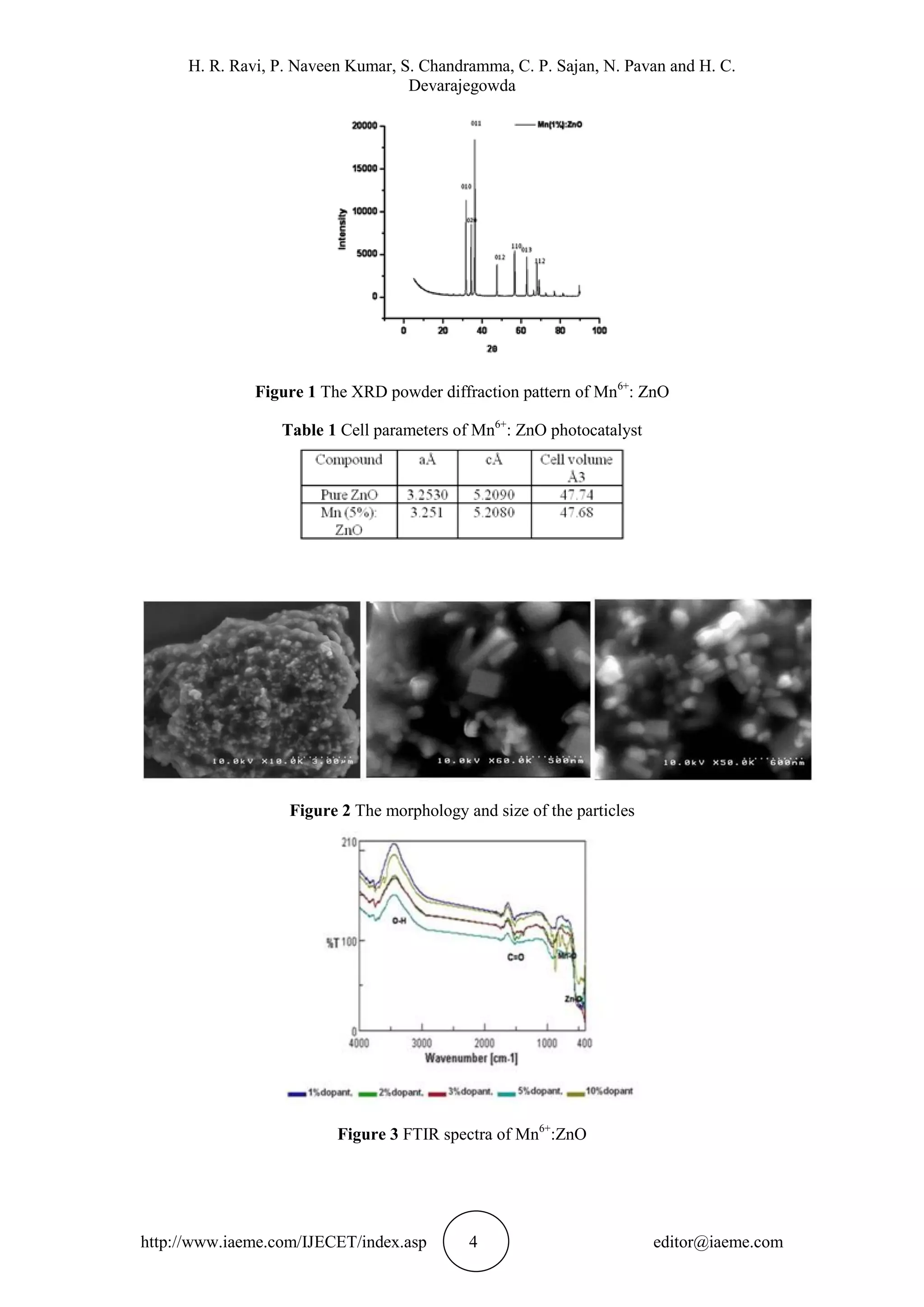
The XRD powder diffraction pattern of Mn6+
: ZnO is shown in Figure 1. The peaks
were compared with standard patterns of JCPDS data bank. The crystalline phase of
ZnO matches with JCPDS 800075 respectively. The cell parameter and indexing of
the prepared Mn6+
: ZnO compound was done using chek cells software. Table 1 gives
the cell parameters of Mn6+
: ZnO photocatalyst obtained in the present work. The cell
parameters obtained matches with the space group P63MC. The crystal system of the
synthesized Mn6+
: ZnO is identified as hexagonal system. However, (010), (020) and
(011) peak positions shows a slight shift to the smaller angles due to the addition of
doping material which clearly depicts that the doping has effectively taken place. The
reduction in the unit volume of the cell when doped with Mn6+
is due to the smaller
ionic radii of the dopants (ionic radii of Mn6+
is 0.69 Å). A high resolution SEM study
was done to know the size and morphology of the crystals obtained. Figure 2
represents the morphology and size of the particles obtained. The SEM study clearly
reveals that the product obtained is monodisperssed. Figure 3 represents the FTIR
spectra of Mn6+
:ZnO. The bands at 574 cm-1
is assigned to the stretching vibrations of
Zn-O The broad absorption peak centered 3418 cm-1
correspond to O–H group,
indicating the existence of water absorbed on the surface of synthesized compound.
The bands in the region 523 cm-1
represents the presence of manganese. In the
present study the population and particle size distribution of the prepared compounds
were carried out using HORIBA, LB-550. The histograms were plotted by analyzing
the correlation function and the calculation were done based on the assumed
distribution. Figure 4 represents the DLS results obtained. The histogram clearly
shows that among the synthesized compound 70% of the crystals are in the size of
8.225 and 9.85 nm, and the rest 30 % of the crystals are in the size of 11.475 and 15
nm.
H. R. Ravi, P. Naveen Kumar, S. Chandramma, C. P. Sajan, N. Pavan and H. C.
Devarajegowda
http://www.iaeme.com/IJECET/index.asp 4 editor@iaeme.com
Figure 1 The XRD powder diffraction pattern of Mn6+
: ZnO
Table 1 Cell parameters of Mn6+
: ZnO photocatalyst
Figure 2 The morphology and size of the particles
Figure 3 FTIR spectra of Mn6+
:ZnO
Synthesis Characterisation and Application of Novel Composite Mn6+
: ZnO Nanocrystals
http://www.iaeme.com/IJECET/index.asp 5 editor@iaeme.com
Figure 4 DLS results
3.2. Effect of Mn: ZnO on photodegradation of textile effluent
In order to obtain an optimum condition with respect to the amount of catalyst used at
which photodegradation is maximum the experiment was carried out for the
degradation of textile effluent using different amount of Mn6+
: ZnO Figure 4
illustrates the effect of different amount of catalyst (1030 mg) on the degradation of
the textile effluent. Figure 5 clearly shows that when the degradation was carried
under sunlight and UV light, using 30 mg of the photocatalyst the % decomposition
rate of the effluent is high.
0 1 2 3 4 5
0
10
20
30
40
50
60
70
80
Light source: UV
%decomposition()
Time in Hrs
10 mg
20 mg
30 mg
0 1 2 3 4 5
0
10
20
30
40
50
60
70
80
90
Light source: Sunlight
%decomposition()
Time in Hrs
10 mg
20 mg
30 mg
Figure 5 Graphical representation of increase in % decomposition (η) under UV light and
sunlight using Mn6+
: ZnO
3.3. Effect of Mn6+
: ZnO on the chemical oxygen demand (COD) of the
textile effluent
The COD of the effluent was estimated before and after the treatment. The reduction
in the COD value of the effluent depicts the destruction of the organics present in the
effluent. A maximum of 87.5 % of degradation efficiency was obtained with in the
duration of 5 hrs in the present study. Figure 6 represents the reduction of COD using
Mn6+
: ZnO under both sunlight and UV light. The COD of the effluent was reduced
from 256 to 64 mg/ L. Tables 2 and 3 represent the effect of Mn6+
: ZnO weight on
H. R. Ravi, P. Naveen Kumar, S. Chandramma, C. P. Sajan, N. Pavan and H. C.
Devarajegowda
http://www.iaeme.com/IJECET/index.asp 6 editor@iaeme.com
COD, decomposition (ŋ) and % transmission (%T) of textile effluent under both
sunlight and UV light.
3.4. Effect of Mn6+
: ZnO on % transmission of the textile effluent
The % transmission (T) of the effluent was analyzed before and after the treatment of
the textile effluent using spectrophotometer. As the duration of exposure of the
effluent containing Mn6+
: ZnO photocatalyst to light increases, the %T increases. The
increase of %T clearly depicts the destruction of dye molecules present in the textile
effluent, Figure 7, represents the graphical representation of increase in %T under
both UV and sunlight with respect to time. Tables 2 and 3 represent the effect of
Mn6+
: ZnO weight on COD, decomposition (ŋ) and % transmission (%T) of textile
effluent under both sunlight and UV light.
0 1 2 3 4 5
0
50
100
150
200
250
Light source: UV
COD
Time in Hrs
10 mg
20 mg
30 mg
0 1 2 3 4 5
0
50
100
150
200
250
Light source: Sunlight
COD
Time in Hrs
10 mg
20 mg
30 mg
Figure 6 Graphical representation of decrease in COD under UV and sunlight using Mn6+
:
ZnO
0 1 2 3 4 5
50
60
70
80
90
Light source: UV
%T
Time in hrs
10 mg
20 mg
30 mg
0 1 2 3 4 5
40
50
60
70
80
90
100
%T
Time in Hrs
10 mg
20 mg
30 mg
Figure 7 Graphical representation of increase in %T under UV and sunlight using Mn6+
: ZnO.
Synthesis Characterisation and Application of Novel Composite Mn6+
: ZnO Nanocrystals
http://www.iaeme.com/IJECET/index.asp 7 editor@iaeme.com
Table 2 Effect of Photocatalytic degradation efficiency (ŋ) and Decolorization (%T) on
Textile effluent under UV using Mn6+
: ZnO
Time in
Hrs
10 mg 20 mg 30 mg
COD ŋ %T COD ŋ %T COD ŋ %T
1 248 3.125 45.2 240 6.25 47.1 232 9.37 49.2
2 232 9.375 49.1 216 15.62 51.3 200 21.87 56.8
3 200 21.87 56.8 184 28.12 60.4 160 37.5 62.3
4 176 31.25 58.5 128 50 71.6 112 56.25 75.8
5 144 43.75 67.3 88 65.6 84 64 75.0 87
Table 3 Effect of Photocatalytic degradation efficiency (ŋ) and Decolorization (%T) on
Textile effluent under sunlight using Mn6+
:ZnO.
Time in
Hrs
10 mg 20 mg 30 mg
COD ŋ %T COD ŋ %T COD ŋ %T
1 232 9.37 49.2 216 15.62 51 208 18.75 53.1
2 216 15.62 51.4 184 28.125 55.4 168 34.37 61.4
3 168 34.37 61.4 136 46.875 69.3 120 53.12 72.5
4 128 50.00 71.2 96 62.25 84.4 72 71.87 84.5
5 88 65.62 85.2 56 78.12 89.7 32 87.5 94.4
4. CONCLUSION
The synthesis of Mn6+
: ZnO was achieved under mild hydrothermal conditions. The
crystallinity, crystal structure and surface morphology were revealed by XRD, SEM
and FTIR. The XRD result of the synthesized compound reveals that the doping of
manganese has decreased the cell volume of the ZnO particles. The DLS study gives
the population density of the synthesized compound, the results of the DLS clearly
reveals that among the crystals synthesized 70 % of the crystals are in the range of
8.229.85 nm size. The decrease in crystal size increases the surface area thereby
enhancing the photodegradation efficiency of the compound. The photo-catalytic
degradation of textile effluent using the prepared composite materials is an efficient
and environmentally benign technique, because it facilitates the complete
mineralization of the complex organics into simpler non-toxic products. The study of
various kinetic parameters like initial concentration of the organics, catalyst amount,
%T and COD test has helped in finding out the optimum reaction conditions.
Moreover the use of sunlight as the source of illumination in the photodegradation
reaction could be a safe and highly cost effective source. The textile effluent was
treated successfully using the prepared compound. The decrease in the COD values
from 256 to 64 demonstrated the destruction of the organics present in the effluent
and increase in the % transmittance. COD reduces and degradation efficiency
increases as the time increases. The proposed degradation mechanisms showed that
the final products of the degradation are less toxic and environmental friendly.
REFERENCE
[1] Hayashi, H., Ishizaka, A., Haemori, M. and Koinuma, H. Appl. Phys. Lett. 82,
2003, pp. 1365.
[2] Sharma, P., Sreenivas, K. and Rao, K. V. J. Appl. Phys. 93, 2003, pp. 3963.
H. R. Ravi, P. Naveen Kumar, S. Chandramma, C. P. Sajan, N. Pavan and H. C.
Devarajegowda
http://www.iaeme.com/IJECET/index.asp 8 editor@iaeme.com
[3] Horwitz, J. S., Kim, W. H., Makinen, A. J., Kafafi, Z. H. and Chrisey, D. B. Thin
Solid Films, 420–421, 2002, pp. 539.
[4] Look, D. C., Mater. Sci. Eng., B 80, 2001, pp. 383.
[5] Wraback, M., Shen, H., Liang, S., Gorla, C. R. and Lu, Y. Appl. Phys. Lett. 74,
1999, pp. 507.
[6] Look, D. C., Hemsky, J. W. and Sizelove, J. R. Phys. Rev. Lett. 82, 1999, pp.
2552.
[7] Auret, F. D., Goodman, S. A., Hayes, M., Legodi, M. J., van Laar-hoven, H. A.
and Look, D. C. Appl. Phys. Lett., 80, 2002, pp. 956.
[8] Kucheyev, S. O., Bradley, J. E., Williams, J. S., Jagerdish, C. and Swain, M. V.
Appl. Phys. Lett., 80, 2002, pp. 956.
[9] Wraback, M., Shen, H., Liang, S., Gorla, C. R. and Lu, Y. Appl. Phys. Lett. 76,
1999, pp. 507.
[10] Aoki, T., Look, D. C. and Hatanaka, Y. Appl. Phys. Lett. 76, 2000, pp. 3257.
[11] Gorla, C. R., Emanetoglu, N. W., Liang, S., Mayo, W. E., Lu, Y., Wra-back, M.
and Shen, H. J. Appl. Phys., 85, 1999, pp. 2595.
[12] Krishnamoorthy, S., Iliadis, A. A., Inumpudi, A., Choopun, S., Vispute, R. D. and
Venkatesan, T. Solid-State Electron, 46, 2002, pp. 1631.
[13] Mrowetz, M. and Selli, E. J. Photoch. Photobio., A 180, 2006, pp. 15.
[14] Sakthivel, S., Janczarek, M., Kisch, H. J. Phys. Chem., B 108, 2004, pp. 19384.
[15] Sharma, P. and Gupta, N. Nanocrystalline Silicon Thin Film Transistor (NC-SI:H
TFTS)-A Device For Display Panels. International journal of Electronics and
Communication Engineering &Technology (IJECET), 4(7), 2013, pp. 115–127.
[16] Dixit, S. and Manohar, R. Gamma Radiation-Induced Transformational Change
In Ir Spectrum of EBHA Nematic Liquid Crystal. International Journal of
Advanced Research in Engineering & Technology (IJARET), 6(3), 2015, pp. 1–6.
[17] Sakthivel, S., Neppolian, B., Shankar, M. V., Arabindoo, B., Palanichamy, M.
and Murugesan, V. Sol. Energy Mater. Sol. C 77, 2003, pp. 65–82.
[18] Dietl, T., Ohno, H., Matsukura, F., Cibert, J. and Ferrand, D. Science, 287, 2000,
pp. 1019.
[19] Dietl, T. Semicond. Sci. Technol. 17, 2002, pp. 377.

Ijecet 06 06_001

  • 1.
    http://www.iaeme.com/IJECET/index.asp 1 editor@iaeme.com InternationalJournal of Electronics and Communication Engineering & Technology (IJECET) Volume 6, Issue 6, Jun 2015, pp. 01-08, Article ID: IJECET_06_06_001 Available online at http://www.iaeme.com/IJECETissues.asp?JTypeIJECET&VType=6&IType=6 ISSN Print: 0976-6464 and ISSN Online: 0976-6472 © IAEME Publication ___________________________________________________________________________ SYNTHESIS CHARACTERISATION AND APPLICATION OF NOVEL COMPOSITE MN6+ : ZNO NANOCRYSTALS H. R. Ravi PG Student, Department of Physics and Research Centre, Bharathi College, Bharathinagara, Mandya P. Naveen Kumar and S. Chandramma Department of Electronics, Yuvaraja’s College (Autonomous), University of Mysore, Mysore C. P. Sajan DOS in Environmental Science, University of Mysore, MGM-6, Karnataka, India N. Pavan and H. C. Devarajegowda Department of Physics, yuvaraja’s college (Autonomous), University of Mysore, Mysore ABSTRACT The hydrothermally synthesis of Mn6+ doped ZnO nanocrystals at 150°C with an autogenous pressure and experimental duration of 40 hrs has been reported. A control over the particle size, morphology and crystallinity of the as prepared compound has been studied with respect to the experimental parameters like nutrient composition, solvent, experimental duration, temperature, pressure and so on. The products synthesized were characterized using XRD, SEM, FTIR and DLS. The photodegradation of textile effluent using these composite was investigated under both solar and UV irradiation. The degradation of textile effluent was checked by the following parameters like COD, %T, irradiation time and duration. The preliminary results are highly encouraging and further work is being carried out for the use of these photocatalytic compounds for other organic decomposition. Key words: Photocatalytic, Hydrothermal, Textile Effluent and Chemical Oxygen Demand.
  • 2.
    H. R. Ravi,P. Naveen Kumar, S. Chandramma, C. P. Sajan, N. Pavan and H. C. Devarajegowda http://www.iaeme.com/IJECET/index.asp 2 editor@iaeme.com Cite this Article: Ravi, H. R., Kumar, P. N., Chandramma, S., Sajan, C. P., Pavan, N. and Devarajegowda, H. C. Synthesis Characterisation and Application of Novel Composite Mn6+ : ZnO Nanocrystals. International Journal of Electronics and Communication Engineering & Technology, 6(6), 2015, pp. 01-08. http://www.iaeme.com/IJECET/issues.asp?JTypeIJECET&VType=6&IType=6 _____________________________________________________________________ 1. INTRODUCTION The properties of ZnO make it an attractive candidate for UV light-emitters, varistors, transparent high power electronics, surface acoustic wave devices, piezoelectric Trans ducers, gas sensing, window material for flat panel displays, and more efficient solar cells [1–12]. Recently, a lot of studies have been concentrated on the degradation of toxic organic compounds in waste water via photocatalysis of various semiconductors [13]. Especially, TiO2 with anatase phase has been most widely investigated due to its photocatalytic activity and chemical stability. However, it is generally known that TiO2 can barely absorb visible light due to its wide band-gap energy (3.2 eV) and this is one of the most acceptable serious obstacles associated with its further application [14]. As a contrast ZnO, a kind of semiconductor that has the similar band gap as TiO2, is not thoroughly investigated. However, the greatest advantage of ZnO is that it absorb large fraction of solar spectrum and more light quanta than TiO2 [17]. There is also interest in developing the use of ion implantation of ZnO for device doping and isolation [8], as well as investigating the effectiveness of different transition metals for magnetic doping, model by Dietl et al [18, 19]. The Mn–Zn–O system has attracted much attention because of the controversial magnetic properties reported, but their basic origins remain unclear. Both the existence and absence of FM have been reported in Mn-doped ZnO thin films. However, in the present article the authors report the hydrothermal synthesis of Mn doped ZnO under mild PT condition and their application in the photocatalytic degradation of textile effluent to know the photodegradation efficiency of the synthisised compound. 2. MATERIALS AND METHODS In the synthesis of Mn6+ : ZnO a known amount of commercially available ZnO was taken in the in a Teflon liner to which MnO3 was doped from 1 to 10 % respectively. The chemical ingredients were weighed in stoichiometric proportions and a required amount of suitable mineralizer (double distilled water) was added into this teflon liner maintaining 40% of % fill. The teflon liner was then placed inside the autoclave. The autoclave was then placed inside the oven and the temperature of the oven was set to 150°C for 40 hrs. After the experimental run, the autoclave was quenched and the sample was taken out. The sample inside the liner was separated from the solution and washed with the double distilled water, and then ultrasonicated. The product extracted was centrifuged to remove undesired components and dried at a temperature of 35– 40°C in a dust free environment. The synthesized Mn6+ : ZnO was characterised using a high resolution SEM. The XRD pattern was obtained using MXP3, MAC Science Co., Ltd, Tokyo, Japan, with Cu Kα radiation (wavelength =0.154 nm). The scanning range was 10–80 °C (2θ). The crystallinity [15, 16] of the compound was identified by comparison with JCPDS files (PCPDF WIN-2.01). The FTIR result was obtained using JASCO-460 Plus, Japan. The DLS study was carried out in order to know the population of the crystal
  • 3.
    Synthesis Characterisation andApplication of Novel Composite Mn6+ : ZnO Nanocrystals http://www.iaeme.com/IJECET/index.asp 3 editor@iaeme.com synthesized. In order to know the photodegradation efficiency of the synthesized compound the photodegradation of textile effluent was carried out under both sunlight and UV light. In the photocatalytic degradation of the textile effluent a known volume of the effluent (50 ml) was taken in a beaker. To this a known amount of catalyst was added. The experiment was carried out under both UV and sunlight. For UV source the sample was kept in UV chamber (Sankyo, Denki, Japan, 8W) the distance between the UV and effluent was 18 cm. The intensity of sunlight and UV was estimated by photolysis of Uranil Oxalate (Steven 1973). It was estimated that the intensity of sunlight was 6.722 × 10¹⁶ quanta/sec, and the intensity of UV was 2.375 × 10¹⁵ quanta/s. 2–3 ml of the sample exposed to light was taken and centrifuged for 4– 5 min at 1000 rpm and then used to measure the percentage transmission (%T) at 540 nm using spectrophotometer (Model: Minispec SL 171, Elico, India). Chemical oxygen demand (COD) was estimated before and after the treatment (using the K2Cr2O7 oxidation method). The photodegradation of the Textile effluent was calculated using the equation, Photodegradation = InitialCOD  FinalCOD / InitialCOD × 100 3. RESULTS AND DISCUSSION 3.1. Characterisation of Mn: ZnO photocatalyst The XRD powder diffraction pattern of Mn6+ : ZnO is shown in Figure 1. The peaks were compared with standard patterns of JCPDS data bank. The crystalline phase of ZnO matches with JCPDS 800075 respectively. The cell parameter and indexing of the prepared Mn6+ : ZnO compound was done using chek cells software. Table 1 gives the cell parameters of Mn6+ : ZnO photocatalyst obtained in the present work. The cell parameters obtained matches with the space group P63MC. The crystal system of the synthesized Mn6+ : ZnO is identified as hexagonal system. However, (010), (020) and (011) peak positions shows a slight shift to the smaller angles due to the addition of doping material which clearly depicts that the doping has effectively taken place. The reduction in the unit volume of the cell when doped with Mn6+ is due to the smaller ionic radii of the dopants (ionic radii of Mn6+ is 0.69 Å). A high resolution SEM study was done to know the size and morphology of the crystals obtained. Figure 2 represents the morphology and size of the particles obtained. The SEM study clearly reveals that the product obtained is monodisperssed. Figure 3 represents the FTIR spectra of Mn6+ :ZnO. The bands at 574 cm-1 is assigned to the stretching vibrations of Zn-O The broad absorption peak centered 3418 cm-1 correspond to O–H group, indicating the existence of water absorbed on the surface of synthesized compound. The bands in the region 523 cm-1 represents the presence of manganese. In the present study the population and particle size distribution of the prepared compounds were carried out using HORIBA, LB-550. The histograms were plotted by analyzing the correlation function and the calculation were done based on the assumed distribution. Figure 4 represents the DLS results obtained. The histogram clearly shows that among the synthesized compound 70% of the crystals are in the size of 8.225 and 9.85 nm, and the rest 30 % of the crystals are in the size of 11.475 and 15 nm.
  • 4.
    H. R. Ravi,P. Naveen Kumar, S. Chandramma, C. P. Sajan, N. Pavan and H. C. Devarajegowda http://www.iaeme.com/IJECET/index.asp 4 editor@iaeme.com Figure 1 The XRD powder diffraction pattern of Mn6+ : ZnO Table 1 Cell parameters of Mn6+ : ZnO photocatalyst Figure 2 The morphology and size of the particles Figure 3 FTIR spectra of Mn6+ :ZnO
  • 5.
    Synthesis Characterisation andApplication of Novel Composite Mn6+ : ZnO Nanocrystals http://www.iaeme.com/IJECET/index.asp 5 editor@iaeme.com Figure 4 DLS results 3.2. Effect of Mn: ZnO on photodegradation of textile effluent In order to obtain an optimum condition with respect to the amount of catalyst used at which photodegradation is maximum the experiment was carried out for the degradation of textile effluent using different amount of Mn6+ : ZnO Figure 4 illustrates the effect of different amount of catalyst (1030 mg) on the degradation of the textile effluent. Figure 5 clearly shows that when the degradation was carried under sunlight and UV light, using 30 mg of the photocatalyst the % decomposition rate of the effluent is high. 0 1 2 3 4 5 0 10 20 30 40 50 60 70 80 Light source: UV %decomposition() Time in Hrs 10 mg 20 mg 30 mg 0 1 2 3 4 5 0 10 20 30 40 50 60 70 80 90 Light source: Sunlight %decomposition() Time in Hrs 10 mg 20 mg 30 mg Figure 5 Graphical representation of increase in % decomposition (η) under UV light and sunlight using Mn6+ : ZnO 3.3. Effect of Mn6+ : ZnO on the chemical oxygen demand (COD) of the textile effluent The COD of the effluent was estimated before and after the treatment. The reduction in the COD value of the effluent depicts the destruction of the organics present in the effluent. A maximum of 87.5 % of degradation efficiency was obtained with in the duration of 5 hrs in the present study. Figure 6 represents the reduction of COD using Mn6+ : ZnO under both sunlight and UV light. The COD of the effluent was reduced from 256 to 64 mg/ L. Tables 2 and 3 represent the effect of Mn6+ : ZnO weight on
  • 6.
    H. R. Ravi,P. Naveen Kumar, S. Chandramma, C. P. Sajan, N. Pavan and H. C. Devarajegowda http://www.iaeme.com/IJECET/index.asp 6 editor@iaeme.com COD, decomposition (ŋ) and % transmission (%T) of textile effluent under both sunlight and UV light. 3.4. Effect of Mn6+ : ZnO on % transmission of the textile effluent The % transmission (T) of the effluent was analyzed before and after the treatment of the textile effluent using spectrophotometer. As the duration of exposure of the effluent containing Mn6+ : ZnO photocatalyst to light increases, the %T increases. The increase of %T clearly depicts the destruction of dye molecules present in the textile effluent, Figure 7, represents the graphical representation of increase in %T under both UV and sunlight with respect to time. Tables 2 and 3 represent the effect of Mn6+ : ZnO weight on COD, decomposition (ŋ) and % transmission (%T) of textile effluent under both sunlight and UV light. 0 1 2 3 4 5 0 50 100 150 200 250 Light source: UV COD Time in Hrs 10 mg 20 mg 30 mg 0 1 2 3 4 5 0 50 100 150 200 250 Light source: Sunlight COD Time in Hrs 10 mg 20 mg 30 mg Figure 6 Graphical representation of decrease in COD under UV and sunlight using Mn6+ : ZnO 0 1 2 3 4 5 50 60 70 80 90 Light source: UV %T Time in hrs 10 mg 20 mg 30 mg 0 1 2 3 4 5 40 50 60 70 80 90 100 %T Time in Hrs 10 mg 20 mg 30 mg Figure 7 Graphical representation of increase in %T under UV and sunlight using Mn6+ : ZnO.
  • 7.
    Synthesis Characterisation andApplication of Novel Composite Mn6+ : ZnO Nanocrystals http://www.iaeme.com/IJECET/index.asp 7 editor@iaeme.com Table 2 Effect of Photocatalytic degradation efficiency (ŋ) and Decolorization (%T) on Textile effluent under UV using Mn6+ : ZnO Time in Hrs 10 mg 20 mg 30 mg COD ŋ %T COD ŋ %T COD ŋ %T 1 248 3.125 45.2 240 6.25 47.1 232 9.37 49.2 2 232 9.375 49.1 216 15.62 51.3 200 21.87 56.8 3 200 21.87 56.8 184 28.12 60.4 160 37.5 62.3 4 176 31.25 58.5 128 50 71.6 112 56.25 75.8 5 144 43.75 67.3 88 65.6 84 64 75.0 87 Table 3 Effect of Photocatalytic degradation efficiency (ŋ) and Decolorization (%T) on Textile effluent under sunlight using Mn6+ :ZnO. Time in Hrs 10 mg 20 mg 30 mg COD ŋ %T COD ŋ %T COD ŋ %T 1 232 9.37 49.2 216 15.62 51 208 18.75 53.1 2 216 15.62 51.4 184 28.125 55.4 168 34.37 61.4 3 168 34.37 61.4 136 46.875 69.3 120 53.12 72.5 4 128 50.00 71.2 96 62.25 84.4 72 71.87 84.5 5 88 65.62 85.2 56 78.12 89.7 32 87.5 94.4 4. CONCLUSION The synthesis of Mn6+ : ZnO was achieved under mild hydrothermal conditions. The crystallinity, crystal structure and surface morphology were revealed by XRD, SEM and FTIR. The XRD result of the synthesized compound reveals that the doping of manganese has decreased the cell volume of the ZnO particles. The DLS study gives the population density of the synthesized compound, the results of the DLS clearly reveals that among the crystals synthesized 70 % of the crystals are in the range of 8.229.85 nm size. The decrease in crystal size increases the surface area thereby enhancing the photodegradation efficiency of the compound. The photo-catalytic degradation of textile effluent using the prepared composite materials is an efficient and environmentally benign technique, because it facilitates the complete mineralization of the complex organics into simpler non-toxic products. The study of various kinetic parameters like initial concentration of the organics, catalyst amount, %T and COD test has helped in finding out the optimum reaction conditions. Moreover the use of sunlight as the source of illumination in the photodegradation reaction could be a safe and highly cost effective source. The textile effluent was treated successfully using the prepared compound. The decrease in the COD values from 256 to 64 demonstrated the destruction of the organics present in the effluent and increase in the % transmittance. COD reduces and degradation efficiency increases as the time increases. The proposed degradation mechanisms showed that the final products of the degradation are less toxic and environmental friendly. REFERENCE [1] Hayashi, H., Ishizaka, A., Haemori, M. and Koinuma, H. Appl. Phys. Lett. 82, 2003, pp. 1365. [2] Sharma, P., Sreenivas, K. and Rao, K. V. J. Appl. Phys. 93, 2003, pp. 3963.
  • 8.
    H. R. Ravi,P. Naveen Kumar, S. Chandramma, C. P. Sajan, N. Pavan and H. C. Devarajegowda http://www.iaeme.com/IJECET/index.asp 8 editor@iaeme.com [3] Horwitz, J. S., Kim, W. H., Makinen, A. J., Kafafi, Z. H. and Chrisey, D. B. Thin Solid Films, 420–421, 2002, pp. 539. [4] Look, D. C., Mater. Sci. Eng., B 80, 2001, pp. 383. [5] Wraback, M., Shen, H., Liang, S., Gorla, C. R. and Lu, Y. Appl. Phys. Lett. 74, 1999, pp. 507. [6] Look, D. C., Hemsky, J. W. and Sizelove, J. R. Phys. Rev. Lett. 82, 1999, pp. 2552. [7] Auret, F. D., Goodman, S. A., Hayes, M., Legodi, M. J., van Laar-hoven, H. A. and Look, D. C. Appl. Phys. Lett., 80, 2002, pp. 956. [8] Kucheyev, S. O., Bradley, J. E., Williams, J. S., Jagerdish, C. and Swain, M. V. Appl. Phys. Lett., 80, 2002, pp. 956. [9] Wraback, M., Shen, H., Liang, S., Gorla, C. R. and Lu, Y. Appl. Phys. Lett. 76, 1999, pp. 507. [10] Aoki, T., Look, D. C. and Hatanaka, Y. Appl. Phys. Lett. 76, 2000, pp. 3257. [11] Gorla, C. R., Emanetoglu, N. W., Liang, S., Mayo, W. E., Lu, Y., Wra-back, M. and Shen, H. J. Appl. Phys., 85, 1999, pp. 2595. [12] Krishnamoorthy, S., Iliadis, A. A., Inumpudi, A., Choopun, S., Vispute, R. D. and Venkatesan, T. Solid-State Electron, 46, 2002, pp. 1631. [13] Mrowetz, M. and Selli, E. J. Photoch. Photobio., A 180, 2006, pp. 15. [14] Sakthivel, S., Janczarek, M., Kisch, H. J. Phys. Chem., B 108, 2004, pp. 19384. [15] Sharma, P. and Gupta, N. Nanocrystalline Silicon Thin Film Transistor (NC-SI:H TFTS)-A Device For Display Panels. International journal of Electronics and Communication Engineering &Technology (IJECET), 4(7), 2013, pp. 115–127. [16] Dixit, S. and Manohar, R. Gamma Radiation-Induced Transformational Change In Ir Spectrum of EBHA Nematic Liquid Crystal. International Journal of Advanced Research in Engineering & Technology (IJARET), 6(3), 2015, pp. 1–6. [17] Sakthivel, S., Neppolian, B., Shankar, M. V., Arabindoo, B., Palanichamy, M. and Murugesan, V. Sol. Energy Mater. Sol. C 77, 2003, pp. 65–82. [18] Dietl, T., Ohno, H., Matsukura, F., Cibert, J. and Ferrand, D. Science, 287, 2000, pp. 1019. [19] Dietl, T. Semicond. Sci. Technol. 17, 2002, pp. 377.