i
CONSTRUCTION OF PERMANENT CAMPUS OF
INDIAN INSTITUTE OF TECHNOLOGY INDORE
A PROJECT REPORT
Submitted by
DILIP PATIDAR
in partial fulfillment for the award of the degree of
BACHELOR OF TECHNOLOGY
IN
CIVIL ENGINEERING
Under The Guidance of Submitted by
MR. PRAVEEN PANDEY DILIP PATIDAR
LECTURER 11210187
LOVELY PROFESSIONAL UNIVERSITY
Phagwara–144401, Punjab (India)
ii
LOVELY PROFESSIONAL UNIVERSITY
CERTIFICATE
Certified that this project report entitled “CONSTRUCTION OF
PERMANENT CAMPUS OF INDIAN INSTITUTE OF TECHNOLOGY
INDORE” submitted by “DILIP PATIDAR , 11210187” student of Civil
Engineering Department, Lovely Professional University, Phagwara, Punjab
who carried out the project work under my supervision.
This report has not been submitted to any other university or institution for the
award of any degree.
SIGNATURE SIGNATURE
NAME: NAME:
HEAD OF DEPARTMET SUPERVISOR
SCHOOL OF CIVIL ENGINEERING (LECTURER)
SCHOOL OF CIVIL ENGINEERING
iii
ACKNOWLEDGEMENT
With deep reference and profound gratitude I express my sincere thanks to
Mr. Pramod Mishra (Deputy General Manager-HRD) for giving me an
opportunity to do training at simplex infrastructure limited. Also I would like to
thank Mr. Rajesh Mishra (Site incharge) who allowed me to work at
construction site. Also I would like to thank to Mr. Prokash Mitra
(Sr. Manager-construction), Mr. Biswanath Moulick(Manager-Construction)
.I would like to specially thanks to my training guide Mr. Sunil Chaudhary
(AM-construction) who helped me at every stage of my training. . I also
thankful to Mr. Ashok Tiwari, Mr. Bunty Bag, Mr. Chetan Patel,
Mr.Subham Sadhukhan who help me at the working sites, explaining and
giving me all the information I need to complete this report.
At last I would like to convey my thanks to Mr. Mahesh Prashad Gupta
(HR-Head) and Mr. Naveen Mehrotra(senior- officer) and all the members of
the staff of simplex infrastructure limited who have helped me at every stage
of training.
I would like to thank Mrs. Mandeep Kaur (HoD, SCHOOL OF
CIVIL ENGINEERING, LPU),Mr. Praveen Pandey (Training Mentor,
Lecturer, Civil, LPU), Mr. Jaspreet Singh(Mentor, Placement coordinator,
LPU) without their co-operation it was impossible to reach up to this stage.
iv
ABSTACT
Construction now a day becomes a industry where work is progressing day and
night continuously, government also works on the infrastructure development
for country included corporate building, institutional building and other
residential building. This report contents the construction of campus of an
government institutional building “INDIAN INSTITUTE OF
TECHNOLOGY, INDORE” which is located in Indore city of Madhya
Pradesh. The project is executed by SIMPLEX INFRASTRUCTURE
LIMITED.
The report content the introduction and overview part of project site and also
content the process of general civil work to be executed at site and technology
like waffle slab, replacement of bricks work by block work, partial replacement
of cement by fly ash in concrete etc. in the field of civil engineering. Different
types of buildings are constructed over campus like school building, studio
apartment, podium building, boys hostel, water treatment plant, sewage
treatment plant, director residence etc.
The designer design the buildings in such a way that buildings are earthquake
resistance, some of the building of the campus are fully air conditioned. There is
a proper design for fire-fighting system in the building. the podium building is
link to each sub part through bridge.
The report content process of construction from shuttering to curing included
steel fixing, binding , bar bending schedule, concreting, deshuttering etc.it also
content the failure of concrete and its solution.
At last the report is having overview of project that what I have learn in my
internship.
v
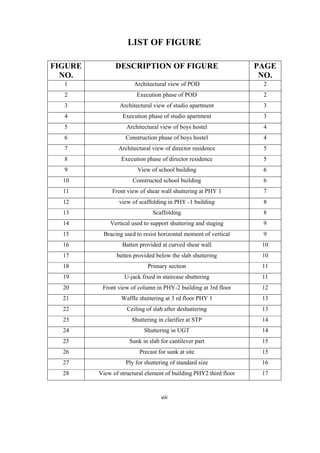
TABLE OF CONTENT
TOPIC PAGE NO.
 Acknowledgement iii
 Abstract iv
 List of figure viii
 List of table xi
 Symbols/abbreviations xi
 Project name and location xii
 About company xiii
 Introduction… 1-6
 CHAPTER 1:Shuttering…. 7-15
 1.1 Scaffolding 8
 1.2Shuttering material 9-11
 1.2.1 Vertical 9
 1.2.2 Bracing or horizontal 9
 1.2.3 Batten 10
 1.2.4 Primary section 11
 1.2.5 Jack 11
 1.3 Shuttering in column 12
 1.4 Waffle shuttering 12-13
 1.5 Shuttering in clarifier tank 14
 1.6 Shuttering in UGT 14
 1.7 SUNK 15
 1.8 Important point for shuttering 16
 1.9 Checking 16
 CHAPTER 2: Reinforcement of structural building….. 17-29
 2.1 Foundation 18-19
 2.2 Beam 20-22
 2.3Column 23-24
 2.4 Shear wall 25
 2.5 Slab 26
 2.6 Waffle slab 27
 2.7 Staircase 28-2
 CHAPTER 3: Bar bending schedule…… 30-35
 3.1 B.B.S. for beams 31
 3.2 B.B.S. for column 32
vi
 3.3 B.B.S. for slab 33
 3.4 B.B.S. for staircase 34
 3.5 Bar bending 35
 CHAPTER4 :CONCRETING……. 36-51
 4.1 Various operation in concreting 37
 4.1.1 Batching of material 37
 4.1.2 Baching plant 38
 4.1.3Mixing of concrete material 39
 4.1.4 Transporting of concrete 40
 4.1.5 Placing of concrete 41
o A)Pump 41
o B)Placer boom 42
o C)Bucket and crane 43
o D)Chutes though transite mixer 43
 4.1.6 Compaction of concrete 44
 4.2 Types of concrete 44
 4.2.1 PCC 44
 4.2.2 RCC 44
 4.2.3 Self compacted concrete 45
 4.3 Grade of concrete 46
 4.4 Components of concrete 46-48
 4.4.1 Cement 46
 4.4.2 Sulphate resisting portland cement 47
 4.4.3 Aggregates 48
 4.4.4Water 48
 4.4.5Admixture 48-49
 4.5 Problems in concreting 50-54
 4.5.1 Bulging of concret 50
 4.5.2 Honey combing 51
 4.5.3Bleeding 52
 4.5.4 Crakes at construction joint 53
 4.5.5 Segregtion 54
 CHAPTER 5 :Finishing work…… 55-61
 5.1 Block work 55
 5.1.1Process of laying 56
 5.1.2Cupping 57
 5.1.3Lintel 58
 5.2 Plastering 58
 5.2.1 Hacking 58
 5.2.2 Material for plastering 59
vii
 5.3 Flooring 60
 5.3.1IPS (Indian patent system) 60
 5.3.2Tiles 61
 5.4 Putty works 62
 CHAPTER 6:Sewarage system 63
 6.1Excavation 63
 6.2Leveling 64
 6.3 PCC 64
 6.4 Pipe laying 64
 6.5 Pipe connecting 65
 6.6Hunching 66
 6.7Chamber construction 66
 6.8 Backfilling 66
 CHAPTER 7:Quality and control……. 67-77
 7.1 Test for cement 67
 7.1.1Fineness test 67
 7.1.2Consistency 68
 7.1.3Initial and final setting time 69
 7.2Test for aggregates 70
 7.2.1Sieve analysis 70
 7.2.2Specific gravity of fine aggregates 72
 7.2.3Silt and clay content of sand 73
 7.3 Test on concrete 74
 7.3.1Workability test(slump cone test) 74
 7.3.2Compressive strength test 76
viii
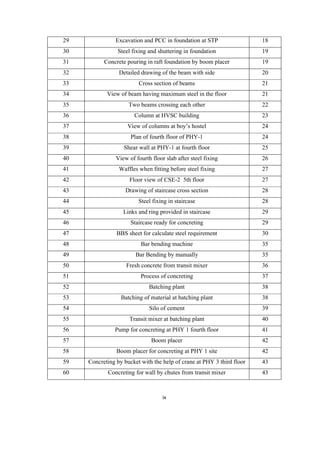
LIST OF FIGURE
FIGURE
NO.
DESCRIPTION OF FIGURE PAGE
NO.
1 Architectural view of POD 2
2 Execution phase of POD 2
3 Architectural view of studio apartment 3
4 Execution phase of studio apartment 3
5 Architectural view of boys hostel 4
6 Construction phase of boys hostel 4
7 Architectural view of director residence 5
8 Execution phase of director residence 5
9 View of school building 6
10 Constructed school building 6
11 Front view of shear wall shuttering at PHY 1 7
12 view of scaffolding in PHY -1 building 8
13 Scaffolding 8
14 Vertical used to support shuttering and staging 9
15 Bracing used to resist horizontal moment of vertical 9
16 Batten provided at curved shear wall 10
17 batten provided below the slab shuttering 10
18 Primary section 11
19 U-jack fixed in staircase shuttering 11
20 Front view of column in PHY-2 building at 3rd floor 12
21 Waffle shuttering at 3 rd floor PHY 1 13
22 Ceiling of slab after deshuttering 13
23 Shuttering in clarifier at STP 14
24 Shuttering in UGT 14
25 Sunk in slab for cantilever part 15
26 Precast for sunk at site 15
27 Ply for shuttering of standard size 16
28 View of structural element of building PHY2 third floor 17
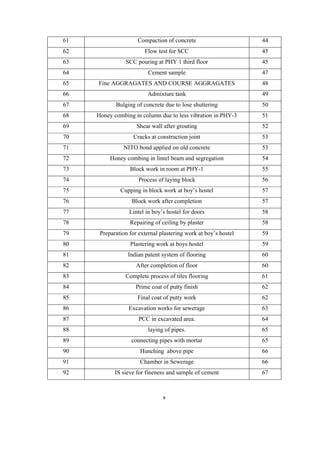
ix
29 Excavation and PCC in foundation at STP 18
30 Steel fixing and shuttering in foundation 19
31 Concrete pouring in raft foundation by boom placer 19
32 Detailed drawing of the beam with side 20
33 Cross section of beams 21
34 View of beam having maximum steel in the floor 21
35 Two beams crossing each other 22
36 Column at HVSC building 23
37 View of columns at boy’s hostel 24
38 Plan of fourth floor of PHY-1 24
39 Shear wall at PHY-1 at fourth floor 25
40 View of fourth floor slab after steel fixing 26
41 Waffles when fitting before steel fixing 27
42 Floor view of CSE-2 5th floor 27
43 Drawing of staircase cross section 28
44 Steel fixing in staircase 28
45 Links and ring provided in staircase 29
46 Staircase ready for concreting 29
47 BBS sheet for calculate steel requirement 30
48 Bar bending machine 35
49 Bar Bending by manually 35
50 Fresh concrete from transit mixer 36
51 Process of concreting 37
52 Batching plant 38
53 Batching of material at batching plant 38
54 Silo of cement 39
55 Transit mixer at batching plant 40
56 Pump for concreting at PHY 1 fourth floor 41
57 Boom placer 42
58 Boom placer for concreting at PHY 1 site 42
59 Concreting by bucket with the help of crane at PHY 3 third floor 43
60 Concreting for wall by chutes from transit mixer 43
x
61 Compaction of concrete 44
62 Flow test for SCC 45
63 SCC pouring at PHY 1 third floor 45
64 Cement sample 47
65 Fine AGGRAGATES AND COURSE AGGRAGATES 48
66 Admixture tank 49
67 Bulging of concrete due to lose shuttering 50
68 Honey combing in column due to less vibration in PHY-3 51
69 Shear wall after grouting 52
70 Cracks at construction joint 53
71 NITO bond applied on old concrete 53
72 Honey combing in lintel beam and segregation 54
73 Block work in room at PHY-1 55
74 Process of laying block 56
75 Cupping in block work at boy’s hostel 57
76 Block work after completion 57
77 Lintel in boy’s hostel for doors 58
78 Repairing of ceiling by plaster 58
79 Preparation for external plastering work at boy’s hostel 59
80 Plastering work at boys hostel 59
81 Indian patent system of flooring 60
82 After completion of floor 60
83 Complete process of tiles flooring 61
84 Prime coat of putty finish 62
85 Final coat of putty work 62
86 Excavation works for sewerage 63
87 PCC in excavated area. 64
88 laying of pipes. 65
89 connecting pipes with mortar 65
90 Hunching above pipe 66
91 Chamber in Sewerage 66
92 IS sieve for fineness and sample of cement 67
xi
93 VICAT apparatus 68
94 Is sieve for gradation of aggregates 70
95 Coarse aggregate & fine aggregates 70
96 Report for particle size distribution 71
97 Specific gravity test 72
98 Specific gravity report 72
99 Silt content report 73
100 Apparatus for slump test 74
101 Slump cone test on fresh concrete 75
102 Compression testing machine 76
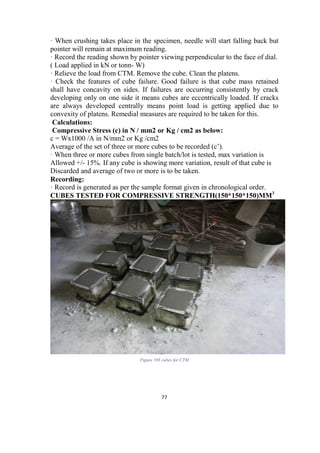
103 Cubes for CTM 77
LIST OF TABLE
Table no. Description Page no.
1 details for steel bar used in reinforcement 30
2 NOMINAL MIX DESIGN FOR CONCRETE 46
3 Dimensions of different pipes. 64
SYMBOLS/ABBREVIATIONS
SYMBOL ABBREVIATIONS
Dia. Diameter
STP Sewage Treatment Plant
WTP Water Treatment Plant
SRC Sulphate Resisting Cement.
SRCC Sulphate Resisting Cement Concrete
Mm Millimeter
Mts Meters
Cum Cubic meter
BBS Bar Bending Schedule
w.r.t With respect to
xii
PROJECT NAME AND LOCATION
CONSTRUCTION OF PERMANENT CAMPUS
IIT, INDORE
THE PROJECT SITE IS SITUATED IN VILLAGE SIMROL WHICH IS 25
KM FROM INDORE ON KHANDWA INDORE STATE HIGHWAY. THE
PROJECT IS EXECUTED BY SIMPLEX INFRASTRUCTURE LIMITED.
WHILE THE SUPERVISION IS DONE BY IIT INDORE WITH JOIN
ADVENTURE OF MACON LIMITED AS CUNSULTANT.THE DESIGN
WAS DONE BY ARCOP ASSOCIATES PRIVATE LIMITED.
xiii
SIMPLEX INFRASTURCTURE LTD.
SIMPLEX INFRASTRUCTURES LTD. IS A DIVERSIFIED COMPANY
ESTABLISHED IN 1924 AND EXECUTING PROJECTS IN SEVERAL
SECTORS LIKE TRANSPORT, ENERGY & POWER, MINING,
BUILDINGS, MARINE, AND REAL ESTATE ETC.
SIMPLEX IS ONE OF THE CONSTRUCTION LEADERS IN INDIA FOR
NEARLY 90 YEARS EXECUTING PROJECTS WITH CONSISTENT
QUALITY ASSURANCE, COST CONTROL AND ADHERENCE TO
MILESTONES IN A SAFE ENVIRONMENT AS PER THE CUSTOMER
REQUIREMENTS. IT PROMOTES THE CULTURE OF SHARING RICH
AND VARIED EXPERIENCE WITH STAFF MEMBERS, AS ALSO WITH
CLIENTS AND THEREBY BENEFITS AND HELPS THE GROWTH OF
THE CONSTRUCTION FRATERNITY AND SOCIETY AT LARGE.
THE COMPANY HAS BEEN CLOSELY ASSOCIATED WITH THE
COUNTRY’S INFRASTRUCTURE BUILDING WITH OVER 2600
COMPLETED PROJECTS SPANNING ALMOST ALL THE GAMUT OF
CONSTRUCTION INDUSTRY.
.
1
INTRODUCTION
The project development consists of the construction Works at INDIAN INSTITUTE OF
TECHNOLOGY, INDORE and comprises of School, Sports Hall, Studio Apartment, Gate,
POD3, Girls Hostel, Boys Hostel, Director Residence, and Services Buildings &
Development of site as per Master Plan. All buildings are RCC framed structures, and Form
Finish Concrete (as specified), Steel Structure, Finishing, Facade and Site Development
Works including WTP,STP, Main receiving substation, Electrical Substations, Central
HVAC Plant, Underground Water Tank. The work is estimated to Cost Rs.347.00 Crore.for
phase- A only.
The project work is to be executed on Design Build Lump sum basis for Part A & on Item
Rate Basis for Part B for construction of the New Campus of IIT Indore Phase 1A (a) being
constructed in village Simrol which is situated about 25 KM from Indore on Indore-Khandwa
road. The scope of work includes broadly construction of following:
Construction of Permanent Campus of IIT INDORE (Part-A) comprising of following units:
1. Academic Pod 3 (Approx.47582.73 Sqm)
2. Studio Apartments (Plot SA02 South Block No 1) (Approx.19565 Sqm)
3. Boys Hostel (Plot BH-02) (Approx.14228 Sqm)
4. Directors Residence (Plot DR) (Approx.612 Sqm)
5. Indoor Sports Center (Plot SP 01) (Approx.4380 Sqm)
6. Enabling School Building (Plot SC) (Approx.8400 Sqm)
7. Entry Gates (Gate 01)
Utility Buildings and services for:
1. Sewage Treatment Plant (PLOT NO SV 01)
2. Water Treatment Plant (SV 03)
3. Main Receiving Substation M.R.S & ESS 13 (SV 02)
4. ESS 02 (SV 10)
5. ESS 05 (SV 12)
6. ESS 07a (SV 05)
7. Central HVAC Plant (Sv04) including Soft Water Plant
8. Underground Water Tank (UGT –G; SV 22)
9. Underground Water Tank (UGT –A; SV 29)
10. Underground Water Tank (UGT –B; SV 25)
The following works to be executed on item rate contract shall be covered under Part-B of the scope:
1. Road Network
2. Sewerage Network
3. Storm water drainage
4. HVAC tunnel including inserts
5. Flushing line
6. Water supply
7. Civil works for electrical cable route
8. Civil works for IT route
9. Culverts and road crossing
10. Any other facilities not covered in Part-A and necessary for completion of project
2
ACADEMIC POD
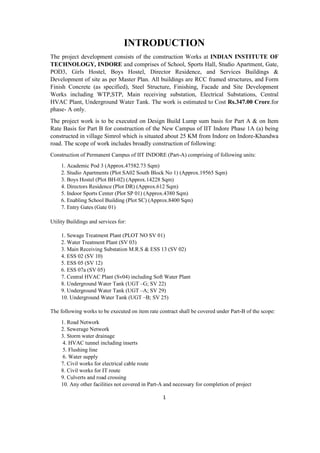
Figure 1 architectural view of POD3
Figure 2 execution phase of POD 3
This building is a academic building and having maximum number of structure
it included PHY1 (G+4),PHY2(G+5) PHY3(G+4) CSE1(G+5) CSE2(G+6) all
five structure having different floor area And having 4200 mm floor height
each from first floor. The maximum floor area of building CSE 1 (1714 sqm)
and minimum of PHY-2(1085 sqm).the highest building is CES2. The most
critical building is PHY1 having 6 meter cantilever part both side. This POD is
construct for academic purpose and having the all laboratories in this. The
maximum of the cost of project is release through only POD.the estimated cost
is Rs. 185 crore approximate.
3
STUDIO APARTMENT
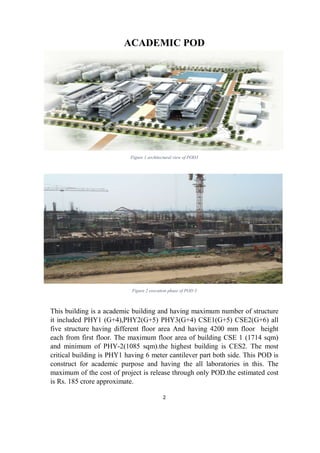
Figure 3 architectural view of studio apartment
Figure 4 execution phase of studio apartment
The complex comprises 2 residential building each consisting of 6 similar units
combined together using expansion joint. Each building consists of 24 1BHK
studio apartment with individual kitchen and bathroom for Ph d student. The
building is of ground +5 upper floors (3200 mm each ) height.
4
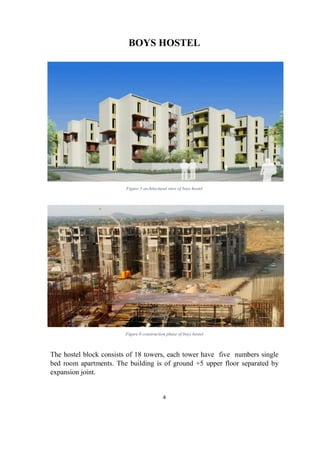
BOYS HOSTEL
Figure 5 architectural view of boys hostel
Figure 6 construction phase of boys hostel
The hostel block consists of 18 towers, each tower have five numbers single
bed room apartments. The building is of ground +5 upper floor separated by
expansion joint.
5
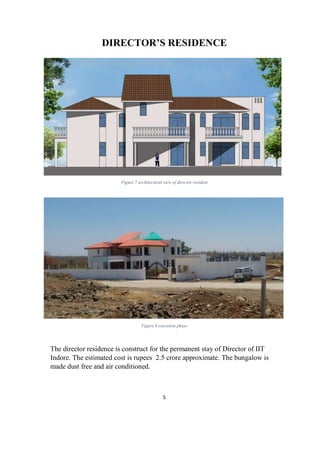
DIRECTOR’S RESIDENCE
Figure 7 architectural view of director resident
Figure 8 execution phase
The director residence is construct for the permanent stay of Director of IIT
Indore. The estimated cost is rupees 2.5 crore approximate. The bungalow is
made dust free and air conditioned.
6
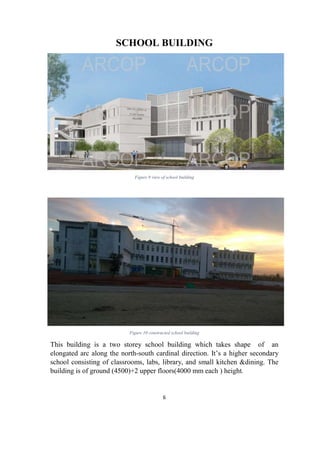
SCHOOL BUILDING
Figure 9 view of school building
Figure 10 constructed school building
This building is a two storey school building which takes shape of an
elongated arc along the north-south cardinal direction. It’s a higher secondary
school consisting of classrooms, labs, library, and small kitchen &dining. The
building is of ground (4500)+2 upper floors(4000 mm each ) height.
7
There are various work and process done in general civil work and it should
have a sequence and followed step by step. some of process are given below
are……
CHAPTER 1
SHUTTERING
Shuttering or Form work is the term used for temporary timber, plywood,
metal or other material used to provide support to wet concrete mix till it gets
strength for self-support. It provides supports to horizontal, vertical and inclined
surfaces or also provides support to cast concrete according to required shape
and size. The form work also produces desired finish concrete surface.
The oiling is done before shuttering on the wood board to prevent the problem
of stick wood with concrete. If oiling is not done properly then honeycomb
structure will arise on surface.
The size of board is generally 1220mm wide and 2440mm height. thickness
may be 6mm or 12mm .Jakes are used to support frame.
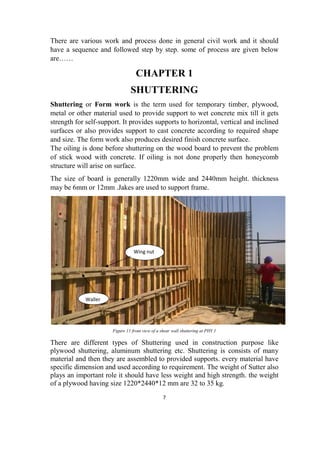
Figure 11 front view of a shear wall shuttering at PHY 1
There are different types of Shuttering used in construction purpose like
plywood shuttering, aluminum shuttering etc. Shuttering is consists of many
material and then they are assembled to provided supports. every material have
specific dimension and used according to requirement. The weight of Sutter also
plays an important role it should have less weight and high strength. the weight
of a plywood having size 1220*2440*12 mm are 32 to 35 kg.
Waller
Wing nut
8
1.1 SCAFFOLDING:
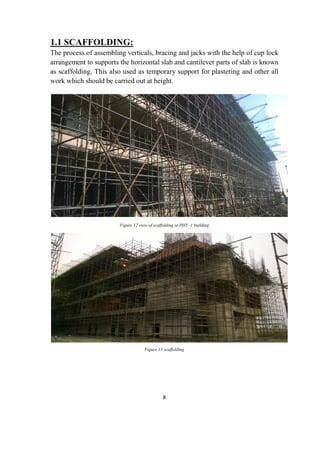
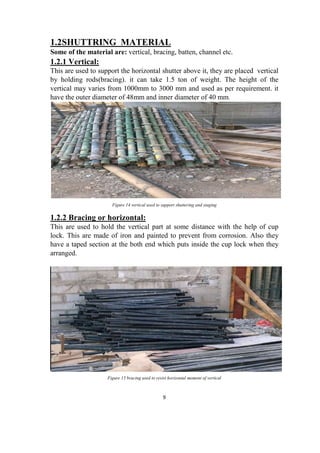
The process of assembling verticals, bracing and jacks with the help of cup lock
arrangement to supports the horizontal slab and cantilever parts of slab is known
as scaffolding. This also used as temporary support for plastering and other all
work which should be carried out at height.
Figure 12 view of scaffolding in PHY -1 building
Figure 13 scaffolding
9
1.2SHUTTRING MATERIAL
Some of the material are: vertical, bracing, batten, channel etc.
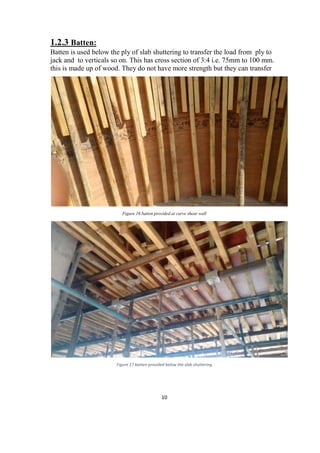
1.2.1 Vertical:
This are used to support the horizontal shutter above it, they are placed vertical
by holding rods(bracing). it can take 1.5 ton of weight. The height of the
vertical may varies from 1000mm to 3000 mm and used as per requirement. it
have the outer diameter of 48mm and inner diameter of 40 mm.
Figure 14 vertical used to support shuttering and staging
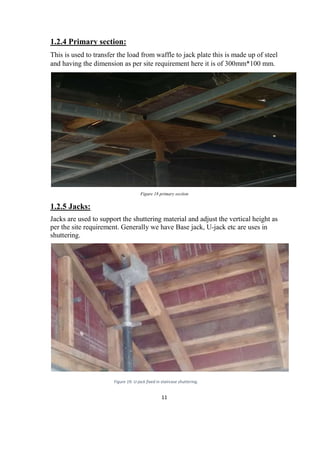
1.2.2 Bracing or horizontal:
This are used to hold the vertical part at some distance with the help of cup
lock. This are made of iron and painted to prevent from corrosion. Also they
have a taped section at the both end which puts inside the cup lock when they
arranged.
Figure 15 bracing used to resist horizontal moment of vertical
10
1.2.3 Batten:
Batten is used below the ply of slab shuttering to transfer the load from ply to
jack and to verticals so on. This has cross section of 3:4 i.e. 75mm to 100 mm.
this is made up of wood. They do not have more strength but they can transfer
Figure 16 batten provided at curve shear wall
Figure 17 batten provided below the slab shuttering
11
1.2.4 Primary section:
This is used to transfer the load from waffle to jack plate this is made up of steel
and having the dimension as per site requirement here it is of 300mm*100 mm.
Figure 18 primary section
1.2.5 Jacks:
Jacks are used to support the shuttering material and adjust the vertical height as
per the site requirement. Generally we have Base jack, U-jack etc are uses in
shuttering.
Figure 19: U-jack fixed in staircase shuttering.
12
1.3 Shuttering in column
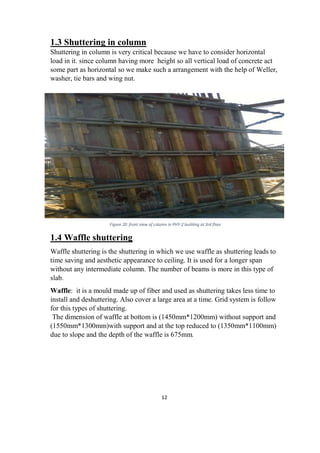
Shuttering in column is very critical because we have to consider horizontal
load in it. since column having more height so all vertical load of concrete act
some part as horizontal so we make such a arrangement with the help of Weller,
washer, tie bars and wing nut.
1.4 Waffle shuttering
Waffle shuttering is the shuttering in which we use waffle as shuttering leads to
time saving and aesthetic appearance to ceiling. It is used for a longer span
without any intermediate column. The number of beams is more in this type of
slab.
Waffle: it is a mould made up of fiber and used as shuttering takes less time to
install and deshuttering. Also cover a large area at a time. Grid system is follow
for this types of shuttering.
The dimension of waffle at bottom is (1450mm*1200mm) without support and
(1550mm*1300mm)with support and at the top reduced to (1350mm*1100mm)
due to slope and the depth of the waffle is 675mm.
Figure 20 front view of column in PHY-2 building at 3rd floor
13
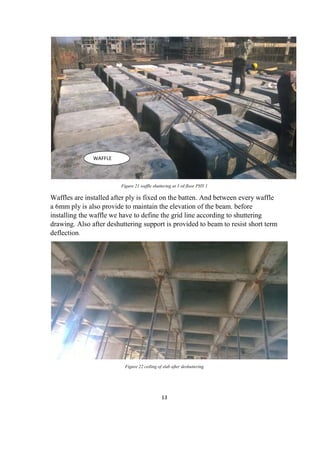
Figure 21 waffle shuttering at 3 rd floor PHY 1
Waffles are installed after ply is fixed on the batten. And between every waffle
a 6mm ply is also provide to maintain the elevation of the beam. before
installing the waffle we have to define the grid line according to shuttering
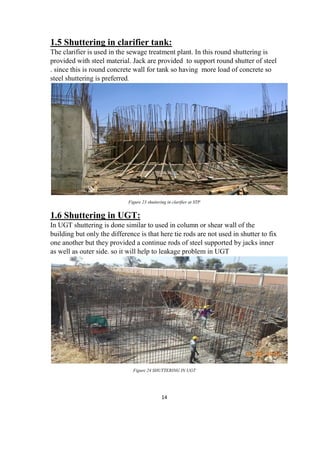
drawing. Also after deshuttering support is provided to beam to resist short term
deflection.
Figure 22 ceiling of slab after deshuttering
WAFFLE
14
1.5 Shuttering in clarifier tank:
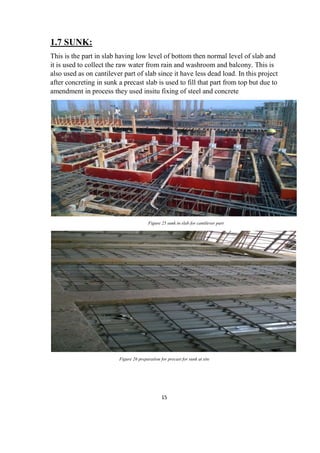
The clarifier is used in the sewage treatment plant. In this round shuttering is
provided with steel material. Jack are provided to support round shutter of steel
. since this is round concrete wall for tank so having more load of concrete so
steel shuttering is preferred.
Figure 23 shuttering in clarifier at STP
1.6 Shuttering in UGT:
In UGT shuttering is done similar to used in column or shear wall of the
building but only the difference is that here tie rods are not used in shutter to fix
one another but they provided a continue rods of steel supported by jacks inner
as well as outer side. so it will help to leakage problem in UGT
Figure 24 SHUTTERING IN UGT
15
1.7 SUNK:
This is the part in slab having low level of bottom then normal level of slab and
it is used to collect the raw water from rain and washroom and balcony. This is
also used as on cantilever part of slab since it have less dead load. In this project
after concreting in sunk a precast slab is used to fill that part from top but due to
amendment in process they used insitu fixing of steel and concrete
Figure 25 sunk in slab for cantilever part
Figure 26 preparation for precast for sunk at site
16
1.8 Important point should be considered at the time of shuttering:
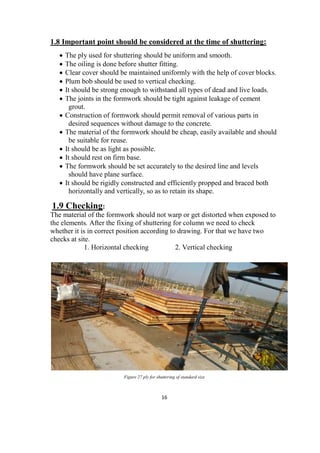
 The ply used for shuttering should be uniform and smooth.
 The oiling is done before shutter fitting.
 Clear cover should be maintained uniformly with the help of cover blocks.
 Plum bob should be used to vertical checking.
 It should be strong enough to withstand all types of dead and live loads.
 The joints in the formwork should be tight against leakage of cement
grout.
 Construction of formwork should permit removal of various parts in
desired sequences without damage to the concrete.
 The material of the formwork should be cheap, easily available and should
be suitable for reuse.
 It should be as light as possible.
 It should rest on firm base.
 The formwork should be set accurately to the desired line and levels
should have plane surface.
 It should be rigidly constructed and efficiently propped and braced both
horizontally and vertically, so as to retain its shape.
1.9 Checking:
The material of the formwork should not warp or get distorted when exposed to
the elements. After the fixing of shuttering for column we need to check
whether it is in correct position according to drawing. For that we have two
checks at site.
1. Horizontal checking 2. Vertical checking
Figure 27 ply for shuttering of standard size
17
CHAPTER 2
REINFORCEMENT OF STRUCTURAL BUILDING
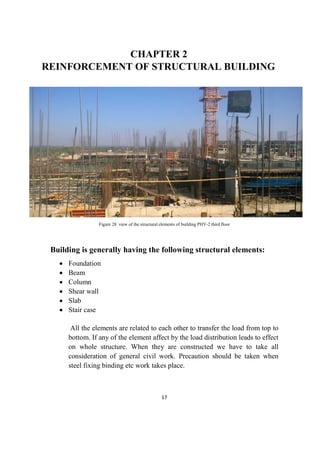
Figure 28 view of the structural elements of building PHY-2 third floor
Building is generally having the following structural elements:
 Foundation
 Beam
 Column
 Shear wall
 Slab
 Stair case
All the elements are related to each other to transfer the load from top to
bottom. If any of the element affect by the load distribution leads to effect
on whole structure. When they are constructed we have to take all
consideration of general civil work. Precaution should be taken when
steel fixing binding etc work takes place.
18
2.1 FOUNDATION
The foundations of the building transfer the weight of the building to the
ground. While 'foundation' is a general word, normally, every building has a
number of individual foundations, commonly called footings. Usually each
column of the building will have its own footing. this is a part in the structure
which play a vital role to support whole structure on it. There is raft foundation
in this structure.
The details of foundation parts of sewage treatment plant and construction
process are in following part:
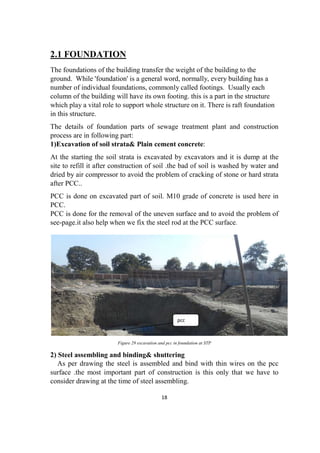
1)Excavation of soil strata& Plain cement concrete:
At the starting the soil strata is excavated by excavators and it is dump at the
site to refill it after construction of soil .the bad of soil is washed by water and
dried by air compressor to avoid the problem of cracking of stone or hard strata
after PCC..
PCC is done on excavated part of soil. M10 grade of concrete is used here in
PCC.
PCC is done for the removal of the uneven surface and to avoid the problem of
see-page.it also help when we fix the steel rod at the PCC surface.
Figure 29 excavation and pcc in foundation at STP
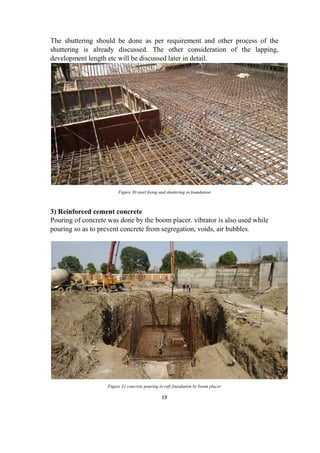
2) Steel assembling and binding& shuttering
As per drawing the steel is assembled and bind with thin wires on the pcc
surface .the most important part of construction is this only that we have to
consider drawing at the time of steel assembling.
pcc
19
The shuttering should be done as per requirement and other process of the
shuttering is already discussed. The other consideration of the lapping,
development length etc will be discussed later in detail.
Figure 30 steel fixing and shuttering in foundation
3) Reinforced cement concrete
Pouring of concrete was done by the boom placer. vibrator is also used while
pouring so as to prevent concrete from segregation, voids, air bubbles.
Figure 31 concrete pouring in raft foundation by boom placer
20
2.2 BEAM
This is a horizontal tension structural part in the building and placed on the
column to provide supports at both ends. All the loads comes from slab is
directly transferred to beam only. And whole slab is stands on side beams.
There are two types of beam on the basis of support they rested are:
 Primary beam or Main beam or framing beam: if it is rested on the
column support.
 Secondary beam or non-framing beam: if it is rested on another the beam.
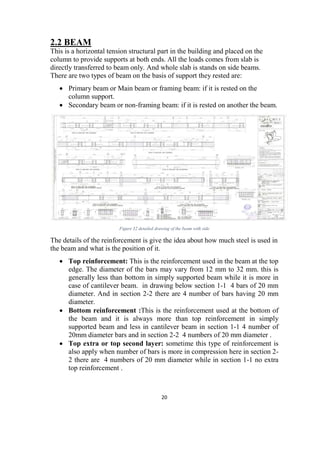
Figure 32 detailed drawing of the beam with side
The details of the reinforcement is give the idea about how much steel is used in
the beam and what is the position of it.
 Top reinforcement: This is the reinforcement used in the beam at the top
edge. The diameter of the bars may vary from 12 mm to 32 mm. this is
generally less than bottom in simply supported beam while it is more in
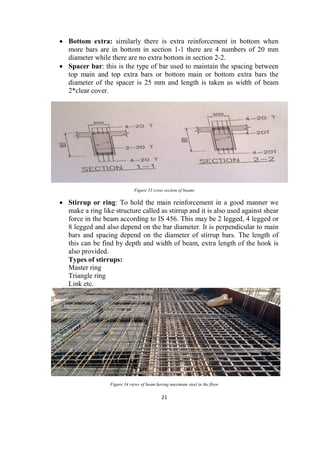
case of cantilever beam. in drawing below section 1-1 4 bars of 20 mm
diameter. And in section 2-2 there are 4 number of bars having 20 mm
diameter.
 Bottom reinforcement :This is the reinforcement used at the bottom of
the beam and it is always more than top reinforcement in simply
supported beam and less in cantilever beam in section 1-1 4 number of
20mm diameter bars and in section 2-2 4 numbers of 20 mm diameter .
 Top extra or top second layer: sometime this type of reinforcement is
also apply when number of bars is more in compression here in section 2-
2 there are 4 numbers of 20 mm diameter while in section 1-1 no extra
top reinforcement .
21
 Bottom extra: similarly there is extra reinforcement in bottom when
more bars are in bottom in section 1-1 there are 4 numbers of 20 mm
diameter while there are no extra bottom in section 2-2.
 Spacer bar: this is the type of bar used to maintain the spacing between
top main and top extra bars or bottom main or bottom extra bars the
diameter of the spacer is 25 mm and length is taken as width of beam
2*clear cover.
Figure 33 cross section of beams
 Stirrup or ring: To hold the main reinforcement in a good manner we
make a ring like structure called as stirrup and it is also used against shear
force in the beam according to IS 456. This may be 2 legged, 4 legged or
8 legged and also depend on the bar diameter. It is perpendicular to main
bars and spacing depend on the diameter of stirrup bars. The length of
this can be find by depth and width of beam, extra length of the hook is
also provided.
Types of stirrups:
Master ring
Triangle ring
Link etc.
Figure 34 views of beam having maximum steel in the floor
22
 Spacing: this is the distance between the stirrups. And it varies depend
on the diameter of the stirrup bars. It have more spacing for higher
diameter while it is less for lower diameter
 Lapping: This is used to continue the bars in longitudinal direction since
generally bar length is 12 meter but if need more than that the lapping is
provided. It is depends on the bar diameter and it is as 45d to 60d.
 Development length: this is provided in the beam to overcome with
problem of bad bond or binding so minimum length is provided so it help
to bind steel with concrete and make good grip.
 Anchorage length: this is length provided in different shape by bend
main bars at the end supports to make good connection between column
and beam. The shape may be in L, Uor C.
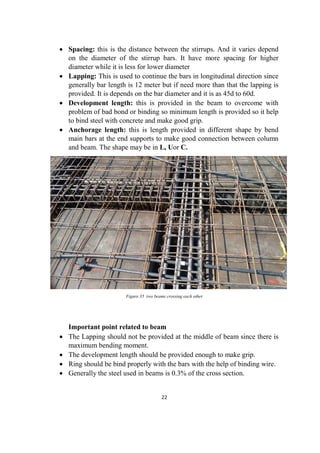
Figure 35 two beams crossing each other
Important point related to beam
 The Lapping should not be provided at the middle of beam since there is
maximum bending moment.
 The development length should be provided enough to make grip.
 Ring should be bind properly with the bars with the help of binding wire.
 Generally the steel used in beams is 0.3% of the cross section.
23
2.3 COLUMN
This is the vertical compression member in the structural building. it transfer
the load from beam to foundation directly. It also help to hold the building
vertically if the column get failed.
It will affect the whole structure of the building. The column is design in such
a way that it may not buckle due to vertical load.
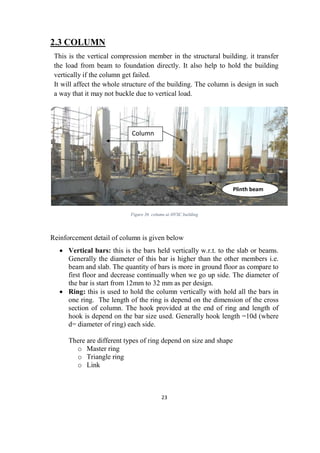
Figure 36 column at HVSC building
Reinforcement detail of column is given below
 Vertical bars: this is the bars held vertically w.r.t. to the slab or beams.
Generally the diameter of this bar is higher than the other members i.e.
beam and slab. The quantity of bars is more in ground floor as compare to
first floor and decrease continually when we go up side. The diameter of
the bar is start from 12mm to 32 mm as per design.
 Ring: this is used to hold the column vertically with hold all the bars in
one ring. The length of the ring is depend on the dimension of the cross
section of column. The hook provided at the end of ring and length of
hook is depend on the bar size used. Generally hook length =10d (where
d= diameter of ring) each side.
There are different types of ring depend on size and shape
o Master ring
o Triangle ring
o Link
Column
Plinth beam
24
 Lapping: lapping is provided to continue the vertical bar to next floor
and the lapping zone is also decide before install the bars. The lap length
is depend on the bar diameter.
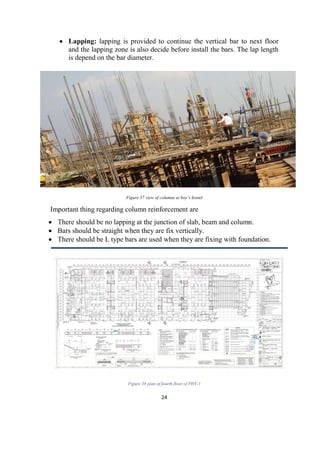
Figure 37 view of columns at boy’s hostel
Important thing regarding column reinforcement are
 There should be no lapping at the junction of slab, beam and column.
 Bars should be straight when they are fix vertically.
 There should be L type bars are used when they are fixing with foundation.
Figure 38 plan of fourth floor of PHY-1
25
2.4 SHEAR WALL
This is the structural element of building same as the column but the dimension
is different from column. This is generally used at the end side of the slab. When
the length to width ratio is more than 4 then it is considered as shear wall. There
are two numbers of columns at the both end of shear wall. The diameter of rods
at the end of shear wall is higher than the inner one.
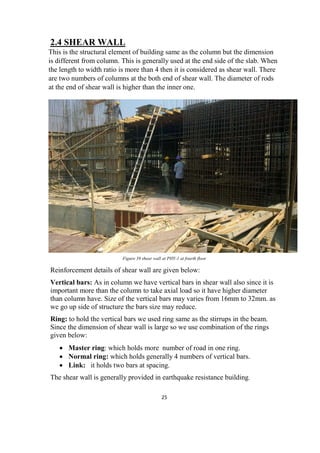
Figure 39 shear wall at PHY-1 at fourth floor
Reinforcement details of shear wall are given below:
Vertical bars: As in column we have vertical bars in shear wall also since it is
important more than the column to take axial load so it have higher diameter
than column have. Size of the vertical bars may varies from 16mm to 32mm. as
we go up side of structure the bars size may reduce.
Ring: to hold the vertical bars we used ring same as the stirrups in the beam.
Since the dimension of shear wall is large so we use combination of the rings
given below:
 Master ring: which holds more number of road in one ring.
 Normal ring: which holds generally 4 numbers of vertical bars.
 Link: it holds two bars at spacing.
The shear wall is generally provided in earthquake resistance building.
26
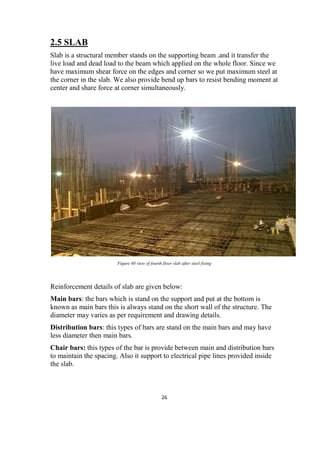
2.5 SLAB
Slab is a structural member stands on the supporting beam .and it transfer the
live load and dead load to the beam which applied on the whole floor. Since we
have maximum shear force on the edges and corner so we put maximum steel at
the corner in the slab. We also provide bend up bars to resist bending moment at
center and share force at corner simultaneously.
Figure 40 view of fourth floor slab after steel fixing
Reinforcement details of slab are given below:
Main bars: the bars which is stand on the support and put at the bottom is
known as main bars this is always stand on the short wall of the structure. The
diameter may varies as per requirement and drawing details.
Distribution bars: this types of bars are stand on the main bars and may have
less diameter then main bars.
Chair bars: this types of the bar is provide between main and distribution bars
to maintain the spacing. Also it support to electrical pipe lines provided inside
the slab.
27
2.6 WAFFLE ROOF OR SLAB
Waffle roof is the roof in which we use waffle as shuttering leads to time saving
and aesthetic appearance to ceiling. It is used for a longer span without any
intermediate column. The number of beams are more in this type of slab. The
dimension of waffle at bottom is (1450mm*1200mm) without support and
(1550mm*1300mm) with support and at the top it is reduced to
(1350mm*1100mm) due to slope and the depth of the waffle is 675mm.
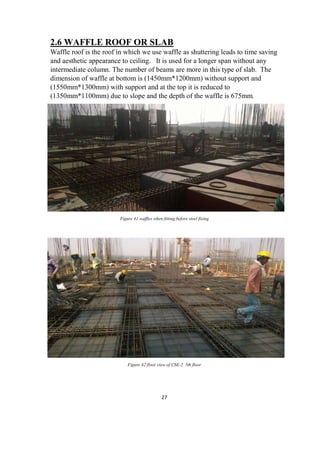
Figure 41 waffles when fitting before steel fixing
Figure 42 floor view of CSE-2 5th floor
28
2.7STAIRCASE :
This is the structural elements used to approach the upper floor or vice versa in
the building. This is provide in the inclined form base to top or in rounded form.
It have the steps to approach up side consists of riser and thread. Sometime mid
land also provided intermediately.
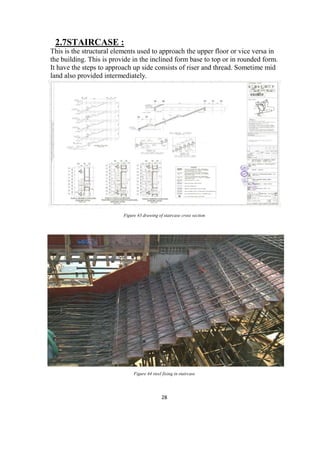
Figure 43 drawing of staircase cross section
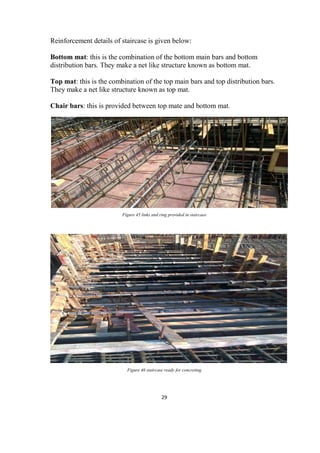
Figure 44 steel fixing in staircase
29
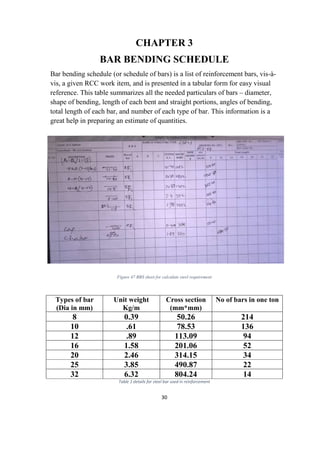
Reinforcement details of staircase is given below:
Bottom mat: this is the combination of the bottom main bars and bottom
distribution bars. They make a net like structure known as bottom mat.
Top mat: this is the combination of the top main bars and top distribution bars.
They make a net like structure known as top mat.
Chair bars: this is provided between top mate and bottom mat.
Figure 45 links and ring provided in staircase
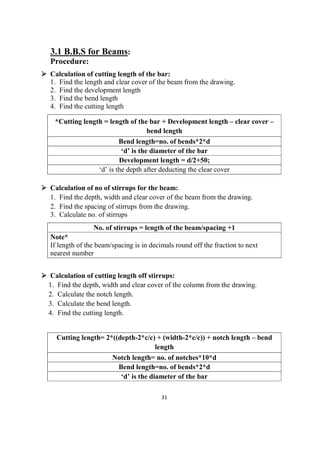
Figure 46 staircase ready for concreting
30
CHAPTER 3
BAR BENDING SCHEDULE
Bar bending schedule (or schedule of bars) is a list of reinforcement bars, vis-à-
vis, a given RCC work item, and is presented in a tabular form for easy visual
reference. This table summarizes all the needed particulars of bars – diameter,
shape of bending, length of each bent and straight portions, angles of bending,
total length of each bar, and number of each type of bar. This information is a
great help in preparing an estimate of quantities.
Figure 47 BBS sheet for calculate steel requirement
Types of bar
(Dia in mm)
Unit weight
Kg/m
Cross section
(mm*mm)
No of bars in one ton
8 0.39 50.26 214
10 .61 78.53 136
12 .89 113.09 94
16 1.58 201.06 52
20 2.46 314.15 34
25 3.85 490.87 22
32 6.32 804.24 14
Table 1 details for steel bar used in reinforcement
31
3.1 B.B.S for Beams:
Procedure:
 Calculation of cutting length of the bar:
1. Find the length and clear cover of the beam from the drawing.
2. Find the development length
3. Find the bend length
4. Find the cutting length
*Cutting length = length of the bar + Development length – clear cover –
bend length
Bend length=no. of bends*2*d
‘d’ is the diameter of the bar
Development length = d/2+50;
‘d’ is the depth after deducting the clear cover
 Calculation of no of stirrups for the beam:
1. Find the depth, width and clear cover of the beam from the drawing.
2. Find the spacing of stirrups from the drawing.
3. Calculate no. of stirrups
No. of stirrups = length of the beam/spacing +1
Note*
If length of the beam/spacing is in decimals round off the fraction to next
nearest number
 Calculation of cutting length off stirrups:
1. Find the depth, width and clear cover of the column from the drawing.
2. Calculate the notch length.
3. Calculate the bend length.
4. Find the cutting length.
Cutting length= 2*((depth-2*c/c) + (width-2*c/c)) + notch length – bend
length
Notch length= no. of notches*10*d
Bend length=no. of bends*2*d
‘d’ is the diameter of the bar
32
3.2 B.B.S for Columns:
Procedure:
 Calculation of cutting length for vertical bars:
1. Find the length of the vertical rod which is 5.5m or 6.5m generally
2. 300mm development length is provided at the raft-column junction to
connect column with the raft.
3. Calculate the lap length and the bend length at every vertical bar
connection
Note*
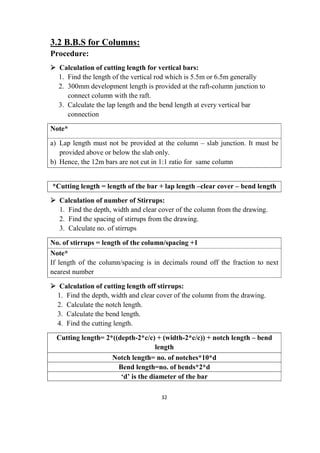
a) Lap length must not be provided at the column – slab junction. It must be
provided above or below the slab only.
b) Hence, the 12m bars are not cut in 1:1 ratio for same column
*Cutting length = length of the bar + lap length –clear cover – bend length
 Calculation of number of Stirrups:
1. Find the depth, width and clear cover of the column from the drawing.
2. Find the spacing of stirrups from the drawing.
3. Calculate no. of stirrups
No. of stirrups = length of the column/spacing +1
Note*
If length of the column/spacing is in decimals round off the fraction to next
nearest number
 Calculation of cutting length off stirrups:
1. Find the depth, width and clear cover of the column from the drawing.
2. Calculate the notch length.
3. Calculate the bend length.
4. Find the cutting length.
Cutting length= 2*((depth-2*c/c) + (width-2*c/c)) + notch length – bend
length
Notch length= no. of notches*10*d
Bend length=no. of bends*2*d
‘d’ is the diameter of the bar
33
3.3 B.B.S for Slabs:
Procedure:
 Calculation of number of bars:
1. Find out the length(l), width(w) and depth(d) of the slab
2. Find the spacing’s for top bar and bottom bar from the drawing
3. Find the diameter of the bars for both distribution and main reinforcement in top
and bottom
4. Main bars are arranged along the shorter span and distribution bars are arranged
along the longer span
5. For number of bottom bars along the width divide the length by the given
spacing after deducting the clear cover on both sides and add 1 to it. If the
fraction is in decimals round off the number to next successive number and add
1 to it.
6. Repeat the same procedure for top bars by taking the spacing given for top bars
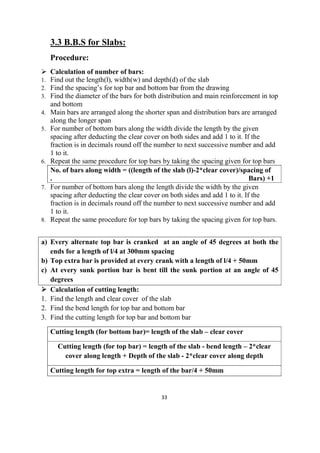
No. of bars along width = ((length of the slab (l)-2*clear cover)/spacing of
. Bars) +1
7. For number of bottom bars along the length divide the width by the given
spacing after deducting the clear cover on both sides and add 1 to it. If the
fraction is in decimals round off the number to next successive number and add
1 to it.
8. Repeat the same procedure for top bars by taking the spacing given for top bars.
a) Every alternate top bar is cranked at an angle of 45 degrees at both the
ends for a length of l/4 at 300mm spacing
b) Top extra bar is provided at every crank with a length of l/4 + 50mm
c) At every sunk portion bar is bent till the sunk portion at an angle of 45
degrees
 Calculation of cutting length:
1. Find the length and clear cover of the slab
2. Find the bend length for top bar and bottom bar
3. Find the cutting length for top bar and bottom bar
Cutting length (for bottom bar)= length of the slab – clear cover
Cutting length (for top bar) = length of the slab - bend length – 2*clear
cover along length + Depth of the slab - 2*clear cover along depth
Cutting length for top extra = length of the bar/4 + 50mm
34
3.4 B.B.S for Staircase:
Procedure:
 Calculation of no. of bars along Waist slab, Mid landing and lower landing:
1. Find out the length(l), width(w) and depth(d) of the slab
2. Find the spacing’s for top bar and bottom bar from the drawing
3. Find the diameter of the bars for both distribution and main reinforcement in top
and bottom
4. Main bars are arranged along the shorter span and distribution bars are arranged
along the longer span
5. For number of bottom bars along the width divide the length by the given
spacing after deducting the clear cover on both sides and add 1 to it. If the
fraction is in decimals round off the number to next successive number and add
1 to it.
6. Repeat the same procedure for top bars by taking the spacing given for top bars
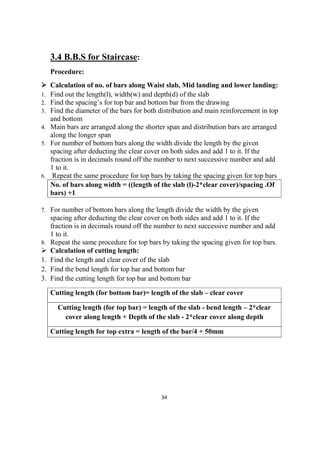
No. of bars along width = ((length of the slab (l)-2*clear cover)/spacing .Of
bars) +1
7. For number of bottom bars along the length divide the width by the given
spacing after deducting the clear cover on both sides and add 1 to it. If the
fraction is in decimals round off the number to next successive number and add
1 to it.
8. Repeat the same procedure for top bars by taking the spacing given for top bars.
 Calculation of cutting length:
1. Find the length and clear cover of the slab
2. Find the bend length for top bar and bottom bar
3. Find the cutting length for top bar and bottom bar
Cutting length (for bottom bar)= length of the slab – clear cover
Cutting length (for top bar) = length of the slab - bend length – 2*clear
cover along length + Depth of the slab - 2*clear cover along depth
Cutting length for top extra = length of the bar/4 + 50mm
35
3.5Bending of bars:
By bar bending machine
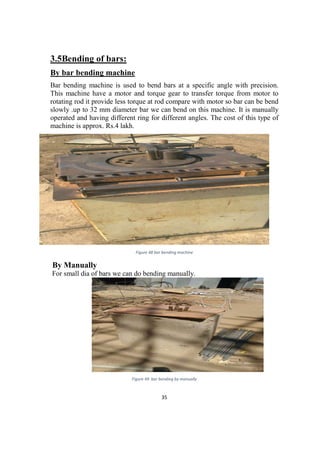
Bar bending machine is used to bend bars at a specific angle with precision.
This machine have a motor and torque gear to transfer torque from motor to
rotating rod it provide less torque at rod compare with motor so bar can be bend
slowly .up to 32 mm diameter bar we can bend on this machine. It is manually
operated and having different ring for different angles. The cost of this type of
machine is approx. Rs.4 lakh.
Figure 48 bar bending machine
By Manually
For small dia of bars we can do bending manually.
Figure 49 bar bending by manually
36
CHAPTER 4
CONCRETING
The process of making, mixing, transporting and putting the concrete in the
desired area (footings, columns, beams and slabs etc.) is known as concreting.
Concreting involves various operations, methods and supervision at the time of
construction.
Concrete: concrete is a mixture of cement, water, aggregates, and admixtures.
Concrete is a versatile construction material, adaptable to a wide variety of
agricultural and residential uses. Concrete is the most widely used construction
material in the world.
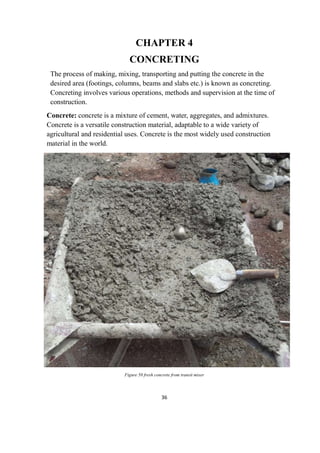
Figure 50 fresh concrete from transit mixer
37
4.1Various operations involved in Concreting
The operations which are followed in actual practice in the making of concrete
and in improving and maintaining the quality of concrete are known as
concreting operations. The following operations are involved in concrete
making:
1. Batching
2. Mixing
3. Transporting of concrete
4. Placing of concrete
5. Compacting.
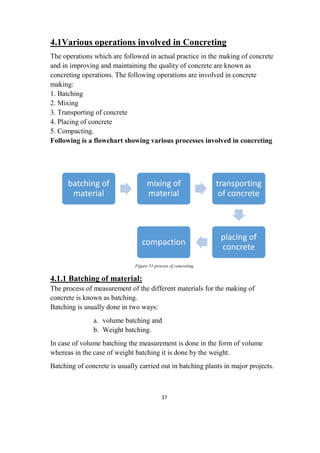
Following is a flowchart showing various processes involved in concreting
Figure 51 process of concreting
4.1.1 Batching of material:
The process of measurement of the different materials for the making of
concrete is known as batching.
Batching is usually done in two ways:
a. volume batching and
b. Weight batching.
In case of volume batching the measurement is done in the form of volume
whereas in the case of weight batching it is done by the weight.
Batching of concrete is usually carried out in batching plants in major projects.
batching of
material
mixing of
material
transporting
of concrete
placing of
concrete
compaction
38
4.1.2 BATCHING PLANT
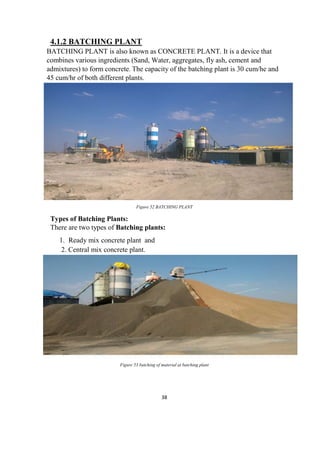
BATCHING PLANT is also known as CONCRETE PLANT. It is a device that
combines various ingredients (Sand, Water, aggregates, fly ash, cement and
admixtures) to form concrete. The capacity of the batching plant is 30 cum/he and
45 cum/hr of both different plants.
Figure 52 BATCHING PLANT
Types of Batching Plants:
There are two types of Batching plants:
1. Ready mix concrete plant and
2. Central mix concrete plant.
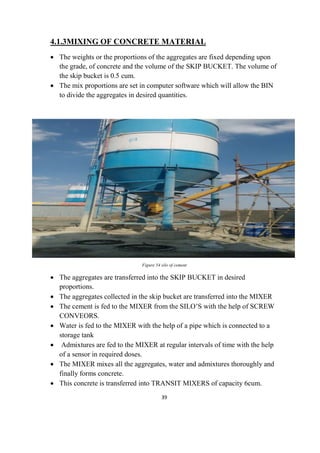
Figure 53 batching of material at batching plant
39
4.1.3MIXING OF CONCRETE MATERIAL
 The weights or the proportions of the aggregates are fixed depending upon
the grade, of concrete and the volume of the SKIP BUCKET. The volume of
the skip bucket is 0.5 cum.
 The mix proportions are set in computer software which will allow the BIN
to divide the aggregates in desired quantities.
Figure 54 silo of cement
 The aggregates are transferred into the SKIP BUCKET in desired
proportions.
 The aggregates collected in the skip bucket are transferred into the MIXER
 The cement is fed to the MIXER from the SILO’S with the help of SCREW
CONVEORS.
 Water is fed to the MIXER with the help of a pipe which is connected to a
storage tank
 Admixtures are fed to the MIXER at regular intervals of time with the help
of a sensor in required doses.
 The MIXER mixes all the aggregates, water and admixtures thoroughly and
finally forms concrete.
 This concrete is transferred into TRANSIT MIXERS of capacity 6cum.
40
4.1.4 TRANSPORTING OF CONCRETE
Once the concrete mixture is created it must be transported to its final
location. The concrete is placed on form works and should always be dropped
on its final location as closely as possible.
Transportation of concrete mix is very important because in transportation,
time factor is involved. The mix should be transported as quickly as possible.
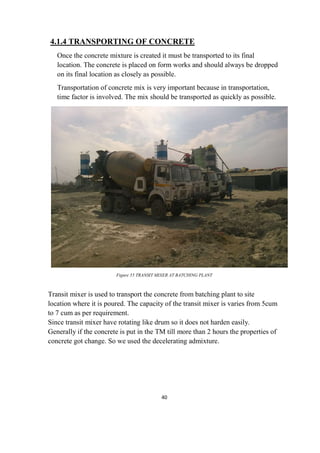
Figure 55 TRANSIT MIXER AT BATCHING PLANT
Transit mixer is used to transport the concrete from batching plant to site
location where it is poured. The capacity of the transit mixer is varies from 5cum
to 7 cum as per requirement.
Since transit mixer have rotating like drum so it does not harden easily.
Generally if the concrete is put in the TM till more than 2 hours the properties of
concrete got change. So we used the decelerating admixture.
41
4.1.5PLACING OF CONCRETE
The process of pouring the concrete from transit mixer to required place with the
help of pump, boom placer or crane (bucket) is known as placing of concrete.
The placing of concrete is done through following equipment:
1. Concrete pump
2. Boom placer
3. Bucket (through crane)
4. through chutes
5. Manually
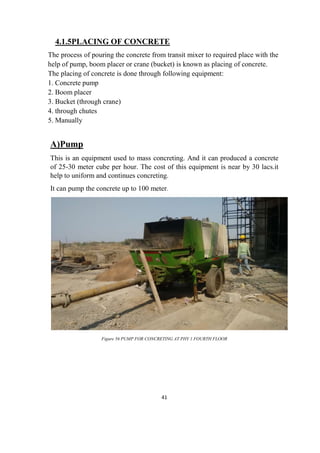
A)Pump
This is an equipment used to mass concreting. And it can produced a concrete
of 25-30 meter cube per hour. The cost of this equipment is near by 30 lacs.it
help to uniform and continues concreting.
It can pump the concrete up to 100 meter.
Figure 56 PUMP FOR CONCRETING AT PHY 1 FOURTH FLOOR
42
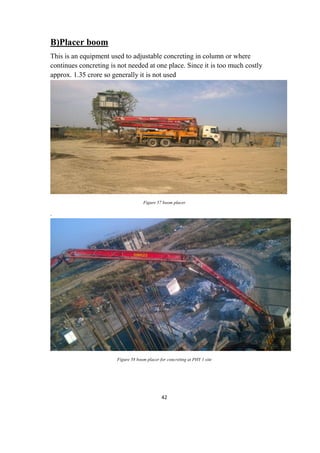
B)Placer boom
This is an equipment used to adjustable concreting in column or where
continues concreting is not needed at one place. Since it is too much costly
approx. 1.35 crore so generally it is not used
Figure 57 boom placer
.
Figure 58 boom placer for concreting at PHY 1 site
43
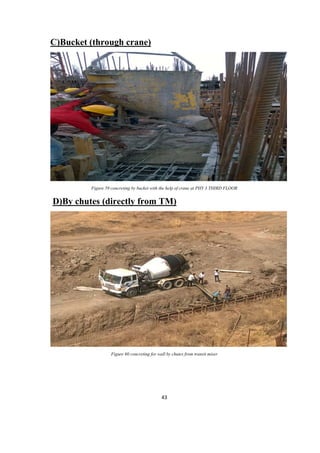
C)Bucket (through crane)
Figure 59 concreting by bucket with the help of crane at PHY 3 THIRD FLOOR
D)By chutes (directly from TM)
Figure 60 concreting for wall by chutes from transit mixer
44
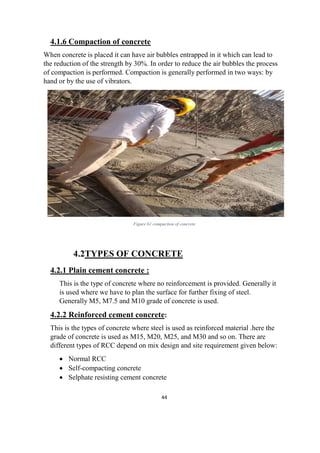
4.1.6 Compaction of concrete
When concrete is placed it can have air bubbles entrapped in it which can lead to
the reduction of the strength by 30%. In order to reduce the air bubbles the process
of compaction is performed. Compaction is generally performed in two ways: by
hand or by the use of vibrators.
Figure 61 compaction of concrete
4.2TYPES OF CONCRETE
4.2.1 Plain cement concrete :
This is the type of concrete where no reinforcement is provided. Generally it
is used where we have to plan the surface for further fixing of steel.
Generally M5, M7.5 and M10 grade of concrete is used.
4.2.2 Reinforced cement concrete:
This is the types of concrete where steel is used as reinforced material .here the
grade of concrete is used as M15, M20, M25, and M30 and so on. There are
different types of RCC depend on mix design and site requirement given below:
 Normal RCC
 Self-compacting concrete
 Selphate resisting cement concrete
45
4.2.3 Self-Compacted Concrete:
Self- compacting concrete is a modern and innovative concrete that does not need
vibration for placement and compaction. It is also known as flow able, self-
consolidating, and non-vibration concrete. It is enormously consistent and highly flow
able, without the loss of stability, and moreover it can flow due to its weight, fill the
formwork and achieve complete compaction even in the presence of crowded
reinforcement. After solidification, it is hard, consistent, and has similar engineering
characteristics, including strength, as conventional concrete that has been vibrated.
Therefore after hardening, its function is like normal (vibrated) concrete.
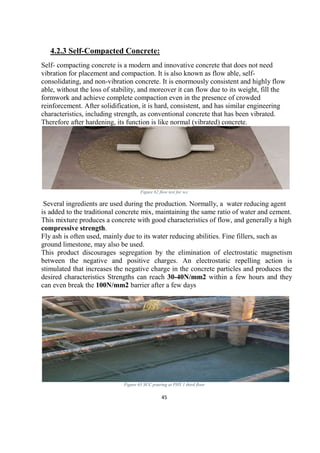
Figure 62 flow test for scc
Several ingredients are used during the production. Normally, a water reducing agent
is added to the traditional concrete mix, maintaining the same ratio of water and cement.
This mixture produces a concrete with good characteristics of flow, and generally a high
compressive strength.
Fly ash is often used, mainly due to its water reducing abilities. Fine fillers, such as
ground limestone, may also be used.
This product discourages segregation by the elimination of electrostatic magnetism
between the negative and positive charges. An electrostatic repelling action is
stimulated that increases the negative charge in the concrete particles and produces the
desired characteristics Strengths can reach 30-40N/mm2 within a few hours and they
can even break the 100N/mm2 barrier after a few days
Figure 63 SCC pouring at PHY 1 third floor
46
4.3 Grade of concrete
Generally there are different types of concrete on the basis of grade as
follow:
As per IS456
 Nominal mix of concrete: M5, M10, M15, M20
 Plain concrete: M15, M20, M25
 Reinforced concrete: M20, M25, M30, M35, M40
Other category
 Ordinary concrete: M10,M15,M20
 Standard concrete: M25,M30,M35,M40,M45,M50,M55
 High strength concrete: M60,M65,M70,M75,M80
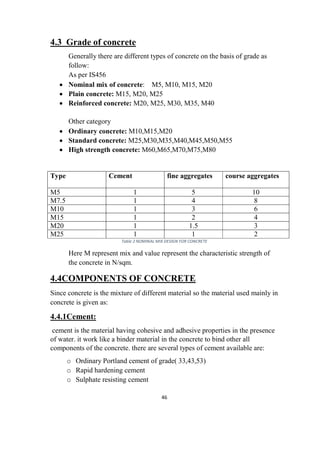
Type Cement fine aggregates course aggregates
M5 1 5 10
M7.5 1 4 8
M10 1 3 6
M15 1 2 4
M20 1 1.5 3
M25 1 1 2
Table 2 NOMINAL MIX DESIGN FOR CONCRETE
Here M represent mix and value represent the characteristic strength of
the concrete in N/sqm.
4.4COMPONENTS OF CONCRETE
Since concrete is the mixture of different material so the material used mainly in
concrete is given as:
4.4.1Cement:
cement is the material having cohesive and adhesive properties in the presence
of water. it work like a binder material in the concrete to bind other all
components of the concrete. there are several types of cement available are:
o Ordinary Portland cement of grade( 33,43,53)
o Rapid hardening cement
o Sulphate resisting cement
47
o High alumina cement
o White cement
o Pozzolana Portland cement
o Low heat cement
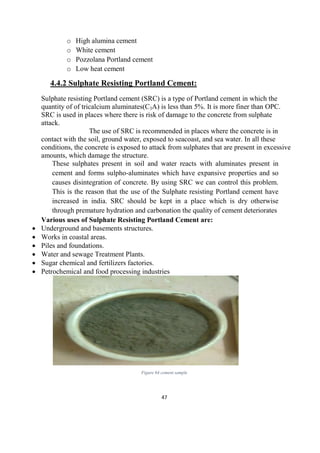
4.4.2 Sulphate Resisting Portland Cement:
Sulphate resisting Portland cement (SRC) is a type of Portland cement in which the
quantity of of tricalcium aluminates(C3A) is less than 5%. It is more finer than OPC.
SRC is used in places where there is risk of damage to the concrete from sulphate
attack.
The use of SRC is recommended in places where the concrete is in
contact with the soil, ground water, exposed to seacoast, and sea water. In all these
conditions, the concrete is exposed to attack from sulphates that are present in excessive
amounts, which damage the structure.
These sulphates present in soil and water reacts with aluminates present in
cement and forms sulpho-aluminates which have expansive properties and so
causes disintegration of concrete. By using SRC we can control this problem.
This is the reason that the use of the Sulphate resisting Portland cement have
increased in india. SRC should be kept in a place which is dry otherwise
through premature hydration and carbonation the quality of cement deteriorates
Various uses of Sulphate Resisting Portland Cement are:
 Underground and basements structures.
 Works in coastal areas.
 Piles and foundations.
 Water and sewage Treatment Plants.
 Sugar chemical and fertilizers factories.
 Petrochemical and food processing industries
Figure 64 cement sample
48
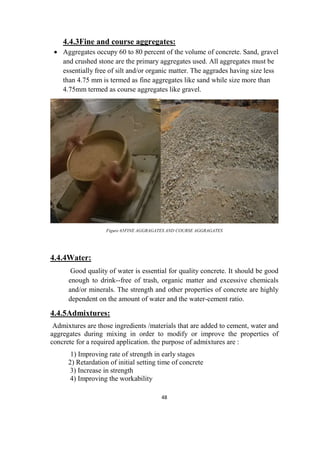
4.4.3Fine and course aggregates:
 Aggregates occupy 60 to 80 percent of the volume of concrete. Sand, gravel
and crushed stone are the primary aggregates used. All aggregates must be
essentially free of silt and/or organic matter. The aggrades having size less
than 4.75 mm is termed as fine aggregates like sand while size more than
4.75mm termed as course aggregates like gravel.
Figure 65FINE AGGRAGATES AND COURSE AGGRAGATES
4.4.4Water:
Good quality of water is essential for quality concrete. It should be good
enough to drink--free of trash, organic matter and excessive chemicals
and/or minerals. The strength and other properties of concrete are highly
dependent on the amount of water and the water-cement ratio.
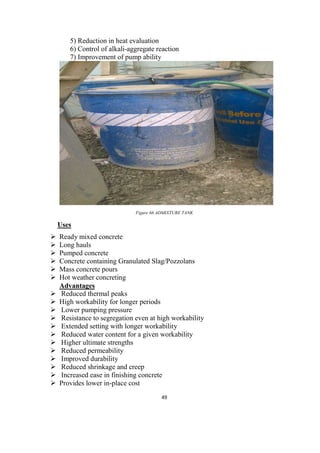
4.4.5Admixtures:
Admixtures are those ingredients /materials that are added to cement, water and
aggregates during mixing in order to modify or improve the properties of
concrete for a required application. the purpose of admixtures are :
1) Improving rate of strength in early stages
2) Retardation of initial setting time of concrete
3) Increase in strength
4) Improving the workability
49
5) Reduction in heat evaluation
6) Control of alkali-aggregate reaction
7) Improvement of pump ability
Figure 66 ADMIXTURE TANK
Uses
 Ready mixed concrete
 Long hauls
 Pumped concrete
 Concrete containing Granulated Slag/Pozzolans
 Mass concrete pours
 Hot weather concreting
Advantages
 Reduced thermal peaks
 High workability for longer periods
 Lower pumping pressure
 Resistance to segregation even at high workability
 Extended setting with longer workability
 Reduced water content for a given workability
 Higher ultimate strengths
 Reduced permeability
 Improved durability
 Reduced shrinkage and creep
 Increased ease in finishing concrete
 Provides lower in-place cost
50
4.5 PROBLEMS IN CONCRETING
When we pour the concrete we have to consider so many thing to produce the
good quality of the structure but due to less inspection many problem arise at
the time of concrete pouring and after pouring.
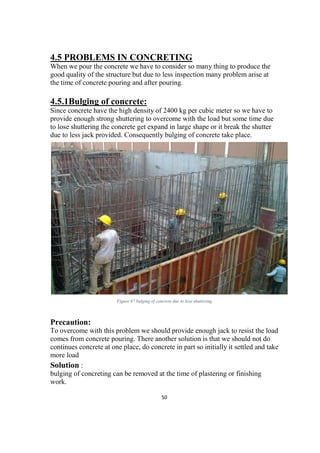
4.5.1Bulging of concrete:
Since concrete have the high density of 2400 kg per cubic meter so we have to
provide enough strong shuttering to overcome with the load but some time due
to lose shuttering the concrete get expand in large shape or it break the shutter
due to less jack provided. Consequently bulging of concrete take place.
Figure 67 bulging of concrete due to lose shuttering
Precaution:
To overcome with this problem we should provide enough jack to resist the load
comes from concrete pouring. There another solution is that we should not do
continues concrete at one place, do concrete in part so initially it settled and take
more load
Solution :
bulging of concreting can be removed at the time of plastering or finishing
work.
51
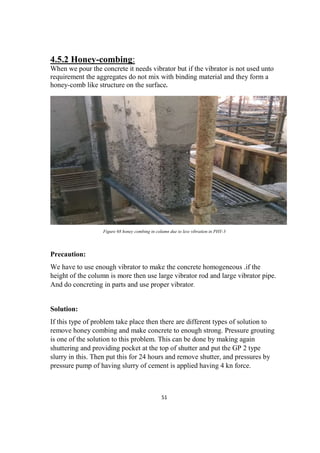
4.5.2 Honey-combing:
When we pour the concrete it needs vibrator but if the vibrator is not used unto
requirement the aggregates do not mix with binding material and they form a
honey-comb like structure on the surface.
Figure 68 honey combing in column due to less vibration in PHY-3
Precaution:
We have to use enough vibrator to make the concrete homogeneous .if the
height of the column is more then use large vibrator rod and large vibrator pipe.
And do concreting in parts and use proper vibrator.
Solution:
If this type of problem take place then there are different types of solution to
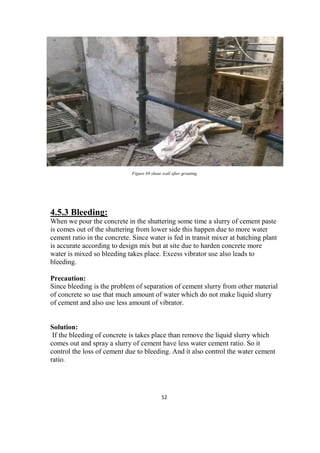
remove honey combing and make concrete to enough strong. Pressure grouting
is one of the solution to this problem. This can be done by making again
shuttering and providing pocket at the top of shutter and put the GP 2 type
slurry in this. Then put this for 24 hours and remove shutter, and pressures by
pressure pump of having slurry of cement is applied having 4 kn force.
52
Figure 69 shear wall after grouting
4.5.3 Bleeding:
When we pour the concrete in the shuttering some time a slurry of cement paste
is comes out of the shuttering from lower side this happen due to more water
cement ratio in the concrete. Since water is fed in transit mixer at batching plant
is accurate according to design mix but at site due to harden concrete more
water is mixed so bleeding takes place. Excess vibrator use also leads to
bleeding.
Precaution:
Since bleeding is the problem of separation of cement slurry from other material
of concrete so use that much amount of water which do not make liquid slurry
of cement and also use less amount of vibrator.
Solution:
If the bleeding of concrete is takes place than remove the liquid slurry which
comes out and spray a slurry of cement have less water cement ratio. So it
control the loss of cement due to bleeding. And it also control the water cement
ratio.
53
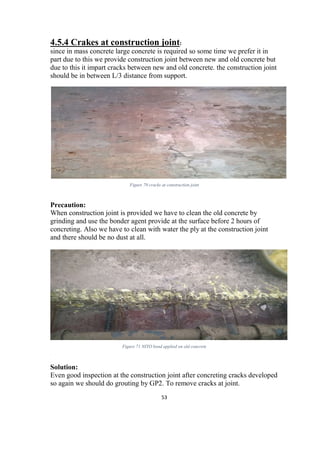
4.5.4 Crakes at construction joint:
since in mass concrete large concrete is required so some time we prefer it in
part due to this we provide construction joint between new and old concrete but
due to this it impart cracks between new and old concrete. the construction joint
should be in between L/3 distance from support.
Figure 70 cracks at construction joint
Precaution:
When construction joint is provided we have to clean the old concrete by
grinding and use the bonder agent provide at the surface before 2 hours of
concreting. Also we have to clean with water the ply at the construction joint
and there should be no dust at all.
Figure 71 NITO bond applied on old concrete
sol
Solution:
Even good inspection at the construction joint after concreting cracks developed
so again we should do grouting by GP2. To remove cracks at joint.
54
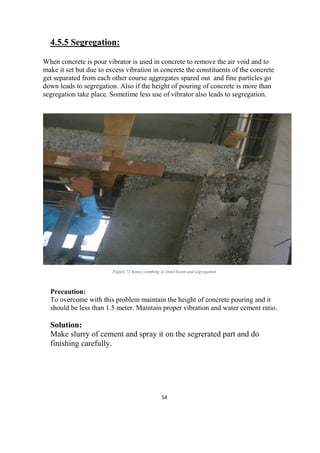
4.5.5 Segregation:
When concrete is pour vibrator is used in concrete to remove the air void and to
make it set but due to excess vibration in concrete the constituents of the concrete
get separated from each other course aggregates spared out and fine particles go
down leads to segregation. Also if the height of pouring of concrete is more than
segregation take place. Sometime less use of vibrator also leads to segregation.
Figure 72 honey combing in lintel beam and segregation
Precaution:
To overcome with this problem maintain the height of concrete pouring and it
should be less than 1.5 meter. Maintain proper vibration and water cement ratio.
Solution:
Make slurry of cement and spray it on the segrerated part and do
finishing carefully.
55
CHAPTER 5
FINISHING WORKS
 Block work
 Plastering
 Flooring
 Putty works
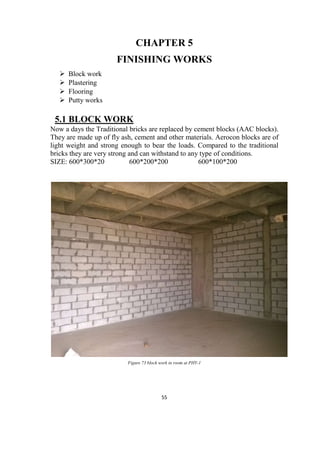
5.1 BLOCK WORK
Now a days the Traditional bricks are replaced by cement blocks (AAC blocks).
They are made up of fly ash, cement and other materials. Aerocon blocks are of
light weight and strong enough to bear the loads. Compared to the traditional
bricks they are very strong and can withstand to any type of conditions.
SIZE: 600*300*20 600*200*200 600*100*200
Figure 73 block work in room at PHY-1
56
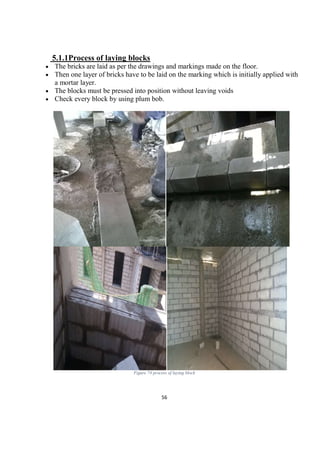
5.1.1Process of laying blocks
 The bricks are laid as per the drawings and markings made on the floor.
 Then one layer of bricks have to be laid on the marking which is initially applied with
a mortar layer.
 The blocks must be pressed into position without leaving voids
 Check every block by using plum bob.
Figure 74 process of laying block
57
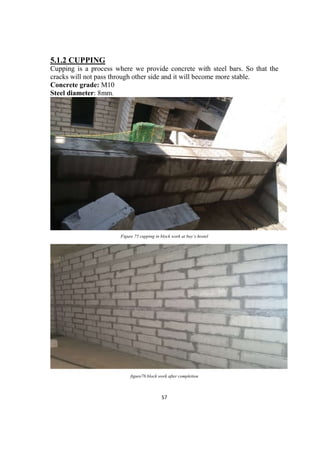
5.1.2 CUPPING
Cupping is a process where we provide concrete with steel bars. So that the
cracks will not pass through other side and it will become more stable.
Concrete grade: M10
Steel diameter: 8mm.
Figure 75 cupping in block work at boy’s hostel
figure76 block work after completion
58
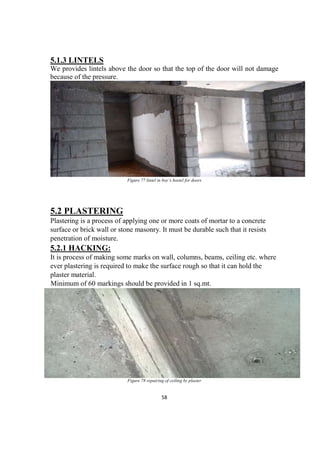
5.1.3 LINTELS
We provides lintels above the door so that the top of the door will not damage
because of the pressure.
Figure 77 lintel in boy’s hostel for doors
5.2 PLASTERING
Plastering is a process of applying one or more coats of mortar to a concrete
surface or brick wall or stone masonry. It must be durable such that it resists
penetration of moisture.
5.2.1 HACKING:
It is process of making some marks on wall, columns, beams, ceiling etc. where
ever plastering is required to make the surface rough so that it can hold the
plaster material.
Minimum of 60 markings should be provided in 1 sq.mt.
Figure 78 repairing of ceiling by plaster
59
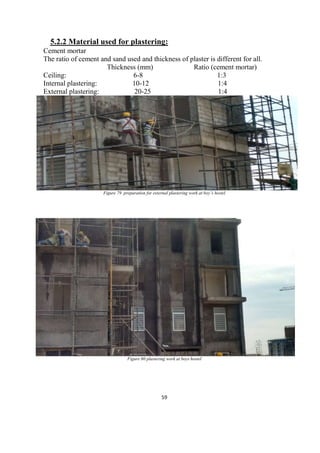
5.2.2 Material used for plastering:
Cement mortar
The ratio of cement and sand used and thickness of plaster is different for all.
Thickness (mm) Ratio (cement mortar)
Ceiling: 6-8 1:3
Internal plastering: 10-12 1:4
External plastering: 20-25 1:4
Figure 79 preparation for external plastering work at boy’s hostel
Figure 80 plastering work at boys hostel
60
5.3 FLOORING
Floors are horizontal elements which divide the building into different floors for
the purpose of creating more space of accommodation in a restricted area.
There are many types of floor finishes such as mosaic tiling, kota stone tiles, IPS
flooring etc.
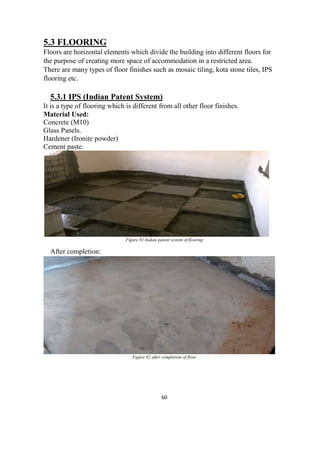
5.3.1 IPS (Indian Patent System)
It is a type of flooring which is different from all other floor finishes.
Material Used:
Concrete (M10)
Glass Panels.
Hardener (Ironite powder)
Cement paste.
Figure 81 Indian patent system of flooring
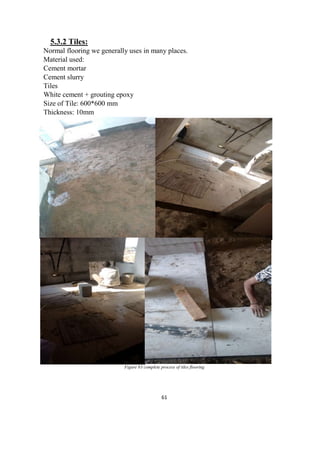
After completion:
Figure 82 after completion of floor
61
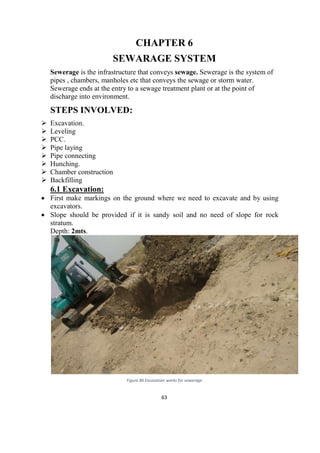
5.3.2 Tiles:
Normal flooring we generally uses in many places.
Material used:
Cement mortar
Cement slurry
Tiles
White cement + grouting epoxy
Size of Tile: 600*600 mm
Thickness: 10mm
Figure 83 complete process of tiles flooring
62
5.4 PUTTY WORK
After the completion of plastering (internal, external and ceiling). We apply Putty
to walls, ceiling, etc. to obtain a smooth surface. it also provided for esthetic
appearance.
Colour: White
No.of coats: 2
We need to add 12 lit of water in 25kg of putty powder to make paste.
Figure 84 prime coat of putty finish
After completion of 2 coats.
Figure 85 final coat of putty work
63
CHAPTER 6
SEWARAGE SYSTEM
Sewerage is the infrastructure that conveys sewage. Sewerage is the system of
pipes , chambers, manholes etc that conveys the sewage or storm water.
Sewerage ends at the entry to a sewage treatment plant or at the point of
discharge into environment.
STEPS INVOLVED:
 Excavation.
 Leveling
 PCC.
 Pipe laying
 Pipe connecting
 Hunching.
 Chamber construction
 Backfilling
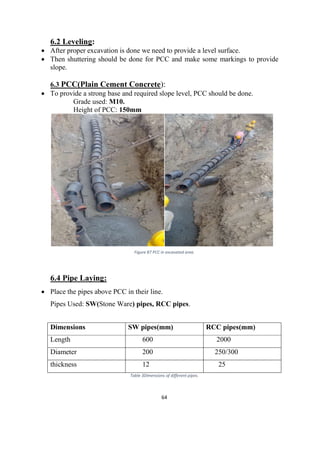
6.1 Excavation:
 First make markings on the ground where we need to excavate and by using
excavators.
 Slope should be provided if it is sandy soil and no need of slope for rock
stratum.
Depth: 2mts.
Figure 86 Excavation works for sewerage
64
6.2 Leveling:
 After proper excavation is done we need to provide a level surface.
 Then shuttering should be done for PCC and make some markings to provide
slope.
6.3 PCC(Plain Cement Concrete):
 To provide a strong base and required slope level, PCC should be done.
Grade used: M10.
Height of PCC: 150mm
Figure 87 PCC in excavated area.
6.4 Pipe Laying:
 Place the pipes above PCC in their line.
Pipes Used: SW(Stone Ware) pipes, RCC pipes.
Dimensions SW pipes(mm) RCC pipes(mm)
Length 600 2000
Diameter 200 250/300
thickness 12 25
Table 3Dimensions of different pipes.
65
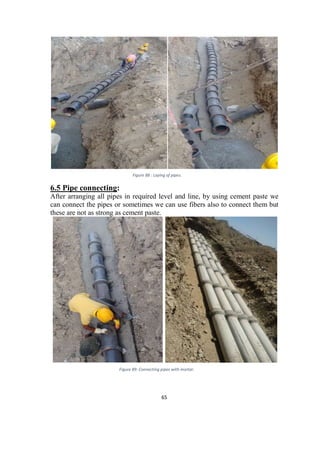
Figure 88 : Laying of pipes.
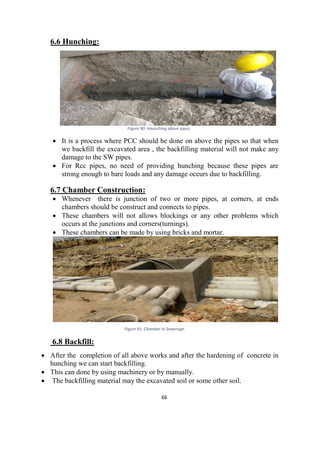
6.5 Pipe connecting:
After arranging all pipes in required level and line, by using cement paste we
can connect the pipes or sometimes we can use fibers also to connect them but
these are not as strong as cement paste.
Figure 89: Connecting pipes with mortar.
66
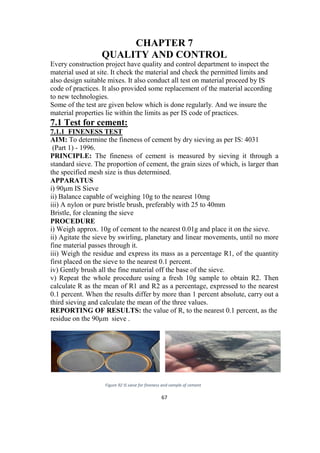
6.6 Hunching:
Figure 90: Haunching above pipes.
 It is a process where PCC should be done on above the pipes so that when
we backfill the excavated area , the backfilling material will not make any
damage to the SW pipes.
 For Rcc pipes, no need of providing hunching because these pipes are
strong enough to bare loads and any damage occurs due to backfilling.
6.7 Chamber Construction:
 Whenever there is junction of two or more pipes, at corners, at ends
chambers should be construct and connects to pipes.
 These chambers will not allows blockings or any other problems which
occurs at the junctions and corners(turnings).
 These chambers can be made by using bricks and mortar.
Figure 91: Chamber in Sewerage.
6.8 Backfill:
 After the completion of all above works and after the hardening of concrete in
hunching we can start backfilling.
 This can done by using machinery or by manually.
 The backfilling material may the excavated soil or some other soil.
67
CHAPTER 7
QUALITY AND CONTROL
Every construction project have quality and control department to inspect the
material used at site. It check the material and check the permitted limits and
also design suitable mixes. It also conduct all test on material proceed by IS
code of practices. It also provided some replacement of the material according
to new technologies.
Some of the test are given below which is done regularly. And we insure the
material properties lie within the limits as per IS code of practices.
7.1 Test for cement:
7.1.1 FINENESS TEST
AIM: To determine the fineness of cement by dry sieving as per IS: 4031
(Part 1) - 1996.
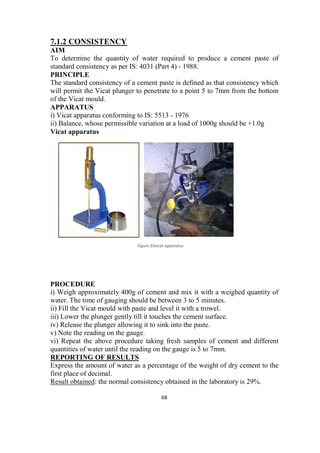
PRINCIPLE: The fineness of cement is measured by sieving it through a
standard sieve. The proportion of cement, the grain sizes of which, is larger than
the specified mesh size is thus determined.
APPARATUS
i) 90μm IS Sieve
ii) Balance capable of weighing 10g to the nearest 10mg
iii) A nylon or pure bristle brush, preferably with 25 to 40mm
Bristle, for cleaning the sieve
PROCEDURE
i) Weigh approx. 10g of cement to the nearest 0.01g and place it on the sieve.
ii) Agitate the sieve by swirling, planetary and linear movements, until no more
fine material passes through it.
iii) Weigh the residue and express its mass as a percentage R1, of the quantity
first placed on the sieve to the nearest 0.1 percent.
iv) Gently brush all the fine material off the base of the sieve.
v) Repeat the whole procedure using a fresh 10g sample to obtain R2. Then
calculate R as the mean of R1 and R2 as a percentage, expressed to the nearest
0.1 percent. When the results differ by more than 1 percent absolute, carry out a
third sieving and calculate the mean of the three values.
REPORTING OF RESULTS: the value of R, to the nearest 0.1 percent, as the
residue on the 90μm sieve .
Figure 92 IS sieve for fineness and sample of cement
68
7.1.2 CONSISTENCY
AIM
To determine the quantity of water required to produce a cement paste of
standard consistency as per IS: 4031 (Part 4) - 1988.
PRINCIPLE
The standard consistency of a cement paste is defined as that consistency which
will permit the Vicat plunger to penetrate to a point 5 to 7mm from the bottom
of the Vicat mould.
APPARATUS
i) Vicat apparatus conforming to IS: 5513 - 1976
ii) Balance, whose permissible variation at a load of 1000g should be +1.0g
Vicat apparatus
PROCEDURE
i) Weigh approximately 400g of cement and mix it with a weighed quantity of
water. The time of gauging should be between 3 to 5 minutes.
ii) Fill the Vicat mould with paste and level it with a trowel.
iii) Lower the plunger gently till it touches the cement surface.
iv) Release the plunger allowing it to sink into the paste.
v) Note the reading on the gauge.
vi) Repeat the above procedure taking fresh samples of cement and different
quantities of water until the reading on the gauge is 5 to 7mm.
REPORTING OF RESULTS
Express the amount of water as a percentage of the weight of dry cement to the
first place of decimal.
Result obtained: the normal consistency obtained in the laboratory is 29%.
Figure 93vicat apparatus
69
7.1.3 INITIAL AND FINAL SETTING TIME
AIM
To determine the initial and the final setting time of cement as per IS: 4031
(Part 5) - 1988.
APPARATUS
i) Vicat apparatus conforming to IS: 5513 - 1976
ii) Balance, whose permissible variation at a load of 1000g should be +1.0g
iii) Gauging trowel conforming to IS: 10086 - 1982
PROCEDURE
I) prepare a cement paste by gauging the cement with 0.85 times the water
required to give a paste of standard consistency.
ii) Start a stop-watch, the moment water is added to the cement.
iii) Fill the Vicat mould completely with the cement paste gauged as above, the
mould resting on a non-porous plate and smooth off the surface of the paste
making it level with the top of the mould. The cement block thus prepared in the
mould is the test block.
A) INITIAL SETTING TIME
Place the test block under the rod bearing the needle. Lower the needle gently in
order to make contact with the surface of the cement paste and release quickly,
allowing itto penetrate the test block. Repeat the procedure till the needle fails
to pierce the test block to a point 5.0 ± 0.5mm measured from the bottom of the
mould.
The time period elapsing between the time, water is added to the cement and the
time, the needle fails to pierce the test block by 5.0 ± 0.5mm measured from the
bottom of the mould, is the initial setting time.
B) FINAL SETTING TIME
Replace the above needle by the one with an annular attachment. The cement
should be considered as finally set when, upon applying the needle gently to the
surface of the test block, the needle makes an impression therein, while the
attachment fails to do so. The period elapsing between the
time, water is added to the cement and the time, the needle makes an impression
on the surface of the test block, while the attachment fails to do so, is the final
setting time.
REPORTING OF RESULTS
The results of the initial and the final setting time should be reported to the
nearest five minutes. Final settling time comes as 8 hours.
70
7.2TESTS ON AGGREGATES
7.2.1 SIEVE ANALYSIS
AIM
To determine the particle size distribution of fine and coarse aggregates by
sieving as per IS: 2386 (Part I) - 1963.
PRINCIPLE
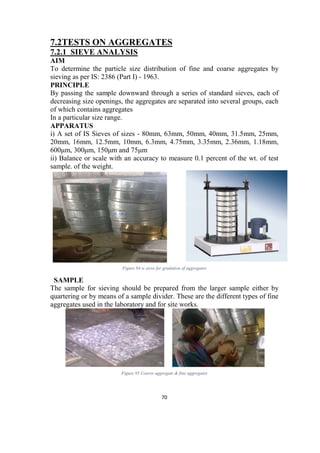
By passing the sample downward through a series of standard sieves, each of
decreasing size openings, the aggregates are separated into several groups, each
of which contains aggregates
In a particular size range.
APPARATUS
i) A set of IS Sieves of sizes - 80mm, 63mm, 50mm, 40mm, 31.5mm, 25mm,
20mm, 16mm, 12.5mm, 10mm, 6.3mm, 4.75mm, 3.35mm, 2.36mm, 1.18mm,
600μm, 300μm, 150μm and 75μm
ii) Balance or scale with an accuracy to measure 0.1 percent of the wt. of test
sample. of the weight.
Figure 94 is sieve for gradation of aggregates
SAMPLE
The sample for sieving should be prepared from the larger sample either by
quartering or by means of a sample divider. These are the different types of fine
aggregates used in the laboratory and for site works.
Figure 95 Coarse aggregate & fine aggregates
71
PROCEDURE
i) The test sample is dried to a constant weight at a temperature of 110 +5 0
c
and weighed.
ii) The sample is sieved by using a set of IS Sieves.
iii) On completion of sieving, the material on each sieve is weighed.
iv) Cumulative weight passing through each sieve is calculated as a percentage
of the total sample weight.
v) Fineness modulus is obtained by adding cumulative percentage of aggregates
retained on each sieve and dividing the sum by 100.
For sand sieve is taken as 10mm, 4.75mm, 2.36mm, 1.18mm, 600micron,
300micron, 150micron.
REPORTING OF RESULTS
The results should be calculated and reported as:
Figure 96 report for particle size distribution
72
7.2.2Specific gravity of fine aggregates
Aim: to determine the specific gravity of fine aggregates as per IS 2386 part 3.
Apparatus : pycnometer , sample, water, weight balance,
Figure 97 specific gravity test.
Procedure:
i) Take the weight of pycnometer.
ii) Take the weight of pycnometer with half fill sand.
iii) Weight the pycnometer with sand and water.
iv) Weight the pycnometer with filled water.
Figure 98 specific gravity report
73
7.2.3)Silt and clay content of sand:
Aim: To determine silt content in sand as per IS 2386 part 2.
Apparatus: weigh balance, sample, 75 micron is sieve.
Figure 99 silt content report
74
7.3 Test on concrete
7.3.1 workability (slump)
AIM:
To determine the workability of fresh concrete by slump test as per IS: 1199 -
1959.
APPARATUS
i) Slump cone
ii) Tamping rod
Figure 100 apparatus for slump test
PROCEDURE
i) The internal surface of the mould is thoroughly cleaned and applied with a
light coat of oil.
ii) The mould is placed on a smooth, horizontal, rigid and non-absorbent
surface.
iii) The mould is then filled in four layers with freshly mixed concrete, each
approximately to one-fourth of the height of the mould.
iv) Each layer is tamped 25 times by the rounded end of the tamping rod
(strokes are distributed evenly over the cross-section).
v) After the top layer is tamped, the concrete is struck off the level with a
trowel.
vi) The mould is removed from the concrete immediately by raising it slowly in
the vertical direction.
75
vii) The difference in level between the height of the mould and that of the
highest point of the subsided concrete is measured.
viii) This difference in height in mm is the slump of the concrete.
Figure 101 slump cone test on fresh concrete
REPORTING OF RESULTS
The slump measured should be recorded in mm of subsidence of the specimen
during the test. Any slump specimen, which collapses or shears off laterally
gives incorrect result and if this occurs, the test should be repeated with another
sample. If, in the repeat test also, the specimen shears, the slump should be
measured and the fact that the specimen sheared, should be recorded.
Results: slump observed as 60 mm.
76
7.3.2. Compressive strength testing
Aim :To establish Compressive strength of concrete sample for acceptance
Apparatus :
Compressive Testing machine having adequate capacity.
Weighing Balance,
Measuring Scale.
Figure 102 compression testing machine
Procedure :
· Remove the cubes required for testing from curing tank wipe clean of water
and air dry them to surface dryness.
· Stack cubes in sequence as per mix, dates, locations etc.
· Record the actual surface area ( Sq cm)of the cube which will be in contact
with platen of CTM ( A in cm2 or mm2 ).
· Weigh the cubes and record the weights in the register in g.
· Place the cube on platen centrally keeping trowelled side in front.
· Position the top platen on cube surface. See that there is no gap left between
cube top and platen.
· Load the CTM at desired speed without any shocks.( Pointer and needle shall
move together)
77
· When crushing takes place in the specimen, needle will start falling back but
pointer will remain at maximum reading.
· Record the reading shown by pointer viewing perpendicular to the face of dial.
( Load applied in kN or tonn- W)
· Relieve the load from CTM. Remove the cube. Clean the platens.
· Check the features of cube failure. Good failure is that cube mass retained
shall have concavity on sides. If failures are occurring consistently by crack
developing only on one side it means cubes are eccentrically loaded. If cracks
are always developed centrally means point load is getting applied due to
convexity of platens. Remedial measures are required to be taken for this.
Calculations:
Compressive Stress (c) in N / mm2 or Kg / cm2 as below:
c = Wx1000 /A in N/mm2 or Kg /cm2
Average of the set of three or more cubes to be recorded (c’).
· When three or more cubes from single batch/lot is tested, max variation is
Allowed +/- 15%. If any cube is showing more variation, result of that cube is
Discarded and average of two or more is to be taken.
Recording:
· Record is generated as per the sample format given in chronological order.
CUBES TESTED FOR COMPRESSIVE STRENGTH(150*150*150)MM3
Figure 103 cubes for CTM

IIT INDORE CUONSTRUCTION OVERVIEW

  • 1.
    i CONSTRUCTION OF PERMANENTCAMPUS OF INDIAN INSTITUTE OF TECHNOLOGY INDORE A PROJECT REPORT Submitted by DILIP PATIDAR in partial fulfillment for the award of the degree of BACHELOR OF TECHNOLOGY IN CIVIL ENGINEERING Under The Guidance of Submitted by MR. PRAVEEN PANDEY DILIP PATIDAR LECTURER 11210187 LOVELY PROFESSIONAL UNIVERSITY Phagwara–144401, Punjab (India)
  • 2.
    ii LOVELY PROFESSIONAL UNIVERSITY CERTIFICATE Certifiedthat this project report entitled “CONSTRUCTION OF PERMANENT CAMPUS OF INDIAN INSTITUTE OF TECHNOLOGY INDORE” submitted by “DILIP PATIDAR , 11210187” student of Civil Engineering Department, Lovely Professional University, Phagwara, Punjab who carried out the project work under my supervision. This report has not been submitted to any other university or institution for the award of any degree. SIGNATURE SIGNATURE NAME: NAME: HEAD OF DEPARTMET SUPERVISOR SCHOOL OF CIVIL ENGINEERING (LECTURER) SCHOOL OF CIVIL ENGINEERING
  • 3.
    iii ACKNOWLEDGEMENT With deep referenceand profound gratitude I express my sincere thanks to Mr. Pramod Mishra (Deputy General Manager-HRD) for giving me an opportunity to do training at simplex infrastructure limited. Also I would like to thank Mr. Rajesh Mishra (Site incharge) who allowed me to work at construction site. Also I would like to thank to Mr. Prokash Mitra (Sr. Manager-construction), Mr. Biswanath Moulick(Manager-Construction) .I would like to specially thanks to my training guide Mr. Sunil Chaudhary (AM-construction) who helped me at every stage of my training. . I also thankful to Mr. Ashok Tiwari, Mr. Bunty Bag, Mr. Chetan Patel, Mr.Subham Sadhukhan who help me at the working sites, explaining and giving me all the information I need to complete this report. At last I would like to convey my thanks to Mr. Mahesh Prashad Gupta (HR-Head) and Mr. Naveen Mehrotra(senior- officer) and all the members of the staff of simplex infrastructure limited who have helped me at every stage of training. I would like to thank Mrs. Mandeep Kaur (HoD, SCHOOL OF CIVIL ENGINEERING, LPU),Mr. Praveen Pandey (Training Mentor, Lecturer, Civil, LPU), Mr. Jaspreet Singh(Mentor, Placement coordinator, LPU) without their co-operation it was impossible to reach up to this stage.
  • 4.
    iv ABSTACT Construction now aday becomes a industry where work is progressing day and night continuously, government also works on the infrastructure development for country included corporate building, institutional building and other residential building. This report contents the construction of campus of an government institutional building “INDIAN INSTITUTE OF TECHNOLOGY, INDORE” which is located in Indore city of Madhya Pradesh. The project is executed by SIMPLEX INFRASTRUCTURE LIMITED. The report content the introduction and overview part of project site and also content the process of general civil work to be executed at site and technology like waffle slab, replacement of bricks work by block work, partial replacement of cement by fly ash in concrete etc. in the field of civil engineering. Different types of buildings are constructed over campus like school building, studio apartment, podium building, boys hostel, water treatment plant, sewage treatment plant, director residence etc. The designer design the buildings in such a way that buildings are earthquake resistance, some of the building of the campus are fully air conditioned. There is a proper design for fire-fighting system in the building. the podium building is link to each sub part through bridge. The report content process of construction from shuttering to curing included steel fixing, binding , bar bending schedule, concreting, deshuttering etc.it also content the failure of concrete and its solution. At last the report is having overview of project that what I have learn in my internship.
  • 5.
    v TABLE OF CONTENT TOPICPAGE NO.  Acknowledgement iii  Abstract iv  List of figure viii  List of table xi  Symbols/abbreviations xi  Project name and location xii  About company xiii  Introduction… 1-6  CHAPTER 1:Shuttering…. 7-15  1.1 Scaffolding 8  1.2Shuttering material 9-11  1.2.1 Vertical 9  1.2.2 Bracing or horizontal 9  1.2.3 Batten 10  1.2.4 Primary section 11  1.2.5 Jack 11  1.3 Shuttering in column 12  1.4 Waffle shuttering 12-13  1.5 Shuttering in clarifier tank 14  1.6 Shuttering in UGT 14  1.7 SUNK 15  1.8 Important point for shuttering 16  1.9 Checking 16  CHAPTER 2: Reinforcement of structural building….. 17-29  2.1 Foundation 18-19  2.2 Beam 20-22  2.3Column 23-24  2.4 Shear wall 25  2.5 Slab 26  2.6 Waffle slab 27  2.7 Staircase 28-2  CHAPTER 3: Bar bending schedule…… 30-35  3.1 B.B.S. for beams 31  3.2 B.B.S. for column 32
  • 6.
    vi  3.3 B.B.S.for slab 33  3.4 B.B.S. for staircase 34  3.5 Bar bending 35  CHAPTER4 :CONCRETING……. 36-51  4.1 Various operation in concreting 37  4.1.1 Batching of material 37  4.1.2 Baching plant 38  4.1.3Mixing of concrete material 39  4.1.4 Transporting of concrete 40  4.1.5 Placing of concrete 41 o A)Pump 41 o B)Placer boom 42 o C)Bucket and crane 43 o D)Chutes though transite mixer 43  4.1.6 Compaction of concrete 44  4.2 Types of concrete 44  4.2.1 PCC 44  4.2.2 RCC 44  4.2.3 Self compacted concrete 45  4.3 Grade of concrete 46  4.4 Components of concrete 46-48  4.4.1 Cement 46  4.4.2 Sulphate resisting portland cement 47  4.4.3 Aggregates 48  4.4.4Water 48  4.4.5Admixture 48-49  4.5 Problems in concreting 50-54  4.5.1 Bulging of concret 50  4.5.2 Honey combing 51  4.5.3Bleeding 52  4.5.4 Crakes at construction joint 53  4.5.5 Segregtion 54  CHAPTER 5 :Finishing work…… 55-61  5.1 Block work 55  5.1.1Process of laying 56  5.1.2Cupping 57  5.1.3Lintel 58  5.2 Plastering 58  5.2.1 Hacking 58  5.2.2 Material for plastering 59
  • 7.
    vii  5.3 Flooring60  5.3.1IPS (Indian patent system) 60  5.3.2Tiles 61  5.4 Putty works 62  CHAPTER 6:Sewarage system 63  6.1Excavation 63  6.2Leveling 64  6.3 PCC 64  6.4 Pipe laying 64  6.5 Pipe connecting 65  6.6Hunching 66  6.7Chamber construction 66  6.8 Backfilling 66  CHAPTER 7:Quality and control……. 67-77  7.1 Test for cement 67  7.1.1Fineness test 67  7.1.2Consistency 68  7.1.3Initial and final setting time 69  7.2Test for aggregates 70  7.2.1Sieve analysis 70  7.2.2Specific gravity of fine aggregates 72  7.2.3Silt and clay content of sand 73  7.3 Test on concrete 74  7.3.1Workability test(slump cone test) 74  7.3.2Compressive strength test 76
  • 8.
    viii LIST OF FIGURE FIGURE NO. DESCRIPTIONOF FIGURE PAGE NO. 1 Architectural view of POD 2 2 Execution phase of POD 2 3 Architectural view of studio apartment 3 4 Execution phase of studio apartment 3 5 Architectural view of boys hostel 4 6 Construction phase of boys hostel 4 7 Architectural view of director residence 5 8 Execution phase of director residence 5 9 View of school building 6 10 Constructed school building 6 11 Front view of shear wall shuttering at PHY 1 7 12 view of scaffolding in PHY -1 building 8 13 Scaffolding 8 14 Vertical used to support shuttering and staging 9 15 Bracing used to resist horizontal moment of vertical 9 16 Batten provided at curved shear wall 10 17 batten provided below the slab shuttering 10 18 Primary section 11 19 U-jack fixed in staircase shuttering 11 20 Front view of column in PHY-2 building at 3rd floor 12 21 Waffle shuttering at 3 rd floor PHY 1 13 22 Ceiling of slab after deshuttering 13 23 Shuttering in clarifier at STP 14 24 Shuttering in UGT 14 25 Sunk in slab for cantilever part 15 26 Precast for sunk at site 15 27 Ply for shuttering of standard size 16 28 View of structural element of building PHY2 third floor 17
  • 9.
    ix 29 Excavation andPCC in foundation at STP 18 30 Steel fixing and shuttering in foundation 19 31 Concrete pouring in raft foundation by boom placer 19 32 Detailed drawing of the beam with side 20 33 Cross section of beams 21 34 View of beam having maximum steel in the floor 21 35 Two beams crossing each other 22 36 Column at HVSC building 23 37 View of columns at boy’s hostel 24 38 Plan of fourth floor of PHY-1 24 39 Shear wall at PHY-1 at fourth floor 25 40 View of fourth floor slab after steel fixing 26 41 Waffles when fitting before steel fixing 27 42 Floor view of CSE-2 5th floor 27 43 Drawing of staircase cross section 28 44 Steel fixing in staircase 28 45 Links and ring provided in staircase 29 46 Staircase ready for concreting 29 47 BBS sheet for calculate steel requirement 30 48 Bar bending machine 35 49 Bar Bending by manually 35 50 Fresh concrete from transit mixer 36 51 Process of concreting 37 52 Batching plant 38 53 Batching of material at batching plant 38 54 Silo of cement 39 55 Transit mixer at batching plant 40 56 Pump for concreting at PHY 1 fourth floor 41 57 Boom placer 42 58 Boom placer for concreting at PHY 1 site 42 59 Concreting by bucket with the help of crane at PHY 3 third floor 43 60 Concreting for wall by chutes from transit mixer 43
  • 10.
    x 61 Compaction ofconcrete 44 62 Flow test for SCC 45 63 SCC pouring at PHY 1 third floor 45 64 Cement sample 47 65 Fine AGGRAGATES AND COURSE AGGRAGATES 48 66 Admixture tank 49 67 Bulging of concrete due to lose shuttering 50 68 Honey combing in column due to less vibration in PHY-3 51 69 Shear wall after grouting 52 70 Cracks at construction joint 53 71 NITO bond applied on old concrete 53 72 Honey combing in lintel beam and segregation 54 73 Block work in room at PHY-1 55 74 Process of laying block 56 75 Cupping in block work at boy’s hostel 57 76 Block work after completion 57 77 Lintel in boy’s hostel for doors 58 78 Repairing of ceiling by plaster 58 79 Preparation for external plastering work at boy’s hostel 59 80 Plastering work at boys hostel 59 81 Indian patent system of flooring 60 82 After completion of floor 60 83 Complete process of tiles flooring 61 84 Prime coat of putty finish 62 85 Final coat of putty work 62 86 Excavation works for sewerage 63 87 PCC in excavated area. 64 88 laying of pipes. 65 89 connecting pipes with mortar 65 90 Hunching above pipe 66 91 Chamber in Sewerage 66 92 IS sieve for fineness and sample of cement 67
  • 11.
    xi 93 VICAT apparatus68 94 Is sieve for gradation of aggregates 70 95 Coarse aggregate & fine aggregates 70 96 Report for particle size distribution 71 97 Specific gravity test 72 98 Specific gravity report 72 99 Silt content report 73 100 Apparatus for slump test 74 101 Slump cone test on fresh concrete 75 102 Compression testing machine 76 103 Cubes for CTM 77 LIST OF TABLE Table no. Description Page no. 1 details for steel bar used in reinforcement 30 2 NOMINAL MIX DESIGN FOR CONCRETE 46 3 Dimensions of different pipes. 64 SYMBOLS/ABBREVIATIONS SYMBOL ABBREVIATIONS Dia. Diameter STP Sewage Treatment Plant WTP Water Treatment Plant SRC Sulphate Resisting Cement. SRCC Sulphate Resisting Cement Concrete Mm Millimeter Mts Meters Cum Cubic meter BBS Bar Bending Schedule w.r.t With respect to
  • 12.
    xii PROJECT NAME ANDLOCATION CONSTRUCTION OF PERMANENT CAMPUS IIT, INDORE THE PROJECT SITE IS SITUATED IN VILLAGE SIMROL WHICH IS 25 KM FROM INDORE ON KHANDWA INDORE STATE HIGHWAY. THE PROJECT IS EXECUTED BY SIMPLEX INFRASTRUCTURE LIMITED. WHILE THE SUPERVISION IS DONE BY IIT INDORE WITH JOIN ADVENTURE OF MACON LIMITED AS CUNSULTANT.THE DESIGN WAS DONE BY ARCOP ASSOCIATES PRIVATE LIMITED.
  • 13.
    xiii SIMPLEX INFRASTURCTURE LTD. SIMPLEXINFRASTRUCTURES LTD. IS A DIVERSIFIED COMPANY ESTABLISHED IN 1924 AND EXECUTING PROJECTS IN SEVERAL SECTORS LIKE TRANSPORT, ENERGY & POWER, MINING, BUILDINGS, MARINE, AND REAL ESTATE ETC. SIMPLEX IS ONE OF THE CONSTRUCTION LEADERS IN INDIA FOR NEARLY 90 YEARS EXECUTING PROJECTS WITH CONSISTENT QUALITY ASSURANCE, COST CONTROL AND ADHERENCE TO MILESTONES IN A SAFE ENVIRONMENT AS PER THE CUSTOMER REQUIREMENTS. IT PROMOTES THE CULTURE OF SHARING RICH AND VARIED EXPERIENCE WITH STAFF MEMBERS, AS ALSO WITH CLIENTS AND THEREBY BENEFITS AND HELPS THE GROWTH OF THE CONSTRUCTION FRATERNITY AND SOCIETY AT LARGE. THE COMPANY HAS BEEN CLOSELY ASSOCIATED WITH THE COUNTRY’S INFRASTRUCTURE BUILDING WITH OVER 2600 COMPLETED PROJECTS SPANNING ALMOST ALL THE GAMUT OF CONSTRUCTION INDUSTRY. .
  • 14.
    1 INTRODUCTION The project developmentconsists of the construction Works at INDIAN INSTITUTE OF TECHNOLOGY, INDORE and comprises of School, Sports Hall, Studio Apartment, Gate, POD3, Girls Hostel, Boys Hostel, Director Residence, and Services Buildings & Development of site as per Master Plan. All buildings are RCC framed structures, and Form Finish Concrete (as specified), Steel Structure, Finishing, Facade and Site Development Works including WTP,STP, Main receiving substation, Electrical Substations, Central HVAC Plant, Underground Water Tank. The work is estimated to Cost Rs.347.00 Crore.for phase- A only. The project work is to be executed on Design Build Lump sum basis for Part A & on Item Rate Basis for Part B for construction of the New Campus of IIT Indore Phase 1A (a) being constructed in village Simrol which is situated about 25 KM from Indore on Indore-Khandwa road. The scope of work includes broadly construction of following: Construction of Permanent Campus of IIT INDORE (Part-A) comprising of following units: 1. Academic Pod 3 (Approx.47582.73 Sqm) 2. Studio Apartments (Plot SA02 South Block No 1) (Approx.19565 Sqm) 3. Boys Hostel (Plot BH-02) (Approx.14228 Sqm) 4. Directors Residence (Plot DR) (Approx.612 Sqm) 5. Indoor Sports Center (Plot SP 01) (Approx.4380 Sqm) 6. Enabling School Building (Plot SC) (Approx.8400 Sqm) 7. Entry Gates (Gate 01) Utility Buildings and services for: 1. Sewage Treatment Plant (PLOT NO SV 01) 2. Water Treatment Plant (SV 03) 3. Main Receiving Substation M.R.S & ESS 13 (SV 02) 4. ESS 02 (SV 10) 5. ESS 05 (SV 12) 6. ESS 07a (SV 05) 7. Central HVAC Plant (Sv04) including Soft Water Plant 8. Underground Water Tank (UGT –G; SV 22) 9. Underground Water Tank (UGT –A; SV 29) 10. Underground Water Tank (UGT –B; SV 25) The following works to be executed on item rate contract shall be covered under Part-B of the scope: 1. Road Network 2. Sewerage Network 3. Storm water drainage 4. HVAC tunnel including inserts 5. Flushing line 6. Water supply 7. Civil works for electrical cable route 8. Civil works for IT route 9. Culverts and road crossing 10. Any other facilities not covered in Part-A and necessary for completion of project
  • 15.
    2 ACADEMIC POD Figure 1architectural view of POD3 Figure 2 execution phase of POD 3 This building is a academic building and having maximum number of structure it included PHY1 (G+4),PHY2(G+5) PHY3(G+4) CSE1(G+5) CSE2(G+6) all five structure having different floor area And having 4200 mm floor height each from first floor. The maximum floor area of building CSE 1 (1714 sqm) and minimum of PHY-2(1085 sqm).the highest building is CES2. The most critical building is PHY1 having 6 meter cantilever part both side. This POD is construct for academic purpose and having the all laboratories in this. The maximum of the cost of project is release through only POD.the estimated cost is Rs. 185 crore approximate.
  • 16.
    3 STUDIO APARTMENT Figure 3architectural view of studio apartment Figure 4 execution phase of studio apartment The complex comprises 2 residential building each consisting of 6 similar units combined together using expansion joint. Each building consists of 24 1BHK studio apartment with individual kitchen and bathroom for Ph d student. The building is of ground +5 upper floors (3200 mm each ) height.
  • 17.
    4 BOYS HOSTEL Figure 5architectural view of boys hostel Figure 6 construction phase of boys hostel The hostel block consists of 18 towers, each tower have five numbers single bed room apartments. The building is of ground +5 upper floor separated by expansion joint.
  • 18.
    5 DIRECTOR’S RESIDENCE Figure 7architectural view of director resident Figure 8 execution phase The director residence is construct for the permanent stay of Director of IIT Indore. The estimated cost is rupees 2.5 crore approximate. The bungalow is made dust free and air conditioned.
  • 19.
    6 SCHOOL BUILDING Figure 9view of school building Figure 10 constructed school building This building is a two storey school building which takes shape of an elongated arc along the north-south cardinal direction. It’s a higher secondary school consisting of classrooms, labs, library, and small kitchen &dining. The building is of ground (4500)+2 upper floors(4000 mm each ) height.
  • 20.
    7 There are variouswork and process done in general civil work and it should have a sequence and followed step by step. some of process are given below are…… CHAPTER 1 SHUTTERING Shuttering or Form work is the term used for temporary timber, plywood, metal or other material used to provide support to wet concrete mix till it gets strength for self-support. It provides supports to horizontal, vertical and inclined surfaces or also provides support to cast concrete according to required shape and size. The form work also produces desired finish concrete surface. The oiling is done before shuttering on the wood board to prevent the problem of stick wood with concrete. If oiling is not done properly then honeycomb structure will arise on surface. The size of board is generally 1220mm wide and 2440mm height. thickness may be 6mm or 12mm .Jakes are used to support frame. Figure 11 front view of a shear wall shuttering at PHY 1 There are different types of Shuttering used in construction purpose like plywood shuttering, aluminum shuttering etc. Shuttering is consists of many material and then they are assembled to provided supports. every material have specific dimension and used according to requirement. The weight of Sutter also plays an important role it should have less weight and high strength. the weight of a plywood having size 1220*2440*12 mm are 32 to 35 kg. Waller Wing nut
  • 21.
    8 1.1 SCAFFOLDING: The processof assembling verticals, bracing and jacks with the help of cup lock arrangement to supports the horizontal slab and cantilever parts of slab is known as scaffolding. This also used as temporary support for plastering and other all work which should be carried out at height. Figure 12 view of scaffolding in PHY -1 building Figure 13 scaffolding
  • 22.
    9 1.2SHUTTRING MATERIAL Some ofthe material are: vertical, bracing, batten, channel etc. 1.2.1 Vertical: This are used to support the horizontal shutter above it, they are placed vertical by holding rods(bracing). it can take 1.5 ton of weight. The height of the vertical may varies from 1000mm to 3000 mm and used as per requirement. it have the outer diameter of 48mm and inner diameter of 40 mm. Figure 14 vertical used to support shuttering and staging 1.2.2 Bracing or horizontal: This are used to hold the vertical part at some distance with the help of cup lock. This are made of iron and painted to prevent from corrosion. Also they have a taped section at the both end which puts inside the cup lock when they arranged. Figure 15 bracing used to resist horizontal moment of vertical
  • 23.
    10 1.2.3 Batten: Batten isused below the ply of slab shuttering to transfer the load from ply to jack and to verticals so on. This has cross section of 3:4 i.e. 75mm to 100 mm. this is made up of wood. They do not have more strength but they can transfer Figure 16 batten provided at curve shear wall Figure 17 batten provided below the slab shuttering
  • 24.
    11 1.2.4 Primary section: Thisis used to transfer the load from waffle to jack plate this is made up of steel and having the dimension as per site requirement here it is of 300mm*100 mm. Figure 18 primary section 1.2.5 Jacks: Jacks are used to support the shuttering material and adjust the vertical height as per the site requirement. Generally we have Base jack, U-jack etc are uses in shuttering. Figure 19: U-jack fixed in staircase shuttering.
  • 25.
    12 1.3 Shuttering incolumn Shuttering in column is very critical because we have to consider horizontal load in it. since column having more height so all vertical load of concrete act some part as horizontal so we make such a arrangement with the help of Weller, washer, tie bars and wing nut. 1.4 Waffle shuttering Waffle shuttering is the shuttering in which we use waffle as shuttering leads to time saving and aesthetic appearance to ceiling. It is used for a longer span without any intermediate column. The number of beams is more in this type of slab. Waffle: it is a mould made up of fiber and used as shuttering takes less time to install and deshuttering. Also cover a large area at a time. Grid system is follow for this types of shuttering. The dimension of waffle at bottom is (1450mm*1200mm) without support and (1550mm*1300mm)with support and at the top reduced to (1350mm*1100mm) due to slope and the depth of the waffle is 675mm. Figure 20 front view of column in PHY-2 building at 3rd floor
  • 26.
    13 Figure 21 waffleshuttering at 3 rd floor PHY 1 Waffles are installed after ply is fixed on the batten. And between every waffle a 6mm ply is also provide to maintain the elevation of the beam. before installing the waffle we have to define the grid line according to shuttering drawing. Also after deshuttering support is provided to beam to resist short term deflection. Figure 22 ceiling of slab after deshuttering WAFFLE
  • 27.
    14 1.5 Shuttering inclarifier tank: The clarifier is used in the sewage treatment plant. In this round shuttering is provided with steel material. Jack are provided to support round shutter of steel . since this is round concrete wall for tank so having more load of concrete so steel shuttering is preferred. Figure 23 shuttering in clarifier at STP 1.6 Shuttering in UGT: In UGT shuttering is done similar to used in column or shear wall of the building but only the difference is that here tie rods are not used in shutter to fix one another but they provided a continue rods of steel supported by jacks inner as well as outer side. so it will help to leakage problem in UGT Figure 24 SHUTTERING IN UGT
  • 28.
    15 1.7 SUNK: This isthe part in slab having low level of bottom then normal level of slab and it is used to collect the raw water from rain and washroom and balcony. This is also used as on cantilever part of slab since it have less dead load. In this project after concreting in sunk a precast slab is used to fill that part from top but due to amendment in process they used insitu fixing of steel and concrete Figure 25 sunk in slab for cantilever part Figure 26 preparation for precast for sunk at site
  • 29.
    16 1.8 Important pointshould be considered at the time of shuttering:  The ply used for shuttering should be uniform and smooth.  The oiling is done before shutter fitting.  Clear cover should be maintained uniformly with the help of cover blocks.  Plum bob should be used to vertical checking.  It should be strong enough to withstand all types of dead and live loads.  The joints in the formwork should be tight against leakage of cement grout.  Construction of formwork should permit removal of various parts in desired sequences without damage to the concrete.  The material of the formwork should be cheap, easily available and should be suitable for reuse.  It should be as light as possible.  It should rest on firm base.  The formwork should be set accurately to the desired line and levels should have plane surface.  It should be rigidly constructed and efficiently propped and braced both horizontally and vertically, so as to retain its shape. 1.9 Checking: The material of the formwork should not warp or get distorted when exposed to the elements. After the fixing of shuttering for column we need to check whether it is in correct position according to drawing. For that we have two checks at site. 1. Horizontal checking 2. Vertical checking Figure 27 ply for shuttering of standard size
  • 30.
    17 CHAPTER 2 REINFORCEMENT OFSTRUCTURAL BUILDING Figure 28 view of the structural elements of building PHY-2 third floor Building is generally having the following structural elements:  Foundation  Beam  Column  Shear wall  Slab  Stair case All the elements are related to each other to transfer the load from top to bottom. If any of the element affect by the load distribution leads to effect on whole structure. When they are constructed we have to take all consideration of general civil work. Precaution should be taken when steel fixing binding etc work takes place.
  • 31.
    18 2.1 FOUNDATION The foundationsof the building transfer the weight of the building to the ground. While 'foundation' is a general word, normally, every building has a number of individual foundations, commonly called footings. Usually each column of the building will have its own footing. this is a part in the structure which play a vital role to support whole structure on it. There is raft foundation in this structure. The details of foundation parts of sewage treatment plant and construction process are in following part: 1)Excavation of soil strata& Plain cement concrete: At the starting the soil strata is excavated by excavators and it is dump at the site to refill it after construction of soil .the bad of soil is washed by water and dried by air compressor to avoid the problem of cracking of stone or hard strata after PCC.. PCC is done on excavated part of soil. M10 grade of concrete is used here in PCC. PCC is done for the removal of the uneven surface and to avoid the problem of see-page.it also help when we fix the steel rod at the PCC surface. Figure 29 excavation and pcc in foundation at STP 2) Steel assembling and binding& shuttering As per drawing the steel is assembled and bind with thin wires on the pcc surface .the most important part of construction is this only that we have to consider drawing at the time of steel assembling. pcc
  • 32.
    19 The shuttering shouldbe done as per requirement and other process of the shuttering is already discussed. The other consideration of the lapping, development length etc will be discussed later in detail. Figure 30 steel fixing and shuttering in foundation 3) Reinforced cement concrete Pouring of concrete was done by the boom placer. vibrator is also used while pouring so as to prevent concrete from segregation, voids, air bubbles. Figure 31 concrete pouring in raft foundation by boom placer
  • 33.
    20 2.2 BEAM This isa horizontal tension structural part in the building and placed on the column to provide supports at both ends. All the loads comes from slab is directly transferred to beam only. And whole slab is stands on side beams. There are two types of beam on the basis of support they rested are:  Primary beam or Main beam or framing beam: if it is rested on the column support.  Secondary beam or non-framing beam: if it is rested on another the beam. Figure 32 detailed drawing of the beam with side The details of the reinforcement is give the idea about how much steel is used in the beam and what is the position of it.  Top reinforcement: This is the reinforcement used in the beam at the top edge. The diameter of the bars may vary from 12 mm to 32 mm. this is generally less than bottom in simply supported beam while it is more in case of cantilever beam. in drawing below section 1-1 4 bars of 20 mm diameter. And in section 2-2 there are 4 number of bars having 20 mm diameter.  Bottom reinforcement :This is the reinforcement used at the bottom of the beam and it is always more than top reinforcement in simply supported beam and less in cantilever beam in section 1-1 4 number of 20mm diameter bars and in section 2-2 4 numbers of 20 mm diameter .  Top extra or top second layer: sometime this type of reinforcement is also apply when number of bars is more in compression here in section 2- 2 there are 4 numbers of 20 mm diameter while in section 1-1 no extra top reinforcement .
  • 34.
    21  Bottom extra:similarly there is extra reinforcement in bottom when more bars are in bottom in section 1-1 there are 4 numbers of 20 mm diameter while there are no extra bottom in section 2-2.  Spacer bar: this is the type of bar used to maintain the spacing between top main and top extra bars or bottom main or bottom extra bars the diameter of the spacer is 25 mm and length is taken as width of beam 2*clear cover. Figure 33 cross section of beams  Stirrup or ring: To hold the main reinforcement in a good manner we make a ring like structure called as stirrup and it is also used against shear force in the beam according to IS 456. This may be 2 legged, 4 legged or 8 legged and also depend on the bar diameter. It is perpendicular to main bars and spacing depend on the diameter of stirrup bars. The length of this can be find by depth and width of beam, extra length of the hook is also provided. Types of stirrups: Master ring Triangle ring Link etc. Figure 34 views of beam having maximum steel in the floor
  • 35.
    22  Spacing: thisis the distance between the stirrups. And it varies depend on the diameter of the stirrup bars. It have more spacing for higher diameter while it is less for lower diameter  Lapping: This is used to continue the bars in longitudinal direction since generally bar length is 12 meter but if need more than that the lapping is provided. It is depends on the bar diameter and it is as 45d to 60d.  Development length: this is provided in the beam to overcome with problem of bad bond or binding so minimum length is provided so it help to bind steel with concrete and make good grip.  Anchorage length: this is length provided in different shape by bend main bars at the end supports to make good connection between column and beam. The shape may be in L, Uor C. Figure 35 two beams crossing each other Important point related to beam  The Lapping should not be provided at the middle of beam since there is maximum bending moment.  The development length should be provided enough to make grip.  Ring should be bind properly with the bars with the help of binding wire.  Generally the steel used in beams is 0.3% of the cross section.
  • 36.
    23 2.3 COLUMN This isthe vertical compression member in the structural building. it transfer the load from beam to foundation directly. It also help to hold the building vertically if the column get failed. It will affect the whole structure of the building. The column is design in such a way that it may not buckle due to vertical load. Figure 36 column at HVSC building Reinforcement detail of column is given below  Vertical bars: this is the bars held vertically w.r.t. to the slab or beams. Generally the diameter of this bar is higher than the other members i.e. beam and slab. The quantity of bars is more in ground floor as compare to first floor and decrease continually when we go up side. The diameter of the bar is start from 12mm to 32 mm as per design.  Ring: this is used to hold the column vertically with hold all the bars in one ring. The length of the ring is depend on the dimension of the cross section of column. The hook provided at the end of ring and length of hook is depend on the bar size used. Generally hook length =10d (where d= diameter of ring) each side. There are different types of ring depend on size and shape o Master ring o Triangle ring o Link Column Plinth beam
  • 37.
    24  Lapping: lappingis provided to continue the vertical bar to next floor and the lapping zone is also decide before install the bars. The lap length is depend on the bar diameter. Figure 37 view of columns at boy’s hostel Important thing regarding column reinforcement are  There should be no lapping at the junction of slab, beam and column.  Bars should be straight when they are fix vertically.  There should be L type bars are used when they are fixing with foundation. Figure 38 plan of fourth floor of PHY-1
  • 38.
    25 2.4 SHEAR WALL Thisis the structural element of building same as the column but the dimension is different from column. This is generally used at the end side of the slab. When the length to width ratio is more than 4 then it is considered as shear wall. There are two numbers of columns at the both end of shear wall. The diameter of rods at the end of shear wall is higher than the inner one. Figure 39 shear wall at PHY-1 at fourth floor Reinforcement details of shear wall are given below: Vertical bars: As in column we have vertical bars in shear wall also since it is important more than the column to take axial load so it have higher diameter than column have. Size of the vertical bars may varies from 16mm to 32mm. as we go up side of structure the bars size may reduce. Ring: to hold the vertical bars we used ring same as the stirrups in the beam. Since the dimension of shear wall is large so we use combination of the rings given below:  Master ring: which holds more number of road in one ring.  Normal ring: which holds generally 4 numbers of vertical bars.  Link: it holds two bars at spacing. The shear wall is generally provided in earthquake resistance building.
  • 39.
    26 2.5 SLAB Slab isa structural member stands on the supporting beam .and it transfer the live load and dead load to the beam which applied on the whole floor. Since we have maximum shear force on the edges and corner so we put maximum steel at the corner in the slab. We also provide bend up bars to resist bending moment at center and share force at corner simultaneously. Figure 40 view of fourth floor slab after steel fixing Reinforcement details of slab are given below: Main bars: the bars which is stand on the support and put at the bottom is known as main bars this is always stand on the short wall of the structure. The diameter may varies as per requirement and drawing details. Distribution bars: this types of bars are stand on the main bars and may have less diameter then main bars. Chair bars: this types of the bar is provide between main and distribution bars to maintain the spacing. Also it support to electrical pipe lines provided inside the slab.
  • 40.
    27 2.6 WAFFLE ROOFOR SLAB Waffle roof is the roof in which we use waffle as shuttering leads to time saving and aesthetic appearance to ceiling. It is used for a longer span without any intermediate column. The number of beams are more in this type of slab. The dimension of waffle at bottom is (1450mm*1200mm) without support and (1550mm*1300mm) with support and at the top it is reduced to (1350mm*1100mm) due to slope and the depth of the waffle is 675mm. Figure 41 waffles when fitting before steel fixing Figure 42 floor view of CSE-2 5th floor
  • 41.
    28 2.7STAIRCASE : This isthe structural elements used to approach the upper floor or vice versa in the building. This is provide in the inclined form base to top or in rounded form. It have the steps to approach up side consists of riser and thread. Sometime mid land also provided intermediately. Figure 43 drawing of staircase cross section Figure 44 steel fixing in staircase
  • 42.
    29 Reinforcement details ofstaircase is given below: Bottom mat: this is the combination of the bottom main bars and bottom distribution bars. They make a net like structure known as bottom mat. Top mat: this is the combination of the top main bars and top distribution bars. They make a net like structure known as top mat. Chair bars: this is provided between top mate and bottom mat. Figure 45 links and ring provided in staircase Figure 46 staircase ready for concreting
  • 43.
    30 CHAPTER 3 BAR BENDINGSCHEDULE Bar bending schedule (or schedule of bars) is a list of reinforcement bars, vis-à- vis, a given RCC work item, and is presented in a tabular form for easy visual reference. This table summarizes all the needed particulars of bars – diameter, shape of bending, length of each bent and straight portions, angles of bending, total length of each bar, and number of each type of bar. This information is a great help in preparing an estimate of quantities. Figure 47 BBS sheet for calculate steel requirement Types of bar (Dia in mm) Unit weight Kg/m Cross section (mm*mm) No of bars in one ton 8 0.39 50.26 214 10 .61 78.53 136 12 .89 113.09 94 16 1.58 201.06 52 20 2.46 314.15 34 25 3.85 490.87 22 32 6.32 804.24 14 Table 1 details for steel bar used in reinforcement
  • 44.
    31 3.1 B.B.S forBeams: Procedure:  Calculation of cutting length of the bar: 1. Find the length and clear cover of the beam from the drawing. 2. Find the development length 3. Find the bend length 4. Find the cutting length *Cutting length = length of the bar + Development length – clear cover – bend length Bend length=no. of bends*2*d ‘d’ is the diameter of the bar Development length = d/2+50; ‘d’ is the depth after deducting the clear cover  Calculation of no of stirrups for the beam: 1. Find the depth, width and clear cover of the beam from the drawing. 2. Find the spacing of stirrups from the drawing. 3. Calculate no. of stirrups No. of stirrups = length of the beam/spacing +1 Note* If length of the beam/spacing is in decimals round off the fraction to next nearest number  Calculation of cutting length off stirrups: 1. Find the depth, width and clear cover of the column from the drawing. 2. Calculate the notch length. 3. Calculate the bend length. 4. Find the cutting length. Cutting length= 2*((depth-2*c/c) + (width-2*c/c)) + notch length – bend length Notch length= no. of notches*10*d Bend length=no. of bends*2*d ‘d’ is the diameter of the bar
  • 45.
    32 3.2 B.B.S forColumns: Procedure:  Calculation of cutting length for vertical bars: 1. Find the length of the vertical rod which is 5.5m or 6.5m generally 2. 300mm development length is provided at the raft-column junction to connect column with the raft. 3. Calculate the lap length and the bend length at every vertical bar connection Note* a) Lap length must not be provided at the column – slab junction. It must be provided above or below the slab only. b) Hence, the 12m bars are not cut in 1:1 ratio for same column *Cutting length = length of the bar + lap length –clear cover – bend length  Calculation of number of Stirrups: 1. Find the depth, width and clear cover of the column from the drawing. 2. Find the spacing of stirrups from the drawing. 3. Calculate no. of stirrups No. of stirrups = length of the column/spacing +1 Note* If length of the column/spacing is in decimals round off the fraction to next nearest number  Calculation of cutting length off stirrups: 1. Find the depth, width and clear cover of the column from the drawing. 2. Calculate the notch length. 3. Calculate the bend length. 4. Find the cutting length. Cutting length= 2*((depth-2*c/c) + (width-2*c/c)) + notch length – bend length Notch length= no. of notches*10*d Bend length=no. of bends*2*d ‘d’ is the diameter of the bar
  • 46.
    33 3.3 B.B.S forSlabs: Procedure:  Calculation of number of bars: 1. Find out the length(l), width(w) and depth(d) of the slab 2. Find the spacing’s for top bar and bottom bar from the drawing 3. Find the diameter of the bars for both distribution and main reinforcement in top and bottom 4. Main bars are arranged along the shorter span and distribution bars are arranged along the longer span 5. For number of bottom bars along the width divide the length by the given spacing after deducting the clear cover on both sides and add 1 to it. If the fraction is in decimals round off the number to next successive number and add 1 to it. 6. Repeat the same procedure for top bars by taking the spacing given for top bars No. of bars along width = ((length of the slab (l)-2*clear cover)/spacing of . Bars) +1 7. For number of bottom bars along the length divide the width by the given spacing after deducting the clear cover on both sides and add 1 to it. If the fraction is in decimals round off the number to next successive number and add 1 to it. 8. Repeat the same procedure for top bars by taking the spacing given for top bars. a) Every alternate top bar is cranked at an angle of 45 degrees at both the ends for a length of l/4 at 300mm spacing b) Top extra bar is provided at every crank with a length of l/4 + 50mm c) At every sunk portion bar is bent till the sunk portion at an angle of 45 degrees  Calculation of cutting length: 1. Find the length and clear cover of the slab 2. Find the bend length for top bar and bottom bar 3. Find the cutting length for top bar and bottom bar Cutting length (for bottom bar)= length of the slab – clear cover Cutting length (for top bar) = length of the slab - bend length – 2*clear cover along length + Depth of the slab - 2*clear cover along depth Cutting length for top extra = length of the bar/4 + 50mm
  • 47.
    34 3.4 B.B.S forStaircase: Procedure:  Calculation of no. of bars along Waist slab, Mid landing and lower landing: 1. Find out the length(l), width(w) and depth(d) of the slab 2. Find the spacing’s for top bar and bottom bar from the drawing 3. Find the diameter of the bars for both distribution and main reinforcement in top and bottom 4. Main bars are arranged along the shorter span and distribution bars are arranged along the longer span 5. For number of bottom bars along the width divide the length by the given spacing after deducting the clear cover on both sides and add 1 to it. If the fraction is in decimals round off the number to next successive number and add 1 to it. 6. Repeat the same procedure for top bars by taking the spacing given for top bars No. of bars along width = ((length of the slab (l)-2*clear cover)/spacing .Of bars) +1 7. For number of bottom bars along the length divide the width by the given spacing after deducting the clear cover on both sides and add 1 to it. If the fraction is in decimals round off the number to next successive number and add 1 to it. 8. Repeat the same procedure for top bars by taking the spacing given for top bars.  Calculation of cutting length: 1. Find the length and clear cover of the slab 2. Find the bend length for top bar and bottom bar 3. Find the cutting length for top bar and bottom bar Cutting length (for bottom bar)= length of the slab – clear cover Cutting length (for top bar) = length of the slab - bend length – 2*clear cover along length + Depth of the slab - 2*clear cover along depth Cutting length for top extra = length of the bar/4 + 50mm
  • 48.
    35 3.5Bending of bars: Bybar bending machine Bar bending machine is used to bend bars at a specific angle with precision. This machine have a motor and torque gear to transfer torque from motor to rotating rod it provide less torque at rod compare with motor so bar can be bend slowly .up to 32 mm diameter bar we can bend on this machine. It is manually operated and having different ring for different angles. The cost of this type of machine is approx. Rs.4 lakh. Figure 48 bar bending machine By Manually For small dia of bars we can do bending manually. Figure 49 bar bending by manually
  • 49.
    36 CHAPTER 4 CONCRETING The processof making, mixing, transporting and putting the concrete in the desired area (footings, columns, beams and slabs etc.) is known as concreting. Concreting involves various operations, methods and supervision at the time of construction. Concrete: concrete is a mixture of cement, water, aggregates, and admixtures. Concrete is a versatile construction material, adaptable to a wide variety of agricultural and residential uses. Concrete is the most widely used construction material in the world. Figure 50 fresh concrete from transit mixer
  • 50.
    37 4.1Various operations involvedin Concreting The operations which are followed in actual practice in the making of concrete and in improving and maintaining the quality of concrete are known as concreting operations. The following operations are involved in concrete making: 1. Batching 2. Mixing 3. Transporting of concrete 4. Placing of concrete 5. Compacting. Following is a flowchart showing various processes involved in concreting Figure 51 process of concreting 4.1.1 Batching of material: The process of measurement of the different materials for the making of concrete is known as batching. Batching is usually done in two ways: a. volume batching and b. Weight batching. In case of volume batching the measurement is done in the form of volume whereas in the case of weight batching it is done by the weight. Batching of concrete is usually carried out in batching plants in major projects. batching of material mixing of material transporting of concrete placing of concrete compaction
  • 51.
    38 4.1.2 BATCHING PLANT BATCHINGPLANT is also known as CONCRETE PLANT. It is a device that combines various ingredients (Sand, Water, aggregates, fly ash, cement and admixtures) to form concrete. The capacity of the batching plant is 30 cum/he and 45 cum/hr of both different plants. Figure 52 BATCHING PLANT Types of Batching Plants: There are two types of Batching plants: 1. Ready mix concrete plant and 2. Central mix concrete plant. Figure 53 batching of material at batching plant
  • 52.
    39 4.1.3MIXING OF CONCRETEMATERIAL  The weights or the proportions of the aggregates are fixed depending upon the grade, of concrete and the volume of the SKIP BUCKET. The volume of the skip bucket is 0.5 cum.  The mix proportions are set in computer software which will allow the BIN to divide the aggregates in desired quantities. Figure 54 silo of cement  The aggregates are transferred into the SKIP BUCKET in desired proportions.  The aggregates collected in the skip bucket are transferred into the MIXER  The cement is fed to the MIXER from the SILO’S with the help of SCREW CONVEORS.  Water is fed to the MIXER with the help of a pipe which is connected to a storage tank  Admixtures are fed to the MIXER at regular intervals of time with the help of a sensor in required doses.  The MIXER mixes all the aggregates, water and admixtures thoroughly and finally forms concrete.  This concrete is transferred into TRANSIT MIXERS of capacity 6cum.
  • 53.
    40 4.1.4 TRANSPORTING OFCONCRETE Once the concrete mixture is created it must be transported to its final location. The concrete is placed on form works and should always be dropped on its final location as closely as possible. Transportation of concrete mix is very important because in transportation, time factor is involved. The mix should be transported as quickly as possible. Figure 55 TRANSIT MIXER AT BATCHING PLANT Transit mixer is used to transport the concrete from batching plant to site location where it is poured. The capacity of the transit mixer is varies from 5cum to 7 cum as per requirement. Since transit mixer have rotating like drum so it does not harden easily. Generally if the concrete is put in the TM till more than 2 hours the properties of concrete got change. So we used the decelerating admixture.
  • 54.
    41 4.1.5PLACING OF CONCRETE Theprocess of pouring the concrete from transit mixer to required place with the help of pump, boom placer or crane (bucket) is known as placing of concrete. The placing of concrete is done through following equipment: 1. Concrete pump 2. Boom placer 3. Bucket (through crane) 4. through chutes 5. Manually A)Pump This is an equipment used to mass concreting. And it can produced a concrete of 25-30 meter cube per hour. The cost of this equipment is near by 30 lacs.it help to uniform and continues concreting. It can pump the concrete up to 100 meter. Figure 56 PUMP FOR CONCRETING AT PHY 1 FOURTH FLOOR
  • 55.
    42 B)Placer boom This isan equipment used to adjustable concreting in column or where continues concreting is not needed at one place. Since it is too much costly approx. 1.35 crore so generally it is not used Figure 57 boom placer . Figure 58 boom placer for concreting at PHY 1 site
  • 56.
    43 C)Bucket (through crane) Figure59 concreting by bucket with the help of crane at PHY 3 THIRD FLOOR D)By chutes (directly from TM) Figure 60 concreting for wall by chutes from transit mixer
  • 57.
    44 4.1.6 Compaction ofconcrete When concrete is placed it can have air bubbles entrapped in it which can lead to the reduction of the strength by 30%. In order to reduce the air bubbles the process of compaction is performed. Compaction is generally performed in two ways: by hand or by the use of vibrators. Figure 61 compaction of concrete 4.2TYPES OF CONCRETE 4.2.1 Plain cement concrete : This is the type of concrete where no reinforcement is provided. Generally it is used where we have to plan the surface for further fixing of steel. Generally M5, M7.5 and M10 grade of concrete is used. 4.2.2 Reinforced cement concrete: This is the types of concrete where steel is used as reinforced material .here the grade of concrete is used as M15, M20, M25, and M30 and so on. There are different types of RCC depend on mix design and site requirement given below:  Normal RCC  Self-compacting concrete  Selphate resisting cement concrete
  • 58.
    45 4.2.3 Self-Compacted Concrete: Self-compacting concrete is a modern and innovative concrete that does not need vibration for placement and compaction. It is also known as flow able, self- consolidating, and non-vibration concrete. It is enormously consistent and highly flow able, without the loss of stability, and moreover it can flow due to its weight, fill the formwork and achieve complete compaction even in the presence of crowded reinforcement. After solidification, it is hard, consistent, and has similar engineering characteristics, including strength, as conventional concrete that has been vibrated. Therefore after hardening, its function is like normal (vibrated) concrete. Figure 62 flow test for scc Several ingredients are used during the production. Normally, a water reducing agent is added to the traditional concrete mix, maintaining the same ratio of water and cement. This mixture produces a concrete with good characteristics of flow, and generally a high compressive strength. Fly ash is often used, mainly due to its water reducing abilities. Fine fillers, such as ground limestone, may also be used. This product discourages segregation by the elimination of electrostatic magnetism between the negative and positive charges. An electrostatic repelling action is stimulated that increases the negative charge in the concrete particles and produces the desired characteristics Strengths can reach 30-40N/mm2 within a few hours and they can even break the 100N/mm2 barrier after a few days Figure 63 SCC pouring at PHY 1 third floor
  • 59.
    46 4.3 Grade ofconcrete Generally there are different types of concrete on the basis of grade as follow: As per IS456  Nominal mix of concrete: M5, M10, M15, M20  Plain concrete: M15, M20, M25  Reinforced concrete: M20, M25, M30, M35, M40 Other category  Ordinary concrete: M10,M15,M20  Standard concrete: M25,M30,M35,M40,M45,M50,M55  High strength concrete: M60,M65,M70,M75,M80 Type Cement fine aggregates course aggregates M5 1 5 10 M7.5 1 4 8 M10 1 3 6 M15 1 2 4 M20 1 1.5 3 M25 1 1 2 Table 2 NOMINAL MIX DESIGN FOR CONCRETE Here M represent mix and value represent the characteristic strength of the concrete in N/sqm. 4.4COMPONENTS OF CONCRETE Since concrete is the mixture of different material so the material used mainly in concrete is given as: 4.4.1Cement: cement is the material having cohesive and adhesive properties in the presence of water. it work like a binder material in the concrete to bind other all components of the concrete. there are several types of cement available are: o Ordinary Portland cement of grade( 33,43,53) o Rapid hardening cement o Sulphate resisting cement
  • 60.
    47 o High aluminacement o White cement o Pozzolana Portland cement o Low heat cement 4.4.2 Sulphate Resisting Portland Cement: Sulphate resisting Portland cement (SRC) is a type of Portland cement in which the quantity of of tricalcium aluminates(C3A) is less than 5%. It is more finer than OPC. SRC is used in places where there is risk of damage to the concrete from sulphate attack. The use of SRC is recommended in places where the concrete is in contact with the soil, ground water, exposed to seacoast, and sea water. In all these conditions, the concrete is exposed to attack from sulphates that are present in excessive amounts, which damage the structure. These sulphates present in soil and water reacts with aluminates present in cement and forms sulpho-aluminates which have expansive properties and so causes disintegration of concrete. By using SRC we can control this problem. This is the reason that the use of the Sulphate resisting Portland cement have increased in india. SRC should be kept in a place which is dry otherwise through premature hydration and carbonation the quality of cement deteriorates Various uses of Sulphate Resisting Portland Cement are:  Underground and basements structures.  Works in coastal areas.  Piles and foundations.  Water and sewage Treatment Plants.  Sugar chemical and fertilizers factories.  Petrochemical and food processing industries Figure 64 cement sample
  • 61.
    48 4.4.3Fine and courseaggregates:  Aggregates occupy 60 to 80 percent of the volume of concrete. Sand, gravel and crushed stone are the primary aggregates used. All aggregates must be essentially free of silt and/or organic matter. The aggrades having size less than 4.75 mm is termed as fine aggregates like sand while size more than 4.75mm termed as course aggregates like gravel. Figure 65FINE AGGRAGATES AND COURSE AGGRAGATES 4.4.4Water: Good quality of water is essential for quality concrete. It should be good enough to drink--free of trash, organic matter and excessive chemicals and/or minerals. The strength and other properties of concrete are highly dependent on the amount of water and the water-cement ratio. 4.4.5Admixtures: Admixtures are those ingredients /materials that are added to cement, water and aggregates during mixing in order to modify or improve the properties of concrete for a required application. the purpose of admixtures are : 1) Improving rate of strength in early stages 2) Retardation of initial setting time of concrete 3) Increase in strength 4) Improving the workability
  • 62.
    49 5) Reduction inheat evaluation 6) Control of alkali-aggregate reaction 7) Improvement of pump ability Figure 66 ADMIXTURE TANK Uses  Ready mixed concrete  Long hauls  Pumped concrete  Concrete containing Granulated Slag/Pozzolans  Mass concrete pours  Hot weather concreting Advantages  Reduced thermal peaks  High workability for longer periods  Lower pumping pressure  Resistance to segregation even at high workability  Extended setting with longer workability  Reduced water content for a given workability  Higher ultimate strengths  Reduced permeability  Improved durability  Reduced shrinkage and creep  Increased ease in finishing concrete  Provides lower in-place cost
  • 63.
    50 4.5 PROBLEMS INCONCRETING When we pour the concrete we have to consider so many thing to produce the good quality of the structure but due to less inspection many problem arise at the time of concrete pouring and after pouring. 4.5.1Bulging of concrete: Since concrete have the high density of 2400 kg per cubic meter so we have to provide enough strong shuttering to overcome with the load but some time due to lose shuttering the concrete get expand in large shape or it break the shutter due to less jack provided. Consequently bulging of concrete take place. Figure 67 bulging of concrete due to lose shuttering Precaution: To overcome with this problem we should provide enough jack to resist the load comes from concrete pouring. There another solution is that we should not do continues concrete at one place, do concrete in part so initially it settled and take more load Solution : bulging of concreting can be removed at the time of plastering or finishing work.
  • 64.
    51 4.5.2 Honey-combing: When wepour the concrete it needs vibrator but if the vibrator is not used unto requirement the aggregates do not mix with binding material and they form a honey-comb like structure on the surface. Figure 68 honey combing in column due to less vibration in PHY-3 Precaution: We have to use enough vibrator to make the concrete homogeneous .if the height of the column is more then use large vibrator rod and large vibrator pipe. And do concreting in parts and use proper vibrator. Solution: If this type of problem take place then there are different types of solution to remove honey combing and make concrete to enough strong. Pressure grouting is one of the solution to this problem. This can be done by making again shuttering and providing pocket at the top of shutter and put the GP 2 type slurry in this. Then put this for 24 hours and remove shutter, and pressures by pressure pump of having slurry of cement is applied having 4 kn force.
  • 65.
    52 Figure 69 shearwall after grouting 4.5.3 Bleeding: When we pour the concrete in the shuttering some time a slurry of cement paste is comes out of the shuttering from lower side this happen due to more water cement ratio in the concrete. Since water is fed in transit mixer at batching plant is accurate according to design mix but at site due to harden concrete more water is mixed so bleeding takes place. Excess vibrator use also leads to bleeding. Precaution: Since bleeding is the problem of separation of cement slurry from other material of concrete so use that much amount of water which do not make liquid slurry of cement and also use less amount of vibrator. Solution: If the bleeding of concrete is takes place than remove the liquid slurry which comes out and spray a slurry of cement have less water cement ratio. So it control the loss of cement due to bleeding. And it also control the water cement ratio.
  • 66.
    53 4.5.4 Crakes atconstruction joint: since in mass concrete large concrete is required so some time we prefer it in part due to this we provide construction joint between new and old concrete but due to this it impart cracks between new and old concrete. the construction joint should be in between L/3 distance from support. Figure 70 cracks at construction joint Precaution: When construction joint is provided we have to clean the old concrete by grinding and use the bonder agent provide at the surface before 2 hours of concreting. Also we have to clean with water the ply at the construction joint and there should be no dust at all. Figure 71 NITO bond applied on old concrete sol Solution: Even good inspection at the construction joint after concreting cracks developed so again we should do grouting by GP2. To remove cracks at joint.
  • 67.
    54 4.5.5 Segregation: When concreteis pour vibrator is used in concrete to remove the air void and to make it set but due to excess vibration in concrete the constituents of the concrete get separated from each other course aggregates spared out and fine particles go down leads to segregation. Also if the height of pouring of concrete is more than segregation take place. Sometime less use of vibrator also leads to segregation. Figure 72 honey combing in lintel beam and segregation Precaution: To overcome with this problem maintain the height of concrete pouring and it should be less than 1.5 meter. Maintain proper vibration and water cement ratio. Solution: Make slurry of cement and spray it on the segrerated part and do finishing carefully.
  • 68.
    55 CHAPTER 5 FINISHING WORKS Block work  Plastering  Flooring  Putty works 5.1 BLOCK WORK Now a days the Traditional bricks are replaced by cement blocks (AAC blocks). They are made up of fly ash, cement and other materials. Aerocon blocks are of light weight and strong enough to bear the loads. Compared to the traditional bricks they are very strong and can withstand to any type of conditions. SIZE: 600*300*20 600*200*200 600*100*200 Figure 73 block work in room at PHY-1
  • 69.
    56 5.1.1Process of layingblocks  The bricks are laid as per the drawings and markings made on the floor.  Then one layer of bricks have to be laid on the marking which is initially applied with a mortar layer.  The blocks must be pressed into position without leaving voids  Check every block by using plum bob. Figure 74 process of laying block
  • 70.
    57 5.1.2 CUPPING Cupping isa process where we provide concrete with steel bars. So that the cracks will not pass through other side and it will become more stable. Concrete grade: M10 Steel diameter: 8mm. Figure 75 cupping in block work at boy’s hostel figure76 block work after completion
  • 71.
    58 5.1.3 LINTELS We provideslintels above the door so that the top of the door will not damage because of the pressure. Figure 77 lintel in boy’s hostel for doors 5.2 PLASTERING Plastering is a process of applying one or more coats of mortar to a concrete surface or brick wall or stone masonry. It must be durable such that it resists penetration of moisture. 5.2.1 HACKING: It is process of making some marks on wall, columns, beams, ceiling etc. where ever plastering is required to make the surface rough so that it can hold the plaster material. Minimum of 60 markings should be provided in 1 sq.mt. Figure 78 repairing of ceiling by plaster
  • 72.
    59 5.2.2 Material usedfor plastering: Cement mortar The ratio of cement and sand used and thickness of plaster is different for all. Thickness (mm) Ratio (cement mortar) Ceiling: 6-8 1:3 Internal plastering: 10-12 1:4 External plastering: 20-25 1:4 Figure 79 preparation for external plastering work at boy’s hostel Figure 80 plastering work at boys hostel
  • 73.
    60 5.3 FLOORING Floors arehorizontal elements which divide the building into different floors for the purpose of creating more space of accommodation in a restricted area. There are many types of floor finishes such as mosaic tiling, kota stone tiles, IPS flooring etc. 5.3.1 IPS (Indian Patent System) It is a type of flooring which is different from all other floor finishes. Material Used: Concrete (M10) Glass Panels. Hardener (Ironite powder) Cement paste. Figure 81 Indian patent system of flooring After completion: Figure 82 after completion of floor
  • 74.
    61 5.3.2 Tiles: Normal flooringwe generally uses in many places. Material used: Cement mortar Cement slurry Tiles White cement + grouting epoxy Size of Tile: 600*600 mm Thickness: 10mm Figure 83 complete process of tiles flooring
  • 75.
    62 5.4 PUTTY WORK Afterthe completion of plastering (internal, external and ceiling). We apply Putty to walls, ceiling, etc. to obtain a smooth surface. it also provided for esthetic appearance. Colour: White No.of coats: 2 We need to add 12 lit of water in 25kg of putty powder to make paste. Figure 84 prime coat of putty finish After completion of 2 coats. Figure 85 final coat of putty work
  • 76.
    63 CHAPTER 6 SEWARAGE SYSTEM Sewerageis the infrastructure that conveys sewage. Sewerage is the system of pipes , chambers, manholes etc that conveys the sewage or storm water. Sewerage ends at the entry to a sewage treatment plant or at the point of discharge into environment. STEPS INVOLVED:  Excavation.  Leveling  PCC.  Pipe laying  Pipe connecting  Hunching.  Chamber construction  Backfilling 6.1 Excavation:  First make markings on the ground where we need to excavate and by using excavators.  Slope should be provided if it is sandy soil and no need of slope for rock stratum. Depth: 2mts. Figure 86 Excavation works for sewerage
  • 77.
    64 6.2 Leveling:  Afterproper excavation is done we need to provide a level surface.  Then shuttering should be done for PCC and make some markings to provide slope. 6.3 PCC(Plain Cement Concrete):  To provide a strong base and required slope level, PCC should be done. Grade used: M10. Height of PCC: 150mm Figure 87 PCC in excavated area. 6.4 Pipe Laying:  Place the pipes above PCC in their line. Pipes Used: SW(Stone Ware) pipes, RCC pipes. Dimensions SW pipes(mm) RCC pipes(mm) Length 600 2000 Diameter 200 250/300 thickness 12 25 Table 3Dimensions of different pipes.
  • 78.
    65 Figure 88 :Laying of pipes. 6.5 Pipe connecting: After arranging all pipes in required level and line, by using cement paste we can connect the pipes or sometimes we can use fibers also to connect them but these are not as strong as cement paste. Figure 89: Connecting pipes with mortar.
  • 79.
    66 6.6 Hunching: Figure 90:Haunching above pipes.  It is a process where PCC should be done on above the pipes so that when we backfill the excavated area , the backfilling material will not make any damage to the SW pipes.  For Rcc pipes, no need of providing hunching because these pipes are strong enough to bare loads and any damage occurs due to backfilling. 6.7 Chamber Construction:  Whenever there is junction of two or more pipes, at corners, at ends chambers should be construct and connects to pipes.  These chambers will not allows blockings or any other problems which occurs at the junctions and corners(turnings).  These chambers can be made by using bricks and mortar. Figure 91: Chamber in Sewerage. 6.8 Backfill:  After the completion of all above works and after the hardening of concrete in hunching we can start backfilling.  This can done by using machinery or by manually.  The backfilling material may the excavated soil or some other soil.
  • 80.
    67 CHAPTER 7 QUALITY ANDCONTROL Every construction project have quality and control department to inspect the material used at site. It check the material and check the permitted limits and also design suitable mixes. It also conduct all test on material proceed by IS code of practices. It also provided some replacement of the material according to new technologies. Some of the test are given below which is done regularly. And we insure the material properties lie within the limits as per IS code of practices. 7.1 Test for cement: 7.1.1 FINENESS TEST AIM: To determine the fineness of cement by dry sieving as per IS: 4031 (Part 1) - 1996. PRINCIPLE: The fineness of cement is measured by sieving it through a standard sieve. The proportion of cement, the grain sizes of which, is larger than the specified mesh size is thus determined. APPARATUS i) 90μm IS Sieve ii) Balance capable of weighing 10g to the nearest 10mg iii) A nylon or pure bristle brush, preferably with 25 to 40mm Bristle, for cleaning the sieve PROCEDURE i) Weigh approx. 10g of cement to the nearest 0.01g and place it on the sieve. ii) Agitate the sieve by swirling, planetary and linear movements, until no more fine material passes through it. iii) Weigh the residue and express its mass as a percentage R1, of the quantity first placed on the sieve to the nearest 0.1 percent. iv) Gently brush all the fine material off the base of the sieve. v) Repeat the whole procedure using a fresh 10g sample to obtain R2. Then calculate R as the mean of R1 and R2 as a percentage, expressed to the nearest 0.1 percent. When the results differ by more than 1 percent absolute, carry out a third sieving and calculate the mean of the three values. REPORTING OF RESULTS: the value of R, to the nearest 0.1 percent, as the residue on the 90μm sieve . Figure 92 IS sieve for fineness and sample of cement
  • 81.
    68 7.1.2 CONSISTENCY AIM To determinethe quantity of water required to produce a cement paste of standard consistency as per IS: 4031 (Part 4) - 1988. PRINCIPLE The standard consistency of a cement paste is defined as that consistency which will permit the Vicat plunger to penetrate to a point 5 to 7mm from the bottom of the Vicat mould. APPARATUS i) Vicat apparatus conforming to IS: 5513 - 1976 ii) Balance, whose permissible variation at a load of 1000g should be +1.0g Vicat apparatus PROCEDURE i) Weigh approximately 400g of cement and mix it with a weighed quantity of water. The time of gauging should be between 3 to 5 minutes. ii) Fill the Vicat mould with paste and level it with a trowel. iii) Lower the plunger gently till it touches the cement surface. iv) Release the plunger allowing it to sink into the paste. v) Note the reading on the gauge. vi) Repeat the above procedure taking fresh samples of cement and different quantities of water until the reading on the gauge is 5 to 7mm. REPORTING OF RESULTS Express the amount of water as a percentage of the weight of dry cement to the first place of decimal. Result obtained: the normal consistency obtained in the laboratory is 29%. Figure 93vicat apparatus
  • 82.
    69 7.1.3 INITIAL ANDFINAL SETTING TIME AIM To determine the initial and the final setting time of cement as per IS: 4031 (Part 5) - 1988. APPARATUS i) Vicat apparatus conforming to IS: 5513 - 1976 ii) Balance, whose permissible variation at a load of 1000g should be +1.0g iii) Gauging trowel conforming to IS: 10086 - 1982 PROCEDURE I) prepare a cement paste by gauging the cement with 0.85 times the water required to give a paste of standard consistency. ii) Start a stop-watch, the moment water is added to the cement. iii) Fill the Vicat mould completely with the cement paste gauged as above, the mould resting on a non-porous plate and smooth off the surface of the paste making it level with the top of the mould. The cement block thus prepared in the mould is the test block. A) INITIAL SETTING TIME Place the test block under the rod bearing the needle. Lower the needle gently in order to make contact with the surface of the cement paste and release quickly, allowing itto penetrate the test block. Repeat the procedure till the needle fails to pierce the test block to a point 5.0 ± 0.5mm measured from the bottom of the mould. The time period elapsing between the time, water is added to the cement and the time, the needle fails to pierce the test block by 5.0 ± 0.5mm measured from the bottom of the mould, is the initial setting time. B) FINAL SETTING TIME Replace the above needle by the one with an annular attachment. The cement should be considered as finally set when, upon applying the needle gently to the surface of the test block, the needle makes an impression therein, while the attachment fails to do so. The period elapsing between the time, water is added to the cement and the time, the needle makes an impression on the surface of the test block, while the attachment fails to do so, is the final setting time. REPORTING OF RESULTS The results of the initial and the final setting time should be reported to the nearest five minutes. Final settling time comes as 8 hours.
  • 83.
    70 7.2TESTS ON AGGREGATES 7.2.1SIEVE ANALYSIS AIM To determine the particle size distribution of fine and coarse aggregates by sieving as per IS: 2386 (Part I) - 1963. PRINCIPLE By passing the sample downward through a series of standard sieves, each of decreasing size openings, the aggregates are separated into several groups, each of which contains aggregates In a particular size range. APPARATUS i) A set of IS Sieves of sizes - 80mm, 63mm, 50mm, 40mm, 31.5mm, 25mm, 20mm, 16mm, 12.5mm, 10mm, 6.3mm, 4.75mm, 3.35mm, 2.36mm, 1.18mm, 600μm, 300μm, 150μm and 75μm ii) Balance or scale with an accuracy to measure 0.1 percent of the wt. of test sample. of the weight. Figure 94 is sieve for gradation of aggregates SAMPLE The sample for sieving should be prepared from the larger sample either by quartering or by means of a sample divider. These are the different types of fine aggregates used in the laboratory and for site works. Figure 95 Coarse aggregate & fine aggregates
  • 84.
    71 PROCEDURE i) The testsample is dried to a constant weight at a temperature of 110 +5 0 c and weighed. ii) The sample is sieved by using a set of IS Sieves. iii) On completion of sieving, the material on each sieve is weighed. iv) Cumulative weight passing through each sieve is calculated as a percentage of the total sample weight. v) Fineness modulus is obtained by adding cumulative percentage of aggregates retained on each sieve and dividing the sum by 100. For sand sieve is taken as 10mm, 4.75mm, 2.36mm, 1.18mm, 600micron, 300micron, 150micron. REPORTING OF RESULTS The results should be calculated and reported as: Figure 96 report for particle size distribution
  • 85.
    72 7.2.2Specific gravity offine aggregates Aim: to determine the specific gravity of fine aggregates as per IS 2386 part 3. Apparatus : pycnometer , sample, water, weight balance, Figure 97 specific gravity test. Procedure: i) Take the weight of pycnometer. ii) Take the weight of pycnometer with half fill sand. iii) Weight the pycnometer with sand and water. iv) Weight the pycnometer with filled water. Figure 98 specific gravity report
  • 86.
    73 7.2.3)Silt and claycontent of sand: Aim: To determine silt content in sand as per IS 2386 part 2. Apparatus: weigh balance, sample, 75 micron is sieve. Figure 99 silt content report
  • 87.
    74 7.3 Test onconcrete 7.3.1 workability (slump) AIM: To determine the workability of fresh concrete by slump test as per IS: 1199 - 1959. APPARATUS i) Slump cone ii) Tamping rod Figure 100 apparatus for slump test PROCEDURE i) The internal surface of the mould is thoroughly cleaned and applied with a light coat of oil. ii) The mould is placed on a smooth, horizontal, rigid and non-absorbent surface. iii) The mould is then filled in four layers with freshly mixed concrete, each approximately to one-fourth of the height of the mould. iv) Each layer is tamped 25 times by the rounded end of the tamping rod (strokes are distributed evenly over the cross-section). v) After the top layer is tamped, the concrete is struck off the level with a trowel. vi) The mould is removed from the concrete immediately by raising it slowly in the vertical direction.
  • 88.
    75 vii) The differencein level between the height of the mould and that of the highest point of the subsided concrete is measured. viii) This difference in height in mm is the slump of the concrete. Figure 101 slump cone test on fresh concrete REPORTING OF RESULTS The slump measured should be recorded in mm of subsidence of the specimen during the test. Any slump specimen, which collapses or shears off laterally gives incorrect result and if this occurs, the test should be repeated with another sample. If, in the repeat test also, the specimen shears, the slump should be measured and the fact that the specimen sheared, should be recorded. Results: slump observed as 60 mm.
  • 89.
    76 7.3.2. Compressive strengthtesting Aim :To establish Compressive strength of concrete sample for acceptance Apparatus : Compressive Testing machine having adequate capacity. Weighing Balance, Measuring Scale. Figure 102 compression testing machine Procedure : · Remove the cubes required for testing from curing tank wipe clean of water and air dry them to surface dryness. · Stack cubes in sequence as per mix, dates, locations etc. · Record the actual surface area ( Sq cm)of the cube which will be in contact with platen of CTM ( A in cm2 or mm2 ). · Weigh the cubes and record the weights in the register in g. · Place the cube on platen centrally keeping trowelled side in front. · Position the top platen on cube surface. See that there is no gap left between cube top and platen. · Load the CTM at desired speed without any shocks.( Pointer and needle shall move together)
  • 90.
    77 · When crushingtakes place in the specimen, needle will start falling back but pointer will remain at maximum reading. · Record the reading shown by pointer viewing perpendicular to the face of dial. ( Load applied in kN or tonn- W) · Relieve the load from CTM. Remove the cube. Clean the platens. · Check the features of cube failure. Good failure is that cube mass retained shall have concavity on sides. If failures are occurring consistently by crack developing only on one side it means cubes are eccentrically loaded. If cracks are always developed centrally means point load is getting applied due to convexity of platens. Remedial measures are required to be taken for this. Calculations: Compressive Stress (c) in N / mm2 or Kg / cm2 as below: c = Wx1000 /A in N/mm2 or Kg /cm2 Average of the set of three or more cubes to be recorded (c’). · When three or more cubes from single batch/lot is tested, max variation is Allowed +/- 15%. If any cube is showing more variation, result of that cube is Discarded and average of two or more is to be taken. Recording: · Record is generated as per the sample format given in chronological order. CUBES TESTED FOR COMPRESSIVE STRENGTH(150*150*150)MM3 Figure 103 cubes for CTM