REPORT ON INTERNSHIP
PROGRAM DONE AT
MULTI ACTIVITY CENTER
UPES
SUBMITTED TO SUBMITTED BY
MR MUKESH DUBEY VIVEK KUMAR
(CIVIL ENGINEERING R680216055
DEPARTMENT)
PREFACE
THIS COMPENDIUM IS A SHORT REPORT OF
OUR FOUR WEEKS INTERNSHIP AT
‘CONSTRUCTION OF MULTI PURPOSE SPORTS
FACILITY BUILDING AT UPES ’. IT INCLUDES
PROCESSES AND METHODS INCORPORATED
AT SITE ALONG WITH A SERIES OF TESTS
DONE IN LABORATORY.
ACKNOWLEDGMENT
With great pleasure, I would like to extend my sincere
gratitude and thanks to Mr Vikas Garg (HOD Civil
engineering) and Mr Mukesh Dubey for providing me
opportunity to do internship at this project. Also I would
like to thank Mr. Sandeep Chuk (General Manager), Mr
Dharmendra, Mr Uspal for their continuous support and
faith to help me get an invaluable experience and
knowledge throughout training. Also I would personally
thank for their immense support in solving all queries and
imparting me extensive knowledge in all the aspects of this
project.
Table Of Contents
Objectives and significance of the Training
Schedule for construction of building
Tests performed in laboratory
Summary
Site Visit
Conclusion
Objectives of the Training
 To impart theoretical skills into practical work.
 To gain business work experience
 To relate with different categories of people in a
working environment.
 To gain exposure to the demand and challenges of the
work place.
 To obtain/ acquire knowledge.
Significance of the internship
 The training has helped me to gain business work
experience since it involved practical work in a
business environment.
 The training has equipped me with more knowledge
in addition to that obtained in class in relation to the
working environment.
 The training has managed to expose me to the
challenges in the work place and how the challenges
can be overcame.
 The training has also helped me in making
connections with various people who in future may be
a helping hand to me.
Schedule for construction of building
Planning Arrangements Construction Furnishing Finalizing
Purchasing of
land
Time schedule
and monthly
cash outflow
Excavation as
per drawing
Completion &
occupancy
certificate
Flooring
Consulting
engineer/
architect
Contractor
selection
Footing/
Foundation
Plumbing
Drawing
approval
from
authority
Columns
(upto plinth
level)
Doors and
windows
Soil filling in
trenches and
compaction till
ground level
Painting
Plinth
construction
Connection
for
electricity
and
drainage
Columns upto
lintel level
Inside
furnishing
lintel
Columns upto
roof level
Soil filling and
compaction
Roof slab
Brick work &
curing
Electrical
wiring
Frames for
doors and
windows
Plastering &
curing
Tests performed in laboratory
CEMENT:
 FINENESS
 CONSISTENCY
 INITIAL AND FINAL SETTING TIME
 SOUNDNESS
AGGREGATES:
 SIEVE ANALYSIS
 WATER ABSORPTION
 AGG.ABRASION VALUE
 AGG.IMPACT VALUE
 AGG.CRUSHING VALUE
FRESH CONCRETE:
 WORKABILITY
 SLUMP
 COMPACTION FACTOR
 VEE BEE
HARDENED CONCRETE:
 NON DESTRUCTIVE
 ULTRASONIC PULSE VELOCITY
 COMPRESSION TEST
Summary
Our four week internship started onmay 17 2018. During this period we
were involved in several thingsfrom map reading tosite visiting, from
calculating excavationtodrainageconstruction, etc. Following arethe
activitiesthat wereworked on:
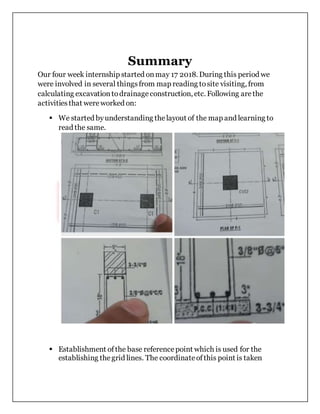
 We started byunderstanding thelayout of the map and learning to
read the same.
 Establishment ofthe base referencepoint which is used for the
establishing thegrid lines. The coordinateofthis point is taken
which is further used as a basepoint from where all the setup is
done.
 Learnt about trench and ditch.
 Estimationofthe totalamount of excavationfor thefoundation.
 Estimationofthe cost of the totalexcavationfor all the foundation.
 Estimationofthe number of bricksina given section.
 Estimationof totalquantityof PCC required.
 Estimationofthe totalcost for laying thePCC.
 Reasons for laying up the PCC beneath thefoundationof a building.
 Reasons for using tiesand stirrupsincolumns and beams
respectively.
 Measuresto be takento ensure safety at site. Equipmentssuch as
work boots, work gloves, helmets, high visibilitygarmentsareused.
 Idea about lap length and development length.
 We cameacrossmainbar and distributionbar.
 Idea about one way and two wayslab.
SITE VISIT
Sitevisiting waslike cherry added to our theoreticalknowledge. It helped
us to relate all learnt conceptsto real situations. Following pointsarethe
short descriptionofthe thingsdone at site.
 We encountered formworkthat consisted of centering, shutteringand
scaffolding. The centering wasused to support thehorizontal surface
and the shuttering wasused as a support to verticalsections. The
scaffolding was used for supporting labor.
 Manyprops were used on the sitefor supporting slabsusing batten.
 Use of staging.
 The shuttering ofthe slabs should be removed first followed by the
removal of the shuttering of thebeam.
 We also witnessed drainageconstructionand variouscurvesgiven
insideit in order to minimize damageinwalls.
 Brickwork -The beginning step in brickwork is the constructionof
starter which ismadeby using concretein thesame positionwhere
the brickworkis to be done. It is done so as to keep the brickwork
straight. Thesearealso used for connecting thewall to the floor base.
Brickwork startsby providing a small gap at the basew.r.t the
column so that skirting canbe carried out later.
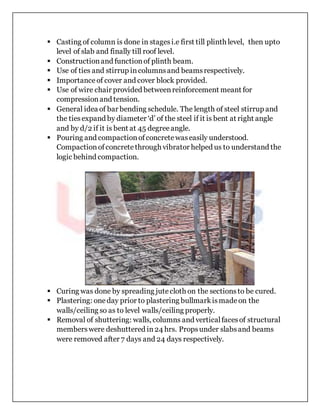
 Casting of column is done in stagesi.e first till plinth level, then upto
level of slab and finally till roof level.
 Constructionand functionof plinth beam.
 Use of ties and stirrup incolumnsand beamsrespectively.
 Importanceof cover and cover block provided.
 Use of wire chair provided betweenreinforcement meant for
compressionand tension.
 General idea of bar bending schedule. The length of steel stirrup and
the tiesexpand by diameter ‘d’ of the steel if it is bent at right angle
and by d/2 if it is bent at 45 degreeangle.
 Pouring and compactionofconcretewaseasily understood.
Compactionofconcretethrough vibrator helped us to understand the
logic behind compaction.
 Curing was done by spreading jutecloth on the sectionsto be cured.
 Plastering: oneday prior to plastering bullmarkismadeon the
walls/ceiling so as to level walls/ceiling properly.
 Removal of shuttering: walls, columns and verticalfacesof structural
memberswere deshuttered in24 hrs. Propsunder slabsand beams
were removed after 7 days and 24 days respectively.
Conclusion
The aim of internship exercise was to acquire practical
skills and link theory that is taught in classroom to the real
world. I am quite confident to announce that this program
has been able to polish my basics and creativity skills. I
have acquired practical skills and experienced site
conditions that actually exists. I was fortunate to witness
ongoing project running in the university itself. Such inter
programs opportunities must often be given to the
students so that learning can become more meaningful in
classroom.

Internship report

  • 1.
    REPORT ON INTERNSHIP PROGRAMDONE AT MULTI ACTIVITY CENTER UPES SUBMITTED TO SUBMITTED BY MR MUKESH DUBEY VIVEK KUMAR (CIVIL ENGINEERING R680216055 DEPARTMENT)
  • 2.
    PREFACE THIS COMPENDIUM ISA SHORT REPORT OF OUR FOUR WEEKS INTERNSHIP AT ‘CONSTRUCTION OF MULTI PURPOSE SPORTS FACILITY BUILDING AT UPES ’. IT INCLUDES PROCESSES AND METHODS INCORPORATED AT SITE ALONG WITH A SERIES OF TESTS DONE IN LABORATORY.
  • 3.
    ACKNOWLEDGMENT With great pleasure,I would like to extend my sincere gratitude and thanks to Mr Vikas Garg (HOD Civil engineering) and Mr Mukesh Dubey for providing me opportunity to do internship at this project. Also I would like to thank Mr. Sandeep Chuk (General Manager), Mr Dharmendra, Mr Uspal for their continuous support and faith to help me get an invaluable experience and knowledge throughout training. Also I would personally thank for their immense support in solving all queries and imparting me extensive knowledge in all the aspects of this project.
  • 4.
    Table Of Contents Objectivesand significance of the Training Schedule for construction of building Tests performed in laboratory Summary Site Visit Conclusion
  • 5.
    Objectives of theTraining  To impart theoretical skills into practical work.  To gain business work experience  To relate with different categories of people in a working environment.  To gain exposure to the demand and challenges of the work place.  To obtain/ acquire knowledge. Significance of the internship  The training has helped me to gain business work experience since it involved practical work in a business environment.  The training has equipped me with more knowledge in addition to that obtained in class in relation to the working environment.  The training has managed to expose me to the challenges in the work place and how the challenges can be overcame.  The training has also helped me in making connections with various people who in future may be a helping hand to me.
  • 6.
    Schedule for constructionof building Planning Arrangements Construction Furnishing Finalizing Purchasing of land Time schedule and monthly cash outflow Excavation as per drawing Completion & occupancy certificate Flooring Consulting engineer/ architect Contractor selection Footing/ Foundation Plumbing Drawing approval from authority Columns (upto plinth level) Doors and windows Soil filling in trenches and compaction till ground level Painting Plinth construction Connection for electricity and drainage Columns upto lintel level Inside furnishing lintel Columns upto roof level Soil filling and compaction Roof slab Brick work & curing Electrical wiring Frames for doors and windows Plastering & curing
  • 7.
    Tests performed inlaboratory CEMENT:  FINENESS  CONSISTENCY  INITIAL AND FINAL SETTING TIME  SOUNDNESS AGGREGATES:  SIEVE ANALYSIS  WATER ABSORPTION  AGG.ABRASION VALUE  AGG.IMPACT VALUE  AGG.CRUSHING VALUE FRESH CONCRETE:  WORKABILITY  SLUMP  COMPACTION FACTOR  VEE BEE HARDENED CONCRETE:  NON DESTRUCTIVE  ULTRASONIC PULSE VELOCITY  COMPRESSION TEST
  • 8.
    Summary Our four weekinternship started onmay 17 2018. During this period we were involved in several thingsfrom map reading tosite visiting, from calculating excavationtodrainageconstruction, etc. Following arethe activitiesthat wereworked on:  We started byunderstanding thelayout of the map and learning to read the same.  Establishment ofthe base referencepoint which is used for the establishing thegrid lines. The coordinateofthis point is taken
  • 9.
    which is furtherused as a basepoint from where all the setup is done.  Learnt about trench and ditch.  Estimationofthe totalamount of excavationfor thefoundation.  Estimationofthe cost of the totalexcavationfor all the foundation.  Estimationofthe number of bricksina given section.  Estimationof totalquantityof PCC required.  Estimationofthe totalcost for laying thePCC.  Reasons for laying up the PCC beneath thefoundationof a building.  Reasons for using tiesand stirrupsincolumns and beams respectively.  Measuresto be takento ensure safety at site. Equipmentssuch as work boots, work gloves, helmets, high visibilitygarmentsareused.  Idea about lap length and development length.  We cameacrossmainbar and distributionbar.  Idea about one way and two wayslab.
  • 10.
    SITE VISIT Sitevisiting waslikecherry added to our theoreticalknowledge. It helped us to relate all learnt conceptsto real situations. Following pointsarethe short descriptionofthe thingsdone at site.  We encountered formworkthat consisted of centering, shutteringand scaffolding. The centering wasused to support thehorizontal surface and the shuttering wasused as a support to verticalsections. The scaffolding was used for supporting labor.  Manyprops were used on the sitefor supporting slabsusing batten.  Use of staging.  The shuttering ofthe slabs should be removed first followed by the removal of the shuttering of thebeam.  We also witnessed drainageconstructionand variouscurvesgiven insideit in order to minimize damageinwalls.  Brickwork -The beginning step in brickwork is the constructionof starter which ismadeby using concretein thesame positionwhere the brickworkis to be done. It is done so as to keep the brickwork straight. Thesearealso used for connecting thewall to the floor base. Brickwork startsby providing a small gap at the basew.r.t the column so that skirting canbe carried out later.
  • 11.
     Casting ofcolumn is done in stagesi.e first till plinth level, then upto level of slab and finally till roof level.  Constructionand functionof plinth beam.  Use of ties and stirrup incolumnsand beamsrespectively.  Importanceof cover and cover block provided.  Use of wire chair provided betweenreinforcement meant for compressionand tension.  General idea of bar bending schedule. The length of steel stirrup and the tiesexpand by diameter ‘d’ of the steel if it is bent at right angle and by d/2 if it is bent at 45 degreeangle.  Pouring and compactionofconcretewaseasily understood. Compactionofconcretethrough vibrator helped us to understand the logic behind compaction.  Curing was done by spreading jutecloth on the sectionsto be cured.  Plastering: oneday prior to plastering bullmarkismadeon the walls/ceiling so as to level walls/ceiling properly.  Removal of shuttering: walls, columns and verticalfacesof structural memberswere deshuttered in24 hrs. Propsunder slabsand beams were removed after 7 days and 24 days respectively.
  • 12.
    Conclusion The aim ofinternship exercise was to acquire practical skills and link theory that is taught in classroom to the real world. I am quite confident to announce that this program has been able to polish my basics and creativity skills. I have acquired practical skills and experienced site conditions that actually exists. I was fortunate to witness ongoing project running in the university itself. Such inter programs opportunities must often be given to the students so that learning can become more meaningful in classroom.