A
Presentation
On
“BUILDING PLANNING & CONSTRUCTION”
Submitted
in partial fulfillment
for the award of Degree of
Bachelor of Technology in Department of Civil Engineering
PRESENTED TO: PRESENTED BY:
Mr. Rohit Soni Devanshu Rai
H.O.D, (Civil Department) 22E1SBCEM10P200
DEPARTMENT OF CIVIL ENGINEERING
SRI BALAJI COLLEGE OF ENGINEERING & TECHNOLOGY
JAIPUR
NOVEMBER - 2024
LIST OF CONTENTS
• Introduction
• Site Analysis
• Center Line Layout
• Footing Overview
• Shuttering Process
• Steel Details
• Electric Plan
• Plumbing Plan
• Safety Measures
• Challenges Faced
• Conclusion
• References
INTRODUCTION
• Building Type: Residential Building with 3
floors.
• Location: Murlipura, Jaipur, opposite Lotus
Public School.
• Built-Up Area: 1,650 sq. ft.
• The project involved the planning and
construction of a multi-story residential
building designed to accommodate modern
housing requirements.
SITE ANALYSIS
• Location and Orientation: The site is positioned for
optimal sunlight exposure and ventilation.
• Surroundings: A quiet, residential area near educational
facilities and community amenities, increasing the site's
appeal.
• Geographical Conditions: Jaipur's semi-arid climate
was a key factor in determining materials and insulation
needs.
• Purpose of Site Analysis: Essential for understanding the
environment and planning construction to optimize
energy efficiency and comfort for future occupants.
CENTER LINE LAYOUT
• The center line layout is used as a
reference for setting out the foundation
and structure. This ensures accurate
alignment of walls, columns, and beams.
• Process
1. Marking is done with chalk lines and
checked with measuring tapes and
leveling devices to ensure precision.
2. This stage required extreme accuracy, as
deviations in the center line could lead
to structural issues later on.
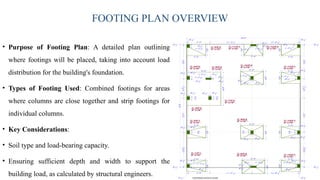
FOOTING PLAN OVERVIEW
• Purpose of Footing Plan: A detailed plan outlining
where footings will be placed, taking into account load
distribution for the building's foundation.
• Types of Footing Used: Combined footings for areas
where columns are close together and strip footings for
individual columns.
• Key Considerations:
• Soil type and load-bearing capacity.
• Ensuring sufficient depth and width to support the
building load, as calculated by structural engineers.
FOOTING DETAILS
SHUTTERING PROCESS
• Shuttering (formwork) is a temporary mold used to shape poured concrete.
• Materials: Mainly plywood and steel for durability and reusability.
• Procedure:
• Installation was done by a team, ensuring each panel was properly aligned and braced to
withstand concrete pressure.
• Quality Control: Tight sealing to prevent concrete leakage, ensuring a smooth finish for
the structure’s exterior.
STEEL DETAILS
• Steel Selection: TMT bars with corrosion resistance and flexibility were chosen.
• Placement in Columns, Beams, and Slabs:
• Reinforcement was laid as per design, with bars tied at intersections to maintain structural
integrity.
• Importance of Steel Placement: Reinforced bars provide tensile strength, counteracting
the compressive forces on concrete, crucial for multi-story buildings.
COLUMN AND BEAM CONSTRUCTION
• Column Construction:
• Column molds were set up using formwork with vertical bars for stability.
• Proper compaction ensured strength, and curing was monitored for durability.
• Beam Construction:
• Horizontal reinforcement placed to connect columns, providing lateral stability.
• Beams were cast using M25 concrete for load-bearing strength.
• Curing: Essential to prevent cracks, curing was maintained for 14 days.
SLAB CONSTRUCTION AND REINFORCEMENT
• Slab Layout: Positioned for each floor, providing base support for the living space.
• Steel Reinforcement: Arranged in mesh form with bars at calculated intervals.
• Concrete Mixture: M20 concrete was used, ensuring strength to support upper floors.
• Process:
• Pouring of concrete, leveling, and smoothing for even surface distribution.
• Curing took place over 14 days to allow the slab to gain strength.
ELECTRIC PLAN
• Electrical outlets placed based on room
functions and user convenience.
• Main electrical board located on the ground
floor, with sub-panels on each floor.
• Safety Standards: Circuit breakers were
installed to prevent overloads.
• Energy Efficiency: LED lighting and
energy-saving fixtures planned to reduce
consumption.
PLUMBING PLAN DRAWING
• Water Supply Layout:
• Pipes installed for consistent water flow to
bathrooms, kitchen, and washing areas.
• Use of PPR pipes for durability and rust
resistance.
• Drainage System:
• Proper slopes maintained to prevent clogging
and ensure effective drainage.
• Location of drainage pipes aligned with the
site’s sewage system.
• Water Storage: Rooftop tanks positioned for
gravity-based water distribution.
SAFETY MEASURES
• On-Site Safety Protocols:
• Mandatory safety gear (helmets, gloves, boots) for all workers.
• Regular safety inspections conducted to identify hazards.
• Emergency Preparedness: First aid kits on site, and fire extinguishers were readily
available.
• Importance: Preventing accidents and ensuring a safe environment for all personnel.
SUSTAINABLE PRACTICES
• Material Choices: Local materials used to reduce transportation emissions.
• Waste Reduction: Efficient material usage and recycling practices for minimal waste.
• Water Conservation: Rainwater harvesting and efficient plumbing fixtures to reduce
water consumption.
QUALITY CONTROL AND SUPERVISION
• Quality Assurance:
• Continuous inspection to ensure adherence to design and safety standards.
• Testing concrete strength and steel quality to maintain structural integrity.
• Supervision Roles:
• Engineers regularly reviewed work progress and corrected deviations from the plan.
• Coordination among teams to streamline the construction process.
CHALLENGES FACED
• Weather Conditions: Delays due to rain impacting concrete curing times.
• Material Delays: Shortages in steel delivery, managed through effective scheduling.
• Labor Management: Ensuring skilled workers were available during critical phases of
construction.
CONCLUSION
• Over the 48-day internship, I gained a deep understanding of residential building
construction, moving from theoretical concepts to practical, on-site applications.
• Key Skills Developed:
• Technical Proficiency: Learned critical aspects like center line marking, footing and
foundation planning, and accurate steel reinforcement placement.
• Project Management: Enhanced my abilities in time management, resource allocation,
and overseeing work to meet quality standards.
• Problem-Solving: Tackled on-site challenges, such as adjusting plans based on soil
conditions and managing labor schedules effectively.
REFERENCES
1. IS 456:2000 – Code of Practice for Plain and Reinforced Concrete
2. IS 1893:2016 – Criteria for Earthquake Resistant Design of Structures
3. NBC 2016 – National Building Code of India 2016
THANK YOU

Devanshu PT final year presentation.pptx

  • 1.
    A Presentation On “BUILDING PLANNING &CONSTRUCTION” Submitted in partial fulfillment for the award of Degree of Bachelor of Technology in Department of Civil Engineering PRESENTED TO: PRESENTED BY: Mr. Rohit Soni Devanshu Rai H.O.D, (Civil Department) 22E1SBCEM10P200 DEPARTMENT OF CIVIL ENGINEERING SRI BALAJI COLLEGE OF ENGINEERING & TECHNOLOGY JAIPUR NOVEMBER - 2024
  • 2.
    LIST OF CONTENTS •Introduction • Site Analysis • Center Line Layout • Footing Overview • Shuttering Process • Steel Details • Electric Plan • Plumbing Plan • Safety Measures • Challenges Faced • Conclusion • References
  • 3.
    INTRODUCTION • Building Type:Residential Building with 3 floors. • Location: Murlipura, Jaipur, opposite Lotus Public School. • Built-Up Area: 1,650 sq. ft. • The project involved the planning and construction of a multi-story residential building designed to accommodate modern housing requirements.
  • 4.
    SITE ANALYSIS • Locationand Orientation: The site is positioned for optimal sunlight exposure and ventilation. • Surroundings: A quiet, residential area near educational facilities and community amenities, increasing the site's appeal. • Geographical Conditions: Jaipur's semi-arid climate was a key factor in determining materials and insulation needs. • Purpose of Site Analysis: Essential for understanding the environment and planning construction to optimize energy efficiency and comfort for future occupants.
  • 5.
    CENTER LINE LAYOUT •The center line layout is used as a reference for setting out the foundation and structure. This ensures accurate alignment of walls, columns, and beams. • Process 1. Marking is done with chalk lines and checked with measuring tapes and leveling devices to ensure precision. 2. This stage required extreme accuracy, as deviations in the center line could lead to structural issues later on.
  • 6.
    FOOTING PLAN OVERVIEW •Purpose of Footing Plan: A detailed plan outlining where footings will be placed, taking into account load distribution for the building's foundation. • Types of Footing Used: Combined footings for areas where columns are close together and strip footings for individual columns. • Key Considerations: • Soil type and load-bearing capacity. • Ensuring sufficient depth and width to support the building load, as calculated by structural engineers.
  • 7.
  • 8.
    SHUTTERING PROCESS • Shuttering(formwork) is a temporary mold used to shape poured concrete. • Materials: Mainly plywood and steel for durability and reusability. • Procedure: • Installation was done by a team, ensuring each panel was properly aligned and braced to withstand concrete pressure. • Quality Control: Tight sealing to prevent concrete leakage, ensuring a smooth finish for the structure’s exterior.
  • 10.
    STEEL DETAILS • SteelSelection: TMT bars with corrosion resistance and flexibility were chosen. • Placement in Columns, Beams, and Slabs: • Reinforcement was laid as per design, with bars tied at intersections to maintain structural integrity. • Importance of Steel Placement: Reinforced bars provide tensile strength, counteracting the compressive forces on concrete, crucial for multi-story buildings.
  • 12.
    COLUMN AND BEAMCONSTRUCTION • Column Construction: • Column molds were set up using formwork with vertical bars for stability. • Proper compaction ensured strength, and curing was monitored for durability. • Beam Construction: • Horizontal reinforcement placed to connect columns, providing lateral stability. • Beams were cast using M25 concrete for load-bearing strength. • Curing: Essential to prevent cracks, curing was maintained for 14 days.
  • 13.
    SLAB CONSTRUCTION ANDREINFORCEMENT • Slab Layout: Positioned for each floor, providing base support for the living space. • Steel Reinforcement: Arranged in mesh form with bars at calculated intervals. • Concrete Mixture: M20 concrete was used, ensuring strength to support upper floors. • Process: • Pouring of concrete, leveling, and smoothing for even surface distribution. • Curing took place over 14 days to allow the slab to gain strength.
  • 14.
    ELECTRIC PLAN • Electricaloutlets placed based on room functions and user convenience. • Main electrical board located on the ground floor, with sub-panels on each floor. • Safety Standards: Circuit breakers were installed to prevent overloads. • Energy Efficiency: LED lighting and energy-saving fixtures planned to reduce consumption.
  • 15.
    PLUMBING PLAN DRAWING •Water Supply Layout: • Pipes installed for consistent water flow to bathrooms, kitchen, and washing areas. • Use of PPR pipes for durability and rust resistance. • Drainage System: • Proper slopes maintained to prevent clogging and ensure effective drainage. • Location of drainage pipes aligned with the site’s sewage system. • Water Storage: Rooftop tanks positioned for gravity-based water distribution.
  • 16.
    SAFETY MEASURES • On-SiteSafety Protocols: • Mandatory safety gear (helmets, gloves, boots) for all workers. • Regular safety inspections conducted to identify hazards. • Emergency Preparedness: First aid kits on site, and fire extinguishers were readily available. • Importance: Preventing accidents and ensuring a safe environment for all personnel.
  • 17.
    SUSTAINABLE PRACTICES • MaterialChoices: Local materials used to reduce transportation emissions. • Waste Reduction: Efficient material usage and recycling practices for minimal waste. • Water Conservation: Rainwater harvesting and efficient plumbing fixtures to reduce water consumption.
  • 18.
    QUALITY CONTROL ANDSUPERVISION • Quality Assurance: • Continuous inspection to ensure adherence to design and safety standards. • Testing concrete strength and steel quality to maintain structural integrity. • Supervision Roles: • Engineers regularly reviewed work progress and corrected deviations from the plan. • Coordination among teams to streamline the construction process.
  • 19.
    CHALLENGES FACED • WeatherConditions: Delays due to rain impacting concrete curing times. • Material Delays: Shortages in steel delivery, managed through effective scheduling. • Labor Management: Ensuring skilled workers were available during critical phases of construction.
  • 20.
    CONCLUSION • Over the48-day internship, I gained a deep understanding of residential building construction, moving from theoretical concepts to practical, on-site applications. • Key Skills Developed: • Technical Proficiency: Learned critical aspects like center line marking, footing and foundation planning, and accurate steel reinforcement placement. • Project Management: Enhanced my abilities in time management, resource allocation, and overseeing work to meet quality standards. • Problem-Solving: Tackled on-site challenges, such as adjusting plans based on soil conditions and managing labor schedules effectively.
  • 21.
    REFERENCES 1. IS 456:2000– Code of Practice for Plain and Reinforced Concrete 2. IS 1893:2016 – Criteria for Earthquake Resistant Design of Structures 3. NBC 2016 – National Building Code of India 2016
  • 22.