THE NEW CONSUMERS OF UTILITY DATA 
WEBINAR brought to you by: 
Sept. 10, 2014
Speakers 
Kevin Sok Brian Glazebrook Jason Roeder Erik Becker Alisdair McDougall 
Manager of Engineering 
& Sustainability 
Senior Global 
Sustainability Manager 
Director of 
Energy Products 
& Services 
Vice President 
Analyst
Agenda 
1 | Discuss why energy management is becoming data driven 
2 | Learn who can benefit from access to energy data across your company 
3 | Review examples and case studies from our panelists 
4 | Q&A
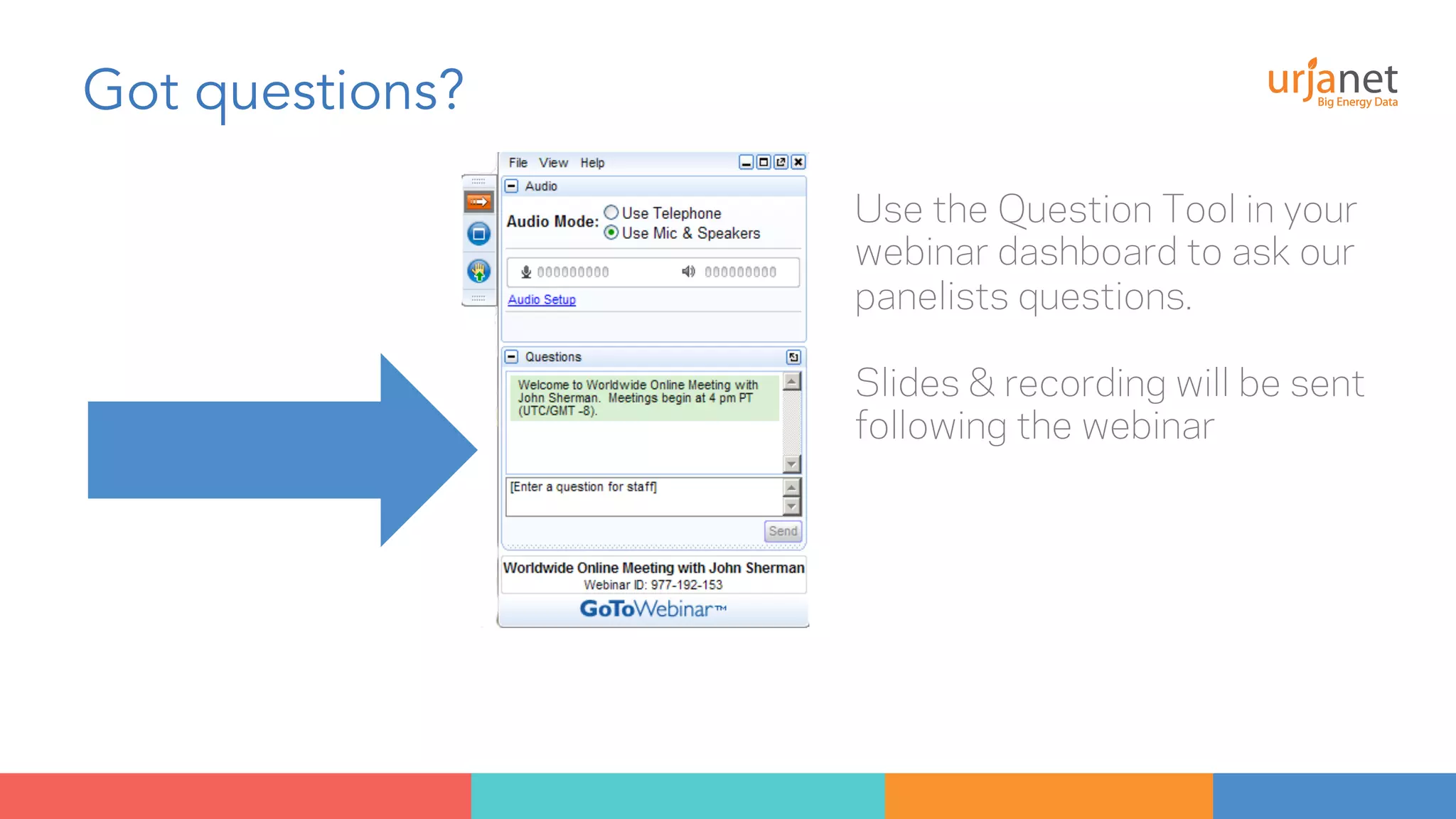
Got questions? 
Use the Question Tool in your 
webinar dashboard to ask our 
panelists questions. 
Slides & recording will be sent 
following the webinar
Presented by Alisdair McDougall 
5 
The New Consumers Of Utility Data
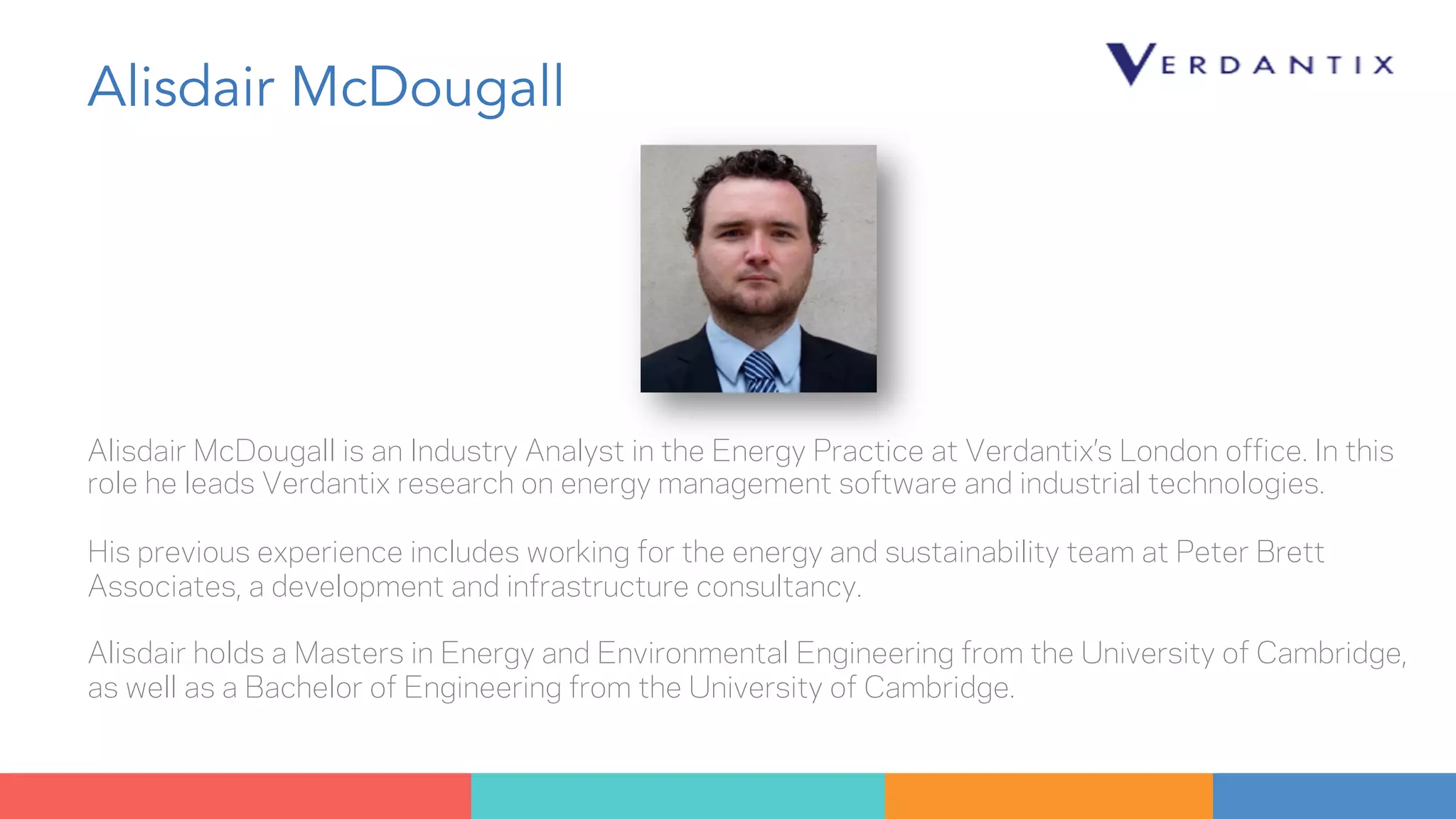
Alisdair McDougall 
Alisdair McDougall is an Industry Analyst in the Energy Practice at Verdantix’s London office. In this 
role he leads Verdantix research on energy management software and industrial technologies. 
His previous experience includes working for the energy and sustainability team at Peter Brett 
Associates, a development and infrastructure consultancy. 
Alisdair holds a Masters in Energy and Environmental Engineering from the University of Cambridge, 
as well as a Bachelor of Engineering from the University of Cambridge.
Agenda 
• Energy management becoming a strategic business 
objective 
• Who within an organization can benefit from access 
to energy data?
Agenda 
• Energy management becoming a strategic business 
objective 
• Who within an organization can benefit from access 
to energy data?
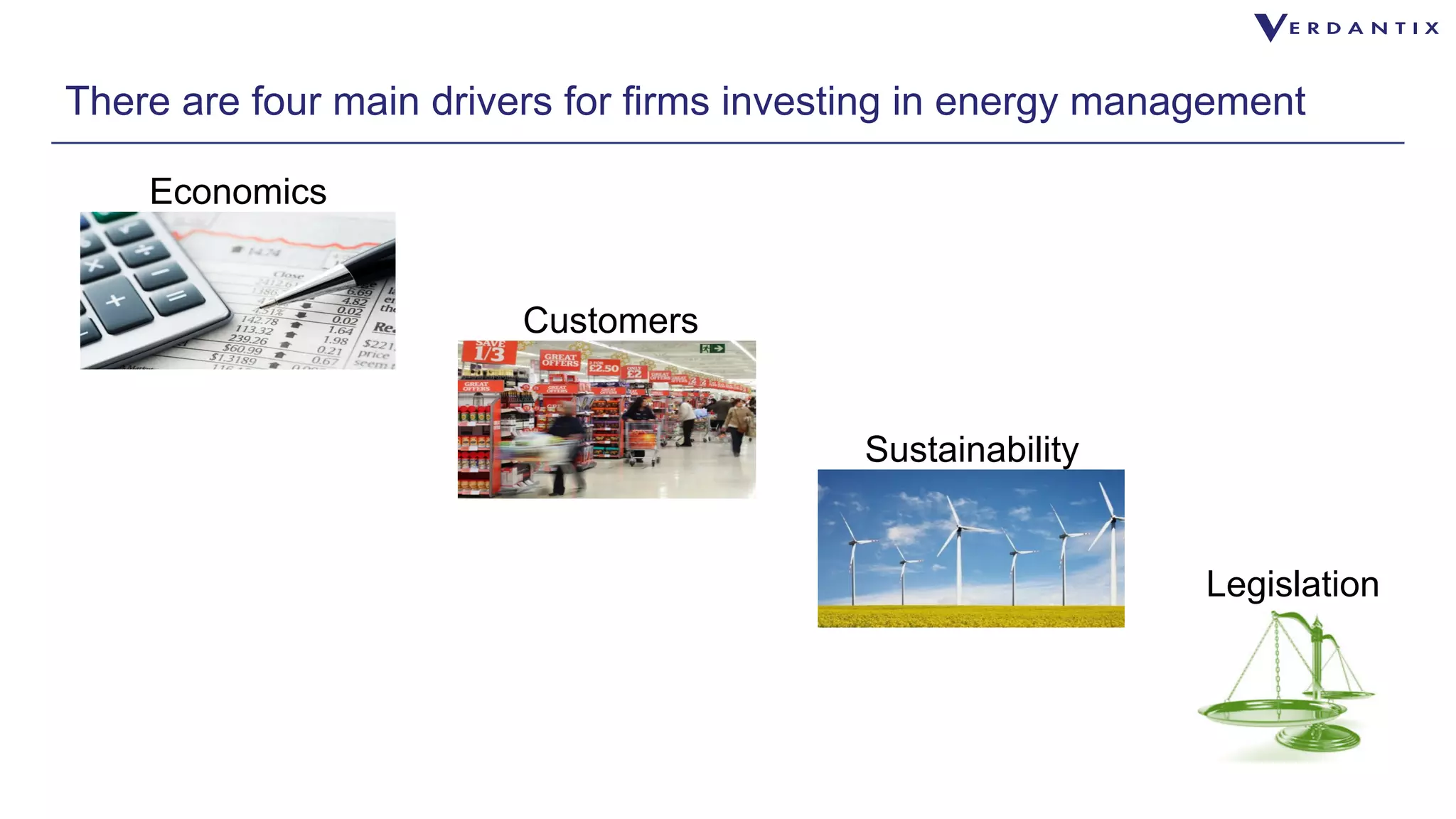
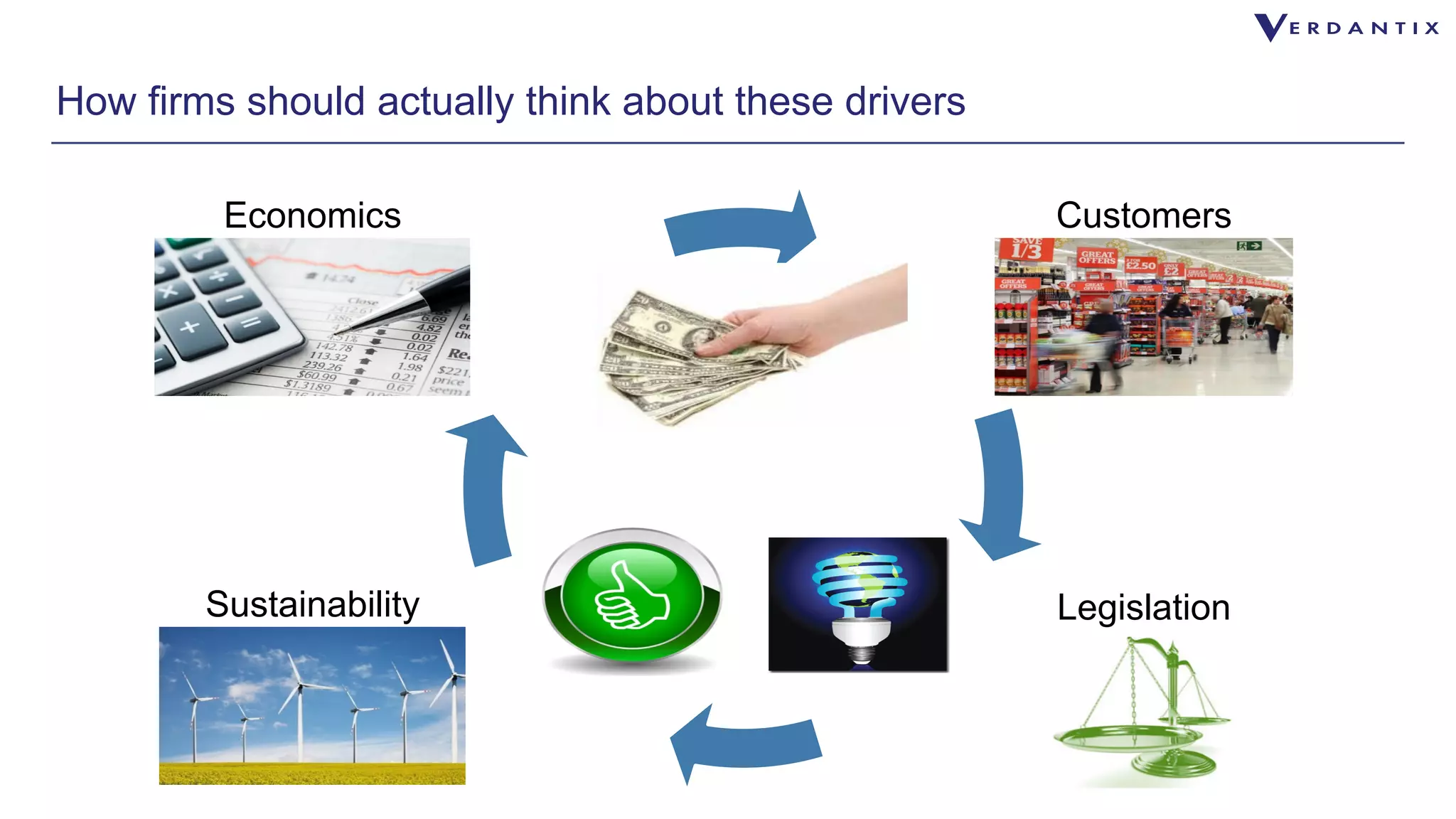
There are four main drivers for firms investing in energy management 
Economics 
Customers 
Sustainability 
Legislation
How firms should actually think about these drivers 
Customers 
Economics 
Sustainability Legislation
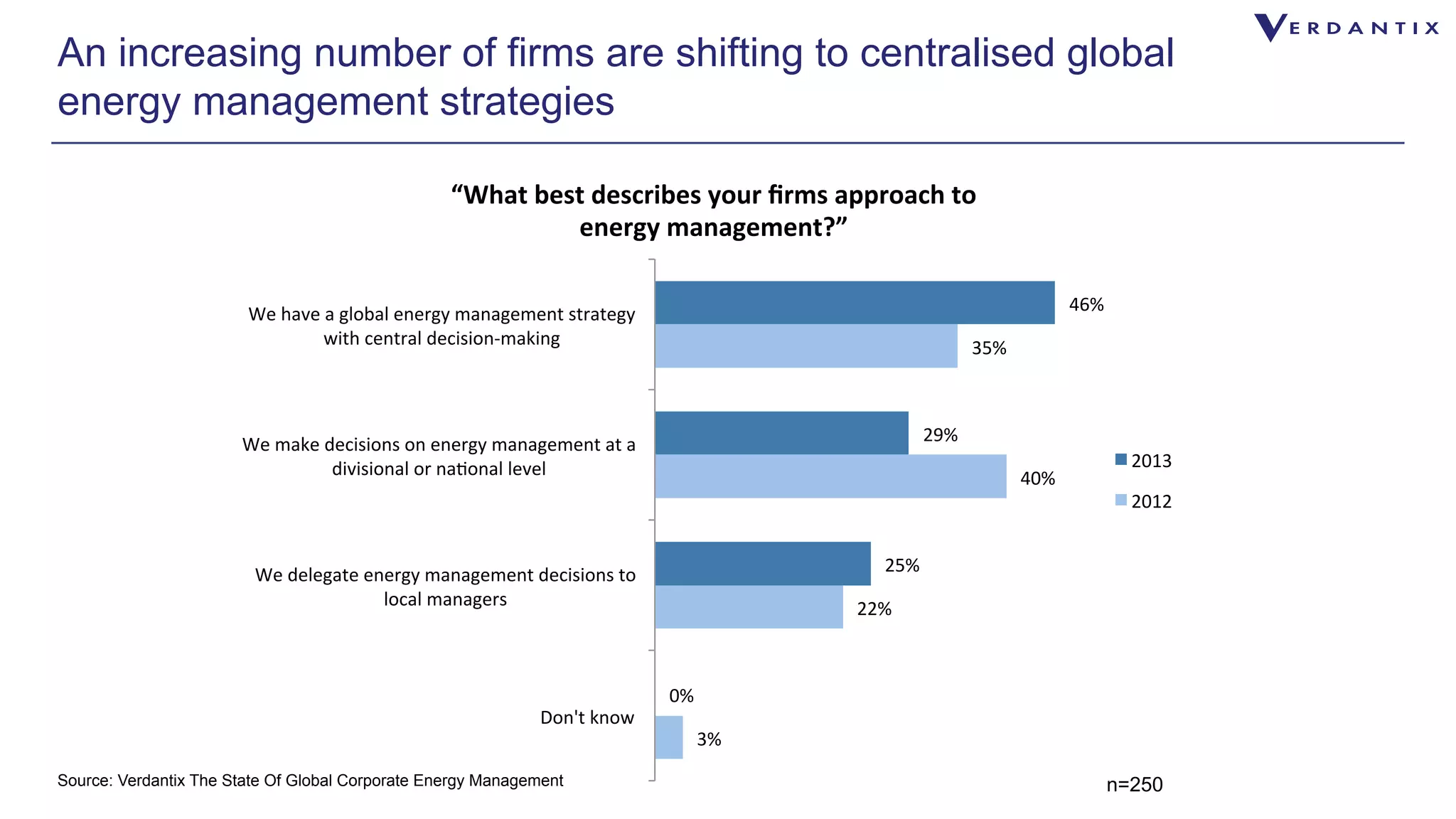
An increasing number of firms are shifting to centralised global 
energy management strategies 
“What 
best 
describes 
your 
firms 
approach 
to 
We 
have 
a 
global 
energy 
management 
strategy 
with 
central 
decision-­‐making 
We 
make 
decisions 
on 
energy 
management 
at 
a 
divisional 
or 
na>onal 
level 
We 
delegate 
energy 
management 
decisions 
to 
Source: Verdantix The State Of Global Corporate Energy Management 
3% 
22% 
40% 
35% 
0% 
25% 
29% 
46% 
Don't 
know 
local 
managers 
energy 
management?” 
2013 
2012 
n=250
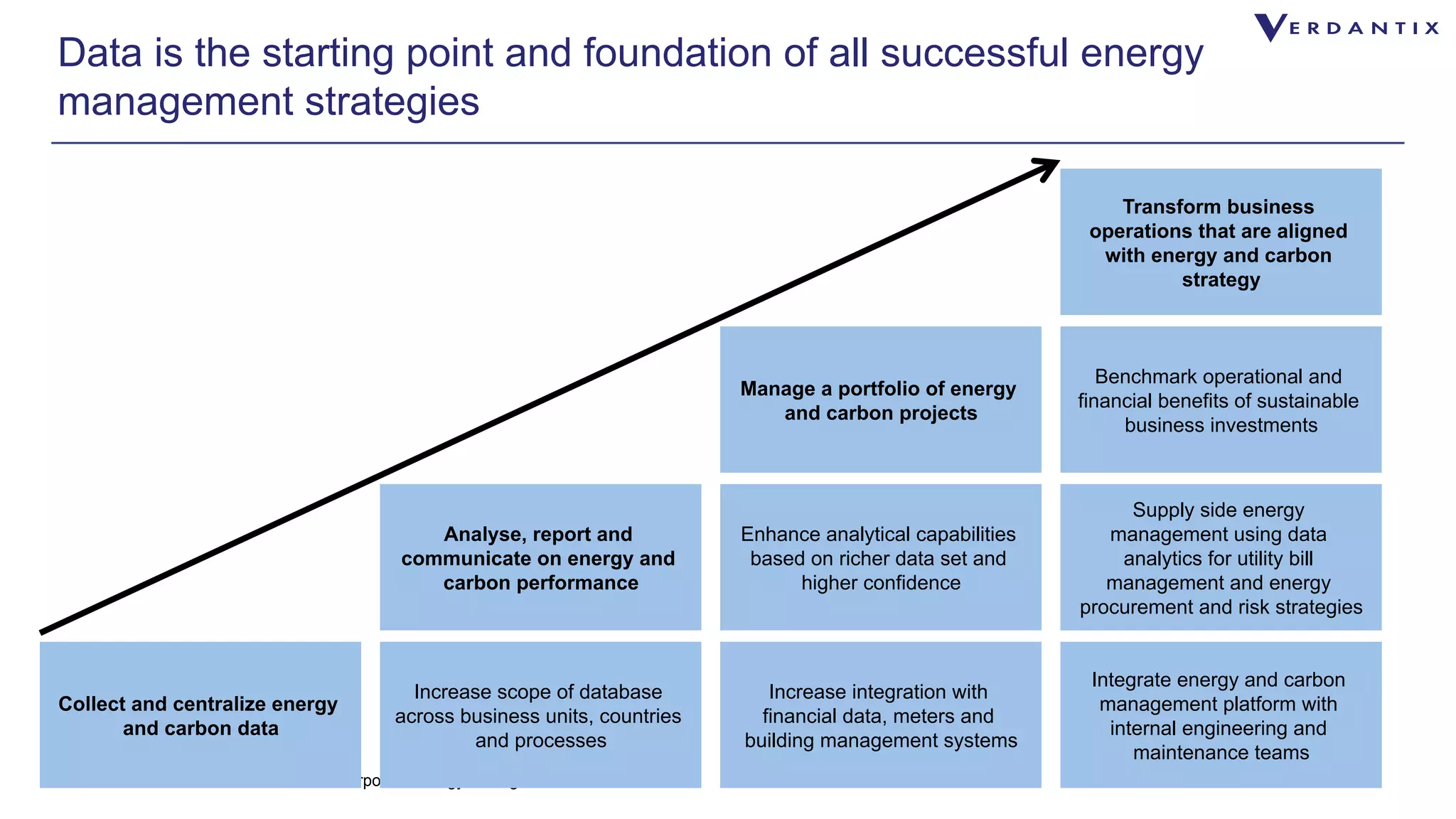
Data is the starting point and foundation of all successful energy 
management strategies 
Collect and centralize energy 
and carbon data 
Analyse, report and 
communicate on energy and 
carbon performance 
Increase scope of database 
across business units, countries 
and processes 
Source: Verdantix The State Of Global Corporate Energy Management 
Manage a portfolio of energy 
and carbon projects 
Enhance analytical capabilities 
based on richer data set and 
higher confidence 
Increase integration with 
financial data, meters and 
building management systems 
Transform business 
operations that are aligned 
with energy and carbon 
strategy 
Benchmark operational and 
financial benefits of sustainable 
business investments 
Supply side energy 
management using data 
analytics for utility bill 
management and energy 
procurement and risk strategies 
Integrate energy and carbon 
management platform with 
internal engineering and 
maintenance teams
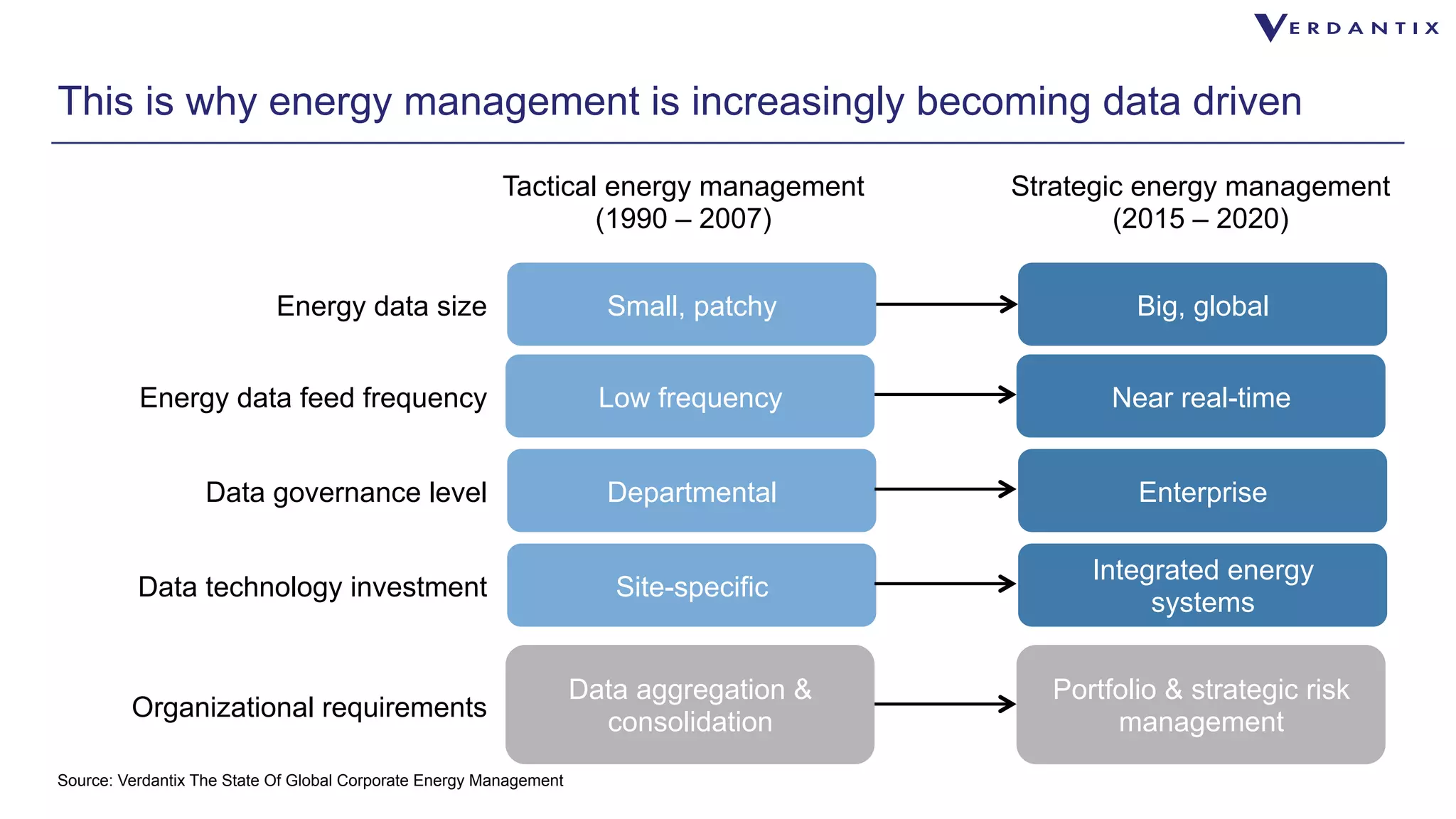
This is why energy management is increasingly becoming data driven 
Energy data size Small, patchy Big, global 
Data governance level Departmental Enterprise 
Data technology investment Site-specific Integrated energy 
Source: Verdantix The State Of Global Corporate Energy Management 
systems 
Tactical energy management 
(1990 – 2007) 
Strategic energy management 
(2015 – 2020) 
Energy data feed frequency Low frequency Near real-time 
Data aggregation & 
consolidation 
Portfolio & strategic risk 
Organizational requirements management
Agenda 
• Energy management becoming a strategic business 
objective 
• Who within an organization can benefit from access 
to energy data?
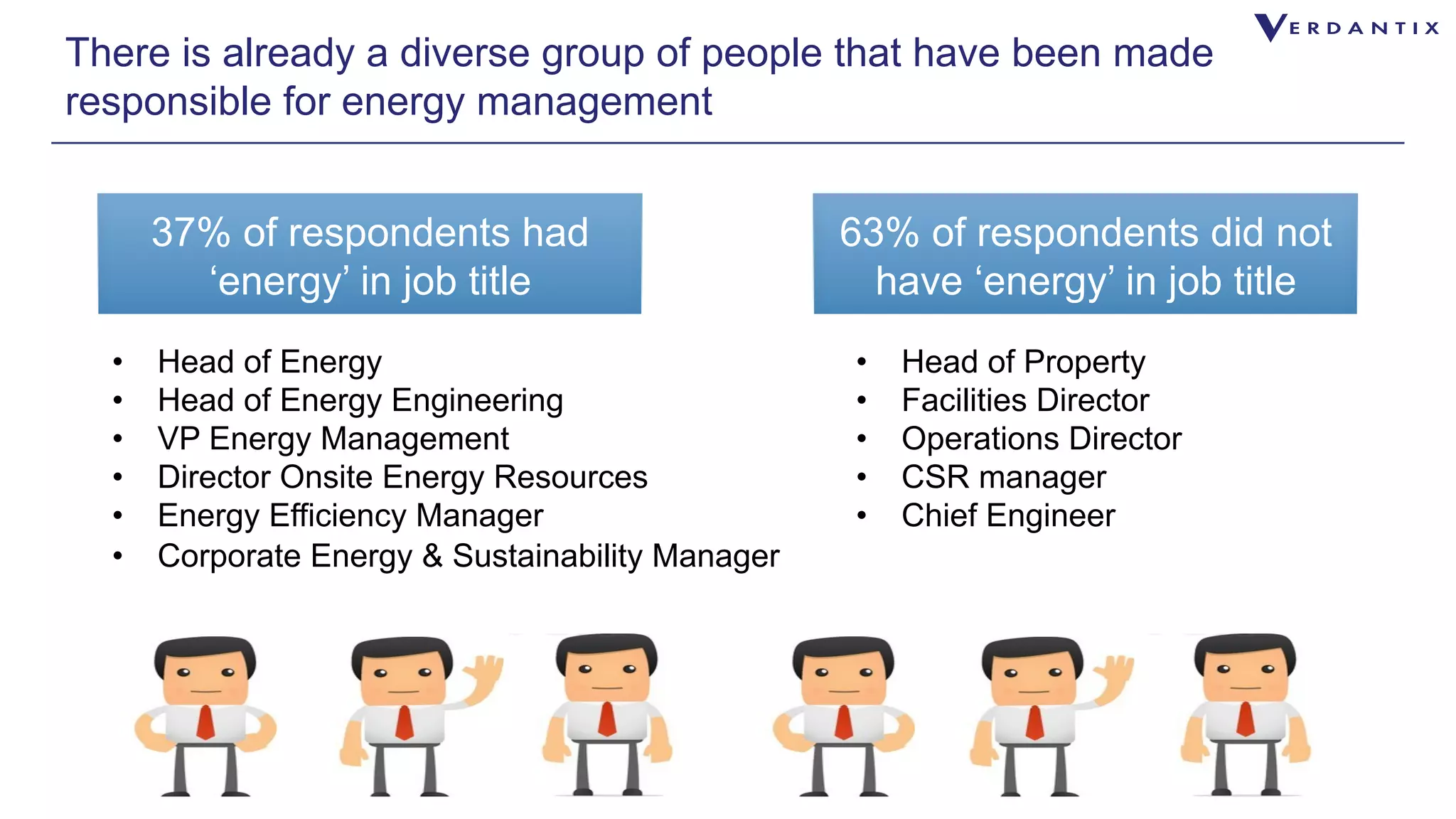
There is already a diverse group of people that have been made 
responsible for energy management 
37% of respondents had 
‘energy’ in job title 
63% of respondents did not 
have ‘energy’ in job title 
• Head of Energy 
• Head of Energy Engineering 
• VP Energy Management 
• Director Onsite Energy Resources 
• Energy Efficiency Manager 
• Corporate Energy & Sustainability Manager 
• Head of Property 
• Facilities Director 
• Operations Director 
• CSR manager 
• Chief Engineer
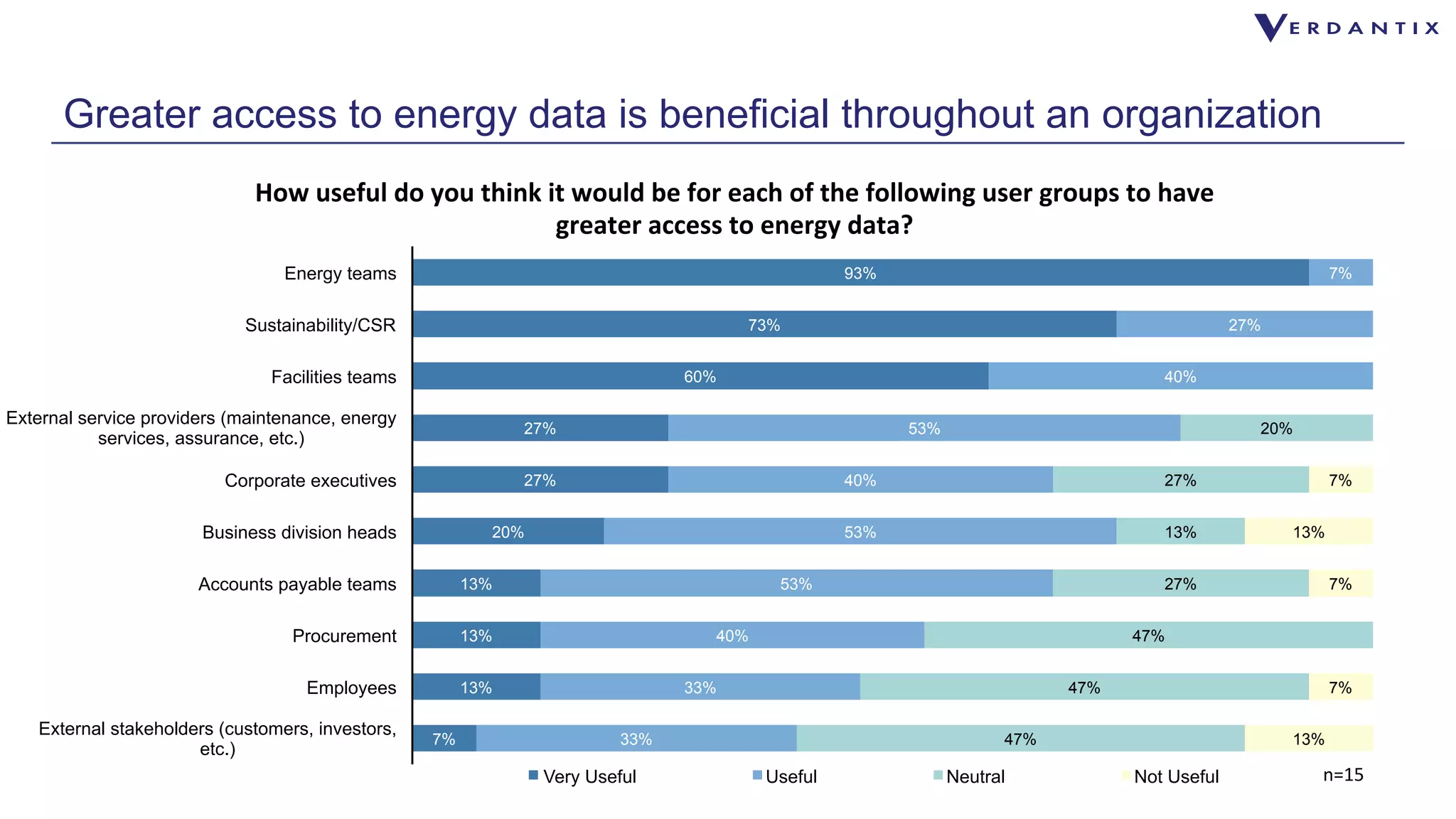
Greater access to energy data is beneficial throughout an organization 
How 
useful 
do 
you 
think 
it 
would 
be 
for 
each 
of 
the 
following 
user 
groups 
to 
have 
7% 
27% 
20% 
13% 
13% 
13% 
27% 
60% 
73% 
93% 
33% 
40% 
33% 
53% 
40% 
53% 
53% 
40% 
27% 
7% 
47% 
47% 
27% 
13% 
27% 
47% 
20% 
13% 
7% 
7% 
13% 
7% 
Energy teams 
Sustainability/CSR 
Facilities teams 
External service providers (maintenance, energy 
Corporate executives 
Business division heads 
Accounts payable teams 
Procurement 
External stakeholders (customers, investors, 
etc.) 
Employees 
services, assurance, etc.) 
greater 
access 
to 
energy 
data? 
Very Useful Useful Neutral Not Useful n=15
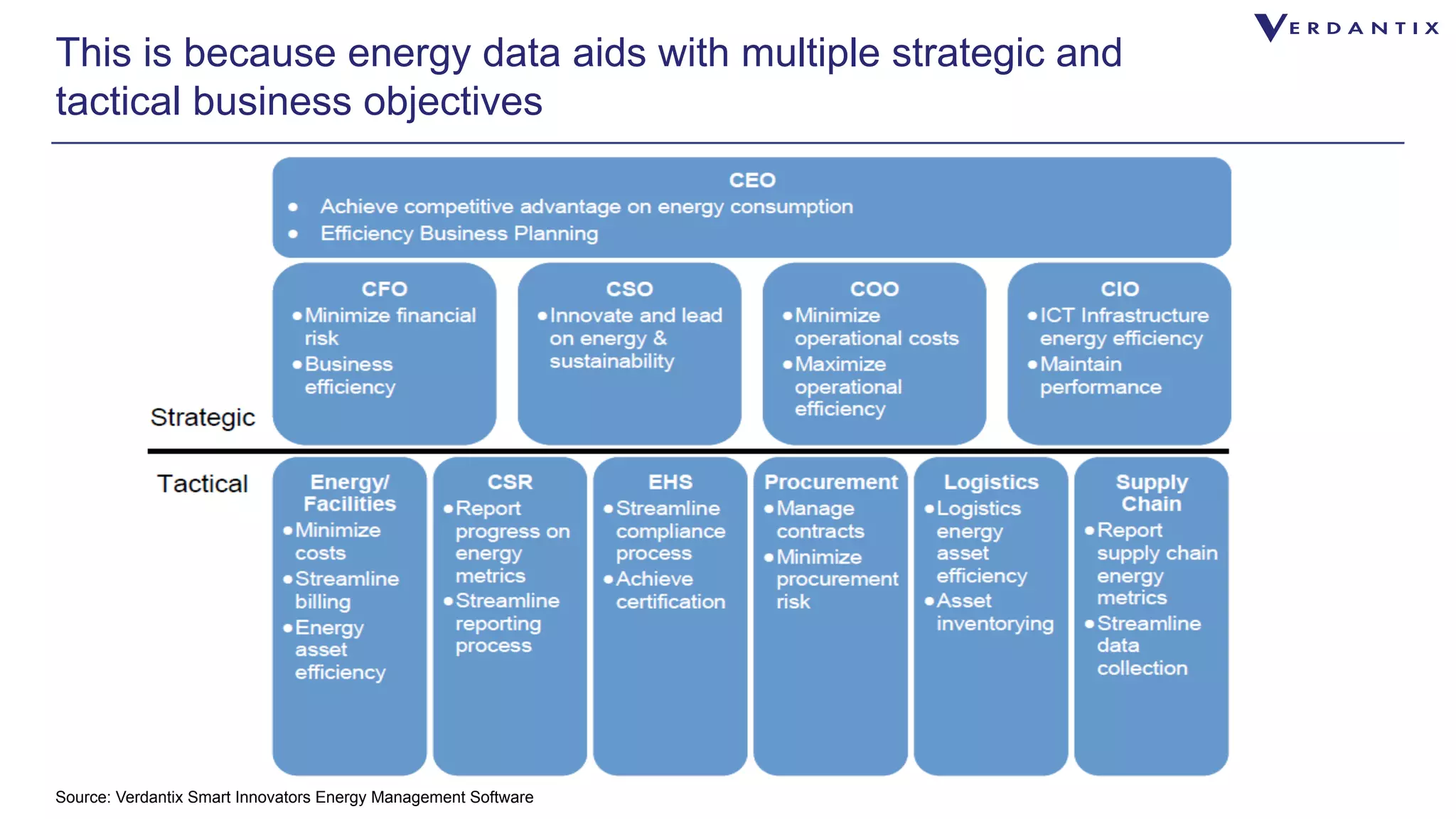
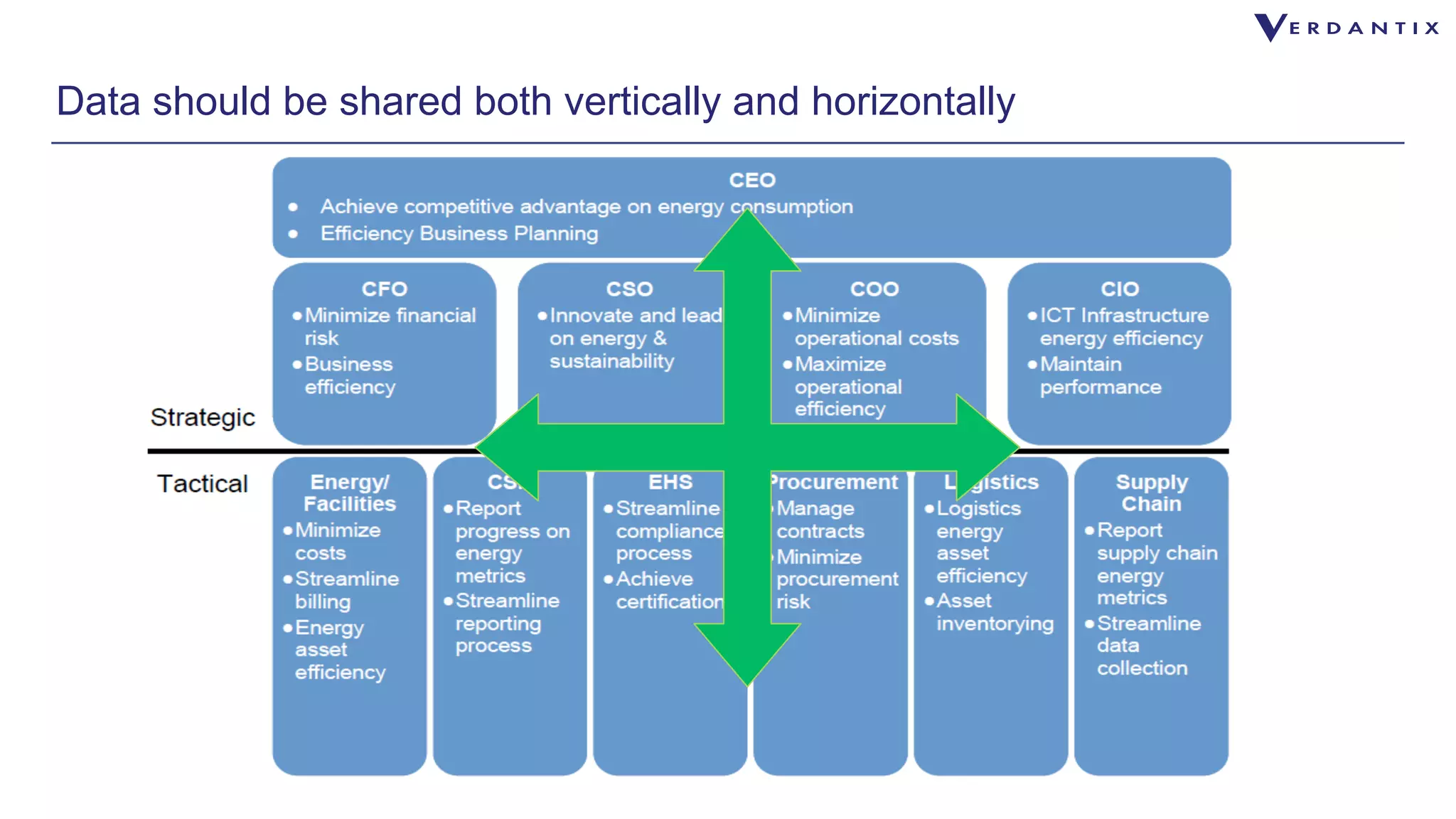
This is because energy data aids with multiple strategic and 
tactical business objectives 
CEO 
• Achieve competitive advantage on energy consumption 
• Efficiency Business Planning 
CFO 
• Minimize financial 
risk 
• Business 
efficiency 
CSO 
• Innovate and lead 
on energy & 
sustainability 
COO 
• Minimize 
operational costs 
• Maximize 
operational 
efficiency 
CIO 
• ICT Infrastructure 
energy efficiency 
• Maintain 
performance 
Energy/ 
Facilities 
• Minimize 
costs 
• Streamline 
billing 
• Energy 
asset 
efficiency 
CSR 
• Report 
progress on 
energy 
metrics 
• Streamline 
reporting 
process 
EH&S 
• Streamline 
compliance 
process 
• Achieve 
certification 
Logistics 
• Logistics 
energy asset 
efficiency 
• Asset 
inventorying 
Procurement 
• Manage 
contracts 
• Minimize 
procurement 
risk 
Supply Chain 
• Report 
supply chain 
energy 
metrics 
• Streamline 
data collection 
Source: Verdantix Smart Innovators Energy Management Software
Data should be shared both vertically and horizontally
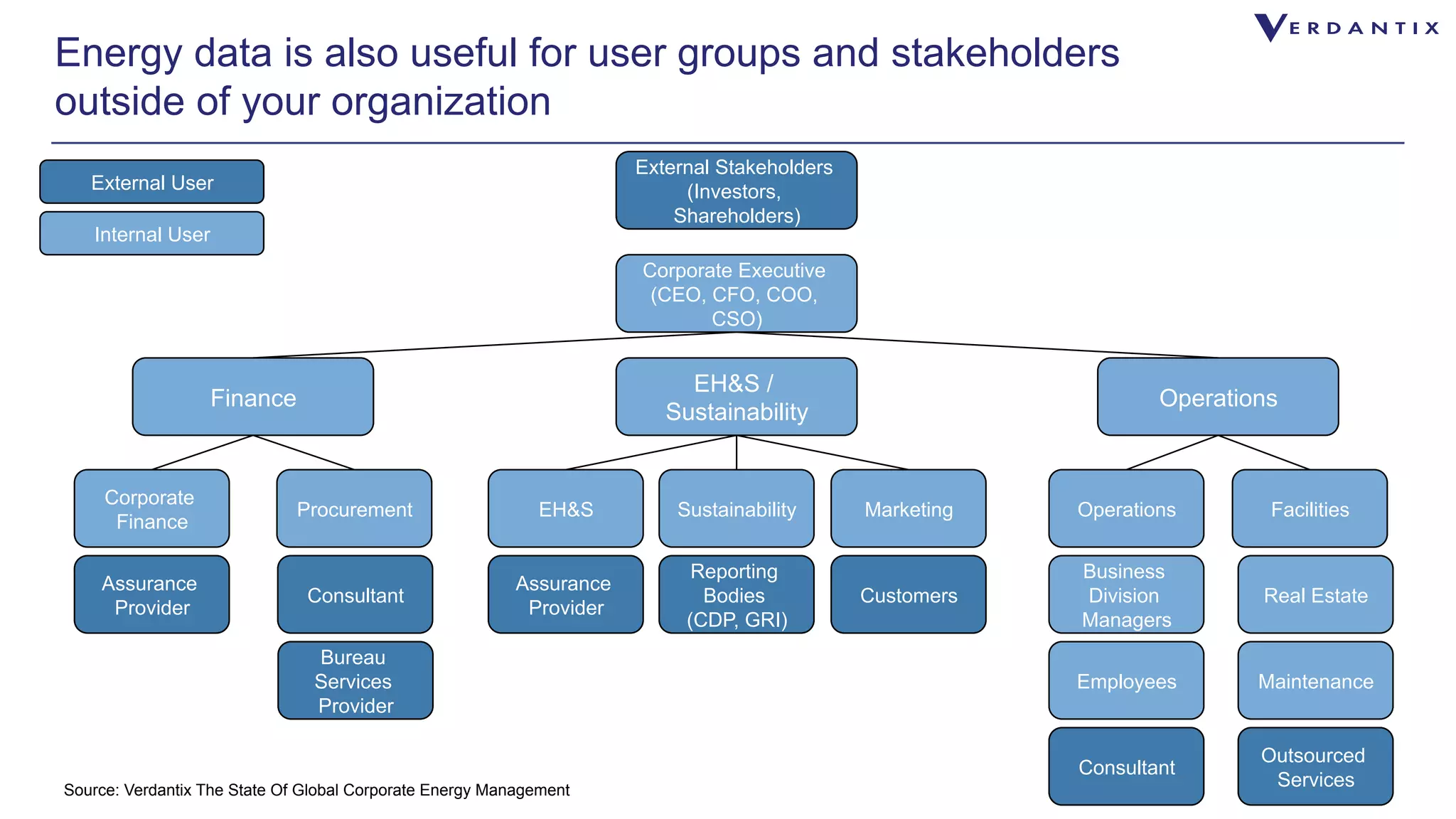
Energy data is also useful for user groups and stakeholders 
outside of your organization 
Source: Verdantix The State Of Global Corporate Energy Management 
External Stakeholders 
(Investors, 
Shareholders) 
Corporate Executive 
(CEO, CFO, COO, 
CSO) 
Finance EH&S / 
Sustainability Operations 
Corporate 
Finance Procurement Operations EH&S Sustainability Marketing Facilities 
Business 
Division 
Managers 
Real Estate 
Employees Maintenance 
Consultant 
Bureau 
Services 
Provider 
Assurance 
Provider 
Reporting 
Bodies 
(CDP, GRI) 
Assurance 
Provider Customers 
Outsourced 
Consultan t Services 
External User 
Internal User
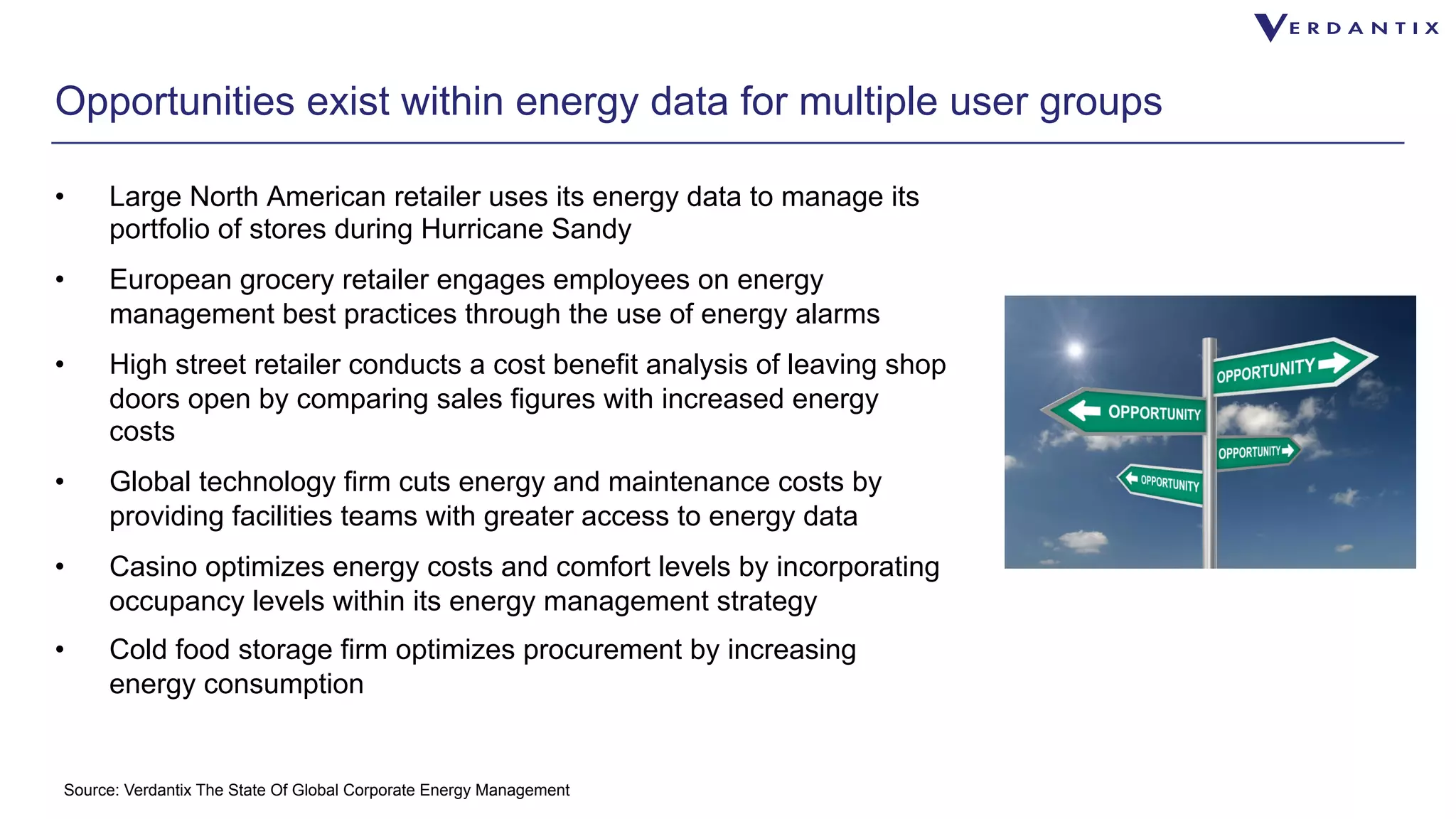
Opportunities exist within energy data for multiple user groups 
• Large North American retailer uses its energy data to manage its 
portfolio of stores during Hurricane Sandy 
• European grocery retailer engages employees on energy 
management best practices through the use of energy alarms 
• High street retailer conducts a cost benefit analysis of leaving shop 
doors open by comparing sales figures with increased energy 
costs 
• Global technology firm cuts energy and maintenance costs by 
providing facilities teams with greater access to energy data 
• Casino optimizes energy costs and comfort levels by incorporating 
occupancy levels within its energy management strategy 
• Cold food storage firm optimizes procurement by increasing 
energy consumption 
Source: Verdantix The State Of Global Corporate Energy Management
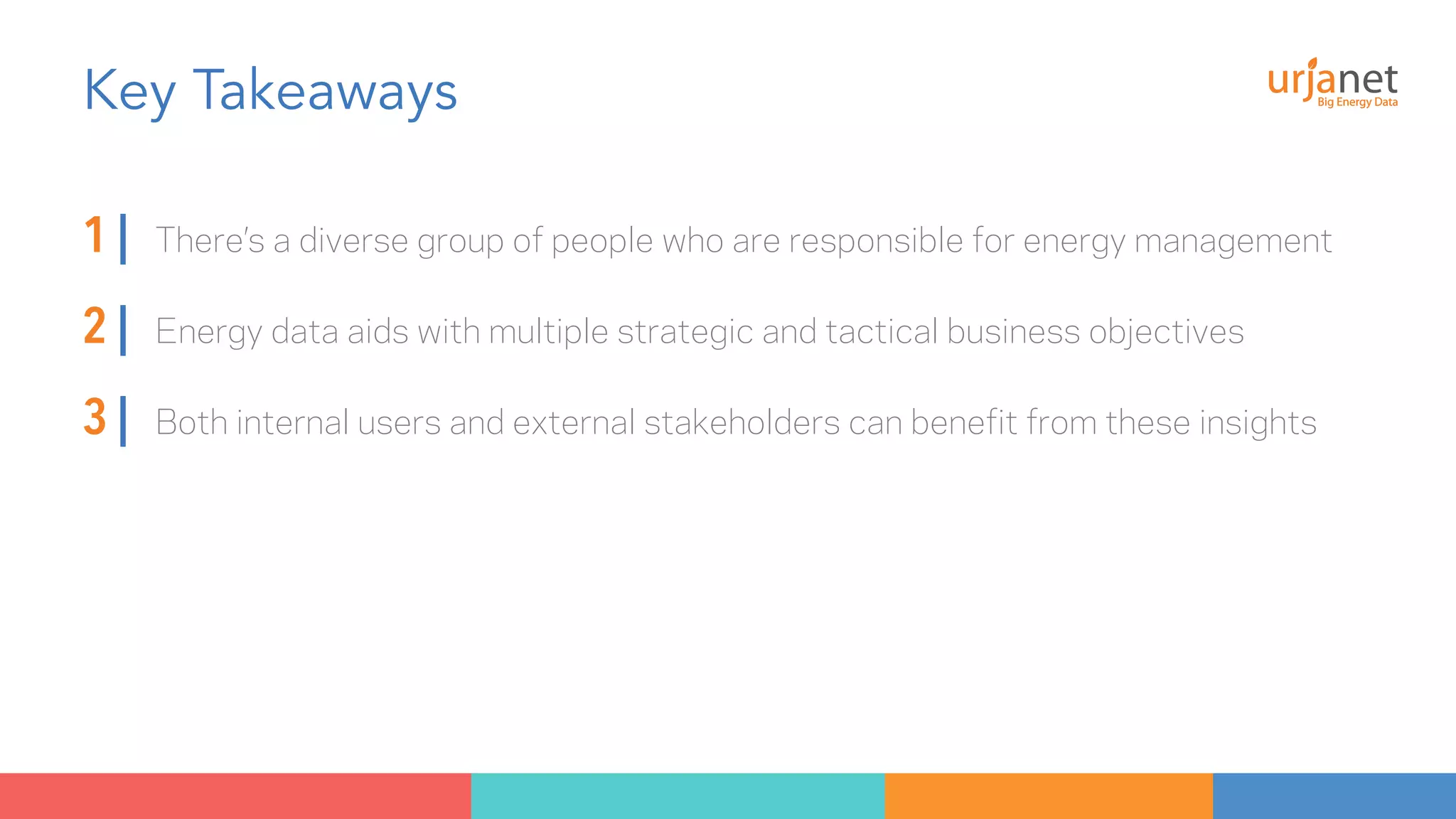
Key Takeaways 
1 | There’s a diverse group of people who are responsible for energy management 
2 | Energy data aids with multiple strategic and tactical business objectives 
3 | Both internal users and external stakeholders can benefit from these insights
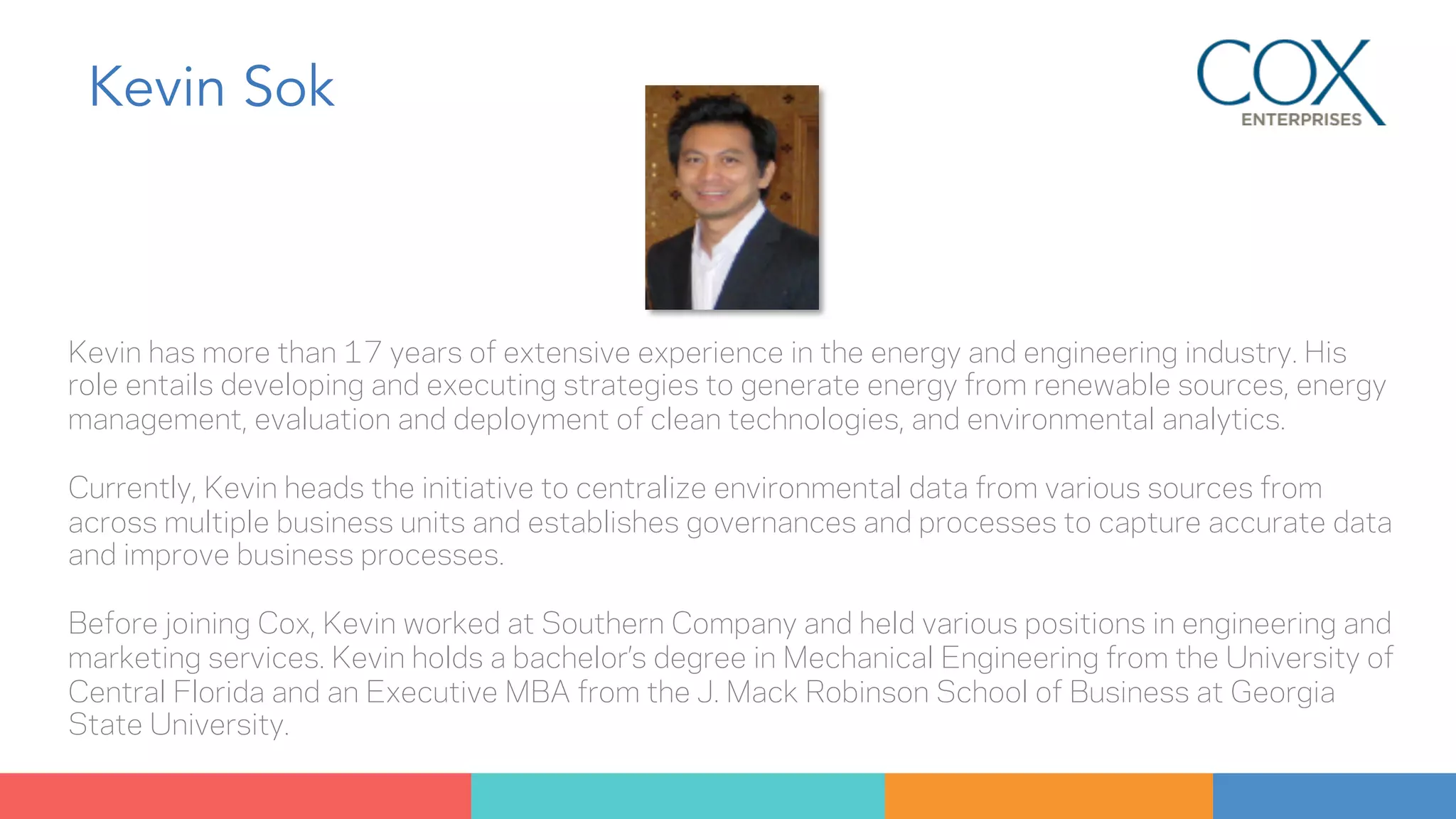
Kevin Sok 
Kevin has more than 17 years of extensive experience in the energy and engineering industry. His 
role entails developing and executing strategies to generate energy from renewable sources, energy 
management, evaluation and deployment of clean technologies, and environmental analytics. 
Currently, Kevin heads the initiative to centralize environmental data from various sources from 
across multiple business units and establishes governances and processes to capture accurate data 
and improve business processes. 
Before joining Cox, Kevin worked at Southern Company and held various positions in engineering and 
marketing services. Kevin holds a bachelor’s degree in Mechanical Engineering from the University of 
Central Florida and an Executive MBA from the J. Mack Robinson School of Business at Georgia 
State University.
23 
About Cox Enterprises, Inc. 
• Revenues nearly $16 billion 
• Approximately 50,000 employees 
• The company's major operating subsidiaries include Cox Communications 
(cable television distribution, high-speed Internet access, telephone, 
commercial telecommunications and advertising solutions); Cox Media 
Group (television and radio stations, digital media, newspapers and 
advertising sales rep firms); and Cox Automotive (automotive-related 
auctions, financial services, media and software solutions). The company's 
major national brands include AutoTrader.com, Kelley Blue Book, Manheim, 
Savings.com and Valpak.
24 
Sustainability Goals 
• Carbon Neutral by 2043 
• Carbon neutrality, or having a net zero carbon footprint, refers to achieving 
net zero carbon emissions by balancing a measured amount of carbon 
released with an equivalent amount renewable energy. 
• Water Neutral by 2043 
• We will reduce our water footprint as much as practical & balance the 
remaining use through meaningful restoration. 
• Zero Waste to landfill by 2023 
• Zero Waste is achieving over 90% diversion of waste from landfill, 
incinerators and the environment.
Data Facts 
• Over 40k+ accounts (data sets from electricity, gas, fuel, water) 
• Over 56k+ assets (facilities, towers, vehicles, power supplies) 
• Operate in 41 states & some international locations across all of 
25 
our businesses (Cox Automotive, CCI, CMG etc.) 
• Over $170 M in spend annually
26 
Data Philosophy 
• Data has always been very important to us. We have been 
looking for ways to capture, store, and analyze a vast amount 
of data in an efficient & accurate manner from multiple 
sources. 
• Establish governances & processes to ensure data are current, 
complete, and accurate. 
• Analyze thousands of pieces of information and correlating 
them with each other to guide our business decisions and 
processes.
27 
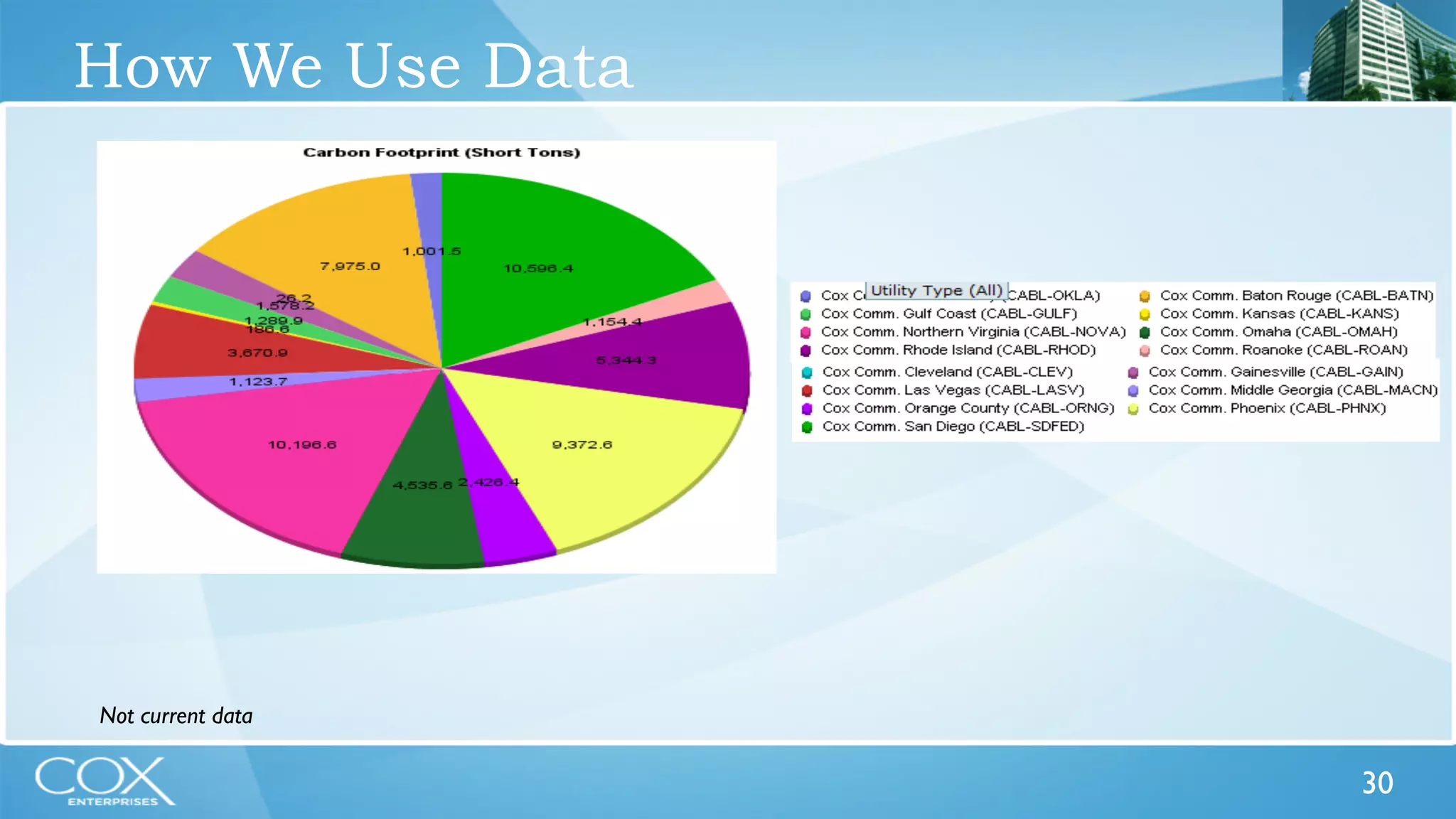
How We Use Data 
• Tracking consumption & spend comparing to budget. 
• Identify & verify anomalies such as billing errors and usage trend. 
• Make corrections. 
• Utilize captured data as a leverage to negotiate better utility rates. 
• Use data to help prioritize utility costs (highest to lowest) for 
establishing target sites for developing alternate energy & energy 
conservation initiatives. 
• Use to data for planning and setting environmental goals.(i.e. Carbon 
Footprint, etc.) Track progress. 
• Use to help identify metrics as compare to other companies and 
correlation to business operations.
28 
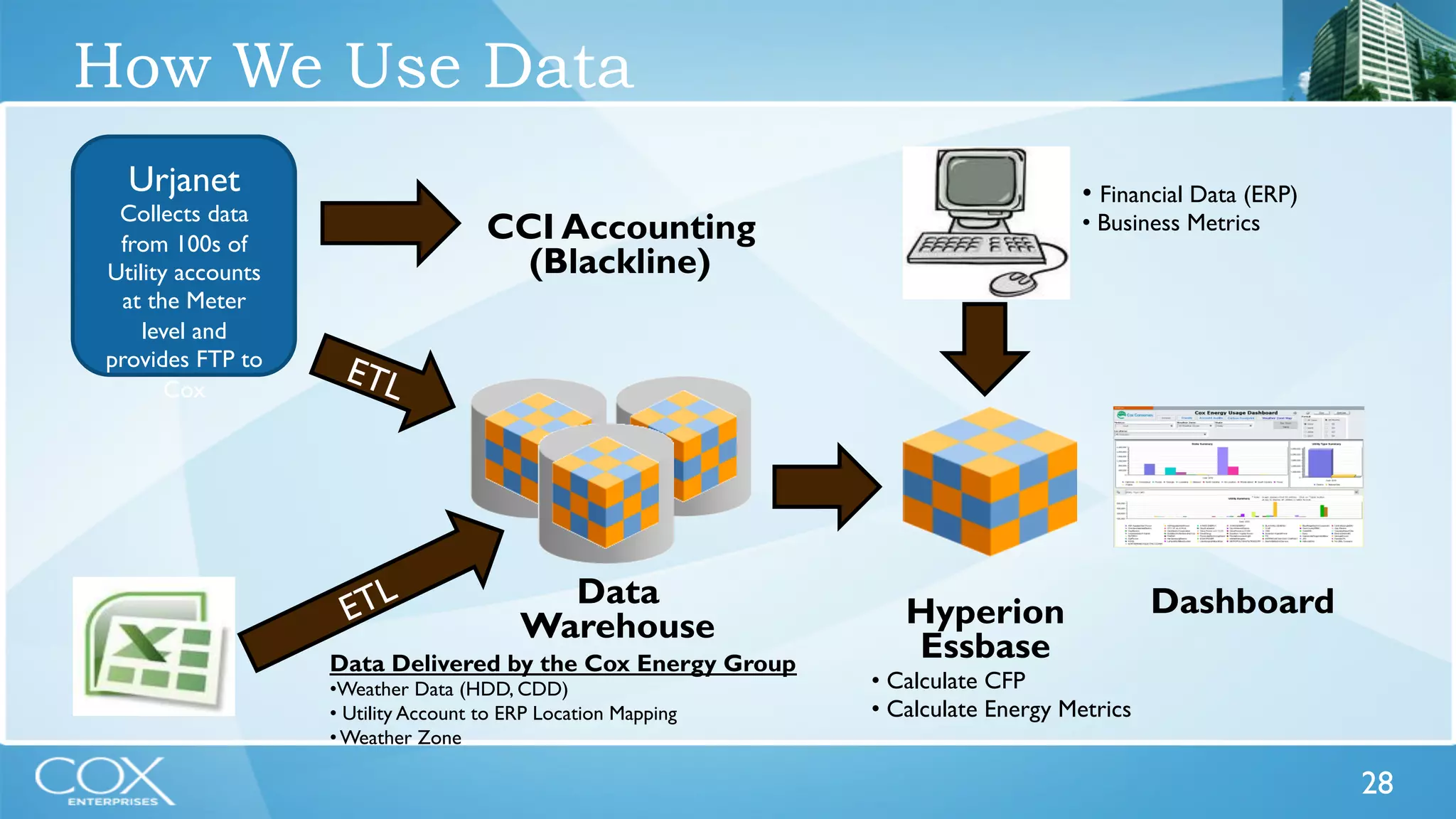
How We Use Data 
• Financial Data (ERP) 
• Business Metrics 
Urjanet 
Collects data 
from 100s of 
Utility accounts 
at the Meter 
level and 
provides FTP to 
Cox 
Data 
Warehouse Hyperion 
Data Delivered by the Cox Energy Group 
• Weather Data (HDD, CDD) 
• Utility Account to ERP Location Mapping 
• Weather Zone 
Essbase 
Dashboard 
• Calculate CFP 
• Calculate Energy Metrics 
CCI Accounting 
(Blackline)
29 
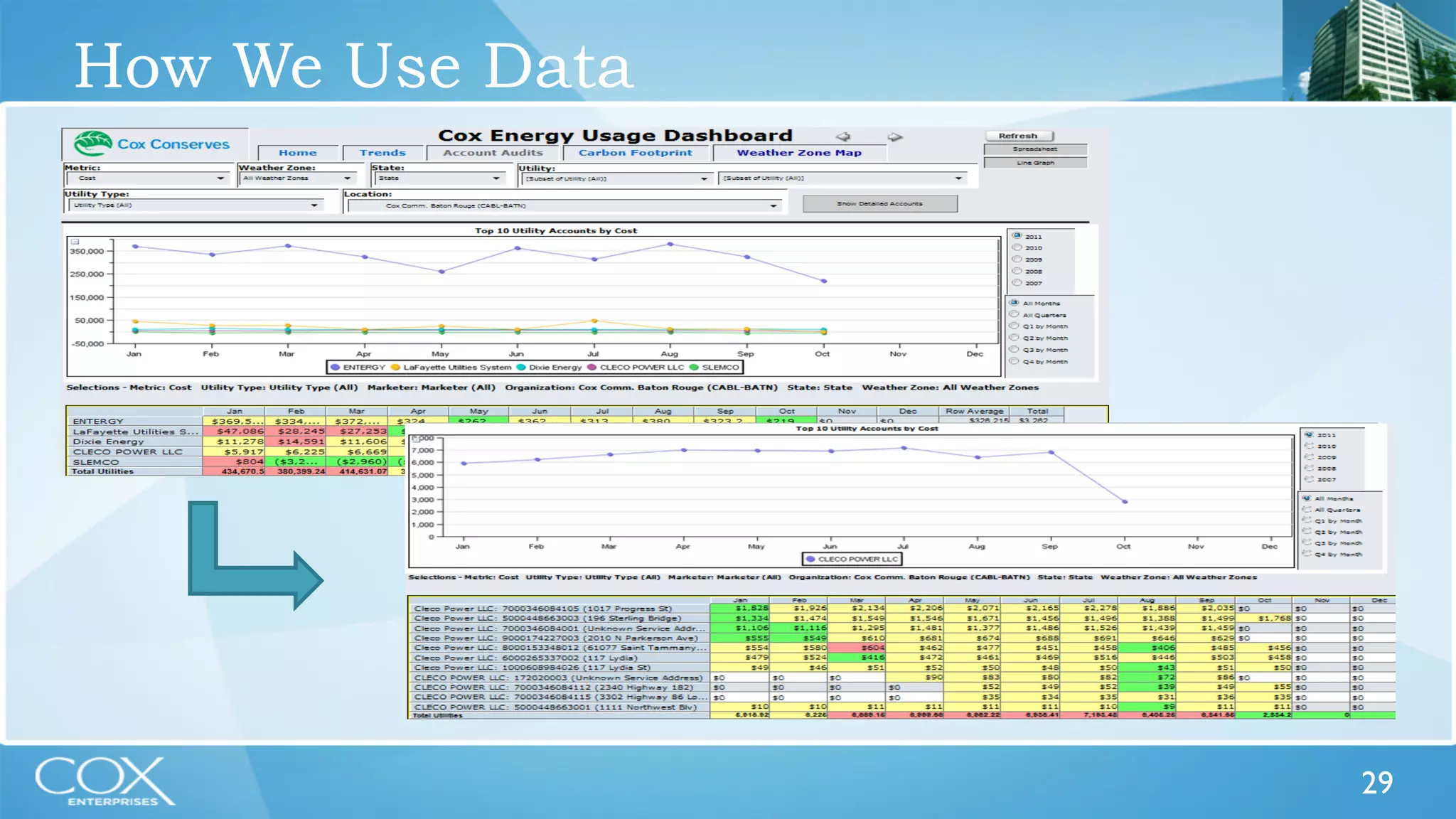
How We Use Data
30 
How We Use Data 
Not current data
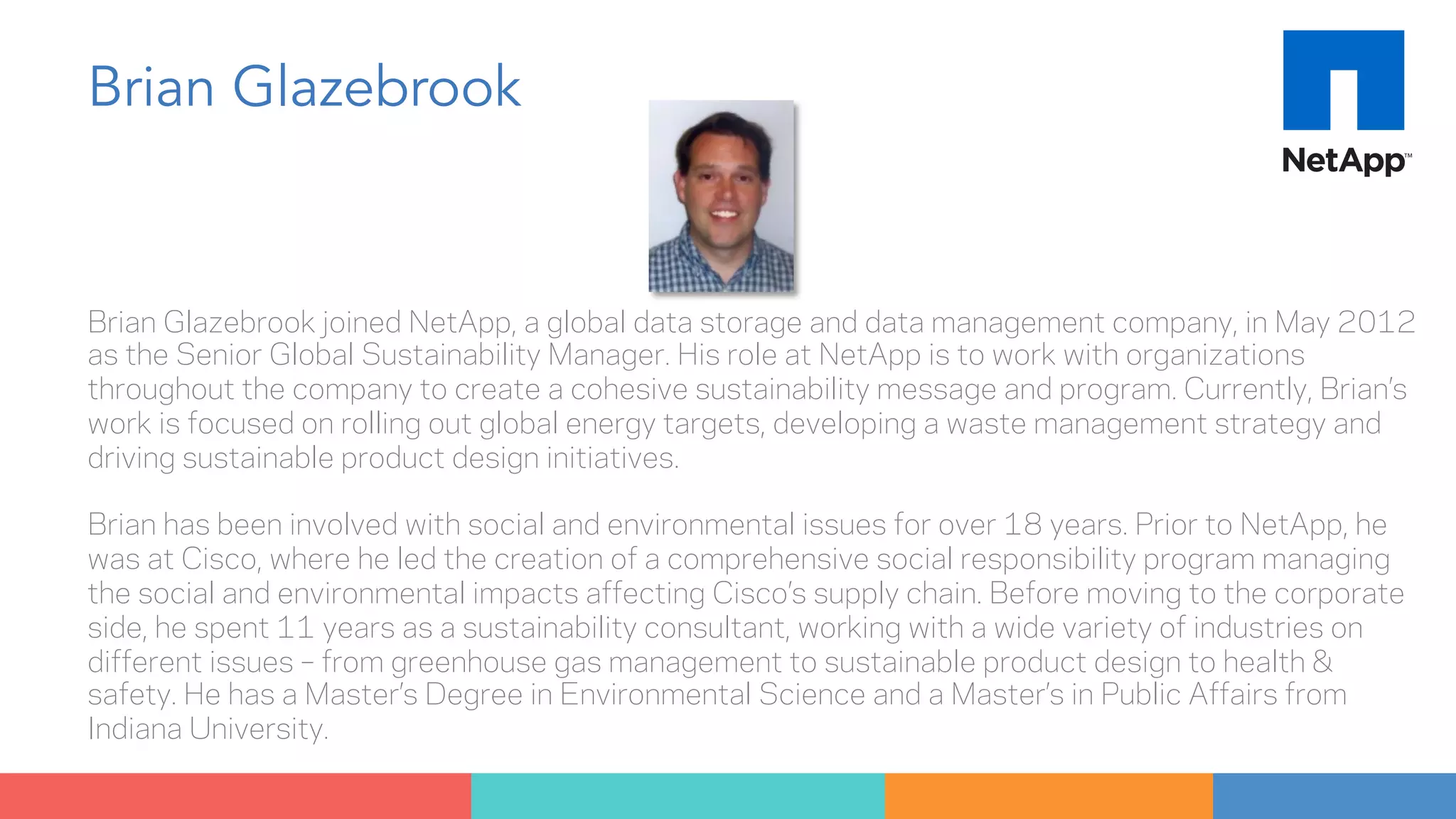
Brian Glazebrook 
Brian Glazebrook joined NetApp, a global data storage and data management company, in May 2012 
as the Senior Global Sustainability Manager. His role at NetApp is to work with organizations 
throughout the company to create a cohesive sustainability message and program. Currently, Brian’s 
work is focused on rolling out global energy targets, developing a waste management strategy and 
driving sustainable product design initiatives. 
Brian has been involved with social and environmental issues for over 18 years. Prior to NetApp, he 
was at Cisco, where he led the creation of a comprehensive social responsibility program managing 
the social and environmental impacts affecting Cisco’s supply chain. Before moving to the corporate 
side, he spent 11 years as a sustainability consultant, working with a wide variety of industries on 
different issues – from greenhouse gas management to sustainable product design to health & 
safety. He has a Master’s Degree in Environmental Science and a Master’s in Public Affairs from 
Indiana University.
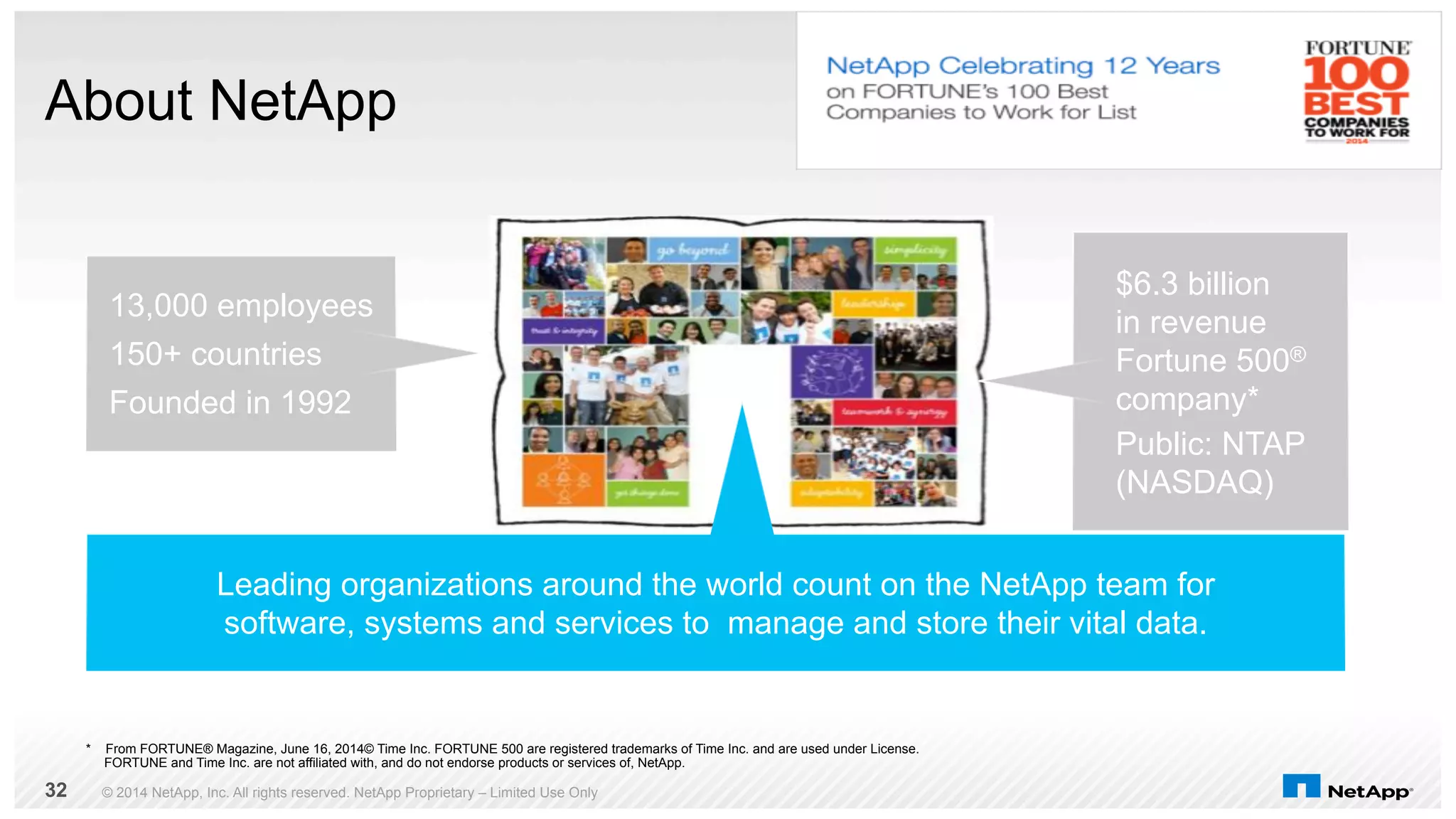
About NetApp 
13,000 employees 
150+ countries 
Founded in 1992 
© 2014 NetApp, Inc. All rights reserved. NetApp Proprietary 32 – Limited Use Only 
$6.3 billion 
in revenue 
Fortune 500® 
company* 
Public: NTAP 
(NASDAQ) 
Leading organizations around the world count on the NetApp team for 
software, systems and services to manage and store their vital data. 
* From FORTUNE® Magazine, June 16, 2014© Time Inc. FORTUNE 500 are registered trademarks of Time Inc. and are used under License. 
FORTUNE and Time Inc. are not affiliated with, and do not endorse products or services of, NetApp.
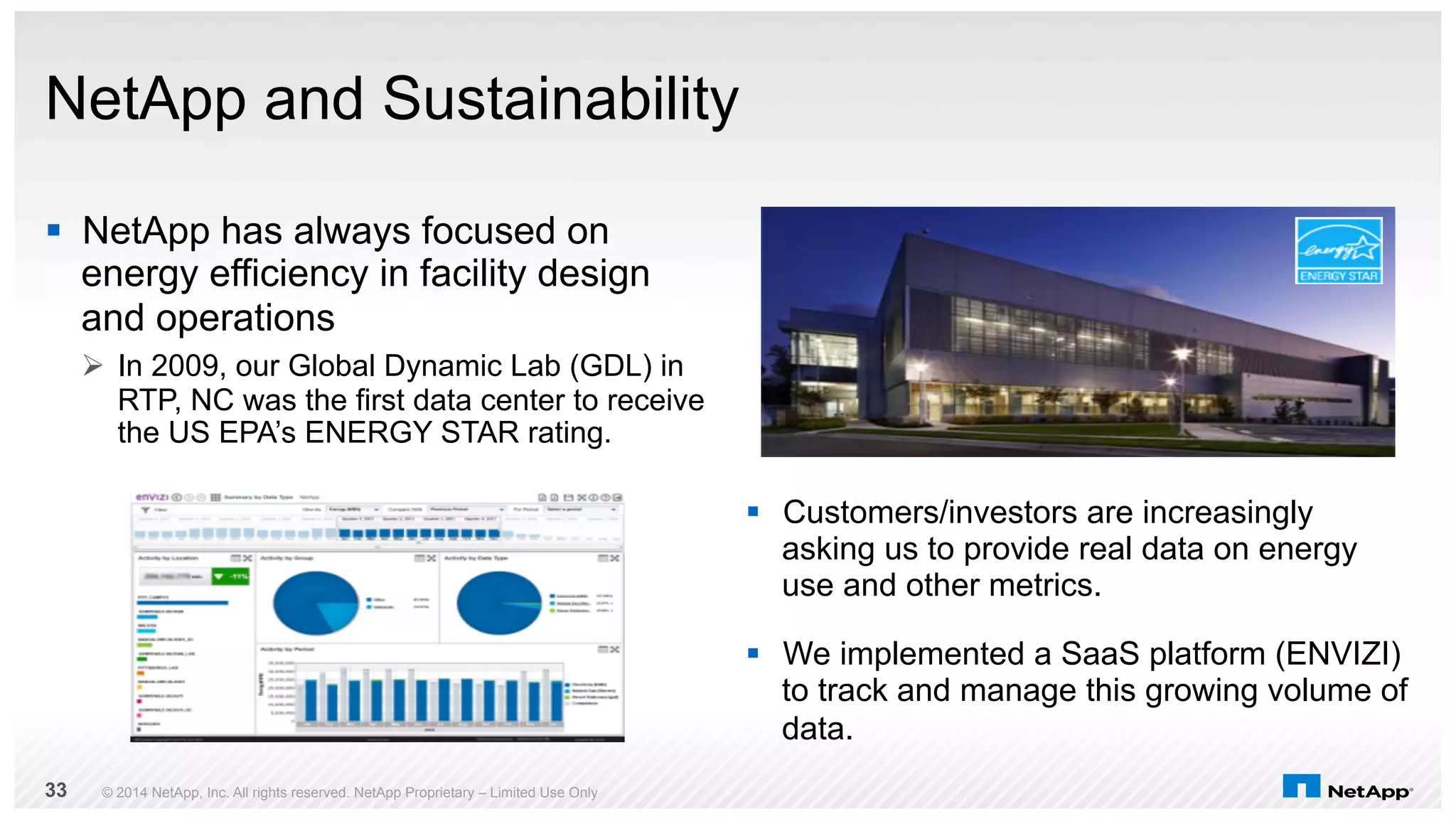
NetApp and Sustainability 
§ NetApp has always focused on 
energy efficiency in facility design 
and operations 
Ø In 2009, our Global Dynamic Lab (GDL) in 
RTP, NC was the first data center to receive 
the US EPA’s ENERGY STAR rating. 
§ Customers/investors are increasingly 
asking us to provide real data on energy 
use and other metrics. 
§ We implemented a SaaS platform (ENVIZI) 
to track and manage this growing volume of 
data. 
© 2014 NetApp, Inc. All rights reserved. NetApp Proprietary 33 – Limited Use Only
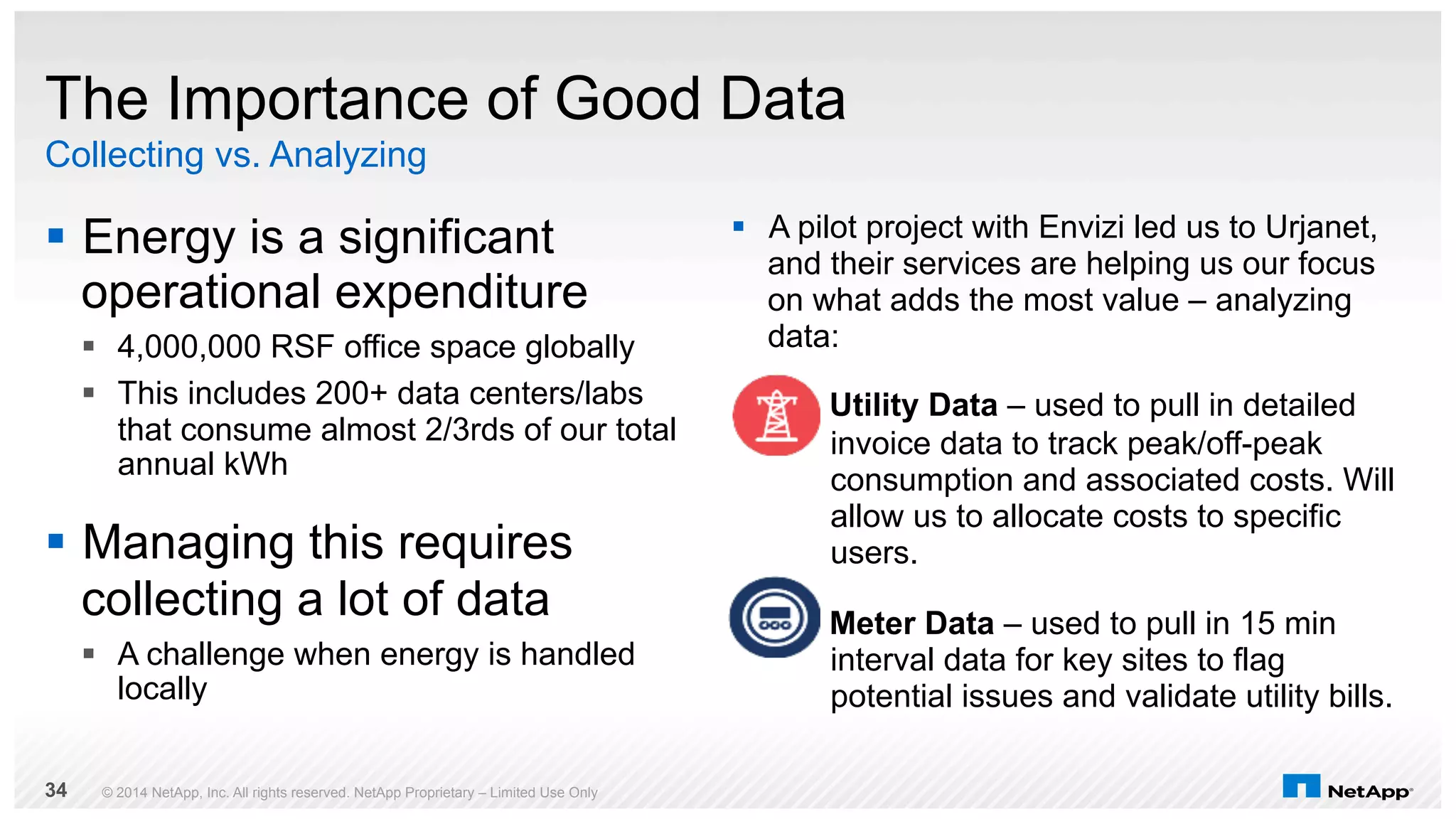
The Importance of Good Data 
Collecting vs. Analyzing 
§ Energy is a significant 
operational expenditure 
§ 4,000,000 RSF office space globally 
§ This includes 200+ data centers/labs 
that consume almost 2/3rds of our total 
annual kWh 
§ Managing this requires 
collecting a lot of data 
§ A challenge when energy is handled 
locally 
§ A pilot project with Envizi led us to Urjanet, 
and their services are helping us our focus 
on what adds the most value – analyzing 
data: 
§ Utility Data – used to pull in detailed 
invoice data to track peak/off-peak 
consumption and associated costs. Will 
allow us to allocate costs to specific 
users. 
§ Meter Data – used to pull in 15 min 
interval data for key sites to flag 
potential issues and validate utility bills. 
© 2014 NetApp, Inc. All rights reserved. NetApp Proprietary 34 – Limited Use Only
Jason Roeder 
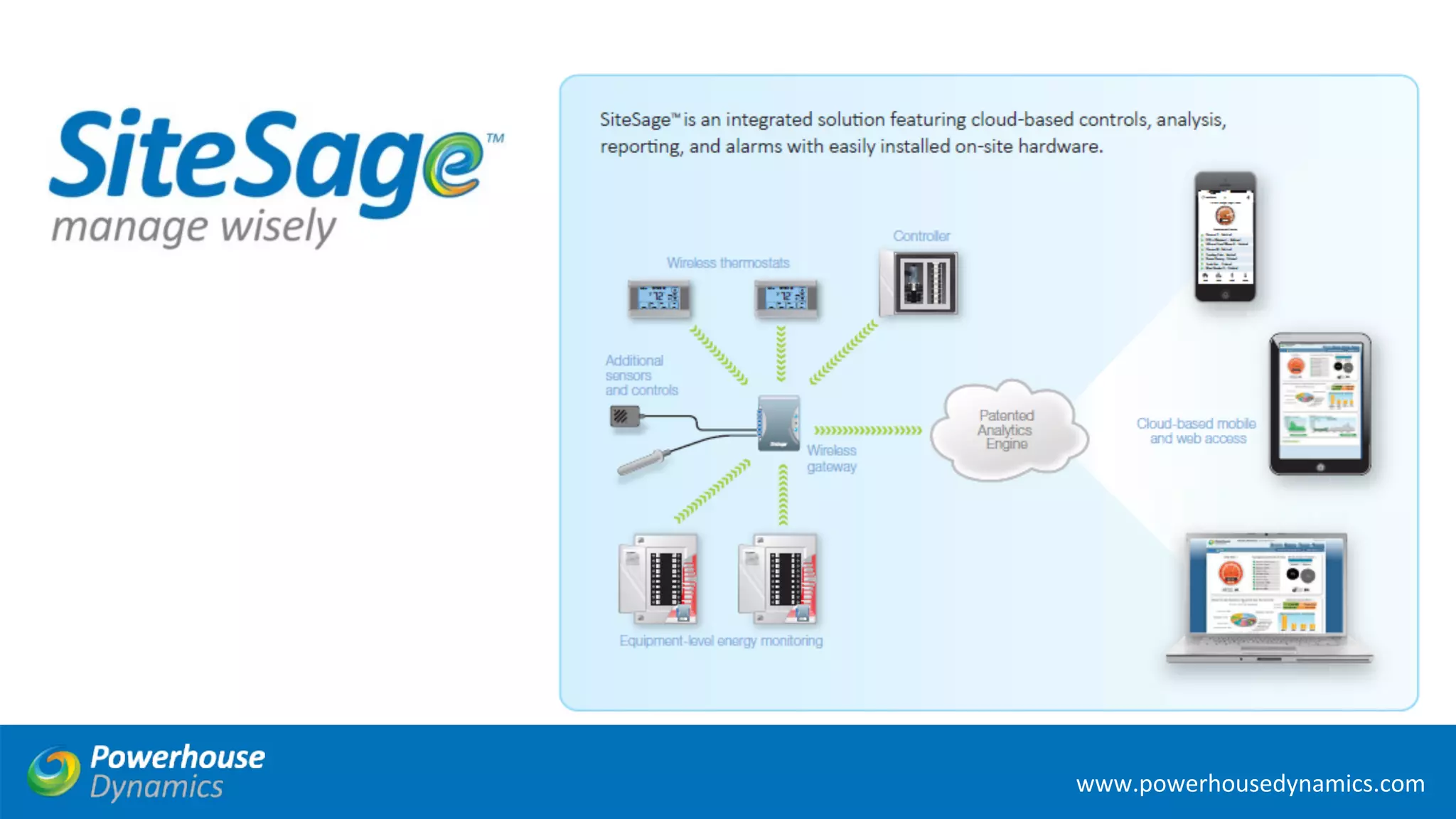
Jason is responsible for leading the continued evolution of the Powerhouse Dynamics’ SiteSage 
platform. Jason has a deep background in energy management and energy efficiency across large 
enterprises and has lead PhD’s successful implementation across many food service concepts. 
Prior to PhD, Jason helped create and deliver energy efficiency solutions at EnerNOC. Also at 
EnerNOC Jason helped lead the creation of an Account Management group that ensured customer 
success across both energy efficiency and demand response programs. Jason has an MBA from MIT 
and an engineering degree from Stanford University.
Use 
hard 
data 
to 
hold 
vendors 
accountable 
for 
effecDve 
repairs 
Page 
36 
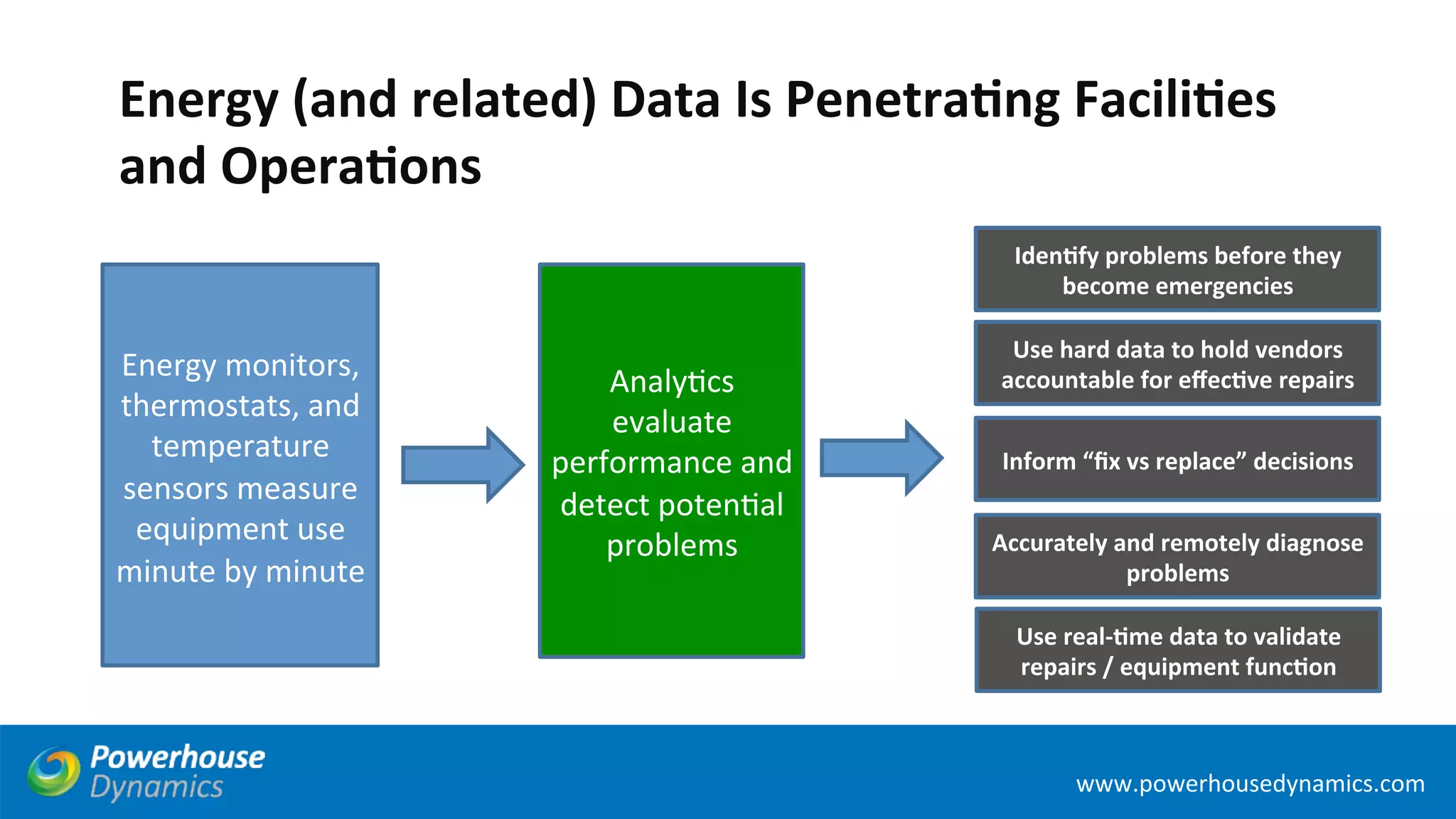
Energy 
(and 
related) 
Data 
Is 
PenetraDng 
FaciliDes 
and 
OperaDons 
www.powerhousedynamics.com 
Analy>cs 
evaluate 
performance 
and 
detect 
poten>al 
problems 
Energy 
monitors, 
thermostats, 
and 
temperature 
sensors 
measure 
equipment 
use 
minute 
by 
minute 
IdenDfy 
problems 
before 
they 
become 
emergencies 
Inform 
“fix 
vs 
replace” 
decisions 
Accurately 
and 
remotely 
diagnose 
problems 
Use 
real-­‐Dme 
data 
to 
validate 
repairs 
/ 
equipment 
funcDon
Page 
37 
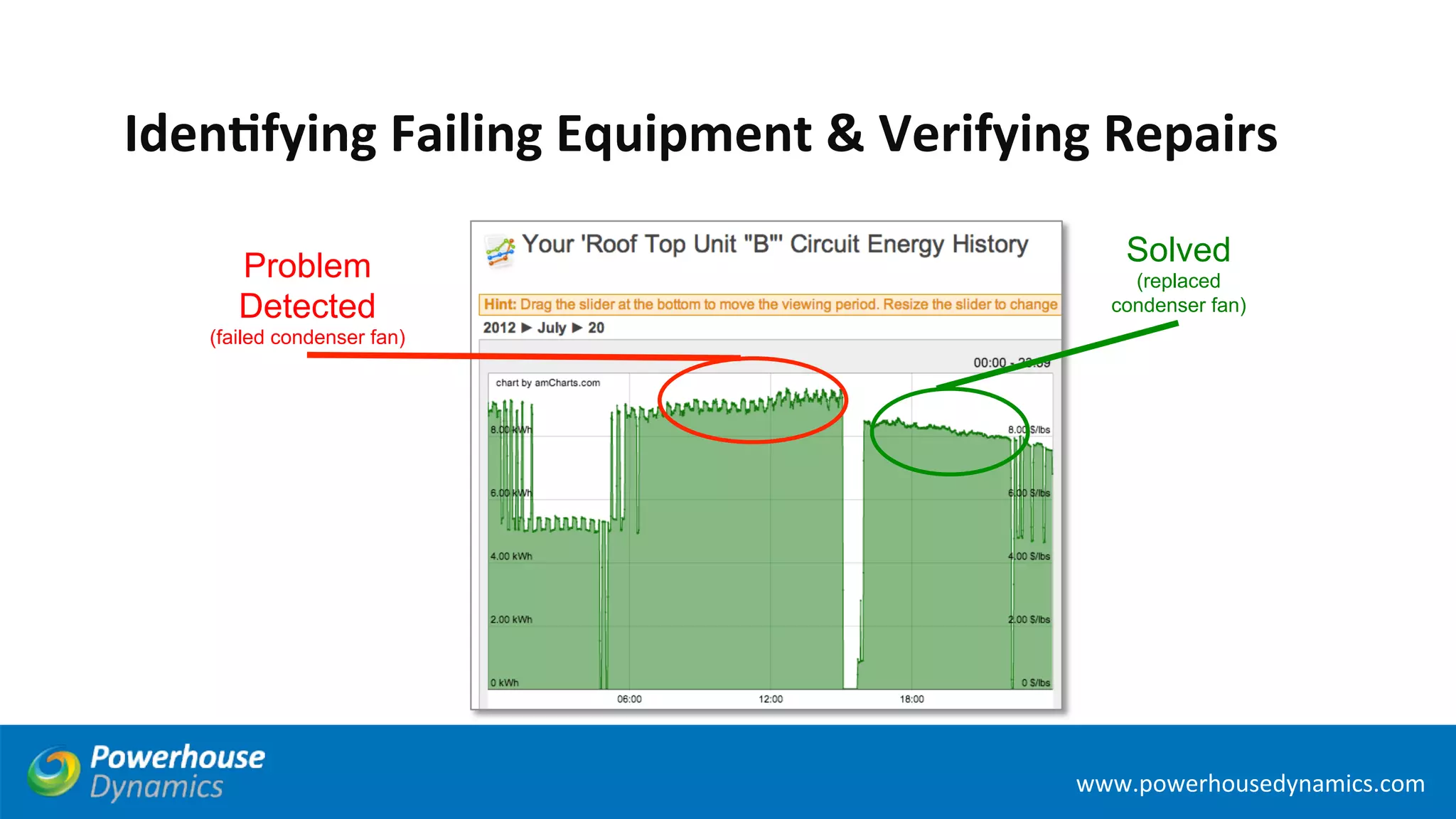
IdenDfying 
Failing 
Equipment 
& 
Verifying 
Repairs 
www.powerhousedynamics.com 
Problem 
Detected 
(failed condenser fan) 
Solved 
(replaced 
condenser fan)
Page 
38 
www.powerhousedynamics.com 
Ensuring 
Food 
Safety 
& 
Product 
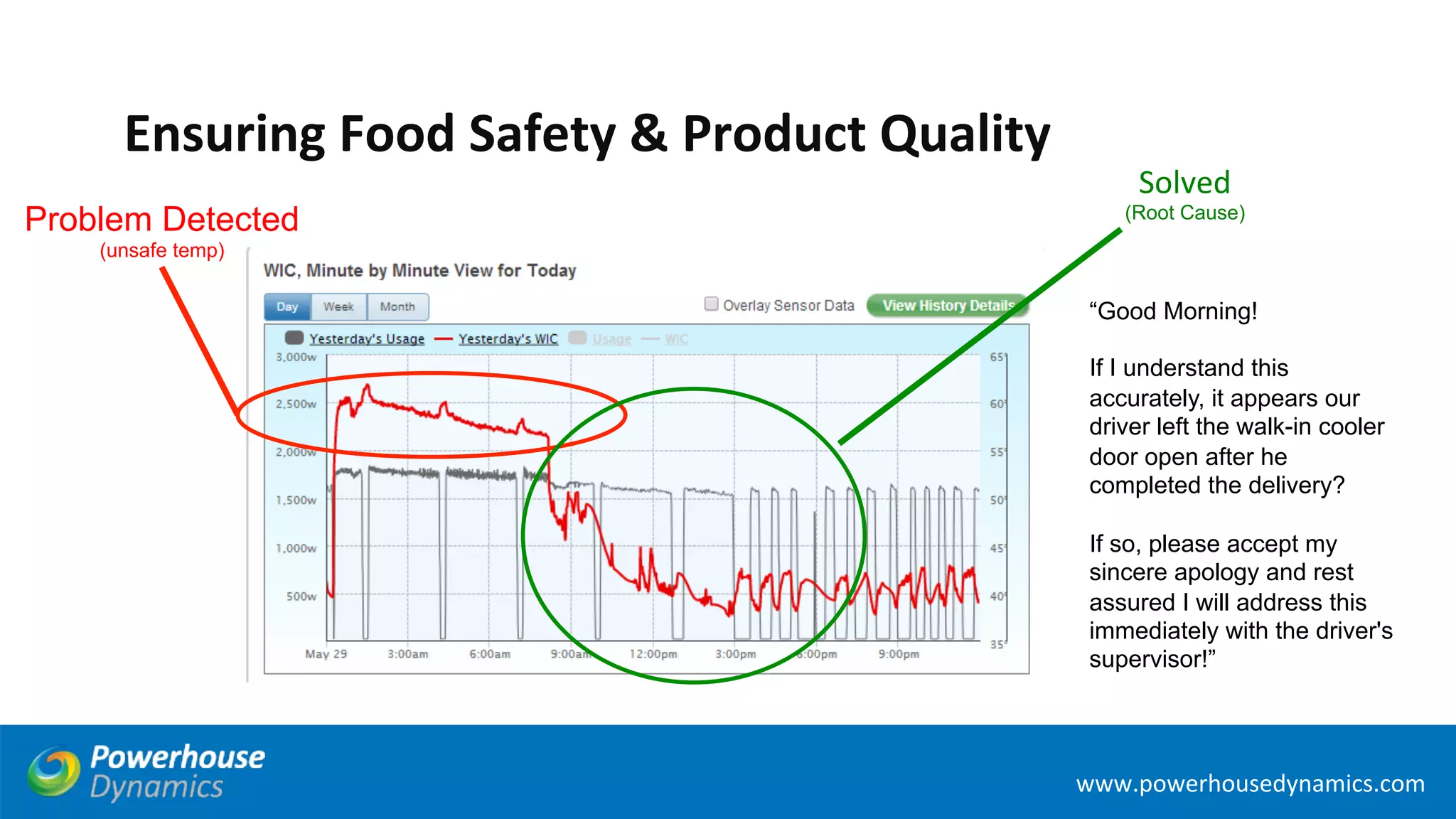
Quality 
“Good Morning! 
If I understand this 
accurately, it appears our 
driver left the walk-in cooler 
door open after he 
completed the delivery? 
If so, please accept my 
sincere apology and rest 
assured I will address this 
immediately with the driver's 
supervisor!” 
Problem Detected 
(unsafe temp) 
Solved 
(Root Cause)
Page 
39 
www.powerhousedynamics.com 
Driving 
OperaDonal 
Best 
PracDces 
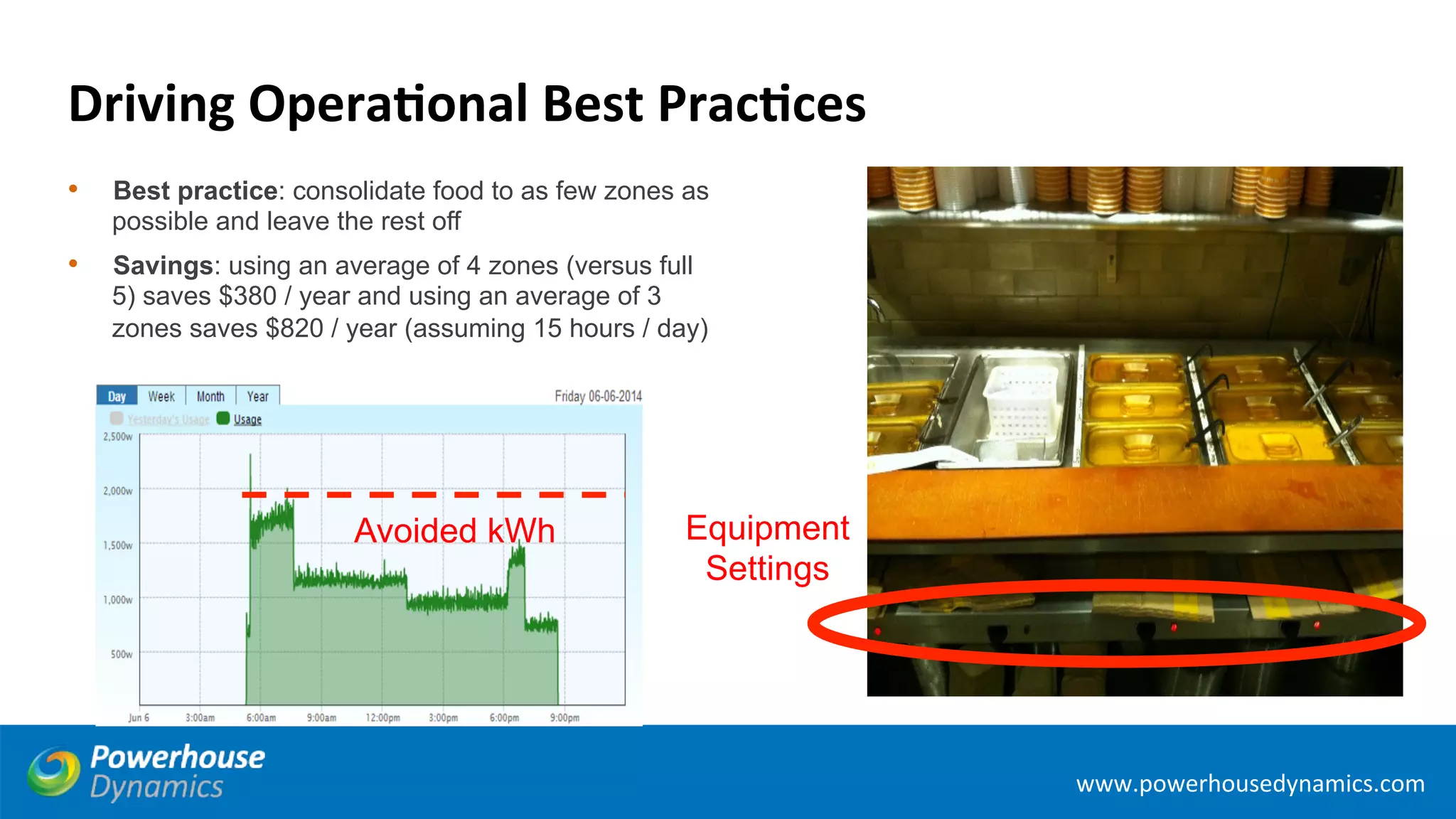
• Best practice: consolidate food to as few zones as 
possible and leave the rest off 
• Savings: using an average of 4 zones (versus full 
5) saves $380 / year and using an average of 3 
zones saves $820 / year (assuming 15 hours / day) 
Avoided kWh Equipment 
Settings
Page 
40 
www.powerhousedynamics.com 
www.powerhousedynamics.com
How does Urjanet factor in? 
Urjanet is the world’s first provider of automated utility data 
as a service. 
We deliver the Big Energy Data that large enterprises, 
government agencies, and educational institutions rely on to 
make smarter 
more profitable 
& eco-friendly energy decisions.
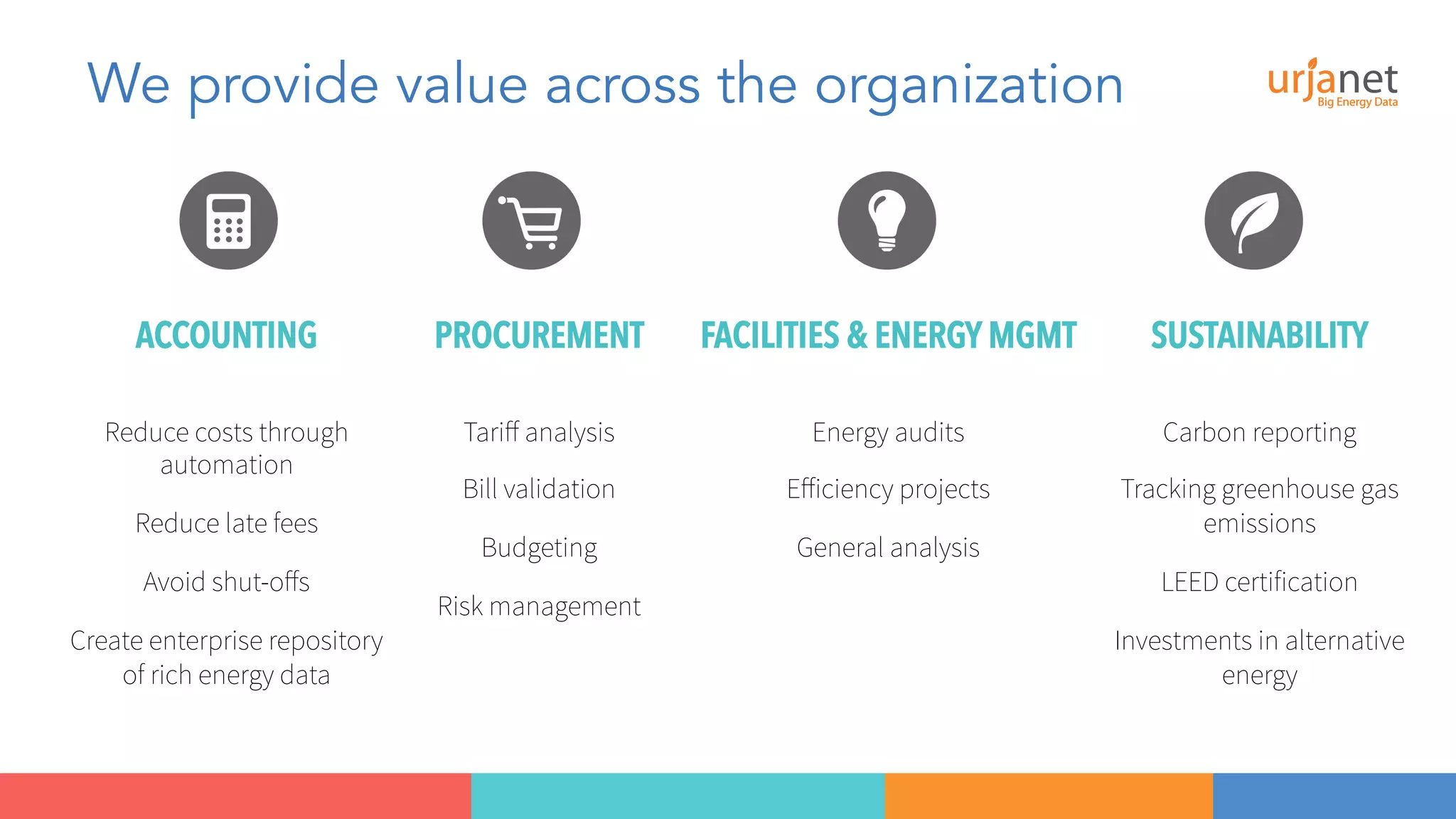
We provide value across the organization 
ACCOUNTING PROCUREMENT FACILITIES & ENERGY MGMT SUSTAINABILITY 
Reduce costs through 
automation 
Reduce late fees 
Avoid shut-offs 
Create enterprise repository 
of rich energy data 
Tariff analysis 
Bill validation 
Budgeting 
Risk management 
Energy audits 
Efficiency projects 
General analysis 
Carbon reporting 
Tracking greenhouse gas 
emissions 
LEED certification 
Investments in alternative 
energy
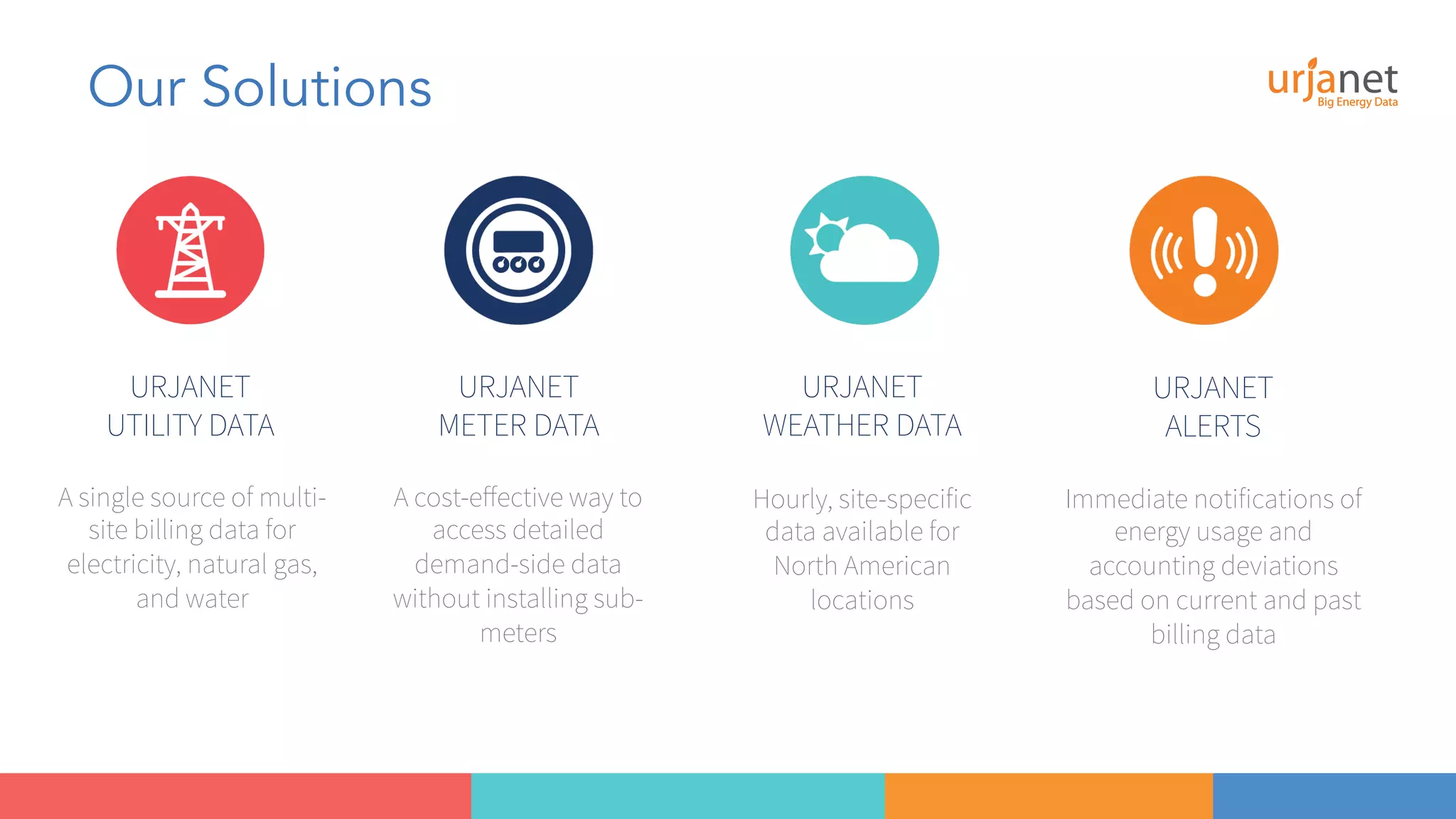
Our Solutions 
URJANET 
UTILITY DATA 
URJANET 
METER DATA 
URJANET 
WEATHER DATA 
URJANET 
ALERTS 
A single source of multi-site 
billing data for 
electricity, natural gas, 
and water 
A cost-effective way to 
access detailed 
demand-side data 
without installing sub-meters 
Hourly, site-specific 
data available for 
North American 
locations 
Immediate notifications of 
energy usage and 
accounting deviations 
based on current and past 
billing data
Join us for: 
WHO 
Energy management software and services 
professionals, Fortune 500 executives, 
members of the Urjanet community 
WHAT 
1.5 day energy conference with speakers, 
cocktail reception, awards ceremony, expert 
panel, Solutions Zone, and more 
WHEN 
October 8-9, 2014 
WHERE 
Georgia Tech Hotel & Conference Center 
FREE REGISTRATION at urjanet.com/spark-2014
Q&A
Speakers 
Kevin Sok Brian Glazebrook Jason Roeder Erik Becker Alisdair McDougall 
Manager of Engineering 
& Sustainability 
Senior Global 
Sustainability Manager 
Director of 
Energy Products 
& Services 
Vice President 
Analyst
THANKS FOR 
TUNING IN! Recording will be emailed to all registrants shortly.

Webinar: The New Consumers of Utility Data

  • 1.
    THE NEW CONSUMERSOF UTILITY DATA WEBINAR brought to you by: Sept. 10, 2014
  • 2.
    Speakers Kevin SokBrian Glazebrook Jason Roeder Erik Becker Alisdair McDougall Manager of Engineering & Sustainability Senior Global Sustainability Manager Director of Energy Products & Services Vice President Analyst
  • 3.
    Agenda 1 |Discuss why energy management is becoming data driven 2 | Learn who can benefit from access to energy data across your company 3 | Review examples and case studies from our panelists 4 | Q&A
  • 4.
    Got questions? Usethe Question Tool in your webinar dashboard to ask our panelists questions. Slides & recording will be sent following the webinar
  • 5.
    Presented by AlisdairMcDougall 5 The New Consumers Of Utility Data
  • 6.
    Alisdair McDougall AlisdairMcDougall is an Industry Analyst in the Energy Practice at Verdantix’s London office. In this role he leads Verdantix research on energy management software and industrial technologies. His previous experience includes working for the energy and sustainability team at Peter Brett Associates, a development and infrastructure consultancy. Alisdair holds a Masters in Energy and Environmental Engineering from the University of Cambridge, as well as a Bachelor of Engineering from the University of Cambridge.
  • 7.
    Agenda • Energymanagement becoming a strategic business objective • Who within an organization can benefit from access to energy data?
  • 8.
    Agenda • Energymanagement becoming a strategic business objective • Who within an organization can benefit from access to energy data?
  • 9.
    There are fourmain drivers for firms investing in energy management Economics Customers Sustainability Legislation
  • 10.
    How firms shouldactually think about these drivers Customers Economics Sustainability Legislation
  • 11.
    An increasing numberof firms are shifting to centralised global energy management strategies “What best describes your firms approach to We have a global energy management strategy with central decision-­‐making We make decisions on energy management at a divisional or na>onal level We delegate energy management decisions to Source: Verdantix The State Of Global Corporate Energy Management 3% 22% 40% 35% 0% 25% 29% 46% Don't know local managers energy management?” 2013 2012 n=250
  • 12.
    Data is thestarting point and foundation of all successful energy management strategies Collect and centralize energy and carbon data Analyse, report and communicate on energy and carbon performance Increase scope of database across business units, countries and processes Source: Verdantix The State Of Global Corporate Energy Management Manage a portfolio of energy and carbon projects Enhance analytical capabilities based on richer data set and higher confidence Increase integration with financial data, meters and building management systems Transform business operations that are aligned with energy and carbon strategy Benchmark operational and financial benefits of sustainable business investments Supply side energy management using data analytics for utility bill management and energy procurement and risk strategies Integrate energy and carbon management platform with internal engineering and maintenance teams
  • 13.
    This is whyenergy management is increasingly becoming data driven Energy data size Small, patchy Big, global Data governance level Departmental Enterprise Data technology investment Site-specific Integrated energy Source: Verdantix The State Of Global Corporate Energy Management systems Tactical energy management (1990 – 2007) Strategic energy management (2015 – 2020) Energy data feed frequency Low frequency Near real-time Data aggregation & consolidation Portfolio & strategic risk Organizational requirements management
  • 14.
    Agenda • Energymanagement becoming a strategic business objective • Who within an organization can benefit from access to energy data?
  • 15.
    There is alreadya diverse group of people that have been made responsible for energy management 37% of respondents had ‘energy’ in job title 63% of respondents did not have ‘energy’ in job title • Head of Energy • Head of Energy Engineering • VP Energy Management • Director Onsite Energy Resources • Energy Efficiency Manager • Corporate Energy & Sustainability Manager • Head of Property • Facilities Director • Operations Director • CSR manager • Chief Engineer
  • 16.
    Greater access toenergy data is beneficial throughout an organization How useful do you think it would be for each of the following user groups to have 7% 27% 20% 13% 13% 13% 27% 60% 73% 93% 33% 40% 33% 53% 40% 53% 53% 40% 27% 7% 47% 47% 27% 13% 27% 47% 20% 13% 7% 7% 13% 7% Energy teams Sustainability/CSR Facilities teams External service providers (maintenance, energy Corporate executives Business division heads Accounts payable teams Procurement External stakeholders (customers, investors, etc.) Employees services, assurance, etc.) greater access to energy data? Very Useful Useful Neutral Not Useful n=15
  • 17.
    This is becauseenergy data aids with multiple strategic and tactical business objectives CEO • Achieve competitive advantage on energy consumption • Efficiency Business Planning CFO • Minimize financial risk • Business efficiency CSO • Innovate and lead on energy & sustainability COO • Minimize operational costs • Maximize operational efficiency CIO • ICT Infrastructure energy efficiency • Maintain performance Energy/ Facilities • Minimize costs • Streamline billing • Energy asset efficiency CSR • Report progress on energy metrics • Streamline reporting process EH&S • Streamline compliance process • Achieve certification Logistics • Logistics energy asset efficiency • Asset inventorying Procurement • Manage contracts • Minimize procurement risk Supply Chain • Report supply chain energy metrics • Streamline data collection Source: Verdantix Smart Innovators Energy Management Software
  • 18.
    Data should beshared both vertically and horizontally
  • 19.
    Energy data isalso useful for user groups and stakeholders outside of your organization Source: Verdantix The State Of Global Corporate Energy Management External Stakeholders (Investors, Shareholders) Corporate Executive (CEO, CFO, COO, CSO) Finance EH&S / Sustainability Operations Corporate Finance Procurement Operations EH&S Sustainability Marketing Facilities Business Division Managers Real Estate Employees Maintenance Consultant Bureau Services Provider Assurance Provider Reporting Bodies (CDP, GRI) Assurance Provider Customers Outsourced Consultan t Services External User Internal User
  • 20.
    Opportunities exist withinenergy data for multiple user groups • Large North American retailer uses its energy data to manage its portfolio of stores during Hurricane Sandy • European grocery retailer engages employees on energy management best practices through the use of energy alarms • High street retailer conducts a cost benefit analysis of leaving shop doors open by comparing sales figures with increased energy costs • Global technology firm cuts energy and maintenance costs by providing facilities teams with greater access to energy data • Casino optimizes energy costs and comfort levels by incorporating occupancy levels within its energy management strategy • Cold food storage firm optimizes procurement by increasing energy consumption Source: Verdantix The State Of Global Corporate Energy Management
  • 21.
    Key Takeaways 1| There’s a diverse group of people who are responsible for energy management 2 | Energy data aids with multiple strategic and tactical business objectives 3 | Both internal users and external stakeholders can benefit from these insights
  • 22.
    Kevin Sok Kevinhas more than 17 years of extensive experience in the energy and engineering industry. His role entails developing and executing strategies to generate energy from renewable sources, energy management, evaluation and deployment of clean technologies, and environmental analytics. Currently, Kevin heads the initiative to centralize environmental data from various sources from across multiple business units and establishes governances and processes to capture accurate data and improve business processes. Before joining Cox, Kevin worked at Southern Company and held various positions in engineering and marketing services. Kevin holds a bachelor’s degree in Mechanical Engineering from the University of Central Florida and an Executive MBA from the J. Mack Robinson School of Business at Georgia State University.
  • 23.
    23 About CoxEnterprises, Inc. • Revenues nearly $16 billion • Approximately 50,000 employees • The company's major operating subsidiaries include Cox Communications (cable television distribution, high-speed Internet access, telephone, commercial telecommunications and advertising solutions); Cox Media Group (television and radio stations, digital media, newspapers and advertising sales rep firms); and Cox Automotive (automotive-related auctions, financial services, media and software solutions). The company's major national brands include AutoTrader.com, Kelley Blue Book, Manheim, Savings.com and Valpak.
  • 24.
    24 Sustainability Goals • Carbon Neutral by 2043 • Carbon neutrality, or having a net zero carbon footprint, refers to achieving net zero carbon emissions by balancing a measured amount of carbon released with an equivalent amount renewable energy. • Water Neutral by 2043 • We will reduce our water footprint as much as practical & balance the remaining use through meaningful restoration. • Zero Waste to landfill by 2023 • Zero Waste is achieving over 90% diversion of waste from landfill, incinerators and the environment.
  • 25.
    Data Facts •Over 40k+ accounts (data sets from electricity, gas, fuel, water) • Over 56k+ assets (facilities, towers, vehicles, power supplies) • Operate in 41 states & some international locations across all of 25 our businesses (Cox Automotive, CCI, CMG etc.) • Over $170 M in spend annually
  • 26.
    26 Data Philosophy • Data has always been very important to us. We have been looking for ways to capture, store, and analyze a vast amount of data in an efficient & accurate manner from multiple sources. • Establish governances & processes to ensure data are current, complete, and accurate. • Analyze thousands of pieces of information and correlating them with each other to guide our business decisions and processes.
  • 27.
    27 How WeUse Data • Tracking consumption & spend comparing to budget. • Identify & verify anomalies such as billing errors and usage trend. • Make corrections. • Utilize captured data as a leverage to negotiate better utility rates. • Use data to help prioritize utility costs (highest to lowest) for establishing target sites for developing alternate energy & energy conservation initiatives. • Use to data for planning and setting environmental goals.(i.e. Carbon Footprint, etc.) Track progress. • Use to help identify metrics as compare to other companies and correlation to business operations.
  • 28.
    28 How WeUse Data • Financial Data (ERP) • Business Metrics Urjanet Collects data from 100s of Utility accounts at the Meter level and provides FTP to Cox Data Warehouse Hyperion Data Delivered by the Cox Energy Group • Weather Data (HDD, CDD) • Utility Account to ERP Location Mapping • Weather Zone Essbase Dashboard • Calculate CFP • Calculate Energy Metrics CCI Accounting (Blackline)
  • 29.
    29 How WeUse Data
  • 30.
    30 How WeUse Data Not current data
  • 31.
    Brian Glazebrook BrianGlazebrook joined NetApp, a global data storage and data management company, in May 2012 as the Senior Global Sustainability Manager. His role at NetApp is to work with organizations throughout the company to create a cohesive sustainability message and program. Currently, Brian’s work is focused on rolling out global energy targets, developing a waste management strategy and driving sustainable product design initiatives. Brian has been involved with social and environmental issues for over 18 years. Prior to NetApp, he was at Cisco, where he led the creation of a comprehensive social responsibility program managing the social and environmental impacts affecting Cisco’s supply chain. Before moving to the corporate side, he spent 11 years as a sustainability consultant, working with a wide variety of industries on different issues – from greenhouse gas management to sustainable product design to health & safety. He has a Master’s Degree in Environmental Science and a Master’s in Public Affairs from Indiana University.
  • 32.
    About NetApp 13,000employees 150+ countries Founded in 1992 © 2014 NetApp, Inc. All rights reserved. NetApp Proprietary 32 – Limited Use Only $6.3 billion in revenue Fortune 500® company* Public: NTAP (NASDAQ) Leading organizations around the world count on the NetApp team for software, systems and services to manage and store their vital data. * From FORTUNE® Magazine, June 16, 2014© Time Inc. FORTUNE 500 are registered trademarks of Time Inc. and are used under License. FORTUNE and Time Inc. are not affiliated with, and do not endorse products or services of, NetApp.
  • 33.
    NetApp and Sustainability § NetApp has always focused on energy efficiency in facility design and operations Ø In 2009, our Global Dynamic Lab (GDL) in RTP, NC was the first data center to receive the US EPA’s ENERGY STAR rating. § Customers/investors are increasingly asking us to provide real data on energy use and other metrics. § We implemented a SaaS platform (ENVIZI) to track and manage this growing volume of data. © 2014 NetApp, Inc. All rights reserved. NetApp Proprietary 33 – Limited Use Only
  • 34.
    The Importance ofGood Data Collecting vs. Analyzing § Energy is a significant operational expenditure § 4,000,000 RSF office space globally § This includes 200+ data centers/labs that consume almost 2/3rds of our total annual kWh § Managing this requires collecting a lot of data § A challenge when energy is handled locally § A pilot project with Envizi led us to Urjanet, and their services are helping us our focus on what adds the most value – analyzing data: § Utility Data – used to pull in detailed invoice data to track peak/off-peak consumption and associated costs. Will allow us to allocate costs to specific users. § Meter Data – used to pull in 15 min interval data for key sites to flag potential issues and validate utility bills. © 2014 NetApp, Inc. All rights reserved. NetApp Proprietary 34 – Limited Use Only
  • 35.
    Jason Roeder Jasonis responsible for leading the continued evolution of the Powerhouse Dynamics’ SiteSage platform. Jason has a deep background in energy management and energy efficiency across large enterprises and has lead PhD’s successful implementation across many food service concepts. Prior to PhD, Jason helped create and deliver energy efficiency solutions at EnerNOC. Also at EnerNOC Jason helped lead the creation of an Account Management group that ensured customer success across both energy efficiency and demand response programs. Jason has an MBA from MIT and an engineering degree from Stanford University.
  • 36.
    Use hard data to hold vendors accountable for effecDve repairs Page 36 Energy (and related) Data Is PenetraDng FaciliDes and OperaDons www.powerhousedynamics.com www.powerhousedynamics.com Analy>cs evaluate performance and detect poten>al problems Energy monitors, thermostats, and temperature sensors measure equipment use minute by minute IdenDfy problems before they become emergencies Inform “fix vs replace” decisions Accurately and remotely diagnose problems Use real-­‐Dme data to validate repairs / equipment funcDon
  • 37.
    Page 37 IdenDfying Failing Equipment & Verifying Repairs www.powerhousedynamics.com www.powerhousedynamics.com Problem Detected (failed condenser fan) Solved (replaced condenser fan)
  • 38.
    Page 38 www.powerhousedynamics.com www.powerhousedynamics.com Ensuring Food Safety & Product Quality “Good Morning! If I understand this accurately, it appears our driver left the walk-in cooler door open after he completed the delivery? If so, please accept my sincere apology and rest assured I will address this immediately with the driver's supervisor!” Problem Detected (unsafe temp) Solved (Root Cause)
  • 39.
    Page 39 www.powerhousedynamics.com www.powerhousedynamics.com Driving OperaDonal Best PracDces • Best practice: consolidate food to as few zones as possible and leave the rest off • Savings: using an average of 4 zones (versus full 5) saves $380 / year and using an average of 3 zones saves $820 / year (assuming 15 hours / day) Avoided kWh Equipment Settings
  • 40.
    Page 40 www.powerhousedynamics.com www.powerhousedynamics.com
  • 41.
    How does Urjanetfactor in? Urjanet is the world’s first provider of automated utility data as a service. We deliver the Big Energy Data that large enterprises, government agencies, and educational institutions rely on to make smarter more profitable & eco-friendly energy decisions.
  • 42.
    We provide valueacross the organization ACCOUNTING PROCUREMENT FACILITIES & ENERGY MGMT SUSTAINABILITY Reduce costs through automation Reduce late fees Avoid shut-offs Create enterprise repository of rich energy data Tariff analysis Bill validation Budgeting Risk management Energy audits Efficiency projects General analysis Carbon reporting Tracking greenhouse gas emissions LEED certification Investments in alternative energy
  • 43.
    Our Solutions URJANET UTILITY DATA URJANET METER DATA URJANET WEATHER DATA URJANET ALERTS A single source of multi-site billing data for electricity, natural gas, and water A cost-effective way to access detailed demand-side data without installing sub-meters Hourly, site-specific data available for North American locations Immediate notifications of energy usage and accounting deviations based on current and past billing data
  • 44.
    Join us for: WHO Energy management software and services professionals, Fortune 500 executives, members of the Urjanet community WHAT 1.5 day energy conference with speakers, cocktail reception, awards ceremony, expert panel, Solutions Zone, and more WHEN October 8-9, 2014 WHERE Georgia Tech Hotel & Conference Center FREE REGISTRATION at urjanet.com/spark-2014
  • 45.
  • 46.
    Speakers Kevin SokBrian Glazebrook Jason Roeder Erik Becker Alisdair McDougall Manager of Engineering & Sustainability Senior Global Sustainability Manager Director of Energy Products & Services Vice President Analyst
  • 47.
    THANKS FOR TUNINGIN! Recording will be emailed to all registrants shortly.