Chapter Ten   International Industrial Relations
Chapter Learning Objectives After reading this chapter, you should be able to: outline the key issues in international industrial relations and the policies and practices of multinationals discuss the potential constraints that trade unions may have on multinationals name key concerns for trade unions
Chapter Learning Objectives identify recent trends and issues in the global workforce context discuss the formation of regional economic zones such as the European Union and the impact of opponents to globalization
Terms industrial relations trade unions regional economic zones collective bargaining enterprise unions strike-proneness umbrella  or  chateau clause ‘ golden handshake’ ‘ investment strike’ ‘ social policy’ Social ‘dumping’ ‘ converging divergences’ European Union (EU) National Contact Points (NCP) Single European Market (SEM) International Trade Secretariats (ITSs)
Opening Vignette Four Season Goes to Paris Restrictive labour laws  capitalism that maintains social equity with laws and tax policies social spending that reduced income disparity  reduction of the work week to 35 hours. Unemployment and retirement benefits were generous   terminations require dues process and good cause
Opening Vignette Some flexibility allow work hour increases during peak business  periods and less during a lull could hire 10 percent to 15 percent of staff on a “temporary,” seasonal basis
Industrial Relations Difficult to compare systems and behavior across national boundaries concept change considerably when translated from one industrial relations context to another  cross-national differences emerge as to the objectives of the collective bargaining process and enforceability of collective agreements  can not be understood without an appreciation of its historical origin
Historical  Evolution of  Industrial Relations developed from the social values of the societies and countries in which they have operated cannot be understood without an understanding of the way in which laws, rules, and union management power relationships, interests and decisions were established and implemented
Factors Underlying Historical Differences in Structure of Trade Unions the mode of technology and industrial organization at critical stages of union development methods of union regulation by government ideological divisions within the trade union movement the influence of religious organizations on trade union development managerial strategies for labor relations in large corporations
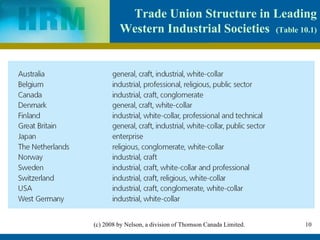
Trade Union Structure in Leading Western Industrial Societies  (Table 10.1)
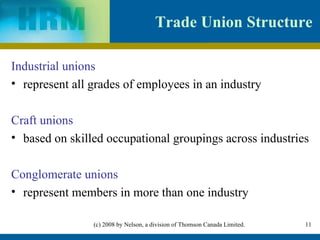
Trade Union Structure   Industrial unions represent all grades of employees in an industry Craft unions   based on skilled occupational groupings across industries Conglomerate unions represent members in more than one industry
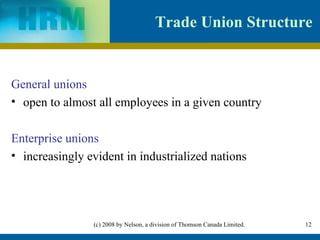
Trade Union Structure   General unions open to almost all employees in a given country Enterprise unions increasingly evident in industrialized nations
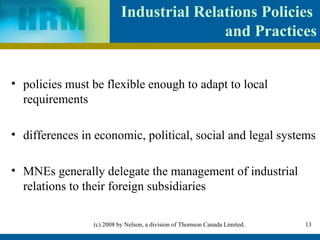
Industrial Relations Policies  and Practices policies must be flexible enough to adapt to local requirements differences in economic, political, social and legal systems MNEs generally delegate the management of industrial relations to their foreign subsidiaries
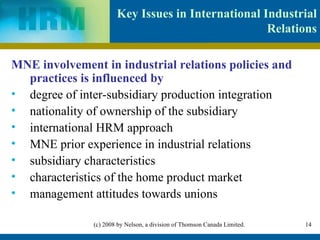
Key Issues in International Industrial Relations MNE involvement in industrial relations policies and practices is influenced by degree of inter-subsidiary production integration nationality of ownership of the subsidiary international HRM approach MNE prior experience in industrial relations subsidiary characteristics characteristics of the home product market management attitudes towards unions
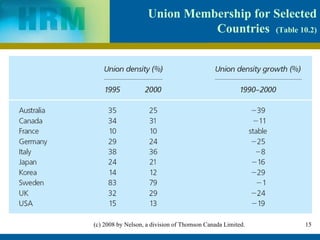
Union Membership for Selected Countries  (Table 10.2)
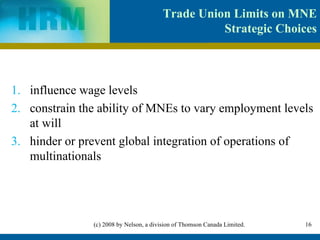
Trade Union Limits on MNE Strategic Choices influence wage levels constrain the ability of MNEs to vary employment levels at will hinder or prevent global integration of operations of multinationals
Influencing Wage Levels directly impact the organizations competitiveness due to increased cost structures and wages
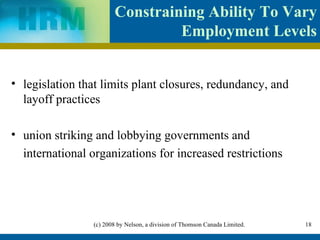
Constraining Ability To Vary Employment Levels legislation that limits plant closures, redundancy, and layoff practices union striking and lobbying governments and  international organizations for increased restrictions
Preventing Global Integration hindering MNEs operations increased costs
Trade Union Concerns About MNEs MNEs have formidable financial resources alternative sources of supply production facilities to other countries they can move a remote locus of authority production facilities in many industries superior knowledge and expertise in industrial relations the capacity to stage an ‘investment strike’
Trade Union Concerns About MNEs these characteristics act to limit the bargaining  power of unions
Trade Union Responses to MNEs International Trade Secretariats (ITSs) lobbying for restrictive national legislation regulation of multinationals by international organizations
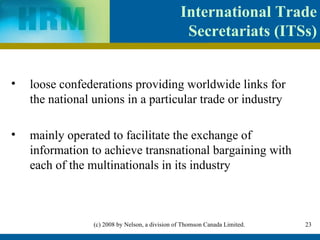
International Trade Secretariats (ITSs) loose confederations providing worldwide links for the national unions in a particular trade or industry mainly operated to facilitate the exchange of information to achieve transnational bargaining with each of the multinationals in its industry
Chapeau Clause OECD guidelines for multinationals   disclosure of information, competition, financing, taxation, employment and industrial relations, and science and technology  multinationals should adhere to the guidelines within the framework of law, regulations and prevailing labour relations and employment practices, in the countries in which they operate
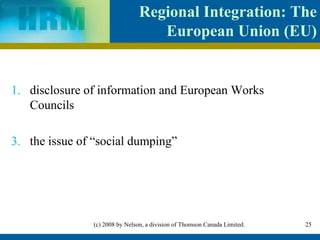
Regional Integration: The European Union (EU) disclosure of information and European Works Councils the issue of “social dumping”
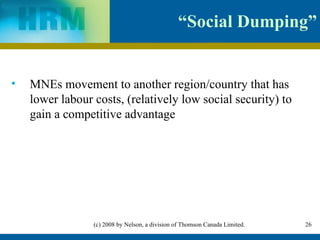
“Social Dumping” MNEs movement to another region/country that has lower labour costs, (relatively low social security) to  gain a competitive advantage
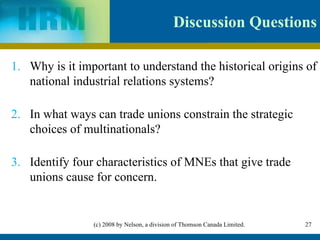
Why is it important to understand the historical origins of national industrial relations systems? In what ways can trade unions constrain the strategic choices of multinationals? Identify four characteristics of MNEs that give trade unions cause for concern. Discussion Questions
Discussion Questions 4 . What is ‘social dumping’ and why should unions   be concerned about it? 5.   Can you give other examples of documentary films which are critical of large multinational firms?
Case : Advice for Companies Going Global  Discuss the different approaches and strategies that global players such as McDonald’s can select to deal with the local labour unions when entering a new country. 2. Do you agree with Quinlan’s statement that unions do not ‘bring much to the equation’ of the employee/employer relationship?  Explain!
Case : Advice for Companies Going Global  Considering McDonald’s relatively standardized product and service, does it come as a surprise to you that McDonald’s employs so relatively few expatriates?  4. If McDonald’s achieves its goal of 100 percent local employees w hat are the advantages and disadvantages of having solely local management negotiating with the local labour unions?

Ihrm chapter10

  • 1.
    Chapter Ten International Industrial Relations
  • 2.
    Chapter Learning ObjectivesAfter reading this chapter, you should be able to: outline the key issues in international industrial relations and the policies and practices of multinationals discuss the potential constraints that trade unions may have on multinationals name key concerns for trade unions
  • 3.
    Chapter Learning Objectivesidentify recent trends and issues in the global workforce context discuss the formation of regional economic zones such as the European Union and the impact of opponents to globalization
  • 4.
    Terms industrial relationstrade unions regional economic zones collective bargaining enterprise unions strike-proneness umbrella or chateau clause ‘ golden handshake’ ‘ investment strike’ ‘ social policy’ Social ‘dumping’ ‘ converging divergences’ European Union (EU) National Contact Points (NCP) Single European Market (SEM) International Trade Secretariats (ITSs)
  • 5.
    Opening Vignette FourSeason Goes to Paris Restrictive labour laws capitalism that maintains social equity with laws and tax policies social spending that reduced income disparity reduction of the work week to 35 hours. Unemployment and retirement benefits were generous terminations require dues process and good cause
  • 6.
    Opening Vignette Someflexibility allow work hour increases during peak business periods and less during a lull could hire 10 percent to 15 percent of staff on a “temporary,” seasonal basis
  • 7.
    Industrial Relations Difficultto compare systems and behavior across national boundaries concept change considerably when translated from one industrial relations context to another cross-national differences emerge as to the objectives of the collective bargaining process and enforceability of collective agreements can not be understood without an appreciation of its historical origin
  • 8.
    Historical Evolution of Industrial Relations developed from the social values of the societies and countries in which they have operated cannot be understood without an understanding of the way in which laws, rules, and union management power relationships, interests and decisions were established and implemented
  • 9.
    Factors Underlying HistoricalDifferences in Structure of Trade Unions the mode of technology and industrial organization at critical stages of union development methods of union regulation by government ideological divisions within the trade union movement the influence of religious organizations on trade union development managerial strategies for labor relations in large corporations
  • 10.
    Trade Union Structurein Leading Western Industrial Societies (Table 10.1)
  • 11.
    Trade Union Structure Industrial unions represent all grades of employees in an industry Craft unions based on skilled occupational groupings across industries Conglomerate unions represent members in more than one industry
  • 12.
    Trade Union Structure General unions open to almost all employees in a given country Enterprise unions increasingly evident in industrialized nations
  • 13.
    Industrial Relations Policies and Practices policies must be flexible enough to adapt to local requirements differences in economic, political, social and legal systems MNEs generally delegate the management of industrial relations to their foreign subsidiaries
  • 14.
    Key Issues inInternational Industrial Relations MNE involvement in industrial relations policies and practices is influenced by degree of inter-subsidiary production integration nationality of ownership of the subsidiary international HRM approach MNE prior experience in industrial relations subsidiary characteristics characteristics of the home product market management attitudes towards unions
  • 15.
    Union Membership forSelected Countries (Table 10.2)
  • 16.
    Trade Union Limitson MNE Strategic Choices influence wage levels constrain the ability of MNEs to vary employment levels at will hinder or prevent global integration of operations of multinationals
  • 17.
    Influencing Wage Levelsdirectly impact the organizations competitiveness due to increased cost structures and wages
  • 18.
    Constraining Ability ToVary Employment Levels legislation that limits plant closures, redundancy, and layoff practices union striking and lobbying governments and international organizations for increased restrictions
  • 19.
    Preventing Global Integrationhindering MNEs operations increased costs
  • 20.
    Trade Union ConcernsAbout MNEs MNEs have formidable financial resources alternative sources of supply production facilities to other countries they can move a remote locus of authority production facilities in many industries superior knowledge and expertise in industrial relations the capacity to stage an ‘investment strike’
  • 21.
    Trade Union ConcernsAbout MNEs these characteristics act to limit the bargaining  power of unions
  • 22.
    Trade Union Responsesto MNEs International Trade Secretariats (ITSs) lobbying for restrictive national legislation regulation of multinationals by international organizations
  • 23.
    International Trade Secretariats(ITSs) loose confederations providing worldwide links for the national unions in a particular trade or industry mainly operated to facilitate the exchange of information to achieve transnational bargaining with each of the multinationals in its industry
  • 24.
    Chapeau Clause OECDguidelines for multinationals disclosure of information, competition, financing, taxation, employment and industrial relations, and science and technology multinationals should adhere to the guidelines within the framework of law, regulations and prevailing labour relations and employment practices, in the countries in which they operate
  • 25.
    Regional Integration: TheEuropean Union (EU) disclosure of information and European Works Councils the issue of “social dumping”
  • 26.
    “Social Dumping” MNEsmovement to another region/country that has lower labour costs, (relatively low social security) to gain a competitive advantage
  • 27.
    Why is itimportant to understand the historical origins of national industrial relations systems? In what ways can trade unions constrain the strategic choices of multinationals? Identify four characteristics of MNEs that give trade unions cause for concern. Discussion Questions
  • 28.
    Discussion Questions 4. What is ‘social dumping’ and why should unions be concerned about it? 5. Can you give other examples of documentary films which are critical of large multinational firms?
  • 29.
    Case : Advicefor Companies Going Global Discuss the different approaches and strategies that global players such as McDonald’s can select to deal with the local labour unions when entering a new country. 2. Do you agree with Quinlan’s statement that unions do not ‘bring much to the equation’ of the employee/employer relationship? Explain!
  • 30.
    Case : Advicefor Companies Going Global Considering McDonald’s relatively standardized product and service, does it come as a surprise to you that McDonald’s employs so relatively few expatriates? 4. If McDonald’s achieves its goal of 100 percent local employees w hat are the advantages and disadvantages of having solely local management negotiating with the local labour unions?