Ignition System
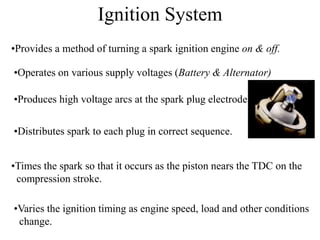
•Provides a method of turning a spark ignition engine on & off.
•Operates on various supply voltages (Battery & Alternator)
•Produces high voltage arcs at the spark plug electrode.
•Distributes spark to each plug in correct sequence.
•Times the spark so that it occurs as the piston nears the TDC on the
compression stroke.
•Varies the ignition timing as engine speed, load and other conditions
change.
Ignition Parts
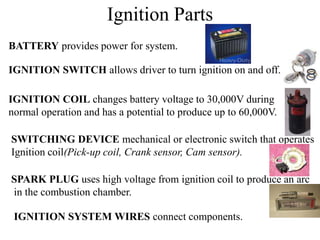
BATTERY provides power for system.
IGNITION SWITCH allows driver to turn ignition on and off.
IGNITION COIL changes battery voltage to 30,000V during
normal operation and has a potential to produce up to 60,000V.
SWITCHING DEVICE mechanical or electronic switch that operates
Ignition coil(Pick-up coil, Crank sensor, Cam sensor).
SPARK PLUG uses high voltage from ignition coil to produce an arc
in the combustion chamber.
IGNITION SYSTEM WIRES connect components.
Ignition Circuits
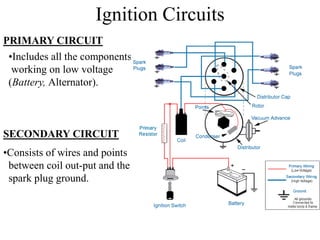
PRIMARY CIRCUIT
•Includes all the components
working on low voltage
(Battery, Alternator).
SECONDARY CIRCUIT
•Consists of wires and points
between coil out-put and the
spark plug ground.
Ignition Coil
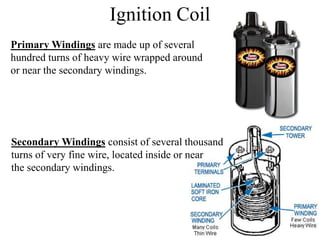
Primary Windings are made up of several
hundred turns of heavy wire wrapped around
or near the secondary windings.
Secondary Windings consist of several thousand
turns of very fine wire, located inside or near
the secondary windings.
Distributor
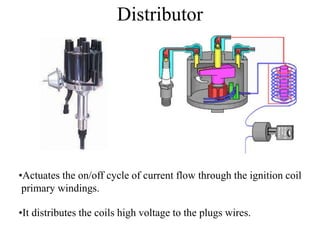
•Actuates the on/off cycle of current flow through the ignition coil
primary windings.
•It distributes the coils high voltage to the plugs wires.
Distributor
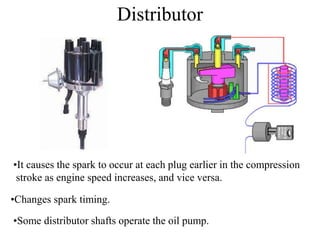
•It causes the spark to occur at each plug earlier in the compression
stroke as engine speed increases, and vice versa.
•Changes spark timing.
•Some distributor shafts operate the oil pump.
Point Ignition System
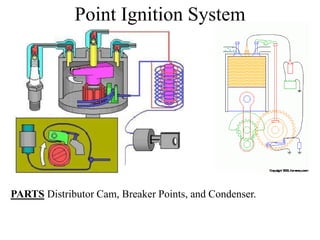
PARTS Distributor Cam, Breaker Points, and Condenser.
Point Ignition System
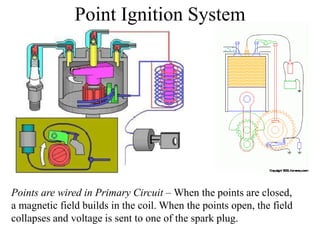
Points are wired in Primary Circuit – When the points are closed,
a magnetic field builds in the coil. When the points open, the field
collapses and voltage is sent to one of the spark plug.
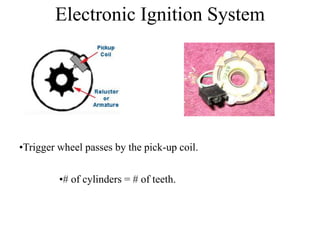
Electronic Ignition System
•Trigger wheel passes by the pick-up coil.
•# of cylinders = # of teeth.
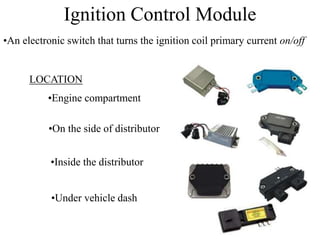
Ignition Control Module
•An electronic switch that turns the ignition coil primary current on/off
LOCATION
•Engine compartment
•On the side of distributor
•Inside the distributor
•Under vehicle dash
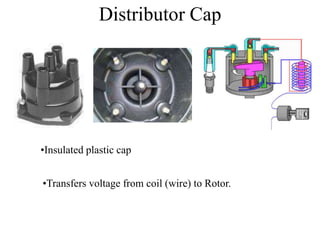
Distributor Cap
•Insulated plastic cap
•Transfers voltage from coil (wire) to Rotor.
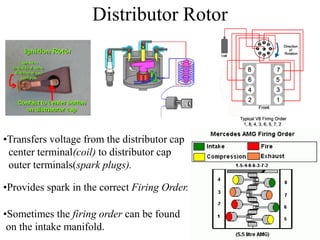
Distributor Rotor
•Transfers voltage from the distributor cap
center terminal(coil) to distributor cap
outer terminals(spark plugs).
•Provides spark in the correct Firing Order.
•Sometimes the firing order can be found
on the intake manifold.
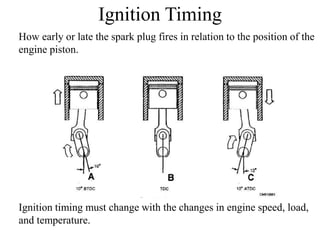
Ignition Timing
How early or late the spark plug fires in relation to the position of the
engine piston.
Ignition timing must change with the changes in engine speed, load,
and temperature.
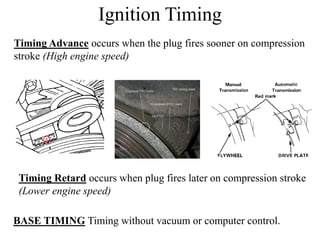
Ignition Timing
Timing Advance occurs when the plug fires sooner on compression
stroke (High engine speed)
Timing Retard occurs when plug fires later on compression stroke
(Lower engine speed)
BASE TIMING Timing without vacuum or computer control.
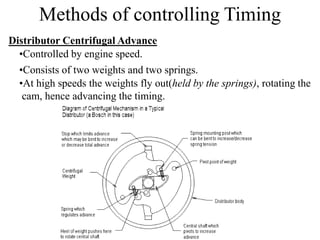
Methods of controlling Timing
Distributor Centrifugal Advance
•Controlled by engine speed.
•Consists of two weights and two springs.
•At high speeds the weights fly out(held by the springs), rotating the
cam, hence advancing the timing.
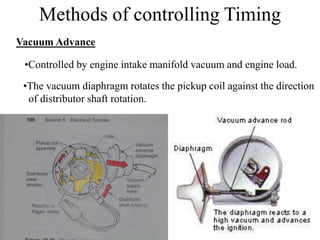
Methods of controlling Timing
Vacuum Advance
•Controlled by engine intake manifold vacuum and engine load.
•The vacuum diaphragm rotates the pickup coil against the direction
of distributor shaft rotation.
Methods of controlling Timing
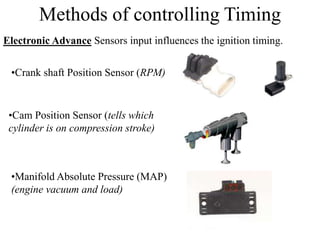
Electronic Advance Sensors input influences the ignition timing.
•Crank shaft Position Sensor (RPM)
•Cam Position Sensor (tells which
cylinder is on compression stroke)
•Manifold Absolute Pressure (MAP)
(engine vacuum and load)
Methods of controlling Timing
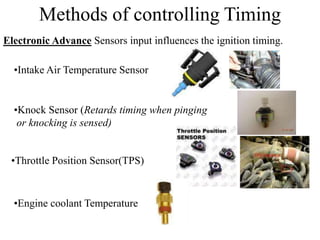
Electronic Advance Sensors input influences the ignition timing.
•Intake Air Temperature Sensor
•Knock Sensor (Retards timing when pinging
or knocking is sensed)
•Throttle Position Sensor(TPS)
•Engine coolant Temperature
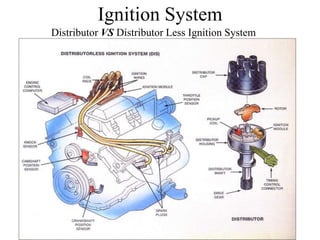
Ignition System
Distributor VS Distributor Less Ignition System
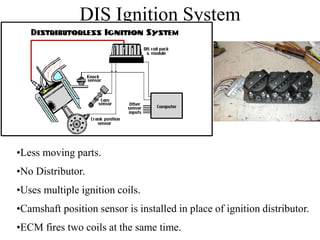
DIS Ignition System
•No Distributor.
•Uses multiple ignition coils.
•Camshaft position sensor is installed in place of ignition distributor.
•ECM fires two coils at the same time.
•Less moving parts.
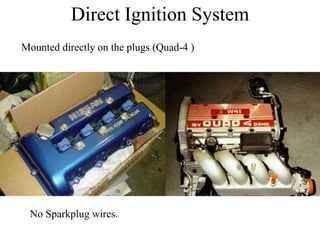
Direct Ignition System
Mounted directly on the plugs (Quad-4 )
No Sparkplug wires.
Ignition System

ignition system.ppt

  • 1.
    Ignition System •Provides amethod of turning a spark ignition engine on & off. •Operates on various supply voltages (Battery & Alternator) •Produces high voltage arcs at the spark plug electrode. •Distributes spark to each plug in correct sequence. •Times the spark so that it occurs as the piston nears the TDC on the compression stroke. •Varies the ignition timing as engine speed, load and other conditions change.
  • 2.
    Ignition Parts BATTERY providespower for system. IGNITION SWITCH allows driver to turn ignition on and off. IGNITION COIL changes battery voltage to 30,000V during normal operation and has a potential to produce up to 60,000V. SWITCHING DEVICE mechanical or electronic switch that operates Ignition coil(Pick-up coil, Crank sensor, Cam sensor). SPARK PLUG uses high voltage from ignition coil to produce an arc in the combustion chamber. IGNITION SYSTEM WIRES connect components.
  • 3.
    Ignition Circuits PRIMARY CIRCUIT •Includesall the components working on low voltage (Battery, Alternator). SECONDARY CIRCUIT •Consists of wires and points between coil out-put and the spark plug ground.
  • 4.
    Ignition Coil Primary Windingsare made up of several hundred turns of heavy wire wrapped around or near the secondary windings. Secondary Windings consist of several thousand turns of very fine wire, located inside or near the secondary windings.
  • 5.
    Distributor •Actuates the on/offcycle of current flow through the ignition coil primary windings. •It distributes the coils high voltage to the plugs wires.
  • 6.
    Distributor •It causes thespark to occur at each plug earlier in the compression stroke as engine speed increases, and vice versa. •Changes spark timing. •Some distributor shafts operate the oil pump.
  • 7.
    Point Ignition System PARTSDistributor Cam, Breaker Points, and Condenser.
  • 8.
    Point Ignition System Pointsare wired in Primary Circuit – When the points are closed, a magnetic field builds in the coil. When the points open, the field collapses and voltage is sent to one of the spark plug.
  • 9.
    Electronic Ignition System •Triggerwheel passes by the pick-up coil. •# of cylinders = # of teeth.
  • 10.
    Ignition Control Module •Anelectronic switch that turns the ignition coil primary current on/off LOCATION •Engine compartment •On the side of distributor •Inside the distributor •Under vehicle dash
  • 11.
    Distributor Cap •Insulated plasticcap •Transfers voltage from coil (wire) to Rotor.
  • 12.
    Distributor Rotor •Transfers voltagefrom the distributor cap center terminal(coil) to distributor cap outer terminals(spark plugs). •Provides spark in the correct Firing Order. •Sometimes the firing order can be found on the intake manifold.
  • 13.
    Ignition Timing How earlyor late the spark plug fires in relation to the position of the engine piston. Ignition timing must change with the changes in engine speed, load, and temperature.
  • 14.
    Ignition Timing Timing Advanceoccurs when the plug fires sooner on compression stroke (High engine speed) Timing Retard occurs when plug fires later on compression stroke (Lower engine speed) BASE TIMING Timing without vacuum or computer control.
  • 15.
    Methods of controllingTiming Distributor Centrifugal Advance •Controlled by engine speed. •Consists of two weights and two springs. •At high speeds the weights fly out(held by the springs), rotating the cam, hence advancing the timing.
  • 16.
    Methods of controllingTiming Vacuum Advance •Controlled by engine intake manifold vacuum and engine load. •The vacuum diaphragm rotates the pickup coil against the direction of distributor shaft rotation.
  • 17.
    Methods of controllingTiming Electronic Advance Sensors input influences the ignition timing. •Crank shaft Position Sensor (RPM) •Cam Position Sensor (tells which cylinder is on compression stroke) •Manifold Absolute Pressure (MAP) (engine vacuum and load)
  • 18.
    Methods of controllingTiming Electronic Advance Sensors input influences the ignition timing. •Intake Air Temperature Sensor •Knock Sensor (Retards timing when pinging or knocking is sensed) •Throttle Position Sensor(TPS) •Engine coolant Temperature
  • 19.
    Ignition System Distributor VSDistributor Less Ignition System
  • 20.
    DIS Ignition System •NoDistributor. •Uses multiple ignition coils. •Camshaft position sensor is installed in place of ignition distributor. •ECM fires two coils at the same time. •Less moving parts.
  • 21.
    Direct Ignition System Mounteddirectly on the plugs (Quad-4 ) No Sparkplug wires.
  • 22.