


iGIP Structures & L&D
Tier 3 iGIP
What we are aiming for?
BIG JUMP IN ABSOLUTE AND
RELATIVE RESULTS!
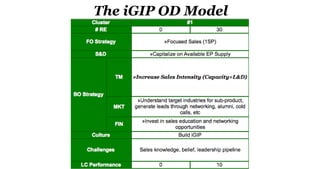
The iGIP OD Model
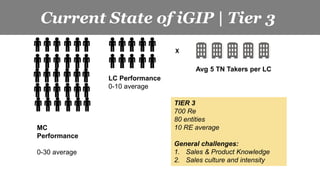
Current State of iGIP
MC
Performance
0-30 average
LC Performance
0-10 average
X
Avg 5 TN Takers per LC
TIER 3
700 Re
80 entities
10 RE average
General challenges:
1. Sales & Product Knowledge
2. Sales culture and intensity
Current State of iGIP | Tier 3
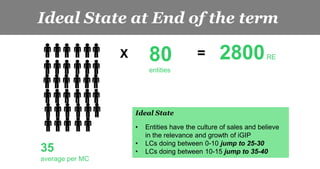
Ideal state at end of 2014
35
average per MC
X 80
entities
2800RE
Ideal State
• Entities have the culture of sales and believe
in the relevance and growth of iGIP
• LCs doing between 0-10 jump to 25-30
• LCs doing between 10-15 jump to 35-40
Ideal State at End of the term
=
What is this about?
• Pick focus LCs for iGIP growth in your entity
• Building Sales Capacity for iGIP fruit peak
• Learning and Development
• Team Minimums
• Summary of what I need to do (MC and LC)
1.Pick focus LCs
for iGIP growth
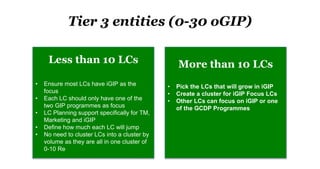
Tier 3 entities (0-30 oGIP)
Less than 10 LCs
• Ensure most LCs have iGIP as the
focus
• Each LC should only have one of the
two GIP programmes as focus
• LC Planning support specifically for TM,
Marketing and iGIP
• Define how much each LC will jump
• No need to cluster LCs into a cluster by
volume as they are all in one cluster of
0-10 Re
More than 10 LCs
• Pick the LCs that will grow in iGIP
• Create a cluster for iGIP Focus LCs
• Other LCs can focus on iGIP or one
of the GCDP Programmes
Go through the OD Toolkit/content for tier 3
to get more clarity on Focus LCs and focus
programmes!
2. Planning and Building CAPACITY
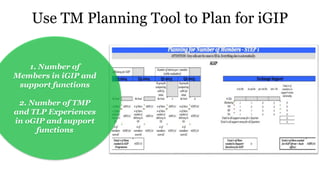
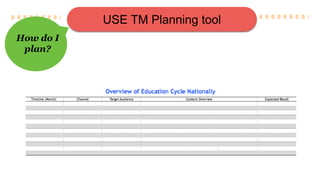
Use TM Planning Tool to Plan for iGIP
1. Number of
Members in iGIP and
support functions
2. Number of TMP
and TLP Experiences
in oGIP and support
functions
TM Planning tool download
http://www.myaiesec.net/content/viewwiki
.do?contentid=10299749
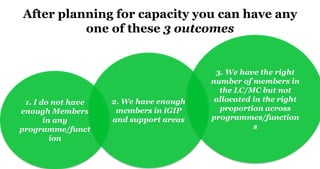
After planning for capacity you can have any
one of these 3 outcomes
1. I do not have
enough Members
in any
programme/funct
ion
2. We have enough
members in iGIP
and support areas
3. We have the right
number of members in
the LC/MC but not
allocated in the right
proportion across
programmes/function
s
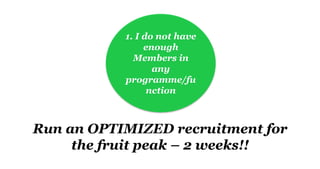
Run an OPTIMIZED recruitment for
the fruit peak – 2 weeks!!
1. I do not have
enough
Members in
any
programme/fu
nction
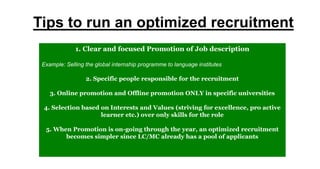
Tips to run an optimized recruitment
1. Clear and focused Promotion of Job description
Example: Selling the global internship programme to language institutes
2. Specific people responsible for the recruitment
3. Online promotion and Offline promotion ONLY in specific universities
4. Selection based on Interests and Values (striving for excellence, pro active
learner etc.) over only skills for the role
5. When Promotion is on-going through the year, an optimized recruitment
becomes simpler since LC/MC already has a pool of applicants
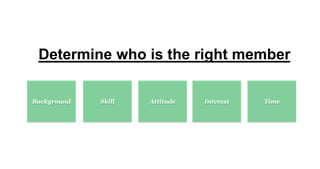
Determine who is the right member
Skill Attitude
Background Interest Time
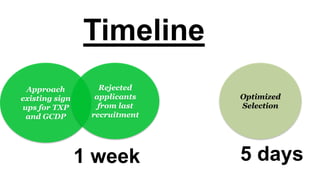
Timeline
Approach
existing sign
ups for TXP
and GCDP
Rejected
applicants
from last
recruitment
Optimized
Selection
1 week 5 days
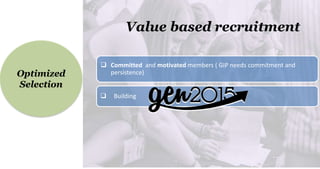
Optimized
Selection
Value based recruitment
 Committed and motivated members ( GIP needs commitment and
persistence)
 Building
Value based recruitment
http://www.myaiesec.net/content/viewwiki
.do?contentid=10299749
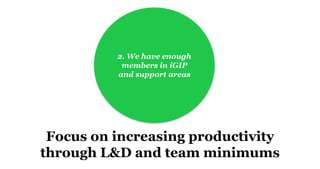
2. We have enough
members in iGIP
and support areas
Focus on increasing productivity
through L&D and team minimums
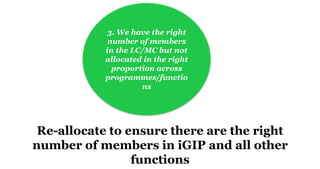
3. We have the right
number of members
in the LC/MC but not
allocated in the right
proportion across
programmes/functio
ns
Re-allocate to ensure there are the right
number of members in iGIP and all other
functions
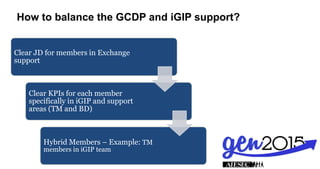
How to balance the GCDP and iGIP support?
Clear JD for members in Exchange
support
Clear KPIs for each member
specifically in iGIP and support
areas (TM and BD)
Hybrid Members – Example: TM
members in iGIP team
What structure to recruit into?
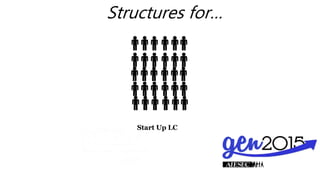
Structures for…
Start Up LC
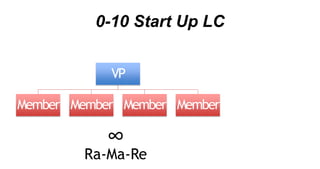
0-10 Start Up LC
VP
Member Member Member Member
∞
Ra-Ma-Re
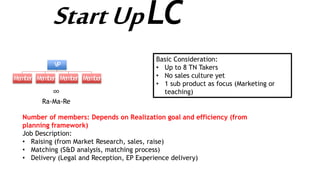
Basic Consideration:
• Up to 8 TN Takers
• No sales culture yet
• 1 sub product as focus (Marketing or
teaching)
Number of members: Depends on Realization goal and efficiency (from
planning framework)
Job Description:
• Raising (from Market Research, sales, raise)
• Matching (S&D analysis, matching process)
• Delivery (Legal and Reception, EP Experience delivery)
VP
Member Member Member Member
∞
Ra-Ma-Re
StartUpLC
Start Up
Why no
Team
Leader
- Generally these LCs have low leadership pipeline
- Since realization volume is not high, growth requires a LOT of
coordination and work of members with LCVPs
- This structure doesn’t need a very large team so an LCVP can manage
it as well
- If you do have very good leadership pipeline, having a Sub Product
based Team Leader can work too
- SPLIT iGIP and iGCDP LCVPs at an LC level across the focus LCs
• SPLIT iGIP and iGCDP LCVPs for focus LCs
• In case this isn’t possible, create specific iGIP teams for the summer within the
OGX team at an LC level so that they can be tracked separately
• Summer teams in iGIP can be working to deliver to maybe 2-3 big entity partners
only and this is part of their JD
0-10 Start Up LC
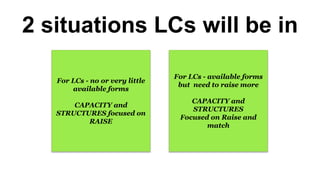
2 situations LCs will be in
For LCs - no or very little
available forms
CAPACITY and
STRUCTURES focused on
RAISE
For LCs - available forms
but need to raise more
CAPACITY and
STRUCTURES
Focused on Raise and
match
3. Learning
and
Development
USE TM Planning tool
How do I
plan?
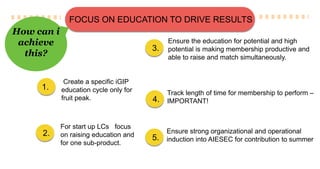
FOCUS ON EDUCATION TO DRIVE RESULTS
How can i
achieve
this?
1.
Create a specific iGIP
education cycle only for
fruit peak.
2.
Ensure the education for potential and high
potential is making membership productive and
able to raise and match simultaneously.
3.
For start up LCs focus
on raising education and
for one sub-product.
4.
Track length of time for membership to perform –
IMPORTANT!
5.
Ensure strong organizational and operational
induction into AIESEC for contribution to summer
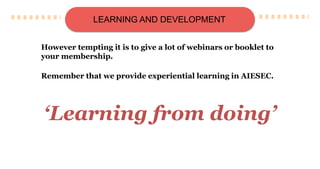
LEARNING AND DEVELOPMENT
However tempting it is to give a lot of webinars or booklet to
your membership.
Remember that we provide experiential learning in AIESEC.
‘Learning from doing’
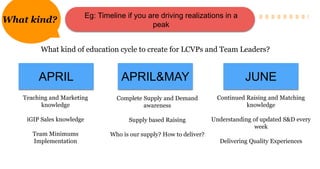
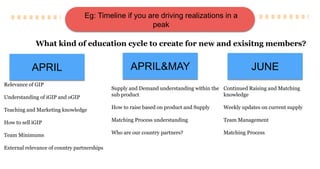
Eg: Timeline if you are driving realizations in a
peak
What kind?
What kind of education cycle to create for LCVPs and Team Leaders?
Teaching and Marketing
knowledge
iGIP Sales knowledge
Team Minimums
Implementation
Complete Supply and Demand
awareness
Supply based Raising
Who is our supply? How to deliver?
Continued Raising and Matching
knowledge
Understanding of updated S&D every
week
Delivering Quality Experiences
APRIL APRIL&MAY JUNE
What kind of education cycle to create for new and exisitng members?
Relevance of GIP
Understanding of iGIP and oGIP
Teaching and Marketing knowledge
How to sell iGIP
Team Minimums
External relevance of country partnerships
Supply and Demand understanding within the
sub product
How to raise based on product and Supply
Matching Process understanding
Who are our country partners?
Continued Raising and Matching
knowledge
Weekly updates on current supply
Team Management
Matching Process
APRIL APRIL&MAY JUNE
Eg: Timeline if you are driving realizations in a
peak
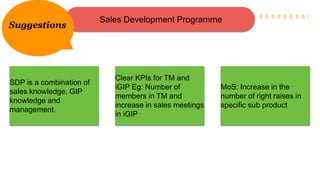
Sales Development Programme
Suggestions
SDP is a combination of
sales knowledge, GIP
knowledge and
management.
Clear KPIs for TM and
iGIP Eg: Number of
members in TM and
increase in sales meetings
in iGIP
MoS: Increase in the
number of right raises in
specific sub product
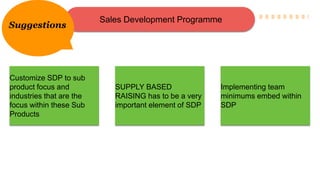
Sales Development Programme
Suggestions
Customize SDP to sub
product focus and
industries that are the
focus within these Sub
Products
SUPPLY BASED
RAISING has to be a very
important element of SDP
Implementing team
minimums embed within
SDP
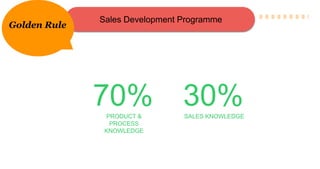
Sales Development Programme
Golden Rule
70%
PRODUCT &
PROCESS
KNOWLEDGE
30%
SALES KNOWLEDGE
To ensure new members in start up
LCs perform, ensure the right
INDUCTION process
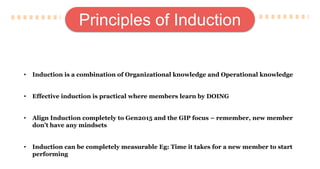
Principles of Induction
• Induction is a combination of Organizational knowledge and Operational knowledge
• Effective induction is practical where members learn by DOING
• Align Induction completely to Gen2015 and the GIP focus – remember, new member
don’t have any mindsets
• Induction can be completely measurable Eg: Time it takes for a new member to start
performing
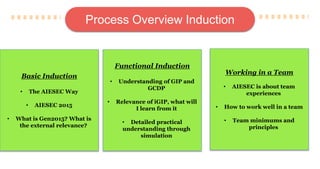
Process Overview Induction
Basic Induction
• The AIESEC Way
• AIESEC 2015
• What is Gen2015? What is
the external relevance?
Functional Induction
• Understanding of GIP and
GCDP
• Relevance of iGIP, what will
I learn from it
• Detailed practical
understanding through
simulation
Working in a Team
• AIESEC is about team
experiences
• How to work well in a team
• Team minimums and
principles
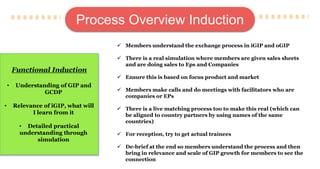
Process Overview Induction
Functional Induction
• Understanding of GIP and
GCDP
• Relevance of iGIP, what will
I learn from it
• Detailed practical
understanding through
simulation
 Members understand the exchange process in iGIP and oGIP
 There is a real simulation where members are given sales sheets
and are doing sales to Eps and Companies
 Ensure this is based on focus product and market
 Members make calls and do meetings with facilitators who are
companies or EPs
 There is a live matching process too to make this real (which can
be aligned to country partners by using names of the same
countries)
 For reception, try to get actual trainees
 De-brief at the end so members understand the process and then
bring in relevance and scale of GIP growth for members to see the
connection
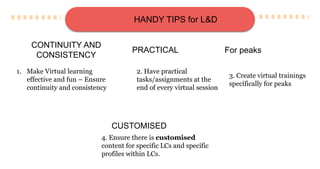
HANDY TIPS for L&D
1. Make Virtual learning
effective and fun – Ensure
continuity and consistency
2. Have practical
tasks/assignments at the
end of every virtual session
CONTINUITY AND
CONSISTENCY
PRACTICAL
3. Create virtual trainings
specifically for peaks
For peaks
4. Ensure there is customised
content for specific LCs and specific
profiles within LCs.
CUSTOMISED
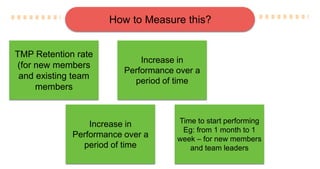
How to Measure this?
TMP Retention rate
(for new members
and existing team
members
Increase in
Performance over a
period of time
Time to start performing
Eg: from 1 month to 1
week – for new members
and team leaders
Increase in
Performance over a
period of time
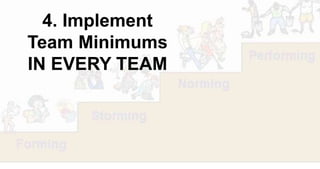
4. Implement
Team Minimums
IN EVERY TEAM
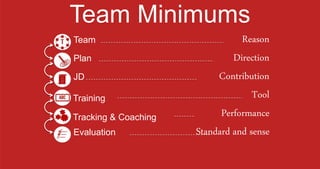
Team Minimums
Team
Plan
JD
Training
Tracking & Coaching
Evaluation Standard and sense
Reason
Direction
Contribution
Tool
Performance
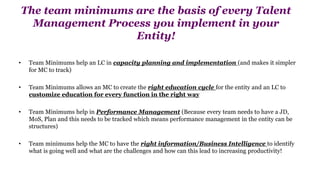
The team minimums are the basis of every Talent
Management Process you implement in your
Entity!
• Team Minimums help an LC in capacity planning and implementation (and makes it simpler
for MC to track)
• Team Minimums allows an MC to create the right education cycle for the entity and an LC to
customize education for every function in the right way
• Team Minimums help in Performance Management (Because every team needs to have a JD,
MoS, Plan and this needs to be tracked which means performance management in the entity can be
structures)
• Team minimums help the MC to have the right information/Business Intelligence to identify
what is going well and what are the challenges and how can this lead to increasing productivity!
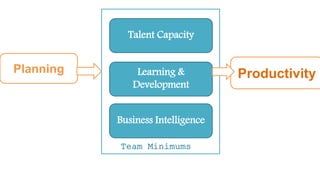
Planning Productivity
Talent Capacity
Learning &
Development
Business Intelligence
Team Minimums
Team minimums are a TOOL for
TEAM MANAGEMENT and not something that is
implemented by an MCVP TM, MCVP OD OR AN
LCVP TM!
Every MCP ,MCVP, LCP, LCVP and Team Leader is
using these to lead, manage and track their teams!
HOW DO I
TRACK THESE?
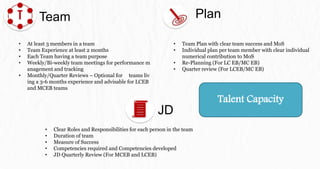
Team
• At least 3 members in a team
• Team Experience at least 2 months
• Each Team having a team purpose
• Weekly/Bi-weekly team meetings for performance m
anagement and tracking
• Monthly/Quarter Reviews – Optional for teams liv
ing a 3-6 months experience and advisable for LCEB
and MCEB teams
Plan
• Team Plan with clear team success and MoS
• Individual plan per team member with clear individual
numerical contribution to MoS
• Re-Planning (For LC EB/MC EB)
• Quarter review (For LCEB/MC EB)
JD
• Clear Roles and Responsibilities for each person in the team
• Duration of team
• Measure of Success
• Competencies required and Competencies developed
• JD Quarterly Review (For MCEB and LCEB)
Talent Capacity
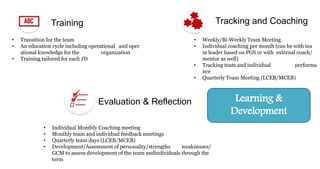
Training Tracking and Coaching
Evaluation & Reflection Learning &
Development
• Transition for the team
• An education cycle including operational and oper
ational knowledge for the organization
• Training tailored for each JD
• Weekly/Bi-Weekly Team Meeting
• Individual coaching per month (can be with tea
m leader based on PGS or with external coach/
mentor as well)
• Tracking team and individual performa
nce
• Quarterly Team Meeting (LCEB/MCEB)
• Individual Monthly Coaching meeting
• Monthly team and individual feedback meetings
• Quarterly team days (LCEB/MCEB)
• Development/Assessment of personality/strengths weaknesses/
GCM to assess development of the team andindividuals through the
term
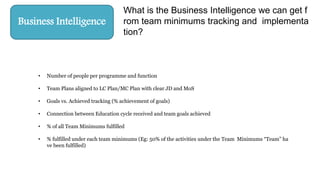
Business Intelligence
What is the Business Intelligence we can get f
rom team minimums tracking and implementa
tion?
• Number of people per programme and function
• Team Plans aligned to LC Plan/MC Plan with clear JD and MoS
• Goals vs. Achieved tracking (% achievement of goals)
• Connection between Education cycle received and team goals achieved
• % of all Team Minimums fulfilled
• % fulfilled under each team minimums (Eg: 50% of the activities under the Team Minimums “Team” ha
ve been fulfilled)
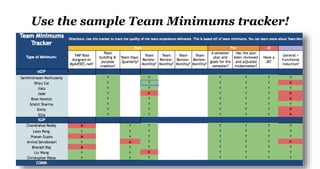
Use the sample Team Minimums tracker!
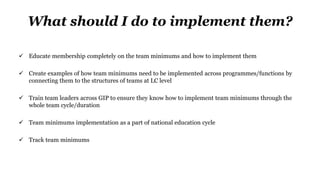
What should I do to implement them?
 Educate membership completely on the team minimums and how to implement them
 Create examples of how team minimums need to be implemented across programmes/functions by
connecting them to the structures of teams at LC level
 Train team leaders across GIP to ensure they know how to implement team minimums through the
whole team cycle/duration
 Team minimums implementation as a part of national education cycle
 Track team minimums
MC Team should start implementing team
minimums with LCVPs!!
Role of MC!
• Pick focus LCs for GIP growth
• Support Planning process - Plan for number of
members needed through TM Planning tool
• Take action based on your current reality and
recruit into the right structures
• Split iGIP goal between MC and LC if needed and
ensure LCs are aware of their goal
• Create a specific Learning and Development cycle
(embed SDP and Supply and Demand into this)
• Focus on Induction Process
• Implement Team Minimums (not just the MCVP
TM, all MCVPs need to do this)
Role of MC!
• Through data, identify the CHALLENGE of LCs to
figure out what will lead to an increase in
productivity!
Eg: Will increasing the current TMP Retention rate
lead to higher productivity
Will re allocating membership in a certain way lead
to higher productivity etc etc!
• Set CLEAR GOALS for PRODUCTIVITY with LCs
per programme, specifically in iGIP and measure
constantly
Summary iGIP 0-30
• Pick focus LCs for GIP growth
• Plan for number of members needed through TM
Planning tool
• Take action based on your current reality and
recruit into the right structures
• Create a specific Learning and Development cycle
(embed SDP and Supply and Demand into this)
just for the fruit peak
• Focus on Induction Process
• Implement Team Minimums

iGIP Tier 3 structures and L&D

  • 1.
    iGIP Structures &L&D Tier 3 iGIP
  • 2.
    What we areaiming for? BIG JUMP IN ABSOLUTE AND RELATIVE RESULTS!
  • 3.
  • 4.
    Current State ofiGIP MC Performance 0-30 average LC Performance 0-10 average X Avg 5 TN Takers per LC TIER 3 700 Re 80 entities 10 RE average General challenges: 1. Sales & Product Knowledge 2. Sales culture and intensity Current State of iGIP | Tier 3
  • 5.
    Ideal state atend of 2014 35 average per MC X 80 entities 2800RE Ideal State • Entities have the culture of sales and believe in the relevance and growth of iGIP • LCs doing between 0-10 jump to 25-30 • LCs doing between 10-15 jump to 35-40 Ideal State at End of the term =
  • 6.
    What is thisabout? • Pick focus LCs for iGIP growth in your entity • Building Sales Capacity for iGIP fruit peak • Learning and Development • Team Minimums • Summary of what I need to do (MC and LC)
  • 7.
  • 8.
    Tier 3 entities(0-30 oGIP) Less than 10 LCs • Ensure most LCs have iGIP as the focus • Each LC should only have one of the two GIP programmes as focus • LC Planning support specifically for TM, Marketing and iGIP • Define how much each LC will jump • No need to cluster LCs into a cluster by volume as they are all in one cluster of 0-10 Re More than 10 LCs • Pick the LCs that will grow in iGIP • Create a cluster for iGIP Focus LCs • Other LCs can focus on iGIP or one of the GCDP Programmes
  • 9.
    Go through theOD Toolkit/content for tier 3 to get more clarity on Focus LCs and focus programmes!
  • 10.
    2. Planning andBuilding CAPACITY
  • 11.
    Use TM PlanningTool to Plan for iGIP 1. Number of Members in iGIP and support functions 2. Number of TMP and TLP Experiences in oGIP and support functions
  • 12.
    TM Planning tooldownload http://www.myaiesec.net/content/viewwiki .do?contentid=10299749
  • 13.
    After planning forcapacity you can have any one of these 3 outcomes 1. I do not have enough Members in any programme/funct ion 2. We have enough members in iGIP and support areas 3. We have the right number of members in the LC/MC but not allocated in the right proportion across programmes/function s
  • 14.
    Run an OPTIMIZEDrecruitment for the fruit peak – 2 weeks!! 1. I do not have enough Members in any programme/fu nction
  • 15.
    Tips to runan optimized recruitment 1. Clear and focused Promotion of Job description Example: Selling the global internship programme to language institutes 2. Specific people responsible for the recruitment 3. Online promotion and Offline promotion ONLY in specific universities 4. Selection based on Interests and Values (striving for excellence, pro active learner etc.) over only skills for the role 5. When Promotion is on-going through the year, an optimized recruitment becomes simpler since LC/MC already has a pool of applicants
  • 16.
    Determine who isthe right member Skill Attitude Background Interest Time
  • 17.
    Timeline Approach existing sign ups forTXP and GCDP Rejected applicants from last recruitment Optimized Selection 1 week 5 days
  • 18.
    Optimized Selection Value based recruitment Committed and motivated members ( GIP needs commitment and persistence)  Building
  • 19.
  • 20.
    2. We haveenough members in iGIP and support areas Focus on increasing productivity through L&D and team minimums
  • 21.
    3. We havethe right number of members in the LC/MC but not allocated in the right proportion across programmes/functio ns Re-allocate to ensure there are the right number of members in iGIP and all other functions
  • 22.
    How to balancethe GCDP and iGIP support? Clear JD for members in Exchange support Clear KPIs for each member specifically in iGIP and support areas (TM and BD) Hybrid Members – Example: TM members in iGIP team
  • 23.
    What structure torecruit into?
  • 24.
  • 25.
    0-10 Start UpLC VP Member Member Member Member ∞ Ra-Ma-Re
  • 26.
    Basic Consideration: • Upto 8 TN Takers • No sales culture yet • 1 sub product as focus (Marketing or teaching) Number of members: Depends on Realization goal and efficiency (from planning framework) Job Description: • Raising (from Market Research, sales, raise) • Matching (S&D analysis, matching process) • Delivery (Legal and Reception, EP Experience delivery) VP Member Member Member Member ∞ Ra-Ma-Re StartUpLC
  • 27.
    Start Up Why no Team Leader -Generally these LCs have low leadership pipeline - Since realization volume is not high, growth requires a LOT of coordination and work of members with LCVPs - This structure doesn’t need a very large team so an LCVP can manage it as well - If you do have very good leadership pipeline, having a Sub Product based Team Leader can work too - SPLIT iGIP and iGCDP LCVPs at an LC level across the focus LCs
  • 28.
    • SPLIT iGIPand iGCDP LCVPs for focus LCs • In case this isn’t possible, create specific iGIP teams for the summer within the OGX team at an LC level so that they can be tracked separately • Summer teams in iGIP can be working to deliver to maybe 2-3 big entity partners only and this is part of their JD 0-10 Start Up LC
  • 29.
    2 situations LCswill be in For LCs - no or very little available forms CAPACITY and STRUCTURES focused on RAISE For LCs - available forms but need to raise more CAPACITY and STRUCTURES Focused on Raise and match
  • 30.
  • 31.
    USE TM Planningtool How do I plan?
  • 32.
    FOCUS ON EDUCATIONTO DRIVE RESULTS How can i achieve this? 1. Create a specific iGIP education cycle only for fruit peak. 2. Ensure the education for potential and high potential is making membership productive and able to raise and match simultaneously. 3. For start up LCs focus on raising education and for one sub-product. 4. Track length of time for membership to perform – IMPORTANT! 5. Ensure strong organizational and operational induction into AIESEC for contribution to summer
  • 33.
    LEARNING AND DEVELOPMENT Howevertempting it is to give a lot of webinars or booklet to your membership. Remember that we provide experiential learning in AIESEC. ‘Learning from doing’
  • 34.
    Eg: Timeline ifyou are driving realizations in a peak What kind? What kind of education cycle to create for LCVPs and Team Leaders? Teaching and Marketing knowledge iGIP Sales knowledge Team Minimums Implementation Complete Supply and Demand awareness Supply based Raising Who is our supply? How to deliver? Continued Raising and Matching knowledge Understanding of updated S&D every week Delivering Quality Experiences APRIL APRIL&MAY JUNE
  • 35.
    What kind ofeducation cycle to create for new and exisitng members? Relevance of GIP Understanding of iGIP and oGIP Teaching and Marketing knowledge How to sell iGIP Team Minimums External relevance of country partnerships Supply and Demand understanding within the sub product How to raise based on product and Supply Matching Process understanding Who are our country partners? Continued Raising and Matching knowledge Weekly updates on current supply Team Management Matching Process APRIL APRIL&MAY JUNE Eg: Timeline if you are driving realizations in a peak
  • 36.
    Sales Development Programme Suggestions SDPis a combination of sales knowledge, GIP knowledge and management. Clear KPIs for TM and iGIP Eg: Number of members in TM and increase in sales meetings in iGIP MoS: Increase in the number of right raises in specific sub product
  • 37.
    Sales Development Programme Suggestions CustomizeSDP to sub product focus and industries that are the focus within these Sub Products SUPPLY BASED RAISING has to be a very important element of SDP Implementing team minimums embed within SDP
  • 38.
    Sales Development Programme GoldenRule 70% PRODUCT & PROCESS KNOWLEDGE 30% SALES KNOWLEDGE
  • 39.
    To ensure newmembers in start up LCs perform, ensure the right INDUCTION process
  • 40.
    Principles of Induction •Induction is a combination of Organizational knowledge and Operational knowledge • Effective induction is practical where members learn by DOING • Align Induction completely to Gen2015 and the GIP focus – remember, new member don’t have any mindsets • Induction can be completely measurable Eg: Time it takes for a new member to start performing
  • 41.
    Process Overview Induction BasicInduction • The AIESEC Way • AIESEC 2015 • What is Gen2015? What is the external relevance? Functional Induction • Understanding of GIP and GCDP • Relevance of iGIP, what will I learn from it • Detailed practical understanding through simulation Working in a Team • AIESEC is about team experiences • How to work well in a team • Team minimums and principles
  • 42.
    Process Overview Induction FunctionalInduction • Understanding of GIP and GCDP • Relevance of iGIP, what will I learn from it • Detailed practical understanding through simulation  Members understand the exchange process in iGIP and oGIP  There is a real simulation where members are given sales sheets and are doing sales to Eps and Companies  Ensure this is based on focus product and market  Members make calls and do meetings with facilitators who are companies or EPs  There is a live matching process too to make this real (which can be aligned to country partners by using names of the same countries)  For reception, try to get actual trainees  De-brief at the end so members understand the process and then bring in relevance and scale of GIP growth for members to see the connection
  • 43.
    HANDY TIPS forL&D 1. Make Virtual learning effective and fun – Ensure continuity and consistency 2. Have practical tasks/assignments at the end of every virtual session CONTINUITY AND CONSISTENCY PRACTICAL 3. Create virtual trainings specifically for peaks For peaks 4. Ensure there is customised content for specific LCs and specific profiles within LCs. CUSTOMISED
  • 44.
    How to Measurethis? TMP Retention rate (for new members and existing team members Increase in Performance over a period of time Time to start performing Eg: from 1 month to 1 week – for new members and team leaders Increase in Performance over a period of time
  • 45.
  • 46.
    Team Minimums Team Plan JD Training Tracking &Coaching Evaluation Standard and sense Reason Direction Contribution Tool Performance
  • 47.
    The team minimumsare the basis of every Talent Management Process you implement in your Entity! • Team Minimums help an LC in capacity planning and implementation (and makes it simpler for MC to track) • Team Minimums allows an MC to create the right education cycle for the entity and an LC to customize education for every function in the right way • Team Minimums help in Performance Management (Because every team needs to have a JD, MoS, Plan and this needs to be tracked which means performance management in the entity can be structures) • Team minimums help the MC to have the right information/Business Intelligence to identify what is going well and what are the challenges and how can this lead to increasing productivity!
  • 48.
    Planning Productivity Talent Capacity Learning& Development Business Intelligence Team Minimums
  • 49.
    Team minimums area TOOL for TEAM MANAGEMENT and not something that is implemented by an MCVP TM, MCVP OD OR AN LCVP TM! Every MCP ,MCVP, LCP, LCVP and Team Leader is using these to lead, manage and track their teams!
  • 50.
  • 51.
    Team • At least3 members in a team • Team Experience at least 2 months • Each Team having a team purpose • Weekly/Bi-weekly team meetings for performance m anagement and tracking • Monthly/Quarter Reviews – Optional for teams liv ing a 3-6 months experience and advisable for LCEB and MCEB teams Plan • Team Plan with clear team success and MoS • Individual plan per team member with clear individual numerical contribution to MoS • Re-Planning (For LC EB/MC EB) • Quarter review (For LCEB/MC EB) JD • Clear Roles and Responsibilities for each person in the team • Duration of team • Measure of Success • Competencies required and Competencies developed • JD Quarterly Review (For MCEB and LCEB) Talent Capacity
  • 52.
    Training Tracking andCoaching Evaluation & Reflection Learning & Development • Transition for the team • An education cycle including operational and oper ational knowledge for the organization • Training tailored for each JD • Weekly/Bi-Weekly Team Meeting • Individual coaching per month (can be with tea m leader based on PGS or with external coach/ mentor as well) • Tracking team and individual performa nce • Quarterly Team Meeting (LCEB/MCEB) • Individual Monthly Coaching meeting • Monthly team and individual feedback meetings • Quarterly team days (LCEB/MCEB) • Development/Assessment of personality/strengths weaknesses/ GCM to assess development of the team andindividuals through the term
  • 53.
    Business Intelligence What isthe Business Intelligence we can get f rom team minimums tracking and implementa tion? • Number of people per programme and function • Team Plans aligned to LC Plan/MC Plan with clear JD and MoS • Goals vs. Achieved tracking (% achievement of goals) • Connection between Education cycle received and team goals achieved • % of all Team Minimums fulfilled • % fulfilled under each team minimums (Eg: 50% of the activities under the Team Minimums “Team” ha ve been fulfilled)
  • 54.
    Use the sampleTeam Minimums tracker!
  • 55.
    What should Ido to implement them?  Educate membership completely on the team minimums and how to implement them  Create examples of how team minimums need to be implemented across programmes/functions by connecting them to the structures of teams at LC level  Train team leaders across GIP to ensure they know how to implement team minimums through the whole team cycle/duration  Team minimums implementation as a part of national education cycle  Track team minimums
  • 56.
    MC Team shouldstart implementing team minimums with LCVPs!!
  • 57.
    Role of MC! •Pick focus LCs for GIP growth • Support Planning process - Plan for number of members needed through TM Planning tool • Take action based on your current reality and recruit into the right structures • Split iGIP goal between MC and LC if needed and ensure LCs are aware of their goal • Create a specific Learning and Development cycle (embed SDP and Supply and Demand into this) • Focus on Induction Process • Implement Team Minimums (not just the MCVP TM, all MCVPs need to do this)
  • 58.
    Role of MC! •Through data, identify the CHALLENGE of LCs to figure out what will lead to an increase in productivity! Eg: Will increasing the current TMP Retention rate lead to higher productivity Will re allocating membership in a certain way lead to higher productivity etc etc! • Set CLEAR GOALS for PRODUCTIVITY with LCs per programme, specifically in iGIP and measure constantly
  • 59.
    Summary iGIP 0-30 •Pick focus LCs for GIP growth • Plan for number of members needed through TM Planning tool • Take action based on your current reality and recruit into the right structures • Create a specific Learning and Development cycle (embed SDP and Supply and Demand into this) just for the fruit peak • Focus on Induction Process • Implement Team Minimums

Editor's Notes

  • #6 If average re is 35, then 80 entities can jump to 2700 Re from 700 Re LCs understand SP Focus, how to sell the product and what is the supply The entity has the culture of sales and believes in the relevance and growth of iGIP LCs doing between o-10 jump to 25-30 and LCs doing between 10-15 jump to 35-40
  • #19 Add link to the TMP Recruitment
  • #20 Add link to the TMP Recruitment
  • #25 Now let’s look t the current reality in IGN Split LC’s in tier 1 and tier bla bla This is the structures: How you build capacity for raising And how do you do capacity for match and raise
  • #47 They have already seen this. However just give one example of how this can work with oGIP. Just very quicky to recap (don’t go into much detail)