
Advanced Pipeline
Management
Tier 1 GIP and Tier 1 GCDP
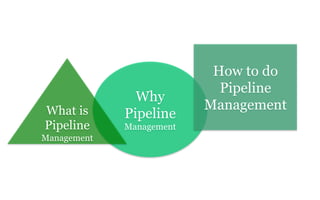
Why
Pipeline
Management
What is
Pipeline
Management
How to do
Pipeline
Management
What is
Pipeline
Management
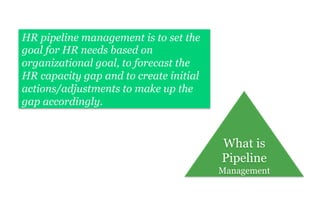
HR pipeline management is to set the
goal for HR needs based on
organizational goal, to forecast the
HR capacity gap and to create initial
actions/adjustments to make up the
gap accordingly.
What is Pipeline Management?
At any given time, you are aware of how many members you have
across each area and whether this is the right number consider goal for
number of exchange experiences and productivity in your entity!
A talent pipeline is having the right profile of people for roles in your
entity!
Simply put, Pipeline Management is
just talent tracking based on a talent
plan which is aligned to the OD Model
of an entity!
Why
Pipeline
Management
HR pipeline Management is
important because it will have us
forecast Retention Rate, Number
of members needed based on
current productivity, and come up
with L&D needs!
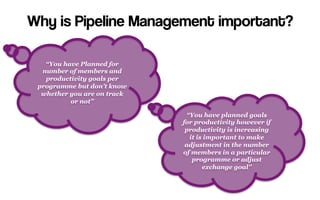
Why is Pipeline Management important?
“You have Planned for
number of members and
productivity goals per
programme but don’t know
whether you are on track
or not”
“You have planned goals
for productivity however if
productivity is increasing
it is important to make
adjustment in the number
of members in a particular
programme or adjust
exchange goal”
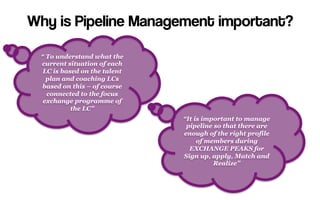
Why is Pipeline Management important?
“ To understand what the
current situation of each
LC is based on the talent
plan and coaching LCs
based on this – of course
connected to the focus
exchange programme of
the LC”
“It is important to manage
pipeline so that there are
enough of the right profile
of members during
EXCHANGE PEAKS for
Sign up, apply, Match and
Realize”
How to do Pipeline
Management at the LC level
How to do
Pipeline
Management
For Team Member
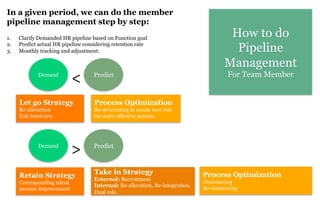
In a given period, we can do the member
pipeline management step by step:
1.  Clarify Demanded HR pipeline based on Function goal
2.  Predict actual HR pipeline considering retention rate
3.  Monthly tracking and adjustment:
Demand Predict
>
Take in Strategy
External: Recruitment
Internal: Re-allocation, Re-integration,
Dual role.
Retain Strategy
Corresponding talent
process improvement
Process Optimization
Outsourcing
Re-structuring
Demand Predict
<
Let go Strategy
Re-allocation
Exit Interview
Process Optimization
Re-structuring to create new role
for more effective process
How to do
Pipeline
Management
For Team Leader
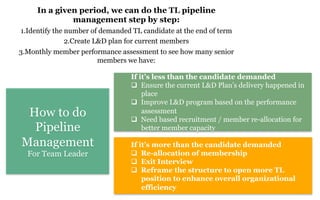
In a given period, we can do the TL pipeline
management step by step:
1. Identify the number of demanded TL candidate at the end of term
2. Create L&D plan for current members
3. Monthly member performance assessment to see how many senior
members we have:
If it’s less than the candidate demanded
q  Ensure the current L&D Plan’s delivery happened in
place
q  Improve L&D program based on the performance
assessment
q  Need based recruitment / member re-allocation for
better member capacity
If it’s more than the candidate demanded
q  Re-allocation of membership
q  Exit Interview
q  Reframe the structure to open more TL
position to enhance overall organizational
efficiency
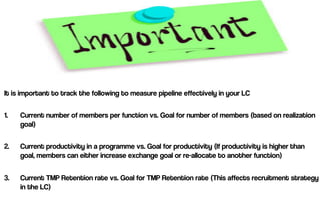
It is important to track the following to measure pipeline effectively in your LC
1.  Current number of members per function vs. Goal for number of members (based on realization
goal)
2.  Current productivity in a programme vs. Goal for productivity (If productivity is higher than
goal, members can either increase exchange goal or re-allocate to another function)
3.  Current TMP Retention rate vs. Goal for TMP Retention rate (This affects recruitment strategy
in the LC)
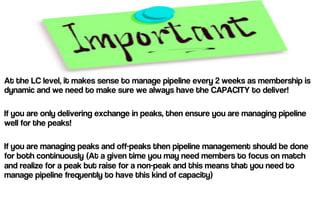
At the LC level, it makes sense to manage pipeline every 2 weeks as membership is
dynamic and we need to make sure we always have the CAPACITY to deliver!
If you are only delivering exchange in peaks, then ensure you are managing pipeline
well for the peaks!
If you are managing peaks and off-peaks then pipeline management should be done
for both continuously (At a given time you may need members to focus on match
and realize for a peak but raise for a non-peak and this means that you need to
manage pipeline frequently to have this kind of capacity)
How to do Pipeline
Management at the MC level
Before understanding how to do pipeline
management, look at what are all the things
that need to be planned for before:
	
  
-  Number of members needed per programme in exchange and back office per quarter
-  Number of members needed per LC per programme and function
-  Productivity goals per programme per LC (based on OD Model)
-  TMP Retention rate goal (can be accumulation of LC goals)
Steps in Pipeline management
at the MC level
Steps in Pipeline Management
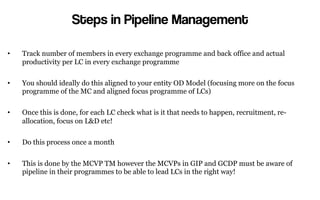
•  Track number of members in every exchange programme and back office and actual
productivity per LC in every exchange programme
•  You should ideally do this aligned to your entity OD Model (focusing more on the focus
programme of the MC and aligned focus programme of LCs)
•  Once this is done, for each LC check what is it that needs to happen, recruitment, re-
allocation, focus on L&D etc!
•  Do this process once a month
•  This is done by the MCVP TM however the MCVPs in GIP and GCDP must be aware of
pipeline in their programmes to be able to lead LCs in the right way!
Once you have worked on pipeline management,
there are many scenarios
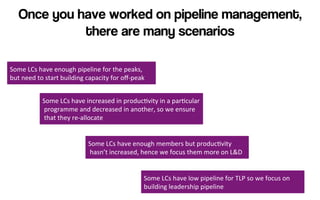
Some	
  LCs	
  have	
  enough	
  pipeline	
  for	
  the	
  peaks,	
  	
  
but	
  need	
  to	
  start	
  building	
  capacity	
  for	
  off-­‐peak	
  
Some	
  LCs	
  have	
  increased	
  in	
  produc=vity	
  in	
  a	
  par=cular
	
  programme	
  and	
  decreased	
  in	
  another,	
  so	
  we	
  ensure	
  
	
  that	
  they	
  re-­‐allocate	
  	
  
Some	
  LCs	
  have	
  enough	
  members	
  but	
  produc=vity	
  
	
  hasn’t	
  increased,	
  hence	
  we	
  focus	
  them	
  more	
  on	
  L&D	
  
Some	
  LCs	
  have	
  low	
  pipeline	
  for	
  TLP	
  so	
  we	
  focus	
  on	
  	
  
building	
  leadership	
  pipeline	
  
Once you have worked on pipeline management,
there are many scenarios
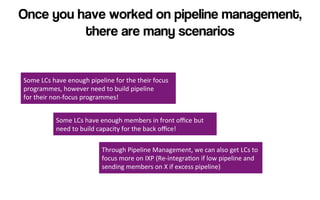
Some	
  LCs	
  have	
  enough	
  pipeline	
  for	
  the	
  their	
  focus	
  
programmes,	
  however	
  need	
  to	
  build	
  pipeline	
  	
  
for	
  their	
  non-­‐focus	
  programmes!	
  
Some	
  LCs	
  have	
  enough	
  members	
  in	
  front	
  office	
  but	
  	
  
need	
  to	
  build	
  capacity	
  for	
  the	
  back	
  office!	
  
Through	
  Pipeline	
  Management,	
  we	
  can	
  also	
  get	
  LCs	
  to	
  
focus	
  more	
  on	
  IXP	
  (Re-­‐integra=on	
  if	
  low	
  pipeline	
  and	
  	
  
sending	
  members	
  on	
  X	
  if	
  excess	
  pipeline)	
  
Pipeline Management is just talent tracking based on PLAN!
However it is the MOST Simple and Effective way to ensure LCs are
focused on the right talent challenge and are growing in GIP and GCDP
by fulfilling this challenge!

oGIP Tier 1 Advanced Pipeline Management

  • 1.
  • 2.
  • 3.
    What is Pipeline Management HR pipelinemanagement is to set the goal for HR needs based on organizational goal, to forecast the HR capacity gap and to create initial actions/adjustments to make up the gap accordingly.
  • 4.
    What is PipelineManagement? At any given time, you are aware of how many members you have across each area and whether this is the right number consider goal for number of exchange experiences and productivity in your entity! A talent pipeline is having the right profile of people for roles in your entity!
  • 5.
    Simply put, PipelineManagement is just talent tracking based on a talent plan which is aligned to the OD Model of an entity!
  • 6.
    Why Pipeline Management HR pipeline Managementis important because it will have us forecast Retention Rate, Number of members needed based on current productivity, and come up with L&D needs!
  • 7.
    Why is PipelineManagement important? “You have Planned for number of members and productivity goals per programme but don’t know whether you are on track or not” “You have planned goals for productivity however if productivity is increasing it is important to make adjustment in the number of members in a particular programme or adjust exchange goal”
  • 8.
    Why is PipelineManagement important? “ To understand what the current situation of each LC is based on the talent plan and coaching LCs based on this – of course connected to the focus exchange programme of the LC” “It is important to manage pipeline so that there are enough of the right profile of members during EXCHANGE PEAKS for Sign up, apply, Match and Realize”
  • 9.
    How to doPipeline Management at the LC level
  • 10.
    How to do Pipeline Management ForTeam Member In a given period, we can do the member pipeline management step by step: 1.  Clarify Demanded HR pipeline based on Function goal 2.  Predict actual HR pipeline considering retention rate 3.  Monthly tracking and adjustment: Demand Predict > Take in Strategy External: Recruitment Internal: Re-allocation, Re-integration, Dual role. Retain Strategy Corresponding talent process improvement Process Optimization Outsourcing Re-structuring Demand Predict < Let go Strategy Re-allocation Exit Interview Process Optimization Re-structuring to create new role for more effective process
  • 11.
    How to do Pipeline Management ForTeam Leader In a given period, we can do the TL pipeline management step by step: 1. Identify the number of demanded TL candidate at the end of term 2. Create L&D plan for current members 3. Monthly member performance assessment to see how many senior members we have: If it’s less than the candidate demanded q  Ensure the current L&D Plan’s delivery happened in place q  Improve L&D program based on the performance assessment q  Need based recruitment / member re-allocation for better member capacity If it’s more than the candidate demanded q  Re-allocation of membership q  Exit Interview q  Reframe the structure to open more TL position to enhance overall organizational efficiency
  • 12.
    It is importantto track the following to measure pipeline effectively in your LC 1.  Current number of members per function vs. Goal for number of members (based on realization goal) 2.  Current productivity in a programme vs. Goal for productivity (If productivity is higher than goal, members can either increase exchange goal or re-allocate to another function) 3.  Current TMP Retention rate vs. Goal for TMP Retention rate (This affects recruitment strategy in the LC)
  • 13.
    At the LClevel, it makes sense to manage pipeline every 2 weeks as membership is dynamic and we need to make sure we always have the CAPACITY to deliver! If you are only delivering exchange in peaks, then ensure you are managing pipeline well for the peaks! If you are managing peaks and off-peaks then pipeline management should be done for both continuously (At a given time you may need members to focus on match and realize for a peak but raise for a non-peak and this means that you need to manage pipeline frequently to have this kind of capacity)
  • 14.
    How to doPipeline Management at the MC level
  • 16.
    Before understanding howto do pipeline management, look at what are all the things that need to be planned for before:   -  Number of members needed per programme in exchange and back office per quarter -  Number of members needed per LC per programme and function -  Productivity goals per programme per LC (based on OD Model) -  TMP Retention rate goal (can be accumulation of LC goals)
  • 17.
    Steps in Pipelinemanagement at the MC level
  • 18.
    Steps in PipelineManagement •  Track number of members in every exchange programme and back office and actual productivity per LC in every exchange programme •  You should ideally do this aligned to your entity OD Model (focusing more on the focus programme of the MC and aligned focus programme of LCs) •  Once this is done, for each LC check what is it that needs to happen, recruitment, re- allocation, focus on L&D etc! •  Do this process once a month •  This is done by the MCVP TM however the MCVPs in GIP and GCDP must be aware of pipeline in their programmes to be able to lead LCs in the right way!
  • 19.
    Once you haveworked on pipeline management, there are many scenarios Some  LCs  have  enough  pipeline  for  the  peaks,     but  need  to  start  building  capacity  for  off-­‐peak   Some  LCs  have  increased  in  produc=vity  in  a  par=cular  programme  and  decreased  in  another,  so  we  ensure    that  they  re-­‐allocate     Some  LCs  have  enough  members  but  produc=vity    hasn’t  increased,  hence  we  focus  them  more  on  L&D   Some  LCs  have  low  pipeline  for  TLP  so  we  focus  on     building  leadership  pipeline  
  • 20.
    Once you haveworked on pipeline management, there are many scenarios Some  LCs  have  enough  pipeline  for  the  their  focus   programmes,  however  need  to  build  pipeline     for  their  non-­‐focus  programmes!   Some  LCs  have  enough  members  in  front  office  but     need  to  build  capacity  for  the  back  office!   Through  Pipeline  Management,  we  can  also  get  LCs  to   focus  more  on  IXP  (Re-­‐integra=on  if  low  pipeline  and     sending  members  on  X  if  excess  pipeline)  
  • 21.
    Pipeline Management isjust talent tracking based on PLAN! However it is the MOST Simple and Effective way to ensure LCs are focused on the right talent challenge and are growing in GIP and GCDP by fulfilling this challenge!