How to get research papers
published
Francesco Ricci
Free University of Bozen-Bolzano
fricci@unibz.it
The Three Golden Rules
p  Raise your quality standards as high as you can
live with and always try to work as closely
possible at the boundary of your abilities.
p  If you can find a topic that is socially relevant and
scientifically sound you are lucky: if the two
targets are in conflict let the requirement of
scientific soundness prevail.
p  Never tackle a problem of which you can be
pretty sure that it will be tackled by others who
are, in relation to that problem, at least as
competent and well-equipped as you.
[Dijkstra, 1982]
Impact of the research
Impact – the criterion of success
p  The fundamental basis for academic achievement
is the impact of one’s ideas and scholarship on
the field
p  Dimension of impact:
n  Who is affected by a result
n  The form of the impact
n  The magnitude of the impact
n  The significance of the impact
Who is affected
Other researchers
Engineers and Practitioners
Users
The form of the impact
p  The contribution may be used directly or be the
foundation for some other artifact (industry
adoption)
p  It may help other to understand better a topic or
a question (review paper)
p  It may change how others conduct their research
(evaluation procedures)
p  It may affect the questions they ask or the topics
they choose to study (the best)
p  It may even indicate the impossibility of certain
goals and kill off lines of research (negative
results).
Magnitude and Significance
p  Assessing the magnitude and significance of the
impact is done observing "indicators"
n  The number of citations
n  The quality of the journal/conferences that
published the result (acceptance rate – impact
factor)
n  The role taken by the researcher in the scientific
community (e.g. conference program chair)
n  The patents
n  The amount of money collected by
the result (projects, consultancy,
products)
n  The quality and quantity of the
scientific connections (collaborations)
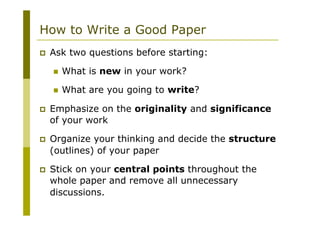
How to Write a Good Paper
p  Ask two questions before starting:
n  What is new in your work?
n  What are you going to write?
p  Emphasize on the originality and significance
of your work
p  Organize your thinking and decide the structure
(outlines) of your paper
p  Stick on your central points throughout the
whole paper and remove all unnecessary
discussions.
How to Write a Good Paper II
p  Start writing the day you start the research and
maintain a good bibliographic database (use
BibTeX and LaTeX)
p  Think about where to submit early (the paper
must be adapted to the venue)
p  Don’t try and prove you are smart and avoid the
kitchen sink syndrome
p  Interrupt the writing process for some days and
then resume it – you should be able to read
critically your own paper
p  Work towards making your paper a pleasure for
the reviewer to read.
Evaluation Criteria for Articles
p  Significance
p  Novelty and Awareness of Related Work
p  Technical Soundness and Quality
p  Relevance
p  Readability and Presentation
11
Significance
p  What is the scientific contribution of this submission? (both
in the authors' view and your own, if different)
p  Is the problem addressed in this paper well defined and
articulated?
p  Is the problem addressed interesting enough to warrant
publication?
p  Does it attack an important and difficult problem or a
peripheral and simple problem?
p  Does the approach offered advance the state of our
scientific knowledge?
p  Will the work influence scientific research or lead to
innovative commercial developments?
p  A referee should read the paper carefully and with an open
mind – often this is not true!
p  A referee should compare the paper with an appropriate
standard (not his own!)
Novelty, Awareness of Related Work
p  Does this paper present innovative ideas or
material?
p  Does this paper cite and use appropriate
references?
p  Detecting plagiarism
13
Technical Soundness
p  Is the information in the paper sound, factual, and
accurate?
p  Is the used research technique appropriate for the problem
addressed/studied?
p  Are the paper's algorithms correct?
p  Has the author systematically run experiments, provided
insightful theoretical analysis, show psychological validity,
or otherwise given evidence of generality of the presented
approach?
p  Are experimental comparisons made to relevant state of
the art alternatives (baselines)?
p  Were reasonable test beds used?
p  Are data unambiguous and properly analyzed?
p  Are the results of the research evaluated?
p  Are the conclusions supported by the evaluation strategy
and result data?
p  Have the results been shown to be statistically significant?
Relevance
p  Is the submission relevant to the scope of the
journal/conference?
p  The article must be adapted to the journal/
conference audience.
Readability and Presentation
p  Does the paper include enough illustrative examples? Are
they sufficiently detailed?
p  Are the algorithms described in sufficient detail so that
readers could replicate the work?
p  Is the presentation, organization and length satisfactory?
p  Do the authors describe the limitations of their approach in
a satisfactory manner?
p  Does the title, the key words and abstracts/summary of
this paper clearly and sufficiently reflect its contents?
p  Is the treatment of the subject complete?
p  Can additions, reductions or amendments be done so to
increase the value of this paper?
p  Are the illustrations and tables necessary and acceptable?
p  Are the references adequate and are they all necessary?
February 4th, 2015 16
3 IT papers
12 T papers
2 Editorials
Acceptance rate less than 40%

How to get research papers published

  • 1.
    How to getresearch papers published Francesco Ricci Free University of Bozen-Bolzano fricci@unibz.it
  • 2.
    The Three GoldenRules p  Raise your quality standards as high as you can live with and always try to work as closely possible at the boundary of your abilities. p  If you can find a topic that is socially relevant and scientifically sound you are lucky: if the two targets are in conflict let the requirement of scientific soundness prevail. p  Never tackle a problem of which you can be pretty sure that it will be tackled by others who are, in relation to that problem, at least as competent and well-equipped as you. [Dijkstra, 1982]
  • 3.
    Impact of theresearch
  • 4.
    Impact – thecriterion of success p  The fundamental basis for academic achievement is the impact of one’s ideas and scholarship on the field p  Dimension of impact: n  Who is affected by a result n  The form of the impact n  The magnitude of the impact n  The significance of the impact
  • 5.
    Who is affected Otherresearchers Engineers and Practitioners Users
  • 6.
    The form ofthe impact p  The contribution may be used directly or be the foundation for some other artifact (industry adoption) p  It may help other to understand better a topic or a question (review paper) p  It may change how others conduct their research (evaluation procedures) p  It may affect the questions they ask or the topics they choose to study (the best) p  It may even indicate the impossibility of certain goals and kill off lines of research (negative results).
  • 7.
    Magnitude and Significance p Assessing the magnitude and significance of the impact is done observing "indicators" n  The number of citations n  The quality of the journal/conferences that published the result (acceptance rate – impact factor) n  The role taken by the researcher in the scientific community (e.g. conference program chair) n  The patents n  The amount of money collected by the result (projects, consultancy, products) n  The quality and quantity of the scientific connections (collaborations)
  • 8.
    How to Writea Good Paper p  Ask two questions before starting: n  What is new in your work? n  What are you going to write? p  Emphasize on the originality and significance of your work p  Organize your thinking and decide the structure (outlines) of your paper p  Stick on your central points throughout the whole paper and remove all unnecessary discussions.
  • 9.
    How to Writea Good Paper II p  Start writing the day you start the research and maintain a good bibliographic database (use BibTeX and LaTeX) p  Think about where to submit early (the paper must be adapted to the venue) p  Don’t try and prove you are smart and avoid the kitchen sink syndrome p  Interrupt the writing process for some days and then resume it – you should be able to read critically your own paper p  Work towards making your paper a pleasure for the reviewer to read.
  • 10.
    Evaluation Criteria forArticles p  Significance p  Novelty and Awareness of Related Work p  Technical Soundness and Quality p  Relevance p  Readability and Presentation
  • 11.
    11 Significance p  What isthe scientific contribution of this submission? (both in the authors' view and your own, if different) p  Is the problem addressed in this paper well defined and articulated? p  Is the problem addressed interesting enough to warrant publication? p  Does it attack an important and difficult problem or a peripheral and simple problem? p  Does the approach offered advance the state of our scientific knowledge? p  Will the work influence scientific research or lead to innovative commercial developments? p  A referee should read the paper carefully and with an open mind – often this is not true! p  A referee should compare the paper with an appropriate standard (not his own!)
  • 12.
    Novelty, Awareness ofRelated Work p  Does this paper present innovative ideas or material? p  Does this paper cite and use appropriate references? p  Detecting plagiarism
  • 13.
    13 Technical Soundness p  Isthe information in the paper sound, factual, and accurate? p  Is the used research technique appropriate for the problem addressed/studied? p  Are the paper's algorithms correct? p  Has the author systematically run experiments, provided insightful theoretical analysis, show psychological validity, or otherwise given evidence of generality of the presented approach? p  Are experimental comparisons made to relevant state of the art alternatives (baselines)? p  Were reasonable test beds used? p  Are data unambiguous and properly analyzed? p  Are the results of the research evaluated? p  Are the conclusions supported by the evaluation strategy and result data? p  Have the results been shown to be statistically significant?
  • 14.
    Relevance p  Is thesubmission relevant to the scope of the journal/conference? p  The article must be adapted to the journal/ conference audience.
  • 15.
    Readability and Presentation p Does the paper include enough illustrative examples? Are they sufficiently detailed? p  Are the algorithms described in sufficient detail so that readers could replicate the work? p  Is the presentation, organization and length satisfactory? p  Do the authors describe the limitations of their approach in a satisfactory manner? p  Does the title, the key words and abstracts/summary of this paper clearly and sufficiently reflect its contents? p  Is the treatment of the subject complete? p  Can additions, reductions or amendments be done so to increase the value of this paper? p  Are the illustrations and tables necessary and acceptable? p  Are the references adequate and are they all necessary?
  • 16.
    February 4th, 201516 3 IT papers 12 T papers 2 Editorials Acceptance rate less than 40%