ENTER 2015 Research Track Slide Number 1
An Investigation of Hotel Room Reservation: What
Are The Diverse Pricing Strategies among
Competing Hotels?
Sunny Sun a,
Rob Law a,
Markus Schuckert a, &
Lawrence Hoc Nang Fong b,
a School of Hotel and Tourism Management
The Hong Kong Polytechnic University, Hong Kong
b Faculty of Business Administration
University of Macau, Macau
ENTER 2015 Research Track Slide Number 2
Agenda
• Introduction
• Literature Review
• Methodology
• Results
• Implications & Conclusions
ENTER 2015 Research Track Slide Number 3
Introduction
Hotels commonly sell their rooms by taking
advantage of Internet platforms (i.e., official and
third party websites) as popular distribution
channels.
ENTER 2015 Research Track Slide Number 4
Introduction
Online reservation systems make it easier for
customers
 to obtain information
 to make reservation for hotel rooms (O’Connor &
Frew, 2004; Guo, Ling, Yang, Li, & Liang, 2013).
However, they also make the competition fiercer
for the hospitality industry, particularly for hotels
that are
 located near one another
 close and then strong competition.
ENTER 2015 Research Track Slide Number 5
Introduction
Nevertheless, no study has investigated the
diverse pricing strategies among competing
hotels.
Therefore, the current study investigated the
price fluctuations of six hotels located near each
other by checking the hotel room rates indicated
on their official websites.
ENTER 2015 Research Track Slide Number 6
Literature Review
Hotel room revenue management
 Hotels often charge different prices for different
customers to sell as many rooms as possible per night
and to maximize revenue.
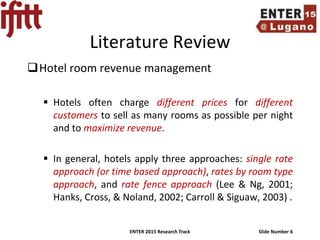
 In general, hotels apply three approaches: single rate
approach (or time based approach), rates by room type
approach, and rate fence approach (Lee & Ng, 2001;
Hanks, Cross, & Noland, 2002; Carroll & Siguaw, 2003) .
ENTER 2015 Research Track Slide Number 7
Literature Review
Hotel room pricing strategy
 Hotels have adopted the common practice of
frequently altering their room rates based on
seasonality,
Competitors (Chen, Chang, & Langelett, 2014).
ENTER 2015 Research Track Slide Number 8
Literature Review
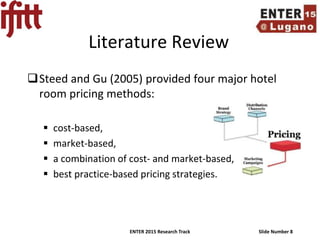
Steed and Gu (2005) provided four major hotel
room pricing methods:
 cost-based,
 market-based,
 a combination of cost- and market-based,
 best practice-based pricing strategies.
ENTER 2015 Research Track Slide Number 9
Literature Review
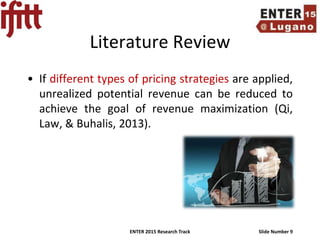
• If different types of pricing strategies are applied,
unrealized potential revenue can be reduced to
achieve the goal of revenue maximization (Qi,
Law, & Buhalis, 2013).
ENTER 2015 Research Track Slide Number 10
Literature Review
However, regardless of the room rate pricing
strategies applied by hotels, revenue is restrained
by room capacity (Pan, 2007).
Therefore, making the best use of diverse pricing
strategies to maximize revenue is an important
lesson that hotel managers should learn.
ENTER 2015 Research Track Slide Number 11
Methodology
What: Hotel room rate information (basic room
type)
When: Nov 1, 2013 – Jan 16, 2014.
How: was collected from the official websites of
the six competing hotels in Tsim Sha Tsui East,
Kowloon, Hong Kong .
ENTER 2015 Research Track Slide Number 12
Methodology
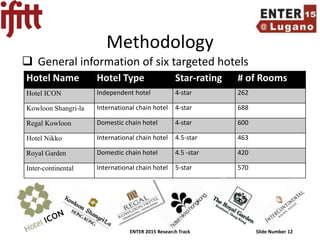
 General information of six targeted hotels
Hotel Name Hotel Type Star-rating # of Rooms
Hotel ICON Independent hotel 4-star 262
Kowloon Shangri-la International chain hotel 4-star 688
Regal Kowloon Domestic chain hotel 4-star 600
Hotel Nikko International chain hotel 4.5-star 463
Royal Garden Domestic chain hotel 4.5 -star 420
Inter-continental International chain hotel 5-star 570
ENTER 2015 Research Track Slide Number 13
Results
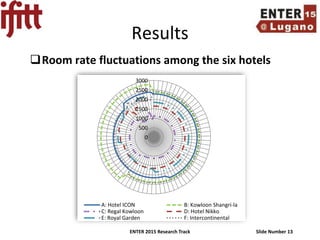
Room rate fluctuations among the six hotels
0
500
1000
1500
2000
2500
3000
A: Hotel ICON B: Kowloon Shangri-la
C: Regal Kowloon D: Hotel Nikko
E: Royal Garden F: Intercontinental
ENTER 2015 Research Track Slide Number 14
Results
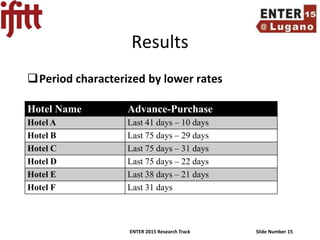
Hotel Name Pricing Strategy
Hotel A Time-based + market-based + rate fence (e.g., early-bird discount
but booked before a specific date and non-refundable)
Hotel B Time-based + market-based
Hotel C Time-based + market-based (more fluctuations)
Hotel D Time-based + market-based (more fluctuations)
Hotel E Time-based + market-based
Hotel F Time-based + market-based (set a higher rate at the beginning)
 Pricing strategies of the six hotels
ENTER 2015 Research Track Slide Number 15
Results
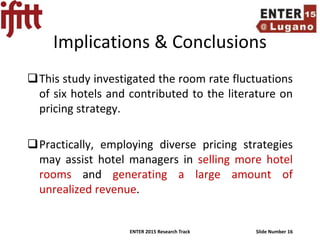
Period characterized by lower rates
Hotel Name Advance-Purchase
Hotel A Last 41 days – 10 days
Hotel B Last 75 days – 29 days
Hotel C Last 75 days – 31 days
Hotel D Last 75 days – 22 days
Hotel E Last 38 days – 21 days
Hotel F Last 31 days
ENTER 2015 Research Track Slide Number 16
Implications & Conclusions
This study investigated the room rate fluctuations
of six hotels and contributed to the literature on
pricing strategy.
Practically, employing diverse pricing strategies
may assist hotel managers in selling more hotel
rooms and generating a large amount of
unrealized revenue.
ENTER 2015 Research Track Slide Number 17
Implications & Conclusions
Some insights for customers
 Customers have many choices in obtaining the lowest
room rate in early reservations (i.e., 30-day advance
purchase).
 Hotel room rates fluctuate most when it is close to
arrival date.
ENTER 2015 Research Track Slide Number 18

An Investigation of Hotel Room Reservation: What Are The Diverse Pricing Strategies among Competing Hotels?

  • 1.
    ENTER 2015 ResearchTrack Slide Number 1 An Investigation of Hotel Room Reservation: What Are The Diverse Pricing Strategies among Competing Hotels? Sunny Sun a, Rob Law a, Markus Schuckert a, & Lawrence Hoc Nang Fong b, a School of Hotel and Tourism Management The Hong Kong Polytechnic University, Hong Kong b Faculty of Business Administration University of Macau, Macau
  • 2.
    ENTER 2015 ResearchTrack Slide Number 2 Agenda • Introduction • Literature Review • Methodology • Results • Implications & Conclusions
  • 3.
    ENTER 2015 ResearchTrack Slide Number 3 Introduction Hotels commonly sell their rooms by taking advantage of Internet platforms (i.e., official and third party websites) as popular distribution channels.
  • 4.
    ENTER 2015 ResearchTrack Slide Number 4 Introduction Online reservation systems make it easier for customers  to obtain information  to make reservation for hotel rooms (O’Connor & Frew, 2004; Guo, Ling, Yang, Li, & Liang, 2013). However, they also make the competition fiercer for the hospitality industry, particularly for hotels that are  located near one another  close and then strong competition.
  • 5.
    ENTER 2015 ResearchTrack Slide Number 5 Introduction Nevertheless, no study has investigated the diverse pricing strategies among competing hotels. Therefore, the current study investigated the price fluctuations of six hotels located near each other by checking the hotel room rates indicated on their official websites.
  • 6.
    ENTER 2015 ResearchTrack Slide Number 6 Literature Review Hotel room revenue management  Hotels often charge different prices for different customers to sell as many rooms as possible per night and to maximize revenue.  In general, hotels apply three approaches: single rate approach (or time based approach), rates by room type approach, and rate fence approach (Lee & Ng, 2001; Hanks, Cross, & Noland, 2002; Carroll & Siguaw, 2003) .
  • 7.
    ENTER 2015 ResearchTrack Slide Number 7 Literature Review Hotel room pricing strategy  Hotels have adopted the common practice of frequently altering their room rates based on seasonality, Competitors (Chen, Chang, & Langelett, 2014).
  • 8.
    ENTER 2015 ResearchTrack Slide Number 8 Literature Review Steed and Gu (2005) provided four major hotel room pricing methods:  cost-based,  market-based,  a combination of cost- and market-based,  best practice-based pricing strategies.
  • 9.
    ENTER 2015 ResearchTrack Slide Number 9 Literature Review • If different types of pricing strategies are applied, unrealized potential revenue can be reduced to achieve the goal of revenue maximization (Qi, Law, & Buhalis, 2013).
  • 10.
    ENTER 2015 ResearchTrack Slide Number 10 Literature Review However, regardless of the room rate pricing strategies applied by hotels, revenue is restrained by room capacity (Pan, 2007). Therefore, making the best use of diverse pricing strategies to maximize revenue is an important lesson that hotel managers should learn.
  • 11.
    ENTER 2015 ResearchTrack Slide Number 11 Methodology What: Hotel room rate information (basic room type) When: Nov 1, 2013 – Jan 16, 2014. How: was collected from the official websites of the six competing hotels in Tsim Sha Tsui East, Kowloon, Hong Kong .
  • 12.
    ENTER 2015 ResearchTrack Slide Number 12 Methodology  General information of six targeted hotels Hotel Name Hotel Type Star-rating # of Rooms Hotel ICON Independent hotel 4-star 262 Kowloon Shangri-la International chain hotel 4-star 688 Regal Kowloon Domestic chain hotel 4-star 600 Hotel Nikko International chain hotel 4.5-star 463 Royal Garden Domestic chain hotel 4.5 -star 420 Inter-continental International chain hotel 5-star 570
  • 13.
    ENTER 2015 ResearchTrack Slide Number 13 Results Room rate fluctuations among the six hotels 0 500 1000 1500 2000 2500 3000 A: Hotel ICON B: Kowloon Shangri-la C: Regal Kowloon D: Hotel Nikko E: Royal Garden F: Intercontinental
  • 14.
    ENTER 2015 ResearchTrack Slide Number 14 Results Hotel Name Pricing Strategy Hotel A Time-based + market-based + rate fence (e.g., early-bird discount but booked before a specific date and non-refundable) Hotel B Time-based + market-based Hotel C Time-based + market-based (more fluctuations) Hotel D Time-based + market-based (more fluctuations) Hotel E Time-based + market-based Hotel F Time-based + market-based (set a higher rate at the beginning)  Pricing strategies of the six hotels
  • 15.
    ENTER 2015 ResearchTrack Slide Number 15 Results Period characterized by lower rates Hotel Name Advance-Purchase Hotel A Last 41 days – 10 days Hotel B Last 75 days – 29 days Hotel C Last 75 days – 31 days Hotel D Last 75 days – 22 days Hotel E Last 38 days – 21 days Hotel F Last 31 days
  • 16.
    ENTER 2015 ResearchTrack Slide Number 16 Implications & Conclusions This study investigated the room rate fluctuations of six hotels and contributed to the literature on pricing strategy. Practically, employing diverse pricing strategies may assist hotel managers in selling more hotel rooms and generating a large amount of unrealized revenue.
  • 17.
    ENTER 2015 ResearchTrack Slide Number 17 Implications & Conclusions Some insights for customers  Customers have many choices in obtaining the lowest room rate in early reservations (i.e., 30-day advance purchase).  Hotel room rates fluctuate most when it is close to arrival date.
  • 18.
    ENTER 2015 ResearchTrack Slide Number 18

Editor's Notes

  • #5 Fiercer competition apart from using an official website for marketing and sales, a number of hotels also cooperate with third-party websites to gain advantage over their competitors. price is still one of the most influential factors that affect their purchase decisions for hotel rooms by adopting diverse and dynamic pricing strategies (e.g., time-based, cost-based, demand-based), hotels attempt to target different segments to generate incremental revenue from the optimal segments. Hospitality companies sell hotel rooms to both price-inelastic customers at a high price and price-sensitive customers at a discounted price for effective revenue management (Hanks, Cross, & Noland, 2002; Guo et al., 2013). On the contrary, hotels also frequently change their room rates to reflect customers’ demand, seasonality, and competitors’ pricing strategies (Chen, Chang, & Langelett, 2014).
  • #6 Previous studies have indicated the importance of pricing strategies and the easy fluctuations of hotel room rates in this information-transparent Internet age. Nevertheless, no study has investigated the diverse pricing strategies among competing hotels. research question is formulated: what are the diverse pricing strategies employed among competing hotels? The objectives that the present study aimed to achieve are to examine the room rate fluctuations of six hotels starting from 2.5 months before to the actual check-in date, to investigate the pricing strategies applied by the targeted hotels, and to compare the attractiveness of advance-purchase and last-minute offers through the targeted hotels.
  • #7 A single rate approach provides a single rate for all inventories where the room rate is time-based (e.g., seasonality, time-period, etc.). The second approach, rates by room type, has been widely applied in the hotel industry by charging different prices based on different room attributes (e.g., view, size, floor level, etc.) (Hanks et al., 2002). Most hotels employ the third approach, rate fence approach, in trying to sell 100 percent of their inventory. When the demand is weak, hotels offer discounts, whereas when the demand is strong, they increase the price. the advanced capabilities of the Internet make the pricing strategies of hotels nearly transparent to customers, and the primary factor that affects customers’ online purchasing decisions is price If hotels charge only one room rate, they may have a substantial amount of unrealized revenue. However, if different types of pricing strategies are applied, unrealized potential revenue can be reduced to achieve the goal of revenue maximization (Qi, Law, & Buhalis, 2013). Rate fence approach: logical, rational rules or restrictions that are designed to allow customers to segment themselves into appropriate rate categories based on their needs, behavior, or willingness to pay. Such fences include advance reservations and nonrefundable advance purchases. Those policies allow, for instance, price-sensitive customers to gain a lower rate in exchange for reduced flexibility.
  • #8 based on the easy accessibility of information; customers can weigh the costs and the benefits of each option easily and choose the one that is most beneficial (Schwartz, 2006). However, meeting both the customer demand and the goal of revenue maximization is a challenge for hotels.
  • #9 Cost-based pricing strategy is a simple technique applied in high-fixed cost industries such as the hotel industry to achieve optimal revenue (Chung, 2000). For market-based pricing strategy, taking hotel rooms for example, hotels often charge a lower rate for customers who book the hotel rooms far in advance of the check-in date (e.g., two months), a medium rate for customers who reserve rooms in advance of the check-in date (e.g., one month to 15 days), and a high rate for customers (e.g., business travelers) who book rooms only one or two days before the check-in date (Guo et al., 2013). best practice-based pricing strategy. Select the best practice in the industry and adopt it. For instance, the rate fence approach, Hotel ICON, a teaching and research hotel in Hong Kong, provides a 35 percent fixed discount to customers who book rooms at least 14 days before the check-in date, along with other dynamic pricing strategies (Guo et al., 2013; Hotel ICON, 2014). 35% Off Room Only - HK$1,755 up 35% off for any bookings from now until 30 Jun 2015. What are you waiting for? The lowest rate you’ll find anywhere. We promise. (This offer is applicable for stay period from now to 30 Jun 2015.) Full non-refundable deposit has to be made upon booking confirmation. No cancellation or date amendment is allowed once the bookings are confirmed or full amount of prepaid deposit will be forfeited.
  • #12 The lowest room rate of basic room type was recorded Previous studies have employed surveys, questionnaires, and case studies to investigate hotel room rates (Rohlfs & Kimes, 2007; Zong, Tang, Huang, & Ma, 2008). The check-in date was January 16, 2014 and the check-out date was January 17, 2014. Basic room types with the lowest room rates in all hotels were selected. Data collection period was from November 1, 2013 to January 16, 2014. Specifically, data collection was conducted every night after 23:00 and before 24:00 because this time is the period when hotels are most likely to change the room rate of the day.
  • #13 Six hotels in Tsim Sha Tsui East, Hong Kong - a mixture of business, shopping and leisure destination were selected as the target hotels in this study.
  • #14 Hotel A: ICON (Independent hotel) 2000 to 2500 Last 75 to 42 days, steady and mid-level Last 41 to 10 days, drop to lowest (best buy for customers) Last 10 days, most expensive Hotel B: Shangri-la (Int’l chain) 2000 to 3000 Last 75 to 29 days, lowest (Best buy for customers) Last 29 increase to a steady level Hotel C: Regal Kowloon (Local chain) 1000 to 1500 Last 75 to 31 days, low and steady Last 30 days, increase, decrease and increase Lowest during the X’mas Dec 24, 25, and 26 (but this is not a regular pricing strategy) fluctuate most among the six hotels Hotel D: Hotel Nikko (Int’l chain) 1500 to 2000 Last 75 to 22 days, lowest (best buy for customers) Last 22 to 6 days, increase Suddenly, one particular day drop to the lowest Last 5 days, no room available Hotel E: Royal Garden (local chain) 1500 to 2500 Last 75 to 39 days, expensive Last 38 to 21 days, lowest (best buy for customers) Last 20, increase sharply No room on the check-in date Hotel F: Intercontinental (Int’l chain) 2000 to 2500 Last 75 to 32 days, expensive Last 31 days, decrease (best buy for customers) One of the day increase sharply Three hotels lowest rates from last 75 to 30 days Another three lowest rates from last 30 days Last 30 days are the best
  • #15 Hotel A: diverse pricing strategies, time-based, demand- based and best practice This is good as diversification can help maximize revenue (Pan, 2007) Hotel B: different from Hotel A, only used time-based and demand-based. Increase the room rate after realizing that the demand increase Hotel C: similar to Hotel B nine days before the check-in date, Hotel C lowered the price. However, the room rate two days before the last day appeared to be the highest A last-minute offer was made available by Hotel C
  • #16 So last 30 days booking is the best for customers
  • #17 most of the hotels adopted time-based and demand-based pricing strategies, and fluctuation of different hotels had a big difference Furthermore, Hotels C and F offered attractive holiday room rates, which were the lowest room rates during the investigation period. This kind of strategy can help hotels gain competitive advantage in terms of branding and recall the customers’ desire for their future purchase. Although hotels may sacrifice short-term benefits when providing the lowest holiday room rate, brand loyalty and long-term benefits may be generated In early reservations such as 2.5 months (75-day) to more than one month advance purchases, hotel room rates do not fluctuate much, and customers have many choices in obtaining the lowest room rate. Moreover, 30 days in advance of the check-in date is the most appropriate period for customers to obtain the lowest room rate. Hotel room rates fluctuate most when the date is closer to the check-in date, such as in less than 10-day advance purchases.