TIPS AND
TRICKS FOR
THE IELTS
EXAM
Bruna Caltabiano
Listening
30 minutes
40 questions
Section 1
A conversation between two people set in an everyday social context.
Section 2
A monologue set in an everyday social context e.g. a speech about local
facilities.
Section 3
A conversation between up to four people set in an educational or training
context, e.g. a university tutor and a student discussing an assignment.
Section 4
A monologue on an academic subject e.g. a university lecture.
LISTENING
o First of all, read all the questions. Try to
imagine from reading all of them
what the listening will be about.
o Read the instructions to each task very
carefully. Only do what the instructions say.
o Write your (rough) answers on your question
paper. You will be given ½ minute to check
your answers at the end of each question.
o At the end of the test, transfer your rough
answers from the question paper to the
answer sheet. You will be given 10 minutes.
o Answer all the questions.
Table completion tasks
•Check the grammar, spelling
and the number of words in
your answer.
•Always read the table from
left to right, not down each
column.
•Some candidates worry so
much about the answer to
one question
•that they don’t pay attention
to the information to the next
question.
Don’t do this! Move on!
TIPS - LISTENING
Here are some words often spelled wrongly in IELTS
ACCOMMODATION
GOVERNMENT
BEAUTIFUL
NIGHT
RESTAURANT
ADVERTISEMENT
WHICH
DIFFERENT
PASSENGERS
- Spelling rule (usually)
Words ending in –y, we usually change the –y to –i
Worry – worried
Baby – babies
Unhappy – unhappily
Early – earlier
- Before adding an ending (e.g. – er/-ed/-est/-y/-able/-ing)
Sit – sitting
Sun – sunny
Mad – madder
Drop – dropping
Big – biggest
Slim – slimming
Rob - robbed
Reading
60 minutes 40 questions
IELTS Academic
The AcademicĀ version includes three long texts which range from the
descriptive and factual to the discursive and analytical.
The texts are authentic and are taken from books, journals, magazines
and newspapers.
These have been selected for a non-specialist audience but are
appropriate
for candidates entering university courses or seeking professional
registration.
IELTS General Training
The General Training version requires candidates to read extracts from
books, magazines, newspapers, notices, advertisements, company
handbooks and guidelines.
These are materials you are likely to encounter on a daily basis in an
English speaking environment.
READING
KINDS OF QUESTIONS
INFORMATION TASKS
True
False
Not Given
MATCHING
oFor these tasks you may need
to read for specific information or
read in detail.
oAlways look for key words in the questions
and scan the the passage to find them.
FLOW CHART
oThe answer does not always occur in the same order as in the passage.
oScan the passage to find the words you need to complete the chart.
oAlways proofread the charge to be sure it makes sense.
MULTIPLE CHOICE
Read before choosing the option. Don’t choose one option
just because it has the same key words as the question.
MATCHING HEADINGS
o When you do these tasks, always read each paragraph
for the main idea, not for detail.
o You will lose precious time if you read the whole text for detail, so don’t!
o There are always more headings than paragraphs
o Be careful about word spots. Sometimes these indicate that this is the right
paragraph, but not always.
o Make sure the heading matches the meaning of the whole paragraph,
not just part of it.
TIPS - READING
o Use the text’s title, any photos and the questions to
predic the topic and key words.
TIME
You have less than 90 seconds for each questions, so
you DON’T have time
To read all the texts carefully.
o Never answer more than the stated number of
words.
o Only pay attention to difficult words if they are
key words.
o Divide your time equally between the sections.
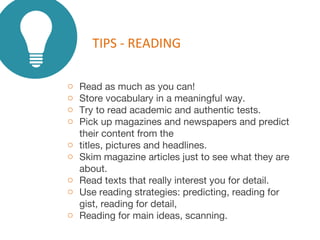
o Read as much as you can!
o Store vocabulary in a meaningful way.
o Try to read academic and authentic tests.
o Pick up magazines and newspapers and predict
their content from the
o titles, pictures and headlines.
o Skim magazine articles just to see what they are
about.
o Read texts that really interest you for detail.
o Use reading strategies: predicting, reading for
gist, reading for detail,
o Reading for main ideas, scanning.
TIPS - READING
WRITING
60 minutes 2 tasks
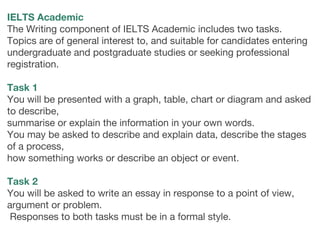
IELTS Academic
The Writing component ofĀ IELTS Academic includes two tasks.
Topics are of general interest to, and suitable for candidates entering
undergraduate and postgraduate studies or seeking professional
registration.Ā 
Ā 
Task 1
You will be presented with a graph, table, chart or diagram and asked
to describe,
summarise or explain the information in your own words.
You may be asked to describe and explain data, describe the stages
of a process,
how something works or describe an object or event.
Task 2
You will be asked to write an essay in response to a point of view,
argument or problem.
Responses to both tasks must be in a formal style.
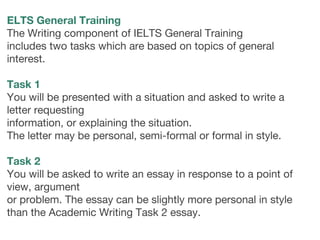
ELTS General Training
The Writing component ofĀ IELTS General Training
includes two tasks which are based on topics of general
interest.
Ā 
Task 1
You will beĀ presented with a situation and asked to write a
letter requesting
information, or explaining the situation.
The letter may be personal, semi-formal or formal in style.
Ā 
Task 2
You will beĀ asked to write an essay in response to a point of
view, argument
or problem. The essay can be slightly more personal in style
than the Academic Writing Task 2 essay.Ā 
WRITING – PART 1
o Draft a short four-part plan
o Use
20 minutes on Task 1
40 minutes on Task 2
o You will lose marks if you do not keep to the question.
o Report what the data in teh table/chart shows. DO NOT
speculate about knowledge you might have about the data.
o Look at the visual information carefully. Consider:
ļ‚§ What information is the most important
ļ‚§ What general trends it shows
ļ‚§ How the data is organized
ļ‚§ Rephrase the words from the question
ļ‚§ Make time to proofread
WRITING – PART 2
- Underline the key part of a sentence.
- Avoid beginning with I. Try to use
impersonal language.
e.g. It seems to me
- Make a short plan.
- Make sure that you use a logical structure:
Situation – problem – solution – conclusion
Introduction – development – conclusion
- Make sure that you give examples and
offer evidence to
support what you are saying.
- In task 2, you will be marked on
Task response
Coherence and cohesion
Lexical resource
Grammatical range and accuracy
- It counts twice as many marks as Task
1
WRITING - TIPS
o Use websites such as www.statistics.gov.uk to find useful language
o Keep useful language and expressions in mind
SPEAKING
11-14 minutes 3 parts
Ā Part 1
The Examiner will ask youĀ general questions about yourself and a range
of familiar topics,
such as home,
family, work, studies and interests. This part lasts betweenĀ four andĀ five
minutes.
Ā 
Part 2
You will be given a card which asks you to talk about a particular topic.
You will have one minute to prepare before
speaking for up to two minutes. The examiner will then ask one or two
questions
on the same topic to finish this part of the test.
Ā 
Part 3
You will be asked further questions connected to the topicĀ in Part 2.
These questions will give you the opportunity to discuss more
abstractĀ ideas and issue.
The part of the test lasts betweenĀ four and five minutes.Ā 
SPEAKING – PARTS 1&3
o Give relevant information and expand on your
answers with details.
o Ask for clarification.
o Use the short answer – expand strategy.
o Do not worry or panic if you cannot remember a
particular word.
o Avoid repeating the language of the quesion at the
beginning of your answer.
o Give answers you would in an interview.
SPEAKING – PART 2
o Make good use of the note-making time you are given. Think and plan
using effective note-making strategies.
o Your notes should be based on the task card you are given. Use the
sub-points
on the card as headings, then write one or two-word promts as notes.
o Expand on the things you say: explain, compare, give examples, etc.
o Keep to the topic.
o Use your preparation time.
TIPS – SPEAKING PARTS 1&3
o Check pronunciation
o Practice with other candidates
o Listen to the radio, podcasts
o Record yoursefl answering questions
o Revise vocabulary on everyday topics
o Chat in English
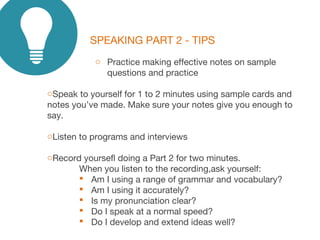
SPEAKING PART 2 - TIPS
o Practice making effective notes on sample
questions and practice
oSpeak to yourself for 1 to 2 minutes using sample cards and
notes you’ve made. Make sure your notes give you enough to
say.
oListen to programs and interviews
oRecord yoursefl doing a Part 2 for two minutes.
When you listen to the recording,ask yourself:
ļ‚§ Am I using a range of grammar and vocabulary?
ļ‚§ Am I using it accurately?
ļ‚§ Is my pronunciation clear?
ļ‚§ Do I speak at a normal speed?
ļ‚§ Do I develop and extend ideas well?
SPANISHCUSTOME-MADE
BUSINESS
ENGLISH
Other courses
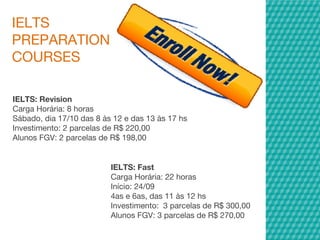
IELTS
PREPARATION
COURSES
IELTS: Revision
Carga HorƔria: 8 horas
SƔbado, dia 17/10 das 8 Ơs 12 e das 13 Ơs 17 hs
Investimento: 2 parcelas de R$ 220,00
Alunos FGV: 2 parcelas de R$ 198,00
IELTS: Fast
Carga HorƔria: 22 horas
InĆ­cio: 24/09
4as e 6as, das 11 Ć s 12 hs
Investimento: Ā 3 parcelas de R$ 300,00
Alunos FGV: 3 parcelas de R$ 270,00
caltabiano.idiomas
@caltabianoidio1
faleconosco@caltabianoidiomas.com.br
www.caltabianoidiomas.com.br
bruna@caltabianoidiomas.com.br
Tel: 11 3436.6004

Tips and tricks for the ielts exam

  • 1.
    TIPS AND TRICKS FOR THEIELTS EXAM Bruna Caltabiano
  • 2.
  • 3.
    Section 1 A conversationbetween two people set in an everyday social context. Section 2 A monologue set in an everyday social context e.g. a speech about local facilities. Section 3 A conversation between up to four people set in an educational or training context, e.g. a university tutor and a student discussing an assignment. Section 4 A monologue on an academic subject e.g. a university lecture.
  • 4.
    LISTENING o First ofall, read all the questions. Try to imagine from reading all of them what the listening will be about. o Read the instructions to each task very carefully. Only do what the instructions say. o Write your (rough) answers on your question paper. You will be given ½ minute to check your answers at the end of each question. o At the end of the test, transfer your rough answers from the question paper to the answer sheet. You will be given 10 minutes. o Answer all the questions.
  • 5.
    Table completion tasks •Checkthe grammar, spelling and the number of words in your answer. •Always read the table from left to right, not down each column. •Some candidates worry so much about the answer to one question •that they don’t pay attention to the information to the next question. Don’t do this! Move on!
  • 6.
    TIPS - LISTENING Hereare some words often spelled wrongly in IELTS ACCOMMODATION GOVERNMENT BEAUTIFUL NIGHT RESTAURANT ADVERTISEMENT WHICH DIFFERENT PASSENGERS
  • 7.
    - Spelling rule(usually) Words ending in –y, we usually change the –y to –i Worry – worried Baby – babies Unhappy – unhappily Early – earlier - Before adding an ending (e.g. – er/-ed/-est/-y/-able/-ing) Sit – sitting Sun – sunny Mad – madder Drop – dropping Big – biggest Slim – slimming Rob - robbed
  • 8.
  • 9.
    IELTS Academic The AcademicĀ versionincludes three long texts which range from the descriptive and factual to the discursive and analytical. The texts are authentic and are taken from books, journals, magazines and newspapers. These have been selected for a non-specialist audience but are appropriate for candidates entering university courses or seeking professional registration. IELTS General Training The General Training version requires candidates to read extracts from books, magazines, newspapers, notices, advertisements, company handbooks and guidelines. These are materials you are likely to encounter on a daily basis in an English speaking environment.
  • 10.
    READING KINDS OF QUESTIONS INFORMATIONTASKS True False Not Given MATCHING oFor these tasks you may need to read for specific information or read in detail. oAlways look for key words in the questions and scan the the passage to find them. FLOW CHART oThe answer does not always occur in the same order as in the passage. oScan the passage to find the words you need to complete the chart. oAlways proofread the charge to be sure it makes sense.
  • 11.
    MULTIPLE CHOICE Read beforechoosing the option. Don’t choose one option just because it has the same key words as the question. MATCHING HEADINGS o When you do these tasks, always read each paragraph for the main idea, not for detail. o You will lose precious time if you read the whole text for detail, so don’t! o There are always more headings than paragraphs o Be careful about word spots. Sometimes these indicate that this is the right paragraph, but not always. o Make sure the heading matches the meaning of the whole paragraph, not just part of it.
  • 12.
    TIPS - READING oUse the text’s title, any photos and the questions to predic the topic and key words. TIME You have less than 90 seconds for each questions, so you DON’T have time To read all the texts carefully. o Never answer more than the stated number of words. o Only pay attention to difficult words if they are key words. o Divide your time equally between the sections.
  • 13.
    o Read asmuch as you can! o Store vocabulary in a meaningful way. o Try to read academic and authentic tests. o Pick up magazines and newspapers and predict their content from the o titles, pictures and headlines. o Skim magazine articles just to see what they are about. o Read texts that really interest you for detail. o Use reading strategies: predicting, reading for gist, reading for detail, o Reading for main ideas, scanning. TIPS - READING
  • 14.
  • 15.
    IELTS Academic The Writingcomponent ofĀ IELTS Academic includes two tasks. Topics are of general interest to, and suitable for candidates entering undergraduate and postgraduate studies or seeking professional registration.Ā  Ā  Task 1 You will be presented with a graph, table, chart or diagram and asked to describe, summarise or explain the information in your own words. You may be asked to describe and explain data, describe the stages of a process, how something works or describe an object or event. Task 2 You will be asked to write an essay in response to a point of view, argument or problem. Responses to both tasks must be in a formal style.
  • 16.
    ELTS General Training TheWriting component ofĀ IELTS General Training includes two tasks which are based on topics of general interest. Ā  Task 1 You will beĀ presented with a situation and asked to write a letter requesting information, or explaining the situation. The letter may be personal, semi-formal or formal in style. Ā  Task 2 You will beĀ asked to write an essay in response to a point of view, argument or problem. The essay can be slightly more personal in style than the Academic Writing Task 2 essay.Ā 
  • 17.
    WRITING – PART1 o Draft a short four-part plan o Use 20 minutes on Task 1 40 minutes on Task 2 o You will lose marks if you do not keep to the question. o Report what the data in teh table/chart shows. DO NOT speculate about knowledge you might have about the data. o Look at the visual information carefully. Consider: ļ‚§ What information is the most important ļ‚§ What general trends it shows ļ‚§ How the data is organized ļ‚§ Rephrase the words from the question ļ‚§ Make time to proofread
  • 18.
    WRITING – PART2 - Underline the key part of a sentence. - Avoid beginning with I. Try to use impersonal language. e.g. It seems to me - Make a short plan. - Make sure that you use a logical structure: Situation – problem – solution – conclusion Introduction – development – conclusion - Make sure that you give examples and offer evidence to support what you are saying. - In task 2, you will be marked on Task response Coherence and cohesion Lexical resource Grammatical range and accuracy - It counts twice as many marks as Task 1
  • 19.
    WRITING - TIPS oUse websites such as www.statistics.gov.uk to find useful language o Keep useful language and expressions in mind
  • 20.
  • 21.
    Ā Part 1 The Examinerwill ask youĀ general questions about yourself and a range of familiar topics, such as home, family, work, studies and interests. This part lasts betweenĀ four andĀ five minutes. Ā  Part 2 You will be given a card which asks you to talk about a particular topic. You will have one minute to prepare before speaking for up to two minutes. The examiner will then ask one or two questions on the same topic to finish this part of the test. Ā  Part 3 You will be asked further questions connected to the topicĀ in Part 2. These questions will give you the opportunity to discuss more abstractĀ ideas and issue. The part of the test lasts betweenĀ four and five minutes.Ā 
  • 22.
    SPEAKING – PARTS1&3 o Give relevant information and expand on your answers with details. o Ask for clarification. o Use the short answer – expand strategy. o Do not worry or panic if you cannot remember a particular word. o Avoid repeating the language of the quesion at the beginning of your answer. o Give answers you would in an interview.
  • 23.
    SPEAKING – PART2 o Make good use of the note-making time you are given. Think and plan using effective note-making strategies. o Your notes should be based on the task card you are given. Use the sub-points on the card as headings, then write one or two-word promts as notes. o Expand on the things you say: explain, compare, give examples, etc. o Keep to the topic. o Use your preparation time.
  • 24.
    TIPS – SPEAKINGPARTS 1&3 o Check pronunciation o Practice with other candidates o Listen to the radio, podcasts o Record yoursefl answering questions o Revise vocabulary on everyday topics o Chat in English
  • 25.
    SPEAKING PART 2- TIPS o Practice making effective notes on sample questions and practice oSpeak to yourself for 1 to 2 minutes using sample cards and notes you’ve made. Make sure your notes give you enough to say. oListen to programs and interviews oRecord yoursefl doing a Part 2 for two minutes. When you listen to the recording,ask yourself: ļ‚§ Am I using a range of grammar and vocabulary? ļ‚§ Am I using it accurately? ļ‚§ Is my pronunciation clear? ļ‚§ Do I speak at a normal speed? ļ‚§ Do I develop and extend ideas well?
  • 26.
  • 28.
    IELTS PREPARATION COURSES IELTS: Revision Carga HorÔria:8 horas SÔbado, dia 17/10 das 8 às 12 e das 13 às 17 hs Investimento: 2 parcelas de R$ 220,00 Alunos FGV: 2 parcelas de R$ 198,00 IELTS: Fast Carga HorÔria: 22 horas Início: 24/09 4as e 6as, das 11 às 12 hs Investimento:  3 parcelas de R$ 300,00 Alunos FGV: 3 parcelas de R$ 270,00
  • 29.

Editor's Notes

  • #4Ā answers to a series of questions. These include questions which test your ability to understand main ideas and detailed factual information, ability to understand the opinions and attitudes of speakers, ability to understand the purpose of an utterance and the ability to follow the development of ideas. A variety of voices and native-speaker accents are used and each section is heard only once.
  • #10Ā he Reading component consists of 40 questions. A variety of question types is used in order to test a wide range of reading skills. These including reading for gist, reading for main ideas, reading for detail, skimming, understanding logical argument, recognising writers' opinions, attitudes and purpose.
  • #12Ā Spots = same words in both the heading and the paragraph)
  • #22Ā The Speaking component assesses your use of spoken English, and takes between 11 and 14 minutes to complete. Every test is recorded. The Speaking component is delivered in such a way that itĀ does not allow candidates to rehearse set responses beforehand.
  • #23Ā It depends.. Better than yes or no Not to short, not to long
  • #26Ā Those are the things assessed on in the Speaking test.