IEEe 754 number SYSTEM
Paper Name : COMPUTER ARCHITECHTURE
Paper code : EC502
Student Name : Debjyoti Musib
Univ. Roll : 13000320104
Department : ECE
MAKAUT CA1 EC502 1
27-07-2022
27-07-2022 MAKAUT CA1 EC502 2
CONTENTS :
 INTRODUCTION
 COMPONENTS
 EXPLANATIONS
 EXAMPLES
27-07-2022 MAKAUT CA1 EC502 3
 What is IEEE 754 number system?
The IEEE Standard for Floating-Point Arithmetic (IEEE 754) is a technical
standard for floating-point computation which was established in 1985 by
the Institute of Electrical and Electronics Engineers (IEEE).
IEEE in 1985 and augmented in 2008 provided a standard to
represent floating-point numbers and process them.
 IEEE Standard 754 floating point is the most common representation today for
real numbers on computers, including Intel-based PC’s, Macs, and most Unix
platforms.
 There are several ways to represent floating point number but IEEE 754 is the
most efficient in most cases.
27-07-2022 MAKAUT CA1 EC502 4
 IEEE 754 has 3 basic components:
 The Sign of Mantissa –
This is as simple as the name. 0 represents a positive number while 1 represents a
negative number.
 The Biased exponent –
The exponent field needs to represent both positive and negative exponents. A bias is
added to the actual exponent in order to get the stored exponent.
 The Normalised Mantissa –
The mantissa is part of a number in scientific notation or a floating-point
number, consisting of its significant digits. Here we have only 2 digits, i.e. O & 1. So a
normalised mantissa is one with only one 1 to the left of the decimal.
27-07-2022 MAKAUT CA1 EC502 5
 IEEE 754 numbers are divided into two based on the above three components:
 Single precision. (32 bit)
 Double precision. (64 bit)
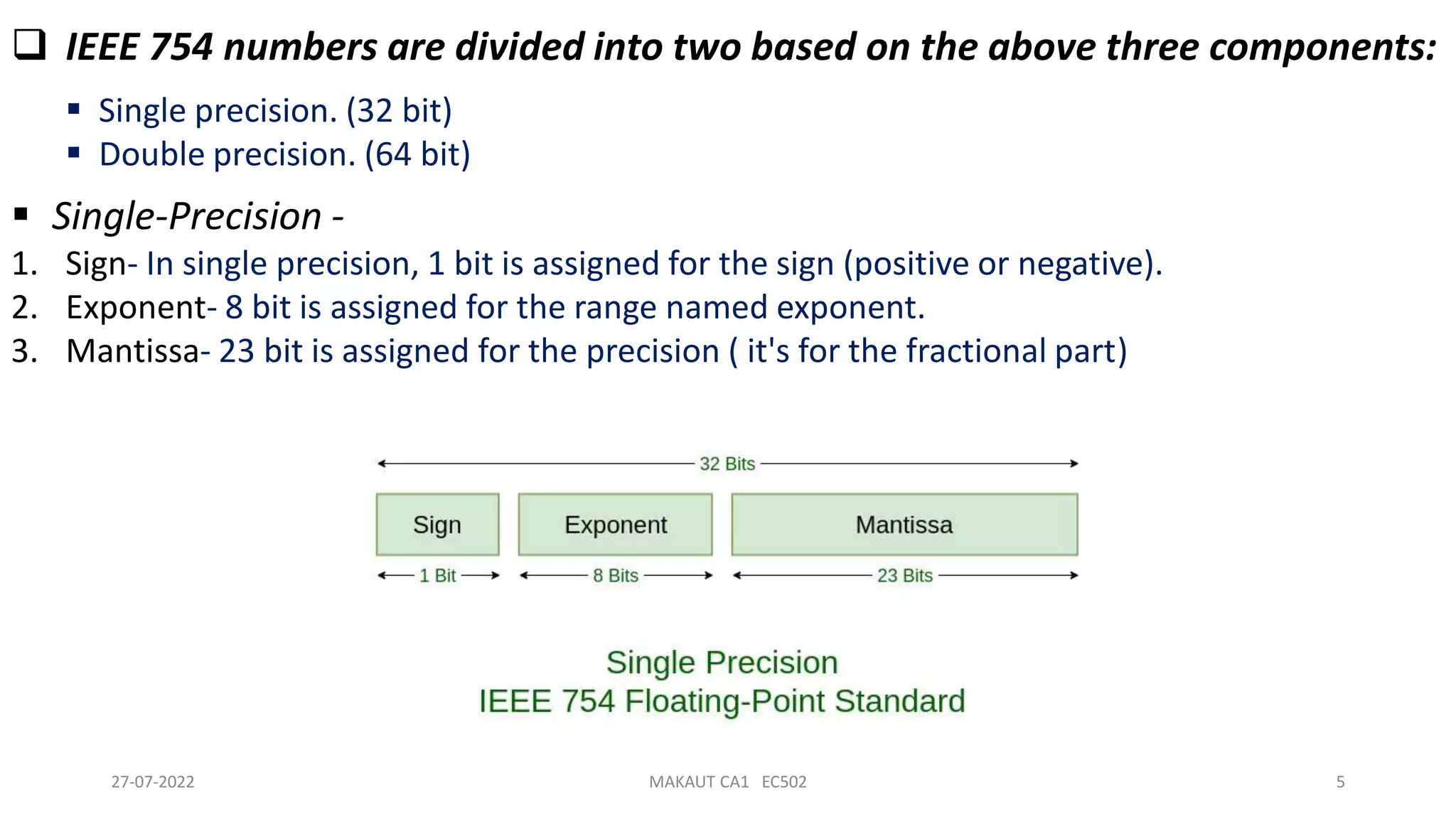
 Single-Precision -
1. Sign- In single precision, 1 bit is assigned for the sign (positive or negative).
2. Exponent- 8 bit is assigned for the range named exponent.
3. Mantissa- 23 bit is assigned for the precision ( it's for the fractional part)
27-07-2022 MAKAUT CA1 EC502 6
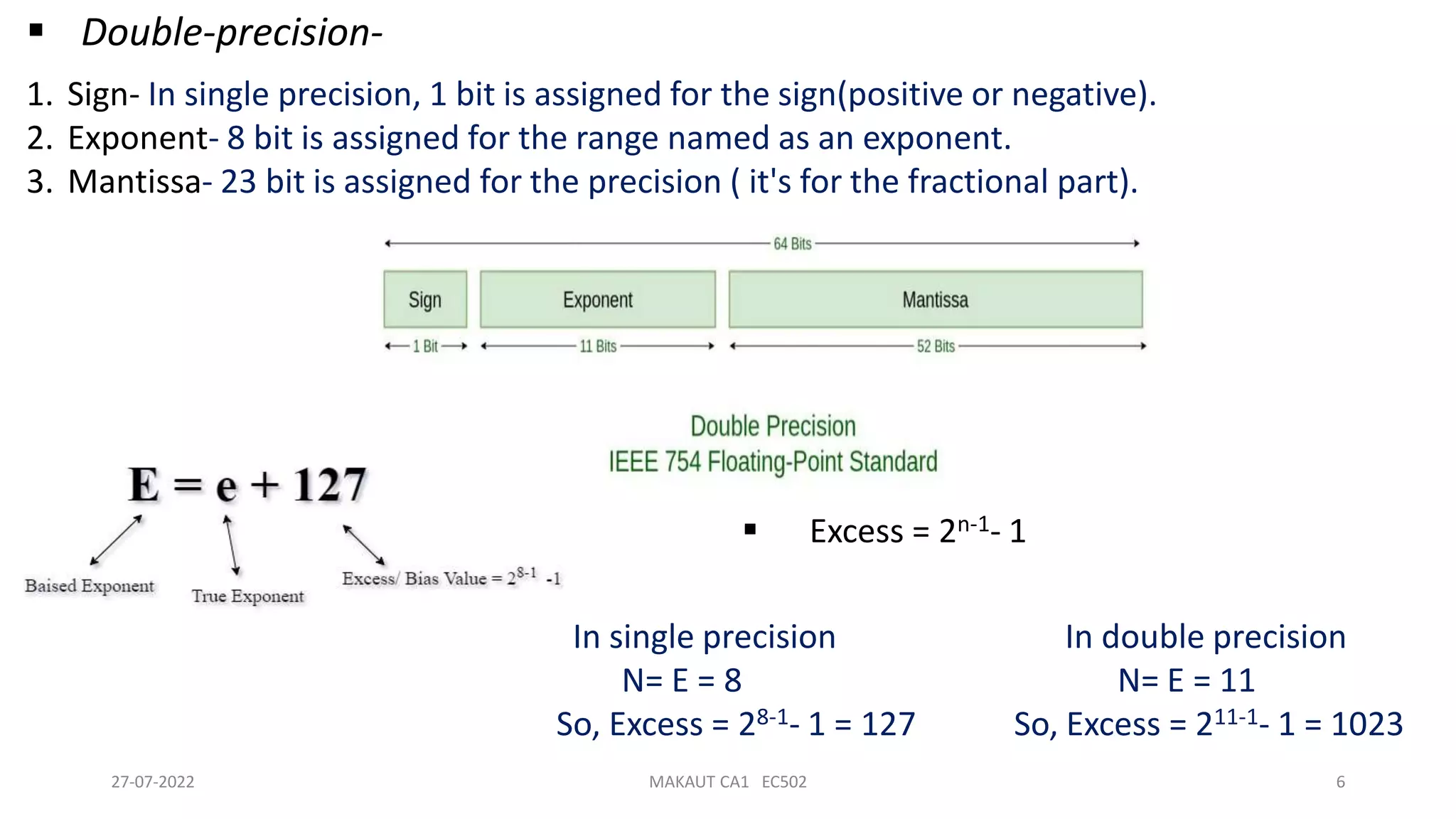
 Double-precision-
1. Sign- In single precision, 1 bit is assigned for the sign(positive or negative).
2. Exponent- 8 bit is assigned for the range named as an exponent.
3. Mantissa- 23 bit is assigned for the precision ( it's for the fractional part).
 Excess = 2n-1- 1
In single precision In double precision
N= E = 8 N= E = 11
So, Excess = 28-1- 1 = 127 So, Excess = 211-1- 1 = 1023
27-07-2022 MAKAUT CA1 EC502 7
 Example:
 85.125
85 = 1010101
0.125 = 001
85.125 = 1010101.001
=1.010101001 x 2^6
sign = 0
1. Single precision:
biased exponent 127+6=133
133 = 10000101
Normalised mantisa = 010101001
we will add 0's to complete the 23 bits
The IEEE 754 Single precision is:
= 0 10000101 01010100100000000000000
This can be written in hexadecimal form 42AA4000
27-07-2022 MAKAUT CA1 EC502 8
2. Double precision:
biased exponent 1023+6=1029
1029 = 10000000101
Normalised mantisa = 010101001
we will add 0's to complete the 52 bits
The IEEE 754 Double precision is:
= 0 10000000101 0101010010000000000000000000000000000000000000000000
This can be written in hexadecimal form 4055480000000000
27-07-2022 MAKAUT CA1 EC502 9

IEEE 754 NUMBER SYSTEM

  • 1.
    IEEe 754 numberSYSTEM Paper Name : COMPUTER ARCHITECHTURE Paper code : EC502 Student Name : Debjyoti Musib Univ. Roll : 13000320104 Department : ECE MAKAUT CA1 EC502 1 27-07-2022
  • 2.
    27-07-2022 MAKAUT CA1EC502 2 CONTENTS :  INTRODUCTION  COMPONENTS  EXPLANATIONS  EXAMPLES
  • 3.
    27-07-2022 MAKAUT CA1EC502 3  What is IEEE 754 number system? The IEEE Standard for Floating-Point Arithmetic (IEEE 754) is a technical standard for floating-point computation which was established in 1985 by the Institute of Electrical and Electronics Engineers (IEEE). IEEE in 1985 and augmented in 2008 provided a standard to represent floating-point numbers and process them.  IEEE Standard 754 floating point is the most common representation today for real numbers on computers, including Intel-based PC’s, Macs, and most Unix platforms.  There are several ways to represent floating point number but IEEE 754 is the most efficient in most cases.
  • 4.
    27-07-2022 MAKAUT CA1EC502 4  IEEE 754 has 3 basic components:  The Sign of Mantissa – This is as simple as the name. 0 represents a positive number while 1 represents a negative number.  The Biased exponent – The exponent field needs to represent both positive and negative exponents. A bias is added to the actual exponent in order to get the stored exponent.  The Normalised Mantissa – The mantissa is part of a number in scientific notation or a floating-point number, consisting of its significant digits. Here we have only 2 digits, i.e. O & 1. So a normalised mantissa is one with only one 1 to the left of the decimal.
  • 5.
    27-07-2022 MAKAUT CA1EC502 5  IEEE 754 numbers are divided into two based on the above three components:  Single precision. (32 bit)  Double precision. (64 bit)  Single-Precision - 1. Sign- In single precision, 1 bit is assigned for the sign (positive or negative). 2. Exponent- 8 bit is assigned for the range named exponent. 3. Mantissa- 23 bit is assigned for the precision ( it's for the fractional part)
  • 6.
    27-07-2022 MAKAUT CA1EC502 6  Double-precision- 1. Sign- In single precision, 1 bit is assigned for the sign(positive or negative). 2. Exponent- 8 bit is assigned for the range named as an exponent. 3. Mantissa- 23 bit is assigned for the precision ( it's for the fractional part).  Excess = 2n-1- 1 In single precision In double precision N= E = 8 N= E = 11 So, Excess = 28-1- 1 = 127 So, Excess = 211-1- 1 = 1023
  • 7.
    27-07-2022 MAKAUT CA1EC502 7  Example:  85.125 85 = 1010101 0.125 = 001 85.125 = 1010101.001 =1.010101001 x 2^6 sign = 0 1. Single precision: biased exponent 127+6=133 133 = 10000101 Normalised mantisa = 010101001 we will add 0's to complete the 23 bits The IEEE 754 Single precision is: = 0 10000101 01010100100000000000000 This can be written in hexadecimal form 42AA4000
  • 8.
    27-07-2022 MAKAUT CA1EC502 8 2. Double precision: biased exponent 1023+6=1029 1029 = 10000000101 Normalised mantisa = 010101001 we will add 0's to complete the 52 bits The IEEE 754 Double precision is: = 0 10000000101 0101010010000000000000000000000000000000000000000000 This can be written in hexadecimal form 4055480000000000
  • 9.