INTRODUCTION
is a decentralized,state based surveillance program in the country
detect early warning signals of impending outbreaks and help initiate
an effective response in a timely manner
Provide essential data to monitor progress of on-going disease control
program and help allocate health resources more efficiently.
4.
MISSION
To strengthen thedisease surveillance in the country
by establishing a decentralized State based surveillance system for
epidemic prone diseases
to detect the early warning signals,
so that timely and effective public health actions can be initiated in
response to health challenges in the country at the Districts, State
and National level.
5.
OBJECTIVES
To strengthen/maintain decentralizedlaboratory based IT enabled
disease surveillance system
for epidemic prone diseases
to monitor disease trends and
to detect and respond to outbreaks in early rising phase through
trained Rapid Response Team (RRTs)
6.
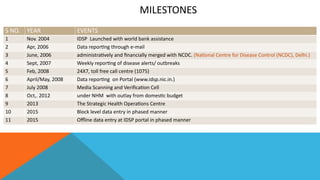
MILESTONES
S NO. YEAREVENTS
1 Nov. 2004 IDSP Launched with world bank assistance
2 Apr, 2006 Data reporting through e-mail
3 June, 2006 administratively and financially merged with NCDC. (National Centre for Disease Control (NCDC), Delhi.)
4 Sept, 2007 Weekly reporting of disease alerts/ outbreaks
5 Feb, 2008 24X7, toll free call centre (1075)
6 April/May, 2008 Data reporting on Portal (www.idsp.nic.in.)
7 July 2008 Media Scanning and Verification Cell
8 Oct,. 2012 under NHM with outlay from domestic budget
9 2013 The Strategic Health Operations Centre
10 2015 Block level data entry in phased manner
11 2015 Offline data entry at IDSP portal in phased manner
7.
PROGRAM COMPONENTS
1. Integrationand decentralization of surveillance activities -
through establishment of surveillance units at Centre, State and District level.
2. Human Resource Development – Training of State Surveillance Officers, District
Surveillance Officers, Rapid Response Team and other Medical and
Paramedical staff on principles of disease surveillance.
3. Information Communication Technology - for collection, collation, compilation,
analysis and dissemination of data.
4. Strengthening of public health laboratories
5. Inter sectoral Co-ordination for zoonotic diseases
CENTRAL SURVEILLANCE UNIT
Asenior officer from NCDC- National Program Officer
coordinate the project activities under six sections namely
1)Budget & Finance, 2)Laboratory strengthening, 3)Information Technology and
Communication, 4)Data Management and Monitoring, 5)Human Resource
Development 6) Non-Communicable Disease (NCD) Surveillance.
Advisor Epidemiologist,
Advisor Microbiologist, Management Expert, Documentation Officer,
Communication Officer, and Consultant (IT) Team leader, Epidemiologists, Consultant
(HR), Microbiologist and Media Scanning Assistant
10.
STATE SURVEILLANCE UNIT
Statesurveillanceofficer - Dr. Shiva Balaji Reddy
Administrative assistant
Consultant (technical)
Consultant (finance)
Data manager
Data entry operator
DISTRICT RAPID RESPONSETEAM
District health officer
District surveillance officer
Epidemiologist
Epidemic MO
Peadiatrician
Disrict malaria officer
Chief bacteriologist
13.
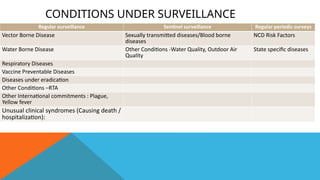
CONDITIONS UNDER SURVEILLANCE
Regularsurveillance Sentinel surveillance Regular periodic surveys
Vector Borne Disease Sexually transmitted diseases/Blood borne
diseases
NCD Risk Factors
Water Borne Disease Other Conditions -Water Quality, Outdoor Air
Quality
State specific diseases
Respiratory Diseases
Vaccine Preventable Diseases
Diseases under eradication
Other Conditions –RTA
Other International commitments : Plague,
Yellow fever
Unusual clinical syndromes (Causing death /
hospitalization):
14.
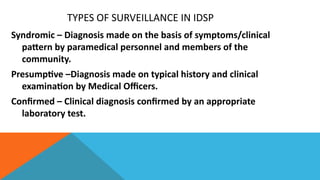
TYPES OF SURVEILLANCEIN IDSP
Syndromic – Diagnosis made on the basis of symptoms/clinical
pattern by paramedical personnel and members of the
community.
Presumptive –Diagnosis made on typical history and clinical
examination by Medical Officers.
Confirmed – Clinical diagnosis confirmed by an appropriate
laboratory test.
15.
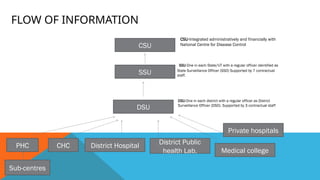
FLOW OF INFORMATION
CSU
SSU
DSU
Medicalcollege
District Hospital
CHC
PHC
Sub-centres
District Public
health Lab.
Private hospitals
CSU-Integrated administratively and financially with
National Centre for Disease Control
SSU-One in each State/UT with a regular officer identified as
State Surveillance Officer (SSO) Supported by 7 contractual
staff.
DSU-One in each district with a regular officer as District
Surveillance Officer (DSO). Supported by 3 contractual staff
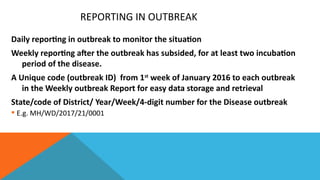
REPORTING IN OUTBREAK
Dailyreporting in outbreak to monitor the situation
Weekly reporting after the outbreak has subsided, for at least two incubation
period of the disease.
A Unique code (outbreak ID) from 1st
week of January 2016 to each outbreak
in the Weekly outbreak Report for easy data storage and retrieval
State/code of District/ Year/Week/4-digit number for the Disease outbreak
E.g. MH/WD/2017/21/0001
18.
REPORTING UNITS INWARDHA
Sr. No. Block No. of Reporting units
S Form P form L form
1 Wardha 27 7 8
2 Deoli 24 7 4
3 Hingaghat 24 5 5
4 Seloo 27 6 2
5 Samudrapur 22 4 3
6 Karanja 18 3 1
7 Ashti 16 2 2
8 Arvi 23 4 3
Total 181 38 28
19.
TRAINING IN IDSP
TOT-Six days TOT program
health personnel and members of rapid response team.
Introduction to surveillance with special reference to IDSP, basic epidemiology, collection and
transmission of laboratory specimens and bio-safety issues and details in response to outbreaks.
FETP- two week training
DSOs/ Epidemiologists to enhance their epidemiological skills in outbreak investigations.
Induction training
Microbiologists, Entomologists, finance consultant and other support staff under IDSP.
20.
MEDIA SCANNING ANDVERIFICATION CELL
established on 24th
July 2008 under IDSP at NCDC, Delhi
It is “Early Warning System”
It works through daily screening of press both local and national, TV
(national and regional channels), Radio and other media channels
which reports on suspected outbreaks or unusual health events.
The information is shared to the districts affected and DSO is
expected to investigate and revert through the internet about the
correctness and action taken
is managed by trained Epidemiologists and Public Health Consultants
working in Central Surveillance Unit of IDSP
Media Surveillance increases the sensitivity of the official
surveillance systems.
21.
INFORMATION,COMMUNICATION TECGNOLOGY
Satellite connectivityIndian Space Research Organization
broadband connectivity through BSNL
online data entry (IDSP Portal www.idsp.nic.in)
A 24X7 call centre
toll free number 1075
Video conferencing at State Surveillance Units and Central
Surveillance Units
STRENGTHENING OF PUBLICHEALTH LABORATORIES
Strengthening of district public health labs
equipment, manpower and funds for consumables
Perform testing for lab confirmation of epidemic prone diseases
Support outbreak investigations in the district
Report weekly surveillance data on L forms.
a) Blood culture for Typhoid
b) Stool culture for cholera and other common enteropathogens
c) IgM ELISA for Dengue (in endemic areas)
d) ELISA for Hepatitis A & E
e) ELISA / rapid test for Leptospirosis (in endemic areas)
f) Tests for other outbreak prone diseases prevalent locally
27.
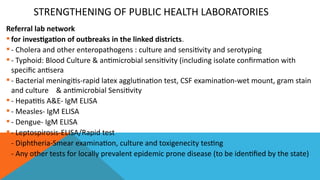
STRENGTHENING OF PUBLICHEALTH LABORATORIES
Referral lab network
for investigation of outbreaks in the linked districts.
- Cholera and other enteropathogens : culture and sensitivity and serotyping
- Typhoid: Blood Culture & antimicrobial sensitivity (including isolate confirmation with
specific antisera
- Bacterial meningitis-rapid latex agglutination test, CSF examination-wet mount, gram stain
and culture & antimicrobial Sensitivity
- Hepatitis A&E- IgM ELISA
- Measles- IgM ELISA
- Dengue- IgM ELISA
- Leptospirosis-ELISA/Rapid test
- Diphtheria-Smear examination, culture and toxigenecity testing
- Any other tests for locally prevalent epidemic prone disease (to be identified by the state)
28.
REFERENCES
National center fordisease control. Ministry of health &
family welfare. www.idsp.nic.in
National center for disease control. Directorate general of
health services. Ministry of health & family welfare, GOI.
ncdc.gov.in
29.
Directorate general ofhealth services
(Ministry of health & family welfare
National centre for
disease control
Centre for medical
entomology & vector
management
Centre for AIDS&
related diseases
Director
Division of parasitic
diseases
Division of
microbiology
Division of
epidemiology
Division of
zoonosis
Integrated disease
surveillance project
Division of
planning, budget &
administration
Division of biochemistry
& biotechnology
Division of malaria
coordination
NCDC
Organogram
30.
CD ALERT
monthly newsletterby NCDC
disseminate information on various aspects of communicable
diseases to medical fraternity and health administrators.
The first issue was published in August 1997 on emerging and
reemerging diseases
give an inside view of the disease including the global scenario,
Indian scenario and also the diagnostic facilities of the particular
disease within our country.
tool for the Rapid response Teams for management and
containment operations in outbreak/ epidemic situations
31.
HISTORY
IDSP launched in2004 with world bank assistance for a period upto
March 2010.
The project was restructured and extended up to March 2012
Earlier World Bank funds were available for Central Surveillance Unit
(CSU) at NCDC & 9 identified states
rest were funded from domestic budget
continues during 12th Plan (2012-17) under NHM with outlay of Rs.
640 Crore from domestic budget only
A Central Surveillance Unit (CSU) at Delhi, State Surveillance Units
(SSU) at all State/UT head quarters and District Surveillance Units
(DSU) at all Districts.
32.
HISTORY CONT…
IT networkconnecting 776 sites in States/District HQ and premier
institutes has been established with the help of National Informatics
Centre (NIC) and Indian Space Research Organization (ISRO) for data
entry, training, video conferencing and outbreak discussion
data on epidemic prone disease are being collected from reporting units
including government and private sector hospitals and medical
colleges on ‘S’ syndromic, ‘P’ probable & ‘L’ laboratory formats using
standard case definitions through e-mail/portal (www.idsp.nic.in).
33.
HISTORY CONT…
analyzed bySSU/DSU for disease trends
investigated by the RRT to diagnose and control the outbreak
A 24X7 call center to receive disease alerts on a Toll Free telephone
number (1075)- February 2008
Media scanning and verification cell was established under IDSP in
July 2008
It detects and shares media alerts with the concerned states/districts
for verification and response
District laboratories are being strengthened for diagnosis of epidemic
prone diseases. 2 lakh per annum per lab for reagents and
consumables.
Editor's Notes
#6 SHOC is established under IDSP to strengthen the outbreak detection and response capacities of the states and districts by utilizing state-of-the-art information technology.
#8 CSU-Integrated administratively and financially with National Centre for Disease Control (NCDC), Delhi. SSU-One in each State/UT with a regular officer identified as State Surveillance Officer (SSO) Supported by 7 contractual staff. Con (Vet) added in 2013-14. DSU-One in each district with a regular officer as District Surveillance Officer (DSO). Supported by 3 contractual staff
#9 six sections=Budget & Finance, Laboratory strengthening, Information Technology and Communication, Data Management and Monitoring, Human Resource Development and NCD Surveillance.
#17 For example, for an outbreak reported in week 1 by Rohtak district of Haryana will reflect as HR/ROH/2016/1/0023
#20 monitors Global and National Media sources such as National and Regional print media, news on internet, newswires and websites, news channels and news shared by partners like Global Public Health Intelligence Network (GPHIN), Canada, WHO and other International and national agencies
#21 800 BY BROADBAND, 400 BY BROADBAND & SATELLITE
#31 Uttarakhand, Rajasthan, Punjab, Maharashtra, Gujarat, Tamil Nadu, Karnataka, Andhra Pradesh and West Bengal
#33 In 9 States, a referral lab network has been established by utilizing the existing 65 functional labs in the medical colleges and various other major centers in the States and linking them with adjoining districts for providing diagnostic services for epidemic prone diseases during outbreaks