Identifying Market Segments and TargetsCarisse Diana A. DrilonASMPH MD-MBAMay 11, 2010
Outline:Why identify?Levels of Market SegmentationSegmenting Consumer MarketsEvaluating and Selecting Market Segments
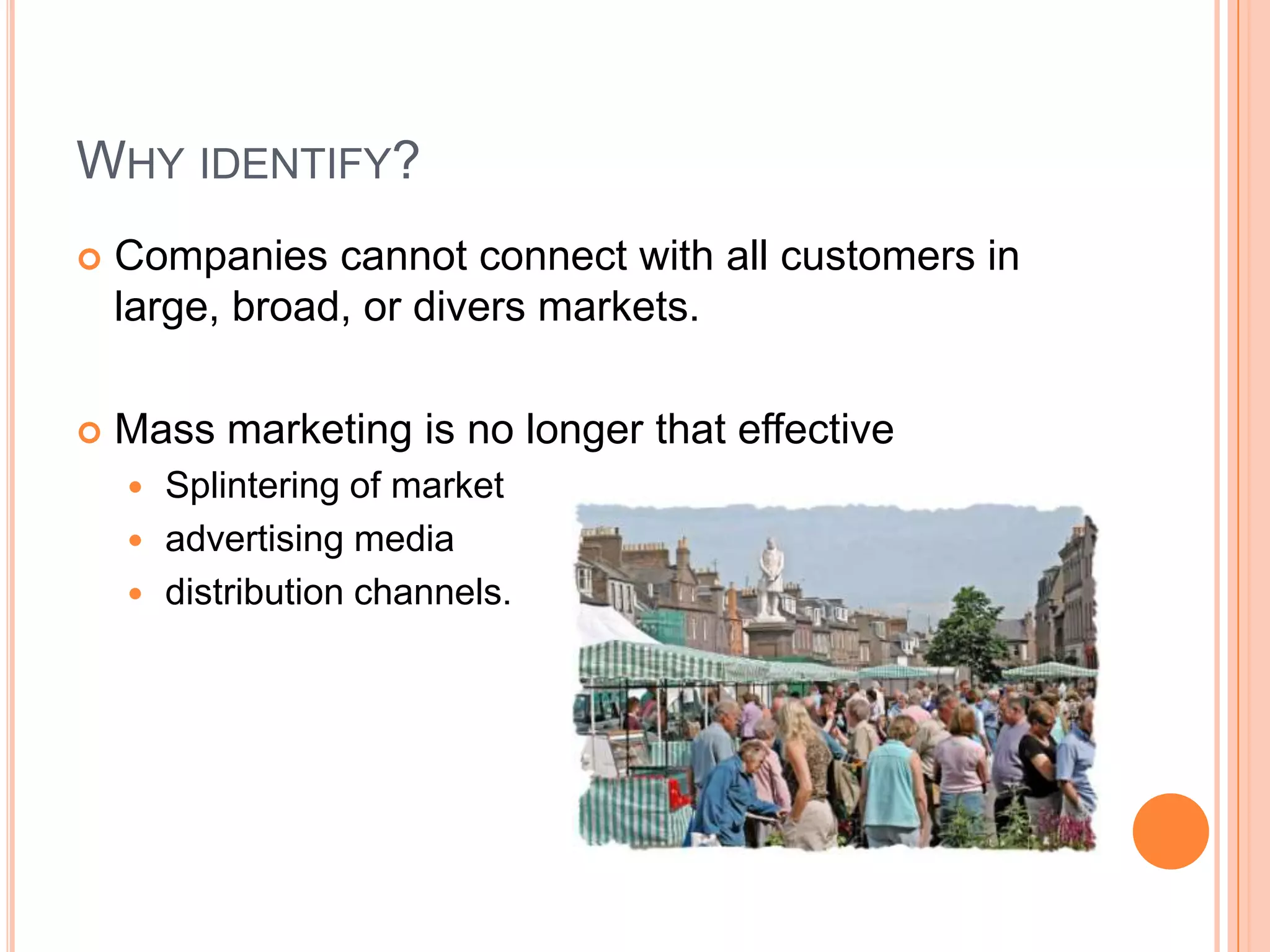
Why identify?Companies cannot connect with all customers in large, broad, or divers markets.Mass marketing is no longer that effective Splintering of marketadvertising mediadistribution channels.
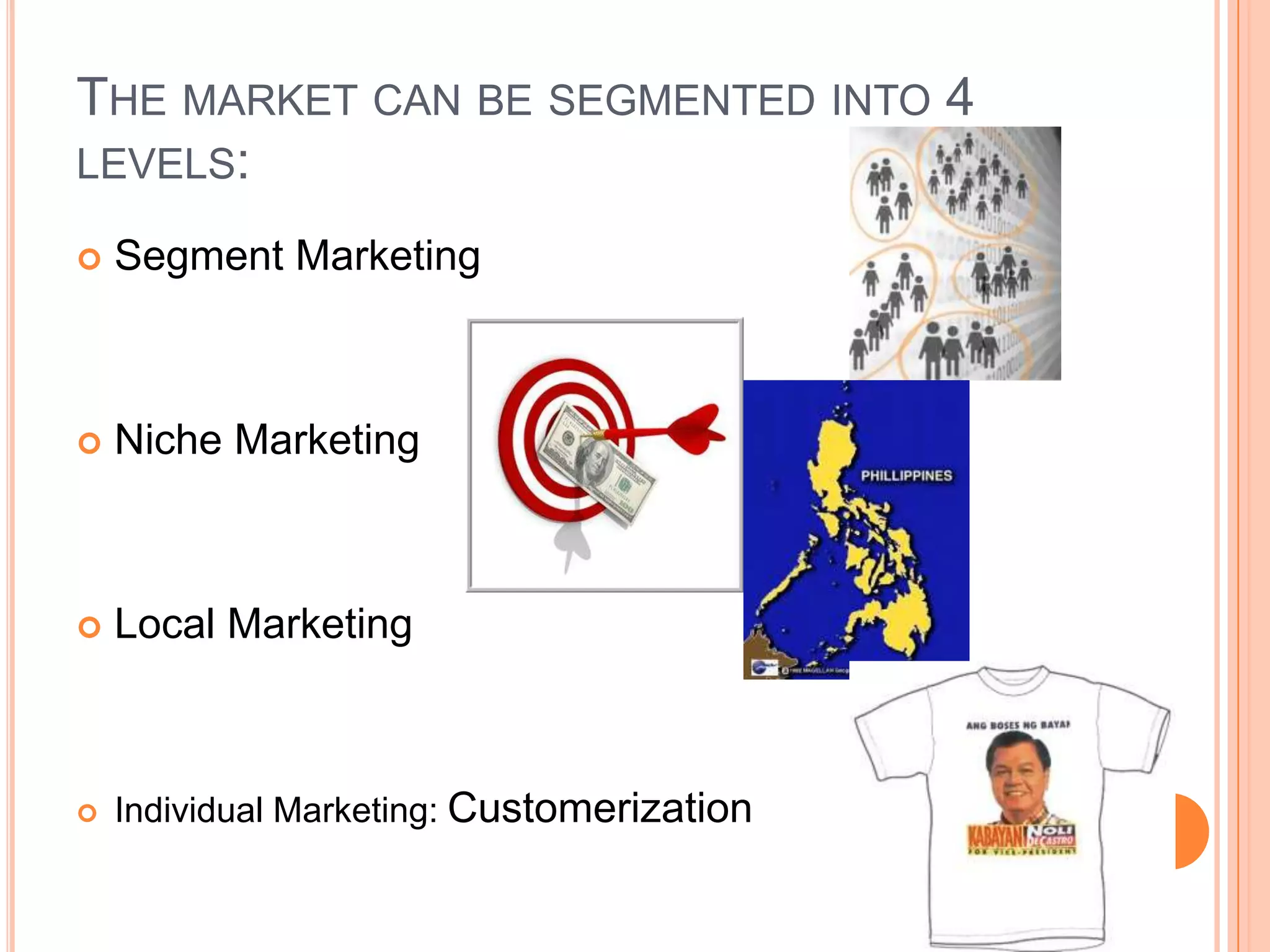
The market can be segmented into 4 levels:Segment MarketingNiche MarketingLocal MarketingIndividual Marketing: Customerization
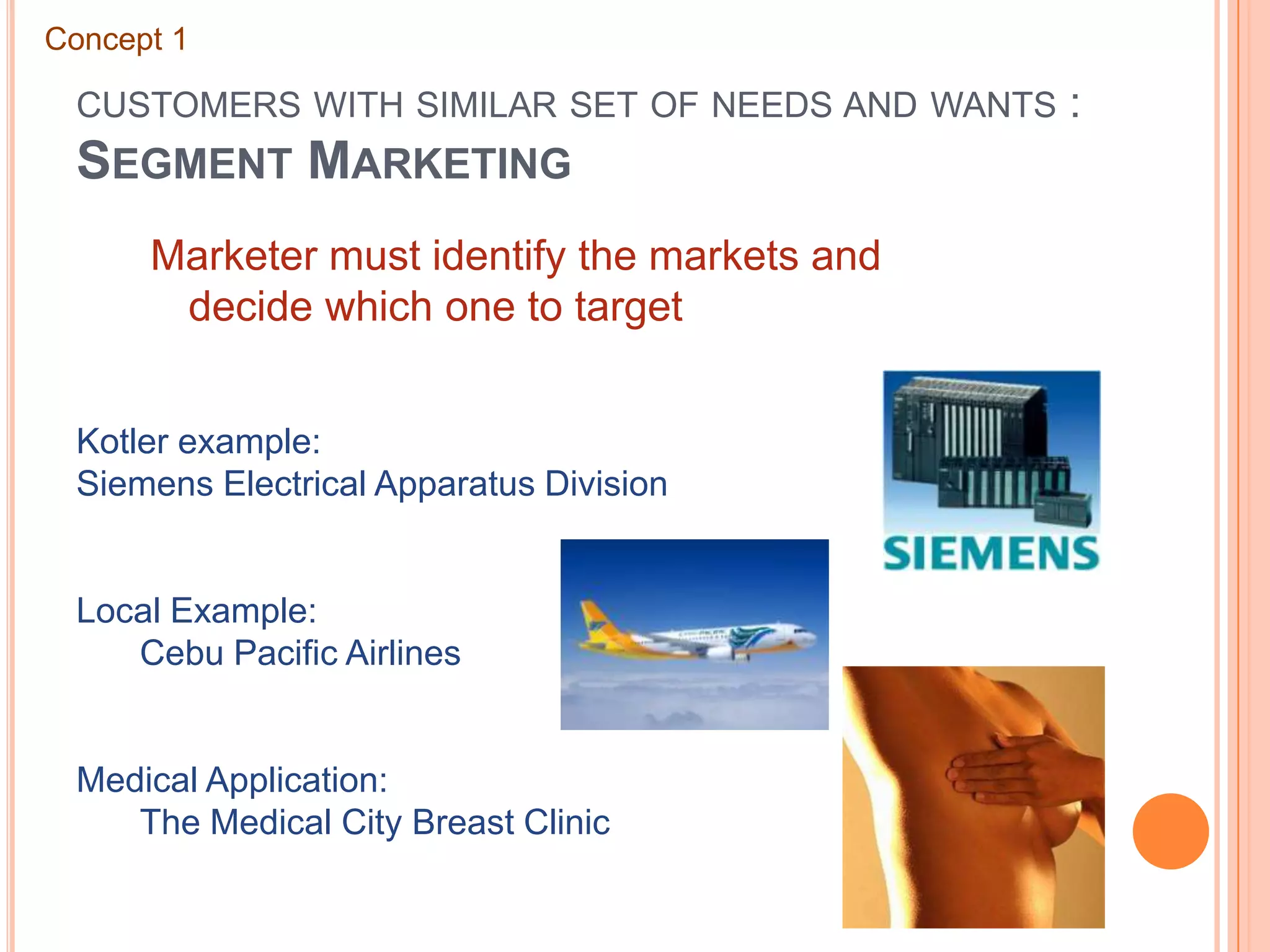
customers with similar set of needs and wants : Segment MarketingConcept 1Marketer must identify the markets and decide which one to targetKotler example: Siemens Electrical Apparatus DivisionLocal Example: 	Cebu Pacific AirlinesMedical Application: 	The Medical City Breast Clinic
defined customer group looking for a distinct mix of benefits: Niche MarketingConcept 2Has a distinct set of needs, willing to pay a premium, fairly small, gains economies through specializationKotler example:	HallmarkLocal example:	VMV HypoallergenicsMedical application:Subspecializing in a certain field
Tailoring to needs and wants of local groups: Local marketingConcept 3Emphasis on local marketing initiativesKotler example:	CitibankLocal example:	McDonald’sMedical application:	Private practice of doctors in different areas
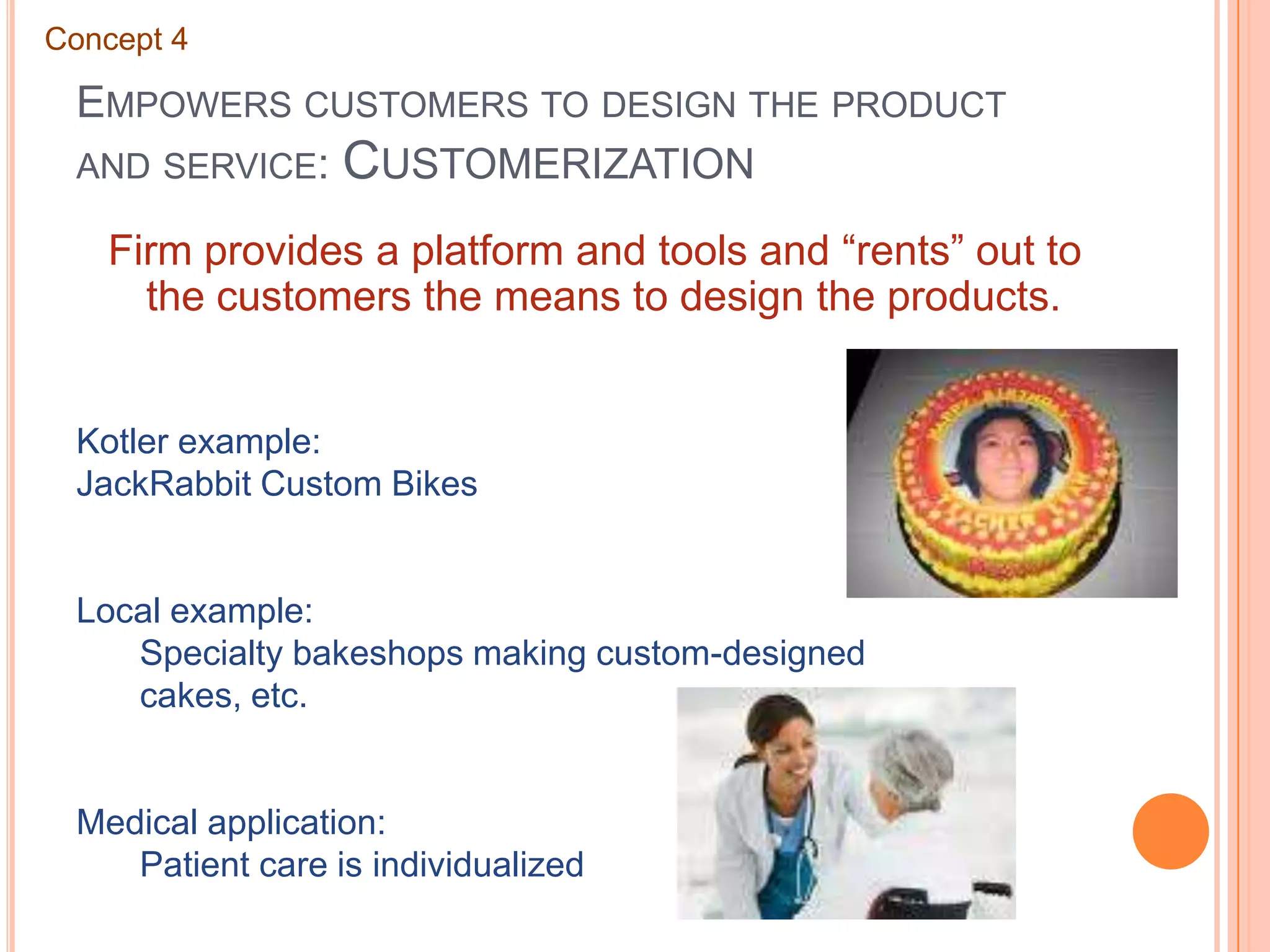
Empowers customers to design the product and service: CustomerizationConcept 4Firm provides a platform and tools and “rents” out to the customers the means to design the products.Kotler example:JackRabbit Custom BikesLocal example:	Specialty bakeshops making custom-designed 	cakes, etc.Medical application:	Patient care is individualized
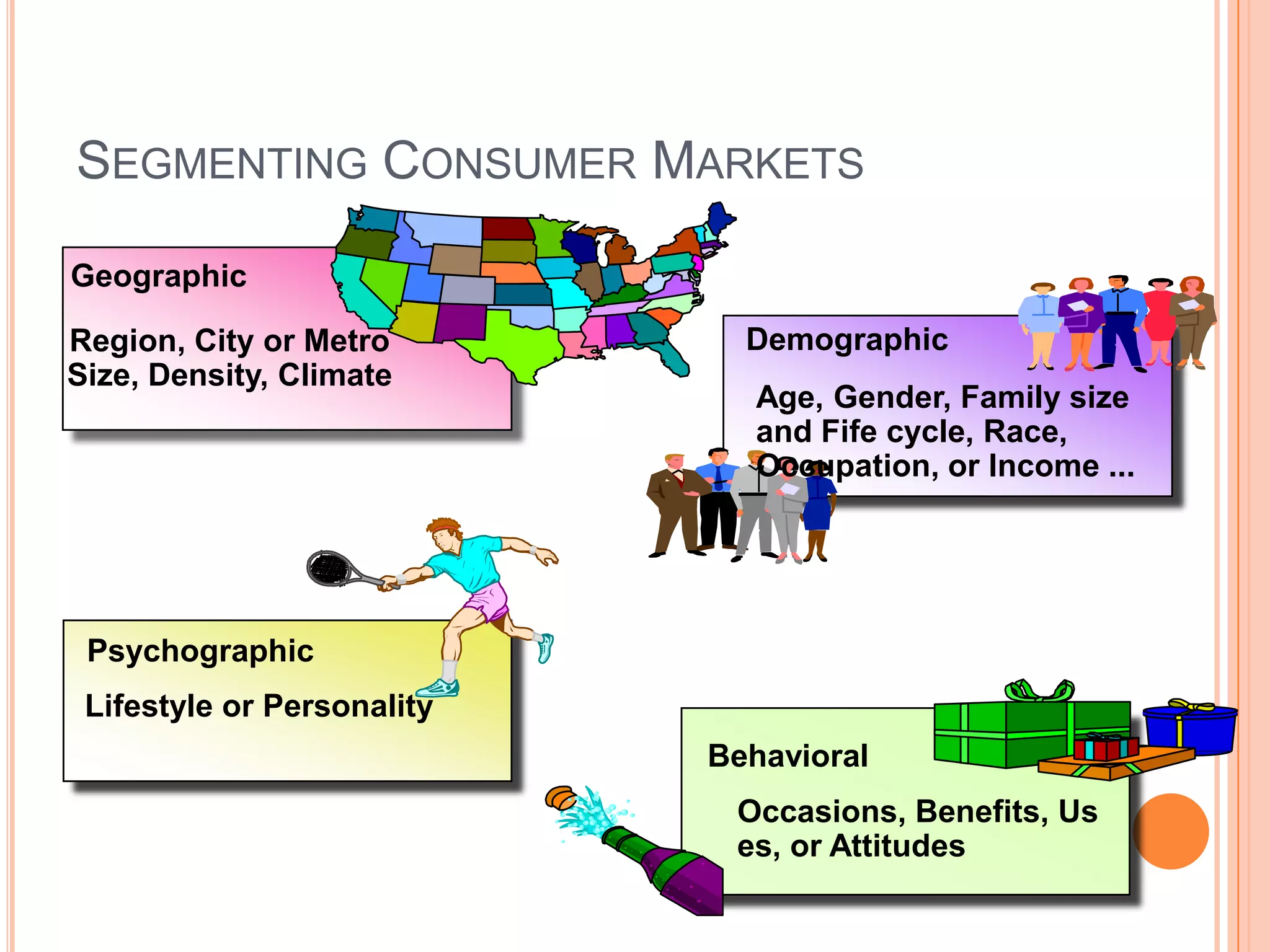
Segmenting Consumer MarketsGeographicRegion, City or MetroSize, Density, ClimateDemographicAge, Gender, Family size and Fife cycle, Race, Occupation, or Income ...PsychographicLifestyle or PersonalityBehavioralOccasions, Benefits, Uses, or Attitudes
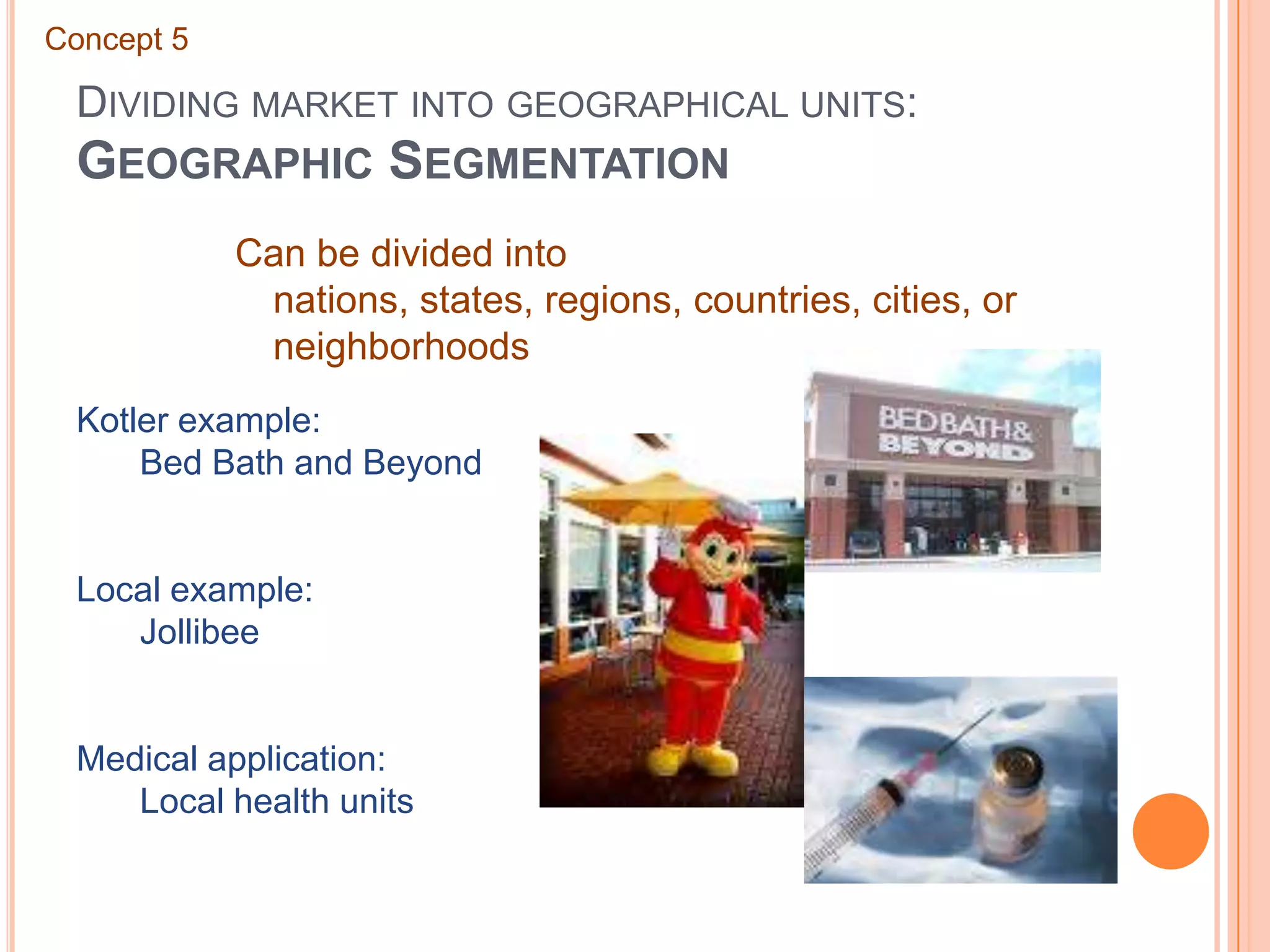
Dividing market into geographical units: Geographic SegmentationConcept 5Can be divided into nations, states, regions, countries, cities, or neighborhoodsKotler example:	Bed Bath and BeyondLocal example:	JollibeeMedical application:	Local health units
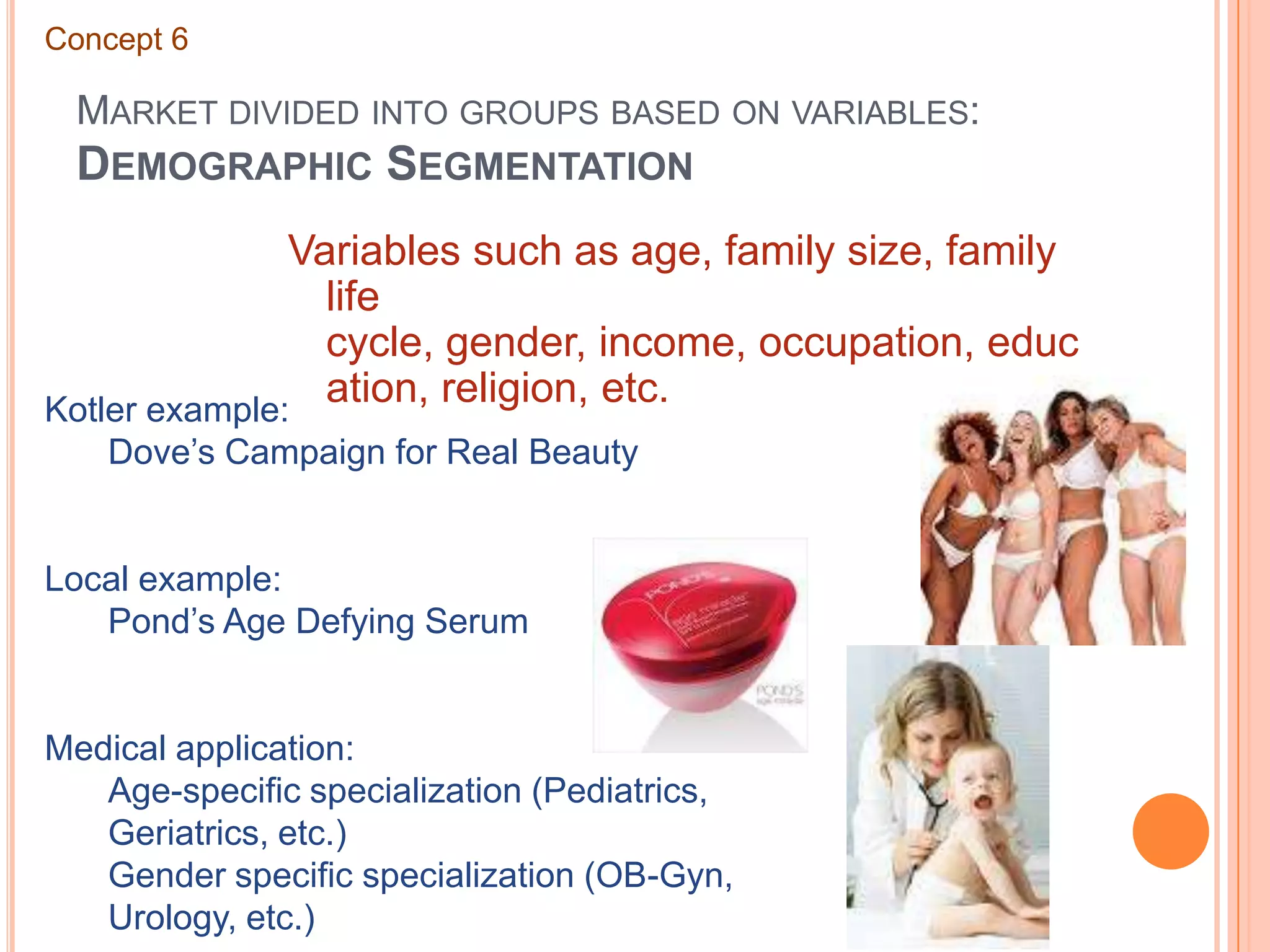
Market divided into groups based on variables: Demographic SegmentationConcept 6Variables such as age, family size, family life cycle, gender, income, occupation, education, religion, etc.Kotler example:	Dove’s Campaign for Real BeautyLocal example:	Pond’s Age Defying SerumMedical application:	Age-specific specialization (Pediatrics, 	Geriatrics, etc.)	Gender specific specialization (OB-Gyn, 	Urology, etc.)
Divided based on Psychographic Profiles:Psychographic SegmentationConcept 7Market is divided into different groups on the basis of psychological/personal traits, lifestyle, or valuesKotler example:	Transport CanadaLocal example:	Philippine AirlinesMedical application:	St. Luke’s Medical Center, Global City
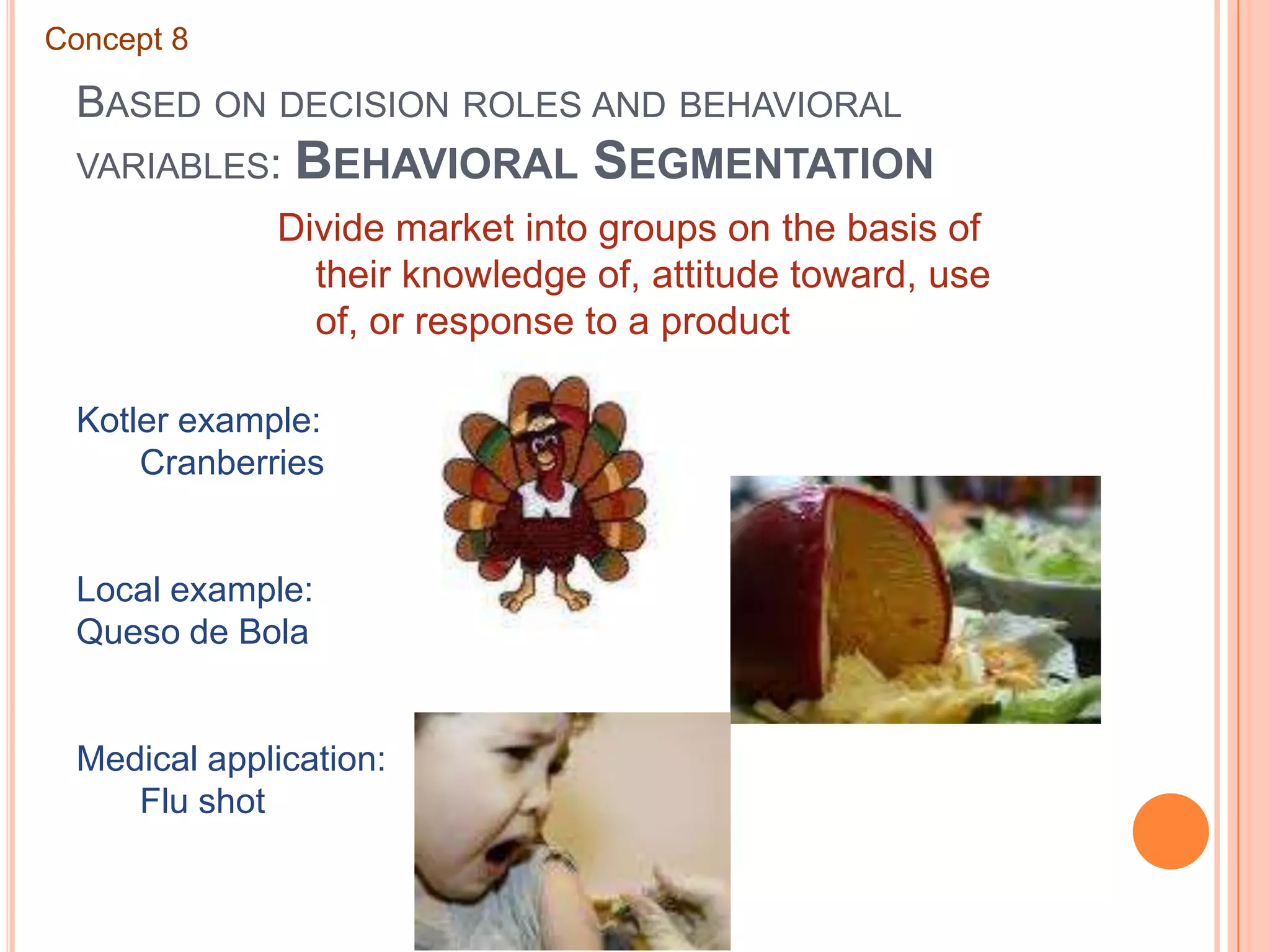
Based on decision roles and behavioral variables: Behavioral SegmentationConcept 8Divide market into groups on the basis of their knowledge of, attitude toward, use of, or response to a productKotler example:	CranberriesLocal example:Queso de BolaMedical application:	Flu shot
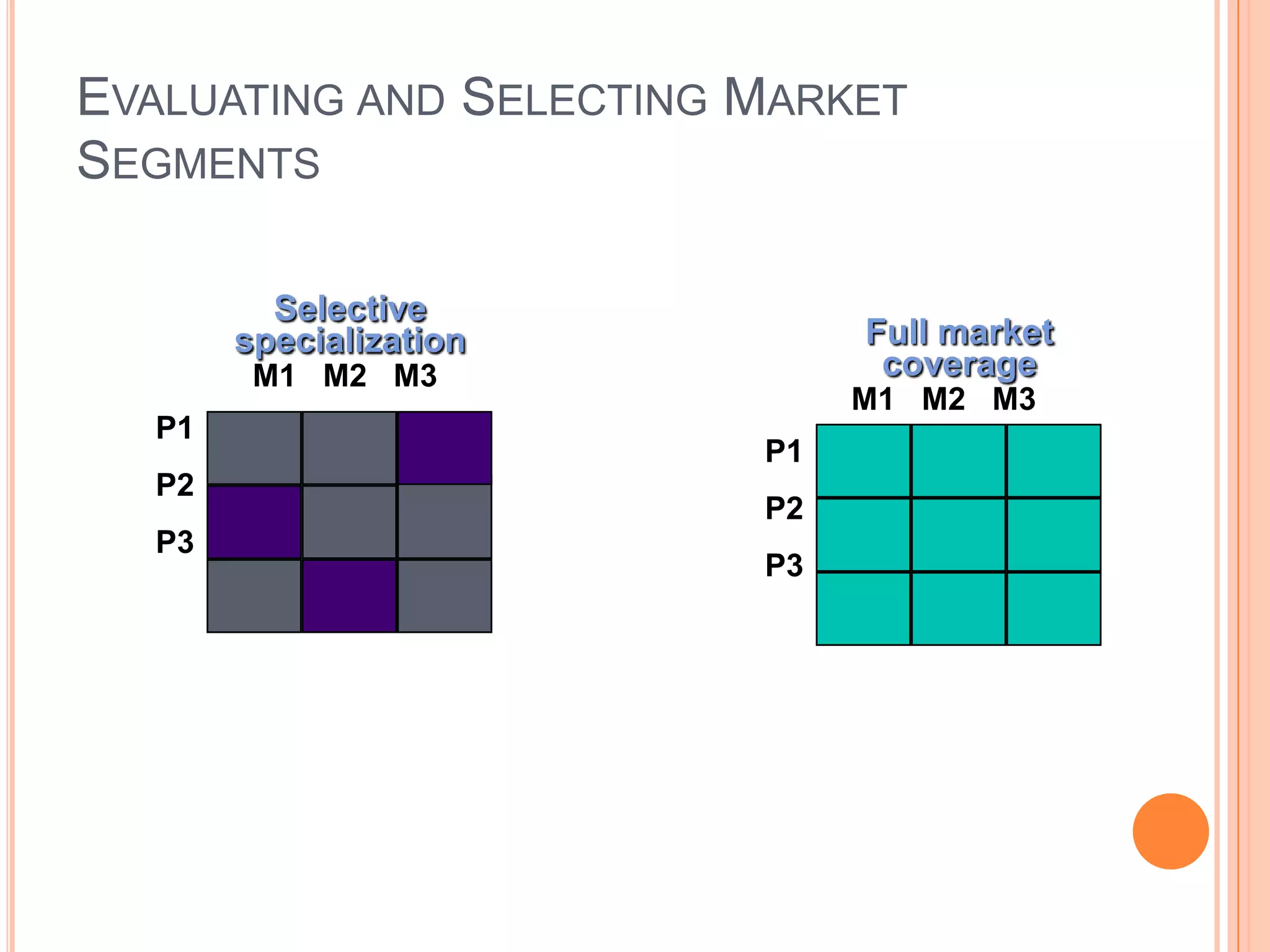
Evaluating and Selecting Market SegmentsSelectivespecializationM1   M2   M3 P1P2P3Full marketcoverageM1   M2   M3 P1P2P3
Selecting a number of market segments:Selective SpecializationConcept 9There may be little or no synergy among the segments, but each promises to be a moneymakerKotler example:	Proctor and Gamble Crest White StripsLocal example:	Swish MouthwashMedical application:	Dermatology Clinic
Serve all customer groups:Full Market CoverageConcept 10Firm attempts to serve all customer groups with all the products they might need.Kotler example:	Coca-ColaLocal example:	United Laboratories, IncorporatedMedical application	Big hospitals (The Medical City, St. Luke’s Medical 	Center, Makati Medical Center)
Outline:Why identify?Levels of Market SegmentationSegmenting Consumer MarketsEvaluating and Selecting Market Segments
Identifying Market Segments and TargetsCarisse Diana A. DrilonASMPH MD-MBAMay 11, 2010

Identifying Market Segments and Target

  • 1.
    Identifying Market Segmentsand TargetsCarisse Diana A. DrilonASMPH MD-MBAMay 11, 2010
  • 2.
    Outline:Why identify?Levels ofMarket SegmentationSegmenting Consumer MarketsEvaluating and Selecting Market Segments
  • 3.
    Why identify?Companies cannotconnect with all customers in large, broad, or divers markets.Mass marketing is no longer that effective Splintering of marketadvertising mediadistribution channels.
  • 4.
    The market canbe segmented into 4 levels:Segment MarketingNiche MarketingLocal MarketingIndividual Marketing: Customerization
  • 5.
    customers with similarset of needs and wants : Segment MarketingConcept 1Marketer must identify the markets and decide which one to targetKotler example: Siemens Electrical Apparatus DivisionLocal Example: Cebu Pacific AirlinesMedical Application: The Medical City Breast Clinic
  • 6.
    defined customer grouplooking for a distinct mix of benefits: Niche MarketingConcept 2Has a distinct set of needs, willing to pay a premium, fairly small, gains economies through specializationKotler example: HallmarkLocal example: VMV HypoallergenicsMedical application:Subspecializing in a certain field
  • 7.
    Tailoring to needsand wants of local groups: Local marketingConcept 3Emphasis on local marketing initiativesKotler example: CitibankLocal example: McDonald’sMedical application: Private practice of doctors in different areas
  • 8.
    Empowers customers todesign the product and service: CustomerizationConcept 4Firm provides a platform and tools and “rents” out to the customers the means to design the products.Kotler example:JackRabbit Custom BikesLocal example: Specialty bakeshops making custom-designed cakes, etc.Medical application: Patient care is individualized
  • 9.
    Segmenting Consumer MarketsGeographicRegion,City or MetroSize, Density, ClimateDemographicAge, Gender, Family size and Fife cycle, Race, Occupation, or Income ...PsychographicLifestyle or PersonalityBehavioralOccasions, Benefits, Uses, or Attitudes
  • 10.
    Dividing market intogeographical units: Geographic SegmentationConcept 5Can be divided into nations, states, regions, countries, cities, or neighborhoodsKotler example: Bed Bath and BeyondLocal example: JollibeeMedical application: Local health units
  • 11.
    Market divided intogroups based on variables: Demographic SegmentationConcept 6Variables such as age, family size, family life cycle, gender, income, occupation, education, religion, etc.Kotler example: Dove’s Campaign for Real BeautyLocal example: Pond’s Age Defying SerumMedical application: Age-specific specialization (Pediatrics, Geriatrics, etc.) Gender specific specialization (OB-Gyn, Urology, etc.)
  • 12.
    Divided based onPsychographic Profiles:Psychographic SegmentationConcept 7Market is divided into different groups on the basis of psychological/personal traits, lifestyle, or valuesKotler example: Transport CanadaLocal example: Philippine AirlinesMedical application: St. Luke’s Medical Center, Global City
  • 13.
    Based on decisionroles and behavioral variables: Behavioral SegmentationConcept 8Divide market into groups on the basis of their knowledge of, attitude toward, use of, or response to a productKotler example: CranberriesLocal example:Queso de BolaMedical application: Flu shot
  • 14.
    Evaluating and SelectingMarket SegmentsSelectivespecializationM1 M2 M3 P1P2P3Full marketcoverageM1 M2 M3 P1P2P3
  • 15.
    Selecting a numberof market segments:Selective SpecializationConcept 9There may be little or no synergy among the segments, but each promises to be a moneymakerKotler example: Proctor and Gamble Crest White StripsLocal example: Swish MouthwashMedical application: Dermatology Clinic
  • 16.
    Serve all customergroups:Full Market CoverageConcept 10Firm attempts to serve all customer groups with all the products they might need.Kotler example: Coca-ColaLocal example: United Laboratories, IncorporatedMedical application Big hospitals (The Medical City, St. Luke’s Medical Center, Makati Medical Center)
  • 17.
    Outline:Why identify?Levels ofMarket SegmentationSegmenting Consumer MarketsEvaluating and Selecting Market Segments
  • 18.
    Identifying Market Segmentsand TargetsCarisse Diana A. DrilonASMPH MD-MBAMay 11, 2010