Topics - Reading a Research
Article
• Brief Overview: Purpose and Process of
Empirical Research
• Standard Format of Research Articles
• Evaluating/Critiquing Research
Role and Purpose of Empirical
Research
• To provide answers to questions about
behavior by using the scientific method.
• Descriptive (to “describe’)
• Correlational (to “predict”)
• Causal-(to “control, explain causation”)
– Experimental
– Comparative
Process of Empirical Research
• Identify and define research problem and
questions.
• Formulate hypotheses on basis of theory, prior
research and/or hunches.
• Design research study to collect data bearing on
questions.
• Conduct the research.
• Analyze the data (through statistical methods).
• Interpret the data in light of the research questions.
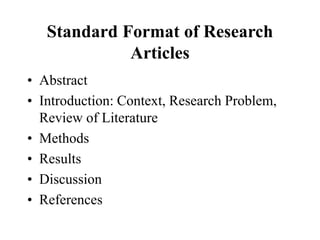
Standard Format of Research
Articles
• Abstract
• Introduction: Context, Research Problem,
Review of Literature
• Methods
• Results
• Discussion
• References
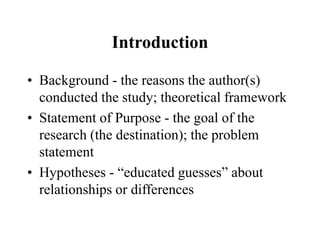
Introduction
• Background - the reasons the author(s)
conducted the study; theoretical framework
• Statement of Purpose - the goal of the
research (the destination); the problem
statement
• Hypotheses - “educated guesses” about
relationships or differences
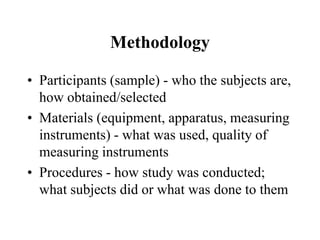
Methodology
• Participants (sample) - who the subjects are,
how obtained/selected
• Materials (equipment, apparatus, measuring
instruments) - what was used, quality of
measuring instruments
• Procedures - how study was conducted;
what subjects did or what was done to them
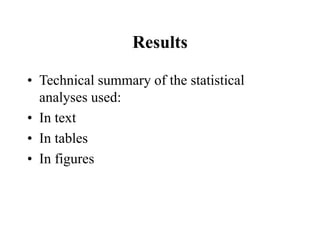
Results
• Technical summary of the statistical
analyses used:
• In text
• In tables
• In figures
Discussion/Conclusions
• Non-technical interpretation of results
• Linking results to original purposes and
hypotheses
• Why the results turned out the way they did
• Identifying the study’s limitations
• Suggesting steps for further research
Evaluating Research
• Goal: to be able to critique a research
article by identifying the strengths and
weaknesses of each component of the
research
• “Tools for Evaluating Research Reports”
Evaluating Introductions:
Literature Review
• Literature review: to place current study in
context of what is known/not known
– Nature of literature cited
– Researcher bias
– Rationale/need for study
– Theoretical framework
– Link of framework to research questions
– Sufficiency of information
– Usefulness of review
Evaluating Introductions:
Research Questions/Hypotheses
• Research questions and hypotheses drive
the study
– Clarity of problem
– Sufficient rationale
– Contribution to existing knowledge
– Link to theoretical framework and lit review
– Assumptions explicit/implicit
– Operational definition of terms
– Statement of hypotheses
Evaluating Methodology
• Sufficient detail of procedures (treatment),
design and instruments
• Full description of population
• Full description of sampling method
• Quality of measures used
• Obvious weaknesses in design
Evaluating Results
• Appropriateness of statistical techniques
used
• Clarity of presentation of results
• Adequacy of presentation of results
Evaluating Discussion/Conclusions
• Consistency of conclusions with findings
• Appropriateness of generalizations
• Discussion of implications of findings
• Discussion of limitations of study
• Alternative explanation for findings
• Linkage of conclusions with theoretical
framework, research questions
Practice Exercise -
Evaluating the Introduction
• Literature Review
• Research problem/questions

week1a.ppt

  • 1.
    Topics - Readinga Research Article • Brief Overview: Purpose and Process of Empirical Research • Standard Format of Research Articles • Evaluating/Critiquing Research
  • 2.
    Role and Purposeof Empirical Research • To provide answers to questions about behavior by using the scientific method. • Descriptive (to “describe’) • Correlational (to “predict”) • Causal-(to “control, explain causation”) – Experimental – Comparative
  • 3.
    Process of EmpiricalResearch • Identify and define research problem and questions. • Formulate hypotheses on basis of theory, prior research and/or hunches. • Design research study to collect data bearing on questions. • Conduct the research. • Analyze the data (through statistical methods). • Interpret the data in light of the research questions.
  • 4.
    Standard Format ofResearch Articles • Abstract • Introduction: Context, Research Problem, Review of Literature • Methods • Results • Discussion • References
  • 5.
    Introduction • Background -the reasons the author(s) conducted the study; theoretical framework • Statement of Purpose - the goal of the research (the destination); the problem statement • Hypotheses - “educated guesses” about relationships or differences
  • 6.
    Methodology • Participants (sample)- who the subjects are, how obtained/selected • Materials (equipment, apparatus, measuring instruments) - what was used, quality of measuring instruments • Procedures - how study was conducted; what subjects did or what was done to them
  • 7.
    Results • Technical summaryof the statistical analyses used: • In text • In tables • In figures
  • 8.
    Discussion/Conclusions • Non-technical interpretationof results • Linking results to original purposes and hypotheses • Why the results turned out the way they did • Identifying the study’s limitations • Suggesting steps for further research
  • 9.
    Evaluating Research • Goal:to be able to critique a research article by identifying the strengths and weaknesses of each component of the research • “Tools for Evaluating Research Reports”
  • 10.
    Evaluating Introductions: Literature Review •Literature review: to place current study in context of what is known/not known – Nature of literature cited – Researcher bias – Rationale/need for study – Theoretical framework – Link of framework to research questions – Sufficiency of information – Usefulness of review
  • 11.
    Evaluating Introductions: Research Questions/Hypotheses •Research questions and hypotheses drive the study – Clarity of problem – Sufficient rationale – Contribution to existing knowledge – Link to theoretical framework and lit review – Assumptions explicit/implicit – Operational definition of terms – Statement of hypotheses
  • 12.
    Evaluating Methodology • Sufficientdetail of procedures (treatment), design and instruments • Full description of population • Full description of sampling method • Quality of measures used • Obvious weaknesses in design
  • 13.
    Evaluating Results • Appropriatenessof statistical techniques used • Clarity of presentation of results • Adequacy of presentation of results
  • 14.
    Evaluating Discussion/Conclusions • Consistencyof conclusions with findings • Appropriateness of generalizations • Discussion of implications of findings • Discussion of limitations of study • Alternative explanation for findings • Linkage of conclusions with theoretical framework, research questions
  • 15.
    Practice Exercise - Evaluatingthe Introduction • Literature Review • Research problem/questions