IDENTIFY AND PREPARE VARIOUS
MEATS
D1.HCC.CL2.03
Slide 1DEDY WIJAYANTTO
Identify and prepare various meats
Elements:
Slide 2
Identify and select meat1
Prepare and store meat2
Cook, hold and present meat3
Store meat and offal products4
DEDY WIJAYANTTO
Identify and prepare various meats
Websites (refer to list on Page 8 of manual):
• Meat and Livestock Australia (MLA)
• Halal Meats Australia
• Windy Gills Game meats
• AUS Meats
• Pork Australia
• Head chef support
• Build an Electronic Library.
Slide 3DEDY WIJAYANTTO
1: Identify and select meats
1.1 Identify the primary meat cuts
1.2 Identify the secondary meat cuts
1.3 Identify commercial establishment cuts and specifications
1.4 Identify offal and fancy meats
1.5 Identify varieties of meats used commercially
1.6 Identify and select suppliers for purchasing of products
1.7 Minimize wastage through freshness and correct purchasing
1.8 Identify costs through yield testing
1.9 Ensure correct conditions are maintained for freshness and
quality
Slide 4DEDY WIJAYANTTO
1: Identify and select meats
1.1 Identify primary meat cuts:
• Primary cuts – Lamb:
• Leg
• Loin
• Shoulder
• Secondary cuts – Lamb leg:
• Round, topside, silverside.
Slide 5DEDY WIJAYANTTO
1: Identify and select meats
1.1 Identify primary meat cuts:
Primary cuts:
• Pork
• Hindquarter
1.2 Identify secondary meat cuts:
• Secondary cuts – Pork Leg:
• Rump:
 Steak, dice, strips for stir fry.
Slide 6DEDY WIJAYANTTO
1: Identify and select meats
1.2 Identify secondary meat cuts:
Refer to sample pg 13 manual:
• Fillet is cut steaks, strips
• Ribs cut into rack (4 point)
• Ribs cut into individual cuts
• Shoulder cuts.
Slide 7DEDY WIJAYANTTO
1: Identify and select meats
1.3 Identify commercial establishment cuts and
specifications :
• Midloin of lamb is cut into
cutlets
• Cutlets are ‘frenched’
• Cutlets are crumbed
• Midloin is taken off bone
and rolled, tied roasted.
Slide 8DEDY WIJAYANTTO
1: Identify and select meats
1.4 Identify offal and fancy meats:
• Liver
• Sweetbreads
• Kidney
• Tripe
• Feet
• Head
• Eyes.
Slide 9DEDY WIJAYANTTO
1: Identify and select meats
1.5 Identify varieties of meats used commercially:
• Beef
• Lamb
• Pork
• Buffalo
• Goat
• Kangaroo
• Rabbit.
Slide 10DEDY WIJAYANTTO
1: Identify and select meats
1.6 Identify and select suppliers for purchasing of products:
• Ease of delivery
• Payment requirements
• Product availability
• Your requirements.
Select according to what suits your enterprise the best
Slide 11DEDY WIJAYANTTO
1: Identify and select meats
1.7 Minimise wastage through freshness and correct
purchasing :
• Use of trimming and off cuts
• Order only what is required
• Storage capacity
• Skill of the staff.
Slide 12DEDY WIJAYANTTO
1: Identify and select meats
1.8 Identify costs through yield testing:
• Number of serves obtained from cuts of meat
• Consistency of serving sizes.
Slide 13DEDY WIJAYANTTO
1: Identify and select meats
1.9 Ensure correct conditions are maintained
for freshness and quality:
• Correct environmental conditions
• Number of days held at defined temperatures
• Purchase in smaller quantities.
Slide 14DEDY WIJAYANTTO
2: Prepare and store meat
2.1 Prepare and portion meat cuts, including offal and
fancy meats, to enterprise requirements
2.2 Minimise wastage through preparation and storage
2.3 Use of trimming and leftovers
2.4 Identification and use of equipment
Slide 15DEDY WIJAYANTTO
2: Prepare and store meat
2.1 Prepare and portion meat cuts, including offal and
fancy meats, to enterprise requirements:
• Cleaning
• Cutting
• Portion size
• Service requirements.
Slide 16DEDY WIJAYANTTO
2: Prepare and store meat
2.2 Minimise wastage through preparation and storage:
• Staff skill levels
• Storage capacity
• Order quantities required.
Slide 17DEDY WIJAYANTTO
2: Prepare and store meat
2.3 Use of trimming and leftovers:
• Menu Variety
• Staff skill levels
• Storage capacity.
Slide 18DEDY WIJAYANTTO
2: Prepare and store meat
2.4 Identification and use of equipment:
• Meat knives
• Mincers
• Food processors
• Coolroom
• Vacuum packing machine
• Freezer.
Slide 19DEDY WIJAYANTTO
3: Cook hold and present meat
3.1 Select appropriate cooking method of
the meat type, including offal
3.2 Prepare and cook following a standard
recipe within a commercial environment
3.3 Hold prepared products as required
prior to presenting
3.4 Present meats and offal dishes
3.5 Prepare garnishes, sauce and
accompaniments for meat dishes,
including offal
Slide 20DEDY WIJAYANTTO
3: Cook hold and present meat
3.1 Select appropriate cooking method of the meat type,
including offal:
• Poach
• Grill
• Roast
• Deep fry
• Fry.
Slide 21DEDY WIJAYANTTO
3: Cook hold and present meat
3.2 Prepare and cook following a standard
recipe within a commercial environment:
• Select a recipe
• Read and understand requirements
• Collect ingredients
• Prepare ingredients
• Cook the dish to enterprise
requirements.
Slide 22DEDY WIJAYANTTO
3: Cook hold and present meat
3.3 Hold prepared products as required prior to
presenting:
• Keep food hot
• Above 60 degrees
• Was the meat grilled
• When is it required to be served
• Is it a braise that can be
held in bain-marie.
23DEDY WIJAYANTTO
3: Cook hold and present meat
3.4 Present meats and offal dishes :
Present the dish you have cooked
Slide 24DEDY WIJAYANTTO
3: Cook hold and present meat
3.5 Prepare garnishes, sauce and accompaniments for
meat dishes, including offal:
• Fresh
• Edible
• Compliment the dish
• Add colour and contrast.
Slide 25DEDY WIJAYANTTO
4: Store meat and offal
1. Store fresh and/or vacuum packed items correctly
2. Thaw frozen meat and offal correctly
3. Store meat and offal in correct containers
4. Label meat and offal correctly
5. Ensure correct conditions are maintained for freshness
and quality
Slide 26DEDY WIJAYANTTO
4: Store meat and offal
4.1 Fresh and/or vacuum packed items are stored
correctly:
• Controlled environment
– Chilled, less than 4°C
• Protected from outside contamination
– Covered or wrapped
• Labelle
• Dated.
Slide 27DEDY WIJAYANTTO
4: Store meat and offal
4.2 Prepare and maintain correct thawing of meat and
offal:
• Controlled environment
– Coolroom
• Single layer in trays
– To capture liquids
• Separate containers.
Slide 28DEDY WIJAYANTTO
4: Store meat and offal
4.3 Meat and offal is appropriately stored in correct
containers:
• Food grade containers
• Impervious to liquids
• Stainless steel or plastic
• In GOOD condition.
Slide 29DEDY WIJAYANTTO
4: Store meat and offal
4.4 Meat and offal is correctly labeled:
• Date of manufacture
• Name of product
• Use by date
• Name of person who
Manufactured.
Slide 30DEDY WIJAYANTTO
4: Store meat and offal
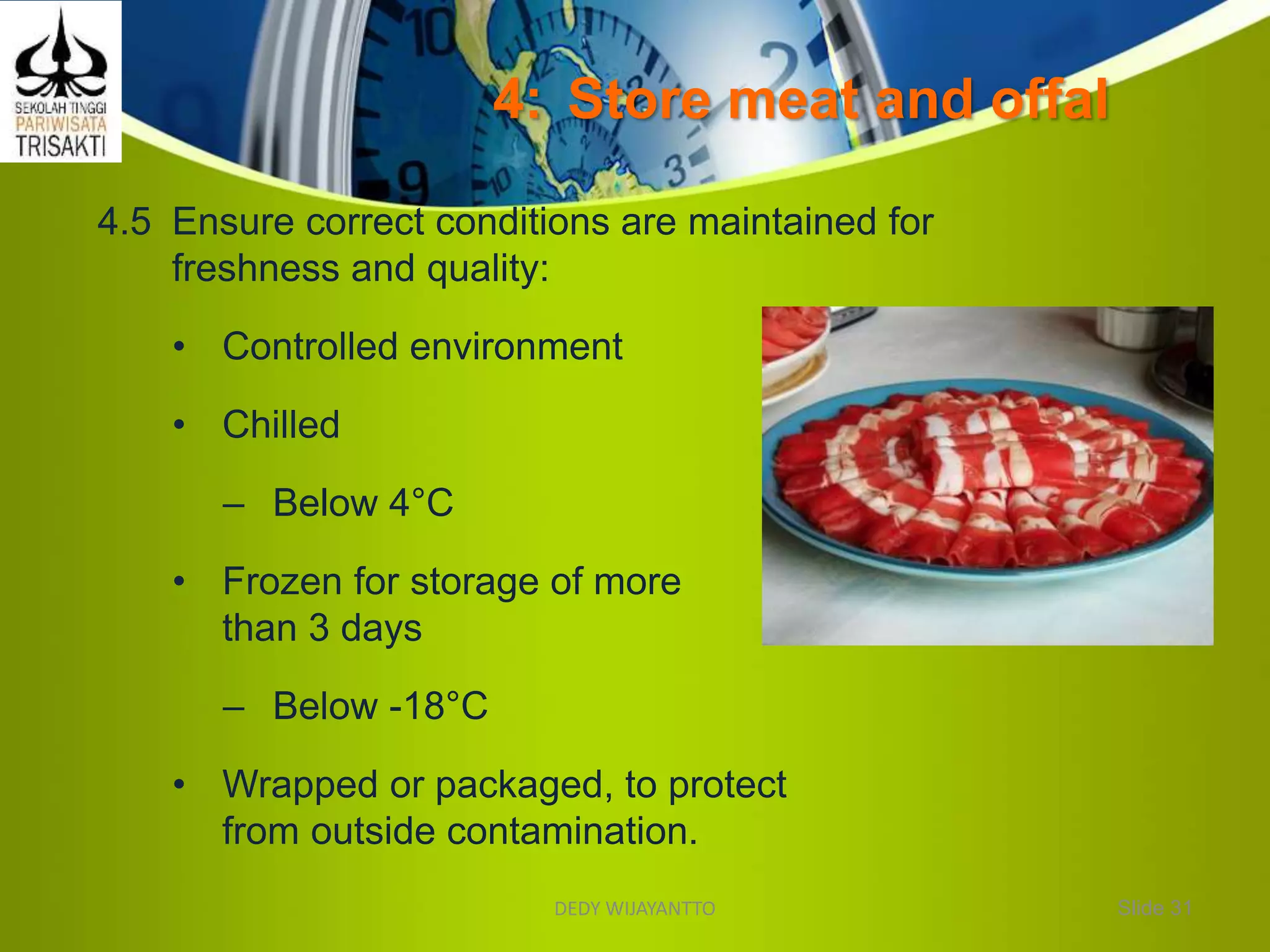
4.5 Ensure correct conditions are maintained for
freshness and quality:
• Controlled environment
• Chilled
– Below 4°C
• Frozen for storage of more
than 3 days
– Below -18°C
• Wrapped or packaged, to protect
from outside contamination.
Slide 31DEDY WIJAYANTTO
Slide 32
See you again.
deddywijayanto@stptrisakti.ac.id
DEDY WIJAYANTTO

Identify and prepare various meats

  • 1.
    IDENTIFY AND PREPAREVARIOUS MEATS D1.HCC.CL2.03 Slide 1DEDY WIJAYANTTO
  • 2.
    Identify and preparevarious meats Elements: Slide 2 Identify and select meat1 Prepare and store meat2 Cook, hold and present meat3 Store meat and offal products4 DEDY WIJAYANTTO
  • 3.
    Identify and preparevarious meats Websites (refer to list on Page 8 of manual): • Meat and Livestock Australia (MLA) • Halal Meats Australia • Windy Gills Game meats • AUS Meats • Pork Australia • Head chef support • Build an Electronic Library. Slide 3DEDY WIJAYANTTO
  • 4.
    1: Identify andselect meats 1.1 Identify the primary meat cuts 1.2 Identify the secondary meat cuts 1.3 Identify commercial establishment cuts and specifications 1.4 Identify offal and fancy meats 1.5 Identify varieties of meats used commercially 1.6 Identify and select suppliers for purchasing of products 1.7 Minimize wastage through freshness and correct purchasing 1.8 Identify costs through yield testing 1.9 Ensure correct conditions are maintained for freshness and quality Slide 4DEDY WIJAYANTTO
  • 5.
    1: Identify andselect meats 1.1 Identify primary meat cuts: • Primary cuts – Lamb: • Leg • Loin • Shoulder • Secondary cuts – Lamb leg: • Round, topside, silverside. Slide 5DEDY WIJAYANTTO
  • 6.
    1: Identify andselect meats 1.1 Identify primary meat cuts: Primary cuts: • Pork • Hindquarter 1.2 Identify secondary meat cuts: • Secondary cuts – Pork Leg: • Rump:  Steak, dice, strips for stir fry. Slide 6DEDY WIJAYANTTO
  • 7.
    1: Identify andselect meats 1.2 Identify secondary meat cuts: Refer to sample pg 13 manual: • Fillet is cut steaks, strips • Ribs cut into rack (4 point) • Ribs cut into individual cuts • Shoulder cuts. Slide 7DEDY WIJAYANTTO
  • 8.
    1: Identify andselect meats 1.3 Identify commercial establishment cuts and specifications : • Midloin of lamb is cut into cutlets • Cutlets are ‘frenched’ • Cutlets are crumbed • Midloin is taken off bone and rolled, tied roasted. Slide 8DEDY WIJAYANTTO
  • 9.
    1: Identify andselect meats 1.4 Identify offal and fancy meats: • Liver • Sweetbreads • Kidney • Tripe • Feet • Head • Eyes. Slide 9DEDY WIJAYANTTO
  • 10.
    1: Identify andselect meats 1.5 Identify varieties of meats used commercially: • Beef • Lamb • Pork • Buffalo • Goat • Kangaroo • Rabbit. Slide 10DEDY WIJAYANTTO
  • 11.
    1: Identify andselect meats 1.6 Identify and select suppliers for purchasing of products: • Ease of delivery • Payment requirements • Product availability • Your requirements. Select according to what suits your enterprise the best Slide 11DEDY WIJAYANTTO
  • 12.
    1: Identify andselect meats 1.7 Minimise wastage through freshness and correct purchasing : • Use of trimming and off cuts • Order only what is required • Storage capacity • Skill of the staff. Slide 12DEDY WIJAYANTTO
  • 13.
    1: Identify andselect meats 1.8 Identify costs through yield testing: • Number of serves obtained from cuts of meat • Consistency of serving sizes. Slide 13DEDY WIJAYANTTO
  • 14.
    1: Identify andselect meats 1.9 Ensure correct conditions are maintained for freshness and quality: • Correct environmental conditions • Number of days held at defined temperatures • Purchase in smaller quantities. Slide 14DEDY WIJAYANTTO
  • 15.
    2: Prepare andstore meat 2.1 Prepare and portion meat cuts, including offal and fancy meats, to enterprise requirements 2.2 Minimise wastage through preparation and storage 2.3 Use of trimming and leftovers 2.4 Identification and use of equipment Slide 15DEDY WIJAYANTTO
  • 16.
    2: Prepare andstore meat 2.1 Prepare and portion meat cuts, including offal and fancy meats, to enterprise requirements: • Cleaning • Cutting • Portion size • Service requirements. Slide 16DEDY WIJAYANTTO
  • 17.
    2: Prepare andstore meat 2.2 Minimise wastage through preparation and storage: • Staff skill levels • Storage capacity • Order quantities required. Slide 17DEDY WIJAYANTTO
  • 18.
    2: Prepare andstore meat 2.3 Use of trimming and leftovers: • Menu Variety • Staff skill levels • Storage capacity. Slide 18DEDY WIJAYANTTO
  • 19.
    2: Prepare andstore meat 2.4 Identification and use of equipment: • Meat knives • Mincers • Food processors • Coolroom • Vacuum packing machine • Freezer. Slide 19DEDY WIJAYANTTO
  • 20.
    3: Cook holdand present meat 3.1 Select appropriate cooking method of the meat type, including offal 3.2 Prepare and cook following a standard recipe within a commercial environment 3.3 Hold prepared products as required prior to presenting 3.4 Present meats and offal dishes 3.5 Prepare garnishes, sauce and accompaniments for meat dishes, including offal Slide 20DEDY WIJAYANTTO
  • 21.
    3: Cook holdand present meat 3.1 Select appropriate cooking method of the meat type, including offal: • Poach • Grill • Roast • Deep fry • Fry. Slide 21DEDY WIJAYANTTO
  • 22.
    3: Cook holdand present meat 3.2 Prepare and cook following a standard recipe within a commercial environment: • Select a recipe • Read and understand requirements • Collect ingredients • Prepare ingredients • Cook the dish to enterprise requirements. Slide 22DEDY WIJAYANTTO
  • 23.
    3: Cook holdand present meat 3.3 Hold prepared products as required prior to presenting: • Keep food hot • Above 60 degrees • Was the meat grilled • When is it required to be served • Is it a braise that can be held in bain-marie. 23DEDY WIJAYANTTO
  • 24.
    3: Cook holdand present meat 3.4 Present meats and offal dishes : Present the dish you have cooked Slide 24DEDY WIJAYANTTO
  • 25.
    3: Cook holdand present meat 3.5 Prepare garnishes, sauce and accompaniments for meat dishes, including offal: • Fresh • Edible • Compliment the dish • Add colour and contrast. Slide 25DEDY WIJAYANTTO
  • 26.
    4: Store meatand offal 1. Store fresh and/or vacuum packed items correctly 2. Thaw frozen meat and offal correctly 3. Store meat and offal in correct containers 4. Label meat and offal correctly 5. Ensure correct conditions are maintained for freshness and quality Slide 26DEDY WIJAYANTTO
  • 27.
    4: Store meatand offal 4.1 Fresh and/or vacuum packed items are stored correctly: • Controlled environment – Chilled, less than 4°C • Protected from outside contamination – Covered or wrapped • Labelle • Dated. Slide 27DEDY WIJAYANTTO
  • 28.
    4: Store meatand offal 4.2 Prepare and maintain correct thawing of meat and offal: • Controlled environment – Coolroom • Single layer in trays – To capture liquids • Separate containers. Slide 28DEDY WIJAYANTTO
  • 29.
    4: Store meatand offal 4.3 Meat and offal is appropriately stored in correct containers: • Food grade containers • Impervious to liquids • Stainless steel or plastic • In GOOD condition. Slide 29DEDY WIJAYANTTO
  • 30.
    4: Store meatand offal 4.4 Meat and offal is correctly labeled: • Date of manufacture • Name of product • Use by date • Name of person who Manufactured. Slide 30DEDY WIJAYANTTO
  • 31.
    4: Store meatand offal 4.5 Ensure correct conditions are maintained for freshness and quality: • Controlled environment • Chilled – Below 4°C • Frozen for storage of more than 3 days – Below -18°C • Wrapped or packaged, to protect from outside contamination. Slide 31DEDY WIJAYANTTO
  • 32.
    Slide 32 See youagain. deddywijayanto@stptrisakti.ac.id DEDY WIJAYANTTO

Editor's Notes

  • #2 Trainer welcomes trainees to class.
  • #3 Trainer to discuss: Trainer advises students this Unit comprises four Elements, as listed on the slide explaining: Each Element comprises a number of Performance Criteria which will be identified throughout the class and explained in detail Students can obtain more detail from their Trainee Manual The course presents advice and information but where their workplace requirements differ to what is presented, the workplace practices and standards must be observed.
  • #4 Trainer to discuss Activity: Get the student to download PDFs of the Australian Meat and Livestock (MLA) website. Students should begin establishing their own electronic library of resources available from the Internet. Students also need to be advised of the Copyright Laws. Most Internet sites allow for 1 copy to be taken for personal use and study purposes. Any excerpts taken and used have to be acknowledged being from the website. If information is used in assignments then ownership need to be acknowledged.
  • #5 Trainer to discuss Performance Criteria for Element 1 which the students will be assessed against.
  • #6 Trainer to discuss Cuts are based on the Australian System. Names will vary from region to region, country to country Basically this is the same in every country The rear leg is referred to as Leg cuts Centre of the animal is referred to as loin, midloin Front of the animal is referred to as shoulder cuts
  • #7 Trainer to discuss Use diagram to highlight different areas of the animal Different cooking techniques for the type of meat obtained Tough cuts Stew/braise slow cooking Tender cuts Grill/fry fast cooking
  • #8 Trainer to discuss: Breakdown of carcass into manageable sizes Breakdown into other cuts Dice, mince, on the bone, off the bone
  • #9 Trainer to discuss Breakdown of carcass into manageable sizes Breakdown into other cuts Lamb is being used as an example Ribloin can either be cut into racks of 2,3 or 4 rib Standing ribrack is still sold in some restaurants Midloin is de-boned and stuffed, tied and rolled, then roasted. Can be encrusted before cooking Establishment cuts vary greatly. Activity: ask students about examples of menu styles they have seen
  • #10 Trainer to discuss Refer to New Zealand meat pdf http://www.samex.com.au/offal.php Samex was established in 1978 in Australia – the world’s leading red meat export nation –and quickly became one of the country’s principal meat trading companies. Samex is Halal certified Activity: Get student to go to website and research these offal parts or the animals
  • #11 Trainer to discuss Australian consumers consume Beef; Lamb; Pork; these are the main meat along with poultry varieties and seafood Camel Kangaroo Emu Rabbit Crocodile are available but not sold in great amounts Main meat sources vary from country to country. Activity: Get the students to list the main meats sources of meat protein in their country in order of consumption
  • #12 Trainer to discuss What is the best supplier for you to use?
  • #13 Trainer to discuss Use of trimming and off cuts Mince for burgers Order only what is required Do not order more just because it is cheaper to order in bulk Storage capacity If you need to store make sure there is capacity to keep in controlled environment Skill of the staff The higher the skill of staff the less wastage
  • #14 Trainer to discuss, and demonstrate by doing a yield testing exercise with students
  • #15 Trainer to discuss Store fresh meats in protected environment for 3-5 days Frozen up to six months Covered to protect from outside contamination Purchase only what you can you within a defined period Discuss Work project with students
  • #16 Trainer to discuss Performance Criteria to Element 2
  • #17 Trainer to discuss Meat cuts: Need to be cleaned, trimmed and cut to enterprise requirements Offal: Cleaning: Most offal will need to be soaked in water or milk before being cleaned Kidneys from older animals will have strong taste of urine Cleaned: Sinew removed, valves removed, skins removed Cutting: Livers need to be cut into thin slices Liver normally sliced in half to help with cleaning.
  • #18 Trainer to discuss Staff skill levels: More skill in the staff the less waste Storage capacity: Make sure you have capacity to store meats in controlled environment Order quantities required: Do not order more than you can use or store.
  • #19 Trainer to discuss Menu Variety: Have same meat on menu in different guise – mince beef Staff skill levels Storage capacity.
  • #20 Trainer to discuss Staff need to be skilled in operating all equipment that may be required to process meats for enterprise requirements Discuss work projects with students
  • #21 Trainer to discuss Performance Criteria for Element 3
  • #22 Trainer to discuss Different cuts of meat require different cooking methods: Tough cuts – long slow cooking braise Tender cuts – fast grilling Offal: Liver can be grilled Brains need to be poached before being fried Flavour enhancements require different cooking methods.
  • #23 Trainer to discuss: Steps in cooking the selected dish Preparation is most important Understand technique and skills required
  • #24 Trainer to discuss As meat products are cooked they may need to be rested. This applies to meats that have been grilled; high heats tighten protein; tight protein expels liquid This allows the fibres of the meat to relax and allows for the liquid movement to settle. This resting helps grilled meats to hold onto moisture still inside and make the eating sensation more moist If the dish is a braise or casserole then these can be heated and held in controlled environment until required. This is done in bain-marie. When the is heated to the required temperature it can be held above 60 degrees until required.
  • #25 Trainer to discuss Trainer to set standards
  • #26 Trainer to discuss Cooked garnishes should be prepare before the cooking of meal begins Garnishes need to be fresh in taste Should compliment the dish, NOT dominate Should add textual contrast, colour contrast
  • #27 Trainer to discuss Performance Criteria requirements for Element 4
  • #28 Trainer to discuss Controlled environment Chilled, less than 4°C Protected from outside contamination Covered or wrapped Labelled Dated
  • #29 Trainer to discuss Foods must be stored under these conditions to minimise the growth of potentially harmful bacteria Temperature less than 5 degrees Celsius In single layers; stops product being damaged if it is too many layers the meat will take longer to thaw In separate containers so liquids that come out of the fractured meat structure is not mixed with other meat compounds from waters
  • #30 Trainer to discuss Quality of the containers must meet these standards
  • #31 Trainer to discuss All product need to be labelled correctly
  • #32 Trainer to discuss Information above Discuss Work Projects with Students
  • #33 At the end of this training session trainer congratulates trainees on its completion.