DEVELOP AND SUPERVISE
OPERATIONAL APPROACHES
DEDY WIJAYANTO
D1.HML.CL10.0
1
D1.HRM.C
L9.08
DEDY WIJAYANTO 1
Identify training and learning
opportunities
Identifying training needs
• Staff induction
• Request from a staff member
• A request from management
• Personal observation
• Customer complaint
• Changes in workplace equipment
• Changes in procedures
• Changes in legal requirements
DEDY WIJAYANTO 2
Training Needs Analysis
TNA is a way of identifying the difference that
exists between:
• The work which staff are performing
• The standard of performance required by
the business
• This difference is known as ‘the training gap’
DEDY WIJAYANTO 3
DEDY WIJAYANTO 4
Further sources of information to identify training needs
• Industry/enterprise or other competency standards
• Endorsed components of relevant industry training packages
• Industry/workplace training practices
• Job descriptions
• Business plans for the organisation
• Standard operating or other workplace procedures
• Consulting with others
DEDY WIJAYANTO 5
Basic steps in developing training and learning
opportunities
• Step 1: Know where you’re starting from and
what’s required
• Step 2: Do an audit of staff
• Step 3: Identify the training gap
• Step 4: Determine the course of action
• Step 5: Consult
DEDY WIJAYANTO 6
Authority and responsibility
To assist communication, enhance internal
relationships and optimise service delivery it is
essential that there are clear lines of authority
and responsibility within the business.
• Where does this information come from?
DEDY WIJAYANTO 7
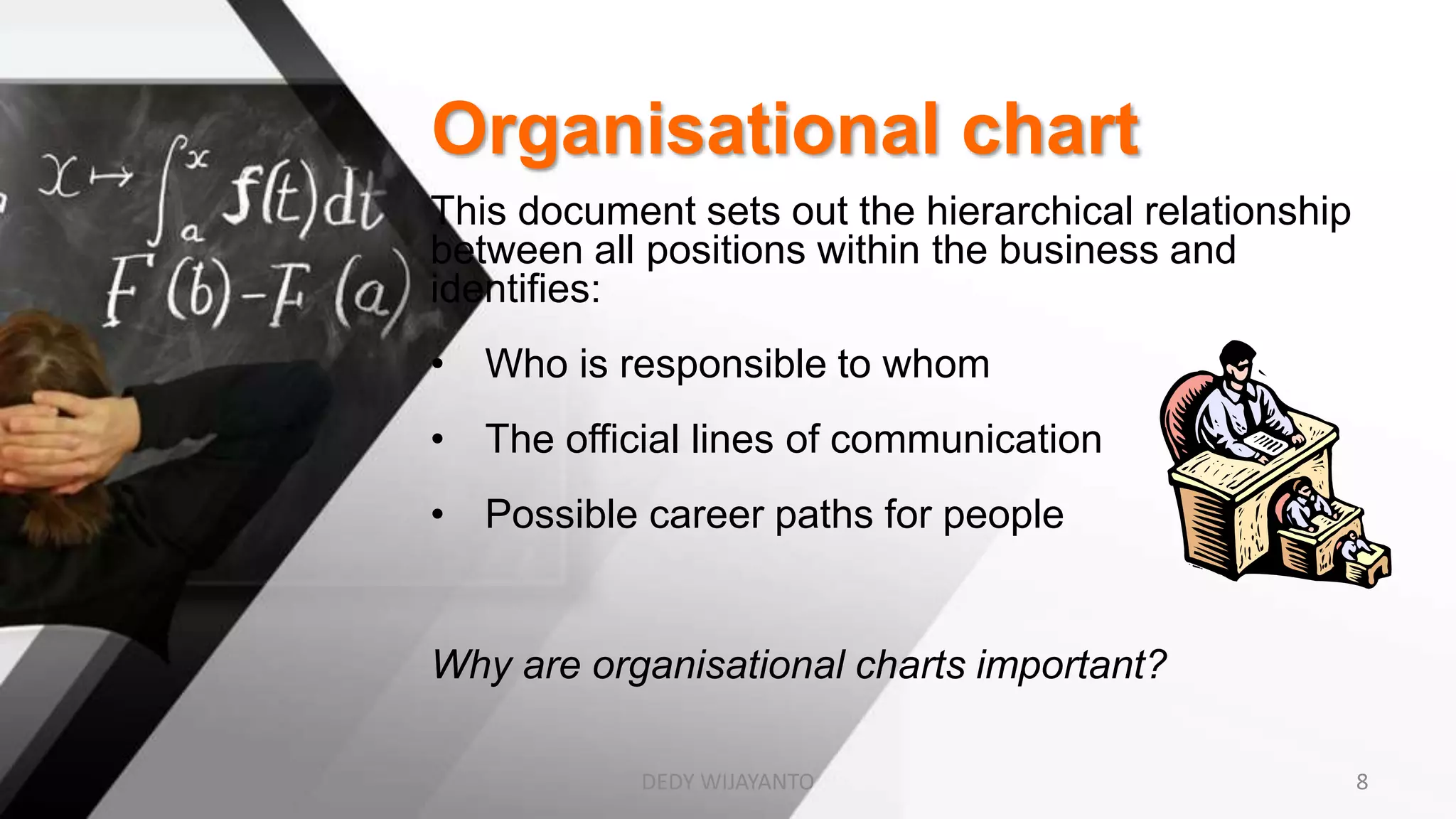
Organisational chart
This document sets out the hierarchical relationship
between all positions within the business and
identifies:
• Who is responsible to whom
• The official lines of communication
• Possible career paths for people
Why are organisational charts important?
DEDY WIJAYANTO 8
Authority and responsibility
Authority
The power to make decisions, take action or
have influence
Responsibility
The areas in which the supervisor has onus on
DEDY WIJAYANTO 9
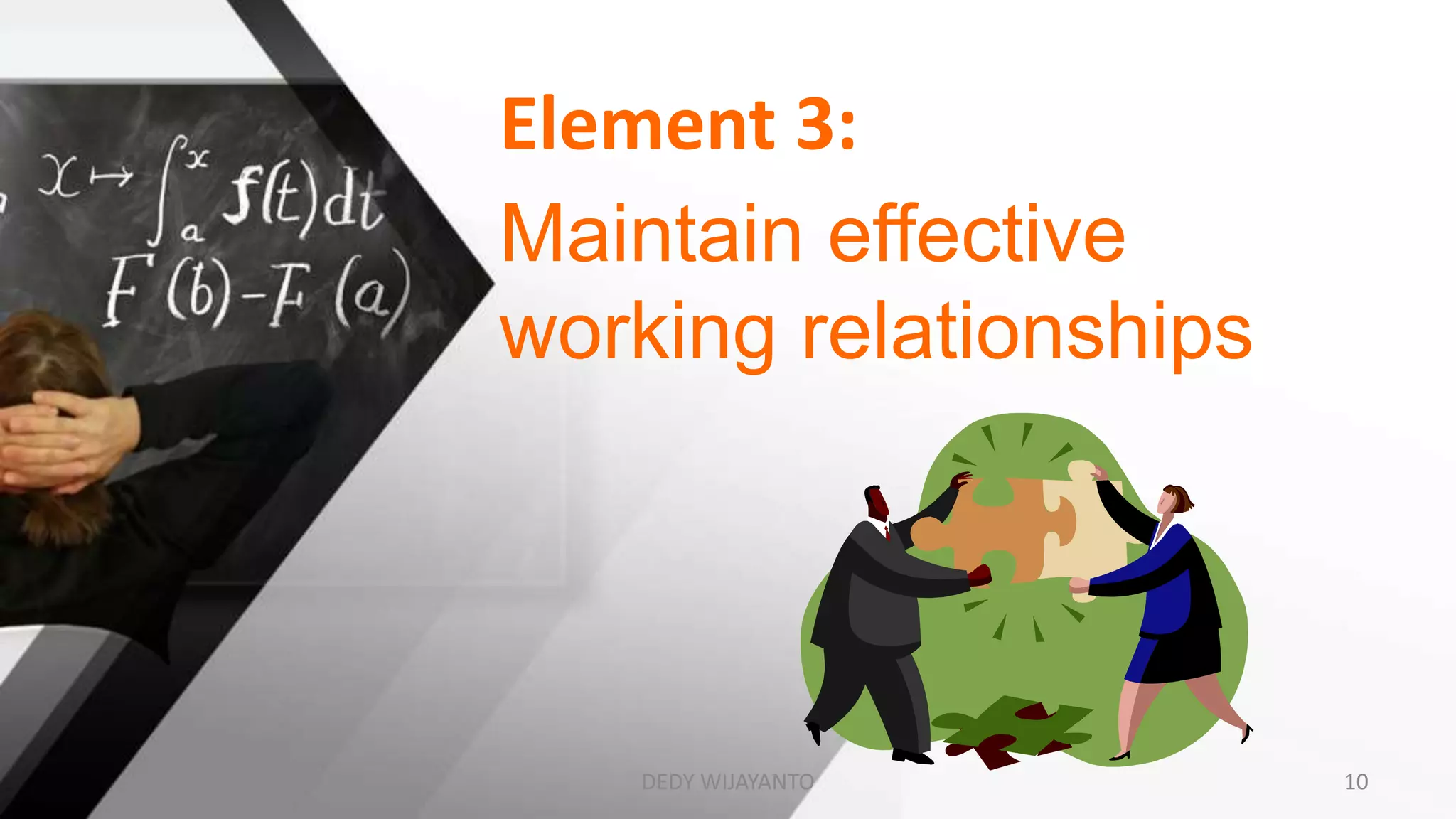
Element 3:
Maintain effective
working relationships
DEDY WIJAYANTO 10
DEDY WIJAYANTO 11
Maintain effective working relationships
Performance Criteria for this Element are:
• Recognise and address problems with team
members
• Seek assistance of team members when difficulties
arise to achieve allocated tasks
• Communicate requirements of work activities using
a participative approach
• Manage disagreements and conflicts constructively
using appropriate conflict management strategies
DEDY WIJAYANTO 12
Recognise and address problems
Types of problems
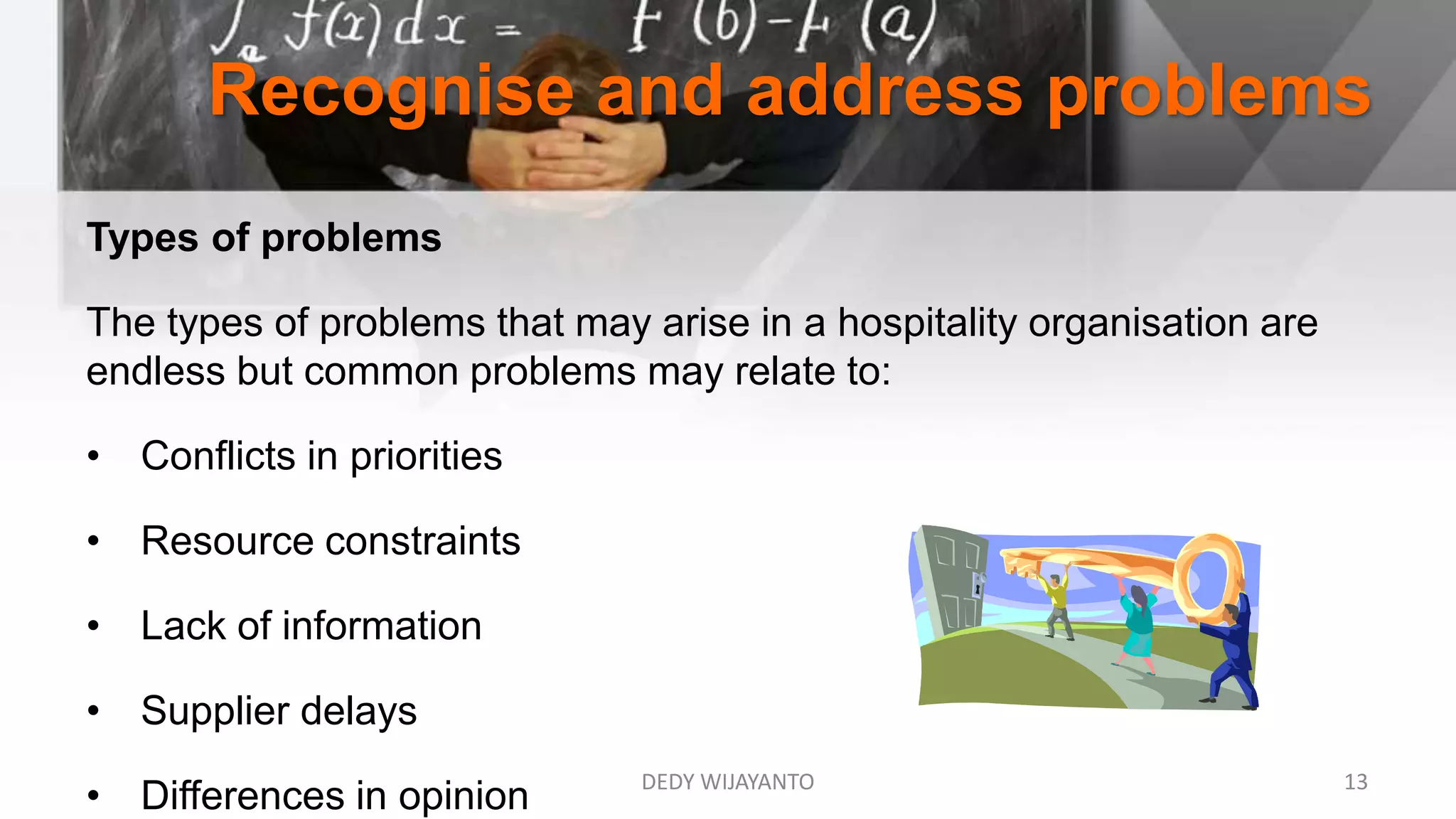
The types of problems that may arise in a hospitality organisation are
endless but common problems may relate to:
• Conflicts in priorities
• Resource constraints
• Lack of information
• Supplier delays
• Differences in opinion DEDY WIJAYANTO 13
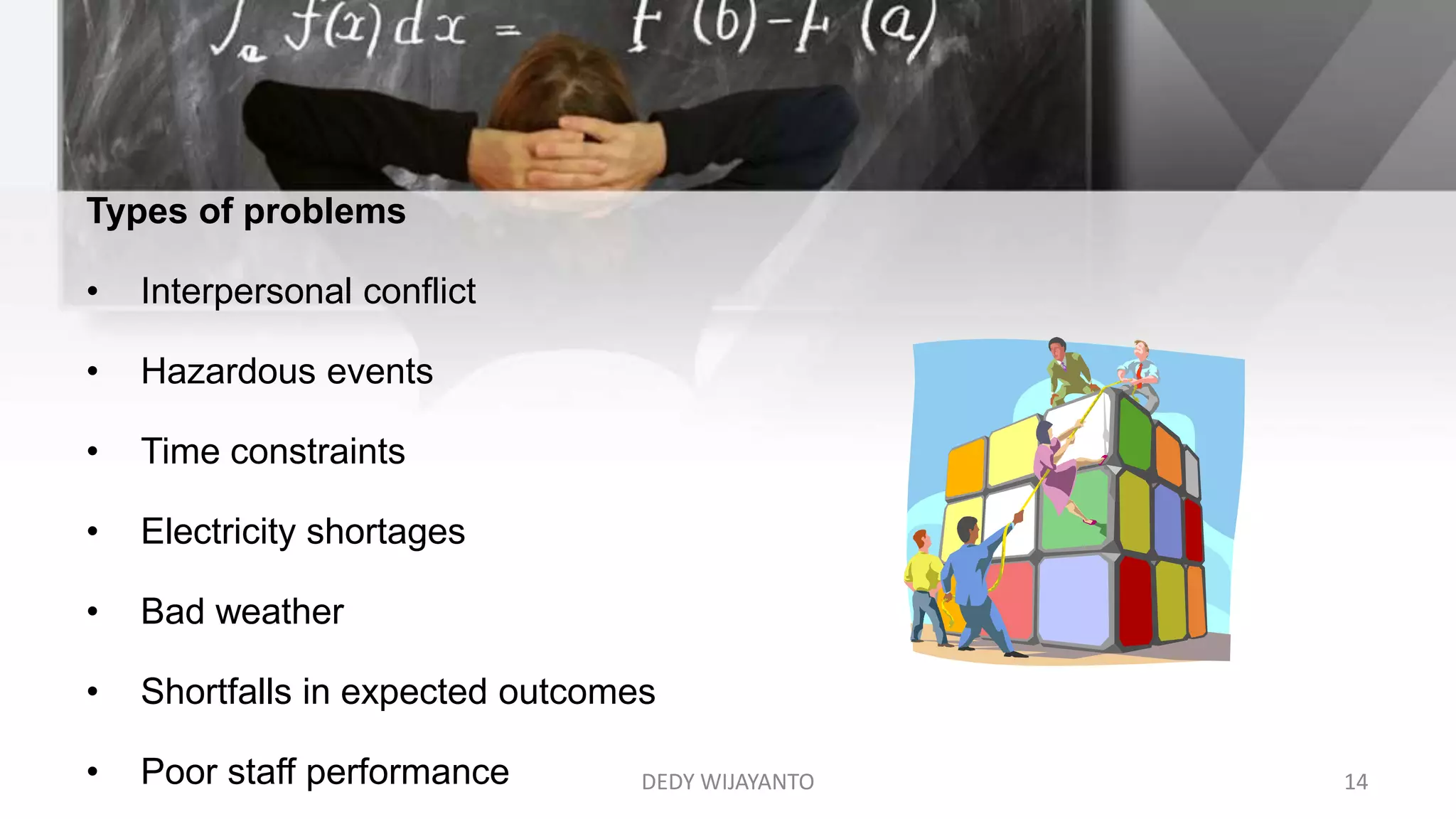
Types of problems
• Interpersonal conflict
• Hazardous events
• Time constraints
• Electricity shortages
• Bad weather
• Shortfalls in expected outcomes
• Poor staff performance DEDY WIJAYANTO 14
Sources of poor performance
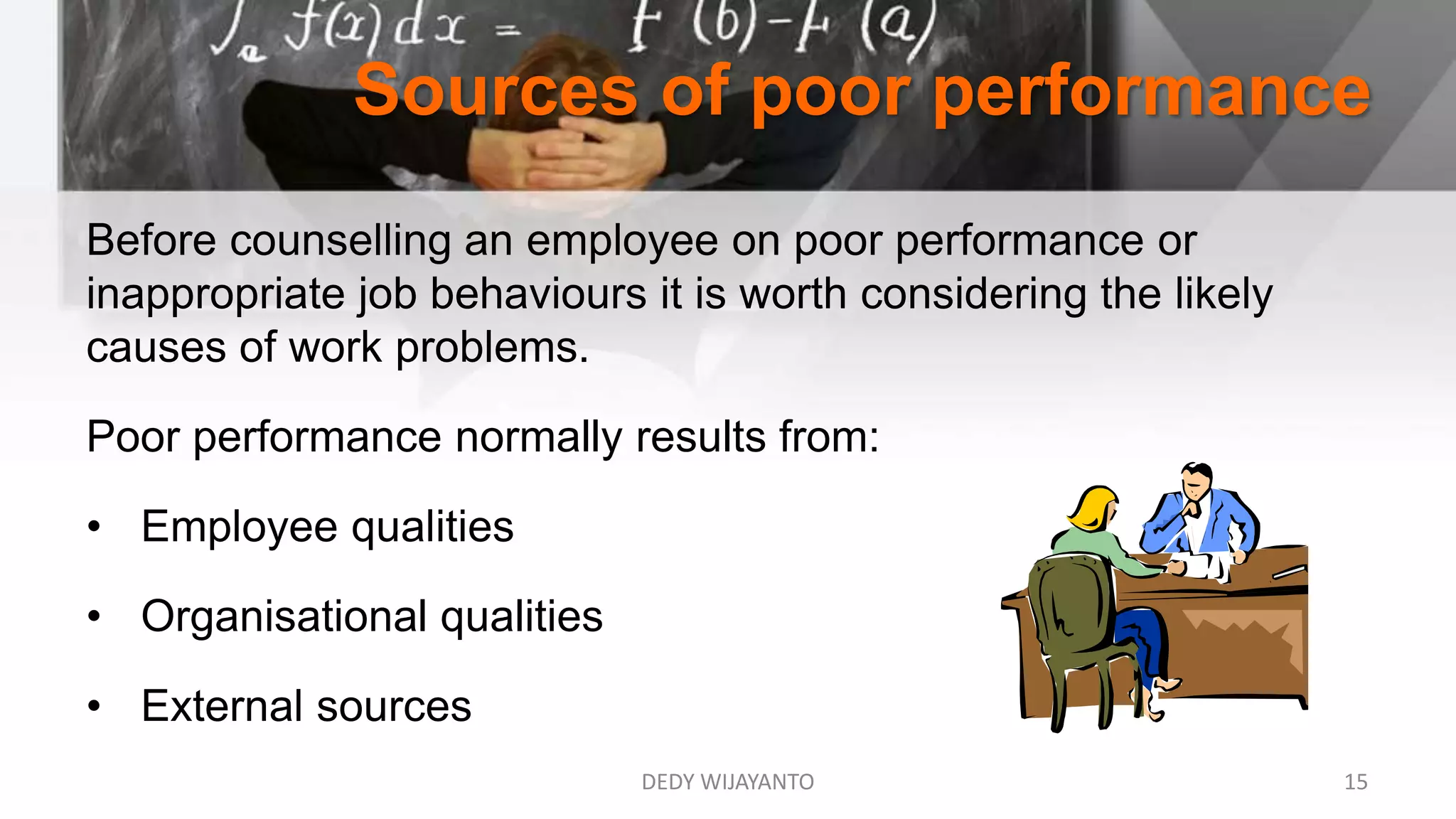
Before counselling an employee on poor performance or
inappropriate job behaviours it is worth considering the likely
causes of work problems.
Poor performance normally results from:
• Employee qualities
• Organisational qualities
• External sources
DEDY WIJAYANTO 15
Employee qualities
These sources stem from the employee themselves and can include:
• Problems of capacity, where the employee does
not have the required aptitude or orientation
for the tasks
• Family related problems
• Psychological problems, such as drug abuse gambling, irrational fears,
depression, aggressive behaviour stemming from self image problems
• Physical problems, such as lack of energy, restricted movement, pain orDEDY WIJAYANTO 16
Organisational sources
• Problems with higher decisions and policies
• Person placed in the wrong position
• Insufficient organisational action over a
grievance
• Organisational over-permissiveness
• Impact of supervisors
• Leadership style
DEDY WIJAYANTO 17
Organisational sources
• Bad communication or instruction
• Inappropriate managerial standards or criteria
• Discrimination
• Lack of managing diversity
• Harassment and bullying
• Problems with team cohesion and acceptance
DEDY WIJAYANTO 18
Organisational sources
• Problems from the work context
• Geographic location
• Bad physical work environment
• Unsafe conditions and work processes
• Problems with the way the job is performed
DEDY WIJAYANTO 19
External sources
These are problems an employee can have that stem from society and its values.
These include situations where:
• Society’s values clash with the job
• Clashes with moral or religious issues
• Working on certain days
• Assisting guests with certain unsavoury requests
• Changing economic conditions
DEDY WIJAYANTO 20
Considerations
Before counselling an employee for poor performance or
conducting the performance appraisal, management need to
consider:
• What are the symptoms and what are the likely causes
• If the causes are because of something that is internal to the
organisation
• Identify whether you are dealing with a work performance
problem or a work behaviour problem
DEDY WIJAYANTO 21
Steps in handling performance related
problems
Review facts surrounding performance concerns before
addressing staff performance
• Obtain original, first-hand evidence
• Gather supplementary information
• Take immediate action if required?
DEDY WIJAYANTO 22
Steps
• Arrange to discuss situation with employee in private
• Notifying employees about performance discussion sessions
• Obtain employee commitment to improvement
• Outline consequences of non-compliance
• Take disciplinary action if required
• record and document actions
DEDY WIJAYANTO 23
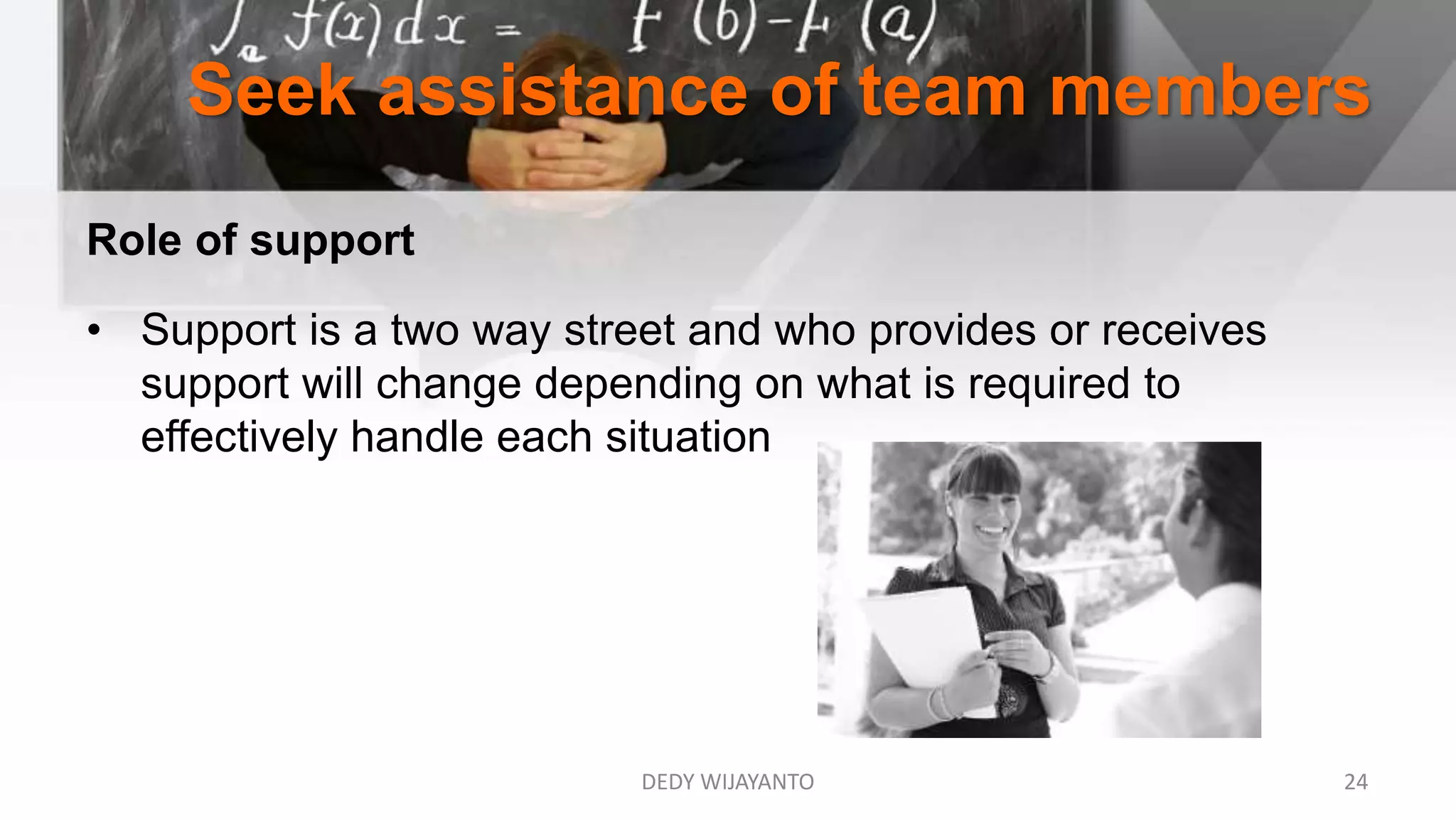
Seek assistance of team members
Role of support
• Support is a two way street and who provides or receives
support will change depending on what is required to
effectively handle each situation
DEDY WIJAYANTO 24
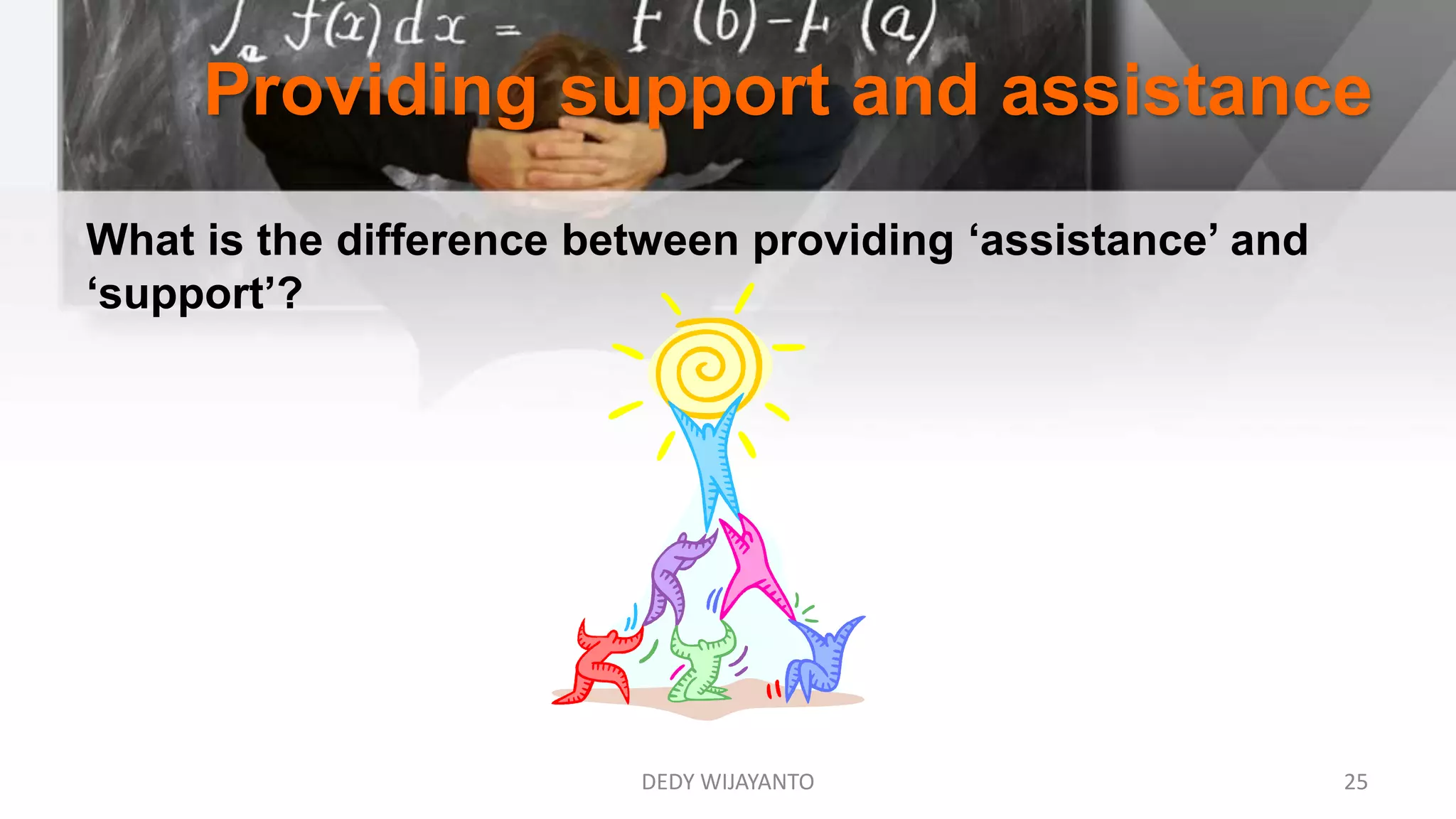
Providing support and assistance
What is the difference between providing ‘assistance’ and
‘support’?
DEDY WIJAYANTO 25
DEDY WIJAYANTO 26
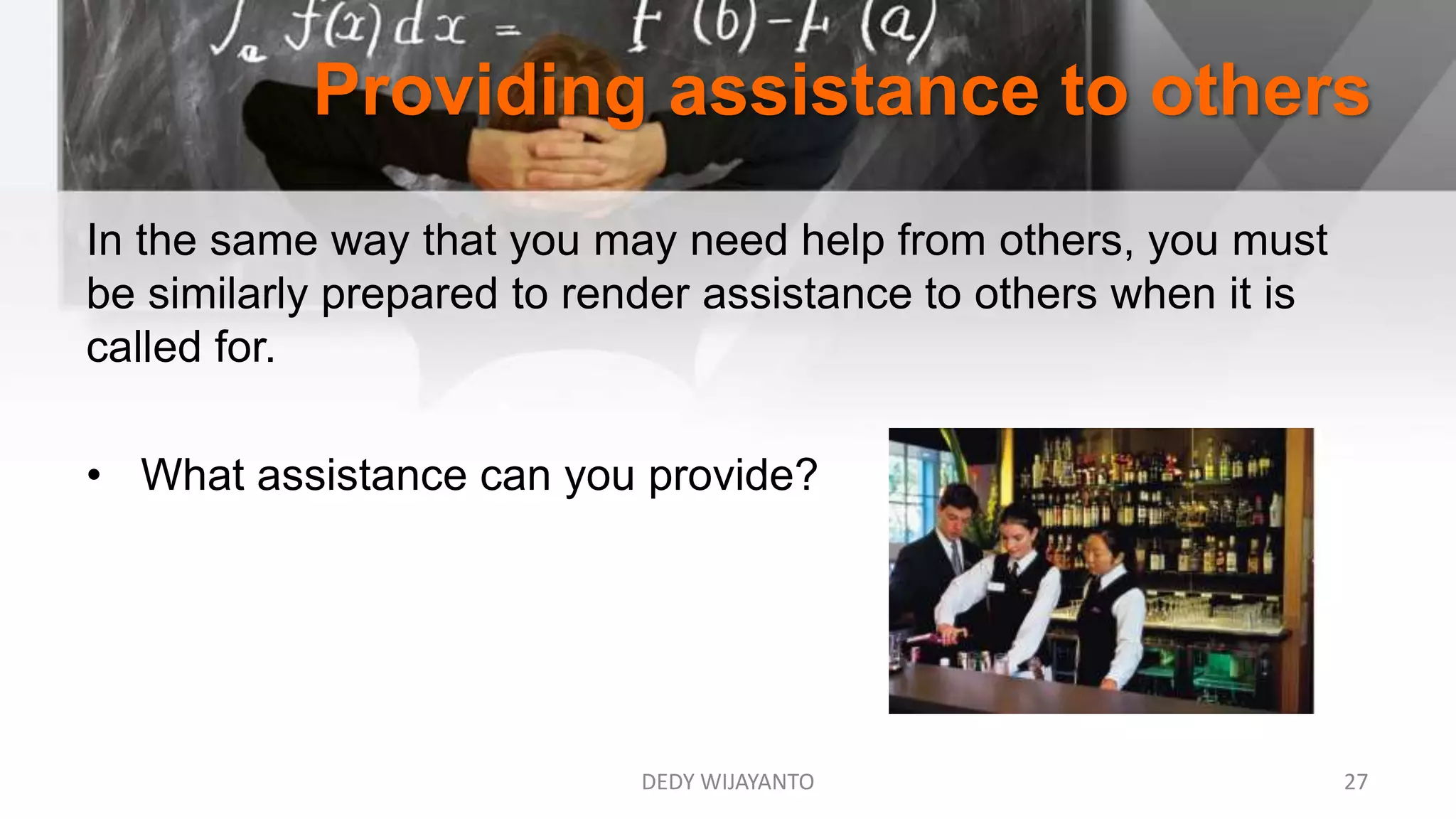
Providing assistance to others
In the same way that you may need help from others, you must
be similarly prepared to render assistance to others when it is
called for.
• What assistance can you provide?
DEDY WIJAYANTO 27
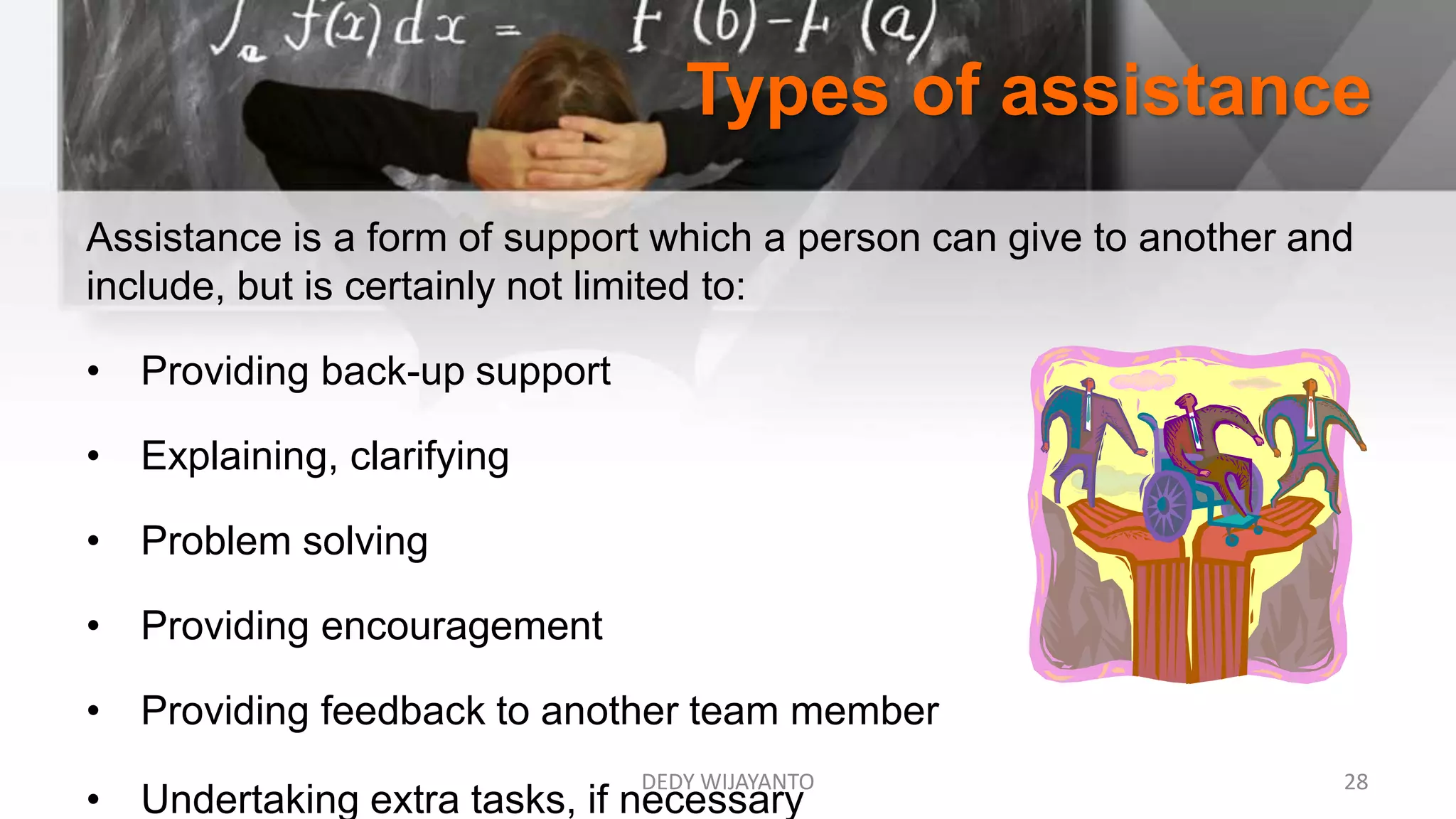
Types of assistance
DEDY WIJAYANTO 28
Assistance is a form of support which a person can give to another and
include, but is certainly not limited to:
• Providing back-up support
• Explaining, clarifying
• Problem solving
• Providing encouragement
• Providing feedback to another team member
• Undertaking extra tasks, if necessary
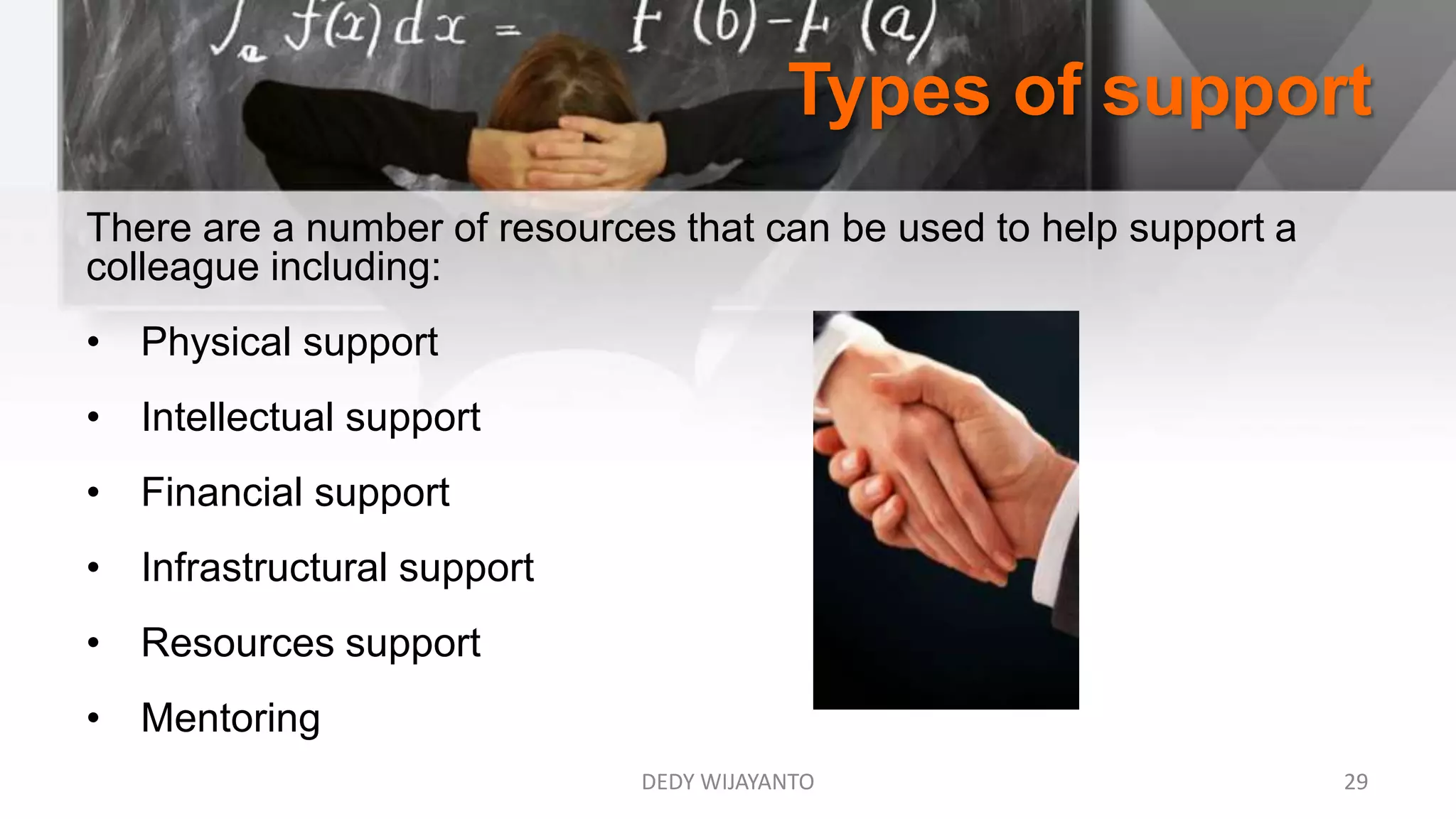
Types of support
DEDY WIJAYANTO 29
There are a number of resources that can be used to help support a
colleague including:
• Physical support
• Intellectual support
• Financial support
• Infrastructural support
• Resources support
• Mentoring
Identifying need for support
DEDY WIJAYANTO 30
Signs of identifying the need for support
• Observation
• Staff behaviour
• Direct request from a person
• Customer complaints
• Productivity reports
• New tasks or job role
People who provide support
DEDY WIJAYANTO 31
• There are a number of people who will provide support to
others
• Support is the provision of some area of assistance or
expertise one person may have which can help others
complete their tasks
DEDY WIJAYANTO 32
• Owners to managers
• Support departments to outlets
• Managers to supervisors
• Managers and supervisors to staff
• Staff to staff
• Staff to managers and supervisors
• Customers to managers, supervisors and staff
Timing and support
DEDY WIJAYANTO 33
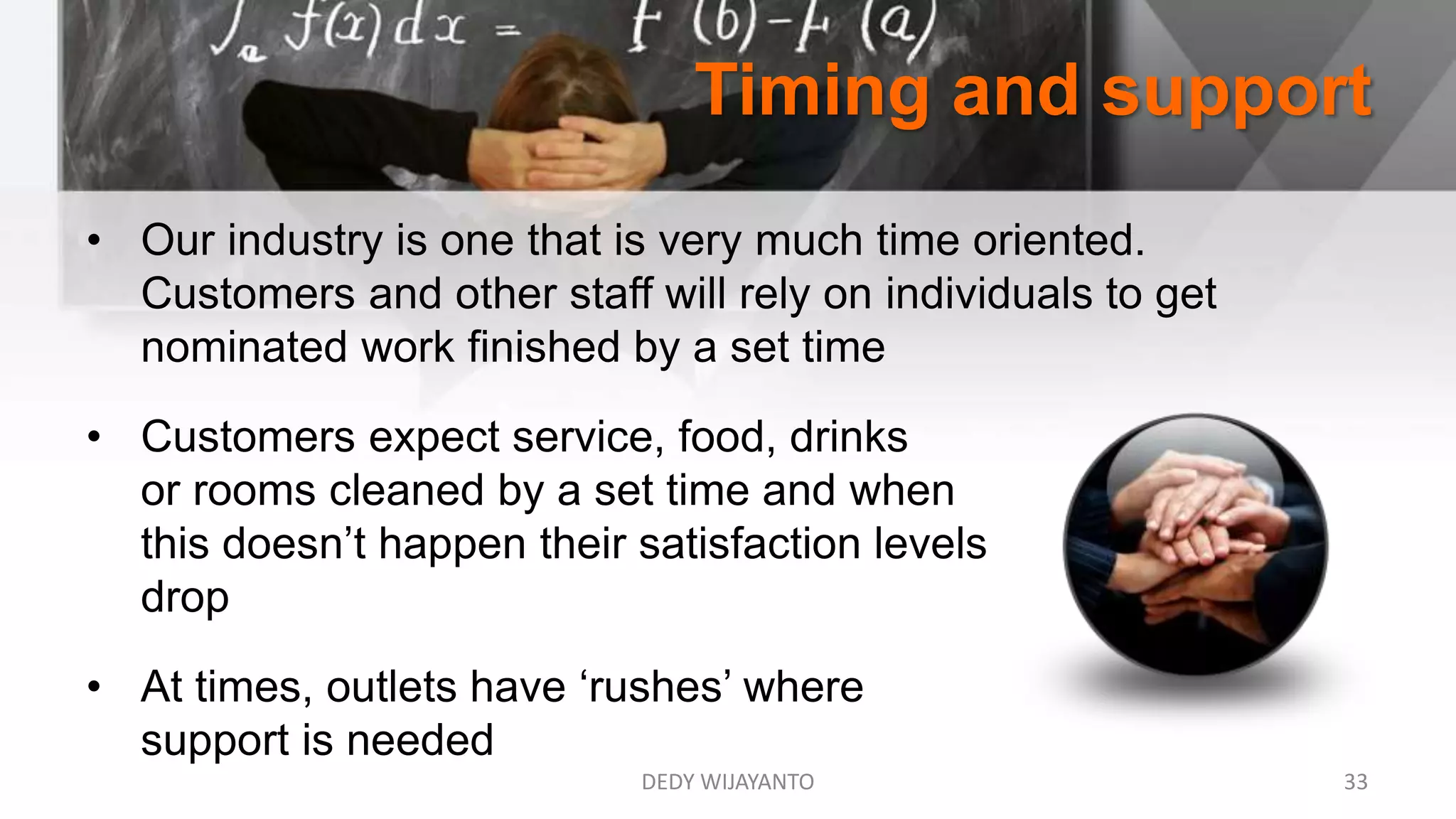
• Our industry is one that is very much time oriented.
Customers and other staff will rely on individuals to get
nominated work finished by a set time
• Customers expect service, food, drinks
or rooms cleaned by a set time and when
this doesn’t happen their satisfaction levels
drop
• At times, outlets have ‘rushes’ where
support is needed
Support from others
DEDY WIJAYANTO 34
Who can you ask for support?
The people you may ask to assist can vary, but will commonly
include:
• Others from your team
• People from other, but related, departments
• Managers and supervisors
Communicate requirements of work
activities
DEDY WIJAYANTO 35
Need for communication
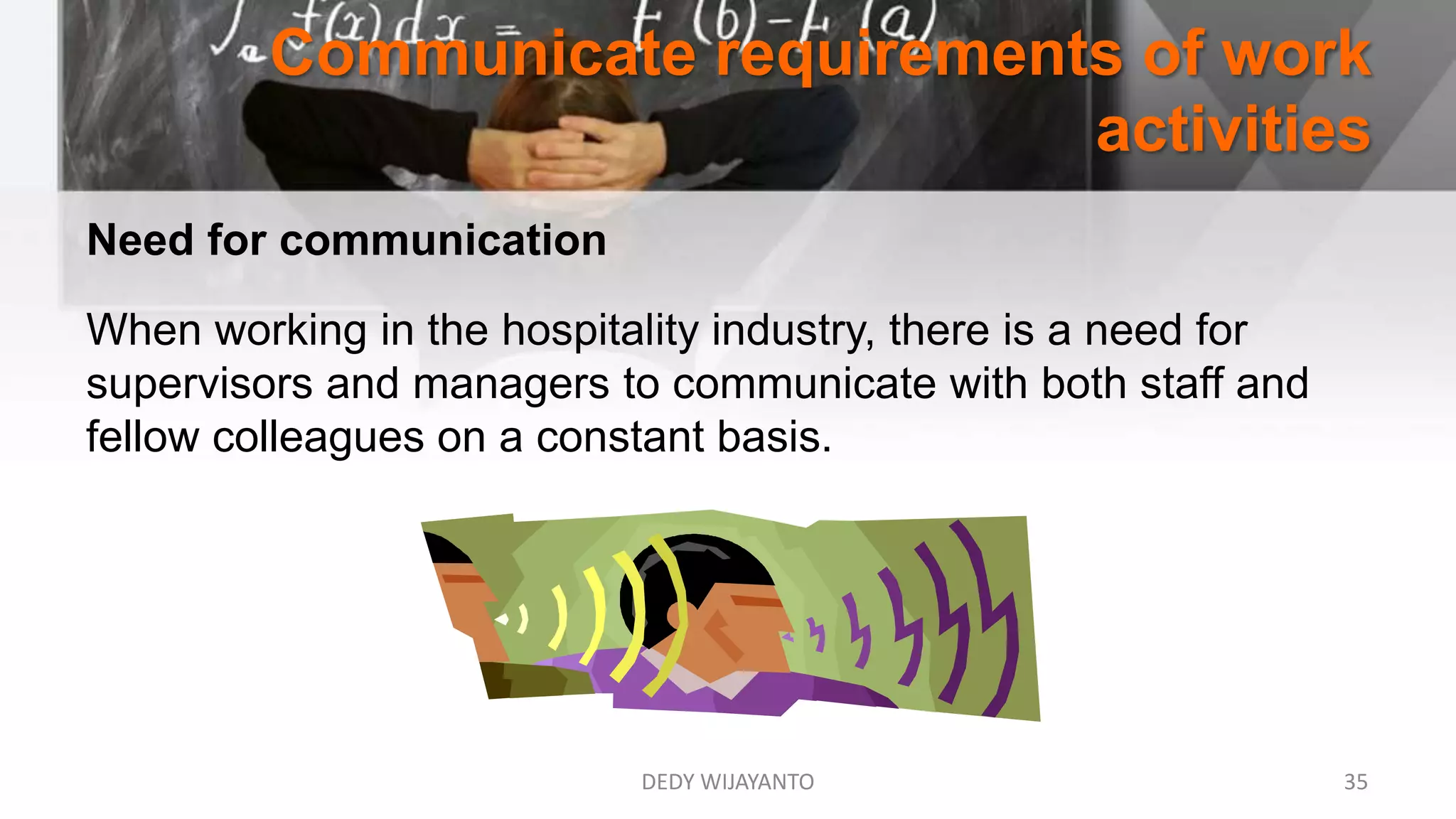
When working in the hospitality industry, there is a need for
supervisors and managers to communicate with both staff and
fellow colleagues on a constant basis.
Types of communication
DEDY WIJAYANTO 36
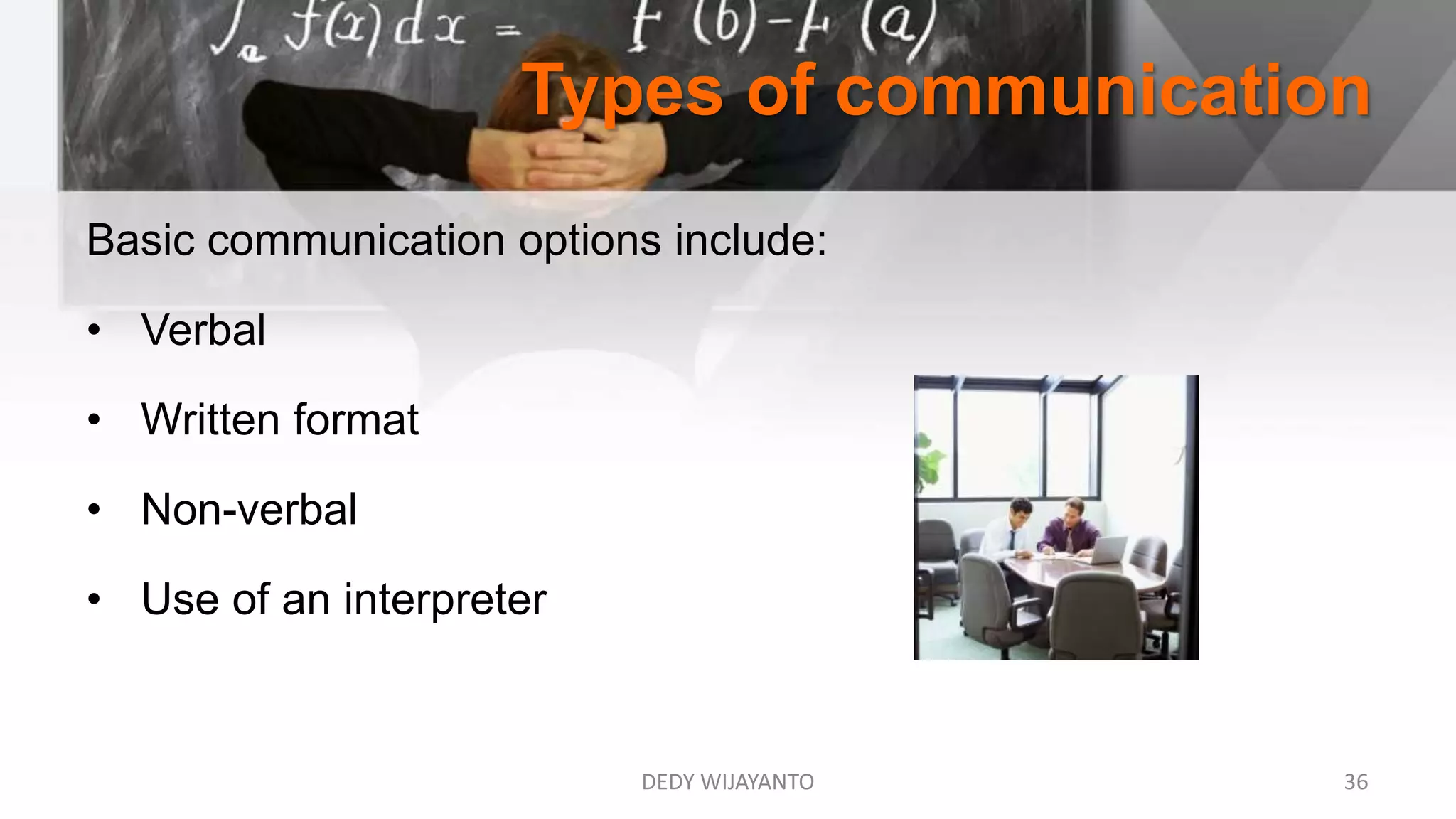
Basic communication options include:
• Verbal
• Written format
• Non-verbal
• Use of an interpreter
DEDY WIJAYANTO 37
Communicating with colleagues
DEDY WIJAYANTO 38
• Clarity of purpose, including vision, mission, goals
• Operational performance
• Upcoming events
• Products and services information
• Promotional activities
• Specific customers
Effective communication
DEDY WIJAYANTO 39
To help ensure your communication is polite, professional and
friendly, the following tips will assist:
• Follow all establishment policies
• Use a person’s name where it is known
• Be honest
• Use ‘please’ and ‘thank you’ a lot
Effective communication
DEDY WIJAYANTO 40
• Don’t interrupt
• Speak at an appropriate pace and volume
• Make sure your non-verbal language matches the verbal
communication
Building trust
DEDY WIJAYANTO 41
Ways to create and build trust
• Establish and maintain integrity
• Communicate vision, values, mission and goals
• Consider all employees as equal partners in the organisation
• Focus on team, rather than individual and personal goals
• Do what's right, regardless of personal risk
DEDY WIJAYANTO 42
Ways to lose trust
• Act and speak inconsistently
• Seek personal rather than shared gain
• Withhold information
• Lie or tell half-truths
• Be closed-minded
Conflict and misunderstanding
DEDY WIJAYANTO 43
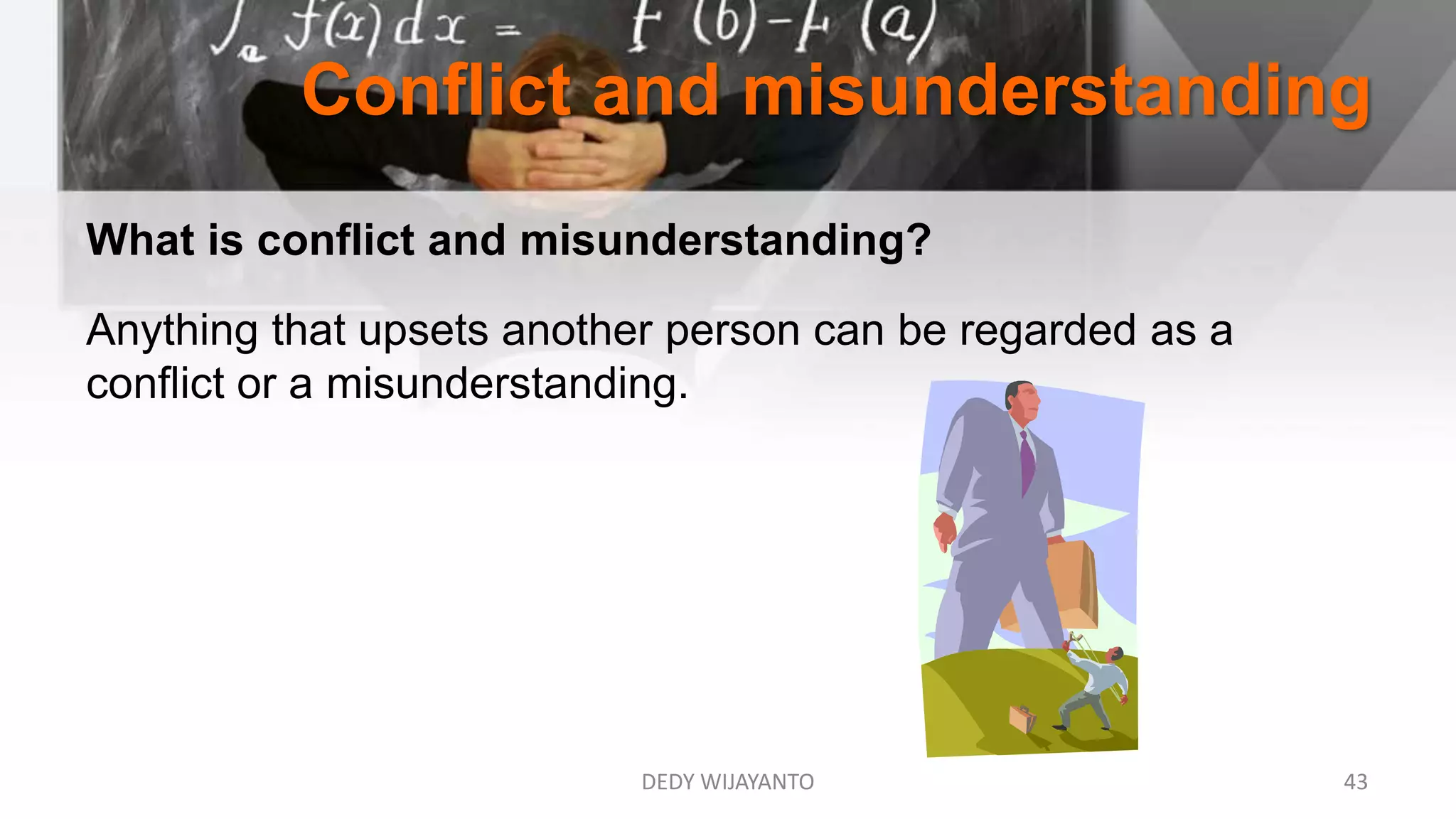
What is conflict and misunderstanding?
Anything that upsets another person can be regarded as a
conflict or a misunderstanding.
Conflict and misunderstanding
DEDY WIJAYANTO 44
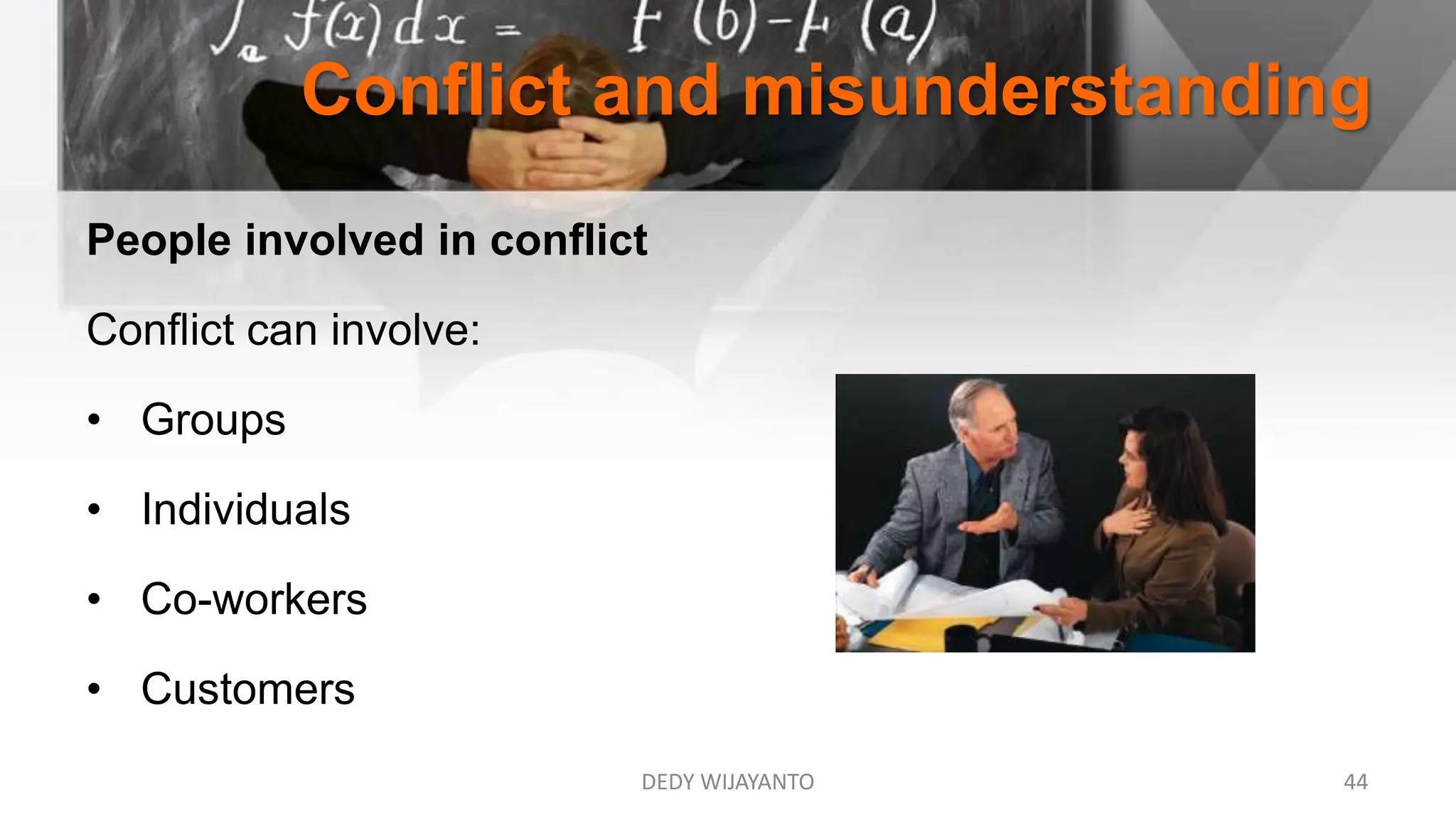
People involved in conflict
Conflict can involve:
• Groups
• Individuals
• Co-workers
• Customers
Addressing conflict and
misunderstanding
DEDY WIJAYANTO 45
Addressing workplace conflict and misunderstanding properly
and as early as possible seeks to:
• Keep all conflict and misunderstanding at the ‘mild’ end of the
spectrum
• Clarify any perceptions that arose due to misunderstanding
• Rectify the situation to the greatest extent possible
Conflict with colleagues
DEDY WIJAYANTO 46
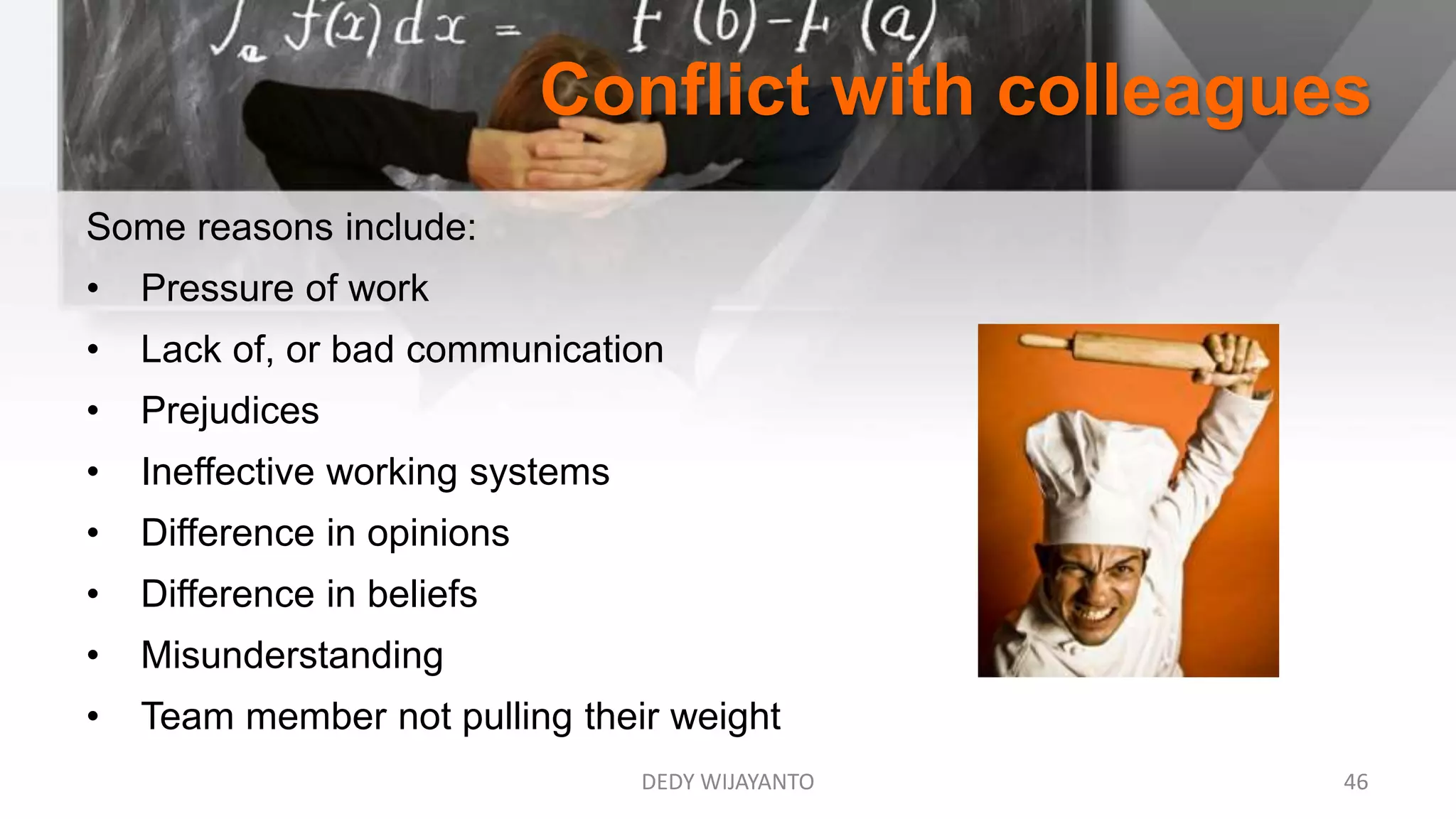
Some reasons include:
• Pressure of work
• Lack of, or bad communication
• Prejudices
• Ineffective working systems
• Difference in opinions
• Difference in beliefs
• Misunderstanding
• Team member not pulling their weight
Conflict warning signs
DEDY WIJAYANTO 47
Various ‘warning signs’ which may be displayed that can indicate
that a problem exists or is imminent.
• What are common warning signs?
• What warning signs do you personally have if you have
conflict with someone else?
Colleague warning signs
DEDY WIJAYANTO 48
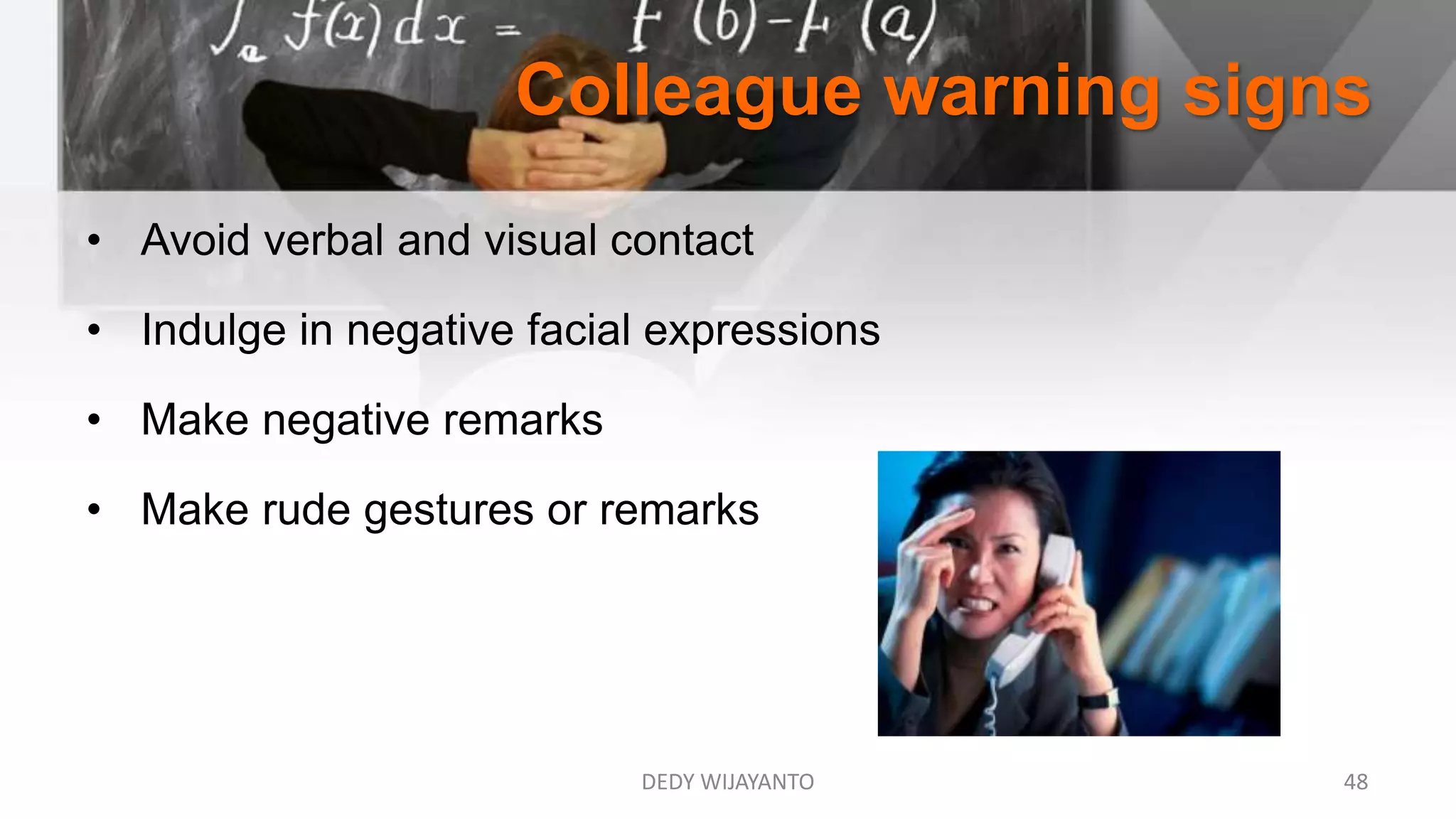
• Avoid verbal and visual contact
• Indulge in negative facial expressions
• Make negative remarks
• Make rude gestures or remarks
Addressing difficulties
DEDY WIJAYANTO 49
Tips when addressing conflict and misunderstandings
• Quick identification of a misunderstanding can prevent a conflict
from occurring
• All possible cultural differences should be taken into consideration
• Resolve the misunderstanding as quickly as possible
• Follow organisational procedures
• Putting yourself in the other person’s shoes
• Frustration or impatience should be avoided
• Focus on respect and sensitivity
Resolving misunderstandings
DEDY WIJAYANTO 50
Actions that can help resolve the situation
This may involve you in:
• Discussing the issue in a courteous manner
• Speaking directly with the person concerned in a respectful way
• Apologising for offence or misunderstanding that may have been
caused
• Taking time to talk with the person concerned
• Asking for advice from the other party
DEDY WIJAYANTO 51
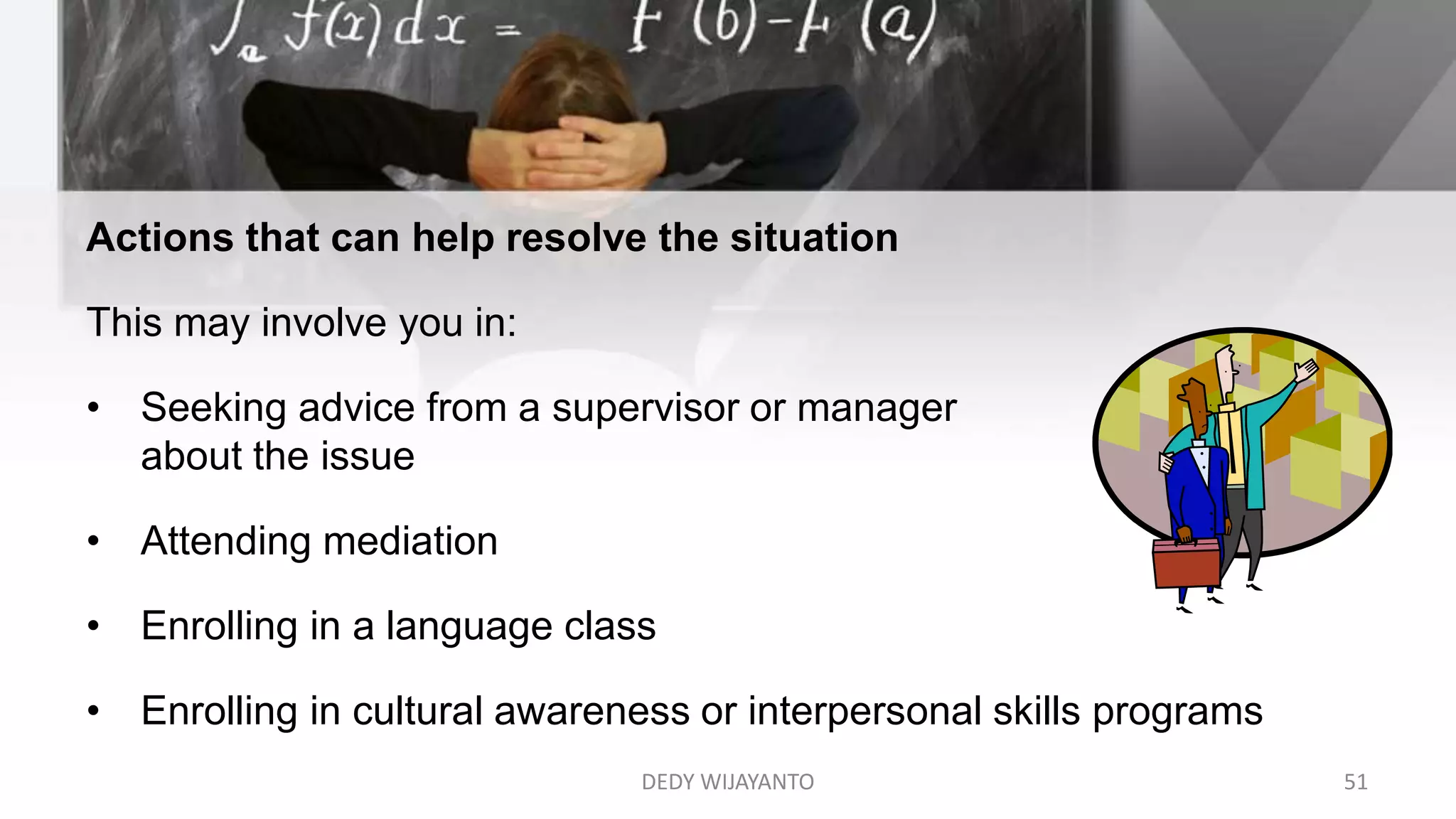
Actions that can help resolve the situation
This may involve you in:
• Seeking advice from a supervisor or manager
about the issue
• Attending mediation
• Enrolling in a language class
• Enrolling in cultural awareness or interpersonal skills programs
Refer issues and problems
DEDY WIJAYANTO 52
There may be a need in your workplace to refer:
• Any issues relating to cross-cultural issues
• Unresolved issues
• Who do you refer issues to?
• When should they be referred?
Refer issues and problems
DEDY WIJAYANTO 53
Who should problems be referred to?
Depending on the establishment, and its organisational structure, the appropriate
person could be:
• Colleagues
• Your team leader
• Your supervisor
• The manager
• Human Resources personnel
• The owner
DEDY WIJAYANTO 54
See you again
DEDY WIJAYANTO 55

Part 2 operational approaches

  • 1.
    DEVELOP AND SUPERVISE OPERATIONALAPPROACHES DEDY WIJAYANTO D1.HML.CL10.0 1 D1.HRM.C L9.08 DEDY WIJAYANTO 1
  • 2.
    Identify training andlearning opportunities Identifying training needs • Staff induction • Request from a staff member • A request from management • Personal observation • Customer complaint • Changes in workplace equipment • Changes in procedures • Changes in legal requirements DEDY WIJAYANTO 2
  • 3.
    Training Needs Analysis TNAis a way of identifying the difference that exists between: • The work which staff are performing • The standard of performance required by the business • This difference is known as ‘the training gap’ DEDY WIJAYANTO 3
  • 4.
  • 5.
    Further sources ofinformation to identify training needs • Industry/enterprise or other competency standards • Endorsed components of relevant industry training packages • Industry/workplace training practices • Job descriptions • Business plans for the organisation • Standard operating or other workplace procedures • Consulting with others DEDY WIJAYANTO 5
  • 6.
    Basic steps indeveloping training and learning opportunities • Step 1: Know where you’re starting from and what’s required • Step 2: Do an audit of staff • Step 3: Identify the training gap • Step 4: Determine the course of action • Step 5: Consult DEDY WIJAYANTO 6

  • 7.
    Authority and responsibility Toassist communication, enhance internal relationships and optimise service delivery it is essential that there are clear lines of authority and responsibility within the business. • Where does this information come from? DEDY WIJAYANTO 7
  • 8.
    Organisational chart This documentsets out the hierarchical relationship between all positions within the business and identifies: • Who is responsible to whom • The official lines of communication • Possible career paths for people Why are organisational charts important? DEDY WIJAYANTO 8
  • 9.
    Authority and responsibility Authority Thepower to make decisions, take action or have influence Responsibility The areas in which the supervisor has onus on DEDY WIJAYANTO 9
  • 10.
    Element 3: Maintain effective workingrelationships DEDY WIJAYANTO 10
  • 11.
  • 12.
    Maintain effective workingrelationships Performance Criteria for this Element are: • Recognise and address problems with team members • Seek assistance of team members when difficulties arise to achieve allocated tasks • Communicate requirements of work activities using a participative approach • Manage disagreements and conflicts constructively using appropriate conflict management strategies DEDY WIJAYANTO 12
  • 13.
    Recognise and addressproblems Types of problems The types of problems that may arise in a hospitality organisation are endless but common problems may relate to: • Conflicts in priorities • Resource constraints • Lack of information • Supplier delays • Differences in opinion DEDY WIJAYANTO 13
  • 14.
    Types of problems •Interpersonal conflict • Hazardous events • Time constraints • Electricity shortages • Bad weather • Shortfalls in expected outcomes • Poor staff performance DEDY WIJAYANTO 14
  • 15.
    Sources of poorperformance Before counselling an employee on poor performance or inappropriate job behaviours it is worth considering the likely causes of work problems. Poor performance normally results from: • Employee qualities • Organisational qualities • External sources DEDY WIJAYANTO 15
  • 16.
    Employee qualities These sourcesstem from the employee themselves and can include: • Problems of capacity, where the employee does not have the required aptitude or orientation for the tasks • Family related problems • Psychological problems, such as drug abuse gambling, irrational fears, depression, aggressive behaviour stemming from self image problems • Physical problems, such as lack of energy, restricted movement, pain orDEDY WIJAYANTO 16
  • 17.
    Organisational sources • Problemswith higher decisions and policies • Person placed in the wrong position • Insufficient organisational action over a grievance • Organisational over-permissiveness • Impact of supervisors • Leadership style DEDY WIJAYANTO 17
  • 18.
    Organisational sources • Badcommunication or instruction • Inappropriate managerial standards or criteria • Discrimination • Lack of managing diversity • Harassment and bullying • Problems with team cohesion and acceptance DEDY WIJAYANTO 18
  • 19.
    Organisational sources • Problemsfrom the work context • Geographic location • Bad physical work environment • Unsafe conditions and work processes • Problems with the way the job is performed DEDY WIJAYANTO 19
  • 20.
    External sources These areproblems an employee can have that stem from society and its values. These include situations where: • Society’s values clash with the job • Clashes with moral or religious issues • Working on certain days • Assisting guests with certain unsavoury requests • Changing economic conditions DEDY WIJAYANTO 20
  • 21.
    Considerations Before counselling anemployee for poor performance or conducting the performance appraisal, management need to consider: • What are the symptoms and what are the likely causes • If the causes are because of something that is internal to the organisation • Identify whether you are dealing with a work performance problem or a work behaviour problem DEDY WIJAYANTO 21
  • 22.
    Steps in handlingperformance related problems Review facts surrounding performance concerns before addressing staff performance • Obtain original, first-hand evidence • Gather supplementary information • Take immediate action if required? DEDY WIJAYANTO 22
  • 23.
    Steps • Arrange todiscuss situation with employee in private • Notifying employees about performance discussion sessions • Obtain employee commitment to improvement • Outline consequences of non-compliance • Take disciplinary action if required • record and document actions DEDY WIJAYANTO 23
  • 24.
    Seek assistance ofteam members Role of support • Support is a two way street and who provides or receives support will change depending on what is required to effectively handle each situation DEDY WIJAYANTO 24
  • 25.
    Providing support andassistance What is the difference between providing ‘assistance’ and ‘support’? DEDY WIJAYANTO 25
  • 26.
  • 27.
    Providing assistance toothers In the same way that you may need help from others, you must be similarly prepared to render assistance to others when it is called for. • What assistance can you provide? DEDY WIJAYANTO 27
  • 28.
    Types of assistance DEDYWIJAYANTO 28 Assistance is a form of support which a person can give to another and include, but is certainly not limited to: • Providing back-up support • Explaining, clarifying • Problem solving • Providing encouragement • Providing feedback to another team member • Undertaking extra tasks, if necessary
  • 29.
    Types of support DEDYWIJAYANTO 29 There are a number of resources that can be used to help support a colleague including: • Physical support • Intellectual support • Financial support • Infrastructural support • Resources support • Mentoring
  • 30.
    Identifying need forsupport DEDY WIJAYANTO 30 Signs of identifying the need for support • Observation • Staff behaviour • Direct request from a person • Customer complaints • Productivity reports • New tasks or job role
  • 31.
    People who providesupport DEDY WIJAYANTO 31 • There are a number of people who will provide support to others • Support is the provision of some area of assistance or expertise one person may have which can help others complete their tasks
  • 32.
    DEDY WIJAYANTO 32 •Owners to managers • Support departments to outlets • Managers to supervisors • Managers and supervisors to staff • Staff to staff • Staff to managers and supervisors • Customers to managers, supervisors and staff
  • 33.
    Timing and support DEDYWIJAYANTO 33 • Our industry is one that is very much time oriented. Customers and other staff will rely on individuals to get nominated work finished by a set time • Customers expect service, food, drinks or rooms cleaned by a set time and when this doesn’t happen their satisfaction levels drop • At times, outlets have ‘rushes’ where support is needed
  • 34.
    Support from others DEDYWIJAYANTO 34 Who can you ask for support? The people you may ask to assist can vary, but will commonly include: • Others from your team • People from other, but related, departments • Managers and supervisors
  • 35.
    Communicate requirements ofwork activities DEDY WIJAYANTO 35 Need for communication When working in the hospitality industry, there is a need for supervisors and managers to communicate with both staff and fellow colleagues on a constant basis.
  • 36.
    Types of communication DEDYWIJAYANTO 36 Basic communication options include: • Verbal • Written format • Non-verbal • Use of an interpreter
  • 37.
  • 38.
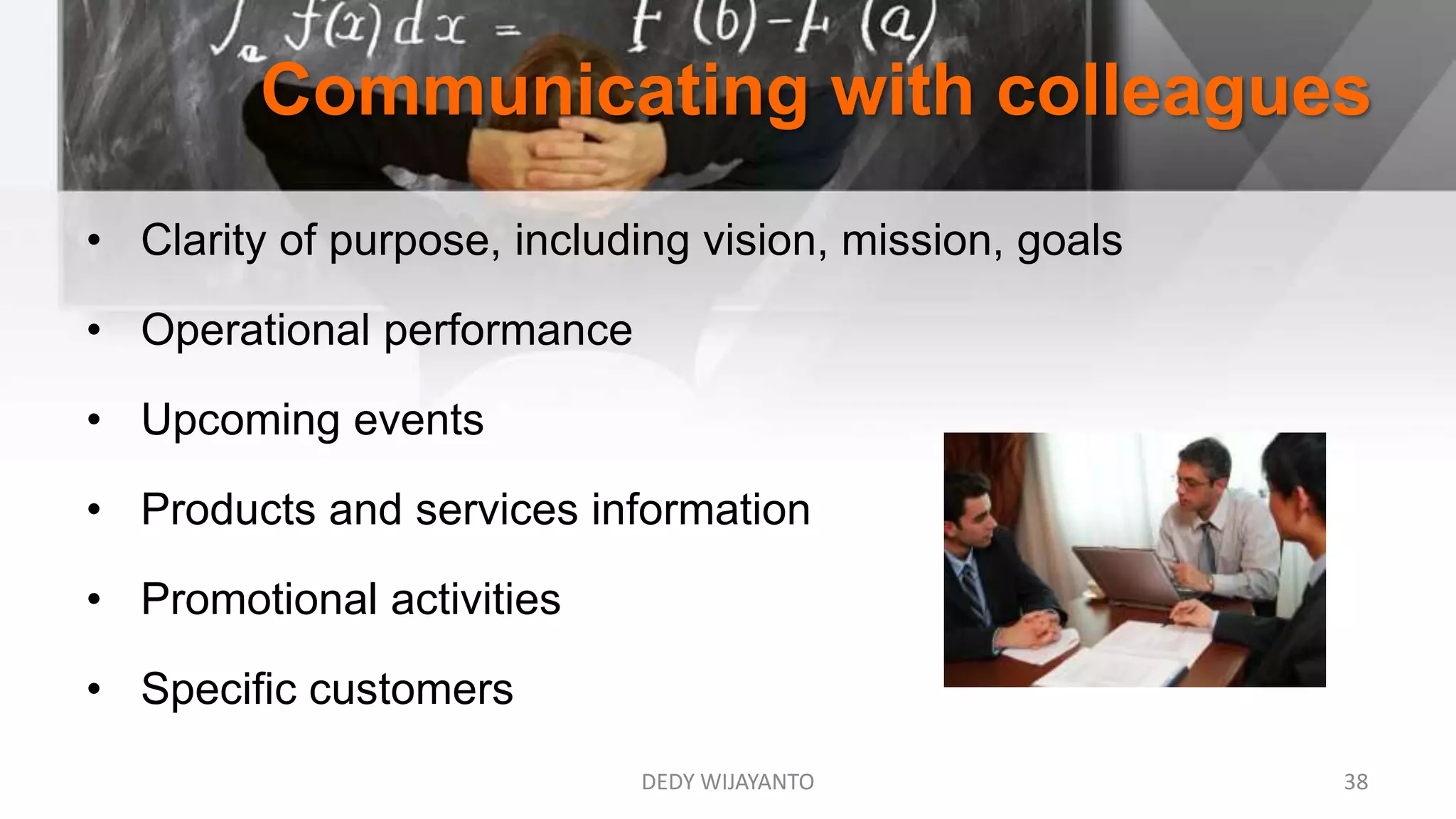
    Communicating with colleagues DEDYWIJAYANTO 38 • Clarity of purpose, including vision, mission, goals • Operational performance • Upcoming events • Products and services information • Promotional activities • Specific customers
  • 39.
    Effective communication DEDY WIJAYANTO39 To help ensure your communication is polite, professional and friendly, the following tips will assist: • Follow all establishment policies • Use a person’s name where it is known • Be honest • Use ‘please’ and ‘thank you’ a lot
  • 40.
    Effective communication DEDY WIJAYANTO40 • Don’t interrupt • Speak at an appropriate pace and volume • Make sure your non-verbal language matches the verbal communication
  • 41.
    Building trust DEDY WIJAYANTO41 Ways to create and build trust • Establish and maintain integrity • Communicate vision, values, mission and goals • Consider all employees as equal partners in the organisation • Focus on team, rather than individual and personal goals • Do what's right, regardless of personal risk
  • 42.
    DEDY WIJAYANTO 42 Waysto lose trust • Act and speak inconsistently • Seek personal rather than shared gain • Withhold information • Lie or tell half-truths • Be closed-minded
  • 43.
    Conflict and misunderstanding DEDYWIJAYANTO 43 What is conflict and misunderstanding? Anything that upsets another person can be regarded as a conflict or a misunderstanding.
  • 44.
    Conflict and misunderstanding DEDYWIJAYANTO 44 People involved in conflict Conflict can involve: • Groups • Individuals • Co-workers • Customers
  • 45.
    Addressing conflict and misunderstanding DEDYWIJAYANTO 45 Addressing workplace conflict and misunderstanding properly and as early as possible seeks to: • Keep all conflict and misunderstanding at the ‘mild’ end of the spectrum • Clarify any perceptions that arose due to misunderstanding • Rectify the situation to the greatest extent possible
  • 46.
    Conflict with colleagues DEDYWIJAYANTO 46 Some reasons include: • Pressure of work • Lack of, or bad communication • Prejudices • Ineffective working systems • Difference in opinions • Difference in beliefs • Misunderstanding • Team member not pulling their weight
  • 47.
    Conflict warning signs DEDYWIJAYANTO 47 Various ‘warning signs’ which may be displayed that can indicate that a problem exists or is imminent. • What are common warning signs? • What warning signs do you personally have if you have conflict with someone else?
  • 48.
    Colleague warning signs DEDYWIJAYANTO 48 • Avoid verbal and visual contact • Indulge in negative facial expressions • Make negative remarks • Make rude gestures or remarks
  • 49.
    Addressing difficulties DEDY WIJAYANTO49 Tips when addressing conflict and misunderstandings • Quick identification of a misunderstanding can prevent a conflict from occurring • All possible cultural differences should be taken into consideration • Resolve the misunderstanding as quickly as possible • Follow organisational procedures • Putting yourself in the other person’s shoes • Frustration or impatience should be avoided • Focus on respect and sensitivity
  • 50.
    Resolving misunderstandings DEDY WIJAYANTO50 Actions that can help resolve the situation This may involve you in: • Discussing the issue in a courteous manner • Speaking directly with the person concerned in a respectful way • Apologising for offence or misunderstanding that may have been caused • Taking time to talk with the person concerned • Asking for advice from the other party
  • 51.
    DEDY WIJAYANTO 51 Actionsthat can help resolve the situation This may involve you in: • Seeking advice from a supervisor or manager about the issue • Attending mediation • Enrolling in a language class • Enrolling in cultural awareness or interpersonal skills programs
  • 52.
    Refer issues andproblems DEDY WIJAYANTO 52 There may be a need in your workplace to refer: • Any issues relating to cross-cultural issues • Unresolved issues • Who do you refer issues to? • When should they be referred?
  • 53.
    Refer issues andproblems DEDY WIJAYANTO 53 Who should problems be referred to? Depending on the establishment, and its organisational structure, the appropriate person could be: • Colleagues • Your team leader • Your supervisor • The manager • Human Resources personnel • The owner
  • 54.
  • 55.
    See you again DEDYWIJAYANTO 55