DEVELOP AND SUPERVISE
OPERATIONAL APPROACHES
DEDY WIJAYANTO
DEDY WIJAYANTTTO 1
D1.HML.CL10.0
1
D1.HRM.C
L9.08
DEDY WIJAYANTTTO 2
Element 4:
Provide feedback
Provide feedback
DEDY WIJAYANTTTO 3
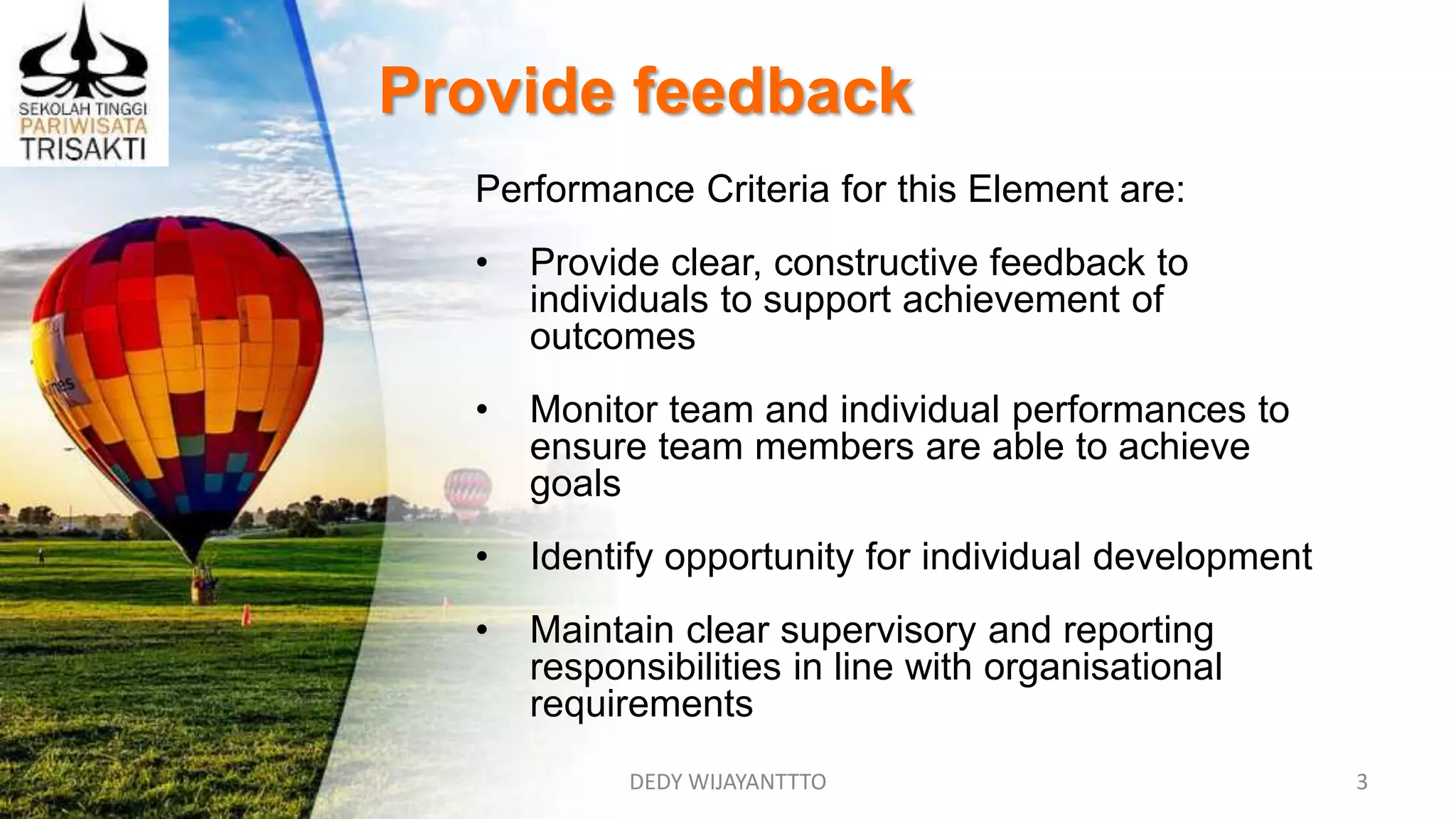
Performance Criteria for this Element are:
• Provide clear, constructive feedback to
individuals to support achievement of
outcomes
• Monitor team and individual performances to
ensure team members are able to achieve
goals
• Identify opportunity for individual development
• Maintain clear supervisory and reporting
responsibilities in line with organisational
requirements
DEDY WIJAYANTTTO 4
Feedback
DEDY WIJAYANTTTO 5
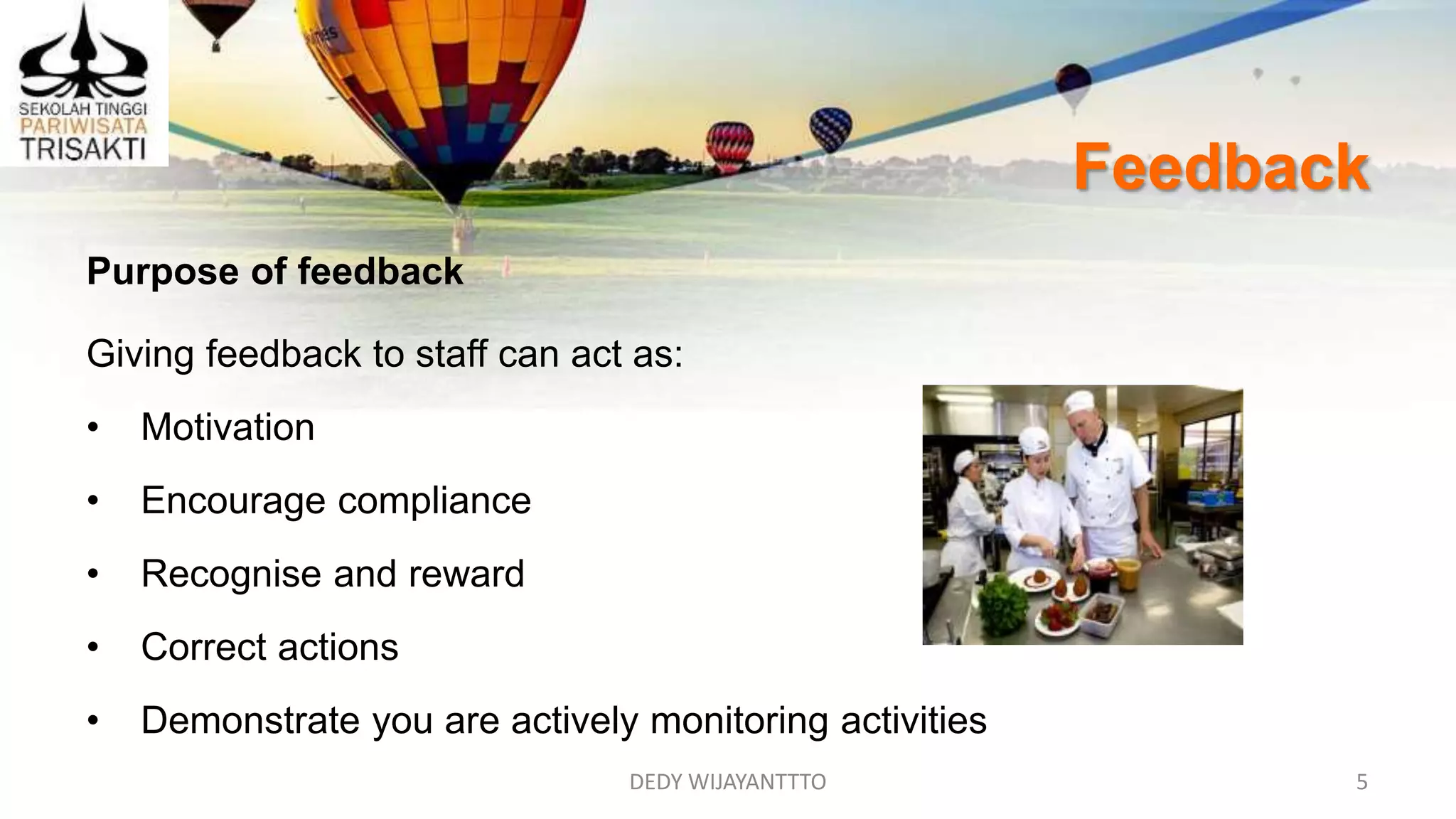
Purpose of feedback
Giving feedback to staff can act as:
• Motivation
• Encourage compliance
• Recognise and reward
• Correct actions
• Demonstrate you are actively monitoring activities
DEDY WIJAYANTTTO 6
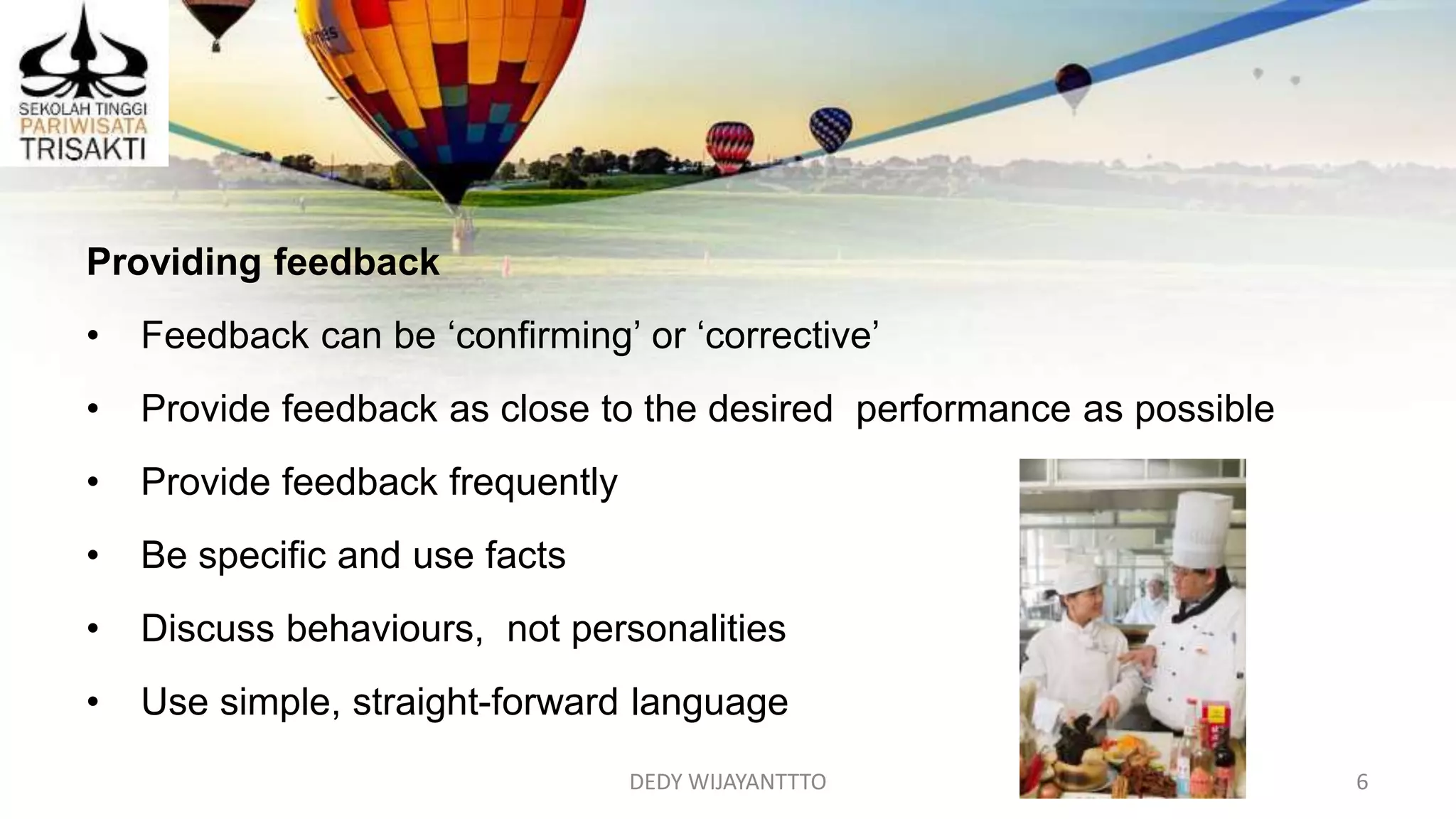
Providing feedback
• Feedback can be ‘confirming’ or ‘corrective’
• Provide feedback as close to the desired performance as possible
• Provide feedback frequently
• Be specific and use facts
• Discuss behaviours, not personalities
• Use simple, straight-forward language
DEDY WIJAYANTTTO 7
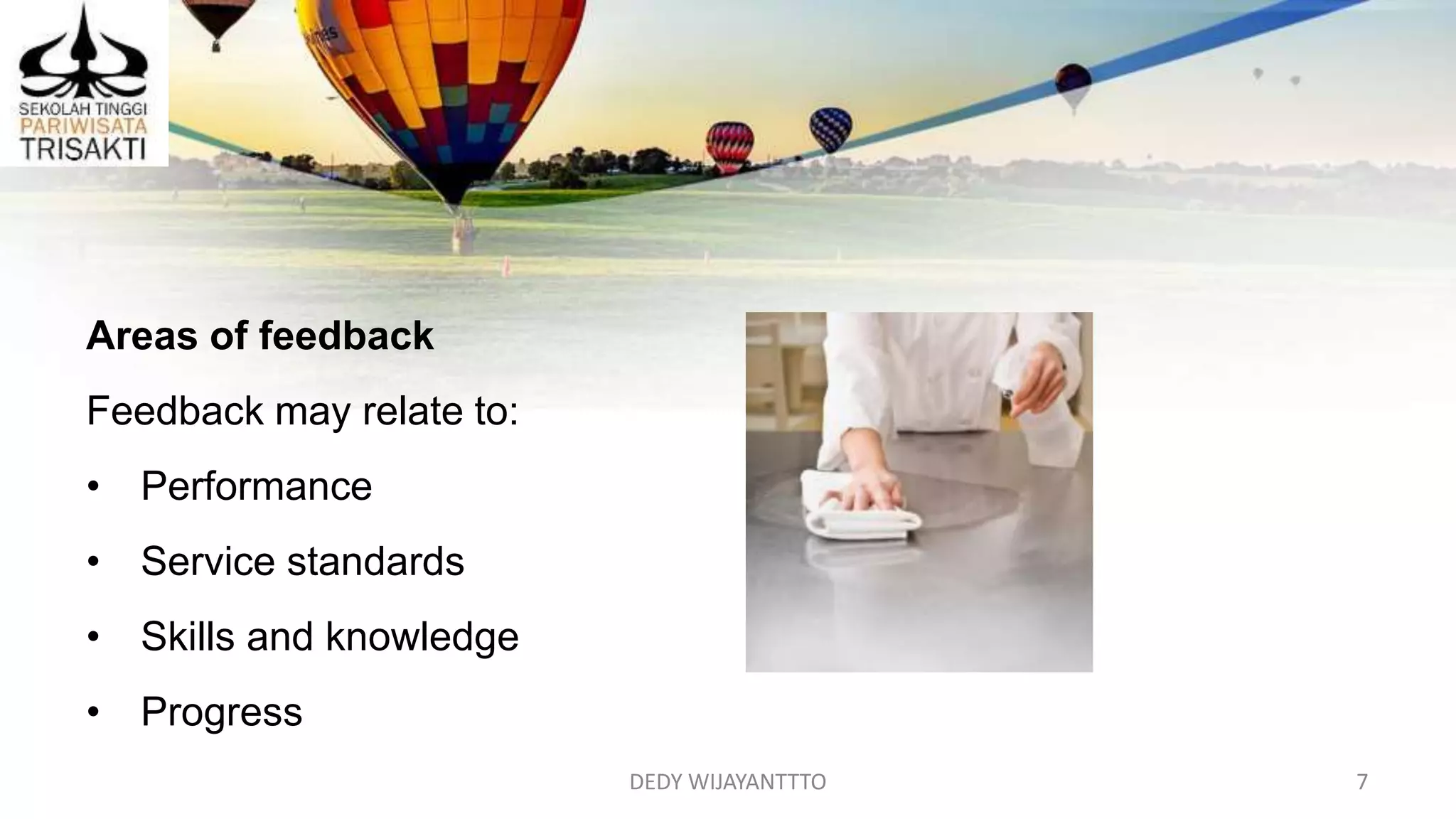
Areas of feedback
Feedback may relate to:
• Performance
• Service standards
• Skills and knowledge
• Progress
Providing feedback
DEDY WIJAYANTTTO 8
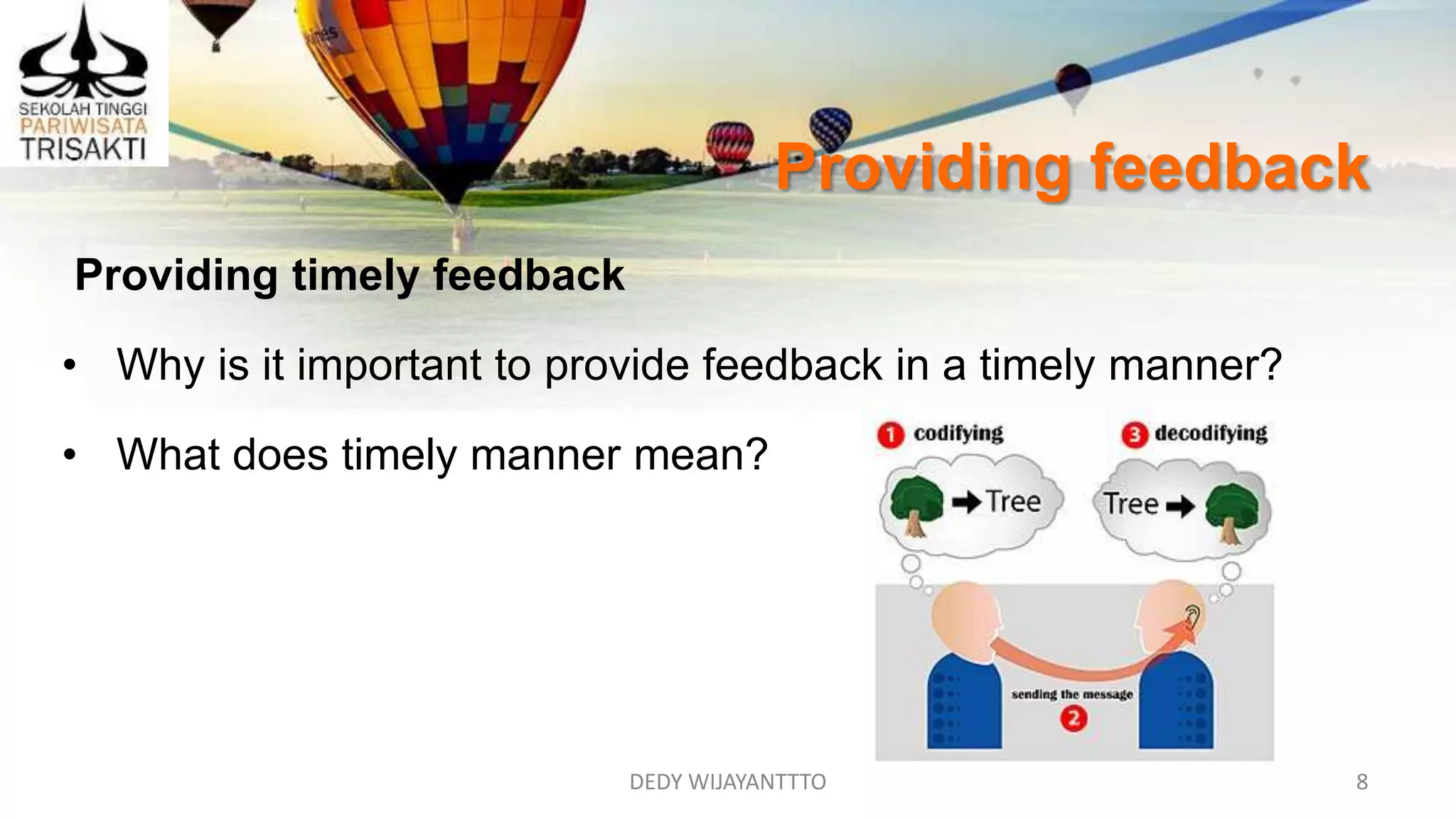
Providing timely feedback
• Why is it important to provide feedback in a timely manner?
• What does timely manner mean?
DEDY WIJAYANTTTO 9
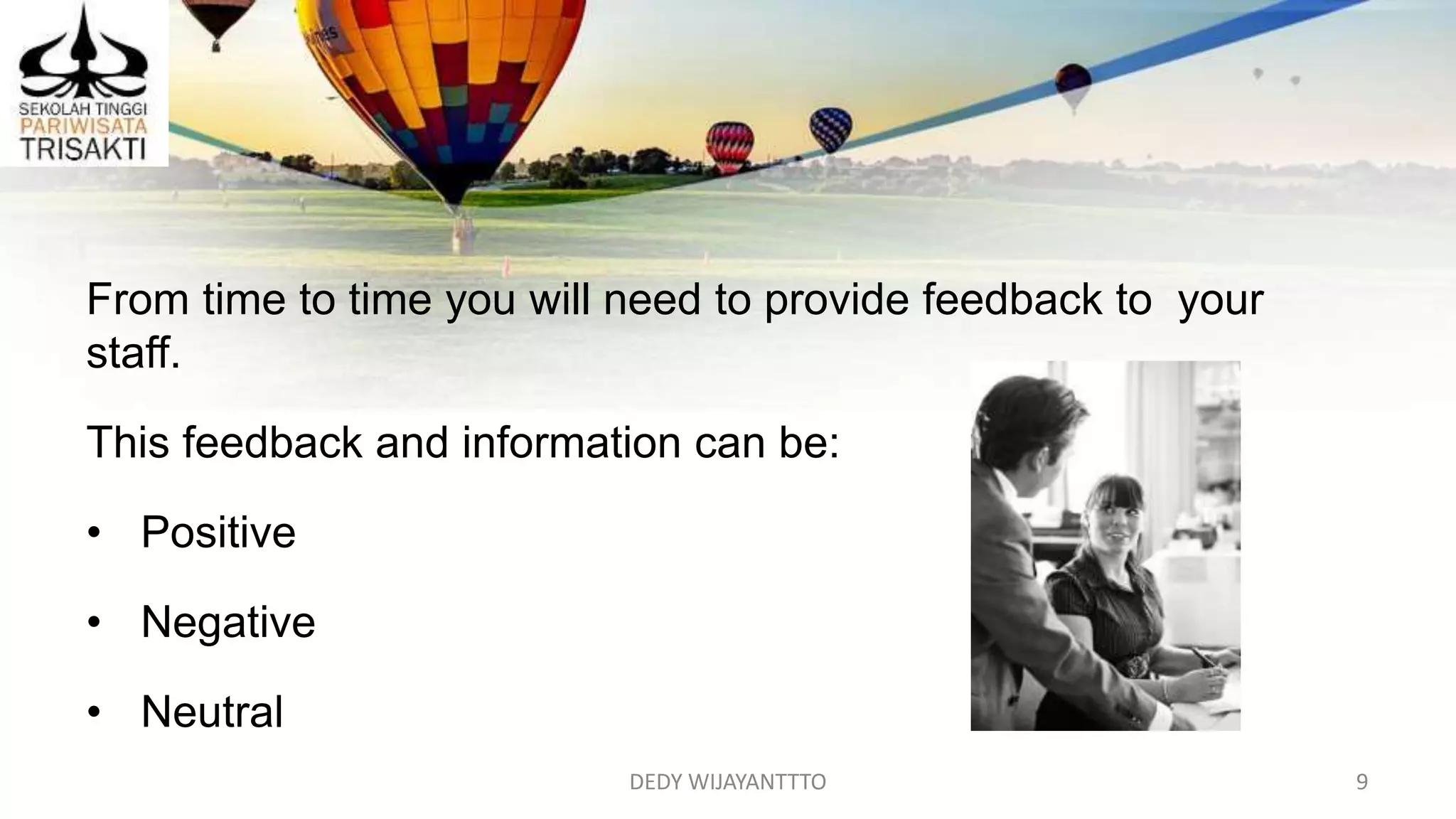
From time to time you will need to provide feedback to your
staff.
This feedback and information can be:
• Positive
• Negative
• Neutral
Positive feedback
DEDY WIJAYANTTTO 10
Providing positive feedback
• How do you provide positive
feedback?
• What recognition or rewards can be
provided?
DEDY WIJAYANTTTO 11
DEDY WIJAYANTTTO 12
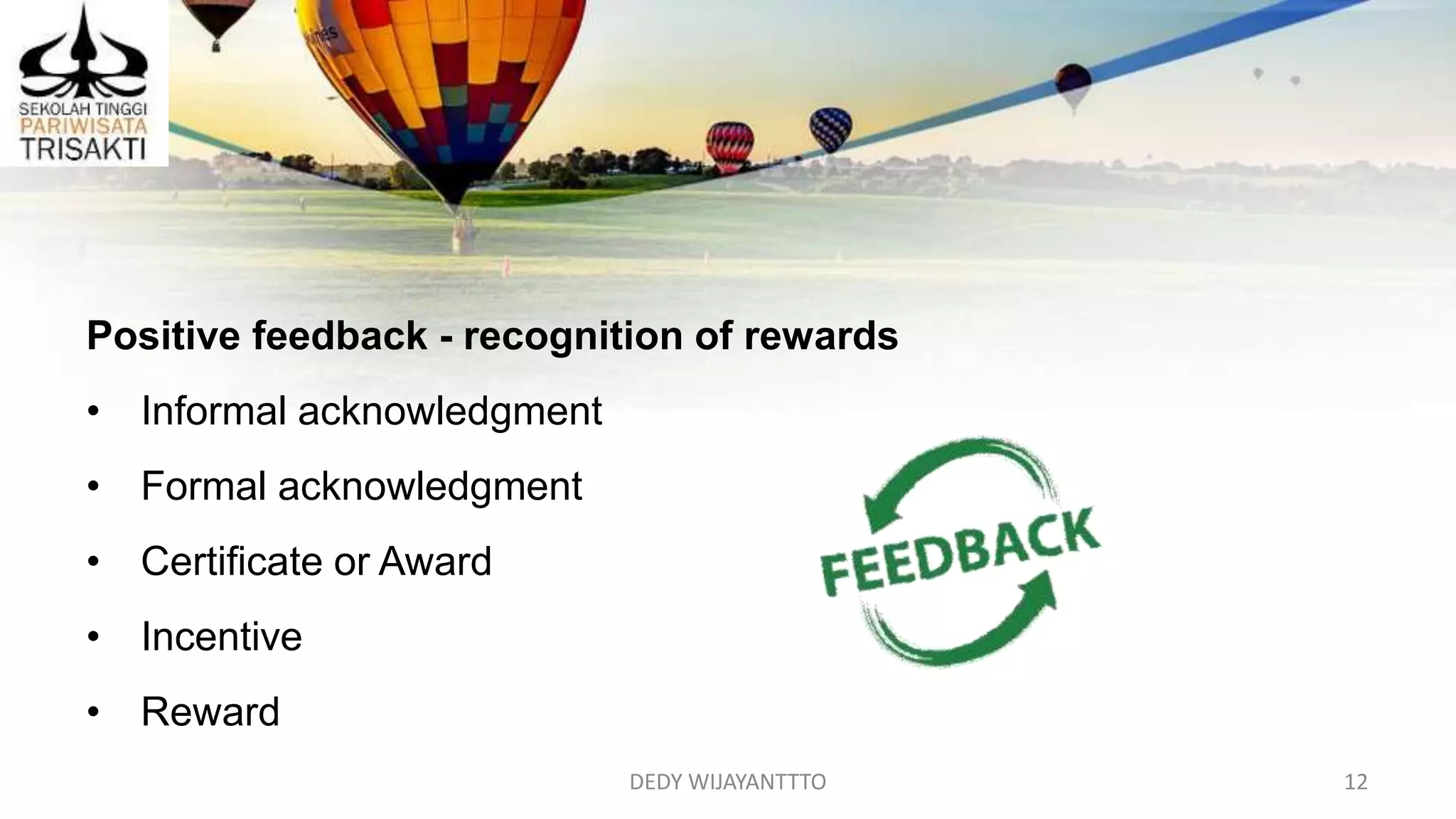
Positive feedback - recognition of rewards
• Informal acknowledgment
• Formal acknowledgment
• Certificate or Award
• Incentive
• Reward
Negative feedback
DEDY WIJAYANTTTO 13
Providing negative feedback
• How would you deliver negative feedback?
• How can you provide negative feedback in a constructive manner?
• What further corrective action may be required?
Negative feedback
DEDY WIJAYANTTTO 14
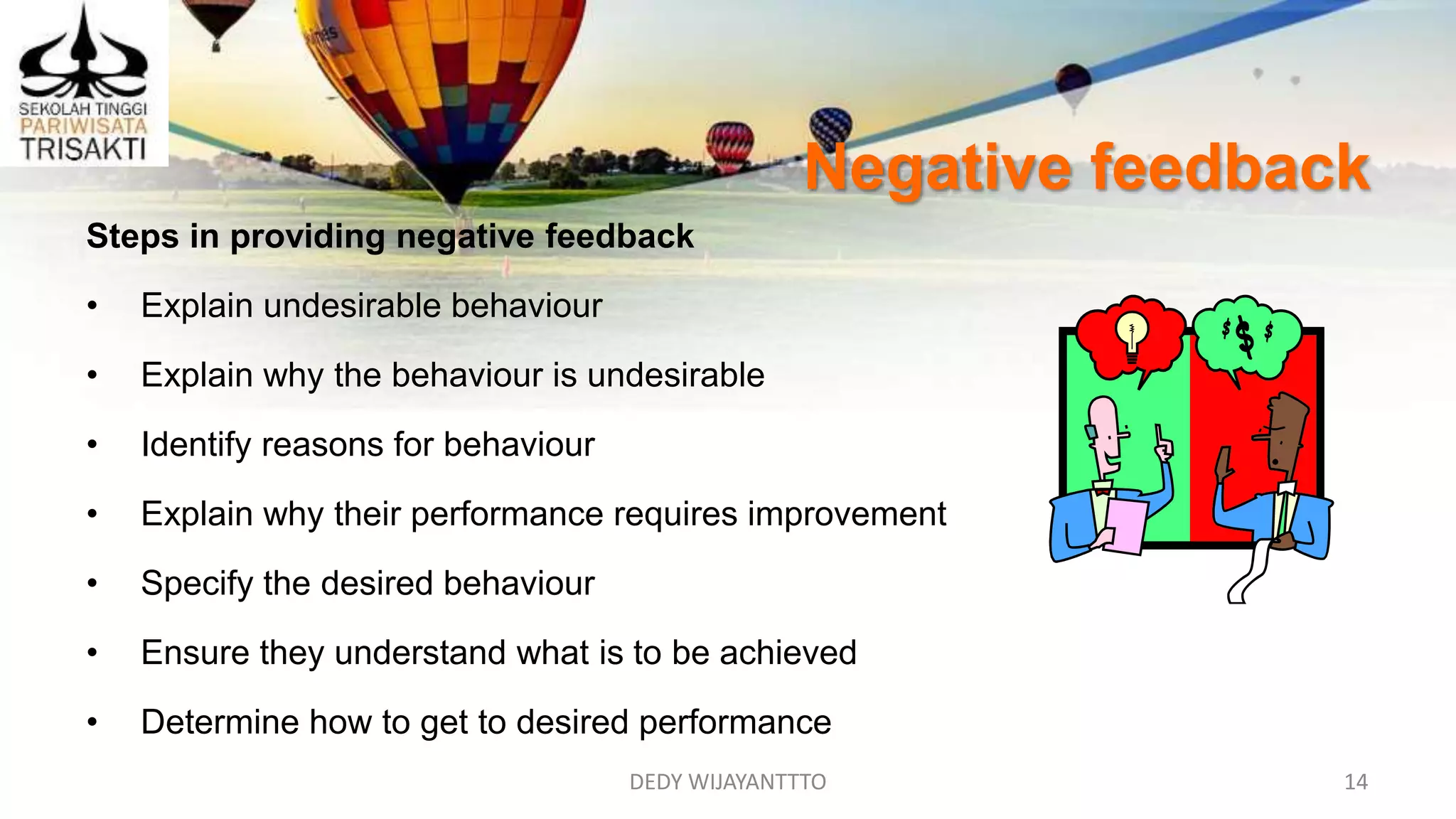
Steps in providing negative feedback
• Explain undesirable behaviour
• Explain why the behaviour is undesirable
• Identify reasons for behaviour
• Explain why their performance requires improvement
• Specify the desired behaviour
• Ensure they understand what is to be achieved
• Determine how to get to desired performance

Monitor team and individual
performance
DEDY WIJAYANTTTO 15
• Why is it important to monitor staff?
• What are they monitored against?
• When should you monitor staff?
• How do you monitor staff?
Monitor team and individual
performance
DEDY WIJAYANTTTO 16
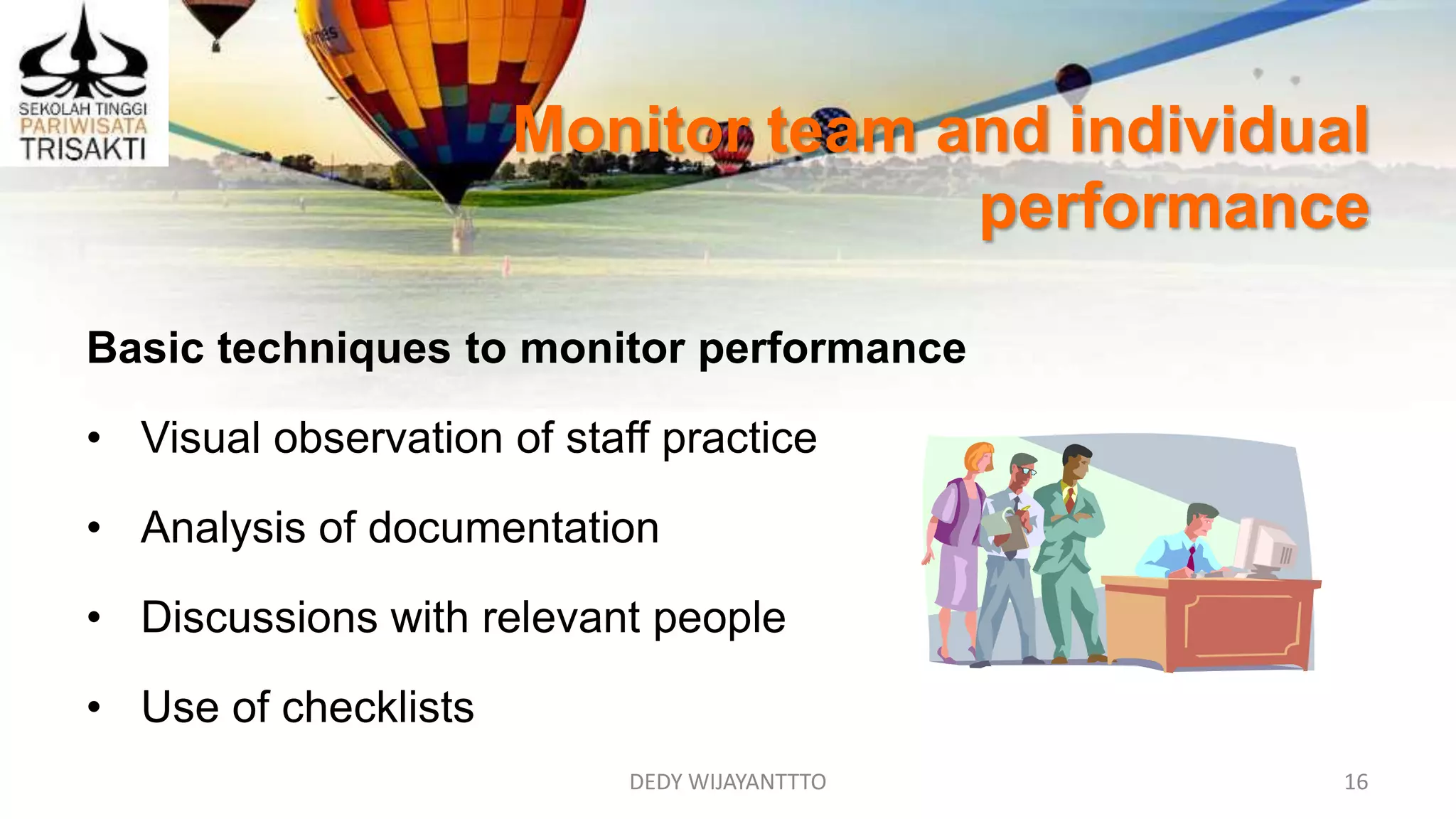
Basic techniques to monitor performance
• Visual observation of staff practice
• Analysis of documentation
• Discussions with relevant people
• Use of checklists
DEDY WIJAYANTTTO 17
Importance of performance standards
Workplace standards are important in order to:
• Meet customer expectations
• Reflect advertised standards
• Match or exceed the competition
• Comply with legal requirements
• Encourage repeat business
DEDY WIJAYANTTTO 18
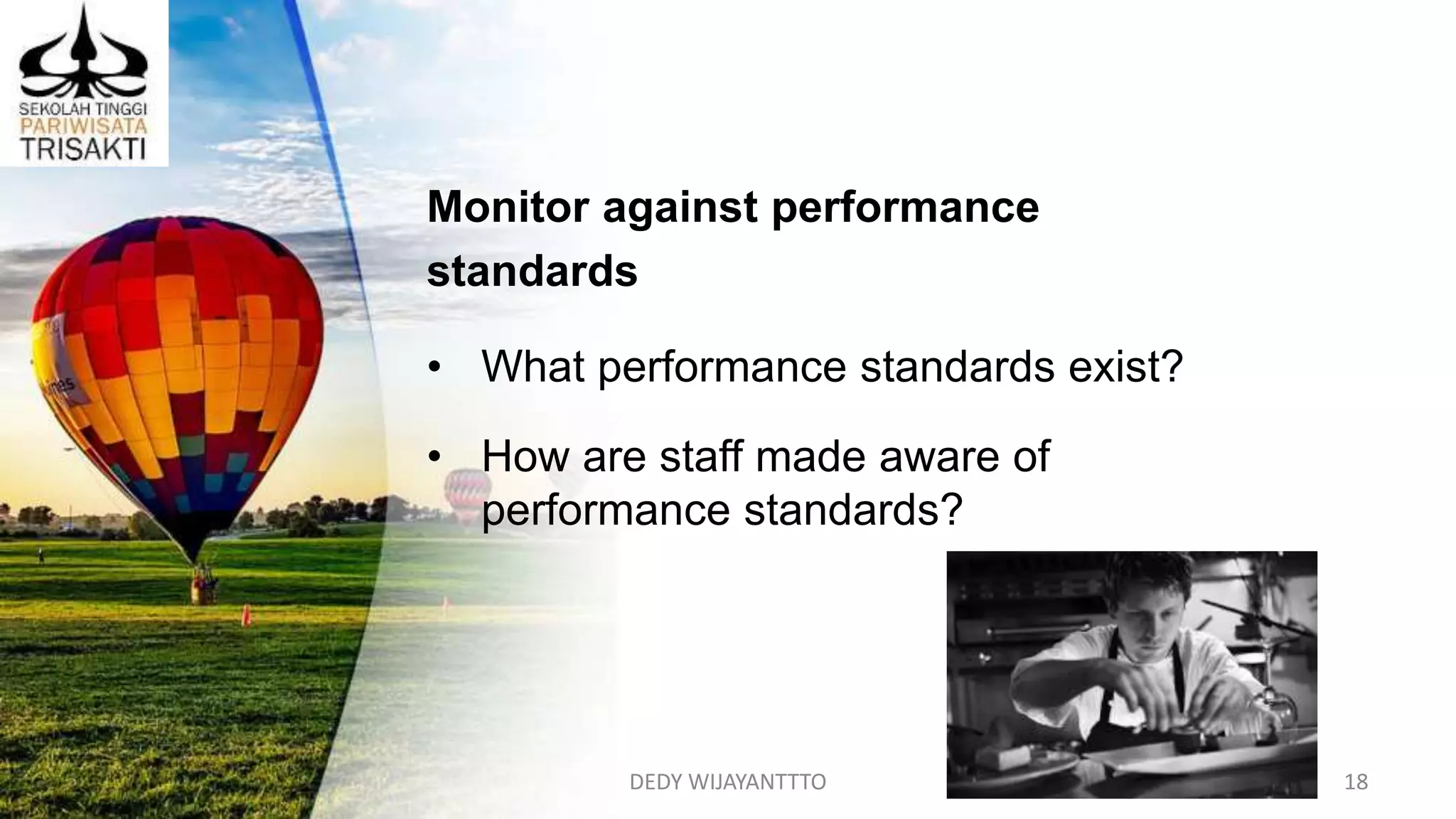
Monitor against performance
standards
• What performance standards exist?
• How are staff made aware of
performance standards?
DEDY WIJAYANTTTO 19
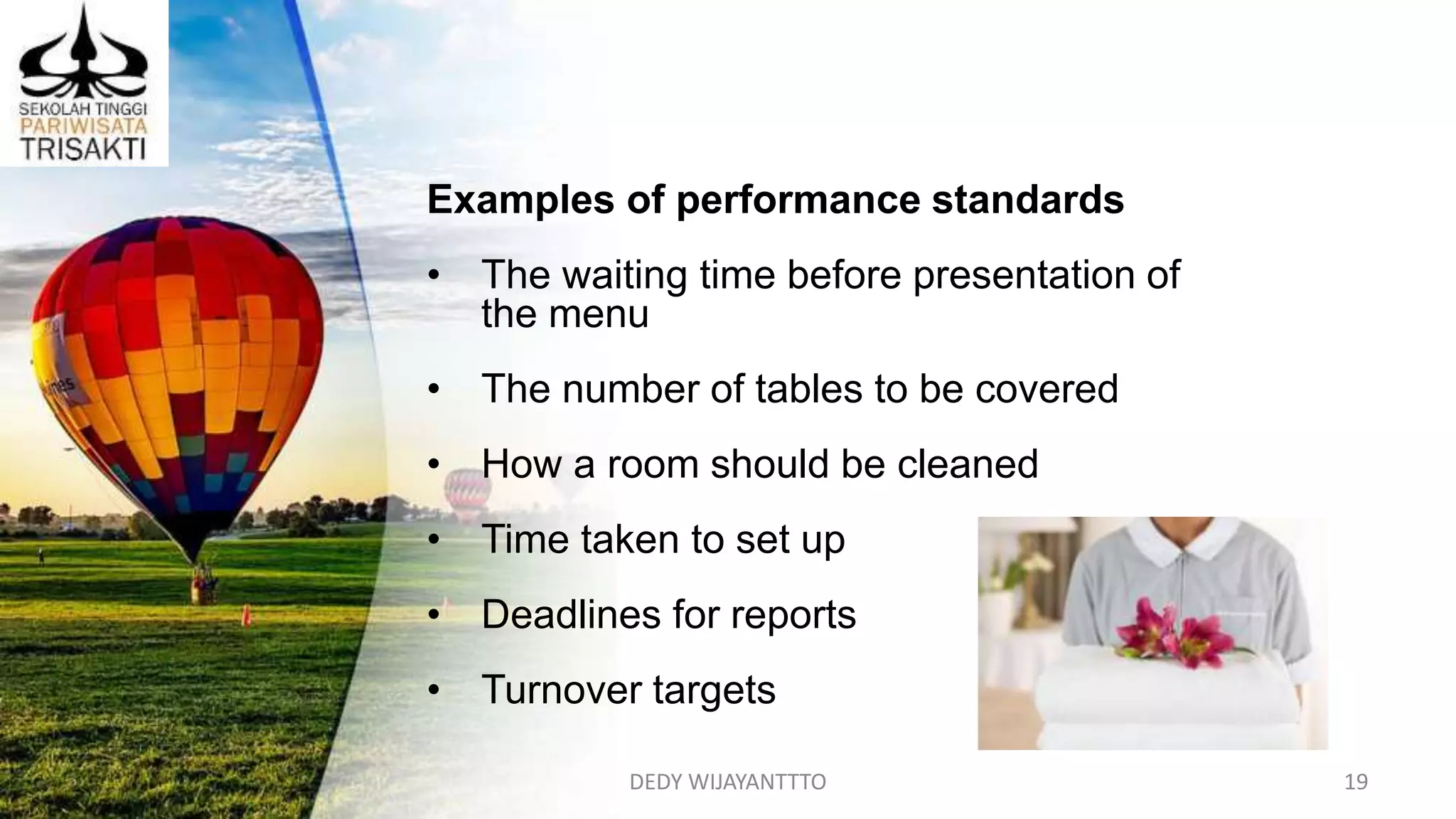
Examples of performance standards
• The waiting time before presentation of
the menu
• The number of tables to be covered
• How a room should be cleaned
• Time taken to set up
• Deadlines for reports
• Turnover targets
DEDY WIJAYANTTTO 20
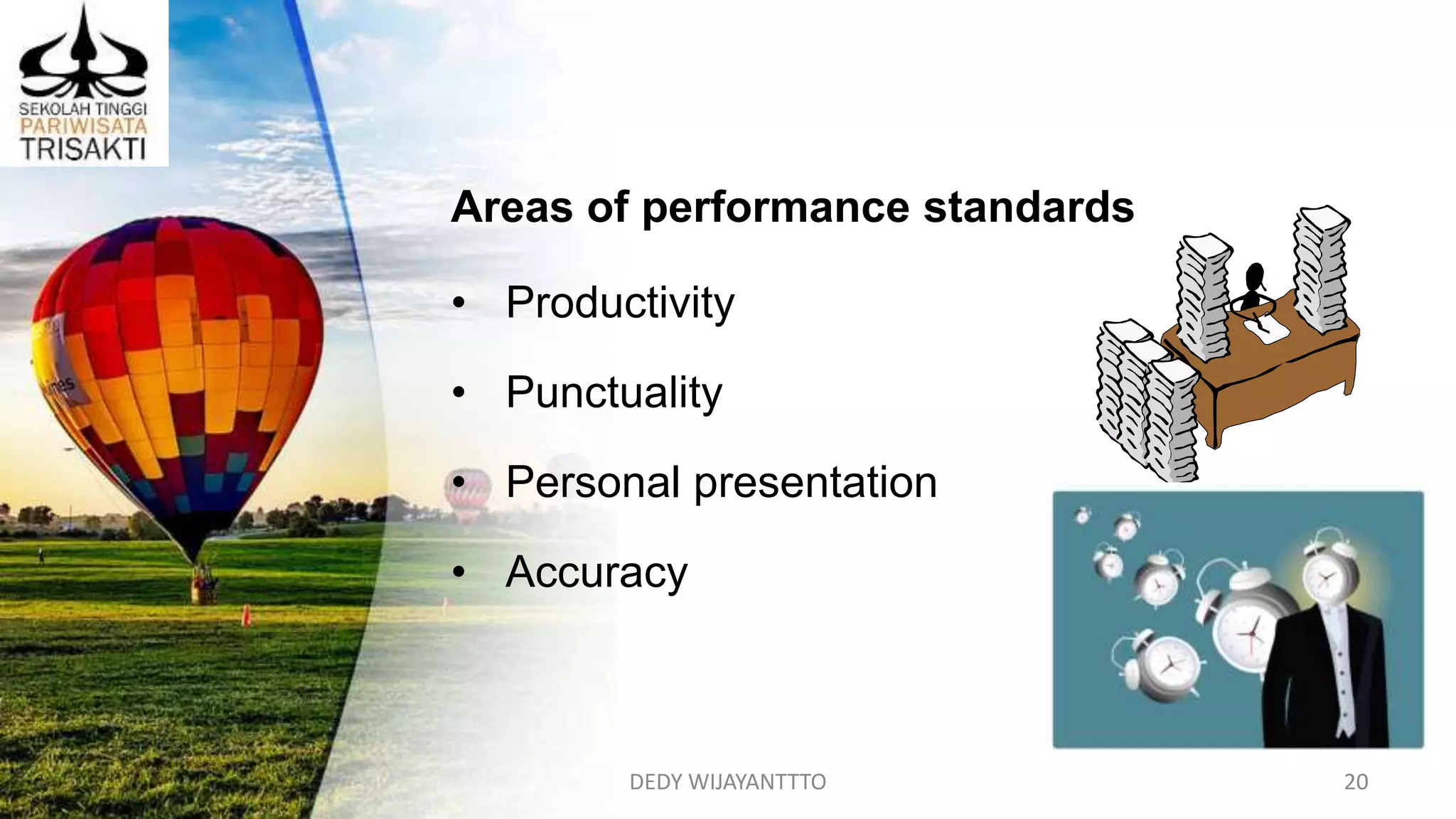
Areas of performance standards
• Productivity
• Punctuality
• Personal presentation
• Accuracy
DEDY WIJAYANTTTO 21
Areas of performance standards
• Adherence to procedures
• Customer service standards
• Team Interaction
• Response times
DEDY WIJAYANTTTO 22
Issues to monitor
• Safety
• Competency
• Appearance
• Professionalism
• Completion of tasks
• Overall ‘offering’ provided
• Customer satisfaction
Monitoring completion of work activities
DEDY WIJAYANTTTO 23
Use of checklists
• What is the importance of checklists?
• What should be included in checklists?
• Who should create checklists?
• How can staff use checklists?
• How can management use checklists?
Professional development opportunities
DEDY WIJAYANTTTO 24
One of the key characteristics of successful teams is the ability


to recognise and provide training and development opportunities
to staff.
• What training and development opportunities exist?
DEDY WIJAYANTTTO 25
Professional development opportunities
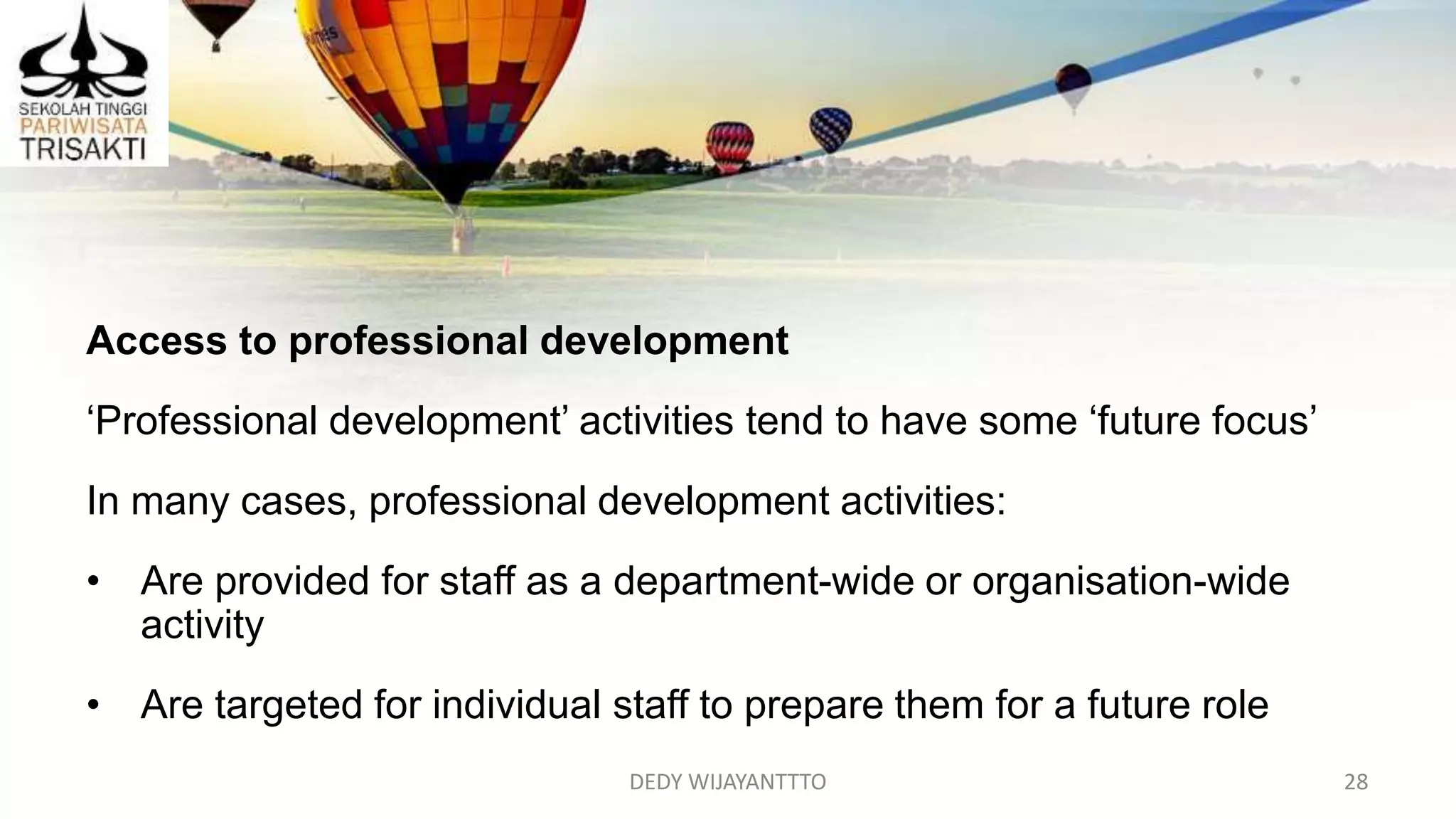
Developing the ‘skill set’
All team members must have the opportunity to improve their ‘skill set’
which aims at the development of:
• Knowledge
• Skills
• Attitudes
DEDY WIJAYANTTTO 26
Staff training and staff development
• Staff training will be applied to address a need that has some
immediacy to it
• Staff development has more of a future orientation and
relates to skills and knowledge the staff member may need at
some future date
DEDY WIJAYANTTTO 27
Professional development
Staff development is often referred to in another name:
‘Professional development’
• What are examples of ‘professional development’ activities?
• How do you select people?
DEDY WIJAYANTTTO 28
Access to professional development
‘Professional development’ activities tend to have some ‘future focus’
In many cases, professional development activities:
• Are provided for staff as a department-wide or organisation-wide
activity
• Are targeted for individual staff to prepare them for a future role
DEDY WIJAYANTTTO 29
Internal or external professional development
Professional development activities can be:
• Conducted on the premises:
– By management or the supervisor
– By an external third party provider
• Conducted off the premises
DEDY WIJAYANTTTO 30
Considerations when creating staff development
opportunities
• Identify the purpose
• Identify the need
• Establish priority for development
DEDY WIJAYANTTTO 31
Types of professional development opportunities
• Internal training and professional development
• External training and professional development
• Coaching
• Mentoring
• Supervision
• Formal or informal learning
programs
DEDY WIJAYANTTTO 32
Types of professional development opportunities
• Work experience and exchange opportunities
• Personal study
• Career planning and development
• Performance appraisals
• Workplace skills assessment
• Quality assurance assessments and recommendations
• Change in job responsibilities
DEDY WIJAYANTTTO 33
Professional development
opportunities
Types of professional development opportunities
• Opportunity for greater autonomy or responsibility
• Formal promotion
• Chance to perform in a higher position in a
caretaker mode
• Becoming a mentor for someone
• Leading a training session
• Being sent to a conference
DEDY WIJAYANTTTO 34
Mentoring
It is a relationship between two people where a more
experienced person works in collaboration with a less
experienced person to give the less experienced
person the benefit of their:
• Knowledge
• Experience
• Perspective
• Contacts
• Insight
• Wisdom
DEDY WIJAYANTTTO 35
Purpose of mentoring
• Provision of advice to the learner
• Enable personal development and growth
• Optimise staff retention
• Give the learner a sounding board for ideas
• Save the mentee from making same mistakes
DEDY WIJAYANTTTO 36
Purpose of mentoring
• Initiate a network for personal learning and contact
• Assist people in career planning
• Empower the learner
• Encourage independence of the learner
• Demonstrate support
DEDY WIJAYANTTTO 37
Coaching
This is where you deliver on-the-job training to individuals and
groups using a wide range of training options.
• What training options exist?
Coaching
DEDY WIJAYANTTTO 38
Coaching options
• Demonstrations
• Discussion
• Lectures
• Case studies
• Role-plays
• Games
DEDY WIJAYANTTTO 39
Coaching options
• Exercises
• Excursions
• Guest speakers
• Presentations
• Providing explanations
• Problem-solving
DEDY WIJAYANTTTO 40
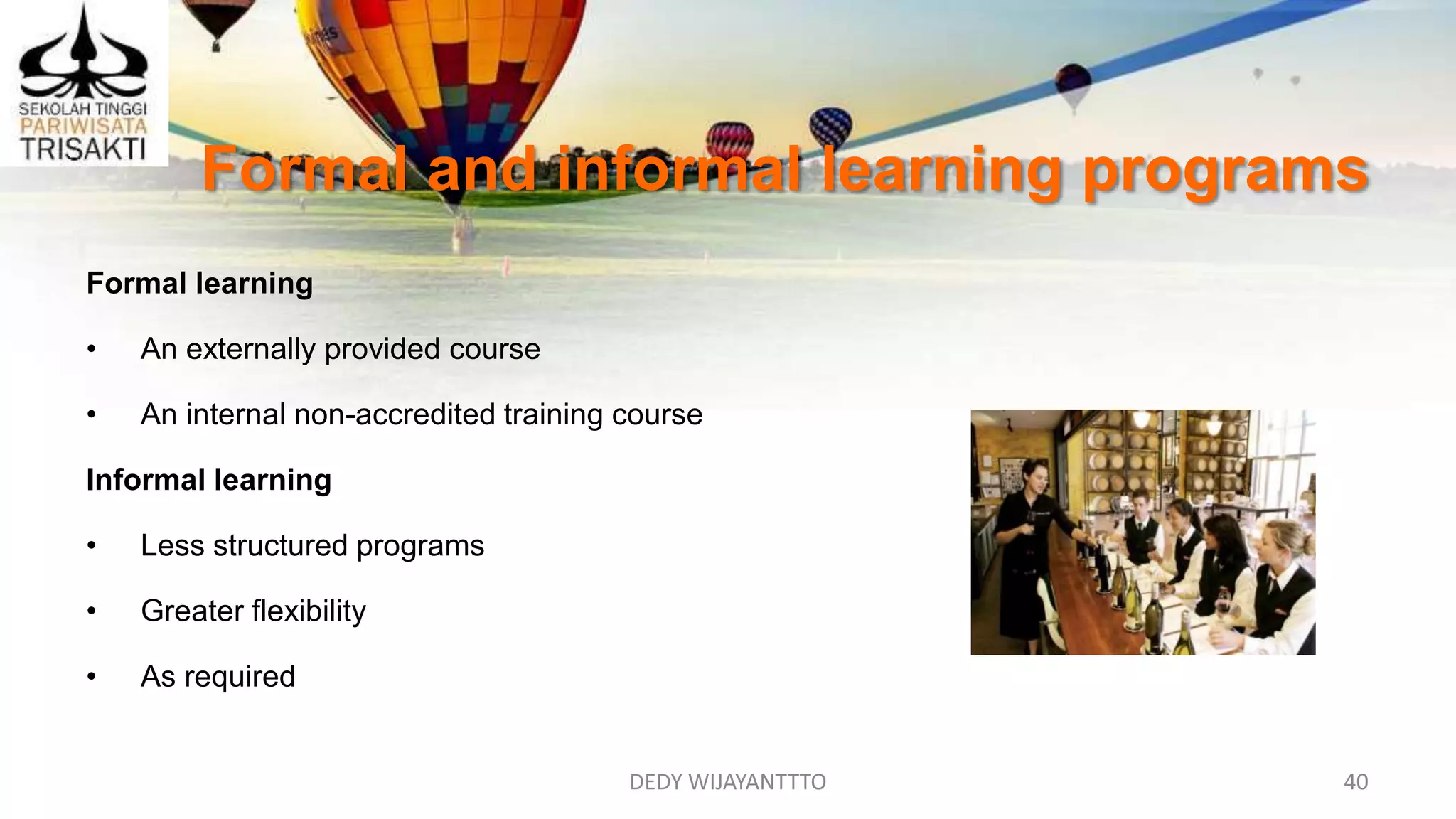
Formal and informal learning programs
Formal learning
• An externally provided course
• An internal non-accredited training course
Informal learning
• Less structured programs
• Greater flexibility
• As required
Other development programs
DEDY WIJAYANTTTO 41
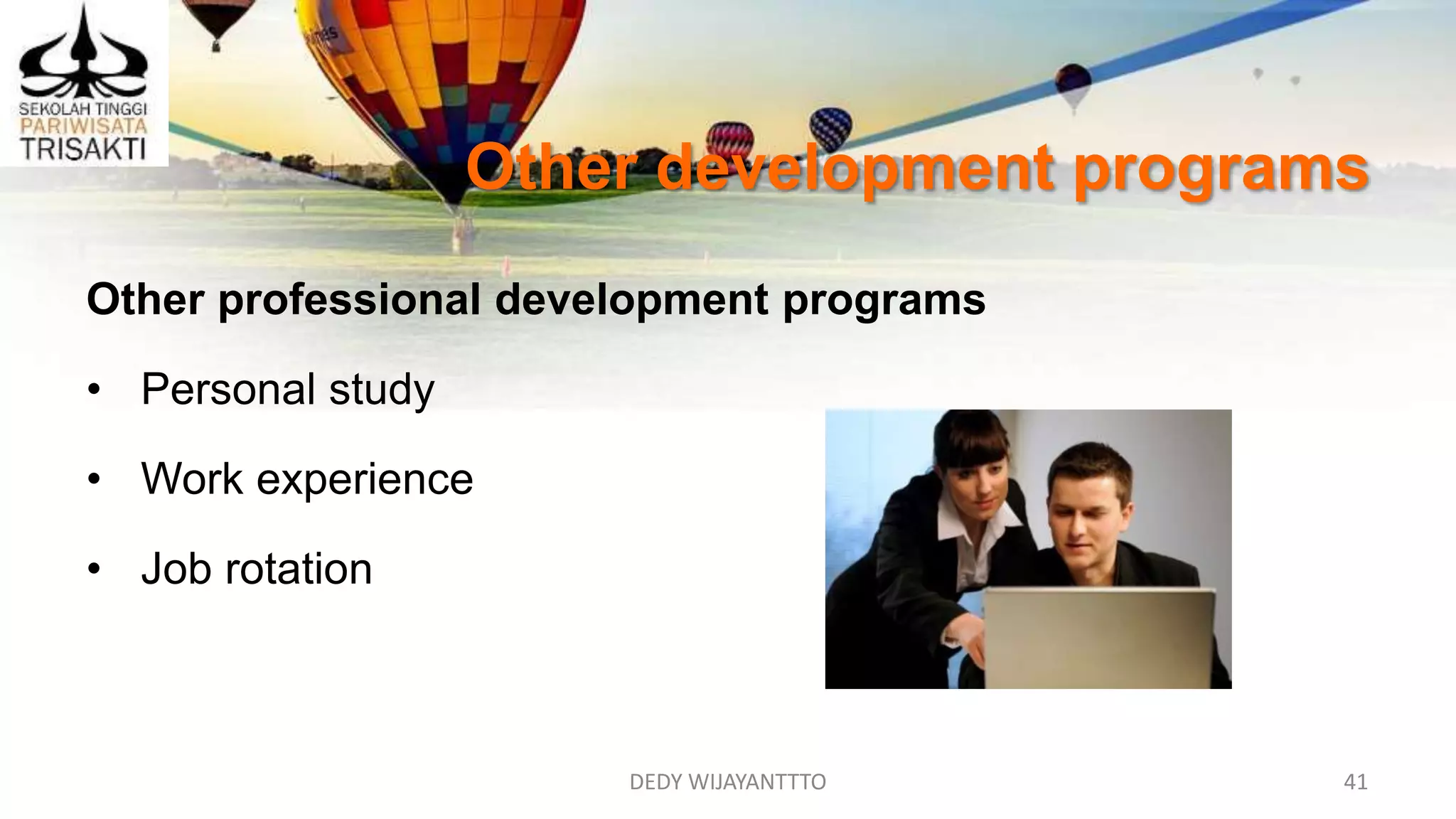
Other professional development programs
• Personal study
• Work experience
• Job rotation
DEDY WIJAYANTTTO 42
Support materials
Support materials for professional development programs
• Manuals
• Exercises
• Take away notes
• Role plays
• Catering
• Management representatives
DEDY WIJAYANTTTO 43
Providing practice opportunities
• Confirm with the staff member that practice is required
• Determine their availability
• Supervise the practice
• Notify the staff member when assessment can take place
DEDY WIJAYANTTTO 44
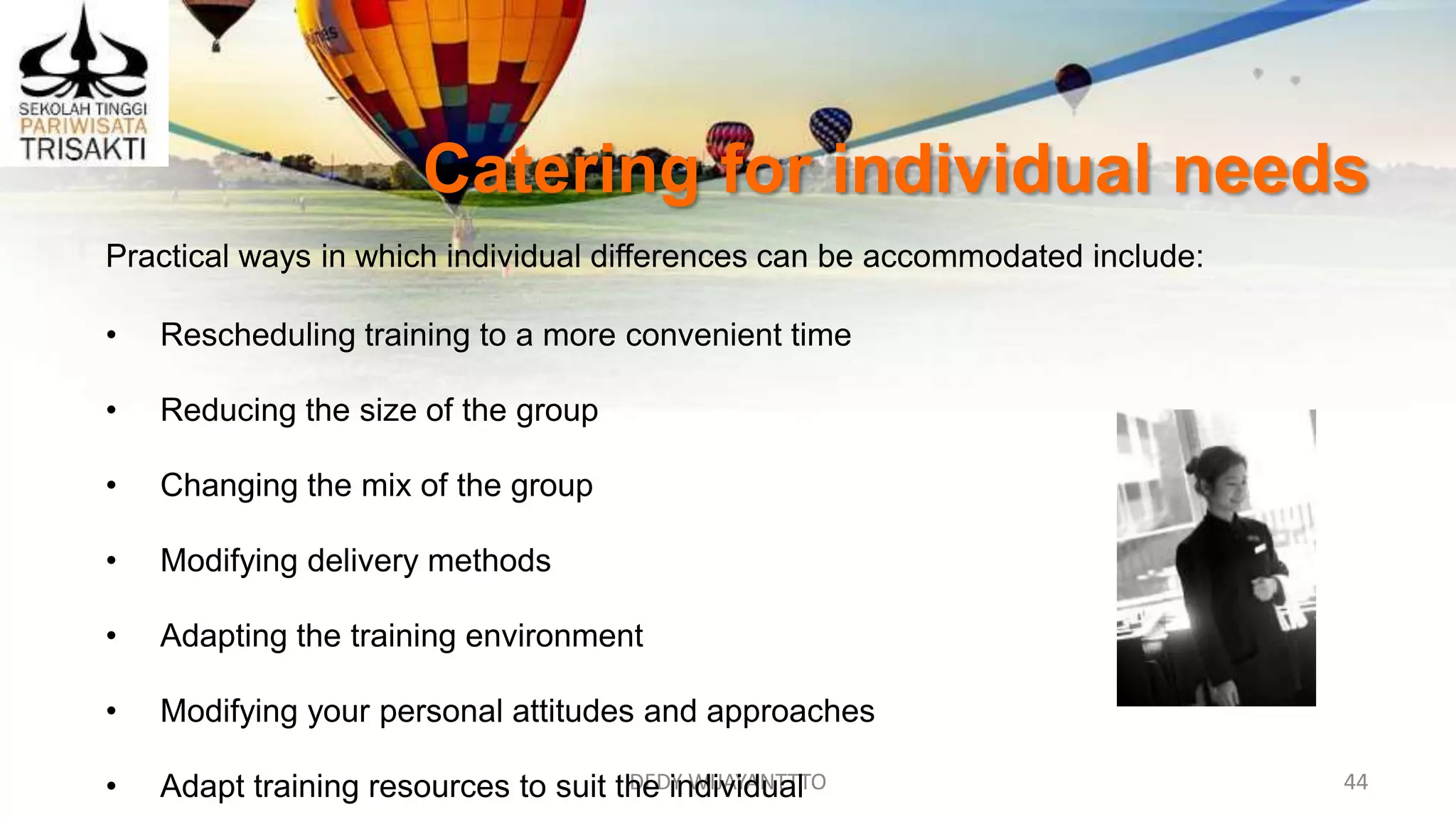
Catering for individual needs
Practical ways in which individual differences can be accommodated include:
• Rescheduling training to a more convenient time
• Reducing the size of the group
• Changing the mix of the group
• Modifying delivery methods
• Adapting the training environment
• Modifying your personal attitudes and approaches
• Adapt training resources to suit the individual
DEDY WIJAYANTTTO 45
Keys to becoming a successful manager
• Demonstrate competence
• Embrace responsibilities
• Make meaningful contributions
• Learn to adapt
• Make a commitment
• Continue to learn
• Prioritise your loyalties
• Always do good work
DEDY WIJAYANTTTO 46
Keys to becoming a successful manager
• Present the right image
• Learn the power structure
• Gain control of organisational resources
• Stay visible
• Find a mentor
• Support your boss
• Think laterally
DEDY WIJAYANTTTO 47
Managers as role models
Influence of a role model
• Every manager, whether they like it or not, acts as a role model to their staff
– even when they don’t intend to
• Staff will view the behaviour, actions and attitudes of the manager and often
will see this as the way to act, even if they disagree with their manager’s
behaviour
• How can you be a good role model for staff?
DEDY WIJAYANTTTO 48
Manage yourself first
The first thing for you as a manager to do is to manage yourself.
This involves:
• Knowing and understanding your own job
and the responsibilities you have
• Planning your own work well
• Managing your time efficiently planning
• Managing your own stress
DEDY WIJAYANTTTO 49
Leadership
Leadership in the workplace
To be a good leader, which is a vital component of
any managerial position, experience and history
shows you need to:
• Have the trust of staff, and in turn, trust them
• Show you respect the abilities and opinions
of staff
• Have the ability to motivate staff
• Be passionate, and committed to what you do
DEDY WIJAYANTTTO 50
Leadership in the workplace
• Be prepared to delegate work
• Be able to create a cooperative team
• Have a strong and clear sense of work goals
and objectives
• Help others achieve their personal goals
DEDY WIJAYANTTTO 51
DEDY WIJAYANTTTO 52

Part 3 operational approaches

  • 1.
    DEVELOP AND SUPERVISE OPERATIONALAPPROACHES DEDY WIJAYANTO DEDY WIJAYANTTTO 1 D1.HML.CL10.0 1 D1.HRM.C L9.08
  • 2.
    DEDY WIJAYANTTTO 2 Element4: Provide feedback
  • 3.
    Provide feedback DEDY WIJAYANTTTO3 Performance Criteria for this Element are: • Provide clear, constructive feedback to individuals to support achievement of outcomes • Monitor team and individual performances to ensure team members are able to achieve goals • Identify opportunity for individual development • Maintain clear supervisory and reporting responsibilities in line with organisational requirements
  • 4.
  • 5.
    Feedback DEDY WIJAYANTTTO 5 Purposeof feedback Giving feedback to staff can act as: • Motivation • Encourage compliance • Recognise and reward • Correct actions • Demonstrate you are actively monitoring activities
  • 6.
    DEDY WIJAYANTTTO 6 Providingfeedback • Feedback can be ‘confirming’ or ‘corrective’ • Provide feedback as close to the desired performance as possible • Provide feedback frequently • Be specific and use facts • Discuss behaviours, not personalities • Use simple, straight-forward language
  • 7.
    DEDY WIJAYANTTTO 7 Areasof feedback Feedback may relate to: • Performance • Service standards • Skills and knowledge • Progress
  • 8.
    Providing feedback DEDY WIJAYANTTTO8 Providing timely feedback • Why is it important to provide feedback in a timely manner? • What does timely manner mean?
  • 9.
    DEDY WIJAYANTTTO 9 Fromtime to time you will need to provide feedback to your staff. This feedback and information can be: • Positive • Negative • Neutral
  • 10.
    Positive feedback DEDY WIJAYANTTTO10 Providing positive feedback • How do you provide positive feedback? • What recognition or rewards can be provided?
  • 11.
  • 12.
    DEDY WIJAYANTTTO 12 Positivefeedback - recognition of rewards • Informal acknowledgment • Formal acknowledgment • Certificate or Award • Incentive • Reward
  • 13.
    Negative feedback DEDY WIJAYANTTTO13 Providing negative feedback • How would you deliver negative feedback? • How can you provide negative feedback in a constructive manner? • What further corrective action may be required?
  • 14.
    Negative feedback DEDY WIJAYANTTTO14 Steps in providing negative feedback • Explain undesirable behaviour • Explain why the behaviour is undesirable • Identify reasons for behaviour • Explain why their performance requires improvement • Specify the desired behaviour • Ensure they understand what is to be achieved • Determine how to get to desired performance
  • 15.
    Monitor team andindividual performance DEDY WIJAYANTTTO 15 • Why is it important to monitor staff? • What are they monitored against? • When should you monitor staff? • How do you monitor staff?
  • 16.
    Monitor team andindividual performance DEDY WIJAYANTTTO 16 Basic techniques to monitor performance • Visual observation of staff practice • Analysis of documentation • Discussions with relevant people • Use of checklists
  • 17.
    DEDY WIJAYANTTTO 17 Importanceof performance standards Workplace standards are important in order to: • Meet customer expectations • Reflect advertised standards • Match or exceed the competition • Comply with legal requirements • Encourage repeat business
  • 18.
    DEDY WIJAYANTTTO 18 Monitoragainst performance standards • What performance standards exist? • How are staff made aware of performance standards?
  • 19.
    DEDY WIJAYANTTTO 19 Examplesof performance standards • The waiting time before presentation of the menu • The number of tables to be covered • How a room should be cleaned • Time taken to set up • Deadlines for reports • Turnover targets
  • 20.
    DEDY WIJAYANTTTO 20 Areasof performance standards • Productivity • Punctuality • Personal presentation • Accuracy
  • 21.
    DEDY WIJAYANTTTO 21 Areasof performance standards • Adherence to procedures • Customer service standards • Team Interaction • Response times
  • 22.
    DEDY WIJAYANTTTO 22 Issuesto monitor • Safety • Competency • Appearance • Professionalism • Completion of tasks • Overall ‘offering’ provided • Customer satisfaction
  • 23.
    Monitoring completion ofwork activities DEDY WIJAYANTTTO 23 Use of checklists • What is the importance of checklists? • What should be included in checklists? • Who should create checklists? • How can staff use checklists? • How can management use checklists?
  • 24.
    Professional development opportunities DEDYWIJAYANTTTO 24 One of the key characteristics of successful teams is the ability to recognise and provide training and development opportunities to staff. • What training and development opportunities exist?
  • 25.
    DEDY WIJAYANTTTO 25 Professionaldevelopment opportunities Developing the ‘skill set’ All team members must have the opportunity to improve their ‘skill set’ which aims at the development of: • Knowledge • Skills • Attitudes
  • 26.
    DEDY WIJAYANTTTO 26 Stafftraining and staff development • Staff training will be applied to address a need that has some immediacy to it • Staff development has more of a future orientation and relates to skills and knowledge the staff member may need at some future date
  • 27.
    DEDY WIJAYANTTTO 27 Professionaldevelopment Staff development is often referred to in another name: ‘Professional development’ • What are examples of ‘professional development’ activities? • How do you select people?
  • 28.
    DEDY WIJAYANTTTO 28 Accessto professional development ‘Professional development’ activities tend to have some ‘future focus’ In many cases, professional development activities: • Are provided for staff as a department-wide or organisation-wide activity • Are targeted for individual staff to prepare them for a future role
  • 29.
    DEDY WIJAYANTTTO 29 Internalor external professional development Professional development activities can be: • Conducted on the premises: – By management or the supervisor – By an external third party provider • Conducted off the premises
  • 30.
    DEDY WIJAYANTTTO 30 Considerationswhen creating staff development opportunities • Identify the purpose • Identify the need • Establish priority for development
  • 31.
    DEDY WIJAYANTTTO 31 Typesof professional development opportunities • Internal training and professional development • External training and professional development • Coaching • Mentoring • Supervision • Formal or informal learning programs
  • 32.
    DEDY WIJAYANTTTO 32 Typesof professional development opportunities • Work experience and exchange opportunities • Personal study • Career planning and development • Performance appraisals • Workplace skills assessment • Quality assurance assessments and recommendations • Change in job responsibilities
  • 33.
    DEDY WIJAYANTTTO 33 Professionaldevelopment opportunities Types of professional development opportunities • Opportunity for greater autonomy or responsibility • Formal promotion • Chance to perform in a higher position in a caretaker mode • Becoming a mentor for someone • Leading a training session • Being sent to a conference
  • 34.
    DEDY WIJAYANTTTO 34 Mentoring Itis a relationship between two people where a more experienced person works in collaboration with a less experienced person to give the less experienced person the benefit of their: • Knowledge • Experience • Perspective • Contacts • Insight • Wisdom
  • 35.
    DEDY WIJAYANTTTO 35 Purposeof mentoring • Provision of advice to the learner • Enable personal development and growth • Optimise staff retention • Give the learner a sounding board for ideas • Save the mentee from making same mistakes
  • 36.
    DEDY WIJAYANTTTO 36 Purposeof mentoring • Initiate a network for personal learning and contact • Assist people in career planning • Empower the learner • Encourage independence of the learner • Demonstrate support
  • 37.
    DEDY WIJAYANTTTO 37 Coaching Thisis where you deliver on-the-job training to individuals and groups using a wide range of training options. • What training options exist?
  • 38.
    Coaching DEDY WIJAYANTTTO 38 Coachingoptions • Demonstrations • Discussion • Lectures • Case studies • Role-plays • Games
  • 39.
    DEDY WIJAYANTTTO 39 Coachingoptions • Exercises • Excursions • Guest speakers • Presentations • Providing explanations • Problem-solving
  • 40.
    DEDY WIJAYANTTTO 40 Formaland informal learning programs Formal learning • An externally provided course • An internal non-accredited training course Informal learning • Less structured programs • Greater flexibility • As required
  • 41.
    Other development programs DEDYWIJAYANTTTO 41 Other professional development programs • Personal study • Work experience • Job rotation
  • 42.
    DEDY WIJAYANTTTO 42 Supportmaterials Support materials for professional development programs • Manuals • Exercises • Take away notes • Role plays • Catering • Management representatives
  • 43.
    DEDY WIJAYANTTTO 43 Providingpractice opportunities Providing practice opportunities • Confirm with the staff member that practice is required • Determine their availability • Supervise the practice • Notify the staff member when assessment can take place
  • 44.
    DEDY WIJAYANTTTO 44 Cateringfor individual needs Practical ways in which individual differences can be accommodated include: • Rescheduling training to a more convenient time • Reducing the size of the group • Changing the mix of the group • Modifying delivery methods • Adapting the training environment • Modifying your personal attitudes and approaches • Adapt training resources to suit the individual
  • 45.
    DEDY WIJAYANTTTO 45 Keysto becoming a successful manager • Demonstrate competence • Embrace responsibilities • Make meaningful contributions • Learn to adapt • Make a commitment • Continue to learn • Prioritise your loyalties • Always do good work
  • 46.
    DEDY WIJAYANTTTO 46 Keysto becoming a successful manager • Present the right image • Learn the power structure • Gain control of organisational resources • Stay visible • Find a mentor • Support your boss • Think laterally
  • 47.
    DEDY WIJAYANTTTO 47 Managersas role models Influence of a role model • Every manager, whether they like it or not, acts as a role model to their staff – even when they don’t intend to • Staff will view the behaviour, actions and attitudes of the manager and often will see this as the way to act, even if they disagree with their manager’s behaviour • How can you be a good role model for staff?
  • 48.
    DEDY WIJAYANTTTO 48 Manageyourself first The first thing for you as a manager to do is to manage yourself. This involves: • Knowing and understanding your own job and the responsibilities you have • Planning your own work well • Managing your time efficiently planning • Managing your own stress
  • 49.
    DEDY WIJAYANTTTO 49 Leadership Leadershipin the workplace To be a good leader, which is a vital component of any managerial position, experience and history shows you need to: • Have the trust of staff, and in turn, trust them • Show you respect the abilities and opinions of staff • Have the ability to motivate staff • Be passionate, and committed to what you do
  • 50.
    DEDY WIJAYANTTTO 50 Leadershipin the workplace • Be prepared to delegate work • Be able to create a cooperative team • Have a strong and clear sense of work goals and objectives • Help others achieve their personal goals
  • 51.
  • 52.