A comprehensive guide
         to your rights and
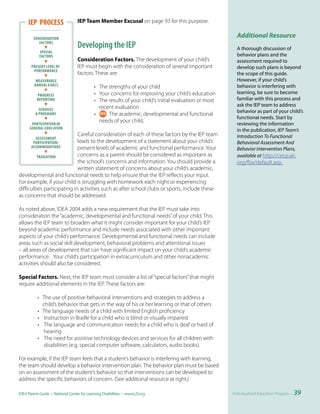
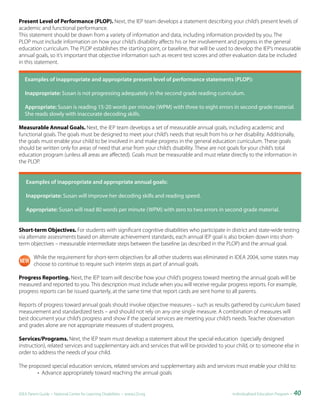
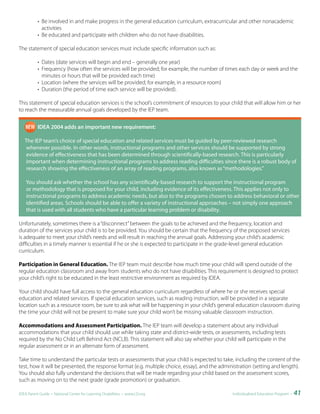
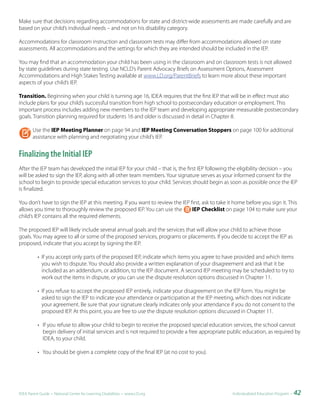
         responsibilities under the
         Individuals with Disabilities
         Education Act (IDEA 2004)


                                                                                                  April 2006
National Center for Learning Disabilities, Inc. 381 Park Avenue South, Suite 1401, NY, NY 10016
Table of Contents


   Introduction                                                  3
   Overview                                                      5
   Chapter 1: Pre-referral Services                              8
   Chapter 2: Response-to-Intervention (RTI)                   12
   Chapter 3: Referral or Request for Evaluation               16
   Chapter 4: Procedural Safeguards                            20
   Chapter 5: Evaluation                                       25
   Chapter 6: Eligibility Determination                        30
   Chapter 7: Individualized Education Program (IEP)           36
   Chapter 8: Transition                                        47
   Chapter 9: Students in Private Schools                       53
   Chapter 10: Student Discipline                              57
   Chapter 11: Dispute Resolution Options                      61
   Terms to Know                                               67
   Overview of The Americans with Disabilities Act             71
   Overview of The No Child Left Behind Act                    72
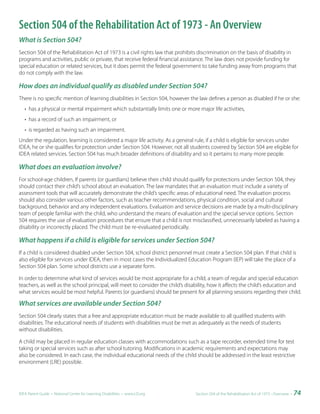
   Overview of Section 504 of the Rehabilitation Act of 1973   74
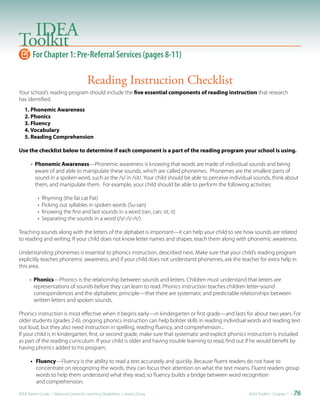
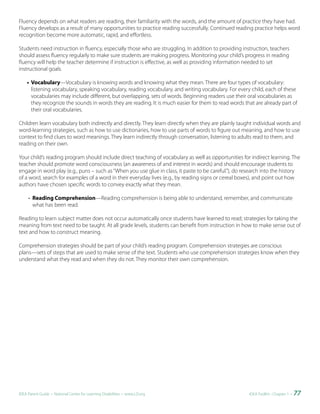
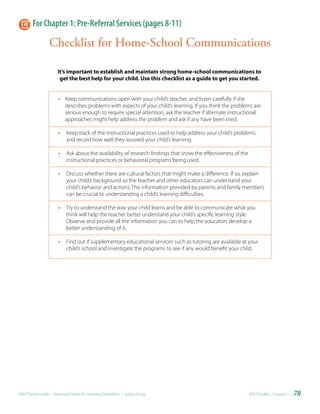
   IDEA Toolkit                                                76
Introduction
NCLD has created this Parent Guide to the Individuals with Disabilities Education Act                      Additional Advocacy
(IDEA) so you can become an informed and effective partner with school personnel in                        Resources
supporting your child’s special learning and behavioral needs. We hope you will use
                                                                                                           Both IDEA and No Child
this IDEA Parent Guide to understand:
                                                                                                           Left Behind (NCLB) include
                                                                                                           provisions that can be used
   • How the federal law generally works in most states                                                    to improve the academic
   • What the law requires to determine whether your child has a learning disability                       achievement of students with
   • What is new to IDEA since Congress last updated the law in 2004                                       learning disabilities. Be sure to
   • What questions you should ask and what information you should prepare in order                        check out the “Making the ‘No
     to be a full and active advocate for your child                                                       Child Left Behind Act’ Work
   • What resources are available to you.                                                                  for Children Who Struggle to
                                                                                                           Learn: A Parent’s Guide” and
In developing this IDEA Parent Guide, we have worked with parents of students with                         the NCLB Parent Advocacy
learning disabilities from around the country. NCLD is thankful to these parents for                       Briefs -- all available at www.
                                                                                                           LD.org/NCLB.
their invaluable input. Together, we have tried to address the questions, challenges and
barriers parents face as they navigate their way through the special education process.
                                                                                                           NCLD also has a guide
Parents have also contributed their own personal stories so that you can hear firsthand                    explaining how you can
that you are not alone in this journey.                                                                    become an effective advocate
                                                                                                           within your state, or at the
                                                                                                           national level. To learn how to
                                                                                                           lend your voice to advocacy
                                                                                                           efforts, take a look at NCLD’s
	 	 ote:	The IDEA Parent Guide was created to provide a basic understanding
  N                                                                                                        LD Advocate’s Guide.
  of the key requirements of the federal law under IDEA. The information
  presented here is not legal advice and should not be used as a legal resource.


       Parent
     Perspectives
     Twenty	Years	Later

     What have I learned after weaving my way through the special education maze?

     Knowledge is power – you must be as informed as possible about your child’s disability AND your child’s strengths. You
     must know the law and how to use it. You must have good communication skills. You must believe in yourself. You must
     believe in your child. You must be creative. You must be patient. You must be part of a team. You will play many roles, not
     just mother or father but also Cheerleader, Advocate, Tutor, Lawyer, Researcher, Detective, Teacher, Mediator, Psychologist
     and Student.

     Yes, you are the Student and your child is the Teacher. Your child provides the opportunity for growth not just for you as a
     parent but also for the teachers. Your child provides the opportunity for your school to grow and expand its vision.

     Your child says: “Look at me, I am different, I am truly an individual, you must change the way you’ve been doing things,
     you must get creative, you must try something new.” You will at first cry, you will be frustrated, you will feel overwhelmed,
     you will feel alone, you will fight. There will be times you feel like giving up, but you won’t because you love your child too
     much. You will make a conscious decision to be part of the solution. You will make a plan.

     -Gloria	from	New	Jersey


IDEA Parent Guide • National Center for Learning Disabilities • www.LD.org                                                   Introduction •   3
Parent
     Perspectives
     Success	is	Sweet:	A	Story	of	Parent	Advocacy

     Our district is in Southwest Colorado, and one of the early things I learned was to find as many parents of dyslexic children
     as I could, and compare notes. Some of us had successful Individual Education Programs (IEPs) for our children, and we
     would meet at my office on the weekend to read them, laugh, weep, and write down the aspects that were successful and
     suitable for our own children.

     For Goals and Objectives, we read “Better IEPs” by Barbara D. Bateman and soon realized that we were actually teaching
     the school district. As we became more successful in writing IEPs, we realized the district would never be able to provide
     a Free Appropriate Public Education to our dyslexic children under the current conditions. We had 12th grade students
     with 4th or 5th grade reading abilities and in my opinion our Colorado Student Assessment Program (CSAP) results were
     appalling.

     One summer we raised over $23,000 to provide cash funds to dyslexic students who wished to attend a six-week academic
     dyslexic summer camp. Some parents chose to provide their children with one-on-one tutoring by a private Certified
     Academic Language Therapist. My son was able to go from a 4.6 grade reading level to an 11th grade reading level in 18
     months! How? He received a “scientifically proven method” of teaching by a highly qualified therapist. Consequently, when
     he reached 9th grade, he was able to access the district curriculum set before him. He also passed his Reading and Writing
     CSAPs for the first time in 5 years.

     We worked with our local newspaper, each of us writing letters to the editor on a continuing basis, never letting the subject
     of dyslexia and our children’s needs drop out of the public eye. Now, the newspaper writes their own editorials in support of
     our dyslexic children’s needs.

     We attend school board meetings monthly, and pluck up the courage to tell our story. For some, it is an emotional three
     minutes of talking; for others, they take it in stride and speak strongly and positively on behalf of all our children.

     We learned from Peter and Pam Wright (www.wrightslaw.com) how to become better advocates for our children. We
     received their monthly newsletters and purchased their books, “From Emotions to Advocacy” and “Special Education
     Law.” We subscribe to every national web site with information that we can. We have an e-mail “tree” of parents who stick
     together. We support each other emotionally.

     We attend the International Dyslexia Association Conference and the Southwest IDA Conference too. We persuade our
     Director of Special Education and our respective school principals to send their teachers. Knowledge is power.

     We encouraged our local Representative in the House of Colorado to change state law, and he included the word
     “dyslexia” as a “specific learning disability.” The Colorado State Senate Bill SB06-118 was signed off by the Senate President
     and House Speaker and forwarded to Governor Bill Owens for his signature on March 31, 2006. As a result, the district will
     soon have to provide a “scientifically proven method of teaching” to our dyslexic children.

     All in all, despite the hardship, trauma and effort, we feel we are being successful. Our campaign won’t help our children,
     but we knew that in 4th grade when we began. The good news is that if we continue, we will eventually make a difference
     in the lives of a future generation of children, and our activism will one day allow those children to check out of 12th grade
     with 12th grade reading.

     Success is sweet – and we decided long ago that it didn’t matter to whom the success came.

     - Anne	from	Colorado


IDEA Parent Guide • National Center for Learning Disabilities • www.LD.org                                                 Introduction •   4
Overview
In 1975, Congress first recognized the need to provide a federal law to help ensure that local schools would serve the
educational needs of students with disabilities. The law they originally passed was titled the Education for All Handicapped
Children Act. That first special education law has undergone several updates over the past 30 years. In 1990 the law got
a new name – The Individuals with Disabilities Education Act, or IDEA. The most recent version of IDEA was passed by
Congress in 2004. It can be referred to as either IDEA 2004 or IDEA.

IDEA gives states federal funds to help make special education services available for students with disabilities. It also
provides very specific requirements to ensure a free appropriate public education (FAPE) for students with disabilities. FAPE
is the protected right of every eligible child, in all fifty states and U.S. Territories.

Today, more than 6 million school-age children in the United States receive special education services. Almost half – some
2.8 million – are students identified with a specific learning disability.


Federal Regulations
In addition to the federal law passed by Congress, the U.S. Department of Education is required to provide states with
federal regulations that further define the meaning of the law including many of the important changes. These regulations
also provide guidance to states as to how the law is to be interpreted and carried out in schools. Final federal regulations
were published in August 2006 and became effective on October 13, 2006.

Information in this guide is based on both the IDEA 2004 law and federal regulations.


State Special Education Regulations
As part of their responsibilities required by IDEA, every state must issue state rules or regulations that provide guidance on
the implementation of IDEA within the state. At a minimum, state regulations must provide all of the protections contained
in IDEA. Some states have additional regulatory requirements that go beyond IDEA. Therefore, while the information in
this guide reflects the basis requirements of IDEA, it is critical that parents obtain a copy of their state special education
regulations and understand the additional requirements they contain. So, consider the information in this guide only half of
your information source.


State Resources
Parents are urged to keep in close contact with resources that can provide them with accurate and up-to-date information
about their state’s special education regulations and procedures. Recommended resources include:

   • Parent Training and Information Centers. Every state has at least one Parent Training and Information Center
   (PTI). These centers are a required part of IDEA. Their primary purpose is to provide parents with timely information
   about special education, including state specific information, so that they may participate effectively in meeting the
   educational needs of their children. In addition to the PTI, many states also have Community Parent Resource Centers


IDEA Parent Guide • National Center for Learning Disabilities • www.LD.org                                         Overview •   5
(CPRC) that are designed to serve the needs of low-income parents, parents of children with limited English proficiency
   and parents with disabilities. To locate the PTI and CPRC that serve your state or community, visit www.LD.org/PTIlocator.

   • State Education Departments. Every state has an agency responsible for the supervision of public education.
   Many states offer handbooks or guides to help parents understand special education state policies and procedures.
   Be sure to check with your state’s education department for helpful information and resources. Complete information
   on contacting your state’s education department is available at http://wdcrobcolp01.ed.gov/Programs/EROD/org_list.
   cfm?category_ID=SEA


Using this Guide
This Parent Guide is designed to give you a brief yet helpful understanding of IDEA 2004. It provides basic information on
the most important aspects of the law and also highlights major changes contained in IDEA 2004. When you see
    it indicates a change or new provision made in the most recent update to IDEA.


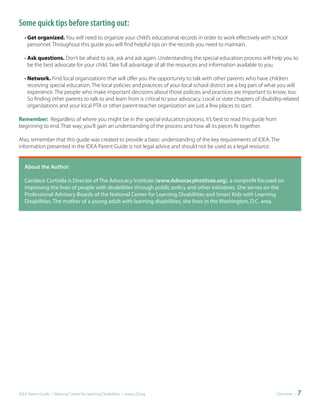
                                            This guide takes you through the special education process – a process that is the same
                                            regardless of your child’s particular difficulties or disabilities. Along the way, special
                                            emphasis is placed on the category of specific learning disability -- only one of the
                                            thirteen disability categories defined by IDEA.

                                            Throughout this guide you will find:

                                                       • Parent Perspectives – brief personal stories that relate the experiences of
                                                         parents like you.

                                                       • Terms – important words and terms that are listed at the beginning of each
                                                         chapter. A complete listing is available in the Terms to Know section.

                                                       • Tools –       helpful information and practical materials for parents such as
                                                         Checklists, Sample Letters, Charts, and Questions to Ask.


Throughout this guide, these important terms are used:

   • Parent. The term “parent” is used to refer to a natural or adoptive parent, an individual acting in place of a natural or
     adoptive parent (such as a grandparent), a foster parent, a guardian or a surrogate parent.

   • School district. The terms “school district” and “school” are used interchangeably to refer to the entity that has legal
     authority, control and responsibility for public education in a city, county, town (or combination of these), or other
     subdivision of a state. Depending on the size of your school and school district, you might find yourself dealing with
     someone at your local school or at a district-level office regarding special education matters.

   • Special education. The term “special education” means specially designed instruction, at no cost to parents, to meet
     the unique needs of a child with a disability. Depending on your child’s needs as well as the state, school district and
     local school policies, special education services may be offered in a variety of ways and in a variety of settings.

As you will discover, special education is complex – full of confusing terms, rigid timelines, and complicated decisions.
However, IDEA makes it clear that parents are full and equal partners with schools in determining and meeting the needs of
a student with a disability. So be sure to approach your child’s educational needs with a sense of equality and confidence.
In your advocacy, treat others with respect and expect the same in return.


IDEA Parent Guide • National Center for Learning Disabilities • www.LD.org                                                      Overview •   6
Some quick tips before starting out:
   • Get organized. You will need to organize your child’s educational records in order to work effectively with school
     personnel. Throughout this guide you will find helpful tips on the records you need to maintain.

   • Ask questions. Don’t be afraid to ask, ask and ask again. Understanding the special education process will help you to
     be the best advocate for your child. Take full advantage of all the resources and information available to you.

   • Network. Find local organizations that will offer you the opportunity to talk with other parents who have children
     receiving special education. The local policies and practices of your local school district are a big part of what you will
     experience. The people who make important decisions about those policies and practices are important to know, too.
     So finding other parents to talk to and learn from is critical to your advocacy. Local or state chapters of disability-related
     organizations and your local PTA or other parent-teacher organization are just a few places to start.

Remember: Regardless of where you might be in the special education process, it’s best to read this guide from
beginning to end. That way, you’ll gain an understanding of the process and how all its pieces fit together.

Also, remember that this guide was created to provide a basic understanding of the key requirements of IDEA. The
information presented in the IDEA Parent Guide is not legal advice and should not be used as a legal resource.


	 	 bout	the	Author:	
  A

	 Candace Cortiella is Director of The Advocacy Institute (www.AdvocacyInstitute.org), a nonprofit focused on
  	
   improving the lives of people with disabilities through public policy and other initiatives. She serves on the
   Professional Advisory Boards of the National Center for Learning Disabilities and Smart Kids with Learning
   Disabilities. The mother of a young adult with learning disabilities, she lives in the Washington, D.C. area.


IDEA Parent Guide • National Center for Learning Disabilities • www.LD.org                                              Overview •   7
1   Who is this for?
                         Pre-referral Services
                             Finding help for your struggling child

     This chapter is for parents who know that their child is struggling in school, but are unsure whether
     or not their child has a learning disability.

     Why is this important?
     Millions of school age children experience difficulties with learning. Their struggles in school may be due to factors
     such as inadequate instruction, cultural or language differences or, in some cases, a learning disability. This chapter
     outlines a number of services and programs that may be available to help these children succeed before they are
     evaluated for special education.

     What can parents do?
     Parents can find out if the school has any additional services that might be available to help their child. This chapter
     explores just a few services available from provisions of IDEA and NCLB. Parents can also ask key questions about
     the quality of instruction and any additional support that their child is receiving.

     Words and terms to know
              Intervention: A change in instructing the student in the area of learning difficulty to try to improve learning and
              achieve adequate progress.

              Pre-referral interventions: Interventions delivered in the student’s regular classroom that attempt to improve
              learning prior to a referral for formal special education evaluation.

              Specific learning disability (SLD): IDEA defines SLD as “A disorder in one or more of the basic psychological
              processes involved in understanding or in using language, spoken or written, which disorder may manifest itself in the
              imperfect ability to listen, think, speak, read, write, spell, or do mathematical calculations.”


Traditionally, when students have not been able to keep up with the rest of the class academically, good teachers have
tried using alternative ways of teaching before referring them for special education. The same is true for students who
present challenging behaviors that interfere with learning. In an attempt to provide this type of early help, many schools,
school districts – and even some states – have established procedures for pre-referral interventions, which are designed to
provide additional support to struggling students.

Your child’s teacher may have discussed this kind of support with you. But if not, and if you suspect your child is struggling,
you should ask to meet with the teacher to discuss your concerns. Frequently, in response to concerns expressed by either
a teacher or a parent, the school will likely offer pre-referral interventions as a ‘first step’ toward improving your child’s
performance. As a parent, it is important that you understand just how pre-referral interventions might work.

Pre-referral services go by many names. Your school district or school may offer support teams, such as teacher assistance
teams or child study teams, to help provide consultation to teachers. To help find the right approach to teaching your
child – often called an instructional method or intervention – the teacher may consult with other teachers, the reading
specialist/teacher, the special education teacher, counselors, psychologists, or other education professionals. They may


IDEA Parent Guide • National Center for Learning Disabilities • www.LD.org                                             Pre-referral Services •   8
conduct informal educational and behavioral evaluations or screenings to make decisions about the services and supports
your child needs.

Feel free to ask questions about the types of teaching methods or interventions the teacher is recommending so you
understand how your child will be taught and what kind of progress is expected. You always have the right to request
a formal evaluation (see Chapter 3) if you don’t believe your child is making adequate progress through pre-referral
approaches.

So, if your child is having trouble learning, it doesn’t necessarily mean that he or she has a disability, such as a specific
learning disability. A learning disability may be one possible source of the problem, but there may be others:

   • The school’s approach to teaching basic academic skills like reading may not be achieving adequate results for all
     students.

   • Your child’s previous learning may not have prepared him or her sufficiently for the lessons the teacher is presenting.

   • Cultural and/or language differences might present a barrier to communication with the teacher or prevent access to
     the learning materials.

   • Another condition, such as attention difficulties, poor hearing, or vision, may be affecting learning.

Here are a few different ways that the school may provide assistance to your child before a formal evaluation for special
education programs is considered:

   • Early Intervening Services
   • Reading First
   • Response-to-Intervention (this third process, strongly encouraged by IDEA 2004, is discussed in detail in Chapter 2)


Early Intervening Services
         A new provision in IDEA 2004 – called Early Intervening Services – is designed to encourage school districts to
         provide additional support for struggling students within the general education classroom.

IDEA 2004 allows school districts the option of using a portion (up to 15%) of their federal special education funds to
develop and implement coordinated Early Intervening Services for children in kindergarten through Grade 12 who are not
currently identified as needing special education or related services but who need additional academic and behavioral
support to succeed in general education. IDEA 2004 particularly encourages school districts to use this new option in
kindergarten through Grade 3.

This money can be used for professional development (teacher training) as well as for providing direct services for your
child. These services may include educational and behavioral evaluations, services and supports such as beginning and/
or remedial reading instruction, interventions to address behavior, small group instruction, and instruction in the use
of adaptive and instructional software (computer programs that improve the student’s access to information or target
specific academic skills). IDEA 2004 requires that the academic and instructional interventions used must be backed by
scientifically-based evidence of their effectiveness.

When these supports are successful, both the school and the student can benefit. The school can save money on costly
evaluations required to determine eligibility for special education as well as the additional costs associated with special
education services. Typically, pre-referral interventions are provided in the student’s regular classroom so they receive
support aimed at helping him or her work at grade level. The goal is to help as many students as possible reach their
potential in school without needing to be placed in special education programs.


IDEA Parent Guide • National Center for Learning Disabilities • www.LD.org                                      Pre-referral Services •   9
Important
                                                                note:
                       Don’t confuse Early Intervening Services with “early intervention services”
                              provided to children younger than school age under IDEA.


Over Identification
In some areas of the U.S., students of different cultural backgrounds are diagnosed as having disabilities more frequently
than would be expected based on their share of the population. For example, African American children may be more
frequently diagnosed as having a disability than white children. This concern with “over identification” is yet another reason
that Early Intervening Services was added to IDEA 2004.

If a school district has been determined to have significant over identification (or “disproportionality”) the district may be
required to use IDEA funds for Early Intervening Services to provide pre-referral services to students showing academic
and/or behavioral difficulties, and particularly for those children in ethnic groups that have been significantly over-
identified as needing special education services.


     Important	note:	

     While Early Intervening Services are funded by IDEA, parents should understand that the Procedural
     Safeguards afforded to students and their parents under IDEA (described in Chapter 4: Procedural Safeguards)
     do not apply to students receiving Early Intervening Services because they are not currently eligible for
     formal services under IDEA, which is explained in Chapter 6: Eligibility Determination. However, some IDEA
     protections, such as those for students involved in school disciplinary actions, may apply. See Chapter 10:
     Student Discipline for additional information.


Reading First
Established by the latest version of the nation’s largest federal education law, the Elementary and Secondary Education Act
(ESEA), also known as No Child Left Behind (NCLB), Reading First is a program designed to establish reading programs for
students in kindergarten through Grade 3 that are based on scientifically-based reading research.

The Reading First program provides funds for teacher training, reading screening and assessments, and instructional
materials and strategies proven to prevent or remediate reading failure. The program is available to elementary schools
with significantly high rates of reading failure.

While learning to read is a complex, multi-dimensional process, NCLB has helped de-mystify reading instruction by
providing what research has determined are the “essential components of reading instruction.         These “essential
components of reading instruction” have also been incorporated into the eligibility provisions of IDEA 2004. This will be
discussed in more detail in Chapter 6: Eligibility Determination. Parents can now use the essential components of reading
instruction to make sure that their child is getting reading instruction based on reading research. Use the
     Reading Instruction Checklist on page 76 to learn what your school’s reading program should include.

There are several other provisions of No Child Left Behind that can be used to provide help for struggling learners. These
provisions are explained in a companion guide entitled “Making the ‘No Child Left Behind Act’ Work for Children
Who Struggle to Learn: A Parent’s Guide” available at www.LD.org/NCLB


IDEA Parent Guide • National Center for Learning Disabilities • www.LD.org                                  Pre-referral Services •   10
Final Word
From this chapter, you should understand that your school may already have pre-
                                                                                          IDEA
referral interventions in place to support struggling students. These services may be
offered using IDEA funds, NCLB programs or a combination of the two. Regardless         Toolkit
of how you and your child’s school might go about finding ways to offer additional
                                                                                        Tools	for	Chapter	1
support and improve learning, it’s important to understand that your school has
both the incentive and funding available to serve your child. And remember, good
                                                                                              Reading Instruction
communication between you and your child’s school is critical to making your child a          Checklist (Page 76)
successful learner. Use the Checklist for Home-School Communications on page
78 to assist you.                                                                             Checklist for
                                                                                              Home-School
In Chapter 2 you’ll learn about another approach for providing early, research-based          Communications
instructional interventions to struggling students. It is known as Response-to-               (Page 78)
Intervention.


IDEA Parent Guide • National Center for Learning Disabilities • www.LD.org                     Pre-referral Services •   11
2   Who is this for?
                         Response-to-Intervention (RTI)
                            A new approach to helping students
                            most at-risk for LD

     This chapter is for parents who know their child is struggling in school, but are unsure whether or not
     their child has a learning disability.
     Why is this important?
     The pre-referral services and programs outlined in Chapter 1 can provide helpful support for struggling students.
     This chapter describes Response-to-Intervention (RTI) – a comprehensive, multi-step process that closely monitors
     how students are responding to different types of services and instruction. RTI provides an improved process of
     pre-referral interventions.
     What can parents do?
     Parents can first find out if their school district uses an RTI process. If the answer is yes, then parents can learn more
     about RTI and ask key questions about how it will be used to help their child.
     Words and terms to know
              Response-to-Intervention (RTI): A comprehensive, multi-step process that closely monitors how the student
              is responding to different types of services and instruction.
              Progress monitoring: A scientifically based practice used to assess students’ academic performance and
              evaluate the effectiveness of instruction. Progress monitoring can be implemented with individual students
              or an entire class.
              Curriculum based measurement (CBM): Tools for measuring student competency and progress in the basic
              skill areas of reading fluency, spelling, mathematics and written language.
              Scientific, research-based instruction: Curriculum and educational interventions that are research based and
              have been proven to be effective for most students
              Universal screening: A step taken by school personnel early in the school year to determine which students
              are “at risk” for not meeting grade level standards. Universal screening can be accomplished by reviewing
              a student’s recent performance on state or district tests or by administering an academic screening to all
              students in a given grade. Students whose scores on the screening fall below a certain cut-off point are
              identified as needing continued progress monitoring and possibly more intensive interventions.


As you learned in Chapter 1: Pre-referral Services, provisions in both IDEA 2004 and No Child Left Behind are designed
to encourage school districts to provide additional support for struggling students within general education. In this
chapter you’ll learn about a process known as Response-to-Intervention (or Responsiveness-to-Intervention)(RTI). IDEA
2004 encourages schools to begin using a process that determines if a student responds to a “scientific, research-based
intervention” as a part of the evaluation procedures to determine which students may have a specific learning disability
(SLD) and need special education.


IDEA Parent Guide • National Center for Learning Disabilities • www.LD.org                                Response-to-Intervention •   12
The growing interest in RTI is closely linked to another significant change made
       by IDEA 2004 – the elimination of the requirement for schools to determine
that a student shows a “severe discrepancy” between intellectual ability and academic       Essential Components
achievement in order to be identified as having an SLD.                                     of RTI
Before IDEA 2004, a student could not be identified as having a specific learning           According to the National
disability unless a “discrepancy” was found in one or more of the following areas:          Research Center on Learning
                                                                                            Disabilities (NRCLD) (www.
   •   oral expression                                                                      nrcld.org), the essential
   •   listening comprehension                                                              components of RTI include:
   •   written expression
   •   basic reading skill                                                                  • Monitoring a student’s
   •   reading comprehension                                                                  progress in the general
   •   mathematics calculation                                                                curriculum using
   •   mathematics reasoning                                                                  appropriate screenings or
                                                                                              tests (assessments)
This “discrepancy” requirement, which has been part of federal special education
                                                                                            • Choosing and
regulations since 1977, has been under attack for some time. Critics charge that the
                                                                                              implementing a
“discrepancy” approach requires students to fail for long periods of time before they         scientifically proven
can be found eligible for special education services. Equally important is the growing        intervention to deal with a
evidence that the “discrepancy” requirement is particularly problematic for students          student’s learning problems
living in poverty, students of culturally different backgrounds and those whose native
language was not English.                                                                   • Following formal guidelines
                                                                                              to decide which students
Relaxing the “discrepancy” requirement, which has been so deeply embedded in                  are not making sufficient
the identification of a specific learning disability, should lead to improvements in          progress or responding to
identification practices and better results for students.                                     the intervention

                                                                                            • Monitoring how the
					 hat	is	RTI?
    W
    	
                                                                                              student responds to the
                                                                                              intervention by using
  The RTI process is a multi-tiered approach to providing services and                        assessments at least once
  interventions to students who struggle with learning at increasing levels of                a week or once every two
  intensity based on progress monitoring and data analysis.                                   weeks

  The RTI process has the potential to limit the amount of academic failure that            • Making sure the
  any student experiences and to increase the accuracy of special education                   intervention is provided
  evaluations. This could also reduce the number of children who have been                    accurately and consistently
  mistakenly identified as having learning disabilities when their learning
                                                                                            • Determining the level of
  problems are actually due to cultural differences or lack of adequate
                                                                                              support that a student
  instruction. Information and data gathered by an RTI process can lead to earlier            needs in order to be
  identification of children who have true disabilities and are in need of special            successful
  education services.
                                                                                            • Giving parents notice of
                                                                                              a referral and a request to
                                                                                              conduct a formal evaluation
RTI vs. Pre-referral Interventions                                                            if a disability is suspected as
                                                                                              required by IDEA
As discussed in Chapter 1, many schools, school districts – and even some states
– have established procedures for pre-referral interventions, which are designed to
provide additional support to struggling students prior to referral for special education
evaluation. However, little research has been done on the effectiveness of this
approach.


IDEA Parent Guide • National Center for Learning Disabilities • www.LD.org                       Response-to-Intervention •   13
Pre-referral interventions have frequently been used without close monitoring or documentation of the student’s progress.
Monitoring and record keeping provide the critical information needed to make decisions about the student’s future
instruction. If monitoring and record keeping doesn’t occur along with pre-referral strategies, the opportunity to make
informed decisions about the student’s future instruction and intervention needs is lost. Equally important, the adequacy
of the instruction being delivered in the general education classroom where the student was experiencing learning
difficulties has not usually been examined. Frequently, the instructional program being used in general education, such as
the beginning reading program, is not scientifically based and does not have a high success rate for most children.

In contrast, successful implementation of RTI requires a number of essential components that ensure high-quality
instruction, careful monitoring and documenting of progress and close collaboration between general education and
special education.

A three-tier RTI model includes:
	
        Tier	1:	Screening	and	Group	Interventions
        Students who are “at-risk” are identified using universal screenings and/or results
        on state or district-wide tests and could include weekly progress monitoring of all
        students for a brief period. Identified students receive supplemental instruction,
        or interventions, generally delivered in small groups during the student’s regular
        school day in the regular classroom. The length of time for this step can vary, but it
        generally should not exceed eight weeks. During that time, student progress is
        closely monitored using a validated screening system such as curriculum based measurement (see below). At the end
        of this period, students showing significant progress are generally returned to the regular classroom program. (Note: this
        step may be broken into 2 separate tiers in a 4-tier model) Students not showing adequate progress are moved to Tier 2.

	       Tier	2:	Targeted	Interventions
        Students not making adequate progress in the regular classroom in Tier 1 are
        provided with more intensive services and interventions. These services are provided
        in addition to instruction in the general curriculum. These interventions are provided
        in small group settings. In the early grades (K-3) interventions are usually in the areas
        of reading and math. A longer period of time may be required for this tier, but it
        should generally not exceed a grading period. Students who continue to show too
        little progress at this level of intervention are then considered for more intensive
        interventions as part of Tier 3.

        Depending on a school’s particular model of RTI, parents may or may not be involved in Tier 2. Ideally, schools involve
        parents at the earliest stages of RTI by explaining the process in face-to-face meetings, providing written intervention
        plans and requesting parental consent.

        Tier	3:	Intensive	Interventions	and	Comprehensive	Evaluation
        Students receive individualized, intensive interventions that target the student’s skill
        deficits. Students who do not respond to these targeted interventions are then
        considered for eligibility as required by the Individuals with Disabilities Education
        Act (IDEA) (see Chapters 5 and 6). The data collected during Tiers 1, 2 and 3 are
        included and used to make the eligibility decision. (Note: This part of the process
        may be broken into 2 separate tiers in a 4-tier model).

        At any point in an RTI process, IDEA allows parents to request a formal evaluation to determine eligibility for special
        education. An RTI process cannot be used to deny or delay a formal evaluation for special education.

        *Images reprinted with permission of the IRIS Center (OSEP grant H325F01003) and the TN State Improvement Grant (OSEP grant H323A030007).
         http://iris.peabody.vanderbilt.edu/


IDEA Parent Guide • National Center for Learning Disabilities • www.LD.org                                                              Response-to-Intervention •   14
Curriculum Based Measurement (CBM)
CBM is one way of tracking and recording a child’s progress in specific learning areas.
                                                                                                    IDEA
Using CBM, teachers regularly assess students’ performance (e.g., each week) using very
brief, simple tests. The results help teachers determine whether students are learning            Toolkit
well from their instructional program. CBM results also provide the teacher with the
                                                                                                  Tools	for	Chapter	2
information needed to tailor instruction for a particular student. CBM practices, supported
by a great deal of research, are available in pre-reading, reading, spelling, mathematics and            Ten Questions to Ask
written expression for grades 1-6. Procedures have also been developed for kindergarten                  About RTI (page 79)
and middle school.

Written Intervention Plans
If your child’s school is using an RTI process to address your child’s difficulties, you should
expect to receive a written intervention plan. This plan should include details about how
the school is planning on helping your child. The written intervention plan should be fully
explained to you and should include the following:

        • A description of the specific intervention
        • The length of time (such as the number of weeks) that will be allowed for the
          intervention to have a positive effect
        • The number of minutes per day the intervention will be implemented (such as 30
          to 45 minutes)
        • The persons responsible for providing the intervention
        • The location where the intervention will be provided
        • The factors for judging whether the student is experiencing success
        • A description of the progress monitoring strategy or approach, such as CBM, that
          will be used
        • A progress monitoring schedule

The instructional interventions used as part of an RTI process should provide targeted
assistance based on progress monitoring, be delivered by a highly qualified classroom
teacher or another specialist and provide additional instruction on an individual or small
group basis (with or without technology assistance).

The following practices are not appropriate instructional interventions and should not be
part of an RTI intervention plan:

        • Special or re-assigned seating in the classroom
        • Shortened assignments
        • Communications with the parent about the child at regular parent-teacher
          conferences or other informal communications
        • Classroom observations
        • Suspension
        • Retention
        • More of the same/general classroom instruction and/or assignments

As school districts work to improve the process of identifying students who have a specific
learning disability and need special education services, parents need to understand
the components essential to the appropriate implementation of RTI. Use the       Ten
Questions to Ask about response-to-Intervention (RTI) on page 79 to help guide
you through the process.

IDEA Parent Guide • National Center for Learning Disabilities • www.LD.org                          Response-to-Intervention •   15
3   Who is this for?
                         Referral or Request for Evaluation
                             Taking the first step toward
                             special education

     This chapter is for parents who are considering asking for a formal evaluation of their child
     (testing to determine if the child has a disability) or who have received a request from the
     school to have their child evaluated.

     Why is this important?
     In order for a child to receive special education services, he or she must first be evaluated.
     A referral from the school or a request for formal evaluation from a parent sets into motion a host of legal
     obligations and procedures required by IDEA. This chapter outlines what will happen when either a parent or
     school district requests an evaluation. It is important for parents to understand their rights and options during this
     process. If an evaluation is conducted by the school, there is no cost to the parent.

     What can parents do?
     Parents can be prepared to participate in the referral and evaluation process. An important first step is learning
     how to organize concerns by keeping detailed records and then sharing relevant information during formal
     communication with the school. Parents can also learn more about the common signs of learning disabilities.

     Words and terms to know
              Child find: Ongoing activities undertaken by states and local school districts to locate, identify, and evaluate
              all children residing in the state who are suspected of having disabilities so that a free appropriate public
              education (FAPE) can be made available to all eligible children, including all children in public and private
              schools, including religious schools.
              Free Appropriate Public Education (FAPE): Special education and related services that are provided at
              public expense, under public supervision and direction, and without charge to the parent, and that meet the
              standards of the state education department. Special education and related services must be provided in
              conformity with an Individualized Education Program (IEP) as required by IDEA.
              Informed consent: Procedure to ensure that the parent:

                   • Has been fully informed of all information related to the proposed activity (in his native language, or
                     other mode of communication)
                   • Understands and agrees in writing to carrying out the activity for which his consent is sought
                   • Understands that giving consent is voluntary and may be revoked at any time
                   • Understands that revoking consent will not apply to an activity that has already occurred
              Informed consent is required for an evaluation, a reevaluation and for the initial delivery of special
              education services.


IDEA Parent Guide • National Center for Learning Disabilities • www.LD.org                           Referral or Request for Evaluation •   16
In Chapter 1: Pre-referral Services you learned about a variety of possibilities to help
                                            address your child’s learning problems before a referral is made for special education
                                            evaluation. Chapter 2: Response-to-Intervention introduced a process intended to
                                            improve both pre-referral services and determining individual student needs. This chapter
                                            describes the process of formally referring students for special education evaluation.

                                            The first step in the special education process is the referral (or request) for an evaluation
                                            of a student.

                                                  IDEA 2004 clearly establishes that either a child’s parent or school district can
                                                  initiate a request for an evaluation to determine if a student is a child with a
                                            disability and needs special education.

                                    Making a request for a formal evaluation does not give the school district your permission
                                    to begin special education services. If the results of the evaluation indicate that your child
                                    needs special education, you and your school will develop an educational plan tailored to
your child’s specific needs. At that point, you must provide consent for any special education services to begin.

A referral for evaluation sets into motion a host of legal obligations and procedures that are complex – even daunting
– for parents. Understanding special education procedures will enable you to act in the best interest of your child during
each phase of the process.

No matter who requests the evaluation, it is conducted at no cost to the parents, and parents are an essential part of the
process.


	 Private	Evaluations	At	Private	Expense

   Parents can and often do choose to have their child evaluated privately, as opposed to asking the school to do
   an evaluation. If you choose to obtain a private evaluation, the school is not responsible for the cost of the
   evaluation. You can decide whether or not to share the results of a private evaluation with your child’s school.


Requests by the Parent
If your child is experiencing academic problems at school, you may suspect your child has a disability such as a specific
learning disability and needs additional help available only through special education programs and services.

Research has provided the basis for a reliable list of “warning signs” which may strongly suggest the presence of a learning
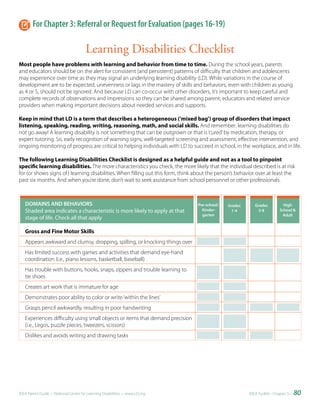
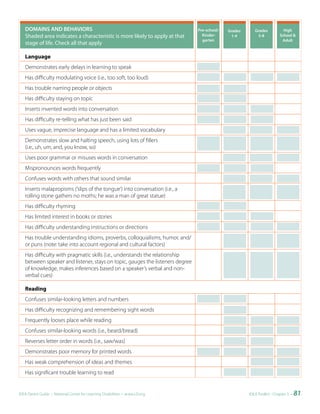
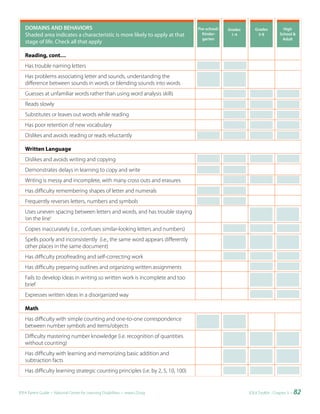
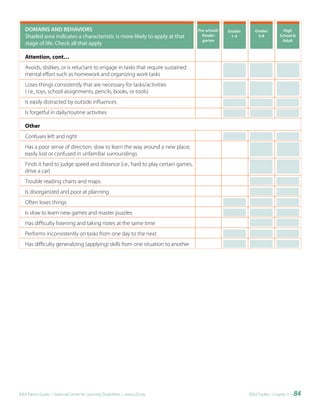
disability. The signs will differ depending on the age of the child. Use the    Learning Disabilities Checklist on page 80
to determine if your child is showing significant signs on an ongoing basis.

If you haven’t already started keeping careful records about your child’s educational experiences, now is the time.
Information about your child’s school experience, evaluation results, meetings with teachers, counselors, specialists,
administrators and any decisions made regarding your child’s education will be critical to your child’s case and to making
the decisions that will most benefit your child. It can be helpful to keep records in chronological order. Review the
    Types of Records a Parent Should Keep on page 85 to help you set up your records.

You can begin the process of special education evaluation at any time. However, it may be wise to do some homework
before formally requesting an evaluation of your child.


IDEA Parent Guide • National Center for Learning Disabilities • www.LD.org                                 Referral or Request for Evaluation •   17
Consider these pre-referral activities:

   • Talk to the Teacher. If you haven’t already met with your child’s teacher to discuss your concerns, consider this as a
     first step.

   • Learn about Special Education Services. Talk to your school’s principal about the special education services
     available at your child’s school. Inquire about the training and qualifications of special education teachers and the
     instructional approaches they use to work with students identified with learning disabilities so you know about the
     qualifications of the personnel in your school. Finally, ask about the evaluation and eligibility process in your school
     district and get any printed information available for parents.

   • Contact Your PTI. Get in touch with the Parent Training and Information Center (PTI) in your state. Each state has at
     least one PTI, supported by funding from the U.S. Department of Education. Your PTI can help you understand the
     particular “ins and outs” of special education in your state. Ask for any printed information that will help you understand
     the process. Go to www.LD.org/PTIlocator to find your state’s PTI.

Once you decide to make a formal request for evaluation, it is up to you to contact your school district and explain your
concerns. Always make your request in writing, and clearly present the reasons for your concern.

In your written request, describe and be prepared to provide specific examples of the problems your child is having.
Items such as work samples, handwriting samples, assessment records, etc. should be used to provide background and
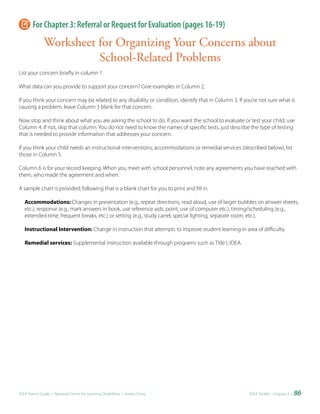
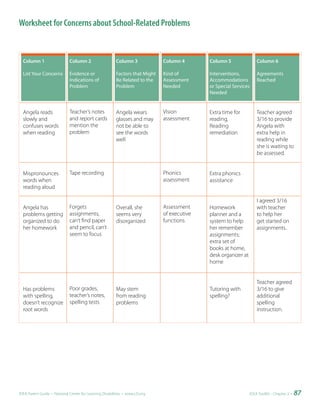
evidence of your concerns. It may be helpful to organize your thoughts and concerns using the    Worksheet for
Organizing Your Concerns about School-Related Problems located on page 86.

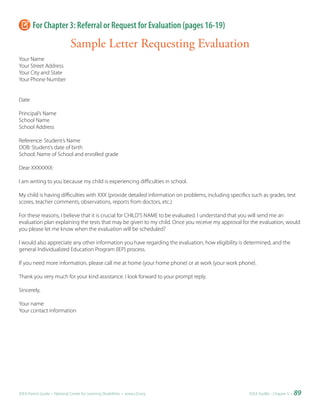
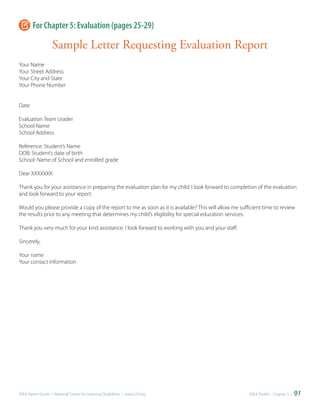
Use the      Sample Letter Requesting Evaluation on page 89 to create your letter to your child’s school requesting an
evaluation for special education.

When the school district gets your request, the district will need to decide whether or not to evaluate your child. They need
to determine if your child shows evidence of a suspected disability and whether or not there is sufficient evidence to call
for an evaluation.

You should receive a written confirmation of your request from the school district, along with a copy of your Procedural
Safeguards, a document which describes your legal rights and protections under IDEA. The information required in the
Procedural Safeguards notice is presented in Chapter 4: Procedural Safeguards.

   Important note: In many cases, schools and school districts will have “pre-referral intervention” processes they will
   want to use – or possibly are required to use – prior to formal special education evaluation. Some of these options were
   discussed in Chapter 1: Pre-referral Services and Chapter 2: Response-to-Intervention.

If the school determines that your child should be evaluated for potential special education eligibility, the district must
request your informed consent, or permission, to proceed with the evaluation.

If the school decides that there is not enough evidence of a “suspected disability” and, therefore, denies your request for
an evaluation, the school must provide you with a written notice of its decision. Known as Prior Written Notice, this notice
must include:

   • A description of the action proposed or refused by the district
   • An explanation of why the district proposes or refuses to take the action and a description of all student information
     used as a basis for the decision
   • A statement that the parents have protection under the Procedural Safeguards (as described in Chapter 4: Procedural
     Safeguards)


IDEA Parent Guide • National Center for Learning Disabilities • www.LD.org                       Referral or Request for Evaluation •   18
• Sources for parents to contact or to obtain assistance in understanding the
     various provisions of their rights under IDEA
   • A description of other options considered and the reason why those options
                                                                                                 IDEA
     were rejected
   • A description of the factors that impacted the district’s proposal or refusal             Toolkit
                                                                                                Tools	for	Chapter	2
At that point, you may go forward with your right to challenge the district’s decision.
Options to resolve disputes between parents and schools under IDEA are covered in                         Learning Disabilities
Chapter 11: Dispute Resolution Options.                                                                   Checklist (Page 80)

                                                                                                          Types of Records a
	 	        A	Word	About	Medication                                                                        Parent Should Keep
                                                                                                          (Page 85)
   IDEA 2004 establishes a new requirement that each state must have a policy
                                                                                                          Sample Letter
   that prohibits school districts from requiring a child to be taking medication,
                                                                                                          Requesting Evaluation
   such as those frequently prescribed for children with attentional disorders
                                                                                                          (Page 89)
   such as Attention Deficit Hyperactivity Disorder (ADHD), as a condition of
   attending school, receiving an evaluation, or receiving services under IDEA.                           Organzing Your
   While ADD/ADHD is not a learning disability, some students may have both                               Concerns Chart
   ADD/ADHD and LD.                                                                                       (Page 86)


Requests by the School District
As part of their responsibilities under IDEA, school districts are required to identify,
locate and evaluate all children who may be in need of special education in their
district. Activities related to this duty are called “Child find” under IDEA.

      This “Child find” obligation includes students who are homeless or are wards
     of the state (such as a foster child or a child in the custody of a public child
welfare agency) and students attending private schools (see Chapter 9: Private
School Students), as clarified by IDEA 2004.

When a school district proposes to conduct an initial evaluation of a child to
determine his or her eligibility for IDEA services, it must notify the parent in writing and
request the parent’s informed consent for the evaluation to proceed.

If the parent chooses to refuse to provide consent for the initial evaluation or does not
respond to the request to provide consent for the initial evaluation of a child attending
public school, the school district may pursue the initial evaluation by using the dispute
resolution procedures described in Chapter 11: Dispute Resolution Options.

In the next chapter you’ll learn about your Procedural Safeguards, which spell out the
rights of children with disabilities and their parents.


IDEA Parent Guide • National Center for Learning Disabilities • www.LD.org                     Referral or Request for Evaluation •   19
4   Who is this for?
                         Procedural Safeguards
                             Understanding and excercising
                             your legal rights
     This chapter is for parents who have officially requested that the school district evaluate their child
     for the presence of a disability – and for parents who have already given the district permission to do so.
     Why is this important?
     Once it has been established that a child will be evaluated, the school is required by law to give parents a copy of
     the “Procedural Safeguards Notice.” This written document tells parents what legal rights they have in order to make
     sure that their child receives the services that he or she needs. When parents understand these rights, they can take
     action when necessary to ensure that the special education process is working in the best interests of their child.
     What can parents do?
     Parents can contact the Parent Training and Information Center (PTI) in their state for a more detailed explanation
     of the Procedural Safeguards Notice.
     Words and terms to know
              Parent: A natural, adoptive or foster parent; an individual acting in the place of a natural or adoptive parent; an
              individual who is legally responsible for the child; a guardian; or a surrogate parent.

              Prior Written Notice: A written notice that the school must provide to the parents of a student with a disability within
              a reasonable time if they wish to:
              • Evaluate the student
              • Determine whether the student is eligible for special education services
              • Change the student’s evaluation or educational placement or educational plan (IEP)
              • Refuse the parents’ request to evaluate their child or change their child’s educational plan (IEP) or placement.


In the last chapter you learned about the process involved in making a formal request for an evaluation of your child. That
request, once made, triggers a requirement for your school district to provide you with a copy of a notice known as the
Procedural Safeguards Notice – a formal document that describes the rights and protections of both you and your
child.

The federal IDEA law promotes parents’ involvement in the education of their child, and it incorporates parents’ and
children’s rights as well as certain protections for these rights. These protections are embedded in the procedures
that states are required to follow as they evaluate students and provide special education services. Collectively, these
protections are called procedural safeguards.

Since state laws also govern special education services, procedural safeguards notices may be different across states and
school districts. However, all procedural safeguards notices must include the safeguards of parents’ and students’ rights that
are required by IDEA (see table below).

     The Procedural Safeguards Notice, containing all of the information required by IDEA, must be provided to
     parents at very specific points along the way. IDEA 2004 changed the points at which the school must provide
parents with the Procedural Safeguards Notice and reduced the number of times a parent must get the notice. However,
parents may request a copy of the Procedural Safeguards Notice at any time. (Many states place a copy of the procedural
safegaurds notice on its Internet Web site.)

IDEA Parent Guide • National Center for Learning Disabilities • www.LD.org                                            Procedural Safeguards •   20
Schools must provide a copy of the Procedural Safeguards Notice:

•   Upon initial referral or parental request for evaluation
•   Once each school year (for students eligible for IDEA services)
•   When parents first file a complaint (either a state complaint or due process complaint)
•   When the student is removed from his or her current educational placement because of a violation of a code of conduct
•   Upon request by the parent.

The Procedural Safeguards Notice must be written in the native language of the parents (unless it is clearly not feasible to
do so) and it must be written in a way that is easy to understand.


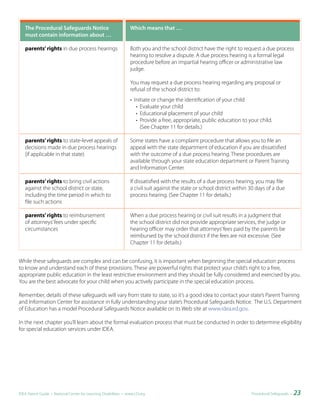
    The	Procedural	Safeguards	Notice	                            Which	means	that	…
    must	contain	information	about	…

    parents’ rights to obtain independent                        You have the right to have your child evaluated by professionals from
    educational evaluations (IEE)*                               outside the school district if you disagree with an evaluation that has
                                                                 been conducted by the school district. The school district is required
    (*An IEE at public expense may be                            to allow outside evaluations but is not required to accept the results.
    requested whenever a parent disagrees                        Generally, you must pay for this evaluation; however, if it is determined
    with an evaluation that has been                             that the school district’s prior evaluation was inappropriate, you will be
    conducted by the school. Parents are                         reimbursed for the cost of the evaluation. (Be sure to learn about your
    entitled to only one IEE each time the                       state or district policy regarding IEE.)
    school conducts an evaluation)


    parents’ rights to receive prior written                     The school district is required to notify you beforehand if they wish to:
    notice any time the school district plans                      • Evaluate your child
    to evaluate the student, schedules                             • Determine whether your child is eligible for special education
    a meeting where decisions will be                                services
    made about the student’s eligibility or                        • Change your child’s evaluation or educational placement or plan.
    educational placement or refuses to
    evaluate or change the student’s plan                        If you request evaluations and changes in your child’s educational plan
    or placement.                                                or placement, and if the school district refuses, they must give you prior
                                                                 written notice that explains their decision.


    parents’ rights to consent to                                The school district must obtain your written, informed consent before
    evaluations and to the school providing                      they can evaluate your child or begin to provide special education
    special education services                                   services to your child (following initial evaluation and eligibility).
                                                                 Their request for your consent must include specific information
                                                                 about the proposed activity and it must be presented in a way that is
                                                                 understandable to you. Until you give them your written consent, they
                                                                 are not required to provide special education services. You may consent
                                                                 to all or some of the services offered by the school. If there are some
                                                                 services you do not want your child to have, the school district must
                                                                 still provide the services to which you do consent.


IDEA Parent Guide • National Center for Learning Disabilities • www.LD.org                                              Procedural Safeguards •   21
The	Procedural	Safeguards	Notice	                             Which	means	that	…
   must	contain	information	about	…

   parents’ rights to have access to their                       You have the right to see your child’s educational records, to have
   child’s educational records                                   copies and to have the records explained to you by school officials.
                                                                 If the records contain inaccurate or misleading information, you may
                                                                 ask that they be changed or make a written request for a hearing to
                                                                 challenge the information.

                                                                 School districts may release your child’s records without your consent
                                                                 to other school officials or teachers who have legitimate educational
                                                                 interests in your child. They may also release records without consent in
                                                                 health or safety emergencies. If your child transfers to another district,
                                                                 the school district may release the records if you are informed that the
                                                                 records will be forwarded and have a chance to request the records
                                                                 and challenge any misinformation.

   parents’ rights to present and resolve                        You must present complaints within two years of the alleged action (or
   a complaint through the due process                           within the period specified by your state’s law).
   complaint and state complaint process,                        Note: In this context, a “complaint” is a legal document that states a
   including:                                                    plaintiff’s case against a defendant.
                                                                 Procedures for resolving parents’ complaints against school districts
       • The time period parents have in
                                                                 include:
         which to make a complaint
       • How the school district or state may                       •   Mediation
          resolve the complaint                                     •   Resolution meetings
       • The difference between the due                             •   Due process hearings
         process and state complaint                                •   Appeals to state or federal courts.
         procedures
                                                                 While your complaint is being resolved, your child will remain in his or
       • The availability of mediation
                                                                 her present educational placement unless you and the school district
         services
                                                                 agree otherwise, or if other circumstances apply. (See Chapter 11 for
       • The student’s educational
                                                                 details.)
         placement while the complaint is
         being resolved.
                                                                 Each state must also have a state complaint procedure that individuals
                                                                 or organizations may use to file complaints against a school district or
                                                                 districts. (See Chapter 11 for details.)

   students’ rights regarding the process                        If your child possesses or attempts to sell a weapon or illegal drugs,
   to determine if they can be placed in an                      or inflicts serious bodily harm on another person at school, on school
   interim alternative educational setting                       grounds or at a school function, the school district may place your
                                                                 child in an interim alternative educational setting (IAES), such as an
                                                                 alternative school, for up to 45 school days, without your written
                                                                 consent, whether your child has a disability or not. (See Chapter 11
                                                                  for details.)

   parents’ rights regarding unilateral                          If you choose to place your child in a private school without the
   placement in private schools at public                        consent of the school district, the district is not required to pay for the
   expense                                                       cost of the private school. However, if your child previously received
                                                                 special education from the school district, and it is determined through
                                                                 legal procedures that these services were inappropriate, then the
                                                                 district may be ordered to pay for the private school. (See Chapter 9
                                                                  for details.)


IDEA Parent Guide • National Center for Learning Disabilities • www.LD.org                                              Procedural Safeguards •   22
The	Procedural	Safeguards	Notice	                             Which	means	that	…
   must	contain	information	about	…

   parents’ rights in due process hearings                       Both you and the school district have the right to request a due process
                                                                 hearing to resolve a dispute. A due process hearing is a formal legal
                                                                 procedure before an impartial hearing officer or administrative law
                                                                 judge.

                                                                 You may request a due process hearing regarding any proposal or
                                                                 refusal of the school district to:
                                                                 • Initiate or change the identification of your child
                                                                    • Evaluate your child
                                                                    • Educational placement of your child
                                                                    • Provide a free, appropriate, public education to your child.
                                                                      (See Chapter 11 for details.)

   parents’ rights to state-level appeals of                     Some states have a complaint procedure that allows you to file an
   decisions made in due process hearings                        appeal with the state department of education if you are dissatisfied
   (if applicable in that state)                                 with the outcome of a due process hearing. These procedures are
                                                                 available through your state education department or Parent Training
                                                                 and Information Center.

   parents’ rights to bring civil actions                        If dissatisfied with the results of a due process hearing, you may file
   against the school district or state,                         a civil suit against the state or school district within 30 days of a due
   including the time period in which to                         process hearing. (See Chapter 11 for details.)
   file such actions

   parents’ rights to reimbursement                              When a due process hearing or civil suit results in a judgment that
   of attorneys’ fees under specific                             the school district did not provide appropriate services, the judge or
   circumstances                                                 hearing officer may order that attorneys’ fees paid by the parents be
                                                                 reimbursed by the school district if the fees are not excessive. (See
                                                                 Chapter 11 for details.)


While these safeguards are complex and can be confusing, it is important when beginning the special education process
to know and understand each of these provisions. These are powerful rights that protect your child’s right to a free,
appropriate public education in the least restrictive environment and they should be fully considered and exercised by you.
You are the best advocate for your child when you actively participate in the special education process.

Remember, details of these safeguards will vary from state to state, so it’s a good idea to contact your state’s Parent Training
and Information Center for assistance in fully understanding your state’s Procedural Safeguards Notice. The U.S. Department
of Education has a model Procedural Safeguards Notice available on its Web site at www.idea.ed.gov.

In the next chapter you’ll learn about the formal evaluation process that must be conducted in order to determine eligibility
for special education services under IDEA.


IDEA Parent Guide • National Center for Learning Disabilities • www.LD.org                                                Procedural Safeguards •   23
Parent
     Perspectives
     Those	Three	Words:	Prior	Written	Notice

     My name is Alex, and I am the father of twin second graders, Holly and Josh, who attend elementary school in Delaware.
     Holly and Josh were born 12 weeks premature. Their pre-maturity resulted in both children having hydrocephalous as well
     as various learning disabilities. I have participated in IEP meetings for five years starting when Holly and Josh were three
     years old.

     At each IEP meeting I was given a small booklet that described a parent’s procedural safeguards under IDEA. To be honest,
     I never actually read through it. I always trusted school staff and assumed that the teachers and therapists would do all
     they could to meet my children’s specific needs. The district staff never took the time to go over the procedural safeguards
     document with me and I never realized exactly how important knowing your rights could be.

     Then, at my last IEP meeting, I was told that my daughter Holly had only made one month of progress in reading during
     the previous twelve months time and that she was falling farther and farther behind.

     During her IEP meeting I asked for some additional intervention from the school reading specialist, but was told the
     reading specialist was already seeing too many children and did not have any additional time available to spend with
     my daughter. The school staff told me that Holly would just have to make due with the small group instruction she was
     getting in the special ed classroom.

     I really didn’t know what to say. Luckily I talked to other parents and they recommended that I attend a seminar sponsored
     by our district’s special needs PTA. A representative from our state’s Parent Information Center was there as well as two
     attorneys who explained, step by step, all of the parent rights described in that little book that I had previously never read.
     It was there that I learned the three most important words that a parent of a child with disabilities needs to know: “Prior
     Written Notice.” I had heard district staff use this term once in a while, and thought that it only meant that the district had
     to give you 10 days notice before scheduling an IEP meeting. It actually means a whole lot more.

     At the special needs PTA meeting I learned that Prior Written Notice means that when a school district adds, changes,
     or denies educational services to your child, they must explain to the parent in writing why the services are being added,
     changed, or denied. If the school district is denying your services, they most likely will not provide you prior written notice
     voluntarily – you will have to ask them to do it.

     I have found that my state’s Parent Training and Information Center and our District’s Special Needs PTA can be extremely
     valuable resources. In my situation, the school district took our concerns more seriously when we requested them to give
     us Prior Written Notice concerning why my request for time with the reading specialist was being denied.

     The district ended up re-evaluating her reading skills and assigned a reading specialist to coach her teacher on how to
     better teach to my daughter. It’s not exactly what I wanted, but it’s a start. I’m hopeful that the district will agree with
     me and get my daughter the additional help she needs. In the meantime, we are using a private tutoring service to
     supplement her instruction.

     I’m sure my story isn’t all that unique but I can’t emphasize enough how important it is to know your rights under IDEA
     – especially those three words: Prior Written Notice. They can make some powerful things happen for you that might
     change the outcome for your child. Hang in there – you are not alone.

     Sincerely,

     Alex from Delaware


IDEA Parent Guide • National Center for Learning Disabilities • www.LD.org                                         Procedural Safeguards •   24
5   Who is this for?
                         Evaluation
                             Learning more about your child

     This chapter is for the parents of students who have been referred for a formal evaluation as
     prescribed by IDEA, and for parents of students already eligible for special education services who are
     referred for a reevaluation.
     Why is this important?
     IDEA contains very specific requirements for a student evaluation. Parents need to understand all aspects of the
     evaluation process in order to be full participants in all decisions involving their child. The evaluation results will be
     used to make important decisions about their child’s educational future.
     What can parents do?
     Parents can and should actively participate in planning for their child’s evaluation. They need to understand the
     school’s proposed evaluation plan and ensure that a comprehensive evaluation is conducted. Parents may find it
     helpful to use the   Questions to Ask About Evaluation Plans on page 90.
     Words and terms to know
              Child with a disability: A child who has a disability as defined in one of the 13 disability categories in IDEA
              and who needs special education and related services because of the disability; or a child aged 3 through 9
              who is experiencing developmental delays.


Initial Evaluation
In previous chapters you’ve learned about several steps that lead up to a formal student evaluation, including Pre-referral
Services, Response-to-Intervention, Referral or Request for Evaluation and Procedural Safeguards. This chapter will provide
you with an overview of the initial evaluation and reevaluation processes.

                                            At this stage of the special education process, both the parent and the school district
                                            have agreed to conduct a formal student evaluation. The student’s parents have received
                                            their Procedural Safeguards Notice and have provided informed consent, or permission,
                                            for the evaluation to proceed.

                                            By providing consent for an initial evaluation, you are not giving permission for your child
                                            to receive special education services. You are only consenting to the evaluation process. If
                                            your child is found eligible for special education services, you will be required to provide
                                            informed consent for the services before they can begin.

                                            An initial evaluation is conducted to provide information that will be used to determine
                                            if your child is a child with a disability as defined by IDEA, and, because of that disability,
                                            needs special education and related services. The evaluation process includes a variety
                                            of tests to measure your child’s cognitive ability, academic skills, language skills, and
                                            social and emotional status. Evaluations may include reports written about your child
                                            that include observations of your child in the classroom and other school settings, and


IDEA Parent Guide • National Center for Learning Disabilities • www.LD.org                                                     Evaluation •   25
standardized tests. If your child is found eligible for special education under IDEA,
the evaluation information will also be used to develop his or her Individualized
Education Program (IEP), which will be discussed in Chapter 7: Individualized               Evaluations vs.
Education Programs.                                                                         Assessments
Timeline for Initial Evaluation. Many states have established specific timeframes in        The No Child Left Behind
which a student evaluation must be completed once you provide informed parental             Act (NCLB) requires all
consent. You need to know your state’s timeline for evaluation – including whether          states to administer
the timeline is in calendar days or schools days. Mark your calendar on the date your       statewide assessments of
child’s evaluation begins and when it should be complete.                                   reading/language arts and
                                                                                            mathematics in grades 3
                                                                                            through 8 and once between
     If you live in a state that does not have an established timeline for completing
                                                                                            grades 10 and 12. Many
     an evaluation, IDEA 2004 requires that the evaluation be conducted within 60           states have additional state
calendar days of receiving parental consent. Exceptions to this timeframe apply if the      or district-wide assessments
parent does not make the child available for evaluation, or if the student transfers to     that are administered to all
another school district.                                                                    students to measure their
                                                                                            academic performance
       Schools routinely perform screenings and other informal assessments to               against the state’s academic
       all students to assist with their instructional programs. IDEA 2004 makes it         standards. Several states have
clear that screenings administered by a teacher or other specialist for the purpose         tests that students must pass
of determining instructional strategies are not to be considered as an evaluation for       to earn a standard high school
special education. Parental consent is not required for school-wide assessments or          diploma or to be promoted to
                                                                                            the next grade.
screenings unless consent is required for all students.
                                                                                            A student’s performance
Evaluation Notice                                                                           on these state or district
                                                                                            assessments can provide
 The school district will provide you with an Evaluation Notice, or evaluation plan, that   helpful information about
describes any tests the school proposes to conduct during the evaluation. Since IDEA        the student’s rate of progress
contains a number of legal requirements for conducting evaluations, you should be           and academic achievement as
sure that the process outlined and types of tests described in the evaluation notice        compared to his or her peers
                                                                                            in the same grade. However,
reflect these requirements, are broad enough to provide a complete picture of your
                                                                                            such assessments do not
child, take into consideration the concerns you have raised in your communications
                                                                                            provide the comprehensive,
with the school, and will provide the information needed to design your child’s             individualized information
educational program. Refer to the      Worksheet for Organizing Your Concerns               required by IDEA in order to
about School-Related Problems on page 86 to assist in your review of the                    make a determination for
proposed evaluation plan.                                                                   special education eligibility.
                                                                                            That comprehensive,
This is the beginning of your full and equal participation in the special education         individualized information
process – participation that is very important to your child’s school success. While the    comes from a formal
terms and jargon used in the world of educational and psychological testing can be          evaluation.
confusing and intimidating, make time to learn about the various tests the school
district proposes in the evaluation plan.

Ask to meet with the evaluator or the school’s special education administrator to
discuss the tests that are proposed, what they measure, and when and how they
will be administered. While providing parents with an opportunity to meet and
discuss the proposed evaluation process isn’t required by IDEA, it’s a good way for
you to gain a full understanding of what is being proposed and how the results will
help everyone make informed decisions about services and supports that might be
appropriate. Ask for any resources that might help further your understanding, and
take the opportunity to visit the library or do an online search. Use the  Questions
to Ask About Evaluation Plans on page 90 to help you decide if the proposed plan
is right for your child and to improve your understanding of the plan.

IDEA Parent Guide • National Center for Learning Disabilities • www.LD.org                                  Evaluation •   26
IDEA requires that the school must review evaluations and information provided by
parents. The information you provide as part of the evaluation process is extremely
important. Also, you may be asked to conduct parts of the evaluation yourself, such       Examples of
as filling out checklists and reporting observations of your child.                       information that
                                                                                          parents can provide
                                                                                          from their records
Requirements for Evaluation
                                                                                            • Prior teacher and parent
According to IDEA, your school district must conduct an evaluation that:                      reports
• Uses a variety of different tests (assessments), procedures, tools and strategies to      • Information from
  gather relevant functional, developmental and academic information (including               parents’ research about
  information provided by the parent); this information may be used to help decide            their child’s disability
  whether your child has a disability, and it can help when developing your child’s
  Individualized Education Program (IEP)                                                    • Results of private
                                                                                              screening or testing (paid
• Ensures that your child is evaluated in all areas in which a disability is suspected        for by parents or private
                                                                                              insurance)
• Does not use any single measure or test as the sole basis for deciding whether your
  child has a disability, or for developing an appropriate educational program for your     • Information from private
  child                                                                                       tutors and therapists

• Uses evaluation tools and strategies that provide relevant information that directly      • Letters from a family
  support decisions about the educational needs of your child                                 doctor
                                                                                            • School reports
• Uses technically sound testing instruments to determine the roles that cognitive
  and behavioral factors, in addition to physical or developmental factors, are playing     • Samples of school
  in your child’s difficulties. These testing instruments must be:                            performance

   • Selected and administered so they do not discriminate on a racial or cultural
      basis
   • Used for purposes for which the assessments or measures are proven to be valid
     and reliable
   • Administered by trained and knowledgeable personnel
   • Administered according to the specific instructions provided by the producer of
     the assessments.

     Additional requirements for evaluations were added in IDEA 2004. Now
     assessments must be provided and administered in the language and form
most likely to yield accurate information on what the student knows and can do
academically, developmentally and functionally. For example, the assessments should
be administered in Spanish, or Braille, or sign language, if that’s the student’s usual
mode of communication.

In addition to the results of the evaluation procedures conducted as required above,
an initial evaluation must also include any existing data on your child, such as:
   • Information and data collected during pre-referral interventions or a response-to-
     intervention process (as described in Chapter 1 and Chapter 2)
   • Evaluations and information provided by the parents
   • Current classroom-based, local or state assessment results
   • Observations by teachers, school psychologists and related service providers
     (such as speech-language pathologists, occupational therapists and physical
     therapists).


IDEA Parent Guide • National Center for Learning Disabilities • www.LD.org                                Evaluation •   27
Evaluation	and	Response-to-Intervention	(RTI)

    As noted in Chapter 2: Response-to-Intervention, the data collected during RTI are included as part of the
    evaluation results and are used to make eligibility decisions. However, IDEA requires multiple sources of data and
    does not allow any single measure or assessment to be used as the sole criterion for determining whether your
    child has a disability or for determining an appropriate educational program for your child.

   A school district may propose to use an RTI process while conducting an evaluation (as required by IDEA) of your
   child. Together, RTI and formal evaluation provide information about your child’s academic skills, rate of learning
   and the underlying reasons for his or her learning difficulties.

   You are free to request a formal evaluation at any time. School district policies regarding RTI should not be used to
   delay or deny your request for evaluation.


Private Evaluations at Private Expense
You are free to have your child evaluated privately at your own expense at any time. If you have had any private testing
conducted on your child at your own expense or through private insurance, you should provide the results to the school at
this stage. To ensure reliable results, it is important that your child not be administered the same test within a short period
of time. Making the school aware of private testing results is important if the school district is to construct an appropriate
evaluation plan.

Before scheduling a private evaluation, you should carefully review the credentials of the evaluator. Make sure that:

   • The individual who conducts the evaluation meets state requirements (e.g., holds a state license)
   • The evaluator will provide a very detailed written report that may include recommendations for support and/or
     services that will address your child’s needs
   • The evaluator will provide you with a full explanation of the findings so you can explain and support them while
     discussing the report with the school
   • The school district generally accepts evaluations from this individual
   • The evaluator is willing to attend school meetings to explain results and the reasons for recommendations.


Finalizing Plans for Evaluation
After you review the school district’s proposed Evaluation Notice, meet with a school representative, review the evaluation
requirements above, and share any private testing results, you’ll need to reach agreement on the proposed evaluation plan.

As the parent, you are free to object to certain tests or assessments and/or to request that additional tests or assessments
be added to the plan. If you reject the plan, you will need to work with the school district to develop a plan that is more
appropriate for your child and addresses your concerns. If the school district does not agree to your changes, you have the
right to refuse your consent or to use the dispute resolution options described in Chapter 11: Dispute Resolution Options.
Likewise, if the district feels the original plan was appropriate, it can choose to utilize available dispute resolution options.

Remember that the evaluation results will be used to make important decisions about your child’s education. Also
remember that, as specified in your Procedural Safeguards Notice described in Chapter 4, you have the right to an outside
or independent educational evaluation (IEE) if you disagree with the results of the district’s evaluation.

Once you and the school district have agreed on the evaluation plan and all of its components, the evaluation will be
completed by school personnel.


IDEA Parent Guide • National Center for Learning Disabilities • www.LD.org                                          Evaluation •   28
Evaluation Report
The school district is required by IDEA to provide you with a copy of the evaluation
                                                                                             If your child transfers
report; however, they are not required to provide it before the meeting to determine
                                                                                             while being evaluated
your child’s eligibility for special education. You should request a copy of the full
evaluation report before any meeting so that you’ll have time to prepare your
                                                                                                  Generally, an evaluation
questions and recommendations. You will need to make a request, in writing, stating               of your child must be
your expectation to receive a report prior to any meetings. Use the        Sample            completed in accordance
Letter on page 91 to make a written request for a copy of the evaluation report.             with your state’s timeline or,
                                                                                             if your state has no timeline,
You can also request to meet with the evaluator – or case manager – at your child’s          within 60 days from the time
school to get a complete review of the results. Again, this type of meeting is not           you consent to an evaluation.
required by IDEA, but it can go a long way toward helping you decipher complex test          However, if your child
results.                                                                                     transfers to another school
                                                                                             district while the evaluation
The next step in the special education process, following the completion of an initial       is underway, the timeline can
evaluation, is Eligibility Determination, which is covered in Chapter 6.                     be changed if you and the
                                                                                             new district agree to a specific
                                                                                             time when the evaluation will
Reevaluations                                                                                be completed. When agreeing
                                                                                             to a change in the timeline,
                                                                                             you should feel that the new
For students who have been found eligible for special education and have an IEP,
                                                                                             district is making sufficient
IDEA lays out certain requirements and conditions for reevaluations to establish
                                                                                             progress in completing the
that the child continues to need special education support and services. In all              evaluation.
circumstances, the school must obtain informed consent from the parent to conduct
a reevaluation. As with the initial evaluation, if the parent chooses to refuse to provide
consent for reevaluation or does not respond to the request to provide consent for
the reevaluation of a child attending public school, the school district may pursue
the evaluation by using the dispute resolution procedures described in Chapter 11:             IDEA
Dispute Resolution Options.                                                                  Toolkit
          While reevaluations are required at least once every three years to determine      Tools	for	Chapter	5
           the continuing need for special education, IDEA 2004 clarifies that the child’s
     parents and the school district can override this requirement if they both agree                Questions to Ask
     that a reevaluation is not necessary to establish continued eligibility for special             About Evaluation
     education.                                                                                      Plans (Page 90)

            Reevaluations cannot be conducted more frequently than once a year,                      Sample Letter
                                                                                                     Requesting Evaluation
            unless both the parent and the school district agree that it is necessary.
                                                                                                     Report (Page 91)
     A reevaluation must be conducted if requested by the child’s parent.

           Reevaluations are also required in order to determine if special education
           and related services are no longer needed. A reevaluation is not required
     when a student graduates with a regular diploma or reaches the maximum age
     for receiving special education services as set by the state (turning 22 years of age
     in most states). In these cases, the school district must provide a summary of the
     student’s academic and functional performance and provide recommendations
     for helping the student meet his or her goals after high school. The “summary of
     performance” is discussed in Chapter 8: Transition.


IDEA Parent Guide • National Center for Learning Disabilities • www.LD.org                                   Evaluation •   29
6   Who is this for?
                         Eligibility Determination
                             Determining your child’s need
                             for special education

     This chapter is for parents whose child has already been formally evaluated for special
     education services. It covers the procedures for making a decision about whether the
     student, based on the information gathered through the evaluation process, is eligible to
     receive special education services as required by IDEA.

     Why is this important?
     Determining eligibility for special education involves a number of important considerations. For students
     suspected of having a Specific Learning Disability (SLD), IDEA requires that schools use several procedures that are
     in addition to the eligibility determination procedures used for all students suspected of a disability.

     What can parents do?
     For parents, the process to determine eligibility for an SLD can be confusing, especially since IDEA 2004 made
     significant changes to this process. Parents need to understand how their child’s school will go about deciding
     whether their child has a specific learning disability that requires special education services. Parents should be
     prepared to discuss their child’s evaluation results and provide information that will assist with the eligibility
     decision.

     Words and terms to know
              Child with a disability: A child who has a disability as defined by one of the 13 disability categories in
              IDEA and who needs special education and related services because of the disability; or a child aged three
              through nine who is experiencing developmental delay.

              Eligibility: The determination that a student is a child with a disability as defined by IDEA.


IDEA Parent Guide • National Center for Learning Disabilities • www.LD.org                                 Eligibility Determination •   30
In the last chapter you learned about IDEA’s
                                             requirements for a formal evaluation. The evaluation
                                             process gathered information needed to determine          IDEA 2004 defines
                                             if your child has a disability and needs special          Specific Learning
                                             education services. In this chapter you’ll learn about    Disability as:
                                             the eligibility determination process – both the
                                             general eligibility determination provisions of IDEA      “A disorder in one or more
                                             as well as additional procedures that are required        of the basic psychological
                                             when making a decision about whether your child           processes involved in
                                             qualifies for services under the Specific Learning        understanding or in using
                                             Disability category of IDEA.                              language, spoken or written.
                                                                                                       The disorder may manifest
                                                                                                       itself in the imperfect ability
                                             Your child may be determined to be a child with a
                                                                                                       to listen, think, speak,
                                             disability based on any of the 13 disability categories
                                                                                                       read, write, spell, or do
                                             in IDEA, including the Specific Learning Disability       mathematical calculations.
                                             category.
                                                                                                       The term Specific Learning
To be found eligible for special education on the basis of a Specific Learning Disability,             Disability includes such
your child will need to meet the requirements established by IDEA as well as any state                 conditions as perceptual
requirements.                                                                                          disabilities, brain injury,
                                                                                                       minimal brain dysfunction,
While the definition of Specific Learning Disability was not changed in IDEA 2004                      dyslexia, and developmental
from previous versions of the law, IDEA 2004 introduced substantial changes to the                     aphasia. This term does
ways in which school districts can go about the SLD eligibility procedure. (Note: Many                 not include a learning
                                                                                                       problem that is primarily
states have their own definition of a Specific Learning Disability, so be sure to check
                                                                                                       the result of visual, hearing,
with your school district to get additional information on your state’s SLD definition.)
                                                                                                       or motor disabilities, of
                                                                                                       mental retardation, of
Eligibility Determination Meeting                                                                      emotional disturbance, or of
                                                                                                       environmental, cultural, or
                                                                                                       economic disadvantage.“
Once the school district has completed the evaluation of your child, it must schedule
a meeting to determine eligibility. This meeting, known as an initial IEP (Individualized
Education Program) meeting, an eligibility meeting or some other term used by your
state, must be scheduled for a time that is convenient for both you and school staff.
(If the proposed time isn’t convenient for you, feel free to ask for a more convenient
time.) The eligibility decision must be made by a team of qualified professionals
and by the parent of the student. Use the Questions to Ask about Your Child’s
Eligibility Determination on page 92 to prepare for the eligibility determination
meeting.


        Meetings do not have to be face-to-face. IDEA 2004 allows for alternative
        ways of meeting, such as through telephone conference calls or video
   conferences. If you are unable to attend a meeting at the proposed time, ask
   about these alternatives.


Who attends the meeting? You will receive a written notice about this meeting
which will include the school staff members who will be attending. As the child’s
parent, you have the right to bring other individuals to the meeting. However,
IDEA states that these other individuals must have knowledge or special expertise
regarding your child. Individuals appropriate to bring with you to an eligibility
meeting might include educational advocates, private evaluators, private tutors and/
or other professionals who have experience with your child. Bringing individuals with

IDEA Parent Guide • National Center for Learning Disabilities • www.LD.org                                  Eligibility Determination •   31
knowledge of your child and the special education process can provide you with additional support during the eligibility
meeting.

IDEA requires that the eligibility determination be made by a group of qualified professionals and the student’s parents.
Who attends on behalf of the school will vary depending on your state or school district. Individuals likely to attend would
include a school principle, school psychologist, special education teacher, general education teacher and others involved
in the evaluations and assessments conducted as part of the evaluation process. A translator should also be present if you
need one.

What happens at the meeting? The initial IEP meeting to determine eligibility will generally include:
   • Introductions of those attending
   • A review of the results of your child’s evaluation (Remember, you should have already received a copy of the evaluation
     report prior to this meeting. If you have not received the evaluation report prior to the meeting, you must be given a
     copy at the meeting.)
   • A review of any material that you, as the parent, want to have included as part of the determination. This may include
     results of private screening or testing, reports from a family doctor, or information from private tutors. It is best to
     provide these materials to school personnel before the meeting so they have an opportunity to review them.
   • Discussion of the evaluation results
   • Determination of eligibility and the educational needs of the student.


Eligibility Determination: A Two-Pronged Test
It is important to understand that establishing eligibility for services under IDEA is a two-pronged process. The team of
qualified professionals and the parent must determine that the student meets both of these criteria in order to be eligible
for special education services:

          Prong One -            The student must be determined to have one (or more) of the 13 disabilities listed in the IDEA.

                                                                             AND
          Prong Two - The student must, as a result of that disability, need special education in order to make progress in
          school and in order to receive benefit from the general educational program.

Given this two-pronged test, it is possible that a student could be determined to have a disability (Prong One), such as a
Specific Learning Disability or Attention Deficit/Hyperactivity Disorder (AD/HD), yet not be in need of special education
(Prong Two).

In such cases, the student may be eligible under other disability categories of IDEA, or an optional designation known as
developmental delay which is designed to enable states to provide special education services to young children (ages
three through nine) who are experiencing developmental delays but do not satisfy the criteria for a disability category.
Lastly, educational assistance may be available to the student under another federal law, Section 504 of the
Rehabilitation Act.

In making the eligibility decision, IDEA requires that the team of qualified professionals and the parent draw upon a variety
of information about the student, including relevant functional, developmental and academic information provided by the
evaluation process. Any additional information provided by the parent must also be considered. The team is not allowed to
rely on any single measure or assessment as the sole basis for determining eligibility.


IDEA Parent Guide • National Center for Learning Disabilities • www.LD.org                                   Eligibility Determination •   32
Special Rule for Eligibility Determination. In addition to the consideration of all information obtained
       through the initial formal evaluation, as well as information provided by the parents, IDEA 2004 requires some
additional considerations in making eligibility decisions. To prevent students from being inappropriately identified as a
“child with a disability” under any category, the team must also determine that none of the following factors are the primary
reason for the student’s academic difficulties:

   • Lack of appropriate instruction in reading, which must include the essential components of reading instruction as
     defined in No Child Left Behind (see the     Reading Instruction Checklist on page 76 for more information.)
   • Lack of instruction in math
   • Limited English proficiency.

In making an eligibility decision, the team has flexibility. More and more, the determination of a specific learning disability
relies on the professional judgment of the team. By using the combined knowledge and expertise of the team members,
sound judgments regarding the disability status and learning needs of your child can be formulated. The team should not
rely on any one criterion nor require any specific mathematical discrepancy in making a determination regarding a specific
learning disability.


          Additional Procedures for SLD Determination

   As discussed in Chapter 2, IDEA 2004 made significant changes to the procedure to determine if a student has a
   Specific Learning Disability.

   Specifically, IDEA 2004 eliminates the requirement for schools to determine that a student shows a “severe discrepancy”
   between intellectual ability and academic achievement in order to be identified as having an SLD – a requirement that had
   been part of IDEA federal regulations for almost 30 years. But since the law does not entirely prohibit its use, some states may
   continue to use a “discrepancy” model as part of its eligibility process.

   Caution – Learn Your State and School District Policy. IDEA 2004 federal regulations require that every state have criteria for
   determining eligibility for SLD. Be sure to learn your state’s criteria and how it is implemented in your local school district. Your
   Parent Training and Information Center can provide you with this information.

   The group that determines eligibility for SLD must include the student’s parents, the student’s regular education teacher (or
   a teacher qualified to teach a student of his or her age) and at least one person qualified to conduct diagnostic examinations,
   such as a school psychologist, speech-language pathologist, or remedial reading teacher. Others may also be included when
   appropriate, such as an occupational therapist or physical therapist.

   The updated procedure, contained in the IDEA 2004 federal regulations, requires them to determine that:
   • The student does not achieve commensurate with his age in one or more of the following areas:
        - Oral expression
        - Listening comprehension
        - Written expression
        - Basic reading skill
        - Reading fluency skills
        - Reading comprehension
        - Mathematics calculation
        - Mathematics problem solving (previously called “mathematics reasoning”)

• The student does not make sufficient progress to meet age or state-approved grade-level standards in one or more of the areas
  above when provided with a response to scientific, research-based intervention (such as the Response to Intervention process
  described in Chapter 2) or


IDEA Parent Guide • National Center for Learning Disabilities • www.LD.org                                     Eligibility Determination •   33
The student exhibits a pattern of strengths and weaknesses in performance, achievement, or both relative to age, state-
      approved grade level standards or intellectual development (for example, an achievement test shows a discrepancy
      between reading and math, indicating strengths and weaknesses among your child’s academic skill levels) or

    • The student has been provided appropriate instruction in reading or math. Information that demonstrates that the
      student received appropriate instruction from a qualified teacher in a regualr education classroom must be considered
      by the team. In addition, there must be documentation of regular assessments of achievement. This documentation
      should have been provided to the student’s parents.

    • The student’s lack of achievement is not primarily the result of any of the following:
            - A visual, hearing, or motor disability
            - Mental retardation
            - Emotional disturbance
            - Cultural factors
            - Limited English proficiency
            - Environmental or economic disadvantage


    The eligibility team must consider information from an observation of the student (including the regular classroom
    setting) to record academic performance and behavior in the areas of difficulty. This information can be from
    observations and monitorings of performance done prior to the student’s referral for a formal evaluation or from an
    observation conducted by a member fo the eligibility team as part of the formal evaluation process.

    Finally, the team must document all of its eligibility findings in writing. Each member of the team must certify in
    writing whether the written report reflects his or her conclusion and, if it does not, that member must submit a
    separate statement presenting his or her conclusions. The written eligibility determination report must include detailed
    information about the findings and conclusions reached by the team.

    In making an eligibility decision, the team has flexibility. More and more, the determination of a specific learning disability
    relies on the professional judgement of the team. By using the combined knowledge and expertise of the team members,
    sound judgements regarding the disability status and learning needs of your child can be formulated. The team should
    not rely on any one criterion nor require any specific mathematical discrepancy in making a determination regarding a
    spcific learning disability.


Next Steps
Eligible Students
If your child is found eligible for special education, the next step is to draft a proposed Individualized Education Program
(IEP) for your child. An IEP must be developed within 30 calendar days of the determination that your child needs special
education. Special education services may not be provided until an IEP has been developed and you have provided
informed consent.

       Frequently, school districts will propose to combine both the eligibility meeting and the initial IEP meeting. In fact,
       IDEA 2004 encourages having these meetings at the same time. Combining meetings can save time for parents
and school staff and can also allow the student to begin receiving services more quickly. However, if you object to such a
process, let the school know that you prefer separate meetings to discuss your child’s eligibility and to develop your
child’s IEP.


IDEA Parent Guide • National Center for Learning Disabilities • www.LD.org                                    Eligibility Determination •   34
Students not eligible
If your child is not found eligible for special education services, you have the right to
exercise your options for dispute resolution as described in Chapter 11. You might                 IDEA
also inquire about other ways that your child might obtain additional educational
assistance, such as through targeted instruction (individualized or in small groups)
                                                                                                 Toolkit
or through a plan allowed under Section 504 of the Rehabilitation Act. Some school               Tools	for	Chapter	6
districts will routinely consider students for this type of plan, but others will not. Be sure
to ask your school for information about Section 504 and whether or not your child                        Questions to Ask
can be evaluated for services under Section 504.                                                          about Your Child’s
                                                                                                 Eligibility Determination
                                                                                                 (Page 92)
Important: You must be given documentation of the eligibility decision, regardless
of whether your child is found eligible or not eligible for special education. This is an
important piece of information, so be sure to keep a copy and place it in your child’s
educational records file at home.


	 Eligibility	–	A	Gateway	to	Services

   In most states, assigning a disability category such as SLD to a student is a
   required part of the eligibility process. However, once eligibility is determined
   by the team – using the procedures discussed above – services available to the
   student should not be limited by his or her specific disability label. For example,
   students found eligible under the Emotional Disturbance category receive
   specific supports that target behavior issues and work on skills to improve
   overall performance. However, if these types of services and supports also
   benefit a student found eligible under the SLD category, the school should
   provide them. It is common for students with SLD to experience emotional
   difficulties as a result of their learning disability. Such emotional issues
   should be addressed in the student’s educational program as part of the
   learning disability.


Eligibility for your child will continue unless:
   • You or your school district propose a change in the disability category
   • Your child’s performance indicates the possibility that special education services
     are no longer needed.

In any of these situations, you or the school will propose to reevaluate your child in
order to gather new information.

      Schools are no longer required to evaluate a student when the student’s
      eligibility ends due to graduation with a standard diploma or when the student
reaches the age at which special education is no longer required by state law (usually
at age 22). In these cases, the school district is now required to provide your child with
a summary of his or her academic achievement and functional performance. This new
summary of performance requirement is discussed in Chapter 8: Transition.

Now that your child has been found eligible to receive special education services, an
IEP must be developed. In the next chapter you’ll learn how the IEP will be developed
and the important role you will play.


IDEA Parent Guide • National Center for Learning Disabilities • www.LD.org                            Eligibility Determination •   35
7   Who is this for?
                         Individualized Education Program (IEP)
                             Developing your child’s education plan

     This chapter is for parents whose child has been formally evaluated for special education services
     and has already been found eligible to receive special education and related services as required
     by IDEA.
     Why is this important?
     The Individualized Education Program (or IEP) lays out the school’s commitment to provide special
     education and related services to eligible students. Each eligible student must have an IEP in effect
     before he or she can receive special education and related services.
     What can parents do?
      IDEA makes it clear that parents are full and equal members of the IEP team. Parents can be active
     participants in developing their child’s IEP. They also should be involved to ensure that special education services
     are helping their child make adequate progress in the general education curriculum.
     Words and terms to know
              Individualized Education Program (IEP): A written statement for each child with a disability that is
              developed, reviewed and revised according to the requirements of IDEA.

              General education curriculum: The body of knowledge and range of skills that all students throughout a
              state are expected to master.

              Least restrictive environment: To the maximum extent appropriate, children with disabilities are to be
              educated with children who are not disabled. Special classes, separate schooling, or other ways of removing
              children with disabilities from the regular educational environment should only occur when the nature or
              severity of the disability is such that education in regular classes cannot be achieved satisfactorily with the
              use of supplementary aids and services.

              Specially designed instruction: Ways that special education professionals adapt the content,
              methodology (approaches to teaching certain grade level content), or the delivery of instruction to address
              the unique needs that result from the child’s disability. Specially designed instruction should also ensure that
              the eligible child has access to the general curriculum so that he or she can meet the educational standards
              of the school district that apply to all children.

              Related services: Supportive services that are required to assist a child with a disability to benefit
              from special education. Related services include transportation, developmental and corrective services,
              speech-language pathology and audiology services, interpreting services, psychological services, physical
              and occupational therapy, recreation (including therapeutic recreation), counseling services (including
              rehabilitation counseling), orientation and mobility services, and medical services for diagnostic or
              evaluation purposes. Related services also include school health services, school nurse services designed to
              enable a child with a disability to receive a free appropriate public education as described in the child’s IEP,
              social work services in schools, and parent counseling and training.


IDEA Parent Guide • National Center for Learning Disabilities • www.LD.org                          Individualized Education Program •   36
Supplemental aids and services: Aids, services and other supports that are provided in regular education
              classes or other education-related settings that enable children with disabilities to be educated alongside
              nondisabled children to the maximum extent appropriate. Examples of supplemental aids and services
              might be assistive technologies such as a computer or adapted physical education.

              Accommodations: Accommodations are tools and procedures that provide equal access to instruction and
              assessment for students with disabilities. Designed to “level the playing field” for students with disabilities,
              accommodations are generally grouped into the following categories:
                   •   Presentation (e.g., repeat directions, read aloud, use of larger bubbles on answer sheets, etc.)
                   •   Response (e.g., mark answers in book, use reference aids, point, use of computer, etc.)
                   •   Timing/Scheduling (e.g., extended time, frequent breaks, etc.)
                   •   Setting (e.g., study carrel, special lighting, separate room, etc.).


                                            In the previous chapter you learned about the Eligibility Determination process – the
                                            decision about whether your child qualifies for special education services under IDEA
                                            following an initial evaluation. If your child is eligible for special education services, the
                                            next step is to develop his or her Individualized Education Program, also known as an IEP.

                                            Your child’s IEP lays out the school’s commitment of special education and related
                                            services to be provided by the school district. An IEP must be developed within 30 days
                                            of eligibility determination and then must be reviewed annually as long as the student
                                            continues to be eligible for services. Special education and related services cannot begin
                                            until an IEP has been developed.

                                            As noted throughout this chapter, IDEA 2004 made several significant changes to the
                                            Individualized Education Program, both in terms of who should participate and what
                                            should be included in this important process.


Scheduling the IEP Meeting
School districts are required to take steps to ensure that one or both of the child’s parents are present at each IEP meeting.
These steps include:
           • Providing notice of the meeting early enough to ensure that parents have an opportunity to attend
           • Scheduling the meeting at a mutually agreed upon time and place.

Alternative ways of meeting, such as conference calls and video conferencing, should be made available to parents as a
way of ensuring participation. While a face-to-face meeting involving at least one parent is most desirable, an alternative
meeting format can provide an opportunity for both parents to participate.


Meeting Notice
The school must provide you with a written notice of every proposed IEP meeting. The meeting notice must state the
purpose of the meeting, the time and location of the meeting and who will attend. The notice must also inform you of your
right to bring other individuals to the IEP meeting.

For meetings to develop IEPs for students turning age 16 (or older) during the time in which the IEP will be in effect, the
notice must also:
           • Indicate that the meeting will include consideration of postsecondary (after high school) goals and transition
             services

IDEA Parent Guide • National Center for Learning Disabilities • www.LD.org                             Individualized Education Program (IEP) •   37
• Indicate that the student will be invited to attend the meeting
           • List any other agency (such as rehabilitative services) that will be invited to
             attend.                                                                            Conducation an IEP
                                                                                                Meeting without a
Information about the transition services required in IEPs is covered in Chapter 8.             Parent.
Who Attends IEP meetings?                                                                       A school district may conduct
                                                                                                an IEP meeting without
The IEP team consists of:                                                                       the student’s parents in
         • The student’s parents                                                                attendance if the district has
         • At least 1 regular education teacher of the student (if the student is, or may       been unable to convince the
                                                                                                parents to attend and has
           be, participating in the regular education classroom)*
                                                                                                kept records of its attempts to
         • At least one special education teacher or, where appropriate, at least one
                                                                                                gain the parents’ attendance.
           special education provider*
         • A representative of the school district who is: qualified to provide, or
           supervise the provision of, specially designed instruction; is knowledgeable
                                                                                                IEP FORMS
           about the general education curriculum; and is knowledgeable about the
           availability of the school district’s resources*                                     Most states and/or local
         • An individual who can interpret the instructional implications of evaluation         school districts have
           results (this may be a school psychologist or may be one of the teachers or          developed forms to make
           the district representative listed above)*                                           the IEP process run smoothly.
         • Any individuals who have knowledge or special expertise regarding the                These forms must contain all
           student. These individuals can be invited by either the school or the parent and     of the elements required by
           might include an advocate, private tutor or related services personnel (such as      IDEA and may also contain
           a speech-language pathologist, occupational therapist or physical therapist)         additional state and/or district
         • When appropriate, the student. (You know your child best, so work with               level elements. If your school
                                                                                                district has an IEP form, obtain
           school staff to determine the appropriate age at which your child is ready to
                                                                                                a copy of the form before your
           be part of the IEP team meeting. This will vary based on your child’s disability,
                                                                                                child’s IEP meeting. Reviewing
           level of maturity and ability to understand the information that is discussed        the IEP form that will be used
           during an IEP meeting.)                                                              by the school will help you
                                                                                                understand the information
You should read the meeting notice to be sure that the required members are going to            that will be covered during
be on hand. You should expect that members will be available for the entire meeting.            the meeting.
If you have any concerns regarding those who are scheduled to attend, communicate
those concerns prior to the meeting. If the school district is proposing to excuse a team       Remember that forms can
member, be sure you understand the terms of such excusals, as explained below.                  limit flexibility by not allowing
                                                                                                you room to include details
                                                                                                that are specific to your child.
                                                                                                So, don’t hesitate to bring up
       Exceptions to IEP Meeting Attendance. IDEA 2004 provides two ways that the               issues of concern regardless
       IEP team members indicated above with an * can be excused from attending the             of whether the school’s IEP
       IEP meeting, in whole or in part:                                                        form provides a place for such
                                                                                                information. Above all, the
           • If the member’s area of the curriculum or related services is not being            IEP must be tailored to each
             modified or discussed in the meeting. Parents must provide written                 student’s unique educational
             agreement for this type of excusal.                                                needs.
           • If, when the member’s area of curriculum or related services is being
             discussed, the member submits written input to the parents and the team
             prior to the meeting. Parents must provide informed written consent for this
             type of excusal.

This applies whther the IEP team member wishes to be excused from attending either
the entire meeting or part of the meeting. If you would prefer that the school district
not propose to excuse any member of your child’s IEP team, you need to notify the
school, in writing, well in advance of the meeting. Use the Sample Letter Regarding
IDEA Parent Guide • National Center for Learning Disabilities • www.LD.org                     Individualized Education Program •   38
IEP PROCESS                  IEP Team Member Excusal on page 93 for this purpose.

        CONSIDERATION
                                                                                                         Additional Resource
           FACTORS
                                  Developing the IEP                                                     A thorough discussion of
            SPECIAL
            FACTORS                                                                                      behavior plans and the
                                  Consideration Factors. The development of your child’s                 assessment required to
       PRESENT LEVEL OF           IEP must begin with the consideration of several important             develop such plans is beyond
        PERFORMANCE
                                  factors. These are:                                                    the scope of this guide.
          MEASURABLE                                                                                     However, if your child’s
         ANNUAL G OALS                      • The strengths of your child                                behavior is interfering with
          PROGRESS                          • Your concerns for improving your child’s education         learning, be sure to become
          REPORTING                         • The results of your child’s initial evaluation or most     familiar with this process and
                                              recent evaluation                                          ask the IEP team to address
           SERVICES                                                                                      behavior as part of your child’s
         & PROGRAMS                         •     The academic, developmental and functional
                                                                                                         functional needs. Start by
                                              needs of your child.
       PARTICIPATION IN                                                                                  reviewing the information
      GENERAL EDUC ATION
                                                                                                         in the publication, IEP Team’s
                             Careful consideration of each of these factors by the IEP team              Introduction To Functional
         ASSESSMENT
        PARTICIPATION/       leads to the development of a statement about your child’s                  Behavioral Assessment And
       ACCOMMODATIONS        present levels of academic and functional performance. Your                 Behavior Intervention Plans,
         TRANSITION          concerns as a parent should be considered as important as                   available at http://cecp.air.
                             the school’s concerns and information. You should provide a                 org/fba/default.asp.
                             written statement of concerns about your child’s academic,
developmental and functional needs to help ensure that the IEP reflects your input.
For example, if your child is struggling with homework each night or experiencing
difficulties participating in activities such as after school clubs or sports, include these
as concerns that should be addressed.

As noted above, IDEA 2004 adds a new requirement that the IEP must take into
consideration the “academic, developmental and functional needs” of your child. This
allows the IEP team to broaden what it might consider important for your child’s IEP
beyond academic performance and include needs associated with other important
aspects of your child’s performance. Developmental and functional needs can include
areas such as social skill development, behavioral problems and attentional issues
– all areas of development that can have significant impact on your child’s academic
performance. Your child’s participation in extracurriculum and other nonacademic
activities should also be considered.

Special Factors. Next, the IEP team must consider a list of “special factors” that might
require additional elements in the IEP. These factors are:

           • The use of positive behavioral interventions and strategies to address a
             child’s behavior that gets in the way of his or her learning or that of others
           • The language needs of a child with limited English proficiency
           • Instruction in Braille for a child who is blind or visually impaired
           • The language and communication needs for a child who is deaf or hard of
             hearing
           • The need for assistive technology devices and services for all children with
             disabilities (e.g. special computer software, calculators, audio books).

For example, if the IEP team feels that a student’s behavior is interfering with learning,
the team should develop a behavior intervention plan. The behavior plan must be based
on an assessment of the student’s behavior so that interventions can be developed to
address the specific behaviors of concern. (See additional resource at right.)

IDEA Parent Guide • National Center for Learning Disabilities • www.LD.org                             Individualized Education Program •   39
Present Level of Performance (PLOP). Next, the IEP team develops a statement describing your child’s present levels of
academic and functional performance.
This statement should be drawn from a variety of information and data, including information provided by you. The
PLOP must include information on how your child’s disability affects his or her involvement and progress in the general
education curriculum. The PLOP establishes the starting point, or baseline, that will be used to develop the IEP’s measurable
annual goals, so it’s important that objective information such as recent test scores and other evaluation data be included
in this statement.


					Examples	of	inappropriate	and	appropriate	present	level	of	performance	statements	(PLOP):

   Inappropriate: Susan is not progressing adequately in the second grade reading curriculum.

  		 ppropriate: Susan is reading 15-20 words per minute (WPM) with three to eight errors in second grade material.
   A
   She reads slowly with inaccurate decoding skills.

Measurable Annual Goals. Next, the IEP team develops a set of measurable annual goals, including academic and
functional goals. The goals must be designed to meet your child’s needs that result from his or her disability. Additionally,
the goals must enable your child to be involved in and make progress in the general education curriculum. These goals
should be written only for areas of need that arise from your child’s disability. These are not goals for your child’s total
education program (unless all areas are affected). Goals must be measurable and must relate directly to the information in
the PLOP.


						Examples	of	inappropriate	and	appropriate	annual	goals:

						Inappropriate: Susan will improve her decoding skills and reading speed.

						Appropriate: Susan will read 80 words per minute (WPM) with zero to two errors in second grade material.


Short-term Objectives. For students with significant cognitive disabilities who participate in district and state-wide testing
via alternate assessments based on alternate achievement standards, each annual IEP goal is also broken down into short-
term objectives – measurable intermediate steps between the baseline (as described in the PLOP) and the annual goal.

        While the requirement for short-term objectives for all other students was eliminated in IDEA 2004, some states may
        choose to continue to require such interim steps as part of annual goals.

Progress Reporting. Next, the IEP team will describe how your child’s progress toward meeting the annual goals will be
measured and reported to you. This description must include when you will receive regular progress reports. For example,
progress reports can be issued quarterly, at the same time that report cards are sent home to all parents.

Reports of progress toward annual goals should involve objective measures – such as results gathered by curriculum based
measurement and standardized tests – and should not rely on any one single measure. A combination of measures will
best document your child’s progress and show if the special services are meeting your child’s needs. Teacher observation
and grades alone are not appropriate measures of student progress.

Services/Programs. Next, the IEP team must develop a statement about the special education (specially designed
instruction), related services and supplementary aids and services that will be provided to your child, or to someone else in
order to address the needs of your child.

The proposed special education services, related services and supplementary aids and services must enable your child to:
       • Advance appropriately toward reaching the annual goals


IDEA Parent Guide • National Center for Learning Disabilities • www.LD.org                      Individualized Education Program •   40
• Be involved in and make progress in the general education curriculum, extracurricular and other nonacademic
            activities
          • Be educated and participate with children who do not have disabilities.

The statement of special education services must include specific information such as:

          • Dates (date services will begin and end – generally one year)
          • Frequency (how often the services will be provided; for example, the number of times each day or week and the
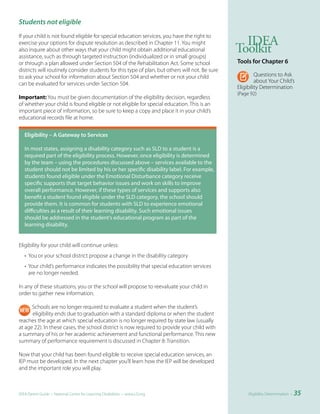
            minutes or hours that will be provided each time)
          • Location (where the services will be provided; for example, in a resource room)
          • Duration (the period of time each service will be provided).

This statement of special education services is the school’s commitment of resources to your child that will allow him or her
to reach the measurable annual goals developed by the IEP team.


   		     IDEA	2004	adds	an	important	new	requirement:	

   The IEP team’s choice of special education and related services must be guided by peer-reviewed research
    whenever possible. In other words, instructional programs and other services should be supported by strong
    evidence of effectiveness that has been determined through scientifically-based research. This is particularly
    important when determining instructional programs to address reading difficulties since there is a robust body of
    research showing the effectiveness of an array of reading programs, also known as “methodologies.”

    You should ask whether the school has any scientifically-based research to support the instructional program
    or methodology that is proposed for your child, including evidence of its effectiveness. This applies not only to
    instructional programs to address academic needs, but also to the programs chosen to address behavioral or other
    identified areas. Schools should be able to offer a variety of instructional approaches – not simply one approach
    that is used with all students who have a particular learning problem or disability.

Unfortunately, sometimes there is a “disconnect” between the goals to be achieved and the frequency, location and
duration of the services your child is to be provided. You should be certain that the frequency of the proposed services
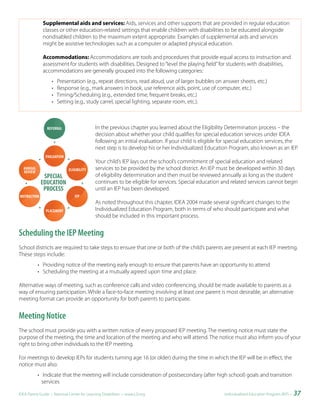
is adequate to meet your child’s needs and will result in reaching the annual goals. Addressing your child’s academic
difficulties in a timely manner is essential if he or she is expected to participate in the grade-level general education
curriculum.

Participation in General Education. The IEP team must describe how much time your child will spend outside of the
regular education classroom and away from students who do not have disabilities. This requirement is designed to protect
your child’s right to be educated in the least restrictive environment as required by IDEA.

Your child should have full access to the general education curriculum regardless of where he or she receives special
education and related services. If special education services, such as reading instruction, will be provided in a separate
location such as a resource room, be sure to ask what will be happening in your child’s general education classroom during
the time your child will not be present to make sure your child won’t be missing valuable classroom instruction.

Accommodations and Assessment Participation. The IEP team will develop a statement about any individual
accommodations that your child should use while taking state and district-wide tests, or assessments, including tests
required by the No Child Left Behind Act (NCLB). This statement will also say whether your child will participate in the
regular assessment or in an alternate form of assessment.

Take time to understand the particular tests or assessments that your child is expected to take, including the content of the
test, how it will be presented, the response format (e.g. multiple choice, essay), and the administration (setting and length).
You should also fully understand the decisions that will be made regarding your child based on the assessment scores,
such as moving on to the next grade (grade promotion) or graduation.

IDEA Parent Guide • National Center for Learning Disabilities • www.LD.org                      Individualized Education Program •   41
Make sure that decisions regarding accommodations for state and district-wide assessments are made carefully and are
based on your child’s individual needs – and not on his disability category.

Accommodations for classroom instruction and classroom tests may differ from accommodations allowed on state
assessments. All accommodations and the settings for which they are intended should be included in the IEP.

You may find that an accommodation your child has been using in the classroom and on classroom tests is not allowed
by state guidelines during state testing. Use NCLD’s Parent Advocacy Briefs on Assessment Options, Assessment
Accommodations and High Stakes Testing available at www.LD.org/ParentBriefs to learn more about these important
aspects of your child’s IEP.

Transition. Beginning when your child is turning age 16, IDEA requires that the first IEP that will be in effect must also
include plans for your child’s successful transition from high school to postsecondary education or employment. This
important process includes adding new members to the IEP team and developing appropriate measurable postsecondary
goals. Transition planning required for students 16 and older is discussed in detail in Chapter 8.

        Use the IEP Meeting Planner on page 94 and IEP Meeting Conversation Stoppers on page 100 for additional
        assistance with planning and negotiating your child’s IEP.


Finalizing the Initial IEP
After the IEP team has developed the initial IEP for your child – that is, the first IEP following the eligibility decision – you
will be asked to sign the IEP, along with all other team members. Your signature serves as your informed consent for the
school to begin to provide special education services to your child. Services should begin as soon as possible once the IEP
is finalized.

You don’t have to sign the IEP at this meeting. If you want to review the IEP first, ask to take it home before you sign it. This
allows you time to thoroughly review the proposed IEP. You can use the         IEP Checklist on page 104 to make sure your
child’s IEP contains all the required elements.

The proposed IEP will likely include several annual goals and the services that will allow your child to achieve those
goals. You may agree to all or some of the proposed services, programs or placements. If you decide to accept the IEP as
proposed, indicate that you accept by signing the IEP.

          • If you accept only parts of the proposed IEP, indicate which items you agree to have provided and which items
            you wish to dispute. You should also provide a written explanation of your disagreement and ask that it be
            included as an addendum, or addition, to the IEP document. A second IEP meeting may be scheduled to try to
            work out the items in dispute, or you can use the dispute resolution options discussed in Chapter 11.

          • If you refuse to accept the proposed IEP entirely, indicate your disagreement on the IEP form. You might be
            asked to sign the IEP to indicate your attendance or participation at the IEP meeting, which does not indicate
            your agreement. Be sure that your signature clearly indicates only your attendance if you do not consent to the
            proposed IEP. At this point, you are free to use the dispute resolution options discussed in Chapter 11.

          • If you refuse to allow your child to begin to receive the proposed special education services, the school cannot
            begin delivery of initial services and is not required to provide a free appropriate public education, as required by
            IDEA, to your child.

          • You should be given a complete copy of the final IEP (at no cost to you).


IDEA Parent Guide • National Center for Learning Disabilities • www.LD.org                         Individualized Education Program •   42
Changing an IEP
        After the initial IEP is finalized or later IEPs are agreed upon (usually annually), IDEA 2004 provides new ways that
        parents and schools can make changes they agree upon:
          • Once the annual IEP team meeting has taken place, schools and parents are allowed to amend or change the IEP
            without holding another meeting of the full team.
          • At minimum, you should recieve a copy of the IEP changes in writing.

If the changes are made in this manner, all members of the IEP team must be made aware of the changes and their
responsiblity in implementing the changes.

While these new provisions make it more convenient for both parents and schools to make IEP changes, you should be
cautious about using this approach to changing your child’s IEP. Minor changes involving such things as accommodations
can be easily revised this way, but significant revisions such as changes in the services, the frequency of those services, and
how behavioral or disciplinary issues are addressed are reasons to have a full IEP team meeting. When making IEP changes
without a team meeting, you should make sure that the school representative making the change(s) is authorized to do so
by the school district. Parents are free to request an IEP meeting at any time, and requests should always be made in writing.


Access to IEPs
Your child’s IEP contains highly confidential information and schools are required to limit access to confidential student
educational records, including IEPs. However, IDEA makes it clear that your child’s IEP must be accessible to each person
responsible for its implementation – this includes all regular education teachers, special education teachers, related service
providers, and other service providers who are involved in the services to be delivered to your child. So, expect that access
to your child’s IEP will be restricted, but also make sure that every person involved in your child’s educational program is
made aware of the IEP and their role in its implementation.


The Annual IEP Review
After your child’s initial IEP is developed and you have provided informed consent for the school to begin delivering special
education services, the school is required to review and revise (as needed) all IEPs at least once each year. This annual IEP
review will follow the same process as your child’s initial IEP. Specifically, the annual IEP review will focus on:

          •   Any lack of expected progress toward the annual goals as well as progress in the general education curriculum
          •   The results of any reevaluations conducted according to the requirements described in Chapter 5: Evaluation
          •   Information that you provide about your child
          •   Any additional information such as your child’s performance on state and district assessments.

As required in the development of initial IEPs, your child’s general education teacher must participate in the review and
revision of the IEP.

Signing Annual IEPs. IDEA does not require parents to sign annually updated IEPs – informed parental consent is required
only for the school to begin the initial delivery of special education services. However, it is common practice for all IEP team
members to sign, primarily for the purpose of verifying their participation. The school district is obligated to provide the
services in an IEP once initial parental consent is obtained. Parents can withdraw their consent for services at any time, as
stated in the Procedural Safeguards notice (see Chapter 4).

While IDEA requires that your child’s IEP be reviewed at least once per year, both you and the school district are free to
request more frequent IEP meetings to address issues and concerns.


IDEA Parent Guide • National Center for Learning Disabilities • www.LD.org                         Individualized Education Program •   43
When you move
    New provisions in IDEA 2004 are intended to ensure that your child’s special
                                                                                                    IDEA
    education program continues without interruption when he or she moves to a
new district either within the same state or to another state.                                    Toolkit
                                                                                                   Tools	for	Chapter	7
          • Moving Within the Same State. If your child is changing school districts
            within the same state, the new district must provide the same or comparable                    Sample Letter
            services as those listed in the previous IEP until it either formally accepts                  Regarding IEP Team
            the previous IEP or develops and implements a new one according to the                         Member Excusal
            process described in this chapter.                                                             (Page 93)
          • Moving from One State to Another. If your child transfers between                               IEP Meeting Planner
            states, IDEA 2004 requires that the new district must continue comparable                       (Page 94)
            services until it
                     • Conducts an evaluation of your child, if necessary. For example,                     IEP Meeting
                                                                                                            Conversation
                       the new school may request permission to conduct an evaluation
                                                                                                            Stoppers (Page 100)
                       to obtain more current information about your child’s level of
                       performance                                                                          IEP Checklist for
                     • Develops a new IEP, if appropriate, that is consistent with federal and              Parents (Page 104)
                       state laws. For example, since states may have laws that govern IEPs
                       in addition to the federal laws, developing a new IEP that meets the
                       state’s requirements may be in order.

Transfer of Records. Both the old and new schools are required to take reasonable
steps to ensure that your child’s IEP is promptly transferred, as well as any
documentation related to special education, related services and other records. To best
ensure that special education services start promptly at the new school, you should
get a copy of your child’s records before moving and provide these records to the new
school when you enroll your child.


IDEA Parent Guide • National Center for Learning Disabilities • www.LD.org                       Individualized Education Program •   44
Parent
     Perspectives
     Why	My	Son	Attended	His	Own	IEP	Meetings

     My son Jay was identified with multiple learning disabilities when he was just a toddler. When he was admitted to a
     school in New York for special education students, no one knew whether he could ever learn to read. I do not know where
     in his soul he found the drive and motivation, but he learned to do what many people said could not be done – he learned
     to read at age nine.

     Jay’s school was filled with specialists who custom tailored his classes to meet his special needs. But then came the greater
     challenge. Could he learn subjects such as history, literature, and foreign languages in a regular classroom?

     When Jay arrived in a regular middle school, he had compensation strategies thanks to successful early intervention. But
     his new regular classroom teachers did not know about strategies that would be appropriate for him. They were untrained
     and unaccustomed to his special needs.

     Jay’s accommodations were written into his IEP, but the school staff and district administrators refused to read them. So,
     it was perhaps not surprising that they discouraged Jay from attending his own IEP meetings. Administrators told Jay
     that he needed to work harder in class and needed the meeting time for coursework. And they told me that he would be
     traumatized by the reports about himself from the IEP team.

     As his parent, I felt that Jay needed to attend every IEP meeting. If he was going to understand what was happening in
     his education, he had to be part of the process. I couldn’t imagine a successful IEP without his buy-in. He had a far better
     understanding of what was really going on because he was in the classroom.

     At one of his IEP meetings, the staff asserted that Jay had made so much progress that he no longer needed an IEP, and
     that he should be found ineligible for special education services. They were basing this partly on a recent 6th grade
     standardized test score. There wasn’t much logic to their argument.

     The staff asserted that Jay got 100% on a recent spelling test. This was important because we had heated controversy
     about whether Jay’s IEP should require un-graded spelling due to his learning disability. The staff argued that Jay should
     be graded on his spelling in light of his remarkably high reading comprehension score on the recent standardized test
     – even though the score was inconsistent with Jay’s history and with other recent scores.

     Then, quite unexpectedly, my son spoke up. He softly explained that the 100% was actually ten words on a quiz that
     was a make-up – hardly a breakthrough score. This was also inconsistent with his personal educational history. More
     importantly, he then explained why his reading comprehension score on the standardized test was so high. Jay said that
     he never actually read the paragraphs that were included with the test!

     Never read the paragraphs?

     Well, the paragraphs were about the terracotta warriors in X’ian China. Coincidentally, we had toured these same warriors
     in person, five years earlier. The paragraphs were too long to bother with, Jay explained, so when he realized they were
     asking about the warriors he had already seen, he just answered the questions based on his prior knowledge. So, Jay
     spent his entire time (including his extended time) answering the multiple-choice questions. He reported they were easy
     questions: What were the warriors used for? (For defense) Were they alive? (No, they were in a tomb) What was special
     about them? (No two are alike). Jay knew most of the answers, guessed the rest, and voila – high score!

     If Jay had not been at that meeting, the school would have used those two test scores to end his special education
     services. By speaking up, my son set the record straight and saved his own eligibility.

     - Ilise from New Jersey


IDEA Parent Guide • National Center for Learning Disabilities • www.LD.org                          Individualized Education Program (IEP) •   45
Parent
     Perspectives
     Tips	for	School	Meetings

     I am the father of two special needs children. My older child has a smorgasbord of attributes that interfere with learning,
     including emotional, behavioral and specific learning disabilities. I have specially designed armor I wear when attending
     any school meeting for him. I am also an educational advocate for foster children, attending intervention meetings
     almost daily.

     Over the years, I have learned much about the way schools operate, and how different each school’s attitude is regarding
     educating atypical learners. They all talk a great game (as required by law), but some are better at practicing what they
     preach.

     Schools are under-funded, over-crowded, and over-burdened with changing rules, cryptic regulations and mountains of
     paperwork. I try to accomplish what I need with honey-coated negotiating skills. However, if I have to turn into PAPA-BEAR
     to get what my child needs – so be it. I never forget – I am an equal-say partner at any meeting and the only one sitting
     around the table who tucks my child in at night.

     When I first began protesting that one of my son’s needs was not being addressed, I was amazed when the educators
     turned to me and asked, “So, what would you suggest?” I quickly learned to have suggested interventions ready and
     know what the laws stipulate. I also learned to ask the educators sitting around the table to help think of non-traditional
     interventions. I respectfully point out that they are the ones with the training, education and years of experience.
     Conversely, I never blindly accept what is told to me without questioning and understanding the implications and
     ramifications. If I have to stop a meeting for clarification one or ten times – so be it.

     Take notes during the meeting. Often people change, revise or deny what they have said earlier. If you’ve written it down,
     you can refer back to what is being said during and after the meeting. Don’t count on the official note-taker. If I want to
     make a point or if I have an un-addressed need, I state that I want this reflected in the notes. Also, have the notes read
     aloud at the end of the meeting. Make sure you agree with what they state has transpired, and get a copy of everything.
     Keep it in a file that you bring to any follow-up meetings.

     Discover what frustrates your child at school by asking him/her directly, and address these in the school meeting. Ask
     specific (not general) questions, such as, “Is it hard for you to finish when the teacher asks you to copy information from
     the board onto your paper?” “How do you feel during a test? Are you able to finish with no problem?” “How noisy is your
     class?” “What is your favorite subject?” You may be surprised by some of the answers.

     Remember, you are a vital part of the decision-making committee. Don’t be intimidated by educators who want to “tell”
     you what will be done or say, “We can always make changes later.” It’s easier to get it done right the first time. Don’t let
     them rush through an IEP meeting because another one has been scheduled. This is a one-year contract you are signing
     and it deserves the time and consideration needed for you to understand and agree with what is in writing.

     - Jody from Georgia


IDEA Parent Guide • National Center for Learning Disabilities • www.LD.org                          Individualized Education Program (IEP) •   46
8   Who is this for?
                         Transition
                             Planning your child’s future success

     This chapter is for middle school and high school students and their parents. It provides
     important information about the transition services that must be a part of IEPs for all
     students with disabilities who are age 16 or older.
     Why is this important?
     Transition planning is crucial to students’ success after high school. Because students with
     disabilities often experience limited success after leaving high school, many new IDEA 2004 provisions seek to
     improve transition planning so that students with disabilities can be more successful in their adult lives.
     What can parents do?
     All too often, parents fail to take an active role in their child’s transition planning. Parents can take an active role
     by working with the school to plan the supports and services that will lead to success. Parents can also help their
     children to define goals and aspirations for life after high school. Both parents and students need to make sure that
     transition planning starts early enough for adequate preparation, which is frequently well before IDEA’s mandatory
     age of 16.
     Words and terms to know
              Functional skills: As used in this chapter, functional skills are those needed for independent living, such as cooking,
              shopping, working with or managing money, using public transportation, and knowing how to be safe at home and in
              the community.
              Postsecondary education: Formal education or training beyond high school, including college, university, vocational
              school and trade school.
              Courses of study: Middle and high school course work (or classes) that lead to certain types of diplomas and/or are
              required for postsecondary education.
              Transition services: A coordinated set of activities that:
                   • Improves the academic and functional skills of the student in order to facilitate the student’s movement from
                     school to post-school activities such as postsecondary education, vocational education, integrated employment
                     (including supported employment), continuing and adult education, adult services, independent living or
                     community participation
                   • Is based on the individual student’s needs, taking into account his or her strengths, preferences and interests
                   • Includes instruction, related services, community experiences, the development of employment and other post-
                     school adult living objectives and, when appropriate, the acquisition of daily living skills. Transition services often
                     include a functional vocational evaluation.
              Summary of performance: A summary of the student’s academic achievement and functional performance that
              includes recommendations to assist the student in meeting his or her postsecondary goals (details later in this chapter).
              Vocational Rehabilitation Agency: A publicly funded state agency that provides direct and indirect services to
              youth with disabilities as they transition from school to work, in order to maximize their employability, independence
              and integration into the workplace and the community..
              Vocational rehabilitation (VR): a set of services offered to individuals with disabilities designed to enable
              participants to attain skills, resources, attitudes, and expectations needed to compete in the interview process, get
              a job, and keep a job.


IDEA Parent Guide • National Center for Learning Disabilities • www.LD.org                                                         Transition •   47
In Chapter 7: Individualized Education Program, you learned about partnering with school staff to plan your child’s
educational program. This chapter discusses the transition services that are a required part of every student’s IEP upon
reaching the age of 16.

       Transition services must be included in the first IEP that will be in effect when a student turns 16. So, this generally
       means that you should begin to include transition services in the IEP that is prepared when your child is
15. However, IDEA 2004 also makes it clear that IEP teams are free to begin planning at an earlier age if the team considers
it appropriate to do so. Many students with learning disabilities need to start their transition planning in middle school
because they may need to take specific classes or courses of study to keep them on a path to achieve their postsecondary
goals. As full and equal partners in the IEP team, you should advocate for transition planning for your child at an early age
and ensure that services in the IEP directly support postsecondary goals. Check to see when your state policies recommend
starting transition planning.


Expanding the IEP Team
Under IDEA 2004, schools continue to be responsible for bringing in representatives from other agencies, such as
vocational rehabilitation agency or postsecondary education, to be part of the planning for transition services, with the
consent of the parents or the student who has reached the age of majority. Your IEP meeting notice must indicate the
individuals from other agencies who have been invited to attend your child’s IEP meeting. If you feel that the school is not
including appropriate representatives to help with transition planning, be sure to let the school know.
Beyond simply participating in your child’s IEP, these agencies may also be responsible for the delivery of some of the
needed transition services. To ensure that transition services are provided, IDEA 2004 makes it clear that if these agencies
do not provide the services for which they are responsible, the school must find alternative ways to meet the transition
objectives for your child.
In addition to other agency representatives, IDEA requires that your child be included in the IEP meeting when planning for
transition services begins. If your child can not or does not attend the meeting, IDEA requires that the school district take
other steps to ensure that his or her preferences and interests are considered in the planning of transition services.
Don’t forget that your child can be part of the IEP team long before transition planning begins. You and the school should
work together to determine the best time to begin including your child as part of the team.


Requirements for Transition Planning
The IEP team must develop appropriate, measurable postsecondary goals based upon age-appropriate transition
assessments related to training, education, employment, and, where appropriate, independent living skills. There are age-
appropriate transition assessments such as personal interest inventories that could be given to your child to help identify
his or her individual special talents and interests.
In developing your child’s transition goals, the IEP team (including your child) must determine what instruction and
educational experiences will help prepare him or her for a successful transition to life after high school. Once the goals are
developed, the IEP team must then develop a statement of the transition services, including courses of study, needed to
assist your child in reaching those goals.


                        IDEA requires states to provide special education services to eligible
                   students until they either graduate with a regular diploma or exceed the age
               limit established in IDEA (reaching age 22) or by your state law. Students receiving
                 diplomas other than a regular diploma are entitled to continue to receive services
                   under IDEA until exceeding the age limit. The IEP team decides when it is
                                 appropriate for a student to exit special education.


IDEA Parent Guide • National Center for Learning Disabilities • www.LD.org                                        Transition •   48
The statement of transition services should relate directly to your child’s
postsecondary goals, and should:
     •    Define every activity that must occur                                             How Parents and
     •    Identify who has primary responsibility for each activity                         Schools Can Prepare
     •    Specify the dates and order that each activity will begin and end                 Students to
     •    Motivate your child to complete his or her education and minimize the risk of     Understand Their
          dropping out prior to graduation.                                                 Rights

         Use the Transition Considerations Checklist on page 105 to help plan               • Students should understand
         transition goals and services.                                                     their disability and be able to
                                                                                            advocate for themselves.

                                                                                            • Students should understand
Coming of Age                                                                               why they receive special
                                                                                            education services.
Another important aspect of transition planning is the requirement to notify your
child one year before he or she reaches the “age of majority” under state law (18 years     • Students should receive
of age in most states). At that time, the IEP must include a statement that your child      written and oral notification
has been informed of his or her rights under IDEA (if any) that will transfer from you to   of meetings.
him or her upon reaching that age.
                                                                                            • Students should be notified
This is an important event in the life of a student. Under state laws, when your child      of changes in placement
reaches the age of majority, he or she is presumed to be capable of making his or her       with explanations of why
own decisions – including educational decisions. That does not mean that you cannot         those changes occurred. This
continue to be involved in your child’s education. It just means that, by law, schools      notification should be in the
must respect the educational decisions of every adult student, unless that person has       communication mode best
                                                                                            suited for each individual
been determined to be incapable of making decisions.
                                                                                            student.
The rights that will transfer from you to your child upon reaching the age of
                                                                                            • Students should participate
majority include:
                                                                                            and assist in the IEP meetings.
         •Notification of meetings
                                                                                            • Students should receive
         •Notification and consent for evaluation
                                                                                            explanations of the type and
         •Selection of participants who attend IEP meetings
                                                                                            purpose of all evaluations.
         •Approval of the contents of the IEP.
                                                                                            • Students should be involved
For those students who may be found legally incompetent and unable to make
                                                                                            in the interpretation of test
important life decisions, schools should provide parents with the information               results.
necessary to establish their child’s legal incompetence and begin guardianship
proceedings with local district courts.                                                     • Students should be given
                                                                                            the opportunity to review
                                                                                            their educational records.
	 Additional	Resource:	                                                                     • Students should know their
   The National Center on Secondary Education and Transition offers more                    rights under Section 504
   information about this important topic in its publication, Age of Majority:              of the Rehabilitation Act of
                                                                                            1973 and the Americans with
   Preparing Your Child for Making Good Choices available at
                                                                                            Disabilities Act.
   http://www.ncset.org/publications/viewdesc.asp?id=318
                                                                                            • Students should participate
                                                                                            in self-advocacy and self-
                                                                                            determination training.


IDEA Parent Guide • National Center for Learning Disabilities • www.LD.org                                   Transition •   49
Moving On
       IDEA 2004 made an important change to the requirement for reevaluations
                                                                                               IDEA
       when terminating special education services. Reevaluations were generally
required in order to determine that special education and related services are no            Toolkit
longer needed. Now, under IDEA 2004, when a student graduates with a regular
                                                                                             Tools	for	Chapter	8
diploma or reaches the maximum age for receiving special education services as set
by the state (turning 22 years of age in most cases), the school district is not required          Transition
to perform a reevaluation. Instead, the school district must now provide a summary                 Considerations
of the student’s academic and functional performance. This summary of performance                  Checklist (Page 105)
must include recommendations for helping the student meet his or her goals after
high school.                                                                                       Summary Of
                                                                                                   Performance
The summary of performance is a description of your child’s academic achievement
                                                                                                   Checklist (Page 106)
and functional performance that includes recommendations to assist him or her
in meeting postsecondary goals. The summary may include the information and
documentation of your child’s abilities and disabilities that will be necessary to access
supports and services in post-school activities, such as higher education. It should
provide specific, meaningful and understandable information to your child, your
family, and any agency, including postsecondary schools, that may provide services to
your child after high school.
Your child will want to check with the Disability Services Office at postsecondary
schools and with community services agencies to identify any specific information or
documentation needed to qualify for support services.
While schools are not required to conduct any new tests or evaluations in order
to provide the summary of performance, you and your child should work with the
school so that the information provided will be adequate to satisfy the disability
documentation required to qualify him or her as a person with a disability under
other federal laws such as the Americans with Disabilities Act and Section 504 of the
Rehabilitation Act of 1973.
The IEP team should discuss what needs to be included in your child’s summary of
performance prior to termination of special education services. You should bring up
this topic if it has not already been addressed by the IEP team. It is important to ensure
that the information provided in the summary will satisfy any requirements connected
with your child’s post-school goals. You and your child should specifically request any
needed information that is not provided.

       Use the Summary Of Performance Checklist on page 106 to review the
       summary proposed by your child’s school. The specific information that must
be included in your child’s summary of performance will vary state by state, so be sure
to become familiar with your state’s requirements by contacting your Parent Training
and Information Center.


IDEA Parent Guide • National Center for Learning Disabilities • www.LD.org                                  Transition •   50
Parent
     Perspectives
     Setting	Goals	and	Planning	for	the	Transition	to	College
     My son, Sal, is a high school senior just outside of New York City. He was first identified at the age of four as a child with a
     significant language disorder, and then later, as a student with a learning disability and a stuttering disorder. A large part
     of his current success is related to transition planning, which has helped him gain the academic, emotional and social skills
     necessary for attaining his goals.

     I believe that setting goals for the future should start whenever a child with learning disabilities first communicates his
     or her frustrations, disappointments and helplessness in school. For us, that moment occurred when Sal was in the third
     grade. As we were outside enjoying the sunshine, he turned to me and said that he hated his brain because it didn’t do what
     he wanted it to do. That began a very open and honest conversation about learning differences. I reassured him that he
     would find, with the help of the school, his family and all those that loved him, different ways to learn and succeed. From
     that day forward, we;ve had frequent conversations about his learning differences.

     I have involved Sal in all aspects of his education. In the seventh grade, I invited him to attend his first Annual Review and sit
     as a member of the Committee on Special Education, designated by New York State. This multidisciplinary team determines
     a student’s abilities and needs and implements an appropriate IEP for eligible students. This first meeting for Sal served as a
     confirmation that he did have a learning disability.

     Attending subsequent meetings allowed him to see how the system worked, find out who was on his “team” and learn
     how the committee decided on his specific IEP and accommodations. By the time he was in the tenth grade, Sal not only
     embraced and “owned” his learning disability, he demonstrated confidence and self-assuredness in his ability to request
     needed support. He understood the process.

     Over the years, Sal has benefited from a number of accommodations and program modifications. In ninth grade, his
     resource room teacher noticed that he performed better if test questions were read to him and/or rephrased. Double time
     ensured even better success. These and other testing accommodations made a tremendous difference in the ensuing
     school years.

     Preparing for the SATs was a big challenge. Although we enrolled Sal in a well-recognized preparatory course, our request
     for testing accommodations was a first for them. They could not accommodate double time, but they did accommodate
     time and a half. For six weeks, he took practice SATs with accommodations. When necessary, questions were read out loud
     to him.

     With the help of his school guidance counselor, Sal applied for testing accommodations for the real SAT according to The
     College Board requirements. The College Board allowed him to take the test over two days. He tested by himself and, when
     necessary, questions were read to him. He took the SATs twice. Sal’s efforts to achieve an acceptable score were tremendous.

     Passing the English regents exam for graduation was no easy task either. Sal spent additional time working with his English
     and resource room teacher to prepare. Then one day, he called me from school, almost in tears. He had received a passing
     score of 80!

     During our transition planning, Sal learned to own his learning disability, to embrace it, to not be embarrassed of it, to
     succeed in spite of it and to feel special. And now, this spring, Sal will be graduating from high school with an advanced
     regents diploma. For this distinction, he had to take a more comprehensive course load and pass eight regents exams. In
     the fall, Sal will be attending college and playing football on the school team. Here is how he concluded his college essay:

     “Special education has actually taught me to think out of the box, to go beyond the conventional way of learning, and to
     find my strengths. To my peers but more importantly to myself, I have proven that I have the ability to overcome challenges.
     Special education should not be a limitation; it is a jumping point to an endless world of life’s lessons. Individuals with
     special needs are just different; no better, no worse – just different.”
     -	Monica	from	New	York


IDEA Parent Guide • National Center for Learning Disabilities • www.LD.org                                                   Transition •   51
Parent
     Perspectives
     Tools	for	the	High	School	Student	with	Learning	Disabilities
     Our daughter Hillary was in the fifth grade when she was originally diagnosed with a language disability. It wasn’t until
     she was a freshman in high school that her disability was given a name: Aphasia. Hillary’s Aphasia is both expressive and
     receptive, meaning that reading, writing, processing information and speaking are all more laborious tasks for her than
     for other students. At the time of the diagnosis, doctors told us that college was an unrealistic aspiration for Hillary.
     Hillary’s strong work ethic got her through two difficult years of junior high school. It was clear from the beginning of high
     school, however, that it was going to take more then hard work and determination to keep Hillary’s self-esteem and desire
     to succeed intact. The increased work load and more complicated subject matter meant hours of studying every night.
     The results were barely passing grades and a student who was left feeling defeated and worthless. Although Hillary had
     an Individualized Education Program, neither she nor I were savvy enough to take full advantage of what it offered.
     We are very fortunate to live in a school district that offers an innovative high school program called LEAD, an acronym
     which stands for learning and educating about disabilities. This program, which is unique to Cheyenne Mountain
     High School in Colorado Springs, is under the direction of the school’s Special Education Department Chair. LEAD is
     an accredited class made up of college-bound students with learning disabilities and AD/HD. During class time, LEAD
     students learn about disabilities and their legal rights as students with disabilities. They also learn that self-knowledge and
     self-advocacy are powerful tools for the student with LD and AD/HD.
     The LEAD curriculum includes opening up the students’ cumulative folders so they can examine and understand their
     own test scores and assessments. This information helps them support their requests for the accommodations and
     modifications they might be entitled to. Students learn about their legal rights under the Individuals with Disabilities
     Education Act and how to actively participate in their own IEP or 504. LEAD students learn not to rely on teachers and
     parents to advocate for them. It is a responsibility they take on themselves.
     During the course of Hillary’s four years as a LEAD student, she developed the habit of writing letters to each of her
     teachers at the beginning of the semester. These letters explained her disability, what accommodations she needed and
     why. Accompanying the letter were articles on Aphasia she had found on the Internet. Hillary educated teachers about her
     disability and they not only accepted her need for accommodations, but encouraged her to use them.
     LEAD provided a niche for Hillary, a place where she could be accepted and understood. In addition, it taught her to focus
     on her strengths. One of LEAD’s most important lessons is that a learning disability has nothing to do with intelligence.
     As Hillary’s confidence and self-esteem grew, she became more successful at dealing with academic challenges and
     graduated from high school with an enviable grade point average.
     Since its inception, 95% of the high school’s LEAD students have gone on to college. Hillary is now one of those students. In
     spite of dire predictions from well-meaning professionals, Hillary is currently a freshman at a four-year college. Each day is
     a challenge, but the lessons of LEAD have served her well. She confidently explains to each of her college professors about
     her disability and how if affects her. She does not hesitate to use the accommodations that she knows she is entitled to.
     Hillary finished her first semester of college with grades that anyone would be proud of.
     Although LEAD is unique to Cheyenne Mountain High School, it is my hope that some day all schools will offer a similar
     program that will teach students with learning disabilities the crucial skill of self-advocacy and the importance of self-
     knowledge. It takes commitment from administrators, parents and teachers, but all students with learning disabilities and
     AD/HD should be given the necessary tools for success, both in college and in life.
     -	Salle	from	Colorado

     To learn more about the LEAD program, visit www.leadcolorado.org.


IDEA Parent Guide • National Center for Learning Disabilities • www.LD.org                                                Transition •   52
9   Who is this for?
                         Students in Private Schools
                            Understanding your child’s special
                            education options

     This chapter is for parents who have a child attending private elementary, middle or high
     school or who are considering moving their child from public school to private school.

     Why is this important?
          IDEA 2004 includes new provisions to ensure that students in private elementary
          and secondary schools have access to special education services. It also includes strict
     requirements to follow when moving an IDEA-eligible student from a public to a private
     school.

     What can parents do?
     Parents should understand the obligations of their local school district as required by IDEA so they can be sure their
     child is receiving services to the maximum extent allowed. Parents considering moving a child who is receiving
     special education services from a public to a private school need to understand the legal requirements involved in
     making such a move if they intend to ask the school district to pay for the private school.

     Words and terms to know
              Free Appropriate Public Education (FAPE): Special education and related services that are provided at
              public expense, under public supervision and direction, and without charge to the parent, and that meet the
              standards of the state education department. Special education and related services must be provided in
              conformity with an Individualized Education Program (IEP) as required by IDEA.


The obligations and responsibilities of a local public school district to students with disabilities in private schools vary
depending on how the students were placed in the private school. Students with disabilities who are in private schools will
fall into one of the following three categories:

           1. Students with disabilities placed in private school by their parents prior to being found IDEA eligible (called
              “Parentally-placed private school children with disabilities” in IDEA)

           2. Students with disabilities placed in private school by their parents after being found IDEA eligible (called
              “Unilateral private placement” in IDEA).

           3. Students with disabilities placed in private school by the public school district


1. Students with disabilities placed in private school by their parents prior to being found IDEA eligible
(Parentally-placed private school children with disabilities)

This term refers to students whose parents have enrolled them in a private school, including private religious schools.
Students in this category have not been previously found eligible for special education services.

IDEA Parent Guide • National Center for Learning Disabilities • www.LD.org                              Students in Private Schools •   53
When either the student’s parent or the private school requests an evaluation, the school district where the private
      school is located is responsible for conducting the evaluation (as discussed in Chapter 5) and for determining if the
student is eligible for special education services (as discussed in Chapter 6). The school district where the private school is
located is also responsible for conducting reevaluations of eligible students.

For those students found eligible, the public school district where the private school is located may provide special education
and related services. However, unlike students enrolled in public schools and public charter schools, eligible students in
private schools are not entitled to a free appropriate public education. In other words, students enrolled in private schools by
their parents do not have the same right to special education and related services as students enrolled in public schools.


       Students in private schools who are found eligible for services under IDEA also have the option
        of enrolling in a public elementary or secondary school in order to receive full access to special
          education and related services. In such cases, the school district where the student resides is
         responsible for developing an initial Individualized Education Program (IEP) through the
         process described in Chapter 7. If the parents have made it clear that they do not intend to
          enroll their child in the public school, the school district is not required to develop an IEP.

For every eligible student in private school who has been designated by the school district to receive special education
services, the school district is required to formulate a “services plan” describing the specific special education or related
services being offered. The school district must develop the services plan with a representative of the private school. However,
the school district is responsible for determining the number of private school students who will be served each year based
on funding requirements of IDEA and for making the final decisions about all aspects of the services being offered.

The amount of funds the school district must spend on providing services to private school students is controlled by a
funding formula specified in IDEA. IDEA outlines a process for determining the amount of funds the district must spend on
special education or related services for eligible students in private schools.

Special education and related services may be provided to private school students on the premises of private schools,
including religious schools, or at a public school. Services can be provided by school district personnel or through
contracts by the school district with other individuals or agencies.

       Public school districts are now required to actively engage in consultations with private schools and parents of
       private school students regarding several topics, including:

           • Child find (activities related to identifying children who may need special education)
           • Funding (how the district will determine the amount of its funds that it will spend on services for students in
             private schools, how the services will be portioned out to eligible students and, if there are insufficient funds to
             serve all eligible students, how and when these decisions will be made)
           • Provision of services (how, where and by whom special education and related services will be provided).

In addition to these new consultative activities required under IDEA 2004, private school officials now have the right to file
a complaint with state education officials if they feel that the local school district did not engage in these consultations in a
meaningful and timely way.

2. Students with disabilities placed in private school by their parents after being found IDEA eligible (Unilateral
private placement)

Sometimes the parents of a child who is receiving special education at a public school decide to withdraw their child from
the public school and enroll him or her in a private school. In such cases, the student is eligible for the provision of special
education services at the private school as described in the first category above.

IDEA Parent Guide • National Center for Learning Disabilities • www.LD.org                               Students in Private Schools •   54
However, if the parents have moved their child for the purpose of obtaining what they consider to be more appropriate
special education services and plan to request the public school to pay for the private school tuition, IDEA provides a rigid
set of requirements that parents must follow.

If parents choose to place their child in a private school without the school district’s agreement, any opportunity to be
reimbursed by the school district for the cost of the private school will be severely limited unless the parents provide
written notice to the school before removing their child from the public school. Parents who might consider seeking
reimbursement for private school tuition should seek additional information from a special education expert to be
certain they provide adequate notice to the public school. Contact your state’s Parent Training and Information Center for
additional information.


3. Students with disabilities placed in private school by the public school district

From time to time, school districts, along with parents, may determine that a student’s need for special education
programs and services can only be met by placing the student in a private school. This decision is part of the IEP process
and is arrived at after the IEP team has identified the student’s present levels of educational performance and developed
annual goals, as described in Chapter 7: IEPs.
Private school programs that the school district and parents may determine to be necessary can either be day programs or
residential programs. The school district pays all costs involved with such a placement, including tuition and transportation.
Students placed in private schools by the school district have the same rights, including the right to a free appropriate
public education, as their counterparts attending public schools.


						Qualifications	of	Teachers	in	Private	Schools:

    Both IDEA 2004 and the No Child Left Behind Act have strict requirements for the qualifications of teachers.
    However, these requirements do not apply to teachers in private schools, regardless of whether the student was
    placed in the private school by the parent or the school district.


IDEA Parent Guide • National Center for Learning Disabilities • www.LD.org                          Students in Private Schools •   55
Parent
     Perspectives
     A	Success	Story

     They do happen! Be brave! Stay the course! Many of us as parents are fearful when our son or daughter is diagnosed with
     a learning disability. Will they succeed in school? At work? Will they make friends? What does it take? My son, Scott, is
     currently 14 years old and in the 8th grade at a school for children with language learning differences. He was identified
     at an early age as being severely dyslexic, dysgraphic, and having significant visual perceptual difficulties. Intensive
     intervention was recommended – but no one knew how or where to get the appropriate help.

     Getting the right kind of help, at the right time, and with the right people, is essential to seeing progress. Scott’s current
     school and tutoring is entirely Orton-Gillingham based. He is completing his fourth year of this specialized education. This
     school is an answered prayer – a miracle for him. Not a day goes by that his parents don’t breathe a sigh of relief, and feel
     grateful. But that was after many blind alleys.

     When Scott started fifth grade, he was falling behind miserably. He was performing at least two years behind his peers. He
     went to school every day with a headache and a stomachache. Often there were tears, and he even went to a doctor to see
     if he was clinically depressed. Since pre-school Scott had received special help in classes, but it wasn’t the right kind of help.
     He was labeled by the public school system as mildly mentally handicapped, and was placed in a cross-categorical
     classroom for most of the day. Joining his regular class sporadically was difficult. Friendships were difficult, as he felt
     different than the other kids. Scott experienced so much stress during the day that he was exhausted after school and
     withdrew from social situations. Outside activities just took too much energy. In the fourth and fifth grade, I would re-teach
     him concepts covered during the day, and then homework would last up to three painful hours – with much frustration for
     both parent and child.

     After just a few months at his new school, Scott’s personality began to emerge. He looked forward to school, and his energy
     level after school sky-rocketed. He now lifts weights. He’s part of a swim team. He has friends both at school and through his
     after school activities. His homework is actually done without any assistance from me. He is self-assured and comfortable
     with himself. Reading is still hard work, but he can read anything he might need to in the future. His written expression is
     coming along nicely, and his confidence continues to grow.

     He is optimistic and hopeful about the future, and not ashamed to be dyslexic. It’s simply one aspect of who he is. He hopes
     to be a psychologist with prison inmates, or the next Dr. Phil, as he identifies with people who have obstacles to overcome
     and desires to lessen their struggle. Due to his difficulties, and then being given the tools to unlock his potential, Scott has
     developed patience and compassion towards others and himself. He is now eager and ready to try his wings in a regular
     school setting.

     Scott is a testimony to the change that can happen when children with learning disabilities receive the right kind of help,
     in a timely fashion. Be committed to finding the right resources and people who see the potential in your child – and stay
     hopeful!

     - Julie from Indiana


IDEA Parent Guide • National Center for Learning Disabilities • www.LD.org                                     Students in Private Schools •   56
10   Who is this for?
                                  Student Discipline
                                     Addressing serious behavior
                                     issues and concerns

     This chapter is for parents whose child may be the subject of disciplinary action by the school or for
     parents of children with significant behavior issues that may put them at risk for disciplinary action.

     Why is this important?
     The conditions for disciplining special education students need to be thoroughly understood by
     parents – preferably before their child is the focus of such actions. While IDEA extends certain protections to special
     education students, schools can subject them to the same disciplinary actions allowed for all students.

     What can parents do?
     Parents should understand the discipline provisions of IDEA as well as their school’s discipline policy. If their child is
     at risk for conduct that requires disciplinary action, parents should make sure that behavior and conduct issues are
     addressed during the IEP process.

     Words and terms to know
              Functional Behavioral Assessment (FBA): A problem-solving process for addressing student problem
              behavior. FBA relies on a variety of techniques and strategies to identify the reasons for a specific behavior
              and to help IEP teams select interventions that directly address the problem behavior.

              Behavior Intervention Plan (BIP): A plan to address problem behavior that includes, as appropriate,
              positive behavioral interventions, strategies, and supports; program modifications; and supplementary aids
              and services that may be required to address the problem behavior.

              Interim Alternative Educational Setting (IAES): A setting other than the student’s current placement
              that enables the student to continue to participate in the general curriculum and to progress toward
              meeting the goals in his or her IEP. The IAES must enable the student to continue to participate in the
              general education curriculum, although in another setting, and progress toward meeting the goals set
              out in the IEP. Students in an IAES should also receive, as appropriate, a functional behavioral assessment,
              behavioral intervention services and modifications that are designed to address the behavior violation so
              that it does not happen again. The particular IAES is determined by the student’s IEP team.


Disciplinary Actions of 10 Days or Less
A student with a disability, who has an IEP in effect, can be disciplined like any other student for 10 consecutive school days
or less if he or she violates the school’s code of conduct.

Disciplinary action generally involves removing students from their current educational settings and placing them in either
in-school suspension, out-of-school suspension, or an interim alternative educational setting. During the time the student
with an IEP is in one of these other settings, the school is only required to provide educational services (including special
education) if the school district also provides educational services to non-disabled students in the same circumstances.

IDEA Parent Guide • National Center for Learning Disabilities • www.LD.org                                      Student Discipline •   57
When school personnel decide to descipline a student by removing the student from the current educational placement,
the school must notify the parents on the same day the decision is made and provide the parents with a written copy of
the notice of Procedural Safeguards.

   Code	of	Conduct:

   Schools have a responsibility to make sure that all students, including those receiving special education, are
   familiar with the school’s code of conduct. Parents should be sure to understand the code of conduct and
   help their child understand the expectations and consequences involved with violating the code. The IEP
   team should determine any specialized help and instruction the child may need to understand the code and
   consistently demonstrate the appropriate classroom and school behaviors.


     In making a determination to discipline a student with a disability, school personnel may now consider any unique
     circumstances on a case-by-case basis. This provision provides new flexibility for school personnel who are
often operating within a district’s “zero-tolerance” policy. A zero-tolerance policy usually requires school personnel to
automatically suspend any student who violates the code of conduct.


Disciplinary Actions Beyond 10 Days
For students with a disability whose disciplinary action exceeds 10 consecutive days in the same school year, or when
frequent disciplinary actions add up to more than 10 school days in a school year and clearly indicate a pattern, the school
must provide special education services that allow the student to:

           • Continue to participate in the general education curriculum, although in another setting
           • Progress toward meeting the goals outlined in the student’s IEP.

The IEP team will meet to determine the exact educational services needed while the student is assigned to the
disciplinary setting. In addition, if the behavior is found to be related to the student’s disability, the IEP team must plan
for a functional behavioral assessment and the development of a behavior intervention plan based on the results of the
assessment. If the student already had a behavior intervention plan in place, the IEP team must review if the plan was
being followed and revise it as needed to address the problem behavior that led to this disciplinary action. For student’s
whose behavior is not determined to be directly associated with their disability, the IEP team should consider the need for
a functional behavioral assessment and behavior intervention plan.

   Additional	Resource:	

   See the publication, IEP Team’s Introduction To Functional Behavioral Assessment And Behavior Intervention
   Plans, available at http://cecp.air.org/fba/default.asp.


Relationship between Behavior and Disability
Within 10 days from the beginning of a disciplinary action that exceeds 10 days, the school district, the parents and
relevant members of the student’s IEP team must meet to determine if the conduct in question was caused by, or had a
direct and substantial relationship to, the student’s disability. This is referred to as a “manifestation determination.” The team
must also determine if the conduct was the direct result of the school’s failure to implement the student’s IEP, including a
behavior intervention plan.


IDEA Parent Guide • National Center for Learning Disabilities • www.LD.org                                     Student Discipline •   58
In making this determination, the IEP team will review:
           •   The student’s IEP
           •   The student’s behavior intervention plan
           •   Any teacher observations
           •   Any relevant information provided by the parents.


                       The manifestation determination – the relationship between behavior and
                       disability – must now be “direct and substantial,” which is a change from the
                 previous requirement for finding such a relationship. For example, a student’s low
               self-esteem, while a possible by-product of a learning disability, cannot be considered
                            to have a direct relationship to a student’s behavior problem.


If the team finds that the student’s behavior was related to the disability or an improperly implemented IEP, the student
is returned to the original education setting unless the parents agree to a new placement, which is a new educational
setting, as part of the behavior intervention plan.

If, on the other hand, the team finds that the student’s behavior was not directly related to the disability, the same
disciplinary actions can be imposed on the student with a disability as those imposed on a non-disabled student. Such
action could include expulsion. However, if the student is expelled from school, the student must continue to receive
educational services that allow him or her to continue to participate in the general education curriculum and progress
toward meeting the goals set out in the IEP.


Special Offenses
Certain serious behavior problems can lead to a student being moved to an interim alternative educational setting for up
to 45 school days even if the conduct is determined to be related to the student’s disability. Removing a student for these
offenses does not require parent permission or agreement, nor does it require any involvement by a hearing officer or
other impartial third party. These offenses are:

           • Weapons: If a student carries or possesses a weapon:
                      • To or at school
                      • On school premises
                      • At a school function.

           • Drugs: If the student knowingly possesses or uses illegal drugs or sells or solicits the sale of illegal drugs while at
             school or at a school function

           •      Serious bodily injury: If a student has inflicted serious bodily injury upon another person while at school,
               on school premises or at a school function.

Note: Parents should obtain the legal definitions of these offenses from their school district or Parent Training and
Information Center.

An additional provision allows a school to seek to remove a student for up to 45 school days if the school believes that
returning the student to the same educational placement is substancially likely to result in injury to the student or other
students. The school must do this by making a request to a hearing officer.


IDEA Parent Guide • National Center for Learning Disabilities • www.LD.org                                       Student Discipline •   59
Appeals
Parents have the right to challenge any decisions made regarding the interim alternative educational setting or the
determination regarding the “manifestation determination” by asking for a due process hearing. Schools can also request a
hearing if school personnel feel that returning a student to the original educational setting is highly likely to result in injury
to the student or to others.

In either case, the hearing must be held within 20 school days of the date requested and the hearing officer must make the
decision within 10 school days after the hearing.

        During the appeal process, the student remains in the interim alternative educational setting, unless the parent and
        the school agree otherwise.


Students Not Yet IDEA eligible
Under certain circumstances, the protections available to students with disabilities who are already receiving services
under IDEA may also be available to students who do not have an IEP in effect. These circumstances may apply to any
students, including those receiving early intervening services discussed in Chapter 1: Pre-referral Services, if:

           • The child’s parent had expressed concern in writing to school personnel, including the teacher, that their child
             may be in need of special education prior to the behavior that resulted in the disciplinary action
           • The child’s parent had requested an evaluation as provided for by IDEA
           • The child’s teacher or other school personnel had expressed concerns about a pattern of behavior that might
             call for a referral for evaluation. Such concerns would need to have been made directly to supervisory personnel.
             For example, a teacher expressing his or her concerns to a parent would not be considered an adequate basis of
             knowledge

Certain exceptions apply to the above circumstances. They include:

           • If the child’s parent had not allowed an evaluation of the child or had refused special education services that had
             been offered as required by IDEA
           • If the child had been evaluated as required by IDEA and was not found eligible for special education.

If a request is made to evaluate a student during the time period of the disciplinary action, the school must complete the
evaluation as quickly as possible. During the evaluation, the student remains in the interim alternative educational setting
while the evaluation is conducted.


Final Word
The provisions regarding student discipline are complex and sometimes confusing. If your child becomes the focus
of a disciplinary action, seek information and guidance from expert resources such as your state’s Parent Training and
Information Center.


IDEA Parent Guide • National Center for Learning Disabilities • www.LD.org                                     Student Discipline •   60
11   Who is this for?
                                  Dispute Resolution Options
                                     Understanding your options for
                                     settling disputes

     This chapter is for parents who either disagree with the school district’s assessment or
     educational program for their child or who believe that the school district has violated
     any of the requirements of IDEA.

     Why is this important?
     Ideally, parents and educators will be able to work as partners in all aspects of serving students
     with disabilities. Good communication between parents and schools will minimize disputes and disagreements.
     However, when disagreements arise, IDEA provides several avenues for handling such disputes. Parents should be
     familiar with the options available for settling disputes and for reporting lack of compliance.

     What can parents do?
      IDEA 2004 has expanded the options available to assist parents and school districts when disagreements arise.
     These changes are aimed at providing opportunities for dispute resolution – which are less formal, generally less
     costly, less time consuming and less stressful than more formal options. As in the past, IDEA 2004 also maintains
     the complaint procedures for reporting violations to your state education department. Parents should be aware of
     all of these options and should know how to make the best use of them.

     Words and terms to know
              Mediation: A confidential, voluntary process that allows parties to resolve disputes without a formal
              due process hearing. An impartial mediator helps the parties to express their views and positions and to
              understand the other’s views and positions. The mediator’s role is to facilitate discussion and help parties
              reach an agreement – not to recommend solutions or take positions or sides.
              Due Process Hearing: A formal, quasi-legal procedure before an impartial hearing officer or administrative
              law judge (or panel of judges) who is not an employee of the state education agency or school district. Both
              the parents and the school district present arguments and evidence.
              Due Process Complaint: A written complaint filed by a parent or a school district involving any matter
              relating to the identification, evaluation, educational placement or provision of a free appropriate public
              education to a student with a disability. Due process complaints must be filed within two years of the matter
              in dispute.
              Resolution Session: A mandatory meeting that the school district must convene within 15 days of
              receiving the parents’ due process complaint. The resolution session includes parents, members of the
              IEP team relevant to the complaint, and a representative of the school district who has decision-making
              authority.
              State Complaint: A written complaint that can be filed by any organization or individual claiming that a
              school district within the state has either violated a requirement of Part B of IDEA (the part that contains all
              requirements regarding the delivery of special education services) or the state’s special education law or
              regulations. State complaints must be filed within one year of the alleged violation.


IDEA Parent Guide • National Center for Learning Disabilities • www.LD.org                                Dispute Resolution Options •   61
In Chapter 4 you learned about the Procedural Safeguards that protect parents’ and students’ rights throughout the
special education process, including parents’ rights to mediation and to present and resolve a complaint through the due
process complaint or state complaint process. In this chapter you will learn about the various options for resolving disputes
presented through these complaint procedures.

      IDEA 2004 expands the dispute resolution options available to parents and school districts to resolve disagreements.
      It promotes the use of mediation as an early dispute resolution option by allowing mediation prior to filing a due
process complaint. It also adds an additional option, called a resolution session, to the array of options that were available
in previous versions of IDEA. The options available to parents and school districts under IDEA are arranged from less formal
to more formal:
           Less formal                                                                                 More formal
              Mediation > Due Process Complaint > Resolution Session > Due Process Hearing > Civil Suit

Mediation
Mediation is a process of facilitated negotiation between parents and the school. It is a confidential process that allows
parties to resolve disputes without a formal due process hearing.

The mediator is a trained, impartial facilitator who helps school staff and parents resolve their disagreement in an informal
setting. The mediator facilitates discussion, encourages participants to identify and clarify areas of agreement and
disagreement, and helps them generate and evaluate options for a mutually agreeable solution.

The goal in mediation, with the assistance of the mediator, is for the school staff and parents to integrate these options into
a workable solution that is written into a legally binding agreement. The agreement is then used to execute the agreed
upon services for the student.

       IDEA 2004 requires that:
           • Mediation is available whether or not a due process hearing is requested
           • Mediation must be conducted by a qualified and impartial mediator. Each state must maintain a list of qualified
             mediators, assign a mediator to a case on a random basis and bear the cost of the mediation process.
           • Mediation discussions are kept confidential and may not be used as evidence in any subsequent due process
             hearing or civil proceeding
           • When a resolution is reached, the parties execute a legally binding agreement that is enforceable in a district
             court. The agreement is binding as soon as it is executed.
           • The mediation agreement must include the following:
                      • A description of the agreement
                      • A statement that all discussions that occurred during the mediation process are kept confidential and
                        may not be used as evidence in any due process hearing or civil proceeding that occurs later
                      • Signatures of both the parent and a representative of the school district who has legally binding
                        authority
                      • A statement that the agreement is enforceable in state or federal district court.

When successful, mediation can help avoid a due process hearing or other more adversarial procedures.

Your state department of education should have information on mediation, including how to make a request for
mediation. Contact your Parent Training and Information Center or state education department for more information.

Due Process Complaint (Request for Hearing)
Either the parent or the school district may request a due process hearing involving any matter relating to the
identification, evaluation or educational placement of the child, or the provision of a free appropriate public education.


IDEA Parent Guide • National Center for Learning Disabilities • www.LD.org                             Dispute Resolution Options •   62
Your state is required to have a policy on whether the due process hearing is conducted by the state education
department or by the local school district.

      IDEA 2004 imposes a time limit for requesting a due process hearing. Now, the hearing must be requested within two
      years of the date the parent or school district knew or should have known about the alleged action that forms the
basis of the request for the hearing. (Note: Your state may have its own timeline for filing such complaints. If so, the state
time limitation for filing a due process complaint applies.)

There are two conditions in which IDEA’s new two-year time limit does not apply:
           • If the school district specifically misrepresented that it had resolved the problem when it had not
           • If the school district did not provide you with information that IDEA requires it provide to you.

Filing a Due Process Complaint. To request a due process hearing, you must provide the school district or its attorney
and your state’s department of education with a written notice that includes:
           • The name of the student, the home address of the student (or available contact information in the case of a
             homeless student) and the name of the school the student is attending
           • A full description of the nature of the problem, including any action the school district proposed or took prior to
             the notice and the facts about that action
           • Your proposal to resolve the problem, if appropriate.
Your description of the nature of the problem must include every issue that you would like to have addressed at the
hearing. Unless the school district agrees, you will not be allowed to bring up any additional issues that have not been
included in your complaint. However, you may file a separate request for a due process hearing on a different issue.

Examples of issues that may form the basis of a due process complaint include disagreement between the parents and
school regarding:
           • The eligibility for special education services
           • The method used to deliver the intervention to provide the student’s special education services
           • The educational setting where special education services will be provided to the student.
Each state department of education must have a model form to assist parents in filing a due process complaint that fulfills
the requirements of IDEA. Contact your Parent Training and Information Center or state education department for more
information.

What Happens Next. When the state department of education receives the due process complaint (or hearing request),
it must immediately assign a hearing officer to the complaint.

Within five days of receiving your hearing request, the hearing officer will determine if your request meets IDEA’s
requirements for a due process hearing and will notify you in writing.

At the same time, if the school district believes that your hearing request does not meet IDEA’s requirements for a due
process hearing, they must notify you and the hearing officer in writing within 15 days of receiving the complaint. Likewise,
if the school district initiated the due process complaint, you must notify them within 15 days if you feel the complaint
does not meet IDEA’s requirements.

You should also receive a response from the school district within 10 days of the time they received your hearing request, if
you have not already received Prior Written Notice from the school district. The response should include:
           • An explanation of why the school district proposed or refused to take the action raised in the request for a due
             process hearing


IDEA Parent Guide • National Center for Learning Disabilities • www.LD.org                              Dispute Resolution Options •   63
• A description of other options that the Individualized Education Program (IEP) team considered and the reasons
             why those options were rejected
           • A description of each evaluation procedure, assessment, record or report the school district used as the basis for
             the proposed or refused action
           • A description of the factors relevant to the school’s proposal or refusal.
On the other hand, if the school district filed the request for a due process hearing, you must respond to them in writing
within 10 days, and your response must specifically address the issues raised.

The party (parent or school district) that requested the due process hearing may change its request only if one of the
following occurs:
           • The other party provides written consent and is given the opportunity to resolve the complaint through a meeting
           • The hearing officer grants permission. This permission can only be granted up until five days before a due
             process hearing occurs.

Resolution Session
     Within 15 days of the time the parent files a due process complaint, IDEA 2004 requires the school district to hold
     a meeting between the parents and the relevant members of the IEP team so that the complaint can be discussed.
This meeting is called a resolution session. The resolution session must include the parents, relevant members of the IEP
team and a representative of the school district who is authorized to make decisions for the district.

Specifics of the resolution session include:
           • Unless the parents bring an attorney to the meeting, the school district is not allowed to bring one
           • While not required, parents may bring an attorney whether or not the school district brings one, but parents’
              attorney fees for this meeting cannot be reimbursed by the school district
           • If an agreement is reached during the resolution session, it is legally binding and must be signed by both parties
           • Either party has three business days to consider the agreement and void it if they wish
           • If both the parents and the school district agree in writing to waive the resolution session, or to use mediation to
             resolve their disagreement, the resolution session does not have to be held and the timeline for the due process
             hearing begins
           • Even if the resolution session is held, if the complaint is not resolved to the parents’ satisfaction within 30 days,
             the due process hearing may occur.
           • If the parent fails to participate in the meeting the school district may request that the complaint be dismissed
             by a hearing officer
           • If the school district fails to participate in the meeting, the parent may seek the intervention of a hearing officer
             in order to begin the hearing.


Due Process Hearing
Due process hearings are formal, quasi-judicial procedures in which parents and school personnel present arguments and
evidence to an impartial hearing officer or administrative law judge. The hearing officer or administrative law judge is not
an employee of the state department of education or the school district.

Many states have timelines by which a due process hearing must be held. If your state does not have a timeline, IDEA
requires that the hearing be held and a final decision reached within 45 days of the time the request was filed. Some
exceptions to this timeline apply, so be sure to understand all the details of a due process hearing in your state.

If the hearing officer determines that the school district was at fault, parents may be awarded reasonable attorneys’ fees.

       If the hearing officer determines that a parent’s attorney has requested a due process hearing for reasons that were
       frivolous, unreasonable or without foundation, the hearing officer may award reasonable attorneys’ fees to the state

IDEA Parent Guide • National Center for Learning Disabilities • www.LD.org                              Dispute Resolution Options •   64
or school district. The hearing officer may also award attorneys’ fees to the state or school district if either a parent or the
parent’s attorney requested a due process hearing for an improper purpose such as to harass, cause unnecessary delay, or
needlessly increase the costs of litigation. In such cases, the parent’s attorney would be required to pay the award to the
state or district.


   Settlement	Agreements:

   Agreements reached as the result of mediation, a resolution session or a due process hearing decision should
   provide details of all actions and activities to be undertaken by the parties, including any changes to be
   incorporated into the student’s IEP as a result of the settlement. A sample settlement agreement is available at
   http://www.directionservice.org/cadre/agree3.cfm


Appealing a Due Process Hearing Decision to the State. Some states have a state appeal procedure that allows
parents to file an appeal of a due process hearing decision with the state department of education. Information on this
appeal procedure is available through your state department of education or Parent Training and Information Center.


Civil Lawsuit
If parents are not satisfied with the results of a due process hearing, they may file a civil suit against the state or school
district within 90 days of the date of the decision of the hearing officer (or state level review decision) or within the time
limit established by state law.

Filing a civil lawsuit is the most extreme option available to parents. It requires that parents employ an attorney and go
through extensive legal proceedings. However, in some cases it is the only option that will resolve the dispute and ensure
that the student receives appropriate supports and services to ensure a free appropriate public education as required by
IDEA.

Either the parent or school district may file a civil lawsuit. The lawsuit may be filed in federal, district and appellate courts,
including the United States Supreme Court.


State Complaints
In addition to the dispute options already discussed, IDEA requires every state to have a complaint procedure that
allows any organization or individual to file a complaint alleging that a school district (or districts) has violated any of the
provisions of Part B of IDEA – or the state’s special education law or regulation.

So, state complaints can be filed for a broader range of issues than those allowed for due process complaints. Also, state
complaints can also be filed on behalf of a group of students – allowing for complaints to challenge policies or practices
that affect a group of students with disabilities.

School district actions that are violations of IDEA and, therefore, could be the basis for a state complaint include:
           • Failure to conduct an evaluation within the required timeframe
           • Failure to implement an agreed upon IEP
           • Failure to provide Prior Written Notice before changing a student’s IEP.
State complaints must be filed within one year of the alleged violation and every state must have procedures for filing
complaints that conform to the requirement in IDEA. Information on these procedures should be available from your state’s
department of education or Parent Training and Information Center.

IDEA Parent Guide • National Center for Learning Disabilities • www.LD.org                               Dispute Resolution Options •   65
At a minimum, the state complaint procedures must:
           • Provide for an independent, on-site investigation within 60 days after the complaint is filed
           • Give the party that filed the complaint an opportunity to submit additional information (either orally or in
             writing)
           • Provide the local school district the opportunity to respond to the complaint
           • Provide the local school district the opportunity to engage the complaining party in mediation or some other
             means of dispute resolution
           • Provide for review of all relevant information and issue a written decision that addresses each allegation in the
             complaint including the reasons for the final decision of the state
           • Include procedures for effective implementation of the state’s final corrective actions ordered to be undertaken
             by the school district or districts.

The time in which a complaint must be resolved can be extended through an agreement between the parent (or
individual or organization) if all parties agree to use medication or other dispute resolution options.


Final Word
You should use some caution when giving the school written feedback in an attempt to communicate frustration
about services for your child. If you have concerns, you should raise them. Just be aware that when you submit a
written complaint about your child’s services, this may be construed as a formal complaint or due process request.
Filing complaints, whether due process complaints or state complaints as allowed by IDEA, is serious business. Before
proceeding, you should be well informed and understand federal and state policies about such actions. Be sure to get all
available information regarding all complaint options prior to filing a complaint.


IDEA Parent Guide • National Center for Learning Disabilities • www.LD.org                             Dispute Resolution Options •   66
Terms to Know
Accommodations: Tools and procedures that provide equal access to instruction and assessment for students with
disabilities. Designed to “level the playing field” for students with disabilities, accommodations are generally grouped into
the following categories:
   • Presentation (e.g., repeat directions, read aloud, use of larger bubbles on answer sheets, etc.)
   • Response (e.g., mark answers in book, use reference aids, point, use of computer, etc.)
   • Timing/Scheduling (e.g., extended time, frequent breaks, etc.)
   • Setting (e.g., study carrel, special lighting, separate room, etc.).
Americans with Disabilities Act: Federal law that protects persons with disabilities from discrimination in the operations
of public businesses and governments. For more information see the Overview of the Americans with Disabilities Act on
page 71.

Behavior Intervention Plan (BIP): A plan to address problem behavior that includes, as appropriate, positive behavioral
interventions, strategies, and supports; program modifications; and supplementary aids and services that may be required
to address the problem behavior.

Child with a disability: A child who has a disability as defined in one of the 13 disability categories in IDEA and who
needs special education and related services because of the disability; or a child aged 3 through 9 who is experiencing
developmental delay.

Child find: Ongoing activities undertaken by states and local school districts to locate, identify, and evaluate all children
residing in the state who are suspected of having disabilities so that a free appropriate public education (FAPE) can be
made available to all eligible children, including all children in public and private schools, including religious schools.

Courses of study: Middle and high school course work (or classes) that lead to a certain type of diploma and/or are
required for post-secondary education.

Curriculum based measurement (CBM): Tools for measuring student competency and progress in the basic skill areas of
reading fluency, spelling, mathematics and written language.

Developmental Delay: A disability category states may use for certain students aged three through nine as a way
to provide early services for students suspected of having a disability. If used, the definition of developmental delay is
determined by the state and may include a child whose development, as measured by appropriate diagnostic tests and
procedures, lags behind peers in one or more of the following areas: physical development, cognitive development,
communication development, social or emotional development, or adaptive development, and who, because of such
delays, needs special education and related services.

Disability categories: IDEA disability categories include autism, deaf-blindness, deafness, emotional disturbance, hearing
impairment, mental retardation, multiple disabilities, orthopedic impairment, other health impairment (e.g., asthma,
attention deficit disorder or attention deficit hyperactivity disorder, diabetes, epilepsy, heart condition, hemophilia, lead
poisoning, leukemia, nephritis, rheumatic fever, sickle cell anemia and Tourette syndrome), specific learning disability, (e.g.,
Perceptual Disabilities, Brain Injury, Minimal Brain Dysfunction, Dyslexia, Developmental Aphasia), speech or language
impairment,
traumatic brain injury, visual impairment (including blindness), and developmental delay.

Early intervention services: Services to infants and toddlers provided under Part C of IDEA. Part C established the
Program for Infants and Toddlers with Disabilities, a federal grant program that assists states in operating a comprehensive
statewide program of early intervention services for infants and toddlers with disabilities, aged birth through age 2 years,


IDEA Parent Guide • National Center for Learning Disabilities • www.LD.org                                     Terms to Know •   67
and their families. Early intervention services include multidisciplinary evaluation of needs of children and family-directed
identification of the needs of each family as set out in an Individualized Family Service Plan (IFSP).

Due Process Complaint: A written complaint filed by a parent or a school district involving any matter relating to the
identification, evaluation, educational placement or provision of a free, appropriate, public education to a student with a
disability. Due process complaints must be filed within two years of the matter in dispute.

Due Process Hearing: A formal, quasi-legal procedure before an impartial hearing officer or administrative law judge (or
panel of judges) who is not an employee of the state educational agency or school district. Both the parents and the school
district present arguments and evidence .

Eligibility: The determination that a student is a child with a disability.

Free Appropriate Public Education (FAPE): Special education and related services that are provided at public expense,
under public supervision and direction, and without charge to the parent, and that meet the standards of the state
education department. Special education and related services must be provided in conformity with an Individualized
Education Program (IEP) as required by IDEA.

Functional Behavioral Assessment (FBA): A problem-solving process for addressing student problem behavior. FBA
relies on a variety of techniques and strategies to identify the reasons for a specific behavior and to help IEP teams select
interventions that directly address the problem behavior.

Functional skills : Skills needed for independent living, such as cooking, comparison shopping, working with or
managing money, using public transportation, and knowing how to be safe in the community.

General education curriculum: The body of knowledge and range of skills that all students in the state are expected to
master.

Interim Alternative Educational Setting (IAES ): A setting other than the student’s current placement that enables
the student to continue to receive educational services according to his or her IEP. The IAES must enable the student to
continue to participate in the general education curriculum, although in another setting, and progress toward meeting
the goals set out in the IEP. Students in an IAES should also receive, as appropriate, a functional behavioral assessment,
behavioral intervention services and modifications that are designed to address the behavior violation so that it does not
happen again. The particular IAES is determined by the student’s IEP team.

Individualized education program (IEP): A written statement for each child with a disability that is developed,
reviewed, and revised according to the requirements of IDEA.

Informed consent: Procedure to ensure that the parent:
   • Has been fully informed of all information related to the proposed activity (in his native language, or other mode of
     communication)
   • Understands and agrees in writing to carrying out the activity for which his consent is sought
   • Understands that giving consent is voluntary and may be revoked at any time
   • Understands that revoking consent will not apply to an activity that has already occurred
Informed consent is required for an evaluation, a reevaluation and for the initial delivery of special education services.

Intervention: A change in instructing the student in the area of learning difficulty to try to improve learning and achieve
adequate progress.

Least Restrictive Environment: To the maximum extent appropriate, children with disabilities are to be educated with
children who are not disabled. Special classes, separate schooling, or other ways of removing children with disabilities from

IDEA Parent Guide • National Center for Learning Disabilities • www.LD.org                                     Terms to Know •   68
the regular educational environment should only occur when the nature or severity of the disability is such that education
in regular classes cannot be achieved satisfactorily with the use of supplementary aids and services.

Mediation: A confidential, voluntary process that allows parties to resolve disputes without a formal due process hearing.
An impartial mediator helps the parties to express their views and positions and to understand the other’s views and
positions. The mediator’s role is to facilitate discussion and help parties reach an agreement – not to recommend solutions
or take positions or sides.

No Child Left Behind: The current version of the Elementary and Secondary Education Act (ESEA)—the principal federal
law affecting public education from kindergarten through high school in the United States. For more information see the
Overview of No Child Left Behind on page 72.

Parent: A natural, adoptive or foster parent; an individual acting in the place of a natural or adoptive parent; an individual
who is legally responsible for the child; a guardian; or a surrogate parent.

Postsecondary education: Formal education or training beyond high school, including college, university, vocational
school and trade school.

Pre-referral interventions: Interventions delivered in the student’s regular classroom that attempt to improve learning
prior to a referral for formal special education evaluation.

Prior Written Notice: A written notice that the school must provide to the parents of a student with a disability within a
reasonable time if they wish to:
   • Evaluate the student
   • Determine whether the student is eligible for special education services
   • Change the student’s evaluation or educational placement or educational plan (IEP)
   • Refuse the parents’ request to evaluate their child or change their child’s educational plan (IEP) or placement.
Progress monitoring: A scientifically based practice used to assess students’ academic performance and evaluate the
effectiveness of instruction. Progress monitoring can be implemented with individual students or an entire class.

Related services: Supportive services that are required to assist a child with a disability to benefit from special education.
Related services include transportation, developmental and corrective services, speech-language pathology and audiology
services, interpreting services, psychological services, physical and occupational therapy, recreation (including therapeutic
recreation), counseling services (including rehabilitation counseling), orientation and mobility services, and medical
services for diagnostic or evaluation purposes. Related services also include school health services, school nurse services
designed to enable a child with a disability to receive a free appropriate public education as described in the child’s IEP,
social work services in schools, and parent counseling and training.

Response-to-Intervention (RTI): A comprehensive, multi-step process that closely monitors how the student is
responding to different types of services and instruction.

Resolution Session : A mandatory meeting that the school district must convene within 15 days of receiving the parents’
due process complaint. The resolution session includes parents, members of the IEP team relevant to the complaint, and a
representative of the school district who has decision-making authority.

Section 504 of the Rehabilitation Act: A federal law that requires a school district to provide a free appropriate public
education (FAPE) to each child with a disability in the district’s jurisdiction. For more information see the Overview of
Section 504 on page 74.


IDEA Parent Guide • National Center for Learning Disabilities • www.LD.org                                     Terms to Know •   69
School district: The term “school district” and “school” are used to refer to the entity that has legal authority, control and
responsibility for public education in a city, county, town (or combination of these), or other subdivision of a state.

Scientific, research-based instruction: Curriculum and educational interventions that are research based and have
been proven to be effective for most students.

Special Education: Specially designed instruction, at no cost to parents, to meet the unique needs of a child with a
disability, including instruction conducted in the classroom, in the home, in hospitals and institutions, and in other settings;
and instruction in physical education.

Specially designed instruction: Ways that special education professionals adapt the content, methodology (approaches
to teaching certain grade level content), or the delivery of instruction to address the unique needs that result from
the child’s disability. Specially designed instruction should also ensure that the eligible child has access to the general
curriculum so that he or she can meet the educational standards of the school district that apply to all children.

Specific Learning Disability: A disorder in one or more of the basic psychological processes involved in understanding
or in using language, spoken or written, which disorder may manifest itself in the imperfect ability to listen, think, speak,
read, write, spell, or do mathematical calculations. The term includes such conditions as perceptual disabilities, brain
injury, minimal brain dysfunction, dyslexia, and developmental aphasia. The term does not include a learning problem
that is primarily the result of visual, hearing, or motor disabilities, of mental retardation, of emotional disturbance, or of
environmental, cultural, or economic disadvantage .

State Complaint: A written complaint that can be filed by any organization or individual claiming that a school district
within the state has either violated a requirement of Part B of IDEA (the part that contains all requirements regarding the
delivery of special education services) or the state’s special education law or regulations. State complaints must be filed
within one year of the alleged violation.

Summary of performance: A summary of the student’s academic achievement and functional performance that
includes recommendations to assist the student in meeting his or her postsecondary goals.

Supplemental Aids and Services: Aids, services, and other supports that are provided in regular education classes
or other education-related settings to enable children with disabilities to be educated with nondisabled children to the
maximum extent appropriate. Examples of supplemental aids and services might be assistive technologies such as a
computer or adapted physical education.

Transition services: A coordinated set of activities that:
   • Improves the academic and functional skills of the student in order to facilitate the student’s movement from
     school to post-school activities such as post-secondary education, vocational education, integrated employment
     (including supported employment), continuing and adult education, adult services, independent living or community
     participation;
   • Is based on the individual student’s needs, taking into account his or her strengths, preferences, and interests; and
   • Includes instruction, related services, community experiences, the development of employment and other post-school
     adult living objectives and, when appropriate, the acquisition of daily living skills and functional vocational evaluation.
Universal screening: A step taken by school personnel early in the school year to determine which students are “at
risk” for not meeting grade level standards. Universal screening can be accomplished by reviewing a student’s recent
performance on state or district tests or by administering an academic screening to all students in a given grade. Students
whose scores on the screening fall below a certain cut-off point are identified as needing continued progress monitoring
and possibly more intensive interventions.

Vocational Rehabilitation Agency: A publicly funded state agency that provides direct and indirect services to youth
with disabilities as they transition from school to work, in order to maximize their employability, independence and
integration into the workplace and the community.


IDEA Parent Guide • National Center for Learning Disabilities • www.LD.org                                      Terms to Know •   70
The Americans with Disabilities Act - An Overview
What is the Americans with Disabilities Act of 1990?
The Americans with Disabilities Act of 1990 (ADA) is a civil rights law that protects individuals with disabilities from
discrimination in the workplace, as well as school and other settings. ADA does not provide funding for services or
accommodations.

Who is eligible?
There is no specific mention of learning disabilities in ADA. However, the law defines a person as disabled if he or she:
   • has a physical or mental impairment which substantially limits one or more major life activities,
   • has a record of such an impairment, or
   • is regarded as having such an impairment.
Under the law, learning is considered a major life activity. This applies to learning disabilities that affect work activities, too.
If a student is eligible for services under Individuals with Disabilities Education Act of 1997 (IDEA), he or she qualifies for
protection under ADA.


ADA and School
ADA mandates that reasonable accommodations must be provided to eligible students “to perform essential functions of
the job.” In other words, a school is required to provide a student with disabilities with those accommodations that help
him or her learn most effectively. The requirements this law sets for schools is similar to the expectations set in Section 504
of the Rehabilitation Act of 1973.

Unlike Section 504 and IDEA, ADA does not make schools responsible for the free and appropriate education of all children.
However, the protections that are guaranteed by ADA apply to public and private schools equally. These protections do not
extend to organizations controlled by religious groups.


ADA and the Workplace
ADA prohibits discrimination against “qualified individuals with disabilities” in all employment practices, including job
application procedures, hiring, firing, advancement, compensation and training. A “qualified individual with disabilities” is an
employee or job applicant who meets all legitimate skill, experience, education and other requirements of a position and
can perform the essential functions of the position with or without reasonable accommodation.

An employer may not ask about a learning disability, with one exception. If an employer has affirmative action
requirements as part of a federal contract, a job applicant may be asked to “self-identify.” However, the employer must keep
all information regarding disabilities in a separate, confidential file apart from regular personnel files.

If an employee requires accommodations in order to perform a job, he or she must disclose information about the disability
and the need for specific accommodations to the employer. Even after disclosure, an employer is not required to make an
accommodation that would prove an “undue hardship.”

The safeguards regarding discrimination against individuals with disabilities are under the same procedures applicable to
race, color, sex, national origin and religious discrimination under the Civil Rights Acts of 1964 and 1991. Complaints against
employers who violate the ADA should be filed with Equal Employment Opportunity Commission or the designated state
human rights agencies.


IDEA Parent Guide • National Center for Learning Disabilities • www.LD.org                    Americans With Disabilities Act - Overview •   71
The No Child Left Behind Act - An Overview
What is the No Child Left Behind Act?
The No Child Left Behind Act of 2001 (NCLB) is the current version of the Elementary and Secondary Education Act (ESEA)
– the principal federal law affecting public education from kindergarten through high school in the United States. The ESEA
was originally passed in 1965. NCLB is important legislation for students with learning disabilities (LD), because it ensures
that they reach high levels of academic standards, just like other children in America’s public schools today.

NCLB is based on four principles of educational reform – (1) stronger accountability for results, (2) increased flexibility and
local control, (3) expanded options for parents and (4) an emphasis on teaching qualifications and methods. Of these four,
accountability for results is the principle that has the potential to greatly improve the educational results for children with
LD.

How does NCLB hold schools accountable for results?
Several critical elements in NCLB ensure that schools are held accountable for educational results so that the best
education possible is provided to each and every student. The three most critical elements to understand are:
   • academic content standards (what students should learn)
   • academic achievement standards (how well they should learn)
   • state assessments (whether a school is teaching all students successfully)
Academic content standards and academic achievement standards in reading and mathematics have been defined
by each state (science will be added in 2007-2008). These standards define what all children should know and be able
to do to be considered “proficient.” Information about each state’s standards should be available on the state’s education
department Web site and in print materials.

State assessments are the way schools must prove that they have successfully taught their students. By 2005-2006, all
states must provide assessments that are appropriate for all students in grades 3 through 8 and once in high school.
These assessments must include students with disabilities. Schools must also provide the accommodations and alternate
assessments that may be needed by students with disabilities. Accommodations are changes to the assessment materials
or procedures that allow students to demonstrate their knowledge and skills rather than the effects of their disabilities.
Students with learning disabilities should be participating in the state assessments with or without accommodations.
Alternate assessments are the assessments designed to measure the performance of students with disabilities who
are unable to participate in state and district assessments even with appropriate accommodations. These alternate
assessments are typically designed for students with complex disabilities and would not be appropriate for students with
learning disabilities.

How does NCLB work with the Individuals with Disabilities Education Act (IDEA)?
IDEA specifically provides services to students with disabilities. Each student served under IDEA has an Individualized
Education Program (IEP) that defines the special education and related services needed by the student. NCLB holds schools
accountable for the educational outcomes of those children, as well as all others. In the past, students with disabilities were
frequently left out of state and district level assessment and accountability systems; and in many cases did not have access
to the general curriculum on which these assessments are based. Because this type of access and assessment did not
happen, there was no external measure to indicate whether special education students were learning enough to move on
to a post-secondary education or to get a job.


IDEA Parent Guide • National Center for Learning Disabilities • www.LD.org                     No Child Left Behind Act - Overview •   72
The IEP that is designed for each individual IDEA-eligible student must address how that student will participate in state
assessments. Students with disabilities may participate in state assessments in the same way as other students, or with
accommodations or by participating in alternate assessments. The IEP team should not be deciding whether a student
will participate is state assessments, but how, so as to hold the educational system responsible for the student’s learning. If
the IEP team determines that an accommodation or modification needed by a child will invalidate a test’s results for state
accountability (such as, perhaps, having questions read aloud to the student), the team should decide how that student
can appropriately be assessed through alternate methods.

Why is it so important that children with learning disabilities be included in state
assessments?
No Child Left Behind is intended to improve the education of all children. As part of the law, all states are required to release
easy-to-read, detailed report cards every year to provide parents and the general public with a measure of how schools
are doing. These report cards must include information on how students in each district, as well as each school, performed
on state assessments. The report cards must state student performance on three levels: basic, proficient, and advanced.
The data must also be broken down by various student subgroups, including students with disabilities. Just like all other
subgroups, NCLB requires that students with disabilities reach proficient levels of achievement. This is not extra pressure on
the children. This is a mandate for schools to provide a better education for students with disabilities, including
learning disabilities.

In addition, each state is required to set Adequate Yearly Progress (AYP) standards that schools must meet. In defining AYP,
each state must set the minimum levels of improvement – measurable in terms of student performance – that school
districts and schools must achieve within the time frame specified by the law. Basically, states have to continue to raise
the bar on academic achievement, and by 2013-2014 all subgroups in all schools in all states must be achieving proficient
levels in reading and math on state assessments. This includes students with learning disabilities. Unlike in the past, NCLB
is setting a way (the state assessments) for schools to be held accountable for what their students with learning disabilities
are learning and achieving.

How else does NCLB set out to improve public education?
Here is a brief summary of other ways NCLB will ensure a better education for students with LD:

Increased flexibility and local control
NCLB gives both states and local school districts greater flexibility in the use of federal funds than they previously had. This
flexibility allows for the reallocation of certain funds to programs dedicated to teacher quality improvement, technology,
safe and drug-free schools, and many others. This flexibility is dependent on improved results on state assessments and
does not include IDEA funds, or the possibility of transferring money out of Title 1* programs.

Expanded options for parents
Under NCLB, all parents must receive local and district report cards before the beginning of every school year. If a Title I
school fails to meet its AYP goal for two consecutive years, parents may choose to place their children in non-failing schools
in their district. Under NCLB, schools districts must pay the cost of transporting students to the other public school. Schools
must also offer supplemental services to the children remaining there, including tutoring, after-school programs and
summer school paid for by the district.

Improved teaching qualifications
NCLB requires that by the end of the 2005-2006 school year, all teachers will be highly qualified. That means they hold at
least a bachelor’s degree and have passed a state test of subject knowledge. Elementary school teachers must demonstrate
knowledge of teaching math and reading; while teachers in higher grades must demonstrate knowledge of the subject
they teach, or must have majored in the subject. The specifics regarding teaching qualifications for special education
teachers are expected to be established as part of the next reauthorization of the IDEA.
* Title	I: Title I of the Elementary and Secondary Education Act provides remedial education programs to poor and
disadvantaged children in nearly every school district in the country. Schools receive federal funding based on the number
of children who qualify for free and reduced lunch.

IDEA Parent Guide • National Center for Learning Disabilities • www.LD.org                      No Child Left Behind Act - Overview •   73
Section 504 of the Rehabilitation Act of 1973 - An Overview
What is Section 504?
Section 504 of the Rehabilitation Act of 1973 is a civil rights law that prohibits discrimination on the basis of disability in
programs and activities, public or private, that receive federal financial assistance. The law does not provide funding for
special education or related services, but it does permit the federal government to take funding away from programs that
do not comply with the law.

How does an individual qualify as disabled under Section 504?
There is no specific mention of learning disabilities in Section 504, however the law defines a person as disabled if he or she:
   • has a physical or mental impairment which substantially limits one or more major life activities,
   • has a record of such an impairment, or
   • is regarded as having such an impairment.
Under the regulation, learning is considered a major life activity. As a general rule, if a child is eligible for services under
IDEA, he or she qualifies for protection under Section 504. However, not all students covered by Section 504 are eligible for
IDEA related services. Section 504 has much broader definitions of disability and so it pertains to many more people.

What does an evaluation involve?
For school-age children, If parents (or guardians) believe their child should qualify for protections under Section 504, they
should contact their child’s school about an evaluation. The law mandates that an evaluation must include a variety of
assessment tools that will accurately demonstrate the child’s specific areas of educational need. The evaluation process
should also consider various other factors, such as teacher recommendations, physical condition, social and cultural
background, behavior and any independent evaluations. Evaluation and service decisions are made by a multi-disciplinary
team of people familiar with the child, who understand the means of evaluation and the special service options. Section
504 requires the use of evaluation procedures that ensure that a child is not misclassified, unnecessarily labeled as having a
disability or incorrectly placed. The child must be re-evaluated periodically.

What happens if a child is eligible for services under Section 504?
If a child is considered disabled under Section 504, school district personnel must create a Section 504 plan. If that child is
also eligible for services under IDEA, then in most cases the Individualized Education Program (IEP) will take the place of a
Section 504 plan. Some school districts use a separate form.

In order to determine what kind of services would be most appropriate for a child, a team of regular and special education
teachers, as well as the school principal, will meet to consider the child’s disability, how it affects the child’s education and
what services would be most helpful. Parents (or guardians) should be present for all planning sessions regarding their child.

What services are available under Section 504?
Section 504 clearly states that a free and appropriate education must be made available to all qualified students with
disabilities. The educational needs of students with disabilities must be met as adequately as the needs of students
without disabilities.

A child may be placed in regular education classes with accommodations such as a tape recorder, extended time for test
taking or special services such as after school tutoring. Modifications in academic requirements and expectations may
also be considered. In each case, the individual educational needs of the child should be addressed in the least restrictive
environment (LRE) possible.


IDEA Parent Guide • National Center for Learning Disabilities • www.LD.org      Section 504 of the Rehabilitation Act of 1973 - Overview •   74
What is the role of a parent under Section 504?
Under Section 504, a child’s school district must receive permission from a parent (or guardian) to evaluate the child.
Parents should also ask to participate in all aspects of planning and decision-making for the child’s education.

Once a child has been evaluated the school must notify the parents (or guardians) about the results and any decisions that
are made. If the parents disagree with any decisions the child’s school makes, both the parents and the school have the
right to use mediation to resolve any differences of opinion.


IDEA Parent Guide • National Center for Learning Disabilities • www.LD.org     Section 504 of the Rehabilitation Act of 1973 - Overview •   75
For Chapter 1: Pre-Referral Services (pages 8-11)

                                        Reading Instruction Checklist
Your school’s reading program should include the five essential components of reading instruction that research
has identified:
   1. Phonemic Awareness
   2. Phonics
   3. Fluency
   4. Vocabulary
   5. Reading Comprehension

Use the checklist below to determine if each component is a part of the reading program your school is using.

       • Phonemic Awareness—Phonemic awareness is knowing that words are made of individual sounds and being
         aware of and able to manipulate these sounds, which are called phonemes. Phonemes are the smallest parts of
         sound in a spoken word, such as the /s/ in /sit/. Your child should be able to perceive individual sounds, think about
         them, and manipulate them. For example, your child should be able to perform the following activities:

           •   Rhyming (the fat cat Pat)
           •   Picking out syllables in spoken words (Su-san)
           •   Knowing the first and last sounds in a word (ran, can; sit, it)
           •   Separating the sounds in a word (/s/-/i/-/t/)

Teaching sounds along with the letters of the alphabet is important—it can help your child to see how sounds are related
to reading and writing. If your child does not know letter names and shapes, teach them along with phonemic awareness.

Understanding phonemes is essential to phonics instruction, described next. Make sure that your child’s reading program
explicitly teaches phonemic awareness, and if your child does not understand phonemes, ask the teacher for extra help in
this area.

      • Phonics—Phonics is the relationship between sounds and letters. Children must understand that letters are
        representations of sounds before they can learn to read. Phonics instruction teaches children letter-sound
        correspondences and the alphabetic principle—that there are systematic and predictable relationships between
        written letters and spoken sounds.

Phonics instruction is most effective when it begins early—in kindergarten or first grade—and lasts for about two years. For
older students (grades 2-6), ongoing phonics instruction can help bolster skills in reading individual words and reading text
out loud, but they also need instruction in spelling, reading fluency, and comprehension...
If your child is in kindergarten, first, or second grade, make sure that systematic and explicit phonics instruction is included
as part of the reading curriculum. If your child is older and having trouble learning to read, find out if he would benefit by
having phonics added to his program.

      • Fluency—Fluency is the ability to read a text accurately and quickly. Because fluent readers do not have to
        concentrate on recognizing the words, they can focus their attention on what the text means. Fluent readers group
        words to help them understand what they read, so fluency builds a bridge between word recognition
        and comprehension.

IDEA Parent Guide • National Center for Learning Disabilities • www.LD.org                              IDEA ToolKit - Chapter 1 •   76
Fluency depends on what readers are reading, their familiarity with the words, and the amount of practice they have had.
Fluency develops as a result of many opportunities to practice reading successfully. Continued reading practice helps word
recognition become more automatic, rapid, and effortless.

Students need instruction in fluency, especially those who are struggling. In addition to providing instruction, teachers
should assess fluency regularly to make sure students are making progress. Monitoring your child’s progress in reading
fluency will help the teacher determine if instruction is effective, as well as providing information needed to set
instructional goals.

    • Vocabulary—Vocabulary is knowing words and knowing what they mean. There are four types of vocabulary:
      listening vocabulary, speaking vocabulary, reading vocabulary, and writing vocabulary. For every child, each of these
      vocabularies may include different, but overlapping, sets of words. Beginning readers use their oral vocabularies as
      they recognize the sounds in words they are reading. It is much easier for them to read words that are already part of
      their oral vocabularies.

Children learn vocabulary both indirectly and directly. They learn directly when they are plainly taught individual words and
word-learning strategies, such as how to use dictionaries, how to use parts of words to figure out meaning, and how to use
context to find clues to word meanings. They learn indirectly through conversation, listening to adults read to them, and
reading on their own.

Your child’s reading program should include direct teaching of vocabulary as well as opportunities for indirect learning. The
teacher should promote word consciousness (an awareness of and interest in words) and should encourage students to
engage in word play (e.g., puns – such as “When you use glue in class, it paste to be careful.”), do research into the history
of a word, search for examples of a word in their everyday lives (e.g., by reading signs or cereal boxes), and point out how
authors have chosen specific words to convey exactly what they mean.

     • Reading Comprehension—Reading comprehension is being able to understand, remember, and communicate
       what has been read.

Reading to learn subject matter does not occur automatically once students have learned to read; strategies for taking the
meaning from text need to be taught. At all grade levels, students can benefit from instruction in how to make sense out of
text and how to construct meaning.

Comprehension strategies should be part of your child’s reading program. Comprehension strategies are conscious
plans—sets of steps that are used to make sense of the text. Students who use comprehension strategies know when they
understand what they read and when they do not. They monitor their own comprehension.


IDEA Parent Guide • National Center for Learning Disabilities • www.LD.org                             IDEA ToolKit - Chapter 1 •   77
For Chapter 1: Pre-Referral Services (pages 8-11)

                 Checklist for Home-School Communications

                      It’s important to establish and maintain strong home-school communications to
                       get the best help for your child. Use this checklist as a guide to get you started.


                       • Keep communications open with your child’s teacher, and listen carefully if she
                         describes problems with aspects of your child’s learning. If you think the problems are
                         serious enough to require special attention, ask the teacher if alternate instructional
                         approaches might help address the problem and ask if any have been tried.

                       •   Keep track of the instructional practices used to help address your child’s problems
                           and record how well they assisted your child’s learning.

                       •   Ask about the availability of research findings that show the effectiveness of the
                           instructional practices or behavioral programs being used.

                       •   Discuss whether there are cultural factors that might make a difference. If so, explain
                           your child’s background so the teacher and other educators can understand your
                           child’s behavior and actions. The information provided by parents and family members
                           can be crucial to understanding a child’s learning difficulties.

                       •   Try to understand the way your child learns and be able to communicate what you
                           think will help the teacher better understand your child’s specific learning style.
                           Observe and provide all the information you can to help the educators develop a
                           better understanding of it.

                       •   Find out if supplementary educational services such as tutoring are available at your
                           child’s school and investigate the programs to see if any would benefit your child.


IDEA Parent Guide • National Center for Learning Disabilities • www.LD.org                                      IDEA ToolKit - Chapter 1 •   78
For Chapter 2: Response-to-Intervention (RTI) (pages 12-15)

Ten Questions to Ask about Response-to-Intervention (RTI)

                    1.        Is the school district currently using an RTI process to provide additional support
                              to struggling students?
                              If not, do they plan to?


                    2.        What screening procedures are used to identify students in need of intervention?


                    3.        What are the interventions being used? What research supports their
                              effectiveness?


                    4.        What process is used to determine the intervention that will be provided?


                    5.        What length of time is allowed for an intervention before determining if the
                              student is making adequate progress?


                    6.        What strategy is being used to monitor student progress?


                    7.        Is a written intervention plan provided to parents as part of the RTI process?


                    8.        Is the teacher or other person responsible for providing the interventions trained
                              in using them?


                    9.        When and how will information about a student’s performance and progress be
                              provided?


                   10.        At what point in the RTI process are students who are suspected of having a
                              learning disability referred for formal evaluation?


IDEA Parent Guide • National Center for Learning Disabilities • www.LD.org                                     IDEA ToolKit - Chapter 2 •   79
For Chapter 3: Referral or Request for Evaluation (pages 16-19)

                                       Learning Disabilities Checklist
Most people have problems with learning and behavior from time to time. During the school years, parents
and educators should be on the alert for consistent (and persistent) patterns of difficulty that children and adolescents
may experience over time as they may signal an underlying learning disability (LD). While variations in the course of
development are to be expected, unevenness or lags in the mastery of skills and behaviors, even with children as young
as 4 or 5, should not be ignored. And because LD can co-occur with other disorders, it’s important to keep careful and
complete records of observations and impressions so they can be shared among parent, educators and related service
providers when making important decisions about needed services and supports.

Keep in mind that LD is a term that describes a heterogeneous (‘mixed bag’) group of disorders that impact
listening, speaking, reading, writing, reasoning, math, and social skills. And remember: learning disabilities do
not go away! A learning disability is not something that can be outgrown or that is ‘cured’ by medication, therapy, or
expert tutoring. So, early recognition of warning signs, well-targeted screening and assessment, effective intervention, and
ongoing monitoring of progress are critical to helping individuals with LD to succeed in school, in the workplace, and in life.

The following Learning Disabilities Checklist is designed as a helpful guide and not as a tool to pinpoint
specific learning disabilities. The more characteristics you check, the more likely that the individual described is at risk
for (or shows signs of ) learning disabilities. When filling out this form, think about the person’s behavior over at least the
past six months. And when you’re done, don’t wait to seek assistance from school personnel or other professionals.


   DOMAINS	AND	BEHAVIORS                                                          Pre-school/    Grades      Grades           High	
   Shaded area indicates a characteristic is more likely to apply at that           	Kinder-		    1-4         5-8           School	&	
                                                                                     garten                                  Adult
   stage of life. Check all that apply

   Gross and Fine Motor Skills
   Appears awkward and clumsy, dropping, spilling, or knocking things over
   Has limited success with games and activities that demand eye-hand
   coordination (i.e., piano lessons, basketball, baseball)
   Has trouble with buttons, hooks, snaps, zippers and trouble learning to
   tie shoes
   Creates art work that is immature for age
   Demonstrates poor ability to color or write ‘within the lines’
   Grasps pencil awkwardly, resulting in poor handwriting
   Experiences difficulty using small objects or items that demand precision
   (i.e., Legos, puzzle pieces, tweezers, scissors)
   Dislikes and avoids writing and drawing tasks


IDEA Parent Guide • National Center for Learning Disabilities • www.LD.org                                IDEA ToolKit - Chapter 3 •   80
DOMAINS	AND	BEHAVIORS                                                       Pre-school/    Grades      Grades           High	
   Shaded area indicates a characteristic is more likely to apply at that        	Kinder-		    1-4         5-8           School	&	
                                                                                  garten                                  Adult
   stage of life. Check all that apply

   Language
   Demonstrates early delays in learning to speak
   Has difficulty modulating voice (i.e., too soft, too loud)
   Has trouble naming people or objects
   Has difficulty staying on topic
   Inserts invented words into conversation
   Has difficulty re-telling what has just been said
   Uses vague, imprecise language and has a limited vocabulary
   Demonstrates slow and halting speech, using lots of fillers
   (i.e., uh, um, and, you know, so)
   Uses poor grammar or misuses words in conversation
   Mispronounces words frequently
   Confuses words with others that sound similar
   Inserts malapropisms (‘slips of the tongue’) into conversation (i.e., a
   rolling stone gathers no moths; he was a man of great statue)
   Has difficulty rhyming
   Has limited interest in books or stories
   Has difficulty understanding instructions or directions
   Has trouble understanding idioms, proverbs, colloquialisms, humor, and/
   or puns (note: take into account regional and cultural factors)
   Has difficulty with pragmatic skills (i.e., understands the relationship
   between speaker and listener, stays on topic, gauges the listeners degree
   of knowledge, makes inferences based on a speaker’s verbal and non-
   verbal cues)

   Reading
   Confuses similar-looking letters and numbers
   Has difficulty recognizing and remembering sight words
   Frequently looses place while reading
   Confuses similar-looking words (i.e., beard/bread)
   Reverses letter order in words (i.e., saw/was)
   Demonstrates poor memory for printed words
   Has weak comprehension of ideas and themes
   Has significant trouble learning to read


IDEA Parent Guide • National Center for Learning Disabilities • www.LD.org                             IDEA ToolKit - Chapter 3 •   81
DOMAINS	AND	BEHAVIORS                                                           Pre-school/    Grades      Grades           High	
   Shaded area indicates a characteristic is more likely to apply at that            	Kinder-		    1-4         5-8           School	&	
                                                                                      garten                                  Adult
   stage of life. Check all that apply

   Reading, cont…
   Has trouble naming letters
   Has problems associating letter and sounds, understanding the
   difference between sounds in words or blending sounds into words
   Guesses at unfamiliar words rather than using word analysis skills
   Reads slowly
   Substitutes or leaves out words while reading
   Has poor retention of new vocabulary
   Dislikes and avoids reading or reads reluctantly

   Written Language
   Dislikes and avoids writing and copying
   Demonstrates delays in learning to copy and write
   Writing is messy and incomplete, with many cross outs and erasures
   Has difficulty remembering shapes of letter and numerals
   Frequently reverses letters, numbers and symbols
   Uses uneven spacing between letters and words, and has trouble staying
   ‘on the line’
   Copies inaccurately (i.e., confuses similar-looking letters and numbers)
   Spells poorly and inconsistently (i.e., the same word appears differently
   other places in the same document)
   Has difficulty proofreading and self-correcting work
   Has difficulty preparing outlines and organizing written assignments
   Fails to develop ideas in writing so written work is incomplete and too
   brief
   Expresses written ideas in a disorganized way

   Math
   Has difficulty with simple counting and one-to-one correspondence
   between number symbols and items/objects
   Difficulty mastering number knowledge (i.e. recognition of quantities
   without counting)
   Has difficulty with learning and memorizing basic addition and
   subtraction facts
   Has difficulty learning strategic counting principles (i.e. by 2, 5, 10, 100)


IDEA Parent Guide • National Center for Learning Disabilities • www.LD.org                                 IDEA ToolKit - Chapter 3 •   82
DOMAINS	AND	BEHAVIORS                                                          Pre-school/    Grades      Grades           High	
   Shaded area indicates a characteristic is more likely to apply at that           	Kinder-		    1-4         5-8           School	&	
                                                                                     garten                                  Adult
   stage of life. Check all that apply

   Math, cont…
   Poorly aligns numbers resulting in computation errors
   Has difficulty estimating quantity (i.e., quantity, value)
   Has difficulty with comparisons (i.e., less than, greater than)
   Has trouble telling time
   Has trouble conceptualizing the passage of time
   Has difficulty counting rapidly or making calculations
   Has trouble learning multiplication tables, formulas and rules
   Has trouble interpreting graphs and charts

   Social/Emotional
   Does not pick up on other people’s mood/feelings (i.e., may say the
   wrong thing at the wrong time)
   May not detect or respond appropriately to teasing
   Has difficulty ‘joining in’ and maintaining positive social status in a peer
   group
   Has trouble knowing how to share/express feelings
   Has trouble ‘getting to the point’ (i.e., gets bogged down in details in
   conversation)
   Has difficulty with self-control when frustrated
   Has difficulty dealing with group pressure, embarrassment and
   unexpected challenges
   Has trouble setting realistic social goals
   Has trouble evaluating personal social strengths and challenges
   Is doubtful of own abilities and is prone to attribute successes to luck or
   outside influences rather than hard work


   Attention
   Fails to pay close attention to details or makes careless mistakes in
   schoolwork, work, or other activities
   Has difficulty sustaining attention in work tasks or play activities
   Does not follow through on instructions and fails to finish schoolwork,
   chores, or duties in the workplace
   Has difficulty organizing tasks and activities


IDEA Parent Guide • National Center for Learning Disabilities • www.LD.org                                IDEA ToolKit - Chapter 3 •   83
DOMAINS	AND	BEHAVIORS                                                          Pre-school/    Grades      Grades           High	
   Shaded area indicates a characteristic is more likely to apply at that           	Kinder-		    1-4         5-8           School	&	
                                                                                     garten                                  Adult
   stage of life. Check all that apply

   Attention, cont…
   Avoids, dislikes, or is reluctant to engage in tasks that require sustained
   mental effort such as homework and organizing work tasks
   Loses things consistently that are necessary for tasks/activities
   ( i.e., toys, school assignments, pencils, books, or tools)
   Is easily distracted by outside influences
   Is forgetful in daily/routine activities

   Other
   Confuses left and right
   Has a poor sense of direction; slow to learn the way around a new place;
   easily lost or confused in unfamiliar surroundings
   Finds it hard to judge speed and distance (i.e., hard to play certain games,
   drive a car)
   Trouble reading charts and maps
   Is disorganized and poor at planning
   Often loses things
   Is slow to learn new games and master puzzles
   Has difficulty listening and taking notes at the same time
   Performs inconsistently on tasks from one day to the next
   Has difficulty generalizing (applying) skills from one situation to another


IDEA Parent Guide • National Center for Learning Disabilities • www.LD.org                                IDEA ToolKit - Chapter 3 •   84
For Chapter 3: Referral or Request for Evaluation (pages 16-19)
                           Types of Records a Parent Should Keep

                         • Report cards and progress reports
                         • Standardized test scores
                         • Evaluation results
                         • Medical records related to disability or ability to learn
                         • Individualized Education Programs (IEPs) and other official services plans such as 504
                          plans
                         • Awards received by the child
                         • Notices of disciplinary actions
                         • Notes on your child’s behavior or progress
                         • Letters or notes to and from the school or teacher, special educators,   evaluators,
                           and administrators
                         • Notices of meetings scheduled
                         • Student handbook and policies
                         • Attendance records
                         • Calendar of meetings
                         • Samples of schoolwork
                         • It is also important that you have a communications log. In a notebook, keep track
                           of your communications with the school, including:

                                 • records of meetings and their outcomes
                                 • dates you sent or received important documents
                                 • dates you gave the school important information
                                 • dates of suspension or other disciplinary action
                                 • notes on telephone conversations (including dates, person with whom you
                                   spoke, and a short description
                                   of the conversation)


IDEA Parent Guide • National Center for Learning Disabilities • www.LD.org                                  IDEA ToolKit - Chapter 3 •   85
For Chapter 3: Referral or Request for Evaluation (pages 16-19)
              Worksheet for Organizing Your Concerns about
                        School-Related Problems
List your concern briefly in column 1.

What data can you provide to support your concern? Give examples in Column 2.

If you think your concern may be related to any disability or condition, identify that in Column 3. If you’re not sure what is
causing a problem, leave Column 3 blank for that concern.

Now stop and think about what you are asking the school to do. If you want the school to evaluate or test your child, use
Column 4. If not, skip that column. You do not need to know the names of specific tests, just describe the type of testing
that is needed to provide information that addresses your concern.

If you think your child needs an instructional interventions, accommodations or remedial services (described below), list
those in Column 5.

Column 6 is for your record keeping. When you meet with school personnel, note any agreements you have reached with
them, who made the agreement and when.

A sample chart is provided; following that is a blank chart for you to print and fill in.

   Accommodations: Changes in presentation (e.g., repeat directions, read aloud, use of larger bubbles on answer sheets,
   etc.), response (e.g., mark answers in book, use reference aids, point, use of computer etc.), timing/scheduling (e.g.,
   extended time, frequent breaks, etc.) or setting (e.g., study carrel, special lighting, separate room, etc.).

   Instructional Intervention: Change in instruction that attempts to improve student learning in area of difficulty.

   Remedial services: Supplemental instruction available through programs such as Title I, IDEA.


IDEA Parent Guide • National Center for Learning Disabilities • www.LD.org                               IDEA ToolKit - Chapter 4 •   86
Worksheet for Concerns about School-Related Problems


  Column	1                   Column	2                   Column	3             Column	4       Column	5                Column	6

  List Your Concerns         Evidence or                Factors that Might   Kind of        Interventions,          Agreements
                             Indications of             Be Related to the    Assessment     Accommodations          Reached
                             Problem                    Problem              Needed         or Special Services
                                                                                            Needed


  Angela reads               Teacher’s notes            Angela wears         Vision         Extra time for          Teacher agreed
  slowly and                 and report cards           glasses and may      assessment     reading,                3/16 to provide
  confuses words             mention the                not be able to                      Reading                 Angela with
  when reading               problem                    see the words                       remediation             extra help in
                                                        well                                                        reading while
                                                                                                                    she is waiting to
                                                                                                                    be assessed.


  Mispronounces              Tape recording                                  Phonics        Extra phonics
  words when                                                                 assessment     assistance
  reading aloud

                                                                                                                    I agreed 3/16
  Angela has                 Forgets                    Overall, she         Assessment     Homework                with teacher
  problems getting           assignments,               seems very           of executive   planner and a           to help her
  organized to do            can’t find paper           disorganized         functions      system to help          get started on
  her homework               and pencil, can’t                                              her remember            assignments.
                             seem to focus                                                  assignments;
                                                                                            extra set of
                                                                                            books at home,
                                                                                            desk organizer at
                                                                                            home


                                                                                                                    Teacher agreed
  Has problems               Poor grades,               May stem                            Tutoring with           3/16 to give
  with spelling,             teacher’s notes,           from reading                        spelling?               additional
  doesn’t recognize          spelling tests             problems                                                    spelling
  root words                                                                                                        instruction.


IDEA Parent Guide • National Center for Learning Disabilities • www.LD.org                                      IDEA ToolKit - Chapter 3 •   87
Worksheet for Concerns about School-Related Problems


  Column	1                   Column	2                   Column	3                   Column	4                    Column	5              Column	6

  List Your Concerns         Evidence or                Factors that Might         Kind of                     Interventions,        Agreements
                             Indications of             Be Related to the          Assessment                  Accommodations        Reached
                             Problem                    Problem                    Needed                      or Special Services
                                                                                                               Needed


                                        Adapted with permission from Leslie E. Packer, Ph.D. http://www.tourettesyndrome.net


IDEA Parent Guide • National Center for Learning Disabilities • www.LD.org                                                       IDEA ToolKit - Chapter 3 •   88
For Chapter 3: Referral or Request for Evaluation (pages 16-19)

                              Sample Letter Requesting Evaluation
Your Name
Your Street Address
Your City and State
Your Phone Number


Date

Principal’s Name
School Name
School Address

Reference: Student’s Name
DOB: Student’s date of birth
School: Name of School and enrolled grade

Dear XXXXXXX:

I am writing to you because my child is experiencing difficulties in school.

My child is having difficulties with XXX (provide detailed information on problems, including specifics such as grades, test
scores, teacher comments, observations, reports from doctors, etc.)

For these reasons, I believe that it is crucial for CHILD’S NAME to be evaluated. I understand that you will send me an
evaluation plan explaining the tests that may be given to my child. Once you receive my approval for the evaluation, would
you please let me know when the evaluation will be scheduled?

I would also appreciate any other information you have regarding the evaluation, how eligibility is determined, and the
general Individualized Education Program (IEP) process.

If you need more information, please call me at home (your home phone) or at work (your work phone).

Thank you very much for your kind assistance. I look forward to your prompt reply.

Sincerely,

Your name
Your contact information


IDEA Parent Guide • National Center for Learning Disabilities • www.LD.org                             IDEA ToolKit - Chapter 5 •   89
For Chapter 5: Evaluation (pages 25-29)

                       Questions to Ask About Evaluation Plans
                         Ask these questions to learn about the proposed evaluation plan, such as the
                        timeframe for the evaluation and the opportunities available for parent input.


                      1.       What is the school district’s timeframe for completion of the evaluation? Is the
                               timeframe in calendar days or school days?

                      2.       What do the proposed tests measure?
                               (Proposed tests frequently measure: academic skill level in reading, math, writing
                               and spelling; intellectual ability; and speech or language development.)

                      3.       Does the evaluation include a parent interview ?
                               (A parent interview gives you the chance to provide your own observations
                               of the child, express your concerns, and ask that your input be included in the
                               evaluation report.)

                      4.       Does the proposed evaluation address all of your concerns about your child?
                               (Use the Worksheet for Organizing Your Concerns about School-Related
                               Problems to be sure all of your concerns are addressed.)

                      5.       How are the tests administered during the evaluation? Is this a good means of
                               communicating with your child?

                      6.       Who will do the evaluation and what specific expertise, training and experience
                               do they have with these particular assessments?

                      7.       How soon after the evaluation is completed will the report be available?

                      8.       How are the test results expressed and what do they mean?
                               (e.g., numeric scores, descriptive statements, percentiles, grade levels)

                      9.       Will the results be explained in a way that is easy to understand?

                    10.        Can I meet with the evaluator or school representative to discuss the results
                               privately?

                    11.        Will the evaluation results provide information to help develop specific
                               recommendations about classroom strategies, teaching methods and services
                               and programs for my child?

                    12.        What is the school district’s process for amending, or revising, the evaluation
                               report?

                    13.        What is the school district’s process for requesting an independent educational
                               evaluation (IEE)?


IDEA Parent Guide • National Center for Learning Disabilities • www.LD.org                                       IDEA ToolKit - Chapter 4 •   90
For Chapter 5: Evaluation (pages 25-29)

                   Sample Letter Requesting Evaluation Report
Your Name
Your Street Address
Your City and State
Your Phone Number


Date

Evaluation Team Leader
School Name
School Address

Reference: Student’s Name
DOB: Student’s date of birth
School: Name of School and enrolled grade

Dear XXXXXXX:

Thank you for your assistance in preparing the evaluation plan for my child. I look forward to completion of the evaluation
and look forward to your report.

Would you please provide a copy of the report to me as soon as it is available? This will allow me sufficient time to review
the results prior to any meeting that determines my child’s eligibility for special education services.

Thank you very much for your kind assistance. I look forward to working with you and your staff.

Sincerely,

Your name
Your contact information


IDEA Parent Guide • National Center for Learning Disabilities • www.LD.org                             IDEA ToolKit - Chapter 5 •   91
For Chapter 6: Eligibility Determination (pages 30-35)
               Questions to Ask about Your Child’s Eligibility
                              Determination
                     Consider asking the school’s representative these questions before the eligibility
                        determination meeting in order to be prepared and ready to participate!


                       1.          Will I be given sufficient time to review my child’s evaluation report prior to the
                                   eligibility meeting?


                       2.          If I have questions about my child’s evaluation report, how will I get my
                                   questions answered prior to the eligibility meeting?


                       3.         May I bring other individuals to the eligibility meeting with me? What is the
                                  school district’s policy regarding other non-school attendees?


                       4.         What is the school district’s current policy regarding the determination of a
                                  specific learning disability?


                       5.         If my child is found eligible, will the school district plan to develop the initial IEP
                                  at the same meeting?


                       6.          If my child is found not eligible, will the school district consider an evaluation for
                                   eligibility under Section 504?


IDEA Parent Guide • National Center for Learning Disabilities • www.LD.org                                          IDEA ToolKit - Chapter 6 •   92
For Chapter 7: Individualized Education Program (IEP) (pages 36-44)

       Sample Letter Regarding IEP Team Member Excusal
Your Name
Your Street Address
Your City and State
Your Phone Number


Date

Name of IEP Team Leader or School Principal
School Name
School Address

Reference: Student’s Name
DOB: Student’s date of birth
School: Name of School and enrolled grade

Dear XXXXXXX:

I look forward to our meeting to formulate the Individualized Education Program for [student’s name].

I am aware that IDEA 2004 now allows for certain IEP team members to be excused from attending this meeting upon my
written agreement. While I understand that bringing together the full IEP team can be difficult, I consider the attendance
of all required IEP team members critical to the development of an appropriate IEP for my child. Therefore, I will not excuse
any member from attending.

Thank you very much for your continuing assistance. I look forward to working with you and your staff.

Sincerely,

Your name
Your contact information


IDEA Parent Guide • National Center for Learning Disabilities • www.LD.org                             IDEA ToolKit - Chapter 7 •   93
For Chapter 7: Individualized Education Program (IEP) (pages 36-44)

                                                    IEP Meeting Planner
Use this planner to get the most out of IEP meetings and special education services for your child.


 Before the Meeting (at least 2 weeks prior to the meeting)

  Check	When	             WHAT	TO	DO
  Complete


                          Visit your child’s classroom
                          If your child is elementary age, you should consider visiting the classroom to observe how your
                          child is performing in class, classroom conditions and routines, instructional materials being used.
                          Classroom visits should be arranged in advance with the teacher and school officials.
                          Review your child’s records
                          Compile and review the following:
                          • Your child’s current IEP
                          • Reports of progress toward the annual goals in your child’s current IEP
                          • Report cards for current school year
                          • Recent work samples
                          • Performance on district and/or state assessments (If your child is participating in district and/or state
                            assessments in an alternate manner, be sure to get information on how your child is performing in
                            relative to same-grade peers. Results on alternate assessments, out-of-level assessments do not provide
                            information on your child’s performance compared to other students at his/her grade level.)
                          • Results of most recent evaluation(s) (If your child has recently received an individual evaluation, be sure
                           to request a copy of the evaluation report prior to the IEP meeting. If you have had your child evaluated
                           privately, consider sharing the results of the evaluation with school personnel prior to the IEP meeting)
                          • If your child has a job outside the home, bring copies of letters or reviews from supervisors
                          • Any other communications with the teacher and/or school
                          Note: You have the right to inspect and review any education records relating to your child that
                          are collected, maintained, or used by the school district. You may also request a copy of your child’s
                          educational records at any time.
                          Be sure to organize all of these records (preferably in a 3-ring binder) and take them with you to the
                          IEP meeting.
                          Network
                          Join local chapters of parent groups that offer information about your child’s specific disability.
                          Contact your state Parent Training and Information Center for information on your state’s special
                          education laws or regulations. Attend trainings and support groups that will help you understand
                          ways to use your rights under IDEA.


IDEA Parent Guide • National Center for Learning Disabilities • www.LD.org                                          IDEA ToolKit - Chapter 7 •   94
Check	When	             WHAT	TO	DO
  Complete


                          Request and review notice of meeting

                          You should be given written notice of the proposed IEP meeting, preferably at least 10 days in
                          advance. The notice should include the date, time, purpose of the meeting and those expected to
                          attend. Use this meeting notice to ensure that:
                             • The date and time are convenient for you and others you plan to have attend (advocate, private tutor,
                               private evaluator)
                             • If appropriate, your child is expected to attend
                             • If your child will turn age 16 (or older) during the period of the next IEP, or if you feel that transition
                               planning should begin with the next IEP (regardless of your child’s age), both your child and any
                               appropriate representatives from other agencies are invited to attend
                             • All appropriate school personnel are listed as expected to be in attendance. See team excusal below for
                               additional information.

                          Request alternative means of meeting attendance

                          If you or others you want to attend the meeting cannot attend on the proposed date and time, you
                          can propose alternative forms of meeting attendance such as audio conference calling or video
                          conferencing. Be sure to make your requests for such alternate meetings well in advance so the
                          school can provide the necessary equipment.

                          Approve or reject proposed IEP team member excusals

                          Your IEP Meeting notice should indicate if the school proposes to excuse a team members – from
                          attending either the entire meeting or part of the meeting – for one of the following reasons:
                             • The member’s area of curriculum or related services is not being modified or discussed in the meeting
                             • The member’s area of curriculum or related services is being discussed and the member will submit
                               written input to the parents and the team prior to the meeting

                          If the school proposes to excuse a member for either of these reasons, you must agree in writing.

                          If you disagree with the proposal to excuse a member on the basis that their area of curriculum or
                          related services will not be discussed, inform the school that you do not agree with the proposed
                          excusal and you expect the member to attend the meeting.

                          Written input from an excused member should be provided well in advance of the meeting in order
                          to allow time for your review and acceptance. If you determine that the written input is not sufficient,
                          advise the school that you expect the member to attend the meeting.

                          For best results, members of the IEP team who should not be excused under any circumstances
                          include:

                             • The district representative (knowledgeable about the availability of the school district’s resources)
                             • The regular education teacher


IDEA Parent Guide • National Center for Learning Disabilities • www.LD.org                                              IDEA ToolKit - Chapter 7 •   95
Check	When	             WHAT	TO	DO
  Complete


                          Request information on any district or state assessments
                          In order to make important decisions about how your child will participant in required district and/or
                          state-wide assessments (such as those required by the No Child Left Behind Act – NCLB) request
                          complete information on those assessments, including information about the type of test, when it
                          is administered and sample questions. Also request information about alternate assessment options
                          and information about how participation in an alternate form of assessment might impact your child.
                          Request state guidelines for test accommodations
                          In order to make important decisions about the appropriate assessments your child will need in order
                          to participant in required district and/or state-wide assessments (such as those required by the No
                          Child Left Behind Act – NCLB) request a copy of your state’s guidelines on test accommodation. Every
                          state is required to have such guidelines. The guidelines should include information regarding any
                          accommodation that, if used, will invalid the test score.
                          Notify the school if:
                             • You plan to tape the IEP meeting. The option to tape an IEP meeting various by state, so be sure
                               to check into your state’s policy regarding taping and also advise the school in advance of your
                               plans to tape the meeting
                             • You plan to bring others to the meeting. Provide the school with a written notice of who you will
                               bring and their relationship to your child
                          Review your Procedural Safeguards Notice
                          Make sure you have a copy of the current Procedural Safeguards Notice for your school district.
                          Note: Schools are no longer required to provide a copy of this notice with each IEP meeting notice.
                          Develop your Parent Report
                          Your Parent Report should include:
                             • Your impressions of how your child is doing in school. Include both academic performance
                               as well as social, behavioral and functional performance (include work samples and/or school
                               reports that substantiate your comments and concerns).
                             • Your child’s strengths and weaknesses, relationships with family and friends
                             • Your comments or concerns regarding your child’s attainment (or lack of attainment) of the
                               annual goals on the current IEP
                             • Your input regarding particular strategies that are or are not working for your child
                             • Your input regarding other areas such as behavior plans and/or technology that might help
                               support your child’s learning
                             • If your child’s IEP also includes a transition plan, include information about your child’s
                               postsecondary goals (college, vocational interests, possible career choices)
                          Use the Organizing Your Concerns Chart to help compile your Parent Report.
                          Note: You can share your Parent Report with school personnel before or at the IEP meeting. Sharing
                          it before the meeting will allow school personnel the opportunity to review your report and include
                          information you have submitted in the IEP.


IDEA Parent Guide • National Center for Learning Disabilities • www.LD.org                                      IDEA ToolKit - Chapter 7 •   96
Check	When	             WHAT	TO	DO
  Complete


                          Develop Annual Goals
                          Using the annual goals in your child’s current IEP, develop annual goals for the coming year, including
                             • The amount of progress you want to see your child make in the coming year (progress should be
                               adequate to allow your child to make up for significant gaps in achievement vs. same age/grade
                               students)
                             • Any particular methodology you think would be well suited for your child given his/her
                               particular difficulty or deficit, age, learning style. Special education and related services must be
                               based on peer-reviewed research whenever possible
                             • How progress toward the goals will be measured and how frequently progress will be reported
                               to you. (Reports of progress must be based on objective measures and progress reports should
                               be provided to you as frequently as progress is reported to all parents, generally at each grading
                               period)

                          Learn the Form
                          Most school district (or states) has developed IEP forms that are used to compile a student’s
                          individualized program. Become familiar with your school’s form prior to the meeting so you will
                          know what information will be included and how the IEP will be developed. Request a copy of your
                          school’s form from your school or district special education office.

                          Request IEP draft

                          Many schools accomplish some advance work on developing student IEPS by doing a “draft” which
                          will then be reviewed at the meeting. If this is the practice of your school district, request a copy of
                          the “draft” prior to the meeting so you have time to review it. (Note: “draft” IEPs are just that – drafts
                          to help facilitate the meeting. Completing IEPs prior to the meeting violates the IDEA. Don’t be
                          intimated by “draft” IEPs – instead, consider it an extra opportunity to see the thinking of IEP team
                          members in advance. You will provide your comments and concerns about any “draft” and you should
                          expect a final IEP to be produced at the official IEP meeting.)

  At the meeting
                          Arrive early
                          Arrive at least 15 minutes prior to the time your meeting is scheduled to begin. Provide any persons
                          you have invited to attend the meeting with a copy of your child’s current IEP, your Parent Report and
                          your suggested annual goals.

                          Remain calm
                          IEP meetings can be stressful and emotional. Above all, you must be:
                             • Cooperative
                             • Respectful
                             • Calm
                             • Positive


IDEA Parent Guide • National Center for Learning Disabilities • www.LD.org                                      IDEA ToolKit - Chapter 7 •   97
Check	When	             WHAT	TO	DO
  Complete


                          Name a note taker

                          Unless you plan to tape record the meeting, you will need to take detailed notes. If note taking is hard
                          for you to do while participating in the discussion, designate one of your invitees to be the note taker
                          for the meeting.

                          Request introductions

                          Ask everyone at the meeting to introduce themselves and explain their role in the meeting. Have
                          anyone you have brought to the meeting introduce themselves and explain their relationship to your
                          child. Be sure to record this information in your meeting notes.

                          Review your Parent Report

                          If you haven’t shared your Parent Report with school personnel prior to the meeting, review it at
                          this point. Your input should be incorporated into the school’s information to complete your child’s
                          Present Level of Performance (PLOP).

                          Develop all required IEP components

                          The IDEA requires several components to be a part of every IEP. Be sure that each component
                          is discussed and included. Use the IEP Checklist for Parents to review the proposed IEP for
                          completeness. Make sure that all agreed upon services are written in the IEP document. Note: While
                          some services, such as accommodations, might be “standard practice” in many schools or classrooms,
                          the IEP should reflect all special education, related services, supplemental aids and services,
                          modifications, accommodations (classroom and testing) that will be provided.

                          Finalize the IEP

                          You don’t have to sign the IEP at this meeting. If you want to review the IEP first, ask to take it home
                          before you sign it. Be sure your signature indicates what you intend it to mean, such as attendance,
                          agreement, partial agreement, refusal. Provide any concerns you have about the proposed IEP to the
                          school in writing. If you object to the proposed IEP or any part of the proposal, explain the reasons for
                          your objection. Ask that your written concerns be attached to the proposed IEP.

  After the meeting
                          Explain changes to your child

                          If your child didn’t attend the IEP meeting, explain any changes that will be made to the child’s
                          current program or placement and the reasons for the changes. Don’t let your child be surprised by
                          changes agreed upon in the IEP. Knowing what to expect will help ensure success.


IDEA Parent Guide • National Center for Learning Disabilities • www.LD.org                                    IDEA ToolKit - Chapter 7 •   98
Check	When	             WHAT	TO	DO
  Complete


                          Monitor progress

                          While the school is required to provide you with regular progress reports (generally at each grading
                          period) you can request more frequent progress reports. Progress reports should be based on
                          objective information, not teacher opinion or observation. Work samples and performance on district
                          or state assessments should be compared to the progress reported on the IEP progress reports.

                          If progress reports show significant progress or a substantial lack of progress, the IEP goal(s) should be
                          discussed and the instructional program in use should be reviewed.

                          Meeting more than once a year

                          While each student’s IEP must be reviewed and updated at least annually, you can request an IEP
                          meeting at any time. If progress is slow or other issues, such as behavior, need to be addressed,
                          request an IEP meeting in writing.


IDEA Parent Guide • National Center for Learning Disabilities • www.LD.org                                    IDEA ToolKit - Chapter 7 •   99
For Chapter 7: Individualized Education Program (IEP) (pages 36-44)

                               IEP Meeting Conversation Stoppers
Some of the statements made to parents at IEP Meetings are “conversation stoppers” - comments that create barriers and
can prevent the IEP Team from working cooperatively to develop effective special education services and supports for
students with disabilities.

Here are nine common “conversation stoppers”, some information about what may be the real issues of concern and
suggestions for how parents can respond in a forceful but respectful way so that planning for their child can move forward.

Stopper #1:           “The general education teacher could not be here today.”

What is the issue?

The vast majority of children with disabilities spend most or all of their school day in general education activities or
classrooms. It is essential that the general education teacher be an active IEP team member. This does not mean that
parents should expect teachers to leave their classrooms for long periods of time. However, it is reasonable to expect the
general education teacher to attend IEP meetings to contribute expertise in setting academic, behavorial and social goals,
to advise the team about curriculum and help identify where and when adaptations and accommodation will be needed
so that your child can be successful in the general classroom and have meaningful access to the general
education curriculum.

Here are possible responses:

“Nina is one of Miss Taylor’s students and we think she is doing very well. However, I have no idea if the goals,
accommodation and other supports we are suggesting are going to be helpful to Miss Taylor in adapting the curriculum
and classroom activities so Nina can be successful. We need to schedule another IEP Meeting so that Miss Taylor can attend
for at least part of the time.”

“This is the first year my child has been spending a lot of time in a general classroom. I do not want to have IEP meetings
without my child’s general education teacher. We can complete the main parts of the IEP and give a draft to Mr. Jones. But
then we will need to schedule another IEP Meeting that includes him so that our team is complete.”

Stopper #2: “Your child can’t participate in academic classes if he can’t pass the state assessments.”
What are the issues?

Both the Individuals with Disabilities Education Act (IDEA 2004) and the No Child Left Behind Act (NCLB) encourage schools
to have high expectations for all students and require schools to provide equal opportunities for students to receive
academic instruction. Students with disabilities have a right to have meaningful access to the general curriculum. Parents
and IEP teams should work with general education teachers to identify those areas of the curriculum that can and should
be incorporated into the student’s IEP and then provide modifications and accommodations through special
education services.

Here are possible responses:

“It’s absolutely essential that Eric be provided with good instruction in a variety of academic classes in order to meet his IEP
goals. We want him to have the same opportunities to learn as all other students at this school, whether he is able to pass
the end-of-year assessment or not.”


IDEA Parent Guide • National Center for Learning Disabilities • www.LD.org                             IDEA ToolKit - Chapter 7 •   100
“We know that we and Eric’s IEP team can determine if Eric will take the regular state assessments or an alternate
assessment. Maybe Eric will not reach all the course requirement for this class, but Eric must have the opportunity to learn
the same curriculum as the other students.”

Stopper #3: “We have developed our own reading curriculum for this reading class.”
What are the issues?

Unless the curriculum, which is defined as the content and the methodology used to teach that content – has been shown
to have produced positive learning outcomes for all students or for students with disabilities, there are legitimate questions
that parents and other IEP members must raise. Specifically, IDEA now requires that services provided to students under the
IEP must be based on peer-reviewed research. Peer-reviewed research is that which has been reviewed by other education
experts and can be applied to other situations, can be tested with other groups of children and can be built upon by
other researchers.

Here are possible responses:

“Our job as an IEP Team is to make sure that the curriculum that is used for Maria’s instruction is based upon solid education
research. If there is a particular curriculum used at this school or in this program, then I would like to see the research that
proves that the curriculum has been successful in meeting the instruction needs of students like Maria before we can
agree.”

“The research on reading indicates that a reading program needs to contain several essential components - Phonemic
Awareness, Phonics, Fluency, Vocabulary and Reading Comprehension – to be effective for most children. Can you
provide us with independent research which shows that your reading program adequately provides each of the required
components?”

Stopper #4:          “First we’ll work on skills and then we’ll see if your child is ready for this academic class.”

What are the issues?

The purpose of special education is to provide the “specially designed instruction,” services and supports that will allow
children with disabilities to receive benefit from their public school classes and activities. There is evidence to suggest that
children and adults do better when they are instructed in the same educational environment where the skills are to be
used. Students who require extra help, or individual attention should receive it. But parents and teachers need to take care
when considering how and where that individualized support is provided.

Here are possible responses:

“I want to make sure that Juan receives the individual instruction and reinforcement that he needs. I also want the IEP
team to work with me to make sure that Juan is not held back or that he misses other opportunities to learn the same
information as his classmates.”

“Juan may not have all the skills the other children have, but he can be a part of his general classroom with support. We
can make learning those skills part of his IEP and his special education services. Besides, I am sure that there will be other
children in Juan’s class who need to learn similar skills as well.”

Stopper #5:           “We’ll be using teacher observation to measure progress toward your child’s annual IEP goal.”

What is the issue?

Reporting of progress toward the achievement of each annual goal is designed to provide parents with interim reports
about how their child is doing. To be accurate, such reports must be based on “objective measures.” This means that there


IDEA Parent Guide • National Center for Learning Disabilities • www.LD.org                                      IDEA ToolKit - Chapter 7 •   101
must be something besides what the teacher thinks or sees to determine progress. An object measure might be counting
the number of times your child successfully completes a class assignment, a simple weekly checklist of sight words
recognized, or a more formal assessment tied to your child’s goals. While a structured observation by the teacher or another
member of the school staff can be one way to measure progress, teacher observations cannot serve as the only measure
of progress. Another issue that might be causing this conversation stopper is that the goals may not be written very well.
Check to see if the goals in your child’s IEP are written so they can actually be measured objectively.

Possible responses are:

“It’s not going to be possible for me to know if Natasha is making progress unless we have some objective measures
written into her IEP. What other measures can we use to track her progress toward reaching these annual goals?”

“We need to think about some more formal ways of measuring Natasha’s progress. Sometimes it takes quite a while for
Natasha to learn new material. I need to know what assessments we are going to use to ensure that she is mastering the
really important skills on this IEP.”

Stopper #6:          “Your child’s behaviors are disrupting the classroom.”

What are the issues?

Concerns about your child’s behavior should not be introduced for the first time at the IEP meeting. Students benefit most
when teachers and parents communicate frequently and share concerns or problems when they happen. Students with
disabilities, such as learning disabilities, may have difficulty communicating their wants and needs, may not like “letting go”
of an activity they enjoy, or may challenge adults when “beginning” an activity they don’t like or have failed at in the past.
Many students need help preparing for transitions throughout the day or in learning how to get positive attention from
friends or teachers. Some children with significant learning or emotional needs can engage in challenging behavior when
they are upset or angry. It is very important for the IEP Team to respond to problem behaviors immediately, and to bring
additional professional help to the school to do functional behavior assessments so that positive goals, interventions and
support strategies can be developed for school and home.

Here are possible responses:

“Kevin’s behavior can be disruptive at home, too. But we know that when Kevin feels like he is communicating his wants
and needs and when he is not frustrated, his behavior is much better and is not disruptive. I need the IEP Team to help
everyone understand why Kevin has hard days sometimes and what we can do to help Kevin improve his communication,
his response to instruction and his social skills.”

“Kevin has a lot of strengths. He loves music, he is funny and enjoys humor, and he really tries hard to do what his teachers
and we expect him to do. He wants very much to be with other boys his age and socialize. Why can’t we use Kevin’s strong
skills and the things he really likes to do to help him get better at handling the things that frustrate or upset him?”

Stopper #7:           “Our district doesn’t put technology into the IEP.”

What are the issues?

This statement is incorrect. IDEA provides for technology services as part of students’ special education programs. What
this kind of statement may communicate is that the IEP team members are not certain what type of technology is available,
how to get it, or how to use it. For students with significant learning, communication, sensory, cognitive, or physical
disabilities, the use of technology to assist teaching and learning can make the difference between accessing genuine
opportunities for literacy and higher-level academics and a school day that is limited to low level functional,
redundant activities.


IDEA Parent Guide • National Center for Learning Disabilities • www.LD.org                            IDEA ToolKit - Chapter 7 •   102
Possible responses are:

“I am sorry, but Marc needs to have word prediction software to improve his written language skills. My concern is that if
we do not write this into the IEP he will not get it. If you would like information on where you can find this type of software
for Marc, I have it at home and can send it in or call you with the information.”

“We did a trial run using the computer at his former school last year and Marc’s writing skills improved significantly when
using this software. If we don’t write this into the IEP, then my concern is that Marc will not be provided with the supports
he needs to learn the skill Learning how to use software that can help him improve his writing skills is essential to
achieving the goal.“

Stopper #8:            “We just don’t have the money for technology.”

What is the issue?

It’s true that school districts are often struggling with budget concerns. However, making sure that the public schools get
the money they need is a shared responsibility for the entire community. This is your child’s IEP meeting and you have a
right to focus the meeting on developing an effective special education program that will meet your child’s needs. Services
must not be based on available resources but on the needs of the student.

Possible responses are:

“I appreciate the fact that providing Lee with a computer and software could be expensive. However, learning to use these
devices and gaining access to curriculum using software is critical to Lee’s learning and to his future. We will work with you
to identify possible sources of assistance, but our responsibility is to make sure that Lee’s IEP accurately reflects what he
needs. We can’t end the conversation because of money.”

“There are many sources of possible funding for both hardware and software. But this meeting is not about money. This
meeting is about Lee’s ability to benefit from school and about preparing him for the future.”

Stopper #9:           “We can’t give your child special education services if you don’t sign this IEP.”

What is the issue?

IDEA is very clear about when parents have to give written consent (or permission) for special education services. You must
give written permission for your child to be evaluated to determine if your child is eligible for special education. You also
must give written permission for your child to receive special education services in the first or “initial” IEP team meeting.
However, your signature on IEP documents after that “initial” IEP signifies that you participated in developing the IEP. (If you
and the team disagree about some part of the IEP, it’s best to either schedule another meeting to continue to discuss the
issues and concerns or simply sign your name and add a sentence stating that you participated in the IEP meeting. Provide
the school with a written report stating your objections to the proposed IEP and ask that it be attached to the proposed IEP.)

Possible responses are:

“I am not ready to accept the entire IEP as written. I will sign that I participated in this meeting, but we will need to meet
again to see if we can come up with a program that meets my child’s needs.”

“Actually, it is not necessary for me to sign the IEP document. If the school district has a policy about parents signing their
child’s IEP or losing services, I would like to see a copy of that policy.”

This information has been adapted from the IEP Pop-Up tool developed by the Center on Low Incidence Disabilities, Families for
Hands & Voices and TASH. http://www.NCLID.unco.edu


IDEA Parent Guide • National Center for Learning Disabilities • www.LD.org                                IDEA ToolKit - Chapter 7 •   103
For Chapter 7: Individualized Education Program (IEP) (pages 36-44)

                                              IEP Checklist for Parents
Use this list to determine if your child’s IEP contains all of the components required by IDEA. Remember to provide your
input to the school in advance of your child’s IEP meeting.

      YES           NO Is the information in your child’s present level of performance (PLOP) clearly stated and supported
                       with objective information and assessment or evaluation data, such as information from standardized
                       testing, curriculum based measurements or performance on district or state-wide assessments?
      YES           NO Does the present level of performance (PLOP) section of the IEP contain information about the
                       academic, developmental and functional needs of your child?
      YES           NO Are your concerns and expectations for your child included in the present level of performance (PLOP)
                       section of the IEP?
      YES           NO Are your child’s annual goals clearly stated and can they be measured?
      YES           NO Knowing the effects of your child’s disability, do the annual goals directly relate to your child’s needs as
                       stated in the present level of performance (PLOP)?
      YES           NO Is the specific way(s) to master the annual goals clearly stated?
      YES           NO Is the method(s) to monitor and evaluate your child’s progress toward the annual goals clearly stated?
      YES           NO Does the IEP indicate the amount of time your child will spend in general education?
      YES           NO Are the special education services and related services recommended for your child supported by
                       scientific research that supports their effectiveness? If not, what evidence has the school provided to
                       indicate that the services and instructional methods proposed for your child have been found to be
                       effective for children with similar learning difficulties and of similar age?
      YES           NO Does the IEP state who will be responsible for implementing the services listed?
      YES           NO Are the appropriate related services addressed on the IEP?
      YES           NO Do you know how the IEP content will be communicated and shared with the staff responsible for
                       their implementation?
      YES           NO Are all of the appropriate accommodations listed?
      YES           NO Does the IEP indicate how your child will participate in state and district testing?
      YES           NO Have any potential consequences of your child’s assessment participation been explained to you?
                       Have you discussed whether your child may or may not be allowed to move on to the next grade or
                       graduate with a regular diploma?

Your active participation in your child’s IEP is critical to your child’s success. Every state has additional laws or regulations,
so be sure to contact your state’s Parent Training and Information Center to obtain additional information specific to your
state’s IEP procedures.


IDEA Parent Guide • National Center for Learning Disabilities • www.LD.org                                 IDEA ToolKit - Chapter 7 •   104
For Chapter 8: Transition (pages 47-50)

                               Transition Considerations Checklist
                    Use this checklist to determine if your child’s transition planning includes all of
                                                the components needed.


                  Early Transition Planning (for students in middle school)

                                Have your child’s strengths and interests been adequately identified? If not, what
                                assessments are needed?
                                Can your child’s strengths and interests generate ideas for realistic goals or
                                directions for the future?
                                Can your child expect to graduate with a regular high school diploma?
                                What would your child need to learn or be able to do in order to meet his or her
                                goals?
                                Does your child’s courses of study contribute to meeting these goals?
                                Is self-advocacy training included in your child’s program?
                                If needed, are functional skills (e.g., working with or managing money, shopping,
                                using public transportation, and knowing how to be safe at home and in the
                                community) included in your child’s program?
                                Are extracurricular activities relevant to your child’s interests available?


                  Late Transition Planning (for students in last two years of high school)
                  All of the above questions are still relevant and additional ones need to be addressed:

                                Can your child explain the specific nature of his or her disability? Does your child
                                know when it is appropriate to disclose and discuss this disability and explain
                                the accommodations it requires?
                                Does your child know his or her legal rights?
                                Have you and your child established working relationships with professionals
                                from community service agencies who will be providing services after your child
                                leaves high school?
                                Are there natural supports available in your community (friends, clubs, religious
                                organizations, etc.) to meet your child’s needs and interests?
                                If your child has been using assistive technology or software, what arrangements
                                have been made to ensure that these will be available to him or her after high
                                school?
                                If your child has reached your state’s age of majority, has he or she received a
                                notice of the rights that transfer?


IDEA Parent Guide • National Center for Learning Disabilities • www.LD.org                                       IDEA ToolKit - Chapter 8 •   105
For Chapter 8: Transition (pages 47-50)

                                Summary of Performance Checklist
                     1.     Does your child’s summary of performance include accurate and understandable
                            descriptions of:
                                           academic achievement?
                                           functional performance, including independent living abilities?
                                           recommendations that will realistically help your child to meet
                                           postsecondary education, training, employment and independent living
                                           goals?


                     2.      Does the summary include the specific information or documentation needed
                             to satisfy:
                                           postsecondary education or training institutions?
                                           community services providers?
                                           The Americans with Disabilities Act?
                                           The Rehabilitation Act of 1973, especially Section 504?


IDEA Parent Guide • National Center for Learning Disabilities • www.LD.org                                   IDEA ToolKit - Chapter 8 •   106

IDEA 2004 Parent Guide

  • 1.
    A comprehensive guide to your rights and responsibilities under the Individuals with Disabilities Education Act (IDEA 2004) April 2006 National Center for Learning Disabilities, Inc. 381 Park Avenue South, Suite 1401, NY, NY 10016
  • 2.
    Table of Contents Introduction 3 Overview 5 Chapter 1: Pre-referral Services 8 Chapter 2: Response-to-Intervention (RTI) 12 Chapter 3: Referral or Request for Evaluation 16 Chapter 4: Procedural Safeguards 20 Chapter 5: Evaluation 25 Chapter 6: Eligibility Determination 30 Chapter 7: Individualized Education Program (IEP) 36 Chapter 8: Transition 47 Chapter 9: Students in Private Schools 53 Chapter 10: Student Discipline 57 Chapter 11: Dispute Resolution Options 61 Terms to Know 67 Overview of The Americans with Disabilities Act 71 Overview of The No Child Left Behind Act 72 Overview of Section 504 of the Rehabilitation Act of 1973 74 IDEA Toolkit 76
  • 3.
    Introduction NCLD has createdthis Parent Guide to the Individuals with Disabilities Education Act Additional Advocacy (IDEA) so you can become an informed and effective partner with school personnel in Resources supporting your child’s special learning and behavioral needs. We hope you will use Both IDEA and No Child this IDEA Parent Guide to understand: Left Behind (NCLB) include provisions that can be used • How the federal law generally works in most states to improve the academic • What the law requires to determine whether your child has a learning disability achievement of students with • What is new to IDEA since Congress last updated the law in 2004 learning disabilities. Be sure to • What questions you should ask and what information you should prepare in order check out the “Making the ‘No to be a full and active advocate for your child Child Left Behind Act’ Work • What resources are available to you. for Children Who Struggle to Learn: A Parent’s Guide” and In developing this IDEA Parent Guide, we have worked with parents of students with the NCLB Parent Advocacy learning disabilities from around the country. NCLD is thankful to these parents for Briefs -- all available at www. LD.org/NCLB. their invaluable input. Together, we have tried to address the questions, challenges and barriers parents face as they navigate their way through the special education process. NCLD also has a guide Parents have also contributed their own personal stories so that you can hear firsthand explaining how you can that you are not alone in this journey. become an effective advocate within your state, or at the national level. To learn how to lend your voice to advocacy efforts, take a look at NCLD’s ote: The IDEA Parent Guide was created to provide a basic understanding N LD Advocate’s Guide. of the key requirements of the federal law under IDEA. The information presented here is not legal advice and should not be used as a legal resource. Parent Perspectives Twenty Years Later What have I learned after weaving my way through the special education maze? Knowledge is power – you must be as informed as possible about your child’s disability AND your child’s strengths. You must know the law and how to use it. You must have good communication skills. You must believe in yourself. You must believe in your child. You must be creative. You must be patient. You must be part of a team. You will play many roles, not just mother or father but also Cheerleader, Advocate, Tutor, Lawyer, Researcher, Detective, Teacher, Mediator, Psychologist and Student. Yes, you are the Student and your child is the Teacher. Your child provides the opportunity for growth not just for you as a parent but also for the teachers. Your child provides the opportunity for your school to grow and expand its vision. Your child says: “Look at me, I am different, I am truly an individual, you must change the way you’ve been doing things, you must get creative, you must try something new.” You will at first cry, you will be frustrated, you will feel overwhelmed, you will feel alone, you will fight. There will be times you feel like giving up, but you won’t because you love your child too much. You will make a conscious decision to be part of the solution. You will make a plan. -Gloria from New Jersey IDEA Parent Guide • National Center for Learning Disabilities • www.LD.org Introduction • 3
  • 4.
    Parent Perspectives Success is Sweet: A Story of Parent Advocacy Our district is in Southwest Colorado, and one of the early things I learned was to find as many parents of dyslexic children as I could, and compare notes. Some of us had successful Individual Education Programs (IEPs) for our children, and we would meet at my office on the weekend to read them, laugh, weep, and write down the aspects that were successful and suitable for our own children. For Goals and Objectives, we read “Better IEPs” by Barbara D. Bateman and soon realized that we were actually teaching the school district. As we became more successful in writing IEPs, we realized the district would never be able to provide a Free Appropriate Public Education to our dyslexic children under the current conditions. We had 12th grade students with 4th or 5th grade reading abilities and in my opinion our Colorado Student Assessment Program (CSAP) results were appalling. One summer we raised over $23,000 to provide cash funds to dyslexic students who wished to attend a six-week academic dyslexic summer camp. Some parents chose to provide their children with one-on-one tutoring by a private Certified Academic Language Therapist. My son was able to go from a 4.6 grade reading level to an 11th grade reading level in 18 months! How? He received a “scientifically proven method” of teaching by a highly qualified therapist. Consequently, when he reached 9th grade, he was able to access the district curriculum set before him. He also passed his Reading and Writing CSAPs for the first time in 5 years. We worked with our local newspaper, each of us writing letters to the editor on a continuing basis, never letting the subject of dyslexia and our children’s needs drop out of the public eye. Now, the newspaper writes their own editorials in support of our dyslexic children’s needs. We attend school board meetings monthly, and pluck up the courage to tell our story. For some, it is an emotional three minutes of talking; for others, they take it in stride and speak strongly and positively on behalf of all our children. We learned from Peter and Pam Wright (www.wrightslaw.com) how to become better advocates for our children. We received their monthly newsletters and purchased their books, “From Emotions to Advocacy” and “Special Education Law.” We subscribe to every national web site with information that we can. We have an e-mail “tree” of parents who stick together. We support each other emotionally. We attend the International Dyslexia Association Conference and the Southwest IDA Conference too. We persuade our Director of Special Education and our respective school principals to send their teachers. Knowledge is power. We encouraged our local Representative in the House of Colorado to change state law, and he included the word “dyslexia” as a “specific learning disability.” The Colorado State Senate Bill SB06-118 was signed off by the Senate President and House Speaker and forwarded to Governor Bill Owens for his signature on March 31, 2006. As a result, the district will soon have to provide a “scientifically proven method of teaching” to our dyslexic children. All in all, despite the hardship, trauma and effort, we feel we are being successful. Our campaign won’t help our children, but we knew that in 4th grade when we began. The good news is that if we continue, we will eventually make a difference in the lives of a future generation of children, and our activism will one day allow those children to check out of 12th grade with 12th grade reading. Success is sweet – and we decided long ago that it didn’t matter to whom the success came. - Anne from Colorado IDEA Parent Guide • National Center for Learning Disabilities • www.LD.org Introduction • 4
  • 5.
    Overview In 1975, Congressfirst recognized the need to provide a federal law to help ensure that local schools would serve the educational needs of students with disabilities. The law they originally passed was titled the Education for All Handicapped Children Act. That first special education law has undergone several updates over the past 30 years. In 1990 the law got a new name – The Individuals with Disabilities Education Act, or IDEA. The most recent version of IDEA was passed by Congress in 2004. It can be referred to as either IDEA 2004 or IDEA. IDEA gives states federal funds to help make special education services available for students with disabilities. It also provides very specific requirements to ensure a free appropriate public education (FAPE) for students with disabilities. FAPE is the protected right of every eligible child, in all fifty states and U.S. Territories. Today, more than 6 million school-age children in the United States receive special education services. Almost half – some 2.8 million – are students identified with a specific learning disability. Federal Regulations In addition to the federal law passed by Congress, the U.S. Department of Education is required to provide states with federal regulations that further define the meaning of the law including many of the important changes. These regulations also provide guidance to states as to how the law is to be interpreted and carried out in schools. Final federal regulations were published in August 2006 and became effective on October 13, 2006. Information in this guide is based on both the IDEA 2004 law and federal regulations. State Special Education Regulations As part of their responsibilities required by IDEA, every state must issue state rules or regulations that provide guidance on the implementation of IDEA within the state. At a minimum, state regulations must provide all of the protections contained in IDEA. Some states have additional regulatory requirements that go beyond IDEA. Therefore, while the information in this guide reflects the basis requirements of IDEA, it is critical that parents obtain a copy of their state special education regulations and understand the additional requirements they contain. So, consider the information in this guide only half of your information source. State Resources Parents are urged to keep in close contact with resources that can provide them with accurate and up-to-date information about their state’s special education regulations and procedures. Recommended resources include: • Parent Training and Information Centers. Every state has at least one Parent Training and Information Center (PTI). These centers are a required part of IDEA. Their primary purpose is to provide parents with timely information about special education, including state specific information, so that they may participate effectively in meeting the educational needs of their children. In addition to the PTI, many states also have Community Parent Resource Centers IDEA Parent Guide • National Center for Learning Disabilities • www.LD.org Overview • 5
  • 6.
    (CPRC) that aredesigned to serve the needs of low-income parents, parents of children with limited English proficiency and parents with disabilities. To locate the PTI and CPRC that serve your state or community, visit www.LD.org/PTIlocator. • State Education Departments. Every state has an agency responsible for the supervision of public education. Many states offer handbooks or guides to help parents understand special education state policies and procedures. Be sure to check with your state’s education department for helpful information and resources. Complete information on contacting your state’s education department is available at http://wdcrobcolp01.ed.gov/Programs/EROD/org_list. cfm?category_ID=SEA Using this Guide This Parent Guide is designed to give you a brief yet helpful understanding of IDEA 2004. It provides basic information on the most important aspects of the law and also highlights major changes contained in IDEA 2004. When you see it indicates a change or new provision made in the most recent update to IDEA. This guide takes you through the special education process – a process that is the same regardless of your child’s particular difficulties or disabilities. Along the way, special emphasis is placed on the category of specific learning disability -- only one of the thirteen disability categories defined by IDEA. Throughout this guide you will find: • Parent Perspectives – brief personal stories that relate the experiences of parents like you. • Terms – important words and terms that are listed at the beginning of each chapter. A complete listing is available in the Terms to Know section. • Tools – helpful information and practical materials for parents such as Checklists, Sample Letters, Charts, and Questions to Ask. Throughout this guide, these important terms are used: • Parent. The term “parent” is used to refer to a natural or adoptive parent, an individual acting in place of a natural or adoptive parent (such as a grandparent), a foster parent, a guardian or a surrogate parent. • School district. The terms “school district” and “school” are used interchangeably to refer to the entity that has legal authority, control and responsibility for public education in a city, county, town (or combination of these), or other subdivision of a state. Depending on the size of your school and school district, you might find yourself dealing with someone at your local school or at a district-level office regarding special education matters. • Special education. The term “special education” means specially designed instruction, at no cost to parents, to meet the unique needs of a child with a disability. Depending on your child’s needs as well as the state, school district and local school policies, special education services may be offered in a variety of ways and in a variety of settings. As you will discover, special education is complex – full of confusing terms, rigid timelines, and complicated decisions. However, IDEA makes it clear that parents are full and equal partners with schools in determining and meeting the needs of a student with a disability. So be sure to approach your child’s educational needs with a sense of equality and confidence. In your advocacy, treat others with respect and expect the same in return. IDEA Parent Guide • National Center for Learning Disabilities • www.LD.org Overview • 6
  • 7.
    Some quick tipsbefore starting out: • Get organized. You will need to organize your child’s educational records in order to work effectively with school personnel. Throughout this guide you will find helpful tips on the records you need to maintain. • Ask questions. Don’t be afraid to ask, ask and ask again. Understanding the special education process will help you to be the best advocate for your child. Take full advantage of all the resources and information available to you. • Network. Find local organizations that will offer you the opportunity to talk with other parents who have children receiving special education. The local policies and practices of your local school district are a big part of what you will experience. The people who make important decisions about those policies and practices are important to know, too. So finding other parents to talk to and learn from is critical to your advocacy. Local or state chapters of disability-related organizations and your local PTA or other parent-teacher organization are just a few places to start. Remember: Regardless of where you might be in the special education process, it’s best to read this guide from beginning to end. That way, you’ll gain an understanding of the process and how all its pieces fit together. Also, remember that this guide was created to provide a basic understanding of the key requirements of IDEA. The information presented in the IDEA Parent Guide is not legal advice and should not be used as a legal resource. bout the Author: A Candace Cortiella is Director of The Advocacy Institute (www.AdvocacyInstitute.org), a nonprofit focused on improving the lives of people with disabilities through public policy and other initiatives. She serves on the Professional Advisory Boards of the National Center for Learning Disabilities and Smart Kids with Learning Disabilities. The mother of a young adult with learning disabilities, she lives in the Washington, D.C. area. IDEA Parent Guide • National Center for Learning Disabilities • www.LD.org Overview • 7
  • 8.
    1 Who is this for? Pre-referral Services Finding help for your struggling child This chapter is for parents who know that their child is struggling in school, but are unsure whether or not their child has a learning disability. Why is this important? Millions of school age children experience difficulties with learning. Their struggles in school may be due to factors such as inadequate instruction, cultural or language differences or, in some cases, a learning disability. This chapter outlines a number of services and programs that may be available to help these children succeed before they are evaluated for special education. What can parents do? Parents can find out if the school has any additional services that might be available to help their child. This chapter explores just a few services available from provisions of IDEA and NCLB. Parents can also ask key questions about the quality of instruction and any additional support that their child is receiving. Words and terms to know Intervention: A change in instructing the student in the area of learning difficulty to try to improve learning and achieve adequate progress. Pre-referral interventions: Interventions delivered in the student’s regular classroom that attempt to improve learning prior to a referral for formal special education evaluation. Specific learning disability (SLD): IDEA defines SLD as “A disorder in one or more of the basic psychological processes involved in understanding or in using language, spoken or written, which disorder may manifest itself in the imperfect ability to listen, think, speak, read, write, spell, or do mathematical calculations.” Traditionally, when students have not been able to keep up with the rest of the class academically, good teachers have tried using alternative ways of teaching before referring them for special education. The same is true for students who present challenging behaviors that interfere with learning. In an attempt to provide this type of early help, many schools, school districts – and even some states – have established procedures for pre-referral interventions, which are designed to provide additional support to struggling students. Your child’s teacher may have discussed this kind of support with you. But if not, and if you suspect your child is struggling, you should ask to meet with the teacher to discuss your concerns. Frequently, in response to concerns expressed by either a teacher or a parent, the school will likely offer pre-referral interventions as a ‘first step’ toward improving your child’s performance. As a parent, it is important that you understand just how pre-referral interventions might work. Pre-referral services go by many names. Your school district or school may offer support teams, such as teacher assistance teams or child study teams, to help provide consultation to teachers. To help find the right approach to teaching your child – often called an instructional method or intervention – the teacher may consult with other teachers, the reading specialist/teacher, the special education teacher, counselors, psychologists, or other education professionals. They may IDEA Parent Guide • National Center for Learning Disabilities • www.LD.org Pre-referral Services • 8
  • 9.
    conduct informal educationaland behavioral evaluations or screenings to make decisions about the services and supports your child needs. Feel free to ask questions about the types of teaching methods or interventions the teacher is recommending so you understand how your child will be taught and what kind of progress is expected. You always have the right to request a formal evaluation (see Chapter 3) if you don’t believe your child is making adequate progress through pre-referral approaches. So, if your child is having trouble learning, it doesn’t necessarily mean that he or she has a disability, such as a specific learning disability. A learning disability may be one possible source of the problem, but there may be others: • The school’s approach to teaching basic academic skills like reading may not be achieving adequate results for all students. • Your child’s previous learning may not have prepared him or her sufficiently for the lessons the teacher is presenting. • Cultural and/or language differences might present a barrier to communication with the teacher or prevent access to the learning materials. • Another condition, such as attention difficulties, poor hearing, or vision, may be affecting learning. Here are a few different ways that the school may provide assistance to your child before a formal evaluation for special education programs is considered: • Early Intervening Services • Reading First • Response-to-Intervention (this third process, strongly encouraged by IDEA 2004, is discussed in detail in Chapter 2) Early Intervening Services A new provision in IDEA 2004 – called Early Intervening Services – is designed to encourage school districts to provide additional support for struggling students within the general education classroom. IDEA 2004 allows school districts the option of using a portion (up to 15%) of their federal special education funds to develop and implement coordinated Early Intervening Services for children in kindergarten through Grade 12 who are not currently identified as needing special education or related services but who need additional academic and behavioral support to succeed in general education. IDEA 2004 particularly encourages school districts to use this new option in kindergarten through Grade 3. This money can be used for professional development (teacher training) as well as for providing direct services for your child. These services may include educational and behavioral evaluations, services and supports such as beginning and/ or remedial reading instruction, interventions to address behavior, small group instruction, and instruction in the use of adaptive and instructional software (computer programs that improve the student’s access to information or target specific academic skills). IDEA 2004 requires that the academic and instructional interventions used must be backed by scientifically-based evidence of their effectiveness. When these supports are successful, both the school and the student can benefit. The school can save money on costly evaluations required to determine eligibility for special education as well as the additional costs associated with special education services. Typically, pre-referral interventions are provided in the student’s regular classroom so they receive support aimed at helping him or her work at grade level. The goal is to help as many students as possible reach their potential in school without needing to be placed in special education programs. IDEA Parent Guide • National Center for Learning Disabilities • www.LD.org Pre-referral Services • 9
  • 10.
    Important note: Don’t confuse Early Intervening Services with “early intervention services” provided to children younger than school age under IDEA. Over Identification In some areas of the U.S., students of different cultural backgrounds are diagnosed as having disabilities more frequently than would be expected based on their share of the population. For example, African American children may be more frequently diagnosed as having a disability than white children. This concern with “over identification” is yet another reason that Early Intervening Services was added to IDEA 2004. If a school district has been determined to have significant over identification (or “disproportionality”) the district may be required to use IDEA funds for Early Intervening Services to provide pre-referral services to students showing academic and/or behavioral difficulties, and particularly for those children in ethnic groups that have been significantly over- identified as needing special education services. Important note: While Early Intervening Services are funded by IDEA, parents should understand that the Procedural Safeguards afforded to students and their parents under IDEA (described in Chapter 4: Procedural Safeguards) do not apply to students receiving Early Intervening Services because they are not currently eligible for formal services under IDEA, which is explained in Chapter 6: Eligibility Determination. However, some IDEA protections, such as those for students involved in school disciplinary actions, may apply. See Chapter 10: Student Discipline for additional information. Reading First Established by the latest version of the nation’s largest federal education law, the Elementary and Secondary Education Act (ESEA), also known as No Child Left Behind (NCLB), Reading First is a program designed to establish reading programs for students in kindergarten through Grade 3 that are based on scientifically-based reading research. The Reading First program provides funds for teacher training, reading screening and assessments, and instructional materials and strategies proven to prevent or remediate reading failure. The program is available to elementary schools with significantly high rates of reading failure. While learning to read is a complex, multi-dimensional process, NCLB has helped de-mystify reading instruction by providing what research has determined are the “essential components of reading instruction. These “essential components of reading instruction” have also been incorporated into the eligibility provisions of IDEA 2004. This will be discussed in more detail in Chapter 6: Eligibility Determination. Parents can now use the essential components of reading instruction to make sure that their child is getting reading instruction based on reading research. Use the Reading Instruction Checklist on page 76 to learn what your school’s reading program should include. There are several other provisions of No Child Left Behind that can be used to provide help for struggling learners. These provisions are explained in a companion guide entitled “Making the ‘No Child Left Behind Act’ Work for Children Who Struggle to Learn: A Parent’s Guide” available at www.LD.org/NCLB IDEA Parent Guide • National Center for Learning Disabilities • www.LD.org Pre-referral Services • 10
  • 11.
    Final Word From thischapter, you should understand that your school may already have pre- IDEA referral interventions in place to support struggling students. These services may be offered using IDEA funds, NCLB programs or a combination of the two. Regardless Toolkit of how you and your child’s school might go about finding ways to offer additional Tools for Chapter 1 support and improve learning, it’s important to understand that your school has both the incentive and funding available to serve your child. And remember, good Reading Instruction communication between you and your child’s school is critical to making your child a Checklist (Page 76) successful learner. Use the Checklist for Home-School Communications on page 78 to assist you. Checklist for Home-School In Chapter 2 you’ll learn about another approach for providing early, research-based Communications instructional interventions to struggling students. It is known as Response-to- (Page 78) Intervention. IDEA Parent Guide • National Center for Learning Disabilities • www.LD.org Pre-referral Services • 11
  • 12.
    2 Who is this for? Response-to-Intervention (RTI) A new approach to helping students most at-risk for LD This chapter is for parents who know their child is struggling in school, but are unsure whether or not their child has a learning disability. Why is this important? The pre-referral services and programs outlined in Chapter 1 can provide helpful support for struggling students. This chapter describes Response-to-Intervention (RTI) – a comprehensive, multi-step process that closely monitors how students are responding to different types of services and instruction. RTI provides an improved process of pre-referral interventions. What can parents do? Parents can first find out if their school district uses an RTI process. If the answer is yes, then parents can learn more about RTI and ask key questions about how it will be used to help their child. Words and terms to know Response-to-Intervention (RTI): A comprehensive, multi-step process that closely monitors how the student is responding to different types of services and instruction. Progress monitoring: A scientifically based practice used to assess students’ academic performance and evaluate the effectiveness of instruction. Progress monitoring can be implemented with individual students or an entire class. Curriculum based measurement (CBM): Tools for measuring student competency and progress in the basic skill areas of reading fluency, spelling, mathematics and written language. Scientific, research-based instruction: Curriculum and educational interventions that are research based and have been proven to be effective for most students Universal screening: A step taken by school personnel early in the school year to determine which students are “at risk” for not meeting grade level standards. Universal screening can be accomplished by reviewing a student’s recent performance on state or district tests or by administering an academic screening to all students in a given grade. Students whose scores on the screening fall below a certain cut-off point are identified as needing continued progress monitoring and possibly more intensive interventions. As you learned in Chapter 1: Pre-referral Services, provisions in both IDEA 2004 and No Child Left Behind are designed to encourage school districts to provide additional support for struggling students within general education. In this chapter you’ll learn about a process known as Response-to-Intervention (or Responsiveness-to-Intervention)(RTI). IDEA 2004 encourages schools to begin using a process that determines if a student responds to a “scientific, research-based intervention” as a part of the evaluation procedures to determine which students may have a specific learning disability (SLD) and need special education. IDEA Parent Guide • National Center for Learning Disabilities • www.LD.org Response-to-Intervention • 12
  • 13.
    The growing interestin RTI is closely linked to another significant change made by IDEA 2004 – the elimination of the requirement for schools to determine that a student shows a “severe discrepancy” between intellectual ability and academic Essential Components achievement in order to be identified as having an SLD. of RTI Before IDEA 2004, a student could not be identified as having a specific learning According to the National disability unless a “discrepancy” was found in one or more of the following areas: Research Center on Learning Disabilities (NRCLD) (www. • oral expression nrcld.org), the essential • listening comprehension components of RTI include: • written expression • basic reading skill • Monitoring a student’s • reading comprehension progress in the general • mathematics calculation curriculum using • mathematics reasoning appropriate screenings or tests (assessments) This “discrepancy” requirement, which has been part of federal special education • Choosing and regulations since 1977, has been under attack for some time. Critics charge that the implementing a “discrepancy” approach requires students to fail for long periods of time before they scientifically proven can be found eligible for special education services. Equally important is the growing intervention to deal with a evidence that the “discrepancy” requirement is particularly problematic for students student’s learning problems living in poverty, students of culturally different backgrounds and those whose native language was not English. • Following formal guidelines to decide which students Relaxing the “discrepancy” requirement, which has been so deeply embedded in are not making sufficient the identification of a specific learning disability, should lead to improvements in progress or responding to identification practices and better results for students. the intervention • Monitoring how the hat is RTI? W student responds to the intervention by using The RTI process is a multi-tiered approach to providing services and assessments at least once interventions to students who struggle with learning at increasing levels of a week or once every two intensity based on progress monitoring and data analysis. weeks The RTI process has the potential to limit the amount of academic failure that • Making sure the any student experiences and to increase the accuracy of special education intervention is provided evaluations. This could also reduce the number of children who have been accurately and consistently mistakenly identified as having learning disabilities when their learning • Determining the level of problems are actually due to cultural differences or lack of adequate support that a student instruction. Information and data gathered by an RTI process can lead to earlier needs in order to be identification of children who have true disabilities and are in need of special successful education services. • Giving parents notice of a referral and a request to conduct a formal evaluation RTI vs. Pre-referral Interventions if a disability is suspected as required by IDEA As discussed in Chapter 1, many schools, school districts – and even some states – have established procedures for pre-referral interventions, which are designed to provide additional support to struggling students prior to referral for special education evaluation. However, little research has been done on the effectiveness of this approach. IDEA Parent Guide • National Center for Learning Disabilities • www.LD.org Response-to-Intervention • 13
  • 14.
    Pre-referral interventions havefrequently been used without close monitoring or documentation of the student’s progress. Monitoring and record keeping provide the critical information needed to make decisions about the student’s future instruction. If monitoring and record keeping doesn’t occur along with pre-referral strategies, the opportunity to make informed decisions about the student’s future instruction and intervention needs is lost. Equally important, the adequacy of the instruction being delivered in the general education classroom where the student was experiencing learning difficulties has not usually been examined. Frequently, the instructional program being used in general education, such as the beginning reading program, is not scientifically based and does not have a high success rate for most children. In contrast, successful implementation of RTI requires a number of essential components that ensure high-quality instruction, careful monitoring and documenting of progress and close collaboration between general education and special education. A three-tier RTI model includes: Tier 1: Screening and Group Interventions Students who are “at-risk” are identified using universal screenings and/or results on state or district-wide tests and could include weekly progress monitoring of all students for a brief period. Identified students receive supplemental instruction, or interventions, generally delivered in small groups during the student’s regular school day in the regular classroom. The length of time for this step can vary, but it generally should not exceed eight weeks. During that time, student progress is closely monitored using a validated screening system such as curriculum based measurement (see below). At the end of this period, students showing significant progress are generally returned to the regular classroom program. (Note: this step may be broken into 2 separate tiers in a 4-tier model) Students not showing adequate progress are moved to Tier 2. Tier 2: Targeted Interventions Students not making adequate progress in the regular classroom in Tier 1 are provided with more intensive services and interventions. These services are provided in addition to instruction in the general curriculum. These interventions are provided in small group settings. In the early grades (K-3) interventions are usually in the areas of reading and math. A longer period of time may be required for this tier, but it should generally not exceed a grading period. Students who continue to show too little progress at this level of intervention are then considered for more intensive interventions as part of Tier 3. Depending on a school’s particular model of RTI, parents may or may not be involved in Tier 2. Ideally, schools involve parents at the earliest stages of RTI by explaining the process in face-to-face meetings, providing written intervention plans and requesting parental consent. Tier 3: Intensive Interventions and Comprehensive Evaluation Students receive individualized, intensive interventions that target the student’s skill deficits. Students who do not respond to these targeted interventions are then considered for eligibility as required by the Individuals with Disabilities Education Act (IDEA) (see Chapters 5 and 6). The data collected during Tiers 1, 2 and 3 are included and used to make the eligibility decision. (Note: This part of the process may be broken into 2 separate tiers in a 4-tier model). At any point in an RTI process, IDEA allows parents to request a formal evaluation to determine eligibility for special education. An RTI process cannot be used to deny or delay a formal evaluation for special education. *Images reprinted with permission of the IRIS Center (OSEP grant H325F01003) and the TN State Improvement Grant (OSEP grant H323A030007). http://iris.peabody.vanderbilt.edu/ IDEA Parent Guide • National Center for Learning Disabilities • www.LD.org Response-to-Intervention • 14
  • 15.
    Curriculum Based Measurement(CBM) CBM is one way of tracking and recording a child’s progress in specific learning areas. IDEA Using CBM, teachers regularly assess students’ performance (e.g., each week) using very brief, simple tests. The results help teachers determine whether students are learning Toolkit well from their instructional program. CBM results also provide the teacher with the Tools for Chapter 2 information needed to tailor instruction for a particular student. CBM practices, supported by a great deal of research, are available in pre-reading, reading, spelling, mathematics and Ten Questions to Ask written expression for grades 1-6. Procedures have also been developed for kindergarten About RTI (page 79) and middle school. Written Intervention Plans If your child’s school is using an RTI process to address your child’s difficulties, you should expect to receive a written intervention plan. This plan should include details about how the school is planning on helping your child. The written intervention plan should be fully explained to you and should include the following: • A description of the specific intervention • The length of time (such as the number of weeks) that will be allowed for the intervention to have a positive effect • The number of minutes per day the intervention will be implemented (such as 30 to 45 minutes) • The persons responsible for providing the intervention • The location where the intervention will be provided • The factors for judging whether the student is experiencing success • A description of the progress monitoring strategy or approach, such as CBM, that will be used • A progress monitoring schedule The instructional interventions used as part of an RTI process should provide targeted assistance based on progress monitoring, be delivered by a highly qualified classroom teacher or another specialist and provide additional instruction on an individual or small group basis (with or without technology assistance). The following practices are not appropriate instructional interventions and should not be part of an RTI intervention plan: • Special or re-assigned seating in the classroom • Shortened assignments • Communications with the parent about the child at regular parent-teacher conferences or other informal communications • Classroom observations • Suspension • Retention • More of the same/general classroom instruction and/or assignments As school districts work to improve the process of identifying students who have a specific learning disability and need special education services, parents need to understand the components essential to the appropriate implementation of RTI. Use the Ten Questions to Ask about response-to-Intervention (RTI) on page 79 to help guide you through the process. IDEA Parent Guide • National Center for Learning Disabilities • www.LD.org Response-to-Intervention • 15
  • 16.
    3 Who is this for? Referral or Request for Evaluation Taking the first step toward special education This chapter is for parents who are considering asking for a formal evaluation of their child (testing to determine if the child has a disability) or who have received a request from the school to have their child evaluated. Why is this important? In order for a child to receive special education services, he or she must first be evaluated. A referral from the school or a request for formal evaluation from a parent sets into motion a host of legal obligations and procedures required by IDEA. This chapter outlines what will happen when either a parent or school district requests an evaluation. It is important for parents to understand their rights and options during this process. If an evaluation is conducted by the school, there is no cost to the parent. What can parents do? Parents can be prepared to participate in the referral and evaluation process. An important first step is learning how to organize concerns by keeping detailed records and then sharing relevant information during formal communication with the school. Parents can also learn more about the common signs of learning disabilities. Words and terms to know Child find: Ongoing activities undertaken by states and local school districts to locate, identify, and evaluate all children residing in the state who are suspected of having disabilities so that a free appropriate public education (FAPE) can be made available to all eligible children, including all children in public and private schools, including religious schools. Free Appropriate Public Education (FAPE): Special education and related services that are provided at public expense, under public supervision and direction, and without charge to the parent, and that meet the standards of the state education department. Special education and related services must be provided in conformity with an Individualized Education Program (IEP) as required by IDEA. Informed consent: Procedure to ensure that the parent: • Has been fully informed of all information related to the proposed activity (in his native language, or other mode of communication) • Understands and agrees in writing to carrying out the activity for which his consent is sought • Understands that giving consent is voluntary and may be revoked at any time • Understands that revoking consent will not apply to an activity that has already occurred Informed consent is required for an evaluation, a reevaluation and for the initial delivery of special education services. IDEA Parent Guide • National Center for Learning Disabilities • www.LD.org Referral or Request for Evaluation • 16
  • 17.
    In Chapter 1:Pre-referral Services you learned about a variety of possibilities to help address your child’s learning problems before a referral is made for special education evaluation. Chapter 2: Response-to-Intervention introduced a process intended to improve both pre-referral services and determining individual student needs. This chapter describes the process of formally referring students for special education evaluation. The first step in the special education process is the referral (or request) for an evaluation of a student. IDEA 2004 clearly establishes that either a child’s parent or school district can initiate a request for an evaluation to determine if a student is a child with a disability and needs special education. Making a request for a formal evaluation does not give the school district your permission to begin special education services. If the results of the evaluation indicate that your child needs special education, you and your school will develop an educational plan tailored to your child’s specific needs. At that point, you must provide consent for any special education services to begin. A referral for evaluation sets into motion a host of legal obligations and procedures that are complex – even daunting – for parents. Understanding special education procedures will enable you to act in the best interest of your child during each phase of the process. No matter who requests the evaluation, it is conducted at no cost to the parents, and parents are an essential part of the process. Private Evaluations At Private Expense Parents can and often do choose to have their child evaluated privately, as opposed to asking the school to do an evaluation. If you choose to obtain a private evaluation, the school is not responsible for the cost of the evaluation. You can decide whether or not to share the results of a private evaluation with your child’s school. Requests by the Parent If your child is experiencing academic problems at school, you may suspect your child has a disability such as a specific learning disability and needs additional help available only through special education programs and services. Research has provided the basis for a reliable list of “warning signs” which may strongly suggest the presence of a learning disability. The signs will differ depending on the age of the child. Use the Learning Disabilities Checklist on page 80 to determine if your child is showing significant signs on an ongoing basis. If you haven’t already started keeping careful records about your child’s educational experiences, now is the time. Information about your child’s school experience, evaluation results, meetings with teachers, counselors, specialists, administrators and any decisions made regarding your child’s education will be critical to your child’s case and to making the decisions that will most benefit your child. It can be helpful to keep records in chronological order. Review the Types of Records a Parent Should Keep on page 85 to help you set up your records. You can begin the process of special education evaluation at any time. However, it may be wise to do some homework before formally requesting an evaluation of your child. IDEA Parent Guide • National Center for Learning Disabilities • www.LD.org Referral or Request for Evaluation • 17
  • 18.
    Consider these pre-referralactivities: • Talk to the Teacher. If you haven’t already met with your child’s teacher to discuss your concerns, consider this as a first step. • Learn about Special Education Services. Talk to your school’s principal about the special education services available at your child’s school. Inquire about the training and qualifications of special education teachers and the instructional approaches they use to work with students identified with learning disabilities so you know about the qualifications of the personnel in your school. Finally, ask about the evaluation and eligibility process in your school district and get any printed information available for parents. • Contact Your PTI. Get in touch with the Parent Training and Information Center (PTI) in your state. Each state has at least one PTI, supported by funding from the U.S. Department of Education. Your PTI can help you understand the particular “ins and outs” of special education in your state. Ask for any printed information that will help you understand the process. Go to www.LD.org/PTIlocator to find your state’s PTI. Once you decide to make a formal request for evaluation, it is up to you to contact your school district and explain your concerns. Always make your request in writing, and clearly present the reasons for your concern. In your written request, describe and be prepared to provide specific examples of the problems your child is having. Items such as work samples, handwriting samples, assessment records, etc. should be used to provide background and evidence of your concerns. It may be helpful to organize your thoughts and concerns using the Worksheet for Organizing Your Concerns about School-Related Problems located on page 86. Use the Sample Letter Requesting Evaluation on page 89 to create your letter to your child’s school requesting an evaluation for special education. When the school district gets your request, the district will need to decide whether or not to evaluate your child. They need to determine if your child shows evidence of a suspected disability and whether or not there is sufficient evidence to call for an evaluation. You should receive a written confirmation of your request from the school district, along with a copy of your Procedural Safeguards, a document which describes your legal rights and protections under IDEA. The information required in the Procedural Safeguards notice is presented in Chapter 4: Procedural Safeguards. Important note: In many cases, schools and school districts will have “pre-referral intervention” processes they will want to use – or possibly are required to use – prior to formal special education evaluation. Some of these options were discussed in Chapter 1: Pre-referral Services and Chapter 2: Response-to-Intervention. If the school determines that your child should be evaluated for potential special education eligibility, the district must request your informed consent, or permission, to proceed with the evaluation. If the school decides that there is not enough evidence of a “suspected disability” and, therefore, denies your request for an evaluation, the school must provide you with a written notice of its decision. Known as Prior Written Notice, this notice must include: • A description of the action proposed or refused by the district • An explanation of why the district proposes or refuses to take the action and a description of all student information used as a basis for the decision • A statement that the parents have protection under the Procedural Safeguards (as described in Chapter 4: Procedural Safeguards) IDEA Parent Guide • National Center for Learning Disabilities • www.LD.org Referral or Request for Evaluation • 18
  • 19.
    • Sources forparents to contact or to obtain assistance in understanding the various provisions of their rights under IDEA • A description of other options considered and the reason why those options IDEA were rejected • A description of the factors that impacted the district’s proposal or refusal Toolkit Tools for Chapter 2 At that point, you may go forward with your right to challenge the district’s decision. Options to resolve disputes between parents and schools under IDEA are covered in Learning Disabilities Chapter 11: Dispute Resolution Options. Checklist (Page 80) Types of Records a A Word About Medication Parent Should Keep (Page 85) IDEA 2004 establishes a new requirement that each state must have a policy Sample Letter that prohibits school districts from requiring a child to be taking medication, Requesting Evaluation such as those frequently prescribed for children with attentional disorders (Page 89) such as Attention Deficit Hyperactivity Disorder (ADHD), as a condition of attending school, receiving an evaluation, or receiving services under IDEA. Organzing Your While ADD/ADHD is not a learning disability, some students may have both Concerns Chart ADD/ADHD and LD. (Page 86) Requests by the School District As part of their responsibilities under IDEA, school districts are required to identify, locate and evaluate all children who may be in need of special education in their district. Activities related to this duty are called “Child find” under IDEA. This “Child find” obligation includes students who are homeless or are wards of the state (such as a foster child or a child in the custody of a public child welfare agency) and students attending private schools (see Chapter 9: Private School Students), as clarified by IDEA 2004. When a school district proposes to conduct an initial evaluation of a child to determine his or her eligibility for IDEA services, it must notify the parent in writing and request the parent’s informed consent for the evaluation to proceed. If the parent chooses to refuse to provide consent for the initial evaluation or does not respond to the request to provide consent for the initial evaluation of a child attending public school, the school district may pursue the initial evaluation by using the dispute resolution procedures described in Chapter 11: Dispute Resolution Options. In the next chapter you’ll learn about your Procedural Safeguards, which spell out the rights of children with disabilities and their parents. IDEA Parent Guide • National Center for Learning Disabilities • www.LD.org Referral or Request for Evaluation • 19
  • 20.
    4 Who is this for? Procedural Safeguards Understanding and excercising your legal rights This chapter is for parents who have officially requested that the school district evaluate their child for the presence of a disability – and for parents who have already given the district permission to do so. Why is this important? Once it has been established that a child will be evaluated, the school is required by law to give parents a copy of the “Procedural Safeguards Notice.” This written document tells parents what legal rights they have in order to make sure that their child receives the services that he or she needs. When parents understand these rights, they can take action when necessary to ensure that the special education process is working in the best interests of their child. What can parents do? Parents can contact the Parent Training and Information Center (PTI) in their state for a more detailed explanation of the Procedural Safeguards Notice. Words and terms to know Parent: A natural, adoptive or foster parent; an individual acting in the place of a natural or adoptive parent; an individual who is legally responsible for the child; a guardian; or a surrogate parent. Prior Written Notice: A written notice that the school must provide to the parents of a student with a disability within a reasonable time if they wish to: • Evaluate the student • Determine whether the student is eligible for special education services • Change the student’s evaluation or educational placement or educational plan (IEP) • Refuse the parents’ request to evaluate their child or change their child’s educational plan (IEP) or placement. In the last chapter you learned about the process involved in making a formal request for an evaluation of your child. That request, once made, triggers a requirement for your school district to provide you with a copy of a notice known as the Procedural Safeguards Notice – a formal document that describes the rights and protections of both you and your child. The federal IDEA law promotes parents’ involvement in the education of their child, and it incorporates parents’ and children’s rights as well as certain protections for these rights. These protections are embedded in the procedures that states are required to follow as they evaluate students and provide special education services. Collectively, these protections are called procedural safeguards. Since state laws also govern special education services, procedural safeguards notices may be different across states and school districts. However, all procedural safeguards notices must include the safeguards of parents’ and students’ rights that are required by IDEA (see table below). The Procedural Safeguards Notice, containing all of the information required by IDEA, must be provided to parents at very specific points along the way. IDEA 2004 changed the points at which the school must provide parents with the Procedural Safeguards Notice and reduced the number of times a parent must get the notice. However, parents may request a copy of the Procedural Safeguards Notice at any time. (Many states place a copy of the procedural safegaurds notice on its Internet Web site.) IDEA Parent Guide • National Center for Learning Disabilities • www.LD.org Procedural Safeguards • 20
  • 21.
    Schools must providea copy of the Procedural Safeguards Notice: • Upon initial referral or parental request for evaluation • Once each school year (for students eligible for IDEA services) • When parents first file a complaint (either a state complaint or due process complaint) • When the student is removed from his or her current educational placement because of a violation of a code of conduct • Upon request by the parent. The Procedural Safeguards Notice must be written in the native language of the parents (unless it is clearly not feasible to do so) and it must be written in a way that is easy to understand. The Procedural Safeguards Notice Which means that … must contain information about … parents’ rights to obtain independent You have the right to have your child evaluated by professionals from educational evaluations (IEE)* outside the school district if you disagree with an evaluation that has been conducted by the school district. The school district is required (*An IEE at public expense may be to allow outside evaluations but is not required to accept the results. requested whenever a parent disagrees Generally, you must pay for this evaluation; however, if it is determined with an evaluation that has been that the school district’s prior evaluation was inappropriate, you will be conducted by the school. Parents are reimbursed for the cost of the evaluation. (Be sure to learn about your entitled to only one IEE each time the state or district policy regarding IEE.) school conducts an evaluation) parents’ rights to receive prior written The school district is required to notify you beforehand if they wish to: notice any time the school district plans • Evaluate your child to evaluate the student, schedules • Determine whether your child is eligible for special education a meeting where decisions will be services made about the student’s eligibility or • Change your child’s evaluation or educational placement or plan. educational placement or refuses to evaluate or change the student’s plan If you request evaluations and changes in your child’s educational plan or placement. or placement, and if the school district refuses, they must give you prior written notice that explains their decision. parents’ rights to consent to The school district must obtain your written, informed consent before evaluations and to the school providing they can evaluate your child or begin to provide special education special education services services to your child (following initial evaluation and eligibility). Their request for your consent must include specific information about the proposed activity and it must be presented in a way that is understandable to you. Until you give them your written consent, they are not required to provide special education services. You may consent to all or some of the services offered by the school. If there are some services you do not want your child to have, the school district must still provide the services to which you do consent. IDEA Parent Guide • National Center for Learning Disabilities • www.LD.org Procedural Safeguards • 21
  • 22.
    The Procedural Safeguards Notice Which means that … must contain information about … parents’ rights to have access to their You have the right to see your child’s educational records, to have child’s educational records copies and to have the records explained to you by school officials. If the records contain inaccurate or misleading information, you may ask that they be changed or make a written request for a hearing to challenge the information. School districts may release your child’s records without your consent to other school officials or teachers who have legitimate educational interests in your child. They may also release records without consent in health or safety emergencies. If your child transfers to another district, the school district may release the records if you are informed that the records will be forwarded and have a chance to request the records and challenge any misinformation. parents’ rights to present and resolve You must present complaints within two years of the alleged action (or a complaint through the due process within the period specified by your state’s law). complaint and state complaint process, Note: In this context, a “complaint” is a legal document that states a including: plaintiff’s case against a defendant. Procedures for resolving parents’ complaints against school districts • The time period parents have in include: which to make a complaint • How the school district or state may • Mediation resolve the complaint • Resolution meetings • The difference between the due • Due process hearings process and state complaint • Appeals to state or federal courts. procedures While your complaint is being resolved, your child will remain in his or • The availability of mediation her present educational placement unless you and the school district services agree otherwise, or if other circumstances apply. (See Chapter 11 for • The student’s educational details.) placement while the complaint is being resolved. Each state must also have a state complaint procedure that individuals or organizations may use to file complaints against a school district or districts. (See Chapter 11 for details.) students’ rights regarding the process If your child possesses or attempts to sell a weapon or illegal drugs, to determine if they can be placed in an or inflicts serious bodily harm on another person at school, on school interim alternative educational setting grounds or at a school function, the school district may place your child in an interim alternative educational setting (IAES), such as an alternative school, for up to 45 school days, without your written consent, whether your child has a disability or not. (See Chapter 11 for details.) parents’ rights regarding unilateral If you choose to place your child in a private school without the placement in private schools at public consent of the school district, the district is not required to pay for the expense cost of the private school. However, if your child previously received special education from the school district, and it is determined through legal procedures that these services were inappropriate, then the district may be ordered to pay for the private school. (See Chapter 9 for details.) IDEA Parent Guide • National Center for Learning Disabilities • www.LD.org Procedural Safeguards • 22
  • 23.
    The Procedural Safeguards Notice Which means that … must contain information about … parents’ rights in due process hearings Both you and the school district have the right to request a due process hearing to resolve a dispute. A due process hearing is a formal legal procedure before an impartial hearing officer or administrative law judge. You may request a due process hearing regarding any proposal or refusal of the school district to: • Initiate or change the identification of your child • Evaluate your child • Educational placement of your child • Provide a free, appropriate, public education to your child. (See Chapter 11 for details.) parents’ rights to state-level appeals of Some states have a complaint procedure that allows you to file an decisions made in due process hearings appeal with the state department of education if you are dissatisfied (if applicable in that state) with the outcome of a due process hearing. These procedures are available through your state education department or Parent Training and Information Center. parents’ rights to bring civil actions If dissatisfied with the results of a due process hearing, you may file against the school district or state, a civil suit against the state or school district within 30 days of a due including the time period in which to process hearing. (See Chapter 11 for details.) file such actions parents’ rights to reimbursement When a due process hearing or civil suit results in a judgment that of attorneys’ fees under specific the school district did not provide appropriate services, the judge or circumstances hearing officer may order that attorneys’ fees paid by the parents be reimbursed by the school district if the fees are not excessive. (See Chapter 11 for details.) While these safeguards are complex and can be confusing, it is important when beginning the special education process to know and understand each of these provisions. These are powerful rights that protect your child’s right to a free, appropriate public education in the least restrictive environment and they should be fully considered and exercised by you. You are the best advocate for your child when you actively participate in the special education process. Remember, details of these safeguards will vary from state to state, so it’s a good idea to contact your state’s Parent Training and Information Center for assistance in fully understanding your state’s Procedural Safeguards Notice. The U.S. Department of Education has a model Procedural Safeguards Notice available on its Web site at www.idea.ed.gov. In the next chapter you’ll learn about the formal evaluation process that must be conducted in order to determine eligibility for special education services under IDEA. IDEA Parent Guide • National Center for Learning Disabilities • www.LD.org Procedural Safeguards • 23
  • 24.
    Parent Perspectives Those Three Words: Prior Written Notice My name is Alex, and I am the father of twin second graders, Holly and Josh, who attend elementary school in Delaware. Holly and Josh were born 12 weeks premature. Their pre-maturity resulted in both children having hydrocephalous as well as various learning disabilities. I have participated in IEP meetings for five years starting when Holly and Josh were three years old. At each IEP meeting I was given a small booklet that described a parent’s procedural safeguards under IDEA. To be honest, I never actually read through it. I always trusted school staff and assumed that the teachers and therapists would do all they could to meet my children’s specific needs. The district staff never took the time to go over the procedural safeguards document with me and I never realized exactly how important knowing your rights could be. Then, at my last IEP meeting, I was told that my daughter Holly had only made one month of progress in reading during the previous twelve months time and that she was falling farther and farther behind. During her IEP meeting I asked for some additional intervention from the school reading specialist, but was told the reading specialist was already seeing too many children and did not have any additional time available to spend with my daughter. The school staff told me that Holly would just have to make due with the small group instruction she was getting in the special ed classroom. I really didn’t know what to say. Luckily I talked to other parents and they recommended that I attend a seminar sponsored by our district’s special needs PTA. A representative from our state’s Parent Information Center was there as well as two attorneys who explained, step by step, all of the parent rights described in that little book that I had previously never read. It was there that I learned the three most important words that a parent of a child with disabilities needs to know: “Prior Written Notice.” I had heard district staff use this term once in a while, and thought that it only meant that the district had to give you 10 days notice before scheduling an IEP meeting. It actually means a whole lot more. At the special needs PTA meeting I learned that Prior Written Notice means that when a school district adds, changes, or denies educational services to your child, they must explain to the parent in writing why the services are being added, changed, or denied. If the school district is denying your services, they most likely will not provide you prior written notice voluntarily – you will have to ask them to do it. I have found that my state’s Parent Training and Information Center and our District’s Special Needs PTA can be extremely valuable resources. In my situation, the school district took our concerns more seriously when we requested them to give us Prior Written Notice concerning why my request for time with the reading specialist was being denied. The district ended up re-evaluating her reading skills and assigned a reading specialist to coach her teacher on how to better teach to my daughter. It’s not exactly what I wanted, but it’s a start. I’m hopeful that the district will agree with me and get my daughter the additional help she needs. In the meantime, we are using a private tutoring service to supplement her instruction. I’m sure my story isn’t all that unique but I can’t emphasize enough how important it is to know your rights under IDEA – especially those three words: Prior Written Notice. They can make some powerful things happen for you that might change the outcome for your child. Hang in there – you are not alone. Sincerely, Alex from Delaware IDEA Parent Guide • National Center for Learning Disabilities • www.LD.org Procedural Safeguards • 24
  • 25.
    5 Who is this for? Evaluation Learning more about your child This chapter is for the parents of students who have been referred for a formal evaluation as prescribed by IDEA, and for parents of students already eligible for special education services who are referred for a reevaluation. Why is this important? IDEA contains very specific requirements for a student evaluation. Parents need to understand all aspects of the evaluation process in order to be full participants in all decisions involving their child. The evaluation results will be used to make important decisions about their child’s educational future. What can parents do? Parents can and should actively participate in planning for their child’s evaluation. They need to understand the school’s proposed evaluation plan and ensure that a comprehensive evaluation is conducted. Parents may find it helpful to use the Questions to Ask About Evaluation Plans on page 90. Words and terms to know Child with a disability: A child who has a disability as defined in one of the 13 disability categories in IDEA and who needs special education and related services because of the disability; or a child aged 3 through 9 who is experiencing developmental delays. Initial Evaluation In previous chapters you’ve learned about several steps that lead up to a formal student evaluation, including Pre-referral Services, Response-to-Intervention, Referral or Request for Evaluation and Procedural Safeguards. This chapter will provide you with an overview of the initial evaluation and reevaluation processes. At this stage of the special education process, both the parent and the school district have agreed to conduct a formal student evaluation. The student’s parents have received their Procedural Safeguards Notice and have provided informed consent, or permission, for the evaluation to proceed. By providing consent for an initial evaluation, you are not giving permission for your child to receive special education services. You are only consenting to the evaluation process. If your child is found eligible for special education services, you will be required to provide informed consent for the services before they can begin. An initial evaluation is conducted to provide information that will be used to determine if your child is a child with a disability as defined by IDEA, and, because of that disability, needs special education and related services. The evaluation process includes a variety of tests to measure your child’s cognitive ability, academic skills, language skills, and social and emotional status. Evaluations may include reports written about your child that include observations of your child in the classroom and other school settings, and IDEA Parent Guide • National Center for Learning Disabilities • www.LD.org Evaluation • 25
  • 26.
    standardized tests. Ifyour child is found eligible for special education under IDEA, the evaluation information will also be used to develop his or her Individualized Education Program (IEP), which will be discussed in Chapter 7: Individualized Evaluations vs. Education Programs. Assessments Timeline for Initial Evaluation. Many states have established specific timeframes in The No Child Left Behind which a student evaluation must be completed once you provide informed parental Act (NCLB) requires all consent. You need to know your state’s timeline for evaluation – including whether states to administer the timeline is in calendar days or schools days. Mark your calendar on the date your statewide assessments of child’s evaluation begins and when it should be complete. reading/language arts and mathematics in grades 3 through 8 and once between If you live in a state that does not have an established timeline for completing grades 10 and 12. Many an evaluation, IDEA 2004 requires that the evaluation be conducted within 60 states have additional state calendar days of receiving parental consent. Exceptions to this timeframe apply if the or district-wide assessments parent does not make the child available for evaluation, or if the student transfers to that are administered to all another school district. students to measure their academic performance Schools routinely perform screenings and other informal assessments to against the state’s academic all students to assist with their instructional programs. IDEA 2004 makes it standards. Several states have clear that screenings administered by a teacher or other specialist for the purpose tests that students must pass of determining instructional strategies are not to be considered as an evaluation for to earn a standard high school special education. Parental consent is not required for school-wide assessments or diploma or to be promoted to the next grade. screenings unless consent is required for all students. A student’s performance Evaluation Notice on these state or district assessments can provide The school district will provide you with an Evaluation Notice, or evaluation plan, that helpful information about describes any tests the school proposes to conduct during the evaluation. Since IDEA the student’s rate of progress contains a number of legal requirements for conducting evaluations, you should be and academic achievement as sure that the process outlined and types of tests described in the evaluation notice compared to his or her peers in the same grade. However, reflect these requirements, are broad enough to provide a complete picture of your such assessments do not child, take into consideration the concerns you have raised in your communications provide the comprehensive, with the school, and will provide the information needed to design your child’s individualized information educational program. Refer to the Worksheet for Organizing Your Concerns required by IDEA in order to about School-Related Problems on page 86 to assist in your review of the make a determination for proposed evaluation plan. special education eligibility. That comprehensive, This is the beginning of your full and equal participation in the special education individualized information process – participation that is very important to your child’s school success. While the comes from a formal terms and jargon used in the world of educational and psychological testing can be evaluation. confusing and intimidating, make time to learn about the various tests the school district proposes in the evaluation plan. Ask to meet with the evaluator or the school’s special education administrator to discuss the tests that are proposed, what they measure, and when and how they will be administered. While providing parents with an opportunity to meet and discuss the proposed evaluation process isn’t required by IDEA, it’s a good way for you to gain a full understanding of what is being proposed and how the results will help everyone make informed decisions about services and supports that might be appropriate. Ask for any resources that might help further your understanding, and take the opportunity to visit the library or do an online search. Use the Questions to Ask About Evaluation Plans on page 90 to help you decide if the proposed plan is right for your child and to improve your understanding of the plan. IDEA Parent Guide • National Center for Learning Disabilities • www.LD.org Evaluation • 26
  • 27.
    IDEA requires thatthe school must review evaluations and information provided by parents. The information you provide as part of the evaluation process is extremely important. Also, you may be asked to conduct parts of the evaluation yourself, such Examples of as filling out checklists and reporting observations of your child. information that parents can provide from their records Requirements for Evaluation • Prior teacher and parent According to IDEA, your school district must conduct an evaluation that: reports • Uses a variety of different tests (assessments), procedures, tools and strategies to • Information from gather relevant functional, developmental and academic information (including parents’ research about information provided by the parent); this information may be used to help decide their child’s disability whether your child has a disability, and it can help when developing your child’s Individualized Education Program (IEP) • Results of private screening or testing (paid • Ensures that your child is evaluated in all areas in which a disability is suspected for by parents or private insurance) • Does not use any single measure or test as the sole basis for deciding whether your child has a disability, or for developing an appropriate educational program for your • Information from private child tutors and therapists • Uses evaluation tools and strategies that provide relevant information that directly • Letters from a family support decisions about the educational needs of your child doctor • School reports • Uses technically sound testing instruments to determine the roles that cognitive and behavioral factors, in addition to physical or developmental factors, are playing • Samples of school in your child’s difficulties. These testing instruments must be: performance • Selected and administered so they do not discriminate on a racial or cultural basis • Used for purposes for which the assessments or measures are proven to be valid and reliable • Administered by trained and knowledgeable personnel • Administered according to the specific instructions provided by the producer of the assessments. Additional requirements for evaluations were added in IDEA 2004. Now assessments must be provided and administered in the language and form most likely to yield accurate information on what the student knows and can do academically, developmentally and functionally. For example, the assessments should be administered in Spanish, or Braille, or sign language, if that’s the student’s usual mode of communication. In addition to the results of the evaluation procedures conducted as required above, an initial evaluation must also include any existing data on your child, such as: • Information and data collected during pre-referral interventions or a response-to- intervention process (as described in Chapter 1 and Chapter 2) • Evaluations and information provided by the parents • Current classroom-based, local or state assessment results • Observations by teachers, school psychologists and related service providers (such as speech-language pathologists, occupational therapists and physical therapists). IDEA Parent Guide • National Center for Learning Disabilities • www.LD.org Evaluation • 27
  • 28.
    Evaluation and Response-to-Intervention (RTI) As noted in Chapter 2: Response-to-Intervention, the data collected during RTI are included as part of the evaluation results and are used to make eligibility decisions. However, IDEA requires multiple sources of data and does not allow any single measure or assessment to be used as the sole criterion for determining whether your child has a disability or for determining an appropriate educational program for your child. A school district may propose to use an RTI process while conducting an evaluation (as required by IDEA) of your child. Together, RTI and formal evaluation provide information about your child’s academic skills, rate of learning and the underlying reasons for his or her learning difficulties. You are free to request a formal evaluation at any time. School district policies regarding RTI should not be used to delay or deny your request for evaluation. Private Evaluations at Private Expense You are free to have your child evaluated privately at your own expense at any time. If you have had any private testing conducted on your child at your own expense or through private insurance, you should provide the results to the school at this stage. To ensure reliable results, it is important that your child not be administered the same test within a short period of time. Making the school aware of private testing results is important if the school district is to construct an appropriate evaluation plan. Before scheduling a private evaluation, you should carefully review the credentials of the evaluator. Make sure that: • The individual who conducts the evaluation meets state requirements (e.g., holds a state license) • The evaluator will provide a very detailed written report that may include recommendations for support and/or services that will address your child’s needs • The evaluator will provide you with a full explanation of the findings so you can explain and support them while discussing the report with the school • The school district generally accepts evaluations from this individual • The evaluator is willing to attend school meetings to explain results and the reasons for recommendations. Finalizing Plans for Evaluation After you review the school district’s proposed Evaluation Notice, meet with a school representative, review the evaluation requirements above, and share any private testing results, you’ll need to reach agreement on the proposed evaluation plan. As the parent, you are free to object to certain tests or assessments and/or to request that additional tests or assessments be added to the plan. If you reject the plan, you will need to work with the school district to develop a plan that is more appropriate for your child and addresses your concerns. If the school district does not agree to your changes, you have the right to refuse your consent or to use the dispute resolution options described in Chapter 11: Dispute Resolution Options. Likewise, if the district feels the original plan was appropriate, it can choose to utilize available dispute resolution options. Remember that the evaluation results will be used to make important decisions about your child’s education. Also remember that, as specified in your Procedural Safeguards Notice described in Chapter 4, you have the right to an outside or independent educational evaluation (IEE) if you disagree with the results of the district’s evaluation. Once you and the school district have agreed on the evaluation plan and all of its components, the evaluation will be completed by school personnel. IDEA Parent Guide • National Center for Learning Disabilities • www.LD.org Evaluation • 28
  • 29.
    Evaluation Report The schooldistrict is required by IDEA to provide you with a copy of the evaluation If your child transfers report; however, they are not required to provide it before the meeting to determine while being evaluated your child’s eligibility for special education. You should request a copy of the full evaluation report before any meeting so that you’ll have time to prepare your Generally, an evaluation questions and recommendations. You will need to make a request, in writing, stating of your child must be your expectation to receive a report prior to any meetings. Use the Sample completed in accordance Letter on page 91 to make a written request for a copy of the evaluation report. with your state’s timeline or, if your state has no timeline, You can also request to meet with the evaluator – or case manager – at your child’s within 60 days from the time school to get a complete review of the results. Again, this type of meeting is not you consent to an evaluation. required by IDEA, but it can go a long way toward helping you decipher complex test However, if your child results. transfers to another school district while the evaluation The next step in the special education process, following the completion of an initial is underway, the timeline can evaluation, is Eligibility Determination, which is covered in Chapter 6. be changed if you and the new district agree to a specific time when the evaluation will Reevaluations be completed. When agreeing to a change in the timeline, you should feel that the new For students who have been found eligible for special education and have an IEP, district is making sufficient IDEA lays out certain requirements and conditions for reevaluations to establish progress in completing the that the child continues to need special education support and services. In all evaluation. circumstances, the school must obtain informed consent from the parent to conduct a reevaluation. As with the initial evaluation, if the parent chooses to refuse to provide consent for reevaluation or does not respond to the request to provide consent for the reevaluation of a child attending public school, the school district may pursue the evaluation by using the dispute resolution procedures described in Chapter 11: IDEA Dispute Resolution Options. Toolkit While reevaluations are required at least once every three years to determine Tools for Chapter 5 the continuing need for special education, IDEA 2004 clarifies that the child’s parents and the school district can override this requirement if they both agree Questions to Ask that a reevaluation is not necessary to establish continued eligibility for special About Evaluation education. Plans (Page 90) Reevaluations cannot be conducted more frequently than once a year, Sample Letter Requesting Evaluation unless both the parent and the school district agree that it is necessary. Report (Page 91) A reevaluation must be conducted if requested by the child’s parent. Reevaluations are also required in order to determine if special education and related services are no longer needed. A reevaluation is not required when a student graduates with a regular diploma or reaches the maximum age for receiving special education services as set by the state (turning 22 years of age in most states). In these cases, the school district must provide a summary of the student’s academic and functional performance and provide recommendations for helping the student meet his or her goals after high school. The “summary of performance” is discussed in Chapter 8: Transition. IDEA Parent Guide • National Center for Learning Disabilities • www.LD.org Evaluation • 29
  • 30.
    6 Who is this for? Eligibility Determination Determining your child’s need for special education This chapter is for parents whose child has already been formally evaluated for special education services. It covers the procedures for making a decision about whether the student, based on the information gathered through the evaluation process, is eligible to receive special education services as required by IDEA. Why is this important? Determining eligibility for special education involves a number of important considerations. For students suspected of having a Specific Learning Disability (SLD), IDEA requires that schools use several procedures that are in addition to the eligibility determination procedures used for all students suspected of a disability. What can parents do? For parents, the process to determine eligibility for an SLD can be confusing, especially since IDEA 2004 made significant changes to this process. Parents need to understand how their child’s school will go about deciding whether their child has a specific learning disability that requires special education services. Parents should be prepared to discuss their child’s evaluation results and provide information that will assist with the eligibility decision. Words and terms to know Child with a disability: A child who has a disability as defined by one of the 13 disability categories in IDEA and who needs special education and related services because of the disability; or a child aged three through nine who is experiencing developmental delay. Eligibility: The determination that a student is a child with a disability as defined by IDEA. IDEA Parent Guide • National Center for Learning Disabilities • www.LD.org Eligibility Determination • 30
  • 31.
    In the lastchapter you learned about IDEA’s requirements for a formal evaluation. The evaluation process gathered information needed to determine IDEA 2004 defines if your child has a disability and needs special Specific Learning education services. In this chapter you’ll learn about Disability as: the eligibility determination process – both the general eligibility determination provisions of IDEA “A disorder in one or more as well as additional procedures that are required of the basic psychological when making a decision about whether your child processes involved in qualifies for services under the Specific Learning understanding or in using Disability category of IDEA. language, spoken or written. The disorder may manifest itself in the imperfect ability Your child may be determined to be a child with a to listen, think, speak, disability based on any of the 13 disability categories read, write, spell, or do in IDEA, including the Specific Learning Disability mathematical calculations. category. The term Specific Learning To be found eligible for special education on the basis of a Specific Learning Disability, Disability includes such your child will need to meet the requirements established by IDEA as well as any state conditions as perceptual requirements. disabilities, brain injury, minimal brain dysfunction, While the definition of Specific Learning Disability was not changed in IDEA 2004 dyslexia, and developmental from previous versions of the law, IDEA 2004 introduced substantial changes to the aphasia. This term does ways in which school districts can go about the SLD eligibility procedure. (Note: Many not include a learning problem that is primarily states have their own definition of a Specific Learning Disability, so be sure to check the result of visual, hearing, with your school district to get additional information on your state’s SLD definition.) or motor disabilities, of mental retardation, of Eligibility Determination Meeting emotional disturbance, or of environmental, cultural, or economic disadvantage.“ Once the school district has completed the evaluation of your child, it must schedule a meeting to determine eligibility. This meeting, known as an initial IEP (Individualized Education Program) meeting, an eligibility meeting or some other term used by your state, must be scheduled for a time that is convenient for both you and school staff. (If the proposed time isn’t convenient for you, feel free to ask for a more convenient time.) The eligibility decision must be made by a team of qualified professionals and by the parent of the student. Use the Questions to Ask about Your Child’s Eligibility Determination on page 92 to prepare for the eligibility determination meeting. Meetings do not have to be face-to-face. IDEA 2004 allows for alternative ways of meeting, such as through telephone conference calls or video conferences. If you are unable to attend a meeting at the proposed time, ask about these alternatives. Who attends the meeting? You will receive a written notice about this meeting which will include the school staff members who will be attending. As the child’s parent, you have the right to bring other individuals to the meeting. However, IDEA states that these other individuals must have knowledge or special expertise regarding your child. Individuals appropriate to bring with you to an eligibility meeting might include educational advocates, private evaluators, private tutors and/ or other professionals who have experience with your child. Bringing individuals with IDEA Parent Guide • National Center for Learning Disabilities • www.LD.org Eligibility Determination • 31
  • 32.
    knowledge of yourchild and the special education process can provide you with additional support during the eligibility meeting. IDEA requires that the eligibility determination be made by a group of qualified professionals and the student’s parents. Who attends on behalf of the school will vary depending on your state or school district. Individuals likely to attend would include a school principle, school psychologist, special education teacher, general education teacher and others involved in the evaluations and assessments conducted as part of the evaluation process. A translator should also be present if you need one. What happens at the meeting? The initial IEP meeting to determine eligibility will generally include: • Introductions of those attending • A review of the results of your child’s evaluation (Remember, you should have already received a copy of the evaluation report prior to this meeting. If you have not received the evaluation report prior to the meeting, you must be given a copy at the meeting.) • A review of any material that you, as the parent, want to have included as part of the determination. This may include results of private screening or testing, reports from a family doctor, or information from private tutors. It is best to provide these materials to school personnel before the meeting so they have an opportunity to review them. • Discussion of the evaluation results • Determination of eligibility and the educational needs of the student. Eligibility Determination: A Two-Pronged Test It is important to understand that establishing eligibility for services under IDEA is a two-pronged process. The team of qualified professionals and the parent must determine that the student meets both of these criteria in order to be eligible for special education services: Prong One - The student must be determined to have one (or more) of the 13 disabilities listed in the IDEA. AND Prong Two - The student must, as a result of that disability, need special education in order to make progress in school and in order to receive benefit from the general educational program. Given this two-pronged test, it is possible that a student could be determined to have a disability (Prong One), such as a Specific Learning Disability or Attention Deficit/Hyperactivity Disorder (AD/HD), yet not be in need of special education (Prong Two). In such cases, the student may be eligible under other disability categories of IDEA, or an optional designation known as developmental delay which is designed to enable states to provide special education services to young children (ages three through nine) who are experiencing developmental delays but do not satisfy the criteria for a disability category. Lastly, educational assistance may be available to the student under another federal law, Section 504 of the Rehabilitation Act. In making the eligibility decision, IDEA requires that the team of qualified professionals and the parent draw upon a variety of information about the student, including relevant functional, developmental and academic information provided by the evaluation process. Any additional information provided by the parent must also be considered. The team is not allowed to rely on any single measure or assessment as the sole basis for determining eligibility. IDEA Parent Guide • National Center for Learning Disabilities • www.LD.org Eligibility Determination • 32
  • 33.
    Special Rule forEligibility Determination. In addition to the consideration of all information obtained through the initial formal evaluation, as well as information provided by the parents, IDEA 2004 requires some additional considerations in making eligibility decisions. To prevent students from being inappropriately identified as a “child with a disability” under any category, the team must also determine that none of the following factors are the primary reason for the student’s academic difficulties: • Lack of appropriate instruction in reading, which must include the essential components of reading instruction as defined in No Child Left Behind (see the Reading Instruction Checklist on page 76 for more information.) • Lack of instruction in math • Limited English proficiency. In making an eligibility decision, the team has flexibility. More and more, the determination of a specific learning disability relies on the professional judgment of the team. By using the combined knowledge and expertise of the team members, sound judgments regarding the disability status and learning needs of your child can be formulated. The team should not rely on any one criterion nor require any specific mathematical discrepancy in making a determination regarding a specific learning disability. Additional Procedures for SLD Determination As discussed in Chapter 2, IDEA 2004 made significant changes to the procedure to determine if a student has a Specific Learning Disability. Specifically, IDEA 2004 eliminates the requirement for schools to determine that a student shows a “severe discrepancy” between intellectual ability and academic achievement in order to be identified as having an SLD – a requirement that had been part of IDEA federal regulations for almost 30 years. But since the law does not entirely prohibit its use, some states may continue to use a “discrepancy” model as part of its eligibility process. Caution – Learn Your State and School District Policy. IDEA 2004 federal regulations require that every state have criteria for determining eligibility for SLD. Be sure to learn your state’s criteria and how it is implemented in your local school district. Your Parent Training and Information Center can provide you with this information. The group that determines eligibility for SLD must include the student’s parents, the student’s regular education teacher (or a teacher qualified to teach a student of his or her age) and at least one person qualified to conduct diagnostic examinations, such as a school psychologist, speech-language pathologist, or remedial reading teacher. Others may also be included when appropriate, such as an occupational therapist or physical therapist. The updated procedure, contained in the IDEA 2004 federal regulations, requires them to determine that: • The student does not achieve commensurate with his age in one or more of the following areas: - Oral expression - Listening comprehension - Written expression - Basic reading skill - Reading fluency skills - Reading comprehension - Mathematics calculation - Mathematics problem solving (previously called “mathematics reasoning”) • The student does not make sufficient progress to meet age or state-approved grade-level standards in one or more of the areas above when provided with a response to scientific, research-based intervention (such as the Response to Intervention process described in Chapter 2) or IDEA Parent Guide • National Center for Learning Disabilities • www.LD.org Eligibility Determination • 33
  • 34.
    The student exhibitsa pattern of strengths and weaknesses in performance, achievement, or both relative to age, state- approved grade level standards or intellectual development (for example, an achievement test shows a discrepancy between reading and math, indicating strengths and weaknesses among your child’s academic skill levels) or • The student has been provided appropriate instruction in reading or math. Information that demonstrates that the student received appropriate instruction from a qualified teacher in a regualr education classroom must be considered by the team. In addition, there must be documentation of regular assessments of achievement. This documentation should have been provided to the student’s parents. • The student’s lack of achievement is not primarily the result of any of the following: - A visual, hearing, or motor disability - Mental retardation - Emotional disturbance - Cultural factors - Limited English proficiency - Environmental or economic disadvantage The eligibility team must consider information from an observation of the student (including the regular classroom setting) to record academic performance and behavior in the areas of difficulty. This information can be from observations and monitorings of performance done prior to the student’s referral for a formal evaluation or from an observation conducted by a member fo the eligibility team as part of the formal evaluation process. Finally, the team must document all of its eligibility findings in writing. Each member of the team must certify in writing whether the written report reflects his or her conclusion and, if it does not, that member must submit a separate statement presenting his or her conclusions. The written eligibility determination report must include detailed information about the findings and conclusions reached by the team. In making an eligibility decision, the team has flexibility. More and more, the determination of a specific learning disability relies on the professional judgement of the team. By using the combined knowledge and expertise of the team members, sound judgements regarding the disability status and learning needs of your child can be formulated. The team should not rely on any one criterion nor require any specific mathematical discrepancy in making a determination regarding a spcific learning disability. Next Steps Eligible Students If your child is found eligible for special education, the next step is to draft a proposed Individualized Education Program (IEP) for your child. An IEP must be developed within 30 calendar days of the determination that your child needs special education. Special education services may not be provided until an IEP has been developed and you have provided informed consent. Frequently, school districts will propose to combine both the eligibility meeting and the initial IEP meeting. In fact, IDEA 2004 encourages having these meetings at the same time. Combining meetings can save time for parents and school staff and can also allow the student to begin receiving services more quickly. However, if you object to such a process, let the school know that you prefer separate meetings to discuss your child’s eligibility and to develop your child’s IEP. IDEA Parent Guide • National Center for Learning Disabilities • www.LD.org Eligibility Determination • 34
  • 35.
    Students not eligible Ifyour child is not found eligible for special education services, you have the right to exercise your options for dispute resolution as described in Chapter 11. You might IDEA also inquire about other ways that your child might obtain additional educational assistance, such as through targeted instruction (individualized or in small groups) Toolkit or through a plan allowed under Section 504 of the Rehabilitation Act. Some school Tools for Chapter 6 districts will routinely consider students for this type of plan, but others will not. Be sure to ask your school for information about Section 504 and whether or not your child Questions to Ask can be evaluated for services under Section 504. about Your Child’s Eligibility Determination (Page 92) Important: You must be given documentation of the eligibility decision, regardless of whether your child is found eligible or not eligible for special education. This is an important piece of information, so be sure to keep a copy and place it in your child’s educational records file at home. Eligibility – A Gateway to Services In most states, assigning a disability category such as SLD to a student is a required part of the eligibility process. However, once eligibility is determined by the team – using the procedures discussed above – services available to the student should not be limited by his or her specific disability label. For example, students found eligible under the Emotional Disturbance category receive specific supports that target behavior issues and work on skills to improve overall performance. However, if these types of services and supports also benefit a student found eligible under the SLD category, the school should provide them. It is common for students with SLD to experience emotional difficulties as a result of their learning disability. Such emotional issues should be addressed in the student’s educational program as part of the learning disability. Eligibility for your child will continue unless: • You or your school district propose a change in the disability category • Your child’s performance indicates the possibility that special education services are no longer needed. In any of these situations, you or the school will propose to reevaluate your child in order to gather new information. Schools are no longer required to evaluate a student when the student’s eligibility ends due to graduation with a standard diploma or when the student reaches the age at which special education is no longer required by state law (usually at age 22). In these cases, the school district is now required to provide your child with a summary of his or her academic achievement and functional performance. This new summary of performance requirement is discussed in Chapter 8: Transition. Now that your child has been found eligible to receive special education services, an IEP must be developed. In the next chapter you’ll learn how the IEP will be developed and the important role you will play. IDEA Parent Guide • National Center for Learning Disabilities • www.LD.org Eligibility Determination • 35
  • 36.
    7 Who is this for? Individualized Education Program (IEP) Developing your child’s education plan This chapter is for parents whose child has been formally evaluated for special education services and has already been found eligible to receive special education and related services as required by IDEA. Why is this important? The Individualized Education Program (or IEP) lays out the school’s commitment to provide special education and related services to eligible students. Each eligible student must have an IEP in effect before he or she can receive special education and related services. What can parents do? IDEA makes it clear that parents are full and equal members of the IEP team. Parents can be active participants in developing their child’s IEP. They also should be involved to ensure that special education services are helping their child make adequate progress in the general education curriculum. Words and terms to know Individualized Education Program (IEP): A written statement for each child with a disability that is developed, reviewed and revised according to the requirements of IDEA. General education curriculum: The body of knowledge and range of skills that all students throughout a state are expected to master. Least restrictive environment: To the maximum extent appropriate, children with disabilities are to be educated with children who are not disabled. Special classes, separate schooling, or other ways of removing children with disabilities from the regular educational environment should only occur when the nature or severity of the disability is such that education in regular classes cannot be achieved satisfactorily with the use of supplementary aids and services. Specially designed instruction: Ways that special education professionals adapt the content, methodology (approaches to teaching certain grade level content), or the delivery of instruction to address the unique needs that result from the child’s disability. Specially designed instruction should also ensure that the eligible child has access to the general curriculum so that he or she can meet the educational standards of the school district that apply to all children. Related services: Supportive services that are required to assist a child with a disability to benefit from special education. Related services include transportation, developmental and corrective services, speech-language pathology and audiology services, interpreting services, psychological services, physical and occupational therapy, recreation (including therapeutic recreation), counseling services (including rehabilitation counseling), orientation and mobility services, and medical services for diagnostic or evaluation purposes. Related services also include school health services, school nurse services designed to enable a child with a disability to receive a free appropriate public education as described in the child’s IEP, social work services in schools, and parent counseling and training. IDEA Parent Guide • National Center for Learning Disabilities • www.LD.org Individualized Education Program • 36
  • 37.
    Supplemental aids andservices: Aids, services and other supports that are provided in regular education classes or other education-related settings that enable children with disabilities to be educated alongside nondisabled children to the maximum extent appropriate. Examples of supplemental aids and services might be assistive technologies such as a computer or adapted physical education. Accommodations: Accommodations are tools and procedures that provide equal access to instruction and assessment for students with disabilities. Designed to “level the playing field” for students with disabilities, accommodations are generally grouped into the following categories: • Presentation (e.g., repeat directions, read aloud, use of larger bubbles on answer sheets, etc.) • Response (e.g., mark answers in book, use reference aids, point, use of computer, etc.) • Timing/Scheduling (e.g., extended time, frequent breaks, etc.) • Setting (e.g., study carrel, special lighting, separate room, etc.). In the previous chapter you learned about the Eligibility Determination process – the decision about whether your child qualifies for special education services under IDEA following an initial evaluation. If your child is eligible for special education services, the next step is to develop his or her Individualized Education Program, also known as an IEP. Your child’s IEP lays out the school’s commitment of special education and related services to be provided by the school district. An IEP must be developed within 30 days of eligibility determination and then must be reviewed annually as long as the student continues to be eligible for services. Special education and related services cannot begin until an IEP has been developed. As noted throughout this chapter, IDEA 2004 made several significant changes to the Individualized Education Program, both in terms of who should participate and what should be included in this important process. Scheduling the IEP Meeting School districts are required to take steps to ensure that one or both of the child’s parents are present at each IEP meeting. These steps include: • Providing notice of the meeting early enough to ensure that parents have an opportunity to attend • Scheduling the meeting at a mutually agreed upon time and place. Alternative ways of meeting, such as conference calls and video conferencing, should be made available to parents as a way of ensuring participation. While a face-to-face meeting involving at least one parent is most desirable, an alternative meeting format can provide an opportunity for both parents to participate. Meeting Notice The school must provide you with a written notice of every proposed IEP meeting. The meeting notice must state the purpose of the meeting, the time and location of the meeting and who will attend. The notice must also inform you of your right to bring other individuals to the IEP meeting. For meetings to develop IEPs for students turning age 16 (or older) during the time in which the IEP will be in effect, the notice must also: • Indicate that the meeting will include consideration of postsecondary (after high school) goals and transition services IDEA Parent Guide • National Center for Learning Disabilities • www.LD.org Individualized Education Program (IEP) • 37
  • 38.
    • Indicate thatthe student will be invited to attend the meeting • List any other agency (such as rehabilitative services) that will be invited to attend. Conducation an IEP Meeting without a Information about the transition services required in IEPs is covered in Chapter 8. Parent. Who Attends IEP meetings? A school district may conduct an IEP meeting without The IEP team consists of: the student’s parents in • The student’s parents attendance if the district has • At least 1 regular education teacher of the student (if the student is, or may been unable to convince the parents to attend and has be, participating in the regular education classroom)* kept records of its attempts to • At least one special education teacher or, where appropriate, at least one gain the parents’ attendance. special education provider* • A representative of the school district who is: qualified to provide, or supervise the provision of, specially designed instruction; is knowledgeable IEP FORMS about the general education curriculum; and is knowledgeable about the availability of the school district’s resources* Most states and/or local • An individual who can interpret the instructional implications of evaluation school districts have results (this may be a school psychologist or may be one of the teachers or developed forms to make the district representative listed above)* the IEP process run smoothly. • Any individuals who have knowledge or special expertise regarding the These forms must contain all student. These individuals can be invited by either the school or the parent and of the elements required by might include an advocate, private tutor or related services personnel (such as IDEA and may also contain a speech-language pathologist, occupational therapist or physical therapist) additional state and/or district • When appropriate, the student. (You know your child best, so work with level elements. If your school district has an IEP form, obtain school staff to determine the appropriate age at which your child is ready to a copy of the form before your be part of the IEP team meeting. This will vary based on your child’s disability, child’s IEP meeting. Reviewing level of maturity and ability to understand the information that is discussed the IEP form that will be used during an IEP meeting.) by the school will help you understand the information You should read the meeting notice to be sure that the required members are going to that will be covered during be on hand. You should expect that members will be available for the entire meeting. the meeting. If you have any concerns regarding those who are scheduled to attend, communicate those concerns prior to the meeting. If the school district is proposing to excuse a team Remember that forms can member, be sure you understand the terms of such excusals, as explained below. limit flexibility by not allowing you room to include details that are specific to your child. So, don’t hesitate to bring up Exceptions to IEP Meeting Attendance. IDEA 2004 provides two ways that the issues of concern regardless IEP team members indicated above with an * can be excused from attending the of whether the school’s IEP IEP meeting, in whole or in part: form provides a place for such information. Above all, the • If the member’s area of the curriculum or related services is not being IEP must be tailored to each modified or discussed in the meeting. Parents must provide written student’s unique educational agreement for this type of excusal. needs. • If, when the member’s area of curriculum or related services is being discussed, the member submits written input to the parents and the team prior to the meeting. Parents must provide informed written consent for this type of excusal. This applies whther the IEP team member wishes to be excused from attending either the entire meeting or part of the meeting. If you would prefer that the school district not propose to excuse any member of your child’s IEP team, you need to notify the school, in writing, well in advance of the meeting. Use the Sample Letter Regarding IDEA Parent Guide • National Center for Learning Disabilities • www.LD.org Individualized Education Program • 38
  • 39.
    IEP PROCESS IEP Team Member Excusal on page 93 for this purpose. CONSIDERATION Additional Resource FACTORS Developing the IEP A thorough discussion of SPECIAL FACTORS behavior plans and the Consideration Factors. The development of your child’s assessment required to PRESENT LEVEL OF IEP must begin with the consideration of several important develop such plans is beyond PERFORMANCE factors. These are: the scope of this guide. MEASURABLE However, if your child’s ANNUAL G OALS • The strengths of your child behavior is interfering with PROGRESS • Your concerns for improving your child’s education learning, be sure to become REPORTING • The results of your child’s initial evaluation or most familiar with this process and recent evaluation ask the IEP team to address SERVICES behavior as part of your child’s & PROGRAMS • The academic, developmental and functional functional needs. Start by needs of your child. PARTICIPATION IN reviewing the information GENERAL EDUC ATION in the publication, IEP Team’s Careful consideration of each of these factors by the IEP team Introduction To Functional ASSESSMENT PARTICIPATION/ leads to the development of a statement about your child’s Behavioral Assessment And ACCOMMODATIONS present levels of academic and functional performance. Your Behavior Intervention Plans, TRANSITION concerns as a parent should be considered as important as available at http://cecp.air. the school’s concerns and information. You should provide a org/fba/default.asp. written statement of concerns about your child’s academic, developmental and functional needs to help ensure that the IEP reflects your input. For example, if your child is struggling with homework each night or experiencing difficulties participating in activities such as after school clubs or sports, include these as concerns that should be addressed. As noted above, IDEA 2004 adds a new requirement that the IEP must take into consideration the “academic, developmental and functional needs” of your child. This allows the IEP team to broaden what it might consider important for your child’s IEP beyond academic performance and include needs associated with other important aspects of your child’s performance. Developmental and functional needs can include areas such as social skill development, behavioral problems and attentional issues – all areas of development that can have significant impact on your child’s academic performance. Your child’s participation in extracurriculum and other nonacademic activities should also be considered. Special Factors. Next, the IEP team must consider a list of “special factors” that might require additional elements in the IEP. These factors are: • The use of positive behavioral interventions and strategies to address a child’s behavior that gets in the way of his or her learning or that of others • The language needs of a child with limited English proficiency • Instruction in Braille for a child who is blind or visually impaired • The language and communication needs for a child who is deaf or hard of hearing • The need for assistive technology devices and services for all children with disabilities (e.g. special computer software, calculators, audio books). For example, if the IEP team feels that a student’s behavior is interfering with learning, the team should develop a behavior intervention plan. The behavior plan must be based on an assessment of the student’s behavior so that interventions can be developed to address the specific behaviors of concern. (See additional resource at right.) IDEA Parent Guide • National Center for Learning Disabilities • www.LD.org Individualized Education Program • 39
  • 40.
    Present Level ofPerformance (PLOP). Next, the IEP team develops a statement describing your child’s present levels of academic and functional performance. This statement should be drawn from a variety of information and data, including information provided by you. The PLOP must include information on how your child’s disability affects his or her involvement and progress in the general education curriculum. The PLOP establishes the starting point, or baseline, that will be used to develop the IEP’s measurable annual goals, so it’s important that objective information such as recent test scores and other evaluation data be included in this statement. Examples of inappropriate and appropriate present level of performance statements (PLOP): Inappropriate: Susan is not progressing adequately in the second grade reading curriculum. ppropriate: Susan is reading 15-20 words per minute (WPM) with three to eight errors in second grade material. A She reads slowly with inaccurate decoding skills. Measurable Annual Goals. Next, the IEP team develops a set of measurable annual goals, including academic and functional goals. The goals must be designed to meet your child’s needs that result from his or her disability. Additionally, the goals must enable your child to be involved in and make progress in the general education curriculum. These goals should be written only for areas of need that arise from your child’s disability. These are not goals for your child’s total education program (unless all areas are affected). Goals must be measurable and must relate directly to the information in the PLOP. Examples of inappropriate and appropriate annual goals: Inappropriate: Susan will improve her decoding skills and reading speed. Appropriate: Susan will read 80 words per minute (WPM) with zero to two errors in second grade material. Short-term Objectives. For students with significant cognitive disabilities who participate in district and state-wide testing via alternate assessments based on alternate achievement standards, each annual IEP goal is also broken down into short- term objectives – measurable intermediate steps between the baseline (as described in the PLOP) and the annual goal. While the requirement for short-term objectives for all other students was eliminated in IDEA 2004, some states may choose to continue to require such interim steps as part of annual goals. Progress Reporting. Next, the IEP team will describe how your child’s progress toward meeting the annual goals will be measured and reported to you. This description must include when you will receive regular progress reports. For example, progress reports can be issued quarterly, at the same time that report cards are sent home to all parents. Reports of progress toward annual goals should involve objective measures – such as results gathered by curriculum based measurement and standardized tests – and should not rely on any one single measure. A combination of measures will best document your child’s progress and show if the special services are meeting your child’s needs. Teacher observation and grades alone are not appropriate measures of student progress. Services/Programs. Next, the IEP team must develop a statement about the special education (specially designed instruction), related services and supplementary aids and services that will be provided to your child, or to someone else in order to address the needs of your child. The proposed special education services, related services and supplementary aids and services must enable your child to: • Advance appropriately toward reaching the annual goals IDEA Parent Guide • National Center for Learning Disabilities • www.LD.org Individualized Education Program • 40
  • 41.
    • Be involvedin and make progress in the general education curriculum, extracurricular and other nonacademic activities • Be educated and participate with children who do not have disabilities. The statement of special education services must include specific information such as: • Dates (date services will begin and end – generally one year) • Frequency (how often the services will be provided; for example, the number of times each day or week and the minutes or hours that will be provided each time) • Location (where the services will be provided; for example, in a resource room) • Duration (the period of time each service will be provided). This statement of special education services is the school’s commitment of resources to your child that will allow him or her to reach the measurable annual goals developed by the IEP team. IDEA 2004 adds an important new requirement: The IEP team’s choice of special education and related services must be guided by peer-reviewed research whenever possible. In other words, instructional programs and other services should be supported by strong evidence of effectiveness that has been determined through scientifically-based research. This is particularly important when determining instructional programs to address reading difficulties since there is a robust body of research showing the effectiveness of an array of reading programs, also known as “methodologies.” You should ask whether the school has any scientifically-based research to support the instructional program or methodology that is proposed for your child, including evidence of its effectiveness. This applies not only to instructional programs to address academic needs, but also to the programs chosen to address behavioral or other identified areas. Schools should be able to offer a variety of instructional approaches – not simply one approach that is used with all students who have a particular learning problem or disability. Unfortunately, sometimes there is a “disconnect” between the goals to be achieved and the frequency, location and duration of the services your child is to be provided. You should be certain that the frequency of the proposed services is adequate to meet your child’s needs and will result in reaching the annual goals. Addressing your child’s academic difficulties in a timely manner is essential if he or she is expected to participate in the grade-level general education curriculum. Participation in General Education. The IEP team must describe how much time your child will spend outside of the regular education classroom and away from students who do not have disabilities. This requirement is designed to protect your child’s right to be educated in the least restrictive environment as required by IDEA. Your child should have full access to the general education curriculum regardless of where he or she receives special education and related services. If special education services, such as reading instruction, will be provided in a separate location such as a resource room, be sure to ask what will be happening in your child’s general education classroom during the time your child will not be present to make sure your child won’t be missing valuable classroom instruction. Accommodations and Assessment Participation. The IEP team will develop a statement about any individual accommodations that your child should use while taking state and district-wide tests, or assessments, including tests required by the No Child Left Behind Act (NCLB). This statement will also say whether your child will participate in the regular assessment or in an alternate form of assessment. Take time to understand the particular tests or assessments that your child is expected to take, including the content of the test, how it will be presented, the response format (e.g. multiple choice, essay), and the administration (setting and length). You should also fully understand the decisions that will be made regarding your child based on the assessment scores, such as moving on to the next grade (grade promotion) or graduation. IDEA Parent Guide • National Center for Learning Disabilities • www.LD.org Individualized Education Program • 41
  • 42.
    Make sure thatdecisions regarding accommodations for state and district-wide assessments are made carefully and are based on your child’s individual needs – and not on his disability category. Accommodations for classroom instruction and classroom tests may differ from accommodations allowed on state assessments. All accommodations and the settings for which they are intended should be included in the IEP. You may find that an accommodation your child has been using in the classroom and on classroom tests is not allowed by state guidelines during state testing. Use NCLD’s Parent Advocacy Briefs on Assessment Options, Assessment Accommodations and High Stakes Testing available at www.LD.org/ParentBriefs to learn more about these important aspects of your child’s IEP. Transition. Beginning when your child is turning age 16, IDEA requires that the first IEP that will be in effect must also include plans for your child’s successful transition from high school to postsecondary education or employment. This important process includes adding new members to the IEP team and developing appropriate measurable postsecondary goals. Transition planning required for students 16 and older is discussed in detail in Chapter 8. Use the IEP Meeting Planner on page 94 and IEP Meeting Conversation Stoppers on page 100 for additional assistance with planning and negotiating your child’s IEP. Finalizing the Initial IEP After the IEP team has developed the initial IEP for your child – that is, the first IEP following the eligibility decision – you will be asked to sign the IEP, along with all other team members. Your signature serves as your informed consent for the school to begin to provide special education services to your child. Services should begin as soon as possible once the IEP is finalized. You don’t have to sign the IEP at this meeting. If you want to review the IEP first, ask to take it home before you sign it. This allows you time to thoroughly review the proposed IEP. You can use the IEP Checklist on page 104 to make sure your child’s IEP contains all the required elements. The proposed IEP will likely include several annual goals and the services that will allow your child to achieve those goals. You may agree to all or some of the proposed services, programs or placements. If you decide to accept the IEP as proposed, indicate that you accept by signing the IEP. • If you accept only parts of the proposed IEP, indicate which items you agree to have provided and which items you wish to dispute. You should also provide a written explanation of your disagreement and ask that it be included as an addendum, or addition, to the IEP document. A second IEP meeting may be scheduled to try to work out the items in dispute, or you can use the dispute resolution options discussed in Chapter 11. • If you refuse to accept the proposed IEP entirely, indicate your disagreement on the IEP form. You might be asked to sign the IEP to indicate your attendance or participation at the IEP meeting, which does not indicate your agreement. Be sure that your signature clearly indicates only your attendance if you do not consent to the proposed IEP. At this point, you are free to use the dispute resolution options discussed in Chapter 11. • If you refuse to allow your child to begin to receive the proposed special education services, the school cannot begin delivery of initial services and is not required to provide a free appropriate public education, as required by IDEA, to your child. • You should be given a complete copy of the final IEP (at no cost to you). IDEA Parent Guide • National Center for Learning Disabilities • www.LD.org Individualized Education Program • 42
  • 43.
    Changing an IEP After the initial IEP is finalized or later IEPs are agreed upon (usually annually), IDEA 2004 provides new ways that parents and schools can make changes they agree upon: • Once the annual IEP team meeting has taken place, schools and parents are allowed to amend or change the IEP without holding another meeting of the full team. • At minimum, you should recieve a copy of the IEP changes in writing. If the changes are made in this manner, all members of the IEP team must be made aware of the changes and their responsiblity in implementing the changes. While these new provisions make it more convenient for both parents and schools to make IEP changes, you should be cautious about using this approach to changing your child’s IEP. Minor changes involving such things as accommodations can be easily revised this way, but significant revisions such as changes in the services, the frequency of those services, and how behavioral or disciplinary issues are addressed are reasons to have a full IEP team meeting. When making IEP changes without a team meeting, you should make sure that the school representative making the change(s) is authorized to do so by the school district. Parents are free to request an IEP meeting at any time, and requests should always be made in writing. Access to IEPs Your child’s IEP contains highly confidential information and schools are required to limit access to confidential student educational records, including IEPs. However, IDEA makes it clear that your child’s IEP must be accessible to each person responsible for its implementation – this includes all regular education teachers, special education teachers, related service providers, and other service providers who are involved in the services to be delivered to your child. So, expect that access to your child’s IEP will be restricted, but also make sure that every person involved in your child’s educational program is made aware of the IEP and their role in its implementation. The Annual IEP Review After your child’s initial IEP is developed and you have provided informed consent for the school to begin delivering special education services, the school is required to review and revise (as needed) all IEPs at least once each year. This annual IEP review will follow the same process as your child’s initial IEP. Specifically, the annual IEP review will focus on: • Any lack of expected progress toward the annual goals as well as progress in the general education curriculum • The results of any reevaluations conducted according to the requirements described in Chapter 5: Evaluation • Information that you provide about your child • Any additional information such as your child’s performance on state and district assessments. As required in the development of initial IEPs, your child’s general education teacher must participate in the review and revision of the IEP. Signing Annual IEPs. IDEA does not require parents to sign annually updated IEPs – informed parental consent is required only for the school to begin the initial delivery of special education services. However, it is common practice for all IEP team members to sign, primarily for the purpose of verifying their participation. The school district is obligated to provide the services in an IEP once initial parental consent is obtained. Parents can withdraw their consent for services at any time, as stated in the Procedural Safeguards notice (see Chapter 4). While IDEA requires that your child’s IEP be reviewed at least once per year, both you and the school district are free to request more frequent IEP meetings to address issues and concerns. IDEA Parent Guide • National Center for Learning Disabilities • www.LD.org Individualized Education Program • 43
  • 44.
    When you move New provisions in IDEA 2004 are intended to ensure that your child’s special IDEA education program continues without interruption when he or she moves to a new district either within the same state or to another state. Toolkit Tools for Chapter 7 • Moving Within the Same State. If your child is changing school districts within the same state, the new district must provide the same or comparable Sample Letter services as those listed in the previous IEP until it either formally accepts Regarding IEP Team the previous IEP or develops and implements a new one according to the Member Excusal process described in this chapter. (Page 93) • Moving from One State to Another. If your child transfers between IEP Meeting Planner states, IDEA 2004 requires that the new district must continue comparable (Page 94) services until it • Conducts an evaluation of your child, if necessary. For example, IEP Meeting Conversation the new school may request permission to conduct an evaluation Stoppers (Page 100) to obtain more current information about your child’s level of performance IEP Checklist for • Develops a new IEP, if appropriate, that is consistent with federal and Parents (Page 104) state laws. For example, since states may have laws that govern IEPs in addition to the federal laws, developing a new IEP that meets the state’s requirements may be in order. Transfer of Records. Both the old and new schools are required to take reasonable steps to ensure that your child’s IEP is promptly transferred, as well as any documentation related to special education, related services and other records. To best ensure that special education services start promptly at the new school, you should get a copy of your child’s records before moving and provide these records to the new school when you enroll your child. IDEA Parent Guide • National Center for Learning Disabilities • www.LD.org Individualized Education Program • 44
  • 45.
    Parent Perspectives Why My Son Attended His Own IEP Meetings My son Jay was identified with multiple learning disabilities when he was just a toddler. When he was admitted to a school in New York for special education students, no one knew whether he could ever learn to read. I do not know where in his soul he found the drive and motivation, but he learned to do what many people said could not be done – he learned to read at age nine. Jay’s school was filled with specialists who custom tailored his classes to meet his special needs. But then came the greater challenge. Could he learn subjects such as history, literature, and foreign languages in a regular classroom? When Jay arrived in a regular middle school, he had compensation strategies thanks to successful early intervention. But his new regular classroom teachers did not know about strategies that would be appropriate for him. They were untrained and unaccustomed to his special needs. Jay’s accommodations were written into his IEP, but the school staff and district administrators refused to read them. So, it was perhaps not surprising that they discouraged Jay from attending his own IEP meetings. Administrators told Jay that he needed to work harder in class and needed the meeting time for coursework. And they told me that he would be traumatized by the reports about himself from the IEP team. As his parent, I felt that Jay needed to attend every IEP meeting. If he was going to understand what was happening in his education, he had to be part of the process. I couldn’t imagine a successful IEP without his buy-in. He had a far better understanding of what was really going on because he was in the classroom. At one of his IEP meetings, the staff asserted that Jay had made so much progress that he no longer needed an IEP, and that he should be found ineligible for special education services. They were basing this partly on a recent 6th grade standardized test score. There wasn’t much logic to their argument. The staff asserted that Jay got 100% on a recent spelling test. This was important because we had heated controversy about whether Jay’s IEP should require un-graded spelling due to his learning disability. The staff argued that Jay should be graded on his spelling in light of his remarkably high reading comprehension score on the recent standardized test – even though the score was inconsistent with Jay’s history and with other recent scores. Then, quite unexpectedly, my son spoke up. He softly explained that the 100% was actually ten words on a quiz that was a make-up – hardly a breakthrough score. This was also inconsistent with his personal educational history. More importantly, he then explained why his reading comprehension score on the standardized test was so high. Jay said that he never actually read the paragraphs that were included with the test! Never read the paragraphs? Well, the paragraphs were about the terracotta warriors in X’ian China. Coincidentally, we had toured these same warriors in person, five years earlier. The paragraphs were too long to bother with, Jay explained, so when he realized they were asking about the warriors he had already seen, he just answered the questions based on his prior knowledge. So, Jay spent his entire time (including his extended time) answering the multiple-choice questions. He reported they were easy questions: What were the warriors used for? (For defense) Were they alive? (No, they were in a tomb) What was special about them? (No two are alike). Jay knew most of the answers, guessed the rest, and voila – high score! If Jay had not been at that meeting, the school would have used those two test scores to end his special education services. By speaking up, my son set the record straight and saved his own eligibility. - Ilise from New Jersey IDEA Parent Guide • National Center for Learning Disabilities • www.LD.org Individualized Education Program (IEP) • 45
  • 46.
    Parent Perspectives Tips for School Meetings I am the father of two special needs children. My older child has a smorgasbord of attributes that interfere with learning, including emotional, behavioral and specific learning disabilities. I have specially designed armor I wear when attending any school meeting for him. I am also an educational advocate for foster children, attending intervention meetings almost daily. Over the years, I have learned much about the way schools operate, and how different each school’s attitude is regarding educating atypical learners. They all talk a great game (as required by law), but some are better at practicing what they preach. Schools are under-funded, over-crowded, and over-burdened with changing rules, cryptic regulations and mountains of paperwork. I try to accomplish what I need with honey-coated negotiating skills. However, if I have to turn into PAPA-BEAR to get what my child needs – so be it. I never forget – I am an equal-say partner at any meeting and the only one sitting around the table who tucks my child in at night. When I first began protesting that one of my son’s needs was not being addressed, I was amazed when the educators turned to me and asked, “So, what would you suggest?” I quickly learned to have suggested interventions ready and know what the laws stipulate. I also learned to ask the educators sitting around the table to help think of non-traditional interventions. I respectfully point out that they are the ones with the training, education and years of experience. Conversely, I never blindly accept what is told to me without questioning and understanding the implications and ramifications. If I have to stop a meeting for clarification one or ten times – so be it. Take notes during the meeting. Often people change, revise or deny what they have said earlier. If you’ve written it down, you can refer back to what is being said during and after the meeting. Don’t count on the official note-taker. If I want to make a point or if I have an un-addressed need, I state that I want this reflected in the notes. Also, have the notes read aloud at the end of the meeting. Make sure you agree with what they state has transpired, and get a copy of everything. Keep it in a file that you bring to any follow-up meetings. Discover what frustrates your child at school by asking him/her directly, and address these in the school meeting. Ask specific (not general) questions, such as, “Is it hard for you to finish when the teacher asks you to copy information from the board onto your paper?” “How do you feel during a test? Are you able to finish with no problem?” “How noisy is your class?” “What is your favorite subject?” You may be surprised by some of the answers. Remember, you are a vital part of the decision-making committee. Don’t be intimidated by educators who want to “tell” you what will be done or say, “We can always make changes later.” It’s easier to get it done right the first time. Don’t let them rush through an IEP meeting because another one has been scheduled. This is a one-year contract you are signing and it deserves the time and consideration needed for you to understand and agree with what is in writing. - Jody from Georgia IDEA Parent Guide • National Center for Learning Disabilities • www.LD.org Individualized Education Program (IEP) • 46
  • 47.
    8 Who is this for? Transition Planning your child’s future success This chapter is for middle school and high school students and their parents. It provides important information about the transition services that must be a part of IEPs for all students with disabilities who are age 16 or older. Why is this important? Transition planning is crucial to students’ success after high school. Because students with disabilities often experience limited success after leaving high school, many new IDEA 2004 provisions seek to improve transition planning so that students with disabilities can be more successful in their adult lives. What can parents do? All too often, parents fail to take an active role in their child’s transition planning. Parents can take an active role by working with the school to plan the supports and services that will lead to success. Parents can also help their children to define goals and aspirations for life after high school. Both parents and students need to make sure that transition planning starts early enough for adequate preparation, which is frequently well before IDEA’s mandatory age of 16. Words and terms to know Functional skills: As used in this chapter, functional skills are those needed for independent living, such as cooking, shopping, working with or managing money, using public transportation, and knowing how to be safe at home and in the community. Postsecondary education: Formal education or training beyond high school, including college, university, vocational school and trade school. Courses of study: Middle and high school course work (or classes) that lead to certain types of diplomas and/or are required for postsecondary education. Transition services: A coordinated set of activities that: • Improves the academic and functional skills of the student in order to facilitate the student’s movement from school to post-school activities such as postsecondary education, vocational education, integrated employment (including supported employment), continuing and adult education, adult services, independent living or community participation • Is based on the individual student’s needs, taking into account his or her strengths, preferences and interests • Includes instruction, related services, community experiences, the development of employment and other post- school adult living objectives and, when appropriate, the acquisition of daily living skills. Transition services often include a functional vocational evaluation. Summary of performance: A summary of the student’s academic achievement and functional performance that includes recommendations to assist the student in meeting his or her postsecondary goals (details later in this chapter). Vocational Rehabilitation Agency: A publicly funded state agency that provides direct and indirect services to youth with disabilities as they transition from school to work, in order to maximize their employability, independence and integration into the workplace and the community.. Vocational rehabilitation (VR): a set of services offered to individuals with disabilities designed to enable participants to attain skills, resources, attitudes, and expectations needed to compete in the interview process, get a job, and keep a job. IDEA Parent Guide • National Center for Learning Disabilities • www.LD.org Transition • 47
  • 48.
    In Chapter 7:Individualized Education Program, you learned about partnering with school staff to plan your child’s educational program. This chapter discusses the transition services that are a required part of every student’s IEP upon reaching the age of 16. Transition services must be included in the first IEP that will be in effect when a student turns 16. So, this generally means that you should begin to include transition services in the IEP that is prepared when your child is 15. However, IDEA 2004 also makes it clear that IEP teams are free to begin planning at an earlier age if the team considers it appropriate to do so. Many students with learning disabilities need to start their transition planning in middle school because they may need to take specific classes or courses of study to keep them on a path to achieve their postsecondary goals. As full and equal partners in the IEP team, you should advocate for transition planning for your child at an early age and ensure that services in the IEP directly support postsecondary goals. Check to see when your state policies recommend starting transition planning. Expanding the IEP Team Under IDEA 2004, schools continue to be responsible for bringing in representatives from other agencies, such as vocational rehabilitation agency or postsecondary education, to be part of the planning for transition services, with the consent of the parents or the student who has reached the age of majority. Your IEP meeting notice must indicate the individuals from other agencies who have been invited to attend your child’s IEP meeting. If you feel that the school is not including appropriate representatives to help with transition planning, be sure to let the school know. Beyond simply participating in your child’s IEP, these agencies may also be responsible for the delivery of some of the needed transition services. To ensure that transition services are provided, IDEA 2004 makes it clear that if these agencies do not provide the services for which they are responsible, the school must find alternative ways to meet the transition objectives for your child. In addition to other agency representatives, IDEA requires that your child be included in the IEP meeting when planning for transition services begins. If your child can not or does not attend the meeting, IDEA requires that the school district take other steps to ensure that his or her preferences and interests are considered in the planning of transition services. Don’t forget that your child can be part of the IEP team long before transition planning begins. You and the school should work together to determine the best time to begin including your child as part of the team. Requirements for Transition Planning The IEP team must develop appropriate, measurable postsecondary goals based upon age-appropriate transition assessments related to training, education, employment, and, where appropriate, independent living skills. There are age- appropriate transition assessments such as personal interest inventories that could be given to your child to help identify his or her individual special talents and interests. In developing your child’s transition goals, the IEP team (including your child) must determine what instruction and educational experiences will help prepare him or her for a successful transition to life after high school. Once the goals are developed, the IEP team must then develop a statement of the transition services, including courses of study, needed to assist your child in reaching those goals. IDEA requires states to provide special education services to eligible students until they either graduate with a regular diploma or exceed the age limit established in IDEA (reaching age 22) or by your state law. Students receiving diplomas other than a regular diploma are entitled to continue to receive services under IDEA until exceeding the age limit. The IEP team decides when it is appropriate for a student to exit special education. IDEA Parent Guide • National Center for Learning Disabilities • www.LD.org Transition • 48
  • 49.
    The statement oftransition services should relate directly to your child’s postsecondary goals, and should: • Define every activity that must occur How Parents and • Identify who has primary responsibility for each activity Schools Can Prepare • Specify the dates and order that each activity will begin and end Students to • Motivate your child to complete his or her education and minimize the risk of Understand Their dropping out prior to graduation. Rights Use the Transition Considerations Checklist on page 105 to help plan • Students should understand transition goals and services. their disability and be able to advocate for themselves. • Students should understand Coming of Age why they receive special education services. Another important aspect of transition planning is the requirement to notify your child one year before he or she reaches the “age of majority” under state law (18 years • Students should receive of age in most states). At that time, the IEP must include a statement that your child written and oral notification has been informed of his or her rights under IDEA (if any) that will transfer from you to of meetings. him or her upon reaching that age. • Students should be notified This is an important event in the life of a student. Under state laws, when your child of changes in placement reaches the age of majority, he or she is presumed to be capable of making his or her with explanations of why own decisions – including educational decisions. That does not mean that you cannot those changes occurred. This continue to be involved in your child’s education. It just means that, by law, schools notification should be in the must respect the educational decisions of every adult student, unless that person has communication mode best suited for each individual been determined to be incapable of making decisions. student. The rights that will transfer from you to your child upon reaching the age of • Students should participate majority include: and assist in the IEP meetings. •Notification of meetings • Students should receive •Notification and consent for evaluation explanations of the type and •Selection of participants who attend IEP meetings purpose of all evaluations. •Approval of the contents of the IEP. • Students should be involved For those students who may be found legally incompetent and unable to make in the interpretation of test important life decisions, schools should provide parents with the information results. necessary to establish their child’s legal incompetence and begin guardianship proceedings with local district courts. • Students should be given the opportunity to review their educational records. Additional Resource: • Students should know their The National Center on Secondary Education and Transition offers more rights under Section 504 information about this important topic in its publication, Age of Majority: of the Rehabilitation Act of 1973 and the Americans with Preparing Your Child for Making Good Choices available at Disabilities Act. http://www.ncset.org/publications/viewdesc.asp?id=318 • Students should participate in self-advocacy and self- determination training. IDEA Parent Guide • National Center for Learning Disabilities • www.LD.org Transition • 49
  • 50.
    Moving On IDEA 2004 made an important change to the requirement for reevaluations IDEA when terminating special education services. Reevaluations were generally required in order to determine that special education and related services are no Toolkit longer needed. Now, under IDEA 2004, when a student graduates with a regular Tools for Chapter 8 diploma or reaches the maximum age for receiving special education services as set by the state (turning 22 years of age in most cases), the school district is not required Transition to perform a reevaluation. Instead, the school district must now provide a summary Considerations of the student’s academic and functional performance. This summary of performance Checklist (Page 105) must include recommendations for helping the student meet his or her goals after high school. Summary Of Performance The summary of performance is a description of your child’s academic achievement Checklist (Page 106) and functional performance that includes recommendations to assist him or her in meeting postsecondary goals. The summary may include the information and documentation of your child’s abilities and disabilities that will be necessary to access supports and services in post-school activities, such as higher education. It should provide specific, meaningful and understandable information to your child, your family, and any agency, including postsecondary schools, that may provide services to your child after high school. Your child will want to check with the Disability Services Office at postsecondary schools and with community services agencies to identify any specific information or documentation needed to qualify for support services. While schools are not required to conduct any new tests or evaluations in order to provide the summary of performance, you and your child should work with the school so that the information provided will be adequate to satisfy the disability documentation required to qualify him or her as a person with a disability under other federal laws such as the Americans with Disabilities Act and Section 504 of the Rehabilitation Act of 1973. The IEP team should discuss what needs to be included in your child’s summary of performance prior to termination of special education services. You should bring up this topic if it has not already been addressed by the IEP team. It is important to ensure that the information provided in the summary will satisfy any requirements connected with your child’s post-school goals. You and your child should specifically request any needed information that is not provided. Use the Summary Of Performance Checklist on page 106 to review the summary proposed by your child’s school. The specific information that must be included in your child’s summary of performance will vary state by state, so be sure to become familiar with your state’s requirements by contacting your Parent Training and Information Center. IDEA Parent Guide • National Center for Learning Disabilities • www.LD.org Transition • 50
  • 51.
    Parent Perspectives Setting Goals and Planning for the Transition to College My son, Sal, is a high school senior just outside of New York City. He was first identified at the age of four as a child with a significant language disorder, and then later, as a student with a learning disability and a stuttering disorder. A large part of his current success is related to transition planning, which has helped him gain the academic, emotional and social skills necessary for attaining his goals. I believe that setting goals for the future should start whenever a child with learning disabilities first communicates his or her frustrations, disappointments and helplessness in school. For us, that moment occurred when Sal was in the third grade. As we were outside enjoying the sunshine, he turned to me and said that he hated his brain because it didn’t do what he wanted it to do. That began a very open and honest conversation about learning differences. I reassured him that he would find, with the help of the school, his family and all those that loved him, different ways to learn and succeed. From that day forward, we;ve had frequent conversations about his learning differences. I have involved Sal in all aspects of his education. In the seventh grade, I invited him to attend his first Annual Review and sit as a member of the Committee on Special Education, designated by New York State. This multidisciplinary team determines a student’s abilities and needs and implements an appropriate IEP for eligible students. This first meeting for Sal served as a confirmation that he did have a learning disability. Attending subsequent meetings allowed him to see how the system worked, find out who was on his “team” and learn how the committee decided on his specific IEP and accommodations. By the time he was in the tenth grade, Sal not only embraced and “owned” his learning disability, he demonstrated confidence and self-assuredness in his ability to request needed support. He understood the process. Over the years, Sal has benefited from a number of accommodations and program modifications. In ninth grade, his resource room teacher noticed that he performed better if test questions were read to him and/or rephrased. Double time ensured even better success. These and other testing accommodations made a tremendous difference in the ensuing school years. Preparing for the SATs was a big challenge. Although we enrolled Sal in a well-recognized preparatory course, our request for testing accommodations was a first for them. They could not accommodate double time, but they did accommodate time and a half. For six weeks, he took practice SATs with accommodations. When necessary, questions were read out loud to him. With the help of his school guidance counselor, Sal applied for testing accommodations for the real SAT according to The College Board requirements. The College Board allowed him to take the test over two days. He tested by himself and, when necessary, questions were read to him. He took the SATs twice. Sal’s efforts to achieve an acceptable score were tremendous. Passing the English regents exam for graduation was no easy task either. Sal spent additional time working with his English and resource room teacher to prepare. Then one day, he called me from school, almost in tears. He had received a passing score of 80! During our transition planning, Sal learned to own his learning disability, to embrace it, to not be embarrassed of it, to succeed in spite of it and to feel special. And now, this spring, Sal will be graduating from high school with an advanced regents diploma. For this distinction, he had to take a more comprehensive course load and pass eight regents exams. In the fall, Sal will be attending college and playing football on the school team. Here is how he concluded his college essay: “Special education has actually taught me to think out of the box, to go beyond the conventional way of learning, and to find my strengths. To my peers but more importantly to myself, I have proven that I have the ability to overcome challenges. Special education should not be a limitation; it is a jumping point to an endless world of life’s lessons. Individuals with special needs are just different; no better, no worse – just different.” - Monica from New York IDEA Parent Guide • National Center for Learning Disabilities • www.LD.org Transition • 51
  • 52.
    Parent Perspectives Tools for the High School Student with Learning Disabilities Our daughter Hillary was in the fifth grade when she was originally diagnosed with a language disability. It wasn’t until she was a freshman in high school that her disability was given a name: Aphasia. Hillary’s Aphasia is both expressive and receptive, meaning that reading, writing, processing information and speaking are all more laborious tasks for her than for other students. At the time of the diagnosis, doctors told us that college was an unrealistic aspiration for Hillary. Hillary’s strong work ethic got her through two difficult years of junior high school. It was clear from the beginning of high school, however, that it was going to take more then hard work and determination to keep Hillary’s self-esteem and desire to succeed intact. The increased work load and more complicated subject matter meant hours of studying every night. The results were barely passing grades and a student who was left feeling defeated and worthless. Although Hillary had an Individualized Education Program, neither she nor I were savvy enough to take full advantage of what it offered. We are very fortunate to live in a school district that offers an innovative high school program called LEAD, an acronym which stands for learning and educating about disabilities. This program, which is unique to Cheyenne Mountain High School in Colorado Springs, is under the direction of the school’s Special Education Department Chair. LEAD is an accredited class made up of college-bound students with learning disabilities and AD/HD. During class time, LEAD students learn about disabilities and their legal rights as students with disabilities. They also learn that self-knowledge and self-advocacy are powerful tools for the student with LD and AD/HD. The LEAD curriculum includes opening up the students’ cumulative folders so they can examine and understand their own test scores and assessments. This information helps them support their requests for the accommodations and modifications they might be entitled to. Students learn about their legal rights under the Individuals with Disabilities Education Act and how to actively participate in their own IEP or 504. LEAD students learn not to rely on teachers and parents to advocate for them. It is a responsibility they take on themselves. During the course of Hillary’s four years as a LEAD student, she developed the habit of writing letters to each of her teachers at the beginning of the semester. These letters explained her disability, what accommodations she needed and why. Accompanying the letter were articles on Aphasia she had found on the Internet. Hillary educated teachers about her disability and they not only accepted her need for accommodations, but encouraged her to use them. LEAD provided a niche for Hillary, a place where she could be accepted and understood. In addition, it taught her to focus on her strengths. One of LEAD’s most important lessons is that a learning disability has nothing to do with intelligence. As Hillary’s confidence and self-esteem grew, she became more successful at dealing with academic challenges and graduated from high school with an enviable grade point average. Since its inception, 95% of the high school’s LEAD students have gone on to college. Hillary is now one of those students. In spite of dire predictions from well-meaning professionals, Hillary is currently a freshman at a four-year college. Each day is a challenge, but the lessons of LEAD have served her well. She confidently explains to each of her college professors about her disability and how if affects her. She does not hesitate to use the accommodations that she knows she is entitled to. Hillary finished her first semester of college with grades that anyone would be proud of. Although LEAD is unique to Cheyenne Mountain High School, it is my hope that some day all schools will offer a similar program that will teach students with learning disabilities the crucial skill of self-advocacy and the importance of self- knowledge. It takes commitment from administrators, parents and teachers, but all students with learning disabilities and AD/HD should be given the necessary tools for success, both in college and in life. - Salle from Colorado To learn more about the LEAD program, visit www.leadcolorado.org. IDEA Parent Guide • National Center for Learning Disabilities • www.LD.org Transition • 52
  • 53.
    9 Who is this for? Students in Private Schools Understanding your child’s special education options This chapter is for parents who have a child attending private elementary, middle or high school or who are considering moving their child from public school to private school. Why is this important? IDEA 2004 includes new provisions to ensure that students in private elementary and secondary schools have access to special education services. It also includes strict requirements to follow when moving an IDEA-eligible student from a public to a private school. What can parents do? Parents should understand the obligations of their local school district as required by IDEA so they can be sure their child is receiving services to the maximum extent allowed. Parents considering moving a child who is receiving special education services from a public to a private school need to understand the legal requirements involved in making such a move if they intend to ask the school district to pay for the private school. Words and terms to know Free Appropriate Public Education (FAPE): Special education and related services that are provided at public expense, under public supervision and direction, and without charge to the parent, and that meet the standards of the state education department. Special education and related services must be provided in conformity with an Individualized Education Program (IEP) as required by IDEA. The obligations and responsibilities of a local public school district to students with disabilities in private schools vary depending on how the students were placed in the private school. Students with disabilities who are in private schools will fall into one of the following three categories: 1. Students with disabilities placed in private school by their parents prior to being found IDEA eligible (called “Parentally-placed private school children with disabilities” in IDEA) 2. Students with disabilities placed in private school by their parents after being found IDEA eligible (called “Unilateral private placement” in IDEA). 3. Students with disabilities placed in private school by the public school district 1. Students with disabilities placed in private school by their parents prior to being found IDEA eligible (Parentally-placed private school children with disabilities) This term refers to students whose parents have enrolled them in a private school, including private religious schools. Students in this category have not been previously found eligible for special education services. IDEA Parent Guide • National Center for Learning Disabilities • www.LD.org Students in Private Schools • 53
  • 54.
    When either thestudent’s parent or the private school requests an evaluation, the school district where the private school is located is responsible for conducting the evaluation (as discussed in Chapter 5) and for determining if the student is eligible for special education services (as discussed in Chapter 6). The school district where the private school is located is also responsible for conducting reevaluations of eligible students. For those students found eligible, the public school district where the private school is located may provide special education and related services. However, unlike students enrolled in public schools and public charter schools, eligible students in private schools are not entitled to a free appropriate public education. In other words, students enrolled in private schools by their parents do not have the same right to special education and related services as students enrolled in public schools. Students in private schools who are found eligible for services under IDEA also have the option of enrolling in a public elementary or secondary school in order to receive full access to special education and related services. In such cases, the school district where the student resides is responsible for developing an initial Individualized Education Program (IEP) through the process described in Chapter 7. If the parents have made it clear that they do not intend to enroll their child in the public school, the school district is not required to develop an IEP. For every eligible student in private school who has been designated by the school district to receive special education services, the school district is required to formulate a “services plan” describing the specific special education or related services being offered. The school district must develop the services plan with a representative of the private school. However, the school district is responsible for determining the number of private school students who will be served each year based on funding requirements of IDEA and for making the final decisions about all aspects of the services being offered. The amount of funds the school district must spend on providing services to private school students is controlled by a funding formula specified in IDEA. IDEA outlines a process for determining the amount of funds the district must spend on special education or related services for eligible students in private schools. Special education and related services may be provided to private school students on the premises of private schools, including religious schools, or at a public school. Services can be provided by school district personnel or through contracts by the school district with other individuals or agencies. Public school districts are now required to actively engage in consultations with private schools and parents of private school students regarding several topics, including: • Child find (activities related to identifying children who may need special education) • Funding (how the district will determine the amount of its funds that it will spend on services for students in private schools, how the services will be portioned out to eligible students and, if there are insufficient funds to serve all eligible students, how and when these decisions will be made) • Provision of services (how, where and by whom special education and related services will be provided). In addition to these new consultative activities required under IDEA 2004, private school officials now have the right to file a complaint with state education officials if they feel that the local school district did not engage in these consultations in a meaningful and timely way. 2. Students with disabilities placed in private school by their parents after being found IDEA eligible (Unilateral private placement) Sometimes the parents of a child who is receiving special education at a public school decide to withdraw their child from the public school and enroll him or her in a private school. In such cases, the student is eligible for the provision of special education services at the private school as described in the first category above. IDEA Parent Guide • National Center for Learning Disabilities • www.LD.org Students in Private Schools • 54
  • 55.
    However, if theparents have moved their child for the purpose of obtaining what they consider to be more appropriate special education services and plan to request the public school to pay for the private school tuition, IDEA provides a rigid set of requirements that parents must follow. If parents choose to place their child in a private school without the school district’s agreement, any opportunity to be reimbursed by the school district for the cost of the private school will be severely limited unless the parents provide written notice to the school before removing their child from the public school. Parents who might consider seeking reimbursement for private school tuition should seek additional information from a special education expert to be certain they provide adequate notice to the public school. Contact your state’s Parent Training and Information Center for additional information. 3. Students with disabilities placed in private school by the public school district From time to time, school districts, along with parents, may determine that a student’s need for special education programs and services can only be met by placing the student in a private school. This decision is part of the IEP process and is arrived at after the IEP team has identified the student’s present levels of educational performance and developed annual goals, as described in Chapter 7: IEPs. Private school programs that the school district and parents may determine to be necessary can either be day programs or residential programs. The school district pays all costs involved with such a placement, including tuition and transportation. Students placed in private schools by the school district have the same rights, including the right to a free appropriate public education, as their counterparts attending public schools. Qualifications of Teachers in Private Schools: Both IDEA 2004 and the No Child Left Behind Act have strict requirements for the qualifications of teachers. However, these requirements do not apply to teachers in private schools, regardless of whether the student was placed in the private school by the parent or the school district. IDEA Parent Guide • National Center for Learning Disabilities • www.LD.org Students in Private Schools • 55
  • 56.
    Parent Perspectives A Success Story They do happen! Be brave! Stay the course! Many of us as parents are fearful when our son or daughter is diagnosed with a learning disability. Will they succeed in school? At work? Will they make friends? What does it take? My son, Scott, is currently 14 years old and in the 8th grade at a school for children with language learning differences. He was identified at an early age as being severely dyslexic, dysgraphic, and having significant visual perceptual difficulties. Intensive intervention was recommended – but no one knew how or where to get the appropriate help. Getting the right kind of help, at the right time, and with the right people, is essential to seeing progress. Scott’s current school and tutoring is entirely Orton-Gillingham based. He is completing his fourth year of this specialized education. This school is an answered prayer – a miracle for him. Not a day goes by that his parents don’t breathe a sigh of relief, and feel grateful. But that was after many blind alleys. When Scott started fifth grade, he was falling behind miserably. He was performing at least two years behind his peers. He went to school every day with a headache and a stomachache. Often there were tears, and he even went to a doctor to see if he was clinically depressed. Since pre-school Scott had received special help in classes, but it wasn’t the right kind of help. He was labeled by the public school system as mildly mentally handicapped, and was placed in a cross-categorical classroom for most of the day. Joining his regular class sporadically was difficult. Friendships were difficult, as he felt different than the other kids. Scott experienced so much stress during the day that he was exhausted after school and withdrew from social situations. Outside activities just took too much energy. In the fourth and fifth grade, I would re-teach him concepts covered during the day, and then homework would last up to three painful hours – with much frustration for both parent and child. After just a few months at his new school, Scott’s personality began to emerge. He looked forward to school, and his energy level after school sky-rocketed. He now lifts weights. He’s part of a swim team. He has friends both at school and through his after school activities. His homework is actually done without any assistance from me. He is self-assured and comfortable with himself. Reading is still hard work, but he can read anything he might need to in the future. His written expression is coming along nicely, and his confidence continues to grow. He is optimistic and hopeful about the future, and not ashamed to be dyslexic. It’s simply one aspect of who he is. He hopes to be a psychologist with prison inmates, or the next Dr. Phil, as he identifies with people who have obstacles to overcome and desires to lessen their struggle. Due to his difficulties, and then being given the tools to unlock his potential, Scott has developed patience and compassion towards others and himself. He is now eager and ready to try his wings in a regular school setting. Scott is a testimony to the change that can happen when children with learning disabilities receive the right kind of help, in a timely fashion. Be committed to finding the right resources and people who see the potential in your child – and stay hopeful! - Julie from Indiana IDEA Parent Guide • National Center for Learning Disabilities • www.LD.org Students in Private Schools • 56
  • 57.
    10 Who is this for? Student Discipline Addressing serious behavior issues and concerns This chapter is for parents whose child may be the subject of disciplinary action by the school or for parents of children with significant behavior issues that may put them at risk for disciplinary action. Why is this important? The conditions for disciplining special education students need to be thoroughly understood by parents – preferably before their child is the focus of such actions. While IDEA extends certain protections to special education students, schools can subject them to the same disciplinary actions allowed for all students. What can parents do? Parents should understand the discipline provisions of IDEA as well as their school’s discipline policy. If their child is at risk for conduct that requires disciplinary action, parents should make sure that behavior and conduct issues are addressed during the IEP process. Words and terms to know Functional Behavioral Assessment (FBA): A problem-solving process for addressing student problem behavior. FBA relies on a variety of techniques and strategies to identify the reasons for a specific behavior and to help IEP teams select interventions that directly address the problem behavior. Behavior Intervention Plan (BIP): A plan to address problem behavior that includes, as appropriate, positive behavioral interventions, strategies, and supports; program modifications; and supplementary aids and services that may be required to address the problem behavior. Interim Alternative Educational Setting (IAES): A setting other than the student’s current placement that enables the student to continue to participate in the general curriculum and to progress toward meeting the goals in his or her IEP. The IAES must enable the student to continue to participate in the general education curriculum, although in another setting, and progress toward meeting the goals set out in the IEP. Students in an IAES should also receive, as appropriate, a functional behavioral assessment, behavioral intervention services and modifications that are designed to address the behavior violation so that it does not happen again. The particular IAES is determined by the student’s IEP team. Disciplinary Actions of 10 Days or Less A student with a disability, who has an IEP in effect, can be disciplined like any other student for 10 consecutive school days or less if he or she violates the school’s code of conduct. Disciplinary action generally involves removing students from their current educational settings and placing them in either in-school suspension, out-of-school suspension, or an interim alternative educational setting. During the time the student with an IEP is in one of these other settings, the school is only required to provide educational services (including special education) if the school district also provides educational services to non-disabled students in the same circumstances. IDEA Parent Guide • National Center for Learning Disabilities • www.LD.org Student Discipline • 57
  • 58.
    When school personneldecide to descipline a student by removing the student from the current educational placement, the school must notify the parents on the same day the decision is made and provide the parents with a written copy of the notice of Procedural Safeguards. Code of Conduct: Schools have a responsibility to make sure that all students, including those receiving special education, are familiar with the school’s code of conduct. Parents should be sure to understand the code of conduct and help their child understand the expectations and consequences involved with violating the code. The IEP team should determine any specialized help and instruction the child may need to understand the code and consistently demonstrate the appropriate classroom and school behaviors. In making a determination to discipline a student with a disability, school personnel may now consider any unique circumstances on a case-by-case basis. This provision provides new flexibility for school personnel who are often operating within a district’s “zero-tolerance” policy. A zero-tolerance policy usually requires school personnel to automatically suspend any student who violates the code of conduct. Disciplinary Actions Beyond 10 Days For students with a disability whose disciplinary action exceeds 10 consecutive days in the same school year, or when frequent disciplinary actions add up to more than 10 school days in a school year and clearly indicate a pattern, the school must provide special education services that allow the student to: • Continue to participate in the general education curriculum, although in another setting • Progress toward meeting the goals outlined in the student’s IEP. The IEP team will meet to determine the exact educational services needed while the student is assigned to the disciplinary setting. In addition, if the behavior is found to be related to the student’s disability, the IEP team must plan for a functional behavioral assessment and the development of a behavior intervention plan based on the results of the assessment. If the student already had a behavior intervention plan in place, the IEP team must review if the plan was being followed and revise it as needed to address the problem behavior that led to this disciplinary action. For student’s whose behavior is not determined to be directly associated with their disability, the IEP team should consider the need for a functional behavioral assessment and behavior intervention plan. Additional Resource: See the publication, IEP Team’s Introduction To Functional Behavioral Assessment And Behavior Intervention Plans, available at http://cecp.air.org/fba/default.asp. Relationship between Behavior and Disability Within 10 days from the beginning of a disciplinary action that exceeds 10 days, the school district, the parents and relevant members of the student’s IEP team must meet to determine if the conduct in question was caused by, or had a direct and substantial relationship to, the student’s disability. This is referred to as a “manifestation determination.” The team must also determine if the conduct was the direct result of the school’s failure to implement the student’s IEP, including a behavior intervention plan. IDEA Parent Guide • National Center for Learning Disabilities • www.LD.org Student Discipline • 58
  • 59.
    In making thisdetermination, the IEP team will review: • The student’s IEP • The student’s behavior intervention plan • Any teacher observations • Any relevant information provided by the parents. The manifestation determination – the relationship between behavior and disability – must now be “direct and substantial,” which is a change from the previous requirement for finding such a relationship. For example, a student’s low self-esteem, while a possible by-product of a learning disability, cannot be considered to have a direct relationship to a student’s behavior problem. If the team finds that the student’s behavior was related to the disability or an improperly implemented IEP, the student is returned to the original education setting unless the parents agree to a new placement, which is a new educational setting, as part of the behavior intervention plan. If, on the other hand, the team finds that the student’s behavior was not directly related to the disability, the same disciplinary actions can be imposed on the student with a disability as those imposed on a non-disabled student. Such action could include expulsion. However, if the student is expelled from school, the student must continue to receive educational services that allow him or her to continue to participate in the general education curriculum and progress toward meeting the goals set out in the IEP. Special Offenses Certain serious behavior problems can lead to a student being moved to an interim alternative educational setting for up to 45 school days even if the conduct is determined to be related to the student’s disability. Removing a student for these offenses does not require parent permission or agreement, nor does it require any involvement by a hearing officer or other impartial third party. These offenses are: • Weapons: If a student carries or possesses a weapon: • To or at school • On school premises • At a school function. • Drugs: If the student knowingly possesses or uses illegal drugs or sells or solicits the sale of illegal drugs while at school or at a school function • Serious bodily injury: If a student has inflicted serious bodily injury upon another person while at school, on school premises or at a school function. Note: Parents should obtain the legal definitions of these offenses from their school district or Parent Training and Information Center. An additional provision allows a school to seek to remove a student for up to 45 school days if the school believes that returning the student to the same educational placement is substancially likely to result in injury to the student or other students. The school must do this by making a request to a hearing officer. IDEA Parent Guide • National Center for Learning Disabilities • www.LD.org Student Discipline • 59
  • 60.
    Appeals Parents have theright to challenge any decisions made regarding the interim alternative educational setting or the determination regarding the “manifestation determination” by asking for a due process hearing. Schools can also request a hearing if school personnel feel that returning a student to the original educational setting is highly likely to result in injury to the student or to others. In either case, the hearing must be held within 20 school days of the date requested and the hearing officer must make the decision within 10 school days after the hearing. During the appeal process, the student remains in the interim alternative educational setting, unless the parent and the school agree otherwise. Students Not Yet IDEA eligible Under certain circumstances, the protections available to students with disabilities who are already receiving services under IDEA may also be available to students who do not have an IEP in effect. These circumstances may apply to any students, including those receiving early intervening services discussed in Chapter 1: Pre-referral Services, if: • The child’s parent had expressed concern in writing to school personnel, including the teacher, that their child may be in need of special education prior to the behavior that resulted in the disciplinary action • The child’s parent had requested an evaluation as provided for by IDEA • The child’s teacher or other school personnel had expressed concerns about a pattern of behavior that might call for a referral for evaluation. Such concerns would need to have been made directly to supervisory personnel. For example, a teacher expressing his or her concerns to a parent would not be considered an adequate basis of knowledge Certain exceptions apply to the above circumstances. They include: • If the child’s parent had not allowed an evaluation of the child or had refused special education services that had been offered as required by IDEA • If the child had been evaluated as required by IDEA and was not found eligible for special education. If a request is made to evaluate a student during the time period of the disciplinary action, the school must complete the evaluation as quickly as possible. During the evaluation, the student remains in the interim alternative educational setting while the evaluation is conducted. Final Word The provisions regarding student discipline are complex and sometimes confusing. If your child becomes the focus of a disciplinary action, seek information and guidance from expert resources such as your state’s Parent Training and Information Center. IDEA Parent Guide • National Center for Learning Disabilities • www.LD.org Student Discipline • 60
  • 61.
    11 Who is this for? Dispute Resolution Options Understanding your options for settling disputes This chapter is for parents who either disagree with the school district’s assessment or educational program for their child or who believe that the school district has violated any of the requirements of IDEA. Why is this important? Ideally, parents and educators will be able to work as partners in all aspects of serving students with disabilities. Good communication between parents and schools will minimize disputes and disagreements. However, when disagreements arise, IDEA provides several avenues for handling such disputes. Parents should be familiar with the options available for settling disputes and for reporting lack of compliance. What can parents do? IDEA 2004 has expanded the options available to assist parents and school districts when disagreements arise. These changes are aimed at providing opportunities for dispute resolution – which are less formal, generally less costly, less time consuming and less stressful than more formal options. As in the past, IDEA 2004 also maintains the complaint procedures for reporting violations to your state education department. Parents should be aware of all of these options and should know how to make the best use of them. Words and terms to know Mediation: A confidential, voluntary process that allows parties to resolve disputes without a formal due process hearing. An impartial mediator helps the parties to express their views and positions and to understand the other’s views and positions. The mediator’s role is to facilitate discussion and help parties reach an agreement – not to recommend solutions or take positions or sides. Due Process Hearing: A formal, quasi-legal procedure before an impartial hearing officer or administrative law judge (or panel of judges) who is not an employee of the state education agency or school district. Both the parents and the school district present arguments and evidence. Due Process Complaint: A written complaint filed by a parent or a school district involving any matter relating to the identification, evaluation, educational placement or provision of a free appropriate public education to a student with a disability. Due process complaints must be filed within two years of the matter in dispute. Resolution Session: A mandatory meeting that the school district must convene within 15 days of receiving the parents’ due process complaint. The resolution session includes parents, members of the IEP team relevant to the complaint, and a representative of the school district who has decision-making authority. State Complaint: A written complaint that can be filed by any organization or individual claiming that a school district within the state has either violated a requirement of Part B of IDEA (the part that contains all requirements regarding the delivery of special education services) or the state’s special education law or regulations. State complaints must be filed within one year of the alleged violation. IDEA Parent Guide • National Center for Learning Disabilities • www.LD.org Dispute Resolution Options • 61
  • 62.
    In Chapter 4you learned about the Procedural Safeguards that protect parents’ and students’ rights throughout the special education process, including parents’ rights to mediation and to present and resolve a complaint through the due process complaint or state complaint process. In this chapter you will learn about the various options for resolving disputes presented through these complaint procedures. IDEA 2004 expands the dispute resolution options available to parents and school districts to resolve disagreements. It promotes the use of mediation as an early dispute resolution option by allowing mediation prior to filing a due process complaint. It also adds an additional option, called a resolution session, to the array of options that were available in previous versions of IDEA. The options available to parents and school districts under IDEA are arranged from less formal to more formal: Less formal More formal Mediation > Due Process Complaint > Resolution Session > Due Process Hearing > Civil Suit Mediation Mediation is a process of facilitated negotiation between parents and the school. It is a confidential process that allows parties to resolve disputes without a formal due process hearing. The mediator is a trained, impartial facilitator who helps school staff and parents resolve their disagreement in an informal setting. The mediator facilitates discussion, encourages participants to identify and clarify areas of agreement and disagreement, and helps them generate and evaluate options for a mutually agreeable solution. The goal in mediation, with the assistance of the mediator, is for the school staff and parents to integrate these options into a workable solution that is written into a legally binding agreement. The agreement is then used to execute the agreed upon services for the student. IDEA 2004 requires that: • Mediation is available whether or not a due process hearing is requested • Mediation must be conducted by a qualified and impartial mediator. Each state must maintain a list of qualified mediators, assign a mediator to a case on a random basis and bear the cost of the mediation process. • Mediation discussions are kept confidential and may not be used as evidence in any subsequent due process hearing or civil proceeding • When a resolution is reached, the parties execute a legally binding agreement that is enforceable in a district court. The agreement is binding as soon as it is executed. • The mediation agreement must include the following: • A description of the agreement • A statement that all discussions that occurred during the mediation process are kept confidential and may not be used as evidence in any due process hearing or civil proceeding that occurs later • Signatures of both the parent and a representative of the school district who has legally binding authority • A statement that the agreement is enforceable in state or federal district court. When successful, mediation can help avoid a due process hearing or other more adversarial procedures. Your state department of education should have information on mediation, including how to make a request for mediation. Contact your Parent Training and Information Center or state education department for more information. Due Process Complaint (Request for Hearing) Either the parent or the school district may request a due process hearing involving any matter relating to the identification, evaluation or educational placement of the child, or the provision of a free appropriate public education. IDEA Parent Guide • National Center for Learning Disabilities • www.LD.org Dispute Resolution Options • 62
  • 63.
    Your state isrequired to have a policy on whether the due process hearing is conducted by the state education department or by the local school district. IDEA 2004 imposes a time limit for requesting a due process hearing. Now, the hearing must be requested within two years of the date the parent or school district knew or should have known about the alleged action that forms the basis of the request for the hearing. (Note: Your state may have its own timeline for filing such complaints. If so, the state time limitation for filing a due process complaint applies.) There are two conditions in which IDEA’s new two-year time limit does not apply: • If the school district specifically misrepresented that it had resolved the problem when it had not • If the school district did not provide you with information that IDEA requires it provide to you. Filing a Due Process Complaint. To request a due process hearing, you must provide the school district or its attorney and your state’s department of education with a written notice that includes: • The name of the student, the home address of the student (or available contact information in the case of a homeless student) and the name of the school the student is attending • A full description of the nature of the problem, including any action the school district proposed or took prior to the notice and the facts about that action • Your proposal to resolve the problem, if appropriate. Your description of the nature of the problem must include every issue that you would like to have addressed at the hearing. Unless the school district agrees, you will not be allowed to bring up any additional issues that have not been included in your complaint. However, you may file a separate request for a due process hearing on a different issue. Examples of issues that may form the basis of a due process complaint include disagreement between the parents and school regarding: • The eligibility for special education services • The method used to deliver the intervention to provide the student’s special education services • The educational setting where special education services will be provided to the student. Each state department of education must have a model form to assist parents in filing a due process complaint that fulfills the requirements of IDEA. Contact your Parent Training and Information Center or state education department for more information. What Happens Next. When the state department of education receives the due process complaint (or hearing request), it must immediately assign a hearing officer to the complaint. Within five days of receiving your hearing request, the hearing officer will determine if your request meets IDEA’s requirements for a due process hearing and will notify you in writing. At the same time, if the school district believes that your hearing request does not meet IDEA’s requirements for a due process hearing, they must notify you and the hearing officer in writing within 15 days of receiving the complaint. Likewise, if the school district initiated the due process complaint, you must notify them within 15 days if you feel the complaint does not meet IDEA’s requirements. You should also receive a response from the school district within 10 days of the time they received your hearing request, if you have not already received Prior Written Notice from the school district. The response should include: • An explanation of why the school district proposed or refused to take the action raised in the request for a due process hearing IDEA Parent Guide • National Center for Learning Disabilities • www.LD.org Dispute Resolution Options • 63
  • 64.
    • A descriptionof other options that the Individualized Education Program (IEP) team considered and the reasons why those options were rejected • A description of each evaluation procedure, assessment, record or report the school district used as the basis for the proposed or refused action • A description of the factors relevant to the school’s proposal or refusal. On the other hand, if the school district filed the request for a due process hearing, you must respond to them in writing within 10 days, and your response must specifically address the issues raised. The party (parent or school district) that requested the due process hearing may change its request only if one of the following occurs: • The other party provides written consent and is given the opportunity to resolve the complaint through a meeting • The hearing officer grants permission. This permission can only be granted up until five days before a due process hearing occurs. Resolution Session Within 15 days of the time the parent files a due process complaint, IDEA 2004 requires the school district to hold a meeting between the parents and the relevant members of the IEP team so that the complaint can be discussed. This meeting is called a resolution session. The resolution session must include the parents, relevant members of the IEP team and a representative of the school district who is authorized to make decisions for the district. Specifics of the resolution session include: • Unless the parents bring an attorney to the meeting, the school district is not allowed to bring one • While not required, parents may bring an attorney whether or not the school district brings one, but parents’ attorney fees for this meeting cannot be reimbursed by the school district • If an agreement is reached during the resolution session, it is legally binding and must be signed by both parties • Either party has three business days to consider the agreement and void it if they wish • If both the parents and the school district agree in writing to waive the resolution session, or to use mediation to resolve their disagreement, the resolution session does not have to be held and the timeline for the due process hearing begins • Even if the resolution session is held, if the complaint is not resolved to the parents’ satisfaction within 30 days, the due process hearing may occur. • If the parent fails to participate in the meeting the school district may request that the complaint be dismissed by a hearing officer • If the school district fails to participate in the meeting, the parent may seek the intervention of a hearing officer in order to begin the hearing. Due Process Hearing Due process hearings are formal, quasi-judicial procedures in which parents and school personnel present arguments and evidence to an impartial hearing officer or administrative law judge. The hearing officer or administrative law judge is not an employee of the state department of education or the school district. Many states have timelines by which a due process hearing must be held. If your state does not have a timeline, IDEA requires that the hearing be held and a final decision reached within 45 days of the time the request was filed. Some exceptions to this timeline apply, so be sure to understand all the details of a due process hearing in your state. If the hearing officer determines that the school district was at fault, parents may be awarded reasonable attorneys’ fees. If the hearing officer determines that a parent’s attorney has requested a due process hearing for reasons that were frivolous, unreasonable or without foundation, the hearing officer may award reasonable attorneys’ fees to the state IDEA Parent Guide • National Center for Learning Disabilities • www.LD.org Dispute Resolution Options • 64
  • 65.
    or school district.The hearing officer may also award attorneys’ fees to the state or school district if either a parent or the parent’s attorney requested a due process hearing for an improper purpose such as to harass, cause unnecessary delay, or needlessly increase the costs of litigation. In such cases, the parent’s attorney would be required to pay the award to the state or district. Settlement Agreements: Agreements reached as the result of mediation, a resolution session or a due process hearing decision should provide details of all actions and activities to be undertaken by the parties, including any changes to be incorporated into the student’s IEP as a result of the settlement. A sample settlement agreement is available at http://www.directionservice.org/cadre/agree3.cfm Appealing a Due Process Hearing Decision to the State. Some states have a state appeal procedure that allows parents to file an appeal of a due process hearing decision with the state department of education. Information on this appeal procedure is available through your state department of education or Parent Training and Information Center. Civil Lawsuit If parents are not satisfied with the results of a due process hearing, they may file a civil suit against the state or school district within 90 days of the date of the decision of the hearing officer (or state level review decision) or within the time limit established by state law. Filing a civil lawsuit is the most extreme option available to parents. It requires that parents employ an attorney and go through extensive legal proceedings. However, in some cases it is the only option that will resolve the dispute and ensure that the student receives appropriate supports and services to ensure a free appropriate public education as required by IDEA. Either the parent or school district may file a civil lawsuit. The lawsuit may be filed in federal, district and appellate courts, including the United States Supreme Court. State Complaints In addition to the dispute options already discussed, IDEA requires every state to have a complaint procedure that allows any organization or individual to file a complaint alleging that a school district (or districts) has violated any of the provisions of Part B of IDEA – or the state’s special education law or regulation. So, state complaints can be filed for a broader range of issues than those allowed for due process complaints. Also, state complaints can also be filed on behalf of a group of students – allowing for complaints to challenge policies or practices that affect a group of students with disabilities. School district actions that are violations of IDEA and, therefore, could be the basis for a state complaint include: • Failure to conduct an evaluation within the required timeframe • Failure to implement an agreed upon IEP • Failure to provide Prior Written Notice before changing a student’s IEP. State complaints must be filed within one year of the alleged violation and every state must have procedures for filing complaints that conform to the requirement in IDEA. Information on these procedures should be available from your state’s department of education or Parent Training and Information Center. IDEA Parent Guide • National Center for Learning Disabilities • www.LD.org Dispute Resolution Options • 65
  • 66.
    At a minimum,the state complaint procedures must: • Provide for an independent, on-site investigation within 60 days after the complaint is filed • Give the party that filed the complaint an opportunity to submit additional information (either orally or in writing) • Provide the local school district the opportunity to respond to the complaint • Provide the local school district the opportunity to engage the complaining party in mediation or some other means of dispute resolution • Provide for review of all relevant information and issue a written decision that addresses each allegation in the complaint including the reasons for the final decision of the state • Include procedures for effective implementation of the state’s final corrective actions ordered to be undertaken by the school district or districts. The time in which a complaint must be resolved can be extended through an agreement between the parent (or individual or organization) if all parties agree to use medication or other dispute resolution options. Final Word You should use some caution when giving the school written feedback in an attempt to communicate frustration about services for your child. If you have concerns, you should raise them. Just be aware that when you submit a written complaint about your child’s services, this may be construed as a formal complaint or due process request. Filing complaints, whether due process complaints or state complaints as allowed by IDEA, is serious business. Before proceeding, you should be well informed and understand federal and state policies about such actions. Be sure to get all available information regarding all complaint options prior to filing a complaint. IDEA Parent Guide • National Center for Learning Disabilities • www.LD.org Dispute Resolution Options • 66
  • 67.
    Terms to Know Accommodations:Tools and procedures that provide equal access to instruction and assessment for students with disabilities. Designed to “level the playing field” for students with disabilities, accommodations are generally grouped into the following categories: • Presentation (e.g., repeat directions, read aloud, use of larger bubbles on answer sheets, etc.) • Response (e.g., mark answers in book, use reference aids, point, use of computer, etc.) • Timing/Scheduling (e.g., extended time, frequent breaks, etc.) • Setting (e.g., study carrel, special lighting, separate room, etc.). Americans with Disabilities Act: Federal law that protects persons with disabilities from discrimination in the operations of public businesses and governments. For more information see the Overview of the Americans with Disabilities Act on page 71. Behavior Intervention Plan (BIP): A plan to address problem behavior that includes, as appropriate, positive behavioral interventions, strategies, and supports; program modifications; and supplementary aids and services that may be required to address the problem behavior. Child with a disability: A child who has a disability as defined in one of the 13 disability categories in IDEA and who needs special education and related services because of the disability; or a child aged 3 through 9 who is experiencing developmental delay. Child find: Ongoing activities undertaken by states and local school districts to locate, identify, and evaluate all children residing in the state who are suspected of having disabilities so that a free appropriate public education (FAPE) can be made available to all eligible children, including all children in public and private schools, including religious schools. Courses of study: Middle and high school course work (or classes) that lead to a certain type of diploma and/or are required for post-secondary education. Curriculum based measurement (CBM): Tools for measuring student competency and progress in the basic skill areas of reading fluency, spelling, mathematics and written language. Developmental Delay: A disability category states may use for certain students aged three through nine as a way to provide early services for students suspected of having a disability. If used, the definition of developmental delay is determined by the state and may include a child whose development, as measured by appropriate diagnostic tests and procedures, lags behind peers in one or more of the following areas: physical development, cognitive development, communication development, social or emotional development, or adaptive development, and who, because of such delays, needs special education and related services. Disability categories: IDEA disability categories include autism, deaf-blindness, deafness, emotional disturbance, hearing impairment, mental retardation, multiple disabilities, orthopedic impairment, other health impairment (e.g., asthma, attention deficit disorder or attention deficit hyperactivity disorder, diabetes, epilepsy, heart condition, hemophilia, lead poisoning, leukemia, nephritis, rheumatic fever, sickle cell anemia and Tourette syndrome), specific learning disability, (e.g., Perceptual Disabilities, Brain Injury, Minimal Brain Dysfunction, Dyslexia, Developmental Aphasia), speech or language impairment, traumatic brain injury, visual impairment (including blindness), and developmental delay. Early intervention services: Services to infants and toddlers provided under Part C of IDEA. Part C established the Program for Infants and Toddlers with Disabilities, a federal grant program that assists states in operating a comprehensive statewide program of early intervention services for infants and toddlers with disabilities, aged birth through age 2 years, IDEA Parent Guide • National Center for Learning Disabilities • www.LD.org Terms to Know • 67
  • 68.
    and their families.Early intervention services include multidisciplinary evaluation of needs of children and family-directed identification of the needs of each family as set out in an Individualized Family Service Plan (IFSP). Due Process Complaint: A written complaint filed by a parent or a school district involving any matter relating to the identification, evaluation, educational placement or provision of a free, appropriate, public education to a student with a disability. Due process complaints must be filed within two years of the matter in dispute. Due Process Hearing: A formal, quasi-legal procedure before an impartial hearing officer or administrative law judge (or panel of judges) who is not an employee of the state educational agency or school district. Both the parents and the school district present arguments and evidence . Eligibility: The determination that a student is a child with a disability. Free Appropriate Public Education (FAPE): Special education and related services that are provided at public expense, under public supervision and direction, and without charge to the parent, and that meet the standards of the state education department. Special education and related services must be provided in conformity with an Individualized Education Program (IEP) as required by IDEA. Functional Behavioral Assessment (FBA): A problem-solving process for addressing student problem behavior. FBA relies on a variety of techniques and strategies to identify the reasons for a specific behavior and to help IEP teams select interventions that directly address the problem behavior. Functional skills : Skills needed for independent living, such as cooking, comparison shopping, working with or managing money, using public transportation, and knowing how to be safe in the community. General education curriculum: The body of knowledge and range of skills that all students in the state are expected to master. Interim Alternative Educational Setting (IAES ): A setting other than the student’s current placement that enables the student to continue to receive educational services according to his or her IEP. The IAES must enable the student to continue to participate in the general education curriculum, although in another setting, and progress toward meeting the goals set out in the IEP. Students in an IAES should also receive, as appropriate, a functional behavioral assessment, behavioral intervention services and modifications that are designed to address the behavior violation so that it does not happen again. The particular IAES is determined by the student’s IEP team. Individualized education program (IEP): A written statement for each child with a disability that is developed, reviewed, and revised according to the requirements of IDEA. Informed consent: Procedure to ensure that the parent: • Has been fully informed of all information related to the proposed activity (in his native language, or other mode of communication) • Understands and agrees in writing to carrying out the activity for which his consent is sought • Understands that giving consent is voluntary and may be revoked at any time • Understands that revoking consent will not apply to an activity that has already occurred Informed consent is required for an evaluation, a reevaluation and for the initial delivery of special education services. Intervention: A change in instructing the student in the area of learning difficulty to try to improve learning and achieve adequate progress. Least Restrictive Environment: To the maximum extent appropriate, children with disabilities are to be educated with children who are not disabled. Special classes, separate schooling, or other ways of removing children with disabilities from IDEA Parent Guide • National Center for Learning Disabilities • www.LD.org Terms to Know • 68
  • 69.
    the regular educationalenvironment should only occur when the nature or severity of the disability is such that education in regular classes cannot be achieved satisfactorily with the use of supplementary aids and services. Mediation: A confidential, voluntary process that allows parties to resolve disputes without a formal due process hearing. An impartial mediator helps the parties to express their views and positions and to understand the other’s views and positions. The mediator’s role is to facilitate discussion and help parties reach an agreement – not to recommend solutions or take positions or sides. No Child Left Behind: The current version of the Elementary and Secondary Education Act (ESEA)—the principal federal law affecting public education from kindergarten through high school in the United States. For more information see the Overview of No Child Left Behind on page 72. Parent: A natural, adoptive or foster parent; an individual acting in the place of a natural or adoptive parent; an individual who is legally responsible for the child; a guardian; or a surrogate parent. Postsecondary education: Formal education or training beyond high school, including college, university, vocational school and trade school. Pre-referral interventions: Interventions delivered in the student’s regular classroom that attempt to improve learning prior to a referral for formal special education evaluation. Prior Written Notice: A written notice that the school must provide to the parents of a student with a disability within a reasonable time if they wish to: • Evaluate the student • Determine whether the student is eligible for special education services • Change the student’s evaluation or educational placement or educational plan (IEP) • Refuse the parents’ request to evaluate their child or change their child’s educational plan (IEP) or placement. Progress monitoring: A scientifically based practice used to assess students’ academic performance and evaluate the effectiveness of instruction. Progress monitoring can be implemented with individual students or an entire class. Related services: Supportive services that are required to assist a child with a disability to benefit from special education. Related services include transportation, developmental and corrective services, speech-language pathology and audiology services, interpreting services, psychological services, physical and occupational therapy, recreation (including therapeutic recreation), counseling services (including rehabilitation counseling), orientation and mobility services, and medical services for diagnostic or evaluation purposes. Related services also include school health services, school nurse services designed to enable a child with a disability to receive a free appropriate public education as described in the child’s IEP, social work services in schools, and parent counseling and training. Response-to-Intervention (RTI): A comprehensive, multi-step process that closely monitors how the student is responding to different types of services and instruction. Resolution Session : A mandatory meeting that the school district must convene within 15 days of receiving the parents’ due process complaint. The resolution session includes parents, members of the IEP team relevant to the complaint, and a representative of the school district who has decision-making authority. Section 504 of the Rehabilitation Act: A federal law that requires a school district to provide a free appropriate public education (FAPE) to each child with a disability in the district’s jurisdiction. For more information see the Overview of Section 504 on page 74. IDEA Parent Guide • National Center for Learning Disabilities • www.LD.org Terms to Know • 69
  • 70.
    School district: Theterm “school district” and “school” are used to refer to the entity that has legal authority, control and responsibility for public education in a city, county, town (or combination of these), or other subdivision of a state. Scientific, research-based instruction: Curriculum and educational interventions that are research based and have been proven to be effective for most students. Special Education: Specially designed instruction, at no cost to parents, to meet the unique needs of a child with a disability, including instruction conducted in the classroom, in the home, in hospitals and institutions, and in other settings; and instruction in physical education. Specially designed instruction: Ways that special education professionals adapt the content, methodology (approaches to teaching certain grade level content), or the delivery of instruction to address the unique needs that result from the child’s disability. Specially designed instruction should also ensure that the eligible child has access to the general curriculum so that he or she can meet the educational standards of the school district that apply to all children. Specific Learning Disability: A disorder in one or more of the basic psychological processes involved in understanding or in using language, spoken or written, which disorder may manifest itself in the imperfect ability to listen, think, speak, read, write, spell, or do mathematical calculations. The term includes such conditions as perceptual disabilities, brain injury, minimal brain dysfunction, dyslexia, and developmental aphasia. The term does not include a learning problem that is primarily the result of visual, hearing, or motor disabilities, of mental retardation, of emotional disturbance, or of environmental, cultural, or economic disadvantage . State Complaint: A written complaint that can be filed by any organization or individual claiming that a school district within the state has either violated a requirement of Part B of IDEA (the part that contains all requirements regarding the delivery of special education services) or the state’s special education law or regulations. State complaints must be filed within one year of the alleged violation. Summary of performance: A summary of the student’s academic achievement and functional performance that includes recommendations to assist the student in meeting his or her postsecondary goals. Supplemental Aids and Services: Aids, services, and other supports that are provided in regular education classes or other education-related settings to enable children with disabilities to be educated with nondisabled children to the maximum extent appropriate. Examples of supplemental aids and services might be assistive technologies such as a computer or adapted physical education. Transition services: A coordinated set of activities that: • Improves the academic and functional skills of the student in order to facilitate the student’s movement from school to post-school activities such as post-secondary education, vocational education, integrated employment (including supported employment), continuing and adult education, adult services, independent living or community participation; • Is based on the individual student’s needs, taking into account his or her strengths, preferences, and interests; and • Includes instruction, related services, community experiences, the development of employment and other post-school adult living objectives and, when appropriate, the acquisition of daily living skills and functional vocational evaluation. Universal screening: A step taken by school personnel early in the school year to determine which students are “at risk” for not meeting grade level standards. Universal screening can be accomplished by reviewing a student’s recent performance on state or district tests or by administering an academic screening to all students in a given grade. Students whose scores on the screening fall below a certain cut-off point are identified as needing continued progress monitoring and possibly more intensive interventions. Vocational Rehabilitation Agency: A publicly funded state agency that provides direct and indirect services to youth with disabilities as they transition from school to work, in order to maximize their employability, independence and integration into the workplace and the community. IDEA Parent Guide • National Center for Learning Disabilities • www.LD.org Terms to Know • 70
  • 71.
    The Americans withDisabilities Act - An Overview What is the Americans with Disabilities Act of 1990? The Americans with Disabilities Act of 1990 (ADA) is a civil rights law that protects individuals with disabilities from discrimination in the workplace, as well as school and other settings. ADA does not provide funding for services or accommodations. Who is eligible? There is no specific mention of learning disabilities in ADA. However, the law defines a person as disabled if he or she: • has a physical or mental impairment which substantially limits one or more major life activities, • has a record of such an impairment, or • is regarded as having such an impairment. Under the law, learning is considered a major life activity. This applies to learning disabilities that affect work activities, too. If a student is eligible for services under Individuals with Disabilities Education Act of 1997 (IDEA), he or she qualifies for protection under ADA. ADA and School ADA mandates that reasonable accommodations must be provided to eligible students “to perform essential functions of the job.” In other words, a school is required to provide a student with disabilities with those accommodations that help him or her learn most effectively. The requirements this law sets for schools is similar to the expectations set in Section 504 of the Rehabilitation Act of 1973. Unlike Section 504 and IDEA, ADA does not make schools responsible for the free and appropriate education of all children. However, the protections that are guaranteed by ADA apply to public and private schools equally. These protections do not extend to organizations controlled by religious groups. ADA and the Workplace ADA prohibits discrimination against “qualified individuals with disabilities” in all employment practices, including job application procedures, hiring, firing, advancement, compensation and training. A “qualified individual with disabilities” is an employee or job applicant who meets all legitimate skill, experience, education and other requirements of a position and can perform the essential functions of the position with or without reasonable accommodation. An employer may not ask about a learning disability, with one exception. If an employer has affirmative action requirements as part of a federal contract, a job applicant may be asked to “self-identify.” However, the employer must keep all information regarding disabilities in a separate, confidential file apart from regular personnel files. If an employee requires accommodations in order to perform a job, he or she must disclose information about the disability and the need for specific accommodations to the employer. Even after disclosure, an employer is not required to make an accommodation that would prove an “undue hardship.” The safeguards regarding discrimination against individuals with disabilities are under the same procedures applicable to race, color, sex, national origin and religious discrimination under the Civil Rights Acts of 1964 and 1991. Complaints against employers who violate the ADA should be filed with Equal Employment Opportunity Commission or the designated state human rights agencies. IDEA Parent Guide • National Center for Learning Disabilities • www.LD.org Americans With Disabilities Act - Overview • 71
  • 72.
    The No ChildLeft Behind Act - An Overview What is the No Child Left Behind Act? The No Child Left Behind Act of 2001 (NCLB) is the current version of the Elementary and Secondary Education Act (ESEA) – the principal federal law affecting public education from kindergarten through high school in the United States. The ESEA was originally passed in 1965. NCLB is important legislation for students with learning disabilities (LD), because it ensures that they reach high levels of academic standards, just like other children in America’s public schools today. NCLB is based on four principles of educational reform – (1) stronger accountability for results, (2) increased flexibility and local control, (3) expanded options for parents and (4) an emphasis on teaching qualifications and methods. Of these four, accountability for results is the principle that has the potential to greatly improve the educational results for children with LD. How does NCLB hold schools accountable for results? Several critical elements in NCLB ensure that schools are held accountable for educational results so that the best education possible is provided to each and every student. The three most critical elements to understand are: • academic content standards (what students should learn) • academic achievement standards (how well they should learn) • state assessments (whether a school is teaching all students successfully) Academic content standards and academic achievement standards in reading and mathematics have been defined by each state (science will be added in 2007-2008). These standards define what all children should know and be able to do to be considered “proficient.” Information about each state’s standards should be available on the state’s education department Web site and in print materials. State assessments are the way schools must prove that they have successfully taught their students. By 2005-2006, all states must provide assessments that are appropriate for all students in grades 3 through 8 and once in high school. These assessments must include students with disabilities. Schools must also provide the accommodations and alternate assessments that may be needed by students with disabilities. Accommodations are changes to the assessment materials or procedures that allow students to demonstrate their knowledge and skills rather than the effects of their disabilities. Students with learning disabilities should be participating in the state assessments with or without accommodations. Alternate assessments are the assessments designed to measure the performance of students with disabilities who are unable to participate in state and district assessments even with appropriate accommodations. These alternate assessments are typically designed for students with complex disabilities and would not be appropriate for students with learning disabilities. How does NCLB work with the Individuals with Disabilities Education Act (IDEA)? IDEA specifically provides services to students with disabilities. Each student served under IDEA has an Individualized Education Program (IEP) that defines the special education and related services needed by the student. NCLB holds schools accountable for the educational outcomes of those children, as well as all others. In the past, students with disabilities were frequently left out of state and district level assessment and accountability systems; and in many cases did not have access to the general curriculum on which these assessments are based. Because this type of access and assessment did not happen, there was no external measure to indicate whether special education students were learning enough to move on to a post-secondary education or to get a job. IDEA Parent Guide • National Center for Learning Disabilities • www.LD.org No Child Left Behind Act - Overview • 72
  • 73.
    The IEP thatis designed for each individual IDEA-eligible student must address how that student will participate in state assessments. Students with disabilities may participate in state assessments in the same way as other students, or with accommodations or by participating in alternate assessments. The IEP team should not be deciding whether a student will participate is state assessments, but how, so as to hold the educational system responsible for the student’s learning. If the IEP team determines that an accommodation or modification needed by a child will invalidate a test’s results for state accountability (such as, perhaps, having questions read aloud to the student), the team should decide how that student can appropriately be assessed through alternate methods. Why is it so important that children with learning disabilities be included in state assessments? No Child Left Behind is intended to improve the education of all children. As part of the law, all states are required to release easy-to-read, detailed report cards every year to provide parents and the general public with a measure of how schools are doing. These report cards must include information on how students in each district, as well as each school, performed on state assessments. The report cards must state student performance on three levels: basic, proficient, and advanced. The data must also be broken down by various student subgroups, including students with disabilities. Just like all other subgroups, NCLB requires that students with disabilities reach proficient levels of achievement. This is not extra pressure on the children. This is a mandate for schools to provide a better education for students with disabilities, including learning disabilities. In addition, each state is required to set Adequate Yearly Progress (AYP) standards that schools must meet. In defining AYP, each state must set the minimum levels of improvement – measurable in terms of student performance – that school districts and schools must achieve within the time frame specified by the law. Basically, states have to continue to raise the bar on academic achievement, and by 2013-2014 all subgroups in all schools in all states must be achieving proficient levels in reading and math on state assessments. This includes students with learning disabilities. Unlike in the past, NCLB is setting a way (the state assessments) for schools to be held accountable for what their students with learning disabilities are learning and achieving. How else does NCLB set out to improve public education? Here is a brief summary of other ways NCLB will ensure a better education for students with LD: Increased flexibility and local control NCLB gives both states and local school districts greater flexibility in the use of federal funds than they previously had. This flexibility allows for the reallocation of certain funds to programs dedicated to teacher quality improvement, technology, safe and drug-free schools, and many others. This flexibility is dependent on improved results on state assessments and does not include IDEA funds, or the possibility of transferring money out of Title 1* programs. Expanded options for parents Under NCLB, all parents must receive local and district report cards before the beginning of every school year. If a Title I school fails to meet its AYP goal for two consecutive years, parents may choose to place their children in non-failing schools in their district. Under NCLB, schools districts must pay the cost of transporting students to the other public school. Schools must also offer supplemental services to the children remaining there, including tutoring, after-school programs and summer school paid for by the district. Improved teaching qualifications NCLB requires that by the end of the 2005-2006 school year, all teachers will be highly qualified. That means they hold at least a bachelor’s degree and have passed a state test of subject knowledge. Elementary school teachers must demonstrate knowledge of teaching math and reading; while teachers in higher grades must demonstrate knowledge of the subject they teach, or must have majored in the subject. The specifics regarding teaching qualifications for special education teachers are expected to be established as part of the next reauthorization of the IDEA. * Title I: Title I of the Elementary and Secondary Education Act provides remedial education programs to poor and disadvantaged children in nearly every school district in the country. Schools receive federal funding based on the number of children who qualify for free and reduced lunch. IDEA Parent Guide • National Center for Learning Disabilities • www.LD.org No Child Left Behind Act - Overview • 73
  • 74.
    Section 504 ofthe Rehabilitation Act of 1973 - An Overview What is Section 504? Section 504 of the Rehabilitation Act of 1973 is a civil rights law that prohibits discrimination on the basis of disability in programs and activities, public or private, that receive federal financial assistance. The law does not provide funding for special education or related services, but it does permit the federal government to take funding away from programs that do not comply with the law. How does an individual qualify as disabled under Section 504? There is no specific mention of learning disabilities in Section 504, however the law defines a person as disabled if he or she: • has a physical or mental impairment which substantially limits one or more major life activities, • has a record of such an impairment, or • is regarded as having such an impairment. Under the regulation, learning is considered a major life activity. As a general rule, if a child is eligible for services under IDEA, he or she qualifies for protection under Section 504. However, not all students covered by Section 504 are eligible for IDEA related services. Section 504 has much broader definitions of disability and so it pertains to many more people. What does an evaluation involve? For school-age children, If parents (or guardians) believe their child should qualify for protections under Section 504, they should contact their child’s school about an evaluation. The law mandates that an evaluation must include a variety of assessment tools that will accurately demonstrate the child’s specific areas of educational need. The evaluation process should also consider various other factors, such as teacher recommendations, physical condition, social and cultural background, behavior and any independent evaluations. Evaluation and service decisions are made by a multi-disciplinary team of people familiar with the child, who understand the means of evaluation and the special service options. Section 504 requires the use of evaluation procedures that ensure that a child is not misclassified, unnecessarily labeled as having a disability or incorrectly placed. The child must be re-evaluated periodically. What happens if a child is eligible for services under Section 504? If a child is considered disabled under Section 504, school district personnel must create a Section 504 plan. If that child is also eligible for services under IDEA, then in most cases the Individualized Education Program (IEP) will take the place of a Section 504 plan. Some school districts use a separate form. In order to determine what kind of services would be most appropriate for a child, a team of regular and special education teachers, as well as the school principal, will meet to consider the child’s disability, how it affects the child’s education and what services would be most helpful. Parents (or guardians) should be present for all planning sessions regarding their child. What services are available under Section 504? Section 504 clearly states that a free and appropriate education must be made available to all qualified students with disabilities. The educational needs of students with disabilities must be met as adequately as the needs of students without disabilities. A child may be placed in regular education classes with accommodations such as a tape recorder, extended time for test taking or special services such as after school tutoring. Modifications in academic requirements and expectations may also be considered. In each case, the individual educational needs of the child should be addressed in the least restrictive environment (LRE) possible. IDEA Parent Guide • National Center for Learning Disabilities • www.LD.org Section 504 of the Rehabilitation Act of 1973 - Overview • 74
  • 75.
    What is therole of a parent under Section 504? Under Section 504, a child’s school district must receive permission from a parent (or guardian) to evaluate the child. Parents should also ask to participate in all aspects of planning and decision-making for the child’s education. Once a child has been evaluated the school must notify the parents (or guardians) about the results and any decisions that are made. If the parents disagree with any decisions the child’s school makes, both the parents and the school have the right to use mediation to resolve any differences of opinion. IDEA Parent Guide • National Center for Learning Disabilities • www.LD.org Section 504 of the Rehabilitation Act of 1973 - Overview • 75
  • 76.
    For Chapter 1:Pre-Referral Services (pages 8-11) Reading Instruction Checklist Your school’s reading program should include the five essential components of reading instruction that research has identified: 1. Phonemic Awareness 2. Phonics 3. Fluency 4. Vocabulary 5. Reading Comprehension Use the checklist below to determine if each component is a part of the reading program your school is using. • Phonemic Awareness—Phonemic awareness is knowing that words are made of individual sounds and being aware of and able to manipulate these sounds, which are called phonemes. Phonemes are the smallest parts of sound in a spoken word, such as the /s/ in /sit/. Your child should be able to perceive individual sounds, think about them, and manipulate them. For example, your child should be able to perform the following activities: • Rhyming (the fat cat Pat) • Picking out syllables in spoken words (Su-san) • Knowing the first and last sounds in a word (ran, can; sit, it) • Separating the sounds in a word (/s/-/i/-/t/) Teaching sounds along with the letters of the alphabet is important—it can help your child to see how sounds are related to reading and writing. If your child does not know letter names and shapes, teach them along with phonemic awareness. Understanding phonemes is essential to phonics instruction, described next. Make sure that your child’s reading program explicitly teaches phonemic awareness, and if your child does not understand phonemes, ask the teacher for extra help in this area. • Phonics—Phonics is the relationship between sounds and letters. Children must understand that letters are representations of sounds before they can learn to read. Phonics instruction teaches children letter-sound correspondences and the alphabetic principle—that there are systematic and predictable relationships between written letters and spoken sounds. Phonics instruction is most effective when it begins early—in kindergarten or first grade—and lasts for about two years. For older students (grades 2-6), ongoing phonics instruction can help bolster skills in reading individual words and reading text out loud, but they also need instruction in spelling, reading fluency, and comprehension... If your child is in kindergarten, first, or second grade, make sure that systematic and explicit phonics instruction is included as part of the reading curriculum. If your child is older and having trouble learning to read, find out if he would benefit by having phonics added to his program. • Fluency—Fluency is the ability to read a text accurately and quickly. Because fluent readers do not have to concentrate on recognizing the words, they can focus their attention on what the text means. Fluent readers group words to help them understand what they read, so fluency builds a bridge between word recognition and comprehension. IDEA Parent Guide • National Center for Learning Disabilities • www.LD.org IDEA ToolKit - Chapter 1 • 76
  • 77.
    Fluency depends onwhat readers are reading, their familiarity with the words, and the amount of practice they have had. Fluency develops as a result of many opportunities to practice reading successfully. Continued reading practice helps word recognition become more automatic, rapid, and effortless. Students need instruction in fluency, especially those who are struggling. In addition to providing instruction, teachers should assess fluency regularly to make sure students are making progress. Monitoring your child’s progress in reading fluency will help the teacher determine if instruction is effective, as well as providing information needed to set instructional goals. • Vocabulary—Vocabulary is knowing words and knowing what they mean. There are four types of vocabulary: listening vocabulary, speaking vocabulary, reading vocabulary, and writing vocabulary. For every child, each of these vocabularies may include different, but overlapping, sets of words. Beginning readers use their oral vocabularies as they recognize the sounds in words they are reading. It is much easier for them to read words that are already part of their oral vocabularies. Children learn vocabulary both indirectly and directly. They learn directly when they are plainly taught individual words and word-learning strategies, such as how to use dictionaries, how to use parts of words to figure out meaning, and how to use context to find clues to word meanings. They learn indirectly through conversation, listening to adults read to them, and reading on their own. Your child’s reading program should include direct teaching of vocabulary as well as opportunities for indirect learning. The teacher should promote word consciousness (an awareness of and interest in words) and should encourage students to engage in word play (e.g., puns – such as “When you use glue in class, it paste to be careful.”), do research into the history of a word, search for examples of a word in their everyday lives (e.g., by reading signs or cereal boxes), and point out how authors have chosen specific words to convey exactly what they mean. • Reading Comprehension—Reading comprehension is being able to understand, remember, and communicate what has been read. Reading to learn subject matter does not occur automatically once students have learned to read; strategies for taking the meaning from text need to be taught. At all grade levels, students can benefit from instruction in how to make sense out of text and how to construct meaning. Comprehension strategies should be part of your child’s reading program. Comprehension strategies are conscious plans—sets of steps that are used to make sense of the text. Students who use comprehension strategies know when they understand what they read and when they do not. They monitor their own comprehension. IDEA Parent Guide • National Center for Learning Disabilities • www.LD.org IDEA ToolKit - Chapter 1 • 77
  • 78.
    For Chapter 1:Pre-Referral Services (pages 8-11) Checklist for Home-School Communications It’s important to establish and maintain strong home-school communications to get the best help for your child. Use this checklist as a guide to get you started. • Keep communications open with your child’s teacher, and listen carefully if she describes problems with aspects of your child’s learning. If you think the problems are serious enough to require special attention, ask the teacher if alternate instructional approaches might help address the problem and ask if any have been tried. • Keep track of the instructional practices used to help address your child’s problems and record how well they assisted your child’s learning. • Ask about the availability of research findings that show the effectiveness of the instructional practices or behavioral programs being used. • Discuss whether there are cultural factors that might make a difference. If so, explain your child’s background so the teacher and other educators can understand your child’s behavior and actions. The information provided by parents and family members can be crucial to understanding a child’s learning difficulties. • Try to understand the way your child learns and be able to communicate what you think will help the teacher better understand your child’s specific learning style. Observe and provide all the information you can to help the educators develop a better understanding of it. • Find out if supplementary educational services such as tutoring are available at your child’s school and investigate the programs to see if any would benefit your child. IDEA Parent Guide • National Center for Learning Disabilities • www.LD.org IDEA ToolKit - Chapter 1 • 78
  • 79.
    For Chapter 2:Response-to-Intervention (RTI) (pages 12-15) Ten Questions to Ask about Response-to-Intervention (RTI) 1. Is the school district currently using an RTI process to provide additional support to struggling students? If not, do they plan to? 2. What screening procedures are used to identify students in need of intervention? 3. What are the interventions being used? What research supports their effectiveness? 4. What process is used to determine the intervention that will be provided? 5. What length of time is allowed for an intervention before determining if the student is making adequate progress? 6. What strategy is being used to monitor student progress? 7. Is a written intervention plan provided to parents as part of the RTI process? 8. Is the teacher or other person responsible for providing the interventions trained in using them? 9. When and how will information about a student’s performance and progress be provided? 10. At what point in the RTI process are students who are suspected of having a learning disability referred for formal evaluation? IDEA Parent Guide • National Center for Learning Disabilities • www.LD.org IDEA ToolKit - Chapter 2 • 79
  • 80.
    For Chapter 3:Referral or Request for Evaluation (pages 16-19) Learning Disabilities Checklist Most people have problems with learning and behavior from time to time. During the school years, parents and educators should be on the alert for consistent (and persistent) patterns of difficulty that children and adolescents may experience over time as they may signal an underlying learning disability (LD). While variations in the course of development are to be expected, unevenness or lags in the mastery of skills and behaviors, even with children as young as 4 or 5, should not be ignored. And because LD can co-occur with other disorders, it’s important to keep careful and complete records of observations and impressions so they can be shared among parent, educators and related service providers when making important decisions about needed services and supports. Keep in mind that LD is a term that describes a heterogeneous (‘mixed bag’) group of disorders that impact listening, speaking, reading, writing, reasoning, math, and social skills. And remember: learning disabilities do not go away! A learning disability is not something that can be outgrown or that is ‘cured’ by medication, therapy, or expert tutoring. So, early recognition of warning signs, well-targeted screening and assessment, effective intervention, and ongoing monitoring of progress are critical to helping individuals with LD to succeed in school, in the workplace, and in life. The following Learning Disabilities Checklist is designed as a helpful guide and not as a tool to pinpoint specific learning disabilities. The more characteristics you check, the more likely that the individual described is at risk for (or shows signs of ) learning disabilities. When filling out this form, think about the person’s behavior over at least the past six months. And when you’re done, don’t wait to seek assistance from school personnel or other professionals. DOMAINS AND BEHAVIORS Pre-school/ Grades Grades High Shaded area indicates a characteristic is more likely to apply at that Kinder- 1-4 5-8 School & garten Adult stage of life. Check all that apply Gross and Fine Motor Skills Appears awkward and clumsy, dropping, spilling, or knocking things over Has limited success with games and activities that demand eye-hand coordination (i.e., piano lessons, basketball, baseball) Has trouble with buttons, hooks, snaps, zippers and trouble learning to tie shoes Creates art work that is immature for age Demonstrates poor ability to color or write ‘within the lines’ Grasps pencil awkwardly, resulting in poor handwriting Experiences difficulty using small objects or items that demand precision (i.e., Legos, puzzle pieces, tweezers, scissors) Dislikes and avoids writing and drawing tasks IDEA Parent Guide • National Center for Learning Disabilities • www.LD.org IDEA ToolKit - Chapter 3 • 80
  • 81.
    DOMAINS AND BEHAVIORS Pre-school/ Grades Grades High Shaded area indicates a characteristic is more likely to apply at that Kinder- 1-4 5-8 School & garten Adult stage of life. Check all that apply Language Demonstrates early delays in learning to speak Has difficulty modulating voice (i.e., too soft, too loud) Has trouble naming people or objects Has difficulty staying on topic Inserts invented words into conversation Has difficulty re-telling what has just been said Uses vague, imprecise language and has a limited vocabulary Demonstrates slow and halting speech, using lots of fillers (i.e., uh, um, and, you know, so) Uses poor grammar or misuses words in conversation Mispronounces words frequently Confuses words with others that sound similar Inserts malapropisms (‘slips of the tongue’) into conversation (i.e., a rolling stone gathers no moths; he was a man of great statue) Has difficulty rhyming Has limited interest in books or stories Has difficulty understanding instructions or directions Has trouble understanding idioms, proverbs, colloquialisms, humor, and/ or puns (note: take into account regional and cultural factors) Has difficulty with pragmatic skills (i.e., understands the relationship between speaker and listener, stays on topic, gauges the listeners degree of knowledge, makes inferences based on a speaker’s verbal and non- verbal cues) Reading Confuses similar-looking letters and numbers Has difficulty recognizing and remembering sight words Frequently looses place while reading Confuses similar-looking words (i.e., beard/bread) Reverses letter order in words (i.e., saw/was) Demonstrates poor memory for printed words Has weak comprehension of ideas and themes Has significant trouble learning to read IDEA Parent Guide • National Center for Learning Disabilities • www.LD.org IDEA ToolKit - Chapter 3 • 81
  • 82.
    DOMAINS AND BEHAVIORS Pre-school/ Grades Grades High Shaded area indicates a characteristic is more likely to apply at that Kinder- 1-4 5-8 School & garten Adult stage of life. Check all that apply Reading, cont… Has trouble naming letters Has problems associating letter and sounds, understanding the difference between sounds in words or blending sounds into words Guesses at unfamiliar words rather than using word analysis skills Reads slowly Substitutes or leaves out words while reading Has poor retention of new vocabulary Dislikes and avoids reading or reads reluctantly Written Language Dislikes and avoids writing and copying Demonstrates delays in learning to copy and write Writing is messy and incomplete, with many cross outs and erasures Has difficulty remembering shapes of letter and numerals Frequently reverses letters, numbers and symbols Uses uneven spacing between letters and words, and has trouble staying ‘on the line’ Copies inaccurately (i.e., confuses similar-looking letters and numbers) Spells poorly and inconsistently (i.e., the same word appears differently other places in the same document) Has difficulty proofreading and self-correcting work Has difficulty preparing outlines and organizing written assignments Fails to develop ideas in writing so written work is incomplete and too brief Expresses written ideas in a disorganized way Math Has difficulty with simple counting and one-to-one correspondence between number symbols and items/objects Difficulty mastering number knowledge (i.e. recognition of quantities without counting) Has difficulty with learning and memorizing basic addition and subtraction facts Has difficulty learning strategic counting principles (i.e. by 2, 5, 10, 100) IDEA Parent Guide • National Center for Learning Disabilities • www.LD.org IDEA ToolKit - Chapter 3 • 82
  • 83.
    DOMAINS AND BEHAVIORS Pre-school/ Grades Grades High Shaded area indicates a characteristic is more likely to apply at that Kinder- 1-4 5-8 School & garten Adult stage of life. Check all that apply Math, cont… Poorly aligns numbers resulting in computation errors Has difficulty estimating quantity (i.e., quantity, value) Has difficulty with comparisons (i.e., less than, greater than) Has trouble telling time Has trouble conceptualizing the passage of time Has difficulty counting rapidly or making calculations Has trouble learning multiplication tables, formulas and rules Has trouble interpreting graphs and charts Social/Emotional Does not pick up on other people’s mood/feelings (i.e., may say the wrong thing at the wrong time) May not detect or respond appropriately to teasing Has difficulty ‘joining in’ and maintaining positive social status in a peer group Has trouble knowing how to share/express feelings Has trouble ‘getting to the point’ (i.e., gets bogged down in details in conversation) Has difficulty with self-control when frustrated Has difficulty dealing with group pressure, embarrassment and unexpected challenges Has trouble setting realistic social goals Has trouble evaluating personal social strengths and challenges Is doubtful of own abilities and is prone to attribute successes to luck or outside influences rather than hard work Attention Fails to pay close attention to details or makes careless mistakes in schoolwork, work, or other activities Has difficulty sustaining attention in work tasks or play activities Does not follow through on instructions and fails to finish schoolwork, chores, or duties in the workplace Has difficulty organizing tasks and activities IDEA Parent Guide • National Center for Learning Disabilities • www.LD.org IDEA ToolKit - Chapter 3 • 83
  • 84.
    DOMAINS AND BEHAVIORS Pre-school/ Grades Grades High Shaded area indicates a characteristic is more likely to apply at that Kinder- 1-4 5-8 School & garten Adult stage of life. Check all that apply Attention, cont… Avoids, dislikes, or is reluctant to engage in tasks that require sustained mental effort such as homework and organizing work tasks Loses things consistently that are necessary for tasks/activities ( i.e., toys, school assignments, pencils, books, or tools) Is easily distracted by outside influences Is forgetful in daily/routine activities Other Confuses left and right Has a poor sense of direction; slow to learn the way around a new place; easily lost or confused in unfamiliar surroundings Finds it hard to judge speed and distance (i.e., hard to play certain games, drive a car) Trouble reading charts and maps Is disorganized and poor at planning Often loses things Is slow to learn new games and master puzzles Has difficulty listening and taking notes at the same time Performs inconsistently on tasks from one day to the next Has difficulty generalizing (applying) skills from one situation to another IDEA Parent Guide • National Center for Learning Disabilities • www.LD.org IDEA ToolKit - Chapter 3 • 84
  • 85.
    For Chapter 3:Referral or Request for Evaluation (pages 16-19) Types of Records a Parent Should Keep • Report cards and progress reports • Standardized test scores • Evaluation results • Medical records related to disability or ability to learn • Individualized Education Programs (IEPs) and other official services plans such as 504 plans • Awards received by the child • Notices of disciplinary actions • Notes on your child’s behavior or progress • Letters or notes to and from the school or teacher, special educators, evaluators, and administrators • Notices of meetings scheduled • Student handbook and policies • Attendance records • Calendar of meetings • Samples of schoolwork • It is also important that you have a communications log. In a notebook, keep track of your communications with the school, including: • records of meetings and their outcomes • dates you sent or received important documents • dates you gave the school important information • dates of suspension or other disciplinary action • notes on telephone conversations (including dates, person with whom you spoke, and a short description of the conversation) IDEA Parent Guide • National Center for Learning Disabilities • www.LD.org IDEA ToolKit - Chapter 3 • 85
  • 86.
    For Chapter 3:Referral or Request for Evaluation (pages 16-19) Worksheet for Organizing Your Concerns about School-Related Problems List your concern briefly in column 1. What data can you provide to support your concern? Give examples in Column 2. If you think your concern may be related to any disability or condition, identify that in Column 3. If you’re not sure what is causing a problem, leave Column 3 blank for that concern. Now stop and think about what you are asking the school to do. If you want the school to evaluate or test your child, use Column 4. If not, skip that column. You do not need to know the names of specific tests, just describe the type of testing that is needed to provide information that addresses your concern. If you think your child needs an instructional interventions, accommodations or remedial services (described below), list those in Column 5. Column 6 is for your record keeping. When you meet with school personnel, note any agreements you have reached with them, who made the agreement and when. A sample chart is provided; following that is a blank chart for you to print and fill in. Accommodations: Changes in presentation (e.g., repeat directions, read aloud, use of larger bubbles on answer sheets, etc.), response (e.g., mark answers in book, use reference aids, point, use of computer etc.), timing/scheduling (e.g., extended time, frequent breaks, etc.) or setting (e.g., study carrel, special lighting, separate room, etc.). Instructional Intervention: Change in instruction that attempts to improve student learning in area of difficulty. Remedial services: Supplemental instruction available through programs such as Title I, IDEA. IDEA Parent Guide • National Center for Learning Disabilities • www.LD.org IDEA ToolKit - Chapter 4 • 86
  • 87.
    Worksheet for Concernsabout School-Related Problems Column 1 Column 2 Column 3 Column 4 Column 5 Column 6 List Your Concerns Evidence or Factors that Might Kind of Interventions, Agreements Indications of Be Related to the Assessment Accommodations Reached Problem Problem Needed or Special Services Needed Angela reads Teacher’s notes Angela wears Vision Extra time for Teacher agreed slowly and and report cards glasses and may assessment reading, 3/16 to provide confuses words mention the not be able to Reading Angela with when reading problem see the words remediation extra help in well reading while she is waiting to be assessed. Mispronounces Tape recording Phonics Extra phonics words when assessment assistance reading aloud I agreed 3/16 Angela has Forgets Overall, she Assessment Homework with teacher problems getting assignments, seems very of executive planner and a to help her organized to do can’t find paper disorganized functions system to help get started on her homework and pencil, can’t her remember assignments. seem to focus assignments; extra set of books at home, desk organizer at home Teacher agreed Has problems Poor grades, May stem Tutoring with 3/16 to give with spelling, teacher’s notes, from reading spelling? additional doesn’t recognize spelling tests problems spelling root words instruction. IDEA Parent Guide • National Center for Learning Disabilities • www.LD.org IDEA ToolKit - Chapter 3 • 87
  • 88.
    Worksheet for Concernsabout School-Related Problems Column 1 Column 2 Column 3 Column 4 Column 5 Column 6 List Your Concerns Evidence or Factors that Might Kind of Interventions, Agreements Indications of Be Related to the Assessment Accommodations Reached Problem Problem Needed or Special Services Needed Adapted with permission from Leslie E. Packer, Ph.D. http://www.tourettesyndrome.net IDEA Parent Guide • National Center for Learning Disabilities • www.LD.org IDEA ToolKit - Chapter 3 • 88
  • 89.
    For Chapter 3:Referral or Request for Evaluation (pages 16-19) Sample Letter Requesting Evaluation Your Name Your Street Address Your City and State Your Phone Number Date Principal’s Name School Name School Address Reference: Student’s Name DOB: Student’s date of birth School: Name of School and enrolled grade Dear XXXXXXX: I am writing to you because my child is experiencing difficulties in school. My child is having difficulties with XXX (provide detailed information on problems, including specifics such as grades, test scores, teacher comments, observations, reports from doctors, etc.) For these reasons, I believe that it is crucial for CHILD’S NAME to be evaluated. I understand that you will send me an evaluation plan explaining the tests that may be given to my child. Once you receive my approval for the evaluation, would you please let me know when the evaluation will be scheduled? I would also appreciate any other information you have regarding the evaluation, how eligibility is determined, and the general Individualized Education Program (IEP) process. If you need more information, please call me at home (your home phone) or at work (your work phone). Thank you very much for your kind assistance. I look forward to your prompt reply. Sincerely, Your name Your contact information IDEA Parent Guide • National Center for Learning Disabilities • www.LD.org IDEA ToolKit - Chapter 5 • 89
  • 90.
    For Chapter 5:Evaluation (pages 25-29) Questions to Ask About Evaluation Plans Ask these questions to learn about the proposed evaluation plan, such as the timeframe for the evaluation and the opportunities available for parent input. 1. What is the school district’s timeframe for completion of the evaluation? Is the timeframe in calendar days or school days? 2. What do the proposed tests measure? (Proposed tests frequently measure: academic skill level in reading, math, writing and spelling; intellectual ability; and speech or language development.) 3. Does the evaluation include a parent interview ? (A parent interview gives you the chance to provide your own observations of the child, express your concerns, and ask that your input be included in the evaluation report.) 4. Does the proposed evaluation address all of your concerns about your child? (Use the Worksheet for Organizing Your Concerns about School-Related Problems to be sure all of your concerns are addressed.) 5. How are the tests administered during the evaluation? Is this a good means of communicating with your child? 6. Who will do the evaluation and what specific expertise, training and experience do they have with these particular assessments? 7. How soon after the evaluation is completed will the report be available? 8. How are the test results expressed and what do they mean? (e.g., numeric scores, descriptive statements, percentiles, grade levels) 9. Will the results be explained in a way that is easy to understand? 10. Can I meet with the evaluator or school representative to discuss the results privately? 11. Will the evaluation results provide information to help develop specific recommendations about classroom strategies, teaching methods and services and programs for my child? 12. What is the school district’s process for amending, or revising, the evaluation report? 13. What is the school district’s process for requesting an independent educational evaluation (IEE)? IDEA Parent Guide • National Center for Learning Disabilities • www.LD.org IDEA ToolKit - Chapter 4 • 90
  • 91.
    For Chapter 5:Evaluation (pages 25-29) Sample Letter Requesting Evaluation Report Your Name Your Street Address Your City and State Your Phone Number Date Evaluation Team Leader School Name School Address Reference: Student’s Name DOB: Student’s date of birth School: Name of School and enrolled grade Dear XXXXXXX: Thank you for your assistance in preparing the evaluation plan for my child. I look forward to completion of the evaluation and look forward to your report. Would you please provide a copy of the report to me as soon as it is available? This will allow me sufficient time to review the results prior to any meeting that determines my child’s eligibility for special education services. Thank you very much for your kind assistance. I look forward to working with you and your staff. Sincerely, Your name Your contact information IDEA Parent Guide • National Center for Learning Disabilities • www.LD.org IDEA ToolKit - Chapter 5 • 91
  • 92.
    For Chapter 6:Eligibility Determination (pages 30-35) Questions to Ask about Your Child’s Eligibility Determination Consider asking the school’s representative these questions before the eligibility determination meeting in order to be prepared and ready to participate! 1. Will I be given sufficient time to review my child’s evaluation report prior to the eligibility meeting? 2. If I have questions about my child’s evaluation report, how will I get my questions answered prior to the eligibility meeting? 3. May I bring other individuals to the eligibility meeting with me? What is the school district’s policy regarding other non-school attendees? 4. What is the school district’s current policy regarding the determination of a specific learning disability? 5. If my child is found eligible, will the school district plan to develop the initial IEP at the same meeting? 6. If my child is found not eligible, will the school district consider an evaluation for eligibility under Section 504? IDEA Parent Guide • National Center for Learning Disabilities • www.LD.org IDEA ToolKit - Chapter 6 • 92
  • 93.
    For Chapter 7:Individualized Education Program (IEP) (pages 36-44) Sample Letter Regarding IEP Team Member Excusal Your Name Your Street Address Your City and State Your Phone Number Date Name of IEP Team Leader or School Principal School Name School Address Reference: Student’s Name DOB: Student’s date of birth School: Name of School and enrolled grade Dear XXXXXXX: I look forward to our meeting to formulate the Individualized Education Program for [student’s name]. I am aware that IDEA 2004 now allows for certain IEP team members to be excused from attending this meeting upon my written agreement. While I understand that bringing together the full IEP team can be difficult, I consider the attendance of all required IEP team members critical to the development of an appropriate IEP for my child. Therefore, I will not excuse any member from attending. Thank you very much for your continuing assistance. I look forward to working with you and your staff. Sincerely, Your name Your contact information IDEA Parent Guide • National Center for Learning Disabilities • www.LD.org IDEA ToolKit - Chapter 7 • 93
  • 94.
    For Chapter 7:Individualized Education Program (IEP) (pages 36-44) IEP Meeting Planner Use this planner to get the most out of IEP meetings and special education services for your child. Before the Meeting (at least 2 weeks prior to the meeting) Check When WHAT TO DO Complete Visit your child’s classroom If your child is elementary age, you should consider visiting the classroom to observe how your child is performing in class, classroom conditions and routines, instructional materials being used. Classroom visits should be arranged in advance with the teacher and school officials. Review your child’s records Compile and review the following: • Your child’s current IEP • Reports of progress toward the annual goals in your child’s current IEP • Report cards for current school year • Recent work samples • Performance on district and/or state assessments (If your child is participating in district and/or state assessments in an alternate manner, be sure to get information on how your child is performing in relative to same-grade peers. Results on alternate assessments, out-of-level assessments do not provide information on your child’s performance compared to other students at his/her grade level.) • Results of most recent evaluation(s) (If your child has recently received an individual evaluation, be sure to request a copy of the evaluation report prior to the IEP meeting. If you have had your child evaluated privately, consider sharing the results of the evaluation with school personnel prior to the IEP meeting) • If your child has a job outside the home, bring copies of letters or reviews from supervisors • Any other communications with the teacher and/or school Note: You have the right to inspect and review any education records relating to your child that are collected, maintained, or used by the school district. You may also request a copy of your child’s educational records at any time. Be sure to organize all of these records (preferably in a 3-ring binder) and take them with you to the IEP meeting. Network Join local chapters of parent groups that offer information about your child’s specific disability. Contact your state Parent Training and Information Center for information on your state’s special education laws or regulations. Attend trainings and support groups that will help you understand ways to use your rights under IDEA. IDEA Parent Guide • National Center for Learning Disabilities • www.LD.org IDEA ToolKit - Chapter 7 • 94
  • 95.
    Check When WHAT TO DO Complete Request and review notice of meeting You should be given written notice of the proposed IEP meeting, preferably at least 10 days in advance. The notice should include the date, time, purpose of the meeting and those expected to attend. Use this meeting notice to ensure that: • The date and time are convenient for you and others you plan to have attend (advocate, private tutor, private evaluator) • If appropriate, your child is expected to attend • If your child will turn age 16 (or older) during the period of the next IEP, or if you feel that transition planning should begin with the next IEP (regardless of your child’s age), both your child and any appropriate representatives from other agencies are invited to attend • All appropriate school personnel are listed as expected to be in attendance. See team excusal below for additional information. Request alternative means of meeting attendance If you or others you want to attend the meeting cannot attend on the proposed date and time, you can propose alternative forms of meeting attendance such as audio conference calling or video conferencing. Be sure to make your requests for such alternate meetings well in advance so the school can provide the necessary equipment. Approve or reject proposed IEP team member excusals Your IEP Meeting notice should indicate if the school proposes to excuse a team members – from attending either the entire meeting or part of the meeting – for one of the following reasons: • The member’s area of curriculum or related services is not being modified or discussed in the meeting • The member’s area of curriculum or related services is being discussed and the member will submit written input to the parents and the team prior to the meeting If the school proposes to excuse a member for either of these reasons, you must agree in writing. If you disagree with the proposal to excuse a member on the basis that their area of curriculum or related services will not be discussed, inform the school that you do not agree with the proposed excusal and you expect the member to attend the meeting. Written input from an excused member should be provided well in advance of the meeting in order to allow time for your review and acceptance. If you determine that the written input is not sufficient, advise the school that you expect the member to attend the meeting. For best results, members of the IEP team who should not be excused under any circumstances include: • The district representative (knowledgeable about the availability of the school district’s resources) • The regular education teacher IDEA Parent Guide • National Center for Learning Disabilities • www.LD.org IDEA ToolKit - Chapter 7 • 95
  • 96.
    Check When WHAT TO DO Complete Request information on any district or state assessments In order to make important decisions about how your child will participant in required district and/or state-wide assessments (such as those required by the No Child Left Behind Act – NCLB) request complete information on those assessments, including information about the type of test, when it is administered and sample questions. Also request information about alternate assessment options and information about how participation in an alternate form of assessment might impact your child. Request state guidelines for test accommodations In order to make important decisions about the appropriate assessments your child will need in order to participant in required district and/or state-wide assessments (such as those required by the No Child Left Behind Act – NCLB) request a copy of your state’s guidelines on test accommodation. Every state is required to have such guidelines. The guidelines should include information regarding any accommodation that, if used, will invalid the test score. Notify the school if: • You plan to tape the IEP meeting. The option to tape an IEP meeting various by state, so be sure to check into your state’s policy regarding taping and also advise the school in advance of your plans to tape the meeting • You plan to bring others to the meeting. Provide the school with a written notice of who you will bring and their relationship to your child Review your Procedural Safeguards Notice Make sure you have a copy of the current Procedural Safeguards Notice for your school district. Note: Schools are no longer required to provide a copy of this notice with each IEP meeting notice. Develop your Parent Report Your Parent Report should include: • Your impressions of how your child is doing in school. Include both academic performance as well as social, behavioral and functional performance (include work samples and/or school reports that substantiate your comments and concerns). • Your child’s strengths and weaknesses, relationships with family and friends • Your comments or concerns regarding your child’s attainment (or lack of attainment) of the annual goals on the current IEP • Your input regarding particular strategies that are or are not working for your child • Your input regarding other areas such as behavior plans and/or technology that might help support your child’s learning • If your child’s IEP also includes a transition plan, include information about your child’s postsecondary goals (college, vocational interests, possible career choices) Use the Organizing Your Concerns Chart to help compile your Parent Report. Note: You can share your Parent Report with school personnel before or at the IEP meeting. Sharing it before the meeting will allow school personnel the opportunity to review your report and include information you have submitted in the IEP. IDEA Parent Guide • National Center for Learning Disabilities • www.LD.org IDEA ToolKit - Chapter 7 • 96
  • 97.
    Check When WHAT TO DO Complete Develop Annual Goals Using the annual goals in your child’s current IEP, develop annual goals for the coming year, including • The amount of progress you want to see your child make in the coming year (progress should be adequate to allow your child to make up for significant gaps in achievement vs. same age/grade students) • Any particular methodology you think would be well suited for your child given his/her particular difficulty or deficit, age, learning style. Special education and related services must be based on peer-reviewed research whenever possible • How progress toward the goals will be measured and how frequently progress will be reported to you. (Reports of progress must be based on objective measures and progress reports should be provided to you as frequently as progress is reported to all parents, generally at each grading period) Learn the Form Most school district (or states) has developed IEP forms that are used to compile a student’s individualized program. Become familiar with your school’s form prior to the meeting so you will know what information will be included and how the IEP will be developed. Request a copy of your school’s form from your school or district special education office. Request IEP draft Many schools accomplish some advance work on developing student IEPS by doing a “draft” which will then be reviewed at the meeting. If this is the practice of your school district, request a copy of the “draft” prior to the meeting so you have time to review it. (Note: “draft” IEPs are just that – drafts to help facilitate the meeting. Completing IEPs prior to the meeting violates the IDEA. Don’t be intimated by “draft” IEPs – instead, consider it an extra opportunity to see the thinking of IEP team members in advance. You will provide your comments and concerns about any “draft” and you should expect a final IEP to be produced at the official IEP meeting.) At the meeting Arrive early Arrive at least 15 minutes prior to the time your meeting is scheduled to begin. Provide any persons you have invited to attend the meeting with a copy of your child’s current IEP, your Parent Report and your suggested annual goals. Remain calm IEP meetings can be stressful and emotional. Above all, you must be: • Cooperative • Respectful • Calm • Positive IDEA Parent Guide • National Center for Learning Disabilities • www.LD.org IDEA ToolKit - Chapter 7 • 97
  • 98.
    Check When WHAT TO DO Complete Name a note taker Unless you plan to tape record the meeting, you will need to take detailed notes. If note taking is hard for you to do while participating in the discussion, designate one of your invitees to be the note taker for the meeting. Request introductions Ask everyone at the meeting to introduce themselves and explain their role in the meeting. Have anyone you have brought to the meeting introduce themselves and explain their relationship to your child. Be sure to record this information in your meeting notes. Review your Parent Report If you haven’t shared your Parent Report with school personnel prior to the meeting, review it at this point. Your input should be incorporated into the school’s information to complete your child’s Present Level of Performance (PLOP). Develop all required IEP components The IDEA requires several components to be a part of every IEP. Be sure that each component is discussed and included. Use the IEP Checklist for Parents to review the proposed IEP for completeness. Make sure that all agreed upon services are written in the IEP document. Note: While some services, such as accommodations, might be “standard practice” in many schools or classrooms, the IEP should reflect all special education, related services, supplemental aids and services, modifications, accommodations (classroom and testing) that will be provided. Finalize the IEP You don’t have to sign the IEP at this meeting. If you want to review the IEP first, ask to take it home before you sign it. Be sure your signature indicates what you intend it to mean, such as attendance, agreement, partial agreement, refusal. Provide any concerns you have about the proposed IEP to the school in writing. If you object to the proposed IEP or any part of the proposal, explain the reasons for your objection. Ask that your written concerns be attached to the proposed IEP. After the meeting Explain changes to your child If your child didn’t attend the IEP meeting, explain any changes that will be made to the child’s current program or placement and the reasons for the changes. Don’t let your child be surprised by changes agreed upon in the IEP. Knowing what to expect will help ensure success. IDEA Parent Guide • National Center for Learning Disabilities • www.LD.org IDEA ToolKit - Chapter 7 • 98
  • 99.
    Check When WHAT TO DO Complete Monitor progress While the school is required to provide you with regular progress reports (generally at each grading period) you can request more frequent progress reports. Progress reports should be based on objective information, not teacher opinion or observation. Work samples and performance on district or state assessments should be compared to the progress reported on the IEP progress reports. If progress reports show significant progress or a substantial lack of progress, the IEP goal(s) should be discussed and the instructional program in use should be reviewed. Meeting more than once a year While each student’s IEP must be reviewed and updated at least annually, you can request an IEP meeting at any time. If progress is slow or other issues, such as behavior, need to be addressed, request an IEP meeting in writing. IDEA Parent Guide • National Center for Learning Disabilities • www.LD.org IDEA ToolKit - Chapter 7 • 99
  • 100.
    For Chapter 7:Individualized Education Program (IEP) (pages 36-44) IEP Meeting Conversation Stoppers Some of the statements made to parents at IEP Meetings are “conversation stoppers” - comments that create barriers and can prevent the IEP Team from working cooperatively to develop effective special education services and supports for students with disabilities. Here are nine common “conversation stoppers”, some information about what may be the real issues of concern and suggestions for how parents can respond in a forceful but respectful way so that planning for their child can move forward. Stopper #1: “The general education teacher could not be here today.” What is the issue? The vast majority of children with disabilities spend most or all of their school day in general education activities or classrooms. It is essential that the general education teacher be an active IEP team member. This does not mean that parents should expect teachers to leave their classrooms for long periods of time. However, it is reasonable to expect the general education teacher to attend IEP meetings to contribute expertise in setting academic, behavorial and social goals, to advise the team about curriculum and help identify where and when adaptations and accommodation will be needed so that your child can be successful in the general classroom and have meaningful access to the general education curriculum. Here are possible responses: “Nina is one of Miss Taylor’s students and we think she is doing very well. However, I have no idea if the goals, accommodation and other supports we are suggesting are going to be helpful to Miss Taylor in adapting the curriculum and classroom activities so Nina can be successful. We need to schedule another IEP Meeting so that Miss Taylor can attend for at least part of the time.” “This is the first year my child has been spending a lot of time in a general classroom. I do not want to have IEP meetings without my child’s general education teacher. We can complete the main parts of the IEP and give a draft to Mr. Jones. But then we will need to schedule another IEP Meeting that includes him so that our team is complete.” Stopper #2: “Your child can’t participate in academic classes if he can’t pass the state assessments.” What are the issues? Both the Individuals with Disabilities Education Act (IDEA 2004) and the No Child Left Behind Act (NCLB) encourage schools to have high expectations for all students and require schools to provide equal opportunities for students to receive academic instruction. Students with disabilities have a right to have meaningful access to the general curriculum. Parents and IEP teams should work with general education teachers to identify those areas of the curriculum that can and should be incorporated into the student’s IEP and then provide modifications and accommodations through special education services. Here are possible responses: “It’s absolutely essential that Eric be provided with good instruction in a variety of academic classes in order to meet his IEP goals. We want him to have the same opportunities to learn as all other students at this school, whether he is able to pass the end-of-year assessment or not.” IDEA Parent Guide • National Center for Learning Disabilities • www.LD.org IDEA ToolKit - Chapter 7 • 100
  • 101.
    “We know thatwe and Eric’s IEP team can determine if Eric will take the regular state assessments or an alternate assessment. Maybe Eric will not reach all the course requirement for this class, but Eric must have the opportunity to learn the same curriculum as the other students.” Stopper #3: “We have developed our own reading curriculum for this reading class.” What are the issues? Unless the curriculum, which is defined as the content and the methodology used to teach that content – has been shown to have produced positive learning outcomes for all students or for students with disabilities, there are legitimate questions that parents and other IEP members must raise. Specifically, IDEA now requires that services provided to students under the IEP must be based on peer-reviewed research. Peer-reviewed research is that which has been reviewed by other education experts and can be applied to other situations, can be tested with other groups of children and can be built upon by other researchers. Here are possible responses: “Our job as an IEP Team is to make sure that the curriculum that is used for Maria’s instruction is based upon solid education research. If there is a particular curriculum used at this school or in this program, then I would like to see the research that proves that the curriculum has been successful in meeting the instruction needs of students like Maria before we can agree.” “The research on reading indicates that a reading program needs to contain several essential components - Phonemic Awareness, Phonics, Fluency, Vocabulary and Reading Comprehension – to be effective for most children. Can you provide us with independent research which shows that your reading program adequately provides each of the required components?” Stopper #4: “First we’ll work on skills and then we’ll see if your child is ready for this academic class.” What are the issues? The purpose of special education is to provide the “specially designed instruction,” services and supports that will allow children with disabilities to receive benefit from their public school classes and activities. There is evidence to suggest that children and adults do better when they are instructed in the same educational environment where the skills are to be used. Students who require extra help, or individual attention should receive it. But parents and teachers need to take care when considering how and where that individualized support is provided. Here are possible responses: “I want to make sure that Juan receives the individual instruction and reinforcement that he needs. I also want the IEP team to work with me to make sure that Juan is not held back or that he misses other opportunities to learn the same information as his classmates.” “Juan may not have all the skills the other children have, but he can be a part of his general classroom with support. We can make learning those skills part of his IEP and his special education services. Besides, I am sure that there will be other children in Juan’s class who need to learn similar skills as well.” Stopper #5: “We’ll be using teacher observation to measure progress toward your child’s annual IEP goal.” What is the issue? Reporting of progress toward the achievement of each annual goal is designed to provide parents with interim reports about how their child is doing. To be accurate, such reports must be based on “objective measures.” This means that there IDEA Parent Guide • National Center for Learning Disabilities • www.LD.org IDEA ToolKit - Chapter 7 • 101
  • 102.
    must be somethingbesides what the teacher thinks or sees to determine progress. An object measure might be counting the number of times your child successfully completes a class assignment, a simple weekly checklist of sight words recognized, or a more formal assessment tied to your child’s goals. While a structured observation by the teacher or another member of the school staff can be one way to measure progress, teacher observations cannot serve as the only measure of progress. Another issue that might be causing this conversation stopper is that the goals may not be written very well. Check to see if the goals in your child’s IEP are written so they can actually be measured objectively. Possible responses are: “It’s not going to be possible for me to know if Natasha is making progress unless we have some objective measures written into her IEP. What other measures can we use to track her progress toward reaching these annual goals?” “We need to think about some more formal ways of measuring Natasha’s progress. Sometimes it takes quite a while for Natasha to learn new material. I need to know what assessments we are going to use to ensure that she is mastering the really important skills on this IEP.” Stopper #6: “Your child’s behaviors are disrupting the classroom.” What are the issues? Concerns about your child’s behavior should not be introduced for the first time at the IEP meeting. Students benefit most when teachers and parents communicate frequently and share concerns or problems when they happen. Students with disabilities, such as learning disabilities, may have difficulty communicating their wants and needs, may not like “letting go” of an activity they enjoy, or may challenge adults when “beginning” an activity they don’t like or have failed at in the past. Many students need help preparing for transitions throughout the day or in learning how to get positive attention from friends or teachers. Some children with significant learning or emotional needs can engage in challenging behavior when they are upset or angry. It is very important for the IEP Team to respond to problem behaviors immediately, and to bring additional professional help to the school to do functional behavior assessments so that positive goals, interventions and support strategies can be developed for school and home. Here are possible responses: “Kevin’s behavior can be disruptive at home, too. But we know that when Kevin feels like he is communicating his wants and needs and when he is not frustrated, his behavior is much better and is not disruptive. I need the IEP Team to help everyone understand why Kevin has hard days sometimes and what we can do to help Kevin improve his communication, his response to instruction and his social skills.” “Kevin has a lot of strengths. He loves music, he is funny and enjoys humor, and he really tries hard to do what his teachers and we expect him to do. He wants very much to be with other boys his age and socialize. Why can’t we use Kevin’s strong skills and the things he really likes to do to help him get better at handling the things that frustrate or upset him?” Stopper #7: “Our district doesn’t put technology into the IEP.” What are the issues? This statement is incorrect. IDEA provides for technology services as part of students’ special education programs. What this kind of statement may communicate is that the IEP team members are not certain what type of technology is available, how to get it, or how to use it. For students with significant learning, communication, sensory, cognitive, or physical disabilities, the use of technology to assist teaching and learning can make the difference between accessing genuine opportunities for literacy and higher-level academics and a school day that is limited to low level functional, redundant activities. IDEA Parent Guide • National Center for Learning Disabilities • www.LD.org IDEA ToolKit - Chapter 7 • 102
  • 103.
    Possible responses are: “Iam sorry, but Marc needs to have word prediction software to improve his written language skills. My concern is that if we do not write this into the IEP he will not get it. If you would like information on where you can find this type of software for Marc, I have it at home and can send it in or call you with the information.” “We did a trial run using the computer at his former school last year and Marc’s writing skills improved significantly when using this software. If we don’t write this into the IEP, then my concern is that Marc will not be provided with the supports he needs to learn the skill Learning how to use software that can help him improve his writing skills is essential to achieving the goal.“ Stopper #8: “We just don’t have the money for technology.” What is the issue? It’s true that school districts are often struggling with budget concerns. However, making sure that the public schools get the money they need is a shared responsibility for the entire community. This is your child’s IEP meeting and you have a right to focus the meeting on developing an effective special education program that will meet your child’s needs. Services must not be based on available resources but on the needs of the student. Possible responses are: “I appreciate the fact that providing Lee with a computer and software could be expensive. However, learning to use these devices and gaining access to curriculum using software is critical to Lee’s learning and to his future. We will work with you to identify possible sources of assistance, but our responsibility is to make sure that Lee’s IEP accurately reflects what he needs. We can’t end the conversation because of money.” “There are many sources of possible funding for both hardware and software. But this meeting is not about money. This meeting is about Lee’s ability to benefit from school and about preparing him for the future.” Stopper #9: “We can’t give your child special education services if you don’t sign this IEP.” What is the issue? IDEA is very clear about when parents have to give written consent (or permission) for special education services. You must give written permission for your child to be evaluated to determine if your child is eligible for special education. You also must give written permission for your child to receive special education services in the first or “initial” IEP team meeting. However, your signature on IEP documents after that “initial” IEP signifies that you participated in developing the IEP. (If you and the team disagree about some part of the IEP, it’s best to either schedule another meeting to continue to discuss the issues and concerns or simply sign your name and add a sentence stating that you participated in the IEP meeting. Provide the school with a written report stating your objections to the proposed IEP and ask that it be attached to the proposed IEP.) Possible responses are: “I am not ready to accept the entire IEP as written. I will sign that I participated in this meeting, but we will need to meet again to see if we can come up with a program that meets my child’s needs.” “Actually, it is not necessary for me to sign the IEP document. If the school district has a policy about parents signing their child’s IEP or losing services, I would like to see a copy of that policy.” This information has been adapted from the IEP Pop-Up tool developed by the Center on Low Incidence Disabilities, Families for Hands & Voices and TASH. http://www.NCLID.unco.edu IDEA Parent Guide • National Center for Learning Disabilities • www.LD.org IDEA ToolKit - Chapter 7 • 103
  • 104.
    For Chapter 7:Individualized Education Program (IEP) (pages 36-44) IEP Checklist for Parents Use this list to determine if your child’s IEP contains all of the components required by IDEA. Remember to provide your input to the school in advance of your child’s IEP meeting. YES NO Is the information in your child’s present level of performance (PLOP) clearly stated and supported with objective information and assessment or evaluation data, such as information from standardized testing, curriculum based measurements or performance on district or state-wide assessments? YES NO Does the present level of performance (PLOP) section of the IEP contain information about the academic, developmental and functional needs of your child? YES NO Are your concerns and expectations for your child included in the present level of performance (PLOP) section of the IEP? YES NO Are your child’s annual goals clearly stated and can they be measured? YES NO Knowing the effects of your child’s disability, do the annual goals directly relate to your child’s needs as stated in the present level of performance (PLOP)? YES NO Is the specific way(s) to master the annual goals clearly stated? YES NO Is the method(s) to monitor and evaluate your child’s progress toward the annual goals clearly stated? YES NO Does the IEP indicate the amount of time your child will spend in general education? YES NO Are the special education services and related services recommended for your child supported by scientific research that supports their effectiveness? If not, what evidence has the school provided to indicate that the services and instructional methods proposed for your child have been found to be effective for children with similar learning difficulties and of similar age? YES NO Does the IEP state who will be responsible for implementing the services listed? YES NO Are the appropriate related services addressed on the IEP? YES NO Do you know how the IEP content will be communicated and shared with the staff responsible for their implementation? YES NO Are all of the appropriate accommodations listed? YES NO Does the IEP indicate how your child will participate in state and district testing? YES NO Have any potential consequences of your child’s assessment participation been explained to you? Have you discussed whether your child may or may not be allowed to move on to the next grade or graduate with a regular diploma? Your active participation in your child’s IEP is critical to your child’s success. Every state has additional laws or regulations, so be sure to contact your state’s Parent Training and Information Center to obtain additional information specific to your state’s IEP procedures. IDEA Parent Guide • National Center for Learning Disabilities • www.LD.org IDEA ToolKit - Chapter 7 • 104
  • 105.
    For Chapter 8:Transition (pages 47-50) Transition Considerations Checklist Use this checklist to determine if your child’s transition planning includes all of the components needed. Early Transition Planning (for students in middle school) Have your child’s strengths and interests been adequately identified? If not, what assessments are needed? Can your child’s strengths and interests generate ideas for realistic goals or directions for the future? Can your child expect to graduate with a regular high school diploma? What would your child need to learn or be able to do in order to meet his or her goals? Does your child’s courses of study contribute to meeting these goals? Is self-advocacy training included in your child’s program? If needed, are functional skills (e.g., working with or managing money, shopping, using public transportation, and knowing how to be safe at home and in the community) included in your child’s program? Are extracurricular activities relevant to your child’s interests available? Late Transition Planning (for students in last two years of high school) All of the above questions are still relevant and additional ones need to be addressed: Can your child explain the specific nature of his or her disability? Does your child know when it is appropriate to disclose and discuss this disability and explain the accommodations it requires? Does your child know his or her legal rights? Have you and your child established working relationships with professionals from community service agencies who will be providing services after your child leaves high school? Are there natural supports available in your community (friends, clubs, religious organizations, etc.) to meet your child’s needs and interests? If your child has been using assistive technology or software, what arrangements have been made to ensure that these will be available to him or her after high school? If your child has reached your state’s age of majority, has he or she received a notice of the rights that transfer? IDEA Parent Guide • National Center for Learning Disabilities • www.LD.org IDEA ToolKit - Chapter 8 • 105
  • 106.
    For Chapter 8:Transition (pages 47-50) Summary of Performance Checklist 1. Does your child’s summary of performance include accurate and understandable descriptions of: academic achievement? functional performance, including independent living abilities? recommendations that will realistically help your child to meet postsecondary education, training, employment and independent living goals? 2. Does the summary include the specific information or documentation needed to satisfy: postsecondary education or training institutions? community services providers? The Americans with Disabilities Act? The Rehabilitation Act of 1973, especially Section 504? IDEA Parent Guide • National Center for Learning Disabilities • www.LD.org IDEA ToolKit - Chapter 8 • 106