Special Education:
Least Restrictive Environment
    Promoting School Success for
      your Child with a Disability
    William Allan Kritsonis, PhD
Today you will learn
    more abouT:
• What the law says about the least
  restrictive
     environment (LRE);
• The PJ Settlement Agreement;
• Supplementary aids and services; and
• How to address fears parents have
  about including students with
  disabilities in general education
  classrooms.
Individuals with Disabilities
          Education Act (IDEA 04)

• 1975- Education of All Handicapped Children
 Act
• Reauthorized every five years
• Provides for a free appropriate public
 education (FAPE) for students with disabilities
• Last reauthorized in 2004
no Child lefT behind (nClb)


*Signed into law January 2002
*Improve outcomes for All Children
*Close the achievement gap between children
  with or without disabilities
*Emphasis on reading and using approaches that
  have been proven to be effective
*Ensure that teachers are highly qualified
IndIvIdualIzed
educatIon Program –
        (IeP )
The
Individuals with Disabilities Education Improvement Act of 200
 aligns IDEA closely to the
No Child Left Behind Act (NCLB), helping to ensure
equity, accountability and excellence in education for
children with disabilities.
Note that IDEA 2004 is in effect as of July 1, 2005, with
the exception of the Highly Qualified provision, which has
been in effect since the law's signing on December 3,
2004.
On August 14, 2006, the official copy of the final Part B
regulations of the IDEA 2004 was published in the
Federal Register.
PlannIng before
        Placement
The next slide will give you the child's placement
(where the IEP will be carried out) and must be
decided. The placement decision is made by a group
of people, including the parents and others who know
about the child, what the evaluation results mean, and
what types of placements are appropriate. In some
states, the IEP team serves as the group making the
placement decision. In other states, this decision may
be made by another group of people. In all cases, the
parents have the right to be members of the group that
decides the educational placement of the child.
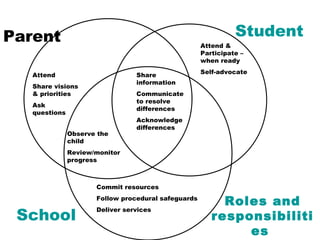
Parent                                                         Student
                                                     Attend &
                                                     Participate –
                                                     when ready
                                                     Self-advocate
   Attend                        Share
                                 information
   Share visions
   & priorities                  Communicate
                                 to resolve
   Ask
                                 differences
   questions
                                 Acknowledge
                                 differences
               Observe the
               child
               Review/monitor
               progress


                      Commit resources
                      Follow procedural safeguards
                                                          Roles and
 School
                      Deliver services
                                                        responsibiliti
                                                             es
PlaCemenT in The leasT
 resTriCTive environmenT-
           (lre)
* The placement of students with disabilities ages 3
  through 21 in appropriate settings has been an integral
  part of the Individuals with Disabilities Education Act
  (IDEA) since its enactment. Three basic principles
  are included in the federal mandates. These are:
• Placement is based on the student 's individualized
  education program;
• Placement is in the least restrictive environment; and
• A continuum of alternative placement options is
  available to all students with disabilities.
factorS:
•  First Factor requires that consideration be given to a comparison of the
  benefits in the regular class and the benefits in the special class. In Daniel
  R. v. El Paso Independent School District , the United States Court
  of Appeals for the Fifth Circuit determined that the appropriateness of
  placement in the regular classroom is not dependent on the student's ability
  to learn the same things that other students learn in the regular classroom.
  The benefit from social interaction of the student with nondisabled peers is a
  legitimate benefit that can be derived from placement in the regular
  classroom.
• Second factor requires that consideration be given to the potentially
  beneficial or harmful effects that placement in the regular classroom may
  have on the student with educational disabilities and the other children in the
  class. Two examples of the many beneficial social and academic effects that
  may accrue to a student with disabilities include positive peer models and
  high expectations for achievement. The potentially beneficial effects on the
  other children in the class are fostered as they learn to understand and
  accept the individual differences of their peers. Harmful effects may include
  the disruptive behavior of a student with disabilities if the disruptiveness is
  severe enough to significantly impair the education of other students. The
  school district must demonstrate that full consideration has been given to the
  complete range of supplementary aids and services that could be provided to
  the student to deal with the problem behaviors.
Placement oPtIonS
         Include:
• a regular classroom;
• a regular classroom with modifications and/or
  supplemental aids and services;
• a resource room for special education instruction
  with instruction in a regular classroom;
• a classroom for children with disabilities located
  in a regular school;
• day or residential special schools, where many
  or all students may have disabilities; and
• a home, hospital, or institution based program
The PJ Settlement Agreement
P.J., et al v. State of Connecticut, Board of
Education, et al. was filed in 1991 on behalf of five
school-age children with mental retardation and their
families. The case was certified as a class action lawsuit
on December 13, 1993. The court defined the class as
“all mentally retarded school-aged children in
Connecticut who have been identified as needing special
education and who. . . are not educated in regular
classrooms” The Settlement Agreement specifically
includes children with the label “Intellectual Disability.”
On May 22, 2002, a Settlement Agreement was
approved and 5 goals and outcomes were determined.
The Five Goals of the PJ
         Settlement Agreement
• An increase in the percent of students with mental
  retardation/intellectual disability who are placed in
  regular classes.
• A reduction in the disparate identification of students with
  MR/ID by racial, ethnic or gender group.
• An increase in the percent of the school day that
  students with MR/ID spend with non-disabled students.
• An increase in the percent of students who attend their
  “home school.”
• An increase in the percent of students with MR/ID who
  participate in school-sponsored extracurricular activities
  with non-disabled peers.
How Do You Address the Fears of Parents with
    Disabilities in a Regular Classroom:

• http://www.klschools.org/www/klsd/site/hosting/public_h
  The above link will give you a “Special Education Parent
  Handbook”, which is a (47 page) very interesting
  publication for a reference guide.
* http://www.coping.org/specialneeds/normaliz.htm
   Tools for Parents of Children with Disabilities and Special Needs
References
• http://www.coping.org/specialneeds/normaliz.htm

• http://www.klschools.org/www/klsd/site/hosting/public_html/SPED/S

• Individuals with Disabilities Education Improvement Act of 2004 (IDEA)

• No Child Left Behind Act (NCLB)

•   http://www.wrightslaw.com/info/lre.index.htm

• http://www.wrightslaw.com/advoc/articles/idea.lre.fape.htm
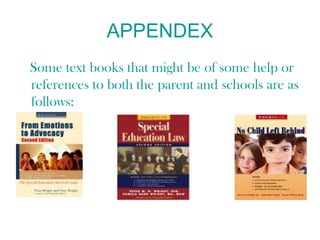
APPENDEX
Some text books that might be of some help or
references to both the parent and schools are as
follows:
Case Studies
                                                                    Case law:
•   Board of Ed. of Hendrick Hudson Central School Dist. v. Rowley 458 U.S. 176 (1982).
    First decision in a special education case by the U. S. Supreme Court; defined "free
    appropriate public education" in the least restrictive environment.
    Carter v. Florence County, U. S. Court of Appeals for the Fourth Circuit While
    arguing that four months a year of progress in reading was appropriate, the district
    also argued that because Trident Academy was not on the State's "approved" list,
    Shannon's parents should not be reimbursed for the placement. The Court discusses
    the mainstreaming policy and "least restrictive environment". This ruling created a
    "split" among circuits that opened the door to an appeal to the U. S. Supreme Court in
    Florence County School District Four v. Shannon Carter.
•   Hartmann v. Loudoun County, U.S. Court of Appeals for the Fourth Circuit, inclusion
    and LRE for child with autism (1997).
    L.B. and J.B. ex rel. K.B. v. Nebo UT School District, U. S. Court of Appeals for the
    Tenth Circuit. Parents of child with autism reimbursed for ABA therapy and private
    preschool which was LRE; also impartiality of hearing officer. (August 2004)
    T. R. v. Kingwood Township (NJ) (3rd Cir. 2000) Clarifies requirement to provide a
    "free appropriate education (FAPE)" in the "least restrictive environment, meaningful
    benefit, continuum of placements.
    Zachary Deal v. Hamilton Dept of Educ (TN Due Process Decision Aug 2001)
    Administrative law judge issues 45 page decision after a 27-day due process hearing;
    finds procedural safeguards and LRE violations; substantive violations ; discusses credibility
    problems with school witnesses re: closed minds, evasiveness.
Conclusion
This was a very interesting topic to do my PowerPoint Presentation
on and I found a lot of information on the subject matter. I could go
on and on because there is so much to learn and tell. I had the
opportunity to teach as a Special Education Associate in Des
Moines, Iowa many years ago and I learned a lot from that
experience. Now that I teach in the Aldine ISD district, I am getting
hands on experience as a teacher on some of the issues and laws
that are associated with Special Education Least Restrictive
Environment. I have several students on my class roster that I deal
with it every day. And I am learning new things everyday as well.
To me, “the least restrictive environment is the one that, to the
greatest extent possible, satisfactorily educates disabled children
together with children who are not disabled, in the same school the
disabled child would attend if the child were not disabled."

Special Education Least Restrictive Environment PPT. - William Allan Kritsonis, PhD

  • 1.
    Special Education: Least RestrictiveEnvironment Promoting School Success for your Child with a Disability William Allan Kritsonis, PhD
  • 2.
    Today you willlearn more abouT: • What the law says about the least restrictive environment (LRE); • The PJ Settlement Agreement; • Supplementary aids and services; and • How to address fears parents have about including students with disabilities in general education classrooms.
  • 3.
    Individuals with Disabilities Education Act (IDEA 04) • 1975- Education of All Handicapped Children Act • Reauthorized every five years • Provides for a free appropriate public education (FAPE) for students with disabilities • Last reauthorized in 2004
  • 4.
    no Child lefTbehind (nClb) *Signed into law January 2002 *Improve outcomes for All Children *Close the achievement gap between children with or without disabilities *Emphasis on reading and using approaches that have been proven to be effective *Ensure that teachers are highly qualified
  • 5.
    IndIvIdualIzed educatIon Program – (IeP ) The Individuals with Disabilities Education Improvement Act of 200 aligns IDEA closely to the No Child Left Behind Act (NCLB), helping to ensure equity, accountability and excellence in education for children with disabilities. Note that IDEA 2004 is in effect as of July 1, 2005, with the exception of the Highly Qualified provision, which has been in effect since the law's signing on December 3, 2004. On August 14, 2006, the official copy of the final Part B regulations of the IDEA 2004 was published in the Federal Register.
  • 6.
    PlannIng before Placement The next slide will give you the child's placement (where the IEP will be carried out) and must be decided. The placement decision is made by a group of people, including the parents and others who know about the child, what the evaluation results mean, and what types of placements are appropriate. In some states, the IEP team serves as the group making the placement decision. In other states, this decision may be made by another group of people. In all cases, the parents have the right to be members of the group that decides the educational placement of the child.
  • 7.
    Parent Student Attend & Participate – when ready Self-advocate Attend Share information Share visions & priorities Communicate to resolve Ask differences questions Acknowledge differences Observe the child Review/monitor progress Commit resources Follow procedural safeguards Roles and School Deliver services responsibiliti es
  • 8.
    PlaCemenT in TheleasT resTriCTive environmenT- (lre) * The placement of students with disabilities ages 3 through 21 in appropriate settings has been an integral part of the Individuals with Disabilities Education Act (IDEA) since its enactment. Three basic principles are included in the federal mandates. These are: • Placement is based on the student 's individualized education program; • Placement is in the least restrictive environment; and • A continuum of alternative placement options is available to all students with disabilities.
  • 9.
    factorS: • FirstFactor requires that consideration be given to a comparison of the benefits in the regular class and the benefits in the special class. In Daniel R. v. El Paso Independent School District , the United States Court of Appeals for the Fifth Circuit determined that the appropriateness of placement in the regular classroom is not dependent on the student's ability to learn the same things that other students learn in the regular classroom. The benefit from social interaction of the student with nondisabled peers is a legitimate benefit that can be derived from placement in the regular classroom. • Second factor requires that consideration be given to the potentially beneficial or harmful effects that placement in the regular classroom may have on the student with educational disabilities and the other children in the class. Two examples of the many beneficial social and academic effects that may accrue to a student with disabilities include positive peer models and high expectations for achievement. The potentially beneficial effects on the other children in the class are fostered as they learn to understand and accept the individual differences of their peers. Harmful effects may include the disruptive behavior of a student with disabilities if the disruptiveness is severe enough to significantly impair the education of other students. The school district must demonstrate that full consideration has been given to the complete range of supplementary aids and services that could be provided to the student to deal with the problem behaviors.
  • 10.
    Placement oPtIonS Include: • a regular classroom; • a regular classroom with modifications and/or supplemental aids and services; • a resource room for special education instruction with instruction in a regular classroom; • a classroom for children with disabilities located in a regular school; • day or residential special schools, where many or all students may have disabilities; and • a home, hospital, or institution based program
  • 11.
    The PJ SettlementAgreement P.J., et al v. State of Connecticut, Board of Education, et al. was filed in 1991 on behalf of five school-age children with mental retardation and their families. The case was certified as a class action lawsuit on December 13, 1993. The court defined the class as “all mentally retarded school-aged children in Connecticut who have been identified as needing special education and who. . . are not educated in regular classrooms” The Settlement Agreement specifically includes children with the label “Intellectual Disability.” On May 22, 2002, a Settlement Agreement was approved and 5 goals and outcomes were determined.
  • 12.
    The Five Goalsof the PJ Settlement Agreement • An increase in the percent of students with mental retardation/intellectual disability who are placed in regular classes. • A reduction in the disparate identification of students with MR/ID by racial, ethnic or gender group. • An increase in the percent of the school day that students with MR/ID spend with non-disabled students. • An increase in the percent of students who attend their “home school.” • An increase in the percent of students with MR/ID who participate in school-sponsored extracurricular activities with non-disabled peers.
  • 13.
    How Do YouAddress the Fears of Parents with Disabilities in a Regular Classroom: • http://www.klschools.org/www/klsd/site/hosting/public_h The above link will give you a “Special Education Parent Handbook”, which is a (47 page) very interesting publication for a reference guide. * http://www.coping.org/specialneeds/normaliz.htm Tools for Parents of Children with Disabilities and Special Needs
  • 14.
    References • http://www.coping.org/specialneeds/normaliz.htm • http://www.klschools.org/www/klsd/site/hosting/public_html/SPED/S •Individuals with Disabilities Education Improvement Act of 2004 (IDEA) • No Child Left Behind Act (NCLB) • http://www.wrightslaw.com/info/lre.index.htm • http://www.wrightslaw.com/advoc/articles/idea.lre.fape.htm
  • 15.
    APPENDEX Some text booksthat might be of some help or references to both the parent and schools are as follows:
  • 16.
    Case Studies Case law: • Board of Ed. of Hendrick Hudson Central School Dist. v. Rowley 458 U.S. 176 (1982). First decision in a special education case by the U. S. Supreme Court; defined "free appropriate public education" in the least restrictive environment. Carter v. Florence County, U. S. Court of Appeals for the Fourth Circuit While arguing that four months a year of progress in reading was appropriate, the district also argued that because Trident Academy was not on the State's "approved" list, Shannon's parents should not be reimbursed for the placement. The Court discusses the mainstreaming policy and "least restrictive environment". This ruling created a "split" among circuits that opened the door to an appeal to the U. S. Supreme Court in Florence County School District Four v. Shannon Carter. • Hartmann v. Loudoun County, U.S. Court of Appeals for the Fourth Circuit, inclusion and LRE for child with autism (1997). L.B. and J.B. ex rel. K.B. v. Nebo UT School District, U. S. Court of Appeals for the Tenth Circuit. Parents of child with autism reimbursed for ABA therapy and private preschool which was LRE; also impartiality of hearing officer. (August 2004) T. R. v. Kingwood Township (NJ) (3rd Cir. 2000) Clarifies requirement to provide a "free appropriate education (FAPE)" in the "least restrictive environment, meaningful benefit, continuum of placements. Zachary Deal v. Hamilton Dept of Educ (TN Due Process Decision Aug 2001) Administrative law judge issues 45 page decision after a 27-day due process hearing; finds procedural safeguards and LRE violations; substantive violations ; discusses credibility problems with school witnesses re: closed minds, evasiveness.
  • 17.
    Conclusion This was avery interesting topic to do my PowerPoint Presentation on and I found a lot of information on the subject matter. I could go on and on because there is so much to learn and tell. I had the opportunity to teach as a Special Education Associate in Des Moines, Iowa many years ago and I learned a lot from that experience. Now that I teach in the Aldine ISD district, I am getting hands on experience as a teacher on some of the issues and laws that are associated with Special Education Least Restrictive Environment. I have several students on my class roster that I deal with it every day. And I am learning new things everyday as well. To me, “the least restrictive environment is the one that, to the greatest extent possible, satisfactorily educates disabled children together with children who are not disabled, in the same school the disabled child would attend if the child were not disabled."