Teaching Learners With Special NeedsBy: Alyssa Peschong
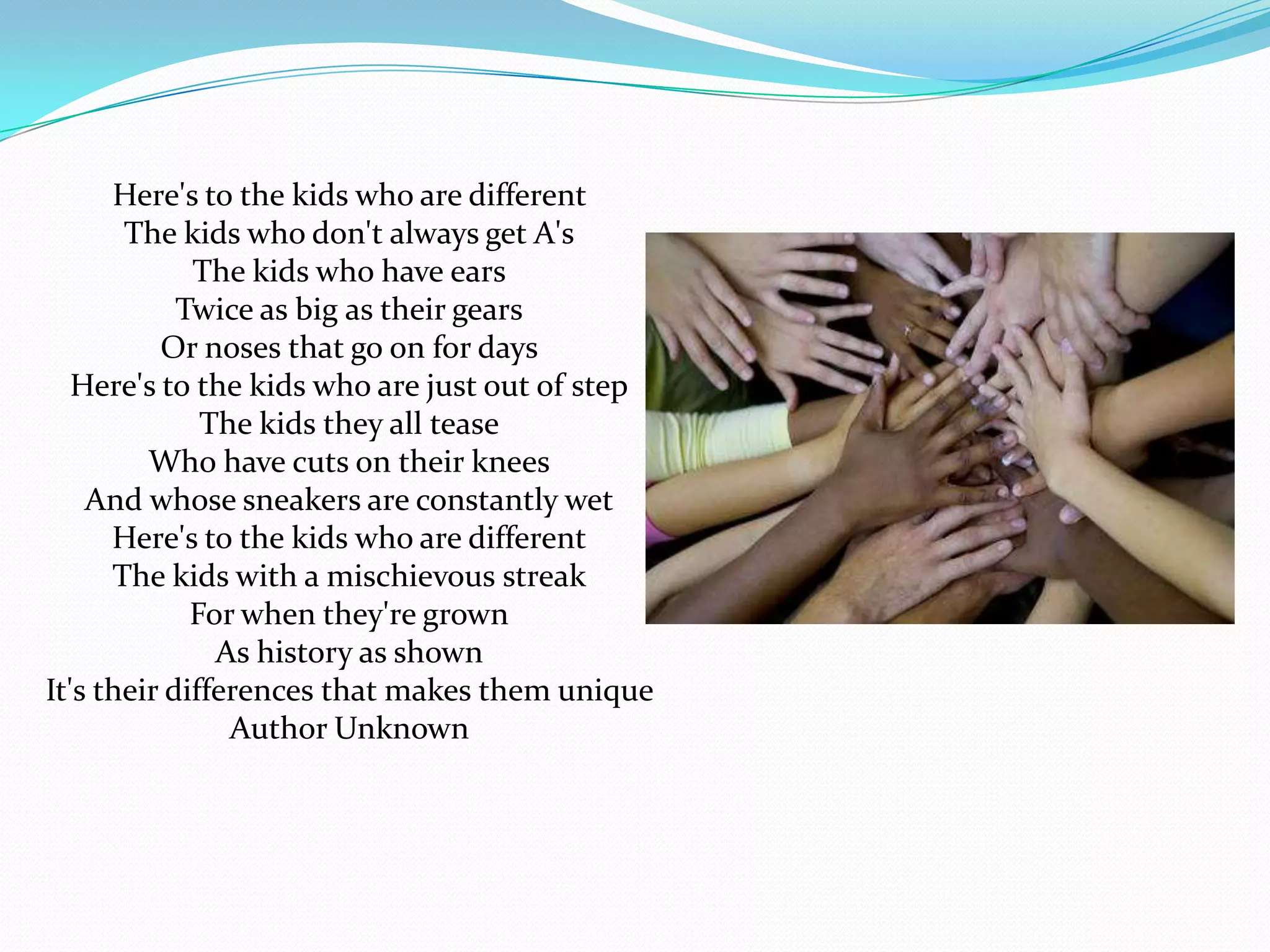
Here's to the kids who are different The kids who don't always get A'sThe kids who have earsTwice as big as their gearsOr noses that go on for daysHere's to the kids who are just out of stepThe kids they all teaseWho have cuts on their kneesAnd whose sneakers are constantly wetHere's to the kids who are differentThe kids with a mischievous streakFor when they're grownAs history as shownIt's their differences that makes them unique Author Unknown
PL 94-142Authorized funding to the states to assist in the development, expansion, and improvement of the special education program.
Provide an appropriate education to students who had not received one in the past.
Ensured the rights of all children with disabilities.
Now known as IDEA. IDEAIndividuals with Disabilities Act – Reauthorization of PL 94-142
Six Key Provisions of IDEAFree, Appropriate Public Education (FAPE)- School districts must provide special education and related services, such as transportation to meet the needs of students with special learning requirements. Appropriate Evaluation- Prior to receiving special education and related services a full ,individual, and nondiscriminatory evaluation must be conducted by a team, which a parent must be a part of.
IDEA ContinuedIndividual Education Program (IEP)- A written document summarizing a students’ learning program and is required for every student who qualifies for services. Major purpose is to establish learning goals for a student which depend on an analysis of the student’s present level of performance. Least Restrictive Environment (LRE)- Schools must educate children with disabilities in the general education setting with their peers who are nondisabled. Provides an opportunity for students to attend school in the most inclusive setting possible. IDEA ContinuedParent and Student Participation in Decision Making-Parents have the right to challenge or appeal any decision related to any part of the special education process. They also have the right to obtain an independent educational evaluation (IEE) of their child. Procedural Safeguards- Parents have the right to: Educational records
Obtain an IEE
Request a due process hearing
Appeal decisions
Initiate civil action when appealing a final hearing decisionSection 504Extended civil rights.
Any student who has a physical or mental impairment that significantly limits one or more major life activities can qualify for special services under section 504.
This laws provides services to students who may not classify under IDEA. These students need certain accommodations and are entitled to protection under law. ADAAmericans with Disabilities Act (ADA)- Represents broad civil rights coverage for individuals who are disabled.
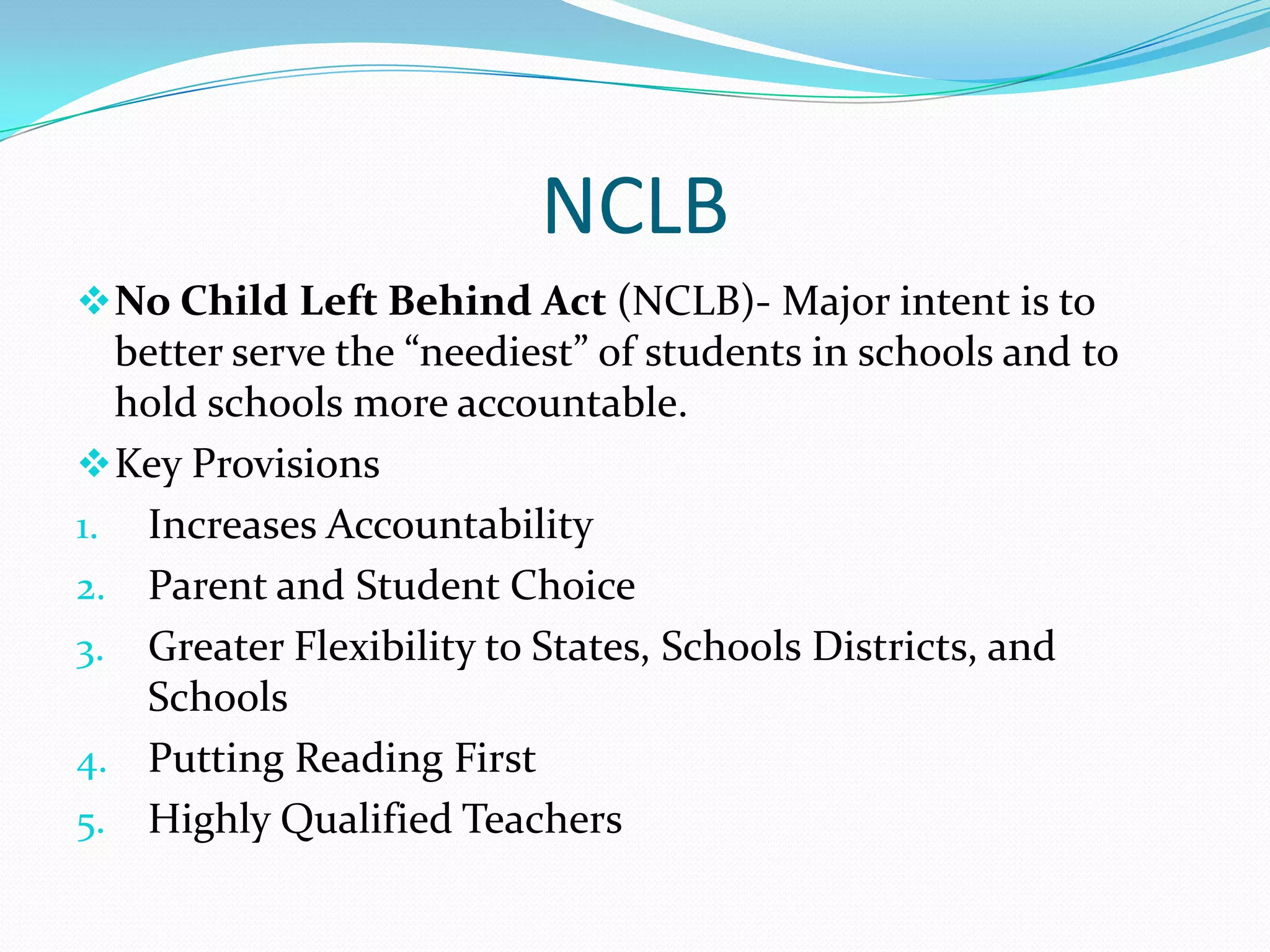
Establishes guidelines for employment, public accommodations, transportation, state and local government operations, and telecommunication systems. NCLBNo Child Left Behind Act (NCLB)- Major intent is to better serve the “neediest” of students in schools and to hold schools more accountable.
Key ProvisionsIncreases AccountabilityParent and Student ChoiceGreater Flexibility to States, Schools Districts, and SchoolsPutting Reading FirstHighly Qualified Teachers

Week one powerpoint

  • 1.
    Teaching Learners WithSpecial NeedsBy: Alyssa Peschong
  • 2.
    Here's to thekids who are different The kids who don't always get A'sThe kids who have earsTwice as big as their gearsOr noses that go on for daysHere's to the kids who are just out of stepThe kids they all teaseWho have cuts on their kneesAnd whose sneakers are constantly wetHere's to the kids who are differentThe kids with a mischievous streakFor when they're grownAs history as shownIt's their differences that makes them unique Author Unknown
  • 3.
    PL 94-142Authorized fundingto the states to assist in the development, expansion, and improvement of the special education program.
  • 4.
    Provide an appropriateeducation to students who had not received one in the past.
  • 5.
    Ensured the rightsof all children with disabilities.
  • 6.
    Now known asIDEA. IDEAIndividuals with Disabilities Act – Reauthorization of PL 94-142
  • 7.
    Six Key Provisionsof IDEAFree, Appropriate Public Education (FAPE)- School districts must provide special education and related services, such as transportation to meet the needs of students with special learning requirements. Appropriate Evaluation- Prior to receiving special education and related services a full ,individual, and nondiscriminatory evaluation must be conducted by a team, which a parent must be a part of.
  • 8.
    IDEA ContinuedIndividual EducationProgram (IEP)- A written document summarizing a students’ learning program and is required for every student who qualifies for services. Major purpose is to establish learning goals for a student which depend on an analysis of the student’s present level of performance. Least Restrictive Environment (LRE)- Schools must educate children with disabilities in the general education setting with their peers who are nondisabled. Provides an opportunity for students to attend school in the most inclusive setting possible. IDEA ContinuedParent and Student Participation in Decision Making-Parents have the right to challenge or appeal any decision related to any part of the special education process. They also have the right to obtain an independent educational evaluation (IEE) of their child. Procedural Safeguards- Parents have the right to: Educational records
  • 9.
  • 10.
    Request a dueprocess hearing
  • 11.
  • 12.
    Initiate civil actionwhen appealing a final hearing decisionSection 504Extended civil rights.
  • 13.
    Any student whohas a physical or mental impairment that significantly limits one or more major life activities can qualify for special services under section 504.
  • 14.
    This laws providesservices to students who may not classify under IDEA. These students need certain accommodations and are entitled to protection under law. ADAAmericans with Disabilities Act (ADA)- Represents broad civil rights coverage for individuals who are disabled.
  • 15.
    Establishes guidelines foremployment, public accommodations, transportation, state and local government operations, and telecommunication systems. NCLBNo Child Left Behind Act (NCLB)- Major intent is to better serve the “neediest” of students in schools and to hold schools more accountable.
  • 16.
    Key ProvisionsIncreases AccountabilityParentand Student ChoiceGreater Flexibility to States, Schools Districts, and SchoolsPutting Reading FirstHighly Qualified Teachers
  • 17.
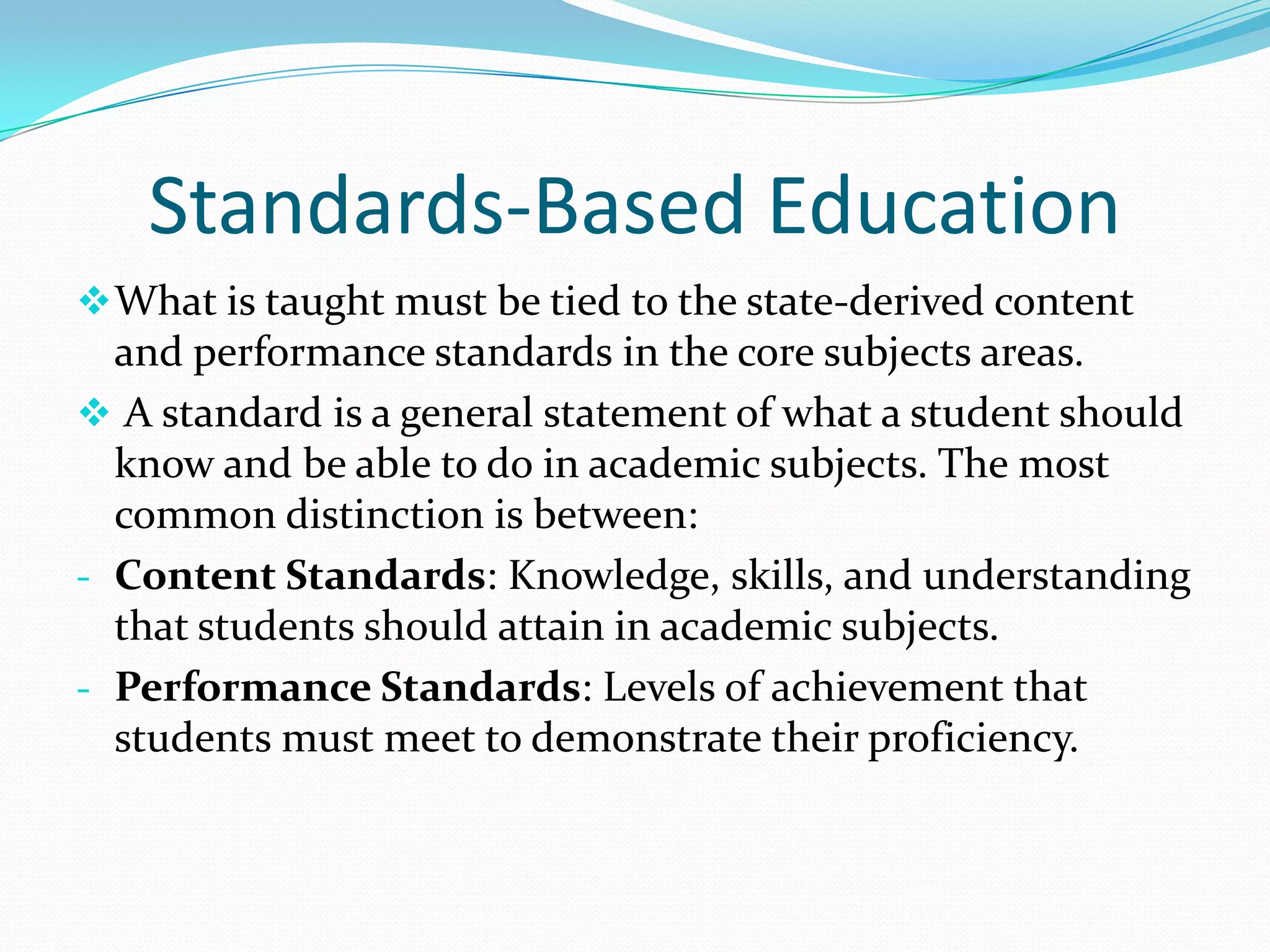
    Standards-Based EducationWhat istaught must be tied to the state-derived content and performance standards in the core subjects areas.
  • 18.
    A standard isa general statement of what a student should know and be able to do in academic subjects. The most common distinction is between:
  • 19.
    Content Standards: Knowledge,skills, and understanding that students should attain in academic subjects.
  • 20.
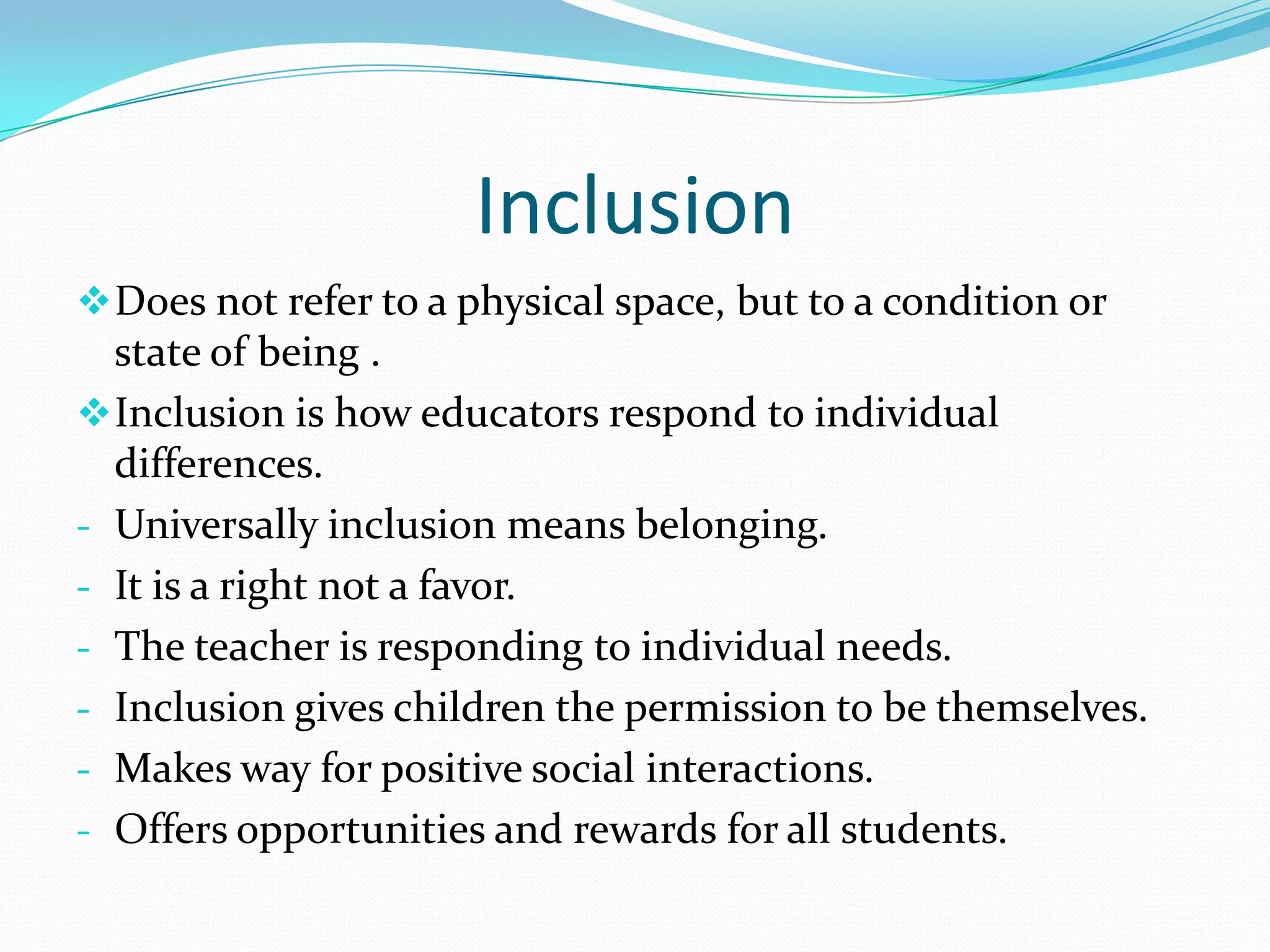
    Performance Standards: Levelsof achievement that students must meet to demonstrate their proficiency. InclusionDoes not refer to a physical space, but to a condition or state of being .
  • 21.
    Inclusion is howeducators respond to individual differences.
  • 22.
  • 23.
    It is aright not a favor.
  • 24.
    The teacher isresponding to individual needs.
  • 25.
    Inclusion gives childrenthe permission to be themselves.
  • 26.
    Makes way forpositive social interactions.
  • 27.
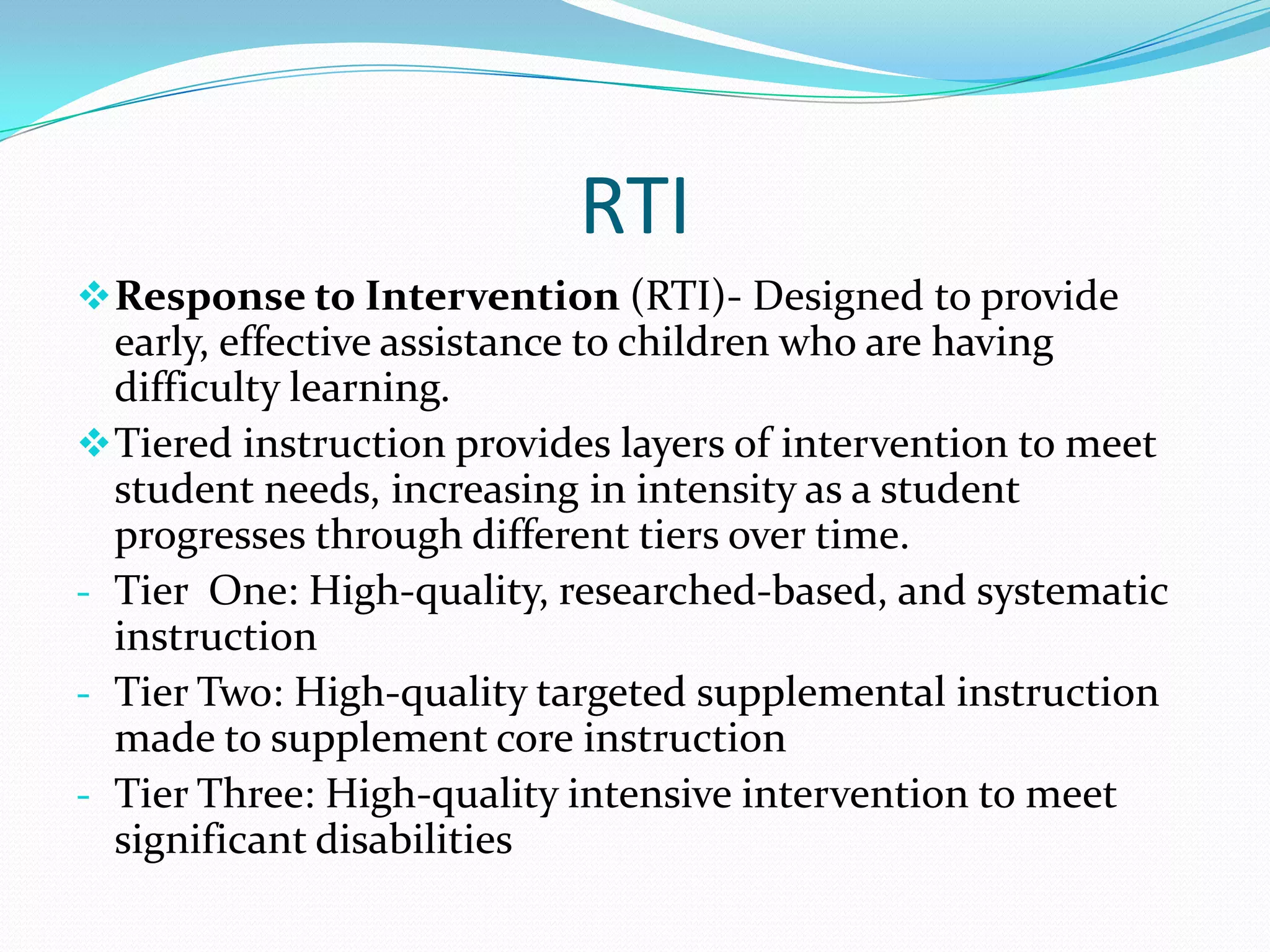
    Offers opportunities andrewards for all students. RTIResponse to Intervention (RTI)- Designed to provide early, effective assistance to children who are having difficulty learning.
  • 28.
    Tiered instruction provideslayers of intervention to meet student needs, increasing in intensity as a student progresses through different tiers over time.
  • 29.
    Tier One:High-quality, researched-based, and systematic instruction
  • 30.
    Tier Two: High-qualitytargeted supplemental instruction made to supplement core instruction
  • 31.
    Tier Three: High-qualityintensive intervention to meet significant disabilitiesUDLUniversal Design for Learning (UDL)- “ The design of products and environment to be usable by all people, to the greatest extent possible, without the need for adaptation or specialized design.”
  • 32.
  • 33.
    A curriculum thatincorporates a UDL direction features the following:
  • 34.
    Goals that providea challenge for all students
  • 35.
  • 36.
    Methods that areflexible and diverse
  • 37.
    Sufficient flexible assessmentDifferentiatedInstructionProcess to approach teaching and learning for students of differing abilities in the same classroom.
  • 38.
    Objective is tomake best use of each student’s growth and individual achievement by meeting each student where he or she is, and supporting in the learning process.
  • 39.
    Teachers are requiredto use interventions that have evidence that they work with the populations that they are being used by. Evidence-Based Practices
  • 40.
    Diversity ConsiderationsA multitieredsystem should be designed to address the needs of a range of learners with diverse needs.
  • 41.
    Teachers must developa sensitivity to the needs of a diverse group of students.
  • 42.
    Diversity is morethan a disability.
  • 43.
    Dimensions of Diversity:Behavioral, cultural, racial-ethnic, setting (urban, migrant), ELL’s, economic, sexual orientation, intellectual/cognitive, physical/sensory, and behavioralResources Patton, J. R., Polloway, E. A., & Serna, L. (2008). Strategies for Teaching Learners with Special Needs. New Jersey : Pearson Education Inc.