WELCOME
Kripa Susan Babu
I M.Ed.
KRTC Kollam
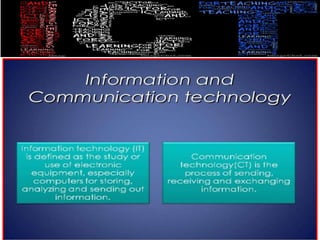
ICT
NEED OF ICT IN TEACHER
EDUCATION
• Role of the teacher: Guide, Facilitator rather than a
Director.
• Students get more choice over how they approach
the study.
• The teacher in the new role will encourage critical
thinking skills, promote information literacy and
nurture the cooperative learning to foster creativity
among students.
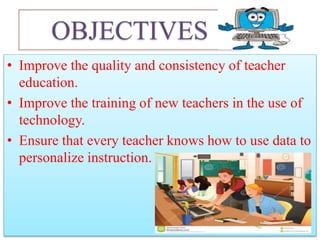
OBJECTIVES
• Improve the quality and consistency of teacher
education.
• Improve the training of new teachers in the use of
technology.
• Ensure that every teacher knows how to use data to
personalize instruction.
APPROACHES
• ICT Skills Development
Approach
• ICT Pedagogy Approach
• Subject- Specific Approach
• Practice Driven Approach
ICT Skills Development Approach
• Importance is given to providing
training in use of ICT.
• Student Teachers are expected to be
skilled users of ICT for their daily
activities.
• Knowledge about various software,
hardware and their use in educational
process is provided.
ICT Pedagogy Approach
• Emphasis is on integration of ICT skills in
a respective subject.
• Is useful to the extent that the skills enhance ICT
literacy skills.
• Pedagogy allows students to develop and
maintain these skills in designing classroom-
based resource.
Subject – Specific Approach
• Here ICT is embedded into one’s own
subject area
• Has an emphasis on how to use ICT in
classroom
• Address issues such as selecting
appropriate ICT tools and supporting
students in the use of these tools using
ICT to promote learning activities.
Practice Driven Approach
• Emphasis is on providing exposure to
the use of ICT in practice aspects of
teacher training.
• Focus is on developing lesson and
assignments.
• Prepare teachers to design and
develop implementable ICT
facilitated classroom programs and
products.
Revolution Caused By ICT in Teacher
Education
• ICT changed the role of a teacher from instructor to a
facilitator
• Introduction of new course in the curriculum in response
to emerging demand
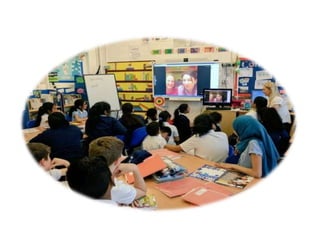
• Helps teachers working in remote locations to access
online libraries and enhance quality teaching and up
gradation of knowledge.
• Helps teachers organizing and using time management
system in their academic work
• Overcome teacher isolation by active and cooperative
participation of students
Ict ppt
Ict ppt

Ict ppt

  • 1.
    WELCOME Kripa Susan Babu IM.Ed. KRTC Kollam
  • 3.
  • 4.
    NEED OF ICTIN TEACHER EDUCATION • Role of the teacher: Guide, Facilitator rather than a Director. • Students get more choice over how they approach the study. • The teacher in the new role will encourage critical thinking skills, promote information literacy and nurture the cooperative learning to foster creativity among students.
  • 5.
    OBJECTIVES • Improve thequality and consistency of teacher education. • Improve the training of new teachers in the use of technology. • Ensure that every teacher knows how to use data to personalize instruction.
  • 6.
    APPROACHES • ICT SkillsDevelopment Approach • ICT Pedagogy Approach • Subject- Specific Approach • Practice Driven Approach
  • 7.
    ICT Skills DevelopmentApproach • Importance is given to providing training in use of ICT. • Student Teachers are expected to be skilled users of ICT for their daily activities. • Knowledge about various software, hardware and their use in educational process is provided.
  • 8.
    ICT Pedagogy Approach •Emphasis is on integration of ICT skills in a respective subject. • Is useful to the extent that the skills enhance ICT literacy skills. • Pedagogy allows students to develop and maintain these skills in designing classroom- based resource.
  • 9.
    Subject – SpecificApproach • Here ICT is embedded into one’s own subject area • Has an emphasis on how to use ICT in classroom • Address issues such as selecting appropriate ICT tools and supporting students in the use of these tools using ICT to promote learning activities.
  • 10.
    Practice Driven Approach •Emphasis is on providing exposure to the use of ICT in practice aspects of teacher training. • Focus is on developing lesson and assignments. • Prepare teachers to design and develop implementable ICT facilitated classroom programs and products.
  • 11.
    Revolution Caused ByICT in Teacher Education • ICT changed the role of a teacher from instructor to a facilitator • Introduction of new course in the curriculum in response to emerging demand • Helps teachers working in remote locations to access online libraries and enhance quality teaching and up gradation of knowledge. • Helps teachers organizing and using time management system in their academic work • Overcome teacher isolation by active and cooperative participation of students