DISRUPTIVE DISORDERS
Dr Srividya
What makes them different from the rest of the developmental
and psychiatric disorders
Disruptive disorders are often seen as deliberate wrong
behaviour of the child and family almost always responds by
punishment.
The symptoms of the disruptive disorders are part of natural
development and only when they create problems to child or
parents, considered as disorder.
Show high persistence and in significant portion of the cases
,they persist even into adulthood in more severe form.
DISRUPTIVE BEHAVIOUR
DISORDERS
The joint prevalence is 5-10%
1. Oppositional defiant disorder
2.Conduct disorder
CRITERIA AND TYPES
ICD 10 includes ODD in Conduct Disorders(F91) but ICD 11 separately
included ODD and CD under disruptive behavior/ dissocial disorders.
ICD 11 even specified with or without chronic irritability and with or with
out prosocial emotions
Types of ODD
1.Angry/ irritable mood
2.Argumentative and defiant
3.Vindictiveness.
Conduct disorder :
The symptoms are categorised into
1.Agression to people and animals
2.Destruction of property
3.Deceitfuness or theft
4.Serious violation of rules.
specifiers: childhood onset type -onset of symptoms <10
adolescent onset type - onset of symptoms after 10 years
MOFITT TAXONOMY
Moffitt describes two developmental pathways into
delinquent behaviour:
1.Adolescence-limited: An episodic occurrence of delinquent
behavior, without family history
2.Life course persistent:A pathway characterised by an early
onset and family history of criminator substance use, have a
stable course of delinquent behavior
WELL REPLICATED FINDINGS
1. Disruptive behavior problems commonly start before age 2 years and may persist
over many years
2. In adult life they are associated with criminality; behavioral and social difficulties
identified as DSM ASPD; and with psychiatric disorders such as substance misuse and
depression
3. Rates of antisocial and delinquent behaviors increase markedly during adolescence
and fall in adult life
4. Between 50% and 70% of children with disruptive behavior problems show
improvement during childhood,
but some continue to have adjustment problems
5. Disruptive behavior problems are more common in boys than in girls
Factors that predict high risk of persistence
1.Early onset conduct problems
2.Presence of Physical aggression, and
3.Presence of CU traits
All of the above mentioned are all strongly heritable which makes them
vulnerable to adverse environmental conditions.
LEE ROBINS WORK
Lee N Robins first showed the
long term course of the
disruptive behavioural
problems.
disruptive behaviour problems
commonly press as adults,
these pts showed persistence
violence and illegal
behaviours
In particular, they often had
unstable lifestyles in terms of
work, relationships, reckless &
impulsive behaviours
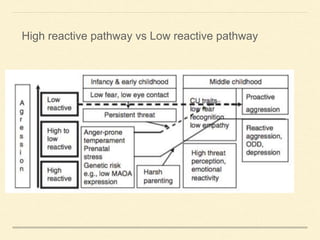
High reactive pathway vs Low reactive pathway
Age-related trends of conduct behaviour:
1.Normative pathway :
Physical aggression is at its peak very early in childhood, then slowly decline and
delinquency rises sharply across the teens, declining gradually in the early adult years
leading to prosocial behaviour.
2.Deviant pathway :
Gradual accumulation of risk factors leads to a steady worsening of aggressive and
oppositional behaviours leading to more serious acts of anti social behaviours.
RISK OF ODD FOR progression to CD
30% of the cases show progression to CD.
Factors pointing to poorer prognosis are
1.Early age of onset of symptoms (3x)
2.More baseline ODD symptoms
10% of youth with ODD grow up to meet ASPD.
LONGITUDINAL OUTCOMES
Young people with disruptive behavior problems face a wide spectrum of adverse outcomes later in
their lives.
childhood conduct problems were associated with
poor educational and occupational achievements;
problems in sexual and partner relationships;
early parenthood; and
elevated rates of substance use, mood and anxiety disorders
suicidal acts.
Longitudinal studies have documented associations with poor health-related behaviors and markers
of chronic disease early in adulthood with increased risk of premature death in high risk
pts(Maughan et al., 2014).
The great majority of offenders eventually desist.
Protective factors :
1.Changes in antisocial peer affiliations as peer influence is one among the
strongest correlates of reductions in offending.
2.Role of adult “turning point” experiences, including social attachments to
work, and supportive marital relationships
These findings point to intervention targets that may accelerate that process
and help to break—or at least interrupt—chains of risk.
MANAGEMENT
Starting with the interview
Non judgemental , empathic and non critical interviewing /
listening is very important to build a healthy rapport
Asking the child whether the consultation is with his consent
or against his will, helps in building trust
Get to know the child ,hobbies , interests,etc. Show the child
that you are genuinely interested.
Always get to know his/her side of the story .
Ask about emotions in general and things that upset him or
times when he was upset
Carefully focus on difficult situations and behaviours and get
the child to talk about them.
EXAMPLE.
Mother: Today afternoon, he was completely out of control.
we went to a hotel for lunch and it ordered to parcel. he
insisted on eating there
I even explained him that it will cost us double if we eat here
, and got the parcel. He was very stubborn but followed me
then, but after reaching our room, he created lot of trouble.
Child’s version of the story: By the time we finished the
consultation,it was 2pm already and i was very hungry. then
my mom made me to walk for 15 minutes to reach the hotel.
I was really very hungry and tired by the time we reached
the hotel.i wanted to eat immediately and my mom insisted
to take away and eat at our room. I was upset that she didn't
care about me. I got angry as I was very hungry. I didn't
want to hurt my mom but it happened somehow.
Clinical Assessment :
Look at the
1.Age of onset of symptoms
2.IQ
3.Subtype and symptoms severity
4.Comorbid conditions
5.Perpetuating factors and Protective factors
Scales :
Eyeberg child behaviour inventory
overt agression scale
Antisocial process screening devise
Newyork teacher rating scale.
TREATMENT
Primary prevention is the gold standard always for at risk children
The well studies mediators of early onset aggression and conduct problems include
• 1.Coercive family processes,
• 2.Problematic parent practices and
• 3.Deficient social skills.
Hence the management include Multimodal intervention targeting multiple domains
1. Parents, 2.family, 3.child and 4.school.
The intervention should be aimed for sufficient duration, generally 2 years
1.PMT FOR THE PARENTS
Parents are trained to alter their child’s behaviour at home
Based on parent child interaction, social learning theories and behavioral principles.
Aim: alter their interaction with the child to reinforce prosocial behavior.
Step1:promoting a child centered approach
Step 2:increasing acceptable child behaviour
Step3: setting clear expectations - Do commands
Step 4: Reducing unacceptable behaviour
Step 5: Strategies for avoiding trouble
Step 6: Identifying and rectifying long standing maladaptive patterns.
2.Managing the children: teaching them and encouraging them to apply
in real world
Problem solving skills
Social skills
Emotional regulation
3.School Interventions :
Collaborating with schools,teachers to plan group activities / train in
social skills. Assigning the high risk children with low risk children
PHARMACOTHERAPY
There is little scientific evidence that ODD/CD responds
directly to medication
Only exception is when ODD occurs in children with ADHD.
In such cases, stimulants and noradrenergic agents have
shown significant results.
Meta analyses have supported typical and atypical
antipsychotics , mood stabilisers , lithium as moderately
effective for managing explosive aggression in youth with
CD.
THANK YOU

ODDCD.pptx

  • 1.
  • 2.
    What makes themdifferent from the rest of the developmental and psychiatric disorders Disruptive disorders are often seen as deliberate wrong behaviour of the child and family almost always responds by punishment. The symptoms of the disruptive disorders are part of natural development and only when they create problems to child or parents, considered as disorder. Show high persistence and in significant portion of the cases ,they persist even into adulthood in more severe form.
  • 3.
    DISRUPTIVE BEHAVIOUR DISORDERS The jointprevalence is 5-10% 1. Oppositional defiant disorder 2.Conduct disorder
  • 4.
    CRITERIA AND TYPES ICD10 includes ODD in Conduct Disorders(F91) but ICD 11 separately included ODD and CD under disruptive behavior/ dissocial disorders. ICD 11 even specified with or without chronic irritability and with or with out prosocial emotions Types of ODD 1.Angry/ irritable mood 2.Argumentative and defiant 3.Vindictiveness.
  • 5.
    Conduct disorder : Thesymptoms are categorised into 1.Agression to people and animals 2.Destruction of property 3.Deceitfuness or theft 4.Serious violation of rules. specifiers: childhood onset type -onset of symptoms <10 adolescent onset type - onset of symptoms after 10 years
  • 6.
    MOFITT TAXONOMY Moffitt describestwo developmental pathways into delinquent behaviour: 1.Adolescence-limited: An episodic occurrence of delinquent behavior, without family history 2.Life course persistent:A pathway characterised by an early onset and family history of criminator substance use, have a stable course of delinquent behavior
  • 7.
    WELL REPLICATED FINDINGS 1.Disruptive behavior problems commonly start before age 2 years and may persist over many years 2. In adult life they are associated with criminality; behavioral and social difficulties identified as DSM ASPD; and with psychiatric disorders such as substance misuse and depression 3. Rates of antisocial and delinquent behaviors increase markedly during adolescence and fall in adult life 4. Between 50% and 70% of children with disruptive behavior problems show improvement during childhood, but some continue to have adjustment problems 5. Disruptive behavior problems are more common in boys than in girls
  • 8.
    Factors that predicthigh risk of persistence 1.Early onset conduct problems 2.Presence of Physical aggression, and 3.Presence of CU traits All of the above mentioned are all strongly heritable which makes them vulnerable to adverse environmental conditions.
  • 9.
    LEE ROBINS WORK LeeN Robins first showed the long term course of the disruptive behavioural problems. disruptive behaviour problems commonly press as adults, these pts showed persistence violence and illegal behaviours In particular, they often had unstable lifestyles in terms of work, relationships, reckless & impulsive behaviours
  • 10.
    High reactive pathwayvs Low reactive pathway
  • 11.
    Age-related trends ofconduct behaviour: 1.Normative pathway : Physical aggression is at its peak very early in childhood, then slowly decline and delinquency rises sharply across the teens, declining gradually in the early adult years leading to prosocial behaviour. 2.Deviant pathway : Gradual accumulation of risk factors leads to a steady worsening of aggressive and oppositional behaviours leading to more serious acts of anti social behaviours.
  • 12.
    RISK OF ODDFOR progression to CD 30% of the cases show progression to CD. Factors pointing to poorer prognosis are 1.Early age of onset of symptoms (3x) 2.More baseline ODD symptoms 10% of youth with ODD grow up to meet ASPD.
  • 13.
    LONGITUDINAL OUTCOMES Young peoplewith disruptive behavior problems face a wide spectrum of adverse outcomes later in their lives. childhood conduct problems were associated with poor educational and occupational achievements; problems in sexual and partner relationships; early parenthood; and elevated rates of substance use, mood and anxiety disorders suicidal acts. Longitudinal studies have documented associations with poor health-related behaviors and markers of chronic disease early in adulthood with increased risk of premature death in high risk pts(Maughan et al., 2014).
  • 14.
    The great majorityof offenders eventually desist. Protective factors : 1.Changes in antisocial peer affiliations as peer influence is one among the strongest correlates of reductions in offending. 2.Role of adult “turning point” experiences, including social attachments to work, and supportive marital relationships These findings point to intervention targets that may accelerate that process and help to break—or at least interrupt—chains of risk.
  • 15.
    MANAGEMENT Starting with theinterview Non judgemental , empathic and non critical interviewing / listening is very important to build a healthy rapport Asking the child whether the consultation is with his consent or against his will, helps in building trust Get to know the child ,hobbies , interests,etc. Show the child that you are genuinely interested.
  • 16.
    Always get toknow his/her side of the story . Ask about emotions in general and things that upset him or times when he was upset Carefully focus on difficult situations and behaviours and get the child to talk about them.
  • 17.
    EXAMPLE. Mother: Today afternoon,he was completely out of control. we went to a hotel for lunch and it ordered to parcel. he insisted on eating there I even explained him that it will cost us double if we eat here , and got the parcel. He was very stubborn but followed me then, but after reaching our room, he created lot of trouble.
  • 18.
    Child’s version ofthe story: By the time we finished the consultation,it was 2pm already and i was very hungry. then my mom made me to walk for 15 minutes to reach the hotel. I was really very hungry and tired by the time we reached the hotel.i wanted to eat immediately and my mom insisted to take away and eat at our room. I was upset that she didn't care about me. I got angry as I was very hungry. I didn't want to hurt my mom but it happened somehow.
  • 19.
    Clinical Assessment : Lookat the 1.Age of onset of symptoms 2.IQ 3.Subtype and symptoms severity 4.Comorbid conditions 5.Perpetuating factors and Protective factors
  • 20.
    Scales : Eyeberg childbehaviour inventory overt agression scale Antisocial process screening devise Newyork teacher rating scale.
  • 21.
    TREATMENT Primary prevention isthe gold standard always for at risk children The well studies mediators of early onset aggression and conduct problems include • 1.Coercive family processes, • 2.Problematic parent practices and • 3.Deficient social skills. Hence the management include Multimodal intervention targeting multiple domains 1. Parents, 2.family, 3.child and 4.school. The intervention should be aimed for sufficient duration, generally 2 years
  • 22.
    1.PMT FOR THEPARENTS Parents are trained to alter their child’s behaviour at home Based on parent child interaction, social learning theories and behavioral principles. Aim: alter their interaction with the child to reinforce prosocial behavior. Step1:promoting a child centered approach Step 2:increasing acceptable child behaviour Step3: setting clear expectations - Do commands Step 4: Reducing unacceptable behaviour Step 5: Strategies for avoiding trouble Step 6: Identifying and rectifying long standing maladaptive patterns.
  • 23.
    2.Managing the children:teaching them and encouraging them to apply in real world Problem solving skills Social skills Emotional regulation 3.School Interventions : Collaborating with schools,teachers to plan group activities / train in social skills. Assigning the high risk children with low risk children
  • 24.
    PHARMACOTHERAPY There is littlescientific evidence that ODD/CD responds directly to medication Only exception is when ODD occurs in children with ADHD. In such cases, stimulants and noradrenergic agents have shown significant results. Meta analyses have supported typical and atypical antipsychotics , mood stabilisers , lithium as moderately effective for managing explosive aggression in youth with CD.
  • 25.