CHRONOBIOLOGY
PRESENTER:
DR.S.CHANDANA,
1STYEAR POSTGRADUATE
CHAIR PERSON:
DR.RUFUS ,
ASSISTANT PROFESSOR,
DEPT OF PSYCHIATRY,
ANDHRA MEDICAL COLLEGE
SCHEME OF PRESENTATION
• Introduction
• Circadian pacemakers
• Molecular Clockwork
• Resetting the circadian clock
• Retinal photoreceptors
• Extra SCN Zeitgebers
• Sleep and circadian rhythm
• Seasonality and circadian rhythm
• Psychiatric disorders and circadian rhythm
• Circadian rhythm and pharmacotherapy
• Chronobiology is the study of biological time
• It is derived from the greek(chronos meaning time and biology is the study or
science of life)
• The rotation of the Earth about its axis imposes a 24 hour cyclicity upon the
biosphere.
• Organisms have evolved to occupy geographical niches that can be defined by
three spacial dimensions and also evolved to occupy temporal niches that are
defined by the fourth dimension of time
A broad range of frequencies exist throughout biology ranging from
• millisecond oscillations in ocular field potentials
• 17 year cycle of emergence seen in the periodic cicada(Magicicada spp.)
HISTORY OF CHRONOBIOLOGY
TIME PERIOD CONTRIBUTOR DISCOVERY
4th century BC Androsthenes
Ship captain serving Alexander
the Great
Described the diurnal leaf
movements of Tamarind
tree
18th century/1729 Jean-Jacques d’Orteus de Mairan
French scientist
Documented 24hr patterns
in the movement of plant
leaves
18th century/1751 Carl Linnaeus
Swedish botanist
Designed flower clock
using certain species of
flowers
Early 20th century Anthonia kleinhoonte
Erwin bunning
Rhythmicity appears to be
endogenous in nature by
plant studies
TIME PERIOD CONTRIBUTOR DISCOVERY
1918 Szymanski Animals are capable of
maintaining the 24 hr
activity patterns in the
absence of environmental
cues
1959 Franz Halberg
Father of American
Chronobiology
Coined the term ‘Circadian’
Auguste forel Circadian rhythms noticed
in the rhythmic feeding
time of bees
1970 Ron Konopka
Seymour benzer
Isolated the first clock
mutant in DROSOPHILA
MELANOGASTER and
mapped the period gene
1994 Joseph Takahasi Discovered the first
mammalian ‘clock gene’
using mice
• The most extensively studied and best understood biological rhythms is Circadian
rhythms that have a period of about one day
• A defining feature of circadian rhythms is that they persist in the absence of time
cues and are not simply driven by the 24-hour environmental cycle
• Circadian rhythm can be
1. Diurnal
2. Nocturnal
3. Crepuscular
Circadian rhythms in human body:
• Sleep-wake cycle
• Body temperature
• Behavior
• Feeding
• Drinking
• Hormonal levels (e.g: melatonin)
ZEITGEBER:
• An environmental agent or event that provides the stimulus for setting or resetting
endogenous circadian clock of an organism
• Derived from german(zeit=time and geber =giver)
• The environmental parameter that most reliably corresponds to the period of
Earth’s rotation is the change in the illuminance associated with day-night cycle
Circadian axis of mammals can be divided into three distinct functional components
• A master pacemaker situated in Suprachiasmatic nucleus
• A photoreceptor input to SCN that originates in the eye
• The myriad of rhythmic outputs that provide insight into the clockwork of the
circadian pacemaker.
HUMAN SUPRACHIASMATIC NUCLEUS.TOP:NISSIL STAIN OF SECTION THROUGH THE
HUMAN HYPOTHALAMUS.SCN INDICATED BY ARROWS LOCATED DORSAL TO OPTIC
CHIASMA
BOTTOM:AUTORADIOGRAPH OF SAME SECTION ,SPECIFIC BINDING OF
RADIOIODINATED ANALOGUE OF MELATONIN INDICATED BY DARKENING OF THE SCN
CIRCADIAN PACEMAKERS
Anatomy:
• SCN is the master oscillator
• Peripheral oscillators are found in wide range of peripheral tissues like kidney ,liver
, lung and other sites in brain
• Neurons of SCN are among the smallest neurons in the entire brain ,they possess
short dendrites
• Every neuron in SCN is immuno-positive for GABA
• SUBDIVISIONS: core-defined by presence of calbindin-positive neurons ,
surrounded by shell
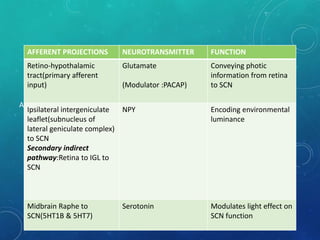
AFFERENT PROJECTIONS:
AFFERENT PROJECTIONS NEUROTRANSMITTER FUNCTION
Retino-hypothalamic
tract(primary afferent
input)
Glutamate
(Modulator :PACAP)
Conveying photic
information from retina
to SCN
Ipsilateral intergeniculate
leaflet(subnucleus of
lateral geniculate complex)
to SCN
Secondary indirect
pathway:Retina to IGL to
SCN
NPY Encoding environmental
luminance
Midbrain Raphe to
SCN(5HT1B & 5HT7)
Serotonin Modulates light effect on
SCN function
EFFERENT PROJECTIONS:
Suprachiasmatic nucleus
Paraventricular nucleus(autonomic division)
Medial forebrain bundle
Spinal cord (T1 &T2 level)
Cholinergic preganglionic sympathetic neurons
Adrenergic postganglionic sym. neurons within superior cervical ganglion
Pinealocytes
Norepineprine
GABA
OUTCOME:
• Increased melatonin synthesis occurs when SCN activity is low
• This anti phasic relationship is established by the GABAergic sign-changing synapse
at PVN
• Melatonin receptors on SCN likely provide feedback mechanism by which the anti
phasic relationship is maintained and possibly reinforced
• Exposure to light elicits two distinct effects on daily melatonin profile.
1)light acutely suppresses elevated melatoni levels immediately decreasing them to
baseline levels.
2)light shifts the phase of the circadian rhythm of melatonin synthesis.
Second efferent pathway
• SCN PVN(parvicellular neurons) CRH
ACTH adrenal gland(zona fasciculata)
release of cortisol.
• Serum levels of cortisol show strong circadian component,being highest in the
morning hours(6 am to 8 am),just as melatonin approach baseline
MOLECULAR CLOCKWORK
• Many of these molecular components were initially discovered in the fruitfly,
Drosophila melanogaster,leading to the discovery of mammalian orthologs
• The mammalian circadian clockwork consists of interacting positive and negative
transcriptional and translational feedback loops
• The expression of multiple homologs of Drosophila period gene and cryptochrome
genes are positively regulated by the binding of Clock-Bmal1 heterodimers to E-box
enhancers in the promoters of these genes
• The products of Per and Cry genes translocate back into the nucleus and repress
their own transcription which constitutes the negative feedback limb
• Light directly influences the molecular clock via its impact on the expression of
Per2,which has either phase advancing or delaying effects on feedback loop
• Clock-Bmal1 also activates expression of the orphan nuclear receptor gene Rev-
Erba
• The gene product of Rev-Erba inturn translocates into the nucleus and represses
transcription of Bmal1 gene through Rev-Erb/Ror response elements in Bmal1
gene promoter
• Bmal1 subsequently heterodimerizes with Clock and again activates expression of
Per,Cry and Rev-Erba genes
• This derepression(activation) of Bmal1 gene ,subsequent heterodimerization with
Clock, and activation of Per,Cry and Rev-Erba genes constitute the Positive
feedback limb
Post translational modification
• Phosphorylation of some Per proteins by casein kinase
• Histone acetylation
RESETTING OF CIRCADIAN CLOCK
• The mean circadian period generated by human SCN is of about 24.18 hours
• To maintain proper phase relationship of behavioural and physiological process
,circadian clock should be reset in a regular basis within a context of 24 hours a day
• Bilateral removal of eyes-incapable to reset circadian clock
• Photic sensitivities of visual and circadian systems are different
VISUAL system CIRCADIAN system
DYNAMIC RANGE 14 Log units 3 Log units
Activation
threshold
Less Higher
Duration of light
stimuli required
less longer
Photoreceptor
input
Layer of rods and
cones
Retinal ganglion
cells
Principal task To construct a
spatio-temporal
representation of
environment
Measurement of
ambient
illumination
NOVEL CLASS OF RETINAL PHOTORECEPTORS
• Retinal Ganglion cells are the circadian photoreceptors
• These intrinsically photosensitive cells project directly to SCN and also
IGL,olivary pretectal nuclei
• Contain melanopsin
• Few in number
• Represent 1-2% of all retinal ganglion cells in rodent retina
RETINAL GANGLION CELLS IN A FLAT MOUNTED MOUSE RETINA,LABELLED BY INDIRECT
IMMUNOFLORESCENCE WITH AN ANTIBODY AGAINST MELANOPSIN.NOTE THE
PHOTORECEPTIVE NET FORMED BY OVERLAPPING DENDRITIC ARBORS
• These cells are less sensitive to light compared to rods and cones of visual system
• They require light stimuli of relatively long duration to be activated
FUNCTION:
• Light induced circadian phase shifting
• knockout study in mice-photoreceptor mediating the residual sensitivity are likely
to be rods and cones
EXTRA SCN ZEITGEBERS
• FOOD-has the ability to entrain the circadian rhythm in the absence of the master
clock
• METHAMPHETAMINE-synchronizing the stimulus in the periphery
• EXERCISE-shifts heart rate and clock gene expression rhythms
• These may provide novel treatment targets in efforts to stabilize or shift circadian
rhythms
SLEEP AND CIRCADIAN RHYTHMS
• Sleep is the integrated product of 2 oscillatory processes
• 1st process is Sleep homeostat:arises from the accumulation and dissipation of
sleep debt
• 2nd process is governed by circadian clock:controls daily rhythm in sleep propensity
or arousal
• Chronotype is dictated almost exclusively by circadian process of sleep regulation
• Morning and evening chronotype loosely reflect advanced and delayed circadian
rhythms relative to environmental light cycle
• Morning larks tend to awaken earlier and experience core body temperature
minimum at earlier clock time relative to those who are labelled as evening types
SEASONALITY
• Many organisms are capable of synchronizing physiology to seasonal cycles to
maximize survival
• E.g. precise seasonal cycles in reproduction
• Large mammals-sheep-long gestation period-short day breeders,conceive in fall
,birth occurs in spring
• Hamsters-short gestation period-long day breeders ,conceive in spring ,give birth in
summer
• Circannual rhythms tend to persist in the absence of seasonal cues with
endogenous periods of one year
CIRCADIAN RHYTHMS IN PSYCHIATRIC DISORDERS
SEASONAL AFFECTIVE DISORDER:
• Characterised by recurrent major depressive episodes followed by periods of
remission or change to mania or hypomania,that recur on a seasonal basis
• SAD is diagnosed as MDD, bipolar 1 or bipolar 2 disorder with the specifier “with
seasonal pattern” in DSM-5
• The seasonal pattern criteria include
1. Regular temporal relationship between the onset of major depressive episodes
and a particular time of the year
2. Full remissions (or a change to mania or hypomania)also occur at a characteristic
time of the year
3. Two major depressive episodes meeting criteria A and B have occurred in the last
2 years and no nonseasonal episodes have occurred in the same period
4. Seasonal major depressive episodes substantially outnumber the nonseasonal
episodes over the individual’s lifetime
• The most prevalent form of SAD has an onset in the late fall and early winter and
remits in the late spring and early summer referred as winter SAD or winter
depression
• Prevalence rate is 4 to 9%
• Women are 4 times as likely to be affected compared to men
• 20% of population have subsyndromal symptoms
• Twin studies identified a heritability of 29 to 43 % for seasonality
SYMPTOMS:
• Increase in sleep rather than decrease
• Hyperphagia
• Increase in weight
• Heightened sensitivity to interpersonal rejection
• Leaden feeling in the extremities
• The gold standard treatment for winter SAD is light therapy
• A typical prescription for light therapy involves 45 to 90 minutes daily exposure to a
broad spectrum ultraviolet filtered white light source of relatively high
irradiance(5000-10000 lux)
• CBT is equally efficacious for acute treatment and prophylactically to reduce
reccurences
NONSEASONAL UNIPOLAR DEPRESSION AND CIRCADIAN
RHYTHMS
• Individuals with depression are more likely to be evening chronotypes and often
have delayed rhythms and reduced peak amplitude of melatonin and core body
temperature
• CLOCK and CRY genes have been found to be associated with depression diagnosis
• Circadian control of sleep is a potential avenue to improve long term outcomes in
depression as sleep improvement is an important marker for lower recurrence
rates
• Chronotherapies for the improvement of sleep include Wake therapy , advancing
sleep phase, bright light therapy and melatonin administration
• Administration of agomelatine 5 hours prior to bedtime can advance rhythms and
improve mood.
• The practise of using these therapies with anti-depressant medications shows
promise for achieving rapid response
BIPOLAR DISORDER AND CIRCADIAN RHYTHMS
• Circadian abnormalities have been suggested as a potential important etiological
mechanism in the development of BPAD
• CLOCK 19 mice models suggest the importance of circadian modulation of
dopaminergic activity within VTA in BPAD
• Depression is associated with a phase delay and mania associated with phase
advance
• Stabilization of these rhythms may help in preventing or reducing the further
episodes
• Interpersonal Social Rhythm therapy was developed due to the observation that
irregular daily routines resulting in circadian dysregulation precipitates mood
disorders
Other psychiatric disorders that may improve in response to light therapy include
• Post partum depression
• Pre-menstrual dysphoric disorder
• Bulimia nervosa
• ADHD
• Disordered sleep due to Traumatic brain injury
CIRCADIAN SLEEP DISORDERS
Advanced sleep phase syndrome
• It is a pathological extreme of the morning lark phenotype
• FASPS(autosomal dominant familial form)
• They exhibit striking 4 hour advance of sleep-wake rhythm
• They typically fall asleep at 7.30 pm and spontaneously awaken at 4.30 am appr
• Affected individuals have SNP in PER2 gene
Delayed sleep phase syndrome:
• A circadian sleep disorder in which the individual’s internal body clock is delayed
with respect to external day-night cycle
• A length polymorphism in a repeat region of PER3 gene is associated with morning
chronotype while short allele associated with evening chronotype
Irregular sleep-wake Disorder:
• Characterized by at least 3 sleep episodes per 24 hour period ,irregularly from
day to day
• Occurs in elderly people with dementia,ASD,traumatic brain injury
Free running/Non-24 hour Sleep-Wake Disorder:
• Circadian sleep disorder in which an individual falls sleep later each day
• Generally the delay is about 1-2 hrs corresponding to a circadian cycle of 25-
26 hrs but some individuals with Non-24 hour exhibit a longer delay
• Chronotherapeutics are often first line of treatment in Circadian rhythm sleep
wake disorders
CIRCADIAN DESYNCHRONY
• One’s circadian clock is being desynchronized from local time
• Occurs in jet lag and shift work
SHIFT WORK SCHEDULE:
• When a person works against the natural day-night cycle ,they would suffer from
disruption of circadian rhythm
JET LAG:
• There would be a phase difference when a person travels through different time
zones
• In jet lag,the clock is slow to reset so that after time zones have been crossed the
endogenous signals for sleep and wakefulness do not match the local light-dark
cycle
• Symptoms include reduced alertness,day time fatigue,loss of appetite, reduced
cognitive skills and disruption of sleep/wakefullness
• SOCIAL JET LAG:
• desynchronization of one’s circadian clock with social environment.
• people who naturally exhibit delayed sleep wake patterns ,able to sleep on
their normal delayed pattern on weekends but are forced to wakeup earlier
during work days
MEMORY,AGING AND NEUROCOGNITIVE DISORDERS
• The importance of circadian alignment in normative memory performance is
established by animal studies
• As humans age and normative age related memory problems begin , individuals
experience shortening of circadian period as well as phase advances resulting in
earlier wake up time and bedtime and decrease in the amplitude of most circadian
rhythms
• Age related circadian changes are exacerbated in age related neurocognitive
disorders like alzheimers
• The amount of disruption in activity rhythms has also been associated with severity
of neuropathology
• Dysregulated Circadian rhythms have been found to predate the occurrence of
dementia or clinical diagnosis of AD
OTHER CIRCADIAN CLOCK ASSOCIATED PATHOLOGIES
• Cancer :Epidemiological studies have shown women working night shifts have
shown elevated risk of breast cancer
• Metabolic syndrome
• Cardiovascular diseases
CIRCADIAN RHYTHMS AND PHARMACOTHERAPY
• TCA’s and SSRI’s reduce the elevated nocturnal body temperature in depression
while enhancing the circadian amplitude
• Lithium causes lengthening of circadian period
• Short acting BZD’s(triazolam and brotizolam)have been shown to reduce light
induced expression of clock genes per1 & per2 in SCN.
• Recreational drugs of abuse(MDMA)-serotonin neurotoxin, also affect circadian
system.
• A Nobel prize in the field of physiology/medicine was awarded to Dr.Jeffrey
Hall,Dr.Michael Young and Dr.Michael Rosbash in 2017 for their discovery of
molecular mechanisms controlling circadian rhythms
• RECENT STUDIES: Blue –blocking glasses as additive treatment for mania for
improving sleep
• It is an evolvement from dark therapy and builds on the discovery of blue light
sensitive retinal ganglion cells that signals daytime to brain
REFERENCES
• Kaplan and sadock’s comprehensive textbook of psychiatry-Tenth edition
• Kaplan and sadock’s synopsis of psychiatry-Eleventh edition
• Shakya P, Roy SN, Deep R. Chronobiology: Discovery of the molecular
mechanisms of circadian rhythm. J Mental Health Hum Behav 2018;23:69-71
• Henriksen TEG, Grønli J, Assmus J, Fasmer OB, Schoeyen H, Leskauskaite I,
Bjorke-Bertheussen J, Ytrehus K, Lund A. Blue-blocking glasses as additive
treatment for mania: Effects on actigraphy-derived sleep parameters. J Sleep
Res. 2020 Oct;29(5):e12984. doi: 10.1111/jsr.12984. Epub 2020 Jan 21. PMID:
31967375.
CHRONOBIOLOGY.pptx

CHRONOBIOLOGY.pptx

  • 1.
    CHRONOBIOLOGY PRESENTER: DR.S.CHANDANA, 1STYEAR POSTGRADUATE CHAIR PERSON: DR.RUFUS, ASSISTANT PROFESSOR, DEPT OF PSYCHIATRY, ANDHRA MEDICAL COLLEGE
  • 2.
    SCHEME OF PRESENTATION •Introduction • Circadian pacemakers • Molecular Clockwork • Resetting the circadian clock • Retinal photoreceptors • Extra SCN Zeitgebers • Sleep and circadian rhythm • Seasonality and circadian rhythm • Psychiatric disorders and circadian rhythm • Circadian rhythm and pharmacotherapy
  • 3.
    • Chronobiology isthe study of biological time • It is derived from the greek(chronos meaning time and biology is the study or science of life) • The rotation of the Earth about its axis imposes a 24 hour cyclicity upon the biosphere. • Organisms have evolved to occupy geographical niches that can be defined by three spacial dimensions and also evolved to occupy temporal niches that are defined by the fourth dimension of time
  • 4.
    A broad rangeof frequencies exist throughout biology ranging from • millisecond oscillations in ocular field potentials • 17 year cycle of emergence seen in the periodic cicada(Magicicada spp.)
  • 5.
    HISTORY OF CHRONOBIOLOGY TIMEPERIOD CONTRIBUTOR DISCOVERY 4th century BC Androsthenes Ship captain serving Alexander the Great Described the diurnal leaf movements of Tamarind tree 18th century/1729 Jean-Jacques d’Orteus de Mairan French scientist Documented 24hr patterns in the movement of plant leaves 18th century/1751 Carl Linnaeus Swedish botanist Designed flower clock using certain species of flowers Early 20th century Anthonia kleinhoonte Erwin bunning Rhythmicity appears to be endogenous in nature by plant studies
  • 6.
    TIME PERIOD CONTRIBUTORDISCOVERY 1918 Szymanski Animals are capable of maintaining the 24 hr activity patterns in the absence of environmental cues 1959 Franz Halberg Father of American Chronobiology Coined the term ‘Circadian’ Auguste forel Circadian rhythms noticed in the rhythmic feeding time of bees 1970 Ron Konopka Seymour benzer Isolated the first clock mutant in DROSOPHILA MELANOGASTER and mapped the period gene 1994 Joseph Takahasi Discovered the first mammalian ‘clock gene’ using mice
  • 7.
    • The mostextensively studied and best understood biological rhythms is Circadian rhythms that have a period of about one day • A defining feature of circadian rhythms is that they persist in the absence of time cues and are not simply driven by the 24-hour environmental cycle • Circadian rhythm can be 1. Diurnal 2. Nocturnal 3. Crepuscular
  • 8.
    Circadian rhythms inhuman body: • Sleep-wake cycle • Body temperature • Behavior • Feeding • Drinking • Hormonal levels (e.g: melatonin)
  • 9.
    ZEITGEBER: • An environmentalagent or event that provides the stimulus for setting or resetting endogenous circadian clock of an organism • Derived from german(zeit=time and geber =giver) • The environmental parameter that most reliably corresponds to the period of Earth’s rotation is the change in the illuminance associated with day-night cycle
  • 10.
    Circadian axis ofmammals can be divided into three distinct functional components • A master pacemaker situated in Suprachiasmatic nucleus • A photoreceptor input to SCN that originates in the eye • The myriad of rhythmic outputs that provide insight into the clockwork of the circadian pacemaker.
  • 11.
    HUMAN SUPRACHIASMATIC NUCLEUS.TOP:NISSILSTAIN OF SECTION THROUGH THE HUMAN HYPOTHALAMUS.SCN INDICATED BY ARROWS LOCATED DORSAL TO OPTIC CHIASMA BOTTOM:AUTORADIOGRAPH OF SAME SECTION ,SPECIFIC BINDING OF RADIOIODINATED ANALOGUE OF MELATONIN INDICATED BY DARKENING OF THE SCN
  • 12.
    CIRCADIAN PACEMAKERS Anatomy: • SCNis the master oscillator • Peripheral oscillators are found in wide range of peripheral tissues like kidney ,liver , lung and other sites in brain • Neurons of SCN are among the smallest neurons in the entire brain ,they possess short dendrites • Every neuron in SCN is immuno-positive for GABA • SUBDIVISIONS: core-defined by presence of calbindin-positive neurons , surrounded by shell
  • 13.
    AFFERENT PROJECTIONS: AFFERENT PROJECTIONSNEUROTRANSMITTER FUNCTION Retino-hypothalamic tract(primary afferent input) Glutamate (Modulator :PACAP) Conveying photic information from retina to SCN Ipsilateral intergeniculate leaflet(subnucleus of lateral geniculate complex) to SCN Secondary indirect pathway:Retina to IGL to SCN NPY Encoding environmental luminance Midbrain Raphe to SCN(5HT1B & 5HT7) Serotonin Modulates light effect on SCN function
  • 14.
    EFFERENT PROJECTIONS: Suprachiasmatic nucleus Paraventricularnucleus(autonomic division) Medial forebrain bundle Spinal cord (T1 &T2 level) Cholinergic preganglionic sympathetic neurons Adrenergic postganglionic sym. neurons within superior cervical ganglion Pinealocytes Norepineprine GABA
  • 15.
    OUTCOME: • Increased melatoninsynthesis occurs when SCN activity is low • This anti phasic relationship is established by the GABAergic sign-changing synapse at PVN • Melatonin receptors on SCN likely provide feedback mechanism by which the anti phasic relationship is maintained and possibly reinforced
  • 16.
    • Exposure tolight elicits two distinct effects on daily melatonin profile. 1)light acutely suppresses elevated melatoni levels immediately decreasing them to baseline levels. 2)light shifts the phase of the circadian rhythm of melatonin synthesis.
  • 17.
    Second efferent pathway •SCN PVN(parvicellular neurons) CRH ACTH adrenal gland(zona fasciculata) release of cortisol. • Serum levels of cortisol show strong circadian component,being highest in the morning hours(6 am to 8 am),just as melatonin approach baseline
  • 18.
  • 19.
    • Many ofthese molecular components were initially discovered in the fruitfly, Drosophila melanogaster,leading to the discovery of mammalian orthologs • The mammalian circadian clockwork consists of interacting positive and negative transcriptional and translational feedback loops • The expression of multiple homologs of Drosophila period gene and cryptochrome genes are positively regulated by the binding of Clock-Bmal1 heterodimers to E-box enhancers in the promoters of these genes
  • 20.
    • The productsof Per and Cry genes translocate back into the nucleus and repress their own transcription which constitutes the negative feedback limb • Light directly influences the molecular clock via its impact on the expression of Per2,which has either phase advancing or delaying effects on feedback loop • Clock-Bmal1 also activates expression of the orphan nuclear receptor gene Rev- Erba
  • 21.
    • The geneproduct of Rev-Erba inturn translocates into the nucleus and represses transcription of Bmal1 gene through Rev-Erb/Ror response elements in Bmal1 gene promoter • Bmal1 subsequently heterodimerizes with Clock and again activates expression of Per,Cry and Rev-Erba genes • This derepression(activation) of Bmal1 gene ,subsequent heterodimerization with Clock, and activation of Per,Cry and Rev-Erba genes constitute the Positive feedback limb
  • 22.
    Post translational modification •Phosphorylation of some Per proteins by casein kinase • Histone acetylation
  • 23.
    RESETTING OF CIRCADIANCLOCK • The mean circadian period generated by human SCN is of about 24.18 hours • To maintain proper phase relationship of behavioural and physiological process ,circadian clock should be reset in a regular basis within a context of 24 hours a day • Bilateral removal of eyes-incapable to reset circadian clock
  • 24.
    • Photic sensitivitiesof visual and circadian systems are different VISUAL system CIRCADIAN system DYNAMIC RANGE 14 Log units 3 Log units Activation threshold Less Higher Duration of light stimuli required less longer Photoreceptor input Layer of rods and cones Retinal ganglion cells Principal task To construct a spatio-temporal representation of environment Measurement of ambient illumination
  • 25.
    NOVEL CLASS OFRETINAL PHOTORECEPTORS • Retinal Ganglion cells are the circadian photoreceptors • These intrinsically photosensitive cells project directly to SCN and also IGL,olivary pretectal nuclei • Contain melanopsin • Few in number • Represent 1-2% of all retinal ganglion cells in rodent retina
  • 26.
    RETINAL GANGLION CELLSIN A FLAT MOUNTED MOUSE RETINA,LABELLED BY INDIRECT IMMUNOFLORESCENCE WITH AN ANTIBODY AGAINST MELANOPSIN.NOTE THE PHOTORECEPTIVE NET FORMED BY OVERLAPPING DENDRITIC ARBORS
  • 27.
    • These cellsare less sensitive to light compared to rods and cones of visual system • They require light stimuli of relatively long duration to be activated FUNCTION: • Light induced circadian phase shifting • knockout study in mice-photoreceptor mediating the residual sensitivity are likely to be rods and cones
  • 28.
    EXTRA SCN ZEITGEBERS •FOOD-has the ability to entrain the circadian rhythm in the absence of the master clock • METHAMPHETAMINE-synchronizing the stimulus in the periphery • EXERCISE-shifts heart rate and clock gene expression rhythms • These may provide novel treatment targets in efforts to stabilize or shift circadian rhythms
  • 29.
    SLEEP AND CIRCADIANRHYTHMS • Sleep is the integrated product of 2 oscillatory processes • 1st process is Sleep homeostat:arises from the accumulation and dissipation of sleep debt • 2nd process is governed by circadian clock:controls daily rhythm in sleep propensity or arousal
  • 32.
    • Chronotype isdictated almost exclusively by circadian process of sleep regulation • Morning and evening chronotype loosely reflect advanced and delayed circadian rhythms relative to environmental light cycle • Morning larks tend to awaken earlier and experience core body temperature minimum at earlier clock time relative to those who are labelled as evening types
  • 33.
    SEASONALITY • Many organismsare capable of synchronizing physiology to seasonal cycles to maximize survival • E.g. precise seasonal cycles in reproduction • Large mammals-sheep-long gestation period-short day breeders,conceive in fall ,birth occurs in spring • Hamsters-short gestation period-long day breeders ,conceive in spring ,give birth in summer • Circannual rhythms tend to persist in the absence of seasonal cues with endogenous periods of one year
  • 34.
    CIRCADIAN RHYTHMS INPSYCHIATRIC DISORDERS SEASONAL AFFECTIVE DISORDER: • Characterised by recurrent major depressive episodes followed by periods of remission or change to mania or hypomania,that recur on a seasonal basis • SAD is diagnosed as MDD, bipolar 1 or bipolar 2 disorder with the specifier “with seasonal pattern” in DSM-5 • The seasonal pattern criteria include
  • 35.
    1. Regular temporalrelationship between the onset of major depressive episodes and a particular time of the year 2. Full remissions (or a change to mania or hypomania)also occur at a characteristic time of the year 3. Two major depressive episodes meeting criteria A and B have occurred in the last 2 years and no nonseasonal episodes have occurred in the same period 4. Seasonal major depressive episodes substantially outnumber the nonseasonal episodes over the individual’s lifetime
  • 36.
    • The mostprevalent form of SAD has an onset in the late fall and early winter and remits in the late spring and early summer referred as winter SAD or winter depression • Prevalence rate is 4 to 9% • Women are 4 times as likely to be affected compared to men • 20% of population have subsyndromal symptoms • Twin studies identified a heritability of 29 to 43 % for seasonality
  • 37.
    SYMPTOMS: • Increase insleep rather than decrease • Hyperphagia • Increase in weight • Heightened sensitivity to interpersonal rejection • Leaden feeling in the extremities
  • 38.
    • The goldstandard treatment for winter SAD is light therapy • A typical prescription for light therapy involves 45 to 90 minutes daily exposure to a broad spectrum ultraviolet filtered white light source of relatively high irradiance(5000-10000 lux) • CBT is equally efficacious for acute treatment and prophylactically to reduce reccurences
  • 39.
    NONSEASONAL UNIPOLAR DEPRESSIONAND CIRCADIAN RHYTHMS • Individuals with depression are more likely to be evening chronotypes and often have delayed rhythms and reduced peak amplitude of melatonin and core body temperature • CLOCK and CRY genes have been found to be associated with depression diagnosis • Circadian control of sleep is a potential avenue to improve long term outcomes in depression as sleep improvement is an important marker for lower recurrence rates
  • 40.
    • Chronotherapies forthe improvement of sleep include Wake therapy , advancing sleep phase, bright light therapy and melatonin administration • Administration of agomelatine 5 hours prior to bedtime can advance rhythms and improve mood. • The practise of using these therapies with anti-depressant medications shows promise for achieving rapid response
  • 41.
    BIPOLAR DISORDER ANDCIRCADIAN RHYTHMS • Circadian abnormalities have been suggested as a potential important etiological mechanism in the development of BPAD • CLOCK 19 mice models suggest the importance of circadian modulation of dopaminergic activity within VTA in BPAD • Depression is associated with a phase delay and mania associated with phase advance • Stabilization of these rhythms may help in preventing or reducing the further episodes • Interpersonal Social Rhythm therapy was developed due to the observation that irregular daily routines resulting in circadian dysregulation precipitates mood disorders
  • 42.
    Other psychiatric disordersthat may improve in response to light therapy include • Post partum depression • Pre-menstrual dysphoric disorder • Bulimia nervosa • ADHD • Disordered sleep due to Traumatic brain injury
  • 43.
    CIRCADIAN SLEEP DISORDERS Advancedsleep phase syndrome • It is a pathological extreme of the morning lark phenotype • FASPS(autosomal dominant familial form) • They exhibit striking 4 hour advance of sleep-wake rhythm • They typically fall asleep at 7.30 pm and spontaneously awaken at 4.30 am appr • Affected individuals have SNP in PER2 gene
  • 44.
    Delayed sleep phasesyndrome: • A circadian sleep disorder in which the individual’s internal body clock is delayed with respect to external day-night cycle • A length polymorphism in a repeat region of PER3 gene is associated with morning chronotype while short allele associated with evening chronotype
  • 45.
    Irregular sleep-wake Disorder: •Characterized by at least 3 sleep episodes per 24 hour period ,irregularly from day to day • Occurs in elderly people with dementia,ASD,traumatic brain injury Free running/Non-24 hour Sleep-Wake Disorder: • Circadian sleep disorder in which an individual falls sleep later each day • Generally the delay is about 1-2 hrs corresponding to a circadian cycle of 25- 26 hrs but some individuals with Non-24 hour exhibit a longer delay • Chronotherapeutics are often first line of treatment in Circadian rhythm sleep wake disorders
  • 46.
    CIRCADIAN DESYNCHRONY • One’scircadian clock is being desynchronized from local time • Occurs in jet lag and shift work SHIFT WORK SCHEDULE: • When a person works against the natural day-night cycle ,they would suffer from disruption of circadian rhythm
  • 47.
    JET LAG: • Therewould be a phase difference when a person travels through different time zones • In jet lag,the clock is slow to reset so that after time zones have been crossed the endogenous signals for sleep and wakefulness do not match the local light-dark cycle • Symptoms include reduced alertness,day time fatigue,loss of appetite, reduced cognitive skills and disruption of sleep/wakefullness
  • 48.
    • SOCIAL JETLAG: • desynchronization of one’s circadian clock with social environment. • people who naturally exhibit delayed sleep wake patterns ,able to sleep on their normal delayed pattern on weekends but are forced to wakeup earlier during work days
  • 49.
    MEMORY,AGING AND NEUROCOGNITIVEDISORDERS • The importance of circadian alignment in normative memory performance is established by animal studies • As humans age and normative age related memory problems begin , individuals experience shortening of circadian period as well as phase advances resulting in earlier wake up time and bedtime and decrease in the amplitude of most circadian rhythms
  • 50.
    • Age relatedcircadian changes are exacerbated in age related neurocognitive disorders like alzheimers • The amount of disruption in activity rhythms has also been associated with severity of neuropathology • Dysregulated Circadian rhythms have been found to predate the occurrence of dementia or clinical diagnosis of AD
  • 51.
    OTHER CIRCADIAN CLOCKASSOCIATED PATHOLOGIES • Cancer :Epidemiological studies have shown women working night shifts have shown elevated risk of breast cancer • Metabolic syndrome • Cardiovascular diseases
  • 52.
    CIRCADIAN RHYTHMS ANDPHARMACOTHERAPY • TCA’s and SSRI’s reduce the elevated nocturnal body temperature in depression while enhancing the circadian amplitude • Lithium causes lengthening of circadian period • Short acting BZD’s(triazolam and brotizolam)have been shown to reduce light induced expression of clock genes per1 & per2 in SCN. • Recreational drugs of abuse(MDMA)-serotonin neurotoxin, also affect circadian system.
  • 53.
    • A Nobelprize in the field of physiology/medicine was awarded to Dr.Jeffrey Hall,Dr.Michael Young and Dr.Michael Rosbash in 2017 for their discovery of molecular mechanisms controlling circadian rhythms • RECENT STUDIES: Blue –blocking glasses as additive treatment for mania for improving sleep • It is an evolvement from dark therapy and builds on the discovery of blue light sensitive retinal ganglion cells that signals daytime to brain
  • 54.
    REFERENCES • Kaplan andsadock’s comprehensive textbook of psychiatry-Tenth edition • Kaplan and sadock’s synopsis of psychiatry-Eleventh edition • Shakya P, Roy SN, Deep R. Chronobiology: Discovery of the molecular mechanisms of circadian rhythm. J Mental Health Hum Behav 2018;23:69-71 • Henriksen TEG, Grønli J, Assmus J, Fasmer OB, Schoeyen H, Leskauskaite I, Bjorke-Bertheussen J, Ytrehus K, Lund A. Blue-blocking glasses as additive treatment for mania: Effects on actigraphy-derived sleep parameters. J Sleep Res. 2020 Oct;29(5):e12984. doi: 10.1111/jsr.12984. Epub 2020 Jan 21. PMID: 31967375.

Editor's Notes

  • #5 THEY SPEND MOST OF THEIR TIME AS UNDERGROUND NYMPHS N REEMERGE ONLY AFTER 17 YEARS
  • #8 BIOLOGICAL RHYTHM is cyclical repeated variation in biological function CREPUSCULAR:organisms active during dawn and dusk hours eg:white tailed deer,some bats
  • #9 Serum levels of melatonin elevated at night and return to baseline during day,nocturnal rise in melatonin is convenient marker of circadian phase NOCTURNAL RISE OF GH,testosterone,prolactin Cortisol is elelvated in daytime
  • #12 SCN are small ,paired,hypothalamic structures situated immediately dorsal to the optic chiasma
  • #13 MASTER OSCILLATOR:Generates mean circadian rhythm and orchestrates a multitude of oscillators found in peripheral tissues
  • #14 Pituitary adenylate cyclase activating polypeptide
  • #15 SCN firing rate is high in day ,hence decreased melatonin levels during day time
  • #17 PHASE SHIFT:shift in the biological rhythm along with its time axis so while the period remains the same ,the time at which the rhythm occurs changes
  • #24 It indicates the photosensitive apparatus necessary for resetting must be ocular
  • #25 Eyes may retain the function in clock resetting despite being useless for vision
  • #26 MELANOPSIN photopigment initially discovered in melanophores of tadpoles,later identified in human retina
  • #28 Targeted disruption of melanopsin gene-deficit in phase shifting-but deficit is not complete
  • #38 SYMPTOMS MAY BE ATYPICAL TO MAJOR DEPRESSION
  • #39 Pharmacotherapy:MAO INHIBITORS
  • #41 Mechanism for wake therapy: sleep restriction for one night or the latter half of one night
  • #42 Dark therapy,keeping acutely manic patients in dark rooms at night time shown to improve symptoms and stop rapid cycling
  • #44 Bedtime and wakeup time are much earlier than normal,although sleep quality is normal
  • #45 SLEEP LATE IN THE NIGHT BETWEEN 1 A.M TO 6 A.M AND TEND TO AWAKE IN THE LATE MORNING OR AFTERNOON
  • #47 MODAFINIL used for excessive sleepiness associated with shift work sleep disorder
  • #48 Travelling from east to west will have phase advance and vice-versa
  • #52 Risk factors like obesity low HDL and high triglycerides are more prevalent among shift workers than day workers