01/28/11
Under the  Supervision of :  Dr.Manjaiah.D.H. Chairman and Associate Professor, Dept of CS,Mangalore University, Mangalore . Research Candidate : Hanumanthappa.J. Senior Asst.Professor , DoS in CS,UoM,MGM,Mysore-06. Compare and Contrast between NAT-PT and  BD-SIIT Translators in Transition of IPv4 to  IPv6 . 01/28/11
Presentation Outline . Objective of the paper. Introduction to the problem. Data sets used. Proposed Methodology. Results. Conclusions. References . 01/28/11
Objective of the paper . This  research work  presents a new  IPv4/IPv6 transition method based on the Comparison and Contrast between Stateless  BD-SIIT  and Stateful  NAT-PT  Translators in Transition of IPv4 to IPv6 new technology .  BD-SIIT and NAT-PT Translators are Powerful Translators in IPv4 to IPv6 Transition . BD-SIIT Performance is really good as compared to NAT-PT Translator. 01/28/11
Introduction to the Problem . The concept of  IPv4/IPv6 transitioning  is one of the hot vigorous topic in  IPv4/IPv6 Transition . The  transition between IPv4 and IPv6  internet will be a very long process as they are completely  incompatible two protocols . 01/28/11
Definition of IP . An IP address is an Identifier that is applied to each device connected to an IP network . 01/28/11
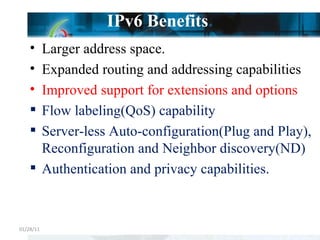
IPv6 Benefits . Larger address space. Expanded routing and addressing capabilities Improved support for extensions and options Flow labeling(QoS) capability Server-less Auto-configuration(Plug and Play), Reconfiguration and Neighbor discovery(ND) Authentication and privacy capabilities. 01/28/11
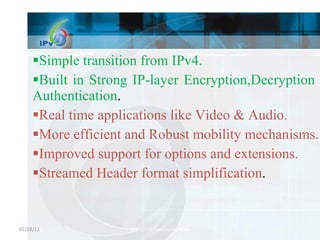
Simple transition from IPv4. Built in Strong IP-layer Encryption,Decryption and Authentication . Real time applications like Video & Audio. More efficient and Robust mobility mechanisms. Improved support for options and extensions. Streamed Header format simplification . 01/28/11
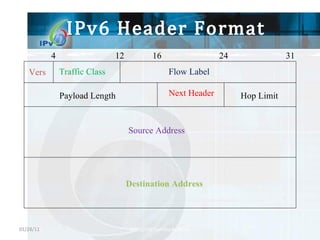
IPv6 Header Format Traffic Class Flow Label Vers Payload Length Next Header Hop Limit Source Address Destination Address 0 4 12 16 24 31 01/28/11
Transition to IPv6: Design Goal No “flag” day. Incremental upgrade and deployment. Minimum upgrade dependencies. Interoperability of IPv4 and IPv6 nodes. Let sites transition at their own pace. Basic migration tools Dual stack and tunneling Translation
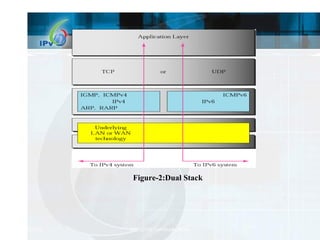
Transition Mechanisms:Dual Stack New nodes support both IPv4 and IPv6. Upgrading from IPv4 to v4/v6 does not break anything. Same transport layer and application above both. Provides complete interoperability with IPv4 nodes.
Figure-2:Dual Stack
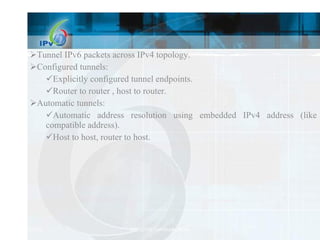
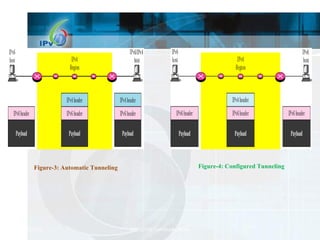
Tunnel IPv6 packets across IPv4 topology. Configured tunnels: Explicitly configured tunnel endpoints. Router to router , host to router. Automatic tunnels: Automatic address resolution using embedded IPv4 address (like IPv4-compatible address). Host to host, router to host.
Figure-3: Automatic Tunneling Figure-4: Configured Tunneling
Translators in IPv6. BD-SIIT Translators. NAT-PT Translators . 01/28/11
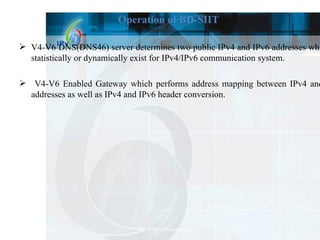
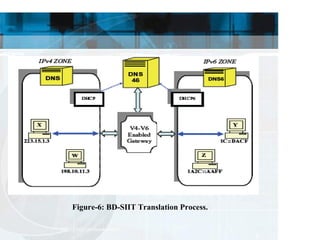
Operation of BD-SIIT V4-V6 DNS(DNS46) server determines two public IPv4 and IPv6 addresses which are statistically or dynamically exist for IPv4/IPv6 communication system. V4-V6 Enabled Gateway which performs address mapping between IPv4 and IPv6 addresses as well as IPv4 and IPv6 header conversion.
Figure-6: BD-SIIT Translation Process.
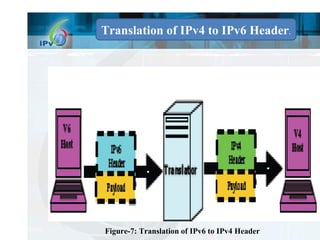
Figure-7: Translation of IPv6 to IPv4 Header Translation of IPv4 to IPv6 Header .
Why BD-SIIT Transition Mechanism To reduce the packet size compared with Tunneling Algorithms, in turn, reducing  traffic overhead. Reduce the cost of IPv6 Network by avoiding the need to upgrade all the edge  nodes that support both the IPv4 and IPv6 as found in Dual Stack mechanisms. Use a new address mapping that depends on identifying two Public addresses (IPv4 and IPv6) instead of  IPv4 mapped IPv6 address method.
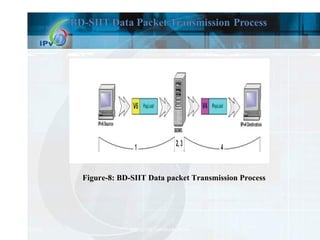
Figure-8: BD-SIIT Data packet Transmission Process
BD-SIIT Translation mainly occurs due to the following Stages Stage 1: IPv6 Packet Transmission. Stage 2: IPv6-to-IPv4 mapping calculation and address mapping. Stage 3: IPv6-to-IPv4 Header Translation. Stage 4: IPv4 packet Transmission.
01/28/11
01/28/11
01/28/11
01/28/11
01/28/11
01/28/11
01/28/11
01/28/11
01/28/11

Iccana 2011

  • 1.
  • 2.
    Under the Supervision of : Dr.Manjaiah.D.H. Chairman and Associate Professor, Dept of CS,Mangalore University, Mangalore . Research Candidate : Hanumanthappa.J. Senior Asst.Professor , DoS in CS,UoM,MGM,Mysore-06. Compare and Contrast between NAT-PT and BD-SIIT Translators in Transition of IPv4 to IPv6 . 01/28/11
  • 3.
    Presentation Outline .Objective of the paper. Introduction to the problem. Data sets used. Proposed Methodology. Results. Conclusions. References . 01/28/11
  • 4.
    Objective of thepaper . This research work presents a new IPv4/IPv6 transition method based on the Comparison and Contrast between Stateless BD-SIIT and Stateful NAT-PT Translators in Transition of IPv4 to IPv6 new technology . BD-SIIT and NAT-PT Translators are Powerful Translators in IPv4 to IPv6 Transition . BD-SIIT Performance is really good as compared to NAT-PT Translator. 01/28/11
  • 5.
    Introduction to theProblem . The concept of IPv4/IPv6 transitioning is one of the hot vigorous topic in IPv4/IPv6 Transition . The transition between IPv4 and IPv6 internet will be a very long process as they are completely incompatible two protocols . 01/28/11
  • 6.
    Definition of IP. An IP address is an Identifier that is applied to each device connected to an IP network . 01/28/11
  • 7.
    IPv6 Benefits .Larger address space. Expanded routing and addressing capabilities Improved support for extensions and options Flow labeling(QoS) capability Server-less Auto-configuration(Plug and Play), Reconfiguration and Neighbor discovery(ND) Authentication and privacy capabilities. 01/28/11
  • 8.
    Simple transition fromIPv4. Built in Strong IP-layer Encryption,Decryption and Authentication . Real time applications like Video & Audio. More efficient and Robust mobility mechanisms. Improved support for options and extensions. Streamed Header format simplification . 01/28/11
  • 9.
    IPv6 Header FormatTraffic Class Flow Label Vers Payload Length Next Header Hop Limit Source Address Destination Address 0 4 12 16 24 31 01/28/11
  • 10.
    Transition to IPv6:Design Goal No “flag” day. Incremental upgrade and deployment. Minimum upgrade dependencies. Interoperability of IPv4 and IPv6 nodes. Let sites transition at their own pace. Basic migration tools Dual stack and tunneling Translation
  • 11.
    Transition Mechanisms:Dual StackNew nodes support both IPv4 and IPv6. Upgrading from IPv4 to v4/v6 does not break anything. Same transport layer and application above both. Provides complete interoperability with IPv4 nodes.
  • 12.
  • 13.
    Tunnel IPv6 packetsacross IPv4 topology. Configured tunnels: Explicitly configured tunnel endpoints. Router to router , host to router. Automatic tunnels: Automatic address resolution using embedded IPv4 address (like IPv4-compatible address). Host to host, router to host.
  • 14.
    Figure-3: Automatic TunnelingFigure-4: Configured Tunneling
  • 15.
    Translators in IPv6.BD-SIIT Translators. NAT-PT Translators . 01/28/11
  • 16.
    Operation of BD-SIITV4-V6 DNS(DNS46) server determines two public IPv4 and IPv6 addresses which are statistically or dynamically exist for IPv4/IPv6 communication system. V4-V6 Enabled Gateway which performs address mapping between IPv4 and IPv6 addresses as well as IPv4 and IPv6 header conversion.
  • 17.
  • 18.
    Figure-7: Translation ofIPv6 to IPv4 Header Translation of IPv4 to IPv6 Header .
  • 19.
    Why BD-SIIT TransitionMechanism To reduce the packet size compared with Tunneling Algorithms, in turn, reducing traffic overhead. Reduce the cost of IPv6 Network by avoiding the need to upgrade all the edge nodes that support both the IPv4 and IPv6 as found in Dual Stack mechanisms. Use a new address mapping that depends on identifying two Public addresses (IPv4 and IPv6) instead of IPv4 mapped IPv6 address method.
  • 20.
    Figure-8: BD-SIIT Datapacket Transmission Process
  • 21.
    BD-SIIT Translation mainlyoccurs due to the following Stages Stage 1: IPv6 Packet Transmission. Stage 2: IPv6-to-IPv4 mapping calculation and address mapping. Stage 3: IPv6-to-IPv4 Header Translation. Stage 4: IPv4 packet Transmission.
  • 22.
  • 23.
  • 24.
  • 25.
  • 26.
  • 27.
  • 28.
  • 29.
  • 30.

Editor's Notes

  • #3 ICCANA-2011,NMAMIT,Nitte,South Canara.
  • #10 ICCANA-2011,NMAMIT,Nitte,South Canara.