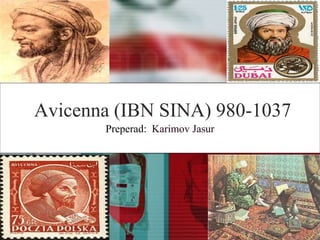
Avicenna (IBN SINA) 980-1037
Preperad: Karimov Jasur
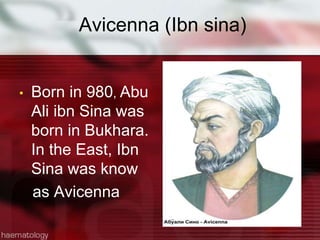
Avicenna (Ibn sina)
• Born in 980, Abu
Ali ibn Sina was
born in Bukhara.
In the East, Ibn
Sina was know
as Avicenna
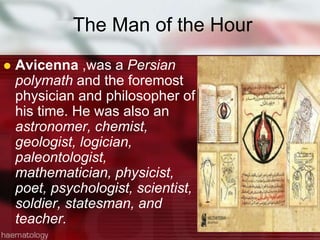
The Man of the Hour
 Avicenna ,was a Persian
polymath and the foremost
physician and philosopher of
his time. He was also an
astronomer, chemist,
geologist, logician,
paleontologist,
mathematician, physicist,
poet, psychologist, scientist,
soldier, statesman, and
teacher.
Reward
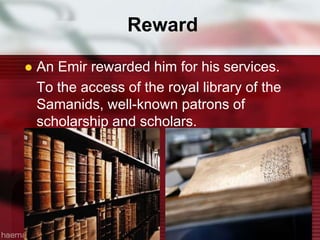
 An Emir rewarded him for his services.
To the access of the royal library of the
Samanids, well-known patrons of
scholarship and scholars.
His Own School
Avicennism
School tradition:
Is a school of early
Islamic philosophy which began during
the middle of the Islamic Golden Age.
 Founded by Avicenna (Ibn Sina)
 Attempted to redefine the course of Islamic
philosophy and channel it into new
directions.
Success
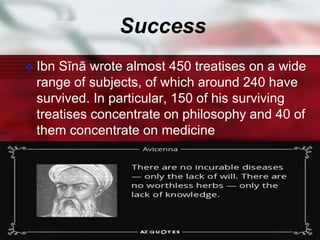
 Ibn Sīnā wrote almost 450 treatises on a wide
range of subjects, of which around 240 have
survived. In particular, 150 of his surviving
treatises concentrate on philosophy and 40 of
them concentrate on medicine
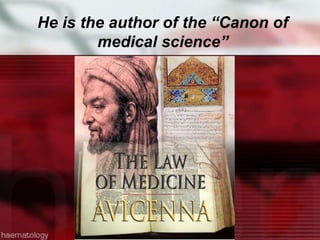
He is the author of the “Canon of
medical science”
Discoveries
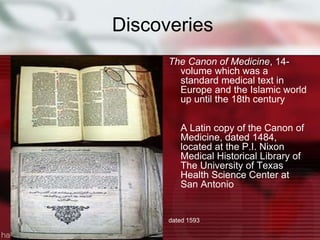
The Canon of Medicine, 14-
volume which was a
standard medical text in
Europe and the Islamic world
up until the 18th century
A Latin copy of the Canon of
Medicine, dated 1484,
located at the P.I. Nixon
Medical Historical Library of
The University of Texas
Health Science Center at
San Antonio
dated 1593
Later life
 The remaining ten or twelve years of Ibn
Sīnā's life were spent in the service of Abu
Ja'far 'Ala Addaula, whom he accompanied
as physician and general literary and
scientific adviser, even in his numerous
campaigns.
 Literary matters and philology
"I prefer a short life with width to a narrow
one with length".
Death
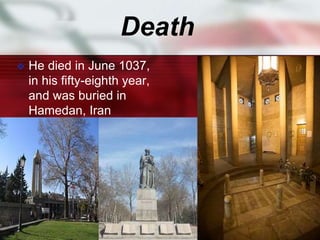
 He died in June 1037,
in his fifty-eighth year,
and was buried in
Hamedan, Iran
The End

ibn sina +.pptx

  • 1.
    Avicenna (IBN SINA)980-1037 Preperad: Karimov Jasur
  • 2.
    Avicenna (Ibn sina) •Born in 980, Abu Ali ibn Sina was born in Bukhara. In the East, Ibn Sina was know as Avicenna
  • 3.
    The Man ofthe Hour  Avicenna ,was a Persian polymath and the foremost physician and philosopher of his time. He was also an astronomer, chemist, geologist, logician, paleontologist, mathematician, physicist, poet, psychologist, scientist, soldier, statesman, and teacher.
  • 4.
    Reward  An Emirrewarded him for his services. To the access of the royal library of the Samanids, well-known patrons of scholarship and scholars.
  • 5.
    His Own School Avicennism Schooltradition: Is a school of early Islamic philosophy which began during the middle of the Islamic Golden Age.  Founded by Avicenna (Ibn Sina)  Attempted to redefine the course of Islamic philosophy and channel it into new directions.
  • 6.
    Success  Ibn Sīnāwrote almost 450 treatises on a wide range of subjects, of which around 240 have survived. In particular, 150 of his surviving treatises concentrate on philosophy and 40 of them concentrate on medicine
  • 7.
    He is theauthor of the “Canon of medical science”
  • 8.
    Discoveries The Canon ofMedicine, 14- volume which was a standard medical text in Europe and the Islamic world up until the 18th century A Latin copy of the Canon of Medicine, dated 1484, located at the P.I. Nixon Medical Historical Library of The University of Texas Health Science Center at San Antonio dated 1593
  • 9.
    Later life  Theremaining ten or twelve years of Ibn Sīnā's life were spent in the service of Abu Ja'far 'Ala Addaula, whom he accompanied as physician and general literary and scientific adviser, even in his numerous campaigns.  Literary matters and philology "I prefer a short life with width to a narrow one with length".
  • 10.
    Death  He diedin June 1037, in his fifty-eighth year, and was buried in Hamedan, Iran
  • 11.