Al-KINDI
BY-ALEENA KHAN
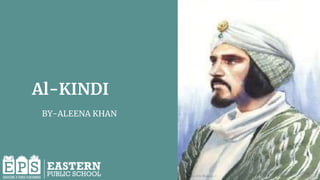
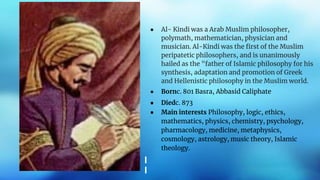
● Al- Kindi was a Arab Muslim philosopher,
polymath, mathematician, physician and
musician. Al-Kindi was the first of the Muslim
peripatetic philosophers, and is unanimously
hailed as the "father of Islamic philosophy for his
synthesis, adaptation and promotion of Greek
and Hellenistic philosophy in the Muslim world.
● Bornc. 801 Basra, Abbasid Caliphate
● Diedc. 873
● Main interests Philosophy, logic, ethics,
mathematics, physics, chemistry, psychology,
pharmacology, medicine, metaphysics,
cosmology, astrology, music theory, Islamic
theology.
EARLY LIFE
● Al-Kindi was born and brought up in Kufa, which was a centre for Arab
culture and learning in the 9th century. This was certainly the right
place for al-Kindi to get the best education possible at this time.
● Kindi's father was the governor of Kufah, as his grandfather had been
before him. Certainly all agree that al-Kindi was descended from the
Royal Kindah tribe which had originated in southern Arabia. This tribe
had united a number of tribes and reached a position of prominence in
the 5th and 6th centuries but then lost power from the middle of the 6th
century. However, descendants of the Royal Kindah continued to hold
prominent court positions in Muslim times.
● After beginning his education in Kufah, al-Kindi moved to Baghdad to
complete his studies and there he quickly achieved fame for his scholarship.
He came to the attention of the Caliph al-Ma'mun who was at that time
setting up the "House of Wisdom" in Baghdad.
● Al-Kindi was appointed by al-Ma'mun to the House of Wisdom together
with al-Khwarizmi and the Banu Musa brothers. The main task that al-
Kindi and his colleagues undertook in the House of Wisdom involved the
translation of Greek scientific manuscripts.
INFLUENCE OF AL-KINDI IN CHINA
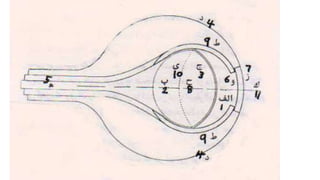
Al-kindi influenced china with his concepts of systematic analysis
of radiation, shadows, and the phenomena of reflection……..
References
https://en.wikipedia.org/wiki/Al-Kindi#Influence
http://www-groups.dcs.st-and.ac.uk/history/Biographies/Al-Kindi.html
https://scholar.google.co.in/scholar?q=influence+of+al+kindi+in+china&hl=en&as_sdt=0&as_vis=1&oi=scholart&s
a=X&ved=0ahUKEwj90e2t3aLWAhWBOI8KHSkvCNQQgQMIIzAA

Al- Kindi

  • 1.
  • 2.
    ● Al- Kindiwas a Arab Muslim philosopher, polymath, mathematician, physician and musician. Al-Kindi was the first of the Muslim peripatetic philosophers, and is unanimously hailed as the "father of Islamic philosophy for his synthesis, adaptation and promotion of Greek and Hellenistic philosophy in the Muslim world. ● Bornc. 801 Basra, Abbasid Caliphate ● Diedc. 873 ● Main interests Philosophy, logic, ethics, mathematics, physics, chemistry, psychology, pharmacology, medicine, metaphysics, cosmology, astrology, music theory, Islamic theology.
  • 3.
    EARLY LIFE ● Al-Kindiwas born and brought up in Kufa, which was a centre for Arab culture and learning in the 9th century. This was certainly the right place for al-Kindi to get the best education possible at this time. ● Kindi's father was the governor of Kufah, as his grandfather had been before him. Certainly all agree that al-Kindi was descended from the Royal Kindah tribe which had originated in southern Arabia. This tribe had united a number of tribes and reached a position of prominence in the 5th and 6th centuries but then lost power from the middle of the 6th century. However, descendants of the Royal Kindah continued to hold prominent court positions in Muslim times.
  • 4.
    ● After beginninghis education in Kufah, al-Kindi moved to Baghdad to complete his studies and there he quickly achieved fame for his scholarship. He came to the attention of the Caliph al-Ma'mun who was at that time setting up the "House of Wisdom" in Baghdad. ● Al-Kindi was appointed by al-Ma'mun to the House of Wisdom together with al-Khwarizmi and the Banu Musa brothers. The main task that al- Kindi and his colleagues undertook in the House of Wisdom involved the translation of Greek scientific manuscripts.
  • 8.
    INFLUENCE OF AL-KINDIIN CHINA Al-kindi influenced china with his concepts of systematic analysis of radiation, shadows, and the phenomena of reflection……..
  • 9.