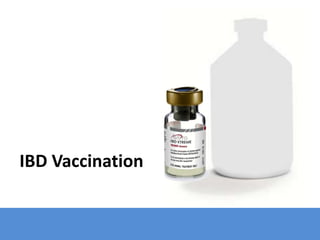
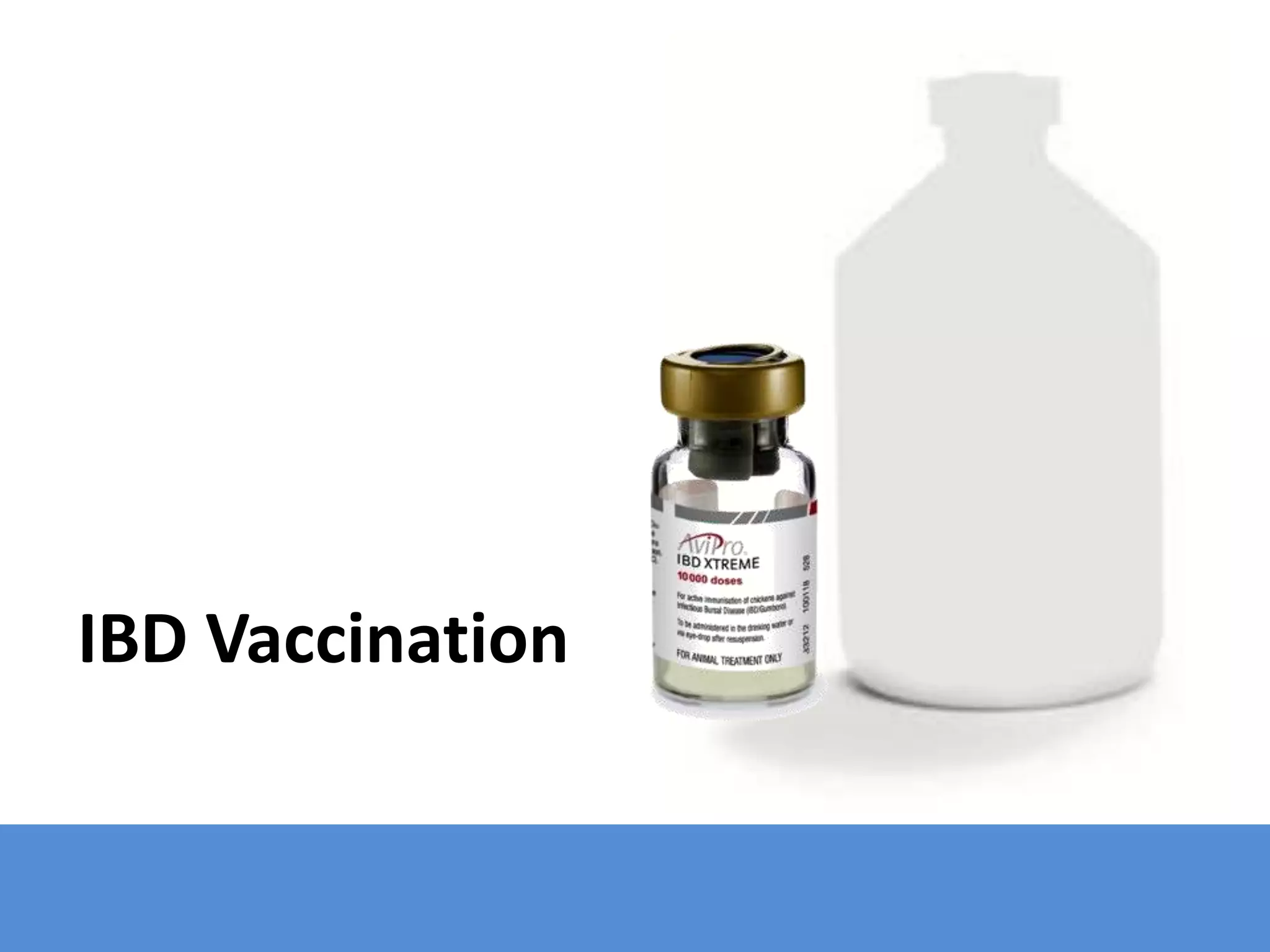
IBD Vaccination
Plan of talk
 Hyperimmunisation of breeders
 Vaccination and maternal immunity
 Types of vaccines
 Live vaccines
 Choosing live vaccine
 Timing of vaccination
 Characteristics of good life vaccine
Plan of talk
 Hyperimmunisation of breeders
 Vaccination and maternal immunity
 Types of vaccines
 Live vaccines
 Choosing live vaccine
 Timing of vaccination
 Characteristics of good life vaccine
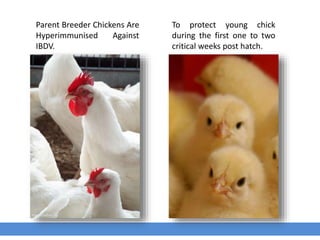
To protect young chick
during the first one to two
critical weeks post hatch.
Parent Breeder Chickens Are
Hyperimmunised Against
IBDV.
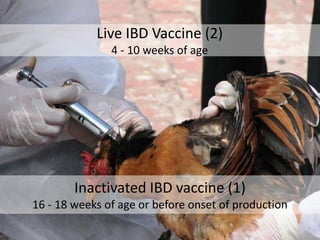
Live IBD Vaccine (2)
4 - 10 weeks of age
Inactivated IBD vaccine (1)
16 - 18 weeks of age or before onset of production
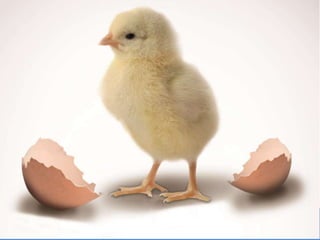
The resultant high level of IBDV neutralizing
antibodies are passively transferred to the day
old chick via the yolk sac (MDA).
Plan of talk
 Hyperimmunisation of breeders
 Vaccination and maternal immunity
 Types of vaccines
 Live vaccines
 Choosing live vaccine
 Timing of vaccination
 Characteristics of good life vaccine
IBD Vaccine and MDA
 Since IBDV enters through the oral route, and should find its
way to the bursa via the blood stream, any MDA in chick
blood would neutralize the vaccine.
MDA
Maternal Derived Antibodies
MDA Decrease
 MDA is protective when present at a sufficiently high titre.
 Due to metabolism and growth, the antibody titre declines to
half (t1/2) at a rate of:
• Broilers 3.5 days
• Broiler breeders 4.5 days
• Layers 5.5 days
 2 to 3 weeks post hatch, the susceptibility of a chicken flock to
an IBDV infection increases.
MDA & Vaccination
Breeder flocks are immunized against IBD, so they would confer
protective antibodies to their progenies.
Advantage
 Protects chickens from early infection.
Disadvantage:
 Neutralizes live vaccines.
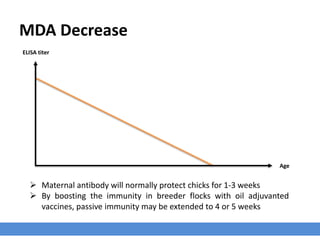
MDA Decrease
ELISA titer
Age
 Maternal antibody will normally protect chicks for 1-3 weeks
 By boosting the immunity in breeder flocks with oil adjuvanted
vaccines, passive immunity may be extended to 4 or 5 weeks
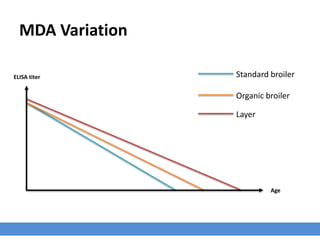
MDA Variation
ELISA titer
Age
Standard broiler
Layer
Organic broiler
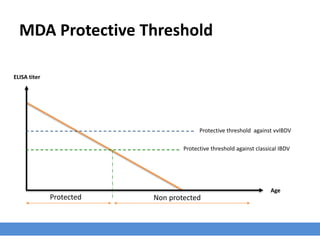
MDA Protective Threshold
ELISA titer
Age
Protected Non protected
Protective threshold against classical IBDV
Protective threshold against vvIBDV
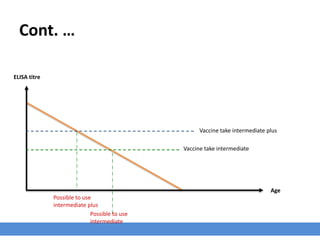
Cont. …
ELISA titre
Age
Possible to use
intermediate plus
Possible to use
intermediate
Vaccine take intermediate
Vaccine take intermediate plus
Plan of talk
 Hyperimmunisation of Breeders
 Vaccination and Maternal Immunity
 Types of Vaccines
 Live Vaccines
 Choosing live vaccine
 Timing of Vaccination
 Characteristics of good life vaccine
Types of IBD vaccines
1. Life attenuated vaccines
2. HVT Recombinant Vaccine
3. Virus-Antibody Complex Vaccines
4. Inactivated vaccines
Live Attenuated Vaccines
Live attenuated vaccines
 They are administered as the primary defense in the young
susceptible chicken.
 Commercial live vaccines are classified into 3 groups:
a) Intermediate strains
b) Intermediate plus strains
c) Hot strains
HVT Recombinant Vaccine
Composition
 The concept of recombinant vaccines is to insert genes of
critical immunizing epitopes (VP2) of IBD virus into a vector
virus HVT (herpesvirus of turkeys).
 While the vector virus replicates, the VP2 also replicates at
the same rate resulting immunization against both.
Cont. …
Precautions
 The HVT is usually a slow replicating virus, it induces immune
response after 14 days.
 Adding a gene to the HVT may slows its replication and
extends the 14 days.
Immune Complex Vaccine
Composition
Antibody specific for the virus
+
Vaccine virus
 Both are mixed in an appropriate ratio.
 The antibodies surround the vaccine virus.
Cont. …
Significance of adding antibodies
 The presence of antibodies protect vaccine virus from being
neutralized by MDA.
 Antibodies delay, by several days, the normal course of
vaccine virus replication.
 This process controls the time of releasing vaccine virus.
Cont. …
Precaution
 The level of MDA should be adjusted to the vaccine virus
strain.
Inactivated vaccines
 They are administered to boost the immunity of parent birds.
 Not used for layers
Plan of talk
 Hyperimmunisation of Breeders
 Vaccination and Maternal Immunity
 Types of Vaccines
 Live Vaccines
 Choosing live vaccine
 Timing of Vaccination
 Characteristics of good life vaccine
Live Vaccines
Objective of using life vaccines:
Live vaccines are administered to achieve active immunity.
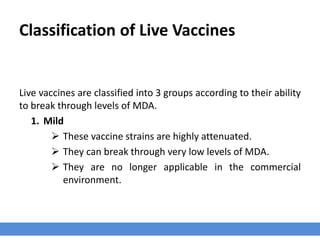
Classification of Live Vaccines
Live vaccines are classified into 3 groups according to their ability
to break through levels of MDA.
1. Mild
 These vaccine strains are highly attenuated.
 They can break through very low levels of MDA.
 They are no longer applicable in the commercial
environment.
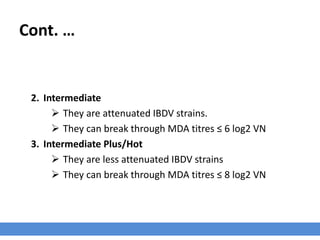
Cont. …
2. Intermediate
 They are attenuated IBDV strains.
 They can break through MDA titres ≤ 6 log2 VN
3. Intermediate Plus/Hot
 They are less attenuated IBDV strains
 They can break through MDA titres ≤ 8 log2 VN
When to Use More Invasive Vaccine?
 The main feature of the presence of very virulent IBDV field
challenge is increased mortality.
 vvIBDV can break through higher levels of MDA than
intermediate IBDV vaccines infections can occur before it is
possible to immunise the chicks with intermediate vaccines.
Cont. …
 To be able to compete with such vvIBDV viruses and induce
immunity in the face of still high maternal immunity, more
invasive IBDV vaccines strains are required.
 The main objective is to reduce mortality and the prevalence
of vvIBDV in the flocks
 Once this aim has been reached return to intermediate
vaccines
General Recommendations
 In farms with IBD problems or in “hot areas”
1. Use a hot or intermediate plus vaccine 3 – 4 cycles;
2. Followed by an intermediate vaccine
 In “endemic” areas, multiple age farms and farms relying
solely on hot vaccines
1. Use continuously a hot vaccine.
Whenever possible try to switch back from a hot vaccine to an
intermediate
Plan of talk
 Hyperimmunisation of Breeders
 Vaccination and Maternal Immunity
 Types of Vaccines
 Live Vaccines
 Choosing live vaccine
 Timing of Vaccination
 Characteristics of good life vaccine
Choosing Live Vaccine
Choice of live vaccine depends on:
1. Virulence of field infection
 Mild and Intermediate vaccine strains can not protect
against vvIBDV.
 Mild and Intermediate vaccine strains cannot be
administered at an early age due to MDA interference.
2. Age of chickens to be vaccinated
 The earlier the vaccination the higher the level of MDA,
requiring a stronger vaccine.
Cont. …
3. Age at which Gumboro outbreak occurs.
 Early outbreaks require earlier vaccination.
 Infections before 2 weeks require using vaccine that cover
variant strains.
 Late infections requires intermediate plus or hot strains.
Plan of talk
 Hyperimmunisation of Breeders
 Vaccination and Maternal Immunity
 Types of Vaccines
 Live Vaccines
 Choosing live vaccine
 Timing of Vaccination
 Characteristics of good life vaccine
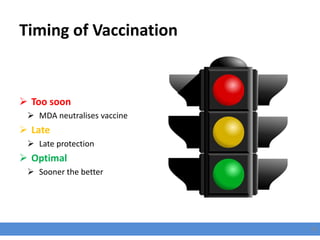
Timing of Vaccination
 Too soon
 MDA neutralises vaccine
 Late
 Late protection
 Optimal
 Sooner the better
36
Cont. …
There is no IBD vaccination schedule that
can be routinely recommended.
Cont. …
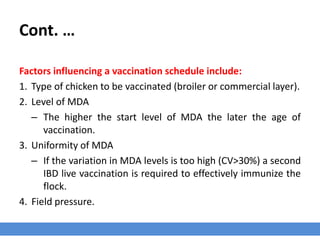
Factors influencing a vaccination schedule include:
1. Type of chicken to be vaccinated (broiler or commercial layer).
2. Level of MDA
– The higher the start level of MDA the later the age of
vaccination.
3. Uniformity of MDA
– If the variation in MDA levels is too high (CV>30%) a second
IBD live vaccination is required to effectively immunize the
flock.
4. Field pressure.
Plan of talk
 Hyperimmunisation of Breeders
 Vaccination and Maternal Immunity
 Types of Vaccines
 Live Vaccines
 Choosing live vaccine
 Timing of Vaccination
 Characteristics of good life vaccine
Characteristics of Good Life Vaccine
1. Early protection.
2. Minimum immunosuppression.
3. Highest antibody titer.
4. Cross protection between different strains.
5. Easy application.

IBD_Vaccination

  • 1.
  • 2.
    Plan of talk Hyperimmunisation of breeders  Vaccination and maternal immunity  Types of vaccines  Live vaccines  Choosing live vaccine  Timing of vaccination  Characteristics of good life vaccine
  • 3.
    Plan of talk Hyperimmunisation of breeders  Vaccination and maternal immunity  Types of vaccines  Live vaccines  Choosing live vaccine  Timing of vaccination  Characteristics of good life vaccine
  • 4.
    To protect youngchick during the first one to two critical weeks post hatch. Parent Breeder Chickens Are Hyperimmunised Against IBDV.
  • 5.
    Live IBD Vaccine(2) 4 - 10 weeks of age Inactivated IBD vaccine (1) 16 - 18 weeks of age or before onset of production
  • 6.
    The resultant highlevel of IBDV neutralizing antibodies are passively transferred to the day old chick via the yolk sac (MDA).
  • 7.
    Plan of talk Hyperimmunisation of breeders  Vaccination and maternal immunity  Types of vaccines  Live vaccines  Choosing live vaccine  Timing of vaccination  Characteristics of good life vaccine
  • 8.
    IBD Vaccine andMDA  Since IBDV enters through the oral route, and should find its way to the bursa via the blood stream, any MDA in chick blood would neutralize the vaccine.
  • 9.
  • 10.
    MDA Decrease  MDAis protective when present at a sufficiently high titre.  Due to metabolism and growth, the antibody titre declines to half (t1/2) at a rate of: • Broilers 3.5 days • Broiler breeders 4.5 days • Layers 5.5 days  2 to 3 weeks post hatch, the susceptibility of a chicken flock to an IBDV infection increases.
  • 11.
    MDA & Vaccination Breederflocks are immunized against IBD, so they would confer protective antibodies to their progenies. Advantage  Protects chickens from early infection. Disadvantage:  Neutralizes live vaccines.
  • 12.
    MDA Decrease ELISA titer Age Maternal antibody will normally protect chicks for 1-3 weeks  By boosting the immunity in breeder flocks with oil adjuvanted vaccines, passive immunity may be extended to 4 or 5 weeks
  • 13.
    MDA Variation ELISA titer Age Standardbroiler Layer Organic broiler
  • 14.
    MDA Protective Threshold ELISAtiter Age Protected Non protected Protective threshold against classical IBDV Protective threshold against vvIBDV
  • 15.
    Cont. … ELISA titre Age Possibleto use intermediate plus Possible to use intermediate Vaccine take intermediate Vaccine take intermediate plus
  • 16.
    Plan of talk Hyperimmunisation of Breeders  Vaccination and Maternal Immunity  Types of Vaccines  Live Vaccines  Choosing live vaccine  Timing of Vaccination  Characteristics of good life vaccine
  • 17.
    Types of IBDvaccines 1. Life attenuated vaccines 2. HVT Recombinant Vaccine 3. Virus-Antibody Complex Vaccines 4. Inactivated vaccines
  • 18.
    Live Attenuated Vaccines Liveattenuated vaccines  They are administered as the primary defense in the young susceptible chicken.  Commercial live vaccines are classified into 3 groups: a) Intermediate strains b) Intermediate plus strains c) Hot strains
  • 19.
    HVT Recombinant Vaccine Composition The concept of recombinant vaccines is to insert genes of critical immunizing epitopes (VP2) of IBD virus into a vector virus HVT (herpesvirus of turkeys).  While the vector virus replicates, the VP2 also replicates at the same rate resulting immunization against both.
  • 20.
    Cont. … Precautions  TheHVT is usually a slow replicating virus, it induces immune response after 14 days.  Adding a gene to the HVT may slows its replication and extends the 14 days.
  • 21.
    Immune Complex Vaccine Composition Antibodyspecific for the virus + Vaccine virus  Both are mixed in an appropriate ratio.  The antibodies surround the vaccine virus.
  • 22.
    Cont. … Significance ofadding antibodies  The presence of antibodies protect vaccine virus from being neutralized by MDA.  Antibodies delay, by several days, the normal course of vaccine virus replication.  This process controls the time of releasing vaccine virus.
  • 23.
    Cont. … Precaution  Thelevel of MDA should be adjusted to the vaccine virus strain.
  • 24.
    Inactivated vaccines  Theyare administered to boost the immunity of parent birds.  Not used for layers
  • 25.
    Plan of talk Hyperimmunisation of Breeders  Vaccination and Maternal Immunity  Types of Vaccines  Live Vaccines  Choosing live vaccine  Timing of Vaccination  Characteristics of good life vaccine
  • 26.
    Live Vaccines Objective ofusing life vaccines: Live vaccines are administered to achieve active immunity.
  • 27.
    Classification of LiveVaccines Live vaccines are classified into 3 groups according to their ability to break through levels of MDA. 1. Mild  These vaccine strains are highly attenuated.  They can break through very low levels of MDA.  They are no longer applicable in the commercial environment.
  • 28.
    Cont. … 2. Intermediate They are attenuated IBDV strains.  They can break through MDA titres ≤ 6 log2 VN 3. Intermediate Plus/Hot  They are less attenuated IBDV strains  They can break through MDA titres ≤ 8 log2 VN
  • 29.
    When to UseMore Invasive Vaccine?  The main feature of the presence of very virulent IBDV field challenge is increased mortality.  vvIBDV can break through higher levels of MDA than intermediate IBDV vaccines infections can occur before it is possible to immunise the chicks with intermediate vaccines.
  • 30.
    Cont. …  Tobe able to compete with such vvIBDV viruses and induce immunity in the face of still high maternal immunity, more invasive IBDV vaccines strains are required.  The main objective is to reduce mortality and the prevalence of vvIBDV in the flocks  Once this aim has been reached return to intermediate vaccines
  • 31.
    General Recommendations  Infarms with IBD problems or in “hot areas” 1. Use a hot or intermediate plus vaccine 3 – 4 cycles; 2. Followed by an intermediate vaccine  In “endemic” areas, multiple age farms and farms relying solely on hot vaccines 1. Use continuously a hot vaccine. Whenever possible try to switch back from a hot vaccine to an intermediate
  • 32.
    Plan of talk Hyperimmunisation of Breeders  Vaccination and Maternal Immunity  Types of Vaccines  Live Vaccines  Choosing live vaccine  Timing of Vaccination  Characteristics of good life vaccine
  • 33.
    Choosing Live Vaccine Choiceof live vaccine depends on: 1. Virulence of field infection  Mild and Intermediate vaccine strains can not protect against vvIBDV.  Mild and Intermediate vaccine strains cannot be administered at an early age due to MDA interference. 2. Age of chickens to be vaccinated  The earlier the vaccination the higher the level of MDA, requiring a stronger vaccine.
  • 34.
    Cont. … 3. Ageat which Gumboro outbreak occurs.  Early outbreaks require earlier vaccination.  Infections before 2 weeks require using vaccine that cover variant strains.  Late infections requires intermediate plus or hot strains.
  • 35.
    Plan of talk Hyperimmunisation of Breeders  Vaccination and Maternal Immunity  Types of Vaccines  Live Vaccines  Choosing live vaccine  Timing of Vaccination  Characteristics of good life vaccine
  • 36.
    Timing of Vaccination Too soon  MDA neutralises vaccine  Late  Late protection  Optimal  Sooner the better 36
  • 37.
    Cont. … There isno IBD vaccination schedule that can be routinely recommended.
  • 38.
    Cont. … Factors influencinga vaccination schedule include: 1. Type of chicken to be vaccinated (broiler or commercial layer). 2. Level of MDA – The higher the start level of MDA the later the age of vaccination. 3. Uniformity of MDA – If the variation in MDA levels is too high (CV>30%) a second IBD live vaccination is required to effectively immunize the flock. 4. Field pressure.
  • 39.
    Plan of talk Hyperimmunisation of Breeders  Vaccination and Maternal Immunity  Types of Vaccines  Live Vaccines  Choosing live vaccine  Timing of Vaccination  Characteristics of good life vaccine
  • 40.
    Characteristics of GoodLife Vaccine 1. Early protection. 2. Minimum immunosuppression. 3. Highest antibody titer. 4. Cross protection between different strains. 5. Easy application.