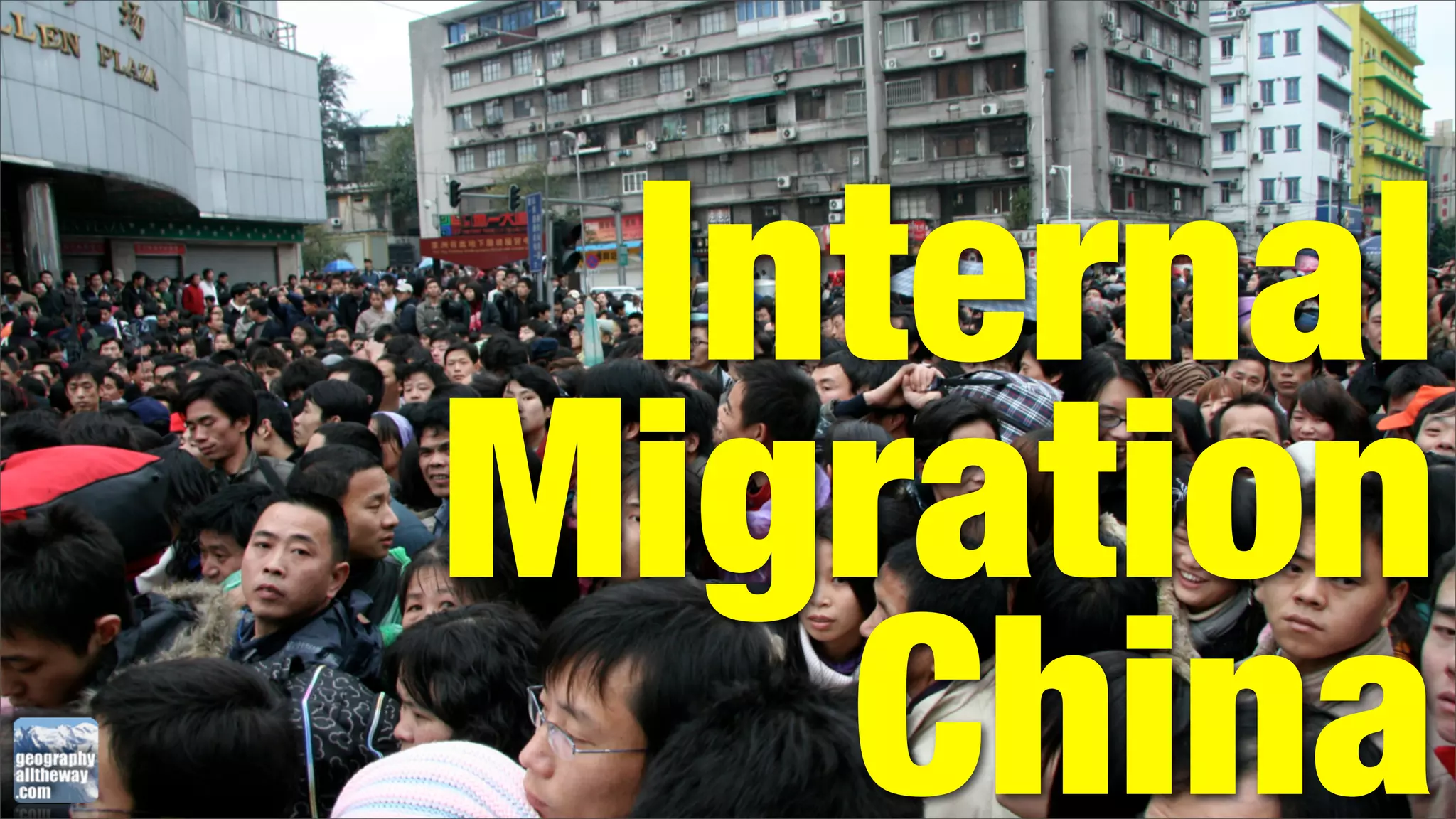






Internal
Migration
   China
Wall Street Journal: On the Move, April 12, 2008
  In 2008 44% of China's population lives in cities.
Wall Street Journal: On the Move, April 12, 2008
  In 2008 44% of China's population lives in cities.

  Projections say urbanites will be the majority by 2015 or earlier.
Wall Street Journal: On the Move, April 12, 2008
  In 2008 44% of China's population lives in cities.

  Projections say urbanites will be the majority by 2015 or earlier.

  The urban population is swelling by roughly 15 million to 20 million each
  year, perhaps the largest peacetime migration in history.
Wall Street Journal: On the Move, April 12, 2008
  In 2008 44% of China's population lives in cities.

  Projections say urbanites will be the majority by 2015 or earlier.

  The urban population is swelling by roughly 15 million to 20 million each
  year, perhaps the largest peacetime migration in history.

  Migrants move for a chance to exchange a life of subsistence agriculture
  for better-paid jobs in the cities, such as construction or factory work.
Wall Street Journal: On the Move, April 12, 2008
  For decades, China's government has restricted migration through the
  household-registration system, called hukou or huji.
Wall Street Journal: On the Move, April 12, 2008
  For decades, China's government has restricted migration through the
  household-registration system, called hukou or huji.

  The system ties Chinese to their place of birth; residents can receive
  official education, health care and other services only where they are
  registered.
Wall Street Journal: On the Move, April 12, 2008
  For decades, China's government has restricted migration through the
  household-registration system, called hukou or huji.

  The system ties Chinese to their place of birth; residents can receive
  official education, health care and other services only where they are
  registered.

  The system is one reason China has lagged behind many other
  developing countries in making the transition to an urban society. For
  instance, Latin America and South America were already majority urban
  by the mid-1960s.
Wall Street Journal: On the Move, April 12, 2008
  Many migrants remain trapped in a halfway existence, where it is
  administratively difficult for them to settle down in the city where they
  work but economically impossible to remain in their rural village.
Wall Street Journal: On the Move, April 12, 2008
  Many migrants remain trapped in a halfway existence, where it is
  administratively difficult for them to settle down in the city where they
  work but economically impossible to remain in their rural village.

  China's "floating population" - rural people working outside their home
  village - totaled 132 million in 2006, according to a survey by the
  country's National Bureau of Statistics.
Wall Street Journal: On the Move, April 12, 2008
  Many migrants remain trapped in a halfway existence, where it is
  administratively difficult for them to settle down in the city where they
  work but economically impossible to remain in their rural village.

  China's "floating population" - rural people working outside their home
  village - totaled 132 million in 2006, according to a survey by the
  country's National Bureau of Statistics.

  The government's judgment has been, in effect, that maintaining a huge
  temporary migrant population is better than overwhelming cities with a
  permanent influx of people.
Wall Street Journal: On the Move, April 12, 2008
  Small cities have relaxed their hukou rules, making it comparatively easy
  for newcomers to register and settle down.
Wall Street Journal: On the Move, April 12, 2008
  Small cities have relaxed their hukou rules, making it comparatively easy
  for newcomers to register and settle down.

  Other local governments are experimenting with a hukou system that
  does away with the distinction between rural and urban residents of the
  same district - so farmers can easily and officially move to a city in their
  home district.
Wall Street Journal: On the Move, April 12, 2008
  Small cities have relaxed their hukou rules, making it comparatively easy
  for newcomers to register and settle down.

  Other local governments are experimenting with a hukou system that
  does away with the distinction between rural and urban residents of the
  same district - so farmers can easily and officially move to a city in their
  home district.

  Changing the place of one's hukou has also become a somewhat easier
  and less exceptional procedure.
WSJ: China Fears Restive Migrants As Jobs Disappear in
Cities, December 2, 2008
WSJ: China Fears Restive Migrants As Jobs Disappear in
Cities, December 2, 2008
  China's roaring industrial economy has been abruptly quieted by the
  effects of the global financial crisis.

  Rural provinces that supplied much of China's factory manpower are
  watching the beginnings of a wave of reverse migration.

  Fast-rising unemployment has led to an unusual series of strikes and
  protests.
WSJ: China Fears Restive Migrants As Jobs Disappear in
Cities, December 2, 2008
WSJ: China Fears Restive Migrants As Jobs Disappear in
Cities, December 2, 2008
  The Government tries to calm tensions in the cities, it also fears that
  newly unemployed migrants returning home could upend the already-
  strained social system in the countryside.
WSJ: China Fears Restive Migrants As Jobs Disappear in
Cities, December 2, 2008
  The Government tries to calm tensions in the cities, it also fears that
  newly unemployed migrants returning home could upend the already-
  strained social system in the countryside.

  Officials are keeping 24-hour tabs on arrivals to monitor how many of the
  migrants will return industrial centers.
WSJ: China Fears Restive Migrants As Jobs Disappear in
Cities, December 2, 2008
  The Government tries to calm tensions in the cities, it also fears that
  newly unemployed migrants returning home could upend the already-
  strained social system in the countryside.

  Officials are keeping 24-hour tabs on arrivals to monitor how many of the
  migrants will return industrial centers.

  Despite Beijing's efforts to persuade workers to stay in cities and train for
  potential new jobs.
IB Geography - Patterns and Change - China's Internal Migration

IB Geography - Patterns and Change - China's Internal Migration

  • 1.
  • 2.
    Wall Street Journal:On the Move, April 12, 2008
  • 3.
    Wall Street Journal:On the Move, April 12, 2008 In 2008 44% of China's population lives in cities.
  • 4.
    Wall Street Journal:On the Move, April 12, 2008 In 2008 44% of China's population lives in cities. Projections say urbanites will be the majority by 2015 or earlier.
  • 5.
    Wall Street Journal:On the Move, April 12, 2008 In 2008 44% of China's population lives in cities. Projections say urbanites will be the majority by 2015 or earlier. The urban population is swelling by roughly 15 million to 20 million each year, perhaps the largest peacetime migration in history.
  • 6.
    Wall Street Journal:On the Move, April 12, 2008 In 2008 44% of China's population lives in cities. Projections say urbanites will be the majority by 2015 or earlier. The urban population is swelling by roughly 15 million to 20 million each year, perhaps the largest peacetime migration in history. Migrants move for a chance to exchange a life of subsistence agriculture for better-paid jobs in the cities, such as construction or factory work.
  • 7.
    Wall Street Journal:On the Move, April 12, 2008
  • 8.
    Wall Street Journal:On the Move, April 12, 2008 For decades, China's government has restricted migration through the household-registration system, called hukou or huji.
  • 9.
    Wall Street Journal:On the Move, April 12, 2008 For decades, China's government has restricted migration through the household-registration system, called hukou or huji. The system ties Chinese to their place of birth; residents can receive official education, health care and other services only where they are registered.
  • 10.
    Wall Street Journal:On the Move, April 12, 2008 For decades, China's government has restricted migration through the household-registration system, called hukou or huji. The system ties Chinese to their place of birth; residents can receive official education, health care and other services only where they are registered. The system is one reason China has lagged behind many other developing countries in making the transition to an urban society. For instance, Latin America and South America were already majority urban by the mid-1960s.
  • 11.
    Wall Street Journal:On the Move, April 12, 2008
  • 12.
    Wall Street Journal:On the Move, April 12, 2008 Many migrants remain trapped in a halfway existence, where it is administratively difficult for them to settle down in the city where they work but economically impossible to remain in their rural village.
  • 13.
    Wall Street Journal:On the Move, April 12, 2008 Many migrants remain trapped in a halfway existence, where it is administratively difficult for them to settle down in the city where they work but economically impossible to remain in their rural village. China's "floating population" - rural people working outside their home village - totaled 132 million in 2006, according to a survey by the country's National Bureau of Statistics.
  • 14.
    Wall Street Journal:On the Move, April 12, 2008 Many migrants remain trapped in a halfway existence, where it is administratively difficult for them to settle down in the city where they work but economically impossible to remain in their rural village. China's "floating population" - rural people working outside their home village - totaled 132 million in 2006, according to a survey by the country's National Bureau of Statistics. The government's judgment has been, in effect, that maintaining a huge temporary migrant population is better than overwhelming cities with a permanent influx of people.
  • 15.
    Wall Street Journal:On the Move, April 12, 2008
  • 16.
    Wall Street Journal:On the Move, April 12, 2008 Small cities have relaxed their hukou rules, making it comparatively easy for newcomers to register and settle down.
  • 17.
    Wall Street Journal:On the Move, April 12, 2008 Small cities have relaxed their hukou rules, making it comparatively easy for newcomers to register and settle down. Other local governments are experimenting with a hukou system that does away with the distinction between rural and urban residents of the same district - so farmers can easily and officially move to a city in their home district.
  • 18.
    Wall Street Journal:On the Move, April 12, 2008 Small cities have relaxed their hukou rules, making it comparatively easy for newcomers to register and settle down. Other local governments are experimenting with a hukou system that does away with the distinction between rural and urban residents of the same district - so farmers can easily and officially move to a city in their home district. Changing the place of one's hukou has also become a somewhat easier and less exceptional procedure.
  • 19.
    WSJ: China FearsRestive Migrants As Jobs Disappear in Cities, December 2, 2008
  • 20.
    WSJ: China FearsRestive Migrants As Jobs Disappear in Cities, December 2, 2008 China's roaring industrial economy has been abruptly quieted by the effects of the global financial crisis. Rural provinces that supplied much of China's factory manpower are watching the beginnings of a wave of reverse migration. Fast-rising unemployment has led to an unusual series of strikes and protests.
  • 21.
    WSJ: China FearsRestive Migrants As Jobs Disappear in Cities, December 2, 2008
  • 22.
    WSJ: China FearsRestive Migrants As Jobs Disappear in Cities, December 2, 2008 The Government tries to calm tensions in the cities, it also fears that newly unemployed migrants returning home could upend the already- strained social system in the countryside.
  • 23.
    WSJ: China FearsRestive Migrants As Jobs Disappear in Cities, December 2, 2008 The Government tries to calm tensions in the cities, it also fears that newly unemployed migrants returning home could upend the already- strained social system in the countryside. Officials are keeping 24-hour tabs on arrivals to monitor how many of the migrants will return industrial centers.
  • 24.
    WSJ: China FearsRestive Migrants As Jobs Disappear in Cities, December 2, 2008 The Government tries to calm tensions in the cities, it also fears that newly unemployed migrants returning home could upend the already- strained social system in the countryside. Officials are keeping 24-hour tabs on arrivals to monitor how many of the migrants will return industrial centers. Despite Beijing's efforts to persuade workers to stay in cities and train for potential new jobs.