UNIT- 1
Referring PAT
 The Passenger Air Tariff (PAT) is the authoritative source of passenger
fares and rules information to the travel industry in printed form.
 It offers a comprehensive coverage of both IATA and carrier specific
fares and rules.
 This publication is produced by IATA and SITA.
 All information in the PAT is divided into he following three
categories:
 Maximum permitted mileage
 General Rules
 Worldwide fares
Passenger Air Tariff Editions
 The PAT set includes the following books shown below:
 1. Maximum Permitted Mileage
 2. General Rules
 3.Worldwide Fares
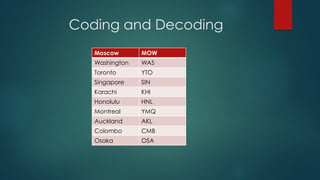
Coding and Decoding
Moscow MOW
Washington WAS
Toronto YTO
Singapore SIN
Karachi KHI
Honolulu HNL
Montreal YMQ
Auckland AKL
Colombo CMB
Osaka OSA
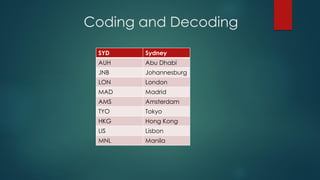
Coding and Decoding
SYD Sydney
AUH Abu Dhabi
JNB Johannesburg
LON London
MAD Madrid
AMS Amsterdam
TYO Tokyo
HKG Hong Kong
LIS Lisbon
MNL Manila
JOURNEY
 A journey consists of the entire routing included on a ticket or group
of conjunction tickets and is composed of the ticketed points.
Types of Journey
 One Way Trip:
A simple one way journey is travel using one way (OW) fares and has
the following features:
The origin and the final destination are in different countries.
1. Routing: CAS
NYC
MEX
This journey consists of one fare component or pricing unit.
ROUND TRIP
 A round trip (RT) is travel entirely by air from a point to another point
and return to the original point, comprising two half round trip fare
components only, for which the applicable half round trip fare for
each component as measured from the point of unit origin, is the
same for the routing travelled.
 A round trip has only two fare components i.e., the outbound and
inbound components.
 The outbound fare need not be equal to the inbound fare.
 The unit origin and unit destination points are the same.
 For a journey with a single pricing unit, the COC is also the same as
the destination country.
Anatomy of a Journey
 Origin- The initial starting point and the first ticketed point in the routing. It is also
a fare construction point and is usually in the country of commencement of
travel (COC).
 Destination - The ultimate stopping place of the journey and as terminal point in
the routing it is also considered a fare construction point or a fare break point.
 Intermediate point(s)- ticketed via point(s)in between consecutive fare
construction points. Also called Transfer points that are further classified as
either:
 1. Intermediate Stopover point:
Which is a point where a passenger arrives at an intermediate point
and is scheduled to depart later than 24 hours after arrival (local time).
A stopover is arranged in advance and specified on the passenger
ticket; or
2. Intermediate no stopover point:
Which is a point where the passenger arrives and departs within 24
hours. It is also known as a transfer connection or connecting point.
 Fare component:
A component or a portion of the itinerary between two consecutive
fare construction points. Thus a journey may have one or more fare
components.
Pricing unit:
A journey or part of a journey which is priced as a separate entity, i.e.
capable of being ticketed separately.
OW sub journey: Part of a journey wherein travel from one country
does not return to such country or which has an international gap.
Return Sub journey – Part of a journey wherein travel is from a
point/country and return thereto and for which the fare is assessed as
a single pricing unit using half RT fares, e.g., round trip, circle trip and
open jaws.
Sectors - A portion of the journey comprised of legs or segments mostly
used in reference to fare construction. This usually involves a pair of
points.
Unit Destination- The final stopping place of a pricing unit.
Unit Origin – The initial starting point of a pricing unit.
 Sample RT routing: Mahe Island – Zurich – Mahe Island
 SEZ
ZRH
 SEZ
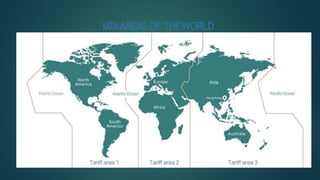
IATAAREAS OF THEWORLD
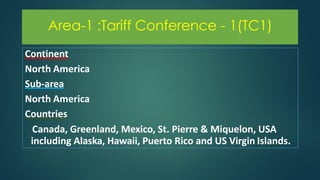
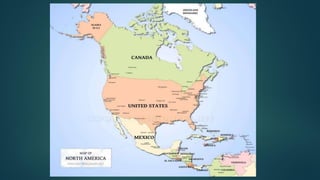
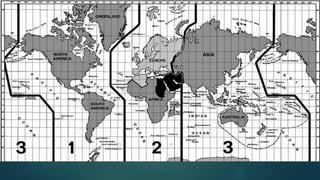
Area-1 :Tariff Conference - 1(TC1)
Continent
North America
Sub-area
North America
Countries
Canada, Greenland, Mexico, St. Pierre & Miquelon, USA
including Alaska, Hawaii, Puerto Rico and US Virgin Islands.
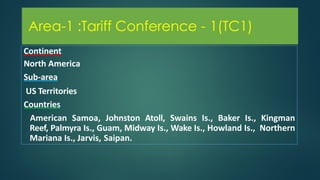
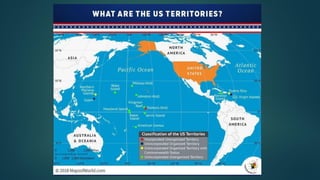
Area-1 :Tariff Conference - 1(TC1)
Continent
North America
Sub-area
US Territories
Countries
American Samoa, Johnston Atoll, Swains Is., Baker Is., Kingman
Reef, Palmyra Is., Guam, Midway Is., Wake Is., Howland Is., Northern
Mariana Is., Jarvis, Saipan.
Area-1 :Tariff Conference - 1(TC1)
Continent
North America
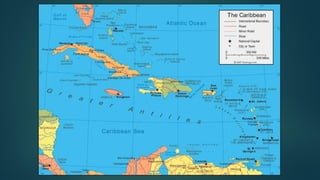
Sub-area
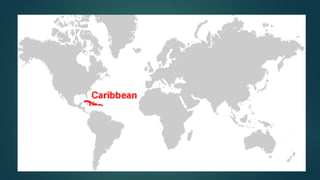
Caribbean
Countries
Anguilla, Dominican Republic, Antilles, Antigua and Bermuda, Grenada, St. Kitts
and Nevis, Barbados, Haiti, St. Vincent and The grenadines, Cayman Islands,
Jamaica, Trinidad and Tobago, Cuba, Martinique, Turks and Caicos Is., Dominica,
Montserrat, British Virgin Islands.
Area-1 :Tariff Conference -
1(TC1)
Area-1 :Tariff Conference - 1(TC1)
Continent
South America
Sub-area
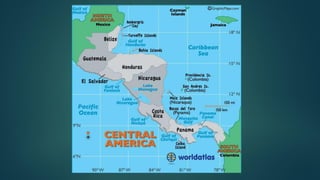
Central America
Countries
Belize, El Salvador, Honduras, Costa Rica, Guatemala, Nicaragua.
Area-1 :Tariff Conference -
1(TC1)
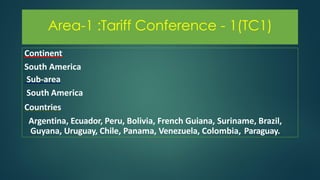
Area-1 :Tariff Conference - 1(TC1)
Continent
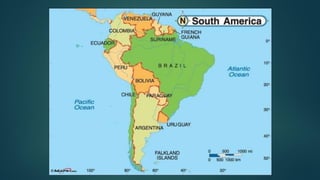
South America
Sub-area
South America
Countries
Argentina, Ecuador, Peru, Bolivia, French Guiana, Suriname, Brazil,
Guyana, Uruguay, Chile, Panama, Venezuela, Colombia, Paraguay.
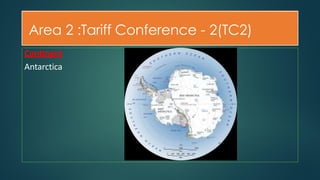
Area 2 :Tariff Conference - 2(TC2)
Continent
Antarctica
Area 2 :Tariff Conference - 2(TC2)
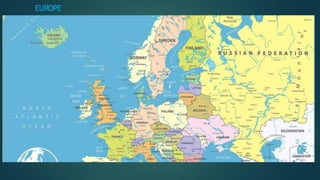
Lithuania, Spain, Croatia, Luxembourg, Sweden, Cyprus, Macedonia,
Switzerland, Czech Republic, Malta, Tunisia, Denmark, Moldova, Turkey,
Estonia, Monaco, Ukraine, Finland, Montenegro, United Kingdom, France,
Morocco, Georgia, Netherlands, Latvia, Slovakia, Bosnia& Herzegovina,
Liechtenstein, Slovenia, Bulgaria.
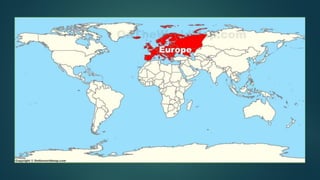
EUROPE
Area 2 :Tariff Conference - 2(TC2)
Sub-area
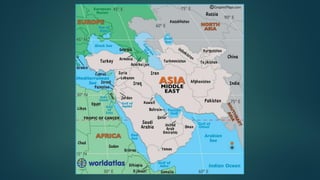
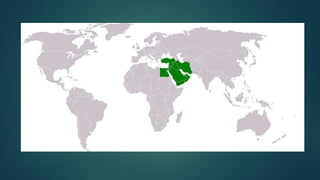
Middle East
Countries
Bahrain, Jordan, Saudi Arabia, Egypt, Kuwait, Sudan, Iran, Lebanon,
Syria, Iraq, Oman, United Arab Emirates, Israel, Qatar, Yemen.
Area 2 :Tariff Conference - 2(TC2)
Continent
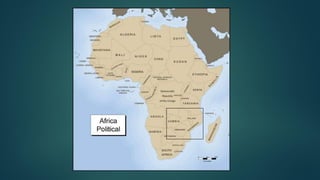
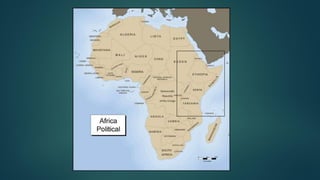
Africa
Sub-area
Central Africa
Countries
Malawi, Zambia, Zimbabwe.
Area 2 :Tariff Conference - 2(TC2)
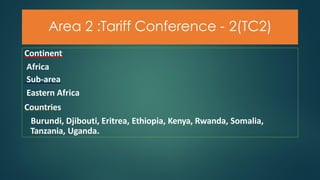
Continent
Africa
Sub-area
Eastern Africa
Countries
Burundi, Djibouti, Eritrea, Ethiopia, Kenya, Rwanda, Somalia,
Tanzania, Uganda.
Area 2 :Tariff Conference - 2(TC2)
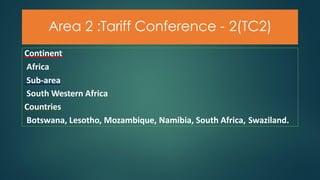
Continent
Africa
Sub-area
South Western Africa
Countries
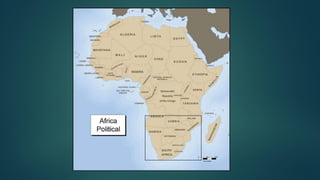
Botswana, Lesotho, Mozambique, Namibia, South Africa, Swaziland.
Area 2 :Tariff Conference - 2(TC2)
Continent
Africa
Sub-area
Western Africa
Countries
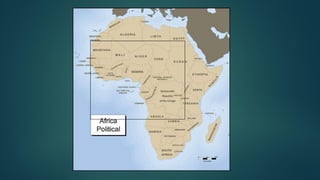
Angola, Benin, Burkina Faso, Cameroon, Cape Verde, Central African
Republic, Chad, Congo, Brazzaville, Congo Kinshasa, Côte D’Ivoire,
Equatorial Guinea, Gabon, Gambia, Ghana, Guinea, Guinea – Bissau,
Liberia, Mali, Mauritania, Niger, Nigeria, Sao Tome and Principe,
Senegal, Sierra Leone, Togo.
Area 2 :Tariff Conference - 2(TC2)
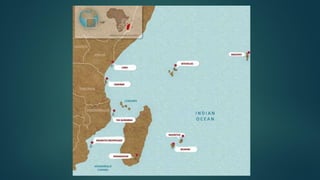
Mauritius, Mayotte, Reunion, Seychelles,
Sub-area
Indian Ocean Islands
Countries
Comoros, Madagascar,
Libya.
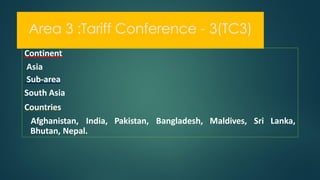
Area 3 :Tariff Conference - 3(TC3)
Continent
Asia
Sub-area
South Asia
Countries
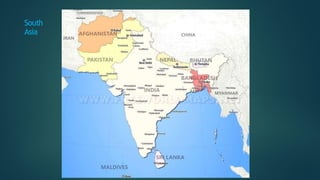
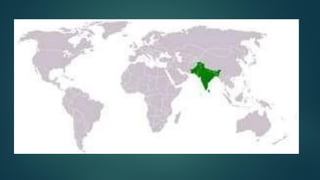
Afghanistan, India, Pakistan, Bangladesh, Maldives, Sri Lanka,
Bhutan, Nepal.
South
Asia
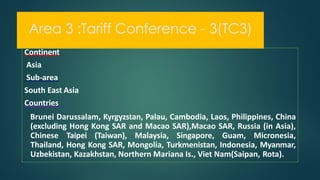
Area 3 :Tariff Conference - 3(TC3)
Continent
Asia
Sub-area
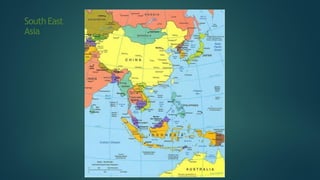
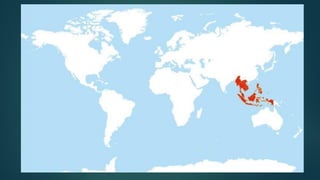
South East Asia
Countries
Brunei Darussalam, Kyrgyzstan, Palau, Cambodia, Laos, Philippines, China
(excluding Hong Kong SAR and Macao SAR),Macao SAR, Russia (in Asia),
Chinese Taipei (Taiwan), Malaysia, Singapore, Guam, Micronesia,
Thailand, Hong Kong SAR, Mongolia, Turkmenistan, Indonesia, Myanmar,
Uzbekistan, Kazakhstan, Northern Mariana Is., Viet Nam(Saipan, Rota).
SouthEast
Asia
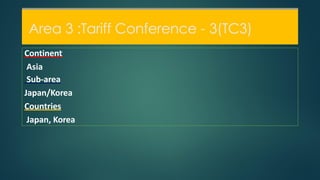
Area 3 :Tariff Conference - 3(TC3)
Continent
Asia
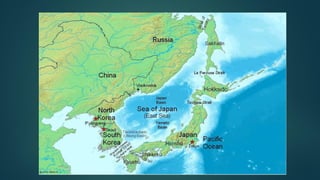
Sub-area
Japan/Korea
Countries
Japan, Korea
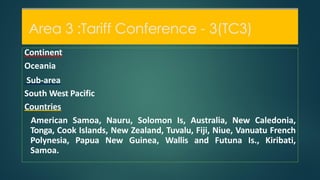
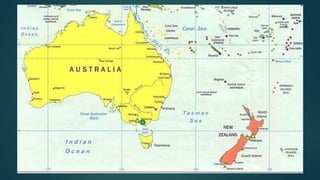
Area 3 :Tariff Conference - 3(TC3)
Continent
Oceania
Sub-area
South West Pacific
Countries
American Samoa, Nauru, Solomon Is, Australia, New Caledonia,
Tonga, Cook Islands, New Zealand, Tuvalu, Fiji, Niue, Vanuatu French
Polynesia, Papua New Guinea, Wallis and Futuna Is., Kiribati,
Samoa.
Area 3 :Tariff Conference - 3(TC3)
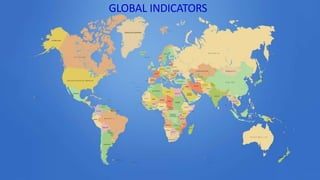
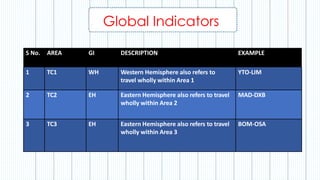
GLOBAL INDICATORS
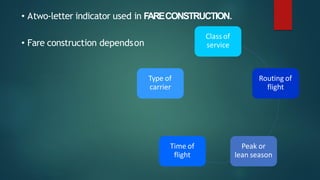
• Atwo-letter indicator used in FARECONSTRUCTION.
• Fare construction dependson
Class of
service
Routing of
flight
Peak or
lean season
Time of
flight
Type of
carrier
S No. AREA GI DESCRIPTION EXAMPLE
1 TC1 WH Western Hemisphere also refers to
travel wholly within Area 1
YTO-LIM
2 TC2 EH Eastern Hemisphere also refers to travel
wholly within Area 2
MAD-DXB
3 TC3 EH Eastern Hemisphere also refers to travel
wholly within Area 3
BOM-OSA
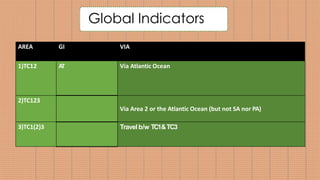
Global Indicators
AREA GI VIA
1)TC12 AT Via Atlantic Ocean
2)TC123
Via Area 2 or the Atlantic Ocean (but not SA nor PA)
3)TC1(2)3 Travel b/w TC1&TC3
Global Indicators
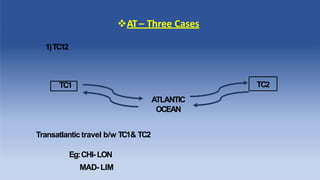
❖AT– Three Cases
1)TC12
TC1 TC2
ATLANTIC
OCEAN
Transatlantictravel b/w TC1& TC2
Eg:CHI- LON
MAD- LIM
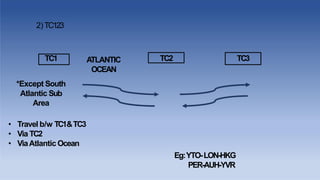
2)TC123
TC1 TC2
ATLANTIC
OCEAN
Eg:YTO-LON-HKG
PER-AUH-YVR
TC3
*Except South
Atlantic Sub
Area
• Travel b/w TC1&TC3
• Via TC2
• ViaAtlantic Ocean
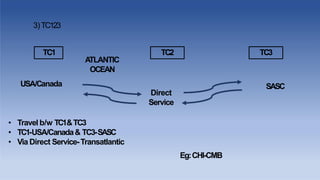
3)TC123
ATLANTIC
OCEAN
• Travel b/w TC1&TC3
• TC1-USA/Canada& TC3-SASC
• Via Direct Service-Transatlantic
Eg:CHI-CMB
USA/Canada
Direct
Service
TC1 TC2 TC3
SASC
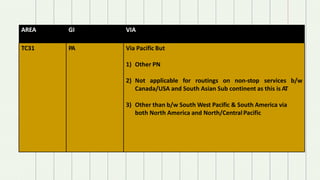
AREA GI VIA
TC31 PA Via Pacific But
1) Other PN
2) Not applicable for routings on non-stop services b/w
Canada/USA and South Asian Sub continent as this is AT
3) Other than b/w South West Pacific & South America via
both North America and North/CentralPacific
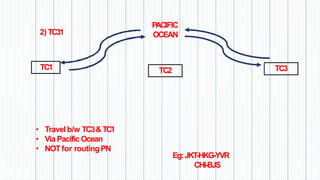
2) TC31
P
ACIFIC
OCEAN
• Travel b/w TC3& TC1
• Via Pacific Ocean
• NOTfor routingPN
Eg:JKT-HKG-YVR
CHI-BJS
TC1 TC2 TC3
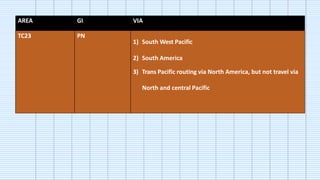
AREA GI VIA
TC23 PN
1) South West Pacific
2) South America
3) Trans Pacific routing via North America, but not travel via
North and central Pacific
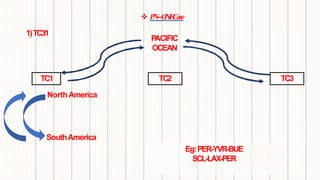
1)TC31
P
ACIFIC
OCEAN
Eg:PER-YVR-BUE
SCL-LAX-PER
❖ PN–O
N
E
Case
NorthAmerica
SouthAmerica
TC1 TC2 TC3
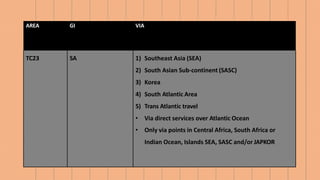
AREA GI VIA
TC23 SA 1) Southeast Asia (SEA)
2) South Asian Sub-continent (SASC)
3) Korea
4) South Atlantic Area
5) Trans Atlantic travel
• Via direct services over Atlantic Ocean
• Only via points in Central Africa, South Africa or
Indian Ocean, Islands SEA, SASC and/or JAPKOR
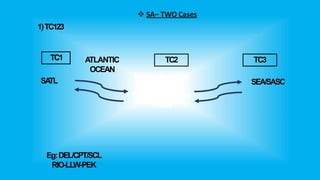
1)TC123
ATLANTIC
OCEAN
Eg:DEL/CPT/SCL
RIO-LLW-PEK
SA
TL
*Only via points
in
Central/Southern
Africa
❖ SA– TWO Cases
SEA/SASC
TC1 TC2 TC3
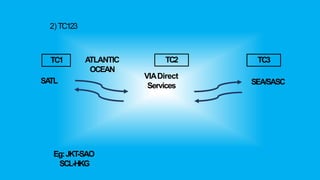
2)TC123
ATLANTIC
OCEAN
Eg:JKT-SAO
SCL-HKG
SA
TL
VIADirect
Services SEA/SASC
TC1 TC2 TC3
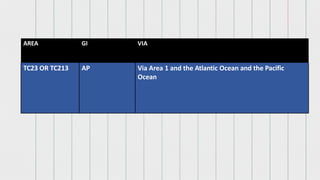
AREA GI VIA
TC23 OR TC213 AP Via Area 1 and the Atlantic Ocean and the Pacific
Ocean
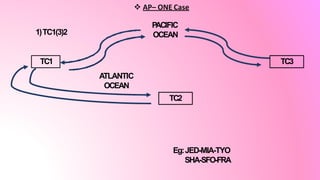
1)TC1(3)2
P
ACIFIC
OCEAN
Eg:JED-MIA-TYO
SHA-SFO-FRA
❖ AP– ONE Case
TC1
ATLANTIC
OCEAN
TC2
TC3
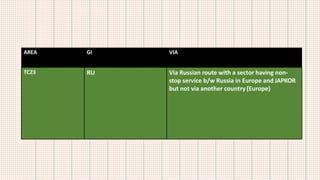
AREA GI VIA
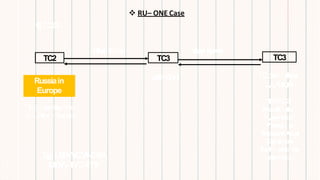
TC23 RU Via Russian route with a sector having non-
stop service b/w Russia in Europe and JAPKOR
but not via another country (Europe)
1)TC23
TC2 TC3
NonStop
Eg:LED-MOW-OSA
MOW-TYO-TYE
TC3
Russiain
Europe
*Other than
JAPKOR
❖ RU– ONE Case
*Not via anyother
country inEurope
JAPKOR
May have
*EXPECT
Kazakhstan
Kyrgyzstan
Mangolia
RussiainAsia
Tajikistan
Turkmenistan
Uzbekistan
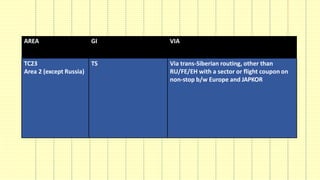
AREA GI VIA
TC23
Area 2 (except Russia)
TS Via trans-Siberian routing, other than
RU/FE/EH with a sector or flight coupon on
non-stop b/w Europe and JAPKOR
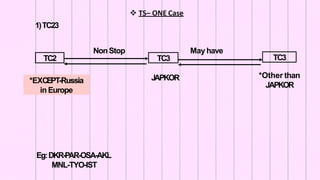
1)TC23
NonStop
Eg:DKR-PAR-OSA-AKL
MNL-TYO-IST
TC3
*EXCEPT-Russia
in Europe
*Other than
JAPKOR
❖ TS– ONE Case
JAPKOR
May have
TC2 TC3
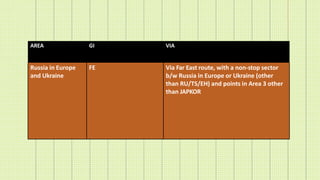
AREA GI VIA
Russia in Europe
and Ukraine
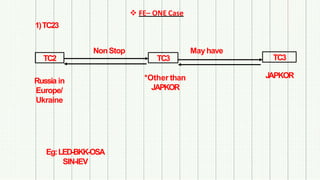
FE Via Far East route, with a non-stop sector
b/w Russia in Europe or Ukraine (other
than RU/TS/EH) and points in Area 3 other
than JAPKOR
1)TC23
TC2 TC3
NonStop
Eg:LED-BKK-OSA
SIN-IEV
TC3
Russia in
Europe/
Ukraine
JAPKOR
❖ FE– ONE Case
*Other than
JAPKOR
May have
Fare Selection Criteria
 Fare Type:
Fares are divided into normal fares and special fares.
Normal fares:
Are fares that do not have as many restrictions as special fares. In case
there are restrictions, these would usually include conditions regarding:
 Number of stopovers and transfers in the routing
 Seasonal or day of week periods of application
 Flight/carrier application
Special Fares
 Special fares are low promotional fares that have more restrictions
than the normal type. Such restrictions are mostly in respect of:
 Length of stay such as minimum and maximum stay requirements.
 Advance purchase requirements
 Reservations, payments and ticketing limits
 Day/time of travel
 Eligibility restrictions
 Refundability and changeability
World Time Zones
 World Time Zones
 World is split up into 24 time zones.
 Most time zones are exactly one hour apart, and by convention compute their
local time as an offset from UTC or GMT. In many locations, these offsets vary
twice yearly due to DST transitions.
 Every country may have a particular standard time zone though, if it is more
convenient for its world cooperation.
 The standard time zone is a region where the local or national authorities unify
the time for a particular goal. The time zones obey specific rules referring to
longitude.
Daylight Saving Time
 The concept of Daylight Saving Time (DST) was proposed by Benjamin Franklin
and refers to advancing the standard time within the region or zone by one
hour to enhance the duration of daytime.
 Typically clocks are adjusted forward one hour in spring and backwards in
autumn.
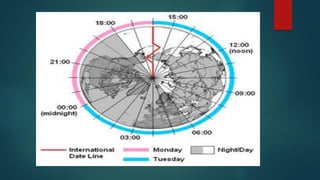
International Date Line
 The (IDL) is an imaginary line of demarcation on the surface of Earth that runs
from the North Pole to the South Pole and demarcates the change of
one calendar day to the next.
 It passes through the middle of the Pacific Ocean, roughly following
the 180° line of longitude but deviating to pass around some territories and
island groups.

IATA AREAS.pdf

  • 1.
  • 2.
    Referring PAT  ThePassenger Air Tariff (PAT) is the authoritative source of passenger fares and rules information to the travel industry in printed form.  It offers a comprehensive coverage of both IATA and carrier specific fares and rules.  This publication is produced by IATA and SITA.  All information in the PAT is divided into he following three categories:  Maximum permitted mileage  General Rules  Worldwide fares
  • 3.
    Passenger Air TariffEditions  The PAT set includes the following books shown below:  1. Maximum Permitted Mileage  2. General Rules  3.Worldwide Fares
  • 4.
    Coding and Decoding MoscowMOW Washington WAS Toronto YTO Singapore SIN Karachi KHI Honolulu HNL Montreal YMQ Auckland AKL Colombo CMB Osaka OSA
  • 5.
    Coding and Decoding SYDSydney AUH Abu Dhabi JNB Johannesburg LON London MAD Madrid AMS Amsterdam TYO Tokyo HKG Hong Kong LIS Lisbon MNL Manila
  • 6.
    JOURNEY  A journeyconsists of the entire routing included on a ticket or group of conjunction tickets and is composed of the ticketed points.
  • 7.
    Types of Journey One Way Trip: A simple one way journey is travel using one way (OW) fares and has the following features: The origin and the final destination are in different countries. 1. Routing: CAS NYC MEX This journey consists of one fare component or pricing unit.
  • 8.
    ROUND TRIP  Around trip (RT) is travel entirely by air from a point to another point and return to the original point, comprising two half round trip fare components only, for which the applicable half round trip fare for each component as measured from the point of unit origin, is the same for the routing travelled.  A round trip has only two fare components i.e., the outbound and inbound components.  The outbound fare need not be equal to the inbound fare.  The unit origin and unit destination points are the same.  For a journey with a single pricing unit, the COC is also the same as the destination country.
  • 9.
    Anatomy of aJourney  Origin- The initial starting point and the first ticketed point in the routing. It is also a fare construction point and is usually in the country of commencement of travel (COC).  Destination - The ultimate stopping place of the journey and as terminal point in the routing it is also considered a fare construction point or a fare break point.  Intermediate point(s)- ticketed via point(s)in between consecutive fare construction points. Also called Transfer points that are further classified as either:
  • 10.
     1. IntermediateStopover point: Which is a point where a passenger arrives at an intermediate point and is scheduled to depart later than 24 hours after arrival (local time). A stopover is arranged in advance and specified on the passenger ticket; or 2. Intermediate no stopover point: Which is a point where the passenger arrives and departs within 24 hours. It is also known as a transfer connection or connecting point.
  • 11.
     Fare component: Acomponent or a portion of the itinerary between two consecutive fare construction points. Thus a journey may have one or more fare components. Pricing unit: A journey or part of a journey which is priced as a separate entity, i.e. capable of being ticketed separately. OW sub journey: Part of a journey wherein travel from one country does not return to such country or which has an international gap.
  • 12.
    Return Sub journey– Part of a journey wherein travel is from a point/country and return thereto and for which the fare is assessed as a single pricing unit using half RT fares, e.g., round trip, circle trip and open jaws. Sectors - A portion of the journey comprised of legs or segments mostly used in reference to fare construction. This usually involves a pair of points. Unit Destination- The final stopping place of a pricing unit. Unit Origin – The initial starting point of a pricing unit.
  • 13.
     Sample RTrouting: Mahe Island – Zurich – Mahe Island  SEZ ZRH  SEZ
  • 14.
  • 15.
  • 17.
    Area-1 :Tariff Conference- 1(TC1) Continent North America Sub-area North America Countries Canada, Greenland, Mexico, St. Pierre & Miquelon, USA including Alaska, Hawaii, Puerto Rico and US Virgin Islands.
  • 19.
    Area-1 :Tariff Conference- 1(TC1) Continent North America Sub-area US Territories Countries American Samoa, Johnston Atoll, Swains Is., Baker Is., Kingman Reef, Palmyra Is., Guam, Midway Is., Wake Is., Howland Is., Northern Mariana Is., Jarvis, Saipan. Area-1 :Tariff Conference - 1(TC1)
  • 21.
    Area-1 :Tariff Conference- 1(TC1) Continent North America Sub-area Caribbean Countries Anguilla, Dominican Republic, Antilles, Antigua and Bermuda, Grenada, St. Kitts and Nevis, Barbados, Haiti, St. Vincent and The grenadines, Cayman Islands, Jamaica, Trinidad and Tobago, Cuba, Martinique, Turks and Caicos Is., Dominica, Montserrat, British Virgin Islands. Area-1 :Tariff Conference - 1(TC1)
  • 24.
    Area-1 :Tariff Conference- 1(TC1) Continent South America Sub-area Central America Countries Belize, El Salvador, Honduras, Costa Rica, Guatemala, Nicaragua. Area-1 :Tariff Conference - 1(TC1)
  • 27.
    Area-1 :Tariff Conference- 1(TC1) Continent South America Sub-area South America Countries Argentina, Ecuador, Peru, Bolivia, French Guiana, Suriname, Brazil, Guyana, Uruguay, Chile, Panama, Venezuela, Colombia, Paraguay.
  • 29.
    Area 2 :TariffConference - 2(TC2) Continent Antarctica Area 2 :Tariff Conference - 2(TC2) Area 2 :Tariff Conference - 2(TC2)
  • 30.
    Area 2 :TariffConference - 2(TC2) Lithuania, Spain, Croatia, Luxembourg, Sweden, Cyprus, Macedonia, Switzerland, Czech Republic, Malta, Tunisia, Denmark, Moldova, Turkey, Estonia, Monaco, Ukraine, Finland, Montenegro, United Kingdom, France, Morocco, Georgia, Netherlands, Latvia, Slovakia, Bosnia& Herzegovina, Liechtenstein, Slovenia, Bulgaria.
  • 31.
  • 33.
    Area 2 :TariffConference - 2(TC2) Sub-area Middle East Countries Bahrain, Jordan, Saudi Arabia, Egypt, Kuwait, Sudan, Iran, Lebanon, Syria, Iraq, Oman, United Arab Emirates, Israel, Qatar, Yemen.
  • 36.
    Area 2 :TariffConference - 2(TC2) Continent Africa Sub-area Central Africa Countries Malawi, Zambia, Zimbabwe.
  • 38.
    Area 2 :TariffConference - 2(TC2) Continent Africa Sub-area Eastern Africa Countries Burundi, Djibouti, Eritrea, Ethiopia, Kenya, Rwanda, Somalia, Tanzania, Uganda.
  • 40.
    Area 2 :TariffConference - 2(TC2) Continent Africa Sub-area South Western Africa Countries Botswana, Lesotho, Mozambique, Namibia, South Africa, Swaziland.
  • 42.
    Area 2 :TariffConference - 2(TC2) Continent Africa Sub-area Western Africa Countries Angola, Benin, Burkina Faso, Cameroon, Cape Verde, Central African Republic, Chad, Congo, Brazzaville, Congo Kinshasa, Côte D’Ivoire, Equatorial Guinea, Gabon, Gambia, Ghana, Guinea, Guinea – Bissau, Liberia, Mali, Mauritania, Niger, Nigeria, Sao Tome and Principe, Senegal, Sierra Leone, Togo.
  • 44.
    Area 2 :TariffConference - 2(TC2) Mauritius, Mayotte, Reunion, Seychelles, Sub-area Indian Ocean Islands Countries Comoros, Madagascar, Libya.
  • 46.
    Area 3 :TariffConference - 3(TC3) Continent Asia Sub-area South Asia Countries Afghanistan, India, Pakistan, Bangladesh, Maldives, Sri Lanka, Bhutan, Nepal.
  • 47.
  • 49.
    Area 3 :TariffConference - 3(TC3) Continent Asia Sub-area South East Asia Countries Brunei Darussalam, Kyrgyzstan, Palau, Cambodia, Laos, Philippines, China (excluding Hong Kong SAR and Macao SAR),Macao SAR, Russia (in Asia), Chinese Taipei (Taiwan), Malaysia, Singapore, Guam, Micronesia, Thailand, Hong Kong SAR, Mongolia, Turkmenistan, Indonesia, Myanmar, Uzbekistan, Kazakhstan, Northern Mariana Is., Viet Nam(Saipan, Rota).
  • 50.
  • 52.
    Area 3 :TariffConference - 3(TC3) Continent Asia Sub-area Japan/Korea Countries Japan, Korea Area 3 :Tariff Conference - 3(TC3)
  • 54.
    Area 3 :TariffConference - 3(TC3) Continent Oceania Sub-area South West Pacific Countries American Samoa, Nauru, Solomon Is, Australia, New Caledonia, Tonga, Cook Islands, New Zealand, Tuvalu, Fiji, Niue, Vanuatu French Polynesia, Papua New Guinea, Wallis and Futuna Is., Kiribati, Samoa. Area 3 :Tariff Conference - 3(TC3)
  • 56.
  • 57.
    • Atwo-letter indicatorused in FARECONSTRUCTION. • Fare construction dependson Class of service Routing of flight Peak or lean season Time of flight Type of carrier
  • 59.
    S No. AREAGI DESCRIPTION EXAMPLE 1 TC1 WH Western Hemisphere also refers to travel wholly within Area 1 YTO-LIM 2 TC2 EH Eastern Hemisphere also refers to travel wholly within Area 2 MAD-DXB 3 TC3 EH Eastern Hemisphere also refers to travel wholly within Area 3 BOM-OSA Global Indicators
  • 60.
    AREA GI VIA 1)TC12AT Via Atlantic Ocean 2)TC123 Via Area 2 or the Atlantic Ocean (but not SA nor PA) 3)TC1(2)3 Travel b/w TC1&TC3 Global Indicators
  • 61.
    ❖AT– Three Cases 1)TC12 TC1TC2 ATLANTIC OCEAN Transatlantictravel b/w TC1& TC2 Eg:CHI- LON MAD- LIM
  • 62.
    2)TC123 TC1 TC2 ATLANTIC OCEAN Eg:YTO-LON-HKG PER-AUH-YVR TC3 *Except South AtlanticSub Area • Travel b/w TC1&TC3 • Via TC2 • ViaAtlantic Ocean
  • 63.
    3)TC123 ATLANTIC OCEAN • Travel b/wTC1&TC3 • TC1-USA/Canada& TC3-SASC • Via Direct Service-Transatlantic Eg:CHI-CMB USA/Canada Direct Service TC1 TC2 TC3 SASC
  • 64.
    AREA GI VIA TC31PA Via Pacific But 1) Other PN 2) Not applicable for routings on non-stop services b/w Canada/USA and South Asian Sub continent as this is AT 3) Other than b/w South West Pacific & South America via both North America and North/CentralPacific
  • 65.
    2) TC31 P ACIFIC OCEAN • Travelb/w TC3& TC1 • Via Pacific Ocean • NOTfor routingPN Eg:JKT-HKG-YVR CHI-BJS TC1 TC2 TC3
  • 66.
    AREA GI VIA TC23PN 1) South West Pacific 2) South America 3) Trans Pacific routing via North America, but not travel via North and central Pacific
  • 67.
  • 68.
    AREA GI VIA TC23SA 1) Southeast Asia (SEA) 2) South Asian Sub-continent (SASC) 3) Korea 4) South Atlantic Area 5) Trans Atlantic travel • Via direct services over Atlantic Ocean • Only via points in Central Africa, South Africa or Indian Ocean, Islands SEA, SASC and/or JAPKOR
  • 69.
  • 70.
  • 71.
    AREA GI VIA TC23OR TC213 AP Via Area 1 and the Atlantic Ocean and the Pacific Ocean
  • 72.
  • 73.
    AREA GI VIA TC23RU Via Russian route with a sector having non- stop service b/w Russia in Europe and JAPKOR but not via another country (Europe)
  • 74.
    1)TC23 TC2 TC3 NonStop Eg:LED-MOW-OSA MOW-TYO-TYE TC3 Russiain Europe *Other than JAPKOR ❖RU– ONE Case *Not via anyother country inEurope JAPKOR May have *EXPECT Kazakhstan Kyrgyzstan Mangolia RussiainAsia Tajikistan Turkmenistan Uzbekistan
  • 75.
    AREA GI VIA TC23 Area2 (except Russia) TS Via trans-Siberian routing, other than RU/FE/EH with a sector or flight coupon on non-stop b/w Europe and JAPKOR
  • 76.
  • 77.
    AREA GI VIA Russiain Europe and Ukraine FE Via Far East route, with a non-stop sector b/w Russia in Europe or Ukraine (other than RU/TS/EH) and points in Area 3 other than JAPKOR
  • 78.
  • 79.
    Fare Selection Criteria Fare Type: Fares are divided into normal fares and special fares. Normal fares: Are fares that do not have as many restrictions as special fares. In case there are restrictions, these would usually include conditions regarding:  Number of stopovers and transfers in the routing  Seasonal or day of week periods of application  Flight/carrier application
  • 80.
    Special Fares  Specialfares are low promotional fares that have more restrictions than the normal type. Such restrictions are mostly in respect of:  Length of stay such as minimum and maximum stay requirements.  Advance purchase requirements  Reservations, payments and ticketing limits  Day/time of travel  Eligibility restrictions  Refundability and changeability
  • 81.
    World Time Zones World Time Zones  World is split up into 24 time zones.  Most time zones are exactly one hour apart, and by convention compute their local time as an offset from UTC or GMT. In many locations, these offsets vary twice yearly due to DST transitions.  Every country may have a particular standard time zone though, if it is more convenient for its world cooperation.  The standard time zone is a region where the local or national authorities unify the time for a particular goal. The time zones obey specific rules referring to longitude.
  • 82.
    Daylight Saving Time The concept of Daylight Saving Time (DST) was proposed by Benjamin Franklin and refers to advancing the standard time within the region or zone by one hour to enhance the duration of daytime.  Typically clocks are adjusted forward one hour in spring and backwards in autumn.
  • 84.
    International Date Line The (IDL) is an imaginary line of demarcation on the surface of Earth that runs from the North Pole to the South Pole and demarcates the change of one calendar day to the next.  It passes through the middle of the Pacific Ocean, roughly following the 180° line of longitude but deviating to pass around some territories and island groups.